Introduction to .NET
Comprehensive Guide to the .NET Framework
InfiniteWebSolutions 1
What is .NET?
Definition:
A free, cross-platform, open-source developer platform for
building many different types of applications.
History and development:
• Initially released by Microsoft in 2002 as the .NET
Framework.
• Evolved to .NET Core, a cross-platform framework, and
now unified under .NET 5 and later versions.
Key features:
Language interoperability, high performance, vast
ecosystem.
InfiniteWebSolutions 2
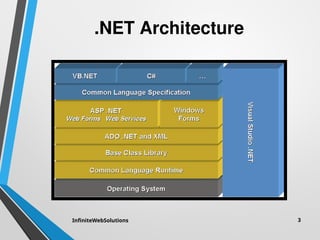
.NET Architecture
InfiniteWebSolutions 3
.NET Core vs .NET Framework
• .NET Core is cross-platform, .NET Framework is
Windows-only.
• Advantages of .NET Core: Better performance,
modularity, and support for microservices.
• When to use each: .NET Core for new projects and
cross-platform needs, .NET Framework for legacy
systems.
InfiniteWebSolutions 4
Installing .NET
System requirements:
• Supported operating systems and hardware.
Installation steps on different platforms:
• Windows: Use Visual Studio Installer.
• macOS: Download and install .NET SDK.
• Linux: Use package managers like apt or yum.
Initial configuration:
• Set up environment variables, verify installation.
InfiniteWebSolutions 5
Visual Studio Overview
Introduction to Visual Studio:
• An integrated development environment (IDE) from
Microsoft.
Installing Visual Studio:
• Download from the official website, choose workloads.
Basic features and navigation:
• Solution Explorer, code editor, debugging tools.
InfiniteWebSolutions 6
Creating a .NET Project
Setting up a new .NET project:
• Choose a project template, configure settings.
Project templates:
• Console App, Web App, Class Library, etc.
Solution Explorer:
• Manages project files, references, and configurations.
InfiniteWebSolutions 7
C# Programming Basics
Overview of C#:
• A modern, object-oriented programming language
developed by Microsoft.
Basic syntax and data types:
• Variables, data types (int, string, bool, etc.), operators.
Control structures:
• Conditional statements (if, switch), loops (for, while,
foreach).
InfiniteWebSolutions 8
Object-Oriented Programming
(OOP)
Classes and objects:
• Define classes, create objects, access members.
Inheritance and polymorphism:
• Inherit from base classes, override methods, implement
interfaces.
Interfaces and abstract classes:
• Define contracts, provide base implementation.
InfiniteWebSolutions 9
Exception Handling
Mechanism for handling runtime errors.
Try-catch blocks:
• Structure for catching and handling exceptions.
Custom exceptions:
• Define custom exception classes for specific error
scenarios.
InfiniteWebSolutions 10
Working with Data
Introduction to ADO.NET:
• A data access technology for .NET.
Connecting to a database:
• Use connection strings, establish connections.
Performing CRUD operations:
• Create, Read, Update, Delete operations using
commands and data readers.
InfiniteWebSolutions 11
Entity Framework
Overview of Entity Framework:
• An ORM (Object-Relational Mapper) for .NET.
Code-first and database-first approaches:
• Code-first: Define models in code, generate database
schema.
• Database-first: Generate models from existing database.
LINQ queries:
• Language Integrated Query for querying data in a type-
safe manner.
InfiniteWebSolutions 12
ASP.NET Core
Introduction to ASP.NET Core:
• A cross-platform, high-performance framework for
building modern web applications.
Setting up a web application:
• Create a new project, configure startup settings.
MVC pattern:
• Model-View-Controller architecture for separation of
concerns.
InfiniteWebSolutions 13
Web API Development
Creating a Web API:
• Set up controllers, define routes.
Routing and controllers:
• Map HTTP requests to controller actions.
Consuming Web APIs:
• Use HttpClient to make requests, handle responses.
InfiniteWebSolutions 14
Deployment
Deploying .NET applications:
• Package applications for deployment.
Hosting options:
• Azure, AWS, on-premises servers.
CI/CD pipelines:
• Automate build, test, and deployment processes.
InfiniteWebSolutions 15
Security in .NET
Authentication and authorization:
• Implement user authentication, role-based access
control.
Secure coding practices:
• Validate input, avoid common vulnerabilities.
Data protection:
• Encrypt sensitive data, use secure protocols.
InfiniteWebSolutions 16
Performance Tuning
Analyzing performance:
• Identify performance bottlenecks using profiling tools.
Profiling tools:
• Visual Studio Profiler, dotTrace, etc.
Optimization techniques:
• Optimize code, use caching, improve database queries.
InfiniteWebSolutions 17
Case Study
A real-world example of .NET implementation:
• Description of the project.
Challenges faced:
• Specific challenges encountered during development.
Solutions:
• How the challenges were addressed and resolved.
InfiniteWebSolutions 18
Best Practices
• Code organization, use of design patterns, testing.
• Utilize tools and libraries, follow coding standards,
perform code reviews.
InfiniteWebSolutions 19
Q&A
Open the floor for questions from the audience
InfiniteWebSolutions 20

Introduction to .NET: The Ultimate Development Framework by Infinite Web Solutions.pptx

  • 1.
    Introduction to .NET ComprehensiveGuide to the .NET Framework InfiniteWebSolutions 1
  • 2.
    What is .NET? Definition: Afree, cross-platform, open-source developer platform for building many different types of applications. History and development: • Initially released by Microsoft in 2002 as the .NET Framework. • Evolved to .NET Core, a cross-platform framework, and now unified under .NET 5 and later versions. Key features: Language interoperability, high performance, vast ecosystem. InfiniteWebSolutions 2
  • 3.
  • 4.
    .NET Core vs.NET Framework • .NET Core is cross-platform, .NET Framework is Windows-only. • Advantages of .NET Core: Better performance, modularity, and support for microservices. • When to use each: .NET Core for new projects and cross-platform needs, .NET Framework for legacy systems. InfiniteWebSolutions 4
  • 5.
    Installing .NET System requirements: •Supported operating systems and hardware. Installation steps on different platforms: • Windows: Use Visual Studio Installer. • macOS: Download and install .NET SDK. • Linux: Use package managers like apt or yum. Initial configuration: • Set up environment variables, verify installation. InfiniteWebSolutions 5
  • 6.
    Visual Studio Overview Introductionto Visual Studio: • An integrated development environment (IDE) from Microsoft. Installing Visual Studio: • Download from the official website, choose workloads. Basic features and navigation: • Solution Explorer, code editor, debugging tools. InfiniteWebSolutions 6
  • 7.
    Creating a .NETProject Setting up a new .NET project: • Choose a project template, configure settings. Project templates: • Console App, Web App, Class Library, etc. Solution Explorer: • Manages project files, references, and configurations. InfiniteWebSolutions 7
  • 8.
    C# Programming Basics Overviewof C#: • A modern, object-oriented programming language developed by Microsoft. Basic syntax and data types: • Variables, data types (int, string, bool, etc.), operators. Control structures: • Conditional statements (if, switch), loops (for, while, foreach). InfiniteWebSolutions 8
  • 9.
    Object-Oriented Programming (OOP) Classes andobjects: • Define classes, create objects, access members. Inheritance and polymorphism: • Inherit from base classes, override methods, implement interfaces. Interfaces and abstract classes: • Define contracts, provide base implementation. InfiniteWebSolutions 9
  • 10.
    Exception Handling Mechanism forhandling runtime errors. Try-catch blocks: • Structure for catching and handling exceptions. Custom exceptions: • Define custom exception classes for specific error scenarios. InfiniteWebSolutions 10
  • 11.
    Working with Data Introductionto ADO.NET: • A data access technology for .NET. Connecting to a database: • Use connection strings, establish connections. Performing CRUD operations: • Create, Read, Update, Delete operations using commands and data readers. InfiniteWebSolutions 11
  • 12.
    Entity Framework Overview ofEntity Framework: • An ORM (Object-Relational Mapper) for .NET. Code-first and database-first approaches: • Code-first: Define models in code, generate database schema. • Database-first: Generate models from existing database. LINQ queries: • Language Integrated Query for querying data in a type- safe manner. InfiniteWebSolutions 12
  • 13.
    ASP.NET Core Introduction toASP.NET Core: • A cross-platform, high-performance framework for building modern web applications. Setting up a web application: • Create a new project, configure startup settings. MVC pattern: • Model-View-Controller architecture for separation of concerns. InfiniteWebSolutions 13
  • 14.
    Web API Development Creatinga Web API: • Set up controllers, define routes. Routing and controllers: • Map HTTP requests to controller actions. Consuming Web APIs: • Use HttpClient to make requests, handle responses. InfiniteWebSolutions 14
  • 15.
    Deployment Deploying .NET applications: •Package applications for deployment. Hosting options: • Azure, AWS, on-premises servers. CI/CD pipelines: • Automate build, test, and deployment processes. InfiniteWebSolutions 15
  • 16.
    Security in .NET Authenticationand authorization: • Implement user authentication, role-based access control. Secure coding practices: • Validate input, avoid common vulnerabilities. Data protection: • Encrypt sensitive data, use secure protocols. InfiniteWebSolutions 16
  • 17.
    Performance Tuning Analyzing performance: •Identify performance bottlenecks using profiling tools. Profiling tools: • Visual Studio Profiler, dotTrace, etc. Optimization techniques: • Optimize code, use caching, improve database queries. InfiniteWebSolutions 17
  • 18.
    Case Study A real-worldexample of .NET implementation: • Description of the project. Challenges faced: • Specific challenges encountered during development. Solutions: • How the challenges were addressed and resolved. InfiniteWebSolutions 18
  • 19.
    Best Practices • Codeorganization, use of design patterns, testing. • Utilize tools and libraries, follow coding standards, perform code reviews. InfiniteWebSolutions 19
  • 20.
    Q&A Open the floorfor questions from the audience InfiniteWebSolutions 20