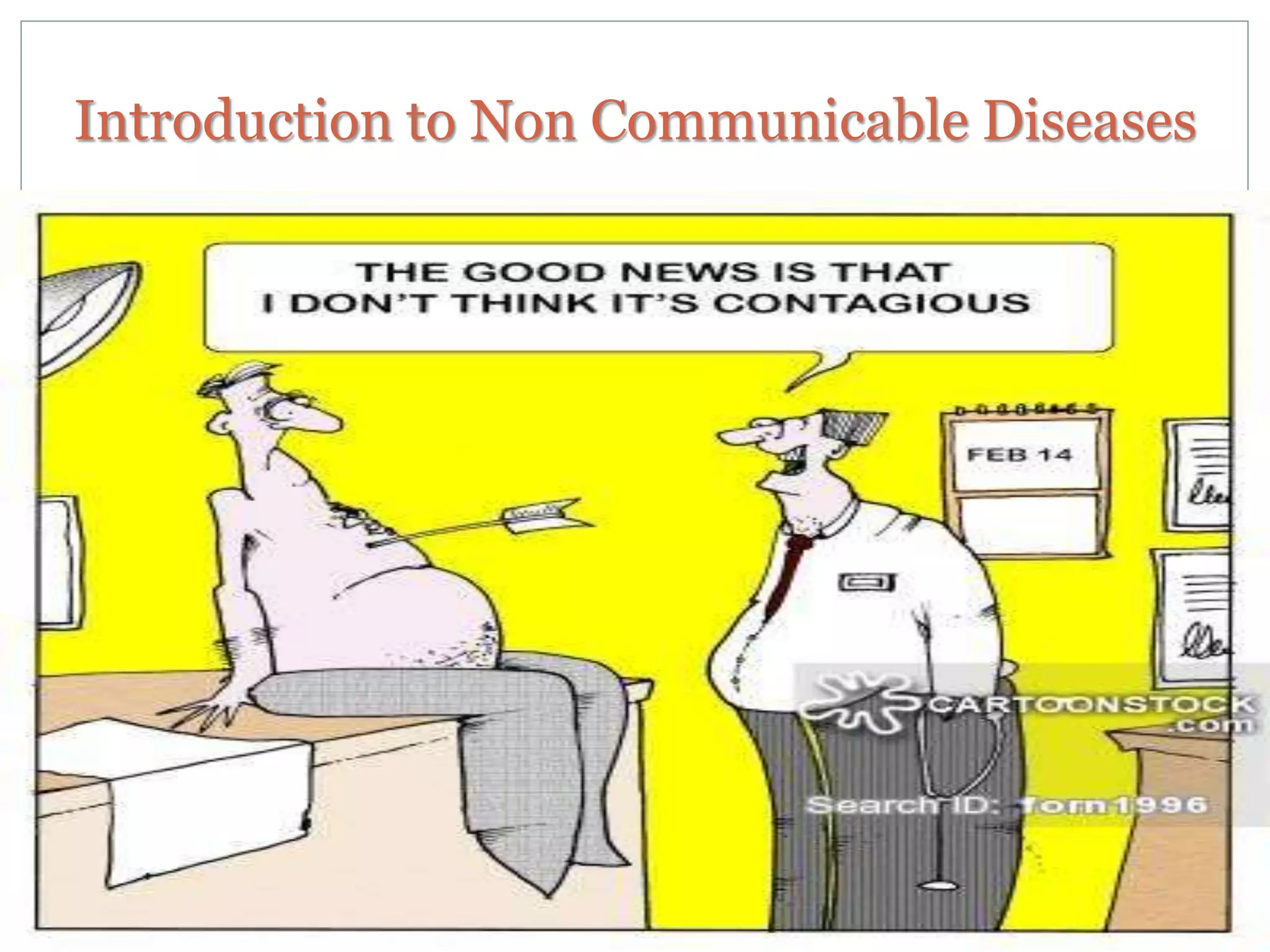
Introduction to Non Communicable Diseases
Definition
 An EURO symposium in 1957 gave the definition
“ an impairment of bodily structure and/or function
that necessitates a modification of the patient’s
normal life, and persisted over an extended period of
time.”
 Commission on Chronic Illness in USA has defined
“Chronic Diseases” as :
“Comprising all impairments or deviations from normal,
which have one or more of the following characteristics:
a) Are permanent
b) Leave residual disability
c) Are caused by non-reversible pathological alteration
d) Require special training of the patient for rehabilitation
e) May be expected to require a long period of
supervision, observation or care”
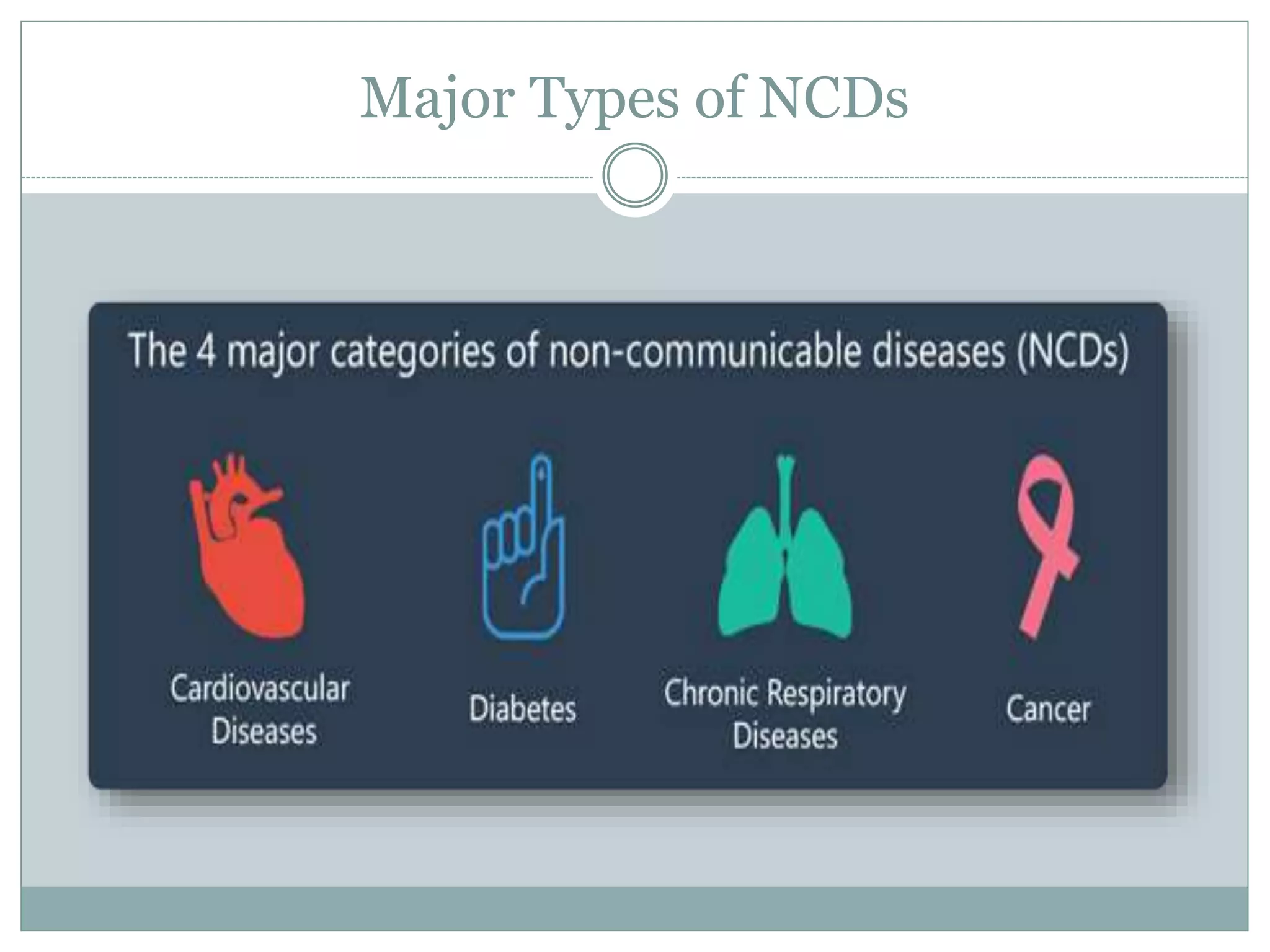
Major Types of NCDs
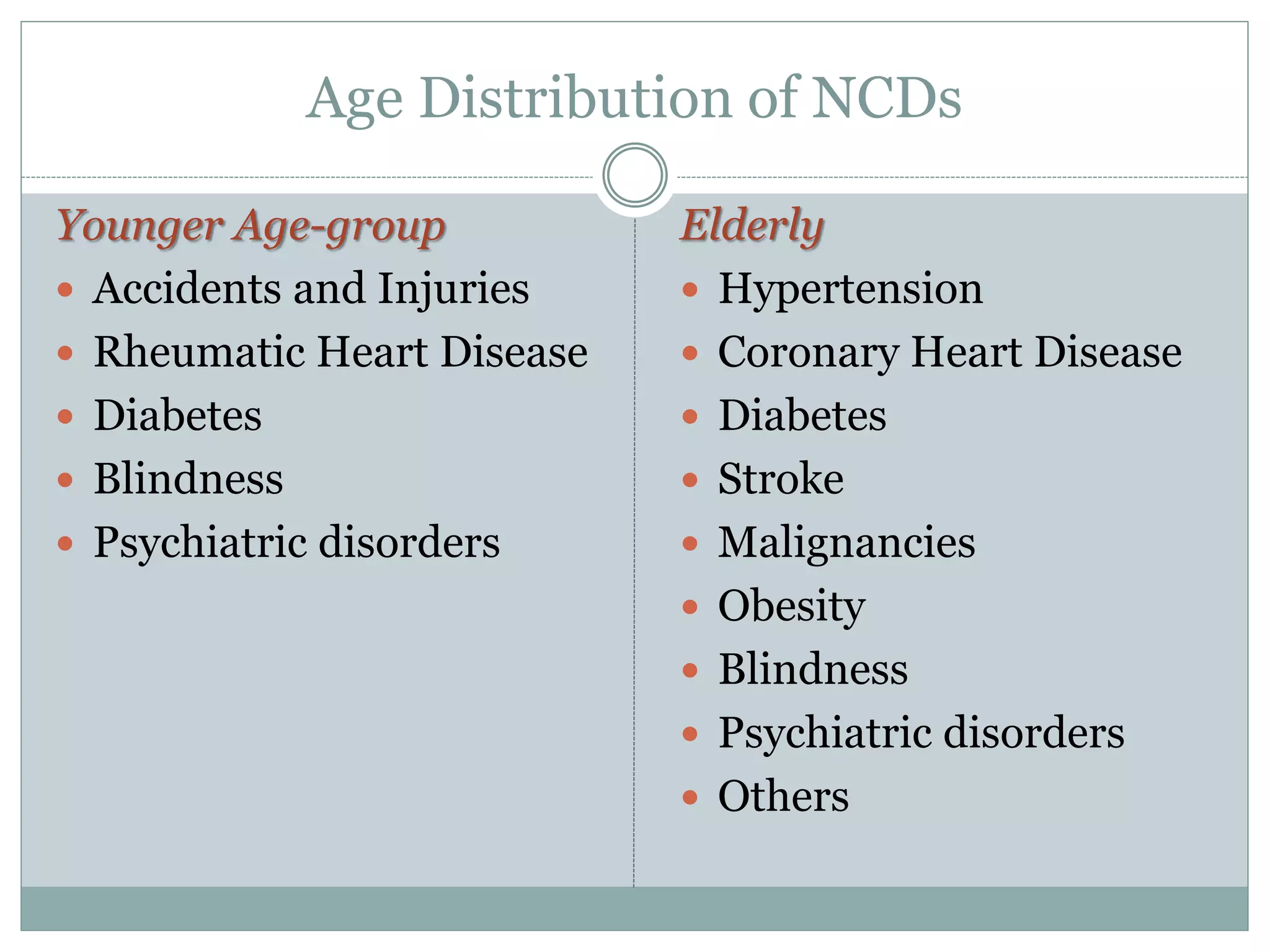
Age Distribution of NCDs
Younger Age-group
 Accidents and Injuries
 Rheumatic Heart Disease
 Diabetes
 Blindness
 Psychiatric disorders
Elderly
 Hypertension
 Coronary Heart Disease
 Diabetes
 Stroke
 Malignancies
 Obesity
 Blindness
 Psychiatric disorders
 Others
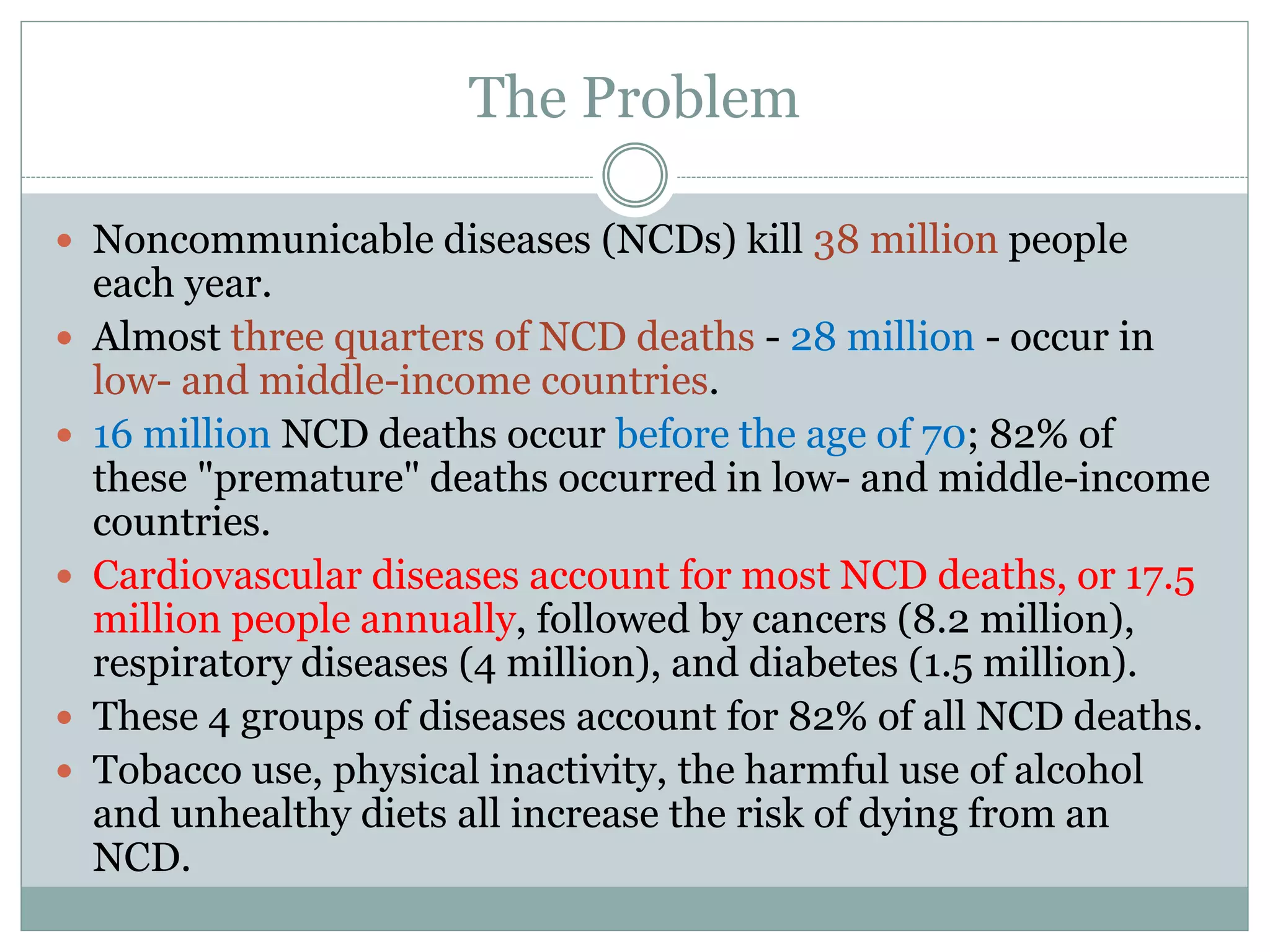
The Problem
 Noncommunicable diseases (NCDs) kill 38 million people
each year.
 Almost three quarters of NCD deaths - 28 million - occur in
low- and middle-income countries.
 16 million NCD deaths occur before the age of 70; 82% of
these "premature" deaths occurred in low- and middle-income
countries.
 Cardiovascular diseases account for most NCD deaths, or 17.5
million people annually, followed by cancers (8.2 million),
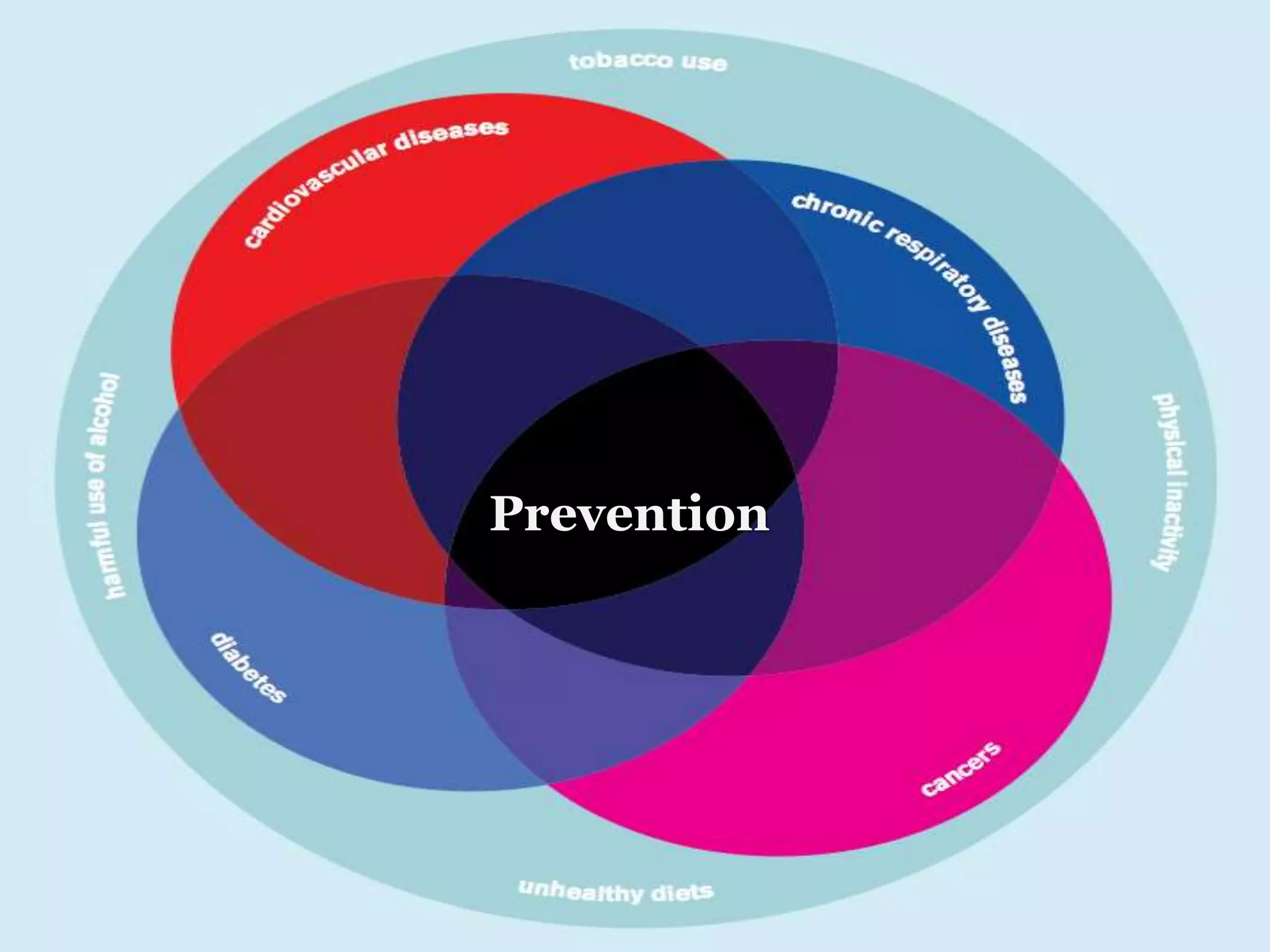
respiratory diseases (4 million), and diabetes (1.5 million).
 These 4 groups of diseases account for 82% of all NCD deaths.
 Tobacco use, physical inactivity, the harmful use of alcohol
and unhealthy diets all increase the risk of dying from an
NCD.
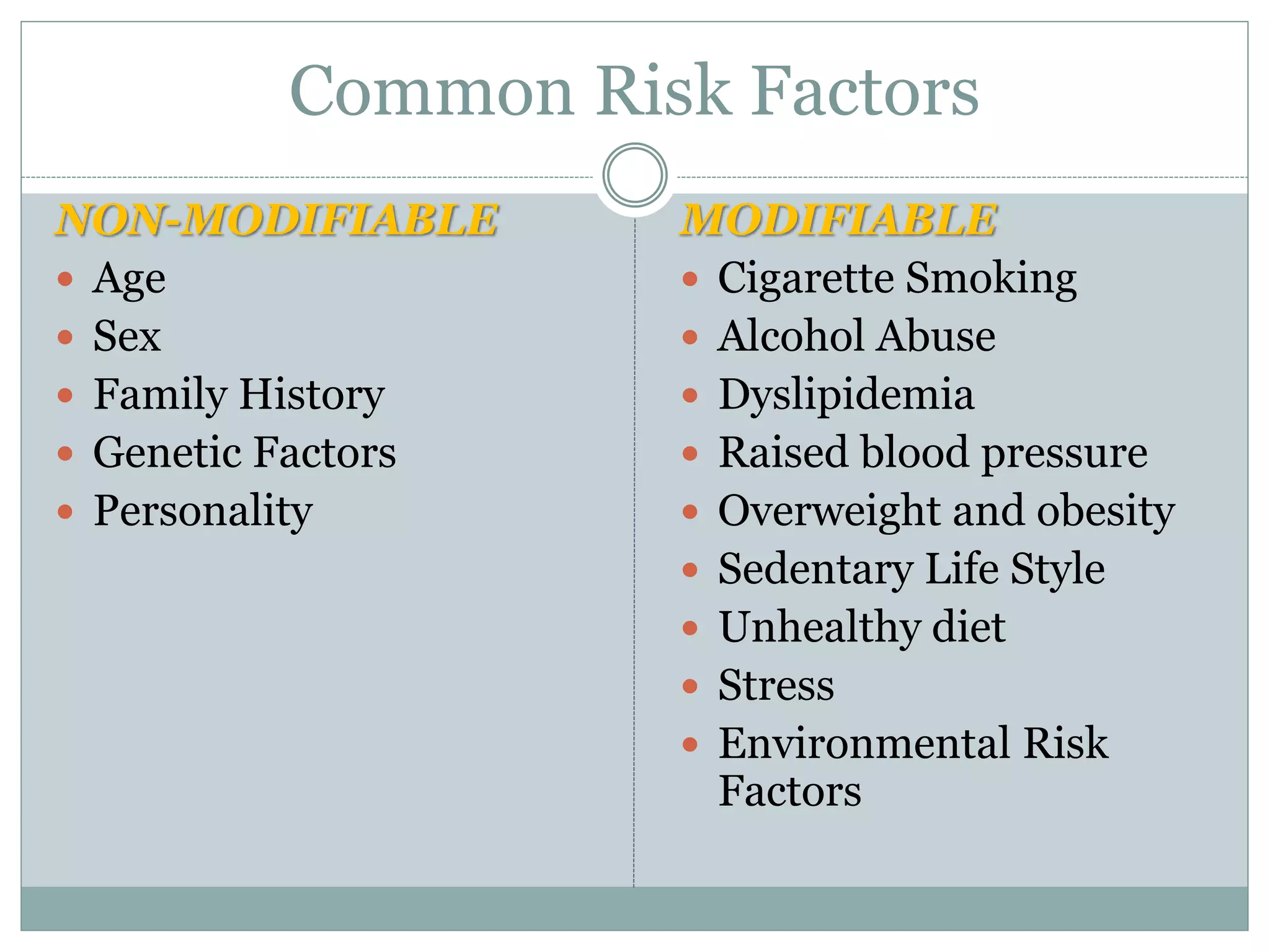
Common Risk Factors
NON-MODIFIABLE
 Age
 Sex
 Family History
 Genetic Factors
 Personality
MODIFIABLE
 Cigarette Smoking
 Alcohol Abuse
 Dyslipidemia
 Raised blood pressure
 Overweight and obesity
 Sedentary Life Style
 Unhealthy diet
 Stress
 Environmental Risk
Factors
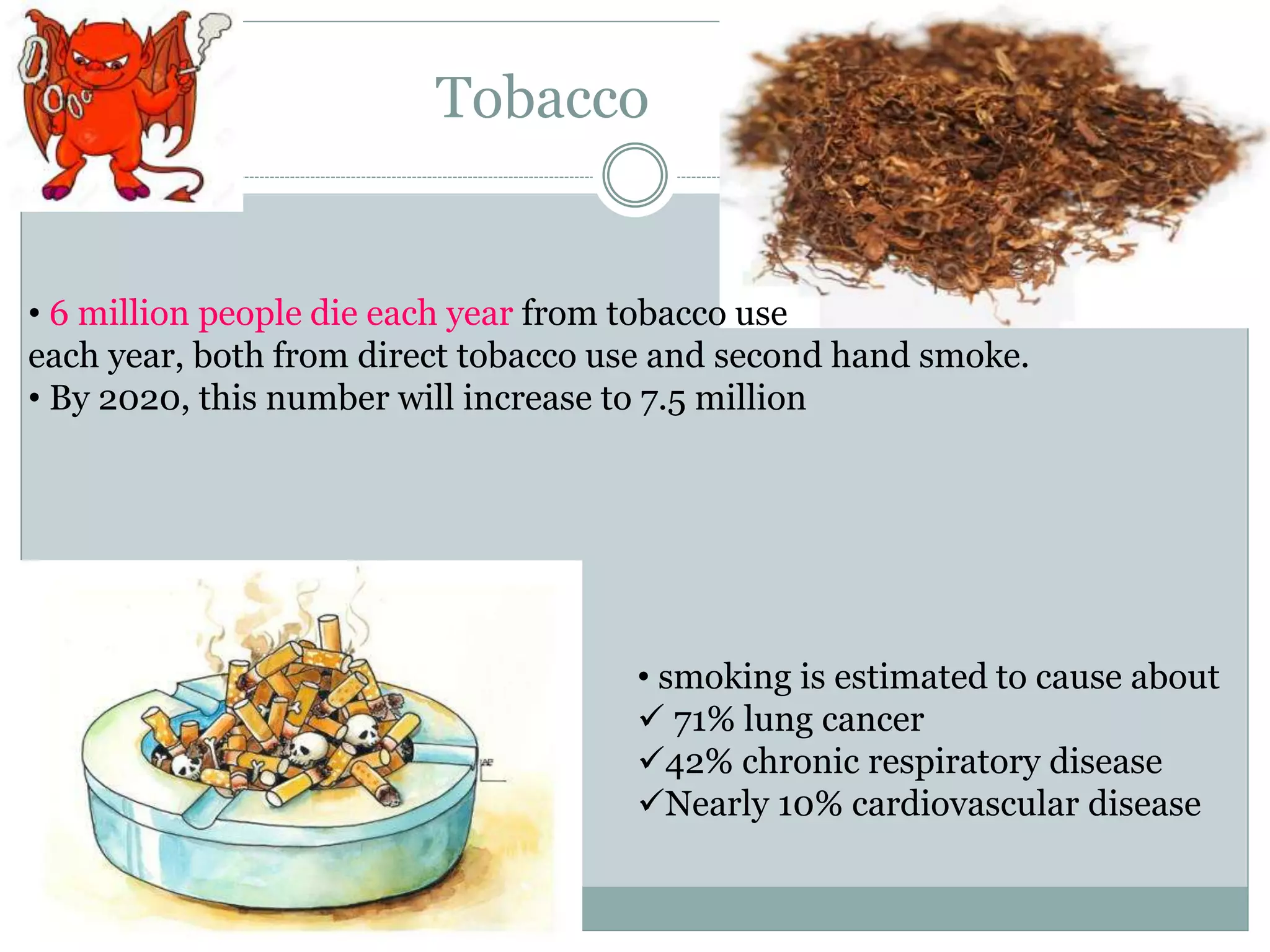
Tobacco
• 6 million people die each year from tobacco use
each year, both from direct tobacco use and second hand smoke.
• By 2020, this number will increase to 7.5 million
• smoking is estimated to cause about
 71% lung cancer
42% chronic respiratory disease
Nearly 10% cardiovascular disease
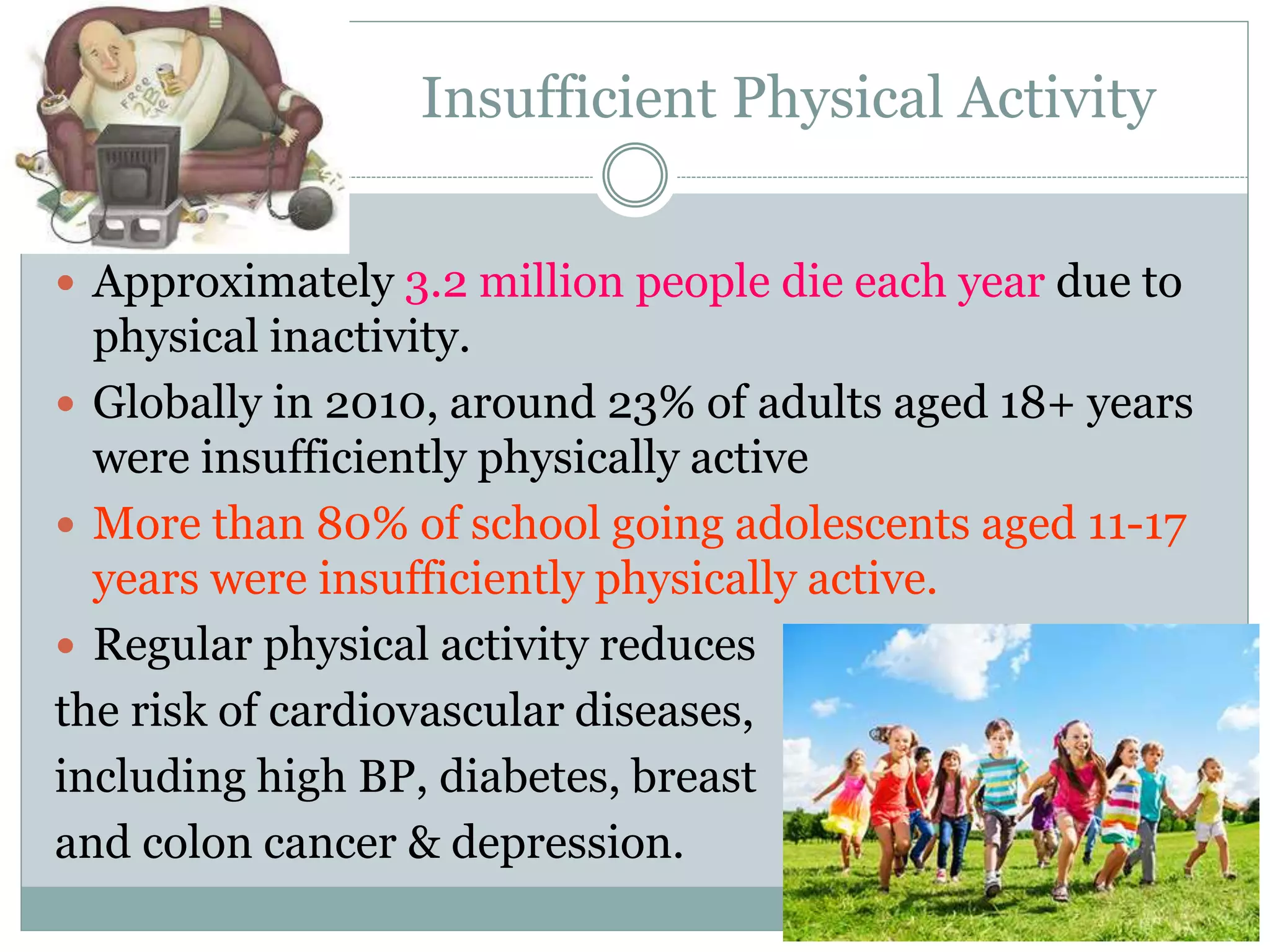
Insufficient Physical Activity
 Approximately 3.2 million people die each year due to
physical inactivity.
 Globally in 2010, around 23% of adults aged 18+ years
were insufficiently physically active
 More than 80% of school going adolescents aged 11-17
years were insufficiently physically active.
 Regular physical activity reduces
the risk of cardiovascular diseases,
including high BP, diabetes, breast
and colon cancer & depression.
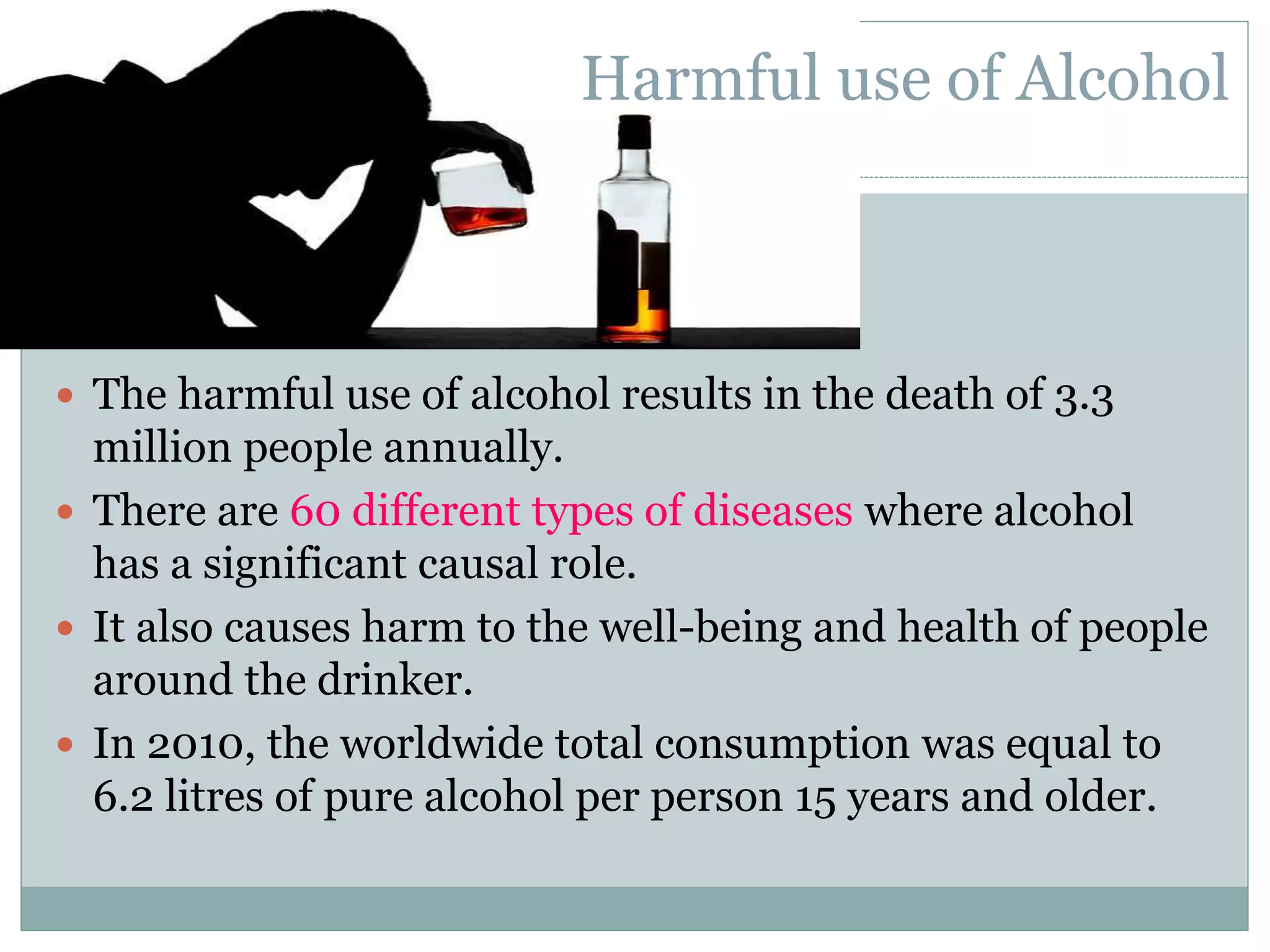
 The harmful use of alcohol results in the death of 3.3
million people annually.
 There are 60 different types of diseases where alcohol
has a significant causal role.
 It also causes harm to the well-being and health of people
around the drinker.
 In 2010, the worldwide total consumption was equal to
6.2 litres of pure alcohol per person 15 years and older.
Harmful use of Alcohol
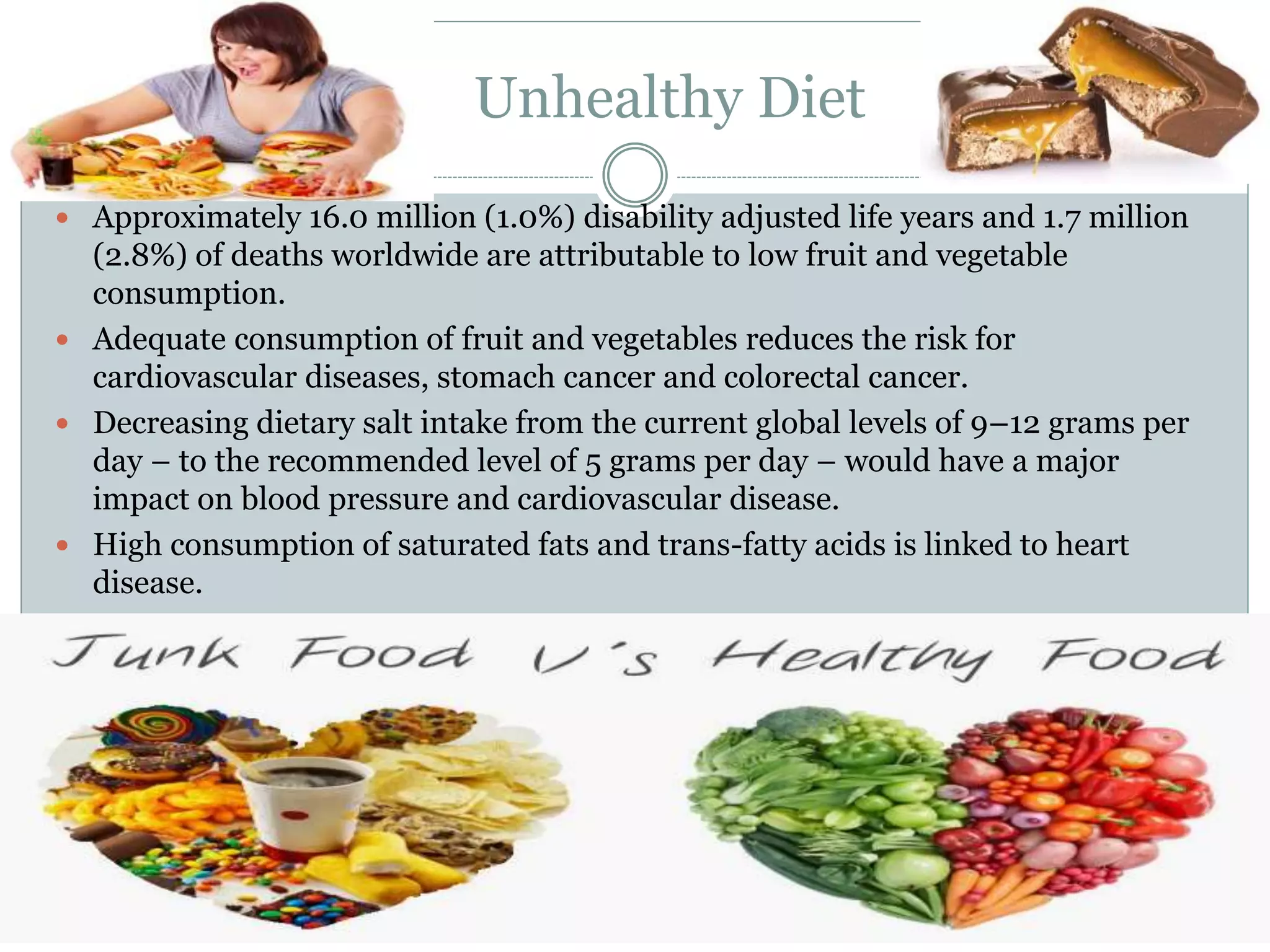
Unhealthy Diet
 Approximately 16.0 million (1.0%) disability adjusted life years and 1.7 million
(2.8%) of deaths worldwide are attributable to low fruit and vegetable
consumption.
 Adequate consumption of fruit and vegetables reduces the risk for
cardiovascular diseases, stomach cancer and colorectal cancer.
 Decreasing dietary salt intake from the current global levels of 9–12 grams per
day – to the recommended level of 5 grams per day – would have a major
impact on blood pressure and cardiovascular disease.
 High consumption of saturated fats and trans-fatty acids is linked to heart
disease.
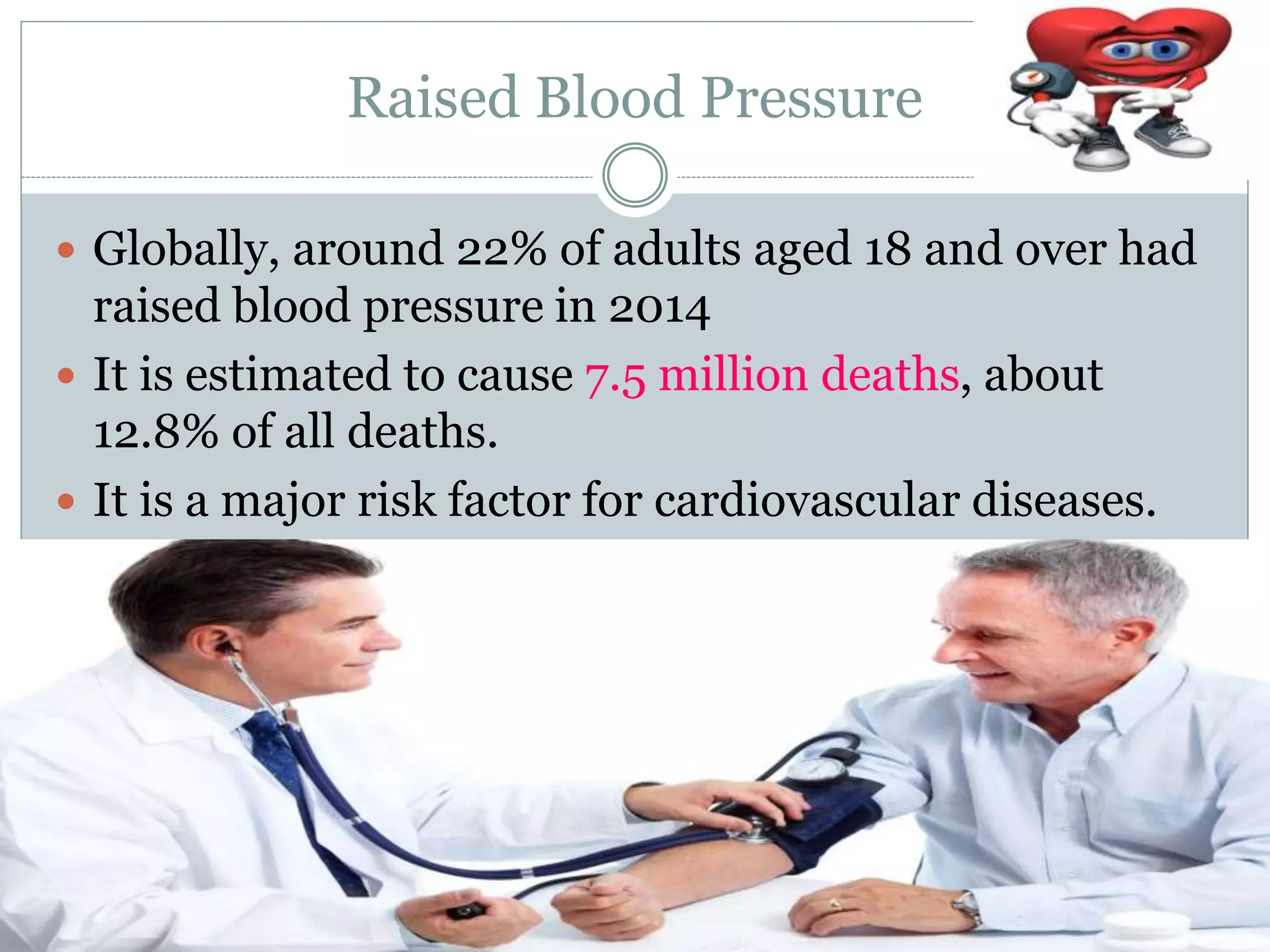
Raised Blood Pressure
 Globally, around 22% of adults aged 18 and over had
raised blood pressure in 2014
 It is estimated to cause 7.5 million deaths, about
12.8% of all deaths.
 It is a major risk factor for cardiovascular diseases.
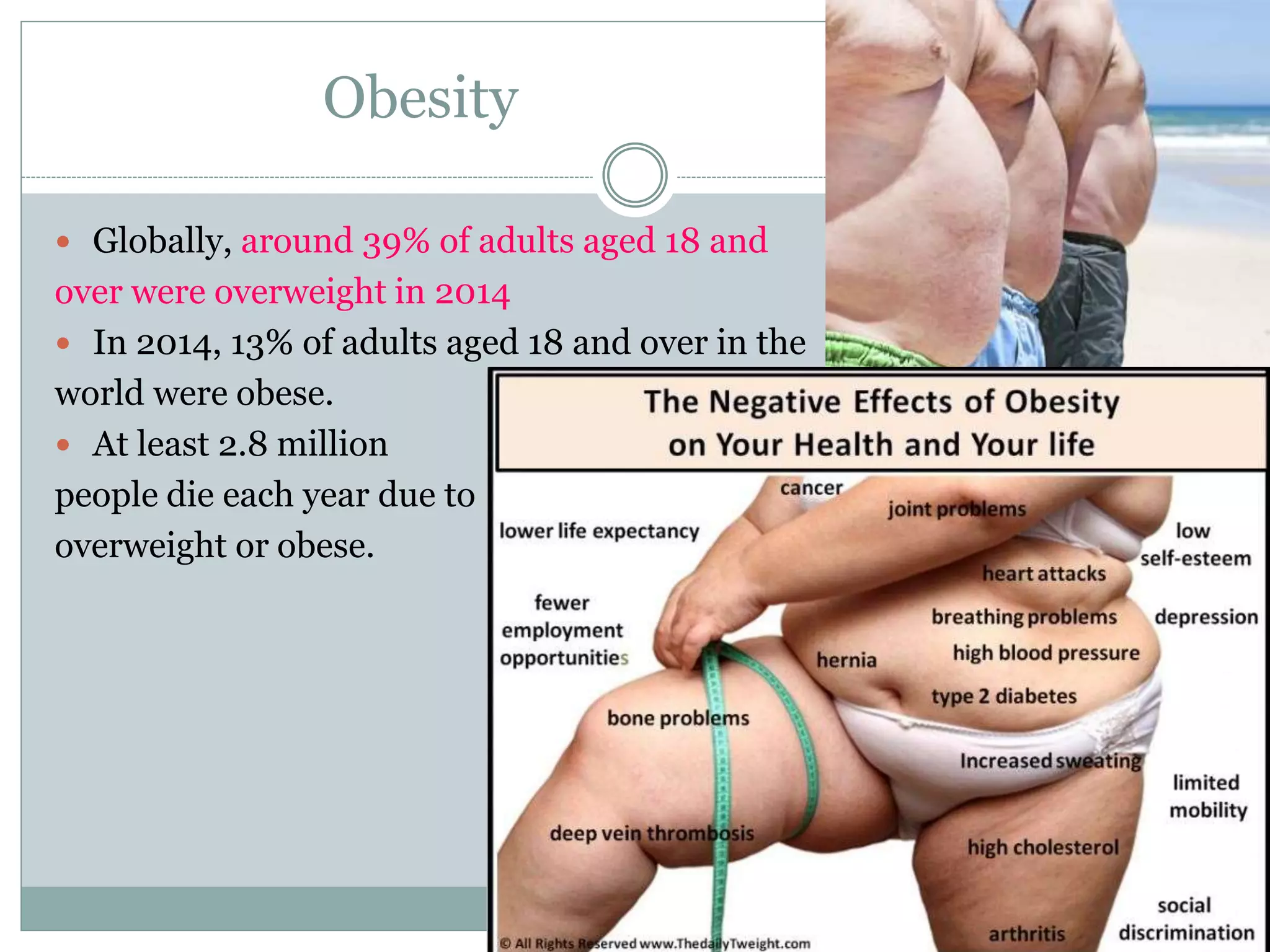
Obesity
 Globally, around 39% of adults aged 18 and
over were overweight in 2014
 In 2014, 13% of adults aged 18 and over in the
world were obese.
 At least 2.8 million
people die each year due to
overweight or obese.
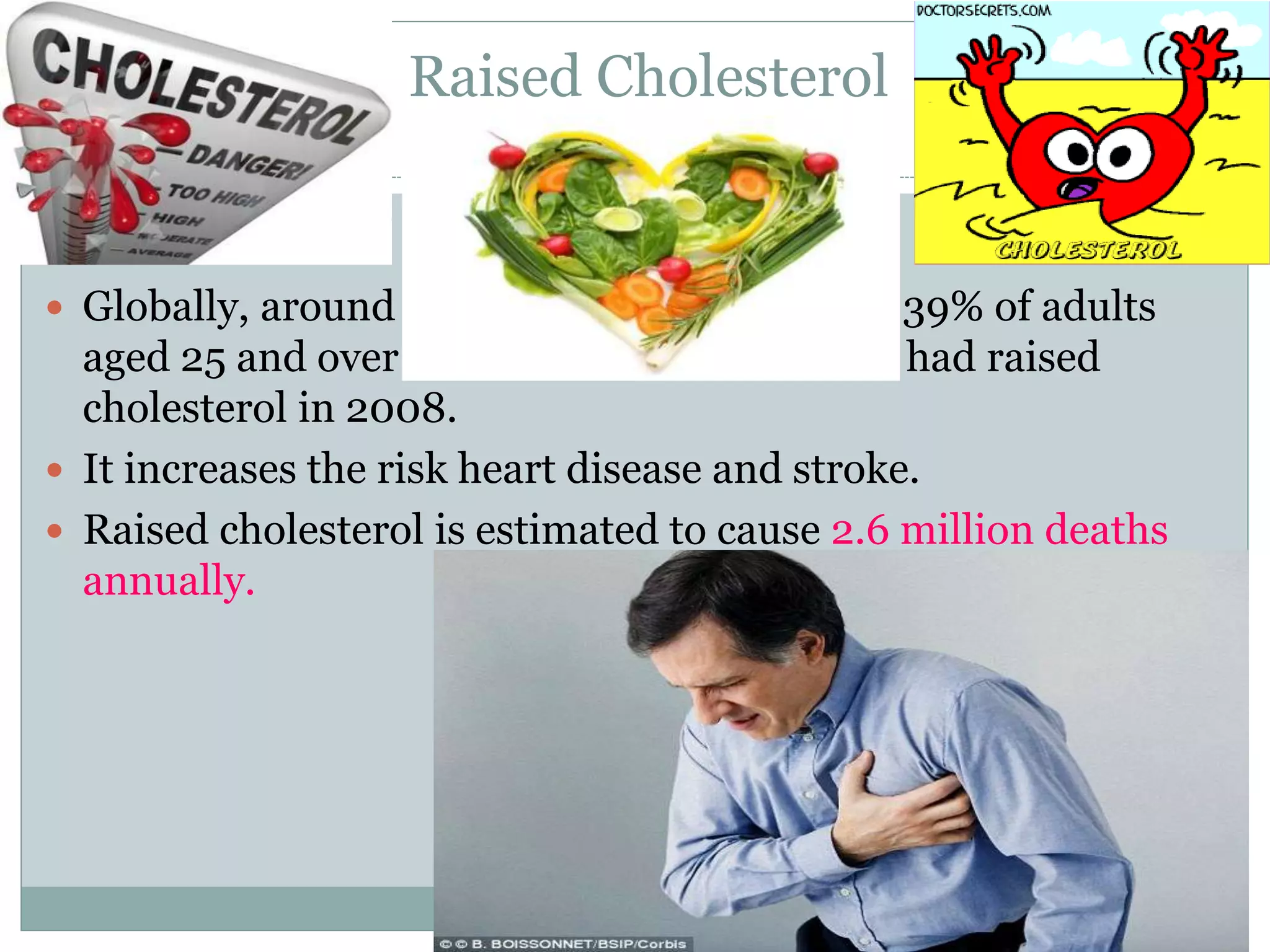
Raised Cholesterol
 Globally, around 39% of adults
aged 25 and over had raised
cholesterol in 2008.
 It increases the risk heart disease and stroke.
 Raised cholesterol is estimated to cause 2.6 million deaths
annually.
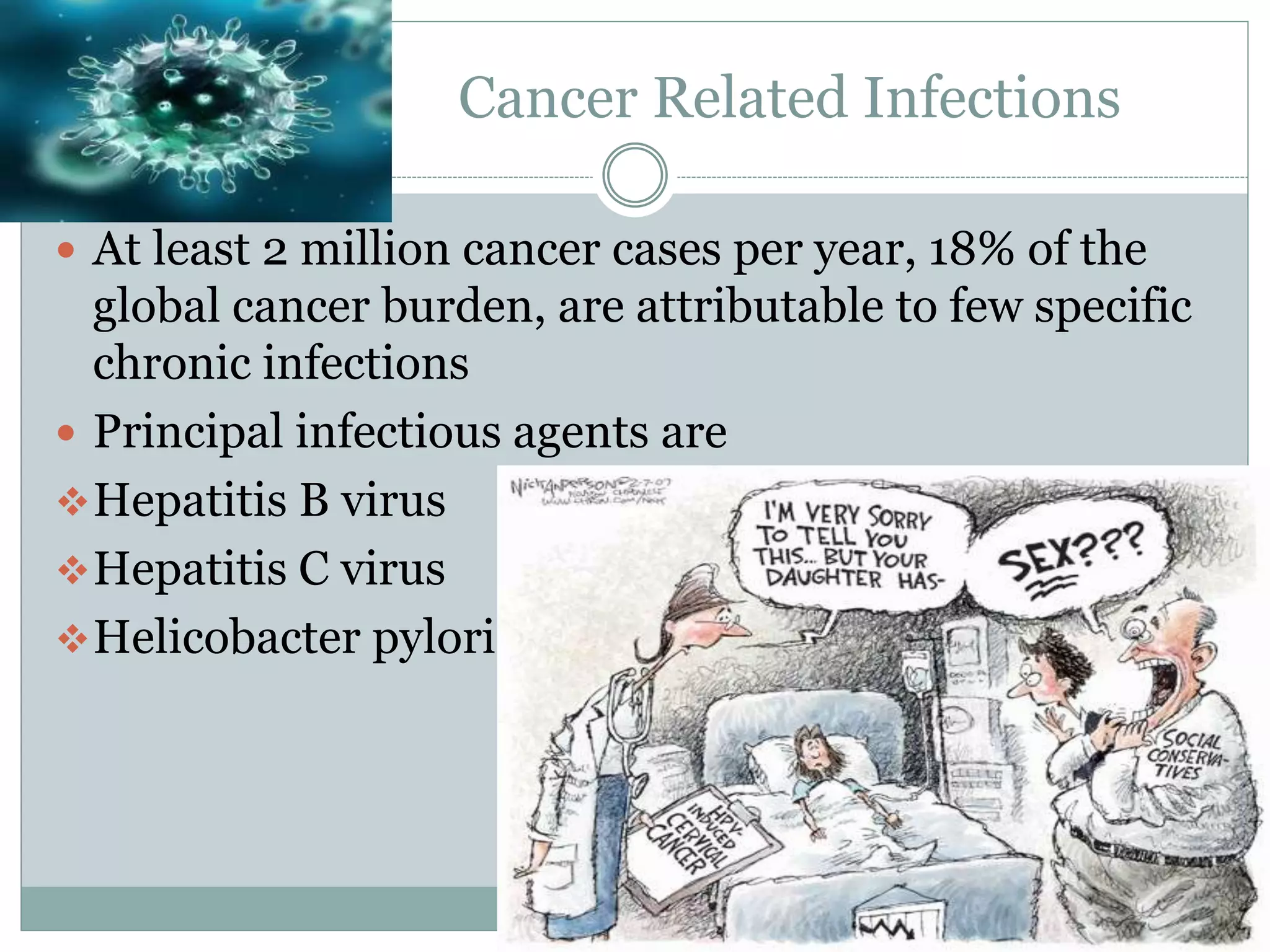
Cancer Related Infections
 At least 2 million cancer cases per year, 18% of the
global cancer burden, are attributable to few specific
chronic infections
 Principal infectious agents are
Hepatitis B virus
Hepatitis C virus
Helicobacter pylori
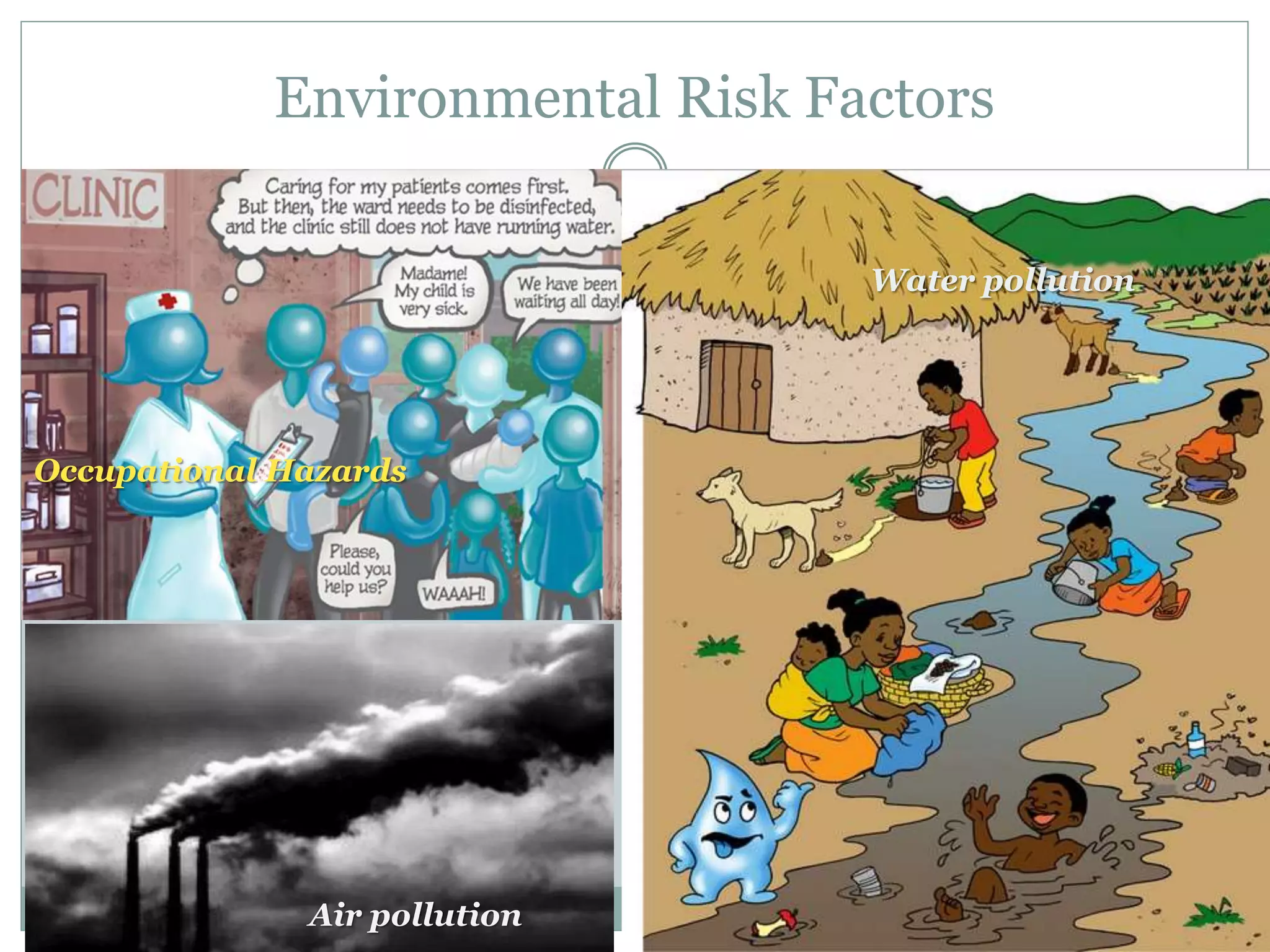
Environmental Risk Factors
Occupational Hazards
Air pollution
Water pollution
Gaps in Natural History
 Absence of a known microbial agent
 Mulatifactorial causation
 Long latent period
 Indefinite onset
Prevention
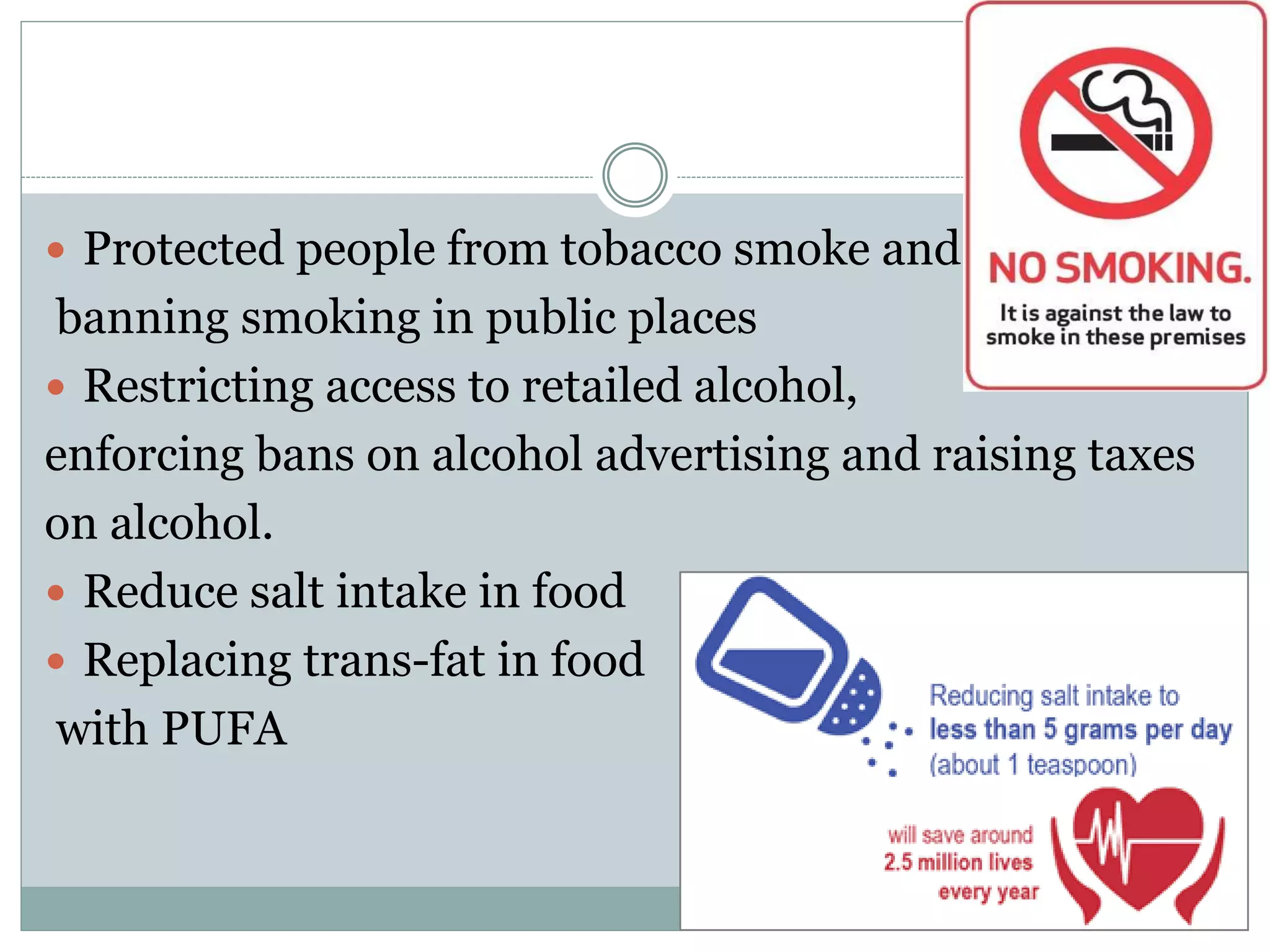
 Protected people from tobacco smoke and
banning smoking in public places
 Restricting access to retailed alcohol,
enforcing bans on alcohol advertising and raising taxes
on alcohol.
 Reduce salt intake in food
 Replacing trans-fat in food
with PUFA
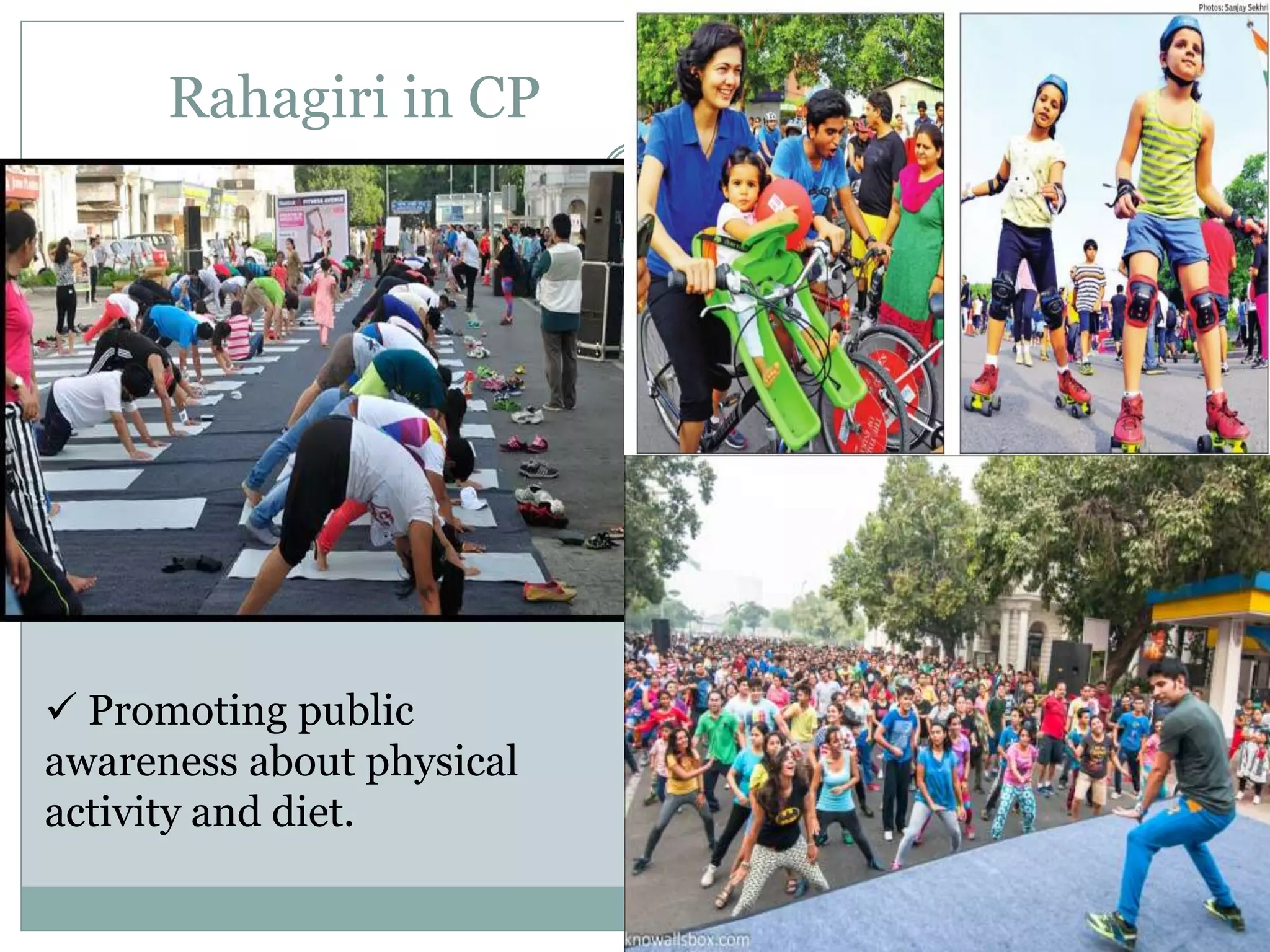
Rahagiri in CP
 Promoting public
awareness about physical
activity and diet.
Cost Effective and Low Cost Population Wide Interventions
 Nicotine dependence treatment
 Enforcing drink-driving laws
 Restrictions on marketing of foods and beverages high in
salt, fats and sugar
 Food taxes and subsidies to promote healthy diets
 Healthy nutrition environments in schools
 Nutritional information and counseling in health care
 Vaccination against HPV
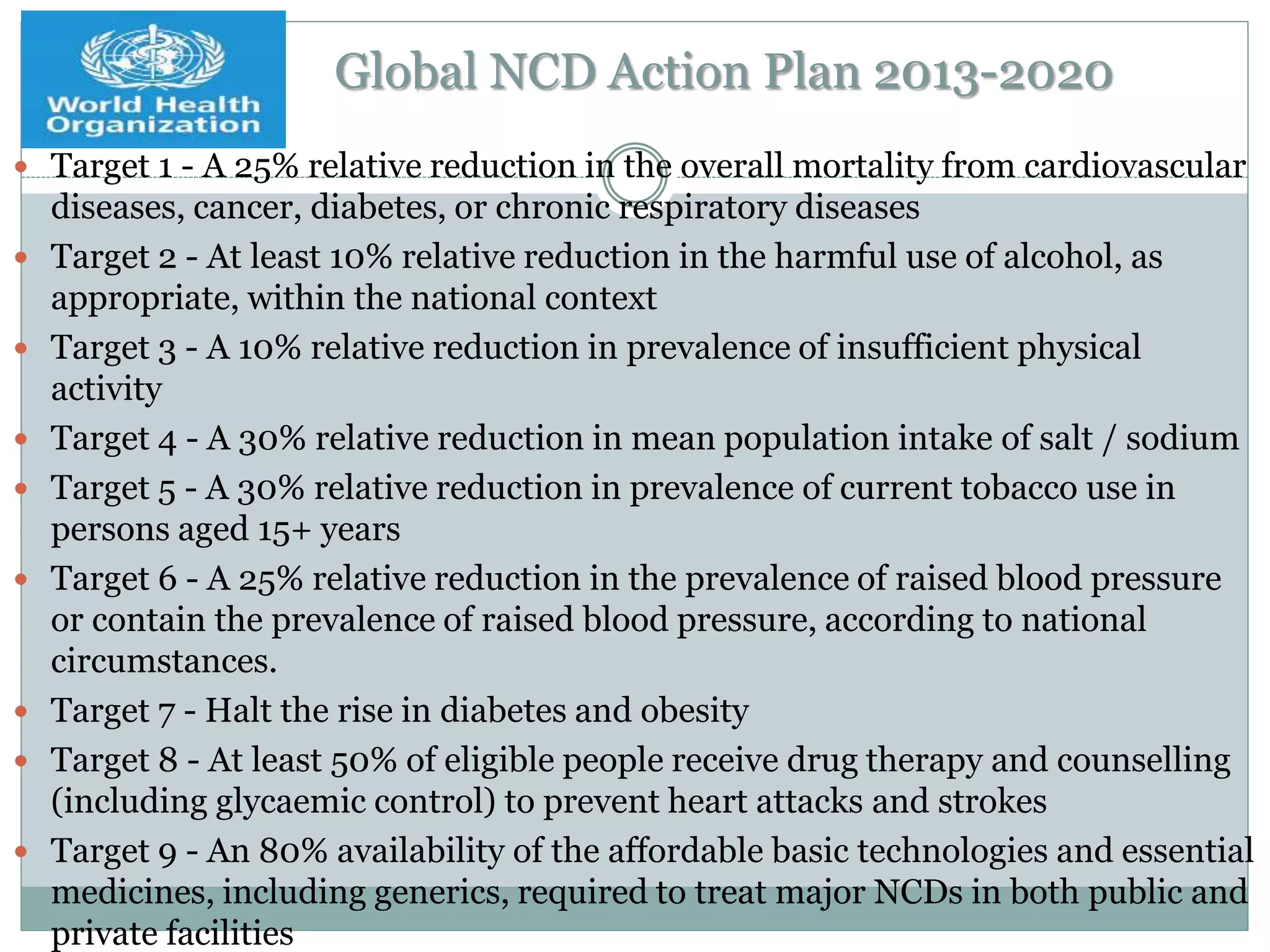
Global NCD Action Plan 2013-2020
 Target 1 - A 25% relative reduction in the overall mortality from cardiovascular
diseases, cancer, diabetes, or chronic respiratory diseases
 Target 2 - At least 10% relative reduction in the harmful use of alcohol, as
appropriate, within the national context
 Target 3 - A 10% relative reduction in prevalence of insufficient physical
activity
 Target 4 - A 30% relative reduction in mean population intake of salt / sodium
 Target 5 - A 30% relative reduction in prevalence of current tobacco use in
persons aged 15+ years
 Target 6 - A 25% relative reduction in the prevalence of raised blood pressure
or contain the prevalence of raised blood pressure, according to national
circumstances.
 Target 7 - Halt the rise in diabetes and obesity
 Target 8 - At least 50% of eligible people receive drug therapy and counselling
(including glycaemic control) to prevent heart attacks and strokes
 Target 9 - An 80% availability of the affordable basic technologies and essential
medicines, including generics, required to treat major NCDs in both public and
private facilities
Thank You

Introduction to NCDs

  • 1.
    Introduction to NonCommunicable Diseases
  • 2.
    Definition  An EUROsymposium in 1957 gave the definition “ an impairment of bodily structure and/or function that necessitates a modification of the patient’s normal life, and persisted over an extended period of time.”
  • 3.
     Commission onChronic Illness in USA has defined “Chronic Diseases” as : “Comprising all impairments or deviations from normal, which have one or more of the following characteristics: a) Are permanent b) Leave residual disability c) Are caused by non-reversible pathological alteration d) Require special training of the patient for rehabilitation e) May be expected to require a long period of supervision, observation or care”
  • 4.
  • 5.
    Age Distribution ofNCDs Younger Age-group  Accidents and Injuries  Rheumatic Heart Disease  Diabetes  Blindness  Psychiatric disorders Elderly  Hypertension  Coronary Heart Disease  Diabetes  Stroke  Malignancies  Obesity  Blindness  Psychiatric disorders  Others
  • 6.
    The Problem  Noncommunicablediseases (NCDs) kill 38 million people each year.  Almost three quarters of NCD deaths - 28 million - occur in low- and middle-income countries.  16 million NCD deaths occur before the age of 70; 82% of these "premature" deaths occurred in low- and middle-income countries.  Cardiovascular diseases account for most NCD deaths, or 17.5 million people annually, followed by cancers (8.2 million), respiratory diseases (4 million), and diabetes (1.5 million).  These 4 groups of diseases account for 82% of all NCD deaths.  Tobacco use, physical inactivity, the harmful use of alcohol and unhealthy diets all increase the risk of dying from an NCD.
  • 9.
    Common Risk Factors NON-MODIFIABLE Age  Sex  Family History  Genetic Factors  Personality MODIFIABLE  Cigarette Smoking  Alcohol Abuse  Dyslipidemia  Raised blood pressure  Overweight and obesity  Sedentary Life Style  Unhealthy diet  Stress  Environmental Risk Factors
  • 10.
    Tobacco • 6 millionpeople die each year from tobacco use each year, both from direct tobacco use and second hand smoke. • By 2020, this number will increase to 7.5 million • smoking is estimated to cause about  71% lung cancer 42% chronic respiratory disease Nearly 10% cardiovascular disease
  • 11.
    Insufficient Physical Activity Approximately 3.2 million people die each year due to physical inactivity.  Globally in 2010, around 23% of adults aged 18+ years were insufficiently physically active  More than 80% of school going adolescents aged 11-17 years were insufficiently physically active.  Regular physical activity reduces the risk of cardiovascular diseases, including high BP, diabetes, breast and colon cancer & depression.
  • 12.
     The harmfuluse of alcohol results in the death of 3.3 million people annually.  There are 60 different types of diseases where alcohol has a significant causal role.  It also causes harm to the well-being and health of people around the drinker.  In 2010, the worldwide total consumption was equal to 6.2 litres of pure alcohol per person 15 years and older. Harmful use of Alcohol
  • 13.
    Unhealthy Diet  Approximately16.0 million (1.0%) disability adjusted life years and 1.7 million (2.8%) of deaths worldwide are attributable to low fruit and vegetable consumption.  Adequate consumption of fruit and vegetables reduces the risk for cardiovascular diseases, stomach cancer and colorectal cancer.  Decreasing dietary salt intake from the current global levels of 9–12 grams per day – to the recommended level of 5 grams per day – would have a major impact on blood pressure and cardiovascular disease.  High consumption of saturated fats and trans-fatty acids is linked to heart disease.
  • 14.
    Raised Blood Pressure Globally, around 22% of adults aged 18 and over had raised blood pressure in 2014  It is estimated to cause 7.5 million deaths, about 12.8% of all deaths.  It is a major risk factor for cardiovascular diseases.
  • 15.
    Obesity  Globally, around39% of adults aged 18 and over were overweight in 2014  In 2014, 13% of adults aged 18 and over in the world were obese.  At least 2.8 million people die each year due to overweight or obese.
  • 16.
    Raised Cholesterol  Globally,around 39% of adults aged 25 and over had raised cholesterol in 2008.  It increases the risk heart disease and stroke.  Raised cholesterol is estimated to cause 2.6 million deaths annually.
  • 17.
    Cancer Related Infections At least 2 million cancer cases per year, 18% of the global cancer burden, are attributable to few specific chronic infections  Principal infectious agents are Hepatitis B virus Hepatitis C virus Helicobacter pylori
  • 18.
    Environmental Risk Factors OccupationalHazards Air pollution Water pollution
  • 20.
    Gaps in NaturalHistory  Absence of a known microbial agent  Mulatifactorial causation  Long latent period  Indefinite onset
  • 21.
  • 23.
     Protected peoplefrom tobacco smoke and banning smoking in public places  Restricting access to retailed alcohol, enforcing bans on alcohol advertising and raising taxes on alcohol.  Reduce salt intake in food  Replacing trans-fat in food with PUFA
  • 24.
    Rahagiri in CP Promoting public awareness about physical activity and diet.
  • 25.
    Cost Effective andLow Cost Population Wide Interventions  Nicotine dependence treatment  Enforcing drink-driving laws  Restrictions on marketing of foods and beverages high in salt, fats and sugar  Food taxes and subsidies to promote healthy diets  Healthy nutrition environments in schools  Nutritional information and counseling in health care  Vaccination against HPV
  • 26.
    Global NCD ActionPlan 2013-2020  Target 1 - A 25% relative reduction in the overall mortality from cardiovascular diseases, cancer, diabetes, or chronic respiratory diseases  Target 2 - At least 10% relative reduction in the harmful use of alcohol, as appropriate, within the national context  Target 3 - A 10% relative reduction in prevalence of insufficient physical activity  Target 4 - A 30% relative reduction in mean population intake of salt / sodium  Target 5 - A 30% relative reduction in prevalence of current tobacco use in persons aged 15+ years  Target 6 - A 25% relative reduction in the prevalence of raised blood pressure or contain the prevalence of raised blood pressure, according to national circumstances.  Target 7 - Halt the rise in diabetes and obesity  Target 8 - At least 50% of eligible people receive drug therapy and counselling (including glycaemic control) to prevent heart attacks and strokes  Target 9 - An 80% availability of the affordable basic technologies and essential medicines, including generics, required to treat major NCDs in both public and private facilities
  • 27.