INTRODUCTION
TO
JAVA
What is JAVA?
• JAVA is a simple programming language. Java makes
writing, compiling, and debugging programming easy. It helps
to create reusable code and modular programs.
• JAVA was developed by Sun Microsystems Inc in the
year 1991, later acquired by Oracle Corporation.
• JAVA is a class-based, object-oriented programming
language and is designed to have as few implementation
dependencies as possible.
History of JAVA
• Java’s history is very interesting. It is a programming
language created in 1991. James Gosling, Mike Sheridan,
and Patrick Naughton, a team of Sun engineers known as
the Green team initiated the Java language in 1991. Sun
Microsystems released its first public implementation in
1996 as Java 1.0. It provides no-cost -run-times on popular
platforms. Java1.0 compiler was re-written in Java by Arthur
Van Hoff to strictly comply with its specifications. With the
arrival of Java 2, new versions had multiple configurations
built for different types of platforms.
History of JAVA
• On November 13, 2006, Sun
released much of its Java virtual
machine as free, open-source software.
On May 8, 2007, Sun finished the
process, making all of its JVM’s core
code available under open-source
distribution terms.
History of JAVA
• The principles for creating java were
simple, robust, secured, high performance,
portable, multi-threaded, interpreted,
dynamic, etc. James Gosling in 1995
developed Java, who is known as the
Father of Java. Currently, Java is used in
mobile devices, internet programming,
games, e-business, etc.
•
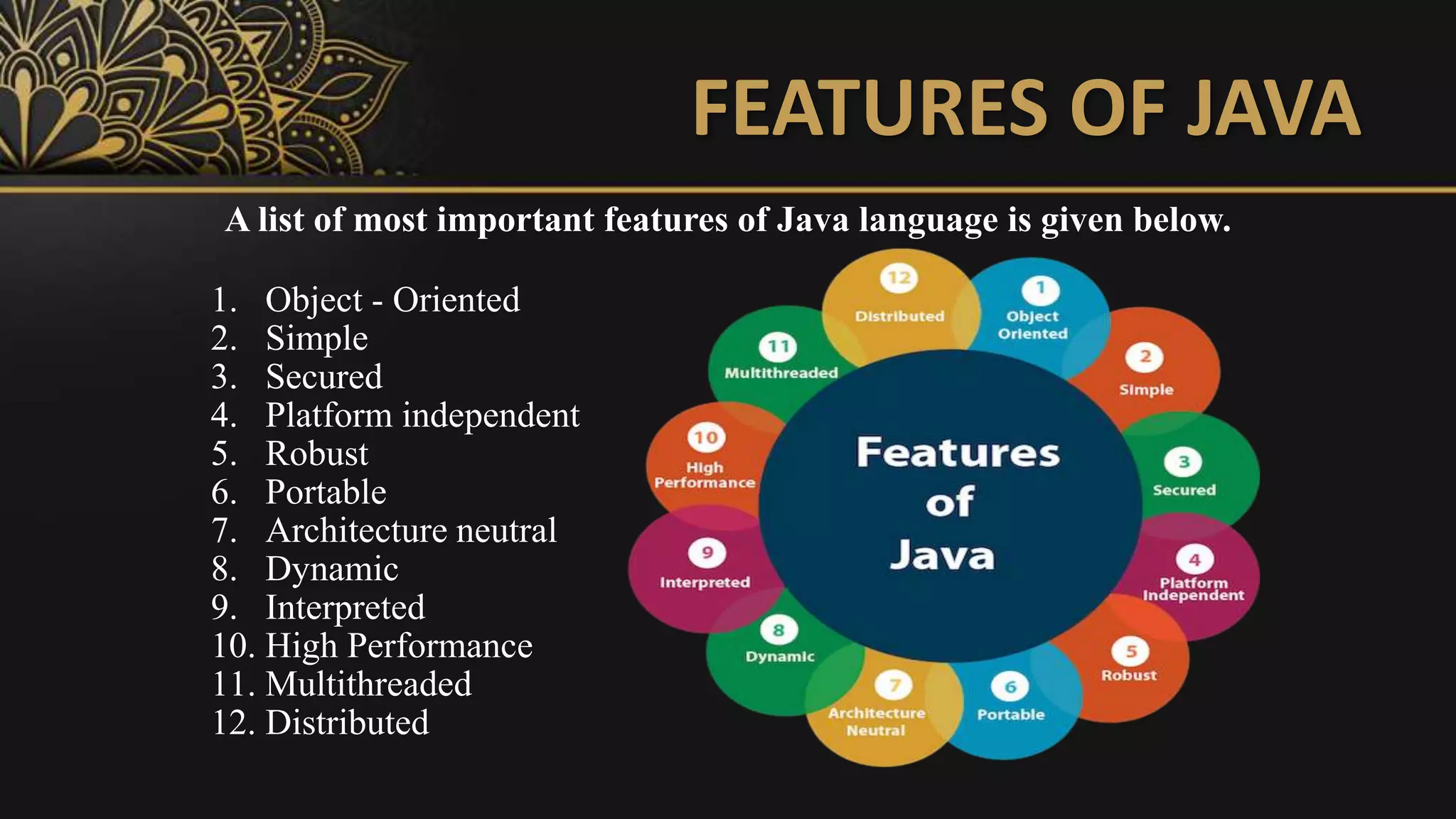
FEATURES OF JAVA
A list of most important features of Java language is given below.
1. Object - Oriented
2. Simple
3. Secured
4. Platform independent
5. Robust
6. Portable
7. Architecture neutral
8. Dynamic
9. Interpreted
10. High Performance
11. Multithreaded
12. Distributed
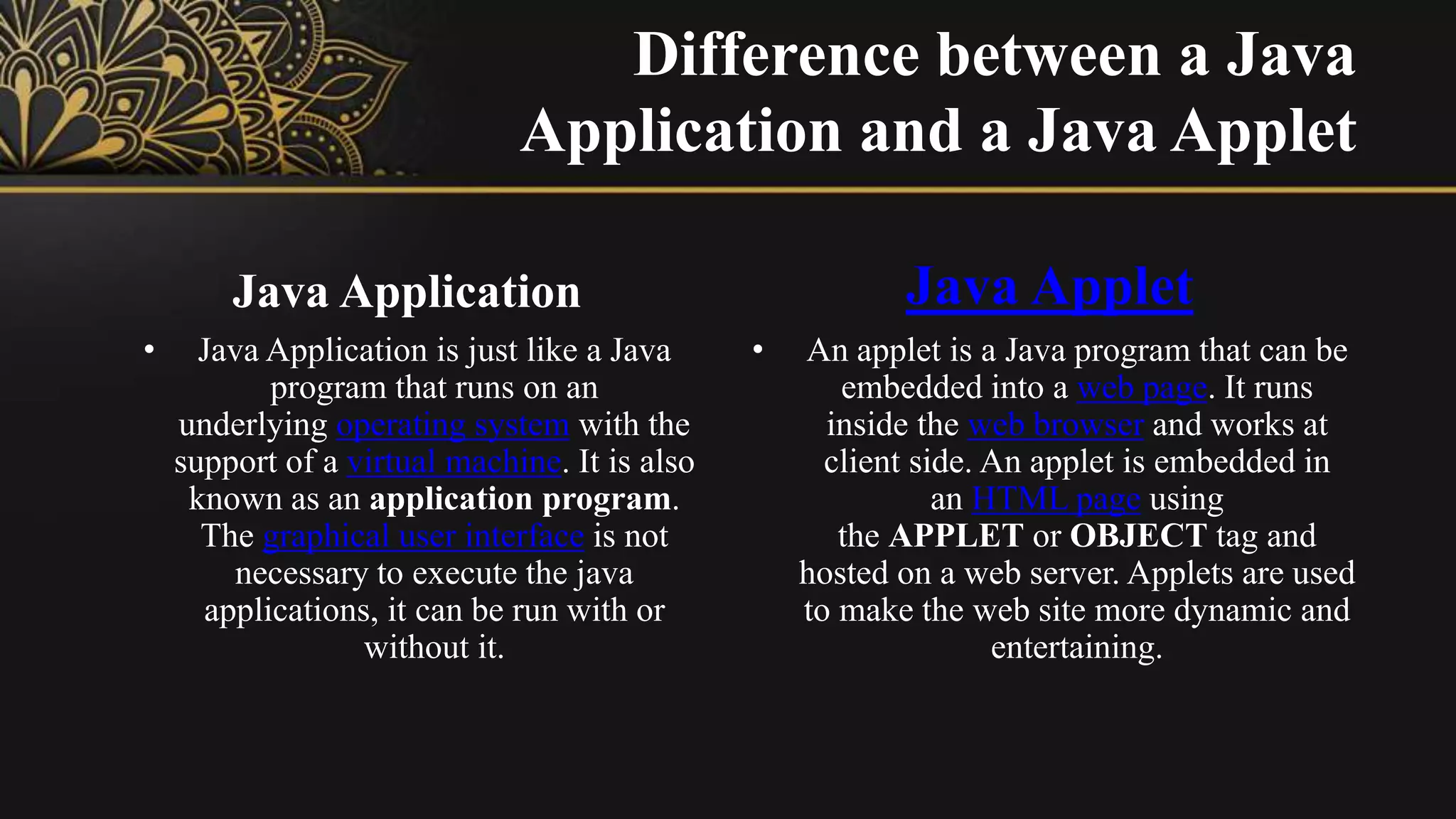
Difference between a Java
Application and a Java Applet
Java Application
• Java Application is just like a Java
program that runs on an
underlying operating system with the
support of a virtual machine. It is also
known as an application program.
The graphical user interface is not
necessary to execute the java
applications, it can be run with or
without it.
Java Applet
• An applet is a Java program that can be
embedded into a web page. It runs
inside the web browser and works at
client side. An applet is embedded in
an HTML page using
the APPLET or OBJECT tag and
hosted on a web server. Applets are used
to make the web site more dynamic and
entertaining.
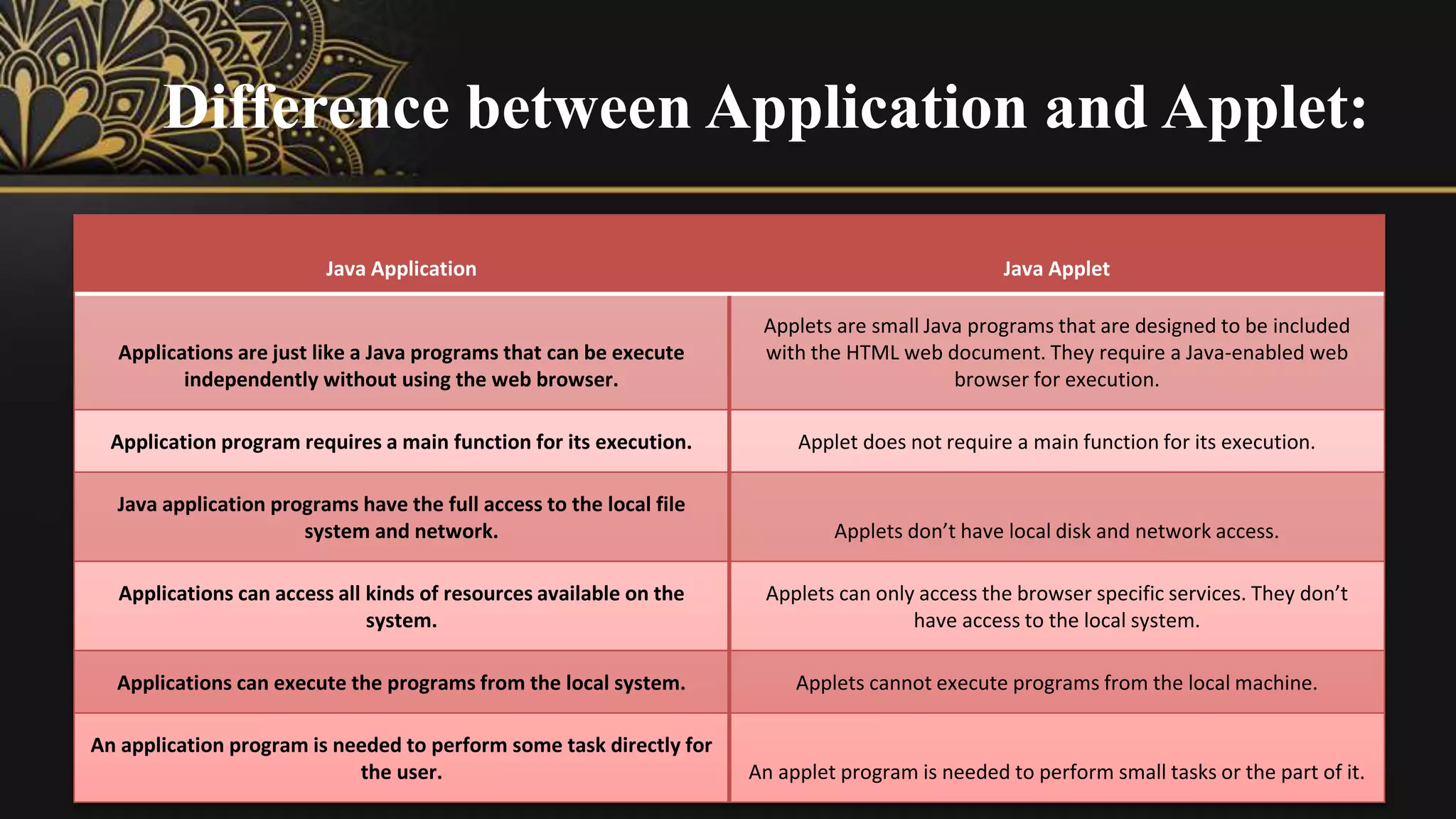
Difference between Application and Applet:
Java Application Java Applet
Applications are just like a Java programs that can be execute
independently without using the web browser.
Applets are small Java programs that are designed to be included
with the HTML web document. They require a Java-enabled web
browser for execution.
Application program requires a main function for its execution. Applet does not require a main function for its execution.
Java application programs have the full access to the local file
system and network. Applets don’t have local disk and network access.
Applications can access all kinds of resources available on the
system.
Applets can only access the browser specific services. They don’t
have access to the local system.
Applications can execute the programs from the local system. Applets cannot execute programs from the local machine.
An application program is needed to perform some task directly for
the user. An applet program is needed to perform small tasks or the part of it.

Introduction To JAVA.pptx

  • 1.
  • 2.
    What is JAVA? •JAVA is a simple programming language. Java makes writing, compiling, and debugging programming easy. It helps to create reusable code and modular programs. • JAVA was developed by Sun Microsystems Inc in the year 1991, later acquired by Oracle Corporation. • JAVA is a class-based, object-oriented programming language and is designed to have as few implementation dependencies as possible.
  • 3.
    History of JAVA •Java’s history is very interesting. It is a programming language created in 1991. James Gosling, Mike Sheridan, and Patrick Naughton, a team of Sun engineers known as the Green team initiated the Java language in 1991. Sun Microsystems released its first public implementation in 1996 as Java 1.0. It provides no-cost -run-times on popular platforms. Java1.0 compiler was re-written in Java by Arthur Van Hoff to strictly comply with its specifications. With the arrival of Java 2, new versions had multiple configurations built for different types of platforms.
  • 4.
    History of JAVA •On November 13, 2006, Sun released much of its Java virtual machine as free, open-source software. On May 8, 2007, Sun finished the process, making all of its JVM’s core code available under open-source distribution terms.
  • 5.
    History of JAVA •The principles for creating java were simple, robust, secured, high performance, portable, multi-threaded, interpreted, dynamic, etc. James Gosling in 1995 developed Java, who is known as the Father of Java. Currently, Java is used in mobile devices, internet programming, games, e-business, etc. •
  • 6.
    FEATURES OF JAVA Alist of most important features of Java language is given below. 1. Object - Oriented 2. Simple 3. Secured 4. Platform independent 5. Robust 6. Portable 7. Architecture neutral 8. Dynamic 9. Interpreted 10. High Performance 11. Multithreaded 12. Distributed
  • 7.
    Difference between aJava Application and a Java Applet Java Application • Java Application is just like a Java program that runs on an underlying operating system with the support of a virtual machine. It is also known as an application program. The graphical user interface is not necessary to execute the java applications, it can be run with or without it. Java Applet • An applet is a Java program that can be embedded into a web page. It runs inside the web browser and works at client side. An applet is embedded in an HTML page using the APPLET or OBJECT tag and hosted on a web server. Applets are used to make the web site more dynamic and entertaining.
  • 8.
    Difference between Applicationand Applet: Java Application Java Applet Applications are just like a Java programs that can be execute independently without using the web browser. Applets are small Java programs that are designed to be included with the HTML web document. They require a Java-enabled web browser for execution. Application program requires a main function for its execution. Applet does not require a main function for its execution. Java application programs have the full access to the local file system and network. Applets don’t have local disk and network access. Applications can access all kinds of resources available on the system. Applets can only access the browser specific services. They don’t have access to the local system. Applications can execute the programs from the local system. Applets cannot execute programs from the local machine. An application program is needed to perform some task directly for the user. An applet program is needed to perform small tasks or the part of it.