
By
Ketan Shahade
2010B4AB671P
BITS Pilani
1
 International Organization for Standardization
◦ Worldwide federation of national standards bodies
from 130 countries
◦ Over 11,000 standards
◦ Over 97 categories
2
 ISO 9000 can benefit many
industries, such as:
Banking
Health Care
Manufacturing, etc.
 ISO 9000 is generic, so it can be applied
virtually anywhere!
 Remember, ISO 9000 is just one part of an
entire system needed to create value for
customers
3
 ISO is not an acronym
 ISO is a name used for the International
Organization for Standardization
 The ISO was formed in 1947 in
Geneva, Switzerland
4
 ISO 9000 is a European Standard
 The organization has two stated
objectives:
1. To promote development of
standardization to facilitate international
exchange of goods and services.
2. To promote cooperation in
intellectual, scientific, technological, and
economic activity.
5
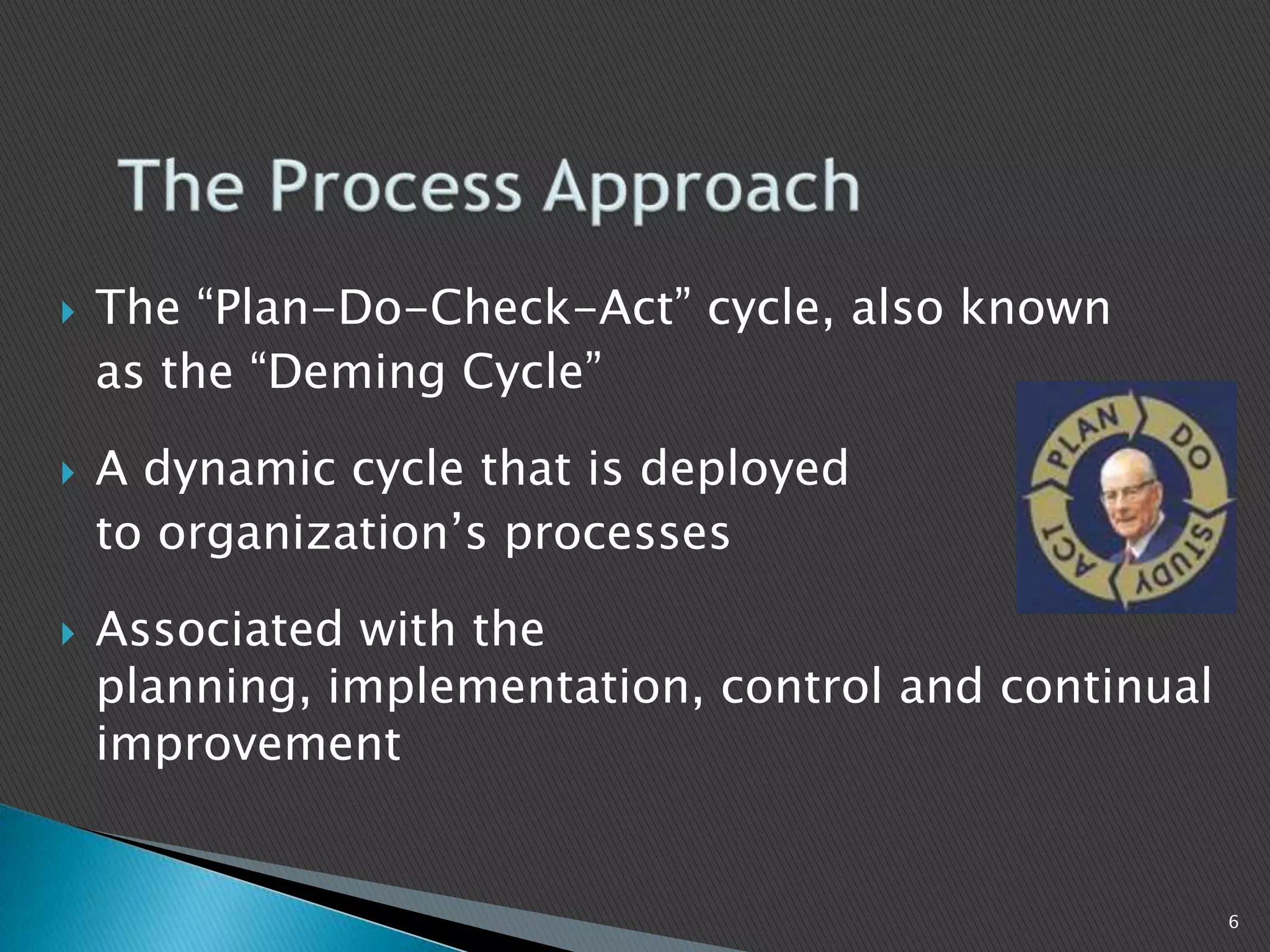
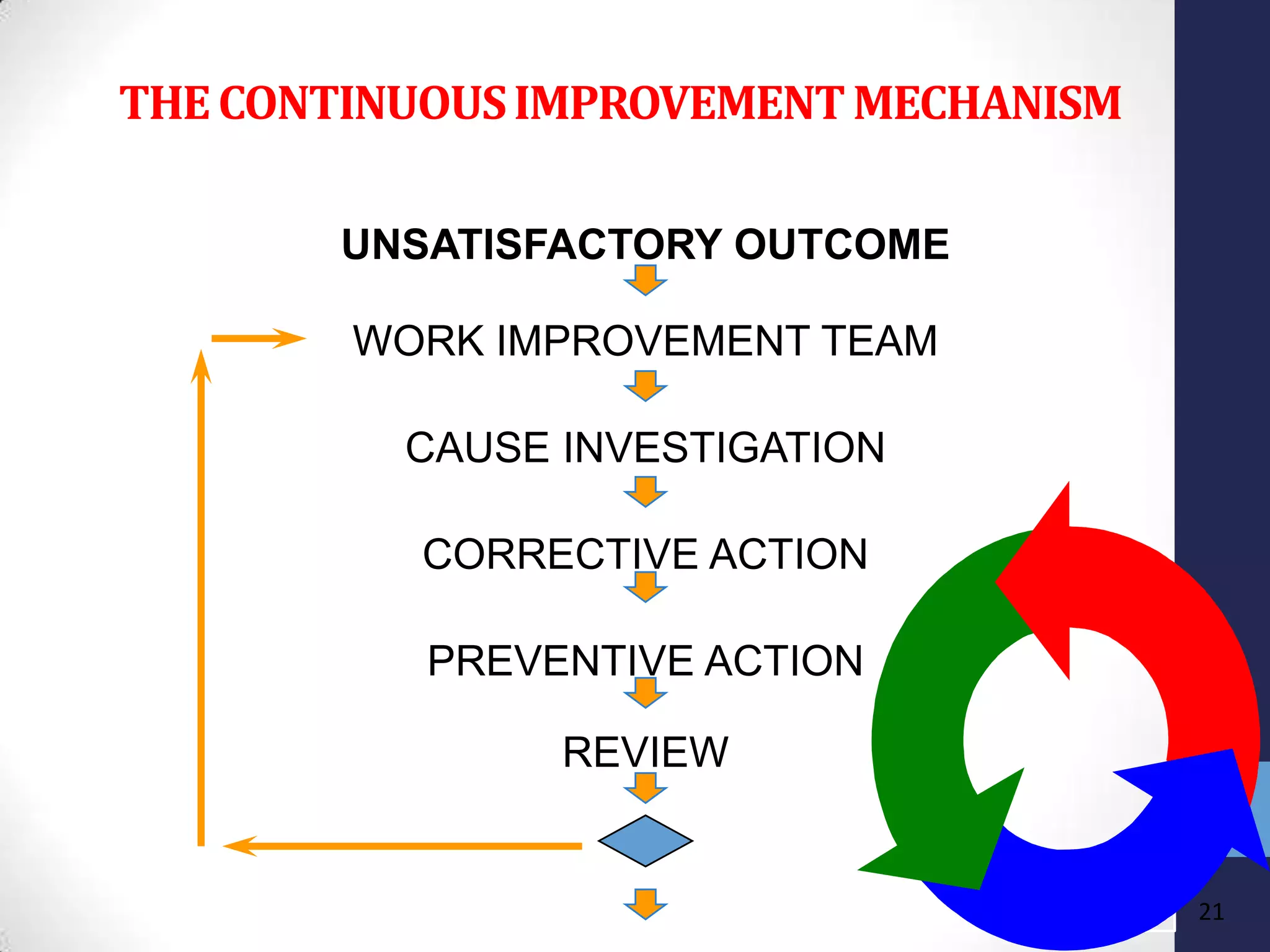
 The “Plan-Do-Check-Act” cycle, also known
as the “Deming Cycle”
 A dynamic cycle that is deployed
to organization’s processes
 Associated with the
planning, implementation, control and continual
improvement
6
Note in Clause 0.2
Plan: establish the objectives and processes
necessary to deliver results in accordance
with customer requirements and the
organization's policies;
Do: implement the processes;
Check: monitor and measure processes and
product against policies, objectives and
requirements for the product and report the
results;
Act: take actions to continually improve process
performance;
7
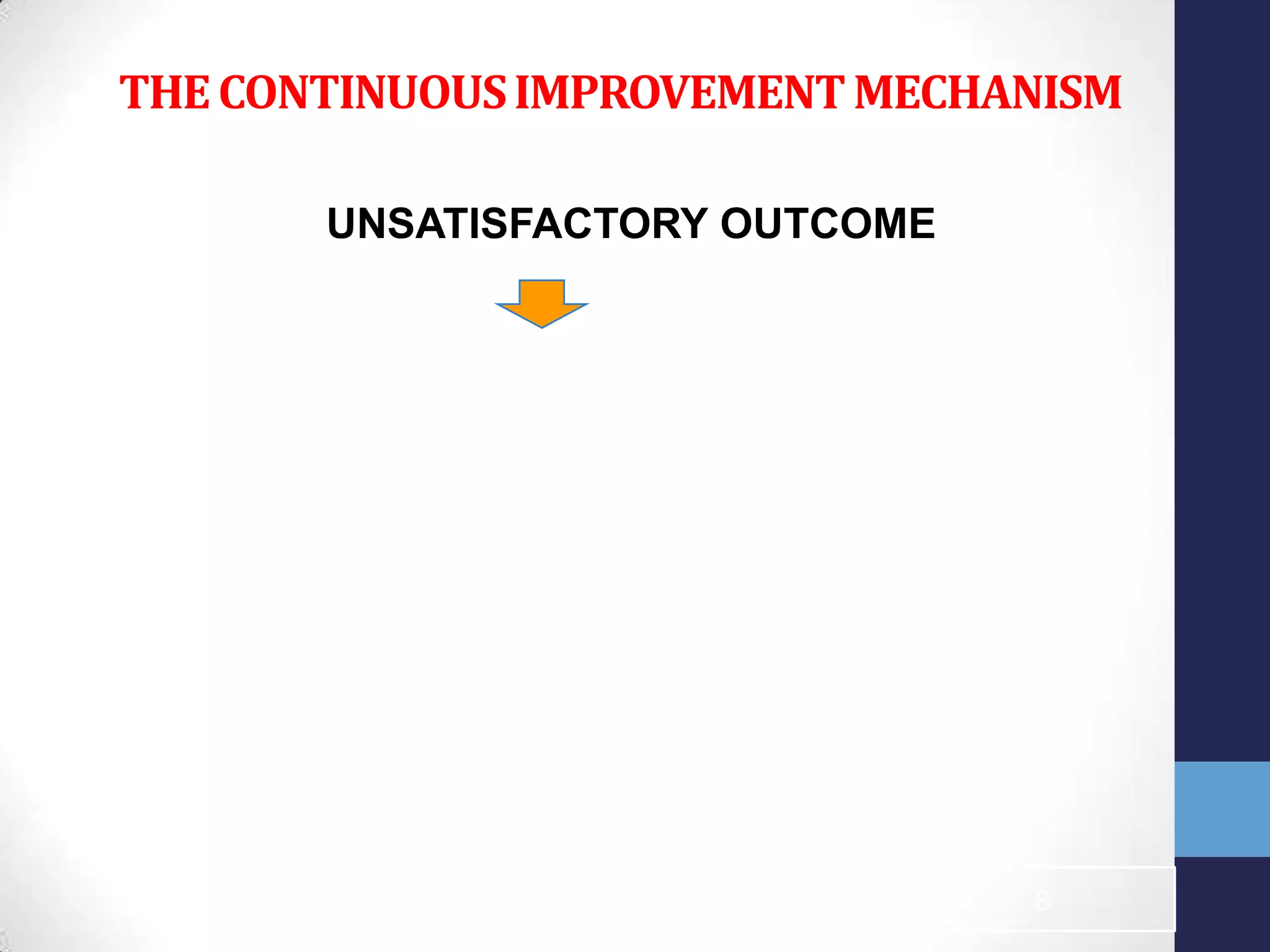
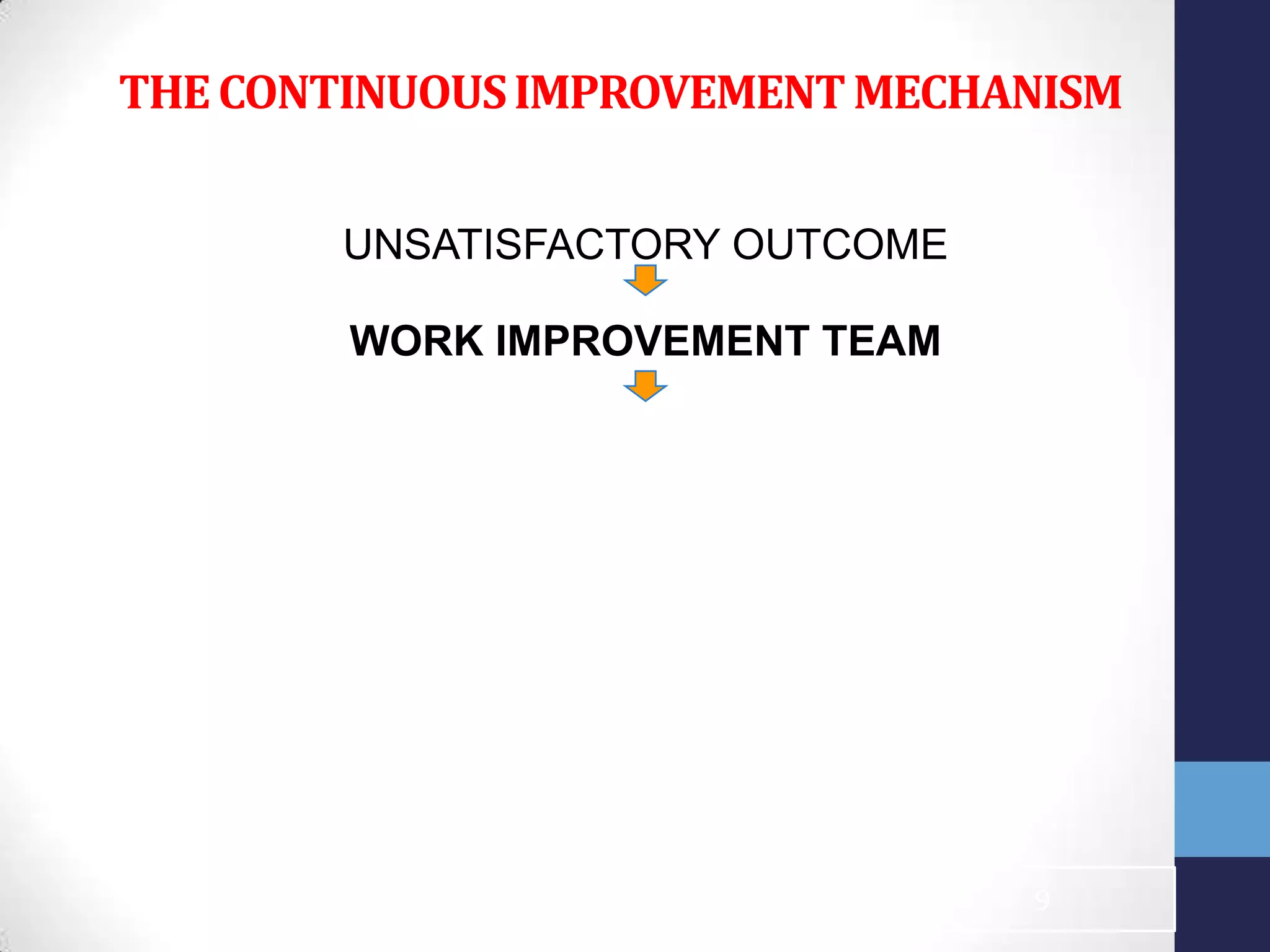
THECONTINUOUSIMPROVEMENTMECHANISM
UNSAUNSATISFACTORY OUTCOME
TISFACTORY OUTCOME
8
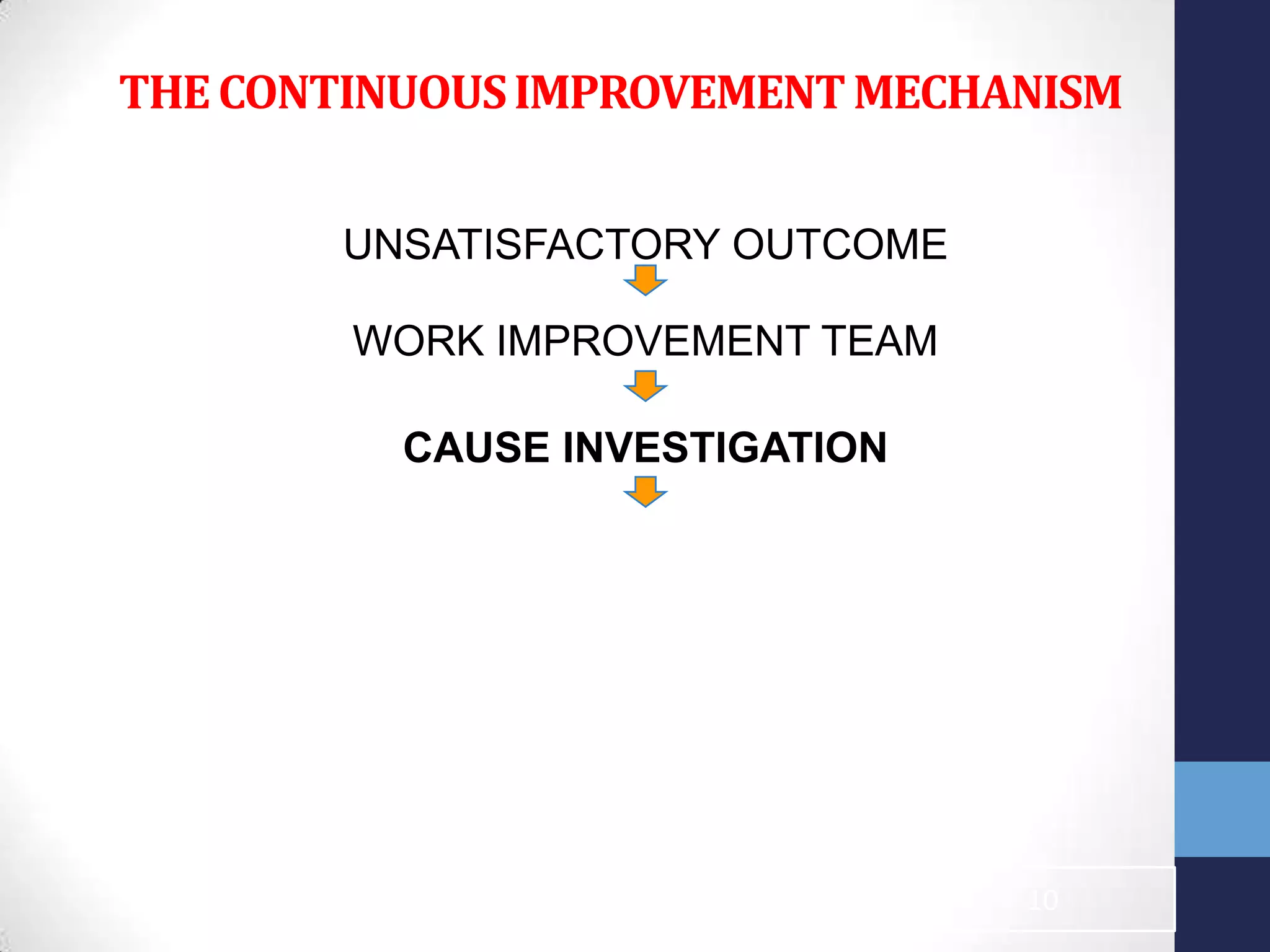
THECONTINUOUSIMPROVEMENTMECHANISM
UNSATISFACTORY OUTCOME
WORK IMPROVEMENT TEAM
9
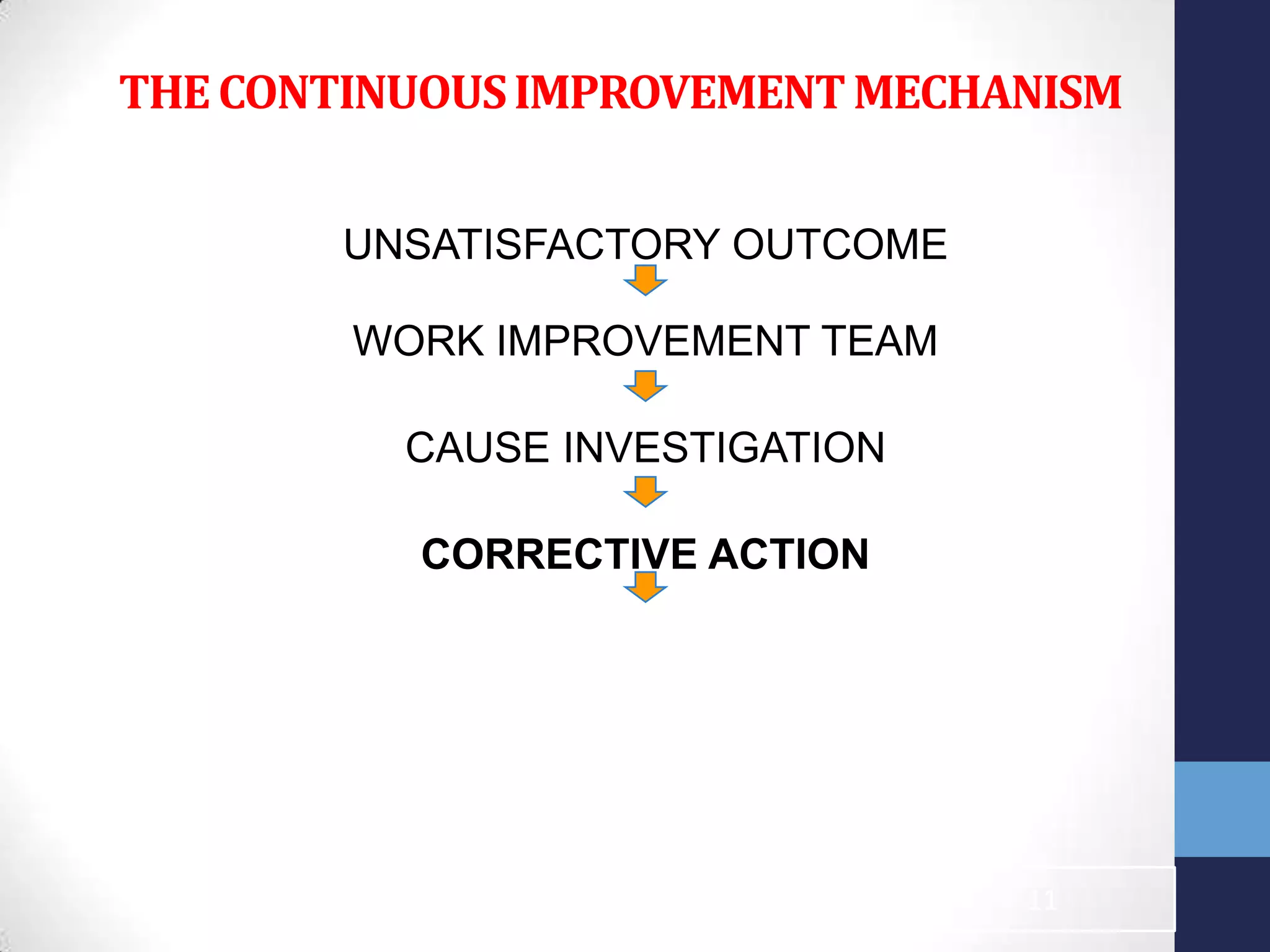
THECONTINUOUSIMPROVEMENTMECHANISM
UNSATISFACTORY OUTCOME
WORK IMPROVEMENT TEAM
CAUSE INVESTIGATION
10
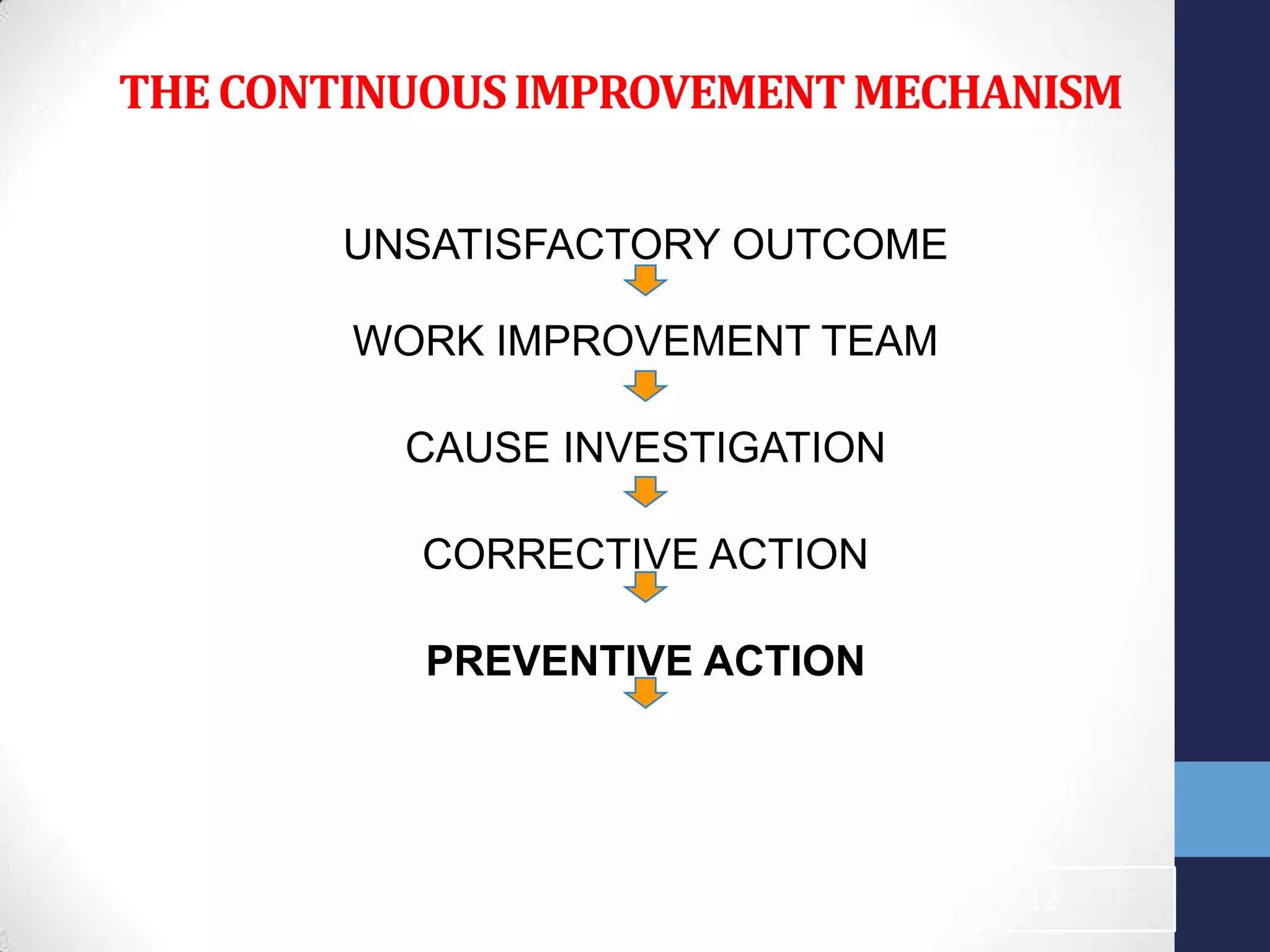
THECONTINUOUSIMPROVEMENTMECHANISM
UNSATISFACTORY OUTCOME
WORK IMPROVEMENT TEAM
CAUSE INVESTIGATION
CORRECTIVE ACTION
11
THECONTINUOUSIMPROVEMENTMECHANISM
UNSATISFACTORY OUTCOME
WORK IMPROVEMENT TEAM
CAUSE INVESTIGATION
CORRECTIVE ACTION
PREVENTIVE ACTION
12
THECONTINUOUSIMPROVEMENTMECHANISM
UNSATISFACTORY OUTCOME
WORK IMPROVEMENT TEAM
CAUSE INVESTIGATION
CORRECTIVE ACTION
PREVENTIVE ACTION
REVIEW
13
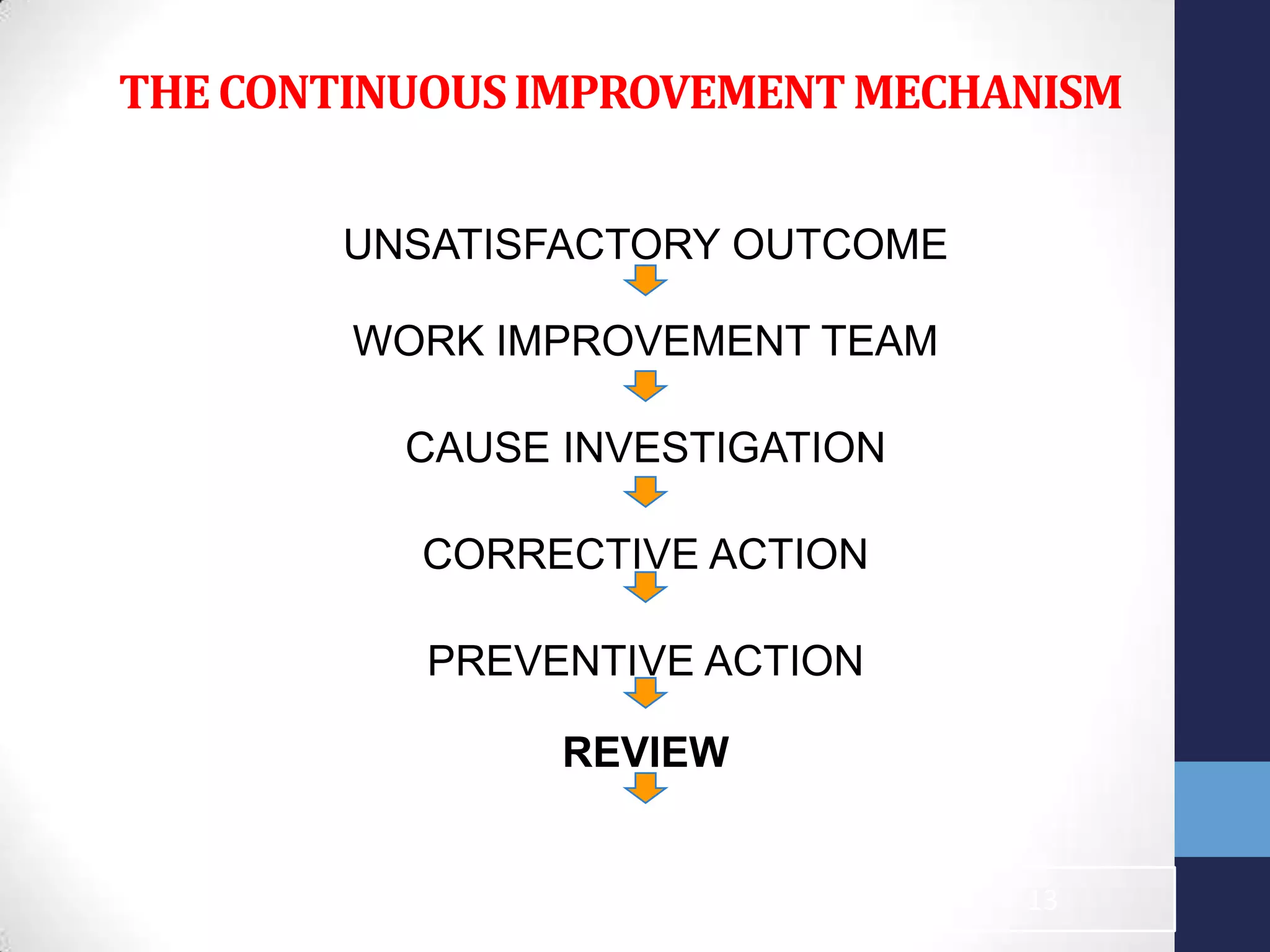
THECONTINUOUSIMPROVEMENTMECHANISM
UNSATISFACTORY OUTCOME
WORK IMPROVEMENT TEAM
CAUSE INVESTIGATION
CORRECTIVE ACTION
PREVENTIVE ACTION
REVIEW
14
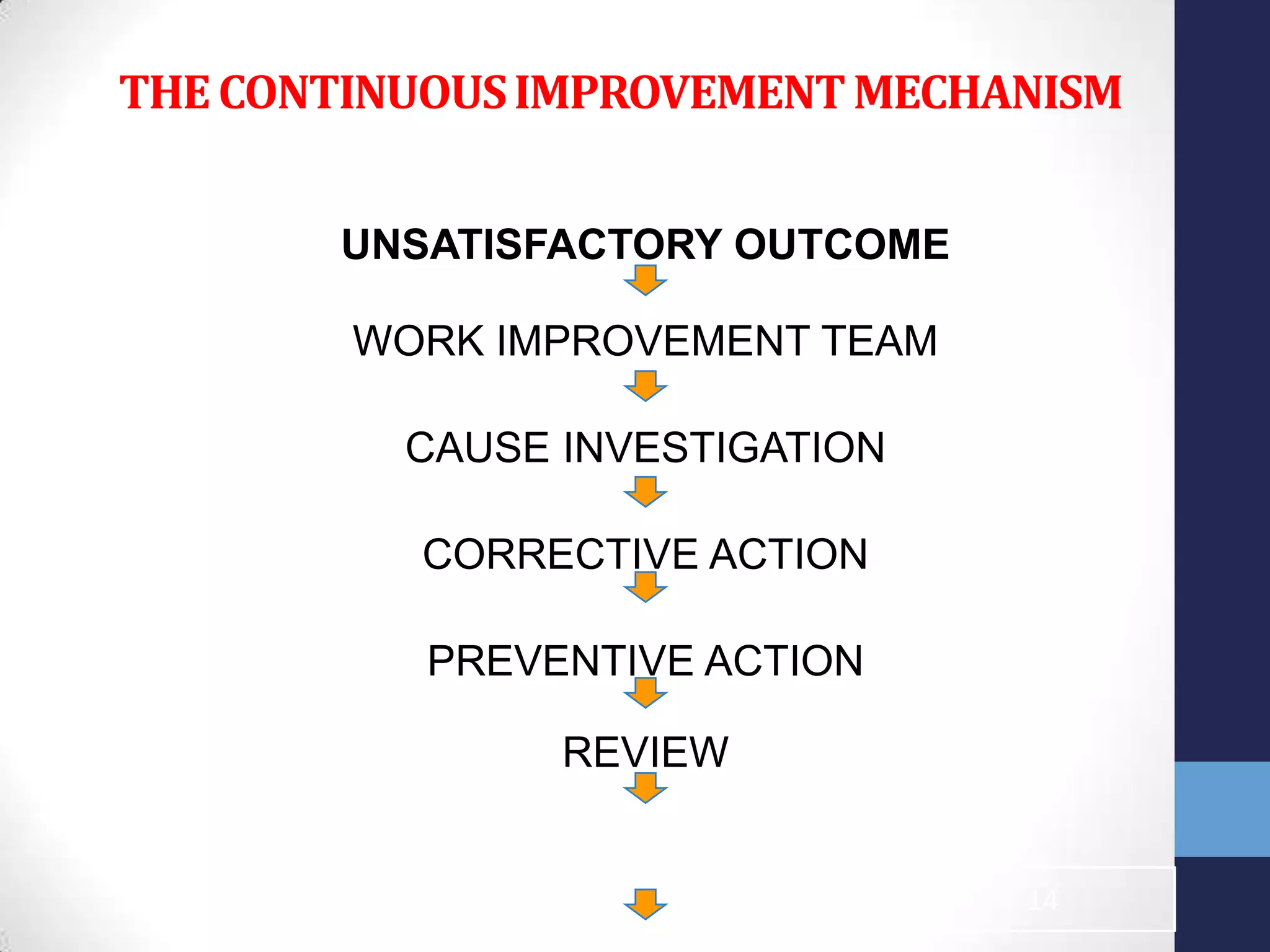
THECONTINUOUSIMPROVEMENTMECHANISM
UNSATISFACTORY OUTCOME
WORK IMPROVEMENT TEAM
CAUSE INVESTIGATION
CORRECTIVE ACTION
PREVENTIVE ACTION
REVIEW
15 21
 ISO 9000 is composed of 5 different, but
related parts:
ISO 9000, 9001, 9002, 9003 and 9004
 ISO 9000 and 9004 are guidelines,
 ISO 9001, 9002, and 9003 are the
categories in which a company may apply
for certification
16
 ISO 9000: “Quality Management and Quality
Assurance Standards – Guidelines for
Selection and Use”
 Written in order to determine which category
your organization should apply for
17
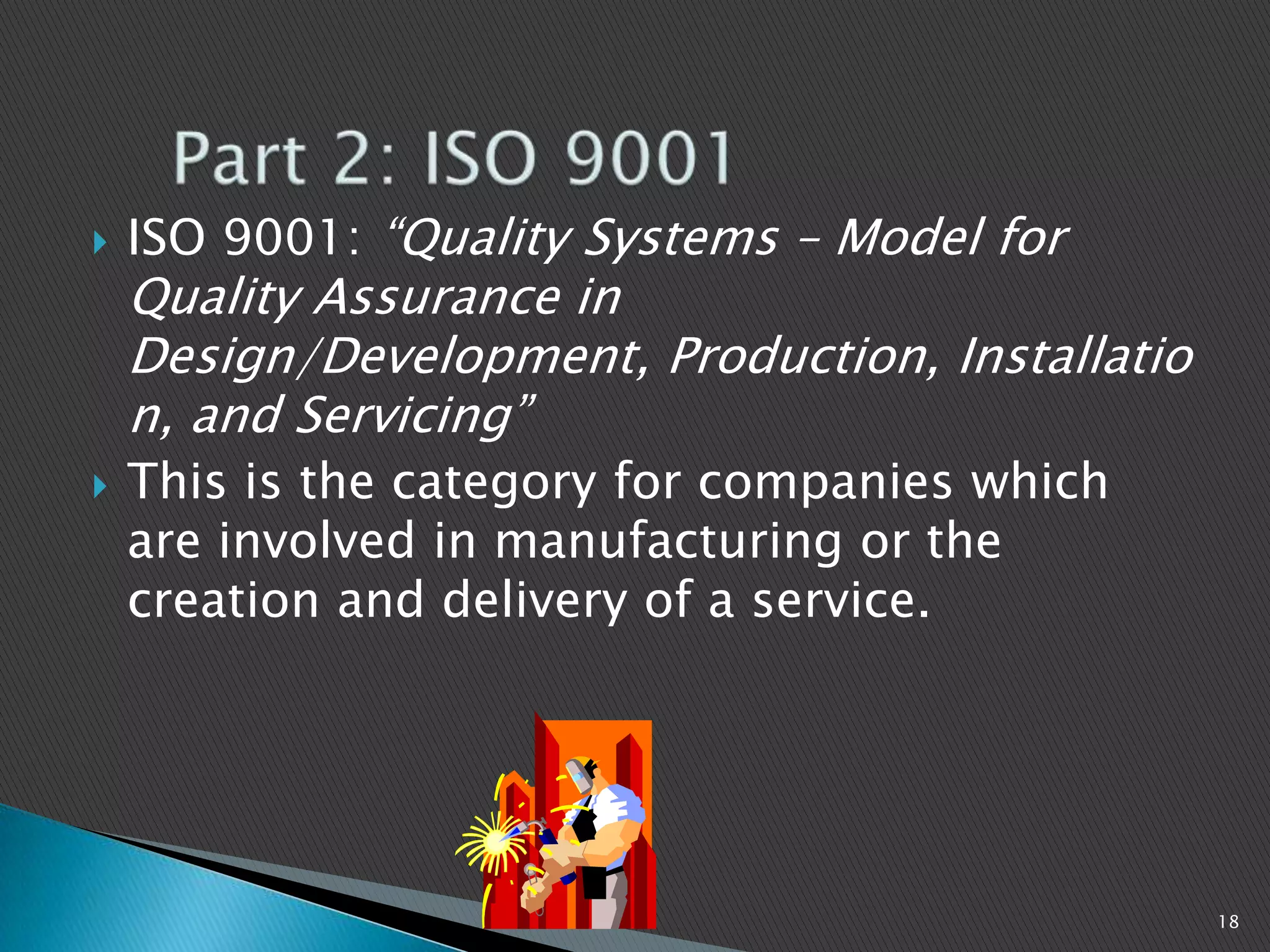
 ISO 9001: “Quality Systems – Model for
Quality Assurance in
Design/Development, Production, Installatio
n, and Servicing”
 This is the category for companies which
are involved in manufacturing or the
creation and delivery of a service.
18
 ISO 9002: “Quality Systems – Model for
Quality Assurance in Production and
Installation”
 Companies who perform many
functions, with the exception of design and
development, may apply to this category
19
 ISO 9003: “Quality Systems – Model for
Quality Assurance in Final Inspection and
Test”
 This category is useful for outside of the
manufacturing sector, such as in distributors
 ISO 9003 is being used less and may be
dropped in the future
20
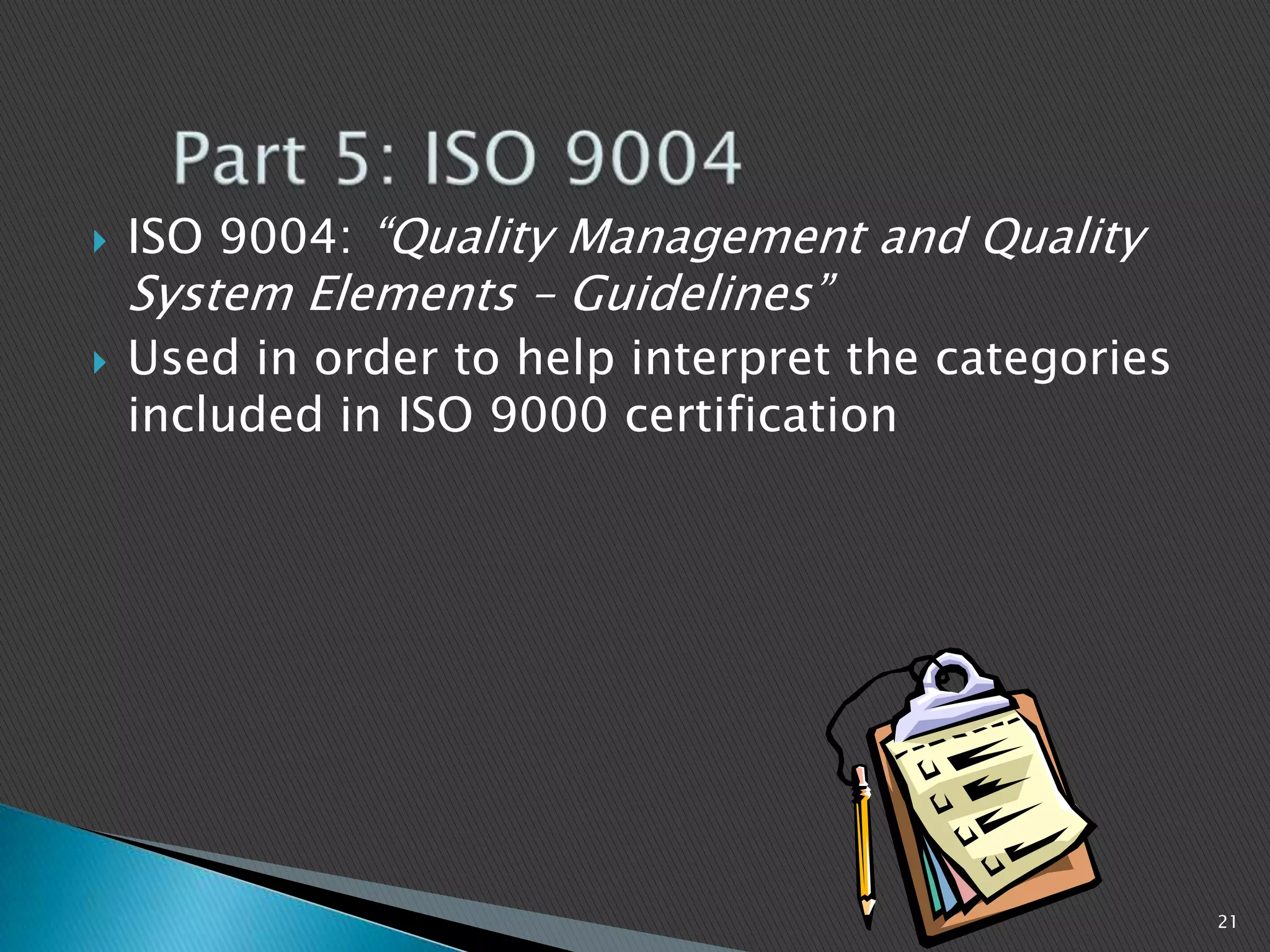
 ISO 9004: “Quality Management and Quality
System Elements – Guidelines”
 Used in order to help interpret the categories
included in ISO 9000 certification
21
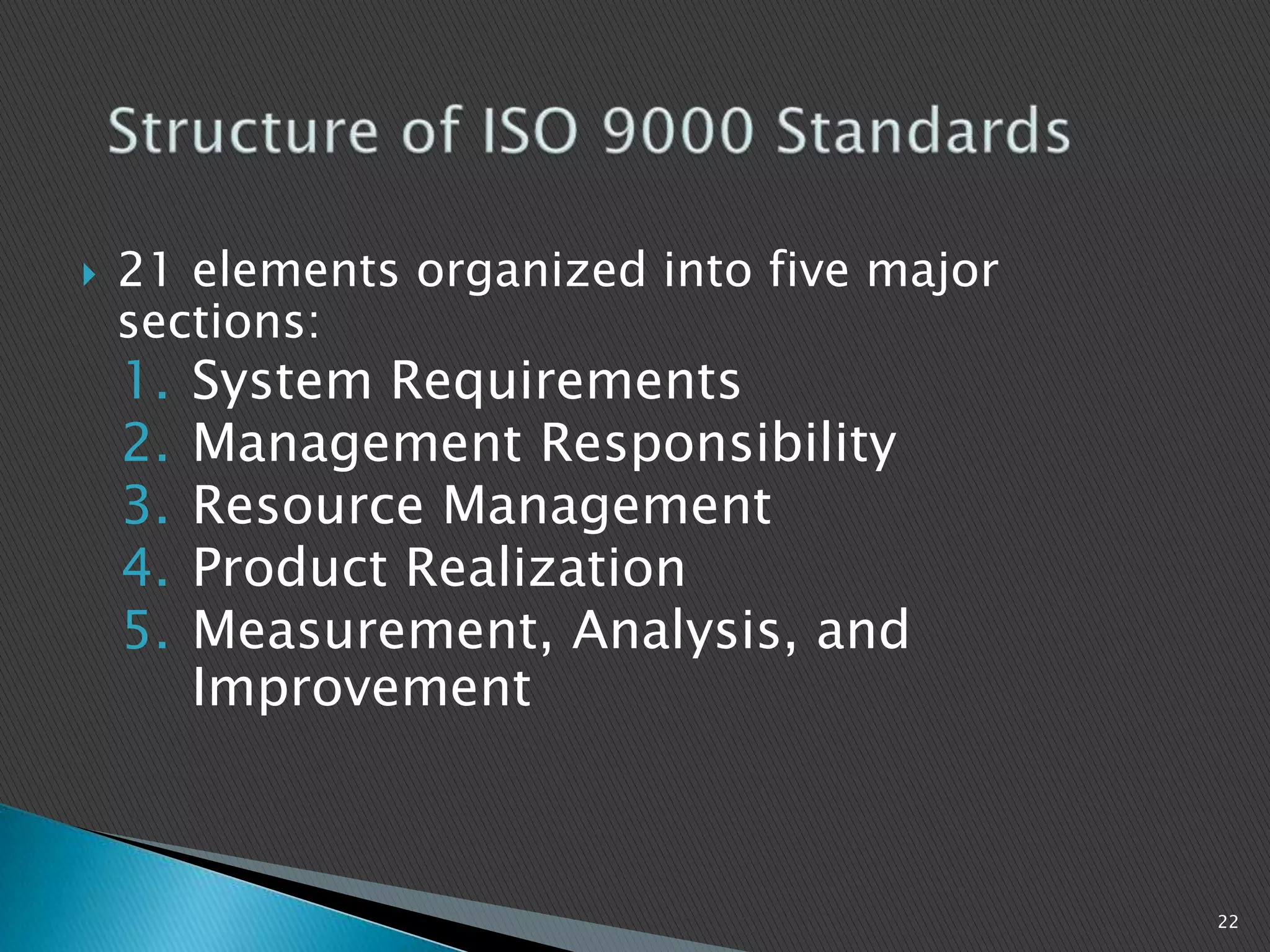
 21 elements organized into five major
sections:
1. System Requirements
2. Management Responsibility
3. Resource Management
4. Product Realization
5. Measurement, Analysis, and
Improvement
22
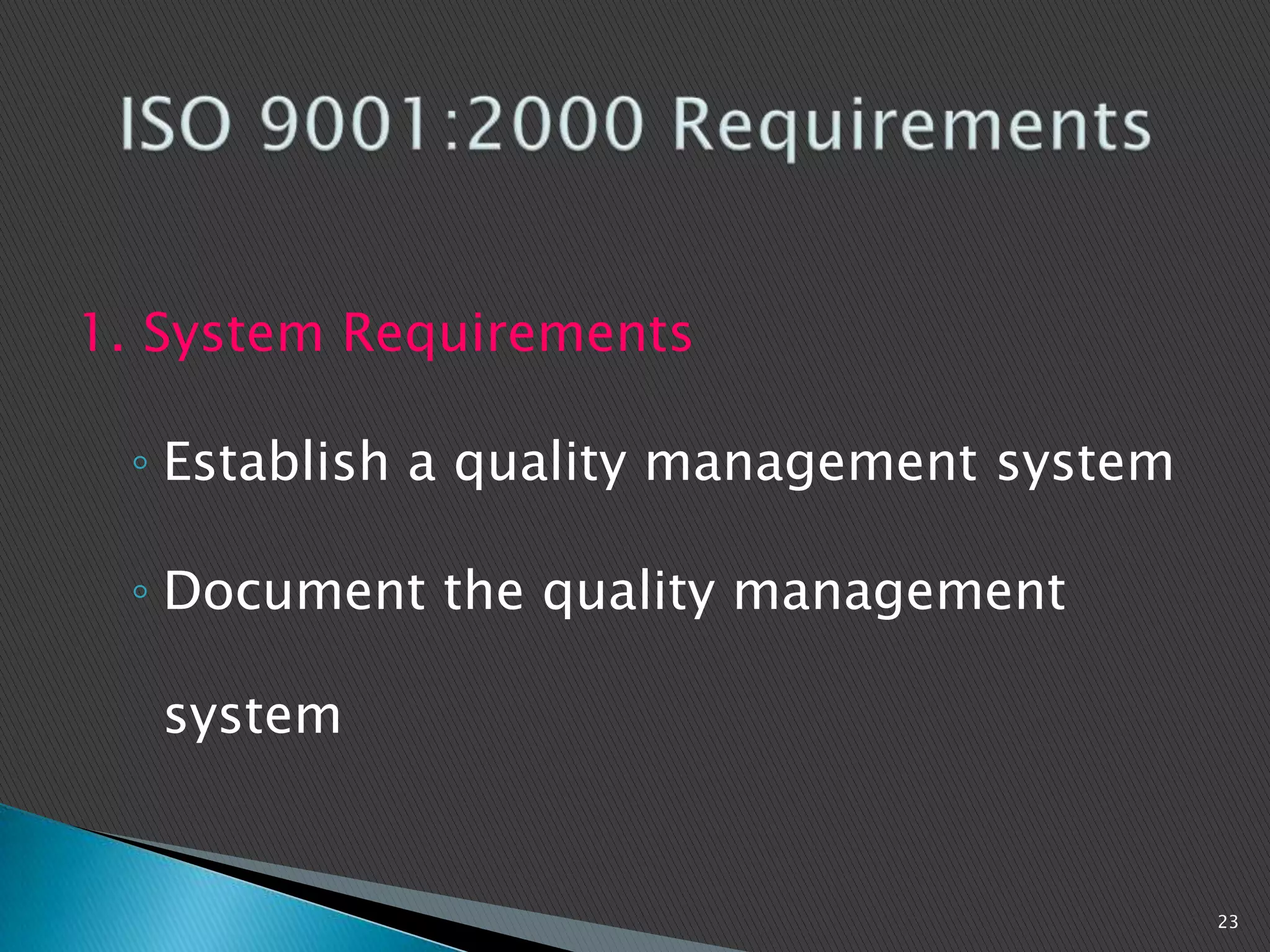
1. System Requirements
◦ Establish a quality management system
◦ Document the quality management
system
23
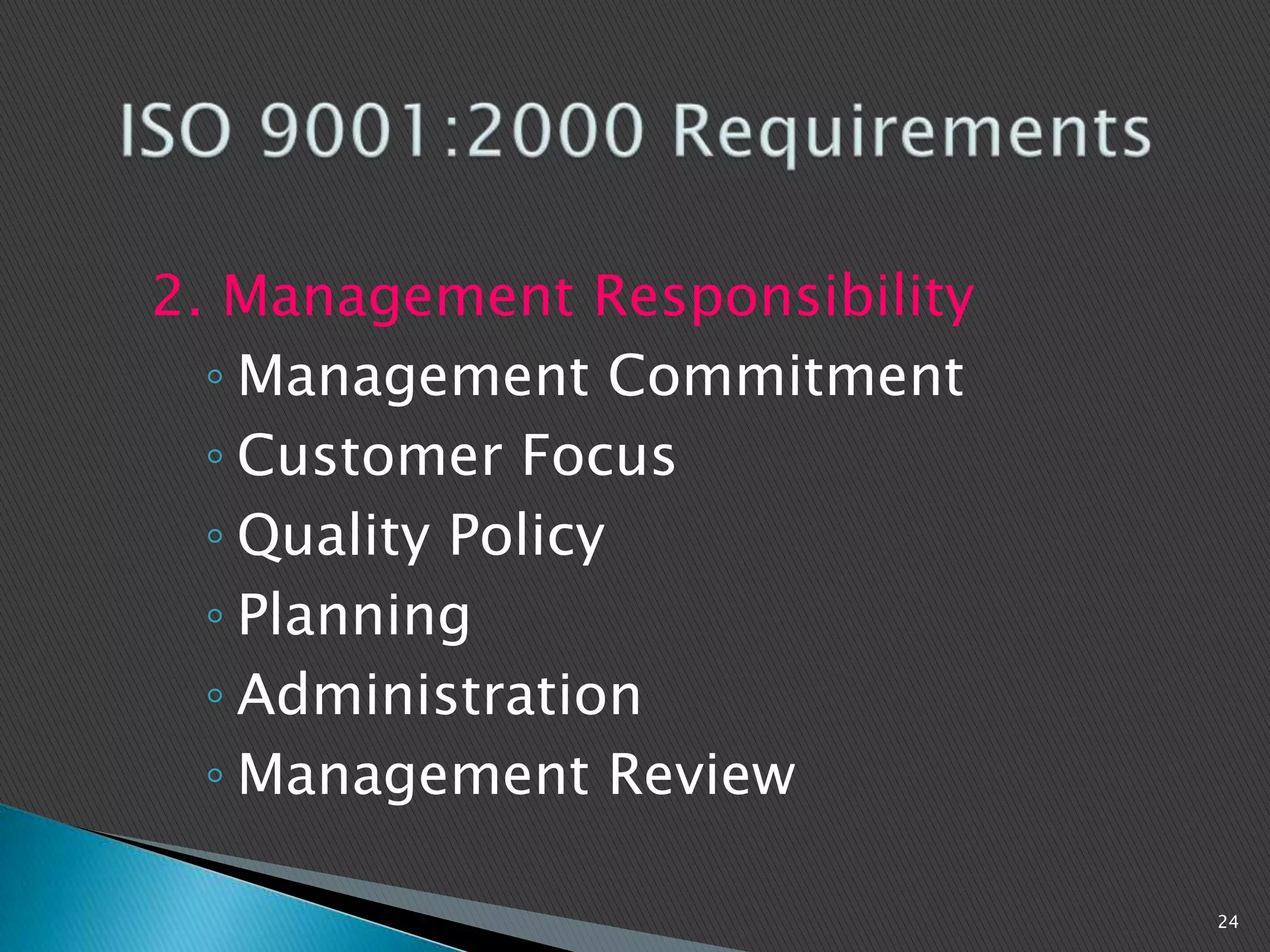
2. Management Responsibility
◦ Management Commitment
◦ Customer Focus
◦ Quality Policy
◦ Planning
◦ Administration
◦ Management Review
24
3. Resource Management
◦ Provision of Resources
◦ Human Resources
◦ Facilities
◦ Work Environment
25
4. Product and/or Service Realization
◦ Planning of Realization Processes
◦ Customer-Related Processes
◦ Design and/or Development
◦ Purchasing
◦ Production and Service Operations
◦ Control of Measuring and
Monitoring Devices
26
5. Measurement, Analysis, and
Improvement
◦ Planning
◦ Measurement and Monitoring
◦ Control of Nonconformity
◦ Analysis of Data
◦ Improvement
27
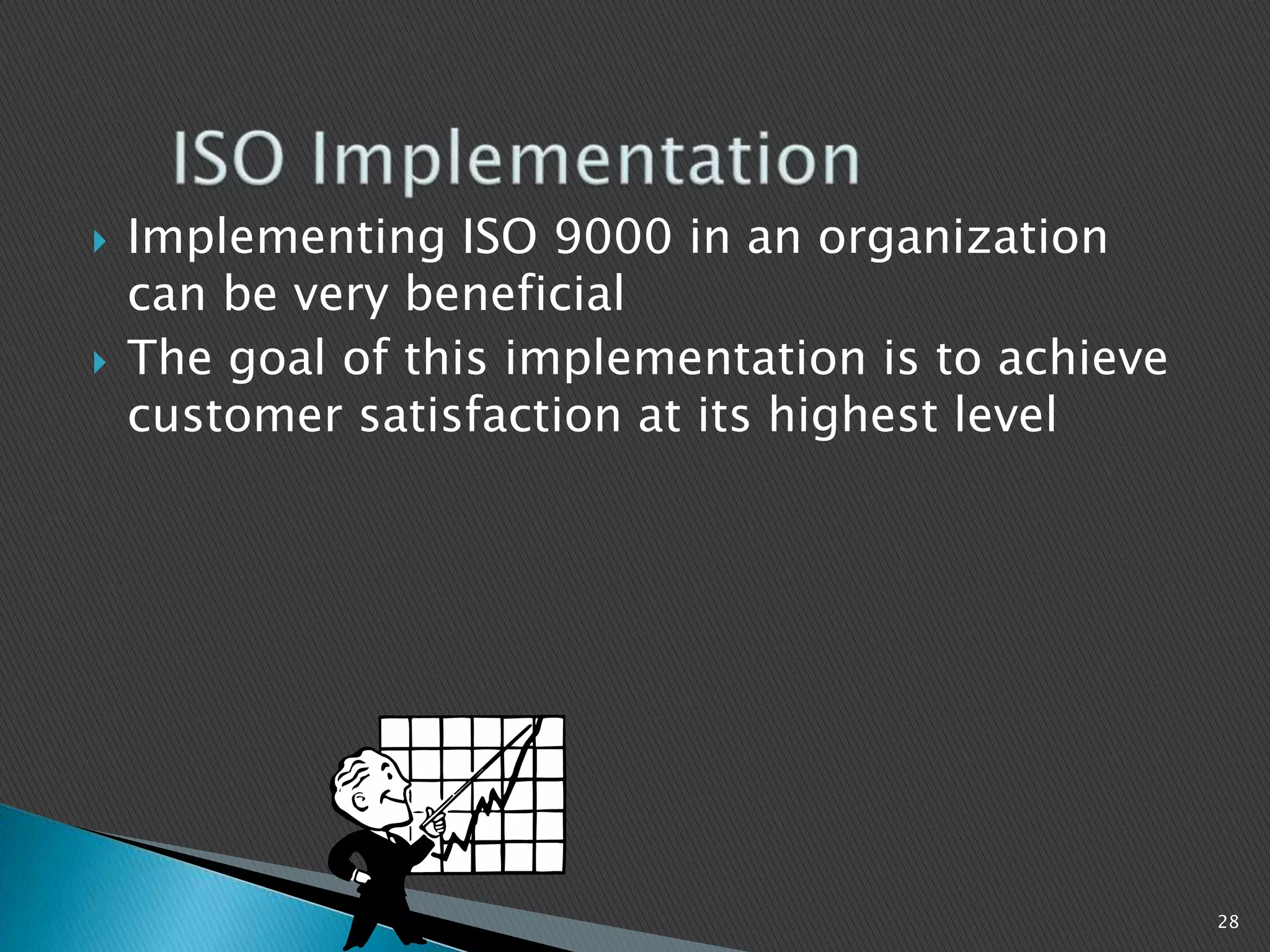
 Implementing ISO 9000 in an organization
can be very beneficial
 The goal of this implementation is to achieve
customer satisfaction at its highest level
28
 Manual
(philosophy, policy, objectives, approach)
 Procedures
 Work instructions
(department, product, process)
 Records (proof and objective evidence)
 Ad-hoc, temporary documents
29
1.The company first implements the control and
documentation procedures outlined in the series.
2. Internal Audit
3. It then involves a thorough audit by an
independent certification organization (i.e., a
Registrar) that is licensed to register quality
systems by an accreditation body (e.g., Registrar
Accreditation Board in U.S.)
30
4. Upon compliance, it receives a registration
certificate and its name is included in a
published directory of registered suppliers.
5. The systems will be continually verified by the
registrar in periodic surveillance and full audits
are conducted every few years.
31
 Through Dec. 2002, at least 561,747 ISO
9000 certifications have been issued in
159 countries and economies. In North
America, 53,806 certifications were
issued. In Europe, 292,970 certifications
were issued – The ISO Survey
 Some beginning to question its
usefulness
32
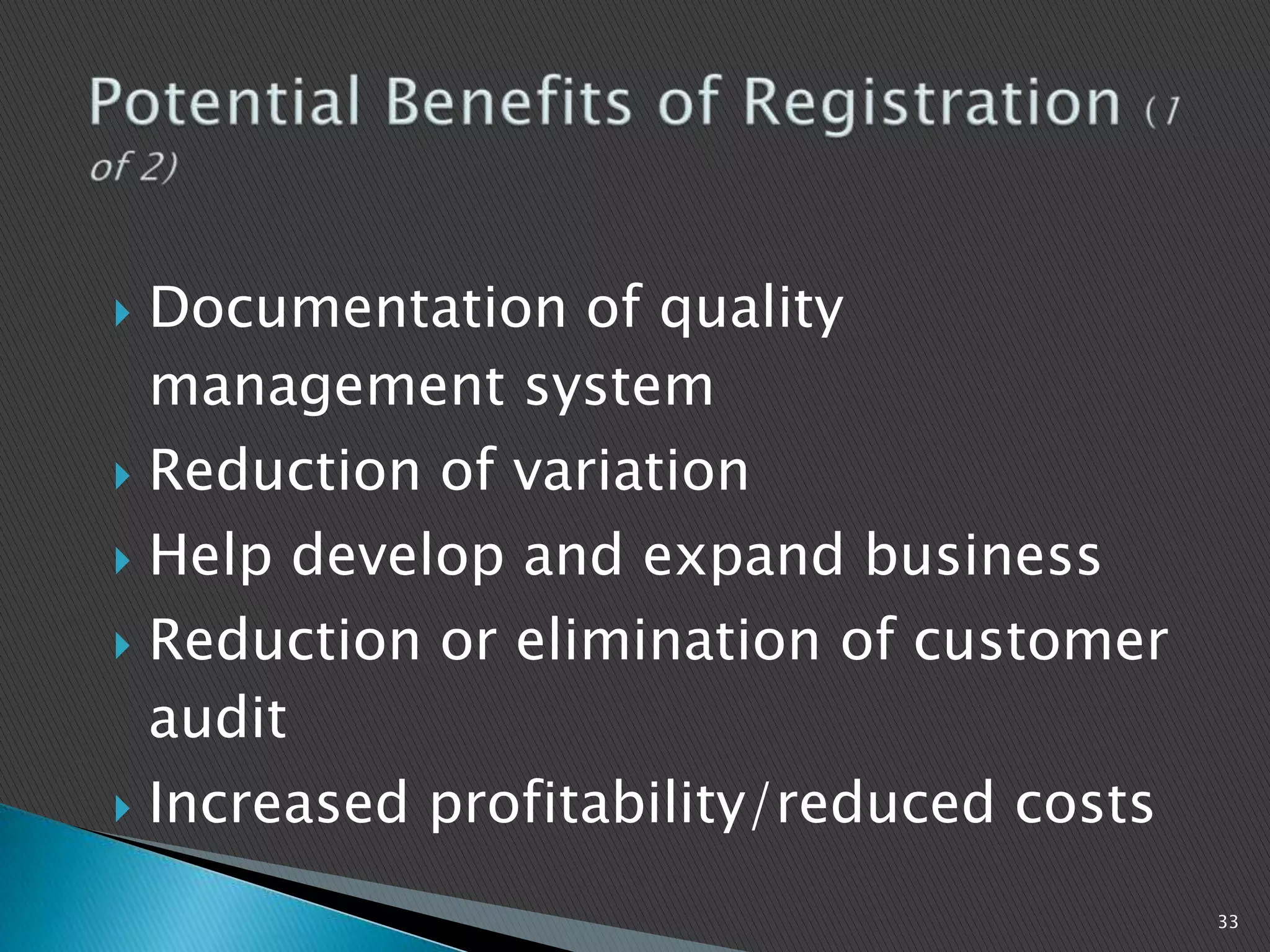
 Documentation of quality
management system
 Reduction of variation
 Help develop and expand business
 Reduction or elimination of customer
audit
 Increased profitability/reduced costs
33
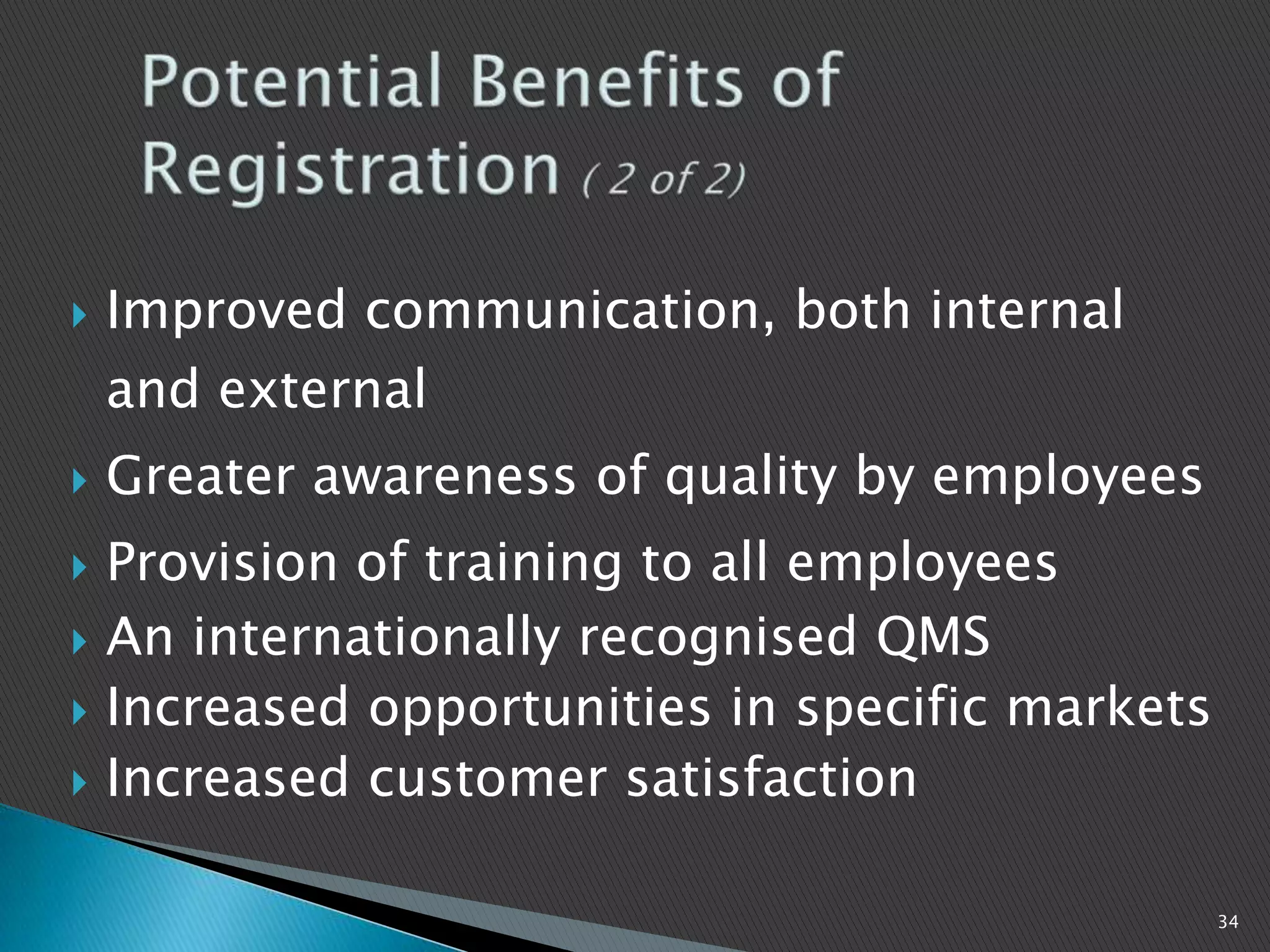
 Improved communication, both internal
and external
 Greater awareness of quality by employees
 Provision of training to all employees
 An internationally recognised QMS
 Increased opportunities in specific markets
 Increased customer satisfaction
34
 Costs - application & maintenance
 Time - maintenance
 Executive commitment
 Selection of registration
35
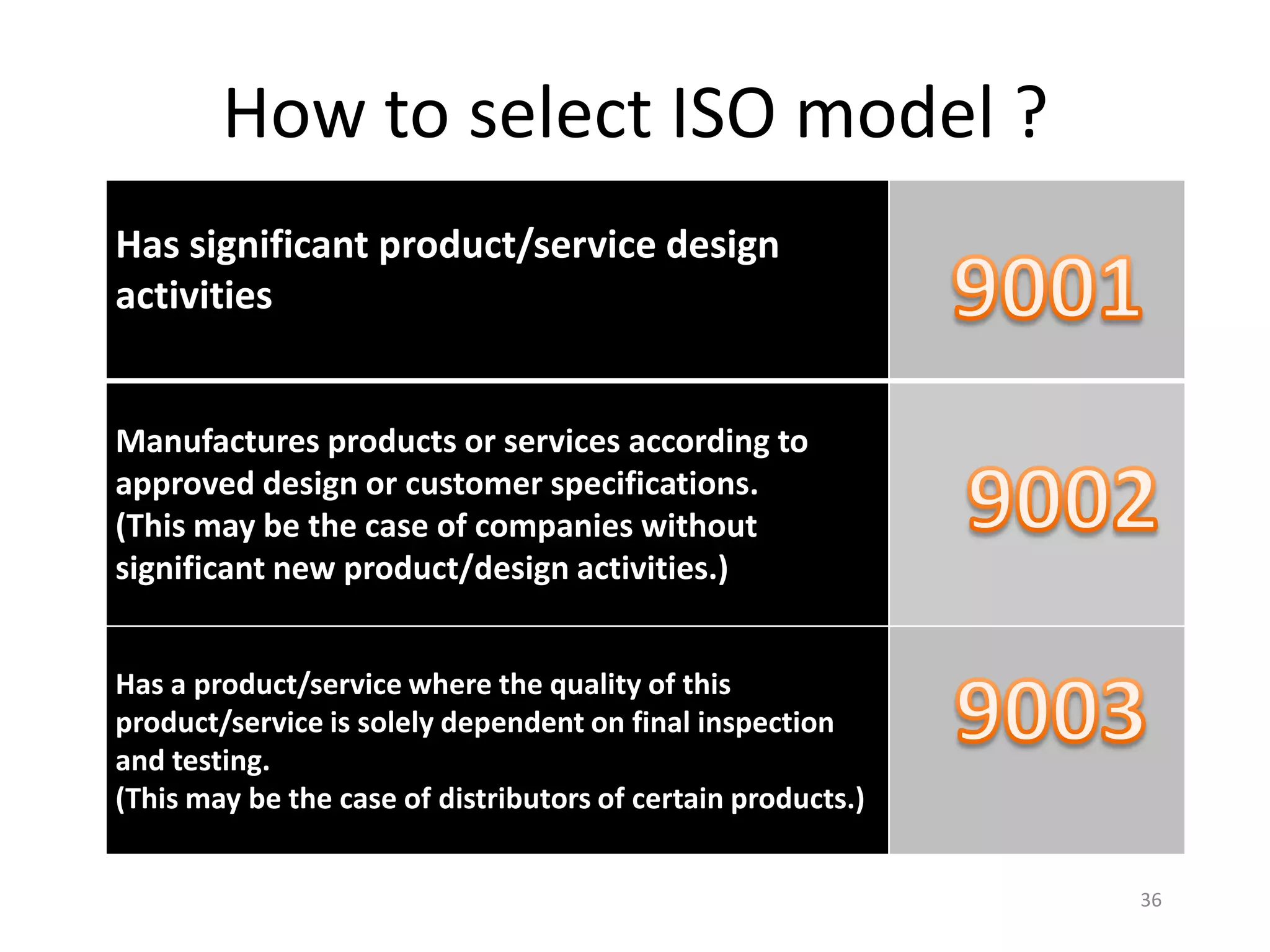
How to select ISO model ?
Has significant product/service design
activities
Manufactures products or services according to
approved design or customer specifications.
(This may be the case of companies without
significant new product/design activities.)
Has a product/service where the quality of this
product/service is solely dependent on final inspection
and testing.
(This may be the case of distributors of certain products.)
36
37

Introduction to ISO 9000

  • 1.
  • 2.
     International Organizationfor Standardization ◦ Worldwide federation of national standards bodies from 130 countries ◦ Over 11,000 standards ◦ Over 97 categories 2
  • 3.
     ISO 9000can benefit many industries, such as: Banking Health Care Manufacturing, etc.  ISO 9000 is generic, so it can be applied virtually anywhere!  Remember, ISO 9000 is just one part of an entire system needed to create value for customers 3
  • 4.
     ISO isnot an acronym  ISO is a name used for the International Organization for Standardization  The ISO was formed in 1947 in Geneva, Switzerland 4
  • 5.
     ISO 9000is a European Standard  The organization has two stated objectives: 1. To promote development of standardization to facilitate international exchange of goods and services. 2. To promote cooperation in intellectual, scientific, technological, and economic activity. 5
  • 6.
     The “Plan-Do-Check-Act”cycle, also known as the “Deming Cycle”  A dynamic cycle that is deployed to organization’s processes  Associated with the planning, implementation, control and continual improvement 6
  • 7.
    Note in Clause0.2 Plan: establish the objectives and processes necessary to deliver results in accordance with customer requirements and the organization's policies; Do: implement the processes; Check: monitor and measure processes and product against policies, objectives and requirements for the product and report the results; Act: take actions to continually improve process performance; 7
  • 8.
  • 9.
  • 10.
  • 11.
  • 12.
    THECONTINUOUSIMPROVEMENTMECHANISM UNSATISFACTORY OUTCOME WORK IMPROVEMENTTEAM CAUSE INVESTIGATION CORRECTIVE ACTION PREVENTIVE ACTION 12
  • 13.
    THECONTINUOUSIMPROVEMENTMECHANISM UNSATISFACTORY OUTCOME WORK IMPROVEMENTTEAM CAUSE INVESTIGATION CORRECTIVE ACTION PREVENTIVE ACTION REVIEW 13
  • 14.
    THECONTINUOUSIMPROVEMENTMECHANISM UNSATISFACTORY OUTCOME WORK IMPROVEMENTTEAM CAUSE INVESTIGATION CORRECTIVE ACTION PREVENTIVE ACTION REVIEW 14
  • 15.
    THECONTINUOUSIMPROVEMENTMECHANISM UNSATISFACTORY OUTCOME WORK IMPROVEMENTTEAM CAUSE INVESTIGATION CORRECTIVE ACTION PREVENTIVE ACTION REVIEW 15 21
  • 16.
     ISO 9000is composed of 5 different, but related parts: ISO 9000, 9001, 9002, 9003 and 9004  ISO 9000 and 9004 are guidelines,  ISO 9001, 9002, and 9003 are the categories in which a company may apply for certification 16
  • 17.
     ISO 9000:“Quality Management and Quality Assurance Standards – Guidelines for Selection and Use”  Written in order to determine which category your organization should apply for 17
  • 18.
     ISO 9001:“Quality Systems – Model for Quality Assurance in Design/Development, Production, Installatio n, and Servicing”  This is the category for companies which are involved in manufacturing or the creation and delivery of a service. 18
  • 19.
     ISO 9002:“Quality Systems – Model for Quality Assurance in Production and Installation”  Companies who perform many functions, with the exception of design and development, may apply to this category 19
  • 20.
     ISO 9003:“Quality Systems – Model for Quality Assurance in Final Inspection and Test”  This category is useful for outside of the manufacturing sector, such as in distributors  ISO 9003 is being used less and may be dropped in the future 20
  • 21.
     ISO 9004:“Quality Management and Quality System Elements – Guidelines”  Used in order to help interpret the categories included in ISO 9000 certification 21
  • 22.
     21 elementsorganized into five major sections: 1. System Requirements 2. Management Responsibility 3. Resource Management 4. Product Realization 5. Measurement, Analysis, and Improvement 22
  • 23.
    1. System Requirements ◦Establish a quality management system ◦ Document the quality management system 23
  • 24.
    2. Management Responsibility ◦Management Commitment ◦ Customer Focus ◦ Quality Policy ◦ Planning ◦ Administration ◦ Management Review 24
  • 25.
    3. Resource Management ◦Provision of Resources ◦ Human Resources ◦ Facilities ◦ Work Environment 25
  • 26.
    4. Product and/orService Realization ◦ Planning of Realization Processes ◦ Customer-Related Processes ◦ Design and/or Development ◦ Purchasing ◦ Production and Service Operations ◦ Control of Measuring and Monitoring Devices 26
  • 27.
    5. Measurement, Analysis,and Improvement ◦ Planning ◦ Measurement and Monitoring ◦ Control of Nonconformity ◦ Analysis of Data ◦ Improvement 27
  • 28.
     Implementing ISO9000 in an organization can be very beneficial  The goal of this implementation is to achieve customer satisfaction at its highest level 28
  • 29.
     Manual (philosophy, policy,objectives, approach)  Procedures  Work instructions (department, product, process)  Records (proof and objective evidence)  Ad-hoc, temporary documents 29
  • 30.
    1.The company firstimplements the control and documentation procedures outlined in the series. 2. Internal Audit 3. It then involves a thorough audit by an independent certification organization (i.e., a Registrar) that is licensed to register quality systems by an accreditation body (e.g., Registrar Accreditation Board in U.S.) 30
  • 31.
    4. Upon compliance,it receives a registration certificate and its name is included in a published directory of registered suppliers. 5. The systems will be continually verified by the registrar in periodic surveillance and full audits are conducted every few years. 31
  • 32.
     Through Dec.2002, at least 561,747 ISO 9000 certifications have been issued in 159 countries and economies. In North America, 53,806 certifications were issued. In Europe, 292,970 certifications were issued – The ISO Survey  Some beginning to question its usefulness 32
  • 33.
     Documentation ofquality management system  Reduction of variation  Help develop and expand business  Reduction or elimination of customer audit  Increased profitability/reduced costs 33
  • 34.
     Improved communication,both internal and external  Greater awareness of quality by employees  Provision of training to all employees  An internationally recognised QMS  Increased opportunities in specific markets  Increased customer satisfaction 34
  • 35.
     Costs -application & maintenance  Time - maintenance  Executive commitment  Selection of registration 35
  • 36.
    How to selectISO model ? Has significant product/service design activities Manufactures products or services according to approved design or customer specifications. (This may be the case of companies without significant new product/design activities.) Has a product/service where the quality of this product/service is solely dependent on final inspection and testing. (This may be the case of distributors of certain products.) 36
  • 37.