National School of Nanosciences and Nanotechnologies
Fluid Mechanics
(Preliminary Course)
Teacher biography

BELHOUCHAT Norel-Houda

Class ‘’A" Associate Professor in Process engineering,
specialiste in Chemical engineering

Area of interest: Chemical Engineering; Nonmaterial,
Water treatment; Environmental Science; Material Science

E-mail: n.belhouchat@univ-alger.dz






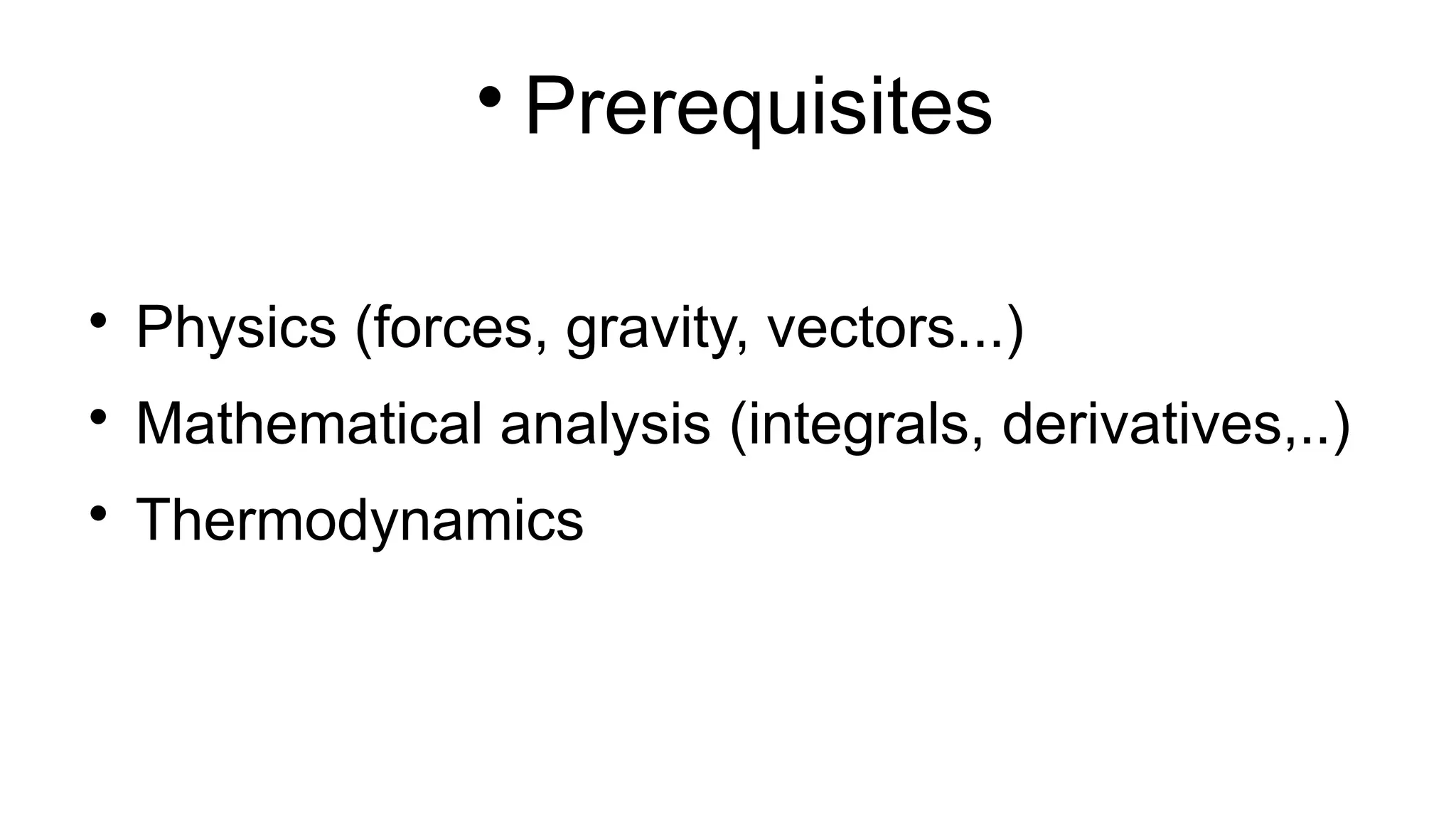
Prerequisites

Physics (forces, gravity, vectors...)

Mathematical analysis (integrals, derivatives,..)

Thermodynamics
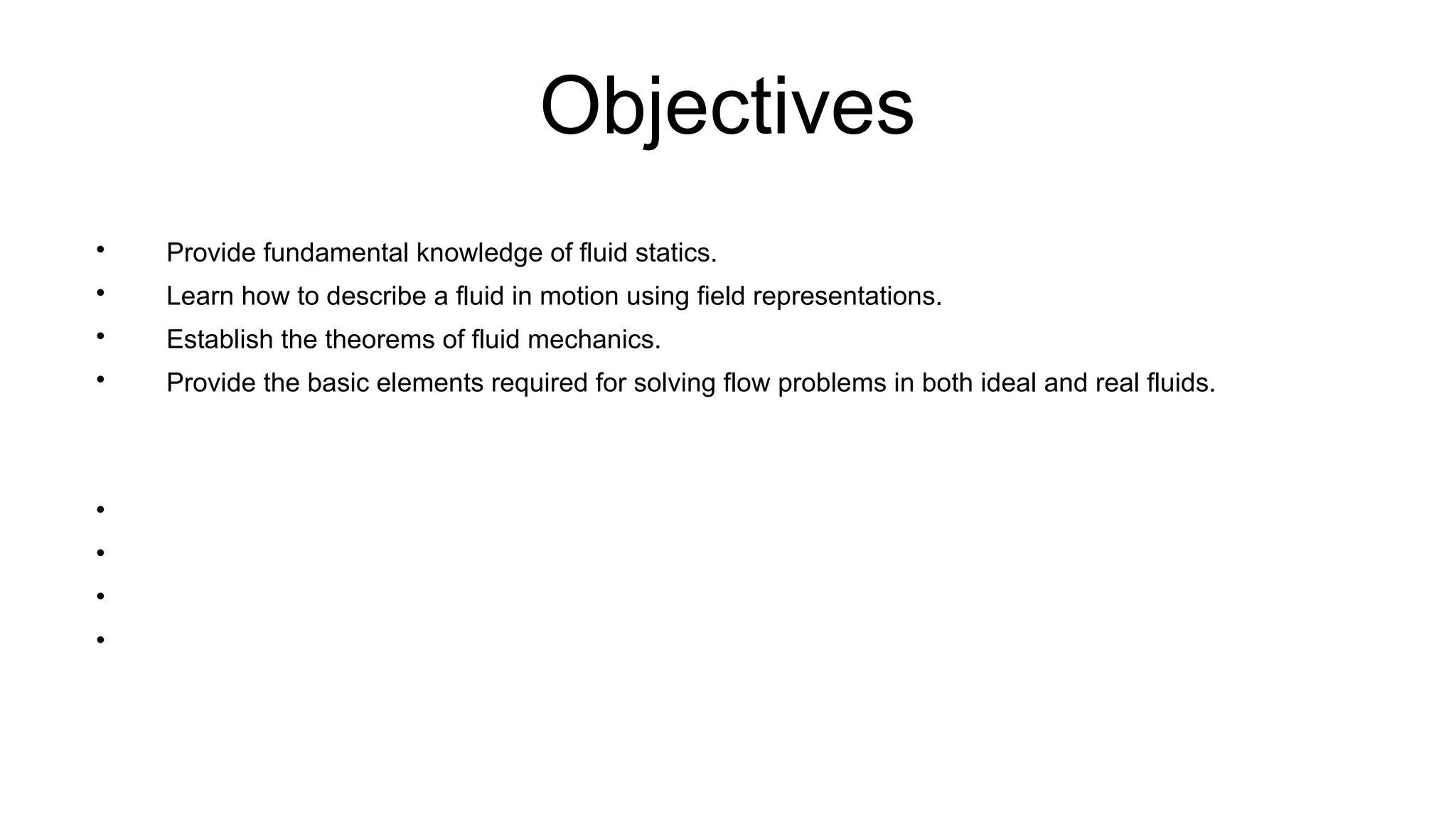
Objectives

Provide fundamental knowledge of fluid statics.

Learn how to describe a fluid in motion using field representations.

Establish the theorems of fluid mechanics.

Provide the basic elements required for solving flow problems in both ideal and real fluids.




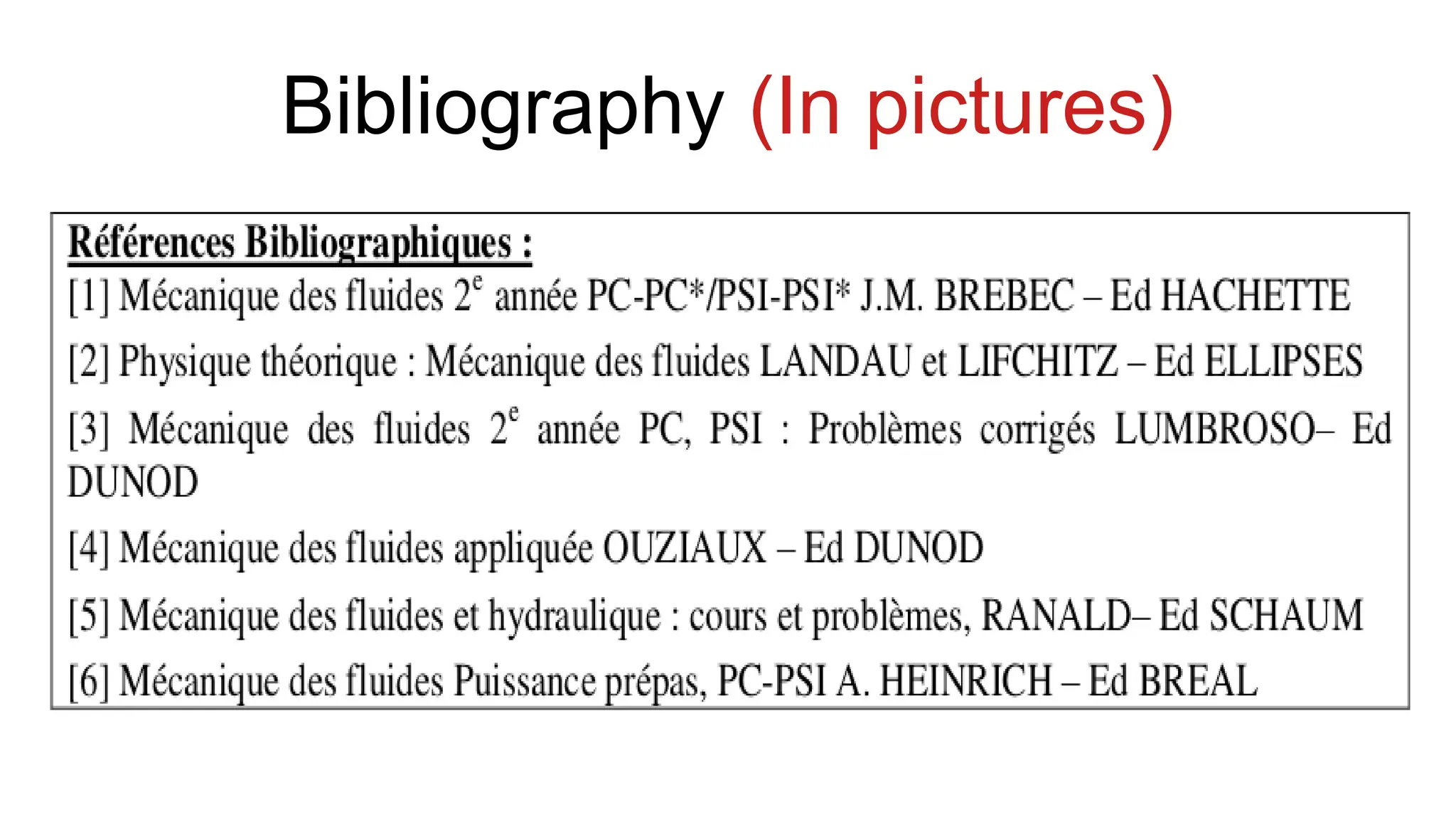
Bibliography (In pictures)
Chapter 1: Fluid statics

1.1. Definition of a Fluid

1.2. Physical Properties of Fluids

1.3. Classification of Fluids

1.4. General Principles and Theorems

1.5. Hydrostatic Pressure

1.6. Hydrostatic Center of Pressure

1.7. Relative Equilibrium

1.8. Archimedes' Principle
Introduction
Fluid mechanics is a branch of applied mechanics
that deals with the behavior of liquids and gases,
whether at rest (Fluid statics) or in motion (Fluid
dynamics).
By the end of this lecture, students will be able to:

Apply the fundamental relation of hydrostatics to calculate pressure at a specific point within a fluid.

Calculate the hydrostatic forces exerted on surfaces submerged in a fluid.

Utilize Archimedes' principle to determine the buoyant force acting on objects in fluids and analyze the
conditions for floating or sinking.

Apply Bernoulli's theorem to solve problems related to fluid flow, pressure, and velocity in various fluid
systems.

Manipulate and employ mathematical tools of vector analysis, including differential operators such as
gradient, divergence, curl, and the Laplacian, to analyze fluid behavior and solve related equations.

Have a deeper understanding about fluid flow theory

Determine the velocity profiles of various flow conditions from a simple force balances

Distinguish various flow types

Understand the basic laws and governing equations of fluid flow

Employ differential and integral approaches to formulate/solve a flow phenomena
This field encompasses a wide range of issues:
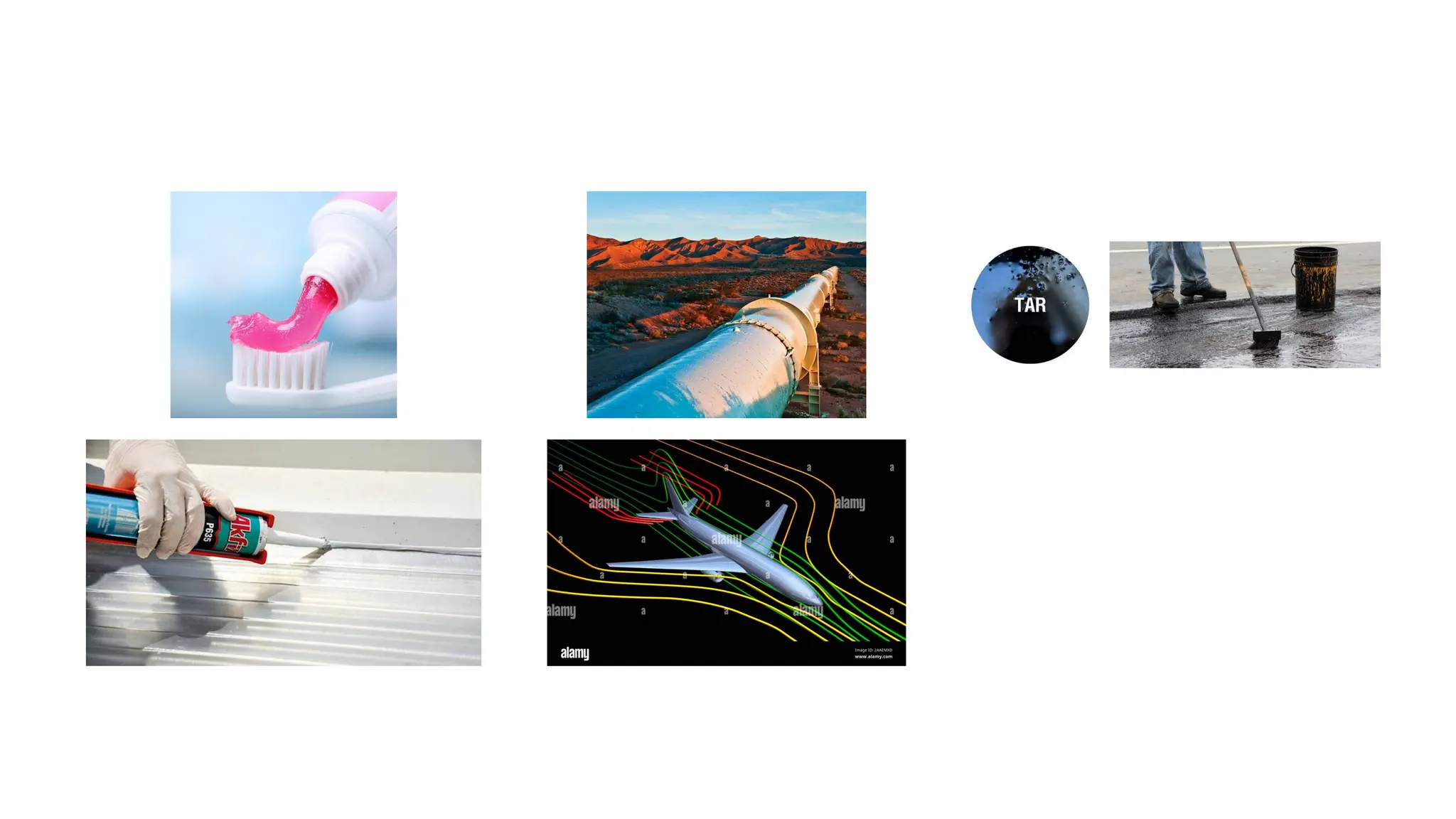
This field encompasses a wide range of issues, from studying blood flow in deformable
capillaries (blood vessels with diameters of just a few microns) to analyzing the flow of
crude oil through pipelines with diameters of up to one meter and lengths extending up
to 13,000 kilometers.
The principles of fluid mechanics are essential for explaining why airplanes fly and
determining the ideal wing profile for the most efficient flight in terms of fuel costs and
speed. Similarly, the dimples on golf balls help to achieve greater distance by delaying
the separation of the boundary layer in turbulent flow.
Other materials, such as mud, tar, sealant, or toothpaste, are not easily classified
because they behave like solids when the applied stress is low. However, if this stress
exceeds a critical value, they flow like a fluid. The study of such substances is a distinct
field known as rheology and falls under the category of complex fluids within fluid
mechanics.
What is a fluid?
From a molecular perspective,
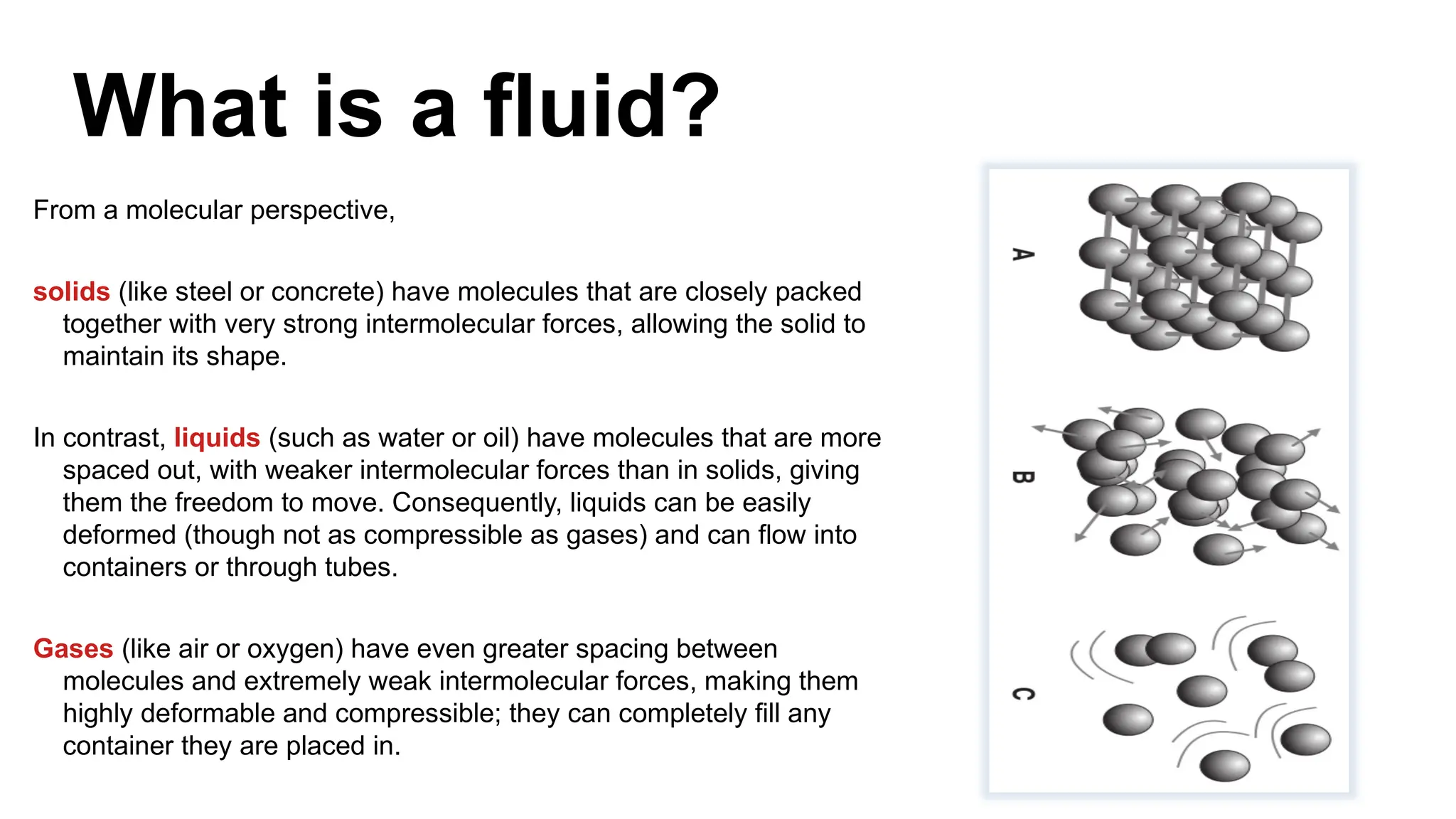
solids (like steel or concrete) have molecules that are closely packed
together with very strong intermolecular forces, allowing the solid to
maintain its shape.
In contrast, liquids (such as water or oil) have molecules that are more
spaced out, with weaker intermolecular forces than in solids, giving
them the freedom to move. Consequently, liquids can be easily
deformed (though not as compressible as gases) and can flow into
containers or through tubes.
Gases (like air or oxygen) have even greater spacing between
molecules and extremely weak intermolecular forces, making them
highly deformable and compressible; they can completely fill any
container they are placed in.

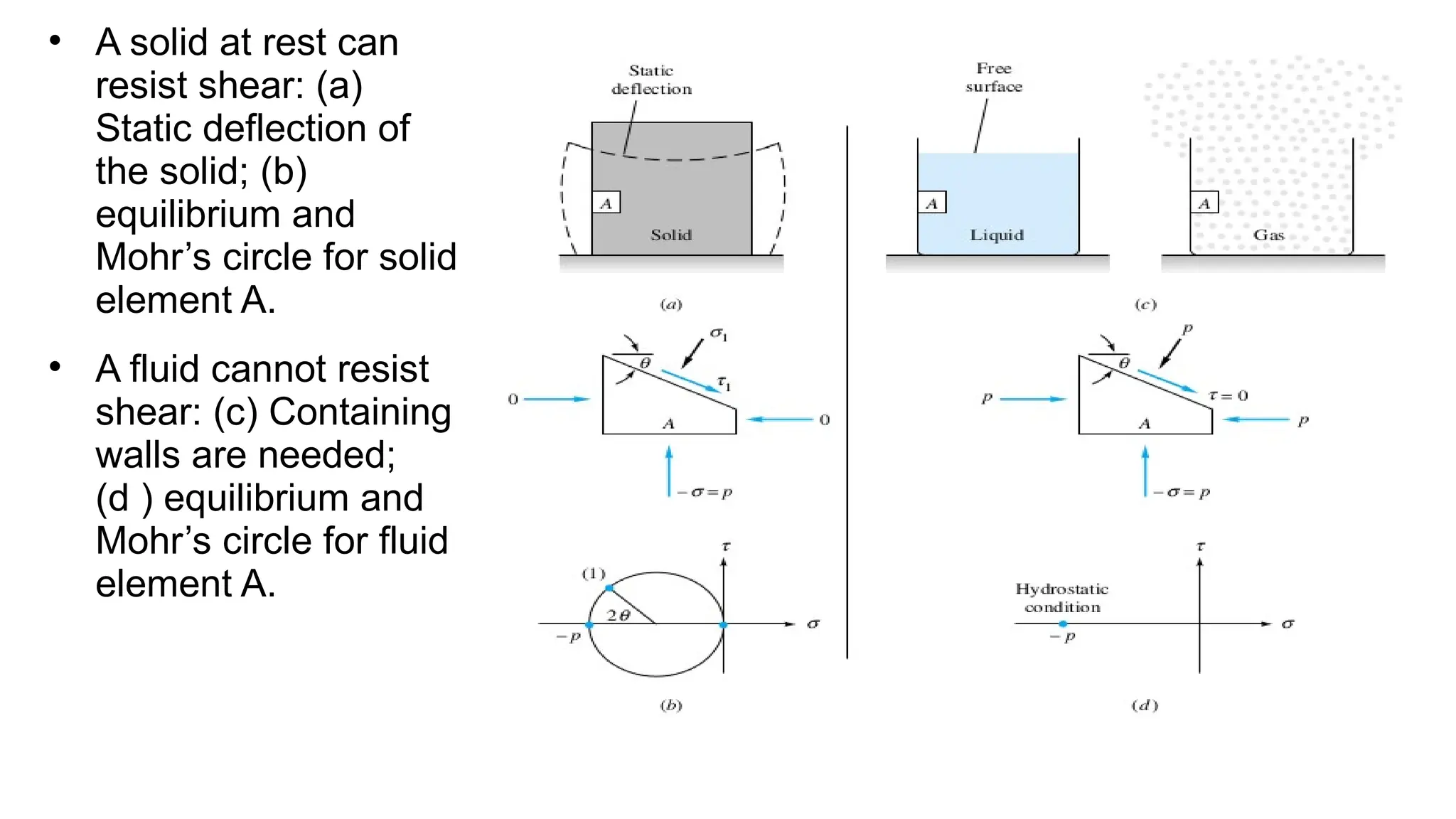
A solid at rest can
resist shear: (a)
Static deflection of
the solid; (b)
equilibrium and
Mohr’s circle for solid
element A.

A fluid cannot resist
shear: (c) Containing
walls are needed;
(d ) equilibrium and
Mohr’s circle for fluid
element A.
Definitions
Mechanics is the oldest physical science that deals with both stationary and
moving bodies under the influence of forces.
 The branch of mechanics that deals with bodies at rest is called statics, while
the branch that deals with bodies in motion is called dynamics.
 The subcategory fluid mechanics is defined as the science that deals with the
behavior of fluids at rest (fluid statics) or in motion (fluid dynamics), and the
interaction of fluids with solids or other fluids at the boundaries.
 The study of fluids at rest is called fluid statics.
The study of f1uids in motion, where pressure forces are
not considered, is called fluid kinematics and if the
pressure forces are also considered for the fluids in
motion. that branch of science is called fluid dynamics.

 Fluid mechanics itself is also divided into several

categories.

 The study of the motion of fluids that are practically incompressible (such
as liquids, especially water, and gases at low speeds) is usually referred to
as hydrodynamics.

 A subcategory of hydrodynamics is hydraulics, which deals with liquid flows
in pipes and open channels.

Gas dynamics deals with the flow of fluids that undergo significant density
changes, such as the flow of gases through nozzles at high speeds.

 The category aerodynamics deals with the flow of gases (especially air)
over bodies such as aircraft, rockets, and automobiles at high or low speeds.

 Some other specialized categories such as meteorology, oceanography,
and hydrology deal with naturally occurring flows.
Fluid Mechanics introduction_Introduction.pptx

Fluid Mechanics introduction_Introduction.pptx

  • 1.
    National School ofNanosciences and Nanotechnologies Fluid Mechanics (Preliminary Course)
  • 2.
    Teacher biography  BELHOUCHAT Norel-Houda  Class‘’A" Associate Professor in Process engineering, specialiste in Chemical engineering  Area of interest: Chemical Engineering; Nonmaterial, Water treatment; Environmental Science; Material Science  E-mail: n.belhouchat@univ-alger.dz
  • 3.
  • 4.
     Prerequisites  Physics (forces, gravity,vectors...)  Mathematical analysis (integrals, derivatives,..)  Thermodynamics
  • 5.
    Objectives  Provide fundamental knowledgeof fluid statics.  Learn how to describe a fluid in motion using field representations.  Establish the theorems of fluid mechanics.  Provide the basic elements required for solving flow problems in both ideal and real fluids.    
  • 6.
  • 7.
    Chapter 1: Fluidstatics  1.1. Definition of a Fluid  1.2. Physical Properties of Fluids  1.3. Classification of Fluids  1.4. General Principles and Theorems  1.5. Hydrostatic Pressure  1.6. Hydrostatic Center of Pressure  1.7. Relative Equilibrium  1.8. Archimedes' Principle
  • 8.
    Introduction Fluid mechanics isa branch of applied mechanics that deals with the behavior of liquids and gases, whether at rest (Fluid statics) or in motion (Fluid dynamics).
  • 9.
    By the endof this lecture, students will be able to:  Apply the fundamental relation of hydrostatics to calculate pressure at a specific point within a fluid.  Calculate the hydrostatic forces exerted on surfaces submerged in a fluid.  Utilize Archimedes' principle to determine the buoyant force acting on objects in fluids and analyze the conditions for floating or sinking.  Apply Bernoulli's theorem to solve problems related to fluid flow, pressure, and velocity in various fluid systems.  Manipulate and employ mathematical tools of vector analysis, including differential operators such as gradient, divergence, curl, and the Laplacian, to analyze fluid behavior and solve related equations.  Have a deeper understanding about fluid flow theory  Determine the velocity profiles of various flow conditions from a simple force balances  Distinguish various flow types  Understand the basic laws and governing equations of fluid flow  Employ differential and integral approaches to formulate/solve a flow phenomena
  • 10.
    This field encompassesa wide range of issues: This field encompasses a wide range of issues, from studying blood flow in deformable capillaries (blood vessels with diameters of just a few microns) to analyzing the flow of crude oil through pipelines with diameters of up to one meter and lengths extending up to 13,000 kilometers. The principles of fluid mechanics are essential for explaining why airplanes fly and determining the ideal wing profile for the most efficient flight in terms of fuel costs and speed. Similarly, the dimples on golf balls help to achieve greater distance by delaying the separation of the boundary layer in turbulent flow. Other materials, such as mud, tar, sealant, or toothpaste, are not easily classified because they behave like solids when the applied stress is low. However, if this stress exceeds a critical value, they flow like a fluid. The study of such substances is a distinct field known as rheology and falls under the category of complex fluids within fluid mechanics.
  • 11.
    What is afluid? From a molecular perspective, solids (like steel or concrete) have molecules that are closely packed together with very strong intermolecular forces, allowing the solid to maintain its shape. In contrast, liquids (such as water or oil) have molecules that are more spaced out, with weaker intermolecular forces than in solids, giving them the freedom to move. Consequently, liquids can be easily deformed (though not as compressible as gases) and can flow into containers or through tubes. Gases (like air or oxygen) have even greater spacing between molecules and extremely weak intermolecular forces, making them highly deformable and compressible; they can completely fill any container they are placed in.
  • 13.
     A solid atrest can resist shear: (a) Static deflection of the solid; (b) equilibrium and Mohr’s circle for solid element A.  A fluid cannot resist shear: (c) Containing walls are needed; (d ) equilibrium and Mohr’s circle for fluid element A.
  • 14.
    Definitions Mechanics is theoldest physical science that deals with both stationary and moving bodies under the influence of forces.  The branch of mechanics that deals with bodies at rest is called statics, while the branch that deals with bodies in motion is called dynamics.  The subcategory fluid mechanics is defined as the science that deals with the behavior of fluids at rest (fluid statics) or in motion (fluid dynamics), and the interaction of fluids with solids or other fluids at the boundaries.  The study of fluids at rest is called fluid statics. The study of f1uids in motion, where pressure forces are not considered, is called fluid kinematics and if the pressure forces are also considered for the fluids in motion. that branch of science is called fluid dynamics.
  • 15.
      Fluid mechanicsitself is also divided into several  categories.   The study of the motion of fluids that are practically incompressible (such as liquids, especially water, and gases at low speeds) is usually referred to as hydrodynamics.   A subcategory of hydrodynamics is hydraulics, which deals with liquid flows in pipes and open channels.  Gas dynamics deals with the flow of fluids that undergo significant density changes, such as the flow of gases through nozzles at high speeds.   The category aerodynamics deals with the flow of gases (especially air) over bodies such as aircraft, rockets, and automobiles at high or low speeds.   Some other specialized categories such as meteorology, oceanography, and hydrology deal with naturally occurring flows.