FUNDAMENTALS
OF FINANCIAL
MANAGEMENT
MODULE 1: INTRODUCTION TO FINANCIAL MANAGEMENT &
TOOLS FOR FINANCIAL DECISION MAKING
Evolution of Financial Management, Key activities of Finance Manager
Changing Role of Finance Managers, Key Decision Areas in Financial
Management, Objectives of the firm. Meaning, importance and role of
Indian Financial System. A framework for Financial Decision Making -
Financial Statement Analysis: Interpretation & Analysis of fund flow
statement, cash flow statement, financial ratio, common size statement,
Comparative statement, trend analysis, time series, Concept of Time
value of Money, Process of Compounding and Discounting, Future Value
of a Single amount, Future Value of an Annuity, Present Value of a
Single Amount, Present Value of an Annuity.
MODULE 2: ANALYSIS AND TECHNIQUES OF
CAPITAL BUDGETING
Basics of Capital Budgeting, Types of capital budgeting decisions, Preparation of
capital budgeting proposal, estimating cash flows for project appraisal, Green capital
budgeting. Non-discounted Cash Flow Techniques: Payback Period, ARR,
Discounted Cash Flow Techniques: NPV, IRR, Modified IRR, PI and Capital
Rationing.
MODULE 3: SOURCES OF FINANCE
Sources of finance – Debt: Term Loans, Debentures. Equity: Ordinary Shares.
Hybrid: Preference, Warrants, Convertible securities, ADRs, GDRs. An introduction
to: leasing, Hire purchase, Leverage Buyouts and securitization. An Overview of
Sources of short term finance: Accruals, Trade credit, Working capital advance by
commercial banks, Public Deposits, Inter-corporate deposits, Short term loan from
financial institutions, Commercial Paper, Factoring & Forfaiting, securitization,
Institutional sources of funds- banks, FII’s, VCF’s.
MODULE 4: WORKING CAPITAL MANAGEMENT
• Factors influencing working capital requirement, estimating working capital
requirement (numerical), Operating cycle analysis, Negative Working Capital. An
introduction to inventory management. Objectives of Inventory management, EOQ
Model (with numerical). Receivables management: An Introduction. Management
of cash: Cash Planning, Managing the cash flows, Determining Optimum Cash
Level (Baumol Model with numerical), Investing surplus cash, Calculation of
Maximum Permissible Bank Finance(MPBF)
MODULE 5: COST OF CAPITAL AND LEVERAGE
ANALYSIS
• Concept, significance, assumptions, factor affecting cost of capital.
Computation of cost of capital of various sources: Equity, Debt, Reserve
& Surplus and Preference shares (floatation cost and its adjustments).
Weighted average cost of capital. Book value weights v/s market value
weights. EBIT-EPS analysis, Leverage Analysis: Operating Leverage,
Financial Leverage & Combined Leverage.
MODULE 1
Introduction to Financial Management &
Tools for financial decision making
• Evolution of Financial Management, Key activities of Finance Manager Changing
Role of Finance Managers, Key Decision Areas in Financial Management,
Objectives of the firm. Meaning, importance and role of Indian Financial System.
A framework for Financial Decision Making - Financial Statement Analysis:
Interpretation & Analysis of fund flow statement, cash flow statement, financial
ratio, common size statement, Comparative statement, trend analysis, time series,
Concept of Time value of Money, Process of Compounding and Discounting,
Future Value of a Single amount, Future Value of an Annuity, Present Value of a
Single Amount, Present Value of an Annuity.
MEANING OF FINANCE
• Finance is a term broadly describing the study and system of
money, investments, and other financial instruments.
• Finance is the common denominator for a vast range of
corporate objectives, and the major part of any corporate plan
must be expressed in financial terms.
• Finance is the “ Management of the monetary affairs of a
company. It includes determining what has to be paid for
raising the money on the best terms available and devoting
available funds to the best uses.
Business FINANCE
Business finance
studies, analyses and
examines wide
aspects related to the
acquisition of funds
for business and
allocates those funds.
Business finance deals
primarily with
raising ,administering
and allocation of
funds by privately
owned business units
operating in the non
financial fields of an
Industry.
Business Finance
Deals with the capital
input function for the
economics of the
acquisition of money
capital for the
conduct of a firm’s
operations.
Finance
function
• Finance is one of the major elements, which
activates the overall growth of the economy is much
broader than the procurement or supply of funds.
Types of Finance function
• Design Function.
• Supply Function.
• Production Function.
• Distribution Function.
• Personnel Function.
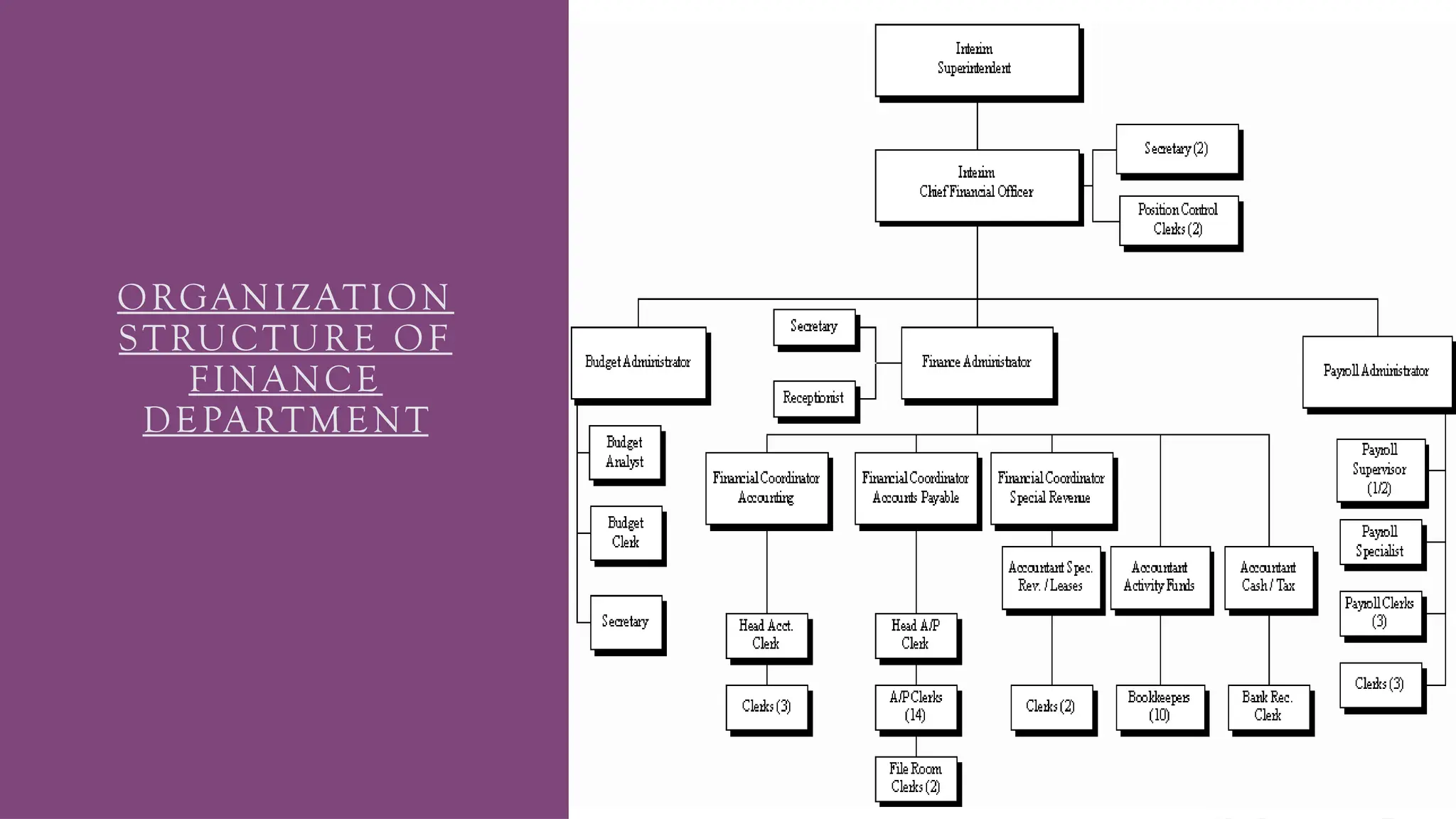
ORGANIZATION
STRUCTURE OF
FINANCE
DEPARTMENT
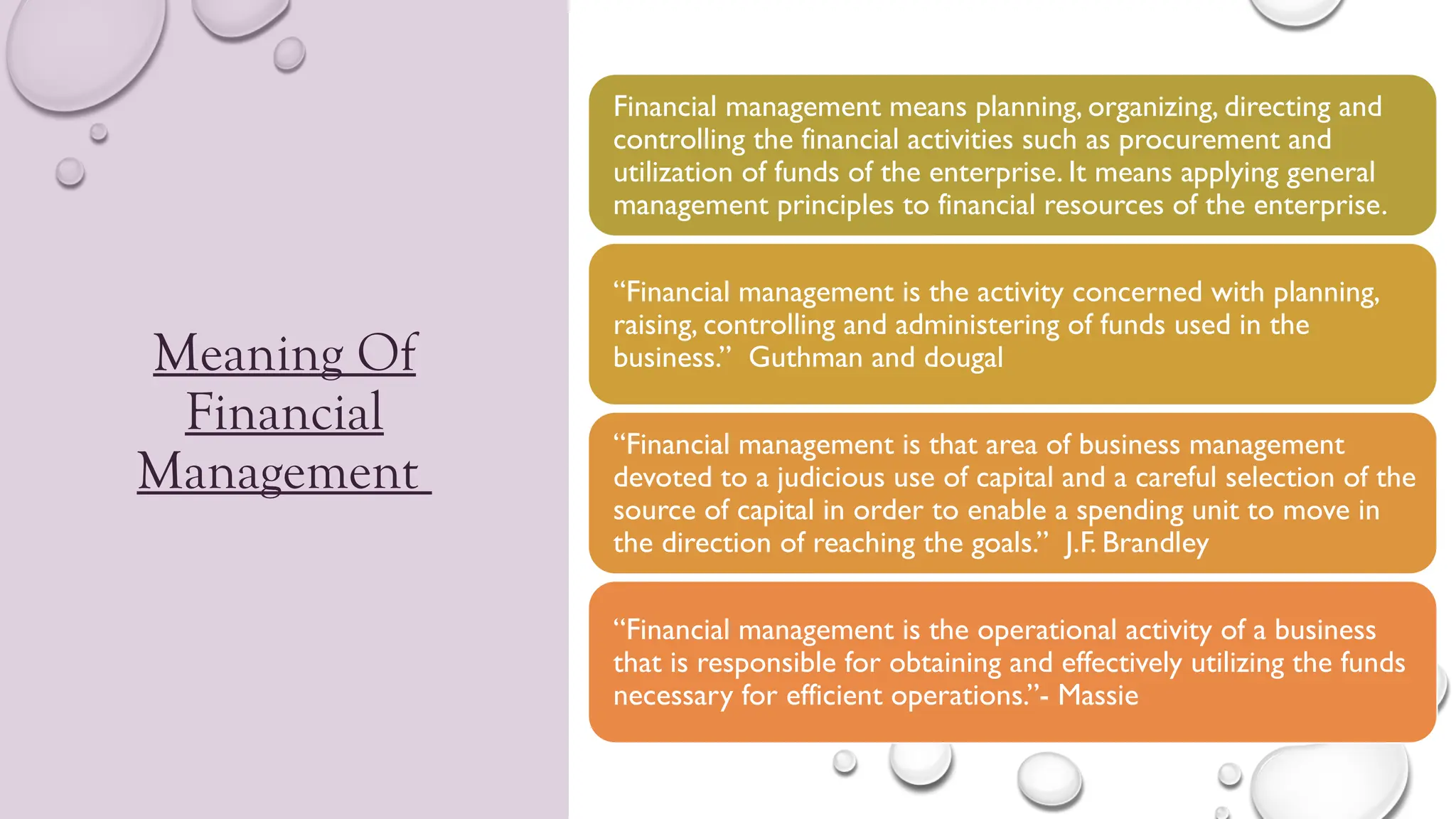
Meaning Of
Financial
Management
Financial management means planning, organizing, directing and
controlling the financial activities such as procurement and
utilization of funds of the enterprise. It means applying general
management principles to financial resources of the enterprise.
“Financial management is the activity concerned with planning,
raising, controlling and administering of funds used in the
business.” Guthman and dougal
“Financial management is that area of business management
devoted to a judicious use of capital and a careful selection of the
source of capital in order to enable a spending unit to move in
the direction of reaching the goals.” J.F. Brandley
“Financial management is the operational activity of a business
that is responsible for obtaining and effectively utilizing the funds
necessary for efficient operations.”- Massie
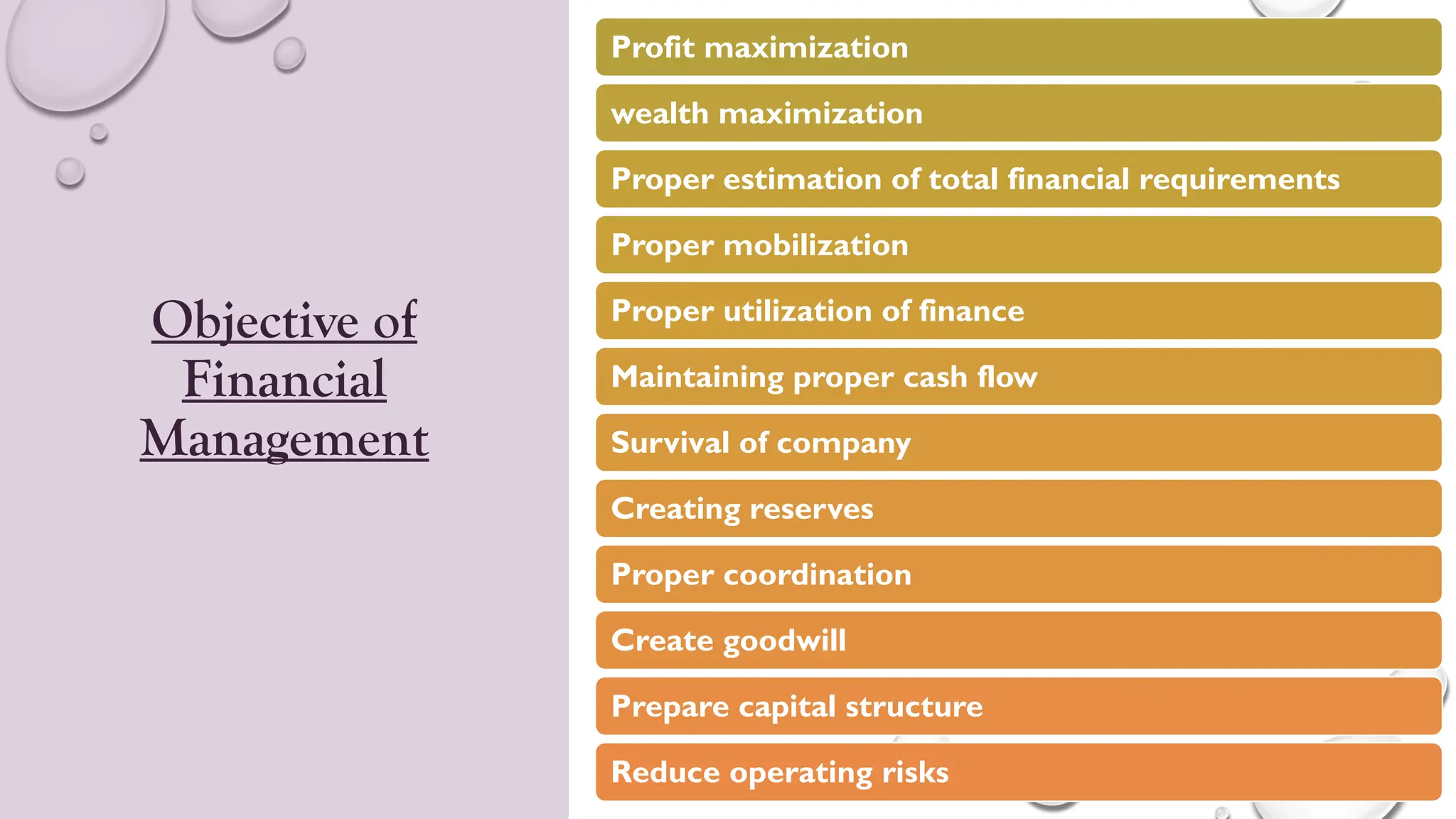
Objective of
Financial
Management
Profit maximization
wealth maximization
Proper estimation of total financial requirements
Proper mobilization
Proper utilization of finance
Maintaining proper cash flow
Survival of company
Creating reserves
Proper coordination
Create goodwill
Prepare capital structure
Reduce operating risks
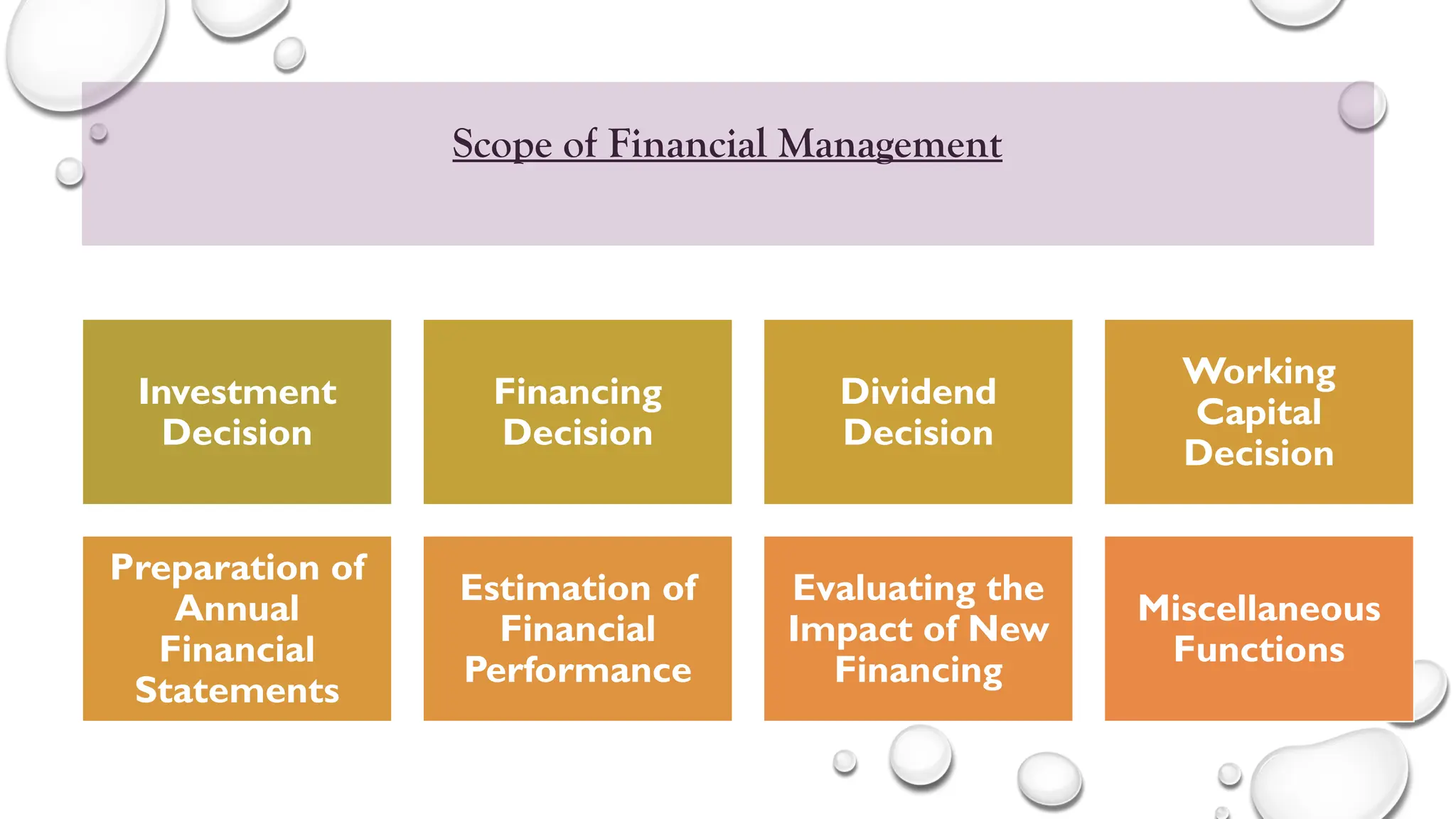
Scope of Financial Management
Investment
Decision
Financing
Decision
Dividend
Decision
Working
Capital
Decision
Preparation of
Annual
Financial
Statements
Estimation of
Financial
Performance
Evaluating the
Impact of New
Financing
Miscellaneous
Functions
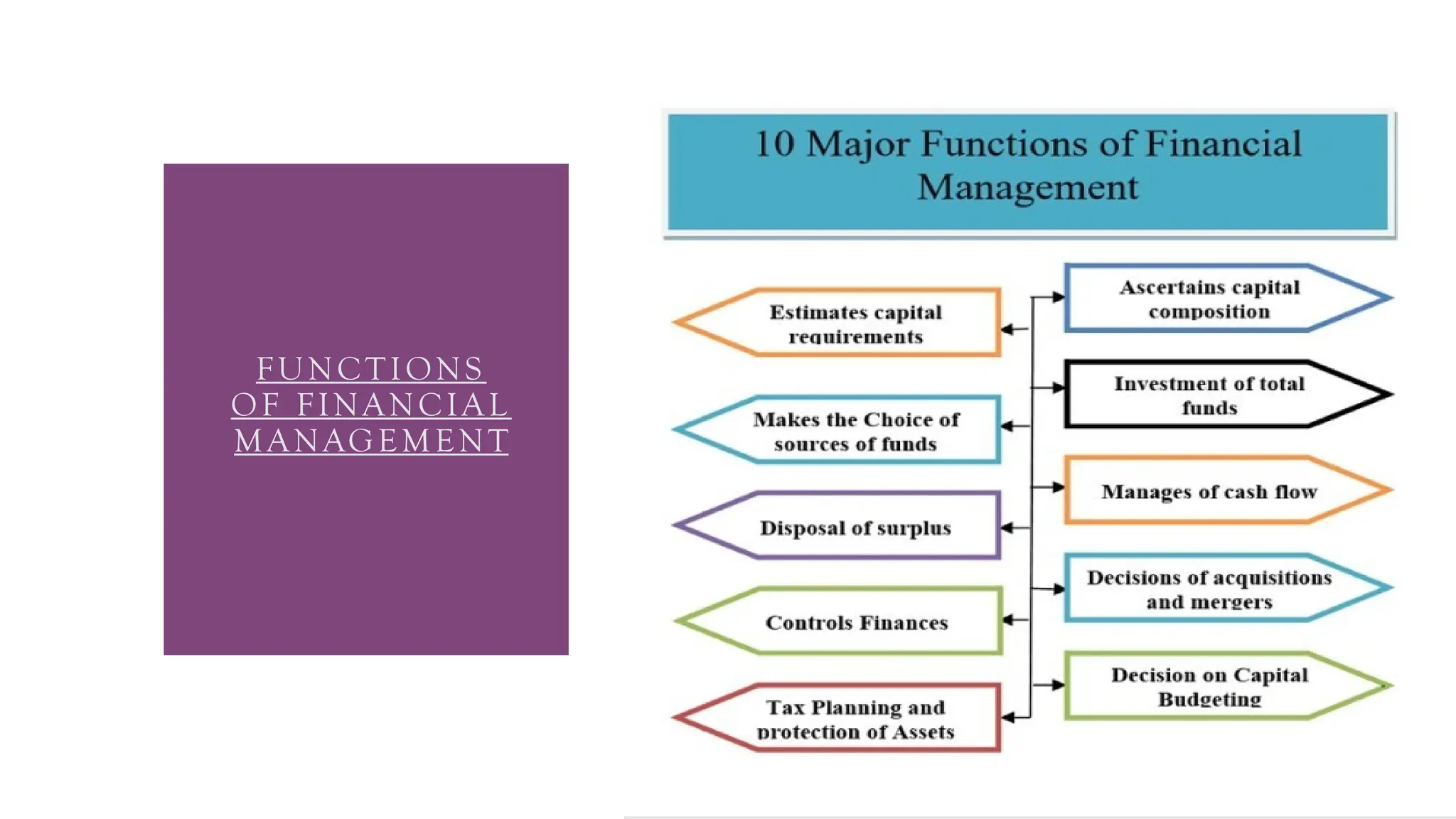
FUNCTIONS
OF FINANCIAL
MANAGEMENT
Financial Decision
• The financing decision is yet another crucial decision made by the financial manager relating to the
financing-mix of an organization. It is concerned with the borrowing and allocation of funds
required for the investment decisions.
• Types of Financial Decisions
• Investment Decision
• Financing Decision
• Dividend Decision
Financial Manager
• Financial manager is the executive who manages the financial matters
of a business.
• Financial managers have the responsibility of overseeing the finances of
major companies, agencies and everything in between. Along with their
teams, they coordinate accounting and produce financial reports, cash-
flow statements and profit projections.
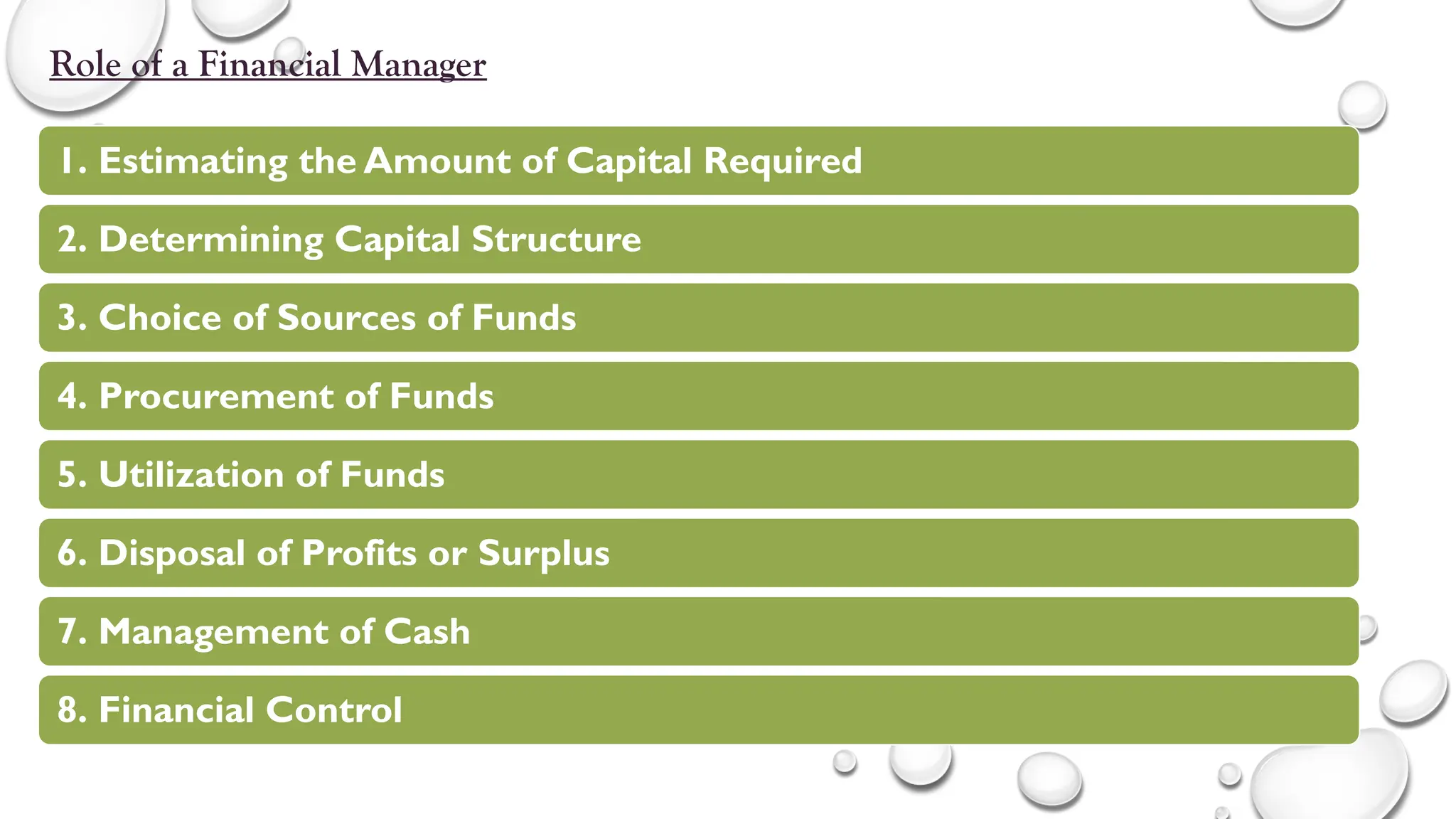
Role of a Financial Manager
1. Estimating the Amount of Capital Required
2. Determining Capital Structure
3. Choice of Sources of Funds
4. Procurement of Funds
5. Utilization of Funds
6. Disposal of Profits or Surplus
7. Management of Cash
8. Financial Control
Financial Planning
• Financial planning is the process of estimating the capital required and determining there
competition. It is the process of framing financial policies in relation to procurement, investment and
administration of funds of an enterprise.
Importance of Financial Planning
• Adequate funds have to be ensured.
• Financial planning helps in ensuring a reasonable balance between outflow and inflow of funds so
that stability is maintained.
• Financial planning ensures that the suppliers of funds are easily investing in companies which
exercise financial planning.
• Financial planning helps in making growth and expansion programmes which helps in long-run
survival of the company.
• Financial planning reduces uncertainties with regards to changing market trends which can be faced
easily through enough funds.
• Financial planning helps in reducing the uncertainties which can be a hindrance to growth of the
company. This helps in ensuring stability an d profitability in concern.
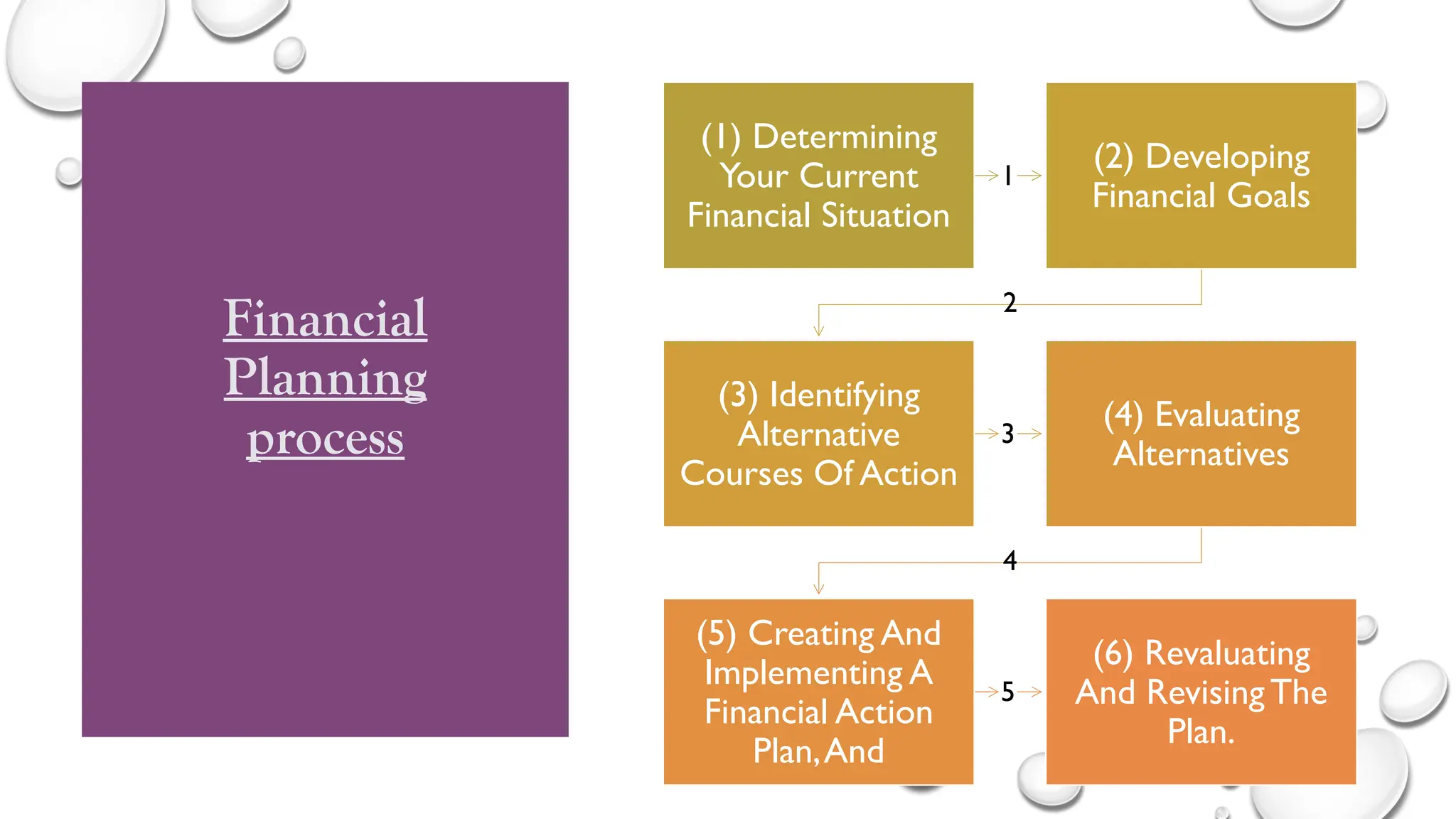
Financial
Planning
process
1
(1) Determining
Your Current
Financial Situation
2
(2) Developing
Financial Goals
3
(3) Identifying
Alternative
Courses Of Action
4
(4) Evaluating
Alternatives
5
(5) Creating And
Implementing A
Financial Action
Plan,And
(6) Revaluating
And Revising The
Plan.
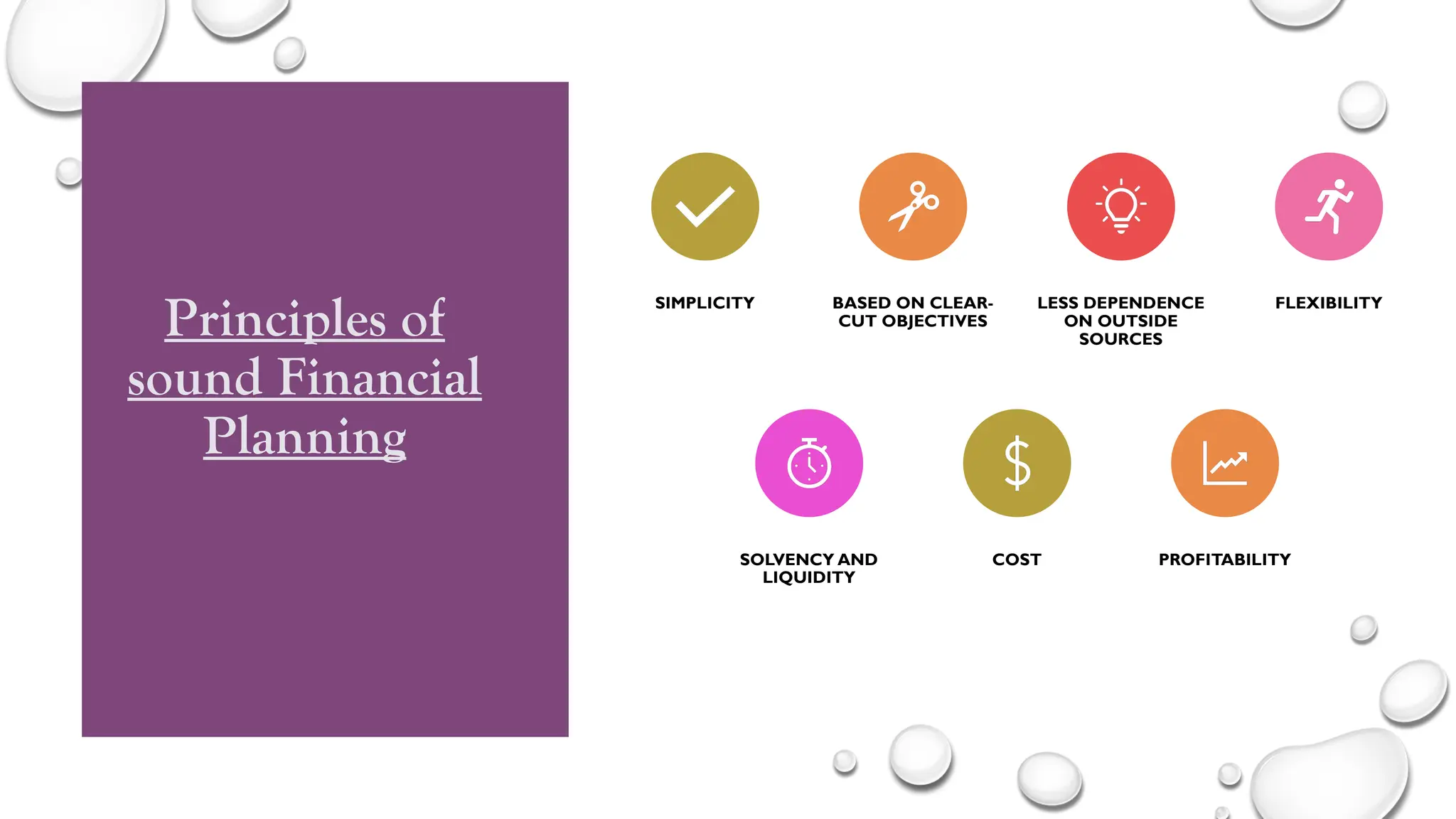
Principles of
sound Financial
Planning
SIMPLICITY BASED ON CLEAR-
CUT OBJECTIVES
LESS DEPENDENCE
ON OUTSIDE
SOURCES
FLEXIBILITY
SOLVENCY AND
LIQUIDITY
COST PROFITABILITY
Factors influencing a sound financial plan
• Spending behavior
• Financial potential
• Savings and investments
• Provision for emergencies
• A financial planner or advisor
• Responsibilities
• Financial goals
• Changing culture
• Economy
• Solvency and liquidity
FINANCIAL SYSTEM
• The financial system of an economy provides the way to collect money from the
people who have it and distribute it to those who can use it best. So, the efficient
allocation of economic resources is achieved by a financial system that
distributes money to those people and for those purposes that will yield the best
returns.
• The financial system is composed of the products and services provided by
financial institutions, which includes banks, insurance companies, pension funds,
organized exchanges, and the many other companies that serve to facilitate
economic transactions. Virtually all economic transactions are effected by one or
more of these financial institutions. They create financial instruments, such as
stocks and bonds, pay interest on deposits, lend money to creditworthy
borrowers, and create and maintain the payment systems of modern economies.
C O M P O N E N T S O F F I N A N C I A L S Y S T E M
1. Financial Institutions
• It ensures smooth working of the financial system by making investors and borrowers meet.
They mobilize the savings of investors either directly or indirectly via financial markets by
making use of different financial instruments as well as in the process using the services of
numerous financial services providers. They could be categorized into Regulatory,
Intermediaries, Non-intermediaries and Others. They offer services to organizations looking for
advises on different problems including restructuring to diversification strategies. They offer
complete series of services to the organizations who want to raise funds from the markets and
take care of financial assets, for example deposits, securities, loans, etc.
2. Financial Markets
• A Financial Market can be defined as the market in which financial assets are created or
transferred. As against a real transaction that involves exchange of money for real goods or
services, a financial transaction involves creation or transfer of a financial asset. Financial
Assets or Financial Instruments represent a claim to the payment of a sum of money sometime
in the future and /or periodic payment in the form of interest or dividend.
3. Financial Instruments
• This is an important component of financial system. The products which are traded in a financial market
are financial assets, securities or other types of financial instruments. There are a wide range of
securities in the markets since the needs of investors and credit seekers are different. They indicate a
claim on the settlement of principal down the road or payment of a regular amount by means of interest
or dividend. Equity shares, debentures, bonds, etc. are some examples.
4. Financial Services
• It consists of services provided by Asset Management and Liability Management Companies. They help
to get the required funds and also make sure that they are efficiently invested. They assist to determine
the financing combination and extend their professional services up to the stage of servicing of lenders.
They help with borrowing, selling and purchasing securities, lending and investing, making and allowing
payments and settlements and taking care of risk exposures in financial markets. These range from the
leasing companies, mutual fund houses, merchant bankers, portfolio managers, bill discounting and
acceptance houses. The financial services sector offers a number of professional services like credit
rating, venture capital financing, mutual funds, merchant banking, depository services, book building,
etc. Financial institutions and financial markets help in the working of the financial system by means of
financial instruments. To be able to carry out the jobs given, they need several services of financial
nature. Therefore, financial services are considered as the 4th major component of the financial system.
FINANCIAL STATEMENT ANALYSIS
• Financial Statement Analysis and Interpretation is a comprehensive
process aimed at evaluating the financial performance, position, and
stability of a company for making informed decisions by various
stakeholders. This analysis involves the systematic review of the
financial statements, including the balance sheet, income statement,
cash flow statement, and statement of changes in equity, alongside
notes and other disclosures.
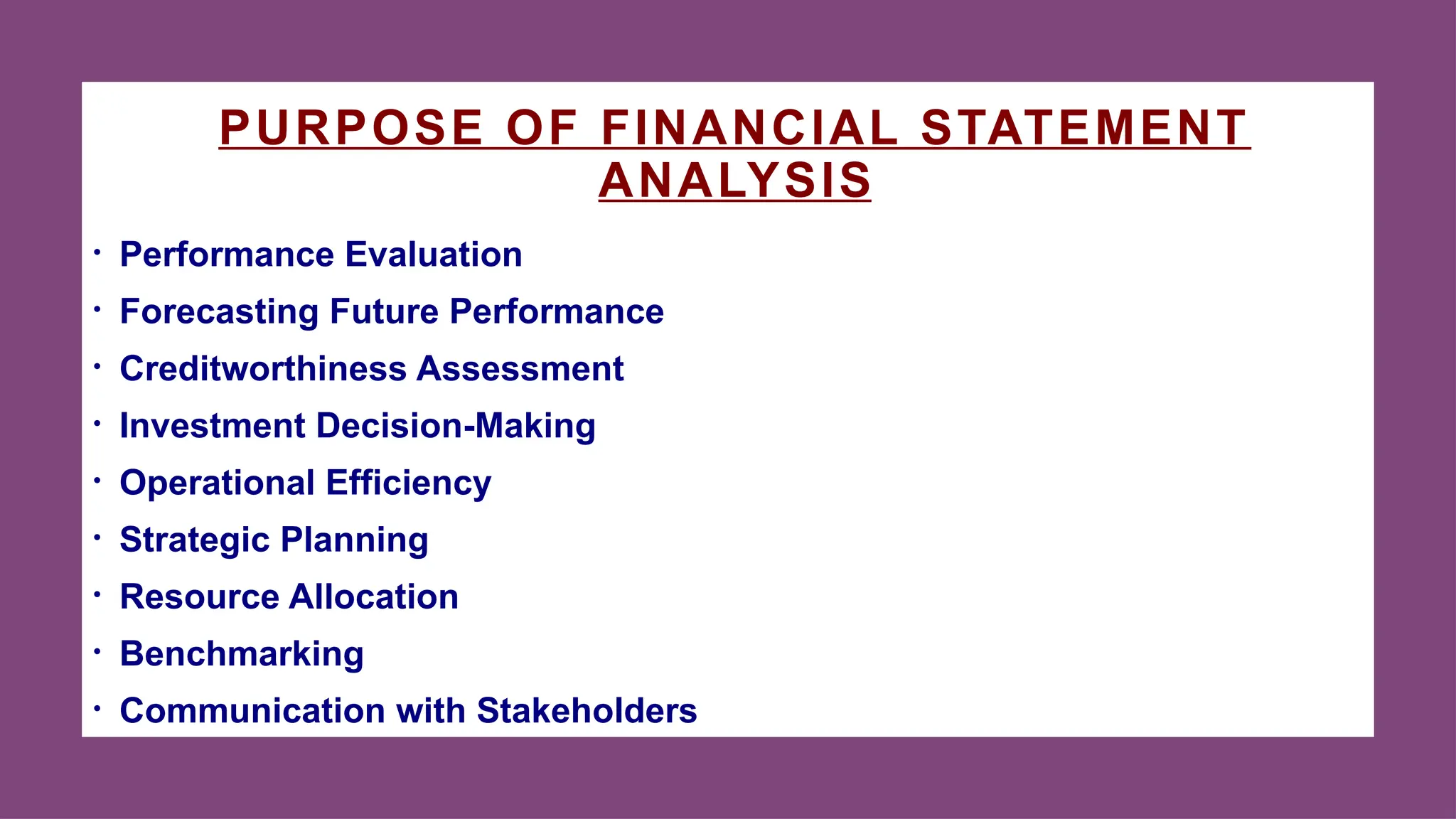
PURPOSE OF FINANCIAL STATEMENT
ANALYSIS
• Performance Evaluation
• Forecasting Future Performance
• Creditworthiness Assessment
• Investment Decision-Making
• Operational Efficiency
• Strategic Planning
• Resource Allocation
• Benchmarking
• Communication with Stakeholders
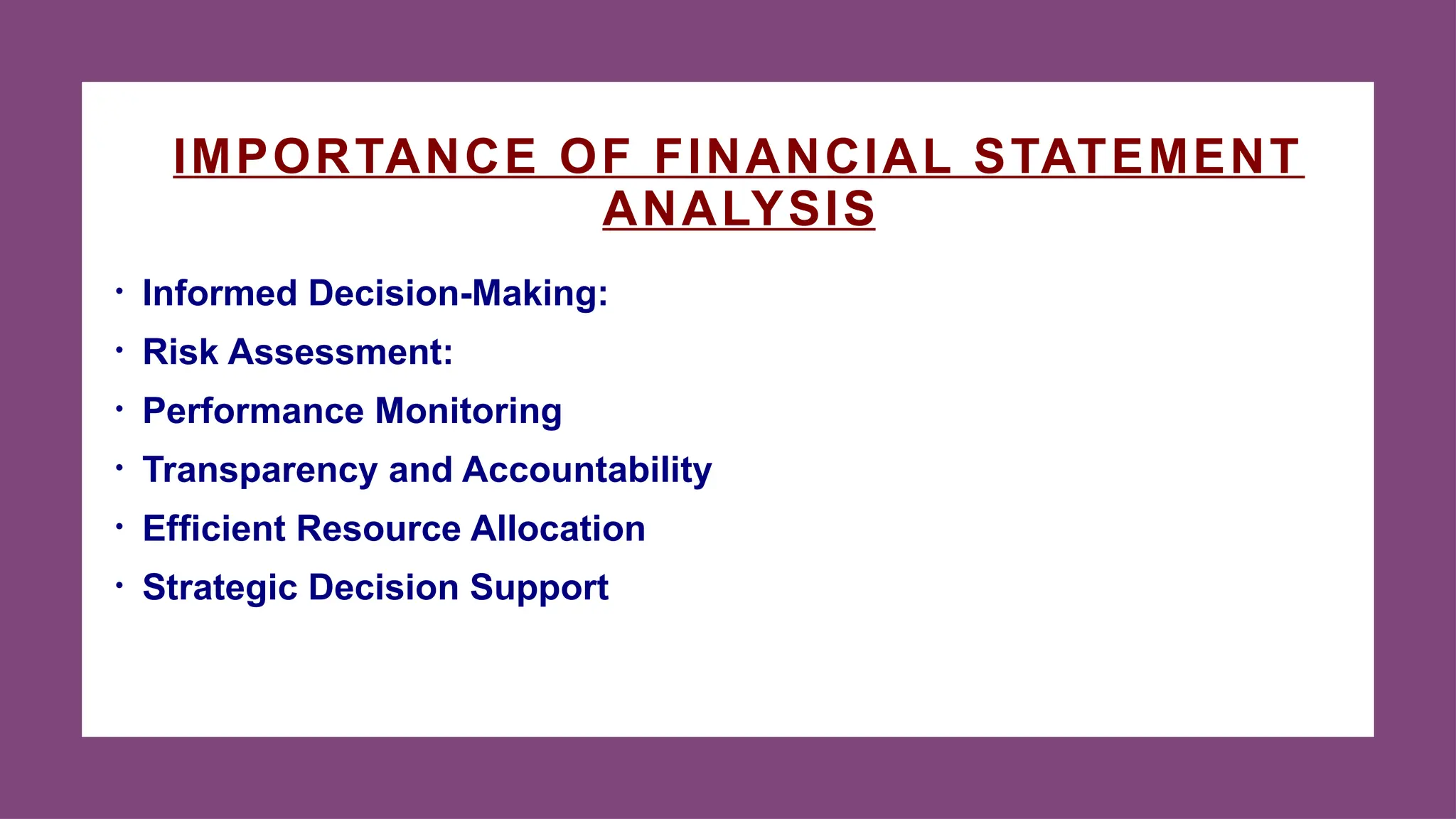
IMPORTANCE OF FINANCIAL STATEMENT
ANALYSIS
• Informed Decision-Making:
• Risk Assessment:
• Performance Monitoring
• Transparency and Accountability
• Efficient Resource Allocation
• Strategic Decision Support

Introduction to Financial Management

  • 1.
  • 2.
    MODULE 1: INTRODUCTIONTO FINANCIAL MANAGEMENT & TOOLS FOR FINANCIAL DECISION MAKING Evolution of Financial Management, Key activities of Finance Manager Changing Role of Finance Managers, Key Decision Areas in Financial Management, Objectives of the firm. Meaning, importance and role of Indian Financial System. A framework for Financial Decision Making - Financial Statement Analysis: Interpretation & Analysis of fund flow statement, cash flow statement, financial ratio, common size statement, Comparative statement, trend analysis, time series, Concept of Time value of Money, Process of Compounding and Discounting, Future Value of a Single amount, Future Value of an Annuity, Present Value of a Single Amount, Present Value of an Annuity.
  • 3.
    MODULE 2: ANALYSISAND TECHNIQUES OF CAPITAL BUDGETING Basics of Capital Budgeting, Types of capital budgeting decisions, Preparation of capital budgeting proposal, estimating cash flows for project appraisal, Green capital budgeting. Non-discounted Cash Flow Techniques: Payback Period, ARR, Discounted Cash Flow Techniques: NPV, IRR, Modified IRR, PI and Capital Rationing.
  • 4.
    MODULE 3: SOURCESOF FINANCE Sources of finance – Debt: Term Loans, Debentures. Equity: Ordinary Shares. Hybrid: Preference, Warrants, Convertible securities, ADRs, GDRs. An introduction to: leasing, Hire purchase, Leverage Buyouts and securitization. An Overview of Sources of short term finance: Accruals, Trade credit, Working capital advance by commercial banks, Public Deposits, Inter-corporate deposits, Short term loan from financial institutions, Commercial Paper, Factoring & Forfaiting, securitization, Institutional sources of funds- banks, FII’s, VCF’s.
  • 5.
    MODULE 4: WORKINGCAPITAL MANAGEMENT • Factors influencing working capital requirement, estimating working capital requirement (numerical), Operating cycle analysis, Negative Working Capital. An introduction to inventory management. Objectives of Inventory management, EOQ Model (with numerical). Receivables management: An Introduction. Management of cash: Cash Planning, Managing the cash flows, Determining Optimum Cash Level (Baumol Model with numerical), Investing surplus cash, Calculation of Maximum Permissible Bank Finance(MPBF)
  • 6.
    MODULE 5: COSTOF CAPITAL AND LEVERAGE ANALYSIS • Concept, significance, assumptions, factor affecting cost of capital. Computation of cost of capital of various sources: Equity, Debt, Reserve & Surplus and Preference shares (floatation cost and its adjustments). Weighted average cost of capital. Book value weights v/s market value weights. EBIT-EPS analysis, Leverage Analysis: Operating Leverage, Financial Leverage & Combined Leverage.
  • 7.
    MODULE 1 Introduction toFinancial Management & Tools for financial decision making
  • 8.
    • Evolution ofFinancial Management, Key activities of Finance Manager Changing Role of Finance Managers, Key Decision Areas in Financial Management, Objectives of the firm. Meaning, importance and role of Indian Financial System. A framework for Financial Decision Making - Financial Statement Analysis: Interpretation & Analysis of fund flow statement, cash flow statement, financial ratio, common size statement, Comparative statement, trend analysis, time series, Concept of Time value of Money, Process of Compounding and Discounting, Future Value of a Single amount, Future Value of an Annuity, Present Value of a Single Amount, Present Value of an Annuity.
  • 9.
    MEANING OF FINANCE •Finance is a term broadly describing the study and system of money, investments, and other financial instruments. • Finance is the common denominator for a vast range of corporate objectives, and the major part of any corporate plan must be expressed in financial terms. • Finance is the “ Management of the monetary affairs of a company. It includes determining what has to be paid for raising the money on the best terms available and devoting available funds to the best uses.
  • 10.
    Business FINANCE Business finance studies,analyses and examines wide aspects related to the acquisition of funds for business and allocates those funds. Business finance deals primarily with raising ,administering and allocation of funds by privately owned business units operating in the non financial fields of an Industry. Business Finance Deals with the capital input function for the economics of the acquisition of money capital for the conduct of a firm’s operations.
  • 11.
    Finance function • Finance isone of the major elements, which activates the overall growth of the economy is much broader than the procurement or supply of funds. Types of Finance function • Design Function. • Supply Function. • Production Function. • Distribution Function. • Personnel Function.
  • 12.
  • 13.
    Meaning Of Financial Management Financial managementmeans planning, organizing, directing and controlling the financial activities such as procurement and utilization of funds of the enterprise. It means applying general management principles to financial resources of the enterprise. “Financial management is the activity concerned with planning, raising, controlling and administering of funds used in the business.” Guthman and dougal “Financial management is that area of business management devoted to a judicious use of capital and a careful selection of the source of capital in order to enable a spending unit to move in the direction of reaching the goals.” J.F. Brandley “Financial management is the operational activity of a business that is responsible for obtaining and effectively utilizing the funds necessary for efficient operations.”- Massie
  • 14.
    Objective of Financial Management Profit maximization wealthmaximization Proper estimation of total financial requirements Proper mobilization Proper utilization of finance Maintaining proper cash flow Survival of company Creating reserves Proper coordination Create goodwill Prepare capital structure Reduce operating risks
  • 15.
    Scope of FinancialManagement Investment Decision Financing Decision Dividend Decision Working Capital Decision Preparation of Annual Financial Statements Estimation of Financial Performance Evaluating the Impact of New Financing Miscellaneous Functions
  • 16.
  • 17.
    Financial Decision • Thefinancing decision is yet another crucial decision made by the financial manager relating to the financing-mix of an organization. It is concerned with the borrowing and allocation of funds required for the investment decisions. • Types of Financial Decisions • Investment Decision • Financing Decision • Dividend Decision
  • 18.
    Financial Manager • Financialmanager is the executive who manages the financial matters of a business. • Financial managers have the responsibility of overseeing the finances of major companies, agencies and everything in between. Along with their teams, they coordinate accounting and produce financial reports, cash- flow statements and profit projections.
  • 19.
    Role of aFinancial Manager 1. Estimating the Amount of Capital Required 2. Determining Capital Structure 3. Choice of Sources of Funds 4. Procurement of Funds 5. Utilization of Funds 6. Disposal of Profits or Surplus 7. Management of Cash 8. Financial Control
  • 20.
    Financial Planning • Financialplanning is the process of estimating the capital required and determining there competition. It is the process of framing financial policies in relation to procurement, investment and administration of funds of an enterprise. Importance of Financial Planning • Adequate funds have to be ensured. • Financial planning helps in ensuring a reasonable balance between outflow and inflow of funds so that stability is maintained. • Financial planning ensures that the suppliers of funds are easily investing in companies which exercise financial planning. • Financial planning helps in making growth and expansion programmes which helps in long-run survival of the company. • Financial planning reduces uncertainties with regards to changing market trends which can be faced easily through enough funds. • Financial planning helps in reducing the uncertainties which can be a hindrance to growth of the company. This helps in ensuring stability an d profitability in concern.
  • 21.
    Financial Planning process 1 (1) Determining Your Current FinancialSituation 2 (2) Developing Financial Goals 3 (3) Identifying Alternative Courses Of Action 4 (4) Evaluating Alternatives 5 (5) Creating And Implementing A Financial Action Plan,And (6) Revaluating And Revising The Plan.
  • 22.
    Principles of sound Financial Planning SIMPLICITYBASED ON CLEAR- CUT OBJECTIVES LESS DEPENDENCE ON OUTSIDE SOURCES FLEXIBILITY SOLVENCY AND LIQUIDITY COST PROFITABILITY
  • 23.
    Factors influencing asound financial plan • Spending behavior • Financial potential • Savings and investments • Provision for emergencies • A financial planner or advisor • Responsibilities • Financial goals • Changing culture • Economy • Solvency and liquidity
  • 24.
    FINANCIAL SYSTEM • Thefinancial system of an economy provides the way to collect money from the people who have it and distribute it to those who can use it best. So, the efficient allocation of economic resources is achieved by a financial system that distributes money to those people and for those purposes that will yield the best returns. • The financial system is composed of the products and services provided by financial institutions, which includes banks, insurance companies, pension funds, organized exchanges, and the many other companies that serve to facilitate economic transactions. Virtually all economic transactions are effected by one or more of these financial institutions. They create financial instruments, such as stocks and bonds, pay interest on deposits, lend money to creditworthy borrowers, and create and maintain the payment systems of modern economies.
  • 25.
    C O MP O N E N T S O F F I N A N C I A L S Y S T E M 1. Financial Institutions • It ensures smooth working of the financial system by making investors and borrowers meet. They mobilize the savings of investors either directly or indirectly via financial markets by making use of different financial instruments as well as in the process using the services of numerous financial services providers. They could be categorized into Regulatory, Intermediaries, Non-intermediaries and Others. They offer services to organizations looking for advises on different problems including restructuring to diversification strategies. They offer complete series of services to the organizations who want to raise funds from the markets and take care of financial assets, for example deposits, securities, loans, etc. 2. Financial Markets • A Financial Market can be defined as the market in which financial assets are created or transferred. As against a real transaction that involves exchange of money for real goods or services, a financial transaction involves creation or transfer of a financial asset. Financial Assets or Financial Instruments represent a claim to the payment of a sum of money sometime in the future and /or periodic payment in the form of interest or dividend.
  • 26.
    3. Financial Instruments •This is an important component of financial system. The products which are traded in a financial market are financial assets, securities or other types of financial instruments. There are a wide range of securities in the markets since the needs of investors and credit seekers are different. They indicate a claim on the settlement of principal down the road or payment of a regular amount by means of interest or dividend. Equity shares, debentures, bonds, etc. are some examples. 4. Financial Services • It consists of services provided by Asset Management and Liability Management Companies. They help to get the required funds and also make sure that they are efficiently invested. They assist to determine the financing combination and extend their professional services up to the stage of servicing of lenders. They help with borrowing, selling and purchasing securities, lending and investing, making and allowing payments and settlements and taking care of risk exposures in financial markets. These range from the leasing companies, mutual fund houses, merchant bankers, portfolio managers, bill discounting and acceptance houses. The financial services sector offers a number of professional services like credit rating, venture capital financing, mutual funds, merchant banking, depository services, book building, etc. Financial institutions and financial markets help in the working of the financial system by means of financial instruments. To be able to carry out the jobs given, they need several services of financial nature. Therefore, financial services are considered as the 4th major component of the financial system.
  • 27.
    FINANCIAL STATEMENT ANALYSIS •Financial Statement Analysis and Interpretation is a comprehensive process aimed at evaluating the financial performance, position, and stability of a company for making informed decisions by various stakeholders. This analysis involves the systematic review of the financial statements, including the balance sheet, income statement, cash flow statement, and statement of changes in equity, alongside notes and other disclosures.
  • 28.
    PURPOSE OF FINANCIALSTATEMENT ANALYSIS • Performance Evaluation • Forecasting Future Performance • Creditworthiness Assessment • Investment Decision-Making • Operational Efficiency • Strategic Planning • Resource Allocation • Benchmarking • Communication with Stakeholders
  • 29.
    IMPORTANCE OF FINANCIALSTATEMENT ANALYSIS • Informed Decision-Making: • Risk Assessment: • Performance Monitoring • Transparency and Accountability • Efficient Resource Allocation • Strategic Decision Support