
Financial Management
Presented by :
Mallikarjun M. Maradi
Assistant Professor,
Dept. of Studies in Commerce,
Rani Channamma University, PG Centre, Vijayapur
malluparam@gmail.com
Unit – I
Financial Management
• An overview-Nature, Significance and scope of corporate
financial management, Objectives and agency theory,
Financial Management and its relationship with other
disciplines, Business polices and their impact on financial
management, Recent trends and contemporary issues.
Introduction to FM
• What is Finance?
• Finance is a field that deals with the study of investments. It
includes the dynamics of assets and liabilities over time under
conditions of different degrees of uncertainty and risk.
• Financing means asking any financial institution (bank, credit
union, finance company) or another person to lend you money that
you promise to repay at some point in the future.
• Finance may be defined as the art and science of managing
money.
It includes financial service and financial instruments. Finance also is
referred as the provision of money at the time when it is needed.
Finance function is the procurement of funds and their effective
utilization in business concerns. The concept of finance includes
capital, funds, money, and amount. But each word is having unique
3 DEFINITION OF FINANCE
• AccordingtoKhanandJain,“Finance istheartandscienceofmanaging money”.
• Financial Management : According to Oxford dictionary, the word ‘finance’ connotes ‘management of
money’.
• Webster’s Ninth New Collegiate Dictionary defines finance as “the Science on study of the management of
funds’ and the management of fund as the system that includes the circulation of money, the granting of
credit,themakingofinvestments,andtheprovisionofbankingfacilities.
• AccordingtotheWheeler, “Business financeisthatbusiness activitywhichconcernswiththeacquisitionand
conversationofcapitalfundsinmeetingfinancialneedsandoverallobjectivesofabusinessenterprise”.
• According to theGuthumannandDougall,“Businessfinance canbroadly bedefinedas theactivity concerned
withplanning, raising,controlling,administering ofthefundsusedinthebusiness”.
• In the words of Parhter and Wert, “Business finance deals primarily with raising, administering and
disbursingfundsbyprivatelyownedbusinessunitsoperatinginnonfinancial fieldsofindustry”.
• Corporate finance is concerned with budgeting, financial forecasting, cash management, credit
administration, investment analysis andfundprocurementof thebusiness concern and thebusiness concern
needstoadoptmoderntechnologyandapplicationsuitabletotheglobalenvironment.
DEFINITION OF FINANCIAL MANAGEMENT
• Financial management is an integral part of overall management. It is concerned with the
dutiesofthefinancialmanagers inthebusinessfirm.
• The term FM has been defined by Solomon, “It is concerned with the efficient use of an
important economic resource namely, capital funds”. The most popular and acceptable
definitionof FMasgivenby
• S.C.Kuchal is that it deals with procurement of funds and their effective utilization in the
business”.
• Howard and Upton : it “as an application of general managerial principles to the area of
financialdecision-making.
• Weston and Brigham :it “is an area of financial decision-making, harmonizing individual motives and
enterprisegoals”.
• Joshep and Massie : it “is the operational activity of a business that is responsible for obtaining and effectively
utilizing the funds necessary for efficient operations. Thus, FM is mainly concerned with the effective funds
managementinthebusiness.Insimplewords,FMaspracticedbybusinessfirmscanbecalledasCorporation
Finance orBusinessFinance.
Nature of Financial Management:
• i) It is a specialized branch of general management.
• (ii) Financial management is growing as a profession.
• (iii) Despite a separate status FM, is intermingled with other aspects of
management.
• (iv) Financial management is multi-disciplinary in approach.
• (v) The finance manager is often called the Controller. The finance manager,
very often, is a highly responsible member of the Top Management Team.
• (vi) Despite a hue and cry about decentralisation of authority; finance is a
matter to be found still centralised, even in enterprises which are so called highly
decentralised.
• (vii) It is not simply a basic business function along with production and
marketing; It turns the sand of dreams into the gold of reality.
Agency theory in Financial Management
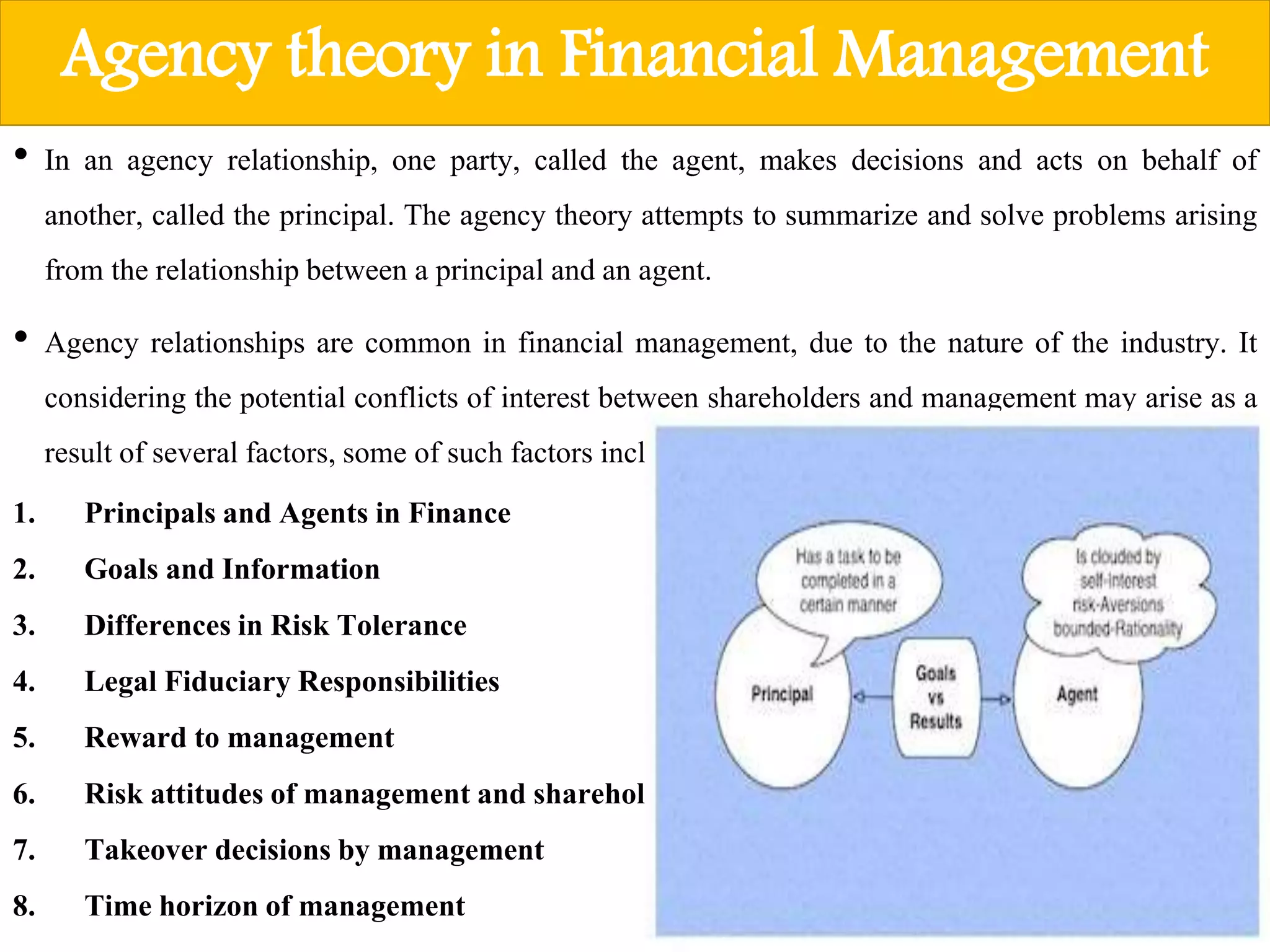
• In an agency relationship, one party, called the agent, makes decisions and acts on behalf of
another, called the principal. The agency theory attempts to summarize and solve problems arising
from the relationshipbetween a principal and an agent.
• Agency relationships are common in financial management, due to the nature of the industry. It
considering the potential conflicts of interest between shareholders and management may arise as a
result of several factors, some of such factors include:
1. Principalsand Agents in Finance
2. Goals and Information
3. Differencesin Risk Tolerance
4. Legal FiduciaryResponsibilities
5. Reward to management
6. Risk attitudesof managementand shareholders
7. Takeover decisionsby management
8. Time horizonof management
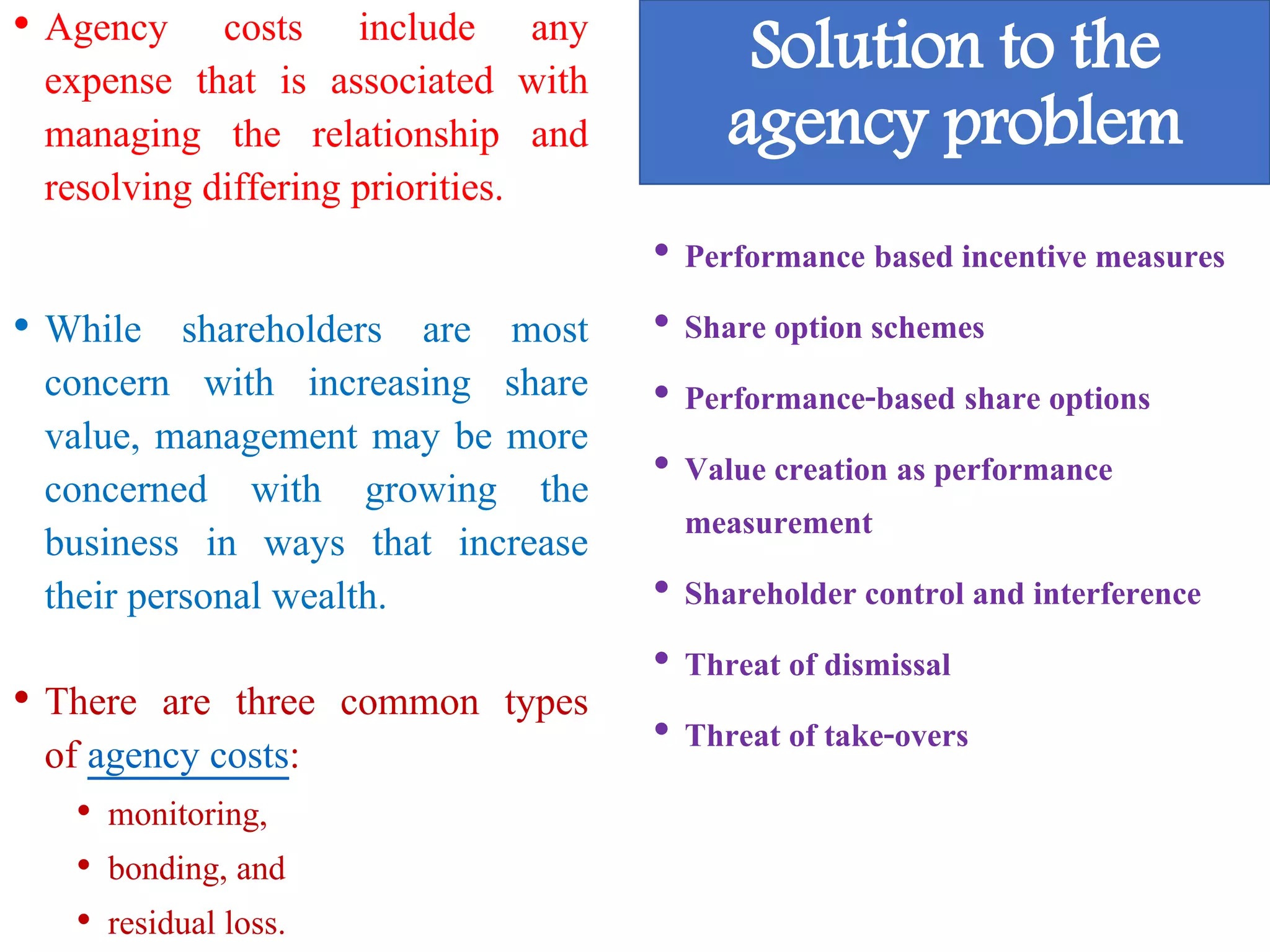
• Agency costs include any
expense that is associated with
managing the relationship and
resolving differing priorities.
• While shareholders are most
concern with increasing share
value, management may be more
concerned with growing the
business in ways that increase
their personal wealth.
• There are three common types
of agency costs:
• monitoring,
• bonding, and
• residual loss.
Solution to the
agency problem
• Performance based incentive measures
• Share option schemes
• Performance-based share options
• Value creation as performance
measurement
• Shareholder control and interference
• Threat of dismissal
• Threat of take-overs
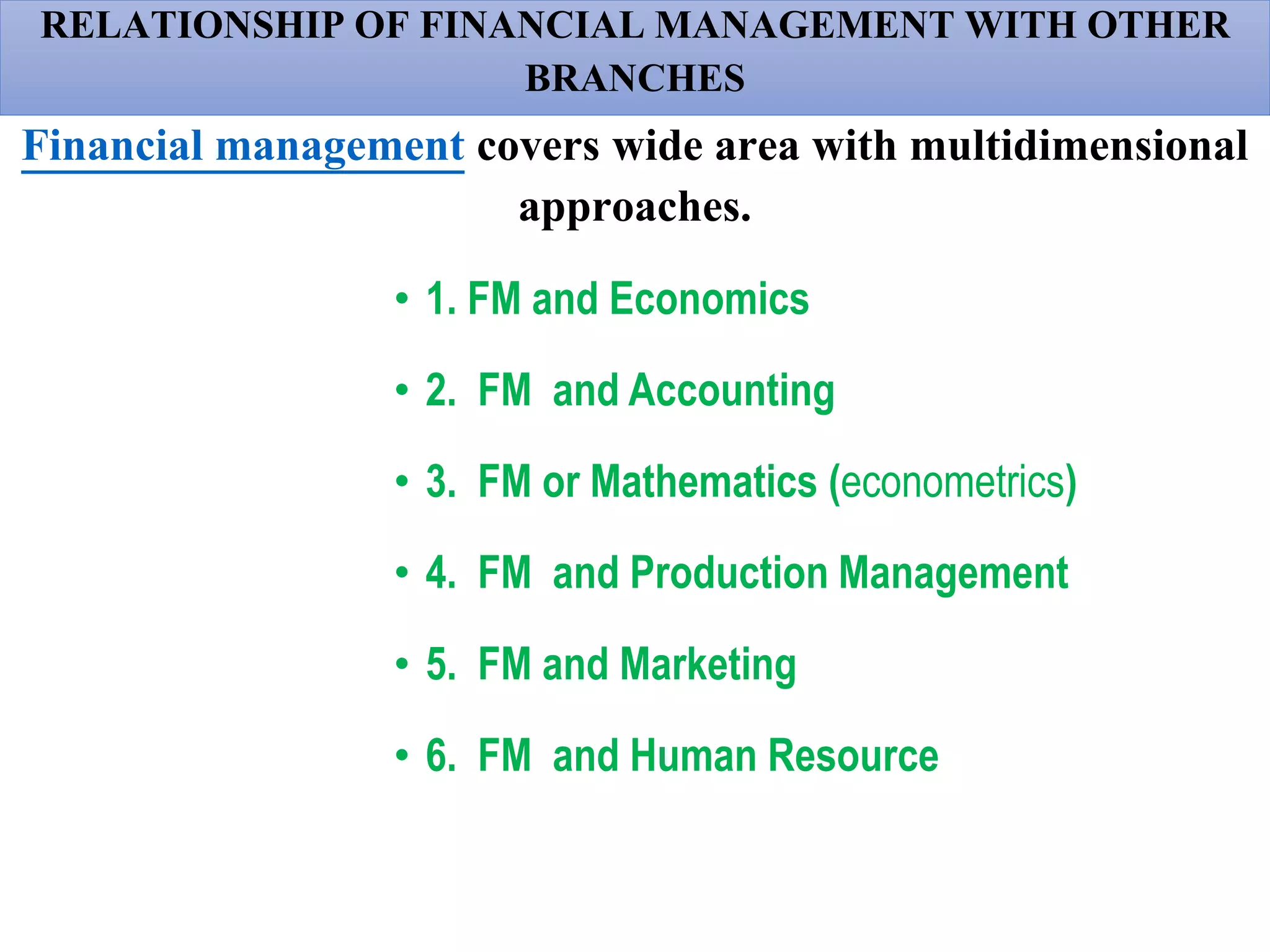
RELATIONSHIP OF FINANCIAL MANAGEMENT WITH OTHER
BRANCHES
Financial management covers wide area with multidimensional
approaches.
• 1. FM and Economics
• 2. FM and Accounting
• 3. FM or Mathematics (econometrics)
• 4. FM and Production Management
• 5. FM and Marketing
• 6. FM and Human Resource
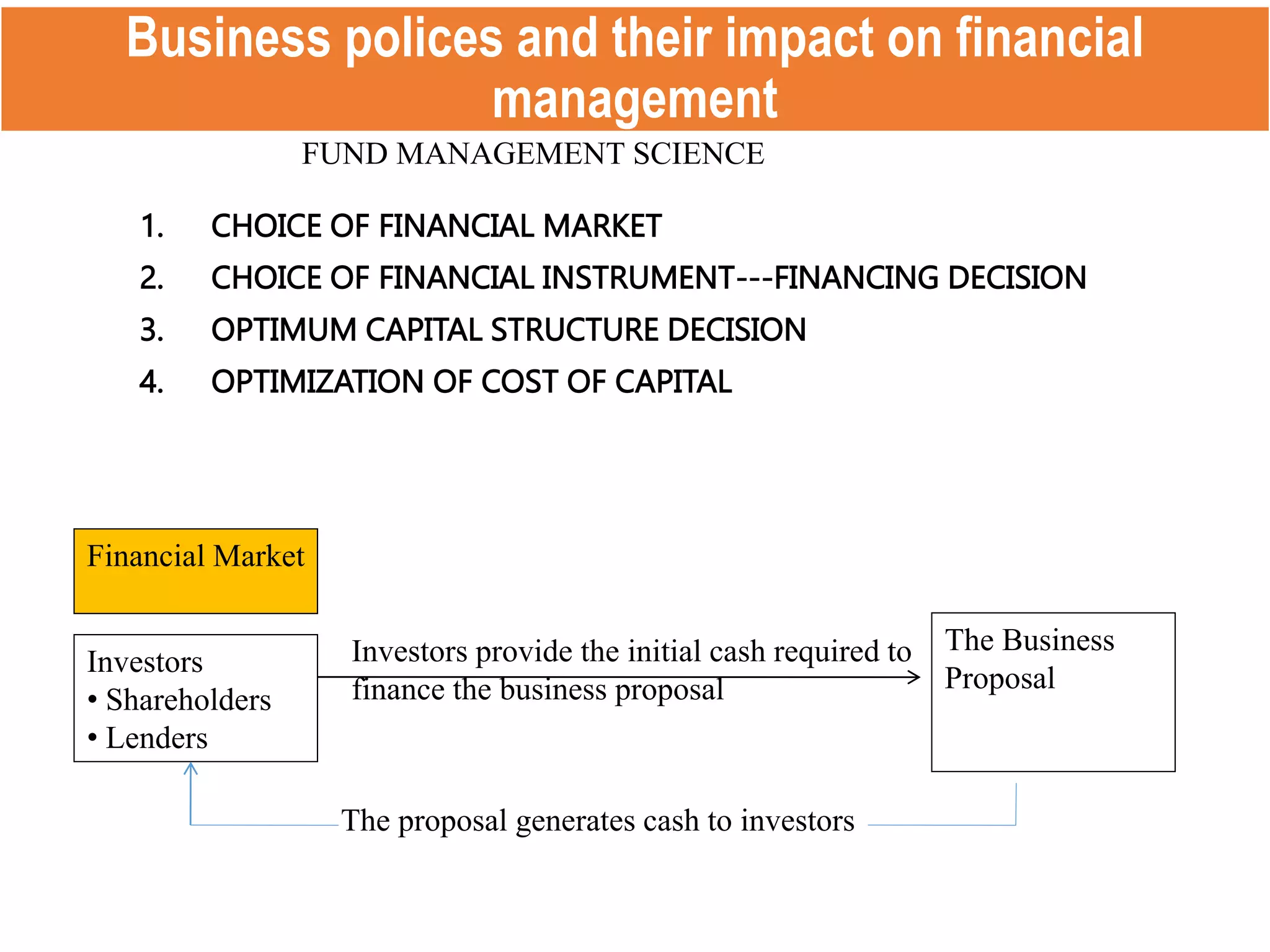
Business polices and their impact on financial
management
1. CHOICE OF FINANCIAL MARKET
2. CHOICE OF FINANCIAL INSTRUMENT---FINANCING DECISION
3. OPTIMUM CAPITAL STRUCTURE DECISION
4. OPTIMIZATION OF COST OF CAPITAL
The Business
Proposal
Investors
• Shareholders
• Lenders
Financial Market
Investors provide the initial cash required to
finance the business proposal
The proposal generates cash to investors
11
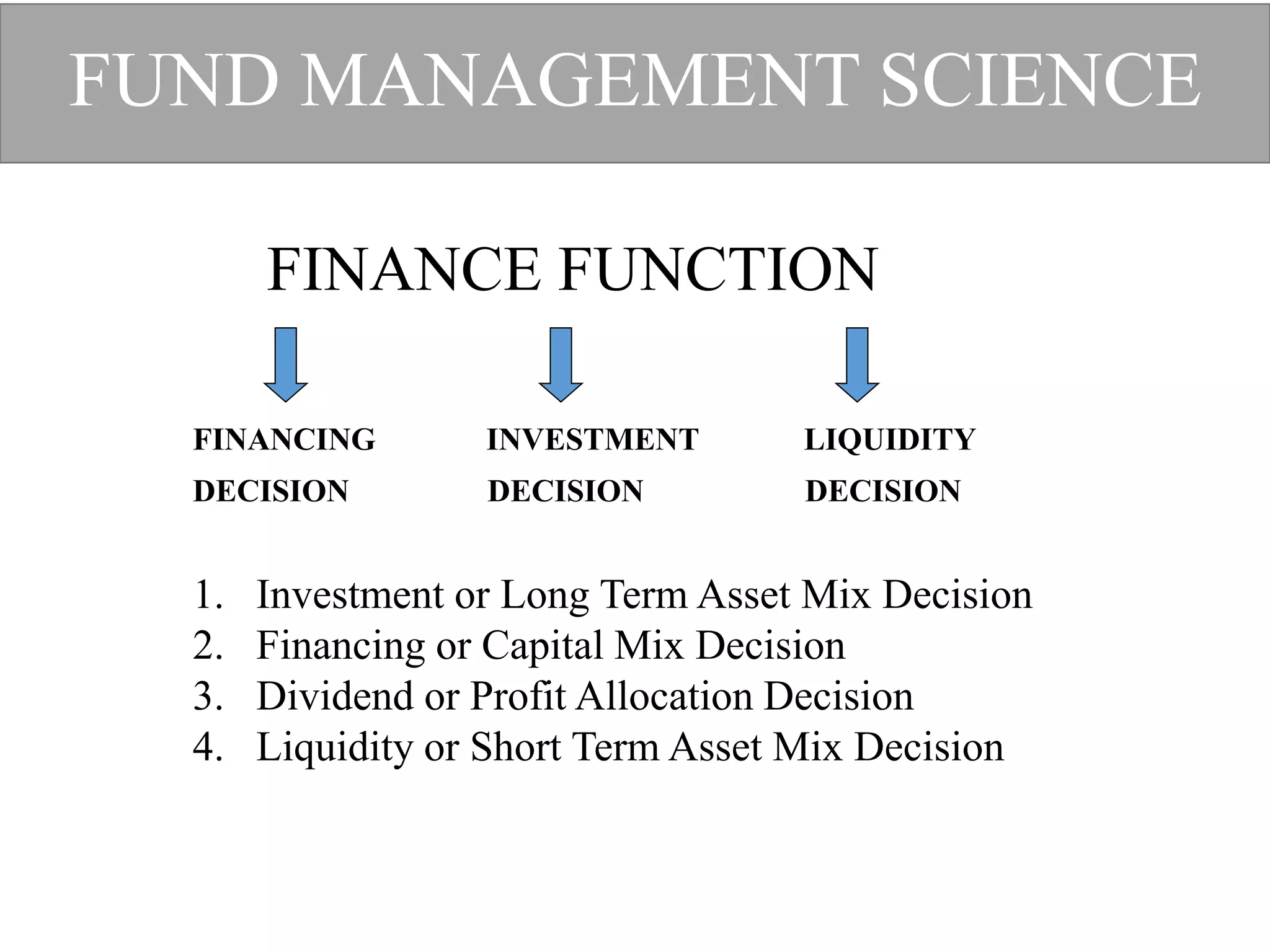
FUND MANAGEMENT SCIENCE
FINANCE FUNCTION
FINANCING INVESTMENT LIQUIDITY
DECISION DECISION DECISION
1. Investment or Long Term Asset Mix Decision
2. Financing or Capital Mix Decision
3. Dividend or Profit Allocation Decision
4. Liquidity or Short Term Asset Mix Decision
12
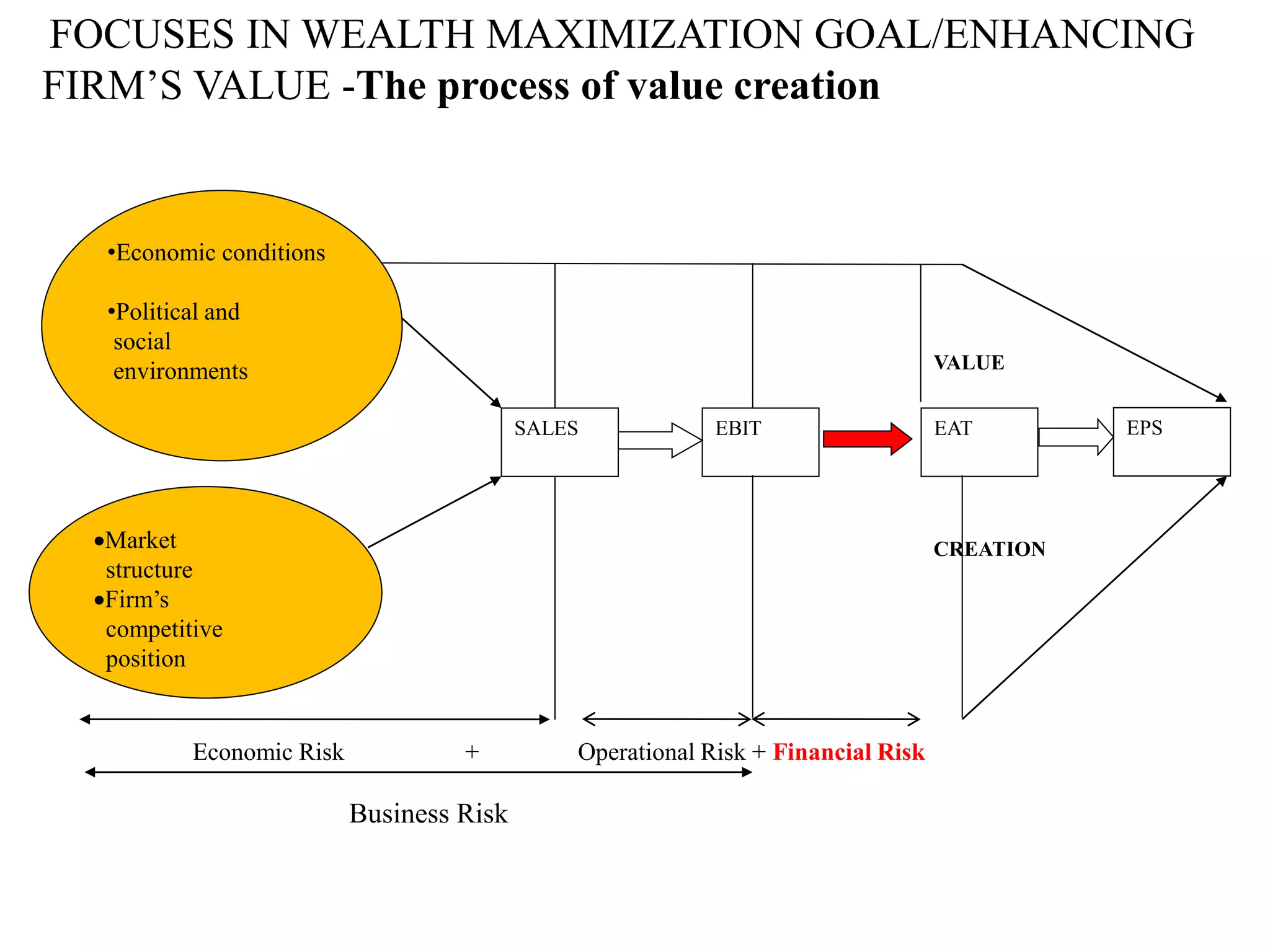
•Economic conditions
•Political and
social
environments
Market
structure
Firm’s
competitive
position
SALES EBIT EAT EPS
Economic Risk + Operational Risk + Financial Risk
VALUE
CREATION
Business Risk
FOCUSES IN WEALTH MAXIMIZATION GOAL/ENHANCING
FIRM’S VALUE -The process of value creation
13
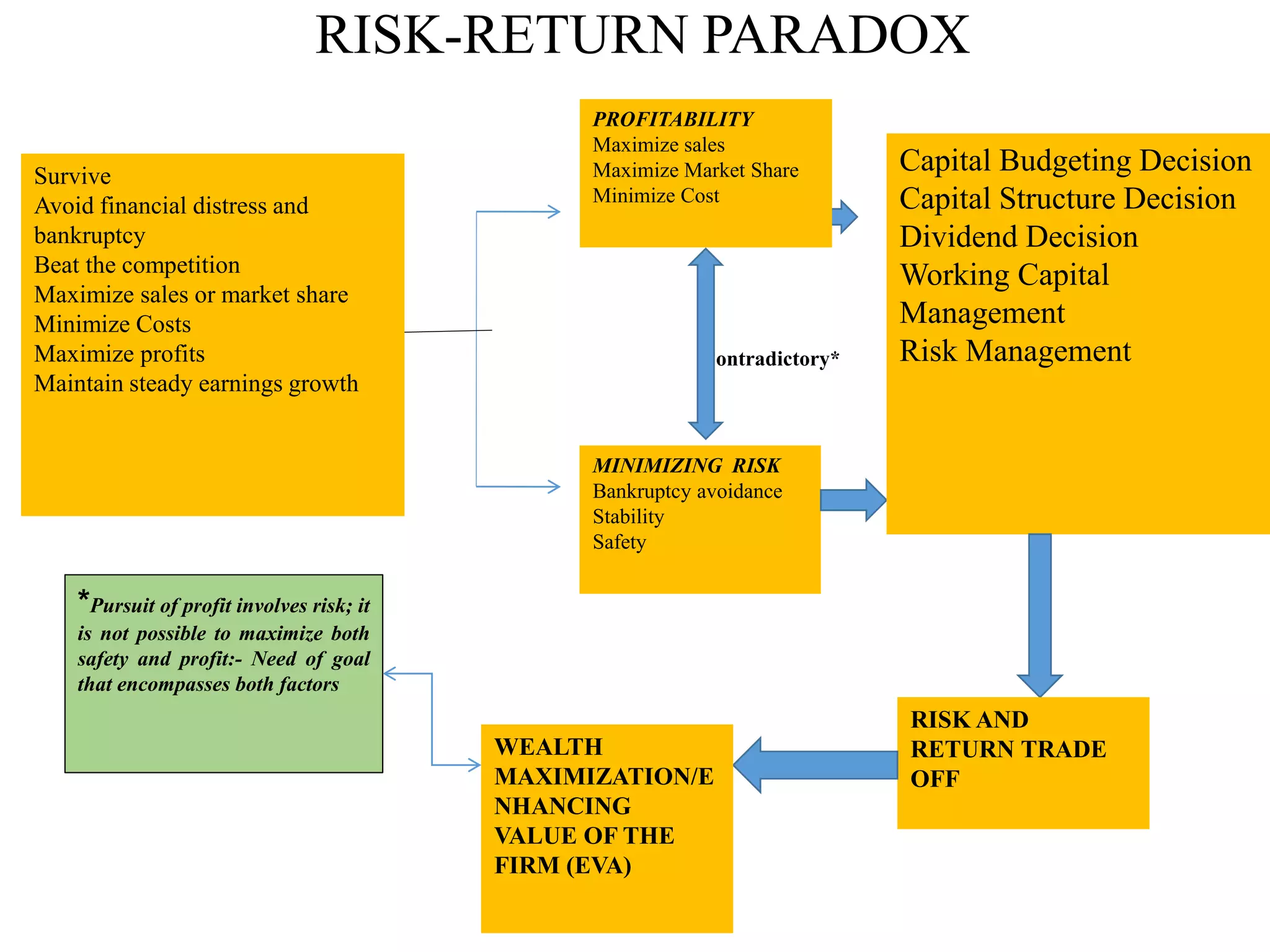
RISK-RETURN PARADOX
14
Contradictory*
Survive
Avoid financial distress and
bankruptcy
Beat the competition
Maximize sales or market share
Minimize Costs
Maximize profits
Maintain steady earnings growth
PROFITABILITY
Maximize sales
Maximize Market Share
Minimize Cost
MINIMIZING RISK
Bankruptcy avoidance
Stability
Safety
Capital Budgeting Decision
Capital Structure Decision
Dividend Decision
Working Capital
Management
Risk Management
RISK AND
RETURN TRADE
OFF
WEALTH
MAXIMIZATION/E
NHANCING
VALUE OF THE
FIRM (EVA)
*Pursuit of profit involves risk; it
is not possible to maximize both
safety and profit:- Need of goal
that encompasses both factors
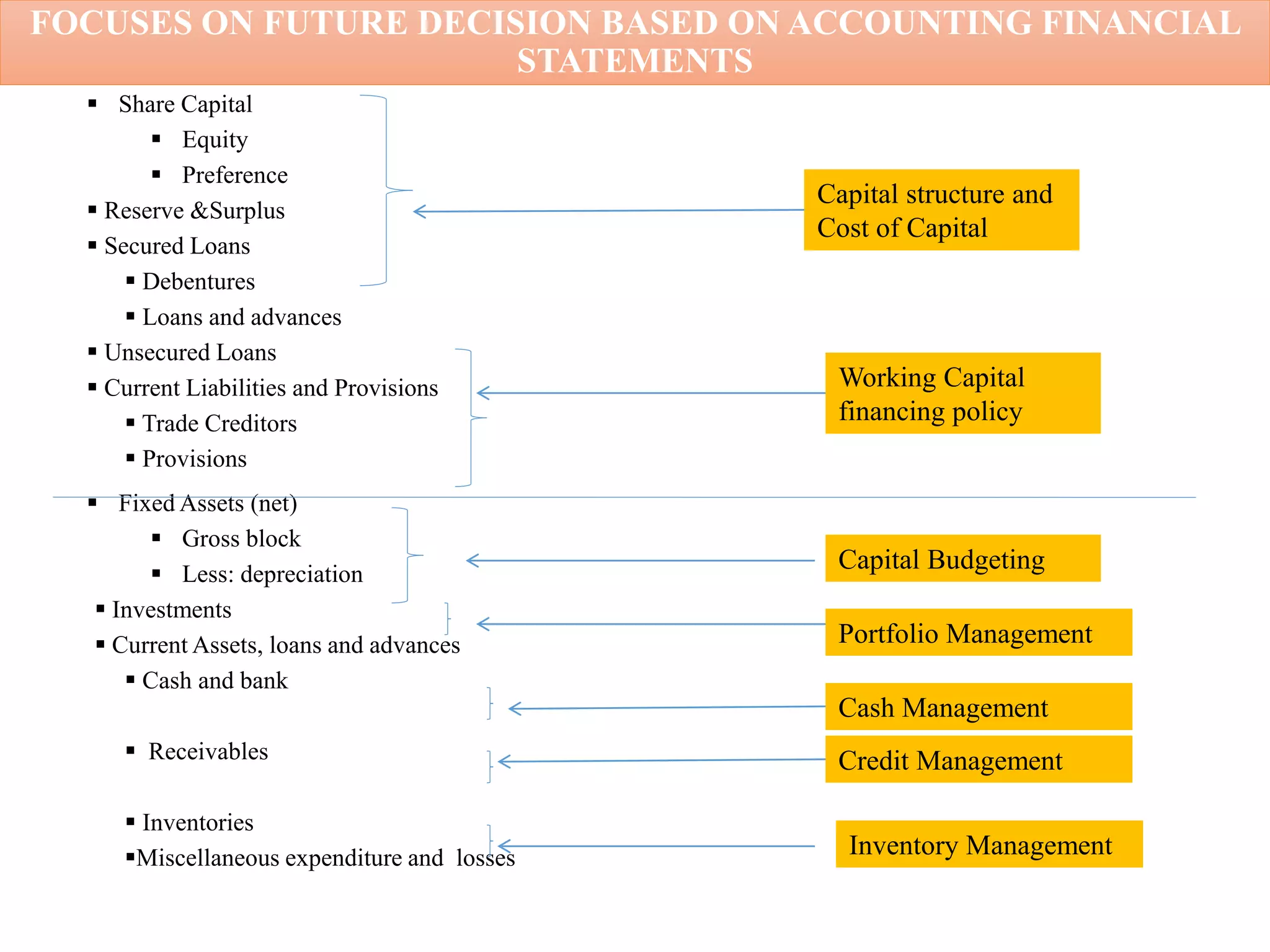
FOCUSES ON FUTURE DECISION BASED ON ACCOUNTING FINANCIAL
STATEMENTS
 Share Capital
 Equity
 Preference
 Reserve &Surplus
 Secured Loans
 Debentures
 Loans and advances
 Unsecured Loans
 Current Liabilities and Provisions
 Trade Creditors
 Provisions
 Fixed Assets (net)
 Gross block
 Less: depreciation
 Investments
 Current Assets, loans and advances
 Cash and bank
 Receivables
 Inventories
Miscellaneous expenditure and losses
Capital structure and
Cost of Capital
Working Capital
financing policy
Capital Budgeting
Portfolio Management
Cash Management
Credit Management
Inventory Management
15
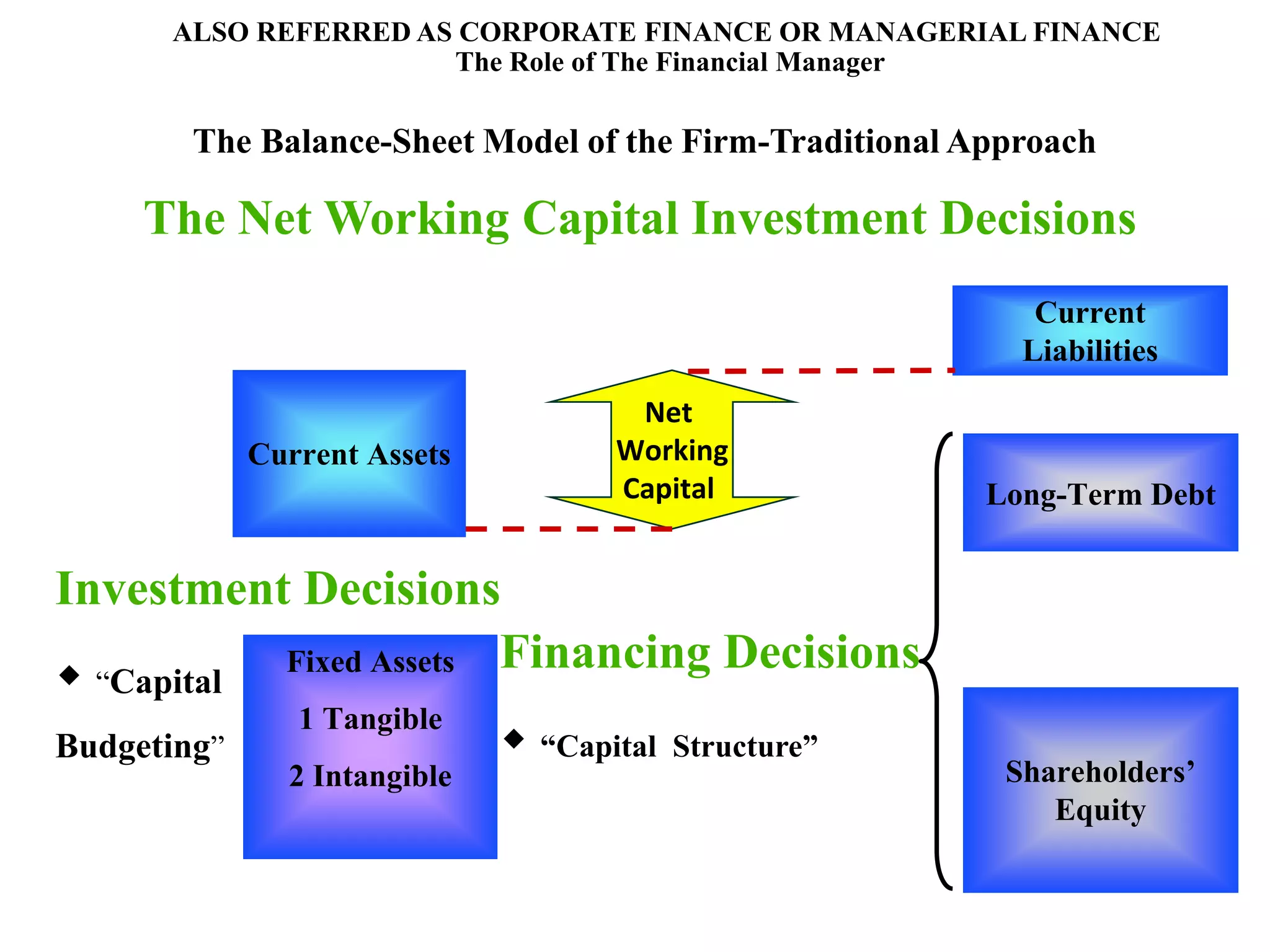
ALSO REFERRED AS CORPORATE FINANCE OR MANAGERIAL FINANCE
The Role of The Financial Manager
The Balance-Sheet Model of the Firm-Traditional Approach
The Net Working Capital Investment Decisions
Current Assets
Investment Decisions
 “Capital
Budgeting”
Fixed Assets
1 Tangible
2 Intangible
Current
Liabilities
Long-Term Debt
Shareholders’
Equity
Net
Working
Capital
Financing Decisions
 “Capital Structure”
16
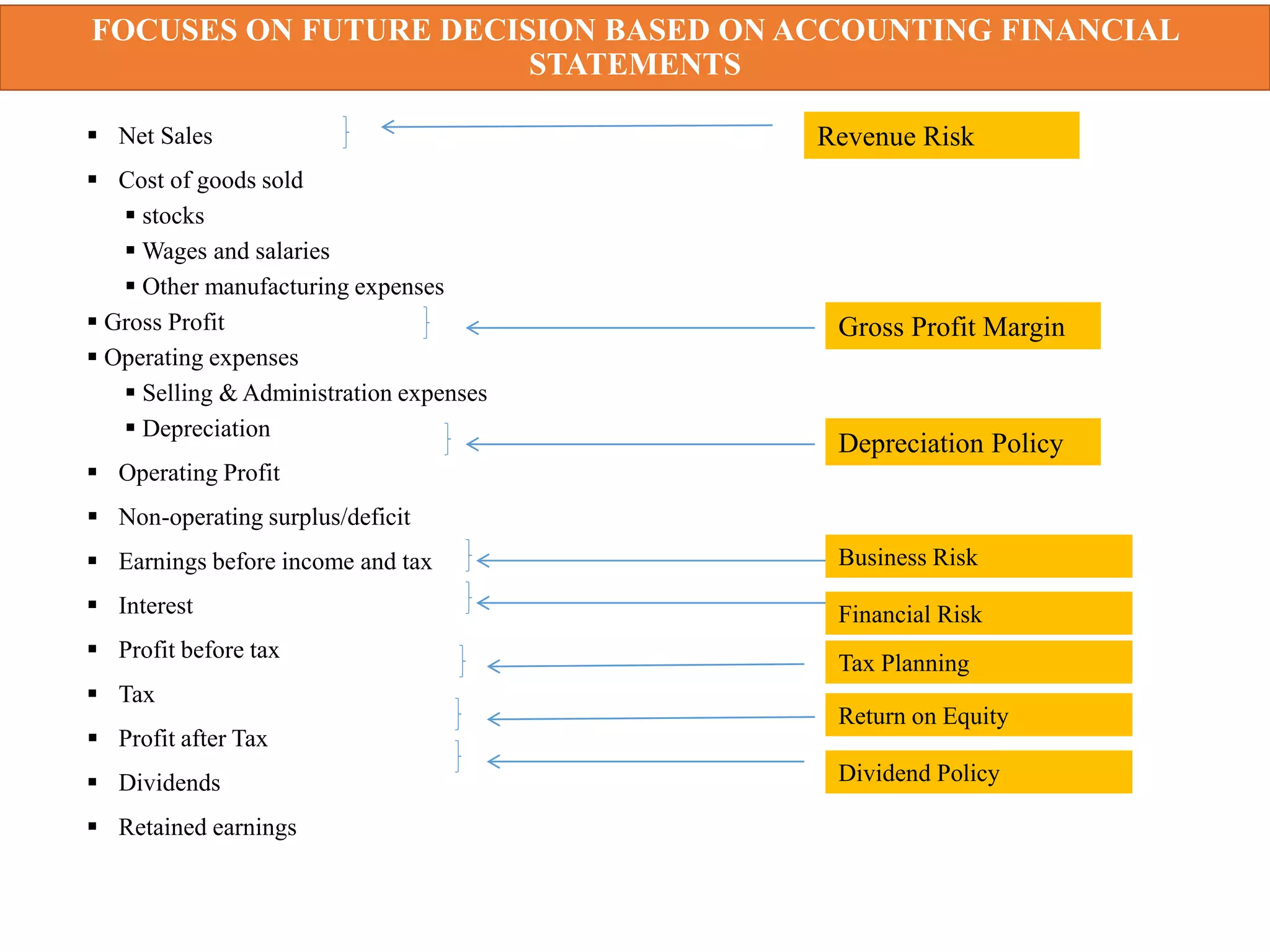
FOCUSES ON FUTURE DECISION BASED ON ACCOUNTING FINANCIAL
STATEMENTS
 Net Sales
 Cost of goods sold
 stocks
 Wages and salaries
 Other manufacturing expenses
 Gross Profit
 Operating expenses
 Selling & Administration expenses
 Depreciation
 Operating Profit
 Non-operating surplus/deficit
 Earnings before income and tax
 Interest
 Profit before tax
 Tax
 Profit after Tax
 Dividends
 Retained earnings
Revenue Risk
Depreciation Policy
Business Risk
Tax Planning
Return on Equity
Dividend Policy
Gross Profit Margin
Financial Risk
17
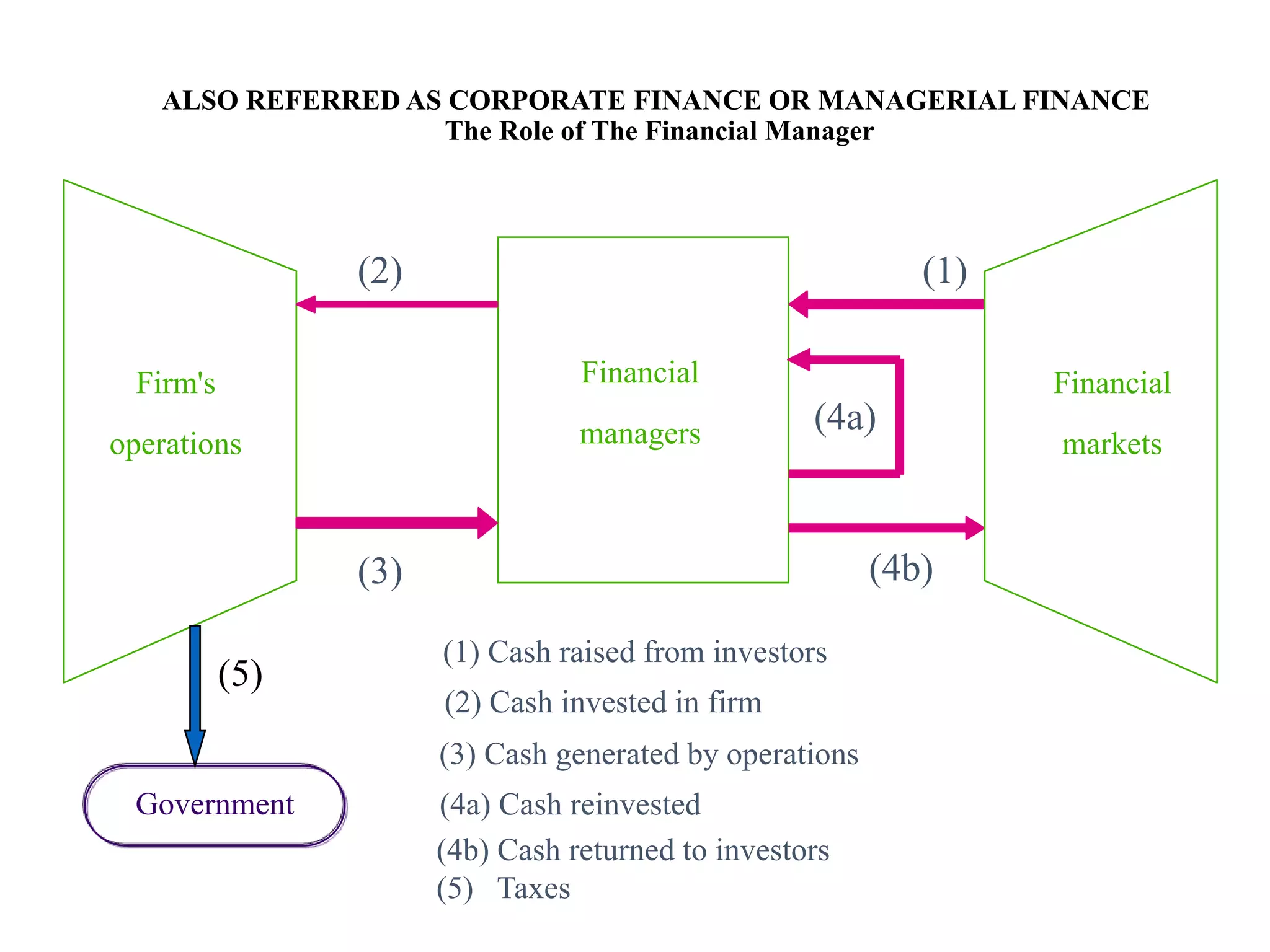
Financial
managers
Firm's
operations
Financial
markets
(1) Cash raised from investors
(1)
(2) Cash invested in firm
(2)
(3) Cash generated by operations
(3)
(4a) Cash reinvested
(4a)
(4b) Cash returned to investors
(5) Taxes
(4b)
ALSO REFERRED AS CORPORATE FINANCE OR MANAGERIAL FINANCE
The Role of The Financial Manager
Government
(5)
18
ALSO REFERRED AS CORPORATE FINANCE OR MANAGERIAL FINANCE
The Role of The Financial Manager
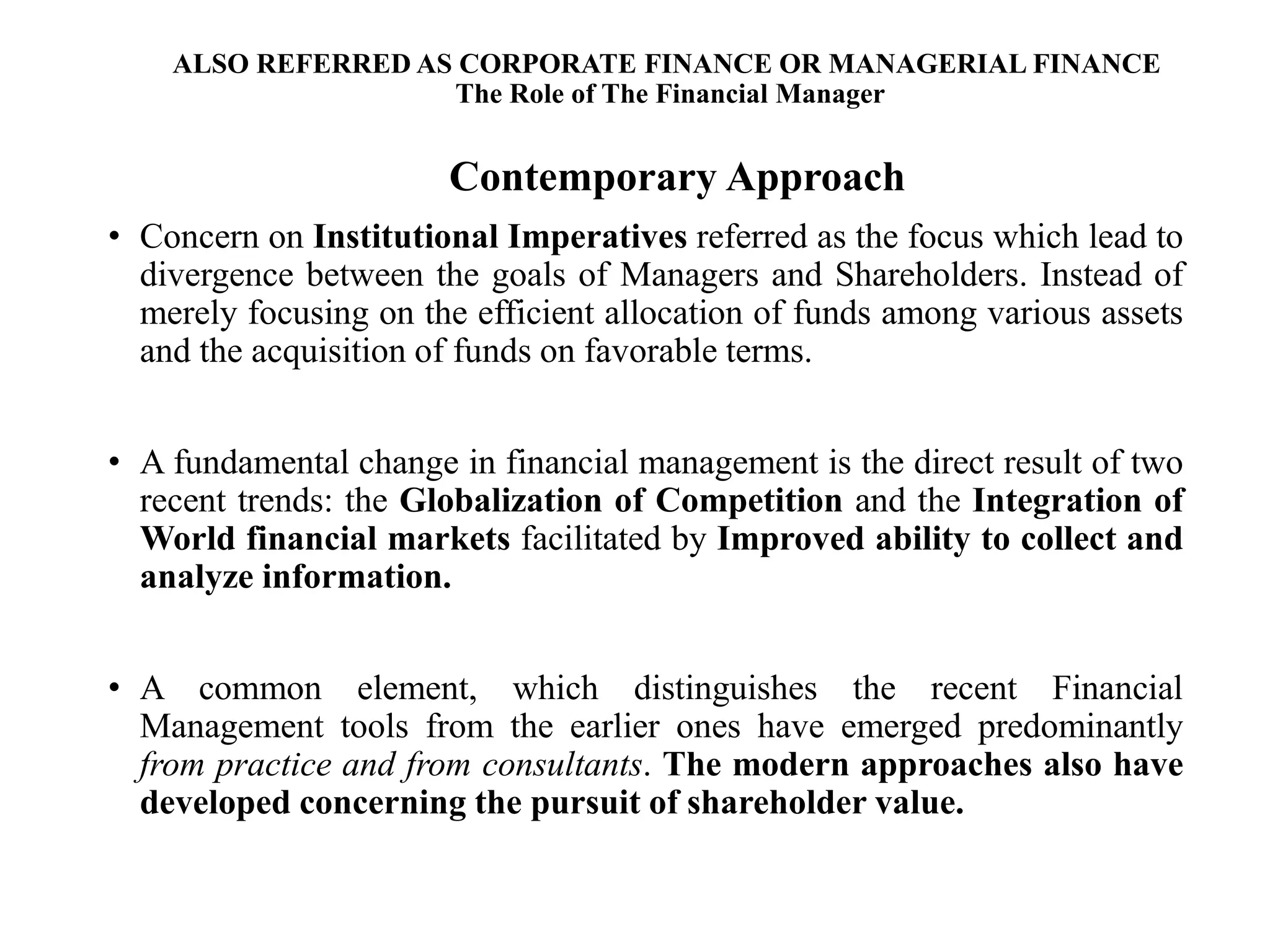
Contemporary Approach
• Concern on Institutional Imperatives referred as the focus which lead to
divergence between the goals of Managers and Shareholders. Instead of
merely focusing on the efficient allocation of funds among various assets
and the acquisition of funds on favorable terms.
• A fundamental change in financial management is the direct result of two
recent trends: the Globalization of Competition and the Integration of
World financial markets facilitated by Improved ability to collect and
analyze information.
• A common element, which distinguishes the recent Financial
Management tools from the earlier ones have emerged predominantly
from practice and from consultants. The modern approaches also have
developed concerning the pursuit of shareholder value.
19
ALSO REFERRED AS CORPORATE FINANCE OR MANAGERIAL FINANCE
The Role of The Financial Manager
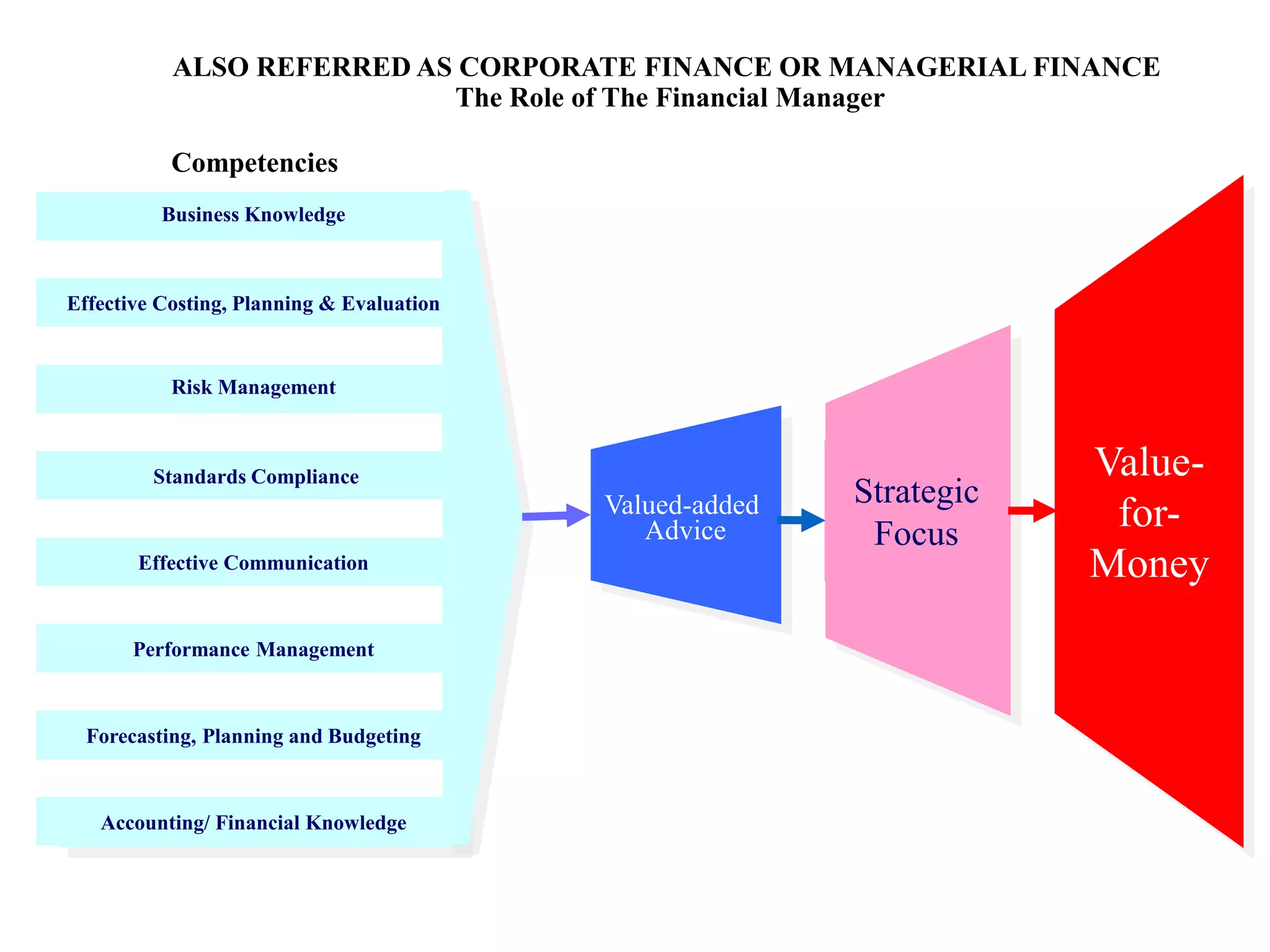
Business Knowledge
Effective Costing, Planning & Evaluation
Risk Management
Standards Compliance
Effective Communication
Performance Management
Forecasting, Planning and Budgeting
Accounting/ Financial Knowledge
Valued-added
Advice
Value-
for-
Money
Strategic
Focus
Competencies
20
Introduction to Financial Management

Introduction to Financial Management

  • 1.
    Financial Management Presented by: Mallikarjun M. Maradi Assistant Professor, Dept. of Studies in Commerce, Rani Channamma University, PG Centre, Vijayapur malluparam@gmail.com
  • 2.
    Unit – I FinancialManagement • An overview-Nature, Significance and scope of corporate financial management, Objectives and agency theory, Financial Management and its relationship with other disciplines, Business polices and their impact on financial management, Recent trends and contemporary issues.
  • 3.
    Introduction to FM •What is Finance? • Finance is a field that deals with the study of investments. It includes the dynamics of assets and liabilities over time under conditions of different degrees of uncertainty and risk. • Financing means asking any financial institution (bank, credit union, finance company) or another person to lend you money that you promise to repay at some point in the future. • Finance may be defined as the art and science of managing money. It includes financial service and financial instruments. Finance also is referred as the provision of money at the time when it is needed. Finance function is the procurement of funds and their effective utilization in business concerns. The concept of finance includes capital, funds, money, and amount. But each word is having unique
  • 4.
    3 DEFINITION OFFINANCE • AccordingtoKhanandJain,“Finance istheartandscienceofmanaging money”. • Financial Management : According to Oxford dictionary, the word ‘finance’ connotes ‘management of money’. • Webster’s Ninth New Collegiate Dictionary defines finance as “the Science on study of the management of funds’ and the management of fund as the system that includes the circulation of money, the granting of credit,themakingofinvestments,andtheprovisionofbankingfacilities. • AccordingtotheWheeler, “Business financeisthatbusiness activitywhichconcernswiththeacquisitionand conversationofcapitalfundsinmeetingfinancialneedsandoverallobjectivesofabusinessenterprise”. • According to theGuthumannandDougall,“Businessfinance canbroadly bedefinedas theactivity concerned withplanning, raising,controlling,administering ofthefundsusedinthebusiness”. • In the words of Parhter and Wert, “Business finance deals primarily with raising, administering and disbursingfundsbyprivatelyownedbusinessunitsoperatinginnonfinancial fieldsofindustry”. • Corporate finance is concerned with budgeting, financial forecasting, cash management, credit administration, investment analysis andfundprocurementof thebusiness concern and thebusiness concern needstoadoptmoderntechnologyandapplicationsuitabletotheglobalenvironment.
  • 5.
    DEFINITION OF FINANCIALMANAGEMENT • Financial management is an integral part of overall management. It is concerned with the dutiesofthefinancialmanagers inthebusinessfirm. • The term FM has been defined by Solomon, “It is concerned with the efficient use of an important economic resource namely, capital funds”. The most popular and acceptable definitionof FMasgivenby • S.C.Kuchal is that it deals with procurement of funds and their effective utilization in the business”. • Howard and Upton : it “as an application of general managerial principles to the area of financialdecision-making. • Weston and Brigham :it “is an area of financial decision-making, harmonizing individual motives and enterprisegoals”. • Joshep and Massie : it “is the operational activity of a business that is responsible for obtaining and effectively utilizing the funds necessary for efficient operations. Thus, FM is mainly concerned with the effective funds managementinthebusiness.Insimplewords,FMaspracticedbybusinessfirmscanbecalledasCorporation Finance orBusinessFinance.
  • 6.
    Nature of FinancialManagement: • i) It is a specialized branch of general management. • (ii) Financial management is growing as a profession. • (iii) Despite a separate status FM, is intermingled with other aspects of management. • (iv) Financial management is multi-disciplinary in approach. • (v) The finance manager is often called the Controller. The finance manager, very often, is a highly responsible member of the Top Management Team. • (vi) Despite a hue and cry about decentralisation of authority; finance is a matter to be found still centralised, even in enterprises which are so called highly decentralised. • (vii) It is not simply a basic business function along with production and marketing; It turns the sand of dreams into the gold of reality.
  • 8.
    Agency theory inFinancial Management • In an agency relationship, one party, called the agent, makes decisions and acts on behalf of another, called the principal. The agency theory attempts to summarize and solve problems arising from the relationshipbetween a principal and an agent. • Agency relationships are common in financial management, due to the nature of the industry. It considering the potential conflicts of interest between shareholders and management may arise as a result of several factors, some of such factors include: 1. Principalsand Agents in Finance 2. Goals and Information 3. Differencesin Risk Tolerance 4. Legal FiduciaryResponsibilities 5. Reward to management 6. Risk attitudesof managementand shareholders 7. Takeover decisionsby management 8. Time horizonof management
  • 9.
    • Agency costsinclude any expense that is associated with managing the relationship and resolving differing priorities. • While shareholders are most concern with increasing share value, management may be more concerned with growing the business in ways that increase their personal wealth. • There are three common types of agency costs: • monitoring, • bonding, and • residual loss. Solution to the agency problem • Performance based incentive measures • Share option schemes • Performance-based share options • Value creation as performance measurement • Shareholder control and interference • Threat of dismissal • Threat of take-overs
  • 10.
    RELATIONSHIP OF FINANCIALMANAGEMENT WITH OTHER BRANCHES Financial management covers wide area with multidimensional approaches. • 1. FM and Economics • 2. FM and Accounting • 3. FM or Mathematics (econometrics) • 4. FM and Production Management • 5. FM and Marketing • 6. FM and Human Resource
  • 11.
    Business polices andtheir impact on financial management 1. CHOICE OF FINANCIAL MARKET 2. CHOICE OF FINANCIAL INSTRUMENT---FINANCING DECISION 3. OPTIMUM CAPITAL STRUCTURE DECISION 4. OPTIMIZATION OF COST OF CAPITAL The Business Proposal Investors • Shareholders • Lenders Financial Market Investors provide the initial cash required to finance the business proposal The proposal generates cash to investors 11 FUND MANAGEMENT SCIENCE
  • 12.
    FUND MANAGEMENT SCIENCE FINANCEFUNCTION FINANCING INVESTMENT LIQUIDITY DECISION DECISION DECISION 1. Investment or Long Term Asset Mix Decision 2. Financing or Capital Mix Decision 3. Dividend or Profit Allocation Decision 4. Liquidity or Short Term Asset Mix Decision 12
  • 13.
    •Economic conditions •Political and social environments Market structure Firm’s competitive position SALESEBIT EAT EPS Economic Risk + Operational Risk + Financial Risk VALUE CREATION Business Risk FOCUSES IN WEALTH MAXIMIZATION GOAL/ENHANCING FIRM’S VALUE -The process of value creation 13
  • 14.
    RISK-RETURN PARADOX 14 Contradictory* Survive Avoid financialdistress and bankruptcy Beat the competition Maximize sales or market share Minimize Costs Maximize profits Maintain steady earnings growth PROFITABILITY Maximize sales Maximize Market Share Minimize Cost MINIMIZING RISK Bankruptcy avoidance Stability Safety Capital Budgeting Decision Capital Structure Decision Dividend Decision Working Capital Management Risk Management RISK AND RETURN TRADE OFF WEALTH MAXIMIZATION/E NHANCING VALUE OF THE FIRM (EVA) *Pursuit of profit involves risk; it is not possible to maximize both safety and profit:- Need of goal that encompasses both factors
  • 15.
    FOCUSES ON FUTUREDECISION BASED ON ACCOUNTING FINANCIAL STATEMENTS  Share Capital  Equity  Preference  Reserve &Surplus  Secured Loans  Debentures  Loans and advances  Unsecured Loans  Current Liabilities and Provisions  Trade Creditors  Provisions  Fixed Assets (net)  Gross block  Less: depreciation  Investments  Current Assets, loans and advances  Cash and bank  Receivables  Inventories Miscellaneous expenditure and losses Capital structure and Cost of Capital Working Capital financing policy Capital Budgeting Portfolio Management Cash Management Credit Management Inventory Management 15
  • 16.
    ALSO REFERRED ASCORPORATE FINANCE OR MANAGERIAL FINANCE The Role of The Financial Manager The Balance-Sheet Model of the Firm-Traditional Approach The Net Working Capital Investment Decisions Current Assets Investment Decisions  “Capital Budgeting” Fixed Assets 1 Tangible 2 Intangible Current Liabilities Long-Term Debt Shareholders’ Equity Net Working Capital Financing Decisions  “Capital Structure” 16
  • 17.
    FOCUSES ON FUTUREDECISION BASED ON ACCOUNTING FINANCIAL STATEMENTS  Net Sales  Cost of goods sold  stocks  Wages and salaries  Other manufacturing expenses  Gross Profit  Operating expenses  Selling & Administration expenses  Depreciation  Operating Profit  Non-operating surplus/deficit  Earnings before income and tax  Interest  Profit before tax  Tax  Profit after Tax  Dividends  Retained earnings Revenue Risk Depreciation Policy Business Risk Tax Planning Return on Equity Dividend Policy Gross Profit Margin Financial Risk 17
  • 18.
    Financial managers Firm's operations Financial markets (1) Cash raisedfrom investors (1) (2) Cash invested in firm (2) (3) Cash generated by operations (3) (4a) Cash reinvested (4a) (4b) Cash returned to investors (5) Taxes (4b) ALSO REFERRED AS CORPORATE FINANCE OR MANAGERIAL FINANCE The Role of The Financial Manager Government (5) 18
  • 19.
    ALSO REFERRED ASCORPORATE FINANCE OR MANAGERIAL FINANCE The Role of The Financial Manager Contemporary Approach • Concern on Institutional Imperatives referred as the focus which lead to divergence between the goals of Managers and Shareholders. Instead of merely focusing on the efficient allocation of funds among various assets and the acquisition of funds on favorable terms. • A fundamental change in financial management is the direct result of two recent trends: the Globalization of Competition and the Integration of World financial markets facilitated by Improved ability to collect and analyze information. • A common element, which distinguishes the recent Financial Management tools from the earlier ones have emerged predominantly from practice and from consultants. The modern approaches also have developed concerning the pursuit of shareholder value. 19
  • 20.
    ALSO REFERRED ASCORPORATE FINANCE OR MANAGERIAL FINANCE The Role of The Financial Manager Business Knowledge Effective Costing, Planning & Evaluation Risk Management Standards Compliance Effective Communication Performance Management Forecasting, Planning and Budgeting Accounting/ Financial Knowledge Valued-added Advice Value- for- Money Strategic Focus Competencies 20

Editor's Notes