Presented By
Ms Subhasheni A
Assistant Professor
Department Of Computer Science
Sri Ramakrishna College Of Arts & Science
Coimbatore
Introduction to Data Analytics
What is Data Analytics?
 Data analytics is the process of examining, cleaning,
transforming, and interpreting data to discover
useful information, patterns, and support decision-
making.
 Goal: To convert raw data into actionable insights.
Importance of Data Analytics
• Drives better decision-making
• Identifies trends and patterns
• Enhances operational efficiency
• Improves customer experience
• Predicts future outcomes
Key Components of Data Analytics
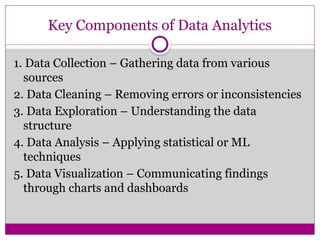
1. Data Collection – Gathering data from various
sources
2. Data Cleaning – Removing errors or inconsistencies
3. Data Exploration – Understanding the data
structure
4. Data Analysis – Applying statistical or ML
techniques
5. Data Visualization – Communicating findings
through charts and dashboards
Types of Data Analytics
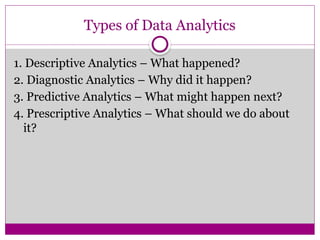
1. Descriptive Analytics – What happened?
2. Diagnostic Analytics – Why did it happen?
3. Predictive Analytics – What might happen next?
4. Prescriptive Analytics – What should we do about
it?
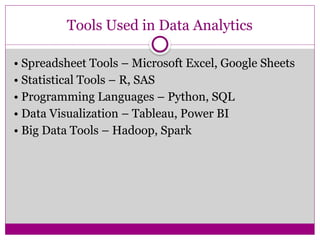
Tools Used in Data Analytics
• Spreadsheet Tools – Microsoft Excel, Google Sheets
• Statistical Tools – R, SAS
• Programming Languages – Python, SQL
• Data Visualization – Tableau, Power BI
• Big Data Tools – Hadoop, Spark
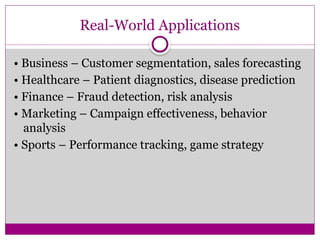
Real-World Applications
• Business – Customer segmentation, sales forecasting
• Healthcare – Patient diagnostics, disease prediction
• Finance – Fraud detection, risk analysis
• Marketing – Campaign effectiveness, behavior
analysis
• Sports – Performance tracking, game strategy
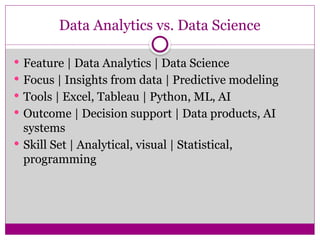
Data Analytics vs. Data Science
 Feature | Data Analytics | Data Science
 Focus | Insights from data | Predictive modeling
 Tools | Excel, Tableau | Python, ML, AI
 Outcome | Decision support | Data products, AI
systems
 Skill Set | Analytical, visual | Statistical,
programming
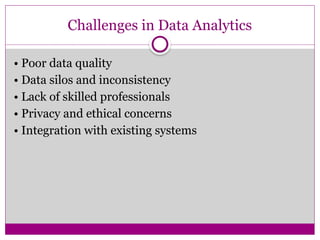
Challenges in Data Analytics
• Poor data quality
• Data silos and inconsistency
• Lack of skilled professionals
• Privacy and ethical concerns
• Integration with existing systems
The Future of Data Analytics
• Growth of AI and machine learning
• Real-time data processing
• Augmented analytics
• Democratization of data
• Increased focus on data ethics and governance
Conclusion
• Data analytics is essential in today’s digital world
• Helps businesses make smarter, faster decisions
• Knowing the tools and types is the first step in
becoming data literate
THANK YOU

Introduction to Data Analytics and Its Importance

  • 1.
    Presented By Ms SubhasheniA Assistant Professor Department Of Computer Science Sri Ramakrishna College Of Arts & Science Coimbatore Introduction to Data Analytics
  • 2.
    What is DataAnalytics?  Data analytics is the process of examining, cleaning, transforming, and interpreting data to discover useful information, patterns, and support decision- making.  Goal: To convert raw data into actionable insights.
  • 3.
    Importance of DataAnalytics • Drives better decision-making • Identifies trends and patterns • Enhances operational efficiency • Improves customer experience • Predicts future outcomes
  • 4.
    Key Components ofData Analytics 1. Data Collection – Gathering data from various sources 2. Data Cleaning – Removing errors or inconsistencies 3. Data Exploration – Understanding the data structure 4. Data Analysis – Applying statistical or ML techniques 5. Data Visualization – Communicating findings through charts and dashboards
  • 5.
    Types of DataAnalytics 1. Descriptive Analytics – What happened? 2. Diagnostic Analytics – Why did it happen? 3. Predictive Analytics – What might happen next? 4. Prescriptive Analytics – What should we do about it?
  • 6.
    Tools Used inData Analytics • Spreadsheet Tools – Microsoft Excel, Google Sheets • Statistical Tools – R, SAS • Programming Languages – Python, SQL • Data Visualization – Tableau, Power BI • Big Data Tools – Hadoop, Spark
  • 7.
    Real-World Applications • Business– Customer segmentation, sales forecasting • Healthcare – Patient diagnostics, disease prediction • Finance – Fraud detection, risk analysis • Marketing – Campaign effectiveness, behavior analysis • Sports – Performance tracking, game strategy
  • 8.
    Data Analytics vs.Data Science  Feature | Data Analytics | Data Science  Focus | Insights from data | Predictive modeling  Tools | Excel, Tableau | Python, ML, AI  Outcome | Decision support | Data products, AI systems  Skill Set | Analytical, visual | Statistical, programming
  • 9.
    Challenges in DataAnalytics • Poor data quality • Data silos and inconsistency • Lack of skilled professionals • Privacy and ethical concerns • Integration with existing systems
  • 10.
    The Future ofData Analytics • Growth of AI and machine learning • Real-time data processing • Augmented analytics • Democratization of data • Increased focus on data ethics and governance
  • 11.
    Conclusion • Data analyticsis essential in today’s digital world • Helps businesses make smarter, faster decisions • Knowing the tools and types is the first step in becoming data literate
  • 12.