Introduction to
Cloud Computing
Dr. Yashoda M B
Assistant Professor
Department of Computer Science (UG)
Kristu Jayanti College (Autonomous)
Introduction
Cloud computing:
 Cloud computing is the on-demand delivery of IT resources over the Internet
with pay-as-you-go pricing. Instead of buying, owning, and maintaining physical
data centers and servers, you can access technology services, such as
computing power, storage, and databases, on an as-needed basis from a
cloud provider.
 It s based on dynamic provisioning, which is not only applied to services but also
computing capabilities, networking, and infrastructure in general.
Different computing paradigms
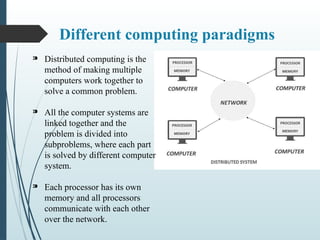
⁍ Distributed computing is the
method of making multiple
computers work together to
solve a common problem.
⁍ All the computer systems are
linked together and the
problem is divided into
subproblems, where each part
is solved by different computer
system.
⁍ Each processor has its own
memory and all processors
communicate with each other
over the network.
Parallel Computing
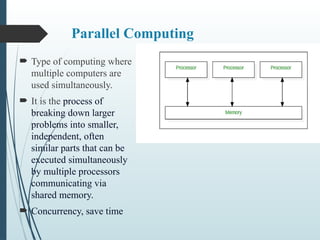
 Type of computing where
multiple computers are
used simultaneously.
 It is the process of
breaking down larger
problems into smaller,
independent, often
similar parts that can be
executed simultaneously
by multiple processors
communicating via
shared memory.
 Concurrency, save time
Cluster Computing
 Group of independent computers
that work together to perform the
given task.
 Increase the performance,
scalability and simplicity of the
system
Grid Computing
 Grid Computing can be defined as a
network of computers working
together to perform a task that would
rather be difficult for a single machine.
All machines on that network work
under the same protocol to act as a
virtual supercomputer. The tasks that
they work on may include analyzing
huge datasets or simulating situations
that require high computing power.
Computers on the network contribute
resources like processing power and
storage capacity to the network.
 Solve high computational problems in
less time.
Utility computing
 Utility computing is defined
as a service provisioning
model that offers computing
resources to clients as and
when they require them on
an on-demand basis. The
charges are exactly as per
the consumption of the
services provided, rather
than a fixed charge or a flat
rate.
 The goal is to increase the
usage of resources and be
more cost efficient.
Edge Computing
 Focused on decreasing the long distance communication
between the client and server.
 Goal is to bring computation to the networks edge
Cloud computing
 Cloud is defined as the usage of some one else’s server to
host, process of store data.
 Cloud computing is the on-demand access of computing
resources—physical servers or virtual servers, data storage,
networking capabilities, application development tools,
software, AI-powered analytic tools and more—over the
internet with pay-per-use pricing.
 Simply put, cloud computing is the delivery of computing
services—including servers, storage, databases, networking,
software, analytics, and intelligence—over the Internet (“the
cloud”) to offer faster innovation, flexible resources, and
economies of scale. You typically pay only for cloud services
you use, helping you lower your operating costs, run your
infrastructure more efficiently, and scale as your business
needs change.

Introduction to Cloud computing concept.pptx

  • 1.
    Introduction to Cloud Computing Dr.Yashoda M B Assistant Professor Department of Computer Science (UG) Kristu Jayanti College (Autonomous)
  • 2.
    Introduction Cloud computing:  Cloudcomputing is the on-demand delivery of IT resources over the Internet with pay-as-you-go pricing. Instead of buying, owning, and maintaining physical data centers and servers, you can access technology services, such as computing power, storage, and databases, on an as-needed basis from a cloud provider.  It s based on dynamic provisioning, which is not only applied to services but also computing capabilities, networking, and infrastructure in general.
  • 3.
    Different computing paradigms ⁍Distributed computing is the method of making multiple computers work together to solve a common problem. ⁍ All the computer systems are linked together and the problem is divided into subproblems, where each part is solved by different computer system. ⁍ Each processor has its own memory and all processors communicate with each other over the network.
  • 4.
    Parallel Computing  Typeof computing where multiple computers are used simultaneously.  It is the process of breaking down larger problems into smaller, independent, often similar parts that can be executed simultaneously by multiple processors communicating via shared memory.  Concurrency, save time
  • 5.
    Cluster Computing  Groupof independent computers that work together to perform the given task.  Increase the performance, scalability and simplicity of the system
  • 6.
    Grid Computing  GridComputing can be defined as a network of computers working together to perform a task that would rather be difficult for a single machine. All machines on that network work under the same protocol to act as a virtual supercomputer. The tasks that they work on may include analyzing huge datasets or simulating situations that require high computing power. Computers on the network contribute resources like processing power and storage capacity to the network.  Solve high computational problems in less time.
  • 7.
    Utility computing  Utilitycomputing is defined as a service provisioning model that offers computing resources to clients as and when they require them on an on-demand basis. The charges are exactly as per the consumption of the services provided, rather than a fixed charge or a flat rate.  The goal is to increase the usage of resources and be more cost efficient.
  • 8.
    Edge Computing  Focusedon decreasing the long distance communication between the client and server.  Goal is to bring computation to the networks edge
  • 9.
    Cloud computing  Cloudis defined as the usage of some one else’s server to host, process of store data.  Cloud computing is the on-demand access of computing resources—physical servers or virtual servers, data storage, networking capabilities, application development tools, software, AI-powered analytic tools and more—over the internet with pay-per-use pricing.  Simply put, cloud computing is the delivery of computing services—including servers, storage, databases, networking, software, analytics, and intelligence—over the Internet (“the cloud”) to offer faster innovation, flexible resources, and economies of scale. You typically pay only for cloud services you use, helping you lower your operating costs, run your infrastructure more efficiently, and scale as your business needs change.