Introduction to Cloud
Computing
Cloud computing refers to the delivery of computing services over the
internet, offering scalable resources and cost-effective solutions for
businesses.
Fa
by Faim Pathan
Definition and Key Concepts
Cloud computing refers to the delivery of computing services over the
internet, offering access to shared resources, such as storage,
processing power, and applications.
Key concepts include on-demand self-service, broad network access,
resource pooling, rapid elasticity, and measured service.
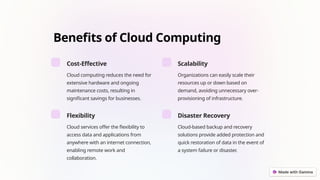
Benefits of Cloud Computing
Cost-Effective
Cloud computing reduces the need for
extensive hardware and ongoing
maintenance costs, resulting in
significant savings for businesses.
Scalability
Organizations can easily scale their
resources up or down based on
demand, avoiding unnecessary over-
provisioning of infrastructure.
Flexibility
Cloud services offer the flexibility to
access data and applications from
anywhere with an internet connection,
enabling remote work and
collaboration.
Disaster Recovery
Cloud-based backup and recovery
solutions provide added protection and
quick restoration of data in the event of
a system failure or disaster.
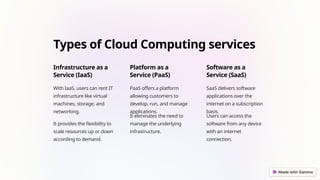
Types of Cloud Computing services
Infrastructure as a
Service (IaaS)
With IaaS, users can rent IT
infrastructure like virtual
machines, storage, and
networking.
It provides the flexibility to
scale resources up or down
according to demand.
Platform as a
Service (PaaS)
PaaS offers a platform
allowing customers to
develop, run, and manage
applications.
It eliminates the need to
manage the underlying
infrastructure.
Software as a
Service (SaaS)
SaaS delivers software
applications over the
internet on a subscription
basis.
Users can access the
software from any device
with an internet
connection.
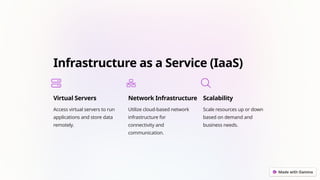
Infrastructure as a Service (IaaS)
Virtual Servers
Access virtual servers to run
applications and store data
remotely.
Network Infrastructure
Utilize cloud-based network
infrastructure for
connectivity and
communication.
Scalability
Scale resources up or down
based on demand and
business needs.
Platform as a Service (PaaS)
Scalability: PaaS allows for easy scalability, enabling businesses to
adjust resources as needed without over-provisioning.
Development Tools: It provides a range of development tools to
facilitate application development, testing, and deployment.
Cost-Effective: PaaS reduces infrastructure costs and streamlines
development efforts, leading to cost savings for organizations.
Software as a Service (SaaS)
Accessible Anywhere: SaaS applications are accessible from any
internet-enabled device.
Automatic Updates: Regular updates and maintenance are
managed by the SaaS provider.
Scalability: Easily scalable to accommodate the changing needs of
the organization.
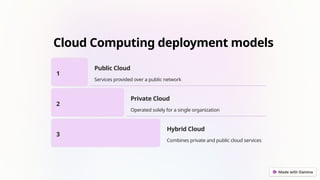
Cloud Computing deployment models
1
Public Cloud
Services provided over a public network
2
Private Cloud
Operated solely for a single organization
3
Hybrid Cloud
Combines private and public cloud services
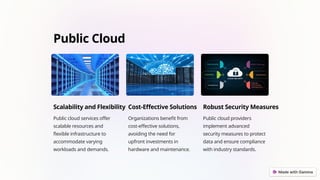
Public Cloud
Scalability and Flexibility
Public cloud services offer
scalable resources and
flexible infrastructure to
accommodate varying
workloads and demands.
Cost-Effective Solutions
Organizations benefit from
cost-effective solutions,
avoiding the need for
upfront investments in
hardware and maintenance.
Robust Security Measures
Public cloud providers
implement advanced
security measures to protect
data and ensure compliance
with industry standards.
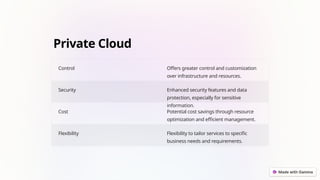
Private Cloud
Control Offers greater control and customization
over infrastructure and resources.
Security Enhanced security features and data
protection, especially for sensitive
information.
Cost Potential cost savings through resource
optimization and efficient management.
Flexibility Flexibility to tailor services to specific
business needs and requirements.

Introduction-to-Cloud-Computing cloud computing.pptx

  • 1.
    Introduction to Cloud Computing Cloudcomputing refers to the delivery of computing services over the internet, offering scalable resources and cost-effective solutions for businesses. Fa by Faim Pathan
  • 2.
    Definition and KeyConcepts Cloud computing refers to the delivery of computing services over the internet, offering access to shared resources, such as storage, processing power, and applications. Key concepts include on-demand self-service, broad network access, resource pooling, rapid elasticity, and measured service.
  • 3.
    Benefits of CloudComputing Cost-Effective Cloud computing reduces the need for extensive hardware and ongoing maintenance costs, resulting in significant savings for businesses. Scalability Organizations can easily scale their resources up or down based on demand, avoiding unnecessary over- provisioning of infrastructure. Flexibility Cloud services offer the flexibility to access data and applications from anywhere with an internet connection, enabling remote work and collaboration. Disaster Recovery Cloud-based backup and recovery solutions provide added protection and quick restoration of data in the event of a system failure or disaster.
  • 4.
    Types of CloudComputing services Infrastructure as a Service (IaaS) With IaaS, users can rent IT infrastructure like virtual machines, storage, and networking. It provides the flexibility to scale resources up or down according to demand. Platform as a Service (PaaS) PaaS offers a platform allowing customers to develop, run, and manage applications. It eliminates the need to manage the underlying infrastructure. Software as a Service (SaaS) SaaS delivers software applications over the internet on a subscription basis. Users can access the software from any device with an internet connection.
  • 5.
    Infrastructure as aService (IaaS) Virtual Servers Access virtual servers to run applications and store data remotely. Network Infrastructure Utilize cloud-based network infrastructure for connectivity and communication. Scalability Scale resources up or down based on demand and business needs.
  • 6.
    Platform as aService (PaaS) Scalability: PaaS allows for easy scalability, enabling businesses to adjust resources as needed without over-provisioning. Development Tools: It provides a range of development tools to facilitate application development, testing, and deployment. Cost-Effective: PaaS reduces infrastructure costs and streamlines development efforts, leading to cost savings for organizations.
  • 7.
    Software as aService (SaaS) Accessible Anywhere: SaaS applications are accessible from any internet-enabled device. Automatic Updates: Regular updates and maintenance are managed by the SaaS provider. Scalability: Easily scalable to accommodate the changing needs of the organization.
  • 8.
    Cloud Computing deploymentmodels 1 Public Cloud Services provided over a public network 2 Private Cloud Operated solely for a single organization 3 Hybrid Cloud Combines private and public cloud services
  • 9.
    Public Cloud Scalability andFlexibility Public cloud services offer scalable resources and flexible infrastructure to accommodate varying workloads and demands. Cost-Effective Solutions Organizations benefit from cost-effective solutions, avoiding the need for upfront investments in hardware and maintenance. Robust Security Measures Public cloud providers implement advanced security measures to protect data and ensure compliance with industry standards.
  • 10.
    Private Cloud Control Offersgreater control and customization over infrastructure and resources. Security Enhanced security features and data protection, especially for sensitive information. Cost Potential cost savings through resource optimization and efficient management. Flexibility Flexibility to tailor services to specific business needs and requirements.