This presentation introduces the fundamentals of Artificial Intelligence. It explains what AI is, key types of AI, common examples, and real-world applications in a clear and beginner-friendly way.
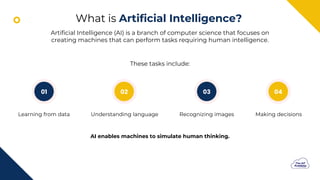
What is ArtificialIntelligence?
Artificial Intelligence (AI) is a branch of computer science that focuses on
creating machines that can perform tasks requiring human intelligence.
AI enables machines to simulate human thinking.
These tasks include:
Learning from data
01 02
Understanding language
03
Recognizing images
04
Making decisions
3.
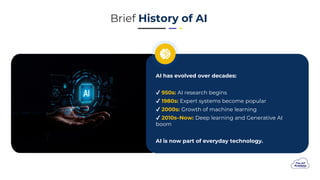
Brief History ofAI
AI has evolved over decades:
950s: AI research begins
1980s: Expert systems become popular
2000s: Growth of machine learning
2010s–Now: Deep learning and Generative AI
boom
AI is now part of everyday technology.
4.
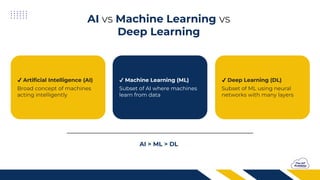
AI vs MachineLearning vs
Deep Learning
Artificial Intelligence (AI)
Broad concept of machines
acting intelligently
Machine Learning (ML)
Subset of AI where machines
learn from data
Deep Learning (DL)
Subset of ML using neural
networks with many layers
AI > ML > DL
5.
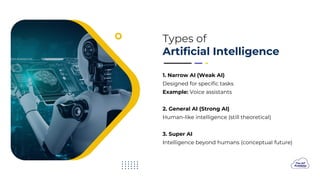
Types of
Artificial Intelligence
1.Narrow AI (Weak AI)
Designed for specific tasks
Example: Voice assistants
2. General AI (Strong AI)
Human-like intelligence (still theoretical)
3. Super AI
Intelligence beyond humans (conceptual future)
6.
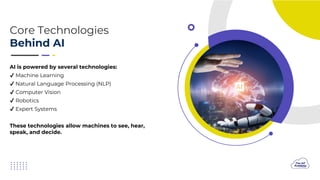
Core Technologies
Behind AI
AIis powered by several technologies:
Machine Learning
Natural Language Processing (NLP)
Computer Vision
Robotics
Expert Systems
These technologies allow machines to see, hear,
speak, and decide.
7.
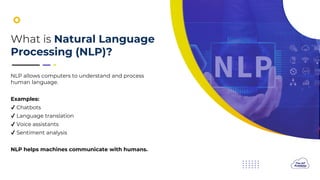
What is NaturalLanguage
Processing (NLP)?
NLP allows computers to understand and process
human language.
Examples:
Chatbots
Language translation
Voice assistants
Sentiment analysis
NLP helps machines communicate with humans.
8.
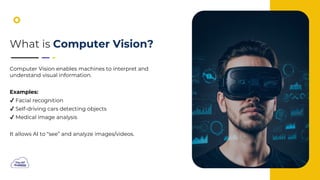
What is ComputerVision?
Computer Vision enables machines to interpret and
understand visual information.
Examples:
Facial recognition
Self-driving cars detecting objects
Medical image analysis
It allows AI to “see” and analyze images/videos.
9.
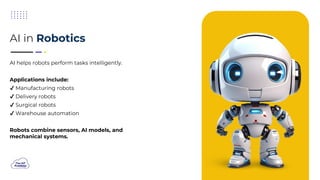
AI helps robotsperform tasks intelligently.
Applications include:
Manufacturing robots
Delivery robots
Surgical robots
Warehouse automation
Robots combine sensors, AI models, and
mechanical systems.
AI in Robotics
10.
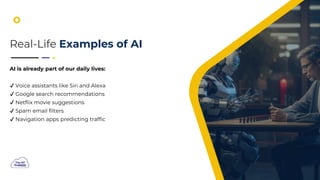
Real-Life Examples ofAI
AI is already part of our daily lives:
Voice assistants like Siri and Alexa
Google search recommendations
Netflix movie suggestions
Spam email filters
Navigation apps predicting traffic
11.
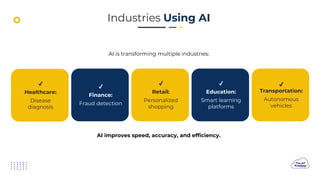
Industries Using AI
AIis transforming multiple industries:
AI improves speed, accuracy, and efficiency.
Healthcare:
Disease
diagnosis
Finance:
Fraud detection
Retail:
Personalized
shopping
Education:
Smart learning
platforms
Transportation:
Autonomous
vehicles
12.
F
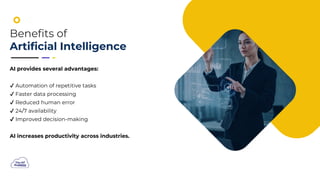
Benefits of
Artificial Intelligence
AIprovides several advantages:
Automation of repetitive tasks
Faster data processing
Reduced human error
24/7 availability
Improved decision-making
AI increases productivity across industries.
13.
F
Risks and Challengesof AI
Despite its benefits, AI has challenges:
Data privacy concerns
Bias in AI models
Job displacement fears
High development costs
Ethical decision-making issues
Responsible AI development is very important.
14.
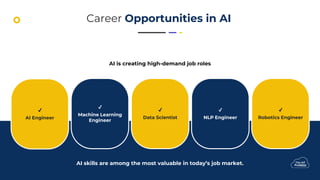
Career Opportunities inAI
AI Engineer
Machine Learning
Engineer
Data Scientist NLP Engineer Robotics Engineer
AI is creating high-demand job roles
AI skills are among the most valuable in today’s job market.
15.
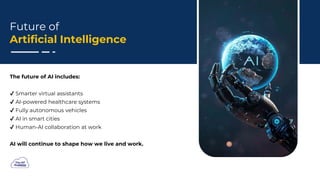
Future of
Artificial Intelligence
Thefuture of AI includes:
Smarter virtual assistants
AI-powered healthcare systems
Fully autonomous vehicles
AI in smart cities
Human-AI collaboration at work
AI will continue to shape how we live and work.



![AI_presentation_AICT[1] [Read-Only].pptx](https://cdn.slidesharecdn.com/ss_thumbnails/aipresentationaict1read-only-250905174825-38ac6625-thumbnail.jpg?width=640&height=640&fit=bounds)
![AI_presentation_AICT[1] [Read-Only].pptx](https://cdn.slidesharecdn.com/ss_thumbnails/aipresentationaict1read-only-250905174916-d5ef4934-thumbnail.jpg?width=640&height=640&fit=bounds)
![AI_presentation_AICT[1] [Read-Only].pptx](https://cdn.slidesharecdn.com/ss_thumbnails/aipresentationaict1read-only-250905175118-16902bff-thumbnail.jpg?width=640&height=640&fit=bounds)


![DaVinci Resolve Studio 16.1.2.026 Crack Activation Key 2025 [Latest]](https://cdn.slidesharecdn.com/ss_thumbnails/artificialintelligence-250523221211-f0a6d7b3-thumbnail.jpg?width=640&height=640&fit=bounds)


