Agile Software
Development Workshop
Focus on Creating User Stories and
Estimations
André Luís Pitombeira
Agenda
● Introduction to Agile Principles 5 min
● Understanding User Stories 5 min
● The INVEST Criteria for Good User Stories 15 min
● Breakdown of Epics into User Stories 10 min
● Introduction to Estimation Techniques 5 min
● Estimating User Stories 15 min
● Q&A and Wrap-up 5 min
Introduction to Agile Principles
What is Agile?
● Agile is a set of principles for software development under which
requirements and solutions evolve through collaborative effort
● Emphasizes flexibility, collaboration, and customer satisfaction
● Key agiles practices: iterative development, continuous feedback, and
adaptive planning
Importance of User Stories and Estimations
● User Stories: Capture needs and drive development
● Estimations: Provide a way to gauge the effort and time required to
deliver user stories
● Both are crucial for planning and delivering value in an Agile environment
Understanding User Stories
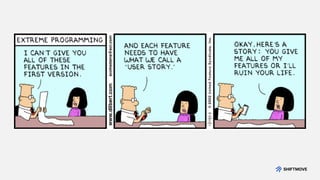
What Are User Stories?
● A user story is a simple, concise statement of a requirement or
functionality from the perspective of the end user
● Format: As a [type of user], I want [an action], so that [a benefit]
Components of a Good User Story
● User role: Who is the user?
● Action: What does the user want to do?
● Benefit: Why does the user want to do this?
Examples User Stories
● Example 1 As a customer, I want to be able to save items to a wishlist,
so that I can purchase them later
● Example 2 As a sales manager, I want to generate monthly sales
reports, so that I can track sales performance
The INVEST Criteria for Good User
Stories
What is INVEST?
● INVEST is a mnemonic to help ensure that user stories are well-crafted and
effective. Each letter stands for a key characteristic of a good user story:
○ Independent: The story should be self-contained, with no inherent dependencies on
other stories
○ Negotiable: The story is not a contract but a starting point for a conversation between
the team and the product owner
○ Valuable: The story must deliver value to the end user of the customer
○ Estimable: The story should be small enough to estimate with reasonable accuracy
○ Smal: The story should be small enough to be completed with a single iteration
○ Testable: There should be clear criteria to verify that the story has been implemented
correctly
Independent
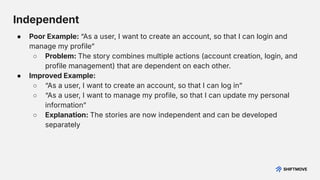
● Poor Example: “As a user, I want to create an account, so that I can login and
manage my profileˮ
○ Problem: The story combines multiple actions (account creation, login, and
profile management) that are dependent on each other.
● Improved Example:
○ “As a user, I want to create an account, so that I can log inˮ
○ “As a user, I want to manage my profile, so that I can update my personal
informationˮ
○ Explanation: The stories are now independent and can be developed
separately
Negotiable
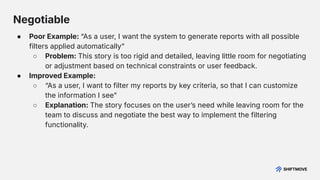
● Poor Example: “As a user, I want the system to generate reports with all possible
filters applied automaticallyˮ
○ Problem: This story is too rigid and detailed, leaving little room for negotiating
or adjustment based on technical constraints or user feedback.
● Improved Example:
○ “As a user, I want to filter my reports by key criteria, so that I can customize
the information I seeˮ
○ Explanation: The story focuses on the userʼs need while leaving room for the
team to discuss and negotiate the best way to implement the filtering
functionality.
Valuable
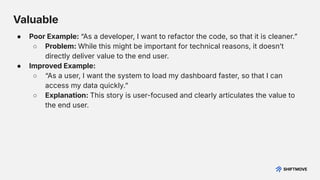
● Poor Example: “As a developer, I want to refactor the code, so that it is cleaner.ˮ
○ Problem: While this might be important for technical reasons, it doesnʼt
directly deliver value to the end user.
● Improved Example:
○ “As a user, I want the system to load my dashboard faster, so that I can
access my data quickly.ˮ
○ Explanation: This story is user-focused and clearly articulates the value to
the end user.
Estimable
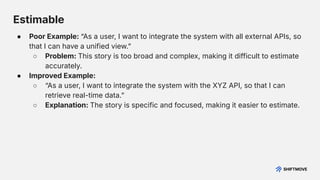
● Poor Example: “As a user, I want to integrate the system with all external APIs, so
that I can have a unified view.ˮ
○ Problem: This story is too broad and complex, making it difficult to estimate
accurately.
● Improved Example:
○ “As a user, I want to integrate the system with the XYZ API, so that I can
retrieve real-time data.ˮ
○ Explanation: The story is specific and focused, making it easier to estimate.
● Poor Example: “As a user, I want to manage all aspects of my account settings, so
that I can control my preferences.ˮ
○ Problem: This story is too large and likely to span multiple sprints.
● Improved Example:
○ “As a user, I want to change my password, so that I can keep my account
secure.ˮ
○ Explanation: The story is small and focused, making it possible to complete
within a single iteration.
Small
● Poor Example: “As a user, I want the system to be user-friendly, so that I can have
better experience..ˮ
○ Problem: The term “user-friendlyˮ is vague and subjective, making it difficult
to test.
● Improved Example:
○ “As a user, I want a confirmation message after submitting a form, so that I
know my action was successful.ˮ
○ Explanation: The story includes clear, testable criteria (confirmation
message) to verify the implementation.
Testable
Exercise 1 Writing User Stories with INVEST
● Task: Write a user story based on the following scenario while ensuring it meets the
INVEST criteria:
● Scenario: A customer wants to receive notifications when flight prices drop on a
route they frequently travel.
● Instructions:
○ Write the user story using the format "As a [type of user], I want [an action], so that
[a benefit]."
○ Check your story against the INVEST criteria: Is it Independent, Negotiable,
Valuable, Estimable, Small, and Testable?
○ Be prepared to discuss how your story meets these criteria.
Exercise 1 Writing User Stories with INVEST  Answer
● User Story:
● As a frequent traveler, I want to receive notifications when flight prices drop on my selected routes, so that I
can book tickets at the best price.
● How This Story Meets the INVEST Criteria:
○ Independent:This story can be developed and tested independently of other stories, such as managing flight
bookings or setting up a user profile.
○ Negotiable: The details of how notifications are sent (e.g., email, SMS, app notification) can be discussed and
adjusted during the planning or refinement process.
○ Valuable: This story directly adds value to the user by enabling them to save money on flights, which is a clear
benefit to frequent travelers.
○ Estimable: The scope of the story is clear and specific, allowing the team to estimate the effort required to
implement the notification feature.
○ Small: The story is focused on a single feature (price drop notifications) and can be completed within a single
iteration or sprint.
○ Testable: The story is testable because the acceptance criteria can include checking that notifications are sent
when the price drops on a selected route. Test cases can be written to verify that the notifications are triggered
correctly.
Breakdown of Epics into User Stories
● What Are Epics?
○ Epics are large user stories that can be broken down into smaller,
more manageable user stories.
○ An Epic usually represents a significant piece of functionality.
Breaking Down Epics
● Example Epic: "As a user, I want to manage my account settings."
● Breakdown into User Stories:
● As a user, I want to update my email address, so that I can receive
notifications.
● As a user, I want to change my password, so that I can keep my account
secure.
● As a user, I want to manage my payment methods, so that I can control
how I pay.
Exercise 2 Break Down an Epic
● Task: Break down the following Epic into smaller user stories:
● "As a project manager, I want to monitor project progress."
● Hint: Think of specific actions the project manager might take to monitor
progress.
Exercise 2 Break Down an Epic - Answer
● User Story 1:
● As a project manager, I want to view a dashboard showing the overall project status, so that I
can quickly assess project health.
● Explanation: This story focuses on providing a high-level overview of the project, enabling the
project manager to monitor the status at a glance.
● User Story 2:
● As a project manager, I want to track the completion status of individual tasks, so that I can
identify any potential delays.
● Explanation: This story allows the project manager to drill down into specific tasks, helping
them understand where bottlenecks might occur.
● User Story 3:
● As a project manager, I want to receive notifications when a task is delayed, so that I can take
action to keep the project on track.
● Explanation: This story adds a proactive feature, allowing the project manager to be alerted to
issues as they arise.
Exercise 2 Break Down an Epic - Answer
● User Story 3:
● As a project manager, I want to receive notifications when a task is delayed, so that I can take
action to keep the project on track.
● Explanation: This story adds a proactive feature, allowing the project manager to be alerted to
issues as they arise.
● User Story 4:
● As a project manager, I want to generate detailed progress reports, so that I can share project
updates with stakeholders.
● Explanation: This story focuses on reporting, providing a way for the project manager to
communicate project status with others.
Exercise 2 Break Down an Epic - Answer
● User Story 5:
○ As a project manager, I want to view the allocation of resources across tasks, so that I can
ensure the project is appropriately staffed.
○ Explanation: This story allows the project manager to monitor resource usage, ensuring that
no one is over or underutilized.
Introduction to Estimation
Techniques
Why Estimations Matter
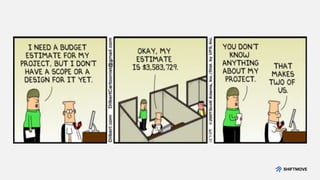
● Estimations help in planning, managing resources, and setting realistic
expectations.
● How long a story will take (effort)
● Influenced by complexity, uncertainty, risk, volume of work
● Relative values are what is important
○ Login screen is 2
○ Checkout screen is 8
Challenges with Estimation
● Ambiguous/changing requirements
● Estimating takes too long and still donʼt get it right
● Estimations are provided by the wrong people
● Software projects are unique and ambiguous.
○ Hard to provide exact estimates
○ Exponential complexity
● Estimations are not commitments
Common Estimation Techniques
● Planning Poker: Collaborative estimation technique using cards with
story points.
● T-shirt Sizing: Estimates are expressed as sizes S, M, L, XL instead of
numbers.
● Complexity Bucket: Categorize tasks into predefined "buckets" based
on their complexity level. E.g, Low Complexity, Medium Complexity,
High Complexity
Why Planning Poker is Effective
● Collaborative: Involves the entire team, ensuring diverse perspectives.
● Shared Understanding: Discusses user stories to uncover hidden
complexities.
● Bias Mitigation: Independent estimates prevent anchoring bias.
● Relative Estimation: Focuses on comparing complexity, not time.
● Consensus Building: Encourages discussion until agreement is reached.
● Engaging: Fun and interactive, boosting team morale.
Tips for Reliable Planning Poker Estimations
● Clear User Stories: Ensure well-defined stories with clear acceptance criteria.
● Break Down Large Stories: Split complex stories into smaller, manageable ones.
● Consider All Work: Include coding, testing, integration, and documentation.
● Discuss Dependencies/Risks: Identify potential blockers or technical challenges.
● Factor in Team Experience: Adjust estimates based on team familiarity with the
task.
● Use Historical Data: Reference past projects to inform current estimates.
● Add Buffers: Account for uncertainties with a buffer in estimates.
● Encourage Discussion: Explore reasons behind widely varying estimates.
● Stay Consistent: Use a consistent scale like the Fibonacci sequence.
● Review and Adjust: Regularly refine estimates as more information becomes
available.
Story Points
● Abstract unit of time
○ Depending on the person it can be hours, days, weeks
● The goal is to take us away from thinking in terms of absolute
estimates
● Start doing estimates relatively
Story Points
● Fibonacci sequence: 1, 2, 3, 5, 8, 13, 21
● Why does it work?
○ Weberʼs law state that the difference we can identify between objects is given by a
percentage
○ Each Fibonacci number is about 60% larger than the preceding value
○ According to Weberʼs Law, if we can distinguish a 60% difference in efforts between two
estimates, we can distinguish that same percentage between other estimates
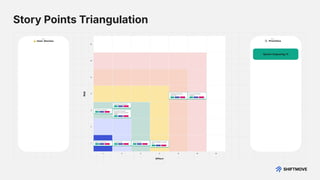
Story Points Triangulation
Estimating User Stories
Example Scenario
● Initial User Story: "As a user, I want to upload and share documents, so
that I can collaborate with my team."
● Without Following the Tips:
○ Story Points: 5 points, assuming a straightforward file upload feature.
Example Scenario: After Applying the Tips
● Clear User Stories: The team clarifies that sharing involves permissions and
version control.
● Break Down Large Stories: The story is split into “Upload documentsˮ and
“Manage document sharing permissions.ˮ
● Consider All Work: They include integration testing and UX design.
● Discuss Dependencies/Risks: Integration with cloud storage introduces risks.
● Factor in Team Experience: The team is less familiar with the cloud storage API.
● Final Story Points: The original 5 points are now split into two stories:
○ "Upload documents" 5 points)
○ "Manage sharing permissions" 8 points)
Exercise 3 Estimating User Stories Using Planning Poker
● Task: Estimate the following user story using Planning Poker:
○ User Story: "As a user, I want to upload and share documents in multiple
formats, so that I can collaborate with my team."
● Instructions:
○ Step 1 Review the user story and discuss possible challenges (e.g., handling
different file formats, ensuring security, user interface).
○ Step 2 Each team member chooses an estimate considering complexity and
effort.
○ Step 3 Reveal the estimates and discuss any discrepancies.
○ Step 4 Reach a consensus on the final estimate.
Questions?
References 📚
● Succeeding with Agile: Software Development Using Scrum
● User Story Mapping: Discover the Whole Story, Build the Right
● User Stories Applied: For Agile Software Development
● Extreme Programming Explained: Embrace Change
● Software Estimation Techniques
Thanks for listening!
46
Questions or feedback?
Reach out to
André Pitombeira
Engineering Manager

Introduction to Agile Software Development

  • 1.
    Agile Software Development Workshop Focuson Creating User Stories and Estimations André Luís Pitombeira
  • 2.
    Agenda ● Introduction toAgile Principles 5 min ● Understanding User Stories 5 min ● The INVEST Criteria for Good User Stories 15 min ● Breakdown of Epics into User Stories 10 min ● Introduction to Estimation Techniques 5 min ● Estimating User Stories 15 min ● Q&A and Wrap-up 5 min
  • 4.
  • 5.
    What is Agile? ●Agile is a set of principles for software development under which requirements and solutions evolve through collaborative effort ● Emphasizes flexibility, collaboration, and customer satisfaction ● Key agiles practices: iterative development, continuous feedback, and adaptive planning
  • 6.
    Importance of UserStories and Estimations ● User Stories: Capture needs and drive development ● Estimations: Provide a way to gauge the effort and time required to deliver user stories ● Both are crucial for planning and delivering value in an Agile environment
  • 7.
  • 9.
    What Are UserStories? ● A user story is a simple, concise statement of a requirement or functionality from the perspective of the end user ● Format: As a [type of user], I want [an action], so that [a benefit]
  • 10.
    Components of aGood User Story ● User role: Who is the user? ● Action: What does the user want to do? ● Benefit: Why does the user want to do this?
  • 11.
    Examples User Stories ●Example 1 As a customer, I want to be able to save items to a wishlist, so that I can purchase them later ● Example 2 As a sales manager, I want to generate monthly sales reports, so that I can track sales performance
  • 12.
    The INVEST Criteriafor Good User Stories
  • 13.
    What is INVEST? ●INVEST is a mnemonic to help ensure that user stories are well-crafted and effective. Each letter stands for a key characteristic of a good user story: ○ Independent: The story should be self-contained, with no inherent dependencies on other stories ○ Negotiable: The story is not a contract but a starting point for a conversation between the team and the product owner ○ Valuable: The story must deliver value to the end user of the customer ○ Estimable: The story should be small enough to estimate with reasonable accuracy ○ Smal: The story should be small enough to be completed with a single iteration ○ Testable: There should be clear criteria to verify that the story has been implemented correctly
  • 14.
    Independent ● Poor Example:“As a user, I want to create an account, so that I can login and manage my profileˮ ○ Problem: The story combines multiple actions (account creation, login, and profile management) that are dependent on each other. ● Improved Example: ○ “As a user, I want to create an account, so that I can log inˮ ○ “As a user, I want to manage my profile, so that I can update my personal informationˮ ○ Explanation: The stories are now independent and can be developed separately
  • 15.
    Negotiable ● Poor Example:“As a user, I want the system to generate reports with all possible filters applied automaticallyˮ ○ Problem: This story is too rigid and detailed, leaving little room for negotiating or adjustment based on technical constraints or user feedback. ● Improved Example: ○ “As a user, I want to filter my reports by key criteria, so that I can customize the information I seeˮ ○ Explanation: The story focuses on the userʼs need while leaving room for the team to discuss and negotiate the best way to implement the filtering functionality.
  • 16.
    Valuable ● Poor Example:“As a developer, I want to refactor the code, so that it is cleaner.ˮ ○ Problem: While this might be important for technical reasons, it doesnʼt directly deliver value to the end user. ● Improved Example: ○ “As a user, I want the system to load my dashboard faster, so that I can access my data quickly.ˮ ○ Explanation: This story is user-focused and clearly articulates the value to the end user.
  • 17.
    Estimable ● Poor Example:“As a user, I want to integrate the system with all external APIs, so that I can have a unified view.ˮ ○ Problem: This story is too broad and complex, making it difficult to estimate accurately. ● Improved Example: ○ “As a user, I want to integrate the system with the XYZ API, so that I can retrieve real-time data.ˮ ○ Explanation: The story is specific and focused, making it easier to estimate.
  • 18.
    ● Poor Example:“As a user, I want to manage all aspects of my account settings, so that I can control my preferences.ˮ ○ Problem: This story is too large and likely to span multiple sprints. ● Improved Example: ○ “As a user, I want to change my password, so that I can keep my account secure.ˮ ○ Explanation: The story is small and focused, making it possible to complete within a single iteration. Small
  • 19.
    ● Poor Example:“As a user, I want the system to be user-friendly, so that I can have better experience..ˮ ○ Problem: The term “user-friendlyˮ is vague and subjective, making it difficult to test. ● Improved Example: ○ “As a user, I want a confirmation message after submitting a form, so that I know my action was successful.ˮ ○ Explanation: The story includes clear, testable criteria (confirmation message) to verify the implementation. Testable
  • 20.
    Exercise 1 WritingUser Stories with INVEST ● Task: Write a user story based on the following scenario while ensuring it meets the INVEST criteria: ● Scenario: A customer wants to receive notifications when flight prices drop on a route they frequently travel. ● Instructions: ○ Write the user story using the format "As a [type of user], I want [an action], so that [a benefit]." ○ Check your story against the INVEST criteria: Is it Independent, Negotiable, Valuable, Estimable, Small, and Testable? ○ Be prepared to discuss how your story meets these criteria.
  • 21.
    Exercise 1 WritingUser Stories with INVEST  Answer ● User Story: ● As a frequent traveler, I want to receive notifications when flight prices drop on my selected routes, so that I can book tickets at the best price. ● How This Story Meets the INVEST Criteria: ○ Independent:This story can be developed and tested independently of other stories, such as managing flight bookings or setting up a user profile. ○ Negotiable: The details of how notifications are sent (e.g., email, SMS, app notification) can be discussed and adjusted during the planning or refinement process. ○ Valuable: This story directly adds value to the user by enabling them to save money on flights, which is a clear benefit to frequent travelers. ○ Estimable: The scope of the story is clear and specific, allowing the team to estimate the effort required to implement the notification feature. ○ Small: The story is focused on a single feature (price drop notifications) and can be completed within a single iteration or sprint. ○ Testable: The story is testable because the acceptance criteria can include checking that notifications are sent when the price drops on a selected route. Test cases can be written to verify that the notifications are triggered correctly.
  • 22.
    Breakdown of Epicsinto User Stories
  • 23.
    Breakdown of Epicsinto User Stories ● What Are Epics? ○ Epics are large user stories that can be broken down into smaller, more manageable user stories. ○ An Epic usually represents a significant piece of functionality.
  • 24.
    Breaking Down Epics ●Example Epic: "As a user, I want to manage my account settings." ● Breakdown into User Stories: ● As a user, I want to update my email address, so that I can receive notifications. ● As a user, I want to change my password, so that I can keep my account secure. ● As a user, I want to manage my payment methods, so that I can control how I pay.
  • 25.
    Exercise 2 BreakDown an Epic ● Task: Break down the following Epic into smaller user stories: ● "As a project manager, I want to monitor project progress." ● Hint: Think of specific actions the project manager might take to monitor progress.
  • 26.
    Exercise 2 BreakDown an Epic - Answer ● User Story 1: ● As a project manager, I want to view a dashboard showing the overall project status, so that I can quickly assess project health. ● Explanation: This story focuses on providing a high-level overview of the project, enabling the project manager to monitor the status at a glance. ● User Story 2: ● As a project manager, I want to track the completion status of individual tasks, so that I can identify any potential delays. ● Explanation: This story allows the project manager to drill down into specific tasks, helping them understand where bottlenecks might occur. ● User Story 3: ● As a project manager, I want to receive notifications when a task is delayed, so that I can take action to keep the project on track. ● Explanation: This story adds a proactive feature, allowing the project manager to be alerted to issues as they arise.
  • 27.
    Exercise 2 BreakDown an Epic - Answer ● User Story 3: ● As a project manager, I want to receive notifications when a task is delayed, so that I can take action to keep the project on track. ● Explanation: This story adds a proactive feature, allowing the project manager to be alerted to issues as they arise. ● User Story 4: ● As a project manager, I want to generate detailed progress reports, so that I can share project updates with stakeholders. ● Explanation: This story focuses on reporting, providing a way for the project manager to communicate project status with others.
  • 28.
    Exercise 2 BreakDown an Epic - Answer ● User Story 5: ○ As a project manager, I want to view the allocation of resources across tasks, so that I can ensure the project is appropriately staffed. ○ Explanation: This story allows the project manager to monitor resource usage, ensuring that no one is over or underutilized.
  • 29.
  • 31.
    Why Estimations Matter ●Estimations help in planning, managing resources, and setting realistic expectations. ● How long a story will take (effort) ● Influenced by complexity, uncertainty, risk, volume of work ● Relative values are what is important ○ Login screen is 2 ○ Checkout screen is 8
  • 32.
    Challenges with Estimation ●Ambiguous/changing requirements ● Estimating takes too long and still donʼt get it right ● Estimations are provided by the wrong people ● Software projects are unique and ambiguous. ○ Hard to provide exact estimates ○ Exponential complexity ● Estimations are not commitments
  • 33.
    Common Estimation Techniques ●Planning Poker: Collaborative estimation technique using cards with story points. ● T-shirt Sizing: Estimates are expressed as sizes S, M, L, XL instead of numbers. ● Complexity Bucket: Categorize tasks into predefined "buckets" based on their complexity level. E.g, Low Complexity, Medium Complexity, High Complexity
  • 34.
    Why Planning Pokeris Effective ● Collaborative: Involves the entire team, ensuring diverse perspectives. ● Shared Understanding: Discusses user stories to uncover hidden complexities. ● Bias Mitigation: Independent estimates prevent anchoring bias. ● Relative Estimation: Focuses on comparing complexity, not time. ● Consensus Building: Encourages discussion until agreement is reached. ● Engaging: Fun and interactive, boosting team morale.
  • 35.
    Tips for ReliablePlanning Poker Estimations ● Clear User Stories: Ensure well-defined stories with clear acceptance criteria. ● Break Down Large Stories: Split complex stories into smaller, manageable ones. ● Consider All Work: Include coding, testing, integration, and documentation. ● Discuss Dependencies/Risks: Identify potential blockers or technical challenges. ● Factor in Team Experience: Adjust estimates based on team familiarity with the task. ● Use Historical Data: Reference past projects to inform current estimates. ● Add Buffers: Account for uncertainties with a buffer in estimates. ● Encourage Discussion: Explore reasons behind widely varying estimates. ● Stay Consistent: Use a consistent scale like the Fibonacci sequence. ● Review and Adjust: Regularly refine estimates as more information becomes available.
  • 37.
    Story Points ● Abstractunit of time ○ Depending on the person it can be hours, days, weeks ● The goal is to take us away from thinking in terms of absolute estimates ● Start doing estimates relatively
  • 38.
    Story Points ● Fibonaccisequence: 1, 2, 3, 5, 8, 13, 21 ● Why does it work? ○ Weberʼs law state that the difference we can identify between objects is given by a percentage ○ Each Fibonacci number is about 60% larger than the preceding value ○ According to Weberʼs Law, if we can distinguish a 60% difference in efforts between two estimates, we can distinguish that same percentage between other estimates
  • 39.
  • 40.
  • 41.
    Example Scenario ● InitialUser Story: "As a user, I want to upload and share documents, so that I can collaborate with my team." ● Without Following the Tips: ○ Story Points: 5 points, assuming a straightforward file upload feature.
  • 42.
    Example Scenario: AfterApplying the Tips ● Clear User Stories: The team clarifies that sharing involves permissions and version control. ● Break Down Large Stories: The story is split into “Upload documentsˮ and “Manage document sharing permissions.ˮ ● Consider All Work: They include integration testing and UX design. ● Discuss Dependencies/Risks: Integration with cloud storage introduces risks. ● Factor in Team Experience: The team is less familiar with the cloud storage API. ● Final Story Points: The original 5 points are now split into two stories: ○ "Upload documents" 5 points) ○ "Manage sharing permissions" 8 points)
  • 43.
    Exercise 3 EstimatingUser Stories Using Planning Poker ● Task: Estimate the following user story using Planning Poker: ○ User Story: "As a user, I want to upload and share documents in multiple formats, so that I can collaborate with my team." ● Instructions: ○ Step 1 Review the user story and discuss possible challenges (e.g., handling different file formats, ensuring security, user interface). ○ Step 2 Each team member chooses an estimate considering complexity and effort. ○ Step 3 Reveal the estimates and discuss any discrepancies. ○ Step 4 Reach a consensus on the final estimate.
  • 44.
  • 45.
    References 📚 ● Succeedingwith Agile: Software Development Using Scrum ● User Story Mapping: Discover the Whole Story, Build the Right ● User Stories Applied: For Agile Software Development ● Extreme Programming Explained: Embrace Change ● Software Estimation Techniques
  • 46.
    Thanks for listening! 46 Questionsor feedback? Reach out to André Pitombeira Engineering Manager