Research
Searching it againand again means Re-search. The primary purpose for
applied research is discovering, interpreting, and the development of
methods and systems for the advancement of human knowledge on a
wide variety of scientific matters of our world and the universe.
Research is an art of scientific investigation. It is regarded as a
systematic effort to gain new knowledge. The dictionary meaning of
research is “a careful investigation or enquiry especially through search
for new facts in any branch of knowledge”
3.
Definition of Researchcomprises defining and redefining problems,
formulating hypothesis or suggested solutions; collecting, organizing
and evaluating data; making deductions and reaching conclusions; and
at last carefully testing the conclusions to determine whether they fit
the formulating hypothesis
4.
Characteristics of research
▪Good research follows a systematic approach to capture accurate data.
Researchers need to practice
ethics and a code of conduct while making observations or drawing conclusions.
▪ The analysis is based on logical reasoning and involves both inductive and
deductive methods.
▪ Real-time data and knowledge is derived from actual observations in natural
settings.
▪ There is an in-depth analysis of all data collected so that there are no anomalies
associated with it.
▪ It creates a path for generating new questions. Existing data helps create more
research opportunities.
5.
• It isanalytical and uses all the available data so that there is no
ambiguity in inference.
• ▪ Accuracy is one of the most critical aspects of research. The
information must be accurate and correct. For example, laboratories
provide a controlled environment to collect data. Accuracy is
measured in the instruments used, the calibrations of instruments or
tools, and the experiment’s final result
6.
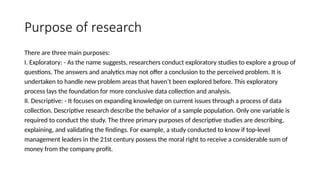
Purpose of research
Thereare three main purposes:
I. Exploratory: - As the name suggests, researchers conduct exploratory studies to explore a group of
questions. The answers and analytics may not offer a conclusion to the perceived problem. It is
undertaken to handle new problem areas that haven’t been explored before. This exploratory
process lays the foundation for more conclusive data collection and analysis.
II. Descriptive: - It focuses on expanding knowledge on current issues through a process of data
collection. Descriptive research describe the behavior of a sample population. Only one variable is
required to conduct the study. The three primary purposes of descriptive studies are describing,
explaining, and validating the findings. For example, a study conducted to know if top-level
management leaders in the 21st century possess the moral right to receive a considerable sum of
money from the company profit.
7.
III. Explanatory: -Causal or explanatory research is conducted to
understand the impact of specific changes in existing standard
procedures. Running experiments is the most popular form. For
example, a study that is conducted to understand the effect of
rebranding on customer loyalty.



![Research methodology1[1]](https://cdn.slidesharecdn.com/ss_thumbnails/researchmethodology11-150425111330-conversion-gate01-thumbnail.jpg?width=640&height=640&fit=bounds)


