This document discusses combustion and combustion calculations. It defines combustion as a chemical reaction between a fuel and oxygen that produces heat and light. Complete combustion means all carbon is converted to CO2, hydrogen to H2O, and sulfur to SO2. Theoretical oxygen is the amount of oxygen needed for complete combustion, calculated two ways. Theoretical air is the amount of air needed to supply the theoretical oxygen. Excess air above the theoretical amount is required for practical combustion to ensure completeness. Flue or stack gas refers to all gases from combustion, while Orsat analysis refers only to dry gases excluding water vapor.
Basics of combustion, unit process, oxidation reaction, complete combustion of fuels, chemical reactions involved.
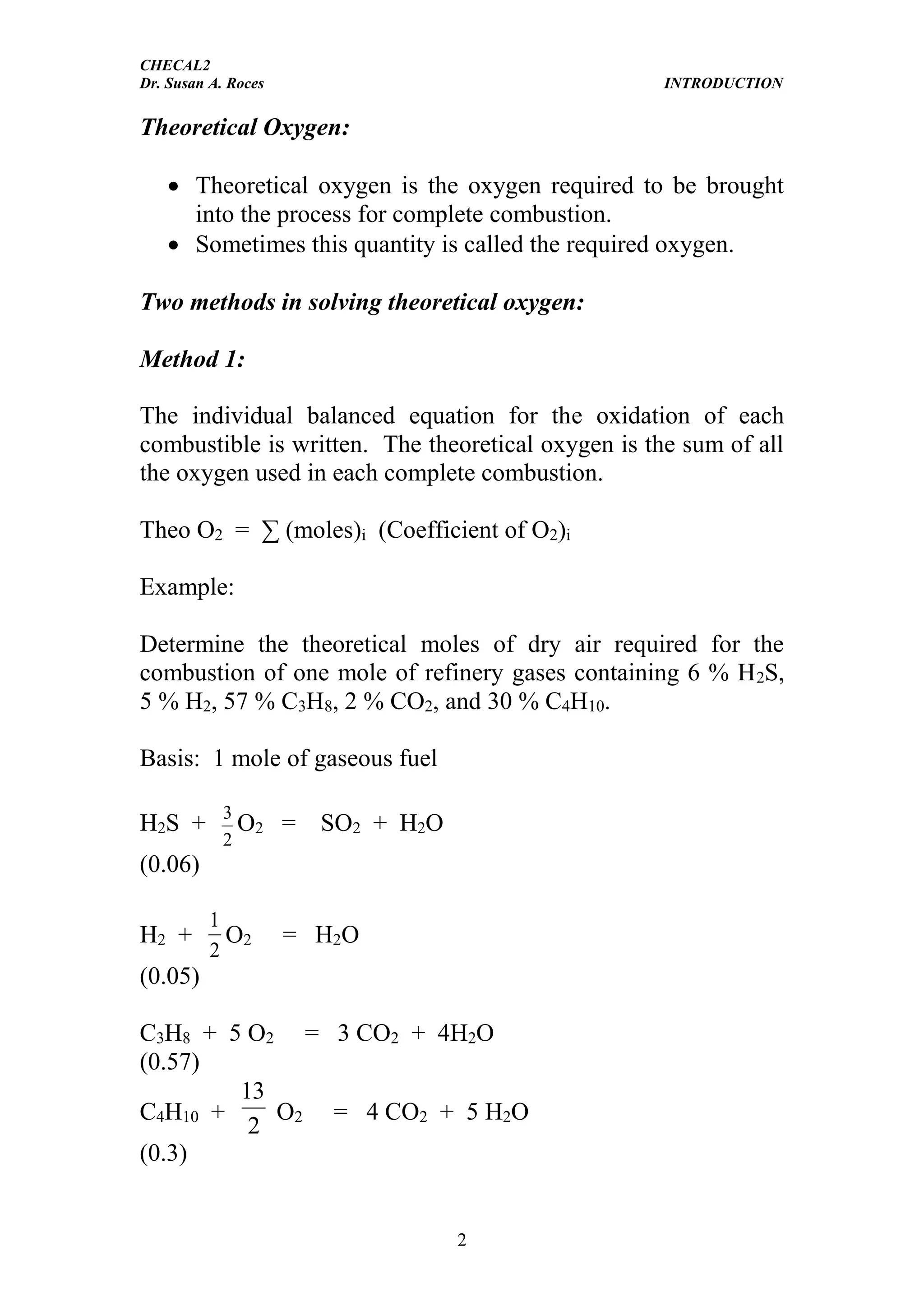
Theoretical oxygen required for complete combustion using two methods with examples, calculating moles of O2 for various fuels.
Theoretical air for combustion calculations, impact of incomplete combustion on heat loss, and common outcomes like CO and unburned combustibles.
Explanation of excess air, its necessity for combustion, and analysis of flue gases, including Orsat analysis and distinctions between wet and dry basis.
CHECAL2
Dr. Susan A.Roces INTRODUCTION
1
Combustion:
unit process in which oxidation reaction takes place.
accompanied by evolution of light and heat, and thus the
industries used in the generation of heat to supply energy
to the process industries.
chemical reaction in which one of the reactants is oxygen
from the air and the other is a fuel (gaseous, liquid, solid).
Air
HC Fuel Stack Gas/Flue Gas
Complete Combustion:
The complete combustion of a fuel means that all of its
combustible components are gasified: all of the carbon is burned
to carbon dioxide, all of the hydrogen is converted to water and
all sulfur to sulfur dioxide.
C + O2 CO2
H2 +
2
1
O2 H2O
S + O2 SO2
The complete combustion of any organic fuel is represented by:
CwHxOySz +
2
1
[ 2w +
2
x
+ 2z - y ]O2
w CO2 +
2
x
H2O + z SO2
2.
CHECAL2
Dr. Susan A.Roces INTRODUCTION
2
Theoretical Oxygen:
Theoretical oxygen is the oxygen required to be brought
into the process for complete combustion.
Sometimes this quantity is called the required oxygen.
Two methods in solving theoretical oxygen:
Method 1:
The individual balanced equation for the oxidation of each
combustible is written. The theoretical oxygen is the sum of all
the oxygen used in each complete combustion.
Theo O2 = ∑ (moles)i (Coefficient of O2)i
Example:
Determine the theoretical moles of dry air required for the
combustion of one mole of refinery gases containing 6 % H2S,
5 % H2, 57 % C3H8, 2 % CO2, and 30 % C4H10.
Basis: 1 mole of gaseous fuel
H2S +
2
3
O2 = SO2 + H2O
(0.06)
H2 +
2
1
O2 = H2O
(0.05)
C3H8 + 5 O2 = 3 CO2 + 4H2O
(0.57)
C4H10 +
2
13
O2 = 4 CO2 + 5 H2O
(0.3)
3.
CHECAL2
Dr. Susan A.Roces INTRODUCTION
3
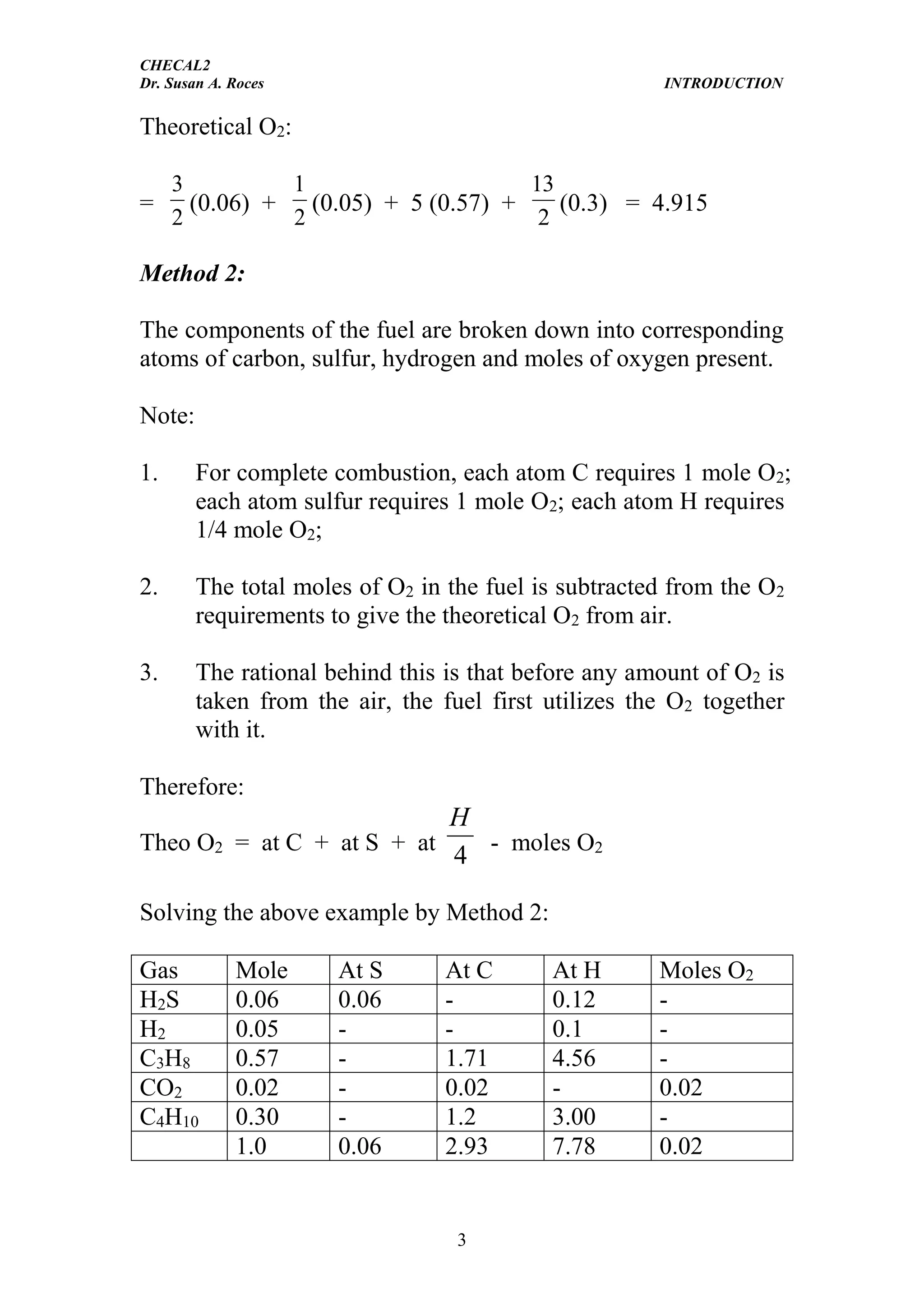
Theoretical O2:
=
2
3
(0.06) +
2
1
(0.05) + 5 (0.57) +
2
13
(0.3) = 4.915
Method 2:
The components of the fuel are broken down into corresponding
atoms of carbon, sulfur, hydrogen and moles of oxygen present.
Note:
1. For complete combustion, each atom C requires 1 mole O2;
each atom sulfur requires 1 mole O2; each atom H requires
1/4 mole O2;
2. The total moles of O2 in the fuel is subtracted from the O2
requirements to give the theoretical O2 from air.
3. The rational behind this is that before any amount of O2 is
taken from the air, the fuel first utilizes the O2 together
with it.
Therefore:
Theo O2 = at C + at S + at
4
H
- moles O2
Solving the above example by Method 2:
Gas Mole At S At C At H Moles O2
H2S 0.06 0.06 - 0.12 -
H2 0.05 - - 0.1 -
C3H8 0.57 - 1.71 4.56 -
CO2 0.02 - 0.02 - 0.02
C4H10 0.30 - 1.2 3.00 -
1.0 0.06 2.93 7.78 0.02
4.
CHECAL2
Dr. Susan A.Roces INTRODUCTION
4
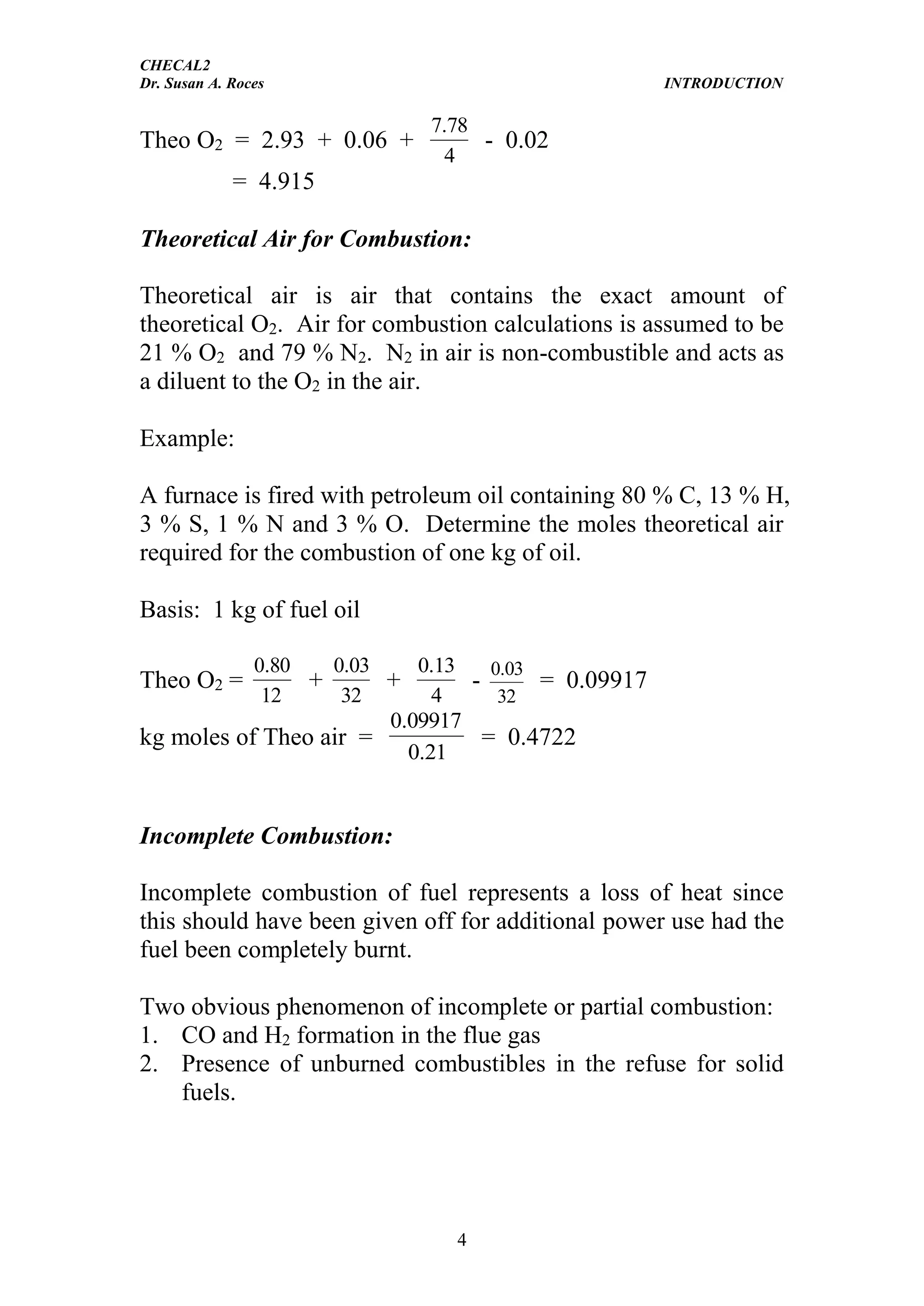
Theo O2 = 2.93 + 0.06 +
4
78.7
- 0.02
= 4.915
Theoretical Air for Combustion:
Theoretical air is air that contains the exact amount of
theoretical O2. Air for combustion calculations is assumed to be
21 % O2 and 79 % N2. N2 in air is non-combustible and acts as
a diluent to the O2 in the air.
Example:
A furnace is fired with petroleum oil containing 80 % C, 13 % H,
3 % S, 1 % N and 3 % O. Determine the moles theoretical air
required for the combustion of one kg of oil.
Basis: 1 kg of fuel oil
Theo O2 =
12
80.0
+
32
03.0
+
4
13.0
-
32
03.0
= 0.09917
kg moles of Theo air =
21.0
09917.0
= 0.4722
Incomplete Combustion:
Incomplete combustion of fuel represents a loss of heat since
this should have been given off for additional power use had the
fuel been completely burnt.
Two obvious phenomenon of incomplete or partial combustion:
1. CO and H2 formation in the flue gas
2. Presence of unburned combustibles in the refuse for solid
fuels.
5.
CHECAL2
Dr. Susan A.Roces INTRODUCTION
5
In actual practice, theoretical air is not sufficient to get complete
combustion.
Excess Air (excess O2):
Amount of air (excess O2) in excess of that is required for
complete combustion
Does not depend on how much material is actually burned
but what can be burned.
The percent excess air is identical to the percent excess O2
Percent Excess Air:
Excess air supply or excess O2 supply is a must for complete
combustion.
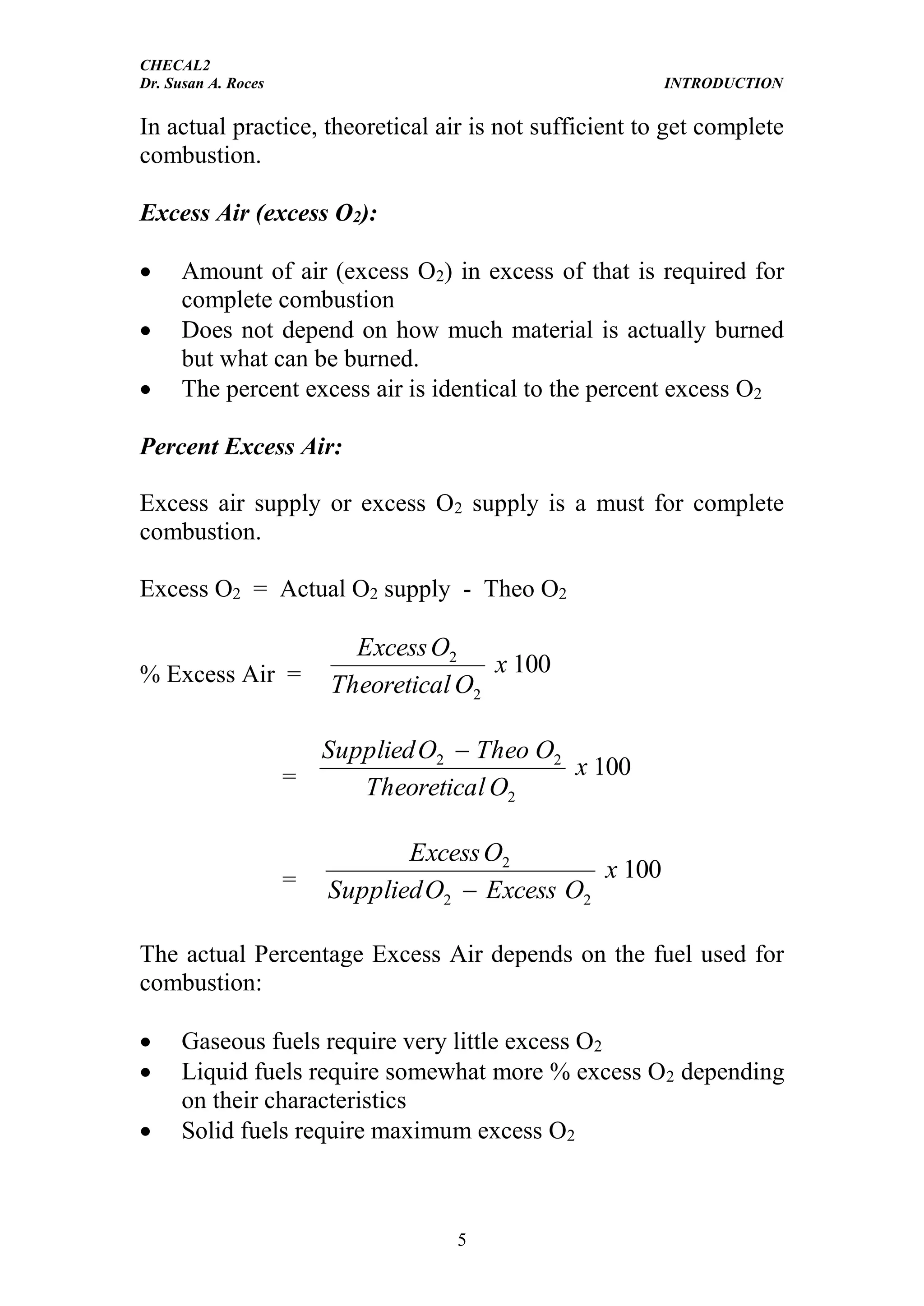
Excess O2 = Actual O2 supply - Theo O2
% Excess Air = 100
2
2
x
OlTheoretica
OExcess
= 100
2
22
x
OlTheoretica
OTheoOSupplied
= 100
22
2
x
OExcessOSupplied
OExcess
The actual Percentage Excess Air depends on the fuel used for
combustion:
Gaseous fuels require very little excess O2
Liquid fuels require somewhat more % excess O2 depending
on their characteristics
Solid fuels require maximum excess O2
6.
CHECAL2
Dr. Susan A.Roces INTRODUCTION
6
If the percent excess air and the chemical equation are specified
in a problem, you will know how much air enters with the fuel.
Flue or stack gas:
All the gases resulting from combustion process including the
water vapor, sometimes known as a wet basis.
Orsat Analysis or dry basis:
All the gases resulting from a combustion process not
including the water vapor
Refers to a type of gas analysis apparatus in which the
volumes of the respective gases are measured over and in
equilibrium with water; hence each component is saturated
with water vapor.
Comparison of gas analysis on different bases:
CO2 Dry Flue
CO Gas on Orsat Analysis
Flue Gas O2 Free Dry Basis
Stack Gas N2 SO2 Basis
Wet Basis SO2
H2O