
z
COMBUSTION PRINCIPLES
PRODUCTS ANDFLAMES
STOICHIOMETRY
z
COMBUSTION
 The chemical process in which a substance reacts with
oxygen to produce heat is called combustion
 Substances which burn in air to produce heat and light
are called combustible substances. It is also called a
fuel
 Eg :- wood, coal, charcoal, kerosene, petrol, diesel,
liquified petroleum gas (LPG), compressed natural gas
(CNG), etc
SOLID FUELS LIQUID FUELS GASEOUS FUELS
z
PRINCIPLES OF COMBUSTION
 Combustion is a chemical reaction between a fuel and oxygen
which is accompanied by the production of a considerable amount
of heat. The process of combustion is an exothermic reaction
 The reaction has to be initiated by some source of high-temperature
energy called ignition
 We can divide up the combustion of a fuel into several processes
 Bringing together the fuel and air (the reactants) in the correct
proportions
 Igniting the reactants
 Ensuring that the flame burns in a stable manner and that
combustion is complete
 Extracting useful heat from the process, and
 Arranging for the safe disposal of the products of combustion
z
3 T’s OF COMBUSTION
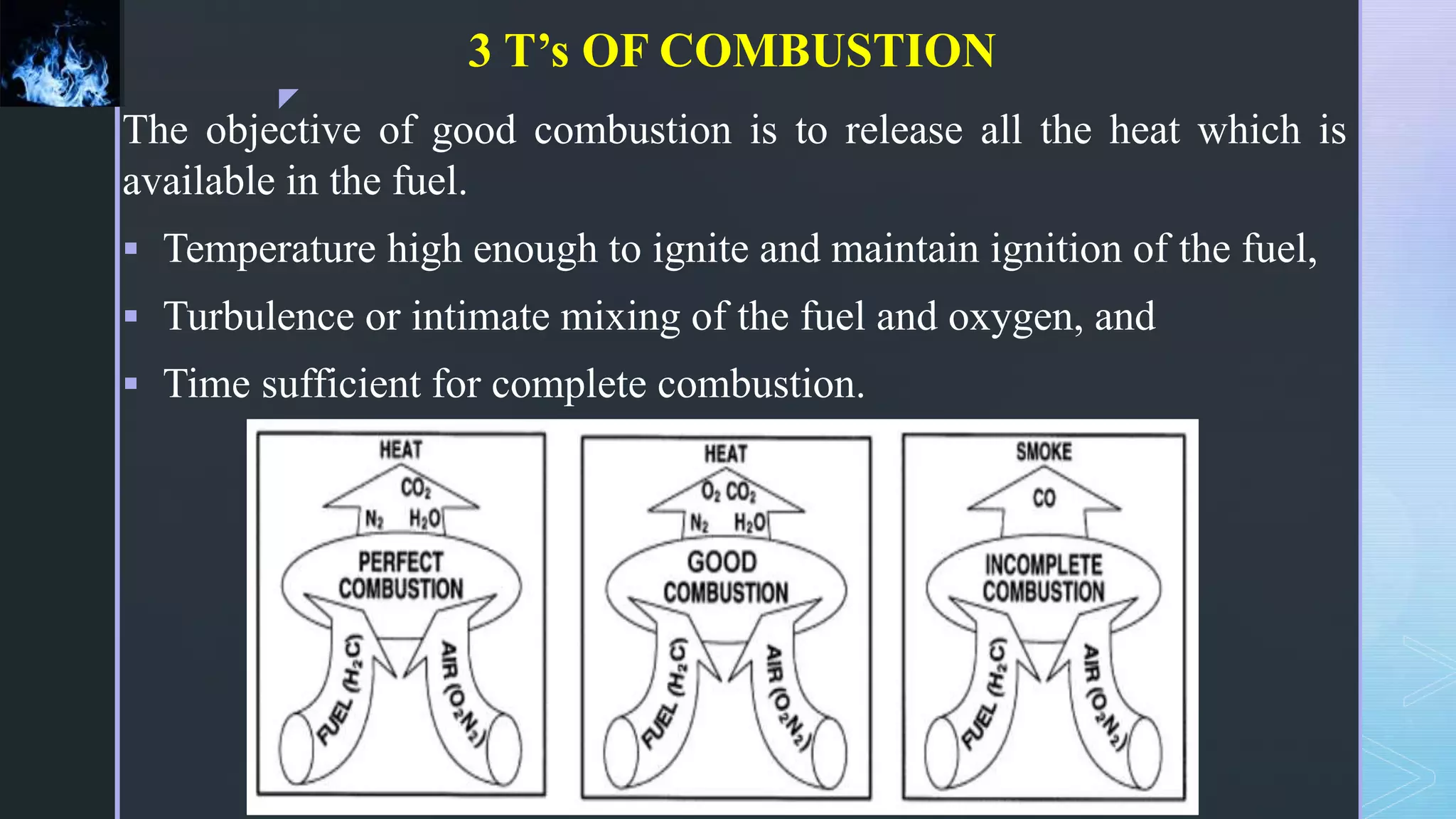
The objective of good combustion is to release all the heat which is
available in the fuel.
 Temperature high enough to ignite and maintain ignition of the fuel,
 Turbulence or intimate mixing of the fuel and oxygen, and
 Time sufficient for complete combustion.
z
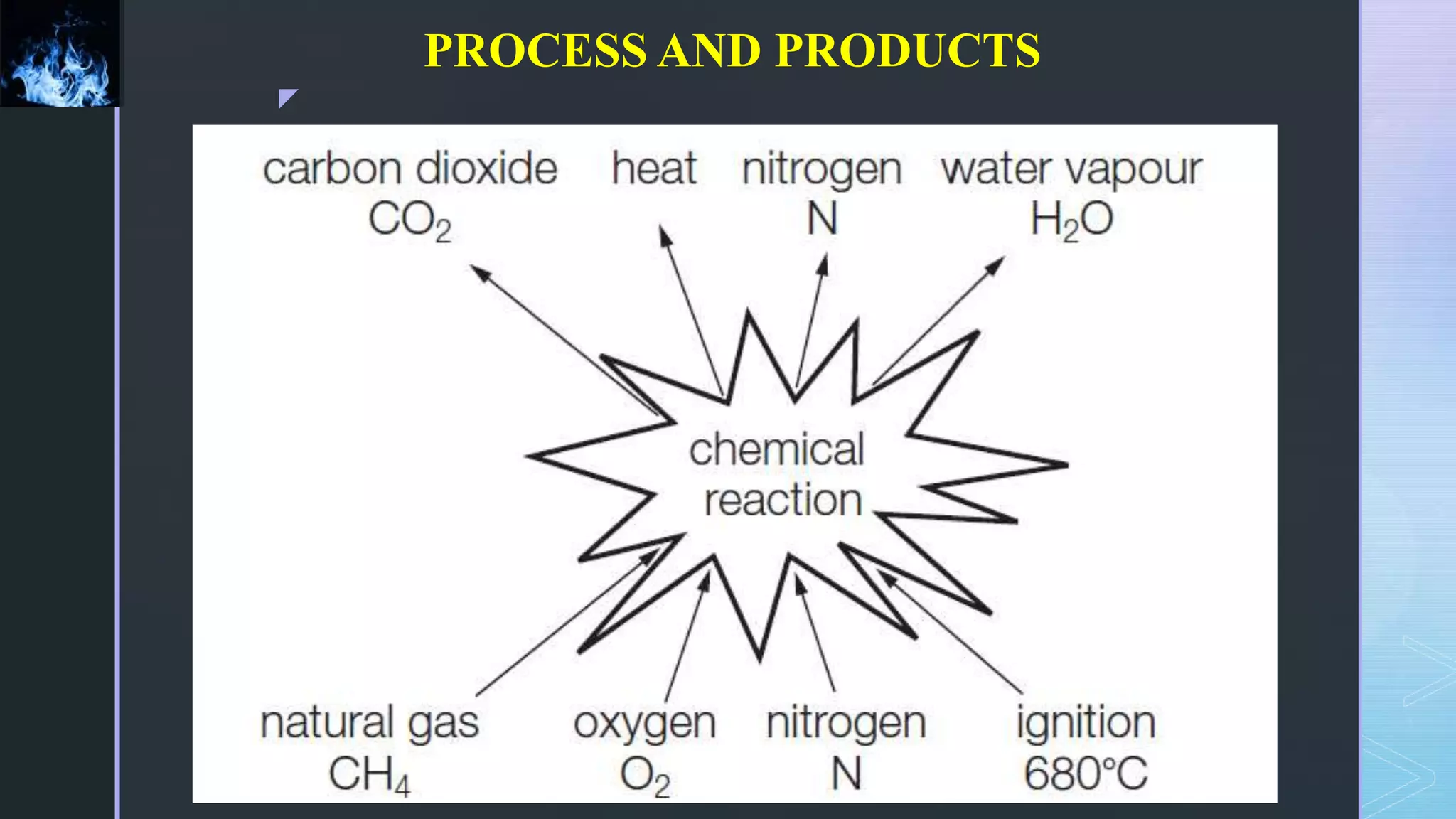
PROCESS AND PRODUCTS
z
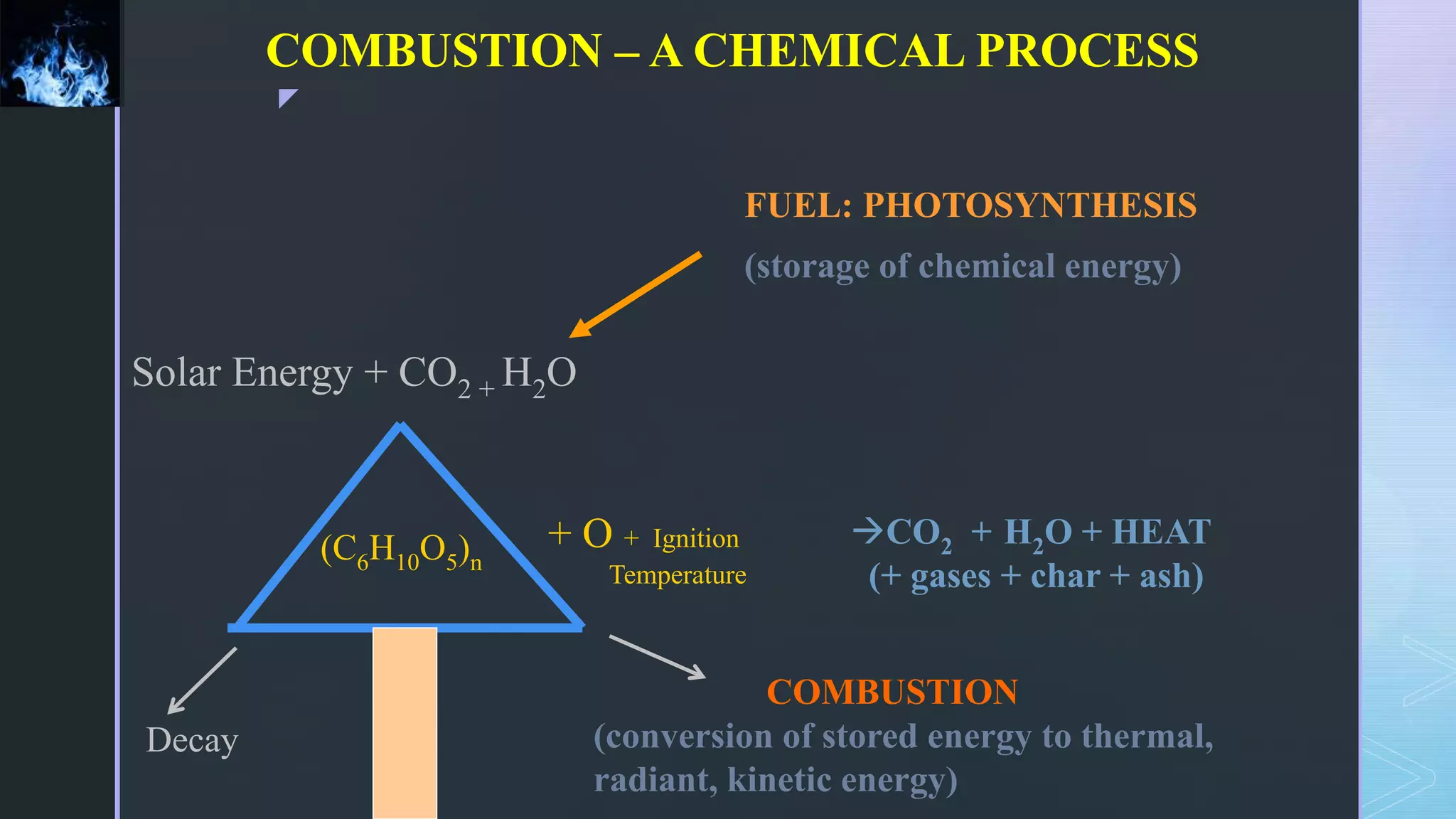
COMBUSTION – A CHEMICAL PROCESS
FUEL: PHOTOSYNTHESIS
(storage of chemical energy)
CO2 + H2O + HEAT
(+ gases + char + ash)
(C6H10O5)n
Solar Energy + CO2 + H2O
+ O + Ignition
Temperature
Decay
COMBUSTION
(conversion of stored energy to thermal,
radiant, kinetic energy)
z
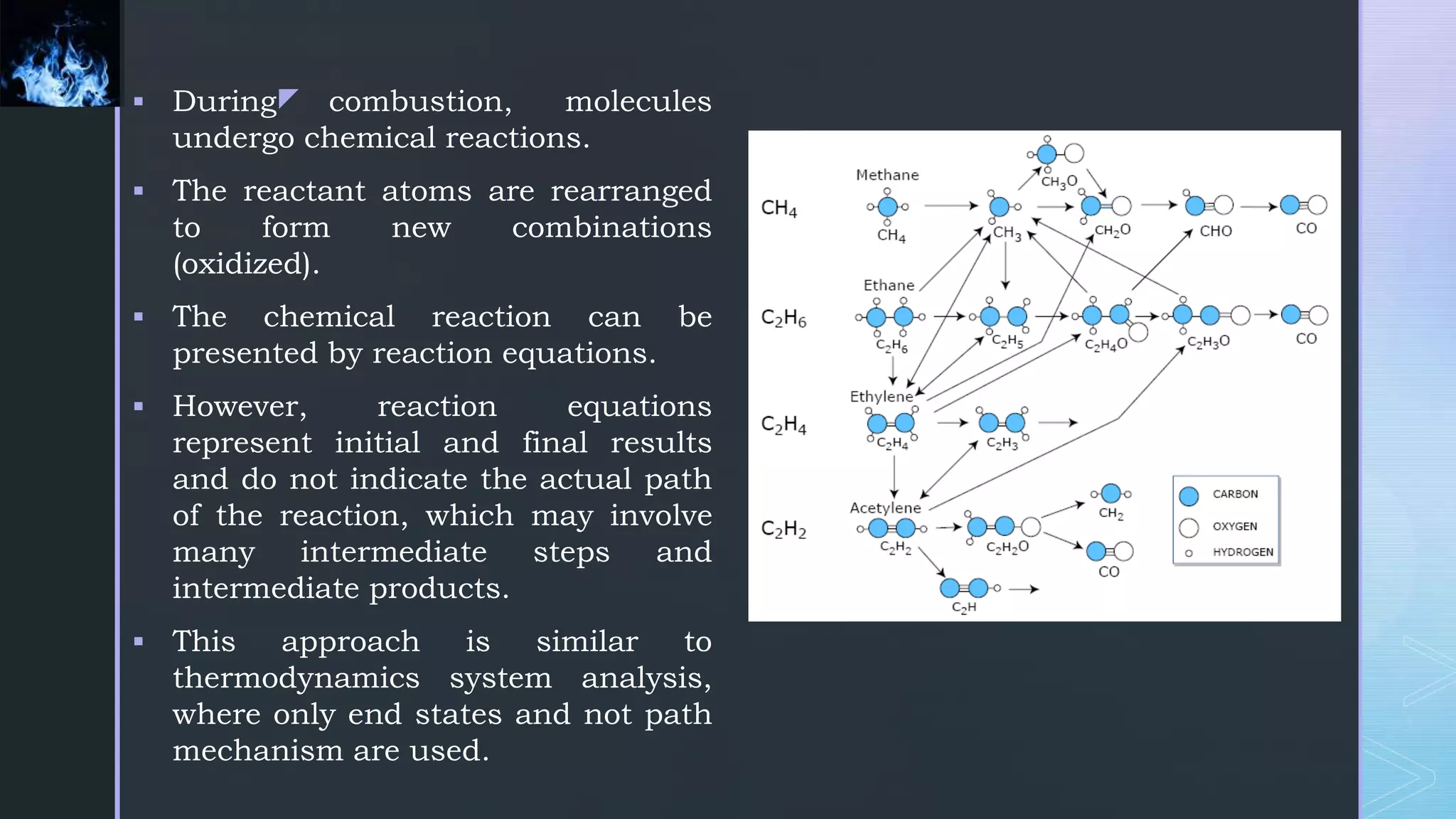
 During combustion, molecules
undergo chemical reactions.
 The reactant atoms are rearranged
to form new combinations
(oxidized).
 The chemical reaction can be
presented by reaction equations.
 However, reaction equations
represent initial and final results
and do not indicate the actual path
of the reaction, which may involve
many intermediate steps and
intermediate products.
 This approach is similar to
thermodynamics system analysis,
where only end states and not path
mechanism are used.
z
COMPLETE COMBUSTION
 Combustion is a chemical reaction between a fuel and an oxidant
which proceeds above minimum temperature called the
spontaneous ignition temperature to which the reactants must be
heated.
 In combustion of gases and vapours, the proportions of fuel and
oxidant must be between the limits of inflammability, and vary with
the particular fuel, oxidant, diluent, direction of flame propogation,
pressure, temperature, presence of catalyst, etc.
 In combustion of all fuels, it is desirable to know the stoichiometric
proportions i.e. the amount of oxidant which on completion of
combustion with a given amount of fuel would lead to the products
like carbon dioxide, water, sulphur dioxide and nitrogen. This
idealized concept is the basis of all combustion calculations
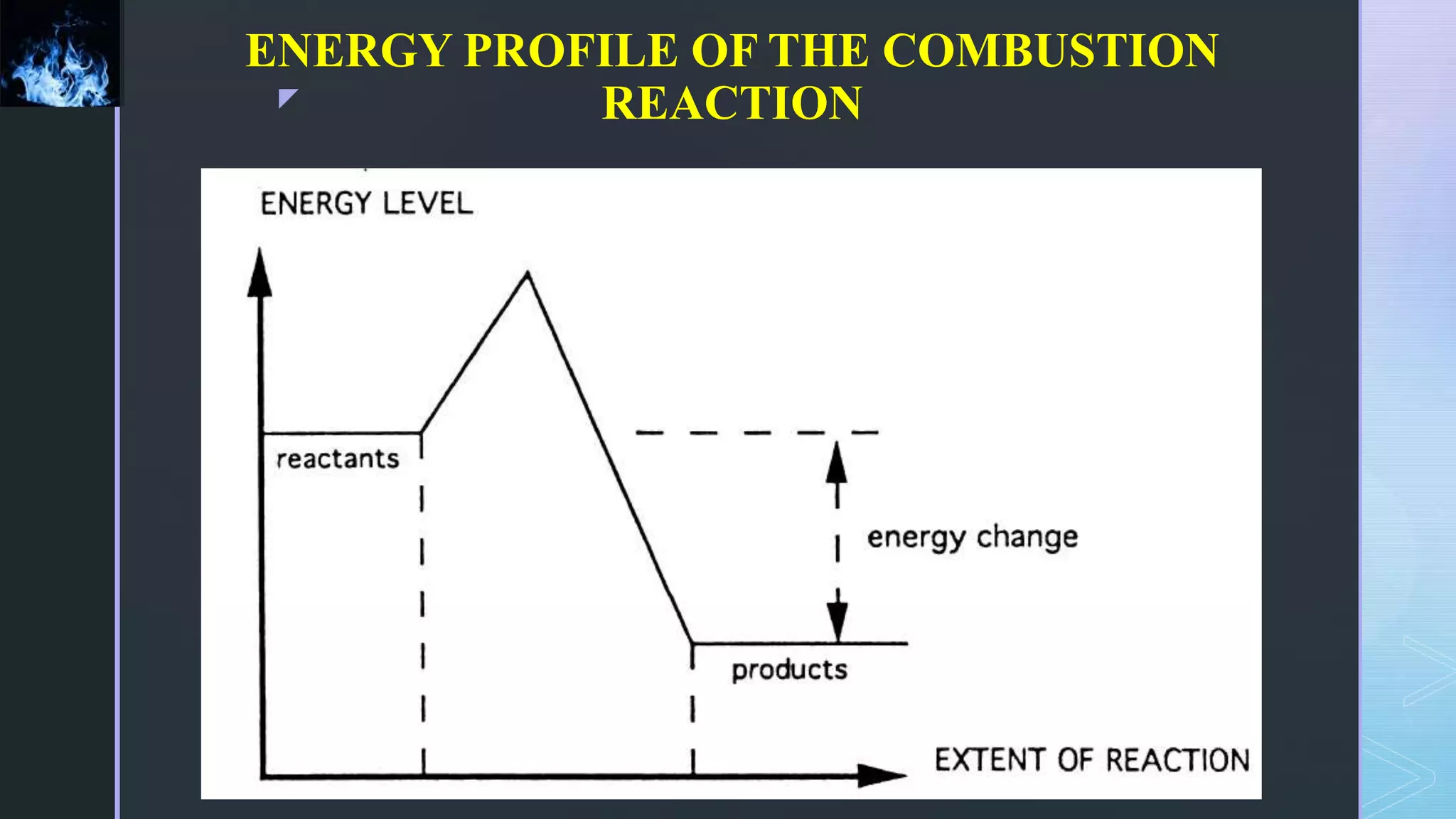
 The transformation to a lower energy level is responsible for the
exothermic nature of the reaction
z
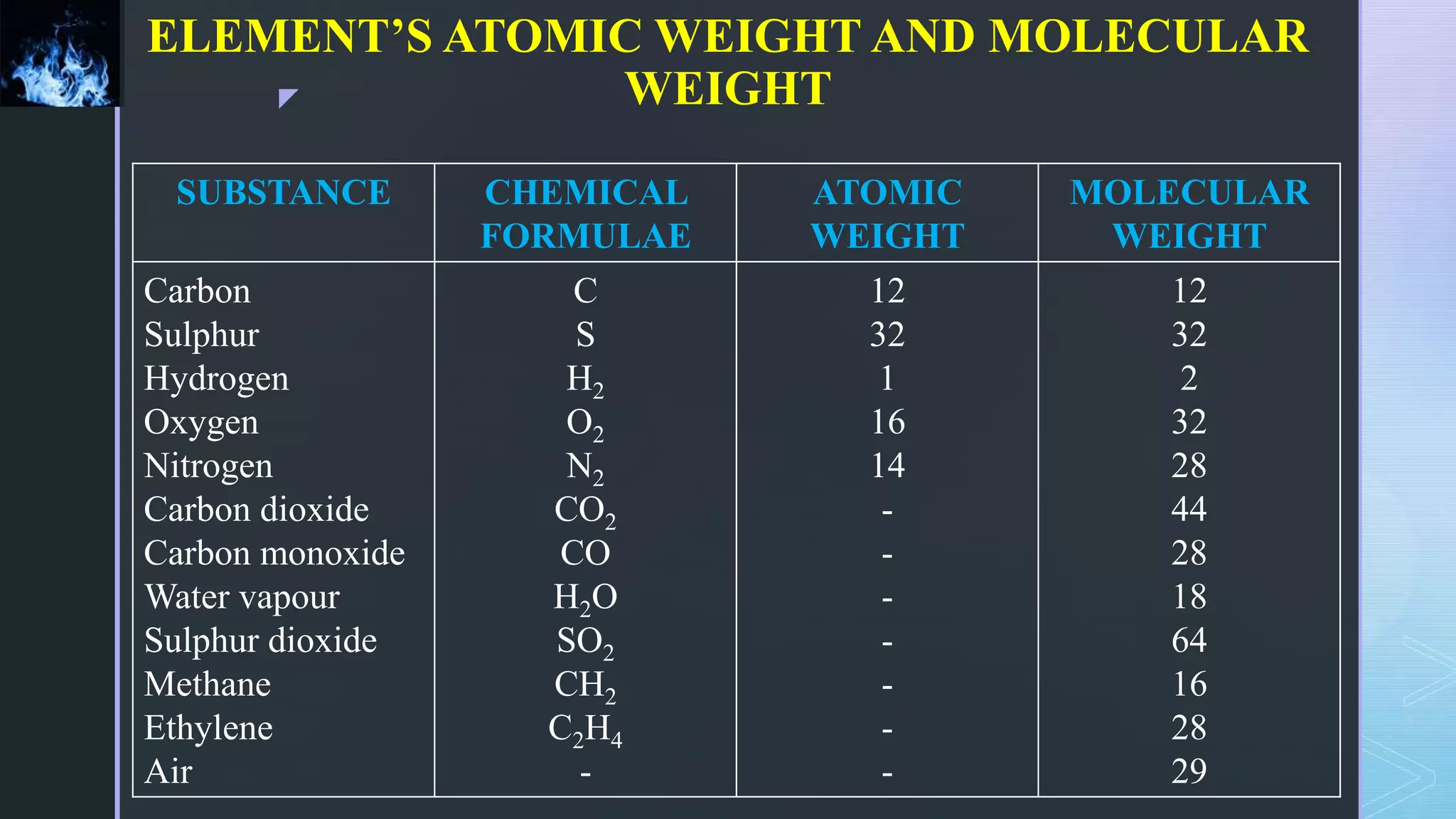
ELEMENT’S ATOMIC WEIGHT AND MOLECULAR
WEIGHT
SUBSTANCE CHEMICAL
FORMULAE
ATOMIC
WEIGHT
MOLECULAR
WEIGHT
Carbon
Sulphur
Hydrogen
Oxygen
Nitrogen
Carbon dioxide
Carbon monoxide
Water vapour
Sulphur dioxide
Methane
Ethylene
Air
C
S
H2
O2
N2
CO2
CO
H2O
SO2
CH2
C2H4
-
12
32
1
16
14
-
-
-
-
-
-
-
12
32
2
32
28
44
28
18
64
16
28
29
z
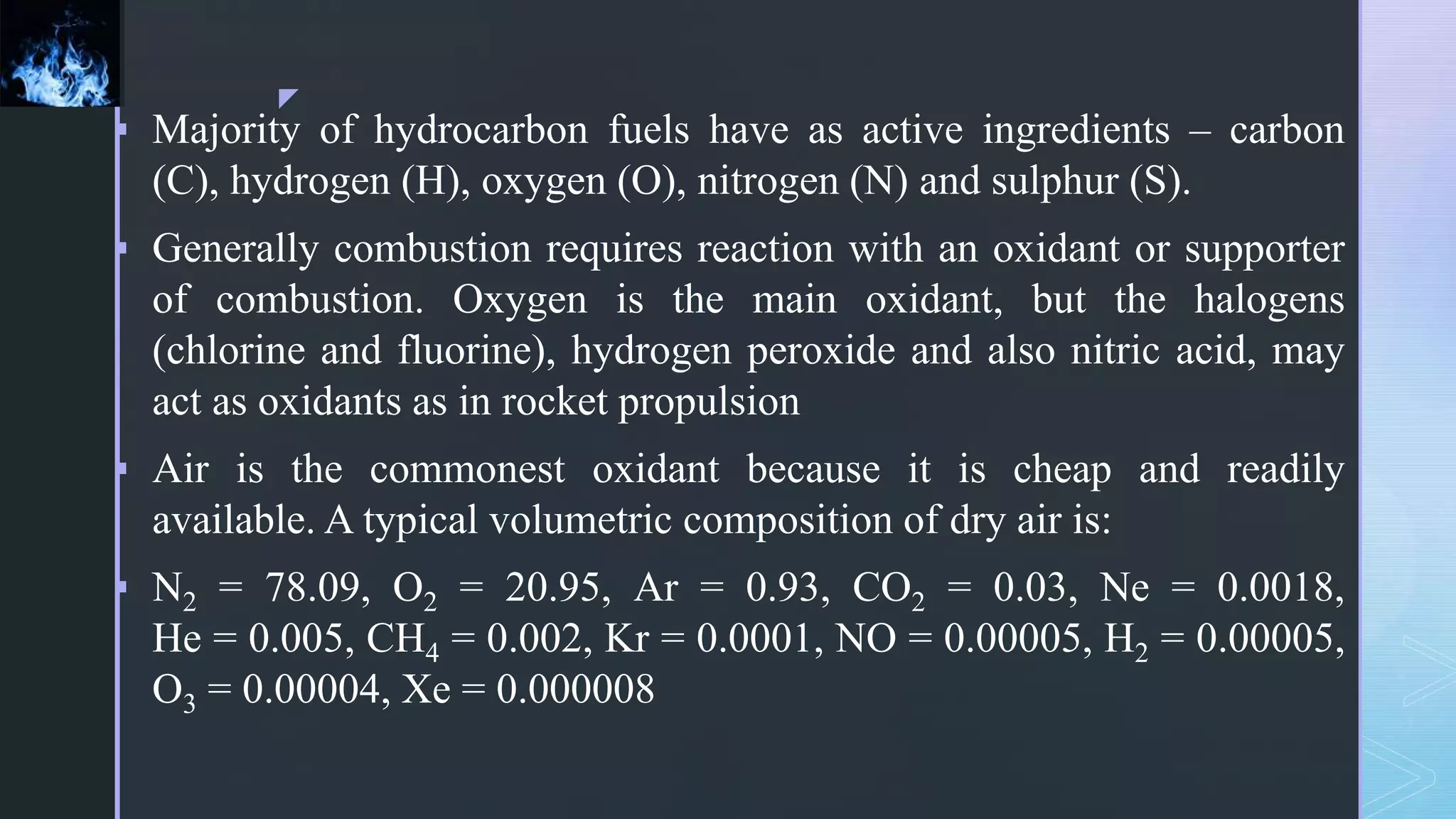
 Majority of hydrocarbon fuels have as active ingredients – carbon
(C), hydrogen (H), oxygen (O), nitrogen (N) and sulphur (S).
 Generally combustion requires reaction with an oxidant or supporter
of combustion. Oxygen is the main oxidant, but the halogens
(chlorine and fluorine), hydrogen peroxide and also nitric acid, may
act as oxidants as in rocket propulsion
 Air is the commonest oxidant because it is cheap and readily
available. A typical volumetric composition of dry air is:
 N2 = 78.09, O2 = 20.95, Ar = 0.93, CO2 = 0.03, Ne = 0.0018,
He = 0.005, CH4 = 0.002, Kr = 0.0001, NO = 0.00005, H2 = 0.00005,
O3 = 0.00004, Xe = 0.000008
z
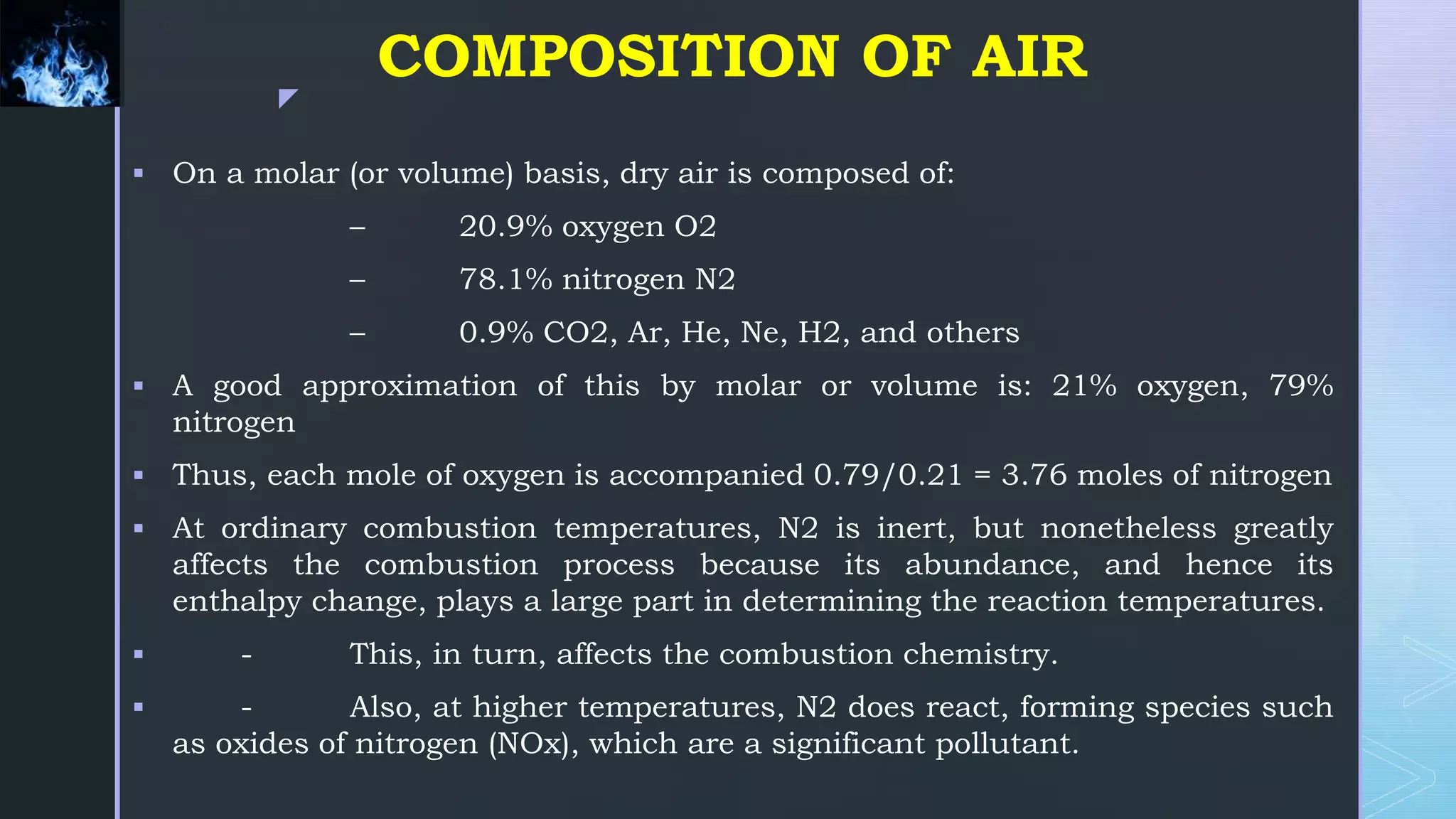
COMPOSITION OF AIR
 On a molar (or volume) basis, dry air is composed of:
– 20.9% oxygen O2
– 78.1% nitrogen N2
– 0.9% CO2, Ar, He, Ne, H2, and others
 A good approximation of this by molar or volume is: 21% oxygen, 79%
nitrogen
 Thus, each mole of oxygen is accompanied 0.79/0.21 = 3.76 moles of nitrogen
 At ordinary combustion temperatures, N2 is inert, but nonetheless greatly
affects the combustion process because its abundance, and hence its
enthalpy change, plays a large part in determining the reaction temperatures.
 - This, in turn, affects the combustion chemistry.
 - Also, at higher temperatures, N2 does react, forming species such
as oxides of nitrogen (NOx), which are a significant pollutant.
z
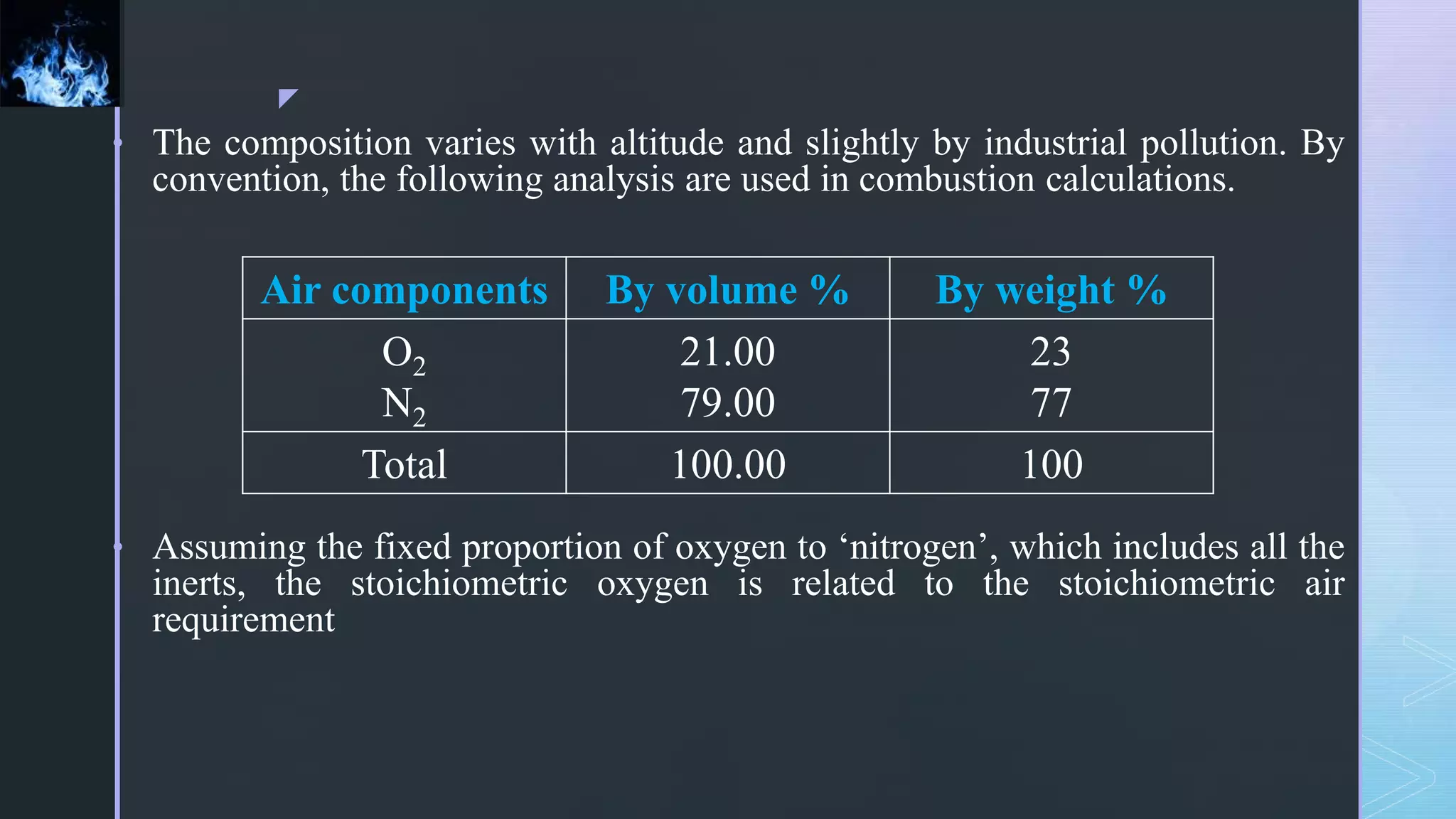
• The composition varies with altitude and slightly by industrial pollution. By
convention, the following analysis are used in combustion calculations.
• Assuming the fixed proportion of oxygen to ‘nitrogen’, which includes all the
inerts, the stoichiometric oxygen is related to the stoichiometric air
requirement
Air components By volume % By weight %
O2
N2
21.00
79.00
23
77
Total 100.00 100
z
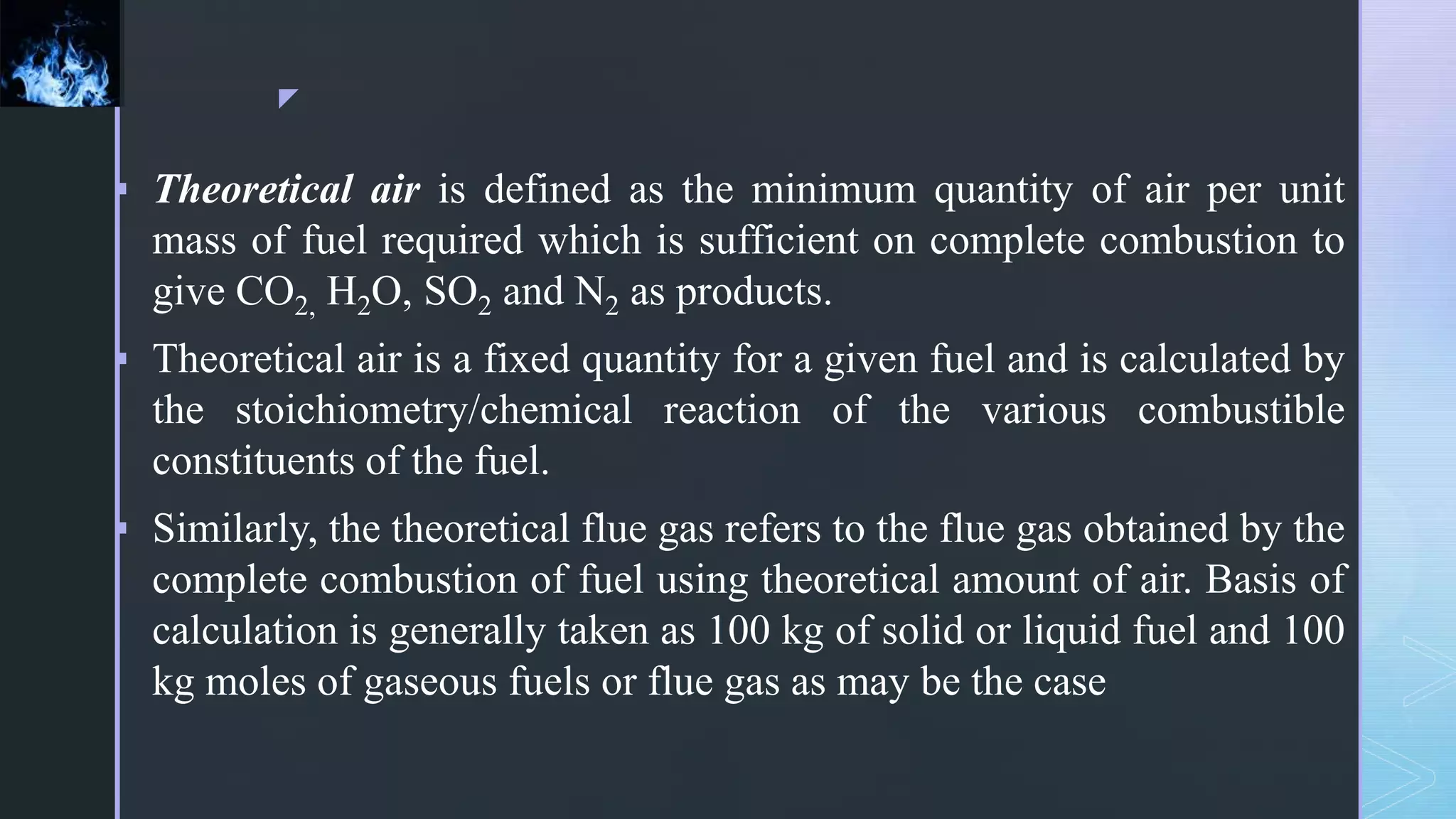
 Theoretical air is defined as the minimum quantity of air per unit
mass of fuel required which is sufficient on complete combustion to
give CO2, H2O, SO2 and N2 as products.
 Theoretical air is a fixed quantity for a given fuel and is calculated by
the stoichiometry/chemical reaction of the various combustible
constituents of the fuel.
 Similarly, the theoretical flue gas refers to the flue gas obtained by the
complete combustion of fuel using theoretical amount of air. Basis of
calculation is generally taken as 100 kg of solid or liquid fuel and 100
kg moles of gaseous fuels or flue gas as may be the case
z
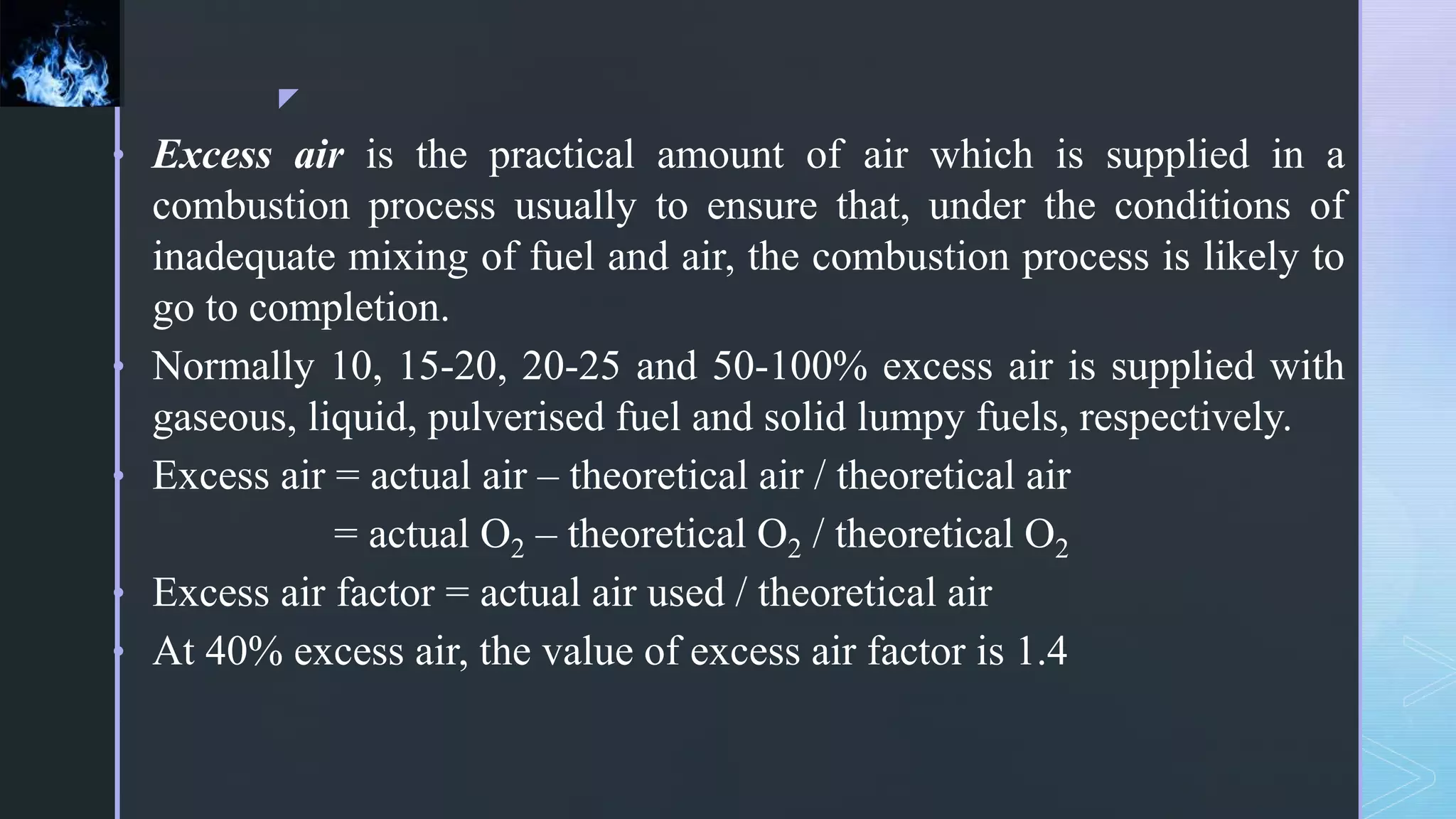
• Excess air is the practical amount of air which is supplied in a
combustion process usually to ensure that, under the conditions of
inadequate mixing of fuel and air, the combustion process is likely to
go to completion.
• Normally 10, 15-20, 20-25 and 50-100% excess air is supplied with
gaseous, liquid, pulverised fuel and solid lumpy fuels, respectively.
• Excess air = actual air – theoretical air / theoretical air
= actual O2 – theoretical O2 / theoretical O2
• Excess air factor = actual air used / theoretical air
• At 40% excess air, the value of excess air factor is 1.4
z
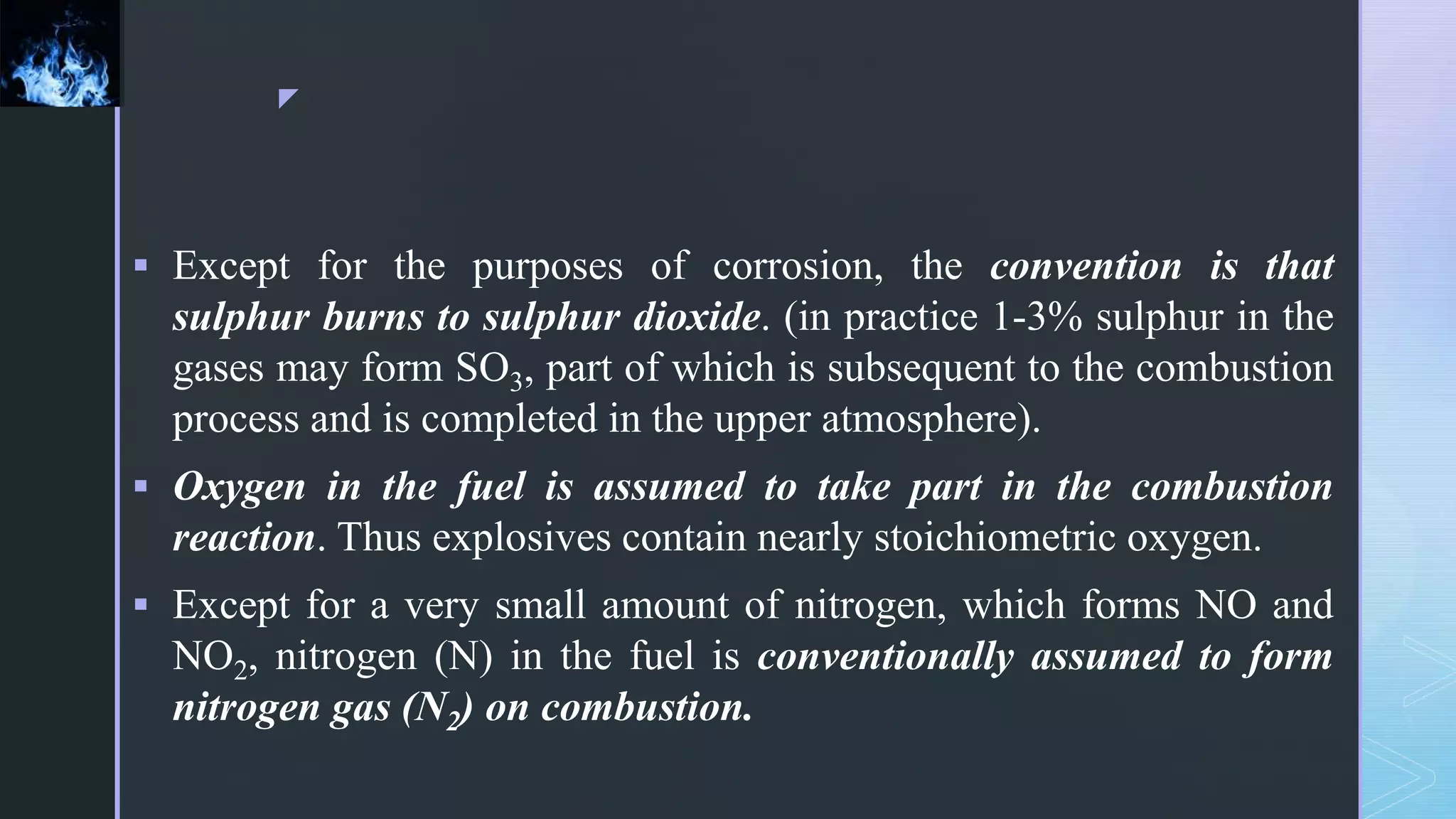
 Except for the purposes of corrosion, the convention is that
sulphur burns to sulphur dioxide. (in practice 1-3% sulphur in the
gases may form SO3, part of which is subsequent to the combustion
process and is completed in the upper atmosphere).
 Oxygen in the fuel is assumed to take part in the combustion
reaction. Thus explosives contain nearly stoichiometric oxygen.
 Except for a very small amount of nitrogen, which forms NO and
NO2, nitrogen (N) in the fuel is conventionally assumed to form
nitrogen gas (N2) on combustion.
z
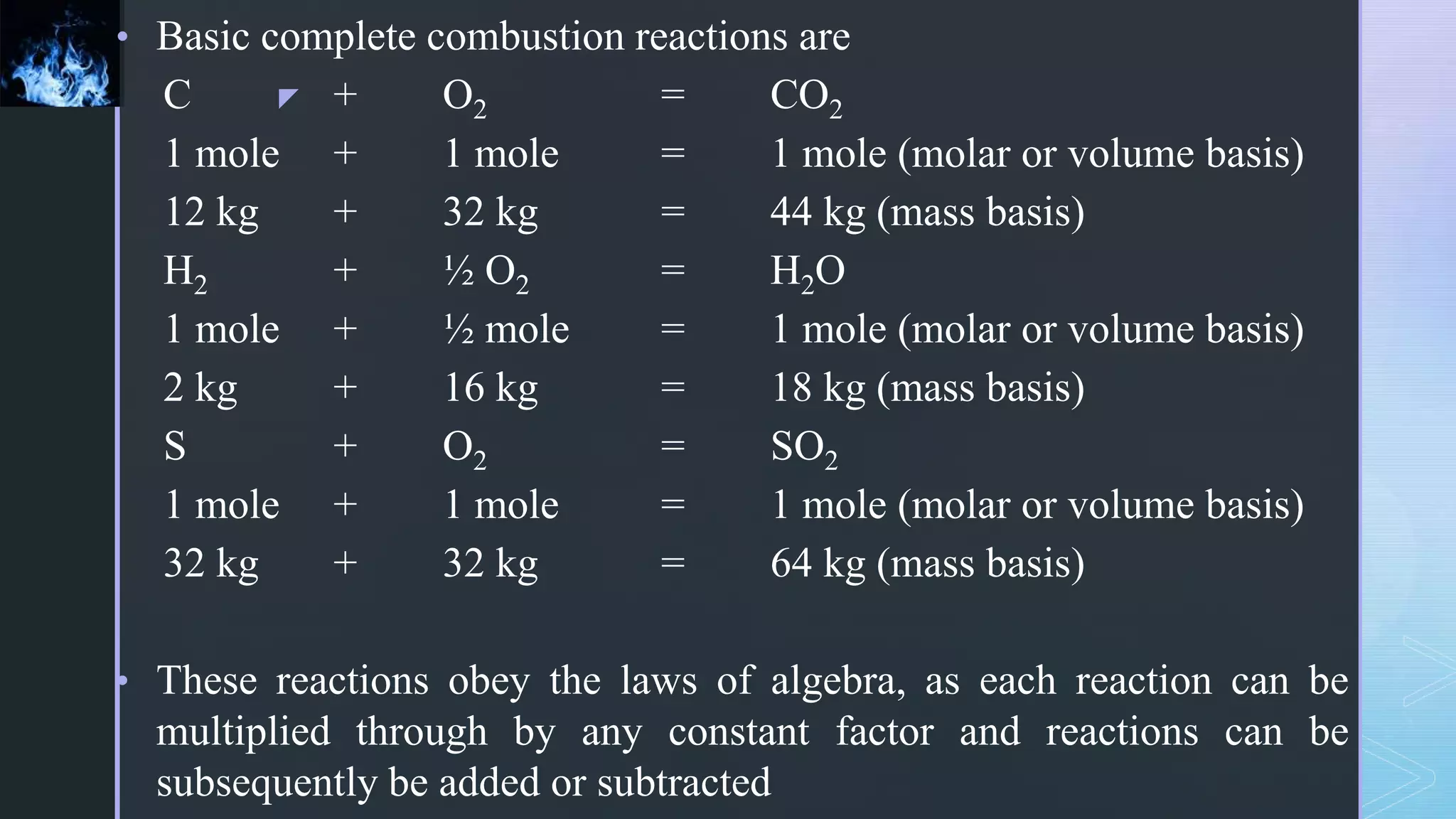
• Basic complete combustion reactions are
C + O2 = CO2
1 mole + 1 mole = 1 mole (molar or volume basis)
12 kg + 32 kg = 44 kg (mass basis)
H2 + ½ O2 = H2O
1 mole + ½ mole = 1 mole (molar or volume basis)
2 kg + 16 kg = 18 kg (mass basis)
S + O2 = SO2
1 mole + 1 mole = 1 mole (molar or volume basis)
32 kg + 32 kg = 64 kg (mass basis)
• These reactions obey the laws of algebra, as each reaction can be
multiplied through by any constant factor and reactions can be
subsequently be added or subtracted
z
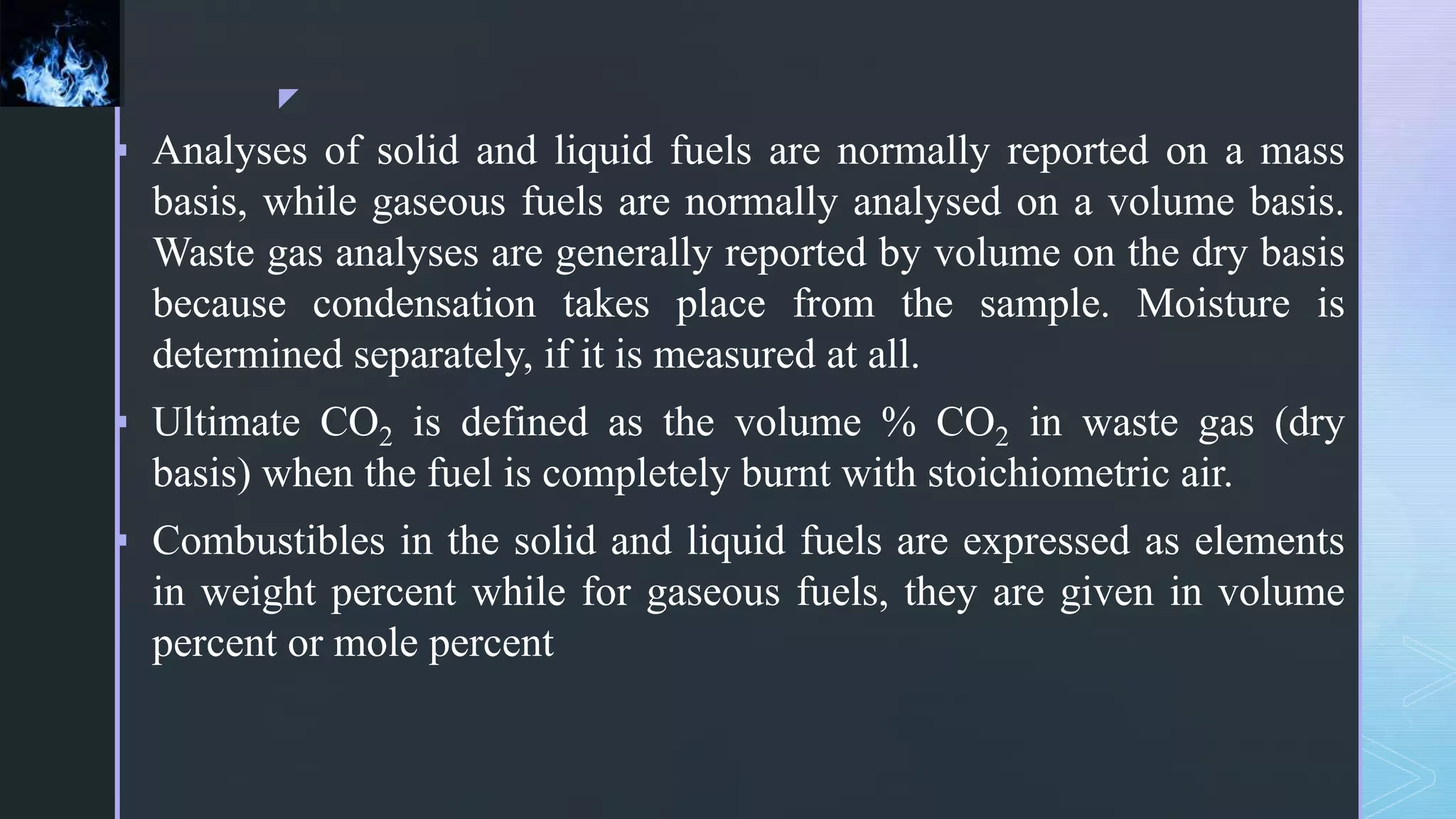
 Analyses of solid and liquid fuels are normally reported on a mass
basis, while gaseous fuels are normally analysed on a volume basis.
Waste gas analyses are generally reported by volume on the dry basis
because condensation takes place from the sample. Moisture is
determined separately, if it is measured at all.
 Ultimate CO2 is defined as the volume % CO2 in waste gas (dry
basis) when the fuel is completely burnt with stoichiometric air.
 Combustibles in the solid and liquid fuels are expressed as elements
in weight percent while for gaseous fuels, they are given in volume
percent or mole percent
z
ENERGY PROFILE OF THE COMBUSTION
REACTION
z
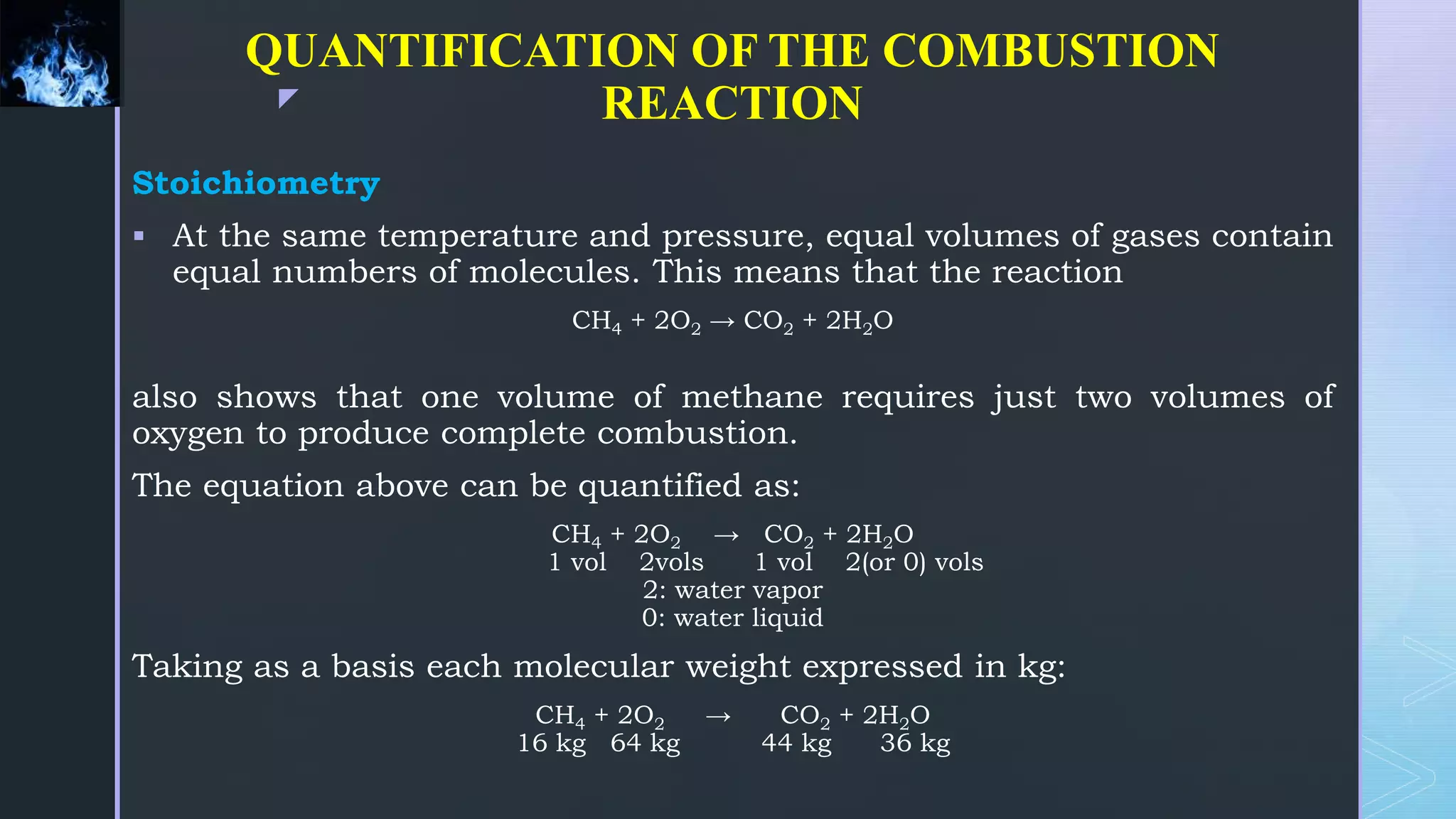
QUANTIFICATION OF THE COMBUSTION
REACTION
Stoichiometry
 At the same temperature and pressure, equal volumes of gases contain
equal numbers of molecules. This means that the reaction
CH4 + 2O2 → CO2 + 2H2O
also shows that one volume of methane requires just two volumes of
oxygen to produce complete combustion.
The equation above can be quantified as:
CH4 + 2O2 → CO2 + 2H2O
1 vol 2vols 1 vol 2(or 0) vols
2: water vapor
0: water liquid
Taking as a basis each molecular weight expressed in kg:
CH4 + 2O2 → CO2 + 2H2O
16 kg 64 kg 44 kg 36 kg
z
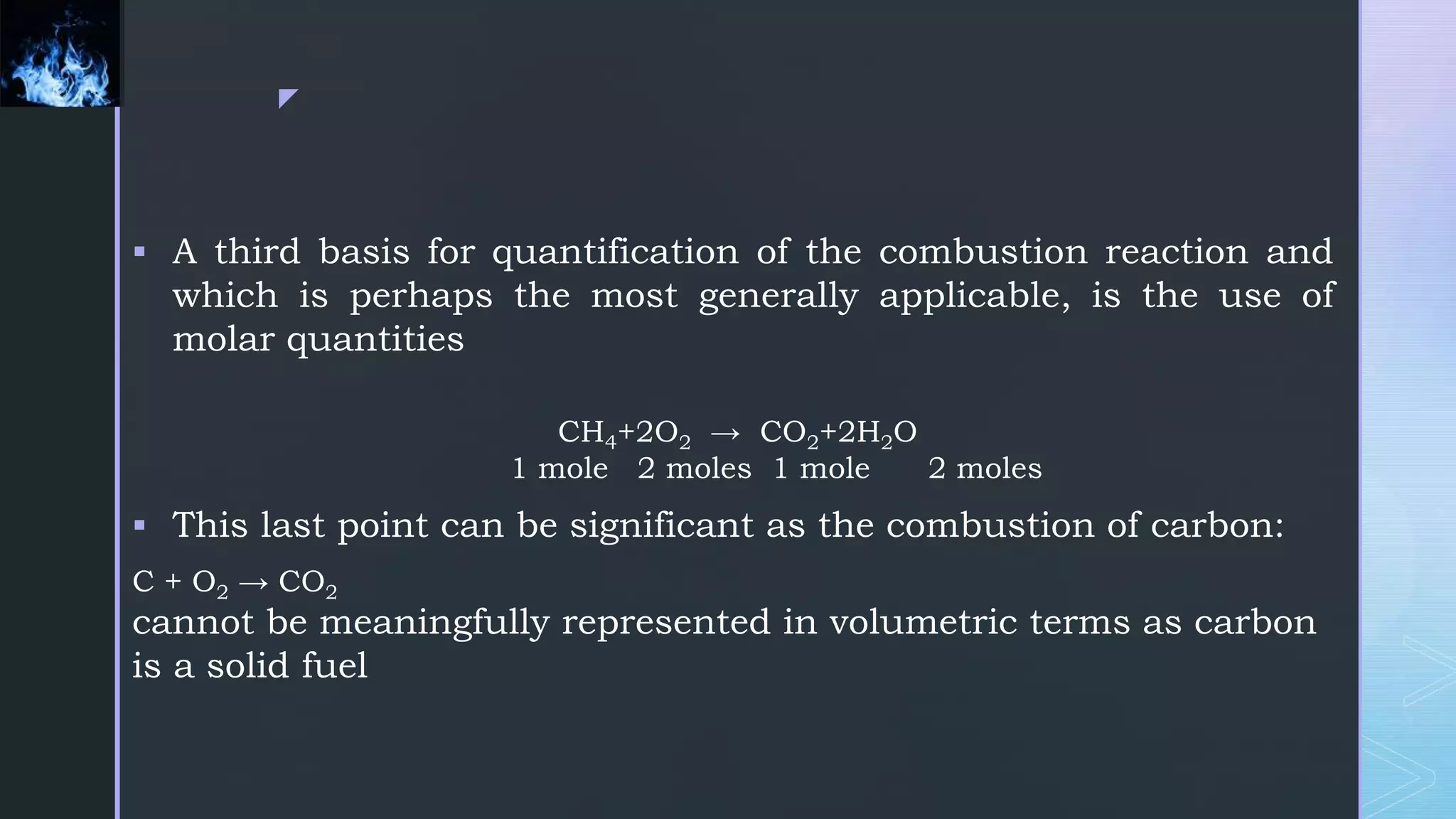
 A third basis for quantification of the combustion reaction and
which is perhaps the most generally applicable, is the use of
molar quantities
CH4+2O2 → CO2+2H2O
1 mole 2 moles 1 mole 2 moles
 This last point can be significant as the combustion of carbon:
C + O2 → CO2
cannot be meaningfully represented in volumetric terms as carbon
is a solid fuel
z
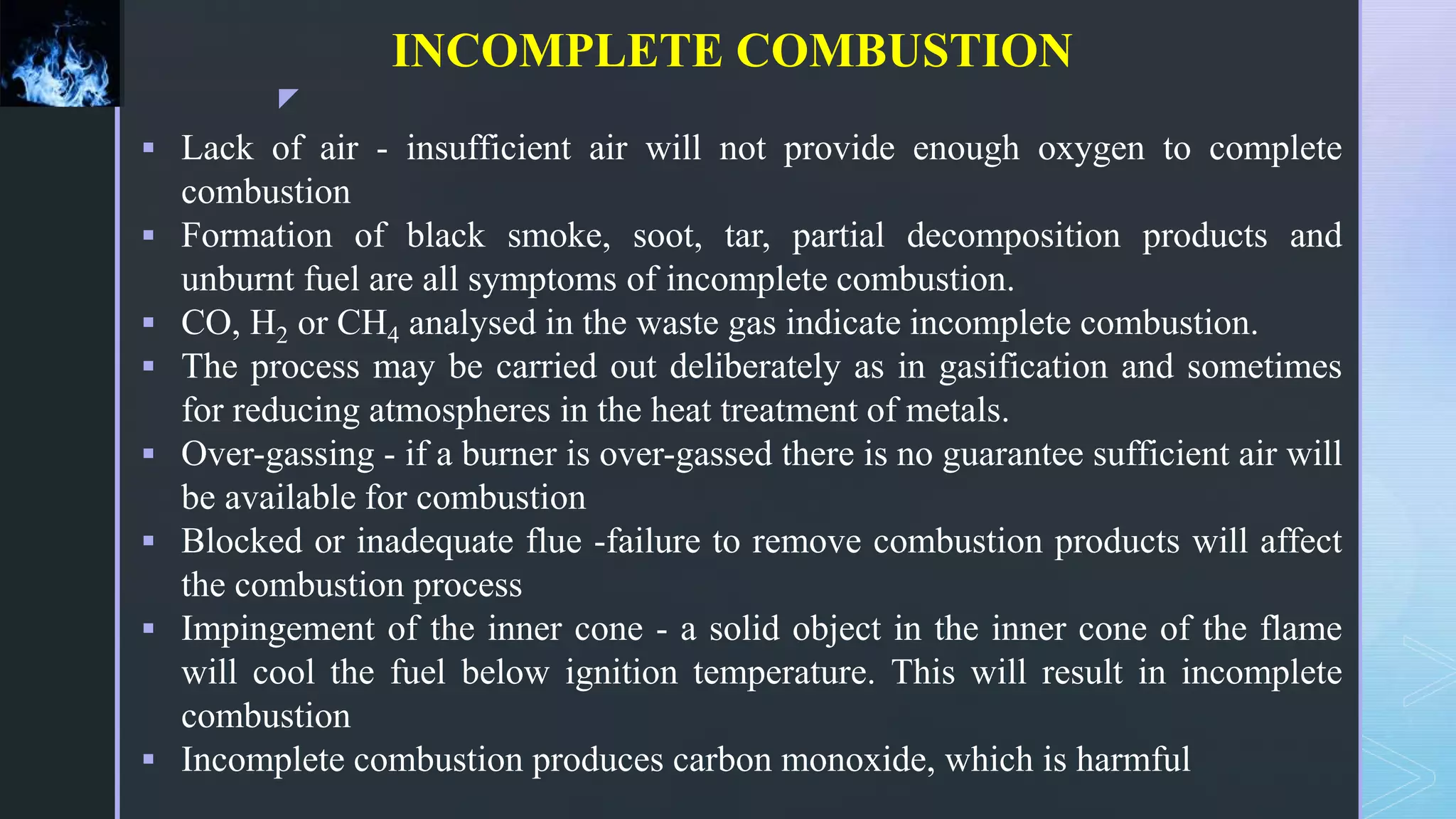
INCOMPLETE COMBUSTION
 Lack of air - insufficient air will not provide enough oxygen to complete
combustion
 Formation of black smoke, soot, tar, partial decomposition products and
unburnt fuel are all symptoms of incomplete combustion.
 CO, H2 or CH4 analysed in the waste gas indicate incomplete combustion.
 The process may be carried out deliberately as in gasification and sometimes
for reducing atmospheres in the heat treatment of metals.
 Over-gassing - if a burner is over-gassed there is no guarantee sufficient air will
be available for combustion
 Blocked or inadequate flue -failure to remove combustion products will affect
the combustion process
 Impingement of the inner cone - a solid object in the inner cone of the flame
will cool the fuel below ignition temperature. This will result in incomplete
combustion
 Incomplete combustion produces carbon monoxide, which is harmful
z
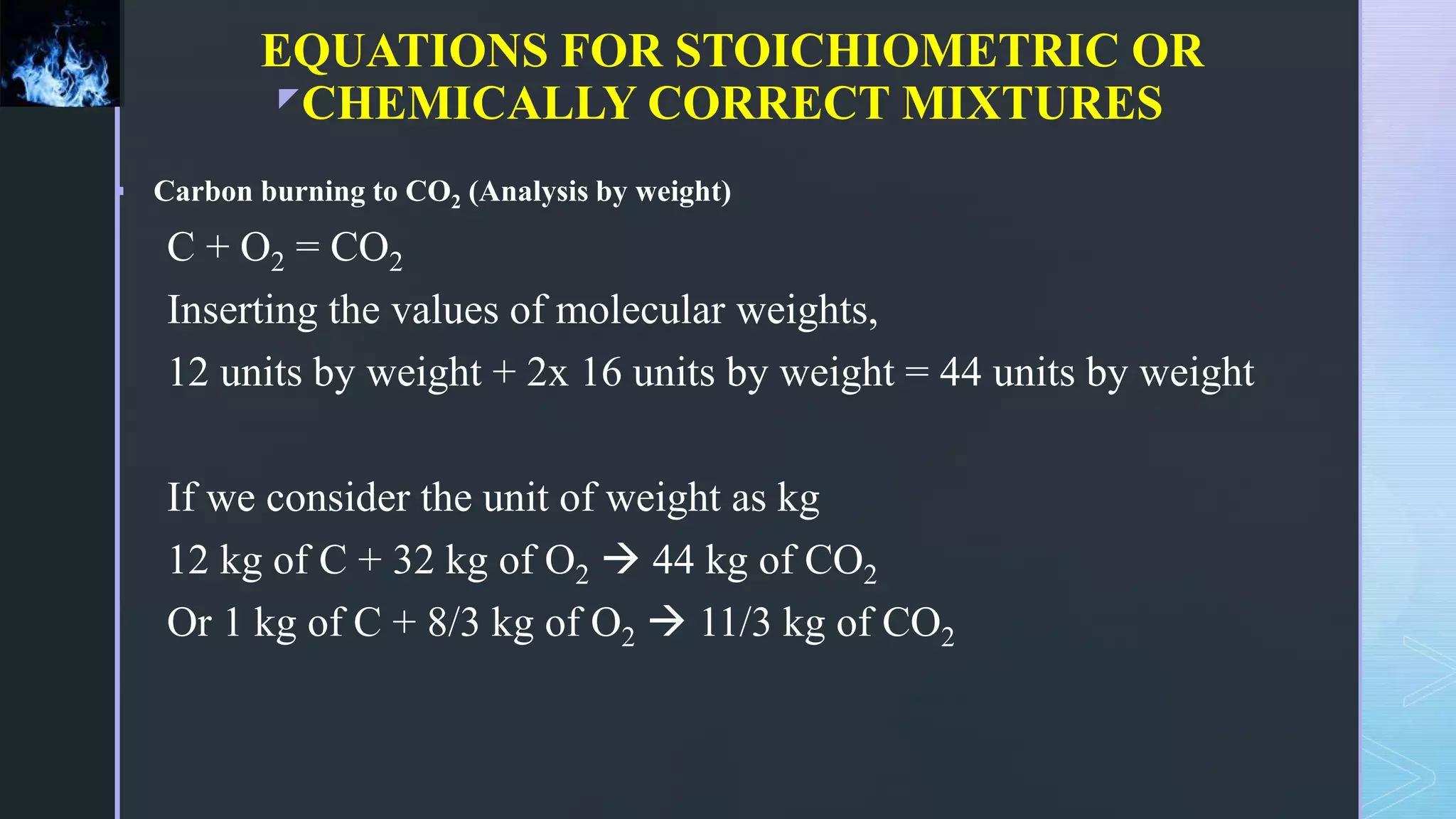
EQUATIONS FOR STOICHIOMETRIC OR
CHEMICALLY CORRECT MIXTURES
 Carbon burning to CO2 (Analysis by weight)
C + O2 = CO2
Inserting the values of molecular weights,
12 units by weight + 2x 16 units by weight = 44 units by weight
If we consider the unit of weight as kg
12 kg of C + 32 kg of O2  44 kg of CO2
Or 1 kg of C + 8/3 kg of O2  11/3 kg of CO2
z
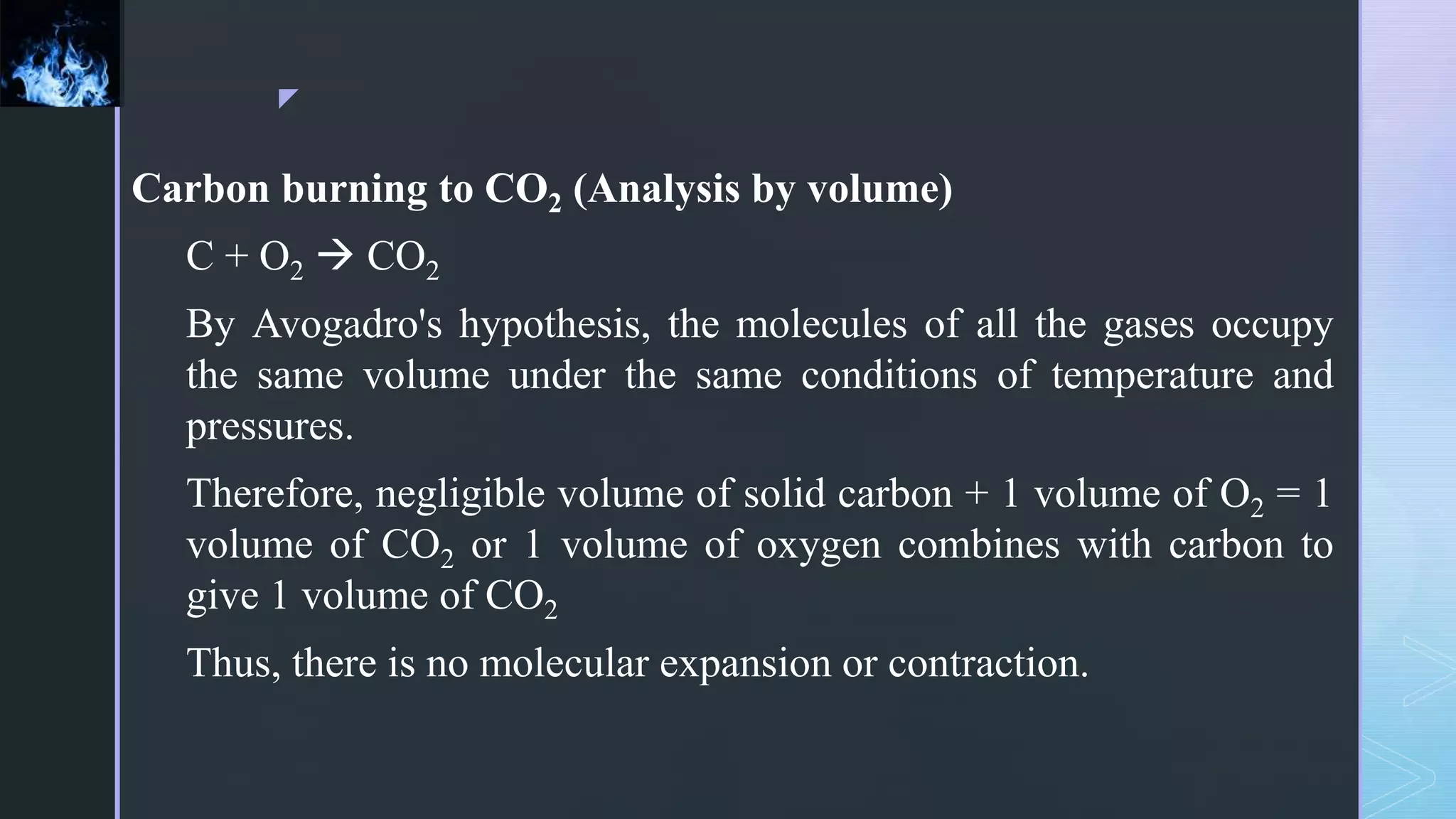
Carbon burning to CO2 (Analysis by volume)
C + O2  CO2
By Avogadro's hypothesis, the molecules of all the gases occupy
the same volume under the same conditions of temperature and
pressures.
Therefore, negligible volume of solid carbon + 1 volume of O2 = 1
volume of CO2 or 1 volume of oxygen combines with carbon to
give 1 volume of CO2
Thus, there is no molecular expansion or contraction.
z
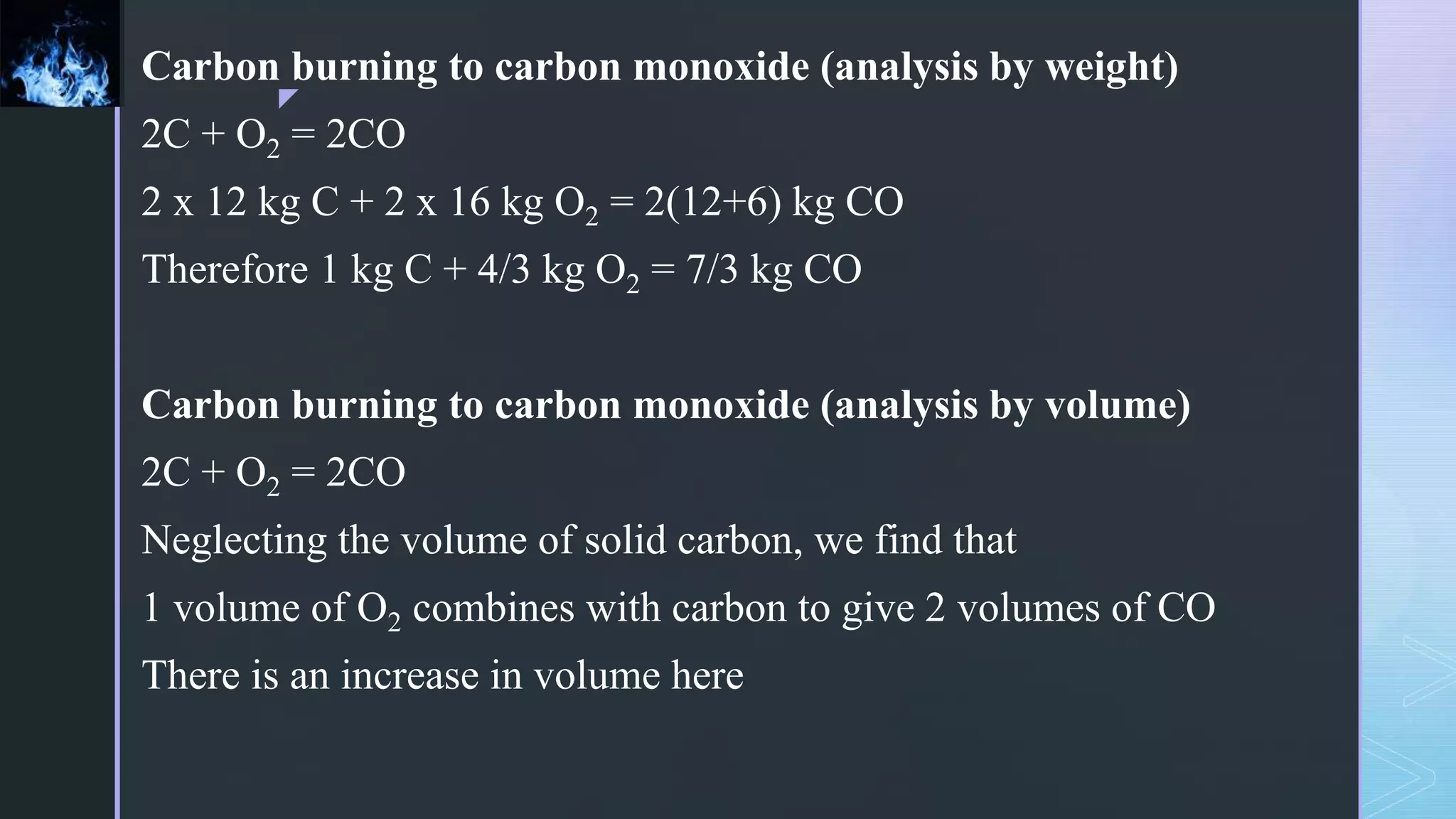
Carbon burning to carbon monoxide (analysis by weight)
2C + O2 = 2CO
2 x 12 kg C + 2 x 16 kg O2 = 2(12+6) kg CO
Therefore 1 kg C + 4/3 kg O2 = 7/3 kg CO
Carbon burning to carbon monoxide (analysis by volume)
2C + O2 = 2CO
Neglecting the volume of solid carbon, we find that
1 volume of O2 combines with carbon to give 2 volumes of CO
There is an increase in volume here
z
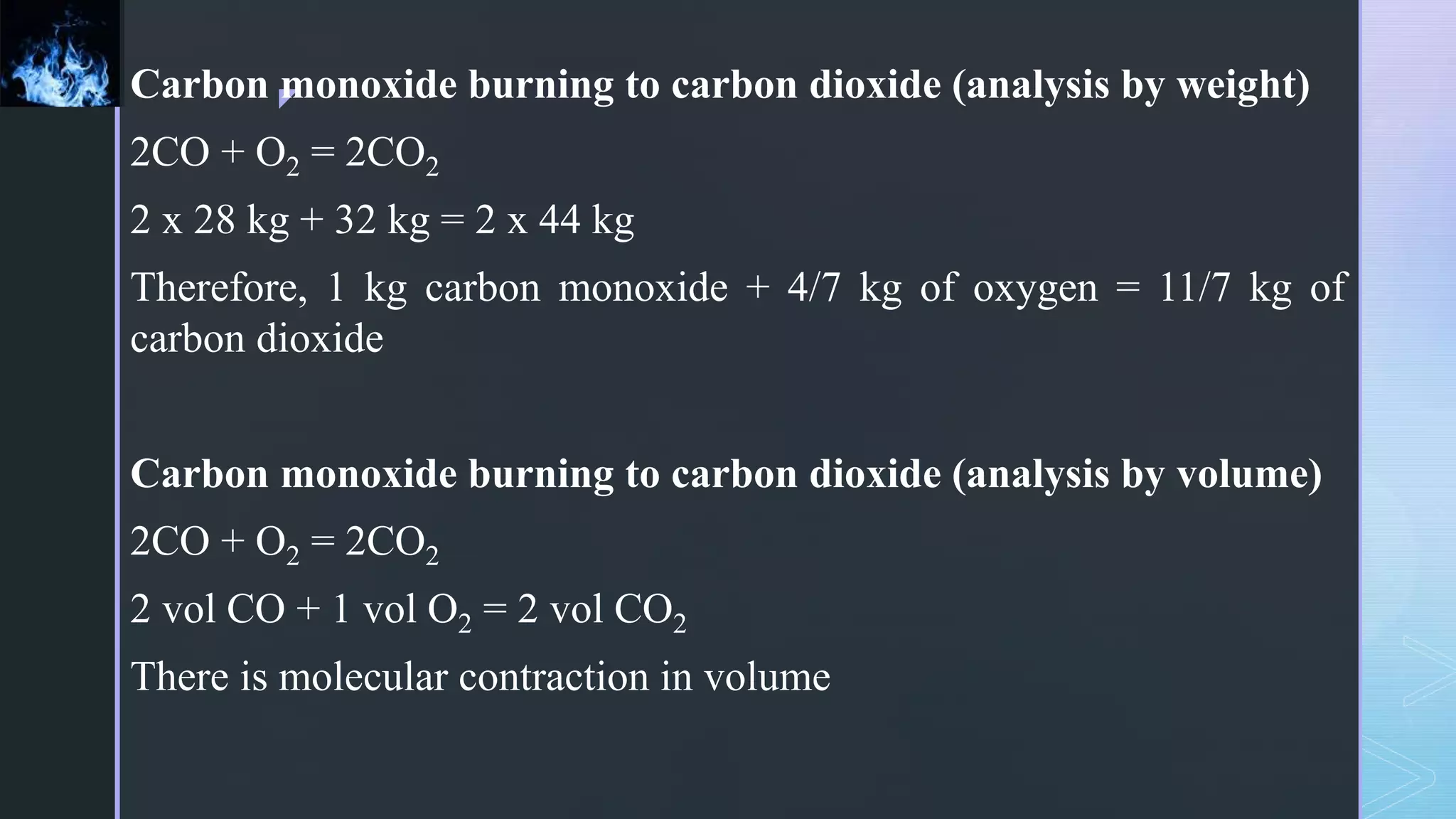
Carbon monoxide burning to carbon dioxide (analysis by weight)
2CO + O2 = 2CO2
2 x 28 kg + 32 kg = 2 x 44 kg
Therefore, 1 kg carbon monoxide + 4/7 kg of oxygen = 11/7 kg of
carbon dioxide
Carbon monoxide burning to carbon dioxide (analysis by volume)
2CO + O2 = 2CO2
2 vol CO + 1 vol O2 = 2 vol CO2
There is molecular contraction in volume
z
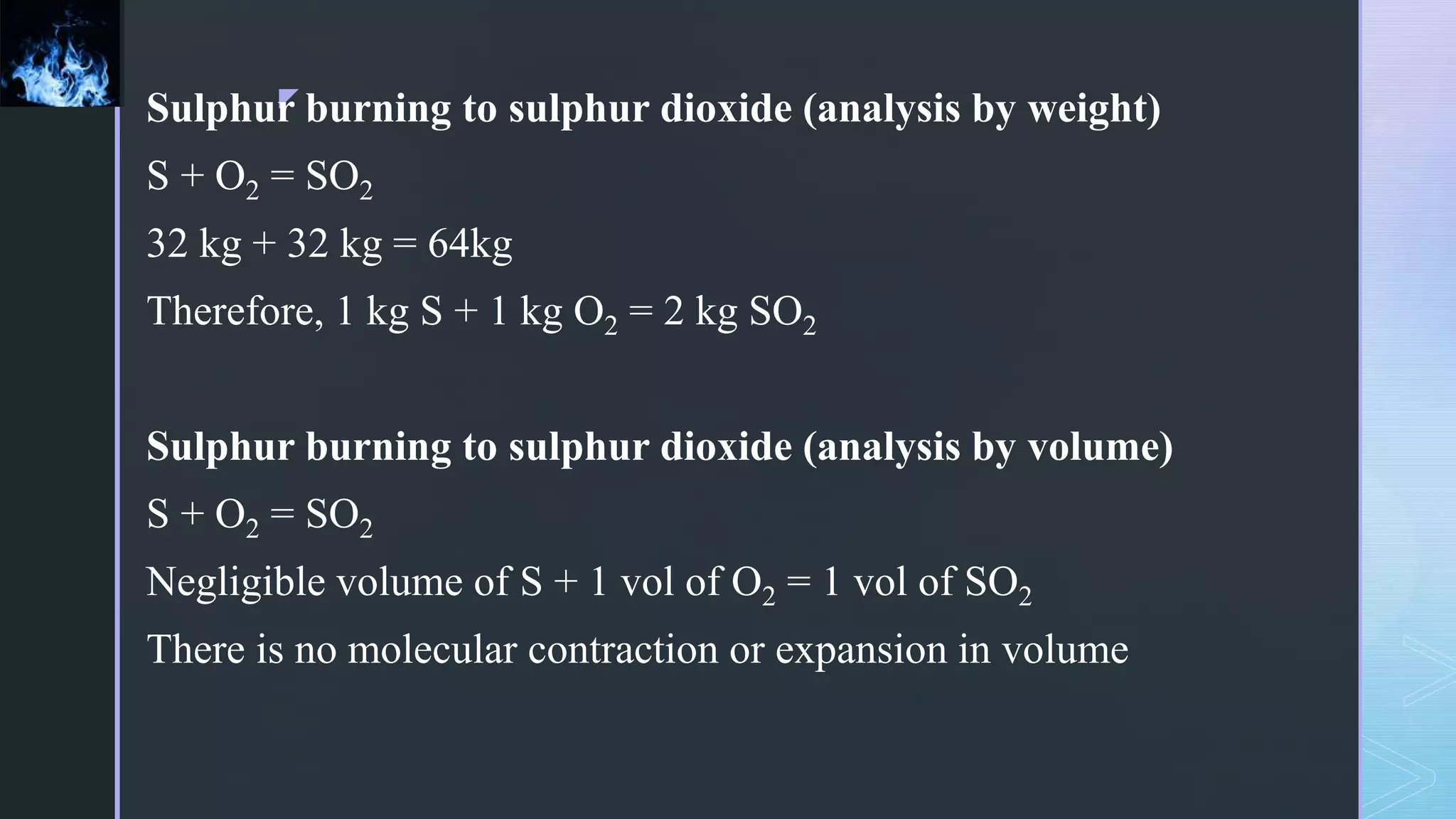
Sulphur burning to sulphur dioxide (analysis by weight)
S + O2 = SO2
32 kg + 32 kg = 64kg
Therefore, 1 kg S + 1 kg O2 = 2 kg SO2
Sulphur burning to sulphur dioxide (analysis by volume)
S + O2 = SO2
Negligible volume of S + 1 vol of O2 = 1 vol of SO2
There is no molecular contraction or expansion in volume
z
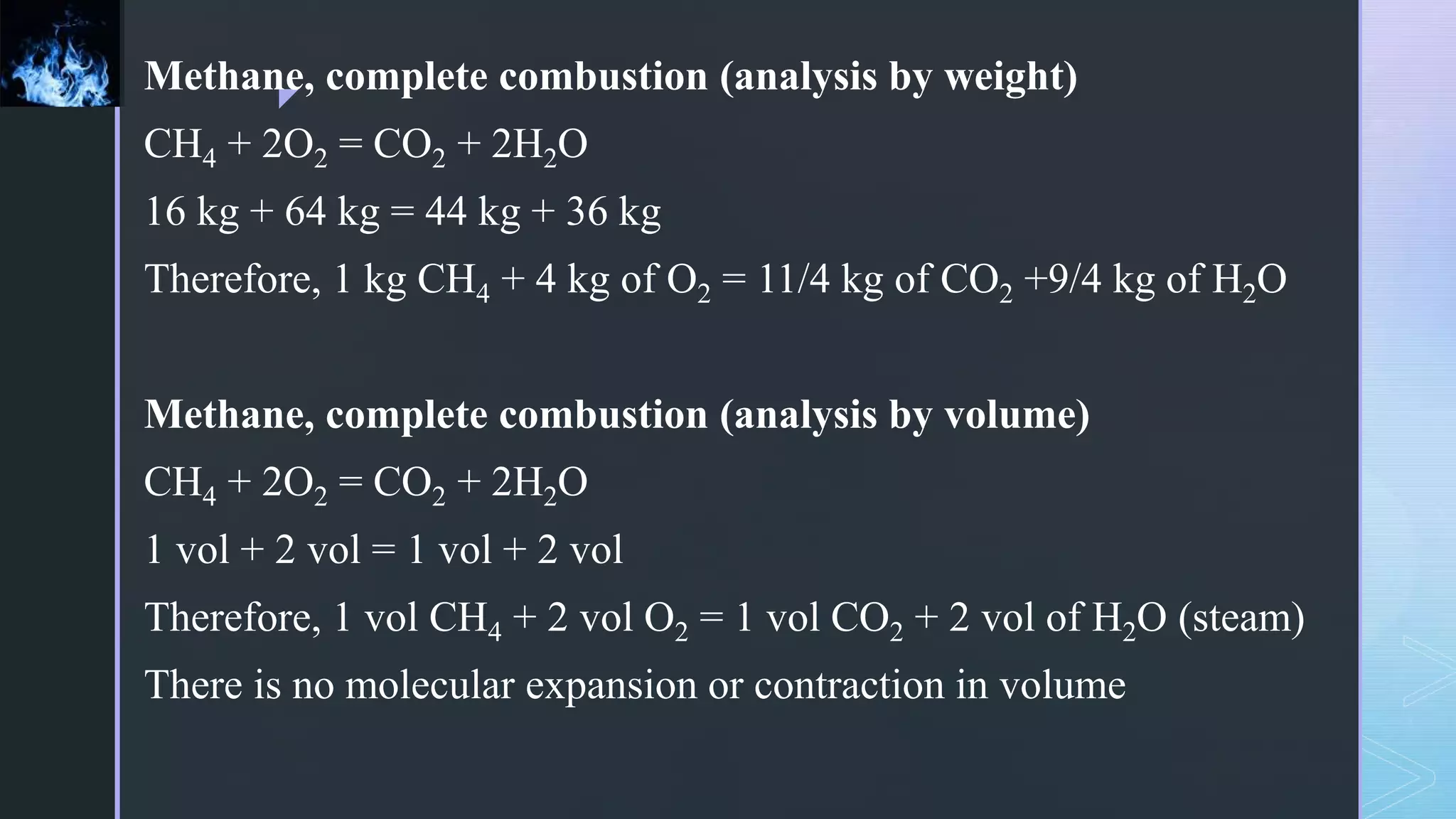
Methane, complete combustion (analysis by weight)
CH4 + 2O2 = CO2 + 2H2O
16 kg + 64 kg = 44 kg + 36 kg
Therefore, 1 kg CH4 + 4 kg of O2 = 11/4 kg of CO2 +9/4 kg of H2O
Methane, complete combustion (analysis by volume)
CH4 + 2O2 = CO2 + 2H2O
1 vol + 2 vol = 1 vol + 2 vol
Therefore, 1 vol CH4 + 2 vol O2 = 1 vol CO2 + 2 vol of H2O (steam)
There is no molecular expansion or contraction in volume
z
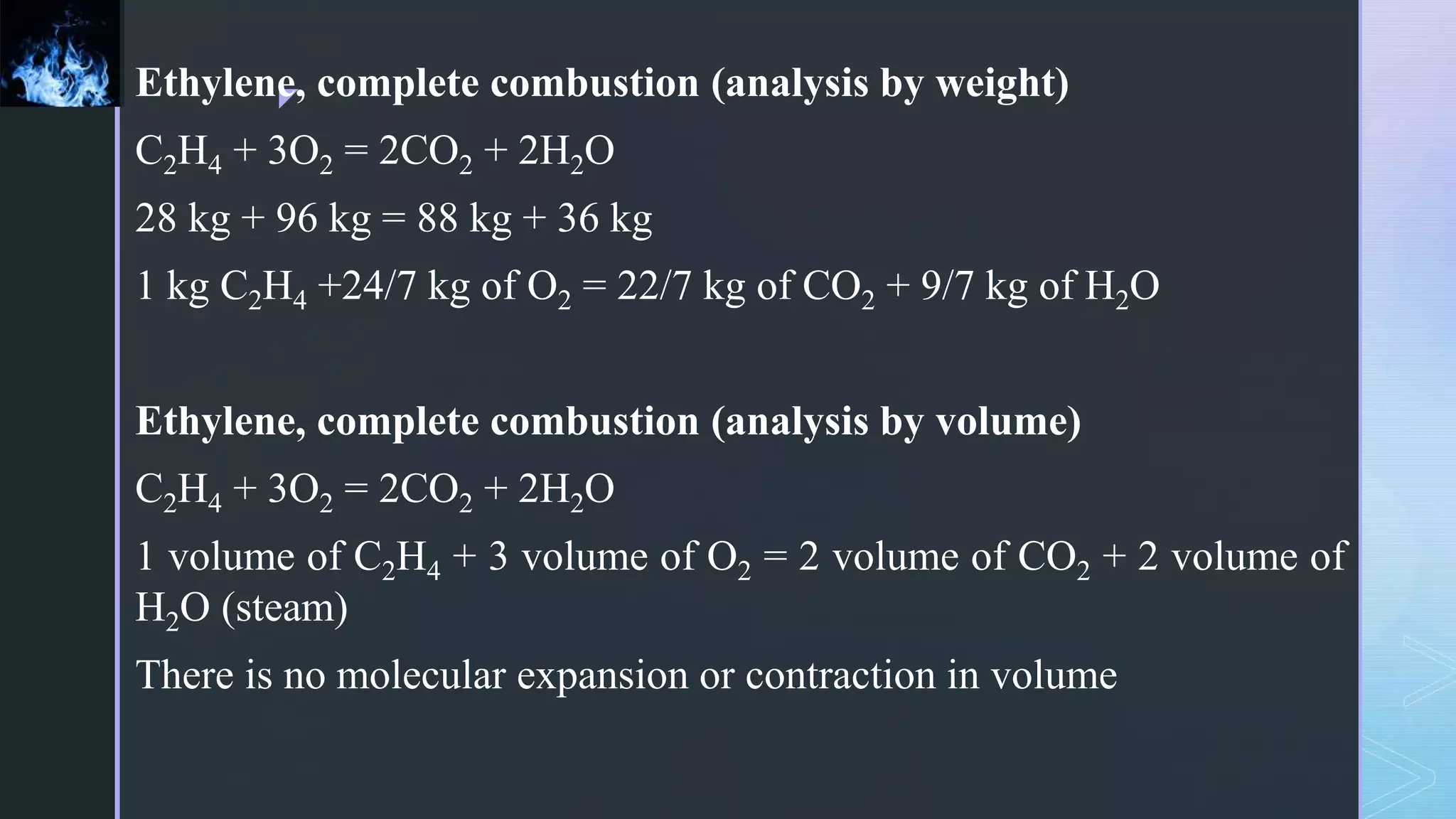
Ethylene, complete combustion (analysis by weight)
C2H4 + 3O2 = 2CO2 + 2H2O
28 kg + 96 kg = 88 kg + 36 kg
1 kg C2H4 +24/7 kg of O2 = 22/7 kg of CO2 + 9/7 kg of H2O
Ethylene, complete combustion (analysis by volume)
C2H4 + 3O2 = 2CO2 + 2H2O
1 volume of C2H4 + 3 volume of O2 = 2 volume of CO2 + 2 volume of
H2O (steam)
There is no molecular expansion or contraction in volume
• Stoichiometry and Air/Fuel Ratios
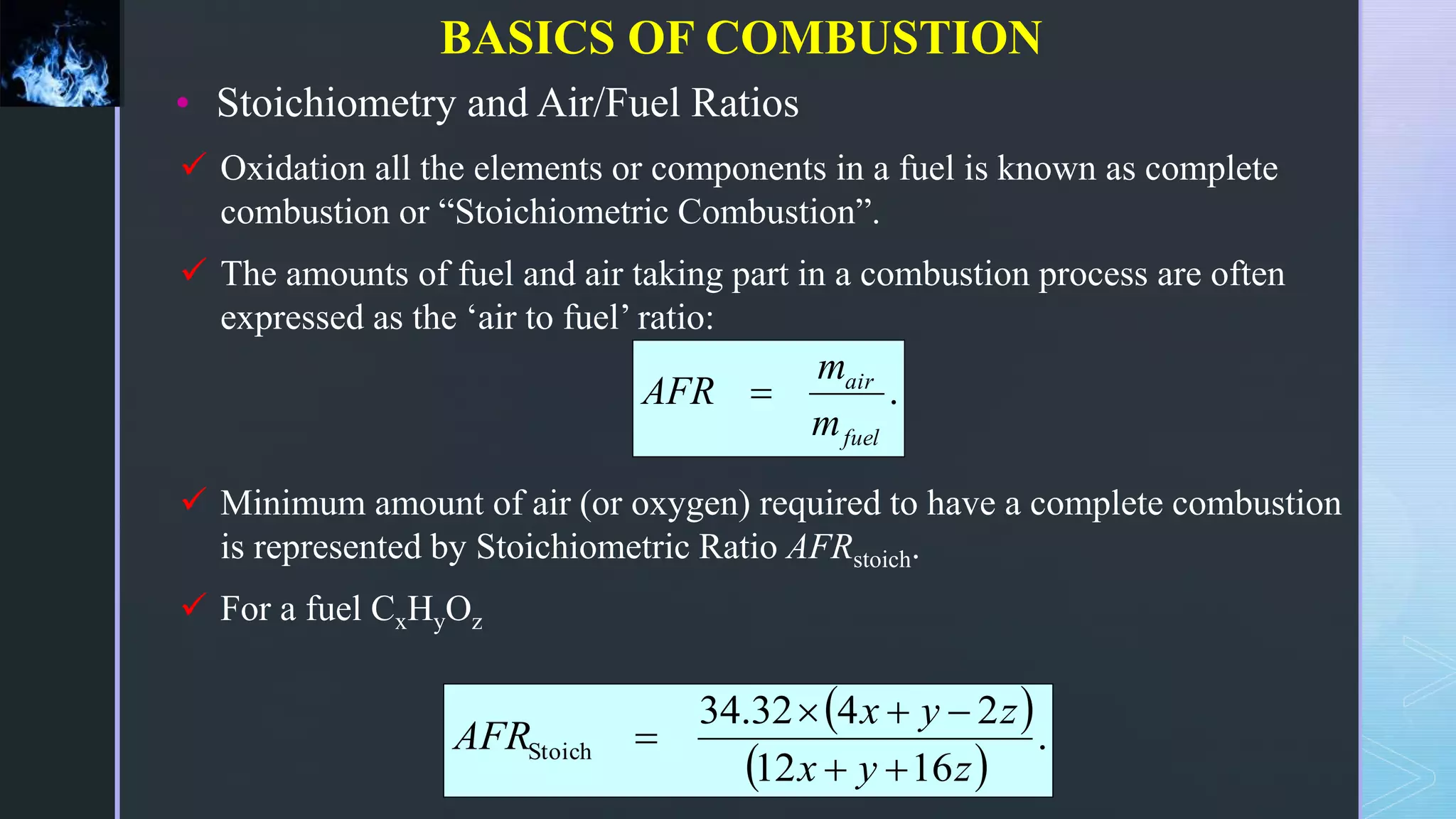
 Oxidation all the elements or components in a fuel is known as complete
combustion or “Stoichiometric Combustion”.
 The amounts of fuel and air taking part in a combustion process are often
expressed as the ‘air to fuel’ ratio:
 Minimum amount of air (or oxygen) required to have a complete combustion
is represented by Stoichiometric Ratio AFRstoich.
 For a fuel CxHyOz
 
 
.
16
12
2
4
32
.
34
Stoich
z
y
x
z
y
x
AFR






.
fuel
air
m
m
AFR 
BASICS OF COMBUSTION
• Stoichiometry and Air/Fuel Ratios
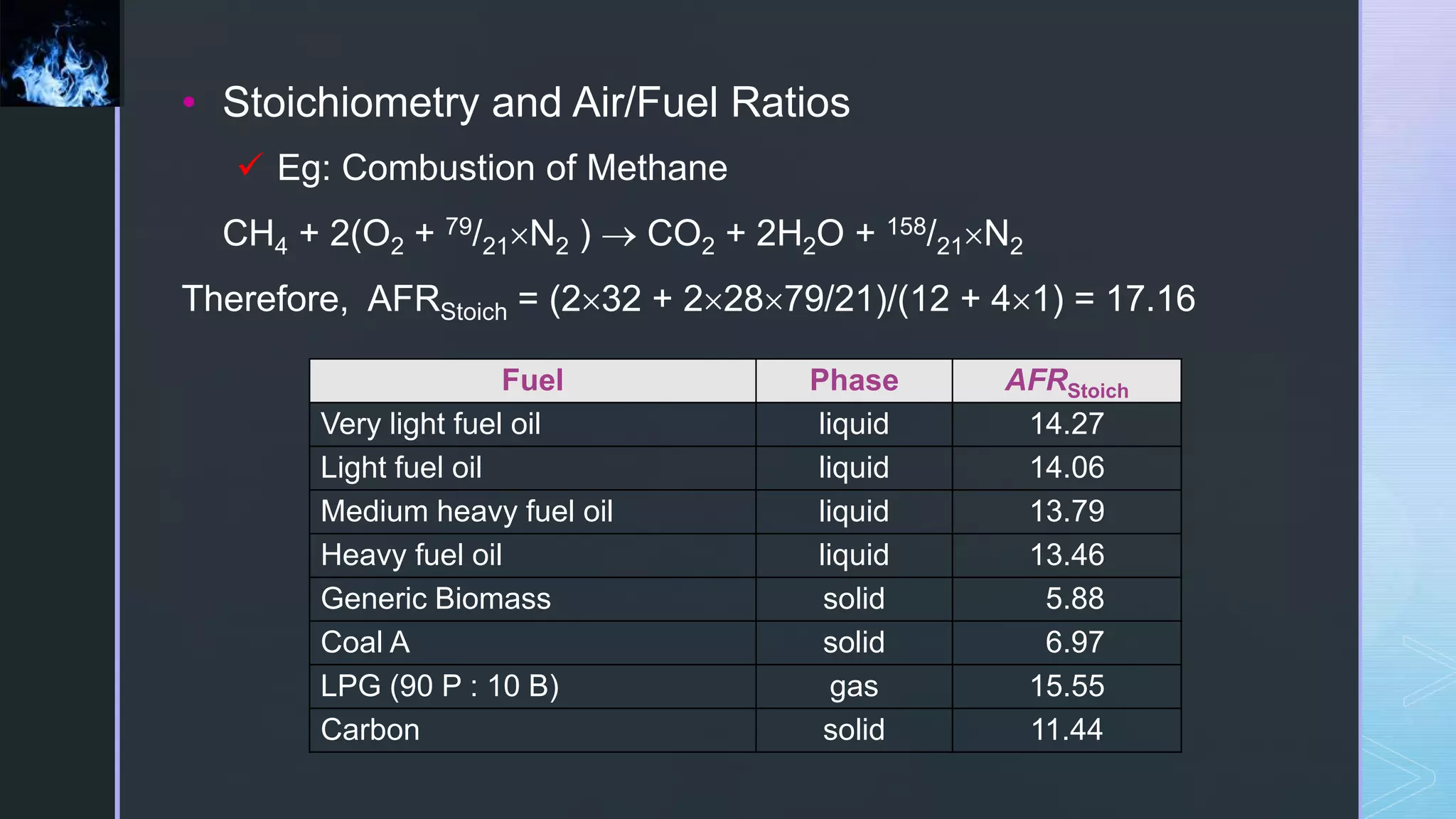
 Eg: Combustion of Methane
CH4 + 2(O2 + 79/21N2 )  CO2 + 2H2O + 158/21N2
Therefore, AFRStoich = (232 + 22879/21)/(12 + 41) = 17.16
Fuel Phase AFRStoich
Very light fuel oil liquid 14.27
Light fuel oil liquid 14.06
Medium heavy fuel oil liquid 13.79
Heavy fuel oil liquid 13.46
Generic Biomass solid 5.88
Coal A solid 6.97
LPG (90 P : 10 B) gas 15.55
Carbon solid 11.44
• Stoichiometry and Air/Fuel Ratios
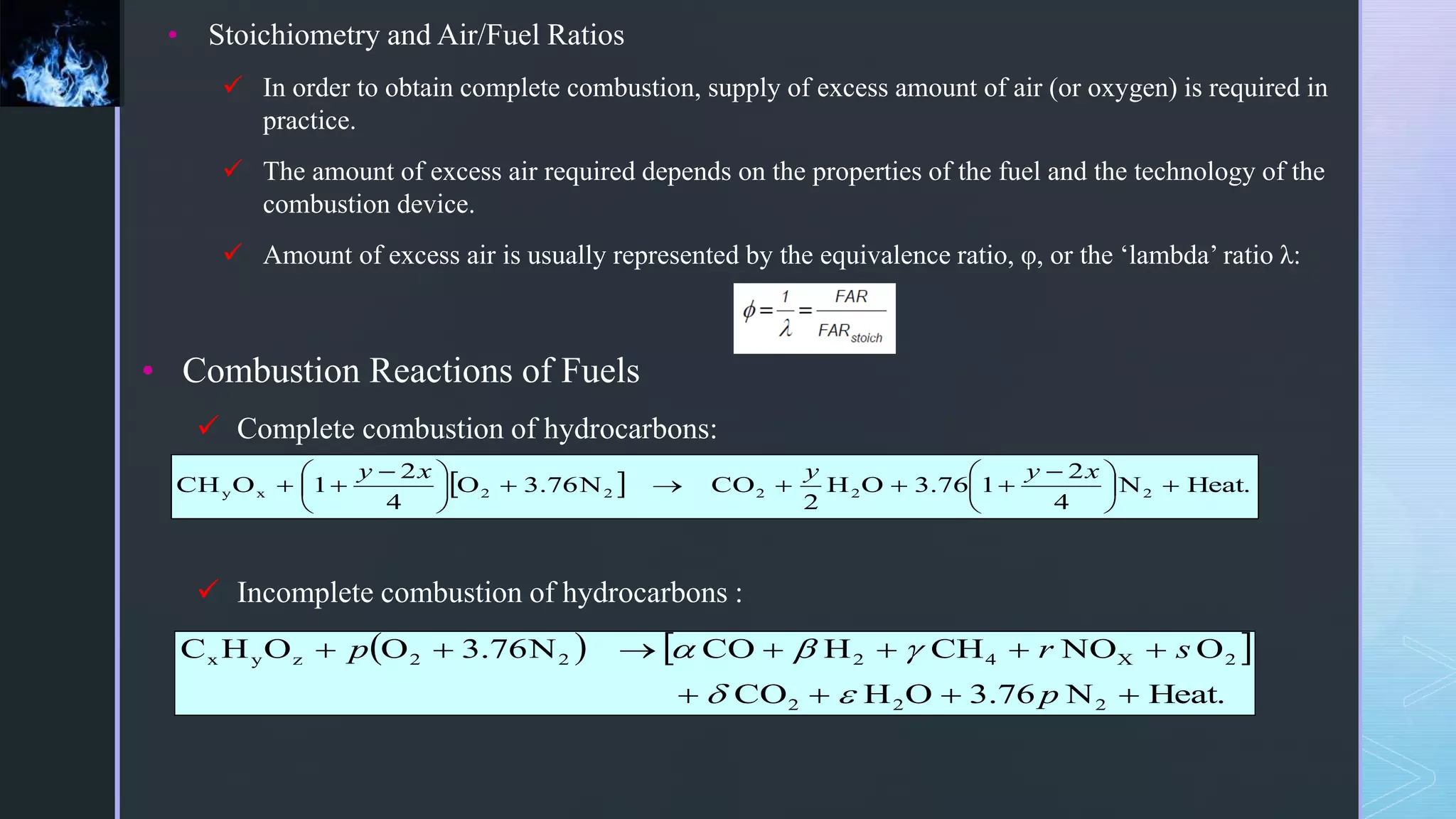
 In order to obtain complete combustion, supply of excess amount of air (or oxygen) is required in
practice.
 The amount of excess air required depends on the properties of the fuel and the technology of the
combustion device.
 Amount of excess air is usually represented by the equivalence ratio, φ, or the ‘lambda’ ratio λ:
• Combustion Reactions of Fuels
 Complete combustion of hydrocarbons:
 Incomplete combustion of hydrocarbons :
  Heat.
N
4
2
1
76
.
3
O
H
2
CO
N
76
.
3
O
4
2
1
O
CH 2
2
2
2
2
x
y 





 










 


x
y
y
x
y
   
Heat.
N
76
.
3
O
H
CO
O
NO
CH
H
CO
N
76
.
3
O
O
H
C
2
2
2
2
X
4
2
2
2
z
y
x











p
s
r
p





z
HARMFUL EFFECTS ON THE ENVIRONMENT DUE
TO BURNING OF FUELS
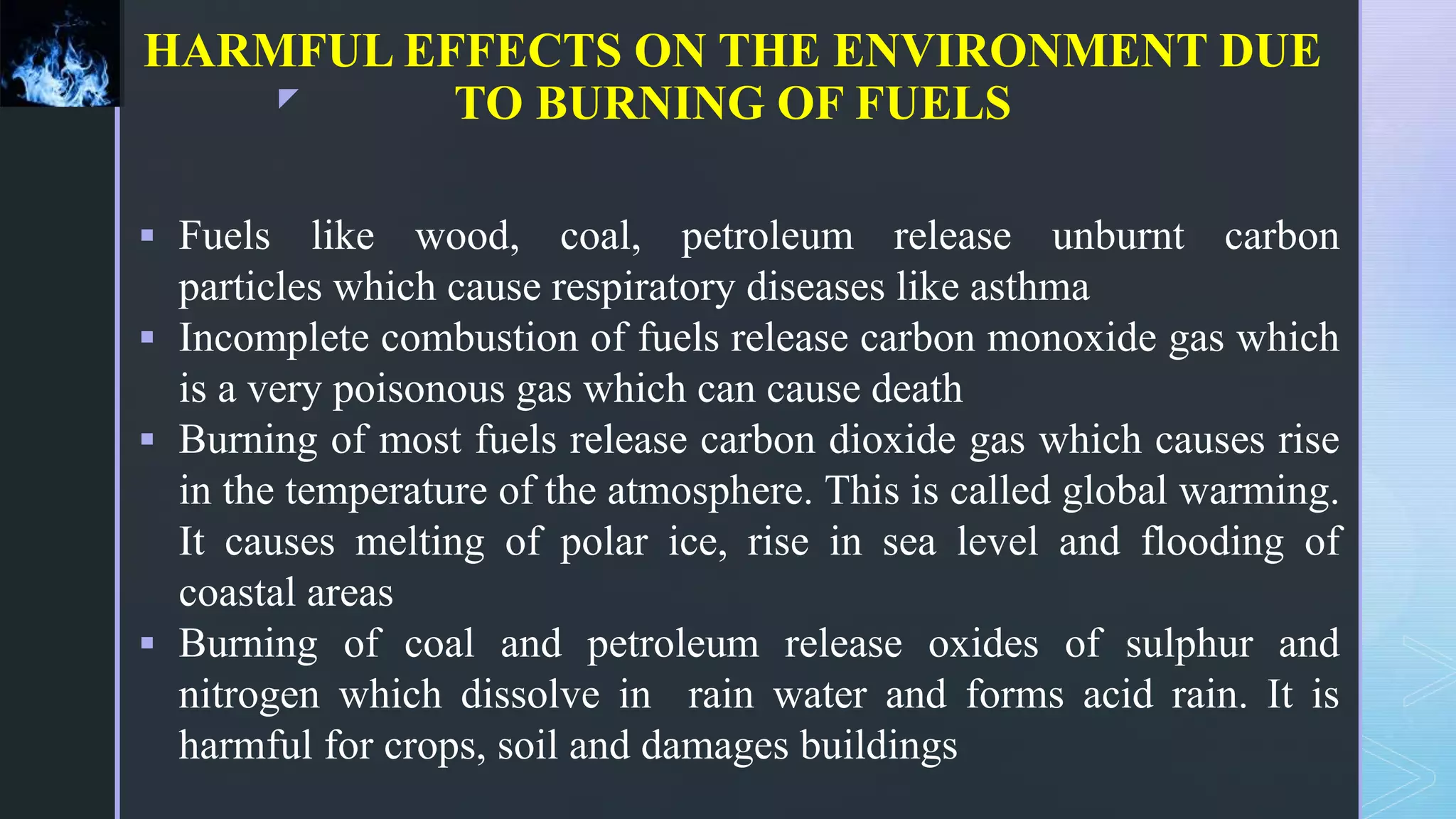
 Fuels like wood, coal, petroleum release unburnt carbon
particles which cause respiratory diseases like asthma
 Incomplete combustion of fuels release carbon monoxide gas which
is a very poisonous gas which can cause death
 Burning of most fuels release carbon dioxide gas which causes rise
in the temperature of the atmosphere. This is called global warming.
It causes melting of polar ice, rise in sea level and flooding of
coastal areas
 Burning of coal and petroleum release oxides of sulphur and
nitrogen which dissolve in rain water and forms acid rain. It is
harmful for crops, soil and damages buildings
z
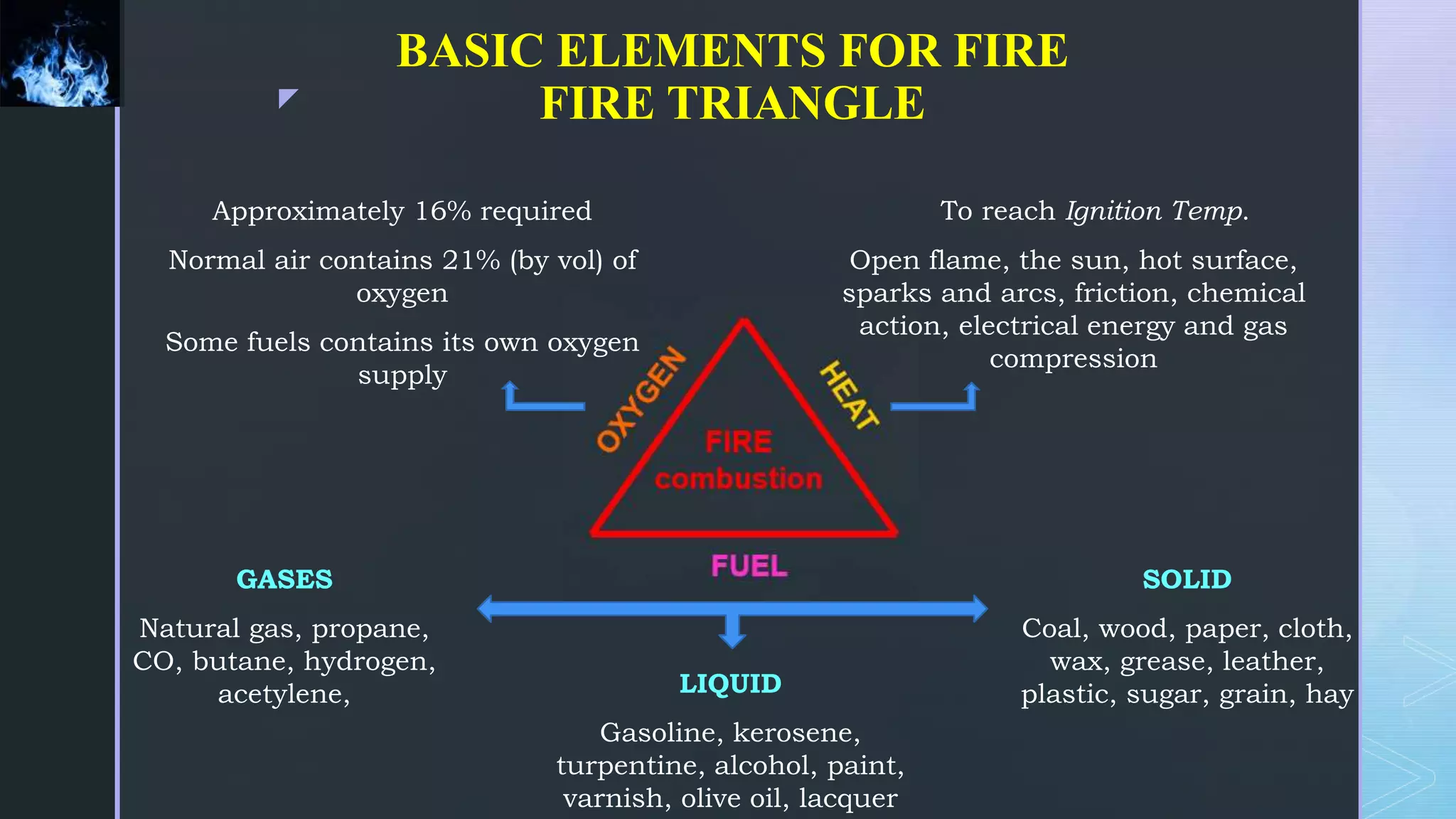
BASIC ELEMENTS FOR FIRE
FIRE TRIANGLE
Approximately 16% required
Normal air contains 21% (by vol) of
oxygen
Some fuels contains its own oxygen
supply
To reach Ignition Temp.
Open flame, the sun, hot surface,
sparks and arcs, friction, chemical
action, electrical energy and gas
compression
GASES
Natural gas, propane,
CO, butane, hydrogen,
acetylene, LIQUID
Gasoline, kerosene,
turpentine, alcohol, paint,
varnish, olive oil, lacquer
SOLID
Coal, wood, paper, cloth,
wax, grease, leather,
plastic, sugar, grain, hay
z
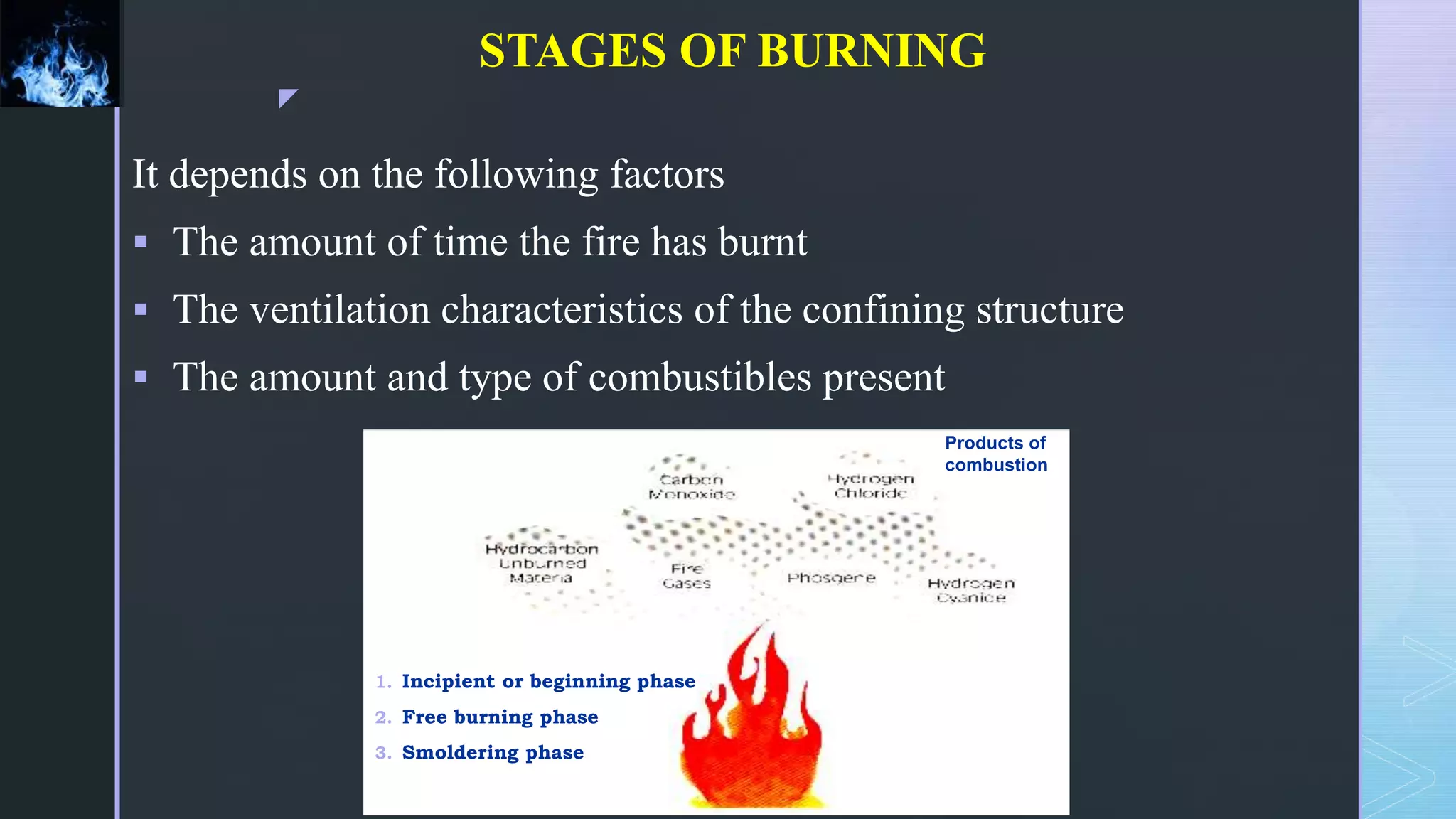
STAGES OF BURNING
It depends on the following factors
 The amount of time the fire has burnt
 The ventilation characteristics of the confining structure
 The amount and type of combustibles present
1. Incipient or beginning phase
2. Free burning phase
3. Smoldering phase
Products of
combustion
z
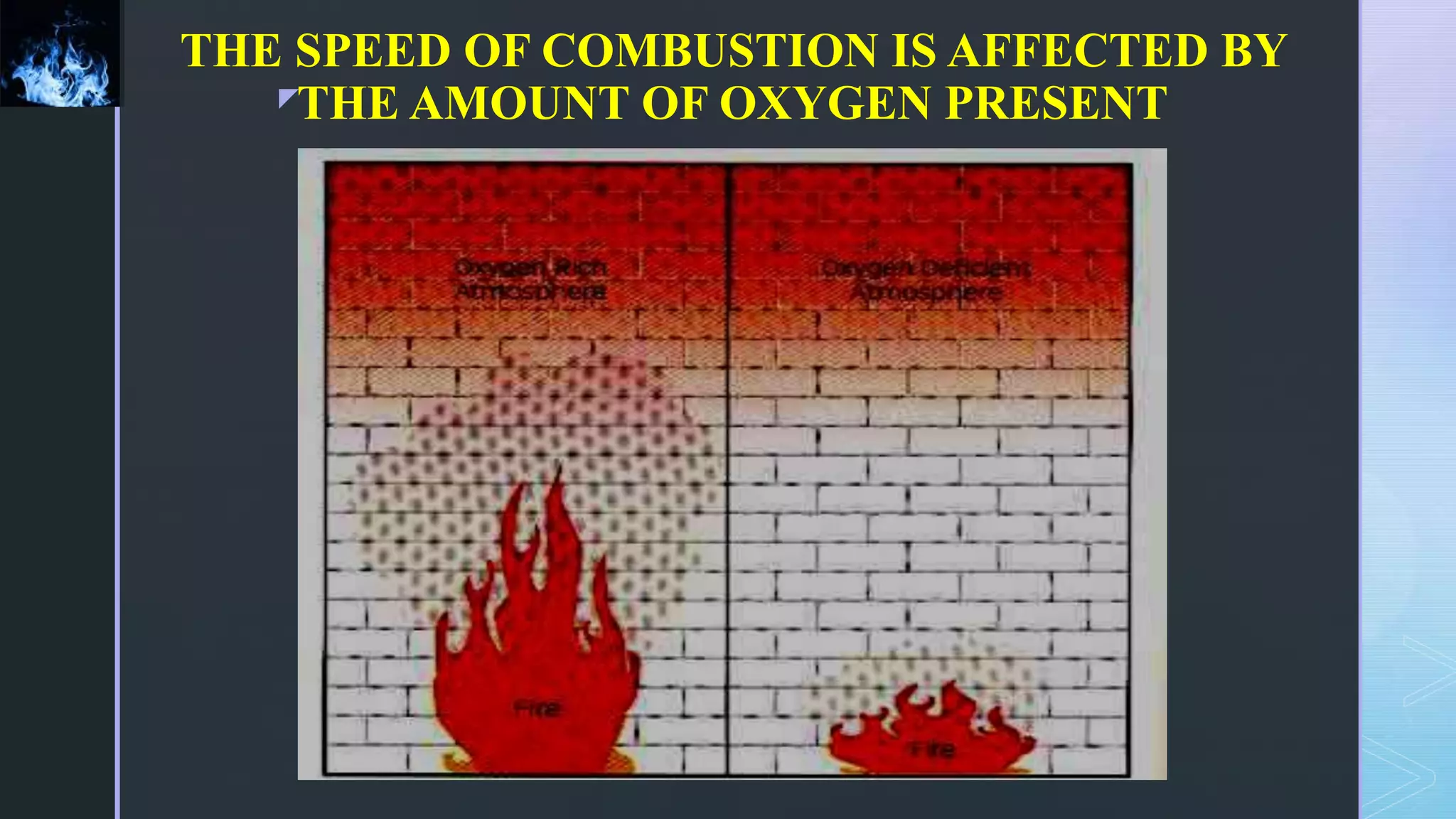
THE SPEED OF COMBUSTION IS AFFECTED BY
THE AMOUNT OF OXYGEN PRESENT
z
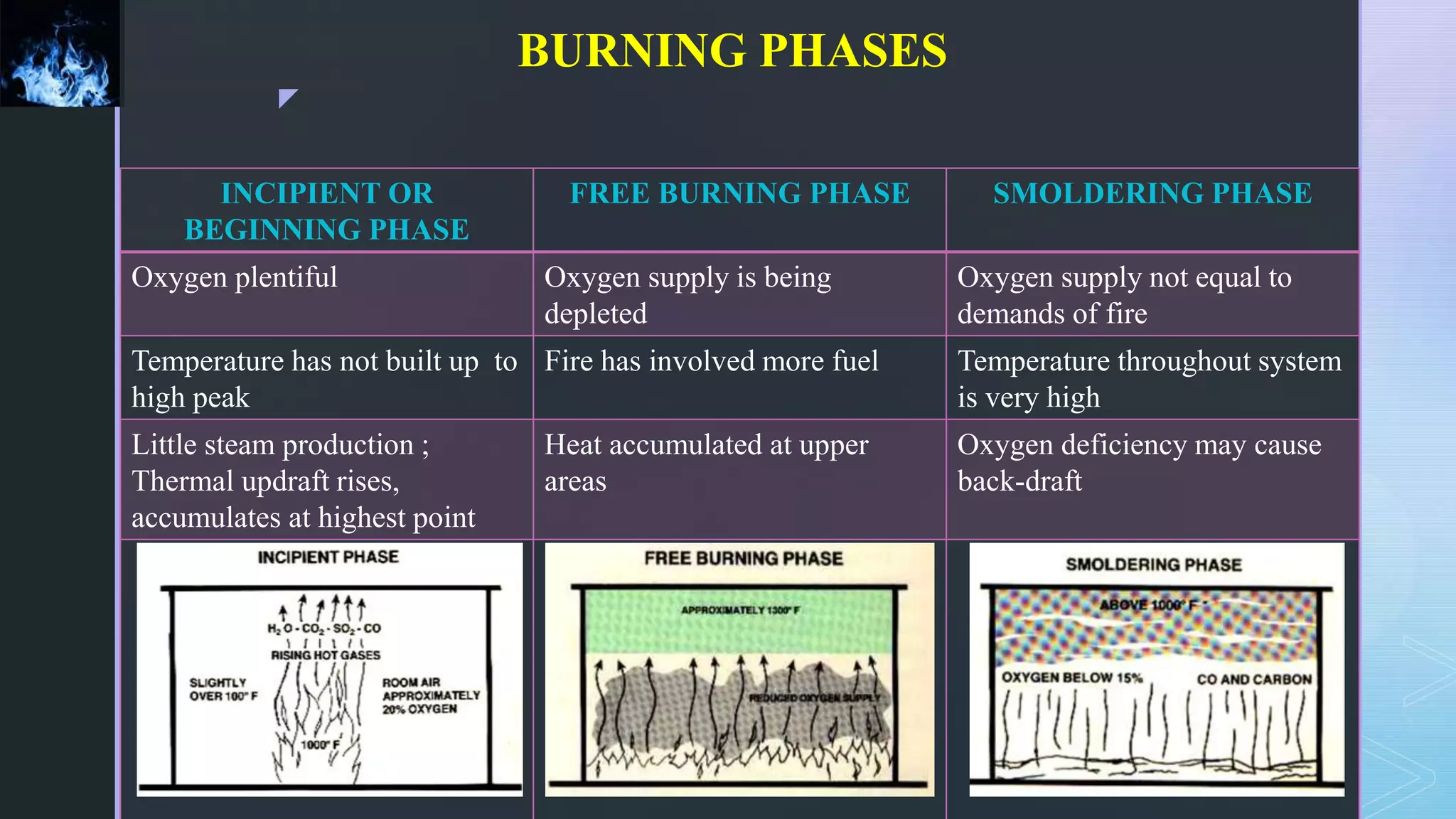
BURNING PHASES
INCIPIENT OR
BEGINNING PHASE
FREE BURNING PHASE SMOLDERING PHASE
Oxygen plentiful Oxygen supply is being
depleted
Oxygen supply not equal to
demands of fire
Temperature has not built up to
high peak
Fire has involved more fuel Temperature throughout system
is very high
Little steam production ;
Thermal updraft rises,
accumulates at highest point
Heat accumulated at upper
areas
Oxygen deficiency may cause
back-draft
z
PHASES OF COMBUSTION
 Pre-ignition
 Ignition
 Combustion
 Extinction
z
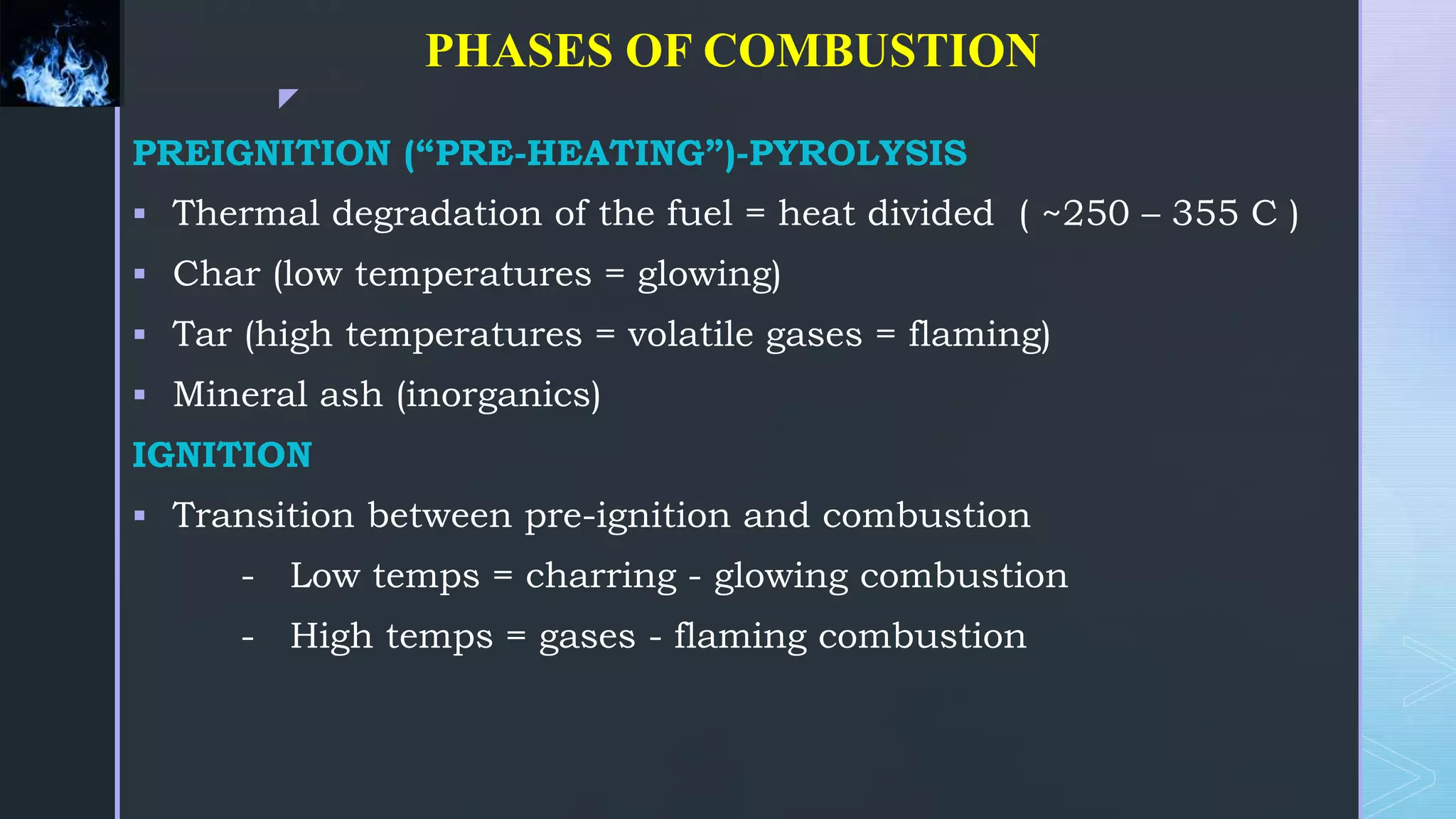
PHASES OF COMBUSTION
PREIGNITION (“PRE-HEATING”)-PYROLYSIS
 Thermal degradation of the fuel = heat divided ( ~250 – 355 C )
 Char (low temperatures = glowing)
 Tar (high temperatures = volatile gases = flaming)
 Mineral ash (inorganics)
IGNITION
 Transition between pre-ignition and combustion
- Low temps = charring - glowing combustion
- High temps = gases - flaming combustion
z
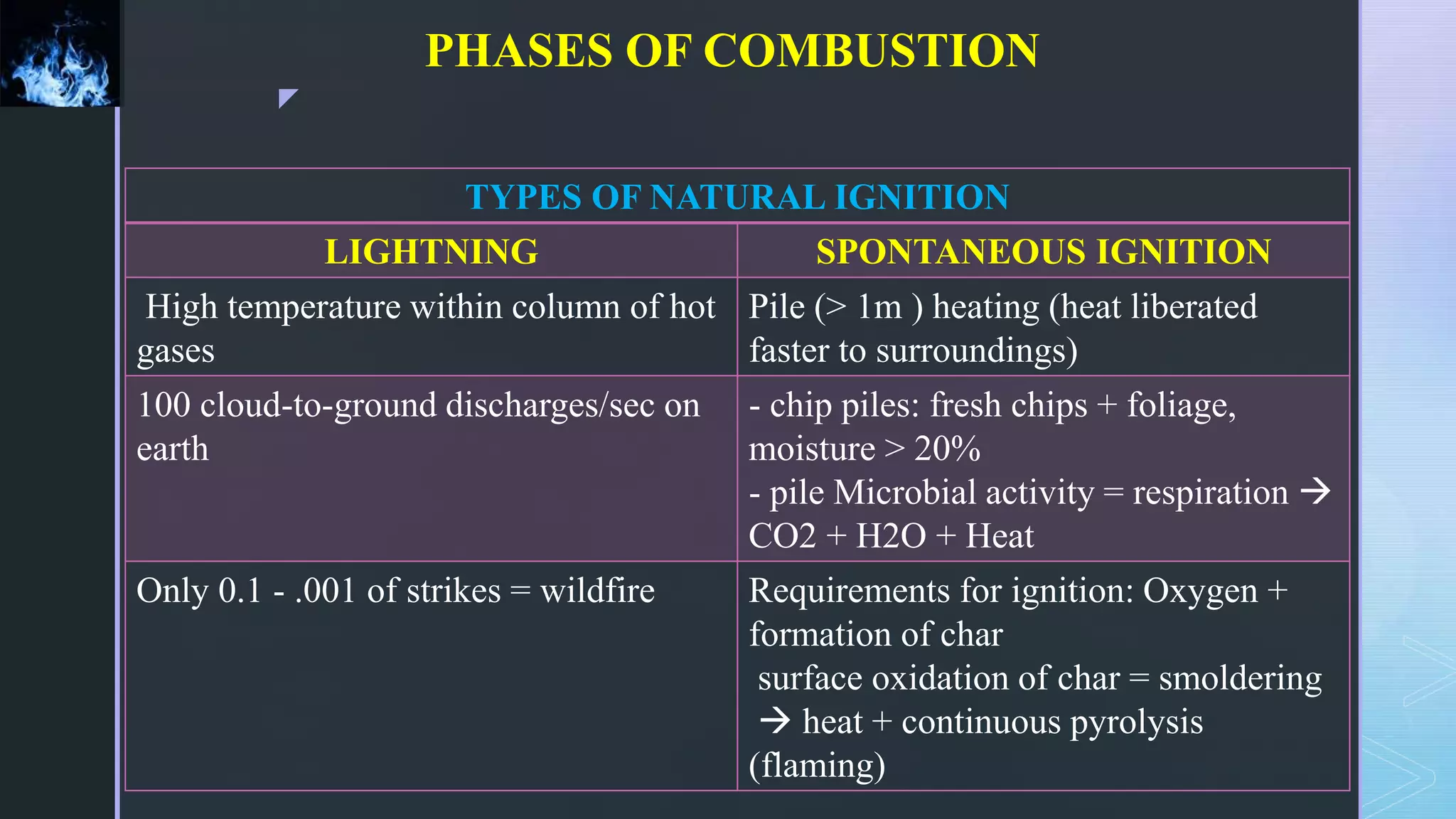
PHASES OF COMBUSTION
TYPES OF NATURAL IGNITION
LIGHTNING SPONTANEOUS IGNITION
High temperature within column of hot
gases
Pile (> 1m ) heating (heat liberated
faster to surroundings)
100 cloud-to-ground discharges/sec on
earth
- chip piles: fresh chips + foliage,
moisture > 20%
- pile Microbial activity = respiration 
CO2 + H2O + Heat
Only 0.1 - .001 of strikes = wildfire Requirements for ignition: Oxygen +
formation of char
surface oxidation of char = smoldering
 heat + continuous pyrolysis
(flaming)
z
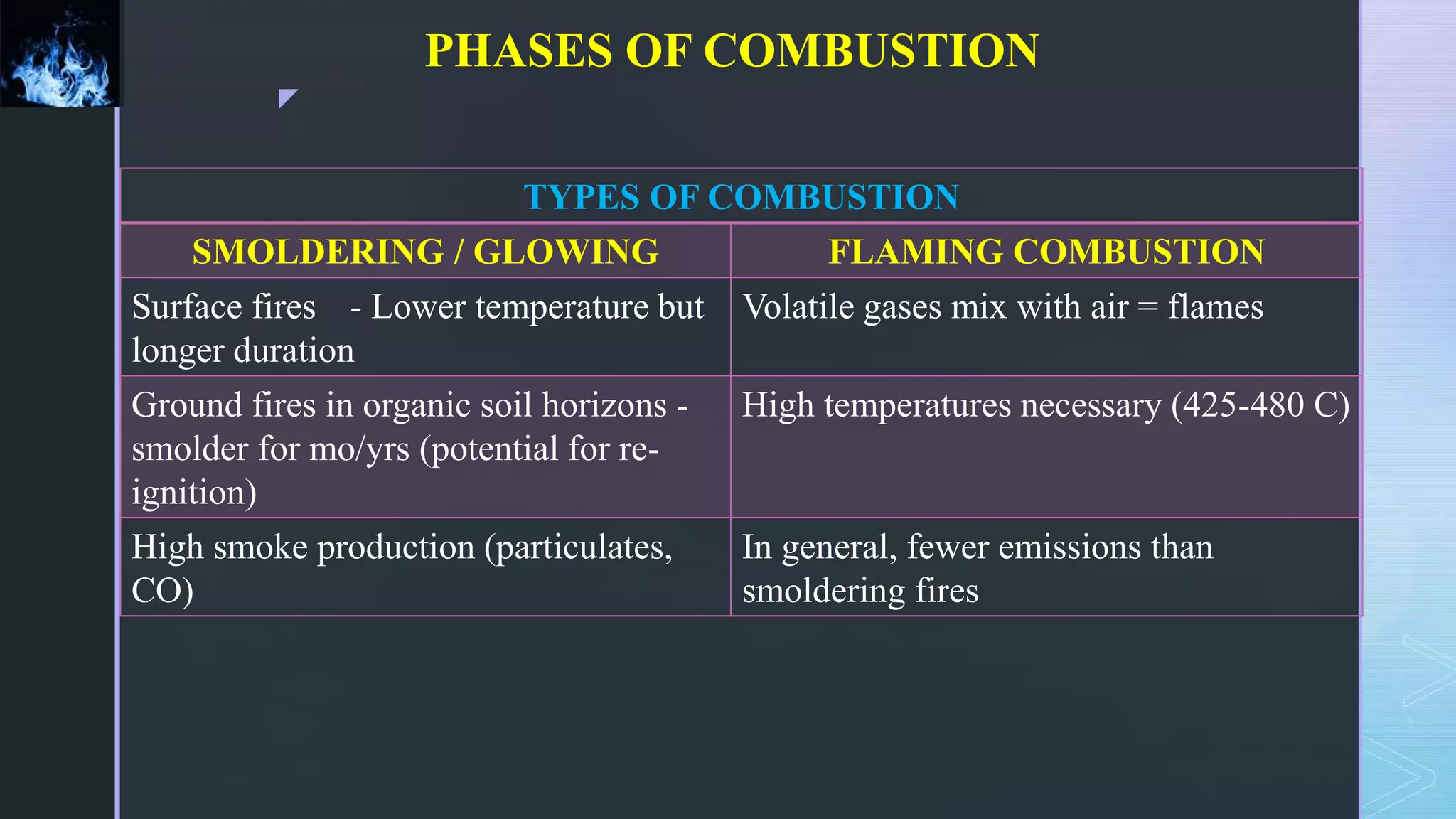
PHASES OF COMBUSTION
TYPES OF COMBUSTION
SMOLDERING / GLOWING FLAMING COMBUSTION
Surface fires - Lower temperature but
longer duration
Volatile gases mix with air = flames
Ground fires in organic soil horizons -
smolder for mo/yrs (potential for re-
ignition)
High temperatures necessary (425-480 C)
High smoke production (particulates,
CO)
In general, fewer emissions than
smoldering fires
z
PHASES OF COMBUSTION
TYPES OF COMBUSTION
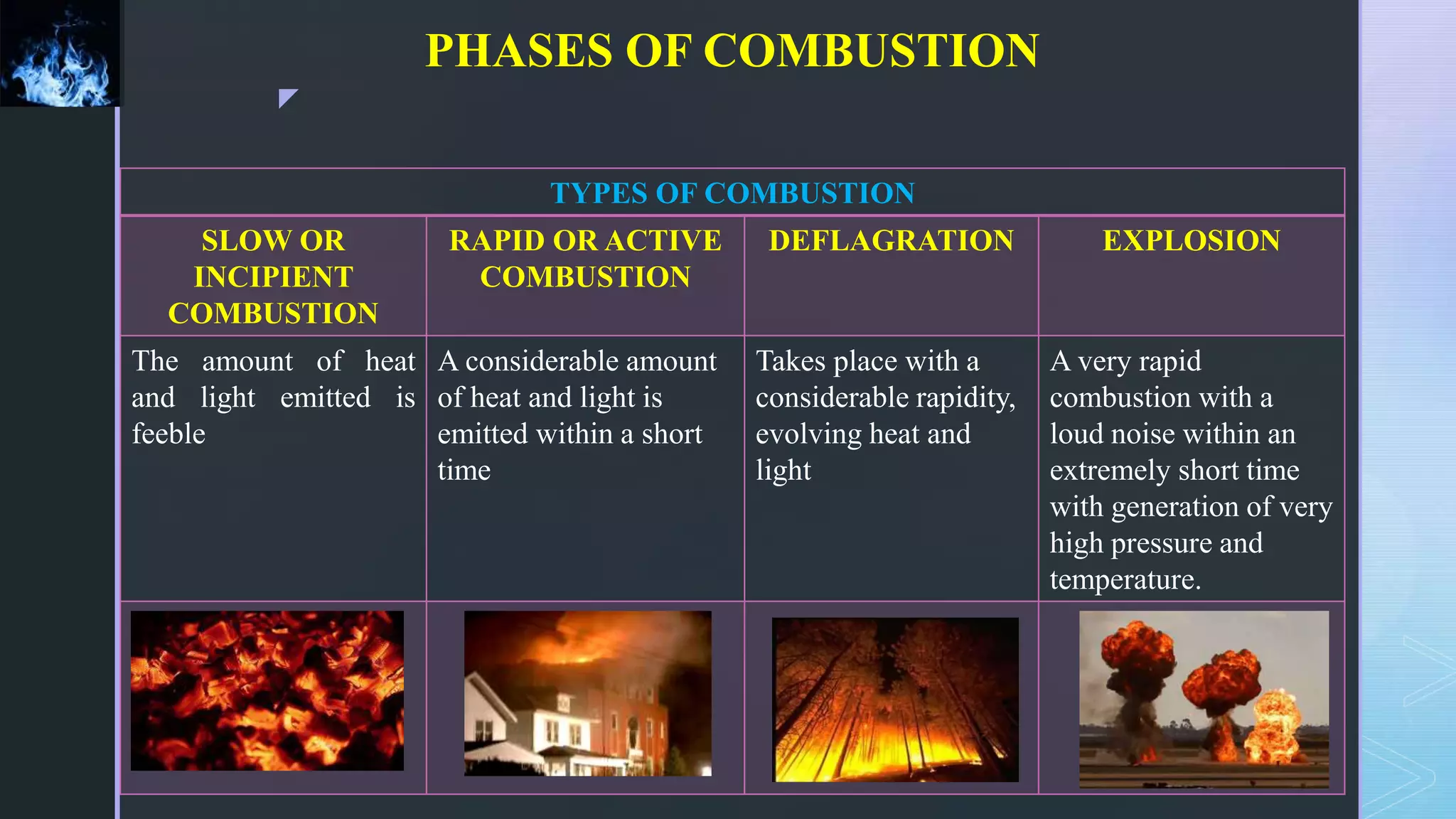
SLOW OR
INCIPIENT
COMBUSTION
RAPID OR ACTIVE
COMBUSTION
DEFLAGRATION EXPLOSION
The amount of heat
and light emitted is
feeble
A considerable amount
of heat and light is
emitted within a short
time
Takes place with a
considerable rapidity,
evolving heat and
light
A very rapid
combustion with a
loud noise within an
extremely short time
with generation of very
high pressure and
temperature.
z
PHASES OF COMBUSTION
RATE OF COMBUSTION
A rate of combustion or the spread of fire would depends on
 The area of solid/liquid in contact with air
 The amount of heat generated to raise the temperature of
unburnt portion
 The ability of materials to conduct heat away
 Atmospheric humidity
 Wind velocity
 Temperature
 Atmospheric pressure
z
PHASES OF COMBUSTION
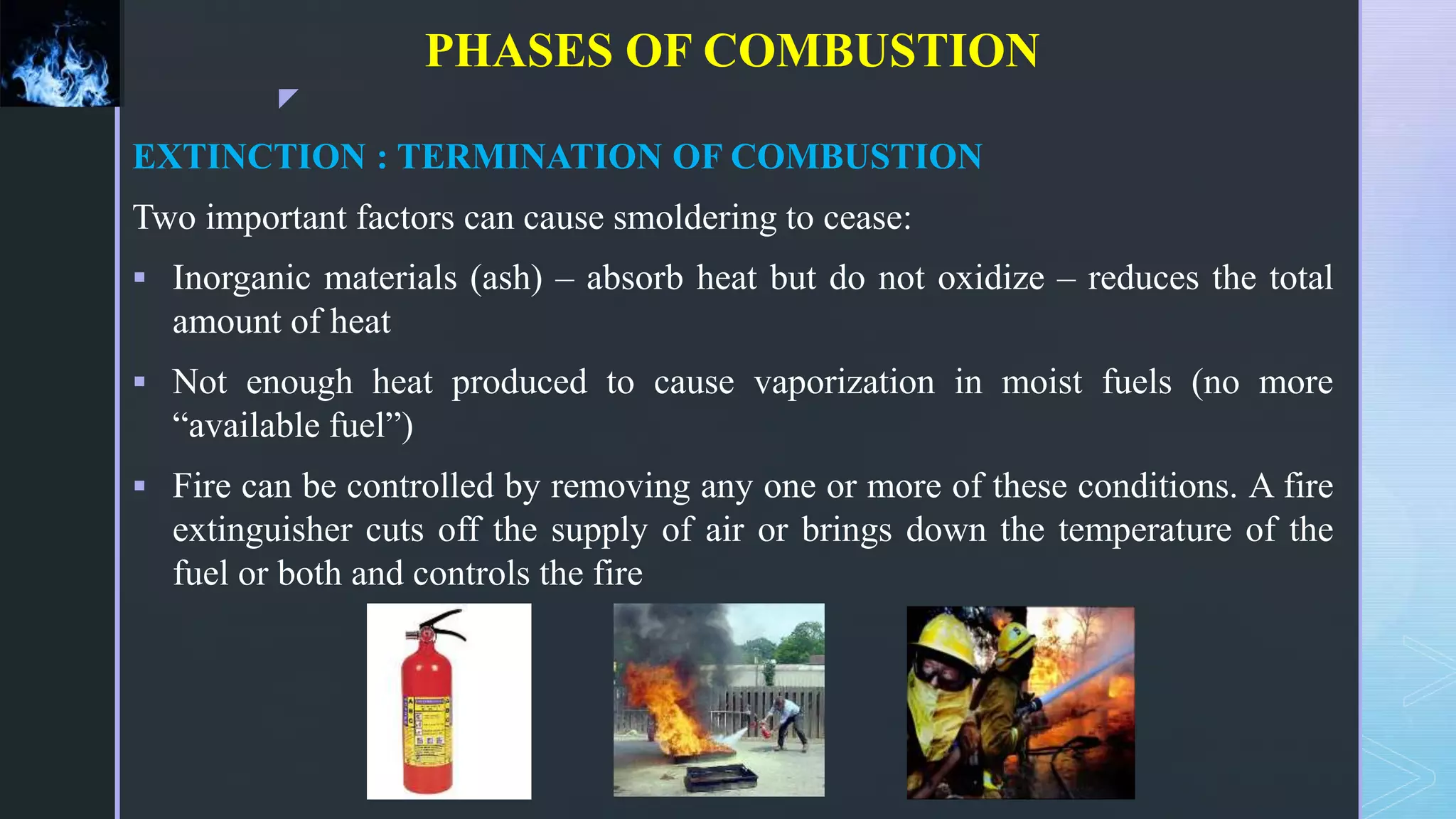
EXTINCTION : TERMINATION OF COMBUSTION
Two important factors can cause smoldering to cease:
 Inorganic materials (ash) – absorb heat but do not oxidize – reduces the total
amount of heat
 Not enough heat produced to cause vaporization in moist fuels (no more
“available fuel”)
 Fire can be controlled by removing any one or more of these conditions. A fire
extinguisher cuts off the supply of air or brings down the temperature of the
fuel or both and controls the fire
z
PHASES OF COMBUSTION
METHODS OF EXTINCTION OF FIRE
By using water
 Water is the most common fire extinguisher. It can be used only when materials
like wood , paper etc. are on fire
 Water cannot be used if electrical equipments are on fire because water
conducts electricity and can harm those trying to put out the fire
 Water cannot be used to put out oil and petrol fires because they float on water
and continue to burn
By using carbon dioxide
 Carbon dioxide is the best fire extinguisher to put out fire caused by
inflammable materials like oil and petrol and electrical equipments. Carbon
dioxide is heavier than air and it covers the fire and cuts off the supply of
oxygen and puts out the fire
 Carbon dioxide is stored at high pressure as liquid in cylinders. Chemicals like
sodium bicarbonate (baking soda), potassium bicarbonate produce carbon
dioxide near the fire
z
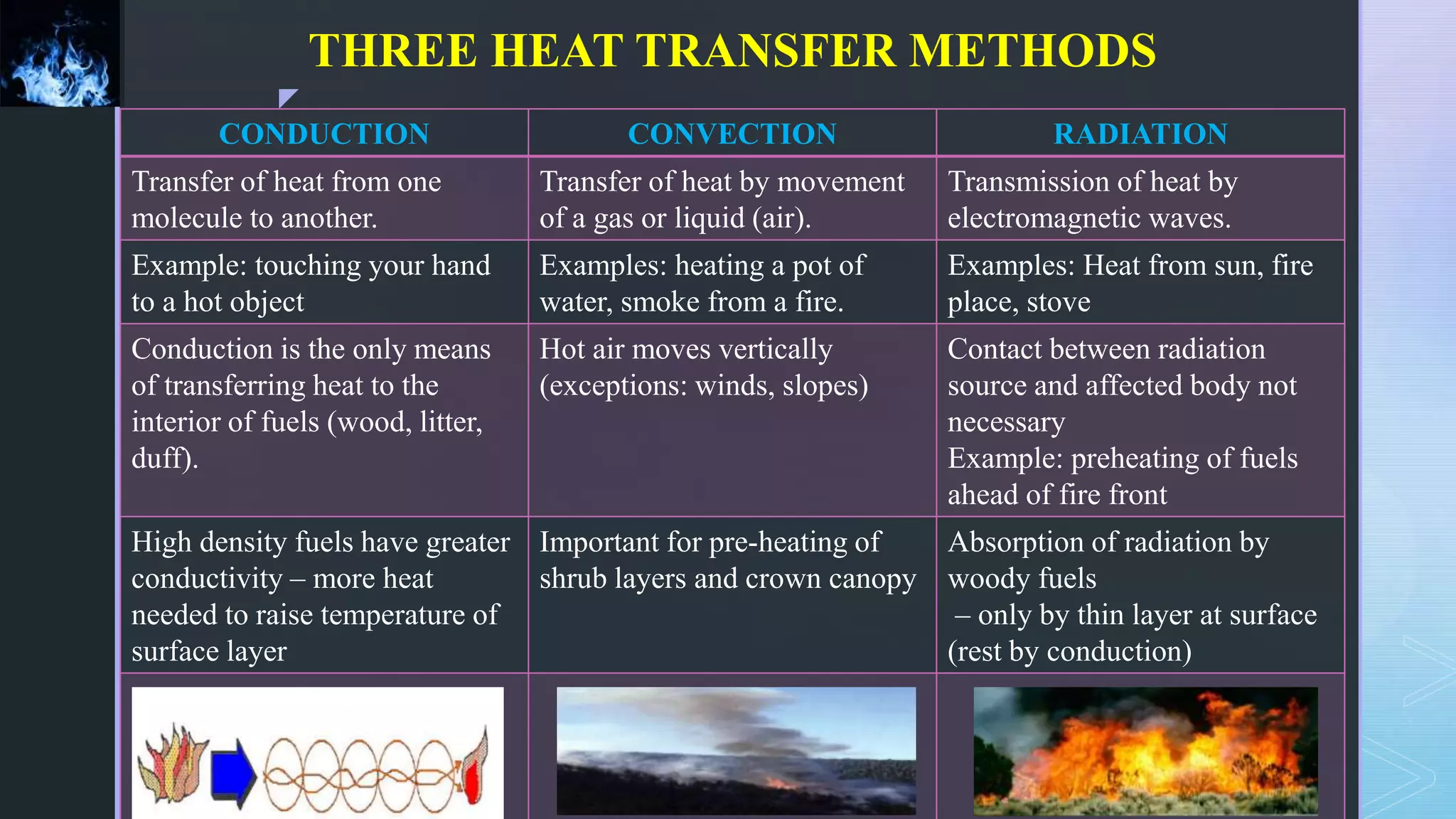
THREE HEAT TRANSFER METHODS
CONDUCTION CONVECTION RADIATION
Transfer of heat from one
molecule to another.
Transfer of heat by movement
of a gas or liquid (air).
Transmission of heat by
electromagnetic waves.
Example: touching your hand
to a hot object
Examples: heating a pot of
water, smoke from a fire.
Examples: Heat from sun, fire
place, stove
Conduction is the only means
of transferring heat to the
interior of fuels (wood, litter,
duff).
Hot air moves vertically
(exceptions: winds, slopes)
Contact between radiation
source and affected body not
necessary
Example: preheating of fuels
ahead of fire front
High density fuels have greater
conductivity – more heat
needed to raise temperature of
surface layer
Important for pre-heating of
shrub layers and crown canopy
Absorption of radiation by
woody fuels
– only by thin layer at surface
(rest by conduction)
z
IMPORTANT
DEFINITIONS
z
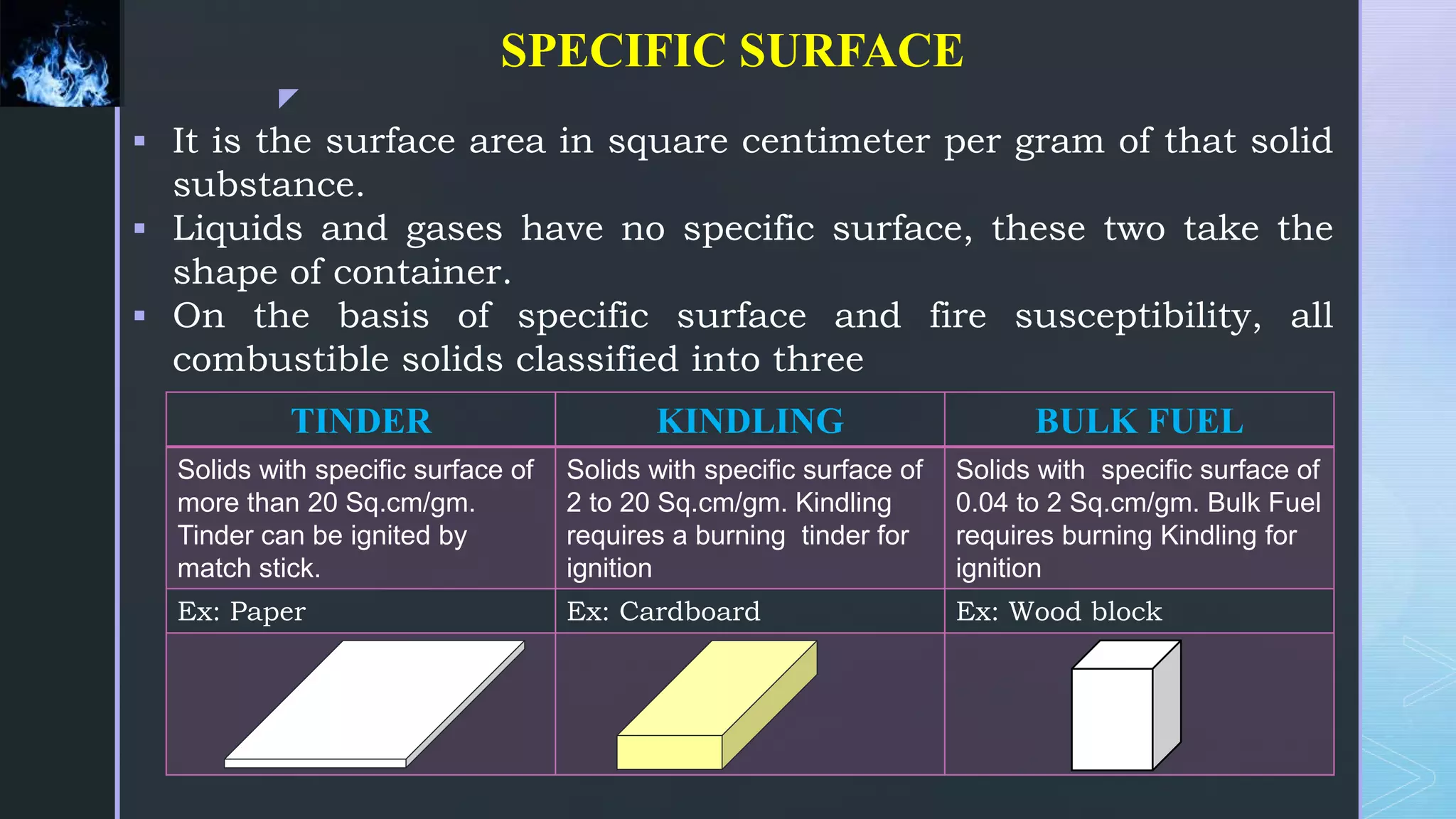
SPECIFIC SURFACE
 It is the surface area in square centimeter per gram of that solid
substance.
 Liquids and gases have no specific surface, these two take the
shape of container.
 On the basis of specific surface and fire susceptibility, all
combustible solids classified into three
TINDER KINDLING BULK FUEL
Solids with specific surface of
more than 20 Sq.cm/gm.
Tinder can be ignited by
match stick.
Solids with specific surface of
2 to 20 Sq.cm/gm. Kindling
requires a burning tinder for
ignition
Solids with specific surface of
0.04 to 2 Sq.cm/gm. Bulk Fuel
requires burning Kindling for
ignition
Ex: Paper Ex: Cardboard Ex: Wood block
z
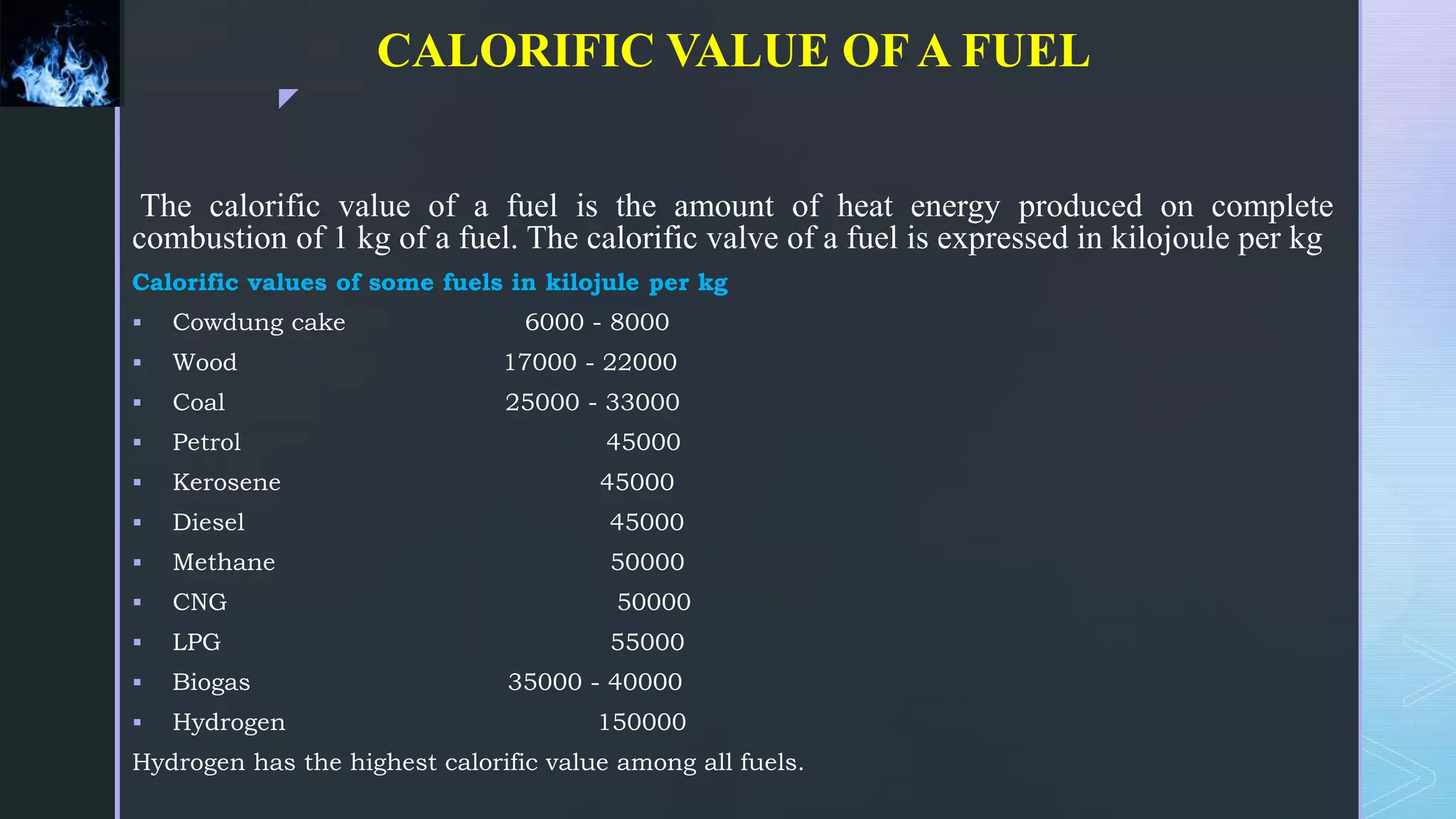
CALORIFIC VALUE OFA FUEL
The calorific value of a fuel is the amount of heat energy produced on complete
combustion of 1 kg of a fuel. The calorific valve of a fuel is expressed in kilojoule per kg
Calorific values of some fuels in kilojule per kg
 Cowdung cake 6000 - 8000
 Wood 17000 - 22000
 Coal 25000 - 33000
 Petrol 45000
 Kerosene 45000
 Diesel 45000
 Methane 50000
 CNG 50000
 LPG 55000
 Biogas 35000 - 40000
 Hydrogen 150000
Hydrogen has the highest calorific value among all fuels.
z
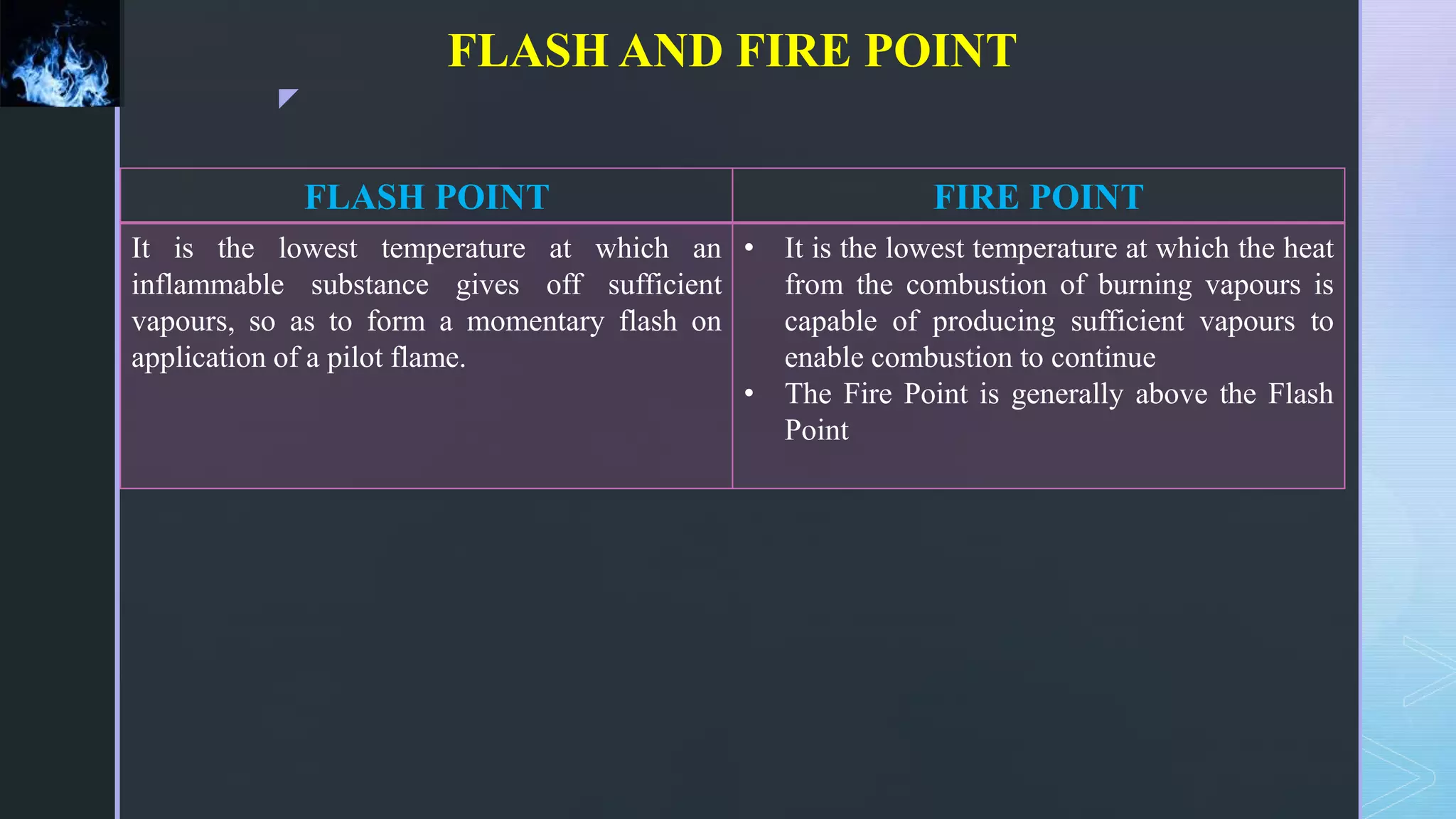
FLASH AND FIRE POINT
FLASH POINT FIRE POINT
It is the lowest temperature at which an
inflammable substance gives off sufficient
vapours, so as to form a momentary flash on
application of a pilot flame.
• It is the lowest temperature at which the heat
from the combustion of burning vapours is
capable of producing sufficient vapours to
enable combustion to continue
• The Fire Point is generally above the Flash
Point
z
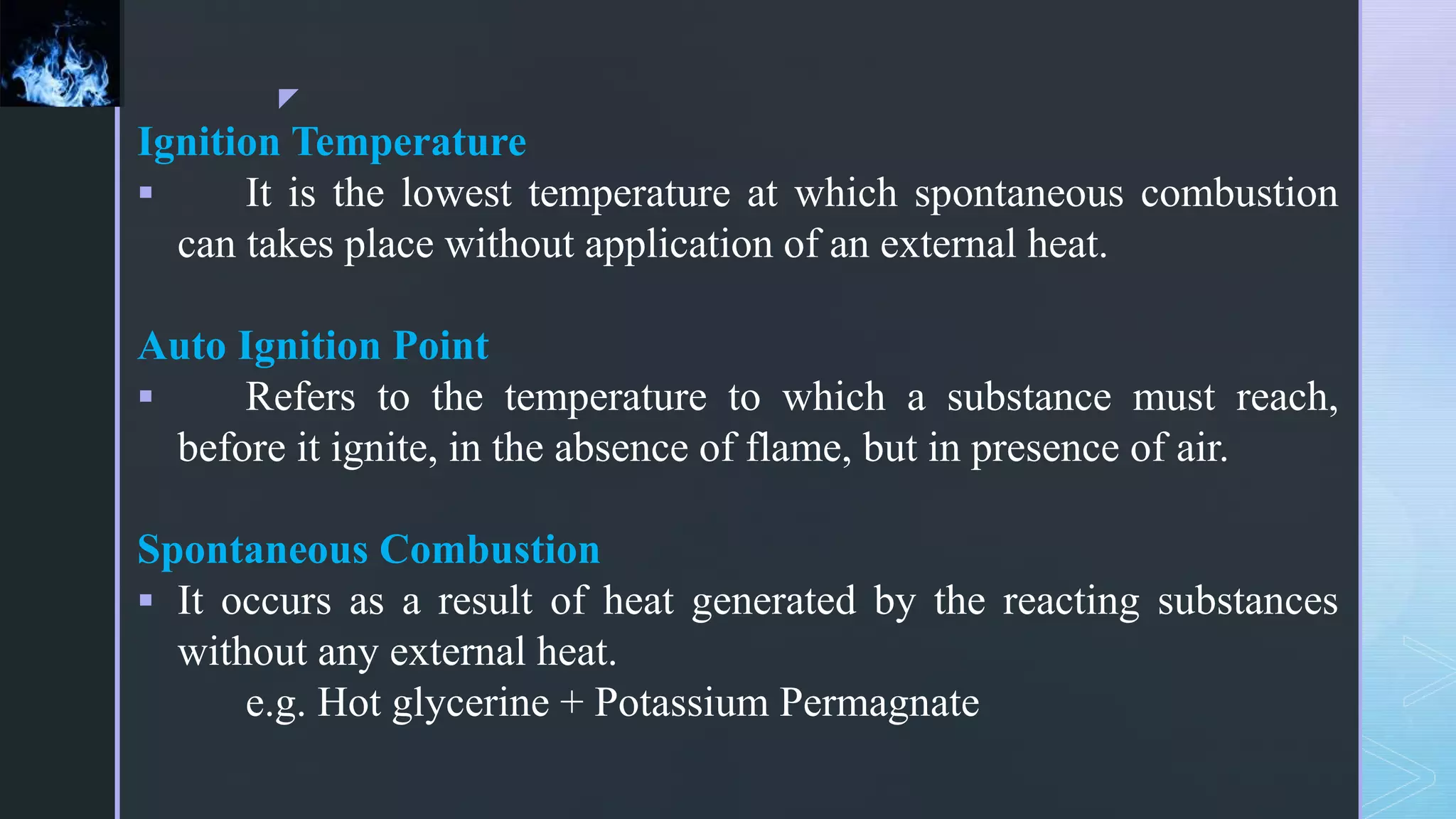
Ignition Temperature
 It is the lowest temperature at which spontaneous combustion
can takes place without application of an external heat.
Auto Ignition Point
 Refers to the temperature to which a substance must reach,
before it ignite, in the absence of flame, but in presence of air.
Spontaneous Combustion
 It occurs as a result of heat generated by the reacting substances
without any external heat.
e.g. Hot glycerine + Potassium Permagnate
z
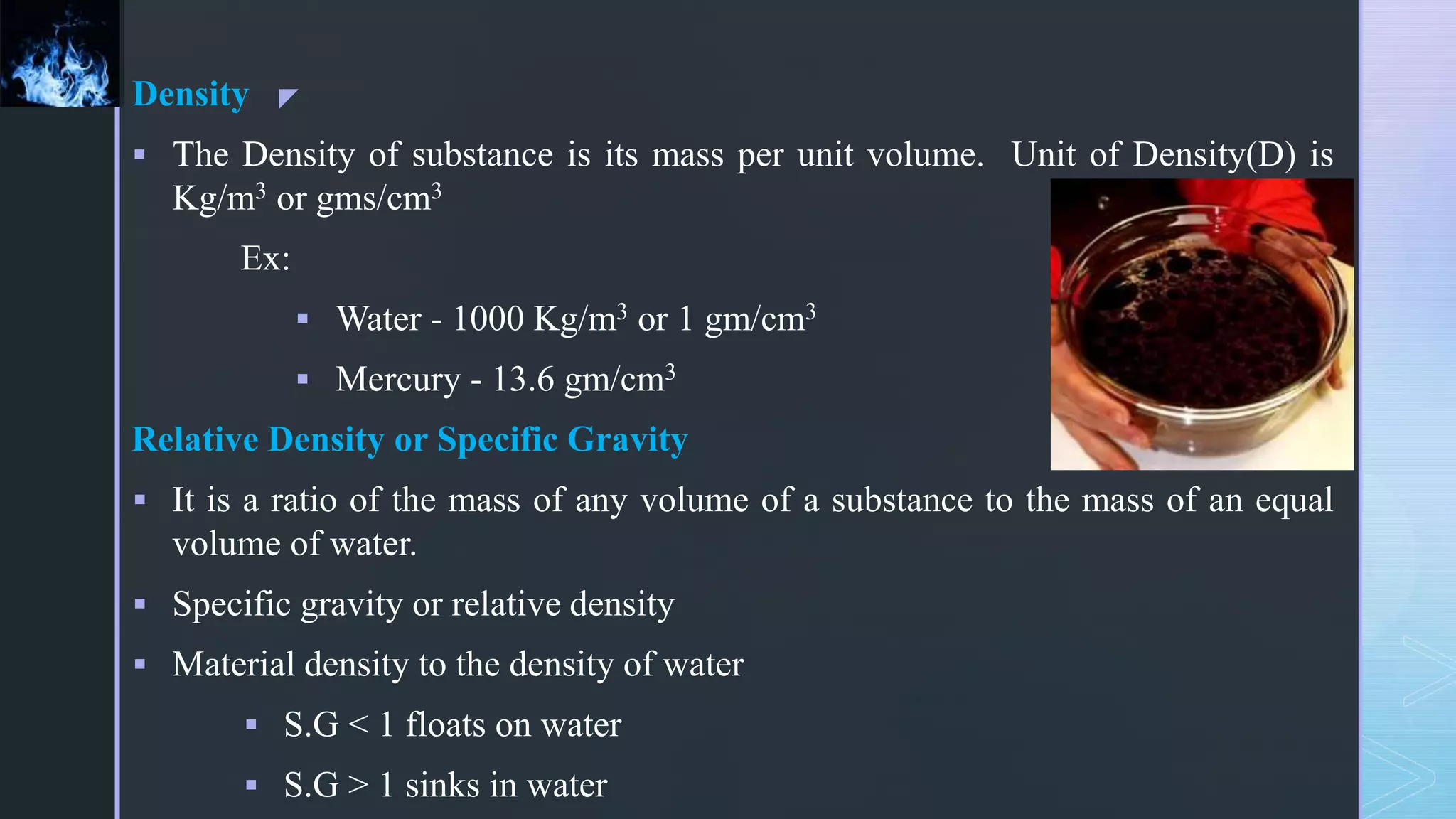
Density
 The Density of substance is its mass per unit volume. Unit of Density(D) is
Kg/m3 or gms/cm3
Ex:
 Water - 1000 Kg/m3 or 1 gm/cm3
 Mercury - 13.6 gm/cm3
Relative Density or Specific Gravity
 It is a ratio of the mass of any volume of a substance to the mass of an equal
volume of water.
 Specific gravity or relative density
 Material density to the density of water
 S.G < 1 floats on water
 S.G > 1 sinks in water
z
Vapour Density
 It is the ratio of the mass of a given volume of the vapour to the mass of an
equal volume of air under the same temperature and pressure
 Dense Vapor (V.D >1) Hazards -Choking, suffocation, death, Distant ignition
possible
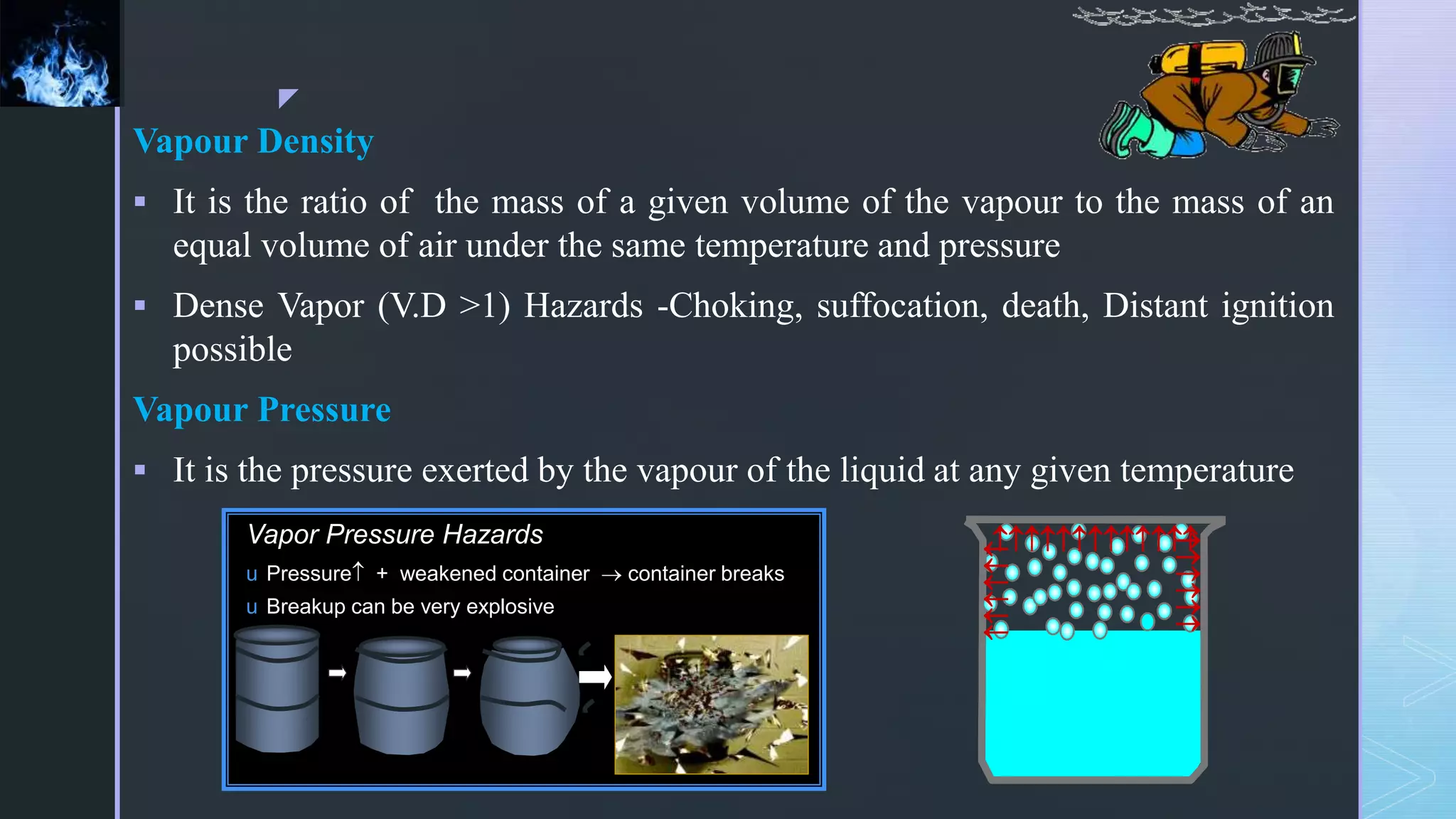
Vapour Pressure
 It is the pressure exerted by the vapour of the liquid at any given temperature






Vapor Pressure Hazards
u Pressure + weakened container  container breaks
u Breakup can be very explosive
z
Latent Heat
 It is the amount of heat energy required to change the state of a matter without
raising the temperature.
Latent Heat of Vapourization
 It is the heat energy which is absorbed by the liquid at its boiling point, to
convert from its liquid state to gaseous state, without raising the temperature.
Ex: Water - 2260000 Joules/Kg
Latent Heat of Fusion
 It is the heat energy which is required to change the state from solid to liquid at
melting point of substance without raising the temperature.
Ex: Water - 336000 Joules/Kg
Thermal Capacity
 The thermal capacity or heat capacity of a body is the heat required to raise its
temperature by 1 degree Centigrade.
Ex: Water - 4.2 KJ/Kg/degree Centrigrade
 Heat Energy can be transferred from a place of higher temperature to one at
lower temperature. When heat is added to a body the temperature rises.
z
Specific Heat
 It is the ratio of thermal capacity of a substance to that of water. Material with
low specific heat will heat up more rapidly in fire conditions.
Thermal Expansion of Solids
 When a solid is heated, it expands in length, breadth and thickness. Solids
which are homogeneous expand uniformly
Co-efficient of Linear Expansion
 The amount with which unit length of substance expands when its temperature
is raised by 1 degree Centigrade is called the Co-efficient of Linear Expansion
of the substance
Ex: Steel - 0.000012 per degree Centigrade
Co-efficient of Cubical Expansion
 Solid - it is 3 times the co-efficient of linear expansion.
 Liquid - only the co-efficient of volume expansion is applicable.
 Gases - can be measured either as an increase in volume at constant pressure or
as the increase in pressure at constant volume.

5. COMBUSTION PRINCIPLES.pptx

  • 1.
  • 2.
    z COMBUSTION  The chemicalprocess in which a substance reacts with oxygen to produce heat is called combustion  Substances which burn in air to produce heat and light are called combustible substances. It is also called a fuel  Eg :- wood, coal, charcoal, kerosene, petrol, diesel, liquified petroleum gas (LPG), compressed natural gas (CNG), etc SOLID FUELS LIQUID FUELS GASEOUS FUELS
  • 3.
    z PRINCIPLES OF COMBUSTION Combustion is a chemical reaction between a fuel and oxygen which is accompanied by the production of a considerable amount of heat. The process of combustion is an exothermic reaction  The reaction has to be initiated by some source of high-temperature energy called ignition  We can divide up the combustion of a fuel into several processes  Bringing together the fuel and air (the reactants) in the correct proportions  Igniting the reactants  Ensuring that the flame burns in a stable manner and that combustion is complete  Extracting useful heat from the process, and  Arranging for the safe disposal of the products of combustion
  • 4.
    z 3 T’s OFCOMBUSTION The objective of good combustion is to release all the heat which is available in the fuel.  Temperature high enough to ignite and maintain ignition of the fuel,  Turbulence or intimate mixing of the fuel and oxygen, and  Time sufficient for complete combustion.
  • 5.
  • 6.
    z COMBUSTION – ACHEMICAL PROCESS FUEL: PHOTOSYNTHESIS (storage of chemical energy) CO2 + H2O + HEAT (+ gases + char + ash) (C6H10O5)n Solar Energy + CO2 + H2O + O + Ignition Temperature Decay COMBUSTION (conversion of stored energy to thermal, radiant, kinetic energy)
  • 7.
    z  During combustion,molecules undergo chemical reactions.  The reactant atoms are rearranged to form new combinations (oxidized).  The chemical reaction can be presented by reaction equations.  However, reaction equations represent initial and final results and do not indicate the actual path of the reaction, which may involve many intermediate steps and intermediate products.  This approach is similar to thermodynamics system analysis, where only end states and not path mechanism are used.
  • 8.
    z COMPLETE COMBUSTION  Combustionis a chemical reaction between a fuel and an oxidant which proceeds above minimum temperature called the spontaneous ignition temperature to which the reactants must be heated.  In combustion of gases and vapours, the proportions of fuel and oxidant must be between the limits of inflammability, and vary with the particular fuel, oxidant, diluent, direction of flame propogation, pressure, temperature, presence of catalyst, etc.  In combustion of all fuels, it is desirable to know the stoichiometric proportions i.e. the amount of oxidant which on completion of combustion with a given amount of fuel would lead to the products like carbon dioxide, water, sulphur dioxide and nitrogen. This idealized concept is the basis of all combustion calculations  The transformation to a lower energy level is responsible for the exothermic nature of the reaction
  • 9.
    z ELEMENT’S ATOMIC WEIGHTAND MOLECULAR WEIGHT SUBSTANCE CHEMICAL FORMULAE ATOMIC WEIGHT MOLECULAR WEIGHT Carbon Sulphur Hydrogen Oxygen Nitrogen Carbon dioxide Carbon monoxide Water vapour Sulphur dioxide Methane Ethylene Air C S H2 O2 N2 CO2 CO H2O SO2 CH2 C2H4 - 12 32 1 16 14 - - - - - - - 12 32 2 32 28 44 28 18 64 16 28 29
  • 10.
    z  Majority ofhydrocarbon fuels have as active ingredients – carbon (C), hydrogen (H), oxygen (O), nitrogen (N) and sulphur (S).  Generally combustion requires reaction with an oxidant or supporter of combustion. Oxygen is the main oxidant, but the halogens (chlorine and fluorine), hydrogen peroxide and also nitric acid, may act as oxidants as in rocket propulsion  Air is the commonest oxidant because it is cheap and readily available. A typical volumetric composition of dry air is:  N2 = 78.09, O2 = 20.95, Ar = 0.93, CO2 = 0.03, Ne = 0.0018, He = 0.005, CH4 = 0.002, Kr = 0.0001, NO = 0.00005, H2 = 0.00005, O3 = 0.00004, Xe = 0.000008
  • 11.
    z COMPOSITION OF AIR On a molar (or volume) basis, dry air is composed of: – 20.9% oxygen O2 – 78.1% nitrogen N2 – 0.9% CO2, Ar, He, Ne, H2, and others  A good approximation of this by molar or volume is: 21% oxygen, 79% nitrogen  Thus, each mole of oxygen is accompanied 0.79/0.21 = 3.76 moles of nitrogen  At ordinary combustion temperatures, N2 is inert, but nonetheless greatly affects the combustion process because its abundance, and hence its enthalpy change, plays a large part in determining the reaction temperatures.  - This, in turn, affects the combustion chemistry.  - Also, at higher temperatures, N2 does react, forming species such as oxides of nitrogen (NOx), which are a significant pollutant.
  • 12.
    z • The compositionvaries with altitude and slightly by industrial pollution. By convention, the following analysis are used in combustion calculations. • Assuming the fixed proportion of oxygen to ‘nitrogen’, which includes all the inerts, the stoichiometric oxygen is related to the stoichiometric air requirement Air components By volume % By weight % O2 N2 21.00 79.00 23 77 Total 100.00 100
  • 13.
    z  Theoretical airis defined as the minimum quantity of air per unit mass of fuel required which is sufficient on complete combustion to give CO2, H2O, SO2 and N2 as products.  Theoretical air is a fixed quantity for a given fuel and is calculated by the stoichiometry/chemical reaction of the various combustible constituents of the fuel.  Similarly, the theoretical flue gas refers to the flue gas obtained by the complete combustion of fuel using theoretical amount of air. Basis of calculation is generally taken as 100 kg of solid or liquid fuel and 100 kg moles of gaseous fuels or flue gas as may be the case
  • 14.
    z • Excess airis the practical amount of air which is supplied in a combustion process usually to ensure that, under the conditions of inadequate mixing of fuel and air, the combustion process is likely to go to completion. • Normally 10, 15-20, 20-25 and 50-100% excess air is supplied with gaseous, liquid, pulverised fuel and solid lumpy fuels, respectively. • Excess air = actual air – theoretical air / theoretical air = actual O2 – theoretical O2 / theoretical O2 • Excess air factor = actual air used / theoretical air • At 40% excess air, the value of excess air factor is 1.4
  • 15.
    z  Except forthe purposes of corrosion, the convention is that sulphur burns to sulphur dioxide. (in practice 1-3% sulphur in the gases may form SO3, part of which is subsequent to the combustion process and is completed in the upper atmosphere).  Oxygen in the fuel is assumed to take part in the combustion reaction. Thus explosives contain nearly stoichiometric oxygen.  Except for a very small amount of nitrogen, which forms NO and NO2, nitrogen (N) in the fuel is conventionally assumed to form nitrogen gas (N2) on combustion.
  • 16.
    z • Basic completecombustion reactions are C + O2 = CO2 1 mole + 1 mole = 1 mole (molar or volume basis) 12 kg + 32 kg = 44 kg (mass basis) H2 + ½ O2 = H2O 1 mole + ½ mole = 1 mole (molar or volume basis) 2 kg + 16 kg = 18 kg (mass basis) S + O2 = SO2 1 mole + 1 mole = 1 mole (molar or volume basis) 32 kg + 32 kg = 64 kg (mass basis) • These reactions obey the laws of algebra, as each reaction can be multiplied through by any constant factor and reactions can be subsequently be added or subtracted
  • 17.
    z  Analyses ofsolid and liquid fuels are normally reported on a mass basis, while gaseous fuels are normally analysed on a volume basis. Waste gas analyses are generally reported by volume on the dry basis because condensation takes place from the sample. Moisture is determined separately, if it is measured at all.  Ultimate CO2 is defined as the volume % CO2 in waste gas (dry basis) when the fuel is completely burnt with stoichiometric air.  Combustibles in the solid and liquid fuels are expressed as elements in weight percent while for gaseous fuels, they are given in volume percent or mole percent
  • 18.
    z ENERGY PROFILE OFTHE COMBUSTION REACTION
  • 19.
    z QUANTIFICATION OF THECOMBUSTION REACTION Stoichiometry  At the same temperature and pressure, equal volumes of gases contain equal numbers of molecules. This means that the reaction CH4 + 2O2 → CO2 + 2H2O also shows that one volume of methane requires just two volumes of oxygen to produce complete combustion. The equation above can be quantified as: CH4 + 2O2 → CO2 + 2H2O 1 vol 2vols 1 vol 2(or 0) vols 2: water vapor 0: water liquid Taking as a basis each molecular weight expressed in kg: CH4 + 2O2 → CO2 + 2H2O 16 kg 64 kg 44 kg 36 kg
  • 20.
    z  A thirdbasis for quantification of the combustion reaction and which is perhaps the most generally applicable, is the use of molar quantities CH4+2O2 → CO2+2H2O 1 mole 2 moles 1 mole 2 moles  This last point can be significant as the combustion of carbon: C + O2 → CO2 cannot be meaningfully represented in volumetric terms as carbon is a solid fuel
  • 21.
    z INCOMPLETE COMBUSTION  Lackof air - insufficient air will not provide enough oxygen to complete combustion  Formation of black smoke, soot, tar, partial decomposition products and unburnt fuel are all symptoms of incomplete combustion.  CO, H2 or CH4 analysed in the waste gas indicate incomplete combustion.  The process may be carried out deliberately as in gasification and sometimes for reducing atmospheres in the heat treatment of metals.  Over-gassing - if a burner is over-gassed there is no guarantee sufficient air will be available for combustion  Blocked or inadequate flue -failure to remove combustion products will affect the combustion process  Impingement of the inner cone - a solid object in the inner cone of the flame will cool the fuel below ignition temperature. This will result in incomplete combustion  Incomplete combustion produces carbon monoxide, which is harmful
  • 22.
    z EQUATIONS FOR STOICHIOMETRICOR CHEMICALLY CORRECT MIXTURES  Carbon burning to CO2 (Analysis by weight) C + O2 = CO2 Inserting the values of molecular weights, 12 units by weight + 2x 16 units by weight = 44 units by weight If we consider the unit of weight as kg 12 kg of C + 32 kg of O2  44 kg of CO2 Or 1 kg of C + 8/3 kg of O2  11/3 kg of CO2
  • 23.
    z Carbon burning toCO2 (Analysis by volume) C + O2  CO2 By Avogadro's hypothesis, the molecules of all the gases occupy the same volume under the same conditions of temperature and pressures. Therefore, negligible volume of solid carbon + 1 volume of O2 = 1 volume of CO2 or 1 volume of oxygen combines with carbon to give 1 volume of CO2 Thus, there is no molecular expansion or contraction.
  • 24.
    z Carbon burning tocarbon monoxide (analysis by weight) 2C + O2 = 2CO 2 x 12 kg C + 2 x 16 kg O2 = 2(12+6) kg CO Therefore 1 kg C + 4/3 kg O2 = 7/3 kg CO Carbon burning to carbon monoxide (analysis by volume) 2C + O2 = 2CO Neglecting the volume of solid carbon, we find that 1 volume of O2 combines with carbon to give 2 volumes of CO There is an increase in volume here
  • 25.
    z Carbon monoxide burningto carbon dioxide (analysis by weight) 2CO + O2 = 2CO2 2 x 28 kg + 32 kg = 2 x 44 kg Therefore, 1 kg carbon monoxide + 4/7 kg of oxygen = 11/7 kg of carbon dioxide Carbon monoxide burning to carbon dioxide (analysis by volume) 2CO + O2 = 2CO2 2 vol CO + 1 vol O2 = 2 vol CO2 There is molecular contraction in volume
  • 26.
    z Sulphur burning tosulphur dioxide (analysis by weight) S + O2 = SO2 32 kg + 32 kg = 64kg Therefore, 1 kg S + 1 kg O2 = 2 kg SO2 Sulphur burning to sulphur dioxide (analysis by volume) S + O2 = SO2 Negligible volume of S + 1 vol of O2 = 1 vol of SO2 There is no molecular contraction or expansion in volume
  • 27.
    z Methane, complete combustion(analysis by weight) CH4 + 2O2 = CO2 + 2H2O 16 kg + 64 kg = 44 kg + 36 kg Therefore, 1 kg CH4 + 4 kg of O2 = 11/4 kg of CO2 +9/4 kg of H2O Methane, complete combustion (analysis by volume) CH4 + 2O2 = CO2 + 2H2O 1 vol + 2 vol = 1 vol + 2 vol Therefore, 1 vol CH4 + 2 vol O2 = 1 vol CO2 + 2 vol of H2O (steam) There is no molecular expansion or contraction in volume
  • 28.
    z Ethylene, complete combustion(analysis by weight) C2H4 + 3O2 = 2CO2 + 2H2O 28 kg + 96 kg = 88 kg + 36 kg 1 kg C2H4 +24/7 kg of O2 = 22/7 kg of CO2 + 9/7 kg of H2O Ethylene, complete combustion (analysis by volume) C2H4 + 3O2 = 2CO2 + 2H2O 1 volume of C2H4 + 3 volume of O2 = 2 volume of CO2 + 2 volume of H2O (steam) There is no molecular expansion or contraction in volume
  • 29.
    • Stoichiometry andAir/Fuel Ratios  Oxidation all the elements or components in a fuel is known as complete combustion or “Stoichiometric Combustion”.  The amounts of fuel and air taking part in a combustion process are often expressed as the ‘air to fuel’ ratio:  Minimum amount of air (or oxygen) required to have a complete combustion is represented by Stoichiometric Ratio AFRstoich.  For a fuel CxHyOz     . 16 12 2 4 32 . 34 Stoich z y x z y x AFR       . fuel air m m AFR  BASICS OF COMBUSTION
  • 30.
    • Stoichiometry andAir/Fuel Ratios  Eg: Combustion of Methane CH4 + 2(O2 + 79/21N2 )  CO2 + 2H2O + 158/21N2 Therefore, AFRStoich = (232 + 22879/21)/(12 + 41) = 17.16 Fuel Phase AFRStoich Very light fuel oil liquid 14.27 Light fuel oil liquid 14.06 Medium heavy fuel oil liquid 13.79 Heavy fuel oil liquid 13.46 Generic Biomass solid 5.88 Coal A solid 6.97 LPG (90 P : 10 B) gas 15.55 Carbon solid 11.44
  • 31.
    • Stoichiometry andAir/Fuel Ratios  In order to obtain complete combustion, supply of excess amount of air (or oxygen) is required in practice.  The amount of excess air required depends on the properties of the fuel and the technology of the combustion device.  Amount of excess air is usually represented by the equivalence ratio, φ, or the ‘lambda’ ratio λ: • Combustion Reactions of Fuels  Complete combustion of hydrocarbons:  Incomplete combustion of hydrocarbons :   Heat. N 4 2 1 76 . 3 O H 2 CO N 76 . 3 O 4 2 1 O CH 2 2 2 2 2 x y                       x y y x y     Heat. N 76 . 3 O H CO O NO CH H CO N 76 . 3 O O H C 2 2 2 2 X 4 2 2 2 z y x            p s r p     
  • 32.
    z HARMFUL EFFECTS ONTHE ENVIRONMENT DUE TO BURNING OF FUELS  Fuels like wood, coal, petroleum release unburnt carbon particles which cause respiratory diseases like asthma  Incomplete combustion of fuels release carbon monoxide gas which is a very poisonous gas which can cause death  Burning of most fuels release carbon dioxide gas which causes rise in the temperature of the atmosphere. This is called global warming. It causes melting of polar ice, rise in sea level and flooding of coastal areas  Burning of coal and petroleum release oxides of sulphur and nitrogen which dissolve in rain water and forms acid rain. It is harmful for crops, soil and damages buildings
  • 33.
    z BASIC ELEMENTS FORFIRE FIRE TRIANGLE Approximately 16% required Normal air contains 21% (by vol) of oxygen Some fuels contains its own oxygen supply To reach Ignition Temp. Open flame, the sun, hot surface, sparks and arcs, friction, chemical action, electrical energy and gas compression GASES Natural gas, propane, CO, butane, hydrogen, acetylene, LIQUID Gasoline, kerosene, turpentine, alcohol, paint, varnish, olive oil, lacquer SOLID Coal, wood, paper, cloth, wax, grease, leather, plastic, sugar, grain, hay
  • 34.
    z STAGES OF BURNING Itdepends on the following factors  The amount of time the fire has burnt  The ventilation characteristics of the confining structure  The amount and type of combustibles present 1. Incipient or beginning phase 2. Free burning phase 3. Smoldering phase Products of combustion
  • 35.
    z THE SPEED OFCOMBUSTION IS AFFECTED BY THE AMOUNT OF OXYGEN PRESENT
  • 36.
    z BURNING PHASES INCIPIENT OR BEGINNINGPHASE FREE BURNING PHASE SMOLDERING PHASE Oxygen plentiful Oxygen supply is being depleted Oxygen supply not equal to demands of fire Temperature has not built up to high peak Fire has involved more fuel Temperature throughout system is very high Little steam production ; Thermal updraft rises, accumulates at highest point Heat accumulated at upper areas Oxygen deficiency may cause back-draft
  • 37.
    z PHASES OF COMBUSTION Pre-ignition  Ignition  Combustion  Extinction
  • 38.
    z PHASES OF COMBUSTION PREIGNITION(“PRE-HEATING”)-PYROLYSIS  Thermal degradation of the fuel = heat divided ( ~250 – 355 C )  Char (low temperatures = glowing)  Tar (high temperatures = volatile gases = flaming)  Mineral ash (inorganics) IGNITION  Transition between pre-ignition and combustion - Low temps = charring - glowing combustion - High temps = gases - flaming combustion
  • 39.
    z PHASES OF COMBUSTION TYPESOF NATURAL IGNITION LIGHTNING SPONTANEOUS IGNITION High temperature within column of hot gases Pile (> 1m ) heating (heat liberated faster to surroundings) 100 cloud-to-ground discharges/sec on earth - chip piles: fresh chips + foliage, moisture > 20% - pile Microbial activity = respiration  CO2 + H2O + Heat Only 0.1 - .001 of strikes = wildfire Requirements for ignition: Oxygen + formation of char surface oxidation of char = smoldering  heat + continuous pyrolysis (flaming)
  • 40.
    z PHASES OF COMBUSTION TYPESOF COMBUSTION SMOLDERING / GLOWING FLAMING COMBUSTION Surface fires - Lower temperature but longer duration Volatile gases mix with air = flames Ground fires in organic soil horizons - smolder for mo/yrs (potential for re- ignition) High temperatures necessary (425-480 C) High smoke production (particulates, CO) In general, fewer emissions than smoldering fires
  • 41.
    z PHASES OF COMBUSTION TYPESOF COMBUSTION SLOW OR INCIPIENT COMBUSTION RAPID OR ACTIVE COMBUSTION DEFLAGRATION EXPLOSION The amount of heat and light emitted is feeble A considerable amount of heat and light is emitted within a short time Takes place with a considerable rapidity, evolving heat and light A very rapid combustion with a loud noise within an extremely short time with generation of very high pressure and temperature.
  • 42.
    z PHASES OF COMBUSTION RATEOF COMBUSTION A rate of combustion or the spread of fire would depends on  The area of solid/liquid in contact with air  The amount of heat generated to raise the temperature of unburnt portion  The ability of materials to conduct heat away  Atmospheric humidity  Wind velocity  Temperature  Atmospheric pressure
  • 43.
    z PHASES OF COMBUSTION EXTINCTION: TERMINATION OF COMBUSTION Two important factors can cause smoldering to cease:  Inorganic materials (ash) – absorb heat but do not oxidize – reduces the total amount of heat  Not enough heat produced to cause vaporization in moist fuels (no more “available fuel”)  Fire can be controlled by removing any one or more of these conditions. A fire extinguisher cuts off the supply of air or brings down the temperature of the fuel or both and controls the fire
  • 44.
    z PHASES OF COMBUSTION METHODSOF EXTINCTION OF FIRE By using water  Water is the most common fire extinguisher. It can be used only when materials like wood , paper etc. are on fire  Water cannot be used if electrical equipments are on fire because water conducts electricity and can harm those trying to put out the fire  Water cannot be used to put out oil and petrol fires because they float on water and continue to burn By using carbon dioxide  Carbon dioxide is the best fire extinguisher to put out fire caused by inflammable materials like oil and petrol and electrical equipments. Carbon dioxide is heavier than air and it covers the fire and cuts off the supply of oxygen and puts out the fire  Carbon dioxide is stored at high pressure as liquid in cylinders. Chemicals like sodium bicarbonate (baking soda), potassium bicarbonate produce carbon dioxide near the fire
  • 45.
    z THREE HEAT TRANSFERMETHODS CONDUCTION CONVECTION RADIATION Transfer of heat from one molecule to another. Transfer of heat by movement of a gas or liquid (air). Transmission of heat by electromagnetic waves. Example: touching your hand to a hot object Examples: heating a pot of water, smoke from a fire. Examples: Heat from sun, fire place, stove Conduction is the only means of transferring heat to the interior of fuels (wood, litter, duff). Hot air moves vertically (exceptions: winds, slopes) Contact between radiation source and affected body not necessary Example: preheating of fuels ahead of fire front High density fuels have greater conductivity – more heat needed to raise temperature of surface layer Important for pre-heating of shrub layers and crown canopy Absorption of radiation by woody fuels – only by thin layer at surface (rest by conduction)
  • 46.
  • 47.
    z SPECIFIC SURFACE  Itis the surface area in square centimeter per gram of that solid substance.  Liquids and gases have no specific surface, these two take the shape of container.  On the basis of specific surface and fire susceptibility, all combustible solids classified into three TINDER KINDLING BULK FUEL Solids with specific surface of more than 20 Sq.cm/gm. Tinder can be ignited by match stick. Solids with specific surface of 2 to 20 Sq.cm/gm. Kindling requires a burning tinder for ignition Solids with specific surface of 0.04 to 2 Sq.cm/gm. Bulk Fuel requires burning Kindling for ignition Ex: Paper Ex: Cardboard Ex: Wood block
  • 48.
    z CALORIFIC VALUE OFAFUEL The calorific value of a fuel is the amount of heat energy produced on complete combustion of 1 kg of a fuel. The calorific valve of a fuel is expressed in kilojoule per kg Calorific values of some fuels in kilojule per kg  Cowdung cake 6000 - 8000  Wood 17000 - 22000  Coal 25000 - 33000  Petrol 45000  Kerosene 45000  Diesel 45000  Methane 50000  CNG 50000  LPG 55000  Biogas 35000 - 40000  Hydrogen 150000 Hydrogen has the highest calorific value among all fuels.
  • 49.
    z FLASH AND FIREPOINT FLASH POINT FIRE POINT It is the lowest temperature at which an inflammable substance gives off sufficient vapours, so as to form a momentary flash on application of a pilot flame. • It is the lowest temperature at which the heat from the combustion of burning vapours is capable of producing sufficient vapours to enable combustion to continue • The Fire Point is generally above the Flash Point
  • 50.
    z Ignition Temperature  Itis the lowest temperature at which spontaneous combustion can takes place without application of an external heat. Auto Ignition Point  Refers to the temperature to which a substance must reach, before it ignite, in the absence of flame, but in presence of air. Spontaneous Combustion  It occurs as a result of heat generated by the reacting substances without any external heat. e.g. Hot glycerine + Potassium Permagnate
  • 51.
    z Density  The Densityof substance is its mass per unit volume. Unit of Density(D) is Kg/m3 or gms/cm3 Ex:  Water - 1000 Kg/m3 or 1 gm/cm3  Mercury - 13.6 gm/cm3 Relative Density or Specific Gravity  It is a ratio of the mass of any volume of a substance to the mass of an equal volume of water.  Specific gravity or relative density  Material density to the density of water  S.G < 1 floats on water  S.G > 1 sinks in water
  • 52.
    z Vapour Density  Itis the ratio of the mass of a given volume of the vapour to the mass of an equal volume of air under the same temperature and pressure  Dense Vapor (V.D >1) Hazards -Choking, suffocation, death, Distant ignition possible Vapour Pressure  It is the pressure exerted by the vapour of the liquid at any given temperature       Vapor Pressure Hazards u Pressure + weakened container  container breaks u Breakup can be very explosive
  • 53.
    z Latent Heat  Itis the amount of heat energy required to change the state of a matter without raising the temperature. Latent Heat of Vapourization  It is the heat energy which is absorbed by the liquid at its boiling point, to convert from its liquid state to gaseous state, without raising the temperature. Ex: Water - 2260000 Joules/Kg Latent Heat of Fusion  It is the heat energy which is required to change the state from solid to liquid at melting point of substance without raising the temperature. Ex: Water - 336000 Joules/Kg Thermal Capacity  The thermal capacity or heat capacity of a body is the heat required to raise its temperature by 1 degree Centigrade. Ex: Water - 4.2 KJ/Kg/degree Centrigrade  Heat Energy can be transferred from a place of higher temperature to one at lower temperature. When heat is added to a body the temperature rises.
  • 54.
    z Specific Heat  Itis the ratio of thermal capacity of a substance to that of water. Material with low specific heat will heat up more rapidly in fire conditions. Thermal Expansion of Solids  When a solid is heated, it expands in length, breadth and thickness. Solids which are homogeneous expand uniformly Co-efficient of Linear Expansion  The amount with which unit length of substance expands when its temperature is raised by 1 degree Centigrade is called the Co-efficient of Linear Expansion of the substance Ex: Steel - 0.000012 per degree Centigrade Co-efficient of Cubical Expansion  Solid - it is 3 times the co-efficient of linear expansion.  Liquid - only the co-efficient of volume expansion is applicable.  Gases - can be measured either as an increase in volume at constant pressure or as the increase in pressure at constant volume.

Editor's Notes

  • #17 Mole of a substance is the mass of the substance numerically equal to the molecular weight of the substance. Mole = weight of the substance in kg / molecular weight of the substance Moles are specfifically useful in the case of gaseous fuels because the equations of chemical reactions are also molecular equations