11/26/2013
1
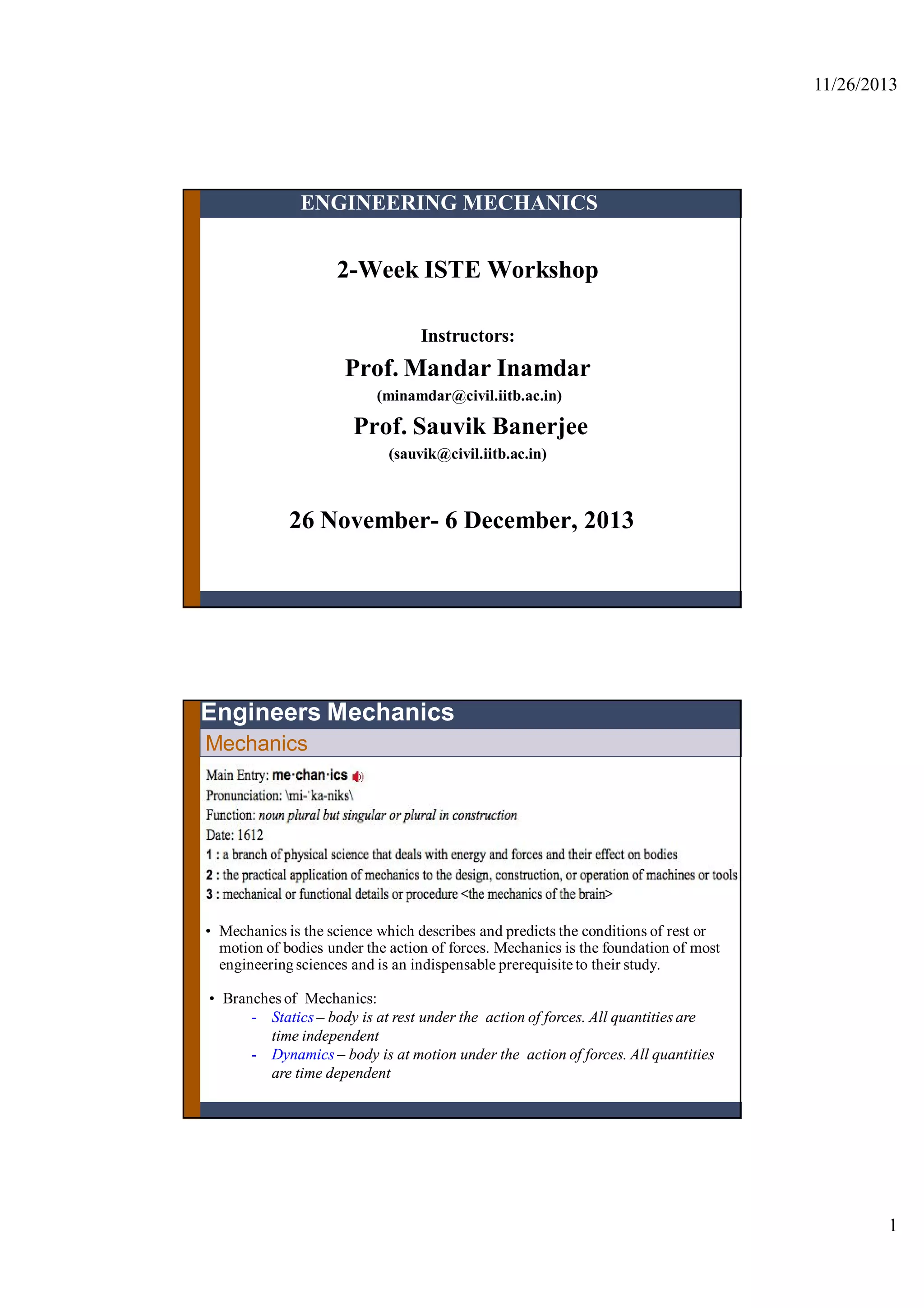
2-Week ISTE Workshop
Instructors:
Prof. Mandar Inamdar
(minamdar@civil.iitb.ac.in)
Prof. Sauvik Banerjee
(sauvik@civil.iitb.ac.in)
26 November- 6 December, 2013
ENGINEERING MECHANICS
Mechanics
• Mechanics is the science which describes and predicts the conditions of rest or
motion of bodies under the action of forces. Mechanics is the foundation of most
engineeringsciences and is an indispensable prerequisite to their study.
Engineers Mechanics
• Branches of Mechanics:
- Statics – body is at rest under the action of forces. All quantities are
time independent
- Dynamics – body is at motion under the action of forces. All quantities
are time dependent
11/26/2013
2
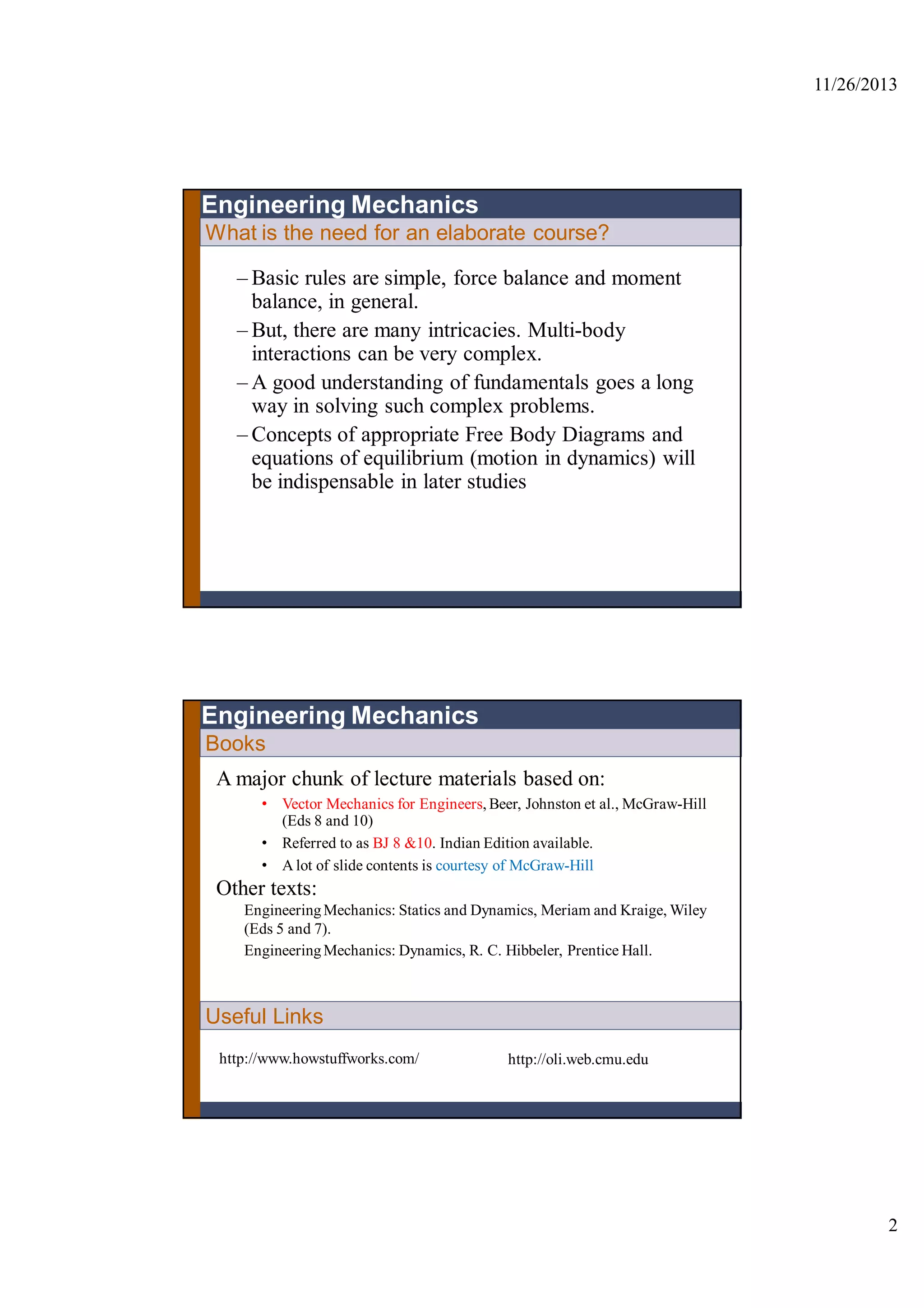
What is the need for an elaborate course?
– Basic rules are simple, force balance and moment
balance, in general.
– But, there are many intricacies. Multi-body
interactions can be very complex.
– A good understanding of fundamentals goes a long
way in solving such complex problems.
– Concepts of appropriate Free Body Diagrams and
equations of equilibrium (motion in dynamics) will
be indispensable in later studies
Engineering Mechanics
Books
A major chunk of lecture materials based on:
• Vector Mechanics for Engineers, Beer, Johnston et al., McGraw-Hill
(Eds 8 and 10)
• Referred to as BJ 8 &10. Indian Edition available.
• A lot of slide contents is courtesy of McGraw-Hill
Other texts:
EngineeringMechanics: Statics and Dynamics, Meriam and Kraige, Wiley
(Eds 5 and 7).
EngineeringMechanics: Dynamics, R. C. Hibbeler, Prentice Hall.
Engineering Mechanics
Useful Links
http://www.howstuffworks.com/ http://oli.web.cmu.edu
11/26/2013
3
Fundamentals
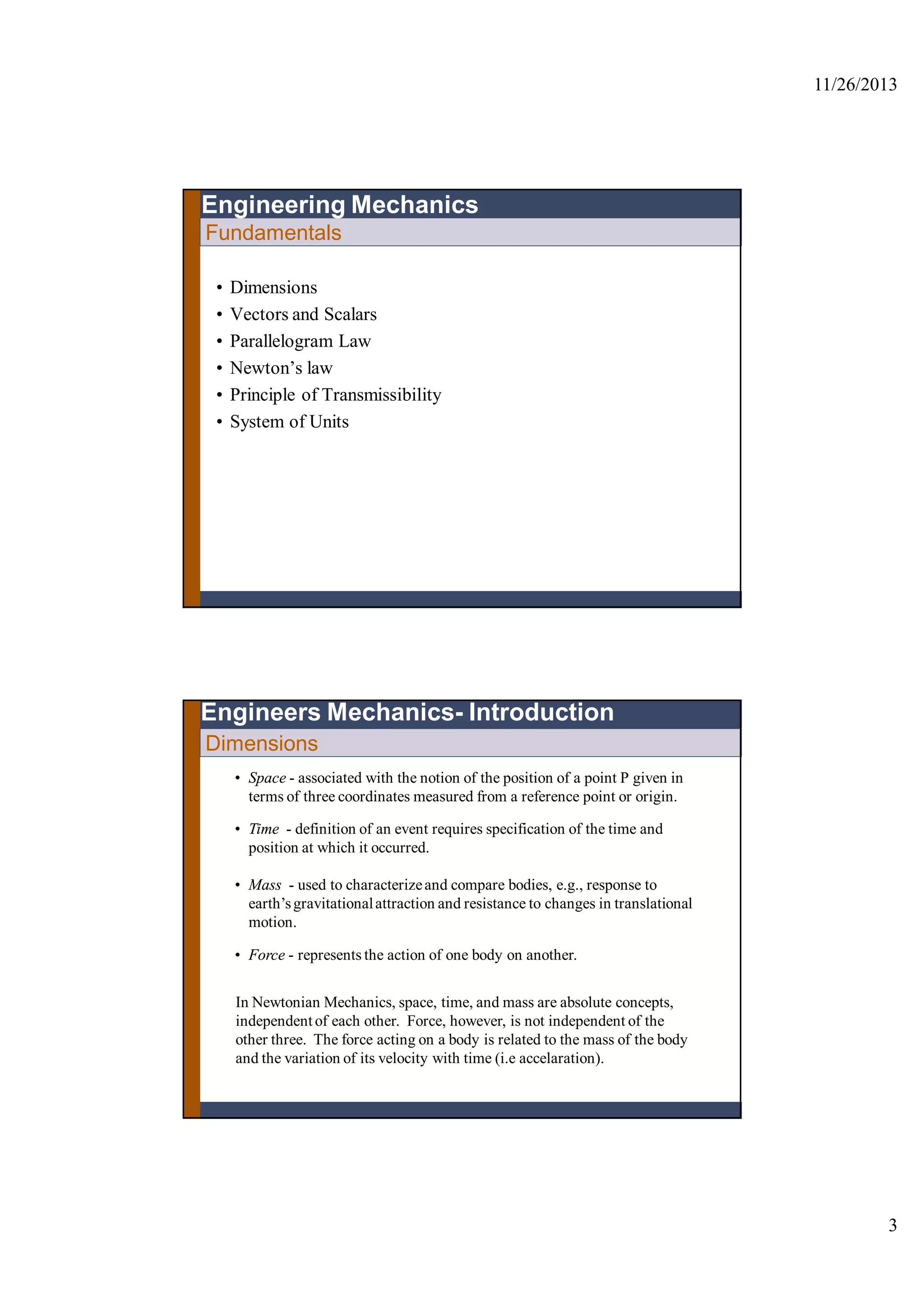
• Dimensions
• Vectors and Scalars
• Parallelogram Law
• Newton’s law
• Principle of Transmissibility
• System of Units
Engineering Mechanics
Dimensions
• Space - associated with the notion of the position of a point P given in
terms of three coordinates measured from a reference point or origin.
• Time - definition of an event requires specification of the time and
position at which it occurred.
• Mass - used to characterizeand compare bodies, e.g., response to
earth’sgravitationalattraction and resistance to changes in translational
motion.
• Force - represents the action of one body on another.
In Newtonian Mechanics, space, time, and mass are absolute concepts,
independent of each other. Force, however, is not independent of the
other three. The force acting on a body is related to the mass of the body
and the variation of its velocity with time (i.e accelaration).
Engineers Mechanics- Introduction
11/26/2013
4
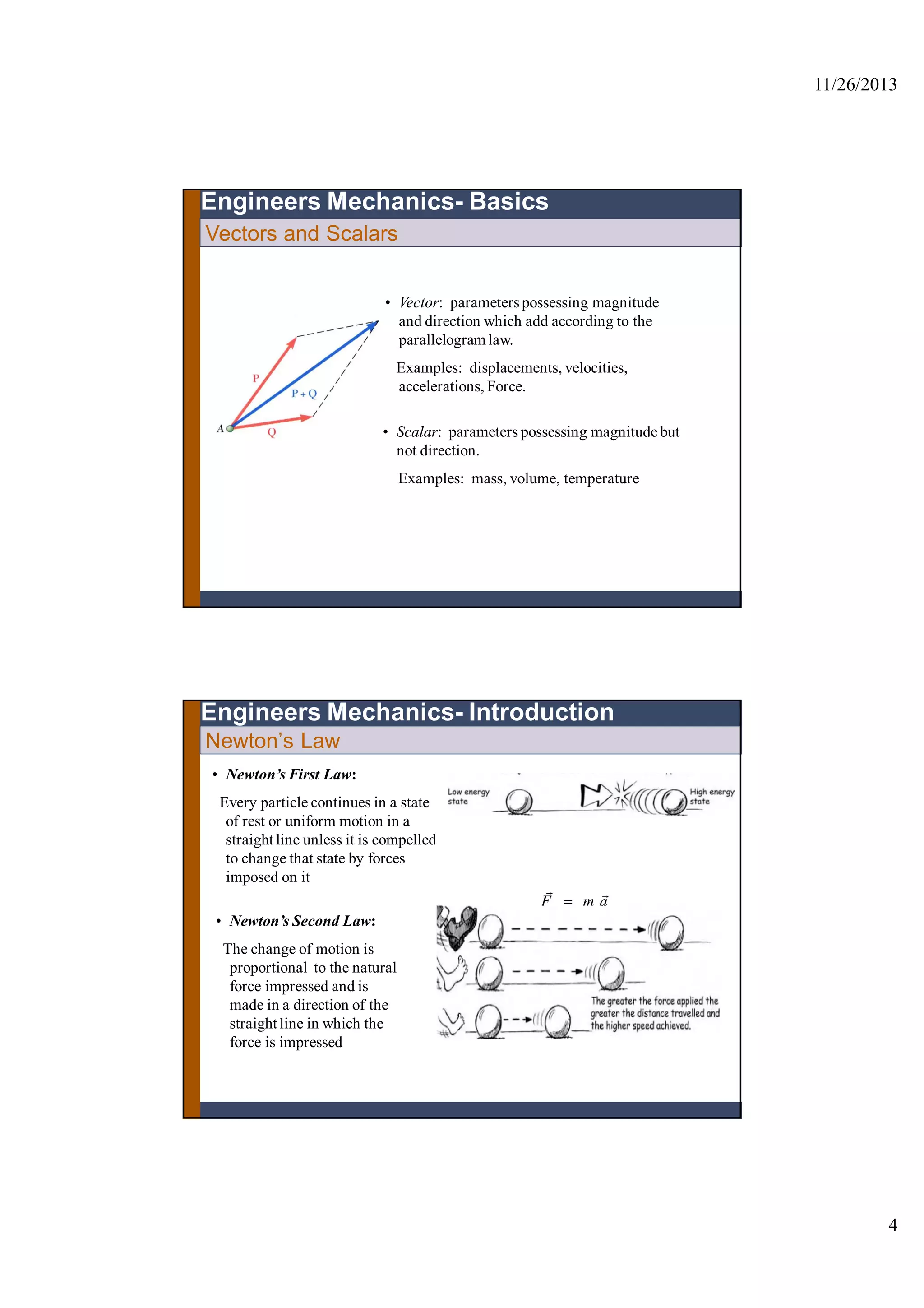
• Vector: parameterspossessing magnitude
and direction which add according to the
parallelogramlaw.
Examples: displacements, velocities,
accelerations, Force.
• Scalar: parameters possessing magnitude but
not direction.
Examples: mass, volume, temperature
Engineers Mechanics- Basics
Vectors and Scalars
Newton’s Law
• Newton’s First Law:
Every particle continues in a state
of rest or uniform motion in a
straight line unless it is compelled
to change that state by forces
imposed on it
• Newton’s Second Law:
The change of motion is
proportional to the natural
force impressed and is
made in a direction of the
straight line in which the
force is impressed
Engineers Mechanics- Introduction
amF


11/26/2013
5
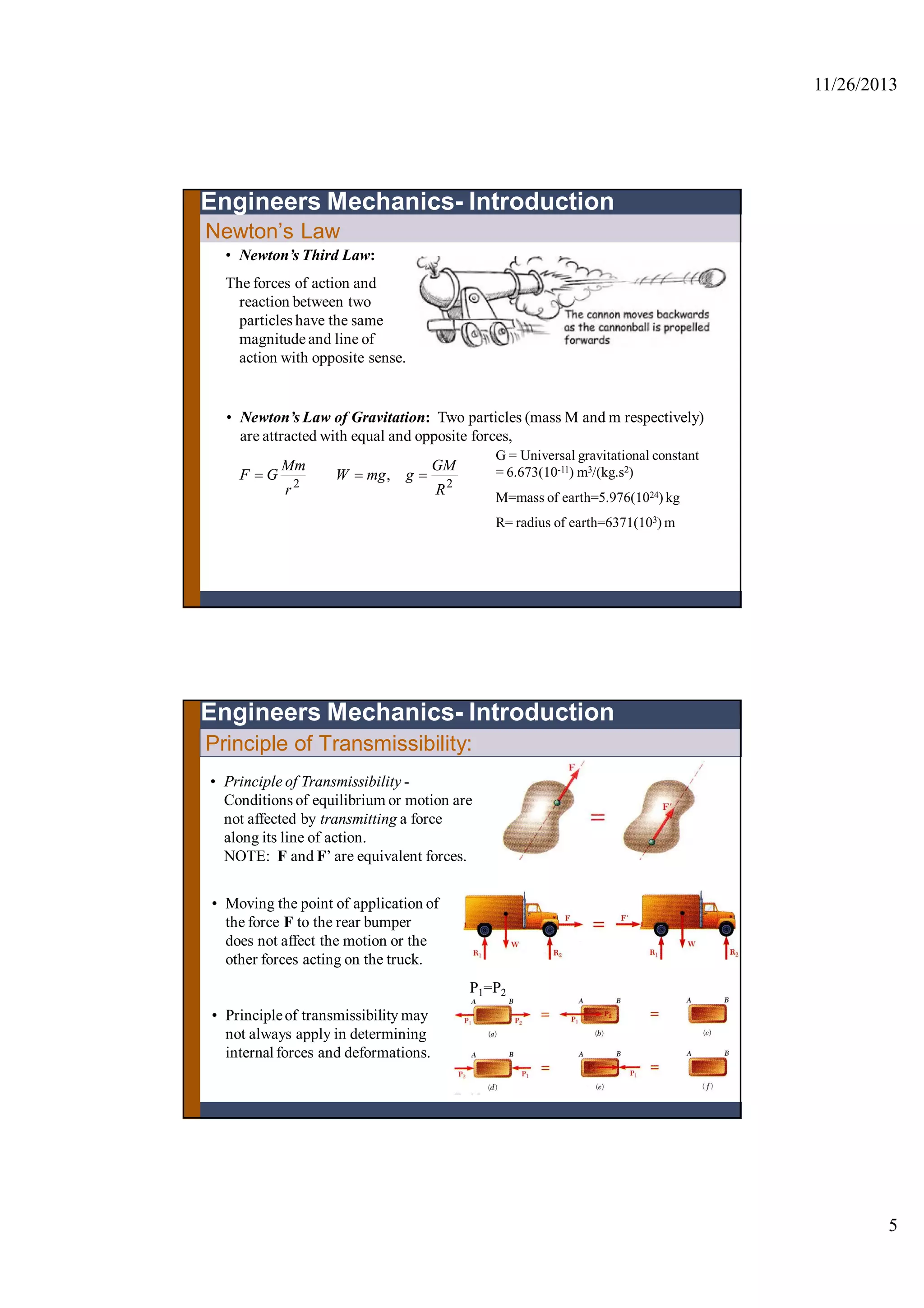
• Newton’s Third Law:
The forces of action and
reaction between two
particles have the same
magnitude and line of
action with opposite sense.
• Newton’s Law of Gravitation: Two particles (mass M and m respectively)
are attracted with equal and opposite forces,
22
,
R
GM
gmgW
r
Mm
GF 
G = Universal gravitational constant
= 6.673(10-11) m3/(kg.s2)
M=mass of earth=5.976(1024) kg
R= radius of earth=6371(103) m
Newton’s Law
Engineers Mechanics- Introduction
Principle of Transmissibility:
• Principle of Transmissibility -
Conditions of equilibrium or motion are
not affected by transmitting a force
along its line of action.
NOTE: F and F’ are equivalent forces.
• Moving the point of application of
the force F to the rear bumper
does not affect the motion or the
other forces acting on the truck.
Engineers Mechanics- Introduction
• Principleof transmissibility may
not always apply in determining
internalforces and deformations.
P1=P2
11/26/2013
6
Systems of Units
• Kinetic Units: length [L], time [t],
mass [m], and force.
• Three of the kinetic units, referred to
as basic units, may be defined
arbitrarily. The fourth unit, referred
to as a derived unit, must have a
definition compatible with Newton’s
2nd Law,
amF


• International System of Units (SI):
The basic units are length, time, and
mass which are arbitrarilydefined as the
meter (m), second (s), and kilogram
(kg). Force is the derived unit,
  







2
s
m
1kg1N1
maF
Engineers Mechanics- Introduction
• US Customary Units (FPS):
The basic units are length, time, and
mass which are arbitrarilydefined as the
foot (ft), second (s) and slug (-). Force
is the derived unit,
  







2
s
ft
1slug1lb1
maF
The NASA Mars Climate Orbiter, the first interplanetary weather satellite
designed to orbit Mars, was lost during entry to Mars orbit because one of the
teams used FPS system and failed to convert them to SI system. As a result, the
$125 million orbiter was lost. As Dr. Stone, director of the Jet Propulsion
Laboratory, California succinctly said "Our inability to recognize and correct this
simple error has had major implications."
Unit Conversion
Engineers Mechanics- Introduction
1 ft = 0.3048 m
1 slug = 14.59 kg
1 lb = 4.4482 N
1 kip (kilopound) = 1000 lb
Giga (G) = 109
Mega (M) = 106
Kilo (k) = 103
Milli (m) = 10-3
Micro (µ) = 10-6
Nano (n) = 10-9
FPS SI
g = 9.81 m/s2 (SI)
= 32 ft/s2 (FPS)
11/26/2013
7
Idealization of Mechanics
Engineers Mechanics- Introduction
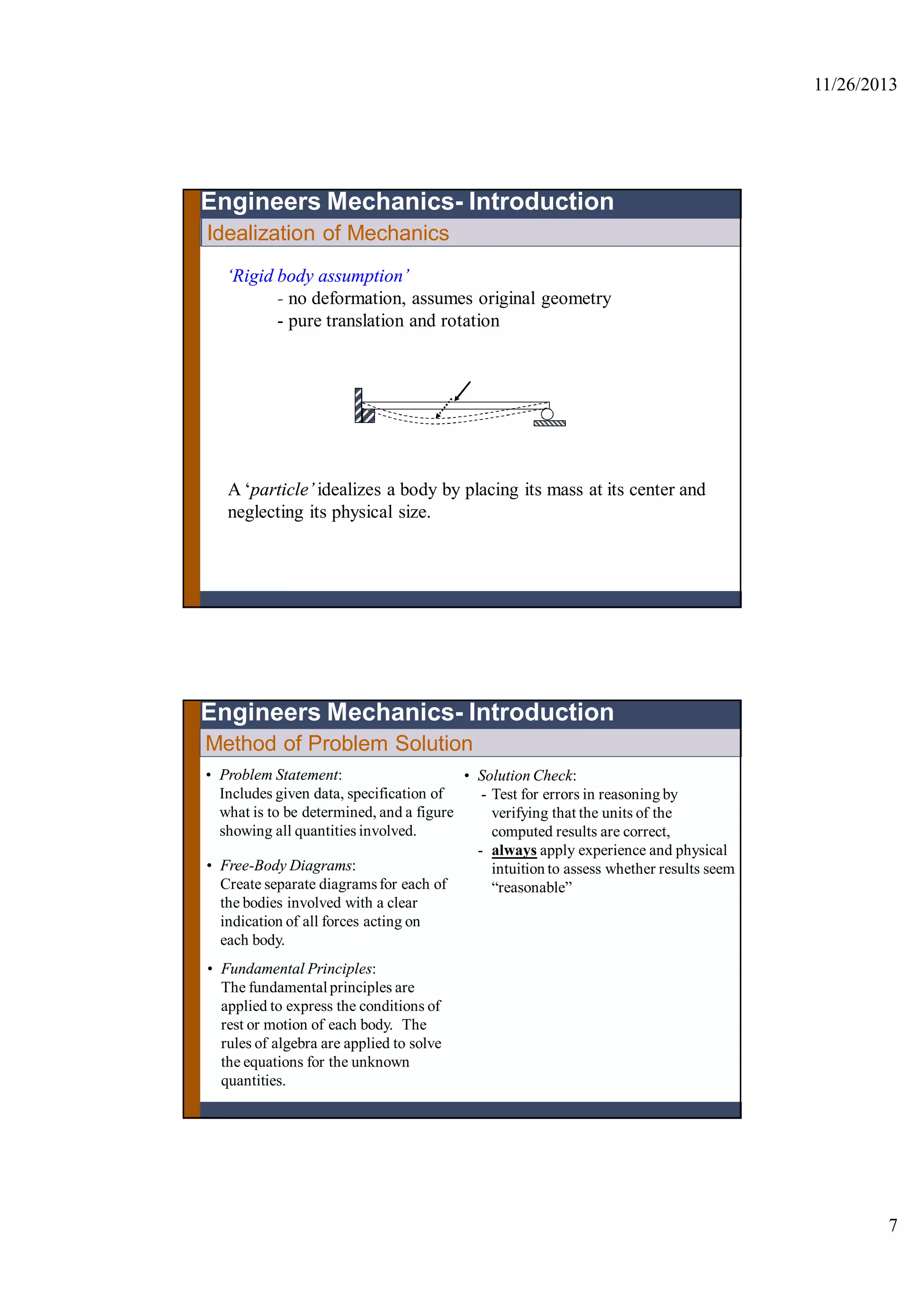
‘Rigid body assumption’
- no deformation, assumes original geometry
- pure translation and rotation
A ‘particle’idealizes a body by placing its mass at its center and
neglecting its physical size.
Method of Problem Solution
• Problem Statement:
Includes given data, specification of
what is to be determined, and a figure
showing all quantities involved.
• Free-Body Diagrams:
Create separate diagramsfor each of
the bodies involved with a clear
indication of all forces acting on
each body.
• Fundamental Principles:
The fundamentalprinciples are
applied to express the conditions of
rest or motion of each body. The
rules of algebra are applied to solve
the equations for the unknown
quantities.
• Solution Check:
- Test for errors in reasoning by
verifying that the units of the
computed results are correct,
- always apply experience and physical
intuition to assess whether results seem
“reasonable”
Engineers Mechanics- Introduction
11/26/2013
8
Modeling of Real Life Problems
Engineers Mechanics- Introduction
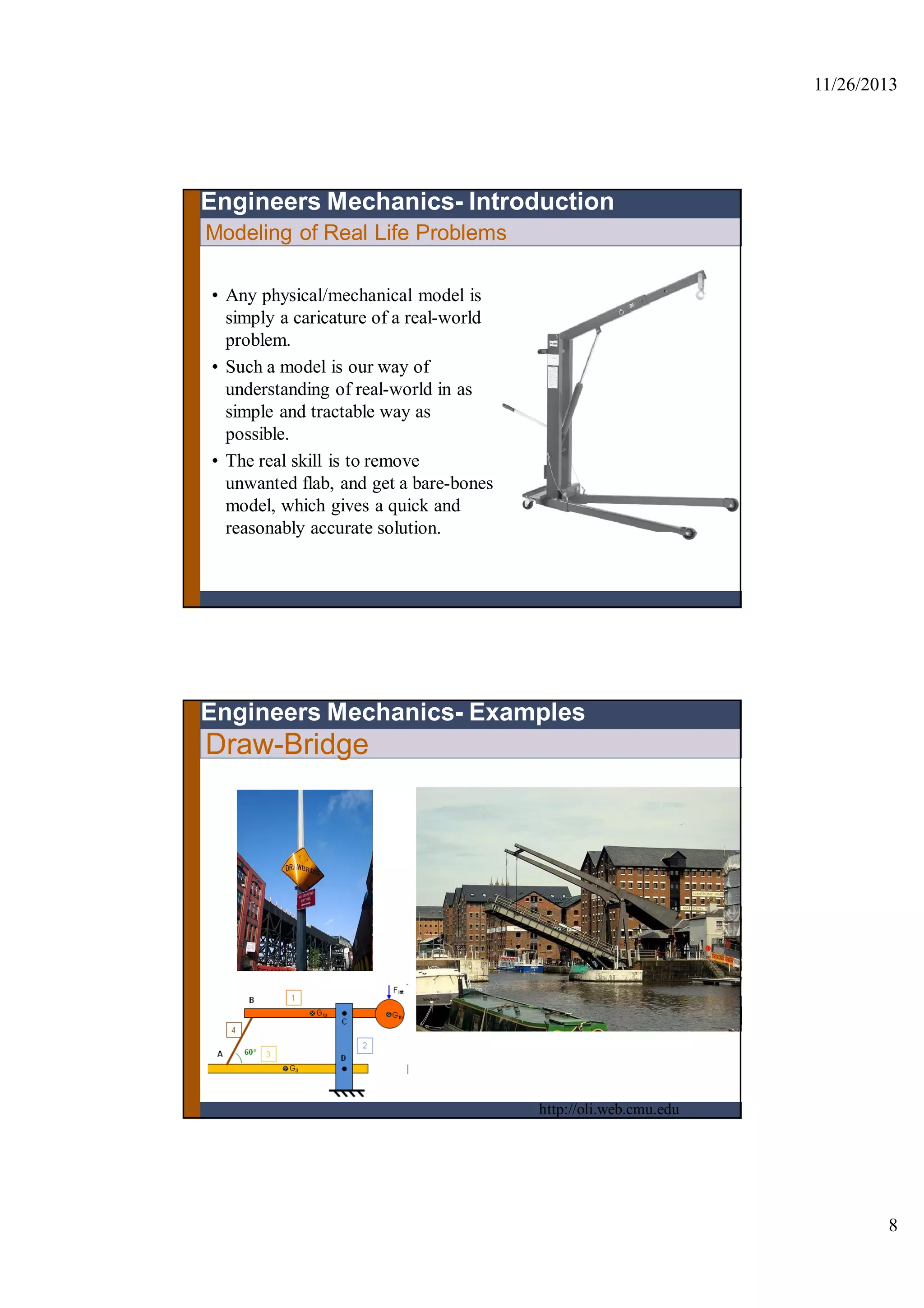
• Any physical/mechanical model is
simply a caricature of a real-world
problem.
• Such a model is our way of
understanding of real-world in as
simple and tractable way as
possible.
• The real skill is to remove
unwanted flab, and get a bare-bones
model, which gives a quick and
reasonably accurate solution.
Draw-Bridge
Engineers Mechanics- Examples
http://oli.web.cmu.edu
11/26/2013
9
Robotics
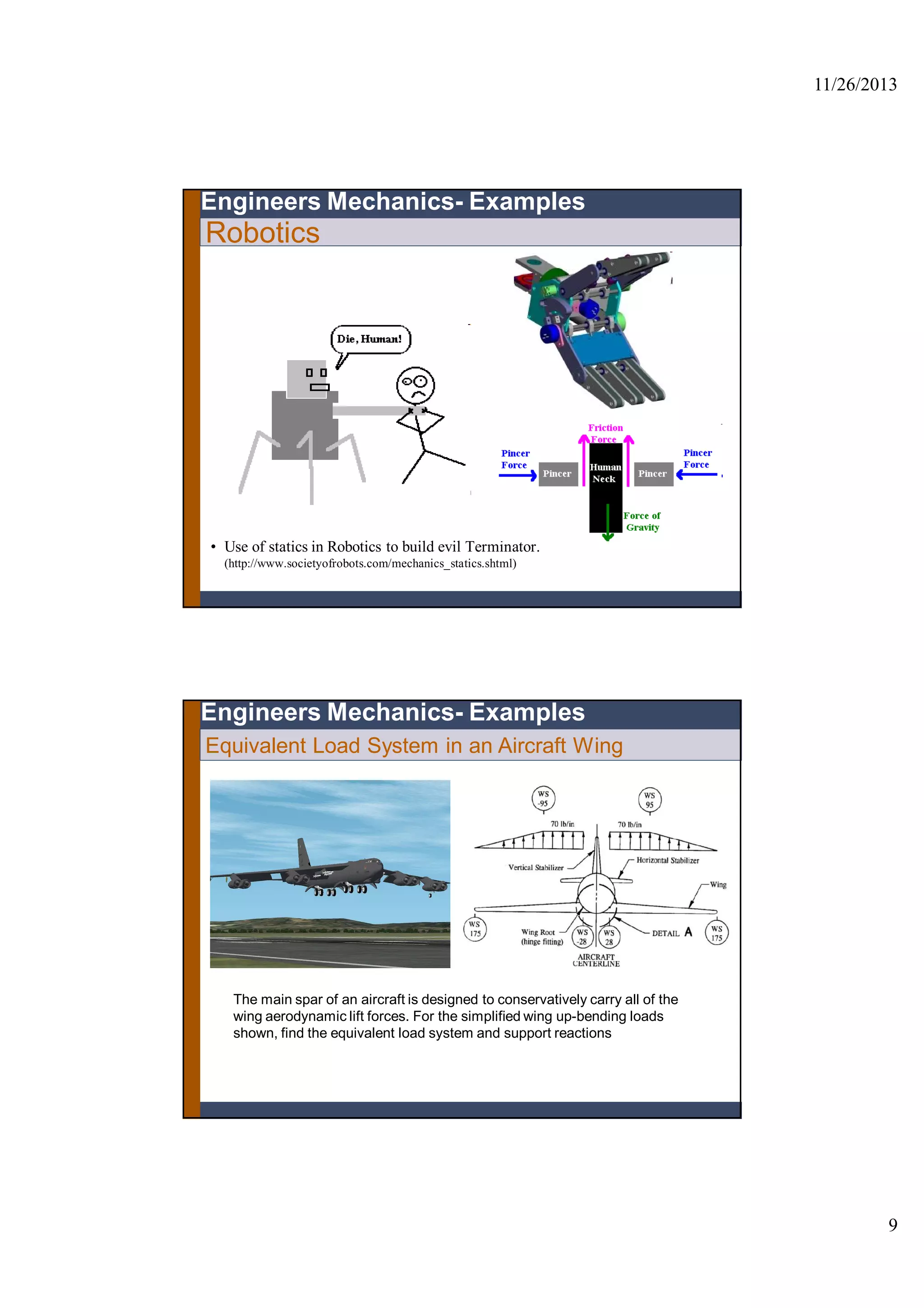
• Use of statics in Robotics to build evil Terminator.
(http://www.societyofrobots.com/mechanics_statics.shtml)
Engineers Mechanics- Examples
The main spar of an aircraft is designed to conservatively carry all of the
wing aerodynamic lift forces. For the simplified wing up-bending loads
shown, find the equivalent load system and support reactions
Engineers Mechanics- Examples
Equivalent Load System in an Aircraft Wing
11/26/2013
10
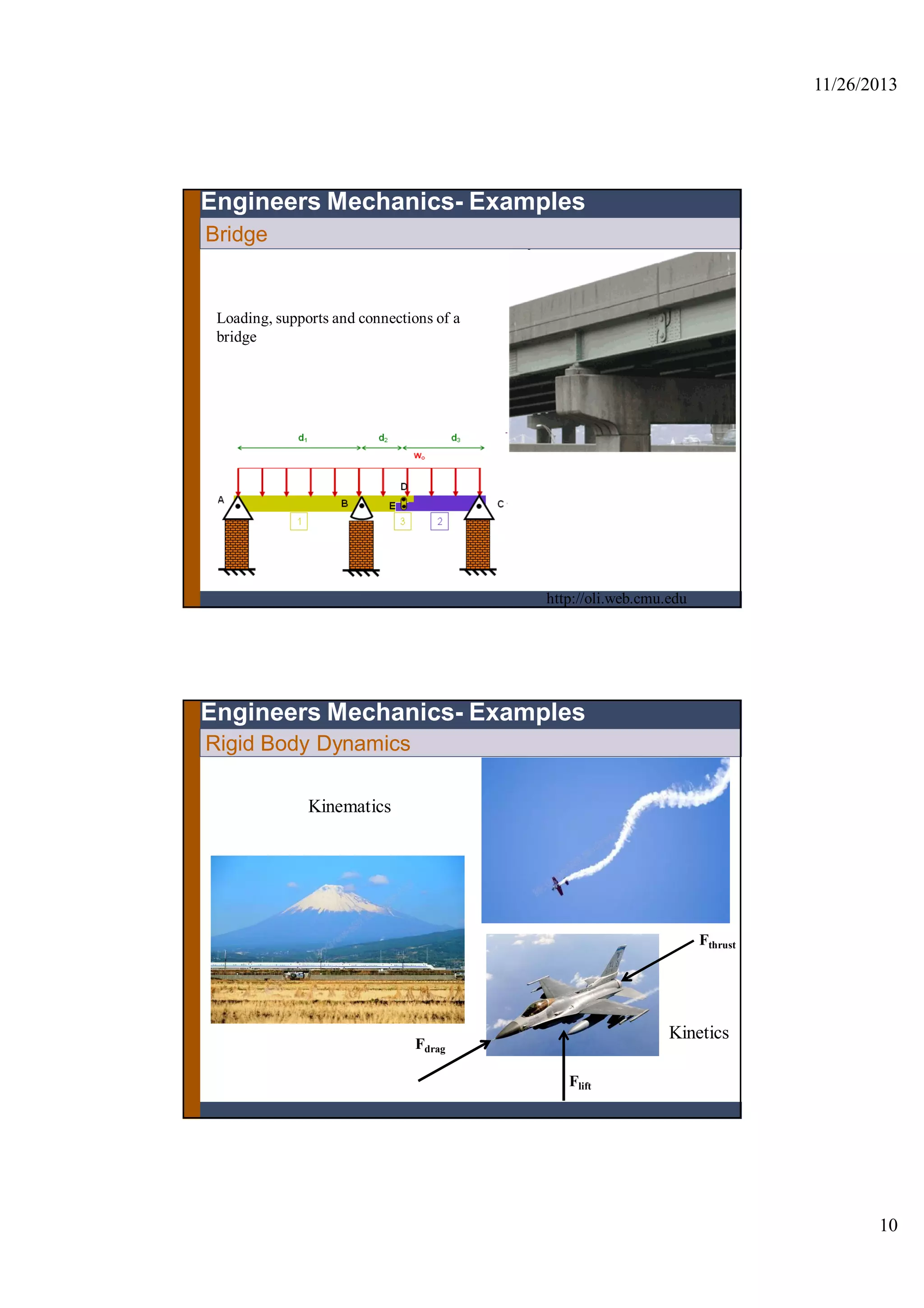
Engineers Mechanics- Examples
Bridge
Loading, supports and connections of a
bridge
http://oli.web.cmu.edu
Rigid Body Dynamics
Fthrust
Flift
Fdrag
Engineers Mechanics- Examples
Kinematics
Kinetics
11/26/2013
11
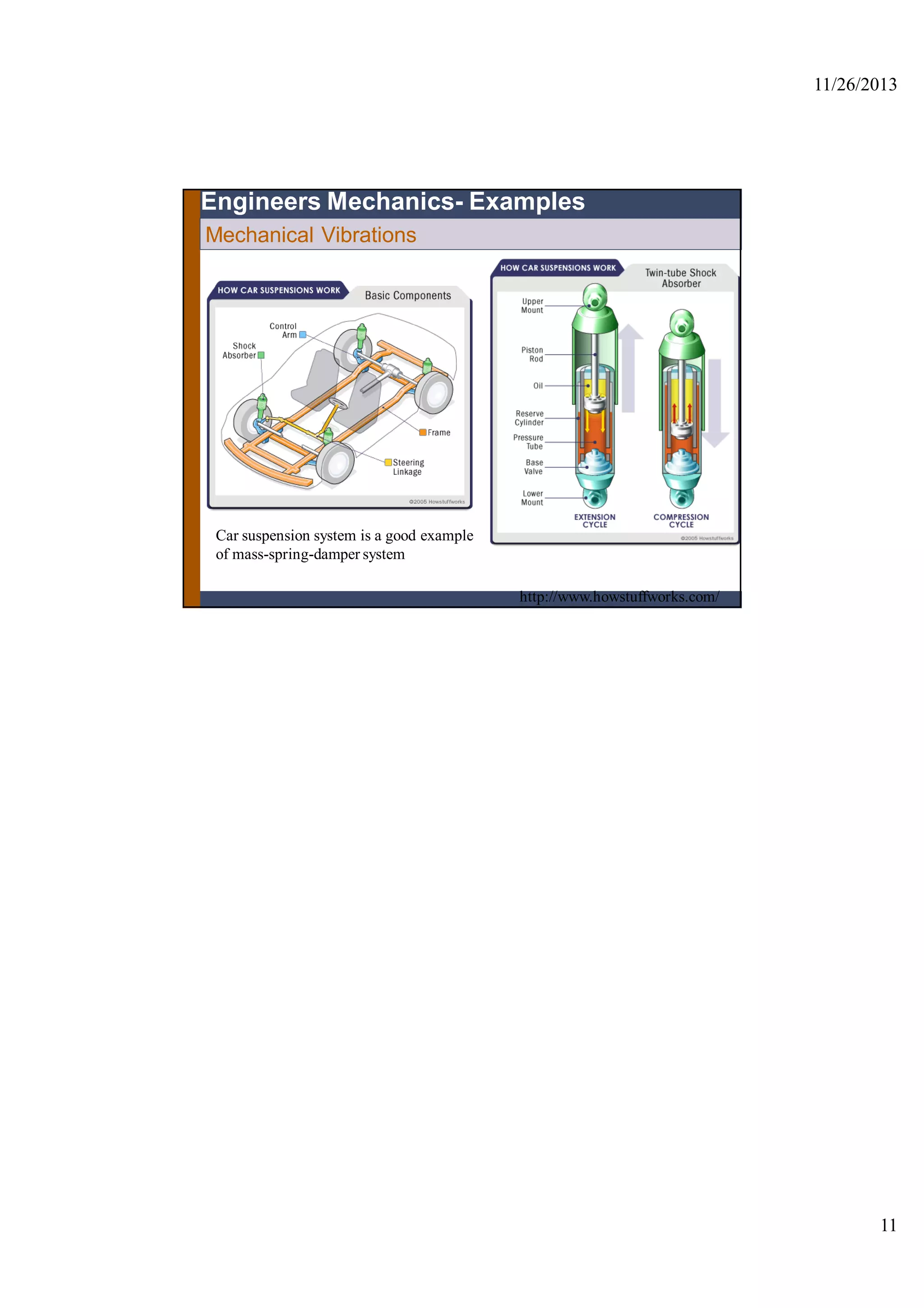
Car suspension system is a good example
of mass-spring-damper system
Engineers Mechanics- Examples
Mechanical Vibrations
http://www.howstuffworks.com/

Introduction

  • 1.
    11/26/2013 1 2-Week ISTE Workshop Instructors: Prof.Mandar Inamdar (minamdar@civil.iitb.ac.in) Prof. Sauvik Banerjee (sauvik@civil.iitb.ac.in) 26 November- 6 December, 2013 ENGINEERING MECHANICS Mechanics • Mechanics is the science which describes and predicts the conditions of rest or motion of bodies under the action of forces. Mechanics is the foundation of most engineeringsciences and is an indispensable prerequisite to their study. Engineers Mechanics • Branches of Mechanics: - Statics – body is at rest under the action of forces. All quantities are time independent - Dynamics – body is at motion under the action of forces. All quantities are time dependent
  • 2.
    11/26/2013 2 What is theneed for an elaborate course? – Basic rules are simple, force balance and moment balance, in general. – But, there are many intricacies. Multi-body interactions can be very complex. – A good understanding of fundamentals goes a long way in solving such complex problems. – Concepts of appropriate Free Body Diagrams and equations of equilibrium (motion in dynamics) will be indispensable in later studies Engineering Mechanics Books A major chunk of lecture materials based on: • Vector Mechanics for Engineers, Beer, Johnston et al., McGraw-Hill (Eds 8 and 10) • Referred to as BJ 8 &10. Indian Edition available. • A lot of slide contents is courtesy of McGraw-Hill Other texts: EngineeringMechanics: Statics and Dynamics, Meriam and Kraige, Wiley (Eds 5 and 7). EngineeringMechanics: Dynamics, R. C. Hibbeler, Prentice Hall. Engineering Mechanics Useful Links http://www.howstuffworks.com/ http://oli.web.cmu.edu
  • 3.
    11/26/2013 3 Fundamentals • Dimensions • Vectorsand Scalars • Parallelogram Law • Newton’s law • Principle of Transmissibility • System of Units Engineering Mechanics Dimensions • Space - associated with the notion of the position of a point P given in terms of three coordinates measured from a reference point or origin. • Time - definition of an event requires specification of the time and position at which it occurred. • Mass - used to characterizeand compare bodies, e.g., response to earth’sgravitationalattraction and resistance to changes in translational motion. • Force - represents the action of one body on another. In Newtonian Mechanics, space, time, and mass are absolute concepts, independent of each other. Force, however, is not independent of the other three. The force acting on a body is related to the mass of the body and the variation of its velocity with time (i.e accelaration). Engineers Mechanics- Introduction
  • 4.
    11/26/2013 4 • Vector: parameterspossessingmagnitude and direction which add according to the parallelogramlaw. Examples: displacements, velocities, accelerations, Force. • Scalar: parameters possessing magnitude but not direction. Examples: mass, volume, temperature Engineers Mechanics- Basics Vectors and Scalars Newton’s Law • Newton’s First Law: Every particle continues in a state of rest or uniform motion in a straight line unless it is compelled to change that state by forces imposed on it • Newton’s Second Law: The change of motion is proportional to the natural force impressed and is made in a direction of the straight line in which the force is impressed Engineers Mechanics- Introduction amF  
  • 5.
    11/26/2013 5 • Newton’s ThirdLaw: The forces of action and reaction between two particles have the same magnitude and line of action with opposite sense. • Newton’s Law of Gravitation: Two particles (mass M and m respectively) are attracted with equal and opposite forces, 22 , R GM gmgW r Mm GF  G = Universal gravitational constant = 6.673(10-11) m3/(kg.s2) M=mass of earth=5.976(1024) kg R= radius of earth=6371(103) m Newton’s Law Engineers Mechanics- Introduction Principle of Transmissibility: • Principle of Transmissibility - Conditions of equilibrium or motion are not affected by transmitting a force along its line of action. NOTE: F and F’ are equivalent forces. • Moving the point of application of the force F to the rear bumper does not affect the motion or the other forces acting on the truck. Engineers Mechanics- Introduction • Principleof transmissibility may not always apply in determining internalforces and deformations. P1=P2
  • 6.
    11/26/2013 6 Systems of Units •Kinetic Units: length [L], time [t], mass [m], and force. • Three of the kinetic units, referred to as basic units, may be defined arbitrarily. The fourth unit, referred to as a derived unit, must have a definition compatible with Newton’s 2nd Law, amF   • International System of Units (SI): The basic units are length, time, and mass which are arbitrarilydefined as the meter (m), second (s), and kilogram (kg). Force is the derived unit,           2 s m 1kg1N1 maF Engineers Mechanics- Introduction • US Customary Units (FPS): The basic units are length, time, and mass which are arbitrarilydefined as the foot (ft), second (s) and slug (-). Force is the derived unit,           2 s ft 1slug1lb1 maF The NASA Mars Climate Orbiter, the first interplanetary weather satellite designed to orbit Mars, was lost during entry to Mars orbit because one of the teams used FPS system and failed to convert them to SI system. As a result, the $125 million orbiter was lost. As Dr. Stone, director of the Jet Propulsion Laboratory, California succinctly said "Our inability to recognize and correct this simple error has had major implications." Unit Conversion Engineers Mechanics- Introduction 1 ft = 0.3048 m 1 slug = 14.59 kg 1 lb = 4.4482 N 1 kip (kilopound) = 1000 lb Giga (G) = 109 Mega (M) = 106 Kilo (k) = 103 Milli (m) = 10-3 Micro (µ) = 10-6 Nano (n) = 10-9 FPS SI g = 9.81 m/s2 (SI) = 32 ft/s2 (FPS)
  • 7.
    11/26/2013 7 Idealization of Mechanics EngineersMechanics- Introduction ‘Rigid body assumption’ - no deformation, assumes original geometry - pure translation and rotation A ‘particle’idealizes a body by placing its mass at its center and neglecting its physical size. Method of Problem Solution • Problem Statement: Includes given data, specification of what is to be determined, and a figure showing all quantities involved. • Free-Body Diagrams: Create separate diagramsfor each of the bodies involved with a clear indication of all forces acting on each body. • Fundamental Principles: The fundamentalprinciples are applied to express the conditions of rest or motion of each body. The rules of algebra are applied to solve the equations for the unknown quantities. • Solution Check: - Test for errors in reasoning by verifying that the units of the computed results are correct, - always apply experience and physical intuition to assess whether results seem “reasonable” Engineers Mechanics- Introduction
  • 8.
    11/26/2013 8 Modeling of RealLife Problems Engineers Mechanics- Introduction • Any physical/mechanical model is simply a caricature of a real-world problem. • Such a model is our way of understanding of real-world in as simple and tractable way as possible. • The real skill is to remove unwanted flab, and get a bare-bones model, which gives a quick and reasonably accurate solution. Draw-Bridge Engineers Mechanics- Examples http://oli.web.cmu.edu
  • 9.
    11/26/2013 9 Robotics • Use ofstatics in Robotics to build evil Terminator. (http://www.societyofrobots.com/mechanics_statics.shtml) Engineers Mechanics- Examples The main spar of an aircraft is designed to conservatively carry all of the wing aerodynamic lift forces. For the simplified wing up-bending loads shown, find the equivalent load system and support reactions Engineers Mechanics- Examples Equivalent Load System in an Aircraft Wing
  • 10.
    11/26/2013 10 Engineers Mechanics- Examples Bridge Loading,supports and connections of a bridge http://oli.web.cmu.edu Rigid Body Dynamics Fthrust Flift Fdrag Engineers Mechanics- Examples Kinematics Kinetics
  • 11.
    11/26/2013 11 Car suspension systemis a good example of mass-spring-damper system Engineers Mechanics- Examples Mechanical Vibrations http://www.howstuffworks.com/