Engineering Mechanics
General Principles
Mechanics
Mechanics is a branch of the physical sciences that is concerned with the state
of rest or motion of bodies that are subjected to the action of forces. In general,
this subject can be subdivided into three branches: rigid-body mechanics,
deformable-body mechanics, and fluid mechanics. In this book we will study
rigid-body mechanics since it is a basic requirement for the study of the
mechanics of deformable bodies and the mechanics of fluids. Furthermore, rigid-
body mechanics is essential for the design and analysis
of many types of structural members, mechanical components, or electrical
devices encountered in engineering. Rigid-body mechanics is divided into two
areas: statics and dynamics. Statics deals with the equilibrium of bodies, that is,
those that are either
at rest or move with a constant velocity; whereas dynamics is concerned with
the accelerated motion of bodies. We can consider statics as a special case of
dynamics, in which the acceleration is zero; however, statics deserves separate
treatment in engineering education since many objects are designed with the
intention that they remain in equilibrium.
Fundamental Concepts
Basic Quantities. The following four quantities are used throughout mechanics:
Length. Length is used to locate the position of a point in space and thereby describe the size of a
physical system.
Time. Time is conceived as a succession of events.
Mass. Mass is a measure of a quantity of matter that is used to compare the action of one body with that
of another.
Force. In general, force is considered as a “push” or “pull” exerted by one body on another. A force is
completely characterized by its magnitude, direction, and point of application.
Idealizations. Models or idealizations are used in mechanics in order to simplify application of the theory.
Here we will consider three important idealizations.
Particle. A particle has a mass, but a size that can be neglected. For example, the size of the earth is
insignificant compared to the size of its orbit, and therefore the earth can be modeled as a particle when
studying its orbital motion. When a body is idealized as a particle, the principles of mechanics reduce to
a rather simplified form since the geometry of the body will not be involved in the analysis of the
problem.
Rigid Body. A rigid body can be considered as a combination of a large number of particles in which all
the particles remain at a fixed distance from one another, both before and after applying a load. This
model is important because the body’s shape does not change when a load is applied, and so we do not
have to consider the type of material from which the body is made. In most cases the actual
deformations occurring in structures, machines, mechanisms, and the like are relatively small, and the
rigid-body assumption is suitable for analysis.
Concentrated Force. A concentrated force represents the effect of a loading which is assumed to
act at a point on a body. We can represent a load by a concentrated force, provided the area over which
the load is applied is very small compared to the overall size of the body. An example would be the
contact force between a wheel and the ground.
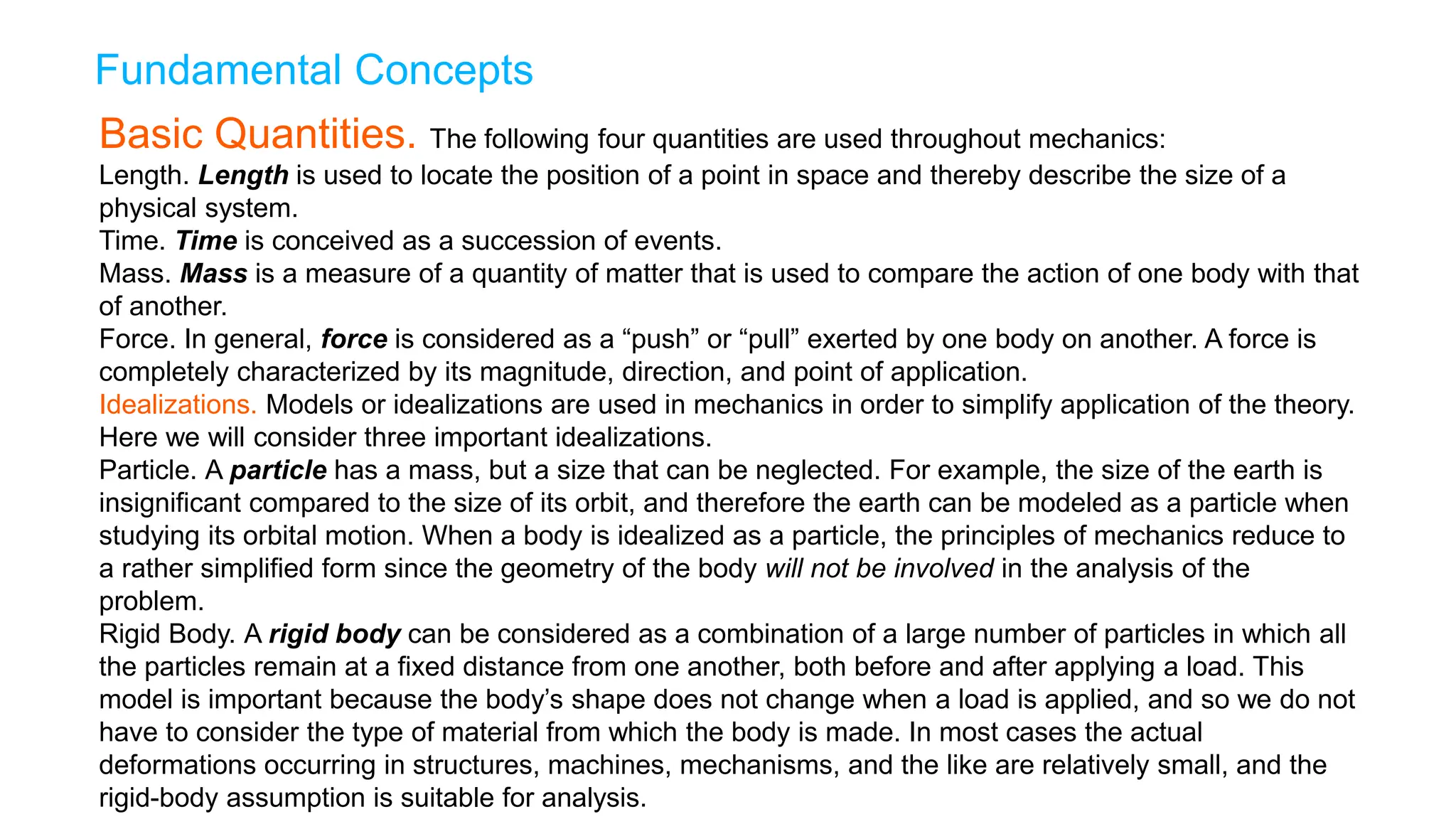
Three forces act on the ring.
Since these forces all meet at
a point, then for any force
analysis, we can assume the
ring to be represented as a
particle.
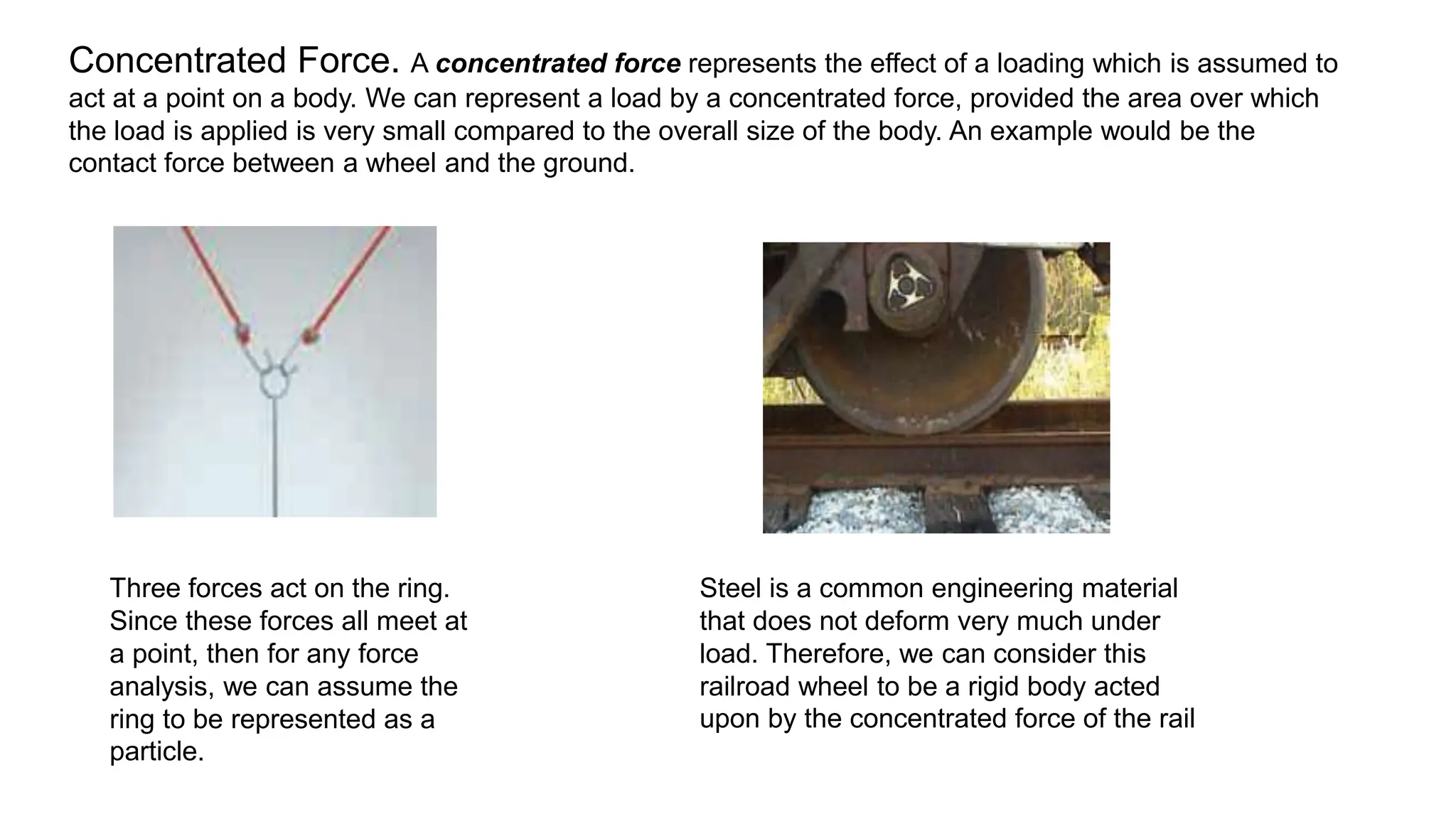
Steel is a common engineering material
that does not deform very much under
load. Therefore, we can consider this
railroad wheel to be a rigid body acted
upon by the concentrated force of the rail
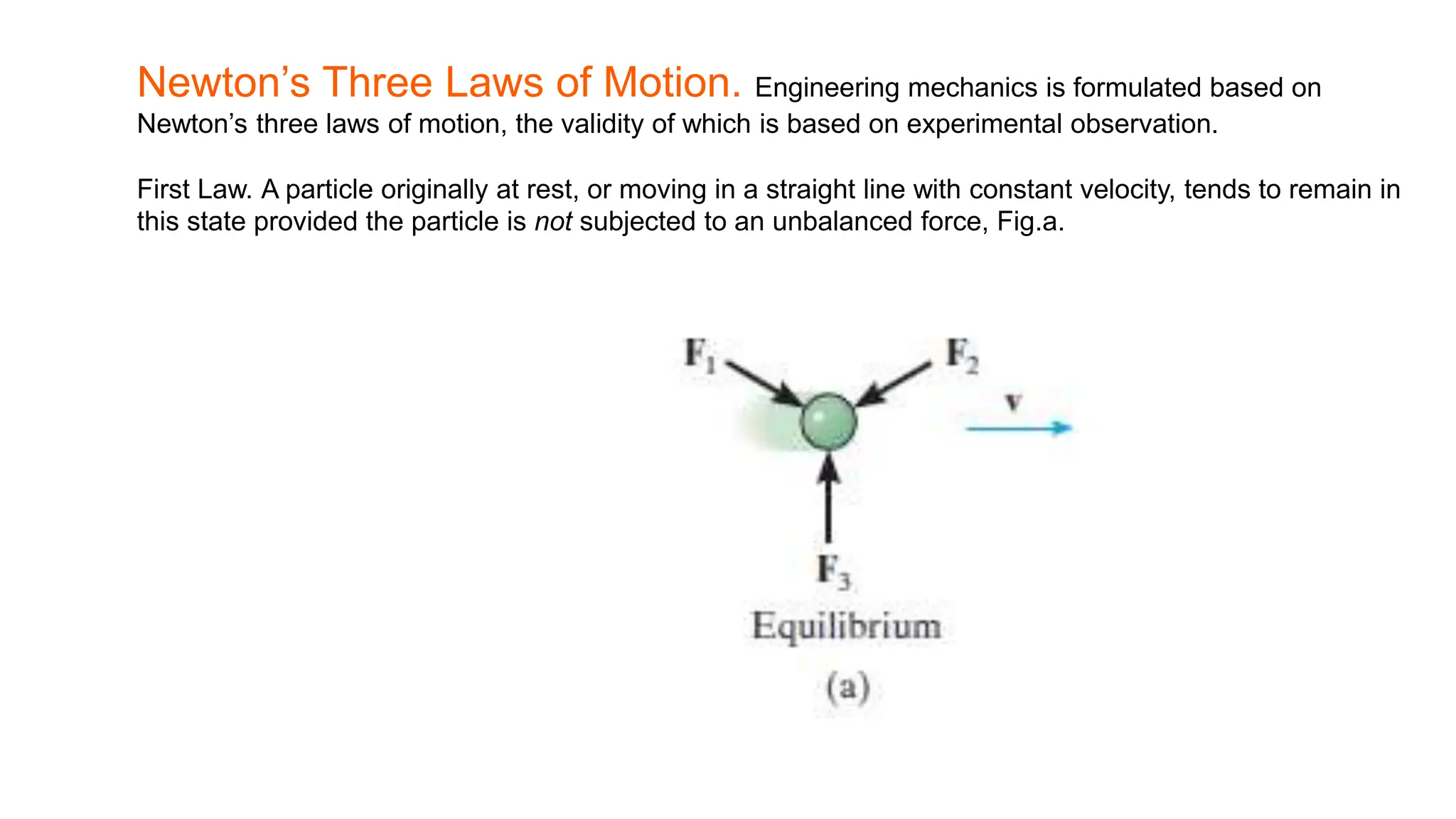
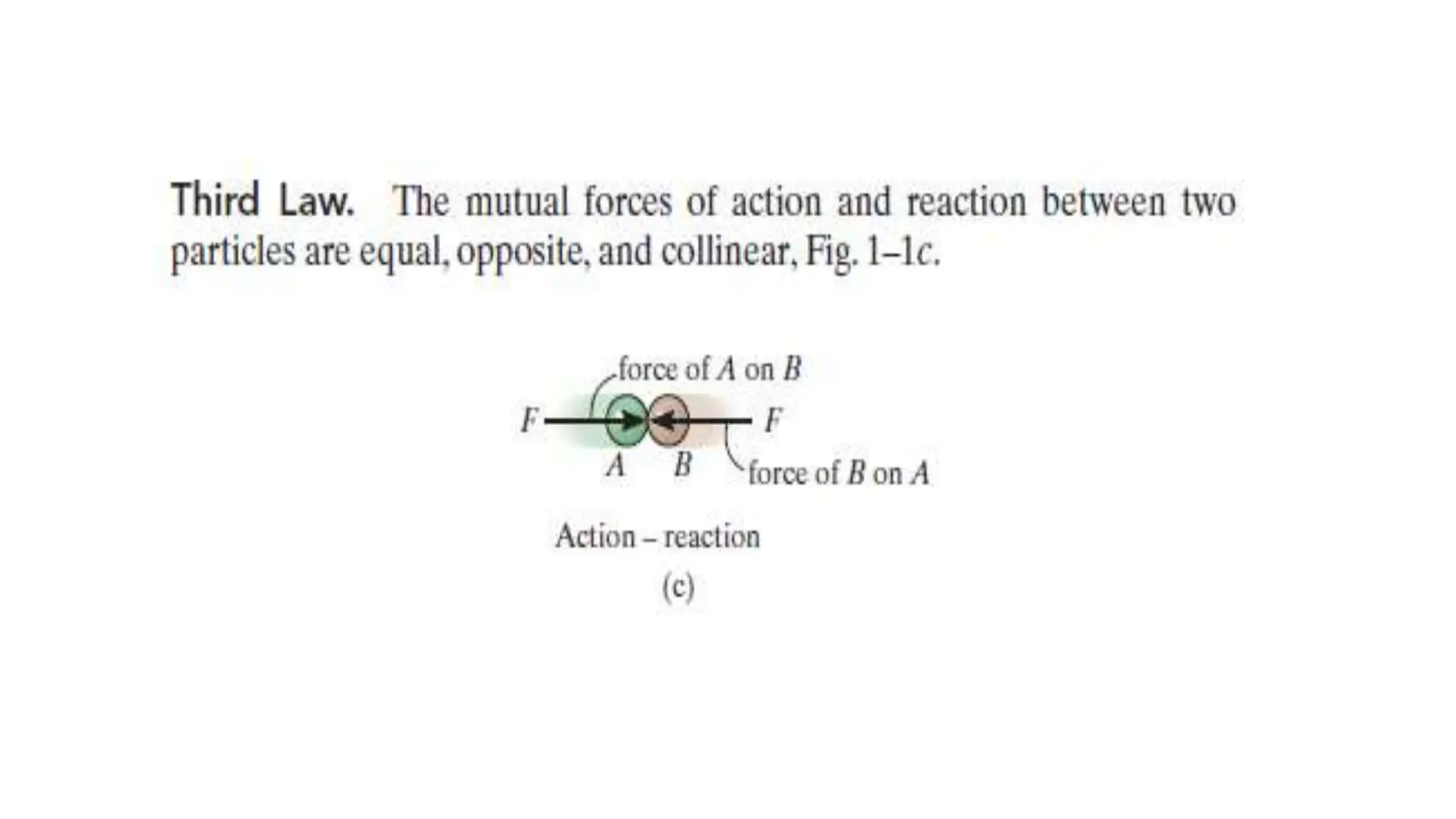
Newton’s Three Laws of Motion. Engineering mechanics is formulated based on
Newton’s three laws of motion, the validity of which is based on experimental observation.
First Law. A particle originally at rest, or moving in a straight line with constant velocity, tends to remain in
this state provided the particle is not subjected to an unbalanced force, Fig.a.
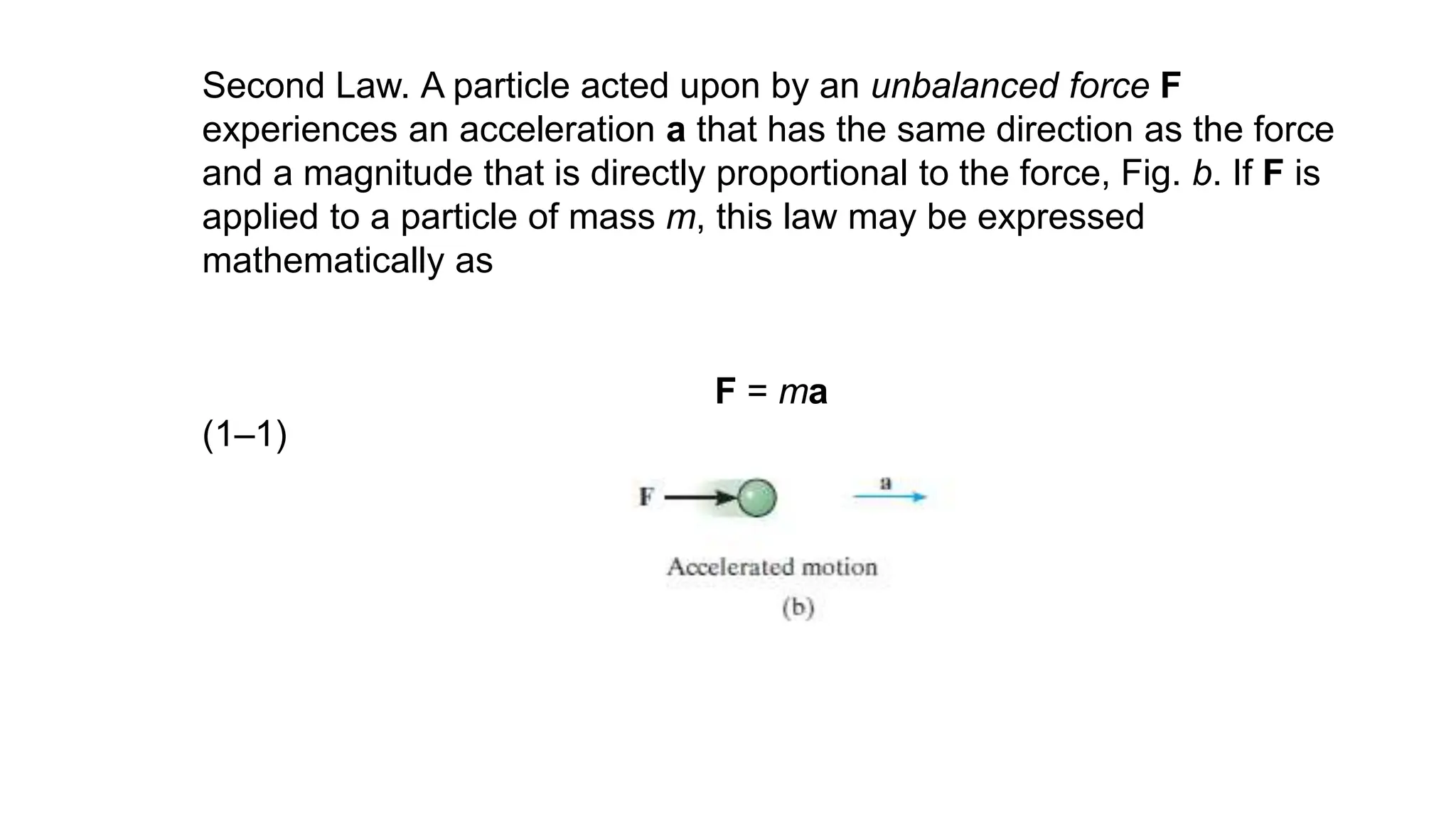
Second Law. A particle acted upon by an unbalanced force F
experiences an acceleration a that has the same direction as the force
and a magnitude that is directly proportional to the force, Fig. b. If F is
applied to a particle of mass m, this law may be expressed
mathematically as
F = ma
(1–1)
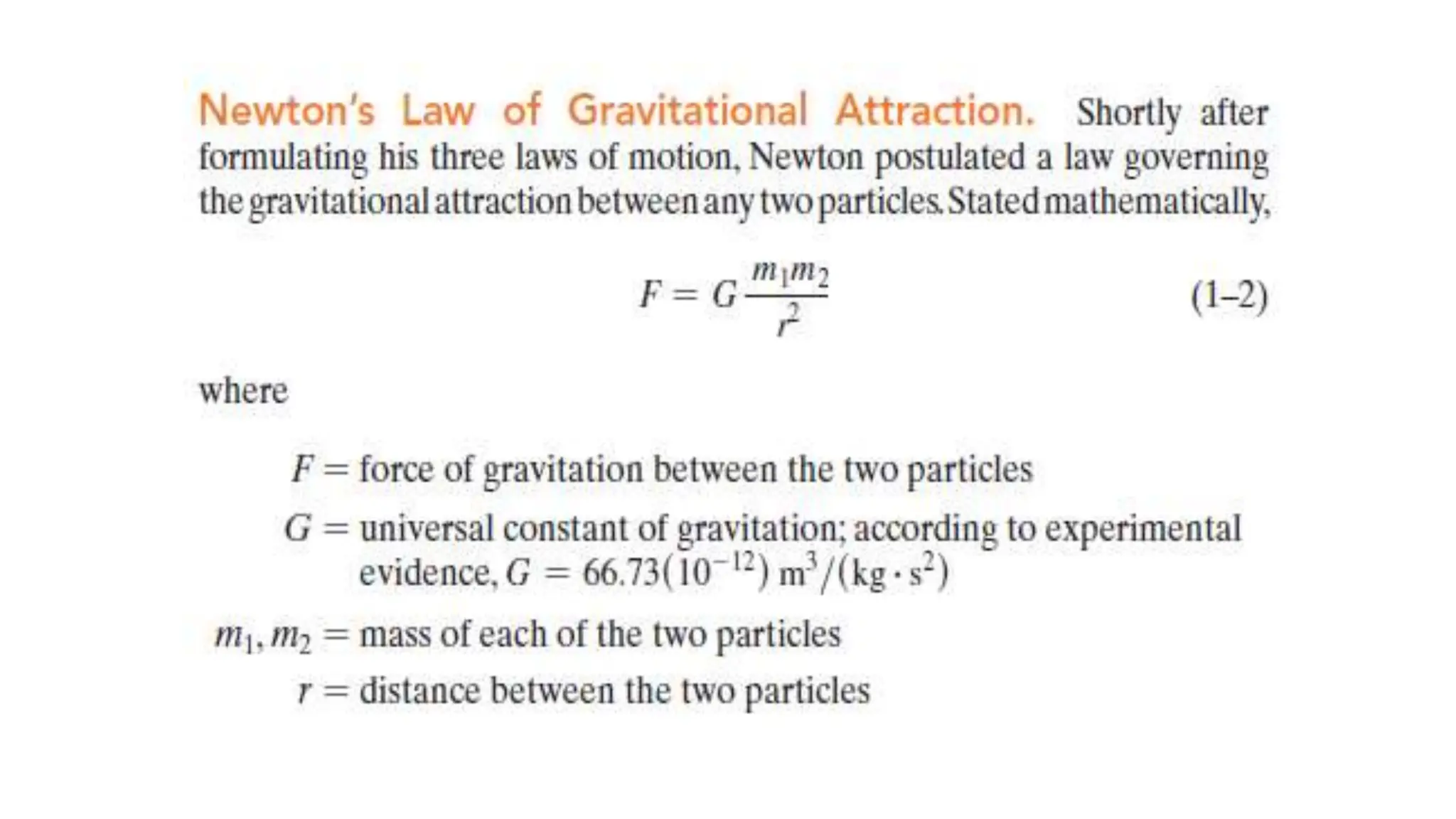
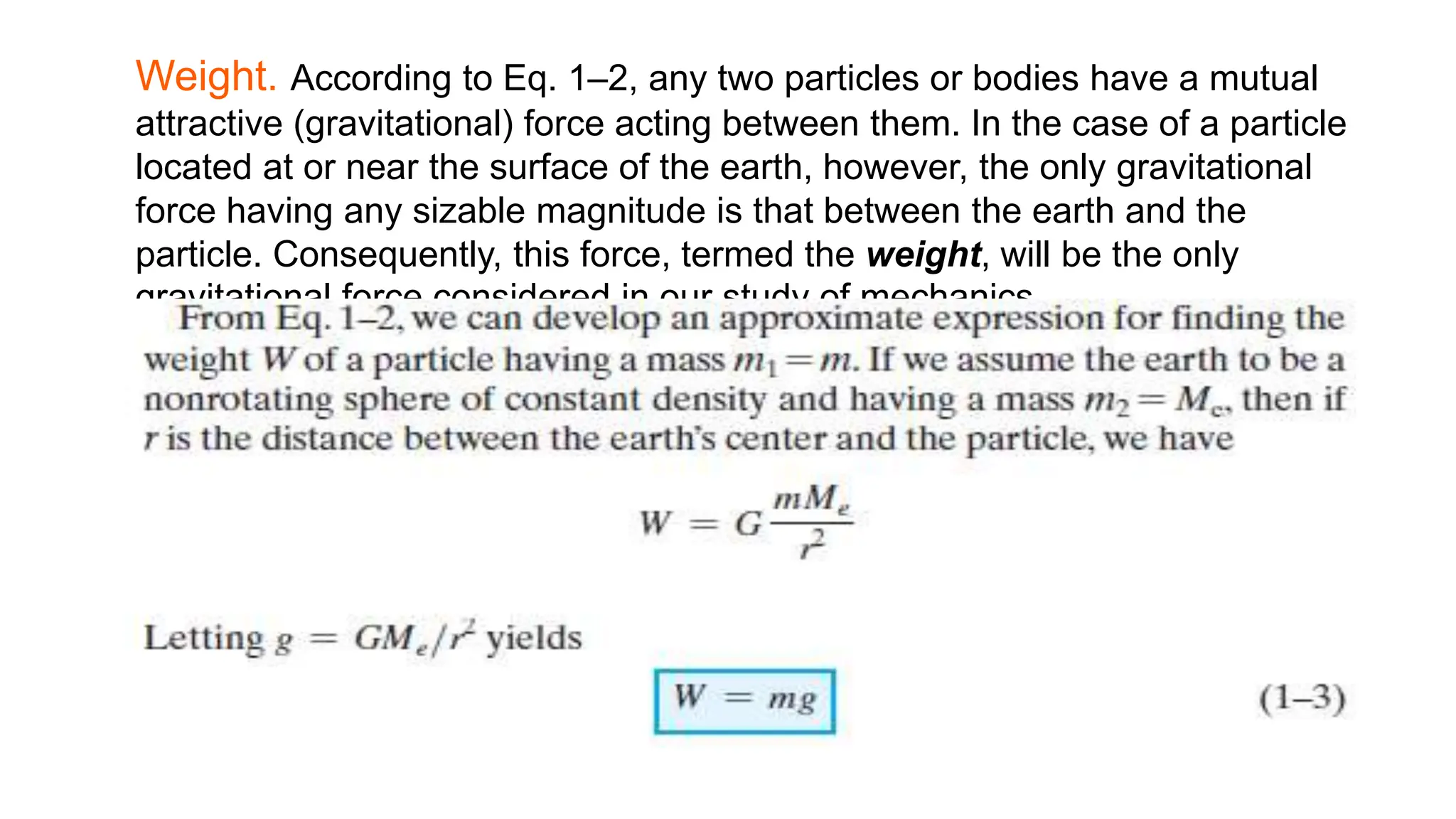
Weight. According to Eq. 1–2, any two particles or bodies have a mutual
attractive (gravitational) force acting between them. In the case of a particle
located at or near the surface of the earth, however, the only gravitational
force having any sizable magnitude is that between the earth and the
particle. Consequently, this force, termed the weight, will be the only
gravitational force considered in our study of mechanics.
By comparison with F = ma, we can see that g is the
acceleration due to gravity. Since it depends on r, then the
weight of a body is not an absolute quantity. Instead, its
magnitude is determined from where the measurement
was made. For most engineering calculations, however, g
is determined at sea level, which is considered the
“standard location.”
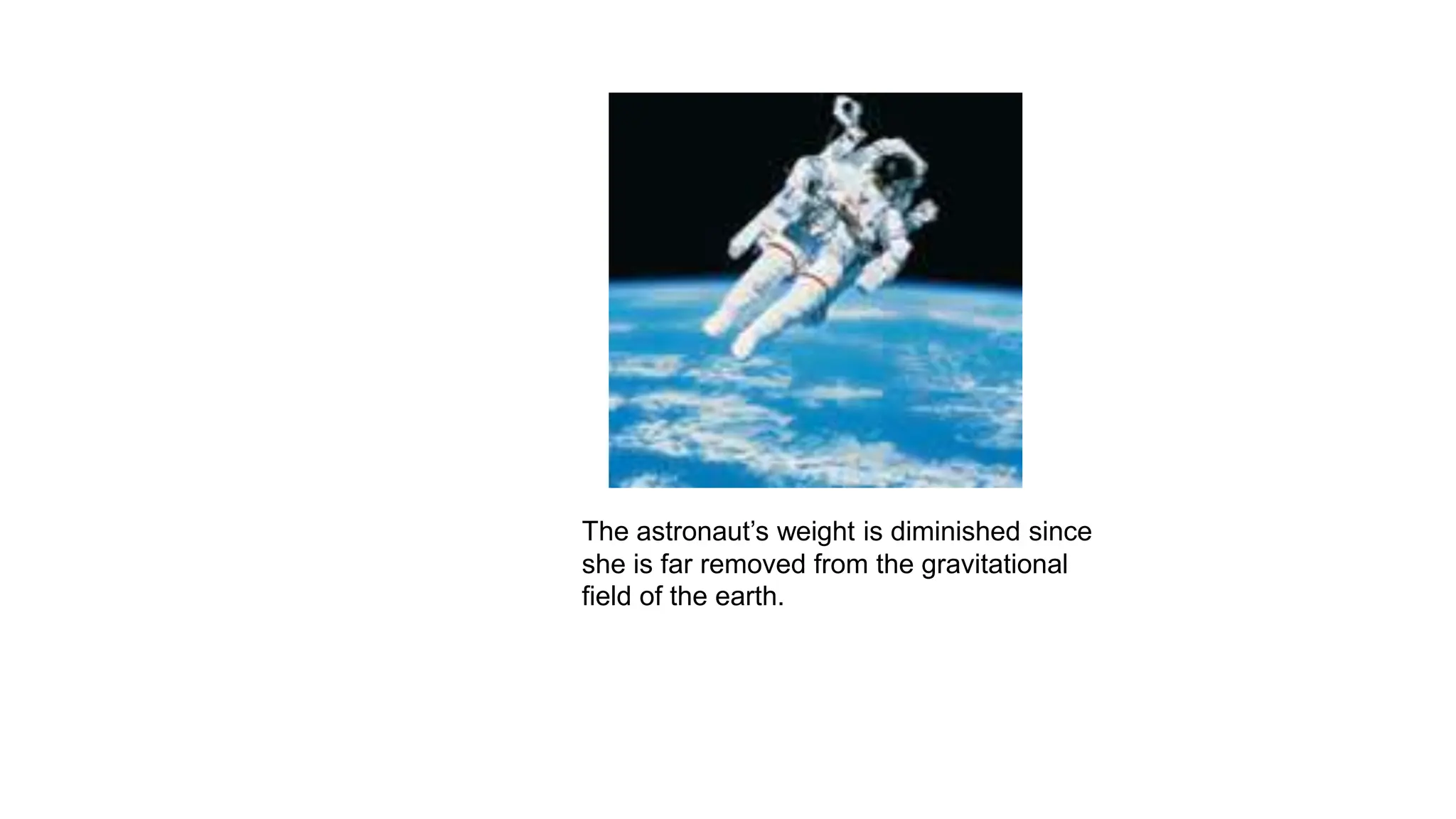
The astronaut’s weight is diminished since
she is far removed from the gravitational
field of the earth.
Units of Measurement
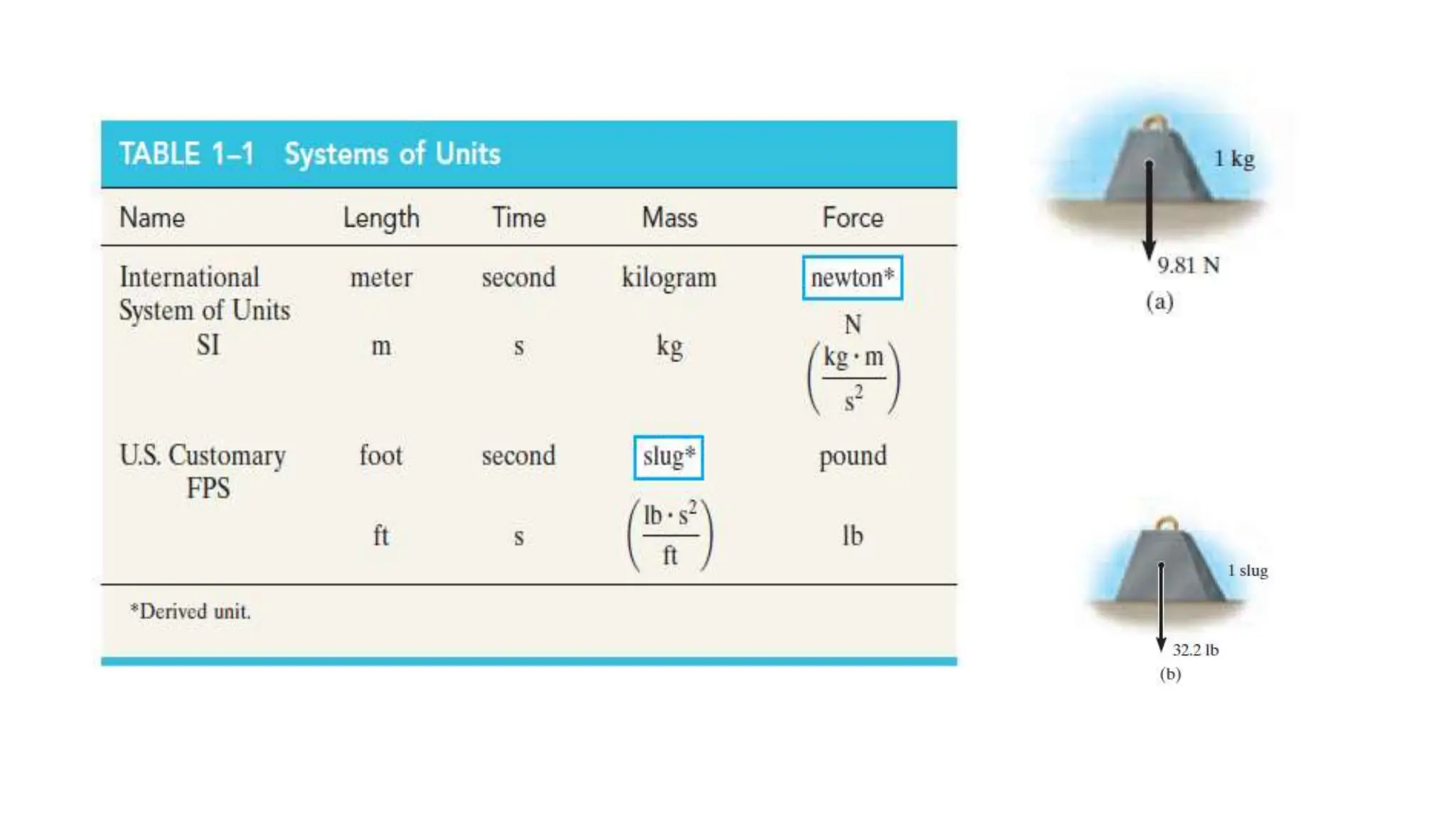
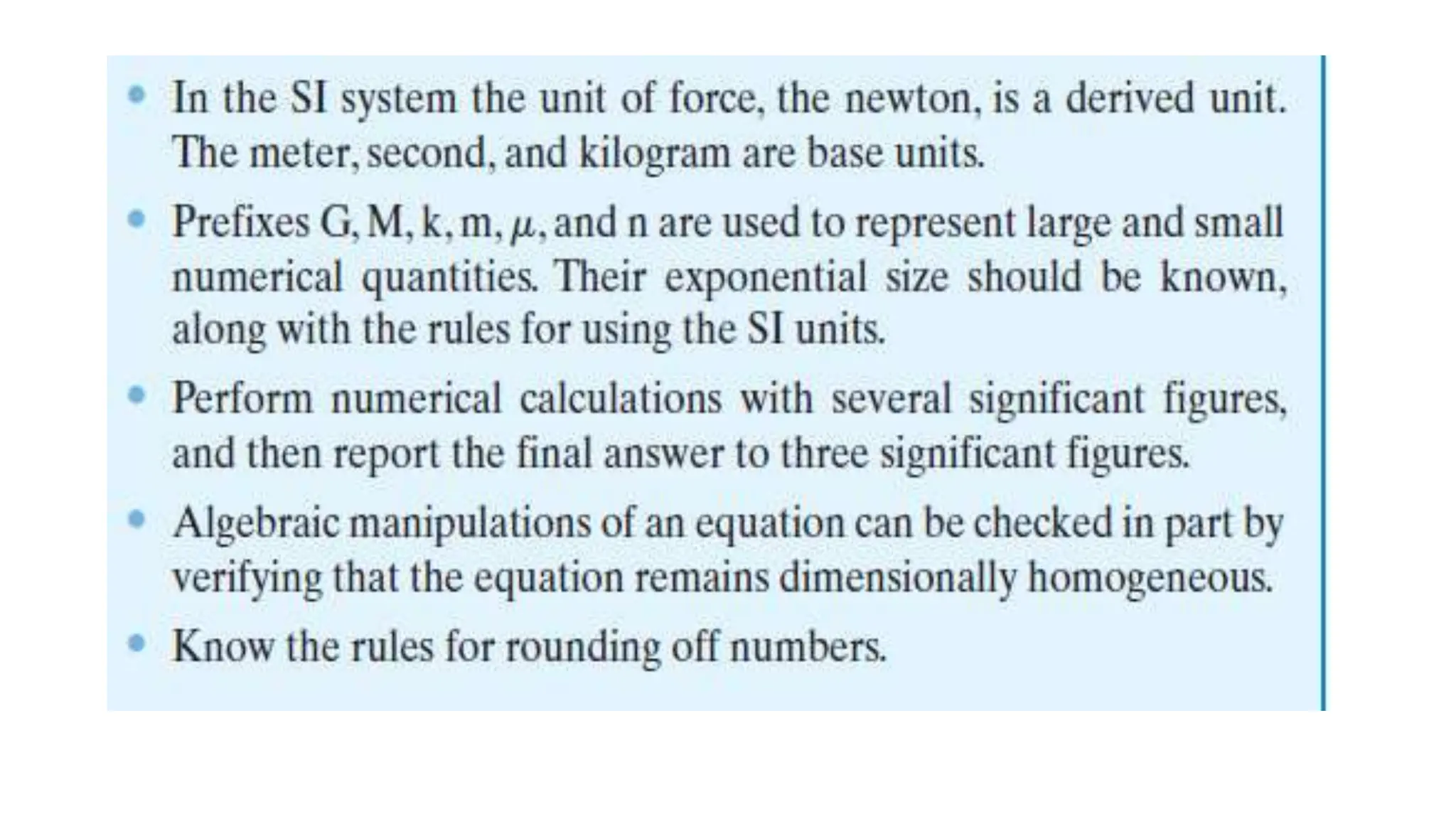
The four basic quantities—length, time, mass, and force—are not all
independent from one another; in fact, they are related by Newton’s
second law of motion, F = ma. Because of this, the units used to
measure
these quantities cannot all be selected arbitrarily. The equality F =
ma is
maintained only if three of the four units, called base units, are
defined
and the fourth unit is then derived from the equation.
Numerical Calculations
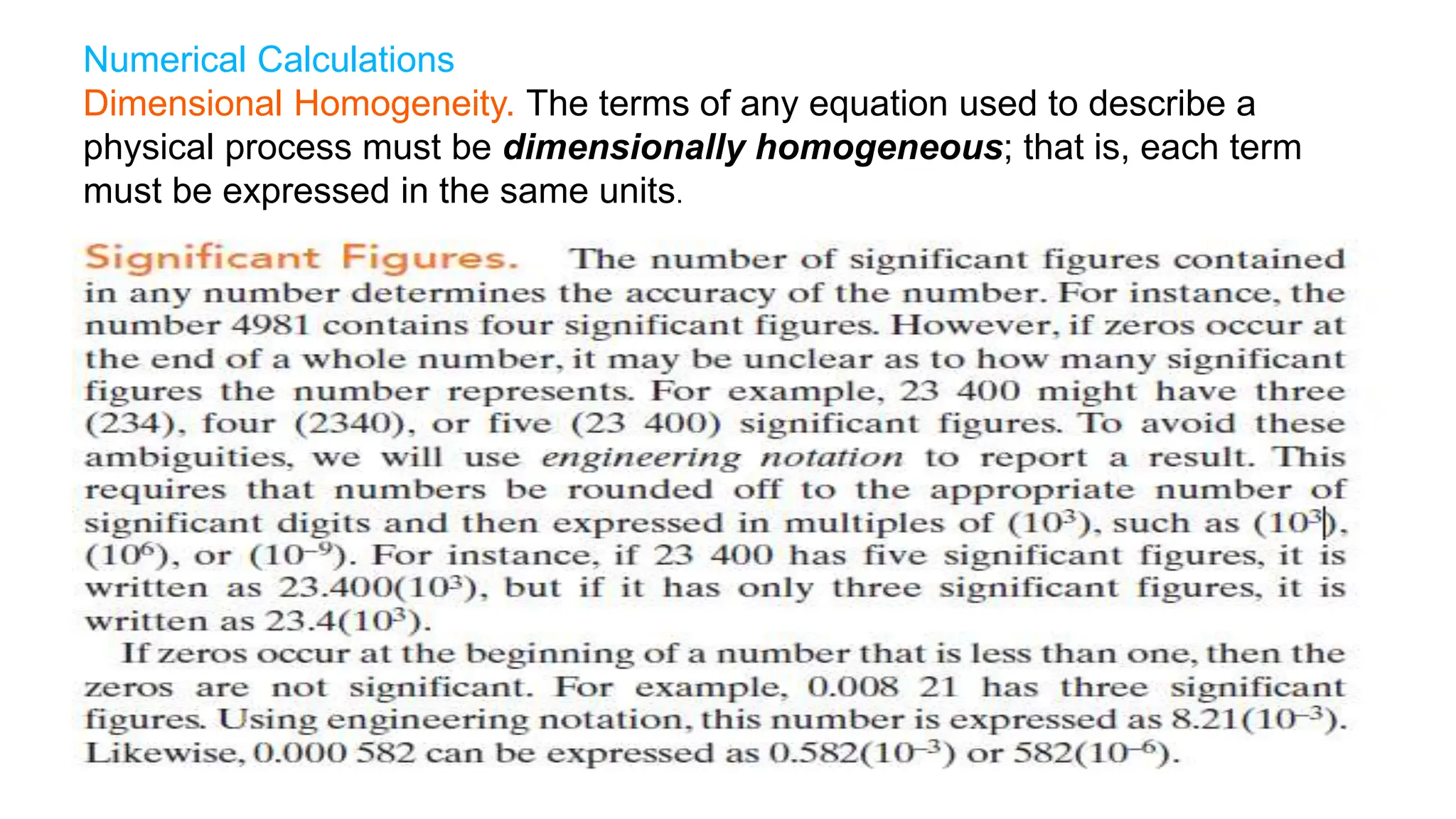
Dimensional Homogeneity. The terms of any equation used to describe a
physical process must be dimensionally homogeneous; that is, each term
must be expressed in the same units.
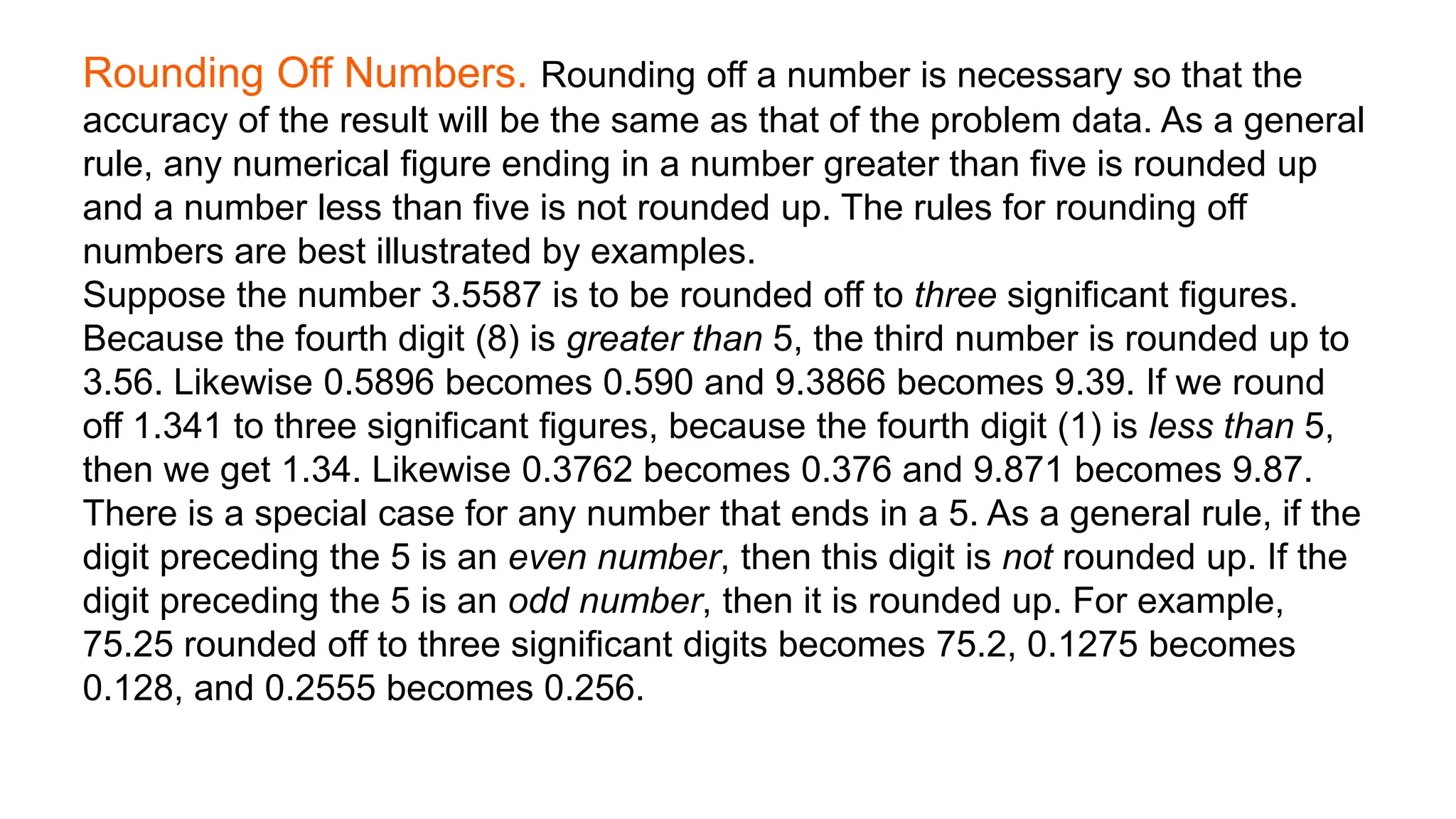
Rounding Off Numbers. Rounding off a number is necessary so that the
accuracy of the result will be the same as that of the problem data. As a general
rule, any numerical figure ending in a number greater than five is rounded up
and a number less than five is not rounded up. The rules for rounding off
numbers are best illustrated by examples.
Suppose the number 3.5587 is to be rounded off to three significant figures.
Because the fourth digit (8) is greater than 5, the third number is rounded up to
3.56. Likewise 0.5896 becomes 0.590 and 9.3866 becomes 9.39. If we round
off 1.341 to three significant figures, because the fourth digit (1) is less than 5,
then we get 1.34. Likewise 0.3762 becomes 0.376 and 9.871 becomes 9.87.
There is a special case for any number that ends in a 5. As a general rule, if the
digit preceding the 5 is an even number, then this digit is not rounded up. If the
digit preceding the 5 is an odd number, then it is rounded up. For example,
75.25 rounded off to three significant digits becomes 75.2, 0.1275 becomes
0.128, and 0.2555 becomes 0.256.
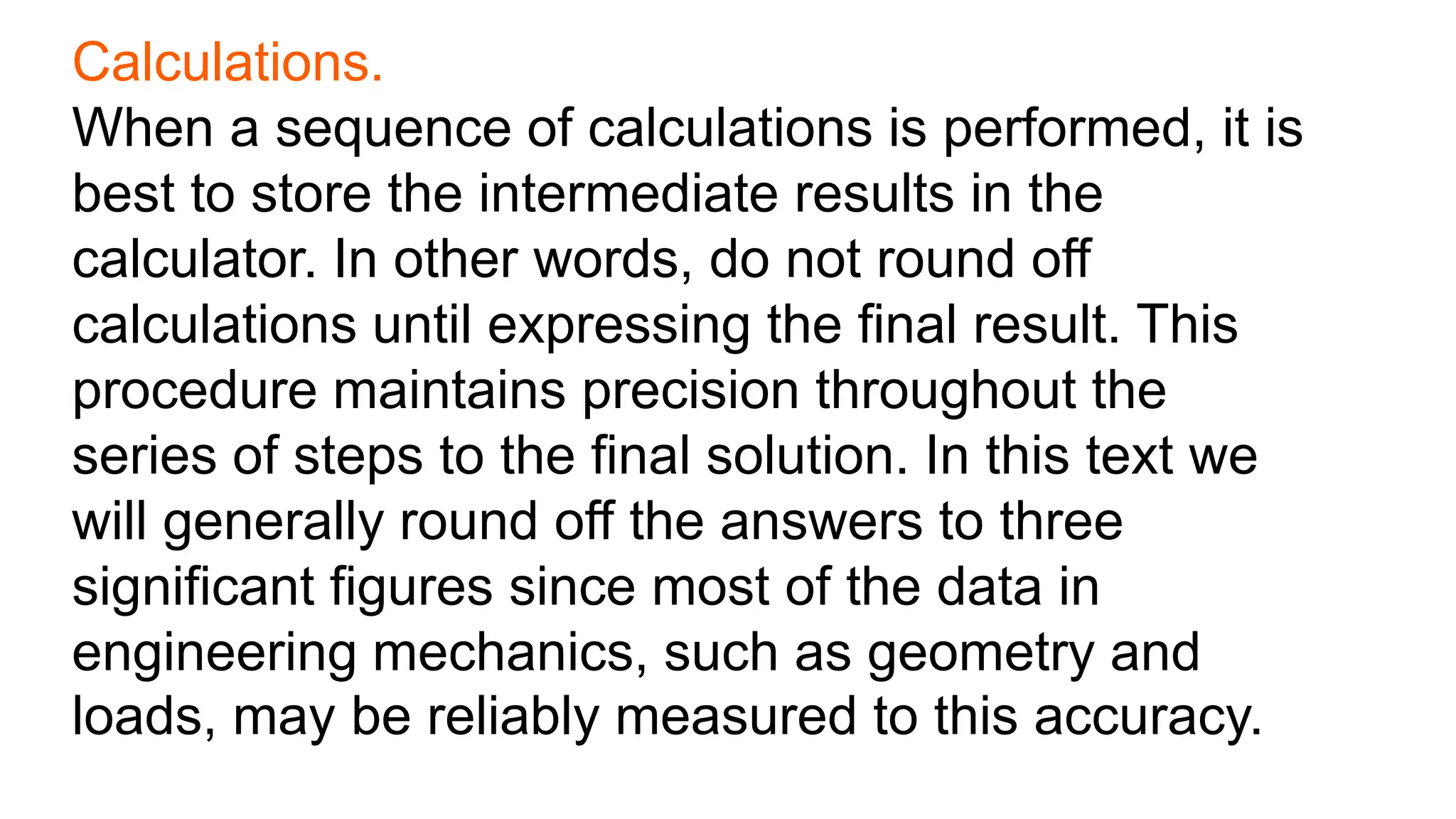
Calculations.
When a sequence of calculations is performed, it is
best to store the intermediate results in the
calculator. In other words, do not round off
calculations until expressing the final result. This
procedure maintains precision throughout the
series of steps to the final solution. In this text we
will generally round off the answers to three
significant figures since most of the data in
engineering mechanics, such as geometry and
loads, may be reliably measured to this accuracy.
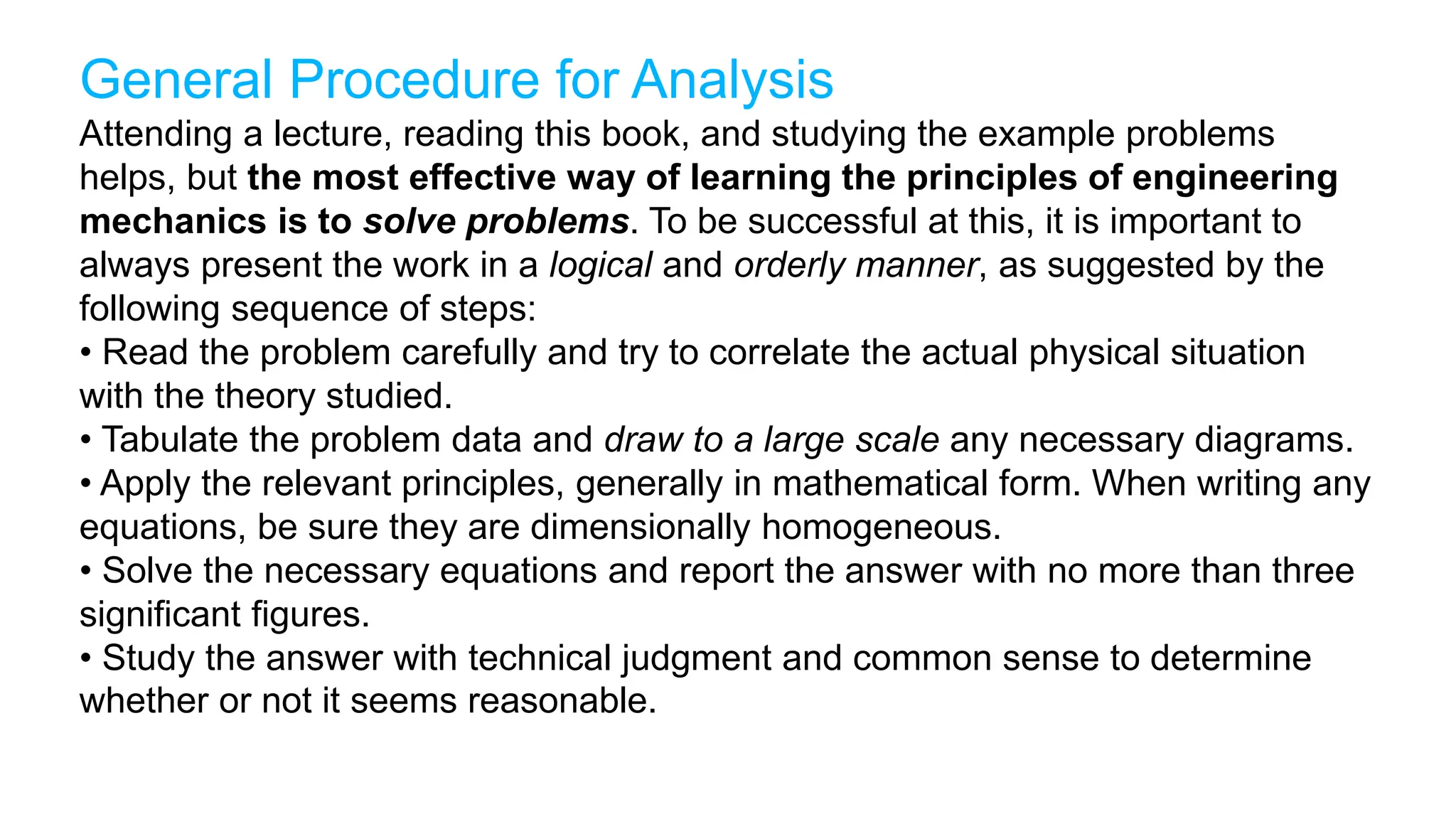
General Procedure for Analysis
Attending a lecture, reading this book, and studying the example problems
helps, but the most effective way of learning the principles of engineering
mechanics is to solve problems. To be successful at this, it is important to
always present the work in a logical and orderly manner, as suggested by the
following sequence of steps:
• Read the problem carefully and try to correlate the actual physical situation
with the theory studied.
• Tabulate the problem data and draw to a large scale any necessary diagrams.
• Apply the relevant principles, generally in mathematical form. When writing any
equations, be sure they are dimensionally homogeneous.
• Solve the necessary equations and report the answer with no more than three
significant figures.
• Study the answer with technical judgment and common sense to determine
whether or not it seems reasonable.
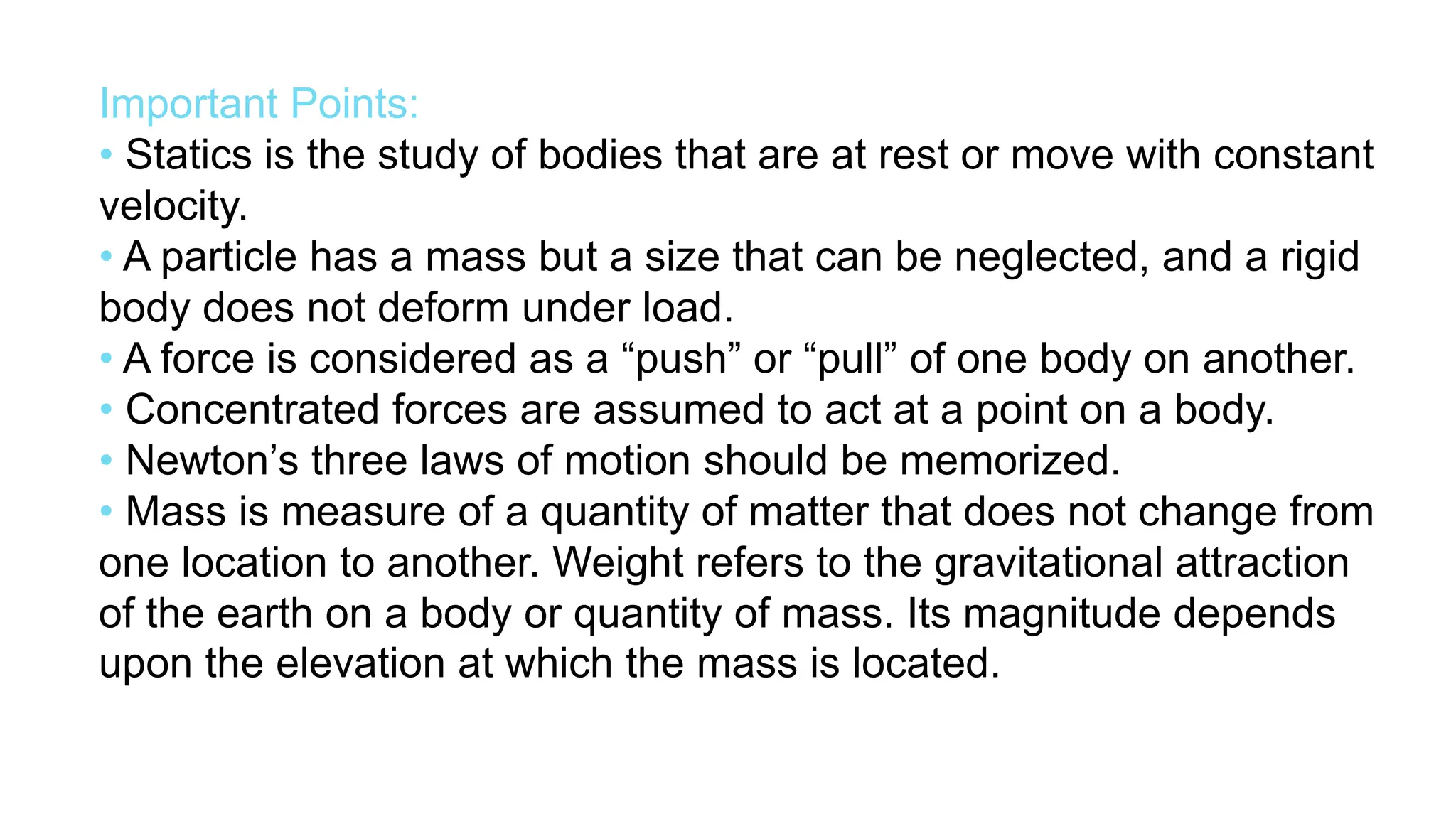
Important Points:
• Statics is the study of bodies that are at rest or move with constant
velocity.
• A particle has a mass but a size that can be neglected, and a rigid
body does not deform under load.
• A force is considered as a “push” or “pull” of one body on another.
• Concentrated forces are assumed to act at a point on a body.
• Newton’s three laws of motion should be memorized.
• Mass is measure of a quantity of matter that does not change from
one location to another. Weight refers to the gravitational attraction
of the earth on a body or quantity of mass. Its magnitude depends
upon the elevation at which the mass is located.
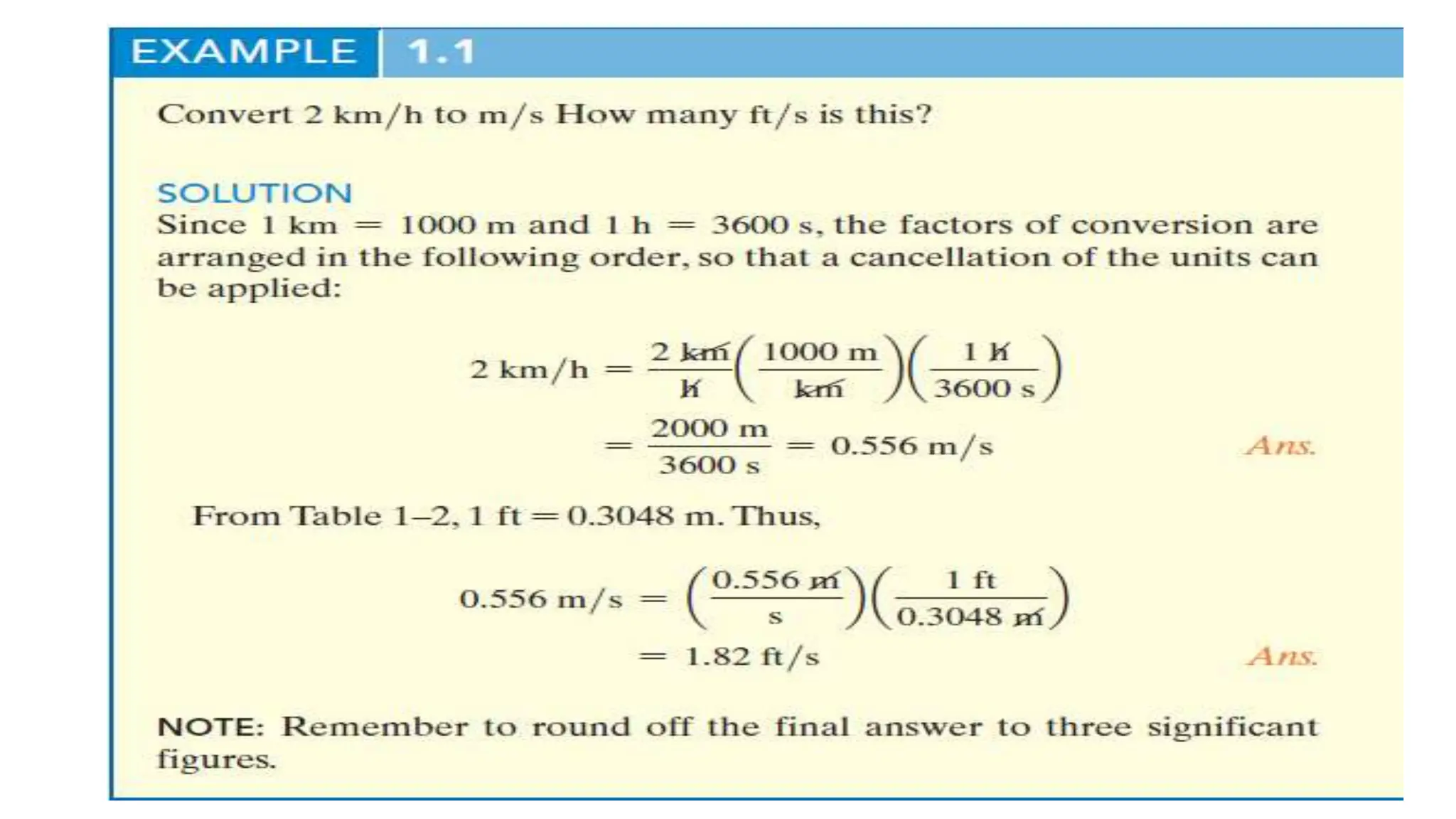
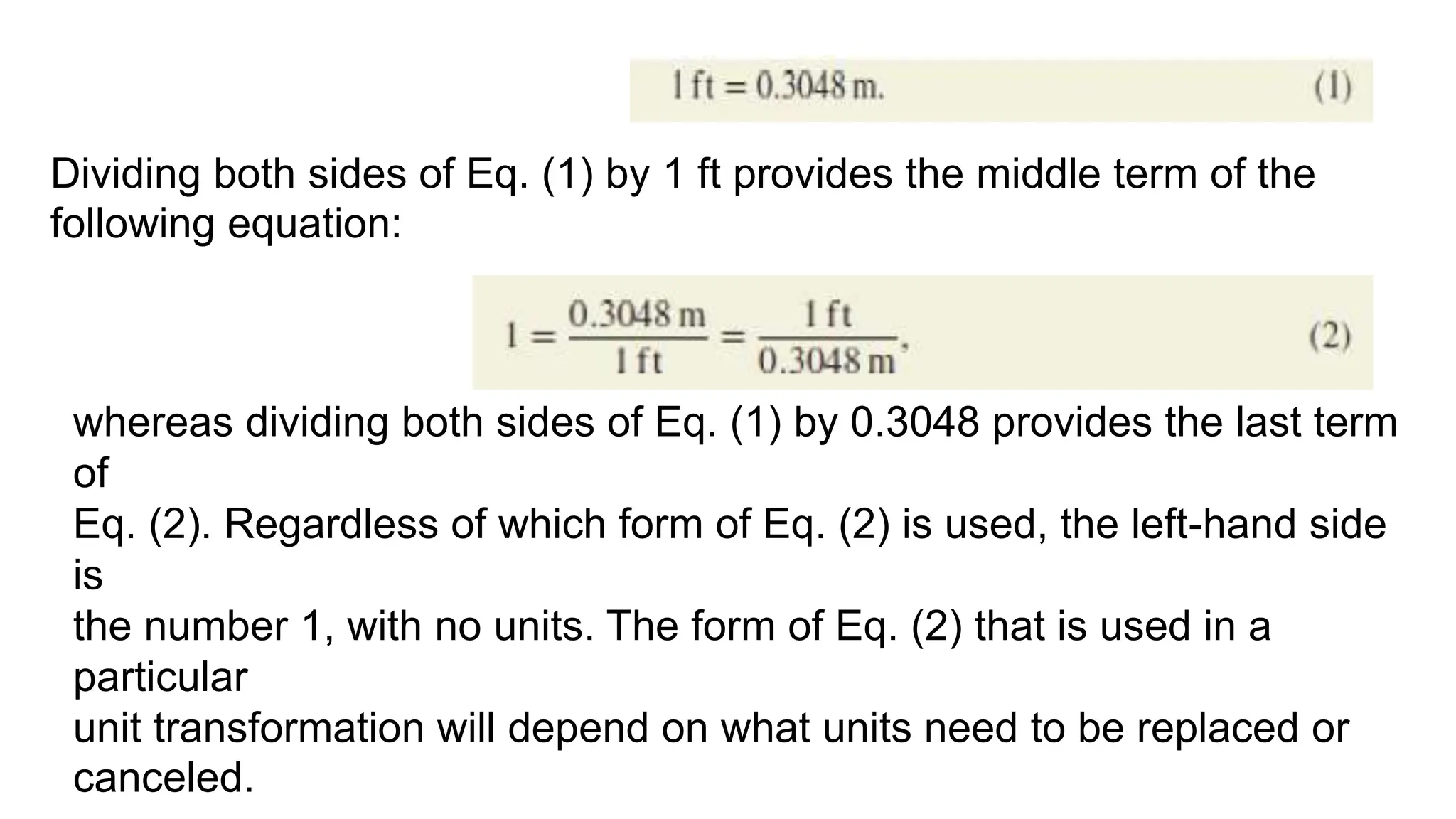
Dividing both sides of Eq. (1) by 1 ft provides the middle term of the
following equation:
whereas dividing both sides of Eq. (1) by 0.3048 provides the last term
of
Eq. (2). Regardless of which form of Eq. (2) is used, the left-hand side
is
the number 1, with no units. The form of Eq. (2) that is used in a
particular
unit transformation will depend on what units need to be replaced or
canceled.
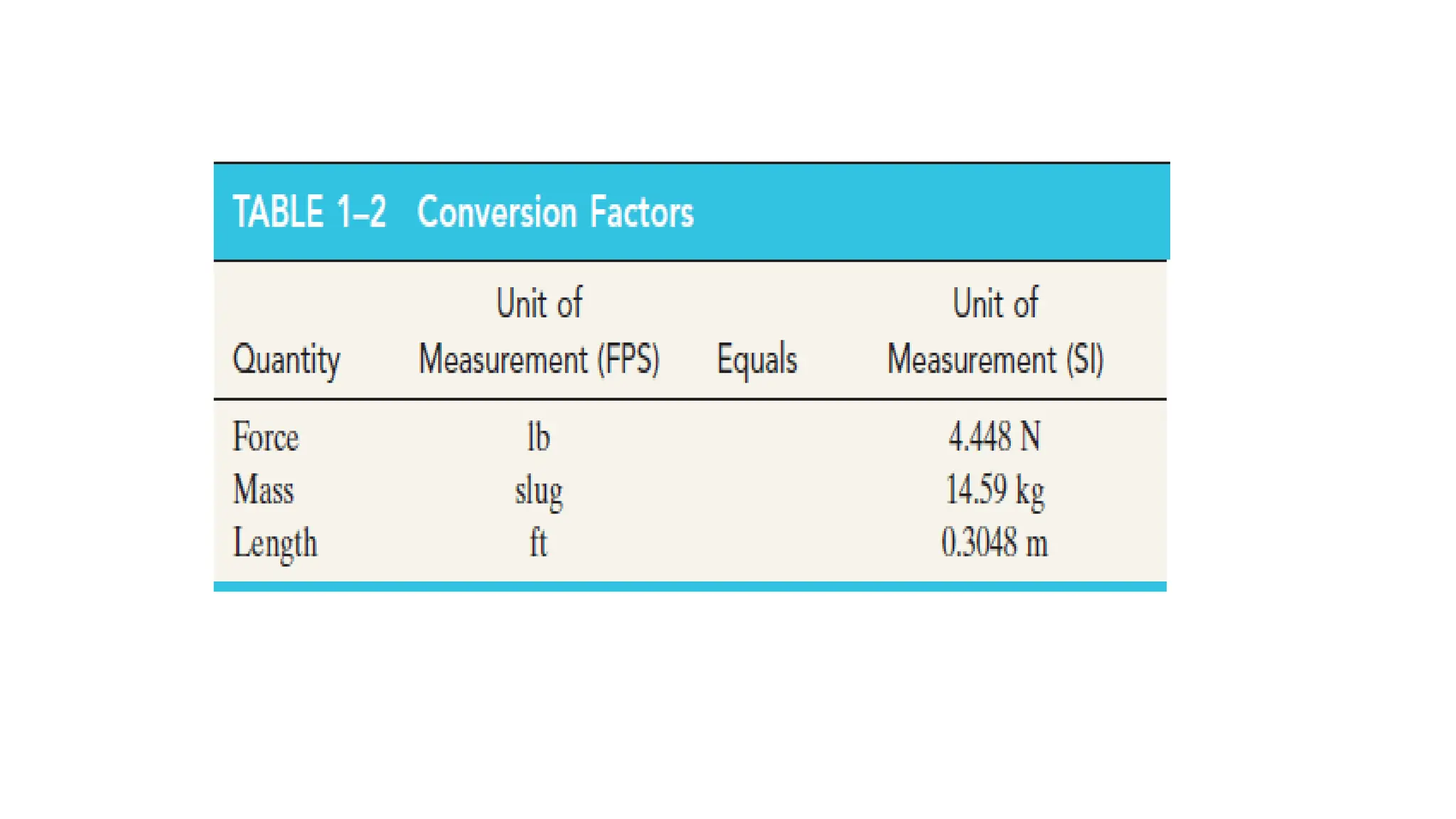
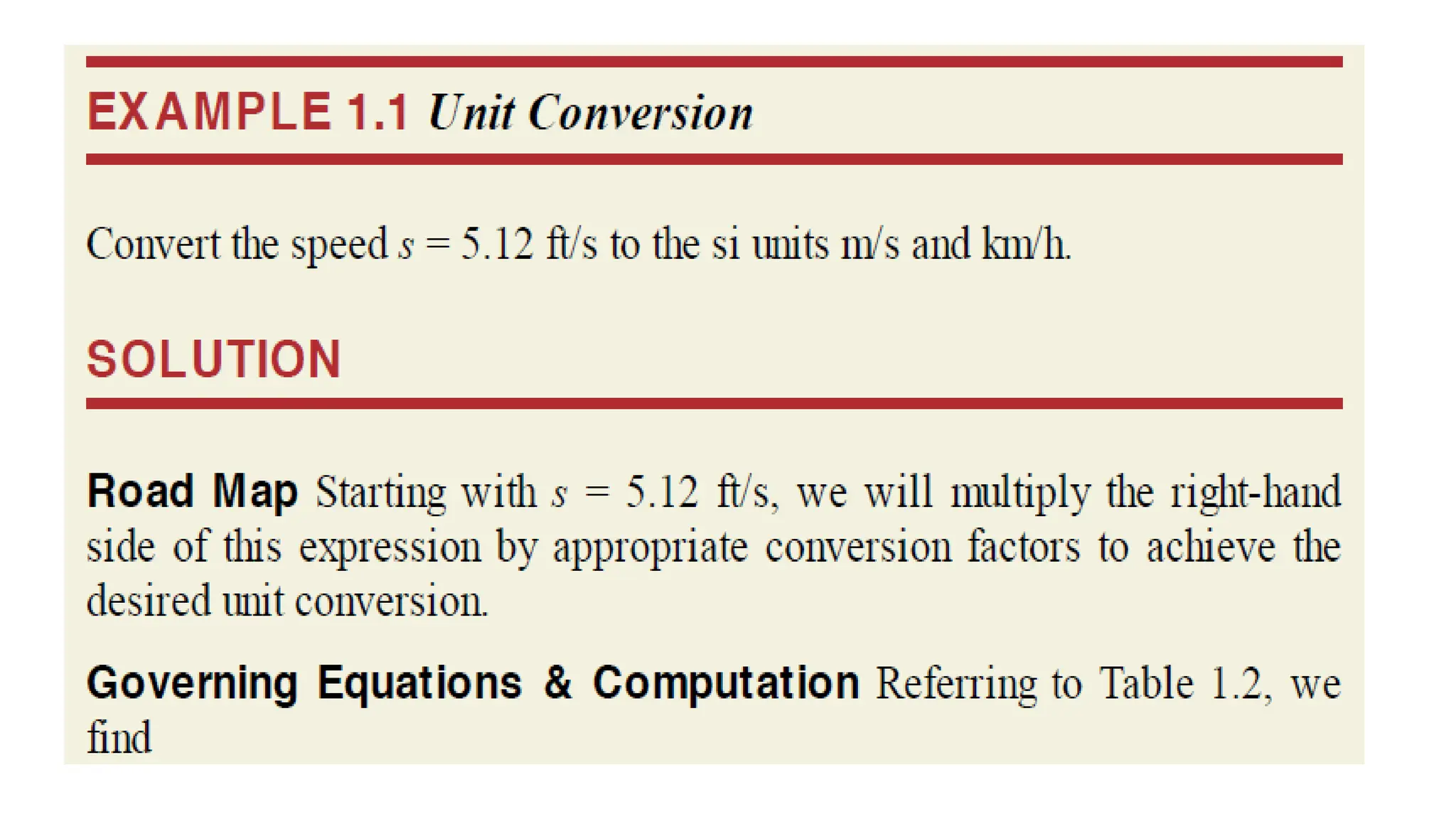
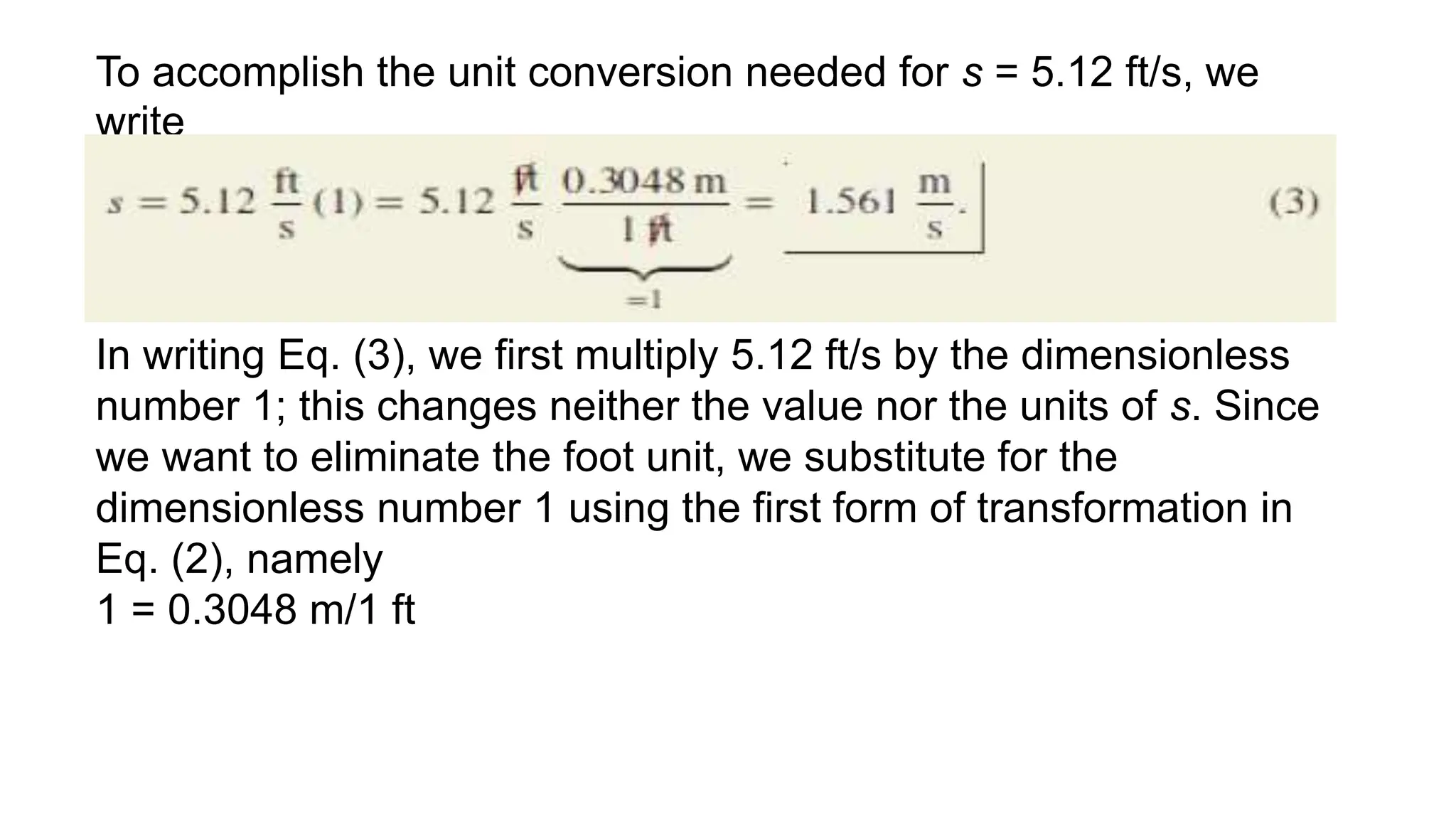
To accomplish the unit conversion needed for s = 5.12 ft/s, we
write
In writing Eq. (3), we first multiply 5.12 ft/s by the dimensionless
number 1; this changes neither the value nor the units of s. Since
we want to eliminate the foot unit, we substitute for the
dimensionless number 1 using the first form of transformation in
Eq. (2), namely
1 = 0.3048 m/1 ft
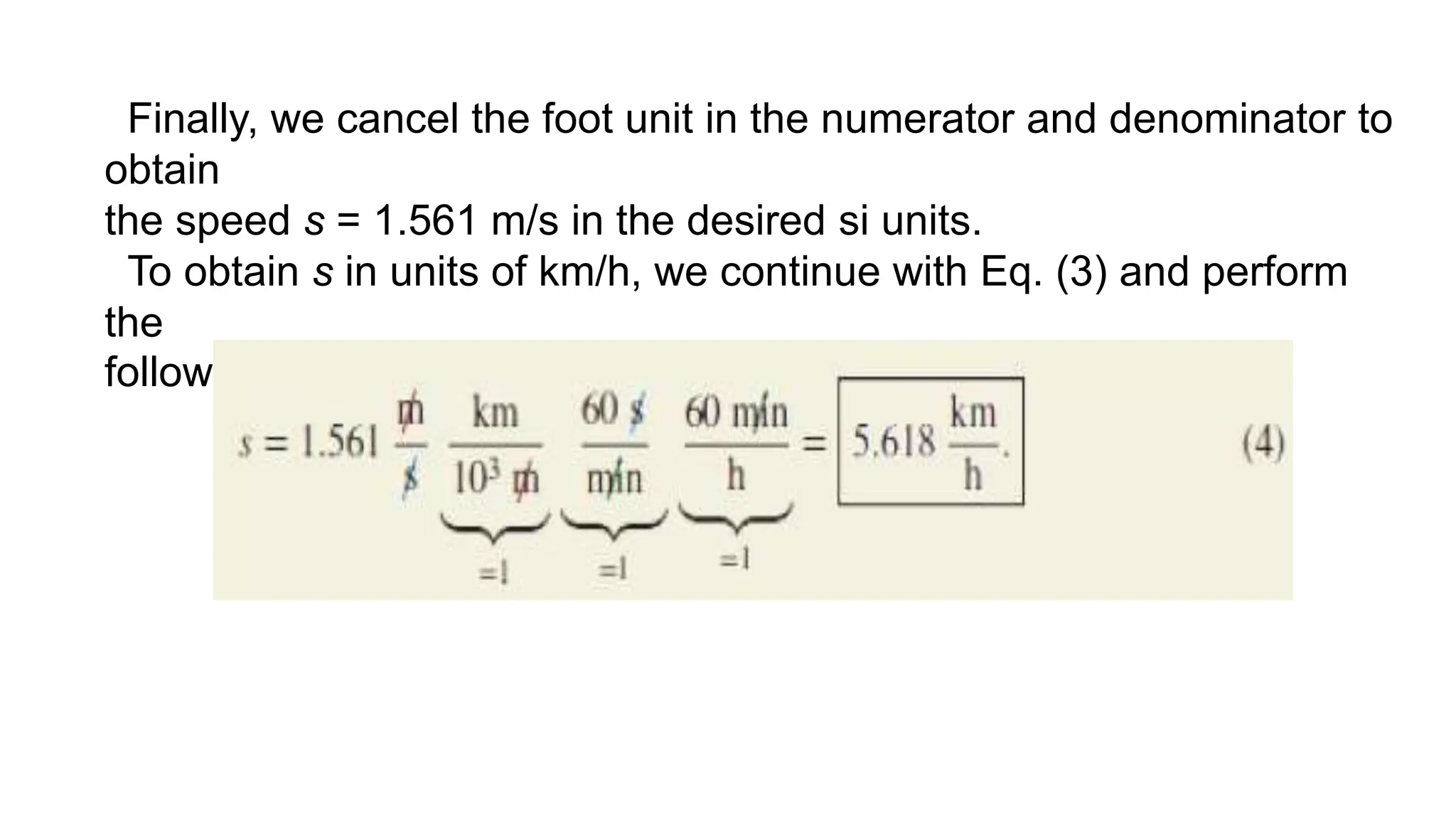
Finally, we cancel the foot unit in the numerator and denominator to
obtain
the speed s = 1.561 m/s in the desired si units.
To obtain s in units of km/h, we continue with Eq. (3) and perform
the
following transformations:
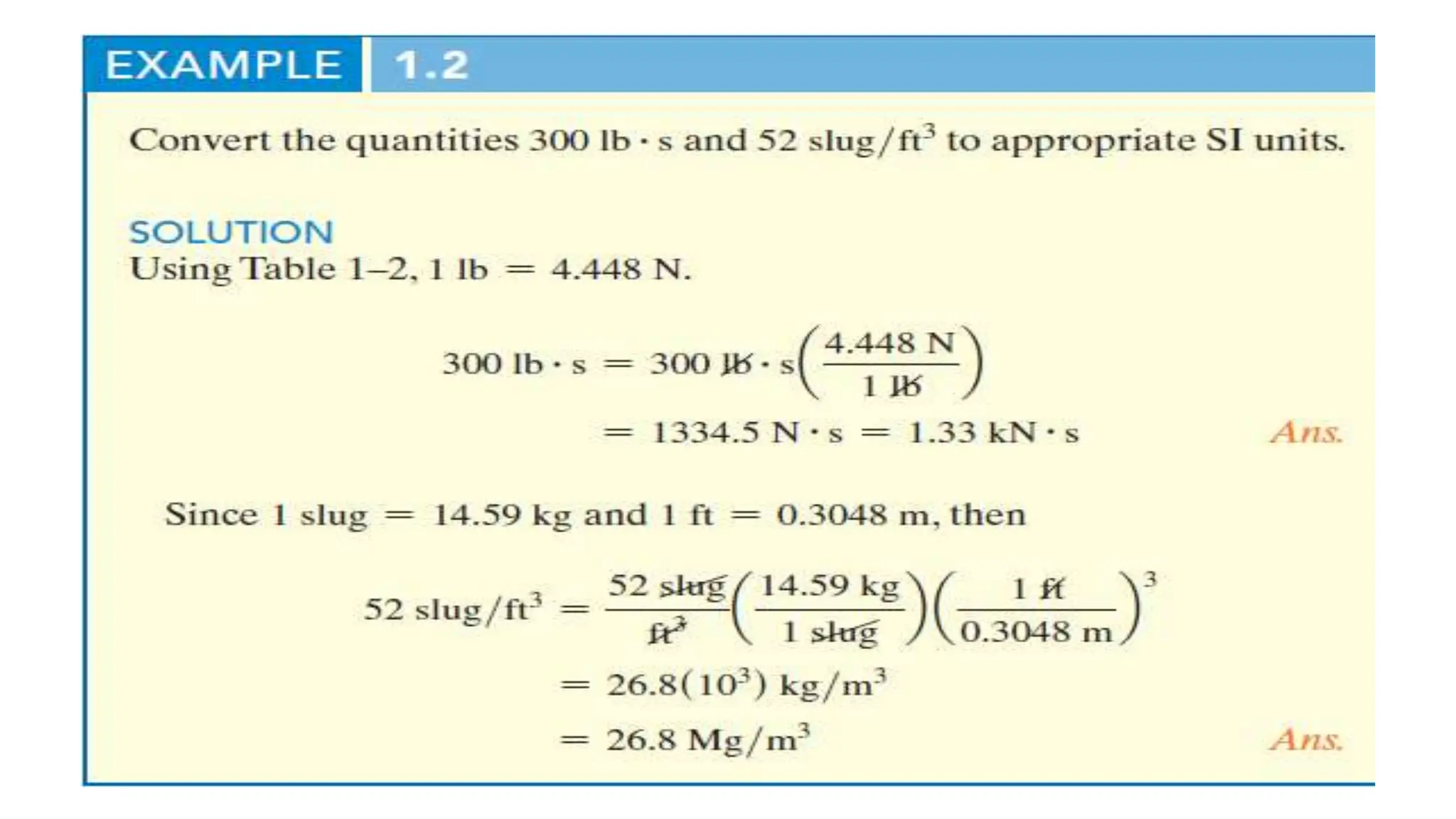
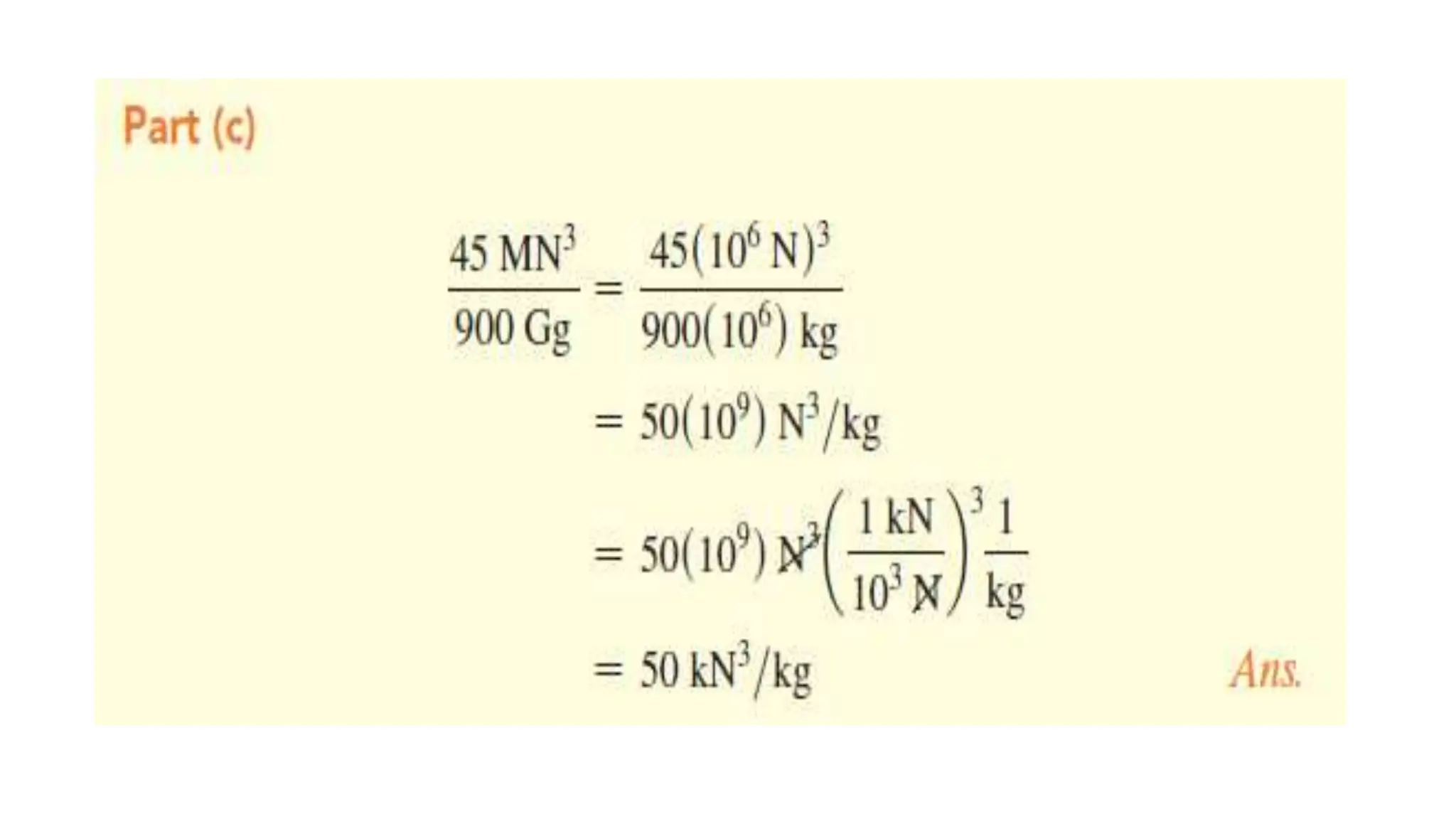
Alternatively, we could also perform the unit transformation by
first
introducing the SI force measure newton, followed by
conversion to force measure in pounds, followed by conversion
of length. Thus,

CV -111 Basic Principles of Engineering Mechanics

  • 1.
  • 2.
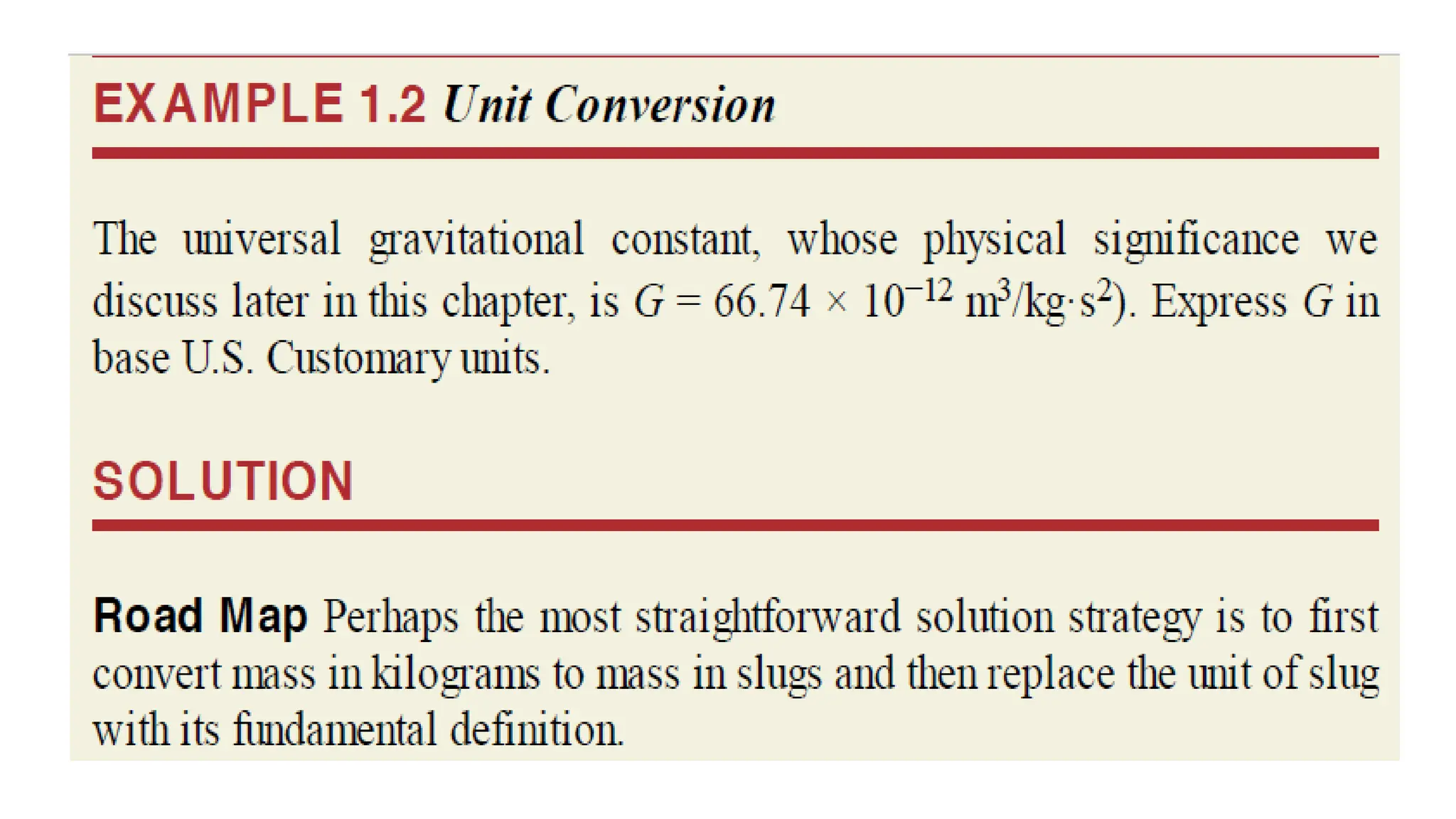
    Mechanics Mechanics is abranch of the physical sciences that is concerned with the state of rest or motion of bodies that are subjected to the action of forces. In general, this subject can be subdivided into three branches: rigid-body mechanics, deformable-body mechanics, and fluid mechanics. In this book we will study rigid-body mechanics since it is a basic requirement for the study of the mechanics of deformable bodies and the mechanics of fluids. Furthermore, rigid- body mechanics is essential for the design and analysis of many types of structural members, mechanical components, or electrical devices encountered in engineering. Rigid-body mechanics is divided into two areas: statics and dynamics. Statics deals with the equilibrium of bodies, that is, those that are either at rest or move with a constant velocity; whereas dynamics is concerned with the accelerated motion of bodies. We can consider statics as a special case of dynamics, in which the acceleration is zero; however, statics deserves separate treatment in engineering education since many objects are designed with the intention that they remain in equilibrium.
  • 3.
    Fundamental Concepts Basic Quantities.The following four quantities are used throughout mechanics: Length. Length is used to locate the position of a point in space and thereby describe the size of a physical system. Time. Time is conceived as a succession of events. Mass. Mass is a measure of a quantity of matter that is used to compare the action of one body with that of another. Force. In general, force is considered as a “push” or “pull” exerted by one body on another. A force is completely characterized by its magnitude, direction, and point of application. Idealizations. Models or idealizations are used in mechanics in order to simplify application of the theory. Here we will consider three important idealizations. Particle. A particle has a mass, but a size that can be neglected. For example, the size of the earth is insignificant compared to the size of its orbit, and therefore the earth can be modeled as a particle when studying its orbital motion. When a body is idealized as a particle, the principles of mechanics reduce to a rather simplified form since the geometry of the body will not be involved in the analysis of the problem. Rigid Body. A rigid body can be considered as a combination of a large number of particles in which all the particles remain at a fixed distance from one another, both before and after applying a load. This model is important because the body’s shape does not change when a load is applied, and so we do not have to consider the type of material from which the body is made. In most cases the actual deformations occurring in structures, machines, mechanisms, and the like are relatively small, and the rigid-body assumption is suitable for analysis.
  • 4.
    Concentrated Force. Aconcentrated force represents the effect of a loading which is assumed to act at a point on a body. We can represent a load by a concentrated force, provided the area over which the load is applied is very small compared to the overall size of the body. An example would be the contact force between a wheel and the ground. Three forces act on the ring. Since these forces all meet at a point, then for any force analysis, we can assume the ring to be represented as a particle. Steel is a common engineering material that does not deform very much under load. Therefore, we can consider this railroad wheel to be a rigid body acted upon by the concentrated force of the rail
  • 5.
    Newton’s Three Lawsof Motion. Engineering mechanics is formulated based on Newton’s three laws of motion, the validity of which is based on experimental observation. First Law. A particle originally at rest, or moving in a straight line with constant velocity, tends to remain in this state provided the particle is not subjected to an unbalanced force, Fig.a.
  • 6.
    Second Law. Aparticle acted upon by an unbalanced force F experiences an acceleration a that has the same direction as the force and a magnitude that is directly proportional to the force, Fig. b. If F is applied to a particle of mass m, this law may be expressed mathematically as F = ma (1–1)
  • 9.
    Weight. According toEq. 1–2, any two particles or bodies have a mutual attractive (gravitational) force acting between them. In the case of a particle located at or near the surface of the earth, however, the only gravitational force having any sizable magnitude is that between the earth and the particle. Consequently, this force, termed the weight, will be the only gravitational force considered in our study of mechanics.
  • 10.
    By comparison withF = ma, we can see that g is the acceleration due to gravity. Since it depends on r, then the weight of a body is not an absolute quantity. Instead, its magnitude is determined from where the measurement was made. For most engineering calculations, however, g is determined at sea level, which is considered the “standard location.”
  • 11.
    The astronaut’s weightis diminished since she is far removed from the gravitational field of the earth.
  • 12.
    Units of Measurement Thefour basic quantities—length, time, mass, and force—are not all independent from one another; in fact, they are related by Newton’s second law of motion, F = ma. Because of this, the units used to measure these quantities cannot all be selected arbitrarily. The equality F = ma is maintained only if three of the four units, called base units, are defined and the fourth unit is then derived from the equation.
  • 18.
    Numerical Calculations Dimensional Homogeneity.The terms of any equation used to describe a physical process must be dimensionally homogeneous; that is, each term must be expressed in the same units.
  • 19.
    Rounding Off Numbers.Rounding off a number is necessary so that the accuracy of the result will be the same as that of the problem data. As a general rule, any numerical figure ending in a number greater than five is rounded up and a number less than five is not rounded up. The rules for rounding off numbers are best illustrated by examples. Suppose the number 3.5587 is to be rounded off to three significant figures. Because the fourth digit (8) is greater than 5, the third number is rounded up to 3.56. Likewise 0.5896 becomes 0.590 and 9.3866 becomes 9.39. If we round off 1.341 to three significant figures, because the fourth digit (1) is less than 5, then we get 1.34. Likewise 0.3762 becomes 0.376 and 9.871 becomes 9.87. There is a special case for any number that ends in a 5. As a general rule, if the digit preceding the 5 is an even number, then this digit is not rounded up. If the digit preceding the 5 is an odd number, then it is rounded up. For example, 75.25 rounded off to three significant digits becomes 75.2, 0.1275 becomes 0.128, and 0.2555 becomes 0.256.
  • 20.
    Calculations. When a sequenceof calculations is performed, it is best to store the intermediate results in the calculator. In other words, do not round off calculations until expressing the final result. This procedure maintains precision throughout the series of steps to the final solution. In this text we will generally round off the answers to three significant figures since most of the data in engineering mechanics, such as geometry and loads, may be reliably measured to this accuracy.
  • 21.
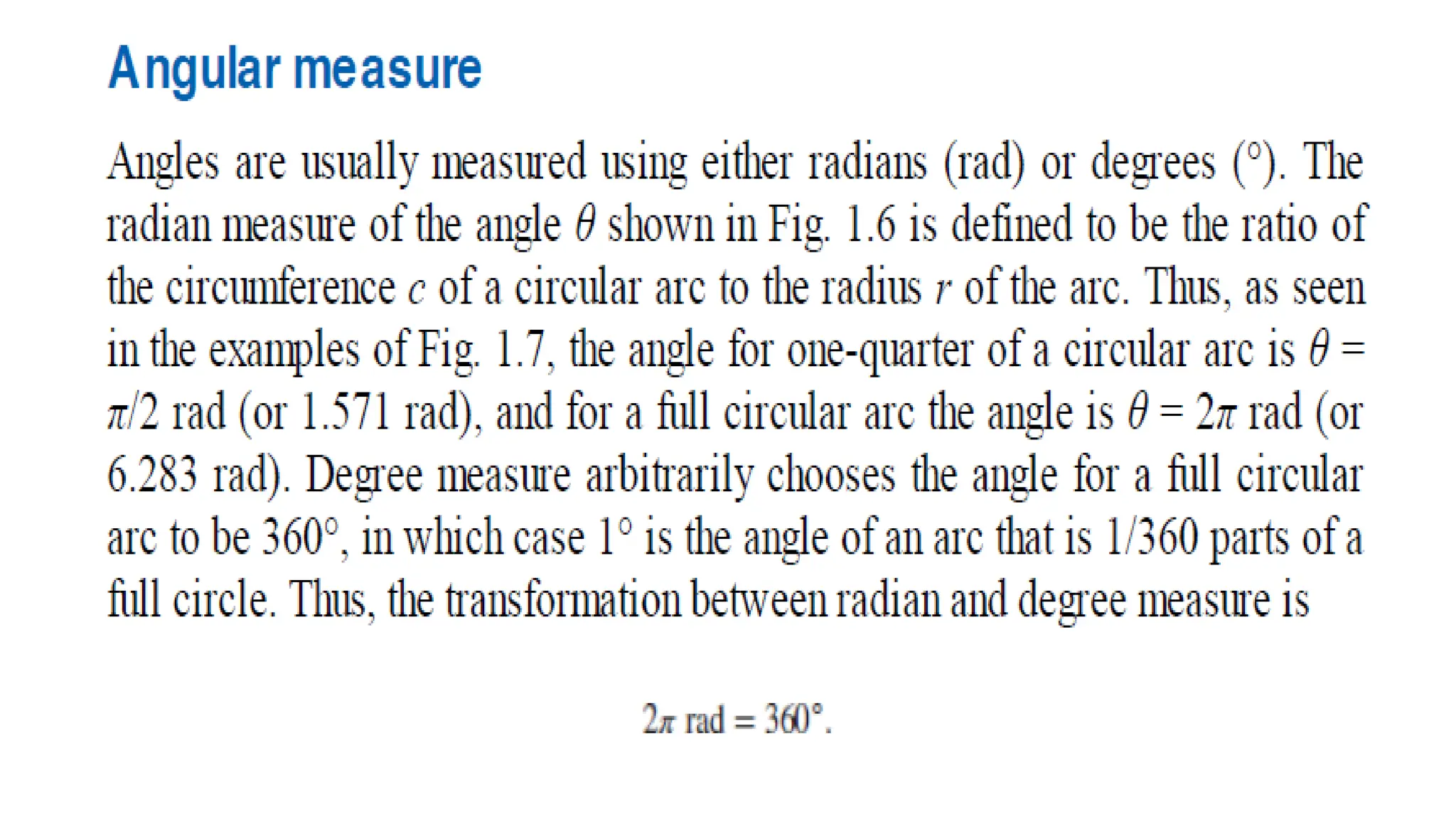
    General Procedure forAnalysis Attending a lecture, reading this book, and studying the example problems helps, but the most effective way of learning the principles of engineering mechanics is to solve problems. To be successful at this, it is important to always present the work in a logical and orderly manner, as suggested by the following sequence of steps: • Read the problem carefully and try to correlate the actual physical situation with the theory studied. • Tabulate the problem data and draw to a large scale any necessary diagrams. • Apply the relevant principles, generally in mathematical form. When writing any equations, be sure they are dimensionally homogeneous. • Solve the necessary equations and report the answer with no more than three significant figures. • Study the answer with technical judgment and common sense to determine whether or not it seems reasonable.
  • 22.
    Important Points: • Staticsis the study of bodies that are at rest or move with constant velocity. • A particle has a mass but a size that can be neglected, and a rigid body does not deform under load. • A force is considered as a “push” or “pull” of one body on another. • Concentrated forces are assumed to act at a point on a body. • Newton’s three laws of motion should be memorized. • Mass is measure of a quantity of matter that does not change from one location to another. Weight refers to the gravitational attraction of the earth on a body or quantity of mass. Its magnitude depends upon the elevation at which the mass is located.
  • 38.
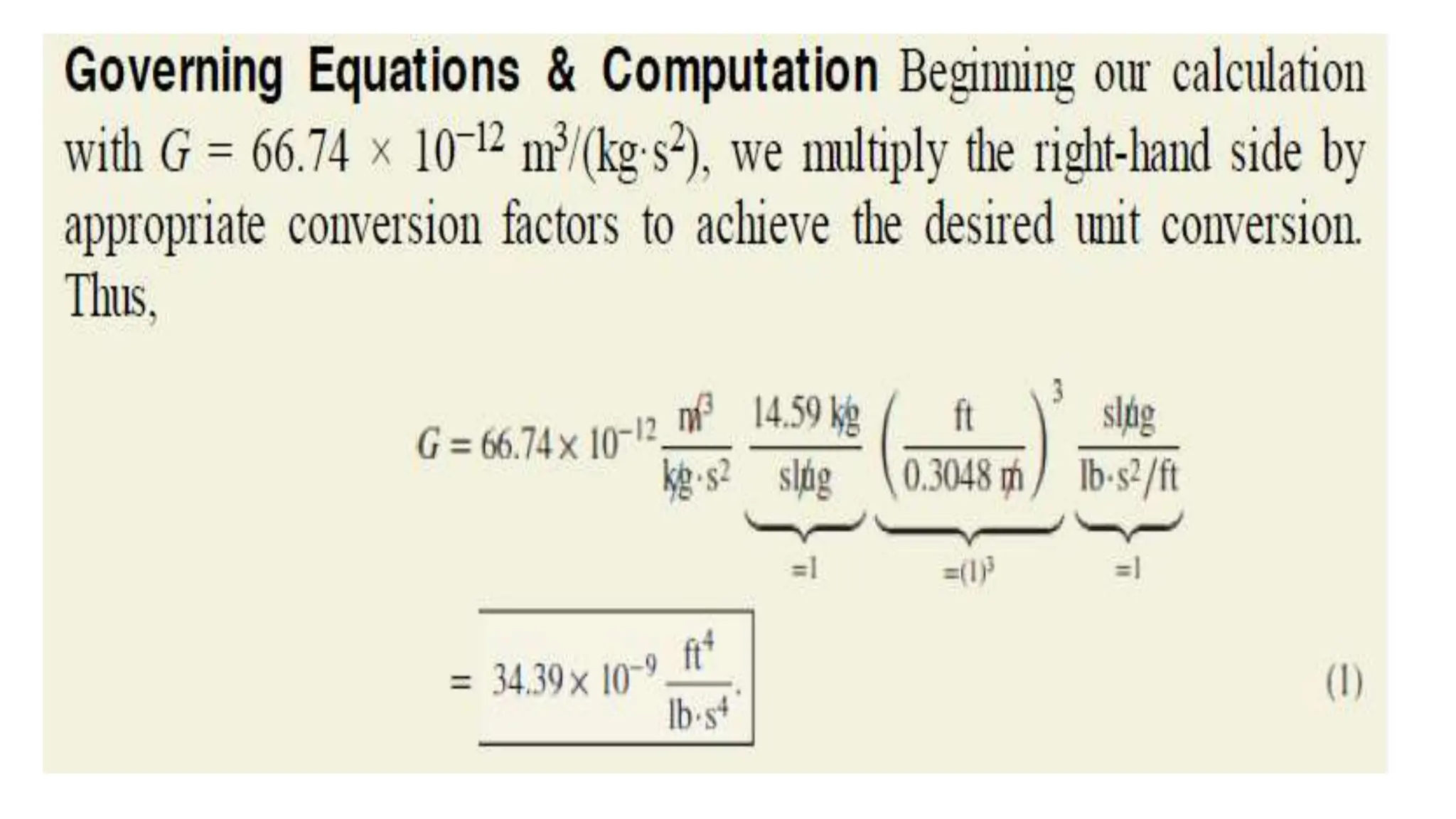
    Dividing both sidesof Eq. (1) by 1 ft provides the middle term of the following equation: whereas dividing both sides of Eq. (1) by 0.3048 provides the last term of Eq. (2). Regardless of which form of Eq. (2) is used, the left-hand side is the number 1, with no units. The form of Eq. (2) that is used in a particular unit transformation will depend on what units need to be replaced or canceled.
  • 39.
    To accomplish theunit conversion needed for s = 5.12 ft/s, we write In writing Eq. (3), we first multiply 5.12 ft/s by the dimensionless number 1; this changes neither the value nor the units of s. Since we want to eliminate the foot unit, we substitute for the dimensionless number 1 using the first form of transformation in Eq. (2), namely 1 = 0.3048 m/1 ft
  • 40.
    Finally, we cancelthe foot unit in the numerator and denominator to obtain the speed s = 1.561 m/s in the desired si units. To obtain s in units of km/h, we continue with Eq. (3) and perform the following transformations:
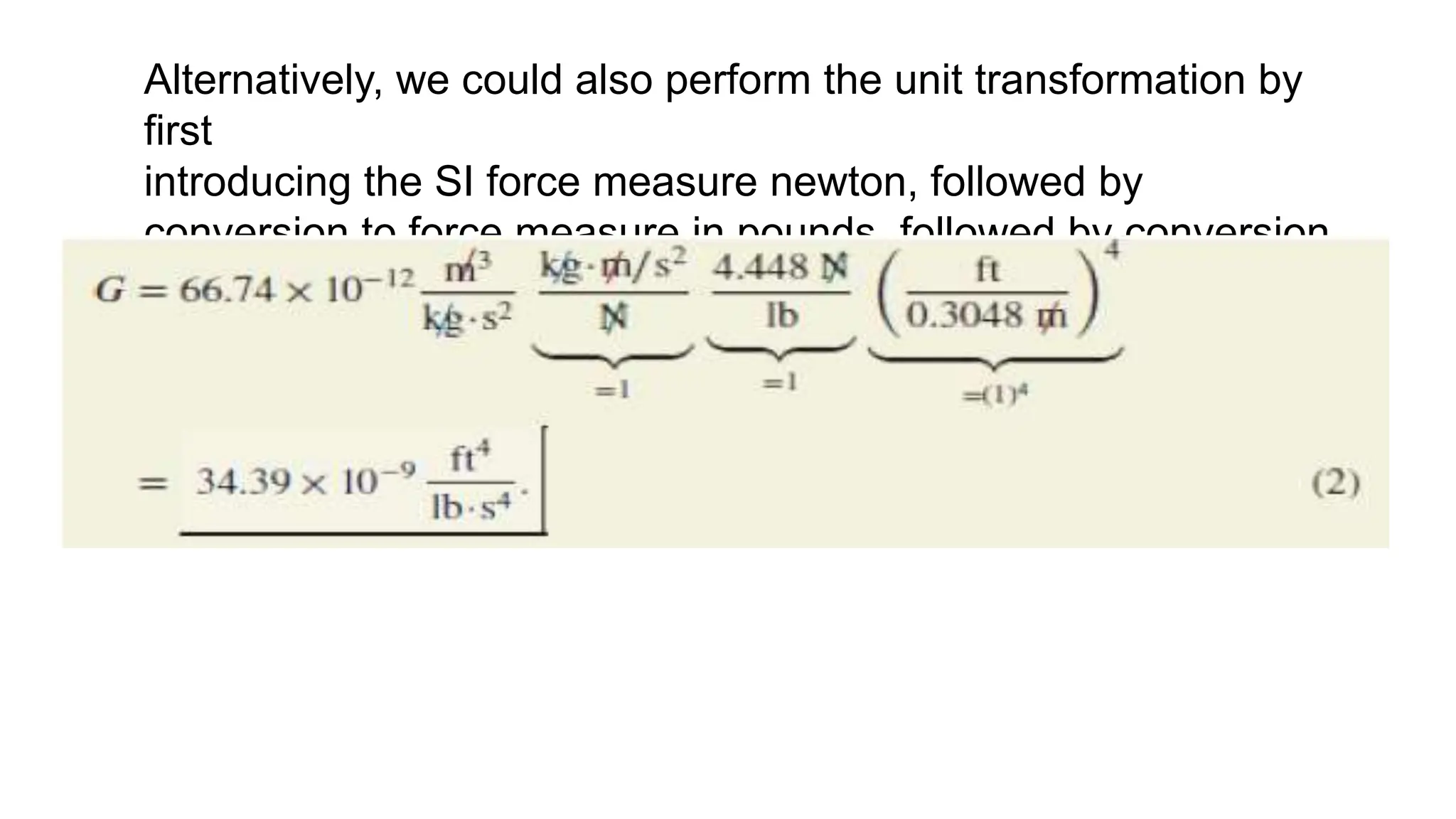
  • 43.
    Alternatively, we couldalso perform the unit transformation by first introducing the SI force measure newton, followed by conversion to force measure in pounds, followed by conversion of length. Thus,