INTRODUCTION TO SQL
STRUCTURED QUERY LANGUAGE
 Today almost all RDBMS(MySql, Oracle,
Infomix, Sybase, MS Access) use SQL as the
standard database query language.
 SQL is used to perform all types of data
operations in RDBMS.
 Structure Query Language(SQL) is a database
query language used for storing and managing
data in Relational DBMS.
 SQL was the first commercial language
introduced for E.F Codd's Relational model of
database.
SQL COMMANDS ARE
INSTRUCTIONS. IT IS USED TO
COMMUNICATE WITH THE
DATABASE. IT IS ALSO USED TO
PERFORM SPECIFIC TASKS,
FUNCTIONS, AND QUERIES OF
DATA.
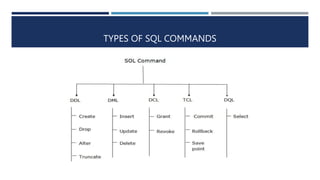
TYPES OF SQL COMMANDS
CHARACTERISTICS OF SQL
 Even if you have no prior experience with technology, you can
learn the basics of the language.
 SQL supports a wide variety of commands such as
DDL,DML,TCL,DCL,DQL.
 SQL supports join which is a command that joins two sets of data
together .
 SQL is well suited to a client-server environment, in which the
database management system (DBMS) is located on a server and
handles client requests.
WHAT ARE THE ADVANTAGES OF SQL?
 Faster and Efficient Query Processing
 No Need for Coding Skills
 Portability is an extremely desirable feature in any program
 SQL is a relational database query language that has been accepted
by ISO and ANSI
 It becomes an interactive language for its users because it offers easy
commands for all purposes
 The SQL programming language is nearly 50 years old and is
incredibly mature and still extensively used.
WHAT ARE THE DISADVANTAGES OF SQL?
 Certain versions of SQL can be costly, preventing
programmers from accessing them.
 The hardware demands of SQL databases encompass
ongoing maintenance and operational expenses.
 Programmers using SQL might find themselves lacking
full control over databases.
INTRO TO SQL.pptx

INTRO TO SQL.pptx

  • 1.
  • 2.
    STRUCTURED QUERY LANGUAGE Today almost all RDBMS(MySql, Oracle, Infomix, Sybase, MS Access) use SQL as the standard database query language.  SQL is used to perform all types of data operations in RDBMS.  Structure Query Language(SQL) is a database query language used for storing and managing data in Relational DBMS.  SQL was the first commercial language introduced for E.F Codd's Relational model of database.
  • 3.
    SQL COMMANDS ARE INSTRUCTIONS.IT IS USED TO COMMUNICATE WITH THE DATABASE. IT IS ALSO USED TO PERFORM SPECIFIC TASKS, FUNCTIONS, AND QUERIES OF DATA.
  • 4.
    TYPES OF SQLCOMMANDS
  • 5.
    CHARACTERISTICS OF SQL Even if you have no prior experience with technology, you can learn the basics of the language.  SQL supports a wide variety of commands such as DDL,DML,TCL,DCL,DQL.  SQL supports join which is a command that joins two sets of data together .  SQL is well suited to a client-server environment, in which the database management system (DBMS) is located on a server and handles client requests.
  • 6.
    WHAT ARE THEADVANTAGES OF SQL?  Faster and Efficient Query Processing  No Need for Coding Skills  Portability is an extremely desirable feature in any program  SQL is a relational database query language that has been accepted by ISO and ANSI  It becomes an interactive language for its users because it offers easy commands for all purposes  The SQL programming language is nearly 50 years old and is incredibly mature and still extensively used.
  • 7.
    WHAT ARE THEDISADVANTAGES OF SQL?  Certain versions of SQL can be costly, preventing programmers from accessing them.  The hardware demands of SQL databases encompass ongoing maintenance and operational expenses.  Programmers using SQL might find themselves lacking full control over databases.