1
Topic: “FACTORS AFFECTING EXCHANGE RATE IN BANGLADESH”
3
4
Group-4
Shariful Islam Id-140310
Zahida 140314
Rozina khatun140316
5
INTRODUCTION
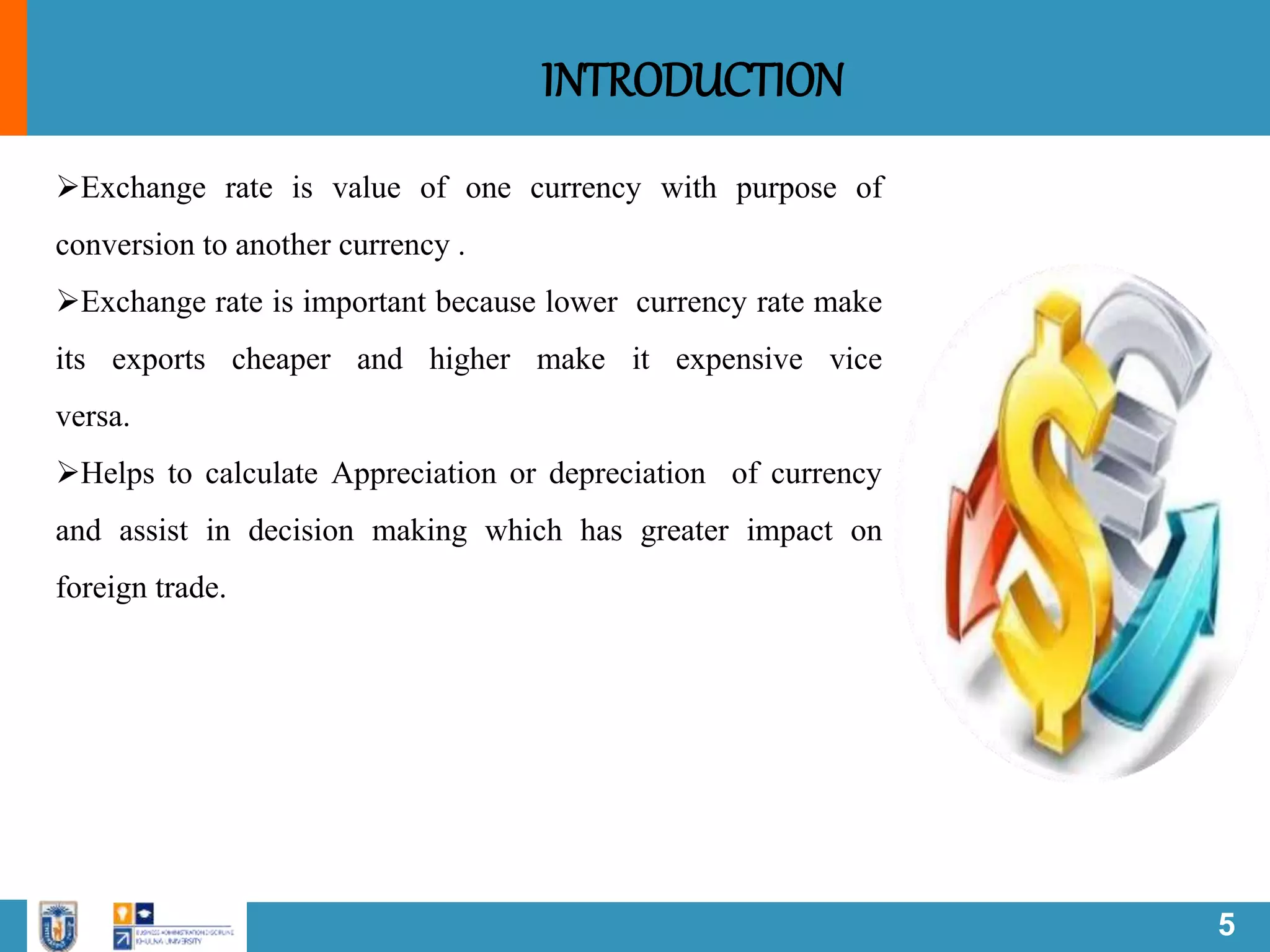
Exchange rate is value of one currency with purpose of
conversion to another currency .
Exchange rate is important because lower currency rate make
its exports cheaper and higher make it expensive vice
versa.
Helps to calculate Appreciation or depreciation of currency
and assist in decision making which has greater impact on
foreign trade.
6
Continue...
 domestic currency appreciates( ), imported goods will be cheaper( )domestic market
and local companies would find that their foreign competitor's goods deamd ( ) .
 Export > Import ....appreciate & import >Export devalue
 Bangladesh started to maintain flexible exchange rate system from 2003
7
objectives
General
Objective
To identify the factors that
affects foreign exchange
rate in Bangladesh .
To identify
the impact of
Inflation
To identify
the impact
of Interest
rate
To identify
the impact
of GDP
To identify the
impact of Per
capita
GDP(Income)
Specific Objectives
8
Methodology
 Research Approach:
Descriptive and causal.
 Study Area:
Factors affecting the exchange
rate in Bangladesh.
 Sampling:
Dependent and independent
variables is taken as a sample
which starts from 2000 to 2016.
9
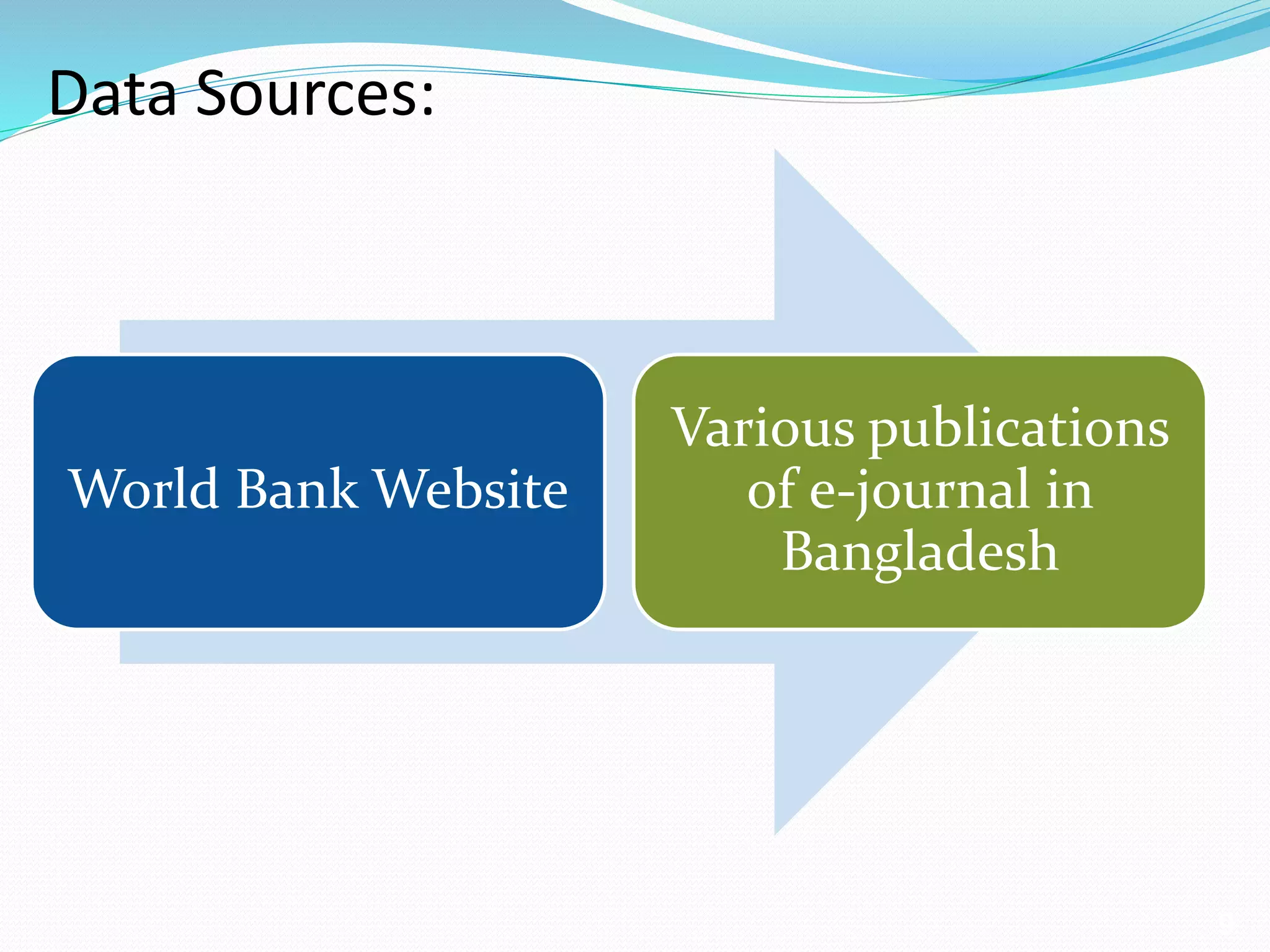
Data Sources:
World Bank Website
Various publications
of e-journal in
Bangladesh
Variables
Exchange Rate Inflation
Real Interest Rate
GDP
Per Capita GDP
Dependent
Independent
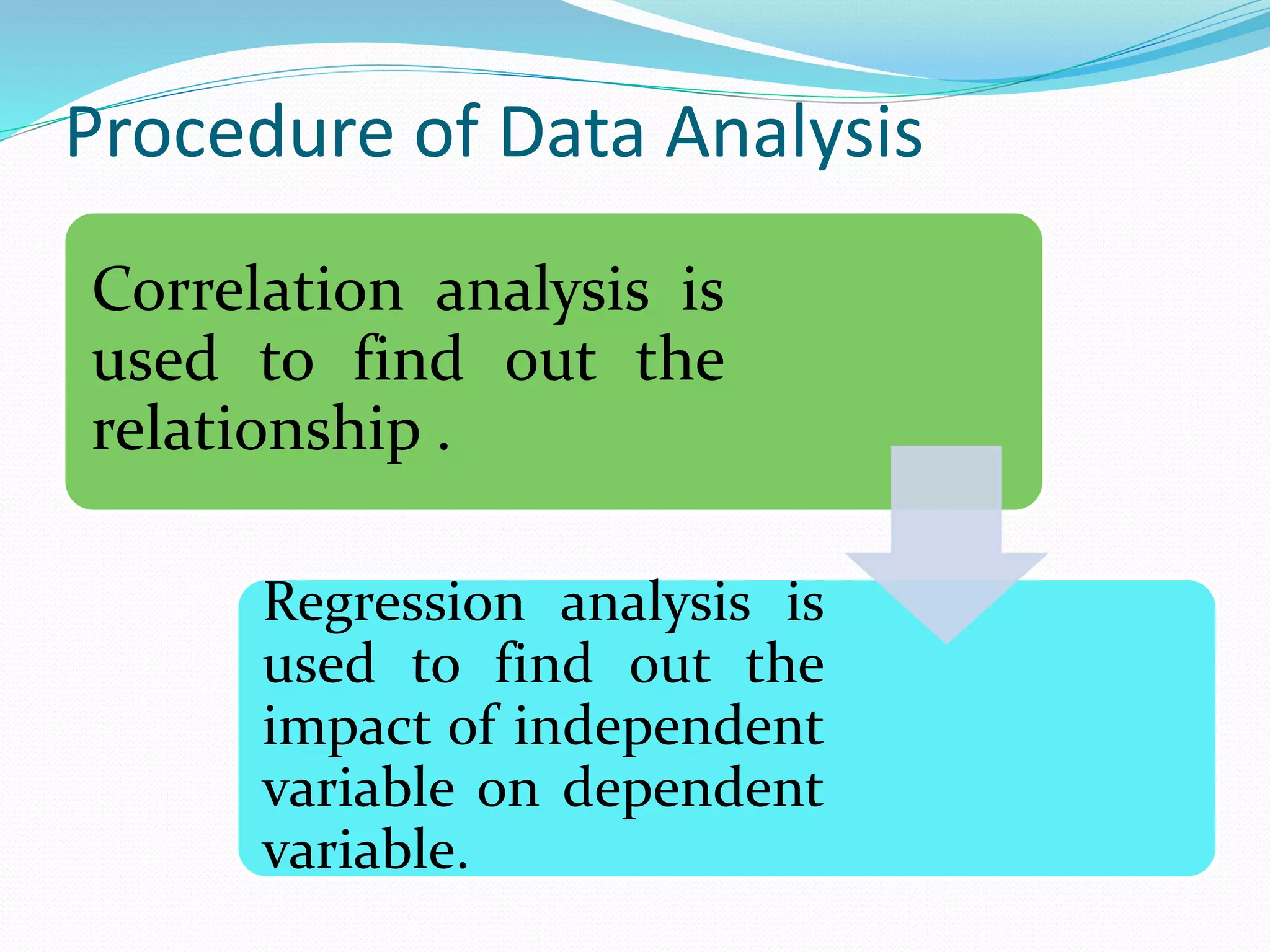
Procedure of Data Analysis
Correlation analysis is
used to find out the
relationship .
Regression analysis is
used to find out the
impact of independent
variable on dependent
variable.
11
Regression Model-
Y it = α + B1 (INF) it + B2 (INT) it + B3
(GDP) it +B4 (INC) + 𝜺
12
Y = Exchange rate movement
B1 INT= coefficient for real Interest rate,
B2 INF = Inflation rate,
B3 GDP= GDP percentage
B4 INC= Per capita growth as a proxy of
income and
𝜺= error term.
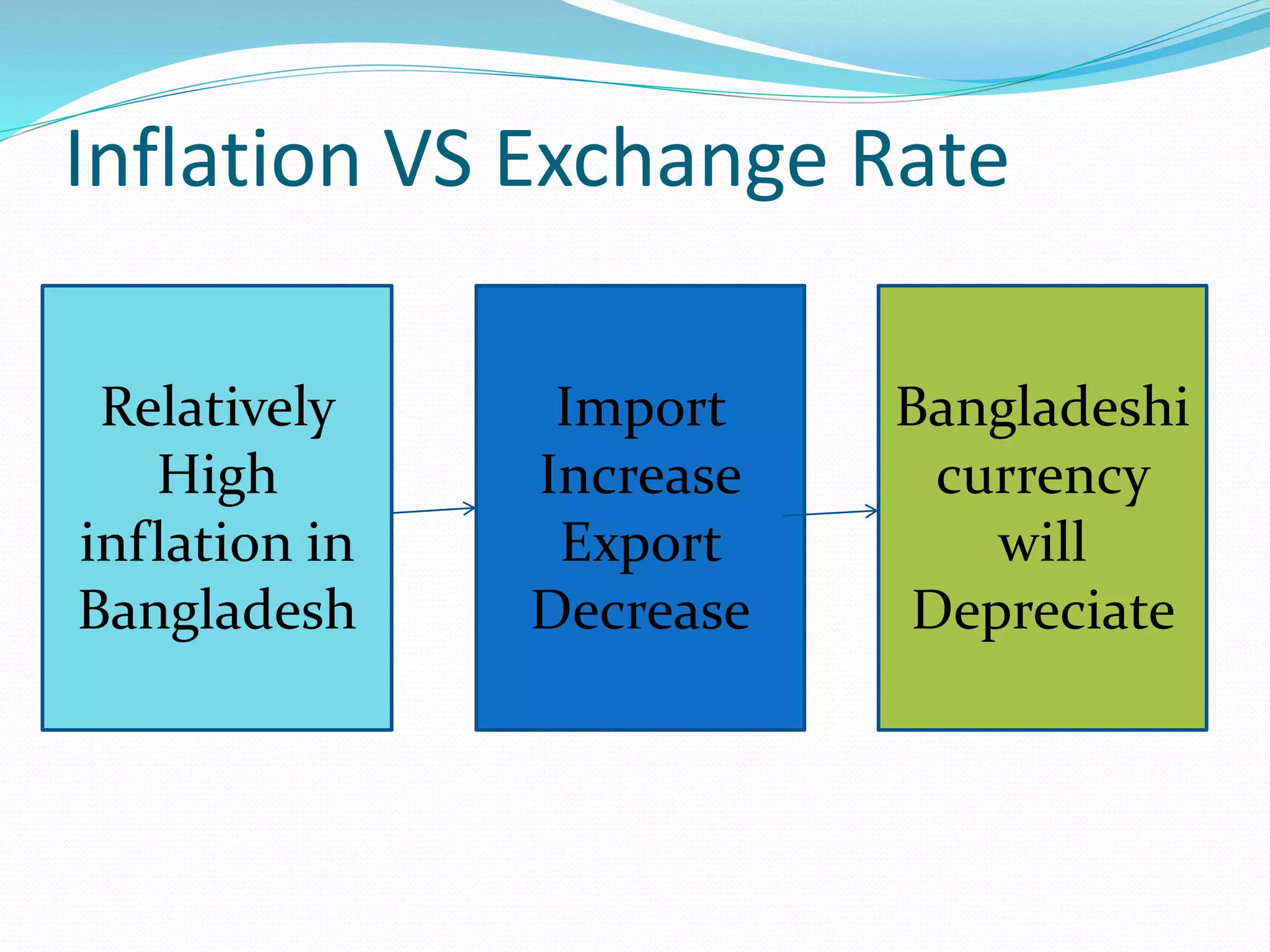
Inflation VS Exchange Rate
13
Relatively
High
inflation in
Bangladesh
Import
Increase
Export
Decrease
Bangladeshi
currency
will
Depreciate
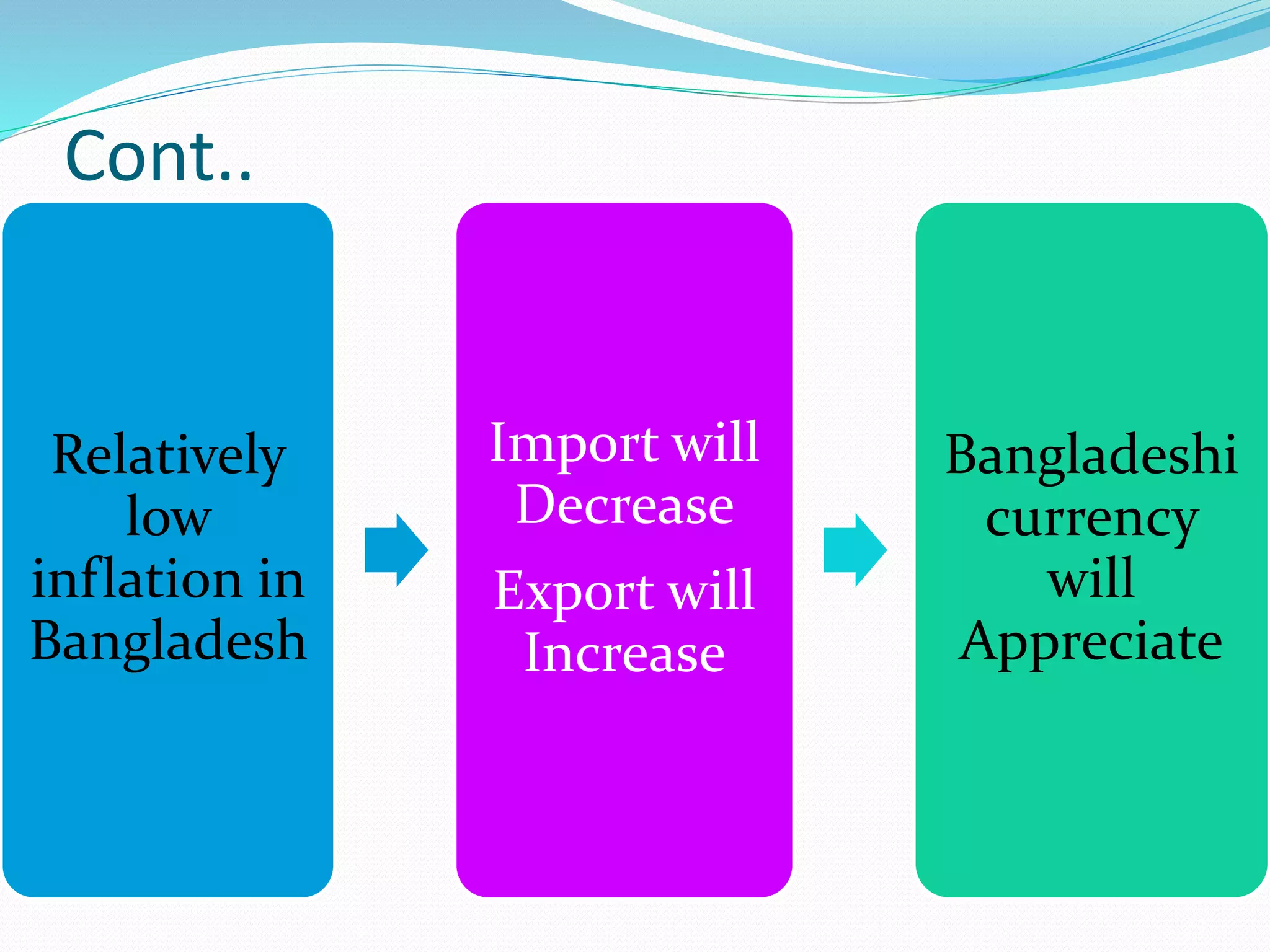
Cont..
Relatively
low
inflation in
Bangladesh
Import will
Decrease
Export will
Increase
Bangladeshi
currency
will
Appreciate
14
Interest rate VS Exchange Rate
Relatively
high interest
rate in
Bangladesh
Increase
demand for
Bangladeshi
currency
Bangladeshi
currency
will
Appreciate
15
Cont…
• Relatively
low interest
Rate in
Bangladesh
• Decrease
demand for
Bangladeshi
securities
• Bangladeshi
currency
will
Depreciate
16
GDP VS Exchange Rate
Increase
GDP
Import
will
Increase
Currency
will
Devalue
17
GDP per capita (Income) VS Exchange Rate
Higher Income level in
Bangladesh
Imports Increase
Exchange Rate Increase
18
Cont…
Bangladeshi
Currency
Appreciate
Import
Decrease
Export
Increase
Lower
income
level in
Bangladesh
19
Correlation
Correlations
Exchange_
Rate
Real_interes
t_rate
Exchange_Rate Pearson Correlation 1 -.657**
Sig. (1-tailed) .002
N 17 17
Real_interest_rate Pearson Correlation -.657** 1
Sig. (1-tailed) .002
N
17 17
**. Correlation is significant at the 0.01 level (1-tailed). 20
Correlations
Exchange_Rat
e Inflation_Rate
Exchange_Rate Pearson Correlation
1 .779**
Sig. (1-tailed)
.000
N
17 17
Inflation_Rate Pearson Correlation
.779** 1
Sig. (1-tailed)
.000
N
17 17
**. Correlation is significant at the 0.01 level (1-tailed).
21
Correlations
Exchange_Rat
e
GDP_percenta
ge
Exchange_Rate Pearson Correlation
1 .687**
Sig. (1-tailed)
.001
N
17 17
GDP_percentage Pearson Correlation
.687** 1
Sig. (1-tailed)
.001
N
17 17
**. Correlation is significant at the 0.01 level (1-tailed).
22
Correlations
Exchange_Rat
e
Per_capita_gro
wth
Exchange_Rate Pearson Correlation
1 .799**
Sig. (1-tailed)
.000
N
17 17
Per_capita_growth Pearson Correlation
.799** 1
Sig. (1-tailed)
.000
N
17 17
**. Correlation is significant at the 0.01 level (1-tailed).
23
Data analysis
 We use annual data on exchange rate, interest rate, inflation rate, GDP & per capita
income of Bangladesh from the World Bank website
 The regression analysis has been done with four independent variables (interest rate,
inflation rate, GDP & per capita income) and a dependent variable which is exchange rate.
Regression model:
 Y = α + B1 (INF) it + B2 (INT) it + B3 (GDP) it +B4 (INC)
24
Coefficientsa
Model
Unstandardized Coefficients
Standardized
Coefficients
t Sig.B Std. Error Beta
1 (Constant) 72.134 25.474 2.832 .015
Inflation_Rate .933 1.460 .159 .639 .535
Real_interest_rate 1.241 1.208 .210 1.027 .325
GDP_percentage -19.245 8.105 -1.902 -2.374 .035
Per_capita_growth 21.692 7.325 2.704 2.962 .012
a. Dependent Variable: Exchange_Rate Table 5.3:Coefficients
 Coefficient shows Per capita income; real interest rate and inflation rate( ) on
exchange rate( ). & GDP ( ) ....exchange rate ( )
 Per capita income has a great impact to increase Exchange rate
Model summary
25
Model R R Square
Adjusted R
Square
Std. Error of the
Estimate
1
.917a .841 .788 4.18562
a. Predictors: (Constant), Per_capita_growth, Inflation_Rate, Real_interest_rate,
GDP_percentage
26
Regression
 Coefficient of correlation, (R) is 0.917, it indicates that the
relations between the dependent variable and independent
variable are very strong.
 (R2) value is .841 indicates that 84.1% of the variations in
Exchange Rate can be explained by the variation of exchange
rate, interest rate, inflation rate , GDP & per capita income.
 Standard error 4.18562 indicated low scatter of data, it increases
the strength of relationship between the dependent and
independent variables.
 Adjusted R square represents if we add more and more useless
variable adjusted R square will decrease. If we add most useful
variable adjusted R square will increase.
ANOVAa
Model Sum of Squares df Mean Square F Sig.
1 Regression 1112.544 4 278.136 15.876 .000b
Residual 210.233 12 17.519
Total 1322.777 16
a. Dependent Variable: Exchange_Rate Table 5.5 Analysis of variance
b. Predictors: (Constant), Per_capita_growth, Inflation_Rate, Real_interest_rate, GDP_percentage
27
ANOVA
The analysis of variance explains further the relationship
between the independent and dependent variables.
significance value is 0.000 b (i.e., p = .000b), which is
below 0.05.
the value of F= 15.876 which is larger than the value of
significance 0.00, It means correlation between the
dependent and independent variables.
28
Findings
Factors Influences the Exchange Rate-
inflation, interest rate, per capita income(+ )
Nature of Relationship
Gross Domestic product (+)
(Among all other independent variables, Per capita has greater impact on
exchange rate.The impact is positive)
(GDP increase means Exchange rate decrease)
CONCLUDING REMARKS
30
 Primarily, inflation, interest rate, per capita income increase
the exchange rate.
 Per capita growth impact on exchange rate than that of any
other factors.
 GDP has a negative impact on Exchange Rate
Thank you
Any
…………….

International trade & finance

  • 1.
  • 2.
    Topic: “FACTORS AFFECTINGEXCHANGE RATE IN BANGLADESH”
  • 3.
  • 4.
  • 5.
    5 INTRODUCTION Exchange rate isvalue of one currency with purpose of conversion to another currency . Exchange rate is important because lower currency rate make its exports cheaper and higher make it expensive vice versa. Helps to calculate Appreciation or depreciation of currency and assist in decision making which has greater impact on foreign trade.
  • 6.
    6 Continue...  domestic currencyappreciates( ), imported goods will be cheaper( )domestic market and local companies would find that their foreign competitor's goods deamd ( ) .  Export > Import ....appreciate & import >Export devalue  Bangladesh started to maintain flexible exchange rate system from 2003
  • 7.
    7 objectives General Objective To identify thefactors that affects foreign exchange rate in Bangladesh . To identify the impact of Inflation To identify the impact of Interest rate To identify the impact of GDP To identify the impact of Per capita GDP(Income) Specific Objectives
  • 8.
    8 Methodology  Research Approach: Descriptiveand causal.  Study Area: Factors affecting the exchange rate in Bangladesh.  Sampling: Dependent and independent variables is taken as a sample which starts from 2000 to 2016.
  • 9.
    9 Data Sources: World BankWebsite Various publications of e-journal in Bangladesh
  • 10.
    Variables Exchange Rate Inflation RealInterest Rate GDP Per Capita GDP Dependent Independent
  • 11.
    Procedure of DataAnalysis Correlation analysis is used to find out the relationship . Regression analysis is used to find out the impact of independent variable on dependent variable. 11
  • 12.
    Regression Model- Y it= α + B1 (INF) it + B2 (INT) it + B3 (GDP) it +B4 (INC) + 𝜺 12 Y = Exchange rate movement B1 INT= coefficient for real Interest rate, B2 INF = Inflation rate, B3 GDP= GDP percentage B4 INC= Per capita growth as a proxy of income and 𝜺= error term.
  • 13.
    Inflation VS ExchangeRate 13 Relatively High inflation in Bangladesh Import Increase Export Decrease Bangladeshi currency will Depreciate
  • 14.
    Cont.. Relatively low inflation in Bangladesh Import will Decrease Exportwill Increase Bangladeshi currency will Appreciate 14
  • 15.
    Interest rate VSExchange Rate Relatively high interest rate in Bangladesh Increase demand for Bangladeshi currency Bangladeshi currency will Appreciate 15
  • 16.
    Cont… • Relatively low interest Ratein Bangladesh • Decrease demand for Bangladeshi securities • Bangladeshi currency will Depreciate 16
  • 17.
    GDP VS ExchangeRate Increase GDP Import will Increase Currency will Devalue 17
  • 18.
    GDP per capita(Income) VS Exchange Rate Higher Income level in Bangladesh Imports Increase Exchange Rate Increase 18
  • 19.
  • 20.
    Correlation Correlations Exchange_ Rate Real_interes t_rate Exchange_Rate Pearson Correlation1 -.657** Sig. (1-tailed) .002 N 17 17 Real_interest_rate Pearson Correlation -.657** 1 Sig. (1-tailed) .002 N 17 17 **. Correlation is significant at the 0.01 level (1-tailed). 20
  • 21.
    Correlations Exchange_Rat e Inflation_Rate Exchange_Rate PearsonCorrelation 1 .779** Sig. (1-tailed) .000 N 17 17 Inflation_Rate Pearson Correlation .779** 1 Sig. (1-tailed) .000 N 17 17 **. Correlation is significant at the 0.01 level (1-tailed). 21
  • 22.
    Correlations Exchange_Rat e GDP_percenta ge Exchange_Rate Pearson Correlation 1.687** Sig. (1-tailed) .001 N 17 17 GDP_percentage Pearson Correlation .687** 1 Sig. (1-tailed) .001 N 17 17 **. Correlation is significant at the 0.01 level (1-tailed). 22
  • 23.
    Correlations Exchange_Rat e Per_capita_gro wth Exchange_Rate Pearson Correlation 1.799** Sig. (1-tailed) .000 N 17 17 Per_capita_growth Pearson Correlation .799** 1 Sig. (1-tailed) .000 N 17 17 **. Correlation is significant at the 0.01 level (1-tailed). 23
  • 24.
    Data analysis  Weuse annual data on exchange rate, interest rate, inflation rate, GDP & per capita income of Bangladesh from the World Bank website  The regression analysis has been done with four independent variables (interest rate, inflation rate, GDP & per capita income) and a dependent variable which is exchange rate. Regression model:  Y = α + B1 (INF) it + B2 (INT) it + B3 (GDP) it +B4 (INC) 24 Coefficientsa Model Unstandardized Coefficients Standardized Coefficients t Sig.B Std. Error Beta 1 (Constant) 72.134 25.474 2.832 .015 Inflation_Rate .933 1.460 .159 .639 .535 Real_interest_rate 1.241 1.208 .210 1.027 .325 GDP_percentage -19.245 8.105 -1.902 -2.374 .035 Per_capita_growth 21.692 7.325 2.704 2.962 .012 a. Dependent Variable: Exchange_Rate Table 5.3:Coefficients
  • 25.
     Coefficient showsPer capita income; real interest rate and inflation rate( ) on exchange rate( ). & GDP ( ) ....exchange rate ( )  Per capita income has a great impact to increase Exchange rate Model summary 25 Model R R Square Adjusted R Square Std. Error of the Estimate 1 .917a .841 .788 4.18562 a. Predictors: (Constant), Per_capita_growth, Inflation_Rate, Real_interest_rate, GDP_percentage
  • 26.
    26 Regression  Coefficient ofcorrelation, (R) is 0.917, it indicates that the relations between the dependent variable and independent variable are very strong.  (R2) value is .841 indicates that 84.1% of the variations in Exchange Rate can be explained by the variation of exchange rate, interest rate, inflation rate , GDP & per capita income.  Standard error 4.18562 indicated low scatter of data, it increases the strength of relationship between the dependent and independent variables.  Adjusted R square represents if we add more and more useless variable adjusted R square will decrease. If we add most useful variable adjusted R square will increase.
  • 27.
    ANOVAa Model Sum ofSquares df Mean Square F Sig. 1 Regression 1112.544 4 278.136 15.876 .000b Residual 210.233 12 17.519 Total 1322.777 16 a. Dependent Variable: Exchange_Rate Table 5.5 Analysis of variance b. Predictors: (Constant), Per_capita_growth, Inflation_Rate, Real_interest_rate, GDP_percentage 27
  • 28.
    ANOVA The analysis ofvariance explains further the relationship between the independent and dependent variables. significance value is 0.000 b (i.e., p = .000b), which is below 0.05. the value of F= 15.876 which is larger than the value of significance 0.00, It means correlation between the dependent and independent variables. 28
  • 29.
    Findings Factors Influences theExchange Rate- inflation, interest rate, per capita income(+ ) Nature of Relationship Gross Domestic product (+) (Among all other independent variables, Per capita has greater impact on exchange rate.The impact is positive) (GDP increase means Exchange rate decrease)
  • 30.
    CONCLUDING REMARKS 30  Primarily,inflation, interest rate, per capita income increase the exchange rate.  Per capita growth impact on exchange rate than that of any other factors.  GDP has a negative impact on Exchange Rate
  • 31.