Edexcel A level Business
Theme 2
2.1.1 Internal Finance
From Edexcel
a) Owner’s capital: personal savings
b) Retained profit
c) Sale of assets
Starter
• What items of value do you own?
• Do you have any savings?
• Are you good with money?
• If I gave you £20 right now would you save it or
spend it?
Definition: Finance
• Finance means the management of the investment needed to; open,
run and grow a business
• There are internal finance methods (investment that comes from
within a business) and external finance methods (investment that
comes from outside the business)
• This topic is just about internal finance, the next unit 2.1.2 is about
external finance
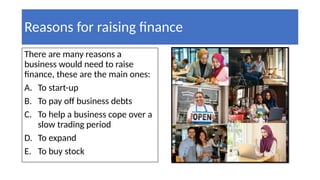
Reasons for raising finance
There are many reasons a
business would need to raise
finance, these are the main ones:
A. To start-up
B. To pay off business debts
C. To help a business cope over a
slow trading period
D. To expand
E. To buy stock
Owner’s capital: personal savings
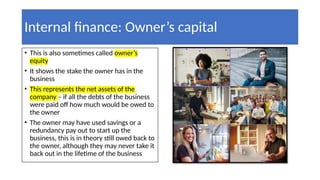
Internal finance: Owner’s capital
• This is also sometimes called owner’s
equity
• It shows the stake the owner has in the
business
• This represents the net assets of the
company – if all the debts of the business
were paid off how much would be owed to
the owner
• The owner may have used savings or a
redundancy pay out to start up the
business, this is in theory still owed back to
the owner, although they may never take it
back out in the lifetime of the business
When is personal savings (owner’s capital) an
appropriate source of finance?
• Sole traders and partnerships
would be the two business forms
which would mostly use personal
savings / owner’s capital start-up,
and to trade and to grow
• The amount of finance that can
be raised will depend on the
savings that the owner has
• Why might the owner have
significant savings?
Retained profit
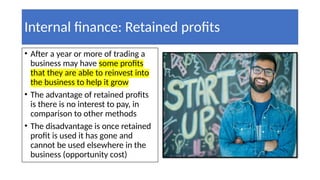
Internal finance: Retained profits
• After a year or more of trading a
business may have some profits
that they are able to reinvest into
the business to help it grow
• The advantage of retained profits
is there is no interest to pay, in
comparison to other methods
• The disadvantage is once retained
profit is used it has gone and
cannot be used elsewhere in the
business (opportunity cost)
When is retained profit NOT an appropriate
source of finance?
• If a business is in its first year of
trading it will NOT have any
retained profits, as it will not have
made any to retain
• If a business has not been
profitable then there will NOT be
any retained profit for the
business to spend
• The business may have made a
loss and therefore will also NOT
have any retained profit
Sale of assets
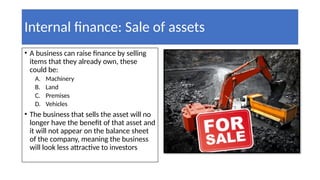
Internal finance: Sale of assets
• A business can raise finance by selling
items that they already own, these
could be:
A. Machinery
B. Land
C. Premises
D. Vehicles
• The business that sells the asset will no
longer have the benefit of that asset and
it will not appear on the balance sheet
of the company, meaning the business
will look less attractive to investors
When is the sale of assets appropriate?
• All types of business can sell
their assets, except those that
have just started up
• This may not raise enough
money for growth or expansion
• When a business is growing it
may need to raise cash fast to be
able to continue to trade
• Assets (like a van) can be sold
quickly (same day) for cash
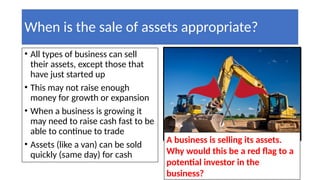
A business is selling its assets.
Why would this be a red flag to a
potential investor in the
business?
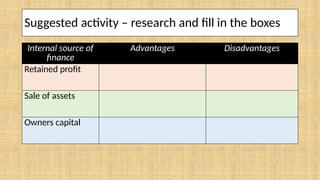
Suggested activity – research and fill in the boxes
Internal source of
finance
Advantages Disadvantages
Retained profit
Sale of assets
Owners capital
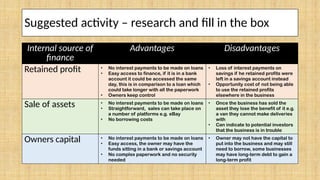
Suggested activity – research and fill in the box
Internal source of
finance
Advantages Disadvantages
Retained profit • No interest payments to be made on loans
• Easy access to finance, if it is in a bank
account it could be accessed the same
day, this is in comparison to a loan which
could take longer with all the paperwork
• Owners keep control
• Loss of interest payments on
savings if he retained profits were
left in a savings account instead
• Opportunity cost of not being able
to use the retained profits
elsewhere in the business
Sale of assets • No interest payments to be made on loans
• Straightforward, sales can take place on
a number of platforms e.g. eBay
• No borrowing costs
• Once the business has sold the
asset they lose the benefit of it e.g.
a van they cannot make deliveries
with
• Can indicate to potential investors
that the business is in trouble
Owners capital • No interest payments to be made on loans
• Easy access, the owner may have the
funds sitting in a bank or savings account
• No complex paperwork and no security
needed
• Owner may not have the capital to
put into the business and may still
need to borrow, some businesses
may have long-term debt to gain a
long-term profit
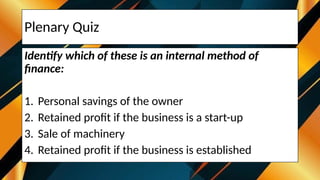
Plenary Quiz
Identify which of these is an internal method of
finance:
1. Personal savings of the owner
2. Retained profit if the business is a start-up
3. Sale of machinery
4. Retained profit if the business is established
Plenary Quiz Answers
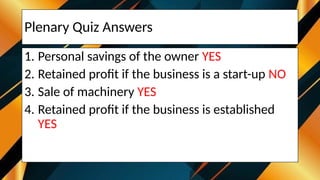
1. Personal savings of the owner YES
2. Retained profit if the business is a start-up NO
3. Sale of machinery YES
4. Retained profit if the business is established
YES
Sample Exam Questions
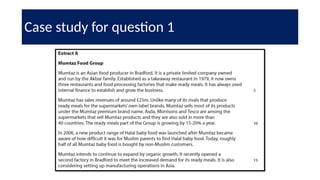
Case study for question 1
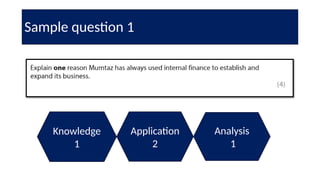
Sample question 1
Knowledge
1
Application
2
Analysis
1
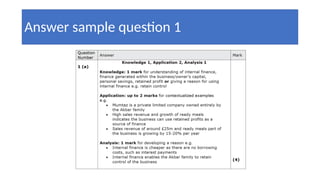
Answer sample question 1

Internal Finance.pptx Business Cambridge

  • 1.
    Edexcel A levelBusiness Theme 2 2.1.1 Internal Finance
  • 2.
    From Edexcel a) Owner’scapital: personal savings b) Retained profit c) Sale of assets
  • 3.
    Starter • What itemsof value do you own? • Do you have any savings? • Are you good with money? • If I gave you £20 right now would you save it or spend it?
  • 4.
    Definition: Finance • Financemeans the management of the investment needed to; open, run and grow a business • There are internal finance methods (investment that comes from within a business) and external finance methods (investment that comes from outside the business) • This topic is just about internal finance, the next unit 2.1.2 is about external finance
  • 5.
    Reasons for raisingfinance There are many reasons a business would need to raise finance, these are the main ones: A. To start-up B. To pay off business debts C. To help a business cope over a slow trading period D. To expand E. To buy stock
  • 6.
  • 7.
    Internal finance: Owner’scapital • This is also sometimes called owner’s equity • It shows the stake the owner has in the business • This represents the net assets of the company – if all the debts of the business were paid off how much would be owed to the owner • The owner may have used savings or a redundancy pay out to start up the business, this is in theory still owed back to the owner, although they may never take it back out in the lifetime of the business
  • 8.
    When is personalsavings (owner’s capital) an appropriate source of finance? • Sole traders and partnerships would be the two business forms which would mostly use personal savings / owner’s capital start-up, and to trade and to grow • The amount of finance that can be raised will depend on the savings that the owner has • Why might the owner have significant savings?
  • 9.
  • 10.
    Internal finance: Retainedprofits • After a year or more of trading a business may have some profits that they are able to reinvest into the business to help it grow • The advantage of retained profits is there is no interest to pay, in comparison to other methods • The disadvantage is once retained profit is used it has gone and cannot be used elsewhere in the business (opportunity cost)
  • 11.
    When is retainedprofit NOT an appropriate source of finance? • If a business is in its first year of trading it will NOT have any retained profits, as it will not have made any to retain • If a business has not been profitable then there will NOT be any retained profit for the business to spend • The business may have made a loss and therefore will also NOT have any retained profit
  • 12.
  • 13.
    Internal finance: Saleof assets • A business can raise finance by selling items that they already own, these could be: A. Machinery B. Land C. Premises D. Vehicles • The business that sells the asset will no longer have the benefit of that asset and it will not appear on the balance sheet of the company, meaning the business will look less attractive to investors
  • 14.
    When is thesale of assets appropriate? • All types of business can sell their assets, except those that have just started up • This may not raise enough money for growth or expansion • When a business is growing it may need to raise cash fast to be able to continue to trade • Assets (like a van) can be sold quickly (same day) for cash A business is selling its assets. Why would this be a red flag to a potential investor in the business?
  • 15.
    Suggested activity –research and fill in the boxes Internal source of finance Advantages Disadvantages Retained profit Sale of assets Owners capital
  • 16.
    Suggested activity –research and fill in the box Internal source of finance Advantages Disadvantages Retained profit • No interest payments to be made on loans • Easy access to finance, if it is in a bank account it could be accessed the same day, this is in comparison to a loan which could take longer with all the paperwork • Owners keep control • Loss of interest payments on savings if he retained profits were left in a savings account instead • Opportunity cost of not being able to use the retained profits elsewhere in the business Sale of assets • No interest payments to be made on loans • Straightforward, sales can take place on a number of platforms e.g. eBay • No borrowing costs • Once the business has sold the asset they lose the benefit of it e.g. a van they cannot make deliveries with • Can indicate to potential investors that the business is in trouble Owners capital • No interest payments to be made on loans • Easy access, the owner may have the funds sitting in a bank or savings account • No complex paperwork and no security needed • Owner may not have the capital to put into the business and may still need to borrow, some businesses may have long-term debt to gain a long-term profit
  • 17.
    Plenary Quiz Identify whichof these is an internal method of finance: 1. Personal savings of the owner 2. Retained profit if the business is a start-up 3. Sale of machinery 4. Retained profit if the business is established
  • 18.
    Plenary Quiz Answers 1.Personal savings of the owner YES 2. Retained profit if the business is a start-up NO 3. Sale of machinery YES 4. Retained profit if the business is established YES
  • 19.
  • 20.
    Case study forquestion 1
  • 21.
  • 22.

Editor's Notes

  • #3 Author’s note: This should reveal that it is hard to save money and some people are gifted with money, others are not.
  • #8 Suggested answer: Redundancy pay-out, retirement (yes business owners can retire from one type of job and start another). They may have just saved up from their previous job.
  • #14 Answer: A business may need fixed assets (like machinery) to trade. If it is selling them off then they might have a serious cash flow problem that is worth looking into before investing.
  • #18 Explanation: Start-ups have not made a profit and so will have no profits to retain