CPA INTERMEDIATE LEVEL
CS INTERMEDIATELEVEL
COMPANY LAW
THURSDAY: 24 August 2023. Morning Paper. Time Allowed: 3hours.
Answer any FIVE questions. ALL questions carry equal marks. Do NOT write anything on this paper.
QUESTION ONE
(a) Explain THREE ways in which persons intending to form a company may avoid personal liability on contracts they
make on behalf of the proposed company. (6 marks)
(b) Summarise any FOUR legal duties of a company’s external auditor. (4 marks)
(c) The general rule is that companies must not give loans to directors. However, there are certain circumstances under
which a company can give loans to a director.
In relation to the above statement, examine THREE such circumstances. (6 marks)
(d) Outline FOUR contents of a certificate of incorporation of a company. (4 marks)
(Total: 20 marks)
QUESTION TWO
(a) Distinguish between “participative preference shares” and “non-participative preference shares”. (4 marks)
(b) Highlight FOUR statutory registers that must be maintained and kept at the registered office of a company.
(4 marks)
(c) A company can be wound up for failure to pay its debts. Explain to Edna Makena, one of the creditors of Ushindi
Co. Ltd, THREE circumstances under which a company may be deemed unable to pay its debts. (6marks)
(d) Describe THREE types of company prospectuses. (6 marks)
(Total: 20 marks)
QUESTION THREE
(a) Explain THREE pieces of information that a Director’s report must contain once a company has issued debentures
in any financial year. (6 marks)
(b) Summarise SIX contents of a notice of a general meeting. (6 marks)
(c) List FOUR fiduciary duties of company directors. (4 marks)
(d) A private company need not have a company secretary.
Explain TWO ways in which service and actions are carried out when a private company elects not to have a
company secretary. (4 marks)
(Total: 20 marks)
CA21 & CS21 Page 1
Out of 2
CA21 & CS21 Page 2
Out of 2
(6 marks)
(6 marks)
QUESTION FOUR
(a) State SIX elements of proper accounting records under company law.
(b) Highlight SIX offences relating to liquidation of companies.
(c) Evaluate FOUR ways in which a company can reorganise its share capital. (8 marks)
(Total: 20 marks)
QUESTION FIVE
(a) In relation to investigation of company affairs:
(i) Explain the purpose of an investigation into a company's affairs under company law. (4 marks)
(ii) Identify FOUR parties that have the authority to initiate an investigation of a company's affairs under
company law. (4 marks)
(iii) Highlight SIX consequences of an adverse finding from investigation of a company's affairs. (6 marks)
(b) Describe THREE reporting requirements for foreign companies operating in Kenya. (6 marks)
(Total: 20 marks)
(2 marks)
(2 marks)
(2 marks)
(2 marks)
QUESTION SIX
(a) In relation to corporate restructuring, explain the following terms:
(i) Compromises.
(ii) Arrangements.
(iii) Reconstructions.
(iv) Takeovers.
(b) Discuss THREE advantages and THREE disadvantages of the principle of legal personality. (12 marks)
(Total: 20 marks)
(8 marks)
QUESTION SEVEN
(a) Describe FOUR types of opinions that can be issued in an Auditor’s report.
(b) With specific reference to beneficial ownership:
(i) Explain THREE criteria that a beneficial owner must satisfy. (6 marks)
(ii) State SIX particulars to be entered in the register of beneficial owners as prescribed by the regulations on
beneficial ownership. (6 marks)
(Total: 20 marks)
…………………………………………………………..…………
CS INTERMEDIATE LEVEL
PUBLIC SECTOR GOVERNANCE, POLICY AND ADMINISTRATION
THURSDAY: 24 August 2023. Afternoon Paper. Time Allowed: 3 hours.
Answer ALL questions. Marks allocated to each question are shown at the end of the question. Do NOT write
anything on this paper.
CS22 Page 1
Out of 2
(2 marks)
QUESTION ONE
(a) With regards to handling conflicts between County Governments and the National Government:
(i) Identify TWO legal instruments which provide on how to resolve conflicts.
(ii) Explain TWO ways of handling conflicts. (2 marks)
(b) Getting the most from stakeholder engagement is crucial for effective policy development and implementation.
Summarise FIVE strategies that could help optimise stakeholder engagement. (5 marks)
(c) Analyse FIVE ways in which private corporations could forge corporate relationships with the National
Government. (5 marks)
(d) Explain THREE distinctions between public administration and politics. (6 marks)
(Total: 20 marks)
QUESTION TWO
(a) The Public Procurement and Asset Disposal Act provides procedures for efficient public procurement.
Outline FIVE areas covered under this Act. (5 marks)
(b) Identify FIVE actors involved in the formulation of public policies. (5 marks)
(c) Policy analysis models are frameworks used to assess and evaluate public policies.
With reference to the above statement, explain FIVE of these models. (10 marks)
(Total: 20 marks)
(2 marks)
(4 marks)
QUESTION THREE
(a) Explain TWO functions of the office of the controller of budget in your country.
(b) Identify FOUR challenges facing parastatals in your country.
(c) Assess SIX weaknesses in budget making process in your country. (6 marks)
(d) Highlight EIGHT powers of the County Public Service Board with regards to values, principles and good
governance. (8 marks)
(Total: 20 marks)
CS22 Page 2
Out of 2
(5 marks)
QUESTION FOUR
(a) Analyse FIVE components of the legal framework that govern the operations of state corporations.
(b) Certified Secretaries play an important role in the management of government organisations.
(c)
In relation to the above statement, highlight SEVEN of these roles. (7 marks)
Proposed by Sherry Arnstein in 1969, the Ladder of Citizen Participation is one of the most widely referenced
and influential models in the field of democratic public participation.
Identify EIGHT principles of the rationale for public participation. (8 marks)
(Total: 20 marks)
QUESTION FIVE
(a) Explain FOUR characteristics associated with value-based leadership. (4 marks)
(b) Identify SIX components of a county integrated development plan as stipulated by the County Governments Act of
2012. (6 marks)
(c) Features of administrative systems can vary depending on the context and purpose.
Required:
Discuss FIVE features of these systems.
-
(10 marks)
(Total: 20 marks)
……………………………………………………………………
CS INTERMEDIATE LEVEL
MEETINGS: COMPLIANCE AND ADMINISTRATION
WEDNESDAY: 23 August 2023. Morning Paper. Time Allowed: 3 hours.
Answer ALL questions. Marks allocated to each question are shown at the end of the question. Do NOT write
anything on thispaper.
QUESTION ONE
CS23 Page 1
Out of 2
(a) During meetings, claims against defamation may arise. To avoid liability or reduce damages, a defendant may
need to apply some defenses.
Identify FIVE such defenses. (5 marks)
(b)
(c)
(d)
A new company, ABC Ltd., was recently registered and has started operations without the services of a
corporate secretary. As a consultant, advise ABC Ltd. on FIVE roles of the secretary as per the governance
standards and guidelines. (5 marks)
Requirements for the circulation of resolutions in a members’ meeting can vary with jurisdiction and the
specific company's constitution or articles of association.
Outline FIVE requirements for such circulation of resolutions. (5 marks)
Jobbys Ltd. has put in place a dividend policy that sets out the parameters and circumstances that will be
considered by the Board of Directors in determining the distribution of dividend to its shareholders or
retaining profits earned by the Company.
In view of the above statement, identify FIVE circumstances when the Board may deviate from this policy
and restrict dividend distribution to its shareholders. (5 marks)
(Total: 20 marks)
(4 marks)
(6 marks)
QUESTION TWO
(a) List FOUR conditions that would invalidate proceedings of a meeting.
(b) Analyse THREE legal instruments governing virtual meetings.
(c) Public limited liability companies are by law required to hold annual general meetings.
Discuss FIVE compliance requirements according to the Companies Act 2015. (10 marks)
(Total: 20 marks)
QUESTION THREE
(a) Integrated reporting is a process founded on integrated thinking for communicating an organisation’s agenda.
Summarise FOUR benefits of integrated reporting as a holistic approach to corporate reporting. (4 marks)
(b) Examine FOUR requirements for keeping records of County and National Assembly meetings as contained
in various laws and regulations. (8 marks)
(c) Describe FOUR stages of the evolution of the corporate secretarial profession in your country. (8 marks)
(Total: 20 marks)
CS23 Page 2
Out of 2
(4 marks)
QUESTION FOUR
(a) Identify FOUR agenda items of notices for general meetings.
(b) Assess TWO benefits of a prospectus to an investor of shares listed at the Securities Exchange. (4 marks)
(c)
(d)
A certified secretary working in an international company may be required to ensure documents are
authenticated and validated.
Discuss THREE steps followed when authenticating documents for international use. (6 marks)
The idea behind committees of the board is to tap into the specific talents, skills and expertise of the individual
board directors, to inform and educate the full board on particular areas of concern.
Explain THREE benefits of these committees in execution of Board agenda. (6 marks)
(Total: 20 marks)
QUESTION FIVE
(a) Memorandum of association is one of the prerequisite documents that is prepared by promoters to set up a
company.
Explain the process involved in altering the memorandum of association. (5 marks)
(b)
(c)
Identify SEVEN legal requirements that have to be met for minutes of a company to be admissible in a court
of law. (7 marks)
Parliament is the legislative assembly of political representatives of a given country. One of its roles is to
debate and make laws which are passed by majority vote.
In view of the above statement, discuss FOUR voting methods used in Parliament. (8 marks)
(Total: 20 marks)
………………………………………………………………………
CS INTERMEDIATE LEVEL
FINANCIAL MARKETS AND SPECIALISED INSTITUTIONS
WEDNESDAY: 23 August 2023. Afternoon Paper. Time Allowed: 3 hours
Answer ALL questions. Marks allocated to each question are shown at the end of the question. Do NOT write
anything on this paper.
QUESTION ONE
(a) Highlight FOUR limitations of raising capital in the Securities Exchange. (4 marks)
CS24 Page 1
Out of 2
(b) In terms of the financial system, in an increasingly technological and digital world, handling physical documents
may hamper the functioning of securities trading and broking. The move to dematerialisation is in line with the
global move of all systems to go online and transact via smart devices.
(2 marks)
(6 marks)
(c)
With reference to the above statement:
(i) Explain the term “De-materialisation” of securities.
(ii) Summarise SIX benefits of a dematerialised account to an investor.
Capital markets have continued to support access to resources for business development.
Discuss FOUR challenges that may hinder the development of an effective Capital market in your country.
(8 marks)
(Total: 20 marks)
QUESTION TWO
(a) The term “frontier markets” was coined in 1992 by Farida Khambata.
(5 marks)
(b) (2 marks)
(3 marks)
(2 marks)
(c)
Outline FIVE characteristics of these markets.
(i) Describe the term “insider trading” as used in the securities exchange.
(ii) Outline THREE effects of insider trading.
(iii) Explain TWO categories of insider trading.
Explain FOUR roles of Unclaimed Financial Assets Authority (UFAA). (8 marks)
(Total: 20 marks)
QUESTION THREE
(a) Identify THREE roles of regulatory sandbox in financial service. (3 marks)
(b)
(c)
Companies that are expanding operations may use internally generated or external funding from the capital
markets.
Outline FOUR benefits that would accrue to companies from listing in the securities exchange. (4 marks)
Summarise FIVE functions of money markets in the development of financial systems of your country.
(5 marks)
(d) Explain FOUR hypothesis of Initial Public Offering (IPO) in the securities market of your country. (8 marks)
(Total: 20 marks)
CS24 Page 2
Out of 2
QUESTION FOUR
(a) Most jurisdictions have implemented Central Depository Systems (CDS) to transact and transfer shares between
parties. Identify FOUR challenges that may affect the effective implementation of CDS in your
jurisdiction. (4 marks)
(b) Explain THREE benefits of holding shares in the Direct Registration system (DRS) in the securities exchange
market. (6 marks)
(c) The Securities Exchange in many countries has experienced low rate of listing of companies over time. Analyse
FIVE factors that could have contributed to the low rate of listing. (10 marks)
(Total: 20 marks)
QUESTION FIVE
(a) Yefwe Self Help Group intends to register a Deposit Taking Sacco. Explain FIVE good governance
practices that it must adhere to for it to be compliant with SACCO Society Regulatory Authority (SASRA)
regulations.
(10 marks)
(b) The International Organisation of Securities Commissions(IOSCO) is an association of organisations that
regulate the world's securities and futures markets.
With reference to the above statement:
(i) Highlight TWO objectives of the IOSCO Principles of Self-Regulation. (2 marks)
(ii) Analyse FOUR risks faced by depository institutions when generating spread income. (8 marks)
(Total: 20 marks)
...........................................................................................................................
CS INTERMEDIATE LEVEL
CORPORATE GOVERNANCE AND ETHICS
TUESDAY: 22 August 2023. Morning Paper. Time Allowed: 3 hours.
Answer ALL questions. Marks allocated to each question are shown at the end of the question. Do NOT write
anything on this paper.
KAZI NZURI LIMITED (KNL)
Kazi Nzuri Limited (KNL) is a well-established Kenyan company operating in the telecommunications sector. The
company was established in the year 1998 and its headquarters are based in Nairobi. KNL has four branches which are
spread out across East Africa. The company has been listed on the securities exchange since year 2010. With a market
presence spanning over two decades, the company has experienced substantial growth and has emerged as a key player in
the industry. As a publicly listed company on the Nairobi Securities Exchange, KNL is subject to the regulatory
requirements and guidelines set by the Capital Markets Authority (CMA) and the Code of Corporate Governance for
Issuers of Securities to the Public. The company places a strong emphasis on board composition and independence to
ensure effective corporate governance. The board consists of nine members, comprising a mix of executive and non-
executive directors. The CEO and the Corporate Secretary also sit on the board. The non-executive directors bring diverse
industry expertise and independence to the board. Additionally, the board includes a significant number of female directors,
promoting gender diversity and inclusivity.
To strengthen corporate governance, Kazi Nzuri Ltd. has established several board committees responsible for specific
areas of oversight. These committees include the Audit Committee, Compensation Committee, Nomination Committee,
and Corporate Social Responsibility (CSR) Committee. Each committee is composed of independent directors with
relevant expertise and plays a crucial role in ensuring accountability, risk management, and ethical decision-making within
the company. KNL recognises the importance of transparency and timely disclosure of information to shareholders and
the public. The company maintains a comprehensive investor relations program, ensuring regular communication and
updates on financial performance, strategic initiatives, and corporate governance practices. Furthermore, KNL publishes
an annual sustainability report, highlighting its commitment to good corporate governance, ethical conduct, environmental
sustainability and social responsibility.
Ethics form a cornerstone of Kazi Nzuri Ltd’s operations with a strong commitment to ethical behaviour embedded in its
corporate culture. The company has a well-defined code of conduct and ethics that outlines expectations for employees
and stakeholders. The code emphasises on integrity, honesty, and fairness. Regular training programs are conducted to
raise awareness of ethical practices and ensure compliance throughout the organisation. To encourage the reporting of
unethical practices, KNL has implemented a robust whistleblower mechanism. Employees and stakeholders are provided
with a secure and confidential channel to report any concerns, violations, or breaches of the company's ethical standards.
The company guarantees protection against retaliation for individuals who come forward with genuine concerns.
Kazi Nzuri Ltd recognises its responsibility towards society and actively engages in CSR initiatives. The company invests
in sustainable development projects, focusing on education, healthcare, and environmental conservation. Through
partnerships with local communities and NGOs, the company contributes to the well-being of society, aligning its business
practices with ethical and socially responsible objectives.
KNL’s commitment to corporate governance and ethics is evident through its strong governance structure, independent
board, transparent disclosure practices, and emphasis on ethical behaviour. By prioritising transparency, accountability,
and responsible decision-making, the company sets a positive example for other East Africa-based companies. Through
its continuous efforts to promote good governance and ethical conduct, KNL not only protects the interests of its
stakeholders but also contributes to the sustainable growth and development of the East Africa business landscape.
Required:
(a) Kazi Nzuri Limited (KNL) conducts regular training programs to ensure compliance with regulatory requirements
and industry standards.
Discuss FIVE additional measures the company could adopt to ensure compliance. (10 marks)
CS25 Page 1
Out of 2
CS25 Page 2
Out of 2
(b) KNL has implemented a robust whistle blowing mechanism.
(c)
Examine FIVE mechanisms that Kazi Nzuri Ltd. could have put in place to encourage whistleblowing and the
reporting of unethical practices by its employees and other stakeholders. (10 marks)
Appraise FIVE ways in which the company could monitor and assess risks against its defined risk appetite.
(10 marks)
(d) Assess FIVE corporate social responsibility (CSR) initiatives that could be undertaken by Kazi Nzuri Ltd.
(10 marks)
(Total: 40 marks)
QUESTION TWO
(a) Stakeholder theory of corporate governance and ethics defines how managers should understand and treat the
stakeholders so that stakeholders’ interests come above all other interests.
(b)
(c)
With reference to the above statement, highlight FIVE principles of this theory. (5 marks)
The technical incompetence of Non-executive Directors has been identified as one of the key drivers for failure
of organisations.
Assess FIVE characteristics a company would consider when recruiting such directors. (5 marks)
Risk management is a key component of corporate governance as it helps to identify the possible future, and plan
for negative possible effects either by transferring or mitigating them.
From the above statement, highlight FIVE risk management areas that business managers should focus on.
(5 marks)
(Total: 15 marks)
QUESTION THREE
(a) Explain FIVE statutory duties of a company’s board of directors. (5 marks)
(b) According to good governance principles, a conflict of interest register needs to be maintained for all directors.
Evaluate FIVE ways on how a director should handle potential conflicts. (5 marks)
(c) Analyse FIVE reasons why compliance is important to a company. (5 marks)
(Total: 15 marks)
QUESTION FOUR
(a) There are several audits that a company engages in to have an independent assessment of its status.
Evaluate FIVE objectives of legal and compliance audit (5 marks)
(b) As a corporate governance and ethics consultant, give your advice on FIVE key issues to be covered during the
training workshop of new board of directors. (5 marks)
(c) List FIVE corporate governance codes in Kenya, which apply to specific sectors. (5 marks)
(Total: 15 marks)
QUESTION FIVE
(a) Every year, a Board needs to have an evaluation of its effectiveness carried out on the Chairman, individual
Directors, and the Board as a whole.
(b)
Discuss FIVE reasons why board assessments often reveal that boards have failed to achieve their strategic
objectives. (5 marks)
The Organisation for Economic Co-operation and Development (OECD) has immensely contributed in the
developing, recording and instilling good corporate governance in business and public operations.
Explain FIVE pillars of corporate governance recommended by OECD. (10 marks)
(Total: 15 marks)
.............................................................................................................
CS INTERMEDIATE LEVEL
RESEARCH, CONSULTANCY AND ADVISORY
TUESDAY: 22 August 2023. Afternoon Paper. Time Allowed: 3 hours.
Answer ALL questions. Marks allocated to each question are shown at the end of the question. Do NOT write anything
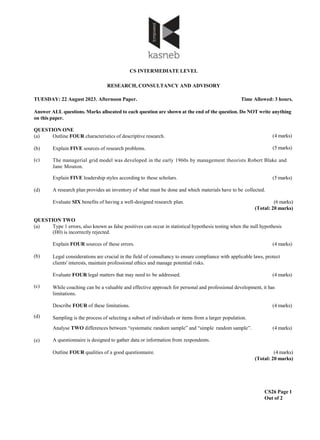
on this paper.
CS26 Page 1
Out of 2
(4 marks)
QUESTION ONE
(a) Outline FOUR characteristics of descriptive research.
(b) Explain FIVE sources of research problems. (5 marks)
(c)
(d)
The managerial grid model was developed in the early 1960s by management theorists Robert Blake and
Jane Mouton.
Explain FIVE leadership styles according to these scholars. (5 marks)
A research plan provides an inventory of what must be done and which materials have to be collected.
Evaluate SIX benefits of having a well-designed research plan. (6 marks)
(Total: 20 marks)
QUESTION TWO
(a) Type 1 errors, also known as false positives can occur in statistical hypothesis testing when the null hypothesis
(H0) is incorrectly rejected.
(b)
(c)
(d)
(e)
Explain FOUR sources of these errors. (4 marks)
Legal considerations are crucial in the field of consultancy to ensure compliance with applicable laws, protect
clients' interests, maintain professional ethics and manage potential risks.
Evaluate FOUR legal matters that may need to be addressed. (4 marks)
While coaching can be a valuable and effective approach for personal and professional development, it has
limitations.
Describe FOUR of these limitations. (4 marks)
Sampling is the process of selecting a subset of individuals or items from a larger population.
Analyse TWO differences between “systematic random sample” and “simple random sample”. (4 marks)
A questionnaire is designed to gather data or information from respondents.
Outline FOUR qualities of a good questionnaire. (4 marks)
(Total: 20 marks)
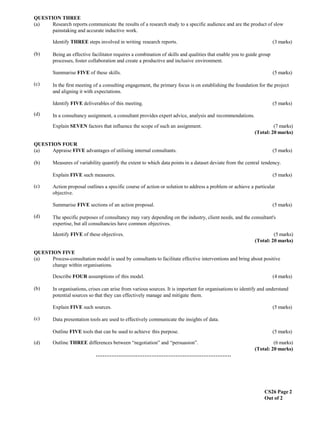
CS26 Page 2
Out of 2
QUESTION THREE
(a) Research reports communicate the results of a research study to a specific audience and are the product of slow
painstaking and accurate inductive work.
(b)
(c)
(d)
Identify THREE steps involved in writing research reports. (3 marks)
Being an effective facilitator requires a combination of skills and qualities that enable you to guide group
processes, foster collaboration and create a productive and inclusive environment.
Summarise FIVE of these skills. (5 marks)
In the first meeting of a consulting engagement, the primary focus is on establishing the foundation for the project
and aligning it with expectations.
Identify FIVE deliverables of this meeting. (5 marks)
In a consultancy assignment, a consultant provides expert advice, analysis and recommendations.
Explain SEVEN factors that influence the scope of such an assignment. (7 marks)
(Total: 20 marks)
QUESTION FOUR
(a) Appraise FIVE advantages of utilising internal consultants. (5 marks)
(b) Measures of variability quantify the extent to which data points in a dataset deviate from the central tendency.
Explain FIVE such measures. (5 marks)
(c)
(d)
Action proposal outlines a specific course of action or solution to address a problem or achieve a particular
objective.
Summarise FIVE sections of an action proposal. (5 marks)
The specific purposes of consultancy may vary depending on the industry, client needs, and the consultant's
expertise, but all consultancies have common objectives.
Identify FIVE of these objectives. (5 marks)
(Total: 20 marks)
QUESTION FIVE
(a) Process-consultation model is used by consultants to facilitate effective interventions and bring about positive
change within organisations.
(b)
(c)
Describe FOUR assumptions of this model. (4 marks)
In organisations, crises can arise from various sources. It is important for organisations to identify and understand
potential sources so that they can effectively manage and mitigate them.
Explain FIVE such sources. (5 marks)
Data presentation tools are used to effectively communicate the insights of data.
Outline FIVE tools that can be used to achieve this purpose. (5 marks)
(d) Outline THREE differences between “negotiation” and “persuasion”. (6 marks)
(Total: 20 marks)
……………………………………………………………………

intermediate papers.pptx

  • 1.
    CPA INTERMEDIATE LEVEL CSINTERMEDIATELEVEL COMPANY LAW THURSDAY: 24 August 2023. Morning Paper. Time Allowed: 3hours. Answer any FIVE questions. ALL questions carry equal marks. Do NOT write anything on this paper. QUESTION ONE (a) Explain THREE ways in which persons intending to form a company may avoid personal liability on contracts they make on behalf of the proposed company. (6 marks) (b) Summarise any FOUR legal duties of a company’s external auditor. (4 marks) (c) The general rule is that companies must not give loans to directors. However, there are certain circumstances under which a company can give loans to a director. In relation to the above statement, examine THREE such circumstances. (6 marks) (d) Outline FOUR contents of a certificate of incorporation of a company. (4 marks) (Total: 20 marks) QUESTION TWO (a) Distinguish between “participative preference shares” and “non-participative preference shares”. (4 marks) (b) Highlight FOUR statutory registers that must be maintained and kept at the registered office of a company. (4 marks) (c) A company can be wound up for failure to pay its debts. Explain to Edna Makena, one of the creditors of Ushindi Co. Ltd, THREE circumstances under which a company may be deemed unable to pay its debts. (6marks) (d) Describe THREE types of company prospectuses. (6 marks) (Total: 20 marks) QUESTION THREE (a) Explain THREE pieces of information that a Director’s report must contain once a company has issued debentures in any financial year. (6 marks) (b) Summarise SIX contents of a notice of a general meeting. (6 marks) (c) List FOUR fiduciary duties of company directors. (4 marks) (d) A private company need not have a company secretary. Explain TWO ways in which service and actions are carried out when a private company elects not to have a company secretary. (4 marks) (Total: 20 marks) CA21 & CS21 Page 1 Out of 2
  • 2.
    CA21 & CS21Page 2 Out of 2 (6 marks) (6 marks) QUESTION FOUR (a) State SIX elements of proper accounting records under company law. (b) Highlight SIX offences relating to liquidation of companies. (c) Evaluate FOUR ways in which a company can reorganise its share capital. (8 marks) (Total: 20 marks) QUESTION FIVE (a) In relation to investigation of company affairs: (i) Explain the purpose of an investigation into a company's affairs under company law. (4 marks) (ii) Identify FOUR parties that have the authority to initiate an investigation of a company's affairs under company law. (4 marks) (iii) Highlight SIX consequences of an adverse finding from investigation of a company's affairs. (6 marks) (b) Describe THREE reporting requirements for foreign companies operating in Kenya. (6 marks) (Total: 20 marks) (2 marks) (2 marks) (2 marks) (2 marks) QUESTION SIX (a) In relation to corporate restructuring, explain the following terms: (i) Compromises. (ii) Arrangements. (iii) Reconstructions. (iv) Takeovers. (b) Discuss THREE advantages and THREE disadvantages of the principle of legal personality. (12 marks) (Total: 20 marks) (8 marks) QUESTION SEVEN (a) Describe FOUR types of opinions that can be issued in an Auditor’s report. (b) With specific reference to beneficial ownership: (i) Explain THREE criteria that a beneficial owner must satisfy. (6 marks) (ii) State SIX particulars to be entered in the register of beneficial owners as prescribed by the regulations on beneficial ownership. (6 marks) (Total: 20 marks) …………………………………………………………..…………
  • 3.
    CS INTERMEDIATE LEVEL PUBLICSECTOR GOVERNANCE, POLICY AND ADMINISTRATION THURSDAY: 24 August 2023. Afternoon Paper. Time Allowed: 3 hours. Answer ALL questions. Marks allocated to each question are shown at the end of the question. Do NOT write anything on this paper. CS22 Page 1 Out of 2 (2 marks) QUESTION ONE (a) With regards to handling conflicts between County Governments and the National Government: (i) Identify TWO legal instruments which provide on how to resolve conflicts. (ii) Explain TWO ways of handling conflicts. (2 marks) (b) Getting the most from stakeholder engagement is crucial for effective policy development and implementation. Summarise FIVE strategies that could help optimise stakeholder engagement. (5 marks) (c) Analyse FIVE ways in which private corporations could forge corporate relationships with the National Government. (5 marks) (d) Explain THREE distinctions between public administration and politics. (6 marks) (Total: 20 marks) QUESTION TWO (a) The Public Procurement and Asset Disposal Act provides procedures for efficient public procurement. Outline FIVE areas covered under this Act. (5 marks) (b) Identify FIVE actors involved in the formulation of public policies. (5 marks) (c) Policy analysis models are frameworks used to assess and evaluate public policies. With reference to the above statement, explain FIVE of these models. (10 marks) (Total: 20 marks) (2 marks) (4 marks) QUESTION THREE (a) Explain TWO functions of the office of the controller of budget in your country. (b) Identify FOUR challenges facing parastatals in your country. (c) Assess SIX weaknesses in budget making process in your country. (6 marks) (d) Highlight EIGHT powers of the County Public Service Board with regards to values, principles and good governance. (8 marks) (Total: 20 marks)
  • 4.
    CS22 Page 2 Outof 2 (5 marks) QUESTION FOUR (a) Analyse FIVE components of the legal framework that govern the operations of state corporations. (b) Certified Secretaries play an important role in the management of government organisations. (c) In relation to the above statement, highlight SEVEN of these roles. (7 marks) Proposed by Sherry Arnstein in 1969, the Ladder of Citizen Participation is one of the most widely referenced and influential models in the field of democratic public participation. Identify EIGHT principles of the rationale for public participation. (8 marks) (Total: 20 marks) QUESTION FIVE (a) Explain FOUR characteristics associated with value-based leadership. (4 marks) (b) Identify SIX components of a county integrated development plan as stipulated by the County Governments Act of 2012. (6 marks) (c) Features of administrative systems can vary depending on the context and purpose. Required: Discuss FIVE features of these systems. - (10 marks) (Total: 20 marks) ……………………………………………………………………
  • 5.
    CS INTERMEDIATE LEVEL MEETINGS:COMPLIANCE AND ADMINISTRATION WEDNESDAY: 23 August 2023. Morning Paper. Time Allowed: 3 hours. Answer ALL questions. Marks allocated to each question are shown at the end of the question. Do NOT write anything on thispaper. QUESTION ONE CS23 Page 1 Out of 2 (a) During meetings, claims against defamation may arise. To avoid liability or reduce damages, a defendant may need to apply some defenses. Identify FIVE such defenses. (5 marks) (b) (c) (d) A new company, ABC Ltd., was recently registered and has started operations without the services of a corporate secretary. As a consultant, advise ABC Ltd. on FIVE roles of the secretary as per the governance standards and guidelines. (5 marks) Requirements for the circulation of resolutions in a members’ meeting can vary with jurisdiction and the specific company's constitution or articles of association. Outline FIVE requirements for such circulation of resolutions. (5 marks) Jobbys Ltd. has put in place a dividend policy that sets out the parameters and circumstances that will be considered by the Board of Directors in determining the distribution of dividend to its shareholders or retaining profits earned by the Company. In view of the above statement, identify FIVE circumstances when the Board may deviate from this policy and restrict dividend distribution to its shareholders. (5 marks) (Total: 20 marks) (4 marks) (6 marks) QUESTION TWO (a) List FOUR conditions that would invalidate proceedings of a meeting. (b) Analyse THREE legal instruments governing virtual meetings. (c) Public limited liability companies are by law required to hold annual general meetings. Discuss FIVE compliance requirements according to the Companies Act 2015. (10 marks) (Total: 20 marks) QUESTION THREE (a) Integrated reporting is a process founded on integrated thinking for communicating an organisation’s agenda. Summarise FOUR benefits of integrated reporting as a holistic approach to corporate reporting. (4 marks) (b) Examine FOUR requirements for keeping records of County and National Assembly meetings as contained in various laws and regulations. (8 marks) (c) Describe FOUR stages of the evolution of the corporate secretarial profession in your country. (8 marks) (Total: 20 marks)
  • 6.
    CS23 Page 2 Outof 2 (4 marks) QUESTION FOUR (a) Identify FOUR agenda items of notices for general meetings. (b) Assess TWO benefits of a prospectus to an investor of shares listed at the Securities Exchange. (4 marks) (c) (d) A certified secretary working in an international company may be required to ensure documents are authenticated and validated. Discuss THREE steps followed when authenticating documents for international use. (6 marks) The idea behind committees of the board is to tap into the specific talents, skills and expertise of the individual board directors, to inform and educate the full board on particular areas of concern. Explain THREE benefits of these committees in execution of Board agenda. (6 marks) (Total: 20 marks) QUESTION FIVE (a) Memorandum of association is one of the prerequisite documents that is prepared by promoters to set up a company. Explain the process involved in altering the memorandum of association. (5 marks) (b) (c) Identify SEVEN legal requirements that have to be met for minutes of a company to be admissible in a court of law. (7 marks) Parliament is the legislative assembly of political representatives of a given country. One of its roles is to debate and make laws which are passed by majority vote. In view of the above statement, discuss FOUR voting methods used in Parliament. (8 marks) (Total: 20 marks) ………………………………………………………………………
  • 7.
    CS INTERMEDIATE LEVEL FINANCIALMARKETS AND SPECIALISED INSTITUTIONS WEDNESDAY: 23 August 2023. Afternoon Paper. Time Allowed: 3 hours Answer ALL questions. Marks allocated to each question are shown at the end of the question. Do NOT write anything on this paper. QUESTION ONE (a) Highlight FOUR limitations of raising capital in the Securities Exchange. (4 marks) CS24 Page 1 Out of 2 (b) In terms of the financial system, in an increasingly technological and digital world, handling physical documents may hamper the functioning of securities trading and broking. The move to dematerialisation is in line with the global move of all systems to go online and transact via smart devices. (2 marks) (6 marks) (c) With reference to the above statement: (i) Explain the term “De-materialisation” of securities. (ii) Summarise SIX benefits of a dematerialised account to an investor. Capital markets have continued to support access to resources for business development. Discuss FOUR challenges that may hinder the development of an effective Capital market in your country. (8 marks) (Total: 20 marks) QUESTION TWO (a) The term “frontier markets” was coined in 1992 by Farida Khambata. (5 marks) (b) (2 marks) (3 marks) (2 marks) (c) Outline FIVE characteristics of these markets. (i) Describe the term “insider trading” as used in the securities exchange. (ii) Outline THREE effects of insider trading. (iii) Explain TWO categories of insider trading. Explain FOUR roles of Unclaimed Financial Assets Authority (UFAA). (8 marks) (Total: 20 marks) QUESTION THREE (a) Identify THREE roles of regulatory sandbox in financial service. (3 marks) (b) (c) Companies that are expanding operations may use internally generated or external funding from the capital markets. Outline FOUR benefits that would accrue to companies from listing in the securities exchange. (4 marks) Summarise FIVE functions of money markets in the development of financial systems of your country. (5 marks) (d) Explain FOUR hypothesis of Initial Public Offering (IPO) in the securities market of your country. (8 marks) (Total: 20 marks)
  • 8.
    CS24 Page 2 Outof 2 QUESTION FOUR (a) Most jurisdictions have implemented Central Depository Systems (CDS) to transact and transfer shares between parties. Identify FOUR challenges that may affect the effective implementation of CDS in your jurisdiction. (4 marks) (b) Explain THREE benefits of holding shares in the Direct Registration system (DRS) in the securities exchange market. (6 marks) (c) The Securities Exchange in many countries has experienced low rate of listing of companies over time. Analyse FIVE factors that could have contributed to the low rate of listing. (10 marks) (Total: 20 marks) QUESTION FIVE (a) Yefwe Self Help Group intends to register a Deposit Taking Sacco. Explain FIVE good governance practices that it must adhere to for it to be compliant with SACCO Society Regulatory Authority (SASRA) regulations. (10 marks) (b) The International Organisation of Securities Commissions(IOSCO) is an association of organisations that regulate the world's securities and futures markets. With reference to the above statement: (i) Highlight TWO objectives of the IOSCO Principles of Self-Regulation. (2 marks) (ii) Analyse FOUR risks faced by depository institutions when generating spread income. (8 marks) (Total: 20 marks) ...........................................................................................................................
  • 9.
    CS INTERMEDIATE LEVEL CORPORATEGOVERNANCE AND ETHICS TUESDAY: 22 August 2023. Morning Paper. Time Allowed: 3 hours. Answer ALL questions. Marks allocated to each question are shown at the end of the question. Do NOT write anything on this paper. KAZI NZURI LIMITED (KNL) Kazi Nzuri Limited (KNL) is a well-established Kenyan company operating in the telecommunications sector. The company was established in the year 1998 and its headquarters are based in Nairobi. KNL has four branches which are spread out across East Africa. The company has been listed on the securities exchange since year 2010. With a market presence spanning over two decades, the company has experienced substantial growth and has emerged as a key player in the industry. As a publicly listed company on the Nairobi Securities Exchange, KNL is subject to the regulatory requirements and guidelines set by the Capital Markets Authority (CMA) and the Code of Corporate Governance for Issuers of Securities to the Public. The company places a strong emphasis on board composition and independence to ensure effective corporate governance. The board consists of nine members, comprising a mix of executive and non- executive directors. The CEO and the Corporate Secretary also sit on the board. The non-executive directors bring diverse industry expertise and independence to the board. Additionally, the board includes a significant number of female directors, promoting gender diversity and inclusivity. To strengthen corporate governance, Kazi Nzuri Ltd. has established several board committees responsible for specific areas of oversight. These committees include the Audit Committee, Compensation Committee, Nomination Committee, and Corporate Social Responsibility (CSR) Committee. Each committee is composed of independent directors with relevant expertise and plays a crucial role in ensuring accountability, risk management, and ethical decision-making within the company. KNL recognises the importance of transparency and timely disclosure of information to shareholders and the public. The company maintains a comprehensive investor relations program, ensuring regular communication and updates on financial performance, strategic initiatives, and corporate governance practices. Furthermore, KNL publishes an annual sustainability report, highlighting its commitment to good corporate governance, ethical conduct, environmental sustainability and social responsibility. Ethics form a cornerstone of Kazi Nzuri Ltd’s operations with a strong commitment to ethical behaviour embedded in its corporate culture. The company has a well-defined code of conduct and ethics that outlines expectations for employees and stakeholders. The code emphasises on integrity, honesty, and fairness. Regular training programs are conducted to raise awareness of ethical practices and ensure compliance throughout the organisation. To encourage the reporting of unethical practices, KNL has implemented a robust whistleblower mechanism. Employees and stakeholders are provided with a secure and confidential channel to report any concerns, violations, or breaches of the company's ethical standards. The company guarantees protection against retaliation for individuals who come forward with genuine concerns. Kazi Nzuri Ltd recognises its responsibility towards society and actively engages in CSR initiatives. The company invests in sustainable development projects, focusing on education, healthcare, and environmental conservation. Through partnerships with local communities and NGOs, the company contributes to the well-being of society, aligning its business practices with ethical and socially responsible objectives. KNL’s commitment to corporate governance and ethics is evident through its strong governance structure, independent board, transparent disclosure practices, and emphasis on ethical behaviour. By prioritising transparency, accountability, and responsible decision-making, the company sets a positive example for other East Africa-based companies. Through its continuous efforts to promote good governance and ethical conduct, KNL not only protects the interests of its stakeholders but also contributes to the sustainable growth and development of the East Africa business landscape. Required: (a) Kazi Nzuri Limited (KNL) conducts regular training programs to ensure compliance with regulatory requirements and industry standards. Discuss FIVE additional measures the company could adopt to ensure compliance. (10 marks) CS25 Page 1 Out of 2
  • 10.
    CS25 Page 2 Outof 2 (b) KNL has implemented a robust whistle blowing mechanism. (c) Examine FIVE mechanisms that Kazi Nzuri Ltd. could have put in place to encourage whistleblowing and the reporting of unethical practices by its employees and other stakeholders. (10 marks) Appraise FIVE ways in which the company could monitor and assess risks against its defined risk appetite. (10 marks) (d) Assess FIVE corporate social responsibility (CSR) initiatives that could be undertaken by Kazi Nzuri Ltd. (10 marks) (Total: 40 marks) QUESTION TWO (a) Stakeholder theory of corporate governance and ethics defines how managers should understand and treat the stakeholders so that stakeholders’ interests come above all other interests. (b) (c) With reference to the above statement, highlight FIVE principles of this theory. (5 marks) The technical incompetence of Non-executive Directors has been identified as one of the key drivers for failure of organisations. Assess FIVE characteristics a company would consider when recruiting such directors. (5 marks) Risk management is a key component of corporate governance as it helps to identify the possible future, and plan for negative possible effects either by transferring or mitigating them. From the above statement, highlight FIVE risk management areas that business managers should focus on. (5 marks) (Total: 15 marks) QUESTION THREE (a) Explain FIVE statutory duties of a company’s board of directors. (5 marks) (b) According to good governance principles, a conflict of interest register needs to be maintained for all directors. Evaluate FIVE ways on how a director should handle potential conflicts. (5 marks) (c) Analyse FIVE reasons why compliance is important to a company. (5 marks) (Total: 15 marks) QUESTION FOUR (a) There are several audits that a company engages in to have an independent assessment of its status. Evaluate FIVE objectives of legal and compliance audit (5 marks) (b) As a corporate governance and ethics consultant, give your advice on FIVE key issues to be covered during the training workshop of new board of directors. (5 marks) (c) List FIVE corporate governance codes in Kenya, which apply to specific sectors. (5 marks) (Total: 15 marks) QUESTION FIVE (a) Every year, a Board needs to have an evaluation of its effectiveness carried out on the Chairman, individual Directors, and the Board as a whole. (b) Discuss FIVE reasons why board assessments often reveal that boards have failed to achieve their strategic objectives. (5 marks) The Organisation for Economic Co-operation and Development (OECD) has immensely contributed in the developing, recording and instilling good corporate governance in business and public operations. Explain FIVE pillars of corporate governance recommended by OECD. (10 marks) (Total: 15 marks) .............................................................................................................
  • 11.
    CS INTERMEDIATE LEVEL RESEARCH,CONSULTANCY AND ADVISORY TUESDAY: 22 August 2023. Afternoon Paper. Time Allowed: 3 hours. Answer ALL questions. Marks allocated to each question are shown at the end of the question. Do NOT write anything on this paper. CS26 Page 1 Out of 2 (4 marks) QUESTION ONE (a) Outline FOUR characteristics of descriptive research. (b) Explain FIVE sources of research problems. (5 marks) (c) (d) The managerial grid model was developed in the early 1960s by management theorists Robert Blake and Jane Mouton. Explain FIVE leadership styles according to these scholars. (5 marks) A research plan provides an inventory of what must be done and which materials have to be collected. Evaluate SIX benefits of having a well-designed research plan. (6 marks) (Total: 20 marks) QUESTION TWO (a) Type 1 errors, also known as false positives can occur in statistical hypothesis testing when the null hypothesis (H0) is incorrectly rejected. (b) (c) (d) (e) Explain FOUR sources of these errors. (4 marks) Legal considerations are crucial in the field of consultancy to ensure compliance with applicable laws, protect clients' interests, maintain professional ethics and manage potential risks. Evaluate FOUR legal matters that may need to be addressed. (4 marks) While coaching can be a valuable and effective approach for personal and professional development, it has limitations. Describe FOUR of these limitations. (4 marks) Sampling is the process of selecting a subset of individuals or items from a larger population. Analyse TWO differences between “systematic random sample” and “simple random sample”. (4 marks) A questionnaire is designed to gather data or information from respondents. Outline FOUR qualities of a good questionnaire. (4 marks) (Total: 20 marks)
  • 12.
    CS26 Page 2 Outof 2 QUESTION THREE (a) Research reports communicate the results of a research study to a specific audience and are the product of slow painstaking and accurate inductive work. (b) (c) (d) Identify THREE steps involved in writing research reports. (3 marks) Being an effective facilitator requires a combination of skills and qualities that enable you to guide group processes, foster collaboration and create a productive and inclusive environment. Summarise FIVE of these skills. (5 marks) In the first meeting of a consulting engagement, the primary focus is on establishing the foundation for the project and aligning it with expectations. Identify FIVE deliverables of this meeting. (5 marks) In a consultancy assignment, a consultant provides expert advice, analysis and recommendations. Explain SEVEN factors that influence the scope of such an assignment. (7 marks) (Total: 20 marks) QUESTION FOUR (a) Appraise FIVE advantages of utilising internal consultants. (5 marks) (b) Measures of variability quantify the extent to which data points in a dataset deviate from the central tendency. Explain FIVE such measures. (5 marks) (c) (d) Action proposal outlines a specific course of action or solution to address a problem or achieve a particular objective. Summarise FIVE sections of an action proposal. (5 marks) The specific purposes of consultancy may vary depending on the industry, client needs, and the consultant's expertise, but all consultancies have common objectives. Identify FIVE of these objectives. (5 marks) (Total: 20 marks) QUESTION FIVE (a) Process-consultation model is used by consultants to facilitate effective interventions and bring about positive change within organisations. (b) (c) Describe FOUR assumptions of this model. (4 marks) In organisations, crises can arise from various sources. It is important for organisations to identify and understand potential sources so that they can effectively manage and mitigate them. Explain FIVE such sources. (5 marks) Data presentation tools are used to effectively communicate the insights of data. Outline FIVE tools that can be used to achieve this purpose. (5 marks) (d) Outline THREE differences between “negotiation” and “persuasion”. (6 marks) (Total: 20 marks) ……………………………………………………………………