Smart patent analysis
with MyIntelliPatent
Alberto Ciaramella - IntelliSemantic
PATINFO 2015
11/6/2015 – Ilmenau
Presentation overview
 the company.
 the patent information challenge today.
 “smart solutions” to solve it.
 the “smart solution” MyIntelliPatent.
IntelliSemantic 2
IntelliSemantic
 Founded in 2005, in Torino
 in the incubator of the Politecnico di Torino.
 competences: natural language processing.
 solution: patent knowledge management MyIntelliPatent.
 Research activities:
 partner of the FP7 cofunded TOPAS project. (Tool for
Patent Analysis and Summarization).
 R&D activities for MyIntelliPatent.
 partner of some Piemonte or Veneto region cofunded
research projects for open data and NLP.
IntelliSemantic 3
 On the information side, the number of worldwide
patents is continuously increasing, hence the effort
required for any kind of patent-related task.
 On the user side, the number of companies whose
business can be affected by patent information is
increasing and include now also a significant percentage
of SMEs, which can be even more tight on costs.
 But if patent analyses are performed less frequently or
less deeply than required, a company can incur:
 higher costs, if a company misses in due time a
competitor which can invalidate its research efforts.
 less benefits, if a company has not the time to
extract “hidden” suggestions from the patent
literature.
The patent information challenge
IntelliSemantic 4
 A solution to this challenge is to deliver smarter tools
which allow professionals to concentrate their activities in
the higher value-added part of their activity.
 Smarter tools can include features as:
 Patent specific knowledge management, to:
 learn, accumulate, and reuse the company
professionals knowledge.
 provide a structured approach for different use
cases.
 Intelligent language technologies to automatically
extract the text embedded knowledge, as the most
relevant entities and passages, and to identify as well
the patent document structure.
How to solve this challenge
IntelliSemantic 5
IntelliSemantic 6
MyIntelliPatent
A smart solution for patent intelligence tasks.
 MyIntelliPatent includes the company specific knowledge,
since it is provided as a password-protected Software as a
Service and repository. A company can build and access to its
specific vocabularies, patent sets, patent annotations.
 MyIntelliPatent supports structured interactions, as
detailed in the following.
 MyIntelliPatent includes intelligent language
technologies, as detailed in the following.
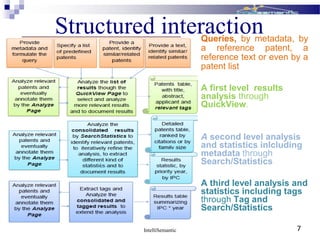
Structured interaction
IntelliSemantic 7
Queries, by metadata, by
a reference patent, a
reference text or even by a
patent list
A first level results
analysis through
QuickView.
A second level analysis
and statistics inlcluding
metadata through
Search/Statistics
A third level analysis and
statistics including tags
through Tag and
Search/Statistics
Linguistic intelligence: Tags
 A tag is a word (e.g. “inductor”) or a sequence of words
(e.g. “speaker verification”) having a well defined meaning.
 Tags are a distinguishing feature in MyIntelliPatent.
 MyIntelliPatent can:
 suggest a topic specific vocabulary from a set of
topic specific patents.
 allow the user to edit this suggested vocabulary.
 apply the finally edited vocabulary to all
collections, in such a way that vocabulary tags in a
patent become new text-specific metadata.
 different topic specific vocabularies can be present in
the same platform, enabling functions exemplified in the
following slide.
IntelliSemantic
8
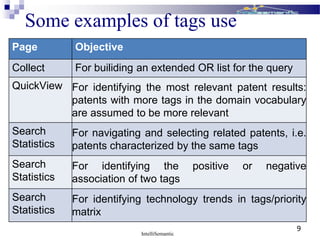
Some examples of tags use
IntelliSemantic
9
Page Objective
Collect For builiding an extended OR list for the query
QuickView For identifying the most relevant patent results:
patents with more tags in the domain vocabulary
are assumed to be more relevant
Search
Statistics
For navigating and selecting related patents, i.e.
patents characterized by the same tags
Search
Statistics
For identifying the positive or negative
association of two tags
Search
Statistics
For identifying technology trends in tags/priority
matrix
IntelliSemantic
10
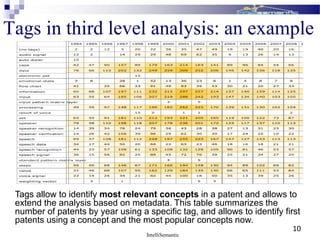
Tags in third level analysis: an example
Tags allow to identify most relevant concepts in a patent and allows to
extend the analysis based on metadata. This table summarizes the
number of patents by year using a specific tag, and allows to identify first
patents using a concept and the most popular concepts now.
For more information
 MyIntelliPatent includes of course other features
besides those mentioned in these slides.
 Visit us at stand 4 for more details.
And/or:
 Contact IntelliSemantic
 e-mail info@intellisemantic.com
 tel. +39 011 9550 380
for a Web Conference presentation.

IntelliSemantic - MyIntelliPatent in a nutshell

  • 1.
    Smart patent analysis withMyIntelliPatent Alberto Ciaramella - IntelliSemantic PATINFO 2015 11/6/2015 – Ilmenau
  • 2.
    Presentation overview  thecompany.  the patent information challenge today.  “smart solutions” to solve it.  the “smart solution” MyIntelliPatent. IntelliSemantic 2
  • 3.
    IntelliSemantic  Founded in2005, in Torino  in the incubator of the Politecnico di Torino.  competences: natural language processing.  solution: patent knowledge management MyIntelliPatent.  Research activities:  partner of the FP7 cofunded TOPAS project. (Tool for Patent Analysis and Summarization).  R&D activities for MyIntelliPatent.  partner of some Piemonte or Veneto region cofunded research projects for open data and NLP. IntelliSemantic 3
  • 4.
     On theinformation side, the number of worldwide patents is continuously increasing, hence the effort required for any kind of patent-related task.  On the user side, the number of companies whose business can be affected by patent information is increasing and include now also a significant percentage of SMEs, which can be even more tight on costs.  But if patent analyses are performed less frequently or less deeply than required, a company can incur:  higher costs, if a company misses in due time a competitor which can invalidate its research efforts.  less benefits, if a company has not the time to extract “hidden” suggestions from the patent literature. The patent information challenge IntelliSemantic 4
  • 5.
     A solutionto this challenge is to deliver smarter tools which allow professionals to concentrate their activities in the higher value-added part of their activity.  Smarter tools can include features as:  Patent specific knowledge management, to:  learn, accumulate, and reuse the company professionals knowledge.  provide a structured approach for different use cases.  Intelligent language technologies to automatically extract the text embedded knowledge, as the most relevant entities and passages, and to identify as well the patent document structure. How to solve this challenge IntelliSemantic 5
  • 6.
    IntelliSemantic 6 MyIntelliPatent A smartsolution for patent intelligence tasks.  MyIntelliPatent includes the company specific knowledge, since it is provided as a password-protected Software as a Service and repository. A company can build and access to its specific vocabularies, patent sets, patent annotations.  MyIntelliPatent supports structured interactions, as detailed in the following.  MyIntelliPatent includes intelligent language technologies, as detailed in the following.
  • 7.
    Structured interaction IntelliSemantic 7 Queries,by metadata, by a reference patent, a reference text or even by a patent list A first level results analysis through QuickView. A second level analysis and statistics inlcluding metadata through Search/Statistics A third level analysis and statistics including tags through Tag and Search/Statistics
  • 8.
    Linguistic intelligence: Tags A tag is a word (e.g. “inductor”) or a sequence of words (e.g. “speaker verification”) having a well defined meaning.  Tags are a distinguishing feature in MyIntelliPatent.  MyIntelliPatent can:  suggest a topic specific vocabulary from a set of topic specific patents.  allow the user to edit this suggested vocabulary.  apply the finally edited vocabulary to all collections, in such a way that vocabulary tags in a patent become new text-specific metadata.  different topic specific vocabularies can be present in the same platform, enabling functions exemplified in the following slide. IntelliSemantic 8
  • 9.
    Some examples oftags use IntelliSemantic 9 Page Objective Collect For builiding an extended OR list for the query QuickView For identifying the most relevant patent results: patents with more tags in the domain vocabulary are assumed to be more relevant Search Statistics For navigating and selecting related patents, i.e. patents characterized by the same tags Search Statistics For identifying the positive or negative association of two tags Search Statistics For identifying technology trends in tags/priority matrix
  • 10.
    IntelliSemantic 10 Tags in thirdlevel analysis: an example Tags allow to identify most relevant concepts in a patent and allows to extend the analysis based on metadata. This table summarizes the number of patents by year using a specific tag, and allows to identify first patents using a concept and the most popular concepts now.
  • 11.
    For more information MyIntelliPatent includes of course other features besides those mentioned in these slides.  Visit us at stand 4 for more details. And/or:  Contact IntelliSemantic  e-mail info@intellisemantic.com  tel. +39 011 9550 380 for a Web Conference presentation.