Chapter 4: Intel’s 1994 Pentium chip Crisis
Intel’s 1994 Commercialhttp://www.youtube.com/watch?v=xwiFW5WVHAU
Summary of Intel’s PR Crisis1. The chip produced malfunctioned.2. Reputation was slandered.3. CEO would not replace unless consumer could prove the chip’s malfunction.4. Finally, forced to replace all chips, costing approximately 420 million.
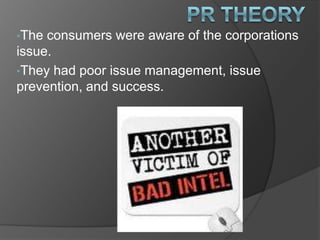
PR TheoryThe consumers were aware of the corporations issue.
They had poor issue management, issue prevention, and success.Why this led to a crisisIntel’s problems were partly related to bad public relations. The problem could have been solved sooner if they had taken immediate action.They violated the 5 ways to measure relationship quality.
Relationship QualityFailed commitment to maintain a relationship with customers.The control mutuality was not reached as they ignored their publics.There was no communality. The values and identity of the company were distorted.
.4. Their trust as a valued and reputable company was hindered.5. The customer satisfaction was damaged, as they chose not to correct the problem
PR Solution1. Ran ads in newspapers “Sincerely apologizing.” 2. Agreed to send a new chip within 60 days.3. Agreed to help install the chip themselves or pay to have someone do it for them.
2010  Commercialhttp://www.youtube.com/watch?v=RSqMTWrlF-8
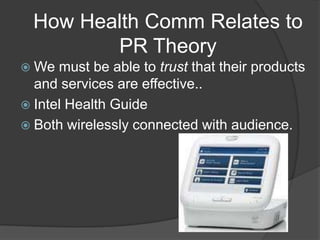
How Health Comm Relates to PR TheoryWe must be able to trust that their products  and services are effective.. Intel Health GuideBoth wirelessly connected with audience.
Works CitedHansen-Horn, & Dostal Neff, . (2008). Public relations: from theory to practice. Boston: Pearson Education, Inc.. http://www.google.com/http://www.newworldencyclopedia.org/entry/Intel_Corporationhttp://www.youtube.com/

Intel crisis pr theory

  • 1.
    Chapter 4: Intel’s1994 Pentium chip Crisis
  • 2.
  • 3.
    Summary of Intel’sPR Crisis1. The chip produced malfunctioned.2. Reputation was slandered.3. CEO would not replace unless consumer could prove the chip’s malfunction.4. Finally, forced to replace all chips, costing approximately 420 million.
  • 4.
    PR TheoryThe consumerswere aware of the corporations issue.
  • 5.
    They had poorissue management, issue prevention, and success.Why this led to a crisisIntel’s problems were partly related to bad public relations. The problem could have been solved sooner if they had taken immediate action.They violated the 5 ways to measure relationship quality.
  • 6.
    Relationship QualityFailed commitmentto maintain a relationship with customers.The control mutuality was not reached as they ignored their publics.There was no communality. The values and identity of the company were distorted.
  • 7.
    .4. Their trustas a valued and reputable company was hindered.5. The customer satisfaction was damaged, as they chose not to correct the problem
  • 8.
    PR Solution1. Ranads in newspapers “Sincerely apologizing.” 2. Agreed to send a new chip within 60 days.3. Agreed to help install the chip themselves or pay to have someone do it for them.
  • 9.
  • 10.
    How Health CommRelates to PR TheoryWe must be able to trust that their products and services are effective.. Intel Health GuideBoth wirelessly connected with audience.
  • 11.
    Works CitedHansen-Horn, &Dostal Neff, . (2008). Public relations: from theory to practice. Boston: Pearson Education, Inc.. http://www.google.com/http://www.newworldencyclopedia.org/entry/Intel_Corporationhttp://www.youtube.com/

Editor's Notes

  • #11 This relates to the NOW Foundation because people need to trust that their advice and advocacy will be effective.The Intel Health Guide offers interactive tools for personalized care management and includes vital sign collection, patient reminders, surveys, multimedia educational content, and feedback and communications tools such as video conferencing and email notifications. It can connect to specific models of wired and wireless medical devices, including blood pressure monitors, glucose metersand weight scales. Using a secure server, health care professionals can remotely review and act on this information.As a result, clinicians have ongoing access to data so that they can better manage each patient's conditions. Patients benefit from customized care in the comfort of their home and can also monitor their health status and communicate with care teams.