The PRINCE2 Cityscape logo™ is a Trade Mark of the Office of Government Commerce in the United Kingdom and other countries
MSP™ is a Trade Mark of the Office of Government Commerce
M_o_R® is a Registered Trade Mark of the Office of Government Commerce in the United Kingdom and other countries
The Swirl logo™ is a Trade Mark of the Office of Government Commerce


                                                             BPUG 2009
                     Integration of PRINCE2™and MoR®
10 things from MoR® that
can help your PRINCE2™
       Project today
The problems
• MoR® is seen as completing the set of
  three
• PRINCE2™ light on risk management
• PRINCE2™ projects still failing to manage
  risk
Evidence
• Delivering training in both PRINCE2™ and
  MoR®
• Marking MoR® Practitioner Papers
• Reviewing many projects over many years
• Role as Risk Manager
• NAO Reports
Solution?
• PRINCE2™ 2009
• Until then:
 – Many concepts in MoR® that can be applied
   to PRINCE2™ projects
 – Simple, low cost but very effective
1. Identifying the Context
Multiple use of Context in
              PRINCE2™


SU4 Preparing a
Project brief     SB4 Updating
                  The Risk Log
                                 CS1 – MP1
                                 Agreeing a
                                 Work Package
Context Techniques
             RACI


SWOT
                               PESTLE


                PROCESS MAPS
2. Risk Descriptions
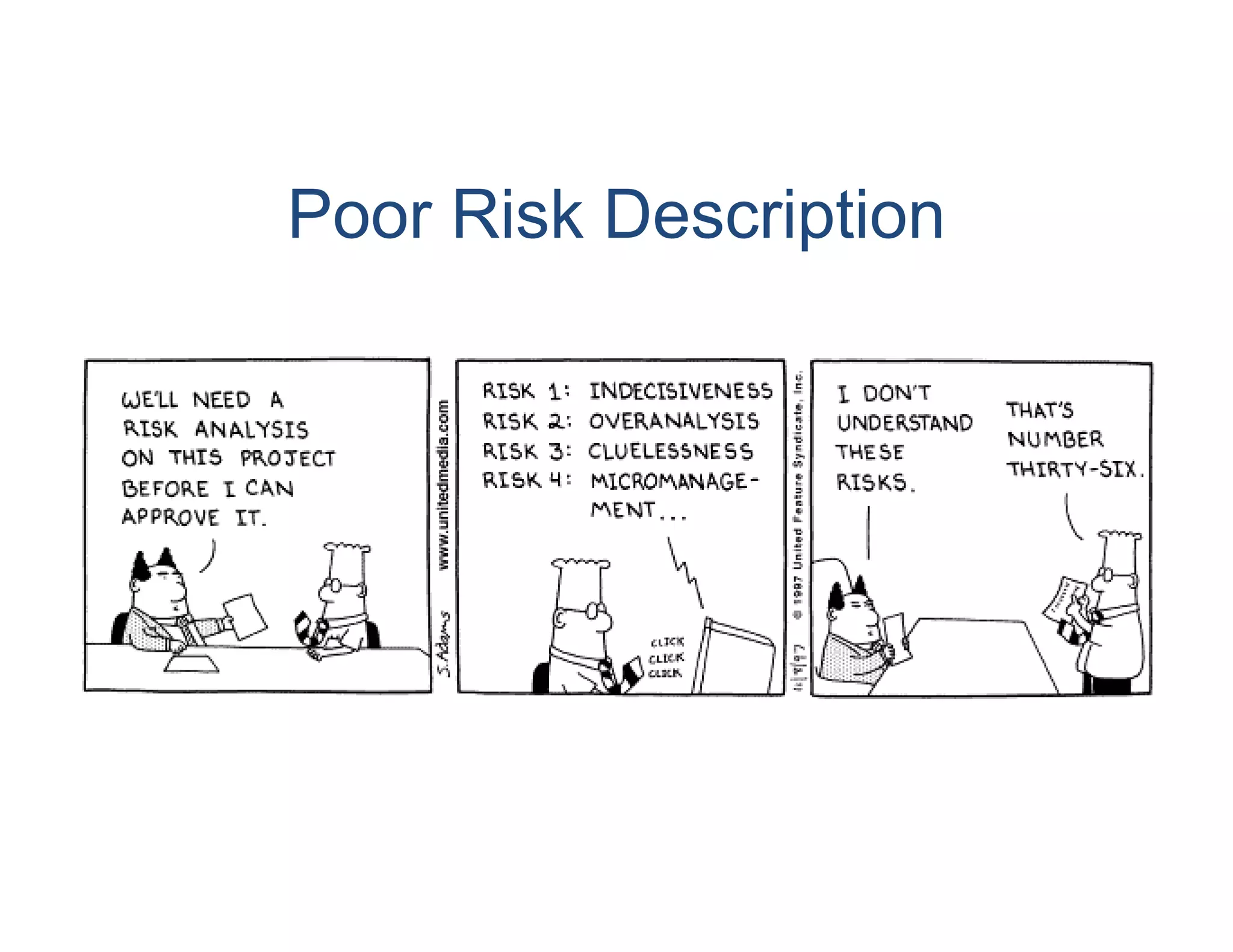
Poor Risk Description
Preferred Approach
• Risks should be described in a clear and
  unambiguous way
• The preferred approach is:
  – Risk Cause (source of risk)
  – Risk Event (threat or opportunity)
  – Risk Effect (impact should it arise)
Question
• Is the following a well defined risk?
  – Because of poor security vetting procedures
  – There is a risk that an inappropriate person is
    employed
  – Which might mean that company secrets are
    leaked to the press

                                      So what?
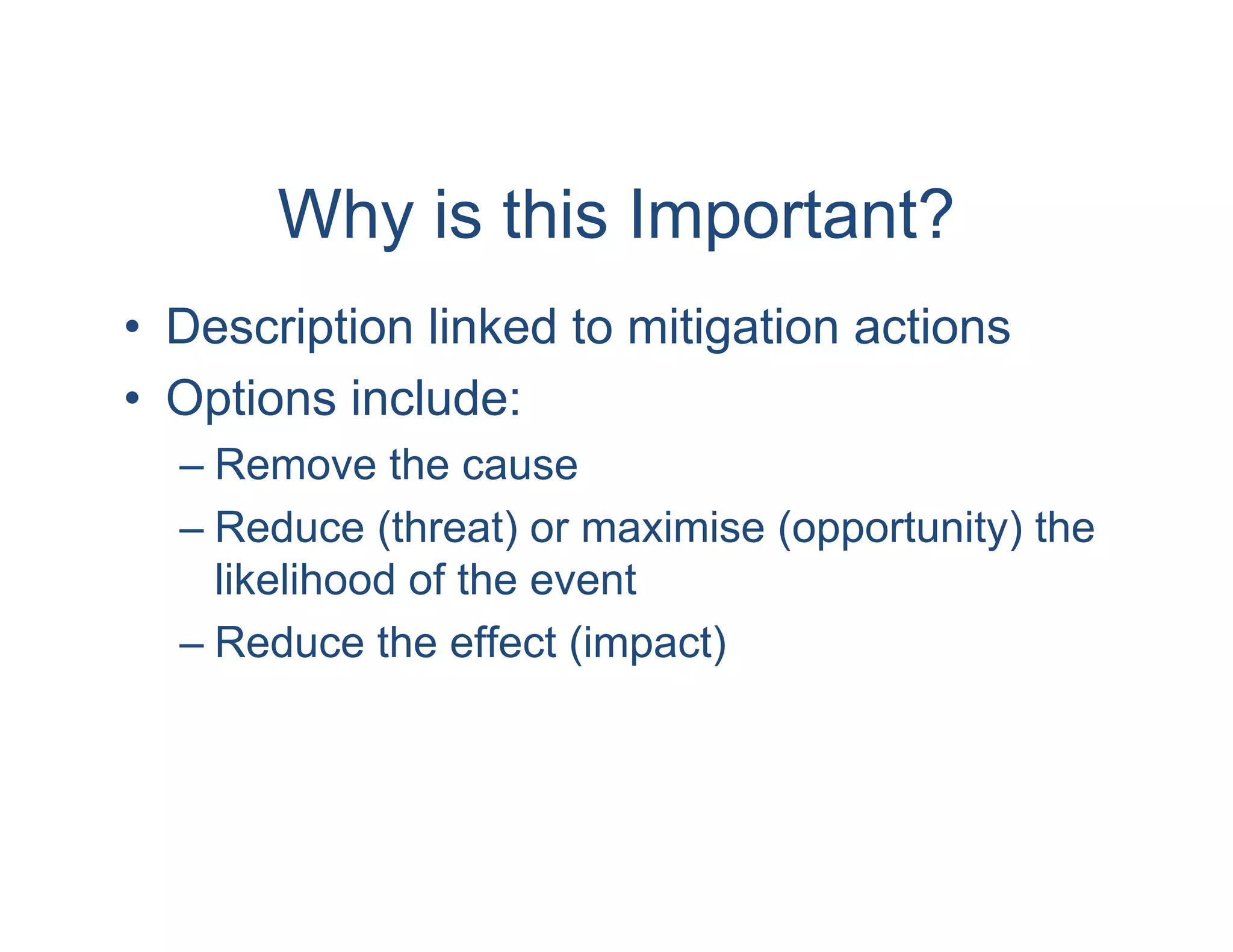
Why is this Important?
• Description linked to mitigation actions
• Options include:
  – Remove the cause
  – Reduce (threat) or maximise (opportunity) the
    likelihood of the event
  – Reduce the effect (impact)
3. Estimating for risk
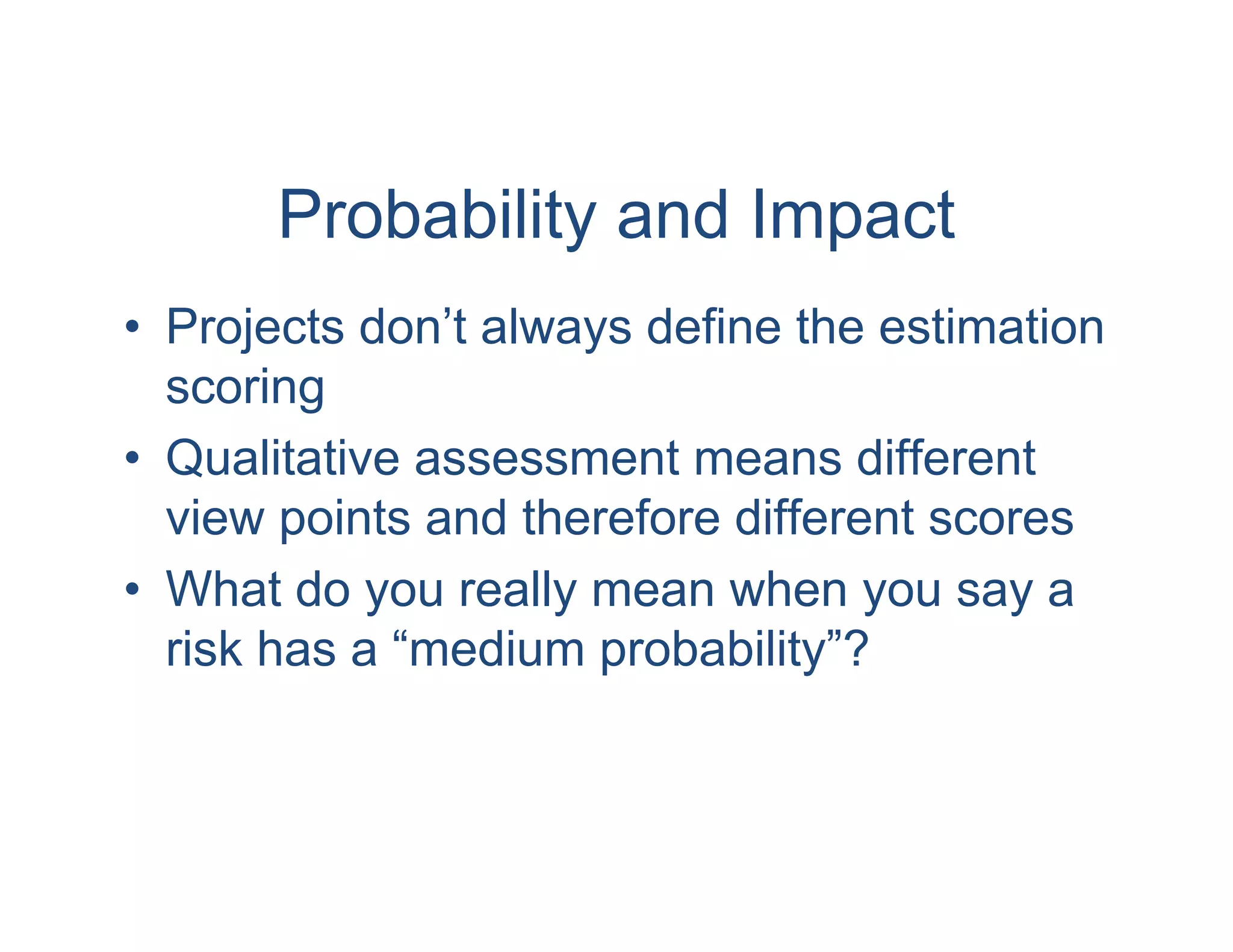
Probability and Impact
• Projects don’t always define the estimation
  scoring
• Qualitative assessment means different
  view points and therefore different scores
• What do you really mean when you say a
  risk has a “medium probability”?
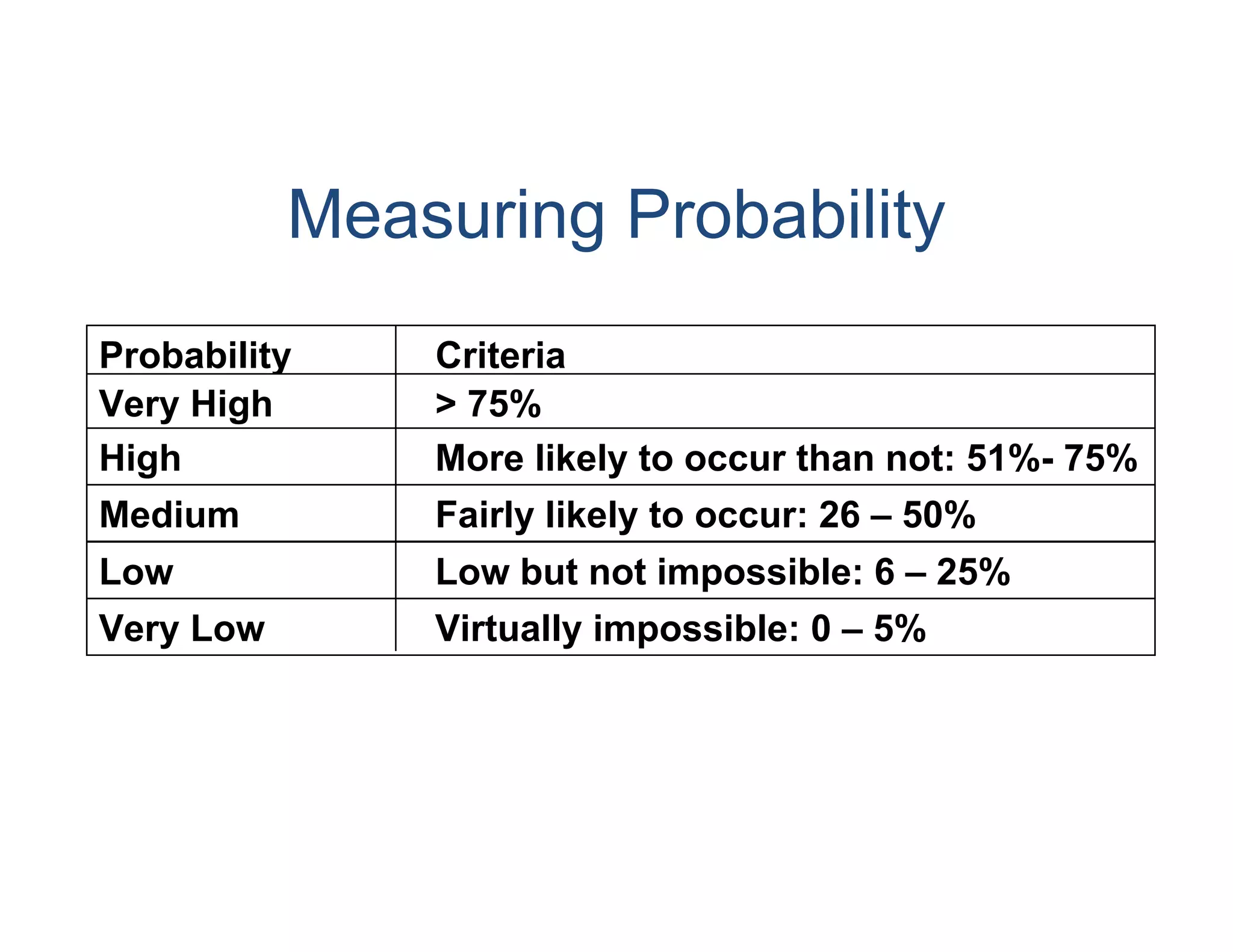
Measuring Probability
Probability    Criteria
Very High      > 75%
High           More likely to occur than not: 51%- 75%
Medium         Fairly likely to occur: 26 – 50%
Low            Low but not impossible: 6 – 25%
Very Low       Virtually impossible: 0 – 5%


                                     ©Crown Copyright 2005 Reproduced under licence from OGC
Different Impacts
• Some risks will have an
  impact on one or more of:
  –   Cost
  –   Time
  –   Resources
  –   Quality
  –   Scope
  –   Benefits
  –   Security
• Need to consider multiple
  impacts.
4. Appetite and Tolerance
Appetite and Tolerance – The
           Difference
• Risk Appetite:
  – Attitude towards risk taking
  – Willingness to tolerate a situation
  – What is and what is not acceptable
• Tolerance
  – Levels of exposure which when exceeded
    trigger a response
  – How bad does it have to be before I escalate?
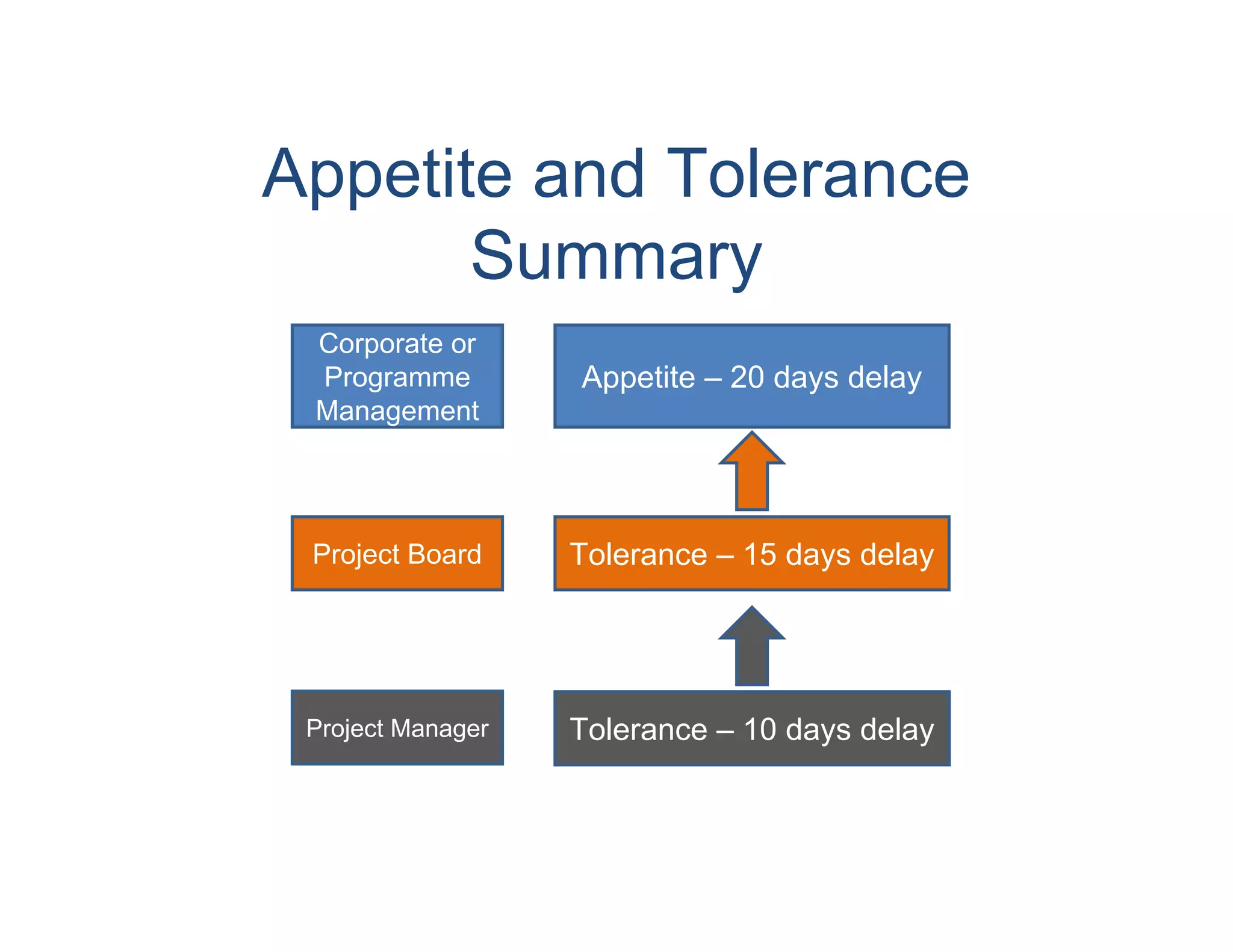
Appetite and Tolerance
       Summary
 Corporate or
 Programme         Appetite – 20 days delay
 Management


 Project Board     Tolerance – 15 days delay


 Project Manager   Tolerance – 10 days delay
5. Aggregated Risk
What is Aggregation?
• Aggregation is the net effect of the threat
  and opportunity assessments when
  combined together
• In other words “what if several risks
  materialise at the same time”?
• PRINCE2™ doesn’t consider this
  eventuality
Example
• The project has identified 3 risks causing delay to
  the project:
   – Risk 3 – an additional 5 days for user training
   – Risk 7 – extra 4 day delay to training due to staff
     sickness
   – Risk 12 – delay of 10 days due to staff unavailability
     for training because of operational needs
• If Project Board Risk Tolerance is 15 days,
  aggregated risk exceeds this.
6. Risk Owners
Different Definitions
• PRINCE2™:
  – Risk owner should be the best person to keep an
    eye on the risk
• MoR®:
  – named individual who is responsible for the
    management and control of all aspects of the
    risks assigned to them, including the
    implementation of the selected actions to address
    the threats or to maximise the opportunities.
7. Mitigation Actions
Choosing What to do
• Prevent – Remove the cause
• Reduce – Carry out an action to reduce the
  probability and or impact of the risk
• Accept – The risk is below the agreed risk
  appetite for the risk
• Contingency – Carry out an action to reduce
  the impact of the risk when it occurs
Transference
• You can only transfer the financial aspects
  of a risk
• Giving the risk to someone else isn’t
  necessarily transferring the risk
• Common transference actions include
  penalty clauses and insurance
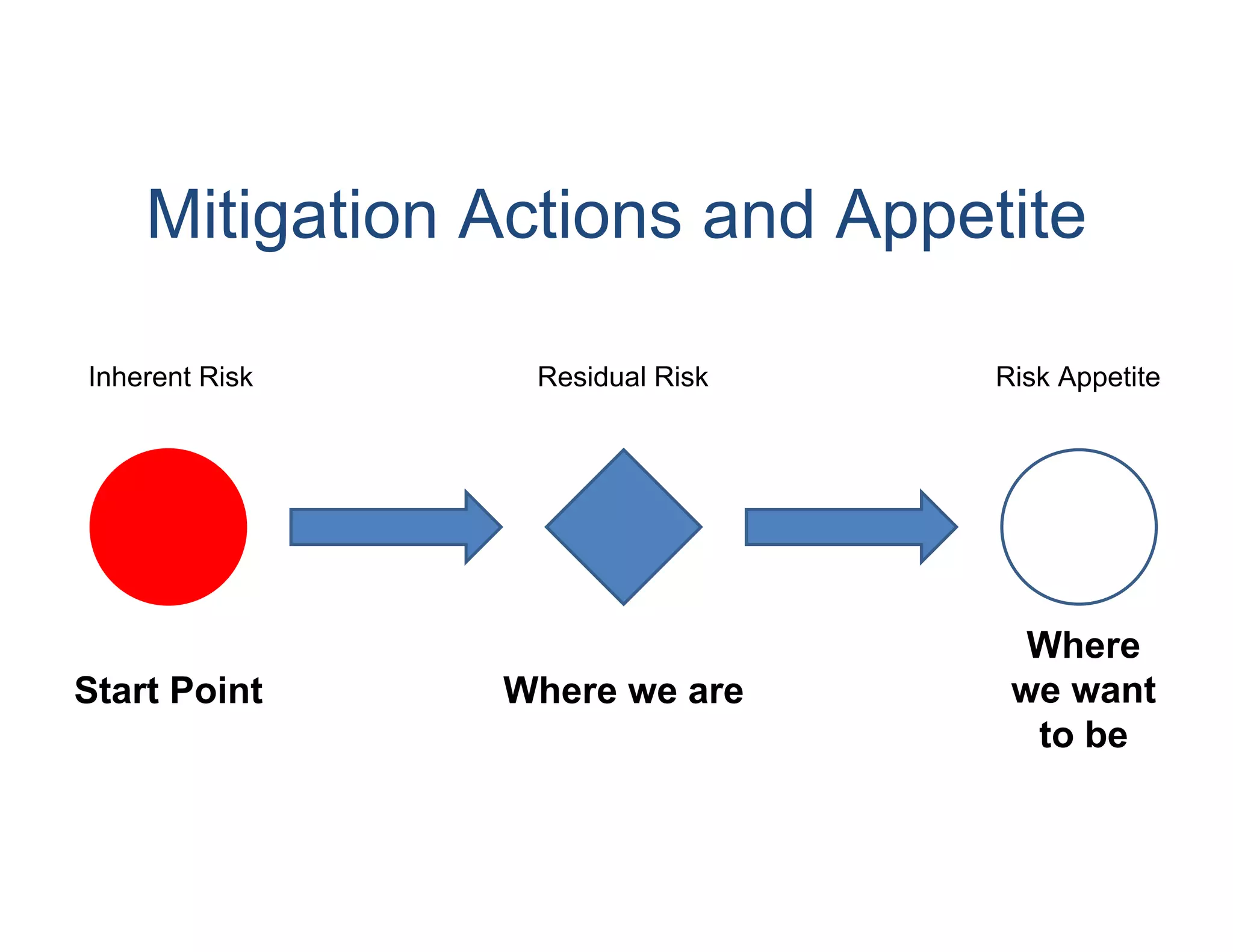
Mitigation Actions and Appetite

Inherent Risk    Residual Risk   Risk Appetite


                                   Where
Start Point     Where we are      we want
                                   to be
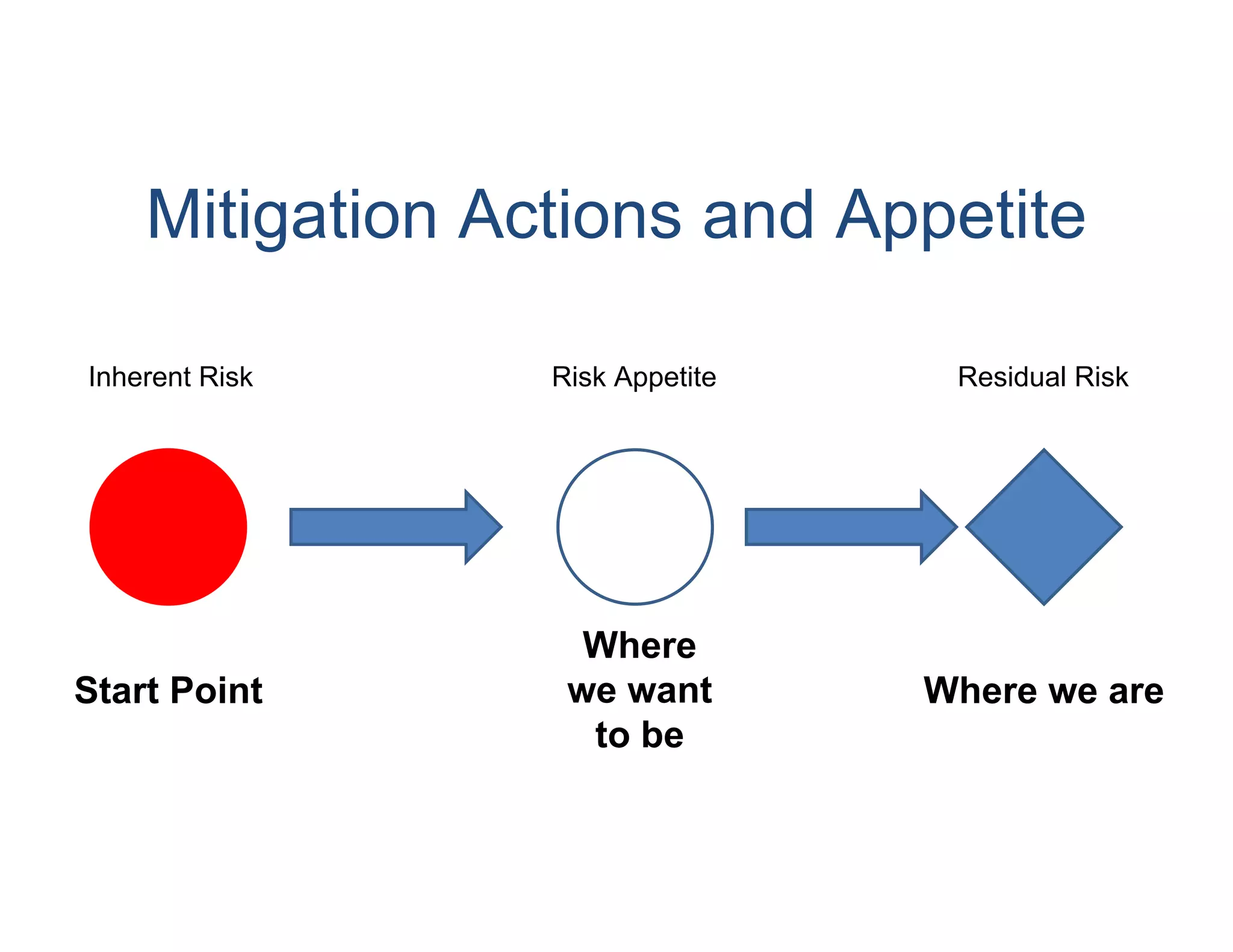
Mitigation Actions and Appetite

Inherent Risk    Risk Appetite    Residual Risk


                   Where
Start Point       we want        Where we are
                   to be
Mitigation Actions and Appetite

Inherent Risk    Risk Appetite
                 Residual Risk


                Where we are
Start Point     is where we
                 want to be
8. Reporting Risk
No Risk Reporting in
          PRINCE2™?
• PRINCE2™ reports don’t have risk in their
  Annex A Product Descriptions
• Risk reporting can be integrated into
  Checkpoint or Highlight Reports
• Standard measures include:
  – Summary Risk Profiles
  – Dashboard metrics
Possible Reporting Mechanisms
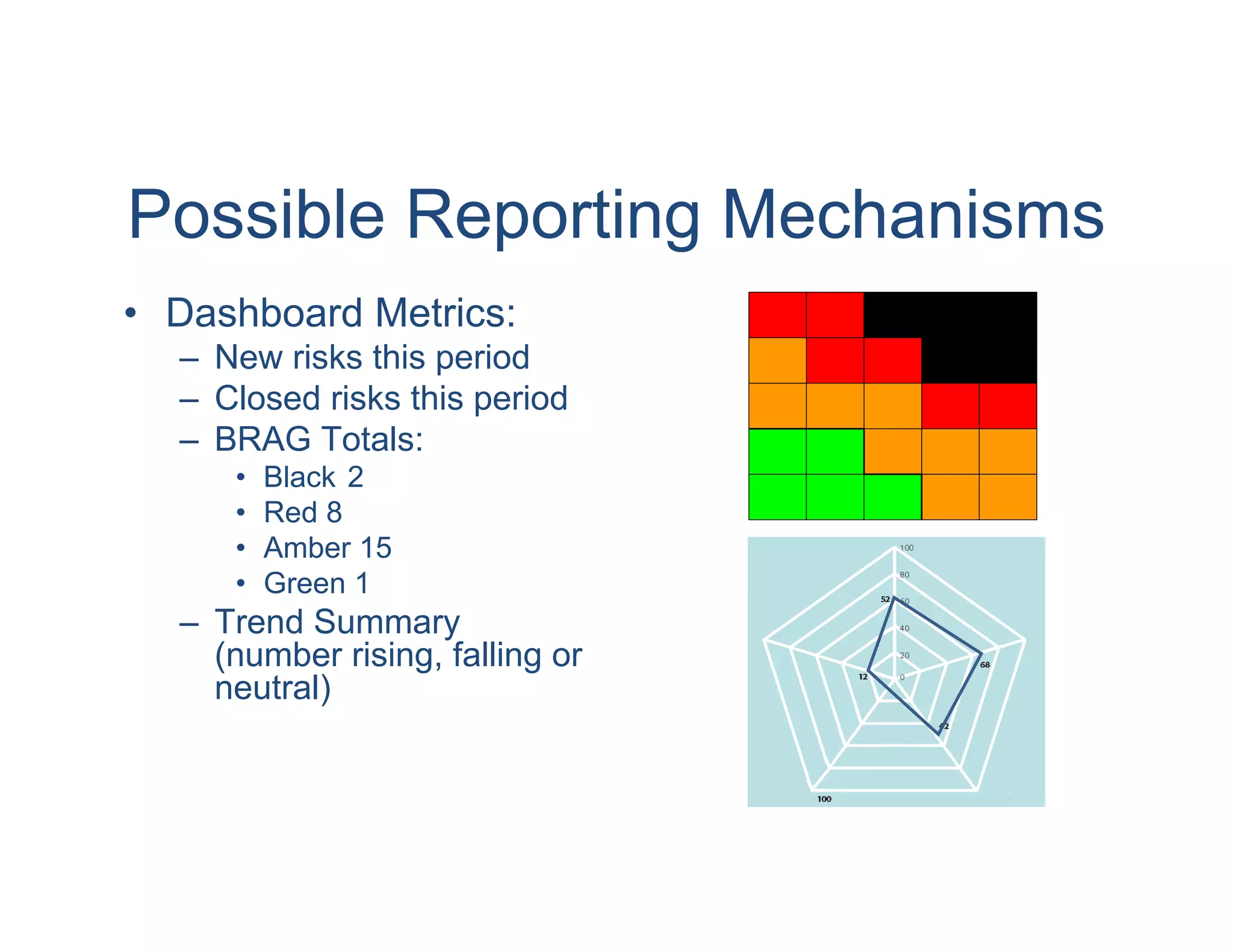
• Dashboard Metrics:
  – New risks this period
  – Closed risks this period
  – BRAG Totals:
     •   Black 2
     •   Red 8
     •   Amber 15
     •   Green 1
  – Trend Summary
    (number rising, falling or
    neutral)
9. Learn the Lessons
Experience is the Best Teacher
• What do you do:
  – When a risk materialises that you didn’t
    identify?
  – A mitigation didn’t work?
  – Risk owners don’t own the risk?
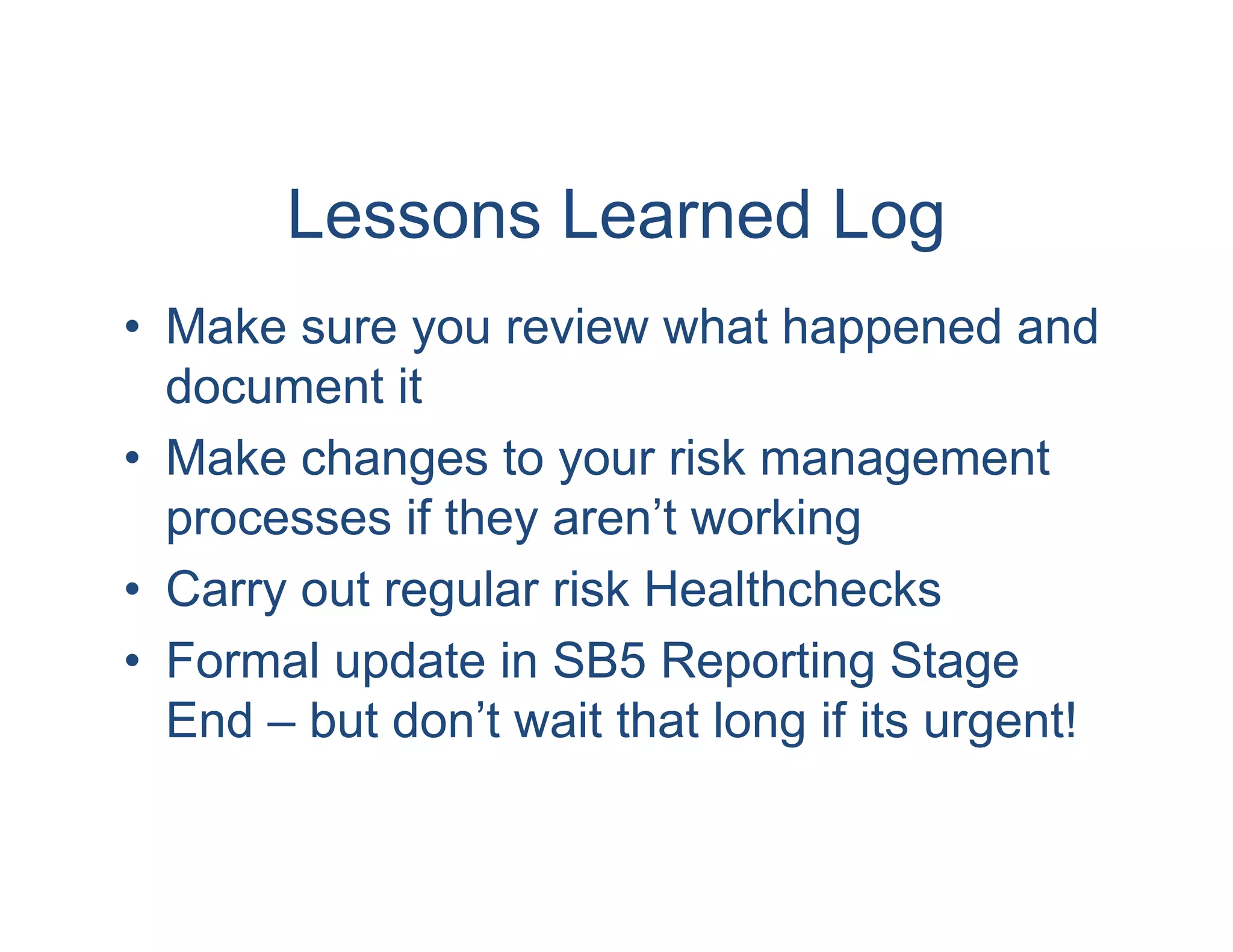
Lessons Learned Log
• Make sure you review what happened and
  document it
• Make changes to your risk management
  processes if they aren’t working
• Carry out regular risk Healthchecks
• Formal update in SB5 Reporting Stage
  End – but don’t wait that long if its urgent!
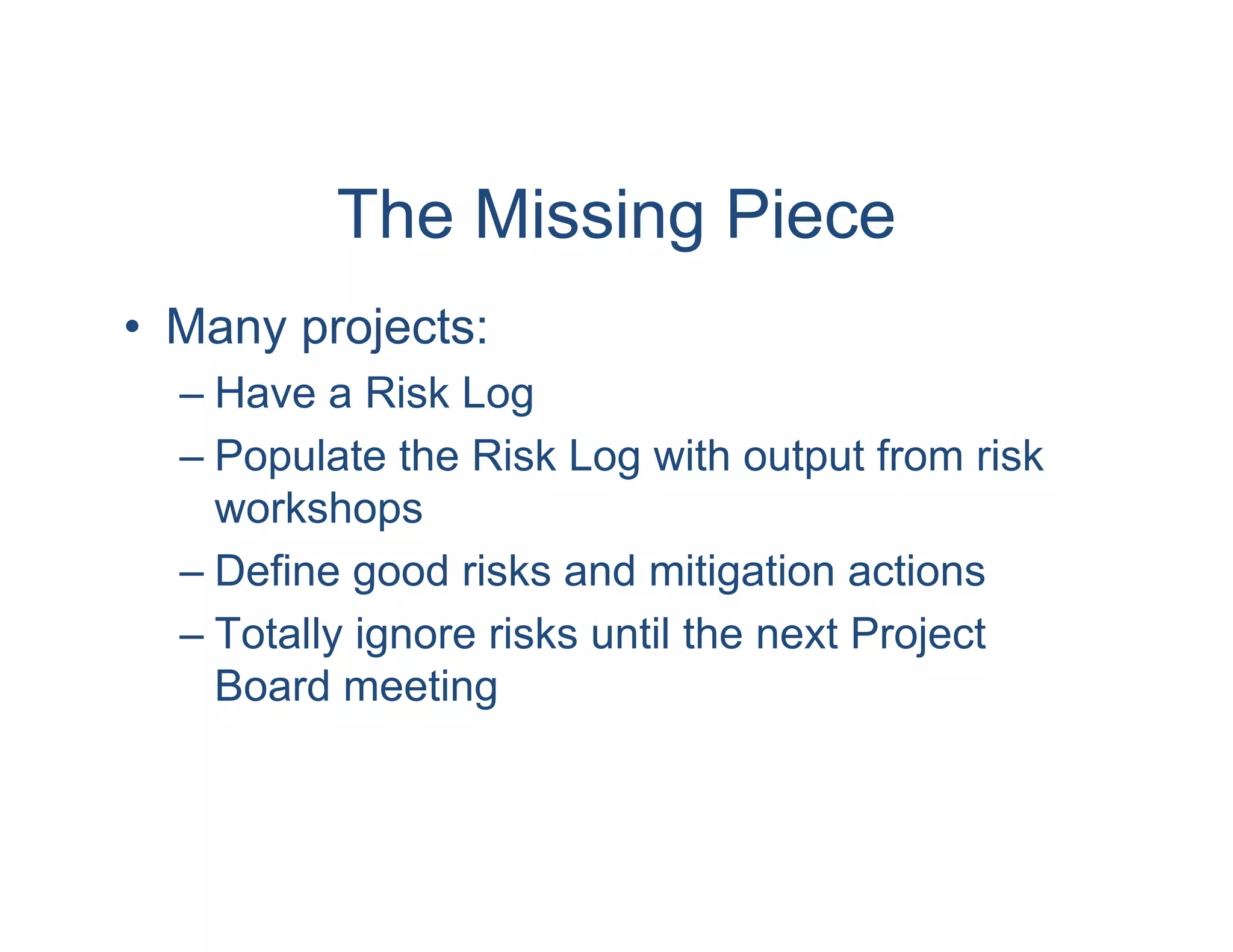
10. Manage Risk
The Missing Piece
• Many projects:
  – Have a Risk Log
  – Populate the Risk Log with output from risk
    workshops
  – Define good risks and mitigation actions
  – Totally ignore risks until the next Project
    Board meeting
Missed Opportunities to Review
           Risks
• Risk should be reviewed throughout:
  – Planning
  – Controlling a Stage
  – Managing Product Delivery
  – Stage Boundaries
  – Directing a Project
Summary
10 Simple ways to add value
1. Identifying the       5. Aggregated risk
   context               6. Risk owners
2. Risk descriptions     7. Mitigation actions
3. Estimating for risk   8. Reporting risk
4. Appetite and          9. Learn the lessons
   Tolerance             10.Manage the risk
Any Questions?

Integration Of Prince2® And M O R® 1 John Fisher

  • 1.
    The PRINCE2 Cityscapelogo™ is a Trade Mark of the Office of Government Commerce in the United Kingdom and other countries MSP™ is a Trade Mark of the Office of Government Commerce M_o_R® is a Registered Trade Mark of the Office of Government Commerce in the United Kingdom and other countries The Swirl logo™ is a Trade Mark of the Office of Government Commerce BPUG 2009 Integration of PRINCE2™and MoR®
  • 2.
    10 things fromMoR® that can help your PRINCE2™ Project today
  • 3.
    The problems • MoR®is seen as completing the set of three • PRINCE2™ light on risk management • PRINCE2™ projects still failing to manage risk
  • 4.
    Evidence • Delivering trainingin both PRINCE2™ and MoR® • Marking MoR® Practitioner Papers • Reviewing many projects over many years • Role as Risk Manager • NAO Reports
  • 5.
    Solution? • PRINCE2™ 2009 •Until then: – Many concepts in MoR® that can be applied to PRINCE2™ projects – Simple, low cost but very effective
  • 6.
  • 7.
    Multiple use ofContext in PRINCE2™ SU4 Preparing a Project brief SB4 Updating The Risk Log CS1 – MP1 Agreeing a Work Package
  • 8.
    Context Techniques RACI SWOT PESTLE PROCESS MAPS
  • 9.
  • 10.
  • 11.
    Preferred Approach • Risksshould be described in a clear and unambiguous way • The preferred approach is: – Risk Cause (source of risk) – Risk Event (threat or opportunity) – Risk Effect (impact should it arise)
  • 12.
    Question • Is thefollowing a well defined risk? – Because of poor security vetting procedures – There is a risk that an inappropriate person is employed – Which might mean that company secrets are leaked to the press So what?
  • 13.
    Why is thisImportant? • Description linked to mitigation actions • Options include: – Remove the cause – Reduce (threat) or maximise (opportunity) the likelihood of the event – Reduce the effect (impact)
  • 14.
  • 15.
    Probability and Impact •Projects don’t always define the estimation scoring • Qualitative assessment means different view points and therefore different scores • What do you really mean when you say a risk has a “medium probability”?
  • 16.
    Measuring Probability Probability Criteria Very High > 75% High More likely to occur than not: 51%- 75% Medium Fairly likely to occur: 26 – 50% Low Low but not impossible: 6 – 25% Very Low Virtually impossible: 0 – 5% ©Crown Copyright 2005 Reproduced under licence from OGC
  • 17.
    Different Impacts • Somerisks will have an impact on one or more of: – Cost – Time – Resources – Quality – Scope – Benefits – Security • Need to consider multiple impacts.
  • 18.
    4. Appetite andTolerance
  • 19.
    Appetite and Tolerance– The Difference • Risk Appetite: – Attitude towards risk taking – Willingness to tolerate a situation – What is and what is not acceptable • Tolerance – Levels of exposure which when exceeded trigger a response – How bad does it have to be before I escalate?
  • 20.
    Appetite and Tolerance Summary Corporate or Programme Appetite – 20 days delay Management Project Board Tolerance – 15 days delay Project Manager Tolerance – 10 days delay
  • 21.
  • 22.
    What is Aggregation? •Aggregation is the net effect of the threat and opportunity assessments when combined together • In other words “what if several risks materialise at the same time”? • PRINCE2™ doesn’t consider this eventuality
  • 23.
    Example • The projecthas identified 3 risks causing delay to the project: – Risk 3 – an additional 5 days for user training – Risk 7 – extra 4 day delay to training due to staff sickness – Risk 12 – delay of 10 days due to staff unavailability for training because of operational needs • If Project Board Risk Tolerance is 15 days, aggregated risk exceeds this.
  • 24.
  • 25.
    Different Definitions • PRINCE2™: – Risk owner should be the best person to keep an eye on the risk • MoR®: – named individual who is responsible for the management and control of all aspects of the risks assigned to them, including the implementation of the selected actions to address the threats or to maximise the opportunities.
  • 26.
  • 27.
    Choosing What todo • Prevent – Remove the cause • Reduce – Carry out an action to reduce the probability and or impact of the risk • Accept – The risk is below the agreed risk appetite for the risk • Contingency – Carry out an action to reduce the impact of the risk when it occurs
  • 28.
    Transference • You canonly transfer the financial aspects of a risk • Giving the risk to someone else isn’t necessarily transferring the risk • Common transference actions include penalty clauses and insurance
  • 29.
    Mitigation Actions andAppetite Inherent Risk Residual Risk Risk Appetite Where Start Point Where we are we want to be
  • 30.
    Mitigation Actions andAppetite Inherent Risk Risk Appetite Residual Risk Where Start Point we want Where we are to be
  • 31.
    Mitigation Actions andAppetite Inherent Risk Risk Appetite Residual Risk Where we are Start Point is where we want to be
  • 32.
  • 33.
    No Risk Reportingin PRINCE2™? • PRINCE2™ reports don’t have risk in their Annex A Product Descriptions • Risk reporting can be integrated into Checkpoint or Highlight Reports • Standard measures include: – Summary Risk Profiles – Dashboard metrics
  • 34.
    Possible Reporting Mechanisms •Dashboard Metrics: – New risks this period – Closed risks this period – BRAG Totals: • Black 2 • Red 8 • Amber 15 • Green 1 – Trend Summary (number rising, falling or neutral)
  • 35.
    9. Learn theLessons
  • 36.
    Experience is theBest Teacher • What do you do: – When a risk materialises that you didn’t identify? – A mitigation didn’t work? – Risk owners don’t own the risk?
  • 37.
    Lessons Learned Log •Make sure you review what happened and document it • Make changes to your risk management processes if they aren’t working • Carry out regular risk Healthchecks • Formal update in SB5 Reporting Stage End – but don’t wait that long if its urgent!
  • 38.
  • 39.
    The Missing Piece •Many projects: – Have a Risk Log – Populate the Risk Log with output from risk workshops – Define good risks and mitigation actions – Totally ignore risks until the next Project Board meeting
  • 40.
    Missed Opportunities toReview Risks • Risk should be reviewed throughout: – Planning – Controlling a Stage – Managing Product Delivery – Stage Boundaries – Directing a Project
  • 41.
  • 42.
    10 Simple waysto add value 1. Identifying the 5. Aggregated risk context 6. Risk owners 2. Risk descriptions 7. Mitigation actions 3. Estimating for risk 8. Reporting risk 4. Appetite and 9. Learn the lessons Tolerance 10.Manage the risk
  • 43.