El teorema fundamentaldel cálculo
• Al momento de querer resolver una integral que tenga límites, integrales
definidas o de Riemann, por ser éste matemático uno de los precursores de
este tipo de integrales.
• El enunciado: Sea f una función continua en [a; b]. Entonces,
f (x)dx F(x) F(b) F(a) b
a
b
a
donde: a = Límite inferior y b = Límite superior.
Fórmula de Newton-Leibniz.
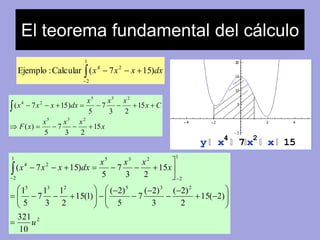
3.
El teorema fundamentaldel cálculo
4
y x
2
7 x
x 15
1
4 2 Ejemplo : Calcular (x 7x x 15)dx
2
5 3 2
x x x
7
x
4 2
x x x dx
( 7 15)
5 3 2
x x x
F x
x C
15
3 2
7
5
( )
15
3 2
5
5 3 2 5 3 2
1
7
2
1
2
1 5 3 2
2
4 2
1
321
10
15( 2)
( 2)
2
( 2)
7
3
( 2)
5
15(1)
1
2
3
5
15
3 2
7
5
( 7 15)
u
x
x x x
x x x dx
4.
El teorema fundamentaldel cálculo
1
4
0
1
3
3
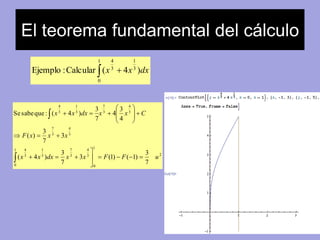
Ejemplo : Calcular (x 4x )dx
2
x x dx x x C
1
3
0
4
3
4
7
4
3
F x x x
1 7
3
0
1
3
4
3
3
3
4
3
7
3
1
3
3
3
7
3
3 (1) ( 1)
3
7
( 4 )
3
7
( )
4
4
7
Se sabe que : ( 4 )
x x dx x x F F u
5.
ln 2
Ejemplo: Calcular e e dx x x
1
2
ln
Log 2
Log
1
2
Exp x Exp x x
Solución
1. Método a emplear: Integración Definida.
2. Regla de integración: Teorema fundamental del cálculo(TFD)
3. Desarrollo:
e e dx e dx dx x x x
1
2ln 2
1
2
ln 2 ln
ln 2
1
2
ln
ln 2
1
2
ln
ln 2
1
2
ln
0
ln 2
2
ln
0.5 1.0 1.5 2.0
1.0
0.8
0.6
0.4
0.2
In[38]:=
Log 2
Log
1
2
x
e
e
x
x
Out[38]= 2 Log 2
6.
3
2 Ejemplo : Calcular x 4x 3 dx
1
Solución
1. Método a emplear: Integración Definida.
2. Regla de integración: Teorema fundamental del cálculo(TFD)
3. Desarrollo:
1
x x dx x x x
2
3 2
3
1
3 2
3
1
2
1
4
3
2 3
1
3
3 2 3 3 3
3
2 3
3
4 3
u
2
In[2]:= ContourPlot y x
4 x 3, x 1, x 3 ,
x, 1, 4 , y, 1, 4 , Axes True, Frame False
Out[2]=
4
3
2
1
1 1 2 3 4
1
7.
2
Ejemplo:
dx
ln
e
e x x
dx e
d ln
x
e e
ln(ln ) ln(ln )
ln 2 0.69
ln ln
ln
ln
2
2
2 2
x
x
x x
e
e
e
e
e
Solución:
ContourPlot y
1
x Log x
2 4 6 8 10
2
1
1
2
3
4
5
In[68]:=
Exp 2 1
Exp 1
x Log x
x
Out[68]= Log 2
, x Exp 1 , x Exp 2 ,
x, 1, 10 , y, 5, 2 , Axes True,
Frame False
8.
Cambio de variableen la integral definida
2
( ) ( ( )) ( )
1
t
t
b
a
f x dx f t t dt
Ejemplo:
1
2
2
2 1
2
dx
x
x
1 x2
x2
x, 2, 2 , y, 1, 10 , Axes True,
10
8
6
4
2
ContourPlot y
, x
2
2
, x 1 ,
Frame False
2 1 1 2
In[74]:=
1 1 x2
2
2
x2
x
Out[74]= 1
4
9.
2
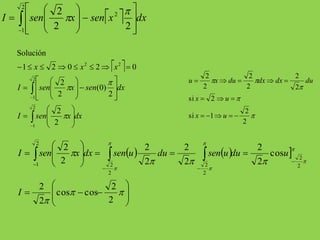
I sen x senx dx
2
1
2
2 2
x x x
1 2 0 2 0
2
2
I sen x sen dx
1
2
I sen x dx
2
1
2 2
2
2
(0)
2
Solución
2
u x du dx dx
du
2
2
2
2
x u
si 2
x u
si 1
2
2
2
2
2
2
2
I sen x dx sen u du sen u du u
2
2
2
2
cos cos
2
cos
2
2
2
2
2
2
2
2
2
2
1
I
10.
1
2
2
2 1
2
dx
x
x
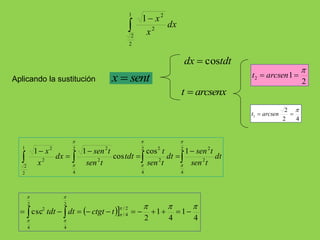
Aplicando la sustitución sent x
dx costdt
t arcsenx
2
2 4
1
t arcsen
2
1 2
t arcsen
1 2
2 2
2 2
sen t
t
2
4
sen t
2
4
2
4
2
2
2
2
2 cos 1
cos
1 1
dt
sen t
dt
sen t
tdt
sen t
dx
x
x
4
tdt dt ctgt t 1
4
1
2
csc / 2
/ 4
2
4
2
4
2
11.
3
0
1dxx x
Aplicando la sustitución z 1 x 2
dx 2zdz
z 1 x
1 1 z
2 2 z
2
x x dx z z dz
1
4 2
3
0
1 2 ( )
In[13]:= ContourPlot y x 1 x , x 0, x 3 , x, 1, 5 , y, 1, 7 ,
Axes True, Frame False
Out[13]=
6
4
2
1 1 2 3 4 5
12.
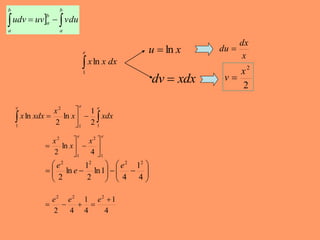
Integración por partes
b
a
b
b
a udv uv vdu
a
e
x xdx
1
Ejemplo : Calcular ln
In[78]:=
Exp 1
1
x Log x x
Out[78]=
1
4
1
2
In[23]:= ContourPlot y x Log x , x 1, x Exp 1 ,
x, 1, 4 , y, 1, 4 , Axes True, Frame False
x Log x x
Exp 1
1
x Log x x
Out[23]=
4
3
2
1
1 1 2 3 4
1
Out[24]=
x2
4
1
2
2
Log x
x
Out[25]=
1
4
1
2
13.
1
0
arctan xdx x
2
1
arctan
2
2
x
dv xdx v
dx
x
u x du
1
1
2 4
arctan
1
1
2
arctan
2
1
1
1
2
arctan
2
2 1
arctan
2
arctan
1
0
1
0
2
1
0
2
1
0
2
1
0
2
2
1
0
1 2
0
dx
x x x
x
dx
x
x
x
x
x x
x
x xdx
In[34]:= ContourPlot y x ArcTan x , x 2, x 2 3 ,
x, 4, 4 , y, 4, 4 , Axes True, Frame False
x ArcTan x x
1
x ArcTan x x
0
Out[34]=
4
2
4 2 2 4
2
4
Out[35]=
x
2
ArcTan x
2
1
2
2
ArcTan x
x
Out[36]=
1
4
2
14.
b
a
b
b
a udv uv vdu
a
e
x x dx
1
ln
x u ln
dv xdx
dx
x
du
2 x
2
v
e e e
1
x xdx
x
x xdx
1 1
2
ln
2
2
1 ln
e e
x
x
x
1
2
1
2
4
ln
2
2 2
e
2 2
1
4
4
1
ln1
2
ln
2
e
e
2 2 2
4
1
e e 1
e
4
2 4
15.
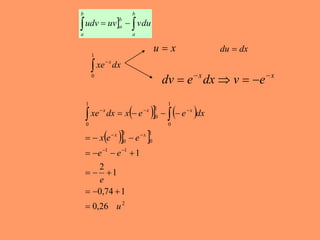
b
a
b
b
a udv uv vdu
a
x u
dx du
x x dv e dx v e
1
xe dx x
0
x x x
xe dx x e e dx
x e e
1 1
e e
0,74 1
2
1
0
1
0
1
0
1
0
1
0
0,26
1
2
1
u
e
x x
![El teorema fundamental del cálculo
• Al momento de querer resolver una integral que tenga límites, integrales
definidas o de Riemann, por ser éste matemático uno de los precursores de
este tipo de integrales.
• El enunciado: Sea f una función continua en [a; b]. Entonces,
f (x)dx F(x) F(b) F(a) b
a
b
a
donde: a = Límite inferior y b = Límite superior.
Fórmula de Newton-Leibniz.](https://image.slidesharecdn.com/integraldefinidaclase2-141026154127-conversion-gate02/85/Integral-definida-clase2-2-320.jpg)
![ln 2
Ejemplo : Calcular e e dx x x
1
2
ln
Log 2
Log
1
2
Exp x Exp x x
Solución
1. Método a emplear: Integración Definida.
2. Regla de integración: Teorema fundamental del cálculo(TFD)
3. Desarrollo:
e e dx e dx dx x x x
1
2ln 2
1
2
ln 2 ln
ln 2
1
2
ln
ln 2
1
2
ln
ln 2
1
2
ln
0
ln 2
2
ln
0.5 1.0 1.5 2.0
1.0
0.8
0.6
0.4
0.2
In[38]:=
Log 2
Log
1
2
x
e
e
x
x
Out[38]= 2 Log 2](https://image.slidesharecdn.com/integraldefinidaclase2-141026154127-conversion-gate02/85/Integral-definida-clase2-5-320.jpg)
![3
2 Ejemplo : Calcular x 4x 3 dx
1
Solución
1. Método a emplear: Integración Definida.
2. Regla de integración: Teorema fundamental del cálculo(TFD)
3. Desarrollo:
1
x x dx x x x
2
3 2
3
1
3 2
3
1
2
1
4
3
2 3
1
3
3 2 3 3 3
3
2 3
3
4 3
u
2
In[2]:= ContourPlot y x
4 x 3, x 1, x 3 ,
x, 1, 4 , y, 1, 4 , Axes True, Frame False
Out[2]=
4
3
2
1
1 1 2 3 4
1](https://image.slidesharecdn.com/integraldefinidaclase2-141026154127-conversion-gate02/85/Integral-definida-clase2-6-320.jpg)
![2
Ejemplo:
dx
ln
e
e x x
dx e
d ln
x
e e
ln(ln ) ln(ln )
ln 2 0.69
ln ln
ln
ln
2
2
2 2
x
x
x x
e
e
e
e
e
Solución:
ContourPlot y
1
x Log x
2 4 6 8 10
2
1
1
2
3
4
5
In[68]:=
Exp 2 1
Exp 1
x Log x
x
Out[68]= Log 2
, x Exp 1 , x Exp 2 ,
x, 1, 10 , y, 5, 2 , Axes True,
Frame False](https://image.slidesharecdn.com/integraldefinidaclase2-141026154127-conversion-gate02/85/Integral-definida-clase2-7-320.jpg)
![Cambio de variable en la integral definida
2
( ) ( ( )) ( )
1
t
t
b
a
f x dx f t t dt
Ejemplo:
1
2
2
2 1
2
dx
x
x
1 x2
x2
x, 2, 2 , y, 1, 10 , Axes True,
10
8
6
4
2
ContourPlot y
, x
2
2
, x 1 ,
Frame False
2 1 1 2
In[74]:=
1 1 x2
2
2
x2
x
Out[74]= 1
4](https://image.slidesharecdn.com/integraldefinidaclase2-141026154127-conversion-gate02/85/Integral-definida-clase2-8-320.jpg)
![3
0
1dxx x
Aplicando la sustitución z 1 x 2
dx 2zdz
z 1 x
1 1 z
2 2 z
2
x x dx z z dz
1
4 2
3
0
1 2 ( )
In[13]:= ContourPlot y x 1 x , x 0, x 3 , x, 1, 5 , y, 1, 7 ,
Axes True, Frame False
Out[13]=
6
4
2
1 1 2 3 4 5](https://image.slidesharecdn.com/integraldefinidaclase2-141026154127-conversion-gate02/85/Integral-definida-clase2-11-320.jpg)
![Integración por partes
b
a
b
b
a udv uv vdu
a
e
x xdx
1
Ejemplo : Calcular ln
In[78]:=
Exp 1
1
x Log x x
Out[78]=
1
4
1
2
In[23]:= ContourPlot y x Log x , x 1, x Exp 1 ,
x, 1, 4 , y, 1, 4 , Axes True, Frame False
x Log x x
Exp 1
1
x Log x x
Out[23]=
4
3
2
1
1 1 2 3 4
1
Out[24]=
x2
4
1
2
2
Log x
x
Out[25]=
1
4
1
2](https://image.slidesharecdn.com/integraldefinidaclase2-141026154127-conversion-gate02/85/Integral-definida-clase2-12-320.jpg)
![1
0
arctan xdx x
2
1
arctan
2
2
x
dv xdx v
dx
x
u x du
1
1
2 4
arctan
1
1
2
arctan
2
1
1
1
2
arctan
2
2 1
arctan
2
arctan
1
0
1
0
2
1
0
2
1
0
2
1
0
2
2
1
0
1 2
0
dx
x x x
x
dx
x
x
x
x
x x
x
x xdx
In[34]:= ContourPlot y x ArcTan x , x 2, x 2 3 ,
x, 4, 4 , y, 4, 4 , Axes True, Frame False
x ArcTan x x
1
x ArcTan x x
0
Out[34]=
4
2
4 2 2 4
2
4
Out[35]=
x
2
ArcTan x
2
1
2
2
ArcTan x
x
Out[36]=
1
4
2](https://image.slidesharecdn.com/integraldefinidaclase2-141026154127-conversion-gate02/85/Integral-definida-clase2-13-320.jpg)