PREVIEW
The conceptof International Trade Policy
Exchange Rate
Trends in Trade Policy
4.
What is InternationalTrade Policy
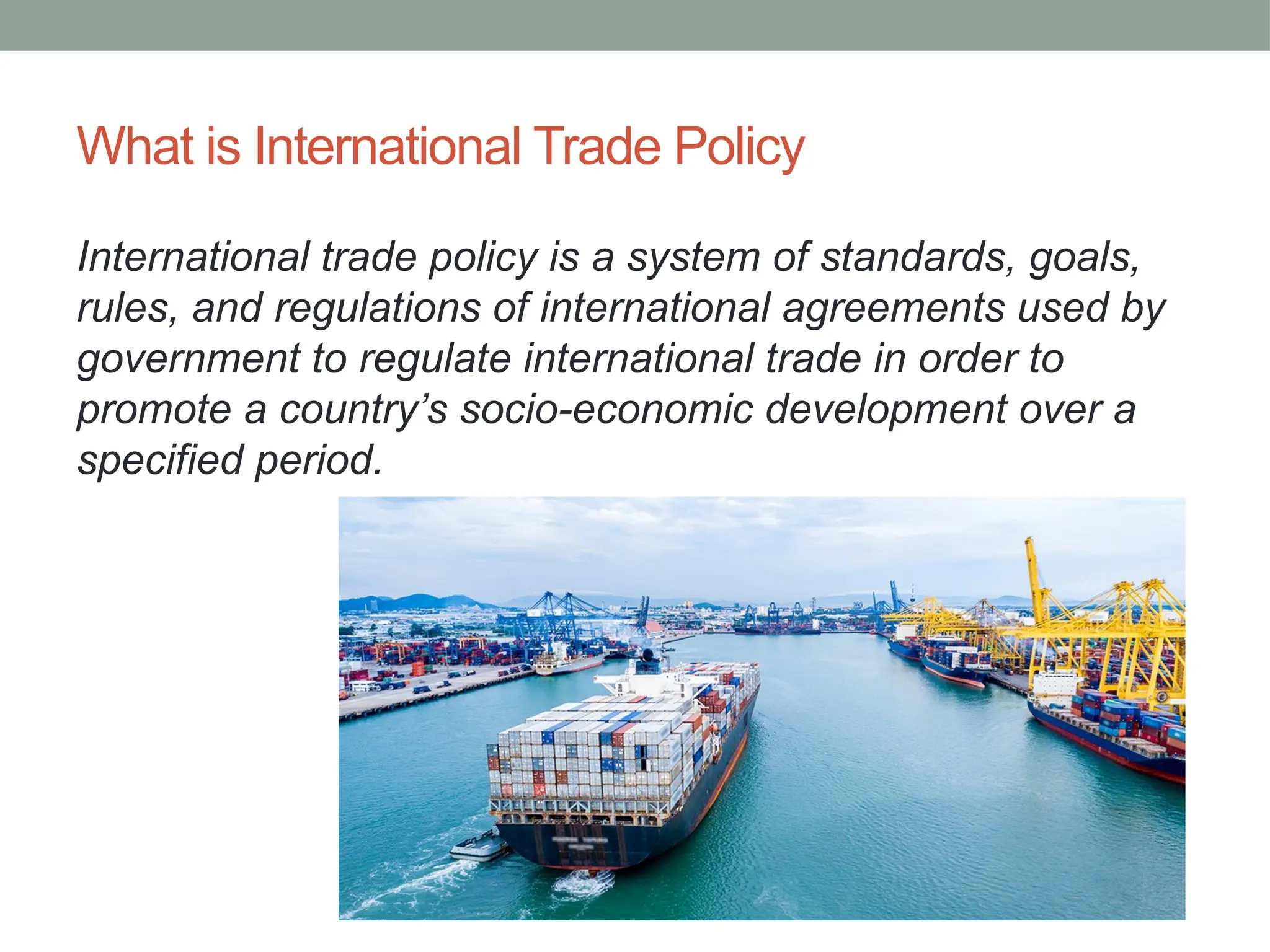
International trade policy is a system of standards, goals,
rules, and regulations of international agreements used by
government to regulate international trade in order to
promote a country’s socio-economic development over a
specified period.
5.
What is InternationalTrade Policy
Position: a part of external economic policy.
Goals:
The objectives of each country's international trade policy
may vary from period to period depending on national and
international conditions, but its general function is adjusting
international trade activities in the direction conducive to
socio-economic development.
• Protect the domestic market, protect the national interests, create
favorable conditions to promote domestic production.
• Facilitate domestic enterprises to participate in international trade
and businesses, and thoroughly exploit national advantages.
Role: international legal bases for international trade
activities.
6.
Controversies in TradePolicy
Trade and Income distribution (low-wage labour)
• An increase in manufactured exports from low and middle
income industries has been a major change in the world
economy. Compared to rich developed country standards,
workers who produce these goods are paid low wage and
may work under poor conditions.
• Some have opposed free trade for this reason.
For example, Mexican firms that produce for export to the US.
Opponents of the NAFTA have argued that it is easier for employers
to replace high wage workers in the US with low wage workers in
Mexico.
7.
Controversies in TradePolicy
• The above claim can be true, but we cannot conclude
that trade hurts labour.
• The Ricardian model predicts that while wages in Mexico
should be lower than those in the US because of low
productivity in Mexico, the wages will still rise relative to
their pre-trade level.
• The Heckscher-Ohlin model predicts that unskilled
workers in the US will lose from NAFTA, but unskilled
workers in Mexico will gain.
8.
Controversies in TradePolicy
• Despite the low wages earned by workers in Mexico, both
theories predict that those workers are better off than they
would be in the absence of trade. In other words, workers
in low and middle income countries are predicted to have
lower wages due to lower productivity, yet still have higher
wages compared to their situation without trade.
Evidence consistent with these predictions would show that wages in
the export sector have risen relative to wages in other Mexican
sectors. We could also compare working conditions in the export
sector with the working conditions in other sectors.
9.
Controversies in TradePolicy
• Some labor activists want to include labor standards in
trade negotiations.
• However, labor standards imposed by foreign countries
are opposed by governments of low and middle income
countries. Standards set by high income countries would
be expensive for low and middle income producers.
• A policy that could be agreeable for governments of low
and middle income countries is a system that monitors
wages and working conditions and makes this information
available to consumers.
Products could be certified as made with acceptable wage rates and
working conditions.
Controversies in TradePolicy
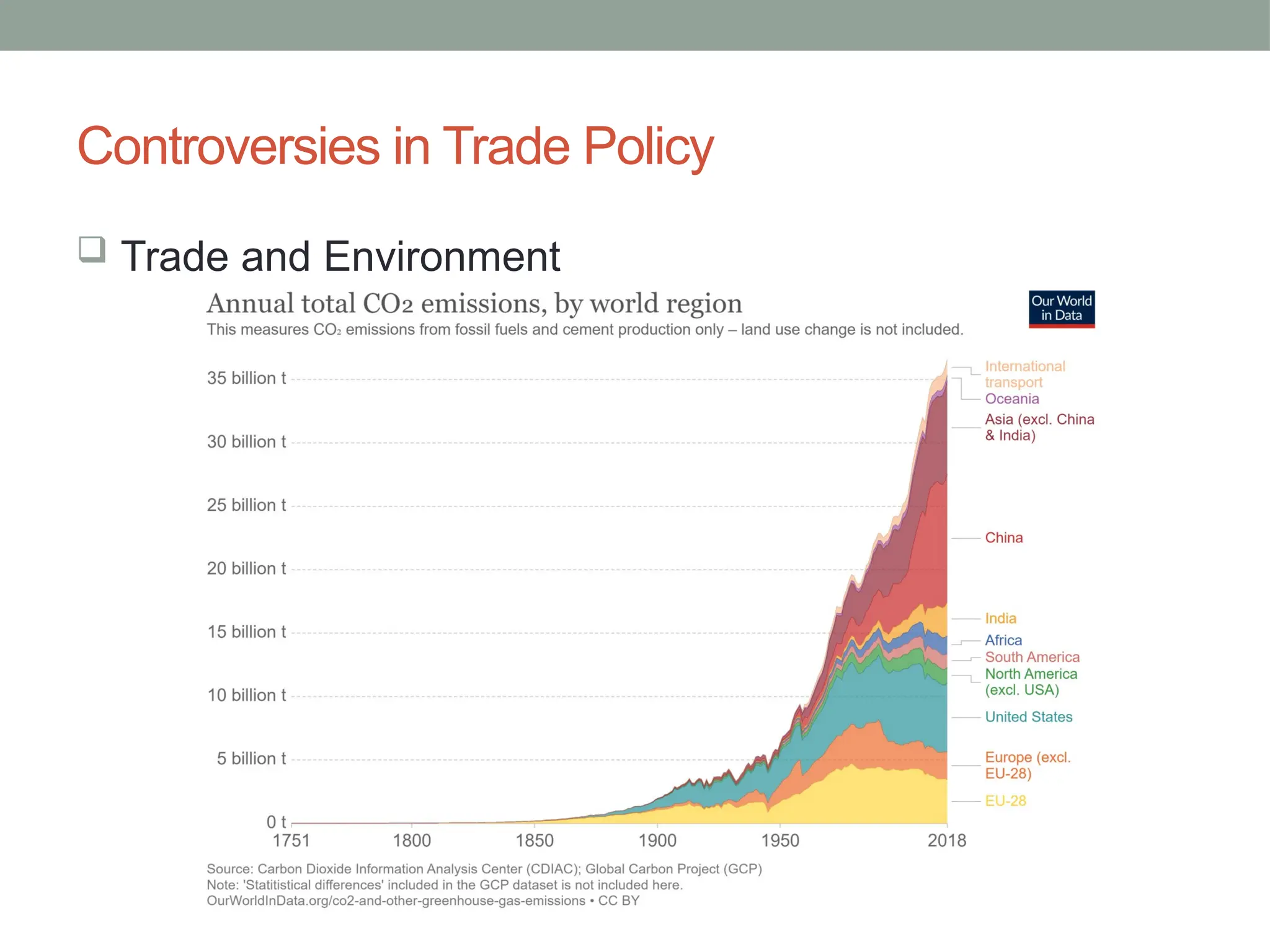
• Compared to rich country standards, environmental
standards in low and middle income countries are lax.
• Some have opposed free trade because of this fact. But
we cannot conclude that trade hurts the environment,
since in the absence of trade, consumption and
production have degraded the environment.
12.
Controversies in TradePolicy
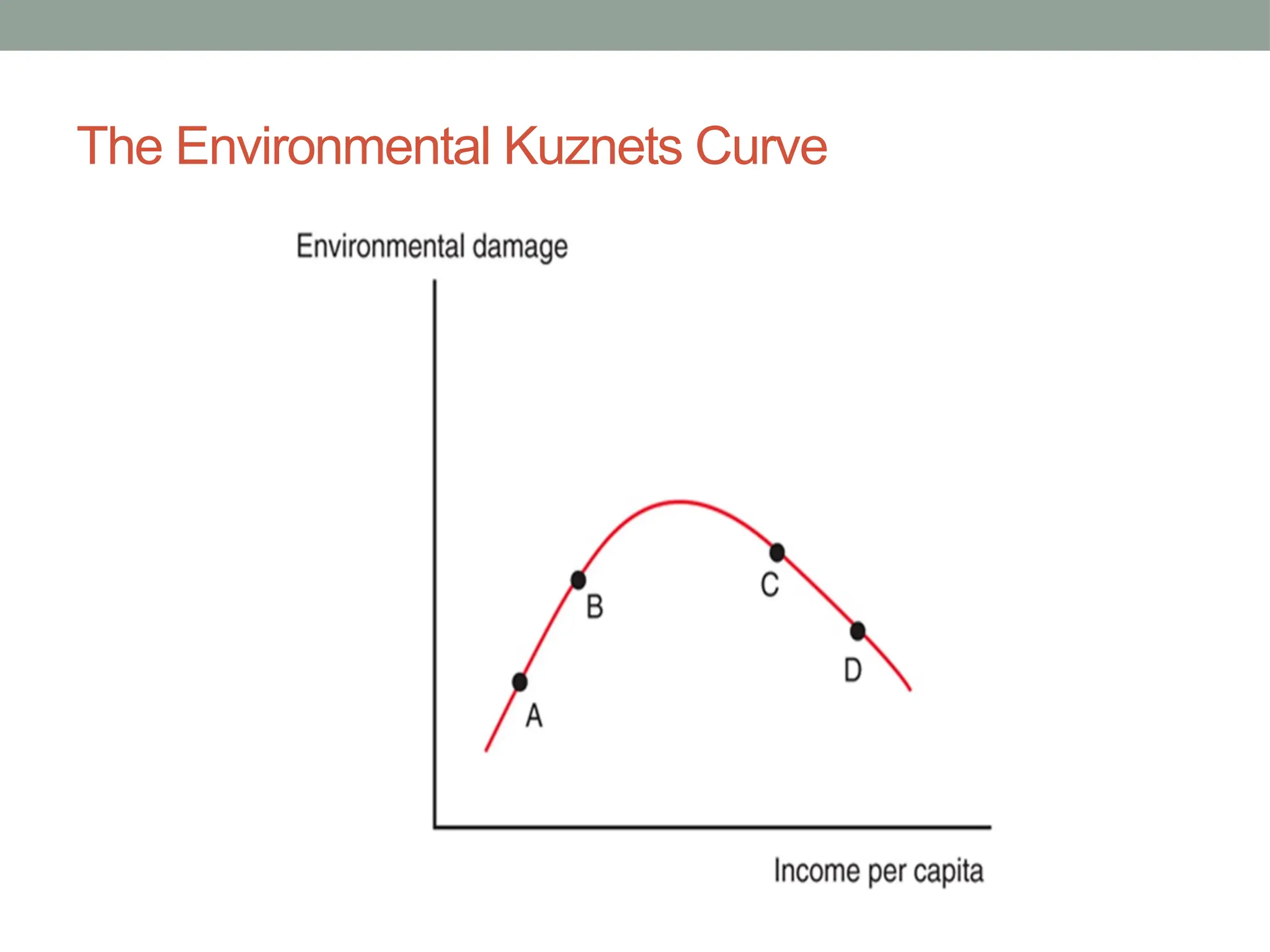
• As poor countries grow richer, possibly partly due to trade,
they produce more and can consume more, leading to
more environmental degradation.
• But as countries grow richer, they want to pay for more
stringent environmental protection.
• There is an inverted “U-shaped” relationship between
environmental degradation and income per person, which
is represented as the environmental Kuznets curve.
Controversies in TradePolicy
• Because rich countries usually have strict environmental
regulations and poor countries do not, environmentally
hazardous activities may be moved to poor countries.
A pollution haven is a place where an economic activity that is
subject to strict environmental controls in some countries is moved
to other countries with less strict regulation.
There is evidence that pollution havens are insignificant relative to
the pollution that occurs without international trade.
• Pollution in some countries may cause a negative
externality for other countries.
E.g., production in China could cause air pollution in Korea.
15.
Controversies in TradePolicy
• Some environmental activists want to include
environmental standards in trade negotiations.
• However, environmental standards imposed by foreign
countries are opposed by governments of low and middle
income countries. Standards set by high income countries
would be expensive for low and middle income producers.
16.
Controversies in TradePolicy
Trade and Culture
• Some believe that trade destroys culture in other
countries.
This belief neglects the principle that we should allow people to
define their culture through the choices that they make, not through
standards set by others.
Also, any economic change, not just trade, leads to changes in
everyday life.
17.
Exchange Rate
o Exchangerate is the comparison of the purchasing power
of currencies, or the value of a nation’s currency in terms
of the currency of another nations.
o Methods of quotation of exchange rate
Direct quotation
When the value of one unit of foreign currency is expressed in
terms of the domestic currency.
In a direct quote, the foreign currency serves as the base
currency, the domestic currency is the counter currency.
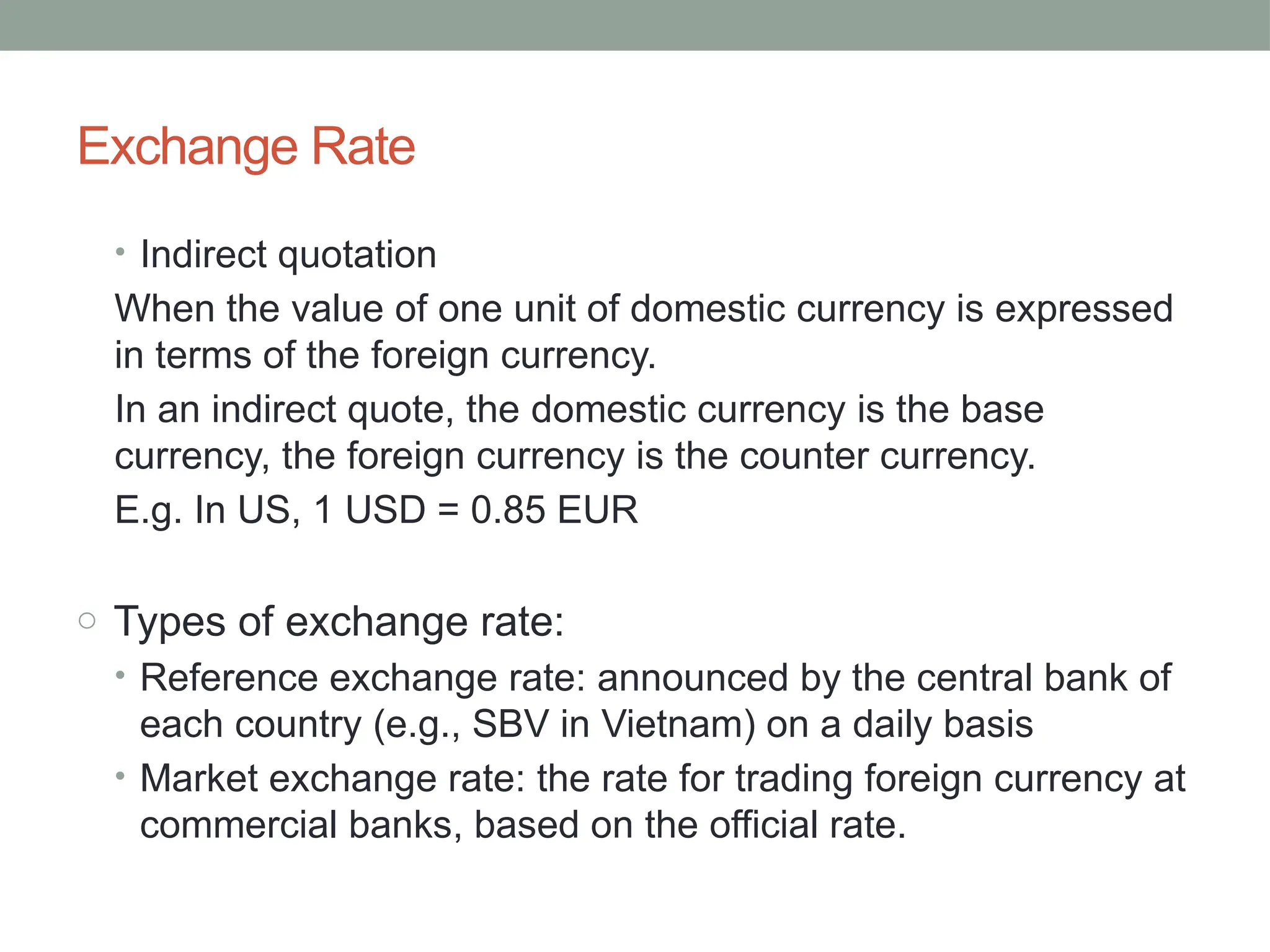
E.g. In Vietnam, 1 USD = 22,800 VND
18.
Exchange Rate
• Indirectquotation
When the value of one unit of domestic currency is expressed
in terms of the foreign currency.
In an indirect quote, the domestic currency is the base
currency, the foreign currency is the counter currency.
E.g. In US, 1 USD = 0.85 EUR
o Types of exchange rate:
• Reference exchange rate: announced by the central bank of
each country (e.g., SBV in Vietnam) on a daily basis
• Market exchange rate: the rate for trading foreign currency at
commercial banks, based on the official rate.
19.
Exchange Rate
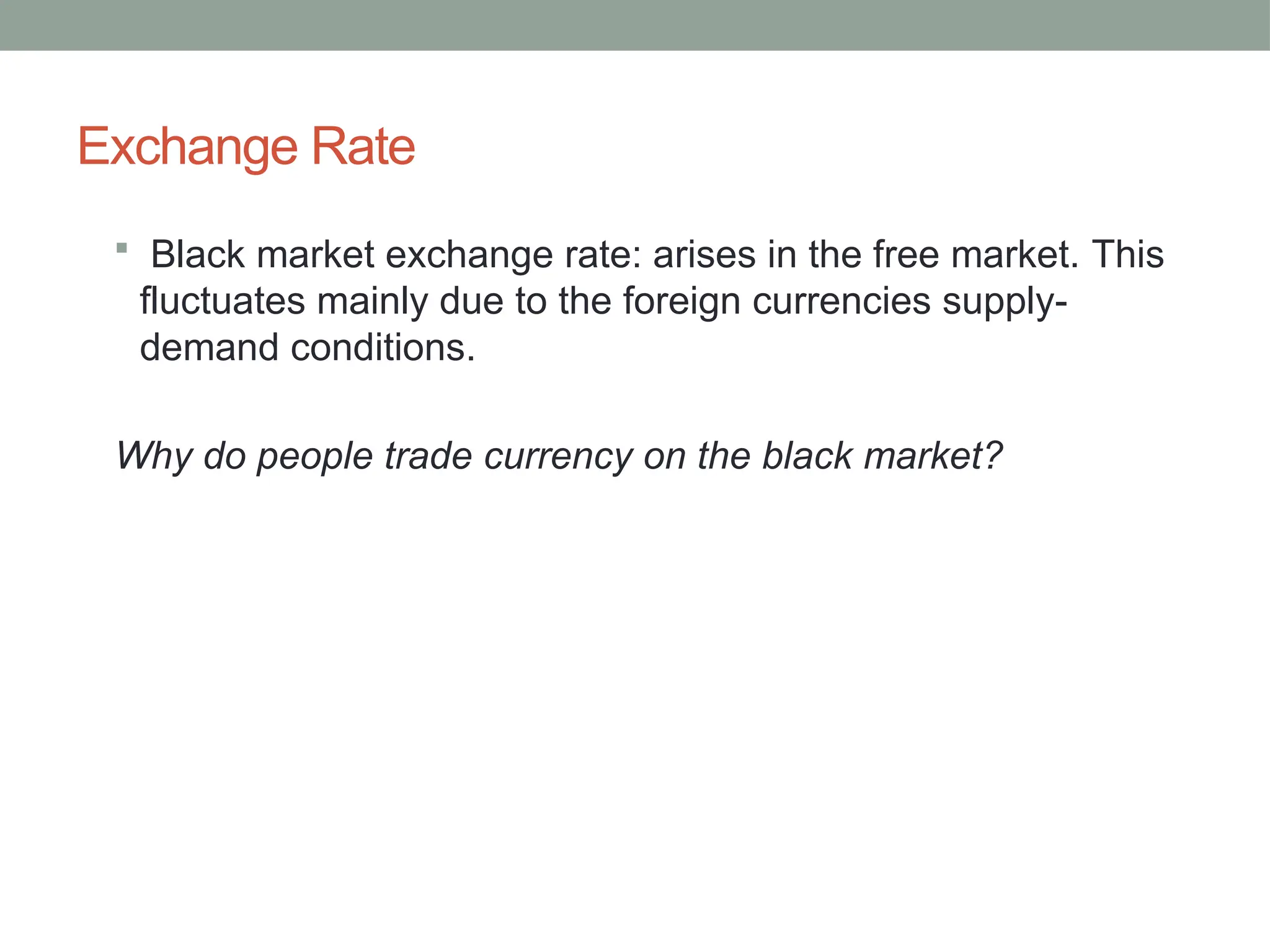
Blackmarket exchange rate: arises in the free market. This
fluctuates mainly due to the foreign currencies supply-
demand conditions.
Why do people trade currency on the black market?
20.
Influential Factors ofExchange Rate
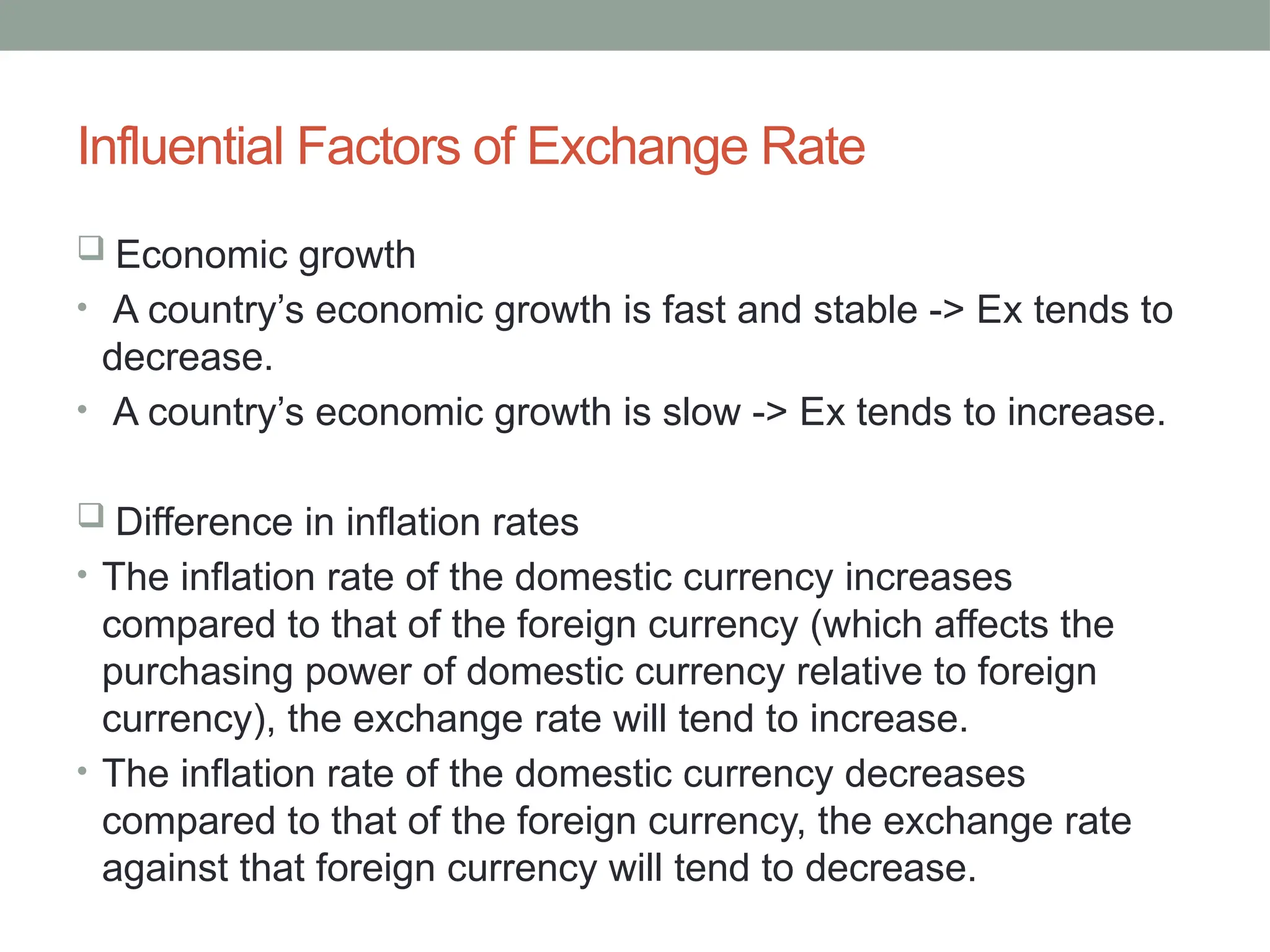
Economic growth
• A country’s economic growth is fast and stable -> Ex tends to
decrease.
• A country’s economic growth is slow -> Ex tends to increase.
Difference in inflation rates
• The inflation rate of the domestic currency increases
compared to that of the foreign currency (which affects the
purchasing power of domestic currency relative to foreign
currency), the exchange rate will tend to increase.
• The inflation rate of the domestic currency decreases
compared to that of the foreign currency, the exchange rate
against that foreign currency will tend to decrease.
21.
Influential Factors ofExchange Rate
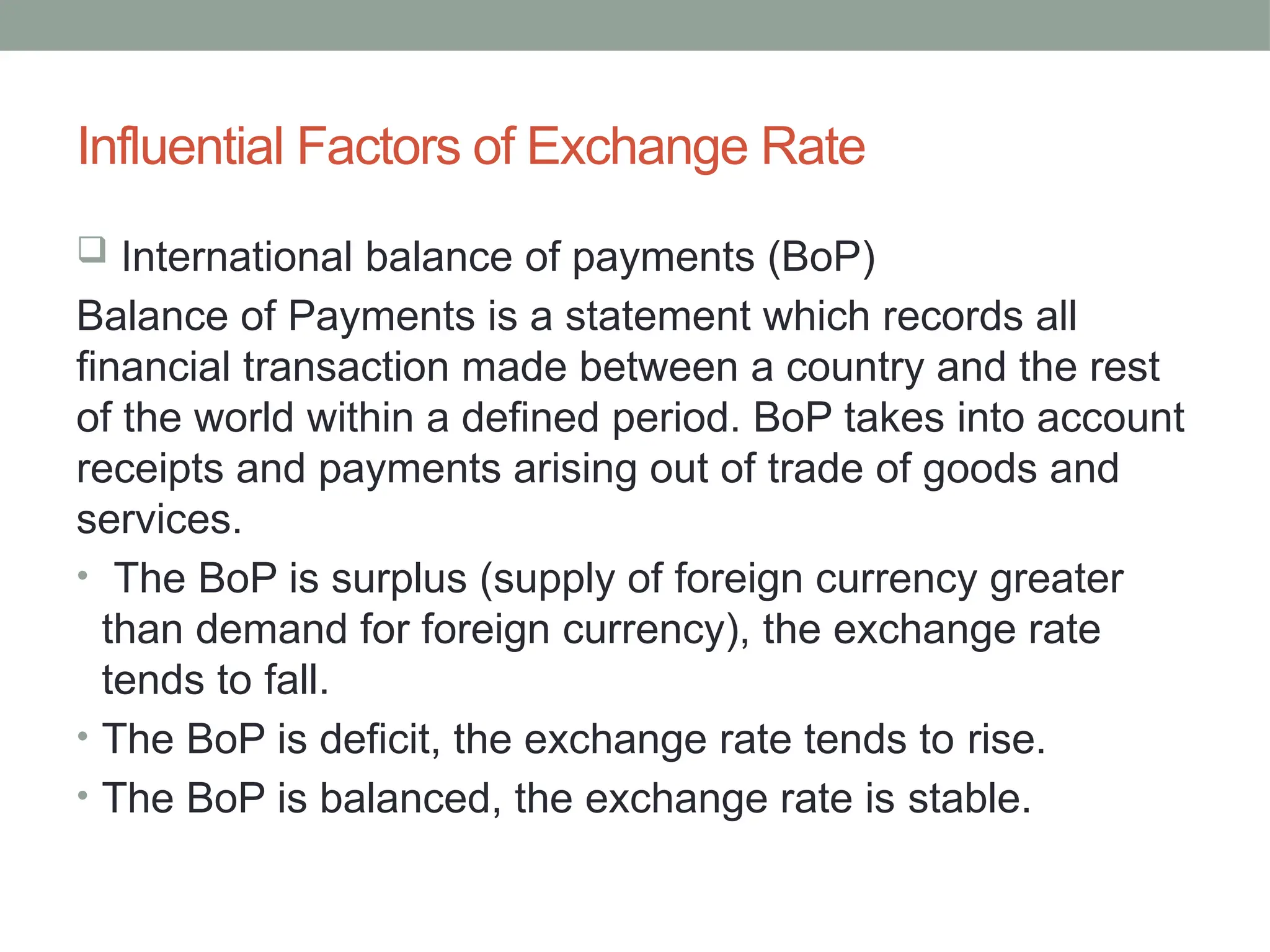
International balance of payments (BoP)
Balance of Payments is a statement which records all
financial transaction made between a country and the rest
of the world within a defined period. BoP takes into account
receipts and payments arising out of trade of goods and
services.
• The BoP is surplus (supply of foreign currency greater
than demand for foreign currency), the exchange rate
tends to fall.
• The BoP is deficit, the exchange rate tends to rise.
• The BoP is balanced, the exchange rate is stable.
22.
Influential Factors ofExchange Rate
Monetary policy
Regulations on foreign currency management, compulsory
reserve ratio, deposit interest rate policy will affect the
supply and demand of foreign currencies in the market,
thus affecting the fluctuation of the exchange rate.
Psychological factors
Socio-economic and political changes will affect the
psychology of consumption, changing the supply and
demand of foreign currencies in the market, thus affecting
the exchange rate’s stabilities.
23.
Impact of ExchangeRate Fluctuations
o When exchange rate increases within the limits:
In the short term: exports increase, import decreases
- As the exchange rate increases, the profits earned which are
converted to domestic currency will increase, thereby promoting
exports.
- Or exporters can reduce selling prices (in foreign currency) in
foreign markets to improve the competitiveness of goods.
- For imports, when the exchange rate increases, the enterprise will
have to use more domestic currency to buy an imported good (the
price in foreign currency remains unchanged), so the import may be
restricted.
24.
Impact of ExchangeRate Fluctuations
• In the long term:
- For the production of exports which are heavily dependent on
imported materials (low localization rate), an increase in the
exchange rate will cause the price of imported raw materials (in
domestic currency) to increase, thereby increase input costs.
- This can cause the price of the product to increase, affecting
adversely the competitiveness of exports, or if the selling price is kept
unchanged, the profit will decrease, discouraging export activities.
o When exchange rate increases sharply:
This causes economic shock and great risks, thus leading
to narrowing international economic activities with foreign
countries, especially imports. In other words, there are no
positive effects for both exports and imports.
25.
Trends in TradePolicy
Trade Liberalisation
o Trade liberalisation is the removal or reduction of tariff
and non-tariff barriers on the free exchange of goods
between nations, thus minimizing government
interference in international trade.
26.
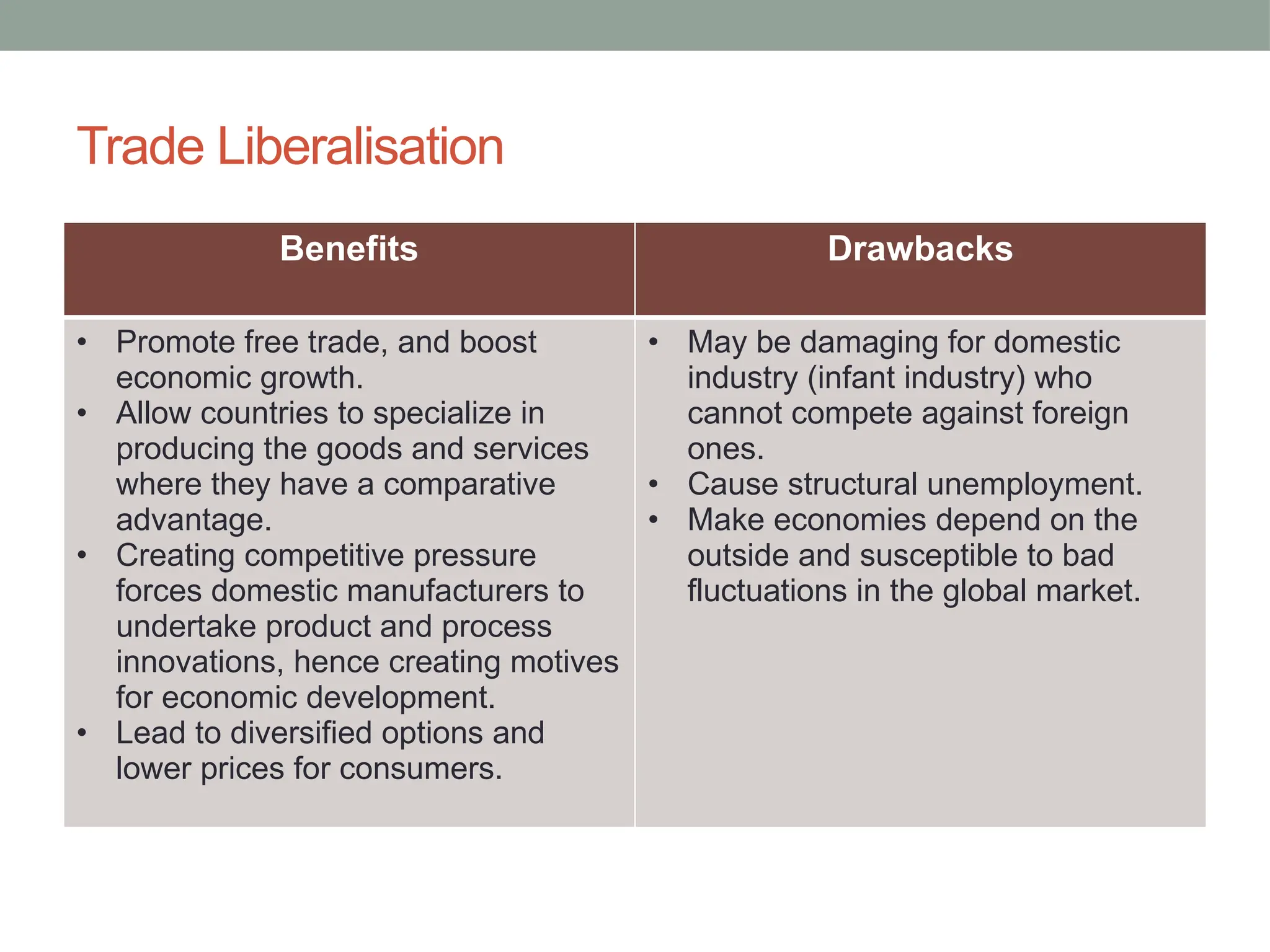
Trade Liberalisation
Benefits Drawbacks
•Promote free trade, and boost
economic growth.
• Allow countries to specialize in
producing the goods and services
where they have a comparative
advantage.
• Creating competitive pressure
forces domestic manufacturers to
undertake product and process
innovations, hence creating motives
for economic development.
• Lead to diversified options and
lower prices for consumers.
• May be damaging for domestic
industry (infant industry) who
cannot compete against foreign
ones.
• Cause structural unemployment.
• Make economies depend on the
outside and susceptible to bad
fluctuations in the global market.
27.
Trends in TradePolicy
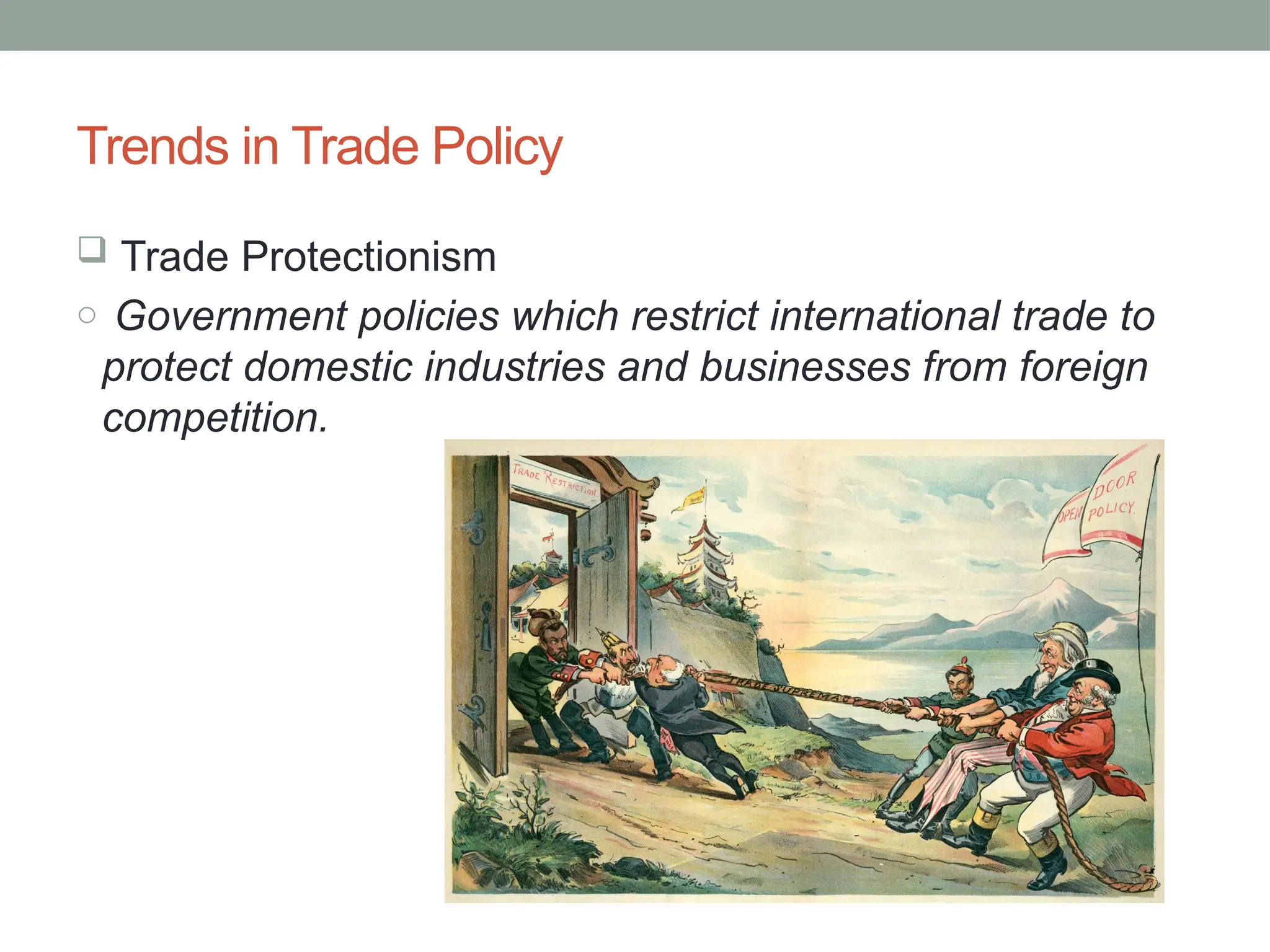
Trade Protectionism
o Government policies which restrict international trade to
protect domestic industries and businesses from foreign
competition.
28.
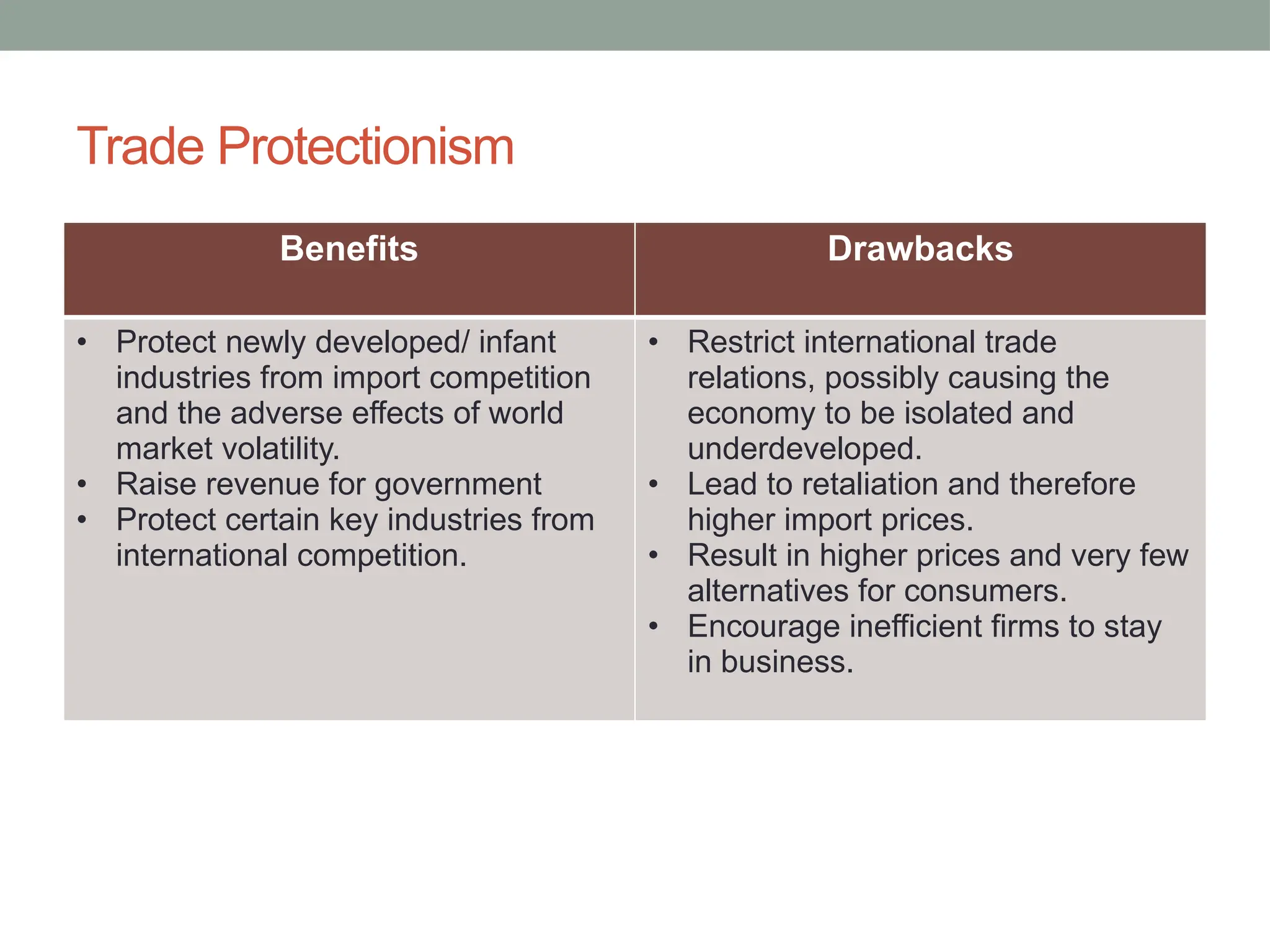
Trade Protectionism
Benefits Drawbacks
•Protect newly developed/ infant
industries from import competition
and the adverse effects of world
market volatility.
• Raise revenue for government
• Protect certain key industries from
international competition.
• Restrict international trade
relations, possibly causing the
economy to be isolated and
underdeveloped.
• Lead to retaliation and therefore
higher import prices.
• Result in higher prices and very few
alternatives for consumers.
• Encourage inefficient firms to stay
in business.
29.
International Trade Policyin practice
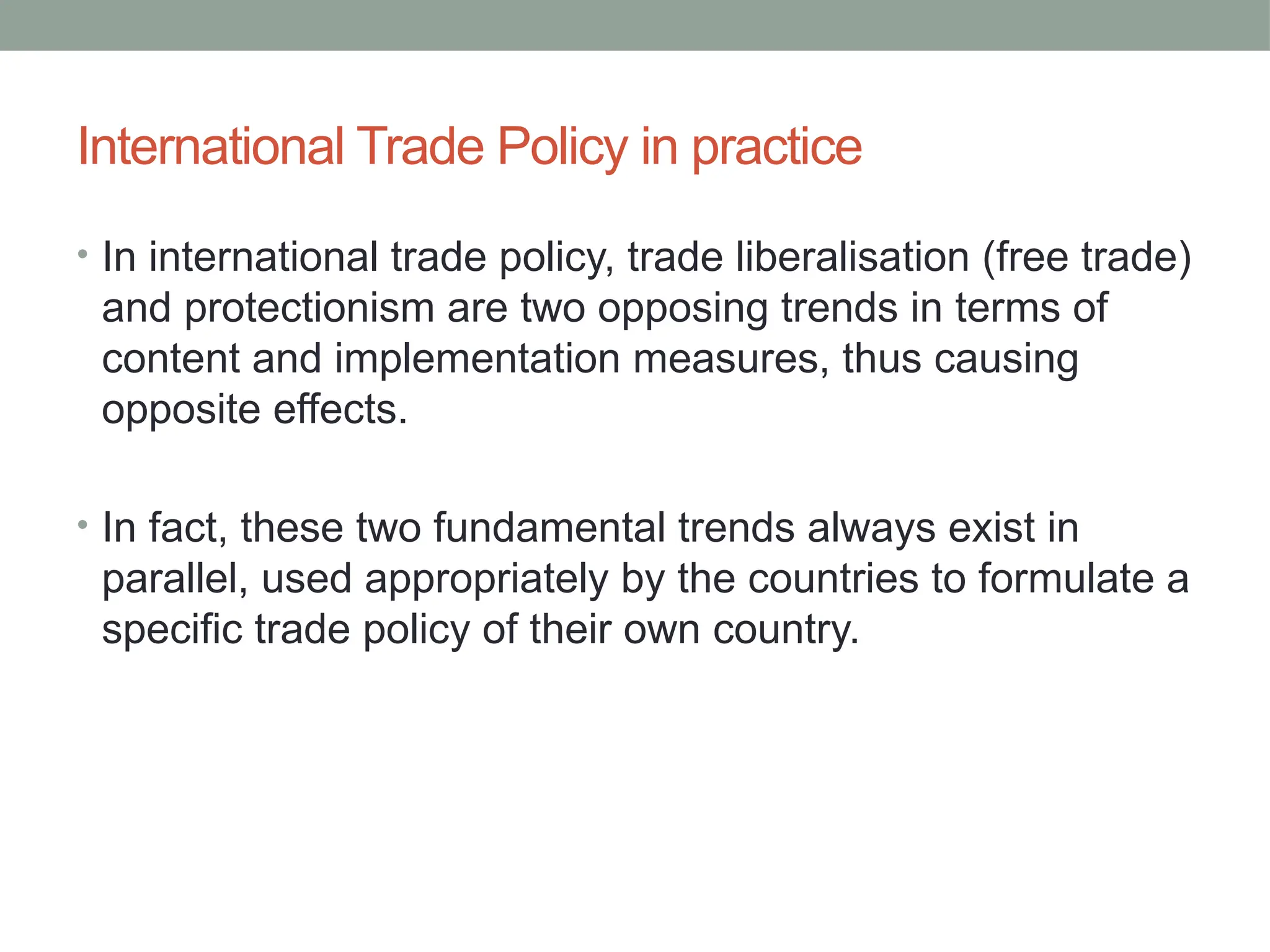
• In international trade policy, trade liberalisation (free trade)
and protectionism are two opposing trends in terms of
content and implementation measures, thus causing
opposite effects.
• In fact, these two fundamental trends always exist in
parallel, used appropriately by the countries to formulate a
specific trade policy of their own country.
30.
International Trade Policyin practice
• Trade liberalization and protectionism are two
interdependent sides, creating a premise for each other.
Possibly implement a free trade policy for strong and competitive
industries and on several regional markets with bilateral or
multilateral relations, based on the preferential trade agreements
and non-discrimination principles.
Implement protectionist trade policies with different levels for
goods with weak competitiveness, new products, products of infant
industries that need investment and time for development, and on
some markets that economic relationships are less friendly.