Insurance Dundamental in English
                                       Fix mục lụcWd8042


                                   1
Insurance Dundamental in English
                                                                                                                    Fix mục lụcWd8042


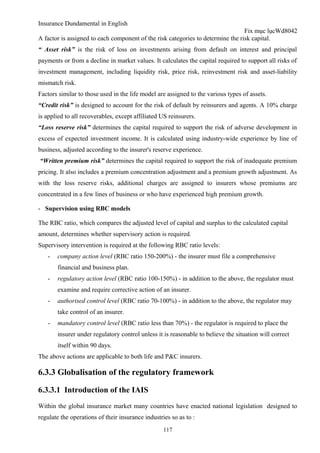
CHAPTER 1.........................................................................................................................................3
OVERVIEW OF INSURANCE...........................................................................................................3
  1.1 Risks and insurance..................................................................................................................3
     1.1.1 Concept of risk...................................................................................................................3
     1.1.2 Concept of Risk Management ..........................................................................................6
     1.1.3 Concept of Insurance.........................................................................................................8
     1.1.4 Insurance Contracts.........................................................................................................11
  1.2 Principles of insurance............................................................................................................13
     1.2.1 Insurable interest (quyền lợi có thể được BH).................................................................13
     1.2.2 Utmost Good Faith (trung thực tin tưởng tuyệt đối) .....................................................15
     1.2.3 Principle of Indemnity......................................................................................................16
     1.2.4 Subrogation......................................................................................................................17
     1.2.5 Contribution / Double insurance......................................................................................18
     1.2.6 Proximate cause...............................................................................................................19
  1.3 Insurance market......................................................................................................................21
     1.3.1 The buyers of insurance .................................................................................................21
     1.3.2 The intermediaries............................................................................................................21
     1.3.3 The sellers .......................................................................................................................24
     1.3.4 Other insurance related professions and bodies...............................................................27
CHAPTER 2.......................................................................................................................................29
GENERAL INSURANCE..................................................................................................................29
  2.1 Overview of general insurance................................................................................................29
  2.2 Commercial general insurance.................................................................................................30
     2.2.1 Marine Insurance and Oil & Gas Insurance....................................................................30
        2.2.1.1 Marine Insurance.....................................................................................................30
        2.2.1.2 Oil & Gas Insurance ................................................................................................34
     2.2.2 Non - marine General Insurance......................................................................................35
        2.2.2.1 Property Insurance/fire insurance.............................................................................35
        2.2.2.2 Business interruption Insurance ..............................................................................38
        2.2.2.3 Motor Vehicle Insurance..........................................................................................38
        2.2.2.4 Construction and Erection Insurance........................................................................40
        2.2.2.5 Liability Insurance....................................................................................................42
        2.2.2.6 Aviation Insurance....................................................................................................44
  2.3 Personal general insurance.......................................................................................................46
     2.3.1 Personal accident insurance.............................................................................................46
     2.3.2 Medical and health insurance .........................................................................................47
     2.3.3 Workers' compensation insurance....................................................................................47
     2.3.4 Consumer credit insurance...............................................................................................49
CHAPTER 3.......................................................................................................................................50
LIFE INSURANCE............................................................................................................................50
  3.1 Overview..................................................................................................................................50
  3.2. Term/Temporary Term Insurance...........................................................................................51
     3.2.1 Concept............................................................................................................................51
     3.2.2 Annual renewable term....................................................................................................51
     3.2.3 Level Term Life Insurance..............................................................................................52
                                                                        1
Insurance Dundamental in English
                                                                                                                    Fix mục lụcWd8042
   3.3 Permanent life insurance .........................................................................................................52
      3.3.1 Concept............................................................................................................................52
      3.3.2 Whole life insurance........................................................................................................53
      3.3.3 Universal life insurance...................................................................................................55
      3.3.4 Variable universal life insurance......................................................................................56
   3.4 Endowment Insurance and Pure endowment..........................................................................58
      3.4.1 Endowment Insurance....................................................................................................58
      3.4.2 Pure endowment.............................................................................................................60
   3.5 Income stream products.........................................................................................................60
   3.6 Group life insurance policies..................................................................................................62
CHAPTER 4.......................................................................................................................................64
REINSURANCE................................................................................................................................64
   4.1 Overview..................................................................................................................................64
      4.1.1 The Concept.....................................................................................................................64
      4.1.2 Functions of Reinsurance.................................................................................................64
   4.2 Methods of reinsurance............................................................................................................67
      4.2.1 Facultative Reinsurance ..................................................................................................67
      4.2.2 Treaty Reinsurance ..........................................................................................................68
      4.2.3 Facultative/ Obligatory Treaty ........................................................................................69
   4.3 Types of Reinsurance...............................................................................................................70
      4.3.1 Proportional Reinsurance.................................................................................................70
         4.3.1.1 Quota Share .............................................................................................................70
         4.3.1.2 Surplus Reinsurance.................................................................................................71
      4.3.2 Non – Proportional Reinsurance......................................................................................73
         4.3.2.1 Excess of Loss reinsurance.......................................................................................73
         4.3.2.2 Stop Loss .................................................................................................................75
   4.4 Non - Traditional Reinsurance.................................................................................................75
      4.4.1 The Concept.....................................................................................................................76
      4.4.2 Types of Financial Reinsurance Contract........................................................................77
CHAPTER 5.......................................................................................................................................79
Finance and Accounting in insurance.................................................................................................79
   5.1 Implementing the IASs/IFRS in the insurance industry ........................................................80
      5.1.1 Overview..........................................................................................................................80
      5.1.2 Financial statements of insurance companies in accordance with IAS/IFRS..................86
         5.1.2.1 Financial Statements – Key Points...........................................................................86
         5.1.2.2 Financial statements in accordance with the IAS / IFRS........................................88
   5.2 Assessing Financial Strength of insurance companies............................................................90
      5.2.1 Financial strength ratings methodologies of rating agencies...........................................91
      5.2.2 Capital adequacy and solvency of insurance companies.................................................94
      5.2.3 Ratios used in assessing insurance company’s financial condition.................................96
      5.2.3 Roles of Actuaries, independent Auditors, internal audit and internal control in the
      financial management ..............................................................................................................99
CHAPTER 6.....................................................................................................................................102
LEGAL ASPECTS of INSURANCE...............................................................................................102
   6.1 Overview ...............................................................................................................................102
   6.2 Legal aspects of insurance contract.......................................................................................102
      6.2.1 Concept of insurance contract........................................................................................102
      6.2.2 Essentials of a Valid Insurance Contract .....................................................................103
      6.2.3 Content of an insurance contract....................................................................................104
       6.2.4 Entering into contracts of insurance .............................................................................105
      6.2.5 Cancellation of insurance contract.................................................................................109
   6.3 Insurance Regulation and supervision...................................................................................110
                                                                        2
Insurance Dundamental in English
                                                                                                                      Fix mục lụcWd8042
      6.3.1 Objectives of Insurance Regulation and supervision..................................................110
      6.3.2 Prudential supervision of insurance company solvency................................................112
         6.3.2.1 Supervision based on solvency margin requirement .............................................112
         6.3.2.2 Supervision based on Risk Based Capital system..................................................114
      6.3.3 Globalisation of the regulatory framework....................................................................117
         6.3.3.1 Introduction of the IAIS........................................................................................117
         6.3.3.2 The Insurance core principles and methodology (October 2003, modified 7 March
         2007)...................................................................................................................................119


                                        CHAPTER 1
                                  OVERVIEW OF INSURANCE
1.1 Risks and insurance

1.1.1 Concept of risk
- Definition of risk

In general, risk is defined as:
“The probability of something happening that will have an adverse (xấu) impact(ảnh hưởng) upon
people, plant, equipment, financials, property or the environment and the severity (mức độ) of the
impact.”
Basically, the concept of risk has three elements:
      -    The perception (khả năng) that something could happen
      -    The likelihood (khả năng xảy ra) of something happening
      -    The consequences (hậu quả) if it happens
Risk implies (ám chỉ) some form of uncertainty about an outcome (hậu quả) in a given situation and
the outcome is not favorable.
In the insurance area, as a basic insurance term, risk may be definned as “the chance of something
happening that may have an unfavorable financial impact upon subject matter of insurance (đối
tượng của BH)”. However, the term “Risk” is also used in various senses (ý nghĩa), notably:
      -    The subject matter of insurance;
      -    Uncertainty as to the outcome of an event;
      -    Probability (khả năng) of loss;

                                                                       3
Insurance Dundamental in English
                                                                                  Fix mục lụcWd8042
      -   The peril (sự đe dọa) insured against;
      -   Danger;

      -   A particular (cá nhân) unfavorable outcome such as fire damage or a broken arm

The term “risk” can be used as a noun as in the above examples or as a verb in which the usual

meaning is to “take a chance” on something. For example a mountain climber risks a broken arm

and even risks death if he were to fall.

- Types of risks

Risk takes many forms, normally being classified into two main types being:
    ▪ Speculative (or Dynamic) Risk and Pure (or Static) Risk (rr đầu cơ và rr thuần túy)
Speculative (dynamic) risk is a situation in which either gain (lợi ích) or loss is possible. Examples
of speculative risks are betting on a horse race, investing in stocks/, bonds and real estate. In these
situations, both gains and losses are possible. In the daily conduct (quản lý) of its affairs (sự việc),
every business establishment faces (đối mặt) decisions that entail (dẫn đến) elements of risk. The
decision to venture (mạo hiemr) into a new market, borrow additional capital, etc., carry risks
inherent (cố hữu) to the business. The outcome of such speculative risk is either beneficial( sinh
lợi) (profitable) or loss.
In contrast to speculative risk, a pure risks involves possibility of loss only or at best (may mắn lắm)
a “no gain” situation. The only outcome of pure risks are adverse (có hại) (in a loss situation) or
neutral (khong hại không lợi) (with no loss), never beneficial. A pure risk does not include the
possibility of gain.
Examples of pure risks are premature death, occupational disability, catastrophic medical expenses,
damage to property and the loss ability to generate revenue from the asset which has been lost or
damaged.
It is important to distinguish between pure and speculative risks for three reasons:
      -   First, through the use of general insurance policies, insurance companies generally insure
          only pure risks. Speculative risks are not considered insurable, with some exceptions (loại
          trừ).
      -   Second, the “law of large numbers” can be applied more easily to pure risks than to
          speculative risks. The law of large numbers is important in insurance because it enables
          (cho phép) insurers to predict loss figures in advance.
      -   Finally, society as a whole benefits from speculative risk even though a losses sometimes
          occurs, but is only harmed by pure risk. This is to say, society would not benefit when


                                                   4
Insurance Dundamental in English
                                                                         Fix mục lụcWd8042
          pure risks such as earthquakes occur but benefits from speculative risks taken by
          entrepreneurs since jobs and wealth are created by them in the process.

   ▪ Particular (riêng biệt) risk and Fundamental (cơ bản) risk

Particular risks are risks that affect only a single or relatively (tương đối) few individuals, not the
entire communnity. Examples of particular risks are burglary, theft, auto accident and dwelling
fires. In contrast to particular risks, fundamental risks affect the entire economy or large numbers of
people or groups within the community. Examples of fundamental risks are high inflation,
unemployment, war and natural disasters such as earthquakes, hurricanes and floods, etc.
The distinction (sự khác biệt) between a fundamental and a particular risk is important, since
government assistance (sự giúp đỡ) may be necessary in order to insure fundamental risks. Social
insurance, government insurance programs, and government guarantees and subsidies are used to
meet certain fundamental risks which are not insurable by private insurance companies.

    ▪ Financial risk and Non - financial risk

A financial risk is the situation in which the outcome must be capable of measurement in monetary
terms. Example of financial risk: damage to the hull and machinery of a vessel. The financial value
of the risk is the cost of repairing or replacing the different portions of the vessel
In contrast to financial risk, non - financial risk is the situation in which the outcome is not
measurable in monetary terms. Examples of non financial risks are choosing a spouse or deciding
whether to leave one’s hometown to live. Each of the above situations will involve a degree of
uncertainty or risk and the result may be satisfactory or disappointing.
It is important to distinguish between a financial risk and a non - financial risk. For a risk to be
insurable, the outcome must be capable of measurement in monetary terms. Non financial risks are
not insurable.

    ▪ Insurable and Non-Insurable Risks

For a risk to be insurable it must meets certain conditions as follows:
    -   There must be an insurable interest in the object or person being insured.
    -   There must be a large number of similar risks being insured.
    -   Any losses occurring must be accidental
    -   It must be possible to calculate the risk of a loss occurring.
Further, for an efficient (hiệu quả) insurance system to exist, an insurable risk must meets the ideal
criteria (tiêu chuẩn) as follows:
    -   The insurer must be able to charge a premium high enough to cover not only claims (khiếu
        nại, bồi thường) expenses, but also to cover the insurer's expenses.

                                                    5
Insurance Dundamental in English
                                                                              Fix mục lụcWd8042
   -   The nature of the loss must be definite (xác định) and financially measurable. That is, there
       should not be room for argument as to whether or not payment is due, nor as to what amount
       the payment should be. (không nên để sơ hở cho việc trả hay không trả, và cũng không nên
       phải bàn bạc về lượng phải trả)
   -   The loss should be random in nature.
Also, risks that are not measurable, can not be rated properly. The insurer will need to charge a
conservatively (thận trọng) high premium in order to mitigate (giảm nhẹ) the risk of paying too
large a claim. The premium will thus be higher than ideal (suy nghĩ), and inefficient. (không hiệu
quả)

1.1.2 Concept of Risk Management
Risk Management involves the understanding and identification of a broad spectrum (áp dụng rộng
rãi) of risks faced by individuals and businesses together with the ability to make decisions with
respect (chi tiết) to methods to avoid, reduce and control risk to the extent possible and to then
make decisions with respect to determining the most efficient (có hiệu quả) way to treat the
remaining risk which includes firstly to determine the amount of risk that the organization has the
ability to absorb financially and then to plan for either insurance or other contractual transfer of the
remaining risk. “Risk” includes the full range of unfavorable outcomes that may result from a chain
of events involving hazards and perils all leading to any one of the many possible unfavorable
outcomes. Individual risks can be studied and analyzed with the purpose to reduce its probability
and its effect. With respect to all individual risks there are chains of events that can lead to the risk
occurrence. It is important to understand these “chains” so that risk can be most appropriately
understood and managed.
All risk chains include hazards and perils. It is important to understand the distinction among
“hazard”, “peril” and “risk” as many people are confused by these terms but in fact the succinct
meaning of each is very different. “Hazards” are states or conditions that increase the possibility of
a “peril” from happening. A “peril” is an risk event possibility that may lead to any particular
unfavorable final outcome. If a peril is incurred the risk of a particular negative outcome is
increased. For example a wet floor is a “hazard” that may lead to the peril of a “fall” which may
lead to the ultimate risk of a “broken arm”. A wet floor does not always lead to a fall and a fall does
not always lead to a broken arm however where hazards exist then perils are more likely to occur
and where perils occur then particular ultimate risk (a type of loss event) such as the risk of a
broken arm in this case is increased. Thus by understanding this “chain” it is possible to manage or
control the hazard and to make perils that occur less likely to occur which in turn will decrease the
chance of suffering the ultimate particular risk (in this case is a broken arm). Poor housekeeping is

                                                   6
Insurance Dundamental in English
                                                                                Fix mục lụcWd8042
an example of a hazard that may lead to the peril of fire. Fire may lead to complete destruction of a
building. However by ensuring good housekeeping the peril of fire is reduced. But if the peril of
fire is incurred then if there is a proper loss reduction system in place such as a sprinkler system
then the severity of the loss by fire will likely be decreased or minimised.
The process of risk management is a systematic plan to identify risks, evaluate the risks and to
decide ultimately how to treat the risk. Risk should be identified by formal methods such as risk
questionnaires which ask basic information about the risk such as size of risk, amount of value at
risk, type of structure, previous claim information etc. In addition physical inspection can be made
by a risk assessor who can look at housekeeping, maintenance logs, physical condition of
equipment especially boilers etc. Lastly review of the operations process should be made to identify
where any specific problems could occur in the event of an interruption. Once risk is adequately
identified the process of determining appropriate treatment begins.
People, organizations and society usually try to avoid risk but where not avoidable, then best to
manage it. There are 5 major methods of handling risk: avoidance, loss control, retention,
noninsurance transfers, and insurance.

- Avoidance

Avoidance involves not participating in certain activities that involve risk. For examples, the risk of
a loss of investing in the stock market can be avoided by not buying but the fact remains that not all
risks can be avoided, and even where they can be avoided, it is often not desirable. Avoiding risk
may be avoiding certain pleasures of life, or the potential profits that result from taking risks. Those
who minimize risks by avoiding activities are usually bored with their life and don't make much
money. Where avoidance is not possible or desirable, loss control is the next best thing.

- Control

Loss control works by both loss prevention, which involves reducing the probability of risk such as
keeping a manufacturing facility clean and orderly, or loss reduction, which minimizes the loss
should the loss occur such as the use of a sprinkler system.
Losses can be prevented by identifying the factors that increase the likelihood of a loss, then either
eliminating the factor or minimizing its effect. Most businesses actively control risk because it is a
cost-effective way to prevent losses from accidents and damage to property, and generally becomes
more effective the longer the business has been operating.

- Retention

    ▪ Active retention (Risk assumption)


                                                   7
Insurance Dundamental in English
                                                                                 Fix mục lụcWd8042
Risk retention, as active retention or risk assumption, is handling the unavoidable or unavoided risk
internally, either because insurance cannot be purchased for the risk, because it costs too much, or
because it is much more cost-effective. Usually, retained risks occur with greater frequency, but
have a low severity. An insurance deductible is a common example of risk retention to save money,
since a deductible is a limited risk that can save money on insurance premiums for larger risks.

   ▪ Passive risk retention

Passive risk retention is retaining risk where the risk is unknown or improperly understood.

- Transfer

     ▪ Non-insurance transfers of risk

Risk can also be managed by noninsurance transfers of risk. The 3 major forms of noninsurance risk
transfer is by contract, hedging, and, for business risks, by incorporating. A common way to
transfer risk by contract is by purchasing the warranty extension that many retailers sell for the
items that they sell. The warranty itself transfers the risk of manufacturing defects from the buyer to
the manufacturer. Transfers of risk through contract is often accomplished or prevented by a hold-
harmless clause and other forms of indemnity agreements which may limit liability for the party to
which the clause applies.
Hedging is a method of reducing portfolio risk and some business risks involving future
transactions. A Stockholders can reduce his risks by buying “put options”. A business can hedge a
foreign exchange transaction by purchasing a forward contract that guarantees the exchange rate for
a future date. Airlines will typically hedge fuel prices by buying “forward contracts” also known as
“futures” to guaranty a maximum price for up to a certain future period.
Investors can reduce their liability risk in a business by forming a corporation or a limited liability
company. This prevents the extension of the company's liabilities to its investors.

    ▪ Insurance

Insurance is one major method that most people, businesses, and other organizations can use to
transfer certain risks. By using the law of large numbers, an insurance company can estimate fairly
reliably the amount of loss for a given number of customers within a specific time. An insurance
company can pay for losses because it pools and invests the premiums of many subscribers
(customers) to pay the few who will have significant losses.

1.1.3 Concept of Insurance
Generally, insurance is the means whereby the losses of a few are transferred to many. Insurance
works on the basic principle of risk-sharing. While community grain pools have probably existed

                                                  8
Insurance Dundamental in English
                                                                             Fix mục lụcWd8042
for thousands of years, modern organized risk sharing began in the coffee houses of London a few
hundred years ago where ship owners would meet and agree to share losses with each other. A great
advantage of insurance is that it spreads the risk of a few people over a large group of people
exposed to risk of similar type.
Insurance provides financial protection against a loss arising out of happening of an uncertain event.
A person can avail this protection by paying a fee known as premium (or contribution) to an
insurance company. A pool is created through contributions (premiums) made by persons seeking
to protect themselves from common risk. Premium is collected by insurance companies which also
act as trustee to the pool. Any loss to the insured in case of happening of an uncertain event is paid
out of this pool.
In a legal respect, insurance is defined as: “a contract between two parties whereby one party
(insurer) agrees to undertake the risk of another (insured) in exchange for “consideration” known
as premium and promises to pay a fixed sum of money to the other party on the happening of an
uncertain event or after the expiry of a certain period in case of life insurance or to indemnify other
parties on the happening of an uncertain event in case of general insurance”.

- Benefits of insurance

Insurance brings many benefits to individuals and to society as a whole.

   ▪ Provides financial stability

With insurance, even when losses occur, peoples have the assurance that their assets can be restored
after suffering losses. So, however unfortunate events such as these may be, their finances will not
be drained, and they and their family’s financial stability will not be undermined. They will be able
to keep their present lifestyle and their future plans. With respect to commercial business operations
insurance allows for normal operations of the business to continue to function normally after losses
have occurred.

   ▪ Provides peace of mind and Stimulates business enterprise

By knowing that insurance exists to meet the financial consequences of certain risks provides peace
of mind for an individual. Anxiety is also reduced when insured persons knows that insurance is
available to indemnify them when loss occurs.
The indemnity function of insurance also relieves businesses from the worry of anxiety they may
have about how they would meet the cost of risk. In the case of businesses, this is a positive
stimulus to their activities and allows them to get on with their own business in the knowledge that
they are financially protected against many forms of risk.


                                                   9
Insurance Dundamental in English
                                                                            Fix mục lụcWd8042
 Business people will be more inclined to risk their money by building factories, making goods,
sailing ships, flying planes, etc, with the knowledge that they will not lose everything should they
fall victim to risk. This is an extremely important benefit which insurance brings – not only to the
individual insuring but to the whole country – as stimulating businesses makes for a healthy
economy and allows for additional employment.
The need for businesses to retain large sums of money to pay for potential losses largely disappears.
This helps the business cash flow and financial planning as money does not need to be kept in
reserve for losses which may occur. Instead, there is known cost – the premium. The availability of
insurance, therefore stimulates enterprises as it makes it easier for existing businesses to invest and
expand..

   ▪ Encourages loss control

  Insurance also can help in actually reducing losses. Insurers have an interest in reducing the
frequency and severity of losses, and insurance companies have a great deal of experience in risks
of all kinds and, over many years, they have found ways in which certain risks can be reduced.
They employ surveyors who go out and look at premises which people may want to insure. They
can, from that experience, often suggest ways in which the likelihood of some risk occurring may
be reduced. They might see some hazard which could injure employees, or a host of other problems.
The advice and the recommendations they make on behalf of insurance companies reduces the
likelihood of many of the losses from ever occurring. An example would be for a surveyor to point
out that flammable liquids must be stored in proper containers and only in proper locations. You
would expect that the last place that a flammable storage container should be stored is in a stairwell.
Correct? Remember this the next time you see motorcycles being stored in the stairwell of a
residential building! In fact there is a flammable liquids storage container in every motorcycle and
so keeping motorcycles at the bottom of a stairwell is extremely dangerous not only because it
blocks exit from the building but that because in a fire situation the gasoline containers in the
motorcycles will explode creating heat and smoke in the stairwell. Insurance companies will help
the insured facilities identify these risks and make recommendations to reduce or even eliminate
certain aspects of risk.


  ▪ Encourages investment

 One further benefit derived from the transaction of insurance is the use to which the insurance
company puts the money it holds in the common pool. Insurers have, at their disposal, large sums of
money. This arises from the fact that there is the gap between the receipt of a premium and the


                                                  10
Insurance Dundamental in English
                                                                              Fix mục lụcWd8042
payment of a claims. The insurer can invest this money in a wide range of investments which all go
towards aiding government, industry, commerce and consequently the whole of society.

  ▪ Enhance provision of credit facilities

Bankers and other financial institutions require the security of insurance in financing properties and
overseas trade. In this case, insurance enhances borrower’s credit because it helps to guaranty the
value of the borrower’s collateral, or gives greater assurance that the loan will be repaid.
We could go on with the benefits of insurance, but those listed above are enough to show that the
insurance industry has a major importance to the society. In the act of creating the common pool,
security and peace of mind are provided, the likelihood or severity of losses may even be reduced,
vast funds of money are invested for the prosperity of the economy, the country is relieved from
what it may look upon as a financial burden to compensate the victims of loss and, finally, society
gains large amounts of money from the payment of premiums from overseas. Insurance companies
contribute to the efficiency of the economy.

1.1.4 Insurance Contracts
This section is intended to provide an overview of the structure of the insurance contract. But first it
is noted that Insurance contracts are normally governed by the common law of contracts namely
that any contract whether the subject of insurance or any other matter require certain elements to
become enforceable. Section 6 will provide additional detail however simply said, the law of
contracts require that there be a “meeting of the minds” between “competent parties” with respect to
legal subject matter which is to say that the parties entering the contractual agreement be
sufficiently competent to understand the terms of the contract, that there must be “consideration”,
that the subject of the contract be of a “legal nature” nature etc. With respect to “competent” parties,
each side must normally be of a legal age to enter contracts and be sane of mind to become
enforceable. Thus a contract entered into by an adult and a child or between a sane person and one
who is insane is not enforceable except in certain rare circumstances. Each side must agree to
exchange something of value as “consideration”. A simple unilateral promise to give someone
money or anything else is not enforceable in the absence of the agreement of the other person to
provide something of value in return. Regarding the legality of the subject matter a contract to buy
and sell illegal drugs would not be enforceable. Insurance contracts are again just like any another
contract however as previously noted there is a special duty to make each side aware of material
information so that there is indeed a proper understanding or “meeting of the minds” before the
contract is undertaken.


                                                   11
Insurance Dundamental in English
                                                                             Fix mục lụcWd8042
Insurance contracts have three main sections being the “declarations page”, the main body of the
policy, and a set of extensions. The following describes these sections of the insurance contract in a
bit more detail.

- The declarations page (bản kê khai thông tin)

The declarations page which can also be known as a “cover schedule” includes basic summary
information including the type of insurance, name and addresses of the insurer and the insured, the
subject matter and the location of the risk, the jurisdiction (thẩm quyền) of the risk, the effective
period of the insurance, and a policy number.

- Policy wording (HĐBH tóm tắt)

The policy wording is the full set of contractual wordings which normally include a printed set of
common wordings used by the insurer on all risks of a similar nature together with the wordings of
any particular extensions or other modifications to the main wordings. The wordings are normally
prepared by the insurer or broker with the insurer’s final agreement. This distinction is important
since the courts normally provide that any vagaries in the contract will be viewed in favor of the
party which did not prepare the wording.

▪ The “Insuring Agreement”, general wording, conditions and exclusions (điều khoản chung)

The main wording normally starts with a short sentence called the insurance agreement. This
provides for the main essence of the insurance contract. Nearly everything else in the contract is
modifying the main insurance agreement . For example the insuring agreement found in an
Industrial All Risk property policy will typically state something like, “In consideration of the
payment of premium this policy covers all risks of loss or damage”. All the remaining wording
provides the framework of the risk by explaining that which is required to effect the coverage, that
which is required to keep the coverage in place etc. The policy will then specify certain conditions
which must be met such as proper maintenance of equipment, the perils which are excluded, the
type of property which is excluded etc.


▪ Extensions and Modifications (điều khoản bổ sung)

Some of the perils (mối đe dọa) or types of property that are excluded under the basic policy may be
covered or “bought back” by way of an “extension”. There may be other modifications to the
original wording which restrict (hạn chế) the coverage being provided under the basic form. For
example the main policy form may exclude losses occurring as a result of the risk of “faulty
design”. This particular exclusion is commonly “bought back” which is to say for some additional


                                                 12
Insurance Dundamental in English
                                                                            Fix mục lụcWd8042
premium the insurer will agree to cancel the exclusion. Other modifications may be made on an
individual basis. For example the insurer may be aware that a fire sprinkler system is inoperable.
The insurer may put some restrictions to the coverage amount while the sprinkler system is
inoperable.
A proper review of any insurance contact begins with a review of the insuring agreement, then a
review of the assets items subject to insurance to be sure that they are covered by the policy, then a
review of the perils covered or not covered, then lastly and assuming the property is found to be the
subject of the policy and that the peril causing the loss is also covered or not excluded then a review
of the policy conditions is made to ensure that all conditions have been met. If there is a loss for
example there is a sequence of items to review in order to determine whether the loss is covered or
not. The sequence shown above would be typical of that done by loss adjusters to determine
whether the coverage is applicable. Once there is a determination that coverage is applicable then
the adjuster will determine the quantum of the loss and settle the claim.

1.2 Principles of insurance
Insurance is based on certain principles which form the foundation of an insurance policy... The
basic and general principles of insurance are:
                -   Insurable Interest
                -   Utmost Good Faith
                -   Indemnity
                -   Subrogation
                -   Contribution
                -   Proximate Cause

1.2.1 Insurable interest (quyền lợi có thể được BH)
- Concept

Insurable interest is a fundamental principle of insurance. It means that the person wishing to take
out (nhận được) insurance must be legally entitled to insure the article, or the event, or the life. In
other words, the happening of the event insured against, or the death of the life insured must cause
the policyholder/insured financial loss. The policyholder/insured must stand to lose financially if a
loss occurs

An insurable interest in the life of another requires that the continued life of the insured be of real
interest to the insuring party. The connection may be financial (as when a creditor insures the life of
his debtor ), or it may consist of familial or other ties of affection.


                                                    13
Insurance Dundamental in English
                                                                              Fix mục lụcWd8042
The principle of insurable interest demonstrates the difference between insurance and a wager or
bet.

- Purpose of the insurable interest requirement is

                  -     To prevent gambling
                  -     To reduce moral hazard (giảm rủi ro về đạo đức)
                  -     To be able to measure the amount of loss

- Existence of insurable interest

       ▪ Non - life insurance
Insurable interest varies (biến đổi) according to the type of insurance policy. These relationships
give rise to (thể hiện tốt) insurable interest:
        -   owner of the property;
        -   vendor and vendee (người bán và người mua);
        -   bailee and bailor (người nhận và người ủy thác);
        -   life estates;
        -   mortgagee and mortgagor (chủ nợ và người cầm cố);
        -   creditor of an insured has an insurable interest in property pledged (vật thế chấp) as
            security.
  ▪
Life insurance
        -   Each individual has an unlimited insurable interest in his or her own life, and therefore
            can select anyone (bất cứ ai)as a beneficiary (người thụ hưởng).
        -   Parent and child, husband and wife, brother and sister have an insurable interest in each
            other because of blood or marriage.
        -   Creditor-debtor relationships give rise to an insurable interest.
        -   Business relationships give rise to an insurable interest.

- When must insurable interest exist?

   ▪ Non - life insurance
Insurable interest has to exist both at the inception (lúc bắt đầu) of the contract and at the time of a
loss. For instance (ví dụ), an insured can purchase a homeowners policy because of insurable
interest in a home. Upon (lúc) selling it, the insured no longer has an insurable interest because
there is no expectation of a monetary loss should the home burn down.


                                                     14
Insurance Dundamental in English
                                                                               Fix mục lụcWd8042
Note that in certain types of insurances such as marine cargo insurance, the insured’s relationship
with a thing that supports issuance may exist at the time of loss only, not necessarily at the
inception of the contract.
   ▪ Life insurance
Insurable interest must exist at the inception of the contract, not necessarily at the time of loss. For
example, because a woman has an insurable interest in the life of her fiancé, she purchases an
insurance policy on his life. Even if the relationship is terminated, as long as she continues to pay
the premiums she will be able to collect the death benefit under the policy.

1.2.2 Utmost Good Faith (trung thực tin tưởng tuyệt đối)
- Concept

One of the important basic principles of insurance is known as 'utmost good faith'. The duty of
utmost good faith is central to the buying and selling of insurance - both the insured and the insurer
are expected to disclose any information, important to the contract. This means that the insurer and
the insured have a duty to deal honestly and openly with each other in the negotiations which lead
up to the formation of the contract. This duty continues whilst the contract is in force. If one party is
in breach of this duty, the other party usually has the right to avoid the contract entirely.

- Duty of Disclosure (trách nhiệm khai báo)

   ▪ Insured’s Duty of Disclosure

The insured is legally obliged to disclose all information that would influence the insurer's decision
to accept the risk. Very often, the insurer has to rely only on the description and details filled in the
proposal form. In the absence of a formal verification through third party surveyors, the Insurer has
no way of verifying these details. After an insured peril has operated, the subject matter of the
insurance may very well have gone up in smoke or washed away. It is therefore an implied
condition or principle of insurance that the insured be required to make a full disclosure of all
material particulars within his knowledge about his risk. After taking out an insurance policy, if
there are any alterations or changes to the business or risk which increases the risk, the insured must
inform the insurer.
Normally, a breach of the principle of utmost good faith arises when insured, whether deliberately
or accidentally, fails to divulge these important facts. There are two kinds of non-disclosure:
     -   Innocent non-disclosure or misrepresentation;
     -   Deliberate non-disclosure - providing incorrect material information intentionally.
In the case of an innocent breach that is irrelevant to the risk, the insurer may decide to ignore the
breach as if it had never occurred but if the insurer considers the breach as innocent but significant
                                                   15
Insurance Dundamental in English
                                                                              Fix mục lụcWd8042
to the risk, it may choose to collect additional premiums to reflect that which would have been
charged if the risk was properly known in the first place. In certain cases of misrepresentation,
where the effect may only have been increased premium, it is possible that the insurer may partly
pay the a claim on a proportional basis to the premium originally paid vs. the correct premium on
the true risk.
In the case of a deliberate material breach, the insurer would be entitled to avoid any payment of
claims or monies under the Policy.

    ▪ Insurer’s Duty of Disclosure

The insurer also has a duty of disclosure to the insured. In order to fulfill this duty, the insurer must
also exercise utmost good faith, notably by :
      -   notifying an insured of a possible entitlement to a premium discount resulting from a good
          previous insurance history;
      -   only taking on risks which the insurer is registered to accept, i.e. avoid unenforceable
          contracts;
      -   ensuring that statements made are true since misleading an insured about policy cover is a
          breach of utmost good faith.
In respect of utmost good faith, besides duty of disclosure there are many others duties imposing on
the parties of a insurance contract. These issues will be dealt with in the Chapter 6.

1.2.3 Principle of Indemnity
- Concept

Indemnity is arguably the most fundamental principle of insurance. The term ‘indemnity’ means
the protection of or security against damarge or loss. Therefore, when an insurance policy is said to
be a contract of indemnity, it is intended to provide financial compensation for loss which the
insured has suffered and put the insured back in the same position that the insured had enjoyed
immediately before the loss.
One of the basic tenets of insurance is that the insured should not profit from a loss or damage but
should be returned (as near as possible) to the same financial position that existed before the loss or
damage occurred. In other words, the insured cannot recover more than his or her actual loss from
the insurer.

- Purpose

      -   To prevent the insured from profiting from a loss


                                                   16
Insurance Dundamental in English
                                                                             Fix mục lụcWd8042
     -   To reduce the “moral hazard” of an insured intentionally creating a loss in order to take
         advantage of the insurance

- Application of indemnity

This principle requires the insurer to pay an amount, not more than the actual loss suffered.
This principle plays a critical role in general insurance. Indemnity is easily applied to losses that are
quantifiable. There are, however, certain exceptions to this rule, such as personal accident and life
insurance policies where the policy amount is paid on occurrence of accident or death and the
question of profit does not arise. Life insurance and personal accident policy are therefore not
contracts of indemnity. A life insurance contract is a valued policy that pays a stated sum to the
beneficiary upon the insured’s death. Some marine insurance policies also constitute an exception
because the settlement of a total loss is based on a sum agreed upon at the time the insurance policy
was written. There are also some exceptions in the case of property insurance where the subject of
the insurance is a unique property such as a painting or other artwork. In these cases the insurance
will be based on an agreed amount in advance.
The aim of the indemnity provision is to provide a claim amount that will help the claimant regain
the lost financial position. In some indemnity contracts, the amount payable by the insurance
company is subject to the amount of actual loss. Some indemnity contracts also have a provision for
the claim to be paid only if the actual loss exceeds a certain amount.
In property insurance, indemnification is based on the actual cash value of the property at the date
and place of loss. There are three main methods to determine actual cash value:
     -   Replacement cost less depreciation
     -   Fair market value is the price a willing buyer would pay a willing seller in a free market
     -   Broad evidence rule means that the determination of actual cash value should include all
         relevant factors an expert would use to determine the value of the property
In liability insurance, the indemnity under a liability insurance policy is the amount of damages
awarded by the court. In actual practice, mosst liability claims do not go to court. They are usually
settled by negotiation between the insurers and the third - party on the basis of what a court would
award if tha the case had come before it.

1.2.4 Subrogation
- Concept

Subrogation is a legal principle under which an insured party surrenders its rights against a third
party to the insurer after claiming and receiving a compensation for an insured loss.


                                                   17
Insurance Dundamental in English
                                                                       Fix mục lụcWd8042
The principle of subrogation enables the insured to claim the amount from the third party
responsible for the loss. It allows the insurer to pursue legal methods to recover the amount of loss,
which the company has paid the insured via the insurance claim.

- Purpose

      -   To prevent the insured from collecting twice for the same loss
      -   To hold the negligent person responsible for the loss
      -   To hold down insurance rates by allowing the insurer to recover the loss from the
          responsible party

- Application of subrogation

The principle of subrogation can operate in two ways. First, the insured may have actually
succeeded in ‘recovering for the same loss twice’, i.e. collected a claim payment from his insurer
and recovered compensation from another source for the same loss. Second, where the insured has
not received compensation from another source, insurers who have indemnified the insured in
respect of the loss may themselves bring an action against the third – party who is legally
responsible for it.
There are four notable aspects of the principle of subrogation:
          -   The insurer is entitled only to the amount it has paid under the policy
          -   The insured cannot impair the insurer’s subrogation rights
          -   Subrogation does not apply to life insurance and to most individual health insurance
              contracts
          -   The insurer cannot subrogate against its own insureds
Further, note that there are some legal requirements of application of subrogation, for example: the
insurer shall not be entitled to exercise rights of subrogation against a member of the household of
the policyholder or insured, a person being in an equivalent social relationship to the policyholder
or insured, or an employee of the policyholder or insured, except when it proves that the loss was
caused by such a person intentionally or recklessly and with knowledge that the loss would
probably result.

1.2.5 Contribution / Double insurance
- Concept

Contribution is concerned with the sharing of losses between insurers. It comes ito effect when two
or more insurers may be involved on the same risk.


                                                  18
Insurance Dundamental in English
                                                                             Fix mục lụcWd8042
This situation arises when the same risk is insured by two overlapping but independent insurance
policies. It is lawful to obtain double insurance, and the insured can make claim to both insurers in
the event of a loss because both are liable under their respective polices. The insured, however,
cannot profit (recover more than the loss suffered) from this arrangement because the insurers are
law bound only to share the actual loss – the principle of contribution has evolved to ensure that all
insurers who are involved in covering the risk pay an equitable proportion of claim.

- Purpose

     -   To prevent the insured from profiting from a loss
     -   To reduce moral hazard

- Application of contribution

Contributions will arise only where the following requirements are satisfied:
     -   two or more policies of indemnity must exit;
     -   the policies must cover a common interest;
     -   the policies must cover a common peril which gives rise to the loss;
     -   the policies must cover a common subject – matter; and
     -   each policy must be liable for the loss
Contribution applies only to insurance policies which are contracts of indemnity.
Double insurance causes practical and legal problems and particularly, where the sums insured
exceed the insurable value in the case of an unvalued policy or the value fixed by the policy in the
case of a valued policy.
Note that certain policies have what is known as a non – contribution clause. The effect of this
clause is that the policy would not contribute if there was another insurance in force. However, the
courts do not favour such clauses and in situations where a similar clauses applies to both (or all)
policies they are treated as cancelling each other out. This means that each insurer would contribute
its ratable proportion.

1.2.6 Proximate cause
- Concept

Proximate cause concerns the real reason for the loss. In the event of a claim the insurers will want
to ascertain if the cause of the loss was an insured peril. Proximate cause is usually defined as “The
active efficient cause, which sets in motion a chain of events which brings about a result without the
intervention of any force started and working actively from a new and independent source”
Note two aspects concerning the test of proximate cause.


                                                   19
Insurance Dundamental in English
                                                                              Fix mục lụcWd8042
     -   Foreseeability: It determines if the harm resulting from an action was reasonably able to
         be predicted.
     - Direct Causation: The main thrust of direct causation is that there are no intervening
         causes between an act and the resulting harm. An intervening cause has several
         requirements - it must:
           ○ be independent of the original act,
           ○ be a voluntary human act or an abnormal natural event, and
           ○ occur at some time between the original act and the harm

- Application of Proximate Cause

Proximate cause is the active, efficient cause of loss or damage. For insurance to apply, the
proximate cause must be an insured peril. Establishing that a loss is covered by insurance is usually
straightforward because the event that gave rise to the loss is also usually quite clear. However,
situations will arise from time to time where there is more than one cause of damage, or there is an
initial cause and then a subsequent cause. An example of this would be property damaged caused
during typhoons. Typical homeowners insurance will provide cover for the peril of windstorm but
not flood. Often homes most damaged by typhoons lie along coastal regions. Damage caused by
wave action is thus typically not covered. Many people who lost homes during the famous
hurricane Katrina lost those homes when surge waters moved in. The insurers denied cover based
on the flood peril exclusion. People then sued their insurers claiming that the homes were first
destroyed or damaged by wind and demanded compensation.
Once the insurer has established the proximate cause of loss, it must ensure determine that the peril
which gave rise to the loss is covered by the policy. Perils can be classified as follows:
     -   Insured perils
     -   Uninsured or unnamed perils
     -   Excluded perils
The courts, when considering cases requiring the determination of proximate cause in concurrent
cases, have decided the following:
     -   Where an insured peril and an uninsured peril operate concurrently, there is a claim
     -   Where insured peril and excluded peril operate concurrently, there is no claim
In some loss events, the perils follow each other in sequence. The courts, when considering cases
requiring the determination of proximate cause in sequential cases, have decided the following:
     -   Where an uninsured peril is followed by an insured peril, there is a claim as per the
         example described above in Hurricane Katrina
     -   Where an insured peril is followed by an uninsured peril, there is a claim

                                                   20
Insurance Dundamental in English
                                                                                    Fix mục lụcWd8042
       -    Where an insured peril is followed by an excluded peril, there is a claim
       -    Where an excluded peril is followed by an insured peril, there is no claim
Practically, in many situations, two perils were involved in the widespread community loss, one
usually covered and one usually excluded. Determining the proximate cause is not always easy.
Indeed in the case of Hurricane Katrina, it was difficult to determine the amount of windstorm
damage that would have been present prior to the amount of wave action damage in cases where the
wave action ultimately obliterated the home leaving no trace.

1.3 Insurance market
Basically, in respect of market structure, the insurance market comprises:
   -       Buyers;
   -       sellers; and
   -       intermediaries

1.3.1 The buyers of insurance
The buyers of insurance are known as policy-holders or policy-owners, and they can also be known
as insureds. For the prospective buyers of insurance, they are known as proposers, prospects and
applicants.
There are generally three groups of buyers, namely, individuals, commercial enterprises and the
government.
The insurance types that are purchased by individuals will likely be personal general insurances or
life insurances.
Commercial general insurances are generally purchased by business enterprises and the
government.

1.3.2 The intermediaries
An intermediary is a party who is authorized by a second party, called the “principal”, to bring that
principal into a contractual relationship with another, called a “third-party”. The role of an
intermediary is to bring buyers and sellers together.
Basically, there are two main types of intermediaries in the general insurance sector:
   -       insurance agents;
   -       insurance brokers.

- Insurance agents


                                                   21
Insurance Dundamental in English
                                                                          Fix mục lụcWd8042
Agents arrange insurance policies on behalf of an insurance company. The agent is appointed by
insurer through a written letter of appointment or an agency agreement. The agency agreements
provide for the specific authority of the agent. The agent has the authority to act for a principal
(usually the insurer) with the objective of bringing the principal into legal relationships with other
persons. As agent for the insurer, the agent’s aim is to represent the insurer in procuring new
insurance customers, and therefore new insurance policies, thereby increasing the insurer’s
customer base and revenue.
In some places only individuals can operate as agents. In others, an agent can be a corporation but
the corporation normally has to have individuals who act on its behalf.
The agents will also carry out many of the service functions generally performed by the insurer, and
these services will be in the areas of:
   -       assisting customers with the completion of insurance proposals
   -       collection of premiums
   -       assisting customers with general inquiries concerning their insurance covers
   -       assisting customers with their claims
In the developed insurance markets there are many different types of insurance agents.
       -    Sole agents (also known as “tied” or “captive” agents): these agents are tied to one
            insurance company and must place all of their insurance business with that company.
       -    First option agents: these agents are sole agents who are able to place some business
            outside of their principal insurance company.
       -    Multi agents: these agents are able to place insurance business with a number of insurance
            companies. The services provided by a multi-agent will often be very similar to the
            services provided by an insurance broker, given that a multi-agent will also represent a
            number of insurers.
       -    Sub agents: these agents normally work part-time and work with a principal full-time
            agent, sometimes working to find and/or refer potential clients. They can be paid a fee or
            a portion of the principal agent’s commission.
       -    Underwriting agencies: underwriting agencies act on behalf of insurance companies
            providing underwriting management and claims administration.

- Insurance Brokers

Generally speaking a “broker” is a professional negotiator who attempts to bring two parties to
accept an agreement by showing the best aspects of any proposal to the respective parties. For
example the broker will show the most positive aspects of a proposed agreement with respect to
party “A” while doing his or her best to show the most positive aspects of the same agreement with

                                                    22
Insurance Dundamental in English
                                                                         Fix mục lụcWd8042
respect to party “B” even though the most positive aspects for party “A” may be completely
different than for party “B”. Thus brokers are often thought of as being “smooth talkers” and in
many cases this is quite true however despite being skilled in “smooth talking” professional brokers
be they stock brokers, insurance brokers or real estate brokers must always remain honest about the
way the agreement is portrayed to each party. Insurance brokers find sources for contracts of
insurance on behalf of their customers. Insurance brokers can be individuals or organisations who
act principally for the client and not the insurance company.
A broking operation is a business of one or more brokers that arranges and manages contracts of
insurance for clients. Broking operations manage the services they provide to clients, along with the
day-to-day running of their business.
As agent for the insured (the client), the broker’s aim is to save the client time, money and worry.
The broker’s role is to negotiate competitive premiums and the best insurance coverage. They do
this through their knowledge of the various insurance cover benefits and exclusions, as well as the
costs of competing policies in the market. Brokers deal with a range of insurers and have access to
many different policy types.
Brokers act in the client’s best interest and provide advice and guidance so that clients can make
informed decisions about their risk exposures and insurance protection. They also ensure their
clients receive prompt and fair settlement of claims.
The broker’s first duty is to that of their principal, the client, for whom they are acting. Brokers
generally work for insureds but are sometimes hired directly by the insurer.
Except as is required under duty of disclosure requirements, brokers are not responsible to the
insurer with whom he/she might place the insurance covers on behalf of its clients but there is an
exception to the general rule which exists where a broker is acting under a binder agreement granted
to the broker by the insurer. Brokers may enter into a binding authority with an insurer whereby the
broker is given an authority by the insurer to enter into contracts of insurance on the insurer’s
behalf.
In developed insurance markets, the services that can be offered to a broking client have grown to
include much more than negotiation services and include:
     -    regular meetings with the client for the purpose of updating risk and or claim information
     -    collection of information for underwriting purposes
     -    broking to prospective insurers
     -    policy placement
     -    claims management
     -    providing for mid–term amendments to policies/new policies
     -    claims recording and analysis
                                                  23
Insurance Dundamental in English
                                                                                  Fix mục lụcWd8042
     -   self insurance management
     -   handling of losses below deductibles
     -   risk management advice
     -   loss control advice
     -   technical advice (policy coverage/legislation etc).
     -   advice on the most appropriate manner in which to structure the client’s insurance
         program,
     -   access to a broad range of insurance companies and, therefore a broader range of insurance
         policies/cover that it markets
     -   advice on the general financial security of insurers who might be considered as
         underwriters for the various parts of the client’s insurance program
     -   access to insurance markets in other countries, particularly for specialist classes of
         insurance
     -   and other services the broker may provide
Although insurance buyers may deal directly with insurers, the vast majority of commercial
insurance business (i.e. insurance bought by companies) is transacted through brokers. The
complexity of many commercial risks and the large premiums involved often render a broker’s
services invaluable to the insured.
Though agents and brokers handle the majority of business in many insurance markets, it is possible
to buy insurance directly from an insurance company. Buyers are also buying through banks, the
Internet, and other alternative distribution channels.

1.3.3 The sellers
- Direct Insurers

These are insurance companies who exist primarily to provide insurance protection to insurance
buyers without the use of intermediaries. All insurance companies are classified according to the
main class of insurance business they underwrite namely “general” or “life” insurance.
In the certain insurance markets, some companies write both general and life insurances and they
are called “composite” insurers.

- Reinsurers

These are companies who act as insurers to the retail insurance market. They Reinsurers do not deal
with the general public; instead, they liaise with the direct insurers selling into the retail market
directly or through reinsurance intermediaries (these issues will be examined in the chapter 4) Note
that I change the word from “direct” to “retail” in these two sentences because of the text is

                                                   24
Insurance Dundamental in English
                                                                           Fix mục lụcWd8042
discussing the concept of “direct” marketing of insurers without intermediaries in the previous
section. The use of the term “direct” here with respect to reinsurance will confuse the reader.

- Protection & Indemnity Clubs (P&I Clubs)

These clubs are mutual insurance associations formed by ship-owners to provide them with
indemnity against certain losses and liabilities which may arise, and for which cover is not
otherwise generally available in the marine insurance market. These include a wide range of Ship
Owner’s Liability covers such as Collision Insurance, Crew and Cargo Liabilities and Pollution
Liabilities.
The Clubs operate on a non-profit making mutual basis. It means that the contributions- "mutual
premium" paid by the membership companies in relation to any one year should be sufficient to
meet all the claims, reinsurance and administrative expenses of the Club for that year. If there is a
shortfall because claims are high, the members may pay a pro rata "additional call" (additional
premium). If there is a surplus, a similar proportional return may be made to the membership, or
transferred to reserve to meet losses on other years.
The present P&I Clubs are the remote descendants of the many small hull insurance Clubs that were
formed by British ship-owners in the 18th century. Similar clubs exist with respect to the marine
hull market however after the removal in 1824 of the company monopoly in favour of the Royal
Exchange and the London Assurance, the hull Clubs became less necessary and went into decline.
A few exist today, but their share of the total hull market is not very significant. However, legal
developments during the latter half of the 19th Century resulted in a significant increase in ship
owners’ liabilities to injured crew, passengers and others third parties, and the first liability
insurance Club was founded in 1855.
The Clubs started their activities by insuring the 1/4th liability for collisions and liability for
damage to fixed objects      which were excluded from the hull cover. This cover was called
"protection" insurance. The introduction of statutory liability for loss of life and injury to
passengers gave rise to a new liability which was covered by the establishment of "indemnity"
mutuals.
Legal developments in the late 19th Century resulted in ship-owners facing an exposure to cargo
claims, and in 1874 the Indemnity Clubs started to insure liabilities for loss of or damage to cargo.
Fusion of the functions of the "Protection" and "Indemnity" mutual associations gave rise to the
Protection & Indemnity Clubs.
While all the original P&I Clubs were based in the United Kingdom, Clubs were subsequently
established and today flourish in Scandinavia, in the United States and in Japan. Most of the major
Clubs now belong to the International Group for reinsurance and other purposes. Moreover, many

                                                  25
Insurance Dundamental in English
                                                                         Fix mục lụcWd8042
Clubs originally based in the UK have comparatively recently moved their domiciles (place of
registration) to in such places as Bermuda and Luxembourg. These unusual insurance associations
create an essential component of the international insurance markets.

- Captive Insurers

Captive insurance companies are established with the specific objective of financing risks
emanating from their parent group or groups but they sometimes also insure risks of the group's
customers as well. The parent and the related companies first purchase insurance coverage from
their own captive company, which will then transfer part of the risks to insurance companies which
may be regular retail or commercial reinsurers.
The types of risk that a captive can underwrite for the parent include property damage, public and
products liability, professional indemnity, employee benefits, employers liability, motor and
medical aid expenses.
There are several types of insurance captives, the most common are defined below:
     -   Single Parent Captive: an insurance or reinsurance company formed primarily to insure
         the risks of its non-insurance parent or affiliates.
     -   Association Captive: a company owned by a trade, industry or service group for the
         benefit of its members.
     -   Group Captive: a company, jointly owned by a number of companies, created to provide a
         vehicle to meet a common insurance need.
     -   Agency Captive: a company owned by an insurance agency or brokerage firm so they may
         reinsure a portion of their clients risks through that company.
     -   Rent-a-Captive: is a company that provides 'captive' facilities to others for a fee.
Captives are becoming an increasingly important component of the risk management and risk
financing strategy of their parents. Many captive insurers make their home "offshore". Bermuda,
The Cayman Islands, Luxembourg, Singapore and the British Virgin Islands are a few examples.
Several offshore jurisdictions have lower capitalization requirements. Also, offshore captive
insurers will depending upon location of the domicile have lower tax rates on investment and
underwriting income which reduces expected tax payments relative to domestic captives. There are
a number of advantages to using captives to provide a better risk management than the conventional
insurance market. The parent and the related companies can price their risks based on their own loss
experience instead of paying the premium that an insurance company charges. As such, they can
avoid paying for operating expenses and profits to a direct insurer and thus keep their insurance
costs low. In addition, captive insurers can tap directly into the reinsurance market without going
through the direct insurers. Hence, the parent and the related companies of a captive insurer have

                                                   26
Insurance Dundamental in English
                                                                             Fix mục lụcWd8042
access to much lower costs of reinsurance. Besides, the premiums paid to the captive company are
sometimes deductible as business expenses and as a result, the parent and the related companies pay
lesser corporate taxes.

- Co-operatives/ mutual insurance companies

Co-operatives are business organisations owned by the members who use their services. The
members of the co-operatives are people, or groups of people, who need and use the services and
products a co-operatives provides.
Mutual insurance is a type of insurance where those protected by the insurance (policyholders) also
have certain "ownership" rights in the organization. All policyholders of the insurance co-
operative/mutual insurance companies are the members and co-owners of the company. The
"ownership" rights typically consist of the ability to elect the management of the organization and
to participate in a distribution of any net assets or surplus should the organization cease doing
business.
Recently, some mutual insurance companies have gone through demutualization and become public
companies in an effort, among other things, to improve their ability to acquire capital.

1.3.4 Other insurance related professions and bodies
- Actuaries

Generally, an actuary is a business professional who deals with the financial impact of risk and
uncertainty. Actuaries use skills in mathematics, economics, finance, probability and statistics to
help businesses assess the risk of certain events occurring, and to formulate policies that minimize
the cost of that risk
Actuaries are essential to the insurance and reinsurance industry, either as staff employees or as
      consultants. Insurance actuaries can be defined as qualified professionals concerned with the
      application of probability and statistical theory to problems of insurance, investment, financial
      management and demography.
The classical function of actuaries is to calculate premium rates and reserves for various risks.
On the non - life side, this analysis often involves quantifying the probability of a loss event, called
the frequency, and the size of that loss event, called the severity. Further, the amount of time that
occurs before the loss event is also important, as the insurer will not have to pay anything until after
the event has occurred.
On the life side, the analysis often involves quantifying how much a potential sum of money or a
financial liability will be worth at different points in the future. Forecasting interest yields and
currency movements also plays a role in determining future costs, especially on the life insurance

                                                  27
Insurance Dundamental in English
                                                                              Fix mục lụcWd8042
side. Actuaries also design and maintain insurance related products and systems. They are involved
in financial reporting of companies’ assets and liabilities.

- Loss Adjusters

Loss Adjusters are independent, professionally qualified persons who provide expert advice and
assistance to insurers and sometimes directly to the insureds in the settlement of claims.
Insurance loss adjusters are responsible for investigating claims submitted by policy holders as a
result of insured events. They usually become involved in particularly large or complicated claims
and act as an intermediary between insurers and claimants.
Loss adjusters check that the terms and conditions of the policy cover each claim by investigating
the cause of loss or damage. Assuming insurance coverage is found to be applicable to the loss the
adjuster will further determine the quantum of the damage in financial terms.
A loss adjuster presents a report to the insurers who then agree a suitable settlement with the
claimant. Should either party dispute the findings of the report, negotiations continue until a
settlement is reached.
If loss adjusters suspect that a claim is fraudulent, they may have to carry out more detailed
investigations. This may require the involvement of police, private investigators and, possibly,
forensic experts.
A loss adjuster can act on behalf of an insured but usually, they are appointed by insurers. However,
in both of these cases, the adjuster might not be aware of the commercial factors regarding the
relationship between the insured and insurer.


                                                   28
Insurance Dundamental in English
                                                                                  Fix mục lụcWd8042


                                         CHAPTER 2

                              GENERAL INSURANCE

2.1 Overview of general insurance
Generally, there are two main types of insurance, namely life insurance and non – life (or general
insurance). General insurance comprises any insurance that is not determined to be life insurance.
In the United States general insurance is also called property and casualty insurance. Property
insurance provides protection against most risks to assets of the party buying the insurance.
Casualty insurance covers losses and liabilities which are a result of unforeseen accidents. Casualty
insurance is loosely used to describe an area of insurance not particularly or directly concerned with
life insurance, health insurance, or property insurance, it is designed for things like burglary,
terrorist attacks, and fraud. It is sometimes equated to liability insurance, and is mainly used to
describe the liability insurance coverage of an individual or organization's for negligent acts or
omissions. However, the broad term has also been used to describe property insurance for aviation
insurance, boiler and machinery insurance, “glass” and crime insurance. It may include marine
insurance for shipwrecks or losses at sea or fidelity and surety insurance. It may also include
earthquake, political risk insurance, terrorism insurance, fidelity and surety bonds.
Casualty insurance is typically combined with property insurance and often referred to as “property
and casualty” insurance.
In the United Kingdom, there are primarily three areas of general insurance. They are discussed
under the following heads:
     -   Personal lines: General insurance provided along personal lines include automobile (xe ô
         tô), home, pet and creditor insurance. Note that the overall subject of personal lines
         includes not only casualty products but various health insurance and life products.
     -   Commercial lines: General insurance products along commercial lines include employers’
         liability, public liability, product liability and commercial fleet.
     -   London Market: The London Market provides general insurance for large commercial
         risks.


                                                   29
Insurance Dundamental in English
                                                                       Fix mục lụcWd8042
In many developed insurance markets, general insurance is broadly divided into two areas:
commercial lines and personal lines. Personal lines insurance differs from commercial lines
insurance in two important respects, namely:
   -       The ways in which insurers prefer to distribute the business, and
   -       The underwriting approach adopted


2.2 Commercial general insurance
Various types of commercial general insurance exist in the insurance markets. This section provides
an overview of the most common types of commercial general insurance only.

2.2.1 Marine Insurance and Oil & Gas Insurance

2.2.1.1 Marine Insurance
- Overview

Marine insurance is generally considered to have been the very first type of insurance. A contract of
marine insurance is legally defined as a contract whereby the insurer agrees to indemnify the
insured against:
       -    losses incidental to the exposure of any ship, goods or other moveable items, earnings or
            profits to maritime perils
       -    liabilities to third parties which may be incurred by reason of maritime perils
Maritime perils means perils of navigation of the sea. Perils of navigation of the sea is defined as
including perils of the seas (which in this context refers only to accidents or casualties of the seas,
not to the ordinary action of the winds and waves), fire, theft, war and piracy.
Perils of the seas do not include every loss that occurs on the sea, but only accidental, unanticipated
losses occurring through extraordinary action of the elements at sea, as well as mishaps in
navigation such as collision with another vessel or running aground. Various other perils such as
fire, lightning, or earthquake - are also named in the perils clause. As the insurance needs of ship-
owners and cargo shippers became more complex, new clauses were devised to cover additional
perils such as bursting of boilers, breakage of shafts, and accidents in loading and unloading.
Eventually, the concept of “all-risks” policy was introduced, which states that any risk of physical
loss is covered unless it is specifically excluded. War, capture, seizure, political or labor
disturbances, civil commotion, riot, and similar perils are excluded under basic marine insurance
forms but can be bought back through an endorsement or by a separate policy.


                                                    30
Insurance Dundamental in English
                                                                               Fix mục lụcWd8042
Beside the terms of risks, it is important to note several clauses describing the specific types of
losses, costs, or expenses in the maritime insurances such as: total loss, particular average, general
average

     ○ Total Loss

A total loss can be either an actual total loss or a constructive total loss. An actual total loss may
take any of three basic forms:
             -   Physical destruction (e.g. foundering, loss by fire, missing ship).
             -   Loss of specie. This has been defined as cargo which no longer answers the
                 description of the interest insured.
             -   Irretrievable deprivation (e.g. capture).
Because the interpretation of constructive total loss by some laws is unacceptable to most insurers,
some hull policies usually contain a provision stating that there will be no recovery for a
constructive total loss unless the cost of recovering and repairing the vessel would exceed the
agreed value of the vessel. Similarly, cargo policies ordinarily contain a provision stating that there
will be no recovery for a constructive total loss unless the property is reasonably abandoned in
expectation of its becoming an actual total loss without expending more than the value of the
property. The important concept to grasp for now is that in most marine insurance policies the full
amount of insurance is payable in the event of either an actual or a constructive total loss.

       ○ Particular Average

In marine insurance, an “average” is a partial loss of vessel or cargo. A particular average is a
partial loss that is to be borne by only a particular interest (such as the vessel alone or one of the
various cargo interests aboard). In contrast, a general average is a partial loss that must be borne
proportionally by all interests in the maritime venture (such as the vessel and all owners of cargo
aboard the vessel on a particular voyage).
Damaged property can be considered general average only if the property was sacrificed in order to
save the entire venture or was somehow damaged as a result of the sacrifice. If this element is
lacking, the damage is a particular average. An example of particular average is fire damage to a
vessel and cargo aboard the vessel.

       ○ General Average

General average originated in ancient times as a way to apportion fairly among all parties to a
maritime venture any losses incurred by some of the ventures in the interest of preserving the entire
venture. Modern hull and cargo policies include a provision covering the insured’s share of general
average.

                                                  31
Insurance Dundamental in English
                                                                                  Fix mục lụcWd8042
- Types of Marine Insurance

Marine insurance can be broadly classified as either property or liability insurance

▪ Types of Marine Property Insurance

The principal branches of marine property insurance are
                -     cargo insurance,
                -     hull and machinery insurance, and
                -     loss of income insurance.
     ○ Cargo insurance
Cargo insurance covers the interest of shippers, consignees, distributors, and others in goods and
merchandise shipped primarily by water or, if in foreign trade, also by air. Most cargo insurance
involves foreign trade across oceans, but the cargo may also be transported within a nation or
between nations on inland waterways. Cargo insurance is underwritten on the Institute Cargo
Clauses, with coverage on an A, B, or C basis, A having the widest cover and C the most restricted.
(A), (B) and (C) clauses. One of these (usually the (A) clauses) is always used in conjunction with
Institute War Clauses (Cargo) and Institute Strikes Clauses (Cargo).
     ○ Hull and Machinery insurance
This term applies to the insurance of all types of vessels during construction, in operation or laid up,
whether used for commercial work including the carriage of cargo and passengers or for private
pleasure purposes.
 Hull and Machinery insurance protects ship-owners and others with an interest in vessels, and the
like against the expenses that might be incurred in repairing or replacing such property if it is
damaged, destroyed, or lost due to a covered peril. Usually, hull insurance on pleasure craft and
tugs and barges, is provided as part of a package policy providing both property and liability
coverage.
     ○ Loss of income insurance
Marine loss of income insurance covers a ship-owner against loss of business income resulting from
damage to or loss of the insured vessel. When written for cargo vessels, whose income is called
freight, the coverage is referred to as freight (freight fee income) insurance.

▪ Types of Marine Liability Insurance

Liability insurance can also be divided into three categories:
            -       collision liability,
            -       protection and indemnity, and
            -       other liability insurances.

                                                    32
Insurance Dundamental in English
                                                                                     Fix mục lụcWd8042
      ○ Collision Liability Insurance

Collision liability insurance is included in most commercial hull insurance policies. Due to reasons
such as the size of the Hull and Machinery policy deductible and prompt guarantees issued by the P
& I Underwriters, it is often more prudent and practical to have this aspect of cover underwritten
under the P & I policy. It covers the liability of the insured vessel for damage to another vessel and
property thereon resulting from collision between the insured vessel and the other vessel.

      ○ Protection and Indemnity Insurance

There are many liabilities and expenses arising from the owning or chartering of ships or from the
operation of ships as principals such as:
       Liabilities in respect of:
          -     collision with another vessel
          -     pollution
          -     towage or other service
          -     wreck liabilities
          -     cargo and other property on the vessel
          -     loss or of damage to other property
 Protection and indemnity (P&I) insurance is the major form of liability insurance for vessels. This
insurance protects the insured against liability for bodily injury or property damage arising out of
specified types of accidents, and certain unexpected vessel-related expenditures.
In many cases, P&I policies are broadened to include coverage for collision liability losses in excess
of the collision liability coverage provided under the hull policy. This optional P&I feature is most
desirable and is quite commonly incorporated into the policy because collision liability coverage
whether underwritten under the Hull and Machinery or the P & I policy is ordinarily limited to a
separate amount of insurance equal to the agreed value of the vessel, which could be less than
needed to pay collision liability claims.

     ○ Other Liability Insurances

Other liability policies include the following:
      -       Liability insurance for maritime businesses such as ship repairers, stevedores, wharfingers,
              marina operators, boat dealers and terminal operators
      -       Charterers liabilities policies
      -       Excess liability policies
In many insurance markets others types of specific marine policy types exist such as:


                                                      33
Insurance Dundamental in English
                                                                          Fix mục lụcWd8042
       -    New building risks: This covers the risk of damage to the hull whilst it is under
            construction.
       -    Yacht Insurance: Insurance of pleasure craft is generally known as 'yacht insurance' and
            includes liability coverage. Smaller vessels, such as yachts and fishing vessels are
            typically underwritten on a 'binding authority' or 'line slip' basis.
       -    War risks: Usual Hull insurance does not cover the risks of a vessel sailing into a war
            zone... War risks cover protects, at an additional premium, against the danger of loss in a
            war zone including acts of war.
       -    Increased Value: Increased Value cover protects the ship-owner against any difference
            between the insured value of the vessel and the market value of the vessel.
       -    Overdue insurance: This is a form of insurance now largely obsolete due to advances in
            communications. It was an early form of reinsurance and was bought by an insurer when a
            ship was late at arriving at her destination port and there was a risk that she might have
            been lost (but, equally, might simply have been delayed).

2.2.1.2 Oil & Gas Insurance
Oil and Gas insurance is a sector of the market which covers a wide range of activities pertaining to
the oil and energy industries.
Marine insurance sometimes is defined as an area which includes also the offshore exposed
property (oil platforms, pipelines) - offshore assets in the oil and gas industry are exposed to
maritime perils. However, offshore oil and gas insurance has much that will be similar to marine
insurance and much that will not.
This segment is a brief look at the main types of oil and gas insurance and focuses on offshore oil
and gas insurance related to oil exploration, offshore construction and the operation of fixed and
floating offshore properties.

- Property Damage Insurance

This insurance covers all properties used by oil companies and drilling contractors during
exploration or production phase, and it is classified into the following categories:
   -       Industrial All Risk Insurance covers all oil and gas related assets, either in onshore or
           offshore locations, such as Refinery Plants, Terminals, Storage Tanks, Platforms, etc.
   -       Pipelines All Risk Insurance covers all pipelines used in oil and gas distribution system.
   -       Well Drilling Tools Floater Insurance insures well drilling, servicing, work over, or special
           equipment against physical loss or damage from any external causes.


                                                      34
Insurance Dundamental in English
                                                                              Fix mục lụcWd8042
   -   Drilling Barge Insurance covers hull and machinery of the drilling barges including all their
       tools and equipment.

- Marine Hull & Cargo Insurance

This insurance covers the hull, machinery and cargoes related to oil and gas products.

   -   Operating vessels are insured under normal hull insurance policies but other assets have
       specific policy forms.
   -   Considerable variations are found in individual insurance arrangements.


- Liability Insurance

Liability Insurance with respect to the oil and gas sector covers the insured's legal liability against
any Third Parties in respect of accidental bodily injuries and/or property damage arising from the
insured activities, such as Oil well operation.
The coverage insures extra expenses that should be covered by the operator in case of loss/damage
during well operation. The risks that the insurance covers among others are as follows:
   -   Control of Well expenses
   -   Re-drilling/Operators extra expenses
   -   Seepage & pollution, clean up and contamination expenses
Control of well insurance is a package form policy for control of well insurance.risks. The cover is
in respect of the actual costs incurred in regaining or attempting to regain control of any wells
insured by the policy including materials needed to regain control of the well and extinguish fire.
Costs may include drilling a relief well or wells.
In the Oil & Gas Construction area, the insurance covers temporary or permanent construction and
erection of the project
   -   Construction of Platform/Tanker Storage/Refinery Plant
   -   Laying and installation of Pipeline

2.2.2 Non - marine General Insurance
There is a wide range of non – marine general insurance. This section takes a brief look at
         some the most common types.

2.2.2.1 Property Insurance/fire insurance
Property insurance provides protection against most risks to property, such as fire, theft and some
weather damage. This includes specialized forms of insurance such as fire insurance, home
insurance or boiler insurance…
                                                     35
Insurance Dundamental in English
                                                                                  Fix mục lụcWd8042
- Fire insurance / Fire and special perils policy

The earliest forms of fire insurance was protection for commercial property. – They were restricted
to loss or damage caused by fire.
In response to market demand, extensions of cover were developed for other perils such as: impact
from vehicles or animals, explosion, earthquake, aircraft, riot and strikes, malicious acts, storm
and/or tempest, rainwater, wind, flood, bursting or leaking from pipes or water systems.
Additional Perils were added to the basic - these were called Fire and Extraneous Perils (Special)
policy. As opposed to the “all risk form” which is now widely used these special policies provided
for all perils specifically named within the special perils form.
There are some other current market products which offers also cover against “fire” and other
perils, such as Industrial All Risks (IAR) Policy, created to achieve administrative savings and
seamless set of products. Note the use of the term “seamless” means to cover risks normally found
in different policies with possibly different insurers with only one insurer. This reduces the risk that
there may be disputes between different insurers that are insuring different risks where losses are
the result of perils which may border the different coverage types.
IAR covers commercial and industrial property from loss or damage (other than causes excluded).
Thus there is no need for several separate policies. IAR policies are used mostly to insure “larger
property/factory risks.” However, for small to medium businesses, Business Package policy is
usually standard cover.
The more limited but still commonly used Fire and special perils policy is a traditional and a time-
tested policy that offers cover against fire and allied perils and some of the perils of nature. The
policy can cover building (including foundation), plant and machinery, stocks, furniture, fixtures
and fittings and other contents. The standard cover is a named-peril policy covering the following
perils:
          -   Fire
          -   Explosion/ Implosion (excluding explosion/ implosion of boilers, economizers or other
              vessels, machinery or apparatus in which steam is generated)
          -   Direct lightning
          -   Falling Aircraft including damage caused by any article dropped there from However the
              cover does not include sonic boom.
          -   Riot, strike, malicious damage-excluding terrorism
          -   Storm, cyclone, typhoon, tempest, hurricane, tornado, flood and inundation. Note
              however the peril of food that is covered under these forms is usually limited to rain or
              bursting of pipes NOT ocean waves or tidal surge.


                                                   36
Insurance Dundamental in English
                                                                               Fix mục lụcWd8042
       -   Impact by any rail/ road/ vehicle/ animal (other than owned vehicles)
       -   Subsidence and landslide including rockslide
       -   Bursting and/ or overflowing of water tanks, apparatus and pipes
       -   Leakage of water from automatic sprinkler installations
       -   Terrorism risk can be covered on payment of additional premium
The policy does not cover for various perils and various types of properties including:
       -   Destruction/damage by own fermentation, natural heating or spontaneous combustion
       -   Property undergoing any heating or drying process
       -   Burning of property insured by order of any public authority
       -   Explosion/implosion damage to boilers, damage caused by centrifugal forces
       -   Forest Fire, War and nuclear perils
       -   Bullion, curios, works of Art, cheques, currency etc (unless specified)
       -   Electrical short circuits, consequential losses
       -   Theft during/after operation of peril,
In many insurance markets, the insurers always provides a range of extensions sometimes for
additional fee but more usually included in the fee in order to be competitive, such as coverage of:
           -   architect's, surveyor's and consulting engineers' fees
           -   removal of debris
           -   deterioration of stocks in cold storage resulting from accidental power failure due to
               an insured peril
           -   deterioration of stocks in cold storage consequent to change in temperature
           -   forest fire
           -   impact damage due to insured's own vehicle,
           -   temporary removal of stocks
           -   additional expenses for rent for an alternative accommodation
           -   etc.

- Home insurance

Home insurance also commonly called homeowners insurance is the type of property insurance that
covers private homes. It is an insurance policy that combines various personal insurance
protections, which can include losses occurring to one's home, its contents, loss of its use
(additional living expenses), or loss of other personal possessions of the homeowner, as well as
liability insurance for accidents that may happen at the home. It requires that at least one of the
named insured occupies the home. It is a multiple line insurance, meaning that it includes both


                                                    37
Insurance Dundamental in English
                                                                                Fix mục lụcWd8042
property and liability coverage, with an indivisible premium, meaning that a single premium is paid
for all risks.


2.2.2.2 Business interruption Insurance

Generally, business interruption insurance protects a business owner against losses resulting from a
temporary shutdown because of fire or other insured peril. It protects the insured against the
financial consequences of:

      -       Reduction in turnover
      -       Increased cost of working
There are various types of business interruption coverage available and, the typical policy forms of
which are:
          -    Traditional “gross profit” wordings
          -    Gross revenue or fees wordings
          -    Gross rentals wordings
Beside the basic coverages listed above, many insurers offer various additional benefits & optional
covers, such as:
          -    closure of premise
          -    electronic equipment
          -    prevention of access
          -    failure of public utilities
          -    customers premises
          -    suppliers premises
          -    area damage
          -    business that attracts customers
The Gross Profit, Claims Preparation Costs, Payroll, Additional increased cost of working and other
insured items are determined by analysis of historical financial records of the insured business.

2.2.2.3 Motor Vehicle Insurance
Motor vehicle insurance (also known as automobile insurance or motor insurance) is insurance
purchased for cars, trucks, and other vehicles. It is probably the most common form of insurance
and may cover both legal liability claims against the driver and loss of or damage to the insured's
vehicle itself. Throughout the world motor insurance is required to legally operate a motor vehicle
on public roads. In some jurisdictions, bodily injury compensation for automobile accident victims


                                                     38
Insurance Dundamental in English
                                                                       Fix mục lụcWd8042
has been changed to a “no-fault” system, which reduces or eliminates the ability to sue for
compensation but provides automatic eligibility for benefits.
The basic types of vehicle insurance coverages are:

- Own Damage

   ▪ Covers for:
       -   All accidental loss or damage (subject to exclusions) by
           o Collision or overturning
           o Fire, external explosion, self-ignition, lightning, theft
           o Malicious act
       -   Windscreen cover
       -   Towing following accident
       -   Theft of insured vehicle

   ▪ Typical Exclusions:

           o Depreciation, wear & tear
           o Consequential loss, loss of use
           o Mechanical or electrical breakdown
           o Damage to tyres (unless vehicle is also damaged at the same time)
           o War, terrorism
           o Flood, strike, riot, civil commotion


- Liability to Third-Party

   ▪ Covers legal liability for:

       -   Death of or bodily injury to third-party
       -   Loss of or damage to third-party property

   ▪ Typical Exclusions:

       -   Death/bodily injury to any employee
       -   Loss of/damage to property belonging to or in the custody of any person covered by the
           policy or their household member
       -   War, terrorism

- Medical Benefits (Private Car Only)

                                                  39
Insurance Dundamental in English
                                                                                   Fix mục lụcWd8042
   Injury of insured, authorised drivers and/or passengers

- Towing Liability (Commercial Vehicle Only)

   Insured vehicle used to tow disabled vehicle (but not for reward)

- Personal Accident Benefits (Private Car Only)

Insured in connection with the use of the insured motor car and mounting/dismounting from or
travelling in any private motor car and, specified injury only (including death)

2.2.2.4 Construction and Erection Insurance
- Concepts
Construction and erection insurance provides protection of interests of the parties to the
construction process (customer, contractor, subcontractors, designers etc) - covering against risks
arising from building and civil engineering projects.
     ▪ Construction insurance commonly referred to as ‘contract works’ insurance. It provides
financial security for all parties involved in construction projects covering risks associated with
construction, from start to finish.
Scope of cover includes many subject matters, such as:
       -   the contract works
       -   construction plant
       -   equipment and machinery
       -   financial loss resulting from delay in project completion
       -   third party claims for property damage or bodily injury that arise in connection with the
           construction project
    ▪ Erection Insurance covers risks associated with erection and/or installation of mechanical or
electrical items during testing and commissioning operations. It particularly suited to testing and
commissioning large industrial projects, where there are substantial risks from fire and explosion.
The coverage commences when items are unloaded at the construction site, through to after the
erection work and testing is completed. The coverage can be also extended to cover “maintenance
period” which is a period following the completion and handover to the project owners covering
remaining construction related risks.
The scope of cover of erection insurance is broadly similar to construction insurance. However,
there are differences in subject matter and definition of when the insurer’s liability ends. The
insurance covers sudden and unforseen loss or damage occurring to property insured on the erection
site during the period of insurance.


                                                  40
Insurance Dundamental in English
                                                                                      Fix mục lụcWd8042
- Insurable risks

Commonly, insurable risks in the construction and erection insurances include:
       -   fire, explosion, thunderbolt; soil subsidence and settlement; avalanche; land slide;
       -   natural disasters (earthquake, blizzard, hurricane, rainfall, hail etc);
       -   illegal actions of third parties;
       -   explosion of pressurized gas vessels, boilers and other engineering and hydraulic
           engineering equipment, devices, machinery and other similar installations;
       -   fall of cranes, hoisted cargos, blocks and components of hoisting equipment;
       -   utility network accidents;
       -   errors and/or negligence during construction and mounting works;
       -   collapse of construction or their sections and parts;
       and,
       -   any other sudden and unforeseen events on the construction site that are not excluded
           from the policy or by insurance terms.
Many exclusions exist under the construction/ erection insurance policies, commonly such as:
       -   War and political risks, civil unrest, acts of terror;
       -   Nuclear explosion, ionizing radiation or radioactive pollution;
       -   Malicious intent of the Insured (or its employees in management positions);
       -   Errors, faults or defections known to the Insured prior to the occurrence of an insured
           event;
       -   Indirect losses of any kind, including penalties, fines, losses through delays, default on
           or termination of contracts and loss of profit;
       -   Errors in design;
       -   Losses caused by wear & tear, corrosion, oxidation, decay, self-ignition and exposure to
           other special and natural properties of the materials;
       -   Loss or damage of documents, design drafts, books, accounts, money, stamps and prints,
           debt securities, securities, receipts, information, software and/or data;
       -   Shortages or damages disclosed during a stock-taking exercise;
       -   Losses as the result of research or trial runs/experiments

- The policy

The construction/ erection insurance policy is usually arranged as a combined material damage, and
legal liability cover (CAR or EAR). There are three sections in the policy but in actuality very few
companies buy advance loss of profit insurance even though this is a very significant risk.
       -   Section 1: Material Damage Insures against physical damage to property

                                                   41
Insurance Dundamental in English
                                                                             Fix mục lụcWd8042
       -   Section 2: Liability Insures against damage to property of or personal injury to third
           parties arising from construction activities
       -   Advanced consequential loss (sometimes called advanced loss of profits) can be insured
           separately or as a “section 3” under the policy. The cover insures against loss of
           advanced profits to the project principal arising from the delay in the project completion
           due to losses arising under Section 1 of the policy
Typical Additional covers
       -   ‘In-transit’ cover to the project site
       -   Erection and testing of machinery where it is a minor element of the project
       -   Cover during construction for existing buildings or property on the project site
       -   Additional expenses to recover lost construction time following an event
       -   Liability arising out of damage to surrounding properties caused by vibration or
           weakening supports
       -   damage to other property which was free of a defective condition, but is damaged as a
           consequence of a defective component
       -   damage caused by faulty design and installation

2.2.2.5 Liability Insurance
- Overview
Liability insurance is designed to offer specific protection against third party claims, i.e., payment is
not typically made to the insured, but rather to someone suffering loss who is not a party to the
insurance contract. In general, damage caused intentionally and contractual liability is not covered
under liability insurance policies. When a claim is made, the insurance carrier has the right to
defend the insured. The legal costs of a defense are not always affected by any policy limits, which
is useful because they can be significant where long trials are held to determine either fault or the
amount of damages.
Many types of insurance include an aspect of liability coverage. Liability policies typically cover
only the negligence of the insured, and will not apply to results of willful or intentional acts by the
insured.
In many countries, liability insurance is a compulsory form of insurance for those at risk of being
sued by third parties for negligence. The most usual classes of mandatory policy cover the drivers
of vehicles, those who offer professional services to the public, those who manufacture products
that may be harmful, building contractors and those who offer employment. The reason for such
laws is that the classes of insured are engaging in activities that put others at risk of injury or loss.
“Public policy” which is to say that which the government decides as being in the best interest of

                                                    42
Insurance Dundamental in English
                                                                            Fix mục lụcWd8042
the population therefore requires that such individuals should carry insurance so that, if their
activities do cause loss or damage to another, money will be available to pay compensation. In
addition, there are numerous other perils that people insure against and, consequently, the number
and range of liability policies has increased in line with the rise of contingency fee litigation offered
by lawyers (sometimes on a class action basis).

- Types of liability insurance

As we have seen, the concept of liability insurance concerns a wide range of various types of
liability. However, in this section we focus on the types of policies that not yet discussed.
   ▪ General liability insurance
General liability insurance protects the insured from third party claims. Aside from general liability,
there is also D & O liability, employer liability, and professional liability insurance.
   ▪ D & O liability insurance
D & O liability stands for "directors and officers" liability and is intended to cover the acts or
omissions of those in the director or officer position. Individual directors and officers can cause
significant liability to others in cases where they have not performed their duties properly. This
insurance is designed to protect the insured company, its directors and officers and its shareholders
for liabilities created by the errors and omissions of any individual or group of directors and
officers.
   ▪ Employer liability insurance
Employer liability is a supplemental section of worker's compensation. Note that in many
jurisdictions such as Vietnam, the cover is not mandatory. Generally speaking injured workers are
automatically entitled to compensation where an injury or illness can be attributed to employment.
In return for this right of benefit, employees have only very limited rights to sue their employer.
However in cases where the employee can sustain a lawsuit against the employer the employer
liability cover will provide defense of claim and indemnity to the employee where the court has
found liability.
    ▪ Professional liability insurance
Professional liability also called professional indemnity insurance is similar to malpractice
insurance, although the coverage may not be as comprehensive as some malpractice policies in
different fields. The purpose of professional liability insurance is to protect against the legal liability
of "experts" in a given profession who for risks not protected by general liability insurance


                                                    43
Insurance Dundamental in English
                                                                          Fix mục lụcWd8042
Professional liability insurance protects professionals such as architectural corporation and
medical practice against potential negligence claims made by their patients/clients. Professional
liability insurance may take on different names depending on the profession. For instance,
professional liability insurance in reference to the medical profession may be called malpractice
insurance. Notaries public may take out errors and omissions insurance (E&O). Other potential
E&O policyholders include, for example, real estate brokers, Insurance agents, home inspectors,
appraisers, lawyers and website developers.
    ▪ Public liability insurance
Those with the greatest public liability risk exposure are occupiers of premises where large numbers
of third parties frequent at leisure including shopping centers, pubs, clubs, theaters, sporting venues,
markets, hotels and resorts.
    ▪ Product liability insurance
Product liability insurance is generally not a compulsory class of insurance, but legislation such as
the UK. Consumer Protection Act 1987 and the EC Directive on Product Liability (25/7/85) require
those manufacturing or supplying goods to carry some form of product liability insurance, usually
as part of a combined liability policy. The coverages concern liabilities that may result from the
production, distribution and sales of any type of product but especially high risk products such as
pharmaceuticals and medical devices, asbestos, tobacco, recreational equipment, mechanical and
electrical products, chemicals and pesticides, agricultural products and equipment etc

2.2.2.6 Aviation Insurance

Aviation insurance insures against aircraft hull, spares, deductibles, hull wear and liability risks.

- Hull "All Risks"

The insuring agreement found in most hulls "All Risks" policies provide "all risks of physical loss
or damage to the aircraft from any cause except as hereinafter excluded".
Airline hull "All Risks" policies are subject to a standard level of deductible applicable in the event
of partial (non-total) loss. The term "all risks" can be misleading. "All risks of physical loss or
damage" does not include loss of use, delay, or consequential loss.
Today, the vast majority of airline hull "all risks" policies are arranged on an "Agreed Value Basis".
This provides that the Insurers agree with the Insured, for the policy period, the value of the aircraft
and as such, in the event of total loss, this Agreed Value is payable in full. Under an Agreed Value
policy the replacement option is deleted.


                                                   44
Insurance Dundamental in English
                                                                                   Fix mục lụcWd8042
- Spares insurance

Under most "Hull" policies the word "Aircraft" means Hulls, machinery, instruments and the entire
equipment of the aircraft (including parts removed but not replaced). Once a part is replaced it is no
longer, from an insurance viewpoint, part of the aircraft. Conversely once a spare part is attached to
an aircraft as a part of that aircraft (not in the hold as cargo or on the wing as an extra pod) it is no
longer a "spare".
If the equipment is insured on the hull "All Risks" policy the automatic transfer of coverage from
"aircraft" to "spare" and vice versa is automatically accomplished.
Spares installed on any aircraft are not covered by the Spares Insurance. They become, from an
insurance standpoint, a part of the aircraft upon which they are installed and a part of the Agreed
Value for which it is insured. This becomes particularly important if the parts are loaned to another
airline.

- Hull War Risks

Throughout the aviation insurance world, the he hull "All Risks" policy will contain the exclusion
of "War and Allied Perils". The majority of the excluded "War and Allied Perils", other than the
detonation of a nuclear weapon and a war between the Great Powers (the aviation insurance world
identifies these as the U.S.A., the Russian Federation, China, France and the UK), can normally be
covered by way of a separate "War and Allied Perils" policy. Aircraft deductibles are not normally
applied in respect of losses arising out of "War and Allied Perils".
The aircraft hull "War and Allied Perils" policy will cover the aircraft on an "Agreed Value" basis
against physical loss or damage to the aircraft occasioned by any of these perils. This statement is
made carefully and deliberately in order to highlight the essential difference from a "Political Risks"
Insurance.

- Hull Total Loss Only Cover

This is similar to Hull All Risks cover given above but will respond only to total losses of aircraft,
whether actual, constructive or arranged. This is particularly given for old aircraft since the old
aircraft are heavily depreciated and insured for low sums and premium on such low sums would
result in low premium, which would be inadequate for the partial losses. The ratio of partial losses
to total losses in such old aircraft is distorted.

- Liability Insurance

Liability can be divided basically into two categories:
    1. Liability in respect of Passengers, Baggage, Cargo and Mail carried on the aircraft. These
           liabilities result from the operations the airline is set up to perform and are normally the
                                                     45
Insurance Dundamental in English
                                                                                  Fix mục lụcWd8042
       subject of a contract of carriage like a ticket or airway bill, which provides some possibility
       of limiting the airline's liability.
   2. Aircraft Third Party Liability - the liability for damage done to property or people outside
       the aircraft itself.
Every airline will arrange liability insurance for these two categories, normally in a single liability
policy. In many countries there are requirements laid down imposing minimum limits of liability
that are a prerequisite to obtaining an operator's license. Elsewhere limits are specified for an
aircraft to be allowed to land. The size of limit required is often related to the size of the aircraft
concerned (and it’s potential for causing damage). A small aircraft operating only in remote regions
and using small airstrips incurs considerably less potential exposure than an aircraft flying into and
out of major airports.

2.3 Personal general insurance
In many insurance markets, the classes of business generally regarded as “personal lines” are:
   -   Personal Motor Insurance
   -   Personal Property Insurance (Tenants or Renters Insurance,Homeowners Insurance and
       Other Personal Property Insurance)
   -   Personal Liability Insurance
   -   Personal Accident Insurance
   -   Health Insurance
   -   Travel Insurance
   -   Consumer credit insurance
   -   Domestic workers compensation
   -   Other Types of Personal General Insurance (Domestic Maid Insurance and Golfer
       Insurance; Critical Illness Insurance and Hospital Cash Benefits)
As we have emphasized above - personal lines insurance differs from commercial lines insurance in
the ways in which insurers prefer to distribute the business and the underwriting approach adopted.
Other-wise, the contents of the majority of products listed above such as personal motor insurance,
personal property insurance, personal liability insurance … are similar to commercial lines.
For that reason, this section deal with some of personal products that are not described under the
section of commercial general insurance only.

2.3.1 Personal accident insurance
Personal Accident Insurance (PAI), also known as Accidental Death and Dismemberment
Insurance, pays a stated “benefit” (sum insured) in the event of an accidental death. It also pays a

                                                  46
Insurance Dundamental in English
                                                                                Fix mục lụcWd8042
full or partial benefit in the event of catastrophic injuries such as dismemberment, loss of vision or
loss of hearing because of an accident. The payments are based on the actual nature of the injury
suffered by the insured and agreements in the signed insurance contract.
It is different from life insurance and medical & health insurance. The types of coverage normally
provided under a PA policy include:
   -   Accidental death
   -   Permanent disablement
   -   Temporary total or partial disablement
   -   Medical expenses
   -   Corrective surgery
   -   Hospitalisation benefits
   -   Funeral expenses

2.3.2 Medical and health insurance
Health insurance is insurance that pays for medical expenses. The payments are based on health
care expenses needed for restoring health damaged by disease or accident as per what has agreed
upon in the insurance contract.
It is sometimes used more broadly to include insurance covering disability or long-term nursing or
custodial care needs. It may be provided through a government-sponsored social insurance
program, or from private insurance companies. It may be purchased on a group basis (e.g., by a firm
to cover its employees) or purchased by individual consumers. In each case, the covered groups or
individuals pay premiums or taxes with respect to government run programs to help protect
themselves from high or unexpected healthcare expenses. Similar benefits paying medical expenses
may also be provided through social welfare programs funded by the government. By estimating the
overall risk of healthcare expenses, a routine finance structure (such as a monthly premium or
annual tax) can be developed, ensuring that money is available to pay for the healthcare benefits
specified in the insurance agreement. The benefit is administered by a central organization such as a
government agency, private business, or not-for-profit entity.

2.3.3 Workers' compensation insurance
Workers' compensation insurance replaces all or part of a worker's wages lost and accompanying
medical expenses incurred because of a job-related injury.
Employers have a legal responsibility to their employees to make the workplace safe. However,
accidents happen even when every reasonable safety measure has been taken.


                                                 47
Insurance Dundamental in English
                                                                              Fix mục lụcWd8042
To protect employers from lawsuits resulting from workplace accidents and to provide medical care
and compensation for lost income to employees hurt in workplace accidents, in almost every
jurisdiction, businesses are required to buy workers compensation insurance. But not Vietnam!
Workers compensation insurance covers workers injured on the job, whether they're hurt on the
workplace premises or elsewhere, or in auto accidents while on business. It also covers work-related
illnesses.
Workers compensation provides payments to injured workers, without regard to who was at fault in
the accident, for time lost from work and for medical and rehabilitation services. It also provides
death benefits to surviving spouses and dependents
At the very minimum,Workers' Compensation insurance policies will cover an employee's medical
expenses and reimburse him or her for some percentage of lost wages. Each jurisdiction has
different laws governing the amount and duration of lost income benefits, the provision of medical
and rehabilitation services and how the system is administered. For example, in most jurisdictions
there are regulations that cover whether the worker or employer can choose the doctor who treats
the         injuries   and     how       disputes        about   benefits    are     resolved.
Workers compensation insurance must be bought as a separate policy. Although in-home business
and business owner’s policies are sold as package policies, they don't include coverage for workers
injuries.
Some jurisdictions have developed state funds which are government owned insurance companies
which cover Workers' Compensation insurance, but in most jurisdictions, businesses must find a
private carrier for this type of business insurance policy.
There are differences in Worker Compensation policies, and some of the most significant
differences show up in what's called the Employers' Liability coverage, or "Part Two" coverage.
 Employers' Liability insurance protects companies against the costs of defending employment-
related claims brought by employees for work-related injuries or illness. The Employers' Liability
coverage is usually one portion of a standard Workers' Compensation policy. But while standard
workers' compensation benefits are usually fixed, a business owner can usually select the amount
of Employers' Liability coverage for his or her company while shopping around for a workers'
compensation insurance quote.
Other options in Workers' Compensation insurance include provisions that cover employees injured
in jurisdictions other than those where the business normally operates, coverage of different types
of illnesses and injuries, coverage of funeral expenses and financial support to dependents, and the
percentage of lost wages reimbursed. Even for small business owners, relatively minor differences
between policies can make a big difference in insurance premiums.


                                                    48
Insurance Dundamental in English
                                                                                   Fix mục lụcWd8042
2.3.4 Consumer credit insurance
A loan agreement commits the borrower to specific repayment obligations, and if for some reason
the borrower were unable to meet those obligations, the borrower would be still be liable. Consumer
credit insurance (or CCI) is insurance that covers the borrower if something happens that affects
borrower’ capacity to meet the payments on the loan.
CCI usually covers three types of risks:
          -   death
          -   sickness or accident
          -   or unemployment.
Subject to the terms of the policy wording the Consumer Credit Insurance for Personal Loans
policy:
                 -    pays out the loan, if the borrower/ insured die (Death Cover); and
                 -    pays the monthly loan repayments if the borrower/insured cannot work due to
                      injury or illness (Disability Plus Cover); and
                 -    pays the monthly loan repayments if the borrower/insured cannot work due to
                      involuntary unemployment (Involuntary Unemployment Cover).
As a brief summary of this chapter, it is necessary to concludes that beside these commercial
insurance lines described above, there are else various others such as: Crop insurance; Pet
insurance; Windstorm insurance; Mortgage insurance; Title insurance, etc. In other words, the
issues presented in this chapter are only some of the many available personal insurance types.


                                                     49
Insurance Dundamental in English
                                                                                   Fix mục lụcWd8042


                                          CHAPTER 3

                                    LIFE INSURANCE
3.1 Overview
Life insurance is a contract between the policy owner and the insurer, where the insurer agrees to
pay a sum of money upon the occurrence of the insured individual's or individuals' death or other
event, such as terminal illness or critical illness, and in return, the policy owner agrees to pay a
stipulated amount of premium at regular intervals or in lump sums.
With many years of history, the life insurance industry has developed throughout the world and life-
based contracts tend to fall into two major categories:
      -   Protection policies which are designed to provide a benefit in the event of specified event,
          typically a lump sum payment.
      -   Investment policies in which he main objective is to facilitate the growth of capital by
          regular or single premiums.
As with most insurance policies, a benefit is paid to the designated “beneficiaries” if an insured
event occurs which is covered by the policy. However, to be a “life” policy, the insured event must
be based upon the lives of the people named in the policy. The coverage period for life insurance is
usually more than a year. So this requires periodic premium payments, either monthly, quarterly or
annually.
There is a difference between the insured and the policy owner, although the owner and the insured
are often the same person. The policy owner is the guarantee and he or she will be the person who
will pay for the policy. The beneficiary is a participant in the contract, but not necessarily a party to
it.
Life insurance provides a monetary benefit to a decedent's family or other designated beneficiary,
and may specifically provide for income to an insured person's family, burial, funeral and other
final expenses
Basically, the life insurance contracts can be classified into two main types: “bundled” life
insurance and “unbundled” life insurance. Bundled products include various components including
a life risk insurance component, savings and or investment component
In contrast with the bundled life insurance, the unbundled life insurance investment products
separately identify life insurance cover and investments or savings.


                                                   50
Insurance Dundamental in English
                                                                          Fix mục lụcWd8042
Life insurance may be also divided into the basic classes – temporary or permanent, and some
specific others.

3.2. Term/Temporary Term Insurance

3.2.1 Concept
Term Insurance is the simplest form of life insurance. It pays a sum insured only if death occurs
during the term of the policy.
Term insurance provides for life insurance coverage for a specified term of years for a specified
premium. No savings element is contained in this product. The policy does not accumulate cash
value. “Term” life insurance is generally considered "pure" insurance, where the premium buys
protection in the event of death and nothing else.
The three key factors to be considered in term insurance are: face amount (protection or death
benefit), premium to be paid (cost to the insured), and length of coverage (term).
Various insurance companies sell term insurance with many different combinations of these three
parameters. The face amount can remain constant or decline. The term can be for one or more years.
The premium can remain level or increase. A common type of term is called annual renewable term.
In the past these policies would almost always exclude suicide. However, after a number of court
judgments against the industry, payouts do occur on death by suicide (presumably except for in the
unlikely case that it can be shown that the suicide was just to benefit from the policy). Generally, if
an insured person commits suicide within the first two policy years, the insurer will return the
premiums paid. However, a death benefit will usually be paid if the suicide occurs after the two
year period.
Because term life insurance is a pure death benefit, its primary use is to provide coverage of
financial responsibilities, for the insured. Such responsibilities may include, but are not limited to
normal living expenses, consumer debt, dependent care, college education for dependents, funeral
costs, and mortgages.

3.2.2 Annual renewable term
The simplest form of term life insurance is for a term of one year. The death benefit would be paid
by the insurance company if the insured died during the one year term, while no benefit is paid if
the insured dies one day after the last day of the one year term. The premium paid is then based on
the expected probability of the insured dying in that one year.
Because the likelihood of dying in any one year is low for anyone that the insurer would accept for
the coverage, purchase of only one year of coverage is rare.

                                                     51
Insurance Dundamental in English
                                                                              Fix mục lụcWd8042
One of the main challenges to renewal experienced with some of these policies is requiring proof of
insurability. For instance, the insured could acquire a terminal illness within the term, but not
actually die until after the term expires. Because of the terminal illness, the purchaser would likely
be uninsurable after the expiration of the initial term, and would be unable to renew the policy or
purchase a new one.
This issue is frequently overcome by a feature in some policies called “guaranteed reinsurability”
included on some programs that allows the insured to renew without proof of insurability.
A version of term insurance which is commonly purchased is “annual renewable term”. In this
form, the premium is paid for one year of coverage, but the policy is guaranteed to be able to be
continued each year for a given period of years. As the insured, becomes older the premiums
increase with each renewal period, eventually becoming financially non viable as the rates for a
policy would eventually exceed the cost of a permanent policy. In this form the premium is slightly
higher than for a single year's coverage, but the chances of the benefit being paid are much higher.

3.2.3 Level Term Life Insurance
Much more common than annual renewable term insurance is guaranteed level premium term life
insurance. Here the premium is guaranteed to be the same for a given period of years.
In this form, the premium paid each year remains the same for the duration of the contract. This cost
is based on the summed cost of each year's annual renewable term rates, with a time value of money
adjustment made by the insurer. Thus, the longer the term the premium is level for, the higher the
premium, because the older, more expensive to insure years are averaged into the premium.
Most level term programs include a renewal option and allow the insured to renew for a maximum
guaranteed rate if the insured period needs to be extended. It is important to note that the renewal
may or may not be guaranteed and the insured should review their contract to see if evidence of
insurability is required to renew the policy. Typically this clause is invoked only if the health of the
insured deteriorates significantly during the term, and poor health would prevent them from being
able to provide proof of insurability.

3.3 Permanent life insurance

3.3.1 Concept
Permanent life insurance is life insurance that remains in force until the policy matures, unless the
owner fails to pay the premium when due. The policy cannot be canceled by the insurer for any
reason except fraud in the application, and that cancellation must occur within a period of time
defined by law.

                                                  52
Insurance Dundamental in English
                                                                          Fix mục lụcWd8042
In the comparison with Term life insurance where insurance is purchased for a specified period
where a death benefit is only paid to the beneficiary if the insured dies during the specified period,
permanent life insurance is a form of life insurance such as whole life or endowment, where the
policy is for the life of the insured, the payout is assured at the end of the policy (assuming the
policy is kept current) and the policy accrues cash value (surrender value)
There are some different types of permanent policies, such as whole life, universal life, endowment,
and there are variations within each type.

3.3.2 Whole life insurance
Whole Life Insurance is a life insurance policy that remains in force for the insured's whole life.
This offers consumers guaranteed cash value accumulation and a consistent premium.
Traditionally, Whole life policies provide:
   -   sum insured paid on death
   -   bonuses
   -   surrender values
   -   conversion options
In the case of traditional whole life, both the death benefit and the premium are designed to stay the
same (level) throughout the life of the policy. The insurance company could charge a premium that
increases each year, but that would make it very hard for most people to afford life insurance at
advanced ages. So the company keeps the premium level by charging a premium that, in the early
years, is higher than what’s needed to pay claims, investing that money, and then using it to
supplement the level premium to help pay the cost of life insurance for older people.
By law, when these “overpayments” reach a certain amount, they must be available to the policy
owner as a cash value (surrender values) if the policy owner decides not to continue with the
original plan. The cash value is an alternative, not an additional, benefit under the policy.
The primary advantages of whole life are guaranteed death benefits, guaranteed cash values, fixed
and known annual premiums, and mortality and expense charges will not reduce the cash value
shown in the policy. The savings element would grow based on dividends the company pays to
insured.
The primary disadvantages of whole life are premium inflexibility, cancellation penalties and the
internal rate of return in the policy may not be competitive with other savings alternatives.
Riders (extensions) are available that can allow the policy owner to increase the death benefit by
paying additional premium. The death benefit can also be increased through the use of policy
dividends. Dividends cannot be guaranteed and may be higher or lower than historical rates over


                                                   53
Insurance Dundamental in English
                                                                           Fix mục lụcWd8042
time. Premiums are much higher than term insurance in the short-term, but cumulative premiums
are roughly equal if policies are kept in force until average life expectancy.
Cash value can be accessed at any time through policy "loans". Since these loans decrease the death
benefit if not paid back, payback is optional. Cash values are not paid to the beneficiary upon the
death of the insured; the beneficiary receives the death benefit only. If the paid up additions is
elected, dividend cash values will can be used to purchase additional death benefit which will
increase the death benefit of the policy to the named beneficiary.
There are various types of whole life insurance policies, such as non-participating, participating,
indeterminate premium, economic, limited pay, and single premium. A newer type is known
generally as interest sensitive whole life. Other jurisdictions may classify them differently, and not
all companies offer all types. It should be noted that there are as many types of insurance policies as
can be written in their contracts while staying within the law's guidelines.
- Non - Participating policy
All values related to the policy (death benefits, cash surrender values, premiums) are usually
determined at policy issue for the life of the contract and usually cannot be altered after issue.
This means that the insurance company assumes all risk of future performance versus the actuaries'
estimates. If future claims are underestimated, the insurance company makes up the difference. On
the other hand, if the actuaries' estimates on future death claims are high, the insurance company
will retain the difference.
- Participating policy
In a participating policy, the insurance company shares the excess profits (variously called
dividends or refunds ) with the policyholder. Typically these refunds are not taxable as income
because they are considered an overcharge of premium. The greater the overcharge by the
company, the greater the refund/dividend.
- Indeterminate Premium
Similar to non-participating, except that the premium may vary year to year. However, the premium
will never exceed the maximum premium guaranteed in the policy.
- Economic
A blending of participating and term life insurance, wherein a part of the dividends is used to
purchase additional term insurance. This can generally yield a higher death benefit, at a cost to long
term cash value. In some policy years the dividends may be below projections, causing the death
benefit in those years to decrease.
Note that, in the many insurance markets there are additional variations of Whole life insurance.
Such variations include:


                                                   54
Insurance Dundamental in English
                                                                                 Fix mục lụcWd8042
    -   Joint life insurance – (is either a term or permanent policy) insuring two or more lives with
        the proceeds payable on the first death or second death).
    -   Survivorship life: is a whole life policy insuring two lives with the proceeds payable on the
        second (later) death.
    -   Single premium whole life: is a policy with only one premium which is payable at the time
        the policy is issued.
    -   Modified whole life: is a whole life policy that charges smaller premiums for a specified
        period of time after which the premiums increase for the remainder of the policy.

3.3.3 Universal life insurance
Universal life insurance is an unbundled savings plan with life cover. In comparison with whole
life insurance, universal life allows more flexibility in premium payment.
For example universal life insurance allows consumers more flexibility in when premiums are to be
paid and the amount that they would normally be. Universal life policies also allows consumers to
permanently withdraw cash from the policy without the interest associated with the loan provisions
in whole life policies. Universal life policies retained the fixed investment performance of whole
life policies.
The insurer will usually guarantee that the policy's cash values will increase regardless of the
performance of the company or its claim experience with death claims.
Cash values are considered liquid enough to be used for investment capital, but only if the owner is
financially healthy enough to continue making premium payments.
There are two other areas that differentiate Universal Life from Whole Life Insurance. The first is
that the expenses, charges and cost of insurance within a Universal Life contract are transparently
disclosed to the insured, whereas a Whole Life Insurance policy has traditionally hidden this type of
information from the policyholder. Secondly, there are more flexible provisions within a Universal
Life contract including zero interest or wash loans which in limited cases can provide the
policyholder the ability to access the growth inside the contract without paying income tax.
However if the policy lapses while the growth has been withdrawn, there may be substantial income
tax owed.
Types of universal life insurance:
- Single Premium
Single Premium universal life insurance is paid for by a single, substantial initial payment.
- Fixed Premium
Fixed Premium Universal Life is paid for by periodic premium payments. Generally these payments
will be for a shorter period of time than the policy is in force.

                                                    55
Insurance Dundamental in English
                                                                                   Fix mục lụcWd8042
- Flexible Premium
Flexible Premium Universal Life allows the policyholder to determine how much they wish to pay
each time premium is due. In addition, Flexible Premium may offer a number of different death
benefit options, which typically include at least the following:
   -   A level death benefit, or
   -   A level amount at risk - this is also referred to as an increasing death benefit.

3.3.4 Variable universal life insurance
- Concept

Variable universal life insurance (is also known as investment-linked insurance) is a life insurance
that combines investment and protection. The premiums provide not only for a life insurance cover,
but part of the premiums will also be invested in specific investment funds which are allocated by
the policy owner. Variable universal life insurance is unbundled investment product
This type of policy was developed from universal life policies. Variable universal life insurance
combines this with the flexibility in premium structure of universal life to create the most free form
option for consumers to manage their own money (at their own risk). Variable universal life
insurance policies are considered more favorable to other permanent life insurance alternatives due
to the favorable tax treatment of all permanent life insurance policies and their potential for greater
returns than other permanent life insurance products.
Variable universal life insurance allow the cash value to be directed to a number of separate
accounts that operate like mutual funds and can be invested in stock or bond investments with
greater risk and potential reward.
In a Variable universal life insurance, the cash value can be invested in a wide variety of separate
accounts, similar to mutual funds, and the choice of which of the available separate accounts to use
is entirely up to the contract owner. The 'variable' component in the name refers to this ability to
invest in separate accounts whose values vary. They vary because they cash values are invested in
stock and/or bond markets. The 'universal' component in the name refers to the flexibility the owner
has in making premium payments. The premiums can vary from nothing in a given month up to
maximums defined by the relevant tax authorities for life insurance. This flexibility is in contrast to
whole life insurance that has fixed premium payments that typically cannot be missed without
lapsing the policy.
Variable universal life is a type of permanent life insurance, because the death benefit will be paid if
the insured dies any time as long as there is sufficient cash value to pay the costs of insurance in the
policy. With most if not all Variable universal life insurance, unlike whole life, there is no


                                                  56
Insurance Dundamental in English
                                                                         Fix mục lụcWd8042
endowment age (which for whole life is typically 100). This is yet another key advantage of
Variable universal life insurance over Whole Life. With a typical whole life policy, the death
benefit is limited to the face amount specified in the policy, and at endowment age, the face amount
is all that is paid out. Thus with either death or endowment, the insurance company keeps any cash
value built up over the years. With a Variable universal life insurance policy, the death benefit is the
face amount plus the buildup of any cash value that occurs (beyond any amount being used to fund
the current cost of insurance.)
If good choices for investments are made in the separate accounts, a much higher rate-of-return can
occur than the low fixed rates-of-return typical for whole life. The combination over the years of no
endowment age, continually increasing death benefit and high rate-of-return in the separate
accounts of a Variable universal life insurance policy could typically result in value to the owner or
beneficiary which can be many times that of a whole life policy with the same amounts of money
paid in as premiums

- Characteristics of variable life insurance

By allowing the contract owner to choose the investments inside the policy the insured takes on the
investment risk, and receives the greater potential return of the investments in return. If the
investment returns are very poor this could lead to a policy lapsing (ceasing to exist as a valid
policy). To avoid this, many insurers offer guaranteed death benefits up to a certain age as long as a
given minimum premium is paid.
         - Premium Flexibility
Variable universal life insurance policies have a great deal of flexibility in choosing how much
premiums to pay for a given death benefit. The minimum premium is primarily affected by the
contract features offered by the insurer. To maintain a death benefit guarantee, the specified
premium level must be paid every month. To keep the policy in force, typically no premium needs
to be paid as long as there is enough cash value in the policy to pay that month's cost of insurance.
         - Investment choices/ Investment options
The number and type of choices available is dependent on the insurer, but some policies are
available with a wide variety of separate accounts - there are diversified portfolios in different
Sector, such as: Cash & fixed interest; Property securities; Local equities; International equities, etc.
Separate accounts are organized as trusts to be managed for the benefit of the insureds, and are
named because they are kept separate from the general account which is the other reserve assets of
the insurer. They are treated, and in all intents and purposes are, very much like mutual funds, but
have slightly different regulatory requirements.


                                                   57
Insurance Dundamental in English
                                                                                  Fix mục lụcWd8042
- Risks of Variable Universal Life

In comparison with traditional life insurances, Variable universal insurances have inherent risks,
such as:
           -   Cost of Insurance - The cost of insurance for Variable universal life insurance is
               generally based on term rates.
           -   Cash Outlay - The cash needed to effectively use a Variable universal life insurance is
               generally much higher than other types of insurance policies. If a policy does not have
               the right amount of funding, it may lapse.
           -   Investment Risk - Because the sub accounts in the Variable universal life insurance
               may be invested in stocks and bonds, the insured now takes on the investment risk
               rather than the insurance company.
           -   Complexity - The Variable universal life insurance is a complex product, and can
               easily be used (or sold) inappropriately because of this. Proper funding, investing, and
               planning are usually required in order for the Variable universal life insurance to work
               as expected.
Further, many criticisms of Variable Universal Life policies are not about the product in and of
itself, but rather how it is sold by many insurance agents, this problem arises out of several reasons
such as: the conflict of interest which is created by the agents when they sell it; Policy purchasers
may not be fully aware of the investment risk and complexities involved.

3.4 Endowment Insurance and Pure endowment

3.4.1 Endowment Insurance
Endowment insurance policy may be classified as permanent life insurance.
An endowment policy is a life insurance contract designed to pay a lump sum after a specified term
(on its 'maturity') or at death if death comes first. Endowment policies typically mature at ten,
fifteen or twenty years up to a certain age limit. Some policies also pay out in the case of critical
illness.
Endowment policies are modifications of whole life. Like whole life, part of the premium goes to
build up a cash value fund. An endowment policy generally has a higher premium than a whole life
policy for the same amount of insurance because more of the premium is devoted to building cash
value. The endowment is designed to terminate and pay out the cash amount at a designated time,
such as after a prescribed number of years or at a specific age.
Unlike whole life, an endowment life insurance policy is designed primarily to provide a living
benefit and only secondarily to provide life insurance protection. Therefore, it is more of an

                                                    58
Insurance Dundamental in English
                                                                           Fix mục lụcWd8042
investment than a whole life policy. Endowment life insurance pays the face value of the policy
either at the insured's death or at a certain age or after a number of years of premium payment.
Endowment life insurance is a method of accumulating capital for a specific purpose and protecting
this savings program against the saver's premature death. Many investors use endowment life
insurance to fund anticipated financial needs, such as college education or retirement. Premium for
an endowment life policy is much higher than those for a whole life policy.
With endowments the cash value built up equals the death benefit (face amount) at a certain age.
The age this commences is known as the endowment age. Endowments are considerably more
expensive (in terms of annual premiums) than either whole life or universal life because the
premium paying period is shortened and the endowment date is earlier. Endowments can be cashed
in early (or 'surrendered') and the holder then receives the surrender value which is determined by
the insurance company depending on how long the policy has been running and how much has been
paid in to it.
Policies are typically traditional with-profits or unit-linked (including those with unitised with-
profits funds).
- Traditional With Profits Endowments
There is an amount guaranteed to be paid out called the sum assured and this can be increased on
the basis of investment performance through the addition of periodic (for example annual) bonuses.
Regular bonuses (sometimes referred to as reversionary bonuses) are guaranteed at maturity and a
further non-guaranteed bonus may be paid at the end known as a terminal bonus

- Unit-linked endowment

Unit-linked endowments are investments where the premium is invested in units of a unitised
insurance fund. Units are used to cover the cost of the life assurance. Policyholders can often
choose which funds their premiums are invested in and in what proportion. Unit prices are
published on a regular basis and the encashment value of the policy is the current value of the units.
This is the simplest definition.
- Full endowments
A full endowment is a with-profits endowment where the basic sum assured is equal to the death
benefit at start of policy and, assuming growth the final payout would be much higher than the sum
assured
- Low cost endowment
A low cost endowment is a combination of: an endowment where an estimated future growth rate
will meet a target amount and a decreasing life insurance element to ensure that the target amount
will be paid out as a minimum if death occurs (or a critical illness is diagnosed if included).

                                                  59
Insurance Dundamental in English
                                                                       Fix mục lụcWd8042
The main purpose of a low cost endowment has been for endowment mortgages to pay off interest
only mortgage at maturity or earlier death in favour of full endowment with the required premium
would be much higher.
- Traded endowments
Traded endowment policies are traditional with-profits endowments that have been sold to a new
owner part way through their term. The Traded endowment policies enable buyers (investors) to
buy unwanted endowment policies for more than the surrender value offered by the insurance
company. Investors will pay more than the surrender value because the policy has greater value if it
is kept in force than if it is terminated early.
When a policy is sold, all beneficial rights on the policy are transferred to the new owner. The new
owner takes on responsibility for future premium payments and collects the maturity value when
the policy matures or the death benefit when the original life assured dies. Policyholders who sell
their policies, no longer benefit from the life cover and should consider whether to take out
alternative cover.

3.4.2 Pure endowment
Pure endowment is a life insurance policy under which its face value is payable only if the insured
survives to the end of the stated endowment period; no benefit is paid if the insured dies during the
endowment period. Few if any of these policies are sold today.
Normally no death cover, pure endowment provides:
        -   Sum insured if the insured survives to the end of a pre-determined term
        -   Cash values, bonuses, life company guarantees, as per endowment insurance

3.5 Income stream products
These products are designed to provide an adequate lifestyle in retirement and include annuities and
pensions. Annuities provide a stream of payments and are generally classified as insurance because
they are issued by insurance companies and regulated as insurance and require the same kinds of
actuarial and investment management expertise that life insurance requires. Annuities and pensions
that pay a benefit for life are sometimes regarded as insurance against the possibility that a retiree
will outlive his or her financial resources. In that sense, they are the complement of life insurance
and, from an underwriting perspective, are the mirror image of life insurance.
- Annuities
A life annuity is a financial contract in the form of an insurance product according to which a seller
(issuer) - typically a financial institution such as a life insurance company- makes a series of
payments in the future to the buyer (annuitant) in exchange for the immediate payment of a lump

                                                   60
Insurance Dundamental in English
                                                                           Fix mục lụcWd8042
sum (single-payment annuity) or a series of regular payments (regular-payment annuity), prior to
the onset of the annuity. The payment stream from the issuer to the annuitant has an unknown
duration based principally upon the date of death of the annuitant. At this point the contract will
terminate unless there are other annuitants or beneficiaries in the contract, and the remainder of the
fund accumulated is forfeited. Thus a life annuity is a form of longevity insurance, where the
uncertainty of an individual's lifespan is transferred from the individual to the insurer, which
reduces its own uncertainty by pooling many clients. Annuities can be purchased to provide an
income during retirement, or originate from a structured settlement of a personal injury lawsuit.
Annuities as traditional life insurances include:
         -   Life time immediate annuities
         -   Life time immediate annuities with guarantees
         -   Term certain annuities
         -   Deferred annuities
Annuities can be clarified also into follows:
   - Fixed and variable annuities
Annuities that make payments in fixed amounts or in amounts that increase by a fixed percentage
are called fixed annuities. Variable annuities, by contrast, pay amounts that vary according to the
investment performance of a specified set of investments.
Variable annuities offer a variety of funds from various money managers. This gives investors the
ability to move between subaccounts without incurring additional fees or sales charges.
   - Guaranteed annuities
With a "pure" life annuity an annuitant may die before recovering the value of their original
investment in it. If the possibility of this situation, called a "forfeiture", is not desired, it can be
ameliorated by the addition of an added clause, forming a type of guaranteed annuity, under which
the annuity issuer is required to make annuity payments for at least a certain number of years (the
"period certain"); if the annuitant outlives the specified period certain, annuity payments then
continue until the annuitant's death, and if the annuitant dies before the expiration of the period
certain, the annuitant's estate or beneficiary is entitled to collect the remaining payments certain.
   - Joint annuities
Multiple annuitant products include joint-life and joint-survivor annuities, where payments stop
upon the death of one or both of the annuitants respectively. In joint-survivor annuities, sometimes
the instrument reduces the payments to the second annuitant after death of the first.


                                                    61
Insurance Dundamental in English
                                                                                       Fix mục lụcWd8042
    - Impaired life annuities
These involve improving the terms offered due to a medical diagnosis which is severe enough to
reduce life expectancy. A process of medical underwriting is involved and the range of qualifying
conditions has increased substantially in recent years. [Both conventional annuities and Purchase
Life Annuities can qualify for impaired terms.
- Pensions
In some countries, Pensions are a form of life insurance. However, whilst while for basic life
insurance, permanent health insurance and non-pensions annuity business includes an amount of
mortality or morbidity risk for the insurer, for pensions there is a longevity risk.
A pension fund will be built up throughout a person's working life. When the person retires, the
pension will become in payment, and at some stage the pensioner may buy an annuity contract,
which will guarantee a certain pay-out each month until death.
- Investment linked pensions
Generally, Investment linked pensions have some characteristics which include followings:
         -   Allocated pensions & variable income products
         -   Client nominates how capital is invested
         -   No guarantees by life company
Investment linked pensions provide greater flexibility and potentially higher returns but greater
risks.

3.6 Group life insurance policies
Basically, group life insurance policies include: Group life; Group savings or investments; Group
disability (Salary Continuance); Group pensions, and Multiple life – multiple benefit products
- Group Life: This is Death cover (often with TPD) for a number of people - normally employer
on provided coverage for its employees.
- Group savings or investment: Life insurance investment policy for a number of people, and is
always used for Retirement planning for groups
- Group disability. Commonly called salary continuance provides disability income for a number
of people - normally employer on provided coverage for its employees:
- Group pensions. Retirement pensions for a number of people. Often in tandem with group
investment policy. Lower costs than individual pensions or annuities but less flexible.
- Multiple lives – multiple benefit policies. One policy covering a number of members of a family
or a number of events


                                                   62
Insurance Dundamental in English
                                                                        Fix mục lụcWd8042
Beside the basic covers that are listed above, life insurance companies always offer many
       Riders or Optional Benefits or Supplementary benefits to insurance buyers. These are
       modifications to the insurance policy and change the basic policy to provide features desired
       by the policy owner. Depending on the types of life insurance, the riders/optional/
       supplementary benefits are diverse. The following brings out the main point of some these
       benefits:
   -    Guaranteed insurability: this option gives the benefit of the right or option to buy
        additional insurance without evidence of insurability.
   -    Total & permanent disablement: lump sum paid if insured totally & permanently unable to
        work as result of an illness or accident.
   -    Trauma insurance: lump sum if insured diagnosed with one of defined traumatic or critical
        illnesses.
   -    Waiver of premiums: this option gives the benefit of that the premiums are waived while
        policyholder is disabled.
   -    Indexation benefits: indexation gives the option to increase the sum insured each year, in
        line with the cost of living.
   -    Accidental death: this used to be commonly referred to as "double indemnity”, which pays
        twice the amount of the policy face value if death results from accidental causes, as if both a
        full coverage policy and an accidental death policy were in effect on the insured.
Practically speaking, there is a set of variations on basic types of original life insurance which
contain many different characteristics, and in this chapter the Academy provides the more useful
informations.


                                                    63
Insurance Dundamental in English
                                                                                 Fix mục lụcWd8042


                                        CHAPTER 4
                                       REINSURANCE
4.1 Overview

4.1.1 The Concept
Reinsurance is an arrangement in which a company, the reinsurer, agrees to indemnify an insurance
company, the ceding company, against all or a portion of the primary insurance risks underwritten
by the ceding company under one or more insurance contracts.
The insurance company that wrote the policy for the insured is called the primary insurer (ceding
company), and the insurance company that accepts the transference is the reinsurer. The amount of
the insurance that the primary insurer retains is the retention limit (net retention), and the amount
that is ceded to the reinsurer is the cession.
▪ Retrocession
The reinsurer may transfer some of the insurance to another reinsurer by way of reinsurance
purchase and this transferring is known as retrocession.
Reinsurance of a reinsurer's business is called a retrocession. Reinsurance companies cede risks
under retrocessional agreements to other reinsurers, known as retrocessionaires. A reinsurance
company that buys reinsurance is a "retrocedent".
This process can sometimes continue until the original reinsurance company unknowingly gets
some of its own business (and therefore its own liabilities) back. This is known as a "spiral" and
was common in some specialty lines of business such as marine and aviation.
It is important to note that the insurance company is obliged to indemnify its policyholder for the
loss under the insurance policy whether or not the reinsurer reimburses the insurer.

4.1.2 Functions of Reinsurance
Reinsurance plays a very important, even vital, role in the insurance industry. Generally,
Reinsurance provides the following essential functions:

                                                 64
Insurance Dundamental in English
                                                                                  Fix mục lụcWd8042
- Risk transfer

Reinsurance increases the underwriting capacity of the insurer. The main use of any insurer that
might practice reinsurance is to allow the company to assume greater individual risks than its size
would otherwise allow, and to protect a company against losses. Reinsurance also provides a ceding
company with additional underwriting capacity by permitting it to accept larger risks and write
more business than would be possible without a concomitant increase in capital and surplus.
Reinsurance, however, does not discharge the ceding company from its liability to policyholders.

- Income smoothing

Reinsurance can help to make an insurance company’s results more predictable by absorbing larger
losses and reducing the amount of capital needed to provide coverage. Reinsurance helps to
stabilize direct insurers' earnings when unusual and major events occur by assuming the high layers
of these risks or relieving them of accumulated individual exposures. Reinsurance also protects
against a catastrophic loss, which helps to stabilize profits.

- Reinsurer expertise

The insurance company may want to avail of the expertise of a reinsurer in regard to a specific risk
or want to avail their rating ability in unusual risks. Reinsurers helps ceding companies to define
their reinsurance needs and devise the most effective reinsurance program, to better plan for their
capital adequacy and solvency margin.
Reinsurers always supply a wide array of support services, particularly in terms of technical
training, organization, accounting and information technology. In addition they provides expertise
in certain highly specialized areas such as the analysis of complex risks and risk pricing.
Reinsurers can provide advice about specific lines of insurance to insurance companies that are
starting up or entering a new line of insurance business.

- Creating a manageable and profitable portfolio of insured risks

By choosing a particular type of reinsurance method, the insurance company may be able to create a
more balanced and homogenous portfolio of insured risks. This would lend greater predictability to
the portfolio results on a net basis (after reinsurance) and would be reflected in income smoothing.
While income smoothing is one of the objectives of reinsurance arrangements, the mechanism is by
way of balancing the portfolio.
Note the case of Reciprocity Business in which reinsurance companies might seek an exchange of
reinsurance business in return for their own ceded business, particularly when their own business is
profitable. Reasons for reciprocity business can be the company's desire to obtain a more diversified
business, to increase their net premium income by adding to premiums retained from their direct
                                                   65
Insurance Dundamental in English
                                                                        Fix mục lụcWd8042
business the premiums for reinsurance business. Reciprocity business in these cases can be
understood as traditional reinsurance business. However, reciprocity business can also be
understood as ART (Alternative Risk Transfer) business if the reinsurance assumes both profitable
and unprofitable business from the same ceding company with profits and losses offsetting each
other.

- Surplus relief and Managing cost of capital for an insurance company

An insurance company's writings are limited by its balance sheet (this test is known as the solvency
margin). When that limit is reached, an insurer can do one of the following: stop writing new
business, increase its capital, or buy "surplus relief" reinsurance. Buying reinsurance is usually done
on a quota share basis and is an efficient way of not having to turn clients away or raise additional
capital.
By obtaining suitable reinsurance, the insurance company may be able to substitute "capital needed"
as per the requirements of the regulator for premium written. Reinsurance allows insurers to
increase the maximum amount they can insure for a given loss or category of losses by enabling
them to underwrite a greater number of risks, or larger risks, without burdening their need to cover
their solvency margin and hence their capital base.
In addition reinsurance reduces the unearned premium reserve. This is to say when an insurer sells a
policy; a certain part of the premium goes into an unearned premium reserve which is required by
law. This is the unearned part of the premium. Premiums are paid for future insurance coverage, so
the premium is earned as time elapses during coverage. The insurer cannot use the money in the
unearned premium reserve to pay its own expenses.
Furthermore, the insurer must pay acquisition expenses, such as commissions for the sales agent
and administrative processing, so when an insurer sells a policy, it initially has less money than
before it issued the policy. This limits how fast an insurance company can expand. Reinsurance
lowers the unearned premium reserve requirement for the primary insurer, and increases its surplus,
thus allowing it to expand its business more rapidly than would otherwise be possible.
Note that beside these uses, there are many risks that the reinsurance company is exposed to when
writing a reinsurance contract. These risks depend, amongst others, upon the contractual features of
the respective contract. Many provisions of reinsurance arrangements can increase or decrease the
risk. For instance, in the case of proportional reinsurance, such provisions as follows:
    -      Sliding-Scale Commission Rate: by using sliding-scale commission rates the reinsurance
           company can reward a ceding company for ceding profitable business and conversely
           penalise a cedant for poor experience (high losses). This gives the ceding company an
           incentive for properly underwriting (and ceding) high quality business;

                                                    66
Insurance Dundamental in English
                                                                         Fix mục lụcWd8042
   -   Profit Commission: by paying a profit commission in addition to a flat commission the
       reinsurance company can reward the ceding company for a better than average loss
       experience. In the case of a poor experience the reinsurance company pays lower profit
       commissions partly offsetting the higher loss payments;
   -   Loss Participation Clauses: by using loss participation clauses the assuming company can
       penalise the ceding company if a treaty's loss experience deteriorates. Under these
       provisions the reinsurer can recover expenses from the ceding company;
   -   Profit sharing: under profit sharing agreements the insurance company returns a varying
       percentage at regular intervals of the amount by which net premiums exceed claims.
Overall, the risk the reinsurer is exposed to depends on the overall reinsurance program of the
ceding company.

4.2 Methods of reinsurance
The two basic methods of reinsurance used to provide coverage are facultative reinsurance and
treaty. Reinsurance can be arranged between the insurer and the reinsurer, in respect of individual
risks or in respect of a group of risks. Commonly, facultative reinsurance relates to one specific
risk. Treaty reinsurance relates to a group of risks. Both facultative and treaty contracts may be
concluded on a proportional or non proportional basis.

4.2.1 Facultative Reinsurance
Reinsurance can also be purchased on a per policy basis, in which case it is known as facultative
reinsurance. The insurer seeks cover from a reinsurer for a particular underlying risk on an
individual contract basis and the reinsurer may accept or decline the proposal.
Under this method, there is no obligation on either side to cede or accept. There are freedoms of the
choice of reinsurer, or the amount of reinsurance to be placed/accepted, or the scope of cover to be
placed/accepted and the premium rate to be offered/rejected either.
Under facultative business the reinsurer receives an offer from the insurance company to underwrite
a risk. The offer determines the nature of the risk, start and end of the insurance period, the sum
insured and the premium. The reinsurance company can accept the risk offered by the ceding
company, in full or in part, as a proportion or as a fixed sum. This type of agreement is designed to
enable the insurer to “lie off” (transfer) the following features of an individual risk:
   -   size;
   -   type or conditions;
   -   likelihood of occurrence.


                                                   67
Insurance Dundamental in English
                                                                           Fix mục lụcWd8042
Facultative reinsurance is negotiated separately for each insurance contract that is reinsured.
Underwriting expenses and in particular personnel costs are higher relative to premiums written on
facultative business because each risk is individually underwritten and administered. The ability to
separately evaluate each risk reinsured, however, increases the probability that the underwriter can
“price the contract” (charge a premium for the contract) to more accurately reflect the risks
involved.
Facultative reinsurance normally is purchased by ceding companies for individual risks not covered
by their reinsurance treaties, for amounts in excess of the monetary limits of their reinsurance
treaties and for unusual risks. Although this method of reinsurance has several disadvantages – for
instance: expensive in administration; time-consuming in completing the reinsurance placement, it
is used also either when a large capacity is required or where there are no automatic reinsurance
facilities available.
Facultative reinsurance can be written on either a proportional reinsurance basis or the non
proportional basis.

4.2.2 Treaty Reinsurance
A “treaty” is an agreement in writing between the two parties to a reinsurance agreement for
reinsurances to be offered by one party in respect of certain specified classes of business on a basis
outlined and to be accepted automatically by the other party.
Under treaty reinsurance the cedant agrees to cede, and the reinsurer agrees to accept, all business
written by the cedant which falls within the specific terms of the contract that they have entered
into. Individual risks are not negotiated.
Under a reinsurance treaty the reinsurer agrees in advance to accept a share of a particular type of
business so that risks are automatically insured under the terms of the contract.
Reinsurance treaties can either be written on a “continuous” or “term” basis. A continuous contract
continues indefinitely, but generally has a “notice” period whereby either party can give its intent to
cancel or amend the treaty within 90 days. A term agreement has a built-in expiration date. It is
common for insurers and reinsurers to have long term relationships that span many years.
No offers of individual risks are made to reinsurers. But the recording of cessions must be made to
the reinsurers in the Ceding Company's books, if only because the Ceding Company has to ascertain
the total premium to be remitted to the reinsurers. This is usually done by entering the cessions in a
“bordereaux” (detail listing of treaty reinsurance being placed) in a serial order. The bordereaux
will have columns for recording the following items:
        -   Cession number;
        -   Insured's name;

                                                  68
Insurance Dundamental in English
                                                                                  Fix mục lụcWd8042
          -   Insurance period;
          -   Brief details of risk and perils covered;
          -   Total sum insured;
          -   Ceding Company's share of Sum Insured;
          -   Ceding Company's share of gross premium;
          -   Sum Insured cession made to reinsurers;
          -   Reinsurer's share of premium.
Any alterations/amendments involving refund/additional premium must also be recorded in the
bordereaux.
In treaty reinsurance, the ceding company is contractually bound to cede and the reinsurer is bound
to assume a specified portion of a type or category of risks insured by the ceding company. Treaty
reinsurers do not separately evaluate each of the individual risks assumed under their treaties and,
consequently, after a review of the ceding company's underwriting practices, are dependent on the
original risk underwriting decisions made by the ceding primary policy writers.
Such dependence subjects reinsurers to the possibility that the ceding companies have not
adequately evaluated the risks to be reinsured and, therefore, that the premiums ceded in connection
therewith may not adequately compensate the reinsurer for the risk assumed
The reinsurer's evaluation of the ceding company's risk management and underwriting practices as
well as claims settlement practices and procedures, therefore, will usually impact the pricing of the
treaty.
There are various types of treaty reinsurance arrangements. These can also be written on either
proportional reinsurance basis or non proportional reinsurance basis

4.2.3 Facultative/ Obligatory Treaty
There is also a relatively unusual type of contract known as facultative obligatory cover. Under this
type of arrangement the cedant chooses which risks are to be ceded and the reinsurer is obliged to
accept them.
The facultative obligatory treaty has both the characteristics of facultative cessions and of
obligatory treaties. In fact it is an agreement whereby the ceding company has the option to cede
(not bound to) as for facultative risks, and the reinsurer is bound to accept (no option to decline), as
under a treaty arrangement share of a specified risk underwritten by the ceding company. It
normally comes after a “surplus” treaty and gives automatic reinsurance facilities to the ceding
company when the capacity of the surplus has been exhausted.


                                                     69
Insurance Dundamental in English
                                                                         Fix mục lụcWd8042
For the ceding company, this method of reinsurance enables immediate reinsurance after treaty
facilities and provides automatic facility for risks of a specific nature or of an irregular occurrence
pattern.
To the reinsurer, the advantage is that this method allows it to have a slightly better spread of risks
than under the facultative method. However, there are some disadvantages to the reinsurer, such as:
no control can be exercised over the business ceded; adverse selection by the ceding company, etc.

4.3 Types of Reinsurance
There are two main types of reinsurance
        -    Proportional
        -    Non-Proportional

4.3.1 Proportional Reinsurance
Under proportional reinsurance (or pro rata reinsurance - premiums and losses are then shared on a
pro rata basis) the reinsurer agrees to cover a proportionate share of the risks ceded. In other words,
the reinsurer, in return for a predetermined portion or share of the insurance premium charged by
the ceding company, indemnifies the ceding company against a predetermined portion of the losses
and loss adjustment expenses of the ceding company under the covered insurance contract or
contracts.
The reinsurers participate on every one of the policies issued on the risk concerned and earns its
premium. Similarly, it participates in each and every one of the losses reported under the policies.
It is also called prorata distribution.
In addition, the reinsurer will allow a "ceding commission" to the insurer to compensate the insurer
for the costs of writing and administering the business
The basic forms of proportional reinsurance include Quota Share Reinsurance and Surplus
Reinsurance

4.3.1.1 Quota Share
Quota Share Pro-Rata Reinsurance: The primary insurer cedes a fixed percentage of premiums and
loses for every risk accepted.
Quota Share is used in either facultative reinsurance or treaty reinsurance.
A quota share treaty is an agreement whereby the ceding company is bound to cede and the
reinsurer is bound to accept a fixed proportion of every risk accepted by the ceding company. The
reinsurer thus shares proportionally in all losses and receives the same proportion of all premiums
less commission.

                                                  70
Insurance Dundamental in English
                                                                               Fix mục lụcWd8042
The quota-share contract is the simplest of all forms of treaty reinsurance. The treaty will specify
the classes of insurance covered, the geographical limits and any other limits on restrictions. The
treaty usually provides that the ceding company will automatically cede the risk while the reinsurer
will correspondingly accept the agreed share of every risk underwritten that falls within the
contract.
For example, a ceding company may decide to arrange an 70% quota share treaty covering all its
fire business. The retention of the company will be 30% of each and every risk and the proportion
to be ceded to the reinsurer 70%. Thus, the reinsurer will cover 70% of all risks, will receive 70%
of premiums (less commission) and pay 70% of all claims falling under the treaty.
The main advantages for a ceding company of a quota share are:
       -    Simplicity of operation.
       -    Higher commission and better terms are obtainable
The main disadvantages are:
       -    The ceding company cannot vary its retention for any particular risk and thus it pays
            away premiums on small risks which it could well retain for its own account.
       -    The sizes of risks retained are not homogeneous as the ceding company retains a fixed
            percentage of all risks written which may be of varying sizes.
The advantages to a reinsurer are:
       -    The reinsurer receives a share of each and every risk. There is no selection against it and
            it participates in the business written to a larger extent than under other types of
            reinsurance.
       -    The reinsurer obtains a larger share of profits from the ceding company than would be
            obtained under any other type of treaty.
The quota share treaty is best suited for:
       -    New ceding companies or companies entering into a new class of business or a new area.
            This would be the best way to get reinsurers to participate in a portfolio with unknown
            experience and limited spread of risk.
       -    A ceding company which desires to accept reinsurance business itself and has to provide
            a share of its own business in reciprocity.

4.3.1.2 Surplus Reinsurance
In comparison with Quota Share reinsurance, Surplus Reinsurance is different in that not every risk
is ceded but only those that exceed certain predetermined amounts. The retention limit for each
policy is known as a line. The reinsurer pays anything above the line up to a specified maximum


                                                     71
Insurance Dundamental in English
                                                                                 Fix mục lụcWd8042
amount. If there is a loss, then the primary insurer and the reinsurer pay the same proportion as per
the coverage provided for that policy.
Similar to quota-share, the insurer accepts a certain share of each individual risk by a surplus treaty
receiving an equivalent proportion of the gross premium (less reinsurance commission) and paying
the same proportion of all claims.
The basic difference between the two is that under surplus treaties, the cedant only reinsures that
portion of the risk that exceeds its own retention limit while under quota share arrangement, there
are no retention limits. Quota-share reinsurance cedes a fixed percentage for all risks whereas for
surplus this varies for each risk. Further, quota share reinsurance can be used for any class of
insurance whereas surplus treaties can only operate for property and those other classes of insurance
where the insurer's potential maximum liability is categorically (specifically) expressed.
For example, a retained “line” is defined as the ceding company's retention - say $100,000. In a 10
line surplus, the reinsurer would then accept up to $1.000, 000 (10 lines) - The maximum
underwriting capacity of the cedant would be $ 1,100,000 in this example being the 100,000
retention plus the 1,000,000 dollars of the ten lines.
So if the insurance company issues a $200,000 policy, this cedant would give half of the premiums
and losses to the reinsurer. If the policy eventually pays out $100,000 for losses, then the reinsurer
would pay 50% ($50,000/$100,000) of the losses or 50,000.
Surplus reinsurance is usually used in treaty reassurance. A Surplus treaty is an agreement
whereby the ceding company is bound to cede and the reinsurer is bound to accept the surplus
liability over the ceding company's retention.
A Surplus treaty thus allows the ceding company to reinsure under the treaty any part of the risk,
i.e., the surplus, which it is not retaining for its own account. Thus, if a certain risk is wholly
retained, there is no surplus left to place to the treaty.
To the ceding company, the advantages of Surplus reinsurance are:
      -   Only the portion of the risk which exceeds the company's retention is reinsured.
      -   As the ceding company retains a fixed monetary limit the portfolio it retains is
          homogeneous.
      -   By retaining a larger amount of good risks and a smaller amount of the poor ones, the
          ceding company can keep more profitable business to itself than it gives to its reinsurers.
The principal disadvantage to the ceding company is: high cost of administration as experienced
persons must be employed to determine the retention for each and every risk according to type,
quality, exposure and calculating the premium retained and the premium going to reinsurers
accordingly. However the use of computers has reduced this administrative burden to a large extent.


                                                     72
Insurance Dundamental in English
                                                                                  Fix mục lụcWd8042
4.3.2 Non – Proportional Reinsurance
The term non-proportional reinsurance applies to any reinsurance which is not proportional. The
reinsurer only responds if the loss suffered by the insurer exceeds a certain amount, which is called
the "retention" or "priority". In other words, the reinsurer indemnifies the ceding company against
all or a specified portion of losses in excess of a specified amount, known as the ceding company's
retention or reinsurer's attachment point, and up to a negotiated reinsurance contract limit. This
limit may be either a monetary one, e.g., Excess of Loss; or a percentage one, e.g., Stop Loss. An
any one event one, e.g., Excess of Loss; or, in any one year one, e.g., Aggregate Excess of Loss.

4.3.2.1 Excess of Loss reinsurance
Under a contract of excess of loss reinsurance, the reinsurer only becomes liable once a claim
exceeds the retention of the ceding company (the retention is also known as the deductible). The
treaty will usually set an upper limit on the reinsurer's liability. Any further element of the claim is
borne by the ceding company or may be covered by further layers of excess of loss reinsurance.
A generic term describing reinsurance which, subject to a specified limit, indemnifies the reinsured
company against all or a portion of the amount of loss in excess of the reinsured's specified loss
retention. The term is generic in describing various types of excess of loss reinsurance, such as per
risk (or per policy), per occurrence (property or casualty catastrophe), and annual aggregate. The
loss retention in excess of loss reinsurance should not be confused with the policy retention in
surplus share re-insurance, which always refers to a pro rata form of reinsurance in which, once a
cession of insurance is made, the reinsured and reinsurer share insurance liability, premium and
losses, beginning with the first dollar of loss.
Excess of loss reinsurance is often written in layers. Different layers may be accepted by different
reinsurers. When a claim is made collections are made from reinsurers on the layers affected.
An example of this form of reinsurance is where the insurer is prepared to accept a loss of $ 0.5
million for any loss which may occur and then purchase a layer of reinsurance of $2 million in
excess of $0.5 million. If a loss of $1 million occurs, then insurer will retain 0.5 million and will
recovers $ 0.5 million from its reinsurer.
Premiums payable by the ceding company to a reinsurer for excess of loss reinsurance are not
directly proportional to the premiums that the ceding company receives because the reinsurer does
not assume a direct proportionate risk
Excess of loss reinsurance can have three forms - "Per Risk XL" (Working XL), "Per Occurrence or
Per Event XL" (Catastrophe or Cat XL), and "Aggregate XL".

- Per risk XL

                                                   73
Insurance Dundamental in English
                                                                         Fix mục lụcWd8042
A form of excess of loss reinsurance which, subject to a specified limit, indemnifies the
reinsured company against the amount of loss in excess of a specified retention with respect to
each risk involved in each loss. Per risk excess of loss reinsurance applies separately to each loss
occurring to each risk. The attachment point and reinsurance limit are stated as a certain amount
of money of the loss and apply separately to each risk. A per occurrence limit is generally
included in a per risk excess of loss reinsurance agreement. The per occurrence limit restricts the
amount of losses the reinsurer will pay as the result of a single occurrence affecting multiple
risks.

- Catastrophe or Cat XL

Catastrophe Excess of Loss reinsurance covers the aggregation of the insurer’s retention on each
risk. It provides both a horizontal spread, in that several insurers are involved and a vertical spread,
in that the risk is usually divided into several layers.
Catastrophe covers, on the other hand, protect the ceding company against the risk of accumulation
in the event of one catastrophe. The acceptances and retentions of the ceding company per building
may have been reasonably looked at individually, but the accumulation of reasonable limits in an
area may reach a very high amount.
In catastrophe excess of loss cover, the cedant’s per risk retention is usually less than the cat
reinsurance retention. In that case, the insurance company would only recover from reinsurers in the
event of multiple policy losses in one event/catastrophe.

- Aggregate XL

Aggregate XL covers can also be linked to the cedant's gross premium income during a 12 month
period, with limit and deductible expressed as percentages and amounts.
Excess of loss reinsurance can be written on risk – attaching basis or on loss-occurring basis or on
claims – made basis

         - Risk-attaching Basis

A basis under which reinsurance is provided for claims arising from policies commencing during
the period to which the reinsurance relates. The insurer knows there is coverage for the whole
policy period when written.
All claims from cedant underlying policies incepting during the period of the reinsurance contract
are covered even if they occur after the expiration date of the reinsurance contract. Any claims from
cedant underlying policies incepting outside the period of the reinsurance contract are not covered
even if they occur during the period of the reinsurance contract.


                                                    74
Insurance Dundamental in English
                                                                                  Fix mục lụcWd8042
     - Loss-occurring Basis

A Reinsurance treaty from under which all claims occurring during the period of the contract,
irrespective of when the underlying policies incepted, are covered. Any claims occurring after the
contract expiration date are not covered.
As opposed to claims-made policy, insurance coverage is provided for losses occurring in the
defined period. This is the usual basis of cover for most policies.

     - Claims-made Basis

A policy which covers all claims reported to an insurer within the policy period irrespective of
when they occurred.

4.3.2.2 Stop Loss
Stop loss cover, also known as Excess of Loss Ratio prevents the ceding company from incurring
more than a specified amount of loss retention for a given class of business.
A stop loss treaty is a form of non-proportional reinsurance which limits the insurer's loss ratio (the
ratio of claims incurred to premium income). In other words, the reinsurer is not liable for any
losses until these ratio for the year exceeds an agreed percentage of the premiums (Stop Loss
contracts are generally underwritten for a 12-month period). They may apply either to a particular
class of business or to the insurer's total result. For example the reinsurer may be liable to pay for
claims once a loss ratio of 115% of net premium income is reached, up to a maximum limit of a
160% loss ratio. Should the loss ratio exceed 160% any further losses are borne by the insurer.
Let’s look at several types of Stop Loss contracts:

▪ Incurred / Paid Basis, such as

     -    12/12 - Incurred in 12 month contract period / paid in 12 month contract period
         For Example, Policy Period: 1/1/07 - 12/31/07; Incurred Dates: 1/1/07 to 12/31/07 -> Paid
         Dates: 1/1/07 to 12/31/07.
     -    12/15 - Incurred in 12 month contract period / paid in 15 month contract period
         For Example, Policy Period: 1/1/07 to 12/31/07; Incurred Dates: 1/1/07 to 12/31/07 ->Paid
         Dates: 1/1/07 to 3/31/08.

▪ Paid Basis, such as: 15/12: Incurred in 15 month period / paid in 12 month contract period. For
      example, Policy Period: 1/1/07 - 12/31/07; Incurred Dates: 10/1/06 to 12/31/07 -> Paid Dates:
      1/1/07 to 12/31/07.

4.4 Non - Traditional Reinsurance

                                                  75
Insurance Dundamental in English
                                                                                   Fix mục lụcWd8042
4.4.1 The Concept
Financial reinsurance (in the non-life segment of the insurance industry this class of transactions is
often referred to as finite reinsurance) can be defined as a contract in which the reinsured pays the
reinsurer the reinsurance premiums, and the reinsurer is responsible for providing financial
assistance and reimbursing the reinsured for losses incurred under the Significant Risk inherited in
the insurance policy covering risks over a multi year period.
Financial reinsurance, as an alternative to traditional reinsurance, is focused more on capital
management than on risk transfer. In other words, Financial insurance shifts the main value
proposition from traditional risk transfer towards risk financing. Finite covers are multi-year
contracts reducing the client’s cost of capital by means of earnings smoothing. The year-to-year
earnings volatility is reduced while limiting the total amount of risk transfer over the contract
period.
One of the particular difficulties of running an insurance company is that its financial results - and
hence its profitability - tend to be uneven from one year to the next. Since insurance companies
generally want to produce consistent results, they may be attracted to ways of hoarding this year's
profit to pay for next year's possible losses (within the constraints of the applicable standards for
financial reporting). Financial reinsurance is one means by which insurance companies can
"smooth" their results. In setting up a financial reinsurance treaty, the reinsurer will provide capital.
In return, the insurer will pay the capital back over time.
Financial reinsurance has been around since at least the 1960s, when Lloyd's syndicates started
sending money overseas as reinsurance premium for what were then called 'roll-overs' - multi-year
contracts with specially-established vehicles in tax-light jurisdictions such as the Cayman Islands.
Already stated above Financial reinsurance is one means by which insurance companies can
"smooth" their results. The reinsurance market has gone into turmoil because of the significant loss
ratios being incurred as a result of the catastrophes which have hit the market since 1987. Problems
have been made much worse because of the huge size of claims arising from Piper Alpha (a major
oil platform operating in the North Sea (UK)), Hurricane Hugo which was one of the costliest
hurricanes to hit the American mainland. The losses from these claims in the London Reinsurance
market, where reinsurers reinsure other reinsurance business (the LMX market), had been
significant as claims spiral through the market. These developments have made the reinsurance
market reassess its position and, to a large extent, the capacity in the LMX market had dried up. To
alleviate this problem many reinsurers have taken out financial reinsurance. The direct market has
also been concerned at the level of rates being charged for reinsurance cover, which for the lower
layers could be as high as, or even higher than, the level of risk premium being received for the

                                                   76
Insurance Dundamental in English
                                                                               Fix mục lụcWd8042
business. Again here, there has been a significant move to financial reinsurance. The contracts are
usually placed in an offshore fund to obtain the benefit of a tax free roll up.
Due to the diversity of financial reinsurance products, it is difficult to have a regular definition for
financial reinsurance. In general, it may be distinguished by some or all of the following
characteristics:
    -   multi-year contract term except for cases that follow the expiry of original policies;
    -   retrospective rating provisions that give the contract parties future rights and obligations as a
        result of past events; where premiums, commissions or commutation agreements depend, or
        depend in part, on the timing and amount of claims payments;
    -   premiums are set taking into account the future (expected) investment income;
    -   the financial outcome of the contracts, including the effect on the profit of both parties, can
        be predicted with some certainty at the outset, that is, variability of outcome is reduced; and
    -   combined coverage for asset (investment) risks and liability (insurance) risks.
Financial reinsurance is a practical risk management tool, especially useful when the motivations of
the reinsured insurance company are centered not only on cost effectively managing underwriting
risk but also on explicitly recognizing and addressing other financially oriented risks such as credit,
investment, and timing risks. In any reinsurance transaction, there are four possible types of risks
that may be affected or transferred, in part or in whole: underwriting risk (uncertainty about the
ultimate amount of claims), timing risk (uncertainty about the timing of loss payments), asset risk
(uncertainty that the assets employed and invested will achieve expected future values), and credit
risk (uncertainty that the reinsured will pay the agreed premium in full and that the reinsurer will
meet its obligations to the reinsured when called upon to do so).
For Non-life insurance, the risks transferred in a financial reinsurance contract include underwriting
risk and time risk. For Life insurance, based on different types of businesses and durations of
contracts, the risks include one or more of the following: mortality, survivorship, morbidity,
surrender, investment and expense.

4.4.2 Types of Financial Reinsurance Contract
Financial reinsurance can be written on both proportional financial reinsurance contracts and non-
proportional financial reinsurance contracts
The nature and types of financial reinsurance are many and varied. However, the main standard
types of also contracts are:
    -   Time and distance;
    -   Loss portfolio transfer;
    -   Adverse development cover

                                                   77
Insurance Dundamental in English
                                                                                  Fix mục lụcWd8042
   -   Spread loss cover
   -   Financial quota share

- Time and distance

“Time and distance” deals were the initial standard type of financial reinsurance. The reinsurer
agrees to pay a certain agreed schedule of loss payments in the future, without assuming the risk of
losses being higher than expected. The ceding company agrees to pay specified premiums in return,
representing the net present value of the future loss payments.

- Loss portfolio transfer

With loss portfolio transfers (LPTs), the policyholder transfers outstanding claims to the insurer.
This makes LPTs a retrospective form of (re)insurance. The policyholder pays a premium
corresponding to the net present value of the outstanding claims plus a loading for administrative
expenses, risk capital and profits. “Long-tail” lines (liability insurance in which claims may come in
long after the end of the policy period) land themselves particularly well to LPTs as timing risk is
their key element. The insurer assumes the risk of unexpectedly rapid claims settlements. A faster
than expected claims settlement implies a lower earnings potential via investment income on the
cash-flow. The ultimate total nominal amount of claims indemnification is usually contractually
limited. The main benefits of LPTs are:
   -   Settlement of self-insured claims and possibly the acceleration of the closing down of a
       captive.
   -   Facilitation of mergers or takeovers, since claims settlement risk does not need to be
       assumed by the acquirer who might feel uncomfortable with evaluating and/or assuming this
       type of risk.
   -   The ability to exit from a discontinued line of business.
   -   A mechanism for transferring risks, freeing up risk capital to support the writing of new
       business.
- Adverse development cover
Adverse development covers offer a broader spectrum of cover than LPTs, since they usually also
include “incurred but not reported” (IBNR) losses. Hence, the insured does not retain the risk of
incurred but unreported claims that he is liable for, but passes it along to the reinsurer. Unlike LPTs,
there is no transfer of claims reserves. Instead the policyholder pays a premium for the transfer of
losses exceeding the level that already has been reserved. This can be arranged by either a stop loss
treaty or as a working or catastrophe excess of loss treaty. The main benefit of adverse development
covers is that they facilitate mergers and takeovers since the insured can offload both the timing and
the reserves development risk.
                                                  78
Insurance Dundamental in English
                                                                                   Fix mục lụcWd8042
- Spread loss cover

For spread loss covers, the insurer pays annual premiums or a single premium to the reinsurer for
coverage of specified losses. These premiums – less a margin for expenses, capital costs and profits
– are credited towards a so-called “experience account”, which serves to fund potential loss
payment. The funds earn a contractually agreed investment return. The balance of the experience
account is settled with the client at the end of the multi-year contract period. The reinsurer limits the
payments for each year and/or over the entire duration of the contract. The reinsurer holds the credit
risk of the insurer, if the balance on the experience account turns negative. Usually these types of
contracts involve very limited underwriting risk but provide the insured with the liquidity and
security of the reinsurer.

- Financial quota share

The financial quota share, which is quota share agreement with implicit financing via commissions,
is on of the oldest types of finite risk reinsurance. Policies are usually prospective and cover
underwriting risk in current and/or future underwriting years.
Practically, the financial reinsurance contracts listed above are used mainly in the developed
insurance markets but the characteristics of this non - traditional reinsurance is essential to everyone
who needs comprehensive knowledge of reinsurance area as whole.


                                CHAPTER 5
                     Finance and Accounting in insurance


                                                   79
Insurance Dundamental in English
                                                                               Fix mục lụcWd8042

Finance and accounting in the insurance field is a very complex issue since there are numerous
           complex variables with respect to the values and timing of claims and other liabilities.
           This introductory course will provide an overview of the subject such general
           accounting principles including the typical financial statements of the insurance
           companies and assessing the financial strength of an insurance companies. In other
           words, the detail issues in accounting such as: accounting Processes (premium
           accounting; commissions and expenses accounting; claim accounting, technical reserves
           accounting; investment accounting, etc, are not be examined in this chapter.

5.1 Implementing the IASs/IFRS in the insurance industry

5.1.1 Overview
Implementing the IAS/ IFRS standards for insurance industry is likely to be complex and time-
consuming for insurance companies. Executives’ ability to anticipate changes in market perception
is essential, and this information may provide executives with opportunities to challenge the way in
which their organization is viewed and evaluated by investors, regulators and other key
stakeholders.
International Accounting Standards (IASs) were issued by the IASC (International Accounting
Standards Committee) from 1973 to 2000. The IASB (International Accounting Standards Board)
replaced the IASC in April 2001. Since then, the IASB adopted all IAS and continued their
development, calling the new standards International Financial Reporting Standards (IFRSs)IFRS.
International Financial Reporting Standards comprise International Financial Reporting Standards
(IFRS) - standards issued after 2001 and International Accounting Standards (IAS) - standards
issued before 2001
The following IFRS statements are currently issued:
       •   IFRS 1 First time Adoption of International Financial Reporting Standards
       •   IFRS 2 Share-based Payments
       •   IFRS 3 Business Combinations
       •   IFRS 4 Insurance Contracts
       •   IFRS 5 Non-current Assets Held for Sale and Discontinued Operations
       •   IFRS 6 Exploration for and Evaluation of Mineral Resources
       •   IFRS 7 Financial Instruments: Disclosures
       •   IFRS 8 Operating Segments
       •   IAS 1: Presentation of Financial Statements.

                                                80
Insurance Dundamental in English
                                                                               Fix mục lụcWd8042
       •   IAS 2: Inventories
       •   IAS 7: Cash Flow Statements
       •   IAS 8: Accounting Policies, Changes in Accounting Estimates and Errors
       •   IAS 10: Events After the Balance Sheet Date
       •   IAS 11: Construction Contracts
       •   IAS 12: Income Taxes
       •   IAS 14: Segment Reporting
       •   IAS 16: Property, Plant and Equipment
       •   IAS 17: Leases
       •   IAS 18: Revenue
       •   IAS 19: Employee Benefits
       •   IAS 20: Accounting for Government Grants and Disclosure of Government Assistance
       •   IAS 21: The Effects of Changes in Foreign Exchange Rates
       •   IAS 23: Borrowing Costs
       •   IAS 24: Related Party Disclosures
       •   IAS 26: Accounting and Reporting by Retirement Benefit Plans
       •   IAS 27: Consolidated Financial Statements
       •   IAS 28: Investments in Associates
       •   IAS 29: Financial Reporting in Hyperinflationary Economies
       •   IAS 31: Interests in Joint Ventures
       •   IAS 32: Financial Instruments: Presentation (Financial instruments disclosures are in
           IFRS 7 Financial Instruments: Disclosures, and no longer in IAS 32)
       •   IAS 33: Earnings Per Share
       •   IAS 34: Interim Financial Reporting
       •   IAS 36: Impairment of Assets
       •   IAS 37: Provisions, Contingent Liabilities and Contingent Assets
       •   IAS 38: Intangible Assets
       •   IAS 39: Financial Instruments: Recognition and Measurement
       •   IAS 40: Investment Property
       •   IAS 41: Agriculture
The IAS/IFRS covering a range of topics. The most significant of the existing IAS/ IFRS for
insurance companies are IFRS 4 - Insurance Contracts and IAS 39 - Financial Instruments.

- IFRS 4: Insurance Contracts


                                                 81
Insurance Dundamental in English
                                                                              Fix mục lụcWd8042
IFRS 4 is the first guidance from the IASB on accounting for insurance contracts – but not the last.
A Second Phase of the IASB's Insurance Project is under way.
IFRS 4 applies to virtually all insurance contracts (including reinsurance contracts) that an entity
issues and to reinsurance contracts that it holds. It does not apply to other assets and liabilities of an
insurer, such as financial assets and financial liabilities within the scope of IAS 39 Financial
Instruments: Recognition and Measurement. Furthermore, it does not address accounting by
policyholders. Next section is a brief look at IFRS 4:
     ▪ Definition of insurance contract
An insurance contract is a "contract under which one party (the insurer) accepts significant
insurance risk from another party (the policyholder) by agreeing to compensate the policyholder if a
specified uncertain future event (the insured event) adversely affects the policyholder."
     ▪ Accounting policies
The IFRS exempts an insurer temporarily from some requirements of other IFRSs, including the
requirement to consider the IASB's Framework in selecting accounting policies for insurance
contracts. However, the IFRS:
     -   Prohibits provisions for possible claims under contracts that are not in existence at the
         reporting date (such as catastrophe and equalisation provisions).
     -   Requires a test for the adequacy of recognised insurance liabilities and an impairment test
         for reinsurance assets.
     -   Requires an insurer to keep insurance liabilities in its balance sheet until they are
         discharged or cancelled, or expire, and prohibits offsetting insurance liabilities against
         related reinsurance assets.
IFRS 4 permits an insurer to change its accounting policies for insurance contracts only if, as a
result, its financial statements present information that is more relevant and no less reliable, or more
reliable and no less relevant. In particular, an insurer cannot introduce any of the following
practices, although it may continue using accounting policies that involve them:
     -   Measuring insurance liabilities on an undiscounted basis.
     -   Measuring contractual rights to future investment management fees at an amount that
         exceeds their fair value as implied by a comparison with current market-based fees for
         similar services.
     -   Using non-uniform accounting policies for the insurance liabilities of subsidiaries.
IFRS permits the introduction of an accounting policy that involves remeasuring designated
insurance liabilities consistently in each period to reflect current market interest rates (and, if the
insurer so elects, other current estimates and assumptions). Without this permission, an insurer


                                                   82
Insurance Dundamental in English
                                                                          Fix mục lụcWd8042
would have been required to apply the change in accounting policies consistently to all similar
liabilities.
An insurer need not change its accounting policies for insurance contracts to eliminate excessive
prudence. However, if an insurer already measures its insurance contracts with sufficient prudence,
it should not introduce additional prudence.
There is a rebuttable presumption that an insurer's financial statements will become less relevant
and reliable if it introduces an accounting policy that reflects future investment margins in the
measurement of insurance contracts.
When an insurer changes its accounting policies for insurance liabilities, it may reclassify some or
all financial assets as 'at fair value through profit or loss'.
     ▪ Other issues
The IFRS:
      -    Clarifies that an insurer need not account for an embedded derivative separately at fair
           value if the embedded derivative meets the definition of an insurance contract.
      -    Requires an insurer to unbundle deposit components of some insurance contracts, to avoid
           the omission of assets and liabilities from its balance sheet.
      -    Clarifies the applicability of the practice sometimes known as 'shadow accounting
      -    Permits an expanded presentation for insurance contracts acquired in a business
           combination or portfolio transfer.
      -        Addresses limited aspects of discretionary participation features contained in insurance
           contracts or financial instruments.
The IFRS requires disclosure of:
      -    Information that helps users understand the amounts in the insurer's financial statements
           that arise from insurance contracts:
           o     Accounting policies for insurance contracts and related assets, liabilities, income, and
                 expense.
           o     The recognised assets, liabilities, income, expense, and cash flows arising from
                 insurance contracts.
           o     If the insurer is a cedant, certain additional disclosures are required.
           o     Information about the assumptions that have the greatest effect on the measurement of
                 assets, liabilities, income, and expense including, if practicable, quantified disclosure
                 of those assumptions.
           o     The effect of changes in assumptions.
           o     Reconciliations of changes in insurance liabilities, reinsurance assets, and, if any,
                 related deferred acquisition costs.
                                                       83
Insurance Dundamental in English
                                                                              Fix mục lụcWd8042
      -   Information that helps users understand the amount, timing and uncertainty of future cash
          flows from insurance contracts:
          o   Risk management objectives and policies.
          o   Terms and conditions of insurance contracts that have a material effect on the amount,
              timing, and uncertainty of the insurer's future cash flows.
          o   Information about exposures to interest rate risk or market risk under embedded
              derivatives contained in a host insurance contract if the insurer is not required to, and
              does not, measure the embedded derivatives at fair value.

- IAS 39: financial instruments

IAS 39 applies to almost types of financial instruments.
‘Financial instrument’ is defined as a contract that gives rise to a financial asset of one entity and a
financial liability or equity instrument of another entity. Common examples of Financial
Instruments within the scope of IAS 39: Cash; Demand and time deposits; Commercial paper;
Accounts, notes, and loans receivable and payable; Debt and equity securities; Asset backed
securities such as collateralised mortgage obligations, repurchase agreements, and securitised
packages of receivables; Derivatives, including options, rights, warrants, futures contracts, forward
contracts, and swaps.
“Financial asset” is defined as any asset that is:
      -   cash;
      -   an equity instrument of another entity;
      -   a contractual right:
          o   to receive cash or another financial asset from another entity; or
          o   to exchange financial assets or financial liabilities with another entity under conditions
              that are potentially favourable to the entity; or
      -   a contract that will or may be settled in the entity's own equity instruments and is:
          o   a non-derivative for which the entity is or may be obliged to receive a variable number
              of the entity's own equity instruments; or
          o   a derivative that will or may be settled other than by the exchange of a fixed amount of
              cash or another financial asset for a fixed number of the entity's own equity
              instruments. For this purpose the entity's own equity instruments do not include
              instruments that are themselves contracts for the future receipt or delivery of the
              entity's own equity instruments.
“Financial liability” is defined as any liability that is:
      -   a contractual obligation:

                                                     84
Insurance Dundamental in English
                                                                                   Fix mục lụcWd8042
           o   to deliver cash or another financial asset to another entity; or
           o   to exchange financial assets or financial liabilities with another entity under conditions
               that are potentially unfavourable to the entity; or
       -   a contract that will or may be settled in the entity's own equity instruments
IAS 39 requires that all financial assets and all financial liabilities be recognised on the balance
sheet. Initially, financial assets and liabilities should be measured at fair value. Subsequently,
financial assets and liabilities (including derivatives) should be measured at fair value, with the
following exceptions:
       -   Loans and receivables, held-to-maturity investments, and non-derivative financial
           liabilities should be measured at amortised cost using the effective interest method.
       -   Investments in equity instruments with no reliable fair value measurement (and derivatives
           indexed to such equity instruments) should be measured at cost.
       -   Financial assets and liabilities that are designated as a hedged item or hedging instrument
           are subject to measurement under the hedge accounting requirements of the IAS 39.
       -    Financial liabilities that arise when a transfer of a financial asset does not qualify for
           derecognition, or that are accounted for using the continuing-involvement method, are
           subject to particular measurement requirements.
“Fair value” is the amount for which an asset could be exchanged, or a liability settled, between
knowledgeable, willing parties in an arm's length transaction.
On 18 August 2005, the IASB amended the scope of IAS 39 to include financial guarantee contracts
issued. However, if an issuer of financial guarantee contracts has previously asserted explicitly that
it regards such contracts as insurance contracts and has used accounting applicable to insurance
contracts, the issuer may elect to apply either IAS 39 or IFRS 4 Insurance Contracts to such
financial guarantee contracts.
A “financial guarantee contract” is a contract that requires the issuer to make specified payments
to reimburse the holder for a loss it incurs because a specified debtor fails to make payment when
due.
Other IAS/IFRS may need to be considered depending on the individual circumstances of the
insurance company.
The fact remain that the conversion to IFRS has posed significant challenges for companies
worldwide such as:
       -   Technical accounting challenges: the insurance related disclosure requirement was a major
           challenge which respondents found complex to deal with, along with the areas of financial
           instruments and taxation. The accounting for the newly defined insurance contracts proved
           a significant challenge.
                                                    85
Insurance Dundamental in English
                                                                             Fix mục lụcWd8042
      -   Impact on financial reporting risk: two thirds of respondents had increased risk in the
          reporting process as a result of the increased complexity of technical issues.
      -   Embedding IFRS changes: a system embedded conversion emerged as preferred practice,
          especially in general ledger and consolidation systems. In many actuarial departments,
          however, embedding is limited, requiring manual 'quick fixes'.
      -   Impact of announcement of preliminary full-year results: the IFRS conversion did not
          affect the timing of the companies’ announcement of preliminary financial results in 80
          percent of cases.
      -   Alignment of actuarial function: the need for actuarial resources in the conversion process
          has been important, particularly for life insurers. Most respondents involved the actuarial
          function at an early stage in the conversion.
      -   Impact on staffing levels: the implementation of IFRS requires considerable change
          management effort, particularly in training financial staff and enhancing non-financial
          staff’s.
Although the difficults, IFRS are used in many parts of the world, including the European Union,
Australia, Malaysia, Russia, South Africa, Singapore and many others countries.

5.1.2 Financial statements of insurance companies in accordance with
IAS/IFRS

5.1.2.1 Financial Statements – Key Points
The purpose of accounting is to present pictures in common terms (money value) of the activities
and of the position of a business, and the balance sheet; income statement, cash flow statement are
established as the principal end products of an accounting system.

- Concept of Balance Sheet/ statement of financial position

In financial accounting, a balance sheet or statement of financial position is a summary of a
company's balances. Assets, liabilities and ownership equity are listed as of a specific date, such as
the end of its financial year.
A company balance sheet has three parts: assets, liabilities and ownership equity. The main
categories of assets are usually listed first and are followed by the liabilities. The difference
between the assets and the liabilities is known as equity or the net assets or the net worth of the
company and according to the accounting equation, net worth must equal assets minus liabilities.
Another way to look at the same equation is that assets equal liabilities plus owner's equity.
The balance sheet equations:


                                                  86
Insurance Dundamental in English
                                                                                  Fix mục lụcWd8042
              Liabilities + Shareholders Funds = Total Assets
              This may be rearranged as:
              Total Assets - Liabilities = Shareholders Funds

- Concept of Income statement (or Revenue and profit & loss accounts)

Income statements, also called profit and loss statements (P&Ls) is the accounting of sales,
expenses, and net profit or loss for a given period.
This company's financial statement indicates how the revenue (money received from the sale of
products and services before expenses are taken out, also known as the "top line") is transformed
into the net income (the result after all revenues and expenses have been accounted for, also known
as the "bottom line").
The important thing to remember about an income statement is that it represents a period of time.
This contrasts with the balance sheet, which represents a single moment in time.

- Concept of Cash flow statement

In financial accounting, a cash flow statement or statement of cash flows is a financial statement
that shows how changes in balance sheet and income accounts affect cash and cash equivalents, and
breaks the analysis down to operating, investing, and financing activities - Cash flows are classified
into:
        -   Operational cash flows: Cash received or expended as a result of the company's internal
            business activities.
        -   Investment cash flows: Cash received from the sale of long-life assets, or spent on capital
            expenditure.
        -   Financing cash flows: Cash received from the issue of debt and equity, or paid out as
            dividends, share repurchases or debt repayments
There are many forms of Financial Statements, including:
              o those used by management
              o those prepared under GAAP rules
              o those Prepared under SAP rules
              o those used by taxation authorities.
Standards established by a national accounting association are sometimes referred to as (GAAP).
Standards set by the insurance regulatory authority or through the insurance law are sometimes
referred to as (SAP).


                                                   87
Insurance Dundamental in English
                                                                              Fix mục lụcWd8042
SAP is a reference to the financial information reported to a supervisor. The main purpose of the
reports to a supervisor is to ensure that life insurers can meet their contractual obligations to their
policyholders.
The national tax authority may require use of its own accounting principles, and the insurer itself
may follow other accounting principles designed for optimum management.
There have been changes to GAAP and SAP reporting brought about recently through the
introduction of IFRS (International Financial Reporting Standards).         The IASB (International
Accounting Standards Board) is seeking to have standards in insurance accounting the same around
the world. Most countries have taken up the challenge and have undertaken to introduce a form of
IFRS within the foreseeable future.
A variety of accounting practices under SAP rules exist internationally regarding the treatment of
policy acquisition costs, with some countries requiring their immediate write off and others
requiring varying degrees of capitalisation and amortisation. However, adoption of IFRS and
merging of principles between GAAP and SAP should see more uniformity in the future.
Financial statements can be quite different when compared between countries. There can be quite
significant differences between information reported to shareholders, supervisors and management.
The financial statements of insurance companies are deeply affected by the characteristics of the
insurance industry. Accounting and financial reporting always cope with the following issues:
     -   The product being sold is intangible.
     -   At the time of sale, costs are not known
     -   There are potentially large sums at risk.
     -   Estimates
           ○     Many costs need to be estimated.
           ○     The pricing (of premiums) depends on the accuracy of these estimates.
           ○     Gross profitability of some products may not be known for some years.

5.1.2.2 Financial statements in accordance with the IAS / IFRS
There is also a Framework for the Preparation and Presentation of Financial Statements which
describes some of the principles underlying IFRS.

    ▪ Objective of financial statements

The framework states that the objective of financial statements is to provide information about the
financial position, performance and changes in the financial position of an entity that is useful to a
wide range of users in making economic decisions, and to provide the current financial status of the
entity to its shareholders and public in general.


                                                     88
Insurance Dundamental in English
                                                                                    Fix mục lụcWd8042
    ▪ Underlying assumptions

The underlying assumptions used in IFRS are:
     -   Accrual basis - the effect of transactions and other events are recognized when they occur,
         not as cash is received or paid
     -   Going concern - the financial statements are prepared on the basis that an entity will
         continue in operation for the foreseeable future.

   ▪ Qualitative characteristics of financial statements

The Framework describes the qualitative characteristics of financial statements as having

     -   Understandability
     -   Relevance
     -   Reliability
     -   Comparability.

   ▪ Elements of financial statements

The Framework sets out the statement of financial position (balance sheet) as comprising:-
     -   Assets - resources controlled by the entity as a result of past events and from which future
         economic benefits are expected to flow to the entity
     -   Liabilities - a present obligation of the entity arising from past events, the settlement of
         which is expected to result in an outflow from the entity of resources embodying
         economic benefits
     -   Equity - the residual interest in the assets of the entity after deducting all its liabilities and
         the statement of comprehensive income (income statement) as comprising:
           o   Revenue is increases in economic benefits during the accounting period in the form
               of inflows or enhancements of assets or reductions in liabilities.
           o   Expenses are decreases in such economic benefits.

   ▪ Recognition of elements of financial statements

An item is recognized in the financial statements when:

     -   it is probable that a future economic benefit will flow to or from an entity and
     -   when the item has a cost or value that can be measured with reliability.


                                                   89
Insurance Dundamental in English
                                                                                     Fix mục lụcWd8042
     ▪ Measurement of the Elements of Financial Statements

Measurement is how the responsible accountant determines the monetary values at which items are
to be valued in the income statement and balance sheet. The basis of measurement has to be
selected by the responsible accountant. Accountants employ different measurement bases to
different degrees and in varying combinations. They include, but are not limited to:
      -   Historical cost
      -   Current cost
      -   Realisable (settlement) value
      -   Present value
Historical cost is the measurement basis chosen by most accountants

     ▪ Concepts of Capital and Capital Maintenance

A financial concept of capital, e.g. invested money or invested purchasing power, means capital is
the net assets or equity of the entity. A physical concept of capital means capital is the productive
capacity of the entity.
Accountants can choose to measure financial capital maintenance in either Nominal monetary units
or units of constant purchasing power.
Physical capital is maintained when productive capacity at the end is greater than at the start of the
period. The main difference between the two concepts is the way asset and liability price change
effects are treated. Profit is the excess after the capital at the start of the period has been maintained.
When accountants choose nominal monetary units, the profit is the increase in nominal capital.
When accountants choose units of constant purchasing power, the profit for the period is the
increase in invested purchasing power. Only increases greater than the inflation rate are taken as
profit. Increases up to the level of inflation maintain capital and are taken to equity.

     ▪ Content of financial statements

IFRS financial statements consist of:
      -   balance sheet
      -   income statement
      -   either a statement of changes in equity or a statement of recognised income or expense
      -   cash flow statement
      -   notes, including a summary of the significant accounting policies
Of August 27, 2008, more than 113 countries around the world, including all of Europe, currently
require or permit IFRS reporting.

5.2 Assessing Financial Strength of insurance companies
                                                    90
Insurance Dundamental in English
                                                                                Fix mục lụcWd8042
5.2.1 Financial strength ratings methodologies of rating agencies
One of the best methods to know the financial health of an insurance company is to consult the
independent rating agencies. In the insurance industry, the most well - know rating agencies are
Standard & Poor’s, A.M. Best and Moody’s. These rating agencies provide independent
assessments of insurance companies’ ability to meet their financial objectives and commitments.
This information gives consumers and investors insight into certain aspects of an insurance
company’s financial strength.
With the wider and more structured use of rating agencies, there is a series of criteria which rating
agencies would have to meet fully before their rating regime could be considered for use in the
supervisory process . The criteria are as follows:
   -   Objectivity: The methodology for assigning credit assessments must be rigorous, systematic,
       and subject to some form of validation based on historical experience.
   -   Independence: An External Credit Assessment Institution should be independent and should
       not be subject to political or economic pressures that may influence the rating. The
       assessment process should be as free as possible from any constraints that could arise in
       situations where the composition of the board of directors of the shareholder structure of the
       assessment institution may be seen as creating a conflict of interest.
   -   International access/Transparency: The individual assessment should be available to both
       domestic and foreign institutions with legitimate interests and at equivalent terms. In
       addition, the general methodology used by the External Credit Assessment Institution
       should be publicly available.
   -   Disclosure: An External Credit Assessment Institution should disclose the following
       information: its assessment methodologies, including the definition of default, the time
       horizon and the meaning of each rating; the actual default rates experienced in each
       assessment category; and the transitions of the assessments.
   -   Resources: An External Credit Assessment Institution should have sufficient resources to
       carry out high quality credit assessments.
   -   Credibility: The credibility of an External Credit Assessment Institution is also underpinned
       by the existence of internal procedures to prevent the misuse of confidential information.

- Standard & Poor's rating methodology

Standard & Poor's (S&P) methodology uses a variety of both quantitative and qualitative
information. The S&P rating methodology involves detailed analysis of past and present
performance and a review of how the company will perform going forward. It examines:


                                                     91
Insurance Dundamental in English
                                                                                                Fix mục lụcWd8042
   -     competitive strengths and weaknesses
   -     legal and functional structures
   -     business mix and diversification, life and non-life, and segmentation
   -     premium growth rates
   -     total market share of the company
   -     quality and spread of distribution channels
The analysis is performed on Standard & Poor’s capital adequacy model. Standard & Poor's focuses
on capital adequacy in two ways: first at the level of capital needed by insurers to support their
business needs at a given rating level, and second from a structural and quality of capital
perspective. In many cases, analysis will go beyond the insurer being rated and will look at the
entire group of which the rated insurer is a part, and will involve holding company analysis as well
(where applicable). S&P have developed a sophisticated risk-based capital model which analyses
these factors and develops a capital adequacy ratio. The model plays an important role influencing
their view of an insurer's capital strength, but is only one tool in the rating process.
It is important to keep in mind that this capital adequacy ratio is a reference point for judging the
adequacy of capital. In determining the capital adequacy, S&P will apply qualitative as well as
quantitative factors to the insurance company's capital position. These qualitative factors will
include assessment of the company's management and ownership.
The S&P capital adequacy model compares total adjusted capital minus potential investment losses
and credit losses against a base level of surplus appropriate to support ongoing business activities.
Model formula:
   Total adjusted capital - investment risk charges (C1) - Other credit risk charges (C2)
       -----------------------------------------------------------------------------------------------
             Underwriting risk (C3) + Reserve risk (C4) + Other business risk (C5)

- A M Best rating methodology

The methodology is very similar between life and non-life business, the areas where there are key
differences are commented on below.
The rating is derived from the balance sheet and operating performance. Full ratings are based on
quantitative and qualitative analysis. The quantitative analysis involves over 100 financial tests, the
relative importance of these depends on the characteristics of the company being assessed. The
results of these tests are compared with data for the industry that AM Best prepares. There is a
review process where a committee decides on the rating.
The areas analysed are as follows:
       ▪ Balance sheet strength

                                                           92
Insurance Dundamental in English
                                                                         Fix mục lụcWd8042
AM Best make an in depth analysis of all the relationships which contribute to balance sheet
strength. These include examination of capitalisation and leverage. The tests applied are different
for life and non-life insurers but they aim to give an insight into the strength of the balance sheet
and the risks inherent in the company's capital position.
AM Best have a capital adequacy model which integrates many factors to arrive at a comprehensive
view of the risk-adjusted capitalisation. The model is also similar to that used by Standard & Poors.
        ▪ Operating performance
AM Best reviews the last five years of financial performance to assess profitability, figures are
adjusted to allow for changes in levels of premium income and mix of business. In addition to
examining statutory profitability they analyze earnings on a GAAP or IAS basis, as appropriate.
The analysis is done by looking at the key financial ratios, these differ according to the type of
insurer.
        ▪ Market Profile
This is influenced by the company's mix of business, the risk inherent in that business and the
company's competitive position. AM Best places most importance on market profile for insurers
writing long-term business. The key issues are:
    -     Revenue composition - including revenue from investment income as well as from
          premiums.
    -     Management experience and objectives - this looks at the current and future operating
          performance and the management's ability to develop and execute defensible strategic plans.
    -     Competitive position - this analyses a company's competitive advantage and its ability to
          respond to market challenges, economic volatility and regulatory change.
    -     Spread of risk - this looks at a company's geographic, product and distribution channel
          spread of business.
    -     Event risk - this looks at the impact of sudden or unexpected events.

- Moody's rating mythology

Moody's assessments are forward-looking and done on an ongoing basis. There is a strong emphasis
on qualitative measures since current financial performance is not always an accurate indicator of
future performance and strength.
There is a standard set of ratios that analysts can call on but the use of these is tailored for each
rating.
The ratings focus on guaranteed benefits. The analysis covers the following issues:
▪ Company Franchise value - this looks at the company's competitive position, including its
market presence, brand identity and various aspects of its operations.

                                                    93
Insurance Dundamental in English
                                                                             Fix mục lụcWd8042
▪ Strategic focus and risk appetite - the analyst conducts a full review of management's attitude
towards future strategies and the expectations for growth and profitability.
▪ Management and corporate governance - this looks at the financial track record of management.
It also considers the relevant experience of the board members and the motivations and track record
of the major shareholders.
▪ Institutional support/ownership and organisational structure - the final rating reflects the level
of support to the insurer from its shareholders
▪ Distribution and brand - this looks at the degree to which the distribution and brand is a key
competitive advantage.
▪ Financial analysis:
   -   Profitability - this is an assessment of the factors that affect profitability and draws a
       conclusion about the expected long-term profitability and the risk that actual results may
       deviate from the expectation.
   -   Investment risk and asset quality - the asset quality is assessed by considering credit risk,
       interest rate risk and foreign exchange risk relative to the insurer's liabilities. There is also
       consideration of the concentration of risk and the marketability of assets.
   -   Solvency and capitalisation - this is one of the critical parts of the analysis and focuses on
       the available capital that is available to cover the obligations. Moody's do not impose a
       capital adequacy model on insurers when compiling their ratings.
   -   Financial leverage - the analysis looks at any intra-group lending and considers the impact
       this will have on financial strength. The analysis is done by looking at the resulting cash
       flows.
   -   Reinsurance and Liabilities, underwriting and reserves

5.2.2 Capital adequacy and solvency of insurance companies
- Concept of Solvency
In insurance markets, "capital" is a word that can have different meanings. Capital can be a
reference to:
   -   The amount raised by a company when establishing
   -   The amount of net assets based on GAAP principles. Net assets being the difference
       between assets and liabilities calculated according to GAAP accounting rules
   -   The amount of net assets based on SAP principles. Net assets being the difference between
       assets and liabilities calculated according to SAP accounting rules
   -   Paid up capital can mean the amount of capital paid in when establishing a company and
       amounts raised since by, for example, issuing new shares

                                                  94
Insurance Dundamental in English
                                                                                 Fix mục lụcWd8042
    -   Total assets or part of the assets of a business.
Although “capital’ can have different meaning, the amount of capital and solvency of an insurance
company is always closely connected.
- Concept of Solvency
Solvency can also have different meanings.
Outside the insurance market "solvency" has quite a different meaning than when the word is used
within the insurance market. In general usage a company is not solvent ("insolvent") when it is
unable to pay its debts as they fall due. In the case of an insolvent company, it would be normal in
most jurisdictions to appoint an officer of the court to take over the company and consider closing it
down. The aim of an insolvency process is to gather funds from remaining assets to pay out
creditors. Creditors are those people or businesses that are owed money by a company including
staff, suppliers etc.
The concept of solvency in the insurance market sets a much higher financial threshold than that set
for non-insurance companies.         This is because insurance companies also "owe" funds to
policyholders. An insurance company has to be solvent for insurance purposes to remain an active
insurer. If it is not solvent for insurance purposes it can be prevented from accepting new business
but it may still be solvent for general company solvency purposes. Such companies in insurance
often go into "run off" which is to say to continue operations until all insurance policy liabilities
(claims) have been paid.

- Relevance between capital and solvency

The primary purpose of capital in an insurance company is to provide a desired degree of protection
to the company's policyholders. The first step in capital management, then, is for the organization to
express, in qualitative terms, the degree of policyholder security it desires - this represents the
organization's "capital standard". There are a number of ways an organization can qualitatively
express its desired level of policyholder security or capital standard. Some of the more common
methods are:
    -   Meeting (or, more typically exceeding by a specified degree) the minimum regulatory
        capital requirements in relevant jurisdictions
    -   Achieving or maintaining a specified rating
    -   Achieving a security level for policyholders equivalent to that for bondholders represented
        by a specified bond rating from a rating agency
Insurance companies are faced with difficult issues when trying to determine the appropriate
amount of capital needed to support its insurance and investing activities because of inherent


                                                    95
Insurance Dundamental in English
                                                                             Fix mục lụcWd8042
uncertainty in an insurance company's operations can cause volatility. Volatility comes from the
following areas:
   -    Valuations of insurance liabilities
   -    Valuations and liquidity of assets
   -    Operations, for example where a breakdown in computer operations can cause volatility.
The volatility in the areas mentioned above impacts Net Worth or Capital or Solvency. For this
reason, insurance supervisory rules attempt to manage volatility
so it does not impact on policyholders.
The “solvency requirement” is the absolute minimum that must be satisfied for the business to be
allowed to continue to operate. Its purpose is to ensure, as far as practicable, that at any time funds
will be available to meet all existing insurance contract liabilities, investment contract liabilities and
other liabilities as they become due.
The “capital adequacy requirement” is a separate requirement (usually higher than the solvency
requirement) which must be satisfied for the insurance entity to be allowed to make distributions to
its shareholders and to operate without regulatory intervention. Its purpose is to ensure, as far as
practicable, that there is sufficient capital for the continued conduct of the insurance business,
including writing new business.
There are several Solvency Models for trying to manage uncertainty.

5.2.3 Ratios used in assessing insurance company’s financial condition
To assessing an insurance company’s financial condition many ratios are used. Some of which are
similar with the ratios adopted in non – insurance companies. For example: ROA, and ROE.
   ▪ ROA- Return On Assets: ROA is an indicator of how profitable a company is relative to its
total assets. ROA gives an idea as to how efficient management is at using its assets to generate
earnings. The formula for ROA is:
         Net Income/ Total Assets
Net income is for the full fiscal year (before dividends paid to common stock holders but after
dividends to preferred stock.) Shareholder's equity does not include preferred shares.
       ▪ ROE - Return On Equity : Return on equity measures a corporation's profitability by
revealing how much profit a company generates with the money shareholders have invested. The
formula for ROE is:
         Net Income/ Shareholder’s Equity
Beside these common ratios such as some listed above, there are many specific ratios used for
insurance companies, the main of which are follows:


                                                   96
Insurance Dundamental in English
                                                                                 Fix mục lụcWd8042
- Life insurance company

   ▪ Expense Ratio: This ratio is an indicator of an insurance company’s efficiency. The ratio is
calculated by the formula:

      [(Operating expenses excluding commissions)/(Net written premium])

  ▪ Claims Ratio: This ratio indicate overall quality of business. The ratio is calculated by the
formula:
       [(Claims Paid + Change in Mathematical and Claim Reserves)/ Net Written
       Insurance Premium + Investment income from reserves)]
   ▪ Combined ratio: This ratio is measure of an insurer’s profitability. The combined ratio is
comprised of the claim ratio and the expense ratio
  ▪ Change in Capital & Funds: This ratio measure of the improvement or deterioration in the
insurance company’s financial condition during the year. The ratio is calculated by the formula:
       [(The difference between current year and prior year capital and funds)/ (prior year capital
and funds)]
   ▪ Change in Reserving Ratio: This difference in ratios gives an indication only of premium
adequacy for individual classes. It may also reflect a strengthening in reserves. This difference is
calculated by the formula:
       [(Current year's change in reserves)/ (Renewal plus Single Premiums) - ( prior year's change
in reserves)/ (Renewal plus Single Premiums)]
  ▪ Liquidity Ratio: This compares the relationship of total liabilities to liquid assets (cash and
other readily marketable assets).
    ▪ Solvency Ratio: This represents the ratio of capital & funds admitted to determine the
insurance company’s solvency as compared with the required minimum solvency margin based on
the existing regulations. The ratio is calculated by the formula:
           [(Capital and Funds Admitted for Determining Solvency)/ (Required Minimum Solvency
Margin)]
   ▪ Adjusted Capital & Funds to Total Liabilities: this ratio is one of the measures of financial
health of the insurance company, the higher the ratio the better. The ratio is calculated by the
formula:

        [(Adjusted Capital and Funds)/ (Total Liabilities)]

  ▪ Profit Ratio - A general measure of the profitability of the insurance company (including
investment income). The ratio is calculated by the formula :

        [ (Profit)/ (Net Written Premium plus Investment Income)]

                                                  97
Insurance Dundamental in English
                                                                                Fix mục lụcWd8042
   ▪ Debt/equity ratio: this ratio is a measure of company’s leverage. The ratio is calculated by the
formula:

        [Total liabilities/ Shareholders Equity]

   ▪ Debt to capital ratio: this ratio is a measure of company’s leverage. The ratio is calculated by
the formula:
           [Total liability / ( total capital or total assets)]

- Non Life insurance company

     ▪ Claim ratio: this ratio show how much of the earned premiums are owned as claims .The
ratio is calculated by the formula:

       [Claim payable/ Premium Earned]

      ▪ Expense ratio: this ratio measures an insurer’s efficiency. The ratio is calculated by the
formula:

       [Operating expenses excluding commissions / Premium Earned]

      ▪ Combined ratio: this ratio is measure of an insurer’s profitability. The combined ratio is
comprised of the claim ratio and the expense ratio
     ▪ Change in Capital & Funds: this ratio measures the improvement or deterioration in the
insurance company’s financial condition during the year. The ratio is calculated the formula:
       [(The difference between current year and prior year capital and funds)/ (prior year capital
and funds)]
      ▪ Change in Premium: this indicates the growth achieved from one year to the next.
Significant growth can put a significant strain on a company capital
     ▪ Liquidity Ratio: this compares the relationship of total liabilities to liquid assets (cash and
other readily marketable assets).
      ▪ Solvency Ratio: this represents the ratio of capital & funds admitted to determine the
insurance company’s solvency as compared with the required minimum solvency margin based on
the existing regulations. The ratio is calculated by the formula:
      [(Capital and Funds Admitted for Determining Solvency)/ (Required Minimum
       Solvency Margin)]
    ▪ Debt/equity ratio: this ratio is a measure of company’s leverage. The ratio is calculated by the
formula:

       [Total liabilities/ Shareholders Equity]


                                                         98
Insurance Dundamental in English
                                                                                Fix mục lụcWd8042
    ▪ Debt to capital ratio: this ratio is a measure of company’s leverage. The ratio is calculated by
the formula:

        [Total Liabilities/ total capital or total assets]

There are other ratios else, such as: Change in reserving ratio, Surplus Relief; Investment Yield…
this section is an overview that may be useful for the approach of financial assessment of an
insurance company.

5.2.3 Roles of Actuaries, independent Auditors, internal audit and
internal control in the financial management
- Roles of actuaries

In many jurisdictions the laws require an appointed actuary for life insurance companies but there is
no required role for actuaries at this point in time in non-life insurance. In many jurisdictions
actuaries are now becoming part of the formal process in non-life insurance as well as life
insurance.
An appointed actuary must produce key reports such as:
   -   Reports on products and premiums to be offered
   -   Reports on reinsurance arrangements
   -   A Financial Condition Report which is an annual review of all important aspects of a life
       insurance business.

- Roles of external auditors

The primary role of an external auditor is to express an opinion as to whether the financial
statements have been prepared in accordance with the identified financial reporting framework.
This opinion helps to establish the credibility of the financial statements prepared under GAAP or
SAP. The audit opinion may be relied upon not only by supervisors, but also by shareholders,
policyholders, rating agencies and tax authorities.
The involvement of an actuary in the preparation of an insurer’s financial statements, whether under
a responsible actuary model or otherwise, does not lessen either the responsibility of management to
produce reliable financial statements or the responsibility of the external auditor to express an
opinion on such financial statements.
In auditing the financial statements of an insurer, the external auditor must address the technical
provisions established by the insurer.
It is important to have reliable data as the basis for calculating technical provisions. The external
auditor plays an important role in ensuring the reliability of the data. The calculation of these

                                                     99
Insurance Dundamental in English
                                                                              Fix mục lụcWd8042
provisions generally requires special expertise, methods and techniques, which are provided by an
actuary. In some cases, actuaries are employed within auditing firms.
The external auditor, if not possessing this expertise, may engage an actuary to review the methods,
techniques and calculations underlying the insurer’s provisions; in some countries such a review is
legally required.     This independent actuarial advice enables the auditor to reach an informed
conclusion regarding the appropriateness of the insurer’s provisions.
While external auditors and actuaries may be subject to different legal frameworks across
jurisdictions, the work of an external auditor and an actuary are closely linked. In particular, the
relationship between actuaries and external auditors is enhanced by clear definition of roles of the
actuary and the external auditor and arrangements for formal communication between the actuary
and the external auditor.

- Internal audit/Internal control

The supervisory authority requires insurers to have in place internal controls that are adequate for
the nature and scale of the business to ensure:
   -   Business is conducted in a prudent manner in accordance with policies
   -   Strategies are established by the board
   -   Transactions entered into with appropriate authority
   -   Assets are safeguarded
   -   Accounting and other records provide complete, accurate, verifiable and timely information
   -   Management is able to identify, assess, manage and control the risks of the business and
       hold
   -   Sufficient capital for these risks
The internal audit and internal control processes are seen as integral parts of governance and
financial management processes.
Internal auditing is an independent, objective assurance and consulting activity designed to add
value and improve an organisation’s operations. It helps an organisation accomplish its objectives
by bringing a systematic, disciplined approach to evaluate and improve the effectiveness of risk
management, control, and governance processes.
The pivotal role of internal audit in the corporate governance of financial institutions is fundamental
to international standards for prudential regulators.
One of the set of insurance core principles (ICPs) published by the International Association of
Insurance Supervisors - ICP number 10 states:
"Internal control -


                                                  100
Insurance Dundamental in English
                                                                                Fix mục lụcWd8042
The supervisory authority requires insurers to have in place internal controls that are adequate for
the nature and scale of the business. The oversight and reporting systems allow the board and
management to monitor and control the operations."
Others, such as ICP 9, ICP 18, ICP 21, ICP 23 also states:
"The purpose of internal control is to verify that:
   -   the business of an insurer is conducted in a prudent manner in accordance with policies and
       strategies established by the board of directors
   -   transactions are only entered into with appropriate authority
   -    assets are safeguarded
   -   accounting and other records provide complete, accurate, verifiable and timely information
   -    management is able to identify, assess, manage and control the risks of the business and
       hold
   -   sufficient capital for these risks
And,
"A system of internal control is critical to effective risk management and a foundation for the safe
and sound operation of an insurer. It provides a systematic and disciplined approach to evaluating
and improving the effectiveness of the operation and assuring compliance with laws and
regulations. It is the responsibility of the board of directors to develop a strong internal control
culture within its organisation, a central feature of which is the establishment of systems for
adequate communication of information between levels of management."
Note that the basic function of internal audit is independent appraisal of an institution’s internal
controls, including controls over financial reporting. Of course, a by-product of internal audit will
be recommendations on internal control and process improvements that could be made, an
important role for internal audit in every insurance company.


                                                  101
Insurance Dundamental in English
                                                                                 Fix mục lụcWd8042


                              CHAPTER 6
                      LEGAL ASPECTS of INSURANCE
6.1 Overview
Generally speaking, insurance contracts are governed from a legal point of view on the basis of the
commercial law of contracts which are reasonably uniform internationally. Such essentials as: the
legal concepts, rules and procedures basic to insurance activities; the major principles governing
agency, contracts, tort and their application in insurance and the basic legal concepts to situations
to be encountered in insurance activities.
The law plays an important part in the business of insurance worldwide. Its significance can be seen
in the fact that:
    -   Contracts of insurance are legal contracts, and disputes regarding claims are subject to the
        jurisdictions of the courts
    -   Insurers are regulated in most countries, and must comply with many legal requirements
Nowadays, the insurance industry, in both the life and general sectors, is currently facing significant
challenges which result the change of industry regulation and legislation.
This chapter focus only on several issues of the main legal aspects of insurance including the legal
aspects relevant insurance contract and the regulation of insurance.

6.2 Legal aspects of insurance contract

6.2.1 Concept of insurance contract
An insurance contract is a contract under which one party, the insurer, promises another party, the
policyholder/insured, protection against a specified risk (insured event) in exchange for a premium.
Note the terms relevant
    -   “Insured event” means the materialisation of the risk specified in the insurance contract;
    -   “Insured” means the person whose interest is protected against loss under indemnity
        insurance;


                                                 102
Insurance Dundamental in English
                                                                         Fix mục lụcWd8042
   -     “Beneficiary” means the person in whose favour the insurance money is payable under
        insurance of fixed sums;
   -     “Person at risk” means the person on whose life, health, integrity or status insurance is
        taken;
   -     "Premium“ means the payment due to the insurer on the part of the policyholder in return
        for cover;
   -     "Contract period“ means the period of contractual commitment starting at the conclusion
        of the contract and ending when the agreed term of duration elapses;
   -     "Insurance period“ means the period for which the premium is due in accordance with the
        parties’ agreement;
   -    "Liability period“ means the period of cover.
   -    “Indemnity insurance” means insurance under which the insurer is obliged to indemnify
        against loss suffered on the occurrence of an insured event;
   -     “Insurance of fixed sums” means insurance under which the insurer is bound to pay a fixed
        sum of money on the occurrence of an insured event.
Insurance contracts are designed to meet specific needs and thus have many features not found in
many other types of contracts. Many features are similar across a wide variety of different types of
insurance policies.
Generally, in comparison with others contracts, the insurance contracts have following
       characteristics :
   -    Insurance contracts are generally considered contracts of adhesion - the insurer draws up the
        contract and the insured has little or no ability to make material changes to it.
   -    Insurance contracts are aleatory - the amounts exchanged by the insured and insurer are
        unequal and depend upon uncertain future events.
   -    Insurance contracts are unilateral - the insurer is required to pay the benefits under the
        contract if the insured has paid the premiums and met certain other basic provisions.
   -    Insurance contracts are governed by the principle of utmost good faith - both parties of the
        insurance contact to deal in good faith and in particular it imparts on the insured a duty to
        disclose all material facts which relate to the risk to be covered.

6.2.2 Essentials of a Valid Insurance Contract
In general, an insurance contract must meet four conditions in order to be legally valid:

- Offer and Acceptance


                                                   103
Insurance Dundamental in English
                                                                        Fix mục lụcWd8042
The requirement of “meeting of minds” is met when a valid “offer” is made by one party and
“accepted” by another.
When applying for insurance, the applicant must provide various information that is pertinent to the
insurance. This is usually done by way of filling in an application form requesting insurance. The
application is considered to be an “offer” to the insurance company to accept the risk. If the
insurance company accepts this offer and agrees to insure, this is called an “acceptance”.

- Consideration

This means that each party to the contract must provide some value to the relationship - there must
be a payment or consideration. The payment or consideration is generally made up of two parts -
the premiums and the promise to adhere to all conditions stated in the contract.

- Legal Capacity

The parties must have a legal capacity to contract. The Applicant need to must be legally competent
to enter into an agreement with the insurer.
The requirement of “capacity” to contract (legal ability to enter a contract) usually means that the
individual obtaining insurance must be of a legal age (typically 18 years of age or older) and must
be legally competent. Legal competency pertains to one’s mental and legal state at the time of the
contract being made. In addition to the requirement of “maturity” or legal age, the parties must be
sane, sober and be legally allowed to enter contracts. The contract may be voided if any party to the
contract is found to be insane or intoxicated or not permitted by law to enter contracts by reasons of
being convicted of a crime or as the insurer by operation outside the scope of its authority as
defined in its charter, bylaws, or articles of incorporation.
A minor, for example, may not be qualified to make contracts. Similarly, insurers are considered to
be competent if they are licensed under the prevailing regulations that govern them.

- Legal Purpose

Any contract including an insurance contract it must be for a legal purpose. In other words, if the
purpose of an insurance contract is to encourage illegal activities, it is invalid. A contract to buy and
sell illegal drugs would be automatically invalid given that the subject nature is illegal. A contract
to insure illegal drugs would also be invalid since the subject matter is illegal.
To meet the requirement of legal purpose, the insurance contract must be supported by an insurable
interest; it may not be issued in such a way as to encourage illegal ventures.

6.2.3 Content of an insurance contract


                                                   104
Insurance Dundamental in English
                                                                                Fix mục lụcWd8042
Generally, an insurance contract consists of:
   -   Definitions - define important terms used in the policy language.
   -   Insuring agreement - describes the covered perils, or risks assumed, or nature of coverage,
       or makes some reference to the contractual agreement between insurer and insured. It
       summarizes the major promises of the insurance company, as well as stating what is
       covered.
   -   Declarations - identifies who is an insured, the insured's address, the insuring company,
       what risks or property are covered, the policy limits (amount of insurance), any applicable
       deductibles, the policy period and premium amount.
   -   Exclusions - take coverage away from the Insuring Agreement by describing property,
       perils, hazards or losses arising from specific causes which are not covered by the policy.
   -   Conditions - provisions, rules of conduct, duties and obligations required for coverage. If
       policy conditions are not met, the insurer can deny the claim. Endorsements are normally
       used when the terms of insurance contracts are to be altered. They could also be issued to
       add specific conditions to the policy.
When concluding the insurance contract, the insurer shall issue an insurance policy, together with
the general contract terms as far as they are not included in the policy, containing the following
information if relevant:
   -   the name and address of the contracting parties;
   -   the name and address of the insured and of the beneficiary;
   -   the name and address of the intermediary;
   -   the subject matter of the insurance and the risks covered;
   -   the sum insured and any deductibles;
   -   the amount of the premium or the method of calculating it;
   -   when the premium falls due as well as the place and mode of payment;
   -   the contract period and the liability period;
   -   the right to avoid the contract
   -   the law applicable to the contract;
   -   the existence of an out-of-court complaint and redress mechanism for the applicant and the
       methods for having access to it;
   -   the existence of guarantee funds or other compensation arrangements.

6.2.4 Entering into contracts of insurance
When an insurer and an applicant/insured enter into a contract of insurance, they warrant that have
meet certain obligations. The obligations imposed on insurers and applicants/insureds flow from:

                                                  105
Insurance Dundamental in English
                                                                                 Fix mục lụcWd8042
       -   Industry association rules and “best practice” codes
       -   Law - Either common law, statutory law, or both

- Insurer’s legal obligations

In connection with entering into contracts of insurance, the insurers have many obligations such as
followings:

    Pre-contract obligations

An insurer will normally have obligations to provide the applicant with a copy of the proposed
      contract terms as well as a document which includes the following information if relevant:
       o the name and address of the contracting parties;
       o the name and address of the insured and of the beneficiary;
       o the name and address of the insurance agent;
       o the subject matter of the insurance and the risks covered;
       o the sum insured and any deductibles;
       o the amount of the premium or the method of calculating it;
       o when the premium falls due as well as the place and mode of payment;
       o the contract period and the liability period;
       o the right to revoke the application or avoid the contract in accordance with months after
           the breach becomes known to the policyholder.
The insurer shall warn the applicant that cover will not begin until the contract is concluded and, if
applicable, the first premium is paid, unless preliminary cover is granted.


                                                 106
Insurance Dundamental in English
                                                                             Fix mục lụcWd8042
Depending on local law and custom, an insurer may have additional obligations as follows:
       -     Provide required disclosures and notices
       -     Avoid misleading or deceptive conduct
       -     Express documentation in plain language
       -     Ensure that products sold are suitable for the applicant’s circumstances

    Post-inception obligation
An insurer will normally have obligations to:
       -     Interpret its contract terms with utmost good faith
       -     Comply with the terms of its own contract
Throughout the contract period the insurer shall provide the policyholder without undue delay with
information in writing on any change concerning its name and address, its legal form, the address of
its head office and of the agency or branch which concluded the contract.
On the policyholder’s request, the insurer shall provide the policyholder without undue delay with
information concerning:
   -   as far as can reasonably be expected of the insurer, all matters relevant to the performance of
       the contract;
   -       new standard terms offered by the insurer for insurance contracts of the same type as the
       one concluded with the policyholder.
Toward the Renewal of contract, the insurer will normally have obligations to:
   -   Provide a renewal notice
   -   Explain the renewal terms offered
   -   Advise of any changes to insurer, cover or service being offered
   -   Remind the client about the duty of disclosure obligation
   -   Provide an explanation in the event the insurer chooses to not renew the policy
   -   Send renewal documentation

- Applicant’s legal obligations

In connection with entering into contracts of insurance, applicants have many obligations, for
examples:

   Duty of Disclosure

   -   When applying for the contract, the applicant shall inform the insurer of circumstances of
       which the insurer ought to be aware, and which are the subject of clear and precise questions
       put to the applicant by the insurer.

                                                   107
Insurance Dundamental in English
                                                                              Fix mục lụcWd8042
   -   When the policyholder is in breach of the duty of disclosure requirement the insurer shall be
       entitled to propose a reasonable variation of the contract or to terminate the contract. To this
       end the insurer shall give written notice of its intention.
   -   The insurer shall be entitled to void the contract and retain the right to any premium due, if
       the failure to disclose is found to be a fraudulent breach. Notice of avoidance shall be given
       to the policyholder in writing withina certain period after the fraud becomes known to the
       insurer.

    Duty to Give Notice of an Aggravation of Risk

   -   Notification shall be given by the policyholder, the insured or the beneficiary, as
       appropriate,
   -   Notice to be given within a stated period of time, such time shall be reasonable.
   -   In the event of breach of the duty of notification, the insurer shall not on that ground be
       entitled to refuse to pay any subsequent loss resulting from an event within the scope of the
       cover unless the loss was caused by the aggravation of risk.
   -   If the contract provides that, in the event of an aggravation of the risk such as the fact that a
       fire suppression system initially declared to the insurer subsequently becomes inoperable
       insured the insurer shall be entitled to terminate the contract, such right shall be exercised by
       written notice to the policyholder
   -   If an insured event is caused by an aggravated risk, of which the policyholder is or ought to
       be aware, before cover has expired, no insurance money shall be payable if the insurer
       would not have insured the aggravated risk. If, however, the insurer would have insured the
       aggravated risk at a higher premium or on different terms, the insurance money shall
       generally be payable proportionately or in accordance with such terms.

   Consequences of the Reduction of Risk

   -   If there is a material reduction of risk, the policyholder shall be entitled to request a
       proportionate reduction of the premium for the remaining contract period.

   -   If the parties do not agree on a proportionate reduction within a time limit allowable in the
       jurisdiction of the request, the policyholder shall be entitled to terminate the contract by
       written notice given within a time limit allowable in the jurisdiction of the request

   Notice of insured event

   -   The occurrence of an insured event shall be notified to the insurer by the policyholder, the
       insured or the beneficiary, as appropriate, provided that the person obliged to give notice

                                                  108
Insurance Dundamental in English
                                                                              Fix mục lụcWd8042
       was or should have been aware of the existence of the insurance cover and of the occurrence
       of the insured event. Notice by another person shall be effective.
   -   Notice shall be given without undue delay. It shall be effective on dispatch. If the contract
       requires notice to be given within a stated period of time, such time shall be reasonable and
       in any event no shorter than five days
   -   The insurance money payable shall be reduced to the extent that the insurer proves that it
       has been prejudiced by undue delay.

    Claims Cooperation

   -   The policyholder, insured or beneficiary, as appropriate, shall cooperate with the insurer in
       the investigation of the insured event by responding to reasonable requests, in particular for
       information about the causes and effects of the insured event; - documentary or other
       evidence of the insured event; - access to premises related thereto.
   -   In the event of any breach, the insurance money payable shall be reduced to the extent that
       the insurer proves that it has been prejudiced by the breach…

6.2.5 Cancellation of insurance contract
An insurer’s rights of policy cancellation arise under:
   -   Contract terms
   -   Legislation Cancellation
Under contract terms, the cancellation clauses often provide that either party may cancel the
contract by written notice to the other party within a stated period of notice. Pro-rata premium
applies in the case where the insurer cancels however a “short rate” cancellation applies if their
insured requests cancellation. The reason for the short rate “penalty” is that the insurer is trying to
recover some of the policy issuance and administration costs.
Cancellation rules vary depending upon jurisdiction. For example, in Australia, unless modified by
the Schedule, most Binding Authority Agreements contain the following subsection:
“In the event of cancellation or termination of any insurance bound the Cover holder shall comply
with any applicable law relating to the cancellation or termination of such insurance and to the
return of premium, commission, fees, charges and taxes.”
Besides, Section 59 of the Insurance Contracts Act deals with the cancellation of contracts of
insurance. Look at several requirements in this section as follows :
“ Cancellation procedure
(1) An insurer who wishes to exercise a right to cancel a contract of insurance shall give notice in
writing of the proposed cancellation to the insured.

                                                 109
Insurance Dundamental in English
                                                                                   Fix mục lụcWd8042
(2) The notice has effect to cancel the contract at whichever is the earlier of the following times:
       (a) the time when another contract of insurance between the insured and the insurer or
       some other insurer, being a contract that is intended by the insured to replace the first
       mentioned contract, is entered into;
       (b) whichever is the latest of the following times:
                   (i) 4 pm on the applicable business day;
                   (ii) if a time is specified for the purpose in the contract - that time;
                   (iii) if a time is specified in the notice - that time.”

And Section 63 of the Insurance Contracts Act reads as follows:
“Except as provided by this Act, an insurer may not cancel a contract of general insurance and
any purported cancellation in contravention of this section is of no effect.”

6.3 Insurance Regulation and supervision

6.3.1 Objectives of Insurance Regulation and supervision
Nowadays, many countries regulate insurance companies through laws, guidelines and independent
commissions and regulatory bodies. In Vietnam the regulator is the Ministry of Finance. Insurance
laws and regulations ensure that the policy holder is protected against bad faith on the insurer's part,
that premiums are not unduly high, and that contracts and policies issued meet a minimum standard.
Within the insurance industry, insurance laws are designed to protect:
   -   the insurance consumer,
   -   the insurance provider, and
   -   innocent third parties.
Generally, the objective of the insurance laws is stated as: “In order to protect the legitimate rights
and interests of the organisations and individuals participating in insurance transactions; to
accelerate insurance business; help to promote and maintain a sustainable socio-economic
development, stabilise the people’s living standards; and strengthen the effectiveness of State
administration of insurance business - the Law on Insurance Business of Vietnam”.
Commonly, the insurance laws set the legal requirements and obligations for:
   -   The fundamental principles of insurance business
   -   General provisions on insurance contracts
   -   Requirements in relation: to contracts of insurance of persons – property insurance contracts
       – civil liability insurance contracts
   -   Licensing and operation of insurance enterprises
   -   Insurance agents and insurance broker enterprises

                                                    110
Insurance Dundamental in English
                                                                                   Fix mục lụcWd8042
     -    Accounting and financial statements
     -    Foreign insurance and broker enterprises
     -    State administration of insurance business
It is important to recognise that any participant in the insurance market has taken the necessary
         actions to meet regulatory requirements.
The following enumerate the reasons why supervision is necessary as quoted in the IAIS
(International Association of Insurance Supervision) paper Principles No.1 - Insurance Core
Principles and Methodology.
1- To contribute to economic growth, efficiently allocate resources, manage risk, and mobilise
         long-term savings, the insurance sector must operate on a financially sound basis. A well-
         developed insurance sector also helps enhance overall efficiency of the financial system by
         reducing transaction costs, creating liquidity, and facilitating economies of scale in
         investment. A sound regulatory and supervisory system is necessary for maintaining efficient,
         safe, fair and stable insurance markets and for promoting growth and competition in the
         sector. Such markets benefit and protect policyholders. Sound macroeconomic policies are
         also essential for the effective performance of insurance supervisory regimes.
2-       The insurance industry, like other components of the financial system, is changing in response
         to a wide range of social and economic forces. In particular, insurance and insurance-linked
         financial activities are increasingly crossing national and regional boundaries. Technological
         advances are facilitating innovation. Insurance supervisory systems and practices must be
         continually upgraded to cope with these developments. Furthermore insurance and other
         financial sector supervisors and regulators should understand and address financial and
         systemic stability concerns arising from the insurance sector as they emerge.
 3- The nature of insurance activity - covering risks for the economy, financial and corporate
         undertakings and households - has both differences and similarities when compared to the
         other financial sectors. Insurance, unlike most financial products, is characterised by the
         reversal of the production cycle insofar as premiums are collected when the contract is
         entered into and claims and costs arise only if a specified event occurs. Insurers intermediate
         risks directly. They manage these risks through diversification and the law of large numbers
         enhanced by a range of other techniques.
 4- Aside from the direct business risks, significant risks to insurers are generated on the liability
         side of the balance sheet. These risks are referred to as technical risks and relate to the
         actuarial or statistical calculations used in estimating liabilities. On the asset side of the
         balance sheet, insurers incur market, credit, and liquidity risk from their investments and
         financial operations, as well as risks arising from asset liability mismatches. Life insurers
                                                     111
Insurance Dundamental in English
                                                                              Fix mục lụcWd8042
     also offer products of life cover with a savings content and pension products that are usually
     managed with a long-term perspective. The supervisory framework must address all these
     aspects.
 5- Finally, the supervisory framework needs to reflect the increasing presence in the market of
     financial conglomerates and groups, as well as financial convergence. The importance of the
     insurance sector for financial stability has been increasing. This trend has implications for
     insurance supervision as it requires more focus on a broader set of risks. Supervisory
     authorities at a national and international level must collaborate to ensure that these entities
     are effectively supervised so that business and individual policyholders are protected and
     financial markets remain stable; to avoid contagious risks being transferred from one sector
     or jurisdiction to another; and to avoid supervisory duplication.”
In sum, the primary objectives of insurance regulation are to protect the interests of policyholder,
assure insurance company solvency and assure that rates are not inadequate, excessive, or unfairly
discriminatory. Of these objectives, the one that is perhaps most fundamental to protecting
consumers is solvency supervision. The next section shall deal with this issue.

6.3.2 Prudential supervision of insurance company solvency
Supervision has taken many forms, including requirements for licensing of insurers, ensuring the
controllers are fit and proper people to run an insurance undertaking, ensuring business is properly
conducted and prudential supervision of the insurance entities.
The overall financial position of an insurance company is important area for prudential supervision.
The key question for regulators and insurers alike is: what are the key risks to the financial position
of the undertaking? Insurance risk is clearly key for life and non-life business (underwriting risk,
and technical provisions). Asset risk (market values, interest rates, inflation), and interaction
between asset and liability risk factors, is often a significant component in the risk profile. Credit
risk (mainly, but not exclusively, in relation to reinsurer security and bond portfolios) is also
important. Operational risk is also a major component, often cited as a separate risk category that
gives rise to a need for capital, and is frequently seen as the residual risk category. It is also
important to recognise the impact of the interaction of these risks.
There are several models of solvency supervision adopted in the different states. The most typical
models will be presented in the next segments.

6.3.2.1 Supervision based on solvency margin requirement


                                                  112
Insurance Dundamental in English
                                                                                 Fix mục lụcWd8042
Solvency margin is defined as: “ the excess of the value of (an insurer’s) assets over the amount of
its liabilities, that value and amount being determined in accordance with any applicable valuation
regulations

Although the solvency margin is a momentary figure, it is often expressed as a ratio to premium
income.

- Calculation of solvency margin requirement in accordance with the EU Directives (the fixed
ratio approach)

Every insurance company authorised to carry on business in the EU must maintain a margin of
solvency. The margin of solvency should not fall below a minimum amount, the calculation of
which is set out in the Article 16 of the EU First Non-Life Directive and Article 19 of the EU First
Life Directive for non-life and life business respectively. In practice, Member States may expect the
actual margin of solvency to be significantly in excess of the solvency margin requirement.
▪   Non-life calculation of solvency margin requirement
The solvency margin requirement for non life companies is calculated as the highest of the
following three figures:
    -   Figure calculated on the Premiums Basis
The starting point is the gross worldwide general business premiums for the previous financial year:
to make sure that this is an annual premium figure it is divided by the number of months in the
financial year and multiplied by twelve. A figure is then calculated, being 18% of the first ten
million units of account (Euro) and 16% of the rest. For certain health business 6% is substituted for
18% and 5⅓ % for 16%.
    -   Figure calculated on the Claims Basis
Add together all claims incurred (gross) in the reference period (the last three financial years for
most classes but seven years if more than half the gross premiums were for storm, hail or frost).
Divide this figure by the number of months in the reference period and multiply by twelve – thus
bringing the figure to an annual basis. A figure is then calculated 26% of first 7 million Euros of
average claims incurred over last 3/7 years (the seven year reference period applies where the
undertaking underwrites only one or more of the risks of credit, storm, hail or frost); 23% of
remainder of average claims incurred over the last 3/7 years. All of these percentages are reduced to
a third of these amounts in the case of health insurance practiced on a similar basis to life assurance
subject to certain conditions being satisfied.
For both the premiums basis and the claims basis, the results obtained are reduced by multiplying
by a factor which is the ratio of claims incurred net of reinsurance to claims incurred gross of
reinsurance. The reduction for the effect of reinsurance recoveries is restricted to 50%.

                                                 113
Insurance Dundamental in English
                                                                                      Fix mục lụcWd8042
      -   Minimum guarantee fund
    This figure varies between 200,000 and 1,400,000 Euro depending on the classes of business
underwritten
▪     Life calculation of solvency margin requirement
The required minimum margin for life companies is calculated as the higher of the following two
figures:
      -   Required solvency margin
By contrast to the non life calculation above, the required solvency margin for long term business is
based not on premiums and benefits paid, but on the 'mathematical provisions' (life business
liabilities) and on 'capital at risk' which is the amount payable on death less the mathematical
provisions.
The required margin of solvency is the aggregate of two calculations:
      • the first calculation is 4% (0% to 1% for certain business) of the mathematical provisions
      gross of reinsurance, reduced to allow for reinsurance recoveries (subject to 15% maximum
      reduction);
      • the second calculation is generally 0.3% of the gross capital at risk (generally capital at risk
      less the mathematical provisions) reduced to allow for reinsurance recoveries (subject to a
      maximum reduction of 50%).
      -   Minimum guarantee fund
      •    For life business the minimum guarantee fund is normally 800,000 Euro. This figure is
      reduced by 25% for mutual companies.
      • In practice the minimum guarantee fund is unlikely to be applicable for most companies as the
      required margin of solvency will give rise to a higher figure.

6.3.2.2 Supervision based on Risk Based Capital system
In the USA, Canada, Australia and Singapore there are systems that are referred to as Risk Based
Capital or Risk Based Solvency systems (RBC system).
A Risk Based Capital system usually has an absolute minimum capital and requires capital
otherwise to at least be the addition of:
      -   percentage factors applied to the values of assets based on the type of asset; and
      -   percentage factors applied to the values of insurance liabilities based on the type of liability.
RBC systems have some very basic and important assumptions relating to investment (or asset)
markets and valuations of insurance liabilities. Investment markets are assumed to be efficient.
Liability valuation processes are assumed to be reliable.


                                                     114
Insurance Dundamental in English
                                                                           Fix mục lụcWd8042
In the USA, the RBC model for life insurers was implemented by the NAIC for 1993 year ends; the
property-casualty model was implemented in 1994. Each State legislative body generally adopted
the models for use in their state shortly thereafter.

- RBC model for life insurers

The RBC model for life insurers is structured around the concept of asset risk. In the RBC model,
industry risk factors are applied to each of four risk categories. The total capital for each risk
category is then combined according to a formula to determine the required level of capital for an
insurer.
RBC ratio is calculated on the basis of assessment of the four risk categories below:
   ○ Asset risk
Asset risk is the risk of loss on investments arising from default on interest and principal payments
or from a decline in market values. It determines the capital required to support all risks of
investment management.
The different asset types are:
   -    investment-grade bonds;
   -    less than investment-grade bonds;
   -    mortgages - current;
   -    mortgages - delinquent;
   -    common stock - affiliated;
   -    common stock - unaffiliated;
   -       real estate;
   -    reinsurance (excluding affiliates);
   -    off balance-sheet items.
Different RBC factors are applied to each type of investment, depending on the level of inherent
risk. The factors range from 0-1% for government bonds to a maximum 30% for bonds and
mortgages in default. These factors are applied to the balance sheet value, and aggregated to
produce the total capital required to cover asset risk.
An asset concentration factor is added to the asset risk total. This factor is designed to reflect the
risk involved in high concentrations of assets with one issuer or borrower. The effect of this factor
is basically to double the risk based capital of the ten largest exposures. Certain types of assets are
exempt from this adjustment, such as assets with an RBC factor of less than 1%, affiliated common
stock and assets already at the maximum factor of 30%.
       ○ Insurance risk


                                                   115
Insurance Dundamental in English
                                                                             Fix mục lụcWd8042
Insurance risk is the risk that premiums will not be sufficient to cover unfavourable changes in
mortality, morbidity and expenses. Normal variations in experience are expected to be covered by
premiums, expense loadings, conservative reserve valuation assumptions and reinsurance. This
calculation determines the capital required for adverse insurance experience, due to inadequate
pricing as well as random fluctuations in claims levels.
The RBC factors vary from 7% to 35% of premiums for permanent health insurance and 0.06%-
0.15% of the capital at risk for life insurance, scaled by size.
        ○ Interest rate risk
Interest rate risk is the risk that unexpected cash outflows or inflows may occur during periods of
rising or falling interest rates.
When interest rates rise, policyholders may withdraw their funds and invest elsewhere, if the
surrender penalties are not too prohibitive. The insurer may have to liquidate a portion of its bond
portfolio at a loss. Conversely, when interest rates fall, policyholders may try to add money to their
single or flexible premium policies before the insurer has an opportunity to lower its credited
interest rate. In this situation, the insurer may not be able to invest the funds received at a rate which
is greater than the contracted rate.
The RBC interest rate factors range from 0.75-3% of annual statement provisions, depending on the
nature of products written.
        ○ Business risk
Business risk calculates the capital required for miscellaneous risks and events not captured in the
above categories. Examples of business risks include guarantee fund assessments, changes in tax
laws, fraud and contingent liabilities.
A percentage of guarantee fund assessments received by the company is used to approximate all
business risks. The RBC charge is set at 2% and 3% of life and annuity and of health premiums
respectively.

- RBC model for property-casualty

The RBC model for property-casualty (P&C) insurers is similar in concept to the life model, except
that it emphasises underwriting risk. In addition, the risk factors used are based on the company's
own experience, rather than using industry-wide factors.
The P&C RBC model takes into account four types of risks:
    -    asset risk;
    -    credit risk;
    -    loss reserve risk; and
    -    written premium risk.

                                                   116
Insurance Dundamental in English
                                                                                 Fix mục lụcWd8042
A factor is assigned to each component of the risk categories to determine the risk capital.
“ Asset risk” is the risk of loss on investments arising from default on interest and principal
payments or from a decline in market values. It calculates the capital required to support all risks of
investment management, including liquidity risk, price risk, reinvestment risk and asset-liability
mismatch risk.
Factors similar to those used in the life model are assigned to the various types of assets.
“Credit risk” is designed to account for the risk of default by reinsurers and agents. A 10% charge
is applied to all recoverables, except affiliated US reinsurers.
“Loss reserve risk” determines the capital required to support the risk of adverse development in
excess of expected investment income. It is calculated using industry-wide experience by line of
business, adjusted according to the insurer's reserve experience.
“Written premium risk” determines the capital required to support the risk of inadequate premium
pricing. It also includes a premium concentration adjustment and a premium growth adjustment. As
with the loss reserve risks, additional charges are assigned to insurers whose premiums are
concentrated in a few lines of business or who have experienced high premium growth.

- Supervision using RBC models

The RBC ratio, which compares the adjusted level of capital and surplus to the calculated capital
amount, determines whether supervisory action is required.
Supervisory intervention is required at the following RBC ratio levels:
   -   company action level (RBC ratio 150-200%) - the insurer must file a comprehensive
       financial and business plan.
   -   regulatory action level (RBC ratio 100-150%) - in addition to the above, the regulator must
       examine and require corrective action of an insurer.
   -   authorised control level (RBC ratio 70-100%) - in addition to the above, the regulator may
       take control of an insurer.
   -   mandatory control level (RBC ratio less than 70%) - the regulator is required to place the
       insurer under regulatory control unless it is reasonable to believe the situation will correct
       itself within 90 days.
The above actions are applicable to both life and P&C insurers.

6.3.3 Globalisation of the regulatory framework

6.3.3.1 Introduction of the IAIS
Within the global insurance market many countries have enacted national legislation designed to
regulate the operations of their insurance industries so as to :
                                                   117
Insurance Dundamental in English
                                                                                   Fix mục lụcWd8042
   -   encourage fair and ethical competition by insurers,
   -   provide customers with choices in price, quality and service in the delivery of insurance
       products, and
   -   ensure the financial stability of the insurance market.
The growth of global insurers/reinsurers has presented challenges for the world's insurance
regulators, and increasingly we are seeing commonality in the regulatory framework of the world's
insurance markets.     Because of the formation and activity of large, internationally active
insurance/reinsurance groups, regulators must have a good picture of the totality of risks that each
insurance/ reinsurance group is running. Regulators need to confer and to compare national systems
so as to identify regulatory best-practices and avoid duplicative regulatory work. It is important
also for each regulator to understand and evaluate the major changes in the laws and regulations in
the other regulators' countries and the international implications of the changes. So, there are many
reasons for the need of common ground in the regulatory frameworks of the world's insurance
markets.
For the effective and uniform operation of the regulation and supervision of the global insurance
market and provides training and support on issues related to insurance supervision, the IAIS was
established in 1994.
The IAIS represents insurance regulators and supervisors of some 190 jurisdictions in nearly 140
countries, constituting 97% of the world's insurance premiums.            It also has more than 120
observers. Its objectives are to:
   -   Cooperate to contribute to improved supervision of the insurance industry on a domestic as
       well as on an international level in order to maintain efficient, fair, safe and stable insurance
       markets for the benefit and protection of policyholders
   -   Promote the development of well-regarded insurance markets
   -   Contribute to global financial stability
The IAIS issues insurance supervisory principles, standards and guidance papers that are
fundamental to effective insurance supervision. These provide a globally-accepted framework for
the regulation and supervision of the insurance sector. These is the basis for evaluating insurance
legislation, and supervisory systems and procedures. The principles identify areas in which the
insurance supervisor should have authority or control and that form the basis on which standards are
developed. The standards focus on particular issues. They describe best or most prudent practices.
In some cases, standards set out best practices for a supervisory authority; in others, they describe
the practices a well managed insurer would be expected to follow and thereby assist supervisors in
assessing the practices that companies in their jurisdictions have in place.


                                                  118
Insurance Dundamental in English
                                                                              Fix mục lụcWd8042
Guidance papers are an adjunct to principles and standards. They are designed to assist supervisors
and raise the effectiveness of supervision. IAIS principles, standards and guidance papers expand
on various aspects that apply to the supervision of insurers and reinsurers, whether private or
government-controlled insurers that compete with private enterprises, wherever their business is
conducted, including through e-commerce.

6.3.3.2 The Insurance core principles and methodology (October 2003,
modified 7 March 2007)
The Insurance core principles and methodology consist of:
   -     essential principles that need to be in place for a supervisory system to be effective
   -     explanatory notes that set out the rationale underlying each principle
   -     criteria to facilitate comprehensive and consistent assessments.

▪ Essential principles

The following principles address issues of the essential areas of the supervision in the insurance
sector

□ Insurance core principle in relation to the conditions for effective insurance supervision

       ○ ICP 1 - Conditions for effective insurance supervision
Insurance supervision relies on:
         -   a regulatory policy, intuitional and legal framework for financial sector
         -   a well developed and effective financial market infrastructure
         -   efficient financial markets

□ Insurance core principles in relation to the supervisory system

         ○ ICP 2 - Supervisory objectives
The principal objectives of insurance supervision are to be clearly defined.
         ○ ICP 3 - Supervisory authority
The supervisory authority:
         -   has adequate powers, legal protection and financial resources to exercise its functions
             and powers
         -   is operationally independent and accountable in the exercise of its functions and powers
         -   hires, trains and maintains sufficient staff with high professional standards
         -   treats confidential information appropriately.
         ○ ICP 4 - Supervisory process
The supervisory authority conducts its functions in a transparent and accountable manner.

                                                   119
Insurance Dundamental in English
                                                                                 Fix mục lụcWd8042
       ○ ICP 5 - Supervisory cooperation and information sharing
The supervisory authority cooperates and shares information with other relevant supervisors subject
to confidentiality requirements.

□ Insurance core principles in relation to the supervised entity

       ○ ICP 6 - Licensing
An insurer must be licensed before it can operate within a jurisdiction. The requirements for
licensing are clear, objective and public.
       ○ ICP 7 - Suitability of persons
The significant owners, board members, senior management, auditors and actuaries of an insurer are
fit and proper to fulfill their roles. This requires that they possess the appropriate integrity,
competency, experience and qualifications.
       ○ ICP 8 - Changes in control and portfolio transfers
The supervisory authority approves or rejects proposals to acquire significant ownership or any
other interest in an insurer that results in that person, directly or indirectly, alone or with an
associate, exercising control over the insurer.    The supervisory authority approves the portfolio
transfer or merger of insurance business.
       ○ ICP 9 - Corporate governance
The corporate governance framework recognises and protects rights of all interested parties. The
supervisory authority requires compliance with all applicable corporate governance standards.
       ○ ICP 10 - Internal control
The supervisory authority requires insurers to have in place internal controls that are adequate for
the nature and scale of the business. The oversight and reporting systems allow the board and
management to monitor and control the operations.

□ Insurance core principles in relation to the on-going supervision

       ○ ICP 11 - Market analysis
Making use of all available sources, the supervisory authority monitors and analyses all factors that
may have an impact on insurers and insurance markets. It draws conclusions and takes action as
appropriate.
       ○ ICP 12 - Reporting to supervisors and off-site monitoring
The supervisory authority receives necessary information to conduct effective off-site monitoring
and to evaluate the condition of each insurer as well as the insurance market.
       ○ ICP 13 - On-site inspection
The supervisory authority carries out on-site inspections to examine the business of an insurer and
its compliance with legislation and supervisory requirements.
                                                  120
Insurance Dundamental in English
                                                                                 Fix mục lụcWd8042
       ○ ICP 14 - Preventive and corrective measures
The supervisory authority takes preventive and corrective measures that are timely, suitable and
necessary to achieve the objectives of insurance supervision.
       ○ ICP 15 - Enforcement or sanctions
The supervisory authority enforces corrective action and, where needed, imposes sanctions based on
clear and objective criteria that are publicly disclosed.
       ○ ICP 16 - Winding-up and exit from the market
The legal and regulatory framework defines a range of options for the orderly exit of insurers from
the marketplace. It defines insolvency and establishes the criteria and procedure for dealing with
insolvency. In the event of winding-up proceedings, the legal framework gives priority to the
protection of policyholders.
       ○ ICP 17 - Group-wide supervision
The supervisory authority supervises its insurers on a solo and a group-wide basis.

□   Insurance core principles in relation to the Prudential requirements

      ○ ICP 18 - Risk assessment and management
The supervisory authority requires insurers to recognise the range of risks that they face and to
assess and manage them effectively.
      ○ ICP 19 - Insurance activity
Since insurance is a risk taking activity, the supervisory authority requires insurers to evaluate and
manage the risks that they underwrite, in particular through reinsurance, and to have the tools to
establish an adequate level of premiums.
     ○ ICP 20 - Liabilities
The supervisory authority requires insurers to comply with standards for establishing adequate
technical provisions and other liabilities, and making allowance for reinsurance recoverables. The
supervisory authority has both the authority and the ability to assess the adequacy of the technical
provisions and to require that these provisions be increased, if necessary.
     ○ ICP 21 - Investments
The supervisory authority requires insurers to comply with standards on investment activities.
These standards include requirements on investment policy, asset mix, valuation, diversification,
asset-liability matching, and risk management.
     ○ ICP 22 - Derivatives and similar commitments
The supervisory authority requires insurers to comply with standards on the use of derivatives and
similar commitments. These standards address restrictions in their use and disclosure requirements,
as well as internal controls and monitoring of the related positions.

                                                   121
Insurance Dundamental in English
                                                                                 Fix mục lụcWd8042
      ○ ICP 23 - Capital adequacy and solvency
The supervisory authority requires insurers to comply with the prescribed solvency regime. This
regime includes capital adequacy requirements and requires suitable forms of capital that enable the
insurer to absorb significant unforeseen losses.

□ Insurance core principles in relation to the markets and consumers

      ○ ICP 24 - Intermediaries
The supervisory authority sets requirements, directly or through the supervision of insurers, for the
conduct of intermediaries.
      ○ ICP 25 - Consumer protection
The supervisory authority sets minimum requirements for insurers and intermediaries in dealing
with consumers in its jurisdiction, including foreign insurers selling products on a cross-border
basis. The requirements include provision of timely, complete and relevant information to
consumers both before a contract is entered into through to the point at which all obligations under
a contract have been satisfied.
      ○ ICP 26 - Information, disclosure & transparency towards the market
The supervisory authority requires insurers to disclose relevant information on a timely basis in
order to give stakeholders a clear view of their business activities and financial position and to
facilitate the understanding of the risks to which they are exposed.
      ○ ICP 27 - Fraud
The supervisory authority requires that insurers and intermediaries take the necessary measures to
prevent, detect and remedy insurance fraud.

□ Insurance core principles in relation to the anti-money laundering, combating the financing
of terrorism

      ○ ICP 28 - Anti-money laundering, combating the financing of terrorism (AML/CFT)
The supervisory authority requires insurers and intermediaries, at a minimum those insurers and
intermediaries offering life insurance products or other investment related
insurance, to take effective measures to deter, detect and report money laundering and the financing
of terrorism consistent with the Recommendations of the Financial Action Task Force on Money
Laundering (FATF).
▪ Explanatory notes and criteria: Refer to the www.iaisweb.org.
The world economic and financial crisis which began in July 2007 in the United States resulted in a
considerable number of failed banks, mortgage lenders and insurance companies. These failures are
a clear proof of need for more effective regulation and using regulatory tools more proactively to
regular the financial system as whole and insurance sector in particular. This is not an easy task but
                                                   122
Insurance Dundamental in English
                                                                        Fix mục lụcWd8042
 one in which the world insurance community must continue to work on with respect to greater
 uniformity and resolve.


                                              Appendix 1
 The following is a listing of the most common insurance terms together with their insurance related
 meanings. It is important to understand these terms prior to begin studying this material because the
 insurance meaning of these terms is quite different from the ordinary meaning of the term
Simple term                Broader meaning
Life                       life insurance

Non life                   All general insurance other than life insurance
Premium                    insurance fee
Rate, premium rate         a figure which when multiplied by the sum insured provides the
                           amount of fee. The term premium rates sometimes also refers to the
                           total insurance fee
Policy                     contract of insurance
Cover                      Insurance
Covers                     types of insurance
Risk                       The term risk as used in insurance has many meanings both in noun
                           and verb forms and so the context of the use must be carefully
                           considered. The term “risk” may mean “peril”, “the entire subject
                           matter of an insurance type”, “the insured party”, to “take a chance”
                           etc.
Retention                  Amount of risk being kept by any one party. Retention can be in the

                                                   123
Insurance Dundamental in English
                                                                                Fix mục lụcWd8042
                        form of risk not insured, by way of “deductibles”, “co insurance”,
                        “exclusions”, risk level above the limit of the insurance policy etc.,
                        with respect to insureds AND with respect to risk accepted by an
                        insurer that is not reinsured
Write, underwrite       accept a risk, make an insurance policy sale
Written                 risk accepted, sales revenue
Carrier                 insurance company
Experience              amount of losses
Extension, rider        an endorsement to the main policy usually providing an added benefit


                                              Appendix 2

                    American International Group Inc: Financial Statement


                       Balance Sheet; Income Statement; Cash Flow
                                    5 Year Summary


Balance Sheet
                                                                  Financial data in U.S. Dollars
                                                  Values in Millions (Except for per share items)

                                     2008      2007       2006      2005      2004
 Period End Date                     12/31/200812/31/2007 12/31/200612/31/200512/31/2004
 Assets
   Cash and Short Term Investments   8,642.0      2,284.0   1,590.0  1,897.0  2,009.0
   Cash                               8,642.0     2,284.0 1,590.0 1,897.0 2,009.0
   Total Receivables, Net            32,850.0     31,906.0 33,890.0 27,995.0 23,712.0
   Receivables - Other                32,850.0    31,906.0 33,890.0 27,995.0 23,712.0
 Prepaid Expenses                    0.0          0.0       0.0      0.0      0.0
 Property/Plant/Equipment, Total -   48,961.0     47,502.0 44,256.0 39,886.0 38,322.0
 Net
 Goodwill, Net                       6,952.0      9,414.0      8,628.0     8,093.0     8,556.0
 Intangibles, Net                    0.0          0.0          0.0         0.0         0.0
 Long Term Investments               572,497.0    694,692.0    650,904.0   560,297.0   534,903.0
 Insurance Receivables               17,330.0     18,395.0     17,789.0    15,333.0    15,622.0
 Note Receivable – Long Term         0.0          0.0          0.0         0.0         0.0
 Other Long Term Assets, Total       11,734.0     0.0          0.0         0.0         0.0
 Deferred Policy Acquisition Costs   45,782.0     43,914.0     37,235.0    32,154.0    29,817.0
 Other Assets, Total                 115,670.0    200,254.0    185,118.0   167,396.0   148,204.0
 Total Assets                        860,418.0    1,048,361.   979,410.0   853,051.0   801,145.0
                                                  0

 Liabilities and Shareholders' Equity
 Accounts Payable                     977.0       6,445.0      6,174.0     0.0         0.0
                                                 124
Insurance Dundamental in English
                                                                                  Fix mục lụcWd8042
Payable/Accrued                       0.0         0.0          0.0         0.0        0.0
Accrued Expenses                      0.0         0.0          0.0         0.0        0.0
Policy Liabilities                    552,077.0   604,210.0    560,590.0   515,477.0 478,174.0
Notes Payable/Short Term Debt         56,149.0    13,114.0     13,363.0    9,208.0    9,693.0
Current Port. of LT Debt/Capital      0.0         0.0          0.0         0.0        0.0
Leases
Other Current Liabilities, Total      2,879.0    85,788.0      79,744.0 66,697.0 49,972.0
 Total Long Term Debt                 137,054.0 162,935.0      135,507.0 100,827.0 87,405.0
  Long Term Debt                       137,054.0 162,935.0    135,507.0 100,827.0 87,405.0
Deferred Income Tax                   0.0        0.0           0.0       0.0       6,588.0
Minority Interest                     10,016.0 10,522.0        7,778.0   5,124.0   4,831.0
Other Liabilities, Total              48,556.0 69,546.0        74,577.0 69,401.0 84,809.0
Total Liabilities                     807,708.0 952,560.0      877,733.0 766,734.0 721,472.0

Redeemable Preferred Stock            0.0         0.0          0.0         0.0        0.0
Preferred Stock - Non Redeemable,     20.0        0.0          0.0         0.0        0.0
Net
Common Stock                          7,370.0   6,878.0        6,878.0     6,878.0    6,878.0
Additional Paid-In Capital            72,466.0 2,848.0         2,590.0     2,339.0    2,094.0
Retained Earnings (Accumulated        -12,368.0 89,029.0       84,996.0    72,330.0   63,468.0
Deficit)
Treasury Stock - Common               -8,450.0    -6,685.0     -1,897.0 -2,197.0      -2,211.0
Other Equity, Total                   -6,328.0    3,731.0      9,110.0   6,967.0      9,444.0
Total Equity                          52,710.0    95,801.0     101,677.0 86,317.0     79,673.0

Total Liabilities & Shareholders’     860,418.0 1,048,361. 979,410.0 853,051.0 801,145.0
Equity                                          0

Total Common Shares Outstanding 2,689.67          2,529.58     2,601.2     2,596.65   2,596.42
Total Preferred Shares Outstanding 4.0            0.0          0.0         0.0        0.0

Income Statement
                                                                  Financial data in U.S. Dollars
                                                  Values in Millions (Except for per share items)

                                    2008      2007       2006       2005       2004
Period End Date                     12/31/200812/31/2007 12/31/2006 12/31/2005 12/31/2004
Period Length                       12 Months 12 Months 12 Months 12 Months 12 Months


Total Premiums Earned               83,505.0    79,302.0     74,213.0     70,310.0    66,625.0
Net Investment Income               12,222.0    28,619.0     26,070.0     22,584.0    18,465.0
Realized Gains (Losses)             -84,086.0   -15,064.0    106.0        341.0       44.0
Other Revenue, Total                -537.0      17,207.0     12,998.0     15,546.0    12,532.0
Total Revenue                       11,104.0    110,064.0    113,387.0    108,781.0   97,666.0

Losses, Benefits, and               63,299.0    66,115.0     60,287.0     64,100.0    58,212.0
Adjustments, Total
Amort. Of Policy Acquisition        27,565.0    20,396.0     19,413.0     29,468.0    24,609.0

                                                  125
Insurance Dundamental in English
                                                                               Fix mục lụcWd8042
Costs
Gross Profit                       -79,760.0 23,553.0     33,687.0   15,213.0    14,845.0

Selling/General/Administrative     0.0         0.0        0.0        0.0         0.0
Expenses, Total
Depreciation/Amortization          0.0         0.0        0.0        0.0         0.0
Interest Expense (Income), Net     0.0         0.0        0.0        0.0         0.0
Operating
Unusual Expense (Income)           758.0      0.0         0.0        0.0         0.0
Other Operating Expenses, Total    11,236.0 9,859.0       8,343.0    0.0         0.0
Operating Income                   -108,761.0 8,943.0     21,687.0   15,213.0    14,845.0

Interest Income (Expense), Net     0.0         0.0        0.0        0.0         0.0
Non-Operating
Gain (Loss) on Sale of Assets      0.0        0.0         0.0        0.0         0.0
Other, Net                         0.0        0.0         0.0        0.0         0.0
Income Before Tax                  -108,761.0 8,943.0     21,687.0   15,213.0    14,845.0

Income Tax – Total                 -8,374.0 1,455.0       6,537.0    4,258.0     4,407.0
Income After Tax                   -100,387.0 7,488.0     15,150.0   10,955.0    10,438.0

Minority Interest                  1,098.0     -1,288.0   -1,136.0   -478.0      -455.0
Equity In Affiliates               0.0         0.0        0.0        0.0         0.0
U.S. GAAP Adjustment               0.0         0.0        0.0        0.0         0.0
Net Income Before Extra. Items     -99,289.0   6,200.0    14,014.0   10,477.0    9,983.0

 Total Extraordinary Items         0.0       0.0          34.0       0.0          -144.0
 Accounting Change                    0.0       0.0        34.0      0.0         -144.0
Net Income                         -99,289.0 6,200.0      14,048.0   10,477.0     9,839.0


  Total Adjustments to Net        -400.0    0.0           0.0        0.0         0.0
Income
  Preferred Dividends                -400.0    0.0         0.0       0.0         0.0
  General Partners' Distributions    0.0       0.0         0.0       0.0         0.0

Basic Weighted Average Shares 2,634.0          2,585.0    2,608.0    2,597.0     2,587.0
Basic EPS Excluding           -37.85           2.4        5.37       4.03        3.86
Extraordinary Items
Basic EPS Including           -37.85           2.4        5.39       4.03        3.8
Extraordinary Items

Diluted Weighted Average Shares 2,634.0        2,585.0    2,623.0    2,627.0     2,637.0
Diluted EPS Excluding           -37.85         2.4        5.35       3.99        3.84
Extrordinary Items
Diluted EPS Including           -37.85         2.4        5.36       3.99        3.79
Extraordinary Items


                                                126
Insurance Dundamental in English
                                                                            Fix mục lụcWd8042
Dividends per Share - Common 0.42             0.77       0.65       0.63       0.29
Stock Primary Issue
Gross Dividends - Common Stock 1,105.0        1,964.0    1,690.0    1,615.0    755.0
Interest Expense, Supplemental 17,007.0       4,751.0    3,657.0    5,700.0    4,400.0
Depreciation, Supplemental     3,523.0        3,913.0    3,564.0    2,200.0    2,035.0
Normalized Income Before Tax -52,489.0        13,643.0   22,631.0   15,213.0   14,845.0
Normalized Income After Taxes -63,810.0       11,423.0   15,809.0   10,955.0   10,438.0
Normalized Income Available to -63,112.0      10,135.0   14,673.0   10,477.0   9,983.0
Common

Basic Normalized EPS               -23.96     3.92       5.63       4.03       3.86
Diluted Normalized EPS             -23.96     3.92       5.6        3.99       3.84

Cash Flow
Financial data in U.S. Dollars
Values in Millions (Except for per share items)

                                   2008      2007       2006       2005       2004
Period End Date                    12/31/200812/31/2007 12/31/2006 12/31/2005 12/31/2004
Period Length                      12 Months 12 Months 12 Months 12 Months 12 Months


Net Income/Starting Line           -99,289.0 6,200.0      14,048.0 10,477.0 9,839.0
Depreciation/Depletion             3,523.0     3,913.0    3,564.0    2,200.0    2,035.0
Amortization                       0.0         0.0        0.0        0.0        0.0
  Non-Cash Items                   140,760.0 22,338.0 9,346.0        6,842.0    9,691.0
   Unusual Items                       110,287.0 14,850.0 1,263.0 -3,072.0 264.0
   Equity in Net Earnings (Loss)       5,410.0 -4,760.0 -3,990.0 -1,421.0 -1,279.0
   Other Non-Cash Items                25,063.0 12,248.0 12,073.0 11,335.0 10,706.0
  Changes in Working Capital       -44,239.0 2,720.0      -20,706.0 3,894.0     7,849.0
   Other Assets                        141.0      1,538.0 -1,908.0 -3,763.0 486.0
   Taxes Payable                       -8,992.0 -3,709.0 2,003.0 1,543.0 1,356.0
   Other Liabilities                   -1.0       989.0    408.0     140.0     -16.0
   Other Assets & Liabilities, Net     -9,447.0 5,975.0 -101.0       -1,981.0 1,972.0
   Investment Securities,              -23,117.0 -2,328.0 -18,552.0 -4,636.0 -5,433.0
   Gains/Losses
   Deferred Policy Acquisition Costs -14,610.0 -15,987.0 -15,486.0 -14,454.0 -13,334.0
   Insurance Reserves                  11,787.0 16,242.0 12,930.0 27,045.0 22,818.0
Cash from Operating Activities 755.0           35,171.0 6,252.0      23,413.0 29,414.0
  Capital Expenditures             -4,817.0 -5,642.0      -7,106.0   -7,134.0   -5,503.0
   Purchase of Fixed Assets            -4,817.0 -5,642.0 -7,106.0 -7,134.0 -5,503.0
  Other Investing Cash Flow        52,301.0 -62,192.0 -59,808.0 -54,325.0 -87,093.0
Items, Total
   Sale of Fixed Assets                430.0      303.0    697.0     573.0     1,219.0
   Sale/Maturity of Investment         163,940.0 142,231.0 125,512.0 151,783.0 128,097.0
   Investment, Net                     -3,032.0 -23,484.0 -10,620.0 1,801.0 -2,542.0
   Purchase of Investments             -169,974.0-177,071.0-176,521.0-207,322.0-194,866.0

                                                  127
Insurance Dundamental in English
                                                                            Fix mục lụcWd8042
   Other Investing Cash Flow           60,937.0 -4,171.0 1,124.0 -1,160.0 -19,001.0
Cash from Investing Activities      47,484.0 -67,834.0 -66,914.0 -61,459.0 -92,596.0
  Financing Cash Flow Items         -101,532.0 11,864.0 24,237.0 24,755.0 63,798.0
   Other Financing Cash Flow           -101,532.011,864.0 24,237.0 24,755.0 63,798.0
Total Cash Dividends Paid           -1,628.0 -1,881.0    -1,638.0  -1,421.0     -730.0
Issuance (Retirement) of Stock,     47,355.0 190.0       143.0     -94.0        -925.0
Net
Issuance (Retirement) of Debt, Net13,886.0          23,134.0   37,499.0     14,857.0      2,074.0
Cash from Financing Activities -41,919.0            33,307.0   60,241.0     38,097.0      64,217.0
Foreign Exchange Effects          38.0              50.0       114.0        -163.0        52.0
Net Change in Cash                6,358.0           694.0      -307.0       -112.0        1,087.0

Net Cash - Beginning Balance    2,284.0             1,590.0    1,897.0      2,009.0       922.0
Net Cash - Ending Balance       8,642.0             2,284.0    1,590.0      1,897.0       2,009.0
Cash Taxes Paid                 617.0               5,163.0    4,693.0      2,593.0       3,060.0
Data provied by Thomson Reuters
                                                Appedix 3
                        Prudential Financial, Inc: Financial statements
 Balance Sheet
In Millions of USD (except        As of 2008-     As of 2007- As of 2006-12-31 As of 2005-12-31
for per share items)            12-31           12-31
 Cash & Equivalents             15,028.00       11,060.00     8,589.00         7,799.00
 Short Term Investments         -               -             -                -
 Cash and Short Term
                                -               -              -                      -
Investments
 Accounts Receivable - Trade,
                                -               -              -                      -
Net
 Receivables - Other            -               -              -                      -
 Total Receivables, Net         -               -              -                      -
 Total Inventory                -               -              -                      -
 Prepaid Expenses               -               -              -                      -
 Other Current Assets, Total    -               -              -                      -
 Total Current Assets           -               -              -                      -
 Property/Plant/Equipment,
                                -               -              -                      -
Total - Gross
 Goodwill, Net                  -               -              -                      -
 Intangibles, Net               -               -              -                      -
 Long Term Investments          236,449.00      238,320.00     230,383.00             217,442.00
 Other Long Term Assets,
                                1,106.00        0.00           -                      -
Total
 Total Assets                   445,011.00      485,814.00     454,266.00             413,374.00
 Accounts Payable               -               -              -                      -
 Accrued Expenses               -               -              -                      -
 Notes Payable/Short Term
                                10,134.00       13,912.00      12,093.00              10,374.00
Debt
 Current Port. of LT
                                421.00          1,745.00       443.00                 740.00
Debt/Capital Leases
 Other Current liabilities,
                                452.00          3,553.00       3,108.00               2,214.00
Total

                                                     128
Insurance Dundamental in English
                                                                                    Fix mục lụcWd8042
 Total Current Liabilities       -               -            -                    -
 Long Term Debt                  20,290.00       14,101.00    11,423.00            8,270.00
 Capital Lease Obligations       -               -            -                    -
 Total Long Term Debt            20,290.00       14,101.00    11,423.00            8,270.00
 Total Debt                      30,845.00       29,758.00    23,959.00            19,384.00
 Deferred Income Tax             -               -            -                    -
 Minority Interest               -               -            -                    -
 Other Liabilities, Total        23,733.00       26,291.00    26,302.00            22,737.00
 Total Liabilities               431,589.00      462,357.00   431,374.00           390,611.00
 Redeemable Preferred Stock,
                                 -               -            -                    -
Total
 Preferred Stock – Non
                                 -               -            -                    -
Redeemable, Net
 Common Stock, Total             6.00            6.00         6.00                 6.00
 Additional Paid-In Capital      21,912.00       20,856.00    20,666.00            20,501.00
 Retained Earnings
                                 10,502.00       11,841.00    8,844.00             5,947.00
(Accumulated Deficit)
 Treasury Stock - Common         -11,655.00      -9,693.00    -7,143.00            -4,925.00
 Other Equity, Total             -7,343.00       447.00       519.00               1,234.00
 Total Equity                    13,422.00       23,457.00    22,892.00            22,763.00
 Total Liabilities &
                                 445,011.00      485,814.00   454,266.00           413,374.00
Shareholders' Equity
 Total Common Shares
                                 423.32          449.37       473.11               499.49
Outstanding

Income statement
In Millions of USD (except for         12 months        12 months        12 months       12 months
per share items)                     ending 2008-     ending 2007-     ending 2006-    ending 2005-
                                     12-31            12-31            12-31           12-31
Revenue                              -                -                -               -
Other Revenue, Total                 -                -                -               -
Total Revenue                        29,275.00        34,401.00        32,268.00       31,347.00
Cost of Revenue, Total               -                -                -               -
Gross Profit                         -                -                -               -
Selling/General/Admin.
                                     11,527.00         11,744.00       10,674.00       10,491.00
Expenses, Total
Research & Development               -                 -               -               -
Depreciation/Amortization            -                 -               -               -
Interest Expense(Income) - Net
                                     -                 -               -               -
Operating
Unusual Expense (Income)             -                 -               -               -
Other Operating Expenses, Total      -                 -               -               -
Total Operating Expense              30,393.00         29,715.00       27,874.00       27,073.00
Operating Income                     -1,118.00         4,686.00        4,394.00        4,274.00
Interest Income(Expense), Net
                                     -                 -               -               -
Non-Operating
Gain (Loss) on Sale of Assets        -                 -               -               -
Other, Net                           -                 -               -               -
Income Before Tax                    -1,118.00         4,686.00        4,394.00        4,274.00
Income After Tax                     -657.00           3,441.00        3,149.00        3,471.00
Minority Interest                    -                 -               -               -
Equity In Affiliates                 -447.00           246.00          208.00          142.00
                                                     129
Insurance Dundamental in English
                                                                            Fix mục lụcWd8042
 Net Income Before Extra. Items   -1,104.00     3,687.00      3,357.00         3,613.00
 Accounting Change                -             -             -                -
 Discontinued Operations          -             -             -                -
 Extraordinary Item               -             -             -                -
 Net Income                       -1,073.00     3,704.00      3,428.00         3,540.00
 Preferred Dividends              -             -             -                -
 Income Available to Common
                                  -1,072.00     3,550.00      3,141.00        3,374.00
Excl. Extra Items
 Income Available to Common
                                  -1,041.00     3,567.00      3,212.00        3,301.00
Incl. Extra Items
 Basic Weighted Average Shares    -             -             -               -
 Basic EPS Excluding
                                  -             -             -               -
Extraordinary Items
 Basic EPS Including
                                  -             -             -               -
Extraordinary Items
 Dilution Adjustment              0.00          0.00          0.00            0.00
 Diluted Weighted Average
                                  429.70        468.30        494.00          520.90
Shares
 Diluted EPS Excluding
                                  -2.49         7.58          6.36            6.48
Extraordinary Items
 Diluted EPS Including
                                  -             -             -               -
Extraordinary Items
 Dividends per Share - Common
                                  0.58          1.15          0.95            0.78
Stock Primary Issue
 Gross Dividends - Common
                                  -             -             -               -
Stock
 Net Income after Stock Based
                                  -             -             -               -
Comp. Expense
 Basic EPS after Stock Based
                                  -             -             -               -
Comp. Expense
 Diluted EPS after Stock Based
                                  -             -             -               -
Comp. Expense
 Depreciation, Supplemental       -             -             -               -
 Total Special Items              -             -             -               -
 Normalized Income Before
                                  -             -             -               -
Taxes
 Effect of Special Items on
                                  -             -             -               -
Income Taxes
 Income Taxes Ex. Impact of
                                  -             -             -               -
Special Items
 Normalized Income After Taxes    -             -             -               -
 Normalized Income Avail to
                                  -             -             -               -
Common
 Basic Normalized EPS             -             -             -               -
 Diluted Normalized EPS           -2.49         7.58          6.36            6.48

Cash Flow
In Millions of USD (except for 12 months       12 months      12 months       12 months
per share items)              ending 2008-12- ending 2007-   ending 2006-    ending 2005-
                              31              12-31          12-31           12-31
Net Income/Starting Line      -1,073.00       3,704.00       3,428.00        3,540.00
Depreciation/Depletion        656.00          272.00         350.00          501.00
                                              130
Insurance Dundamental in English
                                                                        Fix mục lụcWd8042
 Amortization                     -            -           -              -
 Deferred Taxes                   -            -           -              -
 Non-Cash Items                   663.00       -915.00     -726.00        -852.00
 Changes in Working Capital       10,592.00    2,905.00    1,323.00       843.00
 Cash from Operating
                                  10,838.00    5,966.00    4,375.00       4,032.00
Activities
 Capital Expenditures             -            -           -              -
 Other Investing Cash Flow
                                  -10,780.00   -5,004.00   -10,147.00     -11,273.00
Items, Total
 Cash from Investing
                                  -10,780.00   -5,004.00   -10,147.00     -11,273.00
Activities
 Financing Cash Flow Items        5,089.00     -806.00     4,338.00       1,762.00
 Total Cash Dividends Paid        -317.00      -533.00     -440.00        -394.00
 Issuance (Retirement) of
                                  -2,056.00    -2,779.00   -2,346.00      -1,926.00
Stock, Net
 Issuance (Retirement) of Debt,
                                  1,097.00     5,657.00    4,970.00       7,706.00
Net
 Cash from Financing
                                  3,813.00     1,539.00    6,522.00       7,148.00
Activities
 Foreign Exchange Effects         97.00        -30.00      40.00          -180.00
 Net Change in Cash               3,968.00     2,471.00    790.00         -273.00
 Cash Interest Paid,
                                  1,468.00     1,602.00    1,230.00       794.00
Supplemental
 Cash Taxes Paid,
                                  508.00       653.00      -384.00        509.00
Supplemental

Data provided by Thomson Reuters.


                                               131
Insurance Dundamental in English
                                                                                        Fix mục lụcWd8042


                                                 References
1. “IAIS Revised insurance core principles, Approved in Singapore on 3 October 2003”,
     http://www.iaisweb.org.
2. William H. beaver; George Parker. “ Risk Management: Problems & Solution”, Stanford
     University, International Editions 1995.
3. “Comercial general Insurance”. Written and Published by Singapore College of Insurance
     Limited, first Edition – 2002
4. “Personal general Insurance”. Written and Published by Singapore College of Insurance
     Limited, first Edition – 2002
5.   Hurrient E Jones, Demi L. Long “Principles of Insurance: Life, Health, and Annuities”,
     LOMA, 1996
6. “Law on Insurance Business and Contract of Insurance”. Australian and New Zealand Institute
     of Insurance and Finance, 2007.
7. “Reinsurance”, The Chartered Insurance Institute, London 1999
8. “Accouting and Finance for Managers in Insurance”. Published by The Malaysian Insurance
     Institute – Copyright © The Chartered Insurance Institute, London 1991
9. “EC Insurance Solvency Study”. Designed and produced by KPMG’s UK, Design Services,
     May 2002
10. “Sigma, No 1/2003”, Economic Reseach & Consulting, Swiss Reinsurance Company / Zurich,
     Switzerland


                            ---------------------------------------------------------


                                                      132

Insurance textbook

  • 1.
    Insurance Dundamental inEnglish Fix mục lụcWd8042 1
  • 2.
    Insurance Dundamental inEnglish Fix mục lụcWd8042 CHAPTER 1.........................................................................................................................................3 OVERVIEW OF INSURANCE...........................................................................................................3 1.1 Risks and insurance..................................................................................................................3 1.1.1 Concept of risk...................................................................................................................3 1.1.2 Concept of Risk Management ..........................................................................................6 1.1.3 Concept of Insurance.........................................................................................................8 1.1.4 Insurance Contracts.........................................................................................................11 1.2 Principles of insurance............................................................................................................13 1.2.1 Insurable interest (quyền lợi có thể được BH).................................................................13 1.2.2 Utmost Good Faith (trung thực tin tưởng tuyệt đối) .....................................................15 1.2.3 Principle of Indemnity......................................................................................................16 1.2.4 Subrogation......................................................................................................................17 1.2.5 Contribution / Double insurance......................................................................................18 1.2.6 Proximate cause...............................................................................................................19 1.3 Insurance market......................................................................................................................21 1.3.1 The buyers of insurance .................................................................................................21 1.3.2 The intermediaries............................................................................................................21 1.3.3 The sellers .......................................................................................................................24 1.3.4 Other insurance related professions and bodies...............................................................27 CHAPTER 2.......................................................................................................................................29 GENERAL INSURANCE..................................................................................................................29 2.1 Overview of general insurance................................................................................................29 2.2 Commercial general insurance.................................................................................................30 2.2.1 Marine Insurance and Oil & Gas Insurance....................................................................30 2.2.1.1 Marine Insurance.....................................................................................................30 2.2.1.2 Oil & Gas Insurance ................................................................................................34 2.2.2 Non - marine General Insurance......................................................................................35 2.2.2.1 Property Insurance/fire insurance.............................................................................35 2.2.2.2 Business interruption Insurance ..............................................................................38 2.2.2.3 Motor Vehicle Insurance..........................................................................................38 2.2.2.4 Construction and Erection Insurance........................................................................40 2.2.2.5 Liability Insurance....................................................................................................42 2.2.2.6 Aviation Insurance....................................................................................................44 2.3 Personal general insurance.......................................................................................................46 2.3.1 Personal accident insurance.............................................................................................46 2.3.2 Medical and health insurance .........................................................................................47 2.3.3 Workers' compensation insurance....................................................................................47 2.3.4 Consumer credit insurance...............................................................................................49 CHAPTER 3.......................................................................................................................................50 LIFE INSURANCE............................................................................................................................50 3.1 Overview..................................................................................................................................50 3.2. Term/Temporary Term Insurance...........................................................................................51 3.2.1 Concept............................................................................................................................51 3.2.2 Annual renewable term....................................................................................................51 3.2.3 Level Term Life Insurance..............................................................................................52 1
  • 3.
    Insurance Dundamental inEnglish Fix mục lụcWd8042 3.3 Permanent life insurance .........................................................................................................52 3.3.1 Concept............................................................................................................................52 3.3.2 Whole life insurance........................................................................................................53 3.3.3 Universal life insurance...................................................................................................55 3.3.4 Variable universal life insurance......................................................................................56 3.4 Endowment Insurance and Pure endowment..........................................................................58 3.4.1 Endowment Insurance....................................................................................................58 3.4.2 Pure endowment.............................................................................................................60 3.5 Income stream products.........................................................................................................60 3.6 Group life insurance policies..................................................................................................62 CHAPTER 4.......................................................................................................................................64 REINSURANCE................................................................................................................................64 4.1 Overview..................................................................................................................................64 4.1.1 The Concept.....................................................................................................................64 4.1.2 Functions of Reinsurance.................................................................................................64 4.2 Methods of reinsurance............................................................................................................67 4.2.1 Facultative Reinsurance ..................................................................................................67 4.2.2 Treaty Reinsurance ..........................................................................................................68 4.2.3 Facultative/ Obligatory Treaty ........................................................................................69 4.3 Types of Reinsurance...............................................................................................................70 4.3.1 Proportional Reinsurance.................................................................................................70 4.3.1.1 Quota Share .............................................................................................................70 4.3.1.2 Surplus Reinsurance.................................................................................................71 4.3.2 Non – Proportional Reinsurance......................................................................................73 4.3.2.1 Excess of Loss reinsurance.......................................................................................73 4.3.2.2 Stop Loss .................................................................................................................75 4.4 Non - Traditional Reinsurance.................................................................................................75 4.4.1 The Concept.....................................................................................................................76 4.4.2 Types of Financial Reinsurance Contract........................................................................77 CHAPTER 5.......................................................................................................................................79 Finance and Accounting in insurance.................................................................................................79 5.1 Implementing the IASs/IFRS in the insurance industry ........................................................80 5.1.1 Overview..........................................................................................................................80 5.1.2 Financial statements of insurance companies in accordance with IAS/IFRS..................86 5.1.2.1 Financial Statements – Key Points...........................................................................86 5.1.2.2 Financial statements in accordance with the IAS / IFRS........................................88 5.2 Assessing Financial Strength of insurance companies............................................................90 5.2.1 Financial strength ratings methodologies of rating agencies...........................................91 5.2.2 Capital adequacy and solvency of insurance companies.................................................94 5.2.3 Ratios used in assessing insurance company’s financial condition.................................96 5.2.3 Roles of Actuaries, independent Auditors, internal audit and internal control in the financial management ..............................................................................................................99 CHAPTER 6.....................................................................................................................................102 LEGAL ASPECTS of INSURANCE...............................................................................................102 6.1 Overview ...............................................................................................................................102 6.2 Legal aspects of insurance contract.......................................................................................102 6.2.1 Concept of insurance contract........................................................................................102 6.2.2 Essentials of a Valid Insurance Contract .....................................................................103 6.2.3 Content of an insurance contract....................................................................................104 6.2.4 Entering into contracts of insurance .............................................................................105 6.2.5 Cancellation of insurance contract.................................................................................109 6.3 Insurance Regulation and supervision...................................................................................110 2
  • 4.
    Insurance Dundamental inEnglish Fix mục lụcWd8042 6.3.1 Objectives of Insurance Regulation and supervision..................................................110 6.3.2 Prudential supervision of insurance company solvency................................................112 6.3.2.1 Supervision based on solvency margin requirement .............................................112 6.3.2.2 Supervision based on Risk Based Capital system..................................................114 6.3.3 Globalisation of the regulatory framework....................................................................117 6.3.3.1 Introduction of the IAIS........................................................................................117 6.3.3.2 The Insurance core principles and methodology (October 2003, modified 7 March 2007)...................................................................................................................................119 CHAPTER 1 OVERVIEW OF INSURANCE 1.1 Risks and insurance 1.1.1 Concept of risk - Definition of risk In general, risk is defined as: “The probability of something happening that will have an adverse (xấu) impact(ảnh hưởng) upon people, plant, equipment, financials, property or the environment and the severity (mức độ) of the impact.” Basically, the concept of risk has three elements: - The perception (khả năng) that something could happen - The likelihood (khả năng xảy ra) of something happening - The consequences (hậu quả) if it happens Risk implies (ám chỉ) some form of uncertainty about an outcome (hậu quả) in a given situation and the outcome is not favorable. In the insurance area, as a basic insurance term, risk may be definned as “the chance of something happening that may have an unfavorable financial impact upon subject matter of insurance (đối tượng của BH)”. However, the term “Risk” is also used in various senses (ý nghĩa), notably: - The subject matter of insurance; - Uncertainty as to the outcome of an event; - Probability (khả năng) of loss; 3
  • 5.
    Insurance Dundamental inEnglish Fix mục lụcWd8042 - The peril (sự đe dọa) insured against; - Danger; - A particular (cá nhân) unfavorable outcome such as fire damage or a broken arm The term “risk” can be used as a noun as in the above examples or as a verb in which the usual meaning is to “take a chance” on something. For example a mountain climber risks a broken arm and even risks death if he were to fall. - Types of risks Risk takes many forms, normally being classified into two main types being: ▪ Speculative (or Dynamic) Risk and Pure (or Static) Risk (rr đầu cơ và rr thuần túy) Speculative (dynamic) risk is a situation in which either gain (lợi ích) or loss is possible. Examples of speculative risks are betting on a horse race, investing in stocks/, bonds and real estate. In these situations, both gains and losses are possible. In the daily conduct (quản lý) of its affairs (sự việc), every business establishment faces (đối mặt) decisions that entail (dẫn đến) elements of risk. The decision to venture (mạo hiemr) into a new market, borrow additional capital, etc., carry risks inherent (cố hữu) to the business. The outcome of such speculative risk is either beneficial( sinh lợi) (profitable) or loss. In contrast to speculative risk, a pure risks involves possibility of loss only or at best (may mắn lắm) a “no gain” situation. The only outcome of pure risks are adverse (có hại) (in a loss situation) or neutral (khong hại không lợi) (with no loss), never beneficial. A pure risk does not include the possibility of gain. Examples of pure risks are premature death, occupational disability, catastrophic medical expenses, damage to property and the loss ability to generate revenue from the asset which has been lost or damaged. It is important to distinguish between pure and speculative risks for three reasons: - First, through the use of general insurance policies, insurance companies generally insure only pure risks. Speculative risks are not considered insurable, with some exceptions (loại trừ). - Second, the “law of large numbers” can be applied more easily to pure risks than to speculative risks. The law of large numbers is important in insurance because it enables (cho phép) insurers to predict loss figures in advance. - Finally, society as a whole benefits from speculative risk even though a losses sometimes occurs, but is only harmed by pure risk. This is to say, society would not benefit when 4
  • 6.
    Insurance Dundamental inEnglish Fix mục lụcWd8042 pure risks such as earthquakes occur but benefits from speculative risks taken by entrepreneurs since jobs and wealth are created by them in the process. ▪ Particular (riêng biệt) risk and Fundamental (cơ bản) risk Particular risks are risks that affect only a single or relatively (tương đối) few individuals, not the entire communnity. Examples of particular risks are burglary, theft, auto accident and dwelling fires. In contrast to particular risks, fundamental risks affect the entire economy or large numbers of people or groups within the community. Examples of fundamental risks are high inflation, unemployment, war and natural disasters such as earthquakes, hurricanes and floods, etc. The distinction (sự khác biệt) between a fundamental and a particular risk is important, since government assistance (sự giúp đỡ) may be necessary in order to insure fundamental risks. Social insurance, government insurance programs, and government guarantees and subsidies are used to meet certain fundamental risks which are not insurable by private insurance companies. ▪ Financial risk and Non - financial risk A financial risk is the situation in which the outcome must be capable of measurement in monetary terms. Example of financial risk: damage to the hull and machinery of a vessel. The financial value of the risk is the cost of repairing or replacing the different portions of the vessel In contrast to financial risk, non - financial risk is the situation in which the outcome is not measurable in monetary terms. Examples of non financial risks are choosing a spouse or deciding whether to leave one’s hometown to live. Each of the above situations will involve a degree of uncertainty or risk and the result may be satisfactory or disappointing. It is important to distinguish between a financial risk and a non - financial risk. For a risk to be insurable, the outcome must be capable of measurement in monetary terms. Non financial risks are not insurable. ▪ Insurable and Non-Insurable Risks For a risk to be insurable it must meets certain conditions as follows: - There must be an insurable interest in the object or person being insured. - There must be a large number of similar risks being insured. - Any losses occurring must be accidental - It must be possible to calculate the risk of a loss occurring. Further, for an efficient (hiệu quả) insurance system to exist, an insurable risk must meets the ideal criteria (tiêu chuẩn) as follows: - The insurer must be able to charge a premium high enough to cover not only claims (khiếu nại, bồi thường) expenses, but also to cover the insurer's expenses. 5
  • 7.
    Insurance Dundamental inEnglish Fix mục lụcWd8042 - The nature of the loss must be definite (xác định) and financially measurable. That is, there should not be room for argument as to whether or not payment is due, nor as to what amount the payment should be. (không nên để sơ hở cho việc trả hay không trả, và cũng không nên phải bàn bạc về lượng phải trả) - The loss should be random in nature. Also, risks that are not measurable, can not be rated properly. The insurer will need to charge a conservatively (thận trọng) high premium in order to mitigate (giảm nhẹ) the risk of paying too large a claim. The premium will thus be higher than ideal (suy nghĩ), and inefficient. (không hiệu quả) 1.1.2 Concept of Risk Management Risk Management involves the understanding and identification of a broad spectrum (áp dụng rộng rãi) of risks faced by individuals and businesses together with the ability to make decisions with respect (chi tiết) to methods to avoid, reduce and control risk to the extent possible and to then make decisions with respect to determining the most efficient (có hiệu quả) way to treat the remaining risk which includes firstly to determine the amount of risk that the organization has the ability to absorb financially and then to plan for either insurance or other contractual transfer of the remaining risk. “Risk” includes the full range of unfavorable outcomes that may result from a chain of events involving hazards and perils all leading to any one of the many possible unfavorable outcomes. Individual risks can be studied and analyzed with the purpose to reduce its probability and its effect. With respect to all individual risks there are chains of events that can lead to the risk occurrence. It is important to understand these “chains” so that risk can be most appropriately understood and managed. All risk chains include hazards and perils. It is important to understand the distinction among “hazard”, “peril” and “risk” as many people are confused by these terms but in fact the succinct meaning of each is very different. “Hazards” are states or conditions that increase the possibility of a “peril” from happening. A “peril” is an risk event possibility that may lead to any particular unfavorable final outcome. If a peril is incurred the risk of a particular negative outcome is increased. For example a wet floor is a “hazard” that may lead to the peril of a “fall” which may lead to the ultimate risk of a “broken arm”. A wet floor does not always lead to a fall and a fall does not always lead to a broken arm however where hazards exist then perils are more likely to occur and where perils occur then particular ultimate risk (a type of loss event) such as the risk of a broken arm in this case is increased. Thus by understanding this “chain” it is possible to manage or control the hazard and to make perils that occur less likely to occur which in turn will decrease the chance of suffering the ultimate particular risk (in this case is a broken arm). Poor housekeeping is 6
  • 8.
    Insurance Dundamental inEnglish Fix mục lụcWd8042 an example of a hazard that may lead to the peril of fire. Fire may lead to complete destruction of a building. However by ensuring good housekeeping the peril of fire is reduced. But if the peril of fire is incurred then if there is a proper loss reduction system in place such as a sprinkler system then the severity of the loss by fire will likely be decreased or minimised. The process of risk management is a systematic plan to identify risks, evaluate the risks and to decide ultimately how to treat the risk. Risk should be identified by formal methods such as risk questionnaires which ask basic information about the risk such as size of risk, amount of value at risk, type of structure, previous claim information etc. In addition physical inspection can be made by a risk assessor who can look at housekeeping, maintenance logs, physical condition of equipment especially boilers etc. Lastly review of the operations process should be made to identify where any specific problems could occur in the event of an interruption. Once risk is adequately identified the process of determining appropriate treatment begins. People, organizations and society usually try to avoid risk but where not avoidable, then best to manage it. There are 5 major methods of handling risk: avoidance, loss control, retention, noninsurance transfers, and insurance. - Avoidance Avoidance involves not participating in certain activities that involve risk. For examples, the risk of a loss of investing in the stock market can be avoided by not buying but the fact remains that not all risks can be avoided, and even where they can be avoided, it is often not desirable. Avoiding risk may be avoiding certain pleasures of life, or the potential profits that result from taking risks. Those who minimize risks by avoiding activities are usually bored with their life and don't make much money. Where avoidance is not possible or desirable, loss control is the next best thing. - Control Loss control works by both loss prevention, which involves reducing the probability of risk such as keeping a manufacturing facility clean and orderly, or loss reduction, which minimizes the loss should the loss occur such as the use of a sprinkler system. Losses can be prevented by identifying the factors that increase the likelihood of a loss, then either eliminating the factor or minimizing its effect. Most businesses actively control risk because it is a cost-effective way to prevent losses from accidents and damage to property, and generally becomes more effective the longer the business has been operating. - Retention ▪ Active retention (Risk assumption) 7
  • 9.
    Insurance Dundamental inEnglish Fix mục lụcWd8042 Risk retention, as active retention or risk assumption, is handling the unavoidable or unavoided risk internally, either because insurance cannot be purchased for the risk, because it costs too much, or because it is much more cost-effective. Usually, retained risks occur with greater frequency, but have a low severity. An insurance deductible is a common example of risk retention to save money, since a deductible is a limited risk that can save money on insurance premiums for larger risks. ▪ Passive risk retention Passive risk retention is retaining risk where the risk is unknown or improperly understood. - Transfer ▪ Non-insurance transfers of risk Risk can also be managed by noninsurance transfers of risk. The 3 major forms of noninsurance risk transfer is by contract, hedging, and, for business risks, by incorporating. A common way to transfer risk by contract is by purchasing the warranty extension that many retailers sell for the items that they sell. The warranty itself transfers the risk of manufacturing defects from the buyer to the manufacturer. Transfers of risk through contract is often accomplished or prevented by a hold- harmless clause and other forms of indemnity agreements which may limit liability for the party to which the clause applies. Hedging is a method of reducing portfolio risk and some business risks involving future transactions. A Stockholders can reduce his risks by buying “put options”. A business can hedge a foreign exchange transaction by purchasing a forward contract that guarantees the exchange rate for a future date. Airlines will typically hedge fuel prices by buying “forward contracts” also known as “futures” to guaranty a maximum price for up to a certain future period. Investors can reduce their liability risk in a business by forming a corporation or a limited liability company. This prevents the extension of the company's liabilities to its investors. ▪ Insurance Insurance is one major method that most people, businesses, and other organizations can use to transfer certain risks. By using the law of large numbers, an insurance company can estimate fairly reliably the amount of loss for a given number of customers within a specific time. An insurance company can pay for losses because it pools and invests the premiums of many subscribers (customers) to pay the few who will have significant losses. 1.1.3 Concept of Insurance Generally, insurance is the means whereby the losses of a few are transferred to many. Insurance works on the basic principle of risk-sharing. While community grain pools have probably existed 8
  • 10.
    Insurance Dundamental inEnglish Fix mục lụcWd8042 for thousands of years, modern organized risk sharing began in the coffee houses of London a few hundred years ago where ship owners would meet and agree to share losses with each other. A great advantage of insurance is that it spreads the risk of a few people over a large group of people exposed to risk of similar type. Insurance provides financial protection against a loss arising out of happening of an uncertain event. A person can avail this protection by paying a fee known as premium (or contribution) to an insurance company. A pool is created through contributions (premiums) made by persons seeking to protect themselves from common risk. Premium is collected by insurance companies which also act as trustee to the pool. Any loss to the insured in case of happening of an uncertain event is paid out of this pool. In a legal respect, insurance is defined as: “a contract between two parties whereby one party (insurer) agrees to undertake the risk of another (insured) in exchange for “consideration” known as premium and promises to pay a fixed sum of money to the other party on the happening of an uncertain event or after the expiry of a certain period in case of life insurance or to indemnify other parties on the happening of an uncertain event in case of general insurance”. - Benefits of insurance Insurance brings many benefits to individuals and to society as a whole. ▪ Provides financial stability With insurance, even when losses occur, peoples have the assurance that their assets can be restored after suffering losses. So, however unfortunate events such as these may be, their finances will not be drained, and they and their family’s financial stability will not be undermined. They will be able to keep their present lifestyle and their future plans. With respect to commercial business operations insurance allows for normal operations of the business to continue to function normally after losses have occurred. ▪ Provides peace of mind and Stimulates business enterprise By knowing that insurance exists to meet the financial consequences of certain risks provides peace of mind for an individual. Anxiety is also reduced when insured persons knows that insurance is available to indemnify them when loss occurs. The indemnity function of insurance also relieves businesses from the worry of anxiety they may have about how they would meet the cost of risk. In the case of businesses, this is a positive stimulus to their activities and allows them to get on with their own business in the knowledge that they are financially protected against many forms of risk. 9
  • 11.
    Insurance Dundamental inEnglish Fix mục lụcWd8042 Business people will be more inclined to risk their money by building factories, making goods, sailing ships, flying planes, etc, with the knowledge that they will not lose everything should they fall victim to risk. This is an extremely important benefit which insurance brings – not only to the individual insuring but to the whole country – as stimulating businesses makes for a healthy economy and allows for additional employment. The need for businesses to retain large sums of money to pay for potential losses largely disappears. This helps the business cash flow and financial planning as money does not need to be kept in reserve for losses which may occur. Instead, there is known cost – the premium. The availability of insurance, therefore stimulates enterprises as it makes it easier for existing businesses to invest and expand.. ▪ Encourages loss control Insurance also can help in actually reducing losses. Insurers have an interest in reducing the frequency and severity of losses, and insurance companies have a great deal of experience in risks of all kinds and, over many years, they have found ways in which certain risks can be reduced. They employ surveyors who go out and look at premises which people may want to insure. They can, from that experience, often suggest ways in which the likelihood of some risk occurring may be reduced. They might see some hazard which could injure employees, or a host of other problems. The advice and the recommendations they make on behalf of insurance companies reduces the likelihood of many of the losses from ever occurring. An example would be for a surveyor to point out that flammable liquids must be stored in proper containers and only in proper locations. You would expect that the last place that a flammable storage container should be stored is in a stairwell. Correct? Remember this the next time you see motorcycles being stored in the stairwell of a residential building! In fact there is a flammable liquids storage container in every motorcycle and so keeping motorcycles at the bottom of a stairwell is extremely dangerous not only because it blocks exit from the building but that because in a fire situation the gasoline containers in the motorcycles will explode creating heat and smoke in the stairwell. Insurance companies will help the insured facilities identify these risks and make recommendations to reduce or even eliminate certain aspects of risk. ▪ Encourages investment One further benefit derived from the transaction of insurance is the use to which the insurance company puts the money it holds in the common pool. Insurers have, at their disposal, large sums of money. This arises from the fact that there is the gap between the receipt of a premium and the 10
  • 12.
    Insurance Dundamental inEnglish Fix mục lụcWd8042 payment of a claims. The insurer can invest this money in a wide range of investments which all go towards aiding government, industry, commerce and consequently the whole of society. ▪ Enhance provision of credit facilities Bankers and other financial institutions require the security of insurance in financing properties and overseas trade. In this case, insurance enhances borrower’s credit because it helps to guaranty the value of the borrower’s collateral, or gives greater assurance that the loan will be repaid. We could go on with the benefits of insurance, but those listed above are enough to show that the insurance industry has a major importance to the society. In the act of creating the common pool, security and peace of mind are provided, the likelihood or severity of losses may even be reduced, vast funds of money are invested for the prosperity of the economy, the country is relieved from what it may look upon as a financial burden to compensate the victims of loss and, finally, society gains large amounts of money from the payment of premiums from overseas. Insurance companies contribute to the efficiency of the economy. 1.1.4 Insurance Contracts This section is intended to provide an overview of the structure of the insurance contract. But first it is noted that Insurance contracts are normally governed by the common law of contracts namely that any contract whether the subject of insurance or any other matter require certain elements to become enforceable. Section 6 will provide additional detail however simply said, the law of contracts require that there be a “meeting of the minds” between “competent parties” with respect to legal subject matter which is to say that the parties entering the contractual agreement be sufficiently competent to understand the terms of the contract, that there must be “consideration”, that the subject of the contract be of a “legal nature” nature etc. With respect to “competent” parties, each side must normally be of a legal age to enter contracts and be sane of mind to become enforceable. Thus a contract entered into by an adult and a child or between a sane person and one who is insane is not enforceable except in certain rare circumstances. Each side must agree to exchange something of value as “consideration”. A simple unilateral promise to give someone money or anything else is not enforceable in the absence of the agreement of the other person to provide something of value in return. Regarding the legality of the subject matter a contract to buy and sell illegal drugs would not be enforceable. Insurance contracts are again just like any another contract however as previously noted there is a special duty to make each side aware of material information so that there is indeed a proper understanding or “meeting of the minds” before the contract is undertaken. 11
  • 13.
    Insurance Dundamental inEnglish Fix mục lụcWd8042 Insurance contracts have three main sections being the “declarations page”, the main body of the policy, and a set of extensions. The following describes these sections of the insurance contract in a bit more detail. - The declarations page (bản kê khai thông tin) The declarations page which can also be known as a “cover schedule” includes basic summary information including the type of insurance, name and addresses of the insurer and the insured, the subject matter and the location of the risk, the jurisdiction (thẩm quyền) of the risk, the effective period of the insurance, and a policy number. - Policy wording (HĐBH tóm tắt) The policy wording is the full set of contractual wordings which normally include a printed set of common wordings used by the insurer on all risks of a similar nature together with the wordings of any particular extensions or other modifications to the main wordings. The wordings are normally prepared by the insurer or broker with the insurer’s final agreement. This distinction is important since the courts normally provide that any vagaries in the contract will be viewed in favor of the party which did not prepare the wording. ▪ The “Insuring Agreement”, general wording, conditions and exclusions (điều khoản chung) The main wording normally starts with a short sentence called the insurance agreement. This provides for the main essence of the insurance contract. Nearly everything else in the contract is modifying the main insurance agreement . For example the insuring agreement found in an Industrial All Risk property policy will typically state something like, “In consideration of the payment of premium this policy covers all risks of loss or damage”. All the remaining wording provides the framework of the risk by explaining that which is required to effect the coverage, that which is required to keep the coverage in place etc. The policy will then specify certain conditions which must be met such as proper maintenance of equipment, the perils which are excluded, the type of property which is excluded etc. ▪ Extensions and Modifications (điều khoản bổ sung) Some of the perils (mối đe dọa) or types of property that are excluded under the basic policy may be covered or “bought back” by way of an “extension”. There may be other modifications to the original wording which restrict (hạn chế) the coverage being provided under the basic form. For example the main policy form may exclude losses occurring as a result of the risk of “faulty design”. This particular exclusion is commonly “bought back” which is to say for some additional 12
  • 14.
    Insurance Dundamental inEnglish Fix mục lụcWd8042 premium the insurer will agree to cancel the exclusion. Other modifications may be made on an individual basis. For example the insurer may be aware that a fire sprinkler system is inoperable. The insurer may put some restrictions to the coverage amount while the sprinkler system is inoperable. A proper review of any insurance contact begins with a review of the insuring agreement, then a review of the assets items subject to insurance to be sure that they are covered by the policy, then a review of the perils covered or not covered, then lastly and assuming the property is found to be the subject of the policy and that the peril causing the loss is also covered or not excluded then a review of the policy conditions is made to ensure that all conditions have been met. If there is a loss for example there is a sequence of items to review in order to determine whether the loss is covered or not. The sequence shown above would be typical of that done by loss adjusters to determine whether the coverage is applicable. Once there is a determination that coverage is applicable then the adjuster will determine the quantum of the loss and settle the claim. 1.2 Principles of insurance Insurance is based on certain principles which form the foundation of an insurance policy... The basic and general principles of insurance are: - Insurable Interest - Utmost Good Faith - Indemnity - Subrogation - Contribution - Proximate Cause 1.2.1 Insurable interest (quyền lợi có thể được BH) - Concept Insurable interest is a fundamental principle of insurance. It means that the person wishing to take out (nhận được) insurance must be legally entitled to insure the article, or the event, or the life. In other words, the happening of the event insured against, or the death of the life insured must cause the policyholder/insured financial loss. The policyholder/insured must stand to lose financially if a loss occurs An insurable interest in the life of another requires that the continued life of the insured be of real interest to the insuring party. The connection may be financial (as when a creditor insures the life of his debtor ), or it may consist of familial or other ties of affection. 13
  • 15.
    Insurance Dundamental inEnglish Fix mục lụcWd8042 The principle of insurable interest demonstrates the difference between insurance and a wager or bet. - Purpose of the insurable interest requirement is - To prevent gambling - To reduce moral hazard (giảm rủi ro về đạo đức) - To be able to measure the amount of loss - Existence of insurable interest ▪ Non - life insurance Insurable interest varies (biến đổi) according to the type of insurance policy. These relationships give rise to (thể hiện tốt) insurable interest: - owner of the property; - vendor and vendee (người bán và người mua); - bailee and bailor (người nhận và người ủy thác); - life estates; - mortgagee and mortgagor (chủ nợ và người cầm cố); - creditor of an insured has an insurable interest in property pledged (vật thế chấp) as security. ▪ Life insurance - Each individual has an unlimited insurable interest in his or her own life, and therefore can select anyone (bất cứ ai)as a beneficiary (người thụ hưởng). - Parent and child, husband and wife, brother and sister have an insurable interest in each other because of blood or marriage. - Creditor-debtor relationships give rise to an insurable interest. - Business relationships give rise to an insurable interest. - When must insurable interest exist? ▪ Non - life insurance Insurable interest has to exist both at the inception (lúc bắt đầu) of the contract and at the time of a loss. For instance (ví dụ), an insured can purchase a homeowners policy because of insurable interest in a home. Upon (lúc) selling it, the insured no longer has an insurable interest because there is no expectation of a monetary loss should the home burn down. 14
  • 16.
    Insurance Dundamental inEnglish Fix mục lụcWd8042 Note that in certain types of insurances such as marine cargo insurance, the insured’s relationship with a thing that supports issuance may exist at the time of loss only, not necessarily at the inception of the contract. ▪ Life insurance Insurable interest must exist at the inception of the contract, not necessarily at the time of loss. For example, because a woman has an insurable interest in the life of her fiancé, she purchases an insurance policy on his life. Even if the relationship is terminated, as long as she continues to pay the premiums she will be able to collect the death benefit under the policy. 1.2.2 Utmost Good Faith (trung thực tin tưởng tuyệt đối) - Concept One of the important basic principles of insurance is known as 'utmost good faith'. The duty of utmost good faith is central to the buying and selling of insurance - both the insured and the insurer are expected to disclose any information, important to the contract. This means that the insurer and the insured have a duty to deal honestly and openly with each other in the negotiations which lead up to the formation of the contract. This duty continues whilst the contract is in force. If one party is in breach of this duty, the other party usually has the right to avoid the contract entirely. - Duty of Disclosure (trách nhiệm khai báo) ▪ Insured’s Duty of Disclosure The insured is legally obliged to disclose all information that would influence the insurer's decision to accept the risk. Very often, the insurer has to rely only on the description and details filled in the proposal form. In the absence of a formal verification through third party surveyors, the Insurer has no way of verifying these details. After an insured peril has operated, the subject matter of the insurance may very well have gone up in smoke or washed away. It is therefore an implied condition or principle of insurance that the insured be required to make a full disclosure of all material particulars within his knowledge about his risk. After taking out an insurance policy, if there are any alterations or changes to the business or risk which increases the risk, the insured must inform the insurer. Normally, a breach of the principle of utmost good faith arises when insured, whether deliberately or accidentally, fails to divulge these important facts. There are two kinds of non-disclosure: - Innocent non-disclosure or misrepresentation; - Deliberate non-disclosure - providing incorrect material information intentionally. In the case of an innocent breach that is irrelevant to the risk, the insurer may decide to ignore the breach as if it had never occurred but if the insurer considers the breach as innocent but significant 15
  • 17.
    Insurance Dundamental inEnglish Fix mục lụcWd8042 to the risk, it may choose to collect additional premiums to reflect that which would have been charged if the risk was properly known in the first place. In certain cases of misrepresentation, where the effect may only have been increased premium, it is possible that the insurer may partly pay the a claim on a proportional basis to the premium originally paid vs. the correct premium on the true risk. In the case of a deliberate material breach, the insurer would be entitled to avoid any payment of claims or monies under the Policy. ▪ Insurer’s Duty of Disclosure The insurer also has a duty of disclosure to the insured. In order to fulfill this duty, the insurer must also exercise utmost good faith, notably by : - notifying an insured of a possible entitlement to a premium discount resulting from a good previous insurance history; - only taking on risks which the insurer is registered to accept, i.e. avoid unenforceable contracts; - ensuring that statements made are true since misleading an insured about policy cover is a breach of utmost good faith. In respect of utmost good faith, besides duty of disclosure there are many others duties imposing on the parties of a insurance contract. These issues will be dealt with in the Chapter 6. 1.2.3 Principle of Indemnity - Concept Indemnity is arguably the most fundamental principle of insurance. The term ‘indemnity’ means the protection of or security against damarge or loss. Therefore, when an insurance policy is said to be a contract of indemnity, it is intended to provide financial compensation for loss which the insured has suffered and put the insured back in the same position that the insured had enjoyed immediately before the loss. One of the basic tenets of insurance is that the insured should not profit from a loss or damage but should be returned (as near as possible) to the same financial position that existed before the loss or damage occurred. In other words, the insured cannot recover more than his or her actual loss from the insurer. - Purpose - To prevent the insured from profiting from a loss 16
  • 18.
    Insurance Dundamental inEnglish Fix mục lụcWd8042 - To reduce the “moral hazard” of an insured intentionally creating a loss in order to take advantage of the insurance - Application of indemnity This principle requires the insurer to pay an amount, not more than the actual loss suffered. This principle plays a critical role in general insurance. Indemnity is easily applied to losses that are quantifiable. There are, however, certain exceptions to this rule, such as personal accident and life insurance policies where the policy amount is paid on occurrence of accident or death and the question of profit does not arise. Life insurance and personal accident policy are therefore not contracts of indemnity. A life insurance contract is a valued policy that pays a stated sum to the beneficiary upon the insured’s death. Some marine insurance policies also constitute an exception because the settlement of a total loss is based on a sum agreed upon at the time the insurance policy was written. There are also some exceptions in the case of property insurance where the subject of the insurance is a unique property such as a painting or other artwork. In these cases the insurance will be based on an agreed amount in advance. The aim of the indemnity provision is to provide a claim amount that will help the claimant regain the lost financial position. In some indemnity contracts, the amount payable by the insurance company is subject to the amount of actual loss. Some indemnity contracts also have a provision for the claim to be paid only if the actual loss exceeds a certain amount. In property insurance, indemnification is based on the actual cash value of the property at the date and place of loss. There are three main methods to determine actual cash value: - Replacement cost less depreciation - Fair market value is the price a willing buyer would pay a willing seller in a free market - Broad evidence rule means that the determination of actual cash value should include all relevant factors an expert would use to determine the value of the property In liability insurance, the indemnity under a liability insurance policy is the amount of damages awarded by the court. In actual practice, mosst liability claims do not go to court. They are usually settled by negotiation between the insurers and the third - party on the basis of what a court would award if tha the case had come before it. 1.2.4 Subrogation - Concept Subrogation is a legal principle under which an insured party surrenders its rights against a third party to the insurer after claiming and receiving a compensation for an insured loss. 17
  • 19.
    Insurance Dundamental inEnglish Fix mục lụcWd8042 The principle of subrogation enables the insured to claim the amount from the third party responsible for the loss. It allows the insurer to pursue legal methods to recover the amount of loss, which the company has paid the insured via the insurance claim. - Purpose - To prevent the insured from collecting twice for the same loss - To hold the negligent person responsible for the loss - To hold down insurance rates by allowing the insurer to recover the loss from the responsible party - Application of subrogation The principle of subrogation can operate in two ways. First, the insured may have actually succeeded in ‘recovering for the same loss twice’, i.e. collected a claim payment from his insurer and recovered compensation from another source for the same loss. Second, where the insured has not received compensation from another source, insurers who have indemnified the insured in respect of the loss may themselves bring an action against the third – party who is legally responsible for it. There are four notable aspects of the principle of subrogation: - The insurer is entitled only to the amount it has paid under the policy - The insured cannot impair the insurer’s subrogation rights - Subrogation does not apply to life insurance and to most individual health insurance contracts - The insurer cannot subrogate against its own insureds Further, note that there are some legal requirements of application of subrogation, for example: the insurer shall not be entitled to exercise rights of subrogation against a member of the household of the policyholder or insured, a person being in an equivalent social relationship to the policyholder or insured, or an employee of the policyholder or insured, except when it proves that the loss was caused by such a person intentionally or recklessly and with knowledge that the loss would probably result. 1.2.5 Contribution / Double insurance - Concept Contribution is concerned with the sharing of losses between insurers. It comes ito effect when two or more insurers may be involved on the same risk. 18
  • 20.
    Insurance Dundamental inEnglish Fix mục lụcWd8042 This situation arises when the same risk is insured by two overlapping but independent insurance policies. It is lawful to obtain double insurance, and the insured can make claim to both insurers in the event of a loss because both are liable under their respective polices. The insured, however, cannot profit (recover more than the loss suffered) from this arrangement because the insurers are law bound only to share the actual loss – the principle of contribution has evolved to ensure that all insurers who are involved in covering the risk pay an equitable proportion of claim. - Purpose - To prevent the insured from profiting from a loss - To reduce moral hazard - Application of contribution Contributions will arise only where the following requirements are satisfied: - two or more policies of indemnity must exit; - the policies must cover a common interest; - the policies must cover a common peril which gives rise to the loss; - the policies must cover a common subject – matter; and - each policy must be liable for the loss Contribution applies only to insurance policies which are contracts of indemnity. Double insurance causes practical and legal problems and particularly, where the sums insured exceed the insurable value in the case of an unvalued policy or the value fixed by the policy in the case of a valued policy. Note that certain policies have what is known as a non – contribution clause. The effect of this clause is that the policy would not contribute if there was another insurance in force. However, the courts do not favour such clauses and in situations where a similar clauses applies to both (or all) policies they are treated as cancelling each other out. This means that each insurer would contribute its ratable proportion. 1.2.6 Proximate cause - Concept Proximate cause concerns the real reason for the loss. In the event of a claim the insurers will want to ascertain if the cause of the loss was an insured peril. Proximate cause is usually defined as “The active efficient cause, which sets in motion a chain of events which brings about a result without the intervention of any force started and working actively from a new and independent source” Note two aspects concerning the test of proximate cause. 19
  • 21.
    Insurance Dundamental inEnglish Fix mục lụcWd8042 - Foreseeability: It determines if the harm resulting from an action was reasonably able to be predicted. - Direct Causation: The main thrust of direct causation is that there are no intervening causes between an act and the resulting harm. An intervening cause has several requirements - it must: ○ be independent of the original act, ○ be a voluntary human act or an abnormal natural event, and ○ occur at some time between the original act and the harm - Application of Proximate Cause Proximate cause is the active, efficient cause of loss or damage. For insurance to apply, the proximate cause must be an insured peril. Establishing that a loss is covered by insurance is usually straightforward because the event that gave rise to the loss is also usually quite clear. However, situations will arise from time to time where there is more than one cause of damage, or there is an initial cause and then a subsequent cause. An example of this would be property damaged caused during typhoons. Typical homeowners insurance will provide cover for the peril of windstorm but not flood. Often homes most damaged by typhoons lie along coastal regions. Damage caused by wave action is thus typically not covered. Many people who lost homes during the famous hurricane Katrina lost those homes when surge waters moved in. The insurers denied cover based on the flood peril exclusion. People then sued their insurers claiming that the homes were first destroyed or damaged by wind and demanded compensation. Once the insurer has established the proximate cause of loss, it must ensure determine that the peril which gave rise to the loss is covered by the policy. Perils can be classified as follows: - Insured perils - Uninsured or unnamed perils - Excluded perils The courts, when considering cases requiring the determination of proximate cause in concurrent cases, have decided the following: - Where an insured peril and an uninsured peril operate concurrently, there is a claim - Where insured peril and excluded peril operate concurrently, there is no claim In some loss events, the perils follow each other in sequence. The courts, when considering cases requiring the determination of proximate cause in sequential cases, have decided the following: - Where an uninsured peril is followed by an insured peril, there is a claim as per the example described above in Hurricane Katrina - Where an insured peril is followed by an uninsured peril, there is a claim 20
  • 22.
    Insurance Dundamental inEnglish Fix mục lụcWd8042 - Where an insured peril is followed by an excluded peril, there is a claim - Where an excluded peril is followed by an insured peril, there is no claim Practically, in many situations, two perils were involved in the widespread community loss, one usually covered and one usually excluded. Determining the proximate cause is not always easy. Indeed in the case of Hurricane Katrina, it was difficult to determine the amount of windstorm damage that would have been present prior to the amount of wave action damage in cases where the wave action ultimately obliterated the home leaving no trace. 1.3 Insurance market Basically, in respect of market structure, the insurance market comprises: - Buyers; - sellers; and - intermediaries 1.3.1 The buyers of insurance The buyers of insurance are known as policy-holders or policy-owners, and they can also be known as insureds. For the prospective buyers of insurance, they are known as proposers, prospects and applicants. There are generally three groups of buyers, namely, individuals, commercial enterprises and the government. The insurance types that are purchased by individuals will likely be personal general insurances or life insurances. Commercial general insurances are generally purchased by business enterprises and the government. 1.3.2 The intermediaries An intermediary is a party who is authorized by a second party, called the “principal”, to bring that principal into a contractual relationship with another, called a “third-party”. The role of an intermediary is to bring buyers and sellers together. Basically, there are two main types of intermediaries in the general insurance sector: - insurance agents; - insurance brokers. - Insurance agents 21
  • 23.
    Insurance Dundamental inEnglish Fix mục lụcWd8042 Agents arrange insurance policies on behalf of an insurance company. The agent is appointed by insurer through a written letter of appointment or an agency agreement. The agency agreements provide for the specific authority of the agent. The agent has the authority to act for a principal (usually the insurer) with the objective of bringing the principal into legal relationships with other persons. As agent for the insurer, the agent’s aim is to represent the insurer in procuring new insurance customers, and therefore new insurance policies, thereby increasing the insurer’s customer base and revenue. In some places only individuals can operate as agents. In others, an agent can be a corporation but the corporation normally has to have individuals who act on its behalf. The agents will also carry out many of the service functions generally performed by the insurer, and these services will be in the areas of: - assisting customers with the completion of insurance proposals - collection of premiums - assisting customers with general inquiries concerning their insurance covers - assisting customers with their claims In the developed insurance markets there are many different types of insurance agents. - Sole agents (also known as “tied” or “captive” agents): these agents are tied to one insurance company and must place all of their insurance business with that company. - First option agents: these agents are sole agents who are able to place some business outside of their principal insurance company. - Multi agents: these agents are able to place insurance business with a number of insurance companies. The services provided by a multi-agent will often be very similar to the services provided by an insurance broker, given that a multi-agent will also represent a number of insurers. - Sub agents: these agents normally work part-time and work with a principal full-time agent, sometimes working to find and/or refer potential clients. They can be paid a fee or a portion of the principal agent’s commission. - Underwriting agencies: underwriting agencies act on behalf of insurance companies providing underwriting management and claims administration. - Insurance Brokers Generally speaking a “broker” is a professional negotiator who attempts to bring two parties to accept an agreement by showing the best aspects of any proposal to the respective parties. For example the broker will show the most positive aspects of a proposed agreement with respect to party “A” while doing his or her best to show the most positive aspects of the same agreement with 22
  • 24.
    Insurance Dundamental inEnglish Fix mục lụcWd8042 respect to party “B” even though the most positive aspects for party “A” may be completely different than for party “B”. Thus brokers are often thought of as being “smooth talkers” and in many cases this is quite true however despite being skilled in “smooth talking” professional brokers be they stock brokers, insurance brokers or real estate brokers must always remain honest about the way the agreement is portrayed to each party. Insurance brokers find sources for contracts of insurance on behalf of their customers. Insurance brokers can be individuals or organisations who act principally for the client and not the insurance company. A broking operation is a business of one or more brokers that arranges and manages contracts of insurance for clients. Broking operations manage the services they provide to clients, along with the day-to-day running of their business. As agent for the insured (the client), the broker’s aim is to save the client time, money and worry. The broker’s role is to negotiate competitive premiums and the best insurance coverage. They do this through their knowledge of the various insurance cover benefits and exclusions, as well as the costs of competing policies in the market. Brokers deal with a range of insurers and have access to many different policy types. Brokers act in the client’s best interest and provide advice and guidance so that clients can make informed decisions about their risk exposures and insurance protection. They also ensure their clients receive prompt and fair settlement of claims. The broker’s first duty is to that of their principal, the client, for whom they are acting. Brokers generally work for insureds but are sometimes hired directly by the insurer. Except as is required under duty of disclosure requirements, brokers are not responsible to the insurer with whom he/she might place the insurance covers on behalf of its clients but there is an exception to the general rule which exists where a broker is acting under a binder agreement granted to the broker by the insurer. Brokers may enter into a binding authority with an insurer whereby the broker is given an authority by the insurer to enter into contracts of insurance on the insurer’s behalf. In developed insurance markets, the services that can be offered to a broking client have grown to include much more than negotiation services and include: - regular meetings with the client for the purpose of updating risk and or claim information - collection of information for underwriting purposes - broking to prospective insurers - policy placement - claims management - providing for mid–term amendments to policies/new policies - claims recording and analysis 23
  • 25.
    Insurance Dundamental inEnglish Fix mục lụcWd8042 - self insurance management - handling of losses below deductibles - risk management advice - loss control advice - technical advice (policy coverage/legislation etc). - advice on the most appropriate manner in which to structure the client’s insurance program, - access to a broad range of insurance companies and, therefore a broader range of insurance policies/cover that it markets - advice on the general financial security of insurers who might be considered as underwriters for the various parts of the client’s insurance program - access to insurance markets in other countries, particularly for specialist classes of insurance - and other services the broker may provide Although insurance buyers may deal directly with insurers, the vast majority of commercial insurance business (i.e. insurance bought by companies) is transacted through brokers. The complexity of many commercial risks and the large premiums involved often render a broker’s services invaluable to the insured. Though agents and brokers handle the majority of business in many insurance markets, it is possible to buy insurance directly from an insurance company. Buyers are also buying through banks, the Internet, and other alternative distribution channels. 1.3.3 The sellers - Direct Insurers These are insurance companies who exist primarily to provide insurance protection to insurance buyers without the use of intermediaries. All insurance companies are classified according to the main class of insurance business they underwrite namely “general” or “life” insurance. In the certain insurance markets, some companies write both general and life insurances and they are called “composite” insurers. - Reinsurers These are companies who act as insurers to the retail insurance market. They Reinsurers do not deal with the general public; instead, they liaise with the direct insurers selling into the retail market directly or through reinsurance intermediaries (these issues will be examined in the chapter 4) Note that I change the word from “direct” to “retail” in these two sentences because of the text is 24
  • 26.
    Insurance Dundamental inEnglish Fix mục lụcWd8042 discussing the concept of “direct” marketing of insurers without intermediaries in the previous section. The use of the term “direct” here with respect to reinsurance will confuse the reader. - Protection & Indemnity Clubs (P&I Clubs) These clubs are mutual insurance associations formed by ship-owners to provide them with indemnity against certain losses and liabilities which may arise, and for which cover is not otherwise generally available in the marine insurance market. These include a wide range of Ship Owner’s Liability covers such as Collision Insurance, Crew and Cargo Liabilities and Pollution Liabilities. The Clubs operate on a non-profit making mutual basis. It means that the contributions- "mutual premium" paid by the membership companies in relation to any one year should be sufficient to meet all the claims, reinsurance and administrative expenses of the Club for that year. If there is a shortfall because claims are high, the members may pay a pro rata "additional call" (additional premium). If there is a surplus, a similar proportional return may be made to the membership, or transferred to reserve to meet losses on other years. The present P&I Clubs are the remote descendants of the many small hull insurance Clubs that were formed by British ship-owners in the 18th century. Similar clubs exist with respect to the marine hull market however after the removal in 1824 of the company monopoly in favour of the Royal Exchange and the London Assurance, the hull Clubs became less necessary and went into decline. A few exist today, but their share of the total hull market is not very significant. However, legal developments during the latter half of the 19th Century resulted in a significant increase in ship owners’ liabilities to injured crew, passengers and others third parties, and the first liability insurance Club was founded in 1855. The Clubs started their activities by insuring the 1/4th liability for collisions and liability for damage to fixed objects which were excluded from the hull cover. This cover was called "protection" insurance. The introduction of statutory liability for loss of life and injury to passengers gave rise to a new liability which was covered by the establishment of "indemnity" mutuals. Legal developments in the late 19th Century resulted in ship-owners facing an exposure to cargo claims, and in 1874 the Indemnity Clubs started to insure liabilities for loss of or damage to cargo. Fusion of the functions of the "Protection" and "Indemnity" mutual associations gave rise to the Protection & Indemnity Clubs. While all the original P&I Clubs were based in the United Kingdom, Clubs were subsequently established and today flourish in Scandinavia, in the United States and in Japan. Most of the major Clubs now belong to the International Group for reinsurance and other purposes. Moreover, many 25
  • 27.
    Insurance Dundamental inEnglish Fix mục lụcWd8042 Clubs originally based in the UK have comparatively recently moved their domiciles (place of registration) to in such places as Bermuda and Luxembourg. These unusual insurance associations create an essential component of the international insurance markets. - Captive Insurers Captive insurance companies are established with the specific objective of financing risks emanating from their parent group or groups but they sometimes also insure risks of the group's customers as well. The parent and the related companies first purchase insurance coverage from their own captive company, which will then transfer part of the risks to insurance companies which may be regular retail or commercial reinsurers. The types of risk that a captive can underwrite for the parent include property damage, public and products liability, professional indemnity, employee benefits, employers liability, motor and medical aid expenses. There are several types of insurance captives, the most common are defined below: - Single Parent Captive: an insurance or reinsurance company formed primarily to insure the risks of its non-insurance parent or affiliates. - Association Captive: a company owned by a trade, industry or service group for the benefit of its members. - Group Captive: a company, jointly owned by a number of companies, created to provide a vehicle to meet a common insurance need. - Agency Captive: a company owned by an insurance agency or brokerage firm so they may reinsure a portion of their clients risks through that company. - Rent-a-Captive: is a company that provides 'captive' facilities to others for a fee. Captives are becoming an increasingly important component of the risk management and risk financing strategy of their parents. Many captive insurers make their home "offshore". Bermuda, The Cayman Islands, Luxembourg, Singapore and the British Virgin Islands are a few examples. Several offshore jurisdictions have lower capitalization requirements. Also, offshore captive insurers will depending upon location of the domicile have lower tax rates on investment and underwriting income which reduces expected tax payments relative to domestic captives. There are a number of advantages to using captives to provide a better risk management than the conventional insurance market. The parent and the related companies can price their risks based on their own loss experience instead of paying the premium that an insurance company charges. As such, they can avoid paying for operating expenses and profits to a direct insurer and thus keep their insurance costs low. In addition, captive insurers can tap directly into the reinsurance market without going through the direct insurers. Hence, the parent and the related companies of a captive insurer have 26
  • 28.
    Insurance Dundamental inEnglish Fix mục lụcWd8042 access to much lower costs of reinsurance. Besides, the premiums paid to the captive company are sometimes deductible as business expenses and as a result, the parent and the related companies pay lesser corporate taxes. - Co-operatives/ mutual insurance companies Co-operatives are business organisations owned by the members who use their services. The members of the co-operatives are people, or groups of people, who need and use the services and products a co-operatives provides. Mutual insurance is a type of insurance where those protected by the insurance (policyholders) also have certain "ownership" rights in the organization. All policyholders of the insurance co- operative/mutual insurance companies are the members and co-owners of the company. The "ownership" rights typically consist of the ability to elect the management of the organization and to participate in a distribution of any net assets or surplus should the organization cease doing business. Recently, some mutual insurance companies have gone through demutualization and become public companies in an effort, among other things, to improve their ability to acquire capital. 1.3.4 Other insurance related professions and bodies - Actuaries Generally, an actuary is a business professional who deals with the financial impact of risk and uncertainty. Actuaries use skills in mathematics, economics, finance, probability and statistics to help businesses assess the risk of certain events occurring, and to formulate policies that minimize the cost of that risk Actuaries are essential to the insurance and reinsurance industry, either as staff employees or as consultants. Insurance actuaries can be defined as qualified professionals concerned with the application of probability and statistical theory to problems of insurance, investment, financial management and demography. The classical function of actuaries is to calculate premium rates and reserves for various risks. On the non - life side, this analysis often involves quantifying the probability of a loss event, called the frequency, and the size of that loss event, called the severity. Further, the amount of time that occurs before the loss event is also important, as the insurer will not have to pay anything until after the event has occurred. On the life side, the analysis often involves quantifying how much a potential sum of money or a financial liability will be worth at different points in the future. Forecasting interest yields and currency movements also plays a role in determining future costs, especially on the life insurance 27
  • 29.
    Insurance Dundamental inEnglish Fix mục lụcWd8042 side. Actuaries also design and maintain insurance related products and systems. They are involved in financial reporting of companies’ assets and liabilities. - Loss Adjusters Loss Adjusters are independent, professionally qualified persons who provide expert advice and assistance to insurers and sometimes directly to the insureds in the settlement of claims. Insurance loss adjusters are responsible for investigating claims submitted by policy holders as a result of insured events. They usually become involved in particularly large or complicated claims and act as an intermediary between insurers and claimants. Loss adjusters check that the terms and conditions of the policy cover each claim by investigating the cause of loss or damage. Assuming insurance coverage is found to be applicable to the loss the adjuster will further determine the quantum of the damage in financial terms. A loss adjuster presents a report to the insurers who then agree a suitable settlement with the claimant. Should either party dispute the findings of the report, negotiations continue until a settlement is reached. If loss adjusters suspect that a claim is fraudulent, they may have to carry out more detailed investigations. This may require the involvement of police, private investigators and, possibly, forensic experts. A loss adjuster can act on behalf of an insured but usually, they are appointed by insurers. However, in both of these cases, the adjuster might not be aware of the commercial factors regarding the relationship between the insured and insurer. 28
  • 30.
    Insurance Dundamental inEnglish Fix mục lụcWd8042 CHAPTER 2 GENERAL INSURANCE 2.1 Overview of general insurance Generally, there are two main types of insurance, namely life insurance and non – life (or general insurance). General insurance comprises any insurance that is not determined to be life insurance. In the United States general insurance is also called property and casualty insurance. Property insurance provides protection against most risks to assets of the party buying the insurance. Casualty insurance covers losses and liabilities which are a result of unforeseen accidents. Casualty insurance is loosely used to describe an area of insurance not particularly or directly concerned with life insurance, health insurance, or property insurance, it is designed for things like burglary, terrorist attacks, and fraud. It is sometimes equated to liability insurance, and is mainly used to describe the liability insurance coverage of an individual or organization's for negligent acts or omissions. However, the broad term has also been used to describe property insurance for aviation insurance, boiler and machinery insurance, “glass” and crime insurance. It may include marine insurance for shipwrecks or losses at sea or fidelity and surety insurance. It may also include earthquake, political risk insurance, terrorism insurance, fidelity and surety bonds. Casualty insurance is typically combined with property insurance and often referred to as “property and casualty” insurance. In the United Kingdom, there are primarily three areas of general insurance. They are discussed under the following heads: - Personal lines: General insurance provided along personal lines include automobile (xe ô tô), home, pet and creditor insurance. Note that the overall subject of personal lines includes not only casualty products but various health insurance and life products. - Commercial lines: General insurance products along commercial lines include employers’ liability, public liability, product liability and commercial fleet. - London Market: The London Market provides general insurance for large commercial risks. 29
  • 31.
    Insurance Dundamental inEnglish Fix mục lụcWd8042 In many developed insurance markets, general insurance is broadly divided into two areas: commercial lines and personal lines. Personal lines insurance differs from commercial lines insurance in two important respects, namely: - The ways in which insurers prefer to distribute the business, and - The underwriting approach adopted 2.2 Commercial general insurance Various types of commercial general insurance exist in the insurance markets. This section provides an overview of the most common types of commercial general insurance only. 2.2.1 Marine Insurance and Oil & Gas Insurance 2.2.1.1 Marine Insurance - Overview Marine insurance is generally considered to have been the very first type of insurance. A contract of marine insurance is legally defined as a contract whereby the insurer agrees to indemnify the insured against: - losses incidental to the exposure of any ship, goods or other moveable items, earnings or profits to maritime perils - liabilities to third parties which may be incurred by reason of maritime perils Maritime perils means perils of navigation of the sea. Perils of navigation of the sea is defined as including perils of the seas (which in this context refers only to accidents or casualties of the seas, not to the ordinary action of the winds and waves), fire, theft, war and piracy. Perils of the seas do not include every loss that occurs on the sea, but only accidental, unanticipated losses occurring through extraordinary action of the elements at sea, as well as mishaps in navigation such as collision with another vessel or running aground. Various other perils such as fire, lightning, or earthquake - are also named in the perils clause. As the insurance needs of ship- owners and cargo shippers became more complex, new clauses were devised to cover additional perils such as bursting of boilers, breakage of shafts, and accidents in loading and unloading. Eventually, the concept of “all-risks” policy was introduced, which states that any risk of physical loss is covered unless it is specifically excluded. War, capture, seizure, political or labor disturbances, civil commotion, riot, and similar perils are excluded under basic marine insurance forms but can be bought back through an endorsement or by a separate policy. 30
  • 32.
    Insurance Dundamental inEnglish Fix mục lụcWd8042 Beside the terms of risks, it is important to note several clauses describing the specific types of losses, costs, or expenses in the maritime insurances such as: total loss, particular average, general average ○ Total Loss A total loss can be either an actual total loss or a constructive total loss. An actual total loss may take any of three basic forms: - Physical destruction (e.g. foundering, loss by fire, missing ship). - Loss of specie. This has been defined as cargo which no longer answers the description of the interest insured. - Irretrievable deprivation (e.g. capture). Because the interpretation of constructive total loss by some laws is unacceptable to most insurers, some hull policies usually contain a provision stating that there will be no recovery for a constructive total loss unless the cost of recovering and repairing the vessel would exceed the agreed value of the vessel. Similarly, cargo policies ordinarily contain a provision stating that there will be no recovery for a constructive total loss unless the property is reasonably abandoned in expectation of its becoming an actual total loss without expending more than the value of the property. The important concept to grasp for now is that in most marine insurance policies the full amount of insurance is payable in the event of either an actual or a constructive total loss. ○ Particular Average In marine insurance, an “average” is a partial loss of vessel or cargo. A particular average is a partial loss that is to be borne by only a particular interest (such as the vessel alone or one of the various cargo interests aboard). In contrast, a general average is a partial loss that must be borne proportionally by all interests in the maritime venture (such as the vessel and all owners of cargo aboard the vessel on a particular voyage). Damaged property can be considered general average only if the property was sacrificed in order to save the entire venture or was somehow damaged as a result of the sacrifice. If this element is lacking, the damage is a particular average. An example of particular average is fire damage to a vessel and cargo aboard the vessel. ○ General Average General average originated in ancient times as a way to apportion fairly among all parties to a maritime venture any losses incurred by some of the ventures in the interest of preserving the entire venture. Modern hull and cargo policies include a provision covering the insured’s share of general average. 31
  • 33.
    Insurance Dundamental inEnglish Fix mục lụcWd8042 - Types of Marine Insurance Marine insurance can be broadly classified as either property or liability insurance ▪ Types of Marine Property Insurance The principal branches of marine property insurance are - cargo insurance, - hull and machinery insurance, and - loss of income insurance. ○ Cargo insurance Cargo insurance covers the interest of shippers, consignees, distributors, and others in goods and merchandise shipped primarily by water or, if in foreign trade, also by air. Most cargo insurance involves foreign trade across oceans, but the cargo may also be transported within a nation or between nations on inland waterways. Cargo insurance is underwritten on the Institute Cargo Clauses, with coverage on an A, B, or C basis, A having the widest cover and C the most restricted. (A), (B) and (C) clauses. One of these (usually the (A) clauses) is always used in conjunction with Institute War Clauses (Cargo) and Institute Strikes Clauses (Cargo). ○ Hull and Machinery insurance This term applies to the insurance of all types of vessels during construction, in operation or laid up, whether used for commercial work including the carriage of cargo and passengers or for private pleasure purposes. Hull and Machinery insurance protects ship-owners and others with an interest in vessels, and the like against the expenses that might be incurred in repairing or replacing such property if it is damaged, destroyed, or lost due to a covered peril. Usually, hull insurance on pleasure craft and tugs and barges, is provided as part of a package policy providing both property and liability coverage. ○ Loss of income insurance Marine loss of income insurance covers a ship-owner against loss of business income resulting from damage to or loss of the insured vessel. When written for cargo vessels, whose income is called freight, the coverage is referred to as freight (freight fee income) insurance. ▪ Types of Marine Liability Insurance Liability insurance can also be divided into three categories: - collision liability, - protection and indemnity, and - other liability insurances. 32
  • 34.
    Insurance Dundamental inEnglish Fix mục lụcWd8042 ○ Collision Liability Insurance Collision liability insurance is included in most commercial hull insurance policies. Due to reasons such as the size of the Hull and Machinery policy deductible and prompt guarantees issued by the P & I Underwriters, it is often more prudent and practical to have this aspect of cover underwritten under the P & I policy. It covers the liability of the insured vessel for damage to another vessel and property thereon resulting from collision between the insured vessel and the other vessel. ○ Protection and Indemnity Insurance There are many liabilities and expenses arising from the owning or chartering of ships or from the operation of ships as principals such as: Liabilities in respect of: - collision with another vessel - pollution - towage or other service - wreck liabilities - cargo and other property on the vessel - loss or of damage to other property Protection and indemnity (P&I) insurance is the major form of liability insurance for vessels. This insurance protects the insured against liability for bodily injury or property damage arising out of specified types of accidents, and certain unexpected vessel-related expenditures. In many cases, P&I policies are broadened to include coverage for collision liability losses in excess of the collision liability coverage provided under the hull policy. This optional P&I feature is most desirable and is quite commonly incorporated into the policy because collision liability coverage whether underwritten under the Hull and Machinery or the P & I policy is ordinarily limited to a separate amount of insurance equal to the agreed value of the vessel, which could be less than needed to pay collision liability claims. ○ Other Liability Insurances Other liability policies include the following: - Liability insurance for maritime businesses such as ship repairers, stevedores, wharfingers, marina operators, boat dealers and terminal operators - Charterers liabilities policies - Excess liability policies In many insurance markets others types of specific marine policy types exist such as: 33
  • 35.
    Insurance Dundamental inEnglish Fix mục lụcWd8042 - New building risks: This covers the risk of damage to the hull whilst it is under construction. - Yacht Insurance: Insurance of pleasure craft is generally known as 'yacht insurance' and includes liability coverage. Smaller vessels, such as yachts and fishing vessels are typically underwritten on a 'binding authority' or 'line slip' basis. - War risks: Usual Hull insurance does not cover the risks of a vessel sailing into a war zone... War risks cover protects, at an additional premium, against the danger of loss in a war zone including acts of war. - Increased Value: Increased Value cover protects the ship-owner against any difference between the insured value of the vessel and the market value of the vessel. - Overdue insurance: This is a form of insurance now largely obsolete due to advances in communications. It was an early form of reinsurance and was bought by an insurer when a ship was late at arriving at her destination port and there was a risk that she might have been lost (but, equally, might simply have been delayed). 2.2.1.2 Oil & Gas Insurance Oil and Gas insurance is a sector of the market which covers a wide range of activities pertaining to the oil and energy industries. Marine insurance sometimes is defined as an area which includes also the offshore exposed property (oil platforms, pipelines) - offshore assets in the oil and gas industry are exposed to maritime perils. However, offshore oil and gas insurance has much that will be similar to marine insurance and much that will not. This segment is a brief look at the main types of oil and gas insurance and focuses on offshore oil and gas insurance related to oil exploration, offshore construction and the operation of fixed and floating offshore properties. - Property Damage Insurance This insurance covers all properties used by oil companies and drilling contractors during exploration or production phase, and it is classified into the following categories: - Industrial All Risk Insurance covers all oil and gas related assets, either in onshore or offshore locations, such as Refinery Plants, Terminals, Storage Tanks, Platforms, etc. - Pipelines All Risk Insurance covers all pipelines used in oil and gas distribution system. - Well Drilling Tools Floater Insurance insures well drilling, servicing, work over, or special equipment against physical loss or damage from any external causes. 34
  • 36.
    Insurance Dundamental inEnglish Fix mục lụcWd8042 - Drilling Barge Insurance covers hull and machinery of the drilling barges including all their tools and equipment. - Marine Hull & Cargo Insurance This insurance covers the hull, machinery and cargoes related to oil and gas products. - Operating vessels are insured under normal hull insurance policies but other assets have specific policy forms. - Considerable variations are found in individual insurance arrangements. - Liability Insurance Liability Insurance with respect to the oil and gas sector covers the insured's legal liability against any Third Parties in respect of accidental bodily injuries and/or property damage arising from the insured activities, such as Oil well operation. The coverage insures extra expenses that should be covered by the operator in case of loss/damage during well operation. The risks that the insurance covers among others are as follows: - Control of Well expenses - Re-drilling/Operators extra expenses - Seepage & pollution, clean up and contamination expenses Control of well insurance is a package form policy for control of well insurance.risks. The cover is in respect of the actual costs incurred in regaining or attempting to regain control of any wells insured by the policy including materials needed to regain control of the well and extinguish fire. Costs may include drilling a relief well or wells. In the Oil & Gas Construction area, the insurance covers temporary or permanent construction and erection of the project - Construction of Platform/Tanker Storage/Refinery Plant - Laying and installation of Pipeline 2.2.2 Non - marine General Insurance There is a wide range of non – marine general insurance. This section takes a brief look at some the most common types. 2.2.2.1 Property Insurance/fire insurance Property insurance provides protection against most risks to property, such as fire, theft and some weather damage. This includes specialized forms of insurance such as fire insurance, home insurance or boiler insurance… 35
  • 37.
    Insurance Dundamental inEnglish Fix mục lụcWd8042 - Fire insurance / Fire and special perils policy The earliest forms of fire insurance was protection for commercial property. – They were restricted to loss or damage caused by fire. In response to market demand, extensions of cover were developed for other perils such as: impact from vehicles or animals, explosion, earthquake, aircraft, riot and strikes, malicious acts, storm and/or tempest, rainwater, wind, flood, bursting or leaking from pipes or water systems. Additional Perils were added to the basic - these were called Fire and Extraneous Perils (Special) policy. As opposed to the “all risk form” which is now widely used these special policies provided for all perils specifically named within the special perils form. There are some other current market products which offers also cover against “fire” and other perils, such as Industrial All Risks (IAR) Policy, created to achieve administrative savings and seamless set of products. Note the use of the term “seamless” means to cover risks normally found in different policies with possibly different insurers with only one insurer. This reduces the risk that there may be disputes between different insurers that are insuring different risks where losses are the result of perils which may border the different coverage types. IAR covers commercial and industrial property from loss or damage (other than causes excluded). Thus there is no need for several separate policies. IAR policies are used mostly to insure “larger property/factory risks.” However, for small to medium businesses, Business Package policy is usually standard cover. The more limited but still commonly used Fire and special perils policy is a traditional and a time- tested policy that offers cover against fire and allied perils and some of the perils of nature. The policy can cover building (including foundation), plant and machinery, stocks, furniture, fixtures and fittings and other contents. The standard cover is a named-peril policy covering the following perils: - Fire - Explosion/ Implosion (excluding explosion/ implosion of boilers, economizers or other vessels, machinery or apparatus in which steam is generated) - Direct lightning - Falling Aircraft including damage caused by any article dropped there from However the cover does not include sonic boom. - Riot, strike, malicious damage-excluding terrorism - Storm, cyclone, typhoon, tempest, hurricane, tornado, flood and inundation. Note however the peril of food that is covered under these forms is usually limited to rain or bursting of pipes NOT ocean waves or tidal surge. 36
  • 38.
    Insurance Dundamental inEnglish Fix mục lụcWd8042 - Impact by any rail/ road/ vehicle/ animal (other than owned vehicles) - Subsidence and landslide including rockslide - Bursting and/ or overflowing of water tanks, apparatus and pipes - Leakage of water from automatic sprinkler installations - Terrorism risk can be covered on payment of additional premium The policy does not cover for various perils and various types of properties including: - Destruction/damage by own fermentation, natural heating or spontaneous combustion - Property undergoing any heating or drying process - Burning of property insured by order of any public authority - Explosion/implosion damage to boilers, damage caused by centrifugal forces - Forest Fire, War and nuclear perils - Bullion, curios, works of Art, cheques, currency etc (unless specified) - Electrical short circuits, consequential losses - Theft during/after operation of peril, In many insurance markets, the insurers always provides a range of extensions sometimes for additional fee but more usually included in the fee in order to be competitive, such as coverage of: - architect's, surveyor's and consulting engineers' fees - removal of debris - deterioration of stocks in cold storage resulting from accidental power failure due to an insured peril - deterioration of stocks in cold storage consequent to change in temperature - forest fire - impact damage due to insured's own vehicle, - temporary removal of stocks - additional expenses for rent for an alternative accommodation - etc. - Home insurance Home insurance also commonly called homeowners insurance is the type of property insurance that covers private homes. It is an insurance policy that combines various personal insurance protections, which can include losses occurring to one's home, its contents, loss of its use (additional living expenses), or loss of other personal possessions of the homeowner, as well as liability insurance for accidents that may happen at the home. It requires that at least one of the named insured occupies the home. It is a multiple line insurance, meaning that it includes both 37
  • 39.
    Insurance Dundamental inEnglish Fix mục lụcWd8042 property and liability coverage, with an indivisible premium, meaning that a single premium is paid for all risks. 2.2.2.2 Business interruption Insurance Generally, business interruption insurance protects a business owner against losses resulting from a temporary shutdown because of fire or other insured peril. It protects the insured against the financial consequences of: - Reduction in turnover - Increased cost of working There are various types of business interruption coverage available and, the typical policy forms of which are: - Traditional “gross profit” wordings - Gross revenue or fees wordings - Gross rentals wordings Beside the basic coverages listed above, many insurers offer various additional benefits & optional covers, such as: - closure of premise - electronic equipment - prevention of access - failure of public utilities - customers premises - suppliers premises - area damage - business that attracts customers The Gross Profit, Claims Preparation Costs, Payroll, Additional increased cost of working and other insured items are determined by analysis of historical financial records of the insured business. 2.2.2.3 Motor Vehicle Insurance Motor vehicle insurance (also known as automobile insurance or motor insurance) is insurance purchased for cars, trucks, and other vehicles. It is probably the most common form of insurance and may cover both legal liability claims against the driver and loss of or damage to the insured's vehicle itself. Throughout the world motor insurance is required to legally operate a motor vehicle on public roads. In some jurisdictions, bodily injury compensation for automobile accident victims 38
  • 40.
    Insurance Dundamental inEnglish Fix mục lụcWd8042 has been changed to a “no-fault” system, which reduces or eliminates the ability to sue for compensation but provides automatic eligibility for benefits. The basic types of vehicle insurance coverages are: - Own Damage ▪ Covers for: - All accidental loss or damage (subject to exclusions) by o Collision or overturning o Fire, external explosion, self-ignition, lightning, theft o Malicious act - Windscreen cover - Towing following accident - Theft of insured vehicle ▪ Typical Exclusions: o Depreciation, wear & tear o Consequential loss, loss of use o Mechanical or electrical breakdown o Damage to tyres (unless vehicle is also damaged at the same time) o War, terrorism o Flood, strike, riot, civil commotion - Liability to Third-Party ▪ Covers legal liability for: - Death of or bodily injury to third-party - Loss of or damage to third-party property ▪ Typical Exclusions: - Death/bodily injury to any employee - Loss of/damage to property belonging to or in the custody of any person covered by the policy or their household member - War, terrorism - Medical Benefits (Private Car Only) 39
  • 41.
    Insurance Dundamental inEnglish Fix mục lụcWd8042 Injury of insured, authorised drivers and/or passengers - Towing Liability (Commercial Vehicle Only) Insured vehicle used to tow disabled vehicle (but not for reward) - Personal Accident Benefits (Private Car Only) Insured in connection with the use of the insured motor car and mounting/dismounting from or travelling in any private motor car and, specified injury only (including death) 2.2.2.4 Construction and Erection Insurance - Concepts Construction and erection insurance provides protection of interests of the parties to the construction process (customer, contractor, subcontractors, designers etc) - covering against risks arising from building and civil engineering projects. ▪ Construction insurance commonly referred to as ‘contract works’ insurance. It provides financial security for all parties involved in construction projects covering risks associated with construction, from start to finish. Scope of cover includes many subject matters, such as: - the contract works - construction plant - equipment and machinery - financial loss resulting from delay in project completion - third party claims for property damage or bodily injury that arise in connection with the construction project ▪ Erection Insurance covers risks associated with erection and/or installation of mechanical or electrical items during testing and commissioning operations. It particularly suited to testing and commissioning large industrial projects, where there are substantial risks from fire and explosion. The coverage commences when items are unloaded at the construction site, through to after the erection work and testing is completed. The coverage can be also extended to cover “maintenance period” which is a period following the completion and handover to the project owners covering remaining construction related risks. The scope of cover of erection insurance is broadly similar to construction insurance. However, there are differences in subject matter and definition of when the insurer’s liability ends. The insurance covers sudden and unforseen loss or damage occurring to property insured on the erection site during the period of insurance. 40
  • 42.
    Insurance Dundamental inEnglish Fix mục lụcWd8042 - Insurable risks Commonly, insurable risks in the construction and erection insurances include: - fire, explosion, thunderbolt; soil subsidence and settlement; avalanche; land slide; - natural disasters (earthquake, blizzard, hurricane, rainfall, hail etc); - illegal actions of third parties; - explosion of pressurized gas vessels, boilers and other engineering and hydraulic engineering equipment, devices, machinery and other similar installations; - fall of cranes, hoisted cargos, blocks and components of hoisting equipment; - utility network accidents; - errors and/or negligence during construction and mounting works; - collapse of construction or their sections and parts; and, - any other sudden and unforeseen events on the construction site that are not excluded from the policy or by insurance terms. Many exclusions exist under the construction/ erection insurance policies, commonly such as: - War and political risks, civil unrest, acts of terror; - Nuclear explosion, ionizing radiation or radioactive pollution; - Malicious intent of the Insured (or its employees in management positions); - Errors, faults or defections known to the Insured prior to the occurrence of an insured event; - Indirect losses of any kind, including penalties, fines, losses through delays, default on or termination of contracts and loss of profit; - Errors in design; - Losses caused by wear & tear, corrosion, oxidation, decay, self-ignition and exposure to other special and natural properties of the materials; - Loss or damage of documents, design drafts, books, accounts, money, stamps and prints, debt securities, securities, receipts, information, software and/or data; - Shortages or damages disclosed during a stock-taking exercise; - Losses as the result of research or trial runs/experiments - The policy The construction/ erection insurance policy is usually arranged as a combined material damage, and legal liability cover (CAR or EAR). There are three sections in the policy but in actuality very few companies buy advance loss of profit insurance even though this is a very significant risk. - Section 1: Material Damage Insures against physical damage to property 41
  • 43.
    Insurance Dundamental inEnglish Fix mục lụcWd8042 - Section 2: Liability Insures against damage to property of or personal injury to third parties arising from construction activities - Advanced consequential loss (sometimes called advanced loss of profits) can be insured separately or as a “section 3” under the policy. The cover insures against loss of advanced profits to the project principal arising from the delay in the project completion due to losses arising under Section 1 of the policy Typical Additional covers - ‘In-transit’ cover to the project site - Erection and testing of machinery where it is a minor element of the project - Cover during construction for existing buildings or property on the project site - Additional expenses to recover lost construction time following an event - Liability arising out of damage to surrounding properties caused by vibration or weakening supports - damage to other property which was free of a defective condition, but is damaged as a consequence of a defective component - damage caused by faulty design and installation 2.2.2.5 Liability Insurance - Overview Liability insurance is designed to offer specific protection against third party claims, i.e., payment is not typically made to the insured, but rather to someone suffering loss who is not a party to the insurance contract. In general, damage caused intentionally and contractual liability is not covered under liability insurance policies. When a claim is made, the insurance carrier has the right to defend the insured. The legal costs of a defense are not always affected by any policy limits, which is useful because they can be significant where long trials are held to determine either fault or the amount of damages. Many types of insurance include an aspect of liability coverage. Liability policies typically cover only the negligence of the insured, and will not apply to results of willful or intentional acts by the insured. In many countries, liability insurance is a compulsory form of insurance for those at risk of being sued by third parties for negligence. The most usual classes of mandatory policy cover the drivers of vehicles, those who offer professional services to the public, those who manufacture products that may be harmful, building contractors and those who offer employment. The reason for such laws is that the classes of insured are engaging in activities that put others at risk of injury or loss. “Public policy” which is to say that which the government decides as being in the best interest of 42
  • 44.
    Insurance Dundamental inEnglish Fix mục lụcWd8042 the population therefore requires that such individuals should carry insurance so that, if their activities do cause loss or damage to another, money will be available to pay compensation. In addition, there are numerous other perils that people insure against and, consequently, the number and range of liability policies has increased in line with the rise of contingency fee litigation offered by lawyers (sometimes on a class action basis). - Types of liability insurance As we have seen, the concept of liability insurance concerns a wide range of various types of liability. However, in this section we focus on the types of policies that not yet discussed. ▪ General liability insurance General liability insurance protects the insured from third party claims. Aside from general liability, there is also D & O liability, employer liability, and professional liability insurance. ▪ D & O liability insurance D & O liability stands for "directors and officers" liability and is intended to cover the acts or omissions of those in the director or officer position. Individual directors and officers can cause significant liability to others in cases where they have not performed their duties properly. This insurance is designed to protect the insured company, its directors and officers and its shareholders for liabilities created by the errors and omissions of any individual or group of directors and officers. ▪ Employer liability insurance Employer liability is a supplemental section of worker's compensation. Note that in many jurisdictions such as Vietnam, the cover is not mandatory. Generally speaking injured workers are automatically entitled to compensation where an injury or illness can be attributed to employment. In return for this right of benefit, employees have only very limited rights to sue their employer. However in cases where the employee can sustain a lawsuit against the employer the employer liability cover will provide defense of claim and indemnity to the employee where the court has found liability. ▪ Professional liability insurance Professional liability also called professional indemnity insurance is similar to malpractice insurance, although the coverage may not be as comprehensive as some malpractice policies in different fields. The purpose of professional liability insurance is to protect against the legal liability of "experts" in a given profession who for risks not protected by general liability insurance 43
  • 45.
    Insurance Dundamental inEnglish Fix mục lụcWd8042 Professional liability insurance protects professionals such as architectural corporation and medical practice against potential negligence claims made by their patients/clients. Professional liability insurance may take on different names depending on the profession. For instance, professional liability insurance in reference to the medical profession may be called malpractice insurance. Notaries public may take out errors and omissions insurance (E&O). Other potential E&O policyholders include, for example, real estate brokers, Insurance agents, home inspectors, appraisers, lawyers and website developers. ▪ Public liability insurance Those with the greatest public liability risk exposure are occupiers of premises where large numbers of third parties frequent at leisure including shopping centers, pubs, clubs, theaters, sporting venues, markets, hotels and resorts. ▪ Product liability insurance Product liability insurance is generally not a compulsory class of insurance, but legislation such as the UK. Consumer Protection Act 1987 and the EC Directive on Product Liability (25/7/85) require those manufacturing or supplying goods to carry some form of product liability insurance, usually as part of a combined liability policy. The coverages concern liabilities that may result from the production, distribution and sales of any type of product but especially high risk products such as pharmaceuticals and medical devices, asbestos, tobacco, recreational equipment, mechanical and electrical products, chemicals and pesticides, agricultural products and equipment etc 2.2.2.6 Aviation Insurance Aviation insurance insures against aircraft hull, spares, deductibles, hull wear and liability risks. - Hull "All Risks" The insuring agreement found in most hulls "All Risks" policies provide "all risks of physical loss or damage to the aircraft from any cause except as hereinafter excluded". Airline hull "All Risks" policies are subject to a standard level of deductible applicable in the event of partial (non-total) loss. The term "all risks" can be misleading. "All risks of physical loss or damage" does not include loss of use, delay, or consequential loss. Today, the vast majority of airline hull "all risks" policies are arranged on an "Agreed Value Basis". This provides that the Insurers agree with the Insured, for the policy period, the value of the aircraft and as such, in the event of total loss, this Agreed Value is payable in full. Under an Agreed Value policy the replacement option is deleted. 44
  • 46.
    Insurance Dundamental inEnglish Fix mục lụcWd8042 - Spares insurance Under most "Hull" policies the word "Aircraft" means Hulls, machinery, instruments and the entire equipment of the aircraft (including parts removed but not replaced). Once a part is replaced it is no longer, from an insurance viewpoint, part of the aircraft. Conversely once a spare part is attached to an aircraft as a part of that aircraft (not in the hold as cargo or on the wing as an extra pod) it is no longer a "spare". If the equipment is insured on the hull "All Risks" policy the automatic transfer of coverage from "aircraft" to "spare" and vice versa is automatically accomplished. Spares installed on any aircraft are not covered by the Spares Insurance. They become, from an insurance standpoint, a part of the aircraft upon which they are installed and a part of the Agreed Value for which it is insured. This becomes particularly important if the parts are loaned to another airline. - Hull War Risks Throughout the aviation insurance world, the he hull "All Risks" policy will contain the exclusion of "War and Allied Perils". The majority of the excluded "War and Allied Perils", other than the detonation of a nuclear weapon and a war between the Great Powers (the aviation insurance world identifies these as the U.S.A., the Russian Federation, China, France and the UK), can normally be covered by way of a separate "War and Allied Perils" policy. Aircraft deductibles are not normally applied in respect of losses arising out of "War and Allied Perils". The aircraft hull "War and Allied Perils" policy will cover the aircraft on an "Agreed Value" basis against physical loss or damage to the aircraft occasioned by any of these perils. This statement is made carefully and deliberately in order to highlight the essential difference from a "Political Risks" Insurance. - Hull Total Loss Only Cover This is similar to Hull All Risks cover given above but will respond only to total losses of aircraft, whether actual, constructive or arranged. This is particularly given for old aircraft since the old aircraft are heavily depreciated and insured for low sums and premium on such low sums would result in low premium, which would be inadequate for the partial losses. The ratio of partial losses to total losses in such old aircraft is distorted. - Liability Insurance Liability can be divided basically into two categories: 1. Liability in respect of Passengers, Baggage, Cargo and Mail carried on the aircraft. These liabilities result from the operations the airline is set up to perform and are normally the 45
  • 47.
    Insurance Dundamental inEnglish Fix mục lụcWd8042 subject of a contract of carriage like a ticket or airway bill, which provides some possibility of limiting the airline's liability. 2. Aircraft Third Party Liability - the liability for damage done to property or people outside the aircraft itself. Every airline will arrange liability insurance for these two categories, normally in a single liability policy. In many countries there are requirements laid down imposing minimum limits of liability that are a prerequisite to obtaining an operator's license. Elsewhere limits are specified for an aircraft to be allowed to land. The size of limit required is often related to the size of the aircraft concerned (and it’s potential for causing damage). A small aircraft operating only in remote regions and using small airstrips incurs considerably less potential exposure than an aircraft flying into and out of major airports. 2.3 Personal general insurance In many insurance markets, the classes of business generally regarded as “personal lines” are: - Personal Motor Insurance - Personal Property Insurance (Tenants or Renters Insurance,Homeowners Insurance and Other Personal Property Insurance) - Personal Liability Insurance - Personal Accident Insurance - Health Insurance - Travel Insurance - Consumer credit insurance - Domestic workers compensation - Other Types of Personal General Insurance (Domestic Maid Insurance and Golfer Insurance; Critical Illness Insurance and Hospital Cash Benefits) As we have emphasized above - personal lines insurance differs from commercial lines insurance in the ways in which insurers prefer to distribute the business and the underwriting approach adopted. Other-wise, the contents of the majority of products listed above such as personal motor insurance, personal property insurance, personal liability insurance … are similar to commercial lines. For that reason, this section deal with some of personal products that are not described under the section of commercial general insurance only. 2.3.1 Personal accident insurance Personal Accident Insurance (PAI), also known as Accidental Death and Dismemberment Insurance, pays a stated “benefit” (sum insured) in the event of an accidental death. It also pays a 46
  • 48.
    Insurance Dundamental inEnglish Fix mục lụcWd8042 full or partial benefit in the event of catastrophic injuries such as dismemberment, loss of vision or loss of hearing because of an accident. The payments are based on the actual nature of the injury suffered by the insured and agreements in the signed insurance contract. It is different from life insurance and medical & health insurance. The types of coverage normally provided under a PA policy include: - Accidental death - Permanent disablement - Temporary total or partial disablement - Medical expenses - Corrective surgery - Hospitalisation benefits - Funeral expenses 2.3.2 Medical and health insurance Health insurance is insurance that pays for medical expenses. The payments are based on health care expenses needed for restoring health damaged by disease or accident as per what has agreed upon in the insurance contract. It is sometimes used more broadly to include insurance covering disability or long-term nursing or custodial care needs. It may be provided through a government-sponsored social insurance program, or from private insurance companies. It may be purchased on a group basis (e.g., by a firm to cover its employees) or purchased by individual consumers. In each case, the covered groups or individuals pay premiums or taxes with respect to government run programs to help protect themselves from high or unexpected healthcare expenses. Similar benefits paying medical expenses may also be provided through social welfare programs funded by the government. By estimating the overall risk of healthcare expenses, a routine finance structure (such as a monthly premium or annual tax) can be developed, ensuring that money is available to pay for the healthcare benefits specified in the insurance agreement. The benefit is administered by a central organization such as a government agency, private business, or not-for-profit entity. 2.3.3 Workers' compensation insurance Workers' compensation insurance replaces all or part of a worker's wages lost and accompanying medical expenses incurred because of a job-related injury. Employers have a legal responsibility to their employees to make the workplace safe. However, accidents happen even when every reasonable safety measure has been taken. 47
  • 49.
    Insurance Dundamental inEnglish Fix mục lụcWd8042 To protect employers from lawsuits resulting from workplace accidents and to provide medical care and compensation for lost income to employees hurt in workplace accidents, in almost every jurisdiction, businesses are required to buy workers compensation insurance. But not Vietnam! Workers compensation insurance covers workers injured on the job, whether they're hurt on the workplace premises or elsewhere, or in auto accidents while on business. It also covers work-related illnesses. Workers compensation provides payments to injured workers, without regard to who was at fault in the accident, for time lost from work and for medical and rehabilitation services. It also provides death benefits to surviving spouses and dependents At the very minimum,Workers' Compensation insurance policies will cover an employee's medical expenses and reimburse him or her for some percentage of lost wages. Each jurisdiction has different laws governing the amount and duration of lost income benefits, the provision of medical and rehabilitation services and how the system is administered. For example, in most jurisdictions there are regulations that cover whether the worker or employer can choose the doctor who treats the injuries and how disputes about benefits are resolved. Workers compensation insurance must be bought as a separate policy. Although in-home business and business owner’s policies are sold as package policies, they don't include coverage for workers injuries. Some jurisdictions have developed state funds which are government owned insurance companies which cover Workers' Compensation insurance, but in most jurisdictions, businesses must find a private carrier for this type of business insurance policy. There are differences in Worker Compensation policies, and some of the most significant differences show up in what's called the Employers' Liability coverage, or "Part Two" coverage. Employers' Liability insurance protects companies against the costs of defending employment- related claims brought by employees for work-related injuries or illness. The Employers' Liability coverage is usually one portion of a standard Workers' Compensation policy. But while standard workers' compensation benefits are usually fixed, a business owner can usually select the amount of Employers' Liability coverage for his or her company while shopping around for a workers' compensation insurance quote. Other options in Workers' Compensation insurance include provisions that cover employees injured in jurisdictions other than those where the business normally operates, coverage of different types of illnesses and injuries, coverage of funeral expenses and financial support to dependents, and the percentage of lost wages reimbursed. Even for small business owners, relatively minor differences between policies can make a big difference in insurance premiums. 48
  • 50.
    Insurance Dundamental inEnglish Fix mục lụcWd8042 2.3.4 Consumer credit insurance A loan agreement commits the borrower to specific repayment obligations, and if for some reason the borrower were unable to meet those obligations, the borrower would be still be liable. Consumer credit insurance (or CCI) is insurance that covers the borrower if something happens that affects borrower’ capacity to meet the payments on the loan. CCI usually covers three types of risks: - death - sickness or accident - or unemployment. Subject to the terms of the policy wording the Consumer Credit Insurance for Personal Loans policy: - pays out the loan, if the borrower/ insured die (Death Cover); and - pays the monthly loan repayments if the borrower/insured cannot work due to injury or illness (Disability Plus Cover); and - pays the monthly loan repayments if the borrower/insured cannot work due to involuntary unemployment (Involuntary Unemployment Cover). As a brief summary of this chapter, it is necessary to concludes that beside these commercial insurance lines described above, there are else various others such as: Crop insurance; Pet insurance; Windstorm insurance; Mortgage insurance; Title insurance, etc. In other words, the issues presented in this chapter are only some of the many available personal insurance types. 49
  • 51.
    Insurance Dundamental inEnglish Fix mục lụcWd8042 CHAPTER 3 LIFE INSURANCE 3.1 Overview Life insurance is a contract between the policy owner and the insurer, where the insurer agrees to pay a sum of money upon the occurrence of the insured individual's or individuals' death or other event, such as terminal illness or critical illness, and in return, the policy owner agrees to pay a stipulated amount of premium at regular intervals or in lump sums. With many years of history, the life insurance industry has developed throughout the world and life- based contracts tend to fall into two major categories: - Protection policies which are designed to provide a benefit in the event of specified event, typically a lump sum payment. - Investment policies in which he main objective is to facilitate the growth of capital by regular or single premiums. As with most insurance policies, a benefit is paid to the designated “beneficiaries” if an insured event occurs which is covered by the policy. However, to be a “life” policy, the insured event must be based upon the lives of the people named in the policy. The coverage period for life insurance is usually more than a year. So this requires periodic premium payments, either monthly, quarterly or annually. There is a difference between the insured and the policy owner, although the owner and the insured are often the same person. The policy owner is the guarantee and he or she will be the person who will pay for the policy. The beneficiary is a participant in the contract, but not necessarily a party to it. Life insurance provides a monetary benefit to a decedent's family or other designated beneficiary, and may specifically provide for income to an insured person's family, burial, funeral and other final expenses Basically, the life insurance contracts can be classified into two main types: “bundled” life insurance and “unbundled” life insurance. Bundled products include various components including a life risk insurance component, savings and or investment component In contrast with the bundled life insurance, the unbundled life insurance investment products separately identify life insurance cover and investments or savings. 50
  • 52.
    Insurance Dundamental inEnglish Fix mục lụcWd8042 Life insurance may be also divided into the basic classes – temporary or permanent, and some specific others. 3.2. Term/Temporary Term Insurance 3.2.1 Concept Term Insurance is the simplest form of life insurance. It pays a sum insured only if death occurs during the term of the policy. Term insurance provides for life insurance coverage for a specified term of years for a specified premium. No savings element is contained in this product. The policy does not accumulate cash value. “Term” life insurance is generally considered "pure" insurance, where the premium buys protection in the event of death and nothing else. The three key factors to be considered in term insurance are: face amount (protection or death benefit), premium to be paid (cost to the insured), and length of coverage (term). Various insurance companies sell term insurance with many different combinations of these three parameters. The face amount can remain constant or decline. The term can be for one or more years. The premium can remain level or increase. A common type of term is called annual renewable term. In the past these policies would almost always exclude suicide. However, after a number of court judgments against the industry, payouts do occur on death by suicide (presumably except for in the unlikely case that it can be shown that the suicide was just to benefit from the policy). Generally, if an insured person commits suicide within the first two policy years, the insurer will return the premiums paid. However, a death benefit will usually be paid if the suicide occurs after the two year period. Because term life insurance is a pure death benefit, its primary use is to provide coverage of financial responsibilities, for the insured. Such responsibilities may include, but are not limited to normal living expenses, consumer debt, dependent care, college education for dependents, funeral costs, and mortgages. 3.2.2 Annual renewable term The simplest form of term life insurance is for a term of one year. The death benefit would be paid by the insurance company if the insured died during the one year term, while no benefit is paid if the insured dies one day after the last day of the one year term. The premium paid is then based on the expected probability of the insured dying in that one year. Because the likelihood of dying in any one year is low for anyone that the insurer would accept for the coverage, purchase of only one year of coverage is rare. 51
  • 53.
    Insurance Dundamental inEnglish Fix mục lụcWd8042 One of the main challenges to renewal experienced with some of these policies is requiring proof of insurability. For instance, the insured could acquire a terminal illness within the term, but not actually die until after the term expires. Because of the terminal illness, the purchaser would likely be uninsurable after the expiration of the initial term, and would be unable to renew the policy or purchase a new one. This issue is frequently overcome by a feature in some policies called “guaranteed reinsurability” included on some programs that allows the insured to renew without proof of insurability. A version of term insurance which is commonly purchased is “annual renewable term”. In this form, the premium is paid for one year of coverage, but the policy is guaranteed to be able to be continued each year for a given period of years. As the insured, becomes older the premiums increase with each renewal period, eventually becoming financially non viable as the rates for a policy would eventually exceed the cost of a permanent policy. In this form the premium is slightly higher than for a single year's coverage, but the chances of the benefit being paid are much higher. 3.2.3 Level Term Life Insurance Much more common than annual renewable term insurance is guaranteed level premium term life insurance. Here the premium is guaranteed to be the same for a given period of years. In this form, the premium paid each year remains the same for the duration of the contract. This cost is based on the summed cost of each year's annual renewable term rates, with a time value of money adjustment made by the insurer. Thus, the longer the term the premium is level for, the higher the premium, because the older, more expensive to insure years are averaged into the premium. Most level term programs include a renewal option and allow the insured to renew for a maximum guaranteed rate if the insured period needs to be extended. It is important to note that the renewal may or may not be guaranteed and the insured should review their contract to see if evidence of insurability is required to renew the policy. Typically this clause is invoked only if the health of the insured deteriorates significantly during the term, and poor health would prevent them from being able to provide proof of insurability. 3.3 Permanent life insurance 3.3.1 Concept Permanent life insurance is life insurance that remains in force until the policy matures, unless the owner fails to pay the premium when due. The policy cannot be canceled by the insurer for any reason except fraud in the application, and that cancellation must occur within a period of time defined by law. 52
  • 54.
    Insurance Dundamental inEnglish Fix mục lụcWd8042 In the comparison with Term life insurance where insurance is purchased for a specified period where a death benefit is only paid to the beneficiary if the insured dies during the specified period, permanent life insurance is a form of life insurance such as whole life or endowment, where the policy is for the life of the insured, the payout is assured at the end of the policy (assuming the policy is kept current) and the policy accrues cash value (surrender value) There are some different types of permanent policies, such as whole life, universal life, endowment, and there are variations within each type. 3.3.2 Whole life insurance Whole Life Insurance is a life insurance policy that remains in force for the insured's whole life. This offers consumers guaranteed cash value accumulation and a consistent premium. Traditionally, Whole life policies provide: - sum insured paid on death - bonuses - surrender values - conversion options In the case of traditional whole life, both the death benefit and the premium are designed to stay the same (level) throughout the life of the policy. The insurance company could charge a premium that increases each year, but that would make it very hard for most people to afford life insurance at advanced ages. So the company keeps the premium level by charging a premium that, in the early years, is higher than what’s needed to pay claims, investing that money, and then using it to supplement the level premium to help pay the cost of life insurance for older people. By law, when these “overpayments” reach a certain amount, they must be available to the policy owner as a cash value (surrender values) if the policy owner decides not to continue with the original plan. The cash value is an alternative, not an additional, benefit under the policy. The primary advantages of whole life are guaranteed death benefits, guaranteed cash values, fixed and known annual premiums, and mortality and expense charges will not reduce the cash value shown in the policy. The savings element would grow based on dividends the company pays to insured. The primary disadvantages of whole life are premium inflexibility, cancellation penalties and the internal rate of return in the policy may not be competitive with other savings alternatives. Riders (extensions) are available that can allow the policy owner to increase the death benefit by paying additional premium. The death benefit can also be increased through the use of policy dividends. Dividends cannot be guaranteed and may be higher or lower than historical rates over 53
  • 55.
    Insurance Dundamental inEnglish Fix mục lụcWd8042 time. Premiums are much higher than term insurance in the short-term, but cumulative premiums are roughly equal if policies are kept in force until average life expectancy. Cash value can be accessed at any time through policy "loans". Since these loans decrease the death benefit if not paid back, payback is optional. Cash values are not paid to the beneficiary upon the death of the insured; the beneficiary receives the death benefit only. If the paid up additions is elected, dividend cash values will can be used to purchase additional death benefit which will increase the death benefit of the policy to the named beneficiary. There are various types of whole life insurance policies, such as non-participating, participating, indeterminate premium, economic, limited pay, and single premium. A newer type is known generally as interest sensitive whole life. Other jurisdictions may classify them differently, and not all companies offer all types. It should be noted that there are as many types of insurance policies as can be written in their contracts while staying within the law's guidelines. - Non - Participating policy All values related to the policy (death benefits, cash surrender values, premiums) are usually determined at policy issue for the life of the contract and usually cannot be altered after issue. This means that the insurance company assumes all risk of future performance versus the actuaries' estimates. If future claims are underestimated, the insurance company makes up the difference. On the other hand, if the actuaries' estimates on future death claims are high, the insurance company will retain the difference. - Participating policy In a participating policy, the insurance company shares the excess profits (variously called dividends or refunds ) with the policyholder. Typically these refunds are not taxable as income because they are considered an overcharge of premium. The greater the overcharge by the company, the greater the refund/dividend. - Indeterminate Premium Similar to non-participating, except that the premium may vary year to year. However, the premium will never exceed the maximum premium guaranteed in the policy. - Economic A blending of participating and term life insurance, wherein a part of the dividends is used to purchase additional term insurance. This can generally yield a higher death benefit, at a cost to long term cash value. In some policy years the dividends may be below projections, causing the death benefit in those years to decrease. Note that, in the many insurance markets there are additional variations of Whole life insurance. Such variations include: 54
  • 56.
    Insurance Dundamental inEnglish Fix mục lụcWd8042 - Joint life insurance – (is either a term or permanent policy) insuring two or more lives with the proceeds payable on the first death or second death). - Survivorship life: is a whole life policy insuring two lives with the proceeds payable on the second (later) death. - Single premium whole life: is a policy with only one premium which is payable at the time the policy is issued. - Modified whole life: is a whole life policy that charges smaller premiums for a specified period of time after which the premiums increase for the remainder of the policy. 3.3.3 Universal life insurance Universal life insurance is an unbundled savings plan with life cover. In comparison with whole life insurance, universal life allows more flexibility in premium payment. For example universal life insurance allows consumers more flexibility in when premiums are to be paid and the amount that they would normally be. Universal life policies also allows consumers to permanently withdraw cash from the policy without the interest associated with the loan provisions in whole life policies. Universal life policies retained the fixed investment performance of whole life policies. The insurer will usually guarantee that the policy's cash values will increase regardless of the performance of the company or its claim experience with death claims. Cash values are considered liquid enough to be used for investment capital, but only if the owner is financially healthy enough to continue making premium payments. There are two other areas that differentiate Universal Life from Whole Life Insurance. The first is that the expenses, charges and cost of insurance within a Universal Life contract are transparently disclosed to the insured, whereas a Whole Life Insurance policy has traditionally hidden this type of information from the policyholder. Secondly, there are more flexible provisions within a Universal Life contract including zero interest or wash loans which in limited cases can provide the policyholder the ability to access the growth inside the contract without paying income tax. However if the policy lapses while the growth has been withdrawn, there may be substantial income tax owed. Types of universal life insurance: - Single Premium Single Premium universal life insurance is paid for by a single, substantial initial payment. - Fixed Premium Fixed Premium Universal Life is paid for by periodic premium payments. Generally these payments will be for a shorter period of time than the policy is in force. 55
  • 57.
    Insurance Dundamental inEnglish Fix mục lụcWd8042 - Flexible Premium Flexible Premium Universal Life allows the policyholder to determine how much they wish to pay each time premium is due. In addition, Flexible Premium may offer a number of different death benefit options, which typically include at least the following: - A level death benefit, or - A level amount at risk - this is also referred to as an increasing death benefit. 3.3.4 Variable universal life insurance - Concept Variable universal life insurance (is also known as investment-linked insurance) is a life insurance that combines investment and protection. The premiums provide not only for a life insurance cover, but part of the premiums will also be invested in specific investment funds which are allocated by the policy owner. Variable universal life insurance is unbundled investment product This type of policy was developed from universal life policies. Variable universal life insurance combines this with the flexibility in premium structure of universal life to create the most free form option for consumers to manage their own money (at their own risk). Variable universal life insurance policies are considered more favorable to other permanent life insurance alternatives due to the favorable tax treatment of all permanent life insurance policies and their potential for greater returns than other permanent life insurance products. Variable universal life insurance allow the cash value to be directed to a number of separate accounts that operate like mutual funds and can be invested in stock or bond investments with greater risk and potential reward. In a Variable universal life insurance, the cash value can be invested in a wide variety of separate accounts, similar to mutual funds, and the choice of which of the available separate accounts to use is entirely up to the contract owner. The 'variable' component in the name refers to this ability to invest in separate accounts whose values vary. They vary because they cash values are invested in stock and/or bond markets. The 'universal' component in the name refers to the flexibility the owner has in making premium payments. The premiums can vary from nothing in a given month up to maximums defined by the relevant tax authorities for life insurance. This flexibility is in contrast to whole life insurance that has fixed premium payments that typically cannot be missed without lapsing the policy. Variable universal life is a type of permanent life insurance, because the death benefit will be paid if the insured dies any time as long as there is sufficient cash value to pay the costs of insurance in the policy. With most if not all Variable universal life insurance, unlike whole life, there is no 56
  • 58.
    Insurance Dundamental inEnglish Fix mục lụcWd8042 endowment age (which for whole life is typically 100). This is yet another key advantage of Variable universal life insurance over Whole Life. With a typical whole life policy, the death benefit is limited to the face amount specified in the policy, and at endowment age, the face amount is all that is paid out. Thus with either death or endowment, the insurance company keeps any cash value built up over the years. With a Variable universal life insurance policy, the death benefit is the face amount plus the buildup of any cash value that occurs (beyond any amount being used to fund the current cost of insurance.) If good choices for investments are made in the separate accounts, a much higher rate-of-return can occur than the low fixed rates-of-return typical for whole life. The combination over the years of no endowment age, continually increasing death benefit and high rate-of-return in the separate accounts of a Variable universal life insurance policy could typically result in value to the owner or beneficiary which can be many times that of a whole life policy with the same amounts of money paid in as premiums - Characteristics of variable life insurance By allowing the contract owner to choose the investments inside the policy the insured takes on the investment risk, and receives the greater potential return of the investments in return. If the investment returns are very poor this could lead to a policy lapsing (ceasing to exist as a valid policy). To avoid this, many insurers offer guaranteed death benefits up to a certain age as long as a given minimum premium is paid. - Premium Flexibility Variable universal life insurance policies have a great deal of flexibility in choosing how much premiums to pay for a given death benefit. The minimum premium is primarily affected by the contract features offered by the insurer. To maintain a death benefit guarantee, the specified premium level must be paid every month. To keep the policy in force, typically no premium needs to be paid as long as there is enough cash value in the policy to pay that month's cost of insurance. - Investment choices/ Investment options The number and type of choices available is dependent on the insurer, but some policies are available with a wide variety of separate accounts - there are diversified portfolios in different Sector, such as: Cash & fixed interest; Property securities; Local equities; International equities, etc. Separate accounts are organized as trusts to be managed for the benefit of the insureds, and are named because they are kept separate from the general account which is the other reserve assets of the insurer. They are treated, and in all intents and purposes are, very much like mutual funds, but have slightly different regulatory requirements. 57
  • 59.
    Insurance Dundamental inEnglish Fix mục lụcWd8042 - Risks of Variable Universal Life In comparison with traditional life insurances, Variable universal insurances have inherent risks, such as: - Cost of Insurance - The cost of insurance for Variable universal life insurance is generally based on term rates. - Cash Outlay - The cash needed to effectively use a Variable universal life insurance is generally much higher than other types of insurance policies. If a policy does not have the right amount of funding, it may lapse. - Investment Risk - Because the sub accounts in the Variable universal life insurance may be invested in stocks and bonds, the insured now takes on the investment risk rather than the insurance company. - Complexity - The Variable universal life insurance is a complex product, and can easily be used (or sold) inappropriately because of this. Proper funding, investing, and planning are usually required in order for the Variable universal life insurance to work as expected. Further, many criticisms of Variable Universal Life policies are not about the product in and of itself, but rather how it is sold by many insurance agents, this problem arises out of several reasons such as: the conflict of interest which is created by the agents when they sell it; Policy purchasers may not be fully aware of the investment risk and complexities involved. 3.4 Endowment Insurance and Pure endowment 3.4.1 Endowment Insurance Endowment insurance policy may be classified as permanent life insurance. An endowment policy is a life insurance contract designed to pay a lump sum after a specified term (on its 'maturity') or at death if death comes first. Endowment policies typically mature at ten, fifteen or twenty years up to a certain age limit. Some policies also pay out in the case of critical illness. Endowment policies are modifications of whole life. Like whole life, part of the premium goes to build up a cash value fund. An endowment policy generally has a higher premium than a whole life policy for the same amount of insurance because more of the premium is devoted to building cash value. The endowment is designed to terminate and pay out the cash amount at a designated time, such as after a prescribed number of years or at a specific age. Unlike whole life, an endowment life insurance policy is designed primarily to provide a living benefit and only secondarily to provide life insurance protection. Therefore, it is more of an 58
  • 60.
    Insurance Dundamental inEnglish Fix mục lụcWd8042 investment than a whole life policy. Endowment life insurance pays the face value of the policy either at the insured's death or at a certain age or after a number of years of premium payment. Endowment life insurance is a method of accumulating capital for a specific purpose and protecting this savings program against the saver's premature death. Many investors use endowment life insurance to fund anticipated financial needs, such as college education or retirement. Premium for an endowment life policy is much higher than those for a whole life policy. With endowments the cash value built up equals the death benefit (face amount) at a certain age. The age this commences is known as the endowment age. Endowments are considerably more expensive (in terms of annual premiums) than either whole life or universal life because the premium paying period is shortened and the endowment date is earlier. Endowments can be cashed in early (or 'surrendered') and the holder then receives the surrender value which is determined by the insurance company depending on how long the policy has been running and how much has been paid in to it. Policies are typically traditional with-profits or unit-linked (including those with unitised with- profits funds). - Traditional With Profits Endowments There is an amount guaranteed to be paid out called the sum assured and this can be increased on the basis of investment performance through the addition of periodic (for example annual) bonuses. Regular bonuses (sometimes referred to as reversionary bonuses) are guaranteed at maturity and a further non-guaranteed bonus may be paid at the end known as a terminal bonus - Unit-linked endowment Unit-linked endowments are investments where the premium is invested in units of a unitised insurance fund. Units are used to cover the cost of the life assurance. Policyholders can often choose which funds their premiums are invested in and in what proportion. Unit prices are published on a regular basis and the encashment value of the policy is the current value of the units. This is the simplest definition. - Full endowments A full endowment is a with-profits endowment where the basic sum assured is equal to the death benefit at start of policy and, assuming growth the final payout would be much higher than the sum assured - Low cost endowment A low cost endowment is a combination of: an endowment where an estimated future growth rate will meet a target amount and a decreasing life insurance element to ensure that the target amount will be paid out as a minimum if death occurs (or a critical illness is diagnosed if included). 59
  • 61.
    Insurance Dundamental inEnglish Fix mục lụcWd8042 The main purpose of a low cost endowment has been for endowment mortgages to pay off interest only mortgage at maturity or earlier death in favour of full endowment with the required premium would be much higher. - Traded endowments Traded endowment policies are traditional with-profits endowments that have been sold to a new owner part way through their term. The Traded endowment policies enable buyers (investors) to buy unwanted endowment policies for more than the surrender value offered by the insurance company. Investors will pay more than the surrender value because the policy has greater value if it is kept in force than if it is terminated early. When a policy is sold, all beneficial rights on the policy are transferred to the new owner. The new owner takes on responsibility for future premium payments and collects the maturity value when the policy matures or the death benefit when the original life assured dies. Policyholders who sell their policies, no longer benefit from the life cover and should consider whether to take out alternative cover. 3.4.2 Pure endowment Pure endowment is a life insurance policy under which its face value is payable only if the insured survives to the end of the stated endowment period; no benefit is paid if the insured dies during the endowment period. Few if any of these policies are sold today. Normally no death cover, pure endowment provides: - Sum insured if the insured survives to the end of a pre-determined term - Cash values, bonuses, life company guarantees, as per endowment insurance 3.5 Income stream products These products are designed to provide an adequate lifestyle in retirement and include annuities and pensions. Annuities provide a stream of payments and are generally classified as insurance because they are issued by insurance companies and regulated as insurance and require the same kinds of actuarial and investment management expertise that life insurance requires. Annuities and pensions that pay a benefit for life are sometimes regarded as insurance against the possibility that a retiree will outlive his or her financial resources. In that sense, they are the complement of life insurance and, from an underwriting perspective, are the mirror image of life insurance. - Annuities A life annuity is a financial contract in the form of an insurance product according to which a seller (issuer) - typically a financial institution such as a life insurance company- makes a series of payments in the future to the buyer (annuitant) in exchange for the immediate payment of a lump 60
  • 62.
    Insurance Dundamental inEnglish Fix mục lụcWd8042 sum (single-payment annuity) or a series of regular payments (regular-payment annuity), prior to the onset of the annuity. The payment stream from the issuer to the annuitant has an unknown duration based principally upon the date of death of the annuitant. At this point the contract will terminate unless there are other annuitants or beneficiaries in the contract, and the remainder of the fund accumulated is forfeited. Thus a life annuity is a form of longevity insurance, where the uncertainty of an individual's lifespan is transferred from the individual to the insurer, which reduces its own uncertainty by pooling many clients. Annuities can be purchased to provide an income during retirement, or originate from a structured settlement of a personal injury lawsuit. Annuities as traditional life insurances include: - Life time immediate annuities - Life time immediate annuities with guarantees - Term certain annuities - Deferred annuities Annuities can be clarified also into follows: - Fixed and variable annuities Annuities that make payments in fixed amounts or in amounts that increase by a fixed percentage are called fixed annuities. Variable annuities, by contrast, pay amounts that vary according to the investment performance of a specified set of investments. Variable annuities offer a variety of funds from various money managers. This gives investors the ability to move between subaccounts without incurring additional fees or sales charges. - Guaranteed annuities With a "pure" life annuity an annuitant may die before recovering the value of their original investment in it. If the possibility of this situation, called a "forfeiture", is not desired, it can be ameliorated by the addition of an added clause, forming a type of guaranteed annuity, under which the annuity issuer is required to make annuity payments for at least a certain number of years (the "period certain"); if the annuitant outlives the specified period certain, annuity payments then continue until the annuitant's death, and if the annuitant dies before the expiration of the period certain, the annuitant's estate or beneficiary is entitled to collect the remaining payments certain. - Joint annuities Multiple annuitant products include joint-life and joint-survivor annuities, where payments stop upon the death of one or both of the annuitants respectively. In joint-survivor annuities, sometimes the instrument reduces the payments to the second annuitant after death of the first. 61
  • 63.
    Insurance Dundamental inEnglish Fix mục lụcWd8042 - Impaired life annuities These involve improving the terms offered due to a medical diagnosis which is severe enough to reduce life expectancy. A process of medical underwriting is involved and the range of qualifying conditions has increased substantially in recent years. [Both conventional annuities and Purchase Life Annuities can qualify for impaired terms. - Pensions In some countries, Pensions are a form of life insurance. However, whilst while for basic life insurance, permanent health insurance and non-pensions annuity business includes an amount of mortality or morbidity risk for the insurer, for pensions there is a longevity risk. A pension fund will be built up throughout a person's working life. When the person retires, the pension will become in payment, and at some stage the pensioner may buy an annuity contract, which will guarantee a certain pay-out each month until death. - Investment linked pensions Generally, Investment linked pensions have some characteristics which include followings: - Allocated pensions & variable income products - Client nominates how capital is invested - No guarantees by life company Investment linked pensions provide greater flexibility and potentially higher returns but greater risks. 3.6 Group life insurance policies Basically, group life insurance policies include: Group life; Group savings or investments; Group disability (Salary Continuance); Group pensions, and Multiple life – multiple benefit products - Group Life: This is Death cover (often with TPD) for a number of people - normally employer on provided coverage for its employees. - Group savings or investment: Life insurance investment policy for a number of people, and is always used for Retirement planning for groups - Group disability. Commonly called salary continuance provides disability income for a number of people - normally employer on provided coverage for its employees: - Group pensions. Retirement pensions for a number of people. Often in tandem with group investment policy. Lower costs than individual pensions or annuities but less flexible. - Multiple lives – multiple benefit policies. One policy covering a number of members of a family or a number of events 62
  • 64.
    Insurance Dundamental inEnglish Fix mục lụcWd8042 Beside the basic covers that are listed above, life insurance companies always offer many Riders or Optional Benefits or Supplementary benefits to insurance buyers. These are modifications to the insurance policy and change the basic policy to provide features desired by the policy owner. Depending on the types of life insurance, the riders/optional/ supplementary benefits are diverse. The following brings out the main point of some these benefits: - Guaranteed insurability: this option gives the benefit of the right or option to buy additional insurance without evidence of insurability. - Total & permanent disablement: lump sum paid if insured totally & permanently unable to work as result of an illness or accident. - Trauma insurance: lump sum if insured diagnosed with one of defined traumatic or critical illnesses. - Waiver of premiums: this option gives the benefit of that the premiums are waived while policyholder is disabled. - Indexation benefits: indexation gives the option to increase the sum insured each year, in line with the cost of living. - Accidental death: this used to be commonly referred to as "double indemnity”, which pays twice the amount of the policy face value if death results from accidental causes, as if both a full coverage policy and an accidental death policy were in effect on the insured. Practically speaking, there is a set of variations on basic types of original life insurance which contain many different characteristics, and in this chapter the Academy provides the more useful informations. 63
  • 65.
    Insurance Dundamental inEnglish Fix mục lụcWd8042 CHAPTER 4 REINSURANCE 4.1 Overview 4.1.1 The Concept Reinsurance is an arrangement in which a company, the reinsurer, agrees to indemnify an insurance company, the ceding company, against all or a portion of the primary insurance risks underwritten by the ceding company under one or more insurance contracts. The insurance company that wrote the policy for the insured is called the primary insurer (ceding company), and the insurance company that accepts the transference is the reinsurer. The amount of the insurance that the primary insurer retains is the retention limit (net retention), and the amount that is ceded to the reinsurer is the cession. ▪ Retrocession The reinsurer may transfer some of the insurance to another reinsurer by way of reinsurance purchase and this transferring is known as retrocession. Reinsurance of a reinsurer's business is called a retrocession. Reinsurance companies cede risks under retrocessional agreements to other reinsurers, known as retrocessionaires. A reinsurance company that buys reinsurance is a "retrocedent". This process can sometimes continue until the original reinsurance company unknowingly gets some of its own business (and therefore its own liabilities) back. This is known as a "spiral" and was common in some specialty lines of business such as marine and aviation. It is important to note that the insurance company is obliged to indemnify its policyholder for the loss under the insurance policy whether or not the reinsurer reimburses the insurer. 4.1.2 Functions of Reinsurance Reinsurance plays a very important, even vital, role in the insurance industry. Generally, Reinsurance provides the following essential functions: 64
  • 66.
    Insurance Dundamental inEnglish Fix mục lụcWd8042 - Risk transfer Reinsurance increases the underwriting capacity of the insurer. The main use of any insurer that might practice reinsurance is to allow the company to assume greater individual risks than its size would otherwise allow, and to protect a company against losses. Reinsurance also provides a ceding company with additional underwriting capacity by permitting it to accept larger risks and write more business than would be possible without a concomitant increase in capital and surplus. Reinsurance, however, does not discharge the ceding company from its liability to policyholders. - Income smoothing Reinsurance can help to make an insurance company’s results more predictable by absorbing larger losses and reducing the amount of capital needed to provide coverage. Reinsurance helps to stabilize direct insurers' earnings when unusual and major events occur by assuming the high layers of these risks or relieving them of accumulated individual exposures. Reinsurance also protects against a catastrophic loss, which helps to stabilize profits. - Reinsurer expertise The insurance company may want to avail of the expertise of a reinsurer in regard to a specific risk or want to avail their rating ability in unusual risks. Reinsurers helps ceding companies to define their reinsurance needs and devise the most effective reinsurance program, to better plan for their capital adequacy and solvency margin. Reinsurers always supply a wide array of support services, particularly in terms of technical training, organization, accounting and information technology. In addition they provides expertise in certain highly specialized areas such as the analysis of complex risks and risk pricing. Reinsurers can provide advice about specific lines of insurance to insurance companies that are starting up or entering a new line of insurance business. - Creating a manageable and profitable portfolio of insured risks By choosing a particular type of reinsurance method, the insurance company may be able to create a more balanced and homogenous portfolio of insured risks. This would lend greater predictability to the portfolio results on a net basis (after reinsurance) and would be reflected in income smoothing. While income smoothing is one of the objectives of reinsurance arrangements, the mechanism is by way of balancing the portfolio. Note the case of Reciprocity Business in which reinsurance companies might seek an exchange of reinsurance business in return for their own ceded business, particularly when their own business is profitable. Reasons for reciprocity business can be the company's desire to obtain a more diversified business, to increase their net premium income by adding to premiums retained from their direct 65
  • 67.
    Insurance Dundamental inEnglish Fix mục lụcWd8042 business the premiums for reinsurance business. Reciprocity business in these cases can be understood as traditional reinsurance business. However, reciprocity business can also be understood as ART (Alternative Risk Transfer) business if the reinsurance assumes both profitable and unprofitable business from the same ceding company with profits and losses offsetting each other. - Surplus relief and Managing cost of capital for an insurance company An insurance company's writings are limited by its balance sheet (this test is known as the solvency margin). When that limit is reached, an insurer can do one of the following: stop writing new business, increase its capital, or buy "surplus relief" reinsurance. Buying reinsurance is usually done on a quota share basis and is an efficient way of not having to turn clients away or raise additional capital. By obtaining suitable reinsurance, the insurance company may be able to substitute "capital needed" as per the requirements of the regulator for premium written. Reinsurance allows insurers to increase the maximum amount they can insure for a given loss or category of losses by enabling them to underwrite a greater number of risks, or larger risks, without burdening their need to cover their solvency margin and hence their capital base. In addition reinsurance reduces the unearned premium reserve. This is to say when an insurer sells a policy; a certain part of the premium goes into an unearned premium reserve which is required by law. This is the unearned part of the premium. Premiums are paid for future insurance coverage, so the premium is earned as time elapses during coverage. The insurer cannot use the money in the unearned premium reserve to pay its own expenses. Furthermore, the insurer must pay acquisition expenses, such as commissions for the sales agent and administrative processing, so when an insurer sells a policy, it initially has less money than before it issued the policy. This limits how fast an insurance company can expand. Reinsurance lowers the unearned premium reserve requirement for the primary insurer, and increases its surplus, thus allowing it to expand its business more rapidly than would otherwise be possible. Note that beside these uses, there are many risks that the reinsurance company is exposed to when writing a reinsurance contract. These risks depend, amongst others, upon the contractual features of the respective contract. Many provisions of reinsurance arrangements can increase or decrease the risk. For instance, in the case of proportional reinsurance, such provisions as follows: - Sliding-Scale Commission Rate: by using sliding-scale commission rates the reinsurance company can reward a ceding company for ceding profitable business and conversely penalise a cedant for poor experience (high losses). This gives the ceding company an incentive for properly underwriting (and ceding) high quality business; 66
  • 68.
    Insurance Dundamental inEnglish Fix mục lụcWd8042 - Profit Commission: by paying a profit commission in addition to a flat commission the reinsurance company can reward the ceding company for a better than average loss experience. In the case of a poor experience the reinsurance company pays lower profit commissions partly offsetting the higher loss payments; - Loss Participation Clauses: by using loss participation clauses the assuming company can penalise the ceding company if a treaty's loss experience deteriorates. Under these provisions the reinsurer can recover expenses from the ceding company; - Profit sharing: under profit sharing agreements the insurance company returns a varying percentage at regular intervals of the amount by which net premiums exceed claims. Overall, the risk the reinsurer is exposed to depends on the overall reinsurance program of the ceding company. 4.2 Methods of reinsurance The two basic methods of reinsurance used to provide coverage are facultative reinsurance and treaty. Reinsurance can be arranged between the insurer and the reinsurer, in respect of individual risks or in respect of a group of risks. Commonly, facultative reinsurance relates to one specific risk. Treaty reinsurance relates to a group of risks. Both facultative and treaty contracts may be concluded on a proportional or non proportional basis. 4.2.1 Facultative Reinsurance Reinsurance can also be purchased on a per policy basis, in which case it is known as facultative reinsurance. The insurer seeks cover from a reinsurer for a particular underlying risk on an individual contract basis and the reinsurer may accept or decline the proposal. Under this method, there is no obligation on either side to cede or accept. There are freedoms of the choice of reinsurer, or the amount of reinsurance to be placed/accepted, or the scope of cover to be placed/accepted and the premium rate to be offered/rejected either. Under facultative business the reinsurer receives an offer from the insurance company to underwrite a risk. The offer determines the nature of the risk, start and end of the insurance period, the sum insured and the premium. The reinsurance company can accept the risk offered by the ceding company, in full or in part, as a proportion or as a fixed sum. This type of agreement is designed to enable the insurer to “lie off” (transfer) the following features of an individual risk: - size; - type or conditions; - likelihood of occurrence. 67
  • 69.
    Insurance Dundamental inEnglish Fix mục lụcWd8042 Facultative reinsurance is negotiated separately for each insurance contract that is reinsured. Underwriting expenses and in particular personnel costs are higher relative to premiums written on facultative business because each risk is individually underwritten and administered. The ability to separately evaluate each risk reinsured, however, increases the probability that the underwriter can “price the contract” (charge a premium for the contract) to more accurately reflect the risks involved. Facultative reinsurance normally is purchased by ceding companies for individual risks not covered by their reinsurance treaties, for amounts in excess of the monetary limits of their reinsurance treaties and for unusual risks. Although this method of reinsurance has several disadvantages – for instance: expensive in administration; time-consuming in completing the reinsurance placement, it is used also either when a large capacity is required or where there are no automatic reinsurance facilities available. Facultative reinsurance can be written on either a proportional reinsurance basis or the non proportional basis. 4.2.2 Treaty Reinsurance A “treaty” is an agreement in writing between the two parties to a reinsurance agreement for reinsurances to be offered by one party in respect of certain specified classes of business on a basis outlined and to be accepted automatically by the other party. Under treaty reinsurance the cedant agrees to cede, and the reinsurer agrees to accept, all business written by the cedant which falls within the specific terms of the contract that they have entered into. Individual risks are not negotiated. Under a reinsurance treaty the reinsurer agrees in advance to accept a share of a particular type of business so that risks are automatically insured under the terms of the contract. Reinsurance treaties can either be written on a “continuous” or “term” basis. A continuous contract continues indefinitely, but generally has a “notice” period whereby either party can give its intent to cancel or amend the treaty within 90 days. A term agreement has a built-in expiration date. It is common for insurers and reinsurers to have long term relationships that span many years. No offers of individual risks are made to reinsurers. But the recording of cessions must be made to the reinsurers in the Ceding Company's books, if only because the Ceding Company has to ascertain the total premium to be remitted to the reinsurers. This is usually done by entering the cessions in a “bordereaux” (detail listing of treaty reinsurance being placed) in a serial order. The bordereaux will have columns for recording the following items: - Cession number; - Insured's name; 68
  • 70.
    Insurance Dundamental inEnglish Fix mục lụcWd8042 - Insurance period; - Brief details of risk and perils covered; - Total sum insured; - Ceding Company's share of Sum Insured; - Ceding Company's share of gross premium; - Sum Insured cession made to reinsurers; - Reinsurer's share of premium. Any alterations/amendments involving refund/additional premium must also be recorded in the bordereaux. In treaty reinsurance, the ceding company is contractually bound to cede and the reinsurer is bound to assume a specified portion of a type or category of risks insured by the ceding company. Treaty reinsurers do not separately evaluate each of the individual risks assumed under their treaties and, consequently, after a review of the ceding company's underwriting practices, are dependent on the original risk underwriting decisions made by the ceding primary policy writers. Such dependence subjects reinsurers to the possibility that the ceding companies have not adequately evaluated the risks to be reinsured and, therefore, that the premiums ceded in connection therewith may not adequately compensate the reinsurer for the risk assumed The reinsurer's evaluation of the ceding company's risk management and underwriting practices as well as claims settlement practices and procedures, therefore, will usually impact the pricing of the treaty. There are various types of treaty reinsurance arrangements. These can also be written on either proportional reinsurance basis or non proportional reinsurance basis 4.2.3 Facultative/ Obligatory Treaty There is also a relatively unusual type of contract known as facultative obligatory cover. Under this type of arrangement the cedant chooses which risks are to be ceded and the reinsurer is obliged to accept them. The facultative obligatory treaty has both the characteristics of facultative cessions and of obligatory treaties. In fact it is an agreement whereby the ceding company has the option to cede (not bound to) as for facultative risks, and the reinsurer is bound to accept (no option to decline), as under a treaty arrangement share of a specified risk underwritten by the ceding company. It normally comes after a “surplus” treaty and gives automatic reinsurance facilities to the ceding company when the capacity of the surplus has been exhausted. 69
  • 71.
    Insurance Dundamental inEnglish Fix mục lụcWd8042 For the ceding company, this method of reinsurance enables immediate reinsurance after treaty facilities and provides automatic facility for risks of a specific nature or of an irregular occurrence pattern. To the reinsurer, the advantage is that this method allows it to have a slightly better spread of risks than under the facultative method. However, there are some disadvantages to the reinsurer, such as: no control can be exercised over the business ceded; adverse selection by the ceding company, etc. 4.3 Types of Reinsurance There are two main types of reinsurance - Proportional - Non-Proportional 4.3.1 Proportional Reinsurance Under proportional reinsurance (or pro rata reinsurance - premiums and losses are then shared on a pro rata basis) the reinsurer agrees to cover a proportionate share of the risks ceded. In other words, the reinsurer, in return for a predetermined portion or share of the insurance premium charged by the ceding company, indemnifies the ceding company against a predetermined portion of the losses and loss adjustment expenses of the ceding company under the covered insurance contract or contracts. The reinsurers participate on every one of the policies issued on the risk concerned and earns its premium. Similarly, it participates in each and every one of the losses reported under the policies. It is also called prorata distribution. In addition, the reinsurer will allow a "ceding commission" to the insurer to compensate the insurer for the costs of writing and administering the business The basic forms of proportional reinsurance include Quota Share Reinsurance and Surplus Reinsurance 4.3.1.1 Quota Share Quota Share Pro-Rata Reinsurance: The primary insurer cedes a fixed percentage of premiums and loses for every risk accepted. Quota Share is used in either facultative reinsurance or treaty reinsurance. A quota share treaty is an agreement whereby the ceding company is bound to cede and the reinsurer is bound to accept a fixed proportion of every risk accepted by the ceding company. The reinsurer thus shares proportionally in all losses and receives the same proportion of all premiums less commission. 70
  • 72.
    Insurance Dundamental inEnglish Fix mục lụcWd8042 The quota-share contract is the simplest of all forms of treaty reinsurance. The treaty will specify the classes of insurance covered, the geographical limits and any other limits on restrictions. The treaty usually provides that the ceding company will automatically cede the risk while the reinsurer will correspondingly accept the agreed share of every risk underwritten that falls within the contract. For example, a ceding company may decide to arrange an 70% quota share treaty covering all its fire business. The retention of the company will be 30% of each and every risk and the proportion to be ceded to the reinsurer 70%. Thus, the reinsurer will cover 70% of all risks, will receive 70% of premiums (less commission) and pay 70% of all claims falling under the treaty. The main advantages for a ceding company of a quota share are: - Simplicity of operation. - Higher commission and better terms are obtainable The main disadvantages are: - The ceding company cannot vary its retention for any particular risk and thus it pays away premiums on small risks which it could well retain for its own account. - The sizes of risks retained are not homogeneous as the ceding company retains a fixed percentage of all risks written which may be of varying sizes. The advantages to a reinsurer are: - The reinsurer receives a share of each and every risk. There is no selection against it and it participates in the business written to a larger extent than under other types of reinsurance. - The reinsurer obtains a larger share of profits from the ceding company than would be obtained under any other type of treaty. The quota share treaty is best suited for: - New ceding companies or companies entering into a new class of business or a new area. This would be the best way to get reinsurers to participate in a portfolio with unknown experience and limited spread of risk. - A ceding company which desires to accept reinsurance business itself and has to provide a share of its own business in reciprocity. 4.3.1.2 Surplus Reinsurance In comparison with Quota Share reinsurance, Surplus Reinsurance is different in that not every risk is ceded but only those that exceed certain predetermined amounts. The retention limit for each policy is known as a line. The reinsurer pays anything above the line up to a specified maximum 71
  • 73.
    Insurance Dundamental inEnglish Fix mục lụcWd8042 amount. If there is a loss, then the primary insurer and the reinsurer pay the same proportion as per the coverage provided for that policy. Similar to quota-share, the insurer accepts a certain share of each individual risk by a surplus treaty receiving an equivalent proportion of the gross premium (less reinsurance commission) and paying the same proportion of all claims. The basic difference between the two is that under surplus treaties, the cedant only reinsures that portion of the risk that exceeds its own retention limit while under quota share arrangement, there are no retention limits. Quota-share reinsurance cedes a fixed percentage for all risks whereas for surplus this varies for each risk. Further, quota share reinsurance can be used for any class of insurance whereas surplus treaties can only operate for property and those other classes of insurance where the insurer's potential maximum liability is categorically (specifically) expressed. For example, a retained “line” is defined as the ceding company's retention - say $100,000. In a 10 line surplus, the reinsurer would then accept up to $1.000, 000 (10 lines) - The maximum underwriting capacity of the cedant would be $ 1,100,000 in this example being the 100,000 retention plus the 1,000,000 dollars of the ten lines. So if the insurance company issues a $200,000 policy, this cedant would give half of the premiums and losses to the reinsurer. If the policy eventually pays out $100,000 for losses, then the reinsurer would pay 50% ($50,000/$100,000) of the losses or 50,000. Surplus reinsurance is usually used in treaty reassurance. A Surplus treaty is an agreement whereby the ceding company is bound to cede and the reinsurer is bound to accept the surplus liability over the ceding company's retention. A Surplus treaty thus allows the ceding company to reinsure under the treaty any part of the risk, i.e., the surplus, which it is not retaining for its own account. Thus, if a certain risk is wholly retained, there is no surplus left to place to the treaty. To the ceding company, the advantages of Surplus reinsurance are: - Only the portion of the risk which exceeds the company's retention is reinsured. - As the ceding company retains a fixed monetary limit the portfolio it retains is homogeneous. - By retaining a larger amount of good risks and a smaller amount of the poor ones, the ceding company can keep more profitable business to itself than it gives to its reinsurers. The principal disadvantage to the ceding company is: high cost of administration as experienced persons must be employed to determine the retention for each and every risk according to type, quality, exposure and calculating the premium retained and the premium going to reinsurers accordingly. However the use of computers has reduced this administrative burden to a large extent. 72
  • 74.
    Insurance Dundamental inEnglish Fix mục lụcWd8042 4.3.2 Non – Proportional Reinsurance The term non-proportional reinsurance applies to any reinsurance which is not proportional. The reinsurer only responds if the loss suffered by the insurer exceeds a certain amount, which is called the "retention" or "priority". In other words, the reinsurer indemnifies the ceding company against all or a specified portion of losses in excess of a specified amount, known as the ceding company's retention or reinsurer's attachment point, and up to a negotiated reinsurance contract limit. This limit may be either a monetary one, e.g., Excess of Loss; or a percentage one, e.g., Stop Loss. An any one event one, e.g., Excess of Loss; or, in any one year one, e.g., Aggregate Excess of Loss. 4.3.2.1 Excess of Loss reinsurance Under a contract of excess of loss reinsurance, the reinsurer only becomes liable once a claim exceeds the retention of the ceding company (the retention is also known as the deductible). The treaty will usually set an upper limit on the reinsurer's liability. Any further element of the claim is borne by the ceding company or may be covered by further layers of excess of loss reinsurance. A generic term describing reinsurance which, subject to a specified limit, indemnifies the reinsured company against all or a portion of the amount of loss in excess of the reinsured's specified loss retention. The term is generic in describing various types of excess of loss reinsurance, such as per risk (or per policy), per occurrence (property or casualty catastrophe), and annual aggregate. The loss retention in excess of loss reinsurance should not be confused with the policy retention in surplus share re-insurance, which always refers to a pro rata form of reinsurance in which, once a cession of insurance is made, the reinsured and reinsurer share insurance liability, premium and losses, beginning with the first dollar of loss. Excess of loss reinsurance is often written in layers. Different layers may be accepted by different reinsurers. When a claim is made collections are made from reinsurers on the layers affected. An example of this form of reinsurance is where the insurer is prepared to accept a loss of $ 0.5 million for any loss which may occur and then purchase a layer of reinsurance of $2 million in excess of $0.5 million. If a loss of $1 million occurs, then insurer will retain 0.5 million and will recovers $ 0.5 million from its reinsurer. Premiums payable by the ceding company to a reinsurer for excess of loss reinsurance are not directly proportional to the premiums that the ceding company receives because the reinsurer does not assume a direct proportionate risk Excess of loss reinsurance can have three forms - "Per Risk XL" (Working XL), "Per Occurrence or Per Event XL" (Catastrophe or Cat XL), and "Aggregate XL". - Per risk XL 73
  • 75.
    Insurance Dundamental inEnglish Fix mục lụcWd8042 A form of excess of loss reinsurance which, subject to a specified limit, indemnifies the reinsured company against the amount of loss in excess of a specified retention with respect to each risk involved in each loss. Per risk excess of loss reinsurance applies separately to each loss occurring to each risk. The attachment point and reinsurance limit are stated as a certain amount of money of the loss and apply separately to each risk. A per occurrence limit is generally included in a per risk excess of loss reinsurance agreement. The per occurrence limit restricts the amount of losses the reinsurer will pay as the result of a single occurrence affecting multiple risks. - Catastrophe or Cat XL Catastrophe Excess of Loss reinsurance covers the aggregation of the insurer’s retention on each risk. It provides both a horizontal spread, in that several insurers are involved and a vertical spread, in that the risk is usually divided into several layers. Catastrophe covers, on the other hand, protect the ceding company against the risk of accumulation in the event of one catastrophe. The acceptances and retentions of the ceding company per building may have been reasonably looked at individually, but the accumulation of reasonable limits in an area may reach a very high amount. In catastrophe excess of loss cover, the cedant’s per risk retention is usually less than the cat reinsurance retention. In that case, the insurance company would only recover from reinsurers in the event of multiple policy losses in one event/catastrophe. - Aggregate XL Aggregate XL covers can also be linked to the cedant's gross premium income during a 12 month period, with limit and deductible expressed as percentages and amounts. Excess of loss reinsurance can be written on risk – attaching basis or on loss-occurring basis or on claims – made basis - Risk-attaching Basis A basis under which reinsurance is provided for claims arising from policies commencing during the period to which the reinsurance relates. The insurer knows there is coverage for the whole policy period when written. All claims from cedant underlying policies incepting during the period of the reinsurance contract are covered even if they occur after the expiration date of the reinsurance contract. Any claims from cedant underlying policies incepting outside the period of the reinsurance contract are not covered even if they occur during the period of the reinsurance contract. 74
  • 76.
    Insurance Dundamental inEnglish Fix mục lụcWd8042 - Loss-occurring Basis A Reinsurance treaty from under which all claims occurring during the period of the contract, irrespective of when the underlying policies incepted, are covered. Any claims occurring after the contract expiration date are not covered. As opposed to claims-made policy, insurance coverage is provided for losses occurring in the defined period. This is the usual basis of cover for most policies. - Claims-made Basis A policy which covers all claims reported to an insurer within the policy period irrespective of when they occurred. 4.3.2.2 Stop Loss Stop loss cover, also known as Excess of Loss Ratio prevents the ceding company from incurring more than a specified amount of loss retention for a given class of business. A stop loss treaty is a form of non-proportional reinsurance which limits the insurer's loss ratio (the ratio of claims incurred to premium income). In other words, the reinsurer is not liable for any losses until these ratio for the year exceeds an agreed percentage of the premiums (Stop Loss contracts are generally underwritten for a 12-month period). They may apply either to a particular class of business or to the insurer's total result. For example the reinsurer may be liable to pay for claims once a loss ratio of 115% of net premium income is reached, up to a maximum limit of a 160% loss ratio. Should the loss ratio exceed 160% any further losses are borne by the insurer. Let’s look at several types of Stop Loss contracts: ▪ Incurred / Paid Basis, such as - 12/12 - Incurred in 12 month contract period / paid in 12 month contract period For Example, Policy Period: 1/1/07 - 12/31/07; Incurred Dates: 1/1/07 to 12/31/07 -> Paid Dates: 1/1/07 to 12/31/07. - 12/15 - Incurred in 12 month contract period / paid in 15 month contract period For Example, Policy Period: 1/1/07 to 12/31/07; Incurred Dates: 1/1/07 to 12/31/07 ->Paid Dates: 1/1/07 to 3/31/08. ▪ Paid Basis, such as: 15/12: Incurred in 15 month period / paid in 12 month contract period. For example, Policy Period: 1/1/07 - 12/31/07; Incurred Dates: 10/1/06 to 12/31/07 -> Paid Dates: 1/1/07 to 12/31/07. 4.4 Non - Traditional Reinsurance 75
  • 77.
    Insurance Dundamental inEnglish Fix mục lụcWd8042 4.4.1 The Concept Financial reinsurance (in the non-life segment of the insurance industry this class of transactions is often referred to as finite reinsurance) can be defined as a contract in which the reinsured pays the reinsurer the reinsurance premiums, and the reinsurer is responsible for providing financial assistance and reimbursing the reinsured for losses incurred under the Significant Risk inherited in the insurance policy covering risks over a multi year period. Financial reinsurance, as an alternative to traditional reinsurance, is focused more on capital management than on risk transfer. In other words, Financial insurance shifts the main value proposition from traditional risk transfer towards risk financing. Finite covers are multi-year contracts reducing the client’s cost of capital by means of earnings smoothing. The year-to-year earnings volatility is reduced while limiting the total amount of risk transfer over the contract period. One of the particular difficulties of running an insurance company is that its financial results - and hence its profitability - tend to be uneven from one year to the next. Since insurance companies generally want to produce consistent results, they may be attracted to ways of hoarding this year's profit to pay for next year's possible losses (within the constraints of the applicable standards for financial reporting). Financial reinsurance is one means by which insurance companies can "smooth" their results. In setting up a financial reinsurance treaty, the reinsurer will provide capital. In return, the insurer will pay the capital back over time. Financial reinsurance has been around since at least the 1960s, when Lloyd's syndicates started sending money overseas as reinsurance premium for what were then called 'roll-overs' - multi-year contracts with specially-established vehicles in tax-light jurisdictions such as the Cayman Islands. Already stated above Financial reinsurance is one means by which insurance companies can "smooth" their results. The reinsurance market has gone into turmoil because of the significant loss ratios being incurred as a result of the catastrophes which have hit the market since 1987. Problems have been made much worse because of the huge size of claims arising from Piper Alpha (a major oil platform operating in the North Sea (UK)), Hurricane Hugo which was one of the costliest hurricanes to hit the American mainland. The losses from these claims in the London Reinsurance market, where reinsurers reinsure other reinsurance business (the LMX market), had been significant as claims spiral through the market. These developments have made the reinsurance market reassess its position and, to a large extent, the capacity in the LMX market had dried up. To alleviate this problem many reinsurers have taken out financial reinsurance. The direct market has also been concerned at the level of rates being charged for reinsurance cover, which for the lower layers could be as high as, or even higher than, the level of risk premium being received for the 76
  • 78.
    Insurance Dundamental inEnglish Fix mục lụcWd8042 business. Again here, there has been a significant move to financial reinsurance. The contracts are usually placed in an offshore fund to obtain the benefit of a tax free roll up. Due to the diversity of financial reinsurance products, it is difficult to have a regular definition for financial reinsurance. In general, it may be distinguished by some or all of the following characteristics: - multi-year contract term except for cases that follow the expiry of original policies; - retrospective rating provisions that give the contract parties future rights and obligations as a result of past events; where premiums, commissions or commutation agreements depend, or depend in part, on the timing and amount of claims payments; - premiums are set taking into account the future (expected) investment income; - the financial outcome of the contracts, including the effect on the profit of both parties, can be predicted with some certainty at the outset, that is, variability of outcome is reduced; and - combined coverage for asset (investment) risks and liability (insurance) risks. Financial reinsurance is a practical risk management tool, especially useful when the motivations of the reinsured insurance company are centered not only on cost effectively managing underwriting risk but also on explicitly recognizing and addressing other financially oriented risks such as credit, investment, and timing risks. In any reinsurance transaction, there are four possible types of risks that may be affected or transferred, in part or in whole: underwriting risk (uncertainty about the ultimate amount of claims), timing risk (uncertainty about the timing of loss payments), asset risk (uncertainty that the assets employed and invested will achieve expected future values), and credit risk (uncertainty that the reinsured will pay the agreed premium in full and that the reinsurer will meet its obligations to the reinsured when called upon to do so). For Non-life insurance, the risks transferred in a financial reinsurance contract include underwriting risk and time risk. For Life insurance, based on different types of businesses and durations of contracts, the risks include one or more of the following: mortality, survivorship, morbidity, surrender, investment and expense. 4.4.2 Types of Financial Reinsurance Contract Financial reinsurance can be written on both proportional financial reinsurance contracts and non- proportional financial reinsurance contracts The nature and types of financial reinsurance are many and varied. However, the main standard types of also contracts are: - Time and distance; - Loss portfolio transfer; - Adverse development cover 77
  • 79.
    Insurance Dundamental inEnglish Fix mục lụcWd8042 - Spread loss cover - Financial quota share - Time and distance “Time and distance” deals were the initial standard type of financial reinsurance. The reinsurer agrees to pay a certain agreed schedule of loss payments in the future, without assuming the risk of losses being higher than expected. The ceding company agrees to pay specified premiums in return, representing the net present value of the future loss payments. - Loss portfolio transfer With loss portfolio transfers (LPTs), the policyholder transfers outstanding claims to the insurer. This makes LPTs a retrospective form of (re)insurance. The policyholder pays a premium corresponding to the net present value of the outstanding claims plus a loading for administrative expenses, risk capital and profits. “Long-tail” lines (liability insurance in which claims may come in long after the end of the policy period) land themselves particularly well to LPTs as timing risk is their key element. The insurer assumes the risk of unexpectedly rapid claims settlements. A faster than expected claims settlement implies a lower earnings potential via investment income on the cash-flow. The ultimate total nominal amount of claims indemnification is usually contractually limited. The main benefits of LPTs are: - Settlement of self-insured claims and possibly the acceleration of the closing down of a captive. - Facilitation of mergers or takeovers, since claims settlement risk does not need to be assumed by the acquirer who might feel uncomfortable with evaluating and/or assuming this type of risk. - The ability to exit from a discontinued line of business. - A mechanism for transferring risks, freeing up risk capital to support the writing of new business. - Adverse development cover Adverse development covers offer a broader spectrum of cover than LPTs, since they usually also include “incurred but not reported” (IBNR) losses. Hence, the insured does not retain the risk of incurred but unreported claims that he is liable for, but passes it along to the reinsurer. Unlike LPTs, there is no transfer of claims reserves. Instead the policyholder pays a premium for the transfer of losses exceeding the level that already has been reserved. This can be arranged by either a stop loss treaty or as a working or catastrophe excess of loss treaty. The main benefit of adverse development covers is that they facilitate mergers and takeovers since the insured can offload both the timing and the reserves development risk. 78
  • 80.
    Insurance Dundamental inEnglish Fix mục lụcWd8042 - Spread loss cover For spread loss covers, the insurer pays annual premiums or a single premium to the reinsurer for coverage of specified losses. These premiums – less a margin for expenses, capital costs and profits – are credited towards a so-called “experience account”, which serves to fund potential loss payment. The funds earn a contractually agreed investment return. The balance of the experience account is settled with the client at the end of the multi-year contract period. The reinsurer limits the payments for each year and/or over the entire duration of the contract. The reinsurer holds the credit risk of the insurer, if the balance on the experience account turns negative. Usually these types of contracts involve very limited underwriting risk but provide the insured with the liquidity and security of the reinsurer. - Financial quota share The financial quota share, which is quota share agreement with implicit financing via commissions, is on of the oldest types of finite risk reinsurance. Policies are usually prospective and cover underwriting risk in current and/or future underwriting years. Practically, the financial reinsurance contracts listed above are used mainly in the developed insurance markets but the characteristics of this non - traditional reinsurance is essential to everyone who needs comprehensive knowledge of reinsurance area as whole. CHAPTER 5 Finance and Accounting in insurance 79
  • 81.
    Insurance Dundamental inEnglish Fix mục lụcWd8042 Finance and accounting in the insurance field is a very complex issue since there are numerous complex variables with respect to the values and timing of claims and other liabilities. This introductory course will provide an overview of the subject such general accounting principles including the typical financial statements of the insurance companies and assessing the financial strength of an insurance companies. In other words, the detail issues in accounting such as: accounting Processes (premium accounting; commissions and expenses accounting; claim accounting, technical reserves accounting; investment accounting, etc, are not be examined in this chapter. 5.1 Implementing the IASs/IFRS in the insurance industry 5.1.1 Overview Implementing the IAS/ IFRS standards for insurance industry is likely to be complex and time- consuming for insurance companies. Executives’ ability to anticipate changes in market perception is essential, and this information may provide executives with opportunities to challenge the way in which their organization is viewed and evaluated by investors, regulators and other key stakeholders. International Accounting Standards (IASs) were issued by the IASC (International Accounting Standards Committee) from 1973 to 2000. The IASB (International Accounting Standards Board) replaced the IASC in April 2001. Since then, the IASB adopted all IAS and continued their development, calling the new standards International Financial Reporting Standards (IFRSs)IFRS. International Financial Reporting Standards comprise International Financial Reporting Standards (IFRS) - standards issued after 2001 and International Accounting Standards (IAS) - standards issued before 2001 The following IFRS statements are currently issued: • IFRS 1 First time Adoption of International Financial Reporting Standards • IFRS 2 Share-based Payments • IFRS 3 Business Combinations • IFRS 4 Insurance Contracts • IFRS 5 Non-current Assets Held for Sale and Discontinued Operations • IFRS 6 Exploration for and Evaluation of Mineral Resources • IFRS 7 Financial Instruments: Disclosures • IFRS 8 Operating Segments • IAS 1: Presentation of Financial Statements. 80
  • 82.
    Insurance Dundamental inEnglish Fix mục lụcWd8042 • IAS 2: Inventories • IAS 7: Cash Flow Statements • IAS 8: Accounting Policies, Changes in Accounting Estimates and Errors • IAS 10: Events After the Balance Sheet Date • IAS 11: Construction Contracts • IAS 12: Income Taxes • IAS 14: Segment Reporting • IAS 16: Property, Plant and Equipment • IAS 17: Leases • IAS 18: Revenue • IAS 19: Employee Benefits • IAS 20: Accounting for Government Grants and Disclosure of Government Assistance • IAS 21: The Effects of Changes in Foreign Exchange Rates • IAS 23: Borrowing Costs • IAS 24: Related Party Disclosures • IAS 26: Accounting and Reporting by Retirement Benefit Plans • IAS 27: Consolidated Financial Statements • IAS 28: Investments in Associates • IAS 29: Financial Reporting in Hyperinflationary Economies • IAS 31: Interests in Joint Ventures • IAS 32: Financial Instruments: Presentation (Financial instruments disclosures are in IFRS 7 Financial Instruments: Disclosures, and no longer in IAS 32) • IAS 33: Earnings Per Share • IAS 34: Interim Financial Reporting • IAS 36: Impairment of Assets • IAS 37: Provisions, Contingent Liabilities and Contingent Assets • IAS 38: Intangible Assets • IAS 39: Financial Instruments: Recognition and Measurement • IAS 40: Investment Property • IAS 41: Agriculture The IAS/IFRS covering a range of topics. The most significant of the existing IAS/ IFRS for insurance companies are IFRS 4 - Insurance Contracts and IAS 39 - Financial Instruments. - IFRS 4: Insurance Contracts 81
  • 83.
    Insurance Dundamental inEnglish Fix mục lụcWd8042 IFRS 4 is the first guidance from the IASB on accounting for insurance contracts – but not the last. A Second Phase of the IASB's Insurance Project is under way. IFRS 4 applies to virtually all insurance contracts (including reinsurance contracts) that an entity issues and to reinsurance contracts that it holds. It does not apply to other assets and liabilities of an insurer, such as financial assets and financial liabilities within the scope of IAS 39 Financial Instruments: Recognition and Measurement. Furthermore, it does not address accounting by policyholders. Next section is a brief look at IFRS 4: ▪ Definition of insurance contract An insurance contract is a "contract under which one party (the insurer) accepts significant insurance risk from another party (the policyholder) by agreeing to compensate the policyholder if a specified uncertain future event (the insured event) adversely affects the policyholder." ▪ Accounting policies The IFRS exempts an insurer temporarily from some requirements of other IFRSs, including the requirement to consider the IASB's Framework in selecting accounting policies for insurance contracts. However, the IFRS: - Prohibits provisions for possible claims under contracts that are not in existence at the reporting date (such as catastrophe and equalisation provisions). - Requires a test for the adequacy of recognised insurance liabilities and an impairment test for reinsurance assets. - Requires an insurer to keep insurance liabilities in its balance sheet until they are discharged or cancelled, or expire, and prohibits offsetting insurance liabilities against related reinsurance assets. IFRS 4 permits an insurer to change its accounting policies for insurance contracts only if, as a result, its financial statements present information that is more relevant and no less reliable, or more reliable and no less relevant. In particular, an insurer cannot introduce any of the following practices, although it may continue using accounting policies that involve them: - Measuring insurance liabilities on an undiscounted basis. - Measuring contractual rights to future investment management fees at an amount that exceeds their fair value as implied by a comparison with current market-based fees for similar services. - Using non-uniform accounting policies for the insurance liabilities of subsidiaries. IFRS permits the introduction of an accounting policy that involves remeasuring designated insurance liabilities consistently in each period to reflect current market interest rates (and, if the insurer so elects, other current estimates and assumptions). Without this permission, an insurer 82
  • 84.
    Insurance Dundamental inEnglish Fix mục lụcWd8042 would have been required to apply the change in accounting policies consistently to all similar liabilities. An insurer need not change its accounting policies for insurance contracts to eliminate excessive prudence. However, if an insurer already measures its insurance contracts with sufficient prudence, it should not introduce additional prudence. There is a rebuttable presumption that an insurer's financial statements will become less relevant and reliable if it introduces an accounting policy that reflects future investment margins in the measurement of insurance contracts. When an insurer changes its accounting policies for insurance liabilities, it may reclassify some or all financial assets as 'at fair value through profit or loss'. ▪ Other issues The IFRS: - Clarifies that an insurer need not account for an embedded derivative separately at fair value if the embedded derivative meets the definition of an insurance contract. - Requires an insurer to unbundle deposit components of some insurance contracts, to avoid the omission of assets and liabilities from its balance sheet. - Clarifies the applicability of the practice sometimes known as 'shadow accounting - Permits an expanded presentation for insurance contracts acquired in a business combination or portfolio transfer. - Addresses limited aspects of discretionary participation features contained in insurance contracts or financial instruments. The IFRS requires disclosure of: - Information that helps users understand the amounts in the insurer's financial statements that arise from insurance contracts: o Accounting policies for insurance contracts and related assets, liabilities, income, and expense. o The recognised assets, liabilities, income, expense, and cash flows arising from insurance contracts. o If the insurer is a cedant, certain additional disclosures are required. o Information about the assumptions that have the greatest effect on the measurement of assets, liabilities, income, and expense including, if practicable, quantified disclosure of those assumptions. o The effect of changes in assumptions. o Reconciliations of changes in insurance liabilities, reinsurance assets, and, if any, related deferred acquisition costs. 83
  • 85.
    Insurance Dundamental inEnglish Fix mục lụcWd8042 - Information that helps users understand the amount, timing and uncertainty of future cash flows from insurance contracts: o Risk management objectives and policies. o Terms and conditions of insurance contracts that have a material effect on the amount, timing, and uncertainty of the insurer's future cash flows. o Information about exposures to interest rate risk or market risk under embedded derivatives contained in a host insurance contract if the insurer is not required to, and does not, measure the embedded derivatives at fair value. - IAS 39: financial instruments IAS 39 applies to almost types of financial instruments. ‘Financial instrument’ is defined as a contract that gives rise to a financial asset of one entity and a financial liability or equity instrument of another entity. Common examples of Financial Instruments within the scope of IAS 39: Cash; Demand and time deposits; Commercial paper; Accounts, notes, and loans receivable and payable; Debt and equity securities; Asset backed securities such as collateralised mortgage obligations, repurchase agreements, and securitised packages of receivables; Derivatives, including options, rights, warrants, futures contracts, forward contracts, and swaps. “Financial asset” is defined as any asset that is: - cash; - an equity instrument of another entity; - a contractual right: o to receive cash or another financial asset from another entity; or o to exchange financial assets or financial liabilities with another entity under conditions that are potentially favourable to the entity; or - a contract that will or may be settled in the entity's own equity instruments and is: o a non-derivative for which the entity is or may be obliged to receive a variable number of the entity's own equity instruments; or o a derivative that will or may be settled other than by the exchange of a fixed amount of cash or another financial asset for a fixed number of the entity's own equity instruments. For this purpose the entity's own equity instruments do not include instruments that are themselves contracts for the future receipt or delivery of the entity's own equity instruments. “Financial liability” is defined as any liability that is: - a contractual obligation: 84
  • 86.
    Insurance Dundamental inEnglish Fix mục lụcWd8042 o to deliver cash or another financial asset to another entity; or o to exchange financial assets or financial liabilities with another entity under conditions that are potentially unfavourable to the entity; or - a contract that will or may be settled in the entity's own equity instruments IAS 39 requires that all financial assets and all financial liabilities be recognised on the balance sheet. Initially, financial assets and liabilities should be measured at fair value. Subsequently, financial assets and liabilities (including derivatives) should be measured at fair value, with the following exceptions: - Loans and receivables, held-to-maturity investments, and non-derivative financial liabilities should be measured at amortised cost using the effective interest method. - Investments in equity instruments with no reliable fair value measurement (and derivatives indexed to such equity instruments) should be measured at cost. - Financial assets and liabilities that are designated as a hedged item or hedging instrument are subject to measurement under the hedge accounting requirements of the IAS 39. - Financial liabilities that arise when a transfer of a financial asset does not qualify for derecognition, or that are accounted for using the continuing-involvement method, are subject to particular measurement requirements. “Fair value” is the amount for which an asset could be exchanged, or a liability settled, between knowledgeable, willing parties in an arm's length transaction. On 18 August 2005, the IASB amended the scope of IAS 39 to include financial guarantee contracts issued. However, if an issuer of financial guarantee contracts has previously asserted explicitly that it regards such contracts as insurance contracts and has used accounting applicable to insurance contracts, the issuer may elect to apply either IAS 39 or IFRS 4 Insurance Contracts to such financial guarantee contracts. A “financial guarantee contract” is a contract that requires the issuer to make specified payments to reimburse the holder for a loss it incurs because a specified debtor fails to make payment when due. Other IAS/IFRS may need to be considered depending on the individual circumstances of the insurance company. The fact remain that the conversion to IFRS has posed significant challenges for companies worldwide such as: - Technical accounting challenges: the insurance related disclosure requirement was a major challenge which respondents found complex to deal with, along with the areas of financial instruments and taxation. The accounting for the newly defined insurance contracts proved a significant challenge. 85
  • 87.
    Insurance Dundamental inEnglish Fix mục lụcWd8042 - Impact on financial reporting risk: two thirds of respondents had increased risk in the reporting process as a result of the increased complexity of technical issues. - Embedding IFRS changes: a system embedded conversion emerged as preferred practice, especially in general ledger and consolidation systems. In many actuarial departments, however, embedding is limited, requiring manual 'quick fixes'. - Impact of announcement of preliminary full-year results: the IFRS conversion did not affect the timing of the companies’ announcement of preliminary financial results in 80 percent of cases. - Alignment of actuarial function: the need for actuarial resources in the conversion process has been important, particularly for life insurers. Most respondents involved the actuarial function at an early stage in the conversion. - Impact on staffing levels: the implementation of IFRS requires considerable change management effort, particularly in training financial staff and enhancing non-financial staff’s. Although the difficults, IFRS are used in many parts of the world, including the European Union, Australia, Malaysia, Russia, South Africa, Singapore and many others countries. 5.1.2 Financial statements of insurance companies in accordance with IAS/IFRS 5.1.2.1 Financial Statements – Key Points The purpose of accounting is to present pictures in common terms (money value) of the activities and of the position of a business, and the balance sheet; income statement, cash flow statement are established as the principal end products of an accounting system. - Concept of Balance Sheet/ statement of financial position In financial accounting, a balance sheet or statement of financial position is a summary of a company's balances. Assets, liabilities and ownership equity are listed as of a specific date, such as the end of its financial year. A company balance sheet has three parts: assets, liabilities and ownership equity. The main categories of assets are usually listed first and are followed by the liabilities. The difference between the assets and the liabilities is known as equity or the net assets or the net worth of the company and according to the accounting equation, net worth must equal assets minus liabilities. Another way to look at the same equation is that assets equal liabilities plus owner's equity. The balance sheet equations: 86
  • 88.
    Insurance Dundamental inEnglish Fix mục lụcWd8042 Liabilities + Shareholders Funds = Total Assets This may be rearranged as: Total Assets - Liabilities = Shareholders Funds - Concept of Income statement (or Revenue and profit & loss accounts) Income statements, also called profit and loss statements (P&Ls) is the accounting of sales, expenses, and net profit or loss for a given period. This company's financial statement indicates how the revenue (money received from the sale of products and services before expenses are taken out, also known as the "top line") is transformed into the net income (the result after all revenues and expenses have been accounted for, also known as the "bottom line"). The important thing to remember about an income statement is that it represents a period of time. This contrasts with the balance sheet, which represents a single moment in time. - Concept of Cash flow statement In financial accounting, a cash flow statement or statement of cash flows is a financial statement that shows how changes in balance sheet and income accounts affect cash and cash equivalents, and breaks the analysis down to operating, investing, and financing activities - Cash flows are classified into: - Operational cash flows: Cash received or expended as a result of the company's internal business activities. - Investment cash flows: Cash received from the sale of long-life assets, or spent on capital expenditure. - Financing cash flows: Cash received from the issue of debt and equity, or paid out as dividends, share repurchases or debt repayments There are many forms of Financial Statements, including: o those used by management o those prepared under GAAP rules o those Prepared under SAP rules o those used by taxation authorities. Standards established by a national accounting association are sometimes referred to as (GAAP). Standards set by the insurance regulatory authority or through the insurance law are sometimes referred to as (SAP). 87
  • 89.
    Insurance Dundamental inEnglish Fix mục lụcWd8042 SAP is a reference to the financial information reported to a supervisor. The main purpose of the reports to a supervisor is to ensure that life insurers can meet their contractual obligations to their policyholders. The national tax authority may require use of its own accounting principles, and the insurer itself may follow other accounting principles designed for optimum management. There have been changes to GAAP and SAP reporting brought about recently through the introduction of IFRS (International Financial Reporting Standards). The IASB (International Accounting Standards Board) is seeking to have standards in insurance accounting the same around the world. Most countries have taken up the challenge and have undertaken to introduce a form of IFRS within the foreseeable future. A variety of accounting practices under SAP rules exist internationally regarding the treatment of policy acquisition costs, with some countries requiring their immediate write off and others requiring varying degrees of capitalisation and amortisation. However, adoption of IFRS and merging of principles between GAAP and SAP should see more uniformity in the future. Financial statements can be quite different when compared between countries. There can be quite significant differences between information reported to shareholders, supervisors and management. The financial statements of insurance companies are deeply affected by the characteristics of the insurance industry. Accounting and financial reporting always cope with the following issues: - The product being sold is intangible. - At the time of sale, costs are not known - There are potentially large sums at risk. - Estimates ○ Many costs need to be estimated. ○ The pricing (of premiums) depends on the accuracy of these estimates. ○ Gross profitability of some products may not be known for some years. 5.1.2.2 Financial statements in accordance with the IAS / IFRS There is also a Framework for the Preparation and Presentation of Financial Statements which describes some of the principles underlying IFRS. ▪ Objective of financial statements The framework states that the objective of financial statements is to provide information about the financial position, performance and changes in the financial position of an entity that is useful to a wide range of users in making economic decisions, and to provide the current financial status of the entity to its shareholders and public in general. 88
  • 90.
    Insurance Dundamental inEnglish Fix mục lụcWd8042 ▪ Underlying assumptions The underlying assumptions used in IFRS are: - Accrual basis - the effect of transactions and other events are recognized when they occur, not as cash is received or paid - Going concern - the financial statements are prepared on the basis that an entity will continue in operation for the foreseeable future. ▪ Qualitative characteristics of financial statements The Framework describes the qualitative characteristics of financial statements as having - Understandability - Relevance - Reliability - Comparability. ▪ Elements of financial statements The Framework sets out the statement of financial position (balance sheet) as comprising:- - Assets - resources controlled by the entity as a result of past events and from which future economic benefits are expected to flow to the entity - Liabilities - a present obligation of the entity arising from past events, the settlement of which is expected to result in an outflow from the entity of resources embodying economic benefits - Equity - the residual interest in the assets of the entity after deducting all its liabilities and the statement of comprehensive income (income statement) as comprising: o Revenue is increases in economic benefits during the accounting period in the form of inflows or enhancements of assets or reductions in liabilities. o Expenses are decreases in such economic benefits. ▪ Recognition of elements of financial statements An item is recognized in the financial statements when: - it is probable that a future economic benefit will flow to or from an entity and - when the item has a cost or value that can be measured with reliability. 89
  • 91.
    Insurance Dundamental inEnglish Fix mục lụcWd8042 ▪ Measurement of the Elements of Financial Statements Measurement is how the responsible accountant determines the monetary values at which items are to be valued in the income statement and balance sheet. The basis of measurement has to be selected by the responsible accountant. Accountants employ different measurement bases to different degrees and in varying combinations. They include, but are not limited to: - Historical cost - Current cost - Realisable (settlement) value - Present value Historical cost is the measurement basis chosen by most accountants ▪ Concepts of Capital and Capital Maintenance A financial concept of capital, e.g. invested money or invested purchasing power, means capital is the net assets or equity of the entity. A physical concept of capital means capital is the productive capacity of the entity. Accountants can choose to measure financial capital maintenance in either Nominal monetary units or units of constant purchasing power. Physical capital is maintained when productive capacity at the end is greater than at the start of the period. The main difference between the two concepts is the way asset and liability price change effects are treated. Profit is the excess after the capital at the start of the period has been maintained. When accountants choose nominal monetary units, the profit is the increase in nominal capital. When accountants choose units of constant purchasing power, the profit for the period is the increase in invested purchasing power. Only increases greater than the inflation rate are taken as profit. Increases up to the level of inflation maintain capital and are taken to equity. ▪ Content of financial statements IFRS financial statements consist of: - balance sheet - income statement - either a statement of changes in equity or a statement of recognised income or expense - cash flow statement - notes, including a summary of the significant accounting policies Of August 27, 2008, more than 113 countries around the world, including all of Europe, currently require or permit IFRS reporting. 5.2 Assessing Financial Strength of insurance companies 90
  • 92.
    Insurance Dundamental inEnglish Fix mục lụcWd8042 5.2.1 Financial strength ratings methodologies of rating agencies One of the best methods to know the financial health of an insurance company is to consult the independent rating agencies. In the insurance industry, the most well - know rating agencies are Standard & Poor’s, A.M. Best and Moody’s. These rating agencies provide independent assessments of insurance companies’ ability to meet their financial objectives and commitments. This information gives consumers and investors insight into certain aspects of an insurance company’s financial strength. With the wider and more structured use of rating agencies, there is a series of criteria which rating agencies would have to meet fully before their rating regime could be considered for use in the supervisory process . The criteria are as follows: - Objectivity: The methodology for assigning credit assessments must be rigorous, systematic, and subject to some form of validation based on historical experience. - Independence: An External Credit Assessment Institution should be independent and should not be subject to political or economic pressures that may influence the rating. The assessment process should be as free as possible from any constraints that could arise in situations where the composition of the board of directors of the shareholder structure of the assessment institution may be seen as creating a conflict of interest. - International access/Transparency: The individual assessment should be available to both domestic and foreign institutions with legitimate interests and at equivalent terms. In addition, the general methodology used by the External Credit Assessment Institution should be publicly available. - Disclosure: An External Credit Assessment Institution should disclose the following information: its assessment methodologies, including the definition of default, the time horizon and the meaning of each rating; the actual default rates experienced in each assessment category; and the transitions of the assessments. - Resources: An External Credit Assessment Institution should have sufficient resources to carry out high quality credit assessments. - Credibility: The credibility of an External Credit Assessment Institution is also underpinned by the existence of internal procedures to prevent the misuse of confidential information. - Standard & Poor's rating methodology Standard & Poor's (S&P) methodology uses a variety of both quantitative and qualitative information. The S&P rating methodology involves detailed analysis of past and present performance and a review of how the company will perform going forward. It examines: 91
  • 93.
    Insurance Dundamental inEnglish Fix mục lụcWd8042 - competitive strengths and weaknesses - legal and functional structures - business mix and diversification, life and non-life, and segmentation - premium growth rates - total market share of the company - quality and spread of distribution channels The analysis is performed on Standard & Poor’s capital adequacy model. Standard & Poor's focuses on capital adequacy in two ways: first at the level of capital needed by insurers to support their business needs at a given rating level, and second from a structural and quality of capital perspective. In many cases, analysis will go beyond the insurer being rated and will look at the entire group of which the rated insurer is a part, and will involve holding company analysis as well (where applicable). S&P have developed a sophisticated risk-based capital model which analyses these factors and develops a capital adequacy ratio. The model plays an important role influencing their view of an insurer's capital strength, but is only one tool in the rating process. It is important to keep in mind that this capital adequacy ratio is a reference point for judging the adequacy of capital. In determining the capital adequacy, S&P will apply qualitative as well as quantitative factors to the insurance company's capital position. These qualitative factors will include assessment of the company's management and ownership. The S&P capital adequacy model compares total adjusted capital minus potential investment losses and credit losses against a base level of surplus appropriate to support ongoing business activities. Model formula: Total adjusted capital - investment risk charges (C1) - Other credit risk charges (C2) ----------------------------------------------------------------------------------------------- Underwriting risk (C3) + Reserve risk (C4) + Other business risk (C5) - A M Best rating methodology The methodology is very similar between life and non-life business, the areas where there are key differences are commented on below. The rating is derived from the balance sheet and operating performance. Full ratings are based on quantitative and qualitative analysis. The quantitative analysis involves over 100 financial tests, the relative importance of these depends on the characteristics of the company being assessed. The results of these tests are compared with data for the industry that AM Best prepares. There is a review process where a committee decides on the rating. The areas analysed are as follows: ▪ Balance sheet strength 92
  • 94.
    Insurance Dundamental inEnglish Fix mục lụcWd8042 AM Best make an in depth analysis of all the relationships which contribute to balance sheet strength. These include examination of capitalisation and leverage. The tests applied are different for life and non-life insurers but they aim to give an insight into the strength of the balance sheet and the risks inherent in the company's capital position. AM Best have a capital adequacy model which integrates many factors to arrive at a comprehensive view of the risk-adjusted capitalisation. The model is also similar to that used by Standard & Poors. ▪ Operating performance AM Best reviews the last five years of financial performance to assess profitability, figures are adjusted to allow for changes in levels of premium income and mix of business. In addition to examining statutory profitability they analyze earnings on a GAAP or IAS basis, as appropriate. The analysis is done by looking at the key financial ratios, these differ according to the type of insurer. ▪ Market Profile This is influenced by the company's mix of business, the risk inherent in that business and the company's competitive position. AM Best places most importance on market profile for insurers writing long-term business. The key issues are: - Revenue composition - including revenue from investment income as well as from premiums. - Management experience and objectives - this looks at the current and future operating performance and the management's ability to develop and execute defensible strategic plans. - Competitive position - this analyses a company's competitive advantage and its ability to respond to market challenges, economic volatility and regulatory change. - Spread of risk - this looks at a company's geographic, product and distribution channel spread of business. - Event risk - this looks at the impact of sudden or unexpected events. - Moody's rating mythology Moody's assessments are forward-looking and done on an ongoing basis. There is a strong emphasis on qualitative measures since current financial performance is not always an accurate indicator of future performance and strength. There is a standard set of ratios that analysts can call on but the use of these is tailored for each rating. The ratings focus on guaranteed benefits. The analysis covers the following issues: ▪ Company Franchise value - this looks at the company's competitive position, including its market presence, brand identity and various aspects of its operations. 93
  • 95.
    Insurance Dundamental inEnglish Fix mục lụcWd8042 ▪ Strategic focus and risk appetite - the analyst conducts a full review of management's attitude towards future strategies and the expectations for growth and profitability. ▪ Management and corporate governance - this looks at the financial track record of management. It also considers the relevant experience of the board members and the motivations and track record of the major shareholders. ▪ Institutional support/ownership and organisational structure - the final rating reflects the level of support to the insurer from its shareholders ▪ Distribution and brand - this looks at the degree to which the distribution and brand is a key competitive advantage. ▪ Financial analysis: - Profitability - this is an assessment of the factors that affect profitability and draws a conclusion about the expected long-term profitability and the risk that actual results may deviate from the expectation. - Investment risk and asset quality - the asset quality is assessed by considering credit risk, interest rate risk and foreign exchange risk relative to the insurer's liabilities. There is also consideration of the concentration of risk and the marketability of assets. - Solvency and capitalisation - this is one of the critical parts of the analysis and focuses on the available capital that is available to cover the obligations. Moody's do not impose a capital adequacy model on insurers when compiling their ratings. - Financial leverage - the analysis looks at any intra-group lending and considers the impact this will have on financial strength. The analysis is done by looking at the resulting cash flows. - Reinsurance and Liabilities, underwriting and reserves 5.2.2 Capital adequacy and solvency of insurance companies - Concept of Solvency In insurance markets, "capital" is a word that can have different meanings. Capital can be a reference to: - The amount raised by a company when establishing - The amount of net assets based on GAAP principles. Net assets being the difference between assets and liabilities calculated according to GAAP accounting rules - The amount of net assets based on SAP principles. Net assets being the difference between assets and liabilities calculated according to SAP accounting rules - Paid up capital can mean the amount of capital paid in when establishing a company and amounts raised since by, for example, issuing new shares 94
  • 96.
    Insurance Dundamental inEnglish Fix mục lụcWd8042 - Total assets or part of the assets of a business. Although “capital’ can have different meaning, the amount of capital and solvency of an insurance company is always closely connected. - Concept of Solvency Solvency can also have different meanings. Outside the insurance market "solvency" has quite a different meaning than when the word is used within the insurance market. In general usage a company is not solvent ("insolvent") when it is unable to pay its debts as they fall due. In the case of an insolvent company, it would be normal in most jurisdictions to appoint an officer of the court to take over the company and consider closing it down. The aim of an insolvency process is to gather funds from remaining assets to pay out creditors. Creditors are those people or businesses that are owed money by a company including staff, suppliers etc. The concept of solvency in the insurance market sets a much higher financial threshold than that set for non-insurance companies. This is because insurance companies also "owe" funds to policyholders. An insurance company has to be solvent for insurance purposes to remain an active insurer. If it is not solvent for insurance purposes it can be prevented from accepting new business but it may still be solvent for general company solvency purposes. Such companies in insurance often go into "run off" which is to say to continue operations until all insurance policy liabilities (claims) have been paid. - Relevance between capital and solvency The primary purpose of capital in an insurance company is to provide a desired degree of protection to the company's policyholders. The first step in capital management, then, is for the organization to express, in qualitative terms, the degree of policyholder security it desires - this represents the organization's "capital standard". There are a number of ways an organization can qualitatively express its desired level of policyholder security or capital standard. Some of the more common methods are: - Meeting (or, more typically exceeding by a specified degree) the minimum regulatory capital requirements in relevant jurisdictions - Achieving or maintaining a specified rating - Achieving a security level for policyholders equivalent to that for bondholders represented by a specified bond rating from a rating agency Insurance companies are faced with difficult issues when trying to determine the appropriate amount of capital needed to support its insurance and investing activities because of inherent 95
  • 97.
    Insurance Dundamental inEnglish Fix mục lụcWd8042 uncertainty in an insurance company's operations can cause volatility. Volatility comes from the following areas: - Valuations of insurance liabilities - Valuations and liquidity of assets - Operations, for example where a breakdown in computer operations can cause volatility. The volatility in the areas mentioned above impacts Net Worth or Capital or Solvency. For this reason, insurance supervisory rules attempt to manage volatility so it does not impact on policyholders. The “solvency requirement” is the absolute minimum that must be satisfied for the business to be allowed to continue to operate. Its purpose is to ensure, as far as practicable, that at any time funds will be available to meet all existing insurance contract liabilities, investment contract liabilities and other liabilities as they become due. The “capital adequacy requirement” is a separate requirement (usually higher than the solvency requirement) which must be satisfied for the insurance entity to be allowed to make distributions to its shareholders and to operate without regulatory intervention. Its purpose is to ensure, as far as practicable, that there is sufficient capital for the continued conduct of the insurance business, including writing new business. There are several Solvency Models for trying to manage uncertainty. 5.2.3 Ratios used in assessing insurance company’s financial condition To assessing an insurance company’s financial condition many ratios are used. Some of which are similar with the ratios adopted in non – insurance companies. For example: ROA, and ROE. ▪ ROA- Return On Assets: ROA is an indicator of how profitable a company is relative to its total assets. ROA gives an idea as to how efficient management is at using its assets to generate earnings. The formula for ROA is: Net Income/ Total Assets Net income is for the full fiscal year (before dividends paid to common stock holders but after dividends to preferred stock.) Shareholder's equity does not include preferred shares. ▪ ROE - Return On Equity : Return on equity measures a corporation's profitability by revealing how much profit a company generates with the money shareholders have invested. The formula for ROE is: Net Income/ Shareholder’s Equity Beside these common ratios such as some listed above, there are many specific ratios used for insurance companies, the main of which are follows: 96
  • 98.
    Insurance Dundamental inEnglish Fix mục lụcWd8042 - Life insurance company ▪ Expense Ratio: This ratio is an indicator of an insurance company’s efficiency. The ratio is calculated by the formula: [(Operating expenses excluding commissions)/(Net written premium]) ▪ Claims Ratio: This ratio indicate overall quality of business. The ratio is calculated by the formula: [(Claims Paid + Change in Mathematical and Claim Reserves)/ Net Written Insurance Premium + Investment income from reserves)] ▪ Combined ratio: This ratio is measure of an insurer’s profitability. The combined ratio is comprised of the claim ratio and the expense ratio ▪ Change in Capital & Funds: This ratio measure of the improvement or deterioration in the insurance company’s financial condition during the year. The ratio is calculated by the formula: [(The difference between current year and prior year capital and funds)/ (prior year capital and funds)] ▪ Change in Reserving Ratio: This difference in ratios gives an indication only of premium adequacy for individual classes. It may also reflect a strengthening in reserves. This difference is calculated by the formula: [(Current year's change in reserves)/ (Renewal plus Single Premiums) - ( prior year's change in reserves)/ (Renewal plus Single Premiums)] ▪ Liquidity Ratio: This compares the relationship of total liabilities to liquid assets (cash and other readily marketable assets). ▪ Solvency Ratio: This represents the ratio of capital & funds admitted to determine the insurance company’s solvency as compared with the required minimum solvency margin based on the existing regulations. The ratio is calculated by the formula: [(Capital and Funds Admitted for Determining Solvency)/ (Required Minimum Solvency Margin)] ▪ Adjusted Capital & Funds to Total Liabilities: this ratio is one of the measures of financial health of the insurance company, the higher the ratio the better. The ratio is calculated by the formula: [(Adjusted Capital and Funds)/ (Total Liabilities)] ▪ Profit Ratio - A general measure of the profitability of the insurance company (including investment income). The ratio is calculated by the formula : [ (Profit)/ (Net Written Premium plus Investment Income)] 97
  • 99.
    Insurance Dundamental inEnglish Fix mục lụcWd8042 ▪ Debt/equity ratio: this ratio is a measure of company’s leverage. The ratio is calculated by the formula: [Total liabilities/ Shareholders Equity] ▪ Debt to capital ratio: this ratio is a measure of company’s leverage. The ratio is calculated by the formula: [Total liability / ( total capital or total assets)] - Non Life insurance company ▪ Claim ratio: this ratio show how much of the earned premiums are owned as claims .The ratio is calculated by the formula: [Claim payable/ Premium Earned] ▪ Expense ratio: this ratio measures an insurer’s efficiency. The ratio is calculated by the formula: [Operating expenses excluding commissions / Premium Earned] ▪ Combined ratio: this ratio is measure of an insurer’s profitability. The combined ratio is comprised of the claim ratio and the expense ratio ▪ Change in Capital & Funds: this ratio measures the improvement or deterioration in the insurance company’s financial condition during the year. The ratio is calculated the formula: [(The difference between current year and prior year capital and funds)/ (prior year capital and funds)] ▪ Change in Premium: this indicates the growth achieved from one year to the next. Significant growth can put a significant strain on a company capital ▪ Liquidity Ratio: this compares the relationship of total liabilities to liquid assets (cash and other readily marketable assets). ▪ Solvency Ratio: this represents the ratio of capital & funds admitted to determine the insurance company’s solvency as compared with the required minimum solvency margin based on the existing regulations. The ratio is calculated by the formula: [(Capital and Funds Admitted for Determining Solvency)/ (Required Minimum Solvency Margin)] ▪ Debt/equity ratio: this ratio is a measure of company’s leverage. The ratio is calculated by the formula: [Total liabilities/ Shareholders Equity] 98
  • 100.
    Insurance Dundamental inEnglish Fix mục lụcWd8042 ▪ Debt to capital ratio: this ratio is a measure of company’s leverage. The ratio is calculated by the formula: [Total Liabilities/ total capital or total assets] There are other ratios else, such as: Change in reserving ratio, Surplus Relief; Investment Yield… this section is an overview that may be useful for the approach of financial assessment of an insurance company. 5.2.3 Roles of Actuaries, independent Auditors, internal audit and internal control in the financial management - Roles of actuaries In many jurisdictions the laws require an appointed actuary for life insurance companies but there is no required role for actuaries at this point in time in non-life insurance. In many jurisdictions actuaries are now becoming part of the formal process in non-life insurance as well as life insurance. An appointed actuary must produce key reports such as: - Reports on products and premiums to be offered - Reports on reinsurance arrangements - A Financial Condition Report which is an annual review of all important aspects of a life insurance business. - Roles of external auditors The primary role of an external auditor is to express an opinion as to whether the financial statements have been prepared in accordance with the identified financial reporting framework. This opinion helps to establish the credibility of the financial statements prepared under GAAP or SAP. The audit opinion may be relied upon not only by supervisors, but also by shareholders, policyholders, rating agencies and tax authorities. The involvement of an actuary in the preparation of an insurer’s financial statements, whether under a responsible actuary model or otherwise, does not lessen either the responsibility of management to produce reliable financial statements or the responsibility of the external auditor to express an opinion on such financial statements. In auditing the financial statements of an insurer, the external auditor must address the technical provisions established by the insurer. It is important to have reliable data as the basis for calculating technical provisions. The external auditor plays an important role in ensuring the reliability of the data. The calculation of these 99
  • 101.
    Insurance Dundamental inEnglish Fix mục lụcWd8042 provisions generally requires special expertise, methods and techniques, which are provided by an actuary. In some cases, actuaries are employed within auditing firms. The external auditor, if not possessing this expertise, may engage an actuary to review the methods, techniques and calculations underlying the insurer’s provisions; in some countries such a review is legally required. This independent actuarial advice enables the auditor to reach an informed conclusion regarding the appropriateness of the insurer’s provisions. While external auditors and actuaries may be subject to different legal frameworks across jurisdictions, the work of an external auditor and an actuary are closely linked. In particular, the relationship between actuaries and external auditors is enhanced by clear definition of roles of the actuary and the external auditor and arrangements for formal communication between the actuary and the external auditor. - Internal audit/Internal control The supervisory authority requires insurers to have in place internal controls that are adequate for the nature and scale of the business to ensure: - Business is conducted in a prudent manner in accordance with policies - Strategies are established by the board - Transactions entered into with appropriate authority - Assets are safeguarded - Accounting and other records provide complete, accurate, verifiable and timely information - Management is able to identify, assess, manage and control the risks of the business and hold - Sufficient capital for these risks The internal audit and internal control processes are seen as integral parts of governance and financial management processes. Internal auditing is an independent, objective assurance and consulting activity designed to add value and improve an organisation’s operations. It helps an organisation accomplish its objectives by bringing a systematic, disciplined approach to evaluate and improve the effectiveness of risk management, control, and governance processes. The pivotal role of internal audit in the corporate governance of financial institutions is fundamental to international standards for prudential regulators. One of the set of insurance core principles (ICPs) published by the International Association of Insurance Supervisors - ICP number 10 states: "Internal control - 100
  • 102.
    Insurance Dundamental inEnglish Fix mục lụcWd8042 The supervisory authority requires insurers to have in place internal controls that are adequate for the nature and scale of the business. The oversight and reporting systems allow the board and management to monitor and control the operations." Others, such as ICP 9, ICP 18, ICP 21, ICP 23 also states: "The purpose of internal control is to verify that: - the business of an insurer is conducted in a prudent manner in accordance with policies and strategies established by the board of directors - transactions are only entered into with appropriate authority - assets are safeguarded - accounting and other records provide complete, accurate, verifiable and timely information - management is able to identify, assess, manage and control the risks of the business and hold - sufficient capital for these risks And, "A system of internal control is critical to effective risk management and a foundation for the safe and sound operation of an insurer. It provides a systematic and disciplined approach to evaluating and improving the effectiveness of the operation and assuring compliance with laws and regulations. It is the responsibility of the board of directors to develop a strong internal control culture within its organisation, a central feature of which is the establishment of systems for adequate communication of information between levels of management." Note that the basic function of internal audit is independent appraisal of an institution’s internal controls, including controls over financial reporting. Of course, a by-product of internal audit will be recommendations on internal control and process improvements that could be made, an important role for internal audit in every insurance company. 101
  • 103.
    Insurance Dundamental inEnglish Fix mục lụcWd8042 CHAPTER 6 LEGAL ASPECTS of INSURANCE 6.1 Overview Generally speaking, insurance contracts are governed from a legal point of view on the basis of the commercial law of contracts which are reasonably uniform internationally. Such essentials as: the legal concepts, rules and procedures basic to insurance activities; the major principles governing agency, contracts, tort and their application in insurance and the basic legal concepts to situations to be encountered in insurance activities. The law plays an important part in the business of insurance worldwide. Its significance can be seen in the fact that: - Contracts of insurance are legal contracts, and disputes regarding claims are subject to the jurisdictions of the courts - Insurers are regulated in most countries, and must comply with many legal requirements Nowadays, the insurance industry, in both the life and general sectors, is currently facing significant challenges which result the change of industry regulation and legislation. This chapter focus only on several issues of the main legal aspects of insurance including the legal aspects relevant insurance contract and the regulation of insurance. 6.2 Legal aspects of insurance contract 6.2.1 Concept of insurance contract An insurance contract is a contract under which one party, the insurer, promises another party, the policyholder/insured, protection against a specified risk (insured event) in exchange for a premium. Note the terms relevant - “Insured event” means the materialisation of the risk specified in the insurance contract; - “Insured” means the person whose interest is protected against loss under indemnity insurance; 102
  • 104.
    Insurance Dundamental inEnglish Fix mục lụcWd8042 - “Beneficiary” means the person in whose favour the insurance money is payable under insurance of fixed sums; - “Person at risk” means the person on whose life, health, integrity or status insurance is taken; - "Premium“ means the payment due to the insurer on the part of the policyholder in return for cover; - "Contract period“ means the period of contractual commitment starting at the conclusion of the contract and ending when the agreed term of duration elapses; - "Insurance period“ means the period for which the premium is due in accordance with the parties’ agreement; - "Liability period“ means the period of cover. - “Indemnity insurance” means insurance under which the insurer is obliged to indemnify against loss suffered on the occurrence of an insured event; - “Insurance of fixed sums” means insurance under which the insurer is bound to pay a fixed sum of money on the occurrence of an insured event. Insurance contracts are designed to meet specific needs and thus have many features not found in many other types of contracts. Many features are similar across a wide variety of different types of insurance policies. Generally, in comparison with others contracts, the insurance contracts have following characteristics : - Insurance contracts are generally considered contracts of adhesion - the insurer draws up the contract and the insured has little or no ability to make material changes to it. - Insurance contracts are aleatory - the amounts exchanged by the insured and insurer are unequal and depend upon uncertain future events. - Insurance contracts are unilateral - the insurer is required to pay the benefits under the contract if the insured has paid the premiums and met certain other basic provisions. - Insurance contracts are governed by the principle of utmost good faith - both parties of the insurance contact to deal in good faith and in particular it imparts on the insured a duty to disclose all material facts which relate to the risk to be covered. 6.2.2 Essentials of a Valid Insurance Contract In general, an insurance contract must meet four conditions in order to be legally valid: - Offer and Acceptance 103
  • 105.
    Insurance Dundamental inEnglish Fix mục lụcWd8042 The requirement of “meeting of minds” is met when a valid “offer” is made by one party and “accepted” by another. When applying for insurance, the applicant must provide various information that is pertinent to the insurance. This is usually done by way of filling in an application form requesting insurance. The application is considered to be an “offer” to the insurance company to accept the risk. If the insurance company accepts this offer and agrees to insure, this is called an “acceptance”. - Consideration This means that each party to the contract must provide some value to the relationship - there must be a payment or consideration. The payment or consideration is generally made up of two parts - the premiums and the promise to adhere to all conditions stated in the contract. - Legal Capacity The parties must have a legal capacity to contract. The Applicant need to must be legally competent to enter into an agreement with the insurer. The requirement of “capacity” to contract (legal ability to enter a contract) usually means that the individual obtaining insurance must be of a legal age (typically 18 years of age or older) and must be legally competent. Legal competency pertains to one’s mental and legal state at the time of the contract being made. In addition to the requirement of “maturity” or legal age, the parties must be sane, sober and be legally allowed to enter contracts. The contract may be voided if any party to the contract is found to be insane or intoxicated or not permitted by law to enter contracts by reasons of being convicted of a crime or as the insurer by operation outside the scope of its authority as defined in its charter, bylaws, or articles of incorporation. A minor, for example, may not be qualified to make contracts. Similarly, insurers are considered to be competent if they are licensed under the prevailing regulations that govern them. - Legal Purpose Any contract including an insurance contract it must be for a legal purpose. In other words, if the purpose of an insurance contract is to encourage illegal activities, it is invalid. A contract to buy and sell illegal drugs would be automatically invalid given that the subject nature is illegal. A contract to insure illegal drugs would also be invalid since the subject matter is illegal. To meet the requirement of legal purpose, the insurance contract must be supported by an insurable interest; it may not be issued in such a way as to encourage illegal ventures. 6.2.3 Content of an insurance contract 104
  • 106.
    Insurance Dundamental inEnglish Fix mục lụcWd8042 Generally, an insurance contract consists of: - Definitions - define important terms used in the policy language. - Insuring agreement - describes the covered perils, or risks assumed, or nature of coverage, or makes some reference to the contractual agreement between insurer and insured. It summarizes the major promises of the insurance company, as well as stating what is covered. - Declarations - identifies who is an insured, the insured's address, the insuring company, what risks or property are covered, the policy limits (amount of insurance), any applicable deductibles, the policy period and premium amount. - Exclusions - take coverage away from the Insuring Agreement by describing property, perils, hazards or losses arising from specific causes which are not covered by the policy. - Conditions - provisions, rules of conduct, duties and obligations required for coverage. If policy conditions are not met, the insurer can deny the claim. Endorsements are normally used when the terms of insurance contracts are to be altered. They could also be issued to add specific conditions to the policy. When concluding the insurance contract, the insurer shall issue an insurance policy, together with the general contract terms as far as they are not included in the policy, containing the following information if relevant: - the name and address of the contracting parties; - the name and address of the insured and of the beneficiary; - the name and address of the intermediary; - the subject matter of the insurance and the risks covered; - the sum insured and any deductibles; - the amount of the premium or the method of calculating it; - when the premium falls due as well as the place and mode of payment; - the contract period and the liability period; - the right to avoid the contract - the law applicable to the contract; - the existence of an out-of-court complaint and redress mechanism for the applicant and the methods for having access to it; - the existence of guarantee funds or other compensation arrangements. 6.2.4 Entering into contracts of insurance When an insurer and an applicant/insured enter into a contract of insurance, they warrant that have meet certain obligations. The obligations imposed on insurers and applicants/insureds flow from: 105
  • 107.
    Insurance Dundamental inEnglish Fix mục lụcWd8042 - Industry association rules and “best practice” codes - Law - Either common law, statutory law, or both - Insurer’s legal obligations In connection with entering into contracts of insurance, the insurers have many obligations such as followings: Pre-contract obligations An insurer will normally have obligations to provide the applicant with a copy of the proposed contract terms as well as a document which includes the following information if relevant: o the name and address of the contracting parties; o the name and address of the insured and of the beneficiary; o the name and address of the insurance agent; o the subject matter of the insurance and the risks covered; o the sum insured and any deductibles; o the amount of the premium or the method of calculating it; o when the premium falls due as well as the place and mode of payment; o the contract period and the liability period; o the right to revoke the application or avoid the contract in accordance with months after the breach becomes known to the policyholder. The insurer shall warn the applicant that cover will not begin until the contract is concluded and, if applicable, the first premium is paid, unless preliminary cover is granted. 106
  • 108.
    Insurance Dundamental inEnglish Fix mục lụcWd8042 Depending on local law and custom, an insurer may have additional obligations as follows: - Provide required disclosures and notices - Avoid misleading or deceptive conduct - Express documentation in plain language - Ensure that products sold are suitable for the applicant’s circumstances Post-inception obligation An insurer will normally have obligations to: - Interpret its contract terms with utmost good faith - Comply with the terms of its own contract Throughout the contract period the insurer shall provide the policyholder without undue delay with information in writing on any change concerning its name and address, its legal form, the address of its head office and of the agency or branch which concluded the contract. On the policyholder’s request, the insurer shall provide the policyholder without undue delay with information concerning: - as far as can reasonably be expected of the insurer, all matters relevant to the performance of the contract; - new standard terms offered by the insurer for insurance contracts of the same type as the one concluded with the policyholder. Toward the Renewal of contract, the insurer will normally have obligations to: - Provide a renewal notice - Explain the renewal terms offered - Advise of any changes to insurer, cover or service being offered - Remind the client about the duty of disclosure obligation - Provide an explanation in the event the insurer chooses to not renew the policy - Send renewal documentation - Applicant’s legal obligations In connection with entering into contracts of insurance, applicants have many obligations, for examples: Duty of Disclosure - When applying for the contract, the applicant shall inform the insurer of circumstances of which the insurer ought to be aware, and which are the subject of clear and precise questions put to the applicant by the insurer. 107
  • 109.
    Insurance Dundamental inEnglish Fix mục lụcWd8042 - When the policyholder is in breach of the duty of disclosure requirement the insurer shall be entitled to propose a reasonable variation of the contract or to terminate the contract. To this end the insurer shall give written notice of its intention. - The insurer shall be entitled to void the contract and retain the right to any premium due, if the failure to disclose is found to be a fraudulent breach. Notice of avoidance shall be given to the policyholder in writing withina certain period after the fraud becomes known to the insurer. Duty to Give Notice of an Aggravation of Risk - Notification shall be given by the policyholder, the insured or the beneficiary, as appropriate, - Notice to be given within a stated period of time, such time shall be reasonable. - In the event of breach of the duty of notification, the insurer shall not on that ground be entitled to refuse to pay any subsequent loss resulting from an event within the scope of the cover unless the loss was caused by the aggravation of risk. - If the contract provides that, in the event of an aggravation of the risk such as the fact that a fire suppression system initially declared to the insurer subsequently becomes inoperable insured the insurer shall be entitled to terminate the contract, such right shall be exercised by written notice to the policyholder - If an insured event is caused by an aggravated risk, of which the policyholder is or ought to be aware, before cover has expired, no insurance money shall be payable if the insurer would not have insured the aggravated risk. If, however, the insurer would have insured the aggravated risk at a higher premium or on different terms, the insurance money shall generally be payable proportionately or in accordance with such terms. Consequences of the Reduction of Risk - If there is a material reduction of risk, the policyholder shall be entitled to request a proportionate reduction of the premium for the remaining contract period. - If the parties do not agree on a proportionate reduction within a time limit allowable in the jurisdiction of the request, the policyholder shall be entitled to terminate the contract by written notice given within a time limit allowable in the jurisdiction of the request Notice of insured event - The occurrence of an insured event shall be notified to the insurer by the policyholder, the insured or the beneficiary, as appropriate, provided that the person obliged to give notice 108
  • 110.
    Insurance Dundamental inEnglish Fix mục lụcWd8042 was or should have been aware of the existence of the insurance cover and of the occurrence of the insured event. Notice by another person shall be effective. - Notice shall be given without undue delay. It shall be effective on dispatch. If the contract requires notice to be given within a stated period of time, such time shall be reasonable and in any event no shorter than five days - The insurance money payable shall be reduced to the extent that the insurer proves that it has been prejudiced by undue delay. Claims Cooperation - The policyholder, insured or beneficiary, as appropriate, shall cooperate with the insurer in the investigation of the insured event by responding to reasonable requests, in particular for information about the causes and effects of the insured event; - documentary or other evidence of the insured event; - access to premises related thereto. - In the event of any breach, the insurance money payable shall be reduced to the extent that the insurer proves that it has been prejudiced by the breach… 6.2.5 Cancellation of insurance contract An insurer’s rights of policy cancellation arise under: - Contract terms - Legislation Cancellation Under contract terms, the cancellation clauses often provide that either party may cancel the contract by written notice to the other party within a stated period of notice. Pro-rata premium applies in the case where the insurer cancels however a “short rate” cancellation applies if their insured requests cancellation. The reason for the short rate “penalty” is that the insurer is trying to recover some of the policy issuance and administration costs. Cancellation rules vary depending upon jurisdiction. For example, in Australia, unless modified by the Schedule, most Binding Authority Agreements contain the following subsection: “In the event of cancellation or termination of any insurance bound the Cover holder shall comply with any applicable law relating to the cancellation or termination of such insurance and to the return of premium, commission, fees, charges and taxes.” Besides, Section 59 of the Insurance Contracts Act deals with the cancellation of contracts of insurance. Look at several requirements in this section as follows : “ Cancellation procedure (1) An insurer who wishes to exercise a right to cancel a contract of insurance shall give notice in writing of the proposed cancellation to the insured. 109
  • 111.
    Insurance Dundamental inEnglish Fix mục lụcWd8042 (2) The notice has effect to cancel the contract at whichever is the earlier of the following times: (a) the time when another contract of insurance between the insured and the insurer or some other insurer, being a contract that is intended by the insured to replace the first mentioned contract, is entered into; (b) whichever is the latest of the following times: (i) 4 pm on the applicable business day; (ii) if a time is specified for the purpose in the contract - that time; (iii) if a time is specified in the notice - that time.” And Section 63 of the Insurance Contracts Act reads as follows: “Except as provided by this Act, an insurer may not cancel a contract of general insurance and any purported cancellation in contravention of this section is of no effect.” 6.3 Insurance Regulation and supervision 6.3.1 Objectives of Insurance Regulation and supervision Nowadays, many countries regulate insurance companies through laws, guidelines and independent commissions and regulatory bodies. In Vietnam the regulator is the Ministry of Finance. Insurance laws and regulations ensure that the policy holder is protected against bad faith on the insurer's part, that premiums are not unduly high, and that contracts and policies issued meet a minimum standard. Within the insurance industry, insurance laws are designed to protect: - the insurance consumer, - the insurance provider, and - innocent third parties. Generally, the objective of the insurance laws is stated as: “In order to protect the legitimate rights and interests of the organisations and individuals participating in insurance transactions; to accelerate insurance business; help to promote and maintain a sustainable socio-economic development, stabilise the people’s living standards; and strengthen the effectiveness of State administration of insurance business - the Law on Insurance Business of Vietnam”. Commonly, the insurance laws set the legal requirements and obligations for: - The fundamental principles of insurance business - General provisions on insurance contracts - Requirements in relation: to contracts of insurance of persons – property insurance contracts – civil liability insurance contracts - Licensing and operation of insurance enterprises - Insurance agents and insurance broker enterprises 110
  • 112.
    Insurance Dundamental inEnglish Fix mục lụcWd8042 - Accounting and financial statements - Foreign insurance and broker enterprises - State administration of insurance business It is important to recognise that any participant in the insurance market has taken the necessary actions to meet regulatory requirements. The following enumerate the reasons why supervision is necessary as quoted in the IAIS (International Association of Insurance Supervision) paper Principles No.1 - Insurance Core Principles and Methodology. 1- To contribute to economic growth, efficiently allocate resources, manage risk, and mobilise long-term savings, the insurance sector must operate on a financially sound basis. A well- developed insurance sector also helps enhance overall efficiency of the financial system by reducing transaction costs, creating liquidity, and facilitating economies of scale in investment. A sound regulatory and supervisory system is necessary for maintaining efficient, safe, fair and stable insurance markets and for promoting growth and competition in the sector. Such markets benefit and protect policyholders. Sound macroeconomic policies are also essential for the effective performance of insurance supervisory regimes. 2- The insurance industry, like other components of the financial system, is changing in response to a wide range of social and economic forces. In particular, insurance and insurance-linked financial activities are increasingly crossing national and regional boundaries. Technological advances are facilitating innovation. Insurance supervisory systems and practices must be continually upgraded to cope with these developments. Furthermore insurance and other financial sector supervisors and regulators should understand and address financial and systemic stability concerns arising from the insurance sector as they emerge. 3- The nature of insurance activity - covering risks for the economy, financial and corporate undertakings and households - has both differences and similarities when compared to the other financial sectors. Insurance, unlike most financial products, is characterised by the reversal of the production cycle insofar as premiums are collected when the contract is entered into and claims and costs arise only if a specified event occurs. Insurers intermediate risks directly. They manage these risks through diversification and the law of large numbers enhanced by a range of other techniques. 4- Aside from the direct business risks, significant risks to insurers are generated on the liability side of the balance sheet. These risks are referred to as technical risks and relate to the actuarial or statistical calculations used in estimating liabilities. On the asset side of the balance sheet, insurers incur market, credit, and liquidity risk from their investments and financial operations, as well as risks arising from asset liability mismatches. Life insurers 111
  • 113.
    Insurance Dundamental inEnglish Fix mục lụcWd8042 also offer products of life cover with a savings content and pension products that are usually managed with a long-term perspective. The supervisory framework must address all these aspects. 5- Finally, the supervisory framework needs to reflect the increasing presence in the market of financial conglomerates and groups, as well as financial convergence. The importance of the insurance sector for financial stability has been increasing. This trend has implications for insurance supervision as it requires more focus on a broader set of risks. Supervisory authorities at a national and international level must collaborate to ensure that these entities are effectively supervised so that business and individual policyholders are protected and financial markets remain stable; to avoid contagious risks being transferred from one sector or jurisdiction to another; and to avoid supervisory duplication.” In sum, the primary objectives of insurance regulation are to protect the interests of policyholder, assure insurance company solvency and assure that rates are not inadequate, excessive, or unfairly discriminatory. Of these objectives, the one that is perhaps most fundamental to protecting consumers is solvency supervision. The next section shall deal with this issue. 6.3.2 Prudential supervision of insurance company solvency Supervision has taken many forms, including requirements for licensing of insurers, ensuring the controllers are fit and proper people to run an insurance undertaking, ensuring business is properly conducted and prudential supervision of the insurance entities. The overall financial position of an insurance company is important area for prudential supervision. The key question for regulators and insurers alike is: what are the key risks to the financial position of the undertaking? Insurance risk is clearly key for life and non-life business (underwriting risk, and technical provisions). Asset risk (market values, interest rates, inflation), and interaction between asset and liability risk factors, is often a significant component in the risk profile. Credit risk (mainly, but not exclusively, in relation to reinsurer security and bond portfolios) is also important. Operational risk is also a major component, often cited as a separate risk category that gives rise to a need for capital, and is frequently seen as the residual risk category. It is also important to recognise the impact of the interaction of these risks. There are several models of solvency supervision adopted in the different states. The most typical models will be presented in the next segments. 6.3.2.1 Supervision based on solvency margin requirement 112
  • 114.
    Insurance Dundamental inEnglish Fix mục lụcWd8042 Solvency margin is defined as: “ the excess of the value of (an insurer’s) assets over the amount of its liabilities, that value and amount being determined in accordance with any applicable valuation regulations Although the solvency margin is a momentary figure, it is often expressed as a ratio to premium income. - Calculation of solvency margin requirement in accordance with the EU Directives (the fixed ratio approach) Every insurance company authorised to carry on business in the EU must maintain a margin of solvency. The margin of solvency should not fall below a minimum amount, the calculation of which is set out in the Article 16 of the EU First Non-Life Directive and Article 19 of the EU First Life Directive for non-life and life business respectively. In practice, Member States may expect the actual margin of solvency to be significantly in excess of the solvency margin requirement. ▪ Non-life calculation of solvency margin requirement The solvency margin requirement for non life companies is calculated as the highest of the following three figures: - Figure calculated on the Premiums Basis The starting point is the gross worldwide general business premiums for the previous financial year: to make sure that this is an annual premium figure it is divided by the number of months in the financial year and multiplied by twelve. A figure is then calculated, being 18% of the first ten million units of account (Euro) and 16% of the rest. For certain health business 6% is substituted for 18% and 5⅓ % for 16%. - Figure calculated on the Claims Basis Add together all claims incurred (gross) in the reference period (the last three financial years for most classes but seven years if more than half the gross premiums were for storm, hail or frost). Divide this figure by the number of months in the reference period and multiply by twelve – thus bringing the figure to an annual basis. A figure is then calculated 26% of first 7 million Euros of average claims incurred over last 3/7 years (the seven year reference period applies where the undertaking underwrites only one or more of the risks of credit, storm, hail or frost); 23% of remainder of average claims incurred over the last 3/7 years. All of these percentages are reduced to a third of these amounts in the case of health insurance practiced on a similar basis to life assurance subject to certain conditions being satisfied. For both the premiums basis and the claims basis, the results obtained are reduced by multiplying by a factor which is the ratio of claims incurred net of reinsurance to claims incurred gross of reinsurance. The reduction for the effect of reinsurance recoveries is restricted to 50%. 113
  • 115.
    Insurance Dundamental inEnglish Fix mục lụcWd8042 - Minimum guarantee fund This figure varies between 200,000 and 1,400,000 Euro depending on the classes of business underwritten ▪ Life calculation of solvency margin requirement The required minimum margin for life companies is calculated as the higher of the following two figures: - Required solvency margin By contrast to the non life calculation above, the required solvency margin for long term business is based not on premiums and benefits paid, but on the 'mathematical provisions' (life business liabilities) and on 'capital at risk' which is the amount payable on death less the mathematical provisions. The required margin of solvency is the aggregate of two calculations: • the first calculation is 4% (0% to 1% for certain business) of the mathematical provisions gross of reinsurance, reduced to allow for reinsurance recoveries (subject to 15% maximum reduction); • the second calculation is generally 0.3% of the gross capital at risk (generally capital at risk less the mathematical provisions) reduced to allow for reinsurance recoveries (subject to a maximum reduction of 50%). - Minimum guarantee fund • For life business the minimum guarantee fund is normally 800,000 Euro. This figure is reduced by 25% for mutual companies. • In practice the minimum guarantee fund is unlikely to be applicable for most companies as the required margin of solvency will give rise to a higher figure. 6.3.2.2 Supervision based on Risk Based Capital system In the USA, Canada, Australia and Singapore there are systems that are referred to as Risk Based Capital or Risk Based Solvency systems (RBC system). A Risk Based Capital system usually has an absolute minimum capital and requires capital otherwise to at least be the addition of: - percentage factors applied to the values of assets based on the type of asset; and - percentage factors applied to the values of insurance liabilities based on the type of liability. RBC systems have some very basic and important assumptions relating to investment (or asset) markets and valuations of insurance liabilities. Investment markets are assumed to be efficient. Liability valuation processes are assumed to be reliable. 114
  • 116.
    Insurance Dundamental inEnglish Fix mục lụcWd8042 In the USA, the RBC model for life insurers was implemented by the NAIC for 1993 year ends; the property-casualty model was implemented in 1994. Each State legislative body generally adopted the models for use in their state shortly thereafter. - RBC model for life insurers The RBC model for life insurers is structured around the concept of asset risk. In the RBC model, industry risk factors are applied to each of four risk categories. The total capital for each risk category is then combined according to a formula to determine the required level of capital for an insurer. RBC ratio is calculated on the basis of assessment of the four risk categories below: ○ Asset risk Asset risk is the risk of loss on investments arising from default on interest and principal payments or from a decline in market values. It determines the capital required to support all risks of investment management. The different asset types are: - investment-grade bonds; - less than investment-grade bonds; - mortgages - current; - mortgages - delinquent; - common stock - affiliated; - common stock - unaffiliated; - real estate; - reinsurance (excluding affiliates); - off balance-sheet items. Different RBC factors are applied to each type of investment, depending on the level of inherent risk. The factors range from 0-1% for government bonds to a maximum 30% for bonds and mortgages in default. These factors are applied to the balance sheet value, and aggregated to produce the total capital required to cover asset risk. An asset concentration factor is added to the asset risk total. This factor is designed to reflect the risk involved in high concentrations of assets with one issuer or borrower. The effect of this factor is basically to double the risk based capital of the ten largest exposures. Certain types of assets are exempt from this adjustment, such as assets with an RBC factor of less than 1%, affiliated common stock and assets already at the maximum factor of 30%. ○ Insurance risk 115
  • 117.
    Insurance Dundamental inEnglish Fix mục lụcWd8042 Insurance risk is the risk that premiums will not be sufficient to cover unfavourable changes in mortality, morbidity and expenses. Normal variations in experience are expected to be covered by premiums, expense loadings, conservative reserve valuation assumptions and reinsurance. This calculation determines the capital required for adverse insurance experience, due to inadequate pricing as well as random fluctuations in claims levels. The RBC factors vary from 7% to 35% of premiums for permanent health insurance and 0.06%- 0.15% of the capital at risk for life insurance, scaled by size. ○ Interest rate risk Interest rate risk is the risk that unexpected cash outflows or inflows may occur during periods of rising or falling interest rates. When interest rates rise, policyholders may withdraw their funds and invest elsewhere, if the surrender penalties are not too prohibitive. The insurer may have to liquidate a portion of its bond portfolio at a loss. Conversely, when interest rates fall, policyholders may try to add money to their single or flexible premium policies before the insurer has an opportunity to lower its credited interest rate. In this situation, the insurer may not be able to invest the funds received at a rate which is greater than the contracted rate. The RBC interest rate factors range from 0.75-3% of annual statement provisions, depending on the nature of products written. ○ Business risk Business risk calculates the capital required for miscellaneous risks and events not captured in the above categories. Examples of business risks include guarantee fund assessments, changes in tax laws, fraud and contingent liabilities. A percentage of guarantee fund assessments received by the company is used to approximate all business risks. The RBC charge is set at 2% and 3% of life and annuity and of health premiums respectively. - RBC model for property-casualty The RBC model for property-casualty (P&C) insurers is similar in concept to the life model, except that it emphasises underwriting risk. In addition, the risk factors used are based on the company's own experience, rather than using industry-wide factors. The P&C RBC model takes into account four types of risks: - asset risk; - credit risk; - loss reserve risk; and - written premium risk. 116
  • 118.
    Insurance Dundamental inEnglish Fix mục lụcWd8042 A factor is assigned to each component of the risk categories to determine the risk capital. “ Asset risk” is the risk of loss on investments arising from default on interest and principal payments or from a decline in market values. It calculates the capital required to support all risks of investment management, including liquidity risk, price risk, reinvestment risk and asset-liability mismatch risk. Factors similar to those used in the life model are assigned to the various types of assets. “Credit risk” is designed to account for the risk of default by reinsurers and agents. A 10% charge is applied to all recoverables, except affiliated US reinsurers. “Loss reserve risk” determines the capital required to support the risk of adverse development in excess of expected investment income. It is calculated using industry-wide experience by line of business, adjusted according to the insurer's reserve experience. “Written premium risk” determines the capital required to support the risk of inadequate premium pricing. It also includes a premium concentration adjustment and a premium growth adjustment. As with the loss reserve risks, additional charges are assigned to insurers whose premiums are concentrated in a few lines of business or who have experienced high premium growth. - Supervision using RBC models The RBC ratio, which compares the adjusted level of capital and surplus to the calculated capital amount, determines whether supervisory action is required. Supervisory intervention is required at the following RBC ratio levels: - company action level (RBC ratio 150-200%) - the insurer must file a comprehensive financial and business plan. - regulatory action level (RBC ratio 100-150%) - in addition to the above, the regulator must examine and require corrective action of an insurer. - authorised control level (RBC ratio 70-100%) - in addition to the above, the regulator may take control of an insurer. - mandatory control level (RBC ratio less than 70%) - the regulator is required to place the insurer under regulatory control unless it is reasonable to believe the situation will correct itself within 90 days. The above actions are applicable to both life and P&C insurers. 6.3.3 Globalisation of the regulatory framework 6.3.3.1 Introduction of the IAIS Within the global insurance market many countries have enacted national legislation designed to regulate the operations of their insurance industries so as to : 117
  • 119.
    Insurance Dundamental inEnglish Fix mục lụcWd8042 - encourage fair and ethical competition by insurers, - provide customers with choices in price, quality and service in the delivery of insurance products, and - ensure the financial stability of the insurance market. The growth of global insurers/reinsurers has presented challenges for the world's insurance regulators, and increasingly we are seeing commonality in the regulatory framework of the world's insurance markets. Because of the formation and activity of large, internationally active insurance/reinsurance groups, regulators must have a good picture of the totality of risks that each insurance/ reinsurance group is running. Regulators need to confer and to compare national systems so as to identify regulatory best-practices and avoid duplicative regulatory work. It is important also for each regulator to understand and evaluate the major changes in the laws and regulations in the other regulators' countries and the international implications of the changes. So, there are many reasons for the need of common ground in the regulatory frameworks of the world's insurance markets. For the effective and uniform operation of the regulation and supervision of the global insurance market and provides training and support on issues related to insurance supervision, the IAIS was established in 1994. The IAIS represents insurance regulators and supervisors of some 190 jurisdictions in nearly 140 countries, constituting 97% of the world's insurance premiums. It also has more than 120 observers. Its objectives are to: - Cooperate to contribute to improved supervision of the insurance industry on a domestic as well as on an international level in order to maintain efficient, fair, safe and stable insurance markets for the benefit and protection of policyholders - Promote the development of well-regarded insurance markets - Contribute to global financial stability The IAIS issues insurance supervisory principles, standards and guidance papers that are fundamental to effective insurance supervision. These provide a globally-accepted framework for the regulation and supervision of the insurance sector. These is the basis for evaluating insurance legislation, and supervisory systems and procedures. The principles identify areas in which the insurance supervisor should have authority or control and that form the basis on which standards are developed. The standards focus on particular issues. They describe best or most prudent practices. In some cases, standards set out best practices for a supervisory authority; in others, they describe the practices a well managed insurer would be expected to follow and thereby assist supervisors in assessing the practices that companies in their jurisdictions have in place. 118
  • 120.
    Insurance Dundamental inEnglish Fix mục lụcWd8042 Guidance papers are an adjunct to principles and standards. They are designed to assist supervisors and raise the effectiveness of supervision. IAIS principles, standards and guidance papers expand on various aspects that apply to the supervision of insurers and reinsurers, whether private or government-controlled insurers that compete with private enterprises, wherever their business is conducted, including through e-commerce. 6.3.3.2 The Insurance core principles and methodology (October 2003, modified 7 March 2007) The Insurance core principles and methodology consist of: - essential principles that need to be in place for a supervisory system to be effective - explanatory notes that set out the rationale underlying each principle - criteria to facilitate comprehensive and consistent assessments. ▪ Essential principles The following principles address issues of the essential areas of the supervision in the insurance sector □ Insurance core principle in relation to the conditions for effective insurance supervision ○ ICP 1 - Conditions for effective insurance supervision Insurance supervision relies on: - a regulatory policy, intuitional and legal framework for financial sector - a well developed and effective financial market infrastructure - efficient financial markets □ Insurance core principles in relation to the supervisory system ○ ICP 2 - Supervisory objectives The principal objectives of insurance supervision are to be clearly defined. ○ ICP 3 - Supervisory authority The supervisory authority: - has adequate powers, legal protection and financial resources to exercise its functions and powers - is operationally independent and accountable in the exercise of its functions and powers - hires, trains and maintains sufficient staff with high professional standards - treats confidential information appropriately. ○ ICP 4 - Supervisory process The supervisory authority conducts its functions in a transparent and accountable manner. 119
  • 121.
    Insurance Dundamental inEnglish Fix mục lụcWd8042 ○ ICP 5 - Supervisory cooperation and information sharing The supervisory authority cooperates and shares information with other relevant supervisors subject to confidentiality requirements. □ Insurance core principles in relation to the supervised entity ○ ICP 6 - Licensing An insurer must be licensed before it can operate within a jurisdiction. The requirements for licensing are clear, objective and public. ○ ICP 7 - Suitability of persons The significant owners, board members, senior management, auditors and actuaries of an insurer are fit and proper to fulfill their roles. This requires that they possess the appropriate integrity, competency, experience and qualifications. ○ ICP 8 - Changes in control and portfolio transfers The supervisory authority approves or rejects proposals to acquire significant ownership or any other interest in an insurer that results in that person, directly or indirectly, alone or with an associate, exercising control over the insurer. The supervisory authority approves the portfolio transfer or merger of insurance business. ○ ICP 9 - Corporate governance The corporate governance framework recognises and protects rights of all interested parties. The supervisory authority requires compliance with all applicable corporate governance standards. ○ ICP 10 - Internal control The supervisory authority requires insurers to have in place internal controls that are adequate for the nature and scale of the business. The oversight and reporting systems allow the board and management to monitor and control the operations. □ Insurance core principles in relation to the on-going supervision ○ ICP 11 - Market analysis Making use of all available sources, the supervisory authority monitors and analyses all factors that may have an impact on insurers and insurance markets. It draws conclusions and takes action as appropriate. ○ ICP 12 - Reporting to supervisors and off-site monitoring The supervisory authority receives necessary information to conduct effective off-site monitoring and to evaluate the condition of each insurer as well as the insurance market. ○ ICP 13 - On-site inspection The supervisory authority carries out on-site inspections to examine the business of an insurer and its compliance with legislation and supervisory requirements. 120
  • 122.
    Insurance Dundamental inEnglish Fix mục lụcWd8042 ○ ICP 14 - Preventive and corrective measures The supervisory authority takes preventive and corrective measures that are timely, suitable and necessary to achieve the objectives of insurance supervision. ○ ICP 15 - Enforcement or sanctions The supervisory authority enforces corrective action and, where needed, imposes sanctions based on clear and objective criteria that are publicly disclosed. ○ ICP 16 - Winding-up and exit from the market The legal and regulatory framework defines a range of options for the orderly exit of insurers from the marketplace. It defines insolvency and establishes the criteria and procedure for dealing with insolvency. In the event of winding-up proceedings, the legal framework gives priority to the protection of policyholders. ○ ICP 17 - Group-wide supervision The supervisory authority supervises its insurers on a solo and a group-wide basis. □ Insurance core principles in relation to the Prudential requirements ○ ICP 18 - Risk assessment and management The supervisory authority requires insurers to recognise the range of risks that they face and to assess and manage them effectively. ○ ICP 19 - Insurance activity Since insurance is a risk taking activity, the supervisory authority requires insurers to evaluate and manage the risks that they underwrite, in particular through reinsurance, and to have the tools to establish an adequate level of premiums. ○ ICP 20 - Liabilities The supervisory authority requires insurers to comply with standards for establishing adequate technical provisions and other liabilities, and making allowance for reinsurance recoverables. The supervisory authority has both the authority and the ability to assess the adequacy of the technical provisions and to require that these provisions be increased, if necessary. ○ ICP 21 - Investments The supervisory authority requires insurers to comply with standards on investment activities. These standards include requirements on investment policy, asset mix, valuation, diversification, asset-liability matching, and risk management. ○ ICP 22 - Derivatives and similar commitments The supervisory authority requires insurers to comply with standards on the use of derivatives and similar commitments. These standards address restrictions in their use and disclosure requirements, as well as internal controls and monitoring of the related positions. 121
  • 123.
    Insurance Dundamental inEnglish Fix mục lụcWd8042 ○ ICP 23 - Capital adequacy and solvency The supervisory authority requires insurers to comply with the prescribed solvency regime. This regime includes capital adequacy requirements and requires suitable forms of capital that enable the insurer to absorb significant unforeseen losses. □ Insurance core principles in relation to the markets and consumers ○ ICP 24 - Intermediaries The supervisory authority sets requirements, directly or through the supervision of insurers, for the conduct of intermediaries. ○ ICP 25 - Consumer protection The supervisory authority sets minimum requirements for insurers and intermediaries in dealing with consumers in its jurisdiction, including foreign insurers selling products on a cross-border basis. The requirements include provision of timely, complete and relevant information to consumers both before a contract is entered into through to the point at which all obligations under a contract have been satisfied. ○ ICP 26 - Information, disclosure & transparency towards the market The supervisory authority requires insurers to disclose relevant information on a timely basis in order to give stakeholders a clear view of their business activities and financial position and to facilitate the understanding of the risks to which they are exposed. ○ ICP 27 - Fraud The supervisory authority requires that insurers and intermediaries take the necessary measures to prevent, detect and remedy insurance fraud. □ Insurance core principles in relation to the anti-money laundering, combating the financing of terrorism ○ ICP 28 - Anti-money laundering, combating the financing of terrorism (AML/CFT) The supervisory authority requires insurers and intermediaries, at a minimum those insurers and intermediaries offering life insurance products or other investment related insurance, to take effective measures to deter, detect and report money laundering and the financing of terrorism consistent with the Recommendations of the Financial Action Task Force on Money Laundering (FATF). ▪ Explanatory notes and criteria: Refer to the www.iaisweb.org. The world economic and financial crisis which began in July 2007 in the United States resulted in a considerable number of failed banks, mortgage lenders and insurance companies. These failures are a clear proof of need for more effective regulation and using regulatory tools more proactively to regular the financial system as whole and insurance sector in particular. This is not an easy task but 122
  • 124.
    Insurance Dundamental inEnglish Fix mục lụcWd8042 one in which the world insurance community must continue to work on with respect to greater uniformity and resolve. Appendix 1 The following is a listing of the most common insurance terms together with their insurance related meanings. It is important to understand these terms prior to begin studying this material because the insurance meaning of these terms is quite different from the ordinary meaning of the term Simple term Broader meaning Life life insurance Non life All general insurance other than life insurance Premium insurance fee Rate, premium rate a figure which when multiplied by the sum insured provides the amount of fee. The term premium rates sometimes also refers to the total insurance fee Policy contract of insurance Cover Insurance Covers types of insurance Risk The term risk as used in insurance has many meanings both in noun and verb forms and so the context of the use must be carefully considered. The term “risk” may mean “peril”, “the entire subject matter of an insurance type”, “the insured party”, to “take a chance” etc. Retention Amount of risk being kept by any one party. Retention can be in the 123
  • 125.
    Insurance Dundamental inEnglish Fix mục lụcWd8042 form of risk not insured, by way of “deductibles”, “co insurance”, “exclusions”, risk level above the limit of the insurance policy etc., with respect to insureds AND with respect to risk accepted by an insurer that is not reinsured Write, underwrite accept a risk, make an insurance policy sale Written risk accepted, sales revenue Carrier insurance company Experience amount of losses Extension, rider an endorsement to the main policy usually providing an added benefit Appendix 2 American International Group Inc: Financial Statement Balance Sheet; Income Statement; Cash Flow 5 Year Summary Balance Sheet Financial data in U.S. Dollars Values in Millions (Except for per share items) 2008 2007 2006 2005 2004 Period End Date 12/31/200812/31/2007 12/31/200612/31/200512/31/2004 Assets Cash and Short Term Investments 8,642.0 2,284.0 1,590.0 1,897.0 2,009.0 Cash 8,642.0 2,284.0 1,590.0 1,897.0 2,009.0 Total Receivables, Net 32,850.0 31,906.0 33,890.0 27,995.0 23,712.0 Receivables - Other 32,850.0 31,906.0 33,890.0 27,995.0 23,712.0 Prepaid Expenses 0.0 0.0 0.0 0.0 0.0 Property/Plant/Equipment, Total - 48,961.0 47,502.0 44,256.0 39,886.0 38,322.0 Net Goodwill, Net 6,952.0 9,414.0 8,628.0 8,093.0 8,556.0 Intangibles, Net 0.0 0.0 0.0 0.0 0.0 Long Term Investments 572,497.0 694,692.0 650,904.0 560,297.0 534,903.0 Insurance Receivables 17,330.0 18,395.0 17,789.0 15,333.0 15,622.0 Note Receivable – Long Term 0.0 0.0 0.0 0.0 0.0 Other Long Term Assets, Total 11,734.0 0.0 0.0 0.0 0.0 Deferred Policy Acquisition Costs 45,782.0 43,914.0 37,235.0 32,154.0 29,817.0 Other Assets, Total 115,670.0 200,254.0 185,118.0 167,396.0 148,204.0 Total Assets 860,418.0 1,048,361. 979,410.0 853,051.0 801,145.0 0 Liabilities and Shareholders' Equity Accounts Payable 977.0 6,445.0 6,174.0 0.0 0.0 124
  • 126.
    Insurance Dundamental inEnglish Fix mục lụcWd8042 Payable/Accrued 0.0 0.0 0.0 0.0 0.0 Accrued Expenses 0.0 0.0 0.0 0.0 0.0 Policy Liabilities 552,077.0 604,210.0 560,590.0 515,477.0 478,174.0 Notes Payable/Short Term Debt 56,149.0 13,114.0 13,363.0 9,208.0 9,693.0 Current Port. of LT Debt/Capital 0.0 0.0 0.0 0.0 0.0 Leases Other Current Liabilities, Total 2,879.0 85,788.0 79,744.0 66,697.0 49,972.0 Total Long Term Debt 137,054.0 162,935.0 135,507.0 100,827.0 87,405.0 Long Term Debt 137,054.0 162,935.0 135,507.0 100,827.0 87,405.0 Deferred Income Tax 0.0 0.0 0.0 0.0 6,588.0 Minority Interest 10,016.0 10,522.0 7,778.0 5,124.0 4,831.0 Other Liabilities, Total 48,556.0 69,546.0 74,577.0 69,401.0 84,809.0 Total Liabilities 807,708.0 952,560.0 877,733.0 766,734.0 721,472.0 Redeemable Preferred Stock 0.0 0.0 0.0 0.0 0.0 Preferred Stock - Non Redeemable, 20.0 0.0 0.0 0.0 0.0 Net Common Stock 7,370.0 6,878.0 6,878.0 6,878.0 6,878.0 Additional Paid-In Capital 72,466.0 2,848.0 2,590.0 2,339.0 2,094.0 Retained Earnings (Accumulated -12,368.0 89,029.0 84,996.0 72,330.0 63,468.0 Deficit) Treasury Stock - Common -8,450.0 -6,685.0 -1,897.0 -2,197.0 -2,211.0 Other Equity, Total -6,328.0 3,731.0 9,110.0 6,967.0 9,444.0 Total Equity 52,710.0 95,801.0 101,677.0 86,317.0 79,673.0 Total Liabilities & Shareholders’ 860,418.0 1,048,361. 979,410.0 853,051.0 801,145.0 Equity 0 Total Common Shares Outstanding 2,689.67 2,529.58 2,601.2 2,596.65 2,596.42 Total Preferred Shares Outstanding 4.0 0.0 0.0 0.0 0.0 Income Statement Financial data in U.S. Dollars Values in Millions (Except for per share items) 2008 2007 2006 2005 2004 Period End Date 12/31/200812/31/2007 12/31/2006 12/31/2005 12/31/2004 Period Length 12 Months 12 Months 12 Months 12 Months 12 Months Total Premiums Earned 83,505.0 79,302.0 74,213.0 70,310.0 66,625.0 Net Investment Income 12,222.0 28,619.0 26,070.0 22,584.0 18,465.0 Realized Gains (Losses) -84,086.0 -15,064.0 106.0 341.0 44.0 Other Revenue, Total -537.0 17,207.0 12,998.0 15,546.0 12,532.0 Total Revenue 11,104.0 110,064.0 113,387.0 108,781.0 97,666.0 Losses, Benefits, and 63,299.0 66,115.0 60,287.0 64,100.0 58,212.0 Adjustments, Total Amort. Of Policy Acquisition 27,565.0 20,396.0 19,413.0 29,468.0 24,609.0 125
  • 127.
    Insurance Dundamental inEnglish Fix mục lụcWd8042 Costs Gross Profit -79,760.0 23,553.0 33,687.0 15,213.0 14,845.0 Selling/General/Administrative 0.0 0.0 0.0 0.0 0.0 Expenses, Total Depreciation/Amortization 0.0 0.0 0.0 0.0 0.0 Interest Expense (Income), Net 0.0 0.0 0.0 0.0 0.0 Operating Unusual Expense (Income) 758.0 0.0 0.0 0.0 0.0 Other Operating Expenses, Total 11,236.0 9,859.0 8,343.0 0.0 0.0 Operating Income -108,761.0 8,943.0 21,687.0 15,213.0 14,845.0 Interest Income (Expense), Net 0.0 0.0 0.0 0.0 0.0 Non-Operating Gain (Loss) on Sale of Assets 0.0 0.0 0.0 0.0 0.0 Other, Net 0.0 0.0 0.0 0.0 0.0 Income Before Tax -108,761.0 8,943.0 21,687.0 15,213.0 14,845.0 Income Tax – Total -8,374.0 1,455.0 6,537.0 4,258.0 4,407.0 Income After Tax -100,387.0 7,488.0 15,150.0 10,955.0 10,438.0 Minority Interest 1,098.0 -1,288.0 -1,136.0 -478.0 -455.0 Equity In Affiliates 0.0 0.0 0.0 0.0 0.0 U.S. GAAP Adjustment 0.0 0.0 0.0 0.0 0.0 Net Income Before Extra. Items -99,289.0 6,200.0 14,014.0 10,477.0 9,983.0 Total Extraordinary Items 0.0 0.0 34.0 0.0 -144.0 Accounting Change 0.0 0.0 34.0 0.0 -144.0 Net Income -99,289.0 6,200.0 14,048.0 10,477.0 9,839.0 Total Adjustments to Net -400.0 0.0 0.0 0.0 0.0 Income Preferred Dividends -400.0 0.0 0.0 0.0 0.0 General Partners' Distributions 0.0 0.0 0.0 0.0 0.0 Basic Weighted Average Shares 2,634.0 2,585.0 2,608.0 2,597.0 2,587.0 Basic EPS Excluding -37.85 2.4 5.37 4.03 3.86 Extraordinary Items Basic EPS Including -37.85 2.4 5.39 4.03 3.8 Extraordinary Items Diluted Weighted Average Shares 2,634.0 2,585.0 2,623.0 2,627.0 2,637.0 Diluted EPS Excluding -37.85 2.4 5.35 3.99 3.84 Extrordinary Items Diluted EPS Including -37.85 2.4 5.36 3.99 3.79 Extraordinary Items 126
  • 128.
    Insurance Dundamental inEnglish Fix mục lụcWd8042 Dividends per Share - Common 0.42 0.77 0.65 0.63 0.29 Stock Primary Issue Gross Dividends - Common Stock 1,105.0 1,964.0 1,690.0 1,615.0 755.0 Interest Expense, Supplemental 17,007.0 4,751.0 3,657.0 5,700.0 4,400.0 Depreciation, Supplemental 3,523.0 3,913.0 3,564.0 2,200.0 2,035.0 Normalized Income Before Tax -52,489.0 13,643.0 22,631.0 15,213.0 14,845.0 Normalized Income After Taxes -63,810.0 11,423.0 15,809.0 10,955.0 10,438.0 Normalized Income Available to -63,112.0 10,135.0 14,673.0 10,477.0 9,983.0 Common Basic Normalized EPS -23.96 3.92 5.63 4.03 3.86 Diluted Normalized EPS -23.96 3.92 5.6 3.99 3.84 Cash Flow Financial data in U.S. Dollars Values in Millions (Except for per share items) 2008 2007 2006 2005 2004 Period End Date 12/31/200812/31/2007 12/31/2006 12/31/2005 12/31/2004 Period Length 12 Months 12 Months 12 Months 12 Months 12 Months Net Income/Starting Line -99,289.0 6,200.0 14,048.0 10,477.0 9,839.0 Depreciation/Depletion 3,523.0 3,913.0 3,564.0 2,200.0 2,035.0 Amortization 0.0 0.0 0.0 0.0 0.0 Non-Cash Items 140,760.0 22,338.0 9,346.0 6,842.0 9,691.0 Unusual Items 110,287.0 14,850.0 1,263.0 -3,072.0 264.0 Equity in Net Earnings (Loss) 5,410.0 -4,760.0 -3,990.0 -1,421.0 -1,279.0 Other Non-Cash Items 25,063.0 12,248.0 12,073.0 11,335.0 10,706.0 Changes in Working Capital -44,239.0 2,720.0 -20,706.0 3,894.0 7,849.0 Other Assets 141.0 1,538.0 -1,908.0 -3,763.0 486.0 Taxes Payable -8,992.0 -3,709.0 2,003.0 1,543.0 1,356.0 Other Liabilities -1.0 989.0 408.0 140.0 -16.0 Other Assets & Liabilities, Net -9,447.0 5,975.0 -101.0 -1,981.0 1,972.0 Investment Securities, -23,117.0 -2,328.0 -18,552.0 -4,636.0 -5,433.0 Gains/Losses Deferred Policy Acquisition Costs -14,610.0 -15,987.0 -15,486.0 -14,454.0 -13,334.0 Insurance Reserves 11,787.0 16,242.0 12,930.0 27,045.0 22,818.0 Cash from Operating Activities 755.0 35,171.0 6,252.0 23,413.0 29,414.0 Capital Expenditures -4,817.0 -5,642.0 -7,106.0 -7,134.0 -5,503.0 Purchase of Fixed Assets -4,817.0 -5,642.0 -7,106.0 -7,134.0 -5,503.0 Other Investing Cash Flow 52,301.0 -62,192.0 -59,808.0 -54,325.0 -87,093.0 Items, Total Sale of Fixed Assets 430.0 303.0 697.0 573.0 1,219.0 Sale/Maturity of Investment 163,940.0 142,231.0 125,512.0 151,783.0 128,097.0 Investment, Net -3,032.0 -23,484.0 -10,620.0 1,801.0 -2,542.0 Purchase of Investments -169,974.0-177,071.0-176,521.0-207,322.0-194,866.0 127
  • 129.
    Insurance Dundamental inEnglish Fix mục lụcWd8042 Other Investing Cash Flow 60,937.0 -4,171.0 1,124.0 -1,160.0 -19,001.0 Cash from Investing Activities 47,484.0 -67,834.0 -66,914.0 -61,459.0 -92,596.0 Financing Cash Flow Items -101,532.0 11,864.0 24,237.0 24,755.0 63,798.0 Other Financing Cash Flow -101,532.011,864.0 24,237.0 24,755.0 63,798.0 Total Cash Dividends Paid -1,628.0 -1,881.0 -1,638.0 -1,421.0 -730.0 Issuance (Retirement) of Stock, 47,355.0 190.0 143.0 -94.0 -925.0 Net Issuance (Retirement) of Debt, Net13,886.0 23,134.0 37,499.0 14,857.0 2,074.0 Cash from Financing Activities -41,919.0 33,307.0 60,241.0 38,097.0 64,217.0 Foreign Exchange Effects 38.0 50.0 114.0 -163.0 52.0 Net Change in Cash 6,358.0 694.0 -307.0 -112.0 1,087.0 Net Cash - Beginning Balance 2,284.0 1,590.0 1,897.0 2,009.0 922.0 Net Cash - Ending Balance 8,642.0 2,284.0 1,590.0 1,897.0 2,009.0 Cash Taxes Paid 617.0 5,163.0 4,693.0 2,593.0 3,060.0 Data provied by Thomson Reuters Appedix 3 Prudential Financial, Inc: Financial statements Balance Sheet In Millions of USD (except As of 2008- As of 2007- As of 2006-12-31 As of 2005-12-31 for per share items) 12-31 12-31 Cash & Equivalents 15,028.00 11,060.00 8,589.00 7,799.00 Short Term Investments - - - - Cash and Short Term - - - - Investments Accounts Receivable - Trade, - - - - Net Receivables - Other - - - - Total Receivables, Net - - - - Total Inventory - - - - Prepaid Expenses - - - - Other Current Assets, Total - - - - Total Current Assets - - - - Property/Plant/Equipment, - - - - Total - Gross Goodwill, Net - - - - Intangibles, Net - - - - Long Term Investments 236,449.00 238,320.00 230,383.00 217,442.00 Other Long Term Assets, 1,106.00 0.00 - - Total Total Assets 445,011.00 485,814.00 454,266.00 413,374.00 Accounts Payable - - - - Accrued Expenses - - - - Notes Payable/Short Term 10,134.00 13,912.00 12,093.00 10,374.00 Debt Current Port. of LT 421.00 1,745.00 443.00 740.00 Debt/Capital Leases Other Current liabilities, 452.00 3,553.00 3,108.00 2,214.00 Total 128
  • 130.
    Insurance Dundamental inEnglish Fix mục lụcWd8042 Total Current Liabilities - - - - Long Term Debt 20,290.00 14,101.00 11,423.00 8,270.00 Capital Lease Obligations - - - - Total Long Term Debt 20,290.00 14,101.00 11,423.00 8,270.00 Total Debt 30,845.00 29,758.00 23,959.00 19,384.00 Deferred Income Tax - - - - Minority Interest - - - - Other Liabilities, Total 23,733.00 26,291.00 26,302.00 22,737.00 Total Liabilities 431,589.00 462,357.00 431,374.00 390,611.00 Redeemable Preferred Stock, - - - - Total Preferred Stock – Non - - - - Redeemable, Net Common Stock, Total 6.00 6.00 6.00 6.00 Additional Paid-In Capital 21,912.00 20,856.00 20,666.00 20,501.00 Retained Earnings 10,502.00 11,841.00 8,844.00 5,947.00 (Accumulated Deficit) Treasury Stock - Common -11,655.00 -9,693.00 -7,143.00 -4,925.00 Other Equity, Total -7,343.00 447.00 519.00 1,234.00 Total Equity 13,422.00 23,457.00 22,892.00 22,763.00 Total Liabilities & 445,011.00 485,814.00 454,266.00 413,374.00 Shareholders' Equity Total Common Shares 423.32 449.37 473.11 499.49 Outstanding Income statement In Millions of USD (except for 12 months 12 months 12 months 12 months per share items) ending 2008- ending 2007- ending 2006- ending 2005- 12-31 12-31 12-31 12-31 Revenue - - - - Other Revenue, Total - - - - Total Revenue 29,275.00 34,401.00 32,268.00 31,347.00 Cost of Revenue, Total - - - - Gross Profit - - - - Selling/General/Admin. 11,527.00 11,744.00 10,674.00 10,491.00 Expenses, Total Research & Development - - - - Depreciation/Amortization - - - - Interest Expense(Income) - Net - - - - Operating Unusual Expense (Income) - - - - Other Operating Expenses, Total - - - - Total Operating Expense 30,393.00 29,715.00 27,874.00 27,073.00 Operating Income -1,118.00 4,686.00 4,394.00 4,274.00 Interest Income(Expense), Net - - - - Non-Operating Gain (Loss) on Sale of Assets - - - - Other, Net - - - - Income Before Tax -1,118.00 4,686.00 4,394.00 4,274.00 Income After Tax -657.00 3,441.00 3,149.00 3,471.00 Minority Interest - - - - Equity In Affiliates -447.00 246.00 208.00 142.00 129
  • 131.
    Insurance Dundamental inEnglish Fix mục lụcWd8042 Net Income Before Extra. Items -1,104.00 3,687.00 3,357.00 3,613.00 Accounting Change - - - - Discontinued Operations - - - - Extraordinary Item - - - - Net Income -1,073.00 3,704.00 3,428.00 3,540.00 Preferred Dividends - - - - Income Available to Common -1,072.00 3,550.00 3,141.00 3,374.00 Excl. Extra Items Income Available to Common -1,041.00 3,567.00 3,212.00 3,301.00 Incl. Extra Items Basic Weighted Average Shares - - - - Basic EPS Excluding - - - - Extraordinary Items Basic EPS Including - - - - Extraordinary Items Dilution Adjustment 0.00 0.00 0.00 0.00 Diluted Weighted Average 429.70 468.30 494.00 520.90 Shares Diluted EPS Excluding -2.49 7.58 6.36 6.48 Extraordinary Items Diluted EPS Including - - - - Extraordinary Items Dividends per Share - Common 0.58 1.15 0.95 0.78 Stock Primary Issue Gross Dividends - Common - - - - Stock Net Income after Stock Based - - - - Comp. Expense Basic EPS after Stock Based - - - - Comp. Expense Diluted EPS after Stock Based - - - - Comp. Expense Depreciation, Supplemental - - - - Total Special Items - - - - Normalized Income Before - - - - Taxes Effect of Special Items on - - - - Income Taxes Income Taxes Ex. Impact of - - - - Special Items Normalized Income After Taxes - - - - Normalized Income Avail to - - - - Common Basic Normalized EPS - - - - Diluted Normalized EPS -2.49 7.58 6.36 6.48 Cash Flow In Millions of USD (except for 12 months 12 months 12 months 12 months per share items) ending 2008-12- ending 2007- ending 2006- ending 2005- 31 12-31 12-31 12-31 Net Income/Starting Line -1,073.00 3,704.00 3,428.00 3,540.00 Depreciation/Depletion 656.00 272.00 350.00 501.00 130
  • 132.
    Insurance Dundamental inEnglish Fix mục lụcWd8042 Amortization - - - - Deferred Taxes - - - - Non-Cash Items 663.00 -915.00 -726.00 -852.00 Changes in Working Capital 10,592.00 2,905.00 1,323.00 843.00 Cash from Operating 10,838.00 5,966.00 4,375.00 4,032.00 Activities Capital Expenditures - - - - Other Investing Cash Flow -10,780.00 -5,004.00 -10,147.00 -11,273.00 Items, Total Cash from Investing -10,780.00 -5,004.00 -10,147.00 -11,273.00 Activities Financing Cash Flow Items 5,089.00 -806.00 4,338.00 1,762.00 Total Cash Dividends Paid -317.00 -533.00 -440.00 -394.00 Issuance (Retirement) of -2,056.00 -2,779.00 -2,346.00 -1,926.00 Stock, Net Issuance (Retirement) of Debt, 1,097.00 5,657.00 4,970.00 7,706.00 Net Cash from Financing 3,813.00 1,539.00 6,522.00 7,148.00 Activities Foreign Exchange Effects 97.00 -30.00 40.00 -180.00 Net Change in Cash 3,968.00 2,471.00 790.00 -273.00 Cash Interest Paid, 1,468.00 1,602.00 1,230.00 794.00 Supplemental Cash Taxes Paid, 508.00 653.00 -384.00 509.00 Supplemental Data provided by Thomson Reuters. 131
  • 133.
    Insurance Dundamental inEnglish Fix mục lụcWd8042 References 1. “IAIS Revised insurance core principles, Approved in Singapore on 3 October 2003”, http://www.iaisweb.org. 2. William H. beaver; George Parker. “ Risk Management: Problems & Solution”, Stanford University, International Editions 1995. 3. “Comercial general Insurance”. Written and Published by Singapore College of Insurance Limited, first Edition – 2002 4. “Personal general Insurance”. Written and Published by Singapore College of Insurance Limited, first Edition – 2002 5. Hurrient E Jones, Demi L. Long “Principles of Insurance: Life, Health, and Annuities”, LOMA, 1996 6. “Law on Insurance Business and Contract of Insurance”. Australian and New Zealand Institute of Insurance and Finance, 2007. 7. “Reinsurance”, The Chartered Insurance Institute, London 1999 8. “Accouting and Finance for Managers in Insurance”. Published by The Malaysian Insurance Institute – Copyright © The Chartered Insurance Institute, London 1991 9. “EC Insurance Solvency Study”. Designed and produced by KPMG’s UK, Design Services, May 2002 10. “Sigma, No 1/2003”, Economic Reseach & Consulting, Swiss Reinsurance Company / Zurich, Switzerland --------------------------------------------------------- 132