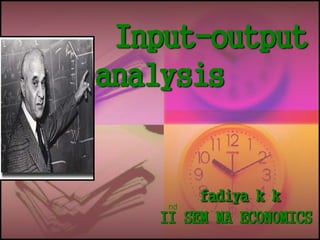
Input-output 
analysis 
fadiya k k 
nd 
II SEM MA ECONOMICS
Outline 
 Input-output analysis 
 Definition 
 Features 
 Assumptions 
 Importance 
 Technical coefficent 
 shortcomings
 First developed by Quseney in his work 
“Tableau Economique.” 
 Modern times-W W Leontief in 1941, 
“Structure of an American Economy.” 
 Based on the concept National Income 
Balances. 
 Interrelationship and interdependence 
between various industries.
“How an industry undertakes the 
production by using the output of 
other industries in the economy 
and how the output of the given 
industry is used up in other 
industries.”
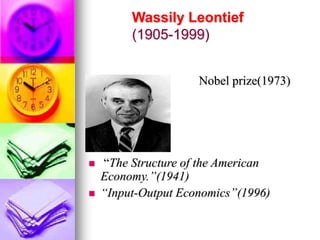
Wassily Leontief 
(1905-1999) 
Nobel prize(1973) 
 “The Structure of the American 
Economy.”(1941) 
 “Input-Output Economics”(1996)
DEFINITION 
 Simon Kuznet , “in the essence it is 
an attempt to study the structure of 
an economy.” 
 J R Hicks, “An input is something 
which is bought for enterprise 
while an output something which is 
sold by it.”
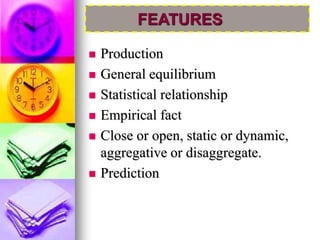
FEATURES 
 Production 
 General equilibrium 
 Statistical relationship 
 Empirical fact 
 Close or open, static or dynamic, 
aggregative or disaggregate. 
 Prediction
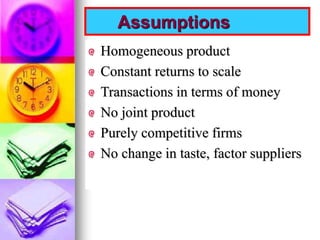
Assumptions 
Homogeneous product 
Constant returns to scale 
Transactions in terms of money 
No joint product 
Purely competitive firms 
No change in taste, factor suppliers
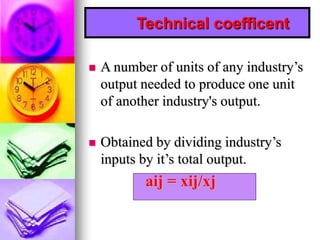
Technical coefficent 
 A number of units of any industry’s 
output needed to produce one unit 
of another industry's output. 
 Obtained by dividing industry’s 
inputs by it’s total output. 
aij = xij/xj
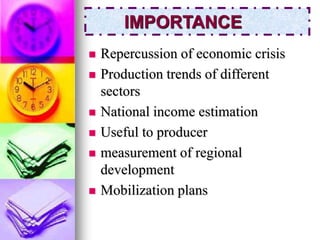
IMPORTANCE 
 Repercussion of economic crisis 
 Production trends of different 
sectors 
 National income estimation 
 Useful to producer 
 measurement of regional 
development 
 Mobilization plans
Shortcomings 
 Each sector produce one product. 
 Does not employ labour only. 
 Over simplified and unrealistic 
assumption. 
 Factor substitution 
 Neglect time lags. 
 Emphasize on production side. 
 Not dealt with disequilibrium.
Input output analysis 2

Input output analysis 2

  • 1.
    Input-output analysis fadiyak k nd II SEM MA ECONOMICS
  • 2.
    Outline  Input-outputanalysis  Definition  Features  Assumptions  Importance  Technical coefficent  shortcomings
  • 3.
     First developedby Quseney in his work “Tableau Economique.”  Modern times-W W Leontief in 1941, “Structure of an American Economy.”  Based on the concept National Income Balances.  Interrelationship and interdependence between various industries.
  • 4.
    “How an industryundertakes the production by using the output of other industries in the economy and how the output of the given industry is used up in other industries.”
  • 5.
    Wassily Leontief (1905-1999) Nobel prize(1973)  “The Structure of the American Economy.”(1941)  “Input-Output Economics”(1996)
  • 6.
    DEFINITION  SimonKuznet , “in the essence it is an attempt to study the structure of an economy.”  J R Hicks, “An input is something which is bought for enterprise while an output something which is sold by it.”
  • 7.
    FEATURES  Production  General equilibrium  Statistical relationship  Empirical fact  Close or open, static or dynamic, aggregative or disaggregate.  Prediction
  • 8.
    Assumptions Homogeneous product Constant returns to scale Transactions in terms of money No joint product Purely competitive firms No change in taste, factor suppliers
  • 9.
    Technical coefficent A number of units of any industry’s output needed to produce one unit of another industry's output.  Obtained by dividing industry’s inputs by it’s total output. aij = xij/xj
  • 10.
    IMPORTANCE  Repercussionof economic crisis  Production trends of different sectors  National income estimation  Useful to producer  measurement of regional development  Mobilization plans
  • 11.
    Shortcomings  Eachsector produce one product.  Does not employ labour only.  Over simplified and unrealistic assumption.  Factor substitution  Neglect time lags.  Emphasize on production side.  Not dealt with disequilibrium.