INTRODUCTION TO:
INNOVATION AND CREATIVITY
By Kamal M. AL MASRI
Israa University Gaza
Faculty of Managerial and Financial Sciences
Departmentof Management
Chapter 02: Innovation types
Course code: ::::.BEAD4312..::::
2
Introduction tothe concepts of Creativity & Innovation, by Kamal M. AL MASRI
Types of innovations:
•Not easy to establish a single list,
•May classifications, based on different criteria.
•Origin: internal vs. external.
•Nature : organizational, social, environmental, technological.
•Scope:incremental vs. radical.
•Object: product, service, process, …
•…
•It depends on the point of interest and the angle of
study.
3
Introduction tothe concepts of Creativity & Innovation, by Kamal M. AL MASRI
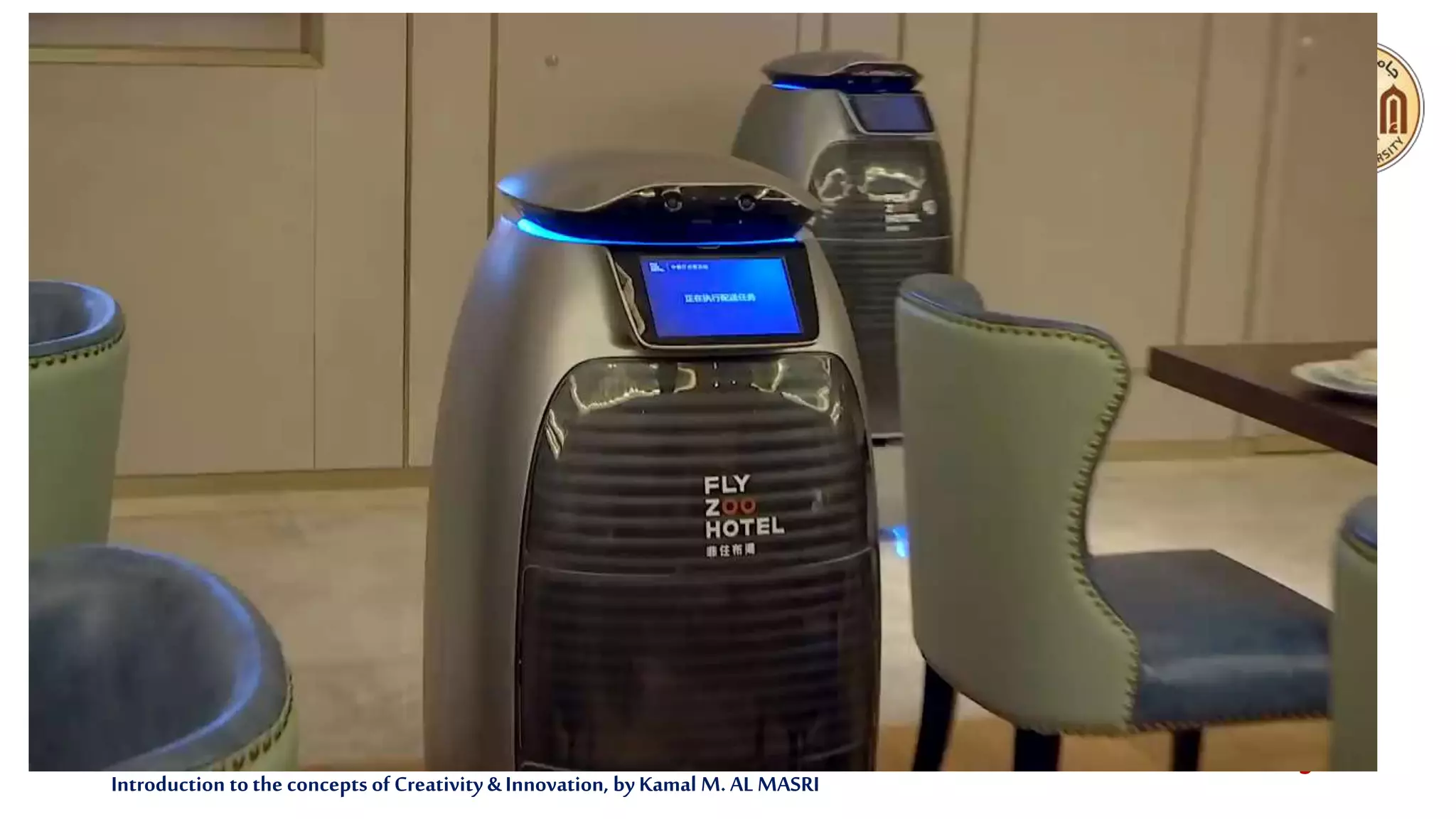
Video: FlyZone Hotel
4
Introduction tothe concepts of Creativity & Innovation, by Kamal M. AL MASRI
What is the purpose of types of innovation?
• From the point of view of management, this
classification have a strategic and process-related
significance.
• A clear definitionof the desired innovation object and
degree ofinnovation is importantfor the innovation
strategy.
• This determines wherean organization wants to innovate.
•This is importantin order to choose the method and the
model of innovation (the efforts).
5
Introduction tothe concepts of Creativity & Innovation, by Kamal M. AL MASRI
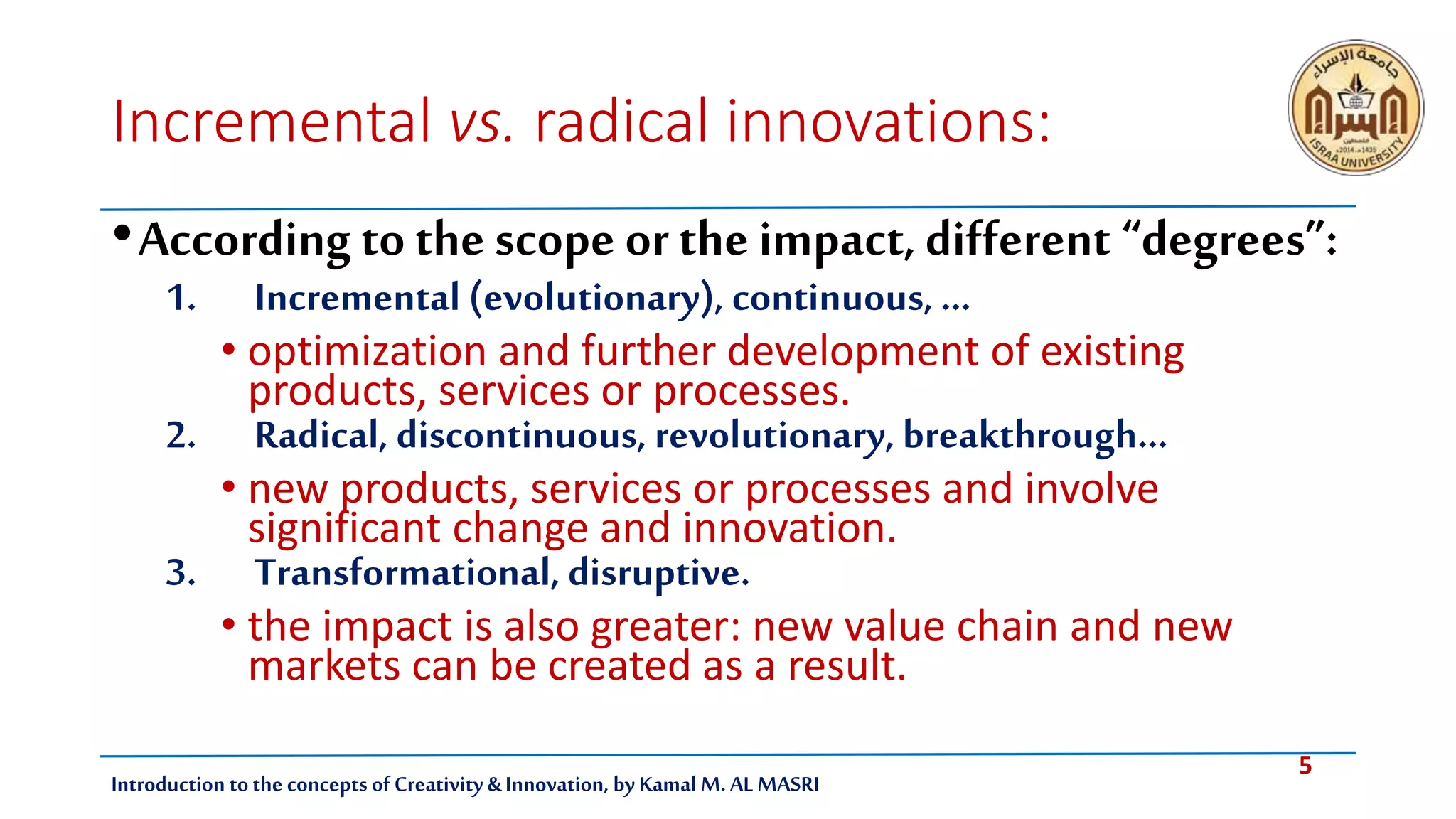
Incremental vs. radical innovations:
•According to the scope or the impact, different “degrees”:
1. Incremental (evolutionary), continuous, ...
• optimization and further development of existing
products, services or processes.
2. Radical, discontinuous, revolutionary, breakthrough…
• new products, services or processes and involve
significant change and innovation.
3. Transformational, disruptive.
• the impact is also greater: new value chain and new
markets can be created as a result.
6
Introduction tothe concepts of Creativity & Innovation, by Kamal M. AL MASRI
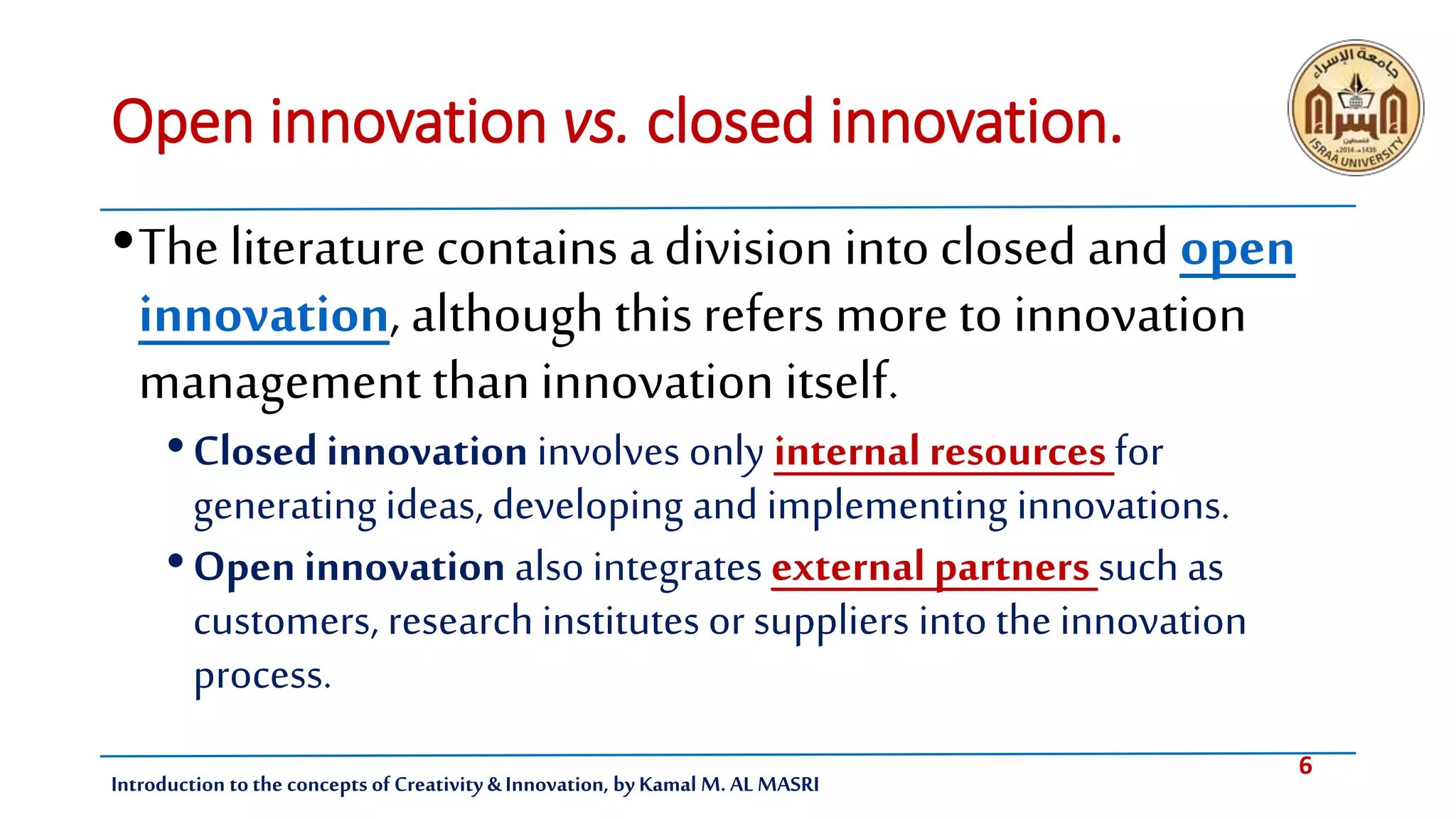
Open innovation vs. closed innovation.
•The literature contains a division into closed and open
innovation, although this refers more to innovation
management than innovation itself.
•Closed innovation involves only internal resourcesfor
generating ideas, developing and implementing innovations.
•Open innovation also integrates external partnerssuch as
customers, research institutes or suppliers into the innovation
process.
7
Introduction tothe concepts of Creativity & Innovation, by Kamal M. AL MASRI
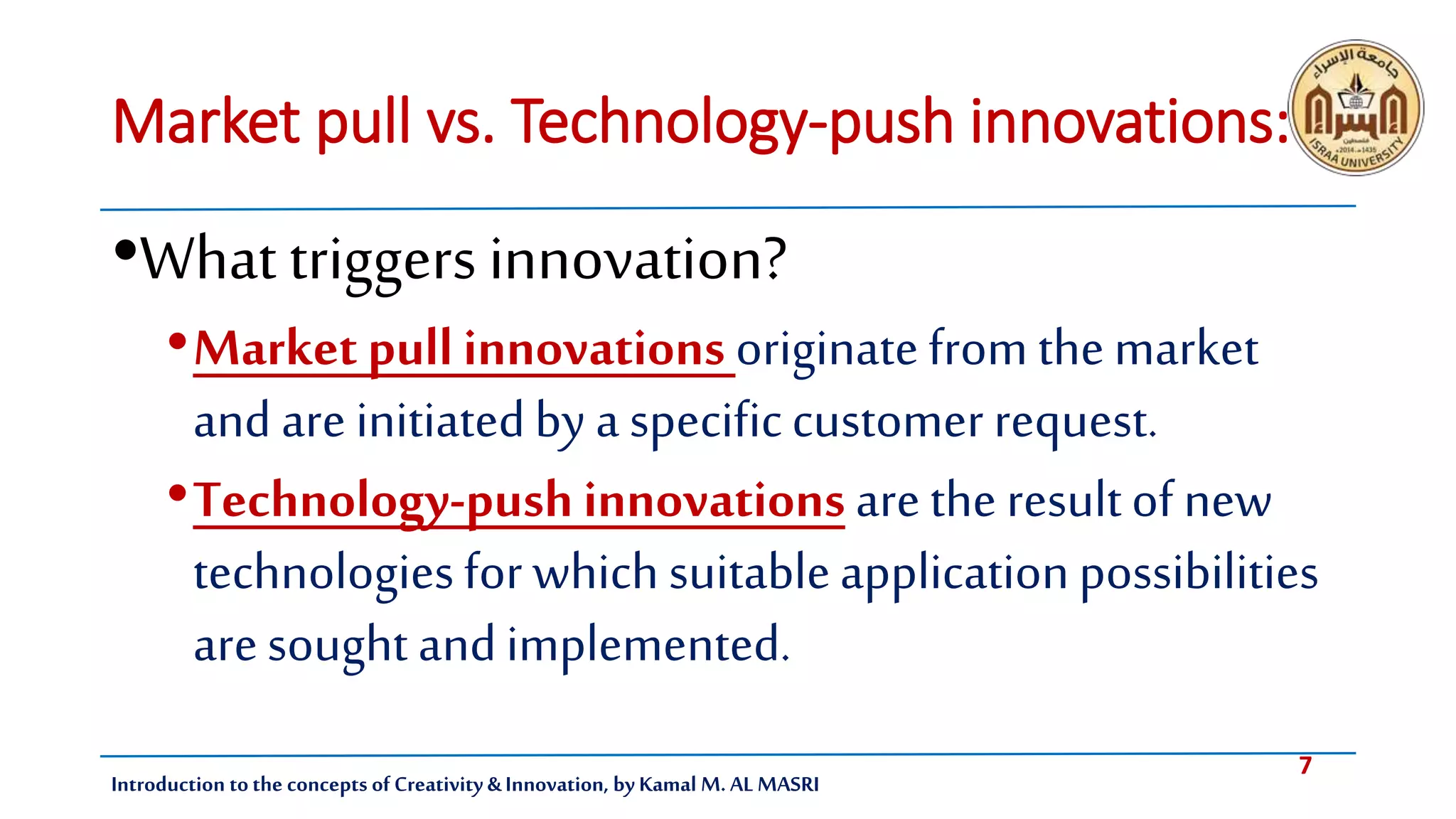
Market pull vs. Technology-push innovations:
•What triggers innovation?
•Market pull innovations originatefrom themarket
and are initiatedby a specificcustomer request.
•Technology-push innovations arethe resultof new
technologiesfor which suitableapplicationpossibilities
aresought andimplemented.
8
Introduction tothe concepts of Creativity & Innovation, by Kamal M. AL MASRI
Sources of inspiration?
Studies suggest:
1- Employees.
2- Customers.
3- Market and competitors.
4- Management and planning teams.
5- Sales department.
6- Suppliers.
7- Managers. 
8- Consultants.
9. …
9
Introduction tothe concepts of Creativity & Innovation, by Kamal M. AL MASRI
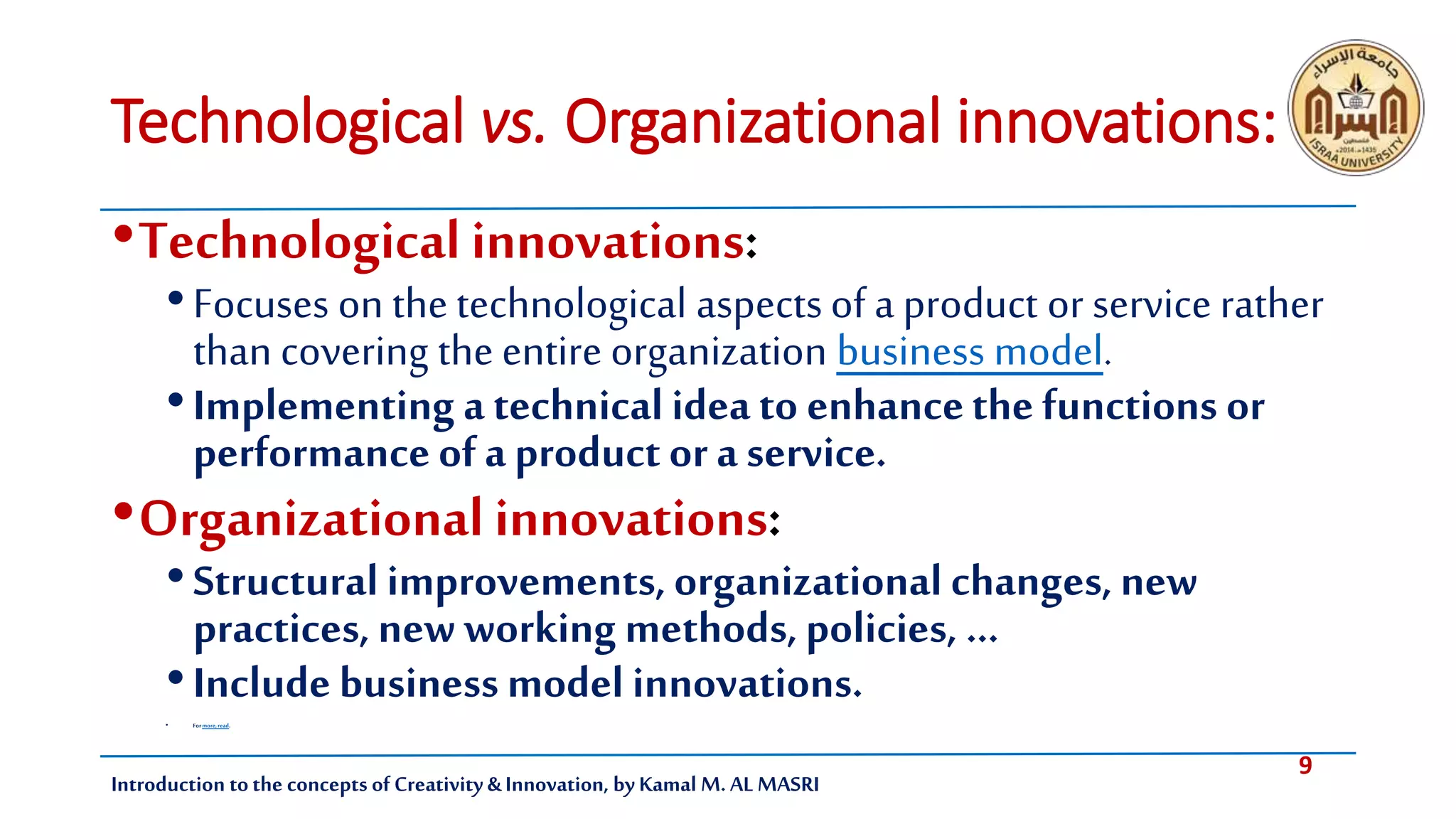
Technological vs. Organizational innovations:
•Technological innovations:
•Focuses on the technological aspectsof a product or service rather
than covering the entire organization business model.
•Implementing a technical idea to enhancethe functions or
performanceof a product or a service.
•Organizational innovations:
•Structural improvements, organizational changes, new
practices, new working methods, policies, …
•Include business model innovations.
• Formore,read.
10
Introduction tothe concepts of Creativity & Innovation, by Kamal M. AL MASRI
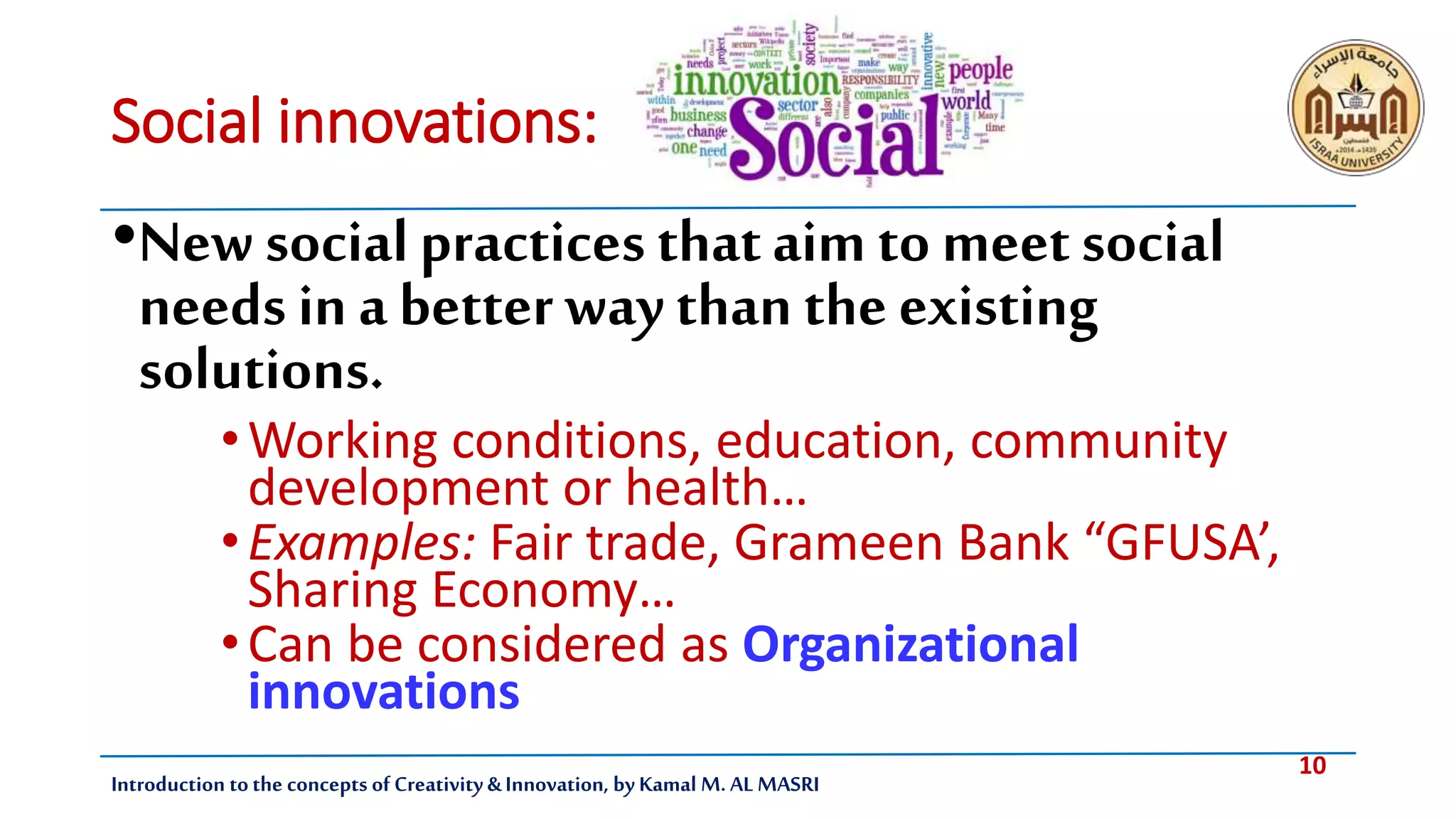
Social innovations:
•Newsocialpractices thataim to meetsocial
needs in a betterway than the existing
solutions.
•Working conditions, education, community
development or health…
•Examples: Fair trade, Grameen Bank “GFUSA’,
Sharing Economy…
•Can be considered as Organizational
innovations
11
Introduction tothe concepts of Creativity & Innovation, by Kamal M. AL MASRI
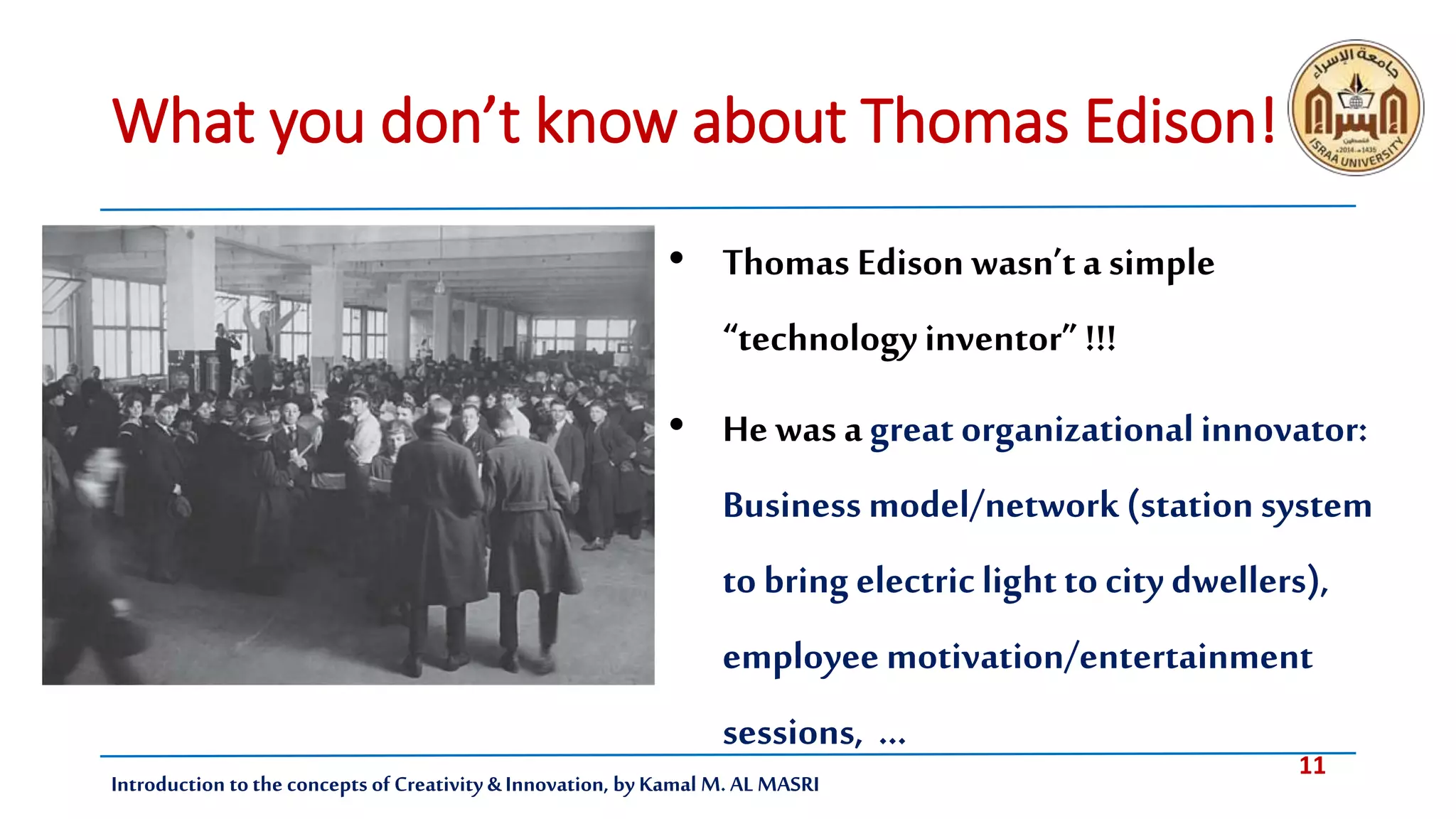
What you don’t know about Thomas Edison!
• Thomas Edison wasn’ta simple
“technologyinventor” !!!
• He was agreat organizationalinnovator:
Business model/network(station system
to bring electriclightto city dwellers),
employee motivation/entertainment
sessions, …
12
Introduction tothe concepts of Creativity & Innovation, by Kamal M. AL MASRI
Famous typologies of innovations:
•Many types,many classifications,the most
important:
•1- Doblin group’s 10 types ofinnovation:
•Creating new product is only one typeof innovation.
•2- Moore’s14 innovation types.
•An innovation type for each phase of the category life
cycle.
13
Introduction tothe concepts of Creativity & Innovation, by Kamal M. AL MASRI
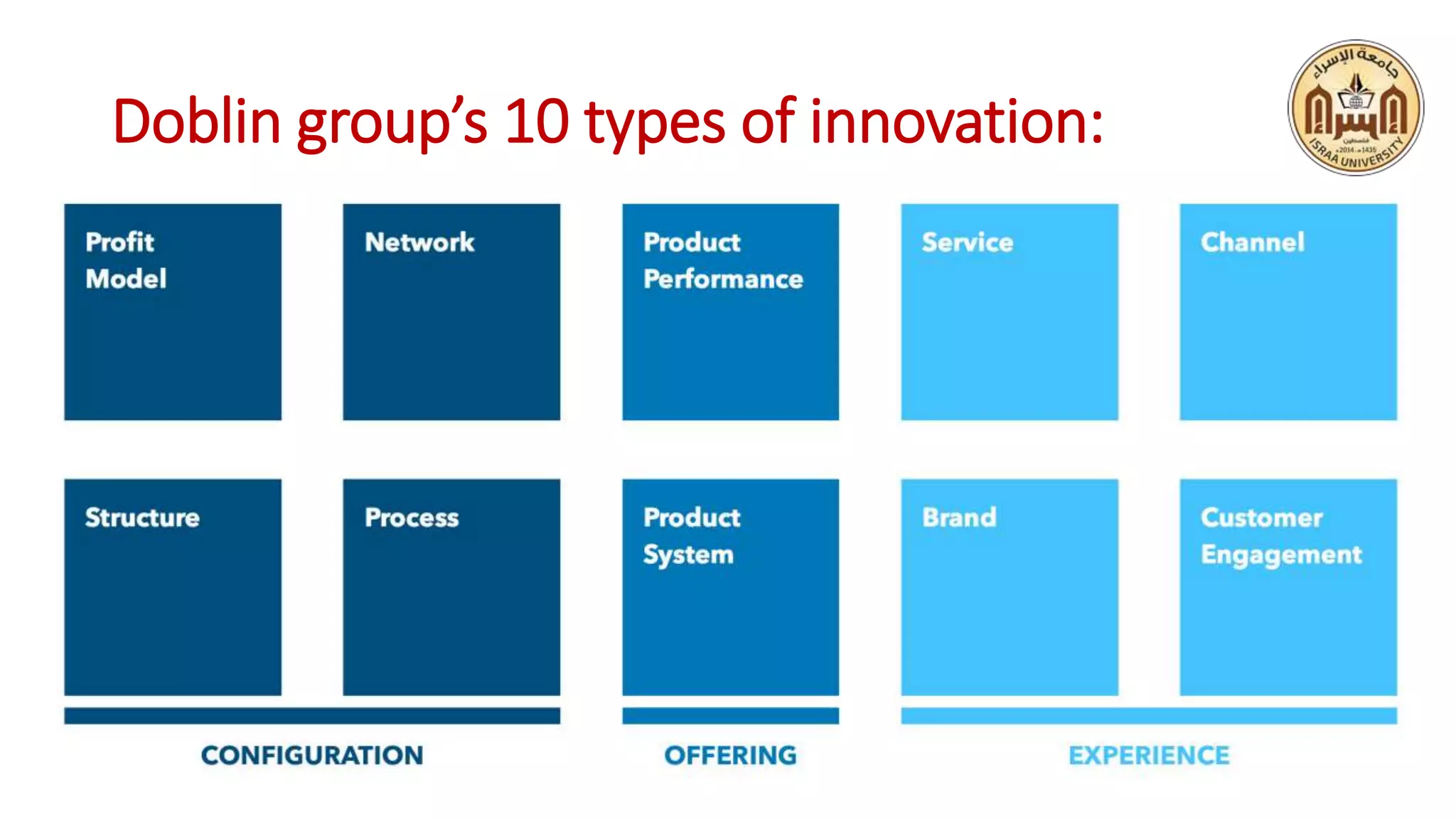
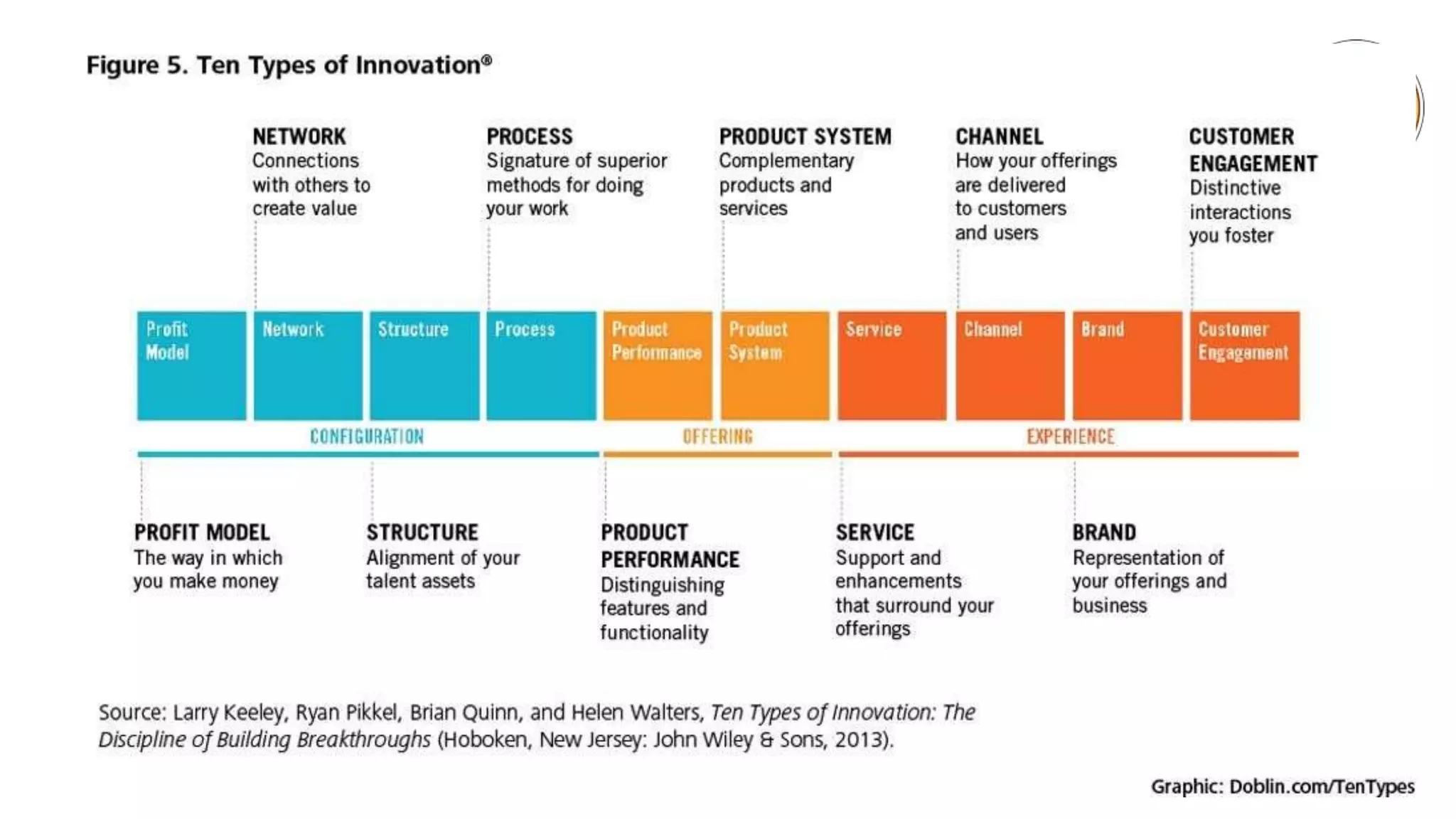
Doblin group’s 10 types of innovation:
14
Introduction tothe concepts of Creativity & Innovation, by Kamal M. AL MASRI
Ten types of innovation = different ways to
innovate …
•The 10 types of innovation canhelp
organizations (people) think about
different ways to innovate that simply
trying to come up with a new product.
15
Introduction tothe concepts of Creativity & Innovation, by Kamal M. AL MASRI
•Ten Types of Innovation:The Discipline of
Building Breakthroughsis the culmination of
thirty years of analysis and research.
16
Introduction tothe concepts of Creativity & Innovation, by Kamal M. AL MASRI
1. Profit model
•Howto make money?
•That typeof innovationrepresentsnew waysof
generation profits, which meansof understanding
what peoplearewilling topay for.
•Profit modelsare often taken for granted and can
remainunchangedfor decades,but they'rea good
opportunity to differentiate your business.
17
Introduction tothe concepts of Creativity & Innovation, by Kamal M. AL MASRI
2. Network
•Howto connect with others to create value?
•Our world is hyper-connected,as networks allowus to
do things wecouldn't do on our own.
•Partnerships can bea good way to share risksin
developingnew offers.
18
Introduction tothe concepts of Creativity & Innovation, by Kamal M. AL MASRI
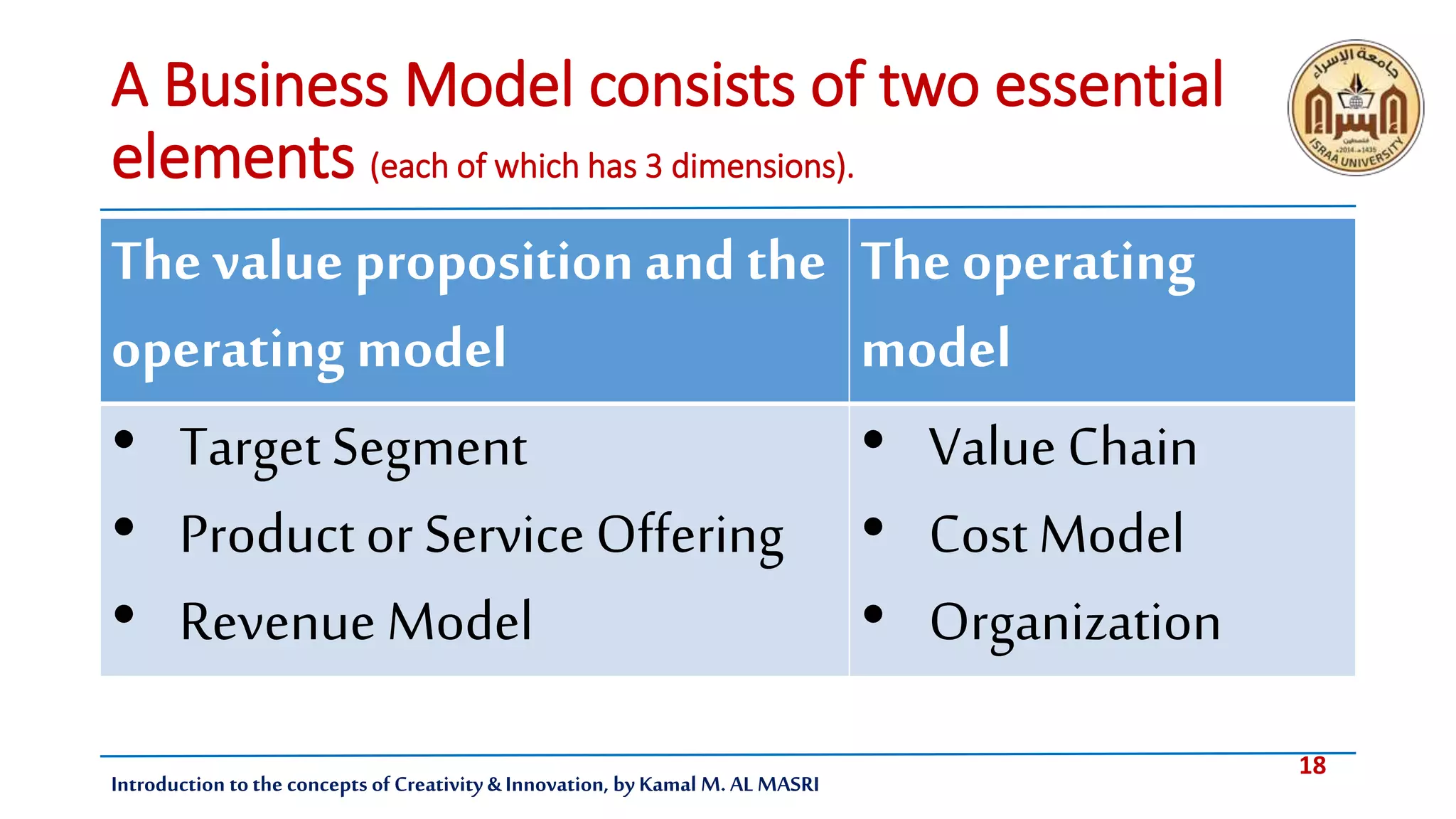
A Business Model consists of two essential
elements (each of which has 3 dimensions).
The operating
model
The value proposition and the
operating model
• Value Chain
• Cost Model
• Organization
• Target Segment
• Product or Service Offering
• Revenue Model
19
Introduction tothe concepts of Creativity & Innovation, by Kamal M. AL MASRI
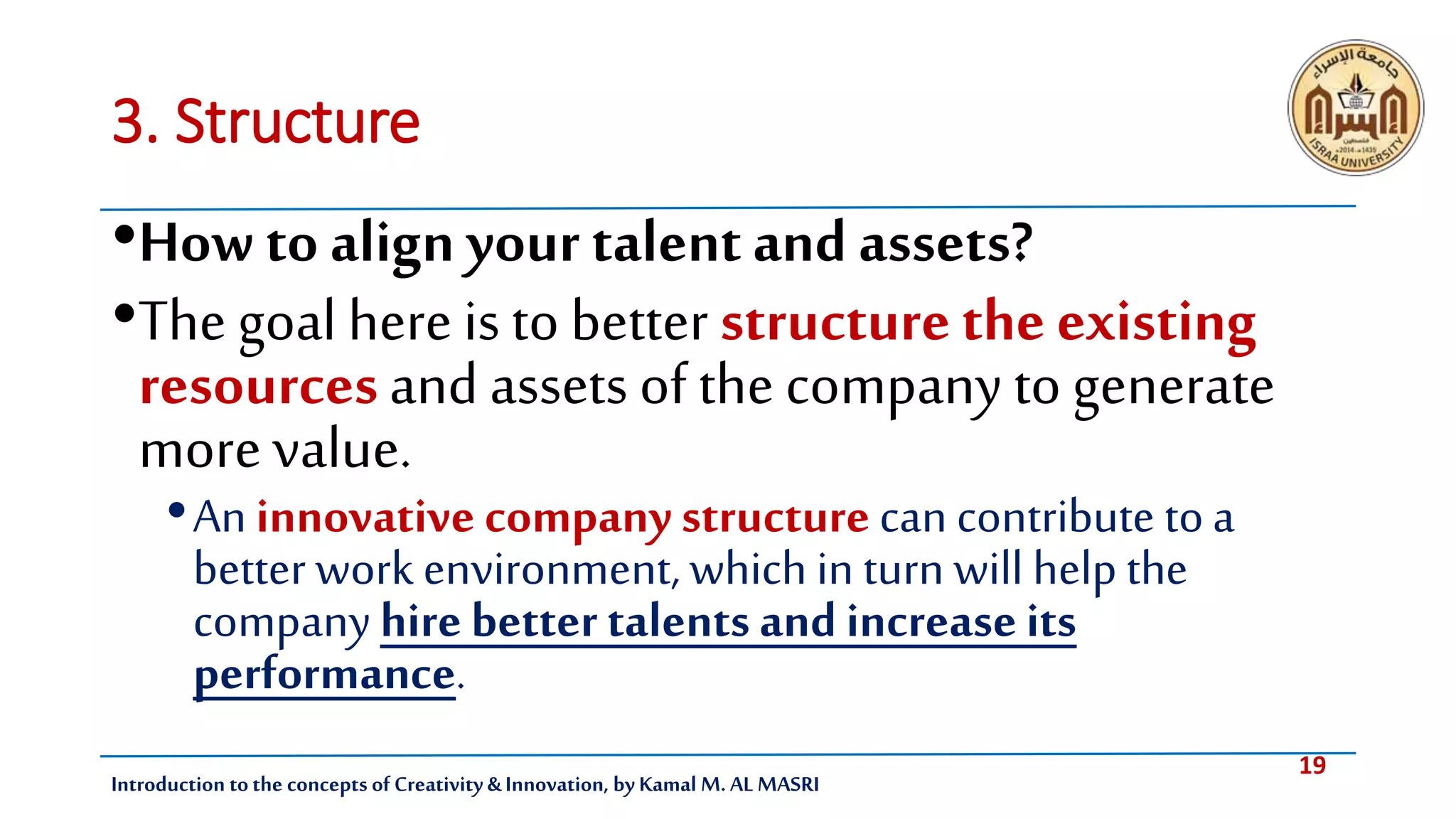
3. Structure
•How to align your talentand assets?
•The goal here is to better structurethe existing
resourcesand assets of the company to generate
morevalue.
•An innovative company structure can contribute toa
better work environment, which in turn will help the
companyhire better talents and increase its
performance.
20
Introduction tothe concepts of Creativity & Innovation, by Kamal M. AL MASRI
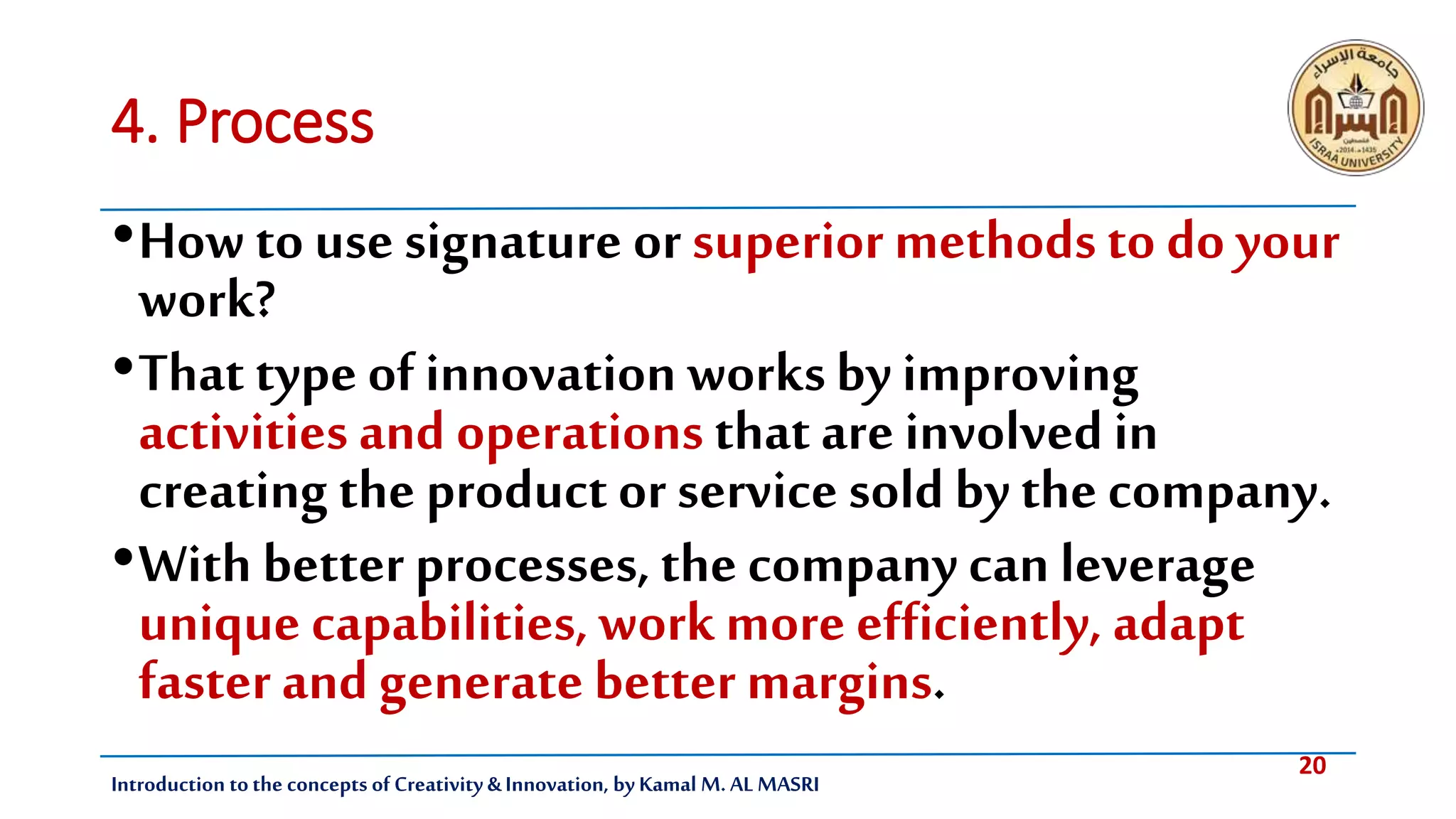
4. Process
•How to use signature or superior methods to do your
work?
•That type of innovation worksby improving
activities and operations that are involved in
creating the product or service sold by the company.
•With better processes, the company can leverage
unique capabilities, work more efficiently, adapt
faster and generate better margins.
21
Introduction tothe concepts of Creativity & Innovation, by Kamal M. AL MASRI
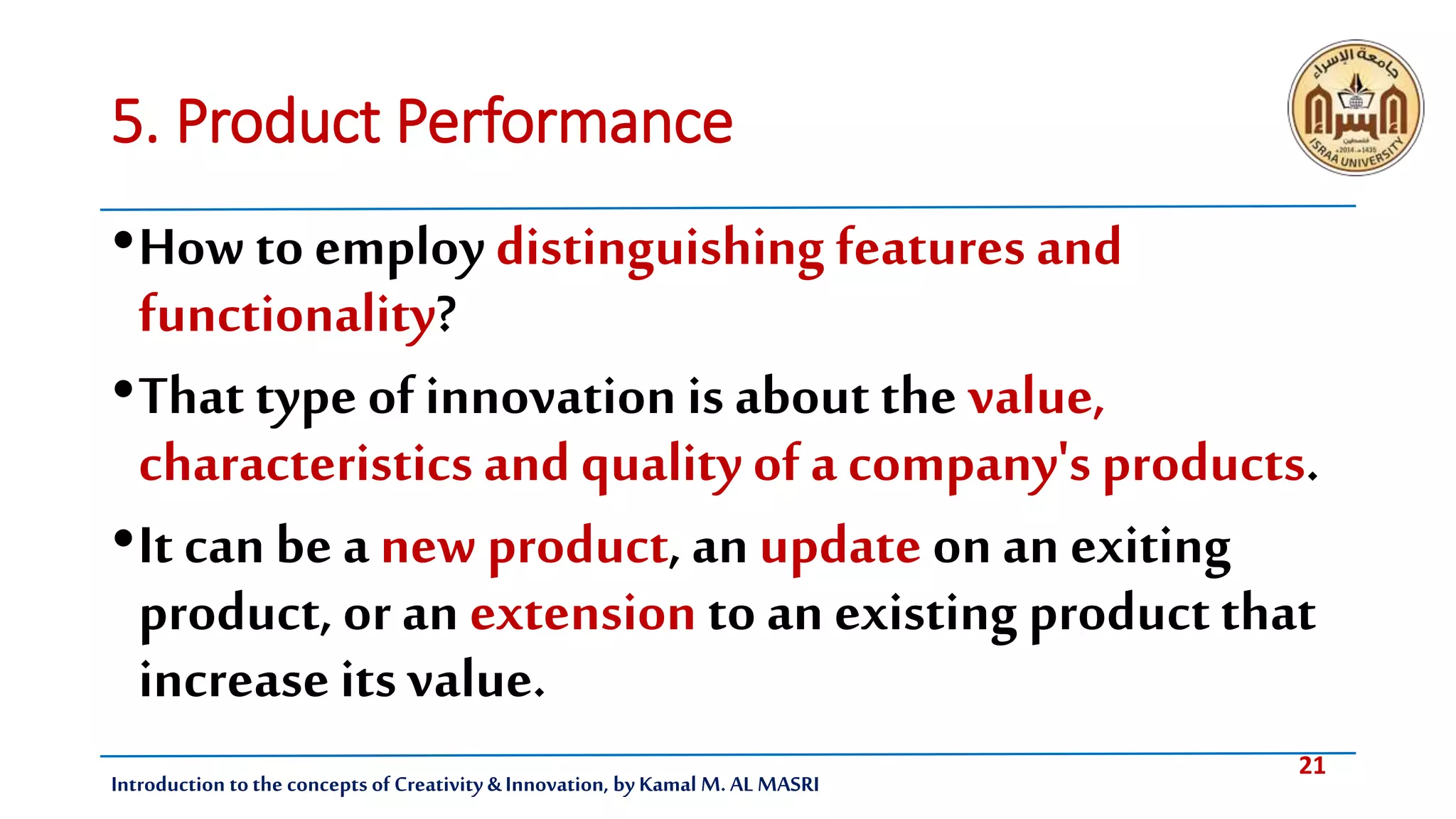
5. Product Performance
•How to employ distinguishing features and
functionality?
•That type of innovation is about the value,
characteristics and quality of a company's products.
•It can be a new product, an update on an exiting
product, or an extension to an existing productthat
increase its value.
22
Introduction tothe concepts of Creativity & Innovation, by Kamal M. AL MASRI
6. Product System
•Howto create complementary products and
services?
•The objective here is to create a robust and
evolutivesystem that connects a company's
existing offer, whetherthroughintegration or
modularisation.
23
Introduction tothe concepts of Creativity & Innovation, by Kamal M. AL MASRI
7. Services
• Howtosupport andenhancethevalue of your
offerings?
•Services can increase the value of a product by
making that product easier to use, by
removing problems or by educating the client
aboutpossibilities they were unaware of.
24
Introduction tothe concepts of Creativity & Innovation, by Kamal M. AL MASRI
8. Channel
•Howtodeliver yourofferingsto customers and
users?
•By addingnew channels and by optimizing
existingchannels, you can improve the
purchase process and remove friction between
yourproduct and yourcustomers.
25
Introduction tothe concepts of Creativity & Innovation, by Kamal M. AL MASRI
9. Brand
•How to represent your offerings and business?
•The goal is to create a distinct brand identity to make
sure clients recognize it, remember it, and prefer your
products to your competitors'.
•To do that, you can rely on marketing
communications, advertising, interaction with your
customers, the environment in which your product is
distributed and the behavior of your employees.
26
Introduction tothe concepts of Creativity & Innovation, by Kamal M. AL MASRI
10. Customer Engagement
•Howto foster distinctive interactions?
•That kind of innovationaims at developing
strongconnections between your customers
and yourcompany, throughrich andmultiple
interactions.
27
Introduction tothe concepts of Creativity & Innovation, by Kamal M. AL MASRI
Moore’s 14 innovation types:
•Innovation isn’t confined to break-out, market-
creating,blockbuster productsand services.
•Thereare innovation typesavailablefor each
phase of the category lifecycle,from growth
through maturityand decline,to end of life.
28
Introduction tothe concepts of Creativity & Innovation, by Kamal M. AL MASRI
Moore’s 14 innovation types:
•In his book “Dealing with Darwin: How Great
Companies Innovate at Every Phase of Their
Evolution”, Moore presents 14 innovation types
in 4 classes:
1. Leadership
2. Customer Intimacy
3. Operational Excellence
4. Category Renewal
29
Introduction tothe concepts of Creativity & Innovation, by Kamal M. AL MASRI
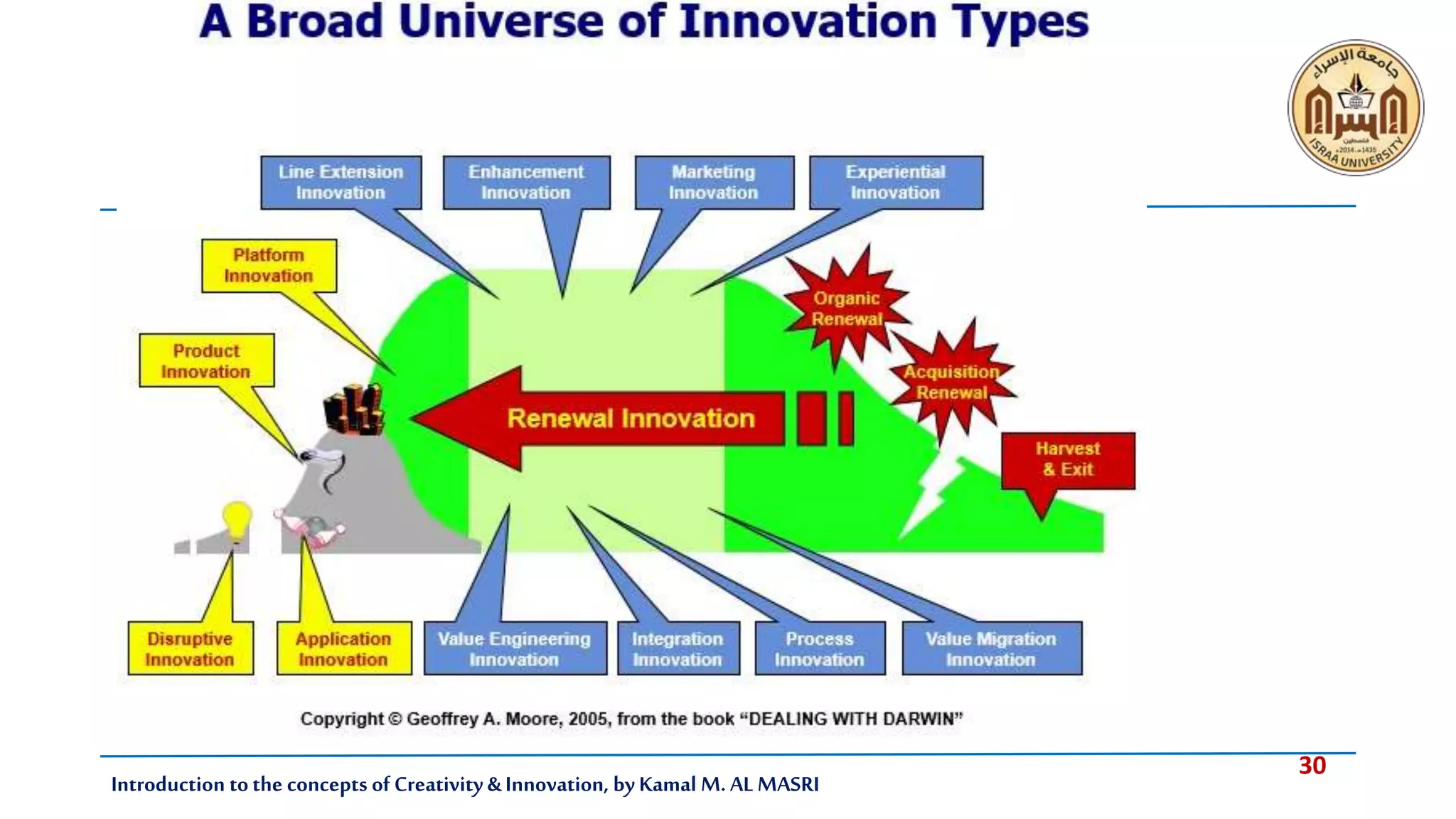
Regarding the lifecycle (Geoffrey Moore)
•There are innovation types available for each phase of the
category life cycle, from growth through maturity and
decline, to end of life.
•The single most important act of strategy leadership is to
select the innovation vector upon which your company
will develop its sustainable competitive advantage—its
core.
•To do thisproperly requires a deeper understanding of the
properties of each ofthese innovation types.
30
Introduction tothe concepts of Creativity & Innovation, by Kamal M. AL MASRI
31
Introduction tothe concepts of Creativity & Innovation, by Kamal M. AL MASRI
32
Introduction tothe concepts of Creativity & Innovation, by Kamal M. AL MASRI
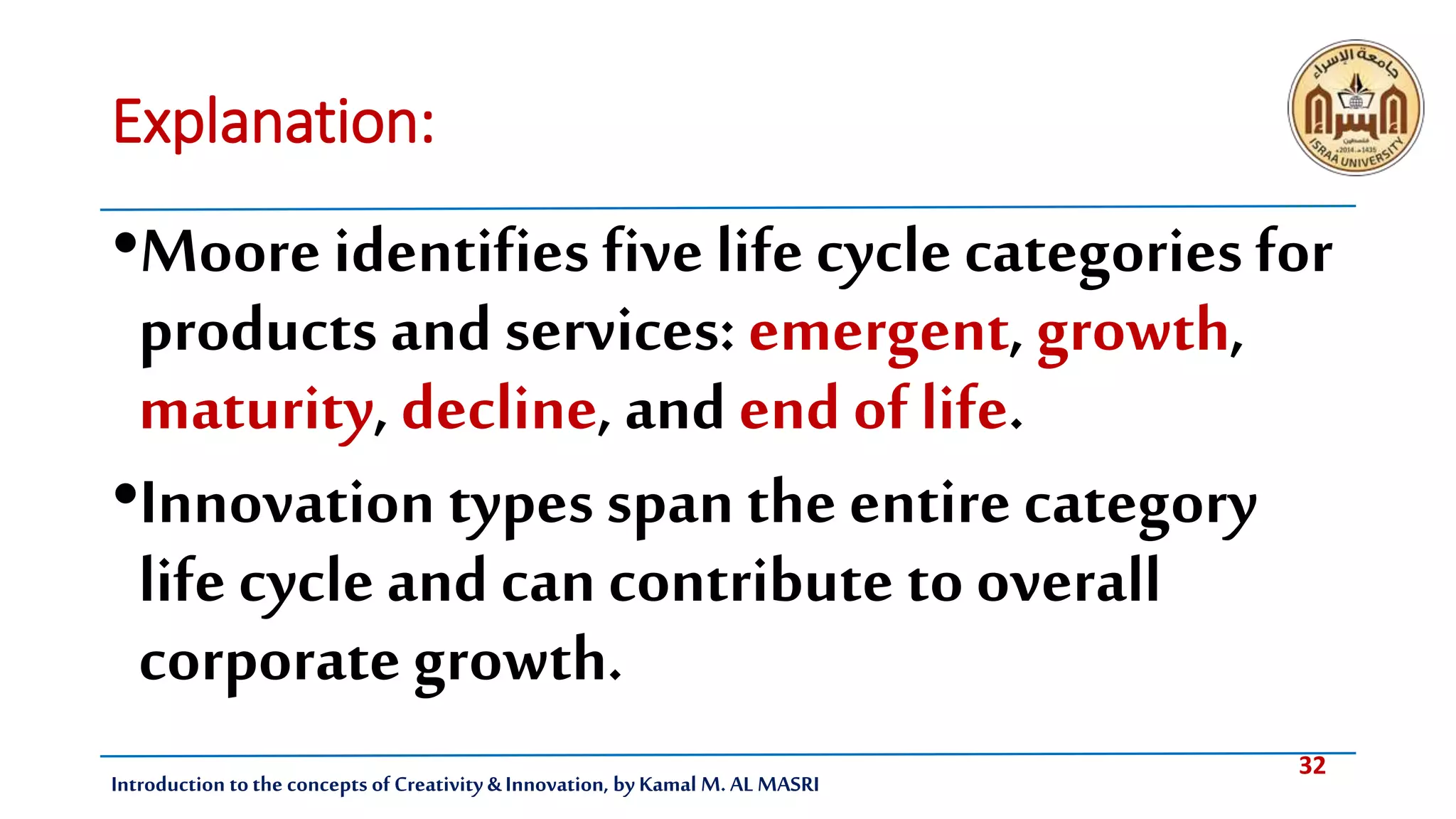
Explanation:
•Moore identifies five life cycle categories for
products and services: emergent, growth,
maturity, decline, and end of life.
•Innovation types span the entire category
life cycle and can contribute to overall
corporate growth.
33
Introduction tothe concepts of Creativity & Innovation, by Kamal M. AL MASRI
Emergent and growth
•Disruptive innovation, the type of innovation which is
most often associated with high technology, occurs in the
emergent category.
•This phase is described “Crossing the Chasm”, and
involves the leap from early adopters to mainstream
buyers where it enters the growth phase.
•Although disruptive innovation is highly desirable, it is
not the only type of innovation available to companies.
34
Introduction tothe concepts of Creativity & Innovation, by Kamal M. AL MASRI
35
Introduction tothe concepts of Creativity & Innovation, by Kamal M. AL MASRI
I- Product Leadership
• This group of innovation types is characterized as very powerful,
expensive and risky. Therefore, they must be executed in high growth
markets to realize the necessary returns and market share wins.
• 1-DisruptiveInnovation–Products andservices which createtechnology
discontinuitiesand newmarketcategoriesare part of this set.
• Existing standards and valuechains are over-turned in favorof newapproaches.
• Ex.:Digital media (music, film) and social media networks.
• 2-Application Innovation– Findingnew uses,newaudiences, andre-combining
existing functionalityare attributesofthiscategory.
• Standards change, existing value chains are disrupted.
• Ex.:Theapplication of Macintosh computers to desktop publishing and using fault tolerant computers
torun ATM networks.
very powerful, expensive and risky
36
Introduction tothe concepts of Creativity & Innovation, by Kamal M. AL MASRI
I- Product Leadership (cont.)
•3- Product Innovation: Existing products are improved
through functionality and usability for existingmarkets.
• Success is achieved through time to market andpatent protection.
• Improvements such as wireless connectivity in laptops, cameras in cell
phones, andhybrid engines in cars are examples of product innovation.
•4- Platform Innovation: Platform leaders create foundational
or ingredient systems on which third parties can build
further value.
• Success here relies on architectural leadership, relationship building, and
creating benefits for the entire ecosystem. (Intel andMicrosoft).
37
Introduction tothe concepts of Creativity & Innovation, by Kamal M. AL MASRI
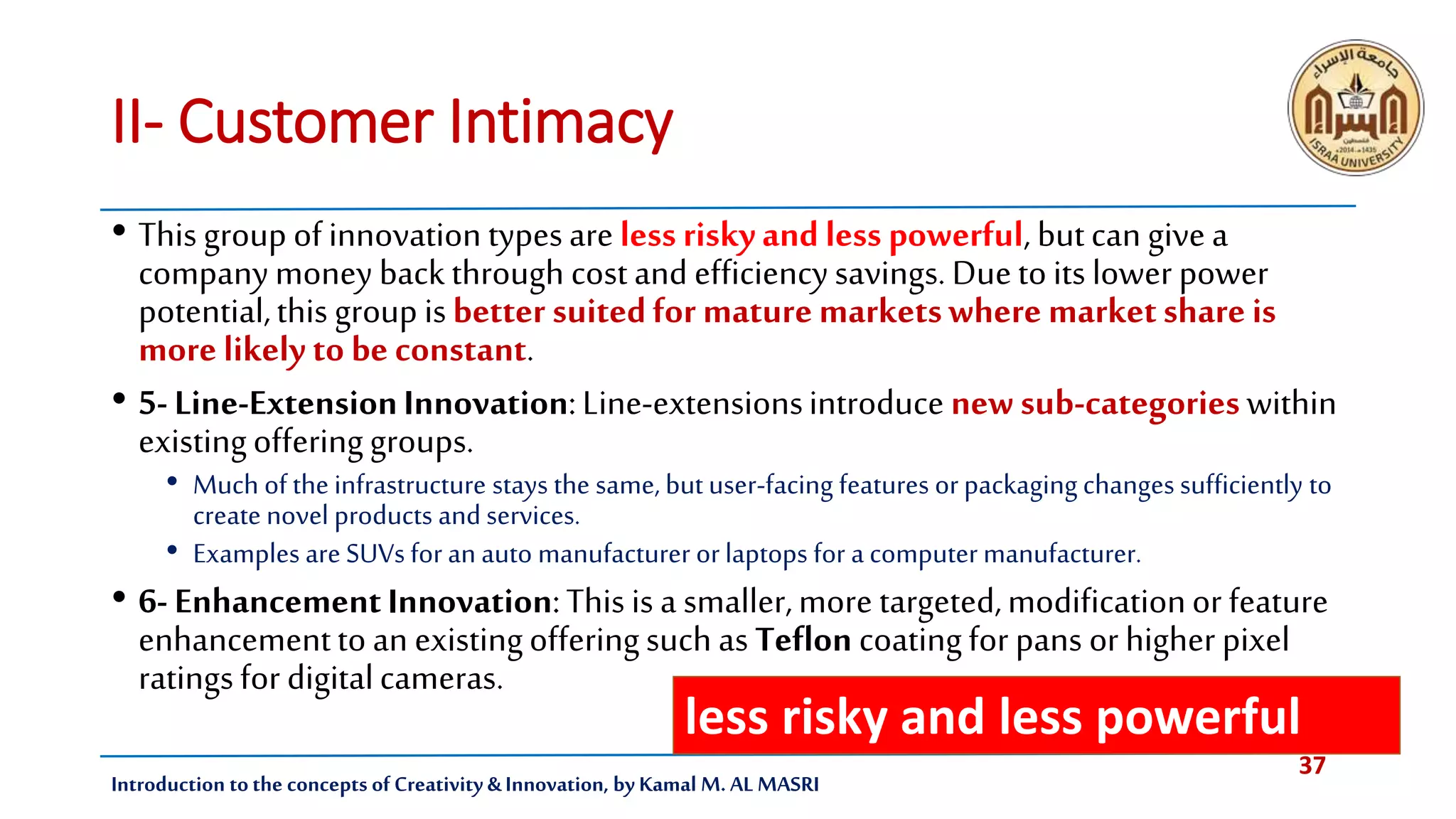
II- Customer Intimacy
• Thisgroup ofinnovation typesare less riskyand less powerful, butcan givea
companymoney backthrough costand efficiencysavings.Duetoits lower power
potential,this group isbetter suitedfor maturemarketswhere marketshare is
more likely to beconstant.
• 5-Line-ExtensionInnovation:Line-extensionsintroduce newsub-categorieswithin
existingofferinggroups.
• Much of the infrastructure stays the same, but user-facing features orpackaging changes sufficiently to
create novel products and services.
• Examples are SUVs for an auto manufacturer orlaptops for a computer manufacturer.
• 6-EnhancementInnovation:Thisis a smaller,more targeted,modificationor feature
enhancementtoan existingofferingsuch as Teflon coatingfor pans or higher pixel
ratingsfor digitalcameras.
less risky and less powerful
38
Introduction tothe concepts of Creativity & Innovation, by Kamal M. AL MASRI
II- Customer Intimacy (cont.)
•7- Marketing Innovation: Marketing innovation uses new
or highly effectivemarketing campaigns such as viral
strategies, social media, or crowd sourcing to outpace
competitors.
•8- Experiential Innovation: Thiscategory occurs most
frequently in service offerings, or by adding a service to an
existing product.
• Here the overall experience of a offering is enhanced through
personalization, 1:1attention, or a higher level of value add.
39
Introduction tothe concepts of Creativity & Innovation, by Kamal M. AL MASRI
III- Operational Excellence
• LikeCustomerIntimacy,theOperationalExcellencezone is less riskyand less
powerful, but can givea companymoney backthrough costand efficiencysavings.
Duetoits lowerpowerpotential,this group isbettersuitedformaturemarketswhere
marketshareis morelikelytobeconstant.
• 9- Value-EngineeringInnovation– The goal in thiscategory is to decrease costs
in manufacturing/development for existing offers withoutchangingtheir
composition. Optimizingcomponentparts and theoverall assembly / creation
process are tactics here.
• 10- IntegrationInnovation– This is the flip-side of value-engineering
innovation–thecustomer’s cost of ownership is decreased by simplification
and/or consolidation intoa singleentity thatcan be managed more effectively
thanmultiplepieces.
40
Introduction tothe concepts of Creativity & Innovation, by Kamal M. AL MASRI
III- Operational Excellence (cont.)
•11- Process Innovation: The goal ofthis type of innovation is
to reduce waste and cost from processes thatsupport and
enable the offer, rather than offer itself.
• Inventory management andquality programs can be used here.
•12- Value-Migration Innovation: This type ofinnovation is
described in Adrian Slywotzky’s book Value Migration.
• Companies taking this approach will move away from segments of the
value chain which are commoditized to segments which are richer in
profit andgrowth opportunities.
41
Introduction tothe concepts of Creativity & Innovation, by Kamal M. AL MASRI
IV - Category Renewal
•This phase comes into play when a business is declining and
must be wound down or immediatelyexited:
13. Organic Innovation: Re-positioning a company to a growth
category is the goalof organic innovation.
• Examples are IBM moving from hardware/software to
services and Microsoft moving into browser software.
14. Acquisition Innovation: This strategy equates to mergers and
acquisitions, either as a buyer or seller.
•Harvest and Exit – This decision effectively closes out a line
of business.
42
Introduction tothe concepts of Creativity & Innovation, by Kamal M. AL MASRI
From strategic point of view
• The innovation ambition matrix goes one step further than
the three-horizon model.
• Their framework isbased ontwo main dimensions: Products (new
products versus existing products) and markets (new markets versus
existing markets).
• Basedon the two dimensions mentioned above, they distinguish three main
types of innovation:
1) Core,
2) secondary and
3) transformation innovations (figure 4).
43
Introduction tothe concepts of Creativity & Innovation, by Kamal M. AL MASRI
Figure 4: Nagji and Tuff’s Innovation ambition
matrix
44
Introduction tothe concepts of Creativity & Innovation, by Kamal M. AL MASRI
What is the type?
• Private speed radars ?
•What type?
•Read (this article).
45
Introduction tothe concepts of Creativity & Innovation, by Kamal M. AL MASRI

Innovation and creativity 02 innovation types

  • 1.
    INTRODUCTION TO: INNOVATION ANDCREATIVITY By Kamal M. AL MASRI Israa University Gaza Faculty of Managerial and Financial Sciences Departmentof Management Chapter 02: Innovation types Course code: ::::.BEAD4312..::::
  • 2.
    2 Introduction tothe conceptsof Creativity & Innovation, by Kamal M. AL MASRI Types of innovations: •Not easy to establish a single list, •May classifications, based on different criteria. •Origin: internal vs. external. •Nature : organizational, social, environmental, technological. •Scope:incremental vs. radical. •Object: product, service, process, … •… •It depends on the point of interest and the angle of study.
  • 3.
    3 Introduction tothe conceptsof Creativity & Innovation, by Kamal M. AL MASRI Video: FlyZone Hotel
  • 4.
    4 Introduction tothe conceptsof Creativity & Innovation, by Kamal M. AL MASRI What is the purpose of types of innovation? • From the point of view of management, this classification have a strategic and process-related significance. • A clear definitionof the desired innovation object and degree ofinnovation is importantfor the innovation strategy. • This determines wherean organization wants to innovate. •This is importantin order to choose the method and the model of innovation (the efforts).
  • 5.
    5 Introduction tothe conceptsof Creativity & Innovation, by Kamal M. AL MASRI Incremental vs. radical innovations: •According to the scope or the impact, different “degrees”: 1. Incremental (evolutionary), continuous, ... • optimization and further development of existing products, services or processes. 2. Radical, discontinuous, revolutionary, breakthrough… • new products, services or processes and involve significant change and innovation. 3. Transformational, disruptive. • the impact is also greater: new value chain and new markets can be created as a result.
  • 6.
    6 Introduction tothe conceptsof Creativity & Innovation, by Kamal M. AL MASRI Open innovation vs. closed innovation. •The literature contains a division into closed and open innovation, although this refers more to innovation management than innovation itself. •Closed innovation involves only internal resourcesfor generating ideas, developing and implementing innovations. •Open innovation also integrates external partnerssuch as customers, research institutes or suppliers into the innovation process.
  • 7.
    7 Introduction tothe conceptsof Creativity & Innovation, by Kamal M. AL MASRI Market pull vs. Technology-push innovations: •What triggers innovation? •Market pull innovations originatefrom themarket and are initiatedby a specificcustomer request. •Technology-push innovations arethe resultof new technologiesfor which suitableapplicationpossibilities aresought andimplemented.
  • 8.
    8 Introduction tothe conceptsof Creativity & Innovation, by Kamal M. AL MASRI Sources of inspiration? Studies suggest: 1- Employees. 2- Customers. 3- Market and competitors. 4- Management and planning teams. 5- Sales department. 6- Suppliers. 7- Managers.  8- Consultants. 9. …
  • 9.
    9 Introduction tothe conceptsof Creativity & Innovation, by Kamal M. AL MASRI Technological vs. Organizational innovations: •Technological innovations: •Focuses on the technological aspectsof a product or service rather than covering the entire organization business model. •Implementing a technical idea to enhancethe functions or performanceof a product or a service. •Organizational innovations: •Structural improvements, organizational changes, new practices, new working methods, policies, … •Include business model innovations. • Formore,read.
  • 10.
    10 Introduction tothe conceptsof Creativity & Innovation, by Kamal M. AL MASRI Social innovations: •Newsocialpractices thataim to meetsocial needs in a betterway than the existing solutions. •Working conditions, education, community development or health… •Examples: Fair trade, Grameen Bank “GFUSA’, Sharing Economy… •Can be considered as Organizational innovations
  • 11.
    11 Introduction tothe conceptsof Creativity & Innovation, by Kamal M. AL MASRI What you don’t know about Thomas Edison! • Thomas Edison wasn’ta simple “technologyinventor” !!! • He was agreat organizationalinnovator: Business model/network(station system to bring electriclightto city dwellers), employee motivation/entertainment sessions, …
  • 12.
    12 Introduction tothe conceptsof Creativity & Innovation, by Kamal M. AL MASRI Famous typologies of innovations: •Many types,many classifications,the most important: •1- Doblin group’s 10 types ofinnovation: •Creating new product is only one typeof innovation. •2- Moore’s14 innovation types. •An innovation type for each phase of the category life cycle.
  • 13.
    13 Introduction tothe conceptsof Creativity & Innovation, by Kamal M. AL MASRI Doblin group’s 10 types of innovation:
  • 14.
    14 Introduction tothe conceptsof Creativity & Innovation, by Kamal M. AL MASRI Ten types of innovation = different ways to innovate … •The 10 types of innovation canhelp organizations (people) think about different ways to innovate that simply trying to come up with a new product.
  • 15.
    15 Introduction tothe conceptsof Creativity & Innovation, by Kamal M. AL MASRI •Ten Types of Innovation:The Discipline of Building Breakthroughsis the culmination of thirty years of analysis and research.
  • 16.
    16 Introduction tothe conceptsof Creativity & Innovation, by Kamal M. AL MASRI 1. Profit model •Howto make money? •That typeof innovationrepresentsnew waysof generation profits, which meansof understanding what peoplearewilling topay for. •Profit modelsare often taken for granted and can remainunchangedfor decades,but they'rea good opportunity to differentiate your business.
  • 17.
    17 Introduction tothe conceptsof Creativity & Innovation, by Kamal M. AL MASRI 2. Network •Howto connect with others to create value? •Our world is hyper-connected,as networks allowus to do things wecouldn't do on our own. •Partnerships can bea good way to share risksin developingnew offers.
  • 18.
    18 Introduction tothe conceptsof Creativity & Innovation, by Kamal M. AL MASRI A Business Model consists of two essential elements (each of which has 3 dimensions). The operating model The value proposition and the operating model • Value Chain • Cost Model • Organization • Target Segment • Product or Service Offering • Revenue Model
  • 19.
    19 Introduction tothe conceptsof Creativity & Innovation, by Kamal M. AL MASRI 3. Structure •How to align your talentand assets? •The goal here is to better structurethe existing resourcesand assets of the company to generate morevalue. •An innovative company structure can contribute toa better work environment, which in turn will help the companyhire better talents and increase its performance.
  • 20.
    20 Introduction tothe conceptsof Creativity & Innovation, by Kamal M. AL MASRI 4. Process •How to use signature or superior methods to do your work? •That type of innovation worksby improving activities and operations that are involved in creating the product or service sold by the company. •With better processes, the company can leverage unique capabilities, work more efficiently, adapt faster and generate better margins.
  • 21.
    21 Introduction tothe conceptsof Creativity & Innovation, by Kamal M. AL MASRI 5. Product Performance •How to employ distinguishing features and functionality? •That type of innovation is about the value, characteristics and quality of a company's products. •It can be a new product, an update on an exiting product, or an extension to an existing productthat increase its value.
  • 22.
    22 Introduction tothe conceptsof Creativity & Innovation, by Kamal M. AL MASRI 6. Product System •Howto create complementary products and services? •The objective here is to create a robust and evolutivesystem that connects a company's existing offer, whetherthroughintegration or modularisation.
  • 23.
    23 Introduction tothe conceptsof Creativity & Innovation, by Kamal M. AL MASRI 7. Services • Howtosupport andenhancethevalue of your offerings? •Services can increase the value of a product by making that product easier to use, by removing problems or by educating the client aboutpossibilities they were unaware of.
  • 24.
    24 Introduction tothe conceptsof Creativity & Innovation, by Kamal M. AL MASRI 8. Channel •Howtodeliver yourofferingsto customers and users? •By addingnew channels and by optimizing existingchannels, you can improve the purchase process and remove friction between yourproduct and yourcustomers.
  • 25.
    25 Introduction tothe conceptsof Creativity & Innovation, by Kamal M. AL MASRI 9. Brand •How to represent your offerings and business? •The goal is to create a distinct brand identity to make sure clients recognize it, remember it, and prefer your products to your competitors'. •To do that, you can rely on marketing communications, advertising, interaction with your customers, the environment in which your product is distributed and the behavior of your employees.
  • 26.
    26 Introduction tothe conceptsof Creativity & Innovation, by Kamal M. AL MASRI 10. Customer Engagement •Howto foster distinctive interactions? •That kind of innovationaims at developing strongconnections between your customers and yourcompany, throughrich andmultiple interactions.
  • 27.
    27 Introduction tothe conceptsof Creativity & Innovation, by Kamal M. AL MASRI Moore’s 14 innovation types: •Innovation isn’t confined to break-out, market- creating,blockbuster productsand services. •Thereare innovation typesavailablefor each phase of the category lifecycle,from growth through maturityand decline,to end of life.
  • 28.
    28 Introduction tothe conceptsof Creativity & Innovation, by Kamal M. AL MASRI Moore’s 14 innovation types: •In his book “Dealing with Darwin: How Great Companies Innovate at Every Phase of Their Evolution”, Moore presents 14 innovation types in 4 classes: 1. Leadership 2. Customer Intimacy 3. Operational Excellence 4. Category Renewal
  • 29.
    29 Introduction tothe conceptsof Creativity & Innovation, by Kamal M. AL MASRI Regarding the lifecycle (Geoffrey Moore) •There are innovation types available for each phase of the category life cycle, from growth through maturity and decline, to end of life. •The single most important act of strategy leadership is to select the innovation vector upon which your company will develop its sustainable competitive advantage—its core. •To do thisproperly requires a deeper understanding of the properties of each ofthese innovation types.
  • 30.
    30 Introduction tothe conceptsof Creativity & Innovation, by Kamal M. AL MASRI
  • 31.
    31 Introduction tothe conceptsof Creativity & Innovation, by Kamal M. AL MASRI
  • 32.
    32 Introduction tothe conceptsof Creativity & Innovation, by Kamal M. AL MASRI Explanation: •Moore identifies five life cycle categories for products and services: emergent, growth, maturity, decline, and end of life. •Innovation types span the entire category life cycle and can contribute to overall corporate growth.
  • 33.
    33 Introduction tothe conceptsof Creativity & Innovation, by Kamal M. AL MASRI Emergent and growth •Disruptive innovation, the type of innovation which is most often associated with high technology, occurs in the emergent category. •This phase is described “Crossing the Chasm”, and involves the leap from early adopters to mainstream buyers where it enters the growth phase. •Although disruptive innovation is highly desirable, it is not the only type of innovation available to companies.
  • 34.
    34 Introduction tothe conceptsof Creativity & Innovation, by Kamal M. AL MASRI
  • 35.
    35 Introduction tothe conceptsof Creativity & Innovation, by Kamal M. AL MASRI I- Product Leadership • This group of innovation types is characterized as very powerful, expensive and risky. Therefore, they must be executed in high growth markets to realize the necessary returns and market share wins. • 1-DisruptiveInnovation–Products andservices which createtechnology discontinuitiesand newmarketcategoriesare part of this set. • Existing standards and valuechains are over-turned in favorof newapproaches. • Ex.:Digital media (music, film) and social media networks. • 2-Application Innovation– Findingnew uses,newaudiences, andre-combining existing functionalityare attributesofthiscategory. • Standards change, existing value chains are disrupted. • Ex.:Theapplication of Macintosh computers to desktop publishing and using fault tolerant computers torun ATM networks. very powerful, expensive and risky
  • 36.
    36 Introduction tothe conceptsof Creativity & Innovation, by Kamal M. AL MASRI I- Product Leadership (cont.) •3- Product Innovation: Existing products are improved through functionality and usability for existingmarkets. • Success is achieved through time to market andpatent protection. • Improvements such as wireless connectivity in laptops, cameras in cell phones, andhybrid engines in cars are examples of product innovation. •4- Platform Innovation: Platform leaders create foundational or ingredient systems on which third parties can build further value. • Success here relies on architectural leadership, relationship building, and creating benefits for the entire ecosystem. (Intel andMicrosoft).
  • 37.
    37 Introduction tothe conceptsof Creativity & Innovation, by Kamal M. AL MASRI II- Customer Intimacy • Thisgroup ofinnovation typesare less riskyand less powerful, butcan givea companymoney backthrough costand efficiencysavings.Duetoits lower power potential,this group isbetter suitedfor maturemarketswhere marketshare is more likely to beconstant. • 5-Line-ExtensionInnovation:Line-extensionsintroduce newsub-categorieswithin existingofferinggroups. • Much of the infrastructure stays the same, but user-facing features orpackaging changes sufficiently to create novel products and services. • Examples are SUVs for an auto manufacturer orlaptops for a computer manufacturer. • 6-EnhancementInnovation:Thisis a smaller,more targeted,modificationor feature enhancementtoan existingofferingsuch as Teflon coatingfor pans or higher pixel ratingsfor digitalcameras. less risky and less powerful
  • 38.
    38 Introduction tothe conceptsof Creativity & Innovation, by Kamal M. AL MASRI II- Customer Intimacy (cont.) •7- Marketing Innovation: Marketing innovation uses new or highly effectivemarketing campaigns such as viral strategies, social media, or crowd sourcing to outpace competitors. •8- Experiential Innovation: Thiscategory occurs most frequently in service offerings, or by adding a service to an existing product. • Here the overall experience of a offering is enhanced through personalization, 1:1attention, or a higher level of value add.
  • 39.
    39 Introduction tothe conceptsof Creativity & Innovation, by Kamal M. AL MASRI III- Operational Excellence • LikeCustomerIntimacy,theOperationalExcellencezone is less riskyand less powerful, but can givea companymoney backthrough costand efficiencysavings. Duetoits lowerpowerpotential,this group isbettersuitedformaturemarketswhere marketshareis morelikelytobeconstant. • 9- Value-EngineeringInnovation– The goal in thiscategory is to decrease costs in manufacturing/development for existing offers withoutchangingtheir composition. Optimizingcomponentparts and theoverall assembly / creation process are tactics here. • 10- IntegrationInnovation– This is the flip-side of value-engineering innovation–thecustomer’s cost of ownership is decreased by simplification and/or consolidation intoa singleentity thatcan be managed more effectively thanmultiplepieces.
  • 40.
    40 Introduction tothe conceptsof Creativity & Innovation, by Kamal M. AL MASRI III- Operational Excellence (cont.) •11- Process Innovation: The goal ofthis type of innovation is to reduce waste and cost from processes thatsupport and enable the offer, rather than offer itself. • Inventory management andquality programs can be used here. •12- Value-Migration Innovation: This type ofinnovation is described in Adrian Slywotzky’s book Value Migration. • Companies taking this approach will move away from segments of the value chain which are commoditized to segments which are richer in profit andgrowth opportunities.
  • 41.
    41 Introduction tothe conceptsof Creativity & Innovation, by Kamal M. AL MASRI IV - Category Renewal •This phase comes into play when a business is declining and must be wound down or immediatelyexited: 13. Organic Innovation: Re-positioning a company to a growth category is the goalof organic innovation. • Examples are IBM moving from hardware/software to services and Microsoft moving into browser software. 14. Acquisition Innovation: This strategy equates to mergers and acquisitions, either as a buyer or seller. •Harvest and Exit – This decision effectively closes out a line of business.
  • 42.
    42 Introduction tothe conceptsof Creativity & Innovation, by Kamal M. AL MASRI From strategic point of view • The innovation ambition matrix goes one step further than the three-horizon model. • Their framework isbased ontwo main dimensions: Products (new products versus existing products) and markets (new markets versus existing markets). • Basedon the two dimensions mentioned above, they distinguish three main types of innovation: 1) Core, 2) secondary and 3) transformation innovations (figure 4).
  • 43.
    43 Introduction tothe conceptsof Creativity & Innovation, by Kamal M. AL MASRI Figure 4: Nagji and Tuff’s Innovation ambition matrix
  • 44.
    44 Introduction tothe conceptsof Creativity & Innovation, by Kamal M. AL MASRI What is the type? • Private speed radars ? •What type? •Read (this article).
  • 45.
    45 Introduction tothe conceptsof Creativity & Innovation, by Kamal M. AL MASRI