Infrastructure in the Archipelago
Rebuilding the Optimism
Asakita Dikarla Muhamad
PwC | January 2014
Overview
2
7/12/2016
PwC 30
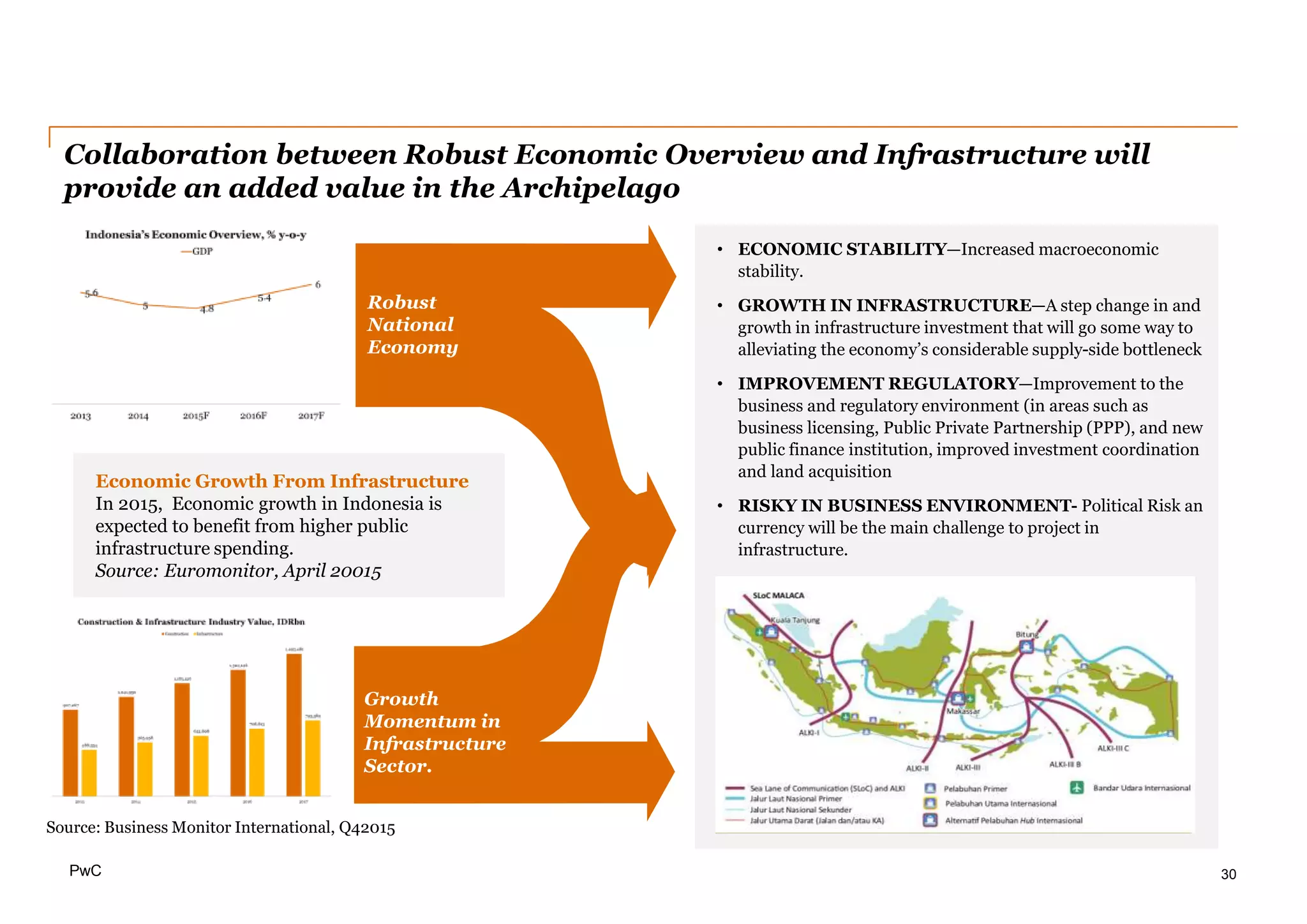
• ECONOMIC STABILITY—Increased macroeconomic
stability.
• GROWTH IN INFRASTRUCTURE—A step change in and
growth in infrastructure investment that will go some way to
alleviating the economy’s considerable supply-side bottleneck
• IMPROVEMENT REGULATORY—Improvement to the
business and regulatory environment (in areas such as
business licensing, Public Private Partnership (PPP), and new
public finance institution, improved investment coordination
and land acquisition
• RISKY IN BUSINESS ENVIRONMENT- Political Risk an
currency will be the main challenge to project in
infrastructure.
Robust
National
Economy
Economic Growth From Infrastructure
In 2015, Economic growth in Indonesia is
expected to benefit from higher public
infrastructure spending.
Source: Euromonitor, April 20015
Growth
Momentum in
Infrastructure
Sector.
Collaboration between Robust Economic Overview and Infrastructure will
provide an added value in the Archipelago
Source: Business Monitor International, Q42015
PwC | January 2014
Industry View
4
7/12/2016
PwC | January 2014
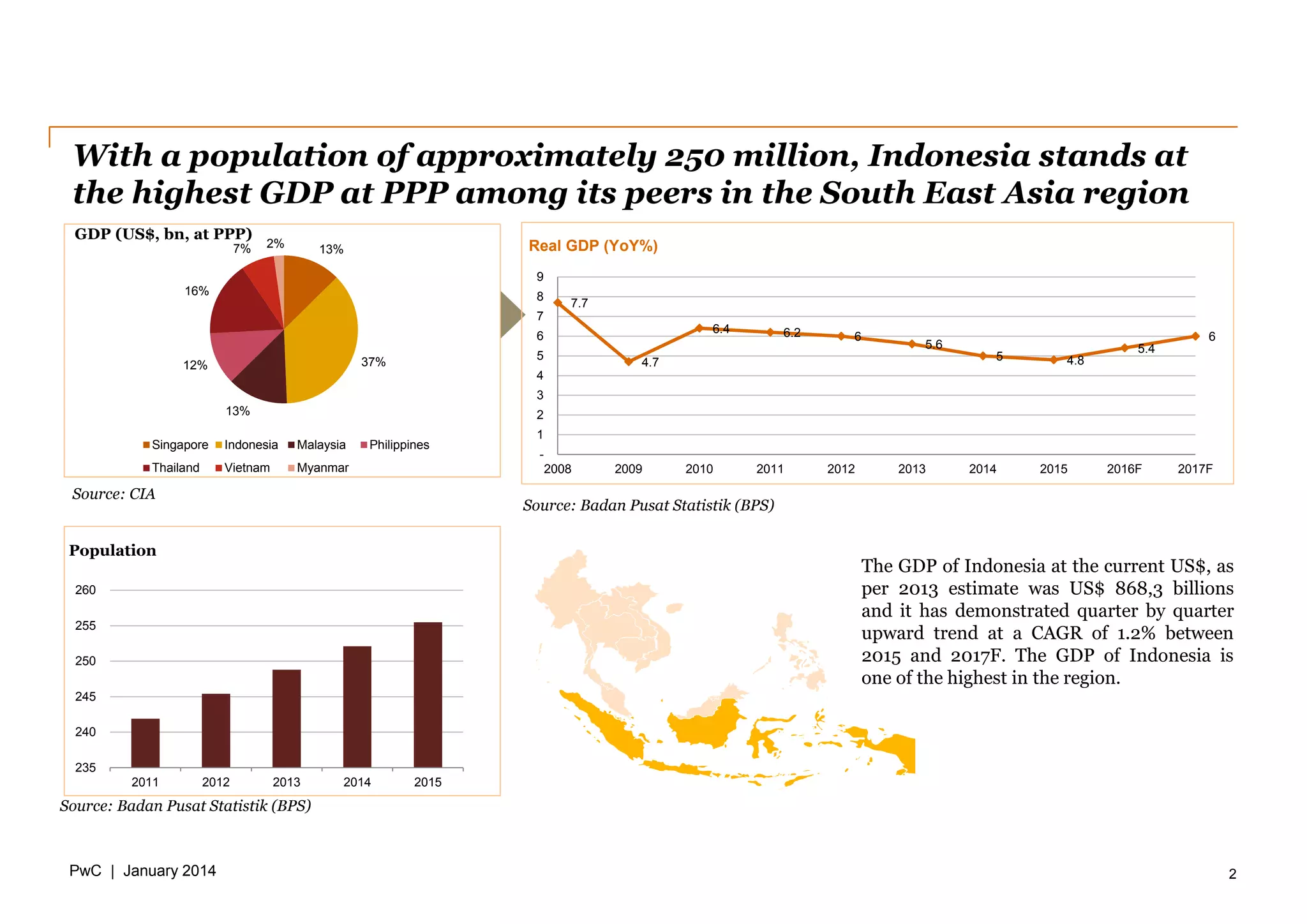
With a population of approximately 250 million, Indonesia stands at
the highest GDP at PPP among its peers in the South East Asia region
2
GDP (US$, bn, at PPP)
Source: CIA
Source: Badan Pusat Statistik (BPS)
The GDP of Indonesia at the current US$, as
per 2013 estimate was US$ 868,3 billions
and it has demonstrated quarter by quarter
upward trend at a CAGR of 1.2% between
2015 and 2017F. The GDP of Indonesia is
one of the highest in the region.
Population
235
240
245
250
255
260
2011 2012 2013 2014 2015
Source: Badan Pusat Statistik (BPS)
7.7
4.7
6.4 6.2 6
5.6
5 4.8
5.4
6
-
1
2
3
4
5
6
7
8
9
2008 2009 2010 2011 2012 2013 2014 2015 2016F 2017F
Real GDP (YoY%)13%
37%
13%
12%
16%
7% 2%
Singapore Indonesia Malaysia Philippines
Thailand Vietnam Myanmar
PwC | January 2014
The Outlook for Indonesia’s construction sector remains positive…
6
Source: MP3EI
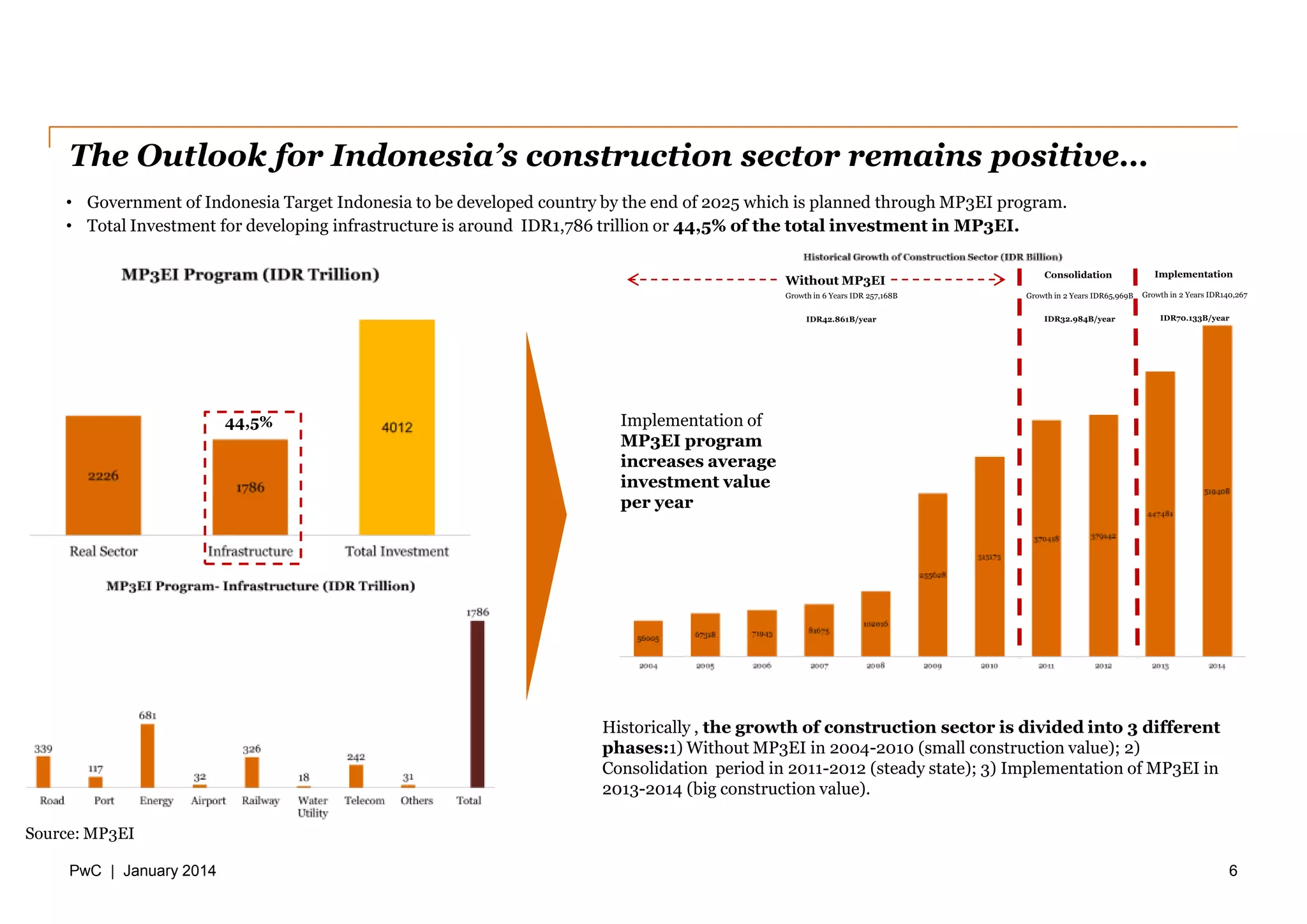
Historically , the growth of construction sector is divided into 3 different
phases:1) Without MP3EI in 2004-2010 (small construction value); 2)
Consolidation period in 2011-2012 (steady state); 3) Implementation of MP3EI in
2013-2014 (big construction value).
• Government of Indonesia Target Indonesia to be developed country by the end of 2025 which is planned through MP3EI program.
• Total Investment for developing infrastructure is around IDR1,786 trillion or 44,5% of the total investment in MP3EI.
44,5% Implementation of
MP3EI program
increases average
investment value
per year
Without MP3EI
Consolidation Implementation
Growth in 6 Years IDR 257,168B
IDR42.861B/year
Growth in 2 Years IDR65,969B
IDR32.984B/year
Growth in 2 Years IDR140,267
IDR70.133B/year
PwC | January 2014
The Outlook for Indonesia’s construction sector remains positive (cont’d)…
7
Source: Business Monitor International, Ltd, 2015
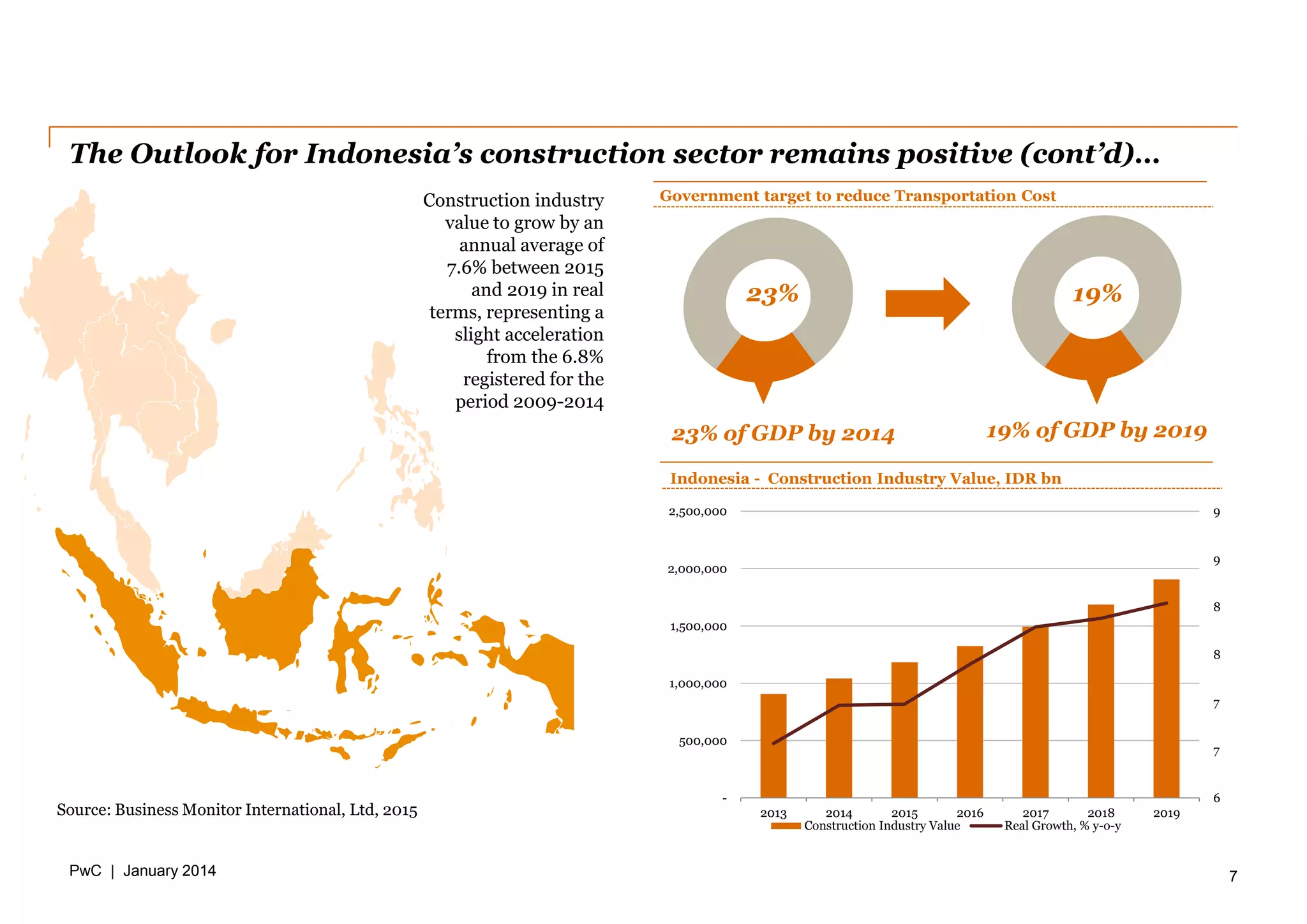
Construction industry
value to grow by an
annual average of
7.6% between 2015
and 2019 in real
terms, representing a
slight acceleration
from the 6.8%
registered for the
period 2009-2014
6
7
7
8
8
9
9
-
500,000
1,000,000
1,500,000
2,000,000
2,500,000
2013 2014 2015 2016 2017 2018 2019
Indonesia - Construction Industry Value, IDR bn
Construction Industry Value Real Growth, % y-o-y
Government target to reduce Transportation Cost
23% of GDP by 2014
23%
19% of GDP by 2019
19%
PwC | January 2014
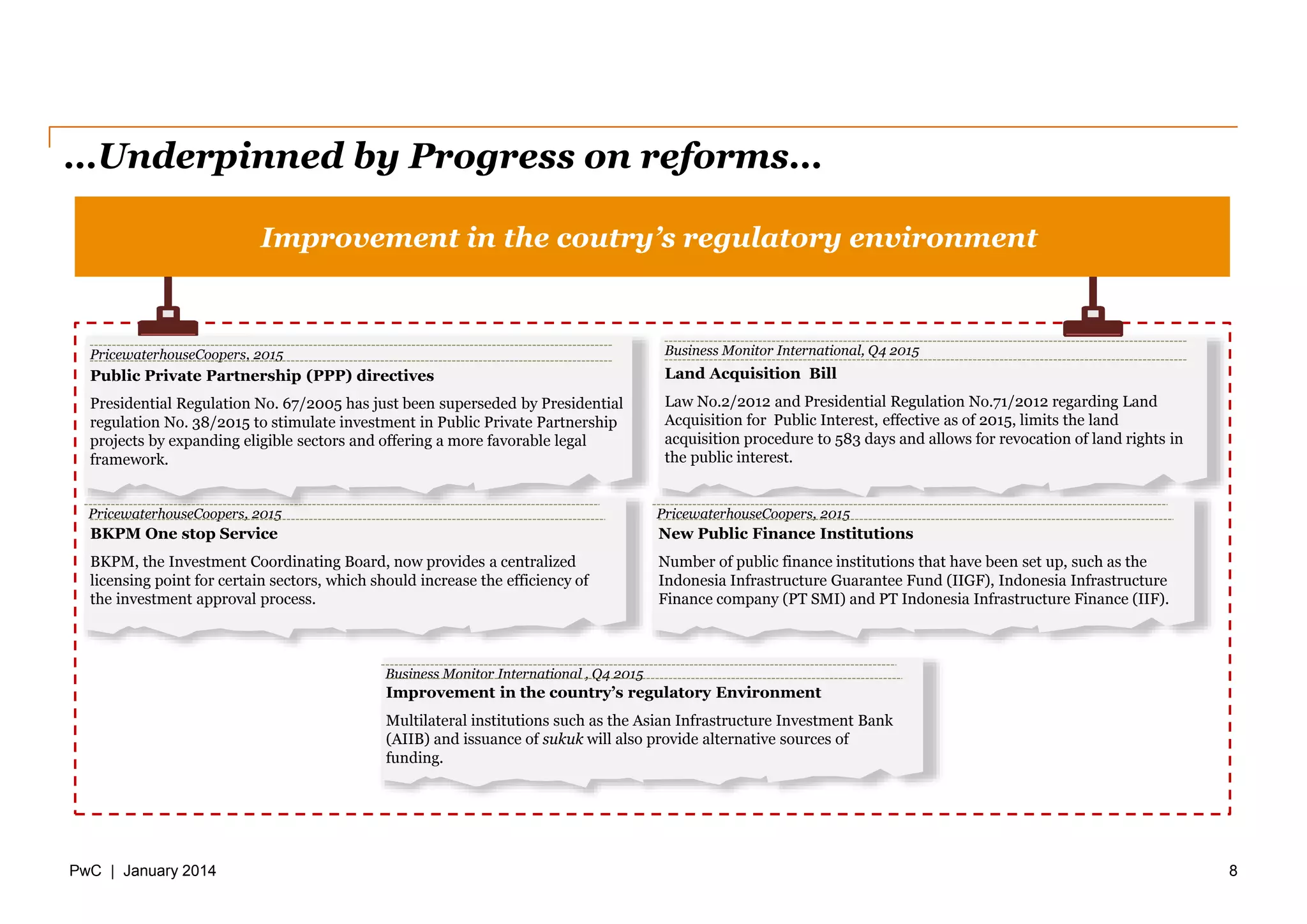
…Underpinned by Progress on reforms…
Improvement in the coutry’s regulatory environment
BKPM One stop Service
BKPM, the Investment Coordinating Board, now provides a centralized
licensing point for certain sectors, which should increase the efficiency of
the investment approval process.
PricewaterhouseCoopers, 2015
Land Acquisition Bill
Law No.2/2012 and Presidential Regulation No.71/2012 regarding Land
Acquisition for Public Interest, effective as of 2015, limits the land
acquisition procedure to 583 days and allows for revocation of land rights in
the public interest.
Business Monitor International, Q4 2015
Public Private Partnership (PPP) directives
Presidential Regulation No. 67/2005 has just been superseded by Presidential
regulation No. 38/2015 to stimulate investment in Public Private Partnership
projects by expanding eligible sectors and offering a more favorable legal
framework.
PricewaterhouseCoopers, 2015
8
New Public Finance Institutions
Number of public finance institutions that have been set up, such as the
Indonesia Infrastructure Guarantee Fund (IIGF), Indonesia Infrastructure
Finance company (PT SMI) and PT Indonesia Infrastructure Finance (IIF).
PricewaterhouseCoopers, 2015
Improvement in the country’s regulatory Environment
Multilateral institutions such as the Asian Infrastructure Investment Bank
(AIIB) and issuance of sukuk will also provide alternative sources of
funding.
Business Monitor International , Q4 2015
PwC | January 2014
….and Progress on Tendering and Contract Awarding
9
Source: Business Monitor International, Q42015
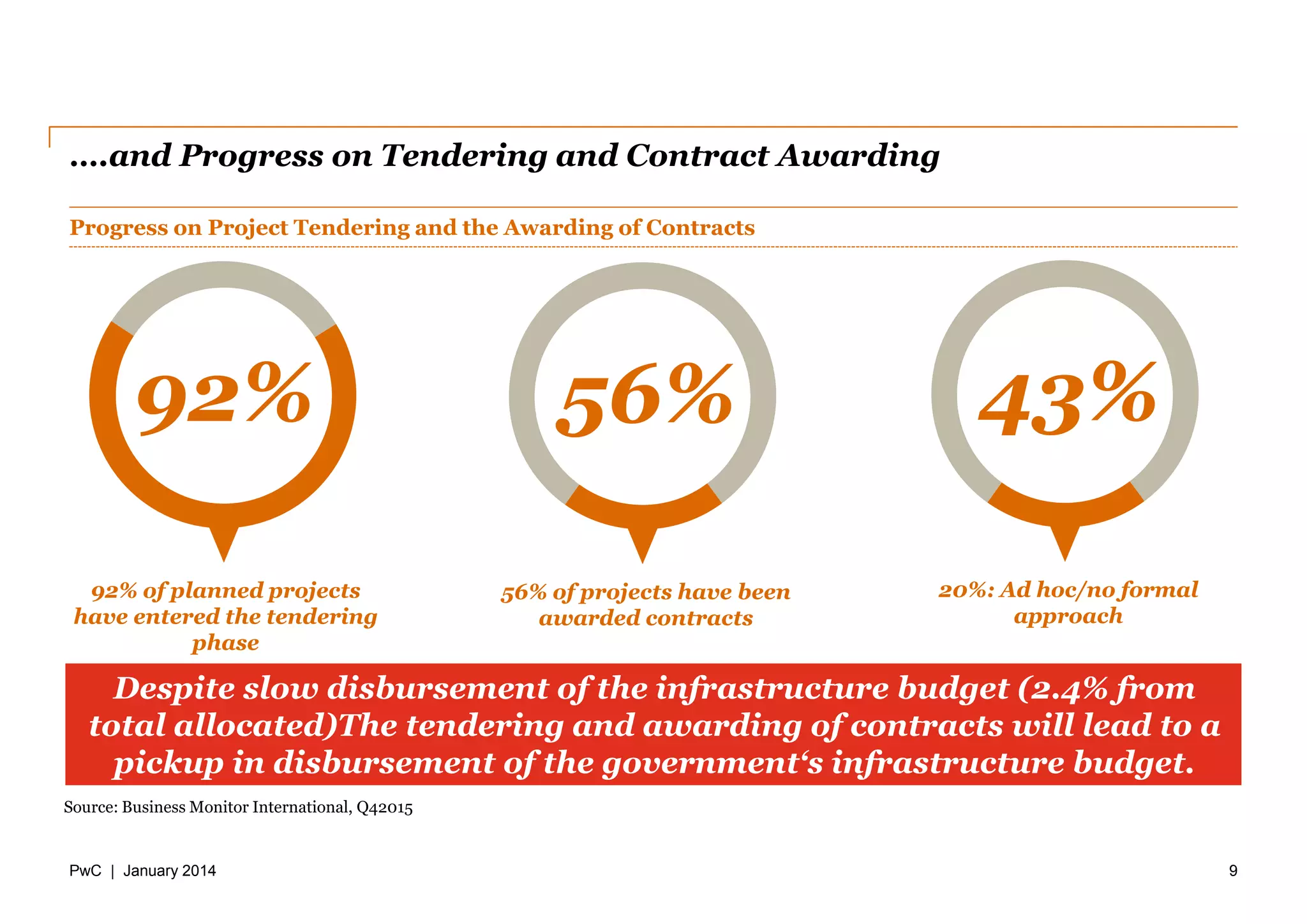
Progress on Project Tendering and the Awarding of Contracts
56% of projects have been
awarded contracts
56%
Despite slow disbursement of the infrastructure budget (2.4% from
total allocated)The tendering and awarding of contracts will lead to a
pickup in disbursement of the government‘s infrastructure budget.
20%: Ad hoc/no formal
approach
43%
92% of planned projects
have entered the tendering
phase
92%
PwC | January 2014
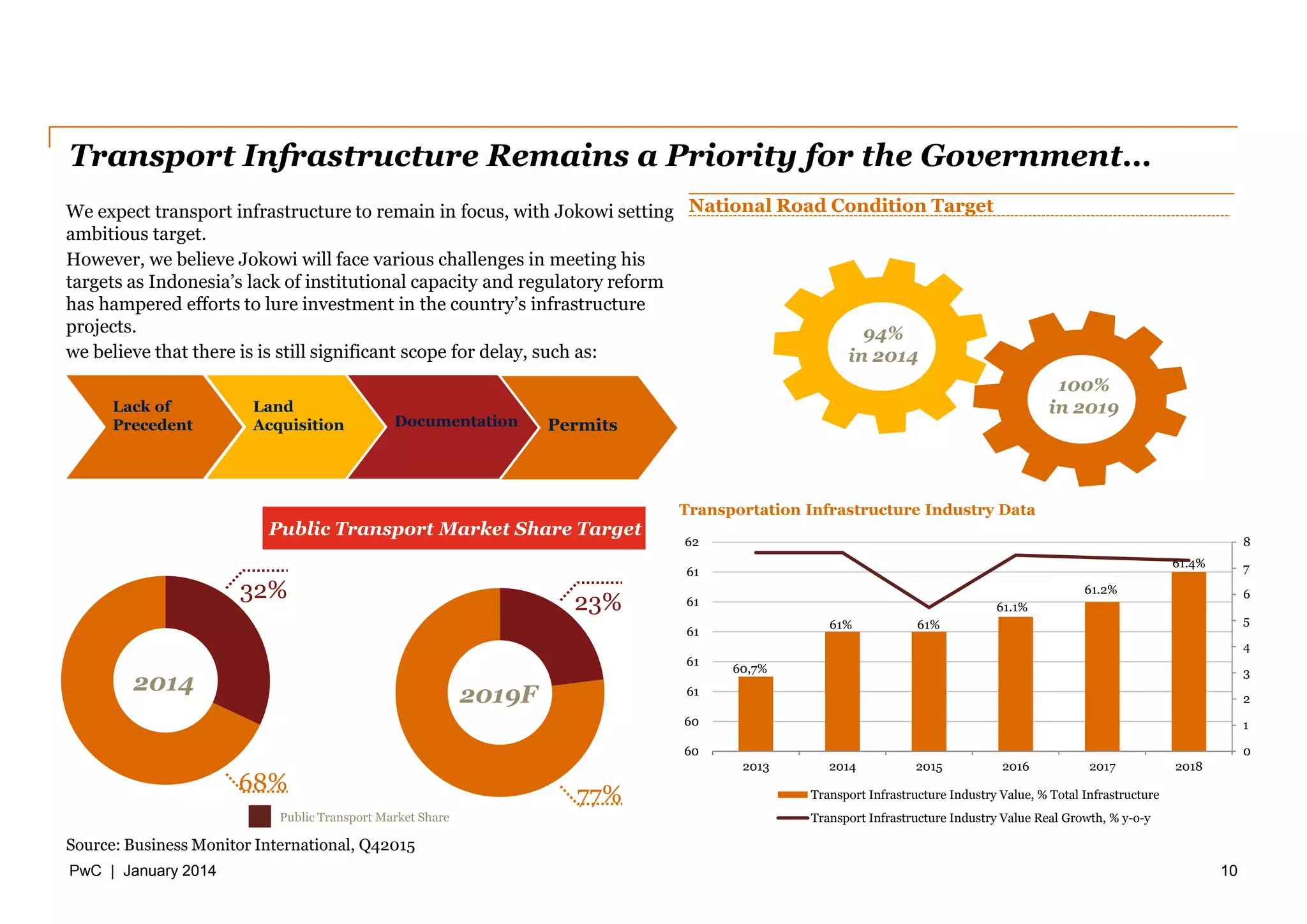
Transport Infrastructure Remains a Priority for the Government…
10
Source: Business Monitor International, Q42015
0
1
2
3
4
5
6
7
8
60
60
61
61
61
61
61
62
2013 2014 2015 2016 2017 2018
Transportation Infrastructure Industry Data
Transport Infrastructure Industry Value, % Total Infrastructure
Transport Infrastructure Industry Value Real Growth, % y-o-y
60,7%
61% 61%
61.1%
61.2%
61.4%
We expect transport infrastructure to remain in focus, with Jokowi setting
ambitious target.
However, we believe Jokowi will face various challenges in meeting his
targets as Indonesia’s lack of institutional capacity and regulatory reform
has hampered efforts to lure investment in the country’s infrastructure
projects.
we believe that there is is still significant scope for delay, such as:
Public Transport Market Share
2019F
23%
77%
Public Transport Market Share Target
2014
32%
68%
National Road Condition Target
94%
in 2014
100%
in 2019Lack of
Precedent
Land
Acquisition Documentation Permits
PwC | January 2014
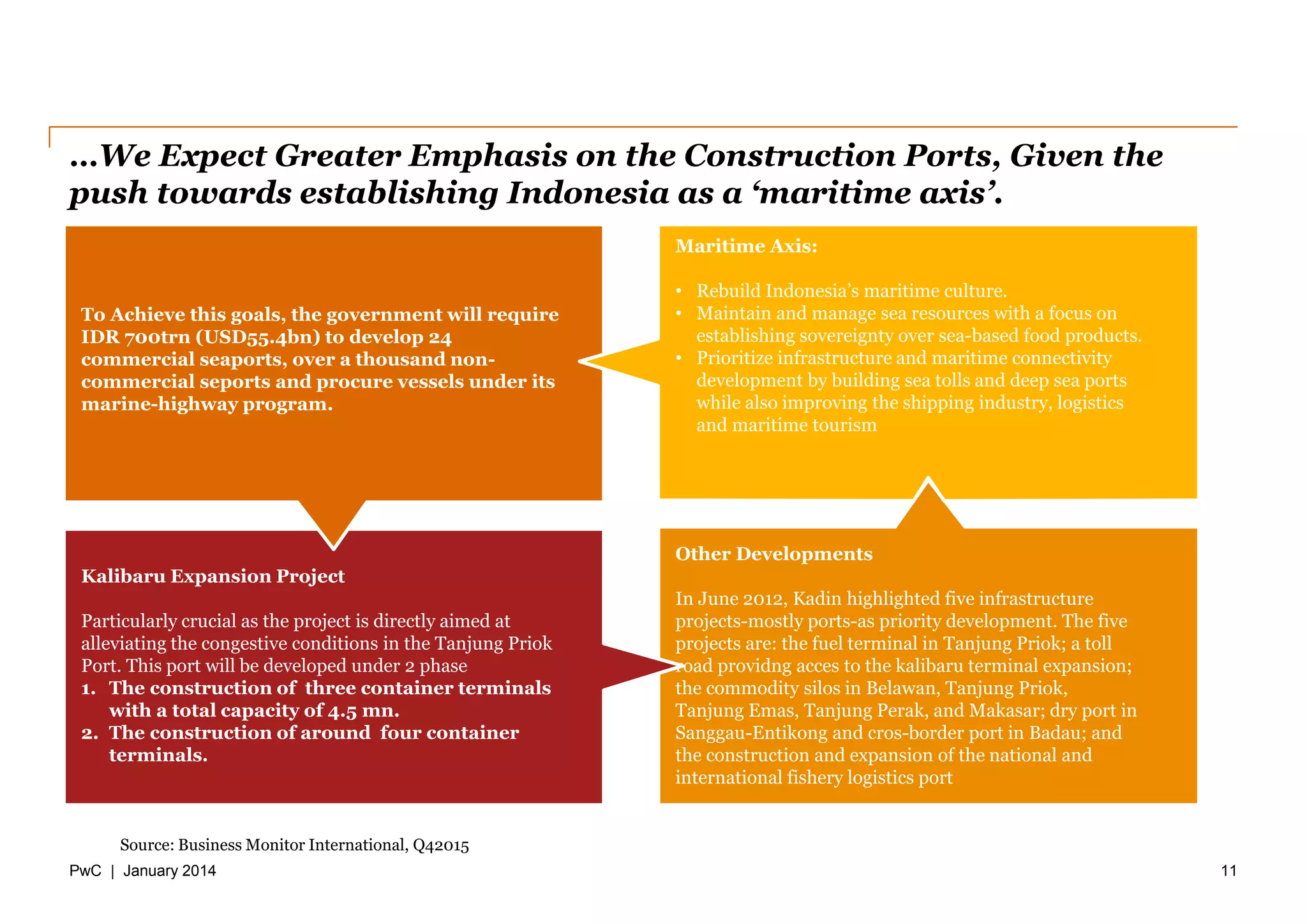
…We Expect Greater Emphasis on the Construction Ports, Given the
push towards establishing Indonesia as a ‘maritime axis’.
11
Source: Business Monitor International, Q42015
To Achieve this goals, the government will require
IDR 700trn (USD55.4bn) to develop 24
commercial seaports, over a thousand non-
commercial seports and procure vessels under its
marine-highway program.
Maritime Axis:
• Rebuild Indonesia’s maritime culture.
• Maintain and manage sea resources with a focus on
establishing sovereignty over sea-based food products.
• Prioritize infrastructure and maritime connectivity
development by building sea tolls and deep sea ports
while also improving the shipping industry, logistics
and maritime tourism
Kalibaru Expansion Project
Particularly crucial as the project is directly aimed at
alleviating the congestive conditions in the Tanjung Priok
Port. This port will be developed under 2 phase
1. The construction of three container terminals
with a total capacity of 4.5 mn.
2. The construction of around four container
terminals.
Other Developments
In June 2012, Kadin highlighted five infrastructure
projects-mostly ports-as priority development. The five
projects are: the fuel terminal in Tanjung Priok; a toll
road providng acces to the kalibaru terminal expansion;
the commodity silos in Belawan, Tanjung Priok,
Tanjung Emas, Tanjung Perak, and Makasar; dry port in
Sanggau-Entikong and cros-border port in Badau; and
the construction and expansion of the national and
international fishery logistics port
PwC | January 2014
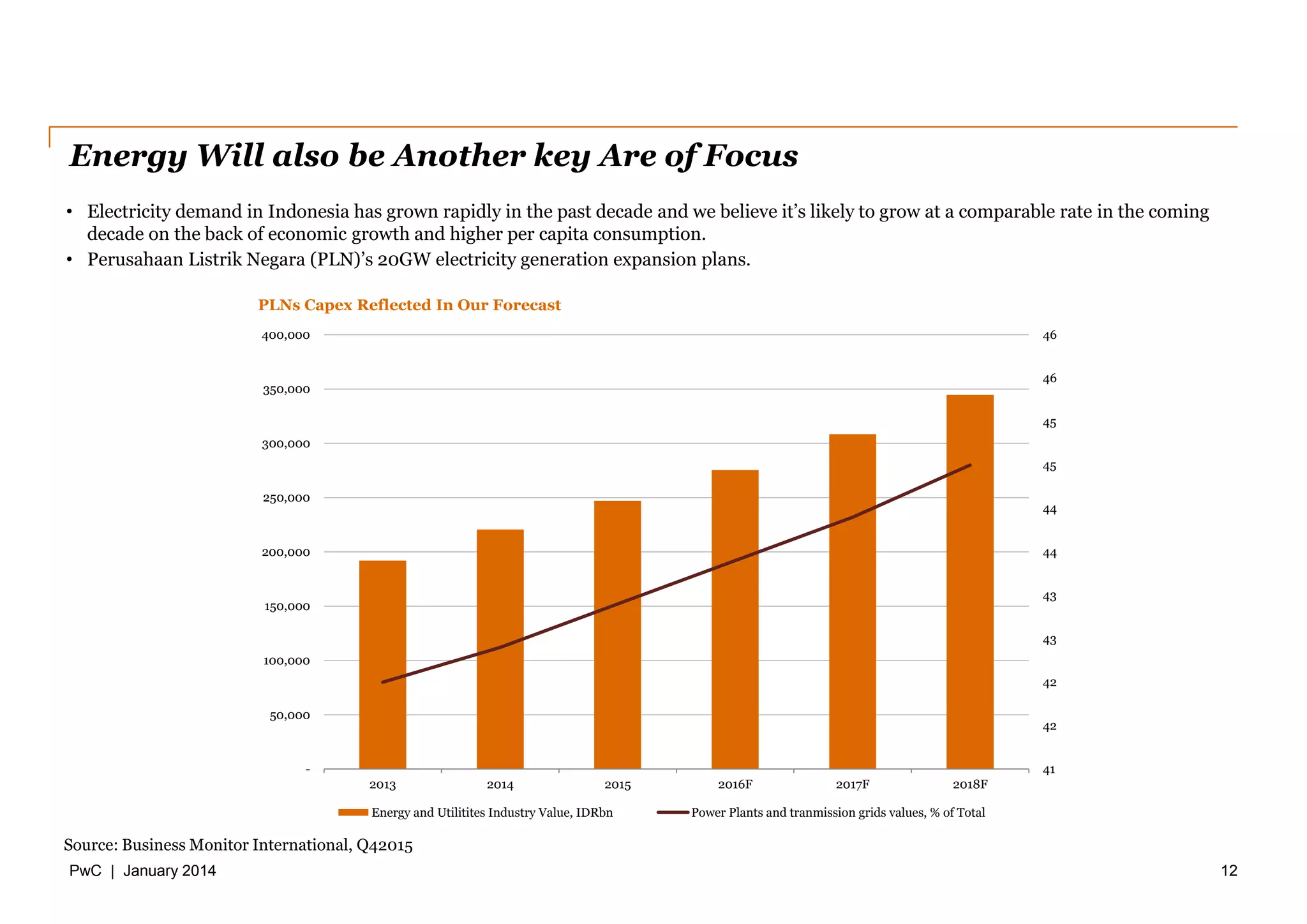
Energy Will also be Another key Are of Focus
12
Source: Business Monitor International, Q42015
• Electricity demand in Indonesia has grown rapidly in the past decade and we believe it’s likely to grow at a comparable rate in the coming
decade on the back of economic growth and higher per capita consumption.
• Perusahaan Listrik Negara (PLN)’s 20GW electricity generation expansion plans.
41
42
42
43
43
44
44
45
45
46
46
-
50,000
100,000
150,000
200,000
250,000
300,000
350,000
400,000
2013 2014 2015 2016F 2017F 2018F
PLNs Capex Reflected In Our Forecast
Energy and Utilitites Industry Value, IDRbn Power Plants and tranmission grids values, % of Total
PwC | January 2014
Risk analysis
13
7/12/2016
PwC | January 2014
Risk Analysis
14
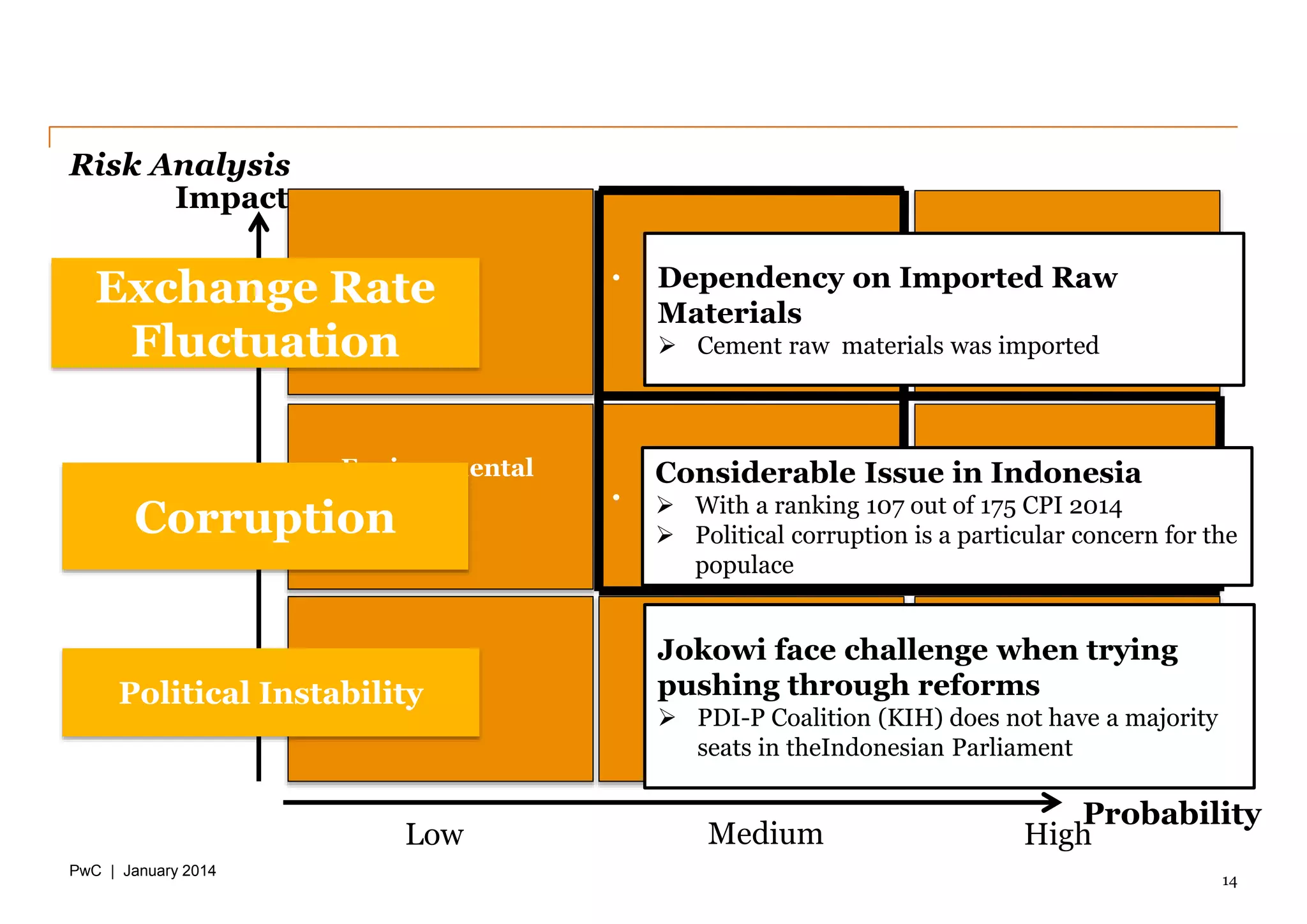
• Political
Instability
• Environmental
Issues • Exchange Rate • Corruption
• Rise in Direct
Labor Cost
• Economic Risk
Probability
Low Medium High
Minor
Impact
Moderate
Significant
Political Instability
Corruption
Exchange Rate
Fluctuation
Jokowi face challenge when trying
pushing through reforms
 PDI-P Coalition (KIH) does not have a majority
seats in theIndonesian Parliament
Considerable Issue in Indonesia
 With a ranking 107 out of 175 CPI 2014
 Political corruption is a particular concern for the
populace
Dependency on Imported Raw
Materials
 Cement raw materials was imported
PwC | January 2014
Trends and Outlook in Infrastructure
Sectors
15
7/12/2016
PwC | January 2014
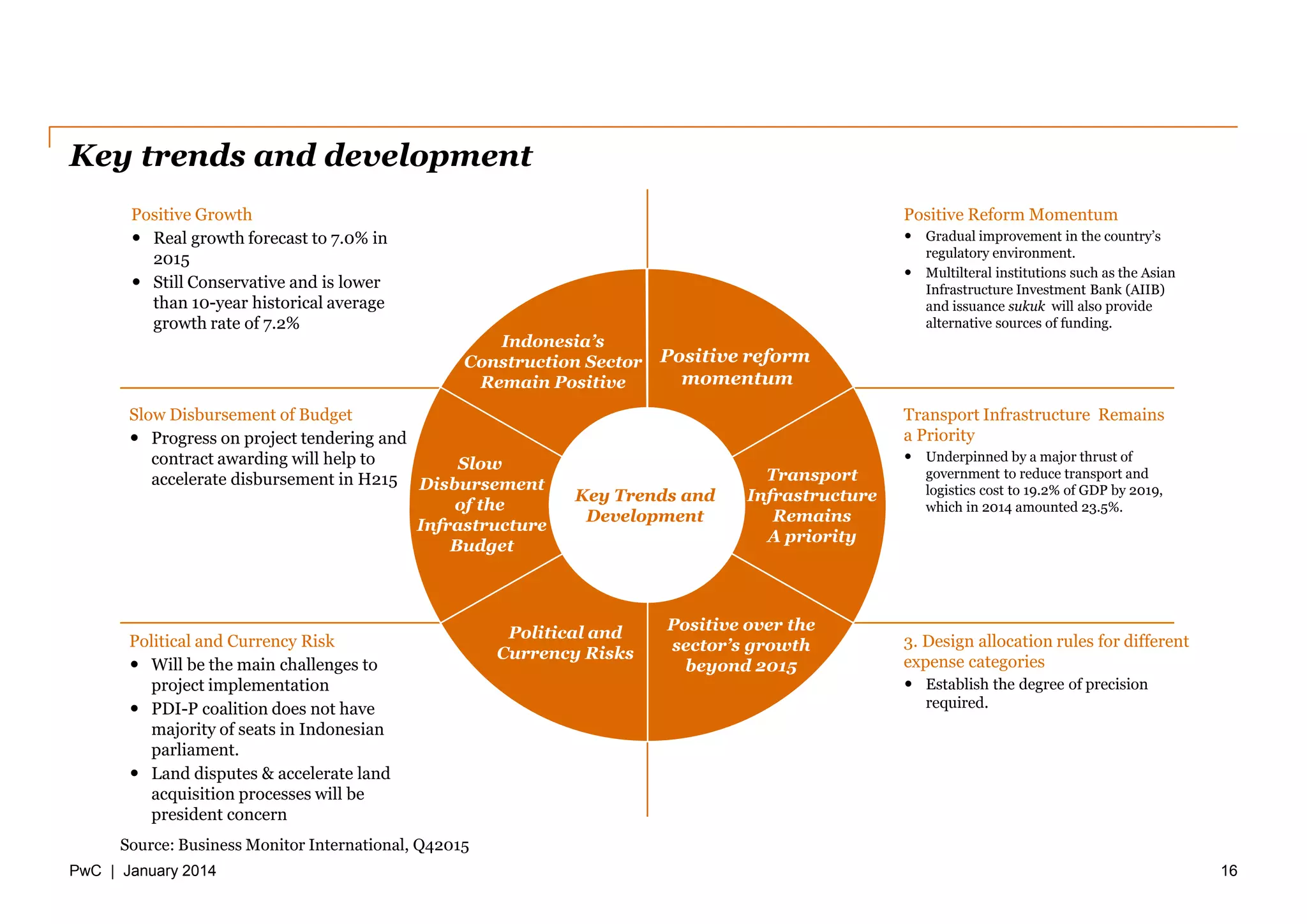
Key trends and development
16
Key Trends and
Development
Indonesia’s
Construction Sector
Remain Positive
Positive reform
momentum
Transport
Infrastructure
Remains
A priority
Slow
Disbursement
of the
Infrastructure
Budget
Political and
Currency Risks
Positive over the
sector’s growth
beyond 2015
Positive Growth
 Real growth forecast to 7.0% in
2015
 Still Conservative and is lower
than 10-year historical average
growth rate of 7.2%
Slow Disbursement of Budget
 Progress on project tendering and
contract awarding will help to
accelerate disbursement in H215
Political and Currency Risk
 Will be the main challenges to
project implementation
 PDI-P coalition does not have
majority of seats in Indonesian
parliament.
 Land disputes & accelerate land
acquisition processes will be
president concern
Positive Reform Momentum
 Gradual improvement in the country’s
regulatory environment.
 Multilteral institutions such as the Asian
Infrastructure Investment Bank (AIIB)
and issuance sukuk will also provide
alternative sources of funding.
Transport Infrastructure Remains
a Priority
 Underpinned by a major thrust of
government to reduce transport and
logistics cost to 19.2% of GDP by 2019,
which in 2014 amounted 23.5%.
3. Design allocation rules for different
expense categories
 Establish the degree of precision
required.
Source: Business Monitor International, Q42015
PwC | January 2014
Company Profile
17
7/12/2016
PwC | January 2014
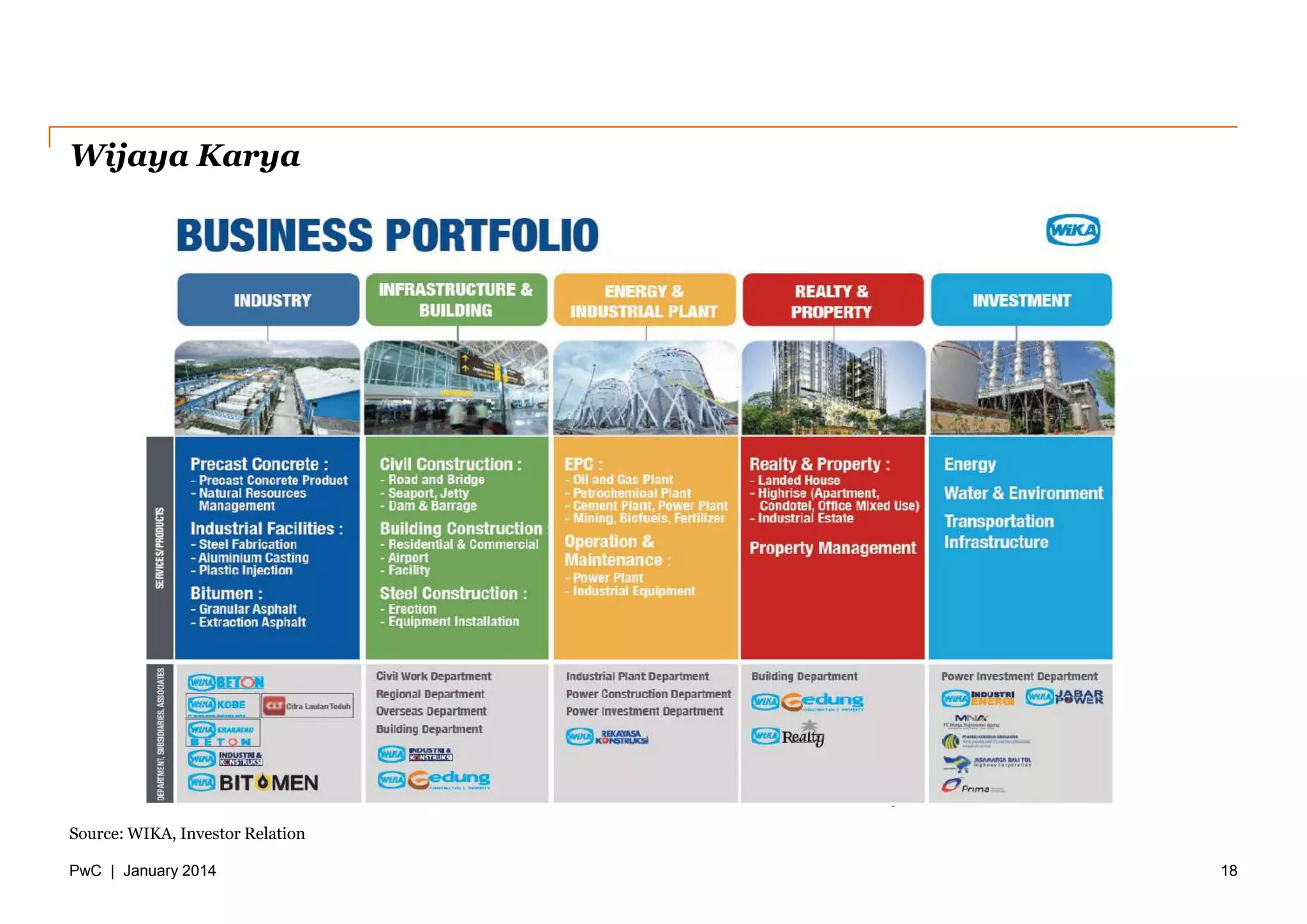
Wijaya Karya
18
Source: WIKA, Investor Relation
PwC | January 2014
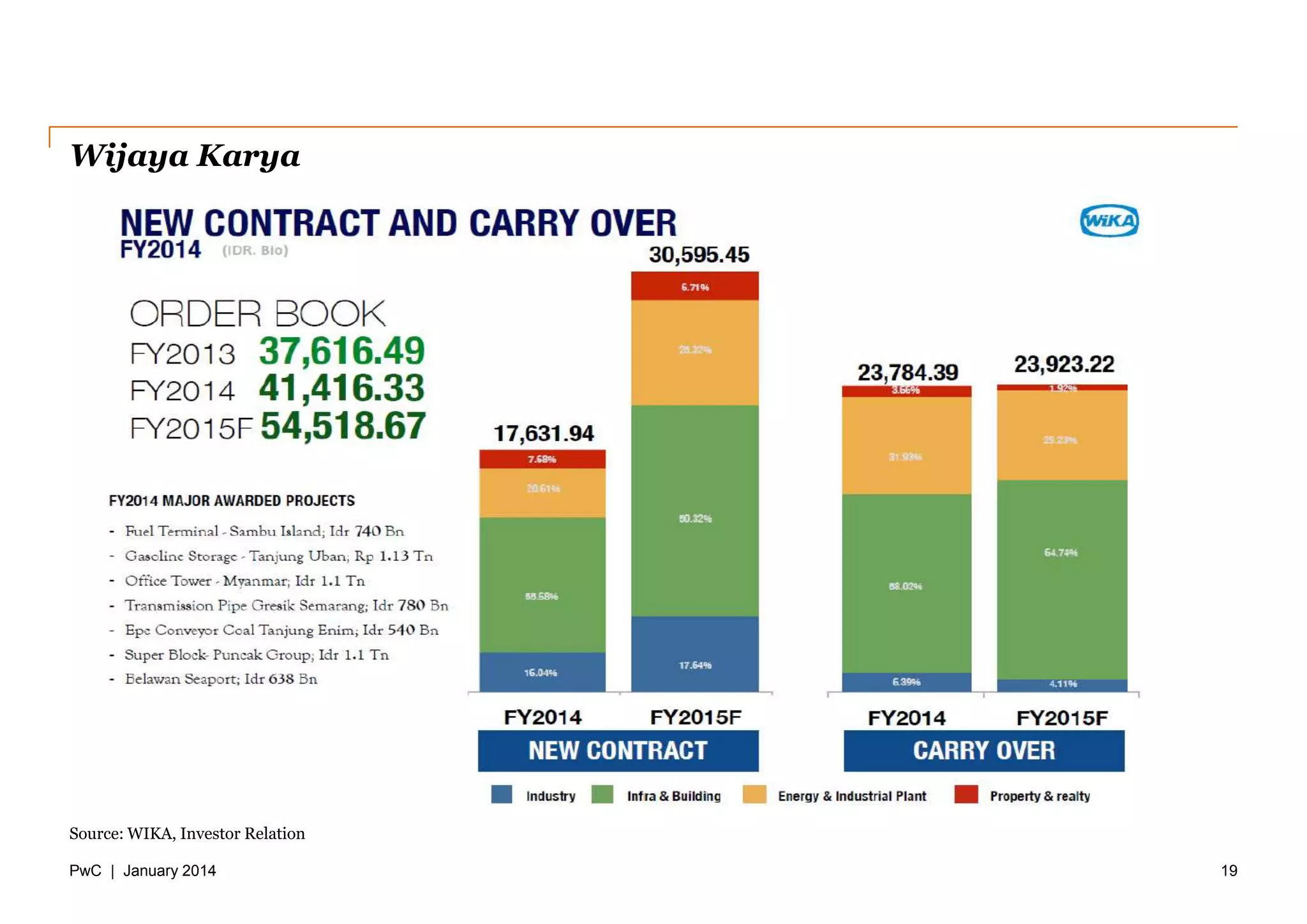
Wijaya Karya
19
Source: WIKA, Investor Relation
PwC | January 2014
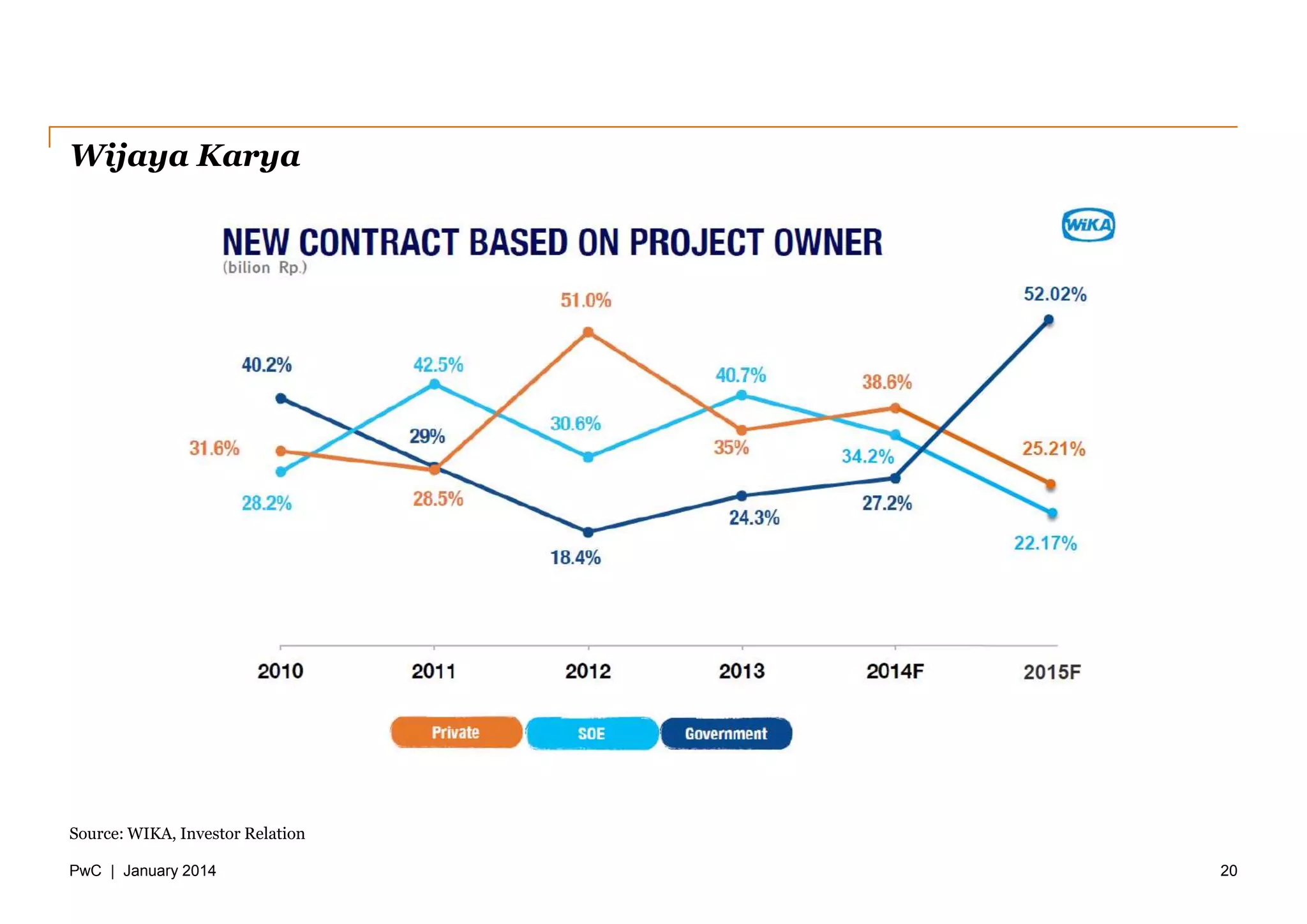
Wijaya Karya
20
Source: WIKA, Investor Relation
PwC | January 2014
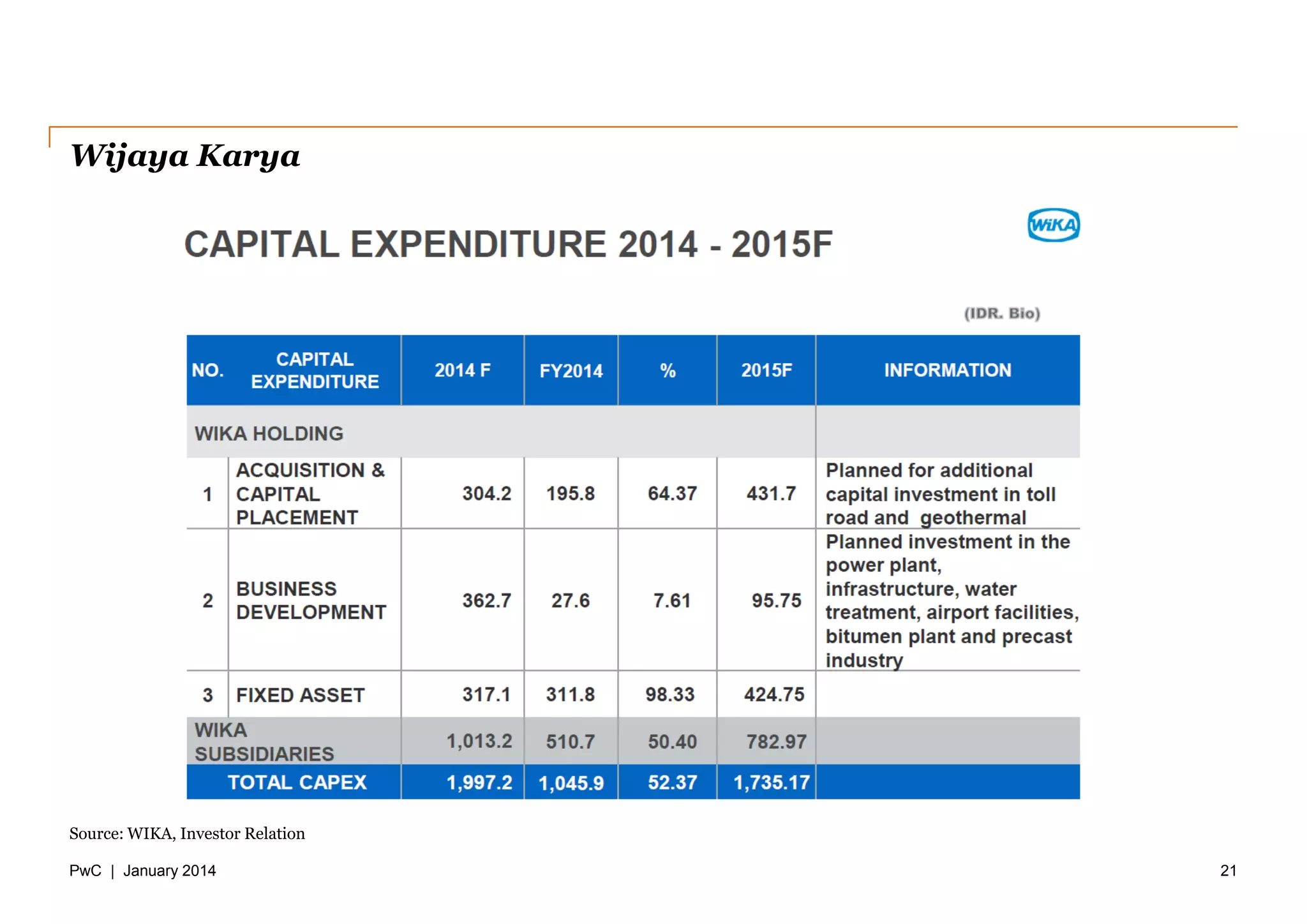
Wijaya Karya
21
Source: WIKA, Investor Relation
PwC | January 2014
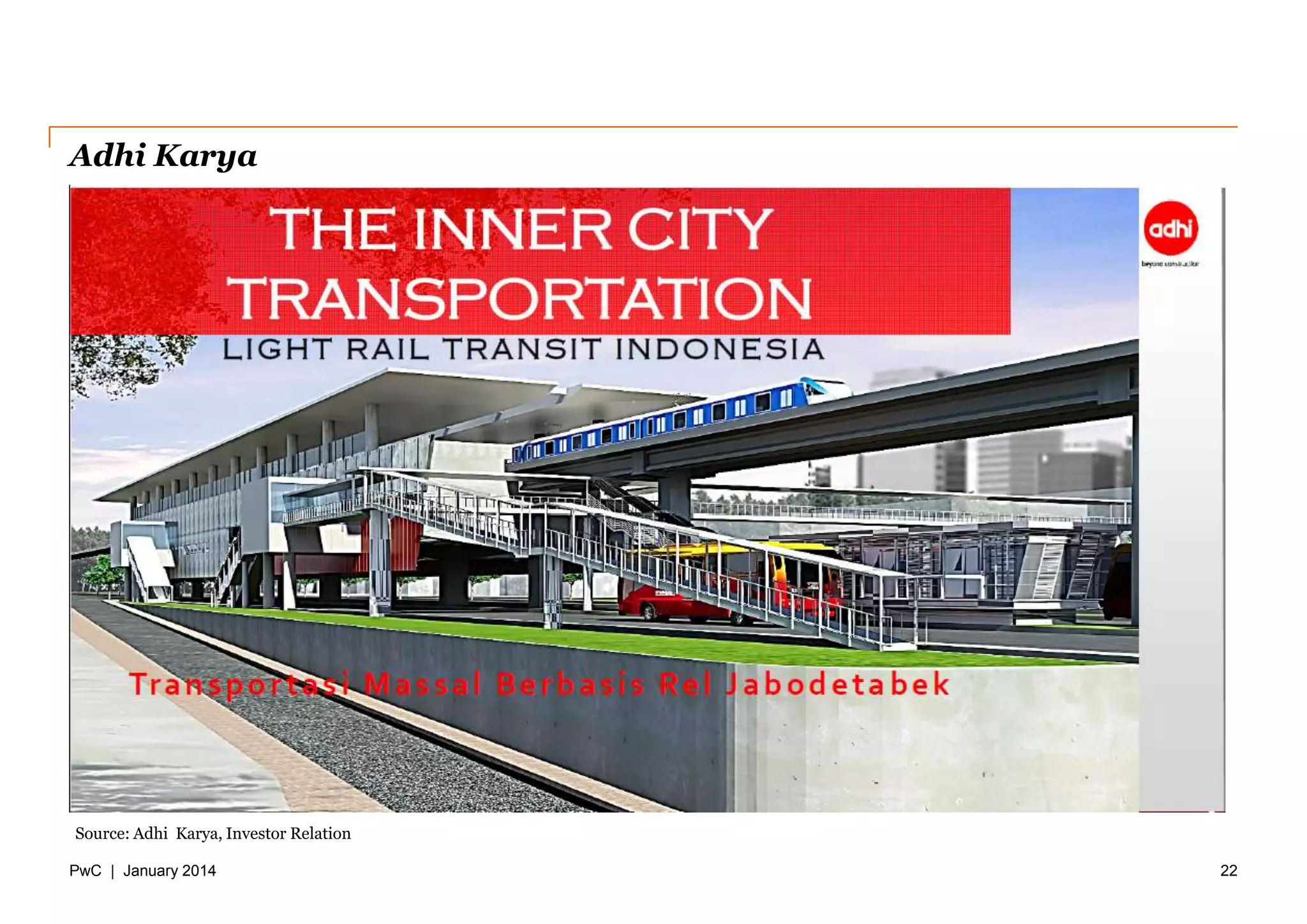
Adhi Karya
22
Source: Adhi Karya, Investor Relation
Construction industry value to grow by an annual average of 7.6% between 2015
and 2019 in real terms, representing a slight acceleration from the 6.8% registered
for the period 2009-2014
PwC | January 2014
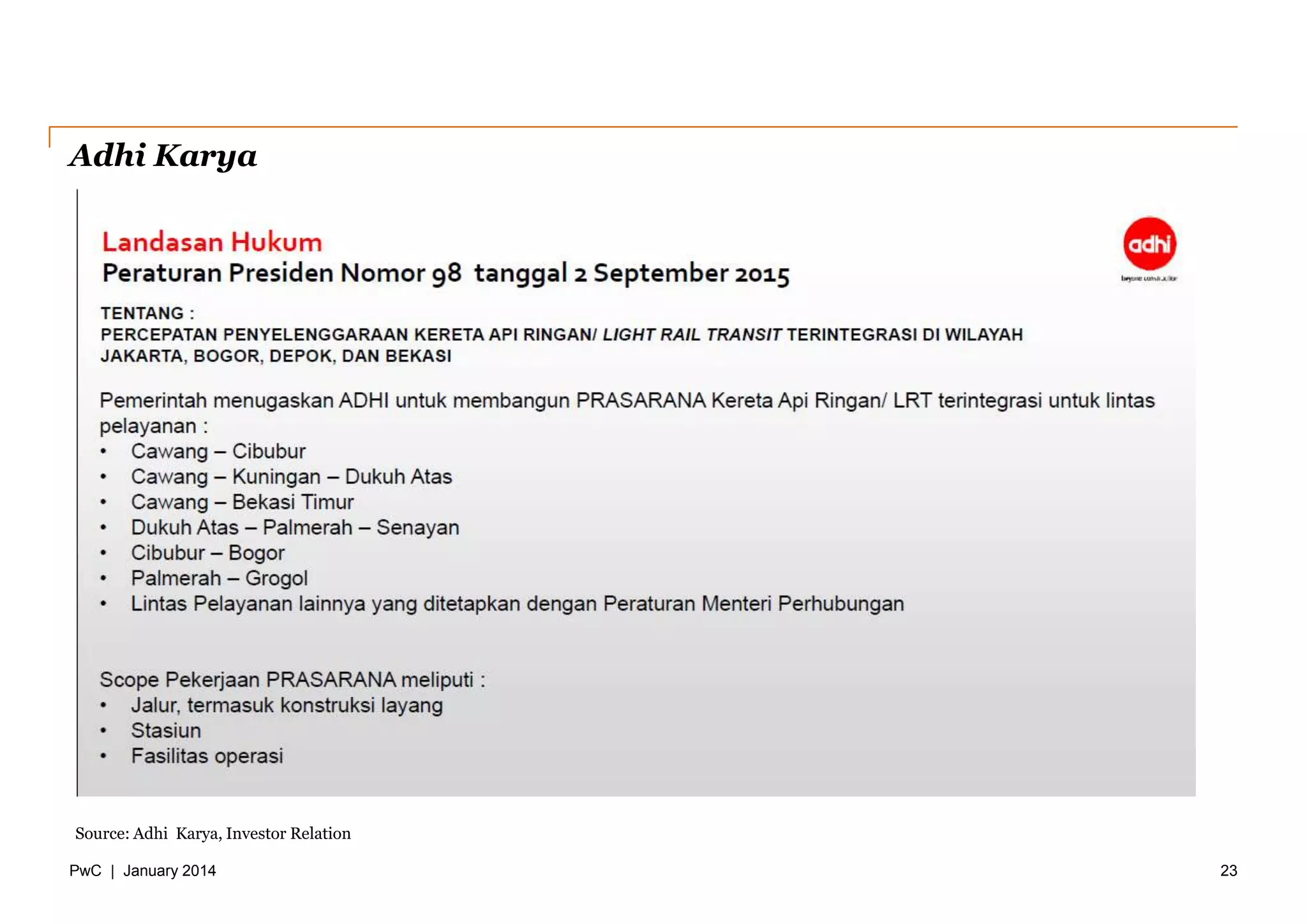
Adhi Karya
23
Source: Adhi Karya, Investor Relation
PwC | January 2014
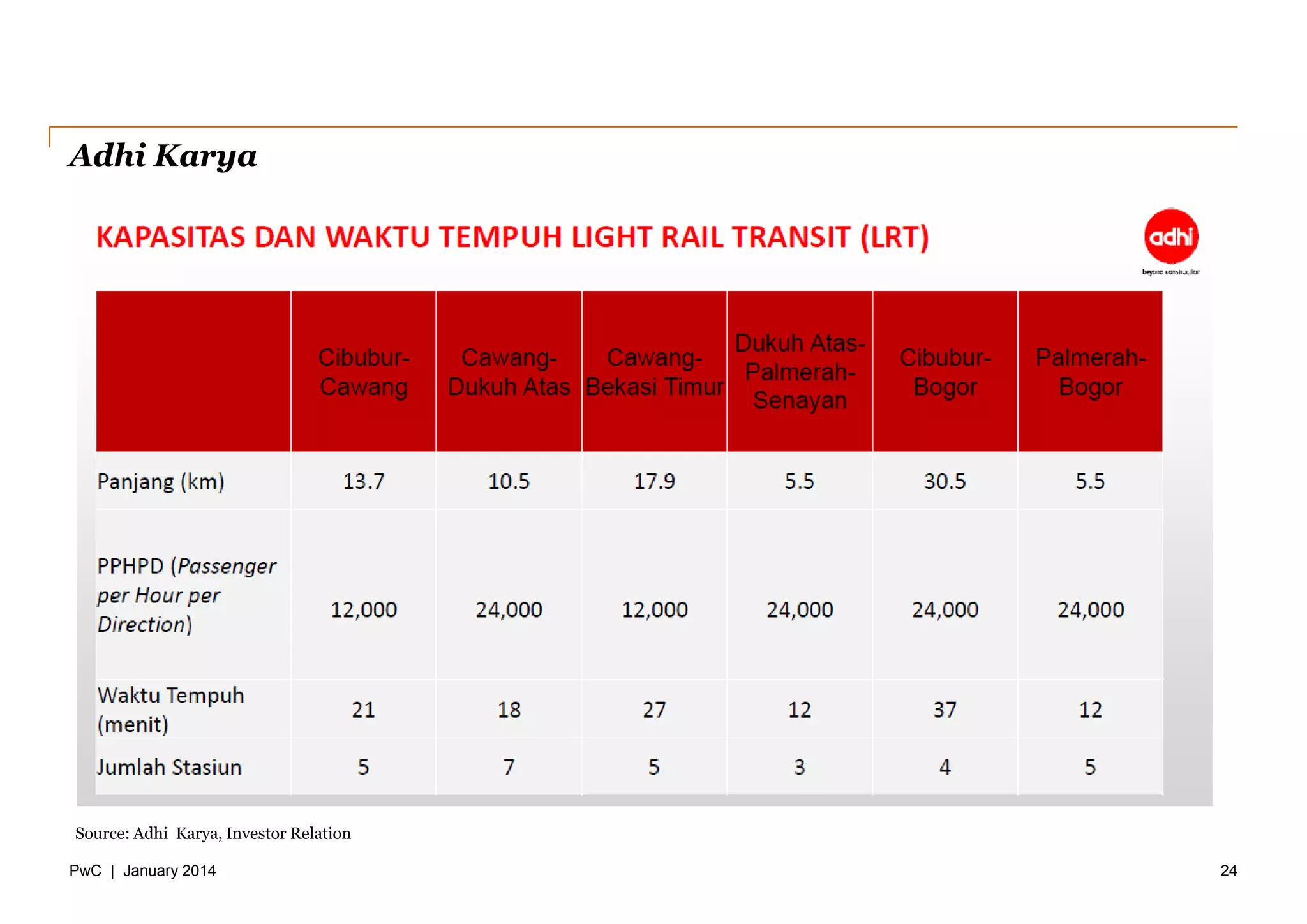
Adhi Karya
24
Source: Adhi Karya, Investor Relation
PwC | January 2014
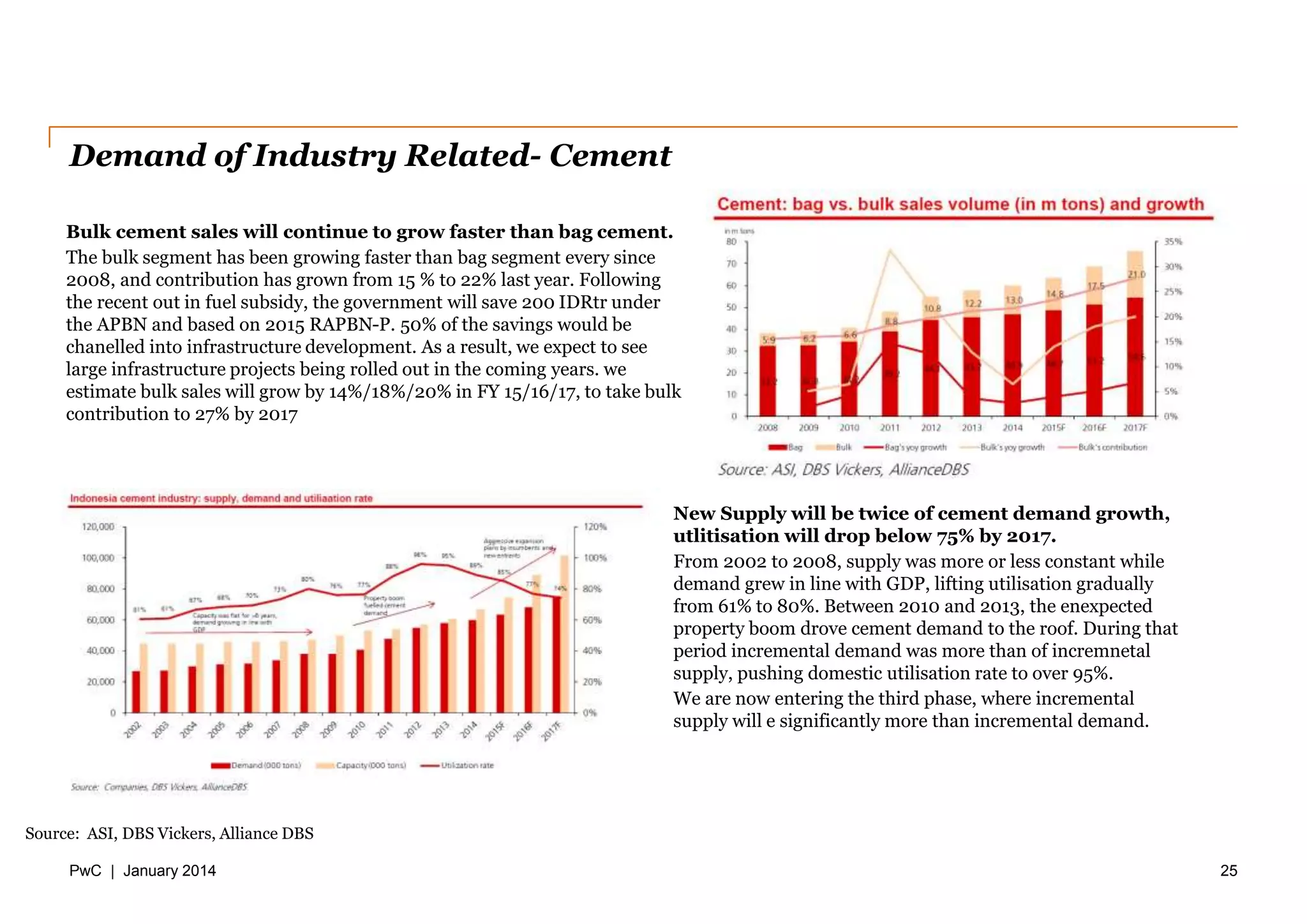
Demand of Industry Related- Cement
25
Source: ASI, DBS Vickers, Alliance DBS
Bulk cement sales will continue to grow faster than bag cement.
The bulk segment has been growing faster than bag segment every since
2008, and contribution has grown from 15 % to 22% last year. Following
the recent out in fuel subsidy, the government will save 200 IDRtr under
the APBN and based on 2015 RAPBN-P. 50% of the savings would be
chanelled into infrastructure development. As a result, we expect to see
large infrastructure projects being rolled out in the coming years. we
estimate bulk sales will grow by 14%/18%/20% in FY 15/16/17, to take bulk
contribution to 27% by 2017
New Supply will be twice of cement demand growth,
utlitisation will drop below 75% by 2017.
From 2002 to 2008, supply was more or less constant while
demand grew in line with GDP, lifting utilisation gradually
from 61% to 80%. Between 2010 and 2013, the enexpected
property boom drove cement demand to the roof. During that
period incremental demand was more than of incremnetal
supply, pushing domestic utilisation rate to over 95%.
We are now entering the third phase, where incremental
supply will e significantly more than incremental demand.
PwC | January 2014
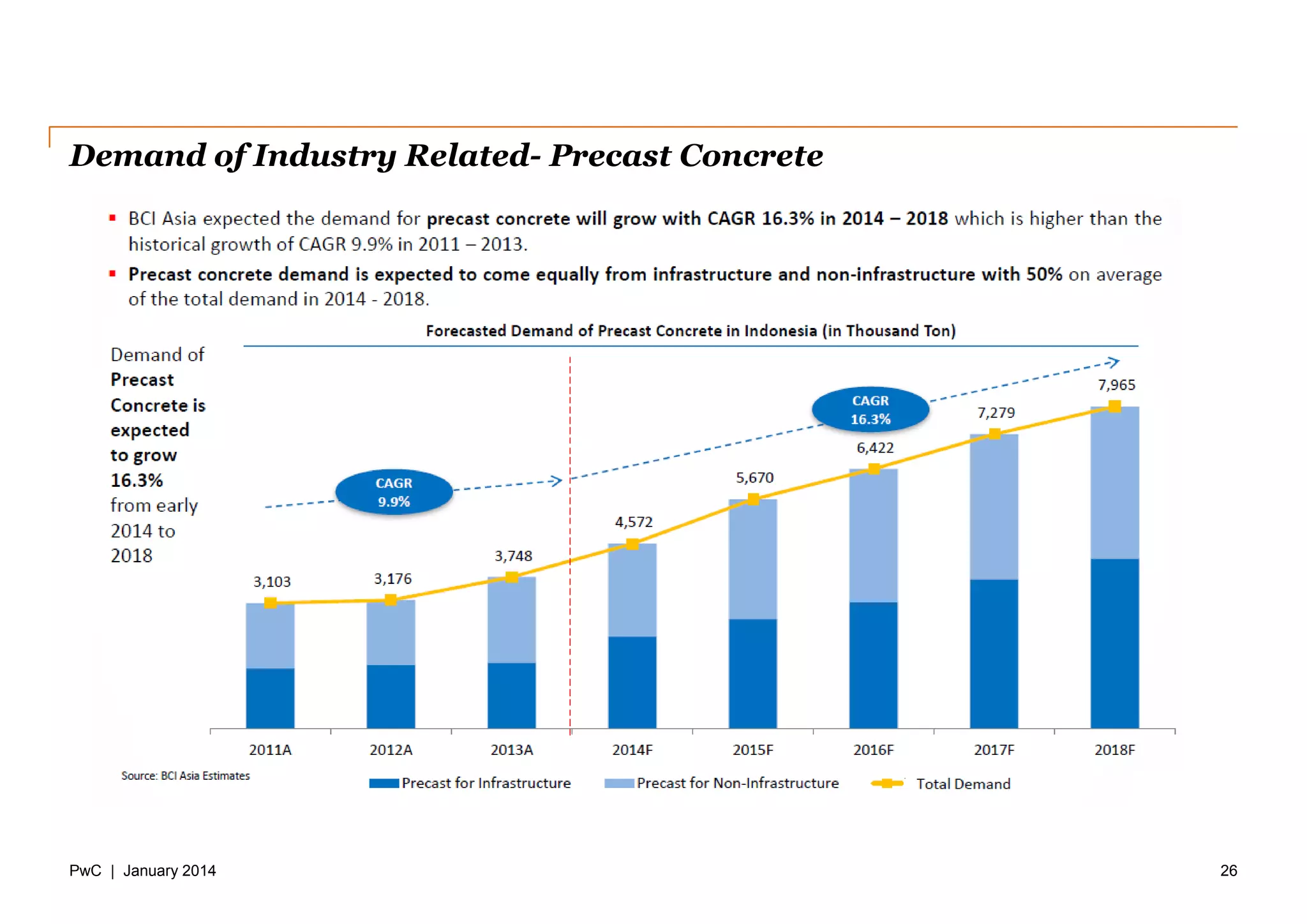
Demand of Industry Related- Precast Concrete
26
PwC | January 2014
Thank You
27
7/12/2016

Infrastructure

  • 1.
    Infrastructure in theArchipelago Rebuilding the Optimism Asakita Dikarla Muhamad
  • 2.
    PwC | January2014 Overview 2 7/12/2016
  • 3.
    PwC 30 • ECONOMICSTABILITY—Increased macroeconomic stability. • GROWTH IN INFRASTRUCTURE—A step change in and growth in infrastructure investment that will go some way to alleviating the economy’s considerable supply-side bottleneck • IMPROVEMENT REGULATORY—Improvement to the business and regulatory environment (in areas such as business licensing, Public Private Partnership (PPP), and new public finance institution, improved investment coordination and land acquisition • RISKY IN BUSINESS ENVIRONMENT- Political Risk an currency will be the main challenge to project in infrastructure. Robust National Economy Economic Growth From Infrastructure In 2015, Economic growth in Indonesia is expected to benefit from higher public infrastructure spending. Source: Euromonitor, April 20015 Growth Momentum in Infrastructure Sector. Collaboration between Robust Economic Overview and Infrastructure will provide an added value in the Archipelago Source: Business Monitor International, Q42015
  • 4.
    PwC | January2014 Industry View 4 7/12/2016
  • 5.
    PwC | January2014 With a population of approximately 250 million, Indonesia stands at the highest GDP at PPP among its peers in the South East Asia region 2 GDP (US$, bn, at PPP) Source: CIA Source: Badan Pusat Statistik (BPS) The GDP of Indonesia at the current US$, as per 2013 estimate was US$ 868,3 billions and it has demonstrated quarter by quarter upward trend at a CAGR of 1.2% between 2015 and 2017F. The GDP of Indonesia is one of the highest in the region. Population 235 240 245 250 255 260 2011 2012 2013 2014 2015 Source: Badan Pusat Statistik (BPS) 7.7 4.7 6.4 6.2 6 5.6 5 4.8 5.4 6 - 1 2 3 4 5 6 7 8 9 2008 2009 2010 2011 2012 2013 2014 2015 2016F 2017F Real GDP (YoY%)13% 37% 13% 12% 16% 7% 2% Singapore Indonesia Malaysia Philippines Thailand Vietnam Myanmar
  • 6.
    PwC | January2014 The Outlook for Indonesia’s construction sector remains positive… 6 Source: MP3EI Historically , the growth of construction sector is divided into 3 different phases:1) Without MP3EI in 2004-2010 (small construction value); 2) Consolidation period in 2011-2012 (steady state); 3) Implementation of MP3EI in 2013-2014 (big construction value). • Government of Indonesia Target Indonesia to be developed country by the end of 2025 which is planned through MP3EI program. • Total Investment for developing infrastructure is around IDR1,786 trillion or 44,5% of the total investment in MP3EI. 44,5% Implementation of MP3EI program increases average investment value per year Without MP3EI Consolidation Implementation Growth in 6 Years IDR 257,168B IDR42.861B/year Growth in 2 Years IDR65,969B IDR32.984B/year Growth in 2 Years IDR140,267 IDR70.133B/year
  • 7.
    PwC | January2014 The Outlook for Indonesia’s construction sector remains positive (cont’d)… 7 Source: Business Monitor International, Ltd, 2015 Construction industry value to grow by an annual average of 7.6% between 2015 and 2019 in real terms, representing a slight acceleration from the 6.8% registered for the period 2009-2014 6 7 7 8 8 9 9 - 500,000 1,000,000 1,500,000 2,000,000 2,500,000 2013 2014 2015 2016 2017 2018 2019 Indonesia - Construction Industry Value, IDR bn Construction Industry Value Real Growth, % y-o-y Government target to reduce Transportation Cost 23% of GDP by 2014 23% 19% of GDP by 2019 19%
  • 8.
    PwC | January2014 …Underpinned by Progress on reforms… Improvement in the coutry’s regulatory environment BKPM One stop Service BKPM, the Investment Coordinating Board, now provides a centralized licensing point for certain sectors, which should increase the efficiency of the investment approval process. PricewaterhouseCoopers, 2015 Land Acquisition Bill Law No.2/2012 and Presidential Regulation No.71/2012 regarding Land Acquisition for Public Interest, effective as of 2015, limits the land acquisition procedure to 583 days and allows for revocation of land rights in the public interest. Business Monitor International, Q4 2015 Public Private Partnership (PPP) directives Presidential Regulation No. 67/2005 has just been superseded by Presidential regulation No. 38/2015 to stimulate investment in Public Private Partnership projects by expanding eligible sectors and offering a more favorable legal framework. PricewaterhouseCoopers, 2015 8 New Public Finance Institutions Number of public finance institutions that have been set up, such as the Indonesia Infrastructure Guarantee Fund (IIGF), Indonesia Infrastructure Finance company (PT SMI) and PT Indonesia Infrastructure Finance (IIF). PricewaterhouseCoopers, 2015 Improvement in the country’s regulatory Environment Multilateral institutions such as the Asian Infrastructure Investment Bank (AIIB) and issuance of sukuk will also provide alternative sources of funding. Business Monitor International , Q4 2015
  • 9.
    PwC | January2014 ….and Progress on Tendering and Contract Awarding 9 Source: Business Monitor International, Q42015 Progress on Project Tendering and the Awarding of Contracts 56% of projects have been awarded contracts 56% Despite slow disbursement of the infrastructure budget (2.4% from total allocated)The tendering and awarding of contracts will lead to a pickup in disbursement of the government‘s infrastructure budget. 20%: Ad hoc/no formal approach 43% 92% of planned projects have entered the tendering phase 92%
  • 10.
    PwC | January2014 Transport Infrastructure Remains a Priority for the Government… 10 Source: Business Monitor International, Q42015 0 1 2 3 4 5 6 7 8 60 60 61 61 61 61 61 62 2013 2014 2015 2016 2017 2018 Transportation Infrastructure Industry Data Transport Infrastructure Industry Value, % Total Infrastructure Transport Infrastructure Industry Value Real Growth, % y-o-y 60,7% 61% 61% 61.1% 61.2% 61.4% We expect transport infrastructure to remain in focus, with Jokowi setting ambitious target. However, we believe Jokowi will face various challenges in meeting his targets as Indonesia’s lack of institutional capacity and regulatory reform has hampered efforts to lure investment in the country’s infrastructure projects. we believe that there is is still significant scope for delay, such as: Public Transport Market Share 2019F 23% 77% Public Transport Market Share Target 2014 32% 68% National Road Condition Target 94% in 2014 100% in 2019Lack of Precedent Land Acquisition Documentation Permits
  • 11.
    PwC | January2014 …We Expect Greater Emphasis on the Construction Ports, Given the push towards establishing Indonesia as a ‘maritime axis’. 11 Source: Business Monitor International, Q42015 To Achieve this goals, the government will require IDR 700trn (USD55.4bn) to develop 24 commercial seaports, over a thousand non- commercial seports and procure vessels under its marine-highway program. Maritime Axis: • Rebuild Indonesia’s maritime culture. • Maintain and manage sea resources with a focus on establishing sovereignty over sea-based food products. • Prioritize infrastructure and maritime connectivity development by building sea tolls and deep sea ports while also improving the shipping industry, logistics and maritime tourism Kalibaru Expansion Project Particularly crucial as the project is directly aimed at alleviating the congestive conditions in the Tanjung Priok Port. This port will be developed under 2 phase 1. The construction of three container terminals with a total capacity of 4.5 mn. 2. The construction of around four container terminals. Other Developments In June 2012, Kadin highlighted five infrastructure projects-mostly ports-as priority development. The five projects are: the fuel terminal in Tanjung Priok; a toll road providng acces to the kalibaru terminal expansion; the commodity silos in Belawan, Tanjung Priok, Tanjung Emas, Tanjung Perak, and Makasar; dry port in Sanggau-Entikong and cros-border port in Badau; and the construction and expansion of the national and international fishery logistics port
  • 12.
    PwC | January2014 Energy Will also be Another key Are of Focus 12 Source: Business Monitor International, Q42015 • Electricity demand in Indonesia has grown rapidly in the past decade and we believe it’s likely to grow at a comparable rate in the coming decade on the back of economic growth and higher per capita consumption. • Perusahaan Listrik Negara (PLN)’s 20GW electricity generation expansion plans. 41 42 42 43 43 44 44 45 45 46 46 - 50,000 100,000 150,000 200,000 250,000 300,000 350,000 400,000 2013 2014 2015 2016F 2017F 2018F PLNs Capex Reflected In Our Forecast Energy and Utilitites Industry Value, IDRbn Power Plants and tranmission grids values, % of Total
  • 13.
    PwC | January2014 Risk analysis 13 7/12/2016
  • 14.
    PwC | January2014 Risk Analysis 14 • Political Instability • Environmental Issues • Exchange Rate • Corruption • Rise in Direct Labor Cost • Economic Risk Probability Low Medium High Minor Impact Moderate Significant Political Instability Corruption Exchange Rate Fluctuation Jokowi face challenge when trying pushing through reforms  PDI-P Coalition (KIH) does not have a majority seats in theIndonesian Parliament Considerable Issue in Indonesia  With a ranking 107 out of 175 CPI 2014  Political corruption is a particular concern for the populace Dependency on Imported Raw Materials  Cement raw materials was imported
  • 15.
    PwC | January2014 Trends and Outlook in Infrastructure Sectors 15 7/12/2016
  • 16.
    PwC | January2014 Key trends and development 16 Key Trends and Development Indonesia’s Construction Sector Remain Positive Positive reform momentum Transport Infrastructure Remains A priority Slow Disbursement of the Infrastructure Budget Political and Currency Risks Positive over the sector’s growth beyond 2015 Positive Growth  Real growth forecast to 7.0% in 2015  Still Conservative and is lower than 10-year historical average growth rate of 7.2% Slow Disbursement of Budget  Progress on project tendering and contract awarding will help to accelerate disbursement in H215 Political and Currency Risk  Will be the main challenges to project implementation  PDI-P coalition does not have majority of seats in Indonesian parliament.  Land disputes & accelerate land acquisition processes will be president concern Positive Reform Momentum  Gradual improvement in the country’s regulatory environment.  Multilteral institutions such as the Asian Infrastructure Investment Bank (AIIB) and issuance sukuk will also provide alternative sources of funding. Transport Infrastructure Remains a Priority  Underpinned by a major thrust of government to reduce transport and logistics cost to 19.2% of GDP by 2019, which in 2014 amounted 23.5%. 3. Design allocation rules for different expense categories  Establish the degree of precision required. Source: Business Monitor International, Q42015
  • 17.
    PwC | January2014 Company Profile 17 7/12/2016
  • 18.
    PwC | January2014 Wijaya Karya 18 Source: WIKA, Investor Relation
  • 19.
    PwC | January2014 Wijaya Karya 19 Source: WIKA, Investor Relation
  • 20.
    PwC | January2014 Wijaya Karya 20 Source: WIKA, Investor Relation
  • 21.
    PwC | January2014 Wijaya Karya 21 Source: WIKA, Investor Relation
  • 22.
    PwC | January2014 Adhi Karya 22 Source: Adhi Karya, Investor Relation Construction industry value to grow by an annual average of 7.6% between 2015 and 2019 in real terms, representing a slight acceleration from the 6.8% registered for the period 2009-2014
  • 23.
    PwC | January2014 Adhi Karya 23 Source: Adhi Karya, Investor Relation
  • 24.
    PwC | January2014 Adhi Karya 24 Source: Adhi Karya, Investor Relation
  • 25.
    PwC | January2014 Demand of Industry Related- Cement 25 Source: ASI, DBS Vickers, Alliance DBS Bulk cement sales will continue to grow faster than bag cement. The bulk segment has been growing faster than bag segment every since 2008, and contribution has grown from 15 % to 22% last year. Following the recent out in fuel subsidy, the government will save 200 IDRtr under the APBN and based on 2015 RAPBN-P. 50% of the savings would be chanelled into infrastructure development. As a result, we expect to see large infrastructure projects being rolled out in the coming years. we estimate bulk sales will grow by 14%/18%/20% in FY 15/16/17, to take bulk contribution to 27% by 2017 New Supply will be twice of cement demand growth, utlitisation will drop below 75% by 2017. From 2002 to 2008, supply was more or less constant while demand grew in line with GDP, lifting utilisation gradually from 61% to 80%. Between 2010 and 2013, the enexpected property boom drove cement demand to the roof. During that period incremental demand was more than of incremnetal supply, pushing domestic utilisation rate to over 95%. We are now entering the third phase, where incremental supply will e significantly more than incremental demand.
  • 26.
    PwC | January2014 Demand of Industry Related- Precast Concrete 26
  • 27.
    PwC | January2014 Thank You 27 7/12/2016