1INFORMATION AND COMMUNICATION TECHNOLOGY (ICT)
KEY TO ENABLE SUSTAINABLE URBANIZATION
INFORMATION & COMMUNICATION
TECHNOLOGY
KEY TO ENABLE SUSTAINABLE
URBANIZATION
In collaboration with:
Acknowledgements
This report has been produced as part of a collaboration
between UN-Habitat and Ericsson, with contributions
from the International Telecommunication Union (ITU).
In 2014 UN-Habitat and Ericsson entered into a three-year
partnership aimed at providing valuable insights on the
role of ICT in sustainable urbanization to city leaders and
policymakers.
This report was researched, compiled, and written by:
UN-Habitat:
Rhoda Omenya
Pontus Westerberg
Andre Dzikus
Ericsson:
Marcus Nyberg
Fanny von Heland
Matilda Gennvi Gustafsson
Mikael Anneroth
Access to information and communi-
cation technology is necessary to the
implementation of the New Urban
Agenda that aims to achieve sustain-
able urban development for social
inclusion and end extreme poverty.
Public private partnerships provide
opportunities for cooperation and
knowledge exchange that contribute
to the realization of the sustainable
development goals.
Mr Andre Dzikus
Coordinator, Urban Basic Services Branch
UN-Habitat
Through city transformation, ICT can
help to address global challenges.
Partnerships with relevant stakeholders
from different sectors is crucial to
achieve a mutual understanding and
secure an efficient deployment aiming
for scalable solutions.
Matilda Gennvi Gustafsson
Sustainability Director
Ericsson
INFORMATION AND COMMUNICATION TECHNOLOGY (ICT)
KEY TO ENABLE SUSTAINABLE URBANIZATION
1
INFORMATION & COMMUNICATION
TECHNOLOGY (ICT) KEY TO ENABLE
SUSTAINABLE URBANIZATION
For the first time in human history more people live in
cities than in rural areas. By 2050 it is expected that 7
out of 10 people will be urbanites, with the majority of
growth occurring in cities of the Global South. Cities
harness human and technological resources for improved
productivity, cultural production and human interaction
and are often the sites of socio-political change. At the
same time, the rapid and chaotic nature of urbanization
has increasingly made cities sites of poverty, inequality,
environmental degradation and the violation of human
rights.
To deal with the urbanization challenges of the 21st
century, and specifically recognizing climate change,
human rights, youth and gender, new city thinking is
needed. Several international processes are ongoing
to address this area. The Sustainable Development
Goals being one of them with a new stand-alone goal
for Sustainable Cities and Human Settlements (Goal
11: Make cities and human settlements inclusive, safe,
resilient and sustainable). A number of other goals such
as those on: health, food security, water and sanitation,
resilient infrastructure, climate change, sustainable
energy, productive employment, etc.; are linked to
urbanization and Goal 11.
ICT thus present opportunities for develop more
economically, socially and environmentally sustainable
cities. ICTs are central in providing linkages and act as
enablers between all levels of government, the private
sector and urban communities towards achieving the
sustainable urban development.
Ericsson and UH-Habitat are in a partnership to advocate
for Smart Sustainable Cities towards promoting the
New Urban Agenda. This is being accomplished through
conducting applied research projects that has currently
spanned three years to address the contribution of ICT to
achieving the Sustainable Development Goals (specifically
Goal 11) towards sustainable global urban development.
At the 2015 PrepCom II meeting for, Habitat III, we
launched a joint report, “The role of ICT in the proposed
Urban Sustainable Development Goal and the New Urban
Agenda.” The report highlighted ICT’s role in helping city
mayors meet the SDGs. At COP21 in Paris we launched a
report focusing on ICTs potential to reduce global climate
emissions.
The scope is to address ICT-for examples using
communication networks, Internet of Things (IoT) and
big data - as one of the major components, influencing
the development of current and future urban areas in
the world. Looking into how ICT enable and impact
development, prosperity and resilience of cities will create
knowledge of how this could be added as a natural part
of national and global policies for urban planning. ICT is
today a basic infrastructure component of any city but not
always a natural part of the planning and implementation
of development and extension of urban areas. It will be
important to recognize and investigate the role of ICTs as
enablers for social changes in the society at large.
The research projects undertaken
under the partnership include:
Maji Wazi – digital technologies to
improve water supply in informal
settlements
The project’s main ambition was to investigate how
digital technologies, such as, sensors, shared data, and
interaction platforms can support access to water in
informal areas in Nairobi, Kenya. And thereby provide
one example of how ICT can support sustainable urban
development, such as citizens’ need for fundamental
utilities and their ability to influence decision-making.
To further develop our thinking around digital
technologies, such as, Internet of Things and urban
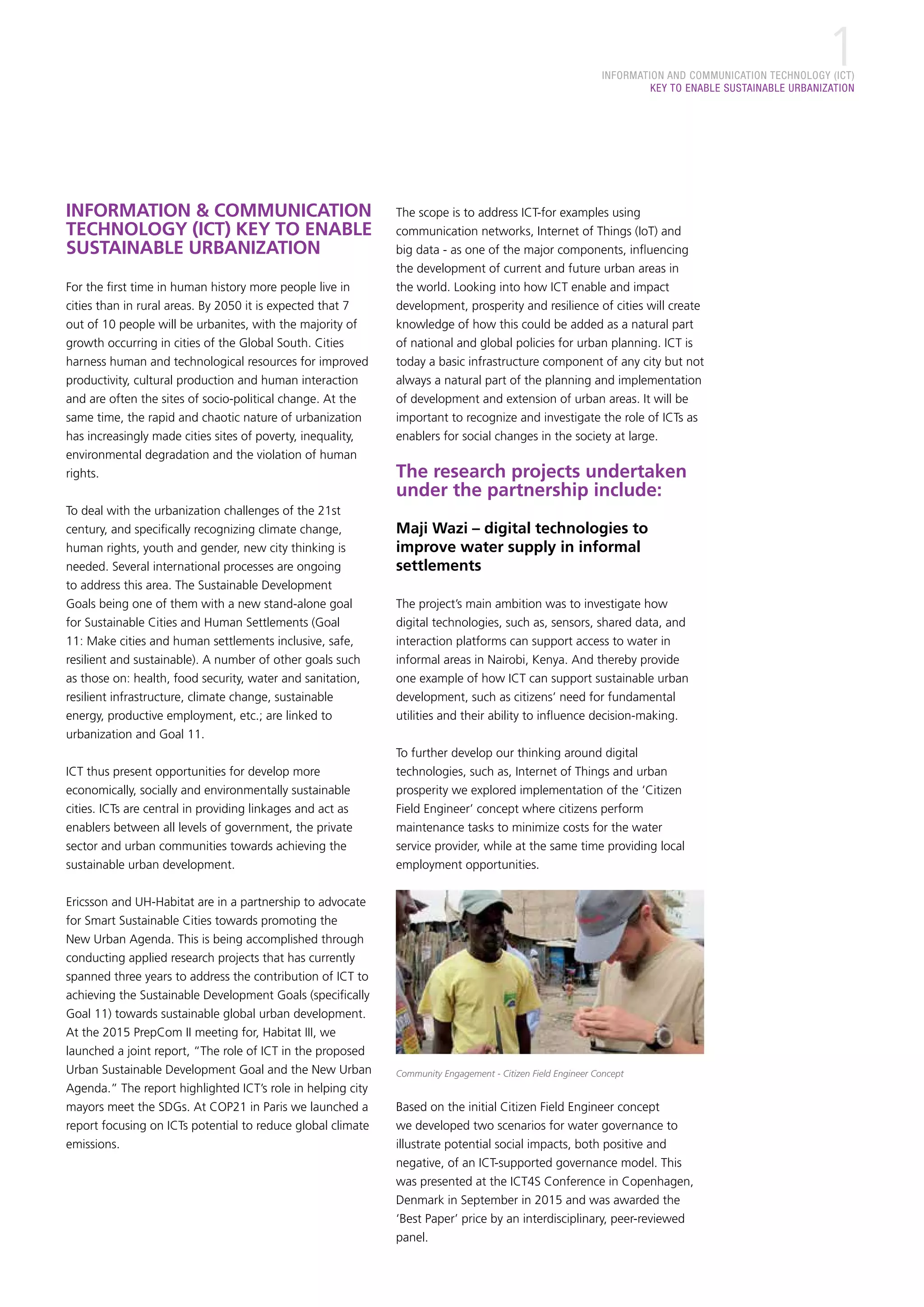
prosperity we explored implementation of the ‘Citizen
Field Engineer’ concept where citizens perform
maintenance tasks to minimize costs for the water
service provider, while at the same time providing local
employment opportunities.
Community Engagement - Citizen Field Engineer Concept
Based on the initial Citizen Field Engineer concept
we developed two scenarios for water governance to
illustrate potential social impacts, both positive and
negative, of an ICT-supported governance model. This
was presented at the ICT4S Conference in Copenhagen,
Denmark in September in 2015 and was awarded the
‘Best Paper’ price by an interdisciplinary, peer-reviewed
panel.
INFORMATION AND COMMUNICATION TECHNOLOGY (ICT)
KEY TO ENABLE SUSTAINABLE URBANIZATION
2
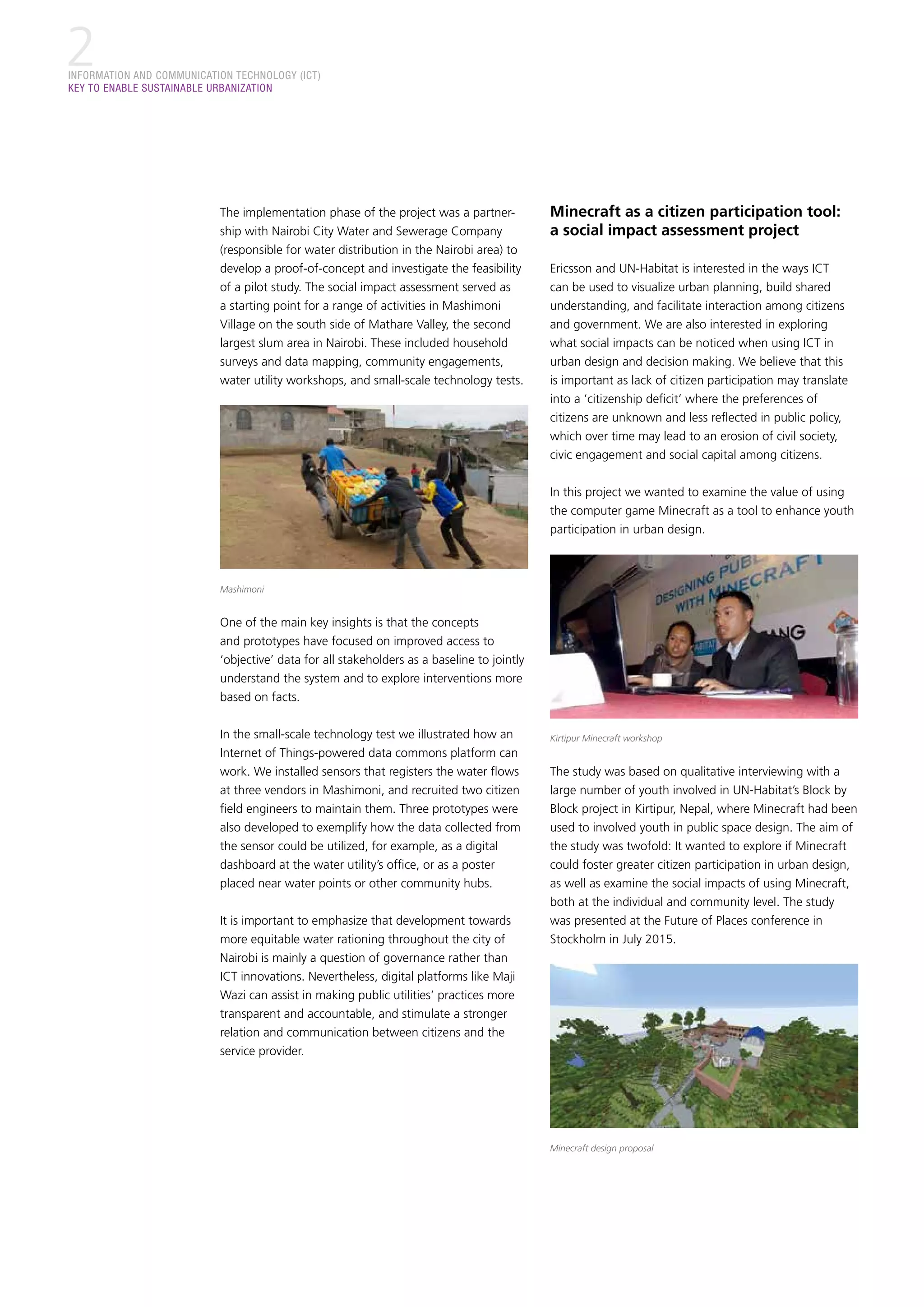
The implementation phase of the project was a partner-
ship with Nairobi City Water and Sewerage Company
(responsible for water distribution in the Nairobi area) to
develop a proof-of-concept and investigate the feasibility
of a pilot study. The social impact assessment served as
a starting point for a range of activities in Mashimoni
Village on the south side of Mathare Valley, the second
largest slum area in Nairobi. These included household
surveys and data mapping, community engagements,
water utility workshops, and small-scale technology tests.
Mashimoni
One of the main key insights is that the concepts
and prototypes have focused on improved access to
‘objective’ data for all stakeholders as a baseline to jointly
understand the system and to explore interventions more
based on facts.
In the small-scale technology test we illustrated how an
Internet of Things-powered data commons platform can
work. We installed sensors that registers the water flows
at three vendors in Mashimoni, and recruited two citizen
field engineers to maintain them. Three prototypes were
also developed to exemplify how the data collected from
the sensor could be utilized, for example, as a digital
dashboard at the water utility’s office, or as a poster
placed near water points or other community hubs.
It is important to emphasize that development towards
more equitable water rationing throughout the city of
Nairobi is mainly a question of governance rather than
ICT innovations. Nevertheless, digital platforms like Maji
Wazi can assist in making public utilities’ practices more
transparent and accountable, and stimulate a stronger
relation and communication between citizens and the
service provider.
Minecraft as a citizen participation tool:
a social impact assessment project
Ericsson and UN-Habitat is interested in the ways ICT
can be used to visualize urban planning, build shared
understanding, and facilitate interaction among citizens
and government. We are also interested in exploring
what social impacts can be noticed when using ICT in
urban design and decision making. We believe that this
is important as lack of citizen participation may translate
into a ‘citizenship deficit’ where the preferences of
citizens are unknown and less reflected in public policy,
which over time may lead to an erosion of civil society,
civic engagement and social capital among citizens.
In this project we wanted to examine the value of using
the computer game Minecraft as a tool to enhance youth
participation in urban design.
Kirtipur Minecraft workshop
The study was based on qualitative interviewing with a
large number of youth involved in UN-Habitat’s Block by
Block project in Kirtipur, Nepal, where Minecraft had been
used to involved youth in public space design. The aim of
the study was twofold: It wanted to explore if Minecraft
could foster greater citizen participation in urban design,
as well as examine the social impacts of using Minecraft,
both at the individual and community level. The study
was presented at the Future of Places conference in
Stockholm in July 2015.
Minecraft design proposal
INFORMATION AND COMMUNICATION TECHNOLOGY (ICT)
KEY TO ENABLE SUSTAINABLE URBANIZATION
3
The study showed that by using Minecraft:
•	 youth interest in urban design and community work
increased;
•	 youth where provided a new venue to influence the
political agenda and frame policy issues relating to
urban design;
•	 youth where empowered to develop important
action-oriented and intrinsic skills as well as new social
networks; and
•	 common ground and new understanding of different
needs and desires was developed.
However, gender relations and digital skills were
shown to influence individuals’ ability to enhance
their representation, participation and voice.
Innovation Marketplace – bringing
together youth and governments
for digital social innovation
The Urban Innovation Marketplace seeks to bridge
the gap that has developed between tech savvy urban
young people and county governments grappling
with devolution and decentralization. It seeks to
connect young voices, often marginalized and from
informal settlements, with governance and meaningful
participation, using ICT.
UN-Habitat partnered with @iLab Africa at Strathmore
University, Ericsson and Samsung to develop, test and
implement tech innovations together with youth and
county governments in Kenya.
An Urban Challenge Workshop was organized to enable
youth and county government representatives to come
together and openly discuss issues affecting them related
to urbanization and local governance, creating challenge
statements to be brought forward to the Hackday. The
workshop created common ground and a basis for future
collaboration. The inclusion of youth groups was of
particular relevance because it allowed reflection around
youth related issues.
The Innovation Hackday held at Strathmore University
was a dynamic hackathon to enable effective matching
of community and county needs and problems, seeking
to identify appropriate and innovative conceptual
solutions to these issues. Groups were formed consisting
of representatives from the local government, tech
community, and students and youth civil society groups
in Kenya to solve the challenge statement brought
forward from the Urban Challenge Workshop held earlier.
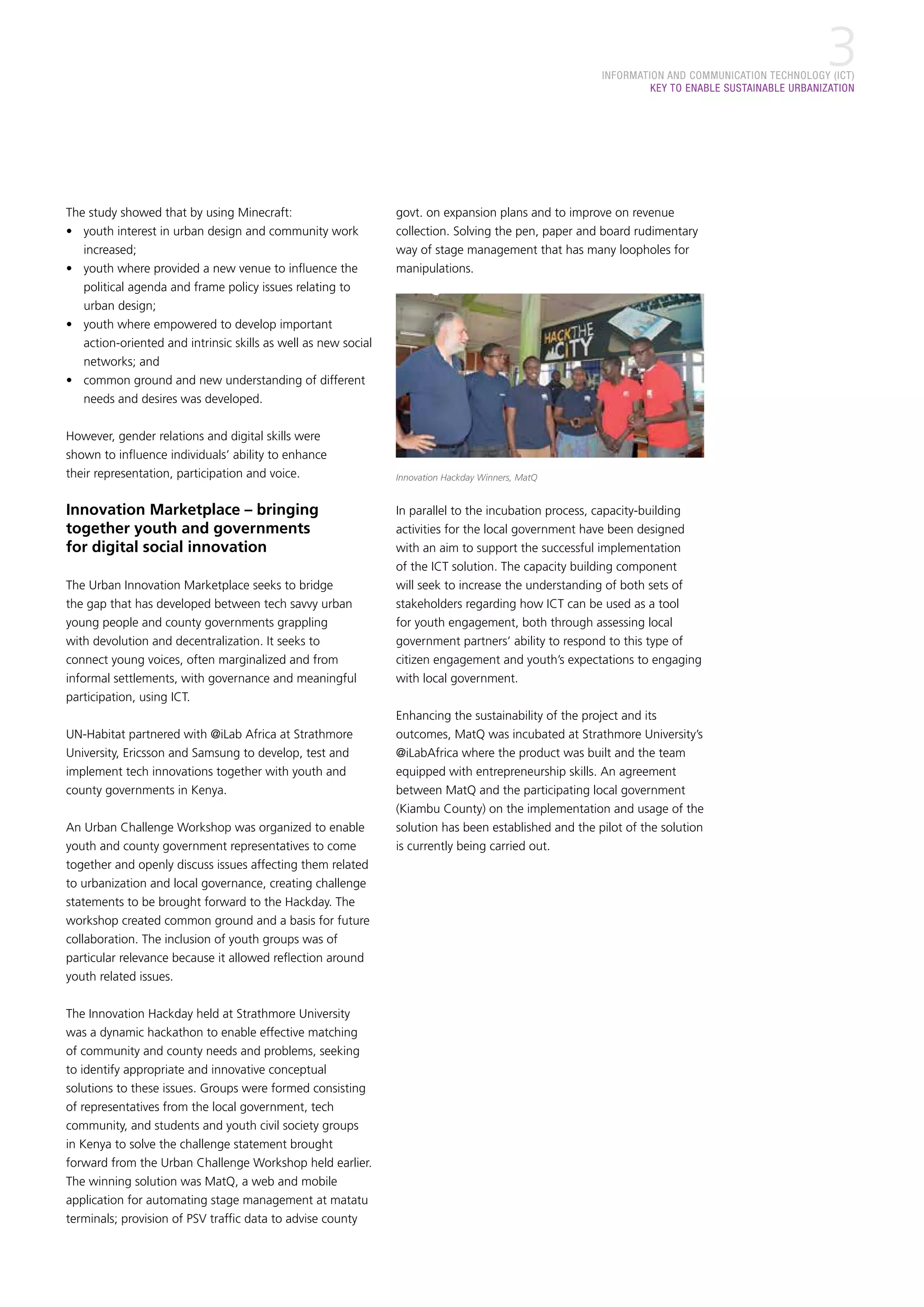
The winning solution was MatQ, a web and mobile
application for automating stage management at matatu
terminals; provision of PSV traffic data to advise county
govt. on expansion plans and to improve on revenue
collection. Solving the pen, paper and board rudimentary
way of stage management that has many loopholes for
manipulations.
Innovation Hackday Winners, MatQ
In parallel to the incubation process, capacity-building
activities for the local government have been designed
with an aim to support the successful implementation
of the ICT solution. The capacity building component
will seek to increase the understanding of both sets of
stakeholders regarding how ICT can be used as a tool
for youth engagement, both through assessing local
government partners’ ability to respond to this type of
citizen engagement and youth’s expectations to engaging
with local government.
Enhancing the sustainability of the project and its
outcomes, MatQ was incubated at Strathmore University’s
@iLabAfrica where the product was built and the team
equipped with entrepreneurship skills. An agreement
between MatQ and the participating local government
(Kiambu County) on the implementation and usage of the
solution has been established and the pilot of the solution
is currently being carried out.
INFORMATION AND COMMUNICATION TECHNOLOGY (ICT)
KEY TO ENABLE SUSTAINABLE URBANIZATION
4
Upcoming Projects
Digital technologies, such as, Internet of Things including
data analytics, can provide new opportunities to both
improving urban planning as well as understand current
systems such as transportation and support in developing
tools for planning decisions as well as for organisations
to better utilise various transportation modes. These
solutions and technologies could then be translated to
many other cities that face similar challenges and some of
the project prospects we work on now are:
The role of emerging digital technologies in
participatory urban planning and innovation
The Ericsson and UN-Habitat partnership include a series
of research collaborations to investigate how digital
technologies contribute to a sustainable global urban
development. An ongoing innovation project at Ericsson
Research explores how technologies, such as, Internet-
of-Things might enable new forms of participatory
processes, and innovative urban applications and services.
As part of this activity a workshop with UN-Habitat are
planned in order to develop concepts that are in touch
with the new urban agenda as well as realities in cities in
the Global South.
Intelligent Transport Solutions
Together with Ericsson Sub Saharan Africa and a
technology innovations partner called Mat Q, the Mobility
Unit at UN-Habitat is working towards developing A
Sustainable Urban Mobility Plan (SUMP) using ICT to
develop an intelligent transport solution for Ruiru town
– one of the small towns in the Metropolitan Area of
Nairobi that is facing rapid population growth. This
technology could then be translated to many other
African cities that face similar transport challenges.
Summary
With our reports on ICT and the New Urban Agenda and
ICT for urban climate action and through our concluded
and upcoming undertakings, it is evident that ICT is
a basic infrastructure needed to promote sustainable
urbanization which is a major driver of development.
As Internet of Things (IoT) and big data technologies
become widespread, the potential for ICT to contribute
to addressing cities’ challenges rises and to measure
progress.
Through this we aspire to the promotion of a new model
of urban development that is able to integrate all facets
of sustainable development to promote equity, welfare
resilience and shared prosperity, post Habitat III and
environmental issues, through ICT inclusion.
So with the intention to address SDG 11 and other SDG:s,
Smart Sustainable Cities provides a key enabler to the
New Urban Agenda.
INFORMATION AND COMMUNICATION TECHNOLOGY (ICT)
KEY TO ENABLE SUSTAINABLE URBANIZATION
5
Ericsson is the driving force behind the Networked
Society – a world leader in communications
technology and services. Our long-term relationships
with every major telecom operator in the world allow
people, business and society to fulfill their potential
and create a more sustainable future.
Our services, software and infrastructure – especially
in mobility, broadband and the cloud – are enabling
the telecom industry and other sectors to do better
business, increase efficiency, improve the user
experience and capture new opportunities.
With approximately 115,000 professionals and
customers in 180 countries, we combine global
scale with technology and services leadership.
We support networks that connect more than
2.5 billion subscribers. Forty percent of the world’s
mobile traffic is carried over Ericsson networks. And
our investments in research and development ensure
that our solutions – and our customers – stay in front.
Founded in 1876, Ericsson has its headquarters in
Stockholm, Sweden.
www.ericsson.com
www.ericsson.com/news
www.twitter.com/ericssonpress
www.facebook.com/ericsson
www.youtube.com/ericsson
Telefonaktiebolaget LM Ericsson
SE-126 25 Stockholm, Sweden
www.ericsson.com
The United Nations Human Settlements
Programme (UN-Habitat) is the United Nations
programme for sustainable urban development.
It is mandated to promote socially and environmentally
sustainable towns and cities while advocating
adequate shelter for all and is the focal point
for sustainable urbanization and local governments
within the UN system.
UN-Habitat works to expand understanding of
inadequate shelter and poverty and to facilitate
the tracking of progress in urban development.
It sets out norms and best practice for sustainable
urbanization and urban poverty reduction, promoting
realistic urban planning, municipal finance and urban
legislation as the keys to harnessing the economic
potential of cities.
www.unhabitat.org
www.twitter.com/unhabitat
www.facebook.com/unhabitat
www.youtube.com/unhabitatglobal
United Nations Human Settlements Programme
(UN-Habitat)
P.O. Box 30030, Nairobi 00100, Kenya
www.unhabitat.org

Information & Communication Technology key to enable sustainable urbanization

  • 1.
    1INFORMATION AND COMMUNICATIONTECHNOLOGY (ICT) KEY TO ENABLE SUSTAINABLE URBANIZATION INFORMATION & COMMUNICATION TECHNOLOGY KEY TO ENABLE SUSTAINABLE URBANIZATION In collaboration with:
  • 2.
    Acknowledgements This report hasbeen produced as part of a collaboration between UN-Habitat and Ericsson, with contributions from the International Telecommunication Union (ITU). In 2014 UN-Habitat and Ericsson entered into a three-year partnership aimed at providing valuable insights on the role of ICT in sustainable urbanization to city leaders and policymakers. This report was researched, compiled, and written by: UN-Habitat: Rhoda Omenya Pontus Westerberg Andre Dzikus Ericsson: Marcus Nyberg Fanny von Heland Matilda Gennvi Gustafsson Mikael Anneroth Access to information and communi- cation technology is necessary to the implementation of the New Urban Agenda that aims to achieve sustain- able urban development for social inclusion and end extreme poverty. Public private partnerships provide opportunities for cooperation and knowledge exchange that contribute to the realization of the sustainable development goals. Mr Andre Dzikus Coordinator, Urban Basic Services Branch UN-Habitat Through city transformation, ICT can help to address global challenges. Partnerships with relevant stakeholders from different sectors is crucial to achieve a mutual understanding and secure an efficient deployment aiming for scalable solutions. Matilda Gennvi Gustafsson Sustainability Director Ericsson
  • 3.
    INFORMATION AND COMMUNICATIONTECHNOLOGY (ICT) KEY TO ENABLE SUSTAINABLE URBANIZATION 1 INFORMATION & COMMUNICATION TECHNOLOGY (ICT) KEY TO ENABLE SUSTAINABLE URBANIZATION For the first time in human history more people live in cities than in rural areas. By 2050 it is expected that 7 out of 10 people will be urbanites, with the majority of growth occurring in cities of the Global South. Cities harness human and technological resources for improved productivity, cultural production and human interaction and are often the sites of socio-political change. At the same time, the rapid and chaotic nature of urbanization has increasingly made cities sites of poverty, inequality, environmental degradation and the violation of human rights. To deal with the urbanization challenges of the 21st century, and specifically recognizing climate change, human rights, youth and gender, new city thinking is needed. Several international processes are ongoing to address this area. The Sustainable Development Goals being one of them with a new stand-alone goal for Sustainable Cities and Human Settlements (Goal 11: Make cities and human settlements inclusive, safe, resilient and sustainable). A number of other goals such as those on: health, food security, water and sanitation, resilient infrastructure, climate change, sustainable energy, productive employment, etc.; are linked to urbanization and Goal 11. ICT thus present opportunities for develop more economically, socially and environmentally sustainable cities. ICTs are central in providing linkages and act as enablers between all levels of government, the private sector and urban communities towards achieving the sustainable urban development. Ericsson and UH-Habitat are in a partnership to advocate for Smart Sustainable Cities towards promoting the New Urban Agenda. This is being accomplished through conducting applied research projects that has currently spanned three years to address the contribution of ICT to achieving the Sustainable Development Goals (specifically Goal 11) towards sustainable global urban development. At the 2015 PrepCom II meeting for, Habitat III, we launched a joint report, “The role of ICT in the proposed Urban Sustainable Development Goal and the New Urban Agenda.” The report highlighted ICT’s role in helping city mayors meet the SDGs. At COP21 in Paris we launched a report focusing on ICTs potential to reduce global climate emissions. The scope is to address ICT-for examples using communication networks, Internet of Things (IoT) and big data - as one of the major components, influencing the development of current and future urban areas in the world. Looking into how ICT enable and impact development, prosperity and resilience of cities will create knowledge of how this could be added as a natural part of national and global policies for urban planning. ICT is today a basic infrastructure component of any city but not always a natural part of the planning and implementation of development and extension of urban areas. It will be important to recognize and investigate the role of ICTs as enablers for social changes in the society at large. The research projects undertaken under the partnership include: Maji Wazi – digital technologies to improve water supply in informal settlements The project’s main ambition was to investigate how digital technologies, such as, sensors, shared data, and interaction platforms can support access to water in informal areas in Nairobi, Kenya. And thereby provide one example of how ICT can support sustainable urban development, such as citizens’ need for fundamental utilities and their ability to influence decision-making. To further develop our thinking around digital technologies, such as, Internet of Things and urban prosperity we explored implementation of the ‘Citizen Field Engineer’ concept where citizens perform maintenance tasks to minimize costs for the water service provider, while at the same time providing local employment opportunities. Community Engagement - Citizen Field Engineer Concept Based on the initial Citizen Field Engineer concept we developed two scenarios for water governance to illustrate potential social impacts, both positive and negative, of an ICT-supported governance model. This was presented at the ICT4S Conference in Copenhagen, Denmark in September in 2015 and was awarded the ‘Best Paper’ price by an interdisciplinary, peer-reviewed panel.
  • 4.
    INFORMATION AND COMMUNICATIONTECHNOLOGY (ICT) KEY TO ENABLE SUSTAINABLE URBANIZATION 2 The implementation phase of the project was a partner- ship with Nairobi City Water and Sewerage Company (responsible for water distribution in the Nairobi area) to develop a proof-of-concept and investigate the feasibility of a pilot study. The social impact assessment served as a starting point for a range of activities in Mashimoni Village on the south side of Mathare Valley, the second largest slum area in Nairobi. These included household surveys and data mapping, community engagements, water utility workshops, and small-scale technology tests. Mashimoni One of the main key insights is that the concepts and prototypes have focused on improved access to ‘objective’ data for all stakeholders as a baseline to jointly understand the system and to explore interventions more based on facts. In the small-scale technology test we illustrated how an Internet of Things-powered data commons platform can work. We installed sensors that registers the water flows at three vendors in Mashimoni, and recruited two citizen field engineers to maintain them. Three prototypes were also developed to exemplify how the data collected from the sensor could be utilized, for example, as a digital dashboard at the water utility’s office, or as a poster placed near water points or other community hubs. It is important to emphasize that development towards more equitable water rationing throughout the city of Nairobi is mainly a question of governance rather than ICT innovations. Nevertheless, digital platforms like Maji Wazi can assist in making public utilities’ practices more transparent and accountable, and stimulate a stronger relation and communication between citizens and the service provider. Minecraft as a citizen participation tool: a social impact assessment project Ericsson and UN-Habitat is interested in the ways ICT can be used to visualize urban planning, build shared understanding, and facilitate interaction among citizens and government. We are also interested in exploring what social impacts can be noticed when using ICT in urban design and decision making. We believe that this is important as lack of citizen participation may translate into a ‘citizenship deficit’ where the preferences of citizens are unknown and less reflected in public policy, which over time may lead to an erosion of civil society, civic engagement and social capital among citizens. In this project we wanted to examine the value of using the computer game Minecraft as a tool to enhance youth participation in urban design. Kirtipur Minecraft workshop The study was based on qualitative interviewing with a large number of youth involved in UN-Habitat’s Block by Block project in Kirtipur, Nepal, where Minecraft had been used to involved youth in public space design. The aim of the study was twofold: It wanted to explore if Minecraft could foster greater citizen participation in urban design, as well as examine the social impacts of using Minecraft, both at the individual and community level. The study was presented at the Future of Places conference in Stockholm in July 2015. Minecraft design proposal
  • 5.
    INFORMATION AND COMMUNICATIONTECHNOLOGY (ICT) KEY TO ENABLE SUSTAINABLE URBANIZATION 3 The study showed that by using Minecraft: • youth interest in urban design and community work increased; • youth where provided a new venue to influence the political agenda and frame policy issues relating to urban design; • youth where empowered to develop important action-oriented and intrinsic skills as well as new social networks; and • common ground and new understanding of different needs and desires was developed. However, gender relations and digital skills were shown to influence individuals’ ability to enhance their representation, participation and voice. Innovation Marketplace – bringing together youth and governments for digital social innovation The Urban Innovation Marketplace seeks to bridge the gap that has developed between tech savvy urban young people and county governments grappling with devolution and decentralization. It seeks to connect young voices, often marginalized and from informal settlements, with governance and meaningful participation, using ICT. UN-Habitat partnered with @iLab Africa at Strathmore University, Ericsson and Samsung to develop, test and implement tech innovations together with youth and county governments in Kenya. An Urban Challenge Workshop was organized to enable youth and county government representatives to come together and openly discuss issues affecting them related to urbanization and local governance, creating challenge statements to be brought forward to the Hackday. The workshop created common ground and a basis for future collaboration. The inclusion of youth groups was of particular relevance because it allowed reflection around youth related issues. The Innovation Hackday held at Strathmore University was a dynamic hackathon to enable effective matching of community and county needs and problems, seeking to identify appropriate and innovative conceptual solutions to these issues. Groups were formed consisting of representatives from the local government, tech community, and students and youth civil society groups in Kenya to solve the challenge statement brought forward from the Urban Challenge Workshop held earlier. The winning solution was MatQ, a web and mobile application for automating stage management at matatu terminals; provision of PSV traffic data to advise county govt. on expansion plans and to improve on revenue collection. Solving the pen, paper and board rudimentary way of stage management that has many loopholes for manipulations. Innovation Hackday Winners, MatQ In parallel to the incubation process, capacity-building activities for the local government have been designed with an aim to support the successful implementation of the ICT solution. The capacity building component will seek to increase the understanding of both sets of stakeholders regarding how ICT can be used as a tool for youth engagement, both through assessing local government partners’ ability to respond to this type of citizen engagement and youth’s expectations to engaging with local government. Enhancing the sustainability of the project and its outcomes, MatQ was incubated at Strathmore University’s @iLabAfrica where the product was built and the team equipped with entrepreneurship skills. An agreement between MatQ and the participating local government (Kiambu County) on the implementation and usage of the solution has been established and the pilot of the solution is currently being carried out.
  • 6.
    INFORMATION AND COMMUNICATIONTECHNOLOGY (ICT) KEY TO ENABLE SUSTAINABLE URBANIZATION 4 Upcoming Projects Digital technologies, such as, Internet of Things including data analytics, can provide new opportunities to both improving urban planning as well as understand current systems such as transportation and support in developing tools for planning decisions as well as for organisations to better utilise various transportation modes. These solutions and technologies could then be translated to many other cities that face similar challenges and some of the project prospects we work on now are: The role of emerging digital technologies in participatory urban planning and innovation The Ericsson and UN-Habitat partnership include a series of research collaborations to investigate how digital technologies contribute to a sustainable global urban development. An ongoing innovation project at Ericsson Research explores how technologies, such as, Internet- of-Things might enable new forms of participatory processes, and innovative urban applications and services. As part of this activity a workshop with UN-Habitat are planned in order to develop concepts that are in touch with the new urban agenda as well as realities in cities in the Global South. Intelligent Transport Solutions Together with Ericsson Sub Saharan Africa and a technology innovations partner called Mat Q, the Mobility Unit at UN-Habitat is working towards developing A Sustainable Urban Mobility Plan (SUMP) using ICT to develop an intelligent transport solution for Ruiru town – one of the small towns in the Metropolitan Area of Nairobi that is facing rapid population growth. This technology could then be translated to many other African cities that face similar transport challenges. Summary With our reports on ICT and the New Urban Agenda and ICT for urban climate action and through our concluded and upcoming undertakings, it is evident that ICT is a basic infrastructure needed to promote sustainable urbanization which is a major driver of development. As Internet of Things (IoT) and big data technologies become widespread, the potential for ICT to contribute to addressing cities’ challenges rises and to measure progress. Through this we aspire to the promotion of a new model of urban development that is able to integrate all facets of sustainable development to promote equity, welfare resilience and shared prosperity, post Habitat III and environmental issues, through ICT inclusion. So with the intention to address SDG 11 and other SDG:s, Smart Sustainable Cities provides a key enabler to the New Urban Agenda.
  • 7.
    INFORMATION AND COMMUNICATIONTECHNOLOGY (ICT) KEY TO ENABLE SUSTAINABLE URBANIZATION 5
  • 8.
    Ericsson is thedriving force behind the Networked Society – a world leader in communications technology and services. Our long-term relationships with every major telecom operator in the world allow people, business and society to fulfill their potential and create a more sustainable future. Our services, software and infrastructure – especially in mobility, broadband and the cloud – are enabling the telecom industry and other sectors to do better business, increase efficiency, improve the user experience and capture new opportunities. With approximately 115,000 professionals and customers in 180 countries, we combine global scale with technology and services leadership. We support networks that connect more than 2.5 billion subscribers. Forty percent of the world’s mobile traffic is carried over Ericsson networks. And our investments in research and development ensure that our solutions – and our customers – stay in front. Founded in 1876, Ericsson has its headquarters in Stockholm, Sweden. www.ericsson.com www.ericsson.com/news www.twitter.com/ericssonpress www.facebook.com/ericsson www.youtube.com/ericsson Telefonaktiebolaget LM Ericsson SE-126 25 Stockholm, Sweden www.ericsson.com The United Nations Human Settlements Programme (UN-Habitat) is the United Nations programme for sustainable urban development. It is mandated to promote socially and environmentally sustainable towns and cities while advocating adequate shelter for all and is the focal point for sustainable urbanization and local governments within the UN system. UN-Habitat works to expand understanding of inadequate shelter and poverty and to facilitate the tracking of progress in urban development. It sets out norms and best practice for sustainable urbanization and urban poverty reduction, promoting realistic urban planning, municipal finance and urban legislation as the keys to harnessing the economic potential of cities. www.unhabitat.org www.twitter.com/unhabitat www.facebook.com/unhabitat www.youtube.com/unhabitatglobal United Nations Human Settlements Programme (UN-Habitat) P.O. Box 30030, Nairobi 00100, Kenya www.unhabitat.org