Infinity Properads And Infinity Wheeled Properads 1st Edition Philip Hackney
Infinity Properads And Infinity Wheeled Properads 1st Edition Philip Hackney
Infinity Properads And Infinity Wheeled Properads 1st Edition Philip Hackney
Infinity Properads And Infinity Wheeled Properads 1st Edition Philip Hackney
Infinity Properads And Infinity Wheeled Properads 1st Edition Philip Hackney
1.
Infinity Properads AndInfinity Wheeled
Properads 1st Edition Philip Hackney download
https://ebookbell.com/product/infinity-properads-and-infinity-
wheeled-properads-1st-edition-philip-hackney-5235244
Explore and download more ebooks at ebookbell.com
2.
Here are somerecommended products that we believe you will be
interested in. You can click the link to download.
Infinity A Very Short Introduction Ian Stewart
https://ebookbell.com/product/infinity-a-very-short-introduction-ian-
stewart-46264512
Infinity A Very Short Introduction Ian Stewart
https://ebookbell.com/product/infinity-a-very-short-introduction-ian-
stewart-47623618
Infinity For Marxists Essays On Poetry And Capital Christopher Nealon
https://ebookbell.com/product/infinity-for-marxists-essays-on-poetry-
and-capital-christopher-nealon-47648206
Infinity Investing How The Rich Get Richer And How You Can Do The Same
Toby Mathis
https://ebookbell.com/product/infinity-investing-how-the-rich-get-
richer-and-how-you-can-do-the-same-toby-mathis-48527112
3.
Infinity Fish EconomicsAnd The Future Of Fish And Fisheries Ussif
Rashid Sumaila
https://ebookbell.com/product/infinity-fish-economics-and-the-future-
of-fish-and-fisheries-ussif-rashid-sumaila-50435510
Infinity And Perspective Karsten Harries
https://ebookbell.com/product/infinity-and-perspective-karsten-
harries-50837520
Infinity Of Lists Umberto Eco
https://ebookbell.com/product/infinity-of-lists-umberto-eco-51208292
Infinity And The Mind The Science And Philosophy Of The Infinite
Course Book Rudy Rucker
https://ebookbell.com/product/infinity-and-the-mind-the-science-and-
philosophy-of-the-infinite-course-book-rudy-rucker-51953032
Infinity And The Mind The Science And Philosophy Of The Infinite Rudy
Rucker
https://ebookbell.com/product/infinity-and-the-mind-the-science-and-
philosophy-of-the-infinite-rudy-rucker-51959558
5.
Lecture Notes inMathematics 2147
Philip Hackney
Marcy Robertson
DonaldYau
Infinity
Properads
and Infinity
Wheeled
Properads
6.
Lecture Notes inMathematics 2147
Editors-in-Chief:
J.-M. Morel, Cachan
B. Teissier, Paris
Advisory Board:
Camillo De Lellis, Zurich
Mario di Bernardo, Bristol
Alessio Figalli, Austin
Davar Khoshnevisan, Salt Lake City
Ioannis Kontoyiannis, Athens
Gabor Lugosi, Barcelona
Mark Podolskij, Aarhus
Sylvia Serfaty, Paris and NY
Catharina Stroppel, Bonn
Anna Wienhard, Heidelberg
To Chloë andElly
To Rosa
To Eun Soo and Jacqueline
12.
Preface
This monograph fitsin the intersection of two long and intertwined stories. The
first part of our story starts in the mid-twentieth century, when it became clear that
a new conceptual framework was necessary for the study of higher homotopical
structures arising in algebraic topology. Some better known examples of these
higher homotopical structures appear in work of J.F. Adams and S. Mac Lane
[Mac65] on the coproduct in the bar construction and work of J. Stasheff [Sta63],
J.M. Boardman and R.M. Vogt [BV68, BV73], and J.P. May [May72] on recognition
principles for (ordinary, n-fold, or infinite) loop spaces. The notions of ‘operad’
and ‘prop’ were precisely formulated for the purpose of this work; the former is
suitable for modeling algebraic or coalgebraic structures, while the latter is also
capable of modeling bialgebraic structures, such as Hopf algebras. Operads came to
prominence in other areas of mathematics beginning in the 1990s (but see, e.g.,
[Kad79, Smi81] for earlier examples) through the work of V. Ginzburg and M.
Kapranov on Koszul duality [GK95], E. Getzler and J. Jones on two-dimensional
topological field theories [GJ94, Get94], and M. Kontsevich on deformation quanti-
zation [Kon99].
This renaissance in the world of operads [Lod96, LSV97] and the popularity of
quantum groups [Dri83, Dri87] in the 1990s lead to a resurgence of interest in props,
which had long been in the shadow of their little single-output nephew. Properads
were invented around this time, during an effort of B. Vallette to formulate a Koszul
duality for props [Val07]. Properads and props both model algebraic structures with
several inputs and outputs, but properads govern a smaller class of such structures,
those whose generating operations and relations among operations can be taken
to be connected. This class includes most types of bialgebras that arise in nature,
such as biassociative bialgebras, (co)module bialgebras, Lie bialgebras, Frobenius
algebras, and Hopf algebras.
Wheeled variants of operads, properads, and props were introduced by M. Markl,
S. Merkulov, and S. Shadrin [MMS09] to model algebraic structures with traces.
For instance, one of the simplest examples of a wheeled properad controls
vii
13.
viii Preface
finite-dimensional associativealgebras. There are numerous applications of wheeled
properads in geometry, deformation theory, and mathematical physics [Mer10b].
Monoids Categories -categories
Operads
Colored
Operads
-operads
Properads
Colored
Properads
-properads
Props
Colored
Props
Wheeled
Properads
Colored
Wheeled
Properads
Wheeled
Props
-wheeled
properads
Colored
Wheeled
Props
The use of ‘colored’ or ‘multisorted’ variants of operads or props [Bri00, BV73],
where composition is only partially defined, allows one to address many other
situations of interest. It allows one, for instance, to model morphisms of algebras
associated with a given operad. There is a two-colored operad, which encodes
the data of two associative algebras as well as a map from one to the other; a
resolution of this operad precisely gives the correct notion of morphism of A1-
algebras [Mar04, Mar02]. It also provides a unified way to treat operads, cyclic
operads, modular operads, properads, and so on: for each, there is a colored operad,
which controls the structure in question.
The second part of our story is an extension of the theory of categories.
Categories are pervasive in pure mathematics and, for our purposes, can be loosely
described as tools for studying collections of objects up to isomorphism and
comparisons between collections of objects up to isomorphism. When the objects
we want to study have a homotopy theory, we need to generalize category theory
to identify two objects which are, while possibly not isomorphic in the categorical
sense, equivalent up to homotopy. For example, when discussing topological spaces
we might replace ‘homeomorphism’ with ‘homotopy equivalence.’ This leads to
the theory of 1-categories (or restricted Kan complexes [BV73], quasi-categories,
14.
Preface ix
and soon); A. Joyal (Notes on Quasi-categories, 2007, unpublished manuscript),
[Joy08] and J. Lurie [Lur09] have extended many tools from traditional category
theory to 1-category theory. This extension of category theory has led to new
applications in various subjects ranging from a convenient framework for the
study of A1 and E1-ring spectra in stable homotopy theory [ABGHR], derived
algebraic geometry [Lur04, Toë05, TV05, TV08] and geometric representation
theory [Toë06, BZN12, BZN13].
I. Moerdijk and I. Weiss [MW07] realized that the connection between colored
operads and weakly composable maps was worth further exploration, and intro-
duced a way to think about the notion of 1-operad. They introduced a category
of trees , the ‘dendroidal category,’ which contains the simplicial category .
Dendroidal sets, or presheaves on , are an extension of simplicial sets, and
this extension allows us to consider ‘quasi-operads’ in the category of dendroidal
sets, which are analogs of quasi-categories. Moerdijk and Weiss proposed a
model for weak n-categories based on this formalism, which has been partially
validated [Luk13]. There are also relations to connective spectra [BN14], E1-spaces
[Heu11b], algebraic K-theory [Nik13], and group actions on operads [BH14].
This book is a thorough initial investigation into the theory of 1-properads and
1-wheeled properads. We here lay the foundation for our aim of exploring the
homotopy theory of properads in depth. This work also serves as a complete guide
to the generalized graphs, which are pervasive in the study of operads and properads.
In the final chapter, we include a preliminary list of potential applications ranging
from string topology to category theory.
This monograph is written for mathematicians in the fields of topology, algebra,
category theory, and related areas. It is written roughly at the second year graduate
level. We assume some very basic knowledge of category theory, as discussed in the
standard references [Bor94a, Bor94b, Mac98]. Topics such as monads, simplicial
objects, generalized PROPs, and so forth will be reviewed in the text.
The first two authors would like to thank the third author for his considerable
patience and role as a mentor in the preparation of this monograph. They would
also like to thank Tom Fiore for planting the seeds of this project during his talk at
the Graduate Student Geometry and Topology Conference in 2010.
The authors would like to thank Alexander Berglund, Julie Bergner, Benoit
Fresse, David Gepner, Mark W. Johnson, André Joyal, Peter May, Sergei Merkulov,
Ieke Moerdijk, Bruno Vallette, Rainer Vogt, and Ben Ward for their interest and
encouragement while completing this project. We would particularly like to thank
Joachim Kock for sharing his point of view on the definition of generalized graph
[Koc14]. Finally, much credit goes to all five anonymousreferees who each provided
insightful comments and suggestions.
Stockholm, Sweden Philip Hackney
Los Angeles, CA, USA Marcy Robertson
Newark, OH, USA Donald Yau
January 2014
February 2015
2 1 Introduction
Compositionin a category is represented linearly. With multiple inputs, composition
in an operad takes on the shape of a tree. Explicitly, if there are operations
wi
1; : : : ; wi
ki
gi
// xi
for each i, then the operadic composition .fI g1; : : : ; gn/ is represented by the
following decorated 2-level tree.
In particular, its inputs are the concatenation of the lists
wi
1; : : : ; wi
ki
as i runs from
1 to n. Associativity of the operadic composition takes the form of a 3-level tree.
There are also unity and equivariance axioms, which come from permutations of the
inputs. We should point out that what we call an operad here is sometimes called a
colored operad or a multicategory in the literature.
A properad [Val07] allows even more general operations, where both inputs and
outputs are finite lists of objects, say
.x1; : : : ; xm/
f
// .y1; : : : ; yn/
with m; n 0. Such an operation is visualized as the following decorated corolla.
Since both the inputs and the outputs can be permuted, there are bi-equivariance
axioms. The properadic composition is represented by the following graph, called a
partially grafted corollas.
23.
1.1 (Wheeled) Properadsas Generalized Categories 3
For this properadic composition to be defined, a non-empty sub-list of the outputs
of f must match a non-empty sub-list of the inputs of g. Associativity says that if a
3-vertex connected wheel-free graph has its vertices decorated by operations, then
there is a well-defined operation.
One particular instance of the properadic composition is when the partially
grafted corollas has only one edge connecting the two vertices, as in the following
simply connected graph.
It is called a dioperadic graph and represents the dioperadic composition in a
dioperad [Gan04], which is sometimes called a polycategory in the literature.
Thus, a category is a special case of an operad, which in turn is a special case
of a dioperad. Moreover, properads contain dioperads. These generalizations of
categories are very powerful tools that encode operations. For example, the little
n-cube operads introduced by May [May72] provide a recognition principle for con-
nected n-fold loop spaces. Dioperads can model algebraic structures with multiple
inputs and multiple outputs, whose axioms are represented by simply connected
graphs, such as Lie bialgebras. Going even further, properads can model algebraic
structures with multiple inputs and multiple outputs, whose axioms are represented
by connected wheel-free graphs, such as biassociative bialgebras and (co)module
bialgebras. There are numerous other applications of these generalized categories
in homotopy theory, string topology, deformation theory, and mathematical physics,
among many other subjects. See, for example, [Mar08, MSS02], and the references
therein.
A wheeled properad takes this line of thought one step further by allowing a
contraction operation. To motivate this structure, recall from above that a dioperadic
composition is a special case of a properadic composition. It is natural to ask if
properadic compositions can be generated by dioperadic compositions in some way,
since the latter are much simpler than the former. A dioperadic graph has only
24.
4 1 Introduction
oneinternal edge, while a partially grafted corollas can have finitely many internal
edges. Starting with a dioperadic graph, to create a general partially grafted corollas
with the same vertices and containing the given internal edge, one needs to connect
some output legs of the bottom vertex with some input legs of the top vertex. So
we need a contraction operation that connects an output di of an operation h with
an input cj of the same color (i.e., di D cj) of the same operation. The following
picture, called a contracted corolla, represents such a contraction.
h
di
cj
A general properadic composition is a composition of a dioperadic composition and
finitely many contractions.
A wheeled properad is an object that has a bi-equivariant structure, units, a
dioperadic composition, and a contraction, satisfying suitable axioms. Wheeled
properads in the linear setting are heavily used in applications [KWZ12, MMS09,
Mer09, Mer10a, Mer10b]. Foundational discussion of wheeled properads can be
found in [YJ15, JY]. As the picture above indicates, when working with wheeled
properads, one must allow graphs to have loops and directed cycles in general.
1.2 Infinity Categories and Infinity Operads
Another natural way to extend the notion of a category comes from relaxing the
axioms, so they do not need to hold in the strict sense, resulting in what is called
a weak category. There are quite a few variations of this concept; see, for example,
[Lei04, Sim12]. We concentrate only on 1-categories in the sense of Joyal [Joy02]
and Lurie [Lur09]. These objects were actually first defined by Boardman and Vogt
[BV73] as simplicial sets satisfying the restricted Kan condition.
The basic idea of an 1-category is very similar to that of the path space of a
topological space X. Given two composable paths f and g in X, there are many ways
to form their composition, but any two such compositions are homotopic. Moreover,
any two such homotopies are themselves homotopic, and so forth. Composition of
paths is not associative in the strict sense, but it holds up to homotopy again.
Similarly, in an 1-category, one asks that there be a composition of two given
morphisms.
1
0 2
f g
∃
25.
1.2 Infinity Categoriesand Infinity Operads 5
There may be many such compositions, but any two compositions are homotopic.
Associativity of such composition holds up to homotopy, and there are also higher
coherence conditions. To make these ideas precise, observe that the above triangle
can be phrased in a simplicial set X. Namely, f and g are two 1-simplices in X that
determine a unique inner horn 1
Œ2 ! X, with g as the 0-face and f as the 2-face.
To say that a composition exists, one can say that this inner horn has an extension
to Œ2 ! X, so its 1-face is such a composition. In fact, an 1-category is defined
as a simplicial set in which every inner horn
with 0 k n has a filler. There are several other models of 1-categories, which
are discussed in [Ber07, Ber10, JT06, Rez01].
Similarly, an 1-operad captures the idea of an up-to-homotopy operad. It was
first developed by Moerdijk and Weiss [MW07, MW09], and more recently in
[BN14, CM13a, CM11, CM13b, Heu11a, Heu11b, HHM13, Luk13, Nik13]. To
define 1-operads, recall that 1-categories are simplicial sets satisfying an inner
horn extension property. The finite ordinal category can be represented using
linear graphs. In fact, the object
Œn D f0 1 ng 2
is the category generated by the following linear graph with n vertices.
v1 v2 · · · vn
0 1 2 n − 1 n
Here each vertex vi is the generating morphism i 1 ! i.
Likewise, each unital tree freely generates an operad. The resulting full subcate-
gory of operads generated by unital trees is called the dendroidal category. Using
the dendroidal category instead of the finite ordinal category , one can define
analogs of coface and codegeneracy maps. Objects in the presheaf category Setop
are called dendroidal sets, which are tree-like analogs of simplicial sets. An 1-
operad is then defined as a dendroidal set in which every dendroidal inner horn has
a filler.
The objects discussed above are summarized in the following table. Starting in
the upper left corner, moving downward represents the first type of generalized
categories discussed above, while moving to the right yields 1-categories. In view
of this table, a natural question is this:
What are 1-properads and 1-wheeled properads?
26.
6 1 Introduction
CategoriesSetop
1-categories
Operads Setop
1-operads
Properads ? ?
Wheeled properads ? ?
The answer should simultaneously capture the notion of an up-to-homotopy
(wheeled) properad and also extend 1-category and 1-operad.
1.3 Infinity (Wheeled) Properads
The purpose of this monograph is to initiate the study of 1-properads and 1-
wheeled properads. Let us very briefly describe how 1-properads are defined.
Both 1-categories and 1-operads are objects in some presheaf categories
satisfying some inner horn extension property. In each case, the presheaf category is
induced by graphs that parametrize composition of operations and their axioms. For
categories (resp., operads), one uses linear graphs (resp., unital trees), which freely
generate categories (resp., operads) that form the finite ordinal category (resp.,
dendroidal category ).
Properadic compositions and their axioms are parametrized by connected graphs
without directed cycles, which we call connected wheel-free graphs. Each connected
wheel-free graph freely generates a properad, called a graphical properad. With
carefully defined morphisms called graphical maps, such graphical properads form
a non-full subcategory , called the graphical category, of the category of properads.
There are graphical analogs of coface and codegeneracy maps in the graphical
category. Objects in the presheaf category Setop
are called graphical sets. Infinity
properads are defined as graphical sets that satisfy an inner horn extension property.
The graphical category contains a full subcategory ‚ corresponding to simply
connected graphs, which as mentioned above parametrize the dioperadic compo-
sition. Likewise, by restricting to linear graphs and unital trees, the finite ordinal
category and the dendroidal category may be regarded as full subcategories of
the graphical category. The full subcategory inclusions
i
//
i
// ‚
i
//
induce restriction functors i
and fully faithful left adjoints iŠ,
Setop
iŠ
// Setop
i
oo
iŠ
// Set‚op
i
oo
iŠ
// Setop
;
i
oo
27.
1.4 Chapter Summaries7
on presheaf categories. Moreover, we have i
iŠ D Id in each case. In particular, the
graphical set generated by an 1-category or an 1-operad is an 1-properad.
One difficulty in studying 1-properads is that working with connected wheel-
free graphs requires a lot more care than working with simply connected graphs,
such as linear graphs and unital trees. For example, even the graphical analogs of the
cosimplicial identities are not entirely straightforward to prove. Likewise, whereas
every object in the finite ordinal category and the dendroidal category has a
finite set of elements, most objects in the graphical category have infinite sets
of elements. In fact, a graphical properad is finite if and only if it is generated
by a simply connected graph. Furthermore, since graphical properads are often
very large, general properad maps between them may exhibit bad behavior that
would never happen in and . To obtain graphical analogs of, say, the epi-
mono factorization, we will need to impose suitable restrictions on the maps in the
graphical category .
To explain such differences in graph theoretical terms, note that in a simply
connected graph, any two vertices are connected by a unique internal path. In
particular, any finite subset of edges can be shrunk away in any order. This is far
from the case in a connected wheel-free graph, where there may be finitely many
edges adjacent to two given vertices. Thus, one cannot in general shrink away an
edge in a connected wheel-free graph, or else one may end up with a directed loop.
Therefore, in the development of the graphical category , one must be extremely
careful about the various graph operations.
Infinity wheeled properads are defined similarly, using all connected graphs,
where loops and directed cycles are allowed, instead of connected wheel-free
graphs. One major difference between 1-wheeled properads and 1-properads is
that, when working with all connected graphs, there are more types of coface maps.
This is due to the fact that a properad has only one generating operation, namely
the properadic composition, besides the bi-equivariant structure and the units. In
a wheeled properad, there are two generating operations, namely the dioperadic
composition and the contraction, each with its own corresponding coface maps.
1.4 Chapter Summaries
This monograph is divided into two parts. In Part I we set up the graph theoretic
foundation and discuss 1-properads. Part II has the parallel theory of 1-wheeled
properads.
In Chap. 2 we recall the definition of a graph and the operation of graph
substitution developed in detail in the monograph [YJ15]. This discussion is needed
because graphical properads (resp., graphical wheeled properads) are generated by
connected wheel-free graphs (resp., all connected graphs). Also, many properties
of the graphical category are proved using the associativity and unity of graph
substitution. The first four sections of this chapter are adapted from that monograph.
In the remaining sections, we develop graph theoretical concepts that will be
28.
8 1 Introduction
neededlater to define coface and codegeneracy maps in the graphical categories
for connected (wheeled-free) graphs. We give graph substitution characterization of
each of these concepts.
A major advantage of using graph substitution to define coface and codegeneracy
maps is that the resulting definition is very formal. From the graph substitution
point of view, regardless of the graphs one uses (linear graphs, unital trees, simply
connected graphs, or connected (wheel-free) graphs), all the coface maps have
almost the same definition. What changes in these definitions of coface maps, from
one type of graphs to another, is the set of minimal generating graphs. For linear
graphs, a minimal generating graph is the linear graph with two vertices. For unital
trees (resp., simply connected graphs), one takes as minimal generating graphs
the unital trees with one ordinary edge (resp., dioperadic graphs). For connected
wheel-free graphs, the partially grafted corollas form the set of minimal generating
graphs. For all connected graphs, the set of minimal generating graphs consists of
the dioperadic graphs and the contracted corollas.
In Chap.3 we recall both the biased and the unbiased definitions of a properad.
The former describes a properad in terms of generating operations, namely, units,
˙-bimodule structure, and properadic composition. The unbiased definition of a
properad describes it as an algebra over a monad induced by connected wheel-free
graphs. The equivalence of the two definitions of a properad are proved in detail in
[YJ15] as an example of a general theory of generating sets for graphs.
In Chap. 4 we equip the category of properads with a symmetric monoidal closed
structure. For topological operads, a symmetric monoidal product was already
defined by Boardman and Vogt [BV73]. One main result of this chapter gives a
simple description of the tensor product of two free properads in terms of the
two generating sets. In particular, when the free properads are finitely generated,
their tensor product is finitely presented. This is not immediately obvious from
the definition because free properads are often infinite sets. In future work we will
compare our symmetric monoidal tensor product with the Dwyer-Hess box product
of operadic bimodules [DH13] and show they agree in the special case when our
properads come from operads.
In Chap. 5 we define graphical properads as the free properads generated by
connected wheel-free graphs. We observe that a graphical properad has an infinite
set of elements precisely when the generating graph is not simply connected. The
discussion of the tensor product of free properads in Chap. 4 applies in particular
to graphical properads. Then we illustrate with several examples that a general
properad map between graphical properads may exhibit bad behavior that would
never happen when working with simply connected graphs. These examples serve
as the motivation of the restriction on the morphisms in the graphical category.
In Chap. 6 we define the properadic graphical category , whose objects are
graphical properads. Its morphisms are called properadic graphical maps. To define
such graphical maps, we first discuss coface and codegeneracy maps between
graphical properads. We establish graphical analogs of the cosimplicial identities.
29.
1.4 Chapter Summaries9
The most interesting case is the graphical analog of the cosimplicial identity
dj
di
D di
dj1
for i j because it involves iterating the operations of deleting an almost isolated
vertex and of smashing two closest neighbors together. Graphical maps do not have
the bad behavior discussed in the examples in Chap. 5. In particular, it is observed
that each graphical map has a factorization into codegeneracy maps followed by
coface maps. Such factorizations do not exist for general properad maps between
graphical properads. Finally, we show that the properadic graphical category admits
the structure of a (dualizable) generalized Reedy category, in the sense of [BM11].
In Chap. 7 we first define the category Setop
of graphical sets. There is an
adjoint pair
Setop
L
// Properad;
N
oo
in which the right adjoint N is called the properadic nerve. The symmetric monoidal
product of properads in Chap.4 induces, via the properadic nerve, a symmetric
monoidal closed structure on Setop
. Then we define an 1-properad as a graphical
set in which every inner horn has a filler. If, furthermore, every inner horn filler is
unique, then it is called a strict 1-properad. The rest of this chapter contains two
alternative descriptions of a strict 1-properad. One description is in terms of the
graphical analogs of the Segal maps, and the other is in terms of the properadic
nerve.
In Chap. 8 we give an explicit description of the fundamental properad LK of an
1-properad K. The fundamental properad of an 1-properad consists of homotopy
classes of 1-dimensional elements. It takes a bit of work to prove that there is a
well-defined homotopy relation among 1-dimensional elements and that a properad
structure can be defined on homotopy classes. This finishes Part I on 1-properads.
Part II begins with Chap. 9. We first recall from [YJ15] the biased and the
unbiased definitions of a wheeled properad. There is a symmetric monoidal structure
on the category of wheeled properads. Then we define graphical wheeled properads
as free wheeled properads generated by connected graphs, possibly with loops
and directed cycles. With the exception of the exceptional wheel, a graphical
wheeled properad has a finite set of elements precisely when the generating graph
is simply connected. So most graphical wheeled properads are infinite. In the rest
of this chapter, we discuss wheeled versions of coface maps, codegeneracy maps,
and graphical maps, which are used to define the wheeled properadic graphical
category ˚. Every wheeled properadic graphical map has a decomposition into
codegeneracy maps followed by coface maps.
30.
10 1 Introduction
InChap. 10 we define the adjunction
Set
op
˚
L
// Properad˚
N
oo
between wheeled properads and wheeled properadic graphical sets. Then we define
1-wheeled properads as wheeled properadic graphical sets that satisfy an inner
horn extension property. Next we give two alternative characterizations of strict
1-wheeled properads, one in terms of the wheeled properadic Segal maps, and
the other in terms of the wheeled properadic nerve. In the last section, we give
an explicit description of the fundamental wheeled properad LK of an 1-wheeled
properad K in terms of homotopy classes of 1-dimensional elements.
In the final chapter, we mention some potential future applications and extensions
of this work. These include applications to string topology and deformation theory.
We also discuss other models for 1-properads and the categorical machinery of M.
Weber which produces categories like and .
14 2 Graphs
2.1Wheeled Graphs
The intuitive idea of a graph is quite simple, but the precise definition is slightly
abstract. We first give the more general definition of a wheeled graph before
restricting to the connected (wheel-free) ones.
2.1.1 Profiles of Colors
We begin by describing profiles of colors, which provide a way to parametrize lists
of inputs and outputs. This discussion of profiles of colors can be found in [JY09,
YJ15].
Fix a set C.
Definition 2.1 Let ˙n denote the symmetric group on n letters.
1. An element in C will be called a color.
2. A C-profile of length n is a finite sequence
c D .c1; : : : ; cn/ D cŒ1;n
of colors. We write jcj D n for the length. The empty profile, with n D 0, is
denoted by ¿.
3. Given a C-profile c D cŒ1;n and 0 k n, a k-segment of c is a sub-C-profile
c0
D .ci; : : : ; ciCk1/
of length k for some 1 i n C 1 k.
4. Given two C-profiles c and d D dŒ1;m and a k-segment c0
c as above, define
the C-profile
c ıc0 d D .c1; : : : ; ci1; d1; : : : ; dm; ciCk; : : : ; cn/ :
If c0
happens to be the 1-segment .ci/, we also write c ıi d for c ıc0 d.
5. For a C-profile c of length n and 2 ˙n, define the left and right actions
c D
c.1/; : : : ; c.n/
and c D
c1.1/; : : : ; c1.n/
:
6. The groupoid of all C-profiles with left (resp., right) symmetric group actions as
morphisms is denoted by P.C/ (resp., P.C/op
).
7. Define the product category
S.C/ D P.C/op
P.C/;
34.
2.1 Wheeled Graphs15
which will be abbreviated to S if C is clear from the context. Its elements are
pairs of C-profiles and are written either horizontally as .cI d/ or vertically as
d
c
.
2.1.2 Generalized Graphs
Fix an infinite set F once and for all.
Definition 2.2 A generalized graph G is a finite set Flag.G/ F with
• a partition Flag.G/ D
`
˛2A F˛ with A finite,
• a distinguished partition subset F called the exceptional cell,
• an involution satisfying F F , and
• a free involution on the set of -fixed points in F .
Next we introduce some intuitive terminology associated to a generalized graph.
Definition 2.3 Suppose G is a generalized graph.
1. The elements in Flag.G/ are called flags. Flags in a non-exceptional cell are
called ordinary flags. Flags in the exceptional cell F are called exceptional
flags.
2. Call G an ordinary graph if its exceptional cell is empty.
3. Each non-exceptional partition subset F˛ 6D F is a vertex. The set of vertices is
denoted by Vt.G/. An empty vertex is an isolated vertex, which is often written
as C.¿I¿/. A flag in a vertex is said to be adjacent to or attached to that vertex.
4. An -fixed point is a leg of G. The set of legs of G is denoted by Leg.G/. An
ordinary leg (resp., exceptional leg) is an ordinary (resp., exceptional) flag that
is also a leg. For an -fixed point x 2 F , the pair fx; xg is an exceptional edge.
5. A 2-cycle of consisting of ordinary flags is an ordinary edge. A 2-cycle of
contained in a vertex v is a loop at v. A vertex that does not contain any loop is
loop-free. A 2-cycle of in the exceptional cell is an exceptional loop.
6. An internal edge is a 2-cycle of , i.e., either an ordinary edge or an exceptional
loop. An edge means an internal edge, an exceptional edge, or an ordinary leg.
The set of edges (resp., internal edges) in G is denoted by Edge.G/ (resp.,
Edgei.G/).
7. An ordinary edge e D fe1; e1g is said to be adjacent to or attached to a vertex
v if either (or both) ei 2 v.
Remark 2.4 In plain language, flags are half-edges. The elements in a vertex are
the flags attached to it. On the other hand, exceptional flags are not attached to any
vertex. So an exceptional edge (resp., exceptional loop) is an edge (resp., a loop)
not attached to any vertex. A leg has at most one end attached to a vertex. Also note
that an exceptional edge is not an internal edge.
35.
16 2 Graphs
2.1.3Structures on Generalized Graphs
To describe free (wheeled) properads as well as certain maps in the graphical
category later, we need some extra structures on a generalized graph, which we now
discuss. Intuitively, we need an orientation for each edge, a color for each edge, and
a labeling of the incoming/outgoing flags of each vertex as well as the generalized
graph. Fix a set of colors C.
Definition 2.5 Suppose G is a generalized graph.
1. A coloring for G is a function
Flag.G/ // C
that is constant on orbits of both involutions and .
2. A direction for G is a function
Flag.G/
ı
// f1; 1g
such that
• if x 6D x, then ı. x/ D ı.x/, and
• if x 2 F , then ı. x/ D ı.x/.
3. For G with direction, an input (resp., output) of a vertex v is a flag x 2 v such
that ı.x/ D 1 (resp., ı.x/ D 1). An input (resp., output) of the graph G is a leg
x such that ı.x/ D 1 (resp., ı.x/ D 1). For u 2 fGg [ Vt.G/, the set of inputs
(resp., outputs) of u is written as in.u/ (resp., out.u/).
4. A listing for G with direction is a choice for each u 2 fGg [ Vt.G/ of a bijection
of pairs of sets
.in.u/; out.u//
`u
// .f1; : : : ; j in.u/jg; f1; : : : ; j out.u/jg/ ;
where for a finite set T the symbol jTj denotes its cardinality.
5. A C-colored wheeled graph, or just a wheeled graph, is a generalized graph
together with a choice of a coloring, a direction, and a listing.
Definition 2.6 Suppose G is a wheeled graph.
1. Its input profile (resp., output profile) is the C-profile .in.u// (resp.,
.out.u//), where in.u/ and out.u/ are regarded as ordered sets using the listing.
A .cI d/-wheeled graph is a wheeled graph with input profile c and output
profile d.
2. Suppose e D fe1; e1g is an ordinary edge attached to a vertex v with ı.ei/ D i.
If e1 2 v (resp., e1 2 v), then v is called the initial vertex (resp., terminal
36.
2.2 Examples ofGraphs 17
vertex) of e. If e has initial vertex u and terminal vertex v, then it is also denoted
by u
e
// v .
Remark 2.7 It is possible that a vertex v is both the initial vertex and the terminal
vertex of an ordinary edge e, which is then a loop at the vertex v, as in the following
picture.
Definition 2.8 A strict isomorphism between two wheeled graphs is a bijection of
partitioned sets preserving the exceptional cells, both involutions, the colorings, the
directions, and the listings.
Convention 1 In what follows, we will mostly be talking about strict isomorphism
classes of wheeled graphs, and we will lazily call them graphs. Furthermore,
we will sometimes ignore the listings, since they can always be dealt with using
input/output relabeling permutations, but writing all of them down explicitly tends
to obscure the simplicity of the ideas and constructions involved.
2.2 Examples of Graphs
Example 2.9 The empty graph ¿ has
Flag.¿/ D ¿ D
a
¿;
whose exceptional cell is ¿, and it has no non-exceptional partition subsets. In
particular, it has no vertices and no flags.
Example 2.10 Suppose n is a positive integer. The union of n isolated vertices is
the graph Vn with
Flag.Vn/ D ¿ D
nC1
a
iD1
¿:
It has an empty set of flags, an empty exceptional cell, and n empty non-exceptional
partition subsets, each of which is an isolated vertex. For example, we can represent
V3 pictorially as
with each representing an isolated vertex.
37.
18 2 Graphs
Example2.11 Pick a color c 2 C. The c-colored exceptional edge is the graph G
whose only partition subset is the exceptional cell
Flag.G/ D F D ff1; f1g;
with
.fi/ D fi; .fi/ D c; and ı.fi/ D i:
It can be represented pictorially as
c
in which the top (resp., bottom) half is f1 (resp., f1). Note that this graph has
no vertices and has one exceptional edge. The c-colored exceptional edge will be
referred to in Remark 3.10.
Example 2.12 The c-colored exceptional loop is defined exactly like the excep-
tional edge c, except for
.fi/ D fi:
It can be represented pictorially as
˚c
in which the left (resp., right) half is f1 (resp., f1). This graph has no vertices and
has one exceptional loop.
Example 2.13 Suppose c D cŒ1;m and d D dŒ1;n are C-profiles. The .cI d/-corolla
C.cId/ is the .cI d/-wheeled graph with
Flag
C.cId/
D fi1; : : : ; im; o1; : : : ; ong :
Its only non-exceptional partition subset is v D Flag.G/, which is its only vertex,
and its exceptional cell is empty. The structure maps are defined as:
• .ik/ D ik and .oj/ D oj for all k and j.
• .ik/ D ck and .oj/ D dj.
• ı.ik/ D 1 and ı.oj/ D 1.
• `u.ik/ D k and `u.oj/ D oj for u 2 fC.cId/; vg.
38.
2.2 Examples ofGraphs 19
The .cI d/-corolla can be represented pictorially as the following graph.
This corolla will be referred to in Remark 3.2. In particular, when c D d D ¿, the
corolla C.¿I¿/ consists of a single isolated vertex. Notice that we omit some of the
structure of a wheeled graph in its pictorial representation in order not to overload
it with too many symbols.
In the 1-colored case with C D f g, we also write C.cId/ as C.mIn/. In other words,
C.mIn/ is the 1-colored corolla with m inputs and n outputs.
Example 2.14 Suppose c D cŒ1;m and d D dŒ1;n are C-profiles, 2 ˙n, and 2
˙m. Define the permuted corolla C.cId/ , which is a .c I d/-wheeled graph,
with
Flag
C.cId/
D Flag
C.cId/
:
All the structure maps are the same as for the corolla C.cId/, except for the listing of
the full graph, which in this case is
`G.ik/ D .k/ and `G.oj/ D 1
.j/:
The .cI d/-corolla is also a permuted corolla with and the identity permutations.
In the unbiased formulation of a properad, permuted corollas give rise to the bi-
equivariant structure. Moreover, permuted corollas can be used to change the listing
of a graph via graph substitution. Substituting a graph into a suitable permuted
corolla changes the listing of the full graph. On the other hand, substituting a suitable
permuted corolla into a vertex changes the listing of that vertex. The permuted
corollas generate the ˙-bimodule structures in all variants of generalized PROPs
[YJ15].
Example 2.15 Suppose c D cŒ1;m, d D dŒ1;n, 1 j m, and 1 i n. The
contracted corolla i
j C.cId/ is defined exactly like the .cI d/-corolla (Example 2.13)
with the following two exceptions.
1. The involution is given by
.ij/ D oi; .oi/ D ij;
and is the identity on other flags.
2. The listing for the full graph is given by
`G.ik/ D
(
k if k j;
k 1 if k j
39.
20 2 Graphs
and
`G.ok/D
(
k if k i;
k 1 if k i:
This contracted corolla can be represented pictorially as follows.
Its input/output profiles are
c n fcjgI d n fdig
and has 1 internal edge. On the other hand, the incoming/outgoing profiles of the
vertex v are still .cI d/. If the internal edge is named e, then we also write
eC.cId/ D i
j C.cId/:
The contracted corollas generate the contraction in wheeled properads (Defini-
tion 9.1).
Example 2.16 Suppose a D aŒ1;k, b D bŒ1;l, c D cŒ1;m, d D dŒ1;n are C-profiles,
c c0
D b0
b are equal ˛-segments for some ˛ 0 with
b0
D .bi; : : : ; biC˛1/ and c0
D .cj; : : : ; cjC˛1/:
Then the partially grafted corollas
G D C.cId/
c0
b0 C.aIb/
is defined as follows.
• Flag.G/ D
˚
fap ; fbq ; fcr ; fds
with 1 p k, 1 q l, 1 r m, and
1 s n.
• The exceptional cell is empty.
• There are two vertices,
– v D ffcr ; fds g with 1 r m and 1 s n, and
– u D
˚
fap ; fbq
with 1 p k and 1 q l.
40.
2.2 Examples ofGraphs 21
• fixes the flags with subscripts in a, d, b n b0
D .b1; : : : ; bi1; biC˛; : : : ; bl/, and
c n c0
D .c1; : : : ; cj1; cjC˛; : : : ; cm/.
• .biCt/ D cjCt and
cjCt
D biCt for 0 t ˛ 1.
• The coloring is defined as
.fex / D ex
for each possible subscript ex.
• Flags with subscripts in a and c have ı D 1, while flags with subscripts in b and
d have ı D 1.
• At each vertex w 2 fu; vg, the listing is given by
`w .fex / D x
for e 2 fa; b; c; dg.
• The listing for the full graph G at its inputs is given by
`G .fex / D
8
ˆ
ˆ
ˆ
:̂
y if ex D cy with 1 y j;
y C j 1 if ex D ay for 1 y k;
y ˛ C k if ex D cy with j C ˛ y m:
• The listing for the full graph G at its outputs is given by
`G .fex / D
8
ˆ
ˆ
ˆ
:̂
y if ex D by with 1 y i;
y C i 1 if ex D dy with 1 y n;
y ˛ C n if ex D by with i C ˛ y l:
This partially grafted corollas can be represented pictorially as the following graph.
This is the same graph as the one in Remark 3.10, which explains why we use
the same symbol
c0
b0 for both the properadic composition and the partially grafted
corollas. Note that the input and output profiles are
in.G/ D c ıc0 a and out.G/ D b ıb0 d;
41.
22 2 Graphs
whichform the input/output profiles of the target of the properadic composition.
There are ˛ internal edges. If these internal edges are names e D .e1; : : : ; e˛/, then
we also write
C.cId/ e C.aIb/ D C.cId/
c0
b0 C.aIb/:
The partially grafted corollas generate the properadic composition (Definition 3.5).
Example 2.17 Using the same symbols as in Example 2.16, suppose that ˛ D 1,
i.e., b0
D .bi/ D .cj/ D c0
are equal 1-segments. Define the dioperadic graph
C.cId/iıjC.aIb/ D C.cId/
.cj/
.bi/ C.aIb/
as a special case of a partially grafted corollas. This dioperadic graph can be
represented pictorially as follows.
It has input/output profiles
c ıj aI b ıi d
and 1 internal edge. If this internal edge is named e, then we also write
C.cId/ ıe C.aIb/ D C.cId/iıjC.aIb/
The dioperadic graphs generate the dioperadic composition in a dioperad [Gan04]
and in a wheeled properad (Definition 9.1).
2.3 Connected Graphs
In this section, we discuss connected graphs and connected wheel-free graphs. They
will be used to define free (wheeled) properads and the graphical category later. We
will also define simply connected graphs, unital trees, and linear graphs. To discuss
connectivity and wheels, we need the concept of a path.
42.
2.3 Connected Graphs23
2.3.1 Paths
Definition 2.18 Suppose G is a graph.
1. A path in G is a pair
P D
ej
r
jD1
; .vi/r
iD0
with r 0, in which
• the vi are distinct vertices except possibly for v0 D vr,
• the ej
are distinct ordinary edges, and
• each ej
is adjacent to both vj1 and vj.
Such a path is said to have length r.
2. A path of length 0 is called a trivial path. A path of length 1 is called an
internal path.
3. Given a path P as above, call v0 (resp., vr) its initial vertex (resp., terminal
vertex). An end vertex means either an initial vertex or a terminal vertex.
4. An internal path whose initial vertex is equal to its terminal vertex is called a
cycle. Otherwise, it is called a trail.
5. A directed path in G is an internal path P as above such that each ej
has initial
vertex vj1 and terminal vertex vj.
6. A wheel in G is a directed path that is also a cycle.
Remark 2.19 If P is a wheel, then a cyclic permutation of its edges and vertices is
also a wheel. In what follows, we will not distinguish between a wheel and its cyclic
permutations.
Remark 2.20 When we specify a path, we will sometimes just specify the vertices
vi or just the edges ej
.
Example 2.21 Given an internal path P as above, by reversing the labels of the
ej
and the vi, we obtain an internal path Pop
, called the opposite internal path. It
contains the same sets of ordinary edges and vertices as P. Its initial (resp., terminal)
vertex is the terminal (resp., initial) vertex of P.
Example 2.22 Suppose vi for 0 i 4 are distinct vertices in a graph G. Suppose
ej
is an ordinary edge adjacent to both vj1 and vj as in the following picture.
Then this is an internal path of length 4 that is also a trail. Likewise, the picture
depicts a directed path of length 2, but it is not a wheel.
43.
24 2 Graphs
Example2.23 Suppose vi for 0 i 3 are distinct vertices in a graph G. Suppose
ej
is an ordinary edge adjacent to both vj1 and vj as in the following picture.
Then this is a cycle of length 4, but it is not a wheel.
Example 2.24 If the orientation of e2 is reversed in Example 2.23, then we have
which is a wheel of length 4.
2.3.2 Connected Graphs
First we define the concept of connected graphs.
Definition 2.25 Suppose G is a graph. Then G is called a connected graph if one
of the following three statements is true.
1. G is a single exceptional edge (Example 2.11).
2. G is a single exceptional loop (Example 2.12).
3. G satisfies all of the following conditions.
• G is ordinary (i.e., has no exceptional flags).
• G is not the empty graph (Example 2.9).
• For any two distinct vertices u and v in G, there exists an internal path in G
with u as its initial vertex and v as its terminal vertex.
Example 2.26 The following are examples of connected graphs.
• A single isolated vertex V1 (Example 2.10).
• The c-colored exceptional edge c (Example 2.11).
• The c-colored exceptional loop ˚c (Example 2.12).
44.
2.3 Connected Graphs25
• The .cI d/-corolla C.cId/ (Example 2.13).
• The permuted corolla C.cId/ (Example 2.14).
• The contracted corolla i
j C.cId/ (Example 2.15).
• The partially grafted corollas C.cId/
c0
b0 C.aIb/ (Example 2.16).
• The dioperadic graph C.cId/iıjC.aIb/ (Example 2.17).
Example 2.27 On the other hand, the following graphs are not connected.
• The empty graph ¿ (Example 2.9).
• The union of n isolated vertices Vn with n 2 (Example 2.10).
2.3.3 Wheel-Free Graphs
Next we define some related classes of graphs.
Definition 2.28 Suppose G is a graph.
1. We say G is wheel-free if it contains neither exceptional loops nor wheels.
2. We say G is simply connected if it is connected, is not an exceptional loop, and
contains no cycles.
3. We call G a unital tree if it is simply connected in which each vertex has exactly
one output flag.
4. We call G a linear graph if it is a unital tree in which each vertex has exactly
one input flag.
5. We say G has non-empty inputs (resp., non-empty outputs) if in.v/ (resp.,
out.v/) is non-empty for each vertex v in G.
6. We say G is special if it has non-empty inputs and non-empty outputs.
Definition 2.29 Define the following sets of graphs.
1. Gr˚
c is the set of connected graphs.
2. Gr
c is the set of connected wheel-free graphs.
3. Gr
ci (resp., Gr
co) is the set of connected wheel-free graphs with non-empty
inputs (resp., outputs).
4. Gr
cs is the set of special connected wheel-free graphs.
5. Gr
di is the set of simply connected graphs.
6. UTree is the set of unital trees.
7. ULin is the set of linear graphs.
Remark 2.30 In view of Convention 1, the sets in Definition 2.29 are really sets
of strict isomorphism classes of C-colored wheeled graphs with the indicated
properties for a fixed color set C. In particular, if we wish to emphasize the color set
C, we will write Gr
c .C/ and so forth.
45.
26 2 Graphs
Remark2.31 In each of ULin, UTree, Gr
di, Gr
ci, Gr
co, Gr
cs, and Gr
c , the only
graphs without any vertex are the exceptional edges c of a single color c. On the
other hand, the set Gr˚
c also contains the exceptional loops ˚c of a single color.
Remark 2.32 We have the following strict inclusions:
Moreover, Gr
cs is the intersection of Gr
ci and Gr
co within Gr
c .
Remark 2.33 If G 2 Gr
ci (resp., G 2 Gr
co), then in.G/ (resp., out.G/) is non-
empty. Indeed, an exceptional edge has both an input leg and an output leg. If G 2
Gr
ci (resp., Gr
co) is ordinary, then the initial (resp., terminal) vertex of any maximal
directed path in G has an incoming (resp., outgoing) flag that must be an input (resp.,
output) leg of G. On the other hand, even if G 2 Gr
c has in.G/ (resp., out.G/) non-
empty, it does not follow that each vertex in G has non-empty inputs (resp., outputs).
For example, the connected graph
has in.G/ non-empty, but in.v/ D ¿. So G does not have non-empty inputs.
Remark 2.34 A linear graph is precisely a simply connected graph in which each
vertex has exactly one input flag and one output flag. There is a canonical bijection
between the set of linear graphs and the set
`
n1 Cn
. Indeed, the linear graphs with
0 vertex are the c-colored exceptional edges c with c 2 C. For k 1 the linear
graphs with k vertices all have the form
46.
2.3 Connected Graphs27
The k 1 internal edges, the single input leg, and the single output leg can be
arbitrary colors.
Remark 2.35 In a simply connected graph, given any two distinct vertices u and
v, there is a unique internal path P with initial vertex u and terminal vertex v. The
opposite internal path Pop
(Example 2.21) has initial vertex v and terminal vertex
u. The internal paths P and Pop
are the only ones that have u and v as end vertices.
Therefore, with a slight abuse of terminology, we say that in a simply connected
graph, there is a unique path between any two distinct vertices.
Remark 2.36 A simply connected graph is both connected and wheel-free. On the
other hand, a wheel-free graph may contain cycles, such as the one in Example 2.23,
although it cannot contain exceptional loops or wheels.
Remark 2.37 A graph G is connected wheel-free if and only if one of the following
two statements is true.
1. G is a single exceptional edge (Example 2.11).
2. G satisfies all of the following conditions.
• G is ordinary (i.e., has no exceptional flags).
• G is not the empty graph (Example 2.9).
• G has no wheels.
• For any two distinct vertices u and v in G, there exists an internal path in G
with u as its initial vertex and v as its terminal vertex.
Example 2.38 The exceptional edge c and the permuted corolla C.cId/ with
jdj D 1 are unital trees.
Example 2.39 Examples of simply connected graphs that are not unital trees
include:
• a single isolated vertex V1 and
• a permuted corolla C.cId/ with jdj 6D 1.
47.
28 2 Graphs
Example2.40 The partially grafted corollas C.cId/
c0
b0 C.aIb/ (Example 2.16) is
connected wheel-free.
1. Moreover, such a partially grafted corollas is simply connected if and only if it is
a dioperadic graph (Example 2.17).
2. A dioperadic graph is a unital tree if and only if jdj D 1 D jbj. In this case, it
looks like
and is called a simple tree. It generates the operadic ıj operation [Ger63,
May97].
2.4 Graph Substitution
The free (wheeled) properad monad is induced by the operation of graph sub-
stitution. The reader is referred to [YJ15] for the detailed construction of graph
substitution and proof of its associativity and unity properties. Intuitively, at each
vertex v in a given graph G, we drill a small hole containing v and replace v with a
scaled down version of another graph Hv whose profiles are the same as those of v.
2.4.1 Properties of Graph Substitution
Definition 2.41 Suppose G is a graph with profiles
d
c
, and Hv is a graph with
profiles
out.v/
in.v/
for each v 2 Vt.G/. Define the graph substitution
G
fHvgv2Vt.G/
;
or just G.fHvg/, as the graph obtained from G by
1. replacing each vertex v 2 Vt.G/ with the graph Hv, and
2. identifying the legs of Hv with the incoming/outgoing flags of v.
We say that Hv is substituted into v.
48.
2.4 Graph Substitution29
Remark 2.42 Let us make a few observations.
1. The graph substitution G.fHvg/ has the same input/output profiles as G. More-
over, there is a canonical identification
Vt .G.fHvg// D
a
v2Vt.G/
Vt.Hv/:
All the internal edges in the Hv become internal edges in G.fHvg/.
2. Corollas are units for graph substitution, in the sense that
C.G/ D G D G.fCvg/;
where on the left C denotes the corolla whose unique vertex has the same profiles
as G. On the right, Cv is the corolla with the same profiles as v.
3. Graph substitution is associative in the following sense. Suppose Iu is a graph
with the same profiles as u for each u 2 Vt.GfHvg/. If u is a vertex in Hv, we
write Iu as Iv
u as well. Then
ŒG.fHvg/ .fIug/ D G
˚
Hv.fIv
u g/
:
4. Each of the sets of graphs in Definition 2.29 is closed under graph substitution.
For example, if G and all the Hv are connected (wheel-free) graphs, then so is the
graph substitution G.fHvg/.
Notation 1 If Hw is a graph with the profiles of a vertex w 2 Vt.G/, then we use
the abbreviation
G.Hw/ D G.fHvg/;
where for vertices u 6D w, Hu is the corolla with the profiles of u. There are a
canonical bijection
Vt .G.Hw// D Vt.Hw/
a
ŒVt.G/ n fwg ;
a canonical injection
Edgei.Hw/
// Edgei .G.Hw// ;
and a canonical map
Leg.Hw/ ! Edge.G.Hw//
that identifies each leg of Hw with an element in in.w/ [ out.w/. Note that for a
vertex v 2 Vt.G/, the sets in.v/ and out.v/, regarded as subsets of Edge.G/, may
49.
30 2 Graphs
havenon-empty intersection. In fact, e 2 Edge.G/ lies in both in.v/ and out.v/
precisely when e is a loop at v. So if G does not have loops, then there is an injection
Edge.Hw/
// Edge.G.Hw// :
2.4.2 Examples
Example 2.43 The exceptional loop can be obtained by substituting an exceptional
edge into a contracted corolla, i.e.,
1
1 C.cIc/
.c/ D ˚c
for any color c.
Example 2.44 Substituting an exceptional wheel into an isolated vertex yields the
same exceptional wheel, i.e.,
. / .˚c/ D ˚c
for any color c.
Example 2.45 A partially grafted corollas can be obtained from a dioperadic graph
by repeated contractions. To be precise, we use the notations in Examples 2.15–2.17.
Then we have a graph substitution decomposition
C.cId/ e C.aIb/ D .e˛ C˛/ .e2 C2/
C.cId/ ıe1 C.aIb/
:
Here the Ci are corollas with appropriate profiles such that the graph substitutions
make sense. There are many other such decompositions of the partially grafted
corollas. For example, we can start with a dioperadic graph whose internal edge
is some er. Then we use ˛ 1 contractions to create the other internal edges in any
order.
Example 2.46 Suppose G is the graph
50.
2.4 Graph Substitution31
with three vertices, three internal edges, one input, and two outputs, where a and b
are colors. The legs can be given arbitrary colors. Suppose Hu D b, the b-colored
exceptional edge. Suppose Hv is the contracted corolla
with two inputs with colors a and b, respectively, two outputs, and a loop of arbitrary
color. Suppose Ht is the graph
with three vertices, three internal edges, one input, and two outputs of colors a and
b, respectively. The input and the internal edges can have arbitrary colors. Then the
graph substitution G.fHt; Hu; Hvg/ is the graph
with four vertices, six internal edges (one of which is a loop at z), one input, and
two outputs.
51.
32 2 Graphs
2.5Closest Neighbors
In this section, we discuss a connected wheel-free analog of two vertices in a
simply connected graph connected by an ordinary edge. This concept will be useful
for various purposes later, for example, in the definition of inner coface maps in
the graphical category for connected wheel-free graphs and in studying the tensor
product of two free properads.
All the assertions in this section concerning connected wheel-free graphs have
obvious analogs for connected wheel-free graphs with non-empty inputs or non-
empty outputs. Since the proofs are the same in all three cases, we will not state the
non-empty input/output cases separately.
2.5.1 Motivating Examples
In a simply connected graph (e.g., a unital tree or a linear graph), if two vertices u
and v are connected by an ordinary edge e, then there is only one such ordinary edge.
Moreover, the two vertices can be combined into a single vertex with e deleted, and
the resulting graph is still simply connected. Such combination of two vertices into
one is how inner coface maps are defined in the finite ordinal category and the
Moerdijk-Weiss dendroidal category .
The obvious analog is not true for connected wheel-free graphs in general.
Example 2.47 For example, in a partially grafted corollas (Example 2.16) with at
least two ordinary edges, if the two vertices are combined with some but not all
of the ordinary edges deleted, then the resulting graph has a directed loop at the
combined vertex. Here is an example with two internal edges, in which e is deleted
when the two vertices are combined.
In particular, it would not be wheel-free any more.
Example 2.48 Even if all the ordinary edges between such vertices are deleted when
the vertices are combined, it still does not guarantee that the result is wheel-free. For
example, when u and v are combined with e deleted in the graph on the left
52.
2.5 Closest Neighbors33
the resulting graph on the right has a wheel.
2.5.2 Closest Neighbors
In order to smash two vertices together and keep the resulting graph connected
wheel-free, we need the following analog of two vertices connected by an ordinary
edge.
Definition 2.49 Suppose G is a connected wheel-free graph, and u and v are two
distinct vertices in G. Call u and v closest neighbors if:
1. there is at least one ordinary edge adjacent to both of them, and
2. there are no directed paths with initial vertex u and terminal vertex v that involve
a third vertex.
In this case, we also say v is a closest neighbor of u.
Remark 2.50 In [Val07, Sect. 4] the author defined a very similar and probably
equivalent concept called adjacent vertices.
Example 2.51 Consider the following connected wheel-free graph K.
Then u and v are closest neighbors, as are v and w. The vertices u and w are not
closest neighbors.
Example 2.52 The two vertices in a partially grafted corollas (Example 2.16) are
closest neighbors.
Example 2.53 For G 2 Gr
c with at least two vertices, every vertex u has a closest
neighbor. Indeed, either in.u/ or out.u/ is not empty, so let us assume out.u/ is not
empty. Among all the directed paths with initial vertex u, pick one, say P, with
maximal length. Then the vertex v in P right after u must be a closer neighbor of u,
since otherwise P would not be maximal.
53.
34 2 Graphs
2.5.3Inner Properadic Factorization
Closest neighbors are intimately related to graph substitution in Gr
c involving
partially grafted corollas. To make this precise, we need the following definition,
where we use the notation in 1.
Definition 2.54 Suppose K is a connected wheel-free graph. An inner properadic
factorization of K is a graph substitution decomposition
K D G.fHvg/ D G.Hw/
in which
• G is connected wheel-free,
• a chosen Hw is a partially grafted corollas, and
• all other Hu are corollas.
In this case, Hw is called the distinguished subgraph.
Remark 2.55 The “inner” in Definition 2.54 refers to the assumption that the
distinguished partially grafted corollas Hw is an inner graph in the graph substitution
G.fHvg/.
Example 2.56 Suppose K is a partially grafted corollas with profiles .cI d/. Then
there is an inner properadic factorization
K D C.cId/.K/;
where K itself is the distinguished subgraph.
Example 2.57 The graph K in Example 2.51 admits an inner properadic factoriza-
tion in which G is
and Hu is the corolla Cu with the same profiles as u. The distinguished subgraph Hy
is
54.
2.5 Closest Neighbors35
which has two inputs and empty output. This inner properadic factorization
corresponds to the closest neighbors v and w, in the sense that Hy is defined by
the flags in v and w as well as the ordinary edges adjacent to both of them.
Example 2.58 The only other inner properadic factorization of K in Example 2.51
is the one in which G0
is
and Hw is the corolla Cw with the same profiles as w. The distinguished subgraph
Hz is
which has three outputs and empty input. This inner properadic factorization
corresponds to the closest neighbors u and v.
Example 2.57 suggests a close relationship between inner properadic factoriza-
tion and closest neighbors. In fact, the two notions are equivalent.
Theorem 2.59 Suppose K is a connected wheel-free graph, and x and y are distinct
vertices in K. Then the following statements are equivalent.
1. The vertices x and y are closest neighbors in K.
2. K admits an inner properadic factorization G.Hw/ in which the two vertices in
the distinguished subgraph Hw are x and y.
Proof First suppose x and y are closest neighbors. Define G as the graph obtained
from K by:
• combining the closest neighbors x and y into one vertex w, and
• deleting all the ordinary edges adjacent to both x and y in K.
The distinguished subgraph Hw is defined using all the flags in the vertices x and
y in K, with ordinary edges the ones adjacent to both x and y in K. Then we have
K D G.fHvg/, Hw is a partially grafted corollas, and G is still connected.
It remains to see that G is wheel-free. Suppose to the contrary that G has a wheel
Q. Then Q must contain w, since all other Hu are just corollas and K is wheel-
free. Moreover, Q must contain some other vertex z because all the ordinary edges
between x and y in K have already been deleted during the passage to G. As a vertex
the lines ofthe roof. In the front yard grew the beech and elm and
chestnut tree, their wide-spreading branches indicating an existence
for centuries. A little below the structure, and south-west from it,
was a colony of low, small buildings, where dwelt the slaves of Mr.
Tompkins. One or two were nearer, and in these the domestics lived.
These were a higher order of servants than the field-hands, and they
never let an opportunity pass to assert their superiority over their
fellow slaves.
Socially, as well as geographically, Mr. Tompkins' home combined the
extremes of the North and South. He, with his calm face and mild
gray eyes, was a native of the green hills of New Hampshire, while
his dark-eyed wife was a daughter of sunny Georgia.
Mrs. Tompkins was the only child of a wealthy Georgia planter. Mr.
Tompkins had met her first in Atlanta, where he was spending the
Winter with a class-mate, both having graduated at Yale the year
before. Their meeting grew into intimacy, from intimacy it ripened
into love. Shortly after the marriage of his daughter, his only child,
the planter exchanged his property for more extensive possessions
in Virginia, but he never occupied this new home. He and his wife
were in New Orleans, when the dread malady, yellow-fever, seized
upon them, and they died before their daughter or her husband
could go to them.
Mr. Tompkins, a man who had always been opposed to slavery, thus
found himself the owner of a large plantation in Virginia, and more
than a hundred slaves. There seemed to be no other alternative, and
he accepted the situation, and tried, by being a humane master, to
conciliate his wounded conscience for being a master at all.
He and his only brother, Henry, had inherited a large and valuable
property from their father, in their native State. His brother, like
himself, had gone South and married a planter's daughter, and
become a large slave-holder. He was a far different man from his
brother. Naturally overbearing and cruel, he seemed to possess none
of the other's kindness of heart or cool, dispassionate reason. He
57.
was a hardtask-master, and no fire-eating Southerner ever
exercised his power more remorselessly than he, and no one hated
the Abolition party more cordially. But it is not with Henry Tompkins
we have to deal at present.
It was near noon the day after the travelers reached Jerry Lycan's
inn. Mrs. Tompkins sat on the piazza, looking down the road that led
to the village. She was one of those Southern beauties who attract
at a first glance; her eyes large, and dark, and brilliant; her hair soft
and glossy, like waves of lustrous silk. Of medium height, though not
quite so slender as when younger, her form was faultless. Her cheek
had the olive tint of the South, and as she reclined with indolent
grace in her easy chair, one little foot restlessly tapping the carpet
on which it rested, she looked a very queen.
The Tompkins mansion was the grandest for many miles around, and
the whole plantation bore evidence of the taste and judgment of its
owner. There seemed to be nothing, from the crystal fountain
splashing in front of the white-pillared dwelling to the vast fields of
corn, wheat and tobacco stretching far into the back-ground, which
did not add to the beauty of the place.
On the north were barns, immense and well filled granaries and
stables. Then came tobacco houses, covering acres of ground. One
would hardly have suspected the plain, unpretentious Mr. Tompkins
as being the possessor of all this wealth. But his house held his
greatest treasures—two bright little boys, aged respectively nine and
seven years.
Abner, the elder, had bright blue eyes and the clear Saxon
complexion of his father. Oleah, the younger, was of the same dark
Southern type as his mother. They were two such children as even a
Roman mother might have been proud to call her jewels. Bright and
affectionate, they yielded a quick obedience to their parents, and—a
remarkable thing for boys—were always in perfect accord.
58.
Oh, mamma, mamma!cried Oleah, following close after his
brother, and quite as much excited.
Well, what is the matter? the mother asked, with a smile.
It's coming! it's coming! it's coming! cried Oleah.
He's coming! he's coming! shouted Abner.
Who is coming? asked the mother.
Papa, papa, papa! shouted both at the top of their voices. Papa is
coming down the big hill on the stage-coach.
Mrs. Tompkins was now looking for herself. Sure enough there was
the great, old-fashioned stage-coach lumbering down the hill, and
her husband was an outside passenger, as the sky was now clear
and the sun shone warm and bright. The clumsy vehicle showed the
mud-stains of its long travel, and the roads in places were yet filled
with water.
The winding of the coachman's horn, which never failed to set the
boys dancing with delight, sounded mellow and clear on the morning
air.
It's going to stop! it's going to stop! cried Oleah, clapping his little
hands.
It's going to stop! it's going to stop! shouted Abner, and both kept
up a frantic shouting, Whoa, whoa! to the prancing horses as they
drew near the house.
It paused in front of the gate, and Mrs. Tompkins and her two boys
hurried down the walk.
Mr. Tompkins' baggage had just been taken from the boot and
placed inside the gate, and the stage had rolled on, as his wife and
two boys came up to the traveler.
59.
Mamma first, andme next, said Oleah, preparing his red lips for
the expected kiss.
And I come after Oleah, said Abner.
Mr. Tompkins called to a negro boy who was near to carry the
baggage to the house, and the happy group made their way to the
great piazza, the two boys clinging to their father's hands and
keeping up a torrent of questions. Where had he been? What had he
seen? What had he brought home for them? The porch reached,
Mrs. Tompkins drew up the arm-chair for her tired husband.
Rest a few minutes, she said, and then you can take a bath and
change your clothes, and you will feel quite yourself once more.
The planter took the seat, with a bright-faced child perched on each
side of him.
You were gone so long without writing that I became uneasy, said
his wife, drawing her chair close to his side.
I had a great deal to do, he answered, shaking his head sadly,
and it was terrible work, I assure you. The memory of the past
three weeks, I fear, will never leave my mind.
Was it as terrible as the message said? asked Mrs. Tompkins, with
a shudder.
Yes, the horrible story was all true. The whole family was
murdered.
By whom?
That remains a mystery, but it is supposed to have been done by
one of the slaves, as two or three ran away about that time.
How did it happen? Tell me all.
The little boys were sent away, for this story was not for children to
hear, and Mr. Tompkins proceeded.
60.
We could hardlybelieve the news the dispatch brought us, my dear,
but it did not tell us the worst. The roads between here and North
Carolina are not the best, and I was four or five days making it, even
with the aid of a few hours occasionally by rail. I found my brother's
next neighbor, Mr. Clayborne, at the village waiting for me. On the
way he told all that he or any one seemed to know of the affair. My
brother had a slave who was half negro and part Indian, with some
white blood in his veins. This slave had a quadroon wife, whom he
loved with all his wild, passionate heart. She was very beautiful, and
a belle among the negroes. But Henry, for some disobedience on the
part of the husband, whose Indian and white blood revolted against
slavery, sold the wife to a Louisiana sugar planter. The half breed
swore he would be revenged, and my brother, unfortunately
possessing a hasty temper, had him tied up and severely whipped—
Served the black rascal quite right, interrupted the wife, who,
being Southern born, could not endure the least self-assertion on the
part of a slave.
I think not, my dear, though we will not argue the question. After
his punishment the black hung about for a week or two, sullen and
silent. Several friends cautioned my brother to beware of him, but
Henry was headstrong and took no man's counsel. Suddenly the
slave disappeared, and although the woods, swamps and cane-
breaks were scoured by experienced hunters and dogs he could not
be found. Three weeks had passed, and all thought of the runaway
had passed from the minds of the people. Late one night the man
who told me this was passing my brother's house, when he saw
flames shooting about the roof and out of the windows. He gave the
alarm, and roused the negroes. As he ran up the lawn toward the
house a bloody ax met his view. On entering the front door my
brother Henry was found lying in the hall, his skull cleft in twain. I
cannot repeat all that met the man's horror-stricken gaze. They had
only time to snatch away the bodies of my brother, his wife and two
of the children when the roof fell in.
And the other two children? asked Mrs. Tompkins.
61.
Were evidently murderedalso, but their bodies could not be found.
It is supposed they were burned to ashes amid the ruins.
Did you cause any extra search to be made?
I did, but it was useless. I have searched, searched, searched—
mountain, plain and swamp. The rivers were dragged, the wells
examined, the ruins raked, but in vain. The oldest and the youngest
of the children could not be found. A skull bone was discovered
among the ruins, but so burned and charred that it was impossible
to tell whether it belonged to a human being or an animal. I have
done everything I could think of, and yet something seems to tell me
my task is not over—my task is not over.
What has been done with the plantation? Mrs. Tompkins asked.
The father of my brother's wife is the administrator of the estate,
and he will manage it.
And the murderer?
No trace of him whatever. It seems as though, after performing his
horrible deed, he must have sank into the earth.
Mrs. Tompkins now, remembering that her husband needed a bath
and a change of clothes, hurried him into the house. The recital of
that horrible story had cast a shadow over her countenance, which
she tried in vain to drive away, and had reawakened in Mr. Tompkins'
soul a longing for revenge, though his better reason compelled him
to admit that the half-breed was goaded to madness and
desperation.
The day passed gloomily enough after the first joy of the husband
and father's return. The next morning, just as the sun was peeping
over the gray peaks of the eastern mountains and throwing floods of
golden light into the valley below, dancing upon the stream of silver
which wound beneath, or splintering its ineffectual lances among the
branches and trunks of the grand old trees surrounding the
62.
plantation, Mr. Tompkinswas awakened from the dreamless sleep of
exhaustion.
What was that? he asked of his wife.
Both waited a moment, listening, when again the feeble wail of an
infant reached their ears.
It is a child's voice, said Mrs. Tompkins; but why is it there?
Some of the negro children have strayed from the quarters; or,
more likely, it is the child of one of the house servants, said Mr.
Tompkins.
The house servants have no children, answered Mrs. Tompkins,
and I have cautioned the field women not to allow their children to
come here especially in the early morning, to annoy us.
Mr. Tompkins, whose morning nap was not yet over, closed his eyes
again. The melodious horn of the overseer, calling the slaves to the
labors of the day, sounded musical in the early morning air, and
seemed only to soothe the wearied master to sleep again. Footsteps
were heard upon the carpeted hallway, and then three or four light
taps on the door of the bedroom.
Who is there? asked Mrs. Tompkins.
It's me, missus, if you please. The door was pushed open and a
dark head, wound in a red bandana handkerchief, appeared in the
opening.
What is the matter, Dinah? Mrs. Tompkins asked, for she saw by
the woman's manner that something unusual had occurred. Dinah
was her mistress' handmaid and the children's nurse.
If you please, missus, she said, there is a queerest little baby on
the front porch in the big clothes-basket.
A baby! cried the astonished Mrs. Tompkins.
63.
Yes'm, a whitebaby.
Where is its mother?
I don't know, missus. It must a been there nearly all night, an' I
suppose they who ever left it there wants you to keep it fur good.
Bring the poor little thing here, said Mrs. Tompkins, rising to a
sitting position in the bed.
In a few minutes Dinah returned with a baby about six months old,
dressed in a faded calico gown, and hungrily sucking its tiny fist,
while its dark brown eyes were filled with tears.
It was in de big basket among some ole clothes, said Dinah.
Poor, dear little thing! it is nearly starved and almost frozen.
Prepare it some warm milk at once, Dinah, said the kind-hearted
mistress.
The girl hurried away to do her bidding, leaving the baby with Mrs.
Tompkins, who held the benumbed child in her arms and tried to still
its cries.
Mr. Tompkins was wide awake now, and his mind busy with
conjecture how the child came to be left on their piazza.
What is that? called Oleah, from the next room.
Why, it's a baby, answered Abner, and a moment later two pairs of
little bare feet came pattering into their mother's room.
Oh, the sweet little thing! cried Oleah; I want to kiss it.
His mother held it down for him to kiss.
Isn't it pretty! said Abner. Its eyes are black, just like Oleah's. Let
me kiss it, too.
The little stranger looked in wonder at the two children, who, in their
joy over this treasure-trove, were dancing frantically about the room.
64.
Oh, mamma, wheredid you get it? asked Oleah.
Dinah found it on the porch, the mother answered.
Who put it there?
I don't know, dear.
Why, Oleah, said Abner, it's just like old Mr. Post. Don't you know
he found a baby at his door? for we read about it in our First
reader.
Oh, yes; is this the same baby old Mr. Post found? asked Oleah.
No, answered the mother; this is another.
Oh, isn't it sweet? said Oleah, as the child cried and stretched out
its tiny hands.
It's just as pretty as it can be, said Abner.
Mamma, oh, mamma! said Oleah, shaking his mother's arm, as
she did not pay immediate attention to his call.
What, dear? she asked.
Are we goin' to keep it?
Yes, dear; if some one who has a better right to it does not come to
claim it.
They shan't have it, cried Oleah, stamping his little, bare foot on
the carpet.
No, added Abner; it's ours now. They left it there to starve and
freeze, and now we will keep it.
You think, then, that the real owner has lost his title by his
neglect? said the father, with a smile.
Yes, that's it, the boy answered.
65.
It's a verygood common law idea, my son.
Dinah now came in with warm milk for the baby, and Mrs. Tompkins
told her to take the two boys to their room and dress them; but they
wanted to wait first and see the baby eat.
Oh, don't it eat; don't it eat! cried the boys.
The poor little thing is almost starved, said the mother.
Missus, how d'ye reckin it came on the porch? Dinah asked.
I cannot think who would have left it, answered Mrs. Tompkins.
That is not a very young baby, said Mr. Tompkins, watching the
little creature eat greedily from the spoon, for Dinah had now taken
it and was feeding it.
No, marster, not berry, 'cause it's got two or free teef, said the
nurse. Spect it's 'bout six months old.
As soon as the little stranger had been fed, Dinah wrapped it in a
warm blanket and laid it on Mrs. Tompkin's bed, where it soon fell
asleep, showing it was exhausted as well as hungry. Dinah then led
the two boys to the room to wash and dress them.
Strange, strange! said Mrs. Tompkins, beginning to dress. Who
can the little thing belong to, and what are we to do with it?
Keep it, I suppose, said Mr. Tompkins; and, stumbling over a boot-
jack, he exclaimed in the same breath, Oh, confound it!
What, the baby?
No, the boot-jack. I've stubbed my toe on it.
We have no right to take upon ourselves the rearing of other
people's children, said Mrs. Tompkins, paying no attention to her
husband's trifling injury.
66.
But it's ourChristian duty to see that the little thing does not die of
cold and hunger, said Mr. Tompkins, caressing his aching toe.
Soon the boys came in, ready for breakfast, and inquired for the
baby; when told that it was sleeping, they wanted to see it asleep,
and stole on tiptoe to the bed, where the wearied little thing lay, and
nothing would satisfy them until they were permitted to touch the
pale, pinched, tear-stained cheek with their fresh, warm lips.
The breakfast bell rang, and they went down to the dining-room,
where awaiting them was a breakfast such as only Aunt Susan could
prepare. They took their places at the table, while a negro girl stood
behind each, to wait upon them and to drive away flies with long
brushes of peacock feathers. The boys were so much excited by the
advent of the strange baby that they could scarcely keep quiet long
enough to eat.
I am going to draw it on my wagon, said Oleah.
I'm going to let it ride my pony, said Abner.
Don't think too much of the baby yet, for some one may come and
claim it, said their mother.
They shan't have it, shall they, papa? cried Oleah.
No, it is our baby now.
And we are going to keep it, ain't we, Aunt Susan! he asked the
cook, as she entered the dining-room.
Yes, bress yo' little heart; dat baby am yours, said Aunt Susan.
It's a Christmas gift, ain't it, Maggie? he asked the waiter behind
him. Oleah was evidently determined to array everyone's opinion
against his mother's supposition.
Yes, I reckin it am, the negro girl answered with a grin.
Ha, ha, ha! laughed Abner. Why, Oleah, this ain't Christmas.
67.
Seeing his mistake,Oleah joined in the laugh, but soon commenced
again.
We're goin' to make the baby a nice, new play-house, ain't we,
Abner?
Yes, and a swing.
The baby slept nearly all the forenoon. When she woke (for it was a
girl) she was washed, and dressed in some of Master Oleah's
clothes, and Mrs. Tompkins declared the child a marvel of beauty,
and when the little thing turned her dark eyes on her benefactor
with a confiding smile the lady resolved that no sorrow that she
could avert should cloud the sweet, innocent face.
When the boys came in they began a war dance, which made the
baby scream with delight. Impetuous Oleah snatched her from his
mother's lap, and both boy and baby rolled over on the floor,
fortunately not hurting either. His mother scolded, but the baby
crowed and laughed, and he showered a hundred kisses on the little
white face.
A boy about twelve years of age was coming down the lane. He
entered the gate and was coming towards the house. Mr. Tompkins,
who was in the sitting-room, in a moment recognized the boy as
Crazy Joe, and told his wife about the unfortunate lad. He met the
boy on the porch.
How do you do, Joe? he asked, extending his hand.
I am well, Joe answered. Have you seen my father Jacob or my
brother Benjamin?
No, they have not yet come, answered the planter.
For several years after, Joe was a frequent visitor. There was no
moment's lapse of his melancholy madness, which yet seemed to
have a peculiar method in it, and the mystery that hid his past but
deepened and intensified.
69.
CHAPTER III.
DINNER TALK.
Americafurnishes to the world her share of politicians. The United
States, with her free government, her freedom of thought, freedom
of speech and freedom of press, is prolific in their production. One
who had given the subject but little thought, and no investigation,
would be amazed to know their number. Nearly every boy born in
the United States becomes a politician, with views more or less
pronounced, and the subject is by no means neglected by the
feminine portion of the community. That part of Virginia, the scene
of our story, abounded with village tavern and cross-roads
politicians. Snagtown, on Briar creek, was a village not more than
three miles from Mr. Tompkins'. It boasted of two taverns and three
saloons, where loafers congregated to talk about the weather, the
doings in Congress, the terrible state of the country, and their
exploits in catching runaway niggers. A large per cent of our
people pay more attention to Congressional matters than to their
own affairs. We do not deny that it is every man's right to
understand the grand machinery of this Government, but he should
not devote to it the time which should be spent in caring for his
family. Politics should not intoxicate men and lead them from the
paths of honest industry, and furnish food for toughs to digest at
taverns and street corners.
Anything which affords a topic of conversation is eagerly welcomed
by the loafer; and it is little wonder that politics is a theme that
rouses all his enthusiasm. It not only affords him food, but drink as
well, during a campaign. Many are the neglected wives and starving
children who, in cold and cheerless homes, await the return of the
husband and father, who sits, warm and comfortable, in some
70.
tavern, laying plansfor the election of a school director or a town
overseer.
Snagtown could tell its story. It contained many such neglected
homes, and the thriftless vagabonds who constituted the voting
majority never failed to raise an excitement, to provoke bitter
feelings and foment quarrels on election day.
Plump, and short, and sleek was Mr. Hezekiah Diggs, the justice of
the peace of Snagtown. Like many justices of the peace, he brought
to the performance of his duties little native intelligence, and less
acquired erudition; but what he lacked in brains he made up in
brass. He was one of the foremost of the political gossipers of
Snagtown, and had filled his present position for several years.
'Squire Diggs was hardly in what might be termed even moderate
circumstances, though he and his family made great pretension in
society. He was one of that rare class in Virginia—a poor man who
had managed by some inexplicable means, to work his way into the
better class of society. His wife, unlike himself, was tall, slender and
sharp visaged. Like him, she was an incessant talker, and her gossip
frequently caused trouble in the neighborhood. Scandal was seized
on as a sweet morsel by the hungry Mrs. Diggs, and she never let
pass an opportunity to spread it, like a pestilence, over the town.
They had one son, now about twelve years of age, the joy and pride
of their hearts, and as he was capable of declaiming, The boy stood
on the burning deck, his proud father discovered in him the future
orator of America, and determined that Patrick Henry Diggs should
study law and enter the field of politics. The boy, full of his father's
conviction, and of a conceit all his own, felt within his soul a rising
greatness which one day would make him the foremost man of the
Nation. He did not object to his father's plan; he was willing to
become either a statesman or a lawyer, but having read the life of
Washington, he would have chosen to be a general, only that there
were now no redcoats to fight. Poor as Diggs' family was, they
boasted that they associated only with the elite of Southern society.
71.
'Squire Diggs hadinformed Mr. Tompkins that he and his family
would pay him a visit on a certain day, as he wished to consult him
on some political matters, and Mr. Tompkins and his hospitable lady,
setting aside social differences, prepared to make their visitors
welcome. On the appointed day they were driven up in their
antiquated carriage, drawn by an old gray horse, and driven by a
negro coachman older than either. Mose was the only slave that the
'Squire owned, and though sixty years of age, he served the family
faithfully in a multiform capacity. He pulled up at the door of the
mansion, and climbing out somewhat slowly, owing to age and
rheumatism, he opened the carriage door and assisted the
occupants to alight.
Though Mrs. Tompkins felt an unavoidable repugnance for the
gossiping Mrs. Diggs, she was too sensible a hostess to treat an
uninvited guest otherwise than cordially.
I've been just dying to come and see you, said Mrs. Diggs, as soon
as she had removed her wraps and taken her seat in an easy chair,
with a bottle of smelling salts in her hand and her gold-plated
spectacles on her nose, you have been having so many strange
things happen here; and I told the 'Squire we must come over, for I
thought the drive might do me good, and I wanted to hear all about
the murder of your husband's brother's family, and see that strange
baby and the crazy boy. Isn't it strange, though? Who could have
committed that awful murder? Who put that baby on your piazza,
and who is this crazy boy?
Mrs. Tompkins arrested this stream of interrogatories by saying that
it was all a mystery, and they had as yet been unable to find a clew.
Baffled at the very onset in the chief object of her visit, Mrs. Diggs
turned her thoughts at once into new channels, and, graciously
overlooking Mrs. Tompkins' inability to gratify her curiosity, began to
recount the news and gossip and small scandals of the
neighborhood.
72.
'Squire Diggs wasin the midst of an animated conversation on his
favorite theme, the politics of the day. The slavery question was just
assuming prominence. Henry Clay, Martin Van Buren, and others,
had at times hinted at emancipation, while John Brown and Jared
Clarkson, and a host of lesser lights, were making the Nation quake
with the thunders of their eloquence from rostrum and pulpit. 'Squire
Diggs was bitter in his denunciations of Northerners, believing that
they intended to take our niggers from us. He invariably
emphasized the pronoun, and always spoke of niggers in the plural,
as though he owned a hundred instead of one. 'Squire Diggs was
one of a class of people in the South known as the most bitter
slavery men, the small slaveholders—a class that bewailed most
loudly the freedom of the negro, because they had few to free. At
dinner he said:
Slavery is of divine origin, and all John Brown and Jared Clarkson
can say will never convince the world otherwise.
I sometimes think, said Mr. Tompkins, that the country would be
better off with the slaves all in Siberia.
What? My dear sir, how could we exist? cried 'Squire Diggs, his
small eyes growing round with wonder. If the slaves were taken
from us, who would cultivate these vast fields?
Do it ourselves, or by hired help, answered the planter.
My dear sir, the idea is impracticable, said the 'Squire, hotly. We
cannot give up our slaves. Slavery is of divine origin. The niggers,
descending from Ham, were cursed into slavery. The Bible says so,
and no nigger-loving Abolitionist need deny it.
I believe my husband is an emancipationist, said Mrs. Tompkins,
with a smile.
I am, said Mr. Tompkins; not so much for the slaves' good as for
the masters'. Slavery is a curse to both white and black, and more to
73.
the white thanto the black. The two races can never live together in
harmony, and the sooner they are separated the better.
How would you like to free them and leave them among us? asked
the 'Squire.
That even would be better than to keep them among us in
bondage.
But Henry Clay, in his great speech on African colonization in the
House of Representatives, says: 'Of all classes of our population, the
most vicious is the free colored.' And, my dear sir, were this horde of
blacks turned loose upon us, without masters or overseers to keep
them in restraint, our lives would not be safe for a day. Domineering
niggers would be our masters, would claim the right to vote and
hold office. Imagine, my dear sir, an ignorant nigger holding an
important office like that of justice of the peace. Consider for a
moment, Mr. Tompkins, all of the horrors which would be the natural
result of a lazy, indolent race, incapable of earning their own living,
unless urged by the lash, being turned loose to shift for themselves.
Slavery is more a blessing to the slave than to the master. What was
the condition of the negro in his native wilds? He was a ruthless
savage, hunting and fighting, and eating fellow-beings captured in
war. He knew no God, and worshiped snakes, the sun and moon,
and everything he could not understand. Our slave-traders found
him in this state of barbarism and misery. They brought him here,
and taught him to till the soil, and trained him in the ways of peace,
and led him to worship the true and living God. Our niggers now
have food to eat and clothes to wear, when in their native country
they were hungry and naked. They now enjoy all the blessings of an
advanced civilization, whereas they were once in the lowest
barbarism. Set them free, and they will drift back into their former
state.
A blessing may be made out of their bondage, replied Mr.
Tompkins. As Henry Clay said in the speech from which you have
quoted, 'they will carry back to their native soil the rich fruits of
74.
religion, civilization, lawand liberty. And may it not be one of the
great designs of the Ruler of the universe (whose ways are often
inscrutable by short-sighted mortals) thus to transform original crime
into a single blessing to the most unfortunate portions of the globe?
But I fear we uphold slavery rather for our own mercenary
advantages than as a blessing either to our country or to either
race.
Why, Mr. Tompkins, you are advocating Abolition doctrine, said
Mrs. Diggs.
I believe I am, and that abolition is right.
Would you be willing to lose your own slaves to have the niggers
freed? asked the astonished 'Squire.
I would willingly lose them to rid our country of a blighting curse.
I would not, said Mrs. Tompkins, her Southern blood fired by the
discussion. My husband is a Northern man, and advocates principles
that were instilled into his mind from infancy; but I oppose abolition
from principle. Slaves should be treated well and made to know their
place; but to set them free and ruin thousands of people in the
South is the idea of fanatics.
I'm mamma's Democrat, said Oleah, who, seated at his mother's
side, concluded it best to approve her remarks by proclaiming his
own political creed.
And I am papa's Whig, announced Abner, who was at his father's
side.
That's right, my son. You don't believe that people, because they
are black, should be bought and sold and beaten like cattle, do
you? asked the father, looking down, half in jest and half in earnest,
at his eldest born.
No; set the negroes free, and Oleah and I will plow and drive
wagons, he replied, quickly.
75.
You don't believeit's right to take people's property from them for
nothing and leave people poor, do you, Oleah? asked the mother, in
laughing retaliation.
No, I don't, replied the young Southern aristocrat.
You are liable to have both political parties represented in your own
family, said 'Squire Diggs. Here's a difference of opinion already.
Their differences will be easy to reconcile, for never did brothers
love each other as these do, returned Mr. Tompkins, little dreaming
that this difference of opinion was a breach that would widen, widen
and widen, separating the loving brothers, and bringing untold
misery to his peaceful home.
What are you in favor of, Patrick Henry? Mrs. Diggs asked, in her
shrill, sharp tones, of her own hopeful son.
I'm in favor of freedom and the Stars and Stripes, answered
Patrick Henry, gnawing vigorously at the chicken bone he held in his
hand.
He is a patriot, exclaimed the 'Squire. He talks of nothing so much
as Revolutionary days and Revolutionary heroes. He has such a taste
for military life that I'd send him to West Point, but his mother
objects.
Yes, I do object, put in the shrill-voiced, cadaverous Mrs. Diggs,
They don't take a child of mine to their strict military schools. Why,
what if he was to get sick, away off there, and me here? I wouldn't
stop day or night till I got there.
Dinner over, the party repaired to the parlor, and 'Squire Diggs asked
his son to speak one of his pieces for the entertainment of the
company.
What piece shall I say? asked Patrick Henry, as anxious to display
his oratorical talents as his father was to have him.
76.
The piece thatbegins, 'I come not here to talk,' said Mrs. Diggs,
her sallow features lit up with a smile that showed the tips of her
false teeth.
Several of the negroes, learning that a show of some kind was about
to begin in the parlor, crowded about the room, peeping in at the
doors and windows. Patrick Henry took his position in the centre of
the room, struck a pompous attitude, standing high as his short legs
would permit, and, brushing the hair from his forehead, bowed to
his audience and, in a high, loud monotone, began:
I come not to talk! You know too well
The story of our thraldom. We—we—
He paused and bowed his head.
We are slaves, prompted the mother, who was listening with eager
interest. Mrs. Diggs had heard her son say his piece so often that
she had learned it herself, and now served as prompter. Patrick
Henry continued:
We are slaves.
The bright moon rises——
No, sun, interrupted his mother.
The bright sun rises in the East and lights
A race of slaves. He sets—and the—last thing—
The young orator was again off the track.
And his last beam falls on a slave, again the fond mother
prompted.
By being frequently prompted, Patrick Henry managed to speak his
piece through.
77.
While the mother,alert and watchful, listened and prompted, the
father, short, and sleek, and fat, leaned back in his chair, one short
leg just able to reach across the other, listening with satisfied pride
to his son's display.
The poor child has forgotten some of it, said the mother, at the
conclusion.
Yes, added the father; he don't speak much now, and so has
forgotten a great deal that he knew.
Mr. Tompkins and his wife, inwardly regretting that he had not
forgotten all, willingly excused Patrick Henry from any further efforts.
And though they had welcomed and entertained their guests with
the cordial Southern hospitality, they felt somewhat relieved when
the Diggs carriage, with its ancient, dark-skinned coachman, rolled
away over the hills towards Snagtown.
78.
CHAPTER IV.
MORE OFTHE MYSTERY.
We have seen the perfect harmony which prevailed in the household
of Mr. Tompkins, though his wife and himself were of totally different
temperaments, and, on many subjects, held opposite opinions. He,
with his cool Northern blood, was careful and deliberate, slow in
drawing conclusions or forming a decision; but, once his stand was
taken, firm as a rock. She had all the quick Southern impetuosity,
that at times found rash expression, though her head was as clear
and her heart as warm as her husband's. Her prejudices were
stronger than his, and her reason was more frequently swayed by
them.
The great Missouri Compromise was supposed to have settled the
question of slavery forever, and abolition was regarded only as the
dream of visionary fanatics. Though a freeholder by birth and
principle, circumstances had made Mr. Tompkins a slave-holder. He
seldom expressed his sentiments to his Southern neighbors, knowing
how repugnant they were to their feelings; but when his opinions
were asked for he always gave them freely. The movements on the
political checker-board belong rather to history than to a narrative of
individual lives, yet because of their effect on these lives, some of
the most important must be mentioned. While the abolition party
was yet in embryo, the Southern statesmen, or many of them,
seeming to read the fate of slavery in the future, had declared that
the Union of States was only a compact or co-partnership, which
could be dissolved at the option of the contracting parties. This gave
rise to the principle of States' rights and secession, and when the
emancipation of the slaves was advocated, Southern politicians
began to talk more and more of dissolution.
79.
Not only inpolitical assemblies was the subject discussed, but even
in family circles, as we have seen. Mrs. Tompkins, of course, differed
from her husband on the subject of State rights, as she did on
slavery, and many were their debates on the theme. Their little sons,
observing their parents' interest in these questions, became
concerned themselves, and, as was very natural, took sides. Abner
was the Whig and Oleah his mother's Democrat. Still, love and
harmony dwelt in that happy household, though the prophetic ear
might have heard in the distant future the rattle of musketry on that
fair, quiet lawn, and the clash of brothers' swords in mortal combat
beneath the roof which had sheltered their infancy.
Little did these fond parents dream of the deep root those seeds of
political difference had taken in the breasts of their children, and the
bitter fruit of misery and horror they would bear. Their lives now ran
as quietly as a meadow brook. All the long Summer days they played
without an angry word or thought, or if either was hurt or grieved a
kiss or a tender word would heal the wound.
The tragic fate of his brother's family, and his unavailing efforts to
bring the murderers to justice, directed Mr. Tompkins' thoughts into
new channels. The strange baby grew in strength and beauty every
day. Its mysterious appearance among them continued to puzzle the
family, and all their efforts failed to bring any light on the subject.
The servant to whom was assigned the washing of the clothes the
baby had on when found was charged by her mistress to look closely
for marks and letters upon them. When her work was done, she
came to Mrs. Tompkins' room, and that lady asked:
Have you found anything, Hannah?
Yes, missus; here am a word wif some letters in it, the woman
answered, holding up a little undershirt and pointing to some faint
lines.
Mrs. Tompkins took the garment, which, before being washed, had
been so soiled that even more legible lines than these would have
80.
been undistinguishable; itwas of the finest linen, and faintly, yet
surely, was the word Irene traced with indelible ink.
As soon as all the clothes had been washed and dried, bring them
to me, said Mrs. Tompkins, hoping to find some other clew to the
child's parentage.
Yes, missus, and Hannah went back to her washing.
Irene, repeated Mrs. Tompkins aloud, as she looked down on the
baby, who was sitting on the rug, making things lively among a heap
of toys Abner and Oleah had placed before her.
The baby looked up and began crowing with delight.
Oh, bless the darling; it knows its name! cried Mrs. Tompkins.
Poor little thing, it has seldom heard it lately. Irene! Irene! Irene!
The baby, laughing and shouting, reached out its arms to the lady,
who caught it up and pressed it to her heart.
Oh, mamma! cried Oleah, running into the room, with his brother
at his heels, me and Abner have just been talking about what to
call the baby. He wants to call it Tommy, and that's a boy's name,
ain't it, mamma?
Of course it is—
And our baby is a girl, and must have a girl's name, musn't it,
mamma?
Yes.
I just said Tommy was a nice name; if our baby was a boy we'd call
it Tommy, explained Abner.
But the baby has a name—a real pretty name, said the mother.
A name! a name! What is it? the brothers cried, capering about,
and setting the baby almost wild with delight.
81.
Her name isIrene, said Mrs. Tompkins.
Oh, mamma, where did you get such a pretty name? asked Abner.
Who said it was Irene? put in Oleah.
I found it written on some of the clothes it wore the morning we
found it, answered the mother.
Then we will call it Irene, said Abner, decisively.
Irene! Irene! Little Irene! ain't you awful sweet? cried the
impetuous Oleah, snatching the baby from his mother's arms and
smothering its screams of delight with kisses. So enthusiastic was
the little fellow that the baby was in peril, and his mother, spite of
his protestations, took it from him. As soon as released, little Irene's
feet and hands began to play, and she responded, with soft cooing
and baby laughter, to all the boys' noisy demonstrations.
A youth, with large sad eyes and pale face, now entered the door.
Oh, come, Joe, come and see the baby! cried Oleah. Isn't it
sweet? Just look at its pretty bright eyes and its cunning little
mouth.
Joe had visited the plantation frequently of late, and Mr. Tompkins
having given orders that he should always be kindly treated, had
finally established himself there, and was now considered rather a
member of the household than a guest.
The poor, insane boy came close to Mrs. Tompkins' side and looked
fixedly at the baby for a few moments. An expression of pain passed
over his face, as though some long forgotten sorrow was recalled to
his mind.
I remember it now, he finally said. It was at the great carnival
feast, and after the gladiators fought, this babe, which was the son
of the man who was slain, was given to the lions to devour, but
82.
although it wascast in the den, the lions would not harm a hair of
its head.
Oh, no, Joe; you are mistaken, said Abner; it was Daniel who was
cast into the lions' den.
You are right, said Crazy Joe. It was Daniel; but I remember this
baby. It was one of the two taken by the cruel uncle and placed in a
trough and put in the river. The river overflowed the banks and left
the babes at the root of a tree, where the wolf found them, and
taking compassion on the children, came every day and furnished
them nourishment from his own breast.
No, no, interrupted Abner, who, young as he was, knew something
of Roman mythology. You are talking about Romulus and Remus.
Ah, yes, sighed the poor youth, striving in vain to gather up his
wandering faculties; but I have seen this child before. If it was not
the one concealed among the bulrushes, then what can it be?
It's our baby, put in Oleah, and it wasn't in no bulrushes; it was in
the clothes-basket on the porch.
It was a willow ark, said Joe; its mother hid it there, for a decree
had gone forth that all male children of the Israelites should be
exterminated—
No; it was a willow basket, interrupted Oleah. Its mother shan't
have it again. It's our little baby. This baby ain't a liverite, and it
shan't be sterminated, shall it, mamma?
No, dear; no one shall harm this baby, said Mrs. Tompkins.
It's our baby, isn't it mamma?
Yes, my child, unless some one else comes for it who has a better
right to it.
Who could that be, mamma?
83.
Perhaps its ownfather or mother might come—
They shan't have it if they do, cried Oleah, stamping his little foot
resolutely on the floor.
Joe rose from the low chair on which he had been sitting, and went
out, saying something about his father coming down into Egypt.
Mamma, said Abner, when Joe had gone out, what makes him say
such strange things? He says that he is Joseph, and that his brothers
sold him into Egypt, and he calls papa the captain of the guard. He
goes out into the fields and watches the negroes work, and says he
is Potiphar's overseer, and must attend to his household.
Poor boy, he is insane, my son, answered Mrs. Tompkins; he is
very unfortunate, and you must not tease him. Let him believe he is
Joseph, for it will make him feel happier to have his delusion carried
out by others.
The other day, when we were playing in the barn, Joe and Oleah
and me, I saw a great scar and sore place on poor Joe's head, just
like some one had struck him. I asked him what did it, and he said
he fell with his head on a sharp rock when his brothers threw him
into the pit.
Oleah now was anxious to go back to his play, and dragged his
brother out of the house to the lawn, leaving Mrs. Tompkins alone
with the baby.
Several weeks after the baby and Crazy Joe became inmates of Mr.
Tompkins' house, a man, dressed in trowsers of brown jeans and
hunting shirt of tanned deer skin, wearing a broad-brimmed hat and
heavy boots, came to the mansion. The Autumn day was delightful;
it was after the Fall rains. The Indian Summer haze hung over hill,
and mountain, and valley, and the sun glowed with mellowed
splendor. The stranger carried a rifle, from which a wild turkey was
suspended, and wore the usual bullet-pouch and powder-horn of the
hunter slung across his shoulder. He was tall and wiry, about thirty-
84.
five years ofage, and, to use his own expression, as active as a cat
and strong as a lion.
Daniel Martin, or Uncle Dan, as he was more generally known, was
a typical Virginia mountaineer, whose cabin was on the side of a
mountain fifteen miles from Mr. Tompkins' plantation. He was noted
for his bravery and his bluntness, and for the unerring aim of his
rifle.
He was the friend of the rich and poor, and his little cabin frequently
afforded shelter for the tourist or the sportsman. He was called
Uncle Dan by all the younger people, simply because he would not
allow himself to be called Mr. Martin.
No, siree, he would say; no misterin' fur me. I was never brought
up to it, and I can't tote the load now. He persisted in being called
Uncle Dan, especially by the children. It seems more home-like,
he would say.
Why he had not wife and children to make his cabin home-like was
frequently a theme for discussion among the gossips, and, as they
could arrive at no other conclusion, they finally decided that he must
have been crossed in love.
Mr. Tompkins, who chanced to be on the veranda, observed the
hunter enter the gate, and met him with an extended hand and
smile of welcome, saying:
Good morning, Dan. It is so long since you have been here that
your face is almost the face of a stranger.
Ya-as, it's a'most a coon's age, and an old coon at that, since I
been on these grounds. How's all the folks? he answered, grasping
Mr. Tompkins' out-stretched hand.
They are all well, and will be delighted to see you Dan. Come in.
Ye see I brought a gobbler, said Dan, removing the turkey from his
shoulder. I thought maybe ye'd be wantin' some wild meat, and I
85.
Welcome to ourwebsite – the perfect destination for book lovers and
knowledge seekers. We believe that every book holds a new world,
offering opportunities for learning, discovery, and personal growth.
That’s why we are dedicated to bringing you a diverse collection of
books, ranging from classic literature and specialized publications to
self-development guides and children's books.
More than just a book-buying platform, we strive to be a bridge
connecting you with timeless cultural and intellectual values. With an
elegant, user-friendly interface and a smart search system, you can
quickly find the books that best suit your interests. Additionally,
our special promotions and home delivery services help you save time
and fully enjoy the joy of reading.
Join us on a journey of knowledge exploration, passion nurturing, and
personal growth every day!
ebookbell.com





![Preface
This monograph fits in the intersection of two long and intertwined stories. The
first part of our story starts in the mid-twentieth century, when it became clear that
a new conceptual framework was necessary for the study of higher homotopical
structures arising in algebraic topology. Some better known examples of these
higher homotopical structures appear in work of J.F. Adams and S. Mac Lane
[Mac65] on the coproduct in the bar construction and work of J. Stasheff [Sta63],
J.M. Boardman and R.M. Vogt [BV68, BV73], and J.P. May [May72] on recognition
principles for (ordinary, n-fold, or infinite) loop spaces. The notions of ‘operad’
and ‘prop’ were precisely formulated for the purpose of this work; the former is
suitable for modeling algebraic or coalgebraic structures, while the latter is also
capable of modeling bialgebraic structures, such as Hopf algebras. Operads came to
prominence in other areas of mathematics beginning in the 1990s (but see, e.g.,
[Kad79, Smi81] for earlier examples) through the work of V. Ginzburg and M.
Kapranov on Koszul duality [GK95], E. Getzler and J. Jones on two-dimensional
topological field theories [GJ94, Get94], and M. Kontsevich on deformation quanti-
zation [Kon99].
This renaissance in the world of operads [Lod96, LSV97] and the popularity of
quantum groups [Dri83, Dri87] in the 1990s lead to a resurgence of interest in props,
which had long been in the shadow of their little single-output nephew. Properads
were invented around this time, during an effort of B. Vallette to formulate a Koszul
duality for props [Val07]. Properads and props both model algebraic structures with
several inputs and outputs, but properads govern a smaller class of such structures,
those whose generating operations and relations among operations can be taken
to be connected. This class includes most types of bialgebras that arise in nature,
such as biassociative bialgebras, (co)module bialgebras, Lie bialgebras, Frobenius
algebras, and Hopf algebras.
Wheeled variants of operads, properads, and props were introduced by M. Markl,
S. Merkulov, and S. Shadrin [MMS09] to model algebraic structures with traces.
For instance, one of the simplest examples of a wheeled properad controls
vii](https://image.slidesharecdn.com/2617622-250622143055-e33e5477/85/Infinity-Properads-And-Infinity-Wheeled-Properads-1st-Edition-Philip-Hackney-12-320.jpg)
![viii Preface
finite-dimensional associative algebras. There are numerous applications of wheeled
properads in geometry, deformation theory, and mathematical physics [Mer10b].
Monoids Categories -categories
Operads
Colored
Operads
-operads
Properads
Colored
Properads
-properads
Props
Colored
Props
Wheeled
Properads
Colored
Wheeled
Properads
Wheeled
Props
-wheeled
properads
Colored
Wheeled
Props
The use of ‘colored’ or ‘multisorted’ variants of operads or props [Bri00, BV73],
where composition is only partially defined, allows one to address many other
situations of interest. It allows one, for instance, to model morphisms of algebras
associated with a given operad. There is a two-colored operad, which encodes
the data of two associative algebras as well as a map from one to the other; a
resolution of this operad precisely gives the correct notion of morphism of A1-
algebras [Mar04, Mar02]. It also provides a unified way to treat operads, cyclic
operads, modular operads, properads, and so on: for each, there is a colored operad,
which controls the structure in question.
The second part of our story is an extension of the theory of categories.
Categories are pervasive in pure mathematics and, for our purposes, can be loosely
described as tools for studying collections of objects up to isomorphism and
comparisons between collections of objects up to isomorphism. When the objects
we want to study have a homotopy theory, we need to generalize category theory
to identify two objects which are, while possibly not isomorphic in the categorical
sense, equivalent up to homotopy. For example, when discussing topological spaces
we might replace ‘homeomorphism’ with ‘homotopy equivalence.’ This leads to
the theory of 1-categories (or restricted Kan complexes [BV73], quasi-categories,](https://image.slidesharecdn.com/2617622-250622143055-e33e5477/85/Infinity-Properads-And-Infinity-Wheeled-Properads-1st-Edition-Philip-Hackney-13-320.jpg)
![Preface ix
and so on); A. Joyal (Notes on Quasi-categories, 2007, unpublished manuscript),
[Joy08] and J. Lurie [Lur09] have extended many tools from traditional category
theory to 1-category theory. This extension of category theory has led to new
applications in various subjects ranging from a convenient framework for the
study of A1 and E1-ring spectra in stable homotopy theory [ABGHR], derived
algebraic geometry [Lur04, Toë05, TV05, TV08] and geometric representation
theory [Toë06, BZN12, BZN13].
I. Moerdijk and I. Weiss [MW07] realized that the connection between colored
operads and weakly composable maps was worth further exploration, and intro-
duced a way to think about the notion of 1-operad. They introduced a category
of trees , the ‘dendroidal category,’ which contains the simplicial category .
Dendroidal sets, or presheaves on , are an extension of simplicial sets, and
this extension allows us to consider ‘quasi-operads’ in the category of dendroidal
sets, which are analogs of quasi-categories. Moerdijk and Weiss proposed a
model for weak n-categories based on this formalism, which has been partially
validated [Luk13]. There are also relations to connective spectra [BN14], E1-spaces
[Heu11b], algebraic K-theory [Nik13], and group actions on operads [BH14].
This book is a thorough initial investigation into the theory of 1-properads and
1-wheeled properads. We here lay the foundation for our aim of exploring the
homotopy theory of properads in depth. This work also serves as a complete guide
to the generalized graphs, which are pervasive in the study of operads and properads.
In the final chapter, we include a preliminary list of potential applications ranging
from string topology to category theory.
This monograph is written for mathematicians in the fields of topology, algebra,
category theory, and related areas. It is written roughly at the second year graduate
level. We assume some very basic knowledge of category theory, as discussed in the
standard references [Bor94a, Bor94b, Mac98]. Topics such as monads, simplicial
objects, generalized PROPs, and so forth will be reviewed in the text.
The first two authors would like to thank the third author for his considerable
patience and role as a mentor in the preparation of this monograph. They would
also like to thank Tom Fiore for planting the seeds of this project during his talk at
the Graduate Student Geometry and Topology Conference in 2010.
The authors would like to thank Alexander Berglund, Julie Bergner, Benoit
Fresse, David Gepner, Mark W. Johnson, André Joyal, Peter May, Sergei Merkulov,
Ieke Moerdijk, Bruno Vallette, Rainer Vogt, and Ben Ward for their interest and
encouragement while completing this project. We would particularly like to thank
Joachim Kock for sharing his point of view on the definition of generalized graph
[Koc14]. Finally, much credit goes to all five anonymousreferees who each provided
insightful comments and suggestions.
Stockholm, Sweden Philip Hackney
Los Angeles, CA, USA Marcy Robertson
Newark, OH, USA Donald Yau
January 2014
February 2015](https://image.slidesharecdn.com/2617622-250622143055-e33e5477/85/Infinity-Properads-And-Infinity-Wheeled-Properads-1st-Edition-Philip-Hackney-14-320.jpg)

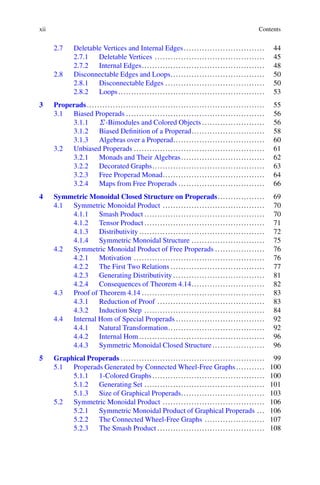
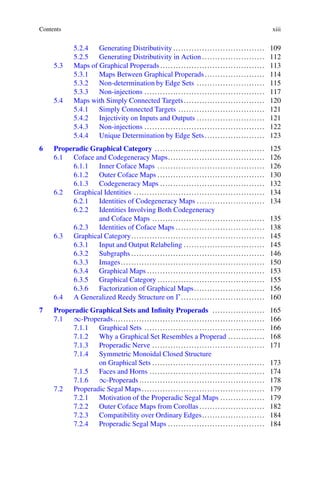
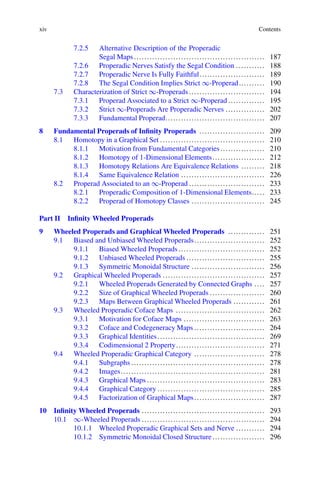
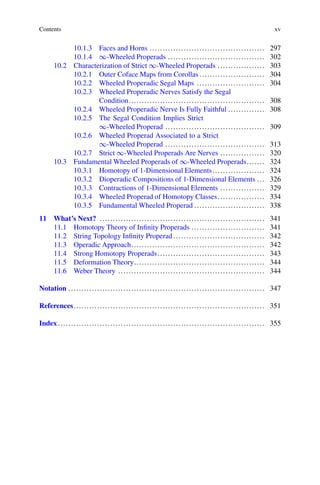
![Chapter 1
Introduction
Let us first recall the notions of a properad and of a wheeled properad.
1.1 (Wheeled) Properads as Generalized Categories
In an ordinary category, a morphism x
f
// y has one input and one output.
If y
g
// z is another morphism, then the composition gf is uniquely defined.
Moreover, the identity and associativity axioms hold in the strict sense. There are
two natural ways in which the notion of a category can be extended.
The first natural way to extend the notion of a category is to allow morphisms
with finite lists of objects as inputs and outputs, together with appropriately
chosen axioms that hold in the strict sense. For example, an operad [May72] is a
generalization of a category in which a morphism has one output and finitely many
inputs, say
.x1; : : : ; xn/
f
// y
with n 0. We often call such a morphism an operation and denote it by the
following decorated graph.
© Springer International Publishing Switzerland 2015
P. Hackney et al., Infinity Properads and Infinity Wheeled Properads,
Lecture Notes in Mathematics 2147, DOI 10.1007/978-3-319-20547-2_1
1](https://image.slidesharecdn.com/2617622-250622143055-e33e5477/85/Infinity-Properads-And-Infinity-Wheeled-Properads-1st-Edition-Philip-Hackney-21-320.jpg)
![2 1 Introduction
Composition in a category is represented linearly. With multiple inputs, composition
in an operad takes on the shape of a tree. Explicitly, if there are operations
wi
1; : : : ; wi
ki
gi
// xi
for each i, then the operadic composition .fI g1; : : : ; gn/ is represented by the
following decorated 2-level tree.
In particular, its inputs are the concatenation of the lists
wi
1; : : : ; wi
ki
as i runs from
1 to n. Associativity of the operadic composition takes the form of a 3-level tree.
There are also unity and equivariance axioms, which come from permutations of the
inputs. We should point out that what we call an operad here is sometimes called a
colored operad or a multicategory in the literature.
A properad [Val07] allows even more general operations, where both inputs and
outputs are finite lists of objects, say
.x1; : : : ; xm/
f
// .y1; : : : ; yn/
with m; n 0. Such an operation is visualized as the following decorated corolla.
Since both the inputs and the outputs can be permuted, there are bi-equivariance
axioms. The properadic composition is represented by the following graph, called a
partially grafted corollas.](https://image.slidesharecdn.com/2617622-250622143055-e33e5477/85/Infinity-Properads-And-Infinity-Wheeled-Properads-1st-Edition-Philip-Hackney-22-320.jpg)
![1.1 (Wheeled) Properads as Generalized Categories 3
For this properadic composition to be defined, a non-empty sub-list of the outputs
of f must match a non-empty sub-list of the inputs of g. Associativity says that if a
3-vertex connected wheel-free graph has its vertices decorated by operations, then
there is a well-defined operation.
One particular instance of the properadic composition is when the partially
grafted corollas has only one edge connecting the two vertices, as in the following
simply connected graph.
It is called a dioperadic graph and represents the dioperadic composition in a
dioperad [Gan04], which is sometimes called a polycategory in the literature.
Thus, a category is a special case of an operad, which in turn is a special case
of a dioperad. Moreover, properads contain dioperads. These generalizations of
categories are very powerful tools that encode operations. For example, the little
n-cube operads introduced by May [May72] provide a recognition principle for con-
nected n-fold loop spaces. Dioperads can model algebraic structures with multiple
inputs and multiple outputs, whose axioms are represented by simply connected
graphs, such as Lie bialgebras. Going even further, properads can model algebraic
structures with multiple inputs and multiple outputs, whose axioms are represented
by connected wheel-free graphs, such as biassociative bialgebras and (co)module
bialgebras. There are numerous other applications of these generalized categories
in homotopy theory, string topology, deformation theory, and mathematical physics,
among many other subjects. See, for example, [Mar08, MSS02], and the references
therein.
A wheeled properad takes this line of thought one step further by allowing a
contraction operation. To motivate this structure, recall from above that a dioperadic
composition is a special case of a properadic composition. It is natural to ask if
properadic compositions can be generated by dioperadic compositions in some way,
since the latter are much simpler than the former. A dioperadic graph has only](https://image.slidesharecdn.com/2617622-250622143055-e33e5477/85/Infinity-Properads-And-Infinity-Wheeled-Properads-1st-Edition-Philip-Hackney-23-320.jpg)
![4 1 Introduction
one internal edge, while a partially grafted corollas can have finitely many internal
edges. Starting with a dioperadic graph, to create a general partially grafted corollas
with the same vertices and containing the given internal edge, one needs to connect
some output legs of the bottom vertex with some input legs of the top vertex. So
we need a contraction operation that connects an output di of an operation h with
an input cj of the same color (i.e., di D cj) of the same operation. The following
picture, called a contracted corolla, represents such a contraction.
h
di
cj
A general properadic composition is a composition of a dioperadic composition and
finitely many contractions.
A wheeled properad is an object that has a bi-equivariant structure, units, a
dioperadic composition, and a contraction, satisfying suitable axioms. Wheeled
properads in the linear setting are heavily used in applications [KWZ12, MMS09,
Mer09, Mer10a, Mer10b]. Foundational discussion of wheeled properads can be
found in [YJ15, JY]. As the picture above indicates, when working with wheeled
properads, one must allow graphs to have loops and directed cycles in general.
1.2 Infinity Categories and Infinity Operads
Another natural way to extend the notion of a category comes from relaxing the
axioms, so they do not need to hold in the strict sense, resulting in what is called
a weak category. There are quite a few variations of this concept; see, for example,
[Lei04, Sim12]. We concentrate only on 1-categories in the sense of Joyal [Joy02]
and Lurie [Lur09]. These objects were actually first defined by Boardman and Vogt
[BV73] as simplicial sets satisfying the restricted Kan condition.
The basic idea of an 1-category is very similar to that of the path space of a
topological space X. Given two composable paths f and g in X, there are many ways
to form their composition, but any two such compositions are homotopic. Moreover,
any two such homotopies are themselves homotopic, and so forth. Composition of
paths is not associative in the strict sense, but it holds up to homotopy again.
Similarly, in an 1-category, one asks that there be a composition of two given
morphisms.
1
0 2
f g
∃](https://image.slidesharecdn.com/2617622-250622143055-e33e5477/85/Infinity-Properads-And-Infinity-Wheeled-Properads-1st-Edition-Philip-Hackney-24-320.jpg)
![1.2 Infinity Categories and Infinity Operads 5
There may be many such compositions, but any two compositions are homotopic.
Associativity of such composition holds up to homotopy, and there are also higher
coherence conditions. To make these ideas precise, observe that the above triangle
can be phrased in a simplicial set X. Namely, f and g are two 1-simplices in X that
determine a unique inner horn 1
Œ2 ! X, with g as the 0-face and f as the 2-face.
To say that a composition exists, one can say that this inner horn has an extension
to Œ2 ! X, so its 1-face is such a composition. In fact, an 1-category is defined
as a simplicial set in which every inner horn
with 0 k n has a filler. There are several other models of 1-categories, which
are discussed in [Ber07, Ber10, JT06, Rez01].
Similarly, an 1-operad captures the idea of an up-to-homotopy operad. It was
first developed by Moerdijk and Weiss [MW07, MW09], and more recently in
[BN14, CM13a, CM11, CM13b, Heu11a, Heu11b, HHM13, Luk13, Nik13]. To
define 1-operads, recall that 1-categories are simplicial sets satisfying an inner
horn extension property. The finite ordinal category can be represented using
linear graphs. In fact, the object
Œn D f0 1 ng 2
is the category generated by the following linear graph with n vertices.
v1 v2 · · · vn
0 1 2 n − 1 n
Here each vertex vi is the generating morphism i 1 ! i.
Likewise, each unital tree freely generates an operad. The resulting full subcate-
gory of operads generated by unital trees is called the dendroidal category. Using
the dendroidal category instead of the finite ordinal category , one can define
analogs of coface and codegeneracy maps. Objects in the presheaf category Setop
are called dendroidal sets, which are tree-like analogs of simplicial sets. An 1-
operad is then defined as a dendroidal set in which every dendroidal inner horn has
a filler.
The objects discussed above are summarized in the following table. Starting in
the upper left corner, moving downward represents the first type of generalized
categories discussed above, while moving to the right yields 1-categories. In view
of this table, a natural question is this:
What are 1-properads and 1-wheeled properads?](https://image.slidesharecdn.com/2617622-250622143055-e33e5477/85/Infinity-Properads-And-Infinity-Wheeled-Properads-1st-Edition-Philip-Hackney-25-320.jpg)
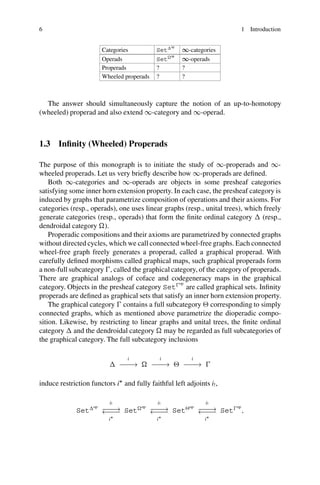
![1.4 Chapter Summaries 7
on presheaf categories. Moreover, we have i
iŠ D Id in each case. In particular, the
graphical set generated by an 1-category or an 1-operad is an 1-properad.
One difficulty in studying 1-properads is that working with connected wheel-
free graphs requires a lot more care than working with simply connected graphs,
such as linear graphs and unital trees. For example, even the graphical analogs of the
cosimplicial identities are not entirely straightforward to prove. Likewise, whereas
every object in the finite ordinal category and the dendroidal category has a
finite set of elements, most objects in the graphical category have infinite sets
of elements. In fact, a graphical properad is finite if and only if it is generated
by a simply connected graph. Furthermore, since graphical properads are often
very large, general properad maps between them may exhibit bad behavior that
would never happen in and . To obtain graphical analogs of, say, the epi-
mono factorization, we will need to impose suitable restrictions on the maps in the
graphical category .
To explain such differences in graph theoretical terms, note that in a simply
connected graph, any two vertices are connected by a unique internal path. In
particular, any finite subset of edges can be shrunk away in any order. This is far
from the case in a connected wheel-free graph, where there may be finitely many
edges adjacent to two given vertices. Thus, one cannot in general shrink away an
edge in a connected wheel-free graph, or else one may end up with a directed loop.
Therefore, in the development of the graphical category , one must be extremely
careful about the various graph operations.
Infinity wheeled properads are defined similarly, using all connected graphs,
where loops and directed cycles are allowed, instead of connected wheel-free
graphs. One major difference between 1-wheeled properads and 1-properads is
that, when working with all connected graphs, there are more types of coface maps.
This is due to the fact that a properad has only one generating operation, namely
the properadic composition, besides the bi-equivariant structure and the units. In
a wheeled properad, there are two generating operations, namely the dioperadic
composition and the contraction, each with its own corresponding coface maps.
1.4 Chapter Summaries
This monograph is divided into two parts. In Part I we set up the graph theoretic
foundation and discuss 1-properads. Part II has the parallel theory of 1-wheeled
properads.
In Chap. 2 we recall the definition of a graph and the operation of graph
substitution developed in detail in the monograph [YJ15]. This discussion is needed
because graphical properads (resp., graphical wheeled properads) are generated by
connected wheel-free graphs (resp., all connected graphs). Also, many properties
of the graphical category are proved using the associativity and unity of graph
substitution. The first four sections of this chapter are adapted from that monograph.
In the remaining sections, we develop graph theoretical concepts that will be](https://image.slidesharecdn.com/2617622-250622143055-e33e5477/85/Infinity-Properads-And-Infinity-Wheeled-Properads-1st-Edition-Philip-Hackney-27-320.jpg)
![8 1 Introduction
needed later to define coface and codegeneracy maps in the graphical categories
for connected (wheeled-free) graphs. We give graph substitution characterization of
each of these concepts.
A major advantage of using graph substitution to define coface and codegeneracy
maps is that the resulting definition is very formal. From the graph substitution
point of view, regardless of the graphs one uses (linear graphs, unital trees, simply
connected graphs, or connected (wheel-free) graphs), all the coface maps have
almost the same definition. What changes in these definitions of coface maps, from
one type of graphs to another, is the set of minimal generating graphs. For linear
graphs, a minimal generating graph is the linear graph with two vertices. For unital
trees (resp., simply connected graphs), one takes as minimal generating graphs
the unital trees with one ordinary edge (resp., dioperadic graphs). For connected
wheel-free graphs, the partially grafted corollas form the set of minimal generating
graphs. For all connected graphs, the set of minimal generating graphs consists of
the dioperadic graphs and the contracted corollas.
In Chap.3 we recall both the biased and the unbiased definitions of a properad.
The former describes a properad in terms of generating operations, namely, units,
˙-bimodule structure, and properadic composition. The unbiased definition of a
properad describes it as an algebra over a monad induced by connected wheel-free
graphs. The equivalence of the two definitions of a properad are proved in detail in
[YJ15] as an example of a general theory of generating sets for graphs.
In Chap. 4 we equip the category of properads with a symmetric monoidal closed
structure. For topological operads, a symmetric monoidal product was already
defined by Boardman and Vogt [BV73]. One main result of this chapter gives a
simple description of the tensor product of two free properads in terms of the
two generating sets. In particular, when the free properads are finitely generated,
their tensor product is finitely presented. This is not immediately obvious from
the definition because free properads are often infinite sets. In future work we will
compare our symmetric monoidal tensor product with the Dwyer-Hess box product
of operadic bimodules [DH13] and show they agree in the special case when our
properads come from operads.
In Chap. 5 we define graphical properads as the free properads generated by
connected wheel-free graphs. We observe that a graphical properad has an infinite
set of elements precisely when the generating graph is not simply connected. The
discussion of the tensor product of free properads in Chap. 4 applies in particular
to graphical properads. Then we illustrate with several examples that a general
properad map between graphical properads may exhibit bad behavior that would
never happen when working with simply connected graphs. These examples serve
as the motivation of the restriction on the morphisms in the graphical category.
In Chap. 6 we define the properadic graphical category , whose objects are
graphical properads. Its morphisms are called properadic graphical maps. To define
such graphical maps, we first discuss coface and codegeneracy maps between
graphical properads. We establish graphical analogs of the cosimplicial identities.](https://image.slidesharecdn.com/2617622-250622143055-e33e5477/85/Infinity-Properads-And-Infinity-Wheeled-Properads-1st-Edition-Philip-Hackney-28-320.jpg)
![1.4 Chapter Summaries 9
The most interesting case is the graphical analog of the cosimplicial identity
dj
di
D di
dj1
for i j because it involves iterating the operations of deleting an almost isolated
vertex and of smashing two closest neighbors together. Graphical maps do not have
the bad behavior discussed in the examples in Chap. 5. In particular, it is observed
that each graphical map has a factorization into codegeneracy maps followed by
coface maps. Such factorizations do not exist for general properad maps between
graphical properads. Finally, we show that the properadic graphical category admits
the structure of a (dualizable) generalized Reedy category, in the sense of [BM11].
In Chap. 7 we first define the category Setop
of graphical sets. There is an
adjoint pair
Setop
L
// Properad;
N
oo
in which the right adjoint N is called the properadic nerve. The symmetric monoidal
product of properads in Chap.4 induces, via the properadic nerve, a symmetric
monoidal closed structure on Setop
. Then we define an 1-properad as a graphical
set in which every inner horn has a filler. If, furthermore, every inner horn filler is
unique, then it is called a strict 1-properad. The rest of this chapter contains two
alternative descriptions of a strict 1-properad. One description is in terms of the
graphical analogs of the Segal maps, and the other is in terms of the properadic
nerve.
In Chap. 8 we give an explicit description of the fundamental properad LK of an
1-properad K. The fundamental properad of an 1-properad consists of homotopy
classes of 1-dimensional elements. It takes a bit of work to prove that there is a
well-defined homotopy relation among 1-dimensional elements and that a properad
structure can be defined on homotopy classes. This finishes Part I on 1-properads.
Part II begins with Chap. 9. We first recall from [YJ15] the biased and the
unbiased definitions of a wheeled properad. There is a symmetric monoidal structure
on the category of wheeled properads. Then we define graphical wheeled properads
as free wheeled properads generated by connected graphs, possibly with loops
and directed cycles. With the exception of the exceptional wheel, a graphical
wheeled properad has a finite set of elements precisely when the generating graph
is simply connected. So most graphical wheeled properads are infinite. In the rest
of this chapter, we discuss wheeled versions of coface maps, codegeneracy maps,
and graphical maps, which are used to define the wheeled properadic graphical
category ˚. Every wheeled properadic graphical map has a decomposition into
codegeneracy maps followed by coface maps.](https://image.slidesharecdn.com/2617622-250622143055-e33e5477/85/Infinity-Properads-And-Infinity-Wheeled-Properads-1st-Edition-Philip-Hackney-29-320.jpg)
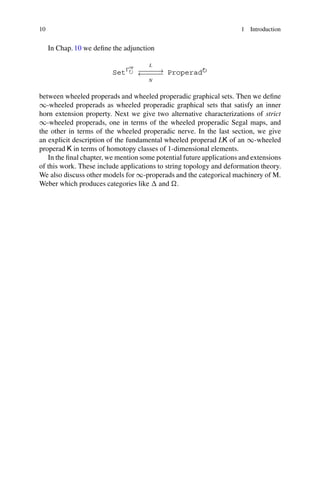
![Chapter 2
Graphs
The purpose of this chapter is to discuss graphs and graph operations that are
suitable for the study of 1-properads and 1-wheeled properads. We will need
connected (wheel-free) graphs for two reasons. First, the free (wheeled) properad
monad is a coproduct parametrized by suitable subsets of connected wheel-free
(connected) graphs. Second, each connected wheel-free (resp., connected) graph
generates a free properad (resp., wheeled properad), called a graphical (wheeled)
properad. The graphical (wheeled) properads form the graphical category, which in
turn yields graphical sets and 1-(wheeled) properads.
In Sect. 2.1 we discuss graphs in general. In Sect. 2.2 we provide some examples
of graphs, most of which are important later. In Sect. 2.3 we discuss connected
(wheel-free) graphs as well as some important subsets of graphs, including simply
connected graphs, unital trees, and linear graphs. In Sect. 2.4 we discuss the
operation of graph substitution, which induces the multiplication of the free
(wheeled) properad monad. Graph substitution will also be used in the second half of
this chapter to characterize some graph theoretic concepts that will be used to define
coface maps in the graphical category in Sect. 6.1. The reference for Sects. 2.1–2.4
on graphs and graph substitution is [YJ15].
In Sects. 2.5 and 2.6 we discuss closest neighbors and almost isolated vertices
in connected wheel-free graphs. These concepts are needed when we define inner
and outer coface maps in the graphical category for connected wheel-free graphs. In
Sects. 2.7 and 2.8 we discuss analogous graph theoretic concepts that will be used in
Part II to define inner and outer coface maps in the graphical category for connected
graphs.
© Springer International Publishing Switzerland 2015
P. Hackney et al., Infinity Properads and Infinity Wheeled Properads,
Lecture Notes in Mathematics 2147, DOI 10.1007/978-3-319-20547-2_2
13](https://image.slidesharecdn.com/2617622-250622143055-e33e5477/85/Infinity-Properads-And-Infinity-Wheeled-Properads-1st-Edition-Philip-Hackney-32-320.jpg)
![14 2 Graphs
2.1 Wheeled Graphs
The intuitive idea of a graph is quite simple, but the precise definition is slightly
abstract. We first give the more general definition of a wheeled graph before
restricting to the connected (wheel-free) ones.
2.1.1 Profiles of Colors
We begin by describing profiles of colors, which provide a way to parametrize lists
of inputs and outputs. This discussion of profiles of colors can be found in [JY09,
YJ15].
Fix a set C.
Definition 2.1 Let ˙n denote the symmetric group on n letters.
1. An element in C will be called a color.
2. A C-profile of length n is a finite sequence
c D .c1; : : : ; cn/ D cŒ1;n
of colors. We write jcj D n for the length. The empty profile, with n D 0, is
denoted by ¿.
3. Given a C-profile c D cŒ1;n and 0 k n, a k-segment of c is a sub-C-profile
c0
D .ci; : : : ; ciCk1/
of length k for some 1 i n C 1 k.
4. Given two C-profiles c and d D dŒ1;m and a k-segment c0
c as above, define
the C-profile
c ıc0 d D .c1; : : : ; ci1; d1; : : : ; dm; ciCk; : : : ; cn/ :
If c0
happens to be the 1-segment .ci/, we also write c ıi d for c ıc0 d.
5. For a C-profile c of length n and 2 ˙n, define the left and right actions
c D
c.1/; : : : ; c.n/
and c D
c1.1/; : : : ; c1.n/
:
6. The groupoid of all C-profiles with left (resp., right) symmetric group actions as
morphisms is denoted by P.C/ (resp., P.C/op
).
7. Define the product category
S.C/ D P.C/op
P.C/;](https://image.slidesharecdn.com/2617622-250622143055-e33e5477/85/Infinity-Properads-And-Infinity-Wheeled-Properads-1st-Edition-Philip-Hackney-33-320.jpg)
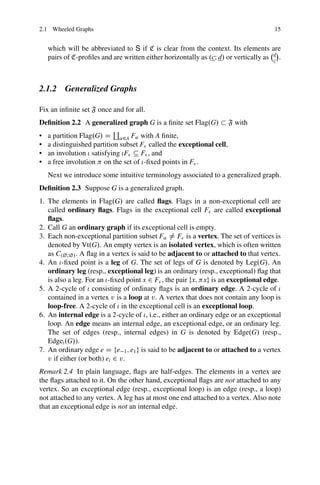
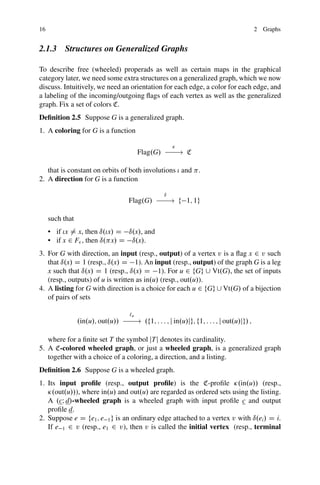
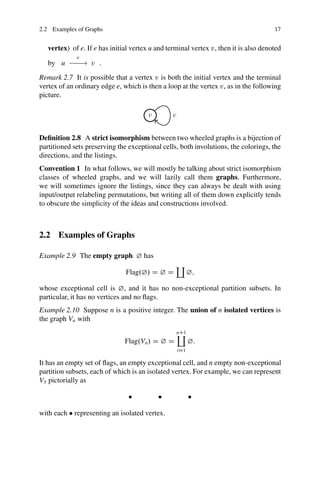
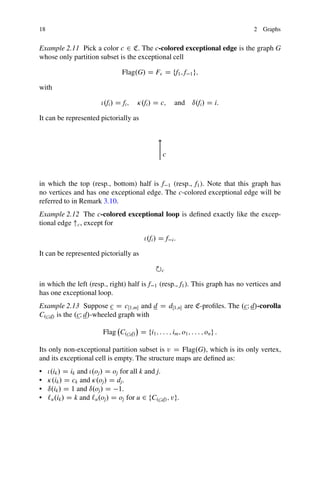
![2.2 Examples of Graphs 19
The .cI d/-corolla can be represented pictorially as the following graph.
This corolla will be referred to in Remark 3.2. In particular, when c D d D ¿, the
corolla C.¿I¿/ consists of a single isolated vertex. Notice that we omit some of the
structure of a wheeled graph in its pictorial representation in order not to overload
it with too many symbols.
In the 1-colored case with C D f g, we also write C.cId/ as C.mIn/. In other words,
C.mIn/ is the 1-colored corolla with m inputs and n outputs.
Example 2.14 Suppose c D cŒ1;m and d D dŒ1;n are C-profiles, 2 ˙n, and 2
˙m. Define the permuted corolla C.cId/ , which is a .c I d/-wheeled graph,
with
Flag
C.cId/
D Flag
C.cId/
:
All the structure maps are the same as for the corolla C.cId/, except for the listing of
the full graph, which in this case is
`G.ik/ D .k/ and `G.oj/ D 1
.j/:
The .cI d/-corolla is also a permuted corolla with and the identity permutations.
In the unbiased formulation of a properad, permuted corollas give rise to the bi-
equivariant structure. Moreover, permuted corollas can be used to change the listing
of a graph via graph substitution. Substituting a graph into a suitable permuted
corolla changes the listing of the full graph. On the other hand, substituting a suitable
permuted corolla into a vertex changes the listing of that vertex. The permuted
corollas generate the ˙-bimodule structures in all variants of generalized PROPs
[YJ15].
Example 2.15 Suppose c D cŒ1;m, d D dŒ1;n, 1 j m, and 1 i n. The
contracted corolla i
j C.cId/ is defined exactly like the .cI d/-corolla (Example 2.13)
with the following two exceptions.
1. The involution is given by
.ij/ D oi; .oi/ D ij;
and is the identity on other flags.
2. The listing for the full graph is given by
`G.ik/ D
(
k if k j;
k 1 if k j](https://image.slidesharecdn.com/2617622-250622143055-e33e5477/85/Infinity-Properads-And-Infinity-Wheeled-Properads-1st-Edition-Philip-Hackney-38-320.jpg)
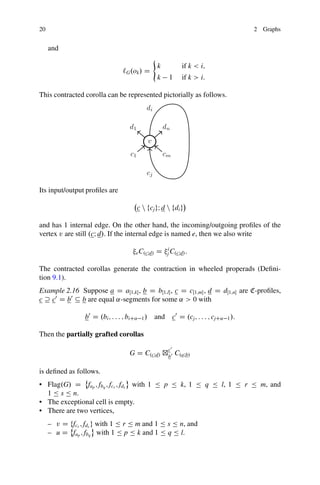
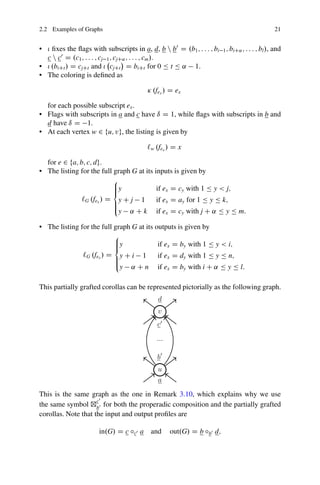
![22 2 Graphs
which form the input/output profiles of the target of the properadic composition.
There are ˛ internal edges. If these internal edges are names e D .e1; : : : ; e˛/, then
we also write
C.cId/ e C.aIb/ D C.cId/
c0
b0 C.aIb/:
The partially grafted corollas generate the properadic composition (Definition 3.5).
Example 2.17 Using the same symbols as in Example 2.16, suppose that ˛ D 1,
i.e., b0
D .bi/ D .cj/ D c0
are equal 1-segments. Define the dioperadic graph
C.cId/iıjC.aIb/ D C.cId/
.cj/
.bi/ C.aIb/
as a special case of a partially grafted corollas. This dioperadic graph can be
represented pictorially as follows.
It has input/output profiles
c ıj aI b ıi d
and 1 internal edge. If this internal edge is named e, then we also write
C.cId/ ıe C.aIb/ D C.cId/iıjC.aIb/
The dioperadic graphs generate the dioperadic composition in a dioperad [Gan04]
and in a wheeled properad (Definition 9.1).
2.3 Connected Graphs
In this section, we discuss connected graphs and connected wheel-free graphs. They
will be used to define free (wheeled) properads and the graphical category later. We
will also define simply connected graphs, unital trees, and linear graphs. To discuss
connectivity and wheels, we need the concept of a path.](https://image.slidesharecdn.com/2617622-250622143055-e33e5477/85/Infinity-Properads-And-Infinity-Wheeled-Properads-1st-Edition-Philip-Hackney-41-320.jpg)
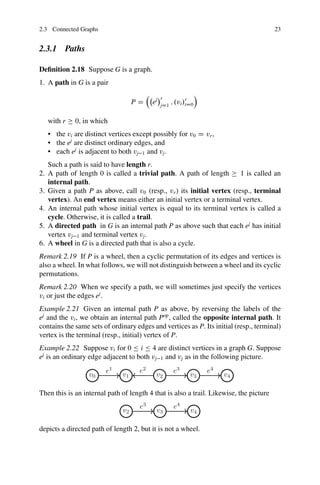
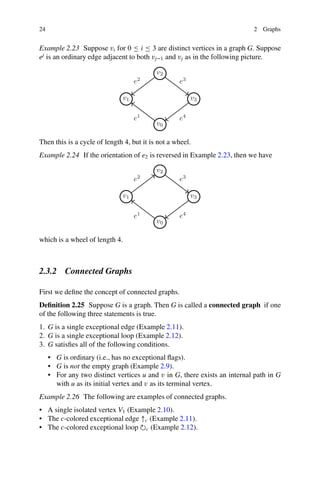
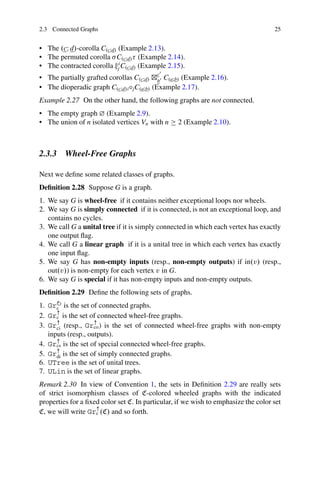
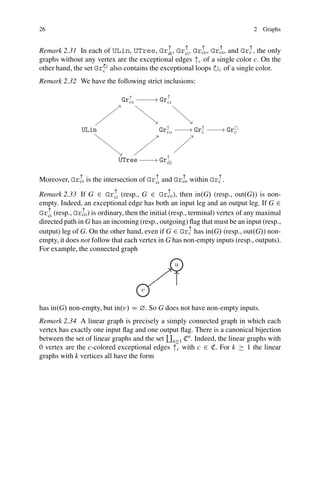
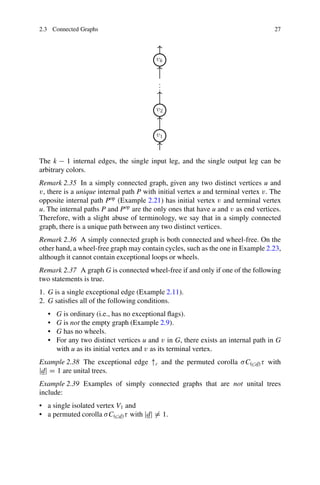
![28 2 Graphs
Example 2.40 The partially grafted corollas C.cId/
c0
b0 C.aIb/ (Example 2.16) is
connected wheel-free.
1. Moreover, such a partially grafted corollas is simply connected if and only if it is
a dioperadic graph (Example 2.17).
2. A dioperadic graph is a unital tree if and only if jdj D 1 D jbj. In this case, it
looks like
and is called a simple tree. It generates the operadic ıj operation [Ger63,
May97].
2.4 Graph Substitution
The free (wheeled) properad monad is induced by the operation of graph sub-
stitution. The reader is referred to [YJ15] for the detailed construction of graph
substitution and proof of its associativity and unity properties. Intuitively, at each
vertex v in a given graph G, we drill a small hole containing v and replace v with a
scaled down version of another graph Hv whose profiles are the same as those of v.
2.4.1 Properties of Graph Substitution
Definition 2.41 Suppose G is a graph with profiles
d
c
, and Hv is a graph with
profiles
out.v/
in.v/
for each v 2 Vt.G/. Define the graph substitution
G
fHvgv2Vt.G/
;
or just G.fHvg/, as the graph obtained from G by
1. replacing each vertex v 2 Vt.G/ with the graph Hv, and
2. identifying the legs of Hv with the incoming/outgoing flags of v.
We say that Hv is substituted into v.](https://image.slidesharecdn.com/2617622-250622143055-e33e5477/85/Infinity-Properads-And-Infinity-Wheeled-Properads-1st-Edition-Philip-Hackney-47-320.jpg)
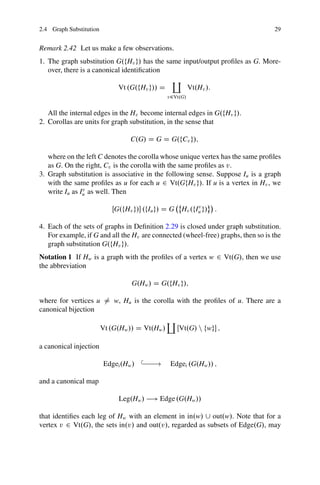
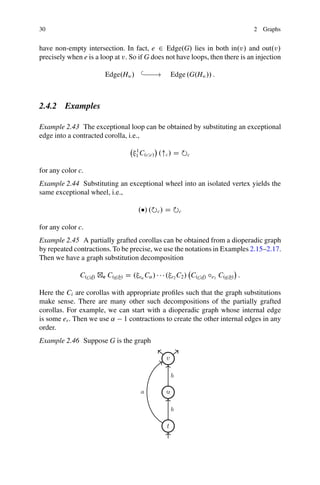
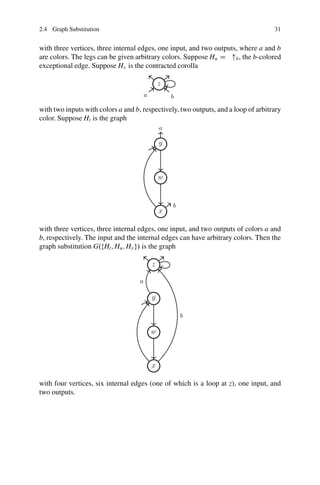
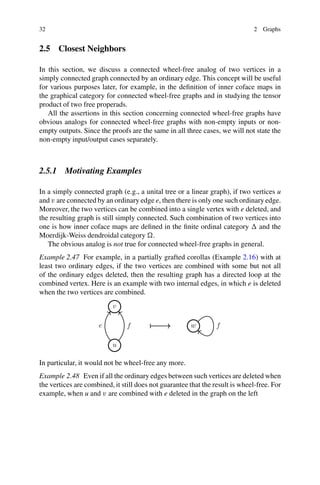
![2.5 Closest Neighbors 33
the resulting graph on the right has a wheel.
2.5.2 Closest Neighbors
In order to smash two vertices together and keep the resulting graph connected
wheel-free, we need the following analog of two vertices connected by an ordinary
edge.
Definition 2.49 Suppose G is a connected wheel-free graph, and u and v are two
distinct vertices in G. Call u and v closest neighbors if:
1. there is at least one ordinary edge adjacent to both of them, and
2. there are no directed paths with initial vertex u and terminal vertex v that involve
a third vertex.
In this case, we also say v is a closest neighbor of u.
Remark 2.50 In [Val07, Sect. 4] the author defined a very similar and probably
equivalent concept called adjacent vertices.
Example 2.51 Consider the following connected wheel-free graph K.
Then u and v are closest neighbors, as are v and w. The vertices u and w are not
closest neighbors.
Example 2.52 The two vertices in a partially grafted corollas (Example 2.16) are
closest neighbors.
Example 2.53 For G 2 Gr
c with at least two vertices, every vertex u has a closest
neighbor. Indeed, either in.u/ or out.u/ is not empty, so let us assume out.u/ is not
empty. Among all the directed paths with initial vertex u, pick one, say P, with
maximal length. Then the vertex v in P right after u must be a closer neighbor of u,
since otherwise P would not be maximal.](https://image.slidesharecdn.com/2617622-250622143055-e33e5477/85/Infinity-Properads-And-Infinity-Wheeled-Properads-1st-Edition-Philip-Hackney-52-320.jpg)
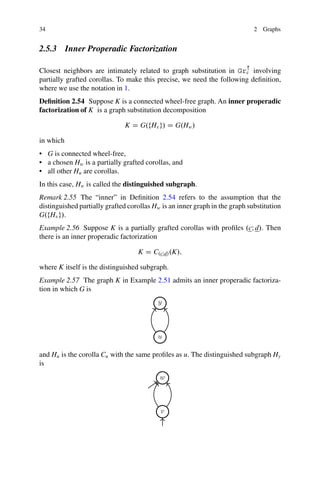
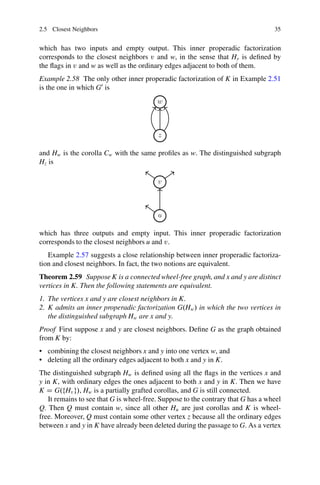





![[SEMINAR at my uni] Tuesday, 14th May, 2019](https://cdn.slidesharecdn.com/ss_thumbnails/may07seminar19051303-190513213519-240815072320-c3e1932b-thumbnail.jpg?width=640&height=640&fit=bounds)


