Incremental and Streaming
Model Transformations
Istvan David
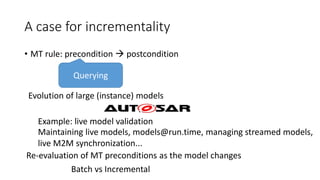
A case for incrementality
• MT rule: precondition  postcondition
Querying
Evolution of large (instance) models
Re-evaluation of MT preconditions as the model changes
Batch vs Incremental
Example: live model validation
Maintaining live models, models@run.time, managing streamed models,
live M2M synchronization...
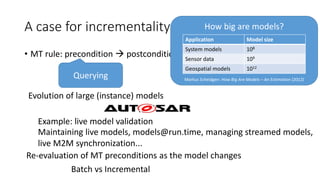
A case for incrementality
• MT rule: precondition  postcondition
Querying
Evolution of large (instance) models
Re-evaluation of MT preconditions as the model changes
Batch vs Incremental
Example: live model validation
Maintaining live models, models@run.time, managing streamed models,
live M2M synchronization...
How big are models?
Markus Scheidgen: How Big Are Models – An Estimation (2012)
Application Model size
System models 108
Sensor data 109
Geospatial models 1012
Batch vs Incremental
• Efficiency vs complexity
• Batch: easy to implement
• Incremental: efficient execution, but very complex algorithms required
Typical in state-of-the-
practice tools!
...on the querying side
Batch vs Incremental
• Efficiency vs complexity
• Batch: easy to implement
• Incremental: efficient execution, but very complex algorithms required
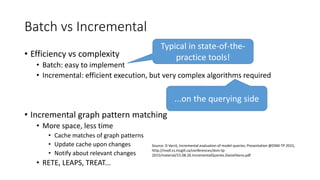
• Incremental graph pattern matching
• More space, less time
• Cache matches of graph patterns
• Update cache upon changes
• Notify about relevant changes
• RETE, LEAPS, TREAT...
Typical in state-of-the-
practice tools!
...on the querying side
Source: D Varró, Incremental evaluation of model queries, Presentation @DSM-TP 2015,
http://msdl.cs.mcgill.ca/conferences/dsm-tp-
2015/material/15.08.26.IncrementalQueries.DanielVarro.pdf
Batch vs Incremental
• Efficiency vs complexity
• Batch: easy to implement
• Incremental: efficient execution, but very complex algorithms required
• Incremental graph pattern matching
• More space, less time
• Cache matches of graph patterns
• Update cache upon changes
• Notify about relevant changes
• RETE, LEAPS, TREAT...
Typical in state-of-the-
practice tools!
...on the querying side
Source: D Varró, Incremental evaluation of model queries, Presentation @DSM-TP 2015,
http://msdl.cs.mcgill.ca/conferences/dsm-tp-
2015/material/15.08.26.IncrementalQueries.DanielVarro.pdf
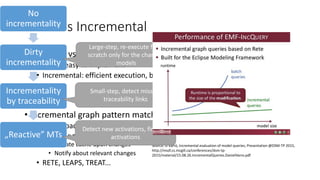
No
incrementality
Dirty
incrementality
Incrementality
by traceability
„Reactive” MTs
Large-step, re-execute from
scratch only for the changed
models
Small-step, detect missing
traceability links
Detect new activations, fire rule
activations
A case for incrementality
• MT rule: precondition  postcondition
Querying
Evolution of large (instance) models
Re-evaluation of MT preconditions as the model changes
Batch vs Incremental
Example: live model validation
Maintaining live models, models@run.time, managing streamed models,
live M2M synchronization...
How big are models?
Markus Scheidgen: How Big Are Models – An Estimation (2012)
Application Model size
System models 108
Sensor data 109
Geospatial models 1012
Assumption: models
are materialized
...what if they are
not?
Streaming MTs
• Models aren’t completely materialized
• Native (or natural) streams
• Sensor systems, CPS, cloud computing...
• Artificial (generated) streams
• Model split up and pushed through a channel
• Large models (AUTOSAR, etc)
• Streaming MTs over live models [1]
“a special kind of transformation in which the whole input model is not
completely available at the beginning of the transformation, but it is
continuously generated”
Sánchez Cuadrado, J., Lara, J.: Streaming model transformations:
Scenarios, challenges and initial solutions (2013) In Duddy, K., Kappel,
G., eds.: Theory and Practice of Model Transformations. Volume 7909
of Lecture Notes in Computer Science. Springer Berlin Heidelberg
(2013) 116
Streaming MTs
• Models aren’t completely materialized
• Native (or natural) streams
• Sensor systems, CPS, cloud computing...
• Artificial (generated) streams
• Model split up and pushed through a channel
• Large models (AUTOSAR, etc)
• Streaming MTs over live models [1]
[1] I. Dávid, I. Ráth, and D. Varró, Streaming model transformations by complex event processing, MoDELS 2014,
Conference acceptance rate: 26%. Invited for submission to MODELS14 Special Issue in SoSyM
Techniques
• Model fragment processing (Lara et al)
• Actual fragments of models are streamed
• Fragments are assembled on the target side
• Ongoing work, implementation planned via Apache Spark
• Related: P2P distributed models (Hartman et al [2])
• Complex event processing
• Model change information streamed as a series of events
• Evaluation of temporal and timing relationships
• Implemented within the VIATRA framework [3]
[2] Hartman et al, Stream my Models: Reactive Peer-to-Peer Distributed Models@run.time, MoDELS 2015
[3] http://www.eclipse.org/viatra/
Pointers
• Incremental MTs
• Tools: IncQuery, ATL, Epsilon...
• Background: RETE (Forgy, 1983), other „custom” cache algorithms
• A. Kusel et al, A Survey on Incremental Model Transformation Approaches,
Workshop on Models and Evolution 2013
• Streaming MTs
• Sánchez Cuadrado, J., Lara, J, Streaming model transformations: Scenarios,
challenges and initial solutions, 2013
• I. Dávid, I. Ráth, D. Varró, Streaming model transformations by complex event
processing, MoDELS 2014
• https://wiki.eclipse.org/VIATRA/CEP
• Hartman et al, Stream my Models: Reactive Peer-to-Peer Distributed
Models@run.time, MoDELS 2015

Incremental and Streaming Model Transformations

  • 1.
    Incremental and Streaming ModelTransformations Istvan David
  • 2.
    A case forincrementality • MT rule: precondition  postcondition Querying Evolution of large (instance) models Re-evaluation of MT preconditions as the model changes Batch vs Incremental Example: live model validation Maintaining live models, models@run.time, managing streamed models, live M2M synchronization...
  • 3.
    A case forincrementality • MT rule: precondition  postcondition Querying Evolution of large (instance) models Re-evaluation of MT preconditions as the model changes Batch vs Incremental Example: live model validation Maintaining live models, models@run.time, managing streamed models, live M2M synchronization... How big are models? Markus Scheidgen: How Big Are Models – An Estimation (2012) Application Model size System models 108 Sensor data 109 Geospatial models 1012
  • 4.
    Batch vs Incremental •Efficiency vs complexity • Batch: easy to implement • Incremental: efficient execution, but very complex algorithms required Typical in state-of-the- practice tools! ...on the querying side
  • 5.
    Batch vs Incremental •Efficiency vs complexity • Batch: easy to implement • Incremental: efficient execution, but very complex algorithms required • Incremental graph pattern matching • More space, less time • Cache matches of graph patterns • Update cache upon changes • Notify about relevant changes • RETE, LEAPS, TREAT... Typical in state-of-the- practice tools! ...on the querying side Source: D Varró, Incremental evaluation of model queries, Presentation @DSM-TP 2015, http://msdl.cs.mcgill.ca/conferences/dsm-tp- 2015/material/15.08.26.IncrementalQueries.DanielVarro.pdf
  • 6.
    Batch vs Incremental •Efficiency vs complexity • Batch: easy to implement • Incremental: efficient execution, but very complex algorithms required • Incremental graph pattern matching • More space, less time • Cache matches of graph patterns • Update cache upon changes • Notify about relevant changes • RETE, LEAPS, TREAT... Typical in state-of-the- practice tools! ...on the querying side Source: D Varró, Incremental evaluation of model queries, Presentation @DSM-TP 2015, http://msdl.cs.mcgill.ca/conferences/dsm-tp- 2015/material/15.08.26.IncrementalQueries.DanielVarro.pdf No incrementality Dirty incrementality Incrementality by traceability „Reactive” MTs Large-step, re-execute from scratch only for the changed models Small-step, detect missing traceability links Detect new activations, fire rule activations
  • 7.
    A case forincrementality • MT rule: precondition  postcondition Querying Evolution of large (instance) models Re-evaluation of MT preconditions as the model changes Batch vs Incremental Example: live model validation Maintaining live models, models@run.time, managing streamed models, live M2M synchronization... How big are models? Markus Scheidgen: How Big Are Models – An Estimation (2012) Application Model size System models 108 Sensor data 109 Geospatial models 1012 Assumption: models are materialized ...what if they are not?
  • 8.
    Streaming MTs • Modelsaren’t completely materialized • Native (or natural) streams • Sensor systems, CPS, cloud computing... • Artificial (generated) streams • Model split up and pushed through a channel • Large models (AUTOSAR, etc) • Streaming MTs over live models [1] “a special kind of transformation in which the whole input model is not completely available at the beginning of the transformation, but it is continuously generated” Sánchez Cuadrado, J., Lara, J.: Streaming model transformations: Scenarios, challenges and initial solutions (2013) In Duddy, K., Kappel, G., eds.: Theory and Practice of Model Transformations. Volume 7909 of Lecture Notes in Computer Science. Springer Berlin Heidelberg (2013) 116
  • 9.
    Streaming MTs • Modelsaren’t completely materialized • Native (or natural) streams • Sensor systems, CPS, cloud computing... • Artificial (generated) streams • Model split up and pushed through a channel • Large models (AUTOSAR, etc) • Streaming MTs over live models [1] [1] I. Dávid, I. Ráth, and D. Varró, Streaming model transformations by complex event processing, MoDELS 2014, Conference acceptance rate: 26%. Invited for submission to MODELS14 Special Issue in SoSyM
  • 10.
    Techniques • Model fragmentprocessing (Lara et al) • Actual fragments of models are streamed • Fragments are assembled on the target side • Ongoing work, implementation planned via Apache Spark • Related: P2P distributed models (Hartman et al [2]) • Complex event processing • Model change information streamed as a series of events • Evaluation of temporal and timing relationships • Implemented within the VIATRA framework [3] [2] Hartman et al, Stream my Models: Reactive Peer-to-Peer Distributed Models@run.time, MoDELS 2015 [3] http://www.eclipse.org/viatra/
  • 11.
    Pointers • Incremental MTs •Tools: IncQuery, ATL, Epsilon... • Background: RETE (Forgy, 1983), other „custom” cache algorithms • A. Kusel et al, A Survey on Incremental Model Transformation Approaches, Workshop on Models and Evolution 2013 • Streaming MTs • Sánchez Cuadrado, J., Lara, J, Streaming model transformations: Scenarios, challenges and initial solutions, 2013 • I. Dávid, I. Ráth, D. Varró, Streaming model transformations by complex event processing, MoDELS 2014 • https://wiki.eclipse.org/VIATRA/CEP • Hartman et al, Stream my Models: Reactive Peer-to-Peer Distributed Models@run.time, MoDELS 2015