INCOTERMS
INCOTERMS
INTERNATIONAL COMMERCIAL TERMS
BY DR. VANDANA SINGH
(RESEARCHER & EDUCATOR)
INTRODUCTION
Since in international transaction , traders are from diverse
nations, specific term should be interpreted in a similar way
by all the parties concerned. Otherwise, disputes are bound to
arise.
To solve this problem the international chamber of
commerce (ICC) Paris has developed ‘Incoterms’. These
terms hold universal meaning for buyers and sellers around
the world and commonly used in export-import transaction.
Incoterms set out the rights and obligations of the buyer and
the seller for each of the terms. Therefore, each party knows
precisely what he is supposed to do and in turn what he can
expect from the other party.
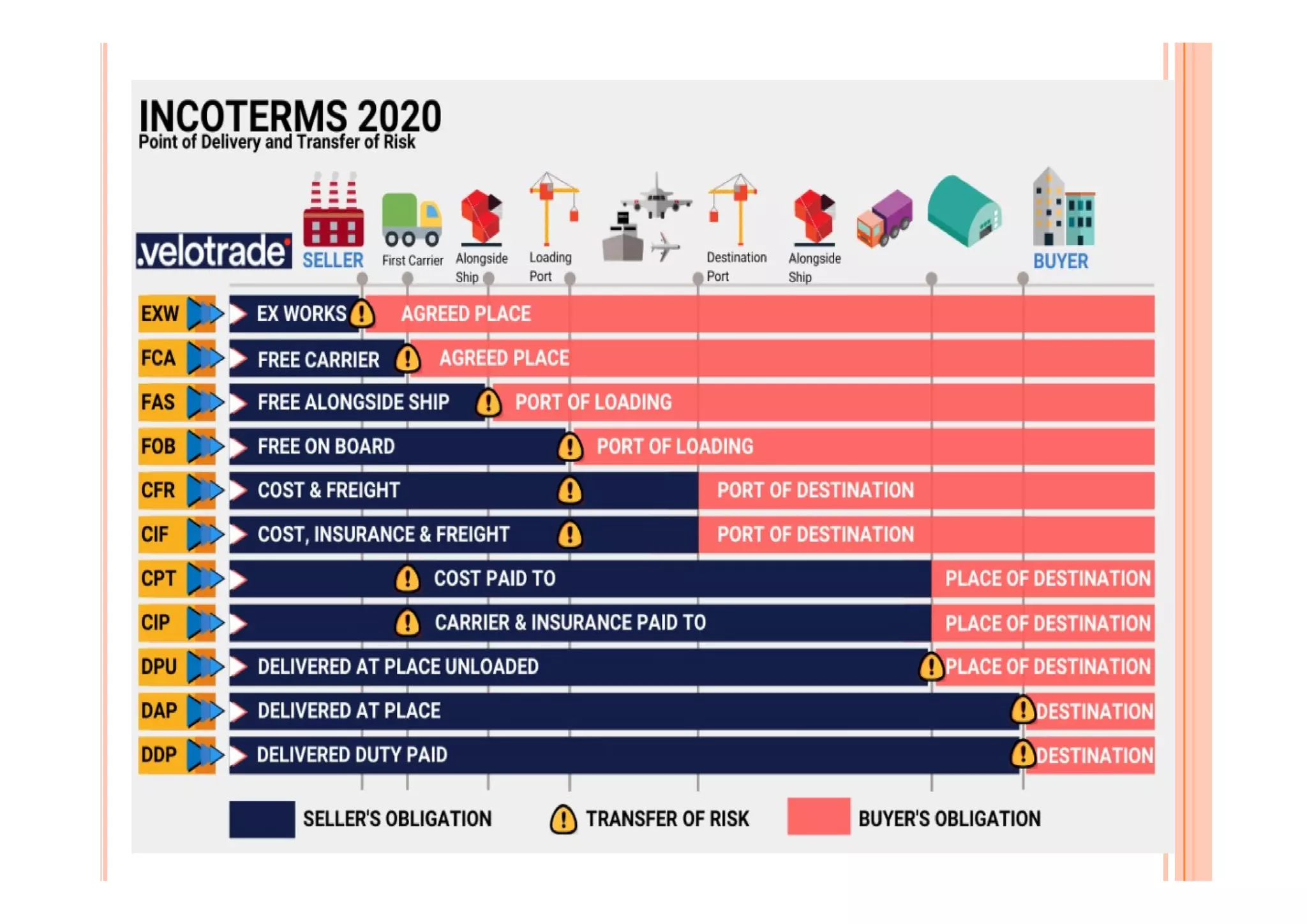
1. EXW – Ex Works
2. FCA – Free Carrier
3. FAS – Free Alongside Ship
4. FOB – Free On Board
5. CFR – Cost and Freight
6. CIF – Cost, Insurance, Freight
7. CPT – Carriage Paid to
S
e
a
S
e
a
7. CPT – Carriage Paid to
8. CIP – Carriage and Insurance Paid to
9. DAT(2010) – Delivered at Terminal (named terminal
at port or place of destination) Now DPU:-
Delivered at Place Unloaded (Jan 2020).
10. DAP – Delivered At Place (named place of
destination)
11. DDP – Delivered Duty Paid
E – GROUP/TERMS: USED WHERE THE SELLER
DOES NOT WANT TO ARRANGE TRANSPORT
EXW or "Ex-Works" means the seller's only responsibility is
to make the goods available at the seller's premises,
i.e., the works or factory. The seller is not responsible for
loading the goods on the vehicle provided by the buyer
unless otherwise agreed. The buyer bears the full costs and
risk involved in bringing the goods from there to the
desired destination. Ex - Works represents the minimum
obligation of the seller.
F - GROUP: USED WHERE THE SELLER CAN
ARRANGE SOME TRANSPORT WITHIN HIS/HER OWN
COUNTRY
2. FCA or "Free Carrier " This term has been designed
to meet the requirements of multi-modal transport, such as
container or roll-on, roll-off traffic by trailers and ferries.
The seller fulfils his/her obligations when the goods are
delivered to the custody of the carrier at a named point. If
no precise point can be named at the time of the contract of
sale, the parties should refer to the place where the carrier
should take the goods into its charge. The risk of loss or
damage to the goods is transferred from seller to buyer at
that time.
3. FAS or "Free Alongside Ship" requires the seller to
deliver the goods alongside the ship on the quay. From that
point on, the buyer bears all costs and risks of loss and
damage to the goods. The buyer has to bear all costs & risks
of loss or damage to the goods from that moment. This term
can be used for ocean transport only.
4. FOB or "Free On Board," . The goods are placed on
board the ship by the seller at a port of shipment named in
the sales agreement. The risk of loss of or damage to the
goods is transferred to the buyer when the goods pass the
ship's rail (i.e., off the dock and placed on the ship). The
seller pays the cost of loading the goods. This term can only
be used for ocean transport.
C - GROUP: USED WHERE THE SELLER CAN ARRANGE AND
PAY FOR MOST OF THE FREIGHT CHARGES UP TO THE
FOREIGN COUNTRY.
 5. CFR (or C & F) "Cost and Freight" requires the seller to pay
the costs and freight necessary to bring the goods to the named
destination, but the risk of loss or damage to the goods, as well as
any cost increases, are transferred from the seller to the buyer
when the goods pass the ship's rail in the port of shipment.
Insurance is the buyer's responsibility.
6. CIF "Cost, Insurance, and Freight" this is CFR with the
additional requirement that the seller procure transport
insurance against the risk of loss or damage to goods. The seller
must contract with the insurer and pay the insurance premium.
Insurance is generally important in international shipping
because transport companies have restricted liability for loss or
damage.
7. CPT "Freight/Carriage Paid To” . This term means the seller
pays the freight for the carriage of the goods to the named
destination. The risk of loss or damage to the goods and any cost
increases transfers from the seller to the buyer when the goods have
been delivered to the custody of the final carrier, and not at the ship's
rail. Accordingly, "freight/carriage paid to" can be used for all modes
of transportation, including container or roll-on roll-off traffic by
trailers and ferries. When the seller is required to furnish a bill of
lading, way bill, or carrier receipt, the seller duly fulfils its obligation
by presenting such a document issued by the person contracted with
for carriage to the main destination.
8. CIP "Freight/Carriage And Insurance Paid To" . This term
(also abbreviated CIP) is the same as "freight/carriage paid to" but
with the additional requirement that the seller has to procure
transport insurance against the risk of loss or damage to the goods
during the carriage. The seller contracts with the insurer and pays the
insurance premium.
D - GROUP: USED WHERE THE SELLER CAN PAY
FOR MOST OF THE DELIVERY CHARGES TO THE
DESTINATION COUNTRY
9. Delivered at Place Unloaded (DPU) (formerly referred to
as DAT for “Delivered at Terminal) requires the seller to
deliver the goods at the disposal of the buyer after they’ve been
unloaded from the arriving means of transport.
DAT – Delivered at Terminal (named terminal at port or
place of destination) Seller pays for carriage to the terminal,
except for costs related to import clearance, and assumes all
risks up to the point that the goods are unloaded at the terminal.
10. DAP - Delivered At Place (named place of destination)
Seller pays for carriage to the named place, except for costs
related to import clearance, and assumes all risks prior to the
point that the goods are ready for unloading by the buyer
11. DDP - Delivered Duty Paid represents the seller's
maximum obligation. The term "DDP." is generally followed
by words indicating the buyer's premises. It notes that the seller
bears all risks and all costs until the goods are delivered. This
term can be used irrespective of the mode of transport. If the
parties wish to make clear that the seller is not responsible for
certain costs, additional word should be added (for example,
"delivered duty paid exclusive of VAT and/or taxes").
SOURCE:
 https://www.google.com/imgres?imgurl=https%3A%2F%2Fwww.velotrade.com%2Fguides%2Fwp-
content%2Fuploads%2F2020%2F04%2FVelotrade-Incoterms-2020-
1080x675.png&imgrefurl=https%3A%2F%2Fwww.velotrade.com%2Fguides%2Fwhat-is-incoterms-
2020%2F&tbnid=_wFpRR7gPga3oM&vet=12ahUKEwiQttSG_a3wAhXQFnIKHbE0CEIQMygAegUIARDLAQ..i&docid
=wBZdij8pwLXlM&w=1080&h=675&q=incoterms&safe=active&ved=2ahUKEwiQttSG_a3wAhXQFnIKHbE0CEIQMyg
AegUIARDLAQ

Incoterms

  • 1.
    INCOTERMS INCOTERMS INTERNATIONAL COMMERCIAL TERMS BYDR. VANDANA SINGH (RESEARCHER & EDUCATOR)
  • 2.
    INTRODUCTION Since in internationaltransaction , traders are from diverse nations, specific term should be interpreted in a similar way by all the parties concerned. Otherwise, disputes are bound to arise. To solve this problem the international chamber of commerce (ICC) Paris has developed ‘Incoterms’. These commerce (ICC) Paris has developed ‘Incoterms’. These terms hold universal meaning for buyers and sellers around the world and commonly used in export-import transaction. Incoterms set out the rights and obligations of the buyer and the seller for each of the terms. Therefore, each party knows precisely what he is supposed to do and in turn what he can expect from the other party.
  • 3.
    1. EXW –Ex Works 2. FCA – Free Carrier 3. FAS – Free Alongside Ship 4. FOB – Free On Board 5. CFR – Cost and Freight 6. CIF – Cost, Insurance, Freight 7. CPT – Carriage Paid to S e a S e a 7. CPT – Carriage Paid to 8. CIP – Carriage and Insurance Paid to 9. DAT(2010) – Delivered at Terminal (named terminal at port or place of destination) Now DPU:- Delivered at Place Unloaded (Jan 2020). 10. DAP – Delivered At Place (named place of destination) 11. DDP – Delivered Duty Paid
  • 5.
    E – GROUP/TERMS:USED WHERE THE SELLER DOES NOT WANT TO ARRANGE TRANSPORT EXW or "Ex-Works" means the seller's only responsibility is to make the goods available at the seller's premises, i.e., the works or factory. The seller is not responsible for loading the goods on the vehicle provided by the buyer unless otherwise agreed. The buyer bears the full costs and risk involved in bringing the goods from there to the risk involved in bringing the goods from there to the desired destination. Ex - Works represents the minimum obligation of the seller.
  • 6.
    F - GROUP:USED WHERE THE SELLER CAN ARRANGE SOME TRANSPORT WITHIN HIS/HER OWN COUNTRY 2. FCA or "Free Carrier " This term has been designed to meet the requirements of multi-modal transport, such as container or roll-on, roll-off traffic by trailers and ferries. The seller fulfils his/her obligations when the goods are delivered to the custody of the carrier at a named point. If no precise point can be named at the time of the contract of sale, the parties should refer to the place where the carrier sale, the parties should refer to the place where the carrier should take the goods into its charge. The risk of loss or damage to the goods is transferred from seller to buyer at that time. 3. FAS or "Free Alongside Ship" requires the seller to deliver the goods alongside the ship on the quay. From that point on, the buyer bears all costs and risks of loss and damage to the goods. The buyer has to bear all costs & risks of loss or damage to the goods from that moment. This term can be used for ocean transport only.
  • 7.
    4. FOB or"Free On Board," . The goods are placed on board the ship by the seller at a port of shipment named in the sales agreement. The risk of loss of or damage to the goods is transferred to the buyer when the goods pass the ship's rail (i.e., off the dock and placed on the ship). The seller pays the cost of loading the goods. This term can only be used for ocean transport.
  • 8.
    C - GROUP:USED WHERE THE SELLER CAN ARRANGE AND PAY FOR MOST OF THE FREIGHT CHARGES UP TO THE FOREIGN COUNTRY.  5. CFR (or C & F) "Cost and Freight" requires the seller to pay the costs and freight necessary to bring the goods to the named destination, but the risk of loss or damage to the goods, as well as any cost increases, are transferred from the seller to the buyer when the goods pass the ship's rail in the port of shipment. Insurance is the buyer's responsibility. 6. CIF "Cost, Insurance, and Freight" this is CFR with the additional requirement that the seller procure transport insurance against the risk of loss or damage to goods. The seller must contract with the insurer and pay the insurance premium. Insurance is generally important in international shipping because transport companies have restricted liability for loss or damage.
  • 9.
    7. CPT "Freight/CarriagePaid To” . This term means the seller pays the freight for the carriage of the goods to the named destination. The risk of loss or damage to the goods and any cost increases transfers from the seller to the buyer when the goods have been delivered to the custody of the final carrier, and not at the ship's rail. Accordingly, "freight/carriage paid to" can be used for all modes of transportation, including container or roll-on roll-off traffic by trailers and ferries. When the seller is required to furnish a bill of lading, way bill, or carrier receipt, the seller duly fulfils its obligation by presenting such a document issued by the person contracted with for carriage to the main destination. for carriage to the main destination. 8. CIP "Freight/Carriage And Insurance Paid To" . This term (also abbreviated CIP) is the same as "freight/carriage paid to" but with the additional requirement that the seller has to procure transport insurance against the risk of loss or damage to the goods during the carriage. The seller contracts with the insurer and pays the insurance premium.
  • 10.
    D - GROUP:USED WHERE THE SELLER CAN PAY FOR MOST OF THE DELIVERY CHARGES TO THE DESTINATION COUNTRY 9. Delivered at Place Unloaded (DPU) (formerly referred to as DAT for “Delivered at Terminal) requires the seller to deliver the goods at the disposal of the buyer after they’ve been unloaded from the arriving means of transport. DAT – Delivered at Terminal (named terminal at port or place of destination) Seller pays for carriage to the terminal, except for costs related to import clearance, and assumes all risks up to the point that the goods are unloaded at the terminal.
  • 11.
    10. DAP -Delivered At Place (named place of destination) Seller pays for carriage to the named place, except for costs related to import clearance, and assumes all risks prior to the point that the goods are ready for unloading by the buyer 11. DDP - Delivered Duty Paid represents the seller's maximum obligation. The term "DDP." is generally followed by words indicating the buyer's premises. It notes that the seller bears all risks and all costs until the goods are delivered. This term can be used irrespective of the mode of transport. If the parties wish to make clear that the seller is not responsible for certain costs, additional word should be added (for example, "delivered duty paid exclusive of VAT and/or taxes").
  • 12.