In-depth storytelling 
GateHouse Media 
News & Interactive
Agenda 
What is in-depth storytelling? 
Why is it important? 
Approaches to a long story 
Outlines for stories and projects 
Watchdog reporting 
Visuals and other elements in a project 
How do I do this and everything else?
In-depth storytelling 
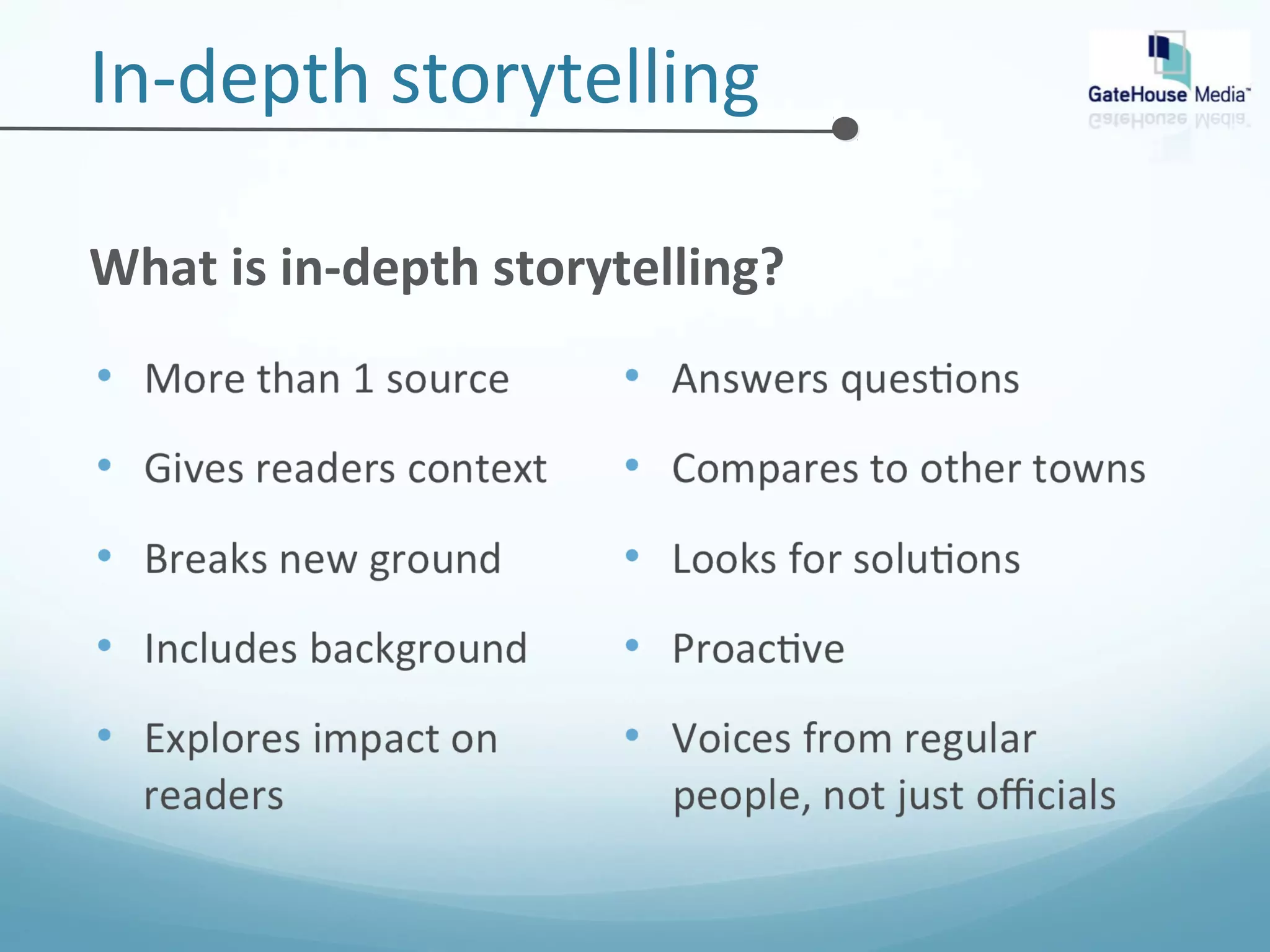
What is in-depth storytelling?
In-depth storytelling 
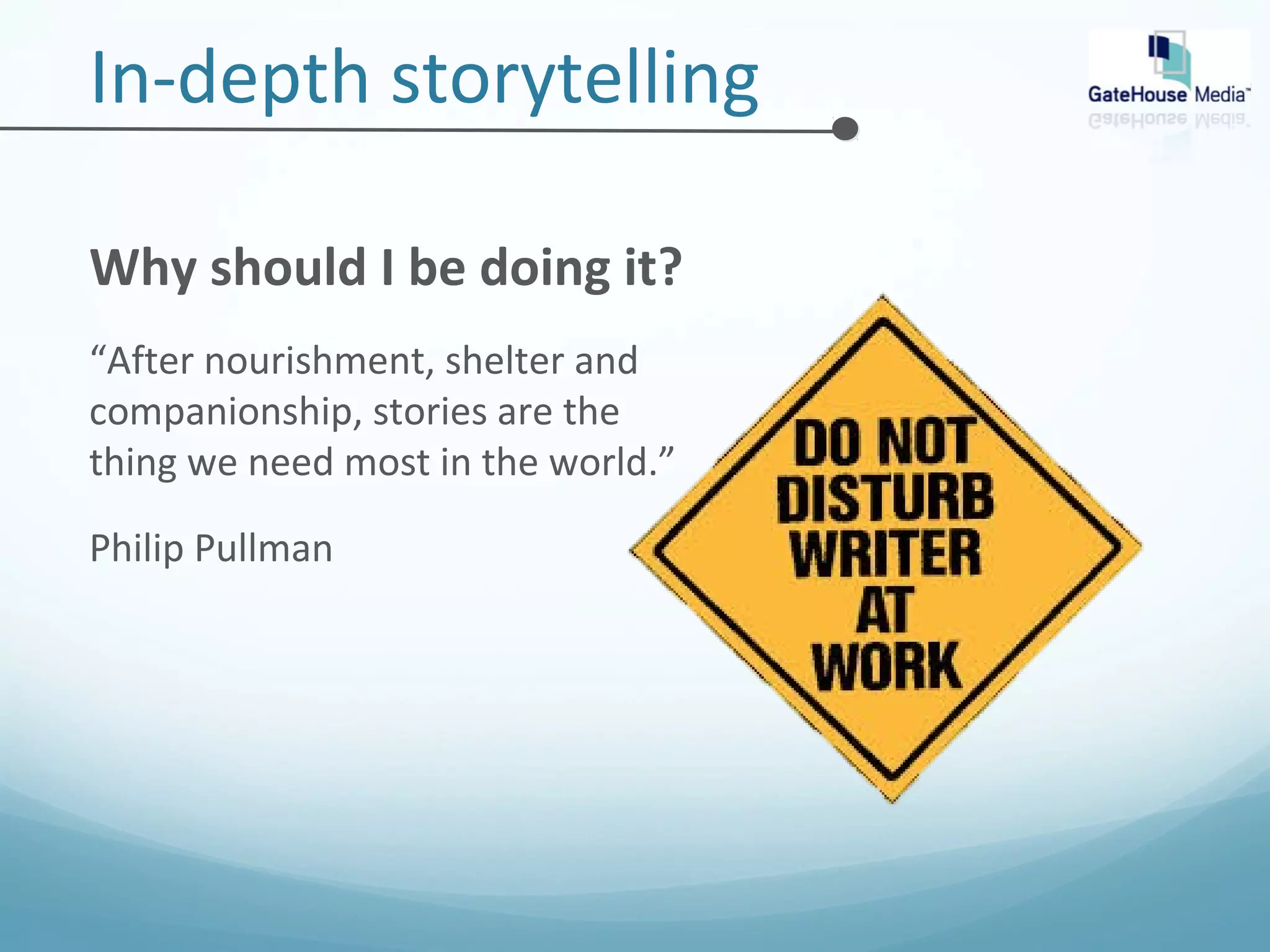
Why should I be doing it? 
“After nourishment, shelter and 
companionship, stories are the 
thing we need most in the world.” 
Philip Pullman
In-depth storytelling 
Why should I be doing it? 
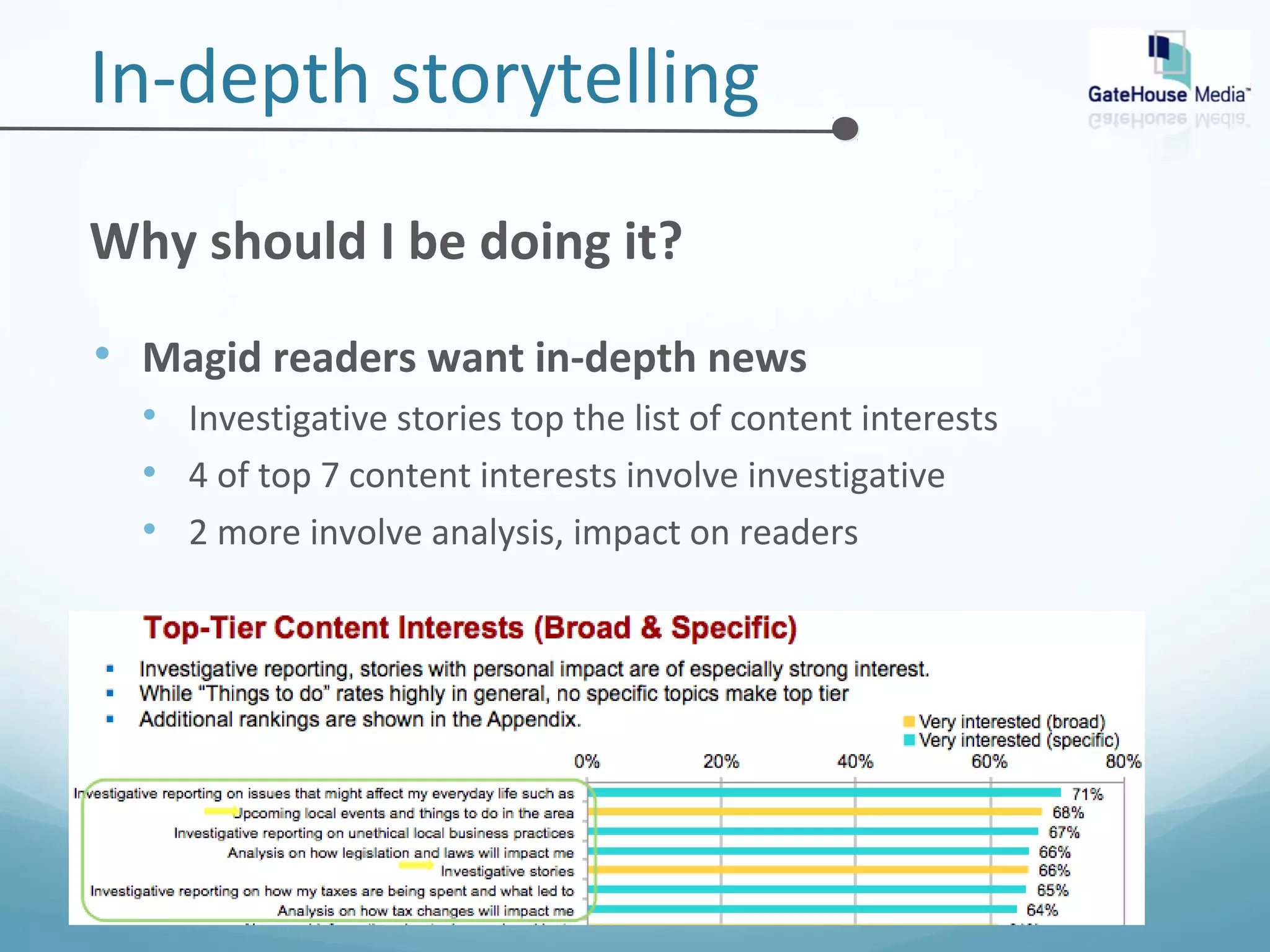
• Magid readers want in-depth news 
• Investigative stories top the list of content interests 
• 4 of top 7 content interests involve investigative 
• 2 more involve analysis, impact on readers
In-depth storytelling 
Getting started: The idea 
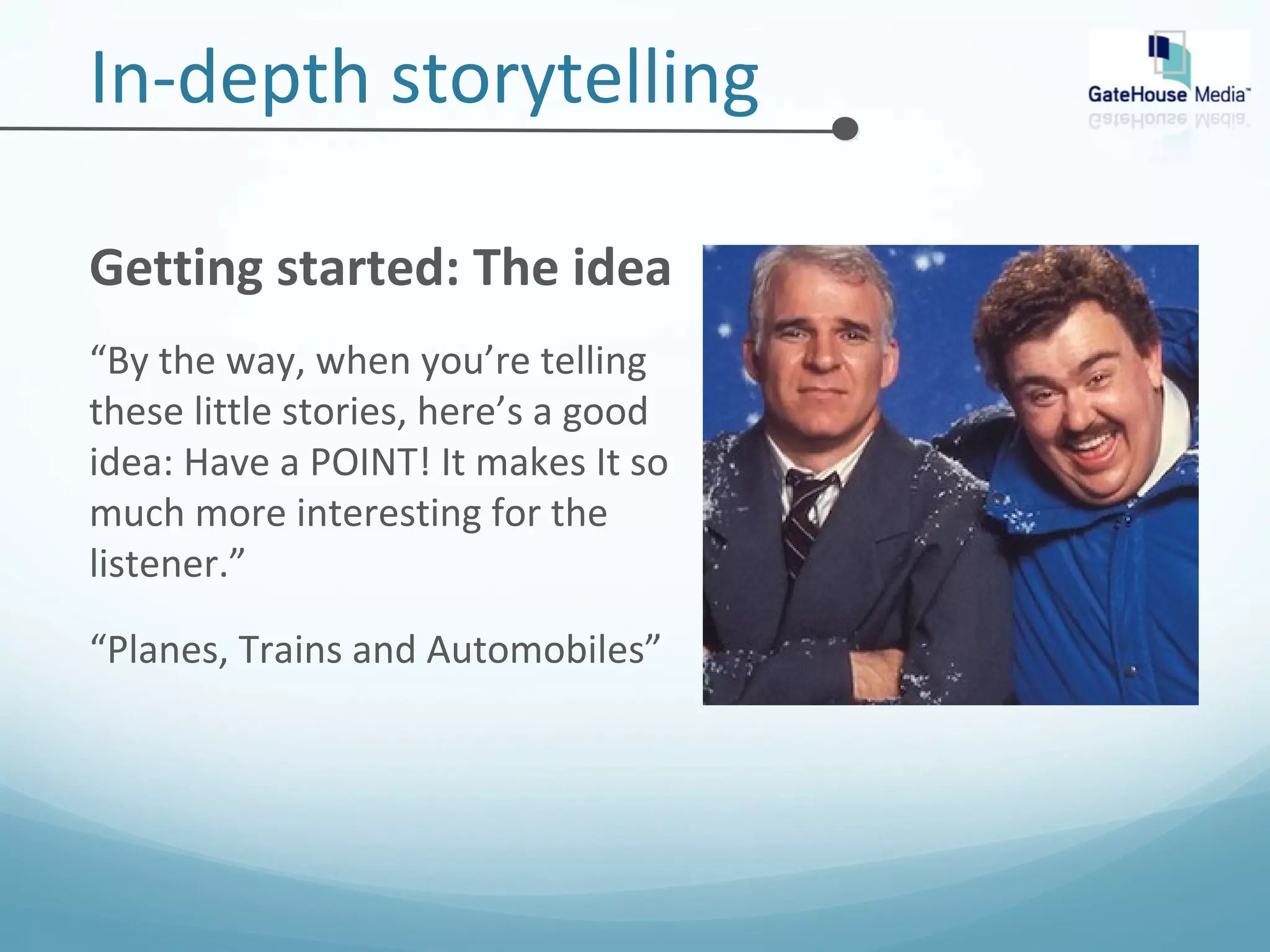
“By the way, when you’re telling 
these little stories, here’s a good 
idea: Have a POINT! It makes It so 
much more interesting for the 
listener.” 
“Planes, Trains and Automobiles”
Getting started 
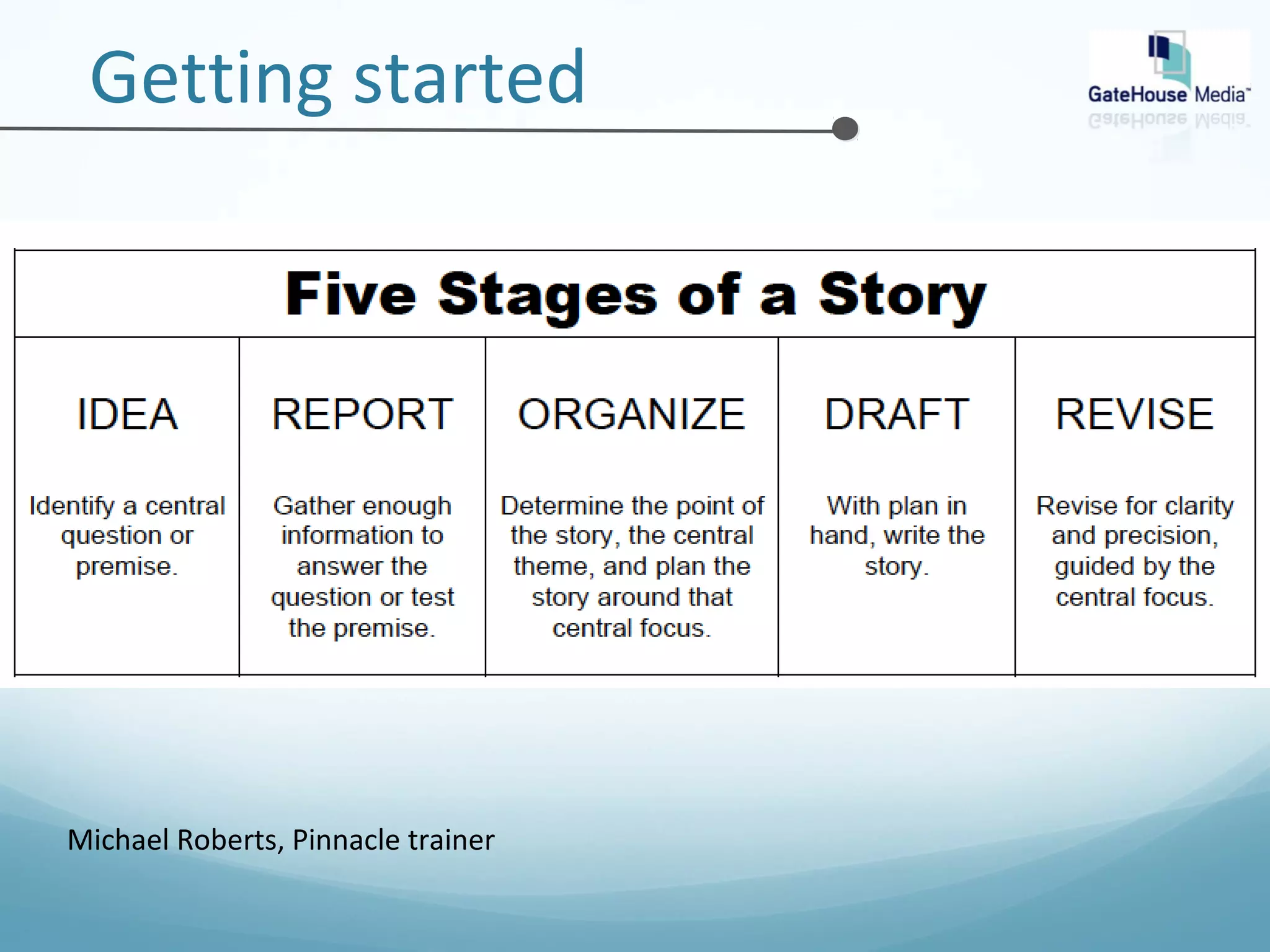
Michael Roberts, Pinnacle trainer
Getting started 
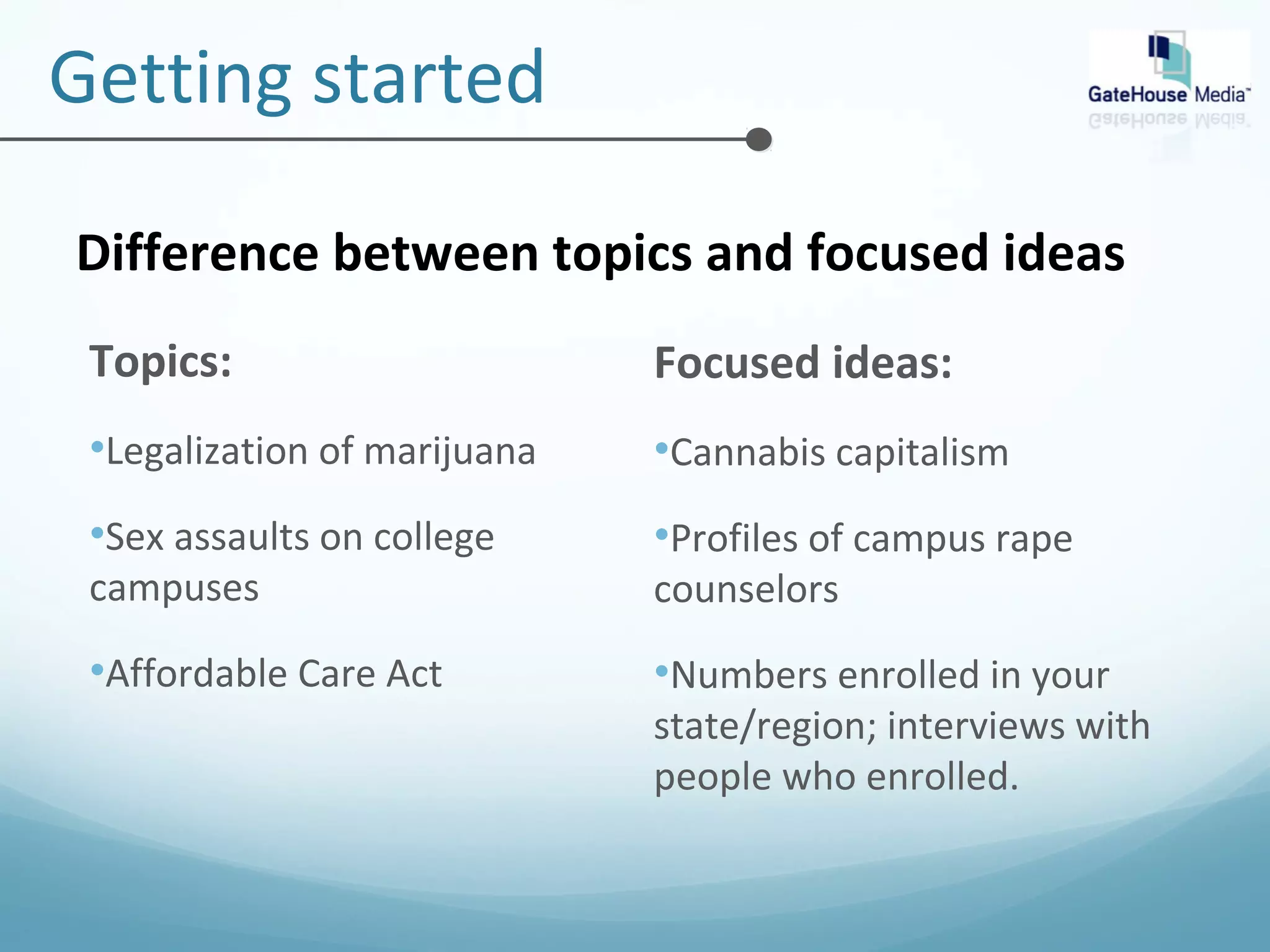
Difference between topics and focused ideas 
Topics: 
•Legalization of marijuana 
•Sex assaults on college 
campuses 
•Affordable Care Act 
Focused ideas: 
•Cannabis capitalism 
•Profiles of campus rape 
counselors 
•Numbers enrolled in your 
state/region; interviews with 
people who enrolled.
Getting started 
Developing ideas 
•Frame idea as a “premise” not a “fact” 
•Try to prove or disprove the premise (keep an open mind) 
•Brainstorm and list the facts of the case 
•Identify the theory of the case (test theory against facts) 
•Build the case around the theory (account for facts that don’t 
support the case)
Getting started 
Example: Cannabis capitalism 
•Premise: Entrepreneurs are making millions in Colorado; this 
will be great for our area. 
•Facts: Find out what business is like so far in Colorado, how 
much of an investment is it, how does Ohio differ? 
•How do the facts, from your reporting, support your premise? 
•Are there facts that don’t fit your theory? Why not? Is the 
theory faulty, or is there some reason you need to explain?
Getting started 
Other techniques for fleshing out an idea 
•Ask five questions a reader would ask about the topic. Answer 
those questions. 
•Ask “why” five times. Each “why” should take you deeper into 
the topic and closer to the central question or premise. 
•Point of view: Write your topic in the middle of a circle. Around 
the circle, list everyone with a connection to the story. Decide 
which person’s point of view might be the best way to tell a 
story.
Getting started 
Other techniques for fleshing out an idea 
•Point of view example 
•Breaking news, car accident on Christmas Eve in snow. Dad 
killed; Mom unconscious; boy’s leg broken; girl (about 12) 
wasn’t injured. Deserted area with a farm house a couple of 
miles back. Girl was shy and afraid. Christmas presents in the 
car. 
•On deadline, Jacqui Banaszynski wrote from the perspective of 
the little girl.
Organizing stories 
Outlines 
•Start organizing by writing your nut graph. 
•Quickest outline: Jot outline – list key points in the order they 
will appear in the story. 
•How long will your story be? 
•What is your focus? 
•What else is a part of 
the package? (More on this)
Organizing stories 
Types of outlines 
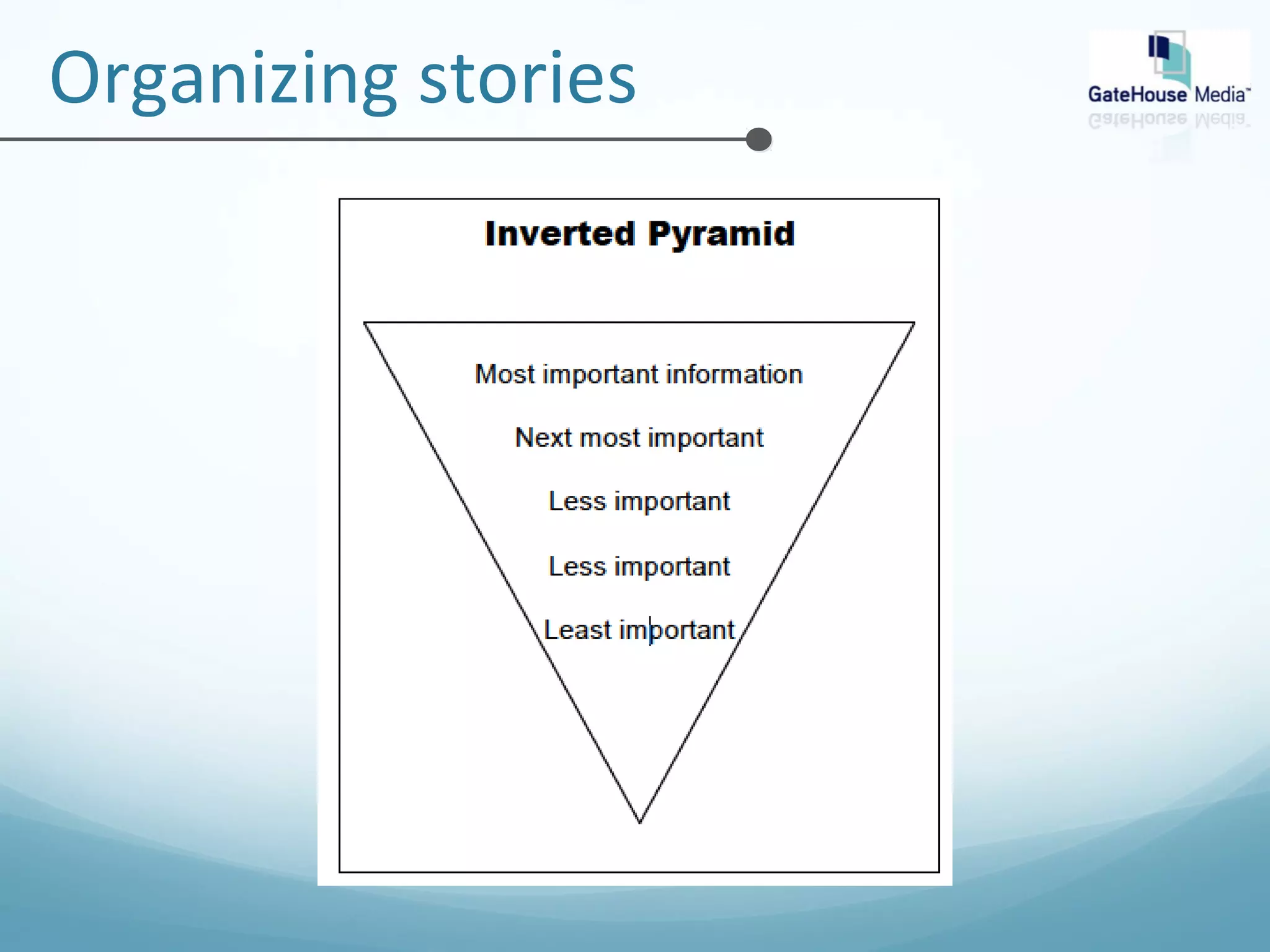
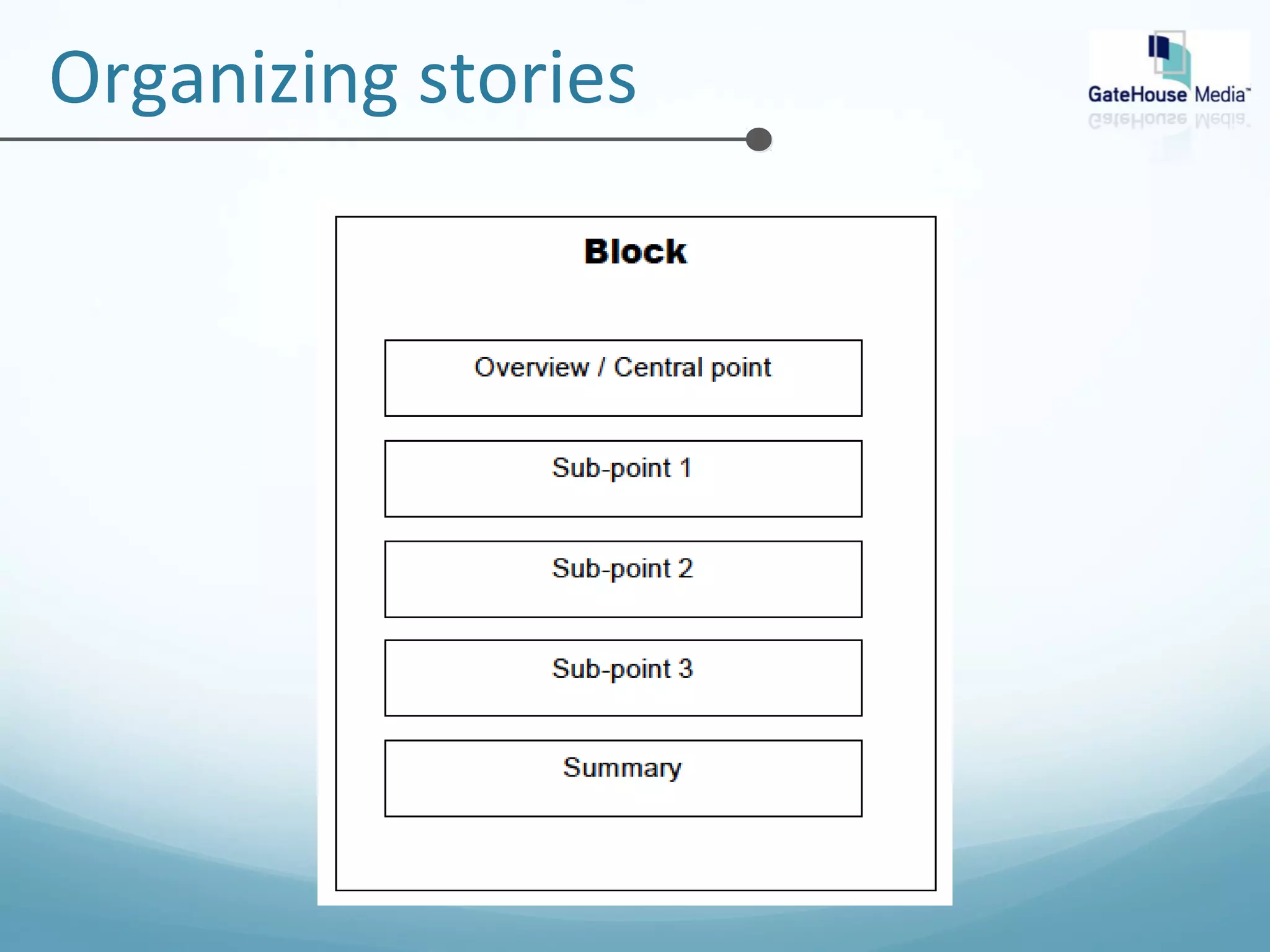
•Inverted pyramid: great for breaking 
news 
•Blocks: work well for longer pieces; 
you write each block as a standalone 
piece, with a lead, to propel the story 
forward. You can move blocks around 
and move them out of the mainbar as a 
sidebar if a block just isn’t fitting.
Organizing stories 
Types of outlines 
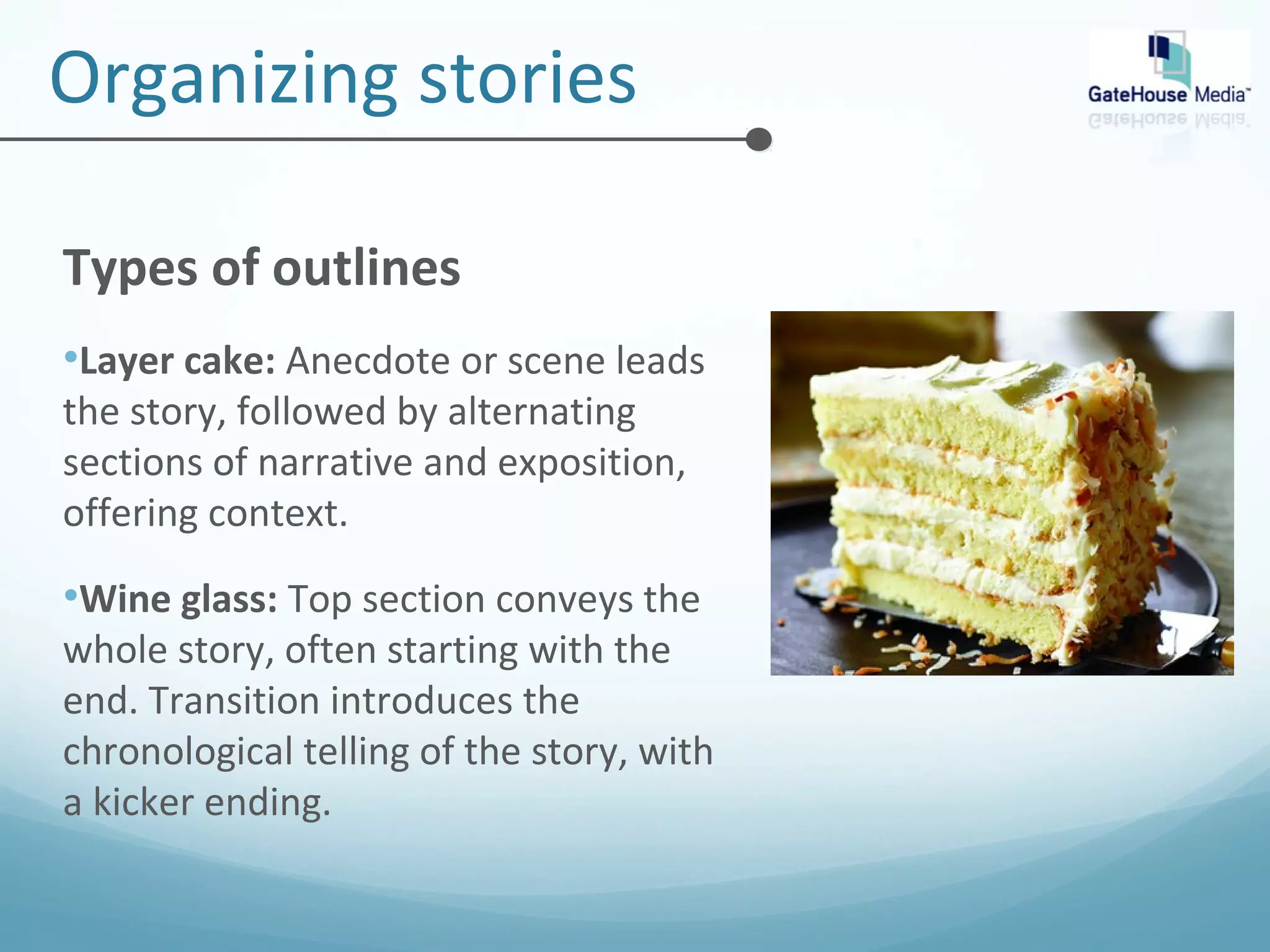
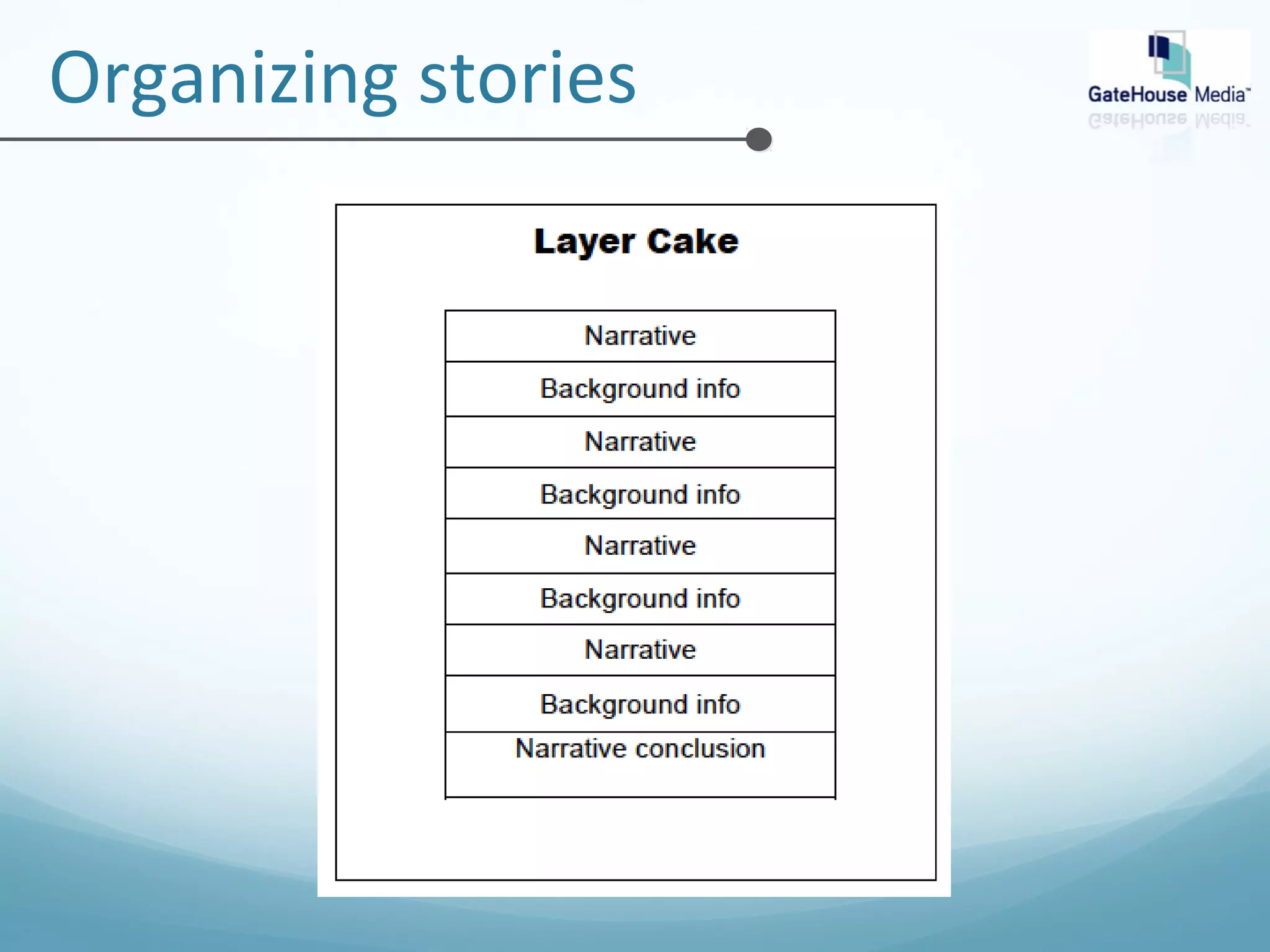
•Layer cake: Anecdote or scene leads 
the story, followed by alternating 
sections of narrative and exposition, 
offering context. 
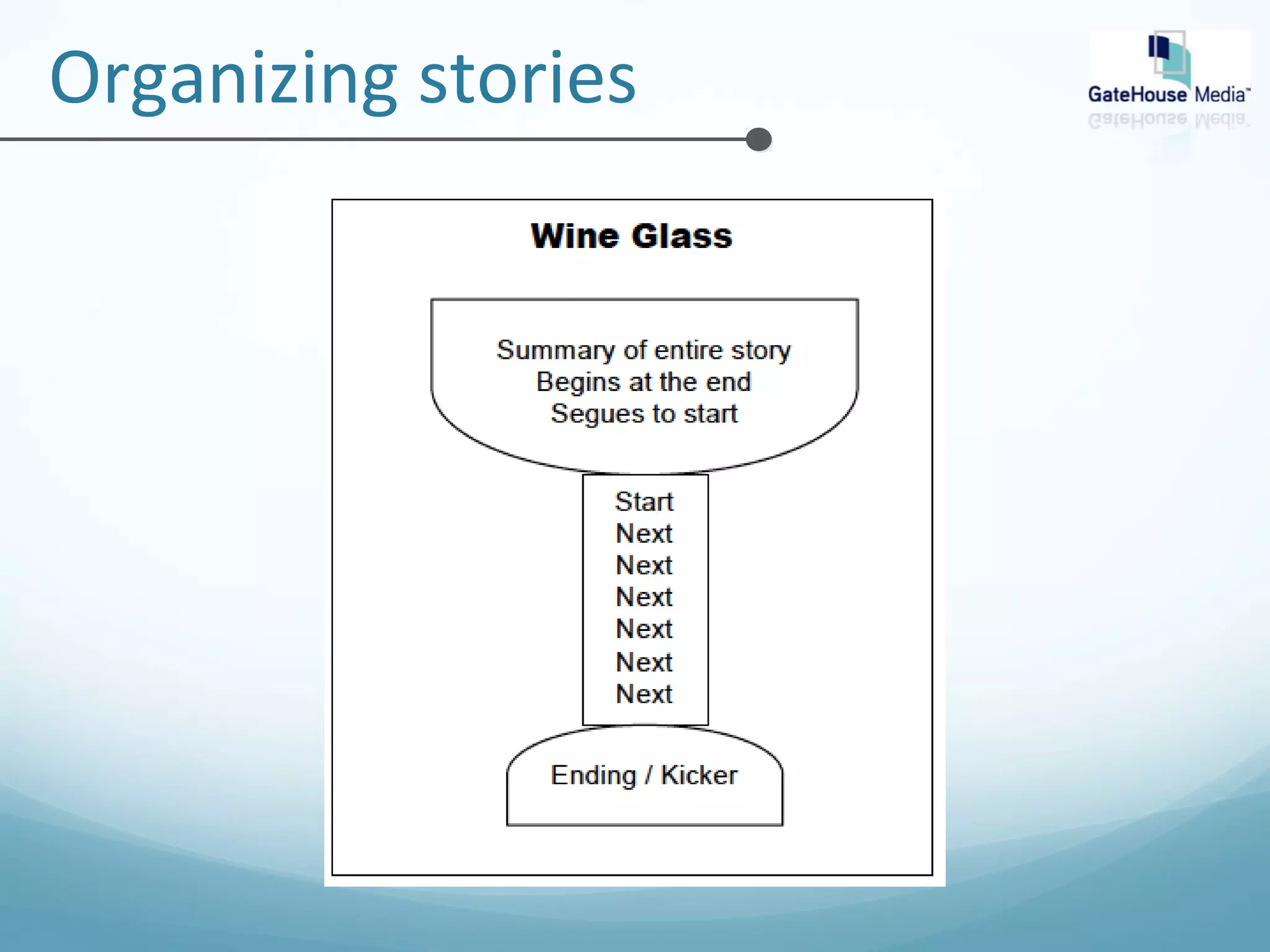
•Wine glass: Top section conveys the 
whole story, often starting with the 
end. Transition introduces the 
chronological telling of the story, with 
a kicker ending.
Organizing stories
Organizing stories
Organizing stories
Organizing stories
Organizing stories 
Why outline? Is this for every story? 
•Outlines give you a chance to think about how to tell your 
story. 
•Outlines ensure your best stuff is in the story. 
•Outlines help your writing flow, keep readers engaged. 
•Even for shorter, daily stories, outlines help you write more 
efficiently and point out holes where you might need more 
reporting. Plus, outlines keep your writing on track.
Organizing stories 
In-depth doesn’t necessarily mean long 
•Make each word count. Look critically at adjectives and 
adverbs, especially “-ly” adverbs. 
“Substitute ‘damn’ every time you’re inclined to write ‘very;’ 
your editor will delete it, and the writing will be just as it 
should be.” 
Mark Twain
Organizing stories 
In-depth doesn’t necessarily mean long 
•Use quotes sparingly. They are not always the most efficient 
way to say something, and they are more powerful if they aren’t 
overused. 
•Watch out for the sentence that contains several prepositions. 
It slows the writing. 
Bottom line: You want to hold the reader’s attention through 
the whole story.
Organizing projects 
Project planning and budgets 
•If your in-depth story turns into a project, with sidebars, breakouts, 
graphics and other visuals, you’ll need a project budget. 
•As your story takes shape, involve others in the planning of how your 
story will be displayed. 
•Editors, photographers, design and graphics brainstorm with the 
reporter on how to make the story pop in print and online. 
•Ideally, reporter and photographer go together for key interviews.
Organizing projects 
Project budget template 
•Myproject.mainbarXX – Nut graph, overview of project. 
Length: (include with each written element) 
•Myproject.sidebarA – Short description. 
•Myproject.graphicA – Quick description & connection to main 
story. 
•Myproject.photos – List of photos for print/online. 
•Myproject.video – Short description
Organizing projects 
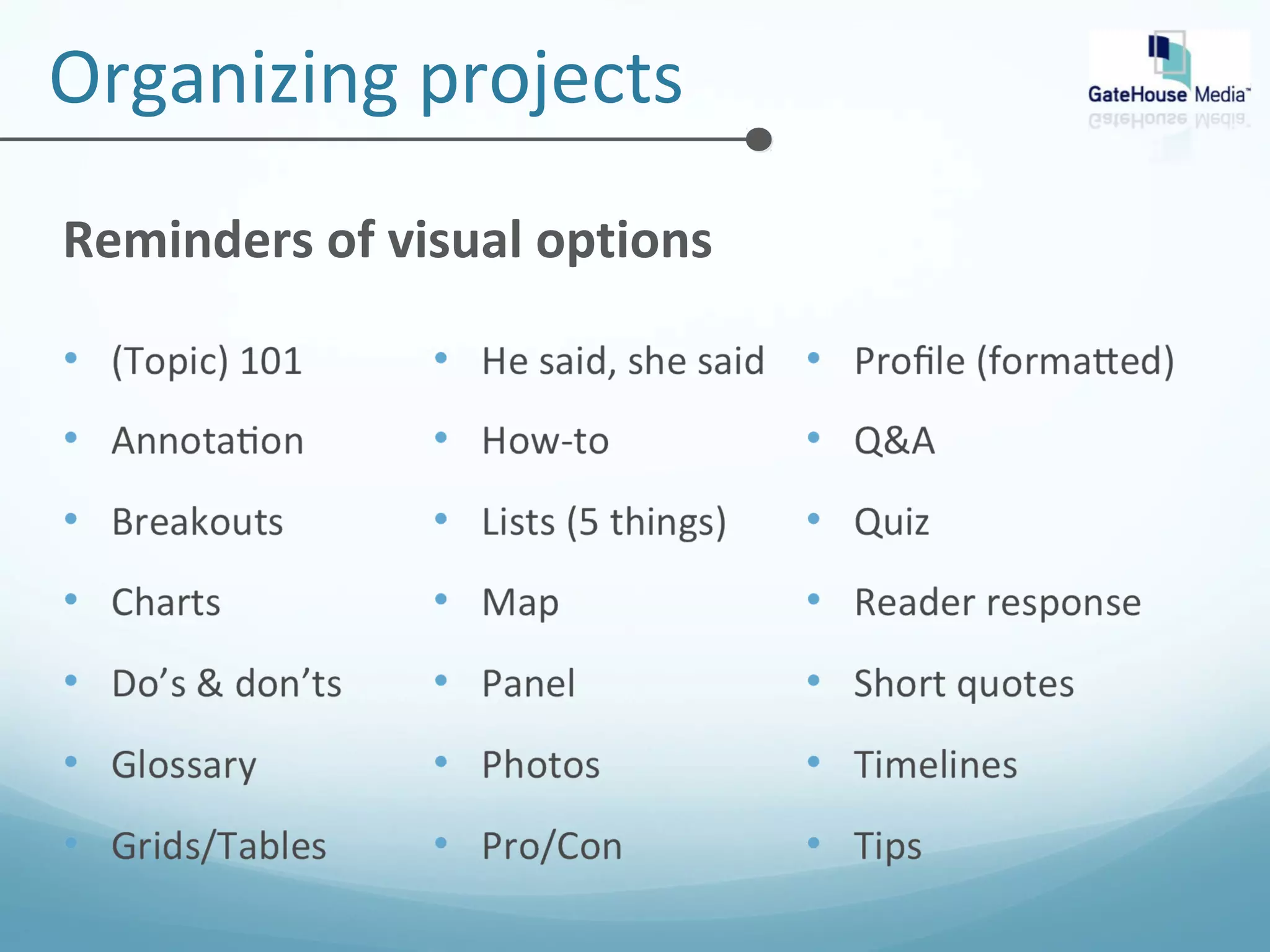
Reminders of visual options
Organizing projects 
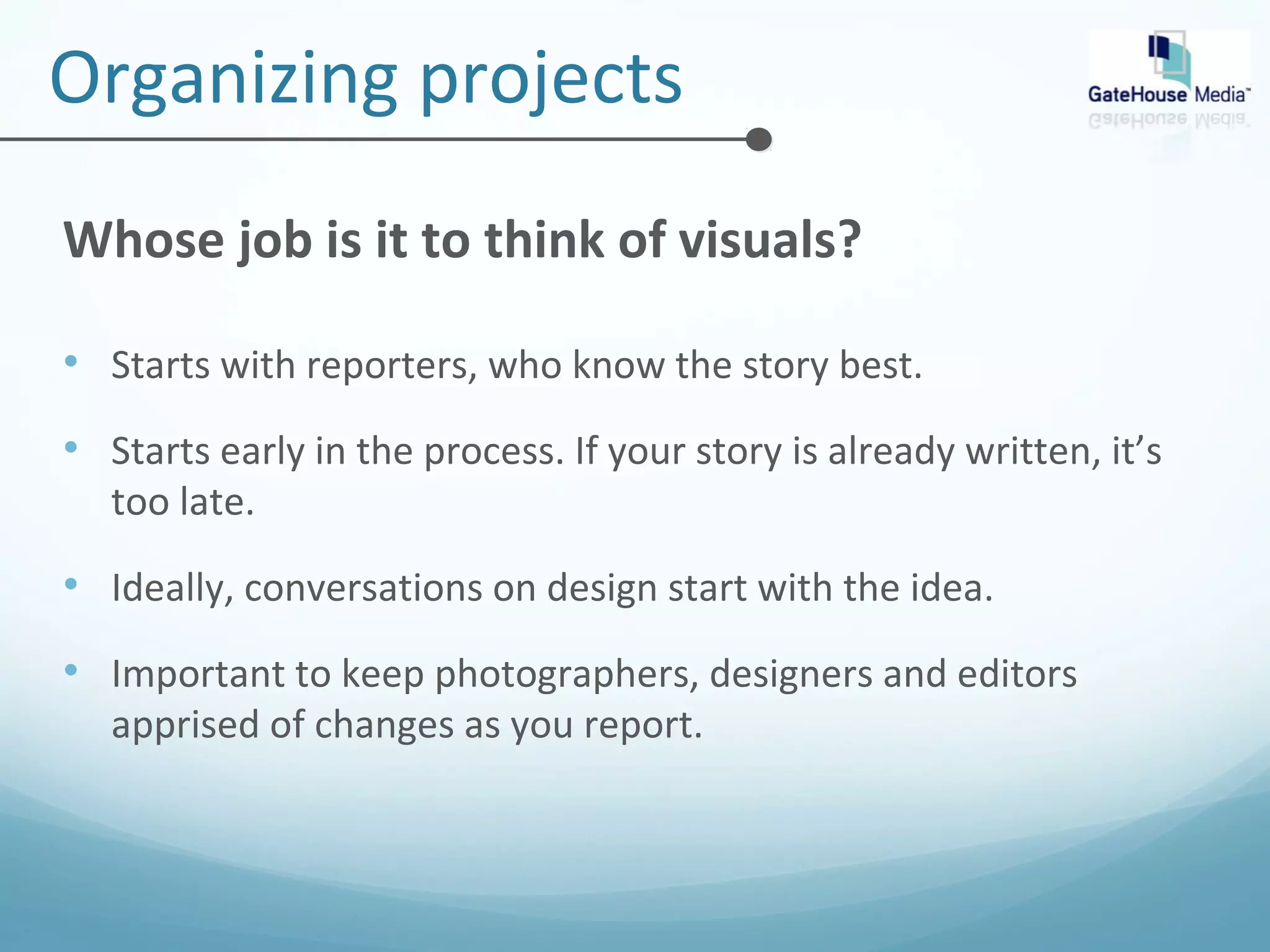
Whose job is it to think of visuals? 
• Starts with reporters, who know the story best. 
• Starts early in the process. If your story is already written, it’s 
too late. 
• Ideally, conversations on design start with the idea. 
• Important to keep photographers, designers and editors 
apprised of changes as you report.
Watchdog reporting 
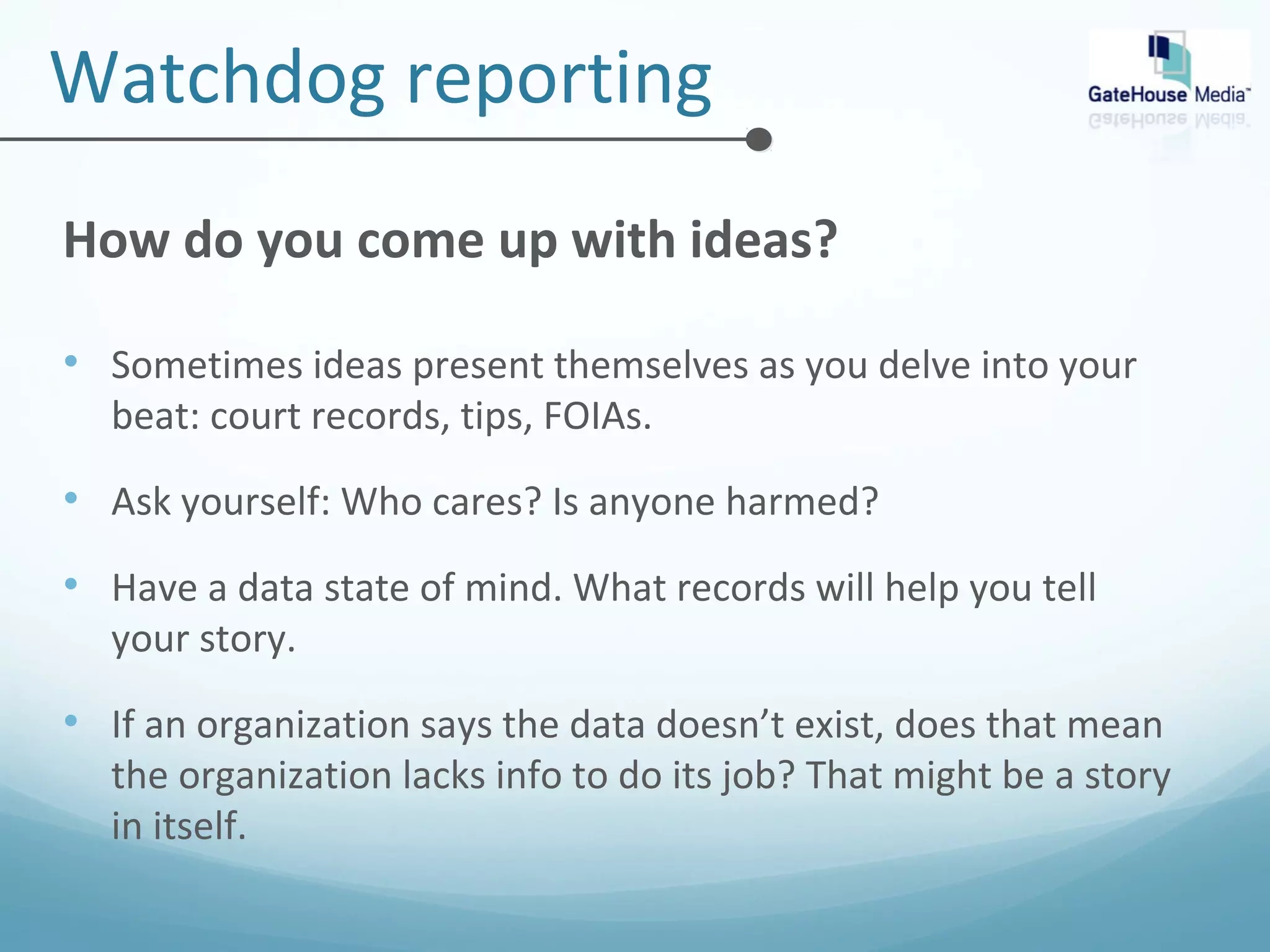
How do you come up with ideas? 
• Sometimes ideas present themselves as you delve into your 
beat: court records, tips, FOIAs. 
• Ask yourself: Who cares? Is anyone harmed? 
• Have a data state of mind. What records will help you tell 
your story. 
• If an organization says the data doesn’t exist, does that mean 
the organization lacks info to do its job? That might be a story 
in itself.
Watchdog reporting 
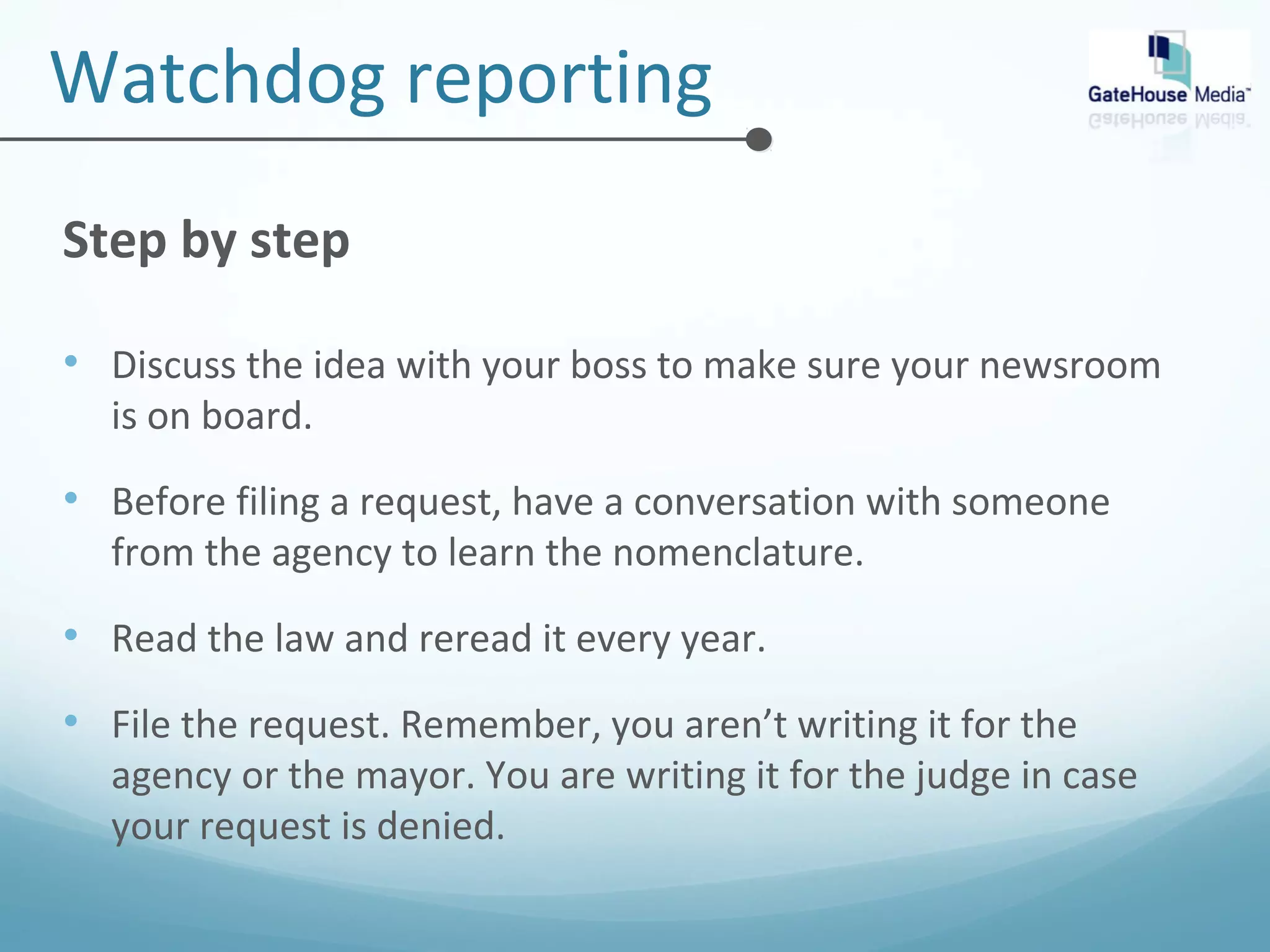
Step by step 
• Discuss the idea with your boss to make sure your newsroom 
is on board. 
• Before filing a request, have a conversation with someone 
from the agency to learn the nomenclature. 
• Read the law and reread it every year. 
• File the request. Remember, you aren’t writing it for the 
agency or the mayor. You are writing it for the judge in case 
your request is denied.
Watchdog reporting 
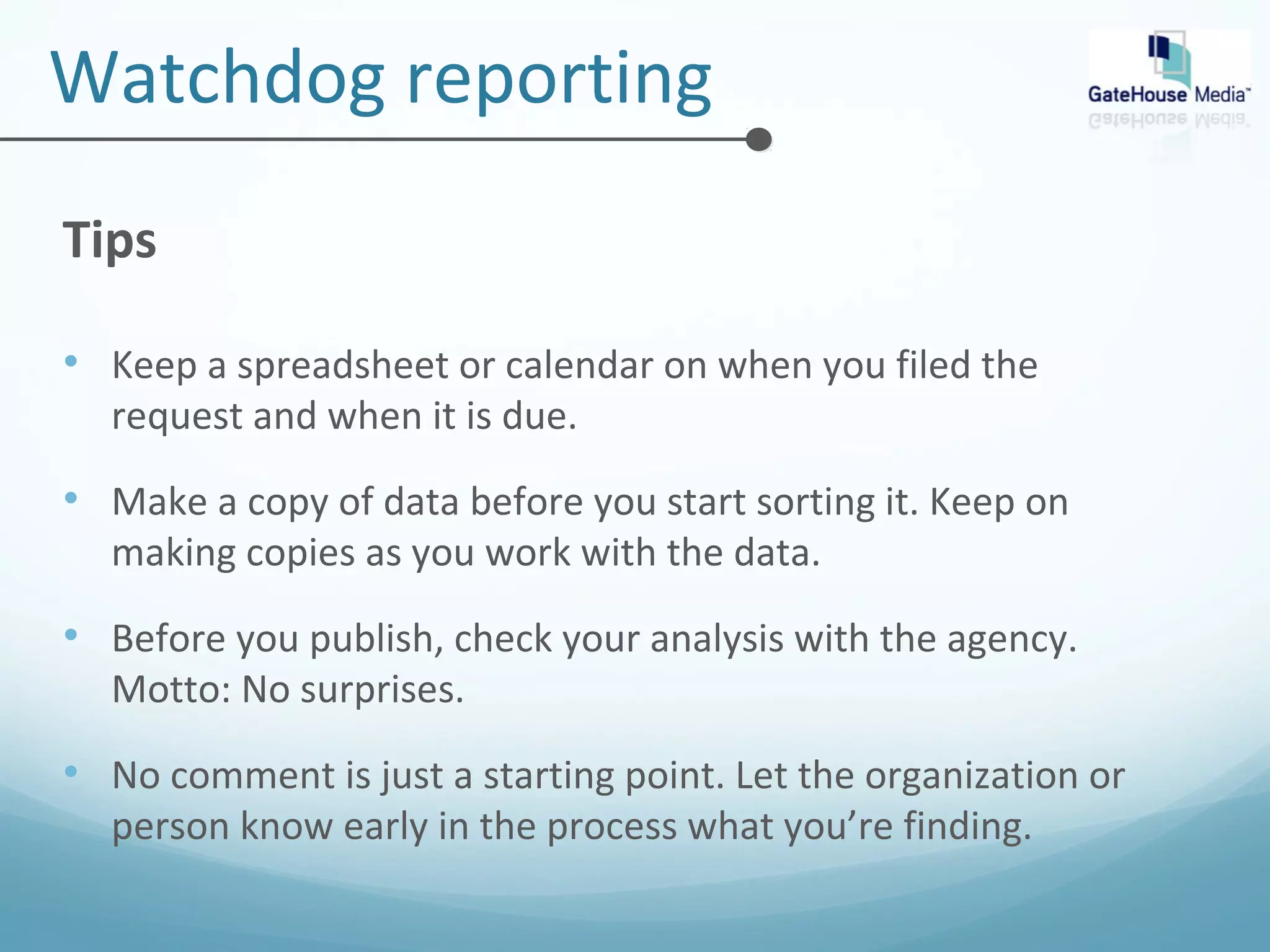
Other options 
• Is there a state task force, 
advisory board or legislator 
who might have the info 
you need? 
• If you can’t get the 
information, appeal.
Watchdog reporting 
Tips 
• Keep a spreadsheet or calendar on when you filed the 
request and when it is due. 
• Make a copy of data before you start sorting it. Keep on 
making copies as you work with the data. 
• Before you publish, check your analysis with the agency. 
Motto: No surprises. 
• No comment is just a starting point. Let the organization or 
person know early in the process what you’re finding.
Watchdog reporting 
Tips 
• Read quotes to your sources and explain the story to them 
before it publishes. They will come after you. It’s better to 
know what they have before you publish. 
• Be transparent about what you don’t know. It shows you 
don’t have the info not for lack of effort or intellectual 
curiosity. 
• Look for loaded language in your writing: Don’t use claims, 
denies, failed to …
Time management 
How to make time for deep reporting 
• Break up big projects into smaller chunks. Write an 
occasional series. 
• Everyday enterprise: Look for ways to enrich regular 
stories. 
• Seek comparisons to other towns that have a similar 
makeup. 
• Use state and national numbers to add context. 
• Write proactively instead of regurgitating yesterday’s 
news.
Time management 
Other tips 
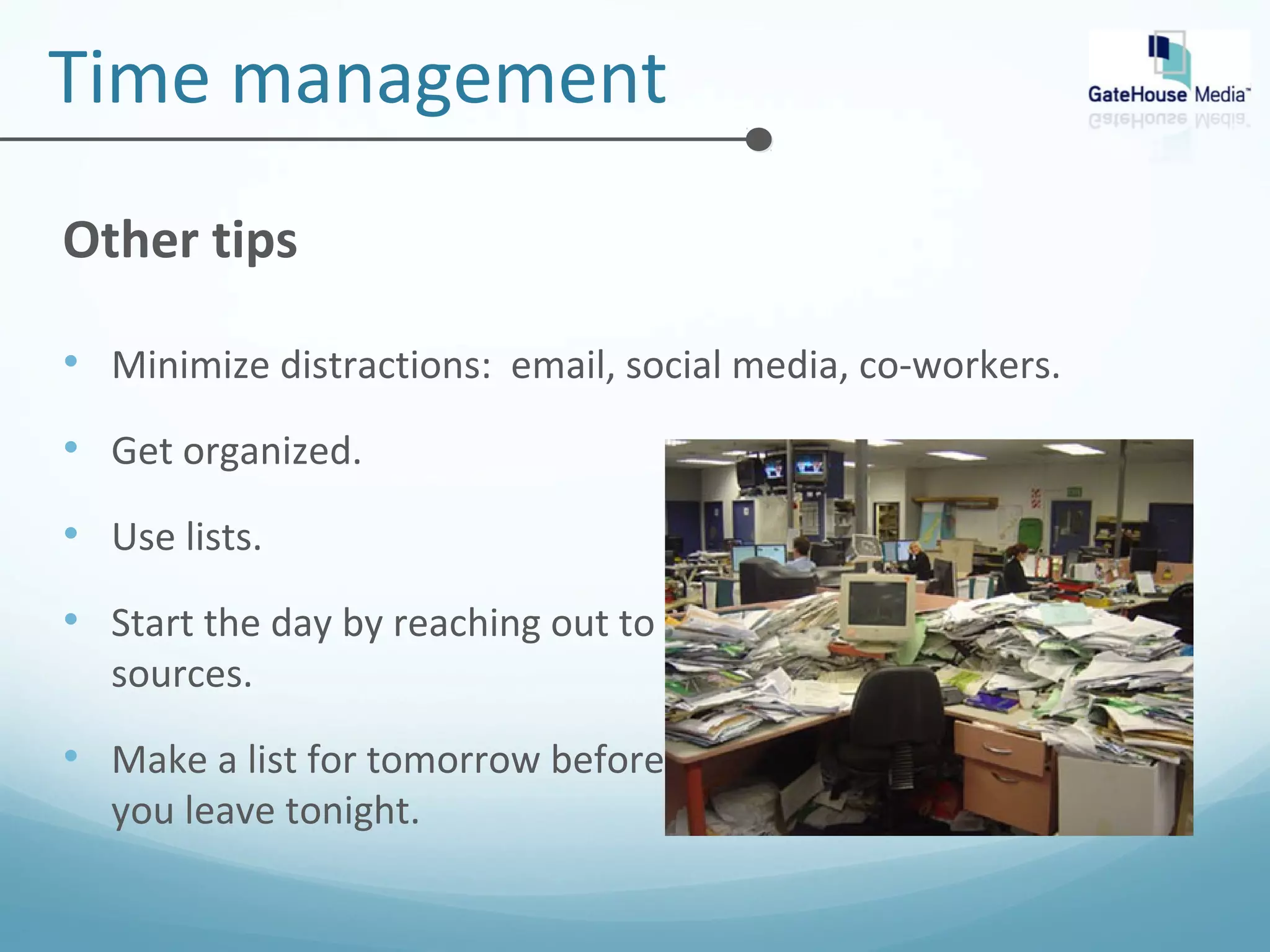
• Minimize distractions: email, social media, co-workers. 
• Get organized. 
• Use lists. 
• Start the day by reaching out to 
sources. 
• Make a list for tomorrow before 
you leave tonight.
Time management 
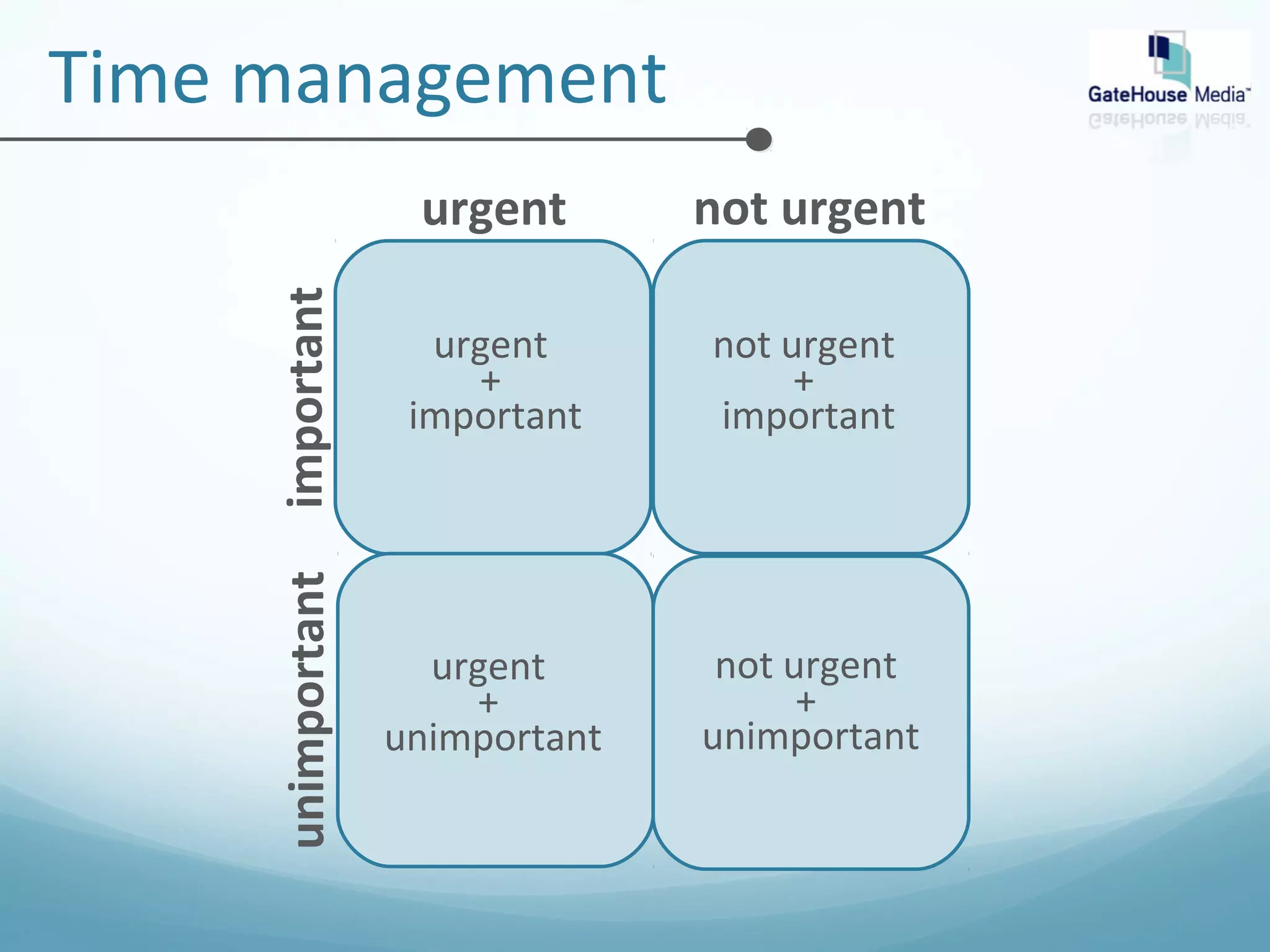
not urgent 
unimportant 
urgent 
important 
urgent 
+ 
important 
not urgent 
+ 
important 
urgent 
+ 
unimportant 
not urgent 
+ 
unimportant
Time management 
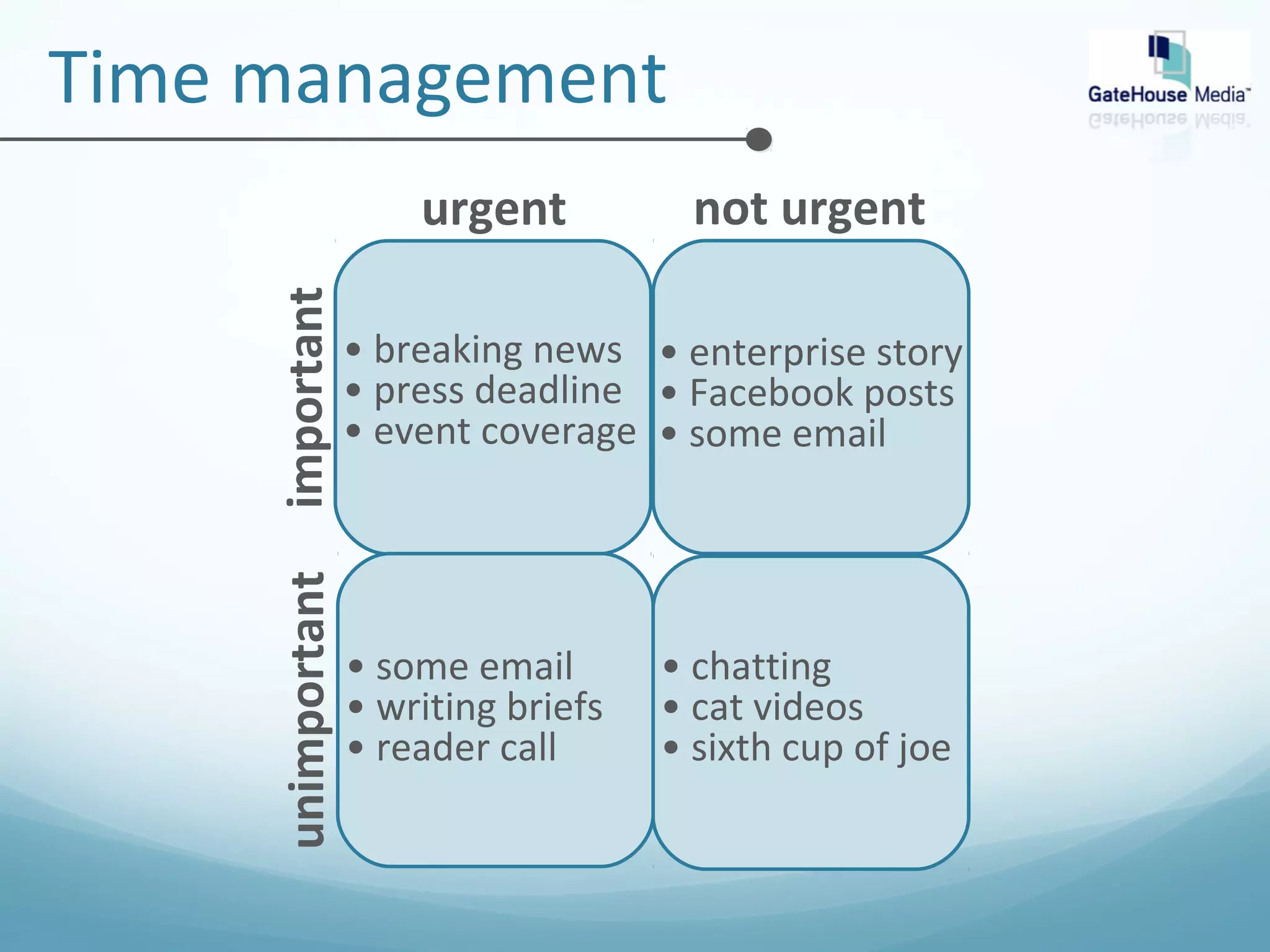
not urgent 
unimportant 
urgent 
important 
• breaking news 
• press deadline 
• event coverage 
• enterprise story 
• Facebook posts 
• some email 
• some email 
• writing briefs 
• reader call 
• chatting 
• cat videos 
• sixth cup of joe
Time management 
Make time for what’s important 
• Once you’re organized and efficient, discuss priorities with 
your editor. 
• Make progress every day to chip away at long-term 
projects. 
• Send an email. 
• Make a call. 
• Do some Google research.
In-depth storytelling 
GateHouse Media 
News & Interactive

In-depth storytelling

  • 1.
    In-depth storytelling GateHouseMedia News & Interactive
  • 2.
    Agenda What isin-depth storytelling? Why is it important? Approaches to a long story Outlines for stories and projects Watchdog reporting Visuals and other elements in a project How do I do this and everything else?
  • 3.
    In-depth storytelling Whatis in-depth storytelling?
  • 4.
    In-depth storytelling Whyshould I be doing it? “After nourishment, shelter and companionship, stories are the thing we need most in the world.” Philip Pullman
  • 5.
    In-depth storytelling Whyshould I be doing it? • Magid readers want in-depth news • Investigative stories top the list of content interests • 4 of top 7 content interests involve investigative • 2 more involve analysis, impact on readers
  • 6.
    In-depth storytelling Gettingstarted: The idea “By the way, when you’re telling these little stories, here’s a good idea: Have a POINT! It makes It so much more interesting for the listener.” “Planes, Trains and Automobiles”
  • 7.
    Getting started MichaelRoberts, Pinnacle trainer
  • 8.
    Getting started Differencebetween topics and focused ideas Topics: •Legalization of marijuana •Sex assaults on college campuses •Affordable Care Act Focused ideas: •Cannabis capitalism •Profiles of campus rape counselors •Numbers enrolled in your state/region; interviews with people who enrolled.
  • 9.
    Getting started Developingideas •Frame idea as a “premise” not a “fact” •Try to prove or disprove the premise (keep an open mind) •Brainstorm and list the facts of the case •Identify the theory of the case (test theory against facts) •Build the case around the theory (account for facts that don’t support the case)
  • 10.
    Getting started Example:Cannabis capitalism •Premise: Entrepreneurs are making millions in Colorado; this will be great for our area. •Facts: Find out what business is like so far in Colorado, how much of an investment is it, how does Ohio differ? •How do the facts, from your reporting, support your premise? •Are there facts that don’t fit your theory? Why not? Is the theory faulty, or is there some reason you need to explain?
  • 11.
    Getting started Othertechniques for fleshing out an idea •Ask five questions a reader would ask about the topic. Answer those questions. •Ask “why” five times. Each “why” should take you deeper into the topic and closer to the central question or premise. •Point of view: Write your topic in the middle of a circle. Around the circle, list everyone with a connection to the story. Decide which person’s point of view might be the best way to tell a story.
  • 12.
    Getting started Othertechniques for fleshing out an idea •Point of view example •Breaking news, car accident on Christmas Eve in snow. Dad killed; Mom unconscious; boy’s leg broken; girl (about 12) wasn’t injured. Deserted area with a farm house a couple of miles back. Girl was shy and afraid. Christmas presents in the car. •On deadline, Jacqui Banaszynski wrote from the perspective of the little girl.
  • 13.
    Organizing stories Outlines •Start organizing by writing your nut graph. •Quickest outline: Jot outline – list key points in the order they will appear in the story. •How long will your story be? •What is your focus? •What else is a part of the package? (More on this)
  • 14.
    Organizing stories Typesof outlines •Inverted pyramid: great for breaking news •Blocks: work well for longer pieces; you write each block as a standalone piece, with a lead, to propel the story forward. You can move blocks around and move them out of the mainbar as a sidebar if a block just isn’t fitting.
  • 15.
    Organizing stories Typesof outlines •Layer cake: Anecdote or scene leads the story, followed by alternating sections of narrative and exposition, offering context. •Wine glass: Top section conveys the whole story, often starting with the end. Transition introduces the chronological telling of the story, with a kicker ending.
  • 16.
  • 17.
  • 18.
  • 19.
  • 20.
    Organizing stories Whyoutline? Is this for every story? •Outlines give you a chance to think about how to tell your story. •Outlines ensure your best stuff is in the story. •Outlines help your writing flow, keep readers engaged. •Even for shorter, daily stories, outlines help you write more efficiently and point out holes where you might need more reporting. Plus, outlines keep your writing on track.
  • 21.
    Organizing stories In-depthdoesn’t necessarily mean long •Make each word count. Look critically at adjectives and adverbs, especially “-ly” adverbs. “Substitute ‘damn’ every time you’re inclined to write ‘very;’ your editor will delete it, and the writing will be just as it should be.” Mark Twain
  • 22.
    Organizing stories In-depthdoesn’t necessarily mean long •Use quotes sparingly. They are not always the most efficient way to say something, and they are more powerful if they aren’t overused. •Watch out for the sentence that contains several prepositions. It slows the writing. Bottom line: You want to hold the reader’s attention through the whole story.
  • 23.
    Organizing projects Projectplanning and budgets •If your in-depth story turns into a project, with sidebars, breakouts, graphics and other visuals, you’ll need a project budget. •As your story takes shape, involve others in the planning of how your story will be displayed. •Editors, photographers, design and graphics brainstorm with the reporter on how to make the story pop in print and online. •Ideally, reporter and photographer go together for key interviews.
  • 24.
    Organizing projects Projectbudget template •Myproject.mainbarXX – Nut graph, overview of project. Length: (include with each written element) •Myproject.sidebarA – Short description. •Myproject.graphicA – Quick description & connection to main story. •Myproject.photos – List of photos for print/online. •Myproject.video – Short description
  • 25.
  • 26.
    Organizing projects Whosejob is it to think of visuals? • Starts with reporters, who know the story best. • Starts early in the process. If your story is already written, it’s too late. • Ideally, conversations on design start with the idea. • Important to keep photographers, designers and editors apprised of changes as you report.
  • 27.
    Watchdog reporting Howdo you come up with ideas? • Sometimes ideas present themselves as you delve into your beat: court records, tips, FOIAs. • Ask yourself: Who cares? Is anyone harmed? • Have a data state of mind. What records will help you tell your story. • If an organization says the data doesn’t exist, does that mean the organization lacks info to do its job? That might be a story in itself.
  • 28.
    Watchdog reporting Stepby step • Discuss the idea with your boss to make sure your newsroom is on board. • Before filing a request, have a conversation with someone from the agency to learn the nomenclature. • Read the law and reread it every year. • File the request. Remember, you aren’t writing it for the agency or the mayor. You are writing it for the judge in case your request is denied.
  • 29.
    Watchdog reporting Otheroptions • Is there a state task force, advisory board or legislator who might have the info you need? • If you can’t get the information, appeal.
  • 30.
    Watchdog reporting Tips • Keep a spreadsheet or calendar on when you filed the request and when it is due. • Make a copy of data before you start sorting it. Keep on making copies as you work with the data. • Before you publish, check your analysis with the agency. Motto: No surprises. • No comment is just a starting point. Let the organization or person know early in the process what you’re finding.
  • 31.
    Watchdog reporting Tips • Read quotes to your sources and explain the story to them before it publishes. They will come after you. It’s better to know what they have before you publish. • Be transparent about what you don’t know. It shows you don’t have the info not for lack of effort or intellectual curiosity. • Look for loaded language in your writing: Don’t use claims, denies, failed to …
  • 32.
    Time management Howto make time for deep reporting • Break up big projects into smaller chunks. Write an occasional series. • Everyday enterprise: Look for ways to enrich regular stories. • Seek comparisons to other towns that have a similar makeup. • Use state and national numbers to add context. • Write proactively instead of regurgitating yesterday’s news.
  • 33.
    Time management Othertips • Minimize distractions: email, social media, co-workers. • Get organized. • Use lists. • Start the day by reaching out to sources. • Make a list for tomorrow before you leave tonight.
  • 34.
    Time management noturgent unimportant urgent important urgent + important not urgent + important urgent + unimportant not urgent + unimportant
  • 35.
    Time management noturgent unimportant urgent important • breaking news • press deadline • event coverage • enterprise story • Facebook posts • some email • some email • writing briefs • reader call • chatting • cat videos • sixth cup of joe
  • 36.
    Time management Maketime for what’s important • Once you’re organized and efficient, discuss priorities with your editor. • Make progress every day to chip away at long-term projects. • Send an email. • Make a call. • Do some Google research.
  • 37.
    In-depth storytelling GateHouseMedia News & Interactive