Importing Wikipedia in Plone
Eric BREHAULT – Plone Conference 2013
ZODB is good at storing objects
● Plone contents are objects,
● we store them in the ZODB,
● everything is fine, end of the story.
But what if ...
... we want to store non-contentish records?
Like polls, statistics, mail-list subscribers, etc.,
or any business-specific structured data.
Store them as contents anyway
That is a powerfull solution.
But there are 2 major problems...
Problem 1: You need to manage a secondary
system
● you need to deploy it,
● you need to backup it,
● you need to secure it,
● etc.
Problem 2: I hate SQL
No explanation here.
I think I just cannot digest it...
How to store many records in the ZODB?
● Is the ZODB strong enough?
● Is the ZCatalog strong enough?
My grandmother often told me
"If you want to become stronger, you have to eat your soup."
Where do we find a good soup for Plone?
In a super souper!!!
souper.plone and souper
● It provides both storage and indexing.
● Record can store any persistent pickable data.
● Created by BlueDynamics.
● Based on ZODB BTrees, node.ext.zodb, and repoze.catalog.
Add a record
>>> soup = get_soup('mysoup', context)
>>> record = Record()
>>> record.attrs['user'] = 'user1'
>>> record.attrs['text'] = u'foo bar baz'
>>> record.attrs['keywords'] = [u'1', u'2', u'ü']
>>> record_id = soup.add(record)
Record in record
>>> record['homeaddress'] = Record()
>>> record['homeaddress'].attrs['zip'] = '6020'
>>> record['homeaddress'].attrs['town'] = 'Innsbruck'
>>> record['homeaddress'].attrs['country'] = 'Austria'
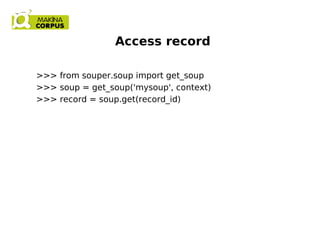
Access record
>>> from souper.soup import get_soup
>>> soup = get_soup('mysoup', context)
>>> record = soup.get(record_id)
Query
>>> from repoze.catalog.query import Eq, Contains
>>> [r for r in soup.query(Eq('user', 'user1')
& Contains('text', 'foo'))]
[<Record object 'None' at ...>]
or using CQE format
>>> [r for r in soup.query("user == 'user1' and 'foo' in text")]
[<Record object 'None' at ...>]
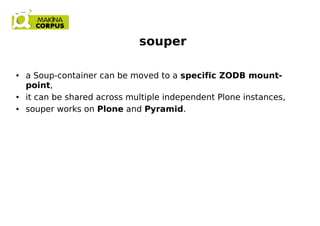
souper
● a Soup-container can be moved to a specific ZODB mount-
point,
● it can be shared across multiple independent Plone instances,
● souper works on Plone and Pyramid.
Plomino & souper
● we use Plomino to build non-content oriented apps easily,
● we use souper to store huge amount of application data.
Plomino data storage
Originally, documents (=record) were ATFolder.
Capacity about 30 000.
Plomino data storage
Since 1.14, documents are pure CMF.
Capacity about 100 000.
Usally the Plomino ZCatalog contains a lot of indexes.
Plomino & souper
With souper, documents are just soup records.
Capacity: several millions.
Typical use case
● Store 500 000 addresses,
● Be able to query them in full text and display the result on a map.
Demo
What is the limit?
Can we import Wikipedia in souper?
Demo with 400 000 records
Demo with 5,5 millions of records
Conclusion
● Usage performances are good,
● Plone performances are not impacted.
Use it!
Thoughts
● What about a REST API on top of it?
● Massive import is long and difficult, could it be improved?
Makina Corpus
For all questions related to this talk,
please contact Éric Bréhault
eric.brehault@makina-corpus.com
Tel : +33 534 566 958
www.makina-corpus.com

Importing wikipedia in Plone

  • 1.
    Importing Wikipedia inPlone Eric BREHAULT – Plone Conference 2013
  • 2.
    ZODB is goodat storing objects ● Plone contents are objects, ● we store them in the ZODB, ● everything is fine, end of the story.
  • 3.
    But what if... ... we want to store non-contentish records? Like polls, statistics, mail-list subscribers, etc., or any business-specific structured data.
  • 4.
    Store them ascontents anyway That is a powerfull solution. But there are 2 major problems...
  • 5.
    Problem 1: Youneed to manage a secondary system ● you need to deploy it, ● you need to backup it, ● you need to secure it, ● etc.
  • 6.
    Problem 2: Ihate SQL No explanation here.
  • 7.
    I think Ijust cannot digest it...
  • 8.
    How to storemany records in the ZODB? ● Is the ZODB strong enough? ● Is the ZCatalog strong enough?
  • 9.
    My grandmother oftentold me "If you want to become stronger, you have to eat your soup."
  • 10.
    Where do wefind a good soup for Plone? In a super souper!!!
  • 11.
    souper.plone and souper ●It provides both storage and indexing. ● Record can store any persistent pickable data. ● Created by BlueDynamics. ● Based on ZODB BTrees, node.ext.zodb, and repoze.catalog.
  • 12.
    Add a record >>>soup = get_soup('mysoup', context) >>> record = Record() >>> record.attrs['user'] = 'user1' >>> record.attrs['text'] = u'foo bar baz' >>> record.attrs['keywords'] = [u'1', u'2', u'ü'] >>> record_id = soup.add(record)
  • 13.
    Record in record >>>record['homeaddress'] = Record() >>> record['homeaddress'].attrs['zip'] = '6020' >>> record['homeaddress'].attrs['town'] = 'Innsbruck' >>> record['homeaddress'].attrs['country'] = 'Austria'
  • 14.
    Access record >>> fromsouper.soup import get_soup >>> soup = get_soup('mysoup', context) >>> record = soup.get(record_id)
  • 15.
    Query >>> from repoze.catalog.queryimport Eq, Contains >>> [r for r in soup.query(Eq('user', 'user1') & Contains('text', 'foo'))] [<Record object 'None' at ...>] or using CQE format >>> [r for r in soup.query("user == 'user1' and 'foo' in text")] [<Record object 'None' at ...>]
  • 16.
    souper ● a Soup-containercan be moved to a specific ZODB mount- point, ● it can be shared across multiple independent Plone instances, ● souper works on Plone and Pyramid.
  • 17.
    Plomino & souper ●we use Plomino to build non-content oriented apps easily, ● we use souper to store huge amount of application data.
  • 18.
    Plomino data storage Originally,documents (=record) were ATFolder. Capacity about 30 000.
  • 19.
    Plomino data storage Since1.14, documents are pure CMF. Capacity about 100 000. Usally the Plomino ZCatalog contains a lot of indexes.
  • 20.
    Plomino & souper Withsouper, documents are just soup records. Capacity: several millions.
  • 21.
    Typical use case ●Store 500 000 addresses, ● Be able to query them in full text and display the result on a map. Demo
  • 22.
    What is thelimit? Can we import Wikipedia in souper? Demo with 400 000 records Demo with 5,5 millions of records
  • 23.
    Conclusion ● Usage performancesare good, ● Plone performances are not impacted. Use it!
  • 24.
    Thoughts ● What abouta REST API on top of it? ● Massive import is long and difficult, could it be improved?
  • 25.
    Makina Corpus For allquestions related to this talk, please contact Éric Bréhault eric.brehault@makina-corpus.com Tel : +33 534 566 958 www.makina-corpus.com