Implementation Methods of
Continuous Improvement
By Joe Buffa
MBA 592
Introduction
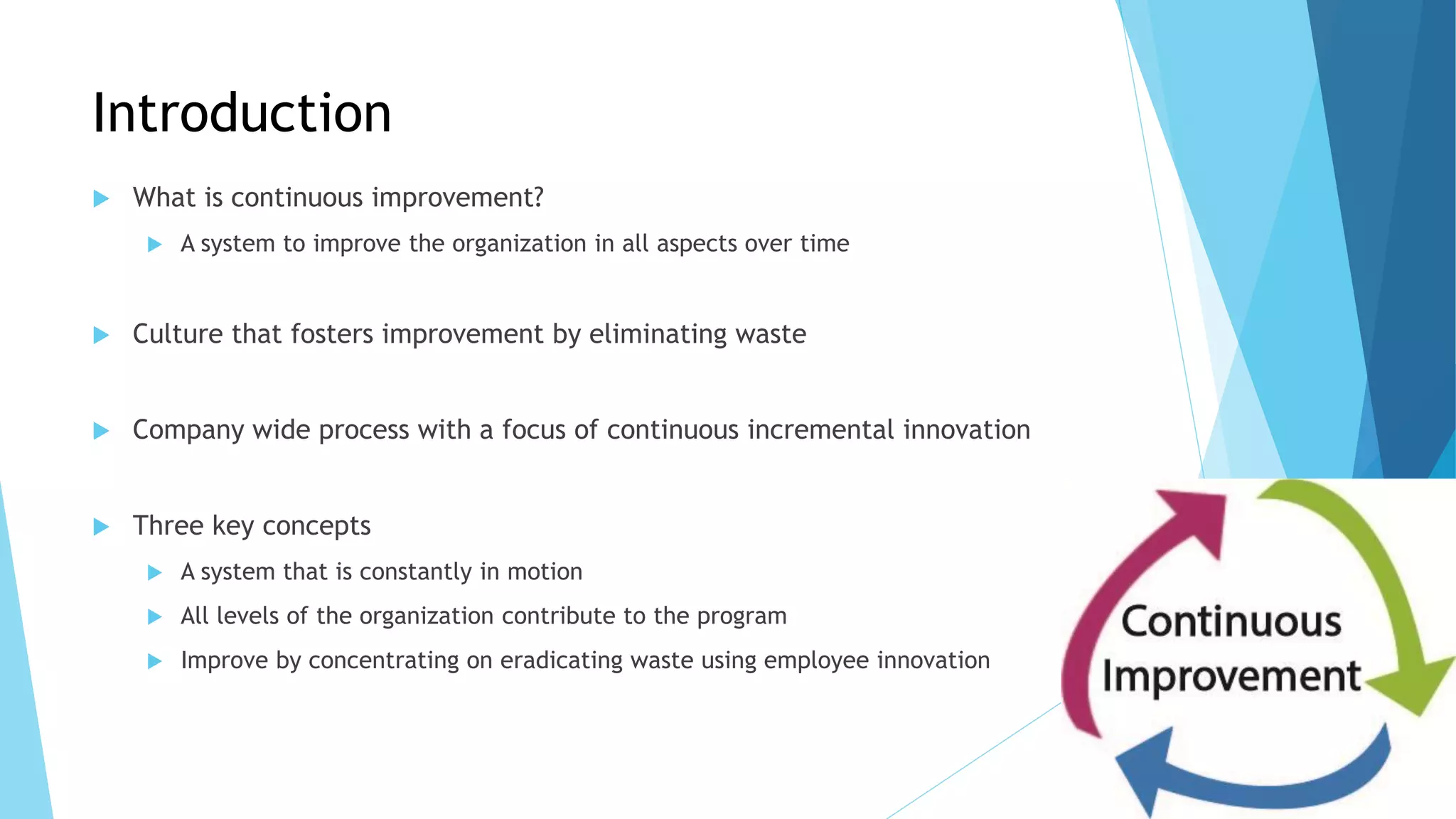
 What is continuous improvement?
 A system to improve the organization in all aspects over time
 Culture that fosters improvement by eliminating waste
 Company wide process with a focus of continuous incremental innovation
 Three key concepts
 A system that is constantly in motion
 All levels of the organization contribute to the program
 Improve by concentrating on eradicating waste using employee innovation
Why Continuous Improvement
 Similar to the definition each company has their own reason
 Common motives
 External pressure
 Periods of uncertainty
 Cultural problems
 Guide, harvest, and implement employee innovation
 Value in small high occurring cycles of innovation
 Nissan Diesel obtains a total of 1.1 million ideas, 88 ideas per worker
 Kawasaki Heavy Engineering collects 6.9 million, 425 ideas per worker
Why Continuous Improvement
 Tangible benefits
 Profitability will increase through reducing internal costs
 Greater efficiency and better use of time
 Non-value added activates
 Eliminate waste in a process
 Intangible benefits
 Low cost
 Improved relationships
 Improved external partnerships
 Heighten communication and collaboration
 Increase employee morale and job satisfaction
Methodologies
 Lean manufacturing
 Traced back to Henry Ford
 Toyota production system
 Eliminate wasted time, effort, and material; reduce cost while improving quality,
provide customers with make-to-order
 Just in time
 Identifying and prioritizing non-value added
 Cycle efficiency – value-added / total time
Methodologies
 Six sigma
 Traced back to Andrew Carnegie
 Places a great importance on training
 Relies on statistical and scientific methods to make reduction
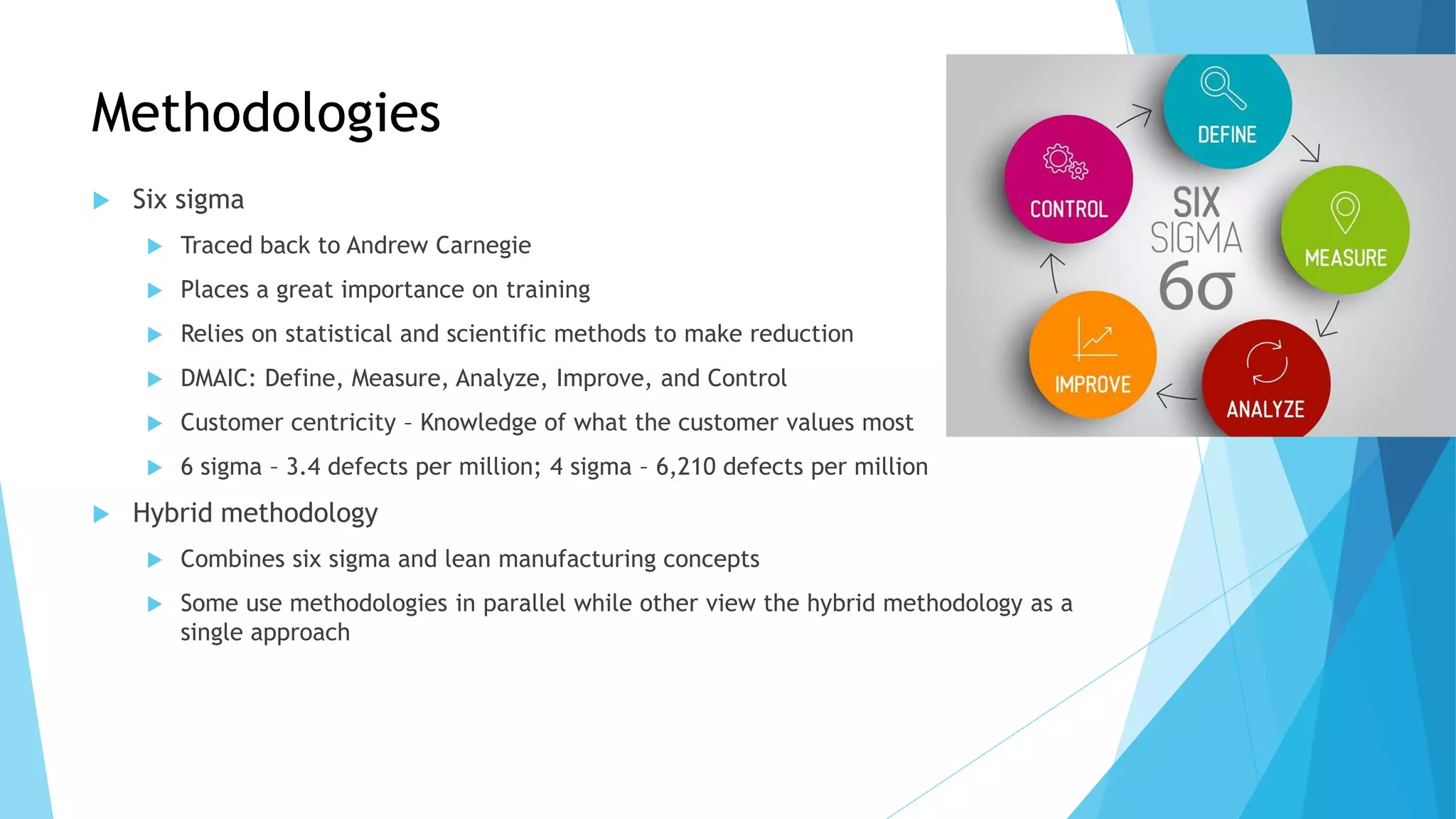
 DMAIC: Define, Measure, Analyze, Improve, and Control
 Customer centricity – Knowledge of what the customer values most
 6 sigma – 3.4 defects per million; 4 sigma – 6,210 defects per million
 Hybrid methodology
 Combines six sigma and lean manufacturing concepts
 Some use methodologies in parallel while other view the hybrid methodology as a
single approach
Implementation Process
 Strategically managed
 Involving management is an indispensable enabler
 Connects to all the other enablers
 Regular milestones
 Should include short and long term
 Measurement and display routines
 Employees want some form of feedback
 Social media
 Communication
 Meetings vs. Email
Implementation Process
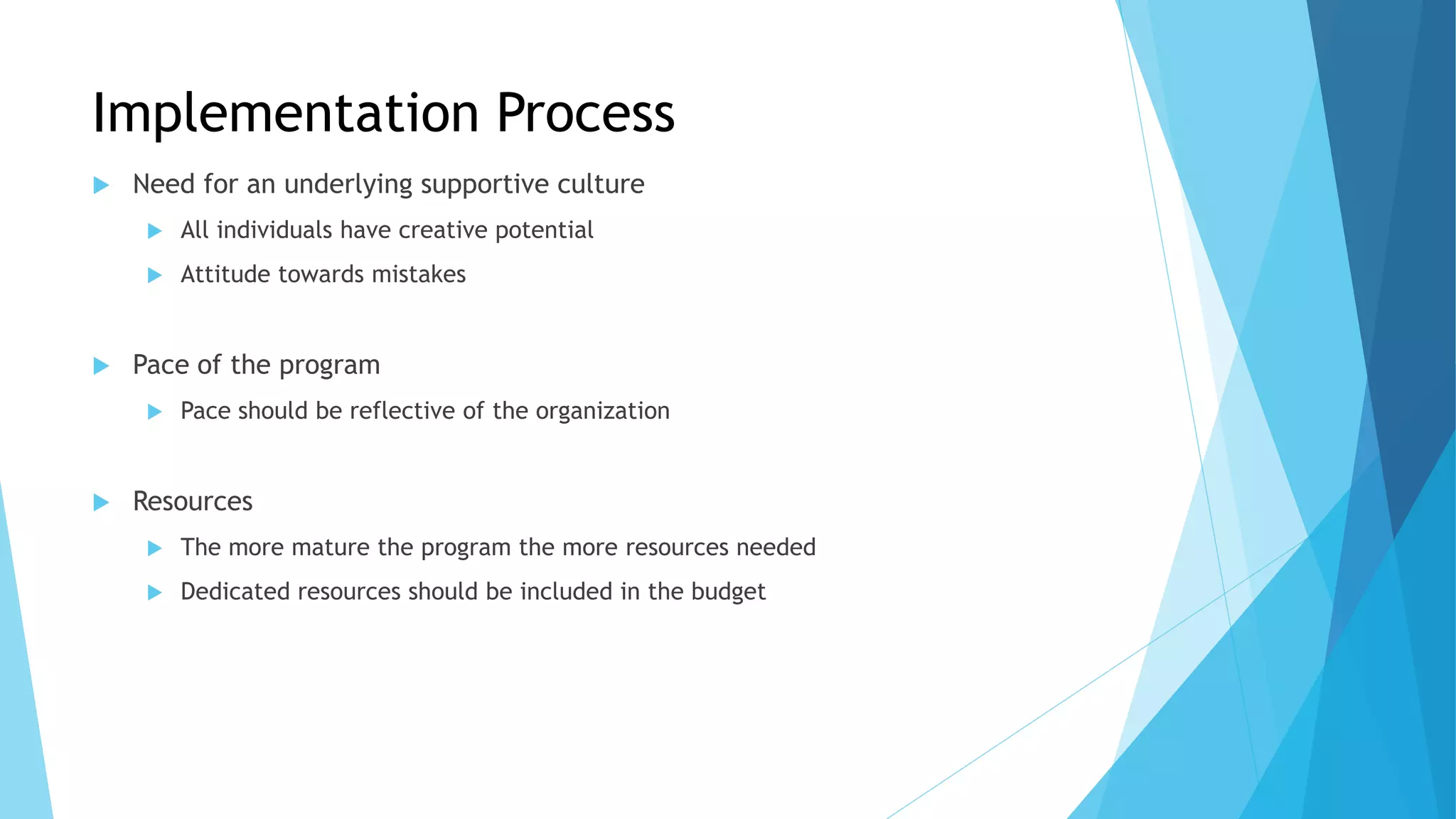
 Need for an underlying supportive culture
 All individuals have creative potential
 Attitude towards mistakes
 Pace of the program
 Pace should be reflective of the organization
 Resources
 The more mature the program the more resources needed
 Dedicated resources should be included in the budget
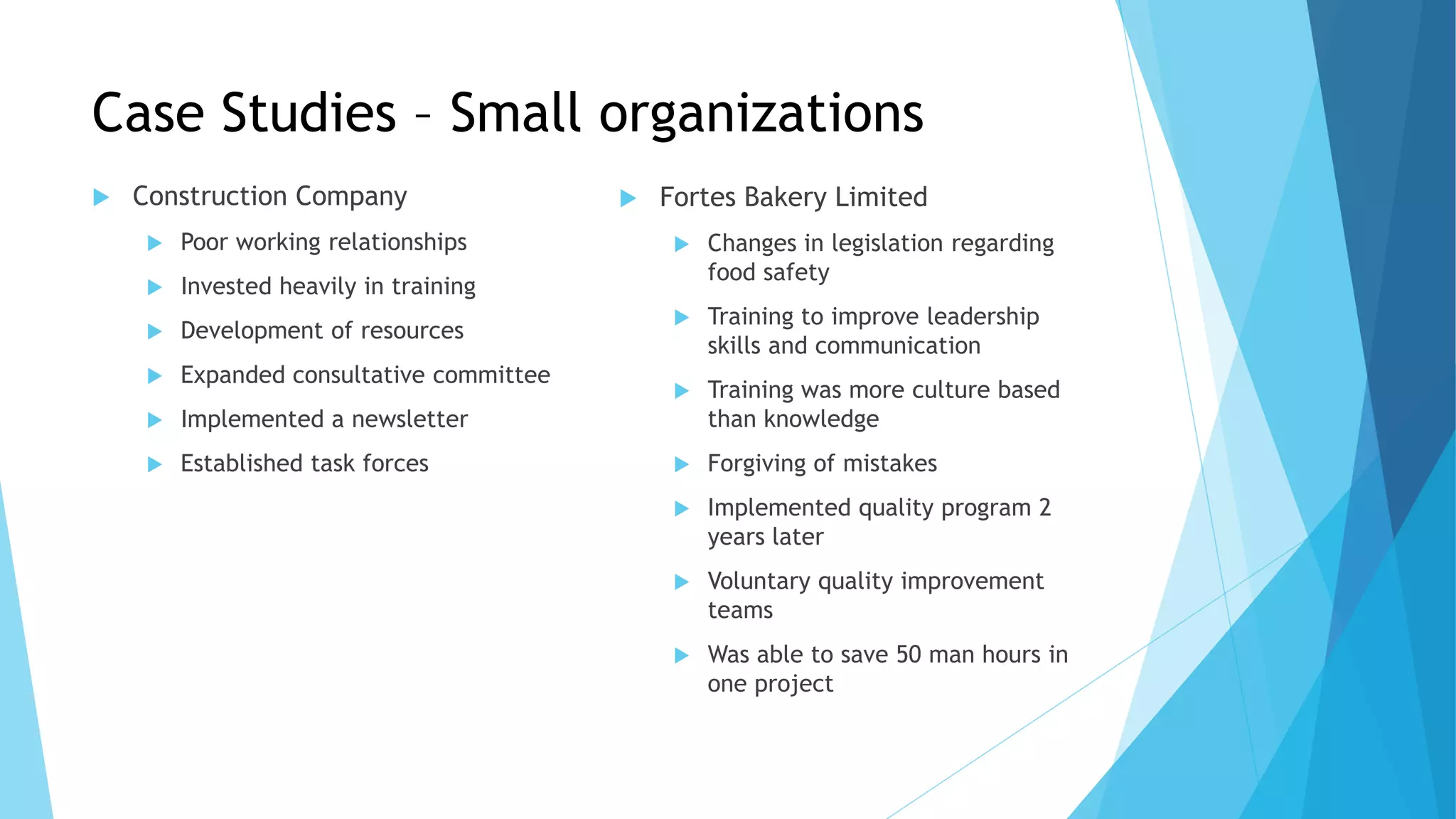
Case Studies – Small organizations
 Construction Company
 Poor working relationships
 Invested heavily in training
 Development of resources
 Expanded consultative committee
 Implemented a newsletter
 Established task forces
 Fortes Bakery Limited
 Changes in legislation regarding
food safety
 Training to improve leadership
skills and communication
 Training was more culture based
than knowledge
 Forgiving of mistakes
 Implemented quality program 2
years later
 Voluntary quality improvement
teams
 Was able to save 50 man hours in
one project
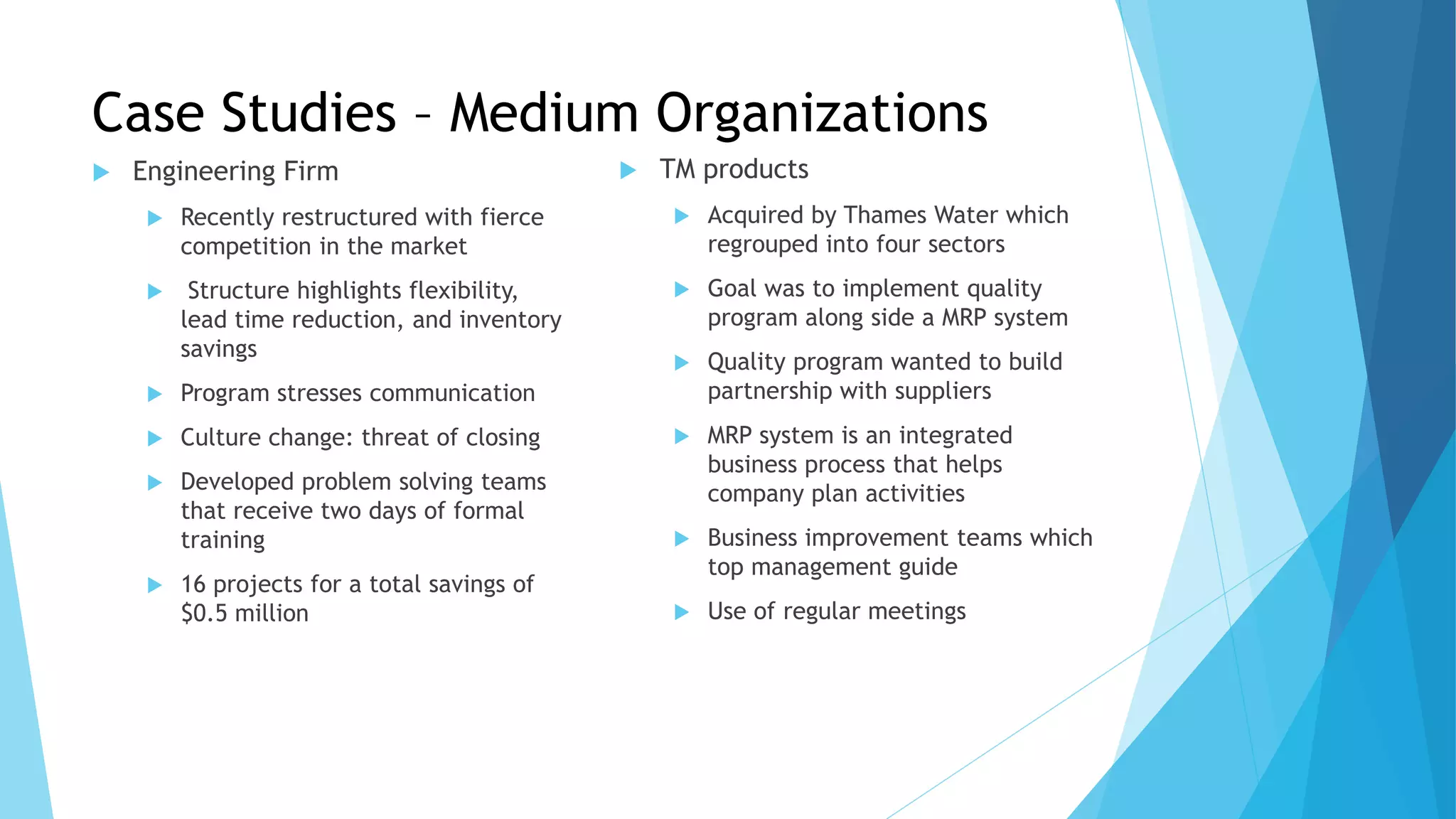
Case Studies – Medium Organizations
 Engineering Firm
 Recently restructured with fierce
competition in the market
 Structure highlights flexibility,
lead time reduction, and inventory
savings
 Program stresses communication
 Culture change: threat of closing
 Developed problem solving teams
that receive two days of formal
training
 16 projects for a total savings of
$0.5 million
 TM products
 Acquired by Thames Water which
regrouped into four sectors
 Goal was to implement quality
program along side a MRP system
 Quality program wanted to build
partnership with suppliers
 MRP system is an integrated
business process that helps
company plan activities
 Business improvement teams which
top management guide
 Use of regular meetings
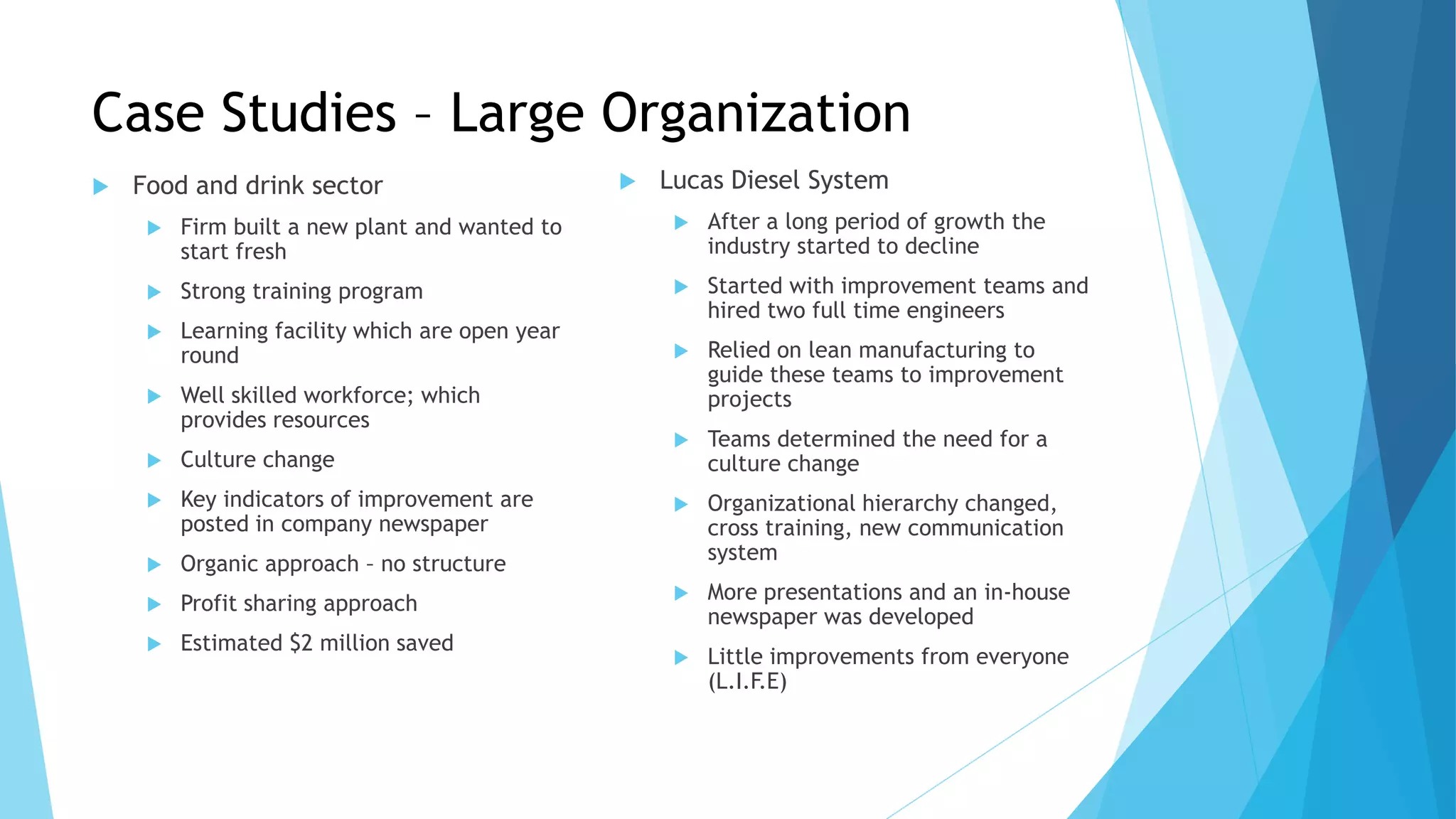
Case Studies – Large Organization
 Food and drink sector
 Firm built a new plant and wanted to
start fresh
 Strong training program
 Learning facility which are open year
round
 Well skilled workforce; which
provides resources
 Culture change
 Key indicators of improvement are
posted in company newspaper
 Organic approach – no structure
 Profit sharing approach
 Estimated $2 million saved
 Lucas Diesel System
 After a long period of growth the
industry started to decline
 Started with improvement teams and
hired two full time engineers
 Relied on lean manufacturing to
guide these teams to improvement
projects
 Teams determined the need for a
culture change
 Organizational hierarchy changed,
cross training, new communication
system
 More presentations and an in-house
newspaper was developed
 Little improvements from everyone
(L.I.F.E)
Implementation Challenges
 No matter how well planned a C.I. program is challenges are going to be
unavoidable
 Understanding these challenges allow the organization a more effortless and
complete implementation
 Organizations struggle to foster collaboration between multiple departments
 Challenging to get I.T. and continuous improvement to work together
 Difficulty identifying which process to prioritize first
 Training, resources, and metrics
 ILL-suited tools
 Too complex or not insufficient
Implementation Challenges
 Lack of employee engagement
 How do employees adopt C.I. on their own; how does management drive
engagement
 Not having enough time, money, or resources
 Impact on staff turnover
 Lack of visible goals and metrics
 Affect of technology
 Reward systems
 Create a competitive culture between employees
 Disbelief in the ability of employee
 Not a silver bullet
 Copying other companies programs doesn’t guarantee success
Case Studies – Small
 Fortes Bakery Limited
 Biggest challenge was a result of directly copying another organizations program
 Maturity level of the copied program
 Program must fit the organization
 Lack of resources – suggestion scheme failure
 Voluntary process teams lead to the same individuals partaking in C.I.
Case Studies – Medium
 Engineering Firm
 Not enough resources, certain projects were put on hold (management)
 No devoted time for top management to participate in C.I.
 Talbot
 Employees struggled to grasp training
 Overwhelmed employees with MRP and C.I. at the same time (pace)
 Poor structure sense emphasis was put on MRP
 C.I was more reactive rather than improvement focused
Case Studies – Large
 Food and Drink organization
 Organic structure leaves the organization vulnerable
 Training may become diluted
 Free for all culture
 Lack of formal process makes it easy to overlook acknowledgment and feedback
 No exclusive resources
Analysis
 Is there one dominant approach when implementing continuous improvement?
 Wide range of enablers are needed
 Connection between small, medium, and large implementation methods
 Depending on the situation different enablers were used
 Organic vs. structured; training for culture vs. training for education
 Order of implementation varies
 Do companies of all sizes face the same challenges?
 Some research shows that resistance to change is the most common challenge
 Different methods will result in different challenges
 Develop a clear structure that fits the company and culture
 Consider the pace
Questions?

Implementation methods of continuous improvement

  • 1.
    Implementation Methods of ContinuousImprovement By Joe Buffa MBA 592
  • 2.
    Introduction  What iscontinuous improvement?  A system to improve the organization in all aspects over time  Culture that fosters improvement by eliminating waste  Company wide process with a focus of continuous incremental innovation  Three key concepts  A system that is constantly in motion  All levels of the organization contribute to the program  Improve by concentrating on eradicating waste using employee innovation
  • 4.
    Why Continuous Improvement Similar to the definition each company has their own reason  Common motives  External pressure  Periods of uncertainty  Cultural problems  Guide, harvest, and implement employee innovation  Value in small high occurring cycles of innovation  Nissan Diesel obtains a total of 1.1 million ideas, 88 ideas per worker  Kawasaki Heavy Engineering collects 6.9 million, 425 ideas per worker
  • 5.
    Why Continuous Improvement Tangible benefits  Profitability will increase through reducing internal costs  Greater efficiency and better use of time  Non-value added activates  Eliminate waste in a process  Intangible benefits  Low cost  Improved relationships  Improved external partnerships  Heighten communication and collaboration  Increase employee morale and job satisfaction
  • 6.
    Methodologies  Lean manufacturing Traced back to Henry Ford  Toyota production system  Eliminate wasted time, effort, and material; reduce cost while improving quality, provide customers with make-to-order  Just in time  Identifying and prioritizing non-value added  Cycle efficiency – value-added / total time
  • 7.
    Methodologies  Six sigma Traced back to Andrew Carnegie  Places a great importance on training  Relies on statistical and scientific methods to make reduction  DMAIC: Define, Measure, Analyze, Improve, and Control  Customer centricity – Knowledge of what the customer values most  6 sigma – 3.4 defects per million; 4 sigma – 6,210 defects per million  Hybrid methodology  Combines six sigma and lean manufacturing concepts  Some use methodologies in parallel while other view the hybrid methodology as a single approach
  • 8.
    Implementation Process  Strategicallymanaged  Involving management is an indispensable enabler  Connects to all the other enablers  Regular milestones  Should include short and long term  Measurement and display routines  Employees want some form of feedback  Social media  Communication  Meetings vs. Email
  • 9.
    Implementation Process  Needfor an underlying supportive culture  All individuals have creative potential  Attitude towards mistakes  Pace of the program  Pace should be reflective of the organization  Resources  The more mature the program the more resources needed  Dedicated resources should be included in the budget
  • 10.
    Case Studies –Small organizations  Construction Company  Poor working relationships  Invested heavily in training  Development of resources  Expanded consultative committee  Implemented a newsletter  Established task forces  Fortes Bakery Limited  Changes in legislation regarding food safety  Training to improve leadership skills and communication  Training was more culture based than knowledge  Forgiving of mistakes  Implemented quality program 2 years later  Voluntary quality improvement teams  Was able to save 50 man hours in one project
  • 11.
    Case Studies –Medium Organizations  Engineering Firm  Recently restructured with fierce competition in the market  Structure highlights flexibility, lead time reduction, and inventory savings  Program stresses communication  Culture change: threat of closing  Developed problem solving teams that receive two days of formal training  16 projects for a total savings of $0.5 million  TM products  Acquired by Thames Water which regrouped into four sectors  Goal was to implement quality program along side a MRP system  Quality program wanted to build partnership with suppliers  MRP system is an integrated business process that helps company plan activities  Business improvement teams which top management guide  Use of regular meetings
  • 12.
    Case Studies –Large Organization  Food and drink sector  Firm built a new plant and wanted to start fresh  Strong training program  Learning facility which are open year round  Well skilled workforce; which provides resources  Culture change  Key indicators of improvement are posted in company newspaper  Organic approach – no structure  Profit sharing approach  Estimated $2 million saved  Lucas Diesel System  After a long period of growth the industry started to decline  Started with improvement teams and hired two full time engineers  Relied on lean manufacturing to guide these teams to improvement projects  Teams determined the need for a culture change  Organizational hierarchy changed, cross training, new communication system  More presentations and an in-house newspaper was developed  Little improvements from everyone (L.I.F.E)
  • 13.
    Implementation Challenges  Nomatter how well planned a C.I. program is challenges are going to be unavoidable  Understanding these challenges allow the organization a more effortless and complete implementation  Organizations struggle to foster collaboration between multiple departments  Challenging to get I.T. and continuous improvement to work together  Difficulty identifying which process to prioritize first  Training, resources, and metrics  ILL-suited tools  Too complex or not insufficient
  • 14.
    Implementation Challenges  Lackof employee engagement  How do employees adopt C.I. on their own; how does management drive engagement  Not having enough time, money, or resources  Impact on staff turnover  Lack of visible goals and metrics  Affect of technology  Reward systems  Create a competitive culture between employees  Disbelief in the ability of employee  Not a silver bullet  Copying other companies programs doesn’t guarantee success
  • 15.
    Case Studies –Small  Fortes Bakery Limited  Biggest challenge was a result of directly copying another organizations program  Maturity level of the copied program  Program must fit the organization  Lack of resources – suggestion scheme failure  Voluntary process teams lead to the same individuals partaking in C.I.
  • 16.
    Case Studies –Medium  Engineering Firm  Not enough resources, certain projects were put on hold (management)  No devoted time for top management to participate in C.I.  Talbot  Employees struggled to grasp training  Overwhelmed employees with MRP and C.I. at the same time (pace)  Poor structure sense emphasis was put on MRP  C.I was more reactive rather than improvement focused
  • 17.
    Case Studies –Large  Food and Drink organization  Organic structure leaves the organization vulnerable  Training may become diluted  Free for all culture  Lack of formal process makes it easy to overlook acknowledgment and feedback  No exclusive resources
  • 18.
    Analysis  Is thereone dominant approach when implementing continuous improvement?  Wide range of enablers are needed  Connection between small, medium, and large implementation methods  Depending on the situation different enablers were used  Organic vs. structured; training for culture vs. training for education  Order of implementation varies  Do companies of all sizes face the same challenges?  Some research shows that resistance to change is the most common challenge  Different methods will result in different challenges  Develop a clear structure that fits the company and culture  Consider the pace
  • 19.