1: IMMUNITY AND ORGANS OF THE IMMUNE
SYSTEM
Dr. Vividha Raunekar
ANTIGEN/IMMUNOGENS
Definition- A substance when introduced in body, evokes immune response to produce a
specific antibody with which antigen reacts in an observable manner
Chemical Nature-
1. mostly protein- present on pathogen surface- good immunogens
2. Polysac and Lipopolysac (LPS)
3. Nucleic acids- poor immunogens but can be immunogenic when complexed with proteins
4. Lipids- non- immunogenic but can act as haptens
Dr. Vividha Raunekar
EPITOPE/ ANTIGENIC DETERMINANTS
A specific site where antibody binds to the antigen
Types- Bcell epitopes- conformational- when heat denatured; not recognized by Ab;
thus vaccines are not heat denatured
T cell epitopes- linear
Dr. Vividha Raunekar
CLASSIFICATION OF AGS- 1. ON BASIS OF THEIR
ORIGIN
Exogenous- that comes inside the body from outside- pathogens, pollutants, pollens,
etc
Endogenous- present inside the body – Blood grp Ags, autoimmune diseases
Dr. Vividha Raunekar
2. ON BASIS OF THEIR IMMUNE RESPONSE
Types- 1. Immunogen/ Complete Ag- Induce Ab formation by themselves and react
specifically with Abs; mostly proteins
2. Incomplete Ag/ Haptens- Unable to Induce Ab formation by themselves Induce Ab
formation by themselves , so need help of carrier proteins; e.g., polysac of
pneumococci, streptococci, etc
Dr. Vividha Raunekar
Hapten+ carrier prot.= induce Ab formation; generates specific reaction
Types of hapten- simple and complex
Simple hapten- Univalent- react with Ab and does not produce precipitation
Complex hapten- Polyvalent- react with Ab and does produce precipitation
Dr. Vividha Raunekar
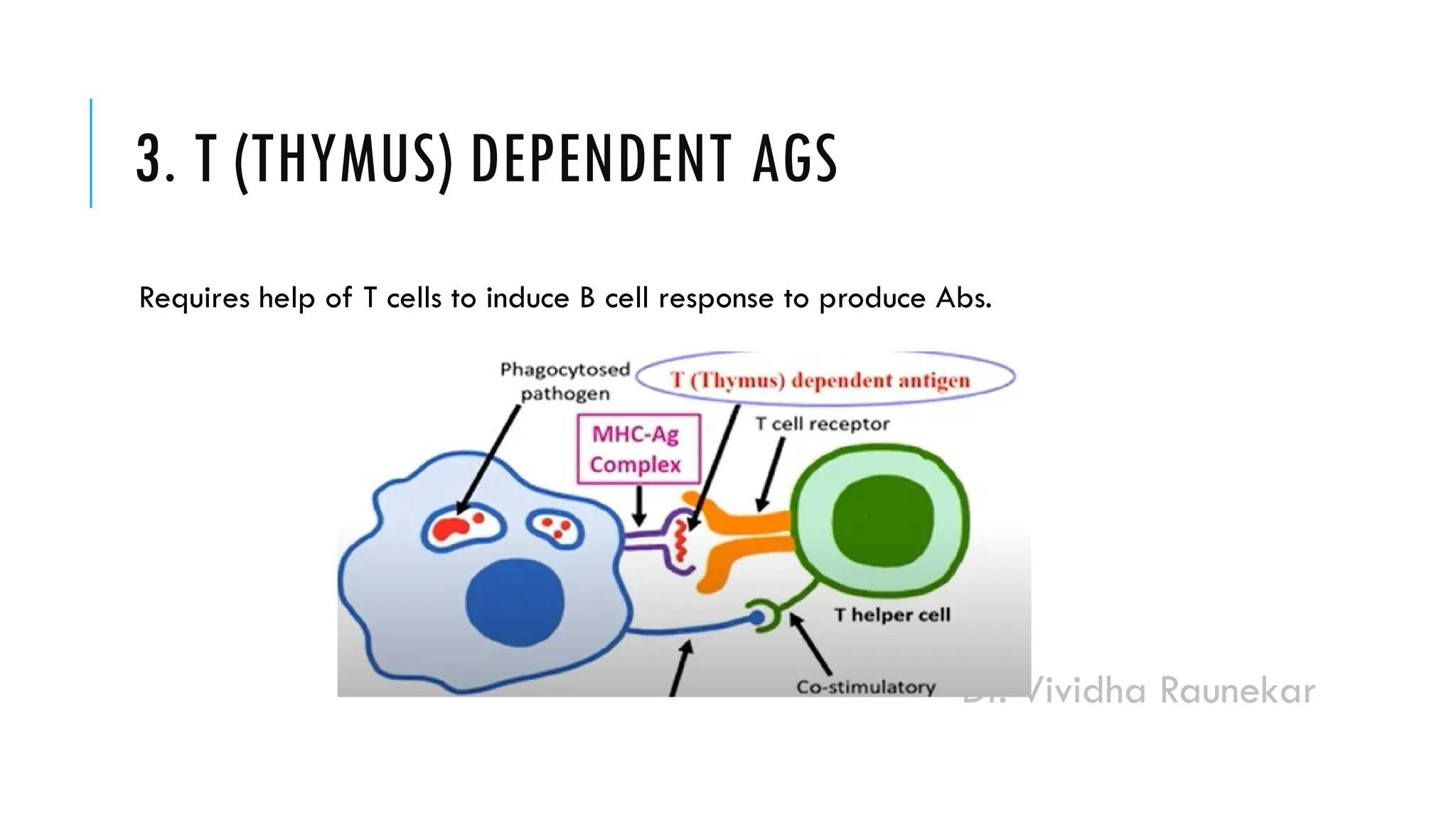
3. T (THYMUS) DEPENDENT AGS
Requires help of T cells to induce B cell response to produce Abs.
Dr. Vividha Raunekar
T (THYMUS) INDEPENDENT AGS
They stimulate B cells to generate Abs without help of T cells
They are polysac that contain repeating epitopes/ LPS derived from Gram negative
bacteria
Do not stimulate Immunological memory
Dr. Vividha Raunekar
IMMUNOGENICITY
Ability of a substance to Induce immune response (humoral/ cell mediated) is
immunogenicity
Substance are called immunogenic
Dr. Vividha Raunekar
ANTIGENICITY
Ability of a substance to bind the product of immune response
Substance are called antigenic
Dr. Vividha Raunekar
THANK YOU

Immunity and organs of the immune system

  • 1.
    1: IMMUNITY ANDORGANS OF THE IMMUNE SYSTEM Dr. Vividha Raunekar
  • 2.
    Dr. Vividha Raunekar ANTIGEN/IMMUNOGENS Definition-A substance when introduced in body, evokes immune response to produce a specific antibody with which antigen reacts in an observable manner Chemical Nature- 1. mostly protein- present on pathogen surface- good immunogens 2. Polysac and Lipopolysac (LPS) 3. Nucleic acids- poor immunogens but can be immunogenic when complexed with proteins 4. Lipids- non- immunogenic but can act as haptens
  • 3.
    Dr. Vividha Raunekar EPITOPE/ANTIGENIC DETERMINANTS A specific site where antibody binds to the antigen Types- Bcell epitopes- conformational- when heat denatured; not recognized by Ab; thus vaccines are not heat denatured T cell epitopes- linear
  • 4.
    Dr. Vividha Raunekar CLASSIFICATIONOF AGS- 1. ON BASIS OF THEIR ORIGIN Exogenous- that comes inside the body from outside- pathogens, pollutants, pollens, etc Endogenous- present inside the body – Blood grp Ags, autoimmune diseases
  • 5.
    Dr. Vividha Raunekar 2.ON BASIS OF THEIR IMMUNE RESPONSE Types- 1. Immunogen/ Complete Ag- Induce Ab formation by themselves and react specifically with Abs; mostly proteins 2. Incomplete Ag/ Haptens- Unable to Induce Ab formation by themselves Induce Ab formation by themselves , so need help of carrier proteins; e.g., polysac of pneumococci, streptococci, etc
  • 6.
    Dr. Vividha Raunekar Hapten+carrier prot.= induce Ab formation; generates specific reaction Types of hapten- simple and complex Simple hapten- Univalent- react with Ab and does not produce precipitation Complex hapten- Polyvalent- react with Ab and does produce precipitation
  • 7.
    Dr. Vividha Raunekar 3.T (THYMUS) DEPENDENT AGS Requires help of T cells to induce B cell response to produce Abs.
  • 8.
    Dr. Vividha Raunekar T(THYMUS) INDEPENDENT AGS They stimulate B cells to generate Abs without help of T cells They are polysac that contain repeating epitopes/ LPS derived from Gram negative bacteria Do not stimulate Immunological memory
  • 9.
    Dr. Vividha Raunekar IMMUNOGENICITY Abilityof a substance to Induce immune response (humoral/ cell mediated) is immunogenicity Substance are called immunogenic
  • 10.
    Dr. Vividha Raunekar ANTIGENICITY Abilityof a substance to bind the product of immune response Substance are called antigenic
  • 11.