SIFAT-SIFAT FIZIKAL MAKANAN
(PHYSICAL PROPERTIES OF FOODS)
Presented by
E-mail: akarim@usm.my
Website: http://www.indtech.usm.my/
karim/AKA/Home.html
Prof. Dr Abd Karim Alias
Universiti Sains Malaysia
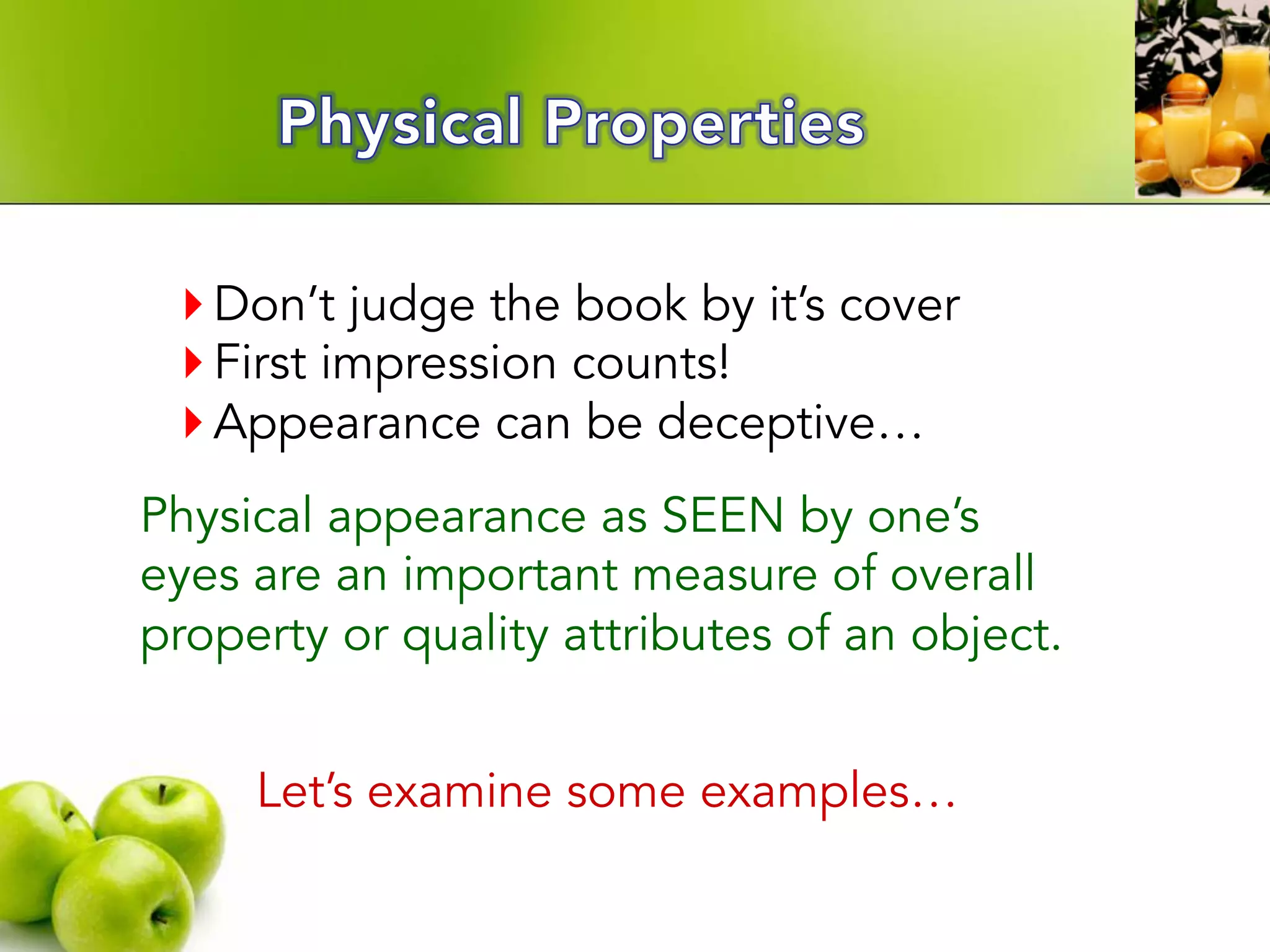
} Don’t judge the book by it’s cover
} First impression counts!
} Appearance can be deceptive…
Physical appearance as SEEN by one’s
eyes are an important measure of overall
property or quality attributes of an object.
Let’s examine some examples…
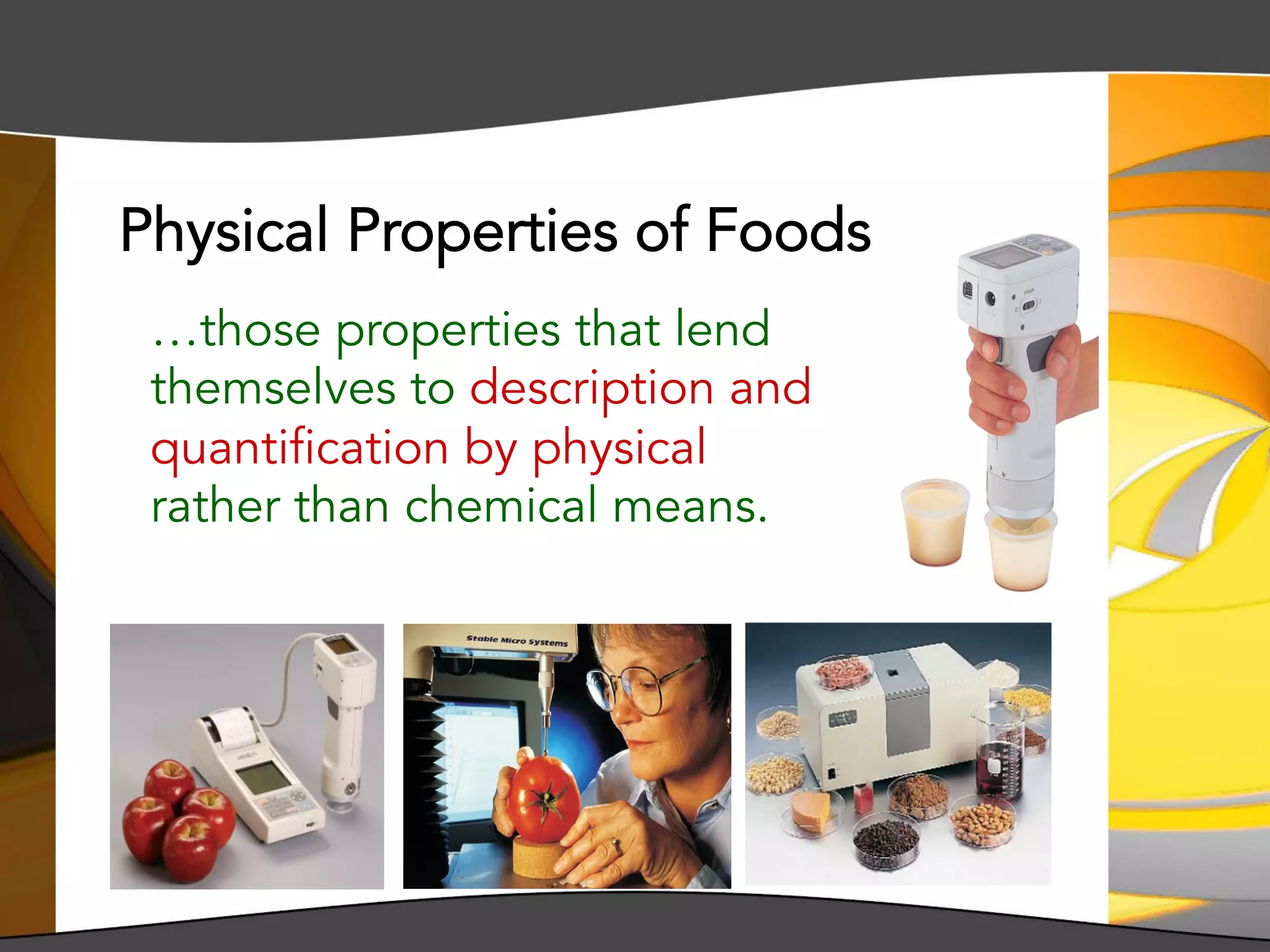
…those properties that lend
themselves to description and
quantification by physical
rather than chemical means.
Physical Properties of Foods
The study of the principles and
measurement of various physical
properties of foods that are
important in handling, preparing,
processing, preserving, packaging,
storing and distribution of foods
Scope
}  To define and describe physical
properties of foods that measure the
overall quality of fresh and prepared
foods.
}  To describe principles of instrumental
methods and their limitations that are
currently available to determine physical
properties of foods.
Course Objectives
}  To gain knowledge & develop skills
in identifying and quantifying
physical properties and their
interrelationships.
}  To understand the significance and
importance of physical properties &
their roles in food processing & food
quality.
Course Objectives
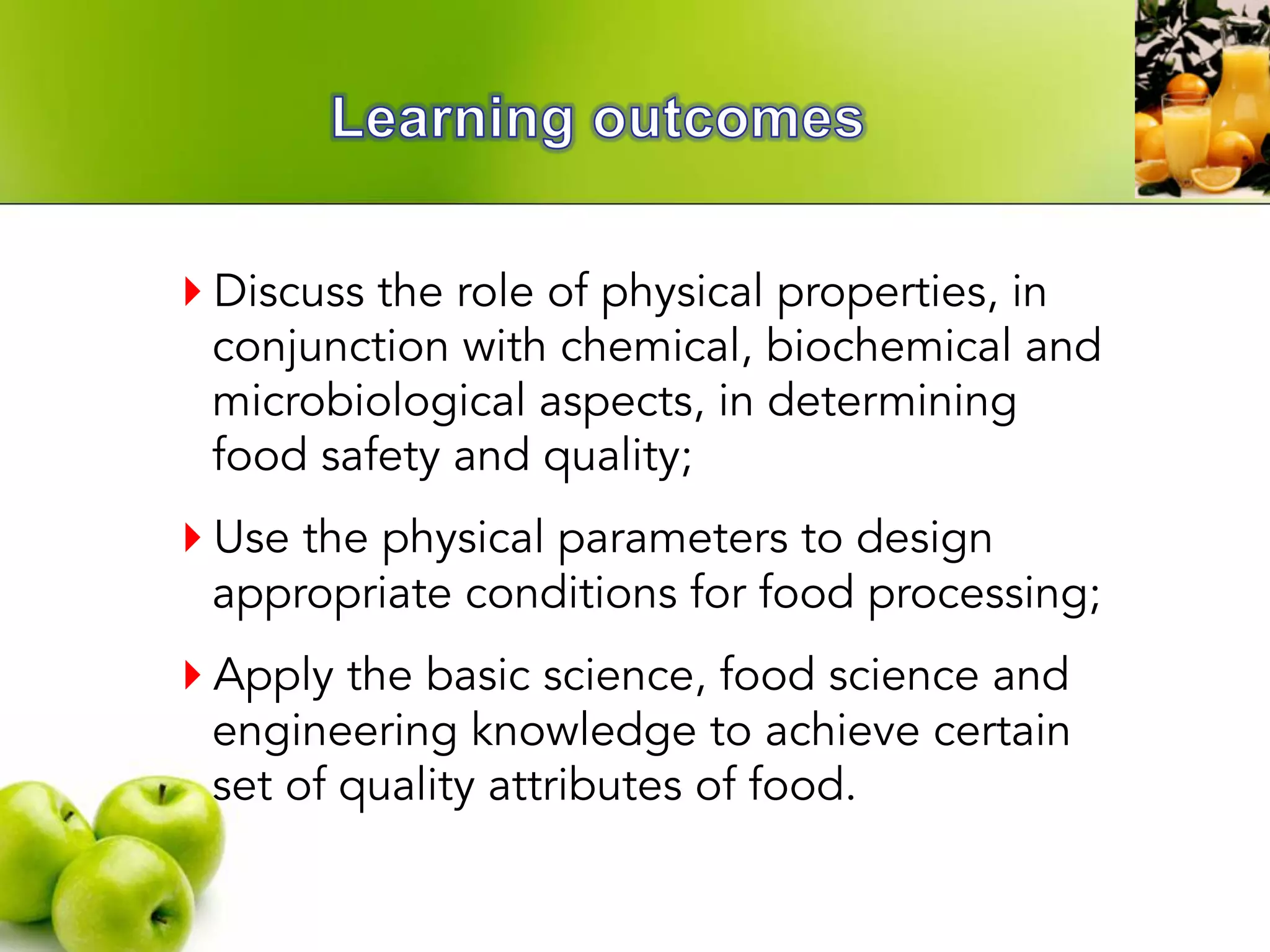
} Discuss the role of physical properties, in
conjunction with chemical, biochemical and
microbiological aspects, in determining
food safety and quality;
} Use the physical parameters to design
appropriate conditions for food processing;
} Apply the basic science, food science and
engineering knowledge to achieve certain
set of quality attributes of food.
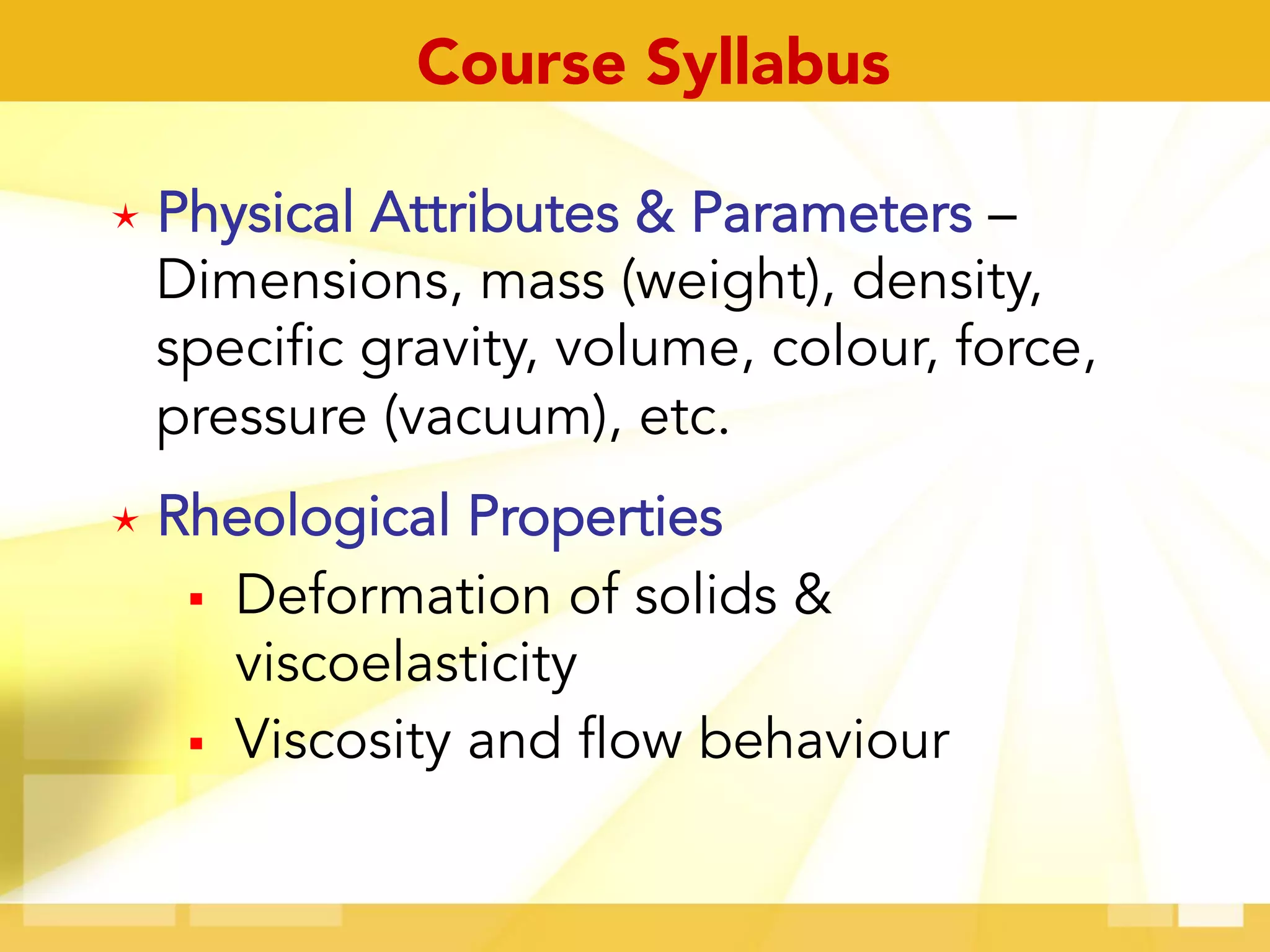
é  Physical Attributes & Parameters –
Dimensions, mass (weight), density,
specific gravity, volume, colour, force,
pressure (vacuum), etc.
é  Rheological Properties
§  Deformation of solids &
viscoelasticity
§  Viscosity and flow behaviour
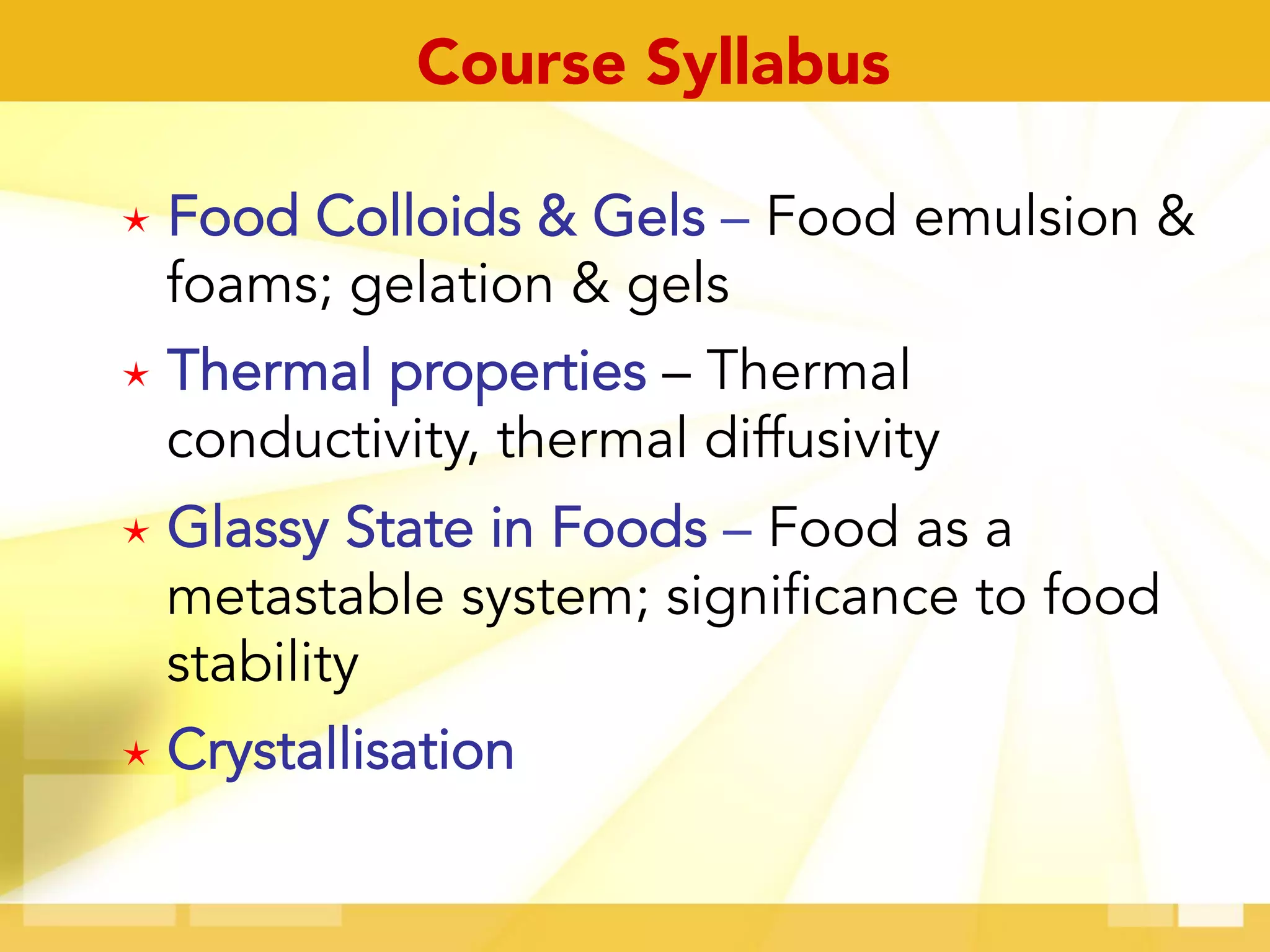
Course Syllabus
é  Food Colloids & Gels – Food emulsion &
foams; gelation & gels
é  Thermal properties – Thermal
conductivity, thermal diffusivity
é  Glassy State in Foods – Food as a
metastable system; significance to food
stability
é  Crystallisation
Course Syllabus
Reference
é  M.J. Lewis, Physical Properties of
Foods & Food Processing Systems

IMK 209 - Physical Properties of Food

  • 1.
  • 2.
    Presented by E-mail: akarim@usm.my Website:http://www.indtech.usm.my/ karim/AKA/Home.html Prof. Dr Abd Karim Alias Universiti Sains Malaysia
  • 3.
    } Don’t judge thebook by it’s cover } First impression counts! } Appearance can be deceptive… Physical appearance as SEEN by one’s eyes are an important measure of overall property or quality attributes of an object. Let’s examine some examples…
  • 4.
    …those properties thatlend themselves to description and quantification by physical rather than chemical means. Physical Properties of Foods
  • 6.
    The study ofthe principles and measurement of various physical properties of foods that are important in handling, preparing, processing, preserving, packaging, storing and distribution of foods Scope
  • 7.
    }  To defineand describe physical properties of foods that measure the overall quality of fresh and prepared foods. }  To describe principles of instrumental methods and their limitations that are currently available to determine physical properties of foods. Course Objectives
  • 8.
    }  To gainknowledge & develop skills in identifying and quantifying physical properties and their interrelationships. }  To understand the significance and importance of physical properties & their roles in food processing & food quality. Course Objectives
  • 9.
    } Discuss the roleof physical properties, in conjunction with chemical, biochemical and microbiological aspects, in determining food safety and quality; } Use the physical parameters to design appropriate conditions for food processing; } Apply the basic science, food science and engineering knowledge to achieve certain set of quality attributes of food.
  • 10.
    é  Physical Attributes& Parameters – Dimensions, mass (weight), density, specific gravity, volume, colour, force, pressure (vacuum), etc. é  Rheological Properties §  Deformation of solids & viscoelasticity §  Viscosity and flow behaviour Course Syllabus
  • 11.
    é  Food Colloids& Gels – Food emulsion & foams; gelation & gels é  Thermal properties – Thermal conductivity, thermal diffusivity é  Glassy State in Foods – Food as a metastable system; significance to food stability é  Crystallisation Course Syllabus
  • 12.
    Reference é  M.J. Lewis,Physical Properties of Foods & Food Processing Systems