International Meeting on Emerging
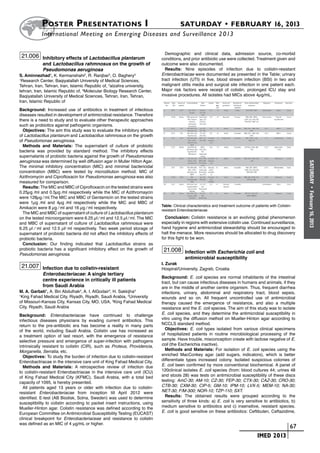
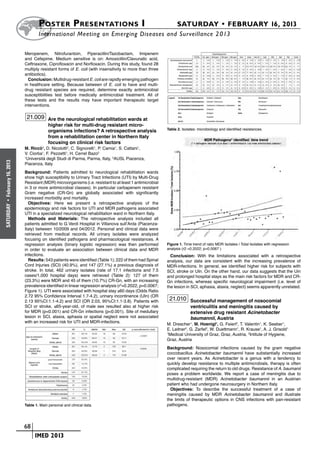
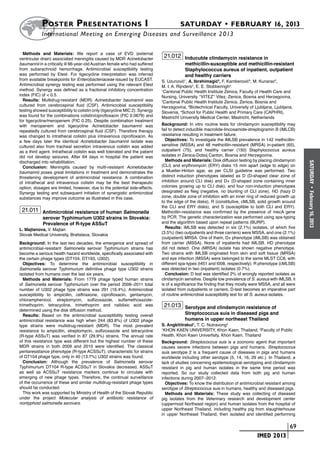
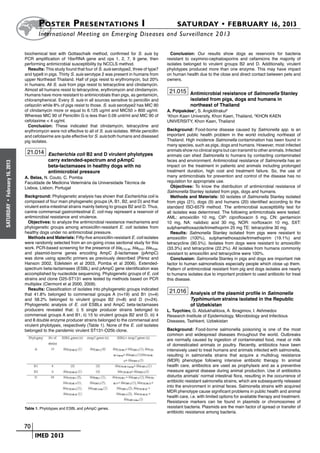
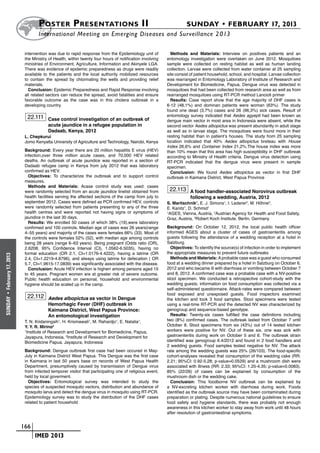
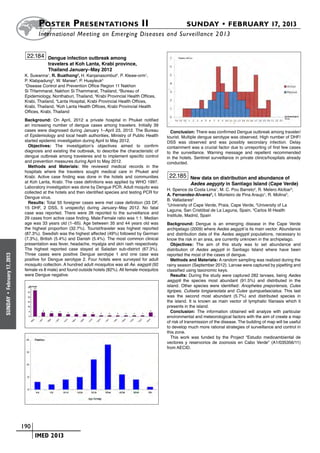
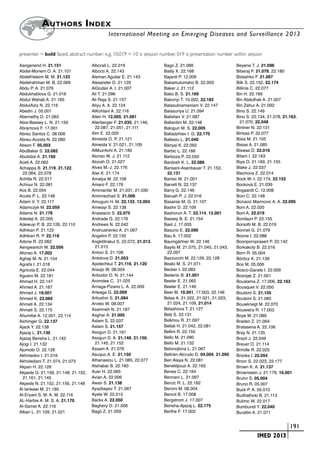
     Diseases and Surveillance
        Vienna, Austria • February 15 –18, 2013

                               Co-sponsored by
         ProMED-mail, the Program for Monitoring Emerging Diseases
                               EcoHealth Alliance
        European Centre for Disease Prevention and Control ( ECDC )
  European Society of Clinical Microbiology and Infectious Diseases ( ESCMID)
       Food and Agriculture Organization of the United Nations ( FAO)
                                   HealthMap
                      Skoll Global Threats Fund (SGTF)
                World Organisation for Animal Health (OIE )


           Organized by the International Society for Infectious Diseases


                        FINAL PROGRAM
16th International Congress
on Infectious Diseases
             Cape Town                 • SouTh afriCa
                                        april 2~5, 2014


   organized by the

   international Society for infectious Diseases


   in collaboration with the
   federation of infectious Diseases Societies of Southern africa
2013


     IMED
        International Meeting
         on E m e r g i n g D i s e a s e s
              and           Surveillance


                             Co-sponsored by
       ProMED-mail, the Program for Monitoring Emerging Diseases
                             EcoHealth Alliance
      European Centre for Disease Prevention and Control ( ECDC )
European Society of Clinical Microbiology and Infectious Diseases ( ESCMID)
     Food and Agriculture Organization of the United Nations ( FAO)
                                 HealthMap
                     Skoll Global Threats Fund (SGTF)
               World Organisation for Animal Health (OIE )


         Organized by the International Society for Infectious Diseases


                      FINAL PROGRAM
Table     of      Contents
         		                                               International Meeting on Emerging Diseases and Surveillance 2 013

                         Welcome. .  .  .  .  .  .  .  .  .  .  .  .  .  .  .  .  .  .  .  .  .  .  .  .  .  .  .  .  .  .  .  .  .  .  .  .  .  .  .  .  .  .  .  .  .  .  .  .  .  .  .  .  .  .  .  .  .  .  .  .  .  .  .  .  .  .  .  .  .  .  .  .  .  .  .  .  .  .  .  .  .  .  .  .  .  .  .  . 1
                         Committees. .  .  .  .  .  .  .  .  .  .  .  .  .  .  .  .  .  .  .  .  .  .  .  .  .  .  .  .  .  .  .  .  .  .  .  .  .  .  .  .  .  .  .  .  .  .  .  .  .  .  .  .  .  .  .  .  .  .  .  .  .  .  .  .  .  .  .  .  .  .  .  .  .  .  .  .  .  .  .  .  .  .  .  .  .  . 2
                         General Information. .  .  .  .  .  .  .  .  .  .  .  .  .  .  .  .  .  .  .  .  .  .  .  .  .  .  .  .  .  .  .  .  .  .  .  .  .  .  .  .  .  .  .  .  .  .  .  .  .  .  .  .  .  .  .  .  .  .  .  .  .  .  .  .  .  .  .  .  .  .  .  .  .  .  .  .  .  .  . 4
                         Floorplans | Hilton Vienna . .  .  .  .  .  .  .  .  .  .  .  .  .  .  .  .  .  .  .  .  .  .  .  .  .  .  .  .  .  .  .  .  .  .  .  .  .  .  .  .  .  .  .  .  .  .  .  .  .  .  .  .  .  .  .  .  .  .  .  .  .  .  .  .  .  .  .  .  .  .  .  .  .  . 6
                         Program-at-a-Glance.  .  .  .  .  .  .  .  .  .  .  .  .  .  .  .  .  .  .  .  .  .  .  .  .  .  .  .  .  .  .  .  .  .  .  .  .  .  .  .  .  .  .  .  .  .  .  .  .  .  .  .  .  .  .  .  .  .  .  .  .  .  .  .  .  .  .  .  .  .  .  .  .  .  .  .  .  .  . 7
                                                                .
                         Scientific Program. .  .  .  .  .  .  .  .  .  .  .  .  .  .  .  .  .  .  .  .  .  .  .  .  .  .  .  .  .  .  .  .  .  .  .  .  .  .  .  .  .  .  .  .  .  .  .  .  .  .  .  .  .  .  .  .  .  .  .  .  .  .  .  .  .  .  .  .  .  .  .  .  .  .  .  .  .  .  .  .  . 8
                         	       Friday, February 15, 2013. .  .  .  .  .  .  .  .  .  .  .  .  .  .  .  .  .  .  .  .  .  .  .  .  .  .  .  .  .  .  .  .  .  .  .  .  .  .  .  .  .  .  .  .  .  .  .  .  .  .  .  .  .  .  .  .  .  .  .  .  .  .  .  .  .  .  .  .  . 8
                         	       Saturday, February 16, 2013 . .  .  .  .  .  .  .  .  .  .  .  .  .  .  .  .  .  .  .  .  .  .  .  .  .  .  .  .  .  .  .  .  .  .  .  .  .  .  .  .  .  .  .  .  .  .  .  .  .  .  .  .  .  .  .  .  .  .  .  .  .  .  .  .  .  . 9
                         	       Sunday, February 17, 2013. .  .  .  .  .  .  .  .  .  .  .  .  .  .  .  .  .  .  .  .  .  .  .  .  .  .  .  .  .  .  .  .  .  .  .  .  .  .  .  .  .  .  .  .  .  .  .  .  .  .  .  .  .  .  .  .  .  .  .  .  .  .  .  .  .  .  . 12
                         	       Monday, February 18, 2013. .  .  .  .  .  .  .  .  .  .  .  .  .  .  .  .  .  .  .  .  .  .  .  .  .  .  .  .  .  .  .  .  .  .  .  .  .  .  .  .  .  .  .  .  .  .  .  .  .  .  .  .  .  .  .  .  .  .  .  .  .  .  .  .  .  . 15
                         	       Poster Presentations I • Saturday, February 16, 2013. . . . . . . . . . . . . . . . . . . . . . . . . . . . . . . . . . . . . . . . . . . . . . 16
                         	       Poster Presentations II • Sunday, February 17, 2013 . .  .  .  .  .  .  .  .  .  .  .  .  .  .  .  .  .  .  .  .  .  .  .  .  .  .  .  .  .  .  .  .  .  .  .  .  .  .  .  .  .  .  .  .  . 26
                         Abstracts . .  .  .  .  .  .  .  .  .  .  .  .  .  .  .  .  .  .  .  .  .  .  .  .  .  .  .  .  .  .  .  .  .  .  .  .  .  .  .  .  .  .  .  .  .  .  .  .  .  .  .  .  .  .  .  .  .  .  .  .  .  .  .  .  .  .  .  .  .  .  .  .  .  .  .  .  .  .  .  .  .  .  .  .  .  .  . 37
                         	       Friday, February 15, 2013
                         		                  Session 01: Science and Sensationalism, Emerging Infections and Emergency!. .  .  .  .  .  .  .  .  .  .  .  .  .  .  .  .  .  .  . 37
                         		                  Session 02: Ecology, Biodiversity, Climate and Emerging Infectious Disease . . . . . . . . . . . . . . . . . . . . . . 37
                         		                  Session 03: Emerging Infectious Diseases and the Hajj. .  .  .  .  .  .  .  .  .  .  .  .  .  .  .  .  .  .  .  .  .  .  .  .  .  .  .  .  .  .  .  .  .  .  .  .  .  . 38
                         	       Saturday, February 16, 2013
                         		                  Session 04: Emerging Disease Prevention. .  .  .  .  .  .  .  .  .  .  .  .  .  .  .  .  .  .  .  .  .  .  .  .  .  .  .  .  .  .  .  .  .  .  .  .  .  .  .  .  .  .  .  .  .  .  .  .  . 40
                         		                  Session 05: Oral Presentations: One Health in Action . .  .  .  .  .  .  .  .  .  .  .  .  .  .  .  .  .  .  .  .  .  .  .  .  .  .  .  .  .  .  .  .  .  .  .  .  .  . 41
                         		                  Session 06: Emerging Fungal Diseases and Species Extinction. .  .  .  .  .  .  .  .  .  .  .  .  .  .  .  .  .  .  .  .  .  .  .  .  .  .  .  .  .  .  .  . 44
                         		                  Session 07: Of Bats and Men: Nipah and Other Infections.  .  .  .  .  .  .  .  .  .  .  .  .  .  .  .  .  .  .  .  .  .  .  .  .  .  .  .  .  .  .  .  .  .  . 45
                                                                                                                                                                                                 .
                         		                  Session 08: Oral Presentations: ‘Contagion’: Contemporary Viral Pathogens.  .  .  .  .  .  .  .  .  .  .  .  .  .  .  .  .  .  .  . 46                                                           .
                         		                  Session 09: Emerging Disease Mysteries. .  .  .  .  .  .  .  .  .  .  .  .  .  .  .  .  .  .  .  .  .  .  .  .  .  .  .  .  .  .  .  .  .  .  .  .  .  .  .  .  .  .  .  .  .  .  .  .  .  . 48
                         		                  Session 10: Vectorborne Diseases in Humans and Animals. .  .  .  .  .  .  .  .  .  .  .  .  .  .  .  .  .  .  .  .  .  .  .  .  .  .  .  .  .  .  .  .  .  . 50
                         	       Sunday, February 17, 2013
                         		                  Session 11: Neglected Zoonotic Diseases. .  .  .  .  .  .  .  .  .  .  .  .  .  .  .  .  .  .  .  .  .  .  .  .  .  .  .  .  .  .  .  .  .  .  .  .  .  .  .  .  .  .  .  .  .  .  .  . 51
                         		                  Session 12: Oral Presentations: Infection, Detection, and Protection: Adventures in Epidemiology.  . 52                                                                                                                                                .
                         		                  Session 13: Global Approach to the Control of Foot and Mouth Disease.  .  .  .  .  .  .  .  .  .  .  .  .  .  .  .  .  .  .  .  .  . 56                                                    .
                         		                  Session 14: Cutting Edge Diagnostics for the Detection of Novel and Neglected Diseases. .  .  .  .  .  .  . 56
                         		                  Session 15: Updates from ProMED (Panel Discussion). . . . . . . . . . . . . . . . . . . . . . . . . . . . . . . . . . . . . . . 57
                         		                  Session 16: Disease Surveillance . .  .  .  .  .  .  .  .  .  .  .  .  .  .  .  .  .  .  .  .  .  .  .  .  .  .  .  .  .  .  .  .  .  .  .  .  .  .  .  .  .  .  .  .  .  .  .  .  .  .  .  .  .  .  .  . 57
                         		                  Session 17: Oral Presentations: Hot Topics. .  .  .  .  .  .  .  .  .  .  .  .  .  .  .  .  .  .  .  .  .  .  .  .  .  .  .  .  .  .  .  .  .  .  .  .  .  .  .  .  .  .  .  .  .  .  .  . 58
                         	       Monday, February 18, 2013
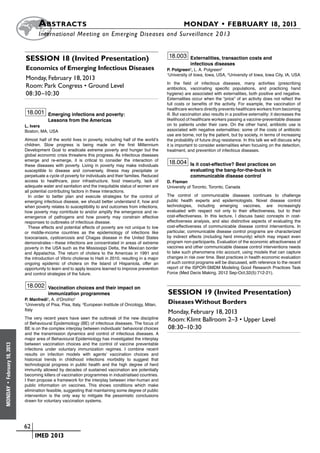
                         		                  Session 18: Economics of Emerging Infectious Diseases. .  .  .  .  .  .  .  .  .  .  .  .  .  .  .  .  .  .  .  .  .  .  .  .  .  .  .  .  .  .  .  .  .  .  .  .  . 62
                         		                  Session 19: Diseases Without Borders. .  .  .  .  .  .  .  .  .  .  .  .  .  .  .  .  .  .  .  .  .  .  .  .  .  .  .  .  .  .  .  .  .  .  .  .  .  .  .  .  .  .  .  .  .  .  .  .  .  .  . 62
                         		                  Session 20: Big Data, Industry and Disease Surveillance. .  .  .  .  .  .  .  .  .  .  .  .  .  .  .  .  .  .  .  .  .  .  .  .  .  .  .  .  .  .  .  .  .  .  .  .  . 64
                         Poster Presentations. .  .  .  .  .  .  .  .  .  .  .  .  .  .  .  .  .  .  .  .  .  .  .  .  .  .  .  .  .  .  .  .  .  .  .  .  .  .  .  .  .  .  .  .  .  .  .  .  .  .  .  .  .  .  .  .  .  .  .  .  .  .  .  .  .  .  .  .  .  .  .  .  .  .  .  .  .  . 65
                         	       Saturday, February 16, 2013
                         		                  Session 21: Poster Presentations I. .  .  .  .  .  .  .  .  .  .  .  .  .  .  .  .  .  .  .  .  .  .  .  .  .  .  .  .  .  .  .  .  .  .  .  .  .  .  .  .  .  .  .  .  .  .  .  .  .  .  .  .  .  .  . 65
                         	       		                           Antimicrobial Resistance. .  .  .  .  .  .  .  .  .  .  .  .  .  .  .  .  .  .  .  .  .  .  .  .  .  .  .  .  .  .  .  .  .  .  .  .  .  .  .  .  .  .  .  .  .  .  .  .  .  .  .  .  .  .  .  .  . 65
                         	       		                           Bioterrorism and Biological Warfare. .  .  .  .  .  .  .  .  .  .  .  .  .  .  .  .  .  .  .  .  .  .  .  .  .  .  .  .  .  .  .  .  .  .  .  .  .  .  .  .  .  .  .  .  .  .  . 76
                         	       		                           Climate Change and Ecological Factors in Disease Emergence. .  .  .  .  .  .  .  .  .  .  .  .  .  .  .  .  .  .  .  .  .  .  .  .  . 77
                         	       		                           Diseases at the Interface of Humans, Wildlife and Other Animals.  .  .  .  .  .  .  .  .  .  .  .  .  .  .  .  .  .  .  .  .  .  . 80                                  .
                         	       		                           Diseases of Animals. .  .  .  .  .  .  .  .  .  .  .  .  .  .  .  .  .  .  .  .  .  .  .  .  .  .  .  .  .  .  .  .  .  .  .  .  .  .  .  .  .  .  .  .  .  .  .  .  .  .  .  .  .  .  .  .  .  .  .  .  . 91
                         	       		                           Foodborne and Waterborne Diseases. .  .  .  .  .  .  .  .  .  .  .  .  .  .  .  .  .  .  .  .  .  .  .  .  .  .  .  .  .  .  .  .  .  .  .  .  .  .  .  .  .  .  .  .  . 96
                         	      		                            Infections of Public Health Significance. .  .  .  .  .  .  .  .  .  .  .  .  .  .  .  .  .  .  .  .  .  .  .  .  .  .  .  .  .  .  .  .  .  .  .  .  .  .  .  .  .  .  .  . 103
                         	      		                            Infections Related to Travel and Migration . .  .  .  .  .  .  .  .  .  .  .  .  .  .  .  .  .  .  .  .  .  .  .  .  .  .  .  .  .  .  .  .  .  .  .  .  .  .  .  .  . 121
                         	      		                            Innovations in Diagnostic Tests for Emerging Diseases. .  .  .  .  .  .  .  .  .  .  .  .  .  .  .  .  .  .  .  .  .  .  .  .  .  .  .  .  .  .  . 124
                         			                                  New Pathogen Discovery. .  .  .  .  .  .  .  .  .  .  .  .  .  .  .  .  .  .  .  .  .  .  .  .  .  .  .  .  .  .  .  .  .  .  .  .  .  .  .  .  .  .  .  .  .  .  .  .  .  .  .  .  .  .  . 126
                         	      Sunday, February 17, 2013
                         		                 Session 22: Poster Presentations II. .  .  .  .  .  .  .  .  .  .  .  .  .  .  .  .  .  .  .  .  .  .  .  .  .  .  .  .  .  .  .  .  .  .  .  .  .  .  .  .  .  .  .  .  .  .  .  .  .  .  .  .  .  . 127
                         	      		                            Influenza and Other Respiratory Infections. .  .  .  .  .  .  .  .  .  .  .  .  .  .  .  .  .  .  .  .  .  .  .  .  .  .  .  .  .  .  .  .  .  .  .  .  .  .  .  . 127
                         	      		                            New Approaches to Outbreak Surveillance and Monitoring. .  .  .  .  .  .  .  .  .  .  .  .  .  .  .  .  .  .  .  .  .  .  .  .  .  . 136
                         	      		                            New, Emerging and Neglected Zoonotic Diseases. .  .  .  .  .  .  .  .  .  .  .  .  .  .  .  .  .  .  .  .  .  .  .  .  .  .  .  .  .  .  .  .  .  . 148
                         	      		                            Outbreak Modeling. .  .  .  .  .  .  .  .  .  .  .  .  .  .  .  .  .  .  .  .  .  .  .  .  .  .  .  .  .  .  .  .  .  .  .  .  .  .  .  .  .  .  .  .  .  .  .  .  .  .  .  .  .  .  .  .  .  .  .  . 160
                         	      		                            Outbreak Response and Control.  .  .  .  .  .  .  .  .  .  .  .  .  .  .  .  .  .  .  .  .  .  .  .  .  .  .  .  .  .  .  .  .  .  .  .  .  .  .  .  .  .  .  .  .  .  .  .  . 161
                                                                                                                                                    .
                         	      		                            Public Communication of Outbreaks and Emerging Diseases. .  .  .  .  .  .  .  .  .  .  .  .  .  .  .  .  .  .  .  .  .  .  .  .  . 168
                         	      		                            Sociopolitical Factors in Disease Emergence. .  .  .  .  .  .  .  .  .  .  .  .  .  .  .  .  .  .  .  .  .  .  .  .  .  .  .  .  .  .  .  .  .  .  .  .  .  .  . 168
                         			                                  Vaccines and Emergence of Vaccine Preventable Diseases. .  .  .  .  .  .  .  .  .  .  .  .  .  .  .  .  .  .  .  .  .  .  .  .  .  .  .  . 170
                         			                                  Vectorborne Diseases. .  .  .  .  .  .  .  .  .  .  .  .  .  .  .  .  .  .  .  .  .  .  .  .  .  .  .  .  .  .  .  .  .  .  .  .  .  .  .  .  .  .  .  .  .  .  .  .  .  .  .  .  .  .  .  .  .  . 174
                         Index of Authors and Co-Authors. .  .  .  .  .  .  .  .  .  .  .  .  .  .  .  .  .  .  .  .  .  .  .  .  .  .  .  .  .  .  .  .  .  .  .  .  .  .  .  .  .  .  .  .  .  .  .  .  .  .  .  .  .  .  .  .  .  .  .  .  .  .  .  .  . 191

	   ii
	     	 IMED 2013
Welcome
		                  International Meeting on Emerging Diseases and Surveillance 2 013


       Welcome to the great city of Vienna and the fourth International Meeting on Emerging Diseases
       and Surveillance, IMED 2013. Now established as a fixture for those whose work deals with
       threats from infectious agents, IMED 2013 will once again bring leading scientists, clinicians and
       policy makers together to present new knowledge and breakthroughs and discuss how to
       discover, detect, understand, prevent and respond to outbreaks of emerging pathogens.

       Since the last IMED, newly emerged diseases and outbreaks of familiar ones have continued to
       challenge us and keep us vigilant. While the influenza pandemic that began in 2009 has quieted,
       an early and severe flu season has occurred in the Northern hemisphere and eruptions of
       H5N1 highly pathogenic avian influenza in poultry, wild birds and humans continue to occur.
       A new strain of H3N2 has transmitted from pigs to humans and, at least occasionally, from
       person to person.. A novel coronavirus has caused severe human disease in several countries
       and the newly discovered Schmallenberg virus, has emerged in livestock in Northern Europe.
       Diseases at the human-wildlife interface ranging from rabies to plague to Nipah virus continue
       to draw our attention. Growing resistance by pathogens to all types of therapeutic agents raises
       fundamental obstacles to our ability to respond to outbreaks and pandemics. The threat of
       intentional use of biological agents for nefarious purposes remains as real as ever.

       Since its inception, IMED has been a summit that unifies our approach to pathogens in the
       broadest ecological context. Drawing together human and veterinary health specialists, IMED
       serves as a true One Health forum where those working in diverse specialties and diverse
       regions can meet, discuss, present and challenge one another with findings and new ideas.
       This year, over 700 abstracts were submitted, a record number. A selection of the best among
       these will be presented in two poster sessions and four oral sessions.

       A meeting of this scope could not occur without the help of many, and I particularly want to
       thank our co-sponsors for making IMED possible: EcoHealth Alliance, the European Centers
       for Disease Control and Prevention (ECDC), the European Society of Clinical Microbiology
       and Infectious Diseases (ESCMID), HealthMap, the Skoll Global Threats Fund (SGTF) and the
       World Organisation for Animal Health (OIE). We also acknowledge the generous technical con-
       tribution of the Food and Agriculture Organization of the United Nations (FAO) and the sup-
       port from the Vienna Convention Bureau, the Mayor of Vienna and Austrian Airlines.

       While pathogens emerge and mutate, our methodology for detection, surveillance, prevention,
       control, and treatment also continue to evolve. New approaches to the uses of social media
       and data mining, novel laboratory methods, rapid point-of-care diagnostics, risk communication,
       political and societal responses to outbreaks have all seen innovation and change that will be
       explored at IMED 2013.
       Thank you for your participation.

       Sincerely,


       Larry MADOFF
       Chair, Scientific Program Committee
       Editor, ProMED-mail, International Society for Infectious Diseases
       Boston, USA


                                                                             	                    	1
                                                                             	       IMED 2013
Committees
        		                      International Meeting on Emerging Diseases and Surveillance 2 013


                   Scientific Program Committee
                   Larry Madoff, Boston, MA, USA – Chair
                   Jacques Acar, Paris, France
                   Yin Myo Aye, Bangkok, Thailand
                   Daniel Beltrán-Alcrudo, Rome, Italy
                   Timothy Brewer, Montreal, Canada
                   John Brownstein, Boston, MA, USA
                   Ilaria Capua, Padova, Italy
                   Giuseppe Cornaglia, Verona, Italy
                   Sidi Coulibaly, Ouagadougou, Burkina Faso
                   Benson Estambale, Nairobi, Kenya
                   David Fisman, Toronto, Canada
                   Antoine Flahault, Paris, France
                   Johann Giesecke, Stockholm, Sweden
                   David Heymann, London, United Kingdom
                   Jim Hughes, Atlanta, GA, USA
                   Damien Joly, Nanaimo, BC, Canada
                   William Karesh, New York, NY, USA
                   Keith Klugman, Atlanta, GA, USA
                   Daniel Lucey, Washington, DC, USA
                   Nina Marano, Nairobi, Kenya
                   Abla Mawadeku, Ottawa, Canada
                   Kazuaki Miyagishima, Paris, France
                   Norbert Nowotny, Vienna, Austria & Muscat, Oman
                   Philip Polgreen, Iowa City, IA, USA
    Co-Sponsors
                   Marjorie Pollack, New York, NY, USA
                   Natalia Psenichnaya, Rostov-on-Don, Russia
                   Arnon Shimshony, Jerusalem, Israel
                   Mark Smolinski, San Francisco, CA, USA
                   Eric Summers, Boston, MA., USA
                   Jaime Torres, Caracas, Venezuela
                   Jack Woodall, Rio de Janeiro, Brazil

                   Co-Sponsors
             *     ProMED-mail, the Program for Monitoring Emerging Diseases
                   EcoHealth Alliance
                   European Centre for Disease Prevention and Control (ECDC)
                   European Society of Clinical Microbiology and Infectious Diseases (ESCMID)
                   Food and Agriculture Organization of the United Nations ( FAO)*
                   HealthMap
                   Skoll Global Threats Fund (SGTF)
                   World Organisation for Animal Health (OIE)
                   * With a technical contribution from the Food and Agriculture Organization of the United Nations.
	   2
	    	 IMED 2013
Committees
		                International Meeting on Emerging Diseases and Surveillance 2 013


        Cooperating Organizations
        Austrian Agency for Health and Food Safety (AGES)
        Austrian Federal Ministry of Health
        Austrian Society for Infectious Diseases (ÖEGIT)
        Austrian Society of Hygiene, Microbiology and Preventive Medicine (ÖGHMP)
        Austrian Society of Tropical Medicine and Parasitology (ÖGTP)
        International Society for Infectious Diseases (ISID)
        International Society for Disease Surveillance (ISDS)
        University of Veterinary Medicine Vienna – (Vetmeduni Vienna)

        Contributors
        Austrian Airlines
        City of Vienna
        EcoHealth Alliance
        International Society for Infectious Diseases (ISID)
        Vienna Hilton Am Stadtpark
        Vienna Convention Bureau

        Exhibitors
        Amplex BioSystems
        European Centre for Disease Prevention and Control (ECDC)
        Food and Agriculture Organization of the United Nations (FAO)
        International Society of Travel Medicine (ISTM)
        World Organisation for Animal Health (OIE)
        R-Biopharm
        We invite you to visit the Exibits in the
        Pre-Function Area on the Ground Level.

        Organizer & Conference Office
        International Society for Infectious Diseases
        9 Babcock Street, Unit 3, Brookline, MA 02446, USA
        phone: (617) 277-0551 • fax: (617) 278-9113
        email: info@isid.org
        web: http://www.isid.org • http://imed.isid.org

        Exhibition Office
        Media Plan
        Freyung 6
        1010 Vienna, Austria
        Phone: (+43 1) 536 63 0
        Fax: (+43 1) 535 60 16
        Email: mp@media.co.at

                                                                  	                 	3
                                                                  	     IMED 2013
G eneral  I nformation
        		                    International Meeting on Emerging Diseases and Surveillance 2 013


                   Opening Hours of the Registration and Information Desk
                   Friday, February 15, 2013	   11:00 –	19:00hrs
                   Saturday, February 16, 2013	 08:00 –	18:00hrs
                   Sunday, February 17, 2013	   08:00 –	18:00hrs
                   Monday, February 18, 2013	   08:00 –	12:00hrs
                   Congress Venue
                   Hilton Vienna • Am Stadtpark • 1030 Vienna • Tel: +43 1 717 000 • http://www.hilton.com
                   Registration Fees
                   Participants: EUR 495.00      Students: EUR 275.00
                   Social Program
                   The Welcome Reception will be held on Friday, February 15 from 17:30 to 19:00hrs
                   at the Hilton Hotel Vienna on the Gallery (Upper Level).
                   The Mayor’s Reception will take place on Sunday, February 17 at 20:00hrs at the Vienna City
                   Hall (entrance: Lichtenfelsgasse, 1010 Vienna). An invitation card is needed to gain access to
                   this reception.The price is EUR 20,00 per person. Onsite registration is subject to availability.
                   For both functions business attire is appropriate.
                   Badges
                   Please wear your name badge at all times during the conference in order to gain
                   access to the scientific program and all conference functions.
                   Internet Access
                   The Hilton provides free internet access in the main hotel lobby. WiFi access in the sleeping
                   rooms and conference area is available for a special conference fee if you present your IMED
                   name badge. Tickets can be purchased from the reception desk on the ground level
                   (EUR 10 for 24 hours).
                   CME
                   The International Meeting on Emerging Diseases and Surveillance –IMED 2013 is accredited by
                   the European Accreditation Council for Continuing Medical Education (EACCME) to provide
                   the following CME activity for medical specialists. The EACCME is an institution of the European
                   Union of Medical Specialists (UEMS), www.uems.net.
                   The International Meeting on Emerging Diseases and Surveillance –IMED 2013 is designated
                   for a maximum of, or up to 17 hours of European external CME credits. Each medical specialist
                   should claim only those hours of credit that he/she actually spent in the educational activity.
                   Through an agreement between the European Union of Medical Specialists and the American
                   Medical Association, physicians may convert EACCME credits to an equivalent number of
                   AMA PRA Category 1 Credits.™ Information on the process to convert EACCME credit to
                   AMA credit can be found at www.ama-assn.org/go/internationalcme.
                   Live educational activities, occurring outside of Canada, recognized by the UEMS-EACCME for
                   ECMEC credits are deemed to be Accredited Group Learning Activities (Section 1) as defined
                   by the Maintenance of Certification Program of The Royal College of Physicians and Surgeons
                   of Canada.
                   RACE (Veterinary CE)
                   The American Association of Veterinary State Boards RACE committee has reviewed and ap-
                   proved IMED 2013 as meeting the Standards adopted by the AAVSB, (maximum CME for one
                   veterinarian: 16.5). This course meets the requirements for hours of continuing education in
                   jurisdictions which recognize AAVSB RACE approval; however, participants should be aware that
                   some boards have limitations on the number of hours accepted in certain categories and/or
                   restrictions on certain methods of delivery.
                   All CME forms are included in the congress bag. Please complete and return forms to the ISID
                   after the conference is over as indicated on the form.
	   4
	    	 IMED 2013
G eneral  I nformation
		                 International Meeting on Emerging Diseases and Surveillance 2 013


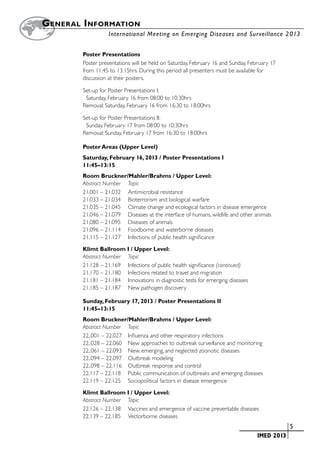
         Poster Presentations
         Poster presentations will be held on Saturday, February 16 and Sunday, February 17
         from 11.45 to 13.15hrs. During this period all presenters must be available for
         discussion at their posters.

         Set-up for Poster Presentations I:
         	 Saturday, February 16 from 08:00 to 10:30hrs
         Removal: Saturday, February 16 from 16:30 to 18:00hrs

         Set-up for Poster Presentations II:
          Sunday, February 17 from 08:00 to 10:30hrs
         Removal: Sunday, February 17 from 16:30 to 18:00hrs

         Poster Areas (Upper Level)
         Saturday, February 16, 2013 / Poster Presentations I
         11:45–13:15
         Room Bruckner/Mahler/Brahms / Upper Level:
         Abstract Number	 Topic
         21.001 – 21.032	 Antimicrobial resistance
         21.033 – 21.034	 Bioterrorism and biological warfare
         21.035 – 21.045	 Climate change and ecological factors in disease emergence
         21.046 – 21.079	 Diseases at the interface of humans, wildlife and other animals
         21.080 – 21.095	 Diseases of animals
         21.096 – 21.114	 Foodborne and waterborne diseases
         21.115 – 21.127	 Infections of public health significance

         Klimt Ballroom I / Upper Level:
         Abstract Number	 Topic
         21.128 – 21.169	 Infections of public health significance (continued)
         21.170 – 21.180	 Infections related to travel and migration
         21.181 – 21.184	 Innovations in diagnostic tests for emerging diseases
         21.185 – 21.187	 New pathogen discovery

         Sunday, February 17, 2013 / Poster Presentations II
         11:45–13:15
         Room Bruckner/Mahler/Brahms / Upper Level:
         Abstract Number 	 Topic
         22..001 – 22.027	 Influenza and other respiratory infections
         22..028 – 22.060 	 New approaches to outbreak surveillance and monitoring
         22..061 – 22.093 	 New, emerging, and neglected zoonotic diseases
         22..094 – 22.097 	 Outbreak modeling
         22..098 – 22.116 	 Outbreak response and control
         22.117 – 22.118 	 Public communication of outbreaks and emerging diseases
         22.119 – 22.125	 Sociopolitical factors in disease emergence

         Klimt Ballroom I / Upper Level:
         Abstract Number 	 Topic
         22.126 – 22.138 	 Vaccines and emergence of vaccine preventable diseases
         22.139 – 22.185	 Vectorborne diseases
                                                                           	                   	5
                                                                           	       IMED 2013
Floorplans • H ilton A m Stadtpark Vienna
        		                   International Meeting on Emerging Diseases and Surveillance 2 013


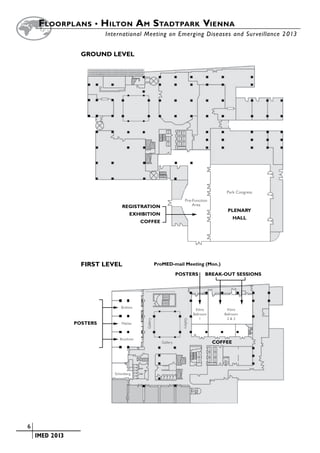
                     GROUND LEVEL


                                                                                                 Park Congress
                                                                          Pre-Function
                                    REGISTRATION                              Area
                                                                                                  PLENARY
                                        EXHIBITION
                                                                                                      HALL
                                             COFFEE


                     FIRST LEVEL                         ProMED-mail Meeting (Mon.)

                                                                      POSTERS            BREAK-OUT SESSIONS


                                   Brahms
                                                                                   Klimt         Klimt
                                                                                  Ballroom      Ballroom
                                                                                      1          2&3
                                               Gallery


                                                                        Gallery


                   POSTERS         Mahler


                                  Bruckner
                                                            Gallery                          COFFEE


                                Schonberg


	   6
	    	 IMED 2013
Program - at- a-G lance
        		                               International Meeting on Emerging Diseases and Surveillance 2 013


	 Time 	         Friday, February 15, 2013	                                        Room
	 11:00–19:00	   Registration and Information Desk	                                Foyer/Park Congress/Ground Level
	 14:00–14:20	   Welcome & Opening	                                                Park Congress/Ground Level
	 14:20–15:00	   Session I: Plenary Lecture: Science and Sensationalism, 	         Park Congress/Ground Level
		                 Emerging Infections and Emergency!
	 15:00–16:30	   Session 2: Plenary Lecture: Ecology, Biodiversity, Climate and	   Park Congress/Ground Level
		                 Emerging Infectious Disease
	 16:30–17:15	   Session 3: Plenary Lecture: Emerging Infectious Diseases	         Park Congress/Ground Level
		                 and the Hajj
	 17:30–19:00	   Welcome: Cocktail Reception	                                      Gallery/Upper Level
	 Time 	         Saturday, February 16, 2013	                                      Room
	 08:30–10:30	 2 Break-out Sessions:
		             Session 4: Emerging Disease Prevention	                             Park Congress/Ground Level
		             Session 5: Oral Presentations: One Health in Action	                Klimt Ballroom 2&3/Upper Level
	 10:30–11:00	 Coffee Break	                                                       Ground Level and Upper Level
	 11:00–11:45	 Session 6: Plenary Lecture: Emerging Fungal Diseases and	           Park Congress/Ground Level
		                Species Extinction
	 11:45–13:15	 Poster Presentations I (Session 21) 	                               Bruckner/Mahler/Brahms/Upper Level
			                                                                                 and Klimt Ballroom1/Upper Level
	 14:30–16:00	 2 Break-out Sessions:
		             Session 7: Of Bats and Men: Nipah and Other Infections	             Park Congress/Ground Level
		             Session 8: Oral Presentations: ‘Contagion’: Contemporary	           Klimt Ballroom 2&3/Upper Level
		               Viral Pathogens
	 16:00–16:30	 Coffee Break	                                                       Ground Level and Upper Level
	 16:30–18:00	 2 Break-out Sessions:
		             Session 9: Emerging Disease Mysteries	                              Park Congress/Ground Level
		             Session 10: Vectorborne Diseases in Humans and Animals	             Klimt Ballroom 2&3/Upper Level
	 Time 	         Sunday, February 17, 2013	                                        Room
	 08:30–10:30	 2 Break-out Sessions:
		             Session 11: Neglected Zoonotic Diseases	                            Park Congress/Ground Level
		             Session 12: Oral Presentations: Infection, Detection, and 	         Klimt Ballroom 2&3/Upper Level
		                Protection: Adventures in Epidemiology
	 10:30–11:00	 Coffee Break	                                                       Ground Level and Upper Level
	 11:00–11:45	 Session 13: Plenary Lecture: Global Approach to the	                Park Congress/Ground Level
		                Control of Foot and Mouth Disease
	 11:45–13:15	 Poster Presentations II (Session 22)	                               Bruckner/Mahler/Brahms/Upper Level
			                                                                                 and Klimt Ballroom1/Upper Level
	 14:30–16:00	 2 Break-out Sessions:
		             Session 14: Cutting Edge Diagnostics for the Detection of	          Park Congress/Ground Level
		                Novel and Neglected Diseases
		             Session 15: Updates from ProMED (Panel Discussion)	                 Klimt Ballroom 2&3/Upper Level
	 16:00–16:30	 Coffee Break	                                                       Ground Level and Upper Level
	 16:30–18:00	 2 Break-out Sessions:
		             Session 16: Disease Surveillance	                                   Park Congress/Ground Level
		             Session 17: Oral Presentations: Hot Topics	                         Klimt Ballroom 2&3/Upper Level
	 20:00–22:00	 Mayor’s Reception	                                                  Vienna City Hall (Entrance: Liechtenfelsgasse)
	 Time 	         Monday, February 18, 2013	                                        Room
	 08:30–10:30	   2 Break-out Sessions:
		               Session 18: Economics of Emerging Infectious Diseases	            Park Congress/Ground Level
		               Session 19: Diseases without Borders 	                            Klimt Ballroom 2&3/Upper Level
	 10:30–11:00	   Coffee Break	                                                     Ground Level and Upper Level
	 11:00–11:45	   Session 20: Plenary Lecture: Big Data, Industry and	              Park Congress/Ground Level
		                  Disease Surveillance


The program is subject to changes!                                                                     	                     	7
                                                                                                       	       IMED 2013
S cientific  Program 	                                             FRIDAY • FEBRUARY 15, 2013
                            	International Meeting on Emerging Diseases and Surveillance 2 013


                            Opening Session                                          Session 02		
                            Room: Park Congress	              14:00–14:20            Plenar y Lectures
                            Ground Level	        Friday, February 15, 2013           Ecology, Biodiversity, Climate and
February 15, 2013


                            Welcome by the President of the                          Emerging Infectious Diseases
                            International Society for Infectious Diseases (ISID)     Co-Chairs:	William Karesh, USA
                            Keith Klugman                                            	          Juan Lubroth, Italy
                            Atlanta, GA (USA)
                                                                                     Room: Park Congress	              15:00–16:30
 •


                            Welcome to Vienna                                        Ground Level	        Friday, February 15, 2013
FRIDAY


                            Norbert Nowotny
                                                                                     02.001	Different views of looking at biodiversity
                            Vienna (Austria)
                                                                                            and health
                                                                                            W. Karesh
                            Official Opening of the Conference
                                                                                            New York, NY (USA)
                            Pamela Rendl-Wagner, Director General,
                            Public Health, Austria                                   02.002	Concerns of the biodiversity community for
                            Vienna (Austria)                                                integrating health
                                                                                            D. Coates
                            Welcome to IMED 2013                                            Montreal (Canada)
                            Larry Madoff                                             02.003	Climate change, biodiversity loss, desertification
                            Boston, MA (USA)                                                and human health - the WHO Perspective
                                                                                            D. Campbell-Lendrum
                                                                                            Geneva (Switzerland)
                                                                                     02.004	Wildlife trade and emerging diseases- Impacts
                                                                                            on biodiversity and health
                                                                                            K. Smith
                                                                                            New York, NY (USA)
                                                                                     Co-sponsored by EcoHealth Alliance


                                                                                     Session 03		
                                                                                     Plenar y Lecture
                                                                                     Emerging Infectious Diseases
                                                                                     and the Hajj
                                                                                     Chair: Marjorie Pollack, USA

                            Session 01		                                             Room: Park Congress	              16:30–17:15
                                                                                     Ground Level	        Friday, February 15, 2013
                            Plenar y Lecture
                            Science and Sensationalism, Emerging                     03.001	Emerging infectious diseases and the Hajj
                                                                                            Z. Memish
                            Infections and Emergency!                                       Riyadh (Saudi Arabia)
                            Chair: Keith Klugman, USA
                            Room: Park Congress	              14:20–15:00            Welcome Cocktail Reception
                            Ground Level	        Friday, February 15, 2013
                                                                                     Gallery		                                   17:30–19:00
                            01.001 Science and sensationalism, emerging infections   Upper Level	                   Friday, February 15, 2013
                                   and emergency!
                                   A. Schuchat
                                   Atlanta, GA (USA)


                    	   8
                    	    	 IMED 2013
S cientific  Program 	                                           SATURDAY • FEBRUARY 16, 2013
	International Meeting on Emerging Diseases and Surveillance 2 013


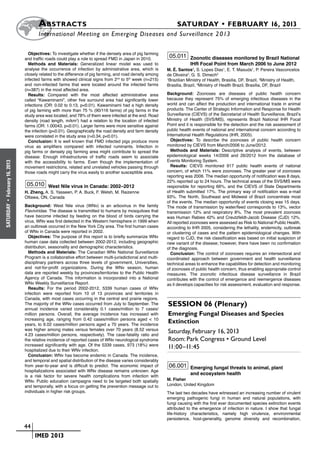
                                                              05.004	Monitoring of influenza virus in pigs and
Session 04	 	                                                        humans in Switzerland
Emerging Disease Prevention                                          M. Engels1, Y. Thomas2, E. Fuchsini3, R. Born4,
Co-Chairs:	Julio Pinto, Italy                                        S. Bruhn4
	          Nina Marano, Kenya
                                                                     1
                                                                       Zurich (Switzerland), 2Geneva (Switzerland),
                                                                     3
                                                                       Sempbach (Switzerland), 4Berne (Switzerland)
Room: Park Congress	               8:30–10:30
                                                              05.005	Coxiella burnetti seroprevalence and risk factors
Ground Level	      Saturday, February 16, 2013
                                                                     in dairy cattle farmers and farm residents in the
04.001	Introduction to FAO's role in emerging disease                Netherlands
       prevention                                                    J. Hautvast1, N. Schotten1, B. Schimmer 2,
       J. Lubroth                                                    P. Schneeberger 3, P. Vellema4, Y. van Duynhoven2
       Rome (Italy)
                                                                     1
                                                                       Nijmegen (Netherlands), 2Bilthoven
                                                                     (Netherlands), 3Den Bosch (Netherlands),
04.002	Strengthening laboratory networks and strategies              4
                                                                       Deventer (Netherlands)
       to meet the challenges of emerging and
       transboundary animal diseases (TADs) threats           05.006	High colonization rate of farmers, their relatives
       F. Claes                                                      and employees at pig farms with emerging
                                                                     Clostridium difficile PCR ribotype 078


                                                                                                                            SATURDAY
       Rome (Italy)
04.003	Innovation to fill the gaps in disease surveillance:          E. Keessen1, M. Hensgens2, M. Bos1, W. Dohmen1,
       Participatory surveillance, applied technologies              J. Wagenaar3, D. Heederik1, E. Kuijper2, L. Lipman1
       for better understanding and reporting
                                                                     1
                                                                       Utrecht (Netherlands), 2Leiden (Netherlands),
                                                                     3
                                                                       Netherland (Netherlands)


                                                                                                                              •
       J. Pinto


                                                                                                                            February 16, 2013
       Rome (Italy)                                           05.007	West Nile Disease in Italy: Animal surveillance
04.004	Dealing with the biocomplexity of emerging                    activities as an early warning system for the
       infectious diseases (EIDs): An ecosystem health               prevention and control of the infection in humans
       approach                                                      R. Bruno, D. Di Sabatino, A. Carvelli, F. De
       D. Beltrán-Alcrudo                                            Massis, P. Calistri
       Rome (Italy)                                                  Teramo (Italy)
With a technical contribution from the Food and Agriculture   05.008	Sylvatic origin and geographic spread of
Organization of the United Nations.                                  St. Louis encephalitis virus
                                                                     A. Kopp1, T. Gillespie2, D. Hobelsberger3,
                                                                     A. Estrada4, I. Eckerle1, M. Mueller1,
Session 05	 	                                                        L. Podsiadlowski5, F. Leendertz3,
Oral Presentations                                                   C. Drosten1, S. Junglen1
                                                                     1
                                                                       Bonn (Germany), 2Atlanta, GA (USA), 3Berlin
One Health in Action                                                 (Germany), 4Mexico City (Mexico),
Co-Chairs:	Tim Brewer, USA                                           5
                                                                       Bonn (Germany)
	          Natalia Pshenichnaya, Russian Federation
                                                              05.009	Considerable relation with foot-and-mouth
Room: Klimt Ballroom 2&3	          8:30–10:30                        disease (FMD) infection in Japan, 2010; Traffic
Upper Level	       Saturday, February 16, 2013                       roads and pig farming area
                                                                     R. Ushijima
05.001	Evaluating long-term behavior change resulting                Miyazaki (Japan)
       from an intervention to prevent Nipah virus
       transmission from bats to humans in Bangladesh         05.010	West Nile Virus in Canada: 2002–2012
       R. Sultana, U. K. Mondal, J. Abedin, M. J. Hossain,           H. Zheng, A. S. Yasseen, P. A. Buck, F. Welsh,
       M. A. Y. Sharker, N. A. Rimi, E. Gurley, N. Nahar,            M. Raizenne
       S. P. Luby                                                    Ottawa, ON (Canada)
       Dhaka (Bangladesh)                                     05.011	Zoonotic diseases monitored by Brazil National
05.002	Characterizing high risk disease transmission                 IHR Focal Point from March 2006 to June 2012
       interfaces in the global pursuit of emerging                  M. É. Santos, S. Lopes Dias, E. T. Masuda,
       zoonotic diseases                                             P. Pereira Vasconcelos de Oliveira, G. S. Dimech
       C. K. Johnson1, T. W. Smiley1, T. Goldstein1,                 Brasilia (Brazil)
       W. Karesh2, D. Joly3, P. Daszak2, J. Mazet1
       1
        Davis, CA (USA), 2New York, NY (USA),
       3
        Nanaimo, BC (Canada)
05.003	Rabies control in Bali: A “one health” approach
       E. Russell, F. Abson
                                                                                              	                        	9
       London (United Kingdom)
                                                                                              	        IMED 2013
S cientific  Program 	                                   SATURDAY • FEBRUARY 16, 2013
                           	International Meeting on Emerging Diseases and Surveillance 2 013


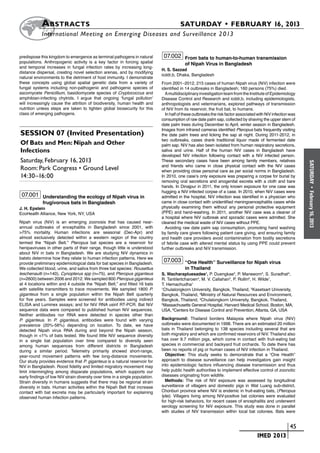
                           Coffee Break                                          Session 08	 	
                           Ground Level	                          10:30–11:00    Oral Presentations
                           and Upper Level	        Saturday, February 16, 2013
                                                                                 ‘Contagion’: Contemporary
                                                                                 Viral Pathogens
                           Session 06	 	                                         Co-Chairs:	Sidi Coulibaly, Burkina Faso
                                                                                 	          Stuart Handysides, United Kingdom
                           Plenar y Lecture
                                                                                 Room: Klimt Ballroom 2&3	         14:30–16:00
                           Emerging Fungal Threats to Animal,                    Upper Level	       Saturday, February 16, 2013
                           Plant and Ecosystem Health
                           Chair: John Brownstein, USA                           08.001	Hepatitis E virus antigen detection:
                                                                                        An early diagnostic marker 
                           Room: Park Congress	              11:00–11:45                R. Ratho, M. Majumdar, M. P. Singh, Y. Chawla
                           Ground Level	      Saturday, February 16, 2013               Chandigarh (India)

                           06.001	Emerging fungal threats to animal, plant       08.002	Evolution of H3N2 influenza viruses from
February 16, 2013


                                  and ecosystem health                                  the Philippines
                                  M. Fisher                                             B. C. Torres1, Y. C. F. Su2, M. S. H. Chua2, H. Guo2,
                                  London (United Kingdom)                               A. K. Cruz1, D. C. Klinzing1, G. J. D. Smith2, F. F.
                                                                                        Natividad1
                                                                                        1
                                                                                         Quezon City (Philippines), 2Singapore
                           Poster Presentations I (Session 21)                          (Singapore)
 •


                                                                                 08.003	Influence of the viral membrane, inherited from
SATURDAY


                           Saturday, February 16, 2013	       11:45–13:15
                                                                                        different host species, on survival of influenza A
                           Bruckner/Mahler/Brahms - Upper Level                         viruses in water
                           and Klimt Ballroom 1 - Upper Level                           S. Shigematsu, A. Dublineau, L. I. O. Sawoo,
                           Sessions 21.001–21.187 (see pages 65–126)                    I. Leclercq, J.-C. Manuguerra
                                                                                        Paris (France)
                                                                                 08.004	Investigation of deaths due by Influenza A(H1N1)
                           Session 07	 	                                                pdm09 in Southern Brazil, July-August, 2012
                           Of Bats and Men: Nipah and                                   R. Soletti1, W. Oliveira1, F. Costa1, F. de Paula1,
                                                                                        R. Moreira1, L. Garay2, M. Bercini2, E. M. Macario1,
                           Other Infections                                             C. N. Igansi1, W. Araújo1
                           Co-Chairs:	Daniel Lucey, USA                                 1
                                                                                          Brasília (Brazil), 2Porto Alegre(Brazil)
                           	          Damien Joly, Canada
                                                                                 08.005	Enhancing the specificity of surveillance case
                           Room: Park Congress	              14:30–16:00                detection of Monkeypox in Democratic Republic
                           Ground Level	      Saturday, February 16, 2013               of Congo (DRC).
                                                                                        L. U. Osadebe1, A. McCollum1, R. S. Lushima2,
                           07.001	Understanding the ecology of Nipah virus in           E. Pukuta2, S. Karhemere2, J. Kabamba2, B. Nguete2,
                                  frugivorous bats in Bangladesh                        I. Damon1, J. J. Muyembe2, M. Reynolds1
                                  J. H. Epstein                                         1
                                                                                         Atlanta, GA (USA), 2Kinshasa (Congo,
                                  New York, NY (USA)                                    Democratic Republic of)
                           07.002	From bats to human-to-human transmission       08.006	First autochthonous outbreak of dengue in the
                                  of Nipah virus in Bangladesh                          island of Madeira, October 2012: A challenge for
                                  H. S. Sazzad                                          the European Union Region
                                  Dhaka (Bangladesh)                                    P.Vasconcelos1, H. Zeller2, C. Abreu Santos1,
                           07.003	“One Health” Surveillance for Nipah virus             B. Sudre2, J. Gomes Dias2, J. Jansa2, A. C. Silva3,
                                  in Thailand                                           A. Nunes3, A. Leça1, K. Mansinho1
                                  S. Wacharapluesadee
                                                                                        1
                                                                                          Lisbon (Portugal), 2Stockholm (Sweden),
                                  Bangkok (Thailand)
                                                                                        3
                                                                                          Funchal (Portugal)


                    	 10
                    	    	 IMED 2013
S cientific  Program 	                                        SATURDAY • FEBRUARY 16, 2013
	International Meeting on Emerging Diseases and Surveillance 2 013


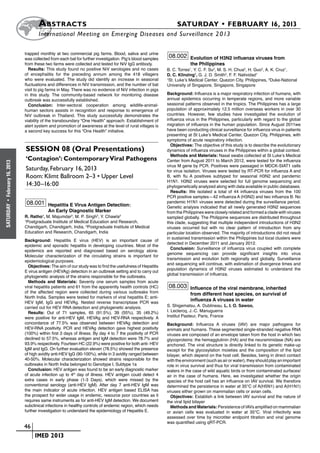
08.007	Dengue fever outbreak in North Eastern              09.003	EV71 virus
       Kenya, 2011                                                P. Chua
       M. O. Obonyo, W. Arvelo, V. O. Ofula,                      Singapore (Singapore)
       A. Fidhow, B. Fields, R. Sang, E. Wurapa,           09.004	Ebola and Marburg viruses emergence
       K. Njenga, J. Montgomery                                   at the human-animal interface
       Nairobi (Kenya)                                            P. Formenty
08.008	Evaluation of innate immune response in                    Geneva (Switzerland)
       acute and fulminant hepatitis E
       M. Majumdar, R. Ratho, Y. Chawla, M. P. Singh
       Chandigarh (India)                                  Session 10	 	
                                                           Vectorborne Diseases in Humans
Coffee Break                                               and Animals
Ground Level	                               16:00–16:30    Co-Chairs:	Arnon Shimshony, Israel
and Upper Level	             Saturday, February 16, 2013   	          Norbert Nowotny, Oman
                                                           Room: Klimt Ballroom 2&3	         16:30–18:00


                                                                                                                                  SATURDAY
                                                           Upper Level	       Saturday, February 16, 2013
Session 09	 	
                                                           10.001	A novel orthobunyavirus in
Emerging Disease Mysteries                                        European livestock: the emergence
Co-Chairs:	Joseph Wamala, Uganda                                  of Schmallenberg virus


                                                                                                                                    •
                                                                                                                                  February 16, 2013
	          Leo Liu, USA                                           M. Beer
Room: Park Congress	              16:30–18:00                     Greifswald-Insel Riems (Germany)
Ground Level	      Saturday, February 16, 2013             10.002	Emerging zoonotic vector-borne
                                                                  diseases in Europe
09.001	Magnitude and distribution of Nodding                      N. Nowotny
       Syndrome in Northern Uganda                                Muscat (Oman)
       J. F. Wamala
       Kampala (Uganda)                                    10.003	Emerging insect vector-borne
                                                                  animal diseases in the eastern
09.002	Nodding Syndrome: An emerging epilepsy
                                                                  Mediterranean
       disorder of sub-Saharan Africa
                                                                  E. Klement
       A. Winkler
                                                                  Rehovot (Israel)
       Munich (Germany)


                                     ProMED
                                                    mail
                    Program for Monitoring Emerging Diseases


                Subscribe for free email updates
                about threats to human, animal, and
                food plant health around the world.

                www.promedmail.org
                                                                                       Sponsored by the
                                                                                International Society for
                                                                                     Infectious Diseases


            ProMED Postcard 4 x 6 V6 V1.indd 1                                                          5/19/11 11:22 AM
                                                                                                  	                        	 11
                                                                                                  	           IMED 2013
S cientific  Program 	                                             SUNDAY • FEBRUARY 17, 2013
                           	International Meeting on Emerging Diseases and Surveillance 2 013


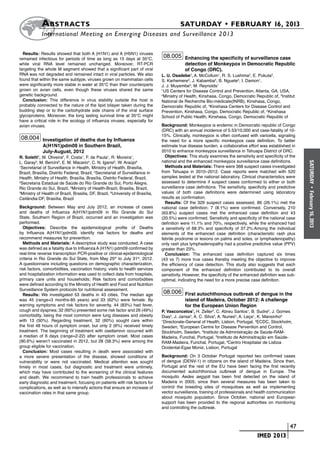
                           Session 11	 	                                               12.005	Characterizing zoonotic disease outbreaks
                                                                                              in the United States
                           Neglected Zoonotic Diseases                                        H. Allen
                           Co-Chairs:	Matt Levison, USA                                       McLean, VA (USA)
                           	          Tam Garland, USA
                                                                                       12.006	Estimating global mortality associated with
                           Room: Park Congress	              08:30–10:30                      the influenza A H1N1 pandemic in 2009: the
                           Ground Level	        Sunday, February 17, 2013                     WHO Global Pandemic Mortality Assessment
                                                                                              (GLaMOR) project
                           11.001	The economic and health burden of neglected                 L. Simonsen1, P. Spreeuwenberg2, R. Lustig3,
                                  zoonotic diseases                                           R. J. Talyor3, D. M. Fleming4, M. Kroneman2,
                                  P.Torgerson                                                 L. W. Kim3, M. D. Van Kerkhove 5, A. W. Mounts6,
                                  Zurich (Switzerland)                                        J. W. Paget2
                           11.002	Rabies: the path to elimination                             1
                                                                                                Washington DC, DC (USA),
                                  A. L. Willingham                                            2
                                                                                                Utrecht (Netherlands), 3Bethesda, DC (USA),
                                  Geneva (Switzerland)                                        4
                                                                                                Birmingham (United Kingdom), 5London
                           11.003	Echinococcosis: endemic and re-emergent                     (United Kingdom), 6Geneva (Switzerland)
                                  P. Craig                                             12.007	Domestic birds as surveillance systems for
                                  Salford (United Kingdom)                                    monitoring West Nile virus lineage 2 enzootic
                           11.004	Implementing the roadmap to combat                          circulation: three years of experience in Greece
                                  Cysticercosis                                               C. I. Dovas1, S. C. Chaintoutis1,
                                  A. L. Willingham                                            A. Chaskopoulou1, S. Gewehr1,
                                  Geneva (Switzerland)                                        M. Papanastassopoulou1, S. Mourelatos1,
                                                                                              S. Zientara2, S. Lecollinet2, K. Danis3,
                                                                                              T. Panagiotopoulos3
                           Session 12	 	                                                      1
                                                                                                Thessaloniki (Greece), 2Maisons-Alfort (France),
                           Oral Presentations
                                                                                              3
                                                                                                Athens (Greece)
                                                                                       12.008	Weekly monitoring of human cases of West Nile
                           Infection, Detection, and Protection:                              fever: an efficient way to assess the evolution of
                           Adventures in Epidemiology                                         the disease in Europe
                           Co-Chairs:	Philip Polgreen, USA                                    L. Marrama Rakotoarivony, C. Bogaardt,
February 17, 2013


                           	          Tom Yuill, USA                                          E. Robinson, V. Estevez, J. Jansa, H. Zeller,
                                                                                              D. Coulombier
                           Room: Klimt Ballroom 2&3	         8:30–10:30                       Stockholm (Sweden)
                           Upper Level	        Sunday, February 17, 2013
                                                                                       12.009	Determinants of active participation in internet-
                           12.001	Evaluation of cholera and other diarrheal diseases          based surveillance systems
                                  surveillance system, Niger State, Nigeria, 2012             D. Paolotti, P. Bajardi
 •
SUNDAY


                                  A.T. Bashorun1, A. Ahumibe1, S. Olugbon1,                   Turin (Italy)
                                  A. Taju1, P. Nguku1, K. Sabitu2                      12.010	An investigation of Salmonella enteritidis PT1
                                  1
                                    Abuja (Nigeria), 2Zaria (Nigeria)                         cases linked to consumption of a pasteurized
                           12.002	Surveillance during Hajj: Patterns and causes of            liquid egg white product in England and
                                  mortality amongst Indonesian pilgrims                       Wales, 2012
                                  M. Pane1, S. Imari1, N. Kandun1, G. Samaan2                 O. Esan, C. Lane, T. Peters
                                  1
                                    Jakarta (Indonesia), 2Canberra, ACT (Australia)           London (United Kingdom)
                           12.003	ECDC/EpiNorth epidemic intelligence activities       12.011	Effects of climate change on the distribution of
                                  during EURO 2012 in Poland and Ukraine                      bluetongue and epizootichaemorrhagic disease
                                  A. M. Gherasim1, I. Linina2, G. Rimseliene3,                vector in Southern Alberta (Canada) and
                                  L. Paine Hallström1, J. Mantero1, P. Penttinen4             Montana(USA)
                                  1
                                    Stockholm (Sweden), 2Brussels (Belgium),                  A. Zuliani1, A. Massolo1, S. Marshall1, T. J. Lysyk2,
                                  3
                                    Oslo (Norway), 4Stockhokm (Sweden)                        G. Johnson3, S. Cork1
                           12.004	Improving capacity to investigate and respond to            1
                                                                                                Calgary, AB (Canada), 2Lethbridge, AB (Canada),
                                  emerging infectious disease outbreaks in East and           3
                                                                                                Bozeman, MT (USA)
                                  Central Africa
                                  H. M. Amuguni1, T. Odoch2, R. Nauma2
                                  1
                                    North Grafton, MA (USA), 2Kampala (Uganda)

                    	 12
                    	    	 IMED 2013
S cientific  Program 	                                         SUNDAY • FEBRUARY 17, 2013
	International Meeting on Emerging Diseases and Surveillance 2 013


Coffee Break                                            Session 15	 	
Ground Level	                          10:30–11:00      Panel Discussion
and Upper Level	          Sunday, February 17, 2013     Updates from ProMED
                                                        Co-Chairs:	Stephen Morse, USA
                                                        	          Eskild Petersen, Denmark
Session 13	 	
Plenar y Lecture                                        Room: Klimt Ballroom 2&3	        14:30–16:00
                                                        Upper Level	        Sunday, February 17, 2013
Global Approach to the Control of
                                                        	       Introduction
Foot and Mouth Disease
                                                                L. Madoff
Chair: Jacques Acar, France                                     Boston, MA (USA)
Room: Park Congress	              11:00–11:45           15.001	Novel coronavirus in the Eastern Mediterranean
Ground Level	        Sunday, February 17, 2013                 M. Pollack
                                                               New York, NY (USA)
13.001	Global approach to the control of foot
       and mouth disease                                15.002	Continuing global emergence of dengue
       B.Vallat                                                S. Chotivichien1, Q. Nguyen1, J.Torres3
       Paris (France)
                                                               1
                                                                 Bangkok (Thailand), 2Hanoi (Vietnam). 3Caracas
                                                               (Venezuela).
                                                        15.003	Fungal meningitis outbreak
Poster Presentations II (Session 22)                           L. Lutwick
                                                               New York, NY (USA)
Sunday, February 17, 2013	       11:45–13:15
                                                        15.004	Yellow fever in Darfur, Sudan
Bruckner/Mahler/Brahms - Upper Level                           J. Woodall1, T.Yuill2
and Klimt Ballroom - Upper Level                               1
                                                                Rio de Janeiro (Brazil), 2Mapleton, UT (USA)
Sessions 22.001–22.185 (see pages 127–190)

                                                        Coffee Break
Session 14	 	


                                                                                                                      SUNDAY
                                                        Ground Level	                          16:00–16:30
Cutting Edge Diagnostics for the                        and Upper Level	          Sunday, February 17, 2013
Detection of Novel and Neglected
Diseases


                                                                                                                        •
                                                        Session 16	 	


                                                                                                                      February 17, 2013
Co-Chairs:	Giuseppe Cornaglia, Italy
	          Keith Klugman, USA                           Disease Surveillance
                                                        Co-Chairs:	John Brownstein, USA
Room: Park Congress	              14:30–16:00           	          Ann Marie Kimball, USA
Ground Level	        Sunday, February 17, 2013
                                                        Room: Park Congress	              16:30–18:00
14.001	MALDI-TOF MS beyond bacterial and fungal         Ground Level	        Sunday, February 17, 2013
       identification
       J.Vila                                           16.001	Integrating data mining and crowd-sourcing for
       Barcelona (Spain)                                       disease surveillance
14.002	Next generation sequencing in clinical                  J. Brownstein
       microbiology diagnosis, what have we                    Boston, MA (USA)
       achieved so far?                                 16.002	Participatory epidemiology:putting the public in
       J.Van Eldere                                            public health surveillance
       Louvain (Belgium)                                       M. Smolinski
14.003	Detection of emerging antimicrobial threats in          San Francisco, CA (USA)
       developing countries                             16.003	Towards synergy between surveillance systems
       K. Klugman                                              for Epidemic Intelligence.
       Atlanta, GA (USA)                                       L.Vaillant
                                                               Saint Maurice (France)
Co-sponsored by ESCMID

                                                                                       	                       	 13
                                                                                       	       IMED 2013
S cientific  Program 	                                              SUNDAY • FEBRUARY 17, 2013
                           	International Meeting on Emerging Diseases and Surveillance 2 013


                           Session 17	 	                                                17.006	Spotted fever group Rickettsia species
                                                                                               and Anaplasma phagocytophilum in lizards
                           Oral Presentations                                                  ticks, Algeria
                           Hot Topics                                                          H. Soualah-Alila1, Z. Bouslama2
                                                                                               1
                                                                                                Annaba, AL-AN (Algeria), 2Annaba (Algeria)
                           Co-Chairs:	Daniel Beltrán-Alcrudo, Italy
                           	          Larry Lutwick, USA                                17.007	Sequelae of human Cryptosporidiosis in
                                                                                               patients living in Östersund during a large
                           Room: Klimt Ballroom 2&3	        16:30–18:00
                                                                                               waterborne outbreak
                           Upper Level	        Sunday, February 17, 2013
                                                                                               J. Lindh1, A. Wallensten1, J. Bergstrom1,
                           17.001	Anthrax pleural effusions and drainage                       M. Lilja2, M. Widerstrom2
                                  1979–2011: A Russia-USA partnership study.
                                                                                               1
                                                                                                 Solna (Sweden), 2Östersund (Sweden)
                                  D. Lucey1, L. Grinberg2, F. Abramova2                 17.008	Evolution of gonococcal strain
                                  1
                                    Washington, DC (USA), 2Yekaterinburg (Russian              susceptibility to antibiotics in France:
                                  Federation)                                                  data from a national sentinel surveillance
                           17.002	Schmallenberg virus—Harmonized European                      network, 2001–2012
                                  data collection for an emerging disease                      G. La Ruche1, P. Sednaoui2, B. Bercot2,
                                  A. Afonso1, F. Berthe1, K. Willgert2, D. Verloo1,            E. Cambau2, A. Goubard2
                                  J. Cortinas Abrahantes1, A. Bau1, J. Richardson1
                                                                                               1
                                                                                                Saint-Maurice (France), 2Paris (France)
                                  1
                                    Parma (Italy), 2London (United Kingdom)
                           17.003	No evidence for zoonotic transmission of
                                  Schmallenberg virus in areas with veterinary
                                  activity
                                  C. Reusken1, C. van den Wijngaard1, M. Beer2,
                                  R. Bouwstra3, H. van den Kerkhof1,
                                  W. van der Poel3, J. Schmidt-Chanasit4,
                                  P. Vellema5, I. Wouters6, M. Koopmans7
                                  1
                                   Bilthoven (Netherlands), 2Greifswald-Insel Riems
                                  (Germany), 3Lelystad (Netherlands), 4Hamburg
                                  (Germany), 5Deventer (Netherlands), 6Utrecht
February 17, 2013


                                  (Netherlands), 7Rotterdam (Netherlands)
                           17.004	The interaction of the spike glycoproteins of
                                  bat-borne SARS-like-CoVs with chiropteran cells
                                  during the entry process
                                  M. Hoffmann, N. Krüger
                                  Hanover (Germany)
 •
SUNDAY


                           17.005	Tick species and tick-borne viruses of Eastern
                           cancelled	
                                  and North Eastern parts of Kenya: Health risk
                                  implications among pastoral communities
                                  J. Mutisya1, J. Lutomiah1, L. Musila1, S. Khamadi1,
                                  H. Koka1, E. Chepkorir1, A. Makio1, J. Bast2,
                                  E. Wurapa1, R. Sang1                                  Mayor’s Reception
                                  1
                                   Nairobi (Kenya), 2Kisumu (Kenya)
                                                                                        Sunday, February 17, 2013	          20:00–22:00
                                                                                        Vienna City Hall (Entrance: Lichtenfelsgasse)
                                                                                        - no transportation provided


                    	 14
                    	    	 IMED 2013
S cientific  Program 	                                            MONDAY • FEBRUARY 18, 2013
	International Meeting on Emerging Diseases and Surveillance 2 013


Session 18	 	                                               Coffee Break
Economics of Emerging                                       Ground Level	                          10:30–11:00
Infectious Diseases                                         and Upper Level	          Monday, February 18, 2013
Co-Chairs:	Nilufar Rakhmanova, USA
	          David Fisman, Canada
                                                            Session 20		
Room: Park Congress	              08:30–10:30
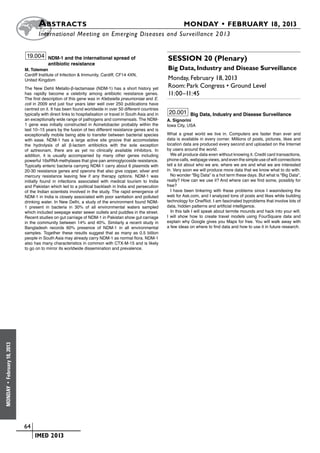
Ground Level	        Monday, February 18, 2013              Plenar y Lecture
18.001	Emerging infections and poverty:                     Big Data, Industry and Disease
       Lessons from the Americas                            Surveillance
       L. Ivers                                             Chair: Larry Madoff, USA
       Boston, MA (USA)
                                                            Room: Park Congress	              11:00–11:45
18.002	Vaccination choices and their impact on
                                                            Ground Level	        Monday, February 18, 2013
       immunization programmes
       P. Manfredi                                          20.001	Big data, industry and disease surveillance
       Pisa (Italy)                                                A. Signorini
18.003	Externalities, transaction costs and infectious             Iowa City, IA (USA)
       diseases
       P. Polgreen
       Iowa City, IA (USA)
18.004	Is it cost-effective? Best practices on evaluating
       the bang-for-the-buck in communicable
       disease control
       D. Fisman
       Toronto (Canada)


Session 19	 	
Diseases Without Borders
Co-Chairs:	Adriano Duse, South Africa
	          Benson Estambale, Kenya
Room: Klimt Ballroom 2&3	        08:30–10:30
Upper Level	        Monday, February 18, 2013

19.001	Hepatitis E outbreak at a refugee camp
       J. Ahmed
       Nairobi (Kenya)
19.002	Dynamics of the Uganda Ebola outbreak
       A. Duse
       Johannesburg (South Africa)
19.003	From surveillance to prevention: developing
                                                                                                                        MONDAY


       a risk assessment framework for “novel”
       emerging infections
       S. Morse
                                                                                                                          •


       New York, NY, and Davis, CA (USA)
                                                                                                                        February 18, 2013


19.004	NDM-1 and the international spread of
       antibiotic resistance
       M.Toleman
       Cardiff, (United Kingdom)


                                                                                            	                    	 15
                                                                                            	       IMED 2013
Poster  Presentations I	                                           SATURDAY • FEBRUARY 16, 2013
                           	International Meeting on Emerging Diseases and Surveillance 2 013


                           Session 21                                                      21.009	Are the neurological rehabilitation wards at
                                                                                                  higher risk for multi-drug resistant micro-
                           Poster Presentations I                                                 organisms infections? A retrospective analysis
                           Saturday, February 16, 2013	     11:45–13:15                           from a rehabilitation center in Northern Italy
                           Bruckner/Mahler/Brahms • Upper Level                                   focusing on clinical risk factors
                                                                                                  M. Riccò1, D. Nicolotti2, C. Signorelli1, P. Camia1,
                           Antimicrobial Resistance                                               S. Cattani1, V. Ciorba1, F. Pezzetti1, H. Cerrel Bazo2
                                                                                                  1
                                                                                                    Parma (Italy), 2Piacenza (Italy)
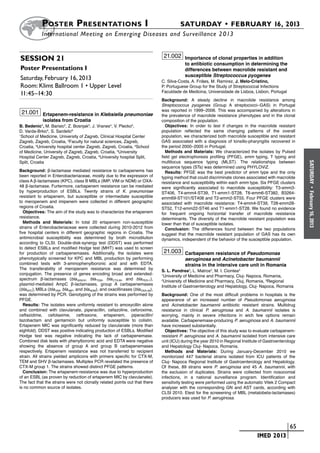
                           21.001	Ertapenem-resistance in Klebsiella pneumoniae
                                  isolates from Croatia                                    21.010	Successful management of nosocomial
                                  B. Bedenic1, M. Barisic1, Z. Bosnjak1, J. Vranes1,              ventriculitis and meningitis caused by extensive
                                  V. Plecko1, D. Varda-Brkic1, S. Sardelic2                       drug resistant Acinetobacter baumannii, Austria
                                  1
                                   Zagreb (Croatia), 2Split (Croatia)                             M. Drescher, M. Hoenigl, G. Feierl, T. Valentin,
                                                                                                  K. Seeber, E. Leitner, G. Zarfel, W. Duettmann,
                           21.002	Importance of clonal properties in addition                     R. Krause, A. J. Grisold
                                  to antibiotic consumption in determining the                    Graz (Austria)
                                  differences between macrolide resistant and
                                  susceptible Streptococcus pyogenes                       21.011	Antimicrobial resistance of human Salmonella
                                                                                                  serovar Typhimurium U302 strains in Slovakia:
February 16, 2013


                                  C. Silva-Costa, A. Friães, M. Ramirez,
                                  J. Melo-Cristino, P. Portuguese Group for                       prevalence of R-type ASSuT
                                  the Study of Streptococcal Infections                           L. Majtanova, V. Majtan
                                  Lisbon (Portugal)                                               Bratislava (Slovakia)

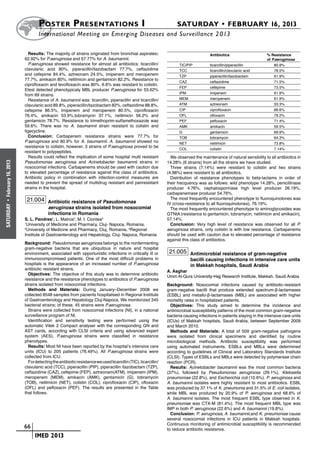
                           21.003	Carbapenem resistance of Pseudomonas                     21.012	Inducuble clindamycin resistance in methicillin-
                                  aeruginosa and Acinetobacter baumannii strains                  susceptible and methicillin-resistant Staphylococcus
 •


                                  in the intensive care unit in Romania                           aureus of inpatient, outpatient and healthy
SATURDAY


                                  S. L. Pandrea, L. Matros, M. I. Ciontea                         carriers
                                  Cluj (Romania),                                                 S. Uzunovi1, A. Ibrahimagi1, F. Kamberovi2,
                                                                                                  M. Kunarac1, M. I. A. Rijnders3, E. E. Stobberingh3
                           21.004	Antibiotic resistance of Pseudomonas aeruginosa                 1
                                                                                                   Zenica (Bosnia and Herzegovina), 2Ljubljana
                                  strains isolated from nosocomial infections in                  (Slovenia), 3Mastricht (Netherlands)
                                  Romania
                                  S. L. Pandrea, L. Matros, M. I. Ciontea                  21.013	Serotype and clindamycin-resistance of
                                  Cluj (Romania)                                                  Streptococcus suis in diseased pigs and
                                                                                                  humans in upper northeast Thailand
                           21.005	Antimicrobial resistance of gram-negative bacilli               S. Angkititrakul1, T. C. Nutravong2
                                  causing infections in intensive care units in                   1
                                                                                                    Khon Kaen (Thailand), 2Khon Kaen, (Thailand)
                                  Makkah hospitals, Saudi Arabia
                                  A. Asghar                                                21.014	Escherichia coli B2 and D virulent phylotypes
                                  Makkah (Saudi Arabia)                                           carry extended-spectrum and pAmpC
                                                                                                  betalactamases in healthy dogs with no
                           21.006	Inhibitory effects of Lactobacillus plantarum                   antimicrobial pressure
                                  and Lactobacillus rahmnosus on the growth of                    A. Belas, N. Couto, C. Pomba
                                  Pseudomonas aeruginosa                                          Lisbon (Portugal)
                                  S. Aminnezhad, K. Kermanshahi, R. Ranjbar, O.
                                  Baghery                                                  21.015	Antimicrobial resistance of Salmonella stanley
                                  Tehran (Iran, Islamic Republic of)                              isolated from pigs, dogs and humans in
                                                                                                  northeast of Thailand
                           21.007	Infection due to colistin-resistant Enterobacteriacae:          A. Polpakdee, S. Angkititrakul
                                  A single tertiary centre experience in critically ill           Khon Kaen (Thailand)
                                  patients from Saudi Arabia
                                  M. A. Garbati1, A. Bin Abdulhak2, A. I. AlGodair3,       21.016	Analysis of the plasmid profile in Salmonella
                                  H. Sakkijha1                                                    typhimurium strains isolated in the Republic of
                                  1
                                   Riyadh, Riyadh (Saudi Arabia), 2Kansas City, MO                Uzbekistan
                                  (USA)                                                           L.Tuychiev, G. Abdukhalilova, A. Ibragimov,
                                                                                                  I. Akhmedov
                           21.008	Infection with Escherichia coli and antimicrobial               Tashkent (Uzbekistan)
                                  susceptibility
                                  I. Zurak                                                 21.017	Characterization of uropathogenic E. coli and
                                  Zagreb (Croatia)                                                detection their ESBL TEM and SHV genes
                                                                                                  S. N. El-Sukhon
                                                                                                  Irbid (Jordan)

                    	 16
                    	    	 IMED 2013
Poster  Presentations I	                                           SATURDAY • FEBRUARY 16, 2013
	International Meeting on Emerging Diseases and Surveillance 2 013


21.018	Copper alloys beneficial effects on ICU operation        21.027	Antibiotic resistant urinary tract infections and
       P Efstathiou, E. Doe Kouskouni, S. Papanikolaou,
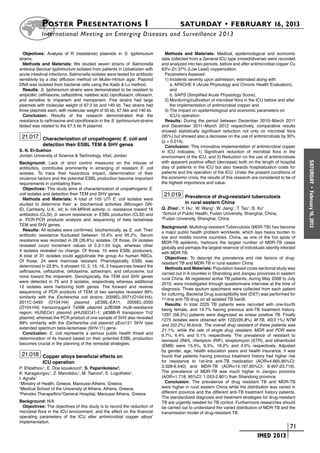
        .                                                              Zataria multifolora Boiss: can it help us?
       K. Karageorgou, Z. Manolidou, M. Tseroni2                       Z. Sepehri1, F. Javadian1, E. Javadian2, O. Aloosh3,
       E. Logothetis, I. Agrafa                                        M. Mohammadi1, N. Keikhaee4, F. Rakhshani5
       Athens (Greece),                                                1
                                                                         Zabol (Iran, Islamic Republic of), 2Zahedan
21.019	Prevalence of drug-resistant tuberculosis in rural              (Iran, Islamic Republic of), 3Hamedan (Iran, Islamic
       eastern China                                                   Republic of), 4Mashhad (Iran, Islamic Republic of),
       Q. Zhao, Y. Hu, W. Wang, W. Jiang, T. Tao, B. Xu
                                                                       5
                                                                         Tehran (Iran, Islamic Republic of)
       Shanghai (China)                                         21.028	Resistance phenotypes of Staphylococcus aureus
21.020	Minced meat as a source for MRSA and                            strains isolated from intensive care unit in
       ESBL-producing E. coli                                          Romania
       C. Petternel, J. Posch, D. Haas, H. Galler, G. Zarfel,          S. L. Pandrea1, L. Matros2, M. I. Ciontea1
       V. Strenger, E. Marth, F. Reinthaler, G. Feierl
                                                                       1
                                                                         Cluj-Napoca (Romania), 2Cluj (Romania)
       Graz (Austria)                                           21.029	Evaluation of in-vitro anti-mycobacterial activity
21.021	Prevalence of commensal ESBL-producing                          of some Indian medicinal plants: Isolation of active
       Escherichia coli strains isolated from piglets from             constituents from Urtica dioica L. and Cassia
                                                                       sophera (Linn.) Roxb.


                                                                                                                                      SATURDAY
       birth to nursery on three Portuguese industrial
       pig farms.                                                      S. H. Kelam
       M. M. Centeno1, N. Couto1, A. Belas1, T. Nunes1,                Jhansi (India)
       V. Almeida1, L. Alban2, C. Pomba1                        21.030	Antibiotic resistance of uropathogens from


                                                                                                                                        •
       1
         Lisbon (Portugal), 2Kobenhavn (Denmark)                cancelled	 community-acquired urinary tract infections in


                                                                                                                                      February 16, 2013
21.022	Relative activity over time of chlorhexidine and                    Besat University Hospital in Tehran, Iran in 2011
       benzalkonium chloride against methicillin-resistant                 A. A. Saeedi, M. Aminianfar, E. Soleimani,
       staphylococci isolates from horses                                  M. Darvishi, S. Faraji
       N. Couto1, A. Belas1, P. Tilley1, L. Telo da Gama1,                 Tehran (Iran, Islamic Republic of)
       I. Couto1, K. Kadlec2, S. Schwarz2, C. Pomba1            21.031	Antimicrobial resistance surveillance of
       1
        Lisbon (Portugal), 2Neustadt-Mariensee (Germany)                              baumannii isolated from Besat
                                                                cancelled 	 Acinetobacter
21.023	Detection of bacteria resistant to critically                   University Hospital in Tehran, Iran from 2009
       important antimicrobials from lower urinary                     to 2011
       tract infections in cats and dogs from Portugal                 A. A. Saeedi, S. Faraji, F. Rahimi, M. Aminianfar,
       C. Pomba, D. Saial, M. M. Centeno, A. Belas,                    M. Khosravi, E. Soleimani, M. Darvishi
       N. Couto                                                        Tehran (Iran, Islamic Republic of)
       Lisbon (Portugal)                                        21.032	Occurrence of plasmid-mediated enrofloxacin
21.024	Trends in the prevalence of methicillin resistance              and tetracycline resistance determinants, among
       in staphylococci isolated from companion animals                Escherichia coli isolated from lambs in Greece
       N. Couto, A. Belas, M. M. Centeno, C. Pomba                     G. Filioussis1, E. Petridou1, A. Tzivara2, S. Kritas1
       Lisbon (Portugal)
                                                                       1
                                                                        Thessaloniki (Greece), 2Karditsa Thessaly
                                                                       (Greece)
21.025	Isolation and characterization of anti-Pythium
       insidiosum compounds from Pseudomonas stutzeri           Bioterrorism and Biological Warfare
       isolated from aquatic environment 
                                                                21.033	A guide to the diagnosis and management
       Y.Thongsri1, C. Aromdee1, S. Kanokmedhakul1,
                                                                       of CDC Category A bioterrorism agents
       C. Yenjai1, A. Chaiprasert2, P. Hamal3,
                                                                       (“Be Past”)
       C. Prariyachatigul1
                                                                       J.Varco, D. Lucey
       1
        Thailand, Khon Kaen (Thailand), 2Khon Kaen
                                                                       Washington, DC (USA)
       (Thailand), 2Bangkok, Thailand (Thailand),
       3
        Olomouc (Czech Republic)                                21.034	Antimicrobial susceptibility and molecular
                                                                       characteristics of Bacillus anthracis strains
21.026	Detection of extended-expectrum ß-lactamase
                                                                       isolated in Slovenia
       (ESBL) producing Enterobacteriaceae in organic
                                                                       M. Ocepek1, I. Zdovc1, S. Duvnjak2, U. Zajc1,
       bovine milk
                                                                       T. Pirš1, M. Pate1, M. Golob1, S. Spicic2, I. Racic2,
       A. K. Siqueira1, M. M. G. Ferraz1, T. Salerno2,
                                                                       Z. Cvetnic2
       G. H. B. Lara2, F. J. P. Listoni2, C. Lambertini1,              1
                                                                        Ljubljana (Slovenia), 2Zagreb (Croatia)
       A. V. da Silva3, A. C. Paes2, M. G. Ribeiro2,
       D. D. S. Leite1
       1
        Campinas, SP (Brazil), 2São Paulo, SP (Brazil),
       3
        Feira de Santana,(Brazil)
                                                                                                    	                          	 17
                                                                                                    	        IMED 2013
Poster  Presentations I	                                        SATURDAY • FEBRUARY 16, 2013
                           	International Meeting on Emerging Diseases and Surveillance 2 013


                           Climate Change and Ecological Factors in                     Diseases at the Interface of Humans, Wildlife and
                           Disease Emergence                                            Other Animals
                           21.035	Occurrence of the Asian tiger mosquito Aedes          21.046	Mass spectrometric approaches for the
                                  (Stegomyia) albopictus (albopicta) in Austria                identification of candidate serum biomarkers
                                  B. Seidel1, A. Rose2, A. Indra3, P. Hufnagl3,                for Schistosomiasis mansoni infected mice
                                  F. Allerberger3                                              M. I. H. I. Kardoush, B. Ward
                                  1
                                    Persenbeug (Austria), 2Regensburg (Germany),               Montreal, Qc (Canada)
                                  3
                                    Vienna (Austria)                                    21.047	Improved collaboration at the animal-human
                           21.036	The influence of the environment on anthrax                  interface – a European initiative to facilitate early
                                  in Ukraine                                                   detection and joint rapid risk assessments of
                                  I. S. Kovalenko, O. B. Khaytovych                            outbreaks of non-foodborne zoonoses
                                  Simferopol (Ukraine)                                         A. Gervelmeyer1, C. Gossner2
                           21.037	Biome specific hanta epidemiologies in Europe
                                                                                               1
                                                                                                 Parma (Italy), 2Stockholm (Sweden)
                                  H. Henttonen                                          21.048	Human interactions with wildlife associated
                                  Vantaa (Finland)                                             with monkeypox in Tshupa District, Democratic
                           21.038	West Nile Virus—Is Asia at risk?                             Republic of Congo
                                  G.Yap                                                        B. Monroe1, M. Reynolds1, D. Tack1, C. Moses2,
February 16, 2013


                                  Singapore (Singapore)                                        J. Malakani3, D. Carroll1
                           21.039	Climate impact on the occurrence, distribution
                                                                                               1
                                                                                                 Atlanta, GA (USA), 2Washington, DC (USA),
                                  and activity of potential dipterans vectors in
                                                                                               3
                                                                                                 Kinshasa XI (Congo, Democratic Republic of)
                                  Eastern Slovakia                                      21.049	Epizootic situation and development tools for
                                  A. Koc   ˇišová, E. Bocková, A. Sarvasová, M. Halán
                                                                         ˇ                     detection of Q-fever in Ukraine
                                                                                               L. Marushchak, A. Golovko, O. Deriabin
 •


                                  Kosice (Slovakia)
SATURDAY


                           21.040	Vector populations in different climatic conditions          Kiev (Ukraine)
                                  in Romania and the emergence of human cases           21.050	Hepatitis E in Belgium: an imported disease or a
                                  of infection with West Nile Virus (WNV)                      viral zoonosis?
                                  L. Baltesiu1, M. T. Gomoiu2, R. Mudura1,                     M. Wautier, V. Hutse, S. Van Gucht
                                  G. M. Nicolescu1, V. Purcarea-Ciulacu1                       Brussels (Belgium)
                                  1
                                    Bucharest (Romania), 2Constanta (Romania)           21.051	Evaluation of risk factors for autochthonous
                           21.041	Climatic anomalies and reemergence of West                   Leptospirosis in Austria
                                  Nile virus in the United States                              C. Wallner1, H. Flick1, F. Allerberger2, T. Valentin1,
                                  M. Wimberly1, T.-W. Chuang2, A. Lamsal1                      K. Seeber1, I. Zollner-Schwetz1, J. Wagner1, W.
                                  1
                                    Brookings, SD (USA), 2Taipei (Taiwan, R.O.C.)              Duettmann1, R. Krause1, M. Hoenigl1
                           21.042	Implementation of an early warning system
                                                                                               1
                                                                                                 Graz (Austria), 2Vienna (Austria)
                                  to predict zoonotic cutaneous leishmaniasis           21.052	VNTR-based molecular epidemiological study of
                                  epidemics in central Tunisia                                 Francisella tularensis ssp. holarctica biovar II strains
                                  H. Bellali, J. Daaboub, I. Nouiri, A. Mrabet,                isolated from humans, European brown hares and
                                  M. K. Chahed                                                 red foxes in Austria from 1995 to 2010
                                  Tunis (Tunisia)                                              S. Revilla-Fernández1, K. Reisp1, E. Hofer2,
                           21.043	The ENHanCE project: a large scale risk                      H. Plicka3, F. Schmoll2
                                  assessment of the most likely human and animal
                                                                                               1
                                                                                                 Moedling (Austria), 2Mödling (Austria),
                                  pathogens to be affected by climate change
                                                                                               3
                                                                                                 Vienna (Austria)
                                  K. M. McIntyre1, C. Setzkorn1, P. J. Hepworth1,       21.053	Echinococcus multilocularis, etiological agent of
                                  S. Morand2, M. Baylis1                                       alveolar echinococcosis, in Slovakia
                                  1
                                    Chester (United Kingdom),                                  D. Antolova, M. Miterpakova, G. Hrčková
                                  2
                                    Montpellier (France)                                       Kosice (Slovakia)
                           21.044	Detection of morphological differences between        21.054	Parasite circulation in the protected areas of the
                                  Batrachochytrium dendrobatidis Brazilian strains             Tatra National Park, Slovakia
                                  C. Lambertini, D. D. S. Leite, A. K. Siqueira ,              Z. Hurnikova1, M. Miterpakova1, B. Chovancova2
                                  L. F. Toledo
                                                                                               1
                                                                                                Kosice (Slovakia), 2Tatranská Lomnica (Slovakia)
                                  Campinas, SP (Brazil)                                 21.055	Contact with rodents in Khon Kaen Province,
                           21.045	Climate change modelling of West Nile Virus                  Thailand
                                  and avian malaria in Madagascar                              K. Suwannarong1, S. Woldehanna2,
                                  C. L. Risley1, S. Goodman2, M. Baylis1                       Z. Rambeloson2, R. Chapman3, S. Zimicki2
                                  1
                                    Chester (United Kingdom), 2Chicago, IL (USA)
                                                                                               1
                                                                                                 Bangkok (Thailand), 2Washington DC, (USA),
                                                                                               3
                                                                                                 Pathumwan (Thailand)
                    	 18
                    	    	 IMED 2013
Poster  Presentations I	                                         SATURDAY • FEBRUARY 16, 2013
	International Meeting on Emerging Diseases and Surveillance 2 013


21.056	Orf virus infection in a hunter presumably             21.066	Survey of infectious disease agents of zoonotic
       transmitted by game in Western Austria                        or epizootic significance in Austrian wildlife
       M. Kitchen, N. Romani, A. Zobl, A. Windisch,                  A. Steinrigl1, Z. Bago1, S. Revilla-Fernández1,
       W. Glawischnig, M. Schmuth, H. P. Huemer                      E. Hofer1, M. Dünser2, E. Wodak1, A. Loitsch1,
       Innsbruck (Austria)                                           J. Hofrichter3, A. Deutz4, F. Schmoll1
21.057	First description of Bartonella bovis in domestic
                                                                     1
                                                                       Mödling (Austria), 2Linz (Austria),
       ruminants in Israel
                                                                     3
                                                                       Graz (Austria), 4St. Lambrecht (Austria)
       N. Rudoler                                             21.067	Ecology of hemorrhagic fever with the renal
       Rehovot (Israel)                                              syndrome (HFRS) in the West Kazakhstan
21.058	Analysing phylogenetic relationships of Pneumocystis          Oblast (WKO)
       carinii f. Sp. suis to other Pneumocystis species             T. Ayazbayev, F. Bidashko, A. Grazhdanov,
       C. Weissenbacher-Lang, N. Nedorost,                           M. Pak, V. Surov, L. Belonojkina, A. Andriushenko,
       H. Weissenboeck                                               A. Zakharov, B. Kdyrsikh, A. Kuspanov
       Vienna (Austria)                                              Uralsk (Kazakhstan)
21.059	Toxoplasma gondii detected in wild and captive         21.068	Epidemiological and clinical manifestations of
       European woodchuck (Marmota marmota)                          Crimean-Congo hemorrhagic fever (CCHF) in
       S. Richter, Z. Bagó, S. Revilla-Fernández,                    the Southern Kazakhstan Region (SKR)


                                                                                                                               SATURDAY
       H. Weinberger, F. Schmoll                                     R. Egemberdiyeva, Z. Shapiyeva
       Mödling (Austria)                                             Almaty (Kazakhstan)
21.060	Monitoring of avian influenza and Newcastle            21.069	Building capacity in ecohealth in Asia: impact on
       Disease among wild birds of different ecological              research activities


                                                                                                                                 •
                                                                     D. Hall1, M. Lunney2, Q. B. Le1, J. Davidson3


                                                                                                                               February 16, 2013
       groups in Azov and Black sea region of Ukraine
       in 2006–2011
                                                                     1
                                                                       Calgary, AB (Canada), 2Santiago (Chile),
       D. Muzyka1, B. T. Stegniy1, M. Pantin-Jackwood2,
                                                                     3
                                                                       Charlottetown, PE (Canada)
       A. Stegniy1                                            21.070	Animal bites  and the prevention of rabies
       1
         Kharkiv (Ukraine), 2Athens, GA (USA)                        in Albania
21.061	Risk factors for acquiring nephropatia epidemica              E.Tomini1, K. Mersini 1, J. Sulo1, S. Tobli2, S. Bino1
       in Sweden, 2011–2012: A case control study
                                                                     1
                                                                       Tirana (Albania), 2Kukes (Albania)
       A. M. Gherasim1, M. Hjertqvist2, Å. Lundkvist3,        21.071	Evaluation of cross-reactivity of human influenza
       S. Kühlmann-Berenzon3, J. Verner Carlsson3,                   antibodies against H1, H2 and H3 avian influenza
       A. Wallensten3                                                virus subtypes
       1
         Stockholm (Sweden), 2SOLNA (Sweden),                        M. S. Pizzuto1, I. Monne1, S. Maniero1,
       3
         Solna (Sweden)                                              A. Burattin1, M. S. Beato1, V. Valastro1, M. Mancin1,
21.062	Case report: Outbreak of Salmonella Dublin in                 E. Vicenzi2, G. Cattoli1, I. Capua1
       wildlife associated with infection in cattle
                                                                     1
                                                                       Padua (Italy), 2Milan (Italy)
       W. Glawischnig1, A. Wallner1, C. Kornschober2,         21.072	Detection and phylogeny of coronavirus in
       K. Schoepf1                                                   Costa Rica neotropical bats
       1
         Innsbruck (Austria), 2Graz (Austria)                        A. E. Moreira-Soto1, L. M. Taylor1, B. Rodriguez1,
21.063	Using wildlife surveillance to provide evidence               E. Corrales-Aguilar1, C. Jimenez2
       of freedom from Echinococcus multilocularis in
                                                                     1
                                                                       San Jose (Costa Rica), 2Heredia (Costa Rica)
       Northern Ireland.                                      21.073	Genetic diversity of Brucella isolates in Georgia 
       E. Courcier1, S. Fee2, F. Malone2, K. McBride1,               E. Zghenti, M. Zakalashvili, L. Malania, L. Sanodze,
       I. McKeown1, D. Abernethy3, F. Menzies1                       T. Akhvlediani, N. Kokaia, E. Mamisahsvili, N.Trapaidze
       1
         Belfast (United Kingdom), 2Omagh (United                    Tbilisi (Georgia)
       Kingdom), 3Pretoria (South Africa)                     21.074	Human brucellosis in Georgia: prevalence and
21.064	Zoonotic Poxviruses isolated from symptomatic                 distribution of the infection
       cattle in Sirajganj District, Bangladesh                      N.Trapaidze, T. Akhvlediani, L. Sanodze,
       E. Lederman1, S. U. Khan2, S. Luby3,                          N. Garuchava, N. Kokaia, N. Chitadze,
       H. Zhao4, Z. Braden4, K. Karem4, I. Damon4,                   S. Saghinadze, L. Malania, M. Ramishvili
       M. Reynolds4,Y. Li4                                           Tbilisi (Georgia)
       1
         San Diego, CA (USA), 2Dhaka (Bangladesh),            21.075	Evidence for transfer of West Nile Virus between
       3
         Stanford, CA (USA), 4Atlanta, GA (USA)                      African countries by migrating birds: comparing
21.065	Surveillance of West Nile Virus in birds in Los               migratory connectedness with West Nile
       Angeles County—A successful and proactive                     phylogenetic connectedness
       program to anticipate human outbreaks                         C. L. Risley, A. Rich, M. Baylis
       G. Lamielle, K. Ehnert, E. Beeler, T. Scott                   Chester (United Kingdom)
       Los Angeles, CA (USA)                                                                    	                      	 19
                                                                                                	        IMED 2013
Poster  Presentations I	                                            SATURDAY • FEBRUARY 16, 2013
                           	International Meeting on Emerging Diseases and Surveillance 2 013


                           21.076	Avian influenza H5 subtype antibodies in                  21.086	Serosurveillance of foot and mouth disease
                           cancelled	 apparently healthy local poultry in live bird                    virus in Asian elephants in Thailand
                                      markets in Jigawa State, Nigeria                                 D. Ounpomma1, W. Linchongsubongkoch2,
                                      R. Miko1, A. Assam2, P. A. Abdu2                                 P. Charoenphan3, W. Pintawong3, T. Yano3
                                      1
                                        Dutse (Nigeria), 2Zaria (Nigeria)                              1
                                                                                                         Meung, Khon Kaen (Thailand), 2Pakchong,
                           21.077	Perils of pigs and PICCs: septic shock secondary                     Nakhonratchasima (Thailand), 3Meung, Surin
                                      to two plant pathogens in a pig farmer                           (Thailand)
                                      H.Yadav, D. Manning                                   21.087	Chemical decontamination of live animals
                                      Rochester, MN (USA)                                              contaminated with African swine fever virus
                           21.078	Two outbreaks of hemorrhagic fever with renal                        Y. Selyaninov1, I. Egorova1, V. Balishev1,
                                      syndome in Albania                                               O.Tatarchuk2
                                      P. Biberaj, M. Kota, N. Como, E. Koreta,
                                                                                                       1
                                                                                                         Pokrov (Russian Federation),
                                      E. Tomini, D. Kraja, A. Ndreu, S. Bino
                                                                                                       2
                                                                                                         Moscow (Russian Federation)
                                      Tirana (Albania)                                      21.088	 Detection of AsHV-5 in a herd of 266 Lipizzaners
                           21.079	Pathogenic Leptospira in wild rodents                                throughout a period of two years
                                      in Cape Verde                                                    J. O. Rushton, J. Kolodziejek, N. Nowotny
                                      A. Martín-Alonso1, P. Foronda1, A. Fernandez-                    Vienna, Vienna (Austria)
February 16, 2013


                                      Alvarez1, G. Bonnet1, C. Feliu2, B. Valladares1       21.089	Occurrence of Clostridium perfringens type A
                                      1
                                       Santa Cruz de Tenerife (Spain), 2Barcelona (Spain)              and its toxins in neonatal piglets from four
                                                                                                       Danish pig farms.
                           Diseases of Animals                                                         B. Jonach1, B. Kokotovic1, H. Kongsted2,
                           21.080	Brucella abortus in cattle and buffaloes in                          M. Boye1, T. Kåre Jensen1
                           cancelled	 Bangladesh                                                       1
                                                                                                         Copenhagen (Denmark), 2Kjellerup (Denmark)
 •
SATURDAY


                                      M. S. Rahman                                          21.090	Seroepidemiology of Contagious Bovine
                                      Mymensingh (Bangladesh)                                          Pleuropneumonia in Kaduna State, Nigeria
                           21.081	Evolution of U.S. foot-and-mouth disease                             A. Suleiman, M. Bello, L. T. Zaria, A. A. Dzikwi
                                      response strategy                                                Zaria (Nigeria)
                                      H. Allen, A. Taylor                                   21.091	Efficiency of B. anthracis detection in soils having
                                      McLean, VA (USA)                                                 different physicochemical properties
                           21.082	Health problems on the pig farm and detection                        I. Egorova, Y. Selyaninov
                                      of antibodies against Mycoplasma hyopneumoniae                   Pokrov (Russian Federation)
                                      (case study)                                          21.092	Sero-prevalence of foot and mouth disease in
                                      M. Prokeš, A. Ondrejková, R. Ondrejka, L’.                       small ruminants of Pakistan
                                                                ˇ
                                      Korytár, E. Slepecká, P. Cechvala, A. Récky                      U. Farooq, A. Ullah, A. Latif, K. Naeem,
                                      Kosice (Slovakia)                                                A. Bin Zahur, M. Hussain
                           21.083	Prion expression inhibition by antisense-                            Islamabad, ICT (Pakistan)
                                      oligodeoxynucleotides for Transmissible               21.093	Persistence of equine piroplasmosis in polo
                                      Spongiform Encephalopathy (TSE) treatment             cancelled	 and pleasure horses in Nigeria
                                      and prevention                                                   P. W. Mshelia
                                      L. Ivanytska, A. Zaichenko, V.Vlizlo                             Zaria (Nigeria)
                                      Lviv (Ukraine)
                                                                                            21.094	Real-time PCR for diagnosis of contagious
                           21.084	Associations between intestinal lesions and                          equine metritis (CEM)
                                      detection of Clostridium perfringens type A or                   S. Artiushin1, U. Balasuriya1, M. Erdman2
                                      beta-2 toxin in neonatal piglets with diarrhoea                  1
                                                                                                         Lexington, KY (USA), 2Ames, IA (USA)
                                      H. Kongsted1, B. Jonach2, B. Kokotovic2,
                                                                                            21.095	Understanding the pig backyard sector for
                                      J. P. Nielsen2
                                                                                                       realistic prevention and control of African
                                      1
                                        Kjellerup (Denmark), 2Copenhagen (Denmark)
                                                                                                       swine fever
                           21.085	Prevalence of Toxoplasma gondii in Greek swine                       D. Beltrán-Alcrudo
                                      industry                                                         Rome (Italy)
                                      V. Papatsiros1, D. Stougiou2, S. Boutsini2,
                                      L. Athanasiou1, G. Christodoulopoulos1,               Foodborne and Waterborne Diseases
                                      P. Tsampalis3, A. Bisias2                             21.096	Study on effect of acetic acid spray on
                                      1
                                        Karditsa (Greece), 2Athens (Greece),                       Escherichia coli load and meat PH at an
                                      3
                                        Larissa (Greece)                                           export abattoir, Modjo, Ethiopia.
                                                                                                   T. J. Beyene, A. W. Wudie, G. Zewude, T. Ali
                                                                                                   Debre Zeit (Ethiopia)
                    	 20
                    	    	 IMED 2013
Poster  Presentations I	                                            SATURDAY • FEBRUARY 16, 2013
	International Meeting on Emerging Diseases and Surveillance 2 013


21.097	Study of Listeria monocytogenes contamination in          21.107	Characterization of Staphylococcus aureus
       raw milk and some Moroccan traditional dairy              cancelled	 producing biofilm isolated from food and
       derivatives (Lben and Jben)                                          clinical samples
       B. El Marnissi, L. Bennani, A. El Ouali lalami,                      G. La Salandra, M. G. Basanisi, R. Pedale,
       R. Belkhou                                                           A. Di Taranto, D. Chiocco
       Fès (Morocco)                                                        Foggia (Italy)
21.098	Rapid cessation of acute diarrhea in pediatric            21.108	The Italian survey on prevalence of
       patients using a novel plant extract                                 Listeria monocytogenes in RTE meat
       A. S. Dover1, T. Noguera2                                            products and cheeses
       1
         Aptos, CA (USA), 2Managua (Nicaragua)                              V. A. Prencipe, S. Antoci, R. D’Aurelio,
21.099	Occurrence of Echinostoma revolutum metacercariae                    D. Neri, G. A. Santarelli, F. Cito, S. Iannetti,
       and other larval trematode infections in freshwater                  F. De Massis, P. Calistri
       snails from Chiang Mai, Thailand                                     Teramo (Italy)
       K. Chantima1, J. Y. Chai2, C. Wongsawad1                  21.109	Detection of monophasic Salmonella Typhimurium
       1
         Chiang Mai (Thailand), 2Seoul (Korea,                              and its antimicrobial susceptibility throughout
       Republic of)                                                         pigs’ life cycle from three industrial pig herds in
21.100	Characterization of Salmonella enterica subsp.                       Portugal


                                                                                                                                   SATURDAY
       enterica monophasic variant 4,[5],12:i:- human                       M. M. Centeno1, L. Fernandes1, A. Belas1,
       isolates in Slovakia                                                 N. Couto1, T. Nunes1, V. Almeida1, L. Alban2,
       V. Majtan, L. Majtanova, J. Majtan                                   C. Pomba1
       Bratislava (Slovakia)
                                                                            1
                                                                              Lisbon (Portugal), 2Kobenhavn V (Denmark)


                                                                                                                                     •
                                                                                                                                   February 16, 2013
21.101	Fresh fish as a potent vehicle for the transmission       21.110	Kudoa septempunctata caused outbreak in
       of Salmonellosis in Egypt                                            humans with raw flounder ingestion
       A. A.Tayel1, W. El-Tras2, O. A. Abdel-Monem1                         Y.Yahata1, T. Ohnishi 2, Y. Sugita-Konishie3,
       1
         El-Sadat City (Egypt), 2Kafrelsheikh (Egypt)                       T. Toyokawa4, N. Nakamura5, K. Taniguchi1,
                                                                            N. Okabe6
21.102	Evaluation of completeness of the mandatory                          1
                                                                              Tokyo (Japan), 2Setagaya (Japan), 3Setagaya-ku
       notification system for salmonellosis and
                                                                            (Japan), 4Haebaru-cho (Japan), 5Cyuo-ku (Japan),
       shigellosis, Greece, 2011.                                           6
                                                                              Kawasaki (Japan)
       K. Mellou, T. Sideroglou, A. Kallimani,
       M. Potamiti-Komi, E. Lillakou, T. Georgakopoulou,         21.111	High prevalence of antibodies against Leptospira
       C. Hadjichristodoulou                                                in Austrian adults: a nationwide cross sectional
       Athens (Greece)                                                      survey
                                                                            W. Poeppl1, M. J. Orola1, H. Herkner1,
21.103	Viral gastroenteritis outbreaks in school settings
                                                                            A. Faas1, G. Mooseder1, M. Müller2,
       in a Greek village, January 2012
                                                                            F. Allerberger1, H. Burgmann1
       K. Mellou1, T. Sideroglou1, M. Potamiti-Komi1,                       1
                                                                              Vienna (Austria), 2Mödling (Austria)
       E. Lillakou1, P. Kokkinos2, P. Ziros2, A. Vantarakis2,
       T. Georgakopoulou1                                        21.112	Seasonality of diarrhea in children of Gilgit,
       1
         Athens (Greece), 2Patras (Greece)                                  northern Pakistan: nastier episodes and shift
                                                                            to older ages as summer unfolds
21.104	Early detection of severe complications with
                                                                            Z. Rasmussen1, B. McCormick1, W. J. Alonso1,
       Escherichia coli O111 in a large outbreak in Japan
                                                                            N. Samji2, J. Baker1
       T. Misaki, Y. Yahata, M. Nagira, Y. Tada, K. Taniguchi,              1
                                                                              Bethesda, MD (USA), 2Hamilton, ON (Canada)
       K. Oishi, N. Okabe
       Tokyo (Japan)                                             21.113	Molecular characterization and epidemiological
                                                                            trend of Hepatitis A virus isolates in a tertiary
21.105	Prevalence and risk association for Trichinella infec-
                                                                            care hospital in North India
       tion in domestic and free range pigs in Greece
                                                                            M. P. Singh1, M. Majumdar1, B. R. Thapa1,
       S. Boutsini1, D. Stougiou1, V. Papatsiros2,
                                                                            P. K. Gupta1, J. Khurana1, B. Budhathoki1, R. Ratho2
       A. Panteli1, M. Bisia2                                               1
                                                                              Chandigarh (India), 2Chandigarh, Chandigarh
       1
         Athens (Greece), 2Karditsa (Greece)
                                                                            (India)
21.106	Sorbitol-fermenting VTEC O157 caused an
                                                                 21.114	Food safety requires public-private partnerships
       outbreak via unpasteurized milk and farm visits,
                                                                            T. Wilke , V. Raab, O. Breuer, M. Hamer,
       Finland 2012
                                                                            B. Petersen
       S. Salmenlinna1, R. Rimhanen-Finne1,
                                                                            Bonn (Germany)
       H. Lundström2, A. Jaakkonen1, A. Pihlajasaari1,
       A. Vainio1, S. Toikkanen1, O. Lyytikäinen1,
       A. Siitonen1, S. Hallanvuo1
       1
         Helsinki (Finland), 2Turku (Finland)
                                                                                                   	                       	 21
                                                                                                   	        IMED 2013
Poster  Presentations I	                                        SATURDAY • FEBRUARY 16, 2013
                           	International Meeting on Emerging Diseases and Surveillance 2 013


                           Infections of Public Health Significance                     21.125	The epidemiology and burden of Q fever in the
                           21.115	Knowledge attitude and behavior of medical                   UK 1999–2011
                                  students towards safety in student laboratory                H. Kirkbride, A. Walsh, K. Halsby, D. Morgan
                                  K. Chaicom, B. Palaeng, P. Kungsang                          London (United Kingdom)
                                  Khon Kaen (Thailand)                                  21.126	Role of antiplatelet antibodies in the
                           21.116	A 20-years retrospective cohort study of                     development of trombocytopenia in patients
                                  HIV/AIDS situation among hill tribe vulnerable               with chronic hepatitis C
                                  population, Thailand                                         N. Pshenichnaya, G. Kuznetsova, E. Romanova
                                  T. Apidechkul                                                Rostov-on-Don (Russian Federation)
                                  Chiang Rai (Thailand)                                 21.127	The outcome of chronic hepatitis C (CHC)
                           21.117	Prevalence of human metapneumovirus infection                depends of degree of intensity and rate of
                                  in hospital wards comprising patients with severe            progression of fibrosis in liver tissue
                                  motor and intellectual disabilities                          E. Romanova, N. Pshenichnaya, G. Kuznetsova,
                                  S. Matsuda1, M. Noda2                                        M. Ladychuk, T. Belashova
                                  1
                                    Tohon (Japan), 2Tokyo (Japan)                              Rostov-on-Don (Russian Federation)

                           21.118	The first report of Mycobacterium riyadhense lung
February 16, 2013


                                  infection with HIV and CMV co-infection               Poster Presentations I
                                  M. A. Garbati, A. M. Hakawi
                                                                                        Saturday, February 16, 2013	                11:45–13:15
                                  Riyadh, (Saudi Arabia),
                                                                                        Klimt Ballroom I • Upper Level
                           21.119	Prevalence of B6, B12 and folic acid deficiency
                                  in HIV positive patients
                                                                                        Infections of Public Health Significance (continued)
                                  B. Achappa, D. Madi
 •


                                                                                        21.128	The efficiency of Helicobacter pylori eradication
SATURDAY


                                  Mangalore (India)
                                                                                               therapy in prevention of thrombocytopenia
                           21.120	TB/HIV among hill tribe marginalized vulnerable
                                                                                               in patients with HCV and Helicobacter pylori
                                  population, Thailand
                                                                                               co-infection
                                  T. Apidechkul
                                                                                               N. Pshenichnaya, G. Kuznetsova, E. Romanova
                                  Chiang Rai (Thailand)
                                                                                               Rostov-on-Don (Russian Federation)
                           21.121	Highly active antiretroviral therapy maintains
                                                                                        21.129	Epidemiological evaluation of spatio-temporal
                                  the population of Langerhans cells in the tongue
                                                                                               and genotypic clustering of Mycobacterium
                                  from Human Immunodeficiency Virus -1
                                                                                               tuberculosis in Ontario, Canada
                                  infected patients
                                                                                               A.Tuite1, D. Fisman1, D. Alexander2, J. Guthrie2,
                                  R. Gondak1, F. V. Mariano1, T. Mauad2,
                                                                                               A. Marchand-Austin2, K. Lam2, J. Ma2, M. Whelan2,
                                  O. P. Almeida1, P. A. Vargas1
                                                                                               B. Lee2, F. Jamieson2
                                  1
                                    Piracicaba, (Brazil), 2São Paulo (Brazil)                  1
                                                                                                Toronto, ON (Canada), 2Etobicoke, ON (Canada)
                           21.122	Outbreak of tuberculosis among elderly in
                                                                                        21.130	Has the epidemiology of bacterial meningitis
                                  geriatric home
                                                                                               changed in a limited-resource country (Kosovo)
                                  B. Achappa, D. Madi, P. Adhikari, S. Raj,
                                                                                               S. A. Namani, R. Koci, B. Koci, E. Qehaja, L. Ajazaj,
                                  M. Tripathy
                                                                                               M. Mehmeti
                                  Mangalore, Karnataka (India)
                                                                                               Prishtine (Kosovo, Republic of)
                           21.123	Prevalence of Clostridium difficile among cases
                                                                                        21.131	Identification of bacterial community in biofilms
                                  of antibiotic associated diarrhea in hospitalized
                                                                                               formed in biliary stents retrieved from patients
                                  patients in an Egyptian hospital
                                                                                               C.Vaishnavi, P. Kapoor, R. Kochhar
                                  M. M. AbdelHaleim, N. Nawar, R. Elsherif,
                                                                                               Chandigarh (India)
                                  A. Farouk
                                  Cairo (Egypt)                                         21.132	Risks factors and level of awareness of bovine
                                                                                               tuberculosis in Kaduna metropolis, Nigeria
                           21.124	Tuberculous meningitis at the Hospital Nacional
                                                                                               E. G. Haruna, C. A. Kudi, M. Bello, I. Ajogi
                                  Dos de Mayo, Lima, Peru: 2005–2010 
                                                                                               Zaria (Nigeria)
                                  T. Metcalf1, J. Soria2, S. Montano3, E. Ticona2,
                                  M. Kasper3, J. Zunt4
                                  1
                                    Bangkok (Thailand), 2Lima (Peru), 3Callao (Peru),
                                  4
                                    Seattle, WA (USA)


                    	 22
                    	    	 IMED 2013
Poster  Presentations I	                                              SATURDAY • FEBRUARY 16, 2013
	International Meeting on Emerging Diseases and Surveillance 2 013


21.133	Multidrug-resistant tuberculosis: A review of               21.143	Clostridium difficile infection in a private hospital of
           diagnosed cases over a 5 year-period in a                      Mexico City. Incidence rate and epidemiological
           Portuguese hospital                                            features during 2011 - 2012
           D. Póvoas, J. Machado, F. Maltez                               J. Reyes Mar, L. Rojo Gutierrez, P. Leal Moran,
           Lisbon, Not US/Canada (Portugal)                               L. Cabrera Ruiz, N. Perez Hernandez, C. Y. Ruiz
21.134	suPAR correlates with renal function and may                       Hernandez, G. Santillan Lopez, M. D. L. Robles
           predict bacteremia in SIRS patients: A cohort                  Hernandez, E. Aleman Aguilar, L. E. Soto
           study                                                          Mexico City, Mexico City (Mexico)
           W. Krammer, J. Wagner, R. Raggam, E. Leitner, F.        21.144	Human parasitic ova and cyst in local food drinks
           Prüller, A. J. Grisold, K. Seeber, W. Duettmann, R.            sold in open markets in Enugu municipality,
           Krause, M. Hoenigl                                             South-East, Nigeria
           Graz (Austria)                                                 C. A. Ekwunife1, C. I. Okafor1, D. N. Aribodor1,
21.135	Mycobacterial infection in cosmetic surgery: A                     M. N. Ezeunala2, C. N. Ukaga3
           case report and review of the literature
                                                                          1
                                                                            Awka (Nigeria), 2Abuja (Nigeria),
           L. Frye, S. Hasan, K. J. Leneweaver, P. Dilanchian,
                                                                          3
                                                                            Owerri (Nigeria)
           N. Bray, D. Droller                                     21.145	Seroprevalence of Lassa fever and infection
           Fort Lauderdale, FL (USA)                                      control practice among health workers in an


                                                                                                                                     SATURDAY
21.136	Prevalence of S. hematobium infection among                        endemic suburban community in Nigeria
           school children living along the south-western                 E. A.Tobin1, D. A. Asogun1, G. Akpede1,
           shores of Lake Malawi                                          P. Okokhere1, S. Gunther2, C. Happi3
           S. A. Kayuni1, R. Peeling2, P. Makaula3
                                                                          1
                                                                            Irrua, Edo (Nigeria), 2Hamburg (Germany),


                                                                                                                                       •
                                                                          3
                                                                            Boston, MA (USA)


                                                                                                                                     February 16, 2013
           1
             Blantyre (Malawi), 2London (United Kingdom),
           3
             Mangochi (Malawi)                                     21.146	Status of TB indicators in Austria
21.137	The duration of effects of antibiotic exposures                    E. J. Simons, A. Indra, S. Pfeiffer,
           on the risk of Clostridium difficile infection (CDI):          F. Allerberger, D. Schmid
           a cohort study                                                 Vienna (Austria)
           K. A. Brown, N. Daneman, R. Moinedden,                  21.147	Increasing incidence of pertussis in Austria,
           D. Fisman                                                      2005–2011
           Toronto, ON (Canada)                                           S.-W. Jian, D. Schmid
21.138	Tuberculosis—major killer of adult urban                           Vienna (Austria)
cancelled	 women: Demographic and Health Survey (DHS)              21.148	Assessment of awareness and practices
           from Pakistan                                                  of secondary school students on lassa fever
           S. Awan                                                        in Nigeria
           Karachi (Pakistan)                                             D. A. Asogun1, E. A. Tobin1, N. Akpede1,
21.139	Healthcare-associated infections due to                            G. Akpede1, S. Gunther2, S. Okogbenin1
           carbapenemase-producing Enterobacteriaceae
                                                                          1
                                                                            Irrua, Edo (Nigeria), 2Hamburg (Germany)
           in Hungary                                              21.149	Potential outbreak of rabies in bats in
           R. Szabó, K. Böröcz, A. Szönyi                                 Los Angeles County, USA
           Budapest (Hungary)                                             T. Scott, G. Lamielle, K. Ehnert, E. Beeler
21.140	The discovery of EMRSA-15 in environmental                         Los Angeles, CA (USA)
           staphylococci isolates                                  21.150	Performance of QuantiFERON TB Gold in the
           H. Mkrtchyan, R. Cutler                                        detection of latent tuberculosis infection among
           London (United Kingdom)                                        healthcare workers (HCWs) in Akwa Ibom
21.141	Risk factors associated with seropositivity against                State, Nigeria
           Lyme borreliosis: Results from a representative                A. N. Umoh1, A. E. Asuquo2, L. N. Abia-Bassey2,
           serosurvey of adults in Germany                                E. O. Ibeneme2
           H. Wilking1, V. Fingerle2, C. Klier2,
                                                                          1
                                                                            Uyo (Nigeria), 2Calabar (Nigeria)
           M. Thamm1, K. Stark1                                    21.151	Prevalence of methicillin-resistant Staphylococcus
           1
             Berlin (Germany), 2Oberschleissheim (Germany)                aureus (MRSA) in high-density livestock farming
21.142	Pulmonary involvement of Brucellosis in patients                   areas along the Dutch-German border.
           treated in Kosovo                                              H. Aangenend1, R. Köck2, K. Velden van der1,
           E. Qehaja Bucaj, S. A. Namani, L. Ajazaj Berisha,              J. Hautvast1, A. Friedrich3, A. Voss1, J. W. Paget1
           M. Mehmeti
                                                                          1
                                                                            Nijmegen (Netherlands), 2Munster (Germany),
           Prishtina (Kosovo, Republic of)
                                                                          3
                                                                            Groningen (Netherlands)


                                                                                                     	                       	 23
                                                                                                     	        IMED 2013
Poster  Presentations I	                                        SATURDAY • FEBRUARY 16, 2013
                           	International Meeting on Emerging Diseases and Surveillance 2 013


                           21.152	Lassa fever control: Assessment of food hygiene       21.161	Trends in the clinical features and mortality in
                                  practice among market traders in Nigeria                     hospitalised Lassa fever patients in Nigeria
                                  E. A.Tobin1, D. A. Asogun1, N. Akpede1,                      P. Okokhere, D. Asogun2, G. Akpede
                                  E. Ogbaini1, C. Happi2, G. Akpede1                           Irrua (Nigeria)
                                  1
                                   Irrua, Edo (Nigeria), 2Boston, MA (USA)              21.162	Detection and genetic characterization of a
                           21.153	Active tuberculosis in patients under therapy                Brucella infection in Saudi patients
                                  with TNF-α inhibitors                                        T. Uzzaman, M. Elfakhei
                                  L. Mejdoubi1, T. Barisani-Asenbauer2,                        Riyadh (Saudi Arabia)
                                  R. Rumetshofer1                                       21.163	Serologic evaluation of Crimean-Congo
                                  1
                                    Vienna (Austria), 2Wien, Austria (Austria)                 hemorrhagic fever in human population of
                           21.154	Evaluation of acute flaccid paralysis suspected              endemic and non endemic areas in Albania
                                  cases reported to the surveillance system in                 S. Bino1, E. Tomini1, M. Kota1, S. Tobli2, J. Sulo1,
                                  Akwa-Ibom State April 2006–April 2012.                       A. Simaku1, N. Como1, A. Papa3
                                  W. E. Nwachukwu1, B. E. Bassey2, J. G. Ebuk2,                1
                                                                                                 Tirana (Albania), 2Kukes (Albania),
                                  P. Nguku3, M. N. Aghaji1                                     3
                                                                                                 Thessaloniki (Greece)
                                  1
                                    Enugu (Nigeria), 2Uyo (Nigeria), 3Abuja (Nigeria)   21.164	Epizootic and laboratory diagnostic methods of
February 16, 2013


                           21.155	Evaluation of Acute Flaccid Paralysis surveillance           anthrax within the scope of CBR GG-18 project
                                  system- Zamfara State, Nigeria, 2011                         M. Zakareishvili, M. Donduashvili,
                                  K. I. Getso1, S. Gidado1, P. Nguku1, O. Biya1,               M. Kokhreidze, M. Nikolaishvili
                                  S. H. Idris2, K. Sabitu2                                     Tbilisi (Georgia)
                                  1
                                   Abuja (Nigeria), 2Zaria (Nigeria)                    21.165	Opportunistic infections in HIV/AIDS patients in
                           21.156	KAP, housing standards and risk factor analysis              Jayapura City Papua Province, Indonesia
 •


                                  for seroprevalence to Lassa fever in a rural                 Y.Y. R. Mirino, A. Oktavian, A. M. Juliana
SATURDAY


                                  community of Edo state, Nigeria                              Jayapura (Indonesia)
                                  D. A. Asogun1, G. Akpede1, E. A. Tobin1,              21.166	West Nile Virus is moving eastward in North
                                  S. Gunther2, N. Akpede1                                      Eastern Italy
                                  1
                                   Irrua, Edo (Nigeria), 2Hamburg (Germany)                    P. D’Agaro1, V. De Angelis2, D. Franchi3,
                           21.157	A study of viral load and genotype association               T. Gallo2, P. Martelli4, M. Palei1, A. Perosa5,
                                  among HCV infected patients in a tertiary care               M. Ruscio6, D. Santon1, M. Stecchina3
                                  hospital of Pakistan                                         1
                                                                                                 Trieste (Italy), 2Udine (Italy), 3Gorizia (Italy),
                                  S. Aslam1, T. Ijaz2, B. Munir Ahmad1,                        4
                                                                                                 Pordenone (Italy), 5Latisana (Italy),
                                  S. Ali Raja1, S. Ijaz1                                       6
                                                                                                 San Daniele (Italy)
                                  1
                                    Lahore (Pakistan), 2Lahore, punjab (Pakistan)       21.167	Challenges in the management of patients with
                           21.158	Immune-based therapy against Clostridium difficile           leprosy in Msambweni District, Kenya
                                  infection                                                    S. K. Kazi
                                  J. A. Steele, J. Sponseller, S. Tzipori, D. Schmidt          Nairobi (Kenya)
                                  North Grafton, MA (USA)                               21.168	Disaster medical assistance team (DMAT) activity
                           21.159	Cross-sectional survey on seroprevalence                     and infectious disease and control in 2011 Great
                                  of hepatitis E virus in Austria: pilot study at              East Japan earthquake
                                  the Austrian armed forces                                    Y. Kohayagawa, Y. Koido, H. Kondo
                                  H. Lagler, W. Poeppl, H.-M. Winkler , H. Herkner,            Tokyo (Japan)
                                  A. Faas, G. Mooseder, H. Burgmann                     21.169	Wild polio virus outbreak in Kebbi State,
                                  Vienna (Austria)                                             Nigeria 2011
                           21.160	Incidence of tuberculosis after initiation of                B. S. Bako1, P. Nguku1, O. Biya1, K. Sabitu2,
                                  antiretroviral therapy in Georgia; Risk factors              S. Gidado1
                                  of mortality among HIV-infected patients                     1
                                                                                                Abuja (Nigeria), 2Zaria (Nigeria)
                                  A. Abutidze1, T. Tsertsvadze1, R. Kempker2,
                                  L. Sharvadze1, N. Chkhartishvili1, M. Magee2,
                                  C. del Rio2
                                  1
                                    Tbilisi (Georgia), 2Atlanta, GA (USA)


                    	 24
                    	    	 IMED 2013
Poster  Presentations I	                                              SATURDAY • FEBRUARY 16, 2013
	International Meeting on Emerging Diseases and Surveillance 2 013


Infections Related to Travel and Migration                         Innovations in Diagnostic Tests for
21.170	Global migration and tuberculosis trends in                 Emerging Diseases
           non-endemic country                                     21.181	Isolation of the emerging foodborn pathogen
           A. M. S. A. AL-Harbie                                          Arcobacter from human stool
           Rumaithiya (Kuwait)                                            A.-M. Van den Abeele1, K. Houf2
21.171	A case of imported dracunculiasis—South Omo,
                                                                          1
                                                                            Ghent (Belgium), 2Merelbeke (Belgium)
cancelled	 Southern Ethiopia, May 2011                             21.182	Use of saliva and urine for early dengue diagnosis
           G. E.Yembo                                                     G.Yap
           Addis Ababa (Ethiopia)                                         Singapore (Singapore)
21.172	The use of diagnostic databases for arbovirus               21.183	Unbiased detection of infectious agents in
           monitoring and surveillance; a feasibility study               respiratory syndromes of poultry using a
           with a focus on dengue virus                                   metagenomic approach
           N. Cleton1, C. Reusken1, M. de Jong2, J.-L. Murk3,             E. Liais1, G. Croville1, J. Mariette2, C. Klopp2,
           A. van der Eijk3, M. Koopmans3                                 C. Donnadieu2, J. Lluch2, M. Ducatez1,
           1
             Bilthoven (Netherlands), 2Amsterdam                          C. Camus-Bouclainville1, J.-L. Guérin1
           (Netherlands), 3Rotterdam (Netherlands)                        1
                                                                           Toulouse (France), 2Castanet-Tolosan (France)


                                                                                                                                 SATURDAY
21.173	Dengue virus 4 infection with thrombocytopenia
                                                                   21.184	SHERPAxMAP: An innovative multiplex
           and acaclculous cholecystitis in a British traveller
                                                                          microsphere assay platform for the
           S. Mankad, B. Kapadiya
                                                                          surveillance and rapid serodiagnosis
           Ahmedabad, (India)
                                                                          of emerging viral diseases


                                                                                                                                   •
21.174	Understanding causes of death amongst                              J. Vanhomwegen, S. Paulous, J.-C. Manuguerra,


                                                                                                                                 February 16, 2013
           Indonesian Hajj pilgrims: Comparison of verbal                 P. Despres, L. I. O. Sawoo
           autopsy and death certificate data                             Paris (France)
           M. Pane1, S. Imari1, K. Alwi1, N. Kandun1,
           G. Samaan2                                              New Pathogen Discovery
           1
             Jakarta (Indonesia), 2Canberra, ACT (Australia)
                                                                   21.185	Molecular identification and susceptibility
21.175	Disseminated histoplasmosis in a domestic cat                      pattern of clinical Nocardia species:
           imported from the USA to Austria                               emergence of Nocardia crassostreae as
           A. Klang, I. Loncaric, J. Spergser, S. Eigelsreiter,           an agent of invasive nocardiosis
           H. Weissenboeck                                                S. J.Taj-Aldeen1, A. Deshmukh1, S. Doiphode1,
           Vienna (Austria)                                               A. Abdul Wahab1, M. Al lankawi1, A. AlMuzrkchi1,
21.176	Learning from a case of imported rabies to                         C. H. Klaassen2, J. Meis2
           establish a rabies control zone                                1
                                                                            Doha (Qatar), 2Nijmegen (Netherlands)
           W. Petsophonsakul1, T. Sripanya1, P. Khawplod2,         21.186	Bronchoalveolar lavage lateral-flow device
           W. Kheuanrat1, S. Phornwisedsirikun1, M. Srijun1,              test for diagnosing invasive pulmonary
           S. Jaisuda1, M. Moonpo3, A. Noguchi4, S. Inoue4                aspergillosis
           1
             Chiang Mai (Thailand), 2Bangkok (Thailand),                  M. Hoenigl1, W. Duettmann1, C. Koidl1, B. Waitzl1,
           3
             Lampang (Thailand), 4Tokyo (Japan)                           K. Seeber1, J. Wagner1, K. Troppan1, R. Raggam1,
21.177	Profile of measles confirmed cases notified to                     R. Krause1, C. Thornton2
           National CIEVS from January to June 2011, Brazil               1
                                                                            Graz (Austria), 2Exeter (United Kingdom)
           S. Lopes Dias1, E. T. Masuda1, M. É. Santos1,
                                                                   21.187	Acute febrile illness outbreak investigation—
           W. A. Oliveira1, P. Pereira Vasconcelos de Oliveira2,
                                                                          Zone1, Afar, Ethiopia, 2011
           G. S. Dimech1
                                                                          A. B. Woyessa, A. Ahmed, N. Asamneh
           1
             Brasilia, DF (Brazil), 2Brasilia (Brazil)
                                                                          Addis Ababa (Ethiopia)
21.178	Risk of latent tuberculosis infection (LTBI) among
           personnel after conducting humanitarian assistance
           aboard a United States military hospital ship
           N. Adams, E. Lederman, J. S. Parrish
           San Diego, CA (USA)
21.179	Intervention strategies for preventing pathogen
           spread via illegal tiger trade network
           N. G. Patel1, A. Sonricker Hansen2,
           J. Brownstein2, D. Joly3
           1
             Philadelphia, PA (USA), 2Boston, MA (USA),
           3
             Nanaimo, BC (Canada)
                                                                                                   	                      	 25
                                                                                                   	       IMED 2013
Poster  Presentations II	                                              SUNDAY • FEBRUARY 17, 2013
                           	International Meeting on Emerging Diseases and Surveillance 2 013


                                                                                          22.008	Clinical features of human H5N1 influenza
                           Session 22                                                            survival cases in Indonesia
                           Poster Presentations II                                               E. Sariwati, V. Setiawaty, B. Sutrisna, S. Giriputro
                                                                                                 Jakarta (Indonesia)
                           Sunday, February 17, 2013	       11:45–13:15
                                                                                          22.009	Improving decisions in clinical medicine: serum
                           Bruckner/Mahler/Brahms • Upper Level
                                                                                                 antibody titres and specific symptom patterns
                                                                                                 may classify categories of pandemic H1N1
                           Influenza and Other Respiratory Infections                            influenza infection during pregnancy
                           22.001	2009 H1N1 influenza A in Mexico City, second                   G. Arteaga, A. Cerbulo-Vazquez, C. Lopez-Macias,
                                  season: Clinical, laboratory and roentgenological              G. Cruz-Cureño, I. Bosco-Garate,
                                  characteristics of patients complicated with                   L. A. Arriaga-Pizano, A. Isibasi, J. Mancilla
                                  pneumonia during January and February 2012                     Mexico City (Mexico)
                                  at a Mexican General Hospital                           22.010	Enhancing respiratory infection surveillance on
                                  J. Reyes Mar, R. Valdez Vazquez, P. Rodriguez                  the US/Mexico border- Arizona BIDS program
                                  Zulueta, F. Velez Perez, J. A. Garcia Vera                     sentinel surveillance data
                                  Mexico City (Mexico)                                           C. Golenko1, O. McCotter1, L. M. Erhart2,
                           22.002	Etiological surveillance of influenza like illness in          D. M. Wolk1, F. Vanskike1, L. Patel1
                                  pediatric population at the University Teaching                1
                                                                                                   Tucson, AZ (USA), 2Phoenix, AZ (USA)
                                  Hospital in Lusaka, Zambia                              22.011	Integration of syndromic surveillance for
                                  P. Simusika                                                    monitoring influenza epidemic among children
                                  Lusaka (Zambia)                                                in rural China, 2011–2012
                           22.003	Northern or southern hemisphere vaccine                        M.Yu1, Q. Zhao1, Y. Zhu1, T. Tao1, V. K. Diwan2, L.
                                  composition: comparison of circulating influenza               Cheng3, L. Palm4, G. Zhao1, B. Xu1
                                  isolates in Uganda to the WHO recommended                      1
                                                                                                   Shanghai (China), 2Stockholm (Sweden),
                                  vaccine composition, 2007 to 2012                              3
                                                                                                   Wuhan (China), 4Gävle (Sweden)
                                  J.T. Kayiwa, T. Byaruhanga, R. Chiiza, B.               22.012	Influenza surveillance in the Pacific island
                                  Namagambo, B. Bakamutumaho, J. J. Lutwama                      countries and territories during the 2009
                                  Entebbe (Uganda)                                               pandemic
                           22.004	Analysis of respiratory infectious diseases on a               J. L. Kool1, B. I. Pavlin2, J. Musto3, A. Dawainavesi1
                                  university campus: Application of mathematical                 1
                                                                                                  Suva (Fiji), 2Boroko, NCD (Papua New Guinea),
February 17, 2013


                                  models to pandemic influenza and other diseases                3
                                                                                                  North Sydney (Australia)
                                  H. Kamano1, T. Mori1, C. Murakami1, T. Kugoh2,          22.013	Influenza mortality in the United States, 2009:
                                  C. Izumi2, K. Tomiie2, A. Nozaki1                              Burden and timing
                                  1
                                    Takamatsu (Japan), 2Miki (Japan)                             A. M. Nguyen1, A. Noymer2
                           22.005	Severe acute respiratory infections in Nigeria:                1
                                                                                                   Escondido, CA (USA), 2Irvine, CA (USA)
                                  analysis of surveillance data 2010–2012                 22.014	Clinical features of infections caused by influenza
 •


                                  M. S. Balogun, A. Adedeji, I. Olorundare,                      virus in 2009-2012
SUNDAY


                                  P. Nguku                                                       K. Herrmannova, M.Trojanek, O. Dzupova,
                                  Abuja, FCT (Nigeria)                                           Z. Blechova, D. Tomickova, M. Havlickova,
                           22.006	Clinical characteristics and laboratory admission              H. Jirincova, J. Kyncl, V. Maresova
                                  values for differentiation between H1N1                        Prague (Czech Republic)
                                  influenza and influenza like illnesses                  22.015	Influenza sentinel surveillance-Addis Ababa,
                                  M. Hoenigl, J. Prattes, M. Drescher, K. Tovilo,                Ethiopia, 2008–2012
                                  H. Kessler, K. Vander, K. Seeber, A. Avian,                    A. B. Woyessa, W. Ayele, E. Zemelak, D. Jima
                                  R. Krause, H. Flick                                            Addis Ababa, Addis Ababa (Ethiopia)
                                  Graz (Austria)
                                                                                          22.016	Monitoring of influenza and respiratory syncytial
                           22.007	SRSF3 interacts with nucleoprotein of Influenza A              virus activity in children under 5 years of age
                                  virus: Implications on viral mRNA nuclear export?              in Dibrugarh district of Assam, northeast India,
                                  V. RMT Balasubramaniam1, B. A. Tejo2,                          2009–2011
                                  T. H. Wai1, A. R. Omar2, I. Othman1, S. S. Hassan1             D. Biswas, K. Yadav, P. J. Baruah,
                                  1
                                   Bandar Sunway (Malaysia), 2Serdang (Malaysia)                 B. Borkakoty, J. Mahanta
                                                                                                 Dibrugarh, Assam (India)


                    	 26
                    	    	 IMED 2013
Poster  Presentations II	                                              SUNDAY • FEBRUARY 17, 2013
	International Meeting on Emerging Diseases and Surveillance 2 013


22.017	Antiviral susceptibility of influenza A viruses          22.026	Application of nanofluid technology to multiple
       obtained in Kenya 2008–2011                                     detection of respiratory viruses in pediatric
       M. Wadegu, W. Bulimo, R. Achilla, J. Majanja,                   respiratory diseases during 2011–2012 winter
       S. Mukunzi, F. Osuna, J. Wangui, B. Opot, E. Wurapa             season in Mexico City
       Nairobi (Kenya)                                                 C. O. Orozco-Sanchez, V. A. Hernandez-Hernandez,
                                                                       Y. Moreno-Valencia, J. A.Vazquez-Perez
22.019	Full genome analysis of H1N1pdm2009 influenza
                                                                       Mexico City (Mexico)
       viruses circulating in italian pig herds
       A. Boni1, A. Moreno2, L. Di Trani1, G. Zaccaria1,        22.027	European surveillance network for influenza in
       S. Faccini2, L. Alborali2, M. B. Boniotti2, D. Lelli2,          pigs 3 (ESNIP 3)—Expanding our knowledge
       P. Cordioli2, G. Vaccari1                                       of the epidemiology and evolution of swine
       1
         Rome (Italy), 2Brescia (Italy)                                influenza viruses
                                                                       G. Simon1, S. Reid2, L. E. Larsen3, P. Kellam4, L.
22.020	Full-length genome sequencing of Influenza A on                 Kaartinen5, K. Van Reeth6, I. Markowska-Daniel7,
       Ion Torrent PGM™ Sequencer                                      E. Foni8, Á. Dan9, W. Loeffen10
       G. Zaccaria1, A. Boni1, E. Alm2, A. M. Moreno                   1
                                                                         Ploufragan (France), 2Surrey (United Kingdom),
       Martin3, P. Cordioli3, L. Di Trani1, G. Vaccari1                3
                                                                         Copenhagen V (Denmark), 4Cambridge (United
       1
        Rome (Italy), 2Solna (Sweden), 3Brescia (Italy)                Kingdom), 5Helsinki (Finland), 6Ghent (Belgium),
22.021	Enterovirus 68 in Cuban Children with Acute
                                                                       7
                                                                         Puławy (Poland), 8Brescia (Italy), 9Budapest
       Respiratory Tract infections                                    (Hungary), 10Lelystad (Netherlands)
       M. D. L. C. Muné , A. Piñon                              New Approaches to Outbreak Surveillance
       La Havana (Cuba)                                         and Monitoring
22.022	Severe acute respiratory infection surveillance          22.028	Adaptive-based system development association
       on the US/Mexico border, 2010–2011 influenza                    for early awareness-based dengue area in the city
       season data from Arizona and California                         of Padang, West Sumatra Province
       P. Kriner1, M. Fierro1, O. McCotter2, C. Golenko2,              I. Irene
       J. Smith3, L. Fajardo3, M. Fonseca-Ford3,                       Padang, West Sumatra (Indonesia)
       R. M. Philen4, S. H. Waterman3, A. Phippard3             22.029	SAGES update: open-source electronic disease
       1
         El Centro, CA (USA), 2Tucson, AZ (USA),                       surveillance software for use in resource-limited
       3
         San Diego, CA (USA), 4Atlanta, GA (USA)                       settings
22.023	Clinical and epidemiological pcture of respiratory              B. Feighner, T. Campbell, J. Coberly, R. Wojcik,


                                                                                                                              SUNDAY
       infections causing viruses                                      S. Patel, S. Lewis
       among hospitalized children in a rural community                Laurel, MD (USA)
       in India                                                 22.030	Reporting to international health and veterinary
       B. Pandey1, S. Broor1, S. Rai1, V. Gupta1, R. Wigh1,            organizations using national electronic integrated


                                                                                                                                •
                                                                                                                              February 17, 2013
       A. Krishnan1, W. Sullender2, D. Erdman3, R. Lal3                disease surveillance system
       1
        Delhi (India), 2Alabama, AB (USA), 3Atlanta, GA                T. Wahl1, A. Burdakov1, A. Oukharov1,
       (USA)                                                           S. Schillinger2
                                                                       1
                                                                         Overland Park, KS (USA), 2Copenhagen
22.024	Assessing the mortality link between respiratory
                                                                       (Denmark)
       infections and heart disease: a time-series
       approach                                                 22.031	Timeliness of syndromic surveillance system in
       A. M. Nguyen1, C. Li2, A. Noymer2                               the early warning of influenza epidemics in rural
       1
        Escondido, CA (USA), 2Irvine, CA (USA)                         China
                                                                       T.Tao1, Q. Zhao1, M.Yu1, F.Yang2, H.Yuan2, L. Palm3,
22.025	Respiratory virus mortality in the Southwest of                 W. Yan4, W. Yan5, B. Xu1
       England during the winter of 2010/2011                          1
                                                                         Shanghai (China), 2Nanchang (China), 3Gävle
       K. Sithamparanathan, J. Lagan, P. Muir,                         (Sweden), 4Stockholm (Sweden), 5Wuhan (China)
       R. Brindle                                               22.032	Digital disease surveillance: the global safety net
       Bristol (United Kingdom)                                        C. Wenham
                                                                       Aberystwyth (United Kingdom)
                                                                22.033	Are informal digital surveillance systems
                                                                       currently capable of detection disease
                                                                       outbreaks in real-time?
                                                                       A. Magid, A. Gesser-Edelsburg, M. S. Green
                                                                       Haifa (Israel)


                                                                                                	                      	 27
                                                                                                	        IMED 2013
Poster  Presentations II	                                                SUNDAY • FEBRUARY 17, 2013
                           	International Meeting on Emerging Diseases and Surveillance 2 013


                           22.034	Are developed countries missing polio cases?              22.043	Health care seeking initiation of symptomatic
                                  B. J. Paterson1, D. Durrheim2                                    patients in an integrated syndromic surveillance
                                  1
                                    Newcastle (Australia), 2Wallsend (Australia)                   system in Jiangxi Province, China
                           22.035	Using influenza-like illness (ILI) data for early                Q. Zhao1, T. Tao1, X. Li2, Z. Pu3, H. Cheng3,
                                  warning of respiratory disease outbreaks in                      V. K. Diwan4, G. Zhao1, B. Xu1
                                  rural China
                                                                                                   1
                                                                                                    Shanghai (China), 2Gävle/SE (Sweden),
                                  L.Tian1, L. Tan1, L. Liu1, J. Zhang1, S. Wei1, W. Yan1,
                                                                                                   3
                                                                                                    Nanchang (China), 4Stockholm (Sweden)
                                  W. Yan2, L. Cheng1, Y. Ding3, S. Nie1                     22.044	Automated learning of naive medical language to
                                  1
                                    Wuhan (China), 2Stockholm (Sweden),                            support syndromic surveillance via  blog mining
                                  3
                                    Heideberg (Germany)                                            A. E.Tozzi, M. De Vincenzi, P. Velardi, F. Gesualdo,
                           22.036	Applicability of different data sources in                       M. Gonfiantini, E. Pandolfi, E. Agricola
                                  syndromic surveillance system for detecting                      Rome (Italy)
                                  infectious disease outbreaks in China                     22.045	Timeliness of data reporting in a web-based
                                  J. Zhang1, L. Tan1, L. Liu1, L. Cheng1, W. Yan1,                 syndromic surveillance system in rural China
                                  W. Yan2, S. Wei1, V. K. Diwan2, H. Dong3, S. Nie1                T.Tao1, Q. Zhao1, J. Yang2, J. Zhou3, K. Engstrom4,
                                  1
                                    Wuhan (China), 2Stockholm (Sweden),                            Y. Zhu1, H. Cheng5, B. Xu1
                                  3
                                    Heidelberg (Germany)                                           1
                                                                                                    Shanghai (China), 2Yongxiu, Jiangxi Province
                           22.037	Open source health intelligence (OSHINT) for                     (China), 3Fengxin, Jiangxi Province (China),
                                  biological event characterization
                                                                                                   4
                                                                                                    Gävle (Sweden), 5Nanchang (China)
                                  J. Blake1, C. Ordun2, S. Aslam3, A. Gentilcore3,          22.046	Holistic assessment of country surveillance, early
                                  V. Grigoryan3, C. Reffett4, N. Rosidi3, M. Shelton4,             detection and response systems:
                                  J. Klenk4                                                        towards a European approach
                                  1
                                    Washington, DC (USA), 2Atlanta, GA (USA),                      G. Fraser1, F. Hruba2, T. Mollet1, P. Penttinen1,
                                  3
                                    Rockville, MD (USA), 4McLean, VA (USA)                         P. Rosin1
                           22.038	Intravenous Immunoglobulin—a serological
                                                                                                   1
                                                                                                    Stockhokm (Sweden), 2Solna (Sweden),
                                  sentinel                                                  22.047	Identifying unobserved heterogeneity of
                                  C. Planitzer, J. Modrof, T. R. Kreil                             influenza-like illness trajectories within health
                                  Vienna (Austria)                                                 care units
                           22.039	Establishing a web-based application for                         X. Song1, Q. Zhao1, C. Zhou1, H. Yuan2, X. Lu3,
                           cancelled	 respiratory pathogen biosurveillance within                  V. K. Diwan3, B. Xu1
February 17, 2013


                                      a diverse global partner network
                                                                                                   1
                                                                                                     Shanghai (China), 2Nanchang (China),
                                      J. A. Cockrill1, A. Y. Tsai1, T. Campbell2,
                                                                                                   3
                                                                                                     Stockholm (Sweden)
                                      M. J. Cooper1                                         22.048	Syndromic surveillance systems in Albania, from
                                      1
                                       Silver Spring, MD (USA), 2Laurel, MD (USA)                  a humanitarian emergency to an integrated
                           22.040	Implementation of modern approaches to                           surveillance system
                                  surveillance and outbreak investigation in                       S. Bino, A. Simaku, E. Tomini, A. Vasili, D. Ulqinaku
 •


                                  Kazakhstan: evaluation of the long-term success                  Tirana (Albania)
SUNDAY


                                  of an epidemiology training course, 2011                  22.049	Developing a common approach to monitor
                                  Y. Bumburidi1, A. Zholshorinov 2, C. Pitenko1                    and evaluate completeness of public health
                                  1
                                   Almaty (Kazakhstan), 2Astana (Kazakhstan)                       surveillance in European Union Member States
                           22.041	Geographic information systems in                                K. Mellou1, I. Devaux2, S. Mc Nabb3, G. Priotto4,
                                  epidemiological monitoring of malaria in                         L. Ferland3, J. Brazil5, J. Freed6, J. Kerlic7, S. van der
                                  Uzbekistan                                                       Plas8, B. Ciancio2
                                  F. Saipov
                                                                                                   1
                                                                                                    Athens (Greece), 2Solna (Sweden), 3Atlanta, GA
                                  Tashkent (Uzbekistan)                                            (USA), 4Lyons (France), 5Dublin (Ireland), 6London
                                                                                                   (United Kingdom), 7Bratislava (Slovakia), 8Blthoven
                           22.042	Development of systems to detect                                 (Netherlands)
                                  hospital outbreaks from automated
                                  laboratory surveillance                                   22.050	Developing national syndromic epidemic
                                  R. Freeman, S. Hopkins, N. Andrews,                              intelligence for early detection of health threats
                                  J. Freed, A. Holmes, A. Charlett, M. Catchpole                   linked to a mass gathering event: the Olympic
                                  London (United Kingdom)                                          Games London 2012
                                                                                                   A. Backx1, L. Vaillant1, J. Linge2, V. Bousquet1,
                                                                                                   C. Caserio-Schönemann1, P. Barboza1
                                                                                                   1
                                                                                                     Saint Maurice (France), 2Ispra (Italy)

                    	 28
                    	    	 IMED 2013
Poster  Presentations II	                                              SUNDAY • FEBRUARY 17, 2013
	International Meeting on Emerging Diseases and Surveillance 2 013


22.051	Use of different data sources for syndromic              New, Emerging and Neglected Zoonotic Diseases
       surveillance in Europe                                   22.061	Serological and cultural detection of Brucella
       A. Ziemann1, T. Krafft1, M. Sala Soler2, A. Fouillet2,          infection in cameland its public health significance
       A. Hulth3, L. Müller4, S. Conti5, M. Kanieff5, C.               in selected districts of Afar region, Ethiopia
       Dupuy6, S. Medina2                                              S. W. Zeweld
       1
         Maastricht (Netherlands), 2Saint Maurice                      Mekelle (Ethiopia)
       (France), 3Solna (Sweden), 4Copenhagen
       (Denmark), 5Rome (Italy), 6Lyons (France)                22.062	Vector transmission of human cutaneous anthrax
                                                                       during an animal outbreak
22.052	Open-intelligence analysis for disease and pest                 A. Fasanella1, R. Adone2, M. Galella1, L. Pace1,
       surveillance                                                    A. Aceti1, L. Serrecchia1
       A. Lyon1, G. Grossel2                                           1
                                                                        Foggia (Italy), 2Rome (Italy)
       1
        College Park, MD (USA), 2Canberra, (Australia)
                                                                22.063	Fatal case of Crimean–Congo haemorrhagic
22.053	Epidemiology of sudden unexplained death                        fever imported into the UK: Laboratory
       in young persons, at an acute care hospital in                  diagnostics, genomic sequencing and
       Singapore                                                       phylogenetic characterisation
       R. Sridhar, I. Venkatachalam, H. C. Chan,                       R. Hewson
       G. K. Goh, P. A. Tambyah                                        Salisbury (United Kingdom)
       Singapore (Singapore)
                                                                22.064	An interesting case of cutaneous melioidosis
22.054	INDICATOR: One Health surveillance using                        D. Madi, B. Achappa
       primary and secondary data                                      Mangalore, Karnataka (India)
       I. Brooks, W. Edwards, S. Rao, M. Vaughan,
       B. A’cs, M. Felarca                                      22.065	Toxocariasis: underdiagnosed in Europe due to
       Urbana, IL (USA)                                                broad range of presenting features?
                                                                       M. Hoenigl1, K. Seeber1, T. Valentin1, I. Zollner-
22.055	Epizootic monitoring of classical swine fever                   Schwetz1, J. Wagner1, W. Duettmann1, N. Wutte1,
       (CSF), Aujeszky’s disease, Teschen Disease,                     M. Palfner1, H. Auer2, R. Krause1
       Circovirus infection in wild boars population                   1
                                                                         Graz (Austria), 2Vienna (Austria)
       in Ukraine
       A. Golovko, S. Nychyk, M. Sytyuk                         22.066	First results from the Hanta Hunting study:
       Kiev (Ukraine)                                                  “Hantavirus infection in leptospirosis suspected
                                                                       patients in the Netherlands.”
22.056	Biosecurity evaluation of Poultry Production                    M. Goeijenbier1, C. Reusken2, M. Goris3,


                                                                                                                               SUNDAY
       Cluster (PPCs) in Thailand                                      A. Osterhaus1, R. Hartskeerl3, J. Wagenaar1,
       W. Aengwanich                                                   J. Reimerink2, B. Martina1, M. Koopmans1,
       Maha Sarakham (Thailand)                                        E. van Gorp1


                                                                                                                                 •
22.057	Exploring disease indicators: an interdisciplinary              1
                                                                         Rotterdam (Netherlands), 2Bilthoven


                                                                                                                               February 17, 2013
       approach to surveillance, detection, and modeling               (Netherlands), 3Amsterdam (Netherlands)
       of Chagas Disease in southwestern United States          22.067	The status and challenges for the control
       M. McConnell                                                    of rabies in Nepal
       Albuquerque, NM (USA)                                           G. R. Pant
22.058	Sixty years of Indonesian Hajj demographic                      Kathmandu (Nepal)
       and health surveillance                                  22.068	Clinical features of Helicobacter cinaedi
       M. Pane1, G. Samaan2                                            bacteremia
       1
         Jakarta (Indonesia), 2Canberra (Australia)                    Y. Uwamino, K. Muranaka, H. Kitazono,
22.059	A mobile phone application for pertussis                        N. Hosokawa
       classification based on machine learning                        Chiba (Japan)
       M. Adamczyk1, D. Parker2, J. Cremer1, J. Picone3,        22.069	Diagnosis of a suspected Rift Valley Fever
       A. Harati3, P. Polgreen1                                        outbreak using IgM captured ELISA in Sudan.
       1
         Iowa City, IA (USA), 2Oxford, MS (USA),                       T. M. A. A. Elhassan, A. M. Elhassan, M. B.
       3
         Philadelphia, PA (USA)                                        Abdelrahman, M. E. A. Mansour, A. M. Elhussein,
22.060	Enhancement of existing infectious disease early                N. A. Ibrahim
       warning system using a novel modeling approach                  Khartoum (Sudan)
       in a resource poor setting: Pakistan 
       K. Ahmed, M. Rahim, R. Kakar, G. Sabatinelli
       Islamabad (Pakistan)


                                                                                                 	                      	 29
                                                                                                 	        IMED 2013
Poster  Presentations II	                                           SUNDAY • FEBRUARY 17, 2013
                           	International Meeting on Emerging Diseases and Surveillance 2 013


                           22.070	Farming system affects seroprevalence of              22.080	Study of Giardia duodenalis in rodents from the
                                  hepatitis E virus in pigs                                    Canary Islands (Spain) and the possible role in
                                  S. Rutjes, M. Bouwknegt, J. van der Giessen,                 the transmission of zoonotic genotypes
                                  A. M. De Roda Husman, C. Reusken                             A. Fernandez-Alvarez1, A. Martín-Alonso1,
                                  Bilthoven (Netherlands)                                      N. Abreu-Acosta1, C. Feliu2, B. Valladares1,
                           22.071	Seroprevalence of brucellosis among high-risk                P. Foronda1
                                  individuals in suburban Khartoum, Sudan
                                                                                               1
                                                                                                Santa Cruz de Tenerife (Spain),
                                  N. Osman1, A. A. A. I. Ismail1, A. H. Elduma1,
                                                                                               2
                                                                                                Barcelona (Spain)
                                  E. S. Saeed1, M. E. Hamid 2                           22.081	Key determinants of vulnerability to Zoonotic
                                  1
                                    Khartoum (Sudan), 2Abha (Saudi Arabia)                     Cutaneous Leishmaniasis in central Tunisia
                           22.072	Prevalence and presence of virulence associated              H. Bellali, A. Mrabet, S. Ennigrou, N. Ben Alaya,
                                  gene profiles of Streptococcus suis in pigs and              S. Dridi, N. Achour, M. K. Chahed
                                  humans in upper northeast Thailand                           Tunis (Tunisia)
                                  T. C. Nutravong, S. Angkititrakul, N. Panomai         22.082	Characterization of genetic diversity of Brucella
                                  Khon Kaen, (Thailand)                                        isolates from South East Asia
                           22.073	Virulence determinants in clinical and non-clinical          K. K. Tan, L.-Y. Chang, S. S. Nor’e, F. L. Jafar,
                                  human and animal Arcobacter butzleri strains                 S. AbuBakar
                                  K. Houf, L. Douidah                                          Kuala Lumpur (Malaysia)
                                  Merelbeke (Belgium)                                   22.083	Risk factors associated with cutaneous
                           22.074	Investigating the role of forages in acquired                leishmaniasis en Chontalpa, Tabasco, México
                                  equine polyneuropathy                                        G. Carrada, B. Cadena, V. Leal, B. Sanchez,
                                  H. K.Telama, A.-M. Virtala, R.-M. Tulamo                     A. Jimenez, I. Becker
                                  Helsinki (Finland)                                           Villahermosa (Mexico)
                           22.075	Sero-epidemiology of Coxiella burnetii in             22.084	Disseminated cutaneous leishmaniasis in Tabasco,
                                  companion animals                                            México
                                  S. Anastacio1, K. Sidi-Boumedine2, G. J. da Silva3           G. Carrada
                                  1
                                   Coimbra, Coimbra (Portugal), 2Sophia Antipolis              Villahermosa (Mexico)
                                  (France), 3Coimbra (Portugal)                         22.085	Human rabies confirmed cases reported to
                           22.076	First report and molecular characterization                  Brazil National IHR Focal Point from March 2006
                                  of hepatitis E virus in renal transplant recipients          to June 2012
                                  in Brazil                                                    S. Lopes Dias1, E. T. Masuda1, M. É. Santos1,
February 17, 2013


                                  A. M. Passos, T. P. Heringer, J. Medina-Pestana,             W. A. Oliveira, P. Pereira Vasconcelos de Oliveira,
                                  M. L. G. Ferraz, C. H. Granato                               G. S. Dimech
                                  Sao Paulo, SP (Brazil)                                       Brasilia, (Brazil)
                           22.077	Use of wild birds surveillance and GIS                22.086	How does Rhodesian sleeping sickness affect
                                  spatial analysis for determining predictive                  rural households? Results from a qualitative
                                  epidemiological patterns of future spatial                   study in Uganda
 •


                                                                                               K. L. Bardosh
SUNDAY


                                  dispersion of West Nile virus: the example
                                  of Greece                                                    Edinburgh (United Kingdom)
                                  G.Valiakos1, A. Giannakopoulos1, K.                   22.087	Austria’s role in the Europe-wide outbreak of the
                                  Papaspyropoulos2, P. Birtsas1, A. Touloudi1,                 emerging Salmonella Stanley strain since 2011
                                  L. Athanasiou1, C. Chadjichristodoulou3,                     E. Kanitz1, S.-W. Jian1, S. Maritschnik1,
                                  V. Spyrou3, L. Petrovska4, C. Billinis1                      E. J. Simons1, C. Kornschober2, F. Allerberger1,
                                  1
                                    Karditsa (Greece), 2Thessaloniki (Greece),                 D. Schmid1
                                  3
                                    Larissa (Greece), 4New Haw, Addlestone                     1
                                                                                                Vienna (Austria), 2Graz (Austria)
                                  (United Kingdom)                                      22.088	Changing patterns of Puumala hantavirus
                           22.078	An Interesting Case Of Eosinophilic Meningitis               outbreaks in Baden-Württemberg 2007–2012
                                  D. Madi1, B. Achappa1, S. Pai2                               C. Wagner-Wiening, I. Boone, G. Pfaff
                                  1
                                    Mangalore, Karnataka (India), 2Mangalore (India)           Stuttgart (Germany)
                           22.079	Coxiella burnetii in small ruminants: assessing the   22.089	Seroprevalence of leptospirosis in veterinary
                                  public health risk                                           students, Botota, Colombia
                                  T. Dewé1, A. Nigsch2, K. Stärk3                              I. Mendez, A. Rodriguez, D. Pachón,
                                  1
                                    London (United Kingdom), 2Bregenz (Austria),               L. Cabrera
                                  3
                                    North Mymms (United Kingdom)                               Bogota (Colombia)


                    	 30
                    	    	 IMED 2013
Poster  Presentations II	                                             SUNDAY • FEBRUARY 17, 2013
	International Meeting on Emerging Diseases and Surveillance 2 013


22.090	Ecohealth assessment on poultry production              22.099	Foodborne outbreak in Ugljevik municipality,
       cluster (PPC) in West Java Indonesia—Focus                          North-east Bosnia, August 2012
       on biosecurity                                                      Z. Daki´ , Z. Maksimovi´
                                                                                     c                c
       E. Basuno, N. Ilham, E. Martindah, Y. Yusdja                        Bijeljina (Bosnia and Herzegovina)
       Bogor (Indonesia)                                       22.100	Outbreak of salmonellosis in pastoral setting—
22.091	Detection of imported case of tick-borne                            Borena Zone, Ethiopia, 2012
       encephalitis in the UK (ex Sweden)                                  G. Defi
       R. Hewson                                                           Addis Ababa (Ethiopia)
       Salisbury (United Kingdom)                              22.101	Knowledge, attitudes and occupational exposure
22.092	Serologic evidence of Crimean-Congo                                 to needle stick injury among health care workers
       hemorrhagic fever virus infection in Hungary                        in Tripoli Central Hospital
       V. Németh1, M. Oldal1, G. Kemenesi1,                                A. M. Elbahi, H. Zeglam
       M. Gyuranecz2, K. Kvell1, N. Kalvatchev3, H. Zeller4,               Tripoli (Libya)
       K. Bányai2, F. Jakab5                                   22.102	Meningococcal meningitis outbreak investigation—
       1
        Pécs (Hungary), 2Budapest (Hungary), 3Sofia            cancelled	 Harenabuluk District, Southeastern Ethiopia, 2011
       (Bulgaria), 4Lyons (France), 5Pécs, Baranya                         G. E.Yembo, D. J. Wayessa
       (Hungary)                                                           Addis Ababa (Ethiopia)
22.093	Human and canine dirofilariasis in Greece: an           22.103	Malaria outbreak investigation: Abobo Town,
       emerging second main focus                              cancelled 	 Southwest lowland of Ethiopia, 2011
       E. Vassalou, C.Vassalos, G. Spanakos,                               G. E.Yembo, G. A. Estayew, D. J. Wayessa
       A. Mpimpa, V. Kontos, N. Vakalis                                    Addis Ababa (Ethiopia)
       Athens (Greece)                                         22.104	Outbreak of mumps at village jumma khan lund,
                                                               cancelled 	 Tando Allahyar, Sindh Pakistan 2011
Outbreak Modeling                                                          M. Nadeem Shah Syed1, D. R. Muhammad
22.094	Modeling ST-246, vaccination, and the effect of                     Safdar2, D. Jawed Junejo1
       contagiousness in a smallpox outbreak                               1
                                                                             Hyderabad, Sindh (Pakistan),
       E. Graeden                                                          2
                                                                             Islamabad (Pakistan)
       Takoma Park, MD (USA)                                   22.105	Investigation of post-flood dengue cases in
22.095	Modelling reporting chain delays and their impact       cancelled	 Hyderabad city, Sindh, Pakistan 2010
       on outbreak control: room for improvement                           M. Nadeem Shah Syed1,


                                                                                                                              SUNDAY
       A. A. Bonacic Marinovic, C. Swaan,                                  D. R. Muhammad Safdar2
       J. Van Steenbergen, M. Kretzschmar                                  1
                                                                             Hyderabad, Sindh (Pakistan),
       Bilthoven (Netherlands)                                             2
                                                                             Islamabad (Pakistan)


                                                                                                                                •
22.096	The analysis of the factor to affect to outbreak        22.106	 Is hospital-based sentinel pneumonia surveillance


                                                                                                                              February 17, 2013
       of resistant type malaria:  Application of                          system useful for pandemic preparedness and
       Mathematical Epidemiology to the control                            response? Lessons learned from the Indonesian
       of the drug-resistant type                                          surveillance system
       K. Shirakawa, M. Nishibuchi                                         Y. Praptiningsih, A. Bratasena, M. Sitorus,
       Kyoto (Japan)                                                       M. Amalya, G. Samaan
                                                                           Jakarta (Indonesia)
22.097	The H index as a measure of disease impact—
       When and why it works                                   22.107	European Union “Yellow Pages” for Microbiology
       K. M. McIntyre1, I. Hawkes1, S. Morand2,                            Laboratory Services to support outbreak
       M. Baylis1                                                          response and control—A needs analysis
       1
        Chester (United Kingdom),                                          A. J. Ozin-Hofsaess1, J. I. M.Vaz1, A. Pierson2,
       2
        Montpellier (France)                                               F. Guedez2, M. Struelens1
                                                                           1
                                                                             Solna (Sweden), 2Lyons (France)
Outbreak Response and Control                                  22.108	Visit delay and report delay of patients and
22.098	Strategy to prevent Clostridium difficile infection                 health facilities in a syndromic surveillance
       outbreak in municipal hospital                                      system for infectious diseases in rural China
       H. Ishikawa1, K. Kojima1, T. Watanabe1,                             C. Zhou1, Q. Zhao1, X. Li2, B. Xu1,
       S. Maruyama2, S. Matsuo2                                            X. Song1, H. Yuan3
       1
        Gifu (Japan), 2Aichi (Japan)                                       1
                                                                             Shanghai (China), 2Gävle/SE (Sweden),
                                                                           3
                                                                             Nanchang (China)


                                                                                                	                      	 31
                                                                                                	        IMED 2013
Poster  Presentations II	                                         SUNDAY • FEBRUARY 17, 2013
                           	International Meeting on Emerging Diseases and Surveillance 2 013


                           22.109	Yellow Fever outbreak investigation and response,   Public Communication of Outbreaks and
                                  Darfur State, Sudan, September–November 2012        Emerging Diseases
                                  M. Nogoudalla1, D. Bashir2, M. Nogoudalla1          22.117	Assessment of the compliance of poultry farmers
                                  1
                                   Khartoum (Sudan), 2Hershey, PA (USA)                      and live poultry sellers to preventive measures
                           22.110	Cholera outbreak in Akinyele local government              against bird flu in Benin City, Nigeria
                                  area, Oyo State, Nigeria, August, 2012—effect of           A. M. M. Qasim1, V. Y. Adam2, M. O. Kazeem3
                                  multi-sectoral intervention                                1
                                                                                               Vom (Nigeria), 2Benin City (Nigeria), 3Ilorin
                                  A. O. Gbolahan1, P. B. Adewuyi2, O. Iyiola1,               (Nigeria)
                                  V. Fapohunda3                                       22.118	Knowledge of HIV/AIDS and attitude towards
                                  1
                                    Ibadan (Nigeria), 2Abuja (Nigeria),                      HIV patients among the educated youth of
                                  3
                                    Remo (Nigeria)                                           Pokhara valley: a Cross-sectional study from
                           22.111	Case control investicationof an outbreak of                Western Nepal
                           cancelled	 acute jaundice in a refugee population in              R. P. Adhikari, B. Sathian
                                      Dadaab, Kenya, 2012                                    Pokhara (Nepal)
                                      L. Chepkurui
                                      Nairobi (Kenya)                                 Sociopolitical Factors in Disease Emergence
                           22.112	Aedes albopictus as vector in Dengue Hemorhagic     22.119	Refugees, reforms and drug resistance:
                                  Fever (DHF) outbreak in Kaimana District, West                 Political transition and artemisinin resistant
                                  Papua Province : an entomological investigation                malaria in Myanmar
                                  T. N. Kridaningsih, H. Krismawati, M. Rahardjo,                I. M. P. Ghinai, T.T. W. Hla, T. Hesketh
                                  E. Natalia, Y.Y. R. Mirino                                     London (United Kingdom)
                                  Jayapura (Indonesia)                                22.120	Influence sociopolitical factors to human
                           22.113	A food handler-associated Norovirus outbreak                   leptospirosis in Crimea (Ukraine)
                                  following a wedding, Austria, 2012                             O. L. Pavlenko, O. B. Khaytovych
                                  S. Maritschnik1, E. J. Simons1, I. Lederer2,                   Simferopol (Ukraine)
                                  M. Höhne3, E. Kanitz1, D. Schmid1                   22.121	Understanding risky behaviours among those
                                  1
                                    Vienna (Austria), 2Graz (Austria),                cancelled	 slaughtering, selling and buying poultry in live
                                  3
                                    Berlin (Germany)                                             bird markets in Indonesia
                                                                                                 S. Naysmith
                           22.114	Characterisation of cholera outbreaks,
                                                                                                 London (United Kingdom)
                                  preparedness and response in Niger State,
February 17, 2013


                                  Nigeria 2012: Transition to best practice           22.122	The 1994 Outbreak of Pneumonic Plague in
                                  A.T. Bashorun1, A. Ahumibe1, S. Olugbon1,                      Surat, India: A Retrospective Analysis
                                  P. Nguku1, K. Sabitu2                                          J.Varco
                                  1
                                   Abuja (Nigeria), 2Zaria (Nigeria)                             Washington, DC (USA)
                           22.115	Epidemiological analysis of a large restaurant-     22.123	The use of compulsory powers to control
                                  associated outbreak of hemolytic uremic                        the spread of HIV in New Zealand: The case
 •


                                  syndrome and encephalopathy caused by                          of a man detained without trial for eleven
SUNDAY


                                  Escherichia coli O111 in Japan                                 years; a challenge for legislators, public health
                                  Y.Yahata1, T. Misaki1, M. Nagira1, Y. Tada1,                   practitioners and community alike.
                                  K. Taniguchi1, K. Oishi1, N. Okabe2                            A. R. G. Humphrey
                                  1
                                    Tokyo (Japan), 2Kawasaki (Japan)                             Christchurch (New Zealand)
                           22.116	Epidemiological characterization of Chikungunya     22.124	Disclosure of HIV status by HIV positive patients
                                  outbreak in Lahj Governorate, Southern Yemen,                  attending adult anti-retrovival therapy (ART)
                                  March–April 2012                                               clinic at Gombe State Specialist Hospital, Gombe,
                                  A. A. Q.Thabet1, S. M. A. M. Al-Eryani2,                       Nigeria 2011
                                  N. AbdulAziz2, M. Obadi2, M. Saleh2,                           R. Dankoli1, A. A. Aliyu2, P. Nguku3, T. Dahiru2,
                                  A. AlKohlani2, A. Al-Samei2                                    O. Ossai3
                                  1
                                    Dhamar (Yemen), 2Sanaa (Yemen)
                                                                                                 1
                                                                                                   Gombe (Nigeria), 2Zaria (Nigeria), 3Abuja
                                                                                                 (Nigeria)
                                                                                      22.125	Quantification of factors influencing pig farmers’
                                                                                                 intention to apply On-Farm Biosecurity measures
                                                                                                 based on theory of planned behavior
                                                                                                 T. Wilke , B. Petersen
                                                                                                 Bonn (Germany)


                    	 32
                    	    	 IMED 2013
Poster  Presentations II	                                              SUNDAY • FEBRUARY 17, 2013
	International Meeting on Emerging Diseases and Surveillance 2 013


                                                                22.134	Implementation of rotavirus surveillance
Poster Presentations II                                                in Albania
Sunday, February 17, 2013	                    11:45–13:15              A. Simaku, M. Kota, I. Preza, A. Ahmeti, S. Bino
                                                                       Tirana (Albania)
Klimt Ballroom I • Upper Level
                                                                22.135	Clinical and host genetic characteristics of the
Vaccines and Emergence of Vaccine                                      patients with BCG osteomyelitis
Preventable Diseases                                                   T. Hoshina1, H. Takada1, Y. Mihara1,
                                                                       K. Kusuhara2, T. Hara1
22.126	Epidemiological pattern of measles infection                    1
                                                                         Fukuoka (Japan), 2Kitakyushu (Japan)
       in children under five in Oyo State, Nigeria,
       2007–2011                                                22.136	A mobile phone application for recording
       L. A. Okeke1, P. B. Adewuyi1, O. Ajumobi2,                      vaccine refusals
       S. Gidado1, P. Nguku1, O. Fawole2, H. Akpan1                    D. Murphy, J. Cremer, P. Polgreen
       1
        Abuja (Nigeria), 2Ibadan (Nigeria)                             Iowa City, IA (USA)
                                                                22.137	Immunogenicity and safety of a Vero cell culture-
22.127	Production of tissue culture rabies vaccine for
                                                                       derived whole-virus H5N1 influenza vaccine in
       human in Nepal
                                                                       immunocompromised and chronically ill patients
       G. R. Pant
                                                                       G. Aichinger1, M. van der Velden1,
       Kathmandu (Nepal)
                                                                       D. Portsmouth2, W. Herr3, E. Distler3,
22.128	Evaluation of the immune response during                        E. M. Wagner3, M. Zeitlinger1, R. Sauermann1,
       experimental infection of vaccinated and                        C. Stephan4, N. Barrett2
       unvaccinated pigs with Classical Swine Fever                    1
                                                                        Vienna (Austria), 2Orth/Donau (Austria), 3Mainz
       Virus (CSFV) using Fluorescent Activate Cell                    (Germany), 4Frankfurt am Main (Germany)
       Scanning (FACS)
                                                                22.138	Evaluation of polio supplementary immunization
       G. Curina, M. Bazzucchi, G. M. De Mia, M. Mari,
                                                                       activity (SIA) in Bungoma Kenya, 2012
       L. Molinari, K. Forti, G. Rizzo, M. Cagiola, G. Severi
                                                                       N. M. Muriu, Y. Ajack, S. Amwayi, Z. Gura,
       Perugia (Italy)
                                                                       I. Njeru, D. Langat
22.129	Cytokines expression in vaccinated and                          Nairobi (Kenya)
       unvaccinated pigs infected with Classical Swine
       Fever Virus strain ISS 60: preliminary results.          Vectorborne Diseases
       M. Bazzucchi, G. Curina, G. M. De Mia, F. Feliziani,     22.139	Betraying the redox system for leishmania
       M. Giammarioli, A. De Giuseppe, G. Rizzo, K. Forti,             parasite


                                                                                                                             SUNDAY
       M. Cagiola, G. Severi                                           V. K. Dubey
       Perugia (Italy)                                                 Guwahati (India)
22.130	Outbreak investigation of measles among fully            22.140	Malaria outbreak investigation in a rain relief


                                                                                                                               •
cancelled	 vaccinated children in Village Khair Muhammad


                                                                                                                             February 17, 2013
                                                                       camp of internally displaced persons at village
           (KM) Dasti, District Naushahro Feroze, Sindh,               Bhimani, Kandiaro district Naushahro Feroze, Sind,
           April 2012.                                                 Pakistan, August–September 2012
           M. P. Jokhio                                                A. A. Ghanghro
           Naushahro Feroze. (Pakistan)                                Naushahroferoze (Pakistan)
22.131	The ocular conjunctiva as a possible mucosal             22.141	Understanding the effects of the Chagas disease
       immunization route                                              control program in Venezuela after 50 years
       A. Inic-Kanada1, M. Stojanovic2, S. Belij1,                     using eco-epidemiological modelling
       E. Marinkovic2, I. Stojicevic2, J. Montanaro1,                  E. Sulbaran Romero1, M. Lange1,
       E. Stein1, N. Bintner1, T. Barisani-Asenbauer1                  J. L. Concepcion2, H.-H. Thulke1
       1
         Vienna (Austria), 2Belgrade (Serbia)                          1
                                                                         Leipzig, Saxony (Germany),
22.132	Detection of rabies antibodies in dog sera
                                                                       2
                                                                         Merida (Venezuela)
       A. Ondrejková, E. Slepecká, J. Süli, R. Ondrejka,        22.142	Epidemiology of vector-borne zoonotic and
                                  ˇ
       L’. Korytár, M. Prokeš, P. Cechvala                             livestock viral diseases in central Thailand, 2012:
       Kosice (Slovakia)                                               a pilot study
22.133	Sublingual immunization as an alternative route                 N. Ketusing1, P. Opaschaitat1,
       for vaccine delivery                                            C. Sirisukeepradit1, P. Boonpornprasert1,
       H. M. Amuguni, S. Lee, X. Sun, S. Tzipori                       M. Tattiyapong1, J. Wattanamethanont1,
       North Grafton, MA (USA)                                         J. Ratthanophart1, H. Shirafuji2, T. Yanase2
                                                                       1
                                                                         Bangkok (Thailand), 2Kagoshima (Japan)


                                                                                               	                     	 33
                                                                                               	        IMED 2013
Poster  Presentations II	                                               SUNDAY • FEBRUARY 17, 2013
                           	International Meeting on Emerging Diseases and Surveillance 2 013


                           22.143	Determination of the association of nTreg                 22.150	Emergence control of mosquito vectors and
                                  (natural regulatory T cells) and its produced                    surveillance of mosquito and water borne viruses
                                  cytokines IL-10, TGFB with Kala azar disease and                 in natural disaster areas
                                  detection of its variations with treatment                       R. E. Morales Vargas1, T. Okabayashi1, N.
                                  M. Keshavarz, M. Rasouli, A. Alborzi                             Komalaminsra1, R. Srisawat 1, N. Phumala-Morales1,
                                  Shiraz (Iran, Islamic Republic of)                               S. Lee2, N. Orii3
                           22.144	Schmallenberg virus RNA detected in Culicoides
                                                                                                   1
                                                                                                    Bangkok (Thailand), 2Kyoto (Japan)
                                  biting midges in the Netherlands in 2011                  22.151	Development of a TaqMan assay for detection
                                  A. R. W. Elbers1, R. Meiswinkel2, E. van Weezep1,                of arboviruses belonging to the genus
                                  M. Sloet van Oldruitenborgh-Oosterbaan3,                         Orthobunyavirus: Universal detection of Japanese
                                  B. Kooi1                                                         strains of orthobunyaviruses and specific
                                  1
                                    Lelystad (Netherlands), 2Rome (Italy),                         detection of Akabane, Aino and Peaton viruses
                                  3
                                    Utrecht (Netherlands)                                          H. Shirafuji1, R. Yazaki2, Y. Shuto3, T. Yanase1,
                           22.145	Oxabicyclo derivatives as a new class of                         T. Kato1, M. Yamakawa4
                                  antileishmanial agents: target identification
                                                                                                   1
                                                                                                    Kagoshima (Japan), 2Kusu (Japan), 3Oita (Japan),
                                  and understanding molecular mechanism
                                                                                                   4
                                                                                                    Tsukuba (Japan)
                                  of parasite death                                         22.152	Organ distribution of Schmallenberg virus RNA
                                  P. Saudagar, V. K. Dubey                                         in malformed calves
                                  Guwahati, Assam (India)                                          W.-I. Bock1, F. Hühn1, C. Schulze2,
                           22.146	Schmallenberg Virus pathogenesis, tropism                        A. Hlinak2, S. Bilk2
                                  and interaction with the innate immune system
                                                                                                   1
                                                                                                     Bad Langensalza (Germany), 2Frankfurtt/Oder
                                  of the host                                                      (Germany)
                                  M.Varela1, E. Schnettler1, M. Caporale2,                  22.153	Opisthorchiasis in the basin of the lower
                                  C. Murgia1, G. Barry1, A. Shaw1, M. Beer 3,                      Don in Russia
                                  W. Baumgärtner4, A. Kohl1, M. Palmarini1                         N. Pshenichnaya, L. Ermakova,
                                  1
                                    Glasgow (United Kingdom), 2Teramo (Italy),                     T. Tverdokhlebova, O. Dumbadze
                                  3
                                    Greifswald-Insel Riems (Germany),                              Rostov-on-Don (Russian Federation)
                                  4
                                    Hanover (Germany)                                       22.154	Recurrent echinococcosis in the Rostov
                           22.147	Discovery of novel mosquito-dengue viral                         region of Russia
                                  protein interactions: construction of whole                      L. Ermakova, N. Pshenichnaya, Y. Kirtanasov,
                                                                                                   T. Tverdokhlebova
February 17, 2013


                                  adult Aedes aegypti cDNA library for use in
                                  yeast-two-hybrid system                                          Rostov-on-Don (Russian Federation)
                                  H. W.Tham1, V. Balasubramaniam1, H. Ahmad2,               22.155	Mosquito surveillance of West Nile and
                                  I. Othman1, S. S. Hassan1                                        Usutu viruses in Emilia-Romagna region,
                                  1
                                    Kuala Lumpur (Malaysia),                                       Italy, 2008–2012
                                  2
                                    Pulau Pinang (Malaysia)                                        M. Calzolari1, P. Bonilauri1, R. Bellini2,
 •


                           22.148	Detection of Usutu virus and a novel mosquito-                   M. Tamba3, P. Angelini3, M. Dottori1
SUNDAY


                                  borne virus in mosquitoes in north-western Italy
                                                                                                   1
                                                                                                    Reggio Emilia (Italy), 2Crevalcore (Italy),
                                  F. Rizzo1, M. Ballardini1, S. Peletto 1, M. Calzolari2,
                                                                                                   3
                                                                                                    Bologna (Italy)
                                  C. Boin1, P. L. Acutis1, C. Casalone1, L. Chiavacci1,     22.156	Seroprevalence of West Nile virus antibodies
                                  M. Prearo1, M. L. Mandola1                                       in poultry and risk factors associated with their
                                  1
                                   Turin (Italy), 2Reggio Emilia (Italy)                           occurrence at live bird markets in Kaduna, Nigeria
                           22.149	The West Nile-induced encephalitis with                          W. S. Mshelia, J. Kabir, J. Umoh, B. D. J. George
                                  respiratory distress mimicking Guillain-Barre                    Zaria, Kaduna (Nigeria)
                                  syndrome                                                  22.157	Detection and characterization of first outbreak
                                  A. Ndreu, S. Bino, E. Ramosaco, E. Mingomataj                    of chikungunya, Papua New Guinea, 2012
                                  Tirana (Albania)                                                 B. I. Pavlin1, S. Jimmy2, R. Dagina1, P. Horwood3,
                                                                                                   B. Ropa1
                                                                                                   1
                                                                                                     Port Moresby (Papua New Guinea),
                                                                                                   2
                                                                                                     Vanimo (Papua New Guinea),
                                                                                                   3
                                                                                                     Goroka (Papua New Guinea)


                    	 34
                    	    	 IMED 2013
Poster  Presentations II	                                               SUNDAY • FEBRUARY 17, 2013
	International Meeting on Emerging Diseases and Surveillance 2 013


22.158	Dirofilariosis in Slovakia                               22.168	Ecoepidemiology of Anaplasma phagocytophylum
       M. Miterpakova, A. Iglodyova                                    in horses in France
       Kosice (Slovakia)                                               A. Leblond1, A. Chastagner2, X. Bailly2,
22.159	Bioecological study of malaria vector                           S. Masseglia3, G. Vourc’h2
       Anopheles balabacensis in one of the buffer
                                                                       1
                                                                         Marcy L’Etoile (France), 2Saint Genès
       areas of Merapi Mountain                                        Champanelle (France)
       N. I. Hariastuti1, A. Tunissea2, B. Yunianto3            22.169	First description, molecular and phylogenetic
       1
         Jakarta Pusat (Indonesia), 2Banjarnegara                      analyses of Barkedji virus isolated from Culex
       (Indonesia), 3Klaten (Indonesia)                                perexiguus in Israel in 2011
22.160	Study of ticks infected with tick-borne                         J. Kolodziejek 1, K. Pachler1, K. Sekulin1, H. Lussy1,
       encephalitis virus in the southern and                          H. Bin2, N. Nowotny1
       southeastern regions of Kazakhstan
                                                                       1
                                                                        Vienna (Austria), 2Tel Hashomer (Israel)
       P. Deryabin1, T. Nurmakhanov1, J. Hay2,                  22.170	Mediterranean spotted fever a reemerging tick-
       B. Atshabar 1, A. Vilkova1                                      born disease inBulgaria
       1
         Almaty (Kazakhstan), 2Buffalo, NY (USA)                       I. G. Baltadzhiev
22.161	Serological and molecular detection of tick borne               Plovdiv (Bulgaria)
       pathogens in horses from Central Italy                   22.171	Detection of SBV Antibodies in wild ruminants in
       M. Diaferia1, F. Veronesi1, F. Laus2, E. Paggi2,                Austria, 2012
       M. Cerquetella2, B. Tesei2, D. Piergili Fioretti1               P. Schiefer1, A. Steinrigl1, E. Wodak1, A. Deutz2,
       1
         Perugia, IT (Italy), 2Matelica, IT (Italy)                    F. Schmoll1
22.162	Culicoides—potential vectors of viral diseases in               1
                                                                         Mödling (Austria), 2St. Lambrecht (Austria)
       Eastern Slovakia                                         22.172	Dengue virus seroprevalence survey in the
       A. Sarvasová1, A. Kocišová1, I. Sopoliga2
                   ˇ             ˇ                                     inhabitants of the Croatian southern Adriatic
       1
         Kosice (Slovakia), 2Rozhanovce (Slovakia)                     coast
22.163	Borrelia in immature Ixodes ricinus feeding on                  I. Pem-Novosel1, I. Gjenero-Margan1,
       lizards in Algeria                                              T. Vilibic-Cavlek1, M. Ljubic2, S. Kurecic-Filipovic1,
       H. Soualah-Alila1, I. Bitam2, Z. Bouslama1,                     T. Nemeth-Blazic1
       A. Beneldjouzi2                                                 1
                                                                         Zagreb (Croatia), 2Dubrovnik (Croatia)
       1
         Annaba (Algeria), 2Algiers (Algeria)                   22.173	Possible involvement of Schmallenberg virus
22.164	Tick-borne encephalitis surveillance in the Czech               in ruminant abortions and early embryonic


                                                                                                                                   SUNDAY
       Republic focused on the areas of the Czech/                     death in cattle
       Austrian border in the decade 2002–2011                         A. Steinrigl1, P. Schiefer1, W. Peinhopf 2,
       B. Kriz, M. Daniel, C. Benes                                    S. Revilla-Fernández1, F. Schmoll1


                                                                                                                                     •
       Praha 10 (Czech Republic)                                       1
                                                                         Mödling (Austria), 2Lebring (Austria)


                                                                                                                                   February 17, 2013
22.165	Cellular factors needed for the functions of the         22.174	Organ distribution of Schmallenberg virus RNA
       Rift Valley fever virus virulence factor NSs                    in malformed lambs
       M. Kainulainen1, M. Habjan2, L. Busch1, S. Lau1,                S. Bilk1, C. Schulze1, F. Hühn2, A. Hlinak1,
       A. Pichlmair3, G. Superti-Furga3, F. Weber1                     B. Hoffmann3, W.-I. Bock2
       1
         Marburg (Germany), 2Freiburg (Germany),                       1
                                                                        Frankfurt/Oder (Germany), 2Bad Langensalza
       3
         Vienna (Austria)                                              (Germany), 3Greifswald-Insel Riems (Germany)
22.166	Outbreak of West Nile virus infection in humans          22.175	Pulmonary Sinvolvement of Crimean–Congo
       and horses, Croatia, 2012                                       haemorrhagic fever
       T.Vilibic-Cavlek1, L. Barbic1, I. Pem-Novosel1,                 L. Berisha-Ajazaj, S. Ahmeti, S. A. Namani,
       I. Gjenero-Margan1, E. Listes2, N. Pandak3, L. Peric4,          E. Qehaja-Bucaj, H. Ramadani, A. Vishaj
       V. Stevanovic1, G. Mlinaric-Galinovic1, G. Savini5              Prishtina (Kosovo, Republic of)
       1
        Zagreb (Croatia), 2Split (Croatia), 3Slavonski Brod
       (Croatia), 4Osijek (Croatia), 5Teramo (Italy)
22.167	Rapid spread of Schmallenberg virus in Austrian
       domestic ruminants
       P. Schiefer, A. Steinrigl, E. Wodak, F. Schmoll
       Mödling (Austria)


                                                                                                   	                        	 35
                                                                                                   	        IMED 2013
Poster  Presentations II	                                             SUNDAY • FEBRUARY 17, 2013
                           	International Meeting on Emerging Diseases and Surveillance 2 013


                           22.176	First autochthonous Dengue virus infections in          22.182	Partial genetic characterisation of
                                  Madeira Island, Portugal in 2012                               orthobunyavirus Sedlec, Europe
                                  L. Ze-Ze1, F. Amaro1, H. C. Osório1, P. Parreira1,             T. Bakonyi1, Z. Hubalek2, I. Rudolf 2, R. L. Bercic3,
                                  T. Luz1, G. Andrade2, P. L. Fernandes2, M.-J. Alves1           N. Nowotny1
                                  1
                                   Águas de Moura (Portugal), 2Funchal (Portugal)                1
                                                                                                  Vienna (Austria), 2Brno (Czech Republic),
                           22.177	2010–2011 Re-emergence of Chikungunya virus
                                                                                                 3
                                                                                                  Budapest (Hungary)
                           cancelled	
                                  infection in National capital territory of India        22.183	A systematic approach to revealing the
                                  P. K. Singh, M. Mir, L. Dar, S. Broor                          phylogeography of Rift Valley Fever Virus
                                  Delhi (India)                                                  C. A. Hercik
                           22.178	Clinical and epidemiological aspects of Lyme                   Washington, DC (USA)
                                  borreliosis from Mures County, Romania                  22.184	Dengue infection outbreak among travelers
                                  B.Tilea, I. Tilea                                       cancelled	 at Koh Lanta, Krabi province, Thailand
                                  Tirgu Mures, Mures (Romania)                                       January–May 2012
                           22.179	Genetic characterization of Chikungunya virus                      K. Suwanna1, R. Buathong2, H. Kanjanasombut2,
                                  causing outbreaks in the Philippines                               P. Kleaw-orm1, P. Klabpadung3, W. Manee3,
                                  A. K. Sy1, I. A. Medado1, M. Saito2                                P. Huayleuk3
                                  1
                                   Muntinlupa (Philippines), 2Sendai (Japan)
                                                                                                     1
                                                                                                      Nakhon Si Thammarat (Thailand), 2Nonthaburi
                                                                                                     (Thailand), 3Krabi (Thailand)
                           22.180	Estimation of some biologic values with regards
                                  to prognostic outcome of patients suffering from        22.185	New data on distribution and abundance of
                                  Crimean-Congo Haemorrhagic Fever                               Aedes aegypty in Santiago Island (Cape Verde)
                                  T. Kalo, P. Biberaj, A. Pilaca, S. Kurti, K. Shkurti,          H. Spence da Costa Lima1, M. C. Pou Barreto2,
                                  E. Puca, D. Kraja                                              R. Melero Alcibar3, A. Fernandez-Alvarez2,
                                  Tirana (Albania)                                               I. Monteiro de Pina Araujo1, R. Molina3,
                                                                                                 B. Valladares2
                           22.181	BTV serotype 14 detection in Catalonia (Spain)                 1
                                                                                                  Praia (Cape Verde), 2San Cristóbal de La
                                  in imported cattle from the Baltic Area                        Laguna (Spain), 3Madrid (Spain)
                                  R. Rosell1, M. Domingo1, J. Pujols1, I. Selga2,
                                  A. Sanz2, I. Mercader 2, E. San Miguel3, A. Rochas3,
                                  M. Aguero3
                                  1
                                    Bellaterra (Cerdanyola del Valles) (Spain),
                                  2
                                    Barcelona (Spain), 3Algete, Madrid (Spain)
February 17, 2013
 •
SUNDAY


                    	 36
                    	    	 IMED 2013
A bstracts
		                                         International Meeting on Emerging Diseases and Surveillance 2 013


      Friday, February 15, 2013
      	    Session 01:	 Science and Sensationalism, Emerging Infections and Emergency!.  .  .  .  .  .  .  .  .  .  .  .  .  .  . 37                         .
      	    Session 02:	 Ecology, Biodiversity, Climate and Emerging Infectious Disease . .  .  .  .  .  .  .  .  .  .  .  .  .  .  .  . 37
      	    Session 03:	 Emerging Infectious Diseases and the Hajj.  .  .  .  .  .  .  .  .  .  .  .  .  .  .  .  .  .  .  .  .  .  .  .  .  .  .  .  .  .  .  .  .  . 38
                                                                                                    .
      Saturday, February 16, 2013
      	    Session 04:	 Emerging Disease Prevention.  .  .  .  .  .  .  .  .  .  .  .  .  .  .  .  .  .  .  .  .  .  .  .  .  .  .  .  .  .  .  .  .  .  .  .  .  .  .  .  .  .  .  .  . 40
                                                                   .
      	    Session 05:	 Oral Presentations: One Health in Action .  .  .  .  .  .  .  .  .  .  .  .  .  .  .  .  .  .  .  .  .  .  .  .  .  .  .  .  .  .  .  .  .  . 41
                                                                                                    .
      	    Session 06:	 Emerging Fungal Diseases and Species Extinction. .  .  .  .  .  .  .  .  .  .  .  .  .  .  .  .  .  .  .  .  .  .  .  .  .  .  .  . 44
      	    Session 07:	 Of Bats and Men: Nipah and Other Infections. . . . . . . . . . . . . . . . . . . . . . . . . . . . . . . . 45
      	    Session 08:	 Oral Presentations: ‘Contagion’: Contemporary Viral Pathogens.  .  .  .  .  .  .  .  .  .  .  .  .  .  .  . 46                    .
      	    Session 09:	 Emerging Disease Mysteries. .  .  .  .  .  .  .  .  .  .  .  .  .  .  .  .  .  .  .  .  .  .  .  .  .  .  .  .  .  .  .  .  .  .  .  .  .  .  .  .  .  .  .  .  .  . 48
      	    Session 10:	 Vectorborne Diseases in Humans and Animals. .  .  .  .  .  .  .  .  .  .  .  .  .  .  .  .  .  .  .  .  .  .  .  .  .  .  .  .  .  . 50
      Sunday, February 17, 2013
      	    Session 11:	 Neglected Zoonotic Diseases. .  .  .  .  .  .  .  .  .  .  .  .  .  .  .  .  .  .  .  .  .  .  .  .  .  .  .  .  .  .  .  .  .  .  .  .  .  .  .  .  .  .  .  . 51
      	    Session 12:	 Oral Presentations: Infection, Detection, and Protection:
      		                Adventures in Epidemiology. . . . . . . . . . . . . . . . . . . . . . . . . . . . . . . . . . . . . . . . . . . . . . . 52
      	    Session 13:	 Global Approach to the Control of Foot and Mouth Disease . .  .  .  .  .  .  .  .  .  .  .  .  .  .  .  .  . 56
      	    Session 14:	 Cutting Edge Diagnostics for the Detection of Novel and Neglected Diseases. .  .  . 56
      	    Session 15:	 Updates from ProMED (Panel Discussion) . .  .  .  .  .  .  .  .  .  .  .  .  .  .  .  .  .  .  .  .  .  .  .  .  .  .  .  .  .  .  .  .  . 57
      	    Session 16:	 Disease Surveillance. .  .  .  .  .  .  .  .  .  .  .  .  .  .  .  .  .  .  .  .  .  .  .  .  .  .  .  .  .  .  .  .  .  .  .  .  .  .  .  .  .  .  .  .  .  .  .  .  .  .  .  . 57
      	    Session 17:	 Oral Presentations: Hot Topics.  .  .  .  .  .  .  .  .  .  .  .  .  .  .  .  .  .  .  .  .  .  .  .  .  .  .  .  .  .  .  .  .  .  .  .  .  .  .  .  .  .  .  . 58
                                                                      .
      Monday, February 18, 2013
      	    Session 18:	 Economics of Emerging Infectious Diseases. .  .  .  .  .  .  .  .  .  .  .  .  .  .  .  .  .  .  .  .  .  .  .  .  .  .  .  .  .  .  .  .  . 62
      	    Session 19:	 Diseases Without Borders. .  .  .  .  .  .  .  .  .  .  .  .  .  .  .  .  .  .  .  .  .  .  .  .  .  .  .  .  .  .  .  .  .  .  .  .  .  .  .  .  .  .  .  .  .  .  . 62
      	    Session 20:	 Big Data, Industry and Disease Surveillance. .  .  .  .  .  .  .  .  .  .  .  .  .  .  .  .  .  .  .  .  .  .  .  .  .  .  .  .  .  .  .  .  . 64
      Saturday, February 16, 2013
      	    Session 21:	 Poster Presentations I. .  .  .  .  .  .  .  .  .  .  .  .  .  .  .  .  .  .  .  .  .  .  .  .  .  .  .  .  .  .  .  .  .  .  .  .  .  .  .  .  .  .  .  .  .  .  .  .  .  .  . 65
      	    	            Antimicrobial Resistance. .  .  .  .  .  .  .  .  .  .  .  .  .  .  .  .  .  .  .  .  .  .  .  .  .  .  .  .  .  .  .  .  .  .  .  .  .  .  .  .  .  .  .  .  .  .  .  .  . 65
      	    	            Bioterrorism and Biological Warfare. .  .  .  .  .  .  .  .  .  .  .  .  .  .  .  .  .  .  .  .  .  .  .  .  .  .  .  .  .  .  .  .  .  .  .  .  .  .  . 76
      	    	            Climate Change and Ecological Factors in Disease Emergence.  .  .  .  .  .  .  .  .  .  .  .  .  .  .  .  . 77                 .
      		                Diseases at the Interface of Humans, Wildlife and Other Animals . .  .  .  .  .  .  .  .  .  .  .  .  .  . 80
      	    	            Diseases of Animals.  .  .  .  .  .  .  .  .  .  .  .  .  .  .  .  .  .  .  .  .  .  .  .  .  .  .  .  .  .  .  .  .  .  .  .  .  .  .  .  .  .  .  .  .  .  .  .  .  .  .  .  . 91
                                               .
      	    	            Foodborne and Waterborne Diseases. .  .  .  .  .  .  .  .  .  .  .  .  .  .  .  .  .  .  .  .  .  .  .  .  .  .  .  .  .  .  .  .  .  .  .  .  . 96
      	    	            Infections of Public Health Significance. .  .  .  .  .  .  .  .  .  .  .  .  .  .  .  .  .  .  .  .  .  .  .  .  .  .  .  .  .  .  .  .  .  .  .  . 103
      	    	            Infections Related to Travel and Migration. .  .  .  .  .  .  .  .  .  .  .  .  .  .  .  .  .  .  .  .  .  .  .  .  .  .  .  .  .  .  .  .  . 121
      	    	            Innovations in Diagnostic Tests for Emerging Diseases. .  .  .  .  .  .  .  .  .  .  .  .  .  .  .  .  .  .  .  .  .  .  . 124
      		                New Pathogen Discovery. . . . . . . . . . . . . . . . . . . . . . . . . . . . . . . . . . . . . . . . . . . . . . . . 126
      Sunday, February 17, 2013
      	    Session 22:	 Poster Presentations II.  .  .  .  .  .  .  .  .  .  .  .  .  .  .  .  .  .  .  .  .  .  .  .  .  .  .  .  .  .  .  .  .  .  .  .  .  .  .  .  .  .  .  .  .  .  .  .  .  . 127
                                                  .
      	    	            Influenza and Other Respiratory Infections. .  .  .  .  .  .  .  .  .  .  .  .  .  .  .  .  .  .  .  .  .  .  .  .  .  .  .  .  .  .  .  . 127
      	    	            New Approaches to Outbreak Surveillance and Monitoring . .  .  .  .  .  .  .  .  .  .  .  .  .  .  .  .  . 136
      	    	            New, Emerging and Neglected Zoonotic Diseases. .  .  .  .  .  .  .  .  .  .  .  .  .  .  .  .  .  .  .  .  .  .  .  .  .  . 148
      	    	            Outbreak Modeling. .  .  .  .  .  .  .  .  .  .  .  .  .  .  .  .  .  .  .  .  .  .  .  .  .  .  .  .  .  .  .  .  .  .  .  .  .  .  .  .  .  .  .  .  .  .  .  .  .  .  .  . 160
      	    	            Outbreak Response and Control. .  .  .  .  .  .  .  .  .  .  .  .  .  .  .  .  .  .  .  .  .  .  .  .  .  .  .  .  .  .  .  .  .  .  .  .  .  .  .  . 161
      	    	            Public Communication of Outbreaks and Emerging Diseases. .  .  .  .  .  .  .  .  .  .  .  .  .  .  .  .  . 168
      	    	            Sociopolitical Factors in Disease Emergence. .  .  .  .  .  .  .  .  .  .  .  .  .  .  .  .  .  .  .  .  .  .  .  .  .  .  .  .  .  .  . 168
      		                Vaccines and Emergence of Vaccine Preventable Diseases. . . . . . . . . . . . . . . . . . . . . 170
      		                Vectorborne Diseases. .  .  .  .  .  .  .  .  .  .  .  .  .  .  .  .  .  .  .  .  .  .  .  .  .  .  .  .  .  .  .  .  .  .  .  .  .  .  .  .  .  .  .  .  .  .  .  .  .  . 174


                                                                                                                                                                 	                                            	 37
                                                                                                                                                                 	               IMED 2013
A bstracts	                                                                        FRIDAY • FEBRUARY 15, 2013
                            	International Meeting on Emerging Diseases and Surveillance 2 013


                       Session 01 (Plenary)                                                         02.001 Different views of looking at biodiversity
                                                                                                               and health
                       Science and Sensationalism, Emerging                                        W. Karesh
                       Infections and Emergency!                                                   EcoHealth Alliance, New York, NY, USA
February 15, 2013


                                                                                                   The role of wildlife and environmental factors in zoonotic disease
                       Friday, February 15, 2013                                                   emergence specifically and health more broadly have been well
                       Room: Park Congress • Ground Level                                          documented, but engagement of experts and authorities in these
                                                                                                   sectors in One Health efforts is lagging. How do we strengthen
                       14:20–15:00                                                                 participation from sectors outside of public health and veterinary
                                                                                                   services to create more effective and sustainable programs? Who are
                       01.001 Science and Sensationalism, Emerging                                 these people, agencies, and organizations and what are their interests
 •


                                                                                                   and mandates? How do we find ways to achieve mutual benefits even if
FRIDAY


                                  Infections and Emergency!                                        we do not share missions? This paper discusses current strengths and
                      A. Schuchat                                                                  limitations of existing structures and offers guidance on identifying and
                      Centers for Disease Control and Prevention (CDC), Atlanta, GA, USA           engaging the wildlife and environment sectors (both public and private)
                      Emerging infections garner substantial public interest when their impact     in One Health to build collaboration, broaden impact, and improve and
                      has consequences that are easily visible or understood, but an effective     strengthen systems.
                      strategy for addressing emerging diseases includes early detection,
                      prompt response, successful control and ultimately prevention of future       02.002 Concerns of the biodiversity community for
                      consequences. The better the strategy, the smaller the problem will be.
                                                                                                               integrating health
                      The emergence of the novel SARS coronavirus 10 years ago resulted
                                                                                                   D. Coates
                      in unprecedented economic and social effects, in addition to the direct
                                                                                                   SCBD, Montreal, Canada
                      illness and death associated with severe respiratory disease outbreaks
                      that occurred in multiple countries. Subsequent adoption of the              Biodiversity and health have inextricable links, with biodiversity
                      International Health Regulations offered the potential to mitigate delays    offering critical health-supporting ecosystem services, and public
                      in recognition and response to possible health events of international       health arguments increasingly acknowledged as an opportunity for the
                      concern. While public health and scientific advances improve our ability     conservation and sustainable use of biodiversity. Emerging infectious
                      to detect, control, and prevent emerging infections, a 24/7 sensation-       disease presents an example of a direct link to biodiversity and
                      hungry media and competition for resources with “emergencies” in             ecosystem interactions with human health. Anthropogenic practices
                      other sectors have introduced challenges to assuring that emerging           such as land use change, expansion of agriculture, and trade of wild
                      diseases garner the serious, persistent focus they require. It is critical   animals and livestock, present opportunities for zoonotic disease
                      that we navigate today’s communication challenges in ways that sustain       spread as well as direct detrimental effects to biodiversity. Thus,
                      the credibility of scientific and public health institutions but make an     human health should not be viewed in isolation of our environment. The
                      effective case for the need for attention to emerging disease threats.       Ecosystem Approach or One Health perspectives present allows us a
                                                                                                   broader understanding of health and biodiversity links to support both
                                                                                                   public health and sustainability use of biodiversity, including species
                                                                                                   conservation, social sustainability, and provision of other ecosystem
                       Session 02 (Plenary)                                                        services. Engagement of the biodiversity community in emerging
                                                                                                   disease research, prevention and control can offer important synergies.
                       Ecology, Biodiversity, Climate and
                       Emerging Infectious Diseases                                                02.003 Climate change, biodiversity loss,
                       Friday, February 15, 2013                                                               desertification and human health—
                       Room: Park Congress • Ground Level                                                      The WHO Perspective
                                                                                                   D. Campbell-Lendrum
                       15:00–16:30                                                                 WHO, Geneva, Switzerland

                       Co-sponsored by EcoHealth Alliance                                          With increasing environmental pressures arising from climate change,
                                                                                                   biodiversity loss, desertification and other pressures, the role and
                                                                                                   effects of the environment on health are increasingly relevant for
                                                                                                   the health community. Modern day human practices are rapidly
                                                                                                   exacerbating environmental change and are also heightening our risks
                                                                                                   of both noncommunicable and emerging diseases. For example, trade
                                                                                                   and climate-related shifting species and corresponding habitat ranges
                                                                                                   are facilitating spread of disease in previously unaffected populations,
                                                                                                   and extreme weather events and changing weather patterns are
                                                                                                   threatening health-supporting resources, including water and food
                                                                                                   security. Low-income populations, which currently face high health and
                                                                                                   livelihood burdens from infectious diseases, are especially impacted by
                                                                                                   negative health effects from climate and other environmental changes.


                    	 38
                    	    	 IMED 2013
A bstracts	                                                                         FRIDAY • FEBRUARY 15, 2013
           	International Meeting on Emerging Diseases and Surveillance 2 013

  All of these environmental pressures interact with rapid changes
in social determinants of health, including economic and population
                                                                                03.001 Emerging Infectious Diseases and the Hajj
growth, human movement, urbanization, technological advance, ageing            Z. Memish
and inequity. Traditional approachs to infectious disease control, with        Ministry of Health, Riyadh, Saudi Arabia
focus on early detection and treatment, are concurrenty being quickly


                                                                                                                                                            FRIDAY
advanced through technological advances, particularly in information           The annual Muslim pilgrimage, the Hajj, is the largest religious annual
technology for detection, data analysis and communication. At the              mass gathering in the world. The possible occurrence and global
same time they are being undermined by weaknesses in basic public              implications of spread of communicable diseases during this mass
health functions, and in management of the upstream environmental              gathering is a fearful event. For disease surveillance during MGs, efforts


                                                                                                                                                              •
                                                                               to harmonize local preparedness and response efforts with increased


                                                                                                                                                            February 15, 2013
determinants of health.
  In order to effectively address our current and prospective health           global awareness of infectious diseases are often constrained by
challenges, the global health community must better consider the               the complexities of integration of real-time intelligence from global
connections between climate change, environmental and social                   surveillance systems with information about global travel between
determinants and health.                                                       sites of reported infectious disease outbreaks and the sites of MGs.
                                                                               Despite the adoption of WHO’s revised 2005 International Health
                                                                               Regulations, difficulties in reporting processes and multilateral
 02.004 Wildlife trade and emerging diseases—                                  coordination presents ongoing challenges. The Health authority
             Impacts on biodiversity and health                                of the Kingdom of Saudi Arabia in coordination with international
K. Smith                                                                       health authorities continuously reviews the global situation of
EcoHealth Alliance, New York, NY, USA                                          communicable diseases and updates its health requirements
                                                                               for pilgrims coming from over 185 countries worldwide.
The majority of recent emerging infectious diseases have originated            In 2012 outbreaks of Ebola hemorrhagic fever in Uganda &
from wildlife reservoirs. The global wildlife trade is one major source        DRC and Cholera in Sierra Leone and the emergence of rapidly
for emergence, driven through the enhanced human-animal contact                progressive acute respiratory infection in adults associated with a
and pathogen pollution opportunities it presents, as seen through              novel coronavirus have from KSA, Qatar and Jordan has challenged
the emergence of SARS and international movement of monkeypox.                 the robustness of the IHR in KSA. Updating Hajj recommendations
Although both the legal and illegal wildlife trade are widespread, little      requires careful update and continuous review of global infectious
proactive risk assessment has been conducted to inform health policy           diseases outbreaks. The current Hajj requirements and guidelines
and disease control responses. Given the immensity and relatively              for the prevention and control of possible communicable diseases
undescribed geographical pathways of the global wildlife trade, most           among pilgrims call for mandatory vaccinations for certain diseases.
responses to control health and biodiversity impacts have been                 These mandatory vaccinations are: yellow fever, meningococcal
reactive. Many developed countries fuel the demand for wildlife and            vaccines, and poliomyelitis vaccine. Influenza vaccine is strongly
wildlife products, and demand is increasing. The health and biodiversity       recommended to all pilgrims. Local and international stakeholders
communities have an important opportunity to work together to better           must collectively promote and foster a culture of cooperation, while
monitor, anticipate and mitigate the negative effects of the wildlife trade.   ensuring that sufficient time and financial resources are available to
                                                                               plan and implement effective, innovative public health measures.
                                                                               Furthermore,      the    early     and    continued     engagement      of
                                                                               planners, health officials in the host city and country, and
Session 03 (Plenary)                                                           international public health organizations will be essential to
                                                                               ensure that new knowledge can be effectively converted into
Emerging Infectious Diseases and the Hajj                                      real benefits for both local and global public health security.
                                                                               For cities and countries hosting MGs, opportunities to strengthen
Friday, February 15, 2013                                                      risk assessment and risk mitigation capabilities through the novel
Room: Park Congress • Ground Level                                             integration of multidisciplinary scientific methods and multiagency
                                                                               public health practices would form the basis not only for a lasting
16:30–17:15                                                                    domestic public health legacy, but also a repository of new knowledge
                                                                               that would benefit the hosts of future MGs worldwide.


                                                                                                                          	                        	 39
                                                                                                                          	        IMED 2013
A bstracts	                                                                SATURDAY • FEBRUARY 16, 2013
                            	International Meeting on Emerging Diseases and Surveillance 2 013

                                                                                                     At international level, FAO together with OIE has created OFFLU,
                       Session 04 (Invited Presentation)                                           the network of expertise on animal influenza. OFFLU’s objective is to
                                                                                                   reduce the negative impacts of animal influenza viruses by promoting
                       Emerging Disease Prevention                                                 effective collaboration between animal health experts and with the
                                                                                                   human health sector.
                       Saturday, February 16, 2013                                                   Apart from these international and regional networks, FAO is also
                       Room: Park Congress • Ground Level                                          involved at country level to improve the linkage of laboratories and
                                                                                                   epidemiologists in both animal and public health sectors, to conduct
                       08:30–10:30                                                                 national cross-sectoral risk assessments for avian influenza at the
                                                                                                   human-animal interface (4-way linking framework).
                       With a technical contribution from the Food and Agriculture                   Finally, networking alone is not sufficient to overcome the challenges
                       Organization of the United Nations.                                         that emerging animal diseases pose. To develop control strategies for
                                                                                                   TADs access to genetic and epidemiological data is key, and linking
                                                                                                   and access of these data is instrumental for the control of TADs.
                       04.001 Introduction                                                         Therefore, FAO developed specific tools to link epidemiological and
                                                                                                   genetic information (the EMPRES-I Genetic Module) and a strongly
                      J. Lubroth
                                                                                                   advocates for free access of genetic information of pathogens.
                      FAO, Rome, Italy
                      Increased global food demand is driven by population, urbanization and        04.003 Innovation to fill the gaps in disease
                      economic growth, particularly in developing and in transition countries.
                      This trend is expected to continue and will require a 70 percent increase                surveillance: Participatory surveillance,
                      need in total food demand by 2050, when the world’s population is                        applied technologies for better
February 16, 2013


                      estimated to surpass 9 billion. Dietary patterns are changing towards                    understanding and reporting
                      more animal products—terrestrial and aquatic. While recognizing that         J. Pinto
                      the livestock sector is the largest user of land resources (grazing,         FAO, Rome, Italy
                      pastures, cereal production, water), the answer does not lie in simply
                      producing more. More efficiently in production is required if ecosystem      Traditional surveillance tools for collecting disease information have
                      services and natural resources are to be persevered. Animal diseases—        made significant contributions to reporting of animal disease events and
                      endemic, chronic, transboundary, exotic, zoonotic, emerging or               support the analysis of information on disease drivers and patterns of
                                                                                                   transmission and spread. However, there are ongoing challenges such
 •


                      entrenched—erode efficiency by as much as 33%, should an animal
SATURDAY


                      or flock survive. Illnesses will do not allow animals mount a proper         as underreporting and the emergence and spread of new pathogens
                      immune response or to reach their genetic potential or reproductive          and sensitivity of surveillance systems that impedes capturing good
                      maturity. Furthermore, animal diseases can cripple trade opportunities       quality information about new pathogens or old pathogen emergence,
                      and cause human suffering through direct health consequences                 spread and persistence. Lack of timely reporting and overlapping
                      (zoonoses and food-borne) or loss to people’s livelihoods. This FAO          indicates that data related to animal disease outbreaks is collected,
                      session looks at some of the dynamics between animal production and          processed at national, regional and global levels with significant delays
                      health, drivers to disease emergency, maintenance and spread, and            and lack of appropriate analysis. The development and the growing
                      new approaches to tackle such uncertainties.                                 use of new technologies and new mechanisms for data collection or
                                                                                                   reporting could help to improve surveillance, early warning and respond
                                                                                                   effectively to diseases threats.
                       04.002 Strengthening laboratory networks and                                  FAO is supporting the design and adoption of new technologies
                                  strategies to meet the challenges of                             for monitoring endemic diseases and detect emerging threats. In
                                  emerging and transboundary animal                                Bangladesh, syndromic surveillance is conducted for poultry diseases
                                  diseases (TADs) threats                                          and to detect particularly Highly Pathogenic Avian Influenza (HPAI)
                      F. Claes1, V. Martin1, G. Dauphin1                                           surveillance as part of an USAID funded FAO project using Short
                      1
                       Emergency Prevention System (EMPRES), Animal Health Service,                Message Service (SMS).
                      Food and Agriculture Organization of the United Nations, Rome, Italy           Other examples, include the use participatory disease surveillance
                                                                                                   (PDS) schemes programs in Indonesia and Egypt to detect H5N1
                      The Food and Agriculture Organization of the United Nations’ (FAO’s)         HPAI; the use FAO introduced the Digital Pen Technology (DPT)
                      mission is to contribute to economic growth, food security and safety,       into southern Africa as an innovative way of collecting and sending
                      and animal health through timely early warning and disease intelligence      animal disease surveillance data from remote areas in the field to
                      based on the sharing of reliable, consistent and transparent information.    the Central Epidemiology Units for analysis and decision making
                      National animal health laboratories responsible for disease detection        and the introduction of rapid reporting systems using smart phones
                      and surveillance are central to this mission. Building technical capacity,   technologies [EMPRES-i Event Mobile Application (EMA)].
                      competency, leadership and a critical mass of regionally networked             The use of new technologies can speed up disease detection,
                      epidemiology, surveillance and laboratory specialists is a strategic         reporting and effective response and must be based on the priorities and
                      imperative for the efficient and effective coordination of risk management   objectives of disease control programs ensuring that cases of animal
                      for transboundary animal diseases and zoonoses, including HPAI.              disease are timely communicated from farmers, local veterinarians
                        FAO’s support to veterinary laboratories and laboratory networks has       to central veterinary services and to regional and global information
                      contributed to major achievements such as eradication of rinderpest          systems. Often livestock farmers, communities and local veterinary
                      and earlier diagnosis for the control of other animal diseases,              services represent critical points in this disease communication chain.
                      including zoonoses and emerging diseases. FAO has supported the              Cost-effectiveness of surveillance systems and social acceptance of
                      establishment of several regional laboratory networks (RLNs) and             stakeholders to new technologies need to be assessed regularly to
                      provides ongoing coordination and support. The sustainability of such        compare and justify the introduction of those new technologies for
                      networks is dramatically improved through recognition and support from       animal disease surveillance and prompt reporting.
                      national governments and linkages to regional economic organizations
                      or other governance bodies. Under these regional frameworks, each             04.004 Dealing with the biocomplexity of emerging
                      network agrees on strategic approaches for strengthening diagnostic
                      and investigation capacities, mapping regional gaps and resources                        infectious diseases (EIDs): An ecosystem
                      through laboratory assessments, sharing information and biologic                         health approach
                      material, and improving linkages between human and animal health.            D. Beltrán-Alcrudo
                                                                                                   FAO, Rome, Italy
                    	 40
                    	    	 IMED 2013
A bstracts	                                                                SATURDAY • FEBRUARY 16, 2013
           	International Meeting on Emerging Diseases and Surveillance 2 013

Today’s epidemics of infectious diseases increasingly emerge and             safe source of raw sap. We subsequently selected a random sample
spread at the interface of human, domestic animal and wildlife               of 77 sap harvesters and 77 tree owners for follow-up. We compared
populations. Such disease emergence is triggered by multiple,                the proportion of sap harvesters and tree owners that used skirts and
interrelated factors: changing human and animal demographics, climate        abstained from consuming raw sap prior to intervention and 1 month and
change, globalization, increased mobility and trade, urbanization, land      1 year after the intervention.
degradation, drug resistance and intensive production. Most of these           Results: Prior to intervention, 3% of sap-harvesters and 1% of tree-
factors are largely related to the booming demand for animal-source          owners reported using skirts and 3% of sap-harvesters and 3% of tree-
protein, which has driven dramatic changes in animal production              owners did not drink raw date palm sap. One month after intervention,
and increases in trade. The resulting changes to host environments           30% of sap-harvesters and 10% of tree-owners reported using skirts and
have led to adjustments in pathogen dynamics, such as expanding              24% of sap-harvesters and 36% of tree-owners reported not drinking raw
geographic range, jumping host species and shifts in virulence.              date palm sap. One year after intervention, 9% of sap-harvesters and 4%
  Current approaches to animal disease prevention and control                of tree-owners reported using skirts and 21% of sap-harvesters and 37%
are based on disease transmission disruption, i.e. to eliminate the          of tree-owners reported not drinking raw date palm sap.
pathogens from populations through stamping out, vaccination,                  Conclusion: The intervention increased the use of skirts, but uptake
quarantine and other sanitary measures. While they have proven               was low and decreased over time. Although we did not discourage
effective in the control of some diseases, these methods have been           drinking raw date palm sap as part of the intervention, raw sap
less successful in other instances as shown by the current persistence       consumption decreased and was better sustained over time than skirt
of H5N1 HPAI despite significant national and international efforts.         use, perhaps because people found it easier to abstain than to use skirts.
These traditional approaches apply veterinary and medicine tools in          Future intervention efforts should focus on achieving higher uptake and
isolation of other relevant disciplines such as economics, sociology,        should consider formally including messages to discourage drinking raw
anthropology, communication, ecology and land management, thus               date palm sap.
not confronting the root causes (drivers) of disease emergence at the


                                                                                                                                                          SATURDAY
human-animal-environment interface. To address the global challenge           05.002 Characterizing high risk disease transmission
of EIDs, an Ecosystem Health approach is needed, which takes into
account the biocomplexity of emerging pathogens and investigates the                     interfaces in the global pursuit of emerging
interaction of these elements in a holistic fashion, rather than isolating               zoonotic diseases
one key element. Researchers and policy-makers must focus on the             C. K. Johnson1, T. W. Smiley1, T. Goldstein1, W. Karesh2,


                                                                                                                                                            •
identification of the specific drivers of disease emergence and outbreaks,   D. Joly3, P. Daszak2, J. Mazet1


                                                                                                                                                          February 16, 2013
ensuring that the role of ecosystems, wildlife, and human factors are not    1
                                                                               University of California-Davis, Davis, CA, USA, 2EcoHealth Alliance,
neglected. This approach is especially important with EIDs, for which        New York, NY, USA, 3Wildlife Conservation Society, Nanaimo, BC,
wildlife species are often the source. This multidisciplinary approach       Canada
will minimize the impact of epidemics, and encourage more holistic
approaches for solving health-related problems.                              Background: Effective prevention and control of infectious diseases
  The international community is increasingly converging on cross-           without available vaccines calls for an appreciation of the biological,
sectoral, multidisciplinary and collaborative approaches of addressing       ecological, and social processes promoting disease transmission
threats and reducing risks of EIDs at the animal-human-ecosystem             in the 21st century. Recent emerging infectious disease events
interface.                                                                   involving wildlife have prompted large scale surveillance for novel
                                                                             zoonotic pathogens in areas where high density human populations
                                                                             coincide with wildlife biodiversity. Investigation of disease transmission
                                                                             interfaces common to zoonotic viruses will identify high risk settings
Session 05 (Oral Presentations)                                              and ecological niches that can be targeted for surveillance and disease
One Health in Action                                                         control efforts.
                                                                               Objectives: Characterize high risk interfaces involved in transmission
Saturday, February 16, 2013                                                  of zoonotic viruses among wildlife, domestic animals and humans.
                                                                               Methods and Materials: A systematic review of over 2,000 papers
Room: Klimt Ballroom 2–3 • Upper Level                                       in the scientific literature was used to evaluate human activities, social
08:30–10:30                                                                  settings, and animal hosts implicated at the point of disease spillover
                                                                             for zoonotic viruses transmitted between 2000 and 2010. Data were
                                                                             summarized for each virus and common interfaces enabling cross-
                                                                             species disease transmission were identified.
 05.001 Evaluating long-term behavior change                                   Results: Among 88 viruses with data on zoonotic disease
            resulting from an intervention to prevent                        transmission to humans during the past decade, wild animal hosts
            Nipah virus transmission from bats to                            were implicated in pathogen spillover for 93% of viruses and domestic
            humans in Bangladesh                                             animal hosts were implicated for 28% of viruses. Rodents, non-human
                                                                             primates, bats, and birds were common wildlife hosts for zoonotic
R. Sultana, U. K. Mondal, J. Abedin, M. J. Hossain,
                                                                             viruses. Direct or indirect contact between wildlife and people was
M. A. Y. Sharker, N. A. Rimi, E. Gurley, N. Nahar, S. P. Luby
                                                                             reported in the transmission of 49 viruses while insect vectors were
icddr,b, Dhaka, Bangladesh
                                                                             required for transmission of 30 viruses between wildlife and humans.
Background: In Bangladesh, Pteropus fruit bats, the natural reservoir of     High risk interfaces enabling direct transmission of viruses from wildlife
Nipah virus (NiV), drink fresh date palm sap made accessible by humans       to humans involved hunted animals, animals held at sanctuaries,
harvesting the sap during winter nights. Multiple outbreaks of NiV           and animals in research laboratories. Direct and indirect contact with
infection of humans in Bangladesh have been associated with ingestion        animals around human dwellings and in agricultural settings was the
of raw date palm sap. Applying a bamboo skirt around the shaved part of      transmission interface shared by most viruses.
date palm tree can prevent bats from contaminating sap, and therefore,         Conclusion: This systematic review is the first to compare
prevent NiV outbreaks in humans.                                             disease transmission interfaces implicated recently in cross-species
  Objectives: The aim of this study was to assess the long-term uptake       transmission of zoonotic viruses. These interfaces represent specific
of a bamboo skirt intervention to reduce human exposure to bat-              ecological niches with high human-animal contact and increased
contaminated sap                                                             opportunities for disease transmission and these settings are being
  Methods and Materials: In December 2009 and January 2010,                  targeted for zoonotic pathogen discovery efforts in USAID’s Emerging
we promoted bamboo skirts in 15 villages in one district in central          Pandemic Threats PREDICT Program as part of a risk-based
Bangladesh. We used community meetings to disseminate messages               surveillance strategy to identify wildlife viruses with potential to cause
on NiV transmission, and how to make and use skirts to ensure a              disease in humans.
                                                                                                                        	                        	 41
                                                                                                                        	        IMED 2013
A bstracts	                                                               SATURDAY • FEBRUARY 16, 2013
                            	International Meeting on Emerging Diseases and Surveillance 2 013

                                                                                                  (60%) were tested positive for SIV, with a clear seasonal difference
                       05.003 Rabies control in Bali: A “one health” approach                     in the positivity rate (69% in winter and 40% in summer season). In
                      E. Russell, F. Abson                                                        Swiss pigs A(H1N1)pdm2009 was first detected in January 2011. All
                      World Society for the Protection of Animals (WSPA), London, United          other isolates were A(H1N1). Four of 24 human samples were SIV
                      Kingdom                                                                     positive. The genomic sequences confirmed a SIV A(H1N1) origin
                                                                                                  which corresponded to the swine SIV isolates of the same farm.
                      Background: Rabies causes an estimated 55,000 human deaths                    Conclusion: Our monitoring allowed us to detect SIV transmission
                      annually, many of which are in children. This fatal zoonotic disease        from pigs to humans. We assume that A(H1N1)pdm09 has been
                      is endemic throughout most of Asia and Africa, where the majority of        transmitted from humans to pigs. Infections occurred the whole year
                      all human rabies deaths occur from exposure to canine rabies. The           but more frequently during winter. So far only SIV A(H1N1) seems
                      gravity of the human health burden, as well as an ignorance of the best     to circulate in the Swiss pig population and there is no evidence for
                      methods to control the disease, and hence protect human health, can,        incursions of new subtypes or new strains or for further person-to-
                      and often does, result in extreme animal suffering (e.g. dog culling). In   person spread of SIV.
                      2005, the WHO stated that “there is no evidence that removal of dogs
                      alone has ever had a significant impact on dog population densities or
                      the spread of rabies”. However, dog culling is still often adopted as the    05.005 Coxiella burnetti seroprevalence and risk
                      initial method of rabies control: in 2008, in response to an outbreak on                 factors in dairy cattle farmers and farm
                      Bali, Indonesia, over 100,000 dogs were culled. Our hypothesis is that                   residents in the Netherlands
                      culling doesn’t control rabies and that mass dog vaccination, alongside
                                                                                                  J. Hautvast1, N. Schotten1, B. Schimmer2, P. Schneeberger3,
                      effective collaboration between public health and animal sectors (so a
                                                                                                  P. Vellema4, Y. van Duynhoven2
                      “one health” approach) is the most effective method.                        1
                                                                                                    Radboud University Nijmegen Medical Centre, Nijmegen,
                         Objectives: To demonstrate through a best practice model how a
                                                                                                  Netherlands, 2National Institute for Public Health and The
February 16, 2013


                      “one health” approach can control rabies.
                                                                                                  Environment, Bilthoven, Netherlands, 3Jeroen Bosch Hospital, Den
                         Methods and Materials: A humane mass dog vaccination pilot
                                                                                                  Bosch, Netherlands, 4Animal Health Service, Deventer, Netherlands
                      on Bali with surveillance, monitoring and evaluation. For 6 months,
                      from October 2010, local partners, with WSPA’s support, vaccinated          Background: From 2007 till 2010 a large outbreak of Q-fever occurred
                      210,000 dogs (70% of the island’s dog population).                          in the Netherlands, involving more than 4500 notified community
                         Results: There were near to 100 human rabies cases at the start          cases. Infected dairy goat farms were the main source for these cases.
                      of the pilot. However, within only 6 months, dog rabies cases fell by       Contact with ruminants is a known risk factor in Q fever outbreaks.
                      76% and human rabies deaths by 35%. Following this success, the             However, there are no recent data on Q fever (Coxiella burnetti)
 •


                      Balinese government, supported by the FAO, committed to further
SATURDAY


                                                                                                  seroprevalence or risk factors in high-risk occupational groups in the
                      rounds of vaccinations and latest data suggests that, year on year, dog     Netherlands such as farmers.
                      and human rabies cases are rapidly declining. Official figures pending,       Objectives: To study the seroprevalence and risk factors of Q fever
                      it is predicted that there will be close to zero human cases in 2013.       in dairy cattle farm residents in the Netherlands.
                         Conclusion: We know that mass dog vaccination is feasible and              Methods and Materials: Dairy cattle farms with at least 50 cows
                      cost effective in a wide range of settings. Rabies can be eliminated        aged two years or older were included. Up to maximum three farm
                      and to ensure sustainability, on-going coordinated “one health” dog         residents each filled out an individual questionnaire and provided a
                      vaccination programmes will be needed.                                      blood sample. Blood was tested for Coxiella burnetii antibodies (IgG
                                                                                                  and IgM, phase I and II) using an immunofluorescence assay. In
                       05.004 Monitoring of influenza virus in pigs and                           addition, one farm-based questionnaire was filled out by the farmer.
                                                                                                  Risk factors for seropositivity were identified by univariate, multivariate
                                  humans in Switzerland                                           and multilevel analyses.
                      M. Engels1, Y. Thomas2, E. Fuchsini3, R. Born4, S. Bruhn5                     Results: In total, 311 farms participated and 755 residents provided
                      1
                       Institute of Virology, Zurich, Switzerland, 2National Influenza Center,    a blood sample. The overall seroprevalence among cattle farm
                      Central Laboratory of Virology, Geneva, Switzerland, 3Swine health          residents was 72.1% (95% CI: 68.8-75.3); farmers showed the highest
                      service, Sempbach, Switzerland, 4Swiss Federal Office of Public             seroprevalence (87.2%), while children under 18 years had the lowest
                      Health, Berne, Switzerland, 5Federal Veterinary Office, Berne,              seroprevalence (44.2%). Thirteen participants (1.7%) reported a
                      Switzerland                                                                 diagnosis of clinical Q fever during 2008–2010 or were IgM phase II
                                                                                                  positive. Risk factors for seropositivity were working full time on the farm,
                      Background: Infuenza virus infection is a zoonosis. Pigs are
                                                                                                  contact with pigs, indirect contact with rats or mice, a higher number of
                      susceptible to swine but also to human and avian influenza viruses.
                                                                                                  cows on the farm, contact with cows at other farms, having beef cattle on
                      Double infections may allow reassortments leading to the development
                                                                                                  the farm, a farm situated in the southern region and birds present in the
                      of new virus variants. Swine influenza virus (SIV) was involved in the
                                                                                                  stable. Protective factors were full compliance using gloves during birth
                      development of the pandemic A(H1N1)pdm09 strain in 2009. Thus,
                                                                                                  care, contact with poultry and use of automatic milking.
                      monitoring of influenza virus in pigs and humans was strengthened in
                                                                                                    Conclusion: The seroprevalence of Q fever among dairy cattle
                      Switzerland.
                                                                                                  farmers and their family members was clearly higher than found in
                        Objectives: The monitoring aims to identify SIV subtypes circulating
                                                                                                  the community, even during the outbreak period. To prevent future
                      in the Swiss swine population, to detect SIV transmissions between
                                                                                                  infections with C. burnetii it is important that persons work hygienic and
                      pigs and humans living on pig farms and to determine new variants as
                                                                                                  that birds and vermin are avoided from the stables. Vaccination of cows
                      early as possible.
                                                                                                  might be a future additional control measure.
                        Methods and Materials: Pig farmers voluntarily reported pigs with
                      flu-like symptomes to the swine health service. Nasal swabs from three
                      sick pigs per farm were collected. Pig farmers or family members having      05.006 High colonization rate of farmers, their relatives
                      had concurrently flu-like symptoms were encouraged to take themselves                    and employees at pig farms with emerging
                      nasal swabs. SIV were identified by real-time RT-PCR and/or virus
                                                                                                               Clostridium difficile PCR ribotype 078
                      isolation. Positive samples were subtyped using specific RT-PCRs.
                      Viral genomic fragments from all positive human isolates and their          E. Keessen1, M. Hensgens2, M. Bos3, W. Dohmen4, J. Wagenaar5, D.
                      corresponding swine isolates were sequenced by the Sanger method.           Heederik4, E. Kuijper2, L. Lipman6
                        Results: From October 2009 to December 2011, 677 farms with pigs
                                                                                                  1
                                                                                                   IRAS- faculty of Veterinary Medicin- Utrecht University, Utrecht,
                      having flu-like symptomes were registered, mainly during winter and in      Netherlands, 2LUMC, Leiden, Netherlands, 3Faculty of Veterinary
                      regions with high pig density. 173 farms (25%) were sampled and 104         medicine, Utrecht University, Utrecht, Netherlands, 4Faculty Veterinary
                                                                                                  Medicine, Utrecht University, Utrecht, Netherlands, 5Utrecht University,
                                                                                                  Netherland, Netherlands, 6IRAS VPH, Faculty of Veterinary Medicine,
                                                                                                  University Utrecht, the Netherlands, Utrecht, Netherlands
                    	 42
                    	    	 IMED 2013
A bstracts	                                                                SATURDAY • FEBRUARY 16, 2013
           	International Meeting on Emerging Diseases and Surveillance 2 013

Background: Clostridium difficile Type 078 is emerging in humans               Conclusion: The multi-species surveillance plan carried out confirmed
and animals and is currently the third most frequently found type at         the ability of the virus to spread to new areas and affect different host
the National Reference Laboratory in The Netherlands. The finding of         populations. Veterinary surveillance activities performed were useful
identical Clostridium difficile PCR ribotype 078 isolates in piglets with    both as an early warning system and for monitoring the evolution of the
diarrhea and in humans with Clostridium difficile infection (CDI) led to     epidemiological situation, in the framework of implementing measures
the suggestion that interspecies transmission could occur.                   for the timely prevention and control of WND infection in humans.
  Objectives: The aim of this study was to investigate intestinal
colonization with C. difficile of pig farmers, employees, their relatives,    05.008 Sylvatic origin and geographic spread of
and their pigs.
  Methods and Materials: Farmers and employees (55), partners                            St. Louis encephalitis virus
(31), and children (41) living on 32 pig farms participated in the study.    A. Kopp1, T. Gillespie2, D. Hobelsberger3, A. Estrada4,
Participants submitted a stool sample, and veterinarians collected           I. Eckerle1, M. Mueller1, L. Podsiadlowski5, F. Leendertz3,
pooled fecal samples of 10 different wards at each farm. Fecal samples       C. Drosten1, S. Junglen1
were cultured using enrichment strategies. Suspected colonies for C.         1
                                                                               Institute of Virology, 53127 Bonn, Germany, 2Department of
difficile were further identified and characterized by PCR ribotyping.       Environmental Studies and Program in Population Biology, Atlanta,
Multiple-locus-variable-number-tandem-repeat analysis (MLVA) was             GA, USA, 3Robert Koch Institute, Berlin, Germany, 4Universidad
used to investigate the genetic similarity of selected human and porcine     Nacional Autónoma de México, Mexico, Mexico, 5University of Bonn,
isolates.                                                                    Bonn, Germany
  Results: C. difficile was isolated from fecal samples of pigs at 31 of
the 32 farms. Type 078 was the predominant ribotype at 30 of the farms       Background: St. Louis encephalitis virus (SLEV) is the major
positive for C. difficile, at 1 farm only type 045 was present. In total     representative of the Japanese encephalitis serocomplex of flaviviruses
14 (25%) of the farmers and employees were positive, 4 (13%) of the          in the Americas. In its known cosmopolitan form, the virus is transmitted


                                                                                                                                                          SATURDAY
partners and none of the children. The Odd’s ratio for colonization and      between Culex mosquitoes and birds in North- and South America.
daily contact with pigs versus no contact with pigs was >2. All positive     However, its geographic and ecological origins remain obscure.
farmers, employees and partners worked on positive farms and                   Objectives: As for other arboviral flaviviruses, there must exist (or
corresponding ribotypes were found in the pigs and the humans. This          have existed) ancestral strains in sylvatic amplification cycles.
was type 078 in the humans and pigs on 13 farms and type 045 on 1              Methods and Materials: In an attempt to seek flaviviruses in


                                                                                                                                                            •
farm. Application of MLVA on C.difficile type 045 and 078 isolates from      sylvatic amplification cycles in Central America, we investigated 3.491


                                                                                                                                                          February 16, 2013
3 different farms, revealed genetical related complexes encompassing         mosquitoes in and around the Palenque National Park, Mexico.
human and pig isolates.                                                        Results: Here we identified the first representatives of sylvatic SLEV.
  Conclusion: The intestinal carriage rate in the population of people       The tentatively named SLEV-Palenque strains were distinct from all
with direct contact with pigs positive tested for C. difficile, is 25%.      presently known SLEV strains showing 94.2–95.7% amino acid identity
The finding of identical isolates from humans and pigs from the same         within the predicted polyprotein and forming a phylogenetic sister clade
farms with MLVA, indicates that transmission, either via direct contact      to all known SLEV strains. Comparing growth of SLEV-Palenque to the
or the environment, likely occurs. Prospective studies are needed to         epidemic MSI-7 strain revealed no differences in insect cells but a lower
determine the risk for development of CDI in this population.                or no infectivity of SLEV-Palenque in Vero cells and cells derived from
                                                                             birds (Passer domesticus and Dumetella carolinensis), bats (Carollia
                                                                             perspicillata and Tadarida brasiliensis) and from cotton rats (Sigmodon
 05.007 West Nile Disease in Italy: Animal surveillance                      hispidus), respectively. Phylogeographic reconstruction was done on E
            activities as an early warning system for                        gene sequences using a Bayesian relaxed random walk approach to
            the prevention and control of the infection                      reconstruct continuous trait changes along a simultaneously inferred
                                                                             coalescent phylogeny. The two geographic co-ordinates, latitude and
            in humans
                                                                             longitude, were reconstructed as separate traits. Results indicated
R. Bruno, D. Di Sabatino, A. Carvelli, F. De Massis, P. Calistri             that the common ancestor of all cosmopolitan (endemic and epidemic)
Istituto Zooprofilattico Sperimentale dell’Abruzzo e del Molise              strains existed until ca. 330 years before present in an area between
“G.Caporale”, Teramo, Italy                                                  southern Mexico and Panama. Expansion of the cosmopolitan lineage
Background: West Nile Disease (WND) is a vector borne zoonosis               occurred in two waves, the first marking the emergence of viruses near
caused by a virus of the family Flaviviridae, genre Flavivirus (WNV).        the area of origin, the second entailing almost parallel appearances of
During the last decades the number of reported cases of WND infection        a Southern hemisphere clade in the Amazonas delta and a Northern
in horses and humans notified in the Mediterranean Basin increased           hemisphere clade in the lower Mississippi region.
significantly. In Italy the first outbreak of WND occurred in Tuscany in       Conclusion: In summary we were able to link the emergence of a
1998.                                                                        major epidemic arbovirus with anthropogenic ecosystems invasion
  Objectives: This paper describes the results of multi-species              during colonial times. In particular, the phylogeographic investigation of
surveillance national plan as an early warning system for WNV                sylvatic relatives to other arboviruses might enhance our understanding
circulation to implement preventive measures for human health.               of the timing and localization of virus emergence in general.
  Methods and Materials: Since 2001, a multi-species surveillance
plan including birds, chicken, horses, mosquitoes and humans has              05.009 Considerable relation with Foot-and-Mouth
been put in place to early detect the virus re-introduction and to monitor
the possible spread of the infection. Organs and blood samples were                      Disease (FMD) infection in Japan, 2010;
collected for serological and virological survey. Risk areas and risk                    traffic roads and pig farming area
period were defined for this purpose; target activities were performed       R. Ushijima
to investigate the ability of WNV to become endemic in some areas.           University of Miyazaki, Miyazaki, Japan
  Results: WNV epidemics re-emerged in Italyfrom 2008 to 2012.
                                                                             Background: Foot-and-Mouth Disease (FMD) outbreak occurred in
Outbreaks in man or in animals occurred in different periods in different
                                                                             Japan, and in total 292 cases was found between April and July in 2010.
Italian regions. In Venetoregion (northern Italy) WNV was detected every
                                                                             Although stamping-out and movement restrictions were implemented
year in man or animals. Clinical cases were generally observed from July
                                                                             since the first case was confirmed, it had to be taken an alternative
to October. The case-fatality rate in horses was equal to 23.9% (95%
                                                                             measure of emergency vaccination. Epidemiological studies help to
CI: 17.6–31.6%), and to 16.3% in humans (95% CI: 8.2–30.1%). Clinical
                                                                             understand how the disease dispersed and what were contributed
signs were also reported in one little owl (Athena noctua) and one common
                                                                             to spread the disease. Also it might be useful to improve the current
buzard (Buteo buteo). High levels of RT-PCR positivity were observed in
                                                                             control measures and find alternatives for the emergency responses.
synanthropic birds magpies (Pica pica), carrion crows (Corvus corone
cornix) and rock pigeons (Columba livia). Moreover, 46 mosquito pools
tested RT-PCR positive, and few serological positivity were detected in
poultry. Both Lineage 1 and 2 circulated through the country.
                                                                                                                        	                        	 43
                                                                                                                        	        IMED 2013
A bstracts	                                                               SATURDAY • FEBRUARY 16, 2013
                            	International Meeting on Emerging Diseases and Surveillance 2 013

                        Objectives: To investigate whether if the densely area of pig farming
                      and traffic roads could play a role to spread FMD in Japan in 2010.
                                                                                                   05.011 Zoonotic diseases monitored by Brazil National
                        Methods and Materials: Generalized linear model was used to                           IHR Focal Point from March 2006 to June 2012
                      analyse the occurrence of infection by administrative area, which is        M. É. Santos1, S. Lopes Dias1, E. T. Masuda1, P. Pereira Vasconcelos
                      closely related to the difference of pig farming, and road density among    de Oliveira2, G. S. Dimech3
                      infected farms with showed clinical signs from 2nd to 5th week (n=215)      1
                                                                                                   Brazilian Ministry of Health, Brasilia, DF, Brazil, 2Ministry of Health,
                      and non-infected farms that were located around the infected farms          Brasilia, Brazil, 3Ministry of Health Brazil, Brasilia, DF, Brazil
                      (n=387) in the most affected area.
                        Results: Compared with the most affected administrative area              Background: Zoonoses are diseases of public health concern
                      called “Kawaminami”, other five surround area had significantly lower       because they represent 75% of emerging infectious diseases in the
                      infections (OR: 0.02 to 0.13, p<0.01). Kawaminami had a high density        world and can affect the production and international trade in animal
                      of pig farming with more than 75 % (90/116 farms) of pig farms in the       products. The Center of Strategic Information and Response for Health
                      study area was located, and 78% of them were infected at the end. Road      Surveillance (CIEVS) of the Secretariat of Health Surveillance, Brazil’s
                      density (road length, m/km2) had a relation to the location of infected     Ministry of Health (SVS/MS), represents Brazil National IHR Focal
                      farms (OR: 1.00043, p<0.01). Larger farms were more sensitive against       Point and it is responsible for the detection and the risk assessment of
                      the infection (p<0.01). Geographically the road density and farm density    public health events of national and international concern according to
                      were correlated in the study area (r=0.34, p<0.01).                         International Health Regulations (IHR, 2005).
                        Conclusion: It is well known that FMD infected pigs produce more            Objectives: To describe the zoonoses of public health concern
                      virus as amplifiers compared with infected ruminants. Infection in          monitored by CIEVS from March/2006 to June/2012.
                      pig farms or densely pig farming area might contribute to spread the          Methods and Materials: Descriptive analysis of events, between
                      disease. Enough infrastructures of traffic roads seem to associate          epidemiological weeks 14/2006 and 26/2012 from the database of
                      with the accessibility to farms. Even though the implementation of          Events Monitoring System.
February 16, 2013


                      movement restrictions, related and unrelated vehicles passing through         Results: CIEVS monitored 917 public health events of national
                      those roads might carry the virus easily to another susceptible area.       concern, of which 11% were zoonoses. The greater year of zoonoses
                                                                                                  reporting was 2006. The median opportunity of notification was 8 days,
                                                                                                  22% reported up to 24 hours. The technical areas of the SVS/MS were
                       05.010 West Nile virus in Canada: 2002–2012                                responsible for reporting 66%, and the CIEVS of State Departments
                      H. Zheng, A. S. Yasseen, P. A. Buck, F. Welsh, M. Raizenne                  of Health submitted 17%. The primary way of notification was e-mail
                      Ottawa, ON, Canada                                                          93%. The North, Southeast and Midwest of Brazil concentrate most
                                                                                                  of the events. The median opportunity of events closing was 15 days.
 •


                      Background: West Nile virus (WNv) is an arbovirus in the family
SATURDAY


                                                                                                  The mode of transmission by water/feed corresponds to 13%, vector
                      Flaviviridae. The disease is transmitted to humans by mosquitoes that       transmission 12% and respiratory 8%. The most prevalent zoonosis
                      have become infected by feeding on the blood of birds carrying the          was Human Rabies 42% and Creutzfeldt-Jacob Disease (CJD) 12%.
                      virus. WNv was first detected in the Western hemisphere in 1999 when        All reported zoonoses were assessed as Risk to National Public Health,
                      an outbreak occurred in the New York City area. The first human cases       according to IHR 2005, considering the lethality, endemicity, outbreak
                      of WNv in Canada were reported in 2002.                                     or clustering of cases and the pattern epidemiological changes. With
                        Objectives: The purpose of this report is to briefly summarize WNv        regard to CJD, the risk classification was based on initial suspicion of
                      human case data collected between 2002-2012, including geographic           new variant of the disease; however, there have been no confirmation
                      distribution, seasonality and demographic characteristics.                  of the diagnosis.
                        Methods and Materials: The Canadian WNv National Surveillance               Conclusion: The control of zoonoses requires an intersectoral and
                      Program is a collaborative effort between multi-jurisdictional and multi-   coordinated approach between government and health surveillance
                      disciplinary partners across three levels of government, Universities,      technical areas to enhance the capabilities for detection and monitoring
                      and not-for-profit organizations. During the WNv season, human              of zoonoses of public health concern, thus enabling appropriate control
                      data are reported weekly by provinces/territories to the Public Health      measures. The zoonotic infectious disease surveillance in Brazil
                      Agency of Canada. This information is incorporated into a National          contributes with the control of emergence and reemergence diseases
                      WNv Weekly Surveillance Report.                                             as it develops capacities for risk assessment, evaluation and response.
                        Results: For the period 2002-2012, 5339 human cases of WNv
                      infection were reported from 10 of 13 provinces and territories in
                      Canada, with most cases occurring in the central and prairie regions.
                      The majority of the WNv cases occurred from July to September. The          Session 06 (Plenary)
                      annual incidence varied considerably 0.1 cases/million to 7 cases/
                      million persons. Overall, the average incidence has increased with          Emerging Fungal Diseases and Species
                      increasing age, ranging from 0.42 cases/million persons aged < 10
                      years, to 6.02 cases/million persons aged ≥ 70 years. The incidence
                                                                                                  Extinction
                      was higher among males versus females over 70 years (8.52 versus
                      4.23 cases/million persons, respectively). The case-fatality ratio and
                                                                                                  Saturday, February 16, 2013
                      the relative incidence of reported cases of WNv neurological syndrome       Room: Park Congress • Ground Level
                      increased significantly with age. Of the 5339 cases, 973 (18%) were
                      hospitalized due to their WNv infection.
                                                                                                  11:00–11:45
                        Conclusion: WNv has become endemic in Canada. The incidence,
                      and temporal and spatial distribution of the disease varies considerably
                      from year-to-year and is difficult to predict. The economic impact of        06.001 Emerging fungal threats to animal, plant
                      hospitalizations associated with WNv disease remains unknown. Age
                      is a risk factor for severe health complications from infection with
                                                                                                              and ecosystem health
                      WNv. Public education campaigns need to be targeted both spatially          M. Fisher
                      and temporally, with a focus on getting the prevention message out to       London, United Kingdom
                      individuals in higher risk groups.                                          The last two decades have witnessed an increasing number of virulent
                                                                                                  emerging pathogenic fungi in human and natural populations, with
                                                                                                  fungi causing with the first ever documented species extinction events
                                                                                                  attributed to the emergence of infection in nature. I show that fungal
                                                                                                  life-history characteristics, namely high virulence, environmental
                                                                                                  persistence, host-generality, genome diversity and recombination,
                    	 44
                    	    	 IMED 2013
A bstracts	                                                                  SATURDAY • FEBRUARY 16, 2013
           	International Meeting on Emerging Diseases and Surveillance 2 013


predispose this kingdom to emergence as terminal pathogens in natural           07.002 From bats to human-to-human transmission
populations. Anthropogenic activity is a key factor in forcing spatial                      of Nipah Virus in Bangladesh
and temporal increases in fungal infection rates by increasing long-
                                                                               H. S. Sazzad
distance dispersal, creating novel selection arenas, and by modifying
                                                                               icddr,b, Dhaka, Bangladesh
natural environments to the detriment of host immunity. I demonstrate
these concepts using global spatial genetic data from a variety of             From 2001–2012, 215 cases of human Nipah virus (NiV) infection were
fungal systems including non-pathogenic and pathogenic species of              identified in 14 outbreaks in Bangladesh; 160 persons (75%) died.
ascomycete Penicillium, basidiomycete species of Cryptococcus and                A multidisciplinary investigation team from the Institute of Epidemiology
amphibian-infecting chytrids. I argue that ongoing ‘fungal pollution’          Disease Control and Research and icddr,b, including epidemiologists,
will increasingly cause the attrition of biodiversity, human health and        anthropologists and veterinarians, explored pathways of transmission
nutrition unless steps are taken to tighten global biosecurity for this        of NiV from its reservoir, the fruit bat, to humans.
class of emerging pathogens.                                                     In half of these outbreaks the risk factor associated with NiV infection was
                                                                               consumption of raw date palm sap, collected by shaving the upper stem of
                                                                               date palm trees during December to April, winter season in Bangladesh.
                                                                               Images from infrared cameras identified Pteropus bats frequently visiting
Session 07 (Invited Presentation)                                              the date palm trees and licking the sap at night. During 2011-2012, in
                                                                               two outbreaks, cases drank traditional liquor made of fermented date
Of Bats and Men: Nipah and Other                                               palm sap. NiV has also been isolated from human respiratory secretions,
Infections                                                                     saliva and urine. Half of the human NiV cases in Bangladesh have
                                                                               developed NiV infection following contact with a NiV infected person.
Saturday, February 16, 2013                                                    These secondary cases have been among family members, relatives


                                                                                                                                                                SATURDAY
                                                                               and friends who came in close physical contact with the NiV cases
Room: Park Congress • Ground Level                                             when providing close personal care as per social norms in Bangladesh.
14:30–16:00                                                                    In 2010, one case’s only exposure was preparing a corpse for burial by
                                                                               removing oral secretions and anogenital excreta with a cloth and bare
                                                                               hands. In Dinajpur in 2011, the only known exposure for one case was


                                                                                                                                                                  •
                                                                               hugging a NiV infected corpse of a case. In 2010, when NiV cases were
 07.001 Understanding the ecology of Nipah virus in


                                                                                                                                                                February 16, 2013
                                                                               admitted in the hospital, NiV infection was identified in a physician who
             frugivorous bats in Bangladesh                                    came in close contact with unidentified meningoencephalitis cases while
J. H. Epstein                                                                  physically examining them without any personal protective equipment
EcoHealth Alliance, New York, NY, USA                                          (PPE) and hand-washing. In 2011, another NiV case was a cleaner of
                                                                               a hospital where NiV outbreak and sporadic cases were admitted. She
Nipah virus (NiV) is an emerging zoonosis that has caused near-                cleaned the medical waste of NiV cases without PPE.
annual outbreaks of encephalitis in Bangladesh since 2001, with                  Avoiding raw date palm sap consumption, promoting hand washing
>75% mortality. Human infections are seasonal (Dec-Apr) and                    by family care givers following patient care giving, and ensuring family
almost exclusively detected within a western region of the country             and health care providers avoid contamination from bodily secretions
termed the “Nipah Belt.” Pteropus bat species are a reservoir for              of febrile case with altered mental status by using PPE could prevent
henipaviruses in other parts of their range, though little is understood       further outbreaks and NiV transmission.
about NiV in bats in Bangladesh. We are studying NiV dynamics in
batsto determine how they relate to human infection patterns. Here we
provide preliminary epidemiological data for bat species in Bangladesh.
                                                                                07.003 “One Health” Surveillance for Nipah virus
We collected blood, urine, and saliva from three bat species: Rousettus                     in Thailand
leschenaulti (n=140), Cynopterus spp (n=75), and Pteropus giganteus            S. Wacharapluesadee1, P. Duengkae2, P. Maneeorn3, S. Suradhat4,
(n=2600) between 2006 and 2012. We sampled 800 Pteropus giganteus              R. Tantilertcharoen4, M. V. Callahan5, P. Rollin6, H. Wilde1,
at 4 locations within and 4 outside the “Nipah Belt,” and fitted 16 bats       T. Hemachudha1
with satellite transmitters to trace movements. We sampled 1800 P.             1
                                                                                 Chulalongkorn University, Bangkok, Thailand, 2Kasetsart University,
giganteus from a single population within the Nipah Belt quarterly             Bangkok, Thailand, 3Ministry of Natural Resources and Environment,
for five years. Samples were screened for antibodies using indirect            Bangkok, Thailand, 4Chulalongkorn University, Bangkok, Thailand,
ELISA and Luminex assays; and for NiV RNA usinf RT-PCR. Bat NiV                5
                                                                                Massachusetts General Hospital, Harvard Medical School, Boston, MA,
sequence data were compared to published human NiV sequences.                  USA, 6Centers for Disease Control and Prevention, Atlanta, GA, USA
Neither antibodies nor RNA were detected in species other than
P. giganteus. In P. giganteus, antibodies were found with varying              Background: Thailand borders Malaysia where Nipah virus (NiV)
prevalence (20%-56%) depending on location. To date, we have                   outbreaks were documented in 1998. There are an estimated 20 million
detected Nipah virus RNA during and beyond the Nipah season,                   bats in Thailand belonging to 138 species including several that are
though in <1% of bats tested. We found little NiV sequence diversity           both migratory and which are confirmed reservoirs of NiV. Thailand also
in a single bat population over time compared to diversity seen                has over 9.7 million pigs, which come in contact with fruit-eating bat
among human sequences from different districts in Bangladesh                   species in commercial and backyard fruit orchards. To date there has
during a similar period. Telemetry primarily showed short-range,               been no reports of pig or human cases of NiV infection in Thailand.
year-round movement patterns with few long-distance movements.                   Objective: This study seeks to demonstrate that a “One Health”
Our study provides evidence that P. giganteus is a natural reservoir for       approach to disease surveillance can help investigators gain insight
NiV in Bangladesh. Roost fidelity and limited migratory movement may           into epidemiologic factors influencing disease transmission and thus
limit intermingling among disparate populations, which supports our            help public health authorities to implement effective control of zoonotic
early findings of low NiV strain diversity over time in a single population.   diseases originating from wildlife.
Strain diversity in humans suggests that there may be regional strain            Methods: The risk of NiV exposure was assessed by longitudinal
diversity in bats. Human activities within the Nipah Belt that increase        surveillance of villagers and domestic pigs in Wat Luang sub-district,
contact with bat excreta may be particularly important for explaining          Chonburi province where NiV is endemic in fruit-eating bats, (Pteropus
observed human infection patterns.                                             lylei). Villagers living among NiV-positive bat colonies were evaluated
                                                                               for high-risk behaviors, for recent cases of encephalitis and underwent
                                                                               serology screening for NiV exposure. This study was done in parallel
                                                                               with studies of NiV transmission within local bat colonies. Bats were


                                                                                                                            	                          	 45
                                                                                                                            	         IMED 2013
A bstracts	                                                                SATURDAY • FEBRUARY 16, 2013
                            	International Meeting on Emerging Diseases and Surveillance 2 013

                      trapped monthly at two commercial pig farms. Blood, saliva and urine
                      was collected from each bat for further investigation. Pig’s blood samples
                                                                                                    08.002 Evolution of H3N2 influenza viruses from
                      from these two farms were collected and tested for NiV IgG antibody.                     the Philippines
                        Results: This study found no positive NiV serologies and no cases          B. C. Torres1, Y. C. F. Su2, M. S. H. Chua2, H. Guo2, A. K. Cruz1,
                      of encephalitis for the preceding annum among the 418 villagers              D. C. Klinzing1, G. J. D. Smith2, F. F. Natividad1
                      who were evaluated. The study did identify an increase in seasonal           1
                                                                                                     St. Luke’s Medical Center, Quezon City, Philippines, 2Duke-National
                      fluctuations and differences in NiV transmission, and the number of bat      University of Singapore, Singapore, Singapore
                      visit to pig farms in May. There was no evidence of NiV infection in pigs
                      in this study. The community-based network for monitoring disease            Background: Influenza is a major respiratory infection of humans, with
                      outbreak was successfully established.                                       annual epidemics occurring in temperate regions, and more variable
                        Conclusion: Inter-sectoral cooperation among wildlife-animal-              seasonal patterns observed in the tropics. The Philippines has a large
                      human sectors assists in recognition and response to emergence of            population of approximately 12.5 million overseas workers in over 30
                      NiV outbreak in Thailand. This study successfully demonstrates the           countries. However, few studies have investigated the evolution of
                      viability of the transboundary “One Health” approach. Establishment of       influenza virus in the Philippines, particularly with regard to the global
                      alert system and promotion of awareness at the level of rural villages is    migration of influenza in the human population. Since August 2011we
                      a second key success for this “One Health” initiative.                       have been conducting clinical surveillance for influenza virus in patients
                                                                                                   presenting at St Luke’s Medical Center, Quezon City, Philippines, with
                                                                                                   symptoms of acute respiratory infection.
                                                                                                     Objectives: The objective of this study is to describe the evolutionary
                       Session 08 (Oral Presentations)                                             dynamics of influenza viruses in the Philippines within a global context.
                                                                                                     Methods and Materials: Nasal swabs collected at St Luke’s Medical
                       ‘Contagion’: Contemporary Viral Pathogens                                   Center from August 2011 to March 2012, were tested for the influenza
February 16, 2013


                                                                                                   virus M gene by PCR. Positives were passaged in MDCK-SIAT1 cells
                       Saturday, February 16, 2013                                                 for virus isolation. Viruses were tested by RT-PCR for influenza A and
                       Room: Klimt Ballroom 2–3 • Upper Level                                      B, with flu A positives subtyped for seasonal H3N2 and pandemic
                                                                                                   H1N1. H3N2 viruses were selected for full genome sequencing and
                       14:30–16:00                                                                 phylogenetically analyzed along with data available in public databases.
                                                                                                     Results: We isolated a total of 44 influenza viruses from the 100
                                                                                                   PCR positive samples—42 influenza A (H3N2) and two influenza B. No
                       08.001 Hepatitis E Virus Antigen Detection:                                 pandemic H1N1 viruses were detected during the surveillance period.
 •
SATURDAY


                                                                                                   Genetic analysis indicated that all newly generated H3N2 sequences
                                  An Early Diagnostic Marker                                       from the Philippines were closely related and formed a clade with viruses
                      R. Ratho1, M. Majumdar2, M. P. Singh2, Y. Chawla2                            sampled globally. The Philippine sequences are distributed throughout
                      1
                        Postgraduate Institute of Medical Education and Research,                  this clade, suggesting that multiple independent introductions of H3N2
                      Chandigarh, Chandigarh, India, 2Postgraduate Institute of Medical            viruses occurred but with no clear pattern of introduction from any
                      Education and Research, Chandigarh, India                                    particular location observed. The majority of introductions did not result
                                                                                                   in sustained transmission within the Philippines but local clusters were
                      Background: Hepatitis E virus (HEV) is an important cause of
                                                                                                   detected in December 2011 and January 2012.
                      epidemic and sporadic hepatitis in developing countries. Most of the
                                                                                                     Conclusion: Surveillance of influenza virus coupled with complete
                      epidemics are reported and diagnosed based on serology alone.
                                                                                                   genome sequencing can provide significant insights into virus
                      Molecular characterization of the circulating strains is important for
                                                                                                   transmission and evolution both regionally and globally. Surveillance
                      epidemiological purposes.
                                                                                                   and sequencing will continue, with estimation of divergence times and
                        Objectives: The aim of our study was to find the usefulness of Hepatitis
                                                                                                   population dynamics of H3N2 viruses estimated to understand the
                      E virus antigen (HEVAg) detection in an outbreak setting and to carry out
                                                                                                   global transmission of influenza.
                      phylogenetic analysis of the strains responsible for the outbreaks.
                        Methods and Materials: Seventy one serum samples from acute
                      viral hepatitis patients and 61 from the apparently health controls (HC)     08.003 Influence of the viral membrane, inherited
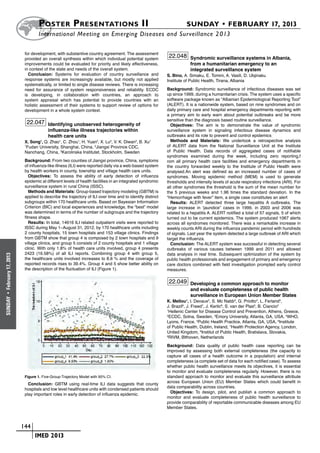
                      of the affected region were collected during various outbreaks from                      from different host species, on survival of
                      North India. Samples were tested for markers of viral hepatitis E; anti-
                      HEV IgM, IgG and HEVAg. Nested reverse transcriptase PCR was
                                                                                                               influenza A viruses in water
                      carried out for HEV RNA detection and phylogenetic analysis.                 S. Shigematsu, A. Dublineau, L. I. O. Sawoo,
                        Results: Out of 71 samples, 65 (91.5%), 39 (55%), 35 (49.2%)               I. Leclercq, J.-C. Manuguerra
                      were positive for anti-HEV IgM, HEVAg and HEV-RNA respectively. A            Institut Pasteur, Paris, France
                      concordance of 77.5% was observed between HEVAg detection and                Background: Influenza A viruses (IAV) are major pathogens for
                      HEV-RNA positivity. PCR and HEVAg detection gave highest positivity          animals and humans. These segmented single-stranded negative RNA
                      (100%) within first 3 days of illness. By day 4 to 7 the positivity of PCR   viruses are composed of an envelope taken from the host in which two
                      declined to 57.5%, whereas antigen and IgM detection were 78.7% and          glycoproteins: the hemagglutinin (HA) and the neuraminidase (NA) are
                      93.9% respectively. Fourteen HC (22.9%) were positive for both anti- HEV     anchored. The viral structure is directly linked to its genetic make-up
                      IgM and IgG. On further evaluation eleven (78.5%) showed the presence        except for the glycosylation moieties and the composition of the lipid
                      of high avidity anti-HEV IgG (90-100%), while in 3 avidity ranged between    bilayer, which depend on the host cell. Besides, being in direct contact
                      40-50%. Molecular characterization showed strains responsible for the        with the environment (such as air or water), they should play an important
                      outbreaks in North India belonged to Genotype I, Subtype 1a                  role in virus survival and thus for viral transmission from contaminated
                        Conclusion: HEV antigen was found to be an early diagnostic marker         waters in the case of wild aquatic birds or from contaminated surfaces/
                      of acute infection up to 4th day of illness. HEV antigen could detect 4      air in the case of humans. Here, we investigated whether the origin
                      extra cases in early phase (1-3 Days), which were missed by the              species of the host cell has an influence on IAV survival. We therefore
                      conventional serology (anti-HEV IgM). After day 7 anti-HEV IgM was           determined the persistence in water at 35°C of A(H5N1) and A(H1N1)
                      the main indicator of acute infection. HEV antigen based ELISA has           viruses either grown on mammalian cells or avian cells.
                      the prospect for wider usage in endemic, resource poor countries as it         Objectives: Establish a link between IAV survival and the nature of
                      requires same instruments as for anti-HEV IgM detection. We document         the viral lipid bilayer
                      subclinical infections in healthy controls of endemic region, which needs      Methods and Materials: Persistence of IAVs amplified on mammalian
                      further investigation to understand the epidemiology of Hepatitis E.         or avian cells was evaluated in water at 35°C. Viral infectivity was
                                                                                                   assessed over time by microtiter endpoint titration and viral genome
                                                                                                   was quantified using qRT-PCR.
                    	 46
                    	    	 IMED 2013
A bstracts	                                                                   SATURDAY • FEBRUARY 16, 2013
            	International Meeting on Emerging Diseases and Surveillance 2 013

  Results: Results showed that both A (H1N1) and A (H5N1) viruses
remained infectious for periods of time as long as 15 days at 35°C,
                                                                                 08.005 Enhancing the specificity of surveillance case
while viral RNA level remained unchanged. Moreover, RT-PCR                                   detection of Monkeypox in Democratic Republic
targeting the whole M segment showed that a significant part of viral                        of Congo (DRC).
RNA was not degraded and remained intact in viral particles. We also             L. U. Osadebe1, A. McCollum1, R. S. Lushima2, E. Pukuta3,
found that within the same subtype, viruses grown on mammalian cells             S. Karhemere3, J. Kabamba4, B. Nguete5, I. Damon1,
were significantly more stable in water at 35°C than their counterparts          J. J. Muyembe3, M. Reynolds1
grown on avian cells, even though these viruses shared the same                  1
                                                                                   US Centers for Disease Control and Prevention, Atlanta, GA, USA,
genetic background.                                                              2
                                                                                   Ministry of Health, Kinshasa, Congo, Democratic Republic of, 3Institut
  Conclusion: This difference in virus stability outside the host is             National de Recherche Bio-médicale(INRB), Kinshasa, Congo,
probably connected to the nature of the lipid bilayer taken during the           Democratic Republic of, 4Kinshasa Centers for Disease Control and
budding step or to the carbohydrate side chains of the viral surface             Prevention, Kinshasa, Congo, Democratic Republic of, 5Kinshasa
glycoproteins. Moreover, the long lasting survival time at 35°C might            School of Public Health, Kinshasa, Congo, Democratic Republic of
have a critical role in the ecology of influenza viruses, especially for
avian viruses.                                                                   Background: Monkeypox is endemic in Democratic republic of Congo
                                                                                 (DRC) with an annual incidence of 5.53/10,000 and case-fatality of 10-
                                                                                 15%. Clinically, monkeypox is often confused with varicella, signaling
 08.004 Investigation of deaths due by Influenza                                 the need for a more specific monkeypox case definition. To better
             A(H1N1)pdm09 in Southern Brazil,                                    estimate true disease burden, a collaborative effort was established in
             July-August, 2012                                                   2010 to enhance monkeypox surveillance in Tshuapa District of DRC.
R. Soletti1, W. Oliveira2, F. Costa1, F. de Paula1, R. Moreira1,                   Objectives: This study examines the sensitivity and specificity of the
L. Garay3, M. Bercini3, E. M. Macario4, C. N. Igansi5, W. Araújo6                national and the enhanced monkeypox surveillance case definitions.


                                                                                                                                                              SATURDAY
1
  Secretariat of Surveillance in Health, Ministry of Health, Brasília,             Methods and Materials: There were 368 suspect cases investigated
Brazil, Brasília, Distrito Federal, Brazil, 2Secretariat of Surveillance in      from Tshuapa in 2010–2012. Case reports were matched with 520
Health, Ministry of Health, Brasília, Brasília, Distrito Federal, Brazil,        samples tested at the national laboratory. Clinical characteristics were
3
  Secretaria Estadual de Saúde do Rio Grande do Sul, Porto Alegre,               assessed to determine if suspect cases conformed to either or both
Rio Grande do Sul, Brazil, 4Ministry of Health-Brazil, Brasilia, Brazil,         surveillance case definitions. The sensitivity, specificity and predictive


                                                                                                                                                                •
  Ministry of Health of Brazil, Brasilia, DF, Brazil, 6University of Brasília,   values of both case definitions were determined using laboratory


                                                                                                                                                              February 16, 2013
5

Ceilândia-DF, Brasília, Brazil                                                   results as confirmation.
                                                                                   Results: Of the 329 suspect cases assessed, 86 (26.1%) met the
Background: Between May and July 2012, an increase of cases                      national case definition; 7 (8.1%) were confirmed. Conversely, 210
and deaths of Influenza A(H1N1)pdm09 in Rio Grande do Sul                        (63.8%) suspect cases met the enhanced case definition and 43
State, Southern Region of Brazil, occurred and an investigation was              (20.5%) were confirmed. Sensitivity and specificity of the national case
performed.                                                                       definition were 11.1% and 70%, respectively, while the enhanced had
  Objectives: Describe the epidemiological profile of Deaths                     a sensitivity of 68.3% and specificity of 37.2%.Among the individual
by Influenza A(H1N1)pdm09, identify risk factors for deaths and                  elements of the enhanced case definition (characteristic rash plus
recommend measures for prevention.                                               febrile prodrome or lesions on palms and soles, or lymphadenopathy)
  Methods and Materials: A descriptive study was conducted. A case               only rash plus lymphadenopathy had a positive predictive value (PPV)
was defined as a fatality due to Influenza A (H1N1) pdm09 confirmed by           greater than 23%.
real-time reverse transcription PCR-positive or clinical-epidemiological           Conclusion: The enhanced case definition captured six times
criteria in Rio Grande do Sul State, from May 25th to July 31st, 2012.           (43 vs 7) more true cases thereby meeting the objective to improve
A questionnaire including questions on demographic characterization,             the efficiency of case detection. This study also suggests that each
risk factors, comorbidities, vaccination history, visits to health services      component of the enhanced definition contributed to its overall
and hospitalization information was used to collect data from hospitals,         sensitivity. However, the specificity of the enhanced definition was sub-
primary care units and households; Risk factors and comorbidities                optimal, indicating the need for a more precise case definition.
were defined according to the Ministry of Health and Food and Nutrition
Surveillance System protocols for nutritional assessment.
  Results: We investigated 53 deaths in 43 cities. The median age
                                                                                 08.006 First autochthonous outbreak of dengue in the
was 45 (range=3 months-85 years) and 33 (62%) were female. By                                island of Madeira, October 2012: A challenge
warning symptoms and risk factors for severity, 44 (83%) had fever,                          for the European Union Region
cough and dyspnea; 32 (60%) presented some risk factor and 26 (49%)              P. Vasconcelos1, H. Zeller2, C. Abreu Santos1, B. Sudre2, J. Gomes
comorbidity, being the most common were lung diseases and obesity                Dias2, J. Jansa3, A. C. Silva4, A. Nunes5, A. Leça1, K. Mansinho6
with 13 (50%). Regarding treatment, 32 (60%) sought care within                  1
                                                                                  Directorate-General of Health, Lisbon, Portugal, 2ECDC, Stockholm,
the first 48 hours of symptom onset, but only 2 (6%) received timely             Sweden, 3European Centre for Disease Pervention and Control,
treatment. The beginning of treatment with oseltamivir occurred with             Stockholm, Sweden, 4Instituto de Administração de Saúde-RAM-
a median of 6 days (range=2-22) after symptom onset. Most cases                  Madeira, Funchal, Portugal, 5Instituto de Adminsitração em Saúde-
(90.6%) weren’t vaccinated in 2012, but 28 (58.3%) were among the                RAM-Madeira, Funchal, Portugal, 6Centro Hospitalar de Lisboa
group eligible for vaccination.                                                  Ocidental-Egas Moniz, Lisbon, Portugal
  Conclusion: Most cases resulting in death were associated with
a more severe presentation of the disease, showed conditions of                  Background: On 3 October Portugal reported two confirmed cases
vulnerability or were not vaccinated. Medical attention was sought               of dengue (DENV-1) in citizens on the island of Madeira. Since then,
timely in most cases, but diagnostic and treatment were untimely,                Portugal and the rest of the EU have been facing the first recently
which may have contributed to the worsening of the clinical features             documented autochthonous outbreak of dengue in Europe. The
and death. We recommend to train health professionals to achieve                 mosquito Aedes aegypti has been first detected on the island of
early diagnostic and treatment, focusing on patients with risk factors for       Madeira in 2005; since then several measures has been taken to
complications, as well as to intensify actions that ensure an increase of        control the breeding sites of mosquitoes as well as implementing
vaccination rates in that same group.                                            vector surveillance, training of professionals and health communication
                                                                                 about mosquito population. Since October, national and European
                                                                                 support has been provided to the regional authorities on monitoring
                                                                                 and controlling the outbreak.


                                                                                                                            	                        	 47
                                                                                                                            	        IMED 2013
A bstracts	                                                                SATURDAY • FEBRUARY 16, 2013
                            	International Meeting on Emerging Diseases and Surveillance 2 013

                        Objectives: To present this outbreak at IMED is an opportunity to          vector control. Clinicians in these regions should consider DF in their
                      address into a comprehensive discussion among international experts          differential diagnosis for individuals presenting with acute febrile illness.
                      the challenges such outbreak brings to Public Health professionals
                      within EU.                                                                    08.008 Evaluation of Innate Immune response in
                        Methods and Materials: The presentation will describe the outbreak
                      from its detection and detail the measures put inplace to monitor, assess                 Acute and Fulminant Hepatitis E
                      and control the outbreak in its clinical, blood safety, entomological,       M. Majumdar1, R. Ratho2, Y. Chawla1, M. P. Singh1
                      epidemiologic and public health points of view. Available data and           1
                                                                                                    Postgraduate Institute of Medical Education and Research,
                      guidance through the documents produced to implement prevention and          Chandigarh, India, 2Postgraduate Institute of Medical Education
                      control measures for the outbreak, will be included.                         and Research, Chandigarh, Chandigarh, India
                        Results: From 3 October till 2 December 2012, 1993 cases of dengue
                      fever have been reported on the island of Madeira. Cases present with        Background: WHO every year reports 20 million hepatitis E virus (HEV)
                      mild symptoms, mainly fever, myalgia, headaches, arthralgia, retro-          infections, over three million people present with self limiting acute viral
                      orbital pain and exanthema, affecting mainly women (69%). A total of 118     hepatitis (AVH) and 70, 000 hepatitis E-related fulminant hepatic failure
                      patients have been hospitalized (average of 4-5 days of hospitalization).    (FHF) cases. Humoral immune response as evident by the presence
                      No deaths have been reported. Upon 2 December 2012, a total of 42            of anti-HEV IgM, is well studied and used as the conventional method
                      imported cases have been reported in several European countries.             for diagnosis of clinically suspected HEV. In contrast, limited data is
                        Conclusion: Depending on the evolution of the outbreak, results will       available on the cell mediated immune (CMI) responses and cytokine
                      be discussed within the frame of main conclusions to be set and thus         profile during HEV infection.
                      especially regarding the potential suitable environmental conditions for       Objectives: The present study was carried out to evaluate the role
                      transmission during the winter period. After the Chikungunya outbreak        of CMI and cytokine profile of acute (AVH) and fulminant (FHF) cases
                      in Italy in 2007, this dengue emergence highlights the key importance        of HEV.
February 16, 2013


                      of surveillance, vector control measures. Vector borne disease outbreak        Methods and Materials: HEV infection was diagnosed by a positive
                      preparedness, needs to be prioritized for the European Public Health         anti-HEV IgM and /or positive HEV RNA.PBMCs were separated from
                      community.                                                                   33 AVH-HEV, 15 FHF-HEV patients, and 20 apparently healthy-controls
                                                                                                   (HC). 2x10⁵ PBMCs were cultured in RPMI-1640 and stimulated
                                                                                                   with recombinant HEV-ORF2-peptide. After 3 days of incubation the
                       08.007 Dengue fever outbreak in North Eastern                               cytokine levels were checked for Th1 (IFNγ, TNFα and IL12), Th2 (IL4,
                                  Kenya, 2011                                                      IL10) and TGFβ in the culture-supernatant using multiplexed cytokine-
                                                                                                   bead-array. Lymphocyte proliferation-index (PI) was estimated using
 •


                      M. O. Obonyo1, W. Arvelo2, V. O. Ofula3, A. Fidhow1, B. Fields2,
                                                                                                   non-radioactive, Colorimetric-MTT assay.
SATURDAY


                      R. Sang4, E. Wurapa5, K. Njenga6, J. Montgomery2
                      1
                        Ministry of Public Health and Sanitation, Nairobi, Kenya, 2US Centers        Results: The PBMCs of the patient group showed blast cell formation
                      for Disease Control and Prevention, Nairobi, Kenya, 3Kenya Medical           on stimulation with HEV-ORF-2 peptide in comparison to control group.
                      research Institute, Nairobi, Kenya, 4Kenya Medical Research Institute,       The PI of AVH, ALF and healthy controls was found to be 3.040±0.667,
                      Nairobi, Kenya, 5US ARMY MEDICAL RESEARCH INSTITUTE-                         2.188±0.722 and 1.215±0.077 respectively. Significant antigenic
                      KENYA, Nairobi, Kenya, 6Centers for Disease Control and Prevention           reactivity was observed in AVH Vs HC (p<0.0001), ALF Vs HC (p
                      in Kenya, Nairobi, Kenya                                                     0.0006) and AVH Vs ALF (p=0.008). The PBMC’s of AVH patients
                                                                                                   showed more proliferation as compared to ALF. Higher amount of
                      Background: Dengue fever (DF), a mosquito-borne viral infection,             IFN-γ was detected in the culture-supernatant of AVH Vs ALF (292.3±
                      accounts for >50 million infections and >22,000 deaths annually. Little is   88 pg/ml Vs 3.235±0.8 pg/ml; p<0.0001). IFN-γ: IL-4 ratio in the AVH
                      known about its transmission in Kenya. An outbreak of the disease was        was 89.76 and in ALF was 0.589.
                      confirmed in Somalia in June 2011.                                             Conclusion: A lower level of INF-γ production and low lymphocyte
                        Objectives: In September, we conducted an investigation to confirm         proliferation index contributes to a marked Th2-bias in FHF patients.
                      and characterize a suspected outbreak in an adjacent area of northern        On the other hand patients capable of expressing high levels of IFN-γ
                      Kenya.                                                                       and mount a robust CMI response are able to limit the disease and
                        Methods and Materials: We reviewed a line list of suspect patients         recover uneventfully. This study demonstrates the vital role played by
                      reported by the affected district surveillance office. A suspected DF case   cell mediated immune response in determining the disease severity of
                      was defined as fever >38oC accompanied with headache, arthralgia,            HEV infection.
                      myalgia or hemorrhages in a person presenting to a health facility from
                      August 1–October 2, 2011. We identified newly presenting cases from
                      October 2–October 10, from whom we collected blood for DF virus
                      testing using real time polymerase chain reaction, and obtained clinical     Session 09 (Invited Presentation)
                      information using a standardized form.
                        Results: We analyzed data on 1,332 suspect patients. Median age            Emerging Disease Mysteries
                      was 18 years (range: thand October 1, 2011. There were five deaths
                      (4/1,000 persons). We identified additional 33 new suspect patients, of      Saturday, February 16, 2013
                      which 30 (91%) were positive for DF virus serotype 3. Among these,           Room: Park Congress • Ground Level
                      20 (67%) required hospitalization due to severe outcome of dengue
                      infection. Median hospitalization was two days (range: 1–4). Twenty-six      16:30–18:00
                      (86%) patients reported aches and pain, 16 (53%) vomiting, and four
                      (13%) gingival bleeding. Seven patients (23%) were also malaria positive.
                      Twenty-four (80%) received antipyretics, 23 (77%) anti-malarials, 15          09.001 Magnitude and distribution of Nodding
                      (50%) re-hydration fluids and 14 (47%) antimicrobials.
                        Conclusion: This was the second confirmed DF outbreak in Kenya,                         Syndrome in Northern Uganda
                      and highlighted the need for improved surveillance to better define          J. F. Wamala1, C. L. Okot2, M. Malimbo1, L. Lukwago3,
                      disease burden. We recommended education of medical personnel                R. Musoke3, E. M. Namukose1, V. Tugumizemu1, I. Makumbi3,
                      on proper clinical management for minimizing severe outcome of DF            M. Nanyunja2, R. G. Downing 4
                      infection and community education on personal protection practices like      1
                                                                                                     Uganda Ministry of Health, Kampala, Uganda, 2World Health
                      wearing protective clothing and use of insect repellants which decreases     Organization Country Office for Uganda, Kampala, Uganda,
                      individual risk of infection. Local efforts to reduce breeding areas for     3
                                                                                                     Ministry of Health, Kampala, Uganda, 4Centres for Disease
                      mosquitoes and further vector assessment are required for specific           Control and Prevention Uganda, Entebbe, Uganda
                                                                                                   Nodding syndrome is an epileptic encephalopathy that is character-
                    	 48                                                                           ized by head nodding, cognitive impairment and physical decline in

                    	    	 IMED 2013
A bstracts	                                                                 SATURDAY • FEBRUARY 16, 2013
           	International Meeting on Emerging Diseases and Surveillance 2 013

affected children. The investigations show an escalating number of            the cause remains unknown, but there are puzzling results as to an
cases though the actual disease magnitude is not known. We therefore          association with the parasite Onchocerca volvulus. Further studies to
implemented a registration of all the NS and Epilepsy cases to establish      determine the prevalence, epidemiology, possible causal factors, and
their magnitude as a requisite for better planning to extend holistic care    management and treatment options are needed in all affected areas.
to the victims and their families.
  To determine the magnitude of NS as the basis for planning and               09.003 EV71 virus
establishing a comprehensive national surveillance system for the
disease.                                                                      P. Chua
  With support from WHO, CDC, AFENET & Partners, the MoH                      Temasek Lifesciences Laboratory, Singapore, Singapore
implemented a NS and Epilepsy case registration census in the three
                                                                              Enterovirus 71 (EV71) belongs to the human Enterovirus A species of the
districts of Kitgum, Pader and Lamwo. The protocol was cleared by the
                                                                              Enterovirus genus within Picornaviridae family. The virion consists of a
Uganda National Council of Science and Technology. Two village health
                                                                              non-enveloped capsid of approximately 28 nm in diameter surrounding
teams were identified and trained on the community case definitions
                                                                              a core of a single-stranded, positive-polarity RNA of slightly more than
for NS and Epilepsy. Registration was thereafter implemented using
                                                                              7.4 kb in size. The single open reading frame of the genome encodes a
simplified registration forms.
                                                                              polyprotein of 2194 amino acids and is flanked by non-translated regions
  A total of 3,541 NS cases were registered with the majority being
                                                                              at the 5’ and 3’ ends, with a variable length of poly-A tract located at the
residents of Pader (1,978 cases) followed by Kitgum (1,084 cases)
                                                                              3’ terminus. The polyprotein is subdivided into three regions; P1, P2,
and Lamwo (479 cases). A total of 161 NS deaths were registered with
                                                                              and P3. P1 encodes four structural proteins whereby P2 and P3 encode
the majority occurring in Pader (107 deaths) followed by Kitgum (37
                                                                              seven non-structural proteins. The functions of the 11 individual viral
deaths) and Lamwo (17 deaths).
                                                                              proteins are thought to be identical to that of other enteroviruses.
  A total of 7,034 Epilepsy cases were registered with the majority being
                                                                                Enterovirus 71 causes both asymptomatic and symptomatic infections
residents of Pader (3,178 cases) followed by Kitgum (2,651 cases) and


                                                                                                                                                             SATURDAY
                                                                              in humans. Symptomatic infections are seen mainly in young children
Lamwo (1,205 cases). A total of 517 Epilepsy deaths were registered
                                                                              and range from non-specific febrile illnesses, exanthemata and classical
with the majority occurring in Pader (217 deaths), followed by Kitgum
                                                                              dermatological manifestation of hand foot and mouth disease (HFMD) to
(216 deaths) and Lamwo (84 deaths).
                                                                              neurological diseases with or without other visceral involvement.
  The initial NS cases were reported starting 1997 with a progressive
                                                                                Since its discovery in 1969, EV71 has been recognised as a periodic
rise in cases till 2012. Nearly all the NS cases (91.7%) were 3–18 years


                                                                                                                                                               •
                                                                              cause of epidemics of HFMD associated with severe neurological
of age with the geographical intensity of NS increasing with reducing


                                                                                                                                                             February 16, 2013
                                                                              complications in a small proportion of cases. Thus, its epidemiology
distance from fast flowing rivers where endemic transmission on
                                                                              so far is based chiefly on outbreak situations which are closely tied to
onchocerciasis has been reported.
                                                                              outbreaks of HFMD. Past outbreaks due to EV71 appear to fall into
  We used very sensitive community case definitions and therefore
                                                                              two patterns; “small-scale” outbreaks with few CNS-complicated cases
these findings represent the worst case scenario for the magnitude
                                                                              and “large-scale” outbreaks associated with frequent and severe CNS-
of NS & Epilepsy. All the registered cases will be verified by trained
                                                                              complicated cases with high mortality rate.
healthcare workers get more accurate estimates.
                                                                                The first large-scale outbreak of HFMD due to EV71 in the Asia-
                                                                              Pacific region occurred in Malaysia in 1997 and since then, EV71
 09.002 Nodding syndrome: An emerging epilepsy                                epidemic appears to recur at a periodicity of approximately every three
             disorder of sub-Saharan Africa                                   years. The controversy of aetiology in the 1997 outbreak, public health
                                                                              perspective with respect to HFMD and EV71 surveillance in Malaysia
A. Winkler
                                                                              will be shared briefly together with the current status of development of
Technical University of Munich, Munich, Germany
                                                                              EV71 vaccines in the region.
Background: Nodding syndrome, a newly recognized epilepsy disorder
of sub-Saharan Africa, has been identified in three locations: northern        09.004 09.004	Ebola and Marburg viruses emergence at
Uganda, South Sudan and southern Tanzania.
  Objective: We describe nodding syndrome and our knowledge of                             the human-animal interface
potentially involved pathophysiologic mechanisms across the three sites.      P. Formenty
  Method: We reviewed all the literature currently available and included     World Health Organization, Geneva, Switzerland
our own unpublished observations.
                                                                              Outbreaks of Ebola and Marburg occur sporadically in Central Africa.
  Results: There are both similarities and dissimilarities across the three
                                                                              The case-fatality ratio varies generally within a range of 20–90%.
sites. The age of onset (5–15 years of age) is similar as are the clinical
                                                                                In Africa, infection has been documented through the handling of
characteristics of the nodding episodes themselves. Detailed prevalence
                                                                              infected chimpanzees, gorillas, fruit bats, monkeys, forest antelope
data are unavailable to date, but it is assumed that some thousands of
                                                                              and porcupines found dead or ill in the rainforest. For Marburg human
children suffer from the illness and hundreds have been reported to have
                                                                              infection resulted from prolonged exposure to mines or caves inhabited
succumbed to it so far. A longitudinal study from Tanzania shows that
                                                                              by Rousettus bats colonies.
the majority of children with nodding syndrome ultimately develop grand-
                                                                                Recent studies have shown that Rousettus aegyptiacus bats should
mal seizures. Response to antiepileptic medication has been anecdotally
                                                                              be considered natural hosts for Marburgvirus. In Africa, fruit bats,
observed, but efficacy has not been assessed in any controlled studies.
                                                                              particularly species of the genera Hypsignathus monstrosus, Epomops
Cognitive impairment is present in children with nodding syndrome, but
                                                                              franqueti and Myonycteris torquata, are considered possible natural
gross neurological abnormalities seem to be absent at least in the early
                                                                              hosts for Ebola virus.
stages of the illness. In northern Uganda and South Sudan children have
                                                                                Reston ebolavirus (REBOV) infection discovery in pigs in Philippines
been reported to be stunted in growth with delayed sexual development
                                                                              in 2008 prompted an intensive collaborative effort of animal health and
and some children demonstrate signs of malnutrition. Results of MRI
                                                                              public health authorities to assess the risk of REBOV in animal and
investigations have been inconclusive and electroencephalography of
                                                                              humans. Possible routes of infection from pigs to humans include:
affected children of northern Uganda has demonstrated that the nodding
                                                                              transmission when handling infected pigs in farms, during slaughtering
episodes themselves represent atonic seizures; results from southern
                                                                              activities and preparation of meat, food chain, xenotransplantation,
Tanzania indicate the presence of atypical absence seizures. Cases of
                                                                              vaccine, cosmetics, etc.
nodding syndrome seem to cluster in areas with high prevalence rates
                                                                                Subsequent experimental infection demonstrated that pigs replicated
of onchocerciasis, although a causal association between nodding
                                                                              Zaire ebolavirus (ZEBOV) to high titers mainly in the respiratory tract,
syndrome and infection with the parasite Onchocerca volvulus has not
                                                                              and thus identified an unexpected site of virus amplification and
been demonstrated.
                                                                              shedding linked to possible virus transmission. Additional experiments
  Conclusions: Nodding syndrome represents a new epilepsy disorder
                                                                              showed ZEBOV transmission from pigs to cynomolgus macaques
in the wider context of a progressive encephalopathy in at least three
                                                                              without direct contact.
different sites of sub-Saharan Africa. Despite extensive investigations
                                                                                                                          	                         	 49
                                                                                                                          	         IMED 2013
A bstracts	                                                                 SATURDAY • FEBRUARY 16, 2013
                             	International Meeting on Emerging Diseases and Surveillance 2 013

                        Recent studies have reported serological evidence of Ebolavirus
                      infection in Orangutans in Indonesia; in several bats species in China
                                                                                                      10.002 Emerging zoonotic vector-borne diseases
                      and in Rousettus bats in Bangladesh. In addition a new filovirus                           in Europe
                      -provisionally named Lloviu virus- was identified in insectivorous bats        N. Nowotny1, T. Bakonyi2, J. Kolodziejek 2, K. Sekulin2,
                      in caves in Spain.                                                             H. Lussy2, K. Pachler2, H. Weissenböck3
                        With more evidence of filovirus infection in wildlife from Africa to         1
                                                                                                       Sultan Qaboos University, College of Medicine and Health Sciences,
                      Asia, the geographic distribution of Ebola and Marburg virus should            Muscat, Oman, 2University of Veterinary Medicine Vienna, Institute of
                      be consider to overlap with the range of Fruit bats of the Pteropodidae        Virology, Vienna, Austria, 3University of Veterinary Medicine Vienna,
                      family.                                                                        Vienna, Austria
                        Given results of recent experimental inoculations with pigs, they
                      should be considered as a potential amplifier host during Ebola or             In my presentation I will focus on West Nile virus lineages 1 and 2,
                      Marburg outbreaks.                                                             which emerged recently in Europe, and dispersed quickly in several
                        New mode of infection and transmission are possible for Filovirus            central, southern and eastern European countries, resulting in
                      at the human-Animal interface (e.g. Henipaviruses) and need to be              significant veterinary and public health challenges. In particular I will
                      studied during next outbreaks. This will impact prevention and control         talk on European aspects of West Nile virus epidemiology, molecular
                      measures during Ebola and Marburg outbreaks.                                   phylogeny and host susceptibility. In short I will also cover Usutu virus,
                                                                                                     another mosquito-borne flavivirus, closely related to West Nile virus.
                                                                                                       I will also provide an update on tick-borne encephalitis virus, a
                                                                                                     significant human pathogen in Europe, which extended recently its
                       Session 10 (Invited Presentation)                                             range of distribution to the north and to higher altitudes.
                                                                                                       As two examples for rodent-borne zoonotic diseases in Europe I will
                       Vectorborne Diseases in Humans                                                discuss hantavirus infections including shrew-borne hantaviruses, and
February 16, 2013


                                                                                                     cases of cowpox, which were transmitted to humans by cats and, more
                       and Animals                                                                   recently, by pet rats.
                       Saturday, February 16, 2013
                       Room: Klimt Ballroom 2–3 • Upper Level                                         10.003 Emerging insect vector-borne animal
                                                                                                                 diseases in the eastern Mediterranean
                       16:30–18:00                                                                   E. Klement
                                                                                                     Hebrew University, Jerusalem, Israel, Rehovot, Israel
 •
SATURDAY


                                                                                                     Infection by insect vector borne animal viruses cause major burden to
                       10.001 A novel orthobunyavirus in European livestock:                         livestock and might result in significant economical losses. The ability
                                   The emergence of Schmallenberg virus                              of such viruses to invade new locations depends on the frequency
                      M. Beer1, D. Hoeper1, K. Wernike1, H. Schirrmeier1, M. Holsteg2,               of their introduction and the existence of adequate environmental
                      F. Conrahts1, T. Mettenleiter1, B. Hoffmann1                                   conditions that support their vector population in the invaded location.
                      1
                        Friedrich-Loeffler-Institut, Greifswald-Insel Riems, Germany,                Such conditions exists in major parts of the Eastern Mediterranean
                      2
                        Chamber of Agriculture for North Rhine-Westphalia, Bonn, Germany             (EM), which includes Cyprus, Syria, Lebanon, Israel, Jordan and the
                                                                                                     Palestinian authority. Extensive livestock trade with countries in both
                      In summer 2011, Dutch and German veterinarians reported signs of               Africa and Asia, movement of livestock and synoptic conditions that
                      an infectious disease in cattle which was associated with primarily            link the region with the adjacent continents are important causes for
                      diarrhea in the Netherlands and with milk drop and fever in Germany.           re-introduction of vector borne viruses into the EM. The existence of
                      Samples were sent for testing for bluetongue virus which was excluded          Mediterranean climate in large parts of the EM, which is characterized
                      as well as other known viral infectious diseases of cattle. A pool of          by relatively high humidity and high temperature, strongly supports
                      plasma samples from diseased dairy cattle from a farm near the                 vector multiplication, biting and virus transmission.
                      city of Schmallenberg was analyzed by next generation sequencing                  The aim of this lecture is to describe the insect vector borne viruses
                      resulting in sequence fragments with a high homology to viruses of             which emerged or re-emerged in the EM during the last decade and to
                      the genus Orthobunyavirus. The novel virus was designated as                   characterize the factors influencing their dynamics.
                      ‘Schmallenberg Virus’ (SBV), the first member of the Simbu serogroup              The diverse climate of Israel, which is located in the center of the
                      detected in Europe. Obviously, the introduction occurred in a region           EM encourages constant re-introduction of vector borne viruses. The
                      which also experienced the first bluetongue virus serotype 8 cases in          high proportion of livestock held under intensive farming in Israel is
                      Central Europe in 2006, and the virus spread very quickly over a wide          under constant observation. Furthermore, the veterinary services in
                      geographical area. SBV-infection resulted in the birth of characteristically   Israel are highly transparent and therefore any incursion of a disease
                      malformed domestic ruminants reflecting acute infections in summer             is immediately notified to the OIE. The insect vector borne viruses
                      and fall 2011. Until December 2012, more than 5500 SBV-cases have              diagnosed in Israel during the last decade will be described, assuming
                      been reported in Europe, and the virus had spread to many countries in         that Israel represents the plethora of viruses which circulate in the EM.
                      Europe. Phylogeny and cross neutralisation demonstrated the closest               In the last decades Israel suffered outbreaks caused by many vector
                      relationship of SBV with viruses of the Sathuperi species like the             borne viruses such as epizootic hemorrhagic disease virus, Akabane
                      Australian Douglas virus. PCR tests with pooled midges caught in fall          virus, bovine ephemeral fever virus, lumpy skin disease virus, equine
                      2011 were able to detect SBV-RNA in biting midges such as Culicoides           encephalosis virus, West Nile virus and Turkey meningoencephalitis
                      obsoletus, C. dewulfi and others indicating vector-transmission similar        virus. These may be a result of primary introduction into Israel or
                      to other Simbu serogroup viruses. First animal experiments with cattle         secondary to other EM infected countries.
                      and sheep resulted in a uniform but short viremic period of about 3               As represented by Israel, the frequency of incursion of new vector
                      to 5 days. However, viral RNA could be detected in some animals                borne animal viruses to the EM is very high. Their early detection may
                      more than 28 days post inoculation in the mesenteric lymphnodes.               enable better preparedness in case of possible invasion to adjacent
                      A zoonotic potential of SBV could be excluded by serological studies           regions like Europe.
                      performed by Dutch and German authorities on humans exposed to
                      SBV. Possible ways of introduction, epidemiological data as well as
                      results of the first pathogenesis studies will be presented, and the
                      potential of metagenomics for pathogen discovery will be discussed.


                    	 50
                    	    	 IMED 2013
A bstracts	                                                                       SUNDAY • FEBRUARY 17, 2013
            	International Meeting on Emerging Diseases and Surveillance 2 013

                                                                                also suggested for rabies elimination in Middle East, Central Asia
Session 11 (Invited Presentation)                                               and North Africa. Although pilot projects are ongoing in sub-Saharan
                                                                                Africa prolonged efforts will be required on that part of the continent
Neglected Zoonotic Diseases                                                     and elimination may only be achieved by 2030. A global strategy
                                                                                to eliminate canine rabies by 2030 is being developed to provide a
Sunday, February 17, 2013                                                       timeframe for implementation, a framework for resource mobilization
Room: Park Congress • Ground Level                                              and technical solutions for conducting reliable diagnoses and effective
                                                                                surveillance, providing easy access to modern rabies biologicals
08:30–10:30                                                                     for proper post-exposure prophylaxis, carrying out thorough dog
                                                                                immunization campaigns achieving a 70% coverage combined with
                                                                                humane dog population management and coordinating disease control
                                                                                efforts across national and regional borders.
 11.001 The economic and health burden of
             neglected zoonotic diseases                                         11.003 Echinococcosis: Endemic and re-emergent
P. Torgerson
University of Zurich, Zurich, Switzerland                                       P. Craig
                                                                                Salford, United Kingdom
A neglected zoonotic disease (NZD) is a zoonosis that is commonly
associated with poverty and causes a considerable burden of ill                   In 2006 WHO listed 8 neglected zoonotic diseases (NZDs), which
health in humans and may also have a substantial financial burden               included echinococcosis and it was also included in the NTD road-map
on livestock. Despite this they often attract little funding for control        to 2020. Recent global disease burden estimates indicate up to 3 million
of intervention. They disproportionately affect the livelihoods of large        cases of human cystic echinococcosis (CE), but also > 300,000 cases of
numbers of poor livestock keepers or those living in periurban slums            alveolar echinococcosis (AE), and increased cases of the rare neotropical
in lower income countries. However upper income countries are not               polycystic echinococcosis (PE). Echinococcosis is also reported to
exempt from the impact of some of these diseases. There is a growing            be re-emergent and spreading in several areas. A return to traditional
concern with the emergence and re-emergence of several zoonoses                 husbandry for poor rural sheep keepers appears to have increased the
including echinococcosis, brucellosis, leptospirosis, leishmaniasis,            risk of synanthropic transmission of Echinococcus granulosus and human
toxoplasmosis and food-borne trematodes. Others such as rabies and              CE in Kazakhstan and Kyrgyzstan. Increased peri-urban transmission of
zoonotic schistosmiasis remain major problems whose true societal               CE in Arab communities in North Africa, Israel, Peru and eastern Tibet,
impact is often underestimated.There is a clear need for data available         may be due to increased ownership of guard dogs and the occurrence
on the burden of NZDs to inform policy with regard to interventions             of significant stray/community dog populations. Breakdown or relaxation
to control or eliminate NZDs. Benefits to intervention policies include         of dog focussed interventions or control measures may also provide a
not only improved human health but increased animal productivity. The           driver for increased transmission and potential CE re-emergence, for
costs of such interventions will drive the cost effectiveness of intervention   example in semi-nomads of NW Kenya and western Mongolia, and
strategies. Current data will be presented that demonstrates that that          sheep farmers in Wales and Cyprus. Wilderness encroachment may
collectively, NZDs probably have a similar human disease burden,                also lead to increased contact with sylvatic hosts with risk of cestode
in terms of Disability Adjusted Life Years, to any one of the big three         zoonoses, for example, indigeneous Indians in Amazonas use dogs to
human infectious diseases: malaria, tuberculosis or HIV. In addition            hunt large rodents for `bush-meat` with increased risk of dogs acquiring
there are substantial animal health costs. Despite the fact that much of        infection with E.vogeli and risk of human PE disease. Deforestation and
this high socio-economic burden is preventable these disease remain             agricultural expansion in western China (Gansu, Ningxia) may increase


                                                                                                                                                            SUNDAY
of low priority.                                                                risk of human AE disease by increasing suitable small mammal host/
                                                                                reservoir habitats and transmission potential of E. multilocularis; and
                                                                                this may also occur as a result of increased livestock grazing pressure
 11.002 Rabies: The path to elimination                                         in Tibetan pastoral communities in western Sichuan. By contrast,


                                                                                                                                                              •
A. L. Willingham                                                                increasing populations of the red fox in Europe, in part as a result of


                                                                                                                                                            February 17, 2013
World Health Organization, Geneva, Switzerland                                  rabies control, reduction in hunting and adaption to peri-urban/urban
                                                                                ecosystems, appears to have facilitated spread of E.multilocularis with
Although rabies cannot be eradicated in view of the multitude of                concern about potential establishment and/or emergence of human
primary animal host species (especially bats) maintaining rabies                AE in previously parasite-free and low-endemic areas. Surveillance
viruses and other lyssaviruses in nature, evidence has accumulated              systems in livestock, dogs, wildlife and human populations are important
through research particularly during the past 10 years, showing that            to understand transmission, to consider interventions and to evaluate
canine rabies which is responsible for most of the human rabies                 control measures.
deaths occurring in the world, can be cost-effectively controlled and
eliminated through control of the disease at source. Eliminating canine
rabies would save many tens of thousands human lives and reduce                  11.004 Implementing the roadmap to
enormously throughout the world the need to provide post-exposure                           combat Cysticercosis
prophylaxis following contacts with rabies suspected animals. Canine            A. L. Willingham
rabies has been successfully eliminated in affluent countries and some          World Health Organization, Geneva, Switzerland
low income countries such as Chile, South Korea and Malaysia in the
past. Ongoing dog rabies control programmes in Latin America, Africa,           Cysticercosis caused by the zoonotic pork tapeworm, Taenia solium,
and Asia are giving promising results indicating that in today’s context        has emerged as a serious public health and agricultural problem in
the elimination of rabies in dogs remains an achievable goal. Various           Latin America, Sub-Saharan Africa and South and Southeast Asia and
regional initiatives for prevention of human dog transmitted rabies             was added by WHO to the list of major neglected tropical diseases in
through dog rabies elimination have been launched involving countries           2010. Neurocysticercosis (NCC) is considered to be the most frequent
of Latin America and South, South east and East Asia. Deadlines for             preventable cause of epilepsy in developing countries. The proportion
achieving the goal of human and dog rabies elimination have been                of NCC cases among people with epilepsy in endemic countries is
set by 2015 for Latin America and 2020 for Asia. This latter date is            estimated to be 29.0% while the global NCC burden has been estimated
                                                                                to be over 2 million DALYs per annum. The increasing frequency of NCC
                                                                                in the USA, Canada, Europe and the Middle East, may relate to the


                                                                                                                          	                         	 51
                                                                                                                          	         IMED 2013
A bstracts	                                                                      SUNDAY • FEBRUARY 17, 2013
                            	International Meeting on Emerging Diseases and Surveillance 2 013

                      growing immigrant population who may come with tapeworm infections            surveillance system and active during outbreaks. It has formal and
                      and so expose others, including those who do not consume pork, to             informal sources of information. Government funds system. It is simple
                      infection. NCC has been found to impose a heavy financial burden to           and integrated into Integrated Disease and Surveillance Response
                      those suffering from the disease and their families and has especially        (IDSR) system. Case definition is simple but laboratory confirmation
                      serious impact on pig-producing communities being responsible for             makes surveillance complex. It takes 24-48hours between onset,
                      poor pork quality and reduced value or condemnation of pig carcasses,         confirmation and response.
                      thereby reducing household income and making an important source                 Previous line list reviewed showed undefined/poorly labeled
                      of protein unsafe to consume. Although cysticercosis is theoretically         outcomes. Of 2472 cases in 2011 1320 (49%) were found in line list.
                      amenable to control and even elimination, information about burden            2011 monthly data completeness was75%. So far in 2012, 5 (0.02%)
                      and transmission, practical and affordable diagnostic tools, and              of all diarrhea cases were cholera. System captures age as the only
                      validation of simple intervention packages need to become available           socio-demographics.
                      to enable this. A single approach to T. solium control is insufficient,          Of 11 suspected cholera cases tested during 2011 epidemic, 7
                      thus for sustainable prevention, control and eventual elimination a           confirmed as cholera (PPV-63%). Of 3 rumours of cholera outbreaks
                      combination of approaches is needed including: (1) improvements in            (2011–July 2012), one (PPV-33%) was true. Acceptability of system is
                      chemotherapy for humans and pigs, (2) vaccination of pigs, (3) better         high. Reporting timeliness -68.7%.
                      pig management and pork production, (4) improved sanitation, and (5)             Laboratory has capacity for V.cholerae isolation but no Cary Blair
                      education. Medium and long term needs for combating the disease               transport medium and cholera test kits.
                      include validating a strategy for control and elimination of T. solium           Conclusion: Evaluation revealed that surveillance system is meeting
                      cysticercosis by 2015 and then using the validated strategy for scaling       its objectives by early detection and response to cholera. System is
                      up interventions in selected endemic countries by 2020. WHO and its           simple, stable, flexible, sensitive, poor data quality, low PPV, fair
                      partners are committed to facilitating attainment of these milestones         laboratory capacity and moderate timeliness. We recommended
                      through improvement of control tools and formulation of best practice         internet-based reporting for timeliness and data quality and provision
                      guidelines for interrupting transmission of cysticercosis, which can then     of laboratory consumables.
                      be tested in pilot projects in selected endemic sites.
                                                                                                     12.002 Surveillance during Hajj: Patterns and causes
                                                                                                                of mortality amongst Indonesian pilgrims
                       Session 12 (Oral Presentations)                                              M. Pane1, S. Imari1, N. Kandun1, G. Samaan2
                                                                                                    1
                                                                                                     Ministry of Health, Jakarta, Indonesia, 2Australian National University,
                       Infection, Detection, & Protection:                                          Canberra, ACT, Australia
                       Adventures in Epidemiology
                                                                                                    Background: Over 200,000 Indonesians undertake Hajj pilgrimage
                       Sunday, February 17, 2013                                                    each year, constituting 10% of international pilgrims. Hajj is physically
                                                                                                    demanding and the mass gathering provides opportunity for disease
                       Room: Klimt Ballroom 2–3 • Upper Level                                       transmission as well as exacerbation of chronic health conditions.
                       08:30–10:30                                                                  Mortality rates amongst Indonesian pilgrims ranged between 200 and
                                                                                                    380 per 100,000 pilgrims in recent years. Reasons for the high mortality
                                                                                                    rates have not been fully explored.
                                                                                                      Objectives: This study assessed the patterns and causes of death
                       12.001 Evaluation of cholera and other diarrheal                             for Indonesian pilgrims based on Hajj mortality surveillance in 2008.
February 17, 2013


                                   diseases surveillance system, Niger State,                         Methods and Materials: Pre-departure, pilgrims undertake a
                                                                                                    medical test to confirm fitness-for-travel and to receive meningitis
                                   Nigeria, 2012
                                                                                                    vaccine. During Hajj, one doctor and two nurses accompany each flight
                      A. T. Bashorun1, A. Ahumibe1, S. Olugbon1, A. Taju1, P. Nguku2,               group and conduct health surveillance. For deaths, the Indonesian
                      K. Sabitu3                                                                    public health team based in Saudi Arabia maintains a database of
                      1
                        Nigeria Field Epidemiology and Laboratory Training Program, Abuja,          demographic and cause of death data. Mortality data were analyzed
                      Nigeria, 2Nigeria Field Epidemiology & Laboratory Training Program,           descriptively to assess rates, timelines and cause of death.
                      Abuja, Nigeria, 3Ahmadu Bello University, Zaria, Nigeria                        Results: In 2008, 206,831 Indonesian undertook Hajj of which 28% of
 •


                                                                                                    pilgrims were classified as high risk due to underlying health conditions
SUNDAY


                      Background: Cholera outbreaks are frequent in Nigeria. In 2010 and
                      2011, 41,936 cases (case fatality rate [CFR]-4.1%) and 23,366 cases           or if they were >60 years. There were 446 deaths, with an overall
                      (CFR-3.2%) were reported. In 2011, Niger state had 2472 cholera               mortality rate of 216 per 100,000 pilgrims. Mortality rates increased
                      cases (CFR-2%) and 45,111 other diarrhea diseases cases.                      significantly with age (p<0.01). Most deaths occurred in Mecca (n=305,
                        Objectives: To determine and assess the objectives, performance             68%), followed by Medinah (n=106, 24%) and Jeddah (n=35, 8%).
                      and attributes of cholera and other diarrheal disease surveillance            Weekly mortality rates exceeded the expected crude mortality rate
                      system in Niger state.                                                        in week 6 when most pilgrims were in Mecca, and remained high till
                        Methods and Materials: We conducted evaluation in July, 2012.               the end of Hajj four weeks later. Deaths peaked earlier amongst those
                      We adapted CDC guideline on surveillance system evaluation (2001).            traveling to Mecca first compared to those who went to Medinah and
                      We conducted key informant/in-depth interviews with stakeholders.             then to Mecca (X2 for trend=9.23, p=0.002). Most deaths were due
                      We examined cholera action plans for preparedness and response,               attributed to cardiovascular (n=292, 66%) and respiratory (n=126,
                      conducted laboratory assessment, extracted and analyzed cholera               28%) diseases.
                      surveillance data from 2007–2012 for frequencies/proportions using              Conclusion: Surveillance during Hajj is critical for health policy
                      Microsoft Excel. Thematic analysis was done for qualitative data. We          development. Travel to Medinah prior to Mecca may provide more
                      shared findings with stakeholders in state and Federal levels.                time for pilgrims to acclimatize to Saudi Arabia and Hajj conditions.
                        Results: Surveillance system was setup for early detection and              Coupled with other strategies to reduce health risks in Mecca, this
                      monitoring towards evidence-based decision. Case definition used              travel route may be more suited to high-risk pilgrims. Patterns of causes
                      is any patient aged 5 years or more who develops acute watery                 of death were aligned with findings from other countries, providing
                      diarrhea, with or without vomiting and is highly sensitive. It is a passive   opportunity to learn lessons from their interventions to decrease pilgrim
                                                                                                    mortality rates.


                    	 52
                    	    	 IMED 2013
A bstracts	                                                                     SUNDAY • FEBRUARY 17, 2013
           	International Meeting on Emerging Diseases and Surveillance 2 013

                                                                             respond to emerging infectious diseases. The RESPOND project in
    12.003 ECDC/EpiNorth epidemic intelligence activities                    collaboration with the African Field Epidemiology Network (AFENET)
            during EURO 2012 in Poland and Ukraine                           and Makerere University College of Veterinary Medicine (COVAB) is
A. M. Gherasim1, I. Linina2, G. Rimseliene3, L. Paine Hallström4,            now in the second year of successfully implementing a One Health
J. Mantero4, P. Penttinen5                                                   focused masters degree in veterinary public health with a field
1
 EPIET Fellow-European Centre for Disease Prevention and Control,            epidemiology component in Uganda.
Stockholm, Sweden, 2Scientific Institute of Public Health (WIV-ISP),           Objectives: The goal is to create a regional East and Central Africa
Brussels, Belgium, 3Norwegian Institute of Public Health, Oslo,              One Health training program that produces field based multi-disciplinary
Norway, 4European Centre for Disease Prevention and Control                  graduates trained in outbreak investigation and response with cohorts
(ECDC), Stockholm, Sweden, 5European Centre for Communicabled                from Uganda, Rwanda, Kenya, Tanzania, Ethiopia and Democratic
Disease prevention and Control, Stockhokm, Sweden                            Republic of Congo. These teams would support their governments
                                                                             to investigate, respond to and counter existing and future emerging
Background: Approximately two million people visited Poland and              infectious disease threats.
Ukraine during UEFA European football championship (EURO 2012)                 Methods and Materials: The 24 month program has a multifaceted
held between 8 June and 1 July 2012.                                         hands-on field based curriculum covering One Health approaches to
  Objectives: From 1 June until 8 July, the European Centre for              emerging and re-emerging infectious disease surveillance, applied
Disease Prevention and Control (ECDC), in collaboration with EpiNorth        epidemiology, outbreak investigation, response and assessment.
and hosting countries public health authorities, implemented tailored          Results: There are currently five fellows in the program who spend
epidemic intelligence (EI) activities in order to detect and assess          75% of their time in the field. Mentorship for the fellows is provided by
potential health threats in this mass-gathering (MG) setting, including      Makerere, Tufts and Minnesota universities, AFENET, and RESPOND.
event-based surveillance (EBS) of web-information.                           They participated in the Ebola, Brucellosis and Typhoid outbreaks
  Methods and Materials: Based on previous experiences, we                   in 2011; developed Rabies and FMD surveillance strategies; and
customized several web-based EBS systems (MedISys, HealthMap,                analyzed animal health surveillance data. They are currently attached
PULS and GPHIN) for automatic and semi-automatic selection of                to 5 districts sites to pilot an infectious disease surveillance system.
official and unofficial public health information relevant for EURO 2012;    The next cohort includes students from six African countries and starts
additional manual daily screening results were provided by EpiNorth          in January 2013.
considering authorities websites of participating and bordering                Conclusion: The AFENET fellows are a great resource to Uganda’s
countries. All the information screened was filtered for public health       Ministries of Agriculture, Health and Environment in combating
relevance using pre-defined criteria. Relevant events identified were        emerging and re-emerging infectious diseases, surveillance and
shared with hosting countries, WHO and EpiNorth network for validation       outbreak investigation and response using the One Health approach.
or further assessment and included in 24 ECDC daily bulletins shared         Continued support and implementation of similar programs will improve
with our partners.                                                           response to outbreaks in the region.
  Results: We identified 114 potential public health events, 76 (67%)
related to hosting countries (58/76 in Ukraine); 30 events (26%) occurred
in participating countries and 8 (7%) in other bordering countries. Of the    12.005 Characterizing zoonotic disease outbreaks
76 hosting country events, we evaluated and validated 39 public health                   in the United States
threats with possible implication for these countries and 11 events as       H. Allen
public health threats to visitors/participants. None of them represented     LMI, McLean, VA, USA
at the end a major public health threat for EURO 2012.
  Conclusion: Our continuous monitoring and assessment of the                Background: There is a documented disconnect in zoonotic disease


                                                                                                                                                         SUNDAY
increased flow of media information, as well as other public health          surveillance and reporting, as well as a clear need for improved
information channels did not lead to identification of any major public      collaboration between veterinary and human medicine. Given the
health threat and no event has occurred during the games. However            growing threat zoonotic diseases pose to public health, it is important
the implemented EI activities provided real-time information on              to better understand zoonotic disease detection practice in the


                                                                                                                                                           •
potential ongoing public health threats and measures in place during         United States.


                                                                                                                                                         February 17, 2013
the MG. Considering the feedback of our public health partners during           Objectives: This research characterizes who detects U.S. zoonotic
this and previous MG experiences we suggest using multiple EBS web-          disease outbreaks and how fast the outbreaks are detected from
systems as a complement to standard surveillance in order to monitor         1998–2008.
and assess the public health risk for infectious diseases during such           Methods and Materials: A database of of zoonotic disease outbreaks
events in real time.                                                         was created from ProMed-Mail and Morbidity and Mortality Weekly
                                                                             Reports. Characteristics including who detected the outbreak, how fast
                                                                             the outbreak was detected, species affected, and species of origin was
    12.004 Improving capacity to investigate and respond                     collected. Univariate statistics were calculated, including mean and
            to emerging infectious disease outbreaks in                      median times to detection. Chi-square tests were used for bivariate
            East and Central Africa                                          analyses (p<.05); Kruskall-Wallis tests and Dunn’s method were used
H. M. Amuguni1, T. Odoch2, R. Nauma3                                         to analyze how fast outbreaks were detected and the relationship
Tufts University, North Grafton, MA, USA, 2Makerere University,
1                                                                            between detection speed and other factors.
Kampala, Uganda, 3RESPOND/USAID, Kampala, Uganda                                Results: One hundred one outbreaks were identified. Sixty one
                                                                             percent were caused by potential bioterrorism agents. Eighty percent of
Background: Infectious diseases of grave concern to human health are         the outbreaks occurred in humans and one or more additional species.
emerging from wildlife and livestock populations in regions of the world     Outbreaks are most commonly detected by diagnostic laboratories
where boundaries between human, wildlife and livestock populations           (49 percent); median number of days to reporting is 13 (range 0-492).
are undergoing rapid change. This occurs with greater frequency in           Laboratories and clinicians detect outbreaks more quickly than a state
tropical regions, areas with limited resources for disease prevention        agency; there was no difference in time to detection based on whether
and control. Using a One Health approach, the USAID RESPOND                  it was identified by the animal health or human health entity. The mode
project strengthens field training, educational programs and supports        of transmission, species of origin (of outbreak), and primary symptom
governments and universities to improve capacity to investigate and          of the disease agent did not affect time to detection.


                                                                                                                       	                         	 53
                                                                                                                       	         IMED 2013
A bstracts	                                                                      SUNDAY • FEBRUARY 17, 2013
                            	International Meeting on Emerging Diseases and Surveillance 2 013

                        Conclusion: This research supplements prior work by reviewing
                      only outbreaks of zoonotic diseases. While zoonotic disease outbreak
                                                                                                     12.007 Domestic birds as surveillance systems for
                      detection is often complex because of the disconnect between animal                       monitoring West Nile virus lineage 2 enzootic
                      health and human health sectors, the time to outbreak detection is not                    circulation: Three years of experience in Greece
                      clearly affected by the species affected by the outbreak. State agencies      C. I. Dovas1, S. C. Chaintoutis1, A. Chaskopoulou2, S. Gewehr3,
                      detect outbreaks more slowly than other entities such as clinicians and       M. Papanastassopoulou1, S. Mourelatos3, S. Zientara4,
                      laboratories, suggesting that it is important to have astute clinicians and   S. Lecollinet4, K. Danis5, T. Panagiotopoulos5
                      electronic laboratory reporting to quickly detect a disease, aggregate        1
                                                                                                      Aristotle University of Thessaloniki, Thessaloniki, Greece, 2United
                      results, and identify a zoonotic disease outbreak in humans or animals.       States Department of Agriculture-Agricultural Research Service
                                                                                                    (USDA-ARS), Thessaloniki, Greece, 3Ecodevelopment, Thessaloniki,
                       12.006 Estimating global mortality associated with                           Greece, 4European Reference Laboratory for equine diseases,
                                                                                                    Maisons-Alfort, France, 5Hellenic Center for Disease Control and
                                   the influenza A H1N1 pandemic in 2009: The                       Prevention (HCDCP), Athens, Greece
                                   WHO Global Pandemic Mortality Assessment
                                   (GLaMOR) project                                                 Background: In Greece, West Nile virus (WNV) 2010-2012 epidemics
                      L. Simonsen , P. Spreeuwenberg , R. Lustig , R. J. Talyor ,
                                   1                      2          3              3               have resulted in 382 human neuroinvasive cases (WNND). Horses
                      D. M. Fleming4, M. Kroneman2, L. W. Kim3, M. D. Van Kerkhove5,                were also affected. Studies in the USA and Europe have addressed
                      A. W. Mounts6, J. W. Paget2                                                   surveillance methodologies for WNV lineage 1, but little is known in the
                      1
                        George Washington University, Washington DC, DC, USA,                       context of WNV lineage 2 circulation.
                      2
                        NIVEL, Utrecht, Netherlands, 3Sage Analytica, Bethesda, DC,                   Objectives: Three surveillance systems (domestic pigeons, free-
                      USA, 4Royal College of General Practitioners, Birmingham, United              range chickens, captive chickens) are continually evaluated from 2010 in
                      Kingdom, 5Imperial College, London, United Kingdom, 6World Health             Greece, for their efficacy in providing data on WNV enzootic circulation.
                      Organization, Geneva, Switzerland                                               Methods and Materials: At the end of the 2010 and 2011 epidemics,
                                                                                                    pigeons 2–8 months old were tested by ELISA to determine WNV
                      Background: The global mortality burden of the 2009 influenza A               seropositivity rates in flocks from different regions. Young free-
                      H1N1 pandemic has been subject to considerable uncertainty. By the            range chickens were also tested after the 2011 and 2012 epidemics.
                      time WHO declared the pandemic to be over in August 2010, it had              Seropositivity rates were correlated with the incidence of WNND cases
                      received reports of 18,500 laboratory-confirmed deaths, a figure that         by municipality and prefecture. Furthermore, at the beginning of the
                      underestimated the true burden of disease and did not provide an              2011 and 2012 epidemics, blood was tested from young pigeons and
                      accurate assessment of the geographical impact of the pandemic.               free-range chickens in Central Macedonia for early warning purposes.
                        Objectives: The WHO Global Pandemic Mortality Burden (GLaMOR)               Finally, during the 2011 and 2012 epidemics, blood was sampled weekly
                      project aims to generate a robust yet conservative estimate of the 2009       from sentinel chickens in cages, placed around the city of Thessaloniki.
                      mortality burden associated with the influenza A H1N1 pandemic.               These samples were examined by ELISA, and retrospectively for the
                      Regional and global burden estimates have been generated and                  presence of WNV using RT-PCR. Mosquitoes were collected in parallel
                      stratified by age (<65 and +65) and cause of death.                           and only one out of 150 pools tested in 2011 was found positive for
                        Methods and Materials: We used a novel two Stage modelling                  WNV.
                      approach to produce the global estimate. In Stage 1, we collected               Results: Results indicated that all systems provided valuable data
                      adequate mortality (weekly data that is cause- and age-specific and           regarding local enzootic circulation of WNV and detected the virus
                      includes a minimum of five years) and weekly virological data from 21         before the onset of human cases, successfully predicting risk for
                      countries around the world: 4 countries in the Americas, 9 in Europe,         local human transmission. Health authorities were informed timely for
February 17, 2013


                      7 in the Western Pacific (including China) and one in Africa (South           the implementation of preparedness plans to protect public health.
                      Africa). We then applied Multiple Regression Modelling to estimate            The captive chicken system was more expensive, but provided
                      the pandemic mortality burden by age group and cause of death. In             weekly monitoring of WNV and enabled fast isolation and molecular
                      Stage 2, we projected the estimates to other world countries using four       characterisation of the circulating virus before the human epidemic
                      distinct statistical approaches, with our final estimates being based on      onset.
                      a Multiple Imputation method.                                                   Conclusion: Domestic pigeon and free-range chicken surveillance
                        Results: We attribute 144,000 to 189,000 respiratory deaths                 is convenient and cost-effective for early warning and identification
                      (preliminary estimate) to pandemic influenza A H1N1 worldwide                 of reservoir areas with early arbovirus transmission. Such low-cost
 •
SUNDAY


                      through December 31, 2009, with 61% of deaths were among people               systems could be easily implemented in large areas as risk indicators
                      <65 years. Mortality varied substantially by region, with far higher          for WNV transmission via blood transfusions. Repetitive sampling in
                      rates in the Americas (North, Central and South) than other regions,          captive chickens is more informative regarding the determination of the
                      especially the Europe region. Attempts to model all-cause and cardio-         epidemic development and the isolation and molecular identification of
                      respiratory mortality failed to produce significant burden estimates          the circulating virus strain.
                      except in a handful of countries with a substantial burden.
                        Conclusion: The overall global mortality impact of pandemic                  12.008 Weekly monitoring of human cases of West Nile
                      influenza A H1N1 in 2009 was modest and not unlike seasonal
                      influenza; however, the young mean age of casualties and the marked                       fever: An efficient way to assess the evolution
                      geographical heterogeneity in severity makes the 2009 pandemic                            of the disease in Europe
                      stand out as a significant global health event.                               L. Marrama Rakotoarivony, C. Bogaardt, E. Robinson, V. Estevez, J.
                                                                                                    Jansa, H. Zeller, D. Coulombier
                                                                                                    European Centre for Disease Pervention and Control, Stockholm,
                                                                                                    Sweden
                                                                                                    Background: Since 2010, epidemiological and virological findings in
                                                                                                    the European Union (EU) countries indicate a geographical expansion
                                                                                                    of West Nile (WN) virus circulation, involving viruses from lineages 1
                                                                                                    and 2.


                    	 54
                    	    	 IMED 2013
A bstracts	                                                                        SUNDAY • FEBRUARY 17, 2013
            	International Meeting on Emerging Diseases and Surveillance 2 013

  Objectives: In this context, the European Centre for Disease                     Results: Being a smoker and a lower educational status are significantly
Prevention and Control has developed a tool to monitor spatial                  associated with a lower participation at follow-up. Younger volunteers are
distribution of human cases in Europe, on a weekly basis.                       more prone to be lost at follow-up. A lower propensity to participate has
  Methods and Materials: The scope of the WN mapping tool includes              been observed among individuals who got aware of the study through on-
65 countries (EU and neighboring countries). Event-based surveillance           line advertising than through traditional off-line media.
web-systems, international networks and official national websources               Conclusion: It is possible to motivate participants sufficiently that they
are used to collect information on WN cases reported by these                   actively take part in a weekly survey over a period of several months.
countries. Data are validated with the National Authorities and cases           Similarly to traditional epidemiological studies, smoking behavior,
are classified according to the EU case definition. Finally, a geographic       educational level and age are determinants of participation to follows-up.
information system (GIS) is used to geo-reference and display the               An internet-based enrollment campaign for internet-based epidemiological
spatial distribution of cases at the sub-national level. Uupdated outputs       studies seems to be less effective than the off-line advertising in enrolling
(maps, tables and synthesis) are published every week on ECDC                   volunteers that are more likely to participate at follow-up questionnaires.
website during the transmission season (June to November).
  Results: The WN mapping tool is in place since June 2011. Twenty-              12.010 An investigation of Salmonella Enteritidis
six and 24 weekly maps have been published during the transmission
seasons 2011 and 2012, respectively. In 2011, 327 cases, including                           PT1 cases linked to consumption of a
124 cases from EU countries, have been reported by 10 EU and non-                            pasteurised liquid egg white product in
EU countries. In 2012, 907 cases (237 from EU) have been reported by                         England and Wales, 2012
15 EU and non-EU countries. The increase in the number of cases and             O. Esan, C. Lane, T. Peters
in the number of countries reporting cases was associated with a rise           Health Protection Agency, London, United Kingdom
in the number of affected areas by country.
  Conclusion: The WN mapping tool has been designed to support                  Background: On September 12, 2012 the European Commission’s
the decision making process of stakeholders involved in blood donation          Rapid Alert System for Food and Feed issued an alert regarding
management. However its outputs have already been linked to by a                Salmonella enterica subspecies enterica serovar Enteritidis (S.
variety of national public health agencies, travel medicine networks            Enteritidis) isolated from a “ready to drink” liquid egg white product
and public health forums on their internet sites. Indeed, this tool also        following a case linked to consumption of the product in Austria. The
supports public health decision makers in their response to the risk            isolate was further typed as phage type 1 (PT1) and resistant to Nalixidic
posed by WN in the Europe. Moreover, this tool contributes to harmonize         acid and Nitrofurantoin. A recall of the product was subsequently
and enhance the surveillance of WN cases in and around the EU.                  issued by the internet retailer. The product originated in France and
Finally, data collected contribute to improve the analysis of favourable        was distributed with a six months shelf life from the United Kingdom to
conditions for WN transmission and hence improve preparedness and               other European countries.
response to WN outbreaks in Europe.                                                Objectives: To ascertain the morbidity associated with the
                                                                                consumption of the product
                                                                                   Methods and Materials: S. Enteritidis cases reported by the
 12.009 Determinants of active participation in                                 Gastrointestinal Bacteria Reference Unit (GBRU) are routinely
             internet-based surveillance systems                                resistance and phage typed. After 20th August 2012 all S. Enteritidis
D. Paolotti1, P. Bajardi2                                                       PT1 were also analysed using Multilocus variable-number Tandem
1
 ISI Foundation, Turin, Turin, Italy, 2ISI Foundation, Turin, Italy             Repeat Analysis (MLVA). Environmental health questionnaires (EHQ)
                                                                                were used to identify travel history. Microbiological testing was also
Background: Internet-based platforms for infectious disease surveillance        carried out on the product.


                                                                                                                                                                SUNDAY
have advantages over traditional approaches as they can potentially                A standardised postal questionnaire (PQ) was designed and sent
recruit and monitor a wider range of subjects in a relatively inexpensive       to a subset of S. Enteritidis PT1 cases with a self-addressed return
fashion.                                                                        envelope. The questionnaire included questions on illness, travel
  Objectives: Loss to active participation is generally a problem in cohort     history, consumption of eggs and purchase history including after-sales


                                                                                                                                                                  •
studies, and it has been rarely investigated for large-scale cross-country      information. In addition, product information was requested from the


                                                                                                                                                                February 17, 2013
internet-based cohort studies.                                                  Foods Standards Agency.
  Methods and Materials: We studied the determinants of active                     Results: Between August 20–October 10, 2012 a total of 84 cases of
participation of individuals in the www.influenzanet.eu project to monitor      S. Enteritidis PT1 were reported by GBRU. Over half of the cases were
influenza-like-illness in the general population of seven European countries.   resistant to Nalixidic acid with reduced susceptibility to Ciprofloxacin
The web-based system requires volunteers to fill in a background survey         (61%, 54/84). Over one third reported travel (39%, 33/84) with most
once, and then weekly questionnaires about symptoms. The background             visiting Spain (33%, 11/33). Of the indigenous cases, eight cases
questionnaire collects socio-demographic information on the participants,       consumed the product (6 EHQ, 2 PQ) of whom two were hospitalised
as well as information on household composition, influenza risk status,         and three were adult male bodybuilders.
vaccine history etc. The symptoms questionnaire, for which a reminder              Over half (53%, 39/74) of the cases responded and most were ill for
is sent every week over email, asks about respiratory symptoms, access          five days (range 4–35).
to care, absenteeism and utilization of medications. If no symptoms are            MLVA pattern was consistent in both product and linked cases.
presented, then it can be completed in one click. For the purposes of this         Conclusion: Our investigation identified cases linked to consumption
study active participants are defined as those that, during the 2011-12         of the product and travel associated cases. Due to the long-shelf-life of
influenza season, completed at least two weekly surveys within 60 days          the product, its recall likely prevented more S. Enteritidis PT1 infections
following their first symptoms questionnaire.                                   from occurring.
  Data from background questionnaires are used as explanatory variables
to predict the likelihood of participation through odds ratios. Furthermore,
a multivariable logistic regression is used to evaluate the impact of the
recruitment by different means of information on the retention behavior.


                                                                                                                            	                          	 55
                                                                                                                            	          IMED 2013
A bstracts	                                                                    SUNDAY • FEBRUARY 17, 2013
                            	International Meeting on Emerging Diseases and Surveillance 2 013


                       12.011 Effects of climate change on the distribution                       13.001 Global approach to the control of foot and
                                  of bluetongue and epizootichaemorrhagic                                     mouth disease
                                  disease vector in Southern Alberta (Canada)                    B. Vallat
                                  and Montana(USA)                                               OIE, Paris, France
                      A. Zuliani1, A. Massolo2, S. Marshall3, T. J. Lysyk4, G. Johnson5,         FMD is among the most devastating disease with severe impacts on
                      S. Cork2                                                                   animal productions and trade. The disease control strategies must be
                      1
                        University of Calgary-Faculty of Veterinary Medicine, Calgary, AB,       based on scientific evidences and the OIE international standards and
                      Canada, 2University of Calgary, Faculty of Veterinary Medicine,            recommendations to Member Countries provide clear guidance for the
                      Calgary, AB, Canada, 3University of Calgary, Calgary, AB, Canada,          preparation of effective methods, strategies and policies. area majority
                      4
                        Lethbridge Research Centre, Agriculture and Agri-Food Canada,            of that texts are published in the “Terrestrial Code” and in the “Terrestrial
                      Lethbridge, AB, Canada, 5Montana State University, College of              Manual” and they represent real foundations to prepare prevention and
                      Agriculture, Bozeman, MT, USA                                              control strategies.
                      Background: Climate change is likely to have an impact on the                Among several key elements, effective national Veterinary Services
                      distribution of arthropod vectors, such as Culicoides sonorensis.          are key players and recognized as public goods. Also crucial are
                      In North America a change in the distribution of arthropod vectors         effective surveillance in domestic and wild animals, early detection
                      could be expected to take place at their northern limit. C. sonorensis     and warning and emergency response to any disease outbreak.
                      is the primary competent vector for Bluetongue (BT) and Epizootic          Transparent world animal health information and warning system
                      Hemorrhagic Disease (EHD) viruses in western North America. BT and         are needed, as described and implemented by the OIE (WAHIS and
                      EHD are endemic in the United States and have occurred sporadically        WAHID systems), supplemented by a number of information and data-
                      in Western Canada.                                                         analysis platforms such as GLEWs developed in partnership with other
                        Objectives: The aim of this study is to determine the effects of         agencies (e.g. OIE, FAO, WHO).
                      different climate change scenarios on the distribution of C. sonorensis      While the commitment of national governments is a prerequisite,
                      in Southern Alberta (Canada) and Montana (USA) in order to better          action at regional and international levels is also critical as evidenced
                      target surveillance efforts towards potential emerging Culicoides-         by the successful eradication of rinderpest worldwide (e.g. regional
                      transmitted diseases in this area.                                         networks of diagnostic laboratories and epidemiological surveillance
                        Methods and Materials: A maximum entropy distribution model              teams, vaccine quality control) without forgetting permanent support
                      was developed using fifty C. sonorensis presence records and four          to research.
                      variables (Elevation, Land Cover, Precipitation and Vapour Pressure          The first OIE FAO International Conference on FMD control (Asuncion,
                      Deficit). The model obtained was then used to derive the distribution of   Paraguay, 2009) recommended that a Global FMD Control Strategy be
                      the arthropod under different climate change scenarios. We selected        prepared and that a second International Conference be organized.
                      three Representative Concentration Pathways (RCP 2.6, RCP 4.5, and         The Global Strategy was finalized in 2012 and it was presented and
                      RCP 8.5) to build scenarios using the Fourth Generation Canadian           adopted at the Second Global Conference on FMD Control (Bangkok,
                      Coupled General Circulation Model. Climate change data for each            June 2012).
                      variable were extracted for two time points, 2030s and 2050s and             The aim of the global strategy is to maintain the status of already
                      projections of future C. sonorensis distribution were developed.           FMD-free 65 countries or zones and to progressively control and
                        Results: Two major trends are observable in C. sonorensis                eradicate the disease in infected countries and zones. The strategy
                      distribution under the climate change scenarios selected. Among the        is tailored according to the national and regional situations and it
                      2030s scenarios 13.3 % (RCP 2.6), 18.7% (RCP 4.5) and 19.7% (RCP           follows a progressive-control approach based on risk assessments
February 17, 2013


                      8.5) of the whole study area indicated a northward/westward increased      corresponding to stages of advancement along a Progressive Control
                      probability of C. sonorensis occurrence. The same trend is observable      Pathway (PCP). It is combined with the use of the OIE Performance of
                      for the 2050s scenarios with an additional increase ranging from 3.9%      Veterinary Services (PVS) Pathway tools. The strategy will also seek
                      (RCP 2.6), 18.4% (RCP 4.5) and 16.3% (RCP 8.5). In contrast a              economies of scale by simultaneously acting to control other priority
                      reduction of C. sonorensis probability of occurrence was indicated in      transboundary diseases, where appropriate.
                      central Montana and the southernmost areas of Alberta for 2.6 and 8.5
                      RCP scenarios in the 2030s and 2050s. No retraction is forecasted by
 •


                      the RCP 4.5 scenario.                                                      Session 14 (Invited Presentation)
SUNDAY


                        Conclusion: Our models illustrated potential changes in the
                      distribution of C. sonorensis and can provide useful projections to        Cutting Edge Diagnostics for the Detection
                      inform the development of future vector surveillance programs and for
                      the region.                                                                of Novel and Neglected Diseases
                                                                                                 Sunday, February 17, 2013
                       Session 13 (Plenary)                                                      Room: Park Congress • Ground Level
                                                                                                 14:30–16:00
                       Global Approach to the Control of Foot
                       and Mouth Disease                                                          Co-sponsored by ESCMID

                       Sunday, February 17, 2013
                       Room: Park Congress • Ground Level
                       11:00–11:45


                    	 56
                    	    	 IMED 2013
A bstracts	                                                                     SUNDAY • FEBRUARY 17, 2013
           	International Meeting on Emerging Diseases and Surveillance 2 013


 14.001 MALDI-TOF MS beyond bacterial and fungal                              14.003 Detection of emerging antimicrobial threats in
            identification                                                               developing countries
J. Vila                                                                      K. Klugman
Barcelona, Spain                                                             Rollins School of Public Health and School of Medicine, Emory
                                                                             University, Atlanta, GA, USA
Matrix-assisted laser desorption ionization-time of flight mass
spectrometry (MALDI-TOF MS) is a rapid technique used for bacterial          The rapid financial emergence of the two most populated countries
identification performed by the analysis of the protein spectrum of the      on earth, India and China, has created an emergency of emerging
microorganism. However, applications other than bacterial and fungal         antimicrobial resistance. Access of millions of people to antibiotics has
identification can be implemented for MALDI-TOF MS. The first and            reduced important indicators of mortality, such as deaths in infants in
most useful so far has been its use as a typing method. The use of           those countries, but has been accompanied by a surge of antimicrobial
MALDI-TOF MS to identify locally dominant bacterial clones would             resistance. The spread of resistance determinants selected by this
prompt the rapid identification of outbreaks and cross-transmission          massive increase in antimicrobial exposure, has been fuelled by a lack
events and allow the implementation of containment measures.                 of infection control in hospitals and lack of sanitation in the community
Recently, a genetic algorithm to identify S. aureus isolates belonging to    which allows hospital pathogens to spread widely. Capacity in
the USA300 family based on only three discriminating mass peaks has          developing countries to detect emerging antimicrobial threats is almost
been developed and other studies have also evaluated the potential of        nil outside of a handful of internationally supported research units. The
MALDI-TOF MS to differentiate MRSA lineages and even identify an             development of laboratory capacity by a number of donor Foundations
outbreak-causing MRSA strain based on the presence of PVL.                   and donor countries has recently increased capacity for detection of
  We have evaluated the ability of MALDI-TOF MS to differentiate             these threats in many developing countries, but a network of reference
among distinct dominant MRSA lineages (clonal complexes, CC).                labs in developing countries, able to detect resistant pathogens, as well
Eight different sequence type (ST) groups: ST 146, ST125, ST 228             as an ability to track their epidemiology and spread, is a major need in
of CC5, ST 22 of CC22, ST 398 of CC398, and ST8, ST 247, ST1819              the fight against emerging microbial threats.
of CC8 were used. A reference MS database library originated from
36 S. aureus isolates, belonging to these four different CC, was
developed. Reproducible spectrum differences were observed allowing
the identification of specific mass peaks whose presence/absence             Session 15 (Invited Presentation)
could be associated with each clonal complex, thus providing a robust
classification of the isolates. These results highlight the potential of
                                                                             Panel Discussion: Updates from ProMED
MALDI-TOF MS as a rapid and accurate approach to evaluate the local          Sunday, February 17, 2013
epidemiology of MRSA. MALDI-TOF Ms has also being used to detect
the presence of beta-lactamases such as extended-spectrum beta-              Room: Klimt Ballroom 2–3 • Upper Level
lactamases (ESBLs) and carbapenemases, by analyzing the hydrolysis           14:30–16:00
of a third generation-cephalosporin or a carbapenem, respectively. In
this sense MALDI-TOF can contribute to the identification of these
mechanisms of resistance and to a better selection of antibiotic
treatment.                                                                    15.001–15.004 Updates from ProMED-mail
                                                                             L. Madoff, M.P. Pollack, S. Chotivichien, Q. Nguyen, J. Torres,
 14.002 Next generation sequencing in clinical                               J. Woodall, T. Yuill


                                                                                                                                                         SUNDAY
            microbiology diagnosis, what have we                             The Program for Monitoring Emerging Diseases from the International
            achieved so far?                                                 Society for Infectious Diseases began in 1994. It serves to provide
J. Van Eldere                                                                early warnings of outbreaks of emerging infectious diseases and


                                                                                                                                                           •
Louvain, Belgium                                                             provide a forum for discussion of these outbreaks. It relies on informal


                                                                                                                                                         February 17, 2013
                                                                             sources of data from a variety of sources including media reports (many
Clinical microbiology includes the rapid identification and susceptibility   retrieved by automated websearching in collaboration with HealthMap.
testing of pathogens to direct management of infections at an individual     org), official sources and reports from more than 65,000 reader-
patient level and the monitoring of pathogens at a public health level.      participants. This session will describe ProMED’s background and
Identification and prediction of antimicrobial resistance in clinical        provide an overview of its operation and its regional networks. ProMED
materials by molecular methods is now routinely used in many diagnostic      editors and moderators will describe some recent developments that
laboratories but remains limited to specific questions and has evolved       have appeared in ProMED posts: The recent detection of a novel
less rapidly than predicted. Next-generation sequencing technologies         coronavirus in the Middle East, the ongoing resurgence of dengue
are now able to sequence multitudes of bacterial genomes and deliver         (focusing on Southeast Asia and Latin America), the ongoing outbreak
and interpret the resultant sequence information in near “real-time”. As     of fungal meningitis in the US due to a contaminated corticosteroid
a result, whole-genome sequencing of bacteria is emerging as a cost-         preparation, and the recent epidemic of Yellow Fever occurring in
effective and convenient approach for addressing many microbiological        the Darfur region of Sudan. The session will provide ample time for
questions. Next-generation sequencing has already begun to transform         questions and discussion.
microbiology, in particular in the fields of fundamental microbiology
and public health microbiology. The use of microbial sequence data
for “real-time” patient management is not yet realized. However, given
the current rate of technological evolution, it can be predicted that        Session 16 (Invited Presentation)
next-generation sequencing will soon be sufficiently fast, accurate and
cheap to be used in routine patient-management clinical microbiology.        Disease Surveillance
                                                                             Sunday, February 17, 2013
                                                                             Room: Park Congress • Ground Level
                                                                             16:30–18:00


                                                                                                                       	                         	 57
                                                                                                                       	         IMED 2013
A bstracts	                                                                      SUNDAY • FEBRUARY 17, 2013
                             	International Meeting on Emerging Diseases and Surveillance 2 013

                                                                                                     nourished by EB surveillance and consolidated by indicator-based
                       16.001 Integrating data mining and crowdsourcing                              surveillance, integrating both formal and informal data. Its process
                                   for disease surveillance                                          is declined in early detection, selection, verification, assessment
                      J. Brownstein                                                                  and communication of information in relation with health events. To
                      Childrens Hospital, Boston, MA, USA                                            help public health community experts in their task of early detection,
                                                                                                     systems able to mine unstructured data from Internet-based media have
                      Over the past fifteen years, Internet technology has significantly             been developed. They retrieve and classify information into medical
                      changed the landscape of public health surveillance and epidemic               categories. By covering different scopes, languages, or geographical
                      intelligence gathering. Disease and outbreak data is disseminated not          areas and providing different functionalities, the systems complement
                      only through formal online announcements by government agencies,               each other to provide broader data and improve the sensitivity. Public
                      but also through informal channels such as social networking                   health experts can therefore use predefined criteria to select events that
                      sites, blogs, chat rooms, Web searches, local news media and                   could impact public health. Information is verified and communicated
                      crowdsourcing platforms. These data streams have been credited with            through different way according their confidentiality and their
                      decreasing the time between an outbreak and formal recognition of              significance. Hence EI is now widely used by national and trans-national
                      an outbreak, allowing for an expedited response to the public health           public health organisations by providing a conceptual framework, which
                      threat. Collectively, these online sources create an image of global           completes public health surveillance systems to cover vaster fields and
                      public health that is fundamentally different from the one produced by         to meet new challenges. EI can be adapted to specific goals: detection
                      traditional public health surveillance infrastructure. The talk will discuss   of global crises, strengthening of national surveillance (focused on
                      the current capabilities and future directions in the use of the non-          specific diseases or implemented for specific events e.g. mass gathering
                      traditional data sources for the purposes of public health surveillance        events). A unique collaborative experience of systems has been initiated
                      and rapid detection of emerging infectious diseases.                           through a trusted network of experts in health threat surveillance of the
                                                                                                     Global Health Security Initiative (GHSI). The Early Alerting and Reporting
                       16.002 Participatory epidemiology: Putting                                    (EAR) project developed an improved EI knowledge and a systematic
                                                                                                     and rational approach to biological threat detection and assessment. The
                                   the public in public health surveillance                          escalating amount of available information and increasing expectations
                      M. Smolinski                                                                   of stakeholders are the forthcoming EI challenges. Hence, combined
                      Skoll Global Threats Fund, San Francisco, CA, USA                              Internet-based systems are playing a key role in detecting signals
                      Epidemiology is not just for public health specialists anymore.                timely whereas human expertise remains fundamental to analyse and
                      Understanding disease trends can now come from a variety of data               implement response.
                      sources ranging from SMS messages, blog posts, Internet searches,
                      and news sources to conversations on social networks. The digital data
                      that makes up our daily activities are a prime target for early detection
                      of disease threats. Changes in the International Health Regulations            Session 17 (Oral Presentations)
                      have spurred innovations in surveillance and case detection using              Hot Topics
                      informal sources of data. The Global Public Health Intelligence Network
                      (GPHIN), the Program for Monitoring Emerging Infections (ProMED),              Sunday, February 17, 2013
                      HealthMap, and Google Flu Trends are just a few examples of how
                      the field of participatory epidemiology has evolved. More recently, self-      Room: Klimt Ballroom 2–3 • Upper Level
                      reporting systems like Flu Near You have opened a new category of              16:30–18:00
February 17, 2013


                      participatory epidemiology that puts the public directly into public health
                      surveillance. If effective, Flu Near You will help us better understand
                      how influenza spreads across the United States and, importantly,
                      engage the public directly in combatting this yearly plague. But Flu            17.001 Anthrax pleural effusions and drainage
                      Near You as a proof of concept is equally important. If people are
                                                                                                                 1979–2011: A Russia-USA partnership study.
                      willing to report symptoms on a regular basis, we can expand beyond
                                                                                                     D. Lucey1, L. Grinberg2, F. Abramova3
                      flu to other diseases. Moreover, we can move beyond the United States          1
                                                                                                       Georgetown University Medical Center, Washington, DC, USA, 2Ural
                      to the developing world, where the challenges are significantly more
 •


                                                                                                     State Academy, and Hospital 40, Yekaterinburg, Russian Federation,
                      complex. Participatory surveillance could become a crucial cornerstone
SUNDAY


                                                                                                     3
                                                                                                       Ural State Academy, Hospital 40 Emeritus, Yekaterinburg, Russian
                      of public health, helping us not only get a better handle on known
                                                                                                     Federation
                      diseases, but also catch novel diseases when they emerge anywhere
                      on the planet. It may not be long before detecting and responding to           Background: Inhalational anthrax is a highly fatal disease. We
                      local outbreaks within a short enough time will dramatically reduce the        hypothesize that inhalation anthrax often causes pleural effusions
                      threat of pandemics. This presentation will lay out a vision for the future    that contribute to the high mortality rate, and thus new guidelines for
                      of participatory epidemiology.                                                 therapy must emphasize pleural drainage.
                                                                                                       Objectives: To test our hypothesis by analyzing data, unpublished
                       16.003 Towards synergy between surveillance                                   and published, on pleural effusions due to inhalational anthrax in
                                                                                                     Russia and the USA 1979-2011.
                                   systems for Epidemic Intelligence.                                  Methods and Materials: Russian and English literature on
                      L. Vaillant                                                                    inhalational anthrax 1979-2011 was reviewed and translated. The
                      Institut de Veille Sanitaire, Saint Maurice, France                            three authors met in Russia in 2011 with a clinician who performed
                                                                                                     pleural drainage in the 1979 Sverdlovsk outbreak. Unpublished data
                      Event-based (EB) surveillance has become an essential component
                                                                                                     on effusion volumes were reviewed for 41 individual autopsy cases.
                      for early detection of worldwide public health threats that remains a
                                                                                                       Results: Hemorrhagic pleuritis was found at autopsy in all 41
                      challenge for health security. EB surveillance relies mainly on informal
                                                                                                     confirmed cases from the 1979 outbreak. Data documenting large
                      and unstructured data available from multiple sources and complements
                                                                                                     volume (> one liter) pleural effusions were found for 24 cases, and >
                      the indicator-based surveillance. The pertinence of using informal
                                                                                                     2 liters in 15 cases. Most effusions were bilateral. Such large volumes
                      information for early detection purpose has already been demonstrated.
                                                                                                     contributed to some patients’ respiratory compromise (Grinberg et al.
                      In practice, public health stakeholders usually implement epidemic
                                                                                                     Mod Path 2001;14: 482-95). In 1979 pleural effusions were drained
                      intelligence (EI) systems to strengthen early detection functions. EI is
                                                                                                     by thoracocentesis, then several antibiotics were instilled into the
                                                                                                     pleural space. No records have been found of who received drainage,


                    	 58
                    	    	 IMED 2013
A bstracts	                                                                       SUNDAY • FEBRUARY 17, 2013
           	International Meeting on Emerging Diseases and Surveillance 2 013

however, and thus impact on survival cannot be measured. This is the
first report of pleural drainage during the 1979 outbreak, and more data
may appear.
   All 11 US patients in the 2001 outbreak, and the single cases in 2006
and 2011, had pleural effusions. 3 of 5 patients who died in 2001 had
no pleural drainage and at autopsy had > 2000ml, 2000ml, and 750
ml of fluid. All 6 survivors had drainage, and 5/6 repeated or sustained
drainage due to reaccumulation. The two surviving US cases in 2006
and 2011 had relatively high anthrax toxin levels documented in their
pleural fluid, and had drainage.
   Conclusion: Pleural effusions, often large, are typical with inhalational
anthrax. In addition to the presence of an empyema, reasons to drain
these pleural effusions are that such large volumes contribute to
respiratory compromise and are a source of anthrax toxin in this toxin-
mediated rapidly-fatal disease. Available data support including pleural
drainage as standard-of-care therapy in updated clinical guidelines.

 17.002 Schmallenberg virus—Harmonised European
             data collection for a emerging disease                            Figure 2. Proportion of SBV confirmed sheep herds.
A. Afonso1, F. Berthe1, K. Willgert2, D. Verloo3, J. Cortinas                    Conclusion: Collaboration between organizations is essential for the
Abrahantes3, A. Bau3, J. Richardson3                                           success of data collection exercises on transboundary diseases. The
1
  European Food Safety Authority, Parma, Italy, 2Royal Veterinary              transparency and networking efforts made at a European level for SBV
College, London, United Kingdom, 3European Food Safey Authority,               show that it is possible to rapidly obtain good quality information on an
Parma, Italy                                                                   emerging disease.
Background: An emerging disease was reported by Germany and the                  The assessment of impact was restricted to estimating the morbidity
Netherlands in late 2011. In the subsequent months, other EU member            and mortality. No other measures of impact, such as a decrease in
states notified the disease. The causal agent was a virus not previously       production, were considered. The surveillance effort was restricted
identified, Schmallenberg virus (SBV). The infection is associated with        to case detection and assessment of the within herd impact was,
congenital malformations in lambs, calves and goat kids when it occurs         therefore, not possible.
at a vulnerable stage of gestation. The European Food Safety Authority
(EFSA) was requested to provide an assessment of the possible risks             17.003 No evidence for zoonotic transmission
for animal and public health of the disease caused by SBV.
                                                                                           of Schmallenberg virus in areas with
  Objectives: This paper describes the EU data collection coordinated
by EFSA. It discusses the advantages of harmonized data collection                         veterinary activity
between EU Member States (MS) but also the difficulties in estimating          C. Reusken1, C. van den Wijngaard1, M. Beer2, R. Bouwstra3,
the impact of transboundary emerging animal diseases.                          H. van den Kerkhof1, W. van der Poel3, J. Schmidt-Chanasit4,
  Methods and Materials: EFSA used its scientific network in MS and            P. Vellema5, I. Wouters6, M. Koopmans7
expertise in affected countries to produce a preliminary analysis of the
                                                                               1
                                                                                 National Institute for Public Health and the Environment, Bilthoven,


                                                                                                                                                           SUNDAY
SBV situation. Together with the MS, guidelines for data collection were       Netherlands, 2Institute of Diagnostic Virology, Friedrich-Loeffler-
prepared, containing case definitions for both adult and newborn cases         Institut, Greifswald-Insel Riems, Germany, 3CVI, Lelystad,
as well as reporting guidelines for both a minimum and an extended             Netherlands, 4Bernhard Nocht Institute for Tropical Medicine,
dataset. The data were collected using an automated, web-based                 Hamburg, Germany, 5Animal Health Service, Deventer, Netherlands,
                                                                                 Institute for risk assessment sciences, Utrecht, Netherlands,


                                                                                                                                                             •
                                                                               6
platform. Mathematical modelling was used to predict the spread of the


                                                                                                                                                           February 17, 2013
disease and future impact.
                                                                               7
                                                                                 Erasmus Medical Centre, Rotterdam, Netherlands
  Results: The data collected in the MS were used to characterize              Background: The emergence of Schmallenberg virus (SBV), a novel
the spread of the disease in the EU. Maps with the total number of             orthobunyavirus, as a cause for malformations in ruminants in Europe
confirmed cases at a regional level and date of first occurrence were          triggered a joint veterinary and public health response to address the
produced. The assessment of the impact of SBV on animal health was             potential human health consequences. Using a risk profiling algorithm,
estimated as the proportion of affected herds/flocks.                          we concluded that the potential for human infection is low but could not
                                                                               be excluded.
                                                                                  Objectives: To ascertain the public health risk of the emergence of
                                                                               SBV in ruminants in the Netherlands and most likely other European
                                                                               countries were SBV has emerged.
                                                                                  Methods and Materials: 1) Self-reported cases of febrile illness
                                                                               within 2 weeks of direct exposure to affected animals or their birth
                                                                               products were monitored. 2) A serological survey was conducted to
                                                                               determine the presence of SBV antibodies in serum from persons
                                                                               living and working on farms where SBV had been highly suspected
                                                                               on the basis of pathological findings consistent with typical SBV-
                                                                               induced malformations in calves or lambs, most confirmed by PCR and
                                                                               or /serology. The target cohort consisted of adult (≥ 18 years of age)
                                                                               farmers, farm residents, farm aids and veterinarians. Serum samples
                                                                               were donated and a questionnaire was filled in. The presence of SBV-
                                                                               specific antibodies was determined by virus neutralization (VNT).


Figure 1. Regions with at least one SBV confirmed herd.


                                                                                                                          	                        	 59
                                                                                                                          	         IMED 2013
A bstracts	                                                                      SUNDAY • FEBRUARY 17, 2013
                            	International Meeting on Emerging Diseases and Surveillance 2 013

                        Results: 1) None of four suspected case-persons showed evidence
                      of an SBV infection. 2) The serological study comprised of 301
                                                                                                       17.005 Tick species and tick-borne viruses of Eastern
                      participants. Of these 234 worked or lived on affected farms; 67 were                     and North Eastern parts of Kenya: Health risk
                      veterinarians. 229 participants specifically reported direct exposure to                  implications among pastoral communities
                      malformed new-borns and/or birth products. A total of 150 participants       J. Mutisya1, J. Lutomiah2, L. Musila1, S. Khamadi2, H. Koka1,
                      reported insect bites on SBV-infected farms, exposing them potentially       E. Chepkorir3, A. Makio1, J. Bast4, E. Wurapa1, R. Sang2
                      to SBV during the vector season. None of the 301 individuals showed          1
                                                                                                    USAMRU-K, Nairobi, Kenya, 2KEMRI, Nairobi, Kenya, 3ICIPE,
                      serologic evidence of SBV infection in the VNT.                              Nairobi, Kenya, 4USAMRU-K, Kisumu, Kenya
                        Conclusion: In this study we found no evidence for human SBV
                      infection, despite the high infection rates in ruminants of the same         Background: Arboviruses are transmitted by arthropods such as ticks
                      localities (up to 100% within herd seroprevalence) and the high level        and mosquitoes, and cause clinical syndromes in humans, ranging
                      of reported insect bites during work on SBV-infected farms. The lack         from febrile illnesses to life-threatening hemorrhagic fever. These
                      of evidence for zoonotic transmission from either syndromic illness          include Crimean Congo hemorrhagic fever which is of great public
                      monitoring or serological testing of presumably highly exposed               health importance. The prevalence of tick-borne viruses among ticks in
                      individuals suggests that the public health risk of SBV given the current    Kenya is poorly understood.
                      situation is absent/ extremely low.                                            Objectives: The aim of this study was to determine the distribution
                                                                                                   of tick species and tick-borne viruses circulating in selected pastoral
                                                                                                   communities in Kenya.
                       17.004 The interaction of the spike glycoproteins of                          Methods and Materials: From 2007–2012, ticks were sampled
                                  bat-borne SARS-like-CoVs with chiropteran                        from the arid Garissa and Isiolo regions of North Eastern and Eastern
                                  cells during the entry process                                   province respectively. These regions are generally occupied by
                      M. Hoffmann, N. Krüger                                                       pastoral communities. Ticks were physically detached from livestock
                      University of Veterinary Medicine Hannover, Foundation, Hanover,             and identified into species by morphological means. The ticks were
                      Germany                                                                      then pooled by species and sex and analysed in cell culture for virus
                                                                                                   presence and Virus infection was confirmed by rt-PCR.
                      Background: In 2002/03 the so far unknown severe acute respiratory             Results: Over 34,377 ticks, 60% from Garissa and 40% from Isiolo,
                      syndrome-related coronavirus (SARS-CoV) emerged from China and               were collected and identified into 10 species. Overall predominant
                      caused a pandemic spread. Investigations revealed that SARS-CoV              species was Rhipicephallus pulchellus 57% (11,711), 80% (11,139)
                      uses the angiotensin converting enzyme 2 (ACE2) as a receptor and            from Garissa and Isiolo respectively. In both sites cattle was the most
                      horseshoe bats have been identified to act as a natural reservoir.           infested host in terms of numbers and species of ticks and was the
                        The worldwide detection of SARS-like coronavirus (SL-CoV) RNA              preferred host for R. pulchellus. 5,760 pools, Garissa 3,366 and Isiolo
                      and the presence of SARS-CoV reactive antibodies in african bats             2,394, were analyzed and 42 viruses isolated from different tick species.
                      raise the questions if another zoonotic infection event can occur and        The virus isolates comprised of 22 Dugbe (44.7%), 14 Kupe (29.8%)
                      under which conditions such a virus can succesfully cross the species        and 10 Dhori (21.3%). 3 Dugbe from Garissa; 1 each from Hyalomma
                      barrier? The (so far) inability to isolate a bat-derived SL-CoV urges the    truncatum and from Amblyomma hebraeum all from cattle while 1 from
                      need of alternative methods.                                                 Boophilus annulatus from camel. All Dugbe from Isiolo came from R.
                        Objectives: Our work focusses on the interaction of SARS-CoV and           pulchellus from Sheep (5), Cattle (1), and Camel (1). 9 Dhori isolates,
                      bat-derived SL-CoVs with mammalian cell lines. Our primary target            2 from Garissa and 7 from Isiolo were from R. pulchellus from sheep
                      are chiropteran cell lines and we are particularly interested in the entry   (4), cattle (1), Goat (1), camel (1). All the 14 Kupe isolates were from
                      process and the interplay between the spike glycoprotein (S) and its         Isiolo tick collections from cattle (8), sheep (4), camel (1) and goat (1).
February 17, 2013


                      cellular receptor.                                                             Conclusion: These results indicate that tick-borne arboviruses are
                        Methods and Materials: In a binding assay, chiropteran cell lines          circulating in Garissa and Isiolo. However their significance to human
                      are incubated with soluble SARS-CoV-S or SL-CoV-S to elucidate the           health is unknown since no human targeted surveillance has been
                      presence of a proper receptor molecule. Further, we established a cell-      conducted to establish exposure to these viruses.
                      based fusion approach, in which SARS-CoV-S or SL-CoV-S are co-
                      expressed with either human (h) or chiropteran ACE2 and the functional
                      activity of the CoV-S is indicated by the appearance of syncytia after
                                                                                                       17.006 Spotted fever group Rickettsia species
                      trypsin treatment. Finally, we employ a pseudotype infection system,                      and Anaplasma phagocytophilum in lizards
 •
SUNDAY


                      based on a replication-deficient vesicular stomatitis virus (VSV) to                      ticks, Algeria
                      analyze if SL-CoV-S can mediate pseudotype entry into chiropteran or         H. Soualah-Alila1, Z. Bouslama2
                      other mammalian cell lines.                                                  1
                                                                                                    Mouhamed Chérif Messadia University-Souk-Ahras-Algeria,
                        Results: Soluble SL-CoV-S can bind to hACE2 expressing cells.              Laboratory of Ecology Terrestrial and Aquatic Systems, Department
                      However, the absence of syncytia in the cell-based fusion assay and          of Biology, Annaba University, Annaba, AL-AN, Algeria, 2University
                      the inability of SL-CoV-S pseudotyped VSV to infect those cells lead to      of Badji Mokhat, Laboratory of Ecosystem Aquatic and Terrestrial,
                      the assumption that this restriction lies on a post binding step.            Annaba, Algeria
                        Conclusion: The binding of soluble SL-CoV-S to hACE2 shows the
                      general potential of such a virus to gain access to the human population     Background: Our results raise the possibility that these agents
                      and cause a zoonotic event, although further adaptations seem to be          transmitted to the human by the tick where the reservoir can be our
                      necessary, which is highlighted by the results of the cell-based fusion      biological model.
                      assay and the pseudotype approach.                                             Objectives: To show the role of lizards in the transmission of
                                                                                                   diseases.


                    	 60
                    	    	 IMED 2013
A bstracts	                                                                       SUNDAY • FEBRUARY 17, 2013
           	International Meeting on Emerging Diseases and Surveillance 2 013

   Methods and Materials: Study Area: The study was conducted in El-          Results: Answered questionnaires were received from 308 case
kala National Park (North East of Algeria) humid bioclimatic zone (72%–       patients and 479 non-case subjects. The case patients significantly
78, 9%). Tick and Lizard Collection: This survey was conducted from           reported to have more symptoms than the non-case subjects. Among
April 2008 to April 2009. Lizards were hand captured in the site or using     the highest could loss of weight (odds ratio [OR], 3.07), loss of appetite
a special pitfall in the complex zone. Ticks were removed from each           (OR, 3.06), three or more diarrheas daily (OR, 3.04, watery diarrhea
lizard using forceps and stored in 70% ethanol for later identification       (OR, 2.9), abdominal pain (OR, 2.9), headache (OR, 2.22) and pain
to species and life stage using taxonomic keys (IPTM, version1.0              in the eyes (OR 2.05) be seen. The variables were further analyzed
“AFPMB” and confirmed by Pasteur Institute of Tunis). DNA Extraction:         for patterns and three groups were identified. These were named
DNA was extracted from ticks composed of males and unfed females,             stomach/intestine (OR, 2.27), fatigue/headache (OR 2.18) and joint
using the QIAmp DNA Mini Kit (QIAGEN GmbH, Hilden, Germany).                  pain (OR 1.87).
   Results: 184 lizards were captured belonging to tree species: 125            Conclusion: Infection with C. hominis increases the risk of getting
Psammodromus algirus, 07 lacerta pater, 52 Podarcis hv, were checked          sequelea 6 months after primary infection.
for attached ticks. In total 422 nymph and larval ticks were removed and
further identifi ed as I. recinus. Moreover, 10 tails and 52 skin biopsy       17.008 Evolution of gonococcal strain susceptibility to
specimens were taken from the captured lizards. DNA isolation was
further analyses for the presence of Rickettsia, Anaplasma. 37% ticks                      antibiotics in France: Data from a national
carried Rickettsia, 4% Anaplasma and 3% unknown pathogens. None                            sentinel surveillance network, 2001–2012
of the tested tails were positive only one of the 52 skin biopsy specimen     G. La Ruche1, P. Sednaoui2, B. Bercot3, E. Cambau3, A. Goubard2
was positive. The vast majority of pathogens detected were R. helvetica       1
                                                                               Institut de veille sanitaire, Saint-Maurice, France, 2Institut Alfred
( 15%), 12% R.monacensis, the rest are unknown Rickettsia (Rickettsia         Fournier, Paris, France, 3Saint-Louis/Lariboisière/Fernand Widal
sp). 4% were A. phagocytophilum and 3% unknown pathogens.                     hospitals, Paris, France
   Conclusion: Our results show clearly the potential for lizards to play
an important role in the ecology of rickettsia as dilution host. I. ricinus   Background: An increase in cases of gonorrhea is observed since
ticks are known to be the main vectors and reservoirs of the spotted          the late 1990s in France as in other European countries. The recent
fever group rickettsiae (SFG) worldwide. Our findings indicate that SFG        emergence of resistance to extended-spectrum cephalosporins (ESCs)
rickettsiae transmitted by ticks could penetrate biotopes, especially         raises an important public health problem.
when transmission cycle depends on environmental conditions. it is              Objectives: This study aims to assess the emergence of antibiotic
prudent for clinicians in North east of Algeria to be alert to possible       resistance in France.
appearances of infections caused by these pathogens. However, the               Methods and Materials: A network of volunteer laboratories allows
apparent contributions of various other hosts to pathogen transmission        following the trends in gonorrhea. Gonococcal strains isolated are sent
highlight the need for a community approach to understanding vector-          to the National Reference Laboratory (NRL) to study susceptibility to
borne zoonoses.                                                               several antibiotics by E-test. Until 2011, approximately 200 public and
                                                                              private labs located throughout France participated in the network.
                                                                              Due to the increasing number of strains, the number of labs involved in
 17.007 Sequelae of human Cryptosporidiosis in                                sending strains has been halved in 2012.
             patients living in Östersund during a large                        Results: The number of strains with antibiotic susceptibility results
             waterborne outbreak                                              increased tenfold between 2001 and 2011, from 150 to 1,524. With a
J. Lindh1, A. Wallensten1, J. Bergstrom1, M. Lilja2, M. Widerstrom2           number of participating labs divided by two, 915 strains were isolated
1
  Swedish institute for communicable disease control, Solna, Sweden,          in 2012 (until November). The strains were isolated from men in 88%
2
  Jämtland County Medical Office, Östersund, Sweden                           of cases.


                                                                                                                                                             SUNDAY
                                                                                In 2012, 27% of strains were susceptible to penicillin (minimum
Background:      During    2010     a   waterborne     outbreak    of         inhibitory concentration [MIC] ≤0.064mg/L) (versus 37% in 2001) and
Cryptosporidium hominis occurred in the city of Östersund,                    16% were sensitive to tetracycline (MIC ≤0.5mg/L) (40% in 2001).
Sweden. Approximately 27000 humans were affected and                            The proportion of strains with a high level of resistance to ciprofloxacin


                                                                                                                                                               •
demonstrated three or more diarrheas daily and/or watery diarrhea.            (MIC ≥1mg/L) has significantly increased since 2004 and has remained


                                                                                                                                                             February 17, 2013
To our knowledge no studies have been performed following up                  high (6% in 2001, 38% in 2012).
the long term health effects from a large Cryptosporidium outbreak.             No resistance to spectinomycin (MIC >64mg/L) was detected during
Objectives: To look for seqelae in humans infected with C. hominis            this period.
  Methods and Materials: Six months prior to this study, an                     In 2010 for the first time, two strains out of 1,400 had a decreased
outbreak questionnaire was sent to a representative part of the               susceptibility to ceftriaxone (MIC >0.125mg/L), but none in 2011 and
population in Östersund. The following case definition was used: a            2012. The proportion of strains with reduced susceptibility to cefixime
person living in Östersund during the outbreak period that had had            (MIC >0.064mg/L) increased (1.5% in 2008, 5.8% in 2009 and 2010,
three or more diarrheas daily and/or watery diarrhea. In this study,          7.2% in 2011, 11.2% in 2012) whereas that of resistant strains (MIC
a follow-up questionnaire was sent to same group that received                >0.125mg/L) increased in 2012 (0.1% in 2008, 0.6% in 2009 and 2010,
the outbreak questionnaire. Questionnaires were developed for                 0.7% in 2011, 3.3% in 2012).
adults and children and included questions about a variety of                   Conclusion: The decreased susceptibility of gonococcal strains
symptoms, e.g. joint pain, pain in the eyes, fatigue, abdominal               to oral ESC tends to increase, and justifies to reinforce surveillance.
pain, diarrhea and headache. Binary logistic regression was used              Our data support the recommendations of the French Drug
to detect differences between the two groups and fuzzy cluster                Agency recommending the use of ceftriaxone with an adequate dose
analysis to detect patterns in the different variables of symptoms.           (500 mg IM in a single dose) as first-line treatment for uncomplicated
                                                                              urogenital gonorrhea.


                                                                                                                          	                         	 61
                                                                                                                          	         IMED 2013
A bstracts	                                                                    MONDAY • FEBRUARY 18, 2013
                            	International Meeting on Emerging Diseases and Surveillance 2 013


                       Session 18 (Invited Presentation)                                            18.003 Externalities, transaction costs and
                                                                                                                infectious diseases
                       Economics of Emerging Infectious Diseases                                   P. Polgreen1, L. A. Polgreen2
                                                                                                   1
                                                                                                    University of Iowa, Iowa, USA, 2University of Iowa, Iowa City, IA, USA
                       Monday, February 18, 2013
                                                                                                   In the field of infectious diseases, many activities (prescribing
                       Room: Park Congress • Ground Level                                          antibiotics, vaccinating specific populations, and practicing hand
                       08:30–10:30                                                                 hygiene) are associated with externalities, both positive and negative.
                                                                                                   Externalities occur when the “price” of an activity does not reflect the
                                                                                                   full costs or benefits of the activity. For example, the vaccination of
                                                                                                   healthcare workers directly prevents healthcare workers from becoming
                       18.001 Emerging infections and poverty:                                     ill. But vaccination also results in a positive externality: it decreases the
                                   Lessons from the Americas                                       likelihood of healthcare workers passing a vaccine-preventable disease
                      L. Ivers                                                                     on to patients under their care. On the other hand, antibiotic use is
                      Boston, MA, USA                                                              associated with negative externalities: some of the costs of antibiotic
                                                                                                   use are borne, not by the patient, but by society, in terms of increasing
                      Almost half of the world lives in poverty, including half of the world’s     the probability of future drug resistance. In this talk we will discuss why
                      children. Slow progress is being made on the first Millennium                it is important to consider externalities when focusing on the detection,
                      Development Goal to eradicate extreme poverty and hunger but the             treatment, and prevention of infectious diseases.
                      global economic crisis threatens this progress. As infectious diseases
                      emerge and re-emerge, it is critical to consider the interaction of
                      these diseases with poverty. Living in poverty may make individuals
                                                                                                    18.004 Is it cost-effective? Best practices on
                      susceptible to disease and conversely, illness may precipitate or                         evaluating the bang-for-the-buck in
                      perpetuate a cycle of poverty for individuals and their families. Reduced                 communicable disease control
                      access to healthcare, poor infrastructure, food insecurity, lack of          D. Fisman
                      adequate water and sanitation and the inequitable status of women are        University of Toronto, Toronto, Canada
                      all potential contributing factors in these interactions.
                        In order to better plan and execute strategies for the control of          The control of communicable diseases continues to challenge
                      emerging infectious disease, we should better understand if, how and         public health experts and epidemiologists. Novel disease control
                      when poverty relates to susceptibility to and outcomes from infections,      technologies, including emerging vaccines, are increasingly
                      how poverty may contribute to and/or amplify the emergence and re-           evaluated with respect not only to their effectiveness, but to their
                      emergence of pathogens and how poverty may constrain effective               cost-effectiveness. In this lecture, I discuss basic concepts in cost-
                      responses to outbreaks of infectious disease.                                effectiveness analysis, and also distinctive aspects of evaluating the
                        These effects and potential effects of poverty are not unique to low       cost-effectiveness of communicable disease control interventions. In
                      or middle-income countries as the epidemiology of infections like            particular, communicable disease control programs are characterized
                      toxocariasis, cysticercosis and Chagas disease in the United States          by indirect effects (including herd immunity) which may impact even
                      demonstrates—these infections are concentrated in areas of extreme           program non-participants. Evaluation of the economic attractiveness of
                      poverty in the USA such as the Mississippi Delta, the Mexican border         vaccines and other communicable disease control interventions needs
                      and Appalachia. The return of cholera to the Americas in 1991 and            to take such phenomena into account, using models that can capture
                      the introduction of Vibrio cholerae to Haiti in 2010, resulting in a major   changes in risk over time. Best practices in health economic evaluation
                      ongoing epidemic of cholera on the Island of Hispaniola, offer an            of such control programs will be discussed, with reference to the recent
                      opportunity to learn and to apply lessons learned to improve prevention      report of the ISPOR-SMDM Modeling Good Research Practices Task
                      and control strategies of the future.                                        Force (Med Decis Making. 2012 Sep-Oct;32(5):712-21).


                       18.002 Vaccination choices and their impact on
                                   immunization programmes                                         Session 19 (Invited Presentation)
                      P. Manfredi1, A. d’Onofrio2
                      1
                        University of Pisa, Pisa, Italy, 2European Institute of Oncology, Milan,
                                                                                                   Diseases Without Borders
                      Italy
                                                                                                   Monday, February 18, 2013
                      The very recent years have seen the outbreak of the new discipline           Room: Klimt Ballroom 2–3 • Upper Level
                      of Behavioural Epidemiology (BE) of infectious diseases. The focus of
                      BE is on the complex interplay between individuals’ behavioral choices       08:30–10:30
                      and the transmission dynamics and control of infectious diseases. A
                      major area of Behavioural Epidemiology has investigated the interplay
                      between vaccination choices and the control of vaccine preventable
February 18, 2013


                      infections under voluntary immunization regimes. I combine recent
                      results on infection models with agents’ vaccination choices and
                      historical trends in childhood infections morbidity to suggest that
                      technological progress in public health and the high degree of herd
                      immunity allowed by decades of sustained vaccination are potentially
                      becoming killers of vaccination programmes in industrialised countries.
                      I then propose a framework for the interplay between inter-human and
 •


                      public information on vaccines. This shows conditions which make
MONDAY


                      elimination feasible, suggesting that maintaining some degree of public
                      intervention is the only way to mitigate the pessimistic conclusions
                      drawn for voluntary vaccination systems.


                    	 62
                    	    	 IMED 2013
A bstracts	                                                                    MONDAY • FEBRUARY 18, 2013
           	International Meeting on Emerging Diseases and Surveillance 2 013


 19.001 Hepatitis E outbreak at a refugee camp                                19.003 From surveillance to prevention: Developing
           J. Ahmed                                                                       a risk assessment framework for “novel”
US Centers for Disease Control and Prevention, Nairobi, Kenya                             emerging infections
Background: Hepatitis E virus (HEV) is a common cause of viral               S. Morse1, J. Mazet2, M. Woolhouse3, C. Parrish4, D. Carroll5,
hepatitis in developing countries. Although outbreaks have previously        W. I. Lipkin6, W. Karesh7, C. Zambrana-Torrelio7, P. Daszak7
been documented among forcibly displaced persons, there have been
                                                                             1
                                                                              Columbia University and University of California Davis, New York,
no documented cases in Somali refugees for more than a decade.               NY, and Davis, CA, USA, 2UC Davis, Davis, CA, USA, 3University of
On 15 August 2012, the Centers for Disease Control and Prevention            Edinburgh, Edinburgh, United Kingdom, 4Cornell University, Ithaca,
(CDC) was notified of an outbreak of acute jaundice syndrome (AJS)           NY, USA, 5USAID, Washington, DC, USA, 6Columbia University
in the Dadaab refugee camps, Kenya. We present the findings from             Mailman School of Public Health, New York, NY, USA, 7EcoHealth
this outbreak.                                                               Alliance, New York, NY, USA
  Method: The United Nations High Commissioner for Refugees                  Most emerging infectious diseases are zoonotic, and result from
(UNHCR) and its partners enhanced AJS surveillance in the camp.              drivers that facilitate interspecies contact and transfer of infections.
Health care workers were trained on case identification. AJS was defined     The emergence of such “novel” infectious diseases continues to
as acute onset of scleral icterus AND not due to another underlying          increase. Despite their effects on global public health and a growing
condition. A standard surveillance form for AJS was developed and            understanding of the process by which they emerge, no emerging
used to collect data from identified cases. Serum was obtained from          infection has been predicted before infecting humans. Consequently,
consenting cases and tested by nested conventional polymerase chain          global surveillance for early warning of emerging infections has long
reaction (PCR) for HEV and real time PCR for yellow fever virus at the       been the primary recommendation of all expert groups.
Kenya Medical Research Institute/CDC laboratories in Nairobi, Kenya.           The objective was to assess current progress towards predictive risk
  Results: Between 2 July−30 November 2012, 339 AJS cases, 184               assessment criteria for zoonotic emerging infections.
(54.3%) female, were reported from the camps. Overall median age               Methods and Materials: Subject Matter Expert elicitation and review
was 23.5 years (range 1 month−91 years). The median age among                of literature.
females and males was 24 years and 20 years, respectively. Of the 339          In recent years, initiatives such as ProMED have demonstrated the
cases, the distribution among the smaller camps that make up Dadaab          feasibility of global early warning surveillance. Recent developments,
were Ifo II 232 (68.4%), Kambioos 57 (16.8%), Ifo 26 (7.7%), Dagahaley       including the revised International Health Regulations, have expanded
12 (3.5%), Hagadera 10 (3.0%). There were 2 (1.2%) reported                  on implementing this vision. The USAID PREDICT project was
cases from two nearby Kenyan villages. Among the 134 women of                initiated in 2009 to identify potential emerging zoonotic pathogens in
reproductive age (15−49 years), 72 (53.7%) reported being pregnant           wildlife hosts at interfaces between humans and other animals, and
with a median gestational age of 17.4 weeks (range 8.7−35.3). There          to build laboratory and surveillance capacity in developing countries
were 10 deaths (case fatality ratio [CFR] 2.9%) including 9 postpartum       and globally. New technologies in diagnostics, modeling, and
deaths (pregnancy CFR 12.5%) reported. Of the 92 specimens tested,           communications enable greater timeliness, coverage, and accuracy
47 (51.1%) were positive for HEV and none for yellow fever.                  in early warning surveillance, even allowing identification of hitherto
  Conclusion: HEV remains a major public health threat in refugee            unknown microbes in other species. However, using this information
camps especially to pregnant women. Due to the difficulty of                 effectively for prediction and prevention before human infection occurs
implementing traditional sanitation interventions, innovative new            requires a risk assessment framework, which does not presently exist.
measures should be considered. As vaccines become available,                 For example, there are no general models for predicting transmissibility
vaccination should be prioritized in this population.                        and virulence from molecular data, and surveillance capacity is often
                                                                             limited to specific diseases and species. Despite these limitations, there
 19.002 Dynamics of the Uganda Ebola outbreak                                are many of the elements of a risk assessment framework, including
                                                                             examination of historical patterns, phylogentic comparisons with known
A. Duse                                                                      emerging pathogens, an expanding database of genomic comparisons,
School of Pathology of the NHLS & University of the Witwatersrand,           and new research strategies to further identify commonalities among
Gauteng, South Africa                                                        pathogens. Developing operational criteria for risk assessment, and
Filoviral infection clusters have been occurring with increasing             fully integrating human behavior into the framework, are still nascent
frequency in Uganda where during 2011–2012 this country has                  aspects, but progressing.
experienced four filoviral haemorrhagic fever outbreaks. Three of              Developing predictive capacity for emerging infections, especially
these were caused by Ebola virus and one by Marburg virus. The last of       the majority that originate in wildlife, will require a sustainable unified
these, the Luwero Ebola South Sudan outbreak, was officially declared        surveillance and risk assessment framework (a “One Health” approach),
by the Ugandan Ministry of Health on 14 November 2012 and involved           and developing capacity in the countries where capacity is least
seven cases (one probable and six confirmed) including four deaths.          developed. This is feasible but will require sustained transdisciplinary
This presentation will outline the key epidemiological features of recent    research and especially sustained political commitment.
filoviral outbreaks in Uganda. The impact of social and cultural factors
on outbreak infection prevention and control activities will be discussed.
Challenges and controversies related to VHF outbreak responses,
                                                                                                                                                           MONDAY


infection prevention control decisions and social mobilization will be
contextualized and highlighted.”
                                                                                                                                                             •
                                                                                                                                                           February 18, 2013


                                                                                                                        	                         	 63
                                                                                                                        	         IMED 2013
A bstracts	                                                                      MONDAY • FEBRUARY 18, 2013
                             	International Meeting on Emerging Diseases and Surveillance 2 013


                       19.004 NDM-1 and the international spread of                                   Session 20 (Plenary)
                                   antibiotic resistance
                      M. Toleman                                                                      Big Data, Industry and Disease Surveillance
                      Cardiff Institute of Infection & Immunity, Cardiff, CF14 4XN,
                      United Kingdom                                                                  Monday, February 18, 2013
                      The New Dehli Metallo-β-lactamase (NDM-1) has a short history yet
                                                                                                      Room: Park Congress • Ground Level
                      has rapidly become a celebrity among antibiotic resistance genes.               11:00–11:45
                      The first description of this gene was in Klebsiella pneumoniae and E.
                      coli in 2009 and just four years later well over 250 publications have
                      centred on it. It has been found worldwide in over 50 different countries
                      typically with direct links to hospitalisation or travel in South Asia and in    20.001 Big Data, Industry and Disease Surveillance
                      an exceptionally wide range of pathogens and commensals. The NDM-               A. Signorini
                      1 gene was initially constructed in Acinetobacter probably within the           Iowa City, USA
                      last 10–15 years by the fusion of two different resistance genes and is
                      exceptionally mobile being able to transfer between bacterial species           What a great world we live in. Computers are faster than ever and
                      with ease. NDM-1 has a large active site groove that accomodates                data is available in every corner. Millions of posts, pictures, likes and
                      the hydrolysis of all β-lactam antibiotics with the sole exception              location data are produced every second and uploaded on the Internet
                      of aztreonam, there are as yet no clinically available inhibitors. In           by users around the world.
                      addition, it is usually accompanied by many other genes including                 We all produce data even without knowing it. Credit card transactions,
                      powerful 16sRNA methylases that give pan aminoglycoside resistance.             phone calls, webpage views, and even the simple use of wifi connections
                      Typically enteric bacteria carrying NDM-1 carry about 6 plasmids with           tell a lot about who we are, where we are and what we are interested
                      20-30 resistance genes and operons that also give copper, silver and            in. Very soon we will produce more data that we know what to do with.
                      mercury resistance leaving few if any therapy options. NDM-1 was                  No wonder “Big Data” is a hot term these days. But what is “Big Data”,
                      initially found in infections associated with medical tourism to India          really? How can we use it? And where can we find some, possibly for
                      and Pakistan which led to a political backlash in India and persecution         free?
                      of the Indian scientists involved in the study. The rapid emergence of            I have been tinkering with these problems since I wasindexing the
                      NDM-1 in India is closely associated with poor sanitation and polluted          web for Ask.com, and I analyzed tons of posts and likes while building
                      drinking water. In New Delhi, a study of the environment found NDM-             technology for OneRiot. I am fascinated byproblems that involve lots of
                      1 present in bacteria in 30% of all environmental waters sampled                data, hidden patterns and artificial intelligence.
                      which included seepage water sewer outlets and puddles in the street.             In this talk I will speak about termite mounds and hack into your wifi.
                      Recent studies on gut carriage of NDM-1 in Pakistan show gut carriage           I will show how to create travel models using FourSquare data and
                      in the community between 14% and 40%. Similarly a recent study in               explain why Google gives you Maps for free. You will walk away with
                      Bangladesh records 60% presence of NDM-1 in all environmental                   a few ideas on where to find data and how to use it in future research.
                      samples. Together these results suggest that as many as 0.5 billion
                      people in South Asia may already carry NDM-1 as normal flora. NDM-1
                      also has many characteristics in common with CTX-M-15 and is likely
                      to go on to mirror its worldwide dissemination and prevalence.
February 18, 2013
 •
MONDAY


                    	 64
                    	    	 IMED 2013
Poster  Presentations I	                                                        SATURDAY • FEBRUARY 16, 2013
            	International Meeting on Emerging Diseases and Surveillance 2 013


Session 21                                                                          21.002 Importance of clonal properties in addition
                                                                                               to antibiotic consumption in determining the
Poster Presentations I                                                                         differences between macrolide resistant and
                                                                                               susceptible Streptococcus pyogenes
Saturday, February 16, 2013                                                        C. Silva-Costa, A. Friães, M. Ramirez, J. Melo-Cristino,
Room: Klimt Ballroom 1 • Upper Level                                               P. Portuguese Group for the Study of Streptococcal Infections
                                                                                   Faculdade de Medicina, Universidade de Lisboa, Lisbon, Portugal
11:45–14:30
                                                                                   Background: A steady decline in macrolide resistance among
                                                                                   Streptococcus pyogenes (Group A streptococci–GAS) in Portugal
                                                                                   was reported in 1999–2006. This was accompanied by alterations in
 21.001 Ertapenem-resistance in Klebsiella pneumoniae                              the prevalence of macrolide resistance phenotypes and in the clonal
             isolates from Croatia                                                 composition of the population.
B. Bedenic1, M. Barisic2, Z. Bosnjak3, J. Vranes4, V. Plecko3,                       Objectives: In order to test if changes in the macrolide resistant
D. Varda-Brkic5, S. Sardelic6                                                      population reflected the same changing patterns of the overall
1
  School of Medicine, University of Zagreb, Clinical Hospital Center               population, we characterized both macrolide susceptible and resistant
Zagreb, Zagreb, Croatia, 2Faculty for natural sciences, Zagreb,                    GAS associated with a diagnosis of tonsillo-pharyngitis recovered in
Croatia, 3University hospital center Zagreb, Zagreb, Croatia, 4School              the period 2000–2005 in Portugal.
of Medicine, University of Zagreb, Zagreb, Croatia, 5University                      Methods and Materials: We characterized the isolates by Pulsed
Hospital Center Zagreb, Zagreb, Croatia, 6University hospital Split,               field gel electrophoresis profiling (PFGE), emm typing, T typing and
Split, Croatia                                                                     multilocus sequence typing (MLST). The relationships between


                                                                                                                                                               SATURDAY
                                                                                   sequence types (STs) was determined using PHYLOViZ.
Background: β-lactamase mediated resistance to carbapenems has                       Results: PFGE was the best predictor of emm type and the only
been reported in Enterobacteriaceae, mostly due to the expression of               typing method that could discriminate clones associated with macrolide
class A β-lactamases (KPC), class B MBLs (IMP, VIM or NDM) or OXA-                 resistance and susceptibility within each emm type. Six PFGE clusters
48 β-lactamase. Furtermore, carbapenem resistance can be mediated                  were significantly associated to macrolide susceptibility: T3-emm3-


                                                                                                                                                                 •
by hyperproduction of ESBLs. Twenty strains of K. pneumoniae                       ST406, T4-emm4-ST39, T1-emm1-ST28, T6-emm6-ST382, B3264-


                                                                                                                                                               February 16, 2013
resistant to ertapenem, but susceptible or intermediate susceptible                emm69-ST101/ST408 and T2-emm2-ST55. Four PFGE clusters were
to meropenem and imipenem were collected in different geographic                   associated with macrolide resistance: T4-emm4-ST39, T28-emm28-
regions of Croatia.                                                                ST52, T12-emm22-ST46 and T1-emm1-ST28. We found no evidence
   Objectives: The aim of the study was to characterize the ertapenem              for frequent ongoing horizontal transfer of macrolide resistance
resistance.                                                                        determinants. The diversity of the macrolide resistant population was
   Methods and Materials: In total 20 ertapenem non-susceptible                    lower than that of susceptible isolates.
strains of Enterobacteriaceae were collected during 2010-2012 from                   Conclusion: The differences found between the two populations
five hospital centers in different geographic regions in Croatia. The              suggest that the macrolide resistant population of GAS has its own
antimicrobial susceptibility was determined by broth microdilution                 dynamics, independent of the behavior of the susceptible population.
according to CLSI. Double-disk-synergy test (DDST) was performed
to detect ESBLs and modified Hodge test (MHT) was used to screen
for production of carbapenemases. Additionally, the isolates were                   21.003 Carbapenem resistance of Pseudomonas
phenotypically screened for KPC and MBL production by performing                               aeruginosa and Acinetobacter baumannii
combined tests with 3-aminophenylboronic acid and with EDTA.                                   strains in the intensive care unit in Romania
The transferability of meropenem resistance was determined by                      S. L. Pandrea1, L. Matros2, M. I. Ciontea3
conjugation. The presence of genes encoding broad and extended-                    1
                                                                                     University of Medicine and Pharmacy, Cluj- Napoca, Romania,
spectrum β-lactamases (bla 50SHV, bla TEM, bla CTX-M, and bla PER-1),              2
                                                                                     University of Medicine and Pharmacy, Cluj, Romania, 3Regional
plasmid-mediated AmpC β-lactamases, group A carbapenemases                         Institute of Gastroenterology and Hepatology, Cluj- Napoca, Romania
(bla KPC), MBLs (bla VIM, bla IMP, and bla NDM), and oxacillinases (bla OXA-48),
was determined by PCR. Genotyping of the strains was performed by                  Background: One of the most difficult problems in hospitals is the
PFGE.                                                                              appearance of an increased number of Pseudomonas aeruginosa
   Results: The isolates were uniformly resistant to amoxycillin alone             and Acinetobacter baumannii antibiotic resistant strains. Multidrug
and combined with clavulanate, piperacillin, cefazoline, ceforoxime,               resistance in clinical P. aeruginosa and A. baumannii isolates is
ceftazidime, cefotaxime, ceftraxone, ertapenem, piperacillin/                      worrying, mainly in severe infections in wich few options remain
tazobactam and gentamicin but uniformly susceptible to colistin.                   available. Carbapenemase-producing P. aeruginosa and A. baumannii
Ertapenem MIC was significantly reduced by clavulanate (more than                  have increased substantially.
eighfold). DDST was positive indicating production of ESBLs. Modified                Objectives: The objective of this study was to evaluate carbapenem-
Hodge test was negative indicating the lack of carbapenemase.                      resistant P. aeruginosa and A. baumannii isolated from intensive care
Combined disk tests with phenylboronic acid and EDTA were negative                 unit (ICU) during the year 2010 in Regional Institute of Gastroenterology
showing the absence of group A and group B carbapenemases                          and Hepatology Cluj- Napoca, Romania.
respectively. Ertapenem resistance was not transferred to recipient                  Methods and Materials: During January-December 2010 we
strain. All strains yielded amplicons with primers specific for CTX-M,             monitorized 447 bacterial strains isolated from ICU patients of the
TEM and SHV β-lactamases. Multiplex PCR revelaled the presence of                  Cluj- Napoca Regional Institute of Gastroenterology and Hepatology.
CTX-M group 1. The strains showed distinct PFGE patterns.                          Of these, 89 strains were P. aeruginosa and 45 A. baumannii, with
   Conclusion: The ertapenem-resistance was due to hyperproduction                 the exclusion of duplicates. Strains were collected from nosocomial
of an ESBL (as proven by reduction of ertapenem MIC by clavulanate).               infections, in a national surveillance program. Identification and
The fact that the strains were not clonally related points out that there          sensitivity testing were performed using the automatic Vitek 2 Compact
is no common source of isolates.                                                   analyser with the corresponding GN and AST cards, according with
                                                                                   CLSI 2010. Etest for the screeening of MBL (metalobeta-lactamases)
                                                                                   producers was used for P. aeruginosa.


                                                                                                                             	                         	 65
                                                                                                                             	         IMED 2013
Poster  Presentations I	                                                         SATURDAY • FEBRUARY 16, 2013
                             	International Meeting on Emerging Diseases and Surveillance 2 013

                        Results: The majority of strains originated from bronchial aspirates:             		         Antibiotics	                                 % Resistance
                      62.92% for P.aeruginosa and 57.77% for A. baumannii.                                			                                                     of P.aeruginosa
                        P.aeruginosa showed resistance for almost all antibiotics: ticarcillin/           	 TIC/PIP	 ticarcillin/piperacillin	                        80.9%
                      clavulanic acid 80%, piperacillin/tazobactam 77.7%, ceftazidime                     	 TCC	     ticarcillin/clavulanic acid	                     78.5%
                      and cefepime 84.4%, aztreonam 24.5%, imipenem and meropenem                         	 TZP	     piperacillin/tazobactam	                         61.9%
                      77.7%, amikacin 80%, netilmicin and gentamicin 82.2%. Resistance to
                                                                                                          	 CAZ	     ceftazidime	                                     71.5%
                      ciprofloxacin and levofloxacin was 80%. 6.6% was resistant to colistin.
                                                                                                          	 FEP	     cefepime	                                        73.5%
                      Etest detected phenotypicaly MBL producer P.aeruginosa for 53.62%
                                                                                                          	 IPM	     imipenem	                                        61.9%
                      from 69 strains.
                        Resistance of A. baumannii was: ticarcillin, piperacillin and ticarcillin/        	 MEM	     meropenem	                                       61.9%
                      clavulanic acid 89.8%, piperacillin/tazobactam 82%, ceftazidime 88.8%,              	 ATM	     aztreonam	                                       33.3%
                      cefepime 86.5%, imipenem and meropenem 80.5%, ciprofloxacin                         	 CIP	     ciprofloxacin	                                   66.6%
                      76.4%, amikacin 53.9%,tobramycin 37.1%, netilmicin 56.2% and                        	 OFL	     ofloxacin	                                       79.2%
                      gentamicin 78.7%. Resistance to trimethoprim-sulfamethoxazole was                   	 PEF	     pefloxacin	                                      71.4%
                      59.6%. There was no A. baumannii strain resistant to colistin and                   	 AMK	     amikacin	                                        59.5%
                      tigecycline.                                                                        	 G	       gentamicin	                                      69.9%
                        Conclusion: Carbapenem resistance strains were 77.7% for                          	 TOB	     tobramycin	                                      64.3%
                      P.aeruginosa and 80.9% for A. baumannii. A. baumannii showed no                     	 NET	     netilmicin	                                      73.8%
                      resistance to colistin, however, 3 strains of P.aeruginosa proved to be
                                                                                                          	 COL	     colistin	                                        7.14%
                      resistant to polypeptides.
                        Results could reflect the implication of some hospital multi resistant               We observed the maintenance of natural sensibility to all antibiotics in
                      Pseudomonas aeruginosa and Acinetobacter baumannii strains in                       14.28% (6 strains) from all the strains we have studied.
February 16, 2013


                      nosocomial infections. Carbapenems should be used with caution due                    Three strains (7.14%) were resistant to colistin and two strains
                      to elevated percentage of resistance against this class of antibiotics.             (4.98%) were resistant to all antibiotics.
                      Antibiotic policy in combination with infection-control measures are                  Distribution of resistance phenotypes to beta-lactams in order of
                      needed to prevent the spread of multidrug resistant and panresistant                their frecquency was as follows: wild phenotype 14.28%, penicillinase
                      strains in the hospital.                                                            producer 4.76%, cephalosporinase high level producer 26.19%,
                                                                                                          carbapenemase producer 54.76%.
                       21.004 Antibiotic resistance of Pseudomonas                                          The most frequently encountered phenotype to fluoroquinolones was
 •


                                                                                                          IV (cross-resistance to all fluoroquinolones), 76.19%.
SATURDAY


                                    aeruginosa strains isolated from nosocomial                             The most frequently encountered phenotype to aminoglycosides was
                                    infections in Romania                                                 GTNtA (resistance to gentamicin, tobramycin, netilmicin and amikacin),
                      S. L. Pandrea1, L. Matros2, M. I. Ciontea3                                          57.14%.
                      1
                        University of Medicine and Pharmacy, Cluj- Napoca, Romania,                         Conclusion: Very high level of resistance was observed for all P.
                      2
                        University of Medicine and Pharmacy, Cluj, Romania, 3Regional                     aeruginosa strains, only colistin is with low resistance. Carbapenems
                      Institute of Gastroenterology and Hepatology, Cluj- Napoca, Romania                 should be used with caution due to elevated percentage of resistance
                                                                                                          against this class of antibiotics.
                      Background: Pseudomonas aeruginosa belongs to the nonfermenting
                      gram-negative bacteria that are ubiquitous in nature and hospital
                      environment, associated with opportunistic infections in critically ill or           21.005 Antimicrobial resistance of gram-negative
                      immunocompromised patients. One of the most difficult problems in                                bacilli causing infections in intensive care units
                      hospitals is the appearance of an increased number of P.aeruginosa                               in Makkah hospitals, Saudi Arabia
                      antibiotic resistant strains.
                                                                                                          A. Asghar
                        Objectives: The objective of this study was to determine antibiotic
                                                                                                          Umm Al-Qura University-Hajj Research Institute, Makkah, Saudi Arabia
                      resistance and the resistance phenotypes to antibiotics of P.aeruginosa
                      strains isolated from nosocomial infections.                                        Background: Nosocomial infections caused by antibiotic-resistant
                        Methods and Materials: During January–December 2008 we                            gram-negative bacilli that produce extended spectrum-β­ lactamases
                                                                                                                                                                        -
                      collected 8548 samples from pacients hospitalised in Regional Institute             (ESBL) and metallo-β-lactamases (MBL) are associated with higher
                      of Gastroenterology and Hepatology Cluj-Napoca. We monitorized 345                  mortality rates in hospitalized patients.
                      bacterial strains; of these, 45 strains were P.aeruginosa.                            Objectives: This study aimed to determine the incidence and
                        Strains were collected from nosocomial infections (NI), in a national             antimicrobial susceptibility patterns of the most common gram-negative
                      surveillance program of NI.                                                         bacteria causing infections in patients staying in the intensive care units
                        Identification and sensitivity testing were performed using the                   (ICUs) of Makkah hospitals, Saudi Arabia, between September 2009
                      automatic Vitek 2 Compact analyser with the corresponding GN and                    and March 2010.
                      AST cards, according with CLSI criteria and using advanced expert                     Methods and Materials: A total of 509 gram-negative pathogens
                      system (AES), P.aeruginosa strains were classified in resistance                    were isolated from clinical specimens and identified by routine
                      phenotypes.                                                                         microbiological methods. Antibiotic susceptibility was performed
                        Results: Most NI have been reported by the hospital’s intensive care              using automated instruments. ESBLs and MBLs were determined
                      units (ICU) to 205 patients (76.49%). All P.aeruginosa strains were                 according to guidelines of Clinical and Laboratory Standards Institute
                      collected from ICU.                                                                 (CLSI). Types of ESBLs and MBLs were detected by polymerase chain
                        For detecting the antibiotic resistance we used ticarcillin (TIC), ticarcillin/   reaction (PCR).
                      clavulanic acid (TCC), piperacillin (PIP), piperacillin /tazobactam (TZP),            Results: Acinetobacter baumannii was the most common bacteria
                      ceftazidime (CAZ), cefepime (FEP), aztreonam(ATM), imipenem (IPM),                  (37%), followed by Pseudomonas aeruginosa (29.1%), Klebsiella
                      meropenem (MEM), amikacin (AMK), gentamicin (G), tobramycin                         pneumoniae (22.8%), and Escherichia coli (10.6%). P. aeruginosa and
                      (TOB), netilmicin (NET), colistin (COL), ciprofloxacin (CIP), ofloxacin             A. baumannii isolates were highly resistant to most antibiotics. ESBL
                      (OFL) and pefloxacin (PEF). The results are presented in the Table                  was produced by 37.1% of K. pneumonia and 31.5% of E. coli isolates,
                      that follows.                                                                       while MBL was produced by 20.9% of P. aeruginosa and 68.6% of
                                                                                                          A. baumannii isolates. The most frequent ESBL type observed in K.
                                                                                                          pneumoniae was CTX-M (81.4%). The most frequent MBL type was
                                                                                                          IMP in both P. aeruginosa (22.6%) and A. baumannii (19.8%).
                                                                                                            Conclusion: P. aeruginosa, A. baumannii,and K. pneumoniae cause
                                                                                                          several nosocomial infections in ICU patients in Makkah hospitals.
                                                                                                          Continuous monitoring of antimicrobial susceptibility is recommended
                    	 66                                                                                  to reduce antibiotic resistance.
                    	    	 IMED 2013
Poster  Presentations I	                                                    SATURDAY • FEBRUARY 16, 2013
           	International Meeting on Emerging Diseases and Surveillance 2 013

                                                                               Demographic and clinical data, admission source, co-morbid
 21.006 Inhibitory effects of Lactobacillus plantarum                        conditions, and prior antibiotic use were collected. Treatment given and
            and Lactobacillus rahmnosus on the growth of                     outcome were also documented.
            Pseudomonas aeruginosa                                             Results: Nine episodes of infection due to colistin-resistant
S. Aminnezhad1, K. Kermanshahi2, R. Ranjbar3, O. Baghery3                    Enterobactriacae were documented as presented in the Table; urinary
1
 Research Center, Baqiyatallah University of Medical Sciences,               tract infection (UTI) in five, blood stream infection (BSI) in two and
Tehran, Iran, Tehran, Iran, Islamic Republic of, 2alzahra university,        malignant otitis media and surgical site infection in one patient each.
tehran, Iran, Islamic Republic of, 3Molecular Biology Research Center,       Major risk factors were receipt of colistin, prolonged ICU stay and
Baqiyatallah University of Medical Sciences, Tehran, Iran, Tehran,           invasive procedures. All isolates had MICs above 4µg/mL.
Iran, Islamic Republic of
Background: Increased use of antibiotics in treatment of infectious
diseases resulted in development of antimicrobial resistance. Therefore
there is a need to study and to evaluate other therapeutic approaches
such as probiotics against pathogenic organisms.
  Objectives: The aim this study was to evaluate the inhibitory effects
of Lactobacillus plantarum and Lactobacillus rahmnosus on the growth
of Pseudomonas aeruginosa.
  Methods and Materials: The supernatant of culture of probiotic
bacteria was provided by standard method. The inhibitory effects
supernatants of probiotic bacteria against the growth of Pseudomonas
aeruginosa was determined by well diffusion agar in Muller Hilton Agar.


                                                                                                                                                                SATURDAY
The minimal inhibitory concentration (MIC) and minimal bactericidal
concentration (MBC) were tested by microdilution method. MIC of
Azithromycin and Ciprofloxacin for Pseudomonas aeruginosa was also
measured for comparison.
  Results: The MIC and MBC of Ciprofloxacin on the tested strains were


                                                                                                                                                                  •
0.25µg ⁄ml and 0.5µg ⁄ml respectively while the MIC of Azithromaycin


                                                                                                                                                                February 16, 2013
were 128µg ⁄ ml.The MIC and MBC of Gentamicin on the tested strains
were 1µg ⁄ml and 4µg ⁄ml respectively while the MIC and MBC of
                                                                             Table: Clinical characteristics and treatment outcome of patients with Colistin-
Amikacin were 8 µg ⁄ ml and 16 µg ⁄ ml respectively.
                                                                             resistant Enterobacteriacae
  The MIC and MBC of supernatant of culture of Lactobacillus plantarum
on the tested microorganism were 6.25 µl ⁄ ml and 12.5 µl ⁄ ml. The MIC        Conclusion: Colistin resistance is an evolving global phenomenon
and MBC of supernatant of culture of Lactobacillus rahmnosus were            especially in regions with extensive colistin use. Continued surveillance,
6.25 µl ⁄ ml and 12.5 µl⁄ ml respectively. Two week period storage of        hand hygiene and antimicrobial stewardship should be encouraged to
supernatant of probiotic bacteria did not affect the inhibitory effects of   halt the menace. More resources should be allocated to drug discovery
probiotic bacteria.                                                          for this fight to be won.
  Conclusion: Our finding indicated that Lactobacillus strains as
probiotic bacteria has a significant inhibitory effect on the growth of       21.008 Infection with Escherichia coli and
Pseudomonas aeruginosa.
                                                                                           antimicrobial susceptibility
                                                                             I. Zurak
 21.007 Infection due to colistin-resistant                                  Hospiral/University, Zagreb, Croatia
            Enterobacteriacae: A single tertiary
                                                                             Background: E. coli species are normal inhabitants of the intestinal
            centre experience in critically ill patients                     tract, but can cause infectious diseases in humans and animals, if they
            from Saudi Arabia                                                are in the middle of another centre organism. Thus, frequent diarrhea
M. A. Garbati1, A. Bin Abdulhak2, A. I. AlGodair3, H. Sakkijha3              infections, urinary, abdominal and respiratory tract, blood sepsis,
1
 King Fahad Medical City, Riyadh, Riyadh, Saudi Arabia, 2University          wounds and so on. All frequent uncontrolled use of antimicrobial
of Missouri-Kansas City, Kansas City, MO, USA, 3King Fahad Medical           therapy caused the emergence of resistance, and also a multiple
City, Riyadh, Saudi Arabia                                                   resistance and the E. coli species. The aim of this study was to isolate
Background: Enterobacteriacae have continued to challenge                    E. coli species, and they determine the antimicrobial susceptibility in
infectious diseases physicians by evading current antibiotics. This          vitro using the diffusion method on Mueller-Hinton agar according to
return to the pre-antibiotic era has become a reality in many parts          NCCLS standard method.
of the world, including Saudi Arabia. Colistin use has increased as            Objectives: E. coli types isolated from various clinical specimens
a treatment option of last resort, with the emergence of resistance          of hospitalized patients in routine microbiological processing of the
selective pressure and emergence of super-infection with pathogens           sample. Have trouble, misconception create with lactose negative of E.
intrinsically resistant to colistin (CIR), such as Proteus, Providencia,     coli (the Escherichia inactive).
Morganella, Serratia, etc.                                                     Methods and Materials: For isolation of E. coli species using the
  Objectives: To study the burden of infection due to colistin-resistant     enriched MacConkey agar (add sugars, indicators), which is better
Enterobactriacae in the intensive care unit of King Fahad Medical City.      differentiate types increased colony. Isolated suspicious colonies of
  Methods and Materials: A retrospective review of infection due             E. coli been confirmed by more conventional biochemical. A panel of
to colistin-resistant Enterobactriacae in the intensive care unit (ICU)      120clinical isolates E. coli species (from: blood cultures 44; urines 48
of King Fahad Medical City (KFMC), Saudi Arabia, with a total bed            and stools 28) was tests on antimicrobial susceptibility of these discs
capacity of 1095, is hereby presented.                                       testing: AmC-30; AM-10; CZ-30; FEP-30; CTX-30; CAZ-30; CRO-30;
  All patients aged 13 years or older with infection due to colistin-        CTB-30; CXM-30; CIP-5; GM-10; IPM-10; LVX-5; MEM-10; NA-30;
resistant Enterobacteriacae from inception till April 2012 were              NET-30; F/M-300; NOR-10; TZP-110; SXT.
identified. E-test (AB Biodisk, Solna, Sweden) was used to determine           Results: The obtained results were grouped according to the
susceptibility to colistin according to packet insert instructions, using    sensitivity of three kinds: a) E. coli is very sensitive to antibiotics, b)
Mueller-Hinton agar. Colistin resistance was defined according to the        medium sensitive to antibiotics and c) insensitive, resistant species.
European Committee on Antimicrobial Susceptibility Testing (EUCAST)          E. coli is good sensitive on these antibiotics: Ceftibuten, Ceftazidime,
clinical breakpoint for Enterobacteriaceae and resistance to colistin
was defined as an MIC of 4 μg/mL or higher.
                                                                                                                             	                           	 67
                                                                                                                             	          IMED 2013
Poster  Presentations I	                                                   SATURDAY • FEBRUARY 16, 2013
                             	International Meeting on Emerging Diseases and Surveillance 2 013

                      Meropenem, Nitrofurantoin, Piperacillin/Tazobactam, Imipenem
                      and Cefepime. Medium sensitive is on: Amoxicillin/Clavunalic acid,
                      Ceftriaxone, Ciprofloxacin and Norfloxacin. During this study, found 28
                      multiply resistant forms of E. coli (with insensitivity to more than three
                      antibiotics).
                        Conclusion: Multidrug-resistant E. coli are rapidly emerging pathogen
                      in healthcare setting. Because between of E. coli to have and multi-
                      drug resistant species are required, determine exactly antimicrobial
                      susceptibilities test before medically antimicrobial treatment. All of
                      these tests and the results may have important therapeutic target
                      interventions.

                       21.009 Are the neurological rehabilitation wards at
                                    higher risk for multi-drug resistant micro-
                                                                                                   Table 2. Isolates: microbiology and identified resistances.
                                    organisms infections? A retrospective analysis
                                    from a rehabilitation center in Northern Italy
                                    focusing on clinical risk factors
                      M. Riccò1, D. Nicolotti2, C. Signorelli1, P. Camia1, S. Cattani1,
                      V. Ciorba1, F. Pezzetti1, H. Cerrel Bazo2
                      1
                       Università degli Studi di Parma, Parma, Italy, 2AUSL Piacenza,
February 16, 2013


                      Piacenza, Italy
                      Background: Patients admitted to neurological rehabilitation wards
                      show high susceptibility to Urinary Tract Infections (UTI) by Multi-Drug
                      Resistant (MDR) microorganisms (i.e. resistant to at least 1 antimicrobial
                      in 3 or more antimicrobial classes). In particular carbapenem resistant
                      Gram negative (CR-Gn) are globally associated with significantly
                      increased morbidity and mortality.
 •


                        Objectives: Here we present a retrospective analysis of the
SATURDAY


                      epidemiology and risk factors for UTI and MDR pathogens associated
                      UTI in a specialized neurological rehabilitation ward in Northern Italy.
                        Methods and Materials: The retrospective analysis included all
                      patients admitted to G.Verdi Hospital in Villanova sull’Arda (Piacenza-
                      Italy) between 10/2009 and 04/2012. Personal and clinical data were
                      retrieved from medical records. All urinary isolates were analyzed
                      focusing on identified pathogens and pharmacological resistances. A
                      regression analysis (binary logistic regression) was then performed          Figure 1. Time trend of ratio MDR Isolates / Total Isolates with regression
                      in order to evaluate an association between clinical data and MDR            analysis (r2 =0.2022; p=0.0067 )
                      infections.                                                                    Conclusion: With the limitations associated with a retrospective
                        Results: 543 patients were identified (Table 1); 222 of them had Spinal    analysis, our data are consistent with the increasing prevalence of
                      Cord Injuries (SCI) (40.9%), and 147 (27.1%) a previous diagnosis of         MDR-infections. In general, we identified higher risk for subjects with
                      stroke. In total, 462 urinary isolates (rate of 17.1 infections and 7.5      SCI, stroke or UIn. On the other hand, our data suggests that the Uin
                      cases/1,000 hospital days) were retrieved (Table 2): 127 of them             and prolonged hospital stays as the main risk factors for MDR and CR-
                      (23.3%) were MDR and 45 of them (10.7%) CR-Gn, with an increasing            Gn infections, whereas specific neurological impairment (i.e. level of
                      prevalence identified in linear regression analysis (r2=0.2022, p=0.0067;    the lesion in SCI, aphasia, ataxia, neglect) seems apparently unrelated.
                      Figure 1). UTI were associated with hospital stay ≥60 days (Odds Ratio
                      2.72 95% Confidence Interval 1.7-4.2), urinary incontinence (UIn) (OR
                      2.13 95%CI:1.1-4.2) and SCI (OR 2.03, 95%CI:1.1-3.8). Patients with           21.010 Successful management of nosocomial
                      SCI or stroke, ≤65-year-old, of male sex resulted also at higher risk                      ventriculitis and meningitis caused by
                      for MDR (p<0.001) and CR-Gn infections (p<0.001). Site of medullary                        extensive drug resistant Acinetobacter
                      lesion in SCI, ataxia, aphasia or spatial neglect were not associated                      baumannii, Austria
                      with an increased risk for UTI and MDR-infections.
                                                                                                   M. Drescher1, M. Hoenigl1, G. Feierl2, T. Valentin1, K. Seeber1,
                                                                                                   E. Leitner2, G. Zarfel2, W. Duettmann1, R. Krause1, A. J. Grisold1
                                                                                                   1
                                                                                                     Medical University of Graz, Graz, Austria, 2Intitute of Hygiene,
                                                                                                   Graz, Austria
                                                                                                   Background: Nosocomial infections caused by the gram negative
                                                                                                   coccobacillus Acinetobacter baumannii have substantially increased
                                                                                                   over recent years. As Acinetobacter is a genus with a tendency to
                                                                                                   quickly develop resistance to multiple antimicrobials, therapy is often
                                                                                                   complicated requiring the return to old drugs. Resistance of A. baumanii
                                                                                                   poses a problem worldwide. We report a case of meningitis due to
                                                                                                   multidrug-resistant (MDR) Acinetobacter baumannii in an Austrian
                                                                                                   patient who had undergone neurosurgery in Northern Italy.
                                                                                                     Objectives: To describe the successful treatment of a case of
                                                                                                   meningitis caused by MDR Acinetobacter baumannii and illustrate
                                                                                                   the limits of therapeutic options in CNS infections with pan-resistant
                      Table 1. Main personal and clinical data.                                    pathogens.


                    	 68
                    	    	 IMED 2013
Poster  Presentations I	                                                    SATURDAY • FEBRUARY 16, 2013
           	International Meeting on Emerging Diseases and Surveillance 2 013

  Methods and Materials: We report a case of EVD (external
ventricular drain) associated meningitis caused by MDR Acinetobacter
                                                                               21.012 Inducuble clindamycin resistance in
baumannii in a critically ill 66-year-old Austrian female who had suffered                methicillin-susceptible and methicillin-resistant
from subarachnoid hemorrhage. Antimicrobial susceptibility testing                        Staphylococcus aureus of inpatient, outpatient
was performed by Etest. For tigecycline interpretation was inferred                       and healthy carriers
from available breakpoints for Enterobacteriaceae issued by EUCAST.           S. Uzunović1, A. Ibrahimagić2, F. Kamberović3, M. Kunarac2,
Antimicrobial synergy testing was performed using the relevant Etest          M. I. A. Rijnders4, E. E. Stobberingh4
method. Synergy was defined as a fractional inhibitory concentration          1
                                                                                Cantonal Public Health Institute Zenica, Faculty of Health Care and
index (FIC) of < 0.5.                                                         Nursing, University ‘’VITEZ’’ Vitez, Zenica, Bosnia and Herzegovina,
  Results: Multidrug-resistant (MDR) Acinetobacter baumannii was              2
                                                                                Cantonal Public Health Institute Zenica, Zenica, Bosnia and
cultured from cerebrospinal fluid (CSF). Antimicrobial susceptibility         Herzegovina, 3Biotechnical Faculty, University of Ljubljana, Ljubljana,
testing showed susceptibility to colistin only (tigecycline MIC 2). Synergy   Slovenia, 4School for Public Health and Primary Care (CAPHRI),
was found for the combinations colistin/ciprofloxacin (FIC 0.0679) and        Mastricht University Medical Center, Mastricht, Netherlands
for tigecycline/meropenem (FIC 0.25). Despite combination treatment
with meropenem and tigecycline Acinetobacter baumannii was                    Background: In vitro routine tests for clindamycin susceptibility may
repeatedly cultured from cerebrospinal fluid (CSF). Therefore therapy         fail to detect inducible macrolide-lincosamide-streptogramin B (iMLCB)
was changed to intrathecal colistin plus intravenous ciprofloxacin. As        resistance resulting in treatment failure.
a few days later the identical Acinetobacter baumannii isolate was              Objectives: To investigate the iMLSB prevalence in 142 methicillin-
cultured also from tracheal secretion intravenous colistin was added          sensitive (MSSA) and 48 methicillin-resistant (MRSA) in-patient (65),
as a third agent. Intrathecal colistin was well tolerated and the patient     outpatient (75), and healthy carrier (150) Staphylococcus aureus
did not develop seizures. After 64 days in hospital the patient was           isolates in Zenica-Doboj Canton, Bosnia and Herzegovina.
discharged into rehabilitation.                                                 Methods and Materials: Disk diffusion testing by placing clindamycin


                                                                                                                                                          SATURDAY
  Conclusion: Meningitis caused by multi-resistant Acinetobacter              (CLI) and erythromycin (ERY) disks 15 mm apart (edge to edge) on
baumannii poses great limitations in treatment and demonstrates the           a Mueller-Hinton agar, as per CLSI guideline was performed. Two
threatening development of antimicrobial resistance. A combination            distinct induction phenotypes labeled as D (D-shaped clear zone of
of intrathecal and intravenous colistin may be the best therapeutic           inhibition around CLI disk) and D+ (D-shaped zone containing inner
option, dosages are limited, however, due to the potential side-effects.      colonies growing up to CLI disk), and four non-induction phenotypes


                                                                                                                                                            •
Synergy testing and subsequent initiation of synergistic antimicrobial        designated as Neg (negative, no blunting of CLI zone), HD (hazy D


                                                                                                                                                          February 16, 2013
substances may improve outcome as illustrated in this case.                   zone, double zone of inhibition with an inner ring of reduced growth up
                                                                              to the edge of the disks), R (constitutive, cMLSB, solid growth around
                                                                              the CLI and ERY disks), and S (susceptible to both CLI and ERY).
 21.011 Antimicrobial resistance of human Salmonella                          Methicillin-resistance was confirmed by the presence of mecA gene
             serovar Typhimurium U302 strains in Slovakia:                    by PCR. The genetic characterization was performed using spa-typing
             Prevalence of R-type ASSuT                                       and the algorithm based upon repeat patterns (BURP).
L. Majtanova, V. Majtan                                                         Results: iMLSB was detected in six (2.1%) isolates, of which five
Slovak Medical University, Bratislava, Slovakia                               (3.5%) (two outpatients and three carriers) were MSSA, and one (2.1%)
                                                                              (outpatient) MRSA. One of them, D+ phenotype (iMLSB) was obtained
Background: In the last two decades, the emergence and spread of              from carrier (MSSA). None of inpatients had iMLSB. HD phenotype
antimicrobial-resistant Salmonella serovar Typhimurium strains has            did not detect. One (MRSA) isolate has shown negative phenotype.
become a serious health hazard worldwide, specifically associated with        Two strains with iMLSB originated from skin and soft tissue (MRSA)
the certain phage types (DT104, DT193, U302).                                 and eye infection (MSSA) were belonged to the same MLST CC8, with
   Objectives: To determine the antimicrobial susceptibility in               different spa-types (t451 and t008, respectively). R phenotype (cMLSB)
Salmonella serovar Typhimurium definitive phage type U302 strains             was detected in two (inpatient) isolates (0.7%).
isolated from humans over the last six years.                                   Conclusion: D test was identified 2% of wrongly reported isolates as
   Methods and Materials: From 1779 phage typed human strains                 clindamycin sensitive. Despite low prevalence of S. aureus with iMLSB, it
of Salmonella serovar Typhimurium over the period 2006–2011 total             is of a significance the finding that they mostly were MSSA, and all were
number of U302 phage type strains was 291 (16.4%). Antimicrobial              isolated from outpatients or carriers. D-test becomes an imperative part
susceptibility to ampicillin, ceftriaxone, ciprofloxacin, gentamycin,         of routine antimicrobial susceptibility test for all S. aureus isolates.
chloramphenicol, streptomycin, sulfizoxazole, sulfamethoxazole-
trimethoprim, tetracycline, trimethoprim and nalidixic acid was                21.013 Serotype and clindamycin resistance of
determined using the disk diffusion method.
   Results: Based on the antimicrobial susceptibility testing overall                     Streptococcus suis in diseased pigs and
antimicrobial resistance was high when 244 (83.8%) of U302 phage                          humans in upper northeast Thailand
type strains were multidrug-resistant (MDR). The most prevalent               S. Angkititrakul1, T. C. Nutravong2
resistance to ampicillin, streptomycin, sulfizoxazole and tetracycline
                                                                              1
                                                                               KHON KAEN UNIVERSITY, Khon Kaen, Thailand, 2Faculty of Public
(R-type ASSuT) was verified in 87 (29.9%) strains. The annual rate            Health, Khon Kaen Univerfsity, Khon Kaen, Thailand
of this resistance type was different but the highest number of these         Background: Streptococcus suis is a zoononic agent that important
MDR strains in both 2009 and 2010 were identified. The classical              causes severe infections between pigs and humans. Streptococcus
pentaresistance phenotype (R-type ACSSuT), characteristic for strains         suis serotype 2 is a frequent cause of diseases in pigs and humans
of DT104 phage type, only in 40 (13.7%) U302 strains was found.               worldwide including other serotype (5, 14, 16, 29 etc.). In Thailand, a
   Conclusion: Although the prevalence of Salmonella serovar                  lack of studies concerning epidemiological serotyping and clindamycin
Typhimurium DT104 R-type ACSSuT in Slovakia decreased, ASSuT                  resistant in pig and human isolates in the same time period was
as well as ACSSuT resistance markers continue to circulate with               reported. So our study collected data from both pig and human
emerging of new phage types. Therefore, the continual surveillance            infections during 2007–2012.
of the occurrence of these and similar multidrug-resistant phage types          Objectives: To know the distribution of antimicrobial resistant among
should be conducted.                                                          serotype of Streptococcus suis in humans, healthy and diseased pigs.
   This work was supported by Ministry of Health of the Slovak Republic         Methods and Materials: These study was collecting of diseased
under the project Molecular analysis of antibiotic resistance of              pig isolates from the Veterinary research and development center
nontyphoid salmonella serovars.                                               (uppermost Northeast region) and human isolates from the hospital of
                                                                              upper Northeast Thailand, including healthy pig from slaughterhouse
                                                                              in upper Northeast Thailand, then isolated and identified performing

                                                                                                                        	                         	 69
                                                                                                                        	         IMED 2013
Poster  Presentations I	                                                      SATURDAY • FEBRUARY 16, 2013
                             	International Meeting on Emerging Diseases and Surveillance 2 013

                      biochemical test with Gottaschalk method, confirmed for S. suis by               Conclusion: Our results show dogs as reservoirs for bacteria
                      PCR amplification of 16srRNA gene and cps 1, 2, 7, 9 gene, then                resistant to oxyimino-cephalosporins and cefamicins the majority of
                      performing antimicrobial susceptibility by NCCLS method.                       isolates belonged to virulent groups B2 and D. Additionally, virulent
                        Results: This study found that four of S. suis serotype2, three of type7     phylotypes produced more than one enzyme. This may have impact
                      and type9 in pigs. Thirty S. suis serotype 2 was present in humans from        on human health due to the close and direct contact between pets and
                      upper Northeast Thailand. Half of pigs resist to erythromycin, but 20%         owners.
                      in humans. All S. suis from pigs resist to tetracycline and clindamycin.
                      Almost all humans resist to tetracycline, erythromycin and clindamycin.            21.015 Antimicrobial resistance of Salmonella Stanley
                      Humans have more resistant to antimicrobials than pigs, as gentamicin,
                      chloramphenical. Every S. suis in all sources sensitive to penicillin and                   isolated from pigs, dogs and humans in
                      cefazolin while 8% of pigs resist to those. S. suis serotype2 has MIC 90                    northeast of Thailand
                      of clindamycin more or equal to 6.125 ug/ml and MIC50 > 800 ug/ml.             A. Polpakdee1, S. Angkititrakul2
                      Whereas MIC 90 of Penicillin G is less than 0.06 unit/ml and MIC 90 of         Khon Kaen University, Khon Kaen, Thailand, 2KHON KAEN
                                                                                                     1

                      cefotaxime < 4 ug/ml.                                                          UNIVERSITY, Khon Kaen, Thailand
                        Conclusion: These indicated that clindamycin, tetracycline and
                      erythromycin were not effective to all of S. suis isolates. While penicillin   Background: Food-borne disease caused by Salmonella spp. is an
                      and cefotaxime are quite effective for S. suis both humans and diseased        important public health problem in the world including northeast of
                      pig isolates.                                                                  Thailand. High incidence Salmonella contamination has been found in
                                                                                                     many species, such as pigs, dogs and humans. However, most infected
                                                                                                     animals show no clinical signs but can transmit to other animals. Infected
                       21.014 Escherichia coli B2 and D virulent phylotypes                          animals can shed Salmonella to humans by contacting contaminated
                                   carry extended-spectrum and pAmpC                                 feces and environment. Antimicrobial resistance of Salmonella has an
February 16, 2013


                                   beta-lactamases in healthy dogs with no                           impact on the treatment in patients and animals including prolonged
                                   antimicrobial pressure                                            treatment duration, high cost and treatment failure. So, the use of
                      A. Belas, N. Couto, C. Pomba                                                   many antimicrobials for prevention and control of the disease has no
                      Faculdade de Medicina Veterinária da Universidade Técnica de                   regulation for appropriate use.
                      Lisboa, Lisbon, Portugal                                                         Objectives: To know the distribution of antimicrobial resistance of
                                                                                                     Salmonella Stanley isolated from pigs, dogs and humans.
                      Background: Phylogenetic analysis has shown that Escherichia coli is             Methods and Materials: 50 isolates of Salmonella Stanley isolated
                      composed of four main phylogenetic groups (A, B1, B2, and D) and that          from pigs (21), dogs (9) and humans (20) identified according to the
 •


                      virulent extra-intestinal strains mainly belong to groups B2 and D. Thus,
SATURDAY


                                                                                                     standard ISO-6579 method. The antimicrobial susceptibility test for
                      canine commensal gastrointestinal E. coli may represent a reservoir of         all isolates was determined. The following antimicrobials were tested:
                      antimicrobial resistance and virulence.                                        AML: amoxicillin 10 mg, CIP: ciprofloxacin 5 mg, CN: gentamicin
                        Objectives: to analyze the antimicrobial resistance mechanisms and           10 mg, NA: nalidixic acid 30 mg, NOR: norfloxacin 10 mg, SXT:
                      phylogenetic groups among amoxicillin-resistant E. coli isolates from          sulphamethoxazole/trimethoprim 25 mg TE: tetracycline 30 mg.
                      healthy dogs under no antimicrobial pressure.                                    Results: Salmonella Stanley isolated from pigs were resistant to
                        Methods and Materials: Fifty-five amoxicillin-resistant E. coli isolates     amoxicillin (100%), sulphamethoxazole/trimethoprim (19.1%) and
                      were randomly selected from an on-going cross sectional study for this         tetracycline (90.5%). Isolates from dogs were resistant to amoxicillin
                      work. PCR-based screening for the presence of blaCTX-M, blaSHV, blaTEM,        (33.3%) and tetracycline (22.2%). All isolates from humans commonly
                      and plasmid-borne genes encoding AmpC β-lactamase (pAmpC)                      resistant to amoxicillin and tetracycline were 100%.
                      was done using specific primers as previously described (Pérez and               Conclusion: Salmonella Stanley in pigs and dogs are important risk
                      Hanson 2002, Edelstein et al 2003, Pomba et al 2006). Extended-                factor to human salmonellosis especially people which close up them.
                      spectrum beta-lactamases (ESBL) and pAmpC gene identification was              Pattern of antimicrobial resistant from pig and dogs isolates are nearly
                      accomplished by nucleotide sequencing. Phylogenetic groups of E. coli          to humans isolates due to important problem to used antibiotic for treat
                      strains and clone O25-ST131 were tested by methods based on PCR                this disease.
                      multiplex (Clermont et al 2000, 2009).
                        Results: Classification of isolates into phylogenetic groups indicated
                      that 41.8% belonged to commensal groups A (n=19) and B1 (n=4)
                                                                                                         21.016 Analysis of the plasmid profile in Salmonella
                      and 58.2% belonged to virulent groups B2 (n=8) and D (n=24).                                Typhimurium strains isolated in the Republic
                      Phylogenetic analysis of E. coli ESBLs and AmpC beta-lactamases                             of Uzbekistan
                      producers revealed that: i) 5 single producer strains belonged to              L. Tuychiev, G. Abdukhalilova, A. Ibragimov, I. Akhmedov
                      commensal groups A and B1; ii) 15 to virulent groups B2 and D, iii) 4          Research Institute of Epidemiology, Microbiology and Infectious
                      and 8 double enzyme producer strains belonged to the commensal and             Diseases, Tashkent, Uzbekistan
                      virulent phylotypes, respectively (Table 1). None of the E. coli isolates
                      belonged to the pandemic virulent ST131-O25b clone.                            Background: Food-borne salmonella poisoning is one of the most
                                                                                                     common and widespread diseases throughout the world. Outbreaks
                                                                                                     are normally caused by ingestion of contaminated food, meat or milk
                                                                                                     of domesticated animals or poultry. Recently, antibiotics have been
                                                                                                     intensively used to treat humans and animals infected with salmonella,
                                                                                                     resulting in salmonella strains that acquire a multidrug resistance
                                                                                                     (MDR) phenotype following intensive antibiotic therapy. In animal
                                                                                                     health care, antibiotics are used as prophylaxis and as a preventive
                                                                                                     measure against disease during animal production. Use of antibiotics
                                                                                                     disturbs animals’ normal intestinal flora, resulting in the occurrence of
                                                                                                     antibiotic resistant salmonella strains, which are subsequently released
                                                                                                     into the environment in animal feces. Salmonella strains with acquired
                                                                                                     MDR phenotype cause significant problems in public health and animal
                                                                                                     health care, i.e. with limited options for available therapy and treatment.
                                                                                                     Resistance markers can be found in plasmids or chromosomes of
                      Table 1. Phylotypes and ESBL and pAmpC genes.                                  resistant bacteria. Plasmids are the main factor of spread or transfer of
                                                                                                     antibiotic resistance among bacteria.


                    	 70
                    	    	 IMED 2013
Poster  Presentations I	                                                       SATURDAY • FEBRUARY 16, 2013
            	International Meeting on Emerging Diseases and Surveillance 2 013

  Objectives: Analysis of R (resistance) plasmids in S. typhimurium                 Methods and Materials: Medical, epidemiological and economic
strains.                                                                          data collected from a General ICU type (mixed/diverse) were recorded
  Methods and Materials: We studied seven strains of Salmonella                   and analyzed into two periods, before and after antimicrobial copper Cu
enterica Serovar typhimurium isolated from patients in Uzbekistan with            63%-Zn 37% (Low Lead) copperization.
acute intestinal infections. Salmonella isolates were tested for antibiotic         Parameters Assesed:
sensitivity by a disc diffusion method on Muller-Hinton agar. Plasmid               1)	Incidents severity upon admission, estimated along with
DNA was isolated from bacterial cells using the Kado & Lu method.                   	 a. APACHE II (Acute Physiology and Chronic Health Evaluation),
  Results: S. typhimurium strains were demonstrated to be resistant to            		 and
ampicillin, ceftriaxone, ceftazidime, nalidixic acid, ciprofloxacin, ofloxacin,     	 b. SAPS (Simplified Acute Physiology Score),
and sensitive to imipenem and meropenem. Five strains had large                     2)	Monitoring/cultivation of microbial flora in the ICU before and after
plasmids with molecular weight of 67.5 kb and 140 kb. Two strains had             		 the implementation of antimicrobial copper and
three plasmids each, with molecular weight of 50 kb, 67.5kb and 140 kb.             3)	The impact on epidemiological and economic parameters on
  Conclusion: Results of the research demonstrated that the                       		 ICU’s operation.
resistance to ceftriaxone and ciprofloxacin in the S. typhimurium strains           Results: During the period between December 2010–March 2011
tested was related to the 67.5 kb R plasmid.                                      and December 2011–March 2012 respectively, comparative results
                                                                                  showed statistically significant reduction not only on microbial flora
 21.017 Characterization of uropathogenic E. coli and                             (95%) but showed also a decrease on the use of antimicrobials by 30%
                                                                                  (p = 0,014).
             detection their ESBL TEM & SHV genes                                   Conclusion: This innovative implementation of antimicrobial copper
S. N. El-Sukhon                                                                   in ICU indicates: 1) Significant reduction of microbial flora in the
Jordan University of Science & Technology, Irbid, Jordan                          environment of the ICU, and 2) Reduction on the use of antimicrobials
Background: Lack of strict control measures on the misuse of                      with apparent positive effect (decrease) both on the length of hospital


                                                                                                                                                                SATURDAY
antibiotics, contributes prominently in emerging of resistant E. coli             stay of patients in the ICU but also towards hospitalization costs for
isolates. To trace their hazardous impact, determination of their                 patients and the operation of the ICU. Under the present conditions of
virulence factors and the potential ESBL production become important              the economic crisis, the results of this research are considered to be of
requirements in combating them.                                                   the highest importance and value.
  Objectives: This study aims at characterization of uropathogenic E.


                                                                                                                                                                  •
coli isolates and detection their TEM and SHV genes.                               21.019 Prevalence of drug-resistant tuberculosis


                                                                                                                                                                February 16, 2013
  Methods and Materials: A total of 105 UTI E. coli isolates were
studied to determine their: a- biochemical activities (Microgen GN-                            in rural eastern China
ID, Camberly, U.K., kit; b- HA-MRHA activity; c- resistance toward 16             Q. Zhao1, Y. Hu1, W. Wang1, W. Jiang1, T. Tao1, B. Xu2
antibiotics (CLSI); d- serum resistance; e- ESBL production (CLSI) and
                                                                                  1
                                                                                    School of Public Health, Fudan University, Shanghai, China,
e- PCR-PCR products analysis and sequencing of beta lactamase
                                                                                  2
                                                                                    Fudan University, Shanghai, China
TEM and SHV genes.
                                                                                  Background: Multidrug-resistant Tuberculosis (MDR-TB) has become
  Results: All isolates were confirmed, biochemically, as E. coli. Their
                                                                                  a major public health problem worldwide, which lays heavy burden to
antibiotic resistance fluctuated between 10.4% and 95.2%. Serum
                                                                                  low and middle income countries. China, as one of the hot spots of
resistance was recorded in 28 (26.6%) isolates. Of those, 24 isolates
                                                                                  MDR-TB epidemic, harbours the largest number of MDR-TB cases
revealed count increment values of 0.3-1.54 logs, whereas other
                                                                                  globally and perhaps the largest reservoir of individuals latently infected
4 isolates revealed no change. Of those, 10 were ESBL producers.
                                                                                  with MDR-TB.
A total of 31 isolates could agglutinate the group A+ human RBCs.
                                                                                    Objectives: To descript the prevalence and risk factors of drug-
Of those, 24 were mannose resistant. Phenotypically, ESBL was
                                                                                  resistant TB and MDR-TB in rural eastern China
determined in 22.8%. It showed 10, 2, 15, 16, 2 frequencies toward the
                                                                                    Methods and Materials: Population based cross-sectional study was
ceftriaxone, ceftazidine, cefotaxime, aztreonam, and cefuroxime, but
                                                                                  carried out in 6 counties in Shandong and Jiangsu provinces in eastern
none toward the imipenem. Genotypically, the TEM and SHV genes
                                                                                  rural China. All registered active TB patients, during May 2008 to July
were detected in 75 and 3 isolates, respectively whereas additional
                                                                                  2010, were investigated through questionnaire interview at the time of
12 isolates were harboring both genes. The forward and reverse
                                                                                  diagnosis. Three sputum specimens were collected from each patient
sequencing of PCR products of TEM of two samples revealed 99%
                                                                                  for culturing. Bacterial Drug susceptibility test (DST) was performed for
similarity with the Escherichia coli strains: 2009EL-2071(O104:H4);
                                                                                  1st-line anti-TB drug on all isolated TB bacilli.
2011C-3493 (O104:H4) plasmid pESBL-EA11; 2009EL-2050
                                                                                    Results: In total 2225 TB patients were recruited with one-fourth
(O104:H4) transconjugant Tx098 plasmid pJIE098 multi-resistance
                                                                                  being female, and 14.7% having previous anti-TB treatment history.
region; HUSEC41 plasmid pHUSEC41-1; p838B-R transposon Tn2
                                                                                  1297 (58.3%) patients were diagnosed as smear positive TB. Finally
plasmid, whereas the PCR product of one sample of SHV also revealed
                                                                                  1275 isolates were obtained with 1222(95.8%) M.TB, 40(3.1%) NTM
99% similarity with the Escherichia coli plasmid pEco121 SHV type
                                                                                  and 2(0.2%) M.bovis. The overall drug resistant of these patients was
extended spectrum beta-lactamase (SHV-11) gene.
                                                                                  21.1%, while the rate of single drug resistant, MDR and PDR were
  Conclusion: E. coli represents a serious public health threat and               9.7%, 6.4% and 5.1% respectively. The prevalence of resistant to
determination of its hazard based on their potential ESBL production
                                                                                  isoniazid (INH), rifampicin (RIF), streptomycin (STR), and ethambutol
becomes crucial in the planning of the remedial strategies.                       (EMB) were 15.5%, 9.3%, 18.2% and 4.0% respectively. Adjusted
                                                                                  by gender, age, health education years and health insurance, it was
 21.018 Copper alloys beneficial effects on                                       found that patients having previous treatment history had higher risk
             ICU operation                                                        for resistance to 1st-line anti-TB medication (AOR=4.665,95%CI:
P. Efstathiou1, E. Doe kouskouni2, S. Papanikolaou3,                              3.328-6.540) and MDR-TB (AOR=14.197,95%CI: 8.497-23.719).
K. Karageorgou1, Z. Manolidou1, M. Tseroni2, E. Logothetis1,                      The prevalence of MDR-TB was much higher in Jiangsu province
I. Agrafa1                                                                        (AOR=1.718, 95%CI: 1.053-2.801) than Shandong province.
1
  Ministry of Health, Greece, Maroussi-Athens, Greece,                              Conclusion: The prevalence of drug resistant TB and MDR-TB
2
  Medical School of the University of Athens, Athens, Greece,                     were higher in rural eastern China while the distribution was varied in
3
  Peiraiko Therapeftirio”General Hospital, Maroussi Athens, Greece                different province and the different anti-TB treatment history patients.
                                                                                  The standardized diagnosis and treatment strategies for drug-resistant
Background: N/A                                                                   TB are urgently needed for TB control. Furthermore researches should
  Objectives: The objectives of this study is to record the reduction of          be carried out to understand the varied distribution of MDR-TB and the
microbial flora in the ICU environment, and the effect on the financial           transmission model of drug-resistant TB.
operating parameters of the ICU after antimicrobial copper alloys’
implementation.
                                                                                                                             	                         	 71
                                                                                                                             	         IMED 2013
Poster  Presentations I	                                                SATURDAY • FEBRUARY 16, 2013
                            	International Meeting on Emerging Diseases and Surveillance 2 013

                                                                                               were inoculated on MacConkey agar supplemented with 1.5μg/ml
                       21.020 Minced meat as a source for MRSA and                             of cefotaxime (CTX). Strains that showed resistance to CTX were
                                  ESBL-producing E. coli                                       identifiedas E. coli by gadA PCR. ESBL production was assessed by
                      C. Petternel, J. Posch, D. Haas, H. Galler, G. Zarfel, V. Strenger,      the double disk diffusion synergy test and isolates were screened for
                      E. Marth, F. Reinthaler, G. Feierl                                       the bla CTX-M-1Group gene cluster.
                      Medical University of Graz, Graz, Austria                                  Results: High prevalence of ESBL-producing E. coli from birth to
                                                                                               nursery is shown in Table 1. Values varied between farms and sampling
                      Background: Antimicrobial drug resistant bacteria are a common           moments, demonstrating different ESBL-producing E. coli presence
                      public health problem. Resistant bacteria present in animal food         in the pig reservoir. Regarding the bla CTX-M-1Group gene cluster, 97.2%
                      products can be a source for infections in humans. For resistant         (CI95% 95–98.4%) of all ESBL-producing E. coli isolates harboured this
                      bacteria it is important to know the phenotype and genotype.             resistance gene group. The mechanism of resistance of the remaining
                        Objectives: This study was conducted to investigate the prevalence     eleven ESBL-producing isolates is still under study.
                      and genetic characteristics of resistant bacteria in mixed minced meat
                      from pork and beef. Therefore special attention was paid to ESBL
                      producers (Escherichia coli and Klebsiella spp), MRSA (Methicillin-
                      resistant Staphylococcus aureus) and VRE (Vancomycin-resistant
                      Enterococcus).
                        Methods and Materials: 100 samples of minced meat were collected
                      from supermarkets (n=70) and local butcher shops (n=30) in the city
                      of Graz (Styria/Austria) between September 2011 and September
                      2012. After enrichment in liquid culture medium (peptone broth and
                      Enterococcosel broth) and inoculation on selective media, bacteria
February 16, 2013


                      were selected from chromeIDTM ESBL (bioMérieux), chromeIDTM VRE
                      (bioMérieux) and OXA agar and subsequently identified with MALDI-
                      TOF MS and Vitek2 systems. All isolated bacteria were tested for
                      antibiotic resistance using disc diffusion test. The ESBL production
                      was confirmed by double disc diffusion test according to current CLSI
                      guidelines. Resistance-genes of ESBL producers and the spa-types of
                      MRSA were detected with PCR and sequencing.                              Table 1. Prevalence (%) of ESBL-producing Escherichia coli strains in pigs from
                                                                                               birth to nursery.
                        Results: In 20 of the 100 meat samples 22 ESBL positive E. coli
 •


                                                                                                 Conclusion: In this study we were able to demonstrate a high
SATURDAY


                      strains were found. The most common ESBL-type, found in 16 E. coli
                      strains, was CTX-M-1, one strain harbouring TEM-1 as an additional       prevalence of ESBL-producing commensal E. coli throughout the first
                      betalactamase. One E. coli strain with genes for CTX-M-32 and TEM-       stages of the pig’s life, possibly influenced by selective antimicrobial
                      1 was found. Two strains contained CTX-M-14, two TEM-52 and one          pressure and biosecurity measures. Furthermore, the bla CTX-M-1Group
                      SHV-12. It is noteworthy, that from one sample three different types     gene cluster detected is also a prevalent one in humans. According
                      (CTX-M-1, CTX-M-14 and SHV-12) of ESBL-producing E. coli could           to the results it is crucial to continue monitoring the presence of these
                      be isolated. Moreover 10 samples were tested positive for MRSA and       resistance genes throughout the entire life cycle from pig to pork.
                      confirmed by spa-typing. Detected spa-types were CA (community-
                      acquired) t3928, as well as LA (livestock-associated) t011, t034 and      21.022 Relative activity over time of chlorhexidine and
                      t2241. No VRE were found.
                        Conclusion: A contamination of beef and pork with resistant bacteria                benzalkonium chloride against methicillin-
                      was confirmed in this study. It could be shown that ESBL and MRSA are                 resistant staphylococci isolates from horses
                      present in meat samples. However it has to be investigated how much      N. Couto1, A. Belas1, P. Tilley1, L. Telo da Gama1, I. Couto2,
                      this bacterial pollution contributes to infections in humans and being   K. Kadlec3, S. Schwarz3, C. Pomba1
                      responsible for the spread of antibiotic resistance.                     1
                                                                                                Faculdade de Medicina Veterinária da Universidade Técnica de
                                                                                               Lisboa, Lisbon, Portugal, 2Instituto de Higiene e Medicina Tropical,
                       21.021 Prevalence of commensal ESBL-producing                           Lisbon, Portugal, 3Friedrich-Loeffler-Institut, Neustadt-Mariensee,
                                                                                               Germany
                                  Escherichia coli strains isolated from piglets
                                  from birth to nursery on three Portuguese                    Background: Methicillin-resistant staphylococci (MRS) from horses
                                                                                               are a serious public health issue. Especially as antimicrobial therapy
                                  industrial pig farms.
                                                                                               has become a challenge in the treatment of staphylococcal infections,
                      M. M. Centeno1, N. Couto1, A. Belas1, T. Nunes1, V. Almeida1,
                                                                                               biocides seem to be a reliable therapeutic option in veterinary medicine.
                      L. Alban2, C. Pomba1
                                                                                                 Objectives: To determine the relative activity over time of two
                      1
                        Faculdade de Medicina Veterinária, Universidade Técnica de Lisboa,
                                                                                               biocides, chlorhexidine (CHA) and benzalkonium chloride (BAC),
                      Lisbon, Portugal, 2Danish Agriculture and Food Council, Kobenhavn
                                                                                               against methicillin-resistant staphylococci isolates from horses.
                      V, Denmark
                                                                                                 Methods and Materials: In total, 14 staphylococcal isolates were
                      Background: Resistance to third generation cephalosporins (3GC) in       isolated from the anterior nares of healthy and diseased horses and
                      animals is considered to be very important owing to the critical role    used for determination of minimum bactericidal concentrations (MBC)
                      these antimicrobials play in human medicine. Although recent EFSA        of BAC and CHA according to NF1040. Briefly, each cell suspension
                      reports state low 3GC resistance in animal bacteria, surveillance of     was exposed to water containing the biocides for 5, 30 and 60 minutes
                      commensal bacteria harbouring extended-spectrum β-lactamases             at 20ºC. The biocides were inactivated by a 5-minute neutralization step
                      (ESBL) genes is a priority specially when 3GC are used.                  and the mixture was used for inoculating Mueller-Hinton broth. Bacterial
                        Objectives: To determine the prevalence of ESBL-producing              growth was registered after 24h at 37ºC. The relative activity over time
                      commensal E. coli isolates from piglets at birth, weaning and during     of CHA and BAC was investigated. This was assessed by regressing
                      nursery on three Portuguese industrial pig farms.                        the natural logarithm of MBC on time (minutes) with a statistical model,
                        Methods and Materials: For each farm 10 litters were randomly          which also included the effect of biocide and its interaction with time.
                      chosen and 7 piglets from each litter were ear-tagged. Fecal samples     Individual regression equations on time were obtained for each biocide.
                      were collected from each piglet at birth before the administration of    Differences were considered significant if the p-value was ≤ 0.05.
                      3GC (n=209), at weaning (n=194) and during nursery (n=190). After          Results: The interaction between the effect of biocide and time was
                      enrichment in buffered peptone water, 100μl of bacterial suspension      found to be significant (p<0.001), indicating that the activity of the two
                                                                                               biocides differed over time (Figure 1). The results showed that, over

                    	 72
                    	    	 IMED 2013
Poster  Presentations I	                                                 SATURDAY • FEBRUARY 16, 2013
            	International Meeting on Emerging Diseases and Surveillance 2 013

the whole period studied, CHA was more efficient than BAC. Moreover,          Conclusion: These results demonstrate that the emergence of
CHA was almost as efficient at 5 minutes as it was at 60 minutes.           resistance to critically important antimicrobials among uropathogens
Furthermore, to achieve the same efficiency, a higher concentration         from companion animals is a concerning fact. Furthermore the
of BAC or a longer exposure to the biocide was necessary, when              detection of uropathogens with antimicrobial resistance is not only an
compared to CHA.                                                            animal health issue but also a matter of public health, since companion
                                                                            animals may act as reservoirs of antimicrobial resistant bacteria or
                                                                            resistance genes for humans.

                                                                             21.024 Trends in the prevalence of methicillin
                                                                                        resistance in staphylococci isolated from
                                                                                        companion animals
                                                                            N. Couto, A. Belas, M. M. Centeno, C. Pomba
                                                                            Faculdade de Medicina Veterinária da Universidade Técnica de
                                                                            Lisboa, Lisbon, Portugal
                                                                            Background: In recent years, methicillin resistance has emerged in
                                                                            staphylococci isolates from animals, turning it to a serious public health
                                                                            issue. These days not only coagulase-positive staphylococci, but also
                                                                            coagulase-negative, are recognized as significant clinical pathogens, in
                                                                            which the mecA gene has been detected.
                                                                               Objectives: To detect methicillin-resistant staphylococci (MRS)


                                                                                                                                                         SATURDAY
                                                                            isolates from infections in companion animals in Portugal.
                                                                               Methods and Materials: Six hundred and nine staphylococci
                                                                            were isolated from sick horses, dogs, cats and rabbits, between
Figure 1. Activity of CHA and BAC over time (minutes).
                                                                            January1999 and November 2012, at the Veterinary Teaching Hospital
  Conclusion: Overall CHA was better than BAC at 20ºC, since less           of the Faculty of Veterinary Medicine and at veterinary private practices


                                                                                                                                                           •
time and a lower concentration was needed to kill all MRS. In order         in the Lisbon area. Isolates were identified at the species level using


                                                                                                                                                         February 16, 2013
to use BAC for decolonization we would have to use a much higher            BBL CrystalTM Gram Positive Identification System and nuc-specific
concentration or increase the exposure time to achieve killing of MRS.      PCR. Susceptibility testing was performed using both the disk diffusion
Our results suggest that CHA may be the best antiseptic to decolonize       and broth microdilution methods, according to CLSI guidelines, and
horses carrying MRS when entering a veterinary hospital.                    methicillin-resistance was confirmed by PCR amplification of the mecA
                                                                            gene. MRS isolates were subjected to SCCmec-typing.
 21.023 Detection of bacteria resistant to critically                          Results: Forty-six staphylococci exhibited resistance to oxacilin and
                                                                            had the mecA gene (6 Staphylococcus aureus, 19 Staphylococcus
             important antimicrobials from lower urinary                    pseudintermedius, 11 Staphylococcus epidermidis, 3 Staphylococcus
             tract infections in cats and dogs from Portugal                haemolyticus, 1 Staphylococcus sciuri and 6 were Staphylococcus
C. Pomba, D. Saial, M. M. Centeno, A. Belas, N. Couto                       spp.). The first MRS detected was in 2001 and was a S. aureus strain.
Faculdade de Medicina Veterinária da Universidade Técnica de                Since then the prevalence of MRS infections has increased and in
Lisboa, Lisbon, Portugal                                                    2012 MRS isolates accounted for 51% of the staphylococci strains. All
                                                                            MRS isolates were resistant to at least one more antimicrobial class
Background: Cephalosporins, fluoroquinolones and aminoglycosides            other than β-lactam (fluoroquinolones or aminoglycosides). None of
are classified as critically important antimicrobials by the OIE and also   the isolates was resistant to vancomycin, quinupristin/dalfopristin or
meet the WHO criteria 1 (sole therapy or one of few alternatives to         linezolid, drugs of choice for the treatment of MRS human infections.
treat serious human disease) and 2 (used to treat diseases caused by        SCCmec-typing revealed type III (S. pseudintermedius, S. epidermidis
organisms that may be transmitted via non-human sources or that may         and S. sciuri), type IV (S. aureus and S. epidermidis), type V (S.
acquire resistance genes from non-human sources).                           pseudintermedius and S. haemolyticus) and type VI (S. epidermidis)
  Objectives: To detect critically important antimicrobial resistant        cassettes.
bacteria among strains isolated from lower urinary tract infections            Conclusion: The prevalence of MRS infection in our companion
originated from cats and dogs in Portugal.                                  animal population is increasing. This may compromise antimicrobial
  Methods and Materials: Eight hundred and forty five uropathogenic         therapy and can become life threatening if not well diagnosed. Moreover,
bacteria were isolated from dogs (n=1160) and cats (n=553), between         the presence of these MRS in sick animals highlights the importance of
January1999 and November 2012, at the Veterinary Teaching Hospital          horizontal transfer of different SCCmec elements and might favor the
of the Faculty of Veterinary Medicine and at veterinary private practices   transmission of resistance genes from animals to humans.
in the Lisbon area. Isolates were identified using standard commercial
systems. Susceptibility testing was performed using the disk diffusion
and broth microdilution methods. Extended-spectrum β-lactamases              21.025 Isolation and characterization of anti-Pythium
(ESBL) production was screened by double-disk synergy test. The                         insidiosum compounds from Pseudomonas
ESBL, plasmid-mediated ampC and mecA genes were detected by                             stutzeri isolated from aquatic environment
PCR and gene enzymes were sequenced.                                        Y. Thongsri1, C. Aromdee2, S. Kanokmedhakul1, C. Yenjai1,
  Results: Overall, among Enterobacteriaceae resistance to                  A. Chaiprasert3, P. Hamal4, C. Prariyachatigul1
cephalosporins was 7.1%, 22% to fluoroquinolones (FQ) and 13.3%             1
                                                                             Khon Kaen University, Thailand, Khon Kaen, Thailand, 2Khon Kaen
to aminoglycosides (AG). Thirty-three Enterobacteriaceae isolates           University, Khon Kaen, Thailand, 3Mahidol University, Bangkok,
were resistant to cefoxitin but only 12 produced plasmid-mediated           Thailand, Thailand, 4Palacky University Olomouc and University
cephalosporinases (11 bla CMY-2 and 1 bla DHA-1). Seven E. coli isolates    Hospital Olomouc, Czech Republic, olomouc, Czech Republic
produced ESBL (3 bla CTX-M-15, 3 bla CTX-M-32 and 1 bla CTX-M-14) and
were also resistant to ciprofloxacin. Eight staphylococci exhibited         Background: Pythiosis is a granulomatous disease which mostly found
resistance to oxacilin (6.7%) and had the mecA gene (2 S. aureus,           in tropical, subtropical and temperate regions. Most cases of pythiosis
3 S. pseudintermedius and 3 S. epidermidis). Staphyloccoci were             have been found in animals and humans caused by a fungus-like
10.1% resistant to FQ and 8.5% to AG. Seven Enterococcus spp.               Pythium insidiosum. Failure of drug treatment of pythiosis combined
were resistant to ampicillin and 3 strains also exhibited high-level-       with a high rate of morbidity and mortality have drawn attention to
gentamicin-resistance.                                                      search for new antifungal agents.

                                                                                                                       	                        	 73
                                                                                                                       	        IMED 2013
Poster  Presentations I	                                                  SATURDAY • FEBRUARY 16, 2013
                            	International Meeting on Emerging Diseases and Surveillance 2 013

                        Objectives: To screened the bacterial flora for strains producing
                      metabolites with inhibitory effect against human pathogenic oomycete,
                                                                                                   21.027 Antibiotic resistant urinary tract infections and
                      P. insidiosum. Separation and characterization of extract from                          Zataria multifolora Boiss: Can it help us?
                      Pseudomonas stutzeri with anti-Pythium inhibitory activity. Searching       Z. Sepehri1, F. Javadian1, E. Javadian2, O. Aloosh3,
                      for genes with anti-Pythium effect within genome of P. stutzeri.            M. Mohammadi1, N. Keikhaee4, F. Rakhshani5
                        Methods and Materials: A total of 88 bacterial strains were               1
                                                                                                    Zabol university of medical sciences, Zabol, Iran, Islamic Republic
                      isolated from water resources collected in northeastern Thailand.           of, 2Zahedan university of medical sciences, Zahedan, Iran, Islamic
                      Two screening methods were performed to establish their inhibitory          Republic of, 3Hamedan university of medical sciences, Hamedan,
                      activity against P. insidiosum. Such activity was detected in 16 isolates   Iran, Islamic Republic of, 4Mashhad university of medical sciences,
                      (18.2%). One strain of them, P. stutzeri ST1302 was randomly chosen         Mashhad, Iran, Islamic Republic of, 5Ministry of health, Tehran, Iran,
                      and its metabolite with anti-Pythium activity was extracted, separated      Islamic Republic of
                      to fractions using liquid column chromatography and purified by thin
                      layer chromatography. Nuclear magnetic resonance (NMR) and mass             Background: Hospital acquired infections usually are due to antibiotic-
                      spectrometry were used to identify this metabolite. Further, searching      resistant strains that are mostly prevalent in many countries. There is
                      for genes involved in anti-Pythium activity was performed in this strain    growing so much effort to find new compounds and solutions to be
                      using five sets of primers reported in the literature.                      used as a replacement for antibiotics in the world.
                        Results: Fraction designated as PYK7 was assigned to                        Objectives: The objective of present study was to evaluate the anti-
                      diketopiperazines as cyclo(D-Pro-L-Val) based on results of Fourier         bacterial effect of hydroalcholic extract leaves Zataria multifolora Boiss
                      transform infrared spectroscopy, nuclear magnetic resonance and             on bacterial pathogens of urinary tract infections.
                      mass spectrometry. One gene region only was successfully amplified,           Methods and Materials: A descriptive study on patients admitted in
                      corresponding to pyrrolnitrin.                                              hospital with urinary tract infection was done in Bu-Ali and Ali-ebn-Abi
                        Conclusion: Presented data about the antimicrobial activity               Taleb hospitals in Zahedan, south east of Iran. Samples were collected
February 16, 2013


                      of environmental bacteria suggest the possibility to utilize their          from the patients who had positive urine cultures. Mining Zataria
                      metabolites against P. insidiosum. This study is the first report about     hydroalcoholic extract was performed using a rotary machine. One
                      inhibitory activity of P. stutzeri against P. insidiosum. Our results may   hundred and twenty samples of bacteria, including Staphylococcus
                      also contribute to developing of novel antimicrobial drugs or probiotics.   aureus (14), Klebsiella (27), Citrobacter (2), Escherichia coli (18),
                                                                                                  Staphylococcus coagulase negative (40), Enterobacter (17) and
                                                                                                  Pseudomonas aeruginosa (2) were isolated from urinary tracts and
                       21.026 Detection of extended-expectrum β-lactamase                         the MIC (minimum inhibitory concentration) and MBC (minimum
                                (ESBL) producing Enterobacteriaceae in                            bactericidal concentration) of the plant (Zataria Multifolora) were
 •
SATURDAY


                      organic bovine milk                                                         studied by the micro titer plate method.
                      A. K. Siqueira1, M. M. G. Ferraz1, T. Salerno2, G. H. B. Lara2,               Results: The extract concentration of 10 mg per ml has the most
                      F. J. P. Listoni2, C. Lambertini1, A. V. da Silva3, A. C. Paes2,            inhibitory effect on bacterial growth and the concentration of 20 mg
                      M. G. Ribeiro2, D. D. S. Leite4                                             per ml was the most lethal effect. Significant relationship was found
                      1
                        UNICAMP, Campinas, SP, Brazil, 2FMVZ/Unesp, São Paulo, SP,                between concentration and bactericidal effect (P<0/05).
                      Brazil, 3UEFS, Feira de Santana, 44036900, Brazil, 4Universidade              Conclusion: The results showed that low concentrations of the
                      Estadual de Campinas, Campinas, SP, Brazil                                  extract are less effective than high concentrations. It can be used in
                                                                                                  high concentrations as an alternative in antibiotic resistant bacterial
                      Background: Resistance to β-lactams has emerged worldwide as a              pathogens of urinary tract.
                      great problem in both human and veterinary medicine. Antimicrobial
                      resistance in pathogenic bacteria of animal origin is a significant          21.028 Resistance phenotypes of Staphylococcus
                      threat to the public health. In organic dairy farms the prophylactic use
                      of antimicrobials is not permitted. Therapeutic interventions must be                   aureus strains isolated from intensive care
                      based on alternative methods.                                                           unit in Romania
                        Objectives: The aim of this study was to identify the presence of         S. L. Pandrea1, L. Matros2, M. I. Ciontea3
                      ESBL-producing Enterobacteriaceae from a total of 259 organic milk          1
                                                                                                    University of Medicine and Pharmacy, Cluj- Napoca, Romania,
                      samples collected from two organic farms in Sao Paulo state, Brazil.        2
                                                                                                    University of Medicine and Pharmacy, Cluj, Romania, 3Regional
                        Methods and Materials: The microorganisms were identified                 Institute of Gastroenterology and Hepatology, Cluj- Napoca, Romania
                      according to morphological, biochemical and culture characteristics. All
                      isolates were submitted to the disc diffusion method and double disc        Background: Staphylococcus aureus remains an important pathogen
                      approximation test. ESBL-producing Enterobacteriaceae were further          involved in nosocomial infections and creates difficulties in both
                      analysed by PCR.                                                            treatment and prevention of this infections.
                        Results: A total of 13 Klebsiella spp. and seven Escherichia coli were      Objectives: The objective of this study was to reveal the distribution
                      isolated. Respectively 92.3% and 100% of Klebsiella spp. and E. coli        of antibiotics resistance/susceptibility phenotypes of S. aureus strains
                      were resistant to β-lactams and 46.1% of Klebsiella spp. to β-lactam        isolated from intensive care unit (ICU) in the Laboratory Department
                      inhibitor. PCR analysis revealed that 53.8% of Klebsiella spp. and          of the Regional Institute of Gastroenterology and Hepatology Cluj-
                      87.7% of E. coli strains harbored ESBL resistance genes. TEM-1 and          Napoca, Romania.
                      TEM-2 were detected, respectively, in 46.1% and 38.5% of Klebsiella           Methods and Materials: Betweeen January–December 2011 was
                      spp., and in 87.7% and 57.1% of E. coli. Four (30.8%) isolates of           performed the identification and antibiotic susceptibility testing of
                      Klebsiella spp. and three (42.8%) of E. coli harbored TEM-1 and TEM-        S. aureus strains isolated from different pathological products: blood
                      2 concomitantly.                                                            (12.09%), catheter tips (12.09%), tracheal secretions (29.03%),
                        Conclusion: Based on the results of this study, TEM-1 was the most        sputum (8.06%), urine (9.67%), peritoneal fluids (7,25%), pleural fluids
                      commom β-lactamase among the isolates and clearly described the             (6.45%), conjunctival discharge (4.83%) and other secretions. Isolation
                      phenotypic and genotypic characterization of β-lactam resistance in         of specimen was completed on appropiated and non-selective media.
                      Enterobacteriaceae isolates from organic milk. Evidence suggests that       Identification was made by conventional methods and automated
                      Enterobacteriaceae may act as a reservoir for the dissemination of          methods (Vitek 2 Compact). Sensitivity testing was performed by disk
                      antimicrobial resistance genes among organic farms in Brazil.               diffusion method and with the automatic Vitek 2 Compact analyser with
                                                                                                  the corresponding AST cards, according with CLSI criteria for a total of
                                                                                                  124 S. aureus strains.
                                                                                                    Results: Following beta-lactam antibiotics susceptibility testing of
                                                                                                  S. aureus isolated strains, it was noticed that 42.53% of strains were


                    	 74
                    	    	 IMED 2013
Poster  Presentations I	                                                   SATURDAY • FEBRUARY 16, 2013
           	International Meeting on Emerging Diseases and Surveillance 2 013

MRSA. Testing to macrolides and lincosamides showed that, of the S.
aureus tested strains 46.77% were resistant to erythromycin, 42.97% to
                                                                              21.030 Antibiotic resistance of uropathogens from
clindamycin and that MLSBi resistance phenotype was predominated.                         community-acquired urinary tract infections in
  The study of the resistance to aminoglycosides showed 20.16%                            Besat University Hospital in Tehran, Iran in 2011
strains were resistant to to gentamicin and 48.38% to kanamycin.             A. A. Saeedi, M. Aminianfar, E. Soleimani, M. Darvishi, S. Faraji
51.61% of the strains had wild type phenotype and 48.38% were                AJA University, Tehran, Iran, Islamic Republic of
resistant resistant, showing phenotypes K/APH(3’)-III, KT/ANT(4’’)
and KTG/APH(2”)+ AAC(6’). Resistance to tetracycline was high:               Background: The empirical therapy of urinary tract infections (UTI)
54.83%. Resistance to ciprofloxacin was 25.80% and to rifampicin was         relies on the predictability of the agents causing UTI and knowledge
19.35%. Low level of resistance were observed by testing the strains         of their antimicrobial susceptibility patterns. The aim of this study was
to fusidic acid (6.45%), chloramphenicol (4.83%) and trimethoprim-           to determine the causative agents of community acquired urinary tract
sulfamethoxazole (4.03%).                                                    infections (UTIs) and their susceptibility patterns to commonly used
  All S. aureus strains tested to second line antistaphylococcal             antibiotics in patients from university hospital in Tehran, Iran.
antibiotics, linezolid, quinupristin/dalfopristin and glycopeptides were       Objectives: To collect routine susceptibility data for uropathogens
found sensitive.                                                             from patients with community acquired urinary tract infections (UTIs)
  There was no S. aureus strain resistant to tigecycline.                    in Tehran, Iran and to relate them to bacterial identification and patient
  Conclusion: The most frecquent resistance phenotype was                    demographics with a view to guiding empirical therapy.
methicillin susceptibile penicillin resistant one.                             Methods and Materials: During 2010-2011, Over a 24-month period
  42.53% of testing strains were MRSA, higher that reported by               urine samples were collected from outpatients suspected of having a
Romania in 2009 to the European network of resistance surveillance-          community acquired UTI. Isolated bacteria were identified by standard
EARS-Net (35.6%).                                                            tests and antimicrobial susceptibility testing for 11 antimicrobials was
  Trimethoprim/sulfamethoxazole might be a therapeutic option for            performed by the disc diffusion method.


                                                                                                                                                           SATURDAY
multi-drug resistant S. aureus.                                                Results: According to our results, E.coli, klebsiella spp. and
                                                                             Staphylococcus saprophyticus were predominant uropathogen
                                                                             (cumulative 91.4%) in outpatients that suspect to have community
 21.029 Evaluation of in-vitro anti-mycobacterial                            acquired UTI. The resistance rate of most prevailing microorganism, E. coli
            activity of some Indian medicinal plants:                        for Nalidixic acid (60.5%), Nitrofurantoin (12.1%),TMP-SMX (42.07%),


                                                                                                                                                             •
            Isolation of active constituents from Urtica                     Ciprofloxacin (29.87), Amikacin (4.26%), Gentamicin (21.95%),


                                                                                                                                                           February 16, 2013
            dioica L. and Cassia sophera (Linn.) Roxb.                       Ceftizoxime (7.3%), Ceftazidime (10.97%), Cefepime (7.9%),
S. H. Kelam                                                                  Meropenem (7.3%), Imipenem (10.36%) were respectively.
Bundelkhand University Jhansi, Jhansi, Uttar Pradesh, India                    Conclusion: The epidemiology of community-acquired antimicrobial
                                                                             resistance (caAMR) is poorly understood. The pattern of sensitivity of
Background: Tuberculosis (T.B.) is a highly infectious disease               bacteria to antibiotics varies over time and in different geographical
with about one third of the world is population including 40 per             regions. The results show that the antimicrobial resistance patterns of
cent fromIndia estimated to be infected. However, this problemhas            the causes of community acquired urinary tract infections (UTIs) are
become serious as Mycobacterium tuberculosis developed                       highly variable and continuous surveillance of trends in resistance
resistance against both the first line as also the second line drugs.        patterns of uropathogens is important.
Due to this, there is emergence of multi-drug resistant (MDR) and
extensively-drug resistant (XDR) strains of M. tuberculosis all over          21.031 Antimicrobial resistance surveillance of
the world including India. We evaluated the antimycobacterial activity
of seven (7) medicinal plants including Senna sophera Linn. (Roxb.),                      Acinetobacter baumannii isolated from
Urtica dioica L., Momordica dioica (Roxb.), Tribulus terrestris L.,                       Besat University Hospital in Tehran, Iran
Adhatoda vasica Nees., Coccinia indica L. and Glycyrrhiza glabra L.                       from 2009 to 2011
  Objectives: To determine the antimycobacterial activity Indian             A. A. Saeedi, S. Faraji, F. Rahimi, M. Aminianfar, M. Khosravi,
medicinal plants.                                                            E. Soleimani, M. Darvishi
  Methods and Materials: Plant materials were subjected                      AJA University, Tehran, Iran, Islamic Republic of
to extraction process using soxhlet with different solvents.
Extracts obtained were tested for antimycobacterial activity first aganist   Background: A. baumannii is an increasingly multidrug-resistant
non-pathogenic strain Mycobacterium semegmatis by Disk diffusion             (MDR) cause of hospital-acquired infections, often associated with
test and Broth dilution test using Middle brook 7H11 agar and Middle         limited therapeutic options. In recent years, the increasing cumulative
brook 7H9 broth respectively.                                                infection outbreaks involving A. baumannii have appeared worldwide.
  Results: During antimycobacterial susceptibility testing several             Objectives: In addition, a perplexing trouble for clinical treatment is
plant extracts showed a significant activity against Mycobacterium           a severe drug-resistance problem with A. baumannii. In this study, we
semegmatis. Among these hexane extract of Urtica dioica (HEUD)               investigated the drug-resistance rates of A. baumannii in a university
and methanol extract of Cassia sophera (MECS), Glcrrhi]a glabra            hospital in Tehran, Iran from 2009 to 2011.
(MEGG) and Tribulus terrestris (METT) and ethyl acetate extract                Methods and Materials: 137 consecutive nonduplicate nosocomial
of Adhatoda vasica (EEAV) showed a significant activity against              isolates of A. baumannii were collected during the period from 2009
Mycobacterium semegmatis; while as hexane extract of Glycyrrhiza             to 2011 in the Besat university Hospital in Tehran, Iran. Isolates were
glabra (HEGG), hexane (HECI) and ethyl acetate (EACI) of Coccinia            identified at the species level using standard biochemical tests and
indica, Methanol extract of Momordica dioica showed moderate activity        microbiological methods. The susceptibilities of A. baumannii to 10
against Mycobacterium semegmatis. The ethyl acetate extract of               antimicrobial agents were determined by the disk diffusion method in
Cassia sophera (EECS), hexane (HEMD) and Chloroform extract of               accordance with Clinical and Laboratory Standards Institute (CLSI)
Momordica dioica (CEMD), Chloroformextract of Glycyrrhi]a glabra             guidelines. The data were analyzed by WHONET 5 software according
(CEGG) and Adhatoda vasica (CEAV), ethyl acetate extract (EAUD)              to CLSI.
and methanol extract of Urtica dioica (MEUD) showed least moderate             Results: The resistance rates of Acinetobacter baumannii isolates
activity against Mycobacterium semegmatis. The drug sensitivity report       in 2009 for meropenem(57.6%), imipenem (86.1%),cefepime
reveledthat upto 90% inhibition by MECS, 85% by HEUD, 69% by                 (81.8%),ceftazidime (90.9%),ceftizoxime (63.6%), ciprofloxacin
MECI against these strains.                                                  (84.8%),tetracycline(57.5%), TMP-SMX(81.8%), amikacin(51.5%),
  Conclusion: Our findings showed that several plant extracts                Gentamicin(90.9%) were respectively. The resistance rates of
exhibited the activity against mycobacterial strainsbut significant          Acinetobacter baumannii isolates in 2011 for meropenem(28.07%),
activity was found in MECS, HUED, MECI, EEAV.


                                                                                                                        	                         	 75
                                                                                                                        	         IMED 2013
Poster  Presentations I	                                                   SATURDAY • FEBRUARY 16, 2013
                            	International Meeting on Emerging Diseases and Surveillance 2 013

                      imipenem (89.4%), cefepime (92.98%),ceftazidime (91.22%),ceftizoxime         While each outbreak is unique and requires a tailored response, it is of
                      (66.66%),ciprofloxacin      (92.98%),    tetracycline(45.61%),     TMP-      value to have a pre-event detailed and concise framework by which to
                      SMX(68.42%),        amikacin(70.17%),     Gentamicin(66.66%)        were     better prepare for diseases due to Category A agents.
                      respectively.                                                                  Objectives: To create a poster containing detailed and up-to-date
                        Conclusion: Today, while clinicians confront the worst situation trying    information of Category A agents.
                      to combat even pan-resistant isolates such as Acinetobacter baumannii,         Methods and Materials: To address this issue of improved
                      the industry curtails the development of new antibiotics. Due to the high    biodefense information against Category A biothreats, we reviewed
                      antimicrobial resistance in the ICU, we must focus on both a wiser use       and analyzed medical and public health literature and websites.
                      of antimicrobials and the prevention of infection. Proper application of       Results: We present a poster containing detailed information for the
                      infection control measures and particularly of “hand hygiene”as well         Category A agents, updated October 18, 2012, for Botulism, Ebola
                      as better antibiotic stewardship in order to slow the development of         (and other Viral Hemorrhagic Fevers), Plague, Anthrax, Smallpox, and
                      resistance and to decrease high resistance rates.                            Tularemia (acronym “Be Past”). Information for each of these Category
                                                                                                   A agents is organized into the following six categories: Microbiology,
                       21.032 Occurrence of plasmid-mediated enrofloxacin                          Precautions (how to prevent infection), Clinical Features, Diagnosis,
                                                                                                   Prophylaxis/Vaccine, and Therapy (including some investigational
                                  and tetracycline resistance determinants,                        therapies). Photographs are included throughout the poster as well as
                                  among Escherichia coli isolated from lambs                       references. Links (URL) are provided to facilitate access to websites
                                  in Greece                                                        with updated information.
                      G. Filioussis1, E. Petridou1, A. Tzivara2, S. Kritas1                          Conclusion: A color poster is presented in an easy-to-read format
                      1
                        Aristotle University of Thessaloniki, Thessaloniki, Greece,                that serves as a concise and detailed tool upon which medical and
                      2
                        Clinic of Medicine, Karditsa Thessaly, Greece                              public health personnel, first responders, and others can refer to
                                                                                                   prepare and respond better against the threat of Category A biothreats.
February 16, 2013


                      Background: In lambs less than 10 days of age Escherichia coli is the
                      agent of an opportunistic disease associated with sloppy environmental
                      conditions and poor sanitation. The disease usually presents itself as
                                                                                                    21.034 Antimicrobial susceptibility and molecular
                      an outbreak called “scours or watery mouth,” because affected lambs                       characteristics of Bacillus anthracis strains
                      salivate and have a cold mouth. Adequate ingestion of colostrum by                        isolated in Slovenia
                      newborns and use of antibiotics for therapy and prevention decreases         M. Ocepek1, I. Zdovc1, S. Duvnjak2, U. Zajc1, T. Pirš1, M. Pate1,
                      the incidence of the disease. Fluoroquinolones and tetracyclines are         M. Golob1, S. Spicic2, I. Racic2, Z. Cvetnic2
                      potential antimicrobial agents that are commonly used in cases of
 •


                                                                                                   1
                                                                                                     Veterinary Faculty, UL, Ljubljana, Slovenia, 2Croatian Veterinary
SATURDAY


                      lambs’ scours. The use of these compounds however, can result in the         Institute, Zagreb, Croatia
                      selection of resistant isolates.
                        Objectives: The aim of the study was to investigate the occurrence         Background: Bacillus anthracis is the causative agent of anthrax,
                      of the plasmid-encoded enrofloxacin and tetracycline resistance              an acute and often fatal zoonotic infection. It is also known as a
                      determinants (qnr and tet) among diarrhoeagenic E. coli isolates             bioterroristic agent. For clarifying the epidemiology of possible anthrax
                      recovered from newborn lambs, in Greece, during the period January           outbreaks, molecular typing of B. anthracis isolates is indispensable.
                      2012 to April 2012.                                                            Objectives: The aim of our work was to determine the antimicrobial
                        Methods and Materials: One hundred E. coli isolates from equal             susceptibility and molecular characteristics of B. anthracis strains
                      number of lambs with symptoms of scours, born at open farms of               isolated from animals in Slovenia between 1960 and 2008.
                      Northern Greece were analyzed. Resistance of the isolates to the               Methods and Materials: A total of 23 B. anthracis animal isolates and
                      following antibiotics was screened using disk-diffusion (AB Biodisk):        3 control strains were investigated. Antibiotic sensitivity (i.e. MIC) tests
                      Enrofloxacin (5μg), tetracycline (30μg), amoxicillin (25 μg), gentamycin     were performed using the commercially available microdilution plates
                      (10 μg), trimethoprim/sulphamethoxazole (1,29/23,75 μg), and                 for Gram positive bacteria (Sensititre Trek Diagnostic System) following
                      cefixime (5 μg), according to methodology specified by CLSI. Acquired        the manufacturer’s instructions for the 20 antimicrobials provided on
                      quinolone and tetracycline resistance was screened by PCR for qnr(A),        the standard panel. Confirmation of virulence was carried out by PCR
                      qnr(B), qnr(S) tet(A), tet(B) and tet(M) genes.                              using the LightCycler® B. anthracis detection kit (Roche) according to
                        Results: Sequencing of the amplicons showed that 10 of the isolates        the manufacturer’s instructions. A six-loci-based (vrrA, vrrB1, vrrB2,
                      carried 3 resistance determinants qnr(S), qnr(B), and tet(B). Additionally   vrrC1, vrrC2 and CG3) multiple-locus variable number tandem repeat
                      5 other isolates were found to carry 2 resistance determinants, qnr(S)       analysis (MLVA) was performed and the resulting fragment sizes
                      and tet(B). Finally in the last 7 isolates tet(B) was the only resistance    interpreted according to Keim et al. (2000).
                      gene that was identified. Plasmid DNA samples from two E.coli isolates         Results: The obtained MIC values for each antimicrobial were
                      that carried the combination of qnr(S), qnr(B),and tet(B)genes, was          identical or similar for all the tested B. anthracis isolates, although
                      extracted and further digested with the endonuclease EcoRI. The              they were obtained in different time periods and locations from
                      resulting fragments were loaded onto a 0.8% agarose gel and then             Slovenia. The majority of MICs was low, except for the trimethoprim/
                      subjected to Southern hybridization with the digoxigenin-labeled qnr and     sulfamethoxazol where higher values were observed. However, the
                      tet probes. As a result, only qnr(S)gene was identified on the plasmid.      results could not be clearly interpreted, since there are no criteria for
                        Conclusion: This study demonstrates the presence of acquired               B. anthracis susceptibility given in the available standards. All the 23
                      enrofloxacin and tetracycline resistance among E. coli isolates in           animal isolates were positive for cap gene, while for pag gene, one
                      newborn lambs in Greece.                                                     was negative and 22 positive. According to MLVA, B. anthracis isolates
                                                                                                   could be assigned to the following genogroups defined by Keim et
                                                                                                   al. (2000): seven isolates to cluster A1.a (comprising four different
                       21.033 A Guide to the Diagnosis and Management                              genotypes), two isolates to cluster A3.b (comprising one genotype),
                                  of CDC Category A Bioterrorism Agents                            four isolates to cluster B1 (comprising one genotype), and ten isolates
                                  (“Be Past”)                                                      to cluster B2 (comprising two different genotypes).
                      J. Varco, D. Lucey                                                             Conclusion: An overview of antimicrobial susceptibility and genetic
                      Georgetown University Medical Center, Washington, DC, USA                    diversity of B. anthracis animal isolates from Slovenia was obtained in
                                                                                                   the present study, which should prove beneficial for a rapid resolution
                      Background: The US CDC “Category A” biothreat agents are                     of potential future cases/outbreaks of anthrax.
                      characterized by high risk of mortality, the ability to cause social
                      disruption, and the need for rapid public health and medical intervention.


                    	 76
                    	    	 IMED 2013
Poster  Presentations I	                                                   SATURDAY • FEBRUARY 16, 2013
           	International Meeting on Emerging Diseases and Surveillance 2 013


 21.035 Occurrence of the Asian tiger mosquito Aedes                          21.036 The influence of the environment on anthrax
            (Stegomyia) albopictus (albopicta) in Austria                                in Ukraine
B. Seidel1, A. Rose2, A. Indra3, P. Hufnagl3, F. Allerberger3                I. S. Kovalenko1, O. B. Khaytovych2
1
  Technical Office, Persenbeug, Austria, 2Biogents AG, Regensburg,           1
                                                                               Public Institution “Ukrainian Anti-Plague Station” Ministry of Health
Germany, 3Austrian Agency for Health and Food Safety, Vienna, Austria        of Ukraine, Simferopol, AR Crimea, Ukraine, 2Public Institution
                                                                             “Ukrainian Anti-Plague Station” Ministry of Health of Ukraine, Crimean
Background: Aedes albopictus, the Asian tiger mosquito, is a main            State Medical University named after S.I. Georgievsky, Simferopol,
vector of tropical human diseases.                                           AR Crimea, Ukraine
  Objectives: A model for predicting climatic suitability for pathogen
transmission, commissioned by ECDC in 2009, assessed which areas             Background: The influence of environmental factors has predominant
in Europe could be most amenable for dengue transmission [1]. Much           importance for the circulation of natural focal infections in the
of Austria was diagnosed as potentially climatically suitable as a habitat   environment.
for Ae. albopictus. According to the ECDC technical report the valley          Objectives: Determine characteristics of environment in the spatial
of the river Inn should lack climatic suitability. We evaluated these        distribution of anthrax permanently-unfavourable points in the territory
projections.                                                                 of Ukraine.
  Methods and Materials: A mosquito surveillance network was                   Methods and Materials: The electronic database of anthrax
established in Austria in 2011 (http://www.ages.at/ages/gesundheit/          permanently-unfavourable points in the territory of Ukraine was created
vektoruebertragene-krankheiten/gelsen-monitoring_1/).                        and used. Creating digital maps was performed by using ArcGis 9.2
  Results: The Austrian mosquito surveillance network detected this          (License E 300 3/02, ESRI USA). Determining the level of anthrax risk
invasive mosquito species Ae. albopictus initially in the most southern      was carried out by calculating the epizootic index.
district of the Austrian province Burgenland (diagnosed as potentially         Results: Ecological region (ecoregion) was selected for identify the


                                                                                                                                                         SATURDAY
climatically suitable as a habitat for Ae. albopictus by modelling) in May   characteristics of environmental influences on the distribution and
2012. In September of 2012 however, a second record of the invasive          maintenance of anthrax, because it is an integrated indicator that
species happened in the village of Angath in the lower river Inn valley in   displays a set of biotic and abiotic factors (climatic, topographic, geo-
the Austrian province of Tirol, an area lacking—according to the ECDC        botanic, hydrologic and etc.).
technical report published in July 2012—environmental suitability for          There are identified six types of ecoregions in Ukraine (every type of


                                                                                                                                                           •
Ae. albopictus.                                                              ecoregions is characterized by certain features):


                                                                                                                                                         February 16, 2013
                                                                               - Central European mixed forests;
                                                                               - European forest steppe;
                                                                               - Pontic Steppe;
                                                                               - Sarmatic mixed forests;
                                                                               - Carpathian ecoregion;
                                                                               - Caucasian-Crimean broadleaf forests.
                                                                               Anthrax permanently-unfavourable points found in all ecoregion of
                                                                             Ukraine.
                                                                               Index, which showing the ratio of the number of fixed points during
                                                                             the troubled period when the disease detected to the total number
                                                                             of settlements in the analyzed region during monitoring period, was
                                                                             calculation for each type of ecoregions. We used ArcGIS (Jenks’
                                                                             natural breaks method) with a sufficient confidence level, for division
                                                                             of the territory of Ukraine on three groups according to the degree of
                                                                             anthrax infection risk: 1) ecological regions with high risk of anthrax
                                                                             infection: Pontic Steppe epizootic index—0.42, and the European
                                                                             forest-steppe—0.41; 2) ecological regions with an average risk of
                                                                             anthrax infection: Sarmatic mixed forests—an index of 0.3 and Central
                                                                             European mixed forests—0.28; and 3) ecological regions with low risk
  Conclusion: Whilst the first occurrence of the invasive species            of anthrax infection: Carpathian ecoregion with epizootic index—0.04
near the Hungarian and Slovenian border remained insular without             and Caucasian-Crimean broadleaf forests—0.06
showing a tendency of disperse in meantime, the second finding can             Conclusion: Zoning of the territory of Ukraine on the risks of anthrax
be seen as the beginning of an expanding invasion, having its origin in      gave an opportunity to identify the most important epizootic areas in
established populations of northern Italy. Heavy transit traffic through     which the complex of the environmental components is most favourable
the Tirol may have introduced this alien species, which seems to be          for the circulation of the anthrax in nature.
already established, as German observations confirm occurrence
of Ae. albopictus near the Austrian border at Kiefersfelden. Vector           21.037 Biome specific hanta epidemiologies in Europe
surveillance, including monitoring the spread of Ae. albopictus, provides
                                                                                         H. Henttonen
a rational basis for developing public health measures that address the
                                                                             Finnish Forest Research Institute, Vantaa, Finland
spread of dengue and its vectors. Suitability maps can be a useful tool
for public health planning, but there are many potential sources of error    Background: Among emerging diseases, rodent-borne viral infections
that need to be properly understood. Projections on biotic trends should     provide a prime example.
not be misunderstood as predictions.                                           Objectives: In the large collaborative EU projects EDEN and
   [1] European Centre for Disease Prevention and Control. The climatic      EDENext (collaborators given in the presentation) our aim was to
suitability for dengue transmission in continental Europe. Stockholm:        understand the human epidemiology of nephropathia epidemica,
ECDC; 2012 ISBN 978-92-9193-382-2.                                           the most common hantaviral disease in Europe, caused by Puumala
                                                                             hantavirus (PUUV), between boreal and temperate Europe in different
                                                                             climatic conditions.
                                                                               Methods and Materials: Intensive longitudinal vole monitorings
                                                                             were conducted to document PUUV transmission in different biomes
                                                                             and landscape systems.


                                                                                                                       	                         	 77
                                                                                                                       	          IMED 2013
Poster  Presentations I	                                                    SATURDAY • FEBRUARY 16, 2013
                            	International Meeting on Emerging Diseases and Surveillance 2 013

                        Results: We documented differences in the transmission dynamics                Methods and Materials: We focused our research on surveillance of
                      of PUUV between these two biomes. The patterns in temperate zone              mosquito species diversity in six inundation localities of East Slovakia.
                      are affected by masting events, of which the frequency may increase           Mosquitoes were collected at weekly intervals between April and
                      due to warmer summers, while in the snowy boreal zone predator                September during two years (2010-2012). Mosquitoes were identified
                      driven vole cycles shape the dynamics, and where warming winters              using stereomicroscope (Nikon SMZ 1500) and keys according to
                      can affect vole cycles. Consequently, the underlying top-down or              Kramář (1958) and Becker et al. (2010). Collection of biting midges
                      bottom-up causes of rodent fluctuations and hanta outbreaks are               was performed according to a protocol adapted after Goffredo and
                      different. We have further documented the role of landscape patterns          Meiswinkel (1994) using the black light suction trap, model JW 1212.
                      (homogenous taiga vs. fragmented temperate forests) in rodent/virus           All Culicoides were identified to species using the morphological key
                      dispersal, and in the presence or absence of host threshold densities         according to Delécolle (1985).
                      for the PUUV occurrence. In addition, temperature and moisture affect            Results: Prevalence, distribution and activity of biting midges and
                      the virus survival outside the host, affecting indirect transmission. Also,   mosquitoes correspond to the meteorological situation in the spotted
                      geographic differences in the immunogenetics of host rodents can              localities. In the season with floods the mosquitoes developed from
                      affect their susceptibility. These results are essential for human risk       spring to autumn and the most frequently determined were Culex
                      evaluation with regard to both long-term and seasonal occurrence of           pipiens, Aedes vexans, Culiseta annulata and Ochlerotatus sticticus.
                      PUUV in the environment.                                                      In dry and warm season mosquitoes usually developed only during
                        Conclusion: In conclusion, it is important to realize that within the       the spring months, but on the other hand we first time confirmed
                      same host/virus system, biome specific PUUV epidemiologies occur,             the occurrence Anopheles hyrcanus in East Slovakia in 2012. The
                      which highlights the importance of geographically comparative studies         ascertained prevalence of biting midges is closely related with the
                      in Europe, or in any host/pathogen system.                                    extreme environmental situation during 2011-2012. Out of them, 65%
                                                                                                    belong to Obsoletus Complex, 15% to Pulicaris Complex and 20 % to
                       21.038 West Nile Virus—Is Asia at risk?                                      other Culicoides species with usually two peaks of midge’s activity in
February 16, 2013


                                                                                                    May and July.
                      G. Yap                                                                           Conclusion: Results of entomologic observation confirmed the
                      National Environment Agency, Singapore, Singapore                             presence of mosquitoes and biting midges as potential vectors of
                                                                                                    filariae and viruses in Eastern Slovakia farms.
                      Background: The unannounced entry and subsequent outbreak
                                                                                                       The work was supported by the Slovak Grant Agency VEGA No.
                      of West Nile virus (WNV) in USA 1999 caught health authorities by
                                                                                                    1/0236/12 and under the basic research project NRL UVLF for
                      surprise, and the economic burden of the disease was enormous.
                                                                                                    pesticides.
                      Can this happen to Asia? Very little is known about WNV in Asia, with
 •


                      the exception of recent WNV reports from India. An isolate of Kunjin
SATURDAY


                      virus (KUN) from Sarawak, Malaysia in Culex pseudovishnuiwas                   21.040 Vector populations in different climatic
                      reported previously in 1966. Apart from these studies, there is no other                  conditions in Romania and the emergence
                      documented work to elucidate the presence of WNV in Asia. Singapore
                                                                                                                of human cases of infection with West Nile
                      lies on the East Asian-Australasian flyway, and is a major pit stop for
                      migratory birds.                                                                          virus (WNV)
                         Objectives: Since 2010, we initiated a series of surveillance studies.     L. Baltesiu1, M. T. Gomoiu2, R. Mudura3, G. M. Nicolescu4,
                      Using spatial and temporal data from migratory birds, other animal            V. Purcarea-Ciulacu5
                      hosts (including humans), mosquito vectors, and combining with
                                                                                                    1
                                                                                                      Romanian Space Agency, Bucharest, Romania, 2R & D National
                      ecological factors, we aim to set up risk models for the quantification of    Institute for Marine Geology and Geoecology, Constanta, Romania,
                      WNV risk in Singapore.
                                                                                                    3
                                                                                                      Romanian Centre for Apply in Agriculture, Bucharest, Romania,
                         Methods and Materials: Blood samples collected from migratory
                                                                                                    4
                                                                                                      National Institute of Research and Development for Microbiology and
                      birds, together with mosquito samples collected from sites where              Immunology “Cantacuzino”, Bucharest, Romania, 5National Institute
                      migratory birds visit, were screened for WNV.                                 of Research and Development for Microbiology and Immunology
                         Results: WNV antibodies were present in some migratory birds,              “Cantacuzino”, Bucharest, Romania
                      indicative of exposure at one/more pit stops along the flyway. No WNV         Background: Since culicides are key elements in the transmission
                      was detected from the birds or mosquitoes during the migratory season.        cycle of WNV in humans, the question is to analyze the occurrence
                         Conclusion: The risk of WNV entry into Singapore is fairly low.            of cases of WNV infection in Romania, under the influence of climate
                      However, data collected from just one country is not sufficient to assess     change.
                      the risk of WNV in Asia. A regional surveillance programme can be set           Objectives: Our investigations took place during the years 2009–
                      up for such purposes.                                                         2011, when we identified 19 species of culicide in the Romanian Plain
                                                                                                    (11 species may be involved in the transmission of WNV) and 23
                       21.039 Climate impact on the occurrence, distribution                        species in Dobrudja (floodplain and lagoon area), including 9 species
                                                                                                    involved in transmission of the virus.
                                   and activity of potential dipterans vectors in
                                                                                                      In culicides fauna of Europe there are 17 species that may be involved
                                   Eastern Slovakia                                                 in the WNV circulation. In Romania were reported 57 species of
                      A. Kočišová, E. Bocková, A. Sarvašová, M. Halán                               culicides and 16 of them there are in Europe and may also be involved
                      University of Veterinary Medicine and Pharmacy in Košice, Kosice,             in the transmission of this virus.
                      Slovakia                                                                        Dominant species in both study areas were Culex pipiens (the main
                      Background: In modern world, no country is safe from vector-borne             vector for WNV in Romania) and Anopheles maculipennis s.l. Culex
                      diseases. Human and animal mobility has escalated dramatically in             modestus and Coquillettidia richiardi there are in wetlands and reeds
                      volume and speed between and within countries. Long-distance trade            area and Aedes vexans in natural and anthropogenic ecosystems.
                      facilitates the geographical redistribution of pathogens and climate            Methods and Materials: Analyzing meteorological data (temperature
                      variations have been related to the new distribution and activity of          and humidity) from previous periods neurological infection with WNV
                      vectors. Animal breeding and the forest nature of Eastern Slovakia            epidemics known in Romania (Targu Mures–1955, SV Banat–1964 and
                      provides a wide range and sufficient number of potential hosts.               the Romanian Plain, Dobrudja and Moldavia S–1996) were reported
                        Objectives: Our work deals with research of species diversity,              temperatures and precipitation higher than average values of reference
                      distribution and capacity/competency of mosquitoes and biting midges          (the last 60), thus increasing the populations of vectors, and hence the
                      from the climate point of view.                                               emergence of several cases of human infection
                                                                                                      Results: The higher temperatures and the lower humidity, in the past
                                                                                                    50 years had strong effects on culicide fauna by blocking and removing
                                                                                                    larvae and by decreasing the lifetime of adult mosquitoes, thus lowering
                                                                                                    culicide populations.
                    	 78
                    	    	 IMED 2013
Poster  Presentations I	                                                    SATURDAY • FEBRUARY 16, 2013
           	International Meeting on Emerging Diseases and Surveillance 2 013

  There have been risk maps according for temperature, humidity,                Methods and Materials: An active system of epidemiological
elevationand land cover /land use for vectors and tangential host             surveillance of human cases of ZCL among the population of the area
(human cases).                                                                was established in July 2009 to collect the number of new cases per
  Conclusion: In these changing climatic conditions, although culicides       month. Data of climatic factors (temperature, rainfall, wind speed…)
populations declined, our team found annual occurrence sporadic               were collected through the installation of a weather monitoring station
human infections or epidemic, thus confirming the endemic presence            in the study area. Rodent’s density was estimated from their monthly
of WNV in Romania.                                                            activities.
  These appearances of human infections with WNV is due to                      We calculated for each month the corresponding averages of these
maintaining enzootic virus circulation in vectors, in the main hosts and      parameters 3, 6 and 9 months ago and 1, 2, 3, 4 and 5 years ago.
in the tangential hosts (human) on very large territories.                    Simple correlation and multiple linear regression were used to analyze
                                                                              the association between the number of cases of ZCL bioclimatic and
 21.041 Climatic anomalies and reemergence of                                 environmental factors.
                                                                                Results: Between July 2009 and June 2012, we collected 361 new
             West Nile virus in the United States                             cases of ZCL. Positive correlation between the number of cases of ZCL
M. Wimberly1, T.-W. Chuang2, A. Lamsal1                                       per monthly and the average temperatures of the three and six months
1
  South Dakota State University, Brookings, SD, USA, 2Taipei Medical          ago, the average density of rodents of the three parcels in the previous
University, Taipei, Taiwan, R.O.C.                                            six months and the average rainfall one year ago.
Background: West Nile virus (WNV) is the most widespread and                    Higher correlation coefficients were observed with the parameters
important mosquito-borne pathogen in North America, and the national          of the previous six months, especially for the minimum temperature
resurgence of human WNV cases during the summer of 2012 has                   (r=0.849, p<10-3). The average density of rodents for each month was
highlighted the persistent threat posed by this potentially fatal disease.    correlated with average rainfall of the last year (r=0.443, p=0.013).
                                                                              Multivariate analysis showed that the average of the minimum


                                                                                                                                                            SATURDAY
Environmental variability in temperature and moisture can affect WNV
risk to humans through influences on mosquito populations, bird               temperature in the last 6 months would predict the occurrence of
communities, human behavior, and the extrinsic incubation period of the       epidemics LCZ (R=0.87, p<10-3).
virus. However, the degree to which these climatic factors influenced           Conclusion: We demonstrated positive correlations between the
the reemergence of WNV in 2012 is unknown.                                    number of cases of ZCL and bioclimatic factors. We intend to continue
  Objectives: The objectives of this study were to assess whether WNV         collecting data for a longer series and apply most appropriate analytical


                                                                                                                                                              •
                                                                              methods to identify the variables and their thresholds that could predict


                                                                                                                                                            February 16, 2013
oubreaks in 2012 were associated with temperature and precipitation
anomalies prior to the main season of WNV transmission to humans              well in advance epidemics.
and to determine whether these relationships varied seasonally and
geogrpahically.                                                                21.043 The ENHanCE project: A large scale risk
  Methods and Materials: We computed county-level interannual
relative rates of human WNV from 2004–2012 using public data from                          assessment of the most likely human
the CDC ArboNET surveillance program. We calculated monthly                                and animal pathogens to be affected by
temperature and precipitation anomalies using interpolated data from                       climate change
the PRISM climate group. Nonparametric models were used to analyze            K. M. McIntyre1, C. Setzkorn1, P. J. Hepworth1, S. Morand2, M. Baylis1
the influences of climatic variability on WNV outbreaks.                      1
                                                                               Institute of Infection & Global Health, University of Liverpool, Chester,
  Results: In most areas there were positive associations between             United Kingdom, 2CIRAD, Montpellier cedex 05, France
temperature anomalies and WNV outbreaks. However, the seasonality
of these relationships exhibited regional variation, with summer              Background: Climate change is considered a major threat to human
temperatures having a greater influence in the North and winter and           health and well-being, with increasing evidence of it impacting
spring temperatures being more important in the South. The effects            infectious diseases. But how large is this threat? Will many diseases
of precipitation were generally weaker and more variable. Winter              respond to climate change or only a few? Is it possible that the most
and spring preciptiation tended to have positive associations with            significant diseases in health or economic terms could be resilient to
WNV outbreaks, whereas late-spring and early summer precipitation             climate change, such that its overall influence on our health and well-
had negative associations. In some areas, such as Colorado, these             being could be of relatively minor importance?
relationships were weaker and higher temperatures in 2012 did not                Objectives: Within the ENHanCE project we have developed an
result in WNV outbreaks.                                                      easily repeatable, bottom-up approach which allows the examination
  Conclusion: This study provides initial evidence of an influence of         of many pathogens using multiple steps, enabling us to answer some
temperature, and to a lesser extent precipitation, on the 2012 WNV            of these questions.
outbreaks in several areas of the United States. Regional variability            Methods and Materials: Within the project, we have built a database,
in these relationship likely reflects ecological differences in mosquito      the open access ENHanCED Infectious Diseases (EID2) database,
vectors, avian communities, and landscape characteristics. These              with which we first identified the main pathogens of man, domestic and
results highlight potential effects of climate change on the WNV in the       companion animals. Second, a proxy for the impact of each pathogen
United States, but also emphasize the possibility of using environmental      upon man was then developed to ascertain those of the greatest
monitoring systems to project the risk of future outbreaks.                   importance to us. Automated literature searches of pathogen names
                                                                              and climate driver terms were then implemented to establish scientific
 21.042 Implementation of an early warning system to                          literature which potentially contained evidence of the climate drivers
                                                                              of disease. It was thereafter necessary to examine the literature, for
             predict Zoonotic Cutaneous Leishmaniasis                         a short list of the pathogens with the highest ‘impact’, to verify the
             epidemics in central Tunisia                                     actual evidence of the effects of climate upon each pathogen. This was
H. Bellali1, J. Daaboub2, I. Nouiri3, A. Mrabet4, M. K. Chahed1               undertaken, finally, using a critical review tool which grades the quality
1
  Medical university of Tunis, Tunis, Tunisia, 2Ministry of Public Health,    of the data based on a number of factors including: the journals in
Tunisia, Tunis, Tunisia, 3Ministry of agriculture, Tunisia, Tunis, Tunisia,   which papers were published; whether they describe field or laboratory
4
  Health Military Direction, Tunis, Tunisia, Tunis, Tunisia                   studies, analysis of collated data or review articles; and the significance
                                                                              of any statistical support for climate and pathogen associations.
Background: Zoonotic Cutaneous Leishmaniasis (ZCL) is an emerging
                                                                                 Results: 66% high impact pathogens in Europe had some evidence
vector born disease caused by L. major parasite. The onset of ZCL in
                                                                              of climate drivers.
humans is the result of the interaction between the different elements
                                                                                 Conclusion: This presentation will demonstrate our methodologies,
of a complex ecosystem. Transmission of ZCL is favored by climatic
                                                                              and present the main findings of our full bottom up assessment.
conditions and environmental factors, including climate change.
  Objectives: The aim of this study was to Model ZCL transmission,
point out variables closely correlated with outbreaks, test and validate
an Early Warning System (EWS) to predict epidemics.                                                                      	                         	 79
                                                                                                                         	         IMED 2013
Poster  Presentations I	                                                    SATURDAY • FEBRUARY 16, 2013
                             	International Meeting on Emerging Diseases and Surveillance 2 013

                                                                                                       Conclusion: Predictiveness of models must be adequately tested
                       21.044 Detection of morphological differences                                 before conclusions about future disease are drawn; and climate
                                   between Batrachochytrium dendrobatidis                            datasets and methods must be carefully chosen. In future, vector
                                   Brazilian strains                                                 transmitted disease distribution in Madagascar is expected to expose
                      C. Lambertini, D. D. S. Leite, A. K. Siqueira, L. F. Toledo                    new species to the threat of emerging disease.
                      Universidade Estadual de Campinas, Campinas, SP, Brazil
                      Background: Chytridiomycosis, an emerging infectious disease
                                                                                                      21.046 Mass spectrometric approaches for the
                      caused by the chytrid fungus Batrachochytrium dendrobatidis (Bd),                           identification of candidate serum biomarkers
                      is linked to the worldwide amphibian population decline, including                          for Schistosomiasis mansoni infected mice
                      extinction of species. The emergence of this pathogen is mainly                M. I. H. I. Kardoush, B. Ward
                      related to climate change. Bd affects the keratinized cells of amphibian       McGill, Montreal, Qc, Canada
                      epidermis causing hyperkeratosis, a consequent osmotic imbalance and
                      eventually death of infected individuals. Strains from worldwide were          Background: Schistosomiasis affects ~200 million people in >70
                      sequenced, including from Atlantic Forest in Brazil. One of the Brazilian      countries and causes >200,000 deaths/year. Early diagnosis typically
                      strains showed to be genetically different of the others, while another        depends on the detection of eggs that first appear in stool or urine
                      was classified as putative hybrid and the others as global panzootic           between only 4–6 weeks post-infection. During the late stages of
                      lineages (Bd-GPL). One study with European strains showed that                 infection associated with liver fibrosis, eggs are often difficult to detect
                      genetic differences may be associated with morphological variations            and diagnosis depends on immunoassays that are insensitive early in
                      in zoosporangia, and another study showed that the zoospore size is            infection.
                      correlated with DNA content, suggesting a variation in ploidy.                   Objectives: Proteomic profile analysis of the sera from infected mice:
                         Objectives: Therefore, our objective was to investigate whether               In order to detect new biomarkers of the early stage,
February 16, 2013


                      the Brazilian strains have morphological differences, both relative to           compare protein profiles in the acute and chronic stages of the
                      zoospore size as in relation to zoosporangia size.                             disease
                         Methods and Materials: Nine strains were isolated from tadpole                compare protein profiles among groups of mice infected with different
                      mouthparts in mTGH culture media, replicated in liquid media and               doses of cercariae
                      incubated at 21°C for seven days. After growth, an aliquot of the                Methods and Materials: Sera collected from 26 CD1 mice before
                      cultures was viewed in optical microscope. Sixty zoospores and sixty           infection and at 3, 6 and 12 weeks post infection were analyzed on
                      zoosporangia were photographed and measured by the software                    a range of mass spectrometric (MS) approaches to identify candidate
                      TSView®. The results were analyzed by One-way ANOVA.                           biomarkers.
 •


                                                                                                       Results: Using SELDI TOF MS to compare uninfected and
SATURDAY


                         Results: We observed significant differences between zoosporangia
                      size and between zoospore size in most strains.                                schistosomiasis-infected samples, 88 candidate biomarkers were
                         Conclusion: Based on these results, we can suppose that genetic             obtained. Used in various combinations, these biomarkers could 1)
                      differences are associated with zoosporangia size. We detected                 reliably diagnose early-stage disease, 2) distinguish between acute
                      differences among zoospore size, but further studies will be needed            and chronic infection and 3) differentiate between animals with lower
                      to associate this finding with variation in ploidy. It is known that genetic   vs higher parasite burdens. The most important contributors to these
                      differences may result in differences in virulence. So, if we can establish    diagnostic algorithms were peaks at 3720, 7081 and 13407Da.
                      a relationship between phenotype, genotype and virulence, it will be           Employing sample fractionation and differential gel electrophoresis, we
                      possible to identify the different strains by simple morphology analysis,      analyzed gel slices either by MALDI-TOF MS or Velos Orbitrap MS.
                      and we could locate contaminated areas by more virulent and lethal             These approaches yielded 10 differentially-expressed host proteins in
                      strains, which could be used in conservation plans worldwide.                  the serum at various disease stages and ~200 parasite-origin proteins
                                                                                                     during the acute stage respectively. Among the host proteins identified
                                                                                                     by MALDI, the presence of hemoglobin in (acute/chronic) disease was
                       21.045 Climate change modelling of West Nile Virus                            the most intriguing. The large number of parasite-origin proteins in
                                   and Avian Malaria in Madagascar                                   acute serum was surprising, particularly the presence of proteins not
                      C. L. Risley1, S. Goodman2, M. Baylis1                                         thought to be associated with the parasite tegument (eg. Thioredoxin
                      1
                       Institute of Infection & Global Health, University of Liverpool, Chester,     peroxidase 3, Fatty acid binding protein).
                      United Kingdom, 2Field Museum of Natural History, Chicago, IL, USA               Conclusion: Our approach of using multiple proteomic platforms in
                                                                                                     parallel revealed that serum protein profiles differ extensively in infected
                      Background: Vector-borne pathogens are particularly sensitive to               and uninfected mice, offering a rich source of biomarkers. If similar
                      climate; and islands may be particularly sensitive to climate change.          differences are identified in human disease, this approach of may not
                      Here we used data from two vector-borne pathogens in a biodiverse              only yield new diagnostic strategies but may also give insights into
                      tropical island (Madagascar) to and estimates of climate in 2055 predict       parasite biology and point to novel targets for treatment or prevention.
                      the impact of climate on vector-borne disease in Madagascar.
                        Objectives: 1. Compare methods for estimating the relationship
                      between disease prevalence and climate variables                                21.047 Improved collaboration at the animal-human
                        2. Predict the current and future distribution of Avian Malaria in birds                  interface—A European initiative to facilitate early
                      and west Nile in humans                                                                     detection and joint rapid risk assessments of
                        Methods and Materials: SaTScan and Logistic Regression methods                            outbreaks of non-foodborne zoonoses
                      were used on WNV and AM datasets, with climate data from the CRU
                                                                                                     A. Gervelmeyer1, C. Gossner2
                      (climate research unit) and MODIS (MODerate resolution Imaging                 1
                                                                                                       European Food Safety Authority, Parma, Italy, 2European Centre for
                      Spectroradiometer). Models were tested for predictiveness using
                                                                                                     Disease Prevention and Control, Stockholm, Sweden
                      Leave One Out regression. Methods were compared and predictions
                      obtained.                                                                      Background: Close collaboration between the animal health and
                        Results: The predictiveness of the Avian Malaria in wild birds model         human health sector both at the national and the European level is
                      was adequate, whereas it was not for modelling West Nile in humans.            paramount to the prevention and control of zoonotic diseases in
                      CRU climate data were more appropriate than MODIS for this purpose.            Europe. Past examples of non-foodborne zoonotic or potentially
                      A 50-year prediction of Avian Malaria was carried out which indicated          zoonotic diseases challenging the EU are the newly emerged Influenza
                      that five threatened birds may become newly at risk of Avian Malaria           A/H1N1/pdm09 virus, the Q-Fever outbreak in the Netherlands and the
                      in Madagascar.                                                                 recent Schmallenberg virus emergence.


                    	 80
                    	    	 IMED 2013
Poster  Presentations I	                                                    SATURDAY • FEBRUARY 16, 2013
           	International Meeting on Emerging Diseases and Surveillance 2 013

  Objectives: EFSA and ECDC take the lead in facilitating a closer              Conclusion: Human interactions with wildlife in Tshuapa appear to
collaboration between the animal health and the public health sectors         be a common occurrence. People in this area are reliant on entering
in European Member States (MS) and at the EU level to increase                forests for many daily activities and may lack access or financial
European preparedness for outbreaks of non-foodborne zoonotic (and            resources to attend markets and purchase food. Several species
potentially zoonotic) diseases, to facilitate rapid, timely exchange of       of animals implicated in human monkeypox are commonly hunted
information and data using the one health approach to underpin rapid          and consumed in this area. The results of this survey should help to
risk assessment and to coordinate cross border investigations of              improve local health messaging and inform future monkeypox ecology
supranational outbreaks.                                                      research.
  Methods and Materials: A European One Health network is being
jointly established by EFSA and ECDC. Building on already existing             21.049 Epizootic situation and development tools for
networks run by EFSA and ECDC, the core group of the network will
bring together representatives from the animal health and the human                       detection of Q-fever in Ukraine
health sector of each EU MS, who coordinate ensuing activities within         L. Marushchak1, A. Golovko2, O. Deriabin3
their sector and MS. Subject matter experts will be brought in from each      1
                                                                                SSRILDVSE, Kiev, Ukraine, 2SSCIBMS, Kiev, Ukraine,
MS and specific EU-funded network as and when needed. The network             3
                                                                                IVM, Kiev, Ukraine
will meet several times per year and will operate an IT information
exchange platform.                                                            Background: Q-fever is a zoonotic disease caused by the ubiquitous
  Results: The network will identify non-foodborne zoonotic diseases          pathogen Coxiella burnetii, and is responsible for acute and chronic
that need a supranational approach, research needs and priority               clinical manifestations. C. burnetii is a category B bioterrorism agent
questions on non-foodborne zoonotic diseases. The IT platform will            and highly pathogenic to animals and humans.
provide a confidential space in which network members inform each                Objectives: The aim of study was to analyze the distribution of
other about new potential non-foodborne zoonotic threats, agree               Q-fever in the Odessa region of Ukraine and to review the methods


                                                                                                                                                         SATURDAY
on data and information needs regarding outbreak investigations,              of C. burnetii laboratory diagnostics employed within the veterinary
exchange data and information on outbreaks and on ongoing                     system of Ukraine.
surveillance activities.                                                         Methods and Materials: Investigations were conducted in the
  Conclusion: It is anticipated that the One Health network will improve      Odessa region due to the systematic registration of causes of this
the capacity for joint assessments of and responses to non-foodborne          disease in people. Animals were tested serologically by complement


                                                                                                                                                           •
zoonotic diseases at the European level, but also stimulate a better          fixation (CFT) and enzyme-linked immunosorbent assay (ELISA).


                                                                                                                                                         February 16, 2013
collaboration between the sectors within MS. Ultimately, it will increase     Beginning from 2011 samples ware also tested by real-time PCR for
the preparedness of the European Union for new zoonotic threats that          the presence of C. burnetii (Genekam Biotechnology AG, Germany).
are due to arise in the future.                                               For the purposes of conventional PCR design target outer membrane
                                                                              protein-coding gene (Com 1) was used. The gene sequences for the
                                                                              highly preserved single copy of outer membrane—associated com1
 21.048 Human interactions with wildlife associated                           protein of C.burnetii from GenBank Accession #s: AB004712.
             with monkeypox in Tshupa District,                                 Results: In 2008 in the Odessa Region serum, samples of domestic
             Democratic Republic of Congo                                     animals were tested, resulted in 20.0% of seropositive samples
                                                                              detection, in 2009–41.2%, in 2010–37.4%, in 2011–24.5%. Geographic
B. Monroe1, M. Reynolds1, D. Tack1, C. Moses2, J. Malakani3,
                                                                              distribution analysis showed that in the Odessa region the existence
D. Carroll1
                                                                              of natural foci of Q fever was established in five southern districts
1
  US Centers for Disease Control and Prevention, Atlanta, GA, USA,
                                                                              (Artsizsky, Kiliyskiy, Tatarbunarsky, Bolgradsky and Tarutinsky). All
2
  International Conservation and Education Fund, Washington, DC,
                                                                              attempts to identify the live agent via PCR have been negative.
USA, 3University of Kinshasa, Kinshasa XI, Congo, Democratic
                                                                                 Conclusion: Epidemiologic and serological investigations confirmed
Republic of
                                                                              the transmission of C. burnetii in the Odessa region. Further systematic
Background: Human monkeypox is a zoonotic infection capable                   control efforts and more modern laboratory investigations are needed
of causing severe disease involving high fever and smallpox-like              to conduct environmental and epidemiological research. The study of
rash. The natural host of the disease has yet to be discovered, but           those infected using molecular and genetic techniques is critical for
is hypothesized to be a rodent. Contact with wildlife is believed to          assessing the distribution of Q fever among animals.
increase risk for human infection with monkeypox virus. The extent to
which people in the affected area interact with wild game has not been         21.050 Hepatitis E in Belgium: An imported disease
properly studied.
  Objectives: The objectives of this survey are to determine the                          or a viral zoonosis?
extent of animal contact and daily activities that may lead to primary        M. Wautier, V. Hutse, S. Van Gucht
transmission of human monkeypox.                                              Scientific Institute of Public Health, Brussels, Belgium
  Methods and Materials: A sample of participants at community
                                                                              Background: In developed countries, hepatitis E (HE) occurs relatively
screenings of monkeypox films produced by the International
                                                                              infrequently and principally affects people who become infected while
Conservation and Education Fund (InCEF) were interviewed about
                                                                              travelling in endemic areas for hepatitis E virus (HEV). HEV is mainly
potential monkeypox risk-associated behaviors. Outreach occurred
                                                                              transmitted faeco-orally through contamination of drinking water.
in the Tshuapa District of the Democratic Republic of Congo between
                                                                              Nevertheless, HEV transmission by blood transfusion has also been
October 2009 and October 2011. Respondents were asked a panel
                                                                              described. Cases of HE in patients with no recent travel history are
of questions addressing basic demographic information, contact with
                                                                              also reported sporadically in developed countries. For these cases,
domestic and wild animals, and frequent daily activities.
                                                                              HEV subgenomic sequencing studies sometimes revealed a close
  Results: Interviews were completed by 588 individuals from 21
                                                                              relationship between the strains infecting humans and those infecting
localities. Interactions with animals included 419 (71.8%) persons
                                                                              pigs. In Japan, HEV transmission was associated with consumption of
reporting owning animals and 243 (41.3%) people hunting wildlife in
                                                                              raw or undercooked wild boar/deer meat.
the last 30 days. Ungulates (36.2%) and rodents (35.3%) were the
                                                                                HEV infection causes an acute self-limited or fulminate hepatitis that
most commonly hunted animal groups, followed by non-mammals,
                                                                              does not evolve into chronicity, except in organ transplant recipients.
primates, other small mammals, and carnivores (21.9%, 12.7%, 6.9%,
                                                                              The mortality rate is low (1-3%), but in pregnant women the mortality
and 0.5% respectively). Consumption of rodents was high, with 68.2%,
                                                                              is as high as 25%. The seroprevalence in blood donors from non-
63.8%, and 61.6% of people reporting eating Gambian rats, squirrels,
                                                                              endemic countries ranges from 1 to 3%. A higher prevalence was seen
and porcupines respectively. Attending school was the most frequent
                                                                              in people working with swine.
daily activity (65.1%), followed by entering the forest (39.7%); visiting a
market was the least frequent activity (4.6%).
                                                                                                                        	                        	 81
                                                                                                                        	         IMED 2013
Poster  Presentations I	                                                   SATURDAY • FEBRUARY 16, 2013
                            	International Meeting on Emerging Diseases and Surveillance 2 013

                        Objectives: The major objectives of our study are to map and               Disease Control Mödling, Moedling, Austria, 2Austrian Agency for
                      characterize the demographic, clinical and molecular features of HEV         Health and Food Safety, Institute for Veterinary Disease Control
                      strains circulating in Belgium in humans and animals and to establish a      Mödling, Mödling, Austria, 3Federal Ministry of Defense, Vienna,
                      risk profile in Belgium. The animal work is performed by the Veterinary      Austria
                      Faculty of the University of Liège (Prof. Dr. Etienne Thiry). All analysis
                      of human samples are performed at the National Centre for Viral              Background: Francisella tularensis (Ft) is one of the most highly
                      Hepatitis of the Belgian Institute of Public Health.                         infectious bacteria known, affecting more animal species than other
                        Methods and Materials: HEV IgM are detected by an ELISA and                known zoonotic pathogens. The geographical distribution of tularemia
                      confirmed by Western blot. HEV RNA is detected by real-time PCR. A           in Austria is well known, however, the diversity and genetic relationships
                      genotyping assay is performed to determine the probable HEV origin.          between strains isolated from humans and wild animals remained
                        Results: Since 2008, 2009, 2010, 2011 and until October 2012,              unknown.
                      respectively 8/210 (4%), 9/264 (3%), 18/206 (8.7%), 37/475 (7.8%) and          Objectives: To study the population and the genetic relationships
                      34/499 (6.8%) of suspected cases were HEV positive.                          of 97 Ft isolates collected in endemic regions of Austria between
                        Conclusion: Epidemiological studies have shown that part of these          1995–2010.
                      infections was imported, but for some there were no travel history             Methods and Materials: The 97 strains derived from 75 brown
                      or contact with travellers, suggesting a locally acquired infection.         hares, 16 red foxes and 6 human cases. The six most discriminative
                      Genotype 3 strains have been isolated from patients in Belgium. The          VNTR markers within the Ft genome (M3, M6, M20, M21, M22 and
                      sequence (ORF2 gene) of these isolates showed 88% homology with              M24) were amplified by specific SYBR-Green Real-time-PCR and
                      the strains of genotype 3 swine isolates in the Netherlands.                 directly sequenced. Then, the Simpson´s Diversity-Index (SDI) was
                                                                                                   calculated for each individual marker. Sequences were analyzed with
                                                                                                   reference sequences of Francisella sp. with the Bionumerics software.
                       21.051 Evaluation of risk factors for autochthonous                         Finally, to give a better overview about the relationships cluster analysis
February 16, 2013


                                  Leptospirosis in Austria                                         of discrete character sets was generated, including a Categorical
                      C. Wallner1, H. Flick1, F. Allerberger2, T. Valentin1, K. Seeber1, I.        Similarity Coefficient combined with a Neighbor-Joining (NJ) Method
                      Zollner-Schwetz1, J. Wagner1, W. Duettmann1, R. Krause1,                     and a Multidimensional Scaling.
                      M. Hoenigl1                                                                    Results: All isolates were identified as F. tularensis ssp. holarctica
                      1
                        Medical University of Graz, Graz, Austria, 2AGES, Vienna, Austria          biovar II. VNTR-loci displayed between 1 and 6 alleles (2 to 12 repeats),
                                                                                                   with SDI between 0 and 0.62 for M24 and M6 markers, respectively.
                      Background: In contrast to Germany and other European countries              Phylogenetically, 9 big clusters were distinguished. The NJ cluster
                      the majority of leptospirosis cases are autochthonous infections in          analysis revealed 17 genotypes, in 9 cases even to individual strain
 •


                      Austria. High rates are particlary found in South- East Austria, however     discriminations level. Eleven out of the 17 genotypes were already
SATURDAY


                      the reasons and associated risk factors are unknown.                         present until 1997, so distribution seems to be in many little natural
                         Objectives: To evaluate risk factors for leptospirosis in South-East      foci, also called “hotspots”. Some genotypes from 1995 could be found
                      Austria.                                                                     in 2009–2010. Six new genotypes were detected after 2005. The 4
                         Methods and Materials: We retrospectively analyzed risk factors           most affected regional districts had 15/17 of the genotypes. Redfox and
                      for leptospirosis in South- East Austria. Patients admitted to hospitals     human isolates were all clustered to previous hare isolates.
                      in South-East Austria that had been tested positive for leptospirosis          Conclusion: In Austria, Ft ssp. holarctica biovar II strains showed
                      by serology/point of care test within a 8 year period (2004-2011) were       higher genetic diversity as reviewed in previous studies, possibly
                      included. Data concerning course of disease as well as recreational or       because they had been never included in any comparative study,
                      residential risk factors (within 2 weeks before onset of infection) were     and because of the numerous strains collected in a relative small
                      collected via telephone questionnaires and/ or electronic databases.         geographical region. Since the natural reservoir remains still unclear,
                         Results: 103 adult patients (38 female, 65 male, median age               future investigation would be necessary, since end hosts do not appear
                      43.1 years) were included. 87/103 (84.5%) of patients had acquired           to be responsible for the transmission between endemic regions.
                      leptospirosis within Austria and 16 (15.5%) had imported infections.
                      Symptoms reported most frequently included fever (68/ 103; 66%),
                                                                                                    21.053 Echinococcus multilocularis, etiological agent
                      myalgia/ arthralgia (37%), abdominal pain/ diarrhea (31%), general
                      weakness (26%), jaundice (24.3%) and headache (21.4%). Lab results                        of alveolar echinococcosis, in Slovakia
                      at admission revealed that 23.3% had thrombocytopenia. Elevated              D. Antolova, M. Miterpakova, G. Hrčková
                      liver transaminases (>2 times normal value) were found in 42.7%,             Institute of Parasitology SAS, Kosice, Slovakia
                      and serum creatinine (≥ 1.5) in 32%. L. sejroe, L. bratislava and L.
                      ballum were the serotypes identified most frequently. Risk factors were      Background: Alveolar echinococcosis is serious parasitozoonosis
                      evaluated in cases that completed the telephone questionaire (n=70,          of men caused by larval stages of Echinococcus multilocularis,
                      all autochthonous). Concerning recreationel risk factors, activities in      lethal in untreated or inadequately treated patients. The disease is
                      woods/ wet areas were reported by 40.8%, followed by gardening/              characterized by development of cystic lesions almost exclusively in the
                      hunting (30%), and tidying up basement/ hut/ attic (22.3%). Rodents          liver; secondary lesions can form in the lungs, and other organs. The
                      in surroundings (48.5%), followed by contact to pets (34%) and farm/-        metacestode is tumor-like multivesicular, infiltrating structure consisting
                      animals (18.4%) were the most residential risk factors.                      of numerous small vesicules embedded in stroma of connective tissue.
                         Conclusion: The vast majority of cases in South- East Austria             Metastasis formation occurs after release of germinal layer cells into
                      are acquired autochthonously. The main risk factors for acquiring            the blood or lymph system.
                      leptospirosis were activities in woods and wet areas as well as pets            Objectives: The aim of the study was to compare the occurrence of
                      and rodents living in the surroundings.                                      alveolar echinococcosis in humans in Slovakia with the prevalence of
                                                                                                   parasite in red foxes its definitive hosts.
                                                                                                      Methods and Materials: Serological methods (ELISA, Western Blot)
                       21.052 VNTR-based molecular epidemiological study                           and PCR where used for the confirmation of diagnosis in humans. In
                                  of Francisella tularensis ssp. holarctica biovar                 red foxes, modified sedimentation and counting technique was used for
                                  II strains isolated from humans, European                        the parasite detection.
                                                                                                      Results: In Slovakia, the first human case of alveolar echinococcosis
                                  brown hares and red foxes in Austria from
                                                                                                   was recorded in 2000 and till now, in total 20 cases has been confirmed.
                                  1995 to 2010                                                     As many as 19 of them came from endemic, northern Slovak regions
                      S. Revilla-Fernández1, K. Reisp1, E. Hofer2, H. Plicka3, F. Schmoll2         (Prešov Region—8 cases; Žilina Region—10 cases; Trnava Region—1
                      1
                       Austrian Agency for Health and Food Safety, Institute for Veterinary        case). The results of long term study in red foxes, realized between
                                                                                                   2000 and 2012, revealed the existence of highly endemic foci of
                                                                                                   echinococcosis in northern Slovak districts, with the prevalence ranging
                    	 82                                                                           from 20 % to more than 60 %.

                    	    	 IMED 2013
Poster  Presentations I	                                                   SATURDAY • FEBRUARY 16, 2013
           	International Meeting on Emerging Diseases and Surveillance 2 013

  Conclusion: High prevalence of echinococcosis in red foxes,                  Methods and Materials: This cross-sectional survey was conducted
together with rising incidence of human cases suggest that the risk          among villagers who lived in urban, forest and agricultural settings
of infection is still very actual and alveolar echinococcosis could be       during November–December 2011. A two-stage cluster sampling
considered in differential diagnostics of liver lesions.                     procedure was used to select study population. Informed consent was
  Acknowledgement: The work was supported by the Science Grant               obtained from all participants, who were informed of the objectives
Agency VEGA 2/0127/13 (0.5) and project “Application Centre for              of the study. The selected respondents were interviewed by using
Protection of Humans, Animals and Plants against Parasites” (code            questionnaires that included nine (9) sections of contact information
ITMS: 26220220018), supported by the Research & Development                  with rodents.
Operational Programme funded by the ERDF (0.5).                                Results: Two hundred-one (201) respondents (100 females and 101
                                                                             males) were selected from 3 settings (urban, agriculture, and forest)
 21.054 Parasite circulation in the protected areas of                       within 4 districts of Khon Kaen province. Mean age of the respondents
                                                                             was 36.5 years old (range 18–50 years old). The results showed that
            the Tatra National Park, Slovakia                                79.6% (160 persons) were always stayed at the areas while the rest,
Z. Hurnikova1, M. Miterpakova2, B. Chovancova3                               39.15% (15) lived in country side, and 28.9% (11) lived in town and
1
  Institute of Parasitology SAS, Kosice, Slovakia, 2Institute of             31.6% (11) lived in city. Regarding to contact with rodents, 149 persons
Parasitology, Slovak Academy of Sciences, Kosice, Slovakia,                  (74.1%) had eaten rodents in the past month while 11 persons (5.5%)
3
  Research Station and Museum TANAP, Tatranská Lomnica, Slovakia             were bitten by rodents in the past 12 months before the interview dates.
Background: The northern part of Slovakia represents the main tourist        One hundred eighty-four (91.5%) found left evidences of rodents inside
and recreational area of the country. After the windstorm in 2004 that       and nearby their households. Surprisingly, 3 persons (2 from forest and
caused losses or changeovers of prime biotopes, migration of existing        1 from agriculture settings) mentioned that they had raised rodents.
and immigration of new wildlife is expected, followed by growth of           Regarding to disease awareness, 151 persons (83.0%) had awareness
carnivorous predator populations that represents the risk of spreading       toward leptospirosis.


                                                                                                                                                           SATURDAY
parasitic infections.                                                          Conclusion: There was substantial contact with rodents in Khon
  Objectives: The aim of our work was to study parasite circulation          Kaen. The results raise concern about potential for significant risk of
in ecosystems that undergo dynamic changeovers. Distribution of              rodent-borne zoonoses. Futher research to chracterize risk factors for
zoonotic agents in carnivore hosts was analysed emphasizing the most         exposure is in progress. In order to obtain understanding of risky and
important ones—echinococcosis and trichinellosis.                            protective practices and risk perceptions surrounding rats, we also plan


                                                                                                                                                             •
  Methods and Materials: Small intestines of carnivores were                 to conduct participatory action research in selected communities in this


                                                                                                                                                           February 16, 2013
examined for the presence of E. multilocularis using modified                province.
sedimentation and counting technique (Raoul et al., 2001). Muscle
samples were examined for the presence of Trichinella spp. larvae by          21.056 Orf virus infection in a hunter presumably
artificial HCl-pepsin digestion method (Kapel and Gamble, 2000). Fecal
samples were investigated using coprological flotation method.                            transmitted by game in Western Austria
  Results: The presented research work revealed the presence of              M. Kitchen1, N. Romani1, A. Zobl1, A. Windisch1, W. Glawischnig2, M.
Echinococcus multilocularis tapeworm, which causes severe alveolar           Schmuth1, H. P. Huemer1
echinoccosis in human, in almost 40 % of foxes from TANAP and
                                                                             1
                                                                               Med.U.Innsbruck, Innsbruck, Austria, 2AGES, Innsbruck, Austria
adjacent areas. The parasite was also present in domestic cat, racoon        Background: Parapoxviruses exist in a variety of animals. Orf virus
dog and marten.                                                              (ORFV) is prevalent in sheep and goats in the Tyrol region of Austria
  Trichinellosis harboured over 19% of foxed, parasite was also              and Northern Italy and zoonotic infections in humans mostly occur after
detected in wolf, brown bear, lynx, domestic cat and also in big             occupational exposure.
proportion of predators from the family Mustelidae (19.4%).                    Objectives: Here we report a case of a hunter with a typical orf lesion
  In 2012, pilot research was initiated on parasite fauna of endemic         (contagious ecthyma) on the finger without any history of direct contact
sub-species Alpine marmot (Marmota marmota latirostris). Examination         with domestic animals. 3 weeks before he had been hunting chamois
of 30 fecal samples revealed the presence of Eimeria spp. oocysts            (Rupicapra rupicapra) and cut his finger while handling the carcass.
(16.7%) and eggs of Ctenotaenia marmotae tapeworm (53.3%).                     Methods and Materials: Parapoxvirus infection was confirmed
  Conclusion: Long-term examination of carnivores from the protected         by electron microscopy and PCR, and the species identification was
areas of TANAP revealed that these wild predators play a significant         obtained by DNA sequencing.
role in environmental contamination with parasites and may contribute          Results: The sequence was found highly homologous to prevalent
significantly to the spread of parasitic zoonoses and play important roles   sheep ORFV and rather distant to parapoxviruses found in red deer in
in the structuring of parasite communities that provide opportunities for    Northern Italy. Our case indicates that ORFV may have been introduced
increased exposure of humans to parasitic infection.                         into certain game species in Austria.
  The work was supported by the Science Grant Agency VEGA 2/0011/12            Conclusion: This could occur via roaming domestic sheep which
(0.5) and project “Application Centre for Protection of Humans, Animals      share the range of the game in the high alpine areas during the summer
and Plants against Parasites“ (code ITMS: 26220220018), supported            months. To address this question a small sero-epidemiological survey
by the Research & Development Operational Programme funded by                in sheep and local game animals was initiated.
the ERDF (0.5).

 21.055 Contact with rodents in Khon Kaen                                     21.057 First description of Bartonella bovis in
            Province, Thailand                                                            domestic ruminants in Israel
K. Suwannarong , S. Woldehanna , Z. Rambeloson ,
                  1                  2                 2                     N. Rudoler
R. Chapman3, S. Zimicki2                                                     Hebrew University, Rehovot, Israel
1
  EPT/ PREVENT Project, FHI 360, Bangkok, Thailand, 2EPT/                    Background: Bartonella are small, Gram-negative bacilli which have
PREVENT Project, FHI 360, Washington D.C., DC, USA, 3                        been isolated from a wide range of mammals including dogs, cats, rabbits,
Chulalongkorn University, Pathumwan, Thailand                                rodents and ruminants. To date, 13 Bartonella species or subspecies
Background: The incidence of zoonotic diseases (ZDs) has increased           have been associated with diseases in humans. Transmission of
in the past 20 years and is projected to rise even more in the near          Bartonella usually involves a vector, either fleas, lice or ticks. The main
future. One important reservoir of ZDs is rodents, which carry several       species isolated from cattle is B.bovis. B. schoenbuchensis, B.chomelii
significant diseases, e.g., hanta virus, plague, leptospirosis. Contact      and B.henselae, have been sporadically isolated.
with rodents, and other characteristics, were measured in Khon Kaen            Objectives: To study the prevalence and characteristics of Bartonella
province, Thailand, during November to December 2011.                        bacteremia in cattle in Israel.
  Objectives: To characterize contact with rodents in 201 residents of
Khon Kaen Province, Thailand.                                                                                           	                         	 83
                                                                                                                        	         IMED 2013
Poster  Presentations I	                                                  SATURDAY • FEBRUARY 16, 2013
                             	International Meeting on Emerging Diseases and Surveillance 2 013

                        Methods and Materials: Blood was collected from 2 beef cattle
                      herds (each sampled thrice) and 1 dairy herd (sampled twice),
                      subjected to freezing and thawing, and plated on chocolate agar plates
                      for 6 weeks or until growth. Quantitative evaluation of colonies number
                      was recorded. For species determination sequencing of a 379bp PCR
                      product targeting the gltA gene was performed.
                        Results: During a period of 16 months 103 blood samples from
                      93 cows were collected. Of the 95 samples which remained after
                      discarding contaminated plates, 71 (75%) grew Bartonella sp. The
                      prevalence of Bartonella bacteremia was 82% and 74% among the 2
                      beef herds and 58% in the dairy herd (p100,000 cfu/mL) which was
                      more prevalent among the beef herds compared with the dairy herd
                      (29% of samples vs. 10%, pB.bovis blood concentration occurred in
                      a bimodal fashion: 33% of positive cultures had high concentration
                      (>100,000 cfu/mL), 60% had low concentration (Bartonella on the first
                      visit as well as 60–120 days later. All isolates were found to have 100%
                      homology to B.bovis. Ticks (mainly Hyalomma spp.) were found on vast
                      majority of cows sampled in May, June and October.                           Figure 2. Phylogenetic analysis of mtLSU
                        Conclusion: This is the first description of Bartonella bovis from           Conclusion: Recently, the first two porcine Pneumocystis sequences
                      cattle in the Middle-East. The high prevalence bacteremia together           have been published. Previously, no swine sequences were available
                      with the previously un-reported high bacterial load in the presence of       for comparison. Sequences from other species and also humans are
                      compatible vector make B. bovis a potential zoonotic agent.
February 16, 2013


                                                                                                   quite heterogeneous. According to this heterogeneity, alignments of
                                                                                                   published sequences from different species are often inexact. The
                       21.058 Analysing phylogenetic relationships of                              present phylogenetic study shows a tendency for porcine Pneumocystis
                                                                                                   to build a separate cluster. Due to the low number of comparable
                                   Pneumocystis carinii f. sp. suis to other                       sequences and the big heterogeneity of this pathogen, additional
                                   Pneumocystis species                                            sequences need to be characterized and phylogenetic studies with a
                      C. Weissenbacher-Lang, N. Nedorost, H. Weissenboeck                          higher number of datasets need to be carried out.
                      University of Veterinary Medicine Vienna, Vienna, Austria
 •


                      Background: The opportunistic fungal pathogen Pneumocystis                    21.059 Toxoplasma gondii detected in wild and captive
SATURDAY


                      spp. causes a potentially life-threatening pneumonia in immune
                                                                                                                European woodchuck (Marmota marmota)
                      compromised humans with a mortality rate up to 60 per cent.
                                                                                                   S. Richter, Z. Bagó, S. Revilla-Fernández, H. Weinberger, F. Schmoll
                      Pneumocystosis has also been reported in a wide variety of animals,
                                                                                                   AGES, Inst. for Veterinary Disease Control Mödling, Mödling, Austria
                      including pigs. Pneumocystis carinii f. sp. suis has not been investigated
                      in detail. Cross infection experiments with rats and mice showed that        Background: Toxoplasma gondii is an important zoonotic apicomplexan
                      Pneumocystis organisms generally are host-specific. However, as a            parasite with worldwide prevalence and great importance in veterinary
                      close host species specificity for porcine Pneumocystis has not yet          and public health because it infects humans, a wide range of wild
                      been proven, a potential risk originating from or for different species      and captive warm-blooded mammals and birds. The life cycle of
                      including humans cannot be ruled out.                                        Toxoplasma includes definitive hosts (felids) and intermediate hosts
                        Objectives: In the present study, the phylogenetic relationships of        (all other mammals, including humans, and birds). Hosts can become
                      Pneumocystis derived from swine to defined Pneumocystis species or           infected by ingestion of food and water contaminated with sporulated
                      isolates was assessed by analysing ribosomal and mitochondrial DNA           oocysts excreted by infected felids, by consumption of tissue cysts, or
                      sequences.                                                                   by congenital transmission.
                        Methods and Materials: As the analysis of sequences from different           Objectives: The current study reports for the first time a T. gondii
                      genetic loci of Pneumocystis carinii showed that isolates from different     infection in wild and captive Marmota marmota, an animal typically
                      hosts were similar at some loci, but completely distinct at others,          found in the Austrian alpine region.
                      parts two different genomic regions, the 18S ribosomal small subunit           Methods and Materials: The samples of the zoo and wild animals
                      (rSSU) and the mitochondrial large subunit (mtLSU) were amplified            comprised liver, intestine and brain. Histological study was based
                      by PCR and sequenced from porcine lung samples. The phylogenetic             on HE-sections, ultrastructural analyses on EPON- sections.
                      investigation was performed with the MEGA4 program using the                 Immunohistochemistry was performed by an Avidin-Biotinylated
                      neighbour-joining method. Samples 5271/04 and 1816/08 (rat, rabbit)          enzyme complex using polyclonal antibodies against T. gondii
                      were used as positive controls. Samples 233/09 and 1313/11 were              (Fermont, USA). Molecularbiological analyses included specific PCRs
                      porcine Pneumocystis sequences established in the present study.             for T. gondii and Neospora caninum. Positive PCR results were further
                        Results: Figure 1 shows the phylogenetic analysis of sequences             confirmed by sequencing.
                      of the 18S rSSU, Figure 2 of the mtLSU. Both trees support the                 Results: Histopathological changes in liver and brain were: presence
                      assumption that Pneumocystis species are host specific and porcine           of pseudocyts, multifocal or focal mononuclear inflammatory infiltrates
                      Pneumocystis build a separate cluster.                                       and necrosis in the area of the lesions. Ultrastructural investigations
                                                                                                   showed characteristic tissue cysts in liver and brain tissue. The tissue
                                                                                                   cysts, respectively the cyst wall structure and bradozoite organization
                                                                                                   (apical conoid, rod-like structured micronemes, apicoplast, uniformly
                                                                                                   electron-dense rhoptries), resembled those of Topxoplasma. The tissue
                                                                                                   cysts contained bradyzoites of different generations—several of them
                                                                                                   were in various stages of producing progeny by endodyogeny. The
                                                                                                   diagnosis was confirmed by immunohistochemistry and by sequencing
                                                                                                   the B1 gene of T.gondii.
                                                                                                     Conclusion: This report, besides confirming the possibility
                                                                                                   of Marmota marmota to be infected with T. gondii, confirms the
                                                                                                   transmission of toxoplasmosis in the alpine region. M. marmota, which
                                                                                                   inhabits like foxes and wild ruminants of the Italian, Swiss and Spanish
                      Figure 1. Phylogenetic analysis of 18S rSSU                                  mountain regions (roe deer, chamois and ibex) the European alpines,
                                                                                                   is one of the indicators for pasture contamination with T. gondii oocysts.
                                                                                                   Exposure to soil and water contaminated with oocysts shed in feces of
                    	 84                                                                           infected domestic and wild felids (e.g. Lynx lynx) is suspected.
                    	    	 IMED 2013
Poster  Presentations I	                                                 SATURDAY • FEBRUARY 16, 2013
           	International Meeting on Emerging Diseases and Surveillance 2 013

                                                                             We collected data on potential exposures for the six weeks prior
 21.060 Monitoring of avian influenza and Newcastle                        symptoms onset (six weeks prior to receiving the questionnaire for
            Disease among wild birds of different                          controls). Controls were offered to test for the presence of PUUV IgG.
            ecological groups in Azov and Black Sea                        We estimated adjusted odds ratios (aOR) and 95% confidence intervals
            region of Ukraine in 2006–2011                                 (95%CI) for various exposures through multivariable conditional logistic
D. Muzyka1, B. T. Stegniy1, M. Pantin-Jackwood2, A. Stegniy1               regression
1
 National Science Center Institute of Experimental and Clinical              Results: Of the 166 cases surveyed, 123 cases replied (74%
Veterinary Medicine, Kharkiv, Ukraine, 2Southeast Poultry Research         response rate). We surveyed 996 controls, of which 379 controls replied
Laboratory, Athens, GA, USA                                                (38% response rate). Only 193 controls tested, 33 being positive, while
                                                                           for 13 the result was inconclusive. We included in the final analysis
Background: Ukraine occupies a unique geographical position in             114 cases and 300 controls. For cases, male-female ratio was 1.5,
central Europe and serves as a large area of transcontinental bird         and median age was 56 years. Cases were more likely to have seen
migration from Northern Asia and Europe to the Mediterranean, Africa       rodents (aOR=5.6, 95%CI=1.8-16.5) or rodent droppings (aOR=9.4,
and Southwest Asia. In particular, the Azov and Black Sea Basins have      95%CI=1.7-49.5), mown the lawn (aOR=5.8, 95%CI=1.7-19.3) or
historically served as places of stops during migration and nesting, for   made house repairs (aOR=4.6, 95%CI=1.3-17.2). Cases were also
many migratory bird species with a high level of biodiversity.             more likely to have stayed in a dwelling with an open space underneath
  Objectives: Our primary objective was to survey populations of wild      (aOR=4.8 95%CI=2-11.5). Smoking (aOR=3.1, 95%=1.1-9.7) was also
birds for AI and PMV.                                                      associated with the disease.
  Methods and Materials: During 2006 to 2011, scientists from NSC            Conclusion: We identified several environmental, occupational, and
IECVM conducted a study of wild birds in Azov- and Black Sea region of     behavioural risk factors for acquiring NE in Northern Sweden. Based
Ukraine. Biological materials were collected from wild bird populations    on these findings, the national and the local public health authorities
during periods of mass accumulation in AR Crimea, Kherson and              should adapt the public health recommendations in order to raise


                                                                                                                                                         SATURDAY
Zaporigia region (Sivash Bay, Molochniy and Utlyukskiy estuaries);         awareness towards these risk factors.
totaling 5091 samples of biological material from 66 species of birds
(8 orders: Pelecaniformes, Ciconiiformes, Anseriformes, Galliformes,        21.062 Case report: Outbreak of Salmonella Dublin in
Gruiformes, Charadriiformes, Coraciiformes, and Passeriformes).
Virological studies were conducted with the OIE recommendations.                        wildlife associated with infection in cattle


                                                                                                                                                           •
  Results: From these samples 79 hemagglutinated viruses were              W. Glawischnig1, A. Wallner1, C. Kornschober2, K. Schoepf1


                                                                                                                                                         February 16, 2013
isolated. Fall migration, 28 hemagglutinated viruses were identified;      1
                                                                             Austrian Agency for Health and Food Safety, Innsbruck, Austria,
influenza viruses of subtypes H3N8, Н4N6, H5N2, Н7N?, H8N4,                2
                                                                             Austrian Agency for Health and Food Safety, Graz, Austria
H10N7, H11N9, Н11N8, and paramixovirus serotypes PMV-1, PMV-
4, PMV-6, PMV-7. Winter migration, 46 hemagglutinated viruses from         Background: Since summer 2012 an increased death rate in a defined
birds were identified; including subtypes H1N1, H1N2, Н4N?, H6N1,          population of chamois (Rupicaprae rupicaprae) could be observed by
H7N6, H7N3, H7N7, H8N2, H9N2, H10N7, H10N4, H11N2, Н11N6,                  local hunters in the Tyrolean district of Kufstein. At the same time cattle
H12N2, H15N7 and paramyxoviruses serotypes PMV-1, PMV-4,                   were grazed on alpine pastures within this region. In two grazing cattle
PMV-6, PMV-7. Spring migration, nesting, post-nesting movements 5          with clinical symptoms of severe diarrhoea Samonella Dublin-infection
hemagglutinated viruses were identifed, including influenza A subtype      could be confirmed as the causative agent. We suspect that waterponds
H4N6, N6N4, N13N?, and N16N?. All influenza and paramixiviruses            located on the mentioned pastures, contaminated by infected manure,
isolated from wild birds are low pathogenic.                               acted as a source of infection for the chamois.
  Conclusion: Influenza remains an unpredictable infection for                Objectives: The objective of our investigations was to proof an
animals, birds and people. Moreover, the constant emergence of             infection chain between domestic and wild animals and if contaminated
new strains and variants with novel properties and pathogenicity to        waterponds act as a transmitter for the disease.
new hosts require constant monitoring and careful research of new             Methods and Materials: Environmental water samples from five
viruses. In this regard, we continue to monitor the constant circulation   different ponds on these alpine pastures, pooled faeces sample from
of influenza in wild bird populations in Ukraine. This will expand the     foxes collected in direct neighbourhood to chamois skeleton and
understanding of the ecology of influenza viruses in nature and timely     pooled faeces samples from cattle grazing in the summer time on the
identification of new viruses.                                             mentioned pastures where examined microbiological for the presence
                                                                           of Salmonella spp. Furthermore 3 chamois terminally ill and shot by
                                                                           hunters underwent post mortem examination.
 21.061 Risk factors for acquiring nephropatia                                Results: Three out of five water samples proofed positive for S. Dublin.
            epidemica in Sweden, 2011–2012:                                Additionally S. Dublin could be confirmed in pooled faeces samples
            A case control study                                           from 3 cattle holdings. Furthermore the fox faeces were positive for
                                                                           these bacteria. In post mortem one of the examined chamois showed
A. M. Gherasim1, M. Hjertqvist2, Å. Lundkvist3, S. Kühlmann-
                                                                           severe diarrhoea and S. Dublin was isolated out of the liver and the
Berenzon3, J. Verner Carlsson3, A. Wallensten3
                                                                           intestine. Microbiological analyses of the different isolates confirmed
1
  EPIET Fellow-European Centre for Disease Prevention and Control,
                                                                           that only one strain of S. Dublin was involved in the outbreak.
Stockholm, Sweden, 2Swedish Institute for Infectious Disease Control,
                                                                              Conclusion: Our results gave strong evidence that cattle from
SOLNA, Sweden, 3Swedish Institute for Infectious Disease Control,
                                                                           endemically infected holdings shed bacteria into the environment of
Solna, Sweden
                                                                           alpine pastures. These contaminated relevant water ponds act as a
Background: Nephropatia epidemica (NE) is a haemorrhagic fever             route of infection to wildlife. The positive faeces from foxes collected
with renal syndrome caused by Puumala virus (PUUV), a hantavirus           nearby the skeletons from chamois give strong evidence that the cause
transmitted to humans by inhalation of aerosolized excreta of infected     of death of theses observed chamois was a highly invasive S. Dublin
rodents. Although in Sweden the disease has the highest incidence          stain. Furthermore the post mortem diagnosis of the examined clinically
in the four northernmost counties (Northern Sweden), associated risk       ill chamois confirmed our hypothesis of this interesting infection
factors have not been investigated locally.                                dynamics.
  Objectives: We aimed to identify risk factors for NE in Northern
Sweden, in order to recommend control measures.
  Methods and Materials: We conducted a matched case-control
study comparing laboratory-confirmed NE cases, identified in Northern
Sweden between July 2011 and March 2012, with randomly selected
controls. Cases and controls were matched by age, sex and location
(postal code). Anticipating a 50% response rate among controls, we
contacted six controls for each case.
                                                                                                                      	                         	 85
                                                                                                                      	         IMED 2013
Poster  Presentations I	                                                      SATURDAY • FEBRUARY 16, 2013
                             	International Meeting on Emerging Diseases and Surveillance 2 013

                                                                                                       qPCR for the presence of genus and species level DNA signatures
                       21.063 Using wildlife surveillance to provide evidence                          from zoonotic orthopoxvviruses and parapoxviruses.
                                   of freedom from Echinococcus multilocularis in                        Results: Evidence of BPSV DNA was obtained from lesion material
                                   Northern Ireland.                                                   (teat) and an oral swab collected from a single adult cow and her calf
                      E. Courcier1, S. Fee2, F. Malone2, K. McBride1, I. McKeown3,                     (respectively). PCV DNA signatures were obtained from a scab and
                      D. Abernethy4, F. Menzies1                                                       oral swab collected from a second cow and her calf. No evidence of
                      1
                       Veterinary Epidemiology Unit, Belfast, United Kingdom, 2Veterinary              prior or current orthopoxvirus infection was detected in any of the 13
                      Sciencies Division, Omagh, United Kingdom, 3Veterinary Service,                  animals examined.
                      Belfast, United Kingdom, 4Department of Veterinary Tropical                        Conclusion: Two species of zoonotic parapoxviruses were identified
                      Diseases, Pretoria, South Africa                                                 in specimens obtained from symptomatic cattle in Bangladesh.
                                                                                                       Humans who have occupational exposure to bovids –through dairy or
                      Background: Alveolar echinococcus (Echinococcus multilocularis) is               meat production or other husbandry activities—are at risk for infection
                      an emerging zoonosis of major public health importance. Currently,               with these viruses and should take precautions when handling animals
                      the British Isles is considered free of the tapeworm despite having              with lesions or gingival symptoms.
                      suitable hosts and environmental conditions. Praziquantel treatment of
                      dogs entering the United Kingdom and Ireland (under derogation to EU
                      Regulation No.998/2003) is a fundamental control measure to prevent               21.065 Surveillance of West Nile Virus in birds in Los
                      entry of the parasite. In order to maintain this derogation, the European                    Angeles County—A successful and proactive
                      Union required the United Kingdom to demonstrate freedom of disease                          program to anticipate human outbreaks
                      in the definitive host (the fox–Vulpus vulpus) (Regulation 11152/2011).          G. Lamielle, K. Ehnert, E. Beeler, T. Scott
                        Objectives: This abstract describes how Northern Ireland, as a                 County of Los Angeles, Department of Public Health, Los Angeles,
                      separate epidemiologically relevant geographical unit from Great                 CA, USA
February 16, 2013


                      Britain, demonstrated freedom from Echinococcus multilocularis.
                        Methods and Materials: The majority of fox carcasses were shot                 Background: Mosquito-borne West Nile virus (WNV) emerged in the
                      by pest controllers, farmers, and landowners while a minority were               Americas in 1999, affecting both human and wild bird populations in
                      reported through the wildlife road traffic accident survey. The intestinal       New York City, and prompting authorities to use a One Health approach
                      tract was examined for parasites by the sedimentation and counting               to disease surveillance integrating all species. While the virus usually
                      technique specified under Regulation 11152/2011.                                 causes mild symptoms in people, rare neuroinvasive forms can result in
                        Results: Two hundred and forty seven fox carcases were collected               life-threatening disease. WNV is now established in wild birds of North
                      between the May 31, 2011 and March 31, 2012 throughout Northern                  America where significant outbreaks have recently occurred. During
 •
SATURDAY


                      Ireland. All foxes tested negative for E multilocularis and E. granulosus.       periods of increased mosquito activity, peaks in crow mortality usually
                      The probability of E.multilocularis being present in the fox population          precede human infections. Significant attention should therefore
                      above a prevalence of 1% was calculated at around 90 to 95% using                be placed on monitoring disease status in wildlife in order to predict
                      the method described by Hadorn et al (2002).                                     outbreaks in people.
                        Conclusion: This study demonstrated that the fox population of                    Objectives: This presentation aims to validate the WNV surveillance
                      Northern Ireland is highly likely to be free of E.multilocularis. This concurs   system in Los Angeles County, California, which uses an integrated,
                      with the finding from the Republic of Ireland. It may be useful to consider      species-spanning approach and promotes inter-professional
                      conducting surveillance of the definitive host on an all-island basis.           collaboration between the human and veterinary medical fields.
                                                                                                          Methods and Materials: Mandated by the California Department
                                                                                                       of Public Health (CDPH), veterinarians at the County of Los Angeles
                       21.064 Zoonotic Poxviruses isolated from symptomatic                            Department of Public Health (LADPH) test dead crows using an antigen
                                   cattle in Sirajganj District, Bangladesh                            assay all year. During periods of increased virus activity, animals are
                      E. Lederman1, S. U. Khan2, S. Luby3, H. Zhao4, Z. Braden4,                       also submitted to CDPH for further testing using PCR technique.
                      K. Karem4, I. Damon4, M. Reynolds4, Y. Li4                                       Results are combined with data from collaborating agencies to include
                      1
                       San Diego State University, San Diego, CA, USA, 2ICDDRB, Dhaka,                 human cases and infected mosquito pools. The public is promptly
                      Bangladesh, 3Stanford University, Stanford, CA, USA, 4US Centers for             notified of results and public health services are able to publish up-to-
                      Disease Control and Prevention, Atlanta, GA, USA                                 date reports educating the population about the risk posed by the virus.
                                                                                                          Results: In the past two years, WNV virus has generally increased in
                      Background: Bovids have been implicated in the transmission of
                                                                                                       Los Angeles County in both animals and people. Thus far, the number
                      Poxvirus infections to humans for centuries. Dairy cattle in Brazil and
                                                                                                       of WNV positive wild birds has increased from 226 to 274 between
                      India—and buffalo in India—have been observed to harbor zoonotic
                                                                                                       2011 and 2012. Likewise, human cases have risen from 58 to 149
                      poxviruses from both the Orthopoxvirus and Parapoxvirus genera. In
                                                                                                       cases including 5 deaths, during the same time period.
                      bovids, vaccinia and buffalopox virus infections (orthopoxviruses) often
                                                                                                          Conclusion: The importance of multidisciplinary cooperation has
                      engender high morbidity, with symptoms including malaise, anorexia,
                                                                                                       become increasingly recognized under the One Health banner. The
                      and pustular or ulcerated lesions or nodules on the teats and muzzles
                                                                                                       WNV monitoring program at the County of Los Angeles is a perfect
                      of adult and juvenile animals, respectively. Symptoms of infection
                                                                                                       example of how an integrated surveillance system can provide a more
                      with Bovine papular stomatitis virus (BPSV) and Pseudocowpox virus
                                                                                                       complete understanding of disease status and ecology in an affected
                      (PCV) (parapoxviruses) are similar to each other, and to the symptoms
                                                                                                       population, and also highlights the risks caused by reducing disease
                      associated with orthopoxvirus infections, however, BPSV may be most
                                                                                                       surveillance in wildlife.
                      recognizable in young animals as a papular rash on oral mucosa or as
                      an inflammation of the gingiva. In most instances human infections are
                      the result of direct contact with infected animals, via milking, feeding or       21.066 Survey of infectious disease agents of zoonotic
                      from animal bites.                                                                           or epizootic significance in Austrian wildlife
                        Objectives: Objectives: To identify zoonotic poxviruses of significance
                                                                                                       A. Steinrigl1, Z. Bago1, S. Revilla-Fernández1, E. Hofer1, M. Dünser2,
                      to public health in domestic bovid species in Bangladesh.
                                                                                                       E. Wodak3, A. Loitsch3, J. Hofrichter4, A. Deutz5, F. Schmoll1
                        Methods and Materials: Whole blood, oral swabs and/or lesion                   1
                                                                                                         AGES, Institute for Veterinary Disease Control, Mödling, Austria,
                      specimens were collected from 9 symptomatic cattle from the Sirajganj            2
                                                                                                         AGES, Linz, Austria, 3AGES, Mödling, Austria, 4AGES, Graz, Austria,
                      District and 4 buffalo from Bhola. For animals that had evidence of              5
                                                                                                         Steiermärkische Landesregierung, St. Lambrecht, Austria
                      scarring, but no active lesions, only blood was collected. Blood
                      specimens were assayed for the presence of orthopoxvirus antibodies              Background: The potential significance of wild animals as indicators
                      by ELISA and lesion and oral swab specimens were examined by                     or reservoirs of infectious diseases potentially affecting livestock and/


                    	 86
                    	    	 IMED 2013
Poster  Presentations I	                                                  SATURDAY • FEBRUARY 16, 2013
           	International Meeting on Emerging Diseases and Surveillance 2 013

or humans is increasingly acknowledged. Furthermore, infectious
disease monitoring in wildlife can provide timely information regarding
                                                                             21.068 Epidemiological and clinical manifestations of
introduction of emerging diseases. Despite their potential significance,                Crimean-Congo hemorrhagic fever (CCHF) in
infectious diseases in wildlife are not well studied, probably due to                   the Southern Kazakhstan Region (SKR)
difficulties to sample wild animals in a representative manner.             R. Egemberdiyeva1, Z. Shapiyeva2
  Objectives: The aims of the work presented here were to implement         1
                                                                             Kazakh National Medical University, Almaty, Kazakhstan, 2Scientific
a representative sampling strategy and to estimate prevalences of           Practical Center of Sanitary Epidemiological Expertise and Monitoring,
selected infectious diseases in several wild animal species in Austria.     Almaty, Kazakhstan
  Methods and Materials: A survey design was implemented
in cooperation with the Austrian Hunters’ Association, aiming at            Background: CCHF cases are registered in the SKR almost every
representative sampling of red fox (Vulpes vulpes), red deer (Cervus        year. Since the official registration of CCHF cases only notes patients
elaphus) and wild boar (Sus scrofa). Foxes and red deer were tested         with hemorrhagic signs, which define a clinical CCHF diagnosis in
for Mycobacterium tuberculosis complex (MTBC), red deer was                 Kazakhstan, we believe there is evidence that the actual number of
additionally tested for Mycobacterium avium ssp. paratuberculosis           CCHF cases is higher than that being registered.
(MAP). Wild boars were tested for Brucella suis, Suid herpesvirus 1           Objectives: To study epidemiological and clinical manifestations of
(SuHV-1), Classical swine fever virus (CSFV) and African swine fever        CCHF, and standardize diagnostics and case definitions.
virus (ASFV). In addition, wild boar sera were tested for presence of         Methods and Materials: Epidemiological outbreaks of CCHF from
antibodies to SuHV-1, CSFV and ASFV.                                        the SKR (2005–2011) were studied. In this period there were 67 cases
  Results: In total, 318 red foxes, 275 red deer and 298 wild boars         diagnosed by an ELISA test (Vector Best antibody capture) on (i) the
were sampled from April 2011 to January 2012. Prevalences for               blood serum samples collected from 165 individuals exposed to tick
infectious disease agents were as follows: MTBC in red fox: 0.0%;           bite and (ii) from 55 acute febrile patients.
MTBC in red deer: 0.5%; MAP in red deer: 1.6%; Brucella suis in wild          Results: The majority of officially registered CCHF patients (79%) had


                                                                                                                                                        SATURDAY
boar: 1.0%; SuHV-1 in wild boar: 1.0%; CSFV and ASFV in wild boar:          a severe form of the disease manifesting as shock and disseminated
0.0%. Prevalences of antibodies to SuHV-1, CSFV and ASFV were               intravascular coagulation (DIC),and hemorrhagic signs.
22.8, 0.0 and 0.0%, respectively.                                             Early clinical manifestations of CCHF infection in patients, often
  Conclusion: This survey is the first reliable estimate of selected        described as the pre-hemorrhagic period, typically include: flu-like
disease prevalence in Austrian wildlife. Prevalences found in this study    symptoms such as fever, weakness, loss of appetite, headache, chills,


                                                                                                                                                          •
mainly confirm results of previous studies and provide information          body pain (32.8%), nausea (47.8%), vomiting (44.8%), abdominal


                                                                                                                                                        February 16, 2013
concerning possible transmission between wildlife, domestic animals         pain (35.8%), and diarrhea (34.3%). For patients who progress to the
and humans.                                                                 hemorrhagic period, dyspeptic symptoms become stronger including:
                                                                            hematemesis (49.3%), diarrhea (53.7%), and the appearance of
                                                                            hemorrhagic syndromes such as rash (60%), hematomas (82.1%),
 21.067 Ecology of hemorrhagic fever with the renal                         bleeding of nose (61.2%), bleeding of gums (51.7%), gastro-intestinal
            syndrome (HFRS) in the West Kazakhstan                          bleeding (52.2%), renal bleeding (29.9%), and uterine bleeding
            Oblast (WKO)                                                    (14.9%).
T. Ayazbayev, F. Bidashko, A. Grazhdanov, M. Pak, V. Surov,                   During outbreak response activities (Zhambyl oblast), we tested all
L. Belonojkina, A. Andriushenko, A. Zakharov, B. Kdyrsikh,                  patients with fever, and determined that 66.6%of CCHF cases were
A. Kuspanov                                                                 without shock and DIC syndrome, and only 33.3% had hemorrhagic
Uralsk Anti-Plague Station, Uralsk, Kazakhstan                              manifestations.
                                                                              ELISA results of 165 tick bite individuals (2005–2011) and 55 acute
Background: Many Hantaviruses, a genus of the Bunyaviridae Family,          fevers patients not diagnosed with clinical CCHF showed that 12.7 and
are known to cause hemorrhagic fever with renal syndrome (HFRS) in          30.8% of cases respectively had IgM to the CCHF virus, indicative of a
humans exposed to rodent excrements. Since 2000, Hantavirus has             recent infection with CCHF virus.
been documented in the West Kazakhstan Oblast (WKO) with little               Conclusion: The official registration of CCHF cases notes only
understanding of the ecology in which this virus flourishes.                patients with hemorrhagic signs. The process of improving standardized
  Objectives: The objective of this work was to study and understand        diagnostics, case registration, and epidemiological mapping will
the ecology of Hantavirus associated with HFRS that are known to            increase the understanding of the scale of CCHF prevalence among
circulate in the WKO by screening small field mammals.                      people residing in endemic areas.
  Methods and Materials: Lung tissue from rodents trapped in the
field were collected, identified, and tested for Hantaviruses, Puumalla
and Dobrava, via ELISA and immunofluorescent assays. A total of 11
                                                                             21.069 Building capacity in ecohealth in Asia:
rodent species were collected including voles (Clethrionomys glareolus,                 Impact on research activities.
Microtus arvalis)and mice (Apodemus silvaticus, Mus musculus).              D. Hall1, M. Lunney2, Q. B. Le1, J. Davidson3
Hospital data showing rates of human HFRS were also collated.               1
                                                                              University of Calgary, Calgary, AB, Canada, 2Consultant, Santiago,
  Results: Out of 55,000 small mammals screened, 594 tissue                 Chile, 3University of Prince Edward Island, Charlottetown, PE, Canada
samples tested positive via an antigen capture ELISA assay. The
number of C. glareolus (bank vole) ELISA positive results inversely         Background: To assist the Southeast Asian region in reducing the
correlated with the sum of those obtained from three other species.         risk of emerging infectious diseases, a three year project (the Building
Pearson’ correlation coefficient is –0.852; p<0.01. The same statistical    Ecohealth Capacity in Asia project, or BECA) was implemented with
analysis between C. glareolus and M. arvalis (common vole) show             emphasis on increasing understanding of ecohealth concepts and
highly inverse correlation number (–0.714; p<0.01).                         encouraging researchers to engage in ecohealth research, particularly
  Conclusion: The results suggest seasonal epizootic activity               at a transdisciplinary level. Asian countries participating were
associates with the four species C. glareolus, M. arvalis, A. silvaticus,   Cambodia, China, Indonesia, Laos, Thailand, and Vietnam.
and M. musculus. Specficially, C. glareolus have been found to be more        Objectives: Objectives of the BECA project were:
active in the cold months whereas the three other species are more            - contribute to building a network of ecohealth researchers in SEAsia
active in the warmer seasons. The C. glareolus activities correspond          - develop an ecohealth monitoring and evaluation (M&E) framework
with the seasonal distribution of human cases, which would suggest            - develop methodologies for measuring impact of sustainable
that this bank vole species is one of the main sources for Puumalla         ecohealth applications
hantavirus infection of people in WKO.                                        - inform and influence local and regional policy formulation related to
                                                                            ecohealth.


                                                                                                                      	                         	 87
                                                                                                                      	         IMED 2013
Poster  Presentations I	                                                   SATURDAY • FEBRUARY 16, 2013
                            	International Meeting on Emerging Diseases and Surveillance 2 013

                        This presentation reports on the recent evaluation of this project.        that the disease will propagate further in Albania with minor importance
                      This information should be of interest to anyone aiming to increase          of south-west direction due to Fierza Lake.
                      transdisciplinary health research capacity.
                        Methods and Materials: The methods used to implement the BECA               21.071 Evaluation of cross-reactivity of human
                      project were a combination of consultation and planning with key
                      focal points in the six Asian project countries, workshop planning and                   influenza antibodies against H1, H2 and H3
                      participation, technical support and mentoring, network development,                     avian influenza virus subtypes
                      and monitoring and evaluation.                                               M. S. Pizzuto1, I. Monne1, S. Maniero1, A. Burattin1, M. S. Beato1,
                        The project was evaluated using a combination of: 1) an extensive          V. Valastro1, M. Mancin1, E. Vicenzi2, G. Cattoli1, I. Capua1
                      in-country evaluation process trialed in Vietnam; 2) an online               1
                                                                                                     Istituto Zooprofilattico Sperimentale delle Venezie, Padua, Italy, 2San
                      questionnaire; 3) a questionnaire distributed prior to the final workshop;   Raffaele Scientific Institute, Milan, Italy
                      4) semi-structured interviews with participants; 5) a SWOT analysis
                      exercise; 6) gap analysis; and 7) performance indicator identification.      Background: To date, only viruses of the haemagglutinin (HA)
                        Results: More than 100 participants benefitted from attending              H1, H2 and H3 subtypes have caused pandemics in humans, and
                      workshops and focused meetings. The M&E process revealed that                all pandemic viruses emerging in the 20th century had an avian
                      participants used new ecohealth knowlede in academic curricula,              progenitor virus donating at least the HA gene. So far, avian H1, H2,
                      scholastic articles, and application to new ecohealth research projects.     and H3 subtype viruses have been excluded from priorities aiming
                      Participants preferred to learn from case studies and presentations          at the development of pandemic vaccine candidates as the human
                      from their peers rather than academic based presentations. The               population was considered sufficiently immune to H1 and H3 viruses
                      development of policy briefs was particularly helpful in understanding       due to exposure or vaccination against homosubtypic human influenza
                      the policy formulation process. Main areas of concern were lack of           viruses. A preliminary study (Capua et al, 2009) has highlighted the
                      project initiation funds with which to apply new knowledge, difficulty in    possibility that post-seasonal influenza vaccination antibodies may be
February 16, 2013


                      maintaining communication after meetings, and the small number of            not cross-reactive with contemporary avian H1 and H3 subtype viruses
                      participants (about 6) per country per meeting.                              underlining the need to further explore human intrasubtypic immunity
                        Conclusion: Efforts to develop capacity in transdisciplinary health        against H1, H2 and H3 avian influenza viruses.
                      research were successful in increasing ecohealth knowledge and                  Objectives: The aim of this study was to evaluate the cross-
                      encouraging researchers to include ecohealth principles in their work.       protective activity of antibodies generated for human H1, H2 and H3
                      Weaknesses include expectation of donors to fund their research              viruses against contemporary homosubtypic avian viruses.
                      programs.                                                                       Methods and Materials: Human serum specimens were collected in
                                                                                                   the frame of 2006 seasonal and 2009 pandemic vaccine studies. Fifty
 •
SATURDAY


                                                                                                   human sera from each study were tested by virus microneutralization
                       21.070 Animal bites and the prevention of rabies                            (MN) assay for cross-reactivity with a panel of 21 representative avian
                                   in Albania                                                      influenza viruses of the H1, H2 and H3 subtypes.
                      E. Tomini1, K. Mersini 2, J. Sulo1, S. Tobli3, S. Bino1                         Results: The results showed that antibodies present in human
                      1
                       Institute of Public Health, Tirana, Albania, 2Food Safety and               sera, induced by vaccination do not significantly cross-react with
                      Veterinary Institute, Tirana, Albania, 3Public Health Directory,             contemporary Eurasian lineage avian influenza viruses of the H1, H2
                      Kukes, Albania                                                               or H3 subtypes as of the 2100 tests performed only 270 resulted in
                                                                                                   MN titres ≥ 40 and merely 39 of them presented seroprotective MN
                      Background: The last reported human rabies cases were reported in            titres ≥ 160 referable to just 13 human sera. The statistical analysis of
                      1976 and mandatory rabies vaccination in confined areas for domestic         the median of differences between the titres confirmed that MN titres
                      animals and wildlife population control where carried out. Since 1976        against H3 strains were higher than those obtained for H1 (p<0.01) and
                      Albania has been a Rabies-free country due to many factors but since         H2 (p<0.05).
                      1990 Albania faced an uncontrolled influx of pet dogs from dog rabies           Conclusion: Seasonal influenza vaccination antibodies do not
                      countries and many wild animals crossed the border due war in Kosovo.        appear to be cross-reactive with contemporary avian H1, H2 or H3
                        Objectives: The main objective is to evaluate the surveillance of          subtype viruses of Eurasian lineage.
                      animal rabies and dog bites, rabies prevention program in Albanian
                      during the last ten years and future risk factors.
                        Methods and Materials: The data provided from national registry of
                                                                                                    21.072 Detection and phylogeny of coronavirus in
                      dog bites, outbreak investigation database from National Surveillance                    Costa Rica neotropical bats
                      Unit, Veterinary Wild Animal Health Surveillance and National Rabies         A. E. Moreira-Soto1, L. M. Taylor1, B. Rodriguez1, E. Corrales-
                      Vaccination Registry were compiled and analysed based on the time,           Aguilar1, C. Jimenez2
                      place and persons. Also the wildlife movement and other geographic           1
                                                                                                    Universidad de Costa Rica, San Jose, Costa Rica, 2Universidad
                      characteristics were analysed to identify further risk factors.              Nacional, Heredia, Costa Rica
                        Results: The disease in animals has reoccurred in Albania in March
                      2001 in Kukes district (Morine village) in north-east Albania, bordering     Background: Bats have been involved as reservoirs in outbreaks of
                      Kosovo. Up to now there have been recorded sporadic cases in                 zoonotic emerging diseases that can cause spillover events to other
                      domestic and wild animals and outbreak in cows occurring in 2001,            mammals. After the 2003 SARS outbreak and its putative bat origin,
                      2006, 2009 and 2012 mainly in north east part of the country. These          several research groups have found alpha- and betacoronavirus in
                      outbreaks have been controlled by eliminating contact animals and by         different bat species throughout the world.
                      implementing ring vaccination in susceptible animals. From 2001–2012           In Costa Rica, several genera of bats previously detected with
                      outbreaks, 6 people have been bitten by confirmed rabid animals. Post        Coronavirus are present. Thus, the screening for coronavirus in this
                      exposure prophylactic measures have been applied to all of them. Pre-        country is of utmost importance due to its high bat biodiversity, its
                      exposure vaccination has been administered to 151 persons present            geographical role as species crossing bridge, and will provide valuable
                      at the outbreaks. Rabiesprophylaxis it was administered in all 103           clues concerning virus evolution.
                      dog bitten cases and based on a risk assessment only 11% received              Objectives: Screening of different Costa Rican bat species for
                      immunoglobulin and vaccination scheme.                                       coronavirus presence and the phylogenetic analysis of the sequences
                        Conclusion: The current data shows the integrated human and                found.
                      health surveillance, identification of rabies risk areas and risk factors      Methods and Materials: Fecal samples were collected form bats
                      and immediate provision of human vaccination has prevented human             captured at different locations in Costa Rica. RNA was extracted using
                      rabies cases in Albania. Based on the current disease patterns, wildlife     TRIzol reagent and retrotranscribed into cDNA. RT-PCR for a conserved
                      movement, lack of animal vaccination programs it could be assumed            region of RdRp was done and correct size-bands were purified for
                                                                                                   sequencing. RdRp sequences were analyzed using ClustalW (http://
                                                                                                   workbench.sdsc.edu). Phylogenetic trees were constructed using the
                    	 88                                                                           neighbor-joining method (PAUP* 4.0, Sinauer Associates, Inc., USA).

                    	    	 IMED 2013
Poster  Presentations I	                                                  SATURDAY • FEBRUARY 16, 2013
            	International Meeting on Emerging Diseases and Surveillance 2 013

  Results: 145 anal swabs/fecal samples were screened for coronavirus        of infection and discrimination of naturally occurring outbreaks from
RdRp gene sequences. 4 families, 11 genera, and 19 species of bats           a bioterrorist event. Recent studies have demonstrated that multiple-
were analyzed. Low total prevalence (1.3%) for the targeted sequence         locus variable-number tandem-repeat analysis (MLVA) is a high
of the bat CoV genome was found. Surprisingly the prevalence for             resolution genetic subtyping tool that can provide valuable information
Artibeus jamaicensis was 3%, and an urban location presented a 4,7%          for epidemiological investigations.
prevalence. Furthermost, CoV prevalence for Carollia perspicillata was         Objectives: The aim of this study was to describe the genetic
4,16%.                                                                       variability of 86 Brucella isolates obtained in Georgia from humans
  Analysis of nucleotide sequences showed that all CO-Bt-CoVs                (N=48) and domestic ruminants (N=38) and preliminary identified as
found belong to alphacoronavirus and have some similarities to those         Brucella melitensis or Brucella abortus.
published for the Asian bat alphacoronaviruses. Nevertheless, there is         Methods and Materials: Genotypes were revealed bycapillary
enough dissimilarity found suggesting that Costa Rican samples may           electrophoresis basedMLVA-8 and MLVA-15 typing systems, targeting
represent unique coronaviruses.                                              eight markers with good rapid subtyping capability and seven markers
                                                                             providing greater resolution. Selected isolates were also characterized
                                                                             by a gel-based MLVA-16 typing system.
                                                                               Results: Initial MLVA-8 analysis revealed four clusters of B. abortus
                                                                             and a single cluster of B. melitensis that was further disaggregated
                                                                             into two clusters by application of more highly discriminatory MLVA-15
                                                                             approach. In addition, the latter revealed three outlying isolates, two B.
                                                                             melitensis and one B. abortus. Data were utilized for construction of the
                                                                             phylogenic tree and evaluation of geographical distribution of various
                                                                             Brucella genotypes countrywide.
                                                                               Conclusion: Human isolates in this study were more widely


                                                                                                                                                          SATURDAY
                                                                             geographically distributed than animal isolates. The presence of three
                                                                             genetic outliers suggests that diversity of Brucella strains in Georgia
                                                                             is greater than captured in this study. Revealed clonal relationships
                                                                             support the hypothesis that mixed herding allows transient infection of
                                                                             bovines with B. melitensis that in turn could be ingested by humans


                                                                                                                                                            •
                                                                             through milk. An indication of the existence of this type of transmission


                                                                                                                                                          February 16, 2013
                                                                             was only revealed by using the MLVA subtyping approach that was
Map of Costa Rica showing the locations of bat collection sites.
                                                                             introduced in this project. Establishment of MLVA-16 genotyping
                                                                             capability will allow comparison of Georgian and European community
                                                                             strains.

                                                                              21.074 Human brucellosis in Georgia: Prevalence and
                                                                                         distribution of the infection
                                                                             N. Trapaidze1, T. Akhvlediani1, L. Sanodze2, N. Garuchava2,
                                                                             N. Kokaia3, N. Chitadze2, S. Saghinadze2, L. Malania2, M. Ramishvili2
                                                                             1
                                                                               WRAIR-USAMRIID Clinical Research Unit, Tbilisi, Georgia, 2National
                                                                             Center for Disease Control and Public Health, Tbilisi, Georgia,
                                                                             3
                                                                               Medical Parasitology and Tropical Medicine Research Institute,
                                                                             Tbilisi, Georgia
                                                                             Background: Brucellosis is an ancient zoonotic disease that still
                                                                             persists as significant threat to the public health and economy of
                                                                             Georgia. The brucellosis incidence rate increased from 2.9 to 4.5
                                                                             cases per 100,000 population in last five years. As elsewhere, passive
                                                                             surveillance systems do not reveal the true disease burden.
Total number and location of bat species collected and tested during 2012,
                                                                               Objectives: This study aims to assess the burden and regional
showing bat coronavirus positivity.
                                                                             distribution of human brucellosis with the final goal to improve the
  Conclusion: Two different bat species, from urban locations, were          brucellosis surveillance system in Georgia.
found positive for the detection of coronavirus. None presented obvious        Methods and Materials: Adult volunteers (>18 years) with symptoms
signs of disease suggesting subclinical or persistent disease. Though        consistent with brucellosis were recruited at the Virsaladze Research
sequence similarity was found with a bat coronavirus from China,             Institute of Medical Parasitology and Tropical Medicine. Household
we suggest that the viruses found may represent a unique group of            members of confirmed cases and community controls were also offered
coronavirus due to subtle sequence differences observed.                     participation and screened for the presence of brucellosis determinants.
                                                                             Clinical, epidemiological information and blood specimens were
 21.073 Genetic diversity of Brucella isolates in Georgia                    collected at initial and follow-up visits. The samples were subjected to
                                                                             serological tests such as agglutination and ELISA. Blood culture testing
E. Zghenti1, M. Zakalashvili1, L. Malania1, L. Sanodze1,                     was conducted.
T. Akhvlediani2, N. Kokaia3, E. Mamisahsvili4, N. Trapaidze2                   Results: A total of 80 suspected cases, 50 household members
1
  National Center for Disease Control and Public Health, Tbilisi,            and 20 community controls for confirmed cases were enrolled and
Georgia, 2WRAIR-USAMRIID Clinical Research Unit, Tbilisi, Georgia,           tested. The routine serological laboratory test, tube agglutination was
3
  Medical Parasitology and Tropical Medicine Research Institute,             positive in 50% (n=40) of suspected cases, 4% (n=2) of household
Tbilisi, Georgia, 4Laboratory for the Ministry of Agriculture, Tbilisi,      members and 5% (n=1) of controls. Nevertheless, 15% (6/40) of initially
Georgia                                                                      serologically negative cases were later found positive by culture and
Background: Brucellosis is a highly contagious zoonotic disease              detectable seroconversion. Thus, 57.5% (46/80) of enrolled suspected
caused by the genus Brucella thatremains endemic in Georgia causing          subjects had a laboratory confirmed diagnosis of brucellosis. Anti-
substantial human morbidity and significant agricultural economic            Brucella total immunoglobulin or IgG was also detected in 12% (6/50)
loss. In addition, Brucella species are considered potential biological      of asymptomatic household members and 25% (5/20) of community
threat agents. Precise genetic characterization of Brucella isolates by
molecular typing methods can provide useful tools for the description
of strain diversity, detection of clonal groups, trace-back to sources                                                  	                        	 89
                                                                                                                        	        IMED 2013
Poster  Presentations I	                                                   SATURDAY • FEBRUARY 16, 2013
                            	International Meeting on Emerging Diseases and Surveillance 2 013

                      controls. The majority of symptomatic as well as laboratory confirmed          Objectives: The study surveyed for avian influenza antibodies in
                      human brucellosis cases were inhabitants of Kakheti (43% and 23.75%)         local poultry in live bird markets.
                      and Qvemo-Qartli (38% and 22.5%) regions.                                      Methods and Materials: Three hundred and ninety six sera were
                        Conclusion: Our results demonstrate the existence of undetected            collected and tested by haemagglutination inhibition test.
                      human brucellosis cases in Georgia. The similar rate of brucellosis            Results: Overall avian influenza H5 subtype antibody prevalence
                      found among household members and the surrounding population                 and mean titre were 12.1 % and 7.73±0.35 log2 respectively. The
                      suggests that brucellosis is also prevalent in these groups. Based on        prevalence and mean titre were 12.15% and 7.30±0.50 log2 respectively
                      these findings, we propose the implementation of an active surveillance      for chickens; 16.39% and 9.90±0.10 log2 and 9.92%/ 6.92±0.58 log2 for
                      program for brucellosis with sensitive and effective laboratory              ducks and guinea fowls respectively. Taura live bird market had the
                      diagnostic testing to significantly increase the early detection of these    highest prevalence of 39.1% with a mean titre of 9.9 ± 0.11 log2.
                      unrecognized brucellosis cases in Georgia.                                     Conclusion: Chickens, ducks and guinea fowls in live bird markets
                                                                                                   in Jigawa State were exposed to H5 subtype antigen and are likely
                       21.075 Evidence for transfer of West Nile Virus                             to maintain avian influenza virus in the markets. There is a need for
                                                                                                   continuous active surveillance for avian influenza virus in live bird
                                  between African countries by migrating birds:                    markets especially in States where there are high likelihoods of poultry-
                                  Comparing migratory connectedness with                           migratory wild bird interaction.
                                  West Nile phylogenetic connectedness
                      C. L. Risley, A. Rich, M. Baylis                                              21.077 Perils of pigs and PICCs: Septic shock secondary
                      Institute of Infection & Global Health, University of Liverpool, Chester,
                      United Kingdom                                                                           to two plant pathogens in a pig farmer
                                                                                                   H. Yadav, D. Manning
                      Background: West Nile virus is currently invading Southern Europe            Mayo Clinic, Rochester, MN, USA
February 16, 2013


                      and the role of bird migration in its spread is not currently well known.
                      We attempted to detect the signal of introduction of West Nile to            Background: Increasingly, patients are receiving outpatient parenteral
                      new coutries via bird migration by comparing volume of migrating             intravenous therapy though peripherally inserted central catheters
                      susceptible birds with West Nile Virus strain sequence similarity.           (PICC). We describe a case of polymicrobial septic shock in a 54-year-
                        Objectives: 1) Classification of migratory bird species with regard to     old nurse from Pantoea sp. and Tsukamurella pulmonis. The patient
                      West Nile susceptibilty; 2) Quantification of migration of these species     was an avid gardener and pig farmer, two plausible sources of the
                      between African countires where West Nile strain data are available; 3)      polymicrobial infection.
                      Quantification of strain sequence similarity between African countries;        Objectives: Increase awareness of atypical blood stream infections
 •


                                                                                                   that result from increased use of long-term intravascular catheters.
SATURDAY


                      and 4) Correlation of strain sequence similarity and migratory
                      connectedness, adjusting for covariates associated with human activity.        Methods and Materials: Case report.
                        Methods and Materials: Nine authoritative bird encyclopedia                  Results: A 54-year-old female was evaluated for a second opinion for
                      detailing migration in Africa by species were searched through, in           a multifocal inflammatory CNS vasculitis, currently being managed with
                      addition to online sources of bird migration information. For those          monthly infusions of intravenous immunoglobulins (IVIG) via PICC line.
                      species living in countries where West Nile strain data were available       During her outpatient evaluation, she developed fevers, chills and felt
                      and susceptible to the virus, population size estaimates by country          generally unwell. She presented to the Emergency Room and was found
                      and migration routes by species were used to estimate migratory              to be hypotensive and tachycardic. She underwent aggressive fluid
                      connectness by species where this was not explicity given.                   resuscitation, and was started on broad spectrum antibiotic therapies
                        West Nile Virus strain sequences were obtained from NCBI’s                 with ciprofloxacin, cefepime and vancomycin. Chest X-ray and urine
                      nucleotide database and compared using BLAST to give values for              analysis were negative. Her PICC line was removed. Once stabilized,
                      strain sequence similarity between countries.                                further history was obtained. She was a full time nurse currently living
                        Strain sequence similarity was compared to migratory connectness           on a farm where she was involved with gardening (growing fruit and
                      correcting for distance between countries and international flights          vegetables), as well as caring for the farm swine livestock.
                      connecting them.                                                               After initial resuscitation, her clinical status improved rapidly. After
                        Results: We detected a signal of bird migration in the similarity of       9 hours peripheral and catheter blood cultures grew a gram negative
                      strains between countries; a regression by country of strain sequence        bacterium, later speciated to Pantoea sp. (sensitive to beta-lactams,
                      similarity on bird migratory connectedness, adjusted for international       quinolones and aminoglycosides). After 28 hours, blood cultures also
                      air traffic connectedness, produced a signficant positive correlation.       grew a gram positive coccus, later speciated to Tsukamurella pulmonis
                        Conclusion: Africa is the continent of emergence and early evolution       (sensitive to quinolones and aminoglycosides, resistant to beta
                      of West Nile and therefore the deepest diversity of West Nile strains are    lactams).
                      found between African countries. The detection of the signal of inter-         She continued to make improvements and was discharged from
                      country bird migration within Africa indicates that bird migration may       hospital on day 3 with a 14 day course of ciprofloxacin.
                      have played a significant role in the early spread of the disease.             Conclusion: Long-term indwelling vascular catheters increase risk of
                                                                                                   blood stream infections. We describe an unusual case of polymicrobial
                                                                                                   septic shock from two rare human pathogens, both plant pathogens, in
                       21.076 Avian influenza H5 subtype antibodies in                             an avid farmer. In patients who absolutely need long-term indwelling
                                  apparently healthy local poultry in live bird                    vascular catheters, counseling should take place on appropriate
                                  markets in Jigawa State, Nigeria                                 hygiene measures to minimize risk of bacterial contamination.
                      R. Miko1, A. Assam2, P. A. Abdu2
                      1
                       Ministry of Agriculture, Dutse, Jigawa, Nigeria, 2Ahmadu Bello               21.078 Two outbreaks of hemorrhagic fever with renal
                      University, Zaria -Nigeria, Zaria, kaduna, Nigeria
                                                                                                               syndome in Albania
                      Background: Jigawa State with over 90% of its poultry being extensively      P. Biberaj1, M. Kota2, N. Como3, E. Koreta2, E. Tomini2, D. Kraja4,
                      managed local poultry has a vast wetland, the Hadejia Nguru wetland,         A. Ndreu5, S. Bino2
                      which serves as a center for aggregation of migratory’ birds from Europe     1
                                                                                                     Faculty of Medical Sciences, University of Tirana, Tirana, Al, Albania,
                      and Asia. The wetland provides a point of interaction between migratory      2
                                                                                                     Institute of Public Health, Tirana, Albania, 3UHC “Mother Teresa”,
                      wild birds, resident wild birds and local poultry which are of great         Tirana, Albania, 4U.H.C. “Mother Teresa”, Tirana, Albania, 5UHC
                      significance in the ecology of avian influenza. Avian influenza outbreak     “Mother Teresa”, Tirane, Albania
                      in Jigawa State involved local poultry usually traded in live bird markets
                      and constitutes the bulk of the poultry population in the State.             Background: Hemorrhagic fever with renal syndrome (HFRS) have
                                                                                                   been identified in northern Albania in 1986. Most of the case shave
                                                                                                   been related to Dobrava-Belgrade virus (DOBV) hosted by different
                    	 90
                    	    	 IMED 2013
Poster  Presentations I	                                                  SATURDAY • FEBRUARY 16, 2013
           	International Meeting on Emerging Diseases and Surveillance 2 013

rodent species, Apodemus flavicollis and Apodemus agrarius also               Furthermore, the high incidence of Leptospira among rodents,
present in Albania. Since then several case have been identified almost     suggests that rodent population could play an important role in the
every year but not outbreaks. DOBV has been identified as the most          transmission of human leptospirosis via environmental contamination
virulent one found in Europe.                                               in Cape Verde.
  Objectives: We want to analyze common risk factors and differences          Supported by a grant of the Canary Government, A1/035356/11 and
of two main outbreaks of HFRS that were identified in Albanian in           CGL 2009-07759BOS.
2011. Also we want describe the importance of case definition and its
adaptation during the investigation.                                         21.080 Brucella abortus in cattle and buffaloes in
  Methods and Materials: We have made a retrospective analyses
of HFRS cases admitted at the Infectious Diseases and Nephrology                         Bangladesh
Department of Tirana University Hospital. Also we anlaysed data             M. S. Rahman
obtained during contact tracing provided by the Institute of Public         Bangladesh Agricultural University, Mymensingh, Bangladesh
Health. Blood samples were tested with ELISA( Vector Best, Rusi) and
IFA (Euroimmune, Germany) to discover IgM and IgG antibodies.               Background: Brucellosis is an important zoonotic disease distributed
  Results: From June to September 2011, seven cases of HFRS were            worldwide including Bangladesh. Prevalence of brucellosis has been
identified in Tirana University Hospital Center. Hemorrhagic fever and      widely investigated on the basis of serological test in livestock but no
jaundice predominated in 5 cases and later were accompanied with            study was devoted to identify the specific Brucella species prevalent in
acute renal failure. All cases belonged to a group of miners in central     Bangladesh using the molecular tools.
north Albania where hantavirues were found nearby in Apodemus                 Objectives: The objective was to determine the prevalence of
agrarius rodents. The index case had jaundice and hemorrhagic fever         Brucella species in cattle and buffaloes in Bangladesh through qRT-
but also pulmonary hemorrhage and had a fatal outcome. Three other          PCR.
cases were identified during the investigation of all jaundices and           Methods and Materials: A total of 799 serum samples of cattle and


                                                                                                                                                           SATURDAY
unexplained fever as well as all acute renal failure cases coming from      buffaloes were collected from the different districts of Bangladesh. The
the same area as the index case. The other outbreak was related to          sera samples were analyzed by screening test such as Rose Bengal
another index case of jaundice and thrombocytopenia and acute renal         Test (RBT) and then the RBT positive sera were re-tested with SAT,
syndrome. Two other cases were identified during contact tracing            CFT, ELISA and quantitative real time PCR (qRT-PCR). Brucella
related to place, time and person. All were shepherds and operating         abortus specific DNA was confirmed by qRT-PCR.


                                                                                                                                                             •
in South East of Albania, an area where few cases of HFRS were                Results: Out of 799 serum samples, 44 serum samples reacted


                                                                                                                                                           February 16, 2013
identified in the past.                                                     positive in the Rose Bengal test (RBT); among the RBT positive serum,
  Conclusion: HFRS can be found in different areas of Albania and it        24 sera were found to contain Brucella DNA by genus specific IS711
is related to selected professions such as shepherds and miners. Other      screening using quantitative real time PCR (qRT-PCR); and out of 24
syndromes than hemorrhagic fever and contact tracing are important          qRT-PCR positive samples, 19 samples found to contain specifically
for identification of outbreaks                                             Brucella abortus DNA.
                                                                              Conclusion: This is the first proof that Brucella abortus is endemic
                                                                            in cattle and buffaloes in Bangladesh. A combination of RBT and PCR
 21.079 Pathogenic Leptospira in wild rodents in                            could be effective for future eradication programmes.
            Cape Verde
A. Martín-Alonso1, P. Foronda1, A. Fernandez-Alvarez1,                       21.081 Evolution of U.S. foot-and-mouth disease
G. Bonnet1, C. Feliu2, B. Valladares1
                                                                                         response strategy
1
 University Institute of Tropical Diseases and Public Health of the
Canary Islands, University of La Laguna, Santa Cruz de Tenerife,            H. Allen, A. Taylor
Spain, 2University of Barcelona, Barcelona, Spain                           LMI, McLean, VA, USA

Background: Cape Verde is an Archipelago situated at the NW off             Background: Throughout the 20th century the primary response
Senegal. Although leptospirosis is a disease that has been found in         strategy of the United States to an outbreak of foot-and-mouth disease
humans, no previous data about the presence on definitive hosts has         (FMD)—one of the most devastating diseases of livestock—was
been reported. Humans are infected by close contact with animals and        stamping-out. Stamping-out is the depopulation of clinically affected and
contaminated water with the urine of infected animals. Rodents, Mus         in-contact susceptible animals. Improved veterinary countermeasures,
species and rats (Rattus norvegicus and Rattus rattus), are the most        changing social norms, and the speed and magnitude of commerce
important reservoir hosts.                                                  require that the United States reevaluates this policy for the 21st century.
  Objectives: The aim of this study was the identification of the             Objectives: To examine the experiences of the United States and
reservoirs of pathogenic leptospiral species.                               other nations with developed veterinary infrastructure in order to identify
  Methods and Materials: Urine samples and the urinary bladder              the critical factors that led the evolution of the U.S. response strategy.
of wild rodents (R. rattus and Mus musculus domesticus) from Cape             Methods and Materials: A thorough literature review, which
Verde were preserved in 100% ethanol. DNA extraction was carried            included official reports of U.S. FMD outbreaks from 1914-1929;
out using the Fast DNA (BIO 101 Systems) kit. Samples were analyzed         documentation on vaccine bank creation; and careful examination of
by PCR. L. interrogans serovar Icterohaemorragiae was used as a             peer-reviewed articles on outbreaks in previously FMD-free countries.
positive control. Amplicons of interest were sequenced.                     Additional textual analysis was conducted on past and current U.S.
  Results: Positive cases for Leptospira species were detected in           FMD response plans, identifying the use of the term ‘vaccination’ or
rodents. These samples amplified for a genomic fragment present only        ‘emergency vaccination’ indicating the potential use of strategies other
in pathogenic Leptospira species, which targets the Leptospira lipL32       than stamping-out.
region. Some areas showed prevalences even higher than 10%. A                 Results: The United States has shifted from a strategy of exclusively
distribution map was carried out in order to highlight the presence of      stamping-out to a response strategy that would consider emergency
these bacteria in the Archipelago. A χ2 test was performed and the          vaccination in any FMD outbreak. This evolution was punctuated by
differences between areas and hosts were studied.                           the creation of FMD vaccine banks, and a focus on using vaccine as
  Conclusion: The lipL32fragment is useful since it only amplifies in       a strategy of last resort. This shift was due to technical and industry/
pathogenic Leptospira species. In Cape Verde, and from the public           economic factors: improved biologics, in the form of vaccine-antigen
health point of view, it is relevant the identification for first time of   concentrate, which enabled lower cost and more feasible vaccine
pathogenic Leptospira species in rodents, since leptospirosis is an         storage; and the likely inability to effectively execute a stamping-out
important zoonotic emerging infectious disease. It is characterized by      strategy, due to the magnitude of the U.S. livestock industry.
fever, renal and hepatic insufficiency, pulmonary manifestations and          Conclusion: A U.S. FMD outbreak is likely to rapidly outpace the
reproductive failure.

                                                                                                                        	                         	 91
                                                                                                                        	         IMED 2013
Poster  Presentations I	                                                  SATURDAY • FEBRUARY 16, 2013
                            	International Meeting on Emerging Diseases and Surveillance 2 013

                      current capacity for stamping-out. With rapid livestock movement, any         Objectives: In accordance to this aim of our study was to
                      delay in detection—as evidenced in other countries—could create a           decrease the cellular prion expression level in vivo by antisense
                      widespread outbreak; emergency vaccination as a response strategy           oligodeoxyribonucleotides (asODNs) toward prion mRNA.
                      would assist in containing and ultimately eradicating FMD. Though             Methods and Materials: 5′-TCTGCTGCTCTGACAACGC-3′,
                      the United States’ policy states that emergency vaccination will be         5′-AGTAGCCAAGGTTCGCCAT-3′,                5′-ATGCTTGAGGTTGGTT-3′
                      considered in any FMD response, additional work must be completed           asODNs were used to decrease prion expression level. As a carrier for
                      to develop transparent and executable vaccination response plans so         asODNs novel dimethylaminoethylmethacrylate oligoelectrolite 1D was
                      emergency vaccination is a viable strategy in practice.                     tested. AsODNs-binding ability was studied using UV-spectroscopy
                                                                                                  and turbidimetry. Size of polyplexes was measured by light scattering.
                       21.082 Health problems on the pig farm and detection                       Sensitivity of asODNs molecules complexed with oligoelectrolyte 1D
                                                                                                  against serum nucleases was assessed by PAAG electrophoresis.
                                  of antibodies against Mycoplasma                                Level of PrPC expression in rat prion-replicating organs was evaluated
                                  hyopneumoniae (case study)                                      by western blotting and immunohistochemistry. Toxicity testing of novel
                      M. Prokeš, A. Ondrejková, R. Ondrejka, Ľ. Korytár, E. Slepecká,             oligoelectrolite 1D in vivo included hematology, blood biochemistry and
                      P. Čechvala, A. Récky                                                       histological investigations as well as functional observation battery
                      University of Veterinary Medicine and Pharmacy in Košice,                   examination to evaluate potential toxicity to the nervous system.
                      Kosice, Slovakia                                                              Results: Selected asODNs incorporated in cationic immunoliposomes
                                                                                                  have decreased expression of the prion to 40 % of control level in the
                      Background: The health status of pigs is one of the key success             spleen and intestine of rats but haven’t in the brain. So in order to gain
                      factors in pigmeat production. Enzootic pneumonia of pigs is caused         inhibition of PrPC expression in brain we have used alternative asODN
                      by the bacterium Mycoplasma hyopneumoniae, as most mycoplasma               delivery system. Formation of highly stable nanoscale (35–95 nm)
                      disease of pigs is of great economic importance, particularly in terms of   intermolecular complexes between 1D and asODNs protects asODNs
February 16, 2013


                      low weight gain in animals that carried disease in mild form.               from nucleases degradation in serum up to 24 hs. These complexes
                        Objectives: The aim of our study was to detect antibodies against         were capable to overcome the blood-brain barrier and decreased
                      M. hyopneumoniae in pigs with respiratory diseases and to suggest           PrPC expression in brain to 48.1 ± 6.1 % for 48 hours. Higher prion-
                      preventive precautions.                                                     decreasing activity of asODNs-1D complexes was ascertained in
                        Methods and Materials: The samples were collected in October              the spleen and intestine. Testing in vivo showed very low toxicity of
                      2012 on the pig farm in district of Trebišov in Slovakia with a closed-     oligoelectrolite 1D.
                      herd production system. The number of samples was proportional to             Conclusion: There were developed effective asODNs and their
                      the number of pigs on farm (5%). A total of 20 blood samples were
 •


                                                                                                  delivery system for inhibition prion expression in rat brain. This gives a
SATURDAY


                      collected from two to three months old growing pigs, from a population      ground for future investigations of asODNs as drugs for prion infections
                      of White Improved pig breed with signs of respiratory disease. We           prevention and treatment.
                      observed a dry and non-productive cough as a typical symptom of
                      enzootic pneumonia. The herds were not treated with antibiotics in this
                      time. They were not vaccinated against infectious diseases either. Blood     21.084 Associations between intestinal lesions and
                      samples from pigs were obtained by jugular vein puncture. Serum was                     detection of Clostridium perfringens type A or
                      analysed for the presence of antibodies to M. hyopneumoniae using a                     beta-2 toxin in neonatal piglets with diarrhoea
                      blocking ELISA (OXOID Ltd, UK).                                             H. Kongsted1, B. Jonach2, B. Kokotovic2, J. P. Nielsen3
                        Results: Using an ELISA assay we detected from sera 100%                  1
                                                                                                   Danish Agriculture & Food Council, Kjellerup, Denmark, 2Technical
                      (20/20) positive samples for the presence of antibody against M.            University of Denmark, Copenhagen, Denmark, 3University of
                      hyopneumoniae. Our results are comparable with findings from                Copenhagen, Copenhagen, Denmark
                      neighboring states, Europe and beyond. In Poland it was 91.3% (Dors
                      at al. 2012). In Germany, seropositivity was 65% from 2578 tested sows      Background: The etiological significance of Clostridium perfringens
                      (Grosse-Beilage at al. 2009). Mattsson at al. (1995) detected by ELISA      type A (CpA) in piglet neonatal enteritis is unclear. Experimental data
                      in Sweden a prevalence of antibodies against M. hyopneumoniae in            have shown an association between infection with this bacterium and
                      90% of pigs.                                                                intestinal lesions (Johannsen, et al., 1993), however, these findings
                        Conclusion: Ideal detection of M. hyopneumoniae is suitable extend        need to be confirmed in natural outbreaks. Furthermore, since beta-
                      with using ELISA, which gives us a broader view of the emergence and        2 toxin is expected to play a role in the pathogenesis of disease
                      development of disease. The presence of enzootic porcine pneumonia          (Bueschel, et al., 2003), associations between the presence of this
                      had a negative impact on the health and productivity of farm pigs.          toxin and pathological findings need to be evaluated.
                      Preventing direct contact of newborn piglets with the sow and other           Objectives: To evaluate associations between gross- and
                      contaminated pigs, or contact between different age groups of animals,      histopathological lesions and the presence of CpA and beta2 toxin in
                      vaccination, welfare also belong to preventive measures. This work          piglets from outbreaks of diarrhoea in 4 herds.
                      was supported by KEGA 009UVLF-4/2011.                                         Methods and Materials: A total of51 diarrhoeic piglets aged 3-7
                                                                                                  days were macroscopically and microscopically examined. CpA was
                       21.083 Prion expression inhibition by antisense-                           cultured anaerobically and typed by PCR. A Clostridium perfringens
                                                                                                  spp targeted probe was used for flourescent in situ hybridization (FISH)
                                  oligodeoxynucleotides for Transmissible                         of intestinal tissue. Detection of beta-2 toxin in intestinal contents was
                                  Spongiform Encephalopathy (TSE)                                 performed by ELISA. Associations between intestinal lesions and
                                  treatment and prevention                                        detection of the bacterium (by culture or FISH) / beta2-toxin were
                      L. Ivanytska1, A. Zaichenko2, V. Vlizlo1                                    evaluated using two-sided Fisher’s exact tests (α=0.05).
                      1
                        Institute of Animal Biology NAAS, Lviv, Ukraine, 2Lviv Polytechnic          Results: No positive associations between intestinal lesions and
                      National University, Lviv, Ukraine                                          detection of bacterium/beta-2 toxin were seen. In contrast, with
                                                                                                  respect to certain lesions, negative associations were seen. These are
                      Background: It was ascertained that presence of normal PrPC is              presented in Table 1.
                      absolutely necessary for prion infection development. Targeting PrPC
                      has the potential to remove substrate for the TSE pathogenesis so this
                      is a promising strategy for development of safe and effective means for
                      treatment and prevention prion infections.


                    	 92
                    	    	 IMED 2013
Poster  Presentations I	                                                         SATURDAY • FEBRUARY 16, 2013
              	International Meeting on Emerging Diseases and Surveillance 2 013


		                       % CPA				                         % Beta-2 toxin             Background: Foot and mouth disease (FMD) is highly contagious
		                       positive samples		                positive samples           viral disease in cloven-hooved livestock and wildlife, There was only
		                       Culture	         FISH		           ELISA (n=45)               single reported of FMD in elephant in Thailand in 1993. Serotypes O
		                       (n=51)		         (n=51)                                      and A are considered endemic in Thailand, there has been national
	 Intestinal lesion	     Lp	    Lnp	      Lp	     Lnp	     Lp	      Lnp               strategic plan to control and eradication of FMD for establishment the
                                                                                      FMD free country under the Southeast Asia and China FMD Control
	 Dilatation of small	   24%	   64%	       	      	         	
                                                                                      Campaign (SEACFMD). The disease surveillance and monitoring of
	 intestine
                                                                                      susceptible animals including elephants were investigated. Recently,
	 Dilatation of large	   19%	   54%	       	      	        32%	     83%
                                                                                      many elephant camps were located in tourist places and were used
	 intestine
                                                                                      for working or tourist riding. Therefore, this might be a risk in receiving
	 Villous atrophy	       22%	   58%	       	      	         	                         FMD from other animals near by.
	 Small intestinal	      	       	        60%	 90%	        25%	     65%                 Objectives: To study serosurveillance of FMDV in Asian elephants,
	 epithelial lesions                                                                  due to no information of FMD was reported.
  Table 1. Associations between intestinal lesions and detection of CpA and beta-       Methods and Materials: Total 689 bloods were used to determine
2 toxin. Lp=Lesion present, Lnp= Lesion not present. Only statistically significant   antibody to FMDV type O, A and Asia1 by liquid phase blocking ELISA
associations are presented.                                                           (LP ELISA), parellel with the detection of antibody to 3ABC non
  Conclusion: Demonstration of CpA or Beta-2 toxin was not                            structural protein of FMD (3ABC NSP) and virus infection associated
associated with intestinal lesions. On the contrary, occurrence of CpA                antigen (VIAA) by agar gel immunodiffusion (AGID).
or Beta-2 toxin was associated with reduced risk of intestinal lesions.                 Results: The result of antibody to FMDV type O, A and Asia1 were
The biological significance of this finding needs further investigation.              indicated as 100% of sero-negative to all 3 serotypes. Similarly results
                                                                                      were found as 100% negative by 3ABC NSP and 100% negative by
                                                                                      VIAA-AGID test in the same samples. There was an accidental case of
 21.085 Prevalence of Toxoplasma gondii in


                                                                                                                                                                    SATURDAY
                                                                                      FMD type O infected in one elephant at elephant camp, tracing back to
               Greek swine industry                                                   the source of infection was by oral route from congestion contaminated
V. Papatsiros1, D. Stougiou2, S. Boutsini2, L. Athanasiou1,                           feed from infected cattle excretion in that area.
G. Christodoulopoulos1, P. Tsampalis3, A. Bisias2                                       Conclusion: Serosurveillance of FMDV in Asian elephants during
1
  University of Thessaly, Karditsa, Greece, 2Center of Athens                         2010-2012 were studied, totally 689 serum samples were collected


                                                                                                                                                                      •
Veterinary Institutions, Ministry of Rural Development and Food,                      from 13 provinces in Thailand where elephant camps were located and


                                                                                                                                                                    February 16, 2013
Greece, Athens, Greece, 3Veterinary Directorate of Thessaly Region,                   used for working or tourist riding. The LP ELISA was used to determine
Greece, Larissa, Greece                                                               antibody to FMD type O, A and Asia1, the result was found no antibody
                                                                                      obtained in all elephnat sera or 100% sero-negative. The NSP result
Background: Toxoplasmosis is a globally distributed zoonosis. Most                    was 100% negative to 3ABC NSP and 100% negative to VIAA. In
species of livestock, including sheep, goats, and pigs, are susceptible               conclusion, those elephants have not been infected with FMDV and
to infection with Toxoplasma gondii.                                                  also they have never been vaccinted with FMD vaccine before. This
  Objectives: The aim of the present study is to investigate the                      information would be useful in supporting the control and eradication
seroprevalence of Toxoplasma gondii infection in Greek swine                          of FMD in Thailand.
population.
  Methods and Materials: Total 371 blood samples were collected
at slaughterhouses form 55 different swine farms in Central Greece,                    21.087 Chemical decontamination of live animals
including samples from fattening pigs and sows. The Central Greece                                 contaminated with African swine fever virus
is one of the main areas of high-density commercial swine production                  Y. Selyaninov1, I. Egorova1, V. Balishev1, O. Tatarchuk2
in Greece. The samples were collected from different capacity (small,                 1
                                                                                        National Research Institute for Veterinary Virology and Microbiology
medium and large-scale) and biosecurity level commercial farms as                     of Russia (NRIVVaMR), Pokrov, Russian Federation, 2KRKA FARMA,
well as from a few organic farms.                                                     Moscow, Russian Federation
  The samples were tested for the detection of Anti-Toxoplasma
gondii antibodies using indirect commercial ELISA kit (ID Screen®                     Background: Since 2007, when the first outbreak of African swine fever
Toxoplasmosis Indirect ELISA–IDvet).                                                  (ASF) in the Russian Federation has occured, the disease has spread
  Results: The results indicated that the presence of Toxoplasma                      to 26 of 83 federal districts across the country resulted in disposal of
gondii in Greek swine industry is not an important risk factor. Only 5.4%             >600,000 pigs. While carrying out of ASF eradication measures, it was
(20/371, 8 sows and 12 fattening pigs) of tested samples were positive,               found that target animals for ASF virus (domestic pigs) on 45 ASF-
derived from 7 positive swine farms (12.7%). Most positive samples                    affected sites and 309 ASF-threatened sites were confinely reared
came from farms that are located close to semi-mountains areas, with                  with various animals of non-target species—such as cows, horses,
wealthy wildlife                                                                      sheeps, chickens, dogs, cats, and rabbits. Being unaffected by ASF
  Conclusion: Based on the results of the present study, the                          contagion, these non-target animals can serve as fomites, thus require
prevalence of Toxoplasma gondii is low for swine industry in Greece                   decontamination before displacement from ASF-affected territories.
up to now. However, wildlife, as rodents remain the main risk factor for                Objectives: To evaluate the efficacy of chemical decontamination
transmission of Toxoplasma gondii in Greek swine farms.                               procedures addressed to live animals of various non-target for ASF
                                                                                      species contaminated superficially with ASF virus.
                                                                                        Methods and Materials: Due to the absence of any local guidance
 21.086 Serosurveillance of foot and mouth disease                                    addressed to decontamination of live animals, the selection of
               virus in Asian elephants in Thailand                                   germicides was made upon meta-analysis of their chemical and
D. Ounpomma1, W. Linchongsubongkoch2, P. Charoenphan3,                                biological properties. Selected biocides were subjected to skin and
W. Pintawong4, T. Yano5                                                               eye irritation studies on rabbits. Samples of the hair coats having
1
  Vetrinary Research and Development Center, Meung, Khon                              either <2000 hairs/cm2 and >2000 hairs/cm2 were employed for
Kaen, Thailand, 2National Institute of Animal Health, Pakchong,                       preliminary study with Staph. aureus applied at a rate of 109 CFU/cm3
Nakhonratchasima, Thailand, 3 National Institute of Elephant                          followed with germicidal treatments and bacteriological evaluation of
Research and Health, Meung, Surin, Thailand, 4National Institute of                   decontamination efficiency. At the next stage of the study, the samples
Elephant Research and Health, Meung, Surin, Thailand, 5Faculty of                     of different hair coats were contaminated with ASF virus at the rate of
Veterinary Medicine, Meung, Chiang Mai, Thailand                                      7,0 lg HAU50/cm3, and then subjected to germicidal treatments followed
                                                                                      with bioassay evaluation of decontamination efficiency.


                                                                                                                                 	                         	 93
                                                                                                                                 	         IMED 2013
Poster  Presentations I	                                                 SATURDAY • FEBRUARY 16, 2013
                            	International Meeting on Emerging Diseases and Surveillance 2 013

                        Results: Live animals having low-density hair coat (<2000 hairs/
                      cm2) contaminated with ASF virus and washed with 6% solution of
                                                                                                  21.089 Occurrence of Clostridium perfringens type A
                      peroxymonosulfate-based germicide Ecocid S by spraying at a rate of                    and its toxins in neonatal piglets from four
                      500 cm3/m2 became free from ASF contagion after 1-hour exposure.                       Danish pig farms.
                      Anumal species having dense hair coat (>2000 hairs/cm2) required the       B. Jonach1, B. Kokotovic1, H. Kongsted2, M. Boye1, T. Kåre Jensen1
                      same exposure time, but two subsequent applications of 6% Ecocid S         1
                                                                                                  Technical University of Denmark, Copenhagen, Denmark, 2Danish
                      solution at a rate of 700 cm3/m2 should be performed with 30-minutes       Agriculture & Food Counsil, Kjellerup, Denmark
                      interval between applications.
                        Conclusion: This study confirms the efficacy of chemical                 Background: Clostridium perfringens type A is considered a common
                      decontamination addressed to live animals contaminated with ASF            pathogen involved in neonatal diarrhea in pigs and its ability to
                      virus. Implementation of such procedures would prevent pathogen from       cause disease is associated with toxin production (1). However, the
                      being mechanically spread by those animals which are non-target for        pathogenesis of Clostridium perfringens type A diarrhea is unclear and
                      ASF contagion.                                                             the prevalence and significance of this disease in Denmark is unknown.
                                                                                                   Objectives: The objective of this study was to investigate the
                                                                                                 occurrence of Cl. perfringens type A and its toxins (alpha and beta2)
                       21.088 Detection of AsHV-5 in a herd of 266                               in healthy and diarrheic pigs in order to determine its association with
                                  Lipizzaners throughout a period of two years                   diarrheic condition.
                      J. O. Rushton, J. Kolodziejek, N. Nowotny                                    Methods and Materials: The study included 51 diarrheic and 50
                      Viral Zoonoses, Emerging and Vector-Borne Infections Group, Vienna,        non-diarrheic piglets aged 3-7 days from 4 Danish farms with outbreak
                      Vienna, Austria                                                            of neonatal diarrhea, which was not due to either ETEC, rotavirus,
                                                                                                 Clostridium perfringens type C, Clostridium difficile or parasite
                      Background: Herpesvirus infections are species specific, however           infection. Jejunum and colon contents were examined for the presence
February 16, 2013


                      recently two case reports on the detection of asinine Herpesvirus 5        of Clostridium perfringens type A by standard methods of bacterial
                      (AsHV-5) in horses with pulmonary disease have been published. AsHV-       culturing followed by typing using PCR. For detection of Clostridium
                      5 is classified as a Gammaherpesvirus, related to equid Herpesvirus        perfringens in the intestinal tissue fluorescence in situ hybridization
                      -5 and -2 To date there is little information about the pathogenicity of   (FISH) was carried out with 16S rRNA-targeting oligonucleotide probe
                      AsHV-5 in donkeys and horses.                                              on tissue sections from duodenum, jejunum, ileum and colon. For
                        Objectives: To describe the detection of AsHV-5 in a closed herd of      detection of alpha and beta2 toxin ELISA tests were performed on
                      266 Lipizzaners—free of clinical symptoms with no reported contact         intestinal contents from the small intestine.
                      with donkeys.                                                                Results: Clostridium perfringens type A was cultured from 35%
 •


                        Methods and Materials: All Lipizzaners (266) distributed among
SATURDAY


                                                                                                 of diarrheic and 70% of non-diarrheic piglets. Bacterial cells were
                      three federal states in Austria were sampled four times over a period of   detected by FISH in the intestinal tissue of 84% of diarrheic and 88% of
                      two years, with six month intervals, for the detection of Herpesviruses    non-diarrheic piglets. 78% of diarrheic and 76% of non-diarrheic piglets
                      as part of a health surveillance programme. All horses were sampled        were positive for alpha toxin and 58% of diarrheic and 46% of non-
                      by an experienced equine veterinarian, no clinical symptoms of disease     diarrheic piglets were positive for beta2 toxin.
                      were evident in any of the horses. Quantified EHV-2 and -5 PCRs of           Conclusion: In this study the prevalence of Clostridium perfringens
                      PBMCs, nasal and conjunctival swabs of all horses were performed.          type A was higher in non-diarrheic piglets compared to diarrheic piglets
                      Samples negative in type-specific qPCRs were subjected to nested           and the occurrence of toxins was similar in both groups of piglets. No
                      Herpesvirus consensus PCR and sequence analysis of positive                association between the presence of the bacterium or the examined
                      samples was carried out.                                                   toxins and diarrhea was observed, although there was a slightly higher
                        Results: Fifty one samples of 39 horses were positive for AsHV-5,        occurrence of beta2 toxin in diarrheic piglets. Further investigations
                      seven of which were positive more often than twice. Twenty four positive   are necessary in order to determine the role of beta2 toxin in neonatal
                      results were identified in PBMCs, 22 in nasal and five in conjunctival     diarrhea.
                      swabs. The rate of infection was 4.5%, 5.0%, 3.6%, and 6.5% of the
                      total study population at the first, second, third, and fourth sample
                      period, respectively. The overall mean age of AsHV-5 positive horses        21.090 Seroepidemiology of Contagious Bovine
                      was nine years (SD± 5.9); 21 mares, 16 stallions and two geldings were                 Pleuropneumonia in Kaduna State, Nigeria
                      distributed among Styria, Vienna and Lower Austria with 29, seven          A. Suleiman, M. Bello, L. T. Zaria, A. A. Dzikwi
                      and three cases respectively. No statistically significant association     Ahmadu Bello University, Zaria, Nigeria
                      between gender and location of positive horses was identified.
                        Conclusion: Based on the results of this study AsHV-5 is ubiquitous      Background: Contagious Bovine Pleuropneumonia, a respiratory
                      in the equine population with an average infection rate between 3-7%. A    disease of cattle caused by Mycoplasma mycoides subspecie
                      close genetic relationship of AsHV-5 to EHV-5 exists. Further genomic      mycoides Small Colony (MmmSC) type, is the most economically
                      research is needed to determine whether AsHV-5 is an individual            important livestock disease in Africa. Nigeria suffers from the disease
                      Herpesvirus or a variant of EHV-5 since the longest nucleotide             through deaths of cattle and exclusion from livestock products trade.
                      sequence within the DNA polymerase gene available in GenBank               The disease has presently assumed endemic stability in the country
                      consists of 881bp only.                                                    with most outbreaks occurring in the Fulani pastoral herds of the North
                                                                                                 where majority of the cattle are located. CBPP control is particularly
                                                                                                 difficult in Nigeria due to lack of epidemiological data for sustained
                                                                                                 measures which are currently estimated to cost 1.5 million US Dollars
                                                                                                 annually.
                                                                                                   Objectives: A study was designed to determine CBPP seroprevalence
                                                                                                 in cattle herds by competitive Enzyme Linked Immunosorbent Assay
                                                                                                 (cELISA), assess the level of awareness of herdsmen about CBPP
                                                                                                 and identify possible risk factors associated with transmission of the
                                                                                                 disease among herds.
                                                                                                   Methods and Materials: Five hundred and sixteen animals from 190
                                                                                                 cattle herds in Kaduna state, North Western Nigeria were tested for
                                                                                                 antibodies to CBPP by cELISA. Questionnaires were administered to
                                                                                                 herdsmen to identify risk factors to CBPP transmission among herds.


                    	 94
                    	    	 IMED 2013
Poster  Presentations I	                                                   SATURDAY • FEBRUARY 16, 2013
              	International Meeting on Emerging Diseases and Surveillance 2 013

                                                                                differencies of physical and chemical properties among different soil
                                                                                types may lead to a false-negative results compromising the efficiency
                                                                                of anthrax detection in soils.
                                                                                  Objectives: Evaluation of different approaches of B. anthracis
                                                                                detection in soils having different physical and chemical properties.
                                                                                  Methods and Materials: Different soil samples with neutral and acidic
                                                                                pH levels having variable clay, silt and sand content at different moisture
                                                                                rates were used in the study. The samples were enriched with the spores
                                                                                of vaccine strain STI-1 of B. anthracis at a rate of 1000 spores/g and kept
                                                                                at controlled conditions allowing the formation of “soil particle + spore”
                                                                                aggregates. The samples were processed for routine bacteriological
                                                                                examination using surface-active reagent to disaggregate the soil
                                                                                particles with following concentration of the samples.
                                                                                  Results: The lowest detection rate of B. anthracis spores was find in
                                                                                soils with acidic pH (3.0 to 5.0), high clay and/or silt particles content,
                                                                                and in samples with low humidity (<5% ). To improve the effectiveness
                                                                                of B. anthracis spore detection in soils having the abovementioned
                                                                                characteristics, new approaches based on the environmental hydrogen-
                                                                                ion value shift was evaluated. It has been found that pH shifted
                                                                                towards a neutral level triggered in the period of the samples being
                                                                                prepared for microbiological investigations resulted in a destruction of
                                                                                the micro- and/or macroaggregates containing the pathogen spores,


                                                                                                                                                              SATURDAY
                                                                                thus increasing the detection efficiency. The similar phenomenon was
                                                                                also observed with the saturation of the soil samples with the water for
                                                                                prolonged time (3 hours), which was also resulted with more than 10%
                                                                                increase in the detection efficacy.
                                                                                  Conclusion: Detection of B. anthracis spores in soils with different


                                                                                                                                                                •
                                                                                physical and chemical characteristics requires special and differentiated


                                                                                                                                                              February 16, 2013
                                                                                approaches to ensure the detection efficiency is appropriate for each
                                                                                case of safety evaluation.
Map of Kaduna state showing the 6 local government areas involved in a study
of CBPP seroepidemiology.
  Results: 58.4% of the herds had at least one seropositive animal and           21.092 Sero-prevalence of foot and mouth disease
50 (45%) of the seropositive herds had 40-59% seropositive cattle. Odds                      in small ruminants of Pakistan
Ratio analyses showed that CBPP seroprevalence was associated with              U. Farooq1, A. Ullah1, A. Latif2, K. Naeem3, A. Bin Zahur4, M. Hussain5
herd size, livestock contacts (animals brought into herds) and herd             1
                                                                                  National Agricultural Research Center, Islamabad, ICT, Pakistan,
dynamics (mixing at grazing and watering points). Prompted recall of            2
                                                                                  NARC, iSLAMABAD, ICT, Pakistan, 3National Agricultural Research
CBPP clinical signs and control measures revealed that the likelihoods          Center, Islamaabd, ICT, Pakistan, 4National Agricultural Research
of having a seropositive herd significantly decreased with increasing           Center, Islamabad, ICT, Pakistan, 5Food and Agriculture Organizatin,
level of awareness about the disease by the corresponding herdsmen.             Islamabad, ICT, Pakistan
	 Variable	           Variable 	 Herds	   Positive	 Prevalence	 OR	   95% CI
                                                                                Background: Foot and mouth disease (FMD) is a contagious viral
		                    Level	     Sampled	 Herds	    (%)		             on OR
                                                                                disease endemic in Pakistan with huge economic losses.
	 New animal 	  Yes	 44	 42	 95.5	 65.63	 12.90-
                                                                                  Objectives: This study was conducted to estimate sero-prevalence
	 brought into 						                     334.0*
	 herd		
                                                                                of FMD in small ruminants kept in proximity to large ruminants with a
                                                                                recent history of FMD outbreak. Initially, eight districts of Pakistan were
		                    No	      33	        8	       24.2
                                                                                selected randomly. Within each district, serum samples were collected
	 Herds mixing	   Yes	 47	 42	 89.4	 23.10	 6.744-                              from sheep and goats from 2010 to 2012.
	 at grazing/						                         79.11*
                                                                                  Methods and Materials: A total of 1486 sera were collected; 74.16%
	 watering points
                                                                                (1102) were goat and 25.84% (384) belonged to sheep. Over half of
		                    No	      30	        8	       26.7                         the samples, 53.36% (793) belonged to female animals, while the rest
	 Significant at                                                                46.64% (693) were from male animals. Serum samples were tested for
	 95% C.I                                                                       the presence of antibodies against non-structural protein (3ABC) of FMD
  Table 1. Distribution of CBPP herds according to herd contacts and dynamics   virus using CHEKIT FMD-3ABC bo-ov kit (IDEXX laboratories, USA).
in Northern and Central parts of Kaduna State.                                    Results: The data were analyzed using χ2 test and multiple logistic
                                                                                regression methods. The sero-prevalence of FMD was 22.75% (338
  Conclusion: It was recommended that more grazing and watering
                                                                                in small ruminants. This was significantly (χ2=30.93; p<0.001) higher
facilities should be made available to cattle herds especially in dry
                                                                                in goats (85.80; 290) than sheep (14.20%; 48). After adjusting for
seasons when pastures are not available.
                                                                                other factors, the goats were 5.19 times (Odds Ratio: 5.19, 95% CI;
                                                                                3.15-8.56) more likely to test sero-positive for FMD than sheep. The
 21.091 Efficiency of B. anthracis detection in soils                           sero-prevalence was significantly (χ2=6.55; p=0.01) higher in female
                   having different physicochemical properties                  animals; of 338 FMD sero-positive animals 59.47% (201) were
I. Egorova, Y. Selyaninov                                                       females. After adjusting for other factors, the female animals were 1.36
National Research Institute for Veterinary Virology and Microbiology of         times (Odds Ratio: 1.36, 95% CI; 1.04-1.77) more likely to test sero-
Russia (NRIVVaMR), Pokrov, Russian Federation                                   positive for FMD than male animals. The sero-prevalence in district
                                                                                Islamabad was significantly lower than other districts (p<0.01), there
Background: Current epizootic situation for anthrax in the Russian              were no differences in the sero-prevalence of FMD in small ruminants
Federation is considered as a stationary problem due to existence of            in other districts.
more than 35,000 contaminated soil foci across the country. Expansion             Conclusion: The finding indicates that small ruminants kept in close
of either urban and rural areas requires the safety evaluation of the           contact with large ruminants can be reservoirs of FMD virus and can
soils suspected for contamination with anthrax spores. Significant              transmit FMD to susceptible livestock.


                                                                                                                           	                         	 95
                                                                                                                           	         IMED 2013
Poster  Presentations I	                                                   SATURDAY • FEBRUARY 16, 2013
                            	International Meeting on Emerging Diseases and Surveillance 2 013

                                                                                                   reproductive tract of horses. Real-time PCR assay targeting sequence
                       21.093 Persistence of equine piroplasmosis in polo                          encoding Hep_Hag repeat-containing protein of Teq was selected as
                                  and pleasure horses in Nigeria                                   the most specific and sensitive. An artificial DNA sequence, primers
                      P. W. Mshelia                                                                and probe were designed and incorporated into the Teq specific
                      Ahmadu Bello University, Zaria, Nigeria                                      TaqMan PCR assay as internal control (IC). No inhibition of Teq specific
                                                                                                   real-time PCR was evident in presence of IC primers and probe.
                      Background: The continuing prevalence of Equine Piroplasmosis                Amplification of IC template was also not depended on the presence of
                      (EP) in Nigeria has important implications in the health and welfare         DNA from Teq or other bacteria.
                      of horses. The non-specific clinical signs commonly seen in horses in          Conclusion: The highly specific and sensitive real-time PCR assay
                      Nigeria including weight loss, lack of appetite and poor performance         was developed for detection and differentiation of Teq and Tas which
                      have raised questions of the possible causes of these signs.                 will enhance the capability to control and eradicate CEM.
                        Objectives: A total of 156 horses were sampled from 2007 to 2012
                      from four widely separated states of Nigeria in order to determine the
                      prevalence of piroplasmosis among polo and pleasure horses, and the           21.095 Understanding the pig backyard sector for
                      clinical correlation of EP with the impending non-specific signs. The                    realistic prevention and control of African
                      breeds of horses sampled include West African dongola, Arabian,                          swine fever
                      Sudan country-bred and Argentine Thoroughbred horses.                        D. Beltrán-Alcrudo
                        Methods and Materials: A detail history was taken and a thorough           FAO, Rome, Italy
                      physical examination was performed. A direct examination of all the
                      sampled blood was carried out using giemsa stain where Theileria equi        Background: First introduced in Georgia in 2007, African swine
                      and Babesia caballi was demonstrated. Tick infestation was seen in           fever (ASF) spread rapidly throughout the Caucasus and the Russian
                      some cases. All the horses had a history of extensive travelling within      Federation. The disease is now endemic in several areas and continues
February 16, 2013


                      the year of study. Out of the 153 blood samples tested 16(10.5%) were        spreading. Both endemicity and spread are mainly associated to
                      positive for Theileria equi while 4(2.6%) were positive for Babesia          backyard farming, a very common and traditional practice in rural
                      caballi.                                                                     areas that predominates in most countries in Eastern Europe and the
                        Results: Out of the 153 blood samples tested 16(10.5%) were                Caucasus, representing an important source of meat and cash income.
                      positive for Theileria equi while 4(2.6%) were positive for Babesia          However, these production systems do not receive much institutional
                      caballi. This demonstrated that 20(13%) out of 153 was positive for          support. Moreover, disease prevention and control is most challenging
                      piroplasmosis. The presence of a bilateral purulent ocular discharge         in these settings due to the lower levels of awareness among the rural
                      was common among all the horses at the onset of EP infection and             communities, low biosecurity, poor compliance to livestock related
 •
SATURDAY


                      relaxation of the anal sphincter was common among the Argentine              regulations (reporting, movement control, certifications, vaccination,
                      Thoroughbred especially in acute and subacute forms of EP.                   etc) and unknown numbers and locations. Also, veterinary services
                        Conclusion: The nationwide distribution of EP could be related to the      often lack the personnel, equipment and funding to control ASF.
                      presence of the vectors. Also, there is a clear indication that the non-     Because of this, currently utilized prevention and control approaches
                      specific signs have a positive clinical correlation with EP. Finally, some   are not being effective to control the disease at the backyard level,
                      of the horses that were negative for piroplasmosis could actually be         particularly the traditional stamping out approach.
                      positive considering the fact that “carrier horses” and in most cases of       Objectives: There is a need to engage all stakeholders at the
                      Babesia caballi, parasetemia is very low and determination on giemsa         village level (pig keepers, butchers, middlemen, wild boar hunters and
                      stain is usually a difficult task.                                           private veterinarians) and empower them to deal with ASF and other
                                                                                                   pig diseases. Such approach needs to be based on a thorough and
                       21.094 Real-time PCR for diagnosis of contagious                            detailed understanding of the predominantly informal, largely unknown
                                                                                                   pig sector, which is highly diverse, even within a country.
                                  equine metritis (CEM)                                              Methods and Materials: To gather such information in a quantifiable
                      S. Artiushin1, U. Balasuriya1, M. Erdman2                                    manner, questionnaires were developed for pig keepers and butchers
                      1
                        University of Kentucky, Lexington, KY, USA, 2National Veterinary           covering biosecurity and husbandry practices, market chains, wild boar
                      Services Laboratories, Ames, IA, USA                                         interactions, awareness status and socio-economic aspects. Georgia
                                                                                                   was selected to pilot this new approach. Veterinary associations in four
                      Background: The national and international movement of horses and            distinct regions across Georgia were used to collect 600 questionnaires
                      semen considerably increases the risk of spread of several infectious        (450 pig keepers and 150 butchers) in 178 villages.
                      diseases including contagious equine metritis (CEM).CEM caused by              Results: The analysis of questionnaires allowed to quantify biosecurity
                      Taylorella equigenitalis (Teq) is a highly transmissible, acute venereal     gaps and risky behaviours, develop risk profiles, and identify critical
                      disease leading to infertility, endometritis and abortion in mares. Since    control points across the market chain where to implement mitigation
                      there is no vaccine to prevent CEM the diagnosis and subsequent              measures.
                      quarantine along with sanitation and antibiotic treatment of affected          Conclusion: Ultimately this will allow the design of realistic and
                      horses are the only options for control of this disease. Several PCR         sustainable prevention, surveillance and control strategies based on
                      and real-time PCR assays targeting 16S ribosomal RNA gene of Teq             simple and inexpensive interventions, largely based on awareness
                      have been developed. However, high similarity of 16S RNA of Teq with         campaigns and trainings. The same approach could be easily adapted
                      same gene of T. asinigenitalis (Tas) and other bacteria may lead to          to Africa.
                      false-positive results.
                        Objectives: Develop a novel more specific TaqMan real-time PCR
                      assay for the identification of Teq in samples from horses.                   21.096 Study on effect of acetic acid spray on
                        Methods and Materials: A panel of primers and probes specific for                      Escherichia coli load and meat PH at an
                      Teq was designed following comparative analysis of Teq and Tas gene                      export abattoir, Modjo, Ethiopia.
                      sequences available in GenBank. Specificity and sensitivity of real-time
                                                                                                   T. J. Beyene, A. W. Wudie, G. Zewude, T. Ali
                      PCR with these primers and probes were evaluated using DNAs from
                                                                                                   Addis ababa University, Debre Zeit, Ethiopia
                      type strains and isolates of Teq and Tas.
                        Results: Eighteen Teq specific genes were selected as potential            Background: According to a recent estimation, food-borne illnesses
                      targets for real-time PCR assay. Primers and probes specific to these        cost the U.S. $152 billion in health-related expenses each year.
                      sequences were produced and evaluated in real-time PCR using DNAs            Worldwide, Campylobacter, Salmonella and Shigatoxin-producing
                      from Teq, Tas and other bacteria that are commonly present in the            E. coli (STEC) are among the most important bacterial food-borne


                    	 96
                    	    	 IMED 2013
Poster  Presentations I	                                                    SATURDAY • FEBRUARY 16, 2013
           	International Meeting on Emerging Diseases and Surveillance 2 013

pathogens (Loretz, 2010). Ministry of Agriculture of Ethiopia has
approved abattoirs to use acetic acid spray on carcasses. So, some
                                                                               21.098 Rapid cessation of acute diarrhea in pediatric
export abattoirs in Ethiopia are using 2%-3% acetic acid with the                         patients using a novel plant extract
intention of improving early darkening of the carcass. However, the           A. S. Dover1, T. Noguera2
effect of acetic acid spray has not been assessed in any of the export        1
                                                                                Aptos Travel Clinic, Aptos, CA, USA, 2Universidad CentroAmerica
abattoirs.                                                                    CE, Managua, Nicaragua
  Objectives: Therefore, this study was conducted with the objectives
of determining the effect of 2.5% acetic acid spray on E. coli load, the      Background: Supportive care with oral rehydration solution (ORS)
combined effect of acetic acid spray and chilling on E. coli load and the     is standard treatment for acute diarrhea, although its use does not
effect of acetic acids spray on pH and color of goat carcass.                 shorten the duration of illness. There is a need to investigate new
  Methods and Materials: A total of 144 sample’s swabs were taken             approaches to diarrhea treatment, such as phytobiologic agents with
from 24 carcasses. 48 swabs were from front leg and hind leg areas            active elements that show anti-microbial activity.
before acetic acid spray, immediately after acetic acid spray and after         Objectives: Assess the effectiveness of a novel plant extract
24 hrs of chilling at 2±1oC. Following incubation of on media at 37 oC        (LifeDrops, LiveLeaf Inc.) to restore bowel homeostasis in patients with
for 48 hrs, E. coli CFU/cm2 was counted. A portable hand pH meter was         acute diarrhea.
used to measure pH of carcass at 15 minutes after slaughter and 24              Methods and Materials: With IRB approval, pediatric patients in a
hrs of chilling at 2±1°C.                                                     Nicaraguan community clinic with uncontrolled diarrhea in the previous
  Results: The log mean of E. coli count before acetic acids spray,           48 hours were enrolled, with parental consent. Patients were randomized
immediately after spray and after chilling were 2.53Log10 CUF/cm2,            to receive either ORS with the plant extract on day 1 and then ORS
1.35Log10 CUF/cm2 and 1.97Log10CUF/cm2, respectively. The number              alone on day 2 (study arm) or receive ORS alone on day 1 and then
of E. coli counts before acetic acid spray was higher in samples from         ORS plus the extract on day 2 (control arm). Patients were observed
front leg than hind leg area. The mean pH value of goat carcasses at          under standard of care (ORS) for 24 hours after administration of fluids


                                                                                                                                                           SATURDAY
15 minutes after slaughter was found to be 6.38.                              and time and number of bowel movements noted; stools in each bowel
  Conclusion: The means of E. coli counts before and after acetic             movement were ranked using the Bristol Stool Scale (BSS).
acid spray showed significant difference. Relatively lower pH were              Results: 61 patients were enrolled (30 in the study arm, 31 in the
measured in sprayed chilled carcasses (with mean pH=5.77) than non-           control arm). In the first 24 hours after consumption of the fluids, study
sprayed chilled carcasses (Mean pH=5.98). Goat carcasses after spray          arm patients reported BSS stool 4 or less in a mean time of 3.1 hours


                                                                                                                                                             •
and chilling showed less darkness. Acetic acid has been shown to be           contrasted to mean time of 9.2 hours in control arm (p=0.002); 66%


                                                                                                                                                           February 16, 2013
effective against E. coli O157:H7 by reducing the pathogen.                   of patients in study arm had BSS ranking of 4 or less the first bowel
                                                                              movement after drinking ORS+extract fluid. During the second study
                                                                              day, patients given the ORS+extract on day 1 and then ORS alone
    21.097 Study of Listeria monocytogenes                                    on day 2 continued with a BSS stool of 4 or less while crossed over
             contamination in raw milk and some Moroccan                      patients who received the plant extract on day 2 achieved a BSS of
             traditional dairy derivatives (Lben and Jben)                    4 within 24 hours of extract consumption. For patients in control arm,
B. El Marnissi1, L. Bennani2, A. El ouali lalami2, R. Belkhou1                mean number of bowel movements on day 1 (receiving ORS alone)
1
 Ecole Supérieure de Technologie, Fès, Morocco, 2Laboratoire                  was 4 but only 2 after given the extract on day 2 (p=0.0001). No
Régional de Diagnostic Epidémiologique et d’Hygiène du Milieu de              adverse events were observed during the study.
Fès, Fès, Morocco                                                               Conclusion: Decreased stool frequency and rapid normalization
                                                                              of stool consistency were observed with ORS containing LifeDrops
Background: Listeria monocytogenes is the causative agent of                  compared to ORS alone.
listeriosis, a serious food-borne disease primarily associated with the
consumption of processed foods that require no further cooking by the          21.099 Occurrence of Echinostoma revolutum
consumer. Milk and dairy products have been implicated.
   Objectives: The objective of this study was to determine the                           metacercariae and other larval trematode
incidence of Listeria monocytogenes in raw milk and its two traditional                   infections in freshwater snails from
drives, the “Lben” (traditionally fermented skimmed milk) and “Jben”                      Chiang Mai, Thailand
(traditional soft white cheese) commercialized in Fez city situated in the    K. Chantima1, J. Y. Chai2, C. Wongsawad1
center northern Morocco throughout a year.                                    1
                                                                                Faculty of Science, Chiang Mai University, Chiang Mai, Thailand,
   Methods and Materials: A total of 288 samples of three dairy               2
                                                                                Seoul National University College of Medicine, Seoul, Korea,
products were collected from eight dairies traditional belonging to           Republic of
various sectors of Fez City throughout a year. Isolation and identification
of Listeriamonocytogenes were carried out according to Moroccan               Background: Echinostomes and larval trematodes have previously
standards NM 08.0.110 (2004). Selected physicochemical parameters             been reported in Thailand. However, no complete epidemiological
were also carried out in parallel. The L. monocytogenes strains that          data existed regarding its infection in freshwater snails, an important
were isolated in this study were tested against eleven antimicrobial          epidemic factor for Echinostomiasis and snail borne parasitic zoonoses
discs.                                                                        in Northern Thailand.
   Results: The overall incidence of Listeria monocytogenes                     Objectives: This study is aimed to investigate the presence and
contamination was 17.70%. It was present in the three dairy products.         epidemiology of Echinostoma revolutum metacercariae and other
The results of this study revealed also a variation of contamination          larval trematode in freshwater snails.
from one sector to another with a higher incidence of contamination             Methods and Materials: 10,692 snails belonging to 12 species were
in milk and dairy product samples collected in the autumn and                 examined for assesse larval trematode infections in Chiang Mai province
winter, suggesting a link between management practices feed, poor             from November 2011–October 2012. The larval trematode infections
hygienic conditions and Listeria monocytogenes contamination. The             in snails were studied by crushing methods. The 37-collar spined
physicochemical results show an acidic pH in the “Lben” and “Jben”            echinostome metacercariae were force-fed to experimental hosts, and
that in raw milk, indicating a significant lactic fermentation of these two   adult worms were recovered. The adult worms were identified based on
products.                                                                     biological features for confirming metacercarial species.
   Conclusion: The levels of contamination found justify the control            Results: Out of total 12 freshwater snail species, 40.3% (4,312/10,692)
of the feeding cattle, milk pasteurization and enforced the general           were infected with larval trematodes. From these, 3 metacercarial
principles of food hygiene in order to reduce consumer’s exposure to          species (E. revolutum, Asymphylodora sp. and 1 unidentified species)
Listeria monocytogenes                                                        and 7 morphologically distinguishable cercariae (monostome cercariae,


                                                                                                                         	                        	 97
                                                                                                                         	        IMED 2013
Poster  Presentations I	                                                   SATURDAY • FEBRUARY 16, 2013
                            	International Meeting on Emerging Diseases and Surveillance 2 013

                      distome cercariae, xiphidiocercariae, gymnocephalus cercariae,
                      furcocercous cercariae, parapleurolophocercous cercariae and
                                                                                                    21.101 Fresh fish as a potent vehicle for the
                      parapleurolophocercous cercariae) were recorded. Seven snail species                     transmission of Salmonellosis in Egypt
                      were infected with both cercariae and metacercariae of E. revolutum,         A. A. Tayel1, W. El-Tras2, O. A. Abdel-Monem1
                      namely, Clea helena (1.0%), Eyriesia eyriesi (16.4%), Bithynia funiculata    1
                                                                                                     Genetic Engineering & Biotechnology Research Institute- Minoufiya
                      (6.8%), B. siamensis siamensis (2.6%), Filopaludina doliaris (63.1%),        Univ, El-Sadat City, Egypt, Egypt, 2Faculty of Veterinary Medicine,
                      F. sumatrensis polygramma (61.0%) and F. martensi martensi (55.7%)           Kafrelsheikh, Egypt
                      respectively. In addition,this metacercariae have been found to infect in
                      C. helena for the first time in Thailand. Seasonal variation of prevalence   Background: Salmonella sp. is from the most disastrous foodborne
                      was also observed by revealing that it was quiet high during the hot-dry     pathogens in the world. Nile tilapia, Oreochromis niloticus, is the most
                      and rainy seasons but relatively low in the cool (P>0.05).                   consumed fresh fish type in Egypt.
                        Conclusion: The present study is the first report of E. revolutum             Objectives: Current study was designed to investigate the role of
                      metacercariae in the molluscan intermediate host, C. helena, and             Nile tilapia in carrying and transmitting Salmonella sp. to human.
                      also confirmed that 12 freshwater snails species were served as both            Methods and Materials: Wild and farmed Nile tilapia fishes were
                      the first and second intermediate hosts of larval trematodes under           screened for the presence of Salmonella sp. on their surfaces and
                      natural condition, which are indigenously distributed in Chiang Mai          muscles, swaps from fish handlers and sellers’ hand were also
                      province. The discovery of these larval trematodes in this epidemic          collected and examined for the presence of Salmonella spp.
                      area is a starting point for some comprehensive studies on snail-related        Detailed questionnaire was conducted to investigate the recurrence
                      transmission aspects and for monitoring its dispersion in Northern           of salmonellosis among fish dealers.
                      Thailand.                                                                       Results: Results indicated that Salmonella spp. was isolated from
                                                                                                   wild and farmed fish with percentages of 62.2 and 48.4%, respectively.
                                                                                                   The existence of Salmonella spp. in surfaces and muscles of positive
                       21.100 Characterization of Salmonella enterica subsp.
February 16, 2013


                                                                                                   carrier fish was 98.6 and 42.2 % in wild fish and 97.4 and 56.4% in
                                  enterica monophasic variant 4,[5],12:i:- human                   farmed fish. Salmonella spp. was isolated from 74.8 % of fish dealers’
                                  isolates in Slovakia                                             hand swabs, whereas the appearance of recurring salmonellosis was
                      V. Majtan, L. Majtanova, J. Majtan                                           recorded in 32.4% from them.
                      Slovak Medical University, Bratislava, Slovakia                                 Questionnaire indicated that fish handling was the merely route to
                                                                                                   transmit Salmonella spp. to 18.6% from the positive human cases.
                      Background: In the mid-1990s a monophasic Salmonella enterica                   Conclusion: The results of this study strongly evidenced that fresh
                      subsp. enterica with the antigenic formula 4,[5],12:i:-, represents          fish in Egypt, especially Nile tilapia, could be considered as a potent
 •
SATURDAY


                      the monophasic variant of serovar Typhimurium started to emerge              carrier for salmonellosis transmission and infection among fish dealers.
                      in Europe. In Slovakia the incidence of serovar 4,[5],12:i:- has been
                      increased from 2006.                                                          21.102 Evaluation of completeness of the mandatory
                        Objectives: The phenotypic (phage type, antimicrobial resistance,
                      markers of virulence) and genotyping (PFGE) characterization of a                        notification system for salmonellosis and
                      collection of 104 S. enterica serovar 4,[5],12:i:- strains isolated from                 shigellosis, Greece, 2011.
                      sporadic human cases of salmonellosis.                                       K. Mellou, T. Sideroglou, A. Kallimani, M. Potamiti-Komi,
                        Methods and Materials: The relatedness of the isolates was                 E. Lillakou, T. Georgakopoulou, C. Hadjichristodoulou
                      determined by phage typing and XbaI-PFGE analysis. All isolates were         Hellenic Center for Disease Control and Prevention, Athens, Greece
                      tested for susceptibility to 11 antibiotics by the disk diffusion method.
                      Surface hydrophobicity was assessed using bacterial adhesion to              Background: Surveillance of laboratory confirmed salmonellosis and
                      xylene. Virulence plasmid was characterized by alkaline lysis and the        shigellosis cases in Greece is based upon a combination of Mandatory
                      biofilm production was determined spectrophotometrically at 570nm.           Notification System (MNS) and surveillance through the National
                        Results: According to the phage typing the isolates belonged to            Reference Laboratory for Salmonella spp. and Shigella spp. (NRLSS).
                      7 different phage types with predominance of U302 (19.2%), U311              Underreporting of both diseases has been postulated but there has not
                      (13.5%) and DT193 (12.5%) phage types. Forty-six isolates (44.2%)            been any study to estimate the actual size of the problem.
                      were untypable. Based on the antimicrobial testing, 90 (86.5%) isolates        Objectives: The objective of this study was: a) to estimate
                      were multidrug resistant and the most frequent resistotype was ASSuT,        underreporting of salmonellosis and shigellosis to the MNS in 2011 in
                      which was expressed by 68 (65.4%) isolates. On the basis of virulence        Greece with a capture recapture study and b) compare the estimated
                      markers investigation, 22.1% of isolates were hydrophobic in the assay       total number of cases to the actual one documented at the hospital
                      of bacterial adherence to xylene and 77.9% of isolates produced biofilm.     registries.
                      The 90-kbp virulence plasmid in 26.9% of isolates was found. Studied           Methods and Materials: The MNS and NRLSS databases were
                      virulence markers did not always correlate with the predominant              used in the capture recapture analysis. Data were checked for
                      phage types, nevertheless the strong biofilm production can suggest          duplicates and cases were matched using the variables “name” and
                      increased adhesion ability to the host. PFGE typing of isolates by           “date of birth”. The total number of salmonellosis and shigellosis
                      restriction enzyme XbaI resulted in 12 profiles. However, up to 94           cases was estimated with Chapman’s formula developed for two-list
                      (90.4%) of studied isolates were distributed in cluster (X1,X1a,X2,X2a).     capture recapture studies. The actual number of cases was calculated
                        Conclusion: Phenotypic analysis showed that four main lineages             through a retrospective review of the registries of the microbiological
                      of S. enterica serovar 4,[5],12:i:- are currently spreading in humans        laboratories of the hospitals.
                      which are characterized by phage types U302, U311, DT193 and by                Results: The estimated underreporting of salmonellosis and
                      untypable strains. PFGE analysis suggested a close clonal relationship       shigellosis to MNS was 49.0% and 52.0% respectively. Based on the
                      among human isolates of this monophasic variant in Slovakia.                 hospital records underreporting was similar; 53.5% for salmonellosis
                        This work was supported by Ministry of Health of the Slovak Republic       and 58.4% for shigellosis.
                      under the project Molecular analysis of antibiotic resistance of               Conclusion: Underreporting of salmonellosis and shigellosis to the
                      nontyphoid salmonella serovars.                                              MNS was high and enhancement of notification is needed. The capture
                                                                                                   recapture study led to an estimation of underreporting close to the actual
                                                                                                   one which indicates that the four assumptions of capture recapture
                                                                                                   studies were not seriously violated. However, a positive dependence
                                                                                                   between the data of MNS and NRLSS cannot be excluded.


                    	 98
                    	    	 IMED 2013
Poster  Presentations I	                                                 SATURDAY • FEBRUARY 16, 2013
           	International Meeting on Emerging Diseases and Surveillance 2 013

                                                                          Na level and elevated blood-glucose, fibrin/fibrinogen degradation
 21.103 Viral gastroenteritis outbreaks in school                         products (FDP) and D-dimer level were also observed in HUS cases at
            settings in a Greek village, January 2012                     the time of admission.
K. Mellou1, T. Sideroglou1, M. Potamiti-Komi1, E. Lillakou1,                A rapid decrease in platelet counts and increases in serum lactate
P. Kokkinos2, P. Ziros2, A. Vantarakis2, T. Georgakopoulou1               dehydrogenase (LDH) and creatinine (Cr) levels during 24 hours before
1
  Hellenic Center for Disease Control and Prevention, Athens, Greece,     the onset of HUS were observed in patients with encephalopathy.
2
  University of Patras, Patras, Greece                                    Abnormal findings were observed in thalamus and/or basal ganglia
                                                                          in the brain imaging, especially in MRI imaging, of patients with
Background: Viral gastroenteritis outbreaks in school settings are        encephalopathy.
underreported and hence, under-investigated. In January 2012, two           Conclusion: An increased level of FDP or D-dimer at the time of
outbreaks, in an elementary school and a kindergarten, in a village of    admission is possible indicator of HUS. Rapid changes in platelet
1,531 inhabitants in Central Macedonia were notified.                     counts, serum LDH and Cr levels during admission were indicative of
  Objectives: To identify the extent of the outbreak at each school,      encephalopathy, and brain MRI studies are useful to detect the acute
the possible common source of the outbreaks, the possibility of an        stage of encephalopathy.
extensive community outbreak and possible risk factors.
  Methods and Materials: Background and current data regarding
the occurrence of gastroenteritis in the community were gathered.          21.105 Prevalence and risk association for
Two retrospective cohort studies were conducted, one at each school.                    Trichinella infection in domestic and
For both studies, a case was defined as any student or staff member
                                                                                        free range pigs in Greece
who presented vomiting and/or diarrhoea between 9 and 22 January
                                                                          S. Boutsini1, D. Stougiou1, V. Papatsiros2, A. Panteli1, M. Bisia2
2012. Staff members and children’s guardians completed a structured       1
                                                                           Center of Athens Veterinary Institutions, Ministry of Rural
questionnaire. Tap water samples from schools were tested for
                                                                          Development and Food, Greece, Athens, Greece, 2University of


                                                                                                                                                                 SATURDAY
adenoviruses and noroviruses GI and GII. Collection of stool samples
                                                                          Thessaly, Karditsa, Greece
was requested. Recommendations regarding prevention and control
measures were made.                                                       Background: Trichinellosis is among the most common food-borne
  Results: A parallel gastroenteritis outbreak in the community was       parasitic zoonoses. The European Commission adopted a regulation
not verified. Attack rate at the elementary school and the kindergarten   stating specific rules aimed at the detection of Trichinella spp. in fresh


                                                                                                                                                                   •
was 57.5% and 60.9% respectively. Regarding elementary school,            meat.


                                                                                                                                                                 February 16, 2013
the shape of the epidemic curve was compatible with a common point          Objectives: During 2009–2011 routine testing for the detection of
source outbreak; according to the multivariable analysis, consumption     Trichinella larvae at slaughterhouses and the Greek National Reference
of tap water was the only statistically significant risk factor for       Laboratory for Parasites (NRL), a total of 3.339.961 pigs were tested
gastroenteritis (RR=9.37, 95% C.I: 3.45-25.46); Noroviruses GI and GII    for Trichinella spp., including 2,892 samples from free-range pigs of
and adenoviruses were detected with RT-PCR in five clinical samples       organic farms (Table 1).
while testing of water was negative. For kindergarten, the shape of         Methods and Materials: Τhese samples were examined with the
the epidemic curve supported a person-to-person transmission; no          new official reference method for Trichinella spp. detection as foreseen
statistically significant risk factor was identified; Adenoviruses were   and described in the Annex 1 of the Commission Regulation 2075/2005
detected in one water sample, but clinical samples were not collected.    (Magnetic stirrer method for pooled sample digestion).
  Conclusion: The attack rate was high in both schools and there            Results: The results of present study are shown in Table 1. The
was strong evidence that the outbreak in the elementary school was of     positive farms are located very close to the Greece-Bulgaria borderline.
mixed viral waterborne origin. The aetiological agent was not verified    It is possible to be a connection between the outbreaks of T. britovi
probably because of the delayed water sampling. Even though both          cases in Bulgaria and the trichinellosis outbreak in Greece. Around this
schools had the same water supply system, clinical samples were not       border line lives a significant population of wild boars and it is possible
collected at the kindergarten and we cannot conclude that the two         that they come to direct or indirect contact with the environment of local
outbreaks were of the same origin.                                        Greek free range pig farms.

 21.104 Early detection of severe complications                           	 Animals	
                                                                          			
                                                                                     Year	    No of 	
                                                                                              tested	
                                                                                                           No of	    T. spiralis	 Trichinella spp.	 T. britovi
                                                                                                           positive 		            (unspecified)
            with Escherichia coli O111 in a large outbreak                			                 samples	     farms
            in Japan                                                      	 Fattening	 2009	 820.512	        0	           0	            0	              0
T. Misaki1, Y. Yahata1, M. Nagira1, Y. Tada1, K. Taniguchi1,              	 pigs
K. Oishi1, N. Okabe2                                                      		            2010	 1.269.894	     0	           0	            0	              0
1
  National Institute of Infectious Diseases, Tokyo, Japan, 2National      		            2011	 1.189.691	     0	           0	            0	              0
Institute of Infectious Diseases, Infectious Disease Surveillance         	 Breeding	   2009	 3.022	         0	           0	            0	              0
Center, Tokyo, Japan                                                      	 stock
Background: In 2011, a large outbreak caused by Enterohemorrhagic         		            2010	 20.981	        0	           0	            0	              0
Escherichia coli O111 infection occurred on the regional scale in Japan   		            2011	 25.427	        0	           0	            0	              0
among people who ate raw beef meet at some branches of chain BBQ          	 Free range	 2009	 2.892	         2	           0	            1	              1
restaurant A.                                                             	 pigs
  Objectives: To determine the predictors for early detection of severe   		            2010	 4.159	         5	           0	            5	              0
complications such as HUS and acute encephalopathy with E coli O111
                                                                          		            2011	 3.383	         4	           0	            0	             14
infection.
  Methods and Materials: We conducted a retrospective cohort study        	 Total	      2009	 826.426	       2	           0	            1	              0
among 86 cases who developed one or more digestive symptoms and           		            2010	 1.295.034	     5	           0	            5	              0
isolated E coli O111 or a detected LPS antibody of E coli O111.           		            2011	 1.218.501	     4	           0	            0	             14
  Results: Of 86 confirmed cases, 34 (40%) were associated with           	 TOTAL	      	     3.339.961
HUS. Of 34 HUS cases, 21 (62%) developed encephalopathy and 5
(15%) died. All of fatal cases were associated with encephalopathy.         Table 1. Number of tested samples for Trichinella spp and positive samples
                                                                          during 2009–2011.
  The incubation period in HUS cases was shorter than that in non-HUS.
Markedly thickening of descending colon wall and constant proteinuria      Conclusion: Based on the results of the present study, Trichinella
were observed at the early stage in severe cases. Decline in serum        spp. is a high risk factor for free-range pig farming in Greece.


                                                                                                                         	                               	 99
                                                                                                                         	           IMED 2013
Poster  Presentations I	                                                  SATURDAY • FEBRUARY 16, 2013
                              	International Meeting on Emerging Diseases and Surveillance 2 013

                                                                                                      Methods and Materials: 395 S. aureus strains isolated from milk
                        21.106 Sorbitol-fermenting VTEC O157 caused an                              and cheese produced in Apulia region (South Italy) and 88 S. aureus
                                    outbreak via unpasteurized milk and farm                        strains isolated from human clinical specimens were examined for the
                                    visits, Finland 2012                                            presence of icaA gene. Isolates encoding icaA were investigated for
                       S. Salmenlinna1, R. Rimhanen-Finne1, H. Lundström2,                          the presence of staphylococcal enteroroxin(s) genes (sea, seb, sec,
                       A. Jaakkonen3, A. Pihlajasaari3, A. Vainio1, S. Toikkanen1,                  sed, see, seg, seh, sei, sej, sem, sen, seo) and PVL-encoding gene
                       O. Lyytikäinen1, A. Siitonen1, S. Hallanvuo3                                 (lukF-PV and lukS-PV) by PCR. The antibiotic resistance was tested
                       1
                        National Institute for Health and Welfare, Helsinki, Finland, 2City of      using Kirby-Bauer method. The biotype of S. aureus strains isolated
                       Turku, Turku, Finland, 3Finnish Food Safety Authority, Helsinki, Finland     from food samples was determined by Devriese method.
                                                                                                      Results: Overall out of 395 strains isolated from food samples,
                       Background: In Finland, the annual number of human verocytotoxin-            297 (75,2%) were found to be positive for icaA. Among these strains,
                       producing Escherichia coli (VTEC) cases ranges from 20 to 40 (incidence      13,5% encoded sec and 12,5% sed associated to sej,40% resulted
                       0.37-0.75/100000) and outbreaks are rare. In June 2012, a VTEC outbreak      susceptible and 5,9% showed multidrug resistance proprieties (MDR).
                       occurred among persons who had visited or consumed unpasteurized             Non host-specific (NHS) biotype results to be the most representative
                       milk purchased from a recreational farm offering theme visits.               (27,3%). For 88 strains isolated from human clinical specimens, 70
                         Objectives: is to evaluate the extent of the outbreak among persons        (79,5%) carried icaA gene. 43 (61,4%) of them harbored enterotoxin(s)
                       possibly exposed in relation to milk, animal and environmental               genes, 11,4% resulted susceptible and 34,6% were multiresistant.
                       contamination at the farm.                                                   Furthermore all analyzed strains lacked the PVL-encoding gene.
                         Methods and Materials: A web-based questionnaire was launched to             Conclusion: icaA gene has high occurrence and comparable rate
                       regular customers purchasing unpasteurized milk and to persons who           between food samples and clinical specimens. Biofilm formation
                       visited the farm during June. Human stool samples were cultured at, and      increases multidrug resistance especially in human isolates and
                       VTEC isolates obtained for further typing, from two clinical microbiology    reduce the host immune response. The prevalence of NHS biotype in
February 16, 2013


                       laboratories. To investigate animal and environmental contamination,         food samples shows a cross contamination along food chain due to
                       samples for VTEC, Salmonella, and Campylobacter culture were taken           the presence of food handlers as principal source of contamination. In
                       at the farm. Both culture and PCR methods were used.                         terms of risk analysis, it is very important a better sanitary education to
                         Results: Of 146 persons who answered to the questionnaire study,           prevent nosocomial infections and foodborne diseases.
                       11 reported diarrhea; six had consumed unpasteurized milk and five
                       of them had a laboratory confirmed VTEC. Altogether, VTEC isolates
                       were received from eight persons. All were of serotype O157:H7, phage
                                                                                                     21.108 The Italian survey on prevalence of Listeria
                       type 88, positive for stx2, eae, hlyA, fermented sorbitol, and shared an                  monocytogenes in RTE meat products and
 •
SATURDAY


                       identical pulsed-field gel electrophoresis (PFGE) pattern. Of the farm                    cheeses
                       samples, 4/16 cattle, 0/1 lamb, 4/8 milk and 7/23 environmental samples      V. A. Prencipe, S. Antoci, R. D’Aurelio, D. Neri, G. A. Santarelli,
                       were culture positive for VTEC. Three of four culture positive milk          F. Cito, S. Iannetti, F. De Massis, P. Calistri
                       samples were negative in the PCR assay. The human and farm isolates          Istituto Zooprofilattico sperimentale dell’Abruzzo e del Molise
                       shared otherwise the same microbiological characteristics, but PFGE          “G.Caporale”, Teramo, Italy
                       patterns of farm isolates were heterogeneous. Several environmental
                       and faecal cattle isolates shared an identical PFGE pattern with human       Background: As established in the Decision 2010/678/EU, the Member
                       isolates. Farm samples for Salmonella were negative, but 4/15 cattle         States carried out a coordinated monitoring programme to assess the
                       faecal samples were positive for C. jejuni. Two animals had both VTEC        prevalence of L. monocytogenes in certain ready to eat (RTE) food
                       and Campylobacter.                                                           categories in European Union. Since the number of samples allocated
                         Conclusion: The VTEC outbreak was caused by consumption of                 to Italy by this survey was not sufficient to estimate prevalence of L.
                       contaminated, unpasteurized milk. Cattle and farm environment was            monocytogenes at national level, the Ministry of Health established in
                       widely contaminated with VTEC strains and also Campylobacter was             2011 a national survey.
                       found. The detection of VTEC from farm samples is challenging; PCR             Objectives: The survey was put in place to evaluate the prevalence
                       alone for milk samples is prone for false negatives and possibility of       of L. monocytogenes in two specific RTE products at retail in Italy.
                       sorbitol-positive strain should be taken account. The same animals may         Methods and Materials: Two RTE food categories were sampled:
                       also be a source for both VTEC and Campylobacter.                            soft and semi-soft cheeses and heat-treated meat products. Three
                                                                                                    hundred and seventy-nine municipalities were randomly selected and a
                                                                                                    stratified proportional sampling was carried out based on the number of
                        21.107 Characterization of Staphylococcus aureus                            inhabitants. The sample size considered was of 900 units for each RTE
                                    producing biofilm isolated from food and                        food categories under the survey. Both soft and semi-soft cheeses and
                                    clinical samples                                                heat-treated meat products were tested immediately after sampling.
                       G. La Salandra1, M. G. Basanisi1, R. Pedale1, A. Di Taranto2,                Meat products were also tested at the end of the shelf-life. Concerning
                       D. Chiocco3                                                                  cheeses, if rinds were present they were separately analysed. Each
                       1
                         Istituto Zooprofilattico Sperimentale della Puglia e della Basilicata,     sample collected was examined qualitatively according to ISO 11290
                       Foggia, Italy, 2Azienda Ospedaliera Universitaria Ospedali Riuniti,          part 1 (ISO, 1996).
                       Foggia, Italy, 3Istituto Zooprofilattico della Puglia e della Basilicata,      Results: A total of 1795 units (894 cheeses and 901 RTE meat
                       Foggia, Italy                                                                products) were collected and tested by the National Reference
                                                                                                    Laboratory. L. monocytogenes was isolated in 19 units of rind-cheeses
                       Background: Staphylococcus aureus is the first bacterium implicated          out of 475 units collected. L. monocytogenes was detected in both
                       in nosocomial infections due to the capacity to form biofilm. Biofilms are   rind and paste samples (0.6%; 95%CI 0.2-1.8%) and only in rind in 16
                       complex microbial communities attached to a surface and embedded             samples (3.4%; 95%CI 2.1-5.4%). L. monocytogenes was also isolated
                       in an extracellular matrix. This ability is regulated by expression of       in 21 units out of 901 RTE meat products (2.3%; 95% CI 1.4-3.4%).
                       polysaccharide intracellular adhesion (PIA), which mediates cell to cell     Among them, 4 were positive only when immediately tested, 6 only
                       adhesion and is the product of icaADBC.                                      when tested at the end of shelf life and 11 in both.
                         Objectives: This study investigates the virulence properties of              Conclusion: This study shows the prevalence of L. monocytogenes
                       S. aureus strains encoding icaA isolated from food samples and human         in some RTE products in Italy. Main outcome is that rind-cheeses are
                       clinical specimens such as the enterotoxin(s) genes, Panton-Valentine        more frequently contaminated by L. monocytogenes, rather than no-
                       Leukocidin (PVL) toxins, antibiotic susceptibilities and the ecological      rind cheeses. The survey confirms that the food categories considered
                       origin.                                                                      were among the most frequently contaminated with L. monocytogenes
                                                                                                    and that they may represents the most important risk for consumers.


                    	 100
                    	     	 IMED 2013
Poster  Presentations I	                                                SATURDAY • FEBRUARY 16, 2013
            	International Meeting on Emerging Diseases and Surveillance 2 013


 21.109 Detection of monophasic Salmonella                                  21.110 Kudoa septempunctata caused outbreak
             Typhimurium and its antimicrobial                                          in humans with raw flounder ingestion
             susceptibility throughout pigs’ life cycle                    Y. Yahata1, T. Ohnishi 2, Y. Sugita-Konishie3, T. Toyokawa4,
             from three industrial pig herds in Portugal                   N. Nakamura5, K. Taniguchi1, N. Okabe6
M. M. Centeno1, L. Fernandes1, A. Belas1, N. Couto1, T. Nunes1,
                                                                           1
                                                                             National Institute of Infectious Diseases, Tokyo, Japan, 2Natinal
V. Almeida1, L. Alban2, C. Pomba1                                          Institute of Health Science, Setagaya, Japan, 3Natinal Institute of
1
 Faculdade de Medicina Veterinária, Universidade Técnica de Lisboa,        Health Science, Setagaya-ku, Japan, 4Okinawa Prefectural Nanbu
Lisbon, Portugal, 2Danish Agriculture and Food Council, Kobenhavn          Medical Center & Children’s Medical Center, Haebaru-cho, Japan,
V, Denmark
                                                                           5
                                                                             Astellas Pharma Global Development, Cyuo-ku, Japan, 6Kawasaki
                                                                           City Institute for Public Health, Kawasaki, Japan
Background: Monophasic Salmonella Typhimurium has become
an emergent and rapidly disseminated variant among food-animals,           Background: The consumption of raw fish (e.g. Sushi, Sashimi and so
companion animals and humans worldwide. Little is known on the             on) is increasing worldwide. The World Health Organization mentioned
characteristics of this S. 4,[5],12:i:- in the pig reservoir.              raw fish consumption is one of the high risks for gastrointestinal
  Objectives: Detect the presence of monophasic Salmonella                 infection all over the world. Since around 2000, western parts of Japan
Typhimurium and characterize its antimicrobial resistance in randomly      have reported unknown cause of foodborne disease that occurred after
selected pigs followed throughout their life cycle.                        consumption of the raw flounder. However, a sufficient number of cases
  Methods and Materials: Three farms that shared biosecurity               for epidemiological investigation have not been reported.
measures were selected conveniently. In each farm, 10 litters were            Objectives: In October 2010, a large outbreak occurred from the
randomly chosen and 7 piglets from each litter were ear-tagged. Each       western part of Japan. All illness people consumed the raw flounder
pig was sampled six times throughout its life: at birth, after weaning,    fish. This flounder fish distributed form same food processing company.


                                                                                                                                                         SATURDAY
at 10 weeks of age, at 4 months of age, before leaving the farm for        We investigated the cause of outbreak and the estimation of threshold
slaughter and after slaughter. Fecal samples were obtained from live       of intake of the agent.
pigs and after slaughter sponges were used to swab the carcass                Methods and Materials: This outbreak investigation conducted the
(100cm2). Detection, isolation and serotyping of Salmonella spp. were      case-control study. Statistical analysis used Fisher’s exact test, logistic
achieved according to the ISO 6579:2002 Annex D and the Kauffmann-         regression analysis and Monte Carlo simulation.


                                                                                                                                                           •
White-Le Minor scheme. Confirmation of genus was attained by invA             Results: The median incubation period was 5 hours (range: 1–22


                                                                                                                                                         February 16, 2013
PCR and the serotyping results validated through PCR for the IS200         hour[s]). The most frequently symptom was diarrhea (80%). The
fragment and the absence of the 2nd flagellar phase. Susceptibility        flounder consumption was significantly higher than the development
testing was performed using disk diffusion and broth microdilution         of symptoms (P=0.0041, Fisher’s exact test). The amount of flounder
methods. PCR was used to screen for resistance genes and clonality         consumption was not significantly different between the cases (median:
was assessed by PFGE according to the Pulsenet protocol.                   66.7g; range: 33.3-300.0g) and controls (median: 77.5g; range: 20.0-
  Results: A total of 37 Salmonella spp. strains were isolated and         300.3g). Regarding preserving, the use of a refrigerator (OR=0.5, 95%
identified as monophasic S. Typhimurium. All isolates were detected        CI: 0.3-1.0) and a preservde of chilled room (OR=2.5, 95% CI: 1.3-4.7)
in pigs from farm 2: seventeen S. 4,[5],12:i:- were obtained at birth, 1   was significantly associated with the onset of symptoms. A Polymerase
after weaning and 19 at 4 months of age. Fifteen different resistance      Chain Reaction (PCR) test detected Kudoa septempunctata. Moreover,
patterns were identified and 5 resistance genes detected as shown          the median amount of K. septempunctata was 0.5×10⁴ (range: 0.1×10⁴-
in Table 1. In contrast to the diversity of resistance patterns found in   9.6×10⁶). All of the flounder fish were grown through aquaculture. A
Salmonella during the fattening process, a predominant resistance          Monte Carlo simulation estimated that the threshold of the development
profile AmlTeStrS3NKNaCt with the bla TEM, tet(B) and sul2 genes           of gastrointestinal symptoms illness was 7.2×10⁷ of K. septempunctata.
occurred at birth. PFGE analysis showed considerable genetic               Attempt to Public Health measure, our results should refer to prevent
similarity among all S. 4,[5],12:i:- isolates.                             for the flounder ingestion related the gastrointestinal symptom.
                                                                             Conclusion: This outbreak caused by consumption of flounder fish
                                                                           which was contaminated by the K. septempunctata. The estimation
                                                                           number of threshold of K. septempukctata was 7.2×10⁷. Ministry of
                                                                           Health, Labor and Welfare has been disseminated this study result
                                                                           through the web site and notification for public relation to the local
                                                                           governments.

                                                                            21.111 High prevalence of antibodies against
                                                                                        Leptospira in Austrian adults: A nationwide
                                                                                        cross sectional survey
                                                                           W. Poeppl1, M. J. Orola2, H. Herkner3, A. Faas4, G. Mooseder4,
                                                                           M. Müller5, F. Allerberger6, H. Burgmann1
                                                                           1
                                                                             Medical University Vienna, Vienna, Austria, 2University of Applied
                                                                           Sciences, Vienna, Austria, 3Medical University of Vienna, Vienna,
                                                                           Austria, 4Military Hospital Vienna, Vienna, Austria, 5AGES, Institute for
                                                                           Veterinary Disease Control, Mödling, Austria, 6AGES, Vienna, Austria
                                                                           Background: Leptospirosis is a worldwide zoonotic disease caused by
                                                                           bacteria belonging to the genus Leptospira and has been recognized
Table 1. Characterization of monophasic Salmonella Typhimurium isolates
                                                                           as an emerging global public health problem because of it’s epidemic
obtained from fecal samples from pigs from Farm 2.
                                                                           proportions and increasing incidence in both developing and developed
 Conclusion: This study demonstrates the emergence of a                    countries. Military personnel is historically regarded as an established
Salmonella serovar similar to the European resistant monophasic            high risk group for contracting leptospirosis.
S. Typhimurium spreading clone. Further studies are needed to fully          Objectives: To assess the distribution of specific antibodies against
assess the dynamics of thisserovar and its impact on food-safety and       Leptospira spp. in Austrian adults and the exposure among military
human and animal health.                                                   personnel and civilians.


                                                                                                                      	                         	 101
                                                                                                                      	         IMED 2013
Poster  Presentations I	                                                   SATURDAY • FEBRUARY 16, 2013
                             	International Meeting on Emerging Diseases and Surveillance 2 013

                         Methods and Materials: Serum samples and epidemiological
                       data were obtained from adults volunteering for international military
                                                                                                     21.113 Molecular characterization and epidemiological
                       employments between April and June 2009 at the Military Hospital                         trend of Hepatitis A virus isolates in a tertiary
                       Vienna. 400 healthy adults from all federal states of Austria were                       care hospital in North India
                       included.Antibody titres against Leptospira were determined by               M. P. Singh1, M. Majumdar1, B. R. Thapa2, P. K. Gupta2,
                       microscopic agglutination test using a panel of cultures with 14 different   J. Khurana2, B. Budhathoki2, R. Ratho3
                       serovars. Samples with titres ≥1:100 were considered positive.               1
                                                                                                     Postgraduate Institute of Medical Education and Research,
                       Variables surveyed included professional soldier or civilian, previous       Chandigarh, India, 2Post Graduate Institute of Medical Education
                       foreign military assignments, residential area, occupational animal          and Research, Chandigarh, India, 3Postgraduate Institute of Medical
                       contact and regular outdoor activities. Differences in proportions           Education and Research, Chandigarh, Chandigarh, India
                       were tested using Fisher’s exact test. A two-sided p value <0.05 was
                       considered statistically significant.                                        Background: Hepatitis A usually causes acute viral hepatitis (AVH) in
                         Results: 18 participants were excluded from the statistical analysis       the pediatric age group. However, recent studies have shown a shift
                       because of impurities in the serum. The remaining 382 participants           in the age distribution to older age group and disease manifestations
                       were between 18 and 57 years and consisted of 166 professional               like acute liver failure (ALF) have also been reported. This has been
                       soldiers and 216 civilians.                                                  attributed to mutations in 5’non-translated region (5’NTR) which affects
                         Overall, 88 (23%) individuals tested positive in serologic screening.      the viral multiplication.
                       Subject sera were most commonly reacting with organisms of the                  Objectives: The present study was aimed to determine the
                       serovars Canicola (16.5%) and Hardjo (11.8%). Epidemiological                epidemiological trends of Hepatitis A and to carry out the molecular
                       information was obtained with a questionnaire: no correlation was            characterization of the isolates over the years
                       found for different residential areas, travel activities abroad, regular        Methods and Materials: Serum samples from patients with clinically
                       outdoor activities, occupational animal contact, or pet ownership. The       suspected AVH patients were tested for anti Hepatitis A virus (HAV) IgM
February 16, 2013


                       proportion of seropositive samples was significantly lower among             antibodies during 2007–2011and were included in the study. Acute sera
                       professional soldiers (15.7%) than among civilians (28.7%) (P = 0.003).      were subjected to nested PCR targeting the 5’NTR region followed by
                         Conclusion: Our data demonstrate serologic evidence of a high              sequencing of the representative strains. These were then analysed for
                       exposure rate to Leptospira spp. among the Austrian population. No           the presence of mutations in this region.
                       increased risk of exposure to Leptospira spp. could be detected for             Results: Anti HAV IgM antibodies positivity was found to be 21.7%.
                       military personnel.                                                          Children < 15 years of age accounted for majority ( 94%) of the cases
                                                                                                    with highest seropositivity during the rainy season. Of the 78 acute
                                                                                                    sera, HAV RNAwas detected in 37(47.4%) samples. Sequencing of 15
 •


                        21.112 Seasonality of diarrhea in children of Gilgit,
SATURDAY


                                                                                                    representative strains was carried out and the circulating genotype was
                                   northern Pakistan: Nastier episodes and shift                    found to be III A. The nucleotide sequences showed high homology
                                   to older ages as summer unfolds                                  among the strains with a variation ranging from 0.1-1% over the years.
                       Z. Rasmussen1, B. McCormick1, W. J. Alonso1, N. Samji2, J. Baker1            Comparison with wild strains showed that the acute strains (n=11) had
                       1
                        National Institutes of Health, Bethesda, MD, USA, 2Consultant,              higher substitutions compared to strains from ALF cases (n=4).
                       Hamilton, ON, Canada                                                            Conclusion: Hepatitis A is still a disease of children in our region
                                                                                                    and the circulating genotype is genotype III A. The mutations at 5’NTR
                       Background: The burden of diarrheal mortality, the second most               region warrant further analysis as they affect the structure of Internal
                       frequent cause of childhood death, and the widespread morbidity              Ribosomal entry site which is important for viral replication.
                       associated with enteric infection is particularly concentrated in
                       impoverished populations and continues despite considerable
                       advances in therapeutic care and improved living conditions.
                                                                                                     21.114 Food safety requires public-private
                         Objectives: To explore the differential experience of enteric                          partnerships
                       infection across age groups and the calendar year in order to better         T. Wilke 1, V. Raab1, O. Breuer2, M. Hamer2, B. Petersen1
                       identify seasonally relevant risk groups for appropriate stratification of   1
                                                                                                     University of Bonn, Bonn, Germany, 2GIQS e.V., Bonn, Germany
                       treatment.
                         Methods and Materials: Using seasonal analysis we explore the              Background: During the last two decades the political and regulatory
                       burden of diarrheal disease in different age groups and the duration         framework of food safety, consumer protection changed and roles were
                       of episodes throughout the calendar year in a rural population of 1857       reallocated with a sharp swift towards self-responsibility of the private
                       children (0-59months old) from Oshikhandass Village, Gilgit in northern      sector. In crisis situations the deficiencies in the interaction between
                       Pakistan studies 1990–1996. Data were collected through weekly               public and private actors become obvious.
                       active surveillance.                                                           Objectives: Objective of our study was to analyze and to subsume
                         Results: The burden of diarrhea was highest in children aged 6–11          these developments in order to derive thereof the strategy of public-
                       months old and decreased in older age groups. The timing of peak             private partnerships (PPP) as well as to formulate recommendations
                       diarrhea burden for different ages were not, however, evenly distributed     for the successful implementation of PPP-structures in the agri-food
                       throughout the year with the peak burden earlier in younger children         chain.
                       (0–23 months peaked in May/June) than older children (24–60 months,            Methods and Materials: Based on a thorough review of literature
                       peaking in July). Furthermore, shorter duration diarrheal episodes           about public and private efforts in food safety and crisis management,
                       tended to occur earlier than later episodes: 1 day episodes tended to        we analyzed example cases of public-private interaction (minimization
                       peak in mid-May, acute and prolonged episodes (65% and 24% of all            of chemical residues, data exchange in animal disease control, crisis
                       episodes respectively) in mid-June and chronic episodes (>30 days            management exercises for bioterrorist attacks, agri-food research and
                       long) tended to start in July.                                               development platform).
                         Conclusion: The seasonal burden of diarrheal disease changes                 Results: Analysis of the dynamics of shared responsibility revealed
                       as children age. Consequently the need for age-stratified therapeutic        that there exists a growing gap between steadily increasing safety
                       treatments is not constant throughout the year. Preventive measures          requirements and the amount of shared responsibility in the food chain.
                       need to be targeted at different groups at different times, with an          Organized co-operations in the form of public-private partnerships are
                       emphasis on management of diarrhea of longer duration.                       able to fill this gap.
                                                                                                      In practice PPP-structures can be organized in different ways (clusters,
                                                                                                    consortia, alliances, agencies) and at different formal levels. Members
                                                                                                    of a PPP-structures need to formulate an common overall goal and goal
                                                                                                    conflicts must be recognized Scientific partners play an important role
                                                                                                    in successful PPP-structures because they can act as moderator and
                                                                                                    knowledge providerPPP-structures require the development and usage
                    	 102
                    	     	 IMED 2013
Poster  Presentations I	                                                   SATURDAY • FEBRUARY 16, 2013
            	International Meeting on Emerging Diseases and Surveillance 2 013

of appropriate information and communication systems. This requires
mutual trust and the consideration of privacy, data ownership and data
                                                                               21.116 A 20-years retrospective cohort study of HIV/
security. In order to maintain and refine sustainable PPP-structures the                  AIDS situation among hill tribe vulnerable
establishment of a neutral long-term organization (PPP-platform) has                      population, Thailand
proved to be successful.                                                      T. Apidechkul
                                                                              Mae Fah Luang University, Chiang Rai, Thailand
                                                                              Background: Thailand has been reported as the highest HIV/AIDS
                                                                              epidemic area in the world last few years. Most of HIV/AIDS had been
                                                                              reported from the north ofThailand. Northern Thailand is the favorite
                                                                              living places of hill tribe people who migrated from the south ofChina
                                                                              through Myanmar last 150 years ago. Nowadays almost 600,000 people
                                                                              were living in these areas with differences of culture and life styles.
                                                                                 Objectives: To investigate the situation of HIV/AIDS among hill tribe
                                                                              marginalized and vulnerable population.
Dynamics in responsibility and opportunity for public-private partnerships.      Methods and Materials: The retrospective cohort study was
                                                                              conducted. The systematic data extraction from the medical records in
                                                                              16 hospitals in northernThailand during 1990-2010 was performed. The
                                                                              six main hill tribe people: Akha, Lau, Karen,Yao, Kmong, and Lisu were
                                                                              the target population. Chi square test was analyzed.
                                                                                 Results: Totally 3,130 cases were recruited into the study. 54.6%
                                                                              were male, the first case had been reported in 1990, and the highest


                                                                                                                                                         SATURDAY
                                                                              incident case had been reported in the year 2004 with 461 cases
                                                                              followed by 2005 (343 cases), and 2006 (302 cases) respectively.
                                                                              The highest cumulative case had been reported from Mae Fah Luang
                                                                              Hospital (25.8%), followed by Mae Suai hospital (18.8%). 46.0%were
                                                                              Akha, 19.7% were Lahu, and 9.5% were Yao. 38.8% were 31–40 years


                                                                                                                                                           •
                                                                              old, followed by 21–30 years old (33.6%), and 41–50 years old (13.4%).


                                                                                                                                                         February 16, 2013
                                                                              44.4% were agriculture, 32.0% were employee. 91.6% were infected by
                                                                              sexual intercourse, 5.7% were mother to child. 24.0% were receiving
                                                                              ARV, 30.7% were receiving OI treatment, and 9.5% were tested CD4
                                                                              level. Male had higher of survival rate than female (p-value>0.001), and
                                                                              male were younger than female at the age of infection (p-value>0.001).
                                                                              There was statistically significant difference of mode of infection by
                                                                              tribe (p-value>0.001).
                                                                                 Conclusion: Specific health education programs and empower them
Three main groups in public-private partnerships for food safety.             for using condom are needed to setting up for HIV/AIDS prevention and
                                                                              control among hill tribe people in Thailand.
  Conclusion: From our results we conclude that public-private
partnerships between private, public and scientific actors are the most
promising approach to cope with the steady increasing requirements of          21.117 Prevalence of human metapneumovirus
food safety, consumer protection and crisis management.                                   infection in hospital wards comprising patients
                                                                                          with severe motor and intellectual disabilities
 21.115 Knowledge attitude and behavior of medical                            S. Matsuda1, M. Noda2
              students towards safety in student laboratory
                                                                              1
                                                                               National Hospital organization, Tohon, Ehime, Japan, 2National
                                                                              Institute fou Infrctious Diseases, Tokyo, Japan
K. Chaicom, B. Palaeng, P. Kungsang
Medcine Facculty, Khon Kaen university,Thailand, Khon Kaen,                   Background: Epidemics of infectious diseases often occur in hospital
Thailand                                                                      wards comprise patients with severe motor and intellectual disabilities.
                                                                              However, the causative pathogens are not identified in half of these
Background: Risks in medical students laboratory were frequently
                                                                              epidemics.
found such as accident, needle injuries, exposures to body fluids etc.
                                                                                 Objectives: Three epidemics occurred in 3 wards consecutively
They were causes of injury and blood borne infection.
                                                                              in National Hospital Organization Ehime Hospital in 2010–2012. We
  Objectives: The purposes of this research were to study knowledge,
                                                                              tried to detect the causative agent and compared it with the clinical
attitude, and behavior of medical students towards safety in student
                                                                              symptoms.
laboratory.
                                                                                 Methods and Materials: Respiratory viruses were detected by PCR,
  Methods and Materials: The quantitative and qualitative data were
                                                                              cell culture and genome-sequencing.
collected during May–June 2012. The research instruments were the
                                                                                 Results: In the first epidemic, 18 of 40 patients in one ward and
questionnaire answered by 100 medical students who practice at
                                                                              14 of 60 patients in another ward showed symptoms, and human
medicine department, Khon Kaen University,Thailand. The statistics for
                                                                              metapneumovirus (HMPV) was detected from pharyngeal and/or nasal
analyzing the data were arithmetic mean and correlation coefficient.
                                                                              swabs of 4 patients. Phylogenetic analysis of the viral genomes showed
  Results: The results showed that the 100 medical students were
                                                                              that the virus belong to subgroup B2, and the same virus had spread
female as 58.50% an average age was 22 years, maximum age 23
                                                                              consecutively in 2 wards. High fever lasted for 5.3 days on an average
years, minimum age 20 years. 88.55% use to working in laboratory
                                                                              in the 32 inpatients, and was mostly over 38°C and accompanied
and 38.25% have a experiments of laboratory accidents. They have
                                                                              by productive coughs. In the 4 patients in whom human HMPV was
a high level, moderate and low of knowledge were 70.33%, 28.17%
                                                                              detected, the number of peripheral blood lymphocytes decreased
and 1.50% respectively. High level, moderate and low of attitude were
                                                                              but that of monocytes increased. Two patients were found to develop
84.3%, 15.7% and 0% respectively. High level, moderate and low of
                                                                              pneumonia as shown by chest radiography, and they showed increased
behavior were 35.75%, 58.75% and 5.50% respectively.
                                                                              number of peripheral blood neutrocytes and elevated CRP levels. Of
  Conclusion: When looking at relationship between each category,
                                                                              the 151 inpatients, anti-human HMPV antibody was found in the sera
it was found that knowledge was positive relative to attitude and
                                                                              of 143 inpatients (95%), and the relationship between high fever and
behaviors. Attitudes were positive relative to behavior with statistical
significance at the level of 0.01. It is necessary to have a course on
safety in the laboratory for medical students before practice.                                                         	                         	 103
                                                                                                                       	         IMED 2013
Poster  Presentations I	                                                 SATURDAY • FEBRUARY 16, 2013
                              	International Meeting on Emerging Diseases and Surveillance 2 013

                       antibody titer was not significant, indicating that HMPV infection could      Conclusion: We presented the case of a patient with acquired
                       recur in spite of the presence of specific antibodies. Additionaly, other   immune deficiency syndrome (AIDS) and opportunistic CMV viremia
                       two epidemics of the same virus that occurred afterwards in the wards       and M. riyadhense infection lung making this the first to be documented
                       will be descrived.                                                          in the literature.
                         Conclusion: Because human HMPV is highly prevalent, and causes
                       high fever and pneumonia, hospital staff should be vigilant of this          21.119 Prevalence of B6, B12 and folic acid deficiency
                       virus in hospital wards and take steps to prevent infection in long-term
                       inpatients.                                                                             in HIV positive patients
                                                                                                   B. Achappa, D. Madi
                                                                                                   Kasturba Medical College (affiliated to Manipal University),
                        21.118 The first report of Mycobacterium riyadhense
                                                                                                   Mangalore, Karnataka, India
                                     lung infection with HIV and CMV co-infection
                       M. A. Garbati1, A. M. Hakawi2                                               Background: Deficiency of certain vitamins and trace elements are
                       1
                        King Fahad Medical City, Riyadh, Riyadh, Saudi Arabia, 2King Fahad         associated with altered immunological and neurological status among
                       Medical City, Riyadh, Saudi Arabia                                          HIV positives. There are very few studies from India evaluating this
                                                                                                   issue in India.
                       Background: Mycobacterium riyadhense, named after Riyadh, is                  Objectives: To identify vitamin B6, B12, folic acid deficiency in:
                       gradually becoming an emerging infectious agent of clinical significance.   a) HIV positive patients with tuberculosis (Group I); b) HIV positive
                       Discovered only in 2009, it has continued to be isolated from both          patients with neuropsychiatric manifestations (Group II); and c) HIV
                       pulmonary and extra-pulmonary sites. Four previous cases of infection       positive patients without tuberculosis or neuropsychiatric manifestations
                       with this agent have been published, but none had co-infection with         (Group III).
                       HIV, making our case the first to be reported in the literature.              Methods and Materials: 150 HIV positives were included and
February 16, 2013


                         Objectives: We hereby present the first documented case                   divided into above 3 groups.
                       of M. riyadhense lung infection in a patient with HIV/AIDS and                Pyridoxine estimation was done using of high performance liquid
                       Cytomegalovirus viremia in the literature.                                  chromatography. Reference range was 5–30 ng/mL.
                         Methods and Materials: Case report.                                         Folate estimated using carbonyl metallo immunoassay method
                         Results: We hereby present the case of a 54-year-old male, with           (CMIA) and reference range was 2.7–34.0 ng/mL
                       diabetes who presented to the emergency room (ER) with chronic                Vitamin B12 estimated using carbonyl metallo immunoassay method
                       cough, diarrhea, odynophagia and dysphagia for solids and progressive       (CMIA) and reference range was 189–883 pg/mL.
                       weight. He looked wasted with oro-pharyngeal thrush, and herpes               HIV cohort containing 150 subjects were followed regularly for 6
 •


                       zoster lesion affecting the left first and second thoracic dermatomes.      months. Out of 150 subjects 74 completed study, 33 expired and 43
SATURDAY


                       Chest x-ray revealed consolidation on the right.                            were lost for follow up.
                         Complete blood count revealed lymphopenia (absolute count of                Results: Baseline median pyridoxine levels (in ng/mL) in HIV cohort
                       0.864 x 10⁹/L (1.5-3.5). He had transaminitis with elevated alanine         groups I, II, III were 8.23; 8.5 and 11.12 respectively. The prevalence
                       aminotransferase (ALT)-70 U/L (30-65), aspartate aminotransferase           of Vitamin B6 deficiency in various groups was group I–18.8%, group
                       (AST)-73 U/L (15-37), alkaline phospahatase (ALP)-357 U/L (50-136),         II–28.3%, group III–10%.
                       and a gamma glutamyl transpeptidase (GGT) of 94 U/L (11-50). Serum            Median baseline folic acid levels in groups I–III were 5.91; 3.64;
                       albumin was 23 g/L (34-50). His stool was positive for Clostridium          5.08; Prevalence of Folic Acid deficiency in various groups was group
                       difficile toxins by PCR. HIV test was positive with high viral load         I–27.1%, group II–31.9%, group III–23.4%.
                       (Table 1). Sputum culture yielded M. riyadhense from Bioscientia              Median serum B12 levels in groups I–III were 380; 555; 460.5; The
                       laboratories (Ingelheim, Germany), however DNA Probe-detection              prevalence of Vitamin B12 deficiency in various groups was group
                       assay for MTB complex was negative.                                         I–8.16%, group II–6.12%, group III–4.16%.
                         The patient was successfully treated with a combination of                  Conclusion: Pyridoxine deficiency, folate deficiency and B12
                       clarithromycin, ethambutol and rifampin for one year. The patient also      deficiency is common in HIV infected patients irrespective of the stages
                       received Truvada (Emtricitabine and tenofovir) and Efavirenz. He            of disease.
                       also received fluconazole, and valganciclovir, for the oro-pharyngeal         The results showed that median pyridoxine levels were significantly
                       candidiasis and CMV viremia respectively.                                   lower in HIV positive patients with tuberculosis and neuropsychiatric
                         Prophylaxis with trimethoprim-sulphamethoxazole was initiated until       manifestations in comparison with asymptomatic HIV positives.
                       CD4 count became more than 200 x 109/L for consecutive 3 months.              The median folic acid levels were lowest among neuropsychiatric
                       Repeat sputum smear and culture after two months into his therapy           patients and nearly a third of these had folate deficiency. However
                       were negative.                                                              nearly a quarter of HIV positive patients who were asymptomatic or
                                                                                                   had tuberculosis also had folate deficiency.
                                                                                                     Median B12 levels were lowest in tuberculous HIV patients and
                                                                                                   higher in neuropsychiatric patients probably because of supplements
                                                                                                   received.

                                                                                                    21.120 TB/HIV among hill tribe marginalized vulnerable
                                                                                                               population, Thailand
                                                                                                   T. Apidechkul
                                                                                                   Mae Fah Luang University, Chiang Rai, Thailand
                                                                                                   Background: Since 1982, Thailand had been reported 372,874 cases
                                                                                                   of HIV/AIDS, and 98,153 deaths. The north of Thailand has been report
                                                                                                   as the highest prevalence areas. There were almost 600,000 hill tribe
                                                                                                   populations live there as a marginalized and vulnerable people under
                                                                                                   lacked of access to health care and limited education. Most of them
                                                                                                   emigrated from China last 200 years ago. Chiang Rai Province is the
                                                                                                   most favorite living area of hill tribe people.
                       Table 1. Virologic and Immunologic characteristics of the patient.            Objectives: To explore the TB/HIV co-infection among the hill tribe
                                                                                                   marginalized population northern, Thailand.


                    	 104
                    	     	 IMED 2013
Poster  Presentations I	                                                  SATURDAY • FEBRUARY 16, 2013
           	International Meeting on Emerging Diseases and Surveillance 2 013

  Methods and Materials: The retrospective cohort study design              times the risk of TB as that of the general population. Nursing home
aimed to investigates the TB and HIV situation among hill tribe             residence doubles the age-adjusted risk of developing TB. However,
marginalized and vulnerable population. The systematic data collection      not much data is available from India on the problem of tuberculosis
with the completed questionnaire was conducted in the 12 hospitals,         in elderly.
Chiang Rai Province. All questionnaires had been tested for reliability        Objectives: To study the outbreak of tuberculosis among elderly and
and validity before use. Survival and Cox’s regression were analysis.       its predisposing factors.
  Results: Of 629 cases of TB reported during 2009-2011 form 12                Methods and Materials: All the inmates were screened for TB using
hospitals were recruited into the study. 60.7% were male 23.8% aged         chest x-ray, Mantoux test and ESR.
51–60 years old, and followed by 41–50 years old (20.2%) (min=1,               After detecting those with tuberculosis based on radiological
max=93). Of 84.6% were pulmonary TB and extra pulmonary 15.4%,              evidence, the inmates were divided into two groups. The first group
44.6%recieving AFB testing, 77.4%new cases. The results of treatment        consisted of those with active and latent tuberculosis and those without
found that 22.7% were cure, 28.6%complte, 4.3%defults, 8.1%death,           tuberculosis were classified into the second group.
and 1.9% failure. Prevalence of HIV/AIDS among hill tribe TB cases             Possible factors contributing to the outbreak such as age, gender,
was 17.2%. Of 88.1% had treatment on CAT1, and 4.6%CAT2, and                presence of co-morbid illnesses, nutritional status as assessed by
2.3% CAT4. Male had greater pulmonary TB (p-vale=0.044), and                BMI, duration of stay in the home were studied and compared in these
HIV+ than female (p-value=0.023). Survival analysis found that being        two groups.
male (p-value=0.01), non-HIV (p-value<0.01), and CAT1 had greater              Results: 23 out of 34 (67.64%) inmates had tuberculosis. Mean
success treatment. Cox’s regression found that only aged 11-20 years        weight, BMI and ESR of patients with TB were 46.42kg, 19.7 and
old had related to success treatment (HR=2.11, 95%CI=1.05-4.26).            43mm/1st hour respectively and 56.7kg, 21.7 and 23mm/1st hour in
  Conclusion: Active screening program and increasing the rights of         those without TB. Mantoux test showed mean induration of 23 mm
access to care are immediate needed for hill tribe vulnerable people for    among patients with TB and 13mm in inmates without TB.
coping TB problem in Thailand.                                                 None of the inmates showed classical symptoms of TB like fever,


                                                                                                                                                           SATURDAY
                                                                            night sweats, cough and hemoptysis.
 21.121 Highly active antiretroviral therapy maintains                         Conclusion: Elderly living in the home for the aged are at higher
                                                                            risk of developing TB. Classical clinical features of TB such as fever,
            the population of Langerhans cells in the                       cough, hemoptysis are not present and hence the diagnosis may be
            tongue from Human Immunodeficiency                              missed. Malnutrition, overcrowding are the major risk factors for TB


                                                                                                                                                             •
            Virus -1 infected patients                                      in the elderly. Care of the elderly living in the home for the aged must


                                                                                                                                                           February 16, 2013
R. Gondak1, F. V. Mariano1, T. Mauad2, O. P. Almeida1, P. A. Vargas1        include periodic screening for TB using chest x-ray.
1
 University of Campinas, Piracicaba, SP, Brazil, 2University of São
Paulo, São Paulo, SP, Brazil                                                 21.123 Prevalence of Clostridium difficile among cases
Background: Langerhans cells (LCs) may have important roles in the                       of antibiotic associated diarrhea in hospitalized
course of Human Immunodeficiency Virus (HIV) infection, including                        patients in an Egyptian hospital
the probable initial uptake of HIV, transmission to the lymph nodes         M. M. AbdelHaleim, N. Nawar, R. Elsherif, A. Farouk
and subsequent transfer to T cells. Highly active antiretroviral therapy    Cairo University- Faculty of medicine, Cairo, Egypt
(HAART) administration that is effective in controlling HIV-1 replication
should be associated with improvement in innate immune parameters.          Background: C. difficile is one of the commonest causes of PMC and
However, the effect of HAART on innate immune cells has not been            AAD. It remains the most commonly recognized cause of HAI and
well established.                                                           is increasingly important as a community pathogen. A more virulent
  Objectives: To quantify and compare the expression of LCs in the          strain of C. difficile has been identified and has been responsible
tongue mucosa of HIV-1 patients on HAART, HIV-1 patients without            for more-severe cases of disease worldwide. Although CDI is not a
HAART and HIV-negative patients, using autopsy material.                    reportable condition in Egypt, patients are often elderly and has been
  Methods and Materials: CD1a and CD83 antibodies were used to              exposed to antimicrobials, suggesting that rates of disease and/or
identify and quantify LCs in tongue tissue by immunohistochemistry of       colonization could potentially be high. Definitive diagnosis of C. difficile
15 HIV-1 patients (5 on HAART and 10 without HAART), and 10 tongues         infection is accomplished by detection of toxigenic C. difficile. A few
from HIV-negative control patients. Quantification was performed by         reliable techniques for toxin detection are available in Egyptian clinical
means of conventional morphometry and the results were expressed            laboratories.
as positive cells per area of epithelium.                                     Objectives: In this work we aimed to determine the prevalence of
  Results: The HIV-1 patients without HAART presented a lower               toxigenic C. difficile among cases of AAD in Cairo University hospitals
density of CD1a+ cells (P < 0.001) and CD83+ cells (P = 0.001) in           in Egypt using specific PCR protocols.
the tongue compared to the HIV-1 patients on HAART. However, no               Methods and Materials: The study was conducted on 100 adults,
differences in any of the markers were found when HIV-1 patients on         admitted in Cairo University hospitals, suffering from AAD and 20
HAART were compared with the control group [CD1a+ cells (P = 0.229)         healthy individuals as control group. All included cases were subjected
and CD83+ cells (P = 0.547)].                                               to full history taking, clinical examination and laboratory investigations
  Conclusion: HAART administration to HIV-1-infected patients               of stool samples including; direct microscopic examination, culture on
maintained the population of Langerhans cells in the tongue and             blood agar and chromogenic media. Molecular detection of C. difficile
consequently led to an improvement in immune function.                      DNA in stool samples using multiplex PCR of the triose phosphate
                                                                            isomerase gene tpi, specific for this bacterial species, tcdA and tcdB
                                                                            genes coding for toxin A and B respectively and cdtA and cdtB genes
 21.122 Outbreak of tuberculosis among elderly in                           of binary toxin.
            geriatric home                                                    Results: Two out of 100 cases were positive for tcdB gene and tpi
B. Achappa, D. Madi, P. Adhikari, S. Raj, M. Tripathy                       gene, and one of these two positive cases were also positive for cdtA
Kasturba Medical College (affiliated to Manipal University),                and cdtB genes. No cases were positive for tcdA toxin A. No samples of
Mangalore, Karnataka, India                                                 the control group were positive for any of the tested genes.
                                                                              Conclusion: This study confirms the usefulness of PCR in the
Background: India has the highest Tuberculosis (TB) burden with             detection of toxigenic C. difficile and suggests that it is responsible for
World health Organization (WHO) statistics for 2010 giving an               a small, but under-appreciated proportion of AAD cases in our country.
estimated incidence figure of 2.3 million cases of TB for India out of a    Further studies on larger scale are warranted.
global incidence of 9.4 million cases. The geriatric population has four


                                                                                                                        	                         	 105
                                                                                                                        	         IMED 2013
Poster  Presentations I	                                                   SATURDAY • FEBRUARY 16, 2013
                             	International Meeting on Emerging Diseases and Surveillance 2 013

                                                                                                      The median age of cases in England and Wales was 47 years, with
                        21.124 Tuberculous meningitis at the Hospital Nacional                      more than 2/3 cases in males. During 1999–2008, 13% (94/720) of new
                                   Dos de Mayo, Lima, Peru: 2005–2010                               Q fever cases in England were hospitalised, with a mean length of stay
                       T. Metcalf1, J. Soria2, S. Montano3, E. Ticona2, M. Kasper3, J. Zunt4        of 2 weeks. The mean age of admitted cases was 10 years older than
                       1
                         Faculty of Tropical Medicine, Mahidol University, Bangkok, Thailand,       laboratory diagnosed cases, which may indicate that a high proportion
                       2
                         Hospital Nacional Dos de Mayo, Lima, Peru, 3U.S. Naval Medical             of hospital admissions were for chronic disease. Only one death was
                       Research Unit No.6, (NAMRU-6), Callao, Peru, 4University of                  reported in England and Wales over this period.
                       Washington, Harborview Medical Center, Seattle, WA, USA
                       Background: Tuberculous meningitis (TBM) is considered the most
                       severe form of tuberculosis—causing substantial morbidity and
                       mortality. It is commonly found to occur in developing countries endemic
                       to tuberculosis. HIV-infected persons are particularly vulnerable which,
                       even when not fatal, often results in very poor clinical outcomes.
                         Objectives: To describe clinical and laboratory correlates of clinically
                       diagnosed TBM and identify demographic and clinical risk factors
                       associated with increased mortality in a cohort of clinically diagnosed
                       TBM adults in Lima, Peru.
                         Methods and Materials: We performed a retrospective cohort
                       study of 101 adults (≥15 years old) clinically diagnosed with TBM at
                       the Hospital Nacional Dos de Mayo in Lima, Peru. Data was extracted
                       from medical records and risk factors associated with mortality were
February 16, 2013


                       assessed using Cox regression analysis and bivariate calculations. Our       Figure 1. Q fever new diagnoses (excluding outbreaks in the UK, 1999–2011).
                       case definition for clinical tuberculous meningitis included: headache,
                       neck stiffness, altered mental state or fever and pleocytosis or other
                       CSF abnormalities. Positive cultures for M. tuberculosis confirmed the
                       diagnosis of TB infection.
                         Results: Twenty-one patients were aware of their HIV positive status
                       prior to admission. At time of admission 10 (10%) of the patients were
                       in BMRC clinical stage III. The clinical diagnosis of TBM was confirmed
 •


                       by culture in 26 (26%) patients. Culture and susceptibility testing
SATURDAY


                       identified six TB isolates as drug resistant; three were MDR-TB, of
                       which two were in HIV-infected patients. Twenty percent of the patients
                       died during hospitalization. In-hospital mortality rate was higher for
                       HIV patients where 12 (35%) died during hospitalization, compared
                       to 8 (12%) non-HIV patients (p=0.002). HIV co-infection (HR: 2.1),
                       previous TB history (HR: 2.2), and previous MDR-TB history (HR: 3.0)
                       were significantly associated with mortality. All HIV-infected patients
                       receiving ART showed a detectable viral load at time of TBM diagnosis;
                       90% reporting poor adherence.
                         Conclusion: Our study detected greater disease severity and shorter
                       survival from TB meningitis in patients who either had a previous history
                       of TB and/or HIV infection—especially those with poor adherence to
                       antiretroviral therapy.

                        21.125 The epidemiology and burden of Q fever in the
                                   UK 1999–2011
                       H. Kirkbride, A. Walsh, K. Halsby, D. Morgan
                       Health Protection Agency, London, United Kingdom
                       Background: Approximately 50–100 cases of Q fever are reported in
                       the UK each year. However, accurate data on the number of cases              Table 1. Incidence rates (per 100,000) for Q fever new diagnoses 1999–2011.
                       are difficult to obtain through routine surveillance systems due to           Conclusion: This study shows that Q fever has a considerable
                       under-ascertainment. We used an enhanced dataset to give a more              burden of infection in the UK even with significant under-reporting.
                       comprehensive description of Q fever in the UK.                              There is some evidence that the substantial increase in numbers of
                         Objectives: To describe the epidemiology and burden of Q fever in          new diagnoses in England and Wales during 2011 may be explained
                       the UK.                                                                      by increased testing, and further investigations are being undertaken.
                         Methods and Materials: Databases of routine laboratory reports
                       were supplemented with data from Q fever reference laboratories to
                       describe laboratory confirmed cases of Q fever in the UK from 1999-
                                                                                                     21.126 Role of antiplatelet antibodies in the
                       2011. The number of Q fever hospital admissions in England and                            development of trombocytopenia in
                       deaths in England and Wales for 1999–2008 were identified from                            patients with chronic hepatitis C
                       the Hospital Episode Statistics database, and the Office for National        N. Pshenichnaya, G. Kuznetsova, E. Romanova
                       Statistics Infectious Disease Deaths dataset respectively.                   Rostov State Medical University, Rostov-on-Don, Russian Federation
                         Results: Between 1999 and 2011 in the UK there were a total of
                       1298 “new diagnoses” of Q fever consistent with either acute or chronic      Background: One of the key position in hemostasis belongs to surface
                       infection. The number of new diagnoses decreased from 1999 to 2010           platelet receptors (SPR)-glycoproteins (GP) Ia/IIa (collagen receptor),
                       across the UK but doubled in England and Wales from 2010–2011.               Ib/IX (Von Willebrand factor receptor) and IIb/IIIa (fibrinogen receptor).
                         The mean annual incidence of Q fever in the UK was 0.17                    Antibodies to SPR can lead to development of thrombocytopenia in
                       cases/100,000 population/year, with substantially higher rates in            patients with chronic HCV-infection via its destruction in spleen and
                       Northern Ireland than in England, Wales and Scotland.                        disorders in the primary hemostasis. However the role of different types
                                                                                                    of antibodies in this process is unknown.
                    	 106
                    	     	 IMED 2013
Poster  Presentations I	                                                  SATURDAY • FEBRUARY 16, 2013
           	International Meeting on Emerging Diseases and Surveillance 2 013

   Objectives: The objective of research were to estimate the role            Conclusion: The MM allows to objectify the assessment of severity
of different types of antibodies to surface platelet receptors in HCV-      of liver fibrosis. It has significant importance in the case of necessity of
associated thrombocytopenia.                                                morphological monitoring for the natural course of disease and during
   Methods and Materials: The detection GP Ia/IIa, Ib/IX and IIb/           the combined antiviral therapy.
IIIa was made by the ELISA technique in HCV-infected patients with
thrombocytopenia (group 1, n=29), HCV-infected patients without              21.128 The efficiency of Helicobacter pylori
thrombocytopenia (group 2, n=28) and healthy people (group 3, n=32).
All patients were PCR(+), untreated with interferon, 20–55 years old                     eradication therapy in prevention of
with F0-F2 stage of liver fibrosis.                                                      thrombocytopenia in patients with HCV
   Results: Anti-GP Ia/IIa were detected in 44,8±9,2 % in 1st group, 3,6                 and Helicobacter pylori co-infection
± 3,5% in 2nd group, 12,5±5,8% in 3rd group, p1-2<0,01, p1-3<0,05.          N. Pshenichnaya, G. Kuznetsova, E. Romanova
Anti-GP Ib/IX were indicated in 55,2±9,2% in 1st group, 10,7±5,8%           Rostov State Medical University, Rostov-on-Don, Russian Federation
in 2nd group, and 28,1±7,9% in 3rd group, p1-2<0,01, p1-3<0,05.
Anti- GP IIb/IIIa were recorded in the same groups in 24,1±8,0%,            Background: Several investigations revealed the possible influence
17,8±7,3% and 25±7,6% accordingly without any statistical difference.       of Helicobacter pylori-associated diseases (Hp) on the platelet level.
Mean optical density (MOD) of anti-GPIa/IIa in 1st group also was more        Objectives: To investigate the prevalence of Hp in HCV-infected
significant than in 2nd and 3rd group (0,331±0,035, 0,208±0,015 and         patients, its influence on the platelet level and to estimate the efficiency
0,217±0,012 accordingly, p1-2<0,01, p1-3<0,01). More high level of          of Hp eradication therapy for prevention of thrombocytopenia in patients
anti- GPIb/IX TOD was also recorded in 1st group than in 2nd group          with HCV-Hp co-infection.
(0,280±0,025 and 0,215±0,010 p<0,05), no statistical evidence was found       Methods and Materials: Screening for revealing Hp was implemented
between 3rd group and patients in 1st and 2nd groups. Investigation of      in 108 persons without HCV and in 187 HCV-infected patients. Нр
anti-GP IIb/IIIa MOD also did not find any statistical difference between   was diagnosed in 67,6±4,5% persons without HCV and in 77,0±3,1%


                                                                                                                                                           SATURDAY
patients with HCV (both groups) and healthy people.                         (p>0.05) patients with HCV. In PCR(+) HCV-infected patients (n=102)
   Conclusion: High frequency of revealing and significant level of MOD     Нр was indicated more frequently (80,4±3,9%) in comparison with
of anti-GP Ia/IIa и Ib/IX in HCV-infected patients with thrombocytopenia    persons without HCV.
demonstrated the evidence of damage in the first stages of primary            PCR(+) HCV-infected patients before start of combined antiviral
hemostasisas well as more high risk of destruction platelets binding        therapy (CAT) were randomized in 3 groups. The 1st group included


                                                                                                                                                             •
with anti-GP Ia/IIa and anti- GP Ib/IX in spleen. Detection of anti-        patients without Hp (n=34). 2nd (n=37) and the 3rd (n=31) groups of


                                                                                                                                                           February 16, 2013
GP Ia/IIa и Ib/IX can serve as prognostication criteria for developing      patients consisted of HCV-Hp co-infected patients. Patients of the 2nd
thrombocytopenia in patients with chronic HCV-infection.                    group passed the triple eradication therapy against Hp before starting
                                                                            of CAT, the 3rd group of patients did not receive this type of therapy.
                                                                              Results: The main clinical and laboratory indicators before starting
 21.127 The outcome of chronic hepatitis C (CHC)                            CAT were comparable between groups. For example, thrombocytopenia
            depends of degree of intensity and rate of                      was revealed 11,8±5,5% in 1st group, 18,9±6,4% in 2nd group and
            progression of fibrosis in liver tissue                         19,4±7,1% in 3rd group (p1-2-3>0.05).
E. Romanova1, N. Pshenichnaya1, G. Kuznetsova1, M. Ladychuk2,                 The patients were observed within 1-6 months of CAT. The decline of
T. Belashova1                                                               platelet level below 150000 cells/mcl or more than 25000 cells/mcl (if
1
  Rostov State Medical University, Rostov-on-Don, Russian                   thrombocytopenia were registered initially) was observed in 28.4% of
Federation, 2Central City Hospital #1, Rostov-on-Don, Russian               patients. In the 1st group of patients thrombocytopenia was registered
Federation                                                                  in 20,6±6,9%, in the 2nd group—in 21,6±6,8% of cases (p>0.05). In
                                                                            the 3rd group the reduction of platelets was observed in 45,2±8,9% of
Background: The semi-quantitative methods (SQM) such as Desmet              patients, that was statistically significant in comparison with patients of
and Metavir scores most often used for assessment the stage of fibrosis.    the 1st and 2nd group (p<0.05).
The subjectivism of such methods is obvious. The morphometric                 Conclusion: Hp is revealed more frequently in HCV-infected patients
method (MM) can be offered as an alternative approach for estimation        with positive PCR than in persons without HCV. CAT in patients with
the stage of liver fibrosis.                                                HCV-Hp co-infection is associated with an increased risk of developing
  Objectives: The aim of investigation is evaluation the degree of          or worsening thrombocytopenia. Eradication therapy against Hp before
equivalence of the fibrosis stage assessment according to the data of       the CAT can reduce the risk of thrombocytopenia in patients with HCV-
SQM and MM.                                                                 Hp co-infection.
   Methods and Materials: The study included 42 patients with CHC in
the age from 25 to 37 years with positive HCV RNA PCR.
   Trans-skin puncture of liver was performed to all patients by Mengini
                                                                             21.129 Epidemiological evaluation of spatio-temporal
needles. According to Desmet SQM it was marked out the following                         and genotypic clustering of Mycobacterium
stages of fibrosis: F0—absence of fibrosis, F1—weak fibrosis (portal                     tuberculosis in Ontario, Canada
or periportal), F2—moderate (porto-portal-septal), F3—severe (porto-        A. Tuite1, D. Fisman1, D. Alexander2, J. Guthrie2, A. Marchand-Austin2,
central septal) and F4—cirrhosis. Simultaneously the samples of liver       K. Lam2, J. Ma2, M. Whelan2, B. Lee2, F. Jamieson2
tissue was investigated by MM using program Sigma Scan Pro 5.0.             1
                                                                              University of Toronto, Toronto, ON, Canada, 2Public Health Ontario,
   Fibrosis index (FI) was determined as ratio of the area of fibrosis to   Etobicoke, ON, Canada
the square of tissue sampling.
   The frequency of significant liver fibrosis (F2-F4) was 54,5%. The       Background: Although tuberculosis (TB) burden is at a historically low
formation of thin collagen fibers along of sinusoids with generation of     level in Canada, recent experience suggests that de novo transmission
perihepatocellular sclerosis was registered even at the weak stage of       events should be closely monitored to identify emerging (often drug-
fibrosis.                                                                   resistant) strains. The tendency of latent TB infections to reactivate,
   Results: It was established that the stage of the F1 correspond to       often years or decades after primary infection, complicates the study of
0,01–0,02 value of FI, moderate fibrosis stage (F2) to 0,03-0,06 FI, the    TB epidemiology. Genetically identical TB isolates from different cases
severe liver fibrosis (F3 and F4) to 0.07–0.2 and ≥0.3 FI accordingly.      can be used to detect recent transmission events.
   Significant differences were revealed when compared the results of         Objectives: To describe the epidemiology of tuberculosis in the
the fibrosis stage assessment by the SQM and MM in 35,7% patients.          province of Ontario, Canada and to characterize risk factors associated
   So, the fibrosis was absent in 4 patients (9.5%) according to the        with transmission events.
assessment by SQM, although MM revealed the moderate stage of                 Methods and Materials: We analyzed trends in TB epidemiology
fibrosis (F2) in these patients.                                            using the Ontario Universal Typing of Tuberculosis (OUT-TB) database,


                                                                                                                        	                         	 107
                                                                                                                        	         IMED 2013
Poster  Presentations I	                                                    SATURDAY • FEBRUARY 16, 2013
                              	International Meeting on Emerging Diseases and Surveillance 2 013

                       which contains comprehensive genotypic and epidemiologic data for
                       all culture-positive cases of tuberculosis in Ontario between August
                                                                                                       21.131 Identification of bacterial community in biofilms
                       2007 and December 2011. We used logistic regression models to                              formed in biliary stents retrieved from patients
                       evaluate both apparent clustering of cases using standard spatio-              C. Vaishnavi1, P. Kapoor2, R. Kochhar3
                       temporal methods and actual case clustering using genotypic data. We           1
                                                                                                        Post Graduate Institute of Medical Education and Research,
                       conducted analyses of temporal trends, drug resistance, and risk of            Chandigarh, India, 2Post Graduate Institute of Medical Education
                       genotypic clustering in frequently observed strain lineages.                   and Research, Chandigarh, Chandigarh, Chandigarh, India, 3Post
                          Results: TB incidence over this time period was highest in individuals      Graduate Institute of Medical Education and Research, Chandigarh,
                       aged 65 or older and born outside of Canada. Adjusting for differences         Chandigarh, India
                       in the distribution of foreign-born individuals across the province,
                       being in a spatio-temporal cluster was associated with homelessness            Background: Biofilms are matrix enclosed bacterial population
                       (adjusted odds ratio (AOR): 2.3, 95% CI: 1.4-6.3). By contrast, cases          adherent to each other and to surfaces. They have an enormous impact
                       in genotypic clusters were more likely to be homeless (AOR: 2.8,               on medicine as they can form on many implants such as stents and
                       95% CI: 1.7-4.7) or male (AOR: 1.3, 95% CI: 1.1-1.7) and were less             catheters. Owing to their increased resistance to antimicrobial agents,
                       likely to be older (AOR: 0.7, 95% CI: 0.5-0.8) or born outside Canada          these infections can often only be treated by removal of the implant,
                       (AOR: 0.3; 95% CI: 0.2-0.4). Although overall annual rates of TB               thereby increasing the trauma to the patients and the cost of treatment.
                       incidence remained unchanged, the Beijing lineage had an annual                Objectives: We quantified the biofilm mass and matrix proteins and
                       rate of increase of almost 10% (P-value=0.047) and was significantly           identified some of the micro-organisms responsible for biofilm formation
                       associated with genotypic clustering (AOR: 2.9, 95% CI: 2.3-3.7) and           in biliary stents retrieved from patients with biliary diseases.
                       multidrug-resistant TB (AOR: 4.7, 95% CI: 2.4-9.5).                              Methods and Materials: The study population comprised of 30
                          Conclusion: Genotypic information can provide novel insights into           biliary disease patients who required removal of their biliary stents.
                       tuberculosis transmission by identifying clusters of active tuberculosis       Clinical details of the patients were recorded in a pre-printed proforma.
February 16, 2013


                       cases. In particular, the emergence of novel drug resistant strains via        Biliary stents were collected in sterile containers from these patients
                       person-to-person transmission is readily identified using genotypic            during their ERCP procedure and processed for biofilm mass, protein
                       data, but difficult to identify using traditional space-time epidemiological   concentration and micro-organisms responsible for the biofilm
                       methods.                                                                       formation. Quantification of biofilm mass was done by the tetrazolium
                                                                                                      reduction assay and read in an ELISA reader. Protein estimation was
                                                                                                      done by the biuret method. Micro-organisms responsible for biofilm
                        21.130 Has the epidemiology of bacterial meningitis                           formation were identified by polymerase chain reaction using their 16S
                                    changed in a limited-resource country (Kosovo)                    rRNA sequences for different bacteria.
 •


                                                                                                        Results: There were equal number of males and females (n=15
SATURDAY


                       S. A. Namani1, R. Koci1, B. Koci2, E. Qehaja1, L. Ajazaj3,
                       M. Mehmeti4                                                                    each) with age range 20 to 81 years. The clinical diagnosis of patients
                       1
                         University Clinical Center of Kosovo, Prishtine, Kosovo, Republic of         was pancreatitis (n=8), CBD stone (n=16) and CBD stricture (n=7). The
                       (under UNSCR 1244/1999), 2Private Pahrmacy, Prishtine, Kosovo,                 range of the biofilm mass in the biliary stents was 0.07 O.D. to 0.50 O.D.
                       Republic of (under UNSCR 1244/1999), 3University clinical center of            with a mean of 0.18 O.D. as compared to 0.04 O.D. in control unused
                       Kosovo, Prishtine, Kosovo, Republic of (under UNSCR 1244/1999),                stents. Protein concentration ranged from 0.07 to 1.6 g/dl with a mean
                       4
                         Univesity clinical center of Kosovo, Prishtine, Kosovo, Republic of          of 0.47 g/dl. Micro-organisms identified were Pseudomonas aeruginosa
                       (under UNSCR 1244/1999)                                                        (n=15), Citrobacter sp. (n=12) and Escherichia coli (n=5). Investigation
                                                                                                      for other common bacteria is ongoing and will be presented.
                       Background: The epidemiology of bacterial meningitis has changed                 Conclusion: High concentration of biofilm mass and protein along
                       since the introduction of the protein conjugate vaccines against common        with different bacteria was detected in the biliary stents. This is an
                       meningeal pathogens. Vaccination against meningeal pathogens has               ongoing work and other organisms are also being studied and will be
                       not been implemented into national immunization programs in Kosovo             presented.
                       except for the Hib vaccine in 2010.
                         Objectives: This study was carried out to analyze the epidemiologic           21.132 Risks factors and level of awareness of bovine
                       features of bacterial meningitis in a limited-resource country (Kosovo).
                         Methods and Materials: Data were collected from active surveillance                      tuberculosis in Kaduna metropolis, Nigeria
                       of bacterial meningitis cases treated in Infectious Diseases Clinic during     E. G. Haruna, C. A. Kudi, M. Bello, I. Ajogi
                       years 2000-2010. Also were analyzed the epidemiologic features and             Ahmadu Bello University, Zaria, Zaria, Nigeria
                       the outcome of bacterial meningitis cases during two study periods, in
                                                                                                      Background: Bovine tuberculosis (BTB) is endemic in Nigeria, a
                       the year 2000 (first post war year) and 2010.
                                                                                                      leading cause of deaths. Despite its zoonotic importance and obvious
                         Results: Comparison of the annual incidence in 2000 with 2010,
                                                                                                      public health concern, little has been done in raising awareness of the
                       showed a significant decline by 35.5% (from 4.8 to 3.1 cases per 100
                                                                                                      community to prevent the disease.
                       000 population). The case fatality rate has decreased from 10% in 2000
                                                                                                         Objectives: The study was designed with the aim of assessing the
                       to 5% in 2010. In children there was a lower recorded mortality rate (5%
                                                                                                      risk factors to and level of awareness of Bovine tuberculosis amongst
                       vs 2%) and a lower incidence of neurologic complications(13% vs 16%)
                                                                                                      small ruminants’ handlers/owners in Kaduna Metropolis, Nigeria.
                       as compared to adults (32% vs 10%; 16% vs 35%). N. meningitidis
                                                                                                         Methods and Materials: A total of 300 opened and closed ended
                       was the most common pathogen of bacterial meningitis in both study
                                                                                                      questionnaires were randomly distributed amongst small ruminants’
                       periods. Bacterial meningitis continues to affect most frequently
                                                                                                      handlers (viz: livestock marketers, butchers and professionals like the
                       children, with increase of the median age of bacterial meningitis cases
                                                                                                      veterinarians and animal health workers) and a randomly sampled
                       from 3 years in 2000 to 7 years in 2 010. We recorded a steady number
                                                                                                      populace. The questionnaire was divided into the following sectors:
                       of bacterial meninigitis cases in adults throughout last decade.
                                                                                                      basic demographic information, animal husbandry and practices,
                         Conclusion: During the last decade gradual changes have been
                                                                                                      lifestyle and habits and knowledge of zoonotic tuberculosis.
                       observed in the epidemiology of bacterial meningitis, unrelated to the
                                                                                                         Results: A 76.3% (229/300) return rate for the questionnaire was
                       introduction of new vaccines but partly due to the improvement of living
                                                                                                      recorded. Amongst the respondents 64.6% indicate awareness of the
                       conditions. After a decade we evidenced a reduction of the bacterial
                                                                                                      disease tuberculosis; 41.9% were aware of BTB while 39.7% were
                       meningitis incidence and case fatality rate.
                                                                                                      aware that BTB is zoonotic. Out of the 39.7% that were aware BTB is
                                                                                                      zoonotic, 11% gave the route of transmission is as inhalation; 48.4%
                                                                                                      through ingestion; 28.6% via direct contact with infected sources and
                                                                                                      2.2% via the environment. Level of education was however found
                                                                                                      to be associated with the degree of awareness of BTB as zoonoses
                                                                                                      among the respondents (P<0.0001). The risk factors to the disease
                    	 108                                                                             were identified as co-habitation of owners with small ruminants,

                    	     	 IMED 2013
Poster  Presentations I	                                                   SATURDAY • FEBRUARY 16, 2013
           	International Meeting on Emerging Diseases and Surveillance 2 013

sharing of utensils and consumption of ruminants’ meat and milk. Out           Objectives: The objective of this cohort study was to correlate suPAR
of the 72.5% respondents that keep livestock, 53% of them do so in          with renal function and to evaluate the diagnostic potential of suPAR for
close proximity with the animals and 52% have a preference for small        bacteraemia in SIRS patients.
ruminant as source of meat.                                                    Methods and Materials: This prospective cohort study was
  Conclusion: In view of the common livestock management                    performed between November 2010 and November 2012 at the
practices in Nigeria, small ruminants could play an important role in       Hospital of the Medical University of Graz, Austria. Patients presenting
the transmission of the disease. Lack of knowledge about the disease        symptoms of SIRS at the emergency room were screened for study
and its risks, with increase in debilitating infections like HIV& AIDS,     inclusion. Blood cultures and serum samples (suPAR, CRP, glomerular
consuption of raw milk/meat and poor ventilation of houses, may             filtration rate andcreatinine) were simultaneously taken and clinical
increase the risk of zoonotic tuberculosis. Consequently, there is a need   data was collected. Median, interquartile range (25%-75%) and
to educate the populace on zoonotic implication of BTB and targeted         standard deviation were calculated for scaled data. Mann-Whitney-U-
control measures involving population at risk should be put in place.       Test, Kruskal-Wallis Test and Spearman’s rank correlation coefficient
                                                                            (2-tailed) were performed.
 21.133 Multidrug-resistant tuberculosis: A review                             Results: A total number of 663 patients were included. 468 had a
                                                                            positive blood culture. Results of suPAR values are depicted in Figure 1.
            of diagnosed cases over a 5-year period                         SIRS patients with a positive blood culture showed higher levels of
            in a Portuguese hospital                                        suPAR than SIRS patients with negative blood cultures (p<0,001).
D. Póvoas, J. Machado, F. Maltez                                            A negative correlation was found between suPAR and GFR (-0,483;
Hospital de Curry Cabral, Lisbon, Not US/Canada, Portugal                   p<0,001) and a positive was found between suPAR and creatinine
                                                                            (0,456; p<0,001). ROC curve analysis revealed an AUC of 0.768 for
Background: The emergence of multidrug-resistant tuberculosis               suPAR levels at admission for predicting 30-day mortality (71patients
(MDR-TB) and extensively drug-resistant tuberculosis (XDR-TB)               died). AUCs for age (0.567 and 0.522) and CRP (0.563 and 0.532)


                                                                                                                                                          SATURDAY
represents a serious worldwide threat with a yet unknown prevalence.        were significantly lower. Using multivariate regression analysis suPAR
MDR-TB is caused by strains of Mycobacterium tuberculosis resistant         (p<0.001; OR 1.154, 95%CI 1.108-1.202) and bacteraemia (p=0.015;
at least to isoniazid and rifampicin; XDR-TB refers to additional           OR 3.028, 95%CI 1,237-7,407) remained significant predictors of
resistance to any fluoroquinolone and any injectable second-line anti-      30-day mortality.
tuberculous drugs (amikacin, capreomycin and kanamycin).


                                                                                                                                                            •
  Objectives: To characterize demographic and clinical data as well as


                                                                                                                                                          February 16, 2013
the pattern of drug-susceptibility of all cases of MDR-TB and XDR-TB
admitted to our Infectious Diseases unit since 2008.
  Methods and Materials: All patients with M. tuberculosis identified in
fluid samples by fluorimetric Bactec MGIT-960 were included. Medical
and laboratory records were reviewed.
  Results: During this 5-year period, 19 patients had MDR-TB. Most
were male (14; 73.7%), aged from 24 to 67 years of age. Most were
African-origined (9; 47%). Among the 11 HIV-positive patients, 3 had
had TB previously and 3 of them had HIV-revealing MDR-TB. Among
the 8 HIV-negative patients only 2 had previous history of tuberculosis.
Most of them had symptoms for more than 30 days (16; 84.1%),
mainly cough (14; 73.7%), weight loss (13; 68.4%) and fever (13;
68.4%). Chest x-ray was abnormal in 16 patients (84.2%), 6 presented
pulmonary cavitation (31.6%), 5 patients had milliary TB (26.3%) and
only 1 patient had no pulmonary involvement (5.3%). 15 patients
(78.9%) had acid-fast bacilli on microscopic examination of stained
smears of sputum. Apart from resistance to isoniazid and rifampicin
in all samples, the rates of resistance to other agents were as follows:    Figure 1. Correlation suPAR with glomerular filtration rate
streptomycin, 14 (73.7%); etambuthol, 13 (68.4%); pyrazinamide, 12
                                                                              Conclusion: We found that suPAR levels may predict mortality
(63.2%); ethionamid, 12 (63.2%); capreomycin, 9 (47.4%); amoxicillin,
                                                                            in SIRS patients and correlate with renal function. Nevertheless
10 (52.6%); kanamycin, 7 (36.8%); PAS, 2 (10.5%); linezolid, 1 (5.3%).
                                                                            and independent of renal function initial suPAR levels may predict
Of all the samples tested, 5 (26.3%) were XDR.
                                                                            bacteremia in SIRS patients. Data indicate that suPAR may be a useful
  Conclusion: Most of the patients diagnosed with MDR-TB and
                                                                            diagnostic and prognostic marker for evaluation of SIRS patients in
XDR-TB had no previous history of TB, suggesting a persistent risk of
                                                                            clinical routine.
drug resistance transmission in the Portuguese community. Accurate
drug-resistance surveillance data can be used to assess and improve
national tuberculosis programs against the serious threats of MDR-TB         21.135 Mycobacterial infection in cosmetic surgery:
and XDR-TB.
                                                                                          A case report and review of the literature
                                                                            L. Frye1, S. Hasan2, K. J. Leneweaver2, P. Dilanchian2, N. Bray1,
 21.134 suPAR correlates with renal function and                            D. Droller1
            may predict bacteremia in SIRS patients:
                                                                            1
                                                                              Broward Health Medical Center, Fort Lauderdale, FL, USA,
                                                                            2
                                                                              Nova Southeastern University, Fort Lauderdale, FL, USA
            A cohort study
W. Krammer1, J. Wagner1, R. Raggam1, E. Leitner2, F. Prüller1,              Background: The rapid growing mycobacterium (RGM) M. chelonae,
A. J. Grisold1, K. Seeber1, W. Duettmann1, R. Krause1, M. Hoenigl1          M. fortuitum, and M. abscessus are emerging infectious agents
1
 Medical University of Graz, Graz, Austria, 2Intitute of Hygiene,           associated with common cosmetic procedures. We report a case of a
Graz, Austria                                                               severe M. abscessus infection following facial cosmetic injections, and
                                                                            a review of the literature.
Background: Soluble urokinase plasminogen activation receptor
                                                                              Objectives: A 49-year-old Hispanic female presented with multiple
(suPAR) levels reflect inflammation and may predict mortality in
                                                                            non-draining facial pustules after receiving subcutaneous “vitamin
hospitalized patients. Small studies have reported that suPAR levels
                                                                            E” injections 4 weeks prior to admission (Figure 1). During her
may also correlate with renal function. While most studies concentrated
                                                                            3-month hospitalization she underwent multiple debridements and
on the role of suPAR as a prognostic marker in infectious diseases,
                                                                            antibiotic therapy including IV vancomycin, piperacillin/tazobactam,
studies elucidating a possible role of suPAR in prediction/diagnosis of
infection are rare.
                                                                                                                           	                      	 109
                                                                                                                           	          IMED 2013
Poster  Presentations I	                                                   SATURDAY • FEBRUARY 16, 2013
                              	International Meeting on Emerging Diseases and Surveillance 2 013

                       amikacin, clarithromycin, cefoxitin, and clofazamine. Three weeks
                       after admission, cultures revealed Mycobacterium species that was
                                                                                                       21.136 Prevalence of S. hematobium infection among
                       subsequently identified as M. abscessus by rpoB gene sequencing                         school children living along the south-western
                       at the National Jewish Hospital in Denver, Colorado, USA. Histology                     shores of Lake Malawi
                       showed granulomatous inflammation with multinucleated giant cells           S. A. Kayuni1, R. Peeling2, P. Makaula3
                       in the muscle tissue (Figure 2). The patient was discharged on IV           1
                                                                                                    MASM Medi Clinics Limited, Blantyre, Malawi, 2London School of
                       cefoxitin, amikacin and oral azithromycin as per susceptibility testing     Hygiene and Tropical Medicine, London, United Kingdom, 3Research
                       with clinical improvement. Of note, amikacin was discontinued due to        on Health, Environment and Development, Mangochi, Malawi
                       ototoxicity.
                                                                                                   Background: Malawi is one of the countries in sub-Saharan Africa
                                                                                                   where both Schistosoma hematobium and Schistosoma mansoni are
                                                                                                   present. These are more prevalent along the shores of Lake Malawi
                                                                                                   and most water bodies. Previous studies showed S. hematobium
                                                                                                   prevalence of 23.7% among children living in the lakeshore areas, with
                                                                                                   re-infection rates of 30% to 40%.
                                                                                                     This study was conducted to determine the current prevalence and
                                                                                                   distribution of S. hematobium infection in school children along the
                                                                                                   south-western shores of Lake Malawi and the control interventions
                                                                                                   present in the area.
                                                                                                     Objectives: 1) To assess prevalence and distribution of S.
                                                                                                   hematobiuminfections in school aged children of south-western
                                                                                                   shores of Lake Malawi in Mangochi. 2) To assess the available control
February 16, 2013


                                                                                                   interventions for schistosomiasis in the area. 3) To determine the
                       Figure 1. Patient, 49-year-old Hispanic female. Figure 2. Muscle tissue
                       showing granulomatous inflammation with multinucleated giant cells. Image
                                                                                                   impact of these control interventions on prevalence and distribution of
                       provided by Naoimi Montague, M.D. via FirstPath.                            schistosomiasis in the area.
                                                                                                     Methods and Materials: This prospective cross-sectional study
                         Methods and Materials: A literature search of adult cases with            was conducted in 7 primary schools, enrolling 400 children (attached
                       RGM skin infections secondary to pedicures, cosmetic injections,            map). They provided health information and submitted urine samples
                       tattoos, cosmetic surgery and acupuncture in immunocompetent hosts          for analysis on macrohematuria, microhematuria and S. hematobium
                       published in the English language was conducted. PubMed data base           eggs. A questionnaire was administered to 3 health facilities on
 •


                       was searched with no limitations regarding date, journal, author, or
SATURDAY


                                                                                                   diagnosis, treatment and control interventions of schistosomiasis.
                       type of article. The following MeSH terms were used: Rapid growing            Results: 174 male and 226 female children were enrolled, aged 7–12
                       mycobacterium; Cosmetic skin infections; M. abscessus; M. chelonae;         years (mean age: 9.57 years). 50 children (12.5%) had S. hematobium
                       M. fortuitum.                                                               eggs. The mean egg count was 14.6/10ml and highest infection
                         Results: A total of 388 cases were identified during the years 1983-      intensity was seen in 10 children (2.5%).
                       2012. Invasive procedures including acupuncture, lidocaine injections,        The prevalence in schools was significantly different, ranging 0–20%.
                       mesotherapy, and tattooing were the most common source of RGM               Schools with higher prevalence rates were located farther away
                       infections (81%), followed by non-invasive procedures (11%), and            from public hospital, providing free treatment. The prevalence rates
                       surgical procedures (8%) (Figure 3A) M. abscessus was the most              correlated with previous history of mass chemotherapy in schools.
                       common RGM isolated (74%), followed by M. fortuitum (15%) and M.              Mass chemotherapy, health education, improved water supplies and
                       Chelonane (11%) (Figure 3B). Seventy eight percent of cases had a           sanitation are some interve
Imed 2013
Imed 2013
Imed 2013
Imed 2013
Imed 2013
Imed 2013
Imed 2013
Imed 2013
Imed 2013
Imed 2013
Imed 2013
Imed 2013
Imed 2013
Imed 2013
Imed 2013
Imed 2013
Imed 2013
Imed 2013
Imed 2013
Imed 2013
Imed 2013
Imed 2013
Imed 2013
Imed 2013
Imed 2013
Imed 2013
Imed 2013
Imed 2013
Imed 2013
Imed 2013
Imed 2013
Imed 2013
Imed 2013
Imed 2013
Imed 2013
Imed 2013
Imed 2013
Imed 2013
Imed 2013
Imed 2013
Imed 2013
Imed 2013
Imed 2013
Imed 2013
Imed 2013
Imed 2013
Imed 2013
Imed 2013
Imed 2013
Imed 2013
Imed 2013
Imed 2013
Imed 2013
Imed 2013
Imed 2013
Imed 2013
Imed 2013
Imed 2013
Imed 2013
Imed 2013
Imed 2013
Imed 2013
Imed 2013
Imed 2013
Imed 2013
Imed 2013
Imed 2013
Imed 2013
Imed 2013
Imed 2013
Imed 2013
Imed 2013
Imed 2013
Imed 2013
Imed 2013
Imed 2013
Imed 2013
Imed 2013
Imed 2013
Imed 2013
Imed 2013
Imed 2013
Imed 2013
Imed 2013
Imed 2013
Imed 2013
Imed 2013
Imed 2013
Imed 2013
Imed 2013
Imed 2013
Imed 2013
Imed 2013
Imed 2013
Imed 2013
Imed 2013
Imed 2013
Imed 2013

Imed 2013

  • 1.
    International Meeting onEmerging Diseases and Surveillance Vienna, Austria • February 15 –18, 2013 Co-sponsored by ProMED-mail, the Program for Monitoring Emerging Diseases EcoHealth Alliance European Centre for Disease Prevention and Control ( ECDC ) European Society of Clinical Microbiology and Infectious Diseases ( ESCMID) Food and Agriculture Organization of the United Nations ( FAO) HealthMap Skoll Global Threats Fund (SGTF) World Organisation for Animal Health (OIE ) Organized by the International Society for Infectious Diseases FINAL PROGRAM
  • 2.
    16th International Congress onInfectious Diseases Cape Town • SouTh afriCa april 2~5, 2014 organized by the international Society for infectious Diseases in collaboration with the federation of infectious Diseases Societies of Southern africa
  • 3.
    2013 IMED International Meeting on E m e r g i n g D i s e a s e s and Surveillance Co-sponsored by ProMED-mail, the Program for Monitoring Emerging Diseases EcoHealth Alliance European Centre for Disease Prevention and Control ( ECDC ) European Society of Clinical Microbiology and Infectious Diseases ( ESCMID) Food and Agriculture Organization of the United Nations ( FAO) HealthMap Skoll Global Threats Fund (SGTF) World Organisation for Animal Health (OIE ) Organized by the International Society for Infectious Diseases FINAL PROGRAM
  • 4.
    Table of Contents International Meeting on Emerging Diseases and Surveillance 2 013 Welcome. . . . . . . . . . . . . . . . . . . . . . . . . . . . . . . . . . . . . . . . . . . . . . . . . . . . . . . . . . . . . . . . . . . . . . . . . . . . . . . . . . . . . . . . . 1 Committees. . . . . . . . . . . . . . . . . . . . . . . . . . . . . . . . . . . . . . . . . . . . . . . . . . . . . . . . . . . . . . . . . . . . . . . . . . . . . . . . . . . . . . . 2 General Information. . . . . . . . . . . . . . . . . . . . . . . . . . . . . . . . . . . . . . . . . . . . . . . . . . . . . . . . . . . . . . . . . . . . . . . . . . . . . . . . 4 Floorplans | Hilton Vienna . . . . . . . . . . . . . . . . . . . . . . . . . . . . . . . . . . . . . . . . . . . . . . . . . . . . . . . . . . . . . . . . . . . . . . . . . . . 6 Program-at-a-Glance. . . . . . . . . . . . . . . . . . . . . . . . . . . . . . . . . . . . . . . . . . . . . . . . . . . . . . . . . . . . . . . . . . . . . . . . . . . . . . . 7 . Scientific Program. . . . . . . . . . . . . . . . . . . . . . . . . . . . . . . . . . . . . . . . . . . . . . . . . . . . . . . . . . . . . . . . . . . . . . . . . . . . . . . . . . 8 Friday, February 15, 2013. . . . . . . . . . . . . . . . . . . . . . . . . . . . . . . . . . . . . . . . . . . . . . . . . . . . . . . . . . . . . . . . . . . . . . 8 Saturday, February 16, 2013 . . . . . . . . . . . . . . . . . . . . . . . . . . . . . . . . . . . . . . . . . . . . . . . . . . . . . . . . . . . . . . . . . . . 9 Sunday, February 17, 2013. . . . . . . . . . . . . . . . . . . . . . . . . . . . . . . . . . . . . . . . . . . . . . . . . . . . . . . . . . . . . . . . . . . . 12 Monday, February 18, 2013. . . . . . . . . . . . . . . . . . . . . . . . . . . . . . . . . . . . . . . . . . . . . . . . . . . . . . . . . . . . . . . . . . . 15 Poster Presentations I • Saturday, February 16, 2013. . . . . . . . . . . . . . . . . . . . . . . . . . . . . . . . . . . . . . . . . . . . . . 16 Poster Presentations II • Sunday, February 17, 2013 . . . . . . . . . . . . . . . . . . . . . . . . . . . . . . . . . . . . . . . . . . . . . . 26 Abstracts . . . . . . . . . . . . . . . . . . . . . . . . . . . . . . . . . . . . . . . . . . . . . . . . . . . . . . . . . . . . . . . . . . . . . . . . . . . . . . . . . . . . . . . . 37 Friday, February 15, 2013 Session 01: Science and Sensationalism, Emerging Infections and Emergency!. . . . . . . . . . . . . . . . . . . . 37 Session 02: Ecology, Biodiversity, Climate and Emerging Infectious Disease . . . . . . . . . . . . . . . . . . . . . . 37 Session 03: Emerging Infectious Diseases and the Hajj. . . . . . . . . . . . . . . . . . . . . . . . . . . . . . . . . . . . . . . 38 Saturday, February 16, 2013 Session 04: Emerging Disease Prevention. . . . . . . . . . . . . . . . . . . . . . . . . . . . . . . . . . . . . . . . . . . . . . . . . . 40 Session 05: Oral Presentations: One Health in Action . . . . . . . . . . . . . . . . . . . . . . . . . . . . . . . . . . . . . . . 41 Session 06: Emerging Fungal Diseases and Species Extinction. . . . . . . . . . . . . . . . . . . . . . . . . . . . . . . . . 44 Session 07: Of Bats and Men: Nipah and Other Infections. . . . . . . . . . . . . . . . . . . . . . . . . . . . . . . . . . . 45 . Session 08: Oral Presentations: ‘Contagion’: Contemporary Viral Pathogens. . . . . . . . . . . . . . . . . . . . 46 . Session 09: Emerging Disease Mysteries. . . . . . . . . . . . . . . . . . . . . . . . . . . . . . . . . . . . . . . . . . . . . . . . . . . 48 Session 10: Vectorborne Diseases in Humans and Animals. . . . . . . . . . . . . . . . . . . . . . . . . . . . . . . . . . . 50 Sunday, February 17, 2013 Session 11: Neglected Zoonotic Diseases. . . . . . . . . . . . . . . . . . . . . . . . . . . . . . . . . . . . . . . . . . . . . . . . . 51 Session 12: Oral Presentations: Infection, Detection, and Protection: Adventures in Epidemiology. . 52 . Session 13: Global Approach to the Control of Foot and Mouth Disease. . . . . . . . . . . . . . . . . . . . . . 56 . Session 14: Cutting Edge Diagnostics for the Detection of Novel and Neglected Diseases. . . . . . . . 56 Session 15: Updates from ProMED (Panel Discussion). . . . . . . . . . . . . . . . . . . . . . . . . . . . . . . . . . . . . . . 57 Session 16: Disease Surveillance . . . . . . . . . . . . . . . . . . . . . . . . . . . . . . . . . . . . . . . . . . . . . . . . . . . . . . . . . 57 Session 17: Oral Presentations: Hot Topics. . . . . . . . . . . . . . . . . . . . . . . . . . . . . . . . . . . . . . . . . . . . . . . . . 58 Monday, February 18, 2013 Session 18: Economics of Emerging Infectious Diseases. . . . . . . . . . . . . . . . . . . . . . . . . . . . . . . . . . . . . . 62 Session 19: Diseases Without Borders. . . . . . . . . . . . . . . . . . . . . . . . . . . . . . . . . . . . . . . . . . . . . . . . . . . . 62 Session 20: Big Data, Industry and Disease Surveillance. . . . . . . . . . . . . . . . . . . . . . . . . . . . . . . . . . . . . . 64 Poster Presentations. . . . . . . . . . . . . . . . . . . . . . . . . . . . . . . . . . . . . . . . . . . . . . . . . . . . . . . . . . . . . . . . . . . . . . . . . . . . . . . 65 Saturday, February 16, 2013 Session 21: Poster Presentations I. . . . . . . . . . . . . . . . . . . . . . . . . . . . . . . . . . . . . . . . . . . . . . . . . . . . . . . . 65 Antimicrobial Resistance. . . . . . . . . . . . . . . . . . . . . . . . . . . . . . . . . . . . . . . . . . . . . . . . . . . . . . . . . . 65 Bioterrorism and Biological Warfare. . . . . . . . . . . . . . . . . . . . . . . . . . . . . . . . . . . . . . . . . . . . . . . . 76 Climate Change and Ecological Factors in Disease Emergence. . . . . . . . . . . . . . . . . . . . . . . . . . 77 Diseases at the Interface of Humans, Wildlife and Other Animals. . . . . . . . . . . . . . . . . . . . . . . 80 . Diseases of Animals. . . . . . . . . . . . . . . . . . . . . . . . . . . . . . . . . . . . . . . . . . . . . . . . . . . . . . . . . . . . . . 91 Foodborne and Waterborne Diseases. . . . . . . . . . . . . . . . . . . . . . . . . . . . . . . . . . . . . . . . . . . . . . 96 Infections of Public Health Significance. . . . . . . . . . . . . . . . . . . . . . . . . . . . . . . . . . . . . . . . . . . . . 103 Infections Related to Travel and Migration . . . . . . . . . . . . . . . . . . . . . . . . . . . . . . . . . . . . . . . . . . 121 Innovations in Diagnostic Tests for Emerging Diseases. . . . . . . . . . . . . . . . . . . . . . . . . . . . . . . . 124 New Pathogen Discovery. . . . . . . . . . . . . . . . . . . . . . . . . . . . . . . . . . . . . . . . . . . . . . . . . . . . . . . . 126 Sunday, February 17, 2013 Session 22: Poster Presentations II. . . . . . . . . . . . . . . . . . . . . . . . . . . . . . . . . . . . . . . . . . . . . . . . . . . . . . . 127 Influenza and Other Respiratory Infections. . . . . . . . . . . . . . . . . . . . . . . . . . . . . . . . . . . . . . . . . 127 New Approaches to Outbreak Surveillance and Monitoring. . . . . . . . . . . . . . . . . . . . . . . . . . . 136 New, Emerging and Neglected Zoonotic Diseases. . . . . . . . . . . . . . . . . . . . . . . . . . . . . . . . . . . 148 Outbreak Modeling. . . . . . . . . . . . . . . . . . . . . . . . . . . . . . . . . . . . . . . . . . . . . . . . . . . . . . . . . . . . . 160 Outbreak Response and Control. . . . . . . . . . . . . . . . . . . . . . . . . . . . . . . . . . . . . . . . . . . . . . . . . 161 . Public Communication of Outbreaks and Emerging Diseases. . . . . . . . . . . . . . . . . . . . . . . . . . 168 Sociopolitical Factors in Disease Emergence. . . . . . . . . . . . . . . . . . . . . . . . . . . . . . . . . . . . . . . . 168 Vaccines and Emergence of Vaccine Preventable Diseases. . . . . . . . . . . . . . . . . . . . . . . . . . . . . 170 Vectorborne Diseases. . . . . . . . . . . . . . . . . . . . . . . . . . . . . . . . . . . . . . . . . . . . . . . . . . . . . . . . . . . 174 Index of Authors and Co-Authors. . . . . . . . . . . . . . . . . . . . . . . . . . . . . . . . . . . . . . . . . . . . . . . . . . . . . . . . . . . . . . . . . . 191 ii IMED 2013
  • 5.
    Welcome International Meeting on Emerging Diseases and Surveillance 2 013 Welcome to the great city of Vienna and the fourth International Meeting on Emerging Diseases and Surveillance, IMED 2013. Now established as a fixture for those whose work deals with threats from infectious agents, IMED 2013 will once again bring leading scientists, clinicians and policy makers together to present new knowledge and breakthroughs and discuss how to discover, detect, understand, prevent and respond to outbreaks of emerging pathogens. Since the last IMED, newly emerged diseases and outbreaks of familiar ones have continued to challenge us and keep us vigilant. While the influenza pandemic that began in 2009 has quieted, an early and severe flu season has occurred in the Northern hemisphere and eruptions of H5N1 highly pathogenic avian influenza in poultry, wild birds and humans continue to occur. A new strain of H3N2 has transmitted from pigs to humans and, at least occasionally, from person to person.. A novel coronavirus has caused severe human disease in several countries and the newly discovered Schmallenberg virus, has emerged in livestock in Northern Europe. Diseases at the human-wildlife interface ranging from rabies to plague to Nipah virus continue to draw our attention. Growing resistance by pathogens to all types of therapeutic agents raises fundamental obstacles to our ability to respond to outbreaks and pandemics. The threat of intentional use of biological agents for nefarious purposes remains as real as ever. Since its inception, IMED has been a summit that unifies our approach to pathogens in the broadest ecological context. Drawing together human and veterinary health specialists, IMED serves as a true One Health forum where those working in diverse specialties and diverse regions can meet, discuss, present and challenge one another with findings and new ideas. This year, over 700 abstracts were submitted, a record number. A selection of the best among these will be presented in two poster sessions and four oral sessions. A meeting of this scope could not occur without the help of many, and I particularly want to thank our co-sponsors for making IMED possible: EcoHealth Alliance, the European Centers for Disease Control and Prevention (ECDC), the European Society of Clinical Microbiology and Infectious Diseases (ESCMID), HealthMap, the Skoll Global Threats Fund (SGTF) and the World Organisation for Animal Health (OIE). We also acknowledge the generous technical con- tribution of the Food and Agriculture Organization of the United Nations (FAO) and the sup- port from the Vienna Convention Bureau, the Mayor of Vienna and Austrian Airlines. While pathogens emerge and mutate, our methodology for detection, surveillance, prevention, control, and treatment also continue to evolve. New approaches to the uses of social media and data mining, novel laboratory methods, rapid point-of-care diagnostics, risk communication, political and societal responses to outbreaks have all seen innovation and change that will be explored at IMED 2013. Thank you for your participation. Sincerely, Larry MADOFF Chair, Scientific Program Committee Editor, ProMED-mail, International Society for Infectious Diseases Boston, USA 1 IMED 2013
  • 6.
    Committees International Meeting on Emerging Diseases and Surveillance 2 013 Scientific Program Committee Larry Madoff, Boston, MA, USA – Chair Jacques Acar, Paris, France Yin Myo Aye, Bangkok, Thailand Daniel Beltrán-Alcrudo, Rome, Italy Timothy Brewer, Montreal, Canada John Brownstein, Boston, MA, USA Ilaria Capua, Padova, Italy Giuseppe Cornaglia, Verona, Italy Sidi Coulibaly, Ouagadougou, Burkina Faso Benson Estambale, Nairobi, Kenya David Fisman, Toronto, Canada Antoine Flahault, Paris, France Johann Giesecke, Stockholm, Sweden David Heymann, London, United Kingdom Jim Hughes, Atlanta, GA, USA Damien Joly, Nanaimo, BC, Canada William Karesh, New York, NY, USA Keith Klugman, Atlanta, GA, USA Daniel Lucey, Washington, DC, USA Nina Marano, Nairobi, Kenya Abla Mawadeku, Ottawa, Canada Kazuaki Miyagishima, Paris, France Norbert Nowotny, Vienna, Austria & Muscat, Oman Philip Polgreen, Iowa City, IA, USA Co-Sponsors Marjorie Pollack, New York, NY, USA Natalia Psenichnaya, Rostov-on-Don, Russia Arnon Shimshony, Jerusalem, Israel Mark Smolinski, San Francisco, CA, USA Eric Summers, Boston, MA., USA Jaime Torres, Caracas, Venezuela Jack Woodall, Rio de Janeiro, Brazil Co-Sponsors * ProMED-mail, the Program for Monitoring Emerging Diseases EcoHealth Alliance European Centre for Disease Prevention and Control (ECDC) European Society of Clinical Microbiology and Infectious Diseases (ESCMID) Food and Agriculture Organization of the United Nations ( FAO)* HealthMap Skoll Global Threats Fund (SGTF) World Organisation for Animal Health (OIE) * With a technical contribution from the Food and Agriculture Organization of the United Nations. 2 IMED 2013
  • 7.
    Committees International Meeting on Emerging Diseases and Surveillance 2 013 Cooperating Organizations Austrian Agency for Health and Food Safety (AGES) Austrian Federal Ministry of Health Austrian Society for Infectious Diseases (ÖEGIT) Austrian Society of Hygiene, Microbiology and Preventive Medicine (ÖGHMP) Austrian Society of Tropical Medicine and Parasitology (ÖGTP) International Society for Infectious Diseases (ISID) International Society for Disease Surveillance (ISDS) University of Veterinary Medicine Vienna – (Vetmeduni Vienna) Contributors Austrian Airlines City of Vienna EcoHealth Alliance International Society for Infectious Diseases (ISID) Vienna Hilton Am Stadtpark Vienna Convention Bureau Exhibitors Amplex BioSystems European Centre for Disease Prevention and Control (ECDC) Food and Agriculture Organization of the United Nations (FAO) International Society of Travel Medicine (ISTM) World Organisation for Animal Health (OIE) R-Biopharm We invite you to visit the Exibits in the Pre-Function Area on the Ground Level. Organizer & Conference Office International Society for Infectious Diseases 9 Babcock Street, Unit 3, Brookline, MA 02446, USA phone: (617) 277-0551 • fax: (617) 278-9113 email: info@isid.org web: http://www.isid.org • http://imed.isid.org Exhibition Office Media Plan Freyung 6 1010 Vienna, Austria Phone: (+43 1) 536 63 0 Fax: (+43 1) 535 60 16 Email: mp@media.co.at 3 IMED 2013
  • 8.
    G eneral I nformation International Meeting on Emerging Diseases and Surveillance 2 013 Opening Hours of the Registration and Information Desk Friday, February 15, 2013 11:00 – 19:00hrs Saturday, February 16, 2013 08:00 – 18:00hrs Sunday, February 17, 2013 08:00 – 18:00hrs Monday, February 18, 2013 08:00 – 12:00hrs Congress Venue Hilton Vienna • Am Stadtpark • 1030 Vienna • Tel: +43 1 717 000 • http://www.hilton.com Registration Fees Participants: EUR 495.00 Students: EUR 275.00 Social Program The Welcome Reception will be held on Friday, February 15 from 17:30 to 19:00hrs at the Hilton Hotel Vienna on the Gallery (Upper Level). The Mayor’s Reception will take place on Sunday, February 17 at 20:00hrs at the Vienna City Hall (entrance: Lichtenfelsgasse, 1010 Vienna). An invitation card is needed to gain access to this reception.The price is EUR 20,00 per person. Onsite registration is subject to availability. For both functions business attire is appropriate. Badges Please wear your name badge at all times during the conference in order to gain access to the scientific program and all conference functions. Internet Access The Hilton provides free internet access in the main hotel lobby. WiFi access in the sleeping rooms and conference area is available for a special conference fee if you present your IMED name badge. Tickets can be purchased from the reception desk on the ground level (EUR 10 for 24 hours). CME The International Meeting on Emerging Diseases and Surveillance –IMED 2013 is accredited by the European Accreditation Council for Continuing Medical Education (EACCME) to provide the following CME activity for medical specialists. The EACCME is an institution of the European Union of Medical Specialists (UEMS), www.uems.net. The International Meeting on Emerging Diseases and Surveillance –IMED 2013 is designated for a maximum of, or up to 17 hours of European external CME credits. Each medical specialist should claim only those hours of credit that he/she actually spent in the educational activity. Through an agreement between the European Union of Medical Specialists and the American Medical Association, physicians may convert EACCME credits to an equivalent number of AMA PRA Category 1 Credits.™ Information on the process to convert EACCME credit to AMA credit can be found at www.ama-assn.org/go/internationalcme. Live educational activities, occurring outside of Canada, recognized by the UEMS-EACCME for ECMEC credits are deemed to be Accredited Group Learning Activities (Section 1) as defined by the Maintenance of Certification Program of The Royal College of Physicians and Surgeons of Canada. RACE (Veterinary CE) The American Association of Veterinary State Boards RACE committee has reviewed and ap- proved IMED 2013 as meeting the Standards adopted by the AAVSB, (maximum CME for one veterinarian: 16.5). This course meets the requirements for hours of continuing education in jurisdictions which recognize AAVSB RACE approval; however, participants should be aware that some boards have limitations on the number of hours accepted in certain categories and/or restrictions on certain methods of delivery. All CME forms are included in the congress bag. Please complete and return forms to the ISID after the conference is over as indicated on the form. 4 IMED 2013
  • 9.
    G eneral I nformation International Meeting on Emerging Diseases and Surveillance 2 013 Poster Presentations Poster presentations will be held on Saturday, February 16 and Sunday, February 17 from 11.45 to 13.15hrs. During this period all presenters must be available for discussion at their posters. Set-up for Poster Presentations I: Saturday, February 16 from 08:00 to 10:30hrs Removal: Saturday, February 16 from 16:30 to 18:00hrs Set-up for Poster Presentations II: Sunday, February 17 from 08:00 to 10:30hrs Removal: Sunday, February 17 from 16:30 to 18:00hrs Poster Areas (Upper Level) Saturday, February 16, 2013 / Poster Presentations I 11:45–13:15 Room Bruckner/Mahler/Brahms / Upper Level: Abstract Number Topic 21.001 – 21.032 Antimicrobial resistance 21.033 – 21.034 Bioterrorism and biological warfare 21.035 – 21.045 Climate change and ecological factors in disease emergence 21.046 – 21.079 Diseases at the interface of humans, wildlife and other animals 21.080 – 21.095 Diseases of animals 21.096 – 21.114 Foodborne and waterborne diseases 21.115 – 21.127 Infections of public health significance Klimt Ballroom I / Upper Level: Abstract Number Topic 21.128 – 21.169 Infections of public health significance (continued) 21.170 – 21.180 Infections related to travel and migration 21.181 – 21.184 Innovations in diagnostic tests for emerging diseases 21.185 – 21.187 New pathogen discovery Sunday, February 17, 2013 / Poster Presentations II 11:45–13:15 Room Bruckner/Mahler/Brahms / Upper Level: Abstract Number Topic 22..001 – 22.027 Influenza and other respiratory infections 22..028 – 22.060 New approaches to outbreak surveillance and monitoring 22..061 – 22.093 New, emerging, and neglected zoonotic diseases 22..094 – 22.097 Outbreak modeling 22..098 – 22.116 Outbreak response and control 22.117 – 22.118 Public communication of outbreaks and emerging diseases 22.119 – 22.125 Sociopolitical factors in disease emergence Klimt Ballroom I / Upper Level: Abstract Number Topic 22.126 – 22.138 Vaccines and emergence of vaccine preventable diseases 22.139 – 22.185 Vectorborne diseases 5 IMED 2013
  • 10.
    Floorplans • Hilton A m Stadtpark Vienna International Meeting on Emerging Diseases and Surveillance 2 013 GROUND LEVEL Park Congress Pre-Function REGISTRATION Area PLENARY EXHIBITION HALL COFFEE FIRST LEVEL ProMED-mail Meeting (Mon.) POSTERS BREAK-OUT SESSIONS Brahms Klimt Klimt Ballroom Ballroom 1 2&3 Gallery Gallery POSTERS Mahler Bruckner Gallery COFFEE Schonberg 6 IMED 2013
  • 11.
    Program - at-a-G lance International Meeting on Emerging Diseases and Surveillance 2 013 Time Friday, February 15, 2013 Room 11:00–19:00 Registration and Information Desk Foyer/Park Congress/Ground Level 14:00–14:20 Welcome & Opening Park Congress/Ground Level 14:20–15:00 Session I: Plenary Lecture: Science and Sensationalism, Park Congress/Ground Level Emerging Infections and Emergency! 15:00–16:30 Session 2: Plenary Lecture: Ecology, Biodiversity, Climate and Park Congress/Ground Level Emerging Infectious Disease 16:30–17:15 Session 3: Plenary Lecture: Emerging Infectious Diseases Park Congress/Ground Level and the Hajj 17:30–19:00 Welcome: Cocktail Reception Gallery/Upper Level Time Saturday, February 16, 2013 Room 08:30–10:30 2 Break-out Sessions: Session 4: Emerging Disease Prevention Park Congress/Ground Level Session 5: Oral Presentations: One Health in Action Klimt Ballroom 2&3/Upper Level 10:30–11:00 Coffee Break Ground Level and Upper Level 11:00–11:45 Session 6: Plenary Lecture: Emerging Fungal Diseases and Park Congress/Ground Level Species Extinction 11:45–13:15 Poster Presentations I (Session 21) Bruckner/Mahler/Brahms/Upper Level and Klimt Ballroom1/Upper Level 14:30–16:00 2 Break-out Sessions: Session 7: Of Bats and Men: Nipah and Other Infections Park Congress/Ground Level Session 8: Oral Presentations: ‘Contagion’: Contemporary Klimt Ballroom 2&3/Upper Level Viral Pathogens 16:00–16:30 Coffee Break Ground Level and Upper Level 16:30–18:00 2 Break-out Sessions: Session 9: Emerging Disease Mysteries Park Congress/Ground Level Session 10: Vectorborne Diseases in Humans and Animals Klimt Ballroom 2&3/Upper Level Time Sunday, February 17, 2013 Room 08:30–10:30 2 Break-out Sessions: Session 11: Neglected Zoonotic Diseases Park Congress/Ground Level Session 12: Oral Presentations: Infection, Detection, and Klimt Ballroom 2&3/Upper Level Protection: Adventures in Epidemiology 10:30–11:00 Coffee Break Ground Level and Upper Level 11:00–11:45 Session 13: Plenary Lecture: Global Approach to the Park Congress/Ground Level Control of Foot and Mouth Disease 11:45–13:15 Poster Presentations II (Session 22) Bruckner/Mahler/Brahms/Upper Level and Klimt Ballroom1/Upper Level 14:30–16:00 2 Break-out Sessions: Session 14: Cutting Edge Diagnostics for the Detection of Park Congress/Ground Level Novel and Neglected Diseases Session 15: Updates from ProMED (Panel Discussion) Klimt Ballroom 2&3/Upper Level 16:00–16:30 Coffee Break Ground Level and Upper Level 16:30–18:00 2 Break-out Sessions: Session 16: Disease Surveillance Park Congress/Ground Level Session 17: Oral Presentations: Hot Topics Klimt Ballroom 2&3/Upper Level 20:00–22:00 Mayor’s Reception Vienna City Hall (Entrance: Liechtenfelsgasse) Time Monday, February 18, 2013 Room 08:30–10:30 2 Break-out Sessions: Session 18: Economics of Emerging Infectious Diseases Park Congress/Ground Level Session 19: Diseases without Borders Klimt Ballroom 2&3/Upper Level 10:30–11:00 Coffee Break Ground Level and Upper Level 11:00–11:45 Session 20: Plenary Lecture: Big Data, Industry and Park Congress/Ground Level Disease Surveillance The program is subject to changes! 7 IMED 2013
  • 12.
    S cientific Program FRIDAY • FEBRUARY 15, 2013 International Meeting on Emerging Diseases and Surveillance 2 013 Opening Session Session 02 Room: Park Congress 14:00–14:20 Plenar y Lectures Ground Level Friday, February 15, 2013 Ecology, Biodiversity, Climate and February 15, 2013 Welcome by the President of the Emerging Infectious Diseases International Society for Infectious Diseases (ISID) Co-Chairs: William Karesh, USA Keith Klugman Juan Lubroth, Italy Atlanta, GA (USA) Room: Park Congress 15:00–16:30 • Welcome to Vienna Ground Level Friday, February 15, 2013 FRIDAY Norbert Nowotny 02.001 Different views of looking at biodiversity Vienna (Austria) and health W. Karesh Official Opening of the Conference New York, NY (USA) Pamela Rendl-Wagner, Director General, Public Health, Austria 02.002 Concerns of the biodiversity community for Vienna (Austria) integrating health D. Coates Welcome to IMED 2013 Montreal (Canada) Larry Madoff 02.003 Climate change, biodiversity loss, desertification Boston, MA (USA) and human health - the WHO Perspective D. Campbell-Lendrum Geneva (Switzerland) 02.004 Wildlife trade and emerging diseases- Impacts on biodiversity and health K. Smith New York, NY (USA) Co-sponsored by EcoHealth Alliance Session 03 Plenar y Lecture Emerging Infectious Diseases and the Hajj Chair: Marjorie Pollack, USA Session 01 Room: Park Congress 16:30–17:15 Ground Level Friday, February 15, 2013 Plenar y Lecture Science and Sensationalism, Emerging 03.001 Emerging infectious diseases and the Hajj Z. Memish Infections and Emergency! Riyadh (Saudi Arabia) Chair: Keith Klugman, USA Room: Park Congress 14:20–15:00 Welcome Cocktail Reception Ground Level Friday, February 15, 2013 Gallery 17:30–19:00 01.001 Science and sensationalism, emerging infections Upper Level Friday, February 15, 2013 and emergency! A. Schuchat Atlanta, GA (USA) 8 IMED 2013
  • 13.
    S cientific Program SATURDAY • FEBRUARY 16, 2013 International Meeting on Emerging Diseases and Surveillance 2 013 05.004 Monitoring of influenza virus in pigs and Session 04 humans in Switzerland Emerging Disease Prevention M. Engels1, Y. Thomas2, E. Fuchsini3, R. Born4, Co-Chairs: Julio Pinto, Italy S. Bruhn4 Nina Marano, Kenya 1 Zurich (Switzerland), 2Geneva (Switzerland), 3 Sempbach (Switzerland), 4Berne (Switzerland) Room: Park Congress 8:30–10:30 05.005 Coxiella burnetti seroprevalence and risk factors Ground Level Saturday, February 16, 2013 in dairy cattle farmers and farm residents in the 04.001 Introduction to FAO's role in emerging disease Netherlands prevention J. Hautvast1, N. Schotten1, B. Schimmer 2, J. Lubroth P. Schneeberger 3, P. Vellema4, Y. van Duynhoven2 Rome (Italy) 1 Nijmegen (Netherlands), 2Bilthoven (Netherlands), 3Den Bosch (Netherlands), 04.002 Strengthening laboratory networks and strategies 4 Deventer (Netherlands) to meet the challenges of emerging and transboundary animal diseases (TADs) threats 05.006 High colonization rate of farmers, their relatives F. Claes and employees at pig farms with emerging Clostridium difficile PCR ribotype 078 SATURDAY Rome (Italy) 04.003 Innovation to fill the gaps in disease surveillance: E. Keessen1, M. Hensgens2, M. Bos1, W. Dohmen1, Participatory surveillance, applied technologies J. Wagenaar3, D. Heederik1, E. Kuijper2, L. Lipman1 for better understanding and reporting 1 Utrecht (Netherlands), 2Leiden (Netherlands), 3 Netherland (Netherlands) • J. Pinto February 16, 2013 Rome (Italy) 05.007 West Nile Disease in Italy: Animal surveillance 04.004 Dealing with the biocomplexity of emerging activities as an early warning system for the infectious diseases (EIDs): An ecosystem health prevention and control of the infection in humans approach R. Bruno, D. Di Sabatino, A. Carvelli, F. De D. Beltrán-Alcrudo Massis, P. Calistri Rome (Italy) Teramo (Italy) With a technical contribution from the Food and Agriculture 05.008 Sylvatic origin and geographic spread of Organization of the United Nations. St. Louis encephalitis virus A. Kopp1, T. Gillespie2, D. Hobelsberger3, A. Estrada4, I. Eckerle1, M. Mueller1, Session 05 L. Podsiadlowski5, F. Leendertz3, Oral Presentations C. Drosten1, S. Junglen1 1 Bonn (Germany), 2Atlanta, GA (USA), 3Berlin One Health in Action (Germany), 4Mexico City (Mexico), Co-Chairs: Tim Brewer, USA 5 Bonn (Germany) Natalia Pshenichnaya, Russian Federation 05.009 Considerable relation with foot-and-mouth Room: Klimt Ballroom 2&3 8:30–10:30 disease (FMD) infection in Japan, 2010; Traffic Upper Level Saturday, February 16, 2013 roads and pig farming area R. Ushijima 05.001 Evaluating long-term behavior change resulting Miyazaki (Japan) from an intervention to prevent Nipah virus transmission from bats to humans in Bangladesh 05.010 West Nile Virus in Canada: 2002–2012 R. Sultana, U. K. Mondal, J. Abedin, M. J. Hossain, H. Zheng, A. S. Yasseen, P. A. Buck, F. Welsh, M. A. Y. Sharker, N. A. Rimi, E. Gurley, N. Nahar, M. Raizenne S. P. Luby Ottawa, ON (Canada) Dhaka (Bangladesh) 05.011 Zoonotic diseases monitored by Brazil National 05.002 Characterizing high risk disease transmission IHR Focal Point from March 2006 to June 2012 interfaces in the global pursuit of emerging M. É. Santos, S. Lopes Dias, E. T. Masuda, zoonotic diseases P. Pereira Vasconcelos de Oliveira, G. S. Dimech C. K. Johnson1, T. W. Smiley1, T. Goldstein1, Brasilia (Brazil) W. Karesh2, D. Joly3, P. Daszak2, J. Mazet1 1 Davis, CA (USA), 2New York, NY (USA), 3 Nanaimo, BC (Canada) 05.003 Rabies control in Bali: A “one health” approach E. Russell, F. Abson 9 London (United Kingdom) IMED 2013
  • 14.
    S cientific Program SATURDAY • FEBRUARY 16, 2013 International Meeting on Emerging Diseases and Surveillance 2 013 Coffee Break Session 08 Ground Level 10:30–11:00 Oral Presentations and Upper Level Saturday, February 16, 2013 ‘Contagion’: Contemporary Viral Pathogens Session 06 Co-Chairs: Sidi Coulibaly, Burkina Faso Stuart Handysides, United Kingdom Plenar y Lecture Room: Klimt Ballroom 2&3 14:30–16:00 Emerging Fungal Threats to Animal, Upper Level Saturday, February 16, 2013 Plant and Ecosystem Health Chair: John Brownstein, USA 08.001 Hepatitis E virus antigen detection: An early diagnostic marker  Room: Park Congress 11:00–11:45 R. Ratho, M. Majumdar, M. P. Singh, Y. Chawla Ground Level Saturday, February 16, 2013 Chandigarh (India) 06.001 Emerging fungal threats to animal, plant 08.002 Evolution of H3N2 influenza viruses from February 16, 2013 and ecosystem health the Philippines M. Fisher B. C. Torres1, Y. C. F. Su2, M. S. H. Chua2, H. Guo2, London (United Kingdom) A. K. Cruz1, D. C. Klinzing1, G. J. D. Smith2, F. F. Natividad1 1 Quezon City (Philippines), 2Singapore Poster Presentations I (Session 21) (Singapore) • 08.003 Influence of the viral membrane, inherited from SATURDAY Saturday, February 16, 2013 11:45–13:15 different host species, on survival of influenza A Bruckner/Mahler/Brahms - Upper Level viruses in water and Klimt Ballroom 1 - Upper Level S. Shigematsu, A. Dublineau, L. I. O. Sawoo, Sessions 21.001–21.187 (see pages 65–126) I. Leclercq, J.-C. Manuguerra Paris (France) 08.004 Investigation of deaths due by Influenza A(H1N1) Session 07 pdm09 in Southern Brazil, July-August, 2012 Of Bats and Men: Nipah and R. Soletti1, W. Oliveira1, F. Costa1, F. de Paula1, R. Moreira1, L. Garay2, M. Bercini2, E. M. Macario1, Other Infections C. N. Igansi1, W. Araújo1 Co-Chairs: Daniel Lucey, USA 1 Brasília (Brazil), 2Porto Alegre(Brazil) Damien Joly, Canada 08.005 Enhancing the specificity of surveillance case Room: Park Congress 14:30–16:00 detection of Monkeypox in Democratic Republic Ground Level Saturday, February 16, 2013 of Congo (DRC). L. U. Osadebe1, A. McCollum1, R. S. Lushima2, 07.001 Understanding the ecology of Nipah virus in E. Pukuta2, S. Karhemere2, J. Kabamba2, B. Nguete2, frugivorous bats in Bangladesh I. Damon1, J. J. Muyembe2, M. Reynolds1 J. H. Epstein 1 Atlanta, GA (USA), 2Kinshasa (Congo, New York, NY (USA) Democratic Republic of) 07.002 From bats to human-to-human transmission 08.006 First autochthonous outbreak of dengue in the of Nipah virus in Bangladesh island of Madeira, October 2012: A challenge for H. S. Sazzad the European Union Region Dhaka (Bangladesh) P.Vasconcelos1, H. Zeller2, C. Abreu Santos1, 07.003 “One Health” Surveillance for Nipah virus B. Sudre2, J. Gomes Dias2, J. Jansa2, A. C. Silva3, in Thailand A. Nunes3, A. Leça1, K. Mansinho1 S. Wacharapluesadee 1 Lisbon (Portugal), 2Stockholm (Sweden), Bangkok (Thailand) 3 Funchal (Portugal) 10 IMED 2013
  • 15.
    S cientific Program SATURDAY • FEBRUARY 16, 2013 International Meeting on Emerging Diseases and Surveillance 2 013 08.007 Dengue fever outbreak in North Eastern 09.003 EV71 virus Kenya, 2011 P. Chua M. O. Obonyo, W. Arvelo, V. O. Ofula, Singapore (Singapore) A. Fidhow, B. Fields, R. Sang, E. Wurapa, 09.004 Ebola and Marburg viruses emergence K. Njenga, J. Montgomery at the human-animal interface Nairobi (Kenya) P. Formenty 08.008 Evaluation of innate immune response in Geneva (Switzerland) acute and fulminant hepatitis E M. Majumdar, R. Ratho, Y. Chawla, M. P. Singh Chandigarh (India) Session 10 Vectorborne Diseases in Humans Coffee Break and Animals Ground Level 16:00–16:30 Co-Chairs: Arnon Shimshony, Israel and Upper Level Saturday, February 16, 2013 Norbert Nowotny, Oman Room: Klimt Ballroom 2&3 16:30–18:00 SATURDAY Upper Level Saturday, February 16, 2013 Session 09 10.001 A novel orthobunyavirus in Emerging Disease Mysteries European livestock: the emergence Co-Chairs: Joseph Wamala, Uganda of Schmallenberg virus • February 16, 2013 Leo Liu, USA M. Beer Room: Park Congress 16:30–18:00 Greifswald-Insel Riems (Germany) Ground Level Saturday, February 16, 2013 10.002 Emerging zoonotic vector-borne diseases in Europe 09.001 Magnitude and distribution of Nodding N. Nowotny Syndrome in Northern Uganda Muscat (Oman) J. F. Wamala Kampala (Uganda) 10.003 Emerging insect vector-borne animal diseases in the eastern 09.002 Nodding Syndrome: An emerging epilepsy Mediterranean disorder of sub-Saharan Africa E. Klement A. Winkler Rehovot (Israel) Munich (Germany) ProMED mail Program for Monitoring Emerging Diseases Subscribe for free email updates about threats to human, animal, and food plant health around the world. www.promedmail.org Sponsored by the International Society for Infectious Diseases ProMED Postcard 4 x 6 V6 V1.indd 1 5/19/11 11:22 AM 11 IMED 2013
  • 16.
    S cientific Program SUNDAY • FEBRUARY 17, 2013 International Meeting on Emerging Diseases and Surveillance 2 013 Session 11 12.005 Characterizing zoonotic disease outbreaks in the United States Neglected Zoonotic Diseases H. Allen Co-Chairs: Matt Levison, USA McLean, VA (USA) Tam Garland, USA 12.006 Estimating global mortality associated with Room: Park Congress 08:30–10:30 the influenza A H1N1 pandemic in 2009: the Ground Level Sunday, February 17, 2013 WHO Global Pandemic Mortality Assessment (GLaMOR) project 11.001 The economic and health burden of neglected L. Simonsen1, P. Spreeuwenberg2, R. Lustig3, zoonotic diseases R. J. Talyor3, D. M. Fleming4, M. Kroneman2, P.Torgerson L. W. Kim3, M. D. Van Kerkhove 5, A. W. Mounts6, Zurich (Switzerland) J. W. Paget2 11.002 Rabies: the path to elimination 1 Washington DC, DC (USA), A. L. Willingham 2 Utrecht (Netherlands), 3Bethesda, DC (USA), Geneva (Switzerland) 4 Birmingham (United Kingdom), 5London 11.003 Echinococcosis: endemic and re-emergent (United Kingdom), 6Geneva (Switzerland) P. Craig 12.007 Domestic birds as surveillance systems for Salford (United Kingdom) monitoring West Nile virus lineage 2 enzootic 11.004 Implementing the roadmap to combat circulation: three years of experience in Greece Cysticercosis C. I. Dovas1, S. C. Chaintoutis1, A. L. Willingham A. Chaskopoulou1, S. Gewehr1, Geneva (Switzerland) M. Papanastassopoulou1, S. Mourelatos1, S. Zientara2, S. Lecollinet2, K. Danis3, T. Panagiotopoulos3 Session 12 1 Thessaloniki (Greece), 2Maisons-Alfort (France), Oral Presentations 3 Athens (Greece) 12.008 Weekly monitoring of human cases of West Nile Infection, Detection, and Protection: fever: an efficient way to assess the evolution of Adventures in Epidemiology the disease in Europe Co-Chairs: Philip Polgreen, USA L. Marrama Rakotoarivony, C. Bogaardt, February 17, 2013 Tom Yuill, USA E. Robinson, V. Estevez, J. Jansa, H. Zeller, D. Coulombier Room: Klimt Ballroom 2&3 8:30–10:30 Stockholm (Sweden) Upper Level Sunday, February 17, 2013 12.009 Determinants of active participation in internet- 12.001 Evaluation of cholera and other diarrheal diseases based surveillance systems surveillance system, Niger State, Nigeria, 2012 D. Paolotti, P. Bajardi • SUNDAY A.T. Bashorun1, A. Ahumibe1, S. Olugbon1, Turin (Italy) A. Taju1, P. Nguku1, K. Sabitu2 12.010 An investigation of Salmonella enteritidis PT1 1 Abuja (Nigeria), 2Zaria (Nigeria) cases linked to consumption of a pasteurized 12.002 Surveillance during Hajj: Patterns and causes of liquid egg white product in England and mortality amongst Indonesian pilgrims Wales, 2012 M. Pane1, S. Imari1, N. Kandun1, G. Samaan2 O. Esan, C. Lane, T. Peters 1 Jakarta (Indonesia), 2Canberra, ACT (Australia) London (United Kingdom) 12.003 ECDC/EpiNorth epidemic intelligence activities 12.011 Effects of climate change on the distribution of during EURO 2012 in Poland and Ukraine bluetongue and epizootichaemorrhagic disease A. M. Gherasim1, I. Linina2, G. Rimseliene3, vector in Southern Alberta (Canada) and L. Paine Hallström1, J. Mantero1, P. Penttinen4 Montana(USA) 1 Stockholm (Sweden), 2Brussels (Belgium), A. Zuliani1, A. Massolo1, S. Marshall1, T. J. Lysyk2, 3 Oslo (Norway), 4Stockhokm (Sweden) G. Johnson3, S. Cork1 12.004 Improving capacity to investigate and respond to 1 Calgary, AB (Canada), 2Lethbridge, AB (Canada), emerging infectious disease outbreaks in East and 3 Bozeman, MT (USA) Central Africa H. M. Amuguni1, T. Odoch2, R. Nauma2 1 North Grafton, MA (USA), 2Kampala (Uganda) 12 IMED 2013
  • 17.
    S cientific Program SUNDAY • FEBRUARY 17, 2013 International Meeting on Emerging Diseases and Surveillance 2 013 Coffee Break Session 15 Ground Level 10:30–11:00 Panel Discussion and Upper Level Sunday, February 17, 2013 Updates from ProMED Co-Chairs: Stephen Morse, USA Eskild Petersen, Denmark Session 13 Plenar y Lecture Room: Klimt Ballroom 2&3 14:30–16:00 Upper Level Sunday, February 17, 2013 Global Approach to the Control of Introduction Foot and Mouth Disease L. Madoff Chair: Jacques Acar, France Boston, MA (USA) Room: Park Congress 11:00–11:45 15.001 Novel coronavirus in the Eastern Mediterranean Ground Level Sunday, February 17, 2013 M. Pollack New York, NY (USA) 13.001 Global approach to the control of foot and mouth disease 15.002 Continuing global emergence of dengue B.Vallat S. Chotivichien1, Q. Nguyen1, J.Torres3 Paris (France) 1 Bangkok (Thailand), 2Hanoi (Vietnam). 3Caracas (Venezuela). 15.003 Fungal meningitis outbreak Poster Presentations II (Session 22) L. Lutwick New York, NY (USA) Sunday, February 17, 2013 11:45–13:15 15.004 Yellow fever in Darfur, Sudan Bruckner/Mahler/Brahms - Upper Level J. Woodall1, T.Yuill2 and Klimt Ballroom - Upper Level 1 Rio de Janeiro (Brazil), 2Mapleton, UT (USA) Sessions 22.001–22.185 (see pages 127–190) Coffee Break Session 14 SUNDAY Ground Level 16:00–16:30 Cutting Edge Diagnostics for the and Upper Level Sunday, February 17, 2013 Detection of Novel and Neglected Diseases • Session 16 February 17, 2013 Co-Chairs: Giuseppe Cornaglia, Italy Keith Klugman, USA Disease Surveillance Co-Chairs: John Brownstein, USA Room: Park Congress 14:30–16:00 Ann Marie Kimball, USA Ground Level Sunday, February 17, 2013 Room: Park Congress 16:30–18:00 14.001 MALDI-TOF MS beyond bacterial and fungal Ground Level Sunday, February 17, 2013 identification J.Vila 16.001 Integrating data mining and crowd-sourcing for Barcelona (Spain) disease surveillance 14.002 Next generation sequencing in clinical J. Brownstein microbiology diagnosis, what have we Boston, MA (USA) achieved so far? 16.002 Participatory epidemiology:putting the public in J.Van Eldere public health surveillance Louvain (Belgium) M. Smolinski 14.003 Detection of emerging antimicrobial threats in San Francisco, CA (USA) developing countries 16.003 Towards synergy between surveillance systems K. Klugman for Epidemic Intelligence. Atlanta, GA (USA) L.Vaillant Saint Maurice (France) Co-sponsored by ESCMID 13 IMED 2013
  • 18.
    S cientific Program SUNDAY • FEBRUARY 17, 2013 International Meeting on Emerging Diseases and Surveillance 2 013 Session 17 17.006 Spotted fever group Rickettsia species and Anaplasma phagocytophilum in lizards Oral Presentations ticks, Algeria Hot Topics H. Soualah-Alila1, Z. Bouslama2 1 Annaba, AL-AN (Algeria), 2Annaba (Algeria) Co-Chairs: Daniel Beltrán-Alcrudo, Italy Larry Lutwick, USA 17.007 Sequelae of human Cryptosporidiosis in patients living in Östersund during a large Room: Klimt Ballroom 2&3 16:30–18:00 waterborne outbreak Upper Level Sunday, February 17, 2013 J. Lindh1, A. Wallensten1, J. Bergstrom1, 17.001 Anthrax pleural effusions and drainage M. Lilja2, M. Widerstrom2 1979–2011: A Russia-USA partnership study. 1 Solna (Sweden), 2Östersund (Sweden) D. Lucey1, L. Grinberg2, F. Abramova2 17.008 Evolution of gonococcal strain 1 Washington, DC (USA), 2Yekaterinburg (Russian susceptibility to antibiotics in France: Federation) data from a national sentinel surveillance 17.002 Schmallenberg virus—Harmonized European network, 2001–2012 data collection for an emerging disease G. La Ruche1, P. Sednaoui2, B. Bercot2, A. Afonso1, F. Berthe1, K. Willgert2, D. Verloo1, E. Cambau2, A. Goubard2 J. Cortinas Abrahantes1, A. Bau1, J. Richardson1 1 Saint-Maurice (France), 2Paris (France) 1 Parma (Italy), 2London (United Kingdom) 17.003 No evidence for zoonotic transmission of Schmallenberg virus in areas with veterinary activity C. Reusken1, C. van den Wijngaard1, M. Beer2, R. Bouwstra3, H. van den Kerkhof1, W. van der Poel3, J. Schmidt-Chanasit4, P. Vellema5, I. Wouters6, M. Koopmans7 1 Bilthoven (Netherlands), 2Greifswald-Insel Riems (Germany), 3Lelystad (Netherlands), 4Hamburg (Germany), 5Deventer (Netherlands), 6Utrecht February 17, 2013 (Netherlands), 7Rotterdam (Netherlands) 17.004 The interaction of the spike glycoproteins of bat-borne SARS-like-CoVs with chiropteran cells during the entry process M. Hoffmann, N. Krüger Hanover (Germany) • SUNDAY 17.005 Tick species and tick-borne viruses of Eastern cancelled and North Eastern parts of Kenya: Health risk implications among pastoral communities J. Mutisya1, J. Lutomiah1, L. Musila1, S. Khamadi1, H. Koka1, E. Chepkorir1, A. Makio1, J. Bast2, E. Wurapa1, R. Sang1 Mayor’s Reception 1 Nairobi (Kenya), 2Kisumu (Kenya) Sunday, February 17, 2013 20:00–22:00 Vienna City Hall (Entrance: Lichtenfelsgasse) - no transportation provided 14 IMED 2013
  • 19.
    S cientific Program MONDAY • FEBRUARY 18, 2013 International Meeting on Emerging Diseases and Surveillance 2 013 Session 18 Coffee Break Economics of Emerging Ground Level 10:30–11:00 Infectious Diseases and Upper Level Monday, February 18, 2013 Co-Chairs: Nilufar Rakhmanova, USA David Fisman, Canada Session 20 Room: Park Congress 08:30–10:30 Ground Level Monday, February 18, 2013 Plenar y Lecture 18.001 Emerging infections and poverty: Big Data, Industry and Disease Lessons from the Americas Surveillance L. Ivers Chair: Larry Madoff, USA Boston, MA (USA) Room: Park Congress 11:00–11:45 18.002 Vaccination choices and their impact on Ground Level Monday, February 18, 2013 immunization programmes P. Manfredi 20.001 Big data, industry and disease surveillance Pisa (Italy) A. Signorini 18.003 Externalities, transaction costs and infectious Iowa City, IA (USA) diseases P. Polgreen Iowa City, IA (USA) 18.004 Is it cost-effective? Best practices on evaluating the bang-for-the-buck in communicable disease control D. Fisman Toronto (Canada) Session 19 Diseases Without Borders Co-Chairs: Adriano Duse, South Africa Benson Estambale, Kenya Room: Klimt Ballroom 2&3 08:30–10:30 Upper Level Monday, February 18, 2013 19.001 Hepatitis E outbreak at a refugee camp J. Ahmed Nairobi (Kenya) 19.002 Dynamics of the Uganda Ebola outbreak A. Duse Johannesburg (South Africa) 19.003 From surveillance to prevention: developing MONDAY a risk assessment framework for “novel” emerging infections S. Morse • New York, NY, and Davis, CA (USA) February 18, 2013 19.004 NDM-1 and the international spread of antibiotic resistance M.Toleman Cardiff, (United Kingdom) 15 IMED 2013
  • 20.
    Poster PresentationsI SATURDAY • FEBRUARY 16, 2013 International Meeting on Emerging Diseases and Surveillance 2 013 Session 21 21.009 Are the neurological rehabilitation wards at higher risk for multi-drug resistant micro- Poster Presentations I organisms infections? A retrospective analysis Saturday, February 16, 2013 11:45–13:15 from a rehabilitation center in Northern Italy Bruckner/Mahler/Brahms • Upper Level focusing on clinical risk factors M. Riccò1, D. Nicolotti2, C. Signorelli1, P. Camia1, Antimicrobial Resistance S. Cattani1, V. Ciorba1, F. Pezzetti1, H. Cerrel Bazo2 1 Parma (Italy), 2Piacenza (Italy) 21.001 Ertapenem-resistance in Klebsiella pneumoniae isolates from Croatia 21.010 Successful management of nosocomial B. Bedenic1, M. Barisic1, Z. Bosnjak1, J. Vranes1, ventriculitis and meningitis caused by extensive V. Plecko1, D. Varda-Brkic1, S. Sardelic2 drug resistant Acinetobacter baumannii, Austria 1 Zagreb (Croatia), 2Split (Croatia) M. Drescher, M. Hoenigl, G. Feierl, T. Valentin, K. Seeber, E. Leitner, G. Zarfel, W. Duettmann, 21.002 Importance of clonal properties in addition R. Krause, A. J. Grisold to antibiotic consumption in determining the Graz (Austria) differences between macrolide resistant and susceptible Streptococcus pyogenes 21.011 Antimicrobial resistance of human Salmonella serovar Typhimurium U302 strains in Slovakia: February 16, 2013 C. Silva-Costa, A. Friães, M. Ramirez, J. Melo-Cristino, P. Portuguese Group for prevalence of R-type ASSuT the Study of Streptococcal Infections L. Majtanova, V. Majtan Lisbon (Portugal) Bratislava (Slovakia) 21.003 Carbapenem resistance of Pseudomonas 21.012 Inducuble clindamycin resistance in methicillin- aeruginosa and Acinetobacter baumannii strains susceptible and methicillin-resistant Staphylococcus • in the intensive care unit in Romania aureus of inpatient, outpatient and healthy SATURDAY S. L. Pandrea, L. Matros, M. I. Ciontea carriers Cluj (Romania), S. Uzunovi1, A. Ibrahimagi1, F. Kamberovi2, M. Kunarac1, M. I. A. Rijnders3, E. E. Stobberingh3 21.004 Antibiotic resistance of Pseudomonas aeruginosa 1 Zenica (Bosnia and Herzegovina), 2Ljubljana strains isolated from nosocomial infections in (Slovenia), 3Mastricht (Netherlands) Romania S. L. Pandrea, L. Matros, M. I. Ciontea 21.013 Serotype and clindamycin-resistance of Cluj (Romania) Streptococcus suis in diseased pigs and humans in upper northeast Thailand 21.005 Antimicrobial resistance of gram-negative bacilli S. Angkititrakul1, T. C. Nutravong2 causing infections in intensive care units in 1 Khon Kaen (Thailand), 2Khon Kaen, (Thailand) Makkah hospitals, Saudi Arabia A. Asghar 21.014 Escherichia coli B2 and D virulent phylotypes Makkah (Saudi Arabia) carry extended-spectrum and pAmpC betalactamases in healthy dogs with no 21.006 Inhibitory effects of Lactobacillus plantarum antimicrobial pressure and Lactobacillus rahmnosus on the growth of A. Belas, N. Couto, C. Pomba Pseudomonas aeruginosa Lisbon (Portugal) S. Aminnezhad, K. Kermanshahi, R. Ranjbar, O. Baghery 21.015 Antimicrobial resistance of Salmonella stanley Tehran (Iran, Islamic Republic of) isolated from pigs, dogs and humans in northeast of Thailand 21.007 Infection due to colistin-resistant Enterobacteriacae: A. Polpakdee, S. Angkititrakul A single tertiary centre experience in critically ill Khon Kaen (Thailand) patients from Saudi Arabia M. A. Garbati1, A. Bin Abdulhak2, A. I. AlGodair3, 21.016 Analysis of the plasmid profile in Salmonella H. Sakkijha1 typhimurium strains isolated in the Republic of 1 Riyadh, Riyadh (Saudi Arabia), 2Kansas City, MO Uzbekistan (USA) L.Tuychiev, G. Abdukhalilova, A. Ibragimov, I. Akhmedov 21.008 Infection with Escherichia coli and antimicrobial Tashkent (Uzbekistan) susceptibility I. Zurak 21.017 Characterization of uropathogenic E. coli and Zagreb (Croatia) detection their ESBL TEM and SHV genes S. N. El-Sukhon Irbid (Jordan) 16 IMED 2013
  • 21.
    Poster PresentationsI SATURDAY • FEBRUARY 16, 2013 International Meeting on Emerging Diseases and Surveillance 2 013 21.018 Copper alloys beneficial effects on ICU operation 21.027 Antibiotic resistant urinary tract infections and P Efstathiou, E. Doe Kouskouni, S. Papanikolaou, . Zataria multifolora Boiss: can it help us? K. Karageorgou, Z. Manolidou, M. Tseroni2 Z. Sepehri1, F. Javadian1, E. Javadian2, O. Aloosh3, E. Logothetis, I. Agrafa M. Mohammadi1, N. Keikhaee4, F. Rakhshani5 Athens (Greece), 1 Zabol (Iran, Islamic Republic of), 2Zahedan 21.019 Prevalence of drug-resistant tuberculosis in rural (Iran, Islamic Republic of), 3Hamedan (Iran, Islamic eastern China Republic of), 4Mashhad (Iran, Islamic Republic of), Q. Zhao, Y. Hu, W. Wang, W. Jiang, T. Tao, B. Xu 5 Tehran (Iran, Islamic Republic of) Shanghai (China) 21.028 Resistance phenotypes of Staphylococcus aureus 21.020 Minced meat as a source for MRSA and strains isolated from intensive care unit in ESBL-producing E. coli Romania C. Petternel, J. Posch, D. Haas, H. Galler, G. Zarfel, S. L. Pandrea1, L. Matros2, M. I. Ciontea1 V. Strenger, E. Marth, F. Reinthaler, G. Feierl 1 Cluj-Napoca (Romania), 2Cluj (Romania) Graz (Austria) 21.029 Evaluation of in-vitro anti-mycobacterial activity 21.021 Prevalence of commensal ESBL-producing of some Indian medicinal plants: Isolation of active Escherichia coli strains isolated from piglets from constituents from Urtica dioica L. and Cassia sophera (Linn.) Roxb. SATURDAY birth to nursery on three Portuguese industrial pig farms. S. H. Kelam M. M. Centeno1, N. Couto1, A. Belas1, T. Nunes1, Jhansi (India) V. Almeida1, L. Alban2, C. Pomba1 21.030 Antibiotic resistance of uropathogens from • 1 Lisbon (Portugal), 2Kobenhavn (Denmark) cancelled community-acquired urinary tract infections in February 16, 2013 21.022 Relative activity over time of chlorhexidine and Besat University Hospital in Tehran, Iran in 2011 benzalkonium chloride against methicillin-resistant A. A. Saeedi, M. Aminianfar, E. Soleimani, staphylococci isolates from horses M. Darvishi, S. Faraji N. Couto1, A. Belas1, P. Tilley1, L. Telo da Gama1, Tehran (Iran, Islamic Republic of) I. Couto1, K. Kadlec2, S. Schwarz2, C. Pomba1 21.031 Antimicrobial resistance surveillance of 1 Lisbon (Portugal), 2Neustadt-Mariensee (Germany) baumannii isolated from Besat cancelled Acinetobacter 21.023 Detection of bacteria resistant to critically University Hospital in Tehran, Iran from 2009 important antimicrobials from lower urinary to 2011 tract infections in cats and dogs from Portugal A. A. Saeedi, S. Faraji, F. Rahimi, M. Aminianfar, C. Pomba, D. Saial, M. M. Centeno, A. Belas, M. Khosravi, E. Soleimani, M. Darvishi N. Couto Tehran (Iran, Islamic Republic of) Lisbon (Portugal) 21.032 Occurrence of plasmid-mediated enrofloxacin 21.024 Trends in the prevalence of methicillin resistance and tetracycline resistance determinants, among in staphylococci isolated from companion animals Escherichia coli isolated from lambs in Greece N. Couto, A. Belas, M. M. Centeno, C. Pomba G. Filioussis1, E. Petridou1, A. Tzivara2, S. Kritas1 Lisbon (Portugal) 1 Thessaloniki (Greece), 2Karditsa Thessaly (Greece) 21.025 Isolation and characterization of anti-Pythium insidiosum compounds from Pseudomonas stutzeri Bioterrorism and Biological Warfare isolated from aquatic environment  21.033 A guide to the diagnosis and management Y.Thongsri1, C. Aromdee1, S. Kanokmedhakul1, of CDC Category A bioterrorism agents C. Yenjai1, A. Chaiprasert2, P. Hamal3, (“Be Past”) C. Prariyachatigul1 J.Varco, D. Lucey 1 Thailand, Khon Kaen (Thailand), 2Khon Kaen Washington, DC (USA) (Thailand), 2Bangkok, Thailand (Thailand), 3 Olomouc (Czech Republic) 21.034 Antimicrobial susceptibility and molecular characteristics of Bacillus anthracis strains 21.026 Detection of extended-expectrum ß-lactamase isolated in Slovenia (ESBL) producing Enterobacteriaceae in organic M. Ocepek1, I. Zdovc1, S. Duvnjak2, U. Zajc1, bovine milk T. Pirš1, M. Pate1, M. Golob1, S. Spicic2, I. Racic2, A. K. Siqueira1, M. M. G. Ferraz1, T. Salerno2, Z. Cvetnic2 G. H. B. Lara2, F. J. P. Listoni2, C. Lambertini1, 1 Ljubljana (Slovenia), 2Zagreb (Croatia) A. V. da Silva3, A. C. Paes2, M. G. Ribeiro2, D. D. S. Leite1 1 Campinas, SP (Brazil), 2São Paulo, SP (Brazil), 3 Feira de Santana,(Brazil) 17 IMED 2013
  • 22.
    Poster PresentationsI SATURDAY • FEBRUARY 16, 2013 International Meeting on Emerging Diseases and Surveillance 2 013 Climate Change and Ecological Factors in Diseases at the Interface of Humans, Wildlife and Disease Emergence Other Animals 21.035 Occurrence of the Asian tiger mosquito Aedes 21.046 Mass spectrometric approaches for the (Stegomyia) albopictus (albopicta) in Austria identification of candidate serum biomarkers B. Seidel1, A. Rose2, A. Indra3, P. Hufnagl3, for Schistosomiasis mansoni infected mice F. Allerberger3 M. I. H. I. Kardoush, B. Ward 1 Persenbeug (Austria), 2Regensburg (Germany), Montreal, Qc (Canada) 3 Vienna (Austria) 21.047 Improved collaboration at the animal-human 21.036 The influence of the environment on anthrax interface – a European initiative to facilitate early in Ukraine detection and joint rapid risk assessments of I. S. Kovalenko, O. B. Khaytovych outbreaks of non-foodborne zoonoses Simferopol (Ukraine) A. Gervelmeyer1, C. Gossner2 21.037 Biome specific hanta epidemiologies in Europe 1 Parma (Italy), 2Stockholm (Sweden) H. Henttonen 21.048 Human interactions with wildlife associated Vantaa (Finland) with monkeypox in Tshupa District, Democratic 21.038 West Nile Virus—Is Asia at risk? Republic of Congo G.Yap B. Monroe1, M. Reynolds1, D. Tack1, C. Moses2, February 16, 2013 Singapore (Singapore) J. Malakani3, D. Carroll1 21.039 Climate impact on the occurrence, distribution 1 Atlanta, GA (USA), 2Washington, DC (USA), and activity of potential dipterans vectors in 3 Kinshasa XI (Congo, Democratic Republic of) Eastern Slovakia 21.049 Epizootic situation and development tools for A. Koc ˇišová, E. Bocková, A. Sarvasová, M. Halán ˇ detection of Q-fever in Ukraine L. Marushchak, A. Golovko, O. Deriabin • Kosice (Slovakia) SATURDAY 21.040 Vector populations in different climatic conditions Kiev (Ukraine) in Romania and the emergence of human cases 21.050 Hepatitis E in Belgium: an imported disease or a of infection with West Nile Virus (WNV) viral zoonosis? L. Baltesiu1, M. T. Gomoiu2, R. Mudura1, M. Wautier, V. Hutse, S. Van Gucht G. M. Nicolescu1, V. Purcarea-Ciulacu1 Brussels (Belgium) 1 Bucharest (Romania), 2Constanta (Romania) 21.051 Evaluation of risk factors for autochthonous 21.041 Climatic anomalies and reemergence of West Leptospirosis in Austria Nile virus in the United States C. Wallner1, H. Flick1, F. Allerberger2, T. Valentin1, M. Wimberly1, T.-W. Chuang2, A. Lamsal1 K. Seeber1, I. Zollner-Schwetz1, J. Wagner1, W. 1 Brookings, SD (USA), 2Taipei (Taiwan, R.O.C.) Duettmann1, R. Krause1, M. Hoenigl1 21.042 Implementation of an early warning system 1 Graz (Austria), 2Vienna (Austria) to predict zoonotic cutaneous leishmaniasis 21.052 VNTR-based molecular epidemiological study of epidemics in central Tunisia Francisella tularensis ssp. holarctica biovar II strains H. Bellali, J. Daaboub, I. Nouiri, A. Mrabet, isolated from humans, European brown hares and M. K. Chahed red foxes in Austria from 1995 to 2010 Tunis (Tunisia) S. Revilla-Fernández1, K. Reisp1, E. Hofer2, 21.043 The ENHanCE project: a large scale risk H. Plicka3, F. Schmoll2 assessment of the most likely human and animal 1 Moedling (Austria), 2Mödling (Austria), pathogens to be affected by climate change 3 Vienna (Austria) K. M. McIntyre1, C. Setzkorn1, P. J. Hepworth1, 21.053 Echinococcus multilocularis, etiological agent of S. Morand2, M. Baylis1 alveolar echinococcosis, in Slovakia 1 Chester (United Kingdom), D. Antolova, M. Miterpakova, G. Hrčková 2 Montpellier (France) Kosice (Slovakia) 21.044 Detection of morphological differences between 21.054 Parasite circulation in the protected areas of the Batrachochytrium dendrobatidis Brazilian strains Tatra National Park, Slovakia C. Lambertini, D. D. S. Leite, A. K. Siqueira , Z. Hurnikova1, M. Miterpakova1, B. Chovancova2 L. F. Toledo 1 Kosice (Slovakia), 2Tatranská Lomnica (Slovakia) Campinas, SP (Brazil) 21.055 Contact with rodents in Khon Kaen Province, 21.045 Climate change modelling of West Nile Virus Thailand and avian malaria in Madagascar K. Suwannarong1, S. Woldehanna2, C. L. Risley1, S. Goodman2, M. Baylis1 Z. Rambeloson2, R. Chapman3, S. Zimicki2 1 Chester (United Kingdom), 2Chicago, IL (USA) 1 Bangkok (Thailand), 2Washington DC, (USA), 3 Pathumwan (Thailand) 18 IMED 2013
  • 23.
    Poster PresentationsI SATURDAY • FEBRUARY 16, 2013 International Meeting on Emerging Diseases and Surveillance 2 013 21.056 Orf virus infection in a hunter presumably 21.066 Survey of infectious disease agents of zoonotic transmitted by game in Western Austria or epizootic significance in Austrian wildlife M. Kitchen, N. Romani, A. Zobl, A. Windisch, A. Steinrigl1, Z. Bago1, S. Revilla-Fernández1, W. Glawischnig, M. Schmuth, H. P. Huemer E. Hofer1, M. Dünser2, E. Wodak1, A. Loitsch1, Innsbruck (Austria) J. Hofrichter3, A. Deutz4, F. Schmoll1 21.057 First description of Bartonella bovis in domestic 1 Mödling (Austria), 2Linz (Austria), ruminants in Israel 3 Graz (Austria), 4St. Lambrecht (Austria) N. Rudoler 21.067 Ecology of hemorrhagic fever with the renal Rehovot (Israel) syndrome (HFRS) in the West Kazakhstan 21.058 Analysing phylogenetic relationships of Pneumocystis Oblast (WKO) carinii f. Sp. suis to other Pneumocystis species T. Ayazbayev, F. Bidashko, A. Grazhdanov, C. Weissenbacher-Lang, N. Nedorost, M. Pak, V. Surov, L. Belonojkina, A. Andriushenko, H. Weissenboeck A. Zakharov, B. Kdyrsikh, A. Kuspanov Vienna (Austria) Uralsk (Kazakhstan) 21.059 Toxoplasma gondii detected in wild and captive 21.068 Epidemiological and clinical manifestations of European woodchuck (Marmota marmota) Crimean-Congo hemorrhagic fever (CCHF) in S. Richter, Z. Bagó, S. Revilla-Fernández, the Southern Kazakhstan Region (SKR) SATURDAY H. Weinberger, F. Schmoll R. Egemberdiyeva, Z. Shapiyeva Mödling (Austria) Almaty (Kazakhstan) 21.060 Monitoring of avian influenza and Newcastle 21.069 Building capacity in ecohealth in Asia: impact on Disease among wild birds of different ecological research activities • D. Hall1, M. Lunney2, Q. B. Le1, J. Davidson3 February 16, 2013 groups in Azov and Black sea region of Ukraine in 2006–2011 1 Calgary, AB (Canada), 2Santiago (Chile), D. Muzyka1, B. T. Stegniy1, M. Pantin-Jackwood2, 3 Charlottetown, PE (Canada) A. Stegniy1 21.070 Animal bites  and the prevention of rabies 1 Kharkiv (Ukraine), 2Athens, GA (USA) in Albania 21.061 Risk factors for acquiring nephropatia epidemica E.Tomini1, K. Mersini 1, J. Sulo1, S. Tobli2, S. Bino1 in Sweden, 2011–2012: A case control study 1 Tirana (Albania), 2Kukes (Albania) A. M. Gherasim1, M. Hjertqvist2, Å. Lundkvist3, 21.071 Evaluation of cross-reactivity of human influenza S. Kühlmann-Berenzon3, J. Verner Carlsson3, antibodies against H1, H2 and H3 avian influenza A. Wallensten3 virus subtypes 1 Stockholm (Sweden), 2SOLNA (Sweden), M. S. Pizzuto1, I. Monne1, S. Maniero1, 3 Solna (Sweden) A. Burattin1, M. S. Beato1, V. Valastro1, M. Mancin1, 21.062 Case report: Outbreak of Salmonella Dublin in E. Vicenzi2, G. Cattoli1, I. Capua1 wildlife associated with infection in cattle 1 Padua (Italy), 2Milan (Italy) W. Glawischnig1, A. Wallner1, C. Kornschober2, 21.072 Detection and phylogeny of coronavirus in K. Schoepf1 Costa Rica neotropical bats 1 Innsbruck (Austria), 2Graz (Austria) A. E. Moreira-Soto1, L. M. Taylor1, B. Rodriguez1, 21.063 Using wildlife surveillance to provide evidence E. Corrales-Aguilar1, C. Jimenez2 of freedom from Echinococcus multilocularis in 1 San Jose (Costa Rica), 2Heredia (Costa Rica) Northern Ireland.  21.073 Genetic diversity of Brucella isolates in Georgia  E. Courcier1, S. Fee2, F. Malone2, K. McBride1, E. Zghenti, M. Zakalashvili, L. Malania, L. Sanodze, I. McKeown1, D. Abernethy3, F. Menzies1 T. Akhvlediani, N. Kokaia, E. Mamisahsvili, N.Trapaidze 1 Belfast (United Kingdom), 2Omagh (United Tbilisi (Georgia) Kingdom), 3Pretoria (South Africa) 21.074 Human brucellosis in Georgia: prevalence and 21.064 Zoonotic Poxviruses isolated from symptomatic distribution of the infection cattle in Sirajganj District, Bangladesh N.Trapaidze, T. Akhvlediani, L. Sanodze, E. Lederman1, S. U. Khan2, S. Luby3, N. Garuchava, N. Kokaia, N. Chitadze, H. Zhao4, Z. Braden4, K. Karem4, I. Damon4, S. Saghinadze, L. Malania, M. Ramishvili M. Reynolds4,Y. Li4 Tbilisi (Georgia) 1 San Diego, CA (USA), 2Dhaka (Bangladesh), 21.075 Evidence for transfer of West Nile Virus between 3 Stanford, CA (USA), 4Atlanta, GA (USA) African countries by migrating birds: comparing 21.065 Surveillance of West Nile Virus in birds in Los migratory connectedness with West Nile Angeles County—A successful and proactive phylogenetic connectedness program to anticipate human outbreaks C. L. Risley, A. Rich, M. Baylis G. Lamielle, K. Ehnert, E. Beeler, T. Scott Chester (United Kingdom) Los Angeles, CA (USA) 19 IMED 2013
  • 24.
    Poster PresentationsI SATURDAY • FEBRUARY 16, 2013 International Meeting on Emerging Diseases and Surveillance 2 013 21.076 Avian influenza H5 subtype antibodies in 21.086 Serosurveillance of foot and mouth disease cancelled apparently healthy local poultry in live bird virus in Asian elephants in Thailand markets in Jigawa State, Nigeria D. Ounpomma1, W. Linchongsubongkoch2, R. Miko1, A. Assam2, P. A. Abdu2 P. Charoenphan3, W. Pintawong3, T. Yano3 1 Dutse (Nigeria), 2Zaria (Nigeria) 1 Meung, Khon Kaen (Thailand), 2Pakchong, 21.077 Perils of pigs and PICCs: septic shock secondary Nakhonratchasima (Thailand), 3Meung, Surin to two plant pathogens in a pig farmer (Thailand) H.Yadav, D. Manning 21.087 Chemical decontamination of live animals Rochester, MN (USA) contaminated with African swine fever virus 21.078 Two outbreaks of hemorrhagic fever with renal Y. Selyaninov1, I. Egorova1, V. Balishev1, syndome in Albania O.Tatarchuk2 P. Biberaj, M. Kota, N. Como, E. Koreta, 1 Pokrov (Russian Federation), E. Tomini, D. Kraja, A. Ndreu, S. Bino 2 Moscow (Russian Federation) Tirana (Albania) 21.088 Detection of AsHV-5 in a herd of 266 Lipizzaners 21.079 Pathogenic Leptospira in wild rodents throughout a period of two years in Cape Verde J. O. Rushton, J. Kolodziejek, N. Nowotny A. Martín-Alonso1, P. Foronda1, A. Fernandez- Vienna, Vienna (Austria) February 16, 2013 Alvarez1, G. Bonnet1, C. Feliu2, B. Valladares1 21.089 Occurrence of Clostridium perfringens type A 1 Santa Cruz de Tenerife (Spain), 2Barcelona (Spain) and its toxins in neonatal piglets from four Danish pig farms. Diseases of Animals B. Jonach1, B. Kokotovic1, H. Kongsted2, 21.080 Brucella abortus in cattle and buffaloes in M. Boye1, T. Kåre Jensen1 cancelled Bangladesh 1 Copenhagen (Denmark), 2Kjellerup (Denmark) • SATURDAY M. S. Rahman 21.090 Seroepidemiology of Contagious Bovine Mymensingh (Bangladesh) Pleuropneumonia in Kaduna State, Nigeria 21.081 Evolution of U.S. foot-and-mouth disease A. Suleiman, M. Bello, L. T. Zaria, A. A. Dzikwi response strategy Zaria (Nigeria) H. Allen, A. Taylor 21.091 Efficiency of B. anthracis detection in soils having McLean, VA (USA) different physicochemical properties 21.082 Health problems on the pig farm and detection I. Egorova, Y. Selyaninov of antibodies against Mycoplasma hyopneumoniae Pokrov (Russian Federation) (case study) 21.092 Sero-prevalence of foot and mouth disease in M. Prokeš, A. Ondrejková, R. Ondrejka, L’. small ruminants of Pakistan ˇ Korytár, E. Slepecká, P. Cechvala, A. Récky U. Farooq, A. Ullah, A. Latif, K. Naeem, Kosice (Slovakia) A. Bin Zahur, M. Hussain 21.083 Prion expression inhibition by antisense- Islamabad, ICT (Pakistan) oligodeoxynucleotides for Transmissible 21.093 Persistence of equine piroplasmosis in polo Spongiform Encephalopathy (TSE) treatment cancelled and pleasure horses in Nigeria and prevention P. W. Mshelia L. Ivanytska, A. Zaichenko, V.Vlizlo Zaria (Nigeria) Lviv (Ukraine) 21.094 Real-time PCR for diagnosis of contagious 21.084 Associations between intestinal lesions and equine metritis (CEM) detection of Clostridium perfringens type A or S. Artiushin1, U. Balasuriya1, M. Erdman2 beta-2 toxin in neonatal piglets with diarrhoea 1 Lexington, KY (USA), 2Ames, IA (USA) H. Kongsted1, B. Jonach2, B. Kokotovic2, 21.095 Understanding the pig backyard sector for J. P. Nielsen2 realistic prevention and control of African 1 Kjellerup (Denmark), 2Copenhagen (Denmark) swine fever 21.085 Prevalence of Toxoplasma gondii in Greek swine D. Beltrán-Alcrudo industry Rome (Italy) V. Papatsiros1, D. Stougiou2, S. Boutsini2, L. Athanasiou1, G. Christodoulopoulos1, Foodborne and Waterborne Diseases P. Tsampalis3, A. Bisias2 21.096 Study on effect of acetic acid spray on 1 Karditsa (Greece), 2Athens (Greece), Escherichia coli load and meat PH at an 3 Larissa (Greece) export abattoir, Modjo, Ethiopia. T. J. Beyene, A. W. Wudie, G. Zewude, T. Ali Debre Zeit (Ethiopia) 20 IMED 2013
  • 25.
    Poster PresentationsI SATURDAY • FEBRUARY 16, 2013 International Meeting on Emerging Diseases and Surveillance 2 013 21.097 Study of Listeria monocytogenes contamination in 21.107 Characterization of Staphylococcus aureus raw milk and some Moroccan traditional dairy cancelled producing biofilm isolated from food and derivatives (Lben and Jben) clinical samples B. El Marnissi, L. Bennani, A. El Ouali lalami, G. La Salandra, M. G. Basanisi, R. Pedale, R. Belkhou A. Di Taranto, D. Chiocco Fès (Morocco) Foggia (Italy) 21.098 Rapid cessation of acute diarrhea in pediatric 21.108 The Italian survey on prevalence of patients using a novel plant extract Listeria monocytogenes in RTE meat A. S. Dover1, T. Noguera2 products and cheeses 1 Aptos, CA (USA), 2Managua (Nicaragua) V. A. Prencipe, S. Antoci, R. D’Aurelio, 21.099 Occurrence of Echinostoma revolutum metacercariae D. Neri, G. A. Santarelli, F. Cito, S. Iannetti, and other larval trematode infections in freshwater F. De Massis, P. Calistri snails from Chiang Mai, Thailand Teramo (Italy) K. Chantima1, J. Y. Chai2, C. Wongsawad1 21.109 Detection of monophasic Salmonella Typhimurium 1 Chiang Mai (Thailand), 2Seoul (Korea, and its antimicrobial susceptibility throughout Republic of) pigs’ life cycle from three industrial pig herds in 21.100 Characterization of Salmonella enterica subsp. Portugal SATURDAY enterica monophasic variant 4,[5],12:i:- human M. M. Centeno1, L. Fernandes1, A. Belas1, isolates in Slovakia N. Couto1, T. Nunes1, V. Almeida1, L. Alban2, V. Majtan, L. Majtanova, J. Majtan C. Pomba1 Bratislava (Slovakia) 1 Lisbon (Portugal), 2Kobenhavn V (Denmark) • February 16, 2013 21.101 Fresh fish as a potent vehicle for the transmission 21.110 Kudoa septempunctata caused outbreak in of Salmonellosis in Egypt humans with raw flounder ingestion A. A.Tayel1, W. El-Tras2, O. A. Abdel-Monem1 Y.Yahata1, T. Ohnishi 2, Y. Sugita-Konishie3, 1 El-Sadat City (Egypt), 2Kafrelsheikh (Egypt) T. Toyokawa4, N. Nakamura5, K. Taniguchi1, N. Okabe6 21.102 Evaluation of completeness of the mandatory 1 Tokyo (Japan), 2Setagaya (Japan), 3Setagaya-ku notification system for salmonellosis and (Japan), 4Haebaru-cho (Japan), 5Cyuo-ku (Japan), shigellosis, Greece, 2011. 6 Kawasaki (Japan) K. Mellou, T. Sideroglou, A. Kallimani, M. Potamiti-Komi, E. Lillakou, T. Georgakopoulou, 21.111 High prevalence of antibodies against Leptospira C. Hadjichristodoulou in Austrian adults: a nationwide cross sectional Athens (Greece) survey W. Poeppl1, M. J. Orola1, H. Herkner1, 21.103 Viral gastroenteritis outbreaks in school settings A. Faas1, G. Mooseder1, M. Müller2, in a Greek village, January 2012 F. Allerberger1, H. Burgmann1 K. Mellou1, T. Sideroglou1, M. Potamiti-Komi1, 1 Vienna (Austria), 2Mödling (Austria) E. Lillakou1, P. Kokkinos2, P. Ziros2, A. Vantarakis2, T. Georgakopoulou1 21.112 Seasonality of diarrhea in children of Gilgit, 1 Athens (Greece), 2Patras (Greece) northern Pakistan: nastier episodes and shift to older ages as summer unfolds 21.104 Early detection of severe complications with Z. Rasmussen1, B. McCormick1, W. J. Alonso1, Escherichia coli O111 in a large outbreak in Japan N. Samji2, J. Baker1 T. Misaki, Y. Yahata, M. Nagira, Y. Tada, K. Taniguchi, 1 Bethesda, MD (USA), 2Hamilton, ON (Canada) K. Oishi, N. Okabe Tokyo (Japan) 21.113 Molecular characterization and epidemiological trend of Hepatitis A virus isolates in a tertiary 21.105 Prevalence and risk association for Trichinella infec- care hospital in North India tion in domestic and free range pigs in Greece M. P. Singh1, M. Majumdar1, B. R. Thapa1, S. Boutsini1, D. Stougiou1, V. Papatsiros2, P. K. Gupta1, J. Khurana1, B. Budhathoki1, R. Ratho2 A. Panteli1, M. Bisia2 1 Chandigarh (India), 2Chandigarh, Chandigarh 1 Athens (Greece), 2Karditsa (Greece) (India) 21.106 Sorbitol-fermenting VTEC O157 caused an 21.114 Food safety requires public-private partnerships outbreak via unpasteurized milk and farm visits, T. Wilke , V. Raab, O. Breuer, M. Hamer, Finland 2012 B. Petersen S. Salmenlinna1, R. Rimhanen-Finne1, Bonn (Germany) H. Lundström2, A. Jaakkonen1, A. Pihlajasaari1, A. Vainio1, S. Toikkanen1, O. Lyytikäinen1, A. Siitonen1, S. Hallanvuo1 1 Helsinki (Finland), 2Turku (Finland) 21 IMED 2013
  • 26.
    Poster PresentationsI SATURDAY • FEBRUARY 16, 2013 International Meeting on Emerging Diseases and Surveillance 2 013 Infections of Public Health Significance 21.125 The epidemiology and burden of Q fever in the 21.115 Knowledge attitude and behavior of medical UK 1999–2011 students towards safety in student laboratory H. Kirkbride, A. Walsh, K. Halsby, D. Morgan K. Chaicom, B. Palaeng, P. Kungsang London (United Kingdom) Khon Kaen (Thailand) 21.126 Role of antiplatelet antibodies in the 21.116 A 20-years retrospective cohort study of development of trombocytopenia in patients HIV/AIDS situation among hill tribe vulnerable with chronic hepatitis C population, Thailand N. Pshenichnaya, G. Kuznetsova, E. Romanova T. Apidechkul Rostov-on-Don (Russian Federation) Chiang Rai (Thailand) 21.127 The outcome of chronic hepatitis C (CHC) 21.117 Prevalence of human metapneumovirus infection depends of degree of intensity and rate of in hospital wards comprising patients with severe progression of fibrosis in liver tissue motor and intellectual disabilities E. Romanova, N. Pshenichnaya, G. Kuznetsova, S. Matsuda1, M. Noda2 M. Ladychuk, T. Belashova 1 Tohon (Japan), 2Tokyo (Japan) Rostov-on-Don (Russian Federation) 21.118 The first report of Mycobacterium riyadhense lung February 16, 2013 infection with HIV and CMV co-infection Poster Presentations I M. A. Garbati, A. M. Hakawi Saturday, February 16, 2013 11:45–13:15 Riyadh, (Saudi Arabia), Klimt Ballroom I • Upper Level 21.119 Prevalence of B6, B12 and folic acid deficiency in HIV positive patients Infections of Public Health Significance (continued) B. Achappa, D. Madi • 21.128 The efficiency of Helicobacter pylori eradication SATURDAY Mangalore (India) therapy in prevention of thrombocytopenia 21.120 TB/HIV among hill tribe marginalized vulnerable in patients with HCV and Helicobacter pylori population, Thailand co-infection T. Apidechkul N. Pshenichnaya, G. Kuznetsova, E. Romanova Chiang Rai (Thailand) Rostov-on-Don (Russian Federation) 21.121 Highly active antiretroviral therapy maintains 21.129 Epidemiological evaluation of spatio-temporal the population of Langerhans cells in the tongue and genotypic clustering of Mycobacterium from Human Immunodeficiency Virus -1 tuberculosis in Ontario, Canada infected patients A.Tuite1, D. Fisman1, D. Alexander2, J. Guthrie2, R. Gondak1, F. V. Mariano1, T. Mauad2, A. Marchand-Austin2, K. Lam2, J. Ma2, M. Whelan2, O. P. Almeida1, P. A. Vargas1 B. Lee2, F. Jamieson2 1 Piracicaba, (Brazil), 2São Paulo (Brazil) 1 Toronto, ON (Canada), 2Etobicoke, ON (Canada) 21.122 Outbreak of tuberculosis among elderly in 21.130 Has the epidemiology of bacterial meningitis geriatric home changed in a limited-resource country (Kosovo) B. Achappa, D. Madi, P. Adhikari, S. Raj, S. A. Namani, R. Koci, B. Koci, E. Qehaja, L. Ajazaj, M. Tripathy M. Mehmeti Mangalore, Karnataka (India) Prishtine (Kosovo, Republic of) 21.123 Prevalence of Clostridium difficile among cases 21.131 Identification of bacterial community in biofilms of antibiotic associated diarrhea in hospitalized formed in biliary stents retrieved from patients patients in an Egyptian hospital C.Vaishnavi, P. Kapoor, R. Kochhar M. M. AbdelHaleim, N. Nawar, R. Elsherif, Chandigarh (India) A. Farouk Cairo (Egypt) 21.132 Risks factors and level of awareness of bovine tuberculosis in Kaduna metropolis, Nigeria 21.124 Tuberculous meningitis at the Hospital Nacional E. G. Haruna, C. A. Kudi, M. Bello, I. Ajogi Dos de Mayo, Lima, Peru: 2005–2010  Zaria (Nigeria) T. Metcalf1, J. Soria2, S. Montano3, E. Ticona2, M. Kasper3, J. Zunt4 1 Bangkok (Thailand), 2Lima (Peru), 3Callao (Peru), 4 Seattle, WA (USA) 22 IMED 2013
  • 27.
    Poster PresentationsI SATURDAY • FEBRUARY 16, 2013 International Meeting on Emerging Diseases and Surveillance 2 013 21.133 Multidrug-resistant tuberculosis: A review of 21.143 Clostridium difficile infection in a private hospital of diagnosed cases over a 5 year-period in a Mexico City. Incidence rate and epidemiological Portuguese hospital features during 2011 - 2012 D. Póvoas, J. Machado, F. Maltez J. Reyes Mar, L. Rojo Gutierrez, P. Leal Moran, Lisbon, Not US/Canada (Portugal) L. Cabrera Ruiz, N. Perez Hernandez, C. Y. Ruiz 21.134 suPAR correlates with renal function and may Hernandez, G. Santillan Lopez, M. D. L. Robles predict bacteremia in SIRS patients: A cohort Hernandez, E. Aleman Aguilar, L. E. Soto study Mexico City, Mexico City (Mexico) W. Krammer, J. Wagner, R. Raggam, E. Leitner, F. 21.144 Human parasitic ova and cyst in local food drinks Prüller, A. J. Grisold, K. Seeber, W. Duettmann, R. sold in open markets in Enugu municipality, Krause, M. Hoenigl South-East, Nigeria Graz (Austria) C. A. Ekwunife1, C. I. Okafor1, D. N. Aribodor1, 21.135 Mycobacterial infection in cosmetic surgery: A M. N. Ezeunala2, C. N. Ukaga3 case report and review of the literature 1 Awka (Nigeria), 2Abuja (Nigeria), L. Frye, S. Hasan, K. J. Leneweaver, P. Dilanchian, 3 Owerri (Nigeria) N. Bray, D. Droller 21.145 Seroprevalence of Lassa fever and infection Fort Lauderdale, FL (USA) control practice among health workers in an SATURDAY 21.136 Prevalence of S. hematobium infection among endemic suburban community in Nigeria school children living along the south-western E. A.Tobin1, D. A. Asogun1, G. Akpede1, shores of Lake Malawi P. Okokhere1, S. Gunther2, C. Happi3 S. A. Kayuni1, R. Peeling2, P. Makaula3 1 Irrua, Edo (Nigeria), 2Hamburg (Germany), • 3 Boston, MA (USA) February 16, 2013 1 Blantyre (Malawi), 2London (United Kingdom), 3 Mangochi (Malawi) 21.146 Status of TB indicators in Austria 21.137 The duration of effects of antibiotic exposures E. J. Simons, A. Indra, S. Pfeiffer, on the risk of Clostridium difficile infection (CDI): F. Allerberger, D. Schmid a cohort study Vienna (Austria) K. A. Brown, N. Daneman, R. Moinedden, 21.147 Increasing incidence of pertussis in Austria, D. Fisman 2005–2011 Toronto, ON (Canada) S.-W. Jian, D. Schmid 21.138 Tuberculosis—major killer of adult urban Vienna (Austria) cancelled women: Demographic and Health Survey (DHS) 21.148 Assessment of awareness and practices from Pakistan of secondary school students on lassa fever S. Awan in Nigeria Karachi (Pakistan) D. A. Asogun1, E. A. Tobin1, N. Akpede1, 21.139 Healthcare-associated infections due to G. Akpede1, S. Gunther2, S. Okogbenin1 carbapenemase-producing Enterobacteriaceae 1 Irrua, Edo (Nigeria), 2Hamburg (Germany) in Hungary 21.149 Potential outbreak of rabies in bats in R. Szabó, K. Böröcz, A. Szönyi Los Angeles County, USA Budapest (Hungary) T. Scott, G. Lamielle, K. Ehnert, E. Beeler 21.140 The discovery of EMRSA-15 in environmental Los Angeles, CA (USA) staphylococci isolates 21.150 Performance of QuantiFERON TB Gold in the H. Mkrtchyan, R. Cutler detection of latent tuberculosis infection among London (United Kingdom) healthcare workers (HCWs) in Akwa Ibom 21.141 Risk factors associated with seropositivity against State, Nigeria Lyme borreliosis: Results from a representative A. N. Umoh1, A. E. Asuquo2, L. N. Abia-Bassey2, serosurvey of adults in Germany E. O. Ibeneme2 H. Wilking1, V. Fingerle2, C. Klier2, 1 Uyo (Nigeria), 2Calabar (Nigeria) M. Thamm1, K. Stark1 21.151 Prevalence of methicillin-resistant Staphylococcus 1 Berlin (Germany), 2Oberschleissheim (Germany) aureus (MRSA) in high-density livestock farming 21.142 Pulmonary involvement of Brucellosis in patients areas along the Dutch-German border. treated in Kosovo   H. Aangenend1, R. Köck2, K. Velden van der1, E. Qehaja Bucaj, S. A. Namani, L. Ajazaj Berisha, J. Hautvast1, A. Friedrich3, A. Voss1, J. W. Paget1 M. Mehmeti 1 Nijmegen (Netherlands), 2Munster (Germany), Prishtina (Kosovo, Republic of) 3 Groningen (Netherlands) 23 IMED 2013
  • 28.
    Poster PresentationsI SATURDAY • FEBRUARY 16, 2013 International Meeting on Emerging Diseases and Surveillance 2 013 21.152 Lassa fever control: Assessment of food hygiene 21.161 Trends in the clinical features and mortality in practice among market traders in Nigeria hospitalised Lassa fever patients in Nigeria E. A.Tobin1, D. A. Asogun1, N. Akpede1, P. Okokhere, D. Asogun2, G. Akpede E. Ogbaini1, C. Happi2, G. Akpede1 Irrua (Nigeria) 1 Irrua, Edo (Nigeria), 2Boston, MA (USA) 21.162 Detection and genetic characterization of a 21.153 Active tuberculosis in patients under therapy Brucella infection in Saudi patients with TNF-α inhibitors T. Uzzaman, M. Elfakhei L. Mejdoubi1, T. Barisani-Asenbauer2, Riyadh (Saudi Arabia) R. Rumetshofer1 21.163 Serologic evaluation of Crimean-Congo 1 Vienna (Austria), 2Wien, Austria (Austria) hemorrhagic fever in human population of 21.154 Evaluation of acute flaccid paralysis suspected endemic and non endemic areas in Albania cases reported to the surveillance system in S. Bino1, E. Tomini1, M. Kota1, S. Tobli2, J. Sulo1, Akwa-Ibom State April 2006–April 2012. A. Simaku1, N. Como1, A. Papa3 W. E. Nwachukwu1, B. E. Bassey2, J. G. Ebuk2, 1 Tirana (Albania), 2Kukes (Albania), P. Nguku3, M. N. Aghaji1 3 Thessaloniki (Greece) 1 Enugu (Nigeria), 2Uyo (Nigeria), 3Abuja (Nigeria) 21.164 Epizootic and laboratory diagnostic methods of February 16, 2013 21.155 Evaluation of Acute Flaccid Paralysis surveillance anthrax within the scope of CBR GG-18 project system- Zamfara State, Nigeria, 2011 M. Zakareishvili, M. Donduashvili, K. I. Getso1, S. Gidado1, P. Nguku1, O. Biya1, M. Kokhreidze, M. Nikolaishvili S. H. Idris2, K. Sabitu2 Tbilisi (Georgia) 1 Abuja (Nigeria), 2Zaria (Nigeria) 21.165 Opportunistic infections in HIV/AIDS patients in 21.156 KAP, housing standards and risk factor analysis Jayapura City Papua Province, Indonesia • for seroprevalence to Lassa fever in a rural Y.Y. R. Mirino, A. Oktavian, A. M. Juliana SATURDAY community of Edo state, Nigeria Jayapura (Indonesia) D. A. Asogun1, G. Akpede1, E. A. Tobin1, 21.166 West Nile Virus is moving eastward in North S. Gunther2, N. Akpede1 Eastern Italy 1 Irrua, Edo (Nigeria), 2Hamburg (Germany) P. D’Agaro1, V. De Angelis2, D. Franchi3, 21.157 A study of viral load and genotype association T. Gallo2, P. Martelli4, M. Palei1, A. Perosa5, among HCV infected patients in a tertiary care M. Ruscio6, D. Santon1, M. Stecchina3 hospital of Pakistan 1 Trieste (Italy), 2Udine (Italy), 3Gorizia (Italy), S. Aslam1, T. Ijaz2, B. Munir Ahmad1, 4 Pordenone (Italy), 5Latisana (Italy), S. Ali Raja1, S. Ijaz1 6 San Daniele (Italy) 1 Lahore (Pakistan), 2Lahore, punjab (Pakistan) 21.167 Challenges in the management of patients with 21.158 Immune-based therapy against Clostridium difficile leprosy in Msambweni District, Kenya infection S. K. Kazi J. A. Steele, J. Sponseller, S. Tzipori, D. Schmidt Nairobi (Kenya) North Grafton, MA (USA) 21.168 Disaster medical assistance team (DMAT) activity 21.159 Cross-sectional survey on seroprevalence and infectious disease and control in 2011 Great of hepatitis E virus in Austria: pilot study at East Japan earthquake the Austrian armed forces  Y. Kohayagawa, Y. Koido, H. Kondo H. Lagler, W. Poeppl, H.-M. Winkler , H. Herkner, Tokyo (Japan) A. Faas, G. Mooseder, H. Burgmann 21.169 Wild polio virus outbreak in Kebbi State, Vienna (Austria) Nigeria 2011 21.160 Incidence of tuberculosis after initiation of B. S. Bako1, P. Nguku1, O. Biya1, K. Sabitu2, antiretroviral therapy in Georgia; Risk factors S. Gidado1 of mortality among HIV-infected patients 1 Abuja (Nigeria), 2Zaria (Nigeria) A. Abutidze1, T. Tsertsvadze1, R. Kempker2, L. Sharvadze1, N. Chkhartishvili1, M. Magee2, C. del Rio2 1 Tbilisi (Georgia), 2Atlanta, GA (USA) 24 IMED 2013
  • 29.
    Poster PresentationsI SATURDAY • FEBRUARY 16, 2013 International Meeting on Emerging Diseases and Surveillance 2 013 Infections Related to Travel and Migration Innovations in Diagnostic Tests for 21.170 Global migration and tuberculosis trends in Emerging Diseases non-endemic country 21.181 Isolation of the emerging foodborn pathogen A. M. S. A. AL-Harbie Arcobacter from human stool Rumaithiya (Kuwait) A.-M. Van den Abeele1, K. Houf2 21.171 A case of imported dracunculiasis—South Omo, 1 Ghent (Belgium), 2Merelbeke (Belgium) cancelled Southern Ethiopia, May 2011 21.182 Use of saliva and urine for early dengue diagnosis G. E.Yembo G.Yap Addis Ababa (Ethiopia) Singapore (Singapore) 21.172 The use of diagnostic databases for arbovirus 21.183 Unbiased detection of infectious agents in monitoring and surveillance; a feasibility study respiratory syndromes of poultry using a with a focus on dengue virus metagenomic approach N. Cleton1, C. Reusken1, M. de Jong2, J.-L. Murk3, E. Liais1, G. Croville1, J. Mariette2, C. Klopp2, A. van der Eijk3, M. Koopmans3 C. Donnadieu2, J. Lluch2, M. Ducatez1, 1 Bilthoven (Netherlands), 2Amsterdam C. Camus-Bouclainville1, J.-L. Guérin1 (Netherlands), 3Rotterdam (Netherlands) 1 Toulouse (France), 2Castanet-Tolosan (France) SATURDAY 21.173 Dengue virus 4 infection with thrombocytopenia 21.184 SHERPAxMAP: An innovative multiplex and acaclculous cholecystitis in a British traveller microsphere assay platform for the S. Mankad, B. Kapadiya surveillance and rapid serodiagnosis Ahmedabad, (India) of emerging viral diseases • 21.174 Understanding causes of death amongst J. Vanhomwegen, S. Paulous, J.-C. Manuguerra, February 16, 2013 Indonesian Hajj pilgrims: Comparison of verbal P. Despres, L. I. O. Sawoo autopsy and death certificate data Paris (France) M. Pane1, S. Imari1, K. Alwi1, N. Kandun1, G. Samaan2 New Pathogen Discovery 1 Jakarta (Indonesia), 2Canberra, ACT (Australia) 21.185 Molecular identification and susceptibility 21.175 Disseminated histoplasmosis in a domestic cat pattern of clinical Nocardia species: imported from the USA to Austria emergence of Nocardia crassostreae as A. Klang, I. Loncaric, J. Spergser, S. Eigelsreiter, an agent of invasive nocardiosis H. Weissenboeck S. J.Taj-Aldeen1, A. Deshmukh1, S. Doiphode1, Vienna (Austria) A. Abdul Wahab1, M. Al lankawi1, A. AlMuzrkchi1, 21.176 Learning from a case of imported rabies to C. H. Klaassen2, J. Meis2 establish a rabies control zone 1 Doha (Qatar), 2Nijmegen (Netherlands) W. Petsophonsakul1, T. Sripanya1, P. Khawplod2, 21.186 Bronchoalveolar lavage lateral-flow device W. Kheuanrat1, S. Phornwisedsirikun1, M. Srijun1, test for diagnosing invasive pulmonary S. Jaisuda1, M. Moonpo3, A. Noguchi4, S. Inoue4 aspergillosis 1 Chiang Mai (Thailand), 2Bangkok (Thailand), M. Hoenigl1, W. Duettmann1, C. Koidl1, B. Waitzl1, 3 Lampang (Thailand), 4Tokyo (Japan) K. Seeber1, J. Wagner1, K. Troppan1, R. Raggam1, 21.177 Profile of measles confirmed cases notified to R. Krause1, C. Thornton2 National CIEVS from January to June 2011, Brazil 1 Graz (Austria), 2Exeter (United Kingdom) S. Lopes Dias1, E. T. Masuda1, M. É. Santos1, 21.187 Acute febrile illness outbreak investigation— W. A. Oliveira1, P. Pereira Vasconcelos de Oliveira2, Zone1, Afar, Ethiopia, 2011 G. S. Dimech1 A. B. Woyessa, A. Ahmed, N. Asamneh 1 Brasilia, DF (Brazil), 2Brasilia (Brazil) Addis Ababa (Ethiopia) 21.178 Risk of latent tuberculosis infection (LTBI) among personnel after conducting humanitarian assistance aboard a United States military hospital ship N. Adams, E. Lederman, J. S. Parrish San Diego, CA (USA) 21.179 Intervention strategies for preventing pathogen spread via illegal tiger trade network N. G. Patel1, A. Sonricker Hansen2, J. Brownstein2, D. Joly3 1 Philadelphia, PA (USA), 2Boston, MA (USA), 3 Nanaimo, BC (Canada) 25 IMED 2013
  • 30.
    Poster PresentationsII SUNDAY • FEBRUARY 17, 2013 International Meeting on Emerging Diseases and Surveillance 2 013 22.008 Clinical features of human H5N1 influenza Session 22 survival cases in Indonesia Poster Presentations II E. Sariwati, V. Setiawaty, B. Sutrisna, S. Giriputro Jakarta (Indonesia) Sunday, February 17, 2013 11:45–13:15 22.009 Improving decisions in clinical medicine: serum Bruckner/Mahler/Brahms • Upper Level antibody titres and specific symptom patterns may classify categories of pandemic H1N1 Influenza and Other Respiratory Infections influenza infection during pregnancy 22.001 2009 H1N1 influenza A in Mexico City, second G. Arteaga, A. Cerbulo-Vazquez, C. Lopez-Macias, season: Clinical, laboratory and roentgenological G. Cruz-Cureño, I. Bosco-Garate, characteristics of patients complicated with L. A. Arriaga-Pizano, A. Isibasi, J. Mancilla pneumonia during January and February 2012 Mexico City (Mexico) at a Mexican General Hospital 22.010 Enhancing respiratory infection surveillance on J. Reyes Mar, R. Valdez Vazquez, P. Rodriguez the US/Mexico border- Arizona BIDS program Zulueta, F. Velez Perez, J. A. Garcia Vera sentinel surveillance data Mexico City (Mexico) C. Golenko1, O. McCotter1, L. M. Erhart2, 22.002 Etiological surveillance of influenza like illness in D. M. Wolk1, F. Vanskike1, L. Patel1 pediatric population at the University Teaching 1 Tucson, AZ (USA), 2Phoenix, AZ (USA) Hospital in Lusaka, Zambia 22.011 Integration of syndromic surveillance for P. Simusika monitoring influenza epidemic among children Lusaka (Zambia) in rural China, 2011–2012 22.003 Northern or southern hemisphere vaccine M.Yu1, Q. Zhao1, Y. Zhu1, T. Tao1, V. K. Diwan2, L. composition: comparison of circulating influenza Cheng3, L. Palm4, G. Zhao1, B. Xu1 isolates in Uganda to the WHO recommended 1 Shanghai (China), 2Stockholm (Sweden), vaccine composition, 2007 to 2012 3 Wuhan (China), 4Gävle (Sweden) J.T. Kayiwa, T. Byaruhanga, R. Chiiza, B. 22.012 Influenza surveillance in the Pacific island Namagambo, B. Bakamutumaho, J. J. Lutwama countries and territories during the 2009 Entebbe (Uganda) pandemic 22.004 Analysis of respiratory infectious diseases on a J. L. Kool1, B. I. Pavlin2, J. Musto3, A. Dawainavesi1 university campus: Application of mathematical 1 Suva (Fiji), 2Boroko, NCD (Papua New Guinea), February 17, 2013 models to pandemic influenza and other diseases 3 North Sydney (Australia) H. Kamano1, T. Mori1, C. Murakami1, T. Kugoh2, 22.013 Influenza mortality in the United States, 2009: C. Izumi2, K. Tomiie2, A. Nozaki1 Burden and timing 1 Takamatsu (Japan), 2Miki (Japan) A. M. Nguyen1, A. Noymer2 22.005 Severe acute respiratory infections in Nigeria: 1 Escondido, CA (USA), 2Irvine, CA (USA) analysis of surveillance data 2010–2012 22.014 Clinical features of infections caused by influenza • M. S. Balogun, A. Adedeji, I. Olorundare, virus in 2009-2012 SUNDAY P. Nguku K. Herrmannova, M.Trojanek, O. Dzupova, Abuja, FCT (Nigeria) Z. Blechova, D. Tomickova, M. Havlickova, 22.006 Clinical characteristics and laboratory admission H. Jirincova, J. Kyncl, V. Maresova values for differentiation between H1N1 Prague (Czech Republic) influenza and influenza like illnesses 22.015 Influenza sentinel surveillance-Addis Ababa, M. Hoenigl, J. Prattes, M. Drescher, K. Tovilo, Ethiopia, 2008–2012 H. Kessler, K. Vander, K. Seeber, A. Avian, A. B. Woyessa, W. Ayele, E. Zemelak, D. Jima R. Krause, H. Flick Addis Ababa, Addis Ababa (Ethiopia) Graz (Austria) 22.016 Monitoring of influenza and respiratory syncytial 22.007 SRSF3 interacts with nucleoprotein of Influenza A virus activity in children under 5 years of age virus: Implications on viral mRNA nuclear export? in Dibrugarh district of Assam, northeast India, V. RMT Balasubramaniam1, B. A. Tejo2, 2009–2011 T. H. Wai1, A. R. Omar2, I. Othman1, S. S. Hassan1 D. Biswas, K. Yadav, P. J. Baruah, 1 Bandar Sunway (Malaysia), 2Serdang (Malaysia) B. Borkakoty, J. Mahanta Dibrugarh, Assam (India) 26 IMED 2013
  • 31.
    Poster PresentationsII SUNDAY • FEBRUARY 17, 2013 International Meeting on Emerging Diseases and Surveillance 2 013 22.017 Antiviral susceptibility of influenza A viruses 22.026 Application of nanofluid technology to multiple obtained in Kenya 2008–2011 detection of respiratory viruses in pediatric M. Wadegu, W. Bulimo, R. Achilla, J. Majanja, respiratory diseases during 2011–2012 winter S. Mukunzi, F. Osuna, J. Wangui, B. Opot, E. Wurapa season in Mexico City Nairobi (Kenya) C. O. Orozco-Sanchez, V. A. Hernandez-Hernandez, Y. Moreno-Valencia, J. A.Vazquez-Perez 22.019 Full genome analysis of H1N1pdm2009 influenza Mexico City (Mexico) viruses circulating in italian pig herds A. Boni1, A. Moreno2, L. Di Trani1, G. Zaccaria1, 22.027 European surveillance network for influenza in S. Faccini2, L. Alborali2, M. B. Boniotti2, D. Lelli2, pigs 3 (ESNIP 3)—Expanding our knowledge P. Cordioli2, G. Vaccari1 of the epidemiology and evolution of swine 1 Rome (Italy), 2Brescia (Italy) influenza viruses G. Simon1, S. Reid2, L. E. Larsen3, P. Kellam4, L. 22.020 Full-length genome sequencing of Influenza A on Kaartinen5, K. Van Reeth6, I. Markowska-Daniel7, Ion Torrent PGM™ Sequencer E. Foni8, Á. Dan9, W. Loeffen10 G. Zaccaria1, A. Boni1, E. Alm2, A. M. Moreno 1 Ploufragan (France), 2Surrey (United Kingdom), Martin3, P. Cordioli3, L. Di Trani1, G. Vaccari1 3 Copenhagen V (Denmark), 4Cambridge (United 1 Rome (Italy), 2Solna (Sweden), 3Brescia (Italy) Kingdom), 5Helsinki (Finland), 6Ghent (Belgium), 22.021 Enterovirus 68 in Cuban Children with Acute 7 Puławy (Poland), 8Brescia (Italy), 9Budapest Respiratory Tract infections (Hungary), 10Lelystad (Netherlands) M. D. L. C. Muné , A. Piñon New Approaches to Outbreak Surveillance La Havana (Cuba) and Monitoring 22.022 Severe acute respiratory infection surveillance 22.028 Adaptive-based system development association on the US/Mexico border, 2010–2011 influenza for early awareness-based dengue area in the city season data from Arizona and California of Padang, West Sumatra Province P. Kriner1, M. Fierro1, O. McCotter2, C. Golenko2, I. Irene J. Smith3, L. Fajardo3, M. Fonseca-Ford3, Padang, West Sumatra (Indonesia) R. M. Philen4, S. H. Waterman3, A. Phippard3 22.029 SAGES update: open-source electronic disease 1 El Centro, CA (USA), 2Tucson, AZ (USA), surveillance software for use in resource-limited 3 San Diego, CA (USA), 4Atlanta, GA (USA) settings 22.023 Clinical and epidemiological pcture of respiratory B. Feighner, T. Campbell, J. Coberly, R. Wojcik, SUNDAY infections causing viruses S. Patel, S. Lewis among hospitalized children in a rural community Laurel, MD (USA) in India 22.030 Reporting to international health and veterinary B. Pandey1, S. Broor1, S. Rai1, V. Gupta1, R. Wigh1, organizations using national electronic integrated • February 17, 2013 A. Krishnan1, W. Sullender2, D. Erdman3, R. Lal3 disease surveillance system 1 Delhi (India), 2Alabama, AB (USA), 3Atlanta, GA T. Wahl1, A. Burdakov1, A. Oukharov1, (USA) S. Schillinger2 1 Overland Park, KS (USA), 2Copenhagen 22.024 Assessing the mortality link between respiratory (Denmark) infections and heart disease: a time-series approach 22.031 Timeliness of syndromic surveillance system in A. M. Nguyen1, C. Li2, A. Noymer2 the early warning of influenza epidemics in rural 1 Escondido, CA (USA), 2Irvine, CA (USA) China T.Tao1, Q. Zhao1, M.Yu1, F.Yang2, H.Yuan2, L. Palm3, 22.025 Respiratory virus mortality in the Southwest of W. Yan4, W. Yan5, B. Xu1 England during the winter of 2010/2011 1 Shanghai (China), 2Nanchang (China), 3Gävle K. Sithamparanathan, J. Lagan, P. Muir, (Sweden), 4Stockholm (Sweden), 5Wuhan (China) R. Brindle 22.032 Digital disease surveillance: the global safety net Bristol (United Kingdom) C. Wenham Aberystwyth (United Kingdom) 22.033 Are informal digital surveillance systems currently capable of detection disease outbreaks in real-time? A. Magid, A. Gesser-Edelsburg, M. S. Green Haifa (Israel) 27 IMED 2013
  • 32.
    Poster PresentationsII SUNDAY • FEBRUARY 17, 2013 International Meeting on Emerging Diseases and Surveillance 2 013 22.034 Are developed countries missing polio cases? 22.043 Health care seeking initiation of symptomatic B. J. Paterson1, D. Durrheim2 patients in an integrated syndromic surveillance 1 Newcastle (Australia), 2Wallsend (Australia) system in Jiangxi Province, China 22.035 Using influenza-like illness (ILI) data for early Q. Zhao1, T. Tao1, X. Li2, Z. Pu3, H. Cheng3, warning of respiratory disease outbreaks in V. K. Diwan4, G. Zhao1, B. Xu1 rural China 1 Shanghai (China), 2Gävle/SE (Sweden), L.Tian1, L. Tan1, L. Liu1, J. Zhang1, S. Wei1, W. Yan1, 3 Nanchang (China), 4Stockholm (Sweden) W. Yan2, L. Cheng1, Y. Ding3, S. Nie1 22.044 Automated learning of naive medical language to 1 Wuhan (China), 2Stockholm (Sweden), support syndromic surveillance via  blog mining 3 Heideberg (Germany) A. E.Tozzi, M. De Vincenzi, P. Velardi, F. Gesualdo, 22.036 Applicability of different data sources in M. Gonfiantini, E. Pandolfi, E. Agricola syndromic surveillance system for detecting Rome (Italy) infectious disease outbreaks in China 22.045 Timeliness of data reporting in a web-based J. Zhang1, L. Tan1, L. Liu1, L. Cheng1, W. Yan1, syndromic surveillance system in rural China W. Yan2, S. Wei1, V. K. Diwan2, H. Dong3, S. Nie1 T.Tao1, Q. Zhao1, J. Yang2, J. Zhou3, K. Engstrom4, 1 Wuhan (China), 2Stockholm (Sweden), Y. Zhu1, H. Cheng5, B. Xu1 3 Heidelberg (Germany) 1 Shanghai (China), 2Yongxiu, Jiangxi Province 22.037 Open source health intelligence (OSHINT) for (China), 3Fengxin, Jiangxi Province (China), biological event characterization 4 Gävle (Sweden), 5Nanchang (China) J. Blake1, C. Ordun2, S. Aslam3, A. Gentilcore3, 22.046 Holistic assessment of country surveillance, early V. Grigoryan3, C. Reffett4, N. Rosidi3, M. Shelton4, detection and response systems: J. Klenk4 towards a European approach 1 Washington, DC (USA), 2Atlanta, GA (USA), G. Fraser1, F. Hruba2, T. Mollet1, P. Penttinen1, 3 Rockville, MD (USA), 4McLean, VA (USA) P. Rosin1 22.038 Intravenous Immunoglobulin—a serological 1 Stockhokm (Sweden), 2Solna (Sweden), sentinel 22.047 Identifying unobserved heterogeneity of C. Planitzer, J. Modrof, T. R. Kreil influenza-like illness trajectories within health Vienna (Austria) care units 22.039 Establishing a web-based application for X. Song1, Q. Zhao1, C. Zhou1, H. Yuan2, X. Lu3, cancelled respiratory pathogen biosurveillance within V. K. Diwan3, B. Xu1 February 17, 2013 a diverse global partner network 1 Shanghai (China), 2Nanchang (China), J. A. Cockrill1, A. Y. Tsai1, T. Campbell2, 3 Stockholm (Sweden) M. J. Cooper1 22.048 Syndromic surveillance systems in Albania, from 1 Silver Spring, MD (USA), 2Laurel, MD (USA) a humanitarian emergency to an integrated 22.040 Implementation of modern approaches to surveillance system surveillance and outbreak investigation in S. Bino, A. Simaku, E. Tomini, A. Vasili, D. Ulqinaku • Kazakhstan: evaluation of the long-term success Tirana (Albania) SUNDAY of an epidemiology training course, 2011 22.049 Developing a common approach to monitor Y. Bumburidi1, A. Zholshorinov 2, C. Pitenko1 and evaluate completeness of public health 1 Almaty (Kazakhstan), 2Astana (Kazakhstan) surveillance in European Union Member States 22.041 Geographic information systems in K. Mellou1, I. Devaux2, S. Mc Nabb3, G. Priotto4, epidemiological monitoring of malaria in L. Ferland3, J. Brazil5, J. Freed6, J. Kerlic7, S. van der Uzbekistan Plas8, B. Ciancio2 F. Saipov 1 Athens (Greece), 2Solna (Sweden), 3Atlanta, GA Tashkent (Uzbekistan) (USA), 4Lyons (France), 5Dublin (Ireland), 6London (United Kingdom), 7Bratislava (Slovakia), 8Blthoven 22.042 Development of systems to detect (Netherlands) hospital outbreaks from automated laboratory surveillance 22.050 Developing national syndromic epidemic R. Freeman, S. Hopkins, N. Andrews, intelligence for early detection of health threats J. Freed, A. Holmes, A. Charlett, M. Catchpole linked to a mass gathering event: the Olympic London (United Kingdom) Games London 2012 A. Backx1, L. Vaillant1, J. Linge2, V. Bousquet1, C. Caserio-Schönemann1, P. Barboza1 1 Saint Maurice (France), 2Ispra (Italy) 28 IMED 2013
  • 33.
    Poster PresentationsII SUNDAY • FEBRUARY 17, 2013 International Meeting on Emerging Diseases and Surveillance 2 013 22.051 Use of different data sources for syndromic New, Emerging and Neglected Zoonotic Diseases surveillance in Europe 22.061 Serological and cultural detection of Brucella A. Ziemann1, T. Krafft1, M. Sala Soler2, A. Fouillet2, infection in cameland its public health significance A. Hulth3, L. Müller4, S. Conti5, M. Kanieff5, C. in selected districts of Afar region, Ethiopia Dupuy6, S. Medina2 S. W. Zeweld 1 Maastricht (Netherlands), 2Saint Maurice Mekelle (Ethiopia) (France), 3Solna (Sweden), 4Copenhagen (Denmark), 5Rome (Italy), 6Lyons (France) 22.062 Vector transmission of human cutaneous anthrax during an animal outbreak 22.052 Open-intelligence analysis for disease and pest A. Fasanella1, R. Adone2, M. Galella1, L. Pace1, surveillance A. Aceti1, L. Serrecchia1 A. Lyon1, G. Grossel2 1 Foggia (Italy), 2Rome (Italy) 1 College Park, MD (USA), 2Canberra, (Australia) 22.063 Fatal case of Crimean–Congo haemorrhagic 22.053 Epidemiology of sudden unexplained death fever imported into the UK: Laboratory in young persons, at an acute care hospital in diagnostics, genomic sequencing and Singapore phylogenetic characterisation R. Sridhar, I. Venkatachalam, H. C. Chan, R. Hewson G. K. Goh, P. A. Tambyah Salisbury (United Kingdom) Singapore (Singapore) 22.064 An interesting case of cutaneous melioidosis 22.054 INDICATOR: One Health surveillance using D. Madi, B. Achappa primary and secondary data Mangalore, Karnataka (India) I. Brooks, W. Edwards, S. Rao, M. Vaughan, B. A’cs, M. Felarca 22.065 Toxocariasis: underdiagnosed in Europe due to Urbana, IL (USA) broad range of presenting features? M. Hoenigl1, K. Seeber1, T. Valentin1, I. Zollner- 22.055 Epizootic monitoring of classical swine fever Schwetz1, J. Wagner1, W. Duettmann1, N. Wutte1, (CSF), Aujeszky’s disease, Teschen Disease, M. Palfner1, H. Auer2, R. Krause1 Circovirus infection in wild boars population 1 Graz (Austria), 2Vienna (Austria) in Ukraine A. Golovko, S. Nychyk, M. Sytyuk 22.066 First results from the Hanta Hunting study: Kiev (Ukraine) “Hantavirus infection in leptospirosis suspected patients in the Netherlands.” 22.056 Biosecurity evaluation of Poultry Production M. Goeijenbier1, C. Reusken2, M. Goris3, SUNDAY Cluster (PPCs) in Thailand A. Osterhaus1, R. Hartskeerl3, J. Wagenaar1, W. Aengwanich J. Reimerink2, B. Martina1, M. Koopmans1, Maha Sarakham (Thailand) E. van Gorp1 • 22.057 Exploring disease indicators: an interdisciplinary 1 Rotterdam (Netherlands), 2Bilthoven February 17, 2013 approach to surveillance, detection, and modeling (Netherlands), 3Amsterdam (Netherlands) of Chagas Disease in southwestern United States 22.067 The status and challenges for the control M. McConnell of rabies in Nepal Albuquerque, NM (USA) G. R. Pant 22.058 Sixty years of Indonesian Hajj demographic Kathmandu (Nepal) and health surveillance 22.068 Clinical features of Helicobacter cinaedi M. Pane1, G. Samaan2 bacteremia 1 Jakarta (Indonesia), 2Canberra (Australia) Y. Uwamino, K. Muranaka, H. Kitazono, 22.059 A mobile phone application for pertussis N. Hosokawa classification based on machine learning Chiba (Japan) M. Adamczyk1, D. Parker2, J. Cremer1, J. Picone3, 22.069 Diagnosis of a suspected Rift Valley Fever A. Harati3, P. Polgreen1 outbreak using IgM captured ELISA in Sudan. 1 Iowa City, IA (USA), 2Oxford, MS (USA), T. M. A. A. Elhassan, A. M. Elhassan, M. B. 3 Philadelphia, PA (USA) Abdelrahman, M. E. A. Mansour, A. M. Elhussein, 22.060 Enhancement of existing infectious disease early N. A. Ibrahim warning system using a novel modeling approach Khartoum (Sudan) in a resource poor setting: Pakistan  K. Ahmed, M. Rahim, R. Kakar, G. Sabatinelli Islamabad (Pakistan) 29 IMED 2013
  • 34.
    Poster PresentationsII SUNDAY • FEBRUARY 17, 2013 International Meeting on Emerging Diseases and Surveillance 2 013 22.070 Farming system affects seroprevalence of 22.080 Study of Giardia duodenalis in rodents from the hepatitis E virus in pigs Canary Islands (Spain) and the possible role in S. Rutjes, M. Bouwknegt, J. van der Giessen, the transmission of zoonotic genotypes A. M. De Roda Husman, C. Reusken A. Fernandez-Alvarez1, A. Martín-Alonso1, Bilthoven (Netherlands) N. Abreu-Acosta1, C. Feliu2, B. Valladares1, 22.071 Seroprevalence of brucellosis among high-risk P. Foronda1 individuals in suburban Khartoum, Sudan 1 Santa Cruz de Tenerife (Spain), N. Osman1, A. A. A. I. Ismail1, A. H. Elduma1, 2 Barcelona (Spain) E. S. Saeed1, M. E. Hamid 2 22.081 Key determinants of vulnerability to Zoonotic 1 Khartoum (Sudan), 2Abha (Saudi Arabia) Cutaneous Leishmaniasis in central Tunisia 22.072 Prevalence and presence of virulence associated H. Bellali, A. Mrabet, S. Ennigrou, N. Ben Alaya, gene profiles of Streptococcus suis in pigs and S. Dridi, N. Achour, M. K. Chahed humans in upper northeast Thailand Tunis (Tunisia) T. C. Nutravong, S. Angkititrakul, N. Panomai 22.082 Characterization of genetic diversity of Brucella Khon Kaen, (Thailand) isolates from South East Asia 22.073 Virulence determinants in clinical and non-clinical K. K. Tan, L.-Y. Chang, S. S. Nor’e, F. L. Jafar, human and animal Arcobacter butzleri strains S. AbuBakar K. Houf, L. Douidah Kuala Lumpur (Malaysia) Merelbeke (Belgium) 22.083 Risk factors associated with cutaneous 22.074 Investigating the role of forages in acquired leishmaniasis en Chontalpa, Tabasco, México equine polyneuropathy G. Carrada, B. Cadena, V. Leal, B. Sanchez, H. K.Telama, A.-M. Virtala, R.-M. Tulamo A. Jimenez, I. Becker Helsinki (Finland) Villahermosa (Mexico) 22.075 Sero-epidemiology of Coxiella burnetii in 22.084 Disseminated cutaneous leishmaniasis in Tabasco, companion animals México S. Anastacio1, K. Sidi-Boumedine2, G. J. da Silva3 G. Carrada 1 Coimbra, Coimbra (Portugal), 2Sophia Antipolis Villahermosa (Mexico) (France), 3Coimbra (Portugal) 22.085 Human rabies confirmed cases reported to 22.076 First report and molecular characterization Brazil National IHR Focal Point from March 2006 of hepatitis E virus in renal transplant recipients to June 2012 in Brazil S. Lopes Dias1, E. T. Masuda1, M. É. Santos1, February 17, 2013 A. M. Passos, T. P. Heringer, J. Medina-Pestana, W. A. Oliveira, P. Pereira Vasconcelos de Oliveira, M. L. G. Ferraz, C. H. Granato G. S. Dimech Sao Paulo, SP (Brazil) Brasilia, (Brazil) 22.077 Use of wild birds surveillance and GIS 22.086 How does Rhodesian sleeping sickness affect spatial analysis for determining predictive rural households? Results from a qualitative epidemiological patterns of future spatial study in Uganda • K. L. Bardosh SUNDAY dispersion of West Nile virus: the example of Greece Edinburgh (United Kingdom) G.Valiakos1, A. Giannakopoulos1, K. 22.087 Austria’s role in the Europe-wide outbreak of the Papaspyropoulos2, P. Birtsas1, A. Touloudi1, emerging Salmonella Stanley strain since 2011 L. Athanasiou1, C. Chadjichristodoulou3, E. Kanitz1, S.-W. Jian1, S. Maritschnik1, V. Spyrou3, L. Petrovska4, C. Billinis1 E. J. Simons1, C. Kornschober2, F. Allerberger1, 1 Karditsa (Greece), 2Thessaloniki (Greece), D. Schmid1 3 Larissa (Greece), 4New Haw, Addlestone 1 Vienna (Austria), 2Graz (Austria) (United Kingdom) 22.088 Changing patterns of Puumala hantavirus 22.078 An Interesting Case Of Eosinophilic Meningitis outbreaks in Baden-Württemberg 2007–2012 D. Madi1, B. Achappa1, S. Pai2 C. Wagner-Wiening, I. Boone, G. Pfaff 1 Mangalore, Karnataka (India), 2Mangalore (India) Stuttgart (Germany) 22.079 Coxiella burnetii in small ruminants: assessing the 22.089 Seroprevalence of leptospirosis in veterinary public health risk students, Botota, Colombia T. Dewé1, A. Nigsch2, K. Stärk3 I. Mendez, A. Rodriguez, D. Pachón, 1 London (United Kingdom), 2Bregenz (Austria), L. Cabrera 3 North Mymms (United Kingdom) Bogota (Colombia) 30 IMED 2013
  • 35.
    Poster PresentationsII SUNDAY • FEBRUARY 17, 2013 International Meeting on Emerging Diseases and Surveillance 2 013 22.090 Ecohealth assessment on poultry production 22.099 Foodborne outbreak in Ugljevik municipality, cluster (PPC) in West Java Indonesia—Focus North-east Bosnia, August 2012 on biosecurity Z. Daki´ , Z. Maksimovi´ c c E. Basuno, N. Ilham, E. Martindah, Y. Yusdja Bijeljina (Bosnia and Herzegovina) Bogor (Indonesia) 22.100 Outbreak of salmonellosis in pastoral setting— 22.091 Detection of imported case of tick-borne Borena Zone, Ethiopia, 2012 encephalitis in the UK (ex Sweden) G. Defi R. Hewson Addis Ababa (Ethiopia) Salisbury (United Kingdom) 22.101 Knowledge, attitudes and occupational exposure 22.092 Serologic evidence of Crimean-Congo to needle stick injury among health care workers hemorrhagic fever virus infection in Hungary in Tripoli Central Hospital V. Németh1, M. Oldal1, G. Kemenesi1, A. M. Elbahi, H. Zeglam M. Gyuranecz2, K. Kvell1, N. Kalvatchev3, H. Zeller4, Tripoli (Libya) K. Bányai2, F. Jakab5 22.102 Meningococcal meningitis outbreak investigation— 1 Pécs (Hungary), 2Budapest (Hungary), 3Sofia cancelled Harenabuluk District, Southeastern Ethiopia, 2011 (Bulgaria), 4Lyons (France), 5Pécs, Baranya G. E.Yembo, D. J. Wayessa (Hungary) Addis Ababa (Ethiopia) 22.093 Human and canine dirofilariasis in Greece: an 22.103 Malaria outbreak investigation: Abobo Town, emerging second main focus cancelled Southwest lowland of Ethiopia, 2011 E. Vassalou, C.Vassalos, G. Spanakos, G. E.Yembo, G. A. Estayew, D. J. Wayessa A. Mpimpa, V. Kontos, N. Vakalis Addis Ababa (Ethiopia) Athens (Greece) 22.104 Outbreak of mumps at village jumma khan lund, cancelled Tando Allahyar, Sindh Pakistan 2011 Outbreak Modeling M. Nadeem Shah Syed1, D. R. Muhammad 22.094 Modeling ST-246, vaccination, and the effect of Safdar2, D. Jawed Junejo1 contagiousness in a smallpox outbreak 1 Hyderabad, Sindh (Pakistan), E. Graeden 2 Islamabad (Pakistan) Takoma Park, MD (USA) 22.105 Investigation of post-flood dengue cases in 22.095 Modelling reporting chain delays and their impact cancelled Hyderabad city, Sindh, Pakistan 2010 on outbreak control: room for improvement M. Nadeem Shah Syed1, SUNDAY A. A. Bonacic Marinovic, C. Swaan, D. R. Muhammad Safdar2 J. Van Steenbergen, M. Kretzschmar 1 Hyderabad, Sindh (Pakistan), Bilthoven (Netherlands) 2 Islamabad (Pakistan) • 22.096 The analysis of the factor to affect to outbreak 22.106 Is hospital-based sentinel pneumonia surveillance February 17, 2013 of resistant type malaria:  Application of system useful for pandemic preparedness and Mathematical Epidemiology to the control response? Lessons learned from the Indonesian of the drug-resistant type surveillance system K. Shirakawa, M. Nishibuchi Y. Praptiningsih, A. Bratasena, M. Sitorus, Kyoto (Japan) M. Amalya, G. Samaan Jakarta (Indonesia) 22.097 The H index as a measure of disease impact— When and why it works 22.107 European Union “Yellow Pages” for Microbiology K. M. McIntyre1, I. Hawkes1, S. Morand2, Laboratory Services to support outbreak M. Baylis1 response and control—A needs analysis 1 Chester (United Kingdom), A. J. Ozin-Hofsaess1, J. I. M.Vaz1, A. Pierson2, 2 Montpellier (France) F. Guedez2, M. Struelens1 1 Solna (Sweden), 2Lyons (France) Outbreak Response and Control 22.108 Visit delay and report delay of patients and 22.098 Strategy to prevent Clostridium difficile infection health facilities in a syndromic surveillance outbreak in municipal hospital system for infectious diseases in rural China H. Ishikawa1, K. Kojima1, T. Watanabe1, C. Zhou1, Q. Zhao1, X. Li2, B. Xu1, S. Maruyama2, S. Matsuo2 X. Song1, H. Yuan3 1 Gifu (Japan), 2Aichi (Japan) 1 Shanghai (China), 2Gävle/SE (Sweden), 3 Nanchang (China) 31 IMED 2013
  • 36.
    Poster PresentationsII SUNDAY • FEBRUARY 17, 2013 International Meeting on Emerging Diseases and Surveillance 2 013 22.109 Yellow Fever outbreak investigation and response, Public Communication of Outbreaks and Darfur State, Sudan, September–November 2012 Emerging Diseases M. Nogoudalla1, D. Bashir2, M. Nogoudalla1 22.117 Assessment of the compliance of poultry farmers 1 Khartoum (Sudan), 2Hershey, PA (USA) and live poultry sellers to preventive measures 22.110 Cholera outbreak in Akinyele local government against bird flu in Benin City, Nigeria area, Oyo State, Nigeria, August, 2012—effect of A. M. M. Qasim1, V. Y. Adam2, M. O. Kazeem3 multi-sectoral intervention 1 Vom (Nigeria), 2Benin City (Nigeria), 3Ilorin A. O. Gbolahan1, P. B. Adewuyi2, O. Iyiola1, (Nigeria) V. Fapohunda3 22.118 Knowledge of HIV/AIDS and attitude towards 1 Ibadan (Nigeria), 2Abuja (Nigeria), HIV patients among the educated youth of 3 Remo (Nigeria) Pokhara valley: a Cross-sectional study from 22.111 Case control investicationof an outbreak of Western Nepal cancelled acute jaundice in a refugee population in R. P. Adhikari, B. Sathian Dadaab, Kenya, 2012  Pokhara (Nepal) L. Chepkurui Nairobi (Kenya) Sociopolitical Factors in Disease Emergence 22.112 Aedes albopictus as vector in Dengue Hemorhagic 22.119 Refugees, reforms and drug resistance: Fever (DHF) outbreak in Kaimana District, West Political transition and artemisinin resistant Papua Province : an entomological investigation malaria in Myanmar T. N. Kridaningsih, H. Krismawati, M. Rahardjo, I. M. P. Ghinai, T.T. W. Hla, T. Hesketh E. Natalia, Y.Y. R. Mirino London (United Kingdom) Jayapura (Indonesia) 22.120 Influence sociopolitical factors to human 22.113 A food handler-associated Norovirus outbreak leptospirosis in Crimea (Ukraine) following a wedding, Austria, 2012 O. L. Pavlenko, O. B. Khaytovych S. Maritschnik1, E. J. Simons1, I. Lederer2, Simferopol (Ukraine) M. Höhne3, E. Kanitz1, D. Schmid1 22.121 Understanding risky behaviours among those 1 Vienna (Austria), 2Graz (Austria), cancelled slaughtering, selling and buying poultry in live 3 Berlin (Germany) bird markets in Indonesia S. Naysmith 22.114 Characterisation of cholera outbreaks, London (United Kingdom) preparedness and response in Niger State, February 17, 2013 Nigeria 2012: Transition to best practice 22.122 The 1994 Outbreak of Pneumonic Plague in A.T. Bashorun1, A. Ahumibe1, S. Olugbon1, Surat, India: A Retrospective Analysis P. Nguku1, K. Sabitu2 J.Varco 1 Abuja (Nigeria), 2Zaria (Nigeria) Washington, DC (USA) 22.115 Epidemiological analysis of a large restaurant- 22.123 The use of compulsory powers to control associated outbreak of hemolytic uremic the spread of HIV in New Zealand: The case • syndrome and encephalopathy caused by of a man detained without trial for eleven SUNDAY Escherichia coli O111 in Japan years; a challenge for legislators, public health Y.Yahata1, T. Misaki1, M. Nagira1, Y. Tada1, practitioners and community alike. K. Taniguchi1, K. Oishi1, N. Okabe2 A. R. G. Humphrey 1 Tokyo (Japan), 2Kawasaki (Japan) Christchurch (New Zealand) 22.116 Epidemiological characterization of Chikungunya 22.124 Disclosure of HIV status by HIV positive patients outbreak in Lahj Governorate, Southern Yemen, attending adult anti-retrovival therapy (ART) March–April 2012 clinic at Gombe State Specialist Hospital, Gombe, A. A. Q.Thabet1, S. M. A. M. Al-Eryani2, Nigeria 2011 N. AbdulAziz2, M. Obadi2, M. Saleh2, R. Dankoli1, A. A. Aliyu2, P. Nguku3, T. Dahiru2, A. AlKohlani2, A. Al-Samei2 O. Ossai3 1 Dhamar (Yemen), 2Sanaa (Yemen) 1 Gombe (Nigeria), 2Zaria (Nigeria), 3Abuja (Nigeria) 22.125 Quantification of factors influencing pig farmers’ intention to apply On-Farm Biosecurity measures based on theory of planned behavior T. Wilke , B. Petersen Bonn (Germany) 32 IMED 2013
  • 37.
    Poster PresentationsII SUNDAY • FEBRUARY 17, 2013 International Meeting on Emerging Diseases and Surveillance 2 013 22.134 Implementation of rotavirus surveillance Poster Presentations II in Albania Sunday, February 17, 2013 11:45–13:15 A. Simaku, M. Kota, I. Preza, A. Ahmeti, S. Bino Tirana (Albania) Klimt Ballroom I • Upper Level 22.135 Clinical and host genetic characteristics of the Vaccines and Emergence of Vaccine patients with BCG osteomyelitis Preventable Diseases T. Hoshina1, H. Takada1, Y. Mihara1, K. Kusuhara2, T. Hara1 22.126 Epidemiological pattern of measles infection 1 Fukuoka (Japan), 2Kitakyushu (Japan) in children under five in Oyo State, Nigeria, 2007–2011 22.136 A mobile phone application for recording L. A. Okeke1, P. B. Adewuyi1, O. Ajumobi2, vaccine refusals S. Gidado1, P. Nguku1, O. Fawole2, H. Akpan1 D. Murphy, J. Cremer, P. Polgreen 1 Abuja (Nigeria), 2Ibadan (Nigeria) Iowa City, IA (USA) 22.137 Immunogenicity and safety of a Vero cell culture- 22.127 Production of tissue culture rabies vaccine for derived whole-virus H5N1 influenza vaccine in human in Nepal immunocompromised and chronically ill patients G. R. Pant G. Aichinger1, M. van der Velden1, Kathmandu (Nepal) D. Portsmouth2, W. Herr3, E. Distler3, 22.128 Evaluation of the immune response during E. M. Wagner3, M. Zeitlinger1, R. Sauermann1, experimental infection of vaccinated and C. Stephan4, N. Barrett2 unvaccinated pigs with Classical Swine Fever 1 Vienna (Austria), 2Orth/Donau (Austria), 3Mainz Virus (CSFV) using Fluorescent Activate Cell (Germany), 4Frankfurt am Main (Germany) Scanning (FACS) 22.138 Evaluation of polio supplementary immunization G. Curina, M. Bazzucchi, G. M. De Mia, M. Mari, activity (SIA) in Bungoma Kenya, 2012 L. Molinari, K. Forti, G. Rizzo, M. Cagiola, G. Severi N. M. Muriu, Y. Ajack, S. Amwayi, Z. Gura, Perugia (Italy) I. Njeru, D. Langat 22.129 Cytokines expression in vaccinated and Nairobi (Kenya) unvaccinated pigs infected with Classical Swine Fever Virus strain ISS 60: preliminary results. Vectorborne Diseases M. Bazzucchi, G. Curina, G. M. De Mia, F. Feliziani, 22.139 Betraying the redox system for leishmania M. Giammarioli, A. De Giuseppe, G. Rizzo, K. Forti, parasite SUNDAY M. Cagiola, G. Severi V. K. Dubey Perugia (Italy) Guwahati (India) 22.130 Outbreak investigation of measles among fully 22.140 Malaria outbreak investigation in a rain relief • cancelled vaccinated children in Village Khair Muhammad February 17, 2013 camp of internally displaced persons at village (KM) Dasti, District Naushahro Feroze, Sindh, Bhimani, Kandiaro district Naushahro Feroze, Sind, April 2012. Pakistan, August–September 2012 M. P. Jokhio A. A. Ghanghro Naushahro Feroze. (Pakistan) Naushahroferoze (Pakistan) 22.131 The ocular conjunctiva as a possible mucosal 22.141 Understanding the effects of the Chagas disease immunization route control program in Venezuela after 50 years A. Inic-Kanada1, M. Stojanovic2, S. Belij1, using eco-epidemiological modelling E. Marinkovic2, I. Stojicevic2, J. Montanaro1, E. Sulbaran Romero1, M. Lange1, E. Stein1, N. Bintner1, T. Barisani-Asenbauer1 J. L. Concepcion2, H.-H. Thulke1 1 Vienna (Austria), 2Belgrade (Serbia) 1 Leipzig, Saxony (Germany), 22.132 Detection of rabies antibodies in dog sera 2 Merida (Venezuela) A. Ondrejková, E. Slepecká, J. Süli, R. Ondrejka, 22.142 Epidemiology of vector-borne zoonotic and ˇ L’. Korytár, M. Prokeš, P. Cechvala livestock viral diseases in central Thailand, 2012: Kosice (Slovakia) a pilot study 22.133 Sublingual immunization as an alternative route N. Ketusing1, P. Opaschaitat1, for vaccine delivery C. Sirisukeepradit1, P. Boonpornprasert1, H. M. Amuguni, S. Lee, X. Sun, S. Tzipori M. Tattiyapong1, J. Wattanamethanont1, North Grafton, MA (USA) J. Ratthanophart1, H. Shirafuji2, T. Yanase2 1 Bangkok (Thailand), 2Kagoshima (Japan) 33 IMED 2013
  • 38.
    Poster PresentationsII SUNDAY • FEBRUARY 17, 2013 International Meeting on Emerging Diseases and Surveillance 2 013 22.143 Determination of the association of nTreg 22.150 Emergence control of mosquito vectors and (natural regulatory T cells) and its produced surveillance of mosquito and water borne viruses cytokines IL-10, TGFB with Kala azar disease and in natural disaster areas detection of its variations with treatment R. E. Morales Vargas1, T. Okabayashi1, N. M. Keshavarz, M. Rasouli, A. Alborzi Komalaminsra1, R. Srisawat 1, N. Phumala-Morales1, Shiraz (Iran, Islamic Republic of) S. Lee2, N. Orii3 22.144 Schmallenberg virus RNA detected in Culicoides 1 Bangkok (Thailand), 2Kyoto (Japan) biting midges in the Netherlands in 2011 22.151 Development of a TaqMan assay for detection A. R. W. Elbers1, R. Meiswinkel2, E. van Weezep1, of arboviruses belonging to the genus M. Sloet van Oldruitenborgh-Oosterbaan3, Orthobunyavirus: Universal detection of Japanese B. Kooi1 strains of orthobunyaviruses and specific 1 Lelystad (Netherlands), 2Rome (Italy), detection of Akabane, Aino and Peaton viruses 3 Utrecht (Netherlands) H. Shirafuji1, R. Yazaki2, Y. Shuto3, T. Yanase1, 22.145 Oxabicyclo derivatives as a new class of T. Kato1, M. Yamakawa4 antileishmanial agents: target identification 1 Kagoshima (Japan), 2Kusu (Japan), 3Oita (Japan), and understanding molecular mechanism 4 Tsukuba (Japan) of parasite death 22.152 Organ distribution of Schmallenberg virus RNA P. Saudagar, V. K. Dubey in malformed calves Guwahati, Assam (India) W.-I. Bock1, F. Hühn1, C. Schulze2, 22.146 Schmallenberg Virus pathogenesis, tropism A. Hlinak2, S. Bilk2 and interaction with the innate immune system 1 Bad Langensalza (Germany), 2Frankfurtt/Oder of the host (Germany) M.Varela1, E. Schnettler1, M. Caporale2, 22.153 Opisthorchiasis in the basin of the lower C. Murgia1, G. Barry1, A. Shaw1, M. Beer 3, Don in Russia W. Baumgärtner4, A. Kohl1, M. Palmarini1 N. Pshenichnaya, L. Ermakova, 1 Glasgow (United Kingdom), 2Teramo (Italy), T. Tverdokhlebova, O. Dumbadze 3 Greifswald-Insel Riems (Germany), Rostov-on-Don (Russian Federation) 4 Hanover (Germany) 22.154 Recurrent echinococcosis in the Rostov 22.147 Discovery of novel mosquito-dengue viral region of Russia protein interactions: construction of whole L. Ermakova, N. Pshenichnaya, Y. Kirtanasov, T. Tverdokhlebova February 17, 2013 adult Aedes aegypti cDNA library for use in yeast-two-hybrid system Rostov-on-Don (Russian Federation) H. W.Tham1, V. Balasubramaniam1, H. Ahmad2, 22.155 Mosquito surveillance of West Nile and I. Othman1, S. S. Hassan1 Usutu viruses in Emilia-Romagna region, 1 Kuala Lumpur (Malaysia), Italy, 2008–2012 2 Pulau Pinang (Malaysia) M. Calzolari1, P. Bonilauri1, R. Bellini2, • 22.148 Detection of Usutu virus and a novel mosquito- M. Tamba3, P. Angelini3, M. Dottori1 SUNDAY borne virus in mosquitoes in north-western Italy 1 Reggio Emilia (Italy), 2Crevalcore (Italy), F. Rizzo1, M. Ballardini1, S. Peletto 1, M. Calzolari2, 3 Bologna (Italy) C. Boin1, P. L. Acutis1, C. Casalone1, L. Chiavacci1, 22.156 Seroprevalence of West Nile virus antibodies M. Prearo1, M. L. Mandola1 in poultry and risk factors associated with their 1 Turin (Italy), 2Reggio Emilia (Italy) occurrence at live bird markets in Kaduna, Nigeria 22.149 The West Nile-induced encephalitis with W. S. Mshelia, J. Kabir, J. Umoh, B. D. J. George respiratory distress mimicking Guillain-Barre Zaria, Kaduna (Nigeria) syndrome 22.157 Detection and characterization of first outbreak A. Ndreu, S. Bino, E. Ramosaco, E. Mingomataj of chikungunya, Papua New Guinea, 2012 Tirana (Albania) B. I. Pavlin1, S. Jimmy2, R. Dagina1, P. Horwood3, B. Ropa1 1 Port Moresby (Papua New Guinea), 2 Vanimo (Papua New Guinea), 3 Goroka (Papua New Guinea) 34 IMED 2013
  • 39.
    Poster PresentationsII SUNDAY • FEBRUARY 17, 2013 International Meeting on Emerging Diseases and Surveillance 2 013 22.158 Dirofilariosis in Slovakia 22.168 Ecoepidemiology of Anaplasma phagocytophylum M. Miterpakova, A. Iglodyova in horses in France Kosice (Slovakia) A. Leblond1, A. Chastagner2, X. Bailly2, 22.159 Bioecological study of malaria vector S. Masseglia3, G. Vourc’h2 Anopheles balabacensis in one of the buffer 1 Marcy L’Etoile (France), 2Saint Genès areas of Merapi Mountain Champanelle (France) N. I. Hariastuti1, A. Tunissea2, B. Yunianto3 22.169 First description, molecular and phylogenetic 1 Jakarta Pusat (Indonesia), 2Banjarnegara analyses of Barkedji virus isolated from Culex (Indonesia), 3Klaten (Indonesia) perexiguus in Israel in 2011 22.160 Study of ticks infected with tick-borne J. Kolodziejek 1, K. Pachler1, K. Sekulin1, H. Lussy1, encephalitis virus in the southern and H. Bin2, N. Nowotny1 southeastern regions of Kazakhstan 1 Vienna (Austria), 2Tel Hashomer (Israel) P. Deryabin1, T. Nurmakhanov1, J. Hay2, 22.170 Mediterranean spotted fever a reemerging tick- B. Atshabar 1, A. Vilkova1 born disease inBulgaria 1 Almaty (Kazakhstan), 2Buffalo, NY (USA) I. G. Baltadzhiev 22.161 Serological and molecular detection of tick borne Plovdiv (Bulgaria) pathogens in horses from Central Italy 22.171 Detection of SBV Antibodies in wild ruminants in M. Diaferia1, F. Veronesi1, F. Laus2, E. Paggi2, Austria, 2012 M. Cerquetella2, B. Tesei2, D. Piergili Fioretti1 P. Schiefer1, A. Steinrigl1, E. Wodak1, A. Deutz2, 1 Perugia, IT (Italy), 2Matelica, IT (Italy) F. Schmoll1 22.162 Culicoides—potential vectors of viral diseases in 1 Mödling (Austria), 2St. Lambrecht (Austria) Eastern Slovakia 22.172 Dengue virus seroprevalence survey in the A. Sarvasová1, A. Kocišová1, I. Sopoliga2 ˇ ˇ inhabitants of the Croatian southern Adriatic 1 Kosice (Slovakia), 2Rozhanovce (Slovakia) coast 22.163 Borrelia in immature Ixodes ricinus feeding on I. Pem-Novosel1, I. Gjenero-Margan1, lizards in Algeria T. Vilibic-Cavlek1, M. Ljubic2, S. Kurecic-Filipovic1, H. Soualah-Alila1, I. Bitam2, Z. Bouslama1, T. Nemeth-Blazic1 A. Beneldjouzi2 1 Zagreb (Croatia), 2Dubrovnik (Croatia) 1 Annaba (Algeria), 2Algiers (Algeria) 22.173 Possible involvement of Schmallenberg virus 22.164 Tick-borne encephalitis surveillance in the Czech in ruminant abortions and early embryonic SUNDAY Republic focused on the areas of the Czech/ death in cattle Austrian border in the decade 2002–2011 A. Steinrigl1, P. Schiefer1, W. Peinhopf 2, B. Kriz, M. Daniel, C. Benes S. Revilla-Fernández1, F. Schmoll1 • Praha 10 (Czech Republic) 1 Mödling (Austria), 2Lebring (Austria) February 17, 2013 22.165 Cellular factors needed for the functions of the 22.174 Organ distribution of Schmallenberg virus RNA Rift Valley fever virus virulence factor NSs in malformed lambs M. Kainulainen1, M. Habjan2, L. Busch1, S. Lau1, S. Bilk1, C. Schulze1, F. Hühn2, A. Hlinak1, A. Pichlmair3, G. Superti-Furga3, F. Weber1 B. Hoffmann3, W.-I. Bock2 1 Marburg (Germany), 2Freiburg (Germany), 1 Frankfurt/Oder (Germany), 2Bad Langensalza 3 Vienna (Austria) (Germany), 3Greifswald-Insel Riems (Germany) 22.166 Outbreak of West Nile virus infection in humans 22.175 Pulmonary Sinvolvement of Crimean–Congo and horses, Croatia, 2012 haemorrhagic fever T.Vilibic-Cavlek1, L. Barbic1, I. Pem-Novosel1, L. Berisha-Ajazaj, S. Ahmeti, S. A. Namani, I. Gjenero-Margan1, E. Listes2, N. Pandak3, L. Peric4, E. Qehaja-Bucaj, H. Ramadani, A. Vishaj V. Stevanovic1, G. Mlinaric-Galinovic1, G. Savini5 Prishtina (Kosovo, Republic of) 1 Zagreb (Croatia), 2Split (Croatia), 3Slavonski Brod (Croatia), 4Osijek (Croatia), 5Teramo (Italy) 22.167 Rapid spread of Schmallenberg virus in Austrian domestic ruminants P. Schiefer, A. Steinrigl, E. Wodak, F. Schmoll Mödling (Austria) 35 IMED 2013
  • 40.
    Poster PresentationsII SUNDAY • FEBRUARY 17, 2013 International Meeting on Emerging Diseases and Surveillance 2 013 22.176 First autochthonous Dengue virus infections in 22.182 Partial genetic characterisation of Madeira Island, Portugal in 2012 orthobunyavirus Sedlec, Europe L. Ze-Ze1, F. Amaro1, H. C. Osório1, P. Parreira1, T. Bakonyi1, Z. Hubalek2, I. Rudolf 2, R. L. Bercic3, T. Luz1, G. Andrade2, P. L. Fernandes2, M.-J. Alves1 N. Nowotny1 1 Águas de Moura (Portugal), 2Funchal (Portugal) 1 Vienna (Austria), 2Brno (Czech Republic), 22.177 2010–2011 Re-emergence of Chikungunya virus 3 Budapest (Hungary) cancelled infection in National capital territory of India 22.183 A systematic approach to revealing the P. K. Singh, M. Mir, L. Dar, S. Broor phylogeography of Rift Valley Fever Virus Delhi (India) C. A. Hercik 22.178 Clinical and epidemiological aspects of Lyme Washington, DC (USA) borreliosis from Mures County, Romania 22.184 Dengue infection outbreak among travelers B.Tilea, I. Tilea cancelled at Koh Lanta, Krabi province, Thailand Tirgu Mures, Mures (Romania) January–May 2012 22.179 Genetic characterization of Chikungunya virus K. Suwanna1, R. Buathong2, H. Kanjanasombut2, causing outbreaks in the Philippines P. Kleaw-orm1, P. Klabpadung3, W. Manee3, A. K. Sy1, I. A. Medado1, M. Saito2 P. Huayleuk3 1 Muntinlupa (Philippines), 2Sendai (Japan) 1 Nakhon Si Thammarat (Thailand), 2Nonthaburi (Thailand), 3Krabi (Thailand) 22.180 Estimation of some biologic values with regards to prognostic outcome of patients suffering from 22.185 New data on distribution and abundance of Crimean-Congo Haemorrhagic Fever Aedes aegypty in Santiago Island (Cape Verde) T. Kalo, P. Biberaj, A. Pilaca, S. Kurti, K. Shkurti, H. Spence da Costa Lima1, M. C. Pou Barreto2, E. Puca, D. Kraja R. Melero Alcibar3, A. Fernandez-Alvarez2, Tirana (Albania) I. Monteiro de Pina Araujo1, R. Molina3, B. Valladares2 22.181 BTV serotype 14 detection in Catalonia (Spain) 1 Praia (Cape Verde), 2San Cristóbal de La in imported cattle from the Baltic Area Laguna (Spain), 3Madrid (Spain) R. Rosell1, M. Domingo1, J. Pujols1, I. Selga2, A. Sanz2, I. Mercader 2, E. San Miguel3, A. Rochas3, M. Aguero3 1 Bellaterra (Cerdanyola del Valles) (Spain), 2 Barcelona (Spain), 3Algete, Madrid (Spain) February 17, 2013 • SUNDAY 36 IMED 2013
  • 41.
    A bstracts International Meeting on Emerging Diseases and Surveillance 2 013 Friday, February 15, 2013 Session 01: Science and Sensationalism, Emerging Infections and Emergency!. . . . . . . . . . . . . . . 37 . Session 02: Ecology, Biodiversity, Climate and Emerging Infectious Disease . . . . . . . . . . . . . . . . . 37 Session 03: Emerging Infectious Diseases and the Hajj. . . . . . . . . . . . . . . . . . . . . . . . . . . . . . . . . . 38 . Saturday, February 16, 2013 Session 04: Emerging Disease Prevention. . . . . . . . . . . . . . . . . . . . . . . . . . . . . . . . . . . . . . . . . . . . . 40 . Session 05: Oral Presentations: One Health in Action . . . . . . . . . . . . . . . . . . . . . . . . . . . . . . . . . . 41 . Session 06: Emerging Fungal Diseases and Species Extinction. . . . . . . . . . . . . . . . . . . . . . . . . . . . . 44 Session 07: Of Bats and Men: Nipah and Other Infections. . . . . . . . . . . . . . . . . . . . . . . . . . . . . . . . 45 Session 08: Oral Presentations: ‘Contagion’: Contemporary Viral Pathogens. . . . . . . . . . . . . . . . 46 . Session 09: Emerging Disease Mysteries. . . . . . . . . . . . . . . . . . . . . . . . . . . . . . . . . . . . . . . . . . . . . . . 48 Session 10: Vectorborne Diseases in Humans and Animals. . . . . . . . . . . . . . . . . . . . . . . . . . . . . . . 50 Sunday, February 17, 2013 Session 11: Neglected Zoonotic Diseases. . . . . . . . . . . . . . . . . . . . . . . . . . . . . . . . . . . . . . . . . . . . . 51 Session 12: Oral Presentations: Infection, Detection, and Protection: Adventures in Epidemiology. . . . . . . . . . . . . . . . . . . . . . . . . . . . . . . . . . . . . . . . . . . . . . . 52 Session 13: Global Approach to the Control of Foot and Mouth Disease . . . . . . . . . . . . . . . . . . 56 Session 14: Cutting Edge Diagnostics for the Detection of Novel and Neglected Diseases. . . . 56 Session 15: Updates from ProMED (Panel Discussion) . . . . . . . . . . . . . . . . . . . . . . . . . . . . . . . . . . 57 Session 16: Disease Surveillance. . . . . . . . . . . . . . . . . . . . . . . . . . . . . . . . . . . . . . . . . . . . . . . . . . . . . 57 Session 17: Oral Presentations: Hot Topics. . . . . . . . . . . . . . . . . . . . . . . . . . . . . . . . . . . . . . . . . . . . 58 . Monday, February 18, 2013 Session 18: Economics of Emerging Infectious Diseases. . . . . . . . . . . . . . . . . . . . . . . . . . . . . . . . . . 62 Session 19: Diseases Without Borders. . . . . . . . . . . . . . . . . . . . . . . . . . . . . . . . . . . . . . . . . . . . . . . . 62 Session 20: Big Data, Industry and Disease Surveillance. . . . . . . . . . . . . . . . . . . . . . . . . . . . . . . . . . 64 Saturday, February 16, 2013 Session 21: Poster Presentations I. . . . . . . . . . . . . . . . . . . . . . . . . . . . . . . . . . . . . . . . . . . . . . . . . . . . 65 Antimicrobial Resistance. . . . . . . . . . . . . . . . . . . . . . . . . . . . . . . . . . . . . . . . . . . . . . . . . . 65 Bioterrorism and Biological Warfare. . . . . . . . . . . . . . . . . . . . . . . . . . . . . . . . . . . . . . . . 76 Climate Change and Ecological Factors in Disease Emergence. . . . . . . . . . . . . . . . . 77 . Diseases at the Interface of Humans, Wildlife and Other Animals . . . . . . . . . . . . . . . 80 Diseases of Animals. . . . . . . . . . . . . . . . . . . . . . . . . . . . . . . . . . . . . . . . . . . . . . . . . . . . . 91 . Foodborne and Waterborne Diseases. . . . . . . . . . . . . . . . . . . . . . . . . . . . . . . . . . . . . . 96 Infections of Public Health Significance. . . . . . . . . . . . . . . . . . . . . . . . . . . . . . . . . . . . . 103 Infections Related to Travel and Migration. . . . . . . . . . . . . . . . . . . . . . . . . . . . . . . . . . 121 Innovations in Diagnostic Tests for Emerging Diseases. . . . . . . . . . . . . . . . . . . . . . . . 124 New Pathogen Discovery. . . . . . . . . . . . . . . . . . . . . . . . . . . . . . . . . . . . . . . . . . . . . . . . 126 Sunday, February 17, 2013 Session 22: Poster Presentations II. . . . . . . . . . . . . . . . . . . . . . . . . . . . . . . . . . . . . . . . . . . . . . . . . . 127 . Influenza and Other Respiratory Infections. . . . . . . . . . . . . . . . . . . . . . . . . . . . . . . . . 127 New Approaches to Outbreak Surveillance and Monitoring . . . . . . . . . . . . . . . . . . 136 New, Emerging and Neglected Zoonotic Diseases. . . . . . . . . . . . . . . . . . . . . . . . . . . 148 Outbreak Modeling. . . . . . . . . . . . . . . . . . . . . . . . . . . . . . . . . . . . . . . . . . . . . . . . . . . . . 160 Outbreak Response and Control. . . . . . . . . . . . . . . . . . . . . . . . . . . . . . . . . . . . . . . . . 161 Public Communication of Outbreaks and Emerging Diseases. . . . . . . . . . . . . . . . . . 168 Sociopolitical Factors in Disease Emergence. . . . . . . . . . . . . . . . . . . . . . . . . . . . . . . . 168 Vaccines and Emergence of Vaccine Preventable Diseases. . . . . . . . . . . . . . . . . . . . . 170 Vectorborne Diseases. . . . . . . . . . . . . . . . . . . . . . . . . . . . . . . . . . . . . . . . . . . . . . . . . . . 174 37 IMED 2013
  • 42.
    A bstracts FRIDAY • FEBRUARY 15, 2013 International Meeting on Emerging Diseases and Surveillance 2 013 Session 01 (Plenary) 02.001 Different views of looking at biodiversity and health Science and Sensationalism, Emerging W. Karesh Infections and Emergency! EcoHealth Alliance, New York, NY, USA February 15, 2013 The role of wildlife and environmental factors in zoonotic disease Friday, February 15, 2013 emergence specifically and health more broadly have been well Room: Park Congress • Ground Level documented, but engagement of experts and authorities in these sectors in One Health efforts is lagging. How do we strengthen 14:20–15:00 participation from sectors outside of public health and veterinary services to create more effective and sustainable programs? Who are 01.001 Science and Sensationalism, Emerging these people, agencies, and organizations and what are their interests • and mandates? How do we find ways to achieve mutual benefits even if FRIDAY Infections and Emergency! we do not share missions? This paper discusses current strengths and A. Schuchat limitations of existing structures and offers guidance on identifying and Centers for Disease Control and Prevention (CDC), Atlanta, GA, USA engaging the wildlife and environment sectors (both public and private) Emerging infections garner substantial public interest when their impact in One Health to build collaboration, broaden impact, and improve and has consequences that are easily visible or understood, but an effective strengthen systems. strategy for addressing emerging diseases includes early detection, prompt response, successful control and ultimately prevention of future 02.002 Concerns of the biodiversity community for consequences. The better the strategy, the smaller the problem will be. integrating health The emergence of the novel SARS coronavirus 10 years ago resulted D. Coates in unprecedented economic and social effects, in addition to the direct SCBD, Montreal, Canada illness and death associated with severe respiratory disease outbreaks that occurred in multiple countries. Subsequent adoption of the Biodiversity and health have inextricable links, with biodiversity International Health Regulations offered the potential to mitigate delays offering critical health-supporting ecosystem services, and public in recognition and response to possible health events of international health arguments increasingly acknowledged as an opportunity for the concern. While public health and scientific advances improve our ability conservation and sustainable use of biodiversity. Emerging infectious to detect, control, and prevent emerging infections, a 24/7 sensation- disease presents an example of a direct link to biodiversity and hungry media and competition for resources with “emergencies” in ecosystem interactions with human health. Anthropogenic practices other sectors have introduced challenges to assuring that emerging such as land use change, expansion of agriculture, and trade of wild diseases garner the serious, persistent focus they require. It is critical animals and livestock, present opportunities for zoonotic disease that we navigate today’s communication challenges in ways that sustain spread as well as direct detrimental effects to biodiversity. Thus, the credibility of scientific and public health institutions but make an human health should not be viewed in isolation of our environment. The effective case for the need for attention to emerging disease threats. Ecosystem Approach or One Health perspectives present allows us a broader understanding of health and biodiversity links to support both public health and sustainability use of biodiversity, including species conservation, social sustainability, and provision of other ecosystem Session 02 (Plenary) services. Engagement of the biodiversity community in emerging disease research, prevention and control can offer important synergies. Ecology, Biodiversity, Climate and Emerging Infectious Diseases 02.003 Climate change, biodiversity loss, Friday, February 15, 2013 desertification and human health— Room: Park Congress • Ground Level The WHO Perspective D. Campbell-Lendrum 15:00–16:30 WHO, Geneva, Switzerland Co-sponsored by EcoHealth Alliance With increasing environmental pressures arising from climate change, biodiversity loss, desertification and other pressures, the role and effects of the environment on health are increasingly relevant for the health community. Modern day human practices are rapidly exacerbating environmental change and are also heightening our risks of both noncommunicable and emerging diseases. For example, trade and climate-related shifting species and corresponding habitat ranges are facilitating spread of disease in previously unaffected populations, and extreme weather events and changing weather patterns are threatening health-supporting resources, including water and food security. Low-income populations, which currently face high health and livelihood burdens from infectious diseases, are especially impacted by negative health effects from climate and other environmental changes. 38 IMED 2013
  • 43.
    A bstracts FRIDAY • FEBRUARY 15, 2013 International Meeting on Emerging Diseases and Surveillance 2 013 All of these environmental pressures interact with rapid changes in social determinants of health, including economic and population 03.001 Emerging Infectious Diseases and the Hajj growth, human movement, urbanization, technological advance, ageing Z. Memish and inequity. Traditional approachs to infectious disease control, with Ministry of Health, Riyadh, Saudi Arabia focus on early detection and treatment, are concurrenty being quickly FRIDAY advanced through technological advances, particularly in information The annual Muslim pilgrimage, the Hajj, is the largest religious annual technology for detection, data analysis and communication. At the mass gathering in the world. The possible occurrence and global same time they are being undermined by weaknesses in basic public implications of spread of communicable diseases during this mass health functions, and in management of the upstream environmental gathering is a fearful event. For disease surveillance during MGs, efforts • to harmonize local preparedness and response efforts with increased February 15, 2013 determinants of health. In order to effectively address our current and prospective health global awareness of infectious diseases are often constrained by challenges, the global health community must better consider the the complexities of integration of real-time intelligence from global connections between climate change, environmental and social surveillance systems with information about global travel between determinants and health. sites of reported infectious disease outbreaks and the sites of MGs. Despite the adoption of WHO’s revised 2005 International Health Regulations, difficulties in reporting processes and multilateral 02.004 Wildlife trade and emerging diseases— coordination presents ongoing challenges. The Health authority Impacts on biodiversity and health of the Kingdom of Saudi Arabia in coordination with international K. Smith health authorities continuously reviews the global situation of EcoHealth Alliance, New York, NY, USA communicable diseases and updates its health requirements for pilgrims coming from over 185 countries worldwide. The majority of recent emerging infectious diseases have originated In 2012 outbreaks of Ebola hemorrhagic fever in Uganda & from wildlife reservoirs. The global wildlife trade is one major source DRC and Cholera in Sierra Leone and the emergence of rapidly for emergence, driven through the enhanced human-animal contact progressive acute respiratory infection in adults associated with a and pathogen pollution opportunities it presents, as seen through novel coronavirus have from KSA, Qatar and Jordan has challenged the emergence of SARS and international movement of monkeypox. the robustness of the IHR in KSA. Updating Hajj recommendations Although both the legal and illegal wildlife trade are widespread, little requires careful update and continuous review of global infectious proactive risk assessment has been conducted to inform health policy diseases outbreaks. The current Hajj requirements and guidelines and disease control responses. Given the immensity and relatively for the prevention and control of possible communicable diseases undescribed geographical pathways of the global wildlife trade, most among pilgrims call for mandatory vaccinations for certain diseases. responses to control health and biodiversity impacts have been These mandatory vaccinations are: yellow fever, meningococcal reactive. Many developed countries fuel the demand for wildlife and vaccines, and poliomyelitis vaccine. Influenza vaccine is strongly wildlife products, and demand is increasing. The health and biodiversity recommended to all pilgrims. Local and international stakeholders communities have an important opportunity to work together to better must collectively promote and foster a culture of cooperation, while monitor, anticipate and mitigate the negative effects of the wildlife trade. ensuring that sufficient time and financial resources are available to plan and implement effective, innovative public health measures. Furthermore, the early and continued engagement of planners, health officials in the host city and country, and Session 03 (Plenary) international public health organizations will be essential to ensure that new knowledge can be effectively converted into Emerging Infectious Diseases and the Hajj real benefits for both local and global public health security. For cities and countries hosting MGs, opportunities to strengthen Friday, February 15, 2013 risk assessment and risk mitigation capabilities through the novel Room: Park Congress • Ground Level integration of multidisciplinary scientific methods and multiagency public health practices would form the basis not only for a lasting 16:30–17:15 domestic public health legacy, but also a repository of new knowledge that would benefit the hosts of future MGs worldwide. 39 IMED 2013
  • 44.
    A bstracts SATURDAY • FEBRUARY 16, 2013 International Meeting on Emerging Diseases and Surveillance 2 013 At international level, FAO together with OIE has created OFFLU, Session 04 (Invited Presentation) the network of expertise on animal influenza. OFFLU’s objective is to reduce the negative impacts of animal influenza viruses by promoting Emerging Disease Prevention effective collaboration between animal health experts and with the human health sector. Saturday, February 16, 2013 Apart from these international and regional networks, FAO is also Room: Park Congress • Ground Level involved at country level to improve the linkage of laboratories and epidemiologists in both animal and public health sectors, to conduct 08:30–10:30 national cross-sectoral risk assessments for avian influenza at the human-animal interface (4-way linking framework). With a technical contribution from the Food and Agriculture Finally, networking alone is not sufficient to overcome the challenges Organization of the United Nations. that emerging animal diseases pose. To develop control strategies for TADs access to genetic and epidemiological data is key, and linking and access of these data is instrumental for the control of TADs. 04.001 Introduction Therefore, FAO developed specific tools to link epidemiological and genetic information (the EMPRES-I Genetic Module) and a strongly J. Lubroth advocates for free access of genetic information of pathogens. FAO, Rome, Italy Increased global food demand is driven by population, urbanization and 04.003 Innovation to fill the gaps in disease economic growth, particularly in developing and in transition countries. This trend is expected to continue and will require a 70 percent increase surveillance: Participatory surveillance, need in total food demand by 2050, when the world’s population is applied technologies for better February 16, 2013 estimated to surpass 9 billion. Dietary patterns are changing towards understanding and reporting more animal products—terrestrial and aquatic. While recognizing that J. Pinto the livestock sector is the largest user of land resources (grazing, FAO, Rome, Italy pastures, cereal production, water), the answer does not lie in simply producing more. More efficiently in production is required if ecosystem Traditional surveillance tools for collecting disease information have services and natural resources are to be persevered. Animal diseases— made significant contributions to reporting of animal disease events and endemic, chronic, transboundary, exotic, zoonotic, emerging or support the analysis of information on disease drivers and patterns of transmission and spread. However, there are ongoing challenges such • entrenched—erode efficiency by as much as 33%, should an animal SATURDAY or flock survive. Illnesses will do not allow animals mount a proper as underreporting and the emergence and spread of new pathogens immune response or to reach their genetic potential or reproductive and sensitivity of surveillance systems that impedes capturing good maturity. Furthermore, animal diseases can cripple trade opportunities quality information about new pathogens or old pathogen emergence, and cause human suffering through direct health consequences spread and persistence. Lack of timely reporting and overlapping (zoonoses and food-borne) or loss to people’s livelihoods. This FAO indicates that data related to animal disease outbreaks is collected, session looks at some of the dynamics between animal production and processed at national, regional and global levels with significant delays health, drivers to disease emergency, maintenance and spread, and and lack of appropriate analysis. The development and the growing new approaches to tackle such uncertainties. use of new technologies and new mechanisms for data collection or reporting could help to improve surveillance, early warning and respond effectively to diseases threats. 04.002 Strengthening laboratory networks and FAO is supporting the design and adoption of new technologies strategies to meet the challenges of for monitoring endemic diseases and detect emerging threats. In emerging and transboundary animal Bangladesh, syndromic surveillance is conducted for poultry diseases diseases (TADs) threats and to detect particularly Highly Pathogenic Avian Influenza (HPAI) F. Claes1, V. Martin1, G. Dauphin1 surveillance as part of an USAID funded FAO project using Short 1 Emergency Prevention System (EMPRES), Animal Health Service, Message Service (SMS). Food and Agriculture Organization of the United Nations, Rome, Italy Other examples, include the use participatory disease surveillance (PDS) schemes programs in Indonesia and Egypt to detect H5N1 The Food and Agriculture Organization of the United Nations’ (FAO’s) HPAI; the use FAO introduced the Digital Pen Technology (DPT) mission is to contribute to economic growth, food security and safety, into southern Africa as an innovative way of collecting and sending and animal health through timely early warning and disease intelligence animal disease surveillance data from remote areas in the field to based on the sharing of reliable, consistent and transparent information. the Central Epidemiology Units for analysis and decision making National animal health laboratories responsible for disease detection and the introduction of rapid reporting systems using smart phones and surveillance are central to this mission. Building technical capacity, technologies [EMPRES-i Event Mobile Application (EMA)]. competency, leadership and a critical mass of regionally networked The use of new technologies can speed up disease detection, epidemiology, surveillance and laboratory specialists is a strategic reporting and effective response and must be based on the priorities and imperative for the efficient and effective coordination of risk management objectives of disease control programs ensuring that cases of animal for transboundary animal diseases and zoonoses, including HPAI. disease are timely communicated from farmers, local veterinarians FAO’s support to veterinary laboratories and laboratory networks has to central veterinary services and to regional and global information contributed to major achievements such as eradication of rinderpest systems. Often livestock farmers, communities and local veterinary and earlier diagnosis for the control of other animal diseases, services represent critical points in this disease communication chain. including zoonoses and emerging diseases. FAO has supported the Cost-effectiveness of surveillance systems and social acceptance of establishment of several regional laboratory networks (RLNs) and stakeholders to new technologies need to be assessed regularly to provides ongoing coordination and support. The sustainability of such compare and justify the introduction of those new technologies for networks is dramatically improved through recognition and support from animal disease surveillance and prompt reporting. national governments and linkages to regional economic organizations or other governance bodies. Under these regional frameworks, each 04.004 Dealing with the biocomplexity of emerging network agrees on strategic approaches for strengthening diagnostic and investigation capacities, mapping regional gaps and resources infectious diseases (EIDs): An ecosystem through laboratory assessments, sharing information and biologic health approach material, and improving linkages between human and animal health. D. Beltrán-Alcrudo FAO, Rome, Italy 40 IMED 2013
  • 45.
    A bstracts SATURDAY • FEBRUARY 16, 2013 International Meeting on Emerging Diseases and Surveillance 2 013 Today’s epidemics of infectious diseases increasingly emerge and safe source of raw sap. We subsequently selected a random sample spread at the interface of human, domestic animal and wildlife of 77 sap harvesters and 77 tree owners for follow-up. We compared populations. Such disease emergence is triggered by multiple, the proportion of sap harvesters and tree owners that used skirts and interrelated factors: changing human and animal demographics, climate abstained from consuming raw sap prior to intervention and 1 month and change, globalization, increased mobility and trade, urbanization, land 1 year after the intervention. degradation, drug resistance and intensive production. Most of these Results: Prior to intervention, 3% of sap-harvesters and 1% of tree- factors are largely related to the booming demand for animal-source owners reported using skirts and 3% of sap-harvesters and 3% of tree- protein, which has driven dramatic changes in animal production owners did not drink raw date palm sap. One month after intervention, and increases in trade. The resulting changes to host environments 30% of sap-harvesters and 10% of tree-owners reported using skirts and have led to adjustments in pathogen dynamics, such as expanding 24% of sap-harvesters and 36% of tree-owners reported not drinking raw geographic range, jumping host species and shifts in virulence. date palm sap. One year after intervention, 9% of sap-harvesters and 4% Current approaches to animal disease prevention and control of tree-owners reported using skirts and 21% of sap-harvesters and 37% are based on disease transmission disruption, i.e. to eliminate the of tree-owners reported not drinking raw date palm sap. pathogens from populations through stamping out, vaccination, Conclusion: The intervention increased the use of skirts, but uptake quarantine and other sanitary measures. While they have proven was low and decreased over time. Although we did not discourage effective in the control of some diseases, these methods have been drinking raw date palm sap as part of the intervention, raw sap less successful in other instances as shown by the current persistence consumption decreased and was better sustained over time than skirt of H5N1 HPAI despite significant national and international efforts. use, perhaps because people found it easier to abstain than to use skirts. These traditional approaches apply veterinary and medicine tools in Future intervention efforts should focus on achieving higher uptake and isolation of other relevant disciplines such as economics, sociology, should consider formally including messages to discourage drinking raw anthropology, communication, ecology and land management, thus date palm sap. not confronting the root causes (drivers) of disease emergence at the SATURDAY human-animal-environment interface. To address the global challenge 05.002 Characterizing high risk disease transmission of EIDs, an Ecosystem Health approach is needed, which takes into account the biocomplexity of emerging pathogens and investigates the interfaces in the global pursuit of emerging interaction of these elements in a holistic fashion, rather than isolating zoonotic diseases one key element. Researchers and policy-makers must focus on the C. K. Johnson1, T. W. Smiley1, T. Goldstein1, W. Karesh2, • identification of the specific drivers of disease emergence and outbreaks, D. Joly3, P. Daszak2, J. Mazet1 February 16, 2013 ensuring that the role of ecosystems, wildlife, and human factors are not 1 University of California-Davis, Davis, CA, USA, 2EcoHealth Alliance, neglected. This approach is especially important with EIDs, for which New York, NY, USA, 3Wildlife Conservation Society, Nanaimo, BC, wildlife species are often the source. This multidisciplinary approach Canada will minimize the impact of epidemics, and encourage more holistic approaches for solving health-related problems. Background: Effective prevention and control of infectious diseases The international community is increasingly converging on cross- without available vaccines calls for an appreciation of the biological, sectoral, multidisciplinary and collaborative approaches of addressing ecological, and social processes promoting disease transmission threats and reducing risks of EIDs at the animal-human-ecosystem in the 21st century. Recent emerging infectious disease events interface. involving wildlife have prompted large scale surveillance for novel zoonotic pathogens in areas where high density human populations coincide with wildlife biodiversity. Investigation of disease transmission interfaces common to zoonotic viruses will identify high risk settings Session 05 (Oral Presentations) and ecological niches that can be targeted for surveillance and disease One Health in Action control efforts. Objectives: Characterize high risk interfaces involved in transmission Saturday, February 16, 2013 of zoonotic viruses among wildlife, domestic animals and humans. Methods and Materials: A systematic review of over 2,000 papers Room: Klimt Ballroom 2–3 • Upper Level in the scientific literature was used to evaluate human activities, social 08:30–10:30 settings, and animal hosts implicated at the point of disease spillover for zoonotic viruses transmitted between 2000 and 2010. Data were summarized for each virus and common interfaces enabling cross- species disease transmission were identified. 05.001 Evaluating long-term behavior change Results: Among 88 viruses with data on zoonotic disease resulting from an intervention to prevent transmission to humans during the past decade, wild animal hosts Nipah virus transmission from bats to were implicated in pathogen spillover for 93% of viruses and domestic humans in Bangladesh animal hosts were implicated for 28% of viruses. Rodents, non-human primates, bats, and birds were common wildlife hosts for zoonotic R. Sultana, U. K. Mondal, J. Abedin, M. J. Hossain, viruses. Direct or indirect contact between wildlife and people was M. A. Y. Sharker, N. A. Rimi, E. Gurley, N. Nahar, S. P. Luby reported in the transmission of 49 viruses while insect vectors were icddr,b, Dhaka, Bangladesh required for transmission of 30 viruses between wildlife and humans. Background: In Bangladesh, Pteropus fruit bats, the natural reservoir of High risk interfaces enabling direct transmission of viruses from wildlife Nipah virus (NiV), drink fresh date palm sap made accessible by humans to humans involved hunted animals, animals held at sanctuaries, harvesting the sap during winter nights. Multiple outbreaks of NiV and animals in research laboratories. Direct and indirect contact with infection of humans in Bangladesh have been associated with ingestion animals around human dwellings and in agricultural settings was the of raw date palm sap. Applying a bamboo skirt around the shaved part of transmission interface shared by most viruses. date palm tree can prevent bats from contaminating sap, and therefore, Conclusion: This systematic review is the first to compare prevent NiV outbreaks in humans. disease transmission interfaces implicated recently in cross-species Objectives: The aim of this study was to assess the long-term uptake transmission of zoonotic viruses. These interfaces represent specific of a bamboo skirt intervention to reduce human exposure to bat- ecological niches with high human-animal contact and increased contaminated sap opportunities for disease transmission and these settings are being Methods and Materials: In December 2009 and January 2010, targeted for zoonotic pathogen discovery efforts in USAID’s Emerging we promoted bamboo skirts in 15 villages in one district in central Pandemic Threats PREDICT Program as part of a risk-based Bangladesh. We used community meetings to disseminate messages surveillance strategy to identify wildlife viruses with potential to cause on NiV transmission, and how to make and use skirts to ensure a disease in humans. 41 IMED 2013
  • 46.
    A bstracts SATURDAY • FEBRUARY 16, 2013 International Meeting on Emerging Diseases and Surveillance 2 013 (60%) were tested positive for SIV, with a clear seasonal difference 05.003 Rabies control in Bali: A “one health” approach in the positivity rate (69% in winter and 40% in summer season). In E. Russell, F. Abson Swiss pigs A(H1N1)pdm2009 was first detected in January 2011. All World Society for the Protection of Animals (WSPA), London, United other isolates were A(H1N1). Four of 24 human samples were SIV Kingdom positive. The genomic sequences confirmed a SIV A(H1N1) origin which corresponded to the swine SIV isolates of the same farm. Background: Rabies causes an estimated 55,000 human deaths Conclusion: Our monitoring allowed us to detect SIV transmission annually, many of which are in children. This fatal zoonotic disease from pigs to humans. We assume that A(H1N1)pdm09 has been is endemic throughout most of Asia and Africa, where the majority of transmitted from humans to pigs. Infections occurred the whole year all human rabies deaths occur from exposure to canine rabies. The but more frequently during winter. So far only SIV A(H1N1) seems gravity of the human health burden, as well as an ignorance of the best to circulate in the Swiss pig population and there is no evidence for methods to control the disease, and hence protect human health, can, incursions of new subtypes or new strains or for further person-to- and often does, result in extreme animal suffering (e.g. dog culling). In person spread of SIV. 2005, the WHO stated that “there is no evidence that removal of dogs alone has ever had a significant impact on dog population densities or the spread of rabies”. However, dog culling is still often adopted as the 05.005 Coxiella burnetti seroprevalence and risk initial method of rabies control: in 2008, in response to an outbreak on factors in dairy cattle farmers and farm Bali, Indonesia, over 100,000 dogs were culled. Our hypothesis is that residents in the Netherlands culling doesn’t control rabies and that mass dog vaccination, alongside J. Hautvast1, N. Schotten1, B. Schimmer2, P. Schneeberger3, effective collaboration between public health and animal sectors (so a P. Vellema4, Y. van Duynhoven2 “one health” approach) is the most effective method. 1 Radboud University Nijmegen Medical Centre, Nijmegen, Objectives: To demonstrate through a best practice model how a Netherlands, 2National Institute for Public Health and The February 16, 2013 “one health” approach can control rabies. Environment, Bilthoven, Netherlands, 3Jeroen Bosch Hospital, Den Methods and Materials: A humane mass dog vaccination pilot Bosch, Netherlands, 4Animal Health Service, Deventer, Netherlands on Bali with surveillance, monitoring and evaluation. For 6 months, from October 2010, local partners, with WSPA’s support, vaccinated Background: From 2007 till 2010 a large outbreak of Q-fever occurred 210,000 dogs (70% of the island’s dog population). in the Netherlands, involving more than 4500 notified community Results: There were near to 100 human rabies cases at the start cases. Infected dairy goat farms were the main source for these cases. of the pilot. However, within only 6 months, dog rabies cases fell by Contact with ruminants is a known risk factor in Q fever outbreaks. 76% and human rabies deaths by 35%. Following this success, the However, there are no recent data on Q fever (Coxiella burnetti) • Balinese government, supported by the FAO, committed to further SATURDAY seroprevalence or risk factors in high-risk occupational groups in the rounds of vaccinations and latest data suggests that, year on year, dog Netherlands such as farmers. and human rabies cases are rapidly declining. Official figures pending, Objectives: To study the seroprevalence and risk factors of Q fever it is predicted that there will be close to zero human cases in 2013. in dairy cattle farm residents in the Netherlands. Conclusion: We know that mass dog vaccination is feasible and Methods and Materials: Dairy cattle farms with at least 50 cows cost effective in a wide range of settings. Rabies can be eliminated aged two years or older were included. Up to maximum three farm and to ensure sustainability, on-going coordinated “one health” dog residents each filled out an individual questionnaire and provided a vaccination programmes will be needed. blood sample. Blood was tested for Coxiella burnetii antibodies (IgG and IgM, phase I and II) using an immunofluorescence assay. In 05.004 Monitoring of influenza virus in pigs and addition, one farm-based questionnaire was filled out by the farmer. Risk factors for seropositivity were identified by univariate, multivariate humans in Switzerland and multilevel analyses. M. Engels1, Y. Thomas2, E. Fuchsini3, R. Born4, S. Bruhn5 Results: In total, 311 farms participated and 755 residents provided 1 Institute of Virology, Zurich, Switzerland, 2National Influenza Center, a blood sample. The overall seroprevalence among cattle farm Central Laboratory of Virology, Geneva, Switzerland, 3Swine health residents was 72.1% (95% CI: 68.8-75.3); farmers showed the highest service, Sempbach, Switzerland, 4Swiss Federal Office of Public seroprevalence (87.2%), while children under 18 years had the lowest Health, Berne, Switzerland, 5Federal Veterinary Office, Berne, seroprevalence (44.2%). Thirteen participants (1.7%) reported a Switzerland diagnosis of clinical Q fever during 2008–2010 or were IgM phase II positive. Risk factors for seropositivity were working full time on the farm, Background: Infuenza virus infection is a zoonosis. Pigs are contact with pigs, indirect contact with rats or mice, a higher number of susceptible to swine but also to human and avian influenza viruses. cows on the farm, contact with cows at other farms, having beef cattle on Double infections may allow reassortments leading to the development the farm, a farm situated in the southern region and birds present in the of new virus variants. Swine influenza virus (SIV) was involved in the stable. Protective factors were full compliance using gloves during birth development of the pandemic A(H1N1)pdm09 strain in 2009. Thus, care, contact with poultry and use of automatic milking. monitoring of influenza virus in pigs and humans was strengthened in Conclusion: The seroprevalence of Q fever among dairy cattle Switzerland. farmers and their family members was clearly higher than found in Objectives: The monitoring aims to identify SIV subtypes circulating the community, even during the outbreak period. To prevent future in the Swiss swine population, to detect SIV transmissions between infections with C. burnetii it is important that persons work hygienic and pigs and humans living on pig farms and to determine new variants as that birds and vermin are avoided from the stables. Vaccination of cows early as possible. might be a future additional control measure. Methods and Materials: Pig farmers voluntarily reported pigs with flu-like symptomes to the swine health service. Nasal swabs from three sick pigs per farm were collected. Pig farmers or family members having 05.006 High colonization rate of farmers, their relatives had concurrently flu-like symptoms were encouraged to take themselves and employees at pig farms with emerging nasal swabs. SIV were identified by real-time RT-PCR and/or virus Clostridium difficile PCR ribotype 078 isolation. Positive samples were subtyped using specific RT-PCRs. Viral genomic fragments from all positive human isolates and their E. Keessen1, M. Hensgens2, M. Bos3, W. Dohmen4, J. Wagenaar5, D. corresponding swine isolates were sequenced by the Sanger method. Heederik4, E. Kuijper2, L. Lipman6 Results: From October 2009 to December 2011, 677 farms with pigs 1 IRAS- faculty of Veterinary Medicin- Utrecht University, Utrecht, having flu-like symptomes were registered, mainly during winter and in Netherlands, 2LUMC, Leiden, Netherlands, 3Faculty of Veterinary regions with high pig density. 173 farms (25%) were sampled and 104 medicine, Utrecht University, Utrecht, Netherlands, 4Faculty Veterinary Medicine, Utrecht University, Utrecht, Netherlands, 5Utrecht University, Netherland, Netherlands, 6IRAS VPH, Faculty of Veterinary Medicine, University Utrecht, the Netherlands, Utrecht, Netherlands 42 IMED 2013
  • 47.
    A bstracts SATURDAY • FEBRUARY 16, 2013 International Meeting on Emerging Diseases and Surveillance 2 013 Background: Clostridium difficile Type 078 is emerging in humans Conclusion: The multi-species surveillance plan carried out confirmed and animals and is currently the third most frequently found type at the ability of the virus to spread to new areas and affect different host the National Reference Laboratory in The Netherlands. The finding of populations. Veterinary surveillance activities performed were useful identical Clostridium difficile PCR ribotype 078 isolates in piglets with both as an early warning system and for monitoring the evolution of the diarrhea and in humans with Clostridium difficile infection (CDI) led to epidemiological situation, in the framework of implementing measures the suggestion that interspecies transmission could occur. for the timely prevention and control of WND infection in humans. Objectives: The aim of this study was to investigate intestinal colonization with C. difficile of pig farmers, employees, their relatives, 05.008 Sylvatic origin and geographic spread of and their pigs. Methods and Materials: Farmers and employees (55), partners St. Louis encephalitis virus (31), and children (41) living on 32 pig farms participated in the study. A. Kopp1, T. Gillespie2, D. Hobelsberger3, A. Estrada4, Participants submitted a stool sample, and veterinarians collected I. Eckerle1, M. Mueller1, L. Podsiadlowski5, F. Leendertz3, pooled fecal samples of 10 different wards at each farm. Fecal samples C. Drosten1, S. Junglen1 were cultured using enrichment strategies. Suspected colonies for C. 1 Institute of Virology, 53127 Bonn, Germany, 2Department of difficile were further identified and characterized by PCR ribotyping. Environmental Studies and Program in Population Biology, Atlanta, Multiple-locus-variable-number-tandem-repeat analysis (MLVA) was GA, USA, 3Robert Koch Institute, Berlin, Germany, 4Universidad used to investigate the genetic similarity of selected human and porcine Nacional Autónoma de México, Mexico, Mexico, 5University of Bonn, isolates. Bonn, Germany Results: C. difficile was isolated from fecal samples of pigs at 31 of the 32 farms. Type 078 was the predominant ribotype at 30 of the farms Background: St. Louis encephalitis virus (SLEV) is the major positive for C. difficile, at 1 farm only type 045 was present. In total representative of the Japanese encephalitis serocomplex of flaviviruses 14 (25%) of the farmers and employees were positive, 4 (13%) of the in the Americas. In its known cosmopolitan form, the virus is transmitted SATURDAY partners and none of the children. The Odd’s ratio for colonization and between Culex mosquitoes and birds in North- and South America. daily contact with pigs versus no contact with pigs was >2. All positive However, its geographic and ecological origins remain obscure. farmers, employees and partners worked on positive farms and Objectives: As for other arboviral flaviviruses, there must exist (or corresponding ribotypes were found in the pigs and the humans. This have existed) ancestral strains in sylvatic amplification cycles. was type 078 in the humans and pigs on 13 farms and type 045 on 1 Methods and Materials: In an attempt to seek flaviviruses in • farm. Application of MLVA on C.difficile type 045 and 078 isolates from sylvatic amplification cycles in Central America, we investigated 3.491 February 16, 2013 3 different farms, revealed genetical related complexes encompassing mosquitoes in and around the Palenque National Park, Mexico. human and pig isolates. Results: Here we identified the first representatives of sylvatic SLEV. Conclusion: The intestinal carriage rate in the population of people The tentatively named SLEV-Palenque strains were distinct from all with direct contact with pigs positive tested for C. difficile, is 25%. presently known SLEV strains showing 94.2–95.7% amino acid identity The finding of identical isolates from humans and pigs from the same within the predicted polyprotein and forming a phylogenetic sister clade farms with MLVA, indicates that transmission, either via direct contact to all known SLEV strains. Comparing growth of SLEV-Palenque to the or the environment, likely occurs. Prospective studies are needed to epidemic MSI-7 strain revealed no differences in insect cells but a lower determine the risk for development of CDI in this population. or no infectivity of SLEV-Palenque in Vero cells and cells derived from birds (Passer domesticus and Dumetella carolinensis), bats (Carollia perspicillata and Tadarida brasiliensis) and from cotton rats (Sigmodon 05.007 West Nile Disease in Italy: Animal surveillance hispidus), respectively. Phylogeographic reconstruction was done on E activities as an early warning system for gene sequences using a Bayesian relaxed random walk approach to the prevention and control of the infection reconstruct continuous trait changes along a simultaneously inferred coalescent phylogeny. The two geographic co-ordinates, latitude and in humans longitude, were reconstructed as separate traits. Results indicated R. Bruno, D. Di Sabatino, A. Carvelli, F. De Massis, P. Calistri that the common ancestor of all cosmopolitan (endemic and epidemic) Istituto Zooprofilattico Sperimentale dell’Abruzzo e del Molise strains existed until ca. 330 years before present in an area between “G.Caporale”, Teramo, Italy southern Mexico and Panama. Expansion of the cosmopolitan lineage Background: West Nile Disease (WND) is a vector borne zoonosis occurred in two waves, the first marking the emergence of viruses near caused by a virus of the family Flaviviridae, genre Flavivirus (WNV). the area of origin, the second entailing almost parallel appearances of During the last decades the number of reported cases of WND infection a Southern hemisphere clade in the Amazonas delta and a Northern in horses and humans notified in the Mediterranean Basin increased hemisphere clade in the lower Mississippi region. significantly. In Italy the first outbreak of WND occurred in Tuscany in Conclusion: In summary we were able to link the emergence of a 1998. major epidemic arbovirus with anthropogenic ecosystems invasion Objectives: This paper describes the results of multi-species during colonial times. In particular, the phylogeographic investigation of surveillance national plan as an early warning system for WNV sylvatic relatives to other arboviruses might enhance our understanding circulation to implement preventive measures for human health. of the timing and localization of virus emergence in general. Methods and Materials: Since 2001, a multi-species surveillance plan including birds, chicken, horses, mosquitoes and humans has 05.009 Considerable relation with Foot-and-Mouth been put in place to early detect the virus re-introduction and to monitor the possible spread of the infection. Organs and blood samples were Disease (FMD) infection in Japan, 2010; collected for serological and virological survey. Risk areas and risk traffic roads and pig farming area period were defined for this purpose; target activities were performed R. Ushijima to investigate the ability of WNV to become endemic in some areas. University of Miyazaki, Miyazaki, Japan Results: WNV epidemics re-emerged in Italyfrom 2008 to 2012. Background: Foot-and-Mouth Disease (FMD) outbreak occurred in Outbreaks in man or in animals occurred in different periods in different Japan, and in total 292 cases was found between April and July in 2010. Italian regions. In Venetoregion (northern Italy) WNV was detected every Although stamping-out and movement restrictions were implemented year in man or animals. Clinical cases were generally observed from July since the first case was confirmed, it had to be taken an alternative to October. The case-fatality rate in horses was equal to 23.9% (95% measure of emergency vaccination. Epidemiological studies help to CI: 17.6–31.6%), and to 16.3% in humans (95% CI: 8.2–30.1%). Clinical understand how the disease dispersed and what were contributed signs were also reported in one little owl (Athena noctua) and one common to spread the disease. Also it might be useful to improve the current buzard (Buteo buteo). High levels of RT-PCR positivity were observed in control measures and find alternatives for the emergency responses. synanthropic birds magpies (Pica pica), carrion crows (Corvus corone cornix) and rock pigeons (Columba livia). Moreover, 46 mosquito pools tested RT-PCR positive, and few serological positivity were detected in poultry. Both Lineage 1 and 2 circulated through the country. 43 IMED 2013
  • 48.
    A bstracts SATURDAY • FEBRUARY 16, 2013 International Meeting on Emerging Diseases and Surveillance 2 013 Objectives: To investigate whether if the densely area of pig farming and traffic roads could play a role to spread FMD in Japan in 2010. 05.011 Zoonotic diseases monitored by Brazil National Methods and Materials: Generalized linear model was used to IHR Focal Point from March 2006 to June 2012 analyse the occurrence of infection by administrative area, which is M. É. Santos1, S. Lopes Dias1, E. T. Masuda1, P. Pereira Vasconcelos closely related to the difference of pig farming, and road density among de Oliveira2, G. S. Dimech3 infected farms with showed clinical signs from 2nd to 5th week (n=215) 1 Brazilian Ministry of Health, Brasilia, DF, Brazil, 2Ministry of Health, and non-infected farms that were located around the infected farms Brasilia, Brazil, 3Ministry of Health Brazil, Brasilia, DF, Brazil (n=387) in the most affected area. Results: Compared with the most affected administrative area Background: Zoonoses are diseases of public health concern called “Kawaminami”, other five surround area had significantly lower because they represent 75% of emerging infectious diseases in the infections (OR: 0.02 to 0.13, p<0.01). Kawaminami had a high density world and can affect the production and international trade in animal of pig farming with more than 75 % (90/116 farms) of pig farms in the products. The Center of Strategic Information and Response for Health study area was located, and 78% of them were infected at the end. Road Surveillance (CIEVS) of the Secretariat of Health Surveillance, Brazil’s density (road length, m/km2) had a relation to the location of infected Ministry of Health (SVS/MS), represents Brazil National IHR Focal farms (OR: 1.00043, p<0.01). Larger farms were more sensitive against Point and it is responsible for the detection and the risk assessment of the infection (p<0.01). Geographically the road density and farm density public health events of national and international concern according to were correlated in the study area (r=0.34, p<0.01). International Health Regulations (IHR, 2005). Conclusion: It is well known that FMD infected pigs produce more Objectives: To describe the zoonoses of public health concern virus as amplifiers compared with infected ruminants. Infection in monitored by CIEVS from March/2006 to June/2012. pig farms or densely pig farming area might contribute to spread the Methods and Materials: Descriptive analysis of events, between disease. Enough infrastructures of traffic roads seem to associate epidemiological weeks 14/2006 and 26/2012 from the database of with the accessibility to farms. Even though the implementation of Events Monitoring System. February 16, 2013 movement restrictions, related and unrelated vehicles passing through Results: CIEVS monitored 917 public health events of national those roads might carry the virus easily to another susceptible area. concern, of which 11% were zoonoses. The greater year of zoonoses reporting was 2006. The median opportunity of notification was 8 days, 22% reported up to 24 hours. The technical areas of the SVS/MS were 05.010 West Nile virus in Canada: 2002–2012 responsible for reporting 66%, and the CIEVS of State Departments H. Zheng, A. S. Yasseen, P. A. Buck, F. Welsh, M. Raizenne of Health submitted 17%. The primary way of notification was e-mail Ottawa, ON, Canada 93%. The North, Southeast and Midwest of Brazil concentrate most of the events. The median opportunity of events closing was 15 days. • Background: West Nile virus (WNv) is an arbovirus in the family SATURDAY The mode of transmission by water/feed corresponds to 13%, vector Flaviviridae. The disease is transmitted to humans by mosquitoes that transmission 12% and respiratory 8%. The most prevalent zoonosis have become infected by feeding on the blood of birds carrying the was Human Rabies 42% and Creutzfeldt-Jacob Disease (CJD) 12%. virus. WNv was first detected in the Western hemisphere in 1999 when All reported zoonoses were assessed as Risk to National Public Health, an outbreak occurred in the New York City area. The first human cases according to IHR 2005, considering the lethality, endemicity, outbreak of WNv in Canada were reported in 2002. or clustering of cases and the pattern epidemiological changes. With Objectives: The purpose of this report is to briefly summarize WNv regard to CJD, the risk classification was based on initial suspicion of human case data collected between 2002-2012, including geographic new variant of the disease; however, there have been no confirmation distribution, seasonality and demographic characteristics. of the diagnosis. Methods and Materials: The Canadian WNv National Surveillance Conclusion: The control of zoonoses requires an intersectoral and Program is a collaborative effort between multi-jurisdictional and multi- coordinated approach between government and health surveillance disciplinary partners across three levels of government, Universities, technical areas to enhance the capabilities for detection and monitoring and not-for-profit organizations. During the WNv season, human of zoonoses of public health concern, thus enabling appropriate control data are reported weekly by provinces/territories to the Public Health measures. The zoonotic infectious disease surveillance in Brazil Agency of Canada. This information is incorporated into a National contributes with the control of emergence and reemergence diseases WNv Weekly Surveillance Report. as it develops capacities for risk assessment, evaluation and response. Results: For the period 2002-2012, 5339 human cases of WNv infection were reported from 10 of 13 provinces and territories in Canada, with most cases occurring in the central and prairie regions. The majority of the WNv cases occurred from July to September. The Session 06 (Plenary) annual incidence varied considerably 0.1 cases/million to 7 cases/ million persons. Overall, the average incidence has increased with Emerging Fungal Diseases and Species increasing age, ranging from 0.42 cases/million persons aged < 10 years, to 6.02 cases/million persons aged ≥ 70 years. The incidence Extinction was higher among males versus females over 70 years (8.52 versus 4.23 cases/million persons, respectively). The case-fatality ratio and Saturday, February 16, 2013 the relative incidence of reported cases of WNv neurological syndrome Room: Park Congress • Ground Level increased significantly with age. Of the 5339 cases, 973 (18%) were hospitalized due to their WNv infection. 11:00–11:45 Conclusion: WNv has become endemic in Canada. The incidence, and temporal and spatial distribution of the disease varies considerably from year-to-year and is difficult to predict. The economic impact of 06.001 Emerging fungal threats to animal, plant hospitalizations associated with WNv disease remains unknown. Age is a risk factor for severe health complications from infection with and ecosystem health WNv. Public education campaigns need to be targeted both spatially M. Fisher and temporally, with a focus on getting the prevention message out to London, United Kingdom individuals in higher risk groups. The last two decades have witnessed an increasing number of virulent emerging pathogenic fungi in human and natural populations, with fungi causing with the first ever documented species extinction events attributed to the emergence of infection in nature. I show that fungal life-history characteristics, namely high virulence, environmental persistence, host-generality, genome diversity and recombination, 44 IMED 2013
  • 49.
    A bstracts SATURDAY • FEBRUARY 16, 2013 International Meeting on Emerging Diseases and Surveillance 2 013 predispose this kingdom to emergence as terminal pathogens in natural 07.002 From bats to human-to-human transmission populations. Anthropogenic activity is a key factor in forcing spatial of Nipah Virus in Bangladesh and temporal increases in fungal infection rates by increasing long- H. S. Sazzad distance dispersal, creating novel selection arenas, and by modifying icddr,b, Dhaka, Bangladesh natural environments to the detriment of host immunity. I demonstrate these concepts using global spatial genetic data from a variety of From 2001–2012, 215 cases of human Nipah virus (NiV) infection were fungal systems including non-pathogenic and pathogenic species of identified in 14 outbreaks in Bangladesh; 160 persons (75%) died. ascomycete Penicillium, basidiomycete species of Cryptococcus and A multidisciplinary investigation team from the Institute of Epidemiology amphibian-infecting chytrids. I argue that ongoing ‘fungal pollution’ Disease Control and Research and icddr,b, including epidemiologists, will increasingly cause the attrition of biodiversity, human health and anthropologists and veterinarians, explored pathways of transmission nutrition unless steps are taken to tighten global biosecurity for this of NiV from its reservoir, the fruit bat, to humans. class of emerging pathogens. In half of these outbreaks the risk factor associated with NiV infection was consumption of raw date palm sap, collected by shaving the upper stem of date palm trees during December to April, winter season in Bangladesh. Images from infrared cameras identified Pteropus bats frequently visiting Session 07 (Invited Presentation) the date palm trees and licking the sap at night. During 2011-2012, in two outbreaks, cases drank traditional liquor made of fermented date Of Bats and Men: Nipah and Other palm sap. NiV has also been isolated from human respiratory secretions, Infections saliva and urine. Half of the human NiV cases in Bangladesh have developed NiV infection following contact with a NiV infected person. Saturday, February 16, 2013 These secondary cases have been among family members, relatives SATURDAY and friends who came in close physical contact with the NiV cases Room: Park Congress • Ground Level when providing close personal care as per social norms in Bangladesh. 14:30–16:00 In 2010, one case’s only exposure was preparing a corpse for burial by removing oral secretions and anogenital excreta with a cloth and bare hands. In Dinajpur in 2011, the only known exposure for one case was • hugging a NiV infected corpse of a case. In 2010, when NiV cases were 07.001 Understanding the ecology of Nipah virus in February 16, 2013 admitted in the hospital, NiV infection was identified in a physician who frugivorous bats in Bangladesh came in close contact with unidentified meningoencephalitis cases while J. H. Epstein physically examining them without any personal protective equipment EcoHealth Alliance, New York, NY, USA (PPE) and hand-washing. In 2011, another NiV case was a cleaner of a hospital where NiV outbreak and sporadic cases were admitted. She Nipah virus (NiV) is an emerging zoonosis that has caused near- cleaned the medical waste of NiV cases without PPE. annual outbreaks of encephalitis in Bangladesh since 2001, with Avoiding raw date palm sap consumption, promoting hand washing >75% mortality. Human infections are seasonal (Dec-Apr) and by family care givers following patient care giving, and ensuring family almost exclusively detected within a western region of the country and health care providers avoid contamination from bodily secretions termed the “Nipah Belt.” Pteropus bat species are a reservoir for of febrile case with altered mental status by using PPE could prevent henipaviruses in other parts of their range, though little is understood further outbreaks and NiV transmission. about NiV in bats in Bangladesh. We are studying NiV dynamics in batsto determine how they relate to human infection patterns. Here we provide preliminary epidemiological data for bat species in Bangladesh. 07.003 “One Health” Surveillance for Nipah virus We collected blood, urine, and saliva from three bat species: Rousettus in Thailand leschenaulti (n=140), Cynopterus spp (n=75), and Pteropus giganteus S. Wacharapluesadee1, P. Duengkae2, P. Maneeorn3, S. Suradhat4, (n=2600) between 2006 and 2012. We sampled 800 Pteropus giganteus R. Tantilertcharoen4, M. V. Callahan5, P. Rollin6, H. Wilde1, at 4 locations within and 4 outside the “Nipah Belt,” and fitted 16 bats T. Hemachudha1 with satellite transmitters to trace movements. We sampled 1800 P. 1 Chulalongkorn University, Bangkok, Thailand, 2Kasetsart University, giganteus from a single population within the Nipah Belt quarterly Bangkok, Thailand, 3Ministry of Natural Resources and Environment, for five years. Samples were screened for antibodies using indirect Bangkok, Thailand, 4Chulalongkorn University, Bangkok, Thailand, ELISA and Luminex assays; and for NiV RNA usinf RT-PCR. Bat NiV 5 Massachusetts General Hospital, Harvard Medical School, Boston, MA, sequence data were compared to published human NiV sequences. USA, 6Centers for Disease Control and Prevention, Atlanta, GA, USA Neither antibodies nor RNA were detected in species other than P. giganteus. In P. giganteus, antibodies were found with varying Background: Thailand borders Malaysia where Nipah virus (NiV) prevalence (20%-56%) depending on location. To date, we have outbreaks were documented in 1998. There are an estimated 20 million detected Nipah virus RNA during and beyond the Nipah season, bats in Thailand belonging to 138 species including several that are though in <1% of bats tested. We found little NiV sequence diversity both migratory and which are confirmed reservoirs of NiV. Thailand also in a single bat population over time compared to diversity seen has over 9.7 million pigs, which come in contact with fruit-eating bat among human sequences from different districts in Bangladesh species in commercial and backyard fruit orchards. To date there has during a similar period. Telemetry primarily showed short-range, been no reports of pig or human cases of NiV infection in Thailand. year-round movement patterns with few long-distance movements. Objective: This study seeks to demonstrate that a “One Health” Our study provides evidence that P. giganteus is a natural reservoir for approach to disease surveillance can help investigators gain insight NiV in Bangladesh. Roost fidelity and limited migratory movement may into epidemiologic factors influencing disease transmission and thus limit intermingling among disparate populations, which supports our help public health authorities to implement effective control of zoonotic early findings of low NiV strain diversity over time in a single population. diseases originating from wildlife. Strain diversity in humans suggests that there may be regional strain Methods: The risk of NiV exposure was assessed by longitudinal diversity in bats. Human activities within the Nipah Belt that increase surveillance of villagers and domestic pigs in Wat Luang sub-district, contact with bat excreta may be particularly important for explaining Chonburi province where NiV is endemic in fruit-eating bats, (Pteropus observed human infection patterns. lylei). Villagers living among NiV-positive bat colonies were evaluated for high-risk behaviors, for recent cases of encephalitis and underwent serology screening for NiV exposure. This study was done in parallel with studies of NiV transmission within local bat colonies. Bats were 45 IMED 2013
  • 50.
    A bstracts SATURDAY • FEBRUARY 16, 2013 International Meeting on Emerging Diseases and Surveillance 2 013 trapped monthly at two commercial pig farms. Blood, saliva and urine was collected from each bat for further investigation. Pig’s blood samples 08.002 Evolution of H3N2 influenza viruses from from these two farms were collected and tested for NiV IgG antibody. the Philippines Results: This study found no positive NiV serologies and no cases B. C. Torres1, Y. C. F. Su2, M. S. H. Chua2, H. Guo2, A. K. Cruz1, of encephalitis for the preceding annum among the 418 villagers D. C. Klinzing1, G. J. D. Smith2, F. F. Natividad1 who were evaluated. The study did identify an increase in seasonal 1 St. Luke’s Medical Center, Quezon City, Philippines, 2Duke-National fluctuations and differences in NiV transmission, and the number of bat University of Singapore, Singapore, Singapore visit to pig farms in May. There was no evidence of NiV infection in pigs in this study. The community-based network for monitoring disease Background: Influenza is a major respiratory infection of humans, with outbreak was successfully established. annual epidemics occurring in temperate regions, and more variable Conclusion: Inter-sectoral cooperation among wildlife-animal- seasonal patterns observed in the tropics. The Philippines has a large human sectors assists in recognition and response to emergence of population of approximately 12.5 million overseas workers in over 30 NiV outbreak in Thailand. This study successfully demonstrates the countries. However, few studies have investigated the evolution of viability of the transboundary “One Health” approach. Establishment of influenza virus in the Philippines, particularly with regard to the global alert system and promotion of awareness at the level of rural villages is migration of influenza in the human population. Since August 2011we a second key success for this “One Health” initiative. have been conducting clinical surveillance for influenza virus in patients presenting at St Luke’s Medical Center, Quezon City, Philippines, with symptoms of acute respiratory infection. Objectives: The objective of this study is to describe the evolutionary Session 08 (Oral Presentations) dynamics of influenza viruses in the Philippines within a global context. Methods and Materials: Nasal swabs collected at St Luke’s Medical ‘Contagion’: Contemporary Viral Pathogens Center from August 2011 to March 2012, were tested for the influenza February 16, 2013 virus M gene by PCR. Positives were passaged in MDCK-SIAT1 cells Saturday, February 16, 2013 for virus isolation. Viruses were tested by RT-PCR for influenza A and Room: Klimt Ballroom 2–3 • Upper Level B, with flu A positives subtyped for seasonal H3N2 and pandemic H1N1. H3N2 viruses were selected for full genome sequencing and 14:30–16:00 phylogenetically analyzed along with data available in public databases. Results: We isolated a total of 44 influenza viruses from the 100 PCR positive samples—42 influenza A (H3N2) and two influenza B. No 08.001 Hepatitis E Virus Antigen Detection: pandemic H1N1 viruses were detected during the surveillance period. • SATURDAY Genetic analysis indicated that all newly generated H3N2 sequences An Early Diagnostic Marker from the Philippines were closely related and formed a clade with viruses R. Ratho1, M. Majumdar2, M. P. Singh2, Y. Chawla2 sampled globally. The Philippine sequences are distributed throughout 1 Postgraduate Institute of Medical Education and Research, this clade, suggesting that multiple independent introductions of H3N2 Chandigarh, Chandigarh, India, 2Postgraduate Institute of Medical viruses occurred but with no clear pattern of introduction from any Education and Research, Chandigarh, India particular location observed. The majority of introductions did not result in sustained transmission within the Philippines but local clusters were Background: Hepatitis E virus (HEV) is an important cause of detected in December 2011 and January 2012. epidemic and sporadic hepatitis in developing countries. Most of the Conclusion: Surveillance of influenza virus coupled with complete epidemics are reported and diagnosed based on serology alone. genome sequencing can provide significant insights into virus Molecular characterization of the circulating strains is important for transmission and evolution both regionally and globally. Surveillance epidemiological purposes. and sequencing will continue, with estimation of divergence times and Objectives: The aim of our study was to find the usefulness of Hepatitis population dynamics of H3N2 viruses estimated to understand the E virus antigen (HEVAg) detection in an outbreak setting and to carry out global transmission of influenza. phylogenetic analysis of the strains responsible for the outbreaks. Methods and Materials: Seventy one serum samples from acute viral hepatitis patients and 61 from the apparently health controls (HC) 08.003 Influence of the viral membrane, inherited of the affected region were collected during various outbreaks from from different host species, on survival of North India. Samples were tested for markers of viral hepatitis E; anti- HEV IgM, IgG and HEVAg. Nested reverse transcriptase PCR was influenza A viruses in water carried out for HEV RNA detection and phylogenetic analysis. S. Shigematsu, A. Dublineau, L. I. O. Sawoo, Results: Out of 71 samples, 65 (91.5%), 39 (55%), 35 (49.2%) I. Leclercq, J.-C. Manuguerra were positive for anti-HEV IgM, HEVAg and HEV-RNA respectively. A Institut Pasteur, Paris, France concordance of 77.5% was observed between HEVAg detection and Background: Influenza A viruses (IAV) are major pathogens for HEV-RNA positivity. PCR and HEVAg detection gave highest positivity animals and humans. These segmented single-stranded negative RNA (100%) within first 3 days of illness. By day 4 to 7 the positivity of PCR viruses are composed of an envelope taken from the host in which two declined to 57.5%, whereas antigen and IgM detection were 78.7% and glycoproteins: the hemagglutinin (HA) and the neuraminidase (NA) are 93.9% respectively. Fourteen HC (22.9%) were positive for both anti- HEV anchored. The viral structure is directly linked to its genetic make-up IgM and IgG. On further evaluation eleven (78.5%) showed the presence except for the glycosylation moieties and the composition of the lipid of high avidity anti-HEV IgG (90-100%), while in 3 avidity ranged between bilayer, which depend on the host cell. Besides, being in direct contact 40-50%. Molecular characterization showed strains responsible for the with the environment (such as air or water), they should play an important outbreaks in North India belonged to Genotype I, Subtype 1a role in virus survival and thus for viral transmission from contaminated Conclusion: HEV antigen was found to be an early diagnostic marker waters in the case of wild aquatic birds or from contaminated surfaces/ of acute infection up to 4th day of illness. HEV antigen could detect 4 air in the case of humans. Here, we investigated whether the origin extra cases in early phase (1-3 Days), which were missed by the species of the host cell has an influence on IAV survival. We therefore conventional serology (anti-HEV IgM). After day 7 anti-HEV IgM was determined the persistence in water at 35°C of A(H5N1) and A(H1N1) the main indicator of acute infection. HEV antigen based ELISA has viruses either grown on mammalian cells or avian cells. the prospect for wider usage in endemic, resource poor countries as it Objectives: Establish a link between IAV survival and the nature of requires same instruments as for anti-HEV IgM detection. We document the viral lipid bilayer subclinical infections in healthy controls of endemic region, which needs Methods and Materials: Persistence of IAVs amplified on mammalian further investigation to understand the epidemiology of Hepatitis E. or avian cells was evaluated in water at 35°C. Viral infectivity was assessed over time by microtiter endpoint titration and viral genome was quantified using qRT-PCR. 46 IMED 2013
  • 51.
    A bstracts SATURDAY • FEBRUARY 16, 2013 International Meeting on Emerging Diseases and Surveillance 2 013 Results: Results showed that both A (H1N1) and A (H5N1) viruses remained infectious for periods of time as long as 15 days at 35°C, 08.005 Enhancing the specificity of surveillance case while viral RNA level remained unchanged. Moreover, RT-PCR detection of Monkeypox in Democratic Republic targeting the whole M segment showed that a significant part of viral of Congo (DRC). RNA was not degraded and remained intact in viral particles. We also L. U. Osadebe1, A. McCollum1, R. S. Lushima2, E. Pukuta3, found that within the same subtype, viruses grown on mammalian cells S. Karhemere3, J. Kabamba4, B. Nguete5, I. Damon1, were significantly more stable in water at 35°C than their counterparts J. J. Muyembe3, M. Reynolds1 grown on avian cells, even though these viruses shared the same 1 US Centers for Disease Control and Prevention, Atlanta, GA, USA, genetic background. 2 Ministry of Health, Kinshasa, Congo, Democratic Republic of, 3Institut Conclusion: This difference in virus stability outside the host is National de Recherche Bio-médicale(INRB), Kinshasa, Congo, probably connected to the nature of the lipid bilayer taken during the Democratic Republic of, 4Kinshasa Centers for Disease Control and budding step or to the carbohydrate side chains of the viral surface Prevention, Kinshasa, Congo, Democratic Republic of, 5Kinshasa glycoproteins. Moreover, the long lasting survival time at 35°C might School of Public Health, Kinshasa, Congo, Democratic Republic of have a critical role in the ecology of influenza viruses, especially for avian viruses. Background: Monkeypox is endemic in Democratic republic of Congo (DRC) with an annual incidence of 5.53/10,000 and case-fatality of 10- 15%. Clinically, monkeypox is often confused with varicella, signaling 08.004 Investigation of deaths due by Influenza the need for a more specific monkeypox case definition. To better A(H1N1)pdm09 in Southern Brazil, estimate true disease burden, a collaborative effort was established in July-August, 2012 2010 to enhance monkeypox surveillance in Tshuapa District of DRC. R. Soletti1, W. Oliveira2, F. Costa1, F. de Paula1, R. Moreira1, Objectives: This study examines the sensitivity and specificity of the L. Garay3, M. Bercini3, E. M. Macario4, C. N. Igansi5, W. Araújo6 national and the enhanced monkeypox surveillance case definitions. SATURDAY 1 Secretariat of Surveillance in Health, Ministry of Health, Brasília, Methods and Materials: There were 368 suspect cases investigated Brazil, Brasília, Distrito Federal, Brazil, 2Secretariat of Surveillance in from Tshuapa in 2010–2012. Case reports were matched with 520 Health, Ministry of Health, Brasília, Brasília, Distrito Federal, Brazil, samples tested at the national laboratory. Clinical characteristics were 3 Secretaria Estadual de Saúde do Rio Grande do Sul, Porto Alegre, assessed to determine if suspect cases conformed to either or both Rio Grande do Sul, Brazil, 4Ministry of Health-Brazil, Brasilia, Brazil, surveillance case definitions. The sensitivity, specificity and predictive • Ministry of Health of Brazil, Brasilia, DF, Brazil, 6University of Brasília, values of both case definitions were determined using laboratory February 16, 2013 5 Ceilândia-DF, Brasília, Brazil results as confirmation. Results: Of the 329 suspect cases assessed, 86 (26.1%) met the Background: Between May and July 2012, an increase of cases national case definition; 7 (8.1%) were confirmed. Conversely, 210 and deaths of Influenza A(H1N1)pdm09 in Rio Grande do Sul (63.8%) suspect cases met the enhanced case definition and 43 State, Southern Region of Brazil, occurred and an investigation was (20.5%) were confirmed. Sensitivity and specificity of the national case performed. definition were 11.1% and 70%, respectively, while the enhanced had Objectives: Describe the epidemiological profile of Deaths a sensitivity of 68.3% and specificity of 37.2%.Among the individual by Influenza A(H1N1)pdm09, identify risk factors for deaths and elements of the enhanced case definition (characteristic rash plus recommend measures for prevention. febrile prodrome or lesions on palms and soles, or lymphadenopathy) Methods and Materials: A descriptive study was conducted. A case only rash plus lymphadenopathy had a positive predictive value (PPV) was defined as a fatality due to Influenza A (H1N1) pdm09 confirmed by greater than 23%. real-time reverse transcription PCR-positive or clinical-epidemiological Conclusion: The enhanced case definition captured six times criteria in Rio Grande do Sul State, from May 25th to July 31st, 2012. (43 vs 7) more true cases thereby meeting the objective to improve A questionnaire including questions on demographic characterization, the efficiency of case detection. This study also suggests that each risk factors, comorbidities, vaccination history, visits to health services component of the enhanced definition contributed to its overall and hospitalization information was used to collect data from hospitals, sensitivity. However, the specificity of the enhanced definition was sub- primary care units and households; Risk factors and comorbidities optimal, indicating the need for a more precise case definition. were defined according to the Ministry of Health and Food and Nutrition Surveillance System protocols for nutritional assessment. Results: We investigated 53 deaths in 43 cities. The median age 08.006 First autochthonous outbreak of dengue in the was 45 (range=3 months-85 years) and 33 (62%) were female. By island of Madeira, October 2012: A challenge warning symptoms and risk factors for severity, 44 (83%) had fever, for the European Union Region cough and dyspnea; 32 (60%) presented some risk factor and 26 (49%) P. Vasconcelos1, H. Zeller2, C. Abreu Santos1, B. Sudre2, J. Gomes comorbidity, being the most common were lung diseases and obesity Dias2, J. Jansa3, A. C. Silva4, A. Nunes5, A. Leça1, K. Mansinho6 with 13 (50%). Regarding treatment, 32 (60%) sought care within 1 Directorate-General of Health, Lisbon, Portugal, 2ECDC, Stockholm, the first 48 hours of symptom onset, but only 2 (6%) received timely Sweden, 3European Centre for Disease Pervention and Control, treatment. The beginning of treatment with oseltamivir occurred with Stockholm, Sweden, 4Instituto de Administração de Saúde-RAM- a median of 6 days (range=2-22) after symptom onset. Most cases Madeira, Funchal, Portugal, 5Instituto de Adminsitração em Saúde- (90.6%) weren’t vaccinated in 2012, but 28 (58.3%) were among the RAM-Madeira, Funchal, Portugal, 6Centro Hospitalar de Lisboa group eligible for vaccination. Ocidental-Egas Moniz, Lisbon, Portugal Conclusion: Most cases resulting in death were associated with a more severe presentation of the disease, showed conditions of Background: On 3 October Portugal reported two confirmed cases vulnerability or were not vaccinated. Medical attention was sought of dengue (DENV-1) in citizens on the island of Madeira. Since then, timely in most cases, but diagnostic and treatment were untimely, Portugal and the rest of the EU have been facing the first recently which may have contributed to the worsening of the clinical features documented autochthonous outbreak of dengue in Europe. The and death. We recommend to train health professionals to achieve mosquito Aedes aegypti has been first detected on the island of early diagnostic and treatment, focusing on patients with risk factors for Madeira in 2005; since then several measures has been taken to complications, as well as to intensify actions that ensure an increase of control the breeding sites of mosquitoes as well as implementing vaccination rates in that same group. vector surveillance, training of professionals and health communication about mosquito population. Since October, national and European support has been provided to the regional authorities on monitoring and controlling the outbreak. 47 IMED 2013
  • 52.
    A bstracts SATURDAY • FEBRUARY 16, 2013 International Meeting on Emerging Diseases and Surveillance 2 013 Objectives: To present this outbreak at IMED is an opportunity to vector control. Clinicians in these regions should consider DF in their address into a comprehensive discussion among international experts differential diagnosis for individuals presenting with acute febrile illness. the challenges such outbreak brings to Public Health professionals within EU. 08.008 Evaluation of Innate Immune response in Methods and Materials: The presentation will describe the outbreak from its detection and detail the measures put inplace to monitor, assess Acute and Fulminant Hepatitis E and control the outbreak in its clinical, blood safety, entomological, M. Majumdar1, R. Ratho2, Y. Chawla1, M. P. Singh1 epidemiologic and public health points of view. Available data and 1 Postgraduate Institute of Medical Education and Research, guidance through the documents produced to implement prevention and Chandigarh, India, 2Postgraduate Institute of Medical Education control measures for the outbreak, will be included. and Research, Chandigarh, Chandigarh, India Results: From 3 October till 2 December 2012, 1993 cases of dengue fever have been reported on the island of Madeira. Cases present with Background: WHO every year reports 20 million hepatitis E virus (HEV) mild symptoms, mainly fever, myalgia, headaches, arthralgia, retro- infections, over three million people present with self limiting acute viral orbital pain and exanthema, affecting mainly women (69%). A total of 118 hepatitis (AVH) and 70, 000 hepatitis E-related fulminant hepatic failure patients have been hospitalized (average of 4-5 days of hospitalization). (FHF) cases. Humoral immune response as evident by the presence No deaths have been reported. Upon 2 December 2012, a total of 42 of anti-HEV IgM, is well studied and used as the conventional method imported cases have been reported in several European countries. for diagnosis of clinically suspected HEV. In contrast, limited data is Conclusion: Depending on the evolution of the outbreak, results will available on the cell mediated immune (CMI) responses and cytokine be discussed within the frame of main conclusions to be set and thus profile during HEV infection. especially regarding the potential suitable environmental conditions for Objectives: The present study was carried out to evaluate the role transmission during the winter period. After the Chikungunya outbreak of CMI and cytokine profile of acute (AVH) and fulminant (FHF) cases in Italy in 2007, this dengue emergence highlights the key importance of HEV. February 16, 2013 of surveillance, vector control measures. Vector borne disease outbreak Methods and Materials: HEV infection was diagnosed by a positive preparedness, needs to be prioritized for the European Public Health anti-HEV IgM and /or positive HEV RNA.PBMCs were separated from community. 33 AVH-HEV, 15 FHF-HEV patients, and 20 apparently healthy-controls (HC). 2x10⁵ PBMCs were cultured in RPMI-1640 and stimulated with recombinant HEV-ORF2-peptide. After 3 days of incubation the 08.007 Dengue fever outbreak in North Eastern cytokine levels were checked for Th1 (IFNγ, TNFα and IL12), Th2 (IL4, Kenya, 2011 IL10) and TGFβ in the culture-supernatant using multiplexed cytokine- bead-array. Lymphocyte proliferation-index (PI) was estimated using • M. O. Obonyo1, W. Arvelo2, V. O. Ofula3, A. Fidhow1, B. Fields2, non-radioactive, Colorimetric-MTT assay. SATURDAY R. Sang4, E. Wurapa5, K. Njenga6, J. Montgomery2 1 Ministry of Public Health and Sanitation, Nairobi, Kenya, 2US Centers Results: The PBMCs of the patient group showed blast cell formation for Disease Control and Prevention, Nairobi, Kenya, 3Kenya Medical on stimulation with HEV-ORF-2 peptide in comparison to control group. research Institute, Nairobi, Kenya, 4Kenya Medical Research Institute, The PI of AVH, ALF and healthy controls was found to be 3.040±0.667, Nairobi, Kenya, 5US ARMY MEDICAL RESEARCH INSTITUTE- 2.188±0.722 and 1.215±0.077 respectively. Significant antigenic KENYA, Nairobi, Kenya, 6Centers for Disease Control and Prevention reactivity was observed in AVH Vs HC (p<0.0001), ALF Vs HC (p in Kenya, Nairobi, Kenya 0.0006) and AVH Vs ALF (p=0.008). The PBMC’s of AVH patients showed more proliferation as compared to ALF. Higher amount of Background: Dengue fever (DF), a mosquito-borne viral infection, IFN-γ was detected in the culture-supernatant of AVH Vs ALF (292.3± accounts for >50 million infections and >22,000 deaths annually. Little is 88 pg/ml Vs 3.235±0.8 pg/ml; p<0.0001). IFN-γ: IL-4 ratio in the AVH known about its transmission in Kenya. An outbreak of the disease was was 89.76 and in ALF was 0.589. confirmed in Somalia in June 2011. Conclusion: A lower level of INF-γ production and low lymphocyte Objectives: In September, we conducted an investigation to confirm proliferation index contributes to a marked Th2-bias in FHF patients. and characterize a suspected outbreak in an adjacent area of northern On the other hand patients capable of expressing high levels of IFN-γ Kenya. and mount a robust CMI response are able to limit the disease and Methods and Materials: We reviewed a line list of suspect patients recover uneventfully. This study demonstrates the vital role played by reported by the affected district surveillance office. A suspected DF case cell mediated immune response in determining the disease severity of was defined as fever >38oC accompanied with headache, arthralgia, HEV infection. myalgia or hemorrhages in a person presenting to a health facility from August 1–October 2, 2011. We identified newly presenting cases from October 2–October 10, from whom we collected blood for DF virus testing using real time polymerase chain reaction, and obtained clinical Session 09 (Invited Presentation) information using a standardized form. Results: We analyzed data on 1,332 suspect patients. Median age Emerging Disease Mysteries was 18 years (range: thand October 1, 2011. There were five deaths (4/1,000 persons). We identified additional 33 new suspect patients, of Saturday, February 16, 2013 which 30 (91%) were positive for DF virus serotype 3. Among these, Room: Park Congress • Ground Level 20 (67%) required hospitalization due to severe outcome of dengue infection. Median hospitalization was two days (range: 1–4). Twenty-six 16:30–18:00 (86%) patients reported aches and pain, 16 (53%) vomiting, and four (13%) gingival bleeding. Seven patients (23%) were also malaria positive. Twenty-four (80%) received antipyretics, 23 (77%) anti-malarials, 15 09.001 Magnitude and distribution of Nodding (50%) re-hydration fluids and 14 (47%) antimicrobials. Conclusion: This was the second confirmed DF outbreak in Kenya, Syndrome in Northern Uganda and highlighted the need for improved surveillance to better define J. F. Wamala1, C. L. Okot2, M. Malimbo1, L. Lukwago3, disease burden. We recommended education of medical personnel R. Musoke3, E. M. Namukose1, V. Tugumizemu1, I. Makumbi3, on proper clinical management for minimizing severe outcome of DF M. Nanyunja2, R. G. Downing 4 infection and community education on personal protection practices like 1 Uganda Ministry of Health, Kampala, Uganda, 2World Health wearing protective clothing and use of insect repellants which decreases Organization Country Office for Uganda, Kampala, Uganda, individual risk of infection. Local efforts to reduce breeding areas for 3 Ministry of Health, Kampala, Uganda, 4Centres for Disease mosquitoes and further vector assessment are required for specific Control and Prevention Uganda, Entebbe, Uganda Nodding syndrome is an epileptic encephalopathy that is character- 48 ized by head nodding, cognitive impairment and physical decline in IMED 2013
  • 53.
    A bstracts SATURDAY • FEBRUARY 16, 2013 International Meeting on Emerging Diseases and Surveillance 2 013 affected children. The investigations show an escalating number of the cause remains unknown, but there are puzzling results as to an cases though the actual disease magnitude is not known. We therefore association with the parasite Onchocerca volvulus. Further studies to implemented a registration of all the NS and Epilepsy cases to establish determine the prevalence, epidemiology, possible causal factors, and their magnitude as a requisite for better planning to extend holistic care management and treatment options are needed in all affected areas. to the victims and their families. To determine the magnitude of NS as the basis for planning and 09.003 EV71 virus establishing a comprehensive national surveillance system for the disease. P. Chua With support from WHO, CDC, AFENET & Partners, the MoH Temasek Lifesciences Laboratory, Singapore, Singapore implemented a NS and Epilepsy case registration census in the three Enterovirus 71 (EV71) belongs to the human Enterovirus A species of the districts of Kitgum, Pader and Lamwo. The protocol was cleared by the Enterovirus genus within Picornaviridae family. The virion consists of a Uganda National Council of Science and Technology. Two village health non-enveloped capsid of approximately 28 nm in diameter surrounding teams were identified and trained on the community case definitions a core of a single-stranded, positive-polarity RNA of slightly more than for NS and Epilepsy. Registration was thereafter implemented using 7.4 kb in size. The single open reading frame of the genome encodes a simplified registration forms. polyprotein of 2194 amino acids and is flanked by non-translated regions A total of 3,541 NS cases were registered with the majority being at the 5’ and 3’ ends, with a variable length of poly-A tract located at the residents of Pader (1,978 cases) followed by Kitgum (1,084 cases) 3’ terminus. The polyprotein is subdivided into three regions; P1, P2, and Lamwo (479 cases). A total of 161 NS deaths were registered with and P3. P1 encodes four structural proteins whereby P2 and P3 encode the majority occurring in Pader (107 deaths) followed by Kitgum (37 seven non-structural proteins. The functions of the 11 individual viral deaths) and Lamwo (17 deaths). proteins are thought to be identical to that of other enteroviruses. A total of 7,034 Epilepsy cases were registered with the majority being Enterovirus 71 causes both asymptomatic and symptomatic infections residents of Pader (3,178 cases) followed by Kitgum (2,651 cases) and SATURDAY in humans. Symptomatic infections are seen mainly in young children Lamwo (1,205 cases). A total of 517 Epilepsy deaths were registered and range from non-specific febrile illnesses, exanthemata and classical with the majority occurring in Pader (217 deaths), followed by Kitgum dermatological manifestation of hand foot and mouth disease (HFMD) to (216 deaths) and Lamwo (84 deaths). neurological diseases with or without other visceral involvement. The initial NS cases were reported starting 1997 with a progressive Since its discovery in 1969, EV71 has been recognised as a periodic rise in cases till 2012. Nearly all the NS cases (91.7%) were 3–18 years • cause of epidemics of HFMD associated with severe neurological of age with the geographical intensity of NS increasing with reducing February 16, 2013 complications in a small proportion of cases. Thus, its epidemiology distance from fast flowing rivers where endemic transmission on so far is based chiefly on outbreak situations which are closely tied to onchocerciasis has been reported. outbreaks of HFMD. Past outbreaks due to EV71 appear to fall into We used very sensitive community case definitions and therefore two patterns; “small-scale” outbreaks with few CNS-complicated cases these findings represent the worst case scenario for the magnitude and “large-scale” outbreaks associated with frequent and severe CNS- of NS & Epilepsy. All the registered cases will be verified by trained complicated cases with high mortality rate. healthcare workers get more accurate estimates. The first large-scale outbreak of HFMD due to EV71 in the Asia- Pacific region occurred in Malaysia in 1997 and since then, EV71 09.002 Nodding syndrome: An emerging epilepsy epidemic appears to recur at a periodicity of approximately every three disorder of sub-Saharan Africa years. The controversy of aetiology in the 1997 outbreak, public health perspective with respect to HFMD and EV71 surveillance in Malaysia A. Winkler will be shared briefly together with the current status of development of Technical University of Munich, Munich, Germany EV71 vaccines in the region. Background: Nodding syndrome, a newly recognized epilepsy disorder of sub-Saharan Africa, has been identified in three locations: northern 09.004 09.004 Ebola and Marburg viruses emergence at Uganda, South Sudan and southern Tanzania. Objective: We describe nodding syndrome and our knowledge of the human-animal interface potentially involved pathophysiologic mechanisms across the three sites. P. Formenty Method: We reviewed all the literature currently available and included World Health Organization, Geneva, Switzerland our own unpublished observations. Outbreaks of Ebola and Marburg occur sporadically in Central Africa. Results: There are both similarities and dissimilarities across the three The case-fatality ratio varies generally within a range of 20–90%. sites. The age of onset (5–15 years of age) is similar as are the clinical In Africa, infection has been documented through the handling of characteristics of the nodding episodes themselves. Detailed prevalence infected chimpanzees, gorillas, fruit bats, monkeys, forest antelope data are unavailable to date, but it is assumed that some thousands of and porcupines found dead or ill in the rainforest. For Marburg human children suffer from the illness and hundreds have been reported to have infection resulted from prolonged exposure to mines or caves inhabited succumbed to it so far. A longitudinal study from Tanzania shows that by Rousettus bats colonies. the majority of children with nodding syndrome ultimately develop grand- Recent studies have shown that Rousettus aegyptiacus bats should mal seizures. Response to antiepileptic medication has been anecdotally be considered natural hosts for Marburgvirus. In Africa, fruit bats, observed, but efficacy has not been assessed in any controlled studies. particularly species of the genera Hypsignathus monstrosus, Epomops Cognitive impairment is present in children with nodding syndrome, but franqueti and Myonycteris torquata, are considered possible natural gross neurological abnormalities seem to be absent at least in the early hosts for Ebola virus. stages of the illness. In northern Uganda and South Sudan children have Reston ebolavirus (REBOV) infection discovery in pigs in Philippines been reported to be stunted in growth with delayed sexual development in 2008 prompted an intensive collaborative effort of animal health and and some children demonstrate signs of malnutrition. Results of MRI public health authorities to assess the risk of REBOV in animal and investigations have been inconclusive and electroencephalography of humans. Possible routes of infection from pigs to humans include: affected children of northern Uganda has demonstrated that the nodding transmission when handling infected pigs in farms, during slaughtering episodes themselves represent atonic seizures; results from southern activities and preparation of meat, food chain, xenotransplantation, Tanzania indicate the presence of atypical absence seizures. Cases of vaccine, cosmetics, etc. nodding syndrome seem to cluster in areas with high prevalence rates Subsequent experimental infection demonstrated that pigs replicated of onchocerciasis, although a causal association between nodding Zaire ebolavirus (ZEBOV) to high titers mainly in the respiratory tract, syndrome and infection with the parasite Onchocerca volvulus has not and thus identified an unexpected site of virus amplification and been demonstrated. shedding linked to possible virus transmission. Additional experiments Conclusions: Nodding syndrome represents a new epilepsy disorder showed ZEBOV transmission from pigs to cynomolgus macaques in the wider context of a progressive encephalopathy in at least three without direct contact. different sites of sub-Saharan Africa. Despite extensive investigations 49 IMED 2013
  • 54.
    A bstracts SATURDAY • FEBRUARY 16, 2013 International Meeting on Emerging Diseases and Surveillance 2 013 Recent studies have reported serological evidence of Ebolavirus infection in Orangutans in Indonesia; in several bats species in China 10.002 Emerging zoonotic vector-borne diseases and in Rousettus bats in Bangladesh. In addition a new filovirus in Europe -provisionally named Lloviu virus- was identified in insectivorous bats N. Nowotny1, T. Bakonyi2, J. Kolodziejek 2, K. Sekulin2, in caves in Spain. H. Lussy2, K. Pachler2, H. Weissenböck3 With more evidence of filovirus infection in wildlife from Africa to 1 Sultan Qaboos University, College of Medicine and Health Sciences, Asia, the geographic distribution of Ebola and Marburg virus should Muscat, Oman, 2University of Veterinary Medicine Vienna, Institute of be consider to overlap with the range of Fruit bats of the Pteropodidae Virology, Vienna, Austria, 3University of Veterinary Medicine Vienna, family. Vienna, Austria Given results of recent experimental inoculations with pigs, they should be considered as a potential amplifier host during Ebola or In my presentation I will focus on West Nile virus lineages 1 and 2, Marburg outbreaks. which emerged recently in Europe, and dispersed quickly in several New mode of infection and transmission are possible for Filovirus central, southern and eastern European countries, resulting in at the human-Animal interface (e.g. Henipaviruses) and need to be significant veterinary and public health challenges. In particular I will studied during next outbreaks. This will impact prevention and control talk on European aspects of West Nile virus epidemiology, molecular measures during Ebola and Marburg outbreaks. phylogeny and host susceptibility. In short I will also cover Usutu virus, another mosquito-borne flavivirus, closely related to West Nile virus. I will also provide an update on tick-borne encephalitis virus, a significant human pathogen in Europe, which extended recently its Session 10 (Invited Presentation) range of distribution to the north and to higher altitudes. As two examples for rodent-borne zoonotic diseases in Europe I will Vectorborne Diseases in Humans discuss hantavirus infections including shrew-borne hantaviruses, and February 16, 2013 cases of cowpox, which were transmitted to humans by cats and, more and Animals recently, by pet rats. Saturday, February 16, 2013 Room: Klimt Ballroom 2–3 • Upper Level 10.003 Emerging insect vector-borne animal diseases in the eastern Mediterranean 16:30–18:00 E. Klement Hebrew University, Jerusalem, Israel, Rehovot, Israel • SATURDAY Infection by insect vector borne animal viruses cause major burden to 10.001 A novel orthobunyavirus in European livestock: livestock and might result in significant economical losses. The ability The emergence of Schmallenberg virus of such viruses to invade new locations depends on the frequency M. Beer1, D. Hoeper1, K. Wernike1, H. Schirrmeier1, M. Holsteg2, of their introduction and the existence of adequate environmental F. Conrahts1, T. Mettenleiter1, B. Hoffmann1 conditions that support their vector population in the invaded location. 1 Friedrich-Loeffler-Institut, Greifswald-Insel Riems, Germany, Such conditions exists in major parts of the Eastern Mediterranean 2 Chamber of Agriculture for North Rhine-Westphalia, Bonn, Germany (EM), which includes Cyprus, Syria, Lebanon, Israel, Jordan and the Palestinian authority. Extensive livestock trade with countries in both In summer 2011, Dutch and German veterinarians reported signs of Africa and Asia, movement of livestock and synoptic conditions that an infectious disease in cattle which was associated with primarily link the region with the adjacent continents are important causes for diarrhea in the Netherlands and with milk drop and fever in Germany. re-introduction of vector borne viruses into the EM. The existence of Samples were sent for testing for bluetongue virus which was excluded Mediterranean climate in large parts of the EM, which is characterized as well as other known viral infectious diseases of cattle. A pool of by relatively high humidity and high temperature, strongly supports plasma samples from diseased dairy cattle from a farm near the vector multiplication, biting and virus transmission. city of Schmallenberg was analyzed by next generation sequencing The aim of this lecture is to describe the insect vector borne viruses resulting in sequence fragments with a high homology to viruses of which emerged or re-emerged in the EM during the last decade and to the genus Orthobunyavirus. The novel virus was designated as characterize the factors influencing their dynamics. ‘Schmallenberg Virus’ (SBV), the first member of the Simbu serogroup The diverse climate of Israel, which is located in the center of the detected in Europe. Obviously, the introduction occurred in a region EM encourages constant re-introduction of vector borne viruses. The which also experienced the first bluetongue virus serotype 8 cases in high proportion of livestock held under intensive farming in Israel is Central Europe in 2006, and the virus spread very quickly over a wide under constant observation. Furthermore, the veterinary services in geographical area. SBV-infection resulted in the birth of characteristically Israel are highly transparent and therefore any incursion of a disease malformed domestic ruminants reflecting acute infections in summer is immediately notified to the OIE. The insect vector borne viruses and fall 2011. Until December 2012, more than 5500 SBV-cases have diagnosed in Israel during the last decade will be described, assuming been reported in Europe, and the virus had spread to many countries in that Israel represents the plethora of viruses which circulate in the EM. Europe. Phylogeny and cross neutralisation demonstrated the closest In the last decades Israel suffered outbreaks caused by many vector relationship of SBV with viruses of the Sathuperi species like the borne viruses such as epizootic hemorrhagic disease virus, Akabane Australian Douglas virus. PCR tests with pooled midges caught in fall virus, bovine ephemeral fever virus, lumpy skin disease virus, equine 2011 were able to detect SBV-RNA in biting midges such as Culicoides encephalosis virus, West Nile virus and Turkey meningoencephalitis obsoletus, C. dewulfi and others indicating vector-transmission similar virus. These may be a result of primary introduction into Israel or to other Simbu serogroup viruses. First animal experiments with cattle secondary to other EM infected countries. and sheep resulted in a uniform but short viremic period of about 3 As represented by Israel, the frequency of incursion of new vector to 5 days. However, viral RNA could be detected in some animals borne animal viruses to the EM is very high. Their early detection may more than 28 days post inoculation in the mesenteric lymphnodes. enable better preparedness in case of possible invasion to adjacent A zoonotic potential of SBV could be excluded by serological studies regions like Europe. performed by Dutch and German authorities on humans exposed to SBV. Possible ways of introduction, epidemiological data as well as results of the first pathogenesis studies will be presented, and the potential of metagenomics for pathogen discovery will be discussed. 50 IMED 2013
  • 55.
    A bstracts SUNDAY • FEBRUARY 17, 2013 International Meeting on Emerging Diseases and Surveillance 2 013 also suggested for rabies elimination in Middle East, Central Asia Session 11 (Invited Presentation) and North Africa. Although pilot projects are ongoing in sub-Saharan Africa prolonged efforts will be required on that part of the continent Neglected Zoonotic Diseases and elimination may only be achieved by 2030. A global strategy to eliminate canine rabies by 2030 is being developed to provide a Sunday, February 17, 2013 timeframe for implementation, a framework for resource mobilization Room: Park Congress • Ground Level and technical solutions for conducting reliable diagnoses and effective surveillance, providing easy access to modern rabies biologicals 08:30–10:30 for proper post-exposure prophylaxis, carrying out thorough dog immunization campaigns achieving a 70% coverage combined with humane dog population management and coordinating disease control efforts across national and regional borders. 11.001 The economic and health burden of neglected zoonotic diseases 11.003 Echinococcosis: Endemic and re-emergent P. Torgerson University of Zurich, Zurich, Switzerland P. Craig Salford, United Kingdom A neglected zoonotic disease (NZD) is a zoonosis that is commonly associated with poverty and causes a considerable burden of ill In 2006 WHO listed 8 neglected zoonotic diseases (NZDs), which health in humans and may also have a substantial financial burden included echinococcosis and it was also included in the NTD road-map on livestock. Despite this they often attract little funding for control to 2020. Recent global disease burden estimates indicate up to 3 million of intervention. They disproportionately affect the livelihoods of large cases of human cystic echinococcosis (CE), but also > 300,000 cases of numbers of poor livestock keepers or those living in periurban slums alveolar echinococcosis (AE), and increased cases of the rare neotropical in lower income countries. However upper income countries are not polycystic echinococcosis (PE). Echinococcosis is also reported to exempt from the impact of some of these diseases. There is a growing be re-emergent and spreading in several areas. A return to traditional concern with the emergence and re-emergence of several zoonoses husbandry for poor rural sheep keepers appears to have increased the including echinococcosis, brucellosis, leptospirosis, leishmaniasis, risk of synanthropic transmission of Echinococcus granulosus and human toxoplasmosis and food-borne trematodes. Others such as rabies and CE in Kazakhstan and Kyrgyzstan. Increased peri-urban transmission of zoonotic schistosmiasis remain major problems whose true societal CE in Arab communities in North Africa, Israel, Peru and eastern Tibet, impact is often underestimated.There is a clear need for data available may be due to increased ownership of guard dogs and the occurrence on the burden of NZDs to inform policy with regard to interventions of significant stray/community dog populations. Breakdown or relaxation to control or eliminate NZDs. Benefits to intervention policies include of dog focussed interventions or control measures may also provide a not only improved human health but increased animal productivity. The driver for increased transmission and potential CE re-emergence, for costs of such interventions will drive the cost effectiveness of intervention example in semi-nomads of NW Kenya and western Mongolia, and strategies. Current data will be presented that demonstrates that that sheep farmers in Wales and Cyprus. Wilderness encroachment may collectively, NZDs probably have a similar human disease burden, also lead to increased contact with sylvatic hosts with risk of cestode in terms of Disability Adjusted Life Years, to any one of the big three zoonoses, for example, indigeneous Indians in Amazonas use dogs to human infectious diseases: malaria, tuberculosis or HIV. In addition hunt large rodents for `bush-meat` with increased risk of dogs acquiring there are substantial animal health costs. Despite the fact that much of infection with E.vogeli and risk of human PE disease. Deforestation and this high socio-economic burden is preventable these disease remain agricultural expansion in western China (Gansu, Ningxia) may increase SUNDAY of low priority. risk of human AE disease by increasing suitable small mammal host/ reservoir habitats and transmission potential of E. multilocularis; and this may also occur as a result of increased livestock grazing pressure 11.002 Rabies: The path to elimination in Tibetan pastoral communities in western Sichuan. By contrast, • A. L. Willingham increasing populations of the red fox in Europe, in part as a result of February 17, 2013 World Health Organization, Geneva, Switzerland rabies control, reduction in hunting and adaption to peri-urban/urban ecosystems, appears to have facilitated spread of E.multilocularis with Although rabies cannot be eradicated in view of the multitude of concern about potential establishment and/or emergence of human primary animal host species (especially bats) maintaining rabies AE in previously parasite-free and low-endemic areas. Surveillance viruses and other lyssaviruses in nature, evidence has accumulated systems in livestock, dogs, wildlife and human populations are important through research particularly during the past 10 years, showing that to understand transmission, to consider interventions and to evaluate canine rabies which is responsible for most of the human rabies control measures. deaths occurring in the world, can be cost-effectively controlled and eliminated through control of the disease at source. Eliminating canine rabies would save many tens of thousands human lives and reduce 11.004 Implementing the roadmap to enormously throughout the world the need to provide post-exposure combat Cysticercosis prophylaxis following contacts with rabies suspected animals. Canine A. L. Willingham rabies has been successfully eliminated in affluent countries and some World Health Organization, Geneva, Switzerland low income countries such as Chile, South Korea and Malaysia in the past. Ongoing dog rabies control programmes in Latin America, Africa, Cysticercosis caused by the zoonotic pork tapeworm, Taenia solium, and Asia are giving promising results indicating that in today’s context has emerged as a serious public health and agricultural problem in the elimination of rabies in dogs remains an achievable goal. Various Latin America, Sub-Saharan Africa and South and Southeast Asia and regional initiatives for prevention of human dog transmitted rabies was added by WHO to the list of major neglected tropical diseases in through dog rabies elimination have been launched involving countries 2010. Neurocysticercosis (NCC) is considered to be the most frequent of Latin America and South, South east and East Asia. Deadlines for preventable cause of epilepsy in developing countries. The proportion achieving the goal of human and dog rabies elimination have been of NCC cases among people with epilepsy in endemic countries is set by 2015 for Latin America and 2020 for Asia. This latter date is estimated to be 29.0% while the global NCC burden has been estimated to be over 2 million DALYs per annum. The increasing frequency of NCC in the USA, Canada, Europe and the Middle East, may relate to the 51 IMED 2013
  • 56.
    A bstracts SUNDAY • FEBRUARY 17, 2013 International Meeting on Emerging Diseases and Surveillance 2 013 growing immigrant population who may come with tapeworm infections surveillance system and active during outbreaks. It has formal and and so expose others, including those who do not consume pork, to informal sources of information. Government funds system. It is simple infection. NCC has been found to impose a heavy financial burden to and integrated into Integrated Disease and Surveillance Response those suffering from the disease and their families and has especially (IDSR) system. Case definition is simple but laboratory confirmation serious impact on pig-producing communities being responsible for makes surveillance complex. It takes 24-48hours between onset, poor pork quality and reduced value or condemnation of pig carcasses, confirmation and response. thereby reducing household income and making an important source Previous line list reviewed showed undefined/poorly labeled of protein unsafe to consume. Although cysticercosis is theoretically outcomes. Of 2472 cases in 2011 1320 (49%) were found in line list. amenable to control and even elimination, information about burden 2011 monthly data completeness was75%. So far in 2012, 5 (0.02%) and transmission, practical and affordable diagnostic tools, and of all diarrhea cases were cholera. System captures age as the only validation of simple intervention packages need to become available socio-demographics. to enable this. A single approach to T. solium control is insufficient, Of 11 suspected cholera cases tested during 2011 epidemic, 7 thus for sustainable prevention, control and eventual elimination a confirmed as cholera (PPV-63%). Of 3 rumours of cholera outbreaks combination of approaches is needed including: (1) improvements in (2011–July 2012), one (PPV-33%) was true. Acceptability of system is chemotherapy for humans and pigs, (2) vaccination of pigs, (3) better high. Reporting timeliness -68.7%. pig management and pork production, (4) improved sanitation, and (5) Laboratory has capacity for V.cholerae isolation but no Cary Blair education. Medium and long term needs for combating the disease transport medium and cholera test kits. include validating a strategy for control and elimination of T. solium Conclusion: Evaluation revealed that surveillance system is meeting cysticercosis by 2015 and then using the validated strategy for scaling its objectives by early detection and response to cholera. System is up interventions in selected endemic countries by 2020. WHO and its simple, stable, flexible, sensitive, poor data quality, low PPV, fair partners are committed to facilitating attainment of these milestones laboratory capacity and moderate timeliness. We recommended through improvement of control tools and formulation of best practice internet-based reporting for timeliness and data quality and provision guidelines for interrupting transmission of cysticercosis, which can then of laboratory consumables. be tested in pilot projects in selected endemic sites. 12.002 Surveillance during Hajj: Patterns and causes of mortality amongst Indonesian pilgrims Session 12 (Oral Presentations) M. Pane1, S. Imari1, N. Kandun1, G. Samaan2 1 Ministry of Health, Jakarta, Indonesia, 2Australian National University, Infection, Detection, & Protection: Canberra, ACT, Australia Adventures in Epidemiology Background: Over 200,000 Indonesians undertake Hajj pilgrimage Sunday, February 17, 2013 each year, constituting 10% of international pilgrims. Hajj is physically demanding and the mass gathering provides opportunity for disease Room: Klimt Ballroom 2–3 • Upper Level transmission as well as exacerbation of chronic health conditions. 08:30–10:30 Mortality rates amongst Indonesian pilgrims ranged between 200 and 380 per 100,000 pilgrims in recent years. Reasons for the high mortality rates have not been fully explored. Objectives: This study assessed the patterns and causes of death 12.001 Evaluation of cholera and other diarrheal for Indonesian pilgrims based on Hajj mortality surveillance in 2008. February 17, 2013 diseases surveillance system, Niger State, Methods and Materials: Pre-departure, pilgrims undertake a medical test to confirm fitness-for-travel and to receive meningitis Nigeria, 2012 vaccine. During Hajj, one doctor and two nurses accompany each flight A. T. Bashorun1, A. Ahumibe1, S. Olugbon1, A. Taju1, P. Nguku2, group and conduct health surveillance. For deaths, the Indonesian K. Sabitu3 public health team based in Saudi Arabia maintains a database of 1 Nigeria Field Epidemiology and Laboratory Training Program, Abuja, demographic and cause of death data. Mortality data were analyzed Nigeria, 2Nigeria Field Epidemiology & Laboratory Training Program, descriptively to assess rates, timelines and cause of death. Abuja, Nigeria, 3Ahmadu Bello University, Zaria, Nigeria Results: In 2008, 206,831 Indonesian undertook Hajj of which 28% of • pilgrims were classified as high risk due to underlying health conditions SUNDAY Background: Cholera outbreaks are frequent in Nigeria. In 2010 and 2011, 41,936 cases (case fatality rate [CFR]-4.1%) and 23,366 cases or if they were >60 years. There were 446 deaths, with an overall (CFR-3.2%) were reported. In 2011, Niger state had 2472 cholera mortality rate of 216 per 100,000 pilgrims. Mortality rates increased cases (CFR-2%) and 45,111 other diarrhea diseases cases. significantly with age (p<0.01). Most deaths occurred in Mecca (n=305, Objectives: To determine and assess the objectives, performance 68%), followed by Medinah (n=106, 24%) and Jeddah (n=35, 8%). and attributes of cholera and other diarrheal disease surveillance Weekly mortality rates exceeded the expected crude mortality rate system in Niger state. in week 6 when most pilgrims were in Mecca, and remained high till Methods and Materials: We conducted evaluation in July, 2012. the end of Hajj four weeks later. Deaths peaked earlier amongst those We adapted CDC guideline on surveillance system evaluation (2001). traveling to Mecca first compared to those who went to Medinah and We conducted key informant/in-depth interviews with stakeholders. then to Mecca (X2 for trend=9.23, p=0.002). Most deaths were due We examined cholera action plans for preparedness and response, attributed to cardiovascular (n=292, 66%) and respiratory (n=126, conducted laboratory assessment, extracted and analyzed cholera 28%) diseases. surveillance data from 2007–2012 for frequencies/proportions using Conclusion: Surveillance during Hajj is critical for health policy Microsoft Excel. Thematic analysis was done for qualitative data. We development. Travel to Medinah prior to Mecca may provide more shared findings with stakeholders in state and Federal levels. time for pilgrims to acclimatize to Saudi Arabia and Hajj conditions. Results: Surveillance system was setup for early detection and Coupled with other strategies to reduce health risks in Mecca, this monitoring towards evidence-based decision. Case definition used travel route may be more suited to high-risk pilgrims. Patterns of causes is any patient aged 5 years or more who develops acute watery of death were aligned with findings from other countries, providing diarrhea, with or without vomiting and is highly sensitive. It is a passive opportunity to learn lessons from their interventions to decrease pilgrim mortality rates. 52 IMED 2013
  • 57.
    A bstracts SUNDAY • FEBRUARY 17, 2013 International Meeting on Emerging Diseases and Surveillance 2 013 respond to emerging infectious diseases. The RESPOND project in 12.003 ECDC/EpiNorth epidemic intelligence activities collaboration with the African Field Epidemiology Network (AFENET) during EURO 2012 in Poland and Ukraine and Makerere University College of Veterinary Medicine (COVAB) is A. M. Gherasim1, I. Linina2, G. Rimseliene3, L. Paine Hallström4, now in the second year of successfully implementing a One Health J. Mantero4, P. Penttinen5 focused masters degree in veterinary public health with a field 1 EPIET Fellow-European Centre for Disease Prevention and Control, epidemiology component in Uganda. Stockholm, Sweden, 2Scientific Institute of Public Health (WIV-ISP), Objectives: The goal is to create a regional East and Central Africa Brussels, Belgium, 3Norwegian Institute of Public Health, Oslo, One Health training program that produces field based multi-disciplinary Norway, 4European Centre for Disease Prevention and Control graduates trained in outbreak investigation and response with cohorts (ECDC), Stockholm, Sweden, 5European Centre for Communicabled from Uganda, Rwanda, Kenya, Tanzania, Ethiopia and Democratic Disease prevention and Control, Stockhokm, Sweden Republic of Congo. These teams would support their governments to investigate, respond to and counter existing and future emerging Background: Approximately two million people visited Poland and infectious disease threats. Ukraine during UEFA European football championship (EURO 2012) Methods and Materials: The 24 month program has a multifaceted held between 8 June and 1 July 2012. hands-on field based curriculum covering One Health approaches to Objectives: From 1 June until 8 July, the European Centre for emerging and re-emerging infectious disease surveillance, applied Disease Prevention and Control (ECDC), in collaboration with EpiNorth epidemiology, outbreak investigation, response and assessment. and hosting countries public health authorities, implemented tailored Results: There are currently five fellows in the program who spend epidemic intelligence (EI) activities in order to detect and assess 75% of their time in the field. Mentorship for the fellows is provided by potential health threats in this mass-gathering (MG) setting, including Makerere, Tufts and Minnesota universities, AFENET, and RESPOND. event-based surveillance (EBS) of web-information. They participated in the Ebola, Brucellosis and Typhoid outbreaks Methods and Materials: Based on previous experiences, we in 2011; developed Rabies and FMD surveillance strategies; and customized several web-based EBS systems (MedISys, HealthMap, analyzed animal health surveillance data. They are currently attached PULS and GPHIN) for automatic and semi-automatic selection of to 5 districts sites to pilot an infectious disease surveillance system. official and unofficial public health information relevant for EURO 2012; The next cohort includes students from six African countries and starts additional manual daily screening results were provided by EpiNorth in January 2013. considering authorities websites of participating and bordering Conclusion: The AFENET fellows are a great resource to Uganda’s countries. All the information screened was filtered for public health Ministries of Agriculture, Health and Environment in combating relevance using pre-defined criteria. Relevant events identified were emerging and re-emerging infectious diseases, surveillance and shared with hosting countries, WHO and EpiNorth network for validation outbreak investigation and response using the One Health approach. or further assessment and included in 24 ECDC daily bulletins shared Continued support and implementation of similar programs will improve with our partners. response to outbreaks in the region. Results: We identified 114 potential public health events, 76 (67%) related to hosting countries (58/76 in Ukraine); 30 events (26%) occurred in participating countries and 8 (7%) in other bordering countries. Of the 12.005 Characterizing zoonotic disease outbreaks 76 hosting country events, we evaluated and validated 39 public health in the United States threats with possible implication for these countries and 11 events as H. Allen public health threats to visitors/participants. None of them represented LMI, McLean, VA, USA at the end a major public health threat for EURO 2012. Conclusion: Our continuous monitoring and assessment of the Background: There is a documented disconnect in zoonotic disease SUNDAY increased flow of media information, as well as other public health surveillance and reporting, as well as a clear need for improved information channels did not lead to identification of any major public collaboration between veterinary and human medicine. Given the health threat and no event has occurred during the games. However growing threat zoonotic diseases pose to public health, it is important the implemented EI activities provided real-time information on to better understand zoonotic disease detection practice in the • potential ongoing public health threats and measures in place during United States. February 17, 2013 the MG. Considering the feedback of our public health partners during Objectives: This research characterizes who detects U.S. zoonotic this and previous MG experiences we suggest using multiple EBS web- disease outbreaks and how fast the outbreaks are detected from systems as a complement to standard surveillance in order to monitor 1998–2008. and assess the public health risk for infectious diseases during such Methods and Materials: A database of of zoonotic disease outbreaks events in real time. was created from ProMed-Mail and Morbidity and Mortality Weekly Reports. Characteristics including who detected the outbreak, how fast the outbreak was detected, species affected, and species of origin was 12.004 Improving capacity to investigate and respond collected. Univariate statistics were calculated, including mean and to emerging infectious disease outbreaks in median times to detection. Chi-square tests were used for bivariate East and Central Africa analyses (p<.05); Kruskall-Wallis tests and Dunn’s method were used H. M. Amuguni1, T. Odoch2, R. Nauma3 to analyze how fast outbreaks were detected and the relationship Tufts University, North Grafton, MA, USA, 2Makerere University, 1 between detection speed and other factors. Kampala, Uganda, 3RESPOND/USAID, Kampala, Uganda Results: One hundred one outbreaks were identified. Sixty one percent were caused by potential bioterrorism agents. Eighty percent of Background: Infectious diseases of grave concern to human health are the outbreaks occurred in humans and one or more additional species. emerging from wildlife and livestock populations in regions of the world Outbreaks are most commonly detected by diagnostic laboratories where boundaries between human, wildlife and livestock populations (49 percent); median number of days to reporting is 13 (range 0-492). are undergoing rapid change. This occurs with greater frequency in Laboratories and clinicians detect outbreaks more quickly than a state tropical regions, areas with limited resources for disease prevention agency; there was no difference in time to detection based on whether and control. Using a One Health approach, the USAID RESPOND it was identified by the animal health or human health entity. The mode project strengthens field training, educational programs and supports of transmission, species of origin (of outbreak), and primary symptom governments and universities to improve capacity to investigate and of the disease agent did not affect time to detection. 53 IMED 2013
  • 58.
    A bstracts SUNDAY • FEBRUARY 17, 2013 International Meeting on Emerging Diseases and Surveillance 2 013 Conclusion: This research supplements prior work by reviewing only outbreaks of zoonotic diseases. While zoonotic disease outbreak 12.007 Domestic birds as surveillance systems for detection is often complex because of the disconnect between animal monitoring West Nile virus lineage 2 enzootic health and human health sectors, the time to outbreak detection is not circulation: Three years of experience in Greece clearly affected by the species affected by the outbreak. State agencies C. I. Dovas1, S. C. Chaintoutis1, A. Chaskopoulou2, S. Gewehr3, detect outbreaks more slowly than other entities such as clinicians and M. Papanastassopoulou1, S. Mourelatos3, S. Zientara4, laboratories, suggesting that it is important to have astute clinicians and S. Lecollinet4, K. Danis5, T. Panagiotopoulos5 electronic laboratory reporting to quickly detect a disease, aggregate 1 Aristotle University of Thessaloniki, Thessaloniki, Greece, 2United results, and identify a zoonotic disease outbreak in humans or animals. States Department of Agriculture-Agricultural Research Service (USDA-ARS), Thessaloniki, Greece, 3Ecodevelopment, Thessaloniki, 12.006 Estimating global mortality associated with Greece, 4European Reference Laboratory for equine diseases, Maisons-Alfort, France, 5Hellenic Center for Disease Control and the influenza A H1N1 pandemic in 2009: The Prevention (HCDCP), Athens, Greece WHO Global Pandemic Mortality Assessment (GLaMOR) project Background: In Greece, West Nile virus (WNV) 2010-2012 epidemics L. Simonsen , P. Spreeuwenberg , R. Lustig , R. J. Talyor , 1 2 3 3 have resulted in 382 human neuroinvasive cases (WNND). Horses D. M. Fleming4, M. Kroneman2, L. W. Kim3, M. D. Van Kerkhove5, were also affected. Studies in the USA and Europe have addressed A. W. Mounts6, J. W. Paget2 surveillance methodologies for WNV lineage 1, but little is known in the 1 George Washington University, Washington DC, DC, USA, context of WNV lineage 2 circulation. 2 NIVEL, Utrecht, Netherlands, 3Sage Analytica, Bethesda, DC, Objectives: Three surveillance systems (domestic pigeons, free- USA, 4Royal College of General Practitioners, Birmingham, United range chickens, captive chickens) are continually evaluated from 2010 in Kingdom, 5Imperial College, London, United Kingdom, 6World Health Greece, for their efficacy in providing data on WNV enzootic circulation. Organization, Geneva, Switzerland Methods and Materials: At the end of the 2010 and 2011 epidemics, pigeons 2–8 months old were tested by ELISA to determine WNV Background: The global mortality burden of the 2009 influenza A seropositivity rates in flocks from different regions. Young free- H1N1 pandemic has been subject to considerable uncertainty. By the range chickens were also tested after the 2011 and 2012 epidemics. time WHO declared the pandemic to be over in August 2010, it had Seropositivity rates were correlated with the incidence of WNND cases received reports of 18,500 laboratory-confirmed deaths, a figure that by municipality and prefecture. Furthermore, at the beginning of the underestimated the true burden of disease and did not provide an 2011 and 2012 epidemics, blood was tested from young pigeons and accurate assessment of the geographical impact of the pandemic. free-range chickens in Central Macedonia for early warning purposes. Objectives: The WHO Global Pandemic Mortality Burden (GLaMOR) Finally, during the 2011 and 2012 epidemics, blood was sampled weekly project aims to generate a robust yet conservative estimate of the 2009 from sentinel chickens in cages, placed around the city of Thessaloniki. mortality burden associated with the influenza A H1N1 pandemic. These samples were examined by ELISA, and retrospectively for the Regional and global burden estimates have been generated and presence of WNV using RT-PCR. Mosquitoes were collected in parallel stratified by age (<65 and +65) and cause of death. and only one out of 150 pools tested in 2011 was found positive for Methods and Materials: We used a novel two Stage modelling WNV. approach to produce the global estimate. In Stage 1, we collected Results: Results indicated that all systems provided valuable data adequate mortality (weekly data that is cause- and age-specific and regarding local enzootic circulation of WNV and detected the virus includes a minimum of five years) and weekly virological data from 21 before the onset of human cases, successfully predicting risk for countries around the world: 4 countries in the Americas, 9 in Europe, local human transmission. Health authorities were informed timely for February 17, 2013 7 in the Western Pacific (including China) and one in Africa (South the implementation of preparedness plans to protect public health. Africa). We then applied Multiple Regression Modelling to estimate The captive chicken system was more expensive, but provided the pandemic mortality burden by age group and cause of death. In weekly monitoring of WNV and enabled fast isolation and molecular Stage 2, we projected the estimates to other world countries using four characterisation of the circulating virus before the human epidemic distinct statistical approaches, with our final estimates being based on onset. a Multiple Imputation method. Conclusion: Domestic pigeon and free-range chicken surveillance Results: We attribute 144,000 to 189,000 respiratory deaths is convenient and cost-effective for early warning and identification (preliminary estimate) to pandemic influenza A H1N1 worldwide of reservoir areas with early arbovirus transmission. Such low-cost • SUNDAY through December 31, 2009, with 61% of deaths were among people systems could be easily implemented in large areas as risk indicators <65 years. Mortality varied substantially by region, with far higher for WNV transmission via blood transfusions. Repetitive sampling in rates in the Americas (North, Central and South) than other regions, captive chickens is more informative regarding the determination of the especially the Europe region. Attempts to model all-cause and cardio- epidemic development and the isolation and molecular identification of respiratory mortality failed to produce significant burden estimates the circulating virus strain. except in a handful of countries with a substantial burden. Conclusion: The overall global mortality impact of pandemic 12.008 Weekly monitoring of human cases of West Nile influenza A H1N1 in 2009 was modest and not unlike seasonal influenza; however, the young mean age of casualties and the marked fever: An efficient way to assess the evolution geographical heterogeneity in severity makes the 2009 pandemic of the disease in Europe stand out as a significant global health event. L. Marrama Rakotoarivony, C. Bogaardt, E. Robinson, V. Estevez, J. Jansa, H. Zeller, D. Coulombier European Centre for Disease Pervention and Control, Stockholm, Sweden Background: Since 2010, epidemiological and virological findings in the European Union (EU) countries indicate a geographical expansion of West Nile (WN) virus circulation, involving viruses from lineages 1 and 2. 54 IMED 2013
  • 59.
    A bstracts SUNDAY • FEBRUARY 17, 2013 International Meeting on Emerging Diseases and Surveillance 2 013 Objectives: In this context, the European Centre for Disease Results: Being a smoker and a lower educational status are significantly Prevention and Control has developed a tool to monitor spatial associated with a lower participation at follow-up. Younger volunteers are distribution of human cases in Europe, on a weekly basis. more prone to be lost at follow-up. A lower propensity to participate has Methods and Materials: The scope of the WN mapping tool includes been observed among individuals who got aware of the study through on- 65 countries (EU and neighboring countries). Event-based surveillance line advertising than through traditional off-line media. web-systems, international networks and official national websources Conclusion: It is possible to motivate participants sufficiently that they are used to collect information on WN cases reported by these actively take part in a weekly survey over a period of several months. countries. Data are validated with the National Authorities and cases Similarly to traditional epidemiological studies, smoking behavior, are classified according to the EU case definition. Finally, a geographic educational level and age are determinants of participation to follows-up. information system (GIS) is used to geo-reference and display the An internet-based enrollment campaign for internet-based epidemiological spatial distribution of cases at the sub-national level. Uupdated outputs studies seems to be less effective than the off-line advertising in enrolling (maps, tables and synthesis) are published every week on ECDC volunteers that are more likely to participate at follow-up questionnaires. website during the transmission season (June to November). Results: The WN mapping tool is in place since June 2011. Twenty- 12.010 An investigation of Salmonella Enteritidis six and 24 weekly maps have been published during the transmission seasons 2011 and 2012, respectively. In 2011, 327 cases, including PT1 cases linked to consumption of a 124 cases from EU countries, have been reported by 10 EU and non- pasteurised liquid egg white product in EU countries. In 2012, 907 cases (237 from EU) have been reported by England and Wales, 2012 15 EU and non-EU countries. The increase in the number of cases and O. Esan, C. Lane, T. Peters in the number of countries reporting cases was associated with a rise Health Protection Agency, London, United Kingdom in the number of affected areas by country. Conclusion: The WN mapping tool has been designed to support Background: On September 12, 2012 the European Commission’s the decision making process of stakeholders involved in blood donation Rapid Alert System for Food and Feed issued an alert regarding management. However its outputs have already been linked to by a Salmonella enterica subspecies enterica serovar Enteritidis (S. variety of national public health agencies, travel medicine networks Enteritidis) isolated from a “ready to drink” liquid egg white product and public health forums on their internet sites. Indeed, this tool also following a case linked to consumption of the product in Austria. The supports public health decision makers in their response to the risk isolate was further typed as phage type 1 (PT1) and resistant to Nalixidic posed by WN in the Europe. Moreover, this tool contributes to harmonize acid and Nitrofurantoin. A recall of the product was subsequently and enhance the surveillance of WN cases in and around the EU. issued by the internet retailer. The product originated in France and Finally, data collected contribute to improve the analysis of favourable was distributed with a six months shelf life from the United Kingdom to conditions for WN transmission and hence improve preparedness and other European countries. response to WN outbreaks in Europe. Objectives: To ascertain the morbidity associated with the consumption of the product Methods and Materials: S. Enteritidis cases reported by the 12.009 Determinants of active participation in Gastrointestinal Bacteria Reference Unit (GBRU) are routinely internet-based surveillance systems resistance and phage typed. After 20th August 2012 all S. Enteritidis D. Paolotti1, P. Bajardi2 PT1 were also analysed using Multilocus variable-number Tandem 1 ISI Foundation, Turin, Turin, Italy, 2ISI Foundation, Turin, Italy Repeat Analysis (MLVA). Environmental health questionnaires (EHQ) were used to identify travel history. Microbiological testing was also Background: Internet-based platforms for infectious disease surveillance carried out on the product. SUNDAY have advantages over traditional approaches as they can potentially A standardised postal questionnaire (PQ) was designed and sent recruit and monitor a wider range of subjects in a relatively inexpensive to a subset of S. Enteritidis PT1 cases with a self-addressed return fashion. envelope. The questionnaire included questions on illness, travel Objectives: Loss to active participation is generally a problem in cohort history, consumption of eggs and purchase history including after-sales • studies, and it has been rarely investigated for large-scale cross-country information. In addition, product information was requested from the February 17, 2013 internet-based cohort studies. Foods Standards Agency. Methods and Materials: We studied the determinants of active Results: Between August 20–October 10, 2012 a total of 84 cases of participation of individuals in the www.influenzanet.eu project to monitor S. Enteritidis PT1 were reported by GBRU. Over half of the cases were influenza-like-illness in the general population of seven European countries. resistant to Nalixidic acid with reduced susceptibility to Ciprofloxacin The web-based system requires volunteers to fill in a background survey (61%, 54/84). Over one third reported travel (39%, 33/84) with most once, and then weekly questionnaires about symptoms. The background visiting Spain (33%, 11/33). Of the indigenous cases, eight cases questionnaire collects socio-demographic information on the participants, consumed the product (6 EHQ, 2 PQ) of whom two were hospitalised as well as information on household composition, influenza risk status, and three were adult male bodybuilders. vaccine history etc. The symptoms questionnaire, for which a reminder Over half (53%, 39/74) of the cases responded and most were ill for is sent every week over email, asks about respiratory symptoms, access five days (range 4–35). to care, absenteeism and utilization of medications. If no symptoms are MLVA pattern was consistent in both product and linked cases. presented, then it can be completed in one click. For the purposes of this Conclusion: Our investigation identified cases linked to consumption study active participants are defined as those that, during the 2011-12 of the product and travel associated cases. Due to the long-shelf-life of influenza season, completed at least two weekly surveys within 60 days the product, its recall likely prevented more S. Enteritidis PT1 infections following their first symptoms questionnaire. from occurring. Data from background questionnaires are used as explanatory variables to predict the likelihood of participation through odds ratios. Furthermore, a multivariable logistic regression is used to evaluate the impact of the recruitment by different means of information on the retention behavior. 55 IMED 2013
  • 60.
    A bstracts SUNDAY • FEBRUARY 17, 2013 International Meeting on Emerging Diseases and Surveillance 2 013 12.011 Effects of climate change on the distribution 13.001 Global approach to the control of foot and of bluetongue and epizootichaemorrhagic mouth disease disease vector in Southern Alberta (Canada) B. Vallat and Montana(USA) OIE, Paris, France A. Zuliani1, A. Massolo2, S. Marshall3, T. J. Lysyk4, G. Johnson5, FMD is among the most devastating disease with severe impacts on S. Cork2 animal productions and trade. The disease control strategies must be 1 University of Calgary-Faculty of Veterinary Medicine, Calgary, AB, based on scientific evidences and the OIE international standards and Canada, 2University of Calgary, Faculty of Veterinary Medicine, recommendations to Member Countries provide clear guidance for the Calgary, AB, Canada, 3University of Calgary, Calgary, AB, Canada, preparation of effective methods, strategies and policies. area majority 4 Lethbridge Research Centre, Agriculture and Agri-Food Canada, of that texts are published in the “Terrestrial Code” and in the “Terrestrial Lethbridge, AB, Canada, 5Montana State University, College of Manual” and they represent real foundations to prepare prevention and Agriculture, Bozeman, MT, USA control strategies. Background: Climate change is likely to have an impact on the Among several key elements, effective national Veterinary Services distribution of arthropod vectors, such as Culicoides sonorensis. are key players and recognized as public goods. Also crucial are In North America a change in the distribution of arthropod vectors effective surveillance in domestic and wild animals, early detection could be expected to take place at their northern limit. C. sonorensis and warning and emergency response to any disease outbreak. is the primary competent vector for Bluetongue (BT) and Epizootic Transparent world animal health information and warning system Hemorrhagic Disease (EHD) viruses in western North America. BT and are needed, as described and implemented by the OIE (WAHIS and EHD are endemic in the United States and have occurred sporadically WAHID systems), supplemented by a number of information and data- in Western Canada. analysis platforms such as GLEWs developed in partnership with other Objectives: The aim of this study is to determine the effects of agencies (e.g. OIE, FAO, WHO). different climate change scenarios on the distribution of C. sonorensis While the commitment of national governments is a prerequisite, in Southern Alberta (Canada) and Montana (USA) in order to better action at regional and international levels is also critical as evidenced target surveillance efforts towards potential emerging Culicoides- by the successful eradication of rinderpest worldwide (e.g. regional transmitted diseases in this area. networks of diagnostic laboratories and epidemiological surveillance Methods and Materials: A maximum entropy distribution model teams, vaccine quality control) without forgetting permanent support was developed using fifty C. sonorensis presence records and four to research. variables (Elevation, Land Cover, Precipitation and Vapour Pressure The first OIE FAO International Conference on FMD control (Asuncion, Deficit). The model obtained was then used to derive the distribution of Paraguay, 2009) recommended that a Global FMD Control Strategy be the arthropod under different climate change scenarios. We selected prepared and that a second International Conference be organized. three Representative Concentration Pathways (RCP 2.6, RCP 4.5, and The Global Strategy was finalized in 2012 and it was presented and RCP 8.5) to build scenarios using the Fourth Generation Canadian adopted at the Second Global Conference on FMD Control (Bangkok, Coupled General Circulation Model. Climate change data for each June 2012). variable were extracted for two time points, 2030s and 2050s and The aim of the global strategy is to maintain the status of already projections of future C. sonorensis distribution were developed. FMD-free 65 countries or zones and to progressively control and Results: Two major trends are observable in C. sonorensis eradicate the disease in infected countries and zones. The strategy distribution under the climate change scenarios selected. Among the is tailored according to the national and regional situations and it 2030s scenarios 13.3 % (RCP 2.6), 18.7% (RCP 4.5) and 19.7% (RCP follows a progressive-control approach based on risk assessments February 17, 2013 8.5) of the whole study area indicated a northward/westward increased corresponding to stages of advancement along a Progressive Control probability of C. sonorensis occurrence. The same trend is observable Pathway (PCP). It is combined with the use of the OIE Performance of for the 2050s scenarios with an additional increase ranging from 3.9% Veterinary Services (PVS) Pathway tools. The strategy will also seek (RCP 2.6), 18.4% (RCP 4.5) and 16.3% (RCP 8.5). In contrast a economies of scale by simultaneously acting to control other priority reduction of C. sonorensis probability of occurrence was indicated in transboundary diseases, where appropriate. central Montana and the southernmost areas of Alberta for 2.6 and 8.5 RCP scenarios in the 2030s and 2050s. No retraction is forecasted by • the RCP 4.5 scenario. Session 14 (Invited Presentation) SUNDAY Conclusion: Our models illustrated potential changes in the distribution of C. sonorensis and can provide useful projections to Cutting Edge Diagnostics for the Detection inform the development of future vector surveillance programs and for the region. of Novel and Neglected Diseases Sunday, February 17, 2013 Session 13 (Plenary) Room: Park Congress • Ground Level 14:30–16:00 Global Approach to the Control of Foot and Mouth Disease Co-sponsored by ESCMID Sunday, February 17, 2013 Room: Park Congress • Ground Level 11:00–11:45 56 IMED 2013
  • 61.
    A bstracts SUNDAY • FEBRUARY 17, 2013 International Meeting on Emerging Diseases and Surveillance 2 013 14.001 MALDI-TOF MS beyond bacterial and fungal 14.003 Detection of emerging antimicrobial threats in identification developing countries J. Vila K. Klugman Barcelona, Spain Rollins School of Public Health and School of Medicine, Emory University, Atlanta, GA, USA Matrix-assisted laser desorption ionization-time of flight mass spectrometry (MALDI-TOF MS) is a rapid technique used for bacterial The rapid financial emergence of the two most populated countries identification performed by the analysis of the protein spectrum of the on earth, India and China, has created an emergency of emerging microorganism. However, applications other than bacterial and fungal antimicrobial resistance. Access of millions of people to antibiotics has identification can be implemented for MALDI-TOF MS. The first and reduced important indicators of mortality, such as deaths in infants in most useful so far has been its use as a typing method. The use of those countries, but has been accompanied by a surge of antimicrobial MALDI-TOF MS to identify locally dominant bacterial clones would resistance. The spread of resistance determinants selected by this prompt the rapid identification of outbreaks and cross-transmission massive increase in antimicrobial exposure, has been fuelled by a lack events and allow the implementation of containment measures. of infection control in hospitals and lack of sanitation in the community Recently, a genetic algorithm to identify S. aureus isolates belonging to which allows hospital pathogens to spread widely. Capacity in the USA300 family based on only three discriminating mass peaks has developing countries to detect emerging antimicrobial threats is almost been developed and other studies have also evaluated the potential of nil outside of a handful of internationally supported research units. The MALDI-TOF MS to differentiate MRSA lineages and even identify an development of laboratory capacity by a number of donor Foundations outbreak-causing MRSA strain based on the presence of PVL. and donor countries has recently increased capacity for detection of We have evaluated the ability of MALDI-TOF MS to differentiate these threats in many developing countries, but a network of reference among distinct dominant MRSA lineages (clonal complexes, CC). labs in developing countries, able to detect resistant pathogens, as well Eight different sequence type (ST) groups: ST 146, ST125, ST 228 as an ability to track their epidemiology and spread, is a major need in of CC5, ST 22 of CC22, ST 398 of CC398, and ST8, ST 247, ST1819 the fight against emerging microbial threats. of CC8 were used. A reference MS database library originated from 36 S. aureus isolates, belonging to these four different CC, was developed. Reproducible spectrum differences were observed allowing the identification of specific mass peaks whose presence/absence Session 15 (Invited Presentation) could be associated with each clonal complex, thus providing a robust classification of the isolates. These results highlight the potential of Panel Discussion: Updates from ProMED MALDI-TOF MS as a rapid and accurate approach to evaluate the local Sunday, February 17, 2013 epidemiology of MRSA. MALDI-TOF Ms has also being used to detect the presence of beta-lactamases such as extended-spectrum beta- Room: Klimt Ballroom 2–3 • Upper Level lactamases (ESBLs) and carbapenemases, by analyzing the hydrolysis 14:30–16:00 of a third generation-cephalosporin or a carbapenem, respectively. In this sense MALDI-TOF can contribute to the identification of these mechanisms of resistance and to a better selection of antibiotic treatment. 15.001–15.004 Updates from ProMED-mail L. Madoff, M.P. Pollack, S. Chotivichien, Q. Nguyen, J. Torres, 14.002 Next generation sequencing in clinical J. Woodall, T. Yuill SUNDAY microbiology diagnosis, what have we The Program for Monitoring Emerging Diseases from the International achieved so far? Society for Infectious Diseases began in 1994. It serves to provide J. Van Eldere early warnings of outbreaks of emerging infectious diseases and • Louvain, Belgium provide a forum for discussion of these outbreaks. It relies on informal February 17, 2013 sources of data from a variety of sources including media reports (many Clinical microbiology includes the rapid identification and susceptibility retrieved by automated websearching in collaboration with HealthMap. testing of pathogens to direct management of infections at an individual org), official sources and reports from more than 65,000 reader- patient level and the monitoring of pathogens at a public health level. participants. This session will describe ProMED’s background and Identification and prediction of antimicrobial resistance in clinical provide an overview of its operation and its regional networks. ProMED materials by molecular methods is now routinely used in many diagnostic editors and moderators will describe some recent developments that laboratories but remains limited to specific questions and has evolved have appeared in ProMED posts: The recent detection of a novel less rapidly than predicted. Next-generation sequencing technologies coronavirus in the Middle East, the ongoing resurgence of dengue are now able to sequence multitudes of bacterial genomes and deliver (focusing on Southeast Asia and Latin America), the ongoing outbreak and interpret the resultant sequence information in near “real-time”. As of fungal meningitis in the US due to a contaminated corticosteroid a result, whole-genome sequencing of bacteria is emerging as a cost- preparation, and the recent epidemic of Yellow Fever occurring in effective and convenient approach for addressing many microbiological the Darfur region of Sudan. The session will provide ample time for questions. Next-generation sequencing has already begun to transform questions and discussion. microbiology, in particular in the fields of fundamental microbiology and public health microbiology. The use of microbial sequence data for “real-time” patient management is not yet realized. However, given the current rate of technological evolution, it can be predicted that Session 16 (Invited Presentation) next-generation sequencing will soon be sufficiently fast, accurate and cheap to be used in routine patient-management clinical microbiology. Disease Surveillance Sunday, February 17, 2013 Room: Park Congress • Ground Level 16:30–18:00 57 IMED 2013
  • 62.
    A bstracts SUNDAY • FEBRUARY 17, 2013 International Meeting on Emerging Diseases and Surveillance 2 013 nourished by EB surveillance and consolidated by indicator-based 16.001 Integrating data mining and crowdsourcing surveillance, integrating both formal and informal data. Its process for disease surveillance is declined in early detection, selection, verification, assessment J. Brownstein and communication of information in relation with health events. To Childrens Hospital, Boston, MA, USA help public health community experts in their task of early detection, systems able to mine unstructured data from Internet-based media have Over the past fifteen years, Internet technology has significantly been developed. They retrieve and classify information into medical changed the landscape of public health surveillance and epidemic categories. By covering different scopes, languages, or geographical intelligence gathering. Disease and outbreak data is disseminated not areas and providing different functionalities, the systems complement only through formal online announcements by government agencies, each other to provide broader data and improve the sensitivity. Public but also through informal channels such as social networking health experts can therefore use predefined criteria to select events that sites, blogs, chat rooms, Web searches, local news media and could impact public health. Information is verified and communicated crowdsourcing platforms. These data streams have been credited with through different way according their confidentiality and their decreasing the time between an outbreak and formal recognition of significance. Hence EI is now widely used by national and trans-national an outbreak, allowing for an expedited response to the public health public health organisations by providing a conceptual framework, which threat. Collectively, these online sources create an image of global completes public health surveillance systems to cover vaster fields and public health that is fundamentally different from the one produced by to meet new challenges. EI can be adapted to specific goals: detection traditional public health surveillance infrastructure. The talk will discuss of global crises, strengthening of national surveillance (focused on the current capabilities and future directions in the use of the non- specific diseases or implemented for specific events e.g. mass gathering traditional data sources for the purposes of public health surveillance events). A unique collaborative experience of systems has been initiated and rapid detection of emerging infectious diseases. through a trusted network of experts in health threat surveillance of the Global Health Security Initiative (GHSI). The Early Alerting and Reporting 16.002 Participatory epidemiology: Putting (EAR) project developed an improved EI knowledge and a systematic and rational approach to biological threat detection and assessment. The the public in public health surveillance escalating amount of available information and increasing expectations M. Smolinski of stakeholders are the forthcoming EI challenges. Hence, combined Skoll Global Threats Fund, San Francisco, CA, USA Internet-based systems are playing a key role in detecting signals Epidemiology is not just for public health specialists anymore. timely whereas human expertise remains fundamental to analyse and Understanding disease trends can now come from a variety of data implement response. sources ranging from SMS messages, blog posts, Internet searches, and news sources to conversations on social networks. The digital data that makes up our daily activities are a prime target for early detection of disease threats. Changes in the International Health Regulations Session 17 (Oral Presentations) have spurred innovations in surveillance and case detection using Hot Topics informal sources of data. The Global Public Health Intelligence Network (GPHIN), the Program for Monitoring Emerging Infections (ProMED), Sunday, February 17, 2013 HealthMap, and Google Flu Trends are just a few examples of how the field of participatory epidemiology has evolved. More recently, self- Room: Klimt Ballroom 2–3 • Upper Level reporting systems like Flu Near You have opened a new category of 16:30–18:00 February 17, 2013 participatory epidemiology that puts the public directly into public health surveillance. If effective, Flu Near You will help us better understand how influenza spreads across the United States and, importantly, engage the public directly in combatting this yearly plague. But Flu 17.001 Anthrax pleural effusions and drainage Near You as a proof of concept is equally important. If people are 1979–2011: A Russia-USA partnership study. willing to report symptoms on a regular basis, we can expand beyond D. Lucey1, L. Grinberg2, F. Abramova3 flu to other diseases. Moreover, we can move beyond the United States 1 Georgetown University Medical Center, Washington, DC, USA, 2Ural to the developing world, where the challenges are significantly more • State Academy, and Hospital 40, Yekaterinburg, Russian Federation, complex. Participatory surveillance could become a crucial cornerstone SUNDAY 3 Ural State Academy, Hospital 40 Emeritus, Yekaterinburg, Russian of public health, helping us not only get a better handle on known Federation diseases, but also catch novel diseases when they emerge anywhere on the planet. It may not be long before detecting and responding to Background: Inhalational anthrax is a highly fatal disease. We local outbreaks within a short enough time will dramatically reduce the hypothesize that inhalation anthrax often causes pleural effusions threat of pandemics. This presentation will lay out a vision for the future that contribute to the high mortality rate, and thus new guidelines for of participatory epidemiology. therapy must emphasize pleural drainage. Objectives: To test our hypothesis by analyzing data, unpublished 16.003 Towards synergy between surveillance and published, on pleural effusions due to inhalational anthrax in Russia and the USA 1979-2011. systems for Epidemic Intelligence. Methods and Materials: Russian and English literature on L. Vaillant inhalational anthrax 1979-2011 was reviewed and translated. The Institut de Veille Sanitaire, Saint Maurice, France three authors met in Russia in 2011 with a clinician who performed pleural drainage in the 1979 Sverdlovsk outbreak. Unpublished data Event-based (EB) surveillance has become an essential component on effusion volumes were reviewed for 41 individual autopsy cases. for early detection of worldwide public health threats that remains a Results: Hemorrhagic pleuritis was found at autopsy in all 41 challenge for health security. EB surveillance relies mainly on informal confirmed cases from the 1979 outbreak. Data documenting large and unstructured data available from multiple sources and complements volume (> one liter) pleural effusions were found for 24 cases, and > the indicator-based surveillance. The pertinence of using informal 2 liters in 15 cases. Most effusions were bilateral. Such large volumes information for early detection purpose has already been demonstrated. contributed to some patients’ respiratory compromise (Grinberg et al. In practice, public health stakeholders usually implement epidemic Mod Path 2001;14: 482-95). In 1979 pleural effusions were drained intelligence (EI) systems to strengthen early detection functions. EI is by thoracocentesis, then several antibiotics were instilled into the pleural space. No records have been found of who received drainage, 58 IMED 2013
  • 63.
    A bstracts SUNDAY • FEBRUARY 17, 2013 International Meeting on Emerging Diseases and Surveillance 2 013 however, and thus impact on survival cannot be measured. This is the first report of pleural drainage during the 1979 outbreak, and more data may appear. All 11 US patients in the 2001 outbreak, and the single cases in 2006 and 2011, had pleural effusions. 3 of 5 patients who died in 2001 had no pleural drainage and at autopsy had > 2000ml, 2000ml, and 750 ml of fluid. All 6 survivors had drainage, and 5/6 repeated or sustained drainage due to reaccumulation. The two surviving US cases in 2006 and 2011 had relatively high anthrax toxin levels documented in their pleural fluid, and had drainage. Conclusion: Pleural effusions, often large, are typical with inhalational anthrax. In addition to the presence of an empyema, reasons to drain these pleural effusions are that such large volumes contribute to respiratory compromise and are a source of anthrax toxin in this toxin- mediated rapidly-fatal disease. Available data support including pleural drainage as standard-of-care therapy in updated clinical guidelines. 17.002 Schmallenberg virus—Harmonised European data collection for a emerging disease Figure 2. Proportion of SBV confirmed sheep herds. A. Afonso1, F. Berthe1, K. Willgert2, D. Verloo3, J. Cortinas Conclusion: Collaboration between organizations is essential for the Abrahantes3, A. Bau3, J. Richardson3 success of data collection exercises on transboundary diseases. The 1 European Food Safety Authority, Parma, Italy, 2Royal Veterinary transparency and networking efforts made at a European level for SBV College, London, United Kingdom, 3European Food Safey Authority, show that it is possible to rapidly obtain good quality information on an Parma, Italy emerging disease. Background: An emerging disease was reported by Germany and the The assessment of impact was restricted to estimating the morbidity Netherlands in late 2011. In the subsequent months, other EU member and mortality. No other measures of impact, such as a decrease in states notified the disease. The causal agent was a virus not previously production, were considered. The surveillance effort was restricted identified, Schmallenberg virus (SBV). The infection is associated with to case detection and assessment of the within herd impact was, congenital malformations in lambs, calves and goat kids when it occurs therefore, not possible. at a vulnerable stage of gestation. The European Food Safety Authority (EFSA) was requested to provide an assessment of the possible risks 17.003 No evidence for zoonotic transmission for animal and public health of the disease caused by SBV. of Schmallenberg virus in areas with Objectives: This paper describes the EU data collection coordinated by EFSA. It discusses the advantages of harmonized data collection veterinary activity between EU Member States (MS) but also the difficulties in estimating C. Reusken1, C. van den Wijngaard1, M. Beer2, R. Bouwstra3, the impact of transboundary emerging animal diseases. H. van den Kerkhof1, W. van der Poel3, J. Schmidt-Chanasit4, Methods and Materials: EFSA used its scientific network in MS and P. Vellema5, I. Wouters6, M. Koopmans7 expertise in affected countries to produce a preliminary analysis of the 1 National Institute for Public Health and the Environment, Bilthoven, SUNDAY SBV situation. Together with the MS, guidelines for data collection were Netherlands, 2Institute of Diagnostic Virology, Friedrich-Loeffler- prepared, containing case definitions for both adult and newborn cases Institut, Greifswald-Insel Riems, Germany, 3CVI, Lelystad, as well as reporting guidelines for both a minimum and an extended Netherlands, 4Bernhard Nocht Institute for Tropical Medicine, dataset. The data were collected using an automated, web-based Hamburg, Germany, 5Animal Health Service, Deventer, Netherlands, Institute for risk assessment sciences, Utrecht, Netherlands, • 6 platform. Mathematical modelling was used to predict the spread of the February 17, 2013 disease and future impact. 7 Erasmus Medical Centre, Rotterdam, Netherlands Results: The data collected in the MS were used to characterize Background: The emergence of Schmallenberg virus (SBV), a novel the spread of the disease in the EU. Maps with the total number of orthobunyavirus, as a cause for malformations in ruminants in Europe confirmed cases at a regional level and date of first occurrence were triggered a joint veterinary and public health response to address the produced. The assessment of the impact of SBV on animal health was potential human health consequences. Using a risk profiling algorithm, estimated as the proportion of affected herds/flocks. we concluded that the potential for human infection is low but could not be excluded. Objectives: To ascertain the public health risk of the emergence of SBV in ruminants in the Netherlands and most likely other European countries were SBV has emerged. Methods and Materials: 1) Self-reported cases of febrile illness within 2 weeks of direct exposure to affected animals or their birth products were monitored. 2) A serological survey was conducted to determine the presence of SBV antibodies in serum from persons living and working on farms where SBV had been highly suspected on the basis of pathological findings consistent with typical SBV- induced malformations in calves or lambs, most confirmed by PCR and or /serology. The target cohort consisted of adult (≥ 18 years of age) farmers, farm residents, farm aids and veterinarians. Serum samples were donated and a questionnaire was filled in. The presence of SBV- specific antibodies was determined by virus neutralization (VNT). Figure 1. Regions with at least one SBV confirmed herd. 59 IMED 2013
  • 64.
    A bstracts SUNDAY • FEBRUARY 17, 2013 International Meeting on Emerging Diseases and Surveillance 2 013 Results: 1) None of four suspected case-persons showed evidence of an SBV infection. 2) The serological study comprised of 301 17.005 Tick species and tick-borne viruses of Eastern participants. Of these 234 worked or lived on affected farms; 67 were and North Eastern parts of Kenya: Health risk veterinarians. 229 participants specifically reported direct exposure to implications among pastoral communities malformed new-borns and/or birth products. A total of 150 participants J. Mutisya1, J. Lutomiah2, L. Musila1, S. Khamadi2, H. Koka1, reported insect bites on SBV-infected farms, exposing them potentially E. Chepkorir3, A. Makio1, J. Bast4, E. Wurapa1, R. Sang2 to SBV during the vector season. None of the 301 individuals showed 1 USAMRU-K, Nairobi, Kenya, 2KEMRI, Nairobi, Kenya, 3ICIPE, serologic evidence of SBV infection in the VNT. Nairobi, Kenya, 4USAMRU-K, Kisumu, Kenya Conclusion: In this study we found no evidence for human SBV infection, despite the high infection rates in ruminants of the same Background: Arboviruses are transmitted by arthropods such as ticks localities (up to 100% within herd seroprevalence) and the high level and mosquitoes, and cause clinical syndromes in humans, ranging of reported insect bites during work on SBV-infected farms. The lack from febrile illnesses to life-threatening hemorrhagic fever. These of evidence for zoonotic transmission from either syndromic illness include Crimean Congo hemorrhagic fever which is of great public monitoring or serological testing of presumably highly exposed health importance. The prevalence of tick-borne viruses among ticks in individuals suggests that the public health risk of SBV given the current Kenya is poorly understood. situation is absent/ extremely low. Objectives: The aim of this study was to determine the distribution of tick species and tick-borne viruses circulating in selected pastoral communities in Kenya. 17.004 The interaction of the spike glycoproteins of Methods and Materials: From 2007–2012, ticks were sampled bat-borne SARS-like-CoVs with chiropteran from the arid Garissa and Isiolo regions of North Eastern and Eastern cells during the entry process province respectively. These regions are generally occupied by M. Hoffmann, N. Krüger pastoral communities. Ticks were physically detached from livestock University of Veterinary Medicine Hannover, Foundation, Hanover, and identified into species by morphological means. The ticks were Germany then pooled by species and sex and analysed in cell culture for virus presence and Virus infection was confirmed by rt-PCR. Background: In 2002/03 the so far unknown severe acute respiratory Results: Over 34,377 ticks, 60% from Garissa and 40% from Isiolo, syndrome-related coronavirus (SARS-CoV) emerged from China and were collected and identified into 10 species. Overall predominant caused a pandemic spread. Investigations revealed that SARS-CoV species was Rhipicephallus pulchellus 57% (11,711), 80% (11,139) uses the angiotensin converting enzyme 2 (ACE2) as a receptor and from Garissa and Isiolo respectively. In both sites cattle was the most horseshoe bats have been identified to act as a natural reservoir. infested host in terms of numbers and species of ticks and was the The worldwide detection of SARS-like coronavirus (SL-CoV) RNA preferred host for R. pulchellus. 5,760 pools, Garissa 3,366 and Isiolo and the presence of SARS-CoV reactive antibodies in african bats 2,394, were analyzed and 42 viruses isolated from different tick species. raise the questions if another zoonotic infection event can occur and The virus isolates comprised of 22 Dugbe (44.7%), 14 Kupe (29.8%) under which conditions such a virus can succesfully cross the species and 10 Dhori (21.3%). 3 Dugbe from Garissa; 1 each from Hyalomma barrier? The (so far) inability to isolate a bat-derived SL-CoV urges the truncatum and from Amblyomma hebraeum all from cattle while 1 from need of alternative methods. Boophilus annulatus from camel. All Dugbe from Isiolo came from R. Objectives: Our work focusses on the interaction of SARS-CoV and pulchellus from Sheep (5), Cattle (1), and Camel (1). 9 Dhori isolates, bat-derived SL-CoVs with mammalian cell lines. Our primary target 2 from Garissa and 7 from Isiolo were from R. pulchellus from sheep are chiropteran cell lines and we are particularly interested in the entry (4), cattle (1), Goat (1), camel (1). All the 14 Kupe isolates were from process and the interplay between the spike glycoprotein (S) and its Isiolo tick collections from cattle (8), sheep (4), camel (1) and goat (1). February 17, 2013 cellular receptor. Conclusion: These results indicate that tick-borne arboviruses are Methods and Materials: In a binding assay, chiropteran cell lines circulating in Garissa and Isiolo. However their significance to human are incubated with soluble SARS-CoV-S or SL-CoV-S to elucidate the health is unknown since no human targeted surveillance has been presence of a proper receptor molecule. Further, we established a cell- conducted to establish exposure to these viruses. based fusion approach, in which SARS-CoV-S or SL-CoV-S are co- expressed with either human (h) or chiropteran ACE2 and the functional activity of the CoV-S is indicated by the appearance of syncytia after 17.006 Spotted fever group Rickettsia species trypsin treatment. Finally, we employ a pseudotype infection system, and Anaplasma phagocytophilum in lizards • SUNDAY based on a replication-deficient vesicular stomatitis virus (VSV) to ticks, Algeria analyze if SL-CoV-S can mediate pseudotype entry into chiropteran or H. Soualah-Alila1, Z. Bouslama2 other mammalian cell lines. 1 Mouhamed Chérif Messadia University-Souk-Ahras-Algeria, Results: Soluble SL-CoV-S can bind to hACE2 expressing cells. Laboratory of Ecology Terrestrial and Aquatic Systems, Department However, the absence of syncytia in the cell-based fusion assay and of Biology, Annaba University, Annaba, AL-AN, Algeria, 2University the inability of SL-CoV-S pseudotyped VSV to infect those cells lead to of Badji Mokhat, Laboratory of Ecosystem Aquatic and Terrestrial, the assumption that this restriction lies on a post binding step. Annaba, Algeria Conclusion: The binding of soluble SL-CoV-S to hACE2 shows the general potential of such a virus to gain access to the human population Background: Our results raise the possibility that these agents and cause a zoonotic event, although further adaptations seem to be transmitted to the human by the tick where the reservoir can be our necessary, which is highlighted by the results of the cell-based fusion biological model. assay and the pseudotype approach. Objectives: To show the role of lizards in the transmission of diseases. 60 IMED 2013
  • 65.
    A bstracts SUNDAY • FEBRUARY 17, 2013 International Meeting on Emerging Diseases and Surveillance 2 013 Methods and Materials: Study Area: The study was conducted in El- Results: Answered questionnaires were received from 308 case kala National Park (North East of Algeria) humid bioclimatic zone (72%– patients and 479 non-case subjects. The case patients significantly 78, 9%). Tick and Lizard Collection: This survey was conducted from reported to have more symptoms than the non-case subjects. Among April 2008 to April 2009. Lizards were hand captured in the site or using the highest could loss of weight (odds ratio [OR], 3.07), loss of appetite a special pitfall in the complex zone. Ticks were removed from each (OR, 3.06), three or more diarrheas daily (OR, 3.04, watery diarrhea lizard using forceps and stored in 70% ethanol for later identification (OR, 2.9), abdominal pain (OR, 2.9), headache (OR, 2.22) and pain to species and life stage using taxonomic keys (IPTM, version1.0 in the eyes (OR 2.05) be seen. The variables were further analyzed “AFPMB” and confirmed by Pasteur Institute of Tunis). DNA Extraction: for patterns and three groups were identified. These were named DNA was extracted from ticks composed of males and unfed females, stomach/intestine (OR, 2.27), fatigue/headache (OR 2.18) and joint using the QIAmp DNA Mini Kit (QIAGEN GmbH, Hilden, Germany). pain (OR 1.87). Results: 184 lizards were captured belonging to tree species: 125 Conclusion: Infection with C. hominis increases the risk of getting Psammodromus algirus, 07 lacerta pater, 52 Podarcis hv, were checked sequelea 6 months after primary infection. for attached ticks. In total 422 nymph and larval ticks were removed and further identifi ed as I. recinus. Moreover, 10 tails and 52 skin biopsy 17.008 Evolution of gonococcal strain susceptibility to specimens were taken from the captured lizards. DNA isolation was further analyses for the presence of Rickettsia, Anaplasma. 37% ticks antibiotics in France: Data from a national carried Rickettsia, 4% Anaplasma and 3% unknown pathogens. None sentinel surveillance network, 2001–2012 of the tested tails were positive only one of the 52 skin biopsy specimen G. La Ruche1, P. Sednaoui2, B. Bercot3, E. Cambau3, A. Goubard2 was positive. The vast majority of pathogens detected were R. helvetica 1 Institut de veille sanitaire, Saint-Maurice, France, 2Institut Alfred ( 15%), 12% R.monacensis, the rest are unknown Rickettsia (Rickettsia Fournier, Paris, France, 3Saint-Louis/Lariboisière/Fernand Widal sp). 4% were A. phagocytophilum and 3% unknown pathogens. hospitals, Paris, France Conclusion: Our results show clearly the potential for lizards to play an important role in the ecology of rickettsia as dilution host. I. ricinus Background: An increase in cases of gonorrhea is observed since ticks are known to be the main vectors and reservoirs of the spotted the late 1990s in France as in other European countries. The recent fever group rickettsiae (SFG) worldwide. Our findings indicate that SFG emergence of resistance to extended-spectrum cephalosporins (ESCs) rickettsiae transmitted by ticks could penetrate biotopes, especially raises an important public health problem. when transmission cycle depends on environmental conditions. it is Objectives: This study aims to assess the emergence of antibiotic prudent for clinicians in North east of Algeria to be alert to possible resistance in France. appearances of infections caused by these pathogens. However, the Methods and Materials: A network of volunteer laboratories allows apparent contributions of various other hosts to pathogen transmission following the trends in gonorrhea. Gonococcal strains isolated are sent highlight the need for a community approach to understanding vector- to the National Reference Laboratory (NRL) to study susceptibility to borne zoonoses. several antibiotics by E-test. Until 2011, approximately 200 public and private labs located throughout France participated in the network. Due to the increasing number of strains, the number of labs involved in 17.007 Sequelae of human Cryptosporidiosis in sending strains has been halved in 2012. patients living in Östersund during a large Results: The number of strains with antibiotic susceptibility results waterborne outbreak increased tenfold between 2001 and 2011, from 150 to 1,524. With a J. Lindh1, A. Wallensten1, J. Bergstrom1, M. Lilja2, M. Widerstrom2 number of participating labs divided by two, 915 strains were isolated 1 Swedish institute for communicable disease control, Solna, Sweden, in 2012 (until November). The strains were isolated from men in 88% 2 Jämtland County Medical Office, Östersund, Sweden of cases. SUNDAY In 2012, 27% of strains were susceptible to penicillin (minimum Background: During 2010 a waterborne outbreak of inhibitory concentration [MIC] ≤0.064mg/L) (versus 37% in 2001) and Cryptosporidium hominis occurred in the city of Östersund, 16% were sensitive to tetracycline (MIC ≤0.5mg/L) (40% in 2001). Sweden. Approximately 27000 humans were affected and The proportion of strains with a high level of resistance to ciprofloxacin • demonstrated three or more diarrheas daily and/or watery diarrhea. (MIC ≥1mg/L) has significantly increased since 2004 and has remained February 17, 2013 To our knowledge no studies have been performed following up high (6% in 2001, 38% in 2012). the long term health effects from a large Cryptosporidium outbreak. No resistance to spectinomycin (MIC >64mg/L) was detected during Objectives: To look for seqelae in humans infected with C. hominis this period. Methods and Materials: Six months prior to this study, an In 2010 for the first time, two strains out of 1,400 had a decreased outbreak questionnaire was sent to a representative part of the susceptibility to ceftriaxone (MIC >0.125mg/L), but none in 2011 and population in Östersund. The following case definition was used: a 2012. The proportion of strains with reduced susceptibility to cefixime person living in Östersund during the outbreak period that had had (MIC >0.064mg/L) increased (1.5% in 2008, 5.8% in 2009 and 2010, three or more diarrheas daily and/or watery diarrhea. In this study, 7.2% in 2011, 11.2% in 2012) whereas that of resistant strains (MIC a follow-up questionnaire was sent to same group that received >0.125mg/L) increased in 2012 (0.1% in 2008, 0.6% in 2009 and 2010, the outbreak questionnaire. Questionnaires were developed for 0.7% in 2011, 3.3% in 2012). adults and children and included questions about a variety of Conclusion: The decreased susceptibility of gonococcal strains symptoms, e.g. joint pain, pain in the eyes, fatigue, abdominal to oral ESC tends to increase, and justifies to reinforce surveillance. pain, diarrhea and headache. Binary logistic regression was used Our data support the recommendations of the French Drug to detect differences between the two groups and fuzzy cluster Agency recommending the use of ceftriaxone with an adequate dose analysis to detect patterns in the different variables of symptoms. (500 mg IM in a single dose) as first-line treatment for uncomplicated urogenital gonorrhea. 61 IMED 2013
  • 66.
    A bstracts MONDAY • FEBRUARY 18, 2013 International Meeting on Emerging Diseases and Surveillance 2 013 Session 18 (Invited Presentation) 18.003 Externalities, transaction costs and infectious diseases Economics of Emerging Infectious Diseases P. Polgreen1, L. A. Polgreen2 1 University of Iowa, Iowa, USA, 2University of Iowa, Iowa City, IA, USA Monday, February 18, 2013 In the field of infectious diseases, many activities (prescribing Room: Park Congress • Ground Level antibiotics, vaccinating specific populations, and practicing hand 08:30–10:30 hygiene) are associated with externalities, both positive and negative. Externalities occur when the “price” of an activity does not reflect the full costs or benefits of the activity. For example, the vaccination of healthcare workers directly prevents healthcare workers from becoming 18.001 Emerging infections and poverty: ill. But vaccination also results in a positive externality: it decreases the Lessons from the Americas likelihood of healthcare workers passing a vaccine-preventable disease L. Ivers on to patients under their care. On the other hand, antibiotic use is Boston, MA, USA associated with negative externalities: some of the costs of antibiotic use are borne, not by the patient, but by society, in terms of increasing Almost half of the world lives in poverty, including half of the world’s the probability of future drug resistance. In this talk we will discuss why children. Slow progress is being made on the first Millennium it is important to consider externalities when focusing on the detection, Development Goal to eradicate extreme poverty and hunger but the treatment, and prevention of infectious diseases. global economic crisis threatens this progress. As infectious diseases emerge and re-emerge, it is critical to consider the interaction of these diseases with poverty. Living in poverty may make individuals 18.004 Is it cost-effective? Best practices on susceptible to disease and conversely, illness may precipitate or evaluating the bang-for-the-buck in perpetuate a cycle of poverty for individuals and their families. Reduced communicable disease control access to healthcare, poor infrastructure, food insecurity, lack of D. Fisman adequate water and sanitation and the inequitable status of women are University of Toronto, Toronto, Canada all potential contributing factors in these interactions. In order to better plan and execute strategies for the control of The control of communicable diseases continues to challenge emerging infectious disease, we should better understand if, how and public health experts and epidemiologists. Novel disease control when poverty relates to susceptibility to and outcomes from infections, technologies, including emerging vaccines, are increasingly how poverty may contribute to and/or amplify the emergence and re- evaluated with respect not only to their effectiveness, but to their emergence of pathogens and how poverty may constrain effective cost-effectiveness. In this lecture, I discuss basic concepts in cost- responses to outbreaks of infectious disease. effectiveness analysis, and also distinctive aspects of evaluating the These effects and potential effects of poverty are not unique to low cost-effectiveness of communicable disease control interventions. In or middle-income countries as the epidemiology of infections like particular, communicable disease control programs are characterized toxocariasis, cysticercosis and Chagas disease in the United States by indirect effects (including herd immunity) which may impact even demonstrates—these infections are concentrated in areas of extreme program non-participants. Evaluation of the economic attractiveness of poverty in the USA such as the Mississippi Delta, the Mexican border vaccines and other communicable disease control interventions needs and Appalachia. The return of cholera to the Americas in 1991 and to take such phenomena into account, using models that can capture the introduction of Vibrio cholerae to Haiti in 2010, resulting in a major changes in risk over time. Best practices in health economic evaluation ongoing epidemic of cholera on the Island of Hispaniola, offer an of such control programs will be discussed, with reference to the recent opportunity to learn and to apply lessons learned to improve prevention report of the ISPOR-SMDM Modeling Good Research Practices Task and control strategies of the future. Force (Med Decis Making. 2012 Sep-Oct;32(5):712-21). 18.002 Vaccination choices and their impact on immunization programmes Session 19 (Invited Presentation) P. Manfredi1, A. d’Onofrio2 1 University of Pisa, Pisa, Italy, 2European Institute of Oncology, Milan, Diseases Without Borders Italy Monday, February 18, 2013 The very recent years have seen the outbreak of the new discipline Room: Klimt Ballroom 2–3 • Upper Level of Behavioural Epidemiology (BE) of infectious diseases. The focus of BE is on the complex interplay between individuals’ behavioral choices 08:30–10:30 and the transmission dynamics and control of infectious diseases. A major area of Behavioural Epidemiology has investigated the interplay between vaccination choices and the control of vaccine preventable February 18, 2013 infections under voluntary immunization regimes. I combine recent results on infection models with agents’ vaccination choices and historical trends in childhood infections morbidity to suggest that technological progress in public health and the high degree of herd immunity allowed by decades of sustained vaccination are potentially becoming killers of vaccination programmes in industrialised countries. I then propose a framework for the interplay between inter-human and • public information on vaccines. This shows conditions which make MONDAY elimination feasible, suggesting that maintaining some degree of public intervention is the only way to mitigate the pessimistic conclusions drawn for voluntary vaccination systems. 62 IMED 2013
  • 67.
    A bstracts MONDAY • FEBRUARY 18, 2013 International Meeting on Emerging Diseases and Surveillance 2 013 19.001 Hepatitis E outbreak at a refugee camp 19.003 From surveillance to prevention: Developing J. Ahmed a risk assessment framework for “novel” US Centers for Disease Control and Prevention, Nairobi, Kenya emerging infections Background: Hepatitis E virus (HEV) is a common cause of viral S. Morse1, J. Mazet2, M. Woolhouse3, C. Parrish4, D. Carroll5, hepatitis in developing countries. Although outbreaks have previously W. I. Lipkin6, W. Karesh7, C. Zambrana-Torrelio7, P. Daszak7 been documented among forcibly displaced persons, there have been 1 Columbia University and University of California Davis, New York, no documented cases in Somali refugees for more than a decade. NY, and Davis, CA, USA, 2UC Davis, Davis, CA, USA, 3University of On 15 August 2012, the Centers for Disease Control and Prevention Edinburgh, Edinburgh, United Kingdom, 4Cornell University, Ithaca, (CDC) was notified of an outbreak of acute jaundice syndrome (AJS) NY, USA, 5USAID, Washington, DC, USA, 6Columbia University in the Dadaab refugee camps, Kenya. We present the findings from Mailman School of Public Health, New York, NY, USA, 7EcoHealth this outbreak. Alliance, New York, NY, USA Method: The United Nations High Commissioner for Refugees Most emerging infectious diseases are zoonotic, and result from (UNHCR) and its partners enhanced AJS surveillance in the camp. drivers that facilitate interspecies contact and transfer of infections. Health care workers were trained on case identification. AJS was defined The emergence of such “novel” infectious diseases continues to as acute onset of scleral icterus AND not due to another underlying increase. Despite their effects on global public health and a growing condition. A standard surveillance form for AJS was developed and understanding of the process by which they emerge, no emerging used to collect data from identified cases. Serum was obtained from infection has been predicted before infecting humans. Consequently, consenting cases and tested by nested conventional polymerase chain global surveillance for early warning of emerging infections has long reaction (PCR) for HEV and real time PCR for yellow fever virus at the been the primary recommendation of all expert groups. Kenya Medical Research Institute/CDC laboratories in Nairobi, Kenya. The objective was to assess current progress towards predictive risk Results: Between 2 July−30 November 2012, 339 AJS cases, 184 assessment criteria for zoonotic emerging infections. (54.3%) female, were reported from the camps. Overall median age Methods and Materials: Subject Matter Expert elicitation and review was 23.5 years (range 1 month−91 years). The median age among of literature. females and males was 24 years and 20 years, respectively. Of the 339 In recent years, initiatives such as ProMED have demonstrated the cases, the distribution among the smaller camps that make up Dadaab feasibility of global early warning surveillance. Recent developments, were Ifo II 232 (68.4%), Kambioos 57 (16.8%), Ifo 26 (7.7%), Dagahaley including the revised International Health Regulations, have expanded 12 (3.5%), Hagadera 10 (3.0%). There were 2 (1.2%) reported on implementing this vision. The USAID PREDICT project was cases from two nearby Kenyan villages. Among the 134 women of initiated in 2009 to identify potential emerging zoonotic pathogens in reproductive age (15−49 years), 72 (53.7%) reported being pregnant wildlife hosts at interfaces between humans and other animals, and with a median gestational age of 17.4 weeks (range 8.7−35.3). There to build laboratory and surveillance capacity in developing countries were 10 deaths (case fatality ratio [CFR] 2.9%) including 9 postpartum and globally. New technologies in diagnostics, modeling, and deaths (pregnancy CFR 12.5%) reported. Of the 92 specimens tested, communications enable greater timeliness, coverage, and accuracy 47 (51.1%) were positive for HEV and none for yellow fever. in early warning surveillance, even allowing identification of hitherto Conclusion: HEV remains a major public health threat in refugee unknown microbes in other species. However, using this information camps especially to pregnant women. Due to the difficulty of effectively for prediction and prevention before human infection occurs implementing traditional sanitation interventions, innovative new requires a risk assessment framework, which does not presently exist. measures should be considered. As vaccines become available, For example, there are no general models for predicting transmissibility vaccination should be prioritized in this population. and virulence from molecular data, and surveillance capacity is often limited to specific diseases and species. Despite these limitations, there 19.002 Dynamics of the Uganda Ebola outbreak are many of the elements of a risk assessment framework, including examination of historical patterns, phylogentic comparisons with known A. Duse emerging pathogens, an expanding database of genomic comparisons, School of Pathology of the NHLS & University of the Witwatersrand, and new research strategies to further identify commonalities among Gauteng, South Africa pathogens. Developing operational criteria for risk assessment, and Filoviral infection clusters have been occurring with increasing fully integrating human behavior into the framework, are still nascent frequency in Uganda where during 2011–2012 this country has aspects, but progressing. experienced four filoviral haemorrhagic fever outbreaks. Three of Developing predictive capacity for emerging infections, especially these were caused by Ebola virus and one by Marburg virus. The last of the majority that originate in wildlife, will require a sustainable unified these, the Luwero Ebola South Sudan outbreak, was officially declared surveillance and risk assessment framework (a “One Health” approach), by the Ugandan Ministry of Health on 14 November 2012 and involved and developing capacity in the countries where capacity is least seven cases (one probable and six confirmed) including four deaths. developed. This is feasible but will require sustained transdisciplinary This presentation will outline the key epidemiological features of recent research and especially sustained political commitment. filoviral outbreaks in Uganda. The impact of social and cultural factors on outbreak infection prevention and control activities will be discussed. Challenges and controversies related to VHF outbreak responses, MONDAY infection prevention control decisions and social mobilization will be contextualized and highlighted.” • February 18, 2013 63 IMED 2013
  • 68.
    A bstracts MONDAY • FEBRUARY 18, 2013 International Meeting on Emerging Diseases and Surveillance 2 013 19.004 NDM-1 and the international spread of Session 20 (Plenary) antibiotic resistance M. Toleman Big Data, Industry and Disease Surveillance Cardiff Institute of Infection & Immunity, Cardiff, CF14 4XN, United Kingdom Monday, February 18, 2013 The New Dehli Metallo-β-lactamase (NDM-1) has a short history yet Room: Park Congress • Ground Level has rapidly become a celebrity among antibiotic resistance genes. 11:00–11:45 The first description of this gene was in Klebsiella pneumoniae and E. coli in 2009 and just four years later well over 250 publications have centred on it. It has been found worldwide in over 50 different countries typically with direct links to hospitalisation or travel in South Asia and in 20.001 Big Data, Industry and Disease Surveillance an exceptionally wide range of pathogens and commensals. The NDM- A. Signorini 1 gene was initially constructed in Acinetobacter probably within the Iowa City, USA last 10–15 years by the fusion of two different resistance genes and is exceptionally mobile being able to transfer between bacterial species What a great world we live in. Computers are faster than ever and with ease. NDM-1 has a large active site groove that accomodates data is available in every corner. Millions of posts, pictures, likes and the hydrolysis of all β-lactam antibiotics with the sole exception location data are produced every second and uploaded on the Internet of aztreonam, there are as yet no clinically available inhibitors. In by users around the world. addition, it is usually accompanied by many other genes including We all produce data even without knowing it. Credit card transactions, powerful 16sRNA methylases that give pan aminoglycoside resistance. phone calls, webpage views, and even the simple use of wifi connections Typically enteric bacteria carrying NDM-1 carry about 6 plasmids with tell a lot about who we are, where we are and what we are interested 20-30 resistance genes and operons that also give copper, silver and in. Very soon we will produce more data that we know what to do with. mercury resistance leaving few if any therapy options. NDM-1 was No wonder “Big Data” is a hot term these days. But what is “Big Data”, initially found in infections associated with medical tourism to India really? How can we use it? And where can we find some, possibly for and Pakistan which led to a political backlash in India and persecution free? of the Indian scientists involved in the study. The rapid emergence of I have been tinkering with these problems since I wasindexing the NDM-1 in India is closely associated with poor sanitation and polluted web for Ask.com, and I analyzed tons of posts and likes while building drinking water. In New Delhi, a study of the environment found NDM- technology for OneRiot. I am fascinated byproblems that involve lots of 1 present in bacteria in 30% of all environmental waters sampled data, hidden patterns and artificial intelligence. which included seepage water sewer outlets and puddles in the street. In this talk I will speak about termite mounds and hack into your wifi. Recent studies on gut carriage of NDM-1 in Pakistan show gut carriage I will show how to create travel models using FourSquare data and in the community between 14% and 40%. Similarly a recent study in explain why Google gives you Maps for free. You will walk away with Bangladesh records 60% presence of NDM-1 in all environmental a few ideas on where to find data and how to use it in future research. samples. Together these results suggest that as many as 0.5 billion people in South Asia may already carry NDM-1 as normal flora. NDM-1 also has many characteristics in common with CTX-M-15 and is likely to go on to mirror its worldwide dissemination and prevalence. February 18, 2013 • MONDAY 64 IMED 2013
  • 69.
    Poster PresentationsI SATURDAY • FEBRUARY 16, 2013 International Meeting on Emerging Diseases and Surveillance 2 013 Session 21 21.002 Importance of clonal properties in addition to antibiotic consumption in determining the Poster Presentations I differences between macrolide resistant and susceptible Streptococcus pyogenes Saturday, February 16, 2013 C. Silva-Costa, A. Friães, M. Ramirez, J. Melo-Cristino, Room: Klimt Ballroom 1 • Upper Level P. Portuguese Group for the Study of Streptococcal Infections Faculdade de Medicina, Universidade de Lisboa, Lisbon, Portugal 11:45–14:30 Background: A steady decline in macrolide resistance among Streptococcus pyogenes (Group A streptococci–GAS) in Portugal was reported in 1999–2006. This was accompanied by alterations in 21.001 Ertapenem-resistance in Klebsiella pneumoniae the prevalence of macrolide resistance phenotypes and in the clonal isolates from Croatia composition of the population. B. Bedenic1, M. Barisic2, Z. Bosnjak3, J. Vranes4, V. Plecko3, Objectives: In order to test if changes in the macrolide resistant D. Varda-Brkic5, S. Sardelic6 population reflected the same changing patterns of the overall 1 School of Medicine, University of Zagreb, Clinical Hospital Center population, we characterized both macrolide susceptible and resistant Zagreb, Zagreb, Croatia, 2Faculty for natural sciences, Zagreb, GAS associated with a diagnosis of tonsillo-pharyngitis recovered in Croatia, 3University hospital center Zagreb, Zagreb, Croatia, 4School the period 2000–2005 in Portugal. of Medicine, University of Zagreb, Zagreb, Croatia, 5University Methods and Materials: We characterized the isolates by Pulsed Hospital Center Zagreb, Zagreb, Croatia, 6University hospital Split, field gel electrophoresis profiling (PFGE), emm typing, T typing and Split, Croatia multilocus sequence typing (MLST). The relationships between SATURDAY sequence types (STs) was determined using PHYLOViZ. Background: β-lactamase mediated resistance to carbapenems has Results: PFGE was the best predictor of emm type and the only been reported in Enterobacteriaceae, mostly due to the expression of typing method that could discriminate clones associated with macrolide class A β-lactamases (KPC), class B MBLs (IMP, VIM or NDM) or OXA- resistance and susceptibility within each emm type. Six PFGE clusters 48 β-lactamase. Furtermore, carbapenem resistance can be mediated were significantly associated to macrolide susceptibility: T3-emm3- • by hyperproduction of ESBLs. Twenty strains of K. pneumoniae ST406, T4-emm4-ST39, T1-emm1-ST28, T6-emm6-ST382, B3264- February 16, 2013 resistant to ertapenem, but susceptible or intermediate susceptible emm69-ST101/ST408 and T2-emm2-ST55. Four PFGE clusters were to meropenem and imipenem were collected in different geographic associated with macrolide resistance: T4-emm4-ST39, T28-emm28- regions of Croatia. ST52, T12-emm22-ST46 and T1-emm1-ST28. We found no evidence Objectives: The aim of the study was to characterize the ertapenem for frequent ongoing horizontal transfer of macrolide resistance resistance. determinants. The diversity of the macrolide resistant population was Methods and Materials: In total 20 ertapenem non-susceptible lower than that of susceptible isolates. strains of Enterobacteriaceae were collected during 2010-2012 from Conclusion: The differences found between the two populations five hospital centers in different geographic regions in Croatia. The suggest that the macrolide resistant population of GAS has its own antimicrobial susceptibility was determined by broth microdilution dynamics, independent of the behavior of the susceptible population. according to CLSI. Double-disk-synergy test (DDST) was performed to detect ESBLs and modified Hodge test (MHT) was used to screen for production of carbapenemases. Additionally, the isolates were 21.003 Carbapenem resistance of Pseudomonas phenotypically screened for KPC and MBL production by performing aeruginosa and Acinetobacter baumannii combined tests with 3-aminophenylboronic acid and with EDTA. strains in the intensive care unit in Romania The transferability of meropenem resistance was determined by S. L. Pandrea1, L. Matros2, M. I. Ciontea3 conjugation. The presence of genes encoding broad and extended- 1 University of Medicine and Pharmacy, Cluj- Napoca, Romania, spectrum β-lactamases (bla 50SHV, bla TEM, bla CTX-M, and bla PER-1), 2 University of Medicine and Pharmacy, Cluj, Romania, 3Regional plasmid-mediated AmpC β-lactamases, group A carbapenemases Institute of Gastroenterology and Hepatology, Cluj- Napoca, Romania (bla KPC), MBLs (bla VIM, bla IMP, and bla NDM), and oxacillinases (bla OXA-48), was determined by PCR. Genotyping of the strains was performed by Background: One of the most difficult problems in hospitals is the PFGE. appearance of an increased number of Pseudomonas aeruginosa Results: The isolates were uniformly resistant to amoxycillin alone and Acinetobacter baumannii antibiotic resistant strains. Multidrug and combined with clavulanate, piperacillin, cefazoline, ceforoxime, resistance in clinical P. aeruginosa and A. baumannii isolates is ceftazidime, cefotaxime, ceftraxone, ertapenem, piperacillin/ worrying, mainly in severe infections in wich few options remain tazobactam and gentamicin but uniformly susceptible to colistin. available. Carbapenemase-producing P. aeruginosa and A. baumannii Ertapenem MIC was significantly reduced by clavulanate (more than have increased substantially. eighfold). DDST was positive indicating production of ESBLs. Modified Objectives: The objective of this study was to evaluate carbapenem- Hodge test was negative indicating the lack of carbapenemase. resistant P. aeruginosa and A. baumannii isolated from intensive care Combined disk tests with phenylboronic acid and EDTA were negative unit (ICU) during the year 2010 in Regional Institute of Gastroenterology showing the absence of group A and group B carbapenemases and Hepatology Cluj- Napoca, Romania. respectively. Ertapenem resistance was not transferred to recipient Methods and Materials: During January-December 2010 we strain. All strains yielded amplicons with primers specific for CTX-M, monitorized 447 bacterial strains isolated from ICU patients of the TEM and SHV β-lactamases. Multiplex PCR revelaled the presence of Cluj- Napoca Regional Institute of Gastroenterology and Hepatology. CTX-M group 1. The strains showed distinct PFGE patterns. Of these, 89 strains were P. aeruginosa and 45 A. baumannii, with Conclusion: The ertapenem-resistance was due to hyperproduction the exclusion of duplicates. Strains were collected from nosocomial of an ESBL (as proven by reduction of ertapenem MIC by clavulanate). infections, in a national surveillance program. Identification and The fact that the strains were not clonally related points out that there sensitivity testing were performed using the automatic Vitek 2 Compact is no common source of isolates. analyser with the corresponding GN and AST cards, according with CLSI 2010. Etest for the screeening of MBL (metalobeta-lactamases) producers was used for P. aeruginosa. 65 IMED 2013
  • 70.
    Poster PresentationsI SATURDAY • FEBRUARY 16, 2013 International Meeting on Emerging Diseases and Surveillance 2 013 Results: The majority of strains originated from bronchial aspirates: Antibiotics % Resistance 62.92% for P.aeruginosa and 57.77% for A. baumannii. of P.aeruginosa P.aeruginosa showed resistance for almost all antibiotics: ticarcillin/ TIC/PIP ticarcillin/piperacillin 80.9% clavulanic acid 80%, piperacillin/tazobactam 77.7%, ceftazidime TCC ticarcillin/clavulanic acid 78.5% and cefepime 84.4%, aztreonam 24.5%, imipenem and meropenem TZP piperacillin/tazobactam 61.9% 77.7%, amikacin 80%, netilmicin and gentamicin 82.2%. Resistance to CAZ ceftazidime 71.5% ciprofloxacin and levofloxacin was 80%. 6.6% was resistant to colistin. FEP cefepime 73.5% Etest detected phenotypicaly MBL producer P.aeruginosa for 53.62% IPM imipenem 61.9% from 69 strains. Resistance of A. baumannii was: ticarcillin, piperacillin and ticarcillin/ MEM meropenem 61.9% clavulanic acid 89.8%, piperacillin/tazobactam 82%, ceftazidime 88.8%, ATM aztreonam 33.3% cefepime 86.5%, imipenem and meropenem 80.5%, ciprofloxacin CIP ciprofloxacin 66.6% 76.4%, amikacin 53.9%,tobramycin 37.1%, netilmicin 56.2% and OFL ofloxacin 79.2% gentamicin 78.7%. Resistance to trimethoprim-sulfamethoxazole was PEF pefloxacin 71.4% 59.6%. There was no A. baumannii strain resistant to colistin and AMK amikacin 59.5% tigecycline. G gentamicin 69.9% Conclusion: Carbapenem resistance strains were 77.7% for TOB tobramycin 64.3% P.aeruginosa and 80.9% for A. baumannii. A. baumannii showed no NET netilmicin 73.8% resistance to colistin, however, 3 strains of P.aeruginosa proved to be COL colistin 7.14% resistant to polypeptides. Results could reflect the implication of some hospital multi resistant We observed the maintenance of natural sensibility to all antibiotics in Pseudomonas aeruginosa and Acinetobacter baumannii strains in 14.28% (6 strains) from all the strains we have studied. February 16, 2013 nosocomial infections. Carbapenems should be used with caution due Three strains (7.14%) were resistant to colistin and two strains to elevated percentage of resistance against this class of antibiotics. (4.98%) were resistant to all antibiotics. Antibiotic policy in combination with infection-control measures are Distribution of resistance phenotypes to beta-lactams in order of needed to prevent the spread of multidrug resistant and panresistant their frecquency was as follows: wild phenotype 14.28%, penicillinase strains in the hospital. producer 4.76%, cephalosporinase high level producer 26.19%, carbapenemase producer 54.76%. 21.004 Antibiotic resistance of Pseudomonas The most frequently encountered phenotype to fluoroquinolones was • IV (cross-resistance to all fluoroquinolones), 76.19%. SATURDAY aeruginosa strains isolated from nosocomial The most frequently encountered phenotype to aminoglycosides was infections in Romania GTNtA (resistance to gentamicin, tobramycin, netilmicin and amikacin), S. L. Pandrea1, L. Matros2, M. I. Ciontea3 57.14%. 1 University of Medicine and Pharmacy, Cluj- Napoca, Romania, Conclusion: Very high level of resistance was observed for all P. 2 University of Medicine and Pharmacy, Cluj, Romania, 3Regional aeruginosa strains, only colistin is with low resistance. Carbapenems Institute of Gastroenterology and Hepatology, Cluj- Napoca, Romania should be used with caution due to elevated percentage of resistance against this class of antibiotics. Background: Pseudomonas aeruginosa belongs to the nonfermenting gram-negative bacteria that are ubiquitous in nature and hospital environment, associated with opportunistic infections in critically ill or 21.005 Antimicrobial resistance of gram-negative immunocompromised patients. One of the most difficult problems in bacilli causing infections in intensive care units hospitals is the appearance of an increased number of P.aeruginosa in Makkah hospitals, Saudi Arabia antibiotic resistant strains. A. Asghar Objectives: The objective of this study was to determine antibiotic Umm Al-Qura University-Hajj Research Institute, Makkah, Saudi Arabia resistance and the resistance phenotypes to antibiotics of P.aeruginosa strains isolated from nosocomial infections. Background: Nosocomial infections caused by antibiotic-resistant Methods and Materials: During January–December 2008 we gram-negative bacilli that produce extended spectrum-β­ lactamases - collected 8548 samples from pacients hospitalised in Regional Institute (ESBL) and metallo-β-lactamases (MBL) are associated with higher of Gastroenterology and Hepatology Cluj-Napoca. We monitorized 345 mortality rates in hospitalized patients. bacterial strains; of these, 45 strains were P.aeruginosa. Objectives: This study aimed to determine the incidence and Strains were collected from nosocomial infections (NI), in a national antimicrobial susceptibility patterns of the most common gram-negative surveillance program of NI. bacteria causing infections in patients staying in the intensive care units Identification and sensitivity testing were performed using the (ICUs) of Makkah hospitals, Saudi Arabia, between September 2009 automatic Vitek 2 Compact analyser with the corresponding GN and and March 2010. AST cards, according with CLSI criteria and using advanced expert Methods and Materials: A total of 509 gram-negative pathogens system (AES), P.aeruginosa strains were classified in resistance were isolated from clinical specimens and identified by routine phenotypes. microbiological methods. Antibiotic susceptibility was performed Results: Most NI have been reported by the hospital’s intensive care using automated instruments. ESBLs and MBLs were determined units (ICU) to 205 patients (76.49%). All P.aeruginosa strains were according to guidelines of Clinical and Laboratory Standards Institute collected from ICU. (CLSI). Types of ESBLs and MBLs were detected by polymerase chain For detecting the antibiotic resistance we used ticarcillin (TIC), ticarcillin/ reaction (PCR). clavulanic acid (TCC), piperacillin (PIP), piperacillin /tazobactam (TZP), Results: Acinetobacter baumannii was the most common bacteria ceftazidime (CAZ), cefepime (FEP), aztreonam(ATM), imipenem (IPM), (37%), followed by Pseudomonas aeruginosa (29.1%), Klebsiella meropenem (MEM), amikacin (AMK), gentamicin (G), tobramycin pneumoniae (22.8%), and Escherichia coli (10.6%). P. aeruginosa and (TOB), netilmicin (NET), colistin (COL), ciprofloxacin (CIP), ofloxacin A. baumannii isolates were highly resistant to most antibiotics. ESBL (OFL) and pefloxacin (PEF). The results are presented in the Table was produced by 37.1% of K. pneumonia and 31.5% of E. coli isolates, that follows. while MBL was produced by 20.9% of P. aeruginosa and 68.6% of A. baumannii isolates. The most frequent ESBL type observed in K. pneumoniae was CTX-M (81.4%). The most frequent MBL type was IMP in both P. aeruginosa (22.6%) and A. baumannii (19.8%). Conclusion: P. aeruginosa, A. baumannii,and K. pneumoniae cause several nosocomial infections in ICU patients in Makkah hospitals. Continuous monitoring of antimicrobial susceptibility is recommended 66 to reduce antibiotic resistance. IMED 2013
  • 71.
    Poster PresentationsI SATURDAY • FEBRUARY 16, 2013 International Meeting on Emerging Diseases and Surveillance 2 013 Demographic and clinical data, admission source, co-morbid 21.006 Inhibitory effects of Lactobacillus plantarum conditions, and prior antibiotic use were collected. Treatment given and and Lactobacillus rahmnosus on the growth of outcome were also documented. Pseudomonas aeruginosa Results: Nine episodes of infection due to colistin-resistant S. Aminnezhad1, K. Kermanshahi2, R. Ranjbar3, O. Baghery3 Enterobactriacae were documented as presented in the Table; urinary 1 Research Center, Baqiyatallah University of Medical Sciences, tract infection (UTI) in five, blood stream infection (BSI) in two and Tehran, Iran, Tehran, Iran, Islamic Republic of, 2alzahra university, malignant otitis media and surgical site infection in one patient each. tehran, Iran, Islamic Republic of, 3Molecular Biology Research Center, Major risk factors were receipt of colistin, prolonged ICU stay and Baqiyatallah University of Medical Sciences, Tehran, Iran, Tehran, invasive procedures. All isolates had MICs above 4µg/mL. Iran, Islamic Republic of Background: Increased use of antibiotics in treatment of infectious diseases resulted in development of antimicrobial resistance. Therefore there is a need to study and to evaluate other therapeutic approaches such as probiotics against pathogenic organisms. Objectives: The aim this study was to evaluate the inhibitory effects of Lactobacillus plantarum and Lactobacillus rahmnosus on the growth of Pseudomonas aeruginosa. Methods and Materials: The supernatant of culture of probiotic bacteria was provided by standard method. The inhibitory effects supernatants of probiotic bacteria against the growth of Pseudomonas aeruginosa was determined by well diffusion agar in Muller Hilton Agar. SATURDAY The minimal inhibitory concentration (MIC) and minimal bactericidal concentration (MBC) were tested by microdilution method. MIC of Azithromycin and Ciprofloxacin for Pseudomonas aeruginosa was also measured for comparison. Results: The MIC and MBC of Ciprofloxacin on the tested strains were • 0.25µg ⁄ml and 0.5µg ⁄ml respectively while the MIC of Azithromaycin February 16, 2013 were 128µg ⁄ ml.The MIC and MBC of Gentamicin on the tested strains were 1µg ⁄ml and 4µg ⁄ml respectively while the MIC and MBC of Table: Clinical characteristics and treatment outcome of patients with Colistin- Amikacin were 8 µg ⁄ ml and 16 µg ⁄ ml respectively. resistant Enterobacteriacae The MIC and MBC of supernatant of culture of Lactobacillus plantarum on the tested microorganism were 6.25 µl ⁄ ml and 12.5 µl ⁄ ml. The MIC Conclusion: Colistin resistance is an evolving global phenomenon and MBC of supernatant of culture of Lactobacillus rahmnosus were especially in regions with extensive colistin use. Continued surveillance, 6.25 µl ⁄ ml and 12.5 µl⁄ ml respectively. Two week period storage of hand hygiene and antimicrobial stewardship should be encouraged to supernatant of probiotic bacteria did not affect the inhibitory effects of halt the menace. More resources should be allocated to drug discovery probiotic bacteria. for this fight to be won. Conclusion: Our finding indicated that Lactobacillus strains as probiotic bacteria has a significant inhibitory effect on the growth of 21.008 Infection with Escherichia coli and Pseudomonas aeruginosa. antimicrobial susceptibility I. Zurak 21.007 Infection due to colistin-resistant Hospiral/University, Zagreb, Croatia Enterobacteriacae: A single tertiary Background: E. coli species are normal inhabitants of the intestinal centre experience in critically ill patients tract, but can cause infectious diseases in humans and animals, if they from Saudi Arabia are in the middle of another centre organism. Thus, frequent diarrhea M. A. Garbati1, A. Bin Abdulhak2, A. I. AlGodair3, H. Sakkijha3 infections, urinary, abdominal and respiratory tract, blood sepsis, 1 King Fahad Medical City, Riyadh, Riyadh, Saudi Arabia, 2University wounds and so on. All frequent uncontrolled use of antimicrobial of Missouri-Kansas City, Kansas City, MO, USA, 3King Fahad Medical therapy caused the emergence of resistance, and also a multiple City, Riyadh, Saudi Arabia resistance and the E. coli species. The aim of this study was to isolate Background: Enterobacteriacae have continued to challenge E. coli species, and they determine the antimicrobial susceptibility in infectious diseases physicians by evading current antibiotics. This vitro using the diffusion method on Mueller-Hinton agar according to return to the pre-antibiotic era has become a reality in many parts NCCLS standard method. of the world, including Saudi Arabia. Colistin use has increased as Objectives: E. coli types isolated from various clinical specimens a treatment option of last resort, with the emergence of resistance of hospitalized patients in routine microbiological processing of the selective pressure and emergence of super-infection with pathogens sample. Have trouble, misconception create with lactose negative of E. intrinsically resistant to colistin (CIR), such as Proteus, Providencia, coli (the Escherichia inactive). Morganella, Serratia, etc. Methods and Materials: For isolation of E. coli species using the Objectives: To study the burden of infection due to colistin-resistant enriched MacConkey agar (add sugars, indicators), which is better Enterobactriacae in the intensive care unit of King Fahad Medical City. differentiate types increased colony. Isolated suspicious colonies of Methods and Materials: A retrospective review of infection due E. coli been confirmed by more conventional biochemical. A panel of to colistin-resistant Enterobactriacae in the intensive care unit (ICU) 120clinical isolates E. coli species (from: blood cultures 44; urines 48 of King Fahad Medical City (KFMC), Saudi Arabia, with a total bed and stools 28) was tests on antimicrobial susceptibility of these discs capacity of 1095, is hereby presented. testing: AmC-30; AM-10; CZ-30; FEP-30; CTX-30; CAZ-30; CRO-30; All patients aged 13 years or older with infection due to colistin- CTB-30; CXM-30; CIP-5; GM-10; IPM-10; LVX-5; MEM-10; NA-30; resistant Enterobacteriacae from inception till April 2012 were NET-30; F/M-300; NOR-10; TZP-110; SXT. identified. E-test (AB Biodisk, Solna, Sweden) was used to determine Results: The obtained results were grouped according to the susceptibility to colistin according to packet insert instructions, using sensitivity of three kinds: a) E. coli is very sensitive to antibiotics, b) Mueller-Hinton agar. Colistin resistance was defined according to the medium sensitive to antibiotics and c) insensitive, resistant species. European Committee on Antimicrobial Susceptibility Testing (EUCAST) E. coli is good sensitive on these antibiotics: Ceftibuten, Ceftazidime, clinical breakpoint for Enterobacteriaceae and resistance to colistin was defined as an MIC of 4 μg/mL or higher. 67 IMED 2013
  • 72.
    Poster PresentationsI SATURDAY • FEBRUARY 16, 2013 International Meeting on Emerging Diseases and Surveillance 2 013 Meropenem, Nitrofurantoin, Piperacillin/Tazobactam, Imipenem and Cefepime. Medium sensitive is on: Amoxicillin/Clavunalic acid, Ceftriaxone, Ciprofloxacin and Norfloxacin. During this study, found 28 multiply resistant forms of E. coli (with insensitivity to more than three antibiotics). Conclusion: Multidrug-resistant E. coli are rapidly emerging pathogen in healthcare setting. Because between of E. coli to have and multi- drug resistant species are required, determine exactly antimicrobial susceptibilities test before medically antimicrobial treatment. All of these tests and the results may have important therapeutic target interventions. 21.009 Are the neurological rehabilitation wards at higher risk for multi-drug resistant micro- Table 2. Isolates: microbiology and identified resistances. organisms infections? A retrospective analysis from a rehabilitation center in Northern Italy focusing on clinical risk factors M. Riccò1, D. Nicolotti2, C. Signorelli1, P. Camia1, S. Cattani1, V. Ciorba1, F. Pezzetti1, H. Cerrel Bazo2 1 Università degli Studi di Parma, Parma, Italy, 2AUSL Piacenza, February 16, 2013 Piacenza, Italy Background: Patients admitted to neurological rehabilitation wards show high susceptibility to Urinary Tract Infections (UTI) by Multi-Drug Resistant (MDR) microorganisms (i.e. resistant to at least 1 antimicrobial in 3 or more antimicrobial classes). In particular carbapenem resistant Gram negative (CR-Gn) are globally associated with significantly increased morbidity and mortality. • Objectives: Here we present a retrospective analysis of the SATURDAY epidemiology and risk factors for UTI and MDR pathogens associated UTI in a specialized neurological rehabilitation ward in Northern Italy. Methods and Materials: The retrospective analysis included all patients admitted to G.Verdi Hospital in Villanova sull’Arda (Piacenza- Italy) between 10/2009 and 04/2012. Personal and clinical data were retrieved from medical records. All urinary isolates were analyzed focusing on identified pathogens and pharmacological resistances. A regression analysis (binary logistic regression) was then performed Figure 1. Time trend of ratio MDR Isolates / Total Isolates with regression in order to evaluate an association between clinical data and MDR analysis (r2 =0.2022; p=0.0067 ) infections. Conclusion: With the limitations associated with a retrospective Results: 543 patients were identified (Table 1); 222 of them had Spinal analysis, our data are consistent with the increasing prevalence of Cord Injuries (SCI) (40.9%), and 147 (27.1%) a previous diagnosis of MDR-infections. In general, we identified higher risk for subjects with stroke. In total, 462 urinary isolates (rate of 17.1 infections and 7.5 SCI, stroke or UIn. On the other hand, our data suggests that the Uin cases/1,000 hospital days) were retrieved (Table 2): 127 of them and prolonged hospital stays as the main risk factors for MDR and CR- (23.3%) were MDR and 45 of them (10.7%) CR-Gn, with an increasing Gn infections, whereas specific neurological impairment (i.e. level of prevalence identified in linear regression analysis (r2=0.2022, p=0.0067; the lesion in SCI, aphasia, ataxia, neglect) seems apparently unrelated. Figure 1). UTI were associated with hospital stay ≥60 days (Odds Ratio 2.72 95% Confidence Interval 1.7-4.2), urinary incontinence (UIn) (OR 2.13 95%CI:1.1-4.2) and SCI (OR 2.03, 95%CI:1.1-3.8). Patients with 21.010 Successful management of nosocomial SCI or stroke, ≤65-year-old, of male sex resulted also at higher risk ventriculitis and meningitis caused by for MDR (p<0.001) and CR-Gn infections (p<0.001). Site of medullary extensive drug resistant Acinetobacter lesion in SCI, ataxia, aphasia or spatial neglect were not associated baumannii, Austria with an increased risk for UTI and MDR-infections. M. Drescher1, M. Hoenigl1, G. Feierl2, T. Valentin1, K. Seeber1, E. Leitner2, G. Zarfel2, W. Duettmann1, R. Krause1, A. J. Grisold1 1 Medical University of Graz, Graz, Austria, 2Intitute of Hygiene, Graz, Austria Background: Nosocomial infections caused by the gram negative coccobacillus Acinetobacter baumannii have substantially increased over recent years. As Acinetobacter is a genus with a tendency to quickly develop resistance to multiple antimicrobials, therapy is often complicated requiring the return to old drugs. Resistance of A. baumanii poses a problem worldwide. We report a case of meningitis due to multidrug-resistant (MDR) Acinetobacter baumannii in an Austrian patient who had undergone neurosurgery in Northern Italy. Objectives: To describe the successful treatment of a case of meningitis caused by MDR Acinetobacter baumannii and illustrate the limits of therapeutic options in CNS infections with pan-resistant Table 1. Main personal and clinical data. pathogens. 68 IMED 2013
  • 73.
    Poster PresentationsI SATURDAY • FEBRUARY 16, 2013 International Meeting on Emerging Diseases and Surveillance 2 013 Methods and Materials: We report a case of EVD (external ventricular drain) associated meningitis caused by MDR Acinetobacter 21.012 Inducuble clindamycin resistance in baumannii in a critically ill 66-year-old Austrian female who had suffered methicillin-susceptible and methicillin-resistant from subarachnoid hemorrhage. Antimicrobial susceptibility testing Staphylococcus aureus of inpatient, outpatient was performed by Etest. For tigecycline interpretation was inferred and healthy carriers from available breakpoints for Enterobacteriaceae issued by EUCAST. S. Uzunović1, A. Ibrahimagić2, F. Kamberović3, M. Kunarac2, Antimicrobial synergy testing was performed using the relevant Etest M. I. A. Rijnders4, E. E. Stobberingh4 method. Synergy was defined as a fractional inhibitory concentration 1 Cantonal Public Health Institute Zenica, Faculty of Health Care and index (FIC) of < 0.5. Nursing, University ‘’VITEZ’’ Vitez, Zenica, Bosnia and Herzegovina, Results: Multidrug-resistant (MDR) Acinetobacter baumannii was 2 Cantonal Public Health Institute Zenica, Zenica, Bosnia and cultured from cerebrospinal fluid (CSF). Antimicrobial susceptibility Herzegovina, 3Biotechnical Faculty, University of Ljubljana, Ljubljana, testing showed susceptibility to colistin only (tigecycline MIC 2). Synergy Slovenia, 4School for Public Health and Primary Care (CAPHRI), was found for the combinations colistin/ciprofloxacin (FIC 0.0679) and Mastricht University Medical Center, Mastricht, Netherlands for tigecycline/meropenem (FIC 0.25). Despite combination treatment with meropenem and tigecycline Acinetobacter baumannii was Background: In vitro routine tests for clindamycin susceptibility may repeatedly cultured from cerebrospinal fluid (CSF). Therefore therapy fail to detect inducible macrolide-lincosamide-streptogramin B (iMLCB) was changed to intrathecal colistin plus intravenous ciprofloxacin. As resistance resulting in treatment failure. a few days later the identical Acinetobacter baumannii isolate was Objectives: To investigate the iMLSB prevalence in 142 methicillin- cultured also from tracheal secretion intravenous colistin was added sensitive (MSSA) and 48 methicillin-resistant (MRSA) in-patient (65), as a third agent. Intrathecal colistin was well tolerated and the patient outpatient (75), and healthy carrier (150) Staphylococcus aureus did not develop seizures. After 64 days in hospital the patient was isolates in Zenica-Doboj Canton, Bosnia and Herzegovina. discharged into rehabilitation. Methods and Materials: Disk diffusion testing by placing clindamycin SATURDAY Conclusion: Meningitis caused by multi-resistant Acinetobacter (CLI) and erythromycin (ERY) disks 15 mm apart (edge to edge) on baumannii poses great limitations in treatment and demonstrates the a Mueller-Hinton agar, as per CLSI guideline was performed. Two threatening development of antimicrobial resistance. A combination distinct induction phenotypes labeled as D (D-shaped clear zone of of intrathecal and intravenous colistin may be the best therapeutic inhibition around CLI disk) and D+ (D-shaped zone containing inner option, dosages are limited, however, due to the potential side-effects. colonies growing up to CLI disk), and four non-induction phenotypes • Synergy testing and subsequent initiation of synergistic antimicrobial designated as Neg (negative, no blunting of CLI zone), HD (hazy D February 16, 2013 substances may improve outcome as illustrated in this case. zone, double zone of inhibition with an inner ring of reduced growth up to the edge of the disks), R (constitutive, cMLSB, solid growth around the CLI and ERY disks), and S (susceptible to both CLI and ERY). 21.011 Antimicrobial resistance of human Salmonella Methicillin-resistance was confirmed by the presence of mecA gene serovar Typhimurium U302 strains in Slovakia: by PCR. The genetic characterization was performed using spa-typing Prevalence of R-type ASSuT and the algorithm based upon repeat patterns (BURP). L. Majtanova, V. Majtan Results: iMLSB was detected in six (2.1%) isolates, of which five Slovak Medical University, Bratislava, Slovakia (3.5%) (two outpatients and three carriers) were MSSA, and one (2.1%) (outpatient) MRSA. One of them, D+ phenotype (iMLSB) was obtained Background: In the last two decades, the emergence and spread of from carrier (MSSA). None of inpatients had iMLSB. HD phenotype antimicrobial-resistant Salmonella serovar Typhimurium strains has did not detect. One (MRSA) isolate has shown negative phenotype. become a serious health hazard worldwide, specifically associated with Two strains with iMLSB originated from skin and soft tissue (MRSA) the certain phage types (DT104, DT193, U302). and eye infection (MSSA) were belonged to the same MLST CC8, with Objectives: To determine the antimicrobial susceptibility in different spa-types (t451 and t008, respectively). R phenotype (cMLSB) Salmonella serovar Typhimurium definitive phage type U302 strains was detected in two (inpatient) isolates (0.7%). isolated from humans over the last six years. Conclusion: D test was identified 2% of wrongly reported isolates as Methods and Materials: From 1779 phage typed human strains clindamycin sensitive. Despite low prevalence of S. aureus with iMLSB, it of Salmonella serovar Typhimurium over the period 2006–2011 total is of a significance the finding that they mostly were MSSA, and all were number of U302 phage type strains was 291 (16.4%). Antimicrobial isolated from outpatients or carriers. D-test becomes an imperative part susceptibility to ampicillin, ceftriaxone, ciprofloxacin, gentamycin, of routine antimicrobial susceptibility test for all S. aureus isolates. chloramphenicol, streptomycin, sulfizoxazole, sulfamethoxazole- trimethoprim, tetracycline, trimethoprim and nalidixic acid was 21.013 Serotype and clindamycin resistance of determined using the disk diffusion method. Results: Based on the antimicrobial susceptibility testing overall Streptococcus suis in diseased pigs and antimicrobial resistance was high when 244 (83.8%) of U302 phage humans in upper northeast Thailand type strains were multidrug-resistant (MDR). The most prevalent S. Angkititrakul1, T. C. Nutravong2 resistance to ampicillin, streptomycin, sulfizoxazole and tetracycline 1 KHON KAEN UNIVERSITY, Khon Kaen, Thailand, 2Faculty of Public (R-type ASSuT) was verified in 87 (29.9%) strains. The annual rate Health, Khon Kaen Univerfsity, Khon Kaen, Thailand of this resistance type was different but the highest number of these Background: Streptococcus suis is a zoononic agent that important MDR strains in both 2009 and 2010 were identified. The classical causes severe infections between pigs and humans. Streptococcus pentaresistance phenotype (R-type ACSSuT), characteristic for strains suis serotype 2 is a frequent cause of diseases in pigs and humans of DT104 phage type, only in 40 (13.7%) U302 strains was found. worldwide including other serotype (5, 14, 16, 29 etc.). In Thailand, a Conclusion: Although the prevalence of Salmonella serovar lack of studies concerning epidemiological serotyping and clindamycin Typhimurium DT104 R-type ACSSuT in Slovakia decreased, ASSuT resistant in pig and human isolates in the same time period was as well as ACSSuT resistance markers continue to circulate with reported. So our study collected data from both pig and human emerging of new phage types. Therefore, the continual surveillance infections during 2007–2012. of the occurrence of these and similar multidrug-resistant phage types Objectives: To know the distribution of antimicrobial resistant among should be conducted. serotype of Streptococcus suis in humans, healthy and diseased pigs. This work was supported by Ministry of Health of the Slovak Republic Methods and Materials: These study was collecting of diseased under the project Molecular analysis of antibiotic resistance of pig isolates from the Veterinary research and development center nontyphoid salmonella serovars. (uppermost Northeast region) and human isolates from the hospital of upper Northeast Thailand, including healthy pig from slaughterhouse in upper Northeast Thailand, then isolated and identified performing 69 IMED 2013
  • 74.
    Poster PresentationsI SATURDAY • FEBRUARY 16, 2013 International Meeting on Emerging Diseases and Surveillance 2 013 biochemical test with Gottaschalk method, confirmed for S. suis by Conclusion: Our results show dogs as reservoirs for bacteria PCR amplification of 16srRNA gene and cps 1, 2, 7, 9 gene, then resistant to oxyimino-cephalosporins and cefamicins the majority of performing antimicrobial susceptibility by NCCLS method. isolates belonged to virulent groups B2 and D. Additionally, virulent Results: This study found that four of S. suis serotype2, three of type7 phylotypes produced more than one enzyme. This may have impact and type9 in pigs. Thirty S. suis serotype 2 was present in humans from on human health due to the close and direct contact between pets and upper Northeast Thailand. Half of pigs resist to erythromycin, but 20% owners. in humans. All S. suis from pigs resist to tetracycline and clindamycin. Almost all humans resist to tetracycline, erythromycin and clindamycin. 21.015 Antimicrobial resistance of Salmonella Stanley Humans have more resistant to antimicrobials than pigs, as gentamicin, chloramphenical. Every S. suis in all sources sensitive to penicillin and isolated from pigs, dogs and humans in cefazolin while 8% of pigs resist to those. S. suis serotype2 has MIC 90 northeast of Thailand of clindamycin more or equal to 6.125 ug/ml and MIC50 > 800 ug/ml. A. Polpakdee1, S. Angkititrakul2 Whereas MIC 90 of Penicillin G is less than 0.06 unit/ml and MIC 90 of Khon Kaen University, Khon Kaen, Thailand, 2KHON KAEN 1 cefotaxime < 4 ug/ml. UNIVERSITY, Khon Kaen, Thailand Conclusion: These indicated that clindamycin, tetracycline and erythromycin were not effective to all of S. suis isolates. While penicillin Background: Food-borne disease caused by Salmonella spp. is an and cefotaxime are quite effective for S. suis both humans and diseased important public health problem in the world including northeast of pig isolates. Thailand. High incidence Salmonella contamination has been found in many species, such as pigs, dogs and humans. However, most infected animals show no clinical signs but can transmit to other animals. Infected 21.014 Escherichia coli B2 and D virulent phylotypes animals can shed Salmonella to humans by contacting contaminated carry extended-spectrum and pAmpC feces and environment. Antimicrobial resistance of Salmonella has an February 16, 2013 beta-lactamases in healthy dogs with no impact on the treatment in patients and animals including prolonged antimicrobial pressure treatment duration, high cost and treatment failure. So, the use of A. Belas, N. Couto, C. Pomba many antimicrobials for prevention and control of the disease has no Faculdade de Medicina Veterinária da Universidade Técnica de regulation for appropriate use. Lisboa, Lisbon, Portugal Objectives: To know the distribution of antimicrobial resistance of Salmonella Stanley isolated from pigs, dogs and humans. Background: Phylogenetic analysis has shown that Escherichia coli is Methods and Materials: 50 isolates of Salmonella Stanley isolated composed of four main phylogenetic groups (A, B1, B2, and D) and that from pigs (21), dogs (9) and humans (20) identified according to the • virulent extra-intestinal strains mainly belong to groups B2 and D. Thus, SATURDAY standard ISO-6579 method. The antimicrobial susceptibility test for canine commensal gastrointestinal E. coli may represent a reservoir of all isolates was determined. The following antimicrobials were tested: antimicrobial resistance and virulence. AML: amoxicillin 10 mg, CIP: ciprofloxacin 5 mg, CN: gentamicin Objectives: to analyze the antimicrobial resistance mechanisms and 10 mg, NA: nalidixic acid 30 mg, NOR: norfloxacin 10 mg, SXT: phylogenetic groups among amoxicillin-resistant E. coli isolates from sulphamethoxazole/trimethoprim 25 mg TE: tetracycline 30 mg. healthy dogs under no antimicrobial pressure. Results: Salmonella Stanley isolated from pigs were resistant to Methods and Materials: Fifty-five amoxicillin-resistant E. coli isolates amoxicillin (100%), sulphamethoxazole/trimethoprim (19.1%) and were randomly selected from an on-going cross sectional study for this tetracycline (90.5%). Isolates from dogs were resistant to amoxicillin work. PCR-based screening for the presence of blaCTX-M, blaSHV, blaTEM, (33.3%) and tetracycline (22.2%). All isolates from humans commonly and plasmid-borne genes encoding AmpC β-lactamase (pAmpC) resistant to amoxicillin and tetracycline were 100%. was done using specific primers as previously described (Pérez and Conclusion: Salmonella Stanley in pigs and dogs are important risk Hanson 2002, Edelstein et al 2003, Pomba et al 2006). Extended- factor to human salmonellosis especially people which close up them. spectrum beta-lactamases (ESBL) and pAmpC gene identification was Pattern of antimicrobial resistant from pig and dogs isolates are nearly accomplished by nucleotide sequencing. Phylogenetic groups of E. coli to humans isolates due to important problem to used antibiotic for treat strains and clone O25-ST131 were tested by methods based on PCR this disease. multiplex (Clermont et al 2000, 2009). Results: Classification of isolates into phylogenetic groups indicated that 41.8% belonged to commensal groups A (n=19) and B1 (n=4) 21.016 Analysis of the plasmid profile in Salmonella and 58.2% belonged to virulent groups B2 (n=8) and D (n=24). Typhimurium strains isolated in the Republic Phylogenetic analysis of E. coli ESBLs and AmpC beta-lactamases of Uzbekistan producers revealed that: i) 5 single producer strains belonged to L. Tuychiev, G. Abdukhalilova, A. Ibragimov, I. Akhmedov commensal groups A and B1; ii) 15 to virulent groups B2 and D, iii) 4 Research Institute of Epidemiology, Microbiology and Infectious and 8 double enzyme producer strains belonged to the commensal and Diseases, Tashkent, Uzbekistan virulent phylotypes, respectively (Table 1). None of the E. coli isolates belonged to the pandemic virulent ST131-O25b clone. Background: Food-borne salmonella poisoning is one of the most common and widespread diseases throughout the world. Outbreaks are normally caused by ingestion of contaminated food, meat or milk of domesticated animals or poultry. Recently, antibiotics have been intensively used to treat humans and animals infected with salmonella, resulting in salmonella strains that acquire a multidrug resistance (MDR) phenotype following intensive antibiotic therapy. In animal health care, antibiotics are used as prophylaxis and as a preventive measure against disease during animal production. Use of antibiotics disturbs animals’ normal intestinal flora, resulting in the occurrence of antibiotic resistant salmonella strains, which are subsequently released into the environment in animal feces. Salmonella strains with acquired MDR phenotype cause significant problems in public health and animal health care, i.e. with limited options for available therapy and treatment. Resistance markers can be found in plasmids or chromosomes of Table 1. Phylotypes and ESBL and pAmpC genes. resistant bacteria. Plasmids are the main factor of spread or transfer of antibiotic resistance among bacteria. 70 IMED 2013
  • 75.
    Poster PresentationsI SATURDAY • FEBRUARY 16, 2013 International Meeting on Emerging Diseases and Surveillance 2 013 Objectives: Analysis of R (resistance) plasmids in S. typhimurium Methods and Materials: Medical, epidemiological and economic strains. data collected from a General ICU type (mixed/diverse) were recorded Methods and Materials: We studied seven strains of Salmonella and analyzed into two periods, before and after antimicrobial copper Cu enterica Serovar typhimurium isolated from patients in Uzbekistan with 63%-Zn 37% (Low Lead) copperization. acute intestinal infections. Salmonella isolates were tested for antibiotic Parameters Assesed: sensitivity by a disc diffusion method on Muller-Hinton agar. Plasmid 1) Incidents severity upon admission, estimated along with DNA was isolated from bacterial cells using the Kado & Lu method. a. APACHE II (Acute Physiology and Chronic Health Evaluation), Results: S. typhimurium strains were demonstrated to be resistant to and ampicillin, ceftriaxone, ceftazidime, nalidixic acid, ciprofloxacin, ofloxacin, b. SAPS (Simplified Acute Physiology Score), and sensitive to imipenem and meropenem. Five strains had large 2) Monitoring/cultivation of microbial flora in the ICU before and after plasmids with molecular weight of 67.5 kb and 140 kb. Two strains had the implementation of antimicrobial copper and three plasmids each, with molecular weight of 50 kb, 67.5kb and 140 kb. 3) The impact on epidemiological and economic parameters on Conclusion: Results of the research demonstrated that the ICU’s operation. resistance to ceftriaxone and ciprofloxacin in the S. typhimurium strains Results: During the period between December 2010–March 2011 tested was related to the 67.5 kb R plasmid. and December 2011–March 2012 respectively, comparative results showed statistically significant reduction not only on microbial flora 21.017 Characterization of uropathogenic E. coli and (95%) but showed also a decrease on the use of antimicrobials by 30% (p = 0,014). detection their ESBL TEM & SHV genes Conclusion: This innovative implementation of antimicrobial copper S. N. El-Sukhon in ICU indicates: 1) Significant reduction of microbial flora in the Jordan University of Science & Technology, Irbid, Jordan environment of the ICU, and 2) Reduction on the use of antimicrobials Background: Lack of strict control measures on the misuse of with apparent positive effect (decrease) both on the length of hospital SATURDAY antibiotics, contributes prominently in emerging of resistant E. coli stay of patients in the ICU but also towards hospitalization costs for isolates. To trace their hazardous impact, determination of their patients and the operation of the ICU. Under the present conditions of virulence factors and the potential ESBL production become important the economic crisis, the results of this research are considered to be of requirements in combating them. the highest importance and value. Objectives: This study aims at characterization of uropathogenic E. • coli isolates and detection their TEM and SHV genes. 21.019 Prevalence of drug-resistant tuberculosis February 16, 2013 Methods and Materials: A total of 105 UTI E. coli isolates were studied to determine their: a- biochemical activities (Microgen GN- in rural eastern China ID, Camberly, U.K., kit; b- HA-MRHA activity; c- resistance toward 16 Q. Zhao1, Y. Hu1, W. Wang1, W. Jiang1, T. Tao1, B. Xu2 antibiotics (CLSI); d- serum resistance; e- ESBL production (CLSI) and 1 School of Public Health, Fudan University, Shanghai, China, e- PCR-PCR products analysis and sequencing of beta lactamase 2 Fudan University, Shanghai, China TEM and SHV genes. Background: Multidrug-resistant Tuberculosis (MDR-TB) has become Results: All isolates were confirmed, biochemically, as E. coli. Their a major public health problem worldwide, which lays heavy burden to antibiotic resistance fluctuated between 10.4% and 95.2%. Serum low and middle income countries. China, as one of the hot spots of resistance was recorded in 28 (26.6%) isolates. Of those, 24 isolates MDR-TB epidemic, harbours the largest number of MDR-TB cases revealed count increment values of 0.3-1.54 logs, whereas other globally and perhaps the largest reservoir of individuals latently infected 4 isolates revealed no change. Of those, 10 were ESBL producers. with MDR-TB. A total of 31 isolates could agglutinate the group A+ human RBCs. Objectives: To descript the prevalence and risk factors of drug- Of those, 24 were mannose resistant. Phenotypically, ESBL was resistant TB and MDR-TB in rural eastern China determined in 22.8%. It showed 10, 2, 15, 16, 2 frequencies toward the Methods and Materials: Population based cross-sectional study was ceftriaxone, ceftazidine, cefotaxime, aztreonam, and cefuroxime, but carried out in 6 counties in Shandong and Jiangsu provinces in eastern none toward the imipenem. Genotypically, the TEM and SHV genes rural China. All registered active TB patients, during May 2008 to July were detected in 75 and 3 isolates, respectively whereas additional 2010, were investigated through questionnaire interview at the time of 12 isolates were harboring both genes. The forward and reverse diagnosis. Three sputum specimens were collected from each patient sequencing of PCR products of TEM of two samples revealed 99% for culturing. Bacterial Drug susceptibility test (DST) was performed for similarity with the Escherichia coli strains: 2009EL-2071(O104:H4); 1st-line anti-TB drug on all isolated TB bacilli. 2011C-3493 (O104:H4) plasmid pESBL-EA11; 2009EL-2050 Results: In total 2225 TB patients were recruited with one-fourth (O104:H4) transconjugant Tx098 plasmid pJIE098 multi-resistance being female, and 14.7% having previous anti-TB treatment history. region; HUSEC41 plasmid pHUSEC41-1; p838B-R transposon Tn2 1297 (58.3%) patients were diagnosed as smear positive TB. Finally plasmid, whereas the PCR product of one sample of SHV also revealed 1275 isolates were obtained with 1222(95.8%) M.TB, 40(3.1%) NTM 99% similarity with the Escherichia coli plasmid pEco121 SHV type and 2(0.2%) M.bovis. The overall drug resistant of these patients was extended spectrum beta-lactamase (SHV-11) gene. 21.1%, while the rate of single drug resistant, MDR and PDR were Conclusion: E. coli represents a serious public health threat and 9.7%, 6.4% and 5.1% respectively. The prevalence of resistant to determination of its hazard based on their potential ESBL production isoniazid (INH), rifampicin (RIF), streptomycin (STR), and ethambutol becomes crucial in the planning of the remedial strategies. (EMB) were 15.5%, 9.3%, 18.2% and 4.0% respectively. Adjusted by gender, age, health education years and health insurance, it was 21.018 Copper alloys beneficial effects on found that patients having previous treatment history had higher risk ICU operation for resistance to 1st-line anti-TB medication (AOR=4.665,95%CI: P. Efstathiou1, E. Doe kouskouni2, S. Papanikolaou3, 3.328-6.540) and MDR-TB (AOR=14.197,95%CI: 8.497-23.719). K. Karageorgou1, Z. Manolidou1, M. Tseroni2, E. Logothetis1, The prevalence of MDR-TB was much higher in Jiangsu province I. Agrafa1 (AOR=1.718, 95%CI: 1.053-2.801) than Shandong province. 1 Ministry of Health, Greece, Maroussi-Athens, Greece, Conclusion: The prevalence of drug resistant TB and MDR-TB 2 Medical School of the University of Athens, Athens, Greece, were higher in rural eastern China while the distribution was varied in 3 Peiraiko Therapeftirio”General Hospital, Maroussi Athens, Greece different province and the different anti-TB treatment history patients. The standardized diagnosis and treatment strategies for drug-resistant Background: N/A TB are urgently needed for TB control. Furthermore researches should Objectives: The objectives of this study is to record the reduction of be carried out to understand the varied distribution of MDR-TB and the microbial flora in the ICU environment, and the effect on the financial transmission model of drug-resistant TB. operating parameters of the ICU after antimicrobial copper alloys’ implementation. 71 IMED 2013
  • 76.
    Poster PresentationsI SATURDAY • FEBRUARY 16, 2013 International Meeting on Emerging Diseases and Surveillance 2 013 were inoculated on MacConkey agar supplemented with 1.5μg/ml 21.020 Minced meat as a source for MRSA and of cefotaxime (CTX). Strains that showed resistance to CTX were ESBL-producing E. coli identifiedas E. coli by gadA PCR. ESBL production was assessed by C. Petternel, J. Posch, D. Haas, H. Galler, G. Zarfel, V. Strenger, the double disk diffusion synergy test and isolates were screened for E. Marth, F. Reinthaler, G. Feierl the bla CTX-M-1Group gene cluster. Medical University of Graz, Graz, Austria Results: High prevalence of ESBL-producing E. coli from birth to nursery is shown in Table 1. Values varied between farms and sampling Background: Antimicrobial drug resistant bacteria are a common moments, demonstrating different ESBL-producing E. coli presence public health problem. Resistant bacteria present in animal food in the pig reservoir. Regarding the bla CTX-M-1Group gene cluster, 97.2% products can be a source for infections in humans. For resistant (CI95% 95–98.4%) of all ESBL-producing E. coli isolates harboured this bacteria it is important to know the phenotype and genotype. resistance gene group. The mechanism of resistance of the remaining Objectives: This study was conducted to investigate the prevalence eleven ESBL-producing isolates is still under study. and genetic characteristics of resistant bacteria in mixed minced meat from pork and beef. Therefore special attention was paid to ESBL producers (Escherichia coli and Klebsiella spp), MRSA (Methicillin- resistant Staphylococcus aureus) and VRE (Vancomycin-resistant Enterococcus). Methods and Materials: 100 samples of minced meat were collected from supermarkets (n=70) and local butcher shops (n=30) in the city of Graz (Styria/Austria) between September 2011 and September 2012. After enrichment in liquid culture medium (peptone broth and Enterococcosel broth) and inoculation on selective media, bacteria February 16, 2013 were selected from chromeIDTM ESBL (bioMérieux), chromeIDTM VRE (bioMérieux) and OXA agar and subsequently identified with MALDI- TOF MS and Vitek2 systems. All isolated bacteria were tested for antibiotic resistance using disc diffusion test. The ESBL production was confirmed by double disc diffusion test according to current CLSI guidelines. Resistance-genes of ESBL producers and the spa-types of MRSA were detected with PCR and sequencing. Table 1. Prevalence (%) of ESBL-producing Escherichia coli strains in pigs from birth to nursery. Results: In 20 of the 100 meat samples 22 ESBL positive E. coli • Conclusion: In this study we were able to demonstrate a high SATURDAY strains were found. The most common ESBL-type, found in 16 E. coli strains, was CTX-M-1, one strain harbouring TEM-1 as an additional prevalence of ESBL-producing commensal E. coli throughout the first betalactamase. One E. coli strain with genes for CTX-M-32 and TEM- stages of the pig’s life, possibly influenced by selective antimicrobial 1 was found. Two strains contained CTX-M-14, two TEM-52 and one pressure and biosecurity measures. Furthermore, the bla CTX-M-1Group SHV-12. It is noteworthy, that from one sample three different types gene cluster detected is also a prevalent one in humans. According (CTX-M-1, CTX-M-14 and SHV-12) of ESBL-producing E. coli could to the results it is crucial to continue monitoring the presence of these be isolated. Moreover 10 samples were tested positive for MRSA and resistance genes throughout the entire life cycle from pig to pork. confirmed by spa-typing. Detected spa-types were CA (community- acquired) t3928, as well as LA (livestock-associated) t011, t034 and 21.022 Relative activity over time of chlorhexidine and t2241. No VRE were found. Conclusion: A contamination of beef and pork with resistant bacteria benzalkonium chloride against methicillin- was confirmed in this study. It could be shown that ESBL and MRSA are resistant staphylococci isolates from horses present in meat samples. However it has to be investigated how much N. Couto1, A. Belas1, P. Tilley1, L. Telo da Gama1, I. Couto2, this bacterial pollution contributes to infections in humans and being K. Kadlec3, S. Schwarz3, C. Pomba1 responsible for the spread of antibiotic resistance. 1 Faculdade de Medicina Veterinária da Universidade Técnica de Lisboa, Lisbon, Portugal, 2Instituto de Higiene e Medicina Tropical, 21.021 Prevalence of commensal ESBL-producing Lisbon, Portugal, 3Friedrich-Loeffler-Institut, Neustadt-Mariensee, Germany Escherichia coli strains isolated from piglets from birth to nursery on three Portuguese Background: Methicillin-resistant staphylococci (MRS) from horses are a serious public health issue. Especially as antimicrobial therapy industrial pig farms. has become a challenge in the treatment of staphylococcal infections, M. M. Centeno1, N. Couto1, A. Belas1, T. Nunes1, V. Almeida1, biocides seem to be a reliable therapeutic option in veterinary medicine. L. Alban2, C. Pomba1 Objectives: To determine the relative activity over time of two 1 Faculdade de Medicina Veterinária, Universidade Técnica de Lisboa, biocides, chlorhexidine (CHA) and benzalkonium chloride (BAC), Lisbon, Portugal, 2Danish Agriculture and Food Council, Kobenhavn against methicillin-resistant staphylococci isolates from horses. V, Denmark Methods and Materials: In total, 14 staphylococcal isolates were Background: Resistance to third generation cephalosporins (3GC) in isolated from the anterior nares of healthy and diseased horses and animals is considered to be very important owing to the critical role used for determination of minimum bactericidal concentrations (MBC) these antimicrobials play in human medicine. Although recent EFSA of BAC and CHA according to NF1040. Briefly, each cell suspension reports state low 3GC resistance in animal bacteria, surveillance of was exposed to water containing the biocides for 5, 30 and 60 minutes commensal bacteria harbouring extended-spectrum β-lactamases at 20ºC. The biocides were inactivated by a 5-minute neutralization step (ESBL) genes is a priority specially when 3GC are used. and the mixture was used for inoculating Mueller-Hinton broth. Bacterial Objectives: To determine the prevalence of ESBL-producing growth was registered after 24h at 37ºC. The relative activity over time commensal E. coli isolates from piglets at birth, weaning and during of CHA and BAC was investigated. This was assessed by regressing nursery on three Portuguese industrial pig farms. the natural logarithm of MBC on time (minutes) with a statistical model, Methods and Materials: For each farm 10 litters were randomly which also included the effect of biocide and its interaction with time. chosen and 7 piglets from each litter were ear-tagged. Fecal samples Individual regression equations on time were obtained for each biocide. were collected from each piglet at birth before the administration of Differences were considered significant if the p-value was ≤ 0.05. 3GC (n=209), at weaning (n=194) and during nursery (n=190). After Results: The interaction between the effect of biocide and time was enrichment in buffered peptone water, 100μl of bacterial suspension found to be significant (p<0.001), indicating that the activity of the two biocides differed over time (Figure 1). The results showed that, over 72 IMED 2013
  • 77.
    Poster PresentationsI SATURDAY • FEBRUARY 16, 2013 International Meeting on Emerging Diseases and Surveillance 2 013 the whole period studied, CHA was more efficient than BAC. Moreover, Conclusion: These results demonstrate that the emergence of CHA was almost as efficient at 5 minutes as it was at 60 minutes. resistance to critically important antimicrobials among uropathogens Furthermore, to achieve the same efficiency, a higher concentration from companion animals is a concerning fact. Furthermore the of BAC or a longer exposure to the biocide was necessary, when detection of uropathogens with antimicrobial resistance is not only an compared to CHA. animal health issue but also a matter of public health, since companion animals may act as reservoirs of antimicrobial resistant bacteria or resistance genes for humans. 21.024 Trends in the prevalence of methicillin resistance in staphylococci isolated from companion animals N. Couto, A. Belas, M. M. Centeno, C. Pomba Faculdade de Medicina Veterinária da Universidade Técnica de Lisboa, Lisbon, Portugal Background: In recent years, methicillin resistance has emerged in staphylococci isolates from animals, turning it to a serious public health issue. These days not only coagulase-positive staphylococci, but also coagulase-negative, are recognized as significant clinical pathogens, in which the mecA gene has been detected. Objectives: To detect methicillin-resistant staphylococci (MRS) SATURDAY isolates from infections in companion animals in Portugal. Methods and Materials: Six hundred and nine staphylococci were isolated from sick horses, dogs, cats and rabbits, between Figure 1. Activity of CHA and BAC over time (minutes). January1999 and November 2012, at the Veterinary Teaching Hospital Conclusion: Overall CHA was better than BAC at 20ºC, since less of the Faculty of Veterinary Medicine and at veterinary private practices • time and a lower concentration was needed to kill all MRS. In order in the Lisbon area. Isolates were identified at the species level using February 16, 2013 to use BAC for decolonization we would have to use a much higher BBL CrystalTM Gram Positive Identification System and nuc-specific concentration or increase the exposure time to achieve killing of MRS. PCR. Susceptibility testing was performed using both the disk diffusion Our results suggest that CHA may be the best antiseptic to decolonize and broth microdilution methods, according to CLSI guidelines, and horses carrying MRS when entering a veterinary hospital. methicillin-resistance was confirmed by PCR amplification of the mecA gene. MRS isolates were subjected to SCCmec-typing. 21.023 Detection of bacteria resistant to critically Results: Forty-six staphylococci exhibited resistance to oxacilin and had the mecA gene (6 Staphylococcus aureus, 19 Staphylococcus important antimicrobials from lower urinary pseudintermedius, 11 Staphylococcus epidermidis, 3 Staphylococcus tract infections in cats and dogs from Portugal haemolyticus, 1 Staphylococcus sciuri and 6 were Staphylococcus C. Pomba, D. Saial, M. M. Centeno, A. Belas, N. Couto spp.). The first MRS detected was in 2001 and was a S. aureus strain. Faculdade de Medicina Veterinária da Universidade Técnica de Since then the prevalence of MRS infections has increased and in Lisboa, Lisbon, Portugal 2012 MRS isolates accounted for 51% of the staphylococci strains. All MRS isolates were resistant to at least one more antimicrobial class Background: Cephalosporins, fluoroquinolones and aminoglycosides other than β-lactam (fluoroquinolones or aminoglycosides). None of are classified as critically important antimicrobials by the OIE and also the isolates was resistant to vancomycin, quinupristin/dalfopristin or meet the WHO criteria 1 (sole therapy or one of few alternatives to linezolid, drugs of choice for the treatment of MRS human infections. treat serious human disease) and 2 (used to treat diseases caused by SCCmec-typing revealed type III (S. pseudintermedius, S. epidermidis organisms that may be transmitted via non-human sources or that may and S. sciuri), type IV (S. aureus and S. epidermidis), type V (S. acquire resistance genes from non-human sources). pseudintermedius and S. haemolyticus) and type VI (S. epidermidis) Objectives: To detect critically important antimicrobial resistant cassettes. bacteria among strains isolated from lower urinary tract infections Conclusion: The prevalence of MRS infection in our companion originated from cats and dogs in Portugal. animal population is increasing. This may compromise antimicrobial Methods and Materials: Eight hundred and forty five uropathogenic therapy and can become life threatening if not well diagnosed. Moreover, bacteria were isolated from dogs (n=1160) and cats (n=553), between the presence of these MRS in sick animals highlights the importance of January1999 and November 2012, at the Veterinary Teaching Hospital horizontal transfer of different SCCmec elements and might favor the of the Faculty of Veterinary Medicine and at veterinary private practices transmission of resistance genes from animals to humans. in the Lisbon area. Isolates were identified using standard commercial systems. Susceptibility testing was performed using the disk diffusion and broth microdilution methods. Extended-spectrum β-lactamases 21.025 Isolation and characterization of anti-Pythium (ESBL) production was screened by double-disk synergy test. The insidiosum compounds from Pseudomonas ESBL, plasmid-mediated ampC and mecA genes were detected by stutzeri isolated from aquatic environment PCR and gene enzymes were sequenced. Y. Thongsri1, C. Aromdee2, S. Kanokmedhakul1, C. Yenjai1, Results: Overall, among Enterobacteriaceae resistance to A. Chaiprasert3, P. Hamal4, C. Prariyachatigul1 cephalosporins was 7.1%, 22% to fluoroquinolones (FQ) and 13.3% 1 Khon Kaen University, Thailand, Khon Kaen, Thailand, 2Khon Kaen to aminoglycosides (AG). Thirty-three Enterobacteriaceae isolates University, Khon Kaen, Thailand, 3Mahidol University, Bangkok, were resistant to cefoxitin but only 12 produced plasmid-mediated Thailand, Thailand, 4Palacky University Olomouc and University cephalosporinases (11 bla CMY-2 and 1 bla DHA-1). Seven E. coli isolates Hospital Olomouc, Czech Republic, olomouc, Czech Republic produced ESBL (3 bla CTX-M-15, 3 bla CTX-M-32 and 1 bla CTX-M-14) and were also resistant to ciprofloxacin. Eight staphylococci exhibited Background: Pythiosis is a granulomatous disease which mostly found resistance to oxacilin (6.7%) and had the mecA gene (2 S. aureus, in tropical, subtropical and temperate regions. Most cases of pythiosis 3 S. pseudintermedius and 3 S. epidermidis). Staphyloccoci were have been found in animals and humans caused by a fungus-like 10.1% resistant to FQ and 8.5% to AG. Seven Enterococcus spp. Pythium insidiosum. Failure of drug treatment of pythiosis combined were resistant to ampicillin and 3 strains also exhibited high-level- with a high rate of morbidity and mortality have drawn attention to gentamicin-resistance. search for new antifungal agents. 73 IMED 2013
  • 78.
    Poster PresentationsI SATURDAY • FEBRUARY 16, 2013 International Meeting on Emerging Diseases and Surveillance 2 013 Objectives: To screened the bacterial flora for strains producing metabolites with inhibitory effect against human pathogenic oomycete, 21.027 Antibiotic resistant urinary tract infections and P. insidiosum. Separation and characterization of extract from Zataria multifolora Boiss: Can it help us? Pseudomonas stutzeri with anti-Pythium inhibitory activity. Searching Z. Sepehri1, F. Javadian1, E. Javadian2, O. Aloosh3, for genes with anti-Pythium effect within genome of P. stutzeri. M. Mohammadi1, N. Keikhaee4, F. Rakhshani5 Methods and Materials: A total of 88 bacterial strains were 1 Zabol university of medical sciences, Zabol, Iran, Islamic Republic isolated from water resources collected in northeastern Thailand. of, 2Zahedan university of medical sciences, Zahedan, Iran, Islamic Two screening methods were performed to establish their inhibitory Republic of, 3Hamedan university of medical sciences, Hamedan, activity against P. insidiosum. Such activity was detected in 16 isolates Iran, Islamic Republic of, 4Mashhad university of medical sciences, (18.2%). One strain of them, P. stutzeri ST1302 was randomly chosen Mashhad, Iran, Islamic Republic of, 5Ministry of health, Tehran, Iran, and its metabolite with anti-Pythium activity was extracted, separated Islamic Republic of to fractions using liquid column chromatography and purified by thin layer chromatography. Nuclear magnetic resonance (NMR) and mass Background: Hospital acquired infections usually are due to antibiotic- spectrometry were used to identify this metabolite. Further, searching resistant strains that are mostly prevalent in many countries. There is for genes involved in anti-Pythium activity was performed in this strain growing so much effort to find new compounds and solutions to be using five sets of primers reported in the literature. used as a replacement for antibiotics in the world. Results: Fraction designated as PYK7 was assigned to Objectives: The objective of present study was to evaluate the anti- diketopiperazines as cyclo(D-Pro-L-Val) based on results of Fourier bacterial effect of hydroalcholic extract leaves Zataria multifolora Boiss transform infrared spectroscopy, nuclear magnetic resonance and on bacterial pathogens of urinary tract infections. mass spectrometry. One gene region only was successfully amplified, Methods and Materials: A descriptive study on patients admitted in corresponding to pyrrolnitrin. hospital with urinary tract infection was done in Bu-Ali and Ali-ebn-Abi Conclusion: Presented data about the antimicrobial activity Taleb hospitals in Zahedan, south east of Iran. Samples were collected February 16, 2013 of environmental bacteria suggest the possibility to utilize their from the patients who had positive urine cultures. Mining Zataria metabolites against P. insidiosum. This study is the first report about hydroalcoholic extract was performed using a rotary machine. One inhibitory activity of P. stutzeri against P. insidiosum. Our results may hundred and twenty samples of bacteria, including Staphylococcus also contribute to developing of novel antimicrobial drugs or probiotics. aureus (14), Klebsiella (27), Citrobacter (2), Escherichia coli (18), Staphylococcus coagulase negative (40), Enterobacter (17) and Pseudomonas aeruginosa (2) were isolated from urinary tracts and 21.026 Detection of extended-expectrum β-lactamase the MIC (minimum inhibitory concentration) and MBC (minimum (ESBL) producing Enterobacteriaceae in bactericidal concentration) of the plant (Zataria Multifolora) were • SATURDAY organic bovine milk studied by the micro titer plate method. A. K. Siqueira1, M. M. G. Ferraz1, T. Salerno2, G. H. B. Lara2, Results: The extract concentration of 10 mg per ml has the most F. J. P. Listoni2, C. Lambertini1, A. V. da Silva3, A. C. Paes2, inhibitory effect on bacterial growth and the concentration of 20 mg M. G. Ribeiro2, D. D. S. Leite4 per ml was the most lethal effect. Significant relationship was found 1 UNICAMP, Campinas, SP, Brazil, 2FMVZ/Unesp, São Paulo, SP, between concentration and bactericidal effect (P<0/05). Brazil, 3UEFS, Feira de Santana, 44036900, Brazil, 4Universidade Conclusion: The results showed that low concentrations of the Estadual de Campinas, Campinas, SP, Brazil extract are less effective than high concentrations. It can be used in high concentrations as an alternative in antibiotic resistant bacterial Background: Resistance to β-lactams has emerged worldwide as a pathogens of urinary tract. great problem in both human and veterinary medicine. Antimicrobial resistance in pathogenic bacteria of animal origin is a significant 21.028 Resistance phenotypes of Staphylococcus threat to the public health. In organic dairy farms the prophylactic use of antimicrobials is not permitted. Therapeutic interventions must be aureus strains isolated from intensive care based on alternative methods. unit in Romania Objectives: The aim of this study was to identify the presence of S. L. Pandrea1, L. Matros2, M. I. Ciontea3 ESBL-producing Enterobacteriaceae from a total of 259 organic milk 1 University of Medicine and Pharmacy, Cluj- Napoca, Romania, samples collected from two organic farms in Sao Paulo state, Brazil. 2 University of Medicine and Pharmacy, Cluj, Romania, 3Regional Methods and Materials: The microorganisms were identified Institute of Gastroenterology and Hepatology, Cluj- Napoca, Romania according to morphological, biochemical and culture characteristics. All isolates were submitted to the disc diffusion method and double disc Background: Staphylococcus aureus remains an important pathogen approximation test. ESBL-producing Enterobacteriaceae were further involved in nosocomial infections and creates difficulties in both analysed by PCR. treatment and prevention of this infections. Results: A total of 13 Klebsiella spp. and seven Escherichia coli were Objectives: The objective of this study was to reveal the distribution isolated. Respectively 92.3% and 100% of Klebsiella spp. and E. coli of antibiotics resistance/susceptibility phenotypes of S. aureus strains were resistant to β-lactams and 46.1% of Klebsiella spp. to β-lactam isolated from intensive care unit (ICU) in the Laboratory Department inhibitor. PCR analysis revealed that 53.8% of Klebsiella spp. and of the Regional Institute of Gastroenterology and Hepatology Cluj- 87.7% of E. coli strains harbored ESBL resistance genes. TEM-1 and Napoca, Romania. TEM-2 were detected, respectively, in 46.1% and 38.5% of Klebsiella Methods and Materials: Betweeen January–December 2011 was spp., and in 87.7% and 57.1% of E. coli. Four (30.8%) isolates of performed the identification and antibiotic susceptibility testing of Klebsiella spp. and three (42.8%) of E. coli harbored TEM-1 and TEM- S. aureus strains isolated from different pathological products: blood 2 concomitantly. (12.09%), catheter tips (12.09%), tracheal secretions (29.03%), Conclusion: Based on the results of this study, TEM-1 was the most sputum (8.06%), urine (9.67%), peritoneal fluids (7,25%), pleural fluids commom β-lactamase among the isolates and clearly described the (6.45%), conjunctival discharge (4.83%) and other secretions. Isolation phenotypic and genotypic characterization of β-lactam resistance in of specimen was completed on appropiated and non-selective media. Enterobacteriaceae isolates from organic milk. Evidence suggests that Identification was made by conventional methods and automated Enterobacteriaceae may act as a reservoir for the dissemination of methods (Vitek 2 Compact). Sensitivity testing was performed by disk antimicrobial resistance genes among organic farms in Brazil. diffusion method and with the automatic Vitek 2 Compact analyser with the corresponding AST cards, according with CLSI criteria for a total of 124 S. aureus strains. Results: Following beta-lactam antibiotics susceptibility testing of S. aureus isolated strains, it was noticed that 42.53% of strains were 74 IMED 2013
  • 79.
    Poster PresentationsI SATURDAY • FEBRUARY 16, 2013 International Meeting on Emerging Diseases and Surveillance 2 013 MRSA. Testing to macrolides and lincosamides showed that, of the S. aureus tested strains 46.77% were resistant to erythromycin, 42.97% to 21.030 Antibiotic resistance of uropathogens from clindamycin and that MLSBi resistance phenotype was predominated. community-acquired urinary tract infections in The study of the resistance to aminoglycosides showed 20.16% Besat University Hospital in Tehran, Iran in 2011 strains were resistant to to gentamicin and 48.38% to kanamycin. A. A. Saeedi, M. Aminianfar, E. Soleimani, M. Darvishi, S. Faraji 51.61% of the strains had wild type phenotype and 48.38% were AJA University, Tehran, Iran, Islamic Republic of resistant resistant, showing phenotypes K/APH(3’)-III, KT/ANT(4’’) and KTG/APH(2”)+ AAC(6’). Resistance to tetracycline was high: Background: The empirical therapy of urinary tract infections (UTI) 54.83%. Resistance to ciprofloxacin was 25.80% and to rifampicin was relies on the predictability of the agents causing UTI and knowledge 19.35%. Low level of resistance were observed by testing the strains of their antimicrobial susceptibility patterns. The aim of this study was to fusidic acid (6.45%), chloramphenicol (4.83%) and trimethoprim- to determine the causative agents of community acquired urinary tract sulfamethoxazole (4.03%). infections (UTIs) and their susceptibility patterns to commonly used All S. aureus strains tested to second line antistaphylococcal antibiotics in patients from university hospital in Tehran, Iran. antibiotics, linezolid, quinupristin/dalfopristin and glycopeptides were Objectives: To collect routine susceptibility data for uropathogens found sensitive. from patients with community acquired urinary tract infections (UTIs) There was no S. aureus strain resistant to tigecycline. in Tehran, Iran and to relate them to bacterial identification and patient Conclusion: The most frecquent resistance phenotype was demographics with a view to guiding empirical therapy. methicillin susceptibile penicillin resistant one. Methods and Materials: During 2010-2011, Over a 24-month period 42.53% of testing strains were MRSA, higher that reported by urine samples were collected from outpatients suspected of having a Romania in 2009 to the European network of resistance surveillance- community acquired UTI. Isolated bacteria were identified by standard EARS-Net (35.6%). tests and antimicrobial susceptibility testing for 11 antimicrobials was Trimethoprim/sulfamethoxazole might be a therapeutic option for performed by the disc diffusion method. SATURDAY multi-drug resistant S. aureus. Results: According to our results, E.coli, klebsiella spp. and Staphylococcus saprophyticus were predominant uropathogen (cumulative 91.4%) in outpatients that suspect to have community 21.029 Evaluation of in-vitro anti-mycobacterial acquired UTI. The resistance rate of most prevailing microorganism, E. coli activity of some Indian medicinal plants: for Nalidixic acid (60.5%), Nitrofurantoin (12.1%),TMP-SMX (42.07%), • Isolation of active constituents from Urtica Ciprofloxacin (29.87), Amikacin (4.26%), Gentamicin (21.95%), February 16, 2013 dioica L. and Cassia sophera (Linn.) Roxb. Ceftizoxime (7.3%), Ceftazidime (10.97%), Cefepime (7.9%), S. H. Kelam Meropenem (7.3%), Imipenem (10.36%) were respectively. Bundelkhand University Jhansi, Jhansi, Uttar Pradesh, India Conclusion: The epidemiology of community-acquired antimicrobial resistance (caAMR) is poorly understood. The pattern of sensitivity of Background: Tuberculosis (T.B.) is a highly infectious disease bacteria to antibiotics varies over time and in different geographical with about one third of the world is population including 40 per regions. The results show that the antimicrobial resistance patterns of cent fromIndia estimated to be infected. However, this problemhas the causes of community acquired urinary tract infections (UTIs) are become serious as Mycobacterium tuberculosis developed highly variable and continuous surveillance of trends in resistance resistance against both the first line as also the second line drugs. patterns of uropathogens is important. Due to this, there is emergence of multi-drug resistant (MDR) and extensively-drug resistant (XDR) strains of M. tuberculosis all over 21.031 Antimicrobial resistance surveillance of the world including India. We evaluated the antimycobacterial activity of seven (7) medicinal plants including Senna sophera Linn. (Roxb.), Acinetobacter baumannii isolated from Urtica dioica L., Momordica dioica (Roxb.), Tribulus terrestris L., Besat University Hospital in Tehran, Iran Adhatoda vasica Nees., Coccinia indica L. and Glycyrrhiza glabra L. from 2009 to 2011 Objectives: To determine the antimycobacterial activity Indian A. A. Saeedi, S. Faraji, F. Rahimi, M. Aminianfar, M. Khosravi, medicinal plants. E. Soleimani, M. Darvishi Methods and Materials: Plant materials were subjected AJA University, Tehran, Iran, Islamic Republic of to extraction process using soxhlet with different solvents. Extracts obtained were tested for antimycobacterial activity first aganist Background: A. baumannii is an increasingly multidrug-resistant non-pathogenic strain Mycobacterium semegmatis by Disk diffusion (MDR) cause of hospital-acquired infections, often associated with test and Broth dilution test using Middle brook 7H11 agar and Middle limited therapeutic options. In recent years, the increasing cumulative brook 7H9 broth respectively. infection outbreaks involving A. baumannii have appeared worldwide. Results: During antimycobacterial susceptibility testing several Objectives: In addition, a perplexing trouble for clinical treatment is plant extracts showed a significant activity against Mycobacterium a severe drug-resistance problem with A. baumannii. In this study, we semegmatis. Among these hexane extract of Urtica dioica (HEUD) investigated the drug-resistance rates of A. baumannii in a university and methanol extract of Cassia sophera (MECS), Glcrrhi]a glabra hospital in Tehran, Iran from 2009 to 2011. (MEGG) and Tribulus terrestris (METT) and ethyl acetate extract Methods and Materials: 137 consecutive nonduplicate nosocomial of Adhatoda vasica (EEAV) showed a significant activity against isolates of A. baumannii were collected during the period from 2009 Mycobacterium semegmatis; while as hexane extract of Glycyrrhiza to 2011 in the Besat university Hospital in Tehran, Iran. Isolates were glabra (HEGG), hexane (HECI) and ethyl acetate (EACI) of Coccinia identified at the species level using standard biochemical tests and indica, Methanol extract of Momordica dioica showed moderate activity microbiological methods. The susceptibilities of A. baumannii to 10 against Mycobacterium semegmatis. The ethyl acetate extract of antimicrobial agents were determined by the disk diffusion method in Cassia sophera (EECS), hexane (HEMD) and Chloroform extract of accordance with Clinical and Laboratory Standards Institute (CLSI) Momordica dioica (CEMD), Chloroformextract of Glycyrrhi]a glabra guidelines. The data were analyzed by WHONET 5 software according (CEGG) and Adhatoda vasica (CEAV), ethyl acetate extract (EAUD) to CLSI. and methanol extract of Urtica dioica (MEUD) showed least moderate Results: The resistance rates of Acinetobacter baumannii isolates activity against Mycobacterium semegmatis. The drug sensitivity report in 2009 for meropenem(57.6%), imipenem (86.1%),cefepime reveledthat upto 90% inhibition by MECS, 85% by HEUD, 69% by (81.8%),ceftazidime (90.9%),ceftizoxime (63.6%), ciprofloxacin MECI against these strains. (84.8%),tetracycline(57.5%), TMP-SMX(81.8%), amikacin(51.5%), Conclusion: Our findings showed that several plant extracts Gentamicin(90.9%) were respectively. The resistance rates of exhibited the activity against mycobacterial strainsbut significant Acinetobacter baumannii isolates in 2011 for meropenem(28.07%), activity was found in MECS, HUED, MECI, EEAV. 75 IMED 2013
  • 80.
    Poster PresentationsI SATURDAY • FEBRUARY 16, 2013 International Meeting on Emerging Diseases and Surveillance 2 013 imipenem (89.4%), cefepime (92.98%),ceftazidime (91.22%),ceftizoxime While each outbreak is unique and requires a tailored response, it is of (66.66%),ciprofloxacin (92.98%), tetracycline(45.61%), TMP- value to have a pre-event detailed and concise framework by which to SMX(68.42%), amikacin(70.17%), Gentamicin(66.66%) were better prepare for diseases due to Category A agents. respectively. Objectives: To create a poster containing detailed and up-to-date Conclusion: Today, while clinicians confront the worst situation trying information of Category A agents. to combat even pan-resistant isolates such as Acinetobacter baumannii, Methods and Materials: To address this issue of improved the industry curtails the development of new antibiotics. Due to the high biodefense information against Category A biothreats, we reviewed antimicrobial resistance in the ICU, we must focus on both a wiser use and analyzed medical and public health literature and websites. of antimicrobials and the prevention of infection. Proper application of Results: We present a poster containing detailed information for the infection control measures and particularly of “hand hygiene”as well Category A agents, updated October 18, 2012, for Botulism, Ebola as better antibiotic stewardship in order to slow the development of (and other Viral Hemorrhagic Fevers), Plague, Anthrax, Smallpox, and resistance and to decrease high resistance rates. Tularemia (acronym “Be Past”). Information for each of these Category A agents is organized into the following six categories: Microbiology, 21.032 Occurrence of plasmid-mediated enrofloxacin Precautions (how to prevent infection), Clinical Features, Diagnosis, Prophylaxis/Vaccine, and Therapy (including some investigational and tetracycline resistance determinants, therapies). Photographs are included throughout the poster as well as among Escherichia coli isolated from lambs references. Links (URL) are provided to facilitate access to websites in Greece with updated information. G. Filioussis1, E. Petridou1, A. Tzivara2, S. Kritas1 Conclusion: A color poster is presented in an easy-to-read format 1 Aristotle University of Thessaloniki, Thessaloniki, Greece, that serves as a concise and detailed tool upon which medical and 2 Clinic of Medicine, Karditsa Thessaly, Greece public health personnel, first responders, and others can refer to prepare and respond better against the threat of Category A biothreats. February 16, 2013 Background: In lambs less than 10 days of age Escherichia coli is the agent of an opportunistic disease associated with sloppy environmental conditions and poor sanitation. The disease usually presents itself as 21.034 Antimicrobial susceptibility and molecular an outbreak called “scours or watery mouth,” because affected lambs characteristics of Bacillus anthracis strains salivate and have a cold mouth. Adequate ingestion of colostrum by isolated in Slovenia newborns and use of antibiotics for therapy and prevention decreases M. Ocepek1, I. Zdovc1, S. Duvnjak2, U. Zajc1, T. Pirš1, M. Pate1, the incidence of the disease. Fluoroquinolones and tetracyclines are M. Golob1, S. Spicic2, I. Racic2, Z. Cvetnic2 potential antimicrobial agents that are commonly used in cases of • 1 Veterinary Faculty, UL, Ljubljana, Slovenia, 2Croatian Veterinary SATURDAY lambs’ scours. The use of these compounds however, can result in the Institute, Zagreb, Croatia selection of resistant isolates. Objectives: The aim of the study was to investigate the occurrence Background: Bacillus anthracis is the causative agent of anthrax, of the plasmid-encoded enrofloxacin and tetracycline resistance an acute and often fatal zoonotic infection. It is also known as a determinants (qnr and tet) among diarrhoeagenic E. coli isolates bioterroristic agent. For clarifying the epidemiology of possible anthrax recovered from newborn lambs, in Greece, during the period January outbreaks, molecular typing of B. anthracis isolates is indispensable. 2012 to April 2012. Objectives: The aim of our work was to determine the antimicrobial Methods and Materials: One hundred E. coli isolates from equal susceptibility and molecular characteristics of B. anthracis strains number of lambs with symptoms of scours, born at open farms of isolated from animals in Slovenia between 1960 and 2008. Northern Greece were analyzed. Resistance of the isolates to the Methods and Materials: A total of 23 B. anthracis animal isolates and following antibiotics was screened using disk-diffusion (AB Biodisk): 3 control strains were investigated. Antibiotic sensitivity (i.e. MIC) tests Enrofloxacin (5μg), tetracycline (30μg), amoxicillin (25 μg), gentamycin were performed using the commercially available microdilution plates (10 μg), trimethoprim/sulphamethoxazole (1,29/23,75 μg), and for Gram positive bacteria (Sensititre Trek Diagnostic System) following cefixime (5 μg), according to methodology specified by CLSI. Acquired the manufacturer’s instructions for the 20 antimicrobials provided on quinolone and tetracycline resistance was screened by PCR for qnr(A), the standard panel. Confirmation of virulence was carried out by PCR qnr(B), qnr(S) tet(A), tet(B) and tet(M) genes. using the LightCycler® B. anthracis detection kit (Roche) according to Results: Sequencing of the amplicons showed that 10 of the isolates the manufacturer’s instructions. A six-loci-based (vrrA, vrrB1, vrrB2, carried 3 resistance determinants qnr(S), qnr(B), and tet(B). Additionally vrrC1, vrrC2 and CG3) multiple-locus variable number tandem repeat 5 other isolates were found to carry 2 resistance determinants, qnr(S) analysis (MLVA) was performed and the resulting fragment sizes and tet(B). Finally in the last 7 isolates tet(B) was the only resistance interpreted according to Keim et al. (2000). gene that was identified. Plasmid DNA samples from two E.coli isolates Results: The obtained MIC values for each antimicrobial were that carried the combination of qnr(S), qnr(B),and tet(B)genes, was identical or similar for all the tested B. anthracis isolates, although extracted and further digested with the endonuclease EcoRI. The they were obtained in different time periods and locations from resulting fragments were loaded onto a 0.8% agarose gel and then Slovenia. The majority of MICs was low, except for the trimethoprim/ subjected to Southern hybridization with the digoxigenin-labeled qnr and sulfamethoxazol where higher values were observed. However, the tet probes. As a result, only qnr(S)gene was identified on the plasmid. results could not be clearly interpreted, since there are no criteria for Conclusion: This study demonstrates the presence of acquired B. anthracis susceptibility given in the available standards. All the 23 enrofloxacin and tetracycline resistance among E. coli isolates in animal isolates were positive for cap gene, while for pag gene, one newborn lambs in Greece. was negative and 22 positive. According to MLVA, B. anthracis isolates could be assigned to the following genogroups defined by Keim et al. (2000): seven isolates to cluster A1.a (comprising four different 21.033 A Guide to the Diagnosis and Management genotypes), two isolates to cluster A3.b (comprising one genotype), of CDC Category A Bioterrorism Agents four isolates to cluster B1 (comprising one genotype), and ten isolates (“Be Past”) to cluster B2 (comprising two different genotypes). J. Varco, D. Lucey Conclusion: An overview of antimicrobial susceptibility and genetic Georgetown University Medical Center, Washington, DC, USA diversity of B. anthracis animal isolates from Slovenia was obtained in the present study, which should prove beneficial for a rapid resolution Background: The US CDC “Category A” biothreat agents are of potential future cases/outbreaks of anthrax. characterized by high risk of mortality, the ability to cause social disruption, and the need for rapid public health and medical intervention. 76 IMED 2013
  • 81.
    Poster PresentationsI SATURDAY • FEBRUARY 16, 2013 International Meeting on Emerging Diseases and Surveillance 2 013 21.035 Occurrence of the Asian tiger mosquito Aedes 21.036 The influence of the environment on anthrax (Stegomyia) albopictus (albopicta) in Austria in Ukraine B. Seidel1, A. Rose2, A. Indra3, P. Hufnagl3, F. Allerberger3 I. S. Kovalenko1, O. B. Khaytovych2 1 Technical Office, Persenbeug, Austria, 2Biogents AG, Regensburg, 1 Public Institution “Ukrainian Anti-Plague Station” Ministry of Health Germany, 3Austrian Agency for Health and Food Safety, Vienna, Austria of Ukraine, Simferopol, AR Crimea, Ukraine, 2Public Institution “Ukrainian Anti-Plague Station” Ministry of Health of Ukraine, Crimean Background: Aedes albopictus, the Asian tiger mosquito, is a main State Medical University named after S.I. Georgievsky, Simferopol, vector of tropical human diseases. AR Crimea, Ukraine Objectives: A model for predicting climatic suitability for pathogen transmission, commissioned by ECDC in 2009, assessed which areas Background: The influence of environmental factors has predominant in Europe could be most amenable for dengue transmission [1]. Much importance for the circulation of natural focal infections in the of Austria was diagnosed as potentially climatically suitable as a habitat environment. for Ae. albopictus. According to the ECDC technical report the valley Objectives: Determine characteristics of environment in the spatial of the river Inn should lack climatic suitability. We evaluated these distribution of anthrax permanently-unfavourable points in the territory projections. of Ukraine. Methods and Materials: A mosquito surveillance network was Methods and Materials: The electronic database of anthrax established in Austria in 2011 (http://www.ages.at/ages/gesundheit/ permanently-unfavourable points in the territory of Ukraine was created vektoruebertragene-krankheiten/gelsen-monitoring_1/). and used. Creating digital maps was performed by using ArcGis 9.2 Results: The Austrian mosquito surveillance network detected this (License E 300 3/02, ESRI USA). Determining the level of anthrax risk invasive mosquito species Ae. albopictus initially in the most southern was carried out by calculating the epizootic index. district of the Austrian province Burgenland (diagnosed as potentially Results: Ecological region (ecoregion) was selected for identify the SATURDAY climatically suitable as a habitat for Ae. albopictus by modelling) in May characteristics of environmental influences on the distribution and 2012. In September of 2012 however, a second record of the invasive maintenance of anthrax, because it is an integrated indicator that species happened in the village of Angath in the lower river Inn valley in displays a set of biotic and abiotic factors (climatic, topographic, geo- the Austrian province of Tirol, an area lacking—according to the ECDC botanic, hydrologic and etc.). technical report published in July 2012—environmental suitability for There are identified six types of ecoregions in Ukraine (every type of • Ae. albopictus. ecoregions is characterized by certain features): February 16, 2013 - Central European mixed forests; - European forest steppe; - Pontic Steppe; - Sarmatic mixed forests; - Carpathian ecoregion; - Caucasian-Crimean broadleaf forests. Anthrax permanently-unfavourable points found in all ecoregion of Ukraine. Index, which showing the ratio of the number of fixed points during the troubled period when the disease detected to the total number of settlements in the analyzed region during monitoring period, was calculation for each type of ecoregions. We used ArcGIS (Jenks’ natural breaks method) with a sufficient confidence level, for division of the territory of Ukraine on three groups according to the degree of anthrax infection risk: 1) ecological regions with high risk of anthrax infection: Pontic Steppe epizootic index—0.42, and the European forest-steppe—0.41; 2) ecological regions with an average risk of anthrax infection: Sarmatic mixed forests—an index of 0.3 and Central European mixed forests—0.28; and 3) ecological regions with low risk Conclusion: Whilst the first occurrence of the invasive species of anthrax infection: Carpathian ecoregion with epizootic index—0.04 near the Hungarian and Slovenian border remained insular without and Caucasian-Crimean broadleaf forests—0.06 showing a tendency of disperse in meantime, the second finding can Conclusion: Zoning of the territory of Ukraine on the risks of anthrax be seen as the beginning of an expanding invasion, having its origin in gave an opportunity to identify the most important epizootic areas in established populations of northern Italy. Heavy transit traffic through which the complex of the environmental components is most favourable the Tirol may have introduced this alien species, which seems to be for the circulation of the anthrax in nature. already established, as German observations confirm occurrence of Ae. albopictus near the Austrian border at Kiefersfelden. Vector 21.037 Biome specific hanta epidemiologies in Europe surveillance, including monitoring the spread of Ae. albopictus, provides H. Henttonen a rational basis for developing public health measures that address the Finnish Forest Research Institute, Vantaa, Finland spread of dengue and its vectors. Suitability maps can be a useful tool for public health planning, but there are many potential sources of error Background: Among emerging diseases, rodent-borne viral infections that need to be properly understood. Projections on biotic trends should provide a prime example. not be misunderstood as predictions. Objectives: In the large collaborative EU projects EDEN and [1] European Centre for Disease Prevention and Control. The climatic EDENext (collaborators given in the presentation) our aim was to suitability for dengue transmission in continental Europe. Stockholm: understand the human epidemiology of nephropathia epidemica, ECDC; 2012 ISBN 978-92-9193-382-2. the most common hantaviral disease in Europe, caused by Puumala hantavirus (PUUV), between boreal and temperate Europe in different climatic conditions. Methods and Materials: Intensive longitudinal vole monitorings were conducted to document PUUV transmission in different biomes and landscape systems. 77 IMED 2013
  • 82.
    Poster PresentationsI SATURDAY • FEBRUARY 16, 2013 International Meeting on Emerging Diseases and Surveillance 2 013 Results: We documented differences in the transmission dynamics Methods and Materials: We focused our research on surveillance of of PUUV between these two biomes. The patterns in temperate zone mosquito species diversity in six inundation localities of East Slovakia. are affected by masting events, of which the frequency may increase Mosquitoes were collected at weekly intervals between April and due to warmer summers, while in the snowy boreal zone predator September during two years (2010-2012). Mosquitoes were identified driven vole cycles shape the dynamics, and where warming winters using stereomicroscope (Nikon SMZ 1500) and keys according to can affect vole cycles. Consequently, the underlying top-down or Kramář (1958) and Becker et al. (2010). Collection of biting midges bottom-up causes of rodent fluctuations and hanta outbreaks are was performed according to a protocol adapted after Goffredo and different. We have further documented the role of landscape patterns Meiswinkel (1994) using the black light suction trap, model JW 1212. (homogenous taiga vs. fragmented temperate forests) in rodent/virus All Culicoides were identified to species using the morphological key dispersal, and in the presence or absence of host threshold densities according to Delécolle (1985). for the PUUV occurrence. In addition, temperature and moisture affect Results: Prevalence, distribution and activity of biting midges and the virus survival outside the host, affecting indirect transmission. Also, mosquitoes correspond to the meteorological situation in the spotted geographic differences in the immunogenetics of host rodents can localities. In the season with floods the mosquitoes developed from affect their susceptibility. These results are essential for human risk spring to autumn and the most frequently determined were Culex evaluation with regard to both long-term and seasonal occurrence of pipiens, Aedes vexans, Culiseta annulata and Ochlerotatus sticticus. PUUV in the environment. In dry and warm season mosquitoes usually developed only during Conclusion: In conclusion, it is important to realize that within the the spring months, but on the other hand we first time confirmed same host/virus system, biome specific PUUV epidemiologies occur, the occurrence Anopheles hyrcanus in East Slovakia in 2012. The which highlights the importance of geographically comparative studies ascertained prevalence of biting midges is closely related with the in Europe, or in any host/pathogen system. extreme environmental situation during 2011-2012. Out of them, 65% belong to Obsoletus Complex, 15% to Pulicaris Complex and 20 % to 21.038 West Nile Virus—Is Asia at risk? other Culicoides species with usually two peaks of midge’s activity in February 16, 2013 May and July. G. Yap Conclusion: Results of entomologic observation confirmed the National Environment Agency, Singapore, Singapore presence of mosquitoes and biting midges as potential vectors of filariae and viruses in Eastern Slovakia farms. Background: The unannounced entry and subsequent outbreak The work was supported by the Slovak Grant Agency VEGA No. of West Nile virus (WNV) in USA 1999 caught health authorities by 1/0236/12 and under the basic research project NRL UVLF for surprise, and the economic burden of the disease was enormous. pesticides. Can this happen to Asia? Very little is known about WNV in Asia, with • the exception of recent WNV reports from India. An isolate of Kunjin SATURDAY virus (KUN) from Sarawak, Malaysia in Culex pseudovishnuiwas 21.040 Vector populations in different climatic reported previously in 1966. Apart from these studies, there is no other conditions in Romania and the emergence documented work to elucidate the presence of WNV in Asia. Singapore of human cases of infection with West Nile lies on the East Asian-Australasian flyway, and is a major pit stop for migratory birds. virus (WNV) Objectives: Since 2010, we initiated a series of surveillance studies. L. Baltesiu1, M. T. Gomoiu2, R. Mudura3, G. M. Nicolescu4, Using spatial and temporal data from migratory birds, other animal V. Purcarea-Ciulacu5 hosts (including humans), mosquito vectors, and combining with 1 Romanian Space Agency, Bucharest, Romania, 2R & D National ecological factors, we aim to set up risk models for the quantification of Institute for Marine Geology and Geoecology, Constanta, Romania, WNV risk in Singapore. 3 Romanian Centre for Apply in Agriculture, Bucharest, Romania, Methods and Materials: Blood samples collected from migratory 4 National Institute of Research and Development for Microbiology and birds, together with mosquito samples collected from sites where Immunology “Cantacuzino”, Bucharest, Romania, 5National Institute migratory birds visit, were screened for WNV. of Research and Development for Microbiology and Immunology Results: WNV antibodies were present in some migratory birds, “Cantacuzino”, Bucharest, Romania indicative of exposure at one/more pit stops along the flyway. No WNV Background: Since culicides are key elements in the transmission was detected from the birds or mosquitoes during the migratory season. cycle of WNV in humans, the question is to analyze the occurrence Conclusion: The risk of WNV entry into Singapore is fairly low. of cases of WNV infection in Romania, under the influence of climate However, data collected from just one country is not sufficient to assess change. the risk of WNV in Asia. A regional surveillance programme can be set Objectives: Our investigations took place during the years 2009– up for such purposes. 2011, when we identified 19 species of culicide in the Romanian Plain (11 species may be involved in the transmission of WNV) and 23 21.039 Climate impact on the occurrence, distribution species in Dobrudja (floodplain and lagoon area), including 9 species involved in transmission of the virus. and activity of potential dipterans vectors in In culicides fauna of Europe there are 17 species that may be involved Eastern Slovakia in the WNV circulation. In Romania were reported 57 species of A. Kočišová, E. Bocková, A. Sarvašová, M. Halán culicides and 16 of them there are in Europe and may also be involved University of Veterinary Medicine and Pharmacy in Košice, Kosice, in the transmission of this virus. Slovakia Dominant species in both study areas were Culex pipiens (the main Background: In modern world, no country is safe from vector-borne vector for WNV in Romania) and Anopheles maculipennis s.l. Culex diseases. Human and animal mobility has escalated dramatically in modestus and Coquillettidia richiardi there are in wetlands and reeds volume and speed between and within countries. Long-distance trade area and Aedes vexans in natural and anthropogenic ecosystems. facilitates the geographical redistribution of pathogens and climate Methods and Materials: Analyzing meteorological data (temperature variations have been related to the new distribution and activity of and humidity) from previous periods neurological infection with WNV vectors. Animal breeding and the forest nature of Eastern Slovakia epidemics known in Romania (Targu Mures–1955, SV Banat–1964 and provides a wide range and sufficient number of potential hosts. the Romanian Plain, Dobrudja and Moldavia S–1996) were reported Objectives: Our work deals with research of species diversity, temperatures and precipitation higher than average values of reference distribution and capacity/competency of mosquitoes and biting midges (the last 60), thus increasing the populations of vectors, and hence the from the climate point of view. emergence of several cases of human infection Results: The higher temperatures and the lower humidity, in the past 50 years had strong effects on culicide fauna by blocking and removing larvae and by decreasing the lifetime of adult mosquitoes, thus lowering culicide populations. 78 IMED 2013
  • 83.
    Poster PresentationsI SATURDAY • FEBRUARY 16, 2013 International Meeting on Emerging Diseases and Surveillance 2 013 There have been risk maps according for temperature, humidity, Methods and Materials: An active system of epidemiological elevationand land cover /land use for vectors and tangential host surveillance of human cases of ZCL among the population of the area (human cases). was established in July 2009 to collect the number of new cases per Conclusion: In these changing climatic conditions, although culicides month. Data of climatic factors (temperature, rainfall, wind speed…) populations declined, our team found annual occurrence sporadic were collected through the installation of a weather monitoring station human infections or epidemic, thus confirming the endemic presence in the study area. Rodent’s density was estimated from their monthly of WNV in Romania. activities. These appearances of human infections with WNV is due to We calculated for each month the corresponding averages of these maintaining enzootic virus circulation in vectors, in the main hosts and parameters 3, 6 and 9 months ago and 1, 2, 3, 4 and 5 years ago. in the tangential hosts (human) on very large territories. Simple correlation and multiple linear regression were used to analyze the association between the number of cases of ZCL bioclimatic and 21.041 Climatic anomalies and reemergence of environmental factors. Results: Between July 2009 and June 2012, we collected 361 new West Nile virus in the United States cases of ZCL. Positive correlation between the number of cases of ZCL M. Wimberly1, T.-W. Chuang2, A. Lamsal1 per monthly and the average temperatures of the three and six months 1 South Dakota State University, Brookings, SD, USA, 2Taipei Medical ago, the average density of rodents of the three parcels in the previous University, Taipei, Taiwan, R.O.C. six months and the average rainfall one year ago. Background: West Nile virus (WNV) is the most widespread and Higher correlation coefficients were observed with the parameters important mosquito-borne pathogen in North America, and the national of the previous six months, especially for the minimum temperature resurgence of human WNV cases during the summer of 2012 has (r=0.849, p<10-3). The average density of rodents for each month was highlighted the persistent threat posed by this potentially fatal disease. correlated with average rainfall of the last year (r=0.443, p=0.013). Multivariate analysis showed that the average of the minimum SATURDAY Environmental variability in temperature and moisture can affect WNV risk to humans through influences on mosquito populations, bird temperature in the last 6 months would predict the occurrence of communities, human behavior, and the extrinsic incubation period of the epidemics LCZ (R=0.87, p<10-3). virus. However, the degree to which these climatic factors influenced Conclusion: We demonstrated positive correlations between the the reemergence of WNV in 2012 is unknown. number of cases of ZCL and bioclimatic factors. We intend to continue Objectives: The objectives of this study were to assess whether WNV collecting data for a longer series and apply most appropriate analytical • methods to identify the variables and their thresholds that could predict February 16, 2013 oubreaks in 2012 were associated with temperature and precipitation anomalies prior to the main season of WNV transmission to humans well in advance epidemics. and to determine whether these relationships varied seasonally and geogrpahically. 21.043 The ENHanCE project: A large scale risk Methods and Materials: We computed county-level interannual relative rates of human WNV from 2004–2012 using public data from assessment of the most likely human the CDC ArboNET surveillance program. We calculated monthly and animal pathogens to be affected by temperature and precipitation anomalies using interpolated data from climate change the PRISM climate group. Nonparametric models were used to analyze K. M. McIntyre1, C. Setzkorn1, P. J. Hepworth1, S. Morand2, M. Baylis1 the influences of climatic variability on WNV outbreaks. 1 Institute of Infection & Global Health, University of Liverpool, Chester, Results: In most areas there were positive associations between United Kingdom, 2CIRAD, Montpellier cedex 05, France temperature anomalies and WNV outbreaks. However, the seasonality of these relationships exhibited regional variation, with summer Background: Climate change is considered a major threat to human temperatures having a greater influence in the North and winter and health and well-being, with increasing evidence of it impacting spring temperatures being more important in the South. The effects infectious diseases. But how large is this threat? Will many diseases of precipitation were generally weaker and more variable. Winter respond to climate change or only a few? Is it possible that the most and spring preciptiation tended to have positive associations with significant diseases in health or economic terms could be resilient to WNV outbreaks, whereas late-spring and early summer precipitation climate change, such that its overall influence on our health and well- had negative associations. In some areas, such as Colorado, these being could be of relatively minor importance? relationships were weaker and higher temperatures in 2012 did not Objectives: Within the ENHanCE project we have developed an result in WNV outbreaks. easily repeatable, bottom-up approach which allows the examination Conclusion: This study provides initial evidence of an influence of of many pathogens using multiple steps, enabling us to answer some temperature, and to a lesser extent precipitation, on the 2012 WNV of these questions. outbreaks in several areas of the United States. Regional variability Methods and Materials: Within the project, we have built a database, in these relationship likely reflects ecological differences in mosquito the open access ENHanCED Infectious Diseases (EID2) database, vectors, avian communities, and landscape characteristics. These with which we first identified the main pathogens of man, domestic and results highlight potential effects of climate change on the WNV in the companion animals. Second, a proxy for the impact of each pathogen United States, but also emphasize the possibility of using environmental upon man was then developed to ascertain those of the greatest monitoring systems to project the risk of future outbreaks. importance to us. Automated literature searches of pathogen names and climate driver terms were then implemented to establish scientific 21.042 Implementation of an early warning system to literature which potentially contained evidence of the climate drivers of disease. It was thereafter necessary to examine the literature, for predict Zoonotic Cutaneous Leishmaniasis a short list of the pathogens with the highest ‘impact’, to verify the epidemics in central Tunisia actual evidence of the effects of climate upon each pathogen. This was H. Bellali1, J. Daaboub2, I. Nouiri3, A. Mrabet4, M. K. Chahed1 undertaken, finally, using a critical review tool which grades the quality 1 Medical university of Tunis, Tunis, Tunisia, 2Ministry of Public Health, of the data based on a number of factors including: the journals in Tunisia, Tunis, Tunisia, 3Ministry of agriculture, Tunisia, Tunis, Tunisia, which papers were published; whether they describe field or laboratory 4 Health Military Direction, Tunis, Tunisia, Tunis, Tunisia studies, analysis of collated data or review articles; and the significance of any statistical support for climate and pathogen associations. Background: Zoonotic Cutaneous Leishmaniasis (ZCL) is an emerging Results: 66% high impact pathogens in Europe had some evidence vector born disease caused by L. major parasite. The onset of ZCL in of climate drivers. humans is the result of the interaction between the different elements Conclusion: This presentation will demonstrate our methodologies, of a complex ecosystem. Transmission of ZCL is favored by climatic and present the main findings of our full bottom up assessment. conditions and environmental factors, including climate change. Objectives: The aim of this study was to Model ZCL transmission, point out variables closely correlated with outbreaks, test and validate an Early Warning System (EWS) to predict epidemics. 79 IMED 2013
  • 84.
    Poster PresentationsI SATURDAY • FEBRUARY 16, 2013 International Meeting on Emerging Diseases and Surveillance 2 013 Conclusion: Predictiveness of models must be adequately tested 21.044 Detection of morphological differences before conclusions about future disease are drawn; and climate between Batrachochytrium dendrobatidis datasets and methods must be carefully chosen. In future, vector Brazilian strains transmitted disease distribution in Madagascar is expected to expose C. Lambertini, D. D. S. Leite, A. K. Siqueira, L. F. Toledo new species to the threat of emerging disease. Universidade Estadual de Campinas, Campinas, SP, Brazil Background: Chytridiomycosis, an emerging infectious disease 21.046 Mass spectrometric approaches for the caused by the chytrid fungus Batrachochytrium dendrobatidis (Bd), identification of candidate serum biomarkers is linked to the worldwide amphibian population decline, including for Schistosomiasis mansoni infected mice extinction of species. The emergence of this pathogen is mainly M. I. H. I. Kardoush, B. Ward related to climate change. Bd affects the keratinized cells of amphibian McGill, Montreal, Qc, Canada epidermis causing hyperkeratosis, a consequent osmotic imbalance and eventually death of infected individuals. Strains from worldwide were Background: Schistosomiasis affects ~200 million people in >70 sequenced, including from Atlantic Forest in Brazil. One of the Brazilian countries and causes >200,000 deaths/year. Early diagnosis typically strains showed to be genetically different of the others, while another depends on the detection of eggs that first appear in stool or urine was classified as putative hybrid and the others as global panzootic between only 4–6 weeks post-infection. During the late stages of lineages (Bd-GPL). One study with European strains showed that infection associated with liver fibrosis, eggs are often difficult to detect genetic differences may be associated with morphological variations and diagnosis depends on immunoassays that are insensitive early in in zoosporangia, and another study showed that the zoospore size is infection. correlated with DNA content, suggesting a variation in ploidy. Objectives: Proteomic profile analysis of the sera from infected mice: Objectives: Therefore, our objective was to investigate whether In order to detect new biomarkers of the early stage, February 16, 2013 the Brazilian strains have morphological differences, both relative to compare protein profiles in the acute and chronic stages of the zoospore size as in relation to zoosporangia size. disease Methods and Materials: Nine strains were isolated from tadpole compare protein profiles among groups of mice infected with different mouthparts in mTGH culture media, replicated in liquid media and doses of cercariae incubated at 21°C for seven days. After growth, an aliquot of the Methods and Materials: Sera collected from 26 CD1 mice before cultures was viewed in optical microscope. Sixty zoospores and sixty infection and at 3, 6 and 12 weeks post infection were analyzed on zoosporangia were photographed and measured by the software a range of mass spectrometric (MS) approaches to identify candidate TSView®. The results were analyzed by One-way ANOVA. biomarkers. • Results: Using SELDI TOF MS to compare uninfected and SATURDAY Results: We observed significant differences between zoosporangia size and between zoospore size in most strains. schistosomiasis-infected samples, 88 candidate biomarkers were Conclusion: Based on these results, we can suppose that genetic obtained. Used in various combinations, these biomarkers could 1) differences are associated with zoosporangia size. We detected reliably diagnose early-stage disease, 2) distinguish between acute differences among zoospore size, but further studies will be needed and chronic infection and 3) differentiate between animals with lower to associate this finding with variation in ploidy. It is known that genetic vs higher parasite burdens. The most important contributors to these differences may result in differences in virulence. So, if we can establish diagnostic algorithms were peaks at 3720, 7081 and 13407Da. a relationship between phenotype, genotype and virulence, it will be Employing sample fractionation and differential gel electrophoresis, we possible to identify the different strains by simple morphology analysis, analyzed gel slices either by MALDI-TOF MS or Velos Orbitrap MS. and we could locate contaminated areas by more virulent and lethal These approaches yielded 10 differentially-expressed host proteins in strains, which could be used in conservation plans worldwide. the serum at various disease stages and ~200 parasite-origin proteins during the acute stage respectively. Among the host proteins identified by MALDI, the presence of hemoglobin in (acute/chronic) disease was 21.045 Climate change modelling of West Nile Virus the most intriguing. The large number of parasite-origin proteins in and Avian Malaria in Madagascar acute serum was surprising, particularly the presence of proteins not C. L. Risley1, S. Goodman2, M. Baylis1 thought to be associated with the parasite tegument (eg. Thioredoxin 1 Institute of Infection & Global Health, University of Liverpool, Chester, peroxidase 3, Fatty acid binding protein). United Kingdom, 2Field Museum of Natural History, Chicago, IL, USA Conclusion: Our approach of using multiple proteomic platforms in parallel revealed that serum protein profiles differ extensively in infected Background: Vector-borne pathogens are particularly sensitive to and uninfected mice, offering a rich source of biomarkers. If similar climate; and islands may be particularly sensitive to climate change. differences are identified in human disease, this approach of may not Here we used data from two vector-borne pathogens in a biodiverse only yield new diagnostic strategies but may also give insights into tropical island (Madagascar) to and estimates of climate in 2055 predict parasite biology and point to novel targets for treatment or prevention. the impact of climate on vector-borne disease in Madagascar. Objectives: 1. Compare methods for estimating the relationship between disease prevalence and climate variables 21.047 Improved collaboration at the animal-human 2. Predict the current and future distribution of Avian Malaria in birds interface—A European initiative to facilitate early and west Nile in humans detection and joint rapid risk assessments of Methods and Materials: SaTScan and Logistic Regression methods outbreaks of non-foodborne zoonoses were used on WNV and AM datasets, with climate data from the CRU A. Gervelmeyer1, C. Gossner2 (climate research unit) and MODIS (MODerate resolution Imaging 1 European Food Safety Authority, Parma, Italy, 2European Centre for Spectroradiometer). Models were tested for predictiveness using Disease Prevention and Control, Stockholm, Sweden Leave One Out regression. Methods were compared and predictions obtained. Background: Close collaboration between the animal health and Results: The predictiveness of the Avian Malaria in wild birds model human health sector both at the national and the European level is was adequate, whereas it was not for modelling West Nile in humans. paramount to the prevention and control of zoonotic diseases in CRU climate data were more appropriate than MODIS for this purpose. Europe. Past examples of non-foodborne zoonotic or potentially A 50-year prediction of Avian Malaria was carried out which indicated zoonotic diseases challenging the EU are the newly emerged Influenza that five threatened birds may become newly at risk of Avian Malaria A/H1N1/pdm09 virus, the Q-Fever outbreak in the Netherlands and the in Madagascar. recent Schmallenberg virus emergence. 80 IMED 2013
  • 85.
    Poster PresentationsI SATURDAY • FEBRUARY 16, 2013 International Meeting on Emerging Diseases and Surveillance 2 013 Objectives: EFSA and ECDC take the lead in facilitating a closer Conclusion: Human interactions with wildlife in Tshuapa appear to collaboration between the animal health and the public health sectors be a common occurrence. People in this area are reliant on entering in European Member States (MS) and at the EU level to increase forests for many daily activities and may lack access or financial European preparedness for outbreaks of non-foodborne zoonotic (and resources to attend markets and purchase food. Several species potentially zoonotic) diseases, to facilitate rapid, timely exchange of of animals implicated in human monkeypox are commonly hunted information and data using the one health approach to underpin rapid and consumed in this area. The results of this survey should help to risk assessment and to coordinate cross border investigations of improve local health messaging and inform future monkeypox ecology supranational outbreaks. research. Methods and Materials: A European One Health network is being jointly established by EFSA and ECDC. Building on already existing 21.049 Epizootic situation and development tools for networks run by EFSA and ECDC, the core group of the network will bring together representatives from the animal health and the human detection of Q-fever in Ukraine health sector of each EU MS, who coordinate ensuing activities within L. Marushchak1, A. Golovko2, O. Deriabin3 their sector and MS. Subject matter experts will be brought in from each 1 SSRILDVSE, Kiev, Ukraine, 2SSCIBMS, Kiev, Ukraine, MS and specific EU-funded network as and when needed. The network 3 IVM, Kiev, Ukraine will meet several times per year and will operate an IT information exchange platform. Background: Q-fever is a zoonotic disease caused by the ubiquitous Results: The network will identify non-foodborne zoonotic diseases pathogen Coxiella burnetii, and is responsible for acute and chronic that need a supranational approach, research needs and priority clinical manifestations. C. burnetii is a category B bioterrorism agent questions on non-foodborne zoonotic diseases. The IT platform will and highly pathogenic to animals and humans. provide a confidential space in which network members inform each Objectives: The aim of study was to analyze the distribution of other about new potential non-foodborne zoonotic threats, agree Q-fever in the Odessa region of Ukraine and to review the methods SATURDAY on data and information needs regarding outbreak investigations, of C. burnetii laboratory diagnostics employed within the veterinary exchange data and information on outbreaks and on ongoing system of Ukraine. surveillance activities. Methods and Materials: Investigations were conducted in the Conclusion: It is anticipated that the One Health network will improve Odessa region due to the systematic registration of causes of this the capacity for joint assessments of and responses to non-foodborne disease in people. Animals were tested serologically by complement • zoonotic diseases at the European level, but also stimulate a better fixation (CFT) and enzyme-linked immunosorbent assay (ELISA). February 16, 2013 collaboration between the sectors within MS. Ultimately, it will increase Beginning from 2011 samples ware also tested by real-time PCR for the preparedness of the European Union for new zoonotic threats that the presence of C. burnetii (Genekam Biotechnology AG, Germany). are due to arise in the future. For the purposes of conventional PCR design target outer membrane protein-coding gene (Com 1) was used. The gene sequences for the highly preserved single copy of outer membrane—associated com1 21.048 Human interactions with wildlife associated protein of C.burnetii from GenBank Accession #s: AB004712. with monkeypox in Tshupa District, Results: In 2008 in the Odessa Region serum, samples of domestic Democratic Republic of Congo animals were tested, resulted in 20.0% of seropositive samples detection, in 2009–41.2%, in 2010–37.4%, in 2011–24.5%. Geographic B. Monroe1, M. Reynolds1, D. Tack1, C. Moses2, J. Malakani3, distribution analysis showed that in the Odessa region the existence D. Carroll1 of natural foci of Q fever was established in five southern districts 1 US Centers for Disease Control and Prevention, Atlanta, GA, USA, (Artsizsky, Kiliyskiy, Tatarbunarsky, Bolgradsky and Tarutinsky). All 2 International Conservation and Education Fund, Washington, DC, attempts to identify the live agent via PCR have been negative. USA, 3University of Kinshasa, Kinshasa XI, Congo, Democratic Conclusion: Epidemiologic and serological investigations confirmed Republic of the transmission of C. burnetii in the Odessa region. Further systematic Background: Human monkeypox is a zoonotic infection capable control efforts and more modern laboratory investigations are needed of causing severe disease involving high fever and smallpox-like to conduct environmental and epidemiological research. The study of rash. The natural host of the disease has yet to be discovered, but those infected using molecular and genetic techniques is critical for is hypothesized to be a rodent. Contact with wildlife is believed to assessing the distribution of Q fever among animals. increase risk for human infection with monkeypox virus. The extent to which people in the affected area interact with wild game has not been 21.050 Hepatitis E in Belgium: An imported disease properly studied. Objectives: The objectives of this survey are to determine the or a viral zoonosis? extent of animal contact and daily activities that may lead to primary M. Wautier, V. Hutse, S. Van Gucht transmission of human monkeypox. Scientific Institute of Public Health, Brussels, Belgium Methods and Materials: A sample of participants at community Background: In developed countries, hepatitis E (HE) occurs relatively screenings of monkeypox films produced by the International infrequently and principally affects people who become infected while Conservation and Education Fund (InCEF) were interviewed about travelling in endemic areas for hepatitis E virus (HEV). HEV is mainly potential monkeypox risk-associated behaviors. Outreach occurred transmitted faeco-orally through contamination of drinking water. in the Tshuapa District of the Democratic Republic of Congo between Nevertheless, HEV transmission by blood transfusion has also been October 2009 and October 2011. Respondents were asked a panel described. Cases of HE in patients with no recent travel history are of questions addressing basic demographic information, contact with also reported sporadically in developed countries. For these cases, domestic and wild animals, and frequent daily activities. HEV subgenomic sequencing studies sometimes revealed a close Results: Interviews were completed by 588 individuals from 21 relationship between the strains infecting humans and those infecting localities. Interactions with animals included 419 (71.8%) persons pigs. In Japan, HEV transmission was associated with consumption of reporting owning animals and 243 (41.3%) people hunting wildlife in raw or undercooked wild boar/deer meat. the last 30 days. Ungulates (36.2%) and rodents (35.3%) were the HEV infection causes an acute self-limited or fulminate hepatitis that most commonly hunted animal groups, followed by non-mammals, does not evolve into chronicity, except in organ transplant recipients. primates, other small mammals, and carnivores (21.9%, 12.7%, 6.9%, The mortality rate is low (1-3%), but in pregnant women the mortality and 0.5% respectively). Consumption of rodents was high, with 68.2%, is as high as 25%. The seroprevalence in blood donors from non- 63.8%, and 61.6% of people reporting eating Gambian rats, squirrels, endemic countries ranges from 1 to 3%. A higher prevalence was seen and porcupines respectively. Attending school was the most frequent in people working with swine. daily activity (65.1%), followed by entering the forest (39.7%); visiting a market was the least frequent activity (4.6%). 81 IMED 2013
  • 86.
    Poster PresentationsI SATURDAY • FEBRUARY 16, 2013 International Meeting on Emerging Diseases and Surveillance 2 013 Objectives: The major objectives of our study are to map and Disease Control Mödling, Moedling, Austria, 2Austrian Agency for characterize the demographic, clinical and molecular features of HEV Health and Food Safety, Institute for Veterinary Disease Control strains circulating in Belgium in humans and animals and to establish a Mödling, Mödling, Austria, 3Federal Ministry of Defense, Vienna, risk profile in Belgium. The animal work is performed by the Veterinary Austria Faculty of the University of Liège (Prof. Dr. Etienne Thiry). All analysis of human samples are performed at the National Centre for Viral Background: Francisella tularensis (Ft) is one of the most highly Hepatitis of the Belgian Institute of Public Health. infectious bacteria known, affecting more animal species than other Methods and Materials: HEV IgM are detected by an ELISA and known zoonotic pathogens. The geographical distribution of tularemia confirmed by Western blot. HEV RNA is detected by real-time PCR. A in Austria is well known, however, the diversity and genetic relationships genotyping assay is performed to determine the probable HEV origin. between strains isolated from humans and wild animals remained Results: Since 2008, 2009, 2010, 2011 and until October 2012, unknown. respectively 8/210 (4%), 9/264 (3%), 18/206 (8.7%), 37/475 (7.8%) and Objectives: To study the population and the genetic relationships 34/499 (6.8%) of suspected cases were HEV positive. of 97 Ft isolates collected in endemic regions of Austria between Conclusion: Epidemiological studies have shown that part of these 1995–2010. infections was imported, but for some there were no travel history Methods and Materials: The 97 strains derived from 75 brown or contact with travellers, suggesting a locally acquired infection. hares, 16 red foxes and 6 human cases. The six most discriminative Genotype 3 strains have been isolated from patients in Belgium. The VNTR markers within the Ft genome (M3, M6, M20, M21, M22 and sequence (ORF2 gene) of these isolates showed 88% homology with M24) were amplified by specific SYBR-Green Real-time-PCR and the strains of genotype 3 swine isolates in the Netherlands. directly sequenced. Then, the Simpson´s Diversity-Index (SDI) was calculated for each individual marker. Sequences were analyzed with reference sequences of Francisella sp. with the Bionumerics software. 21.051 Evaluation of risk factors for autochthonous Finally, to give a better overview about the relationships cluster analysis February 16, 2013 Leptospirosis in Austria of discrete character sets was generated, including a Categorical C. Wallner1, H. Flick1, F. Allerberger2, T. Valentin1, K. Seeber1, I. Similarity Coefficient combined with a Neighbor-Joining (NJ) Method Zollner-Schwetz1, J. Wagner1, W. Duettmann1, R. Krause1, and a Multidimensional Scaling. M. Hoenigl1 Results: All isolates were identified as F. tularensis ssp. holarctica 1 Medical University of Graz, Graz, Austria, 2AGES, Vienna, Austria biovar II. VNTR-loci displayed between 1 and 6 alleles (2 to 12 repeats), with SDI between 0 and 0.62 for M24 and M6 markers, respectively. Background: In contrast to Germany and other European countries Phylogenetically, 9 big clusters were distinguished. The NJ cluster the majority of leptospirosis cases are autochthonous infections in analysis revealed 17 genotypes, in 9 cases even to individual strain • Austria. High rates are particlary found in South- East Austria, however discriminations level. Eleven out of the 17 genotypes were already SATURDAY the reasons and associated risk factors are unknown. present until 1997, so distribution seems to be in many little natural Objectives: To evaluate risk factors for leptospirosis in South-East foci, also called “hotspots”. Some genotypes from 1995 could be found Austria. in 2009–2010. Six new genotypes were detected after 2005. The 4 Methods and Materials: We retrospectively analyzed risk factors most affected regional districts had 15/17 of the genotypes. Redfox and for leptospirosis in South- East Austria. Patients admitted to hospitals human isolates were all clustered to previous hare isolates. in South-East Austria that had been tested positive for leptospirosis Conclusion: In Austria, Ft ssp. holarctica biovar II strains showed by serology/point of care test within a 8 year period (2004-2011) were higher genetic diversity as reviewed in previous studies, possibly included. Data concerning course of disease as well as recreational or because they had been never included in any comparative study, residential risk factors (within 2 weeks before onset of infection) were and because of the numerous strains collected in a relative small collected via telephone questionnaires and/ or electronic databases. geographical region. Since the natural reservoir remains still unclear, Results: 103 adult patients (38 female, 65 male, median age future investigation would be necessary, since end hosts do not appear 43.1 years) were included. 87/103 (84.5%) of patients had acquired to be responsible for the transmission between endemic regions. leptospirosis within Austria and 16 (15.5%) had imported infections. Symptoms reported most frequently included fever (68/ 103; 66%), 21.053 Echinococcus multilocularis, etiological agent myalgia/ arthralgia (37%), abdominal pain/ diarrhea (31%), general weakness (26%), jaundice (24.3%) and headache (21.4%). Lab results of alveolar echinococcosis, in Slovakia at admission revealed that 23.3% had thrombocytopenia. Elevated D. Antolova, M. Miterpakova, G. Hrčková liver transaminases (>2 times normal value) were found in 42.7%, Institute of Parasitology SAS, Kosice, Slovakia and serum creatinine (≥ 1.5) in 32%. L. sejroe, L. bratislava and L. ballum were the serotypes identified most frequently. Risk factors were Background: Alveolar echinococcosis is serious parasitozoonosis evaluated in cases that completed the telephone questionaire (n=70, of men caused by larval stages of Echinococcus multilocularis, all autochthonous). Concerning recreationel risk factors, activities in lethal in untreated or inadequately treated patients. The disease is woods/ wet areas were reported by 40.8%, followed by gardening/ characterized by development of cystic lesions almost exclusively in the hunting (30%), and tidying up basement/ hut/ attic (22.3%). Rodents liver; secondary lesions can form in the lungs, and other organs. The in surroundings (48.5%), followed by contact to pets (34%) and farm/- metacestode is tumor-like multivesicular, infiltrating structure consisting animals (18.4%) were the most residential risk factors. of numerous small vesicules embedded in stroma of connective tissue. Conclusion: The vast majority of cases in South- East Austria Metastasis formation occurs after release of germinal layer cells into are acquired autochthonously. The main risk factors for acquiring the blood or lymph system. leptospirosis were activities in woods and wet areas as well as pets Objectives: The aim of the study was to compare the occurrence of and rodents living in the surroundings. alveolar echinococcosis in humans in Slovakia with the prevalence of parasite in red foxes its definitive hosts. Methods and Materials: Serological methods (ELISA, Western Blot) 21.052 VNTR-based molecular epidemiological study and PCR where used for the confirmation of diagnosis in humans. In of Francisella tularensis ssp. holarctica biovar red foxes, modified sedimentation and counting technique was used for II strains isolated from humans, European the parasite detection. Results: In Slovakia, the first human case of alveolar echinococcosis brown hares and red foxes in Austria from was recorded in 2000 and till now, in total 20 cases has been confirmed. 1995 to 2010 As many as 19 of them came from endemic, northern Slovak regions S. Revilla-Fernández1, K. Reisp1, E. Hofer2, H. Plicka3, F. Schmoll2 (Prešov Region—8 cases; Žilina Region—10 cases; Trnava Region—1 1 Austrian Agency for Health and Food Safety, Institute for Veterinary case). The results of long term study in red foxes, realized between 2000 and 2012, revealed the existence of highly endemic foci of echinococcosis in northern Slovak districts, with the prevalence ranging 82 from 20 % to more than 60 %. IMED 2013
  • 87.
    Poster PresentationsI SATURDAY • FEBRUARY 16, 2013 International Meeting on Emerging Diseases and Surveillance 2 013 Conclusion: High prevalence of echinococcosis in red foxes, Methods and Materials: This cross-sectional survey was conducted together with rising incidence of human cases suggest that the risk among villagers who lived in urban, forest and agricultural settings of infection is still very actual and alveolar echinococcosis could be during November–December 2011. A two-stage cluster sampling considered in differential diagnostics of liver lesions. procedure was used to select study population. Informed consent was Acknowledgement: The work was supported by the Science Grant obtained from all participants, who were informed of the objectives Agency VEGA 2/0127/13 (0.5) and project “Application Centre for of the study. The selected respondents were interviewed by using Protection of Humans, Animals and Plants against Parasites” (code questionnaires that included nine (9) sections of contact information ITMS: 26220220018), supported by the Research & Development with rodents. Operational Programme funded by the ERDF (0.5). Results: Two hundred-one (201) respondents (100 females and 101 males) were selected from 3 settings (urban, agriculture, and forest) 21.054 Parasite circulation in the protected areas of within 4 districts of Khon Kaen province. Mean age of the respondents was 36.5 years old (range 18–50 years old). The results showed that the Tatra National Park, Slovakia 79.6% (160 persons) were always stayed at the areas while the rest, Z. Hurnikova1, M. Miterpakova2, B. Chovancova3 39.15% (15) lived in country side, and 28.9% (11) lived in town and 1 Institute of Parasitology SAS, Kosice, Slovakia, 2Institute of 31.6% (11) lived in city. Regarding to contact with rodents, 149 persons Parasitology, Slovak Academy of Sciences, Kosice, Slovakia, (74.1%) had eaten rodents in the past month while 11 persons (5.5%) 3 Research Station and Museum TANAP, Tatranská Lomnica, Slovakia were bitten by rodents in the past 12 months before the interview dates. Background: The northern part of Slovakia represents the main tourist One hundred eighty-four (91.5%) found left evidences of rodents inside and recreational area of the country. After the windstorm in 2004 that and nearby their households. Surprisingly, 3 persons (2 from forest and caused losses or changeovers of prime biotopes, migration of existing 1 from agriculture settings) mentioned that they had raised rodents. and immigration of new wildlife is expected, followed by growth of Regarding to disease awareness, 151 persons (83.0%) had awareness carnivorous predator populations that represents the risk of spreading toward leptospirosis. SATURDAY parasitic infections. Conclusion: There was substantial contact with rodents in Khon Objectives: The aim of our work was to study parasite circulation Kaen. The results raise concern about potential for significant risk of in ecosystems that undergo dynamic changeovers. Distribution of rodent-borne zoonoses. Futher research to chracterize risk factors for zoonotic agents in carnivore hosts was analysed emphasizing the most exposure is in progress. In order to obtain understanding of risky and important ones—echinococcosis and trichinellosis. protective practices and risk perceptions surrounding rats, we also plan • Methods and Materials: Small intestines of carnivores were to conduct participatory action research in selected communities in this February 16, 2013 examined for the presence of E. multilocularis using modified province. sedimentation and counting technique (Raoul et al., 2001). Muscle samples were examined for the presence of Trichinella spp. larvae by 21.056 Orf virus infection in a hunter presumably artificial HCl-pepsin digestion method (Kapel and Gamble, 2000). Fecal samples were investigated using coprological flotation method. transmitted by game in Western Austria Results: The presented research work revealed the presence of M. Kitchen1, N. Romani1, A. Zobl1, A. Windisch1, W. Glawischnig2, M. Echinococcus multilocularis tapeworm, which causes severe alveolar Schmuth1, H. P. Huemer1 echinoccosis in human, in almost 40 % of foxes from TANAP and 1 Med.U.Innsbruck, Innsbruck, Austria, 2AGES, Innsbruck, Austria adjacent areas. The parasite was also present in domestic cat, racoon Background: Parapoxviruses exist in a variety of animals. Orf virus dog and marten. (ORFV) is prevalent in sheep and goats in the Tyrol region of Austria Trichinellosis harboured over 19% of foxed, parasite was also and Northern Italy and zoonotic infections in humans mostly occur after detected in wolf, brown bear, lynx, domestic cat and also in big occupational exposure. proportion of predators from the family Mustelidae (19.4%). Objectives: Here we report a case of a hunter with a typical orf lesion In 2012, pilot research was initiated on parasite fauna of endemic (contagious ecthyma) on the finger without any history of direct contact sub-species Alpine marmot (Marmota marmota latirostris). Examination with domestic animals. 3 weeks before he had been hunting chamois of 30 fecal samples revealed the presence of Eimeria spp. oocysts (Rupicapra rupicapra) and cut his finger while handling the carcass. (16.7%) and eggs of Ctenotaenia marmotae tapeworm (53.3%). Methods and Materials: Parapoxvirus infection was confirmed Conclusion: Long-term examination of carnivores from the protected by electron microscopy and PCR, and the species identification was areas of TANAP revealed that these wild predators play a significant obtained by DNA sequencing. role in environmental contamination with parasites and may contribute Results: The sequence was found highly homologous to prevalent significantly to the spread of parasitic zoonoses and play important roles sheep ORFV and rather distant to parapoxviruses found in red deer in in the structuring of parasite communities that provide opportunities for Northern Italy. Our case indicates that ORFV may have been introduced increased exposure of humans to parasitic infection. into certain game species in Austria. The work was supported by the Science Grant Agency VEGA 2/0011/12 Conclusion: This could occur via roaming domestic sheep which (0.5) and project “Application Centre for Protection of Humans, Animals share the range of the game in the high alpine areas during the summer and Plants against Parasites“ (code ITMS: 26220220018), supported months. To address this question a small sero-epidemiological survey by the Research & Development Operational Programme funded by in sheep and local game animals was initiated. the ERDF (0.5). 21.055 Contact with rodents in Khon Kaen 21.057 First description of Bartonella bovis in Province, Thailand domestic ruminants in Israel K. Suwannarong , S. Woldehanna , Z. Rambeloson , 1 2 2 N. Rudoler R. Chapman3, S. Zimicki2 Hebrew University, Rehovot, Israel 1 EPT/ PREVENT Project, FHI 360, Bangkok, Thailand, 2EPT/ Background: Bartonella are small, Gram-negative bacilli which have PREVENT Project, FHI 360, Washington D.C., DC, USA, 3 been isolated from a wide range of mammals including dogs, cats, rabbits, Chulalongkorn University, Pathumwan, Thailand rodents and ruminants. To date, 13 Bartonella species or subspecies Background: The incidence of zoonotic diseases (ZDs) has increased have been associated with diseases in humans. Transmission of in the past 20 years and is projected to rise even more in the near Bartonella usually involves a vector, either fleas, lice or ticks. The main future. One important reservoir of ZDs is rodents, which carry several species isolated from cattle is B.bovis. B. schoenbuchensis, B.chomelii significant diseases, e.g., hanta virus, plague, leptospirosis. Contact and B.henselae, have been sporadically isolated. with rodents, and other characteristics, were measured in Khon Kaen Objectives: To study the prevalence and characteristics of Bartonella province, Thailand, during November to December 2011. bacteremia in cattle in Israel. Objectives: To characterize contact with rodents in 201 residents of Khon Kaen Province, Thailand. 83 IMED 2013
  • 88.
    Poster PresentationsI SATURDAY • FEBRUARY 16, 2013 International Meeting on Emerging Diseases and Surveillance 2 013 Methods and Materials: Blood was collected from 2 beef cattle herds (each sampled thrice) and 1 dairy herd (sampled twice), subjected to freezing and thawing, and plated on chocolate agar plates for 6 weeks or until growth. Quantitative evaluation of colonies number was recorded. For species determination sequencing of a 379bp PCR product targeting the gltA gene was performed. Results: During a period of 16 months 103 blood samples from 93 cows were collected. Of the 95 samples which remained after discarding contaminated plates, 71 (75%) grew Bartonella sp. The prevalence of Bartonella bacteremia was 82% and 74% among the 2 beef herds and 58% in the dairy herd (p100,000 cfu/mL) which was more prevalent among the beef herds compared with the dairy herd (29% of samples vs. 10%, pB.bovis blood concentration occurred in a bimodal fashion: 33% of positive cultures had high concentration (>100,000 cfu/mL), 60% had low concentration (Bartonella on the first visit as well as 60–120 days later. All isolates were found to have 100% homology to B.bovis. Ticks (mainly Hyalomma spp.) were found on vast majority of cows sampled in May, June and October. Figure 2. Phylogenetic analysis of mtLSU Conclusion: This is the first description of Bartonella bovis from Conclusion: Recently, the first two porcine Pneumocystis sequences cattle in the Middle-East. The high prevalence bacteremia together have been published. Previously, no swine sequences were available with the previously un-reported high bacterial load in the presence of for comparison. Sequences from other species and also humans are compatible vector make B. bovis a potential zoonotic agent. February 16, 2013 quite heterogeneous. According to this heterogeneity, alignments of published sequences from different species are often inexact. The 21.058 Analysing phylogenetic relationships of present phylogenetic study shows a tendency for porcine Pneumocystis to build a separate cluster. Due to the low number of comparable Pneumocystis carinii f. sp. suis to other sequences and the big heterogeneity of this pathogen, additional Pneumocystis species sequences need to be characterized and phylogenetic studies with a C. Weissenbacher-Lang, N. Nedorost, H. Weissenboeck higher number of datasets need to be carried out. University of Veterinary Medicine Vienna, Vienna, Austria • Background: The opportunistic fungal pathogen Pneumocystis 21.059 Toxoplasma gondii detected in wild and captive SATURDAY spp. causes a potentially life-threatening pneumonia in immune European woodchuck (Marmota marmota) compromised humans with a mortality rate up to 60 per cent. S. Richter, Z. Bagó, S. Revilla-Fernández, H. Weinberger, F. Schmoll Pneumocystosis has also been reported in a wide variety of animals, AGES, Inst. for Veterinary Disease Control Mödling, Mödling, Austria including pigs. Pneumocystis carinii f. sp. suis has not been investigated in detail. Cross infection experiments with rats and mice showed that Background: Toxoplasma gondii is an important zoonotic apicomplexan Pneumocystis organisms generally are host-specific. However, as a parasite with worldwide prevalence and great importance in veterinary close host species specificity for porcine Pneumocystis has not yet and public health because it infects humans, a wide range of wild been proven, a potential risk originating from or for different species and captive warm-blooded mammals and birds. The life cycle of including humans cannot be ruled out. Toxoplasma includes definitive hosts (felids) and intermediate hosts Objectives: In the present study, the phylogenetic relationships of (all other mammals, including humans, and birds). Hosts can become Pneumocystis derived from swine to defined Pneumocystis species or infected by ingestion of food and water contaminated with sporulated isolates was assessed by analysing ribosomal and mitochondrial DNA oocysts excreted by infected felids, by consumption of tissue cysts, or sequences. by congenital transmission. Methods and Materials: As the analysis of sequences from different Objectives: The current study reports for the first time a T. gondii genetic loci of Pneumocystis carinii showed that isolates from different infection in wild and captive Marmota marmota, an animal typically hosts were similar at some loci, but completely distinct at others, found in the Austrian alpine region. parts two different genomic regions, the 18S ribosomal small subunit Methods and Materials: The samples of the zoo and wild animals (rSSU) and the mitochondrial large subunit (mtLSU) were amplified comprised liver, intestine and brain. Histological study was based by PCR and sequenced from porcine lung samples. The phylogenetic on HE-sections, ultrastructural analyses on EPON- sections. investigation was performed with the MEGA4 program using the Immunohistochemistry was performed by an Avidin-Biotinylated neighbour-joining method. Samples 5271/04 and 1816/08 (rat, rabbit) enzyme complex using polyclonal antibodies against T. gondii were used as positive controls. Samples 233/09 and 1313/11 were (Fermont, USA). Molecularbiological analyses included specific PCRs porcine Pneumocystis sequences established in the present study. for T. gondii and Neospora caninum. Positive PCR results were further Results: Figure 1 shows the phylogenetic analysis of sequences confirmed by sequencing. of the 18S rSSU, Figure 2 of the mtLSU. Both trees support the Results: Histopathological changes in liver and brain were: presence assumption that Pneumocystis species are host specific and porcine of pseudocyts, multifocal or focal mononuclear inflammatory infiltrates Pneumocystis build a separate cluster. and necrosis in the area of the lesions. Ultrastructural investigations showed characteristic tissue cysts in liver and brain tissue. The tissue cysts, respectively the cyst wall structure and bradozoite organization (apical conoid, rod-like structured micronemes, apicoplast, uniformly electron-dense rhoptries), resembled those of Topxoplasma. The tissue cysts contained bradyzoites of different generations—several of them were in various stages of producing progeny by endodyogeny. The diagnosis was confirmed by immunohistochemistry and by sequencing the B1 gene of T.gondii. Conclusion: This report, besides confirming the possibility of Marmota marmota to be infected with T. gondii, confirms the transmission of toxoplasmosis in the alpine region. M. marmota, which inhabits like foxes and wild ruminants of the Italian, Swiss and Spanish Figure 1. Phylogenetic analysis of 18S rSSU mountain regions (roe deer, chamois and ibex) the European alpines, is one of the indicators for pasture contamination with T. gondii oocysts. Exposure to soil and water contaminated with oocysts shed in feces of 84 infected domestic and wild felids (e.g. Lynx lynx) is suspected. IMED 2013
  • 89.
    Poster PresentationsI SATURDAY • FEBRUARY 16, 2013 International Meeting on Emerging Diseases and Surveillance 2 013 We collected data on potential exposures for the six weeks prior 21.060 Monitoring of avian influenza and Newcastle symptoms onset (six weeks prior to receiving the questionnaire for Disease among wild birds of different controls). Controls were offered to test for the presence of PUUV IgG. ecological groups in Azov and Black Sea We estimated adjusted odds ratios (aOR) and 95% confidence intervals region of Ukraine in 2006–2011 (95%CI) for various exposures through multivariable conditional logistic D. Muzyka1, B. T. Stegniy1, M. Pantin-Jackwood2, A. Stegniy1 regression 1 National Science Center Institute of Experimental and Clinical Results: Of the 166 cases surveyed, 123 cases replied (74% Veterinary Medicine, Kharkiv, Ukraine, 2Southeast Poultry Research response rate). We surveyed 996 controls, of which 379 controls replied Laboratory, Athens, GA, USA (38% response rate). Only 193 controls tested, 33 being positive, while for 13 the result was inconclusive. We included in the final analysis Background: Ukraine occupies a unique geographical position in 114 cases and 300 controls. For cases, male-female ratio was 1.5, central Europe and serves as a large area of transcontinental bird and median age was 56 years. Cases were more likely to have seen migration from Northern Asia and Europe to the Mediterranean, Africa rodents (aOR=5.6, 95%CI=1.8-16.5) or rodent droppings (aOR=9.4, and Southwest Asia. In particular, the Azov and Black Sea Basins have 95%CI=1.7-49.5), mown the lawn (aOR=5.8, 95%CI=1.7-19.3) or historically served as places of stops during migration and nesting, for made house repairs (aOR=4.6, 95%CI=1.3-17.2). Cases were also many migratory bird species with a high level of biodiversity. more likely to have stayed in a dwelling with an open space underneath Objectives: Our primary objective was to survey populations of wild (aOR=4.8 95%CI=2-11.5). Smoking (aOR=3.1, 95%=1.1-9.7) was also birds for AI and PMV. associated with the disease. Methods and Materials: During 2006 to 2011, scientists from NSC Conclusion: We identified several environmental, occupational, and IECVM conducted a study of wild birds in Azov- and Black Sea region of behavioural risk factors for acquiring NE in Northern Sweden. Based Ukraine. Biological materials were collected from wild bird populations on these findings, the national and the local public health authorities during periods of mass accumulation in AR Crimea, Kherson and should adapt the public health recommendations in order to raise SATURDAY Zaporigia region (Sivash Bay, Molochniy and Utlyukskiy estuaries); awareness towards these risk factors. totaling 5091 samples of biological material from 66 species of birds (8 orders: Pelecaniformes, Ciconiiformes, Anseriformes, Galliformes, 21.062 Case report: Outbreak of Salmonella Dublin in Gruiformes, Charadriiformes, Coraciiformes, and Passeriformes). Virological studies were conducted with the OIE recommendations. wildlife associated with infection in cattle • Results: From these samples 79 hemagglutinated viruses were W. Glawischnig1, A. Wallner1, C. Kornschober2, K. Schoepf1 February 16, 2013 isolated. Fall migration, 28 hemagglutinated viruses were identified; 1 Austrian Agency for Health and Food Safety, Innsbruck, Austria, influenza viruses of subtypes H3N8, Н4N6, H5N2, Н7N?, H8N4, 2 Austrian Agency for Health and Food Safety, Graz, Austria H10N7, H11N9, Н11N8, and paramixovirus serotypes PMV-1, PMV- 4, PMV-6, PMV-7. Winter migration, 46 hemagglutinated viruses from Background: Since summer 2012 an increased death rate in a defined birds were identified; including subtypes H1N1, H1N2, Н4N?, H6N1, population of chamois (Rupicaprae rupicaprae) could be observed by H7N6, H7N3, H7N7, H8N2, H9N2, H10N7, H10N4, H11N2, Н11N6, local hunters in the Tyrolean district of Kufstein. At the same time cattle H12N2, H15N7 and paramyxoviruses serotypes PMV-1, PMV-4, were grazed on alpine pastures within this region. In two grazing cattle PMV-6, PMV-7. Spring migration, nesting, post-nesting movements 5 with clinical symptoms of severe diarrhoea Samonella Dublin-infection hemagglutinated viruses were identifed, including influenza A subtype could be confirmed as the causative agent. We suspect that waterponds H4N6, N6N4, N13N?, and N16N?. All influenza and paramixiviruses located on the mentioned pastures, contaminated by infected manure, isolated from wild birds are low pathogenic. acted as a source of infection for the chamois. Conclusion: Influenza remains an unpredictable infection for Objectives: The objective of our investigations was to proof an animals, birds and people. Moreover, the constant emergence of infection chain between domestic and wild animals and if contaminated new strains and variants with novel properties and pathogenicity to waterponds act as a transmitter for the disease. new hosts require constant monitoring and careful research of new Methods and Materials: Environmental water samples from five viruses. In this regard, we continue to monitor the constant circulation different ponds on these alpine pastures, pooled faeces sample from of influenza in wild bird populations in Ukraine. This will expand the foxes collected in direct neighbourhood to chamois skeleton and understanding of the ecology of influenza viruses in nature and timely pooled faeces samples from cattle grazing in the summer time on the identification of new viruses. mentioned pastures where examined microbiological for the presence of Salmonella spp. Furthermore 3 chamois terminally ill and shot by hunters underwent post mortem examination. 21.061 Risk factors for acquiring nephropatia Results: Three out of five water samples proofed positive for S. Dublin. epidemica in Sweden, 2011–2012: Additionally S. Dublin could be confirmed in pooled faeces samples A case control study from 3 cattle holdings. Furthermore the fox faeces were positive for these bacteria. In post mortem one of the examined chamois showed A. M. Gherasim1, M. Hjertqvist2, Å. Lundkvist3, S. Kühlmann- severe diarrhoea and S. Dublin was isolated out of the liver and the Berenzon3, J. Verner Carlsson3, A. Wallensten3 intestine. Microbiological analyses of the different isolates confirmed 1 EPIET Fellow-European Centre for Disease Prevention and Control, that only one strain of S. Dublin was involved in the outbreak. Stockholm, Sweden, 2Swedish Institute for Infectious Disease Control, Conclusion: Our results gave strong evidence that cattle from SOLNA, Sweden, 3Swedish Institute for Infectious Disease Control, endemically infected holdings shed bacteria into the environment of Solna, Sweden alpine pastures. These contaminated relevant water ponds act as a Background: Nephropatia epidemica (NE) is a haemorrhagic fever route of infection to wildlife. The positive faeces from foxes collected with renal syndrome caused by Puumala virus (PUUV), a hantavirus nearby the skeletons from chamois give strong evidence that the cause transmitted to humans by inhalation of aerosolized excreta of infected of death of theses observed chamois was a highly invasive S. Dublin rodents. Although in Sweden the disease has the highest incidence stain. Furthermore the post mortem diagnosis of the examined clinically in the four northernmost counties (Northern Sweden), associated risk ill chamois confirmed our hypothesis of this interesting infection factors have not been investigated locally. dynamics. Objectives: We aimed to identify risk factors for NE in Northern Sweden, in order to recommend control measures. Methods and Materials: We conducted a matched case-control study comparing laboratory-confirmed NE cases, identified in Northern Sweden between July 2011 and March 2012, with randomly selected controls. Cases and controls were matched by age, sex and location (postal code). Anticipating a 50% response rate among controls, we contacted six controls for each case. 85 IMED 2013
  • 90.
    Poster PresentationsI SATURDAY • FEBRUARY 16, 2013 International Meeting on Emerging Diseases and Surveillance 2 013 qPCR for the presence of genus and species level DNA signatures 21.063 Using wildlife surveillance to provide evidence from zoonotic orthopoxvviruses and parapoxviruses. of freedom from Echinococcus multilocularis in Results: Evidence of BPSV DNA was obtained from lesion material Northern Ireland. (teat) and an oral swab collected from a single adult cow and her calf E. Courcier1, S. Fee2, F. Malone2, K. McBride1, I. McKeown3, (respectively). PCV DNA signatures were obtained from a scab and D. Abernethy4, F. Menzies1 oral swab collected from a second cow and her calf. No evidence of 1 Veterinary Epidemiology Unit, Belfast, United Kingdom, 2Veterinary prior or current orthopoxvirus infection was detected in any of the 13 Sciencies Division, Omagh, United Kingdom, 3Veterinary Service, animals examined. Belfast, United Kingdom, 4Department of Veterinary Tropical Conclusion: Two species of zoonotic parapoxviruses were identified Diseases, Pretoria, South Africa in specimens obtained from symptomatic cattle in Bangladesh. Humans who have occupational exposure to bovids –through dairy or Background: Alveolar echinococcus (Echinococcus multilocularis) is meat production or other husbandry activities—are at risk for infection an emerging zoonosis of major public health importance. Currently, with these viruses and should take precautions when handling animals the British Isles is considered free of the tapeworm despite having with lesions or gingival symptoms. suitable hosts and environmental conditions. Praziquantel treatment of dogs entering the United Kingdom and Ireland (under derogation to EU Regulation No.998/2003) is a fundamental control measure to prevent 21.065 Surveillance of West Nile Virus in birds in Los entry of the parasite. In order to maintain this derogation, the European Angeles County—A successful and proactive Union required the United Kingdom to demonstrate freedom of disease program to anticipate human outbreaks in the definitive host (the fox–Vulpus vulpus) (Regulation 11152/2011). G. Lamielle, K. Ehnert, E. Beeler, T. Scott Objectives: This abstract describes how Northern Ireland, as a County of Los Angeles, Department of Public Health, Los Angeles, separate epidemiologically relevant geographical unit from Great CA, USA February 16, 2013 Britain, demonstrated freedom from Echinococcus multilocularis. Methods and Materials: The majority of fox carcasses were shot Background: Mosquito-borne West Nile virus (WNV) emerged in the by pest controllers, farmers, and landowners while a minority were Americas in 1999, affecting both human and wild bird populations in reported through the wildlife road traffic accident survey. The intestinal New York City, and prompting authorities to use a One Health approach tract was examined for parasites by the sedimentation and counting to disease surveillance integrating all species. While the virus usually technique specified under Regulation 11152/2011. causes mild symptoms in people, rare neuroinvasive forms can result in Results: Two hundred and forty seven fox carcases were collected life-threatening disease. WNV is now established in wild birds of North between the May 31, 2011 and March 31, 2012 throughout Northern America where significant outbreaks have recently occurred. During • SATURDAY Ireland. All foxes tested negative for E multilocularis and E. granulosus. periods of increased mosquito activity, peaks in crow mortality usually The probability of E.multilocularis being present in the fox population precede human infections. Significant attention should therefore above a prevalence of 1% was calculated at around 90 to 95% using be placed on monitoring disease status in wildlife in order to predict the method described by Hadorn et al (2002). outbreaks in people. Conclusion: This study demonstrated that the fox population of Objectives: This presentation aims to validate the WNV surveillance Northern Ireland is highly likely to be free of E.multilocularis. This concurs system in Los Angeles County, California, which uses an integrated, with the finding from the Republic of Ireland. It may be useful to consider species-spanning approach and promotes inter-professional conducting surveillance of the definitive host on an all-island basis. collaboration between the human and veterinary medical fields. Methods and Materials: Mandated by the California Department of Public Health (CDPH), veterinarians at the County of Los Angeles 21.064 Zoonotic Poxviruses isolated from symptomatic Department of Public Health (LADPH) test dead crows using an antigen cattle in Sirajganj District, Bangladesh assay all year. During periods of increased virus activity, animals are E. Lederman1, S. U. Khan2, S. Luby3, H. Zhao4, Z. Braden4, also submitted to CDPH for further testing using PCR technique. K. Karem4, I. Damon4, M. Reynolds4, Y. Li4 Results are combined with data from collaborating agencies to include 1 San Diego State University, San Diego, CA, USA, 2ICDDRB, Dhaka, human cases and infected mosquito pools. The public is promptly Bangladesh, 3Stanford University, Stanford, CA, USA, 4US Centers for notified of results and public health services are able to publish up-to- Disease Control and Prevention, Atlanta, GA, USA date reports educating the population about the risk posed by the virus. Results: In the past two years, WNV virus has generally increased in Background: Bovids have been implicated in the transmission of Los Angeles County in both animals and people. Thus far, the number Poxvirus infections to humans for centuries. Dairy cattle in Brazil and of WNV positive wild birds has increased from 226 to 274 between India—and buffalo in India—have been observed to harbor zoonotic 2011 and 2012. Likewise, human cases have risen from 58 to 149 poxviruses from both the Orthopoxvirus and Parapoxvirus genera. In cases including 5 deaths, during the same time period. bovids, vaccinia and buffalopox virus infections (orthopoxviruses) often Conclusion: The importance of multidisciplinary cooperation has engender high morbidity, with symptoms including malaise, anorexia, become increasingly recognized under the One Health banner. The and pustular or ulcerated lesions or nodules on the teats and muzzles WNV monitoring program at the County of Los Angeles is a perfect of adult and juvenile animals, respectively. Symptoms of infection example of how an integrated surveillance system can provide a more with Bovine papular stomatitis virus (BPSV) and Pseudocowpox virus complete understanding of disease status and ecology in an affected (PCV) (parapoxviruses) are similar to each other, and to the symptoms population, and also highlights the risks caused by reducing disease associated with orthopoxvirus infections, however, BPSV may be most surveillance in wildlife. recognizable in young animals as a papular rash on oral mucosa or as an inflammation of the gingiva. In most instances human infections are the result of direct contact with infected animals, via milking, feeding or 21.066 Survey of infectious disease agents of zoonotic from animal bites. or epizootic significance in Austrian wildlife Objectives: Objectives: To identify zoonotic poxviruses of significance A. Steinrigl1, Z. Bago1, S. Revilla-Fernández1, E. Hofer1, M. Dünser2, to public health in domestic bovid species in Bangladesh. E. Wodak3, A. Loitsch3, J. Hofrichter4, A. Deutz5, F. Schmoll1 Methods and Materials: Whole blood, oral swabs and/or lesion 1 AGES, Institute for Veterinary Disease Control, Mödling, Austria, specimens were collected from 9 symptomatic cattle from the Sirajganj 2 AGES, Linz, Austria, 3AGES, Mödling, Austria, 4AGES, Graz, Austria, District and 4 buffalo from Bhola. For animals that had evidence of 5 Steiermärkische Landesregierung, St. Lambrecht, Austria scarring, but no active lesions, only blood was collected. Blood specimens were assayed for the presence of orthopoxvirus antibodies Background: The potential significance of wild animals as indicators by ELISA and lesion and oral swab specimens were examined by or reservoirs of infectious diseases potentially affecting livestock and/ 86 IMED 2013
  • 91.
    Poster PresentationsI SATURDAY • FEBRUARY 16, 2013 International Meeting on Emerging Diseases and Surveillance 2 013 or humans is increasingly acknowledged. Furthermore, infectious disease monitoring in wildlife can provide timely information regarding 21.068 Epidemiological and clinical manifestations of introduction of emerging diseases. Despite their potential significance, Crimean-Congo hemorrhagic fever (CCHF) in infectious diseases in wildlife are not well studied, probably due to the Southern Kazakhstan Region (SKR) difficulties to sample wild animals in a representative manner. R. Egemberdiyeva1, Z. Shapiyeva2 Objectives: The aims of the work presented here were to implement 1 Kazakh National Medical University, Almaty, Kazakhstan, 2Scientific a representative sampling strategy and to estimate prevalences of Practical Center of Sanitary Epidemiological Expertise and Monitoring, selected infectious diseases in several wild animal species in Austria. Almaty, Kazakhstan Methods and Materials: A survey design was implemented in cooperation with the Austrian Hunters’ Association, aiming at Background: CCHF cases are registered in the SKR almost every representative sampling of red fox (Vulpes vulpes), red deer (Cervus year. Since the official registration of CCHF cases only notes patients elaphus) and wild boar (Sus scrofa). Foxes and red deer were tested with hemorrhagic signs, which define a clinical CCHF diagnosis in for Mycobacterium tuberculosis complex (MTBC), red deer was Kazakhstan, we believe there is evidence that the actual number of additionally tested for Mycobacterium avium ssp. paratuberculosis CCHF cases is higher than that being registered. (MAP). Wild boars were tested for Brucella suis, Suid herpesvirus 1 Objectives: To study epidemiological and clinical manifestations of (SuHV-1), Classical swine fever virus (CSFV) and African swine fever CCHF, and standardize diagnostics and case definitions. virus (ASFV). In addition, wild boar sera were tested for presence of Methods and Materials: Epidemiological outbreaks of CCHF from antibodies to SuHV-1, CSFV and ASFV. the SKR (2005–2011) were studied. In this period there were 67 cases Results: In total, 318 red foxes, 275 red deer and 298 wild boars diagnosed by an ELISA test (Vector Best antibody capture) on (i) the were sampled from April 2011 to January 2012. Prevalences for blood serum samples collected from 165 individuals exposed to tick infectious disease agents were as follows: MTBC in red fox: 0.0%; bite and (ii) from 55 acute febrile patients. MTBC in red deer: 0.5%; MAP in red deer: 1.6%; Brucella suis in wild Results: The majority of officially registered CCHF patients (79%) had SATURDAY boar: 1.0%; SuHV-1 in wild boar: 1.0%; CSFV and ASFV in wild boar: a severe form of the disease manifesting as shock and disseminated 0.0%. Prevalences of antibodies to SuHV-1, CSFV and ASFV were intravascular coagulation (DIC),and hemorrhagic signs. 22.8, 0.0 and 0.0%, respectively. Early clinical manifestations of CCHF infection in patients, often Conclusion: This survey is the first reliable estimate of selected described as the pre-hemorrhagic period, typically include: flu-like disease prevalence in Austrian wildlife. Prevalences found in this study symptoms such as fever, weakness, loss of appetite, headache, chills, • mainly confirm results of previous studies and provide information body pain (32.8%), nausea (47.8%), vomiting (44.8%), abdominal February 16, 2013 concerning possible transmission between wildlife, domestic animals pain (35.8%), and diarrhea (34.3%). For patients who progress to the and humans. hemorrhagic period, dyspeptic symptoms become stronger including: hematemesis (49.3%), diarrhea (53.7%), and the appearance of hemorrhagic syndromes such as rash (60%), hematomas (82.1%), 21.067 Ecology of hemorrhagic fever with the renal bleeding of nose (61.2%), bleeding of gums (51.7%), gastro-intestinal syndrome (HFRS) in the West Kazakhstan bleeding (52.2%), renal bleeding (29.9%), and uterine bleeding Oblast (WKO) (14.9%). T. Ayazbayev, F. Bidashko, A. Grazhdanov, M. Pak, V. Surov, During outbreak response activities (Zhambyl oblast), we tested all L. Belonojkina, A. Andriushenko, A. Zakharov, B. Kdyrsikh, patients with fever, and determined that 66.6%of CCHF cases were A. Kuspanov without shock and DIC syndrome, and only 33.3% had hemorrhagic Uralsk Anti-Plague Station, Uralsk, Kazakhstan manifestations. ELISA results of 165 tick bite individuals (2005–2011) and 55 acute Background: Many Hantaviruses, a genus of the Bunyaviridae Family, fevers patients not diagnosed with clinical CCHF showed that 12.7 and are known to cause hemorrhagic fever with renal syndrome (HFRS) in 30.8% of cases respectively had IgM to the CCHF virus, indicative of a humans exposed to rodent excrements. Since 2000, Hantavirus has recent infection with CCHF virus. been documented in the West Kazakhstan Oblast (WKO) with little Conclusion: The official registration of CCHF cases notes only understanding of the ecology in which this virus flourishes. patients with hemorrhagic signs. The process of improving standardized Objectives: The objective of this work was to study and understand diagnostics, case registration, and epidemiological mapping will the ecology of Hantavirus associated with HFRS that are known to increase the understanding of the scale of CCHF prevalence among circulate in the WKO by screening small field mammals. people residing in endemic areas. Methods and Materials: Lung tissue from rodents trapped in the field were collected, identified, and tested for Hantaviruses, Puumalla and Dobrava, via ELISA and immunofluorescent assays. A total of 11 21.069 Building capacity in ecohealth in Asia: rodent species were collected including voles (Clethrionomys glareolus, Impact on research activities. Microtus arvalis)and mice (Apodemus silvaticus, Mus musculus). D. Hall1, M. Lunney2, Q. B. Le1, J. Davidson3 Hospital data showing rates of human HFRS were also collated. 1 University of Calgary, Calgary, AB, Canada, 2Consultant, Santiago, Results: Out of 55,000 small mammals screened, 594 tissue Chile, 3University of Prince Edward Island, Charlottetown, PE, Canada samples tested positive via an antigen capture ELISA assay. The number of C. glareolus (bank vole) ELISA positive results inversely Background: To assist the Southeast Asian region in reducing the correlated with the sum of those obtained from three other species. risk of emerging infectious diseases, a three year project (the Building Pearson’ correlation coefficient is –0.852; p<0.01. The same statistical Ecohealth Capacity in Asia project, or BECA) was implemented with analysis between C. glareolus and M. arvalis (common vole) show emphasis on increasing understanding of ecohealth concepts and highly inverse correlation number (–0.714; p<0.01). encouraging researchers to engage in ecohealth research, particularly Conclusion: The results suggest seasonal epizootic activity at a transdisciplinary level. Asian countries participating were associates with the four species C. glareolus, M. arvalis, A. silvaticus, Cambodia, China, Indonesia, Laos, Thailand, and Vietnam. and M. musculus. Specficially, C. glareolus have been found to be more Objectives: Objectives of the BECA project were: active in the cold months whereas the three other species are more - contribute to building a network of ecohealth researchers in SEAsia active in the warmer seasons. The C. glareolus activities correspond - develop an ecohealth monitoring and evaluation (M&E) framework with the seasonal distribution of human cases, which would suggest - develop methodologies for measuring impact of sustainable that this bank vole species is one of the main sources for Puumalla ecohealth applications hantavirus infection of people in WKO. - inform and influence local and regional policy formulation related to ecohealth. 87 IMED 2013
  • 92.
    Poster PresentationsI SATURDAY • FEBRUARY 16, 2013 International Meeting on Emerging Diseases and Surveillance 2 013 This presentation reports on the recent evaluation of this project. that the disease will propagate further in Albania with minor importance This information should be of interest to anyone aiming to increase of south-west direction due to Fierza Lake. transdisciplinary health research capacity. Methods and Materials: The methods used to implement the BECA 21.071 Evaluation of cross-reactivity of human project were a combination of consultation and planning with key focal points in the six Asian project countries, workshop planning and influenza antibodies against H1, H2 and H3 participation, technical support and mentoring, network development, avian influenza virus subtypes and monitoring and evaluation. M. S. Pizzuto1, I. Monne1, S. Maniero1, A. Burattin1, M. S. Beato1, The project was evaluated using a combination of: 1) an extensive V. Valastro1, M. Mancin1, E. Vicenzi2, G. Cattoli1, I. Capua1 in-country evaluation process trialed in Vietnam; 2) an online 1 Istituto Zooprofilattico Sperimentale delle Venezie, Padua, Italy, 2San questionnaire; 3) a questionnaire distributed prior to the final workshop; Raffaele Scientific Institute, Milan, Italy 4) semi-structured interviews with participants; 5) a SWOT analysis exercise; 6) gap analysis; and 7) performance indicator identification. Background: To date, only viruses of the haemagglutinin (HA) Results: More than 100 participants benefitted from attending H1, H2 and H3 subtypes have caused pandemics in humans, and workshops and focused meetings. The M&E process revealed that all pandemic viruses emerging in the 20th century had an avian participants used new ecohealth knowlede in academic curricula, progenitor virus donating at least the HA gene. So far, avian H1, H2, scholastic articles, and application to new ecohealth research projects. and H3 subtype viruses have been excluded from priorities aiming Participants preferred to learn from case studies and presentations at the development of pandemic vaccine candidates as the human from their peers rather than academic based presentations. The population was considered sufficiently immune to H1 and H3 viruses development of policy briefs was particularly helpful in understanding due to exposure or vaccination against homosubtypic human influenza the policy formulation process. Main areas of concern were lack of viruses. A preliminary study (Capua et al, 2009) has highlighted the project initiation funds with which to apply new knowledge, difficulty in possibility that post-seasonal influenza vaccination antibodies may be February 16, 2013 maintaining communication after meetings, and the small number of not cross-reactive with contemporary avian H1 and H3 subtype viruses participants (about 6) per country per meeting. underlining the need to further explore human intrasubtypic immunity Conclusion: Efforts to develop capacity in transdisciplinary health against H1, H2 and H3 avian influenza viruses. research were successful in increasing ecohealth knowledge and Objectives: The aim of this study was to evaluate the cross- encouraging researchers to include ecohealth principles in their work. protective activity of antibodies generated for human H1, H2 and H3 Weaknesses include expectation of donors to fund their research viruses against contemporary homosubtypic avian viruses. programs. Methods and Materials: Human serum specimens were collected in the frame of 2006 seasonal and 2009 pandemic vaccine studies. Fifty • SATURDAY human sera from each study were tested by virus microneutralization 21.070 Animal bites and the prevention of rabies (MN) assay for cross-reactivity with a panel of 21 representative avian in Albania influenza viruses of the H1, H2 and H3 subtypes. E. Tomini1, K. Mersini 2, J. Sulo1, S. Tobli3, S. Bino1 Results: The results showed that antibodies present in human 1 Institute of Public Health, Tirana, Albania, 2Food Safety and sera, induced by vaccination do not significantly cross-react with Veterinary Institute, Tirana, Albania, 3Public Health Directory, contemporary Eurasian lineage avian influenza viruses of the H1, H2 Kukes, Albania or H3 subtypes as of the 2100 tests performed only 270 resulted in MN titres ≥ 40 and merely 39 of them presented seroprotective MN Background: The last reported human rabies cases were reported in titres ≥ 160 referable to just 13 human sera. The statistical analysis of 1976 and mandatory rabies vaccination in confined areas for domestic the median of differences between the titres confirmed that MN titres animals and wildlife population control where carried out. Since 1976 against H3 strains were higher than those obtained for H1 (p<0.01) and Albania has been a Rabies-free country due to many factors but since H2 (p<0.05). 1990 Albania faced an uncontrolled influx of pet dogs from dog rabies Conclusion: Seasonal influenza vaccination antibodies do not countries and many wild animals crossed the border due war in Kosovo. appear to be cross-reactive with contemporary avian H1, H2 or H3 Objectives: The main objective is to evaluate the surveillance of subtype viruses of Eurasian lineage. animal rabies and dog bites, rabies prevention program in Albanian during the last ten years and future risk factors. Methods and Materials: The data provided from national registry of 21.072 Detection and phylogeny of coronavirus in dog bites, outbreak investigation database from National Surveillance Costa Rica neotropical bats Unit, Veterinary Wild Animal Health Surveillance and National Rabies A. E. Moreira-Soto1, L. M. Taylor1, B. Rodriguez1, E. Corrales- Vaccination Registry were compiled and analysed based on the time, Aguilar1, C. Jimenez2 place and persons. Also the wildlife movement and other geographic 1 Universidad de Costa Rica, San Jose, Costa Rica, 2Universidad characteristics were analysed to identify further risk factors. Nacional, Heredia, Costa Rica Results: The disease in animals has reoccurred in Albania in March 2001 in Kukes district (Morine village) in north-east Albania, bordering Background: Bats have been involved as reservoirs in outbreaks of Kosovo. Up to now there have been recorded sporadic cases in zoonotic emerging diseases that can cause spillover events to other domestic and wild animals and outbreak in cows occurring in 2001, mammals. After the 2003 SARS outbreak and its putative bat origin, 2006, 2009 and 2012 mainly in north east part of the country. These several research groups have found alpha- and betacoronavirus in outbreaks have been controlled by eliminating contact animals and by different bat species throughout the world. implementing ring vaccination in susceptible animals. From 2001–2012 In Costa Rica, several genera of bats previously detected with outbreaks, 6 people have been bitten by confirmed rabid animals. Post Coronavirus are present. Thus, the screening for coronavirus in this exposure prophylactic measures have been applied to all of them. Pre- country is of utmost importance due to its high bat biodiversity, its exposure vaccination has been administered to 151 persons present geographical role as species crossing bridge, and will provide valuable at the outbreaks. Rabiesprophylaxis it was administered in all 103 clues concerning virus evolution. dog bitten cases and based on a risk assessment only 11% received Objectives: Screening of different Costa Rican bat species for immunoglobulin and vaccination scheme. coronavirus presence and the phylogenetic analysis of the sequences Conclusion: The current data shows the integrated human and found. health surveillance, identification of rabies risk areas and risk factors Methods and Materials: Fecal samples were collected form bats and immediate provision of human vaccination has prevented human captured at different locations in Costa Rica. RNA was extracted using rabies cases in Albania. Based on the current disease patterns, wildlife TRIzol reagent and retrotranscribed into cDNA. RT-PCR for a conserved movement, lack of animal vaccination programs it could be assumed region of RdRp was done and correct size-bands were purified for sequencing. RdRp sequences were analyzed using ClustalW (http:// workbench.sdsc.edu). Phylogenetic trees were constructed using the 88 neighbor-joining method (PAUP* 4.0, Sinauer Associates, Inc., USA). IMED 2013
  • 93.
    Poster PresentationsI SATURDAY • FEBRUARY 16, 2013 International Meeting on Emerging Diseases and Surveillance 2 013 Results: 145 anal swabs/fecal samples were screened for coronavirus of infection and discrimination of naturally occurring outbreaks from RdRp gene sequences. 4 families, 11 genera, and 19 species of bats a bioterrorist event. Recent studies have demonstrated that multiple- were analyzed. Low total prevalence (1.3%) for the targeted sequence locus variable-number tandem-repeat analysis (MLVA) is a high of the bat CoV genome was found. Surprisingly the prevalence for resolution genetic subtyping tool that can provide valuable information Artibeus jamaicensis was 3%, and an urban location presented a 4,7% for epidemiological investigations. prevalence. Furthermost, CoV prevalence for Carollia perspicillata was Objectives: The aim of this study was to describe the genetic 4,16%. variability of 86 Brucella isolates obtained in Georgia from humans Analysis of nucleotide sequences showed that all CO-Bt-CoVs (N=48) and domestic ruminants (N=38) and preliminary identified as found belong to alphacoronavirus and have some similarities to those Brucella melitensis or Brucella abortus. published for the Asian bat alphacoronaviruses. Nevertheless, there is Methods and Materials: Genotypes were revealed bycapillary enough dissimilarity found suggesting that Costa Rican samples may electrophoresis basedMLVA-8 and MLVA-15 typing systems, targeting represent unique coronaviruses. eight markers with good rapid subtyping capability and seven markers providing greater resolution. Selected isolates were also characterized by a gel-based MLVA-16 typing system. Results: Initial MLVA-8 analysis revealed four clusters of B. abortus and a single cluster of B. melitensis that was further disaggregated into two clusters by application of more highly discriminatory MLVA-15 approach. In addition, the latter revealed three outlying isolates, two B. melitensis and one B. abortus. Data were utilized for construction of the phylogenic tree and evaluation of geographical distribution of various Brucella genotypes countrywide. Conclusion: Human isolates in this study were more widely SATURDAY geographically distributed than animal isolates. The presence of three genetic outliers suggests that diversity of Brucella strains in Georgia is greater than captured in this study. Revealed clonal relationships support the hypothesis that mixed herding allows transient infection of bovines with B. melitensis that in turn could be ingested by humans • through milk. An indication of the existence of this type of transmission February 16, 2013 was only revealed by using the MLVA subtyping approach that was Map of Costa Rica showing the locations of bat collection sites. introduced in this project. Establishment of MLVA-16 genotyping capability will allow comparison of Georgian and European community strains. 21.074 Human brucellosis in Georgia: Prevalence and distribution of the infection N. Trapaidze1, T. Akhvlediani1, L. Sanodze2, N. Garuchava2, N. Kokaia3, N. Chitadze2, S. Saghinadze2, L. Malania2, M. Ramishvili2 1 WRAIR-USAMRIID Clinical Research Unit, Tbilisi, Georgia, 2National Center for Disease Control and Public Health, Tbilisi, Georgia, 3 Medical Parasitology and Tropical Medicine Research Institute, Tbilisi, Georgia Background: Brucellosis is an ancient zoonotic disease that still persists as significant threat to the public health and economy of Georgia. The brucellosis incidence rate increased from 2.9 to 4.5 cases per 100,000 population in last five years. As elsewhere, passive surveillance systems do not reveal the true disease burden. Total number and location of bat species collected and tested during 2012, Objectives: This study aims to assess the burden and regional showing bat coronavirus positivity. distribution of human brucellosis with the final goal to improve the Conclusion: Two different bat species, from urban locations, were brucellosis surveillance system in Georgia. found positive for the detection of coronavirus. None presented obvious Methods and Materials: Adult volunteers (>18 years) with symptoms signs of disease suggesting subclinical or persistent disease. Though consistent with brucellosis were recruited at the Virsaladze Research sequence similarity was found with a bat coronavirus from China, Institute of Medical Parasitology and Tropical Medicine. Household we suggest that the viruses found may represent a unique group of members of confirmed cases and community controls were also offered coronavirus due to subtle sequence differences observed. participation and screened for the presence of brucellosis determinants. Clinical, epidemiological information and blood specimens were 21.073 Genetic diversity of Brucella isolates in Georgia collected at initial and follow-up visits. The samples were subjected to serological tests such as agglutination and ELISA. Blood culture testing E. Zghenti1, M. Zakalashvili1, L. Malania1, L. Sanodze1, was conducted. T. Akhvlediani2, N. Kokaia3, E. Mamisahsvili4, N. Trapaidze2 Results: A total of 80 suspected cases, 50 household members 1 National Center for Disease Control and Public Health, Tbilisi, and 20 community controls for confirmed cases were enrolled and Georgia, 2WRAIR-USAMRIID Clinical Research Unit, Tbilisi, Georgia, tested. The routine serological laboratory test, tube agglutination was 3 Medical Parasitology and Tropical Medicine Research Institute, positive in 50% (n=40) of suspected cases, 4% (n=2) of household Tbilisi, Georgia, 4Laboratory for the Ministry of Agriculture, Tbilisi, members and 5% (n=1) of controls. Nevertheless, 15% (6/40) of initially Georgia serologically negative cases were later found positive by culture and Background: Brucellosis is a highly contagious zoonotic disease detectable seroconversion. Thus, 57.5% (46/80) of enrolled suspected caused by the genus Brucella thatremains endemic in Georgia causing subjects had a laboratory confirmed diagnosis of brucellosis. Anti- substantial human morbidity and significant agricultural economic Brucella total immunoglobulin or IgG was also detected in 12% (6/50) loss. In addition, Brucella species are considered potential biological of asymptomatic household members and 25% (5/20) of community threat agents. Precise genetic characterization of Brucella isolates by molecular typing methods can provide useful tools for the description of strain diversity, detection of clonal groups, trace-back to sources 89 IMED 2013
  • 94.
    Poster PresentationsI SATURDAY • FEBRUARY 16, 2013 International Meeting on Emerging Diseases and Surveillance 2 013 controls. The majority of symptomatic as well as laboratory confirmed Objectives: The study surveyed for avian influenza antibodies in human brucellosis cases were inhabitants of Kakheti (43% and 23.75%) local poultry in live bird markets. and Qvemo-Qartli (38% and 22.5%) regions. Methods and Materials: Three hundred and ninety six sera were Conclusion: Our results demonstrate the existence of undetected collected and tested by haemagglutination inhibition test. human brucellosis cases in Georgia. The similar rate of brucellosis Results: Overall avian influenza H5 subtype antibody prevalence found among household members and the surrounding population and mean titre were 12.1 % and 7.73±0.35 log2 respectively. The suggests that brucellosis is also prevalent in these groups. Based on prevalence and mean titre were 12.15% and 7.30±0.50 log2 respectively these findings, we propose the implementation of an active surveillance for chickens; 16.39% and 9.90±0.10 log2 and 9.92%/ 6.92±0.58 log2 for program for brucellosis with sensitive and effective laboratory ducks and guinea fowls respectively. Taura live bird market had the diagnostic testing to significantly increase the early detection of these highest prevalence of 39.1% with a mean titre of 9.9 ± 0.11 log2. unrecognized brucellosis cases in Georgia. Conclusion: Chickens, ducks and guinea fowls in live bird markets in Jigawa State were exposed to H5 subtype antigen and are likely 21.075 Evidence for transfer of West Nile Virus to maintain avian influenza virus in the markets. There is a need for continuous active surveillance for avian influenza virus in live bird between African countries by migrating birds: markets especially in States where there are high likelihoods of poultry- Comparing migratory connectedness with migratory wild bird interaction. West Nile phylogenetic connectedness C. L. Risley, A. Rich, M. Baylis 21.077 Perils of pigs and PICCs: Septic shock secondary Institute of Infection & Global Health, University of Liverpool, Chester, United Kingdom to two plant pathogens in a pig farmer H. Yadav, D. Manning Background: West Nile virus is currently invading Southern Europe Mayo Clinic, Rochester, MN, USA February 16, 2013 and the role of bird migration in its spread is not currently well known. We attempted to detect the signal of introduction of West Nile to Background: Increasingly, patients are receiving outpatient parenteral new coutries via bird migration by comparing volume of migrating intravenous therapy though peripherally inserted central catheters susceptible birds with West Nile Virus strain sequence similarity. (PICC). We describe a case of polymicrobial septic shock in a 54-year- Objectives: 1) Classification of migratory bird species with regard to old nurse from Pantoea sp. and Tsukamurella pulmonis. The patient West Nile susceptibilty; 2) Quantification of migration of these species was an avid gardener and pig farmer, two plausible sources of the between African countires where West Nile strain data are available; 3) polymicrobial infection. Quantification of strain sequence similarity between African countries; Objectives: Increase awareness of atypical blood stream infections • that result from increased use of long-term intravascular catheters. SATURDAY and 4) Correlation of strain sequence similarity and migratory connectedness, adjusting for covariates associated with human activity. Methods and Materials: Case report. Methods and Materials: Nine authoritative bird encyclopedia Results: A 54-year-old female was evaluated for a second opinion for detailing migration in Africa by species were searched through, in a multifocal inflammatory CNS vasculitis, currently being managed with addition to online sources of bird migration information. For those monthly infusions of intravenous immunoglobulins (IVIG) via PICC line. species living in countries where West Nile strain data were available During her outpatient evaluation, she developed fevers, chills and felt and susceptible to the virus, population size estaimates by country generally unwell. She presented to the Emergency Room and was found and migration routes by species were used to estimate migratory to be hypotensive and tachycardic. She underwent aggressive fluid connectness by species where this was not explicity given. resuscitation, and was started on broad spectrum antibiotic therapies West Nile Virus strain sequences were obtained from NCBI’s with ciprofloxacin, cefepime and vancomycin. Chest X-ray and urine nucleotide database and compared using BLAST to give values for analysis were negative. Her PICC line was removed. Once stabilized, strain sequence similarity between countries. further history was obtained. She was a full time nurse currently living Strain sequence similarity was compared to migratory connectness on a farm where she was involved with gardening (growing fruit and correcting for distance between countries and international flights vegetables), as well as caring for the farm swine livestock. connecting them. After initial resuscitation, her clinical status improved rapidly. After Results: We detected a signal of bird migration in the similarity of 9 hours peripheral and catheter blood cultures grew a gram negative strains between countries; a regression by country of strain sequence bacterium, later speciated to Pantoea sp. (sensitive to beta-lactams, similarity on bird migratory connectedness, adjusted for international quinolones and aminoglycosides). After 28 hours, blood cultures also air traffic connectedness, produced a signficant positive correlation. grew a gram positive coccus, later speciated to Tsukamurella pulmonis Conclusion: Africa is the continent of emergence and early evolution (sensitive to quinolones and aminoglycosides, resistant to beta of West Nile and therefore the deepest diversity of West Nile strains are lactams). found between African countries. The detection of the signal of inter- She continued to make improvements and was discharged from country bird migration within Africa indicates that bird migration may hospital on day 3 with a 14 day course of ciprofloxacin. have played a significant role in the early spread of the disease. Conclusion: Long-term indwelling vascular catheters increase risk of blood stream infections. We describe an unusual case of polymicrobial septic shock from two rare human pathogens, both plant pathogens, in 21.076 Avian influenza H5 subtype antibodies in an avid farmer. In patients who absolutely need long-term indwelling apparently healthy local poultry in live bird vascular catheters, counseling should take place on appropriate markets in Jigawa State, Nigeria hygiene measures to minimize risk of bacterial contamination. R. Miko1, A. Assam2, P. A. Abdu2 1 Ministry of Agriculture, Dutse, Jigawa, Nigeria, 2Ahmadu Bello 21.078 Two outbreaks of hemorrhagic fever with renal University, Zaria -Nigeria, Zaria, kaduna, Nigeria syndome in Albania Background: Jigawa State with over 90% of its poultry being extensively P. Biberaj1, M. Kota2, N. Como3, E. Koreta2, E. Tomini2, D. Kraja4, managed local poultry has a vast wetland, the Hadejia Nguru wetland, A. Ndreu5, S. Bino2 which serves as a center for aggregation of migratory’ birds from Europe 1 Faculty of Medical Sciences, University of Tirana, Tirana, Al, Albania, and Asia. The wetland provides a point of interaction between migratory 2 Institute of Public Health, Tirana, Albania, 3UHC “Mother Teresa”, wild birds, resident wild birds and local poultry which are of great Tirana, Albania, 4U.H.C. “Mother Teresa”, Tirana, Albania, 5UHC significance in the ecology of avian influenza. Avian influenza outbreak “Mother Teresa”, Tirane, Albania in Jigawa State involved local poultry usually traded in live bird markets and constitutes the bulk of the poultry population in the State. Background: Hemorrhagic fever with renal syndrome (HFRS) have been identified in northern Albania in 1986. Most of the case shave been related to Dobrava-Belgrade virus (DOBV) hosted by different 90 IMED 2013
  • 95.
    Poster PresentationsI SATURDAY • FEBRUARY 16, 2013 International Meeting on Emerging Diseases and Surveillance 2 013 rodent species, Apodemus flavicollis and Apodemus agrarius also Furthermore, the high incidence of Leptospira among rodents, present in Albania. Since then several case have been identified almost suggests that rodent population could play an important role in the every year but not outbreaks. DOBV has been identified as the most transmission of human leptospirosis via environmental contamination virulent one found in Europe. in Cape Verde. Objectives: We want to analyze common risk factors and differences Supported by a grant of the Canary Government, A1/035356/11 and of two main outbreaks of HFRS that were identified in Albanian in CGL 2009-07759BOS. 2011. Also we want describe the importance of case definition and its adaptation during the investigation. 21.080 Brucella abortus in cattle and buffaloes in Methods and Materials: We have made a retrospective analyses of HFRS cases admitted at the Infectious Diseases and Nephrology Bangladesh Department of Tirana University Hospital. Also we anlaysed data M. S. Rahman obtained during contact tracing provided by the Institute of Public Bangladesh Agricultural University, Mymensingh, Bangladesh Health. Blood samples were tested with ELISA( Vector Best, Rusi) and IFA (Euroimmune, Germany) to discover IgM and IgG antibodies. Background: Brucellosis is an important zoonotic disease distributed Results: From June to September 2011, seven cases of HFRS were worldwide including Bangladesh. Prevalence of brucellosis has been identified in Tirana University Hospital Center. Hemorrhagic fever and widely investigated on the basis of serological test in livestock but no jaundice predominated in 5 cases and later were accompanied with study was devoted to identify the specific Brucella species prevalent in acute renal failure. All cases belonged to a group of miners in central Bangladesh using the molecular tools. north Albania where hantavirues were found nearby in Apodemus Objectives: The objective was to determine the prevalence of agrarius rodents. The index case had jaundice and hemorrhagic fever Brucella species in cattle and buffaloes in Bangladesh through qRT- but also pulmonary hemorrhage and had a fatal outcome. Three other PCR. cases were identified during the investigation of all jaundices and Methods and Materials: A total of 799 serum samples of cattle and SATURDAY unexplained fever as well as all acute renal failure cases coming from buffaloes were collected from the different districts of Bangladesh. The the same area as the index case. The other outbreak was related to sera samples were analyzed by screening test such as Rose Bengal another index case of jaundice and thrombocytopenia and acute renal Test (RBT) and then the RBT positive sera were re-tested with SAT, syndrome. Two other cases were identified during contact tracing CFT, ELISA and quantitative real time PCR (qRT-PCR). Brucella related to place, time and person. All were shepherds and operating abortus specific DNA was confirmed by qRT-PCR. • in South East of Albania, an area where few cases of HFRS were Results: Out of 799 serum samples, 44 serum samples reacted February 16, 2013 identified in the past. positive in the Rose Bengal test (RBT); among the RBT positive serum, Conclusion: HFRS can be found in different areas of Albania and it 24 sera were found to contain Brucella DNA by genus specific IS711 is related to selected professions such as shepherds and miners. Other screening using quantitative real time PCR (qRT-PCR); and out of 24 syndromes than hemorrhagic fever and contact tracing are important qRT-PCR positive samples, 19 samples found to contain specifically for identification of outbreaks Brucella abortus DNA. Conclusion: This is the first proof that Brucella abortus is endemic in cattle and buffaloes in Bangladesh. A combination of RBT and PCR 21.079 Pathogenic Leptospira in wild rodents in could be effective for future eradication programmes. Cape Verde A. Martín-Alonso1, P. Foronda1, A. Fernandez-Alvarez1, 21.081 Evolution of U.S. foot-and-mouth disease G. Bonnet1, C. Feliu2, B. Valladares1 response strategy 1 University Institute of Tropical Diseases and Public Health of the Canary Islands, University of La Laguna, Santa Cruz de Tenerife, H. Allen, A. Taylor Spain, 2University of Barcelona, Barcelona, Spain LMI, McLean, VA, USA Background: Cape Verde is an Archipelago situated at the NW off Background: Throughout the 20th century the primary response Senegal. Although leptospirosis is a disease that has been found in strategy of the United States to an outbreak of foot-and-mouth disease humans, no previous data about the presence on definitive hosts has (FMD)—one of the most devastating diseases of livestock—was been reported. Humans are infected by close contact with animals and stamping-out. Stamping-out is the depopulation of clinically affected and contaminated water with the urine of infected animals. Rodents, Mus in-contact susceptible animals. Improved veterinary countermeasures, species and rats (Rattus norvegicus and Rattus rattus), are the most changing social norms, and the speed and magnitude of commerce important reservoir hosts. require that the United States reevaluates this policy for the 21st century. Objectives: The aim of this study was the identification of the Objectives: To examine the experiences of the United States and reservoirs of pathogenic leptospiral species. other nations with developed veterinary infrastructure in order to identify Methods and Materials: Urine samples and the urinary bladder the critical factors that led the evolution of the U.S. response strategy. of wild rodents (R. rattus and Mus musculus domesticus) from Cape Methods and Materials: A thorough literature review, which Verde were preserved in 100% ethanol. DNA extraction was carried included official reports of U.S. FMD outbreaks from 1914-1929; out using the Fast DNA (BIO 101 Systems) kit. Samples were analyzed documentation on vaccine bank creation; and careful examination of by PCR. L. interrogans serovar Icterohaemorragiae was used as a peer-reviewed articles on outbreaks in previously FMD-free countries. positive control. Amplicons of interest were sequenced. Additional textual analysis was conducted on past and current U.S. Results: Positive cases for Leptospira species were detected in FMD response plans, identifying the use of the term ‘vaccination’ or rodents. These samples amplified for a genomic fragment present only ‘emergency vaccination’ indicating the potential use of strategies other in pathogenic Leptospira species, which targets the Leptospira lipL32 than stamping-out. region. Some areas showed prevalences even higher than 10%. A Results: The United States has shifted from a strategy of exclusively distribution map was carried out in order to highlight the presence of stamping-out to a response strategy that would consider emergency these bacteria in the Archipelago. A χ2 test was performed and the vaccination in any FMD outbreak. This evolution was punctuated by differences between areas and hosts were studied. the creation of FMD vaccine banks, and a focus on using vaccine as Conclusion: The lipL32fragment is useful since it only amplifies in a strategy of last resort. This shift was due to technical and industry/ pathogenic Leptospira species. In Cape Verde, and from the public economic factors: improved biologics, in the form of vaccine-antigen health point of view, it is relevant the identification for first time of concentrate, which enabled lower cost and more feasible vaccine pathogenic Leptospira species in rodents, since leptospirosis is an storage; and the likely inability to effectively execute a stamping-out important zoonotic emerging infectious disease. It is characterized by strategy, due to the magnitude of the U.S. livestock industry. fever, renal and hepatic insufficiency, pulmonary manifestations and Conclusion: A U.S. FMD outbreak is likely to rapidly outpace the reproductive failure. 91 IMED 2013
  • 96.
    Poster PresentationsI SATURDAY • FEBRUARY 16, 2013 International Meeting on Emerging Diseases and Surveillance 2 013 current capacity for stamping-out. With rapid livestock movement, any Objectives: In accordance to this aim of our study was to delay in detection—as evidenced in other countries—could create a decrease the cellular prion expression level in vivo by antisense widespread outbreak; emergency vaccination as a response strategy oligodeoxyribonucleotides (asODNs) toward prion mRNA. would assist in containing and ultimately eradicating FMD. Though Methods and Materials: 5′-TCTGCTGCTCTGACAACGC-3′, the United States’ policy states that emergency vaccination will be 5′-AGTAGCCAAGGTTCGCCAT-3′, 5′-ATGCTTGAGGTTGGTT-3′ considered in any FMD response, additional work must be completed asODNs were used to decrease prion expression level. As a carrier for to develop transparent and executable vaccination response plans so asODNs novel dimethylaminoethylmethacrylate oligoelectrolite 1D was emergency vaccination is a viable strategy in practice. tested. AsODNs-binding ability was studied using UV-spectroscopy and turbidimetry. Size of polyplexes was measured by light scattering. 21.082 Health problems on the pig farm and detection Sensitivity of asODNs molecules complexed with oligoelectrolyte 1D against serum nucleases was assessed by PAAG electrophoresis. of antibodies against Mycoplasma Level of PrPC expression in rat prion-replicating organs was evaluated hyopneumoniae (case study) by western blotting and immunohistochemistry. Toxicity testing of novel M. Prokeš, A. Ondrejková, R. Ondrejka, Ľ. Korytár, E. Slepecká, oligoelectrolite 1D in vivo included hematology, blood biochemistry and P. Čechvala, A. Récky histological investigations as well as functional observation battery University of Veterinary Medicine and Pharmacy in Košice, examination to evaluate potential toxicity to the nervous system. Kosice, Slovakia Results: Selected asODNs incorporated in cationic immunoliposomes have decreased expression of the prion to 40 % of control level in the Background: The health status of pigs is one of the key success spleen and intestine of rats but haven’t in the brain. So in order to gain factors in pigmeat production. Enzootic pneumonia of pigs is caused inhibition of PrPC expression in brain we have used alternative asODN by the bacterium Mycoplasma hyopneumoniae, as most mycoplasma delivery system. Formation of highly stable nanoscale (35–95 nm) disease of pigs is of great economic importance, particularly in terms of intermolecular complexes between 1D and asODNs protects asODNs February 16, 2013 low weight gain in animals that carried disease in mild form. from nucleases degradation in serum up to 24 hs. These complexes Objectives: The aim of our study was to detect antibodies against were capable to overcome the blood-brain barrier and decreased M. hyopneumoniae in pigs with respiratory diseases and to suggest PrPC expression in brain to 48.1 ± 6.1 % for 48 hours. Higher prion- preventive precautions. decreasing activity of asODNs-1D complexes was ascertained in Methods and Materials: The samples were collected in October the spleen and intestine. Testing in vivo showed very low toxicity of 2012 on the pig farm in district of Trebišov in Slovakia with a closed- oligoelectrolite 1D. herd production system. The number of samples was proportional to Conclusion: There were developed effective asODNs and their the number of pigs on farm (5%). A total of 20 blood samples were • delivery system for inhibition prion expression in rat brain. This gives a SATURDAY collected from two to three months old growing pigs, from a population ground for future investigations of asODNs as drugs for prion infections of White Improved pig breed with signs of respiratory disease. We prevention and treatment. observed a dry and non-productive cough as a typical symptom of enzootic pneumonia. The herds were not treated with antibiotics in this time. They were not vaccinated against infectious diseases either. Blood 21.084 Associations between intestinal lesions and samples from pigs were obtained by jugular vein puncture. Serum was detection of Clostridium perfringens type A or analysed for the presence of antibodies to M. hyopneumoniae using a beta-2 toxin in neonatal piglets with diarrhoea blocking ELISA (OXOID Ltd, UK). H. Kongsted1, B. Jonach2, B. Kokotovic2, J. P. Nielsen3 Results: Using an ELISA assay we detected from sera 100% 1 Danish Agriculture & Food Council, Kjellerup, Denmark, 2Technical (20/20) positive samples for the presence of antibody against M. University of Denmark, Copenhagen, Denmark, 3University of hyopneumoniae. Our results are comparable with findings from Copenhagen, Copenhagen, Denmark neighboring states, Europe and beyond. In Poland it was 91.3% (Dors at al. 2012). In Germany, seropositivity was 65% from 2578 tested sows Background: The etiological significance of Clostridium perfringens (Grosse-Beilage at al. 2009). Mattsson at al. (1995) detected by ELISA type A (CpA) in piglet neonatal enteritis is unclear. Experimental data in Sweden a prevalence of antibodies against M. hyopneumoniae in have shown an association between infection with this bacterium and 90% of pigs. intestinal lesions (Johannsen, et al., 1993), however, these findings Conclusion: Ideal detection of M. hyopneumoniae is suitable extend need to be confirmed in natural outbreaks. Furthermore, since beta- with using ELISA, which gives us a broader view of the emergence and 2 toxin is expected to play a role in the pathogenesis of disease development of disease. The presence of enzootic porcine pneumonia (Bueschel, et al., 2003), associations between the presence of this had a negative impact on the health and productivity of farm pigs. toxin and pathological findings need to be evaluated. Preventing direct contact of newborn piglets with the sow and other Objectives: To evaluate associations between gross- and contaminated pigs, or contact between different age groups of animals, histopathological lesions and the presence of CpA and beta2 toxin in vaccination, welfare also belong to preventive measures. This work piglets from outbreaks of diarrhoea in 4 herds. was supported by KEGA 009UVLF-4/2011. Methods and Materials: A total of51 diarrhoeic piglets aged 3-7 days were macroscopically and microscopically examined. CpA was 21.083 Prion expression inhibition by antisense- cultured anaerobically and typed by PCR. A Clostridium perfringens spp targeted probe was used for flourescent in situ hybridization (FISH) oligodeoxynucleotides for Transmissible of intestinal tissue. Detection of beta-2 toxin in intestinal contents was Spongiform Encephalopathy (TSE) performed by ELISA. Associations between intestinal lesions and treatment and prevention detection of the bacterium (by culture or FISH) / beta2-toxin were L. Ivanytska1, A. Zaichenko2, V. Vlizlo1 evaluated using two-sided Fisher’s exact tests (α=0.05). 1 Institute of Animal Biology NAAS, Lviv, Ukraine, 2Lviv Polytechnic Results: No positive associations between intestinal lesions and National University, Lviv, Ukraine detection of bacterium/beta-2 toxin were seen. In contrast, with respect to certain lesions, negative associations were seen. These are Background: It was ascertained that presence of normal PrPC is presented in Table 1. absolutely necessary for prion infection development. Targeting PrPC has the potential to remove substrate for the TSE pathogenesis so this is a promising strategy for development of safe and effective means for treatment and prevention prion infections. 92 IMED 2013
  • 97.
    Poster PresentationsI SATURDAY • FEBRUARY 16, 2013 International Meeting on Emerging Diseases and Surveillance 2 013 % CPA % Beta-2 toxin Background: Foot and mouth disease (FMD) is highly contagious positive samples positive samples viral disease in cloven-hooved livestock and wildlife, There was only Culture FISH ELISA (n=45) single reported of FMD in elephant in Thailand in 1993. Serotypes O (n=51) (n=51) and A are considered endemic in Thailand, there has been national Intestinal lesion Lp Lnp Lp Lnp Lp Lnp strategic plan to control and eradication of FMD for establishment the FMD free country under the Southeast Asia and China FMD Control Dilatation of small 24% 64% Campaign (SEACFMD). The disease surveillance and monitoring of intestine susceptible animals including elephants were investigated. Recently, Dilatation of large 19% 54% 32% 83% many elephant camps were located in tourist places and were used intestine for working or tourist riding. Therefore, this might be a risk in receiving Villous atrophy 22% 58% FMD from other animals near by. Small intestinal 60% 90% 25% 65% Objectives: To study serosurveillance of FMDV in Asian elephants, epithelial lesions due to no information of FMD was reported. Table 1. Associations between intestinal lesions and detection of CpA and beta- Methods and Materials: Total 689 bloods were used to determine 2 toxin. Lp=Lesion present, Lnp= Lesion not present. Only statistically significant antibody to FMDV type O, A and Asia1 by liquid phase blocking ELISA associations are presented. (LP ELISA), parellel with the detection of antibody to 3ABC non Conclusion: Demonstration of CpA or Beta-2 toxin was not structural protein of FMD (3ABC NSP) and virus infection associated associated with intestinal lesions. On the contrary, occurrence of CpA antigen (VIAA) by agar gel immunodiffusion (AGID). or Beta-2 toxin was associated with reduced risk of intestinal lesions. Results: The result of antibody to FMDV type O, A and Asia1 were The biological significance of this finding needs further investigation. indicated as 100% of sero-negative to all 3 serotypes. Similarly results were found as 100% negative by 3ABC NSP and 100% negative by VIAA-AGID test in the same samples. There was an accidental case of 21.085 Prevalence of Toxoplasma gondii in SATURDAY FMD type O infected in one elephant at elephant camp, tracing back to Greek swine industry the source of infection was by oral route from congestion contaminated V. Papatsiros1, D. Stougiou2, S. Boutsini2, L. Athanasiou1, feed from infected cattle excretion in that area. G. Christodoulopoulos1, P. Tsampalis3, A. Bisias2 Conclusion: Serosurveillance of FMDV in Asian elephants during 1 University of Thessaly, Karditsa, Greece, 2Center of Athens 2010-2012 were studied, totally 689 serum samples were collected • Veterinary Institutions, Ministry of Rural Development and Food, from 13 provinces in Thailand where elephant camps were located and February 16, 2013 Greece, Athens, Greece, 3Veterinary Directorate of Thessaly Region, used for working or tourist riding. The LP ELISA was used to determine Greece, Larissa, Greece antibody to FMD type O, A and Asia1, the result was found no antibody obtained in all elephnat sera or 100% sero-negative. The NSP result Background: Toxoplasmosis is a globally distributed zoonosis. Most was 100% negative to 3ABC NSP and 100% negative to VIAA. In species of livestock, including sheep, goats, and pigs, are susceptible conclusion, those elephants have not been infected with FMDV and to infection with Toxoplasma gondii. also they have never been vaccinted with FMD vaccine before. This Objectives: The aim of the present study is to investigate the information would be useful in supporting the control and eradication seroprevalence of Toxoplasma gondii infection in Greek swine of FMD in Thailand. population. Methods and Materials: Total 371 blood samples were collected at slaughterhouses form 55 different swine farms in Central Greece, 21.087 Chemical decontamination of live animals including samples from fattening pigs and sows. The Central Greece contaminated with African swine fever virus is one of the main areas of high-density commercial swine production Y. Selyaninov1, I. Egorova1, V. Balishev1, O. Tatarchuk2 in Greece. The samples were collected from different capacity (small, 1 National Research Institute for Veterinary Virology and Microbiology medium and large-scale) and biosecurity level commercial farms as of Russia (NRIVVaMR), Pokrov, Russian Federation, 2KRKA FARMA, well as from a few organic farms. Moscow, Russian Federation The samples were tested for the detection of Anti-Toxoplasma gondii antibodies using indirect commercial ELISA kit (ID Screen® Background: Since 2007, when the first outbreak of African swine fever Toxoplasmosis Indirect ELISA–IDvet). (ASF) in the Russian Federation has occured, the disease has spread Results: The results indicated that the presence of Toxoplasma to 26 of 83 federal districts across the country resulted in disposal of gondii in Greek swine industry is not an important risk factor. Only 5.4% >600,000 pigs. While carrying out of ASF eradication measures, it was (20/371, 8 sows and 12 fattening pigs) of tested samples were positive, found that target animals for ASF virus (domestic pigs) on 45 ASF- derived from 7 positive swine farms (12.7%). Most positive samples affected sites and 309 ASF-threatened sites were confinely reared came from farms that are located close to semi-mountains areas, with with various animals of non-target species—such as cows, horses, wealthy wildlife sheeps, chickens, dogs, cats, and rabbits. Being unaffected by ASF Conclusion: Based on the results of the present study, the contagion, these non-target animals can serve as fomites, thus require prevalence of Toxoplasma gondii is low for swine industry in Greece decontamination before displacement from ASF-affected territories. up to now. However, wildlife, as rodents remain the main risk factor for Objectives: To evaluate the efficacy of chemical decontamination transmission of Toxoplasma gondii in Greek swine farms. procedures addressed to live animals of various non-target for ASF species contaminated superficially with ASF virus. Methods and Materials: Due to the absence of any local guidance 21.086 Serosurveillance of foot and mouth disease addressed to decontamination of live animals, the selection of virus in Asian elephants in Thailand germicides was made upon meta-analysis of their chemical and D. Ounpomma1, W. Linchongsubongkoch2, P. Charoenphan3, biological properties. Selected biocides were subjected to skin and W. Pintawong4, T. Yano5 eye irritation studies on rabbits. Samples of the hair coats having 1 Vetrinary Research and Development Center, Meung, Khon either <2000 hairs/cm2 and >2000 hairs/cm2 were employed for Kaen, Thailand, 2National Institute of Animal Health, Pakchong, preliminary study with Staph. aureus applied at a rate of 109 CFU/cm3 Nakhonratchasima, Thailand, 3 National Institute of Elephant followed with germicidal treatments and bacteriological evaluation of Research and Health, Meung, Surin, Thailand, 4National Institute of decontamination efficiency. At the next stage of the study, the samples Elephant Research and Health, Meung, Surin, Thailand, 5Faculty of of different hair coats were contaminated with ASF virus at the rate of Veterinary Medicine, Meung, Chiang Mai, Thailand 7,0 lg HAU50/cm3, and then subjected to germicidal treatments followed with bioassay evaluation of decontamination efficiency. 93 IMED 2013
  • 98.
    Poster PresentationsI SATURDAY • FEBRUARY 16, 2013 International Meeting on Emerging Diseases and Surveillance 2 013 Results: Live animals having low-density hair coat (<2000 hairs/ cm2) contaminated with ASF virus and washed with 6% solution of 21.089 Occurrence of Clostridium perfringens type A peroxymonosulfate-based germicide Ecocid S by spraying at a rate of and its toxins in neonatal piglets from four 500 cm3/m2 became free from ASF contagion after 1-hour exposure. Danish pig farms. Anumal species having dense hair coat (>2000 hairs/cm2) required the B. Jonach1, B. Kokotovic1, H. Kongsted2, M. Boye1, T. Kåre Jensen1 same exposure time, but two subsequent applications of 6% Ecocid S 1 Technical University of Denmark, Copenhagen, Denmark, 2Danish solution at a rate of 700 cm3/m2 should be performed with 30-minutes Agriculture & Food Counsil, Kjellerup, Denmark interval between applications. Conclusion: This study confirms the efficacy of chemical Background: Clostridium perfringens type A is considered a common decontamination addressed to live animals contaminated with ASF pathogen involved in neonatal diarrhea in pigs and its ability to virus. Implementation of such procedures would prevent pathogen from cause disease is associated with toxin production (1). However, the being mechanically spread by those animals which are non-target for pathogenesis of Clostridium perfringens type A diarrhea is unclear and ASF contagion. the prevalence and significance of this disease in Denmark is unknown. Objectives: The objective of this study was to investigate the occurrence of Cl. perfringens type A and its toxins (alpha and beta2) 21.088 Detection of AsHV-5 in a herd of 266 in healthy and diarrheic pigs in order to determine its association with Lipizzaners throughout a period of two years diarrheic condition. J. O. Rushton, J. Kolodziejek, N. Nowotny Methods and Materials: The study included 51 diarrheic and 50 Viral Zoonoses, Emerging and Vector-Borne Infections Group, Vienna, non-diarrheic piglets aged 3-7 days from 4 Danish farms with outbreak Vienna, Austria of neonatal diarrhea, which was not due to either ETEC, rotavirus, Clostridium perfringens type C, Clostridium difficile or parasite Background: Herpesvirus infections are species specific, however infection. Jejunum and colon contents were examined for the presence February 16, 2013 recently two case reports on the detection of asinine Herpesvirus 5 of Clostridium perfringens type A by standard methods of bacterial (AsHV-5) in horses with pulmonary disease have been published. AsHV- culturing followed by typing using PCR. For detection of Clostridium 5 is classified as a Gammaherpesvirus, related to equid Herpesvirus perfringens in the intestinal tissue fluorescence in situ hybridization -5 and -2 To date there is little information about the pathogenicity of (FISH) was carried out with 16S rRNA-targeting oligonucleotide probe AsHV-5 in donkeys and horses. on tissue sections from duodenum, jejunum, ileum and colon. For Objectives: To describe the detection of AsHV-5 in a closed herd of detection of alpha and beta2 toxin ELISA tests were performed on 266 Lipizzaners—free of clinical symptoms with no reported contact intestinal contents from the small intestine. with donkeys. Results: Clostridium perfringens type A was cultured from 35% • Methods and Materials: All Lipizzaners (266) distributed among SATURDAY of diarrheic and 70% of non-diarrheic piglets. Bacterial cells were three federal states in Austria were sampled four times over a period of detected by FISH in the intestinal tissue of 84% of diarrheic and 88% of two years, with six month intervals, for the detection of Herpesviruses non-diarrheic piglets. 78% of diarrheic and 76% of non-diarrheic piglets as part of a health surveillance programme. All horses were sampled were positive for alpha toxin and 58% of diarrheic and 46% of non- by an experienced equine veterinarian, no clinical symptoms of disease diarrheic piglets were positive for beta2 toxin. were evident in any of the horses. Quantified EHV-2 and -5 PCRs of Conclusion: In this study the prevalence of Clostridium perfringens PBMCs, nasal and conjunctival swabs of all horses were performed. type A was higher in non-diarrheic piglets compared to diarrheic piglets Samples negative in type-specific qPCRs were subjected to nested and the occurrence of toxins was similar in both groups of piglets. No Herpesvirus consensus PCR and sequence analysis of positive association between the presence of the bacterium or the examined samples was carried out. toxins and diarrhea was observed, although there was a slightly higher Results: Fifty one samples of 39 horses were positive for AsHV-5, occurrence of beta2 toxin in diarrheic piglets. Further investigations seven of which were positive more often than twice. Twenty four positive are necessary in order to determine the role of beta2 toxin in neonatal results were identified in PBMCs, 22 in nasal and five in conjunctival diarrhea. swabs. The rate of infection was 4.5%, 5.0%, 3.6%, and 6.5% of the total study population at the first, second, third, and fourth sample period, respectively. The overall mean age of AsHV-5 positive horses 21.090 Seroepidemiology of Contagious Bovine was nine years (SD± 5.9); 21 mares, 16 stallions and two geldings were Pleuropneumonia in Kaduna State, Nigeria distributed among Styria, Vienna and Lower Austria with 29, seven A. Suleiman, M. Bello, L. T. Zaria, A. A. Dzikwi and three cases respectively. No statistically significant association Ahmadu Bello University, Zaria, Nigeria between gender and location of positive horses was identified. Conclusion: Based on the results of this study AsHV-5 is ubiquitous Background: Contagious Bovine Pleuropneumonia, a respiratory in the equine population with an average infection rate between 3-7%. A disease of cattle caused by Mycoplasma mycoides subspecie close genetic relationship of AsHV-5 to EHV-5 exists. Further genomic mycoides Small Colony (MmmSC) type, is the most economically research is needed to determine whether AsHV-5 is an individual important livestock disease in Africa. Nigeria suffers from the disease Herpesvirus or a variant of EHV-5 since the longest nucleotide through deaths of cattle and exclusion from livestock products trade. sequence within the DNA polymerase gene available in GenBank The disease has presently assumed endemic stability in the country consists of 881bp only. with most outbreaks occurring in the Fulani pastoral herds of the North where majority of the cattle are located. CBPP control is particularly difficult in Nigeria due to lack of epidemiological data for sustained measures which are currently estimated to cost 1.5 million US Dollars annually. Objectives: A study was designed to determine CBPP seroprevalence in cattle herds by competitive Enzyme Linked Immunosorbent Assay (cELISA), assess the level of awareness of herdsmen about CBPP and identify possible risk factors associated with transmission of the disease among herds. Methods and Materials: Five hundred and sixteen animals from 190 cattle herds in Kaduna state, North Western Nigeria were tested for antibodies to CBPP by cELISA. Questionnaires were administered to herdsmen to identify risk factors to CBPP transmission among herds. 94 IMED 2013
  • 99.
    Poster PresentationsI SATURDAY • FEBRUARY 16, 2013 International Meeting on Emerging Diseases and Surveillance 2 013 differencies of physical and chemical properties among different soil types may lead to a false-negative results compromising the efficiency of anthrax detection in soils. Objectives: Evaluation of different approaches of B. anthracis detection in soils having different physical and chemical properties. Methods and Materials: Different soil samples with neutral and acidic pH levels having variable clay, silt and sand content at different moisture rates were used in the study. The samples were enriched with the spores of vaccine strain STI-1 of B. anthracis at a rate of 1000 spores/g and kept at controlled conditions allowing the formation of “soil particle + spore” aggregates. The samples were processed for routine bacteriological examination using surface-active reagent to disaggregate the soil particles with following concentration of the samples. Results: The lowest detection rate of B. anthracis spores was find in soils with acidic pH (3.0 to 5.0), high clay and/or silt particles content, and in samples with low humidity (<5% ). To improve the effectiveness of B. anthracis spore detection in soils having the abovementioned characteristics, new approaches based on the environmental hydrogen- ion value shift was evaluated. It has been found that pH shifted towards a neutral level triggered in the period of the samples being prepared for microbiological investigations resulted in a destruction of the micro- and/or macroaggregates containing the pathogen spores, SATURDAY thus increasing the detection efficiency. The similar phenomenon was also observed with the saturation of the soil samples with the water for prolonged time (3 hours), which was also resulted with more than 10% increase in the detection efficacy. Conclusion: Detection of B. anthracis spores in soils with different • physical and chemical characteristics requires special and differentiated February 16, 2013 approaches to ensure the detection efficiency is appropriate for each case of safety evaluation. Map of Kaduna state showing the 6 local government areas involved in a study of CBPP seroepidemiology. Results: 58.4% of the herds had at least one seropositive animal and 21.092 Sero-prevalence of foot and mouth disease 50 (45%) of the seropositive herds had 40-59% seropositive cattle. Odds in small ruminants of Pakistan Ratio analyses showed that CBPP seroprevalence was associated with U. Farooq1, A. Ullah1, A. Latif2, K. Naeem3, A. Bin Zahur4, M. Hussain5 herd size, livestock contacts (animals brought into herds) and herd 1 National Agricultural Research Center, Islamabad, ICT, Pakistan, dynamics (mixing at grazing and watering points). Prompted recall of 2 NARC, iSLAMABAD, ICT, Pakistan, 3National Agricultural Research CBPP clinical signs and control measures revealed that the likelihoods Center, Islamaabd, ICT, Pakistan, 4National Agricultural Research of having a seropositive herd significantly decreased with increasing Center, Islamabad, ICT, Pakistan, 5Food and Agriculture Organizatin, level of awareness about the disease by the corresponding herdsmen. Islamabad, ICT, Pakistan Variable Variable Herds Positive Prevalence OR 95% CI Background: Foot and mouth disease (FMD) is a contagious viral Level Sampled Herds (%) on OR disease endemic in Pakistan with huge economic losses. New animal Yes 44 42 95.5 65.63 12.90- Objectives: This study was conducted to estimate sero-prevalence brought into 334.0* herd of FMD in small ruminants kept in proximity to large ruminants with a recent history of FMD outbreak. Initially, eight districts of Pakistan were No 33 8 24.2 selected randomly. Within each district, serum samples were collected Herds mixing Yes 47 42 89.4 23.10 6.744- from sheep and goats from 2010 to 2012. at grazing/ 79.11* Methods and Materials: A total of 1486 sera were collected; 74.16% watering points (1102) were goat and 25.84% (384) belonged to sheep. Over half of No 30 8 26.7 the samples, 53.36% (793) belonged to female animals, while the rest Significant at 46.64% (693) were from male animals. Serum samples were tested for 95% C.I the presence of antibodies against non-structural protein (3ABC) of FMD Table 1. Distribution of CBPP herds according to herd contacts and dynamics virus using CHEKIT FMD-3ABC bo-ov kit (IDEXX laboratories, USA). in Northern and Central parts of Kaduna State. Results: The data were analyzed using χ2 test and multiple logistic regression methods. The sero-prevalence of FMD was 22.75% (338 Conclusion: It was recommended that more grazing and watering in small ruminants. This was significantly (χ2=30.93; p<0.001) higher facilities should be made available to cattle herds especially in dry in goats (85.80; 290) than sheep (14.20%; 48). After adjusting for seasons when pastures are not available. other factors, the goats were 5.19 times (Odds Ratio: 5.19, 95% CI; 3.15-8.56) more likely to test sero-positive for FMD than sheep. The 21.091 Efficiency of B. anthracis detection in soils sero-prevalence was significantly (χ2=6.55; p=0.01) higher in female having different physicochemical properties animals; of 338 FMD sero-positive animals 59.47% (201) were I. Egorova, Y. Selyaninov females. After adjusting for other factors, the female animals were 1.36 National Research Institute for Veterinary Virology and Microbiology of times (Odds Ratio: 1.36, 95% CI; 1.04-1.77) more likely to test sero- Russia (NRIVVaMR), Pokrov, Russian Federation positive for FMD than male animals. The sero-prevalence in district Islamabad was significantly lower than other districts (p<0.01), there Background: Current epizootic situation for anthrax in the Russian were no differences in the sero-prevalence of FMD in small ruminants Federation is considered as a stationary problem due to existence of in other districts. more than 35,000 contaminated soil foci across the country. Expansion Conclusion: The finding indicates that small ruminants kept in close of either urban and rural areas requires the safety evaluation of the contact with large ruminants can be reservoirs of FMD virus and can soils suspected for contamination with anthrax spores. Significant transmit FMD to susceptible livestock. 95 IMED 2013
  • 100.
    Poster PresentationsI SATURDAY • FEBRUARY 16, 2013 International Meeting on Emerging Diseases and Surveillance 2 013 reproductive tract of horses. Real-time PCR assay targeting sequence 21.093 Persistence of equine piroplasmosis in polo encoding Hep_Hag repeat-containing protein of Teq was selected as and pleasure horses in Nigeria the most specific and sensitive. An artificial DNA sequence, primers P. W. Mshelia and probe were designed and incorporated into the Teq specific Ahmadu Bello University, Zaria, Nigeria TaqMan PCR assay as internal control (IC). No inhibition of Teq specific real-time PCR was evident in presence of IC primers and probe. Background: The continuing prevalence of Equine Piroplasmosis Amplification of IC template was also not depended on the presence of (EP) in Nigeria has important implications in the health and welfare DNA from Teq or other bacteria. of horses. The non-specific clinical signs commonly seen in horses in Conclusion: The highly specific and sensitive real-time PCR assay Nigeria including weight loss, lack of appetite and poor performance was developed for detection and differentiation of Teq and Tas which have raised questions of the possible causes of these signs. will enhance the capability to control and eradicate CEM. Objectives: A total of 156 horses were sampled from 2007 to 2012 from four widely separated states of Nigeria in order to determine the prevalence of piroplasmosis among polo and pleasure horses, and the 21.095 Understanding the pig backyard sector for clinical correlation of EP with the impending non-specific signs. The realistic prevention and control of African breeds of horses sampled include West African dongola, Arabian, swine fever Sudan country-bred and Argentine Thoroughbred horses. D. Beltrán-Alcrudo Methods and Materials: A detail history was taken and a thorough FAO, Rome, Italy physical examination was performed. A direct examination of all the sampled blood was carried out using giemsa stain where Theileria equi Background: First introduced in Georgia in 2007, African swine and Babesia caballi was demonstrated. Tick infestation was seen in fever (ASF) spread rapidly throughout the Caucasus and the Russian some cases. All the horses had a history of extensive travelling within Federation. The disease is now endemic in several areas and continues February 16, 2013 the year of study. Out of the 153 blood samples tested 16(10.5%) were spreading. Both endemicity and spread are mainly associated to positive for Theileria equi while 4(2.6%) were positive for Babesia backyard farming, a very common and traditional practice in rural caballi. areas that predominates in most countries in Eastern Europe and the Results: Out of the 153 blood samples tested 16(10.5%) were Caucasus, representing an important source of meat and cash income. positive for Theileria equi while 4(2.6%) were positive for Babesia However, these production systems do not receive much institutional caballi. This demonstrated that 20(13%) out of 153 was positive for support. Moreover, disease prevention and control is most challenging piroplasmosis. The presence of a bilateral purulent ocular discharge in these settings due to the lower levels of awareness among the rural was common among all the horses at the onset of EP infection and communities, low biosecurity, poor compliance to livestock related • SATURDAY relaxation of the anal sphincter was common among the Argentine regulations (reporting, movement control, certifications, vaccination, Thoroughbred especially in acute and subacute forms of EP. etc) and unknown numbers and locations. Also, veterinary services Conclusion: The nationwide distribution of EP could be related to the often lack the personnel, equipment and funding to control ASF. presence of the vectors. Also, there is a clear indication that the non- Because of this, currently utilized prevention and control approaches specific signs have a positive clinical correlation with EP. Finally, some are not being effective to control the disease at the backyard level, of the horses that were negative for piroplasmosis could actually be particularly the traditional stamping out approach. positive considering the fact that “carrier horses” and in most cases of Objectives: There is a need to engage all stakeholders at the Babesia caballi, parasetemia is very low and determination on giemsa village level (pig keepers, butchers, middlemen, wild boar hunters and stain is usually a difficult task. private veterinarians) and empower them to deal with ASF and other pig diseases. Such approach needs to be based on a thorough and 21.094 Real-time PCR for diagnosis of contagious detailed understanding of the predominantly informal, largely unknown pig sector, which is highly diverse, even within a country. equine metritis (CEM) Methods and Materials: To gather such information in a quantifiable S. Artiushin1, U. Balasuriya1, M. Erdman2 manner, questionnaires were developed for pig keepers and butchers 1 University of Kentucky, Lexington, KY, USA, 2National Veterinary covering biosecurity and husbandry practices, market chains, wild boar Services Laboratories, Ames, IA, USA interactions, awareness status and socio-economic aspects. Georgia was selected to pilot this new approach. Veterinary associations in four Background: The national and international movement of horses and distinct regions across Georgia were used to collect 600 questionnaires semen considerably increases the risk of spread of several infectious (450 pig keepers and 150 butchers) in 178 villages. diseases including contagious equine metritis (CEM).CEM caused by Results: The analysis of questionnaires allowed to quantify biosecurity Taylorella equigenitalis (Teq) is a highly transmissible, acute venereal gaps and risky behaviours, develop risk profiles, and identify critical disease leading to infertility, endometritis and abortion in mares. Since control points across the market chain where to implement mitigation there is no vaccine to prevent CEM the diagnosis and subsequent measures. quarantine along with sanitation and antibiotic treatment of affected Conclusion: Ultimately this will allow the design of realistic and horses are the only options for control of this disease. Several PCR sustainable prevention, surveillance and control strategies based on and real-time PCR assays targeting 16S ribosomal RNA gene of Teq simple and inexpensive interventions, largely based on awareness have been developed. However, high similarity of 16S RNA of Teq with campaigns and trainings. The same approach could be easily adapted same gene of T. asinigenitalis (Tas) and other bacteria may lead to to Africa. false-positive results. Objectives: Develop a novel more specific TaqMan real-time PCR assay for the identification of Teq in samples from horses. 21.096 Study on effect of acetic acid spray on Methods and Materials: A panel of primers and probes specific for Escherichia coli load and meat PH at an Teq was designed following comparative analysis of Teq and Tas gene export abattoir, Modjo, Ethiopia. sequences available in GenBank. Specificity and sensitivity of real-time T. J. Beyene, A. W. Wudie, G. Zewude, T. Ali PCR with these primers and probes were evaluated using DNAs from Addis ababa University, Debre Zeit, Ethiopia type strains and isolates of Teq and Tas. Results: Eighteen Teq specific genes were selected as potential Background: According to a recent estimation, food-borne illnesses targets for real-time PCR assay. Primers and probes specific to these cost the U.S. $152 billion in health-related expenses each year. sequences were produced and evaluated in real-time PCR using DNAs Worldwide, Campylobacter, Salmonella and Shigatoxin-producing from Teq, Tas and other bacteria that are commonly present in the E. coli (STEC) are among the most important bacterial food-borne 96 IMED 2013
  • 101.
    Poster PresentationsI SATURDAY • FEBRUARY 16, 2013 International Meeting on Emerging Diseases and Surveillance 2 013 pathogens (Loretz, 2010). Ministry of Agriculture of Ethiopia has approved abattoirs to use acetic acid spray on carcasses. So, some 21.098 Rapid cessation of acute diarrhea in pediatric export abattoirs in Ethiopia are using 2%-3% acetic acid with the patients using a novel plant extract intention of improving early darkening of the carcass. However, the A. S. Dover1, T. Noguera2 effect of acetic acid spray has not been assessed in any of the export 1 Aptos Travel Clinic, Aptos, CA, USA, 2Universidad CentroAmerica abattoirs. CE, Managua, Nicaragua Objectives: Therefore, this study was conducted with the objectives of determining the effect of 2.5% acetic acid spray on E. coli load, the Background: Supportive care with oral rehydration solution (ORS) combined effect of acetic acid spray and chilling on E. coli load and the is standard treatment for acute diarrhea, although its use does not effect of acetic acids spray on pH and color of goat carcass. shorten the duration of illness. There is a need to investigate new Methods and Materials: A total of 144 sample’s swabs were taken approaches to diarrhea treatment, such as phytobiologic agents with from 24 carcasses. 48 swabs were from front leg and hind leg areas active elements that show anti-microbial activity. before acetic acid spray, immediately after acetic acid spray and after Objectives: Assess the effectiveness of a novel plant extract 24 hrs of chilling at 2±1oC. Following incubation of on media at 37 oC (LifeDrops, LiveLeaf Inc.) to restore bowel homeostasis in patients with for 48 hrs, E. coli CFU/cm2 was counted. A portable hand pH meter was acute diarrhea. used to measure pH of carcass at 15 minutes after slaughter and 24 Methods and Materials: With IRB approval, pediatric patients in a hrs of chilling at 2±1°C. Nicaraguan community clinic with uncontrolled diarrhea in the previous Results: The log mean of E. coli count before acetic acids spray, 48 hours were enrolled, with parental consent. Patients were randomized immediately after spray and after chilling were 2.53Log10 CUF/cm2, to receive either ORS with the plant extract on day 1 and then ORS 1.35Log10 CUF/cm2 and 1.97Log10CUF/cm2, respectively. The number alone on day 2 (study arm) or receive ORS alone on day 1 and then of E. coli counts before acetic acid spray was higher in samples from ORS plus the extract on day 2 (control arm). Patients were observed front leg than hind leg area. The mean pH value of goat carcasses at under standard of care (ORS) for 24 hours after administration of fluids SATURDAY 15 minutes after slaughter was found to be 6.38. and time and number of bowel movements noted; stools in each bowel Conclusion: The means of E. coli counts before and after acetic movement were ranked using the Bristol Stool Scale (BSS). acid spray showed significant difference. Relatively lower pH were Results: 61 patients were enrolled (30 in the study arm, 31 in the measured in sprayed chilled carcasses (with mean pH=5.77) than non- control arm). In the first 24 hours after consumption of the fluids, study sprayed chilled carcasses (Mean pH=5.98). Goat carcasses after spray arm patients reported BSS stool 4 or less in a mean time of 3.1 hours • and chilling showed less darkness. Acetic acid has been shown to be contrasted to mean time of 9.2 hours in control arm (p=0.002); 66% February 16, 2013 effective against E. coli O157:H7 by reducing the pathogen. of patients in study arm had BSS ranking of 4 or less the first bowel movement after drinking ORS+extract fluid. During the second study day, patients given the ORS+extract on day 1 and then ORS alone 21.097 Study of Listeria monocytogenes on day 2 continued with a BSS stool of 4 or less while crossed over contamination in raw milk and some Moroccan patients who received the plant extract on day 2 achieved a BSS of traditional dairy derivatives (Lben and Jben) 4 within 24 hours of extract consumption. For patients in control arm, B. El Marnissi1, L. Bennani2, A. El ouali lalami2, R. Belkhou1 mean number of bowel movements on day 1 (receiving ORS alone) 1 Ecole Supérieure de Technologie, Fès, Morocco, 2Laboratoire was 4 but only 2 after given the extract on day 2 (p=0.0001). No Régional de Diagnostic Epidémiologique et d’Hygiène du Milieu de adverse events were observed during the study. Fès, Fès, Morocco Conclusion: Decreased stool frequency and rapid normalization of stool consistency were observed with ORS containing LifeDrops Background: Listeria monocytogenes is the causative agent of compared to ORS alone. listeriosis, a serious food-borne disease primarily associated with the consumption of processed foods that require no further cooking by the 21.099 Occurrence of Echinostoma revolutum consumer. Milk and dairy products have been implicated. Objectives: The objective of this study was to determine the metacercariae and other larval trematode incidence of Listeria monocytogenes in raw milk and its two traditional infections in freshwater snails from drives, the “Lben” (traditionally fermented skimmed milk) and “Jben” Chiang Mai, Thailand (traditional soft white cheese) commercialized in Fez city situated in the K. Chantima1, J. Y. Chai2, C. Wongsawad1 center northern Morocco throughout a year. 1 Faculty of Science, Chiang Mai University, Chiang Mai, Thailand, Methods and Materials: A total of 288 samples of three dairy 2 Seoul National University College of Medicine, Seoul, Korea, products were collected from eight dairies traditional belonging to Republic of various sectors of Fez City throughout a year. Isolation and identification of Listeriamonocytogenes were carried out according to Moroccan Background: Echinostomes and larval trematodes have previously standards NM 08.0.110 (2004). Selected physicochemical parameters been reported in Thailand. However, no complete epidemiological were also carried out in parallel. The L. monocytogenes strains that data existed regarding its infection in freshwater snails, an important were isolated in this study were tested against eleven antimicrobial epidemic factor for Echinostomiasis and snail borne parasitic zoonoses discs. in Northern Thailand. Results: The overall incidence of Listeria monocytogenes Objectives: This study is aimed to investigate the presence and contamination was 17.70%. It was present in the three dairy products. epidemiology of Echinostoma revolutum metacercariae and other The results of this study revealed also a variation of contamination larval trematode in freshwater snails. from one sector to another with a higher incidence of contamination Methods and Materials: 10,692 snails belonging to 12 species were in milk and dairy product samples collected in the autumn and examined for assesse larval trematode infections in Chiang Mai province winter, suggesting a link between management practices feed, poor from November 2011–October 2012. The larval trematode infections hygienic conditions and Listeria monocytogenes contamination. The in snails were studied by crushing methods. The 37-collar spined physicochemical results show an acidic pH in the “Lben” and “Jben” echinostome metacercariae were force-fed to experimental hosts, and that in raw milk, indicating a significant lactic fermentation of these two adult worms were recovered. The adult worms were identified based on products. biological features for confirming metacercarial species. Conclusion: The levels of contamination found justify the control Results: Out of total 12 freshwater snail species, 40.3% (4,312/10,692) of the feeding cattle, milk pasteurization and enforced the general were infected with larval trematodes. From these, 3 metacercarial principles of food hygiene in order to reduce consumer’s exposure to species (E. revolutum, Asymphylodora sp. and 1 unidentified species) Listeria monocytogenes and 7 morphologically distinguishable cercariae (monostome cercariae, 97 IMED 2013
  • 102.
    Poster PresentationsI SATURDAY • FEBRUARY 16, 2013 International Meeting on Emerging Diseases and Surveillance 2 013 distome cercariae, xiphidiocercariae, gymnocephalus cercariae, furcocercous cercariae, parapleurolophocercous cercariae and 21.101 Fresh fish as a potent vehicle for the parapleurolophocercous cercariae) were recorded. Seven snail species transmission of Salmonellosis in Egypt were infected with both cercariae and metacercariae of E. revolutum, A. A. Tayel1, W. El-Tras2, O. A. Abdel-Monem1 namely, Clea helena (1.0%), Eyriesia eyriesi (16.4%), Bithynia funiculata 1 Genetic Engineering & Biotechnology Research Institute- Minoufiya (6.8%), B. siamensis siamensis (2.6%), Filopaludina doliaris (63.1%), Univ, El-Sadat City, Egypt, Egypt, 2Faculty of Veterinary Medicine, F. sumatrensis polygramma (61.0%) and F. martensi martensi (55.7%) Kafrelsheikh, Egypt respectively. In addition,this metacercariae have been found to infect in C. helena for the first time in Thailand. Seasonal variation of prevalence Background: Salmonella sp. is from the most disastrous foodborne was also observed by revealing that it was quiet high during the hot-dry pathogens in the world. Nile tilapia, Oreochromis niloticus, is the most and rainy seasons but relatively low in the cool (P>0.05). consumed fresh fish type in Egypt. Conclusion: The present study is the first report of E. revolutum Objectives: Current study was designed to investigate the role of metacercariae in the molluscan intermediate host, C. helena, and Nile tilapia in carrying and transmitting Salmonella sp. to human. also confirmed that 12 freshwater snails species were served as both Methods and Materials: Wild and farmed Nile tilapia fishes were the first and second intermediate hosts of larval trematodes under screened for the presence of Salmonella sp. on their surfaces and natural condition, which are indigenously distributed in Chiang Mai muscles, swaps from fish handlers and sellers’ hand were also province. The discovery of these larval trematodes in this epidemic collected and examined for the presence of Salmonella spp. area is a starting point for some comprehensive studies on snail-related Detailed questionnaire was conducted to investigate the recurrence transmission aspects and for monitoring its dispersion in Northern of salmonellosis among fish dealers. Thailand. Results: Results indicated that Salmonella spp. was isolated from wild and farmed fish with percentages of 62.2 and 48.4%, respectively. The existence of Salmonella spp. in surfaces and muscles of positive 21.100 Characterization of Salmonella enterica subsp. February 16, 2013 carrier fish was 98.6 and 42.2 % in wild fish and 97.4 and 56.4% in enterica monophasic variant 4,[5],12:i:- human farmed fish. Salmonella spp. was isolated from 74.8 % of fish dealers’ isolates in Slovakia hand swabs, whereas the appearance of recurring salmonellosis was V. Majtan, L. Majtanova, J. Majtan recorded in 32.4% from them. Slovak Medical University, Bratislava, Slovakia Questionnaire indicated that fish handling was the merely route to transmit Salmonella spp. to 18.6% from the positive human cases. Background: In the mid-1990s a monophasic Salmonella enterica Conclusion: The results of this study strongly evidenced that fresh subsp. enterica with the antigenic formula 4,[5],12:i:-, represents fish in Egypt, especially Nile tilapia, could be considered as a potent • SATURDAY the monophasic variant of serovar Typhimurium started to emerge carrier for salmonellosis transmission and infection among fish dealers. in Europe. In Slovakia the incidence of serovar 4,[5],12:i:- has been increased from 2006. 21.102 Evaluation of completeness of the mandatory Objectives: The phenotypic (phage type, antimicrobial resistance, markers of virulence) and genotyping (PFGE) characterization of a notification system for salmonellosis and collection of 104 S. enterica serovar 4,[5],12:i:- strains isolated from shigellosis, Greece, 2011. sporadic human cases of salmonellosis. K. Mellou, T. Sideroglou, A. Kallimani, M. Potamiti-Komi, Methods and Materials: The relatedness of the isolates was E. Lillakou, T. Georgakopoulou, C. Hadjichristodoulou determined by phage typing and XbaI-PFGE analysis. All isolates were Hellenic Center for Disease Control and Prevention, Athens, Greece tested for susceptibility to 11 antibiotics by the disk diffusion method. Surface hydrophobicity was assessed using bacterial adhesion to Background: Surveillance of laboratory confirmed salmonellosis and xylene. Virulence plasmid was characterized by alkaline lysis and the shigellosis cases in Greece is based upon a combination of Mandatory biofilm production was determined spectrophotometrically at 570nm. Notification System (MNS) and surveillance through the National Results: According to the phage typing the isolates belonged to Reference Laboratory for Salmonella spp. and Shigella spp. (NRLSS). 7 different phage types with predominance of U302 (19.2%), U311 Underreporting of both diseases has been postulated but there has not (13.5%) and DT193 (12.5%) phage types. Forty-six isolates (44.2%) been any study to estimate the actual size of the problem. were untypable. Based on the antimicrobial testing, 90 (86.5%) isolates Objectives: The objective of this study was: a) to estimate were multidrug resistant and the most frequent resistotype was ASSuT, underreporting of salmonellosis and shigellosis to the MNS in 2011 in which was expressed by 68 (65.4%) isolates. On the basis of virulence Greece with a capture recapture study and b) compare the estimated markers investigation, 22.1% of isolates were hydrophobic in the assay total number of cases to the actual one documented at the hospital of bacterial adherence to xylene and 77.9% of isolates produced biofilm. registries. The 90-kbp virulence plasmid in 26.9% of isolates was found. Studied Methods and Materials: The MNS and NRLSS databases were virulence markers did not always correlate with the predominant used in the capture recapture analysis. Data were checked for phage types, nevertheless the strong biofilm production can suggest duplicates and cases were matched using the variables “name” and increased adhesion ability to the host. PFGE typing of isolates by “date of birth”. The total number of salmonellosis and shigellosis restriction enzyme XbaI resulted in 12 profiles. However, up to 94 cases was estimated with Chapman’s formula developed for two-list (90.4%) of studied isolates were distributed in cluster (X1,X1a,X2,X2a). capture recapture studies. The actual number of cases was calculated Conclusion: Phenotypic analysis showed that four main lineages through a retrospective review of the registries of the microbiological of S. enterica serovar 4,[5],12:i:- are currently spreading in humans laboratories of the hospitals. which are characterized by phage types U302, U311, DT193 and by Results: The estimated underreporting of salmonellosis and untypable strains. PFGE analysis suggested a close clonal relationship shigellosis to MNS was 49.0% and 52.0% respectively. Based on the among human isolates of this monophasic variant in Slovakia. hospital records underreporting was similar; 53.5% for salmonellosis This work was supported by Ministry of Health of the Slovak Republic and 58.4% for shigellosis. under the project Molecular analysis of antibiotic resistance of Conclusion: Underreporting of salmonellosis and shigellosis to the nontyphoid salmonella serovars. MNS was high and enhancement of notification is needed. The capture recapture study led to an estimation of underreporting close to the actual one which indicates that the four assumptions of capture recapture studies were not seriously violated. However, a positive dependence between the data of MNS and NRLSS cannot be excluded. 98 IMED 2013
  • 103.
    Poster PresentationsI SATURDAY • FEBRUARY 16, 2013 International Meeting on Emerging Diseases and Surveillance 2 013 Na level and elevated blood-glucose, fibrin/fibrinogen degradation 21.103 Viral gastroenteritis outbreaks in school products (FDP) and D-dimer level were also observed in HUS cases at settings in a Greek village, January 2012 the time of admission. K. Mellou1, T. Sideroglou1, M. Potamiti-Komi1, E. Lillakou1, A rapid decrease in platelet counts and increases in serum lactate P. Kokkinos2, P. Ziros2, A. Vantarakis2, T. Georgakopoulou1 dehydrogenase (LDH) and creatinine (Cr) levels during 24 hours before 1 Hellenic Center for Disease Control and Prevention, Athens, Greece, the onset of HUS were observed in patients with encephalopathy. 2 University of Patras, Patras, Greece Abnormal findings were observed in thalamus and/or basal ganglia in the brain imaging, especially in MRI imaging, of patients with Background: Viral gastroenteritis outbreaks in school settings are encephalopathy. underreported and hence, under-investigated. In January 2012, two Conclusion: An increased level of FDP or D-dimer at the time of outbreaks, in an elementary school and a kindergarten, in a village of admission is possible indicator of HUS. Rapid changes in platelet 1,531 inhabitants in Central Macedonia were notified. counts, serum LDH and Cr levels during admission were indicative of Objectives: To identify the extent of the outbreak at each school, encephalopathy, and brain MRI studies are useful to detect the acute the possible common source of the outbreaks, the possibility of an stage of encephalopathy. extensive community outbreak and possible risk factors. Methods and Materials: Background and current data regarding the occurrence of gastroenteritis in the community were gathered. 21.105 Prevalence and risk association for Two retrospective cohort studies were conducted, one at each school. Trichinella infection in domestic and For both studies, a case was defined as any student or staff member free range pigs in Greece who presented vomiting and/or diarrhoea between 9 and 22 January S. Boutsini1, D. Stougiou1, V. Papatsiros2, A. Panteli1, M. Bisia2 2012. Staff members and children’s guardians completed a structured 1 Center of Athens Veterinary Institutions, Ministry of Rural questionnaire. Tap water samples from schools were tested for Development and Food, Greece, Athens, Greece, 2University of SATURDAY adenoviruses and noroviruses GI and GII. Collection of stool samples Thessaly, Karditsa, Greece was requested. Recommendations regarding prevention and control measures were made. Background: Trichinellosis is among the most common food-borne Results: A parallel gastroenteritis outbreak in the community was parasitic zoonoses. The European Commission adopted a regulation not verified. Attack rate at the elementary school and the kindergarten stating specific rules aimed at the detection of Trichinella spp. in fresh • was 57.5% and 60.9% respectively. Regarding elementary school, meat. February 16, 2013 the shape of the epidemic curve was compatible with a common point Objectives: During 2009–2011 routine testing for the detection of source outbreak; according to the multivariable analysis, consumption Trichinella larvae at slaughterhouses and the Greek National Reference of tap water was the only statistically significant risk factor for Laboratory for Parasites (NRL), a total of 3.339.961 pigs were tested gastroenteritis (RR=9.37, 95% C.I: 3.45-25.46); Noroviruses GI and GII for Trichinella spp., including 2,892 samples from free-range pigs of and adenoviruses were detected with RT-PCR in five clinical samples organic farms (Table 1). while testing of water was negative. For kindergarten, the shape of Methods and Materials: Τhese samples were examined with the the epidemic curve supported a person-to-person transmission; no new official reference method for Trichinella spp. detection as foreseen statistically significant risk factor was identified; Adenoviruses were and described in the Annex 1 of the Commission Regulation 2075/2005 detected in one water sample, but clinical samples were not collected. (Magnetic stirrer method for pooled sample digestion). Conclusion: The attack rate was high in both schools and there Results: The results of present study are shown in Table 1. The was strong evidence that the outbreak in the elementary school was of positive farms are located very close to the Greece-Bulgaria borderline. mixed viral waterborne origin. The aetiological agent was not verified It is possible to be a connection between the outbreaks of T. britovi probably because of the delayed water sampling. Even though both cases in Bulgaria and the trichinellosis outbreak in Greece. Around this schools had the same water supply system, clinical samples were not border line lives a significant population of wild boars and it is possible collected at the kindergarten and we cannot conclude that the two that they come to direct or indirect contact with the environment of local outbreaks were of the same origin. Greek free range pig farms. 21.104 Early detection of severe complications Animals Year No of tested No of T. spiralis Trichinella spp. T. britovi positive (unspecified) with Escherichia coli O111 in a large outbreak samples farms in Japan Fattening 2009 820.512 0 0 0 0 T. Misaki1, Y. Yahata1, M. Nagira1, Y. Tada1, K. Taniguchi1, pigs K. Oishi1, N. Okabe2 2010 1.269.894 0 0 0 0 1 National Institute of Infectious Diseases, Tokyo, Japan, 2National 2011 1.189.691 0 0 0 0 Institute of Infectious Diseases, Infectious Disease Surveillance Breeding 2009 3.022 0 0 0 0 Center, Tokyo, Japan stock Background: In 2011, a large outbreak caused by Enterohemorrhagic 2010 20.981 0 0 0 0 Escherichia coli O111 infection occurred on the regional scale in Japan 2011 25.427 0 0 0 0 among people who ate raw beef meet at some branches of chain BBQ Free range 2009 2.892 2 0 1 1 restaurant A. pigs Objectives: To determine the predictors for early detection of severe 2010 4.159 5 0 5 0 complications such as HUS and acute encephalopathy with E coli O111 2011 3.383 4 0 0 14 infection. Methods and Materials: We conducted a retrospective cohort study Total 2009 826.426 2 0 1 0 among 86 cases who developed one or more digestive symptoms and 2010 1.295.034 5 0 5 0 isolated E coli O111 or a detected LPS antibody of E coli O111. 2011 1.218.501 4 0 0 14 Results: Of 86 confirmed cases, 34 (40%) were associated with TOTAL 3.339.961 HUS. Of 34 HUS cases, 21 (62%) developed encephalopathy and 5 (15%) died. All of fatal cases were associated with encephalopathy. Table 1. Number of tested samples for Trichinella spp and positive samples during 2009–2011. The incubation period in HUS cases was shorter than that in non-HUS. Markedly thickening of descending colon wall and constant proteinuria Conclusion: Based on the results of the present study, Trichinella were observed at the early stage in severe cases. Decline in serum spp. is a high risk factor for free-range pig farming in Greece. 99 IMED 2013
  • 104.
    Poster PresentationsI SATURDAY • FEBRUARY 16, 2013 International Meeting on Emerging Diseases and Surveillance 2 013 Methods and Materials: 395 S. aureus strains isolated from milk 21.106 Sorbitol-fermenting VTEC O157 caused an and cheese produced in Apulia region (South Italy) and 88 S. aureus outbreak via unpasteurized milk and farm strains isolated from human clinical specimens were examined for the visits, Finland 2012 presence of icaA gene. Isolates encoding icaA were investigated for S. Salmenlinna1, R. Rimhanen-Finne1, H. Lundström2, the presence of staphylococcal enteroroxin(s) genes (sea, seb, sec, A. Jaakkonen3, A. Pihlajasaari3, A. Vainio1, S. Toikkanen1, sed, see, seg, seh, sei, sej, sem, sen, seo) and PVL-encoding gene O. Lyytikäinen1, A. Siitonen1, S. Hallanvuo3 (lukF-PV and lukS-PV) by PCR. The antibiotic resistance was tested 1 National Institute for Health and Welfare, Helsinki, Finland, 2City of using Kirby-Bauer method. The biotype of S. aureus strains isolated Turku, Turku, Finland, 3Finnish Food Safety Authority, Helsinki, Finland from food samples was determined by Devriese method. Results: Overall out of 395 strains isolated from food samples, Background: In Finland, the annual number of human verocytotoxin- 297 (75,2%) were found to be positive for icaA. Among these strains, producing Escherichia coli (VTEC) cases ranges from 20 to 40 (incidence 13,5% encoded sec and 12,5% sed associated to sej,40% resulted 0.37-0.75/100000) and outbreaks are rare. In June 2012, a VTEC outbreak susceptible and 5,9% showed multidrug resistance proprieties (MDR). occurred among persons who had visited or consumed unpasteurized Non host-specific (NHS) biotype results to be the most representative milk purchased from a recreational farm offering theme visits. (27,3%). For 88 strains isolated from human clinical specimens, 70 Objectives: is to evaluate the extent of the outbreak among persons (79,5%) carried icaA gene. 43 (61,4%) of them harbored enterotoxin(s) possibly exposed in relation to milk, animal and environmental genes, 11,4% resulted susceptible and 34,6% were multiresistant. contamination at the farm. Furthermore all analyzed strains lacked the PVL-encoding gene. Methods and Materials: A web-based questionnaire was launched to Conclusion: icaA gene has high occurrence and comparable rate regular customers purchasing unpasteurized milk and to persons who between food samples and clinical specimens. Biofilm formation visited the farm during June. Human stool samples were cultured at, and increases multidrug resistance especially in human isolates and VTEC isolates obtained for further typing, from two clinical microbiology reduce the host immune response. The prevalence of NHS biotype in February 16, 2013 laboratories. To investigate animal and environmental contamination, food samples shows a cross contamination along food chain due to samples for VTEC, Salmonella, and Campylobacter culture were taken the presence of food handlers as principal source of contamination. In at the farm. Both culture and PCR methods were used. terms of risk analysis, it is very important a better sanitary education to Results: Of 146 persons who answered to the questionnaire study, prevent nosocomial infections and foodborne diseases. 11 reported diarrhea; six had consumed unpasteurized milk and five of them had a laboratory confirmed VTEC. Altogether, VTEC isolates were received from eight persons. All were of serotype O157:H7, phage 21.108 The Italian survey on prevalence of Listeria type 88, positive for stx2, eae, hlyA, fermented sorbitol, and shared an monocytogenes in RTE meat products and • SATURDAY identical pulsed-field gel electrophoresis (PFGE) pattern. Of the farm cheeses samples, 4/16 cattle, 0/1 lamb, 4/8 milk and 7/23 environmental samples V. A. Prencipe, S. Antoci, R. D’Aurelio, D. Neri, G. A. Santarelli, were culture positive for VTEC. Three of four culture positive milk F. Cito, S. Iannetti, F. De Massis, P. Calistri samples were negative in the PCR assay. The human and farm isolates Istituto Zooprofilattico sperimentale dell’Abruzzo e del Molise shared otherwise the same microbiological characteristics, but PFGE “G.Caporale”, Teramo, Italy patterns of farm isolates were heterogeneous. Several environmental and faecal cattle isolates shared an identical PFGE pattern with human Background: As established in the Decision 2010/678/EU, the Member isolates. Farm samples for Salmonella were negative, but 4/15 cattle States carried out a coordinated monitoring programme to assess the faecal samples were positive for C. jejuni. Two animals had both VTEC prevalence of L. monocytogenes in certain ready to eat (RTE) food and Campylobacter. categories in European Union. Since the number of samples allocated Conclusion: The VTEC outbreak was caused by consumption of to Italy by this survey was not sufficient to estimate prevalence of L. contaminated, unpasteurized milk. Cattle and farm environment was monocytogenes at national level, the Ministry of Health established in widely contaminated with VTEC strains and also Campylobacter was 2011 a national survey. found. The detection of VTEC from farm samples is challenging; PCR Objectives: The survey was put in place to evaluate the prevalence alone for milk samples is prone for false negatives and possibility of of L. monocytogenes in two specific RTE products at retail in Italy. sorbitol-positive strain should be taken account. The same animals may Methods and Materials: Two RTE food categories were sampled: also be a source for both VTEC and Campylobacter. soft and semi-soft cheeses and heat-treated meat products. Three hundred and seventy-nine municipalities were randomly selected and a stratified proportional sampling was carried out based on the number of 21.107 Characterization of Staphylococcus aureus inhabitants. The sample size considered was of 900 units for each RTE producing biofilm isolated from food and food categories under the survey. Both soft and semi-soft cheeses and clinical samples heat-treated meat products were tested immediately after sampling. G. La Salandra1, M. G. Basanisi1, R. Pedale1, A. Di Taranto2, Meat products were also tested at the end of the shelf-life. Concerning D. Chiocco3 cheeses, if rinds were present they were separately analysed. Each 1 Istituto Zooprofilattico Sperimentale della Puglia e della Basilicata, sample collected was examined qualitatively according to ISO 11290 Foggia, Italy, 2Azienda Ospedaliera Universitaria Ospedali Riuniti, part 1 (ISO, 1996). Foggia, Italy, 3Istituto Zooprofilattico della Puglia e della Basilicata, Results: A total of 1795 units (894 cheeses and 901 RTE meat Foggia, Italy products) were collected and tested by the National Reference Laboratory. L. monocytogenes was isolated in 19 units of rind-cheeses Background: Staphylococcus aureus is the first bacterium implicated out of 475 units collected. L. monocytogenes was detected in both in nosocomial infections due to the capacity to form biofilm. Biofilms are rind and paste samples (0.6%; 95%CI 0.2-1.8%) and only in rind in 16 complex microbial communities attached to a surface and embedded samples (3.4%; 95%CI 2.1-5.4%). L. monocytogenes was also isolated in an extracellular matrix. This ability is regulated by expression of in 21 units out of 901 RTE meat products (2.3%; 95% CI 1.4-3.4%). polysaccharide intracellular adhesion (PIA), which mediates cell to cell Among them, 4 were positive only when immediately tested, 6 only adhesion and is the product of icaADBC. when tested at the end of shelf life and 11 in both. Objectives: This study investigates the virulence properties of Conclusion: This study shows the prevalence of L. monocytogenes S. aureus strains encoding icaA isolated from food samples and human in some RTE products in Italy. Main outcome is that rind-cheeses are clinical specimens such as the enterotoxin(s) genes, Panton-Valentine more frequently contaminated by L. monocytogenes, rather than no- Leukocidin (PVL) toxins, antibiotic susceptibilities and the ecological rind cheeses. The survey confirms that the food categories considered origin. were among the most frequently contaminated with L. monocytogenes and that they may represents the most important risk for consumers. 100 IMED 2013
  • 105.
    Poster PresentationsI SATURDAY • FEBRUARY 16, 2013 International Meeting on Emerging Diseases and Surveillance 2 013 21.109 Detection of monophasic Salmonella 21.110 Kudoa septempunctata caused outbreak Typhimurium and its antimicrobial in humans with raw flounder ingestion susceptibility throughout pigs’ life cycle Y. Yahata1, T. Ohnishi 2, Y. Sugita-Konishie3, T. Toyokawa4, from three industrial pig herds in Portugal N. Nakamura5, K. Taniguchi1, N. Okabe6 M. M. Centeno1, L. Fernandes1, A. Belas1, N. Couto1, T. Nunes1, 1 National Institute of Infectious Diseases, Tokyo, Japan, 2Natinal V. Almeida1, L. Alban2, C. Pomba1 Institute of Health Science, Setagaya, Japan, 3Natinal Institute of 1 Faculdade de Medicina Veterinária, Universidade Técnica de Lisboa, Health Science, Setagaya-ku, Japan, 4Okinawa Prefectural Nanbu Lisbon, Portugal, 2Danish Agriculture and Food Council, Kobenhavn Medical Center & Children’s Medical Center, Haebaru-cho, Japan, V, Denmark 5 Astellas Pharma Global Development, Cyuo-ku, Japan, 6Kawasaki City Institute for Public Health, Kawasaki, Japan Background: Monophasic Salmonella Typhimurium has become an emergent and rapidly disseminated variant among food-animals, Background: The consumption of raw fish (e.g. Sushi, Sashimi and so companion animals and humans worldwide. Little is known on the on) is increasing worldwide. The World Health Organization mentioned characteristics of this S. 4,[5],12:i:- in the pig reservoir. raw fish consumption is one of the high risks for gastrointestinal Objectives: Detect the presence of monophasic Salmonella infection all over the world. Since around 2000, western parts of Japan Typhimurium and characterize its antimicrobial resistance in randomly have reported unknown cause of foodborne disease that occurred after selected pigs followed throughout their life cycle. consumption of the raw flounder. However, a sufficient number of cases Methods and Materials: Three farms that shared biosecurity for epidemiological investigation have not been reported. measures were selected conveniently. In each farm, 10 litters were Objectives: In October 2010, a large outbreak occurred from the randomly chosen and 7 piglets from each litter were ear-tagged. Each western part of Japan. All illness people consumed the raw flounder pig was sampled six times throughout its life: at birth, after weaning, fish. This flounder fish distributed form same food processing company. SATURDAY at 10 weeks of age, at 4 months of age, before leaving the farm for We investigated the cause of outbreak and the estimation of threshold slaughter and after slaughter. Fecal samples were obtained from live of intake of the agent. pigs and after slaughter sponges were used to swab the carcass Methods and Materials: This outbreak investigation conducted the (100cm2). Detection, isolation and serotyping of Salmonella spp. were case-control study. Statistical analysis used Fisher’s exact test, logistic achieved according to the ISO 6579:2002 Annex D and the Kauffmann- regression analysis and Monte Carlo simulation. • White-Le Minor scheme. Confirmation of genus was attained by invA Results: The median incubation period was 5 hours (range: 1–22 February 16, 2013 PCR and the serotyping results validated through PCR for the IS200 hour[s]). The most frequently symptom was diarrhea (80%). The fragment and the absence of the 2nd flagellar phase. Susceptibility flounder consumption was significantly higher than the development testing was performed using disk diffusion and broth microdilution of symptoms (P=0.0041, Fisher’s exact test). The amount of flounder methods. PCR was used to screen for resistance genes and clonality consumption was not significantly different between the cases (median: was assessed by PFGE according to the Pulsenet protocol. 66.7g; range: 33.3-300.0g) and controls (median: 77.5g; range: 20.0- Results: A total of 37 Salmonella spp. strains were isolated and 300.3g). Regarding preserving, the use of a refrigerator (OR=0.5, 95% identified as monophasic S. Typhimurium. All isolates were detected CI: 0.3-1.0) and a preservde of chilled room (OR=2.5, 95% CI: 1.3-4.7) in pigs from farm 2: seventeen S. 4,[5],12:i:- were obtained at birth, 1 was significantly associated with the onset of symptoms. A Polymerase after weaning and 19 at 4 months of age. Fifteen different resistance Chain Reaction (PCR) test detected Kudoa septempunctata. Moreover, patterns were identified and 5 resistance genes detected as shown the median amount of K. septempunctata was 0.5×10⁴ (range: 0.1×10⁴- in Table 1. In contrast to the diversity of resistance patterns found in 9.6×10⁶). All of the flounder fish were grown through aquaculture. A Salmonella during the fattening process, a predominant resistance Monte Carlo simulation estimated that the threshold of the development profile AmlTeStrS3NKNaCt with the bla TEM, tet(B) and sul2 genes of gastrointestinal symptoms illness was 7.2×10⁷ of K. septempunctata. occurred at birth. PFGE analysis showed considerable genetic Attempt to Public Health measure, our results should refer to prevent similarity among all S. 4,[5],12:i:- isolates. for the flounder ingestion related the gastrointestinal symptom. Conclusion: This outbreak caused by consumption of flounder fish which was contaminated by the K. septempunctata. The estimation number of threshold of K. septempukctata was 7.2×10⁷. Ministry of Health, Labor and Welfare has been disseminated this study result through the web site and notification for public relation to the local governments. 21.111 High prevalence of antibodies against Leptospira in Austrian adults: A nationwide cross sectional survey W. Poeppl1, M. J. Orola2, H. Herkner3, A. Faas4, G. Mooseder4, M. Müller5, F. Allerberger6, H. Burgmann1 1 Medical University Vienna, Vienna, Austria, 2University of Applied Sciences, Vienna, Austria, 3Medical University of Vienna, Vienna, Austria, 4Military Hospital Vienna, Vienna, Austria, 5AGES, Institute for Veterinary Disease Control, Mödling, Austria, 6AGES, Vienna, Austria Background: Leptospirosis is a worldwide zoonotic disease caused by bacteria belonging to the genus Leptospira and has been recognized Table 1. Characterization of monophasic Salmonella Typhimurium isolates as an emerging global public health problem because of it’s epidemic obtained from fecal samples from pigs from Farm 2. proportions and increasing incidence in both developing and developed Conclusion: This study demonstrates the emergence of a countries. Military personnel is historically regarded as an established Salmonella serovar similar to the European resistant monophasic high risk group for contracting leptospirosis. S. Typhimurium spreading clone. Further studies are needed to fully Objectives: To assess the distribution of specific antibodies against assess the dynamics of thisserovar and its impact on food-safety and Leptospira spp. in Austrian adults and the exposure among military human and animal health. personnel and civilians. 101 IMED 2013
  • 106.
    Poster PresentationsI SATURDAY • FEBRUARY 16, 2013 International Meeting on Emerging Diseases and Surveillance 2 013 Methods and Materials: Serum samples and epidemiological data were obtained from adults volunteering for international military 21.113 Molecular characterization and epidemiological employments between April and June 2009 at the Military Hospital trend of Hepatitis A virus isolates in a tertiary Vienna. 400 healthy adults from all federal states of Austria were care hospital in North India included.Antibody titres against Leptospira were determined by M. P. Singh1, M. Majumdar1, B. R. Thapa2, P. K. Gupta2, microscopic agglutination test using a panel of cultures with 14 different J. Khurana2, B. Budhathoki2, R. Ratho3 serovars. Samples with titres ≥1:100 were considered positive. 1 Postgraduate Institute of Medical Education and Research, Variables surveyed included professional soldier or civilian, previous Chandigarh, India, 2Post Graduate Institute of Medical Education foreign military assignments, residential area, occupational animal and Research, Chandigarh, India, 3Postgraduate Institute of Medical contact and regular outdoor activities. Differences in proportions Education and Research, Chandigarh, Chandigarh, India were tested using Fisher’s exact test. A two-sided p value <0.05 was considered statistically significant. Background: Hepatitis A usually causes acute viral hepatitis (AVH) in Results: 18 participants were excluded from the statistical analysis the pediatric age group. However, recent studies have shown a shift because of impurities in the serum. The remaining 382 participants in the age distribution to older age group and disease manifestations were between 18 and 57 years and consisted of 166 professional like acute liver failure (ALF) have also been reported. This has been soldiers and 216 civilians. attributed to mutations in 5’non-translated region (5’NTR) which affects Overall, 88 (23%) individuals tested positive in serologic screening. the viral multiplication. Subject sera were most commonly reacting with organisms of the Objectives: The present study was aimed to determine the serovars Canicola (16.5%) and Hardjo (11.8%). Epidemiological epidemiological trends of Hepatitis A and to carry out the molecular information was obtained with a questionnaire: no correlation was characterization of the isolates over the years found for different residential areas, travel activities abroad, regular Methods and Materials: Serum samples from patients with clinically outdoor activities, occupational animal contact, or pet ownership. The suspected AVH patients were tested for anti Hepatitis A virus (HAV) IgM February 16, 2013 proportion of seropositive samples was significantly lower among antibodies during 2007–2011and were included in the study. Acute sera professional soldiers (15.7%) than among civilians (28.7%) (P = 0.003). were subjected to nested PCR targeting the 5’NTR region followed by Conclusion: Our data demonstrate serologic evidence of a high sequencing of the representative strains. These were then analysed for exposure rate to Leptospira spp. among the Austrian population. No the presence of mutations in this region. increased risk of exposure to Leptospira spp. could be detected for Results: Anti HAV IgM antibodies positivity was found to be 21.7%. military personnel. Children < 15 years of age accounted for majority ( 94%) of the cases with highest seropositivity during the rainy season. Of the 78 acute sera, HAV RNAwas detected in 37(47.4%) samples. Sequencing of 15 • 21.112 Seasonality of diarrhea in children of Gilgit, SATURDAY representative strains was carried out and the circulating genotype was northern Pakistan: Nastier episodes and shift found to be III A. The nucleotide sequences showed high homology to older ages as summer unfolds among the strains with a variation ranging from 0.1-1% over the years. Z. Rasmussen1, B. McCormick1, W. J. Alonso1, N. Samji2, J. Baker1 Comparison with wild strains showed that the acute strains (n=11) had 1 National Institutes of Health, Bethesda, MD, USA, 2Consultant, higher substitutions compared to strains from ALF cases (n=4). Hamilton, ON, Canada Conclusion: Hepatitis A is still a disease of children in our region and the circulating genotype is genotype III A. The mutations at 5’NTR Background: The burden of diarrheal mortality, the second most region warrant further analysis as they affect the structure of Internal frequent cause of childhood death, and the widespread morbidity Ribosomal entry site which is important for viral replication. associated with enteric infection is particularly concentrated in impoverished populations and continues despite considerable advances in therapeutic care and improved living conditions. 21.114 Food safety requires public-private Objectives: To explore the differential experience of enteric partnerships infection across age groups and the calendar year in order to better T. Wilke 1, V. Raab1, O. Breuer2, M. Hamer2, B. Petersen1 identify seasonally relevant risk groups for appropriate stratification of 1 University of Bonn, Bonn, Germany, 2GIQS e.V., Bonn, Germany treatment. Methods and Materials: Using seasonal analysis we explore the Background: During the last two decades the political and regulatory burden of diarrheal disease in different age groups and the duration framework of food safety, consumer protection changed and roles were of episodes throughout the calendar year in a rural population of 1857 reallocated with a sharp swift towards self-responsibility of the private children (0-59months old) from Oshikhandass Village, Gilgit in northern sector. In crisis situations the deficiencies in the interaction between Pakistan studies 1990–1996. Data were collected through weekly public and private actors become obvious. active surveillance. Objectives: Objective of our study was to analyze and to subsume Results: The burden of diarrhea was highest in children aged 6–11 these developments in order to derive thereof the strategy of public- months old and decreased in older age groups. The timing of peak private partnerships (PPP) as well as to formulate recommendations diarrhea burden for different ages were not, however, evenly distributed for the successful implementation of PPP-structures in the agri-food throughout the year with the peak burden earlier in younger children chain. (0–23 months peaked in May/June) than older children (24–60 months, Methods and Materials: Based on a thorough review of literature peaking in July). Furthermore, shorter duration diarrheal episodes about public and private efforts in food safety and crisis management, tended to occur earlier than later episodes: 1 day episodes tended to we analyzed example cases of public-private interaction (minimization peak in mid-May, acute and prolonged episodes (65% and 24% of all of chemical residues, data exchange in animal disease control, crisis episodes respectively) in mid-June and chronic episodes (>30 days management exercises for bioterrorist attacks, agri-food research and long) tended to start in July. development platform). Conclusion: The seasonal burden of diarrheal disease changes Results: Analysis of the dynamics of shared responsibility revealed as children age. Consequently the need for age-stratified therapeutic that there exists a growing gap between steadily increasing safety treatments is not constant throughout the year. Preventive measures requirements and the amount of shared responsibility in the food chain. need to be targeted at different groups at different times, with an Organized co-operations in the form of public-private partnerships are emphasis on management of diarrhea of longer duration. able to fill this gap. In practice PPP-structures can be organized in different ways (clusters, consortia, alliances, agencies) and at different formal levels. Members of a PPP-structures need to formulate an common overall goal and goal conflicts must be recognized Scientific partners play an important role in successful PPP-structures because they can act as moderator and knowledge providerPPP-structures require the development and usage 102 IMED 2013
  • 107.
    Poster PresentationsI SATURDAY • FEBRUARY 16, 2013 International Meeting on Emerging Diseases and Surveillance 2 013 of appropriate information and communication systems. This requires mutual trust and the consideration of privacy, data ownership and data 21.116 A 20-years retrospective cohort study of HIV/ security. In order to maintain and refine sustainable PPP-structures the AIDS situation among hill tribe vulnerable establishment of a neutral long-term organization (PPP-platform) has population, Thailand proved to be successful. T. Apidechkul Mae Fah Luang University, Chiang Rai, Thailand Background: Thailand has been reported as the highest HIV/AIDS epidemic area in the world last few years. Most of HIV/AIDS had been reported from the north ofThailand. Northern Thailand is the favorite living places of hill tribe people who migrated from the south ofChina through Myanmar last 150 years ago. Nowadays almost 600,000 people were living in these areas with differences of culture and life styles. Objectives: To investigate the situation of HIV/AIDS among hill tribe marginalized and vulnerable population. Dynamics in responsibility and opportunity for public-private partnerships. Methods and Materials: The retrospective cohort study was conducted. The systematic data extraction from the medical records in 16 hospitals in northernThailand during 1990-2010 was performed. The six main hill tribe people: Akha, Lau, Karen,Yao, Kmong, and Lisu were the target population. Chi square test was analyzed. Results: Totally 3,130 cases were recruited into the study. 54.6% were male, the first case had been reported in 1990, and the highest SATURDAY incident case had been reported in the year 2004 with 461 cases followed by 2005 (343 cases), and 2006 (302 cases) respectively. The highest cumulative case had been reported from Mae Fah Luang Hospital (25.8%), followed by Mae Suai hospital (18.8%). 46.0%were Akha, 19.7% were Lahu, and 9.5% were Yao. 38.8% were 31–40 years • old, followed by 21–30 years old (33.6%), and 41–50 years old (13.4%). February 16, 2013 44.4% were agriculture, 32.0% were employee. 91.6% were infected by sexual intercourse, 5.7% were mother to child. 24.0% were receiving ARV, 30.7% were receiving OI treatment, and 9.5% were tested CD4 level. Male had higher of survival rate than female (p-value>0.001), and male were younger than female at the age of infection (p-value>0.001). There was statistically significant difference of mode of infection by tribe (p-value>0.001). Conclusion: Specific health education programs and empower them Three main groups in public-private partnerships for food safety. for using condom are needed to setting up for HIV/AIDS prevention and control among hill tribe people in Thailand. Conclusion: From our results we conclude that public-private partnerships between private, public and scientific actors are the most promising approach to cope with the steady increasing requirements of 21.117 Prevalence of human metapneumovirus food safety, consumer protection and crisis management. infection in hospital wards comprising patients with severe motor and intellectual disabilities 21.115 Knowledge attitude and behavior of medical S. Matsuda1, M. Noda2 students towards safety in student laboratory 1 National Hospital organization, Tohon, Ehime, Japan, 2National Institute fou Infrctious Diseases, Tokyo, Japan K. Chaicom, B. Palaeng, P. Kungsang Medcine Facculty, Khon Kaen university,Thailand, Khon Kaen, Background: Epidemics of infectious diseases often occur in hospital Thailand wards comprise patients with severe motor and intellectual disabilities. However, the causative pathogens are not identified in half of these Background: Risks in medical students laboratory were frequently epidemics. found such as accident, needle injuries, exposures to body fluids etc. Objectives: Three epidemics occurred in 3 wards consecutively They were causes of injury and blood borne infection. in National Hospital Organization Ehime Hospital in 2010–2012. We Objectives: The purposes of this research were to study knowledge, tried to detect the causative agent and compared it with the clinical attitude, and behavior of medical students towards safety in student symptoms. laboratory. Methods and Materials: Respiratory viruses were detected by PCR, Methods and Materials: The quantitative and qualitative data were cell culture and genome-sequencing. collected during May–June 2012. The research instruments were the Results: In the first epidemic, 18 of 40 patients in one ward and questionnaire answered by 100 medical students who practice at 14 of 60 patients in another ward showed symptoms, and human medicine department, Khon Kaen University,Thailand. The statistics for metapneumovirus (HMPV) was detected from pharyngeal and/or nasal analyzing the data were arithmetic mean and correlation coefficient. swabs of 4 patients. Phylogenetic analysis of the viral genomes showed Results: The results showed that the 100 medical students were that the virus belong to subgroup B2, and the same virus had spread female as 58.50% an average age was 22 years, maximum age 23 consecutively in 2 wards. High fever lasted for 5.3 days on an average years, minimum age 20 years. 88.55% use to working in laboratory in the 32 inpatients, and was mostly over 38°C and accompanied and 38.25% have a experiments of laboratory accidents. They have by productive coughs. In the 4 patients in whom human HMPV was a high level, moderate and low of knowledge were 70.33%, 28.17% detected, the number of peripheral blood lymphocytes decreased and 1.50% respectively. High level, moderate and low of attitude were but that of monocytes increased. Two patients were found to develop 84.3%, 15.7% and 0% respectively. High level, moderate and low of pneumonia as shown by chest radiography, and they showed increased behavior were 35.75%, 58.75% and 5.50% respectively. number of peripheral blood neutrocytes and elevated CRP levels. Of Conclusion: When looking at relationship between each category, the 151 inpatients, anti-human HMPV antibody was found in the sera it was found that knowledge was positive relative to attitude and of 143 inpatients (95%), and the relationship between high fever and behaviors. Attitudes were positive relative to behavior with statistical significance at the level of 0.01. It is necessary to have a course on safety in the laboratory for medical students before practice. 103 IMED 2013
  • 108.
    Poster PresentationsI SATURDAY • FEBRUARY 16, 2013 International Meeting on Emerging Diseases and Surveillance 2 013 antibody titer was not significant, indicating that HMPV infection could Conclusion: We presented the case of a patient with acquired recur in spite of the presence of specific antibodies. Additionaly, other immune deficiency syndrome (AIDS) and opportunistic CMV viremia two epidemics of the same virus that occurred afterwards in the wards and M. riyadhense infection lung making this the first to be documented will be descrived. in the literature. Conclusion: Because human HMPV is highly prevalent, and causes high fever and pneumonia, hospital staff should be vigilant of this 21.119 Prevalence of B6, B12 and folic acid deficiency virus in hospital wards and take steps to prevent infection in long-term inpatients. in HIV positive patients B. Achappa, D. Madi Kasturba Medical College (affiliated to Manipal University), 21.118 The first report of Mycobacterium riyadhense Mangalore, Karnataka, India lung infection with HIV and CMV co-infection M. A. Garbati1, A. M. Hakawi2 Background: Deficiency of certain vitamins and trace elements are 1 King Fahad Medical City, Riyadh, Riyadh, Saudi Arabia, 2King Fahad associated with altered immunological and neurological status among Medical City, Riyadh, Saudi Arabia HIV positives. There are very few studies from India evaluating this issue in India. Background: Mycobacterium riyadhense, named after Riyadh, is Objectives: To identify vitamin B6, B12, folic acid deficiency in: gradually becoming an emerging infectious agent of clinical significance. a) HIV positive patients with tuberculosis (Group I); b) HIV positive Discovered only in 2009, it has continued to be isolated from both patients with neuropsychiatric manifestations (Group II); and c) HIV pulmonary and extra-pulmonary sites. Four previous cases of infection positive patients without tuberculosis or neuropsychiatric manifestations with this agent have been published, but none had co-infection with (Group III). HIV, making our case the first to be reported in the literature. Methods and Materials: 150 HIV positives were included and February 16, 2013 Objectives: We hereby present the first documented case divided into above 3 groups. of M. riyadhense lung infection in a patient with HIV/AIDS and Pyridoxine estimation was done using of high performance liquid Cytomegalovirus viremia in the literature. chromatography. Reference range was 5–30 ng/mL. Methods and Materials: Case report. Folate estimated using carbonyl metallo immunoassay method Results: We hereby present the case of a 54-year-old male, with (CMIA) and reference range was 2.7–34.0 ng/mL diabetes who presented to the emergency room (ER) with chronic Vitamin B12 estimated using carbonyl metallo immunoassay method cough, diarrhea, odynophagia and dysphagia for solids and progressive (CMIA) and reference range was 189–883 pg/mL. weight. He looked wasted with oro-pharyngeal thrush, and herpes HIV cohort containing 150 subjects were followed regularly for 6 • zoster lesion affecting the left first and second thoracic dermatomes. months. Out of 150 subjects 74 completed study, 33 expired and 43 SATURDAY Chest x-ray revealed consolidation on the right. were lost for follow up. Complete blood count revealed lymphopenia (absolute count of Results: Baseline median pyridoxine levels (in ng/mL) in HIV cohort 0.864 x 10⁹/L (1.5-3.5). He had transaminitis with elevated alanine groups I, II, III were 8.23; 8.5 and 11.12 respectively. The prevalence aminotransferase (ALT)-70 U/L (30-65), aspartate aminotransferase of Vitamin B6 deficiency in various groups was group I–18.8%, group (AST)-73 U/L (15-37), alkaline phospahatase (ALP)-357 U/L (50-136), II–28.3%, group III–10%. and a gamma glutamyl transpeptidase (GGT) of 94 U/L (11-50). Serum Median baseline folic acid levels in groups I–III were 5.91; 3.64; albumin was 23 g/L (34-50). His stool was positive for Clostridium 5.08; Prevalence of Folic Acid deficiency in various groups was group difficile toxins by PCR. HIV test was positive with high viral load I–27.1%, group II–31.9%, group III–23.4%. (Table 1). Sputum culture yielded M. riyadhense from Bioscientia Median serum B12 levels in groups I–III were 380; 555; 460.5; The laboratories (Ingelheim, Germany), however DNA Probe-detection prevalence of Vitamin B12 deficiency in various groups was group assay for MTB complex was negative. I–8.16%, group II–6.12%, group III–4.16%. The patient was successfully treated with a combination of Conclusion: Pyridoxine deficiency, folate deficiency and B12 clarithromycin, ethambutol and rifampin for one year. The patient also deficiency is common in HIV infected patients irrespective of the stages received Truvada (Emtricitabine and tenofovir) and Efavirenz. He of disease. also received fluconazole, and valganciclovir, for the oro-pharyngeal The results showed that median pyridoxine levels were significantly candidiasis and CMV viremia respectively. lower in HIV positive patients with tuberculosis and neuropsychiatric Prophylaxis with trimethoprim-sulphamethoxazole was initiated until manifestations in comparison with asymptomatic HIV positives. CD4 count became more than 200 x 109/L for consecutive 3 months. The median folic acid levels were lowest among neuropsychiatric Repeat sputum smear and culture after two months into his therapy patients and nearly a third of these had folate deficiency. However were negative. nearly a quarter of HIV positive patients who were asymptomatic or had tuberculosis also had folate deficiency. Median B12 levels were lowest in tuberculous HIV patients and higher in neuropsychiatric patients probably because of supplements received. 21.120 TB/HIV among hill tribe marginalized vulnerable population, Thailand T. Apidechkul Mae Fah Luang University, Chiang Rai, Thailand Background: Since 1982, Thailand had been reported 372,874 cases of HIV/AIDS, and 98,153 deaths. The north of Thailand has been report as the highest prevalence areas. There were almost 600,000 hill tribe populations live there as a marginalized and vulnerable people under lacked of access to health care and limited education. Most of them emigrated from China last 200 years ago. Chiang Rai Province is the most favorite living area of hill tribe people. Table 1. Virologic and Immunologic characteristics of the patient. Objectives: To explore the TB/HIV co-infection among the hill tribe marginalized population northern, Thailand. 104 IMED 2013
  • 109.
    Poster PresentationsI SATURDAY • FEBRUARY 16, 2013 International Meeting on Emerging Diseases and Surveillance 2 013 Methods and Materials: The retrospective cohort study design times the risk of TB as that of the general population. Nursing home aimed to investigates the TB and HIV situation among hill tribe residence doubles the age-adjusted risk of developing TB. However, marginalized and vulnerable population. The systematic data collection not much data is available from India on the problem of tuberculosis with the completed questionnaire was conducted in the 12 hospitals, in elderly. Chiang Rai Province. All questionnaires had been tested for reliability Objectives: To study the outbreak of tuberculosis among elderly and and validity before use. Survival and Cox’s regression were analysis. its predisposing factors. Results: Of 629 cases of TB reported during 2009-2011 form 12 Methods and Materials: All the inmates were screened for TB using hospitals were recruited into the study. 60.7% were male 23.8% aged chest x-ray, Mantoux test and ESR. 51–60 years old, and followed by 41–50 years old (20.2%) (min=1, After detecting those with tuberculosis based on radiological max=93). Of 84.6% were pulmonary TB and extra pulmonary 15.4%, evidence, the inmates were divided into two groups. The first group 44.6%recieving AFB testing, 77.4%new cases. The results of treatment consisted of those with active and latent tuberculosis and those without found that 22.7% were cure, 28.6%complte, 4.3%defults, 8.1%death, tuberculosis were classified into the second group. and 1.9% failure. Prevalence of HIV/AIDS among hill tribe TB cases Possible factors contributing to the outbreak such as age, gender, was 17.2%. Of 88.1% had treatment on CAT1, and 4.6%CAT2, and presence of co-morbid illnesses, nutritional status as assessed by 2.3% CAT4. Male had greater pulmonary TB (p-vale=0.044), and BMI, duration of stay in the home were studied and compared in these HIV+ than female (p-value=0.023). Survival analysis found that being two groups. male (p-value=0.01), non-HIV (p-value<0.01), and CAT1 had greater Results: 23 out of 34 (67.64%) inmates had tuberculosis. Mean success treatment. Cox’s regression found that only aged 11-20 years weight, BMI and ESR of patients with TB were 46.42kg, 19.7 and old had related to success treatment (HR=2.11, 95%CI=1.05-4.26). 43mm/1st hour respectively and 56.7kg, 21.7 and 23mm/1st hour in Conclusion: Active screening program and increasing the rights of those without TB. Mantoux test showed mean induration of 23 mm access to care are immediate needed for hill tribe vulnerable people for among patients with TB and 13mm in inmates without TB. coping TB problem in Thailand. None of the inmates showed classical symptoms of TB like fever, SATURDAY night sweats, cough and hemoptysis. 21.121 Highly active antiretroviral therapy maintains Conclusion: Elderly living in the home for the aged are at higher risk of developing TB. Classical clinical features of TB such as fever, the population of Langerhans cells in the cough, hemoptysis are not present and hence the diagnosis may be tongue from Human Immunodeficiency missed. Malnutrition, overcrowding are the major risk factors for TB • Virus -1 infected patients in the elderly. Care of the elderly living in the home for the aged must February 16, 2013 R. Gondak1, F. V. Mariano1, T. Mauad2, O. P. Almeida1, P. A. Vargas1 include periodic screening for TB using chest x-ray. 1 University of Campinas, Piracicaba, SP, Brazil, 2University of São Paulo, São Paulo, SP, Brazil 21.123 Prevalence of Clostridium difficile among cases Background: Langerhans cells (LCs) may have important roles in the of antibiotic associated diarrhea in hospitalized course of Human Immunodeficiency Virus (HIV) infection, including patients in an Egyptian hospital the probable initial uptake of HIV, transmission to the lymph nodes M. M. AbdelHaleim, N. Nawar, R. Elsherif, A. Farouk and subsequent transfer to T cells. Highly active antiretroviral therapy Cairo University- Faculty of medicine, Cairo, Egypt (HAART) administration that is effective in controlling HIV-1 replication should be associated with improvement in innate immune parameters. Background: C. difficile is one of the commonest causes of PMC and However, the effect of HAART on innate immune cells has not been AAD. It remains the most commonly recognized cause of HAI and well established. is increasingly important as a community pathogen. A more virulent Objectives: To quantify and compare the expression of LCs in the strain of C. difficile has been identified and has been responsible tongue mucosa of HIV-1 patients on HAART, HIV-1 patients without for more-severe cases of disease worldwide. Although CDI is not a HAART and HIV-negative patients, using autopsy material. reportable condition in Egypt, patients are often elderly and has been Methods and Materials: CD1a and CD83 antibodies were used to exposed to antimicrobials, suggesting that rates of disease and/or identify and quantify LCs in tongue tissue by immunohistochemistry of colonization could potentially be high. Definitive diagnosis of C. difficile 15 HIV-1 patients (5 on HAART and 10 without HAART), and 10 tongues infection is accomplished by detection of toxigenic C. difficile. A few from HIV-negative control patients. Quantification was performed by reliable techniques for toxin detection are available in Egyptian clinical means of conventional morphometry and the results were expressed laboratories. as positive cells per area of epithelium. Objectives: In this work we aimed to determine the prevalence of Results: The HIV-1 patients without HAART presented a lower toxigenic C. difficile among cases of AAD in Cairo University hospitals density of CD1a+ cells (P < 0.001) and CD83+ cells (P = 0.001) in in Egypt using specific PCR protocols. the tongue compared to the HIV-1 patients on HAART. However, no Methods and Materials: The study was conducted on 100 adults, differences in any of the markers were found when HIV-1 patients on admitted in Cairo University hospitals, suffering from AAD and 20 HAART were compared with the control group [CD1a+ cells (P = 0.229) healthy individuals as control group. All included cases were subjected and CD83+ cells (P = 0.547)]. to full history taking, clinical examination and laboratory investigations Conclusion: HAART administration to HIV-1-infected patients of stool samples including; direct microscopic examination, culture on maintained the population of Langerhans cells in the tongue and blood agar and chromogenic media. Molecular detection of C. difficile consequently led to an improvement in immune function. DNA in stool samples using multiplex PCR of the triose phosphate isomerase gene tpi, specific for this bacterial species, tcdA and tcdB genes coding for toxin A and B respectively and cdtA and cdtB genes 21.122 Outbreak of tuberculosis among elderly in of binary toxin. geriatric home Results: Two out of 100 cases were positive for tcdB gene and tpi B. Achappa, D. Madi, P. Adhikari, S. Raj, M. Tripathy gene, and one of these two positive cases were also positive for cdtA Kasturba Medical College (affiliated to Manipal University), and cdtB genes. No cases were positive for tcdA toxin A. No samples of Mangalore, Karnataka, India the control group were positive for any of the tested genes. Conclusion: This study confirms the usefulness of PCR in the Background: India has the highest Tuberculosis (TB) burden with detection of toxigenic C. difficile and suggests that it is responsible for World health Organization (WHO) statistics for 2010 giving an a small, but under-appreciated proportion of AAD cases in our country. estimated incidence figure of 2.3 million cases of TB for India out of a Further studies on larger scale are warranted. global incidence of 9.4 million cases. The geriatric population has four 105 IMED 2013
  • 110.
    Poster PresentationsI SATURDAY • FEBRUARY 16, 2013 International Meeting on Emerging Diseases and Surveillance 2 013 The median age of cases in England and Wales was 47 years, with 21.124 Tuberculous meningitis at the Hospital Nacional more than 2/3 cases in males. During 1999–2008, 13% (94/720) of new Dos de Mayo, Lima, Peru: 2005–2010 Q fever cases in England were hospitalised, with a mean length of stay T. Metcalf1, J. Soria2, S. Montano3, E. Ticona2, M. Kasper3, J. Zunt4 of 2 weeks. The mean age of admitted cases was 10 years older than 1 Faculty of Tropical Medicine, Mahidol University, Bangkok, Thailand, laboratory diagnosed cases, which may indicate that a high proportion 2 Hospital Nacional Dos de Mayo, Lima, Peru, 3U.S. Naval Medical of hospital admissions were for chronic disease. Only one death was Research Unit No.6, (NAMRU-6), Callao, Peru, 4University of reported in England and Wales over this period. Washington, Harborview Medical Center, Seattle, WA, USA Background: Tuberculous meningitis (TBM) is considered the most severe form of tuberculosis—causing substantial morbidity and mortality. It is commonly found to occur in developing countries endemic to tuberculosis. HIV-infected persons are particularly vulnerable which, even when not fatal, often results in very poor clinical outcomes. Objectives: To describe clinical and laboratory correlates of clinically diagnosed TBM and identify demographic and clinical risk factors associated with increased mortality in a cohort of clinically diagnosed TBM adults in Lima, Peru. Methods and Materials: We performed a retrospective cohort study of 101 adults (≥15 years old) clinically diagnosed with TBM at the Hospital Nacional Dos de Mayo in Lima, Peru. Data was extracted from medical records and risk factors associated with mortality were February 16, 2013 assessed using Cox regression analysis and bivariate calculations. Our Figure 1. Q fever new diagnoses (excluding outbreaks in the UK, 1999–2011). case definition for clinical tuberculous meningitis included: headache, neck stiffness, altered mental state or fever and pleocytosis or other CSF abnormalities. Positive cultures for M. tuberculosis confirmed the diagnosis of TB infection. Results: Twenty-one patients were aware of their HIV positive status prior to admission. At time of admission 10 (10%) of the patients were in BMRC clinical stage III. The clinical diagnosis of TBM was confirmed • by culture in 26 (26%) patients. Culture and susceptibility testing SATURDAY identified six TB isolates as drug resistant; three were MDR-TB, of which two were in HIV-infected patients. Twenty percent of the patients died during hospitalization. In-hospital mortality rate was higher for HIV patients where 12 (35%) died during hospitalization, compared to 8 (12%) non-HIV patients (p=0.002). HIV co-infection (HR: 2.1), previous TB history (HR: 2.2), and previous MDR-TB history (HR: 3.0) were significantly associated with mortality. All HIV-infected patients receiving ART showed a detectable viral load at time of TBM diagnosis; 90% reporting poor adherence. Conclusion: Our study detected greater disease severity and shorter survival from TB meningitis in patients who either had a previous history of TB and/or HIV infection—especially those with poor adherence to antiretroviral therapy. 21.125 The epidemiology and burden of Q fever in the UK 1999–2011 H. Kirkbride, A. Walsh, K. Halsby, D. Morgan Health Protection Agency, London, United Kingdom Background: Approximately 50–100 cases of Q fever are reported in the UK each year. However, accurate data on the number of cases Table 1. Incidence rates (per 100,000) for Q fever new diagnoses 1999–2011. are difficult to obtain through routine surveillance systems due to Conclusion: This study shows that Q fever has a considerable under-ascertainment. We used an enhanced dataset to give a more burden of infection in the UK even with significant under-reporting. comprehensive description of Q fever in the UK. There is some evidence that the substantial increase in numbers of Objectives: To describe the epidemiology and burden of Q fever in new diagnoses in England and Wales during 2011 may be explained the UK. by increased testing, and further investigations are being undertaken. Methods and Materials: Databases of routine laboratory reports were supplemented with data from Q fever reference laboratories to describe laboratory confirmed cases of Q fever in the UK from 1999- 21.126 Role of antiplatelet antibodies in the 2011. The number of Q fever hospital admissions in England and development of trombocytopenia in deaths in England and Wales for 1999–2008 were identified from patients with chronic hepatitis C the Hospital Episode Statistics database, and the Office for National N. Pshenichnaya, G. Kuznetsova, E. Romanova Statistics Infectious Disease Deaths dataset respectively. Rostov State Medical University, Rostov-on-Don, Russian Federation Results: Between 1999 and 2011 in the UK there were a total of 1298 “new diagnoses” of Q fever consistent with either acute or chronic Background: One of the key position in hemostasis belongs to surface infection. The number of new diagnoses decreased from 1999 to 2010 platelet receptors (SPR)-glycoproteins (GP) Ia/IIa (collagen receptor), across the UK but doubled in England and Wales from 2010–2011. Ib/IX (Von Willebrand factor receptor) and IIb/IIIa (fibrinogen receptor). The mean annual incidence of Q fever in the UK was 0.17 Antibodies to SPR can lead to development of thrombocytopenia in cases/100,000 population/year, with substantially higher rates in patients with chronic HCV-infection via its destruction in spleen and Northern Ireland than in England, Wales and Scotland. disorders in the primary hemostasis. However the role of different types of antibodies in this process is unknown. 106 IMED 2013
  • 111.
    Poster PresentationsI SATURDAY • FEBRUARY 16, 2013 International Meeting on Emerging Diseases and Surveillance 2 013 Objectives: The objective of research were to estimate the role Conclusion: The MM allows to objectify the assessment of severity of different types of antibodies to surface platelet receptors in HCV- of liver fibrosis. It has significant importance in the case of necessity of associated thrombocytopenia. morphological monitoring for the natural course of disease and during Methods and Materials: The detection GP Ia/IIa, Ib/IX and IIb/ the combined antiviral therapy. IIIa was made by the ELISA technique in HCV-infected patients with thrombocytopenia (group 1, n=29), HCV-infected patients without 21.128 The efficiency of Helicobacter pylori thrombocytopenia (group 2, n=28) and healthy people (group 3, n=32). All patients were PCR(+), untreated with interferon, 20–55 years old eradication therapy in prevention of with F0-F2 stage of liver fibrosis. thrombocytopenia in patients with HCV Results: Anti-GP Ia/IIa were detected in 44,8±9,2 % in 1st group, 3,6 and Helicobacter pylori co-infection ± 3,5% in 2nd group, 12,5±5,8% in 3rd group, p1-2<0,01, p1-3<0,05. N. Pshenichnaya, G. Kuznetsova, E. Romanova Anti-GP Ib/IX were indicated in 55,2±9,2% in 1st group, 10,7±5,8% Rostov State Medical University, Rostov-on-Don, Russian Federation in 2nd group, and 28,1±7,9% in 3rd group, p1-2<0,01, p1-3<0,05. Anti- GP IIb/IIIa were recorded in the same groups in 24,1±8,0%, Background: Several investigations revealed the possible influence 17,8±7,3% and 25±7,6% accordingly without any statistical difference. of Helicobacter pylori-associated diseases (Hp) on the platelet level. Mean optical density (MOD) of anti-GPIa/IIa in 1st group also was more Objectives: To investigate the prevalence of Hp in HCV-infected significant than in 2nd and 3rd group (0,331±0,035, 0,208±0,015 and patients, its influence on the platelet level and to estimate the efficiency 0,217±0,012 accordingly, p1-2<0,01, p1-3<0,01). More high level of of Hp eradication therapy for prevention of thrombocytopenia in patients anti- GPIb/IX TOD was also recorded in 1st group than in 2nd group with HCV-Hp co-infection. (0,280±0,025 and 0,215±0,010 p<0,05), no statistical evidence was found Methods and Materials: Screening for revealing Hp was implemented between 3rd group and patients in 1st and 2nd groups. Investigation of in 108 persons without HCV and in 187 HCV-infected patients. Нр anti-GP IIb/IIIa MOD also did not find any statistical difference between was diagnosed in 67,6±4,5% persons without HCV and in 77,0±3,1% SATURDAY patients with HCV (both groups) and healthy people. (p>0.05) patients with HCV. In PCR(+) HCV-infected patients (n=102) Conclusion: High frequency of revealing and significant level of MOD Нр was indicated more frequently (80,4±3,9%) in comparison with of anti-GP Ia/IIa и Ib/IX in HCV-infected patients with thrombocytopenia persons without HCV. demonstrated the evidence of damage in the first stages of primary PCR(+) HCV-infected patients before start of combined antiviral hemostasisas well as more high risk of destruction platelets binding therapy (CAT) were randomized in 3 groups. The 1st group included • with anti-GP Ia/IIa and anti- GP Ib/IX in spleen. Detection of anti- patients without Hp (n=34). 2nd (n=37) and the 3rd (n=31) groups of February 16, 2013 GP Ia/IIa и Ib/IX can serve as prognostication criteria for developing patients consisted of HCV-Hp co-infected patients. Patients of the 2nd thrombocytopenia in patients with chronic HCV-infection. group passed the triple eradication therapy against Hp before starting of CAT, the 3rd group of patients did not receive this type of therapy. Results: The main clinical and laboratory indicators before starting 21.127 The outcome of chronic hepatitis C (CHC) CAT were comparable between groups. For example, thrombocytopenia depends of degree of intensity and rate of was revealed 11,8±5,5% in 1st group, 18,9±6,4% in 2nd group and progression of fibrosis in liver tissue 19,4±7,1% in 3rd group (p1-2-3>0.05). E. Romanova1, N. Pshenichnaya1, G. Kuznetsova1, M. Ladychuk2, The patients were observed within 1-6 months of CAT. The decline of T. Belashova1 platelet level below 150000 cells/mcl or more than 25000 cells/mcl (if 1 Rostov State Medical University, Rostov-on-Don, Russian thrombocytopenia were registered initially) was observed in 28.4% of Federation, 2Central City Hospital #1, Rostov-on-Don, Russian patients. In the 1st group of patients thrombocytopenia was registered Federation in 20,6±6,9%, in the 2nd group—in 21,6±6,8% of cases (p>0.05). In the 3rd group the reduction of platelets was observed in 45,2±8,9% of Background: The semi-quantitative methods (SQM) such as Desmet patients, that was statistically significant in comparison with patients of and Metavir scores most often used for assessment the stage of fibrosis. the 1st and 2nd group (p<0.05). The subjectivism of such methods is obvious. The morphometric Conclusion: Hp is revealed more frequently in HCV-infected patients method (MM) can be offered as an alternative approach for estimation with positive PCR than in persons without HCV. CAT in patients with the stage of liver fibrosis. HCV-Hp co-infection is associated with an increased risk of developing Objectives: The aim of investigation is evaluation the degree of or worsening thrombocytopenia. Eradication therapy against Hp before equivalence of the fibrosis stage assessment according to the data of the CAT can reduce the risk of thrombocytopenia in patients with HCV- SQM and MM. Hp co-infection. Methods and Materials: The study included 42 patients with CHC in the age from 25 to 37 years with positive HCV RNA PCR. Trans-skin puncture of liver was performed to all patients by Mengini 21.129 Epidemiological evaluation of spatio-temporal needles. According to Desmet SQM it was marked out the following and genotypic clustering of Mycobacterium stages of fibrosis: F0—absence of fibrosis, F1—weak fibrosis (portal tuberculosis in Ontario, Canada or periportal), F2—moderate (porto-portal-septal), F3—severe (porto- A. Tuite1, D. Fisman1, D. Alexander2, J. Guthrie2, A. Marchand-Austin2, central septal) and F4—cirrhosis. Simultaneously the samples of liver K. Lam2, J. Ma2, M. Whelan2, B. Lee2, F. Jamieson2 tissue was investigated by MM using program Sigma Scan Pro 5.0. 1 University of Toronto, Toronto, ON, Canada, 2Public Health Ontario, Fibrosis index (FI) was determined as ratio of the area of fibrosis to Etobicoke, ON, Canada the square of tissue sampling. The frequency of significant liver fibrosis (F2-F4) was 54,5%. The Background: Although tuberculosis (TB) burden is at a historically low formation of thin collagen fibers along of sinusoids with generation of level in Canada, recent experience suggests that de novo transmission perihepatocellular sclerosis was registered even at the weak stage of events should be closely monitored to identify emerging (often drug- fibrosis. resistant) strains. The tendency of latent TB infections to reactivate, Results: It was established that the stage of the F1 correspond to often years or decades after primary infection, complicates the study of 0,01–0,02 value of FI, moderate fibrosis stage (F2) to 0,03-0,06 FI, the TB epidemiology. Genetically identical TB isolates from different cases severe liver fibrosis (F3 and F4) to 0.07–0.2 and ≥0.3 FI accordingly. can be used to detect recent transmission events. Significant differences were revealed when compared the results of Objectives: To describe the epidemiology of tuberculosis in the the fibrosis stage assessment by the SQM and MM in 35,7% patients. province of Ontario, Canada and to characterize risk factors associated So, the fibrosis was absent in 4 patients (9.5%) according to the with transmission events. assessment by SQM, although MM revealed the moderate stage of Methods and Materials: We analyzed trends in TB epidemiology fibrosis (F2) in these patients. using the Ontario Universal Typing of Tuberculosis (OUT-TB) database, 107 IMED 2013
  • 112.
    Poster PresentationsI SATURDAY • FEBRUARY 16, 2013 International Meeting on Emerging Diseases and Surveillance 2 013 which contains comprehensive genotypic and epidemiologic data for all culture-positive cases of tuberculosis in Ontario between August 21.131 Identification of bacterial community in biofilms 2007 and December 2011. We used logistic regression models to formed in biliary stents retrieved from patients evaluate both apparent clustering of cases using standard spatio- C. Vaishnavi1, P. Kapoor2, R. Kochhar3 temporal methods and actual case clustering using genotypic data. We 1 Post Graduate Institute of Medical Education and Research, conducted analyses of temporal trends, drug resistance, and risk of Chandigarh, India, 2Post Graduate Institute of Medical Education genotypic clustering in frequently observed strain lineages. and Research, Chandigarh, Chandigarh, Chandigarh, India, 3Post Results: TB incidence over this time period was highest in individuals Graduate Institute of Medical Education and Research, Chandigarh, aged 65 or older and born outside of Canada. Adjusting for differences Chandigarh, India in the distribution of foreign-born individuals across the province, being in a spatio-temporal cluster was associated with homelessness Background: Biofilms are matrix enclosed bacterial population (adjusted odds ratio (AOR): 2.3, 95% CI: 1.4-6.3). By contrast, cases adherent to each other and to surfaces. They have an enormous impact in genotypic clusters were more likely to be homeless (AOR: 2.8, on medicine as they can form on many implants such as stents and 95% CI: 1.7-4.7) or male (AOR: 1.3, 95% CI: 1.1-1.7) and were less catheters. Owing to their increased resistance to antimicrobial agents, likely to be older (AOR: 0.7, 95% CI: 0.5-0.8) or born outside Canada these infections can often only be treated by removal of the implant, (AOR: 0.3; 95% CI: 0.2-0.4). Although overall annual rates of TB thereby increasing the trauma to the patients and the cost of treatment. incidence remained unchanged, the Beijing lineage had an annual Objectives: We quantified the biofilm mass and matrix proteins and rate of increase of almost 10% (P-value=0.047) and was significantly identified some of the micro-organisms responsible for biofilm formation associated with genotypic clustering (AOR: 2.9, 95% CI: 2.3-3.7) and in biliary stents retrieved from patients with biliary diseases. multidrug-resistant TB (AOR: 4.7, 95% CI: 2.4-9.5). Methods and Materials: The study population comprised of 30 Conclusion: Genotypic information can provide novel insights into biliary disease patients who required removal of their biliary stents. tuberculosis transmission by identifying clusters of active tuberculosis Clinical details of the patients were recorded in a pre-printed proforma. February 16, 2013 cases. In particular, the emergence of novel drug resistant strains via Biliary stents were collected in sterile containers from these patients person-to-person transmission is readily identified using genotypic during their ERCP procedure and processed for biofilm mass, protein data, but difficult to identify using traditional space-time epidemiological concentration and micro-organisms responsible for the biofilm methods. formation. Quantification of biofilm mass was done by the tetrazolium reduction assay and read in an ELISA reader. Protein estimation was done by the biuret method. Micro-organisms responsible for biofilm 21.130 Has the epidemiology of bacterial meningitis formation were identified by polymerase chain reaction using their 16S changed in a limited-resource country (Kosovo) rRNA sequences for different bacteria. • Results: There were equal number of males and females (n=15 SATURDAY S. A. Namani1, R. Koci1, B. Koci2, E. Qehaja1, L. Ajazaj3, M. Mehmeti4 each) with age range 20 to 81 years. The clinical diagnosis of patients 1 University Clinical Center of Kosovo, Prishtine, Kosovo, Republic of was pancreatitis (n=8), CBD stone (n=16) and CBD stricture (n=7). The (under UNSCR 1244/1999), 2Private Pahrmacy, Prishtine, Kosovo, range of the biofilm mass in the biliary stents was 0.07 O.D. to 0.50 O.D. Republic of (under UNSCR 1244/1999), 3University clinical center of with a mean of 0.18 O.D. as compared to 0.04 O.D. in control unused Kosovo, Prishtine, Kosovo, Republic of (under UNSCR 1244/1999), stents. Protein concentration ranged from 0.07 to 1.6 g/dl with a mean 4 Univesity clinical center of Kosovo, Prishtine, Kosovo, Republic of of 0.47 g/dl. Micro-organisms identified were Pseudomonas aeruginosa (under UNSCR 1244/1999) (n=15), Citrobacter sp. (n=12) and Escherichia coli (n=5). Investigation for other common bacteria is ongoing and will be presented. Background: The epidemiology of bacterial meningitis has changed Conclusion: High concentration of biofilm mass and protein along since the introduction of the protein conjugate vaccines against common with different bacteria was detected in the biliary stents. This is an meningeal pathogens. Vaccination against meningeal pathogens has ongoing work and other organisms are also being studied and will be not been implemented into national immunization programs in Kosovo presented. except for the Hib vaccine in 2010. Objectives: This study was carried out to analyze the epidemiologic 21.132 Risks factors and level of awareness of bovine features of bacterial meningitis in a limited-resource country (Kosovo). Methods and Materials: Data were collected from active surveillance tuberculosis in Kaduna metropolis, Nigeria of bacterial meningitis cases treated in Infectious Diseases Clinic during E. G. Haruna, C. A. Kudi, M. Bello, I. Ajogi years 2000-2010. Also were analyzed the epidemiologic features and Ahmadu Bello University, Zaria, Zaria, Nigeria the outcome of bacterial meningitis cases during two study periods, in Background: Bovine tuberculosis (BTB) is endemic in Nigeria, a the year 2000 (first post war year) and 2010. leading cause of deaths. Despite its zoonotic importance and obvious Results: Comparison of the annual incidence in 2000 with 2010, public health concern, little has been done in raising awareness of the showed a significant decline by 35.5% (from 4.8 to 3.1 cases per 100 community to prevent the disease. 000 population). The case fatality rate has decreased from 10% in 2000 Objectives: The study was designed with the aim of assessing the to 5% in 2010. In children there was a lower recorded mortality rate (5% risk factors to and level of awareness of Bovine tuberculosis amongst vs 2%) and a lower incidence of neurologic complications(13% vs 16%) small ruminants’ handlers/owners in Kaduna Metropolis, Nigeria. as compared to adults (32% vs 10%; 16% vs 35%). N. meningitidis Methods and Materials: A total of 300 opened and closed ended was the most common pathogen of bacterial meningitis in both study questionnaires were randomly distributed amongst small ruminants’ periods. Bacterial meningitis continues to affect most frequently handlers (viz: livestock marketers, butchers and professionals like the children, with increase of the median age of bacterial meningitis cases veterinarians and animal health workers) and a randomly sampled from 3 years in 2000 to 7 years in 2 010. We recorded a steady number populace. The questionnaire was divided into the following sectors: of bacterial meninigitis cases in adults throughout last decade. basic demographic information, animal husbandry and practices, Conclusion: During the last decade gradual changes have been lifestyle and habits and knowledge of zoonotic tuberculosis. observed in the epidemiology of bacterial meningitis, unrelated to the Results: A 76.3% (229/300) return rate for the questionnaire was introduction of new vaccines but partly due to the improvement of living recorded. Amongst the respondents 64.6% indicate awareness of the conditions. After a decade we evidenced a reduction of the bacterial disease tuberculosis; 41.9% were aware of BTB while 39.7% were meningitis incidence and case fatality rate. aware that BTB is zoonotic. Out of the 39.7% that were aware BTB is zoonotic, 11% gave the route of transmission is as inhalation; 48.4% through ingestion; 28.6% via direct contact with infected sources and 2.2% via the environment. Level of education was however found to be associated with the degree of awareness of BTB as zoonoses among the respondents (P<0.0001). The risk factors to the disease 108 were identified as co-habitation of owners with small ruminants, IMED 2013
  • 113.
    Poster PresentationsI SATURDAY • FEBRUARY 16, 2013 International Meeting on Emerging Diseases and Surveillance 2 013 sharing of utensils and consumption of ruminants’ meat and milk. Out Objectives: The objective of this cohort study was to correlate suPAR of the 72.5% respondents that keep livestock, 53% of them do so in with renal function and to evaluate the diagnostic potential of suPAR for close proximity with the animals and 52% have a preference for small bacteraemia in SIRS patients. ruminant as source of meat. Methods and Materials: This prospective cohort study was Conclusion: In view of the common livestock management performed between November 2010 and November 2012 at the practices in Nigeria, small ruminants could play an important role in Hospital of the Medical University of Graz, Austria. Patients presenting the transmission of the disease. Lack of knowledge about the disease symptoms of SIRS at the emergency room were screened for study and its risks, with increase in debilitating infections like HIV& AIDS, inclusion. Blood cultures and serum samples (suPAR, CRP, glomerular consuption of raw milk/meat and poor ventilation of houses, may filtration rate andcreatinine) were simultaneously taken and clinical increase the risk of zoonotic tuberculosis. Consequently, there is a need data was collected. Median, interquartile range (25%-75%) and to educate the populace on zoonotic implication of BTB and targeted standard deviation were calculated for scaled data. Mann-Whitney-U- control measures involving population at risk should be put in place. Test, Kruskal-Wallis Test and Spearman’s rank correlation coefficient (2-tailed) were performed. 21.133 Multidrug-resistant tuberculosis: A review Results: A total number of 663 patients were included. 468 had a positive blood culture. Results of suPAR values are depicted in Figure 1. of diagnosed cases over a 5-year period SIRS patients with a positive blood culture showed higher levels of in a Portuguese hospital suPAR than SIRS patients with negative blood cultures (p<0,001). D. Póvoas, J. Machado, F. Maltez A negative correlation was found between suPAR and GFR (-0,483; Hospital de Curry Cabral, Lisbon, Not US/Canada, Portugal p<0,001) and a positive was found between suPAR and creatinine (0,456; p<0,001). ROC curve analysis revealed an AUC of 0.768 for Background: The emergence of multidrug-resistant tuberculosis suPAR levels at admission for predicting 30-day mortality (71patients (MDR-TB) and extensively drug-resistant tuberculosis (XDR-TB) died). AUCs for age (0.567 and 0.522) and CRP (0.563 and 0.532) SATURDAY represents a serious worldwide threat with a yet unknown prevalence. were significantly lower. Using multivariate regression analysis suPAR MDR-TB is caused by strains of Mycobacterium tuberculosis resistant (p<0.001; OR 1.154, 95%CI 1.108-1.202) and bacteraemia (p=0.015; at least to isoniazid and rifampicin; XDR-TB refers to additional OR 3.028, 95%CI 1,237-7,407) remained significant predictors of resistance to any fluoroquinolone and any injectable second-line anti- 30-day mortality. tuberculous drugs (amikacin, capreomycin and kanamycin). • Objectives: To characterize demographic and clinical data as well as February 16, 2013 the pattern of drug-susceptibility of all cases of MDR-TB and XDR-TB admitted to our Infectious Diseases unit since 2008. Methods and Materials: All patients with M. tuberculosis identified in fluid samples by fluorimetric Bactec MGIT-960 were included. Medical and laboratory records were reviewed. Results: During this 5-year period, 19 patients had MDR-TB. Most were male (14; 73.7%), aged from 24 to 67 years of age. Most were African-origined (9; 47%). Among the 11 HIV-positive patients, 3 had had TB previously and 3 of them had HIV-revealing MDR-TB. Among the 8 HIV-negative patients only 2 had previous history of tuberculosis. Most of them had symptoms for more than 30 days (16; 84.1%), mainly cough (14; 73.7%), weight loss (13; 68.4%) and fever (13; 68.4%). Chest x-ray was abnormal in 16 patients (84.2%), 6 presented pulmonary cavitation (31.6%), 5 patients had milliary TB (26.3%) and only 1 patient had no pulmonary involvement (5.3%). 15 patients (78.9%) had acid-fast bacilli on microscopic examination of stained smears of sputum. Apart from resistance to isoniazid and rifampicin in all samples, the rates of resistance to other agents were as follows: Figure 1. Correlation suPAR with glomerular filtration rate streptomycin, 14 (73.7%); etambuthol, 13 (68.4%); pyrazinamide, 12 Conclusion: We found that suPAR levels may predict mortality (63.2%); ethionamid, 12 (63.2%); capreomycin, 9 (47.4%); amoxicillin, in SIRS patients and correlate with renal function. Nevertheless 10 (52.6%); kanamycin, 7 (36.8%); PAS, 2 (10.5%); linezolid, 1 (5.3%). and independent of renal function initial suPAR levels may predict Of all the samples tested, 5 (26.3%) were XDR. bacteremia in SIRS patients. Data indicate that suPAR may be a useful Conclusion: Most of the patients diagnosed with MDR-TB and diagnostic and prognostic marker for evaluation of SIRS patients in XDR-TB had no previous history of TB, suggesting a persistent risk of clinical routine. drug resistance transmission in the Portuguese community. Accurate drug-resistance surveillance data can be used to assess and improve national tuberculosis programs against the serious threats of MDR-TB 21.135 Mycobacterial infection in cosmetic surgery: and XDR-TB. A case report and review of the literature L. Frye1, S. Hasan2, K. J. Leneweaver2, P. Dilanchian2, N. Bray1, 21.134 suPAR correlates with renal function and D. Droller1 may predict bacteremia in SIRS patients: 1 Broward Health Medical Center, Fort Lauderdale, FL, USA, 2 Nova Southeastern University, Fort Lauderdale, FL, USA A cohort study W. Krammer1, J. Wagner1, R. Raggam1, E. Leitner2, F. Prüller1, Background: The rapid growing mycobacterium (RGM) M. chelonae, A. J. Grisold1, K. Seeber1, W. Duettmann1, R. Krause1, M. Hoenigl1 M. fortuitum, and M. abscessus are emerging infectious agents 1 Medical University of Graz, Graz, Austria, 2Intitute of Hygiene, associated with common cosmetic procedures. We report a case of a Graz, Austria severe M. abscessus infection following facial cosmetic injections, and a review of the literature. Background: Soluble urokinase plasminogen activation receptor Objectives: A 49-year-old Hispanic female presented with multiple (suPAR) levels reflect inflammation and may predict mortality in non-draining facial pustules after receiving subcutaneous “vitamin hospitalized patients. Small studies have reported that suPAR levels E” injections 4 weeks prior to admission (Figure 1). During her may also correlate with renal function. While most studies concentrated 3-month hospitalization she underwent multiple debridements and on the role of suPAR as a prognostic marker in infectious diseases, antibiotic therapy including IV vancomycin, piperacillin/tazobactam, studies elucidating a possible role of suPAR in prediction/diagnosis of infection are rare. 109 IMED 2013
  • 114.
    Poster PresentationsI SATURDAY • FEBRUARY 16, 2013 International Meeting on Emerging Diseases and Surveillance 2 013 amikacin, clarithromycin, cefoxitin, and clofazamine. Three weeks after admission, cultures revealed Mycobacterium species that was 21.136 Prevalence of S. hematobium infection among subsequently identified as M. abscessus by rpoB gene sequencing school children living along the south-western at the National Jewish Hospital in Denver, Colorado, USA. Histology shores of Lake Malawi showed granulomatous inflammation with multinucleated giant cells S. A. Kayuni1, R. Peeling2, P. Makaula3 in the muscle tissue (Figure 2). The patient was discharged on IV 1 MASM Medi Clinics Limited, Blantyre, Malawi, 2London School of cefoxitin, amikacin and oral azithromycin as per susceptibility testing Hygiene and Tropical Medicine, London, United Kingdom, 3Research with clinical improvement. Of note, amikacin was discontinued due to on Health, Environment and Development, Mangochi, Malawi ototoxicity. Background: Malawi is one of the countries in sub-Saharan Africa where both Schistosoma hematobium and Schistosoma mansoni are present. These are more prevalent along the shores of Lake Malawi and most water bodies. Previous studies showed S. hematobium prevalence of 23.7% among children living in the lakeshore areas, with re-infection rates of 30% to 40%. This study was conducted to determine the current prevalence and distribution of S. hematobium infection in school children along the south-western shores of Lake Malawi and the control interventions present in the area. Objectives: 1) To assess prevalence and distribution of S. hematobiuminfections in school aged children of south-western shores of Lake Malawi in Mangochi. 2) To assess the available control February 16, 2013 interventions for schistosomiasis in the area. 3) To determine the Figure 1. Patient, 49-year-old Hispanic female. Figure 2. Muscle tissue showing granulomatous inflammation with multinucleated giant cells. Image impact of these control interventions on prevalence and distribution of provided by Naoimi Montague, M.D. via FirstPath. schistosomiasis in the area. Methods and Materials: This prospective cross-sectional study Methods and Materials: A literature search of adult cases with was conducted in 7 primary schools, enrolling 400 children (attached RGM skin infections secondary to pedicures, cosmetic injections, map). They provided health information and submitted urine samples tattoos, cosmetic surgery and acupuncture in immunocompetent hosts for analysis on macrohematuria, microhematuria and S. hematobium published in the English language was conducted. PubMed data base eggs. A questionnaire was administered to 3 health facilities on • was searched with no limitations regarding date, journal, author, or SATURDAY diagnosis, treatment and control interventions of schistosomiasis. type of article. The following MeSH terms were used: Rapid growing Results: 174 male and 226 female children were enrolled, aged 7–12 mycobacterium; Cosmetic skin infections; M. abscessus; M. chelonae; years (mean age: 9.57 years). 50 children (12.5%) had S. hematobium M. fortuitum. eggs. The mean egg count was 14.6/10ml and highest infection Results: A total of 388 cases were identified during the years 1983- intensity was seen in 10 children (2.5%). 2012. Invasive procedures including acupuncture, lidocaine injections, The prevalence in schools was significantly different, ranging 0–20%. mesotherapy, and tattooing were the most common source of RGM Schools with higher prevalence rates were located farther away infections (81%), followed by non-invasive procedures (11%), and from public hospital, providing free treatment. The prevalence rates surgical procedures (8%) (Figure 3A) M. abscessus was the most correlated with previous history of mass chemotherapy in schools. common RGM isolated (74%), followed by M. fortuitum (15%) and M. Mass chemotherapy, health education, improved water supplies and Chelonane (11%) (Figure 3B). Seventy eight percent of cases had a sanitation are some interve