Imagine Math 7 Between Culture And Mathematics 1st Ed Michele Emmer
Imagine Math 7 Between Culture And Mathematics 1st Ed Michele Emmer
Imagine Math 7 Between Culture And Mathematics 1st Ed Michele Emmer
Imagine Math 7 Between Culture And Mathematics 1st Ed Michele Emmer
Imagine Math 7 Between Culture And Mathematics 1st Ed Michele Emmer
1.
Imagine Math 7Between Culture And Mathematics
1st Ed Michele Emmer download
https://ebookbell.com/product/imagine-math-7-between-culture-and-
mathematics-1st-ed-michele-emmer-22425536
Explore and download more ebooks at ebookbell.com
2.
Here are somerecommended products that we believe you will be
interested in. You can click the link to download.
Imagine Math 8 Dreaming Venice Michele Emmer Marco Abate
https://ebookbell.com/product/imagine-math-8-dreaming-venice-michele-
emmer-marco-abate-46079516
Imagine Math Between Culture And Mathematics 1st Edition Michele Emmer
https://ebookbell.com/product/imagine-math-between-culture-and-
mathematics-1st-edition-michele-emmer-2630190
Imagine Math 2 Between Culture And Mathematics 1st Edition Michele
Emmer Ed
https://ebookbell.com/product/imagine-math-2-between-culture-and-
mathematics-1st-edition-michele-emmer-ed-4381042
Imagine Math 3 Between Culture And Mathematics 1st Edition Michele
Emmer
https://ebookbell.com/product/imagine-math-3-between-culture-and-
mathematics-1st-edition-michele-emmer-4983374
3.
Imagine Math 6Between Culture And Mathematics Michele Emmer
https://ebookbell.com/product/imagine-math-6-between-culture-and-
mathematics-michele-emmer-7243628
Imagine Math 3 Between Culture And Mathematics Michele Emmer Ed
https://ebookbell.com/product/imagine-math-3-between-culture-and-
mathematics-michele-emmer-ed-11842604
Lesson Imaging In Math And Science Anticipating Student Ideas And
Questions For Deeper Stem Learning Michelle Stephan
https://ebookbell.com/product/lesson-imaging-in-math-and-science-
anticipating-student-ideas-and-questions-for-deeper-stem-learning-
michelle-stephan-7394494
The Accidental Hero Jack Blank And The Imagine Nation Myklusch Matt
https://ebookbell.com/product/the-accidental-hero-jack-blank-and-the-
imagine-nation-myklusch-matt-3907948
Imagine The Tower Rising Matt Koceich
https://ebookbell.com/product/imagine-the-tower-rising-matt-
koceich-48910538
Preface
Imagine all thepeople
Sharing all the world . . .
John Lennon
Imagine building mathematical models that make it possible to manage our world
better, imagine solving great problems, imagine new problems never before thought
of or imagine combining music, art, poetry, literature, architecture, theatre and cin-
ema with mathematics. Imagine the unpredictable and sometimes counterintuitive
applications of mathematics in all areas of human endeavour.
Imagination and mathematics, imagination and culture, culture and mathematics.
For some years now the world of mathematics has penetrated deeply into human
culture, perhaps more deeply than ever before, even more than in the Renaissance.
In theatre, stories of mathematicians are staged; in cinema Oscars are won by
films about mathematicians; all over the world museums and science centres
dedicated to mathematics are multiplying. Journals have been founded to explore
the relationships between mathematics and contemporary art and architecture.
Exhibitions are mounted to present mathematics, art and mathematics and images
related to the world of mathematics.
The volumes in the series Imagine Math are intended to help readers grasp
how much that is interesting and new is happening in the relationships between
mathematics, imagination and culture.
This seventh volume is dedicated to the Italian poet, visual artist and writer Nanni
Balestrini who died May 2019. He took part in the 2015 Venice Conference with a
presentation and an exhibition dedicated to his combinatorial book Tristano and his
combinatorial film Tristanoil (Imagine Maths 5, 2016).
The volume starts with a homage to the Italian artist Mimmo Paladino who
created exclusively for the Venice Conference 2019 ten original and unique works
of art paper dedicated to the themes of the meeting. An exhibition of the ten works
together with the series of six etchings entitled Mathematica opened for 1 month in
Palazzo Loredan in Venice, the other venue of the Istituto Veneto di Scienze, Lettere
ed Arti, where many conferences on Mathematics and Culture have taken place in
recent years.
vii
11.
viii Preface
After theHomage to the Anniversary of the Bauhaus (1 April 1919), a large
section is dedicated to the most recent Fields Medals including a Homage to
Maryam Mirzakhani and the story of soap bubbles in mathematics including a
presentation of the international exhibition on soap bubbles in art and science with
works of art from many Museums of the world that took place in the Galleria
Nazionale dell’Umbria in Perugia, March–June 2019. A section of the conference
was dedicated to cinema and theatre including two living performances by Claire
Bardainne and Adrien Mondot and the Portuguese mathematician Telma Joao
Santos. A part of the conference focused on the community of mathematicians and
their role in literature and even in politics with the extraordinary example of Antanas
Mockus Major of Bogotá, presented by Carlo Tognato of the Universidad Nacional
de Colombia. Mathematics in the constructions of bridges, in particular in Italy in
the 1960s, was presented by Tullia Iori. A very particular contribution on Origami
by a mathematician, Marco Abate, and an artist, Alessandro Beber. And many other
topics.
As usual the topics are treated in a way that is rigorous but captivating, detailed
and full of evocations. This is an all-embracing look at the world of mathematics
and culture.1
Rome, Italy Michele Emmer
1P.S. The world, life, culture, everything has changed in a few weeks with the Coronavirus. Culture,
science are the main ways to safeguard people’s physical and social life. Trust in humanity’s
creativity and ability. The motto today in Italy is Everything will be fine.
12.
Acknowledgement
We thank MimmoPaladino for his permission to reuse the images published in the
catalogue of the exhibition Mimmo Paladino, Sulla Mathematica, Palazzo Loredan,
IVSLA, Venice, March–April, 2019, Centro Internazionale della Grafica, Venezia.
ix
13.
Contents
Part I Homageto Bauhaus
Homage to Bauhaus, April 1, 1919 ............................................. 3
Michele Emmer
Paul Klee’s “Honey-Writing” Some Reflections on the Relation
of Automatism, Automation, Machines, and Mathematics .................. 5
Michael Rottmann
Part II Fields Medals
Maryam Mirzakhani: A Mathematical Polyglot ............................. 33
Elisabetta Strickland
From Soap Bubbles to Fields Medals: An Exhibition ........................ 45
Michele Emmer
Part III Mathematics and Cinema
Alternative Methods for Digital Contrast Restoration....................... 73
Alice Plutino and Alessandro Rizzi
Mathematically Based Algorithms for Film Digital Restoration ........... 89
Serena Bellotti, Giulia Bottaro, Alice Plutino, and Michele Valsesia
Homage to Octavia Spencer..................................................... 105
Michele Emmer
Part IV Mathematics and Origami
Geometric Origami .............................................................. 117
Marco Abate
Origami Tessellations: Designing Paperfolded Geometric Patterns ........ 135
Alessandro Beber
xi
14.
xii Contents
Part VMathematics and Art
Geometric Concept of a Smooth Staircase: Sinus Stairs..................... 151
Cornelie Leopold
Sublime Experience: New Strategies for Measuring the Aesthetic
Impact of the Sublime ........................................................... 167
Maddalena Mazzocut-Mis, Andrea Visconti, Hooman Tahayori,
and Michela Ceria
Mathematics in Disney Comics ................................................. 189
Alberto Saracco
Part VI Mathematics and Applications
The Language of Structures .................................................... 213
Tullia Iori
Mathematical Aspects of Leonardo’s Production in Milan ................. 231
Elena Marchetti and Luisa Rossi Costa
A Mathematical Improvement of the Skate Curves .......................... 247
Enrico Perano and Marco Codegone
Part VII Mathematics and Physics
Infinity in Physics ................................................................ 265
Jean-Marc Lévy-Leblond
Part VIII Mathematics and . . .
Hyperbolic Honeycomb ......................................................... 279
Gian Marco Todesco
Explaining Cybersecurity with Films and the Arts .......................... 297
Luca Viganò
Part IX Mathematicians
A Portrait of the Mathematical Tribe.......................................... 313
Marco LiCalzi
Creation/Representation/Transmission: Culture
and/of Mathematicians’ Autobiographies ..................................... 333
Odile Chatirichvili
Mathematical Imagination and the Preparation of the Child
for Science: Sparks from Mary Everest Boole ................................ 347
Paola Magrone and Ana Millán Gasca
Antanas Mockus and the Civil Role of a Mathematician .................... 363
Carlo Tognato
15.
Contents xiii
Part XMathematics and Literature
François Le Lionnais and the Oulipo .......................................... 383
Elena Toscano and Maria Alessandra Vaccaro
Part XI Visual Mathematics
Local Estimates for Minimizers, Embodied Techniques and (Self)
Re-presentations Within Performance Art .................................... 411
Telma João Santos
Acqua Alta ........................................................................ 423
Claire Bardainne and Adrien Mondot
A Supposedly Fun Thing We Would Do Again ............................... 435
Imagine Math..................................................................... 471
16.
Editors and Contributors
Aboutthe Editors
Michele Emmer is a member of the Istituto Veneto di Lettere, Scienze e Arti in
Venice, founded by Napoleon. Former Professor of Mathematics at La Sapienza
University in Rome (until 2015), since 1997 he has organized the Mathematics and
Culture conferences in Venice. He has organized several exhibitions, cooperating
with the Biennale of Art of Venice and the Prada Foundation among others. He is
a member of the board of the journal Leonardo: Art, Science and Technology, MIT
Press; a filmmaker, including a film on M.C. Escher; and author of the series Art and
Math. He is also editor of the series Mathematics and Culture and Imagine Math by
Springer, as well as the series The Visual Mind by MIT Press. His most recent books
include Flatlandia di E. Abbott, with DVD, music by Ennio Morricone, 2008; Bolle
di sapone tra arte e matematica, Bollati Boringhieri, 2010, which won the best
Italian essay award at Viareggio 2010; Numeri immaginari: cinema e matematica,
Bollati Boringhieri, 2012; Il mio Harry’s bar, Archinto ed., 2012; Imagine Math 3,
Springer, 2013; Imagine Math 4, Springer, 2015, Imagine Math 5, Springer, 2016,
Imagine Math 6, Springer, 2018; and Racconto matematico: memorie impersonali
con divagazioni, 2019, Bollati Boringhieri.
Marco Abate is a Full Professor of Geometry at the University of Pisa. He has
written more than 100 scientific papers and textbooks, as well as several papers
on the popularization of mathematics. His interests include holomorphic dynamics,
geometric function theory, differential geometry, writing (comic books and more),
photography, origami and travelling (having already visited Antarctica, his next
destination is the Moon).
xv
17.
xvi Editors andContributors
Contributors
Marco Abate Dipartimento di Matematica, Università di Pisa, Pisa, Italy
Claire Bardainne Adrien M & Claire B, Lyon, France
Alessandro Beber Vignola-Falesina, Trento, Italy
Serena Bellotti MIPS Lab, Computer Science Department, Università degli Studi
di Milano, Milano, Italy
Giulia Bottaro MIPS Lab, Computer Science Department, Università degli Studi
di Milano, Milano, Italy
Michela Ceria Dipartimento di Informatica “Giovanni Degli Antoni”, Università
degli Studi di Milano, Milano, Italy
Odile Chatirichvili Université Grenoble Alpes, UMR Litt&Arts – ISA, Grenoble,
France
Rodolfo Clerico Rudi Matematici, Torino, Italy
Marco Codegone Dipartimento di Scienze Matematiche, Dipartimento di Eccel-
lenza 2018–2022, Politecnico di Torino, Torino, Italy
Luisa Rossi Costa Dipartimento di Matematica, Politecnico di Milano, Milano,
Italy
Michele Emmer Sapienza University of Rome (retired), Rome, Italy; IVSLA –
Istituto Veneto di Scienze, Lettere ed Arti, Venice, Italy
Piero Fabbri Rudi Matematici, Torino, Italy
Ana Millán Gasca Department of Education, Roma Tre University, Rome, Italy
Tullia Iori Università di Roma Tor Vergata, Rome, Italy
Cornelie Leopold Descriptive Geometry, FATUK [Faculty of Architecture], TU
Kaiserslautern, Kaiserslautern, Germany
Jean-Marc Lévy-Leblond University of Nice-Côte d’Azur, Nice, France
Marco LiCalzi Department of Management, Università Ca’ Foscari, Venezia,
Italy
Paola Magrone Department of Architecture, Roma Tre University, Rome, Italy
Elena Marchetti Dipartimento di Matematica, Politecnico di Milano, Milano,
Italy
Maddalena Mazzocut-Mis Dipartimento di Beni Culturali e Ambientali, Univer-
sità degli Studi di Milano, Milano, Italy
Adrien Mondot Adrien M & Claire B, Lyon, France
18.
Editors and Contributorsxvii
Francesca Ortenzio Rudi Matematici, Torino, Italy
Enrico Perano Federal Executive FISR under the auspices of CONI, Milano, Italy
Alice Plutino MIPS Lab, Computer Science Department, Università degli Studi
di Milano, Milano, Italy
Alessandro Rizzi MIPS Lab, Computer Science Department, Università degli
Studi di Milano, Milano, Italy
Michael Rottmann Academy of Art and Design FHNW Basel, IXDM – Institute
of Experimental Design and Media Cultures, Basel, Switzerland
Telma João Santos Lisboa, Portugal
Alberto Saracco Dipartimento di Scienze Matematiche, Fisiche e Informatiche,
Università di Parma, Parma, Italy
Elisabetta Strickland Dipartimento di Matematica, University of Rome “Tor
Vergata”, Rome, Italy; Gender Interuniversity Observatory, University of Roma
TRE, Rome, Italy
Hooman Tahayori Department of Computer Science, Engineering and IT, School
of Electrical and Computer Engineering, Shiraz University, Shiraz, Iran
Giam Marco Todesco Digital Video, Rome, Italy
Carlo Tognato Center for Cultural Sociology, Yale University, New Haven, CT,
USA; Center for the Study of Social Change, Institutions, and Policy (SCIP),
Schar School of Policy and Government, George Mason University, Arlington, VA,
USA; Center for Holocaust and Genocide Studies, University of Minnesota, Min-
neapolis, MN, USA; Department of Sociology, National University of Colombia,
Bogotá, Colombia
Elena Toscano Università di Palermo, Palermo, Italy
Maria Alessandra Vaccaro Università di Palermo, Palermo, Italy
Michele Valsesia MIPS Lab, Computer Science Department, Università degli
Studi di Milano, Milano, Italy
Luca Viganò Department of Informatics, King’s College London, London, UK
Andrea Visconti Dipartimento di Informatica “Giovanni Degli Antoni”, Univer-
sità degli Studi di Milano, Milano, Italy
19.
Homage to MimmoPaladino
Dreams and Numbers
Tout est nombre.
Le nombre est dans tout.
Le nombre est dans l’individu.
L’ivresse est un nombre.
Baudelaire, Journaux Intimes, Œuvres posthumes, 1908.
It was inevitable that the universes of Mimmo Paladino and of the Imagine Math
conferences would meet again in this imaginary and geometric city which is Venice.
Earlier I had written about the Mathematica series:
Paladino has always been attracted by numbers, geometric shapes. He depicts shapes and
numbers everywhere, on faces, on objects. Numbers that are disturbing and reassuring
presences, which are human and divine, eternal and contemporary. The numbers and
geometric shapes which attract the artist, with their timeless, immutable and imaginative
charm.
It is worth remembering what D’Arcy Thompson wrote in 1917 in his book On
Growth and Form:
We find more and more our knowledge expressed and our needs satisfied through the
concept of number, as in the dreams and visions of Plato and Pythagoras. Dreams apart,
numerical precision is the very soul of science.
And even mathematicians dream, as the famous mathematician Ennio De Giorgi
repeatedly emphasized:
I think there is a generally indistinct capacity to dream as generally indistinct is the feeling
which the ancients called philosophy, or love of wisdom ... I have developed over the years
the idea that all sciences and arts share a common foundation.
The famous English mathematician G. H. Hardy stated: “the mathematician’s
patterns, like the painter’s or the poet’s must be beautiful; the ideas, like the colours
or the words, must fit together in a harmonious way. Beauty is the first test: there is
no permanent place in the world for ugly mathematics”.
xix
20.
xx Homage toMimmo Paladino
In 1868, Isidore Lucien Ducasse under the pseudonym of Conte de Lautréamont
celebrated the fascination of mathematics in a visionary and terrible book, the
Chants de Maldoror:
O mathématiques sévères, je ne vous ai pas oubliées, depuis que vos savantes
leçons, plus douces que le miel, filtrèrent dans mon coeur, comme une onde
rafraîchissante . . . Arithmétique ! algèbre ! géométrie ! trinité grandiose ! triangle lumineux
!... Aux époques antiques et dans les temps modernes, plus d’une grande imagination
humaine vit son génie, à la contemplation de vos figures symboliques tracées sur le
papier brûlant, comme autant de signes mystérieux, vivants d’une haleine latente, que ne
comprend pas le vulgaire profane et qui n’étaient que la révélation éclatante d’axiomes et
d’hyéroglyphes éternels, qui ont existé avant l’univers et qui se maintiendront après lui.
And not by chance the historian of mathematics, Morris Kline, wrote:
Mathematics has determined the direction and content of much philosophic thought, has
destroyed and rebuilt religious doctrines, has supplied substance to economic and political
theories, has fashioned major painting, musical, architectural, and literary styles, has
fathered our logic, and has furnished the best answers we have to fundamental questions
about the nature of man and his universe.
This new encounter was inevitable. Paladino’s Manifestos for the 2019
Mathematics and Culture Conference.
Venice, Italy Michele Emmer
March 2019
From the catalogue of the exhibition Mimmo Paladino, Sulla Mathematica,
Palazzo Loredan, IVSLA, Venice, March–April, 2019, Centro Internazionale della
Grafica, Venezia. Reproduced with permission.
Paladino’s Matematici
Immobile, silent,solemn indecipherable, mysterious even impenetrable in their
sacred stillness, these six figures have a great deal to do with the hieratic “white
sculptures” of the 1990s disseminated among the olive trees of Paduli, near
Benevento in the south of Italy. Though they have been called “witness”, Paladino
says that they are thinkers, philosophers, perhaps shamans or “mathematicians”.
In some way it is one and the same because, in the end, the philosophy of
numbers can coincide with that of forms. If a great Greek mathematician could
declare that “everything is number”, a great philosopher, he too Greek, later clarified
that “everything (in the visible world) is form”. One can, therefore, say that number
and form make up “the real immutable essence of reality”.
Paladino’s absorbed and motionless figures—surrounded by symbols, numbers
and geometric forms—appear indifferent to our gaze. Perhaps because they have
already “calculated the number of particles in the 3000 worlds” beyond which as
has been said “what cannot be calculated begins”.
The unreasonable “philosophy of numbers” ends, and perhaps the illogical
“theory of forms” begins; both nonetheless capable of interrogating and unveiling
the memory of the world. Thus, the “mathematicians” come into play, those
creatures Paladino depicts as “thinkers of numbers and forms”, of which they are,
in fact, adorned in ineffable representation.
Perhaps they possess the power of magic, a word so often misunderstood because
the magician was once a “wise man”, the one who knew what to do and how to
do it. Or perhaps they are shamans, endowed with extraordinary powers, trustees
and custodians of a community’s “conscience and knowledge”. If, then, we speak
of forms, number and figures, attention must also be given to alchemy, a wisdom
that is mysterious, timorous and at times even victim of persecution, of apparent
meanings.
These figures by Paladino could even represent medieval alchemists, those
thinkers who said they possessed the “stone of madness”, the mythical “philoso-
phers’ stone”. Yet it is essentially the numbers and the geometric forms that
attract and “condition” the artist because they are essential tools of his imaginative
alchemy.
xxxi
31.
xxxii Paladino’s Matematici
Inour culture, the concept of perfection is entrusted to number; it is the
only instrument we have to define the incommensurable, the infinite. Aesthetic
expression and the golden section have, moreover, always had something to do with
“measure”, that is, geometry.
Surely Paladino’s six “mathematicians” manipulate Fibonacci’s magic numbers
and already know “zero and fire”, but they also have the aura of unspeakable
seduction, dressed in sumptuous clothes. The forms and the numbers that adorn
their figures appear clearly symbolic, like the decoration of a priestly vestment.
These figures pose continuous questions without worrying much about giving
credible or comprehensive answers. Perhaps this is because—as Duchamp once said
of the alchemic artist and even himself—Paladino and his mathematicians think in
the dream of art and as such “know not what they do”.
Venice, Italy Enzo di Martino
March 2019
4 M. Emmer
Mathematics,Geometry had an important role in the years of the Bauhaus.
In the volumes of the series Mathematics and Culture and Imagine math several
papers were dedicated to geometry, mathematics and the Bauhaus, in particular in
connection with Paul Klee, Wassily Kandinsky and Max Bill [2–7]. It was Gropius
who asked Paul Klee to become one of the teachers at the Bauhaus in 1920.
Kandinsky was at the Bauhaus between 1922 and 1933. Bill was a student at the
Bauhaus. After learning that a new Bauhaus was to open in Dessau, Bill applied and
was accepted in April 1927 aged 18. Bill left the Bauhaus after 2 years without a
diploma “but with a lot of energy and ideas” wrote Angela Thomas Schmid (The
Max Bill Georges Vantongerloo Stiftung and Hauser Wirth), the curator for the
centenary of Bauhaus of a major exhibition in Zurich devoted to Max Bill.
References
1. C.W. Haxthausen, Walter Gropius and Lyonel Feininger Bauhaus Manifesto, in Workshops for
Modernity: Bauhaus 1919–1933, ed. by B. Bergdoll, L. Dickerman, catalogue; MoMa, The
Museum of Modern Art, New York, November 8, 2009–January 25 2010, pp. 64–67
2. D. Guderian, Mathematics in contemporary arts – finite and infinity, in Mathematics and Culture
II, ed. by M. Emmer, (Springer, Heidelberg, 2005), pp. 23–37
3. M. Emmer, Abstraction, in Mathematics and Culture VI, ed. by M. Emmer, (Springer,
Heidelberg, 2009), pp. 173–182
4. R. Giunti, Strands of complexity in art: Klee, Duchamp and Escher, in Mathematics and Culture
III, ed. by M. Emmer, (Springer, Heidelberg, 2012), pp. 97–107
5. A.C. Quintavalle, Max Bill at the Bauhaus between Klee and Kandinsky, in Imagine Maths 4,
ed. by M. Emmer, M. Abate, M. Villarreal, (UMI IVSLA publisher, Bologna, 2015), pp. 5–14
6. C. Leopold, The mathematical approach at Ulm School of Design, in Imagine Maths 4, ed. by
M. Emmer, M. Abate, M. Villarreal, (UMI IVSLA publisher, Bologna, 2015), pp. 15–27
7. M. Emmer, Max Bill: a journey through memories, in Imagine Maths 4, ed. by M. Emmer, M.
Abate, M. Villarreal, (UMI IVSLA publisher, Bologna, 2015), pp. 29–43
6 M. Rottmann
Fig.1 Paul Klee, Studio with rulers (Castle Suresnes, Werneck-street 1, Munich, 1920), in [1],
p. 15
Fig. 2 Paul Klee, Spiegellauf eines Thema über 4 kubische Flächen (centralperspectivische
Grundconstr.) (1931), 220, pen on paper on cardboard, 47.9 × 31.4 cm, Zentrum Paul Klee, Bern.
Photo: Zentrum Paul Klee, Bern
40.
Paul Klee’s “Honey-Writing”Some Reflections on the Relation of Automatism,... 7
its movement from Weimar to Dessau in 1925 (see [5], p. 22). A “scientific-rational
thinking” predominated especially since 1928 with the headship of architect Hannes
Meyer (see [7], p. 33).
Fig. 3 Paul Klee, Bildnerische Gestaltungslehre: I.2 Principielle Ordnung (undated), crayon on
paper (recto), 15/14.3 × 33 cm, Zentrum Paul Klee, Bern, Inv. Nr. BG I.2/175. Photo: Zentrum
Paul Klee, Bern
Mathematics was linked by Klee to his artistic subjects like dynamics, movement
or vibration (see [5], p. 8, [1], p. 18–21). So a huge amount of mathematical
notes can be found in his graphical sheets and (pedagogical) writings: They are
criss-crossed by series of numbers, geometrical design drawings, “examples of
shaping and diagrams” as well as charts with numerical entries ([5], p. 7). One
has to consider: Klee was rooted in drawing: since he was a child he did drawings,
which led him to painting ([5], p. 7). In particular he described issues of creation
with numerical orders.2 For example exists a sheet of his Principielle Ordnung
(Bildnerische Gestaltungslehre), on which he described the principle of a gradual
overlay of colours for transitions from “white” via “grey” to “black” graphically,
diagrammatically in a chart and last but not least numerically with a geometrical
“progression” (Fig. 3).3 Klee noted once: “The artificial measurement allows a
numerical exact control of steps and with it a synthetic way of proceeding in the
representation of scales from brightness to darkness” (see [1], p. 10).
In such a way Klee worked in his watercolour Zwei Gänge (1932) (Fig. 4) and
before in his black-watercolours (Schwarzaquarelle) like Uhr auf der Kredenz, bei
Kerzenlicht (1908) and Blick in eine Schlafkammer (1908) (see [5], p. 12) (Fig. 5).
2Several publications in Klee’s estate like Farbennormung auf mathematischer Grundlage by
K. Koelsch Munich (undated) show his interest in an arithmetical treatment of artistic issues.
See [8].
3Something comparable can be found in colour theory (earlier in Michel Eugène Chevreul, later in
Josef Albers).
Paul Klee’s “Honey-Writing”Some Reflections on the Relation of Automatism,... 9
Fig. 5 Paul Klee, Blick in eine Schlafkammer (1908), watercolour on paper, mounted to card-
board, 30 × 23.6 cm, Kunstmuseum Basel. Photo: Kunstmuseum Basel, public domain: http://
sammlungonline.kunstmuseumbasel.ch/eMuseumPlus (20.09.2019)
a vertical or spiral way (Figs. 6 and 7).4 Klee took the view that media of fine arts
are time-based and that was why he criticised Lessing’s Laokoon (see [9], p. 78).
With a view to the foregoing the following description about Paul Klee is quite
well understandable: in the case of Klee we have a “highly reflected, technical
subtle art” ([10], p. 100). This was said to distinguish his creative activity from
“the surrealist practice of loss of control”, because Klee’s one was treated again
and again by the surrealist’s automatic writing (écriture automatique).5 One thing
is for certain, Klee knew the surrealists and in 1925 they had a common exhibition
in Paris (see [5], p. 29). But even the first French review disagreed the view of Louis
Aragon that Klee got his artworks “dictated automatically” by his subconscious,
because his art is about planned spontaneity (here quoted after [11], p. 12). Since
4On the theorisation by Klee see [1], p. 10.
5Recently the exhibition Paul Klee und die Surrealisten at Zentrum Paul Klee, Bern was dealing
with that connex (see [10]).
43.
10 M. Rottmann
Fig.6 Paul Klee, Scheidung Abends (1922), 79, watercolour and pencil on paper on cardboard,
33.5 × 23.2 cm, Zentrum Paul Klee, Bern, Gift Livia Klee. Photo: Zentrum Paul Klee, Bern
then the connex is rated in the research debate as ambivalent.6 While Uwe M.
Schneede saw the issue as purely “superficial”, Michael Baumgartner pled for a
relativisation of this view, he asked to consider that the “psychic automatism” has
been an important aspect in Klee’s “artistic self-discovery”—but that has happened
earlier than the surrealists (see [11], p. 12); drawing had been described by Klee
as a “primordial territory of psychological improvisation”, the related drawings as
“psychograms” (here quoted after [10], p. 100). In this sense Christian Geelhaar
saw in such drawings, “in which inner feelings and the unconscious tell themselves
suddenly to the seismographically registering hand” a counterpart to the objective
ones of the Dessau period mentioned before, which are “cleaned from subjective
movement” (see [5], p. 22). As an example the art historian gave bewölktes Gebirg
6Concerning the discourse see [11], footnote 31.
44.
Paul Klee’s “Honey-Writing”Some Reflections on the Relation of Automatism,... 11
Fig. 7 Paul Klee, Statisch-Dynamische Steigerung [Static Dynamic Gradation] (1923), oil
and gouache on paper bordered with gouache, watercolour, and ink, mounted on cardboard,
38.1 × 26.1 cm, The Met, The Berggruen Klee Collection, 1987. Photo: bpk | The Metropolitan
Museum of Art
(1932) with its mellifluous pencil lines, which are drawn through, what goes also
for die Bucht (1930) (Fig. 8) and Baumschlag (1931). Geelhaar explained: “The
intellectual control in the creative process is turned off as far as possible and
the invention is given over to the automatically gliding inkstand” ([5], p. 22).
But a closed line could become (with regard to Ludwig Klages’ physiognomy of
movement) also an “expression of ratio”, at any rate when it appears as a zig-zag
band with sudden changes of direction like in Der Wille (1933) (Fig. 9), how Régine
Bonnefoit suggested (see [12], p. 56–57). Anyway, Klee called his procedure of a
45.
12 M. Rottmann
Fig.8 Paul Klee, die Bucht (1930), 96, pencil on paper on cardboard, 32.9 × 41.9 cm, Zentrum
Paul Klee, Bern
mellifluous graphical expression laconically and perhaps as a replica to the écriture
automatique: “honey-writing” (“Honigschrift”) (here quoted after [5], p. 22).7
It is hardly surprising that a tension was made out in research literature: On the
one hand exists the “painter of enchanted fairytales and dreamworlds, which he
showed off to advantage in his pictures out of a highly imaginative internalization as
it were a psychic automatism, like postulated by the surrealists”.8 On the other hand
becomes clear, “that he made his pictures often in a calculating and planned manner”
(see [13], p. 7, [14], p. 9).9 An explanation for this phenomenon can be deduced
from the coupled terms “intuition” and “construction” as they were used by Klee.10
7We have to consider that he did not speak about “honey-graphics” (“Honiggrafik”).
8Klee himself backed up this view in his dairies and notes (see [13], p. 7).
9Very similarly Itten said in retrospect: “The creative automatism was recognized by myself as
one of the most important factors of artistic production. I worked myself with geometrical-abstract
images, which were based on careful constructions” ([15], p. 9).
10Which was subject of an exhibition of Mannheimer Kunsthalle in 1990 (see [13]). Here it
becomes clear that art history also reproduces a dualistic thinking, which postructuralism would
like to know as overcomed (see [16]).
46.
Paul Klee’s “Honey-Writing”Some Reflections on the Relation of Automatism,... 13
Fig. 9 Paul Klee, Der Wille (1933), 11, brush on grounding on paper on cardboard,
31.5 × 27.8 cm, private collection Switzerland, permanent loan Zentrum Paul Klee, Bern
“Intuition” was understood in general language usage of the 1920s in Germany
according to Henri Bergson as an “intuitive, immediately imagined insight, without
intellectual operation” (see [17], p. 498). It is remarkable that “intuition” and
“construction” were also treated in the 1920s in mathematics—within so-called
Intuitionism of Dutch mathematician Luitzen Egbertus Jan Brouwer (see [18], p.
191).11
In our context the coupled terms are also of interest, because Klee in his text
Exakte Versuche im Bereich der Kunst (1928) connected them with art and sciences
and said in the course of this something about the role of mathematics. While art
11An examination of the relation of these terms would be interesting, but cannot be done here.
47.
14 M. Rottmann
workswith intuition, following Klee, sciences are exact and “logical”.12 But also
in arts “exact research” would be possible and: “Mathematics and physics provide
for it a way of handling in sort of rules for backpedalling and for difference” ([19],
p. 69). At Bauhaus such an approach of receiving scientific procedures in fine arts
could find favour: for architects this was daily business and Klee’s colleague and
compatriot Johannes Itten had even studied mathematics (see [20], p. 12). Klee
praised the advantages of this approach, but he was also warning that intuition and
genius would be indispensable in fine arts (see [19], p. 69–70).
Against this background hereafter the role of mathematics in the creative process
and its conception will be examined in a perspective of production aesthetics. (There
shall be no proof of the reception of certain mathematical issues or its reconstruction
in artworks.) This will be done with a view to Klee’s drawings13 as well as his other
graphical and written output. A focus is on his Bauhaus years—Klee had begun
to teach in 1920 at Weimar as a master and changed in 1931 to the Academy of
Fine Arts in Düsseldorf.14 On the one hand the development of his pedagogy was
accompanied by a reflection of his own creative work; for him practice, theory and
teaching should “go together” (see [1], p. 9, 21, 30). On the other hand during his
“Bauhaus-decade” Klee dedicated himself increasingly to “principles” whereby the
tension of “schematism” and “phantasy” appeared (see [5], p. 19–20).
In a first part Klee’s theory of creation (Schöpfungstheorie) will be reconstructed
together with his terms “intuition” and “construction” and the role of mathematics
demonstrated. This enables a clarification of the relation to surrealist automatism.
In a second part shall be examined in which way Klee’s graphisms—notations and
operative images like diagrams, which he used in a very different manner—were
useful for his creative process (see [21]). This examination is also about questions of
finding an image or an artwork (Bild- bzw. Werkfindung). With respect to this I will
refer to theories of design, draft, notation, diagrammatics and notational iconicity.
One hypothesis is that in the work of Klee, who had a pronounced interest in
machines, mathematics and his machine thinking are connected and with regard
to the concept of “symbolic machines” (see [22], p. 3) by Sybille Krämer, that
especially the mathematical plays together with his graphical machines to realise
a kind of automation—the already mentioned adjective “automatic” also relates
to this meaning—and in this way an oblivion of sense. Thus the mathematical
mediates between construction and intuition. That is why the approach here is to
think automatism, automation, machines and mathematics together.
12In sciences intuition would be helpful and speeds up, but not absolutely necessary (see [19], p.
69).
13Here will be focused on drawings, because the work processes in Klee are in principle extending
over longer periods up to years (see [12], p. 11).
14He had almost a vocation at the Academy of Fine Arts in Stuttgart as a successor of Adolf
Hoelzel (see [1], p. 17).
48.
Paul Klee’s “Honey-Writing”Some Reflections on the Relation of Automatism,... 15
Klee’s Theory of Creation: Construction/Intuition
Construction and intuition seem to be in a tension, especially with regard to “Klee’s
demand for [ . . .] freedom of the artist” (see [14], p. 9). In contrast to this Hans-
Jürgen Buderer demonstrated an explanatory model, which mediates.15 According
to him the relation could not be resolved by a replacement of construction by
intuition, rather exists an interplay of opposites, a “necessary dipolarity of two
basically interdependent moments of creative labor [ . . . ]” (see [14], p. 10), which
was also pointed by Klee. In Exakte Versuche the artist had explained: “We construct
and construct, but intuition is still a good thing. Without it one can do considerable
things, but not all” ([19], p. 69). On the basis of a reconstruction of his writings
Buderer described intuition as an “area”, “in which the artist creates, independent
from the forms of appearance of nature and its inner structures, a new autonomous
order of image-effective relations” (see [14], p. 19).16 In doing so he would be
obliged to the “laws of creation” (“Gesetze[n] des Bildnerischen”, [14], p. 19),
which he could not determine himself, because they would be “immanent to the
means of creation” (“bildnerischen Mittel[n]”).
This and in particular Klee’s “demand for an exact analysis of the means
of creation” (see [14], p. 14) becomes better understandable with a more exact
consideration of his theory of creation (Schöpfungstheorie). (In the 1920/30s one
speaks in German language about “creation” (“Schöpfung”, see [23], p. 780) in
the sense of a “creative act” (“Schaffensakt”) instead of “creativity”.) This is also
instructive, because his thinking about nature and machines appears in it. An
essential precondition for artistic work Klee saw in the knowledge of “visual basic
elements” (“bildnerischen Grundelemente”, [14], p. 9) like line, light–dark tone
and colour, on which he focused firstly in his teaching. He analysed extensively
the appearance, the kinesic behaviour as well as the ways of expressions of lines
and areas (see [14], p. 11). The course of his teaching programme shows that his
examinations went on successively from “single visual basic elements” (see [14],
p. 12) via its “relational dependences” to “a regularity [in the sense of a principle],
which determines the unity of appearance”. Dealing with mathematics and physics
could be helpful for this purpose, at first with functions then with forms, how he
advised in Exakte Versuche (see [19], p. 69). Furthermore he explained:
Algebraic, geometric tasks are moments of training towards the essential and the functional
in opposite to the impressive. One learns to see behind the curtain, seizing a thing by its
root. One learns to recognize what pours underneath, learns the prehistory of the visible.
Learns digging into depth, learns to uncover. Learns to give reasons, learns to analyse ([19],
p. 69).
15Related reflections on transcendental, religious and metaphysical aspects cannot be considered
here (see [7]).
16With this concept raises the discussable question: Does not the artist become a creator, who
overcomes the regularities and constraints of the world?
49.
16 M. Rottmann
Kleewas especially interested in the relational interplay of visual basic elements.
Long before structuralist thinking of the 1960s (and its reception in fine arts) he used
the term “structure” (see [2], p. 217) and was speaking about the image as a “set of
structures” (here quoted after [14], p. 13), when a pictorial unit repeats regularly
or rhythmically. Klee pursued the essential, procedural and functional. In nature—
which he called an “original area of creation” (see [6], p. 54–55)—structures as well
as processes could be studied and transformed into regularities.
In his lecture Organismus als Bewegungsmaschine Klee discussed the interplay
of bones, bands and muscles of man, in another lecture that one of water, drive
belts and wheels with the example of a watermill (Fig. 10) (see [24], p. 345).
Following Buderer they are metaphors for universal or cosmic laws, its restrictions
and interactions (see [14], p. 13).
In this context Klee himself explained an important aim: “The artistic is about
creating movement on the basis of the law and differences with reference to the
lawful” (see [2], p. 152). At the same time he warned: “Taking the lawful too
seriously will lead into a droughty area” (see [2], p. 152).17 With the consideration
of mathematics and physics one would not only learn “logic”, but also “to organize
movement by logical relationships” ([19], p. 69). According to Buderer in Klee the
image could be seen as an “organism of movement” (“Bewegungsorganismus”, see
[14], p. 12–13)—to understand this one needs the analysis of the basic elements as
mentioned before. Movement can be regarded in every respect as central in Klee:
In the process of production and reception (the hand, which draws, the eye, which
observes) and finally in the “creative process” (see [14], p. 19, [5], p. 8–9) itself.
Buderer explained:
On the one hand, by requesting the artist to interrupt his action after a first “initial
movement” (“Initialbewegung”) and to check his arrangement in a receptive manner, and to
control, if the way of the eye conclusively follows the parts of the image. On the other hand
he sees movement between production and reception, but also as an process of actuating the
stepwise developed regularities (see [14], p. 19).
A decisive aspect here is, in a synopsis of the examples mentioned by Klee not
only man and machine were brought together, but one can get also with respect to
Buderer a characterisation of “intution” and the artist´s conception of “creation”:
Nature and image behave analogue (see [14], p. 13–14). In each case elements and
motion sequences are determined by inner (genetics/ways of expression) and outer
conditions (clima/receptive impact). But the example of the watermill shows that
its appearance is determined also by its function—“the driving of the hammer” (see
[14], p. 13–14)—so the “creative acting gains freedom for an order, which is going
beyond the specific means, and which results from the will of the artist to act and
shape”. And the “freedom of developing an image structure, as much it has to follow
its inner law-structure”, characterises “the image as creative act, which is in the end
17Klee also said “that laws should be only a basis, so it is blooming on them . . . That laws are only
common basis for nature and art” (here quoted after [5], p. 20).
50.
Paul Klee’s “Honey-Writing”Some Reflections on the Relation of Automatism,... 17
Fig. 10 Paul Klee, Beiträge zur bildnerischen Formlehre [water mill] (undated), pen and crayon
on paper, 20.2 × 16.3 cm, Zentrum Paul Klee, Bern, Inv. Nr. BF/92. Photo: Zentrum Paul Klee,
Bern
independent from nature and forms of appearance of the empiric world” (see [14],
p. 13–14). Buderer summarised:
To uncover the possibilities of a process of creation, which are lying safe in its origin and
which can be developed in the course of the complex process of artistic acting, is the benefit
of intuition (see [14], p. 21).
51.
18 M. Rottmann
Inother words, “intuition” is a “mental potential”, which serves in the act of
creation, “to use the insights concerning the laws of the means of creation like line,
light-dark and colour, which were made understandable, in such a way, that the
possibilities of creation, hidden in that means, can flower” ([7], p. 34).
At this point a more exact differentiation of Klee and surrealism can be made
with Buderer: It seems that surrealism had monopolised Klee, because of his
examination of pictorial representation in arts and his anti-academicism, but a closer
look shows, while surrealism was aimed at a negation of art, Klee in contrast
pursued a “change of traditional forms of appearance and the aesthetic canon of
norms” (see [14], p. 22–23). Something comparable goes also for automatism:
André Breton diagnosed in his first Manifest of Surrealism (1924) the drawing
of Klee as “partial automatism” (Breton, here quoted after [14], p. 22) and as
statements “from the depths of human mind”. According to Breton automatism
serves to overcome “positivism, which determines art and sciences with its clarity
on the verge of stupidity‘“ (see [14], p. 23). Infantile fantasy, intuition, emotion and
chance would aim at the elimination of “planning mental control” and thus of any
“logical structuring” (see [14], p. 23). In this way only the “psychic-physiological
state of the artist” should be included in the image (see [14], p. 23). In Klee, on the
other hand, the image would be a reification of a “pictorial regularity, an inner logic
and conclusiveness”, which has to be checked in the process of creation and which
shall be fulfilled while observing (see [14], p. 23). Thus it can be said: “Freedom
and intuition are means for dealing with the laws of effect concerning the pictorial,
but do not question its validity” (see [14], p. 23).18
Insofar it is quite fitting that Klee’s relationship with mathematics is quite
different to that one of the surrealists. For Klee dealing with mathematics was as
fruitful as it was with nature and machines, whereas the surrealists pointed out the
lack of the mathematical language and did “work on the myth”, to legitimise their
anti-rationalistic art (see [25], in particular p. 13–14, see also [26], p. 38).
Although one can talk about a general principle of creation in Klee, in which
intuition plays an important role, the introduced spectrum of case examples—
from geometrical design drawings via prearranged watercolours to drawings in the
mode of “honey-writing”—shows that his processes of creation were actually quite
different. So we will have now a closer look to his graphical practices.
Painted, Built and Mathematical–Graphical Machines
Already with Klee’s watermill metaphor was indications that he owned an inter-
est for mechanical machines. He made them even a subject in his pictures
18Klee’s conception would be closer to cubism than surrealism.
52.
Paul Klee’s “Honey-Writing”Some Reflections on the Relation of Automatism,... 19
Fig. 11 Paul Klee, Kleine Experimentier Maschine (1921), 11, oil transfer drawing and water-
colour on paper on cardboard, 23.5 × 31.2 cm, location unknown. Photo: Zentrum Paul Klee,
Bern
Zwitscher-Maschine (1922)19 and Kleine Experimentier Maschine (1921) (Fig. 11).
We have to consider, in the 1920s machines usually were still understood in
Germany as devices, which transmitted forces in a mechanical or electrical manner,
but not yet information; this applied to “working machines” in industry, as well as
automobiles and airplanes (see [30], p. 205–206). In this direction Klee once said:
“The swimmer in the kingdom of heaven (the aviator or sailor) must identify with
its machine and unified with it, he can indulge in new possibilities of movement”
[31].
In this respect at the Bauhaus machines were not only subjects of paintings,
but also built and usable objects. The latter were used as applied machines and
as artist’s machines. In the sense of the modern spirit design objects were fabricated
with machines (in workshops). Lazlo Moholy-Nagy developed 1930 his Light-
Space-Modulator (Licht-Raum-Modulator), which was introduced at an exhibition
of German design in the same year as a generator for lighting and motion effects on
19The work was interpreted as a satire of labour sciences (see [27], p. 79), as a questioning of the
purpose of machines (see [28], p. 84) and as a proof for Klee’s general interest in the relations of
animal and machine as well as organism and mechanism (see [29], p. 240–241).
53.
20 M. Rottmann
astage—dynamics was an important parameter of modernity from which futurism
bears witness.20 From a today’s point of view this machine creates ephemeral
moving images. Klee himself, who understood the image of a traditional panel
painting as a “moving machine” (“Bewegungsmaschine”, [4], p. 123), reworked
around 1940 a commercial projector (see [32, 33]).
A closer look shows that Klee’s relationship to machines was ambivalent. When
he once in 1921 said that “music without dynamics sounds machine-like and
inexpressive”, this seems in a certain manner pejorative (see [2], p. 285). There
was already a talk in society about a “machine age” (see [30], p. 214). The
growing penetration of the world of work was discussed critically in the 1920s, the
substitution of man was perceived also as threatening. In this context a statement
of Klee appears like a positioning: “How the machine functions, is not bad, how
life functions is more. Life fathers and gives birth. When will the worn machine
have children?” (see [34], p. 59). Machines were seen as useful, but in comparison
with man they were seen as in deficit. An examination of the social dimension was
made out in Klee’s interest in puppets like in his watercolour Puppentheater (1923):
“The assault of the machine-world on the body is represented by the puppet, which
is in truth, although it shows human features, a pure mechanical being” ([10], p.
210). With a view to its title Klee’s watercolour Analÿse verschiedener Perversitäten
[Analysis of different perversities] (1922) can be understood as a critique when the
natural, the technical and the human interact in a mechanical manner (Fig. 12).
It is remarkable that the watercolour was created in the same year 1922 when
Oskar Schlemmer’s Triadisches Ballett was premiered and early literary treatments
of the machine age like Karel Čapek’s W.U.R.—Werstands Universal Robots (first
German translation), which produces our today’s term “Robot”, and Ernst Toller’s
The Machine Wreckers (Die Maschinenstürmer) were published. Both made the
man–machine relation an issue. Fritz Lang’s film Metropolis (1927) and Charlie
Chaplin’s Modern Times (1937) should follow.
Against this background shall be now taken a closer look at Klee’s graphisms and
his graphical practices. One has to consider quit different contexts and functions:
Graphisms can be find in notes, in his theoretical and in his teaching material
(for visualisation) as well as in sketches or artwork-like drawings. It is a crucial
aspect that the artist did not only work with sketches, to record or prepare ideas
in a pictorial manner, but also with graphical means like the list, the chart and the
diagram, to develop works on paper. The latter exist also as very complex ones, often
filled with extensive calculations—how it could be already seen in the example at the
beginning of this text (Fig. 3). Just the notation of the mathematical calculus, which
is equipped with a system of rules, was described by media philosopher Sybille
Krämer as a “symbolic machine” ([22]), because with it could be operated quasi-
mechanically and achieved results, without knowing the meaning of the symbols (to
a certain degree). This concept shall serve in the following as a figure of thought,
even when Klee worked not with the calculus itself and not only with notations.
20For the relationship of futurism, Klee and the machine see [14], p. 22.
54.
Paul Klee’s “Honey-Writing”Some Reflections on the Relation of Automatism,... 21
Fig. 12 Paul Klee, Analÿse verschiedener Perversitäten (1922), China chalk and watercolour on
paper on cardboard, 47 × 31.4 cm, Centre Georges Pompidou, Paris. Photo: Philippe Migeat—
Centre Pompidou, MNAM-CCI/Dist. RMN-GP, public domain: https://www.centrepompidou.fr/
cpv/resource/cbqL49o/rajyr4g
Rather he made single mathematical procedures his own (Anverwandlung). On a
sheet of his Bildnerische Gestaltungslehre/Specielle Ordnung he applied geomet-
rical transformations like translation (“Schiebung”), reflection (“Spiegelung”) and
rotation (“Drehung”) on graphical elements (Fig. 13).21 In particular he did so to
generate patterns or formal configurations. Often Klee puts forms of the same kind
on a sheet, among them geometrical ones like the triangle or the rectangle, which
he subdivided (regularly), so that fields came into being, which could be filled
with colours as well as with words, letters or numbers. Well comprehensible Birgit
Schneider pointed out: In such a manner issues like colour configurations could not
21For the aspect of axis of reflection see [6], p. 82–83. Very similar Klee works in other sheets (see
[35], p. 274–275).
him a daughter,whom he acknowledged and declared to be his heir, her
paternity was maliciously ascribed to Beltran de la Cueva, and she was
known by the opposite party as La Beltraneja. Though Henry had been
forced by his nobles to set aside her claims in favor of his brother Alfonso
in the Declaration of Cabezon, in 1464, and, after Alfonso’s death, in favor
of Isabella, in 1468, the latter’s marriage, in 1469, with Ferdinand of
Aragon so angered him that he betrothed Juana to Charles Duke of
Guienne, brother of Louis XI of France, and made the nobles of his faction
swear to acknowledge her. At his death he testified again to her legitimacy
and declared her to be his successor in a will which long remained hidden
and finally in 1504 fell under the control of Ferdinand, who ordered it
burnt.[52] There was a powerful party pledged to support her rights, and
they were aided on the one hand by Affonso of Portugal and on the other by
Louis of France, each eager to profit by dismembering the unhappy land.
Some years of war, more cruel and bloody than even the preceding aimless
strife, were required to dispose of this formidable opposition—years which
tried to the utmost the ability of the young sovereigns and proved to their
subjects that at length they had rulers endowed with kingly qualities. The
decisive victory of Toro, won by Ferdinand over the Portuguese, March 1,
1476, virtually settled the result, although the final treaty was not signed
until 1479. The Beltraneja was given the alternative of marrying within six
months Prince Juan, son of Ferdinand and Isabella, then but two years old,
or of entering the Order of Santa Clara in a Portuguese house. She chose the
latter, but she never ceased to sign herself Yo la Reina, and her pretensions
were a frequent source of anxiety. She led a varied life, sometimes treated
as queen, with a court around her, and sometimes as a nun in her convent,
dying at last in 1531, at the age of seventy.[53]
Isabella was queen in fact as well as in name. Under the feudal system,
the husband of an heiress was so completely lord of the fief that, in the
Capitulations of Cervera, January 7, 1469, which preceded the marriage, the
Castilians carefully guarded the autonomy of their kingdom and Ferdinand
swore to observe the conditions.[54] Yet, on the death of Henry IV, he
imagined that he could disregard the compact, alleging that the crown of
Castile passed to the nearest male descendant, and that through his
grandfather, Ferdinand of Antequera, brother of Henry III, he was the
lawful heir. The position was, however, too doubtful and complicated for
him to insist on this; a short struggle convinced his consummate prudence
57.
FERDINAND’S
CHARACTER
that it waswisdom to yield, and Isabella’s wifely tact facilitated submission.
It was agreed that their two names should appear on all papers, both their
heads on all coins, and that there should be a single seal with the arms of
Castile and Aragon. Thereafter they acted in concert which was rarely
disturbed. The strong individuality which characterized both conduced to
harmony, for neither of them allowed courtiers to gain undue influence. As
Pulgar says “The favorite of the king is the queen, the favorite of the queen
is the king.”[55]
Ferdinand, without being a truly great man, was
unquestionably the greatest monarch of an age not prolific
in greatness, the only contemporary whom he did not
wholly eclipse being Henry VII of England. Constant in adversity, not
unduly elated in prosperity, there was a stedfast equipoise in his character
which more than compensated for any lack of brilliancy. Far-seeing and
cautious, he took no decisive step that was not well prepared in advance
but, when the time came, he could strike, promptly and hard. Not naturally
cruel, he took no pleasure in human suffering, but he was pitiless when his
policy demanded. Dissimulation and deceit are too invariable an ingredient
of statecraft for us to censure him severely for the craftiness in which he
surpassed his rivals or for the mendacity in which he was an adept. Cold
and reserved, he preferred to inspire fear rather than to excite affection, but
he was well served and his insight into character gave him the most useful
faculty of a ruler, the ability to choose his instruments and to get from them
the best work which they were capable of performing, while gratitude for
past services never imposed on him any inconvenient obligations. He was
popularly accused of avarice, but the empty treasury left at his death
showed that acquisitiveness with him had been merely a means to an end.
[56] His religious convictions were sincere and moreover he recognized
wisely the invaluable aid which religion could lend to statesmanship at a
time when Latin Christianity was dominant without a rival. This was
especially the case in the ten years’ war with Granada, his conduct of which
would alone stamp him as a leader of men. The fool-hardy defiance of Abu-
l-Hacan when, in 1478, he haughtily refused to resume payment of the
tribute which for centuries had been imposed on Granada, and when, in
1481, he broke the existing truce by surprising Zahara, was a fortunate
occurrence which Ferdinand improved to the utmost. The unruly Castilian
nobles had been reduced to order, but they chafed under the unaccustomed
58.
restraint. By givingtheir warlike instincts legitimate employment in a holy
cause, he was securing internal peace; by leading his armies personally, he
was winning the respect of his Castilian subjects who hated him as an
Aragonese, and he was training them to habits of obedience. By making
conquests for the crown of Castile he became naturalized and was no longer
a foreigner. It was more than a hundred years since a King of Castile had
led his chivalry to victory over the infidel, and national pride and religious
enthusiasm were enlisted in winning for him the personal authority
necessary for a sovereign, which had been forfeited since the murder of
Pedro the Cruel had established the bastard line upon the throne. It was by
such means as this, and not by the Inquisition that he started the movement
which converted feudal Spain into an absolute monarchy. His life’s work
was seen in the success with which, against heavy odds, he lifted Spain
from her obscurity in Europe to the foremost rank of Christian powers.
Yet amid the numerous acts of cruelty and duplicity which tarnish the
memory of Ferdinand as a statesman, examination of his correspondence
with his officials of the Inquisition, especially with those employed in the
odious business of confiscating the property of the unhappy victims, has
revealed to me an unexpectedly favorable aspect of his character. While
urging them to diligence and thoroughness, his instructions are invariably to
decide all cases with rectitude and justice and to give no one cause of
complaint. While insisting on the subordination of the people and the
secular officials to the Holy Office, more than once we find him intervening
to check arbitrary action and to correct abuses and, when cases of peculiar
hardship arising from confiscations are brought to his notice, he frequently
grants to widows and orphans a portion of the forfeited property. All this
will come before us more fully hereafter and a single instance will suffice
here to illustrate his kindly disposition to his subjects. In a letter of October
20, 1502, he recites that Domingo Muñoz of Calatayna has appealed to him
for relief, representing that his little property was burdened with an annual
censal or ground-rent of two sols eight dineros—part of a larger one
confiscated in the estate of Juan de Buendia, condemned for heresy—and
he orders Juan Royz, his receiver of confiscations at Saragossa, to release
the ground-rent and let Muñoz have his property unincumbered, giving as a
reason that the latter is old and poor.[57] It shows Ferdinand’s reputation
among his subjects that such an appeal should be ventured, and the very
triviality of the matter renders it the more impressive that a monarch, whose
59.
ISABELLA
ceaseless personal activitywas devoted to the largest affairs of that
tumultuous world, should turn from the complicated treachery of European
politics to consider and grant so humble a prayer.
In his successful career as a monarch he was well
seconded by his queen. Without deserving the exaggerated
encomiums which have idealized her, Isabella was a
woman exactly adapted to her environment. As we have seen, the muger
varonil was a not uncommon development of the period in Spain, and
Isabella’s youth, passed in the midst of civil broils, with her fate more than
once suspended in the balance, had strengthened and hardened the
masculine element in her character. Self-reliant and possessed of both moral
and physical courage, she was prompt and decided, bearing with ease
responsibilities that would have crushed a weaker nature and admirably
fitted to cope with the fierce and turbulent nobles, who respected neither her
station nor her sex and could be reduced to obedience only by a will
superior to their own. She had the defects of her qualities. She could not
have been the queen she was without sacrifice of womanly softness, and she
earned the reputation of being hard and unforgiving.[58] She could not be
merciful when her task was to reduce to order the wild turmoil and
lawlessness which had so long reigned unchecked in Castile, but in this she
shed no blood wantonly and she knew how to pardon when policy dictated
mercy. How she won the affection of those in whom she confided can be
readily understood from the feminine grace of her letters to her confessor,
Hernando of Talavera.[59] A less praiseworthy attribute of her sex was her
fondness for personal adornment, in which she indulged in spite of a
chronically empty treasury and a people overwhelmed with taxation. We
hear of her magnifying her self-abnegation in receiving the French
ambassador twice in the same gown, while an attaché of the English envoy
says that he never saw her twice in the same attire, and that a single toilet,
with its jewels and appendages must have cost at least 200,000 crowns.[60]
She was moreover rigidly tenacious of the royal dignity. Once when
Ferdinand was playing cards with some grandees, the Admiral of Castile,
whose sister was Ferdinand’s mother, addressed him repeatedly as
“nephew”; Isabella was undressed in an inner room and heard it; she hastily
gathered a garment around her, put her head through the door and rebuked
him—“Hold! my lord the king has no kindred or friends, he has servants
60.
ROYAL
JURISDICTION
and vassals.”[61] Shewas deeply and sincerely religious, placing almost
unbounded confidence in her spiritual directors, whom she selected, not
among courtly casuists to soothe her conscience, but from among the most
rigid and unbending churchmen within her reach, and to this may in part be
attributed the fanaticism which led her to make such havoc among her
people. She was scrupulously regular in all church observances; in addition
to frequent prayers she daily recited the hours like a priest, and her
biographer tells us that, in spite of the pressing cares of state, she seemed to
lead a contemplative rather than an active life.[62] She was naturally just
and upright, though, in the tortuous policy of the time, she had no hesitation
in becoming the accomplice of Ferdinand’s frequent duplicity and treachery.
With all the crowded activity of her eventful life, she found time to
stimulate the culture despised by the warlike chivalry around her, and she
took a deep interest in an academy which, at her instance, was opened for
the young nobles of her court by the learned Italian, Peter Martyr of
Anghiera.[63]
Isabella recognized that the surest way to curb the
disorders which pervaded her kingdom was the vigorous
enforcement of the law and, as soon as the favorable aspect
of the war of the succession gave leisure for less pressing matters, she set
earnestly to work to accomplish it. The victory of Toro was followed
immediately by the Córtes of Madrigal, April 27, 1476, where far-reaching
reforms were enacted, among which the administration of justice and the
vindication of the royal prerogatives occupied a conspicuous place.[64] It
was not long before she gave her people a practical illustration of her
inflexible determination to enforce these reforms. In 1477 she visited
Seville with her court and presided in public herself over the trial of
malefactors. Complaints came in thick and fast of murders and robberies
committed in the bad old times; the criminals were summarily dispatched,
and a great fear fell upon the whole population, for there was scarce a
family or even an individual who was not compromised. Multitudes fled
and Seville bade fair to be depopulated when, at the supplication of a great
crowd, headed by Enrique de Guzman, Duke of Medina Sidonia, she
proclaimed an amnesty conditioned on the restitution of property, making,
however, the significant exception of heresy.[65]
61.
ADMINISTRATI
ON OF
JUSTICE
From Sevilleshe went, accompanied by Ferdinand, to
Córdova. There they executed malefactors, compelled
restitution of property, took possession of the castles of
robber hidalgos, and left the land pacified. As opportunity
allowed, in the busy years which followed, Isabella visited other portions of
her dominions, from Valencia to Biscay and Galicia, on the same errand
and, when she could not appear in person, she sent judges around with full
power to represent the crown, the influence of which was further extended
when, in 1480, the royal officers known as corregidores were appointed in
all towns and cities.[66] One notable case is recorded which impressed the
whole nobility with salutary terror. In 1480 the widow of a scrivener
appealed to her against Alvar Yáñez, a rich caballero of Lugo in Galicia,
who, to obtain possession of a coveted property, caused the scrivener to
forge a deed and then murdered him to insure secrecy. It was probably this
which led Ferdinand and Isabella to send to Galicia Fernando de Acuña as
governor with an armed force, and Garcí López de Chinchilla as corregidor.
Yáñez was arrested and finally confessed and offered to purchase pardon
with 40,000 ducats to be applied to the Moorish wars. Isabella’s counsellors
advised acceptance of the tempting sum for so holy a cause, but her
inflexible sense of justice rejected it; she had the offender put to death, but
to prove her disinterestedness she waived her claim to his forfeited estates
and gave them to his children. Alvar Yáñez was but a type of the lawless
nobles of Galicia who, for a century, had been accustomed to slay and spoil
without accountability to any one. So desperate appeared the condition of
the land that when, in 1480, the deputies of the towns assembled to receive
Acuña and Chinchilla they told them that they would have to have powers
from the King of Heaven as well as from the earthly king to punish the evil
doers of the land.[67] The example made of Yáñez brought encouragement,
but the work of restoring order was slow. Even in 1482 the representatives
of the towns of Galicia appealed to the sovereigns, stating that there had
long been neither law nor justice there and begging that a justizia mayor be
appointed, armed with full powers to reduce the land to order. They
especially asked for the destruction of the numerous castles of those who,
having little land and few vassals to support them, lived by robbery and
pillage, and with them they classed the fortified churches held by prelates.
At the same time they represented that homicide had been so universal that,
if all murderers were punished, the greater part of the land would be ruined,
62.
and they suggestedthat culprits be merely made to serve at their own
expense in the war with Granada.[68] With the support of the well-disposed,
however, the royal power gradually made itself felt; they lent efficient
support to the royal representatives; forty-six robber castles were razed and
fifteen hundred robbers and murderers fled from the province, which
became comparatively peaceful and orderly—a change confirmed when, in
1486, Ferdinand and Isabella went thither personally to complete the work.
Yet it was not simply by spasmodic effort that the protection of the laws
was secured for the population. Constant vigilance was exercised to see that
the judges were strict and impartial. In 1485, 1488 and 1490 we hear of
searching investigations made into the action of all the corregidores of the
kingdom to see that they administered justice without fear or favor. Juezes
de Residencia, as they were called, armed with almost full royal authority,
were dispatched to all parts of the kingdom, as a regular system, to
investigate and report on the conduct of all royal officials, from governors
down, with power to punish for injustice, oppression, or corruption, subject
always to appeal in larger cases to the royal council, and the detailed
instructions given to them show the minute care exercised over all details of
administration. Bribery, also, which was almost universal in the courts, was
summarily suppressed and all judges were forbidden to receive presents
from suitors.[69] To maintain constant watchfulness over them a secret
service was organized of trustworthy inspectors who circulated throughout
the land in disguise and furnished reports as to their proceedings and
reputation.[70] Attention, moreover, was paid to the confused jurisprudence
of the period. Since the confirmation of the Siete Partidas of Alfonso X, in
1348, and the issue at the same time of the Ordenamiento de Alcalá, there
had been countless laws and edicts published, some of them conflicting and
many that had grown obsolete though still legally in force. The greatest
jurist of the day, Alfonso Diaz de Montalvo, was employed to gather from
these into a code all that were applicable to existing conditions and further
to supplement their deficiencies, and this code, known as the Ordenanzas
Reales, was accepted and confirmed by the Córtes of Toledo in 1480.[71]
This reconstruction of Castilian jurisprudence was completed for the time
when, in 1491, Montalvo brought out an edition of the Siete Partidas,
noting what provisions had become obsolete and adding what was
necessary of the more modern laws. The result of all these strenuous labors
is seen in the admiring exclamation of Peter Martyr, in 1492, “Thus we
63.
have peace andconcord, hitherto unknown in Spain. Justice, which seems
to have abandoned other lands, pervades these kingdoms.”[72] The
inestimable benefits resulting from this are probably due more especially to
Isabella.
Yet I have been led to the conviction that her share in the administration
of her kingdom has been exaggerated. The chroniclers of the period were
for the most part Castilians who would naturally seek to subordinate the
action of the Aragonese intruder, and subsequent writers, in their eagerness
to magnify the reputation of Isabella, have followed the example. In the
copious royal correspondence with the officials of the Inquisition the name
of Isabella rarely appears. To those in Castile as in Aragon Ferdinand
mostly writes in the first person singular, without even using the pluralis
majestatis; the receiver of confiscations is mi receptor, the royal treasury is
mi camera e fisco; the Council of the Inquisition is mi consejo. In spite of
the agreement of 1474, the signature Yo la Reina rarely appears alongside of
Yo el Rey, and still rarer are Ferdinand’s allusions to la Serenissima Reina,
mi muy cara e muy amada muger, while in the occasional letters issued by
Isabella during her husband’s absence, she is careful to adduce his authority
as that of el Rey mi señor.[73] It is scarce likely that this preponderance of
Ferdinand was confined to directing the affairs of the Holy Office.
There has been a tendency of late to regard the Inquisition as a political
engine for the conversion of Spain from a medieval feudal monarchy to one
of the modern absolute type, but this is an error. The change effected by
Ferdinand and Isabella and confirmed by their grandson Charles V was
almost wholly wrought, as it had been two centuries earlier in France, by
the extension and enforcement of the royal jurisdiction, superseding that of
the feudatories.[74] In Castile the latter had virtually ceased to be an
instrument of good during the long period of turbulence which preceded the
accession of Isabella; something evidently was needed to fill the gap; the
zealous and efficient administration of justice, which I have described, not
only restored order to the community but went far to exalt the royal power,
and, while it abased the nobles, it reconciled the people to possible
usurpations which were so beneficent. In the consolidation and maintenance
of this no agency was so effective as the institution known as the Santa
Hermandad.
64.
LA SANTA
HERMANDAD
Hermandades—brotherhoods orassociations for the
maintenance of public peace and private rights—were no
new thing. In the troubles of 1282, caused by the rebellion
of Sancho IV against his father, the first idea of his supporters seems to
have been the formation of such organizations.[75] In these associations,
however, the police functions were subordinated to the political object of
supporting the pretensions of Sancho IV and, recognizing their danger, he
dissolved them as soon as he felt the throne assured to him. After his death,
his widow the regent Doña María de Molina, organized them anew for the
protection of her child, Fernando IV, and again in 1315, when she was a
second time regent in the minority of her grandson, Alfonso XI.[76]
The idea was a fruitful one and speedily came to be recognized as a
potent instrumentality in the struggle with local disorder and violence.
Perhaps the earliest Hermandad of a purely police character, similar to the
later ones, was that entered into in 1302 between Toledo, Talavera and
Villareal to repress the robberies and murders committed by the Golfines in
the district of Xara. Fernando IV not only confirmed the association but
ordered the inhabitants to render it due assistance, and subsequent royal
letters of the same purport were issued in 1303, 1309, 1312 and 1315.[77] In
1386 Juan I framed a general law providing for the organization and
functions of Hermandades, but if any were formed under it at the time they
have left no traces of their activity. In 1418 this law was adopted as the
constitution of one which organized itself in Santiago, but this
accomplished little and, in 1421, the guilds and confraternities of the city
united in another for mutual support and succor.[78] There was, in fact, at
this time, at least nominally, a general Hermandad, probably organized
under the statute of Juan I and possessing written charters and privileges
and customs and revenues, with full jurisdiction to try and condemn
offenders. It commanded little respect, however, for it complained, in 1418,
to Juan II of interference with its revenues and work, in response to which
Juan vigorously prohibited all royal and local judges and officials from
impeding the Hermandades in any manner. The continuity, nominal at least,
of this with subsequent organizations is shown by the confirmation of this
utterance by Juan II in 1423, by Ferdinand and Isabella in 1485, by Juana la
Loca in 1512 and 1518, by Philip II in 1561, by Philip III in 1601 and by
Philip IV in 1621.[79] In the increasing disorder of the times, however, it
65.
LA SANTA
HERMANDAD
was impossible,at that period, to maintain the efficiency of the body. In
1443 an attempt was made to reconstruct it, but as soon as it endeavored to
repress the lawless nobles and laid siege to Pedro López de Ayala in
Salvatierra its forces were cut to pieces and dispersed by Pedro Fernández
de Velasco.[80] Some twenty years later, in 1465, when the disorders under
Henry IV were culminating, another effort was made. The suffering people
organized and taxed themselves to raise a force of 1800 horsemen to render
the roads safe, and they endeavored to bring the number up to 3000. It was
a popular movement against the nobles and the king hailed it as the work of
God who was lifting up the humble against the great. He empowered them
to administer justice without appeal except to himself, he told them that
they had well earned the name of Santa Hermandad and he urged them
earnestly to go forward in the good work. The attempt had considerable
success for a time, but it soon languished and was dissolved for lack of the
means required to carry it on.[81] Again, in 1473, there was another
endeavor to form a Hermandad, but the anarchical forces were too
dominant for its successful organization.[82]
As soon as the victory of Toro, in March, 1476, gave
promise of settled government, the idea of reviving the
Hermandades occurred to Alfonso de Quintanilla,
Contador Mayor, or Chief Auditor, of Ferdinand and Isabella. With their
approval he broached the subject to leading citizens of the principal towns
in Leon and Old Castile; deputies were sent to meet at Dueñas and the
project was debated. So many obstacles presented themselves that it would
have been abandoned but for an eloquent argument by Quintanilla. His plan
was adopted, but so fearful were the deputies that the taxes necessary for its
maintenance might become permanent that they limited its duration to three
years. Under the impulse of the sovereigns it rapidly took shape and was
organized with the Duke of Villahermosa, natural brother of Ferdinand, at
its head.[83] No time was lost in extending it throughout the kingdoms, in
spite of resistance on the part of those who regarded with well-founded
apprehension not only its efficiency as a means of coercing malefactors but
as a dangerous development of the royal power. Seville, for instance,
recalcitrated and only yielded to a peremptory command from Isabella in
June, 1477.[84] One of the reasons assigned, in 1507, by Ferdinand for
assenting to the demoralizing arrangement under which the Archbishop of
66.
Compostella resigned hissee in favor of his natural son, was that he had
received the royal judges and the Hermandad throughout his province, in
opposition to the will of the nobles and gentry.[85] When, in 1479, Alonso
Carrillo and the Marquis of Villena made a final attempt to urge the King of
Portugal to another invasion of Castile, one of the arguments advanced was
the hatred entertained for Ferdinand and Isabella in consequence of the
taxes levied to support the three thousand horsemen of the Hermandad.[86]
In some provinces the resistance was obstinate. In 1479 we find Isabella
writing to the authorities of Biscay, expressing surprise at the neglect of the
royal orders and threatening condign punishment for further delay,
notwithstanding which repeated commands were requisite, and it was not
till 1488 that the stubborn Biscayans submitted, while soon afterward
complaints came from Guipuzcoa that the local courts neutralized it by
admitting appeals from its sentences.[87] It was in the same year that
Ferdinand obtained from the Córtes of Saragossa assent to the introduction
of the Hermandad in his kingdom of Aragon, but the Aragonese, always
jealous of the royal power, chafed under it for, in December, 1493, Isabella,
writing from Saragossa, expresses a fear that the Córtes may suppress it,
though it is the only means of enforcing justice there, and in the Córtes of
Monçon, in 1510, Ferdinand was obliged to approve a fuero abolishing it
and forbidding for the future anything of the kind to be established.[88] In
1490 the independent kingdom of Navarre adopted the system and co-
operated with its neighbors by allowing malefactors to be followed across
the border and extraditing them when caught—even absconding debtors
being thus tracked and surrendered.[89] The institution thus founded was
watched with Isabella’s customary care. In 1483 complaints arose of bribery
and extortion, when she summoned a convention at Pinto of representatives
from all the provinces, where the guilty were punished and abuses were
reformed.[90]
The Santa Hermandad thus formed a mounted military police which
covered the whole kingdom, under the Duke of Villahermosa, who
appointed the captains and summoned the force to any point where trouble
was threatened. Each centre of population elected two alcaldes, one a
gentleman and the other a tax-payer or commoner, and levied a tax to
defray the expense of the organization. The alcaldes selected the
quadrilleros, or privates, and held courts which dispensed summary justice
67.
LA SANTA
HERMANDAD
to delinquents,bound by no formalities and required to listen to no legal
pleadings. Their decision was final, save an appeal to the throne; their
jurisdiction extended over all crimes of violence and theft and they could
inflict stripes, mutilation, or death by shooting with arrows. The quadrillero
in pursuit of an offender was required to follow him for five leagues, raising
the hue and cry as he went, and joined by those of the country through
which he passed, who kept up the hunt until the fugitive was either caught
or driven beyond the frontier.[91]
Great as were the services of the Hermandad in
repressing the turbulence of the nobles and rendering the
roads safe, its cost was a source of complaint to the
communities which defrayed it. This was by no means small; in 1485 it was
computed at 32,000,000 maravedís and subsequently it increased greatly; it
was met by a tax of 18,000 maravedís on every hundred hearths and the
money was not handled by the communities but was paid to the crown.[92]
Nominally the organization was in their hands, but virtually it was
controlled by the sovereigns, and when, in 1498, Ferdinand and Isabella,
with an appearance of generosity, relieved the taxpayers and assumed to
meet the expenses from the royal revenues, although they left the election
of the alcaldes and quadrilleros in the hands of the local populations, yet the
result was inevitable in subjecting it still more closely to the crown.[93] The
institution became permanent, and its modern development is seen in the
guarda civil. None of the reforms of Ferdinand and Isabella was so efficient
in restoring order and none did more to centralize power. It was not only a
rudimentary standing army which could be concentrated speedily to
suppress disorder, but it carried the royal jurisdiction into every corner of
the land and made the royal authority supreme everywhere. It was
practically an alliance between the crown and the people against the
centrifugal forces of feudalism, without which even the policy of Ferdinand
and the iron firmness of Ximenes might have failed to win in the final
struggle. When municipal independence likewise perished in the defeat of
the Comunidades, the only power left standing in Spain was that of the
throne, which thus became absolute and all-pervading. The new absolutism
was embodied in the self-effacing declaration of the Córtes of Valladolid, in
1523, to Charles V, that the laws and customs were subject to the king, who
could make and revoke them at his pleasure, for he was the living law.[94]
68.
How immense wasthe revolution and how speedily accomplished is seen in
the contrast between the time when the Count of Benavente jeered at a royal
safe-conduct and the people of Galicia scarce dared to receive a royal
commissioner, and some sixty years later when, in the unruly Basque
provinces, the people of San Sebastian, in 1536, appealed to the Emperor
Charles V to relieve them from local nuisances, and royal letters were
gravely issued forbidding the butchers of that town from erecting new stalls
or skinning cattle in the streets and restricting the latter operation to places
duly assigned for the purpose.[95] Thus the crown had become absolute and
its interposition could be invoked for the minutest details of local
government. He reads history to little purpose who imagines that this was
the work of the Inquisition.
Another measure of no little importance in establishing the royal
supremacy was the virtual incorporation in the crown of the masterships of
the three great military Orders of Santiago, of Calatrava and of Alcántara.
Under Henry IV a Master of Santiago had been able to keep the whole
kingdom in confusion, and the wealth and power of the others, although not
so great, were sufficient to render their chiefs the equals of the highest
nobles. From Innocent VIII, in 1489, Ferdinand procured a brief granting
him for life the administration of all three; and in her will Isabella
bequeathed to him an annual income of ten millions of maravedís from their
revenues.[96] As Ferdinand’s death drew near, the Orders endeavored to be
released from subjection, claiming that they could be governed only by
their own members, but prudent care secured in time from Leo X the
succession in the masterships to Charles V, who, after Leo’s death, made
haste to obtain from Adrian VI a bull which annexed them in perpetuity to
the crown.[97]
It was impossible that a king so far-seeing and politic as Ferdinand and a
queen so pious as Isabella, when reducing to order the chaos which they
found in Castile, should neglect the interest of the faith on which, according
to medieval belief, all social order was based. There were in fact burning
religious questions which, to sensitive piety, might seem even more urgent
than protection to life and property. To comprehend the intricacy of the
situation will require a somewhat extended retrospect into the relations
between the several races occupying the Peninsula.
69.
CHAPTER II.
THE JEWSAND THE MOORS.
THE influences under which human character can be modified, for good
or for evil, are abundantly illustrated in the conversion of the Spaniards
from the most tolerant to the most intolerant nation in Europe. Apologists
may seek to attribute the hatred felt for Jews and Moors and heretics, in the
Spain of the fifteenth and succeeding centuries, to an inborn peculiarity of
the race—a cosa de España which must be accepted as a fact and requires
no explanation,[98] but such facts have their explanation, and it is the
business of the expositor of history to trace them to their causes.
The vicissitudes endured by the Jewish race, from the period when
Christianity became dominant, may well be a subject of pride to the Hebrew
and of shame to the Christian. The annals of mankind afford no more
brilliant instance of steadfastness under adversity, of unconquerable
strength through centuries of hopeless oppression, of inexhaustible
elasticity in recuperating from apparent destruction, and of conscientious
adherence to a faith whose only portion in this life was contempt and
suffering. Nor does the long record of human perversity present a more
damning illustration of the facility with which the evil passions of man can
justify themselves with the pretext of duty, than the manner in which the
Church, assuming to represent Him who died to redeem mankind,
deliberately planted the seeds of intolerance and persecution and
assiduously cultivated the harvest for nearly fifteen hundred years. It was in
vain that Jesus on the cross had said “Father, forgive them, for they know
not what they do”; it was in vain that St. Peter was recorded as urging, in
excuse for the Crucifixion, “And now, brethren, I wot that through
ignorance ye did it, as did also your rulers”; the Church taught that, short of
murder, no punishment, no suffering, no obloquy was too severe for the
descendants of those who had refused to recognize the Messiah, and had
treated him as a rebel against human and divine authority. Under the canon
law the Jew was a being who had scarce the right to existence and could
70.
only enjoy itunder conditions of virtual slavery. As recently as 1581,
Gregory XIII declared that the guilt of the race in rejecting and crucifying
Christ only grows deeper with successive generations, entailing on its
members perpetual servitude, and this authoritative assertion was embodied
in an appendix to the Corpus Juris.[99] When Paramo, about the same
period, sought to justify the expulsion of the Jews from Spain in 1492, he
had no difficulty in citing canons to prove that Ferdinand and Isabella could
righteously have seized all their property and have sold their bodies into
slavery.[100] Man is ready enough to oppress and despoil his fellows and,
when taught by his religious guides that justice and humanity are a sin
against God, spoliation and oppression become the easiest of duties. It is
not too much to say that for the infinite wrongs committed on the Jews
during the Middle Ages, and for the prejudices that are even yet rife in
many quarters, the Church is mainly if not wholly responsible. It is true that
occasionally she lifted her voice in mild remonstrance when some massacre
occurred more atrocious than usual, but these massacres were the direct
outcome of the hatred and contempt which she so zealously inculcated, and
she never took steps by punishment to prevent their repetition. Alonso de
Espina merely repeats the currently received orthodox ethics of the subject
when he tells us that to oppress the Jew is true kindness and piety, for when
he finds that his impiety brings suffering he will be led to the fear of God
and that he who makes another do right is greater in the sight of God than
he who does right himself.[101]
71.
DEVELOPMEN
T OF
INTOLERANCE
PROGRESSIVE
INTOLERANCE
In viewof Spanish abhorrence of Jews and Saracens
during the last five or six centuries it is a fact worthy of
note that the Spanish nations of the medieval period were
the latest to yield to this impulsion of the Church. The
explanation of this lies partly in the relations between the several races in
the Peninsula and partly in the independent attitude which Spain maintained
towards the Holy See and its indisposition to submit to the dictation of the
Church. To appreciate fully the transformation which culminated in the
establishment of the Inquisition, and to understand the causes leading to it,
will require a brief review of the position occupied by the Jew and the
Saracen towards the Church and the State.
In the primitive Church there would seem to have been
a feeling of equality, if not of cordiality, between Christian
and Jew. When it was deemed necessary, in the Apostolic
canons, to forbid bishops and priests and deacons, as well as laymen, from
fasting or celebrating feasts with Jews, or partaking of their unleavened
bread, or giving oil to their synagogues, or lighting their lamps, this argues
that kindly intercourse between them was only to be restricted in so far as it
might lead to religious fellowship.[102] This kindly intercourse continued
but, as the Church became mostly Gentile in its membership, the prejudices
existing against the Jew in the Gentile world gathered strength until there
becomes manifest a tendency to treat him as an outcast. Early in the fourth
century the council of Elvira, held under the lead of the uncompromising
Hosius of Córdova, forbade marriage between Christians and Jews, because
there could be no society common to the faithful and the infidel; no farmer
was to have his harvest blest by a Jew, nor was any one even to eat with
him.[103] St. Augustin was not quite so rigid, for while he held it lawful to
dissolve marriage between the Christian and the infidel, he argued that it
was inexpedient.[104][105] St. Ambrose was one of the earliest to teach
proscription when he reproved Theodosius the Great for the favor shown by
him to Jews, who slew Christ and who deny God in denying his Son, and
St. John Chrysostom improved on this by publicly preaching that Christians
should hold no intercourse with Jews, whose souls were the habitations of
demons and whose synagogues were their playgrounds.[106] The
antagonism thus stimulated found its natural expression, in 415, in the
72.
turbulent city ofAlexandria, where quarrels arose resulting in the shedding
of Christian blood, when St. Cyril took advantage of the excitement by
leading a mob to the synagogues, of which he took possession, and then
abandoned the property of the Jews to pillage and expelled them from the
city, which they had inhabited since its foundation by Alexander.[107] That
under such impulsion these excesses were common is shown by the
frequent repetition of imperial edicts forbidding the maltreatment of Jews
and the spoiling and burning of their synagogues; they were not allowed to
erect new ones but were to be maintained in possession of those existing. At
the same time the commencement of legal disabilities is manifested in the
reiterated prohibitions of the holding of Christian slaves by Jews, while
confiscation and perpetual exile or death were threatened against Jews who
should convert or circumcise Christians or marry Christian wives.[108] The
Church held it to be a burning disgrace that a Jew should occupy a position
of authority over Christians; in 438 it procured from Theodosius II the
enactment of this as a fixed principle, and we shall see how earnestly it
labored to render this a part of the public law of Christendom.[109] This
spirit received a check from the Arianism of the Gothic conquerors of the
Western Empire. Theodoric ordered the privileges of the Jews to be strictly
preserved, among which was the important one that all quarrels between
themselves should be settled by their own judges, and he sternly repressed
all persecution. When a mob in Rome burned a synagogue he commanded
the punishment of the perpetrators in terms of severe displeasure; when
attempts were made to invade the right of the Jews of Genoa he intervened
effectually, and when in Milan the clergy endeavored to obtain possession
of the synagogue he peremptorily forbade it.[110] So long as the Wisigoths
remained Arian this spirit prevailed throughout their extensive dominions,
although the orthodox were allowed to indulge their growing
uncharitableness. When the council of Agde, in 506, forbade the faithful to
banquet or even to eat with Jews it shows that social intercourse still existed
but that it was condemned by those who ruled the Church.[111] In the East
the same tendency had freer opportunity of expressing itself in legislation,
as when, in 706, the council of Constantinople forbade Christians to live
with Jews or to bathe with them, to eat their unleavened bread, to consult
them as physicians or to take their medicines.[112]
73.
Gregory the Greatwas too large-minded to approve of this growing
spirit of intolerance and, when some zealots in Naples attempted to prevent
the Jews from celebrating their feasts, he intervened with a peremptory
prohibition of such interference, arguing that it would not conduce to their
conversion and that they should be led by kindness and not by force to
embrace the faith, all of which was embodied in the canon law to become
conspicuous through its non-observance.[113] In fact, his repeated
enunciation of the precept shows how little it was regarded even in his own
time.[114] When, moreover, large numbers of Jews were compelled to
submit to baptism in southern Gaul he wrote reprovingly to the Bishops
Virgil of Arles and Theodore of Marseilles, but this did not prevent St.
Avitus of Clermont, about the same time, from baptizing about five
hundred, who thus saved their lives from the fanatic fury of the populace.
[115]
These forced conversions in Gothia were the first fruits of the change of
religion of the Wisigoths from Arianism to Catholicism. The Ostrogoths,
Theodoric and Theodatus, had expressly declared that they could not
interfere with the religion of their subjects, for no one can be forced
unwillingly to believe.[116] The Wisigoths, who dominated southern Gaul
and Spain, when adapting the Roman law to suit their needs, had contented
themselves with punishing by confiscation the Christian who turned Jew,
with liberating Christian slaves held by Jews, and with inflicting the death
penalty on Jewish masters who should force Christian slaves to conversion,
besides preserving the law of Theodosius II prohibiting Jews from holding
office or building new synagogues.[117] This was by no means full
toleration, but it was merciful in comparison with what followed the
conversion of the Goths to Catholicism. The change commenced promptly,
though it did not at once reach its full severity. The third council of Toledo,
held in May, 589, to condemn the Arian heresy and to settle the details of
the conversion, adopted canons which show how free had hitherto been the
intercourse between the races. Jews were forbidden to have Christian wives
or concubines or servants, and all children sprung from such unions were to
be baptized; any Christian slave circumcised or polluted with Jewish rites
was to be set free; no Jew was to hold an office in which he could inflict
punishment on a Christian, and this action was followed by some further
disabilities decreed by the council of Narbonne in December of the same
74.
THE JEWS
UNDER THE
WISIGOTHS
year.[118]That freedom of discussion continued for some time is manifested
by the audacity of a Jew named Froganis, not long afterwards, who, as we
are told, in the presence of all the nobles of the court, exalted the synagogue
and depreciated the Church; it was easier perhaps to close his mouth than to
confute him, for Aurasius, Bishop of Toledo, excommunicated him and
declared him anathematized by the Father, Son and Holy Ghost and by all
the celestial hierarchy and cohorts.[119]
The greatest churchman of the day, St. Isidor of Seville,
whose career of forty years commenced with the Catholic
revolution, did what in him lay to stimulate and justify
persecution. His treatise against the Jews is not
vituperative, as are so many later controversial writings, but he proves that
they are condemned for their fathers’ sins to dispersion and oppression
until, at the end of the world, their eyes are to be opened and they are to
believe.[120] That he should have felt called upon to compose such a work
was an evil sign, and still more evil were the conclusions which he taught.
They could not fail of deplorable results, as was seen when Sisebut
ascended the throne in 612 and signalized the commencement of his reign
by a forcible conversion of all the Jews of the kingdom. What means he
adopted we are not told, but of course they were violent, which St. Isidor
mildly reproves, seeing that conversion ought to be sincere, but which yet
he holds to be strictly within the competence of the Church.[121] The
Church in fact was thus brought face to face with the question whether the
forcible propagation of the faith is lawful. This is so repugnant to the
teachings of Christ that it could scarce be accepted, but, on the other hand,
the sacrament of baptism is indelible, so the convenient doctrine was
adopted and became the settled policy that, while Christianity was not to be
spread by force, unwilling converts were nevertheless Christians; they were
not to be permitted to apostatize and were subject to all the pains and
penalties of heresy for any secret inclination to their own religion.[122] This
fruitful conception led to infinite misery, as we shall see hereafter, and was
the impelling motive which created the Spanish Inquisition.
Whatever may have been the extent and the success of Sisebut’s
measures, the Jews soon afterwards reappear, and they and the conversos
became the subject of an unintermittent series of ecclesiastical and secular
legislation which shows that the policy so unfortunately adopted could only
75.
THE JEWS
UNDER THE
WISIGOTHS
haveattained its end by virtual extermination. The anvil bade fair to wear
out the hammer—the constancy of the persecuted exhausted the ingenuity
of the persecutor. With the conversion to Catholicism ecclesiastics became
dominant throughout the Wisigothic territories and to their influence is
attributable the varied series of measures which occupied the attention of
the successive councils of Toledo from 633 until the Saracenic invasion in
711. Every expedient was tried—the seizure of all Jewish children, to be
shut up in monasteries or to be given to God-fearing Christians; the
alternative of expulsion or conversion, to the enforcement of which all
kings at their accession were to take a solemn oath; the gentle persuasives
of shaving, scourging, confiscation and exile. That the people at large did
not share in the intolerance of their rulers is seen in the prohibitions of
social intercourse, mixed marriages, and the holding of office. The spectre
of proselytism was evoked in justification of these measures as though the
persecuted Jew would seek to incur its dangers even had not the Talmud
declared that “a proselyte is as damaging to Israel as an ulcer to a healthy
body.” The enforced conversions thus obtained were regarded naturally
with suspicion and the converts were the subjects of perpetual
animadversion.[123]
Thus the Church had triumphed and the toleration of the
Arian Goths had been converted into persecuting
orthodoxy. History repeats itself and, eight hundred years
later, we shall see the same process with the same results.
Toleration was changed into persecution; conversions obtained by force, or
by its equivalent, irresistible pressure, were recognized as fictitious, and the
unfortunate converts were held guilty of the unpardonable crime of
apostasy. Although the Goths did not invent the Inquisition, they came as
near to it as the rudeness of the age and the looseness of their tottering
political organization would permit, by endeavoring to create through the
priesthood a network of supervision which should attain the same results.
The Inquisition was prefigured and anticipated.
As apparently the Jews could not be exterminated or the Conversos be
trained into willing Christians, the two classes naturally added an element
of discontent to the already unquiet and motley population consisting of
superimposed layers of Goths, Romans and Celtiberians. The Jews
doubtless aided the Gallo-Roman rebellion of Flavius Paulus about 675, for
St. Julian of Toledo, in describing its suppression by King Wamba,
76.
THE
MOZÁRABES
denounces Gaul inthe bitterest terms, ending with the crowning reproach
that it is a refuge for the blasphemy of the Jews, whom Wamba banished
after his triumph.[124] In spite of the unremitting efforts for their
destruction, they still remained a source of danger to the State. At the
council of Toledo in 694, King Egiza appealed to his prelates to devise
some means by which Judaism should be wiped out, or all Jews be
subjected to the sword of justice and their property be appropriated, for all
efforts to convert them had proved futile and there was danger that, in
conjunction with their brethren in other lands, they would overthrow
Christianity. In its response the council alludes to a conspiracy by which the
Jews had endeavored to occupy the throne and bring about the ruin of the
land, and it decrees that all Jews, with their wives, children and posterity,
shall be reduced to perpetual servitude, while their property is declared
confiscated to the king. They are to be transferred from their present abodes
and be given to such persons as the king may designate, who shall hold
them as slaves so long as they persevere in their faith, taking from them
their children as they reach the age of seven and marrying them only to
Christians. Such of their Christian slaves as the king may select shall
receive a portion of the confiscated property and continue to pay the taxes
hitherto levied on the Jews.[125]
Doubtless this inhuman measure led to indiscriminate plunder and
infinite misery, but its object was not accomplished. The Jews remained,
and when came the catastrophe of the Saracen conquest they were ready
enough to welcome the Berber invaders. That they were still in Spain is
attributed to Witiza, who reigned from 700 to 710 and who is said to have
recalled them and favored them with privileges greater than those of the
Church, but Witiza, though a favorite target for the abuse of later annalists,
was an excellent prince and the best contemporary authority says nothing of
his favoring the Jews.[126]
If the Jews helped the Moslem, as we may readily
believe, both from the probabilities of the case and the
testimony of Spanish and Arab writers,[127] they did no
more than a large portion of the Christians. To the mass of the population
the Goths were merely barbarous masters, whose yoke they were ready to
exchange for that of the Moors, nor were the Goths themselves united. At
the decisive battle of Xeres de la Frontera, Don Roderic’s right and left
77.
wings were commandedby Sisebert and Oppas, the dethroned sons of
Witiza, who fled without striking a blow, for the purpose of causing his
defeat. The land was occupied by the Moors with little resistance, and on
terms easy to the conquered. It is true that, where resistance was made, the
higher classes were reduced to slavery, the lands were divided among the
soldiery and one-fifth was reserved to the State, on which peasants were
settled subject to an impost of one-third of the product, but submission was
general under capitulations which secured to the inhabitants the possession
of their property, subject to the impost of a third, and allowed them the
enjoyment of their laws and religion under native counts and bishops. In
spite of this liberality, vast numbers embraced Mohammedanism, partly to
avoid taxation and partly through conviction that the marvellous success of
the Moslem cause was a proof of its righteousness.[128]
The hardy resolution of the few who preferred exile and independence,
and who found refuge in the mountains of Galicia and Asturias preserved
the Peninsula from total subjection to Islam. During the long struggle of the
Reconquest, the social and religious condition of Spain was strangely
anomalous, presenting a mixture of races and faiths whose relations,
however antagonistic they might be in principle, were, for the most part,
dominated by temporal interests exclusively. Mutual attrition, so far from
inflaming prejudices, led to mutual toleration, so that fanaticism became
reduced to a minimum precisely in that corner of Christendom where a
priori reasoners have been tempted to regard it as especially violent.
The Saracens long maintained the policy adopted in the conquest and
made no attempt to convert their Christian subjects, just as in the Levantine
provinces the Christians, although oppressed, were allowed to retain their
religion, and in Persia, after the fall of the Sassanids, Parsism continued to
exist for centuries and only died out gradually.[129] In fact, the condition of
the Mozárabes, or subject Christians, under the caliphs of Córdova was, for
the most part, preferable to what it had been under the Gothic kings.
Mozárabes were frequently in command of the Moslem armies; they
formed the royal body-guard and were employed as secretaries in the
highest offices of state. In time they so completely lost the Latin tongue that
it became necessary to translate the scripture and the canons into Arabic.
[130] The Church organization was maintained, with its hierarchy of
prelates, who at times assembled in councils; there was sufficient
78.
THE
MOZÁRABES
intellectual activity foroccasional heresies to spring up and be condemned,
like those of Hostegesis and Migetio in the ninth century, while, half a
century earlier, the bull of Adrian I, addressed to the orthodox bishops of
Spain and denouncing the Adoptianism of Felix of Urgel, which was upheld
by Elipandus, Archbishop of Toledo, shows the freedom of intercourse
existing between the Mozárabes and the rest of Christendom.[131] We hear
of S. Eulogio of Córdova, whose two brothers, Alvar and Isidor, had left
Spain and taken service with the Emperor Louis le Germanique; he set out
in 850 to join them, but was stopped at Pampeluna by war and returned by
way of Saragossa, bringing with him a number of books, including Virgil,
Horace, Juvenal, Porphyry, the epigrams of Aldhelm and the fables of
Avienus.[132] Mixed marriages seem not to have been uncommon and there
were frequent instances of conversion from either faith, but Mozárabic
zealots abused the Moslem tolerance by publicly decrying Islam and
making proselytes, which was forbidden, and a sharp persecution arose
under Abderrhaman II and Mahomet I, in which there were a number of
victims, including San Eulogio, who was martyred in 859.[133]
This persecution gave rise to an incident which
illustrates the friendly intercourse between Christian and
Saracen. In 858, Hilduin, Abbot of S. Germain-des-Prés,
under the auspices of Charles le Chauve, sent two monks to Spain to
procure the relics of St. Vincent. On reaching Languedoc they learned that
his body had been carried to Benevento, but they also heard of the
persecution at Córdova and were delighted, knowing that there must be
plenty of relics to be obtained. They therefore kept on to Barcelona, where
Sunifred, the next in command to the count, commended them to Abdulivar,
Prince of Saragossa, with whom he had intimate relations. From Saragossa
they reached Córdova, where the Mozárabic Bishop Saul received them
kindly and assisted them in obtaining the bodies of St. George and St.
Aurelius, except that, as the head of the latter was lacking, that of St.
Natalia was substituted. With these precious spoils they returned in safety to
Paris, by way of Toledo, Alcalá, Saragossa and Barcelona, to the immense
gratification, we are told, of King Charles.[134] The persecution was but
temporary and, a century later, in 956, we hear of Abderrhaman III sending
Recemund, Bishop of Elvira (Granada), as his ambassador to Otho the
Great at Frankfort, where he persuaded Liutprand of Cremona to write one
79.
of his historicalworks.[135] When the Cid conquered Valencia, in 1096, one
of the conditions of surrender was that the garrison should be composed of
Mozárabes, and the capitulation was signed by the principal Christian as
well as Moslem citizens.[136]
The number of the Mozárabes of course diminished rapidly in the
progress of reconquest as the Christian territories expanded from Galicia to
Leon and Castile. Early in the twelfth century Alfonso VI, in reducing to
order his extensive acquisitions, experienced much trouble with them; they
are described as being worse than Moors, and he settled the matter by the
decisive expedient of deporting multitudes of them to Africa.[137] The rapid
progress of his arms, however, had so alarmed the petty kings among whom
Andalusia was divided that they had, about 1090, invited to their assistance
the Berbers known as Almoravides, who drove back Alfonso on the bloody
field of Zalaca. Their leader, Jusuf ibn Techufin, was not content to fight for
the benefit of his allies; he speedily overthrew their feeble dynasties and
established himself as supreme in Moslem Spain. The Almoravides were
savage and fanatical; they could not endure the sight of Christians enjoying
freedom of worship, and bitter persecution speedily followed, until, in 1125,
the Mozárabes invited the aid of Alfonso el Batallador. They sent a roll of
their best warriors, comprising twelve thousand names, and promised that
these and many more would join him. He came and spent fifteen months on
Moorish territory, but made no permanent conquests, and on his departure
the wretched Christians begged him to let them accompany him to escape
the wrath of the Almoravides. Ten thousand of them did so, while of those
who remained large numbers were deported to Africa, where they mostly
perished.[138] The miserable remnant had a breathing spell, for the
atmosphere of Spain seemed unpropitious to fanaticism and the ferocity of
the Berbers speedily softened. We soon find them fraternizing with
Christians. King Ali of Córdova treated the latter well and even entrusted to
a captive noble of Barcelona named Reverter the command of his armies.
His son Techufin followed his example and was regarded as the especial
friend of the Christians, who aided him in his African wars.[139] Yet this
interval of rest was short. In 1146, another Berber horde, known as
Almohades, overthrew the Almoravides and brought a fresh accession of
savage ferocity from the African deserts. Their caliph, Abd-al-mumin,
proclaimed that he would suffer none but true believers in his dominions;
80.
Welcome to ourwebsite – the perfect destination for book lovers and
knowledge seekers. We believe that every book holds a new world,
offering opportunities for learning, discovery, and personal growth.
That’s why we are dedicated to bringing you a diverse collection of
books, ranging from classic literature and specialized publications to
self-development guides and children's books.
More than just a book-buying platform, we strive to be a bridge
connecting you with timeless cultural and intellectual values. With an
elegant, user-friendly interface and a smart search system, you can
quickly find the books that best suit your interests. Additionally,
our special promotions and home delivery services help you save time
and fully enjoy the joy of reading.
Join us on a journey of knowledge exploration, passion nurturing, and
personal growth every day!
ebookbell.com











![xvi Editors and Contributors
Contributors
Marco Abate Dipartimento di Matematica, Università di Pisa, Pisa, Italy
Claire Bardainne Adrien M & Claire B, Lyon, France
Alessandro Beber Vignola-Falesina, Trento, Italy
Serena Bellotti MIPS Lab, Computer Science Department, Università degli Studi
di Milano, Milano, Italy
Giulia Bottaro MIPS Lab, Computer Science Department, Università degli Studi
di Milano, Milano, Italy
Michela Ceria Dipartimento di Informatica “Giovanni Degli Antoni”, Università
degli Studi di Milano, Milano, Italy
Odile Chatirichvili Université Grenoble Alpes, UMR Litt&Arts – ISA, Grenoble,
France
Rodolfo Clerico Rudi Matematici, Torino, Italy
Marco Codegone Dipartimento di Scienze Matematiche, Dipartimento di Eccel-
lenza 2018–2022, Politecnico di Torino, Torino, Italy
Luisa Rossi Costa Dipartimento di Matematica, Politecnico di Milano, Milano,
Italy
Michele Emmer Sapienza University of Rome (retired), Rome, Italy; IVSLA –
Istituto Veneto di Scienze, Lettere ed Arti, Venice, Italy
Piero Fabbri Rudi Matematici, Torino, Italy
Ana Millán Gasca Department of Education, Roma Tre University, Rome, Italy
Tullia Iori Università di Roma Tor Vergata, Rome, Italy
Cornelie Leopold Descriptive Geometry, FATUK [Faculty of Architecture], TU
Kaiserslautern, Kaiserslautern, Germany
Jean-Marc Lévy-Leblond University of Nice-Côte d’Azur, Nice, France
Marco LiCalzi Department of Management, Università Ca’ Foscari, Venezia,
Italy
Paola Magrone Department of Architecture, Roma Tre University, Rome, Italy
Elena Marchetti Dipartimento di Matematica, Politecnico di Milano, Milano,
Italy
Maddalena Mazzocut-Mis Dipartimento di Beni Culturali e Ambientali, Univer-
sità degli Studi di Milano, Milano, Italy
Adrien Mondot Adrien M & Claire B, Lyon, France](https://image.slidesharecdn.com/11212768-250607171146-ddac16e8/75/Imagine-Math-7-Between-Culture-And-Mathematics-1st-Ed-Michele-Emmer-17-2048.jpg)




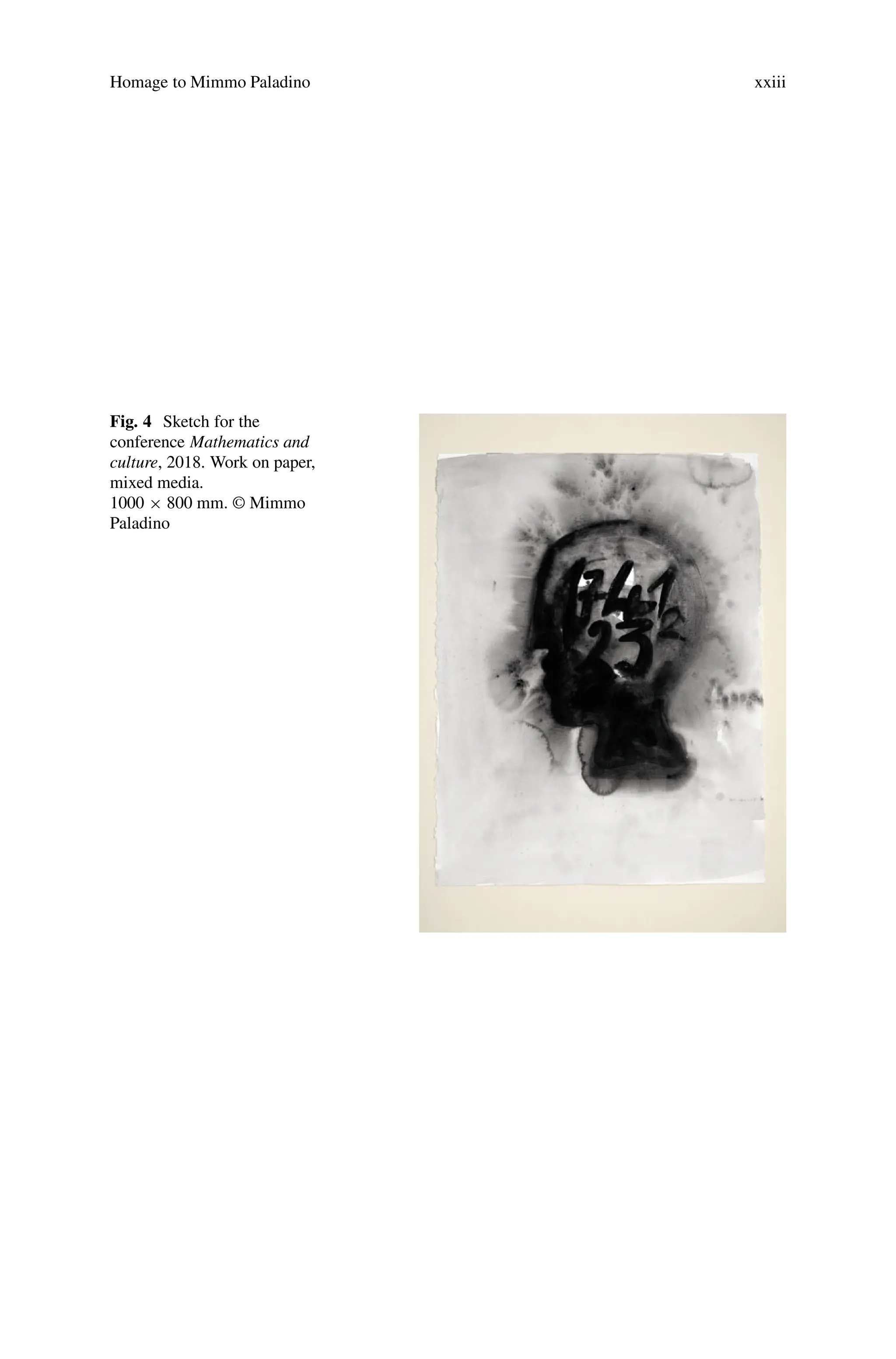


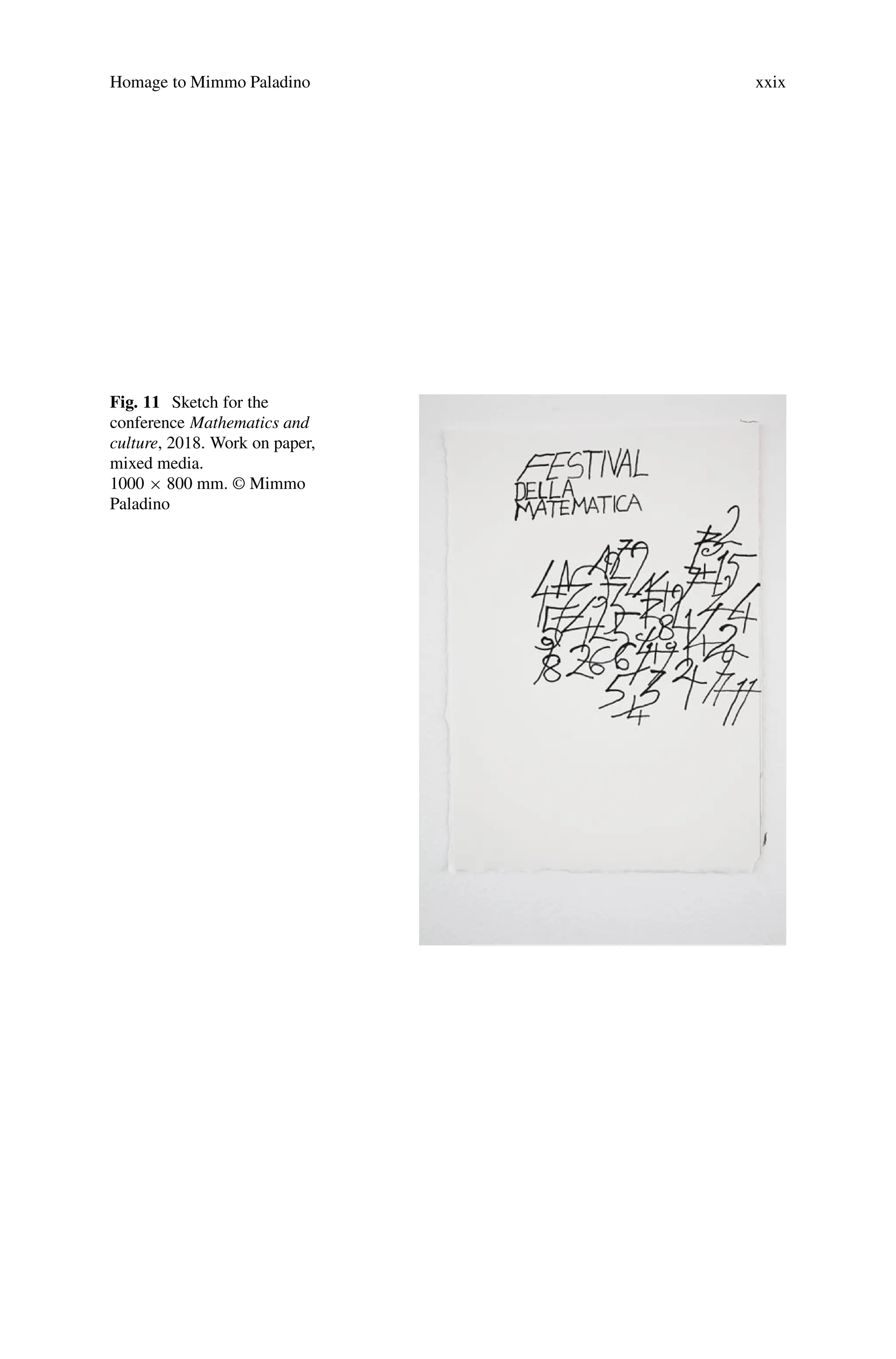


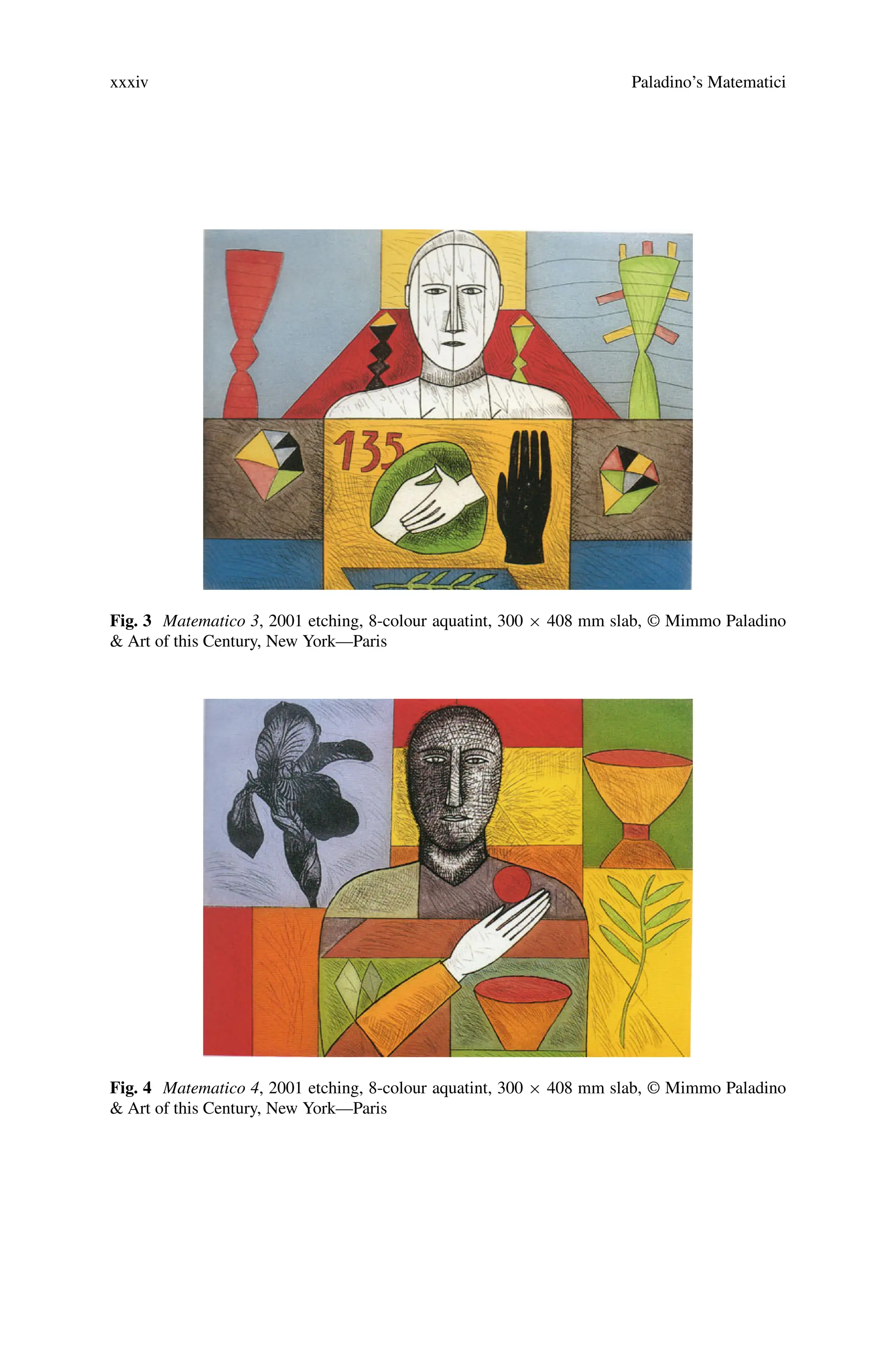
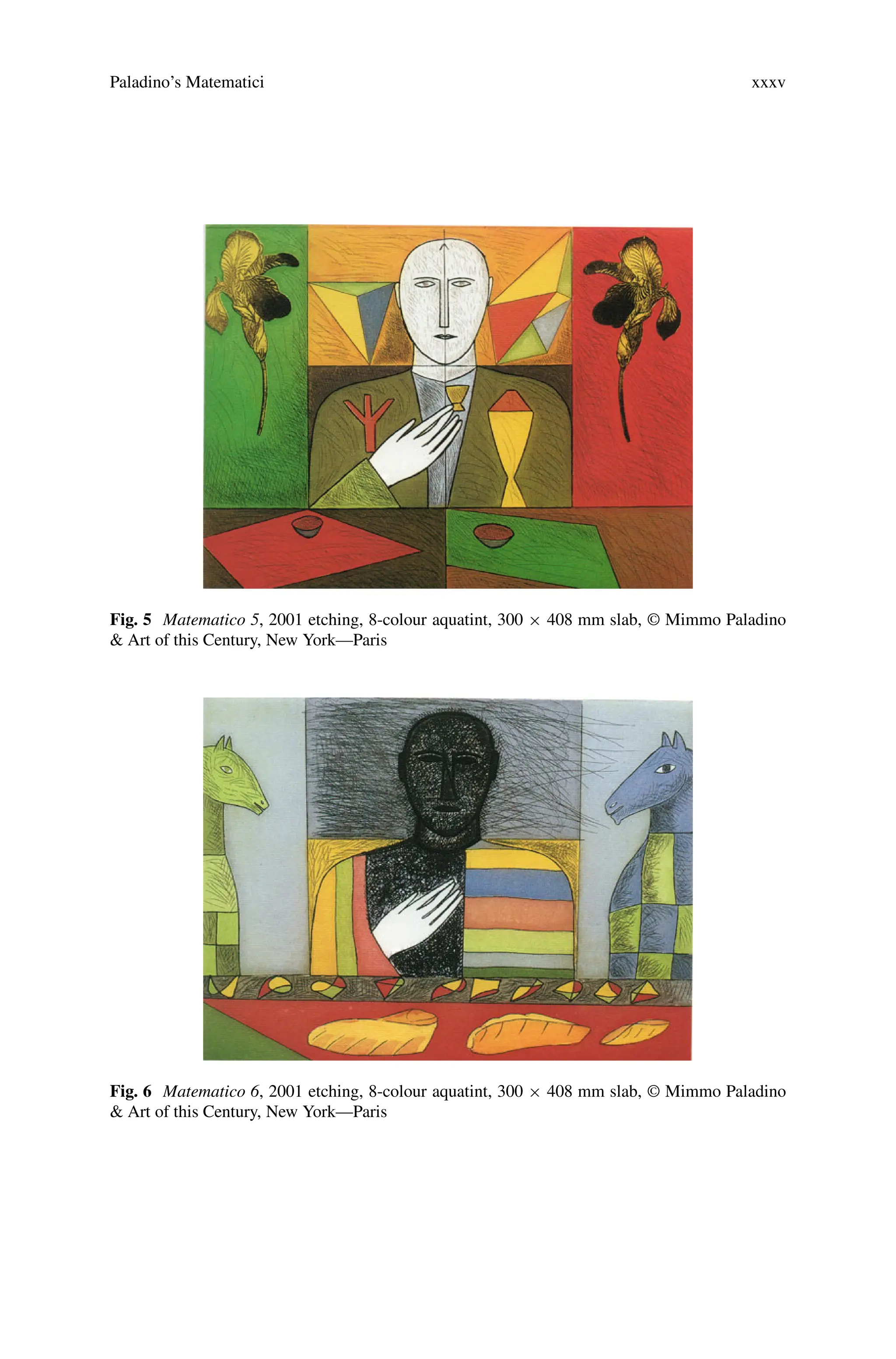

![Homage to Bauhaus, April 1, 1919
Michele Emmer
The Staatliches Bauhaus or simply Bauhaus (building house) was founded by
Walter Gropius in Weimar, Germany, in 1919. The opening date is considered
April 1, 1919. One hundred years later the meeting of Mathematics and Culture,
Imagine math 7, took place in Venice with the opening dedicated to the Bauhaus
anniversary. In April 1919 Gropius wrote a text that is usually called Bauhaus
Manifesto (Programs Staatlichen Bauhauses in Weimar) in which he traced the
guidelines of the Bauhaus: Charles W. Haxthausen wrote in the catalogue of the
important exhibition Workshops for Modernity: Bauhaus 1919–1933, at the MoMa,
The Museum of Modern Art, in New York, November 8, 2009–January, 25, 2010
[1]:
The Manifesto is the founding proclamation of an institution that has become synonymous
with visual modernity, exerting a profound influence on design, artistic practice, and
art education that extends down to our own day . . . The text is a fervently utopian one-
page mission statement and two-page program outlining the principles and pedagogical
organization of the school. The text precedes from the premise that painting, sculpture
and architecture, once integrated in a great building have become mutually isolated, to the
detriment of all three. The goal of the Bauhaus is to reunite them . . . Gropius concludes his
Manifesto with a heady exhortation:
Let us collectively desire, conceive, and create the new building of the future, which will
be everything in one structure: architecture and sculpture and painting, which . . . will one
day rise together towards heaven as the crystalline symbol of a new and coming faith.
The school started in Weimar from 1919 to 1925, then in Dessau from 1925 to
1932 and in Berlin from 1932 to 1933. Gropius was the director from 1919 till 1928.
Hannes Meyer from 1928 till 1930, and Ludwig Mies van der Rohe from 1930 until
1933 when the school was closed under the pressure of the Nazi regime.
M. Emmer ()
Sapienza University of Rome (retired), Rome, Italy
IVSLA – Istituto Veneto di Scienze, Lettere ed Arti, Venice, Italy
e-mail: emmer@mat.uniroma1.it
© Springer Nature Switzerland AG 2020
M. Emmer, M. Abate (eds.), Imagine Math 7,
https://doi.org/10.1007/978-3-030-42653-8_1
3](https://image.slidesharecdn.com/11212768-250607171146-ddac16e8/75/Imagine-Math-7-Between-Culture-And-Mathematics-1st-Ed-Michele-Emmer-36-2048.jpg)
![4 M. Emmer
Mathematics, Geometry had an important role in the years of the Bauhaus.
In the volumes of the series Mathematics and Culture and Imagine math several
papers were dedicated to geometry, mathematics and the Bauhaus, in particular in
connection with Paul Klee, Wassily Kandinsky and Max Bill [2–7]. It was Gropius
who asked Paul Klee to become one of the teachers at the Bauhaus in 1920.
Kandinsky was at the Bauhaus between 1922 and 1933. Bill was a student at the
Bauhaus. After learning that a new Bauhaus was to open in Dessau, Bill applied and
was accepted in April 1927 aged 18. Bill left the Bauhaus after 2 years without a
diploma “but with a lot of energy and ideas” wrote Angela Thomas Schmid (The
Max Bill Georges Vantongerloo Stiftung and Hauser Wirth), the curator for the
centenary of Bauhaus of a major exhibition in Zurich devoted to Max Bill.
References
1. C.W. Haxthausen, Walter Gropius and Lyonel Feininger Bauhaus Manifesto, in Workshops for
Modernity: Bauhaus 1919–1933, ed. by B. Bergdoll, L. Dickerman, catalogue; MoMa, The
Museum of Modern Art, New York, November 8, 2009–January 25 2010, pp. 64–67
2. D. Guderian, Mathematics in contemporary arts – finite and infinity, in Mathematics and Culture
II, ed. by M. Emmer, (Springer, Heidelberg, 2005), pp. 23–37
3. M. Emmer, Abstraction, in Mathematics and Culture VI, ed. by M. Emmer, (Springer,
Heidelberg, 2009), pp. 173–182
4. R. Giunti, Strands of complexity in art: Klee, Duchamp and Escher, in Mathematics and Culture
III, ed. by M. Emmer, (Springer, Heidelberg, 2012), pp. 97–107
5. A.C. Quintavalle, Max Bill at the Bauhaus between Klee and Kandinsky, in Imagine Maths 4,
ed. by M. Emmer, M. Abate, M. Villarreal, (UMI IVSLA publisher, Bologna, 2015), pp. 5–14
6. C. Leopold, The mathematical approach at Ulm School of Design, in Imagine Maths 4, ed. by
M. Emmer, M. Abate, M. Villarreal, (UMI IVSLA publisher, Bologna, 2015), pp. 15–27
7. M. Emmer, Max Bill: a journey through memories, in Imagine Maths 4, ed. by M. Emmer, M.
Abate, M. Villarreal, (UMI IVSLA publisher, Bologna, 2015), pp. 29–43](https://image.slidesharecdn.com/11212768-250607171146-ddac16e8/75/Imagine-Math-7-Between-Culture-And-Mathematics-1st-Ed-Michele-Emmer-37-2048.jpg)
![Paul Klee’s “Honey-Writing”
Some Reflections on the Relation
of Automatism, Automation, Machines,
and Mathematics
Michael Rottmann
Being capable to recognize a clear structure, I will get more
from this as from a lively, imaginary construction,and something
typical will result of series of examples automatically.1
Paul Klee 1902/1903 (23-years old)
Introduction
It may sound like a disenchantment: Paul Klee (1879–1940) devoted himself to
mathematics. Among other things he dealt with perspective, arithmetics (golden
section), topology and combinatorics (see [2], p. 133–135, 231–232, 252–253,
[3], p. 338). He owned books like Mathematisches Unterrichtswerk für höhere
Schulen (1929) [Textbook Mathematics for Secondary Schools] by Reinhard Zeis-
berg, Lebendige Mathematik (1929) [Vivid Mathematics] by Felix Auerbach and
Geometrisches Zeichnen (1920) [Geometrical Drawing] by Hugo Becker; The latter
served, marked up with pink notes, for preparation of lessons at the Bauhaus (see
[4], p. 38). If necessary, for example to gain “objectification and utmost precision”
in “pure geometric constructions”, the artist used for his artworks a “technical
equipment” like “drawing pen, pair of compasses, level, angular measure [and]
stencil” (see [5], p. 22) (Fig. 1). Taking “mathematical-abstract means of artistic
expression” and “geometric-constructive design principles” into consideration,
Christian Geelhaar even spoke of a “mathematization of the creative process” with a
view to Klee´s drawings around 1930 (see [6], p. 22, 63) (Fig. 2). This corresponds
with a “technological-rational objective” of the Bauhaus, which had begun with
1Here quoted after [1], p. 10 (All quotations translated by myself).
M. Rottmann ()
Academy of Art and Design FHNW Basel, IXDM – Institute of Experimental Design and Media
Cultures, Basel, Switzerland
© Springer Nature Switzerland AG 2020
M. Emmer, M. Abate (eds.), Imagine Math 7,
https://doi.org/10.1007/978-3-030-42653-8_2
5](https://image.slidesharecdn.com/11212768-250607171146-ddac16e8/75/Imagine-Math-7-Between-Culture-And-Mathematics-1st-Ed-Michele-Emmer-38-2048.jpg)
![6 M. Rottmann
Fig. 1 Paul Klee, Studio with rulers (Castle Suresnes, Werneck-street 1, Munich, 1920), in [1],
p. 15
Fig. 2 Paul Klee, Spiegellauf eines Thema über 4 kubische Flächen (centralperspectivische
Grundconstr.) (1931), 220, pen on paper on cardboard, 47.9 × 31.4 cm, Zentrum Paul Klee, Bern.
Photo: Zentrum Paul Klee, Bern](https://image.slidesharecdn.com/11212768-250607171146-ddac16e8/75/Imagine-Math-7-Between-Culture-And-Mathematics-1st-Ed-Michele-Emmer-39-2048.jpg)
![Paul Klee’s “Honey-Writing” Some Reflections on the Relation of Automatism,... 7
its movement from Weimar to Dessau in 1925 (see [5], p. 22). A “scientific-rational
thinking” predominated especially since 1928 with the headship of architect Hannes
Meyer (see [7], p. 33).
Fig. 3 Paul Klee, Bildnerische Gestaltungslehre: I.2 Principielle Ordnung (undated), crayon on
paper (recto), 15/14.3 × 33 cm, Zentrum Paul Klee, Bern, Inv. Nr. BG I.2/175. Photo: Zentrum
Paul Klee, Bern
Mathematics was linked by Klee to his artistic subjects like dynamics, movement
or vibration (see [5], p. 8, [1], p. 18–21). So a huge amount of mathematical
notes can be found in his graphical sheets and (pedagogical) writings: They are
criss-crossed by series of numbers, geometrical design drawings, “examples of
shaping and diagrams” as well as charts with numerical entries ([5], p. 7). One
has to consider: Klee was rooted in drawing: since he was a child he did drawings,
which led him to painting ([5], p. 7). In particular he described issues of creation
with numerical orders.2 For example exists a sheet of his Principielle Ordnung
(Bildnerische Gestaltungslehre), on which he described the principle of a gradual
overlay of colours for transitions from “white” via “grey” to “black” graphically,
diagrammatically in a chart and last but not least numerically with a geometrical
“progression” (Fig. 3).3 Klee noted once: “The artificial measurement allows a
numerical exact control of steps and with it a synthetic way of proceeding in the
representation of scales from brightness to darkness” (see [1], p. 10).
In such a way Klee worked in his watercolour Zwei Gänge (1932) (Fig. 4) and
before in his black-watercolours (Schwarzaquarelle) like Uhr auf der Kredenz, bei
Kerzenlicht (1908) and Blick in eine Schlafkammer (1908) (see [5], p. 12) (Fig. 5).
2Several publications in Klee’s estate like Farbennormung auf mathematischer Grundlage by
K. Koelsch Munich (undated) show his interest in an arithmetical treatment of artistic issues.
See [8].
3Something comparable can be found in colour theory (earlier in Michel Eugène Chevreul, later in
Josef Albers).](https://image.slidesharecdn.com/11212768-250607171146-ddac16e8/75/Imagine-Math-7-Between-Culture-And-Mathematics-1st-Ed-Michele-Emmer-40-2048.jpg)
![8 M. Rottmann
Fig. 4 Paul Klee, Zwei Gänge [Two Ways] (1932), watercolour on paper, mounted to paper,
31.3 × 48.4 cm, mount: 44.3 × 61 cm, Solomon R. Guggenheim Museum, New York, Estate
of Karl Nierendorf, by purchase. Photo: © Solomon R. Guggenheim Museum
Geelhaar explained: “he summarized layer by layer of diluted black watercolour, to
move stepwise into a shady darkness”. In doing so he kept “the steps of tones from
white to black pure” ([5], p. 12, [6], p. 21). Following Geelhaar a “mathematical
light-dark-proportion” arose of it, whereat Klee had remarked that the “structured
arrangement” reminds of “gamuts” and “musical scales” ([5], p. 12–13). There is
talk about a “light-dark-procedure of time measurement” (see [6], p. 23). Music
played for Klee in his whole life an important role. His father was a music teacher,
his mother a singer (see [6], p. 14, [5], p. 9). Klee himself played excellently violin
and wrote reviews; music, he once explained, would be a “lover”, but painting an
“oil-smelling brush-goddes, which I only embrace, because of being my wife” (see
[3], p. 336).
Music anyhow can explain why Klee worked in fine arts with notations (see [3]),
what will be discussed later in more detail, and as a time-based artform it offers a
reference to problems like “movement” as well as “space and time”, which were
so important for the artist (see [6], p. 10). It was one of his central tasks to mediate
movement or chronological sequence in a static image (see [5], p. 8–9). One solution
was colour gradients. Like in Scheidung Abends (1922) and in Statisch-Dynamische
Steigerung (1923) they evoke dynamics and direct the gaze of the viewer—here in](https://image.slidesharecdn.com/11212768-250607171146-ddac16e8/75/Imagine-Math-7-Between-Culture-And-Mathematics-1st-Ed-Michele-Emmer-41-2048.jpg)
![Paul Klee’s “Honey-Writing” Some Reflections on the Relation of Automatism,... 9
Fig. 5 Paul Klee, Blick in eine Schlafkammer (1908), watercolour on paper, mounted to card-
board, 30 × 23.6 cm, Kunstmuseum Basel. Photo: Kunstmuseum Basel, public domain: http://
sammlungonline.kunstmuseumbasel.ch/eMuseumPlus (20.09.2019)
a vertical or spiral way (Figs. 6 and 7).4 Klee took the view that media of fine arts
are time-based and that was why he criticised Lessing’s Laokoon (see [9], p. 78).
With a view to the foregoing the following description about Paul Klee is quite
well understandable: in the case of Klee we have a “highly reflected, technical
subtle art” ([10], p. 100). This was said to distinguish his creative activity from
“the surrealist practice of loss of control”, because Klee’s one was treated again
and again by the surrealist’s automatic writing (écriture automatique).5 One thing
is for certain, Klee knew the surrealists and in 1925 they had a common exhibition
in Paris (see [5], p. 29). But even the first French review disagreed the view of Louis
Aragon that Klee got his artworks “dictated automatically” by his subconscious,
because his art is about planned spontaneity (here quoted after [11], p. 12). Since
4On the theorisation by Klee see [1], p. 10.
5Recently the exhibition Paul Klee und die Surrealisten at Zentrum Paul Klee, Bern was dealing
with that connex (see [10]).](https://image.slidesharecdn.com/11212768-250607171146-ddac16e8/75/Imagine-Math-7-Between-Culture-And-Mathematics-1st-Ed-Michele-Emmer-42-2048.jpg)
![10 M. Rottmann
Fig. 6 Paul Klee, Scheidung Abends (1922), 79, watercolour and pencil on paper on cardboard,
33.5 × 23.2 cm, Zentrum Paul Klee, Bern, Gift Livia Klee. Photo: Zentrum Paul Klee, Bern
then the connex is rated in the research debate as ambivalent.6 While Uwe M.
Schneede saw the issue as purely “superficial”, Michael Baumgartner pled for a
relativisation of this view, he asked to consider that the “psychic automatism” has
been an important aspect in Klee’s “artistic self-discovery”—but that has happened
earlier than the surrealists (see [11], p. 12); drawing had been described by Klee
as a “primordial territory of psychological improvisation”, the related drawings as
“psychograms” (here quoted after [10], p. 100). In this sense Christian Geelhaar
saw in such drawings, “in which inner feelings and the unconscious tell themselves
suddenly to the seismographically registering hand” a counterpart to the objective
ones of the Dessau period mentioned before, which are “cleaned from subjective
movement” (see [5], p. 22). As an example the art historian gave bewölktes Gebirg
6Concerning the discourse see [11], footnote 31.](https://image.slidesharecdn.com/11212768-250607171146-ddac16e8/75/Imagine-Math-7-Between-Culture-And-Mathematics-1st-Ed-Michele-Emmer-43-2048.jpg)
![Paul Klee’s “Honey-Writing” Some Reflections on the Relation of Automatism,... 11
Fig. 7 Paul Klee, Statisch-Dynamische Steigerung [Static Dynamic Gradation] (1923), oil
and gouache on paper bordered with gouache, watercolour, and ink, mounted on cardboard,
38.1 × 26.1 cm, The Met, The Berggruen Klee Collection, 1987. Photo: bpk | The Metropolitan
Museum of Art
(1932) with its mellifluous pencil lines, which are drawn through, what goes also
for die Bucht (1930) (Fig. 8) and Baumschlag (1931). Geelhaar explained: “The
intellectual control in the creative process is turned off as far as possible and
the invention is given over to the automatically gliding inkstand” ([5], p. 22).
But a closed line could become (with regard to Ludwig Klages’ physiognomy of
movement) also an “expression of ratio”, at any rate when it appears as a zig-zag
band with sudden changes of direction like in Der Wille (1933) (Fig. 9), how Régine
Bonnefoit suggested (see [12], p. 56–57). Anyway, Klee called his procedure of a](https://image.slidesharecdn.com/11212768-250607171146-ddac16e8/75/Imagine-Math-7-Between-Culture-And-Mathematics-1st-Ed-Michele-Emmer-44-2048.jpg)
![12 M. Rottmann
Fig. 8 Paul Klee, die Bucht (1930), 96, pencil on paper on cardboard, 32.9 × 41.9 cm, Zentrum
Paul Klee, Bern
mellifluous graphical expression laconically and perhaps as a replica to the écriture
automatique: “honey-writing” (“Honigschrift”) (here quoted after [5], p. 22).7
It is hardly surprising that a tension was made out in research literature: On the
one hand exists the “painter of enchanted fairytales and dreamworlds, which he
showed off to advantage in his pictures out of a highly imaginative internalization as
it were a psychic automatism, like postulated by the surrealists”.8 On the other hand
becomes clear, “that he made his pictures often in a calculating and planned manner”
(see [13], p. 7, [14], p. 9).9 An explanation for this phenomenon can be deduced
from the coupled terms “intuition” and “construction” as they were used by Klee.10
7We have to consider that he did not speak about “honey-graphics” (“Honiggrafik”).
8Klee himself backed up this view in his dairies and notes (see [13], p. 7).
9Very similarly Itten said in retrospect: “The creative automatism was recognized by myself as
one of the most important factors of artistic production. I worked myself with geometrical-abstract
images, which were based on careful constructions” ([15], p. 9).
10Which was subject of an exhibition of Mannheimer Kunsthalle in 1990 (see [13]). Here it
becomes clear that art history also reproduces a dualistic thinking, which postructuralism would
like to know as overcomed (see [16]).](https://image.slidesharecdn.com/11212768-250607171146-ddac16e8/75/Imagine-Math-7-Between-Culture-And-Mathematics-1st-Ed-Michele-Emmer-45-2048.jpg)
![Paul Klee’s “Honey-Writing” Some Reflections on the Relation of Automatism,... 13
Fig. 9 Paul Klee, Der Wille (1933), 11, brush on grounding on paper on cardboard,
31.5 × 27.8 cm, private collection Switzerland, permanent loan Zentrum Paul Klee, Bern
“Intuition” was understood in general language usage of the 1920s in Germany
according to Henri Bergson as an “intuitive, immediately imagined insight, without
intellectual operation” (see [17], p. 498). It is remarkable that “intuition” and
“construction” were also treated in the 1920s in mathematics—within so-called
Intuitionism of Dutch mathematician Luitzen Egbertus Jan Brouwer (see [18], p.
191).11
In our context the coupled terms are also of interest, because Klee in his text
Exakte Versuche im Bereich der Kunst (1928) connected them with art and sciences
and said in the course of this something about the role of mathematics. While art
11An examination of the relation of these terms would be interesting, but cannot be done here.](https://image.slidesharecdn.com/11212768-250607171146-ddac16e8/75/Imagine-Math-7-Between-Culture-And-Mathematics-1st-Ed-Michele-Emmer-46-2048.jpg)
![14 M. Rottmann
works with intuition, following Klee, sciences are exact and “logical”.12 But also
in arts “exact research” would be possible and: “Mathematics and physics provide
for it a way of handling in sort of rules for backpedalling and for difference” ([19],
p. 69). At Bauhaus such an approach of receiving scientific procedures in fine arts
could find favour: for architects this was daily business and Klee’s colleague and
compatriot Johannes Itten had even studied mathematics (see [20], p. 12). Klee
praised the advantages of this approach, but he was also warning that intuition and
genius would be indispensable in fine arts (see [19], p. 69–70).
Against this background hereafter the role of mathematics in the creative process
and its conception will be examined in a perspective of production aesthetics. (There
shall be no proof of the reception of certain mathematical issues or its reconstruction
in artworks.) This will be done with a view to Klee’s drawings13 as well as his other
graphical and written output. A focus is on his Bauhaus years—Klee had begun
to teach in 1920 at Weimar as a master and changed in 1931 to the Academy of
Fine Arts in Düsseldorf.14 On the one hand the development of his pedagogy was
accompanied by a reflection of his own creative work; for him practice, theory and
teaching should “go together” (see [1], p. 9, 21, 30). On the other hand during his
“Bauhaus-decade” Klee dedicated himself increasingly to “principles” whereby the
tension of “schematism” and “phantasy” appeared (see [5], p. 19–20).
In a first part Klee’s theory of creation (Schöpfungstheorie) will be reconstructed
together with his terms “intuition” and “construction” and the role of mathematics
demonstrated. This enables a clarification of the relation to surrealist automatism.
In a second part shall be examined in which way Klee’s graphisms—notations and
operative images like diagrams, which he used in a very different manner—were
useful for his creative process (see [21]). This examination is also about questions of
finding an image or an artwork (Bild- bzw. Werkfindung). With respect to this I will
refer to theories of design, draft, notation, diagrammatics and notational iconicity.
One hypothesis is that in the work of Klee, who had a pronounced interest in
machines, mathematics and his machine thinking are connected and with regard
to the concept of “symbolic machines” (see [22], p. 3) by Sybille Krämer, that
especially the mathematical plays together with his graphical machines to realise
a kind of automation—the already mentioned adjective “automatic” also relates
to this meaning—and in this way an oblivion of sense. Thus the mathematical
mediates between construction and intuition. That is why the approach here is to
think automatism, automation, machines and mathematics together.
12In sciences intuition would be helpful and speeds up, but not absolutely necessary (see [19], p.
69).
13Here will be focused on drawings, because the work processes in Klee are in principle extending
over longer periods up to years (see [12], p. 11).
14He had almost a vocation at the Academy of Fine Arts in Stuttgart as a successor of Adolf
Hoelzel (see [1], p. 17).](https://image.slidesharecdn.com/11212768-250607171146-ddac16e8/75/Imagine-Math-7-Between-Culture-And-Mathematics-1st-Ed-Michele-Emmer-47-2048.jpg)
![Paul Klee’s “Honey-Writing” Some Reflections on the Relation of Automatism,... 15
Klee’s Theory of Creation: Construction/Intuition
Construction and intuition seem to be in a tension, especially with regard to “Klee’s
demand for [ . . .] freedom of the artist” (see [14], p. 9). In contrast to this Hans-
Jürgen Buderer demonstrated an explanatory model, which mediates.15 According
to him the relation could not be resolved by a replacement of construction by
intuition, rather exists an interplay of opposites, a “necessary dipolarity of two
basically interdependent moments of creative labor [ . . . ]” (see [14], p. 10), which
was also pointed by Klee. In Exakte Versuche the artist had explained: “We construct
and construct, but intuition is still a good thing. Without it one can do considerable
things, but not all” ([19], p. 69). On the basis of a reconstruction of his writings
Buderer described intuition as an “area”, “in which the artist creates, independent
from the forms of appearance of nature and its inner structures, a new autonomous
order of image-effective relations” (see [14], p. 19).16 In doing so he would be
obliged to the “laws of creation” (“Gesetze[n] des Bildnerischen”, [14], p. 19),
which he could not determine himself, because they would be “immanent to the
means of creation” (“bildnerischen Mittel[n]”).
This and in particular Klee’s “demand for an exact analysis of the means
of creation” (see [14], p. 14) becomes better understandable with a more exact
consideration of his theory of creation (Schöpfungstheorie). (In the 1920/30s one
speaks in German language about “creation” (“Schöpfung”, see [23], p. 780) in
the sense of a “creative act” (“Schaffensakt”) instead of “creativity”.) This is also
instructive, because his thinking about nature and machines appears in it. An
essential precondition for artistic work Klee saw in the knowledge of “visual basic
elements” (“bildnerischen Grundelemente”, [14], p. 9) like line, light–dark tone
and colour, on which he focused firstly in his teaching. He analysed extensively
the appearance, the kinesic behaviour as well as the ways of expressions of lines
and areas (see [14], p. 11). The course of his teaching programme shows that his
examinations went on successively from “single visual basic elements” (see [14],
p. 12) via its “relational dependences” to “a regularity [in the sense of a principle],
which determines the unity of appearance”. Dealing with mathematics and physics
could be helpful for this purpose, at first with functions then with forms, how he
advised in Exakte Versuche (see [19], p. 69). Furthermore he explained:
Algebraic, geometric tasks are moments of training towards the essential and the functional
in opposite to the impressive. One learns to see behind the curtain, seizing a thing by its
root. One learns to recognize what pours underneath, learns the prehistory of the visible.
Learns digging into depth, learns to uncover. Learns to give reasons, learns to analyse ([19],
p. 69).
15Related reflections on transcendental, religious and metaphysical aspects cannot be considered
here (see [7]).
16With this concept raises the discussable question: Does not the artist become a creator, who
overcomes the regularities and constraints of the world?](https://image.slidesharecdn.com/11212768-250607171146-ddac16e8/75/Imagine-Math-7-Between-Culture-And-Mathematics-1st-Ed-Michele-Emmer-48-2048.jpg)
![16 M. Rottmann
Klee was especially interested in the relational interplay of visual basic elements.
Long before structuralist thinking of the 1960s (and its reception in fine arts) he used
the term “structure” (see [2], p. 217) and was speaking about the image as a “set of
structures” (here quoted after [14], p. 13), when a pictorial unit repeats regularly
or rhythmically. Klee pursued the essential, procedural and functional. In nature—
which he called an “original area of creation” (see [6], p. 54–55)—structures as well
as processes could be studied and transformed into regularities.
In his lecture Organismus als Bewegungsmaschine Klee discussed the interplay
of bones, bands and muscles of man, in another lecture that one of water, drive
belts and wheels with the example of a watermill (Fig. 10) (see [24], p. 345).
Following Buderer they are metaphors for universal or cosmic laws, its restrictions
and interactions (see [14], p. 13).
In this context Klee himself explained an important aim: “The artistic is about
creating movement on the basis of the law and differences with reference to the
lawful” (see [2], p. 152). At the same time he warned: “Taking the lawful too
seriously will lead into a droughty area” (see [2], p. 152).17 With the consideration
of mathematics and physics one would not only learn “logic”, but also “to organize
movement by logical relationships” ([19], p. 69). According to Buderer in Klee the
image could be seen as an “organism of movement” (“Bewegungsorganismus”, see
[14], p. 12–13)—to understand this one needs the analysis of the basic elements as
mentioned before. Movement can be regarded in every respect as central in Klee:
In the process of production and reception (the hand, which draws, the eye, which
observes) and finally in the “creative process” (see [14], p. 19, [5], p. 8–9) itself.
Buderer explained:
On the one hand, by requesting the artist to interrupt his action after a first “initial
movement” (“Initialbewegung”) and to check his arrangement in a receptive manner, and to
control, if the way of the eye conclusively follows the parts of the image. On the other hand
he sees movement between production and reception, but also as an process of actuating the
stepwise developed regularities (see [14], p. 19).
A decisive aspect here is, in a synopsis of the examples mentioned by Klee not
only man and machine were brought together, but one can get also with respect to
Buderer a characterisation of “intution” and the artist´s conception of “creation”:
Nature and image behave analogue (see [14], p. 13–14). In each case elements and
motion sequences are determined by inner (genetics/ways of expression) and outer
conditions (clima/receptive impact). But the example of the watermill shows that
its appearance is determined also by its function—“the driving of the hammer” (see
[14], p. 13–14)—so the “creative acting gains freedom for an order, which is going
beyond the specific means, and which results from the will of the artist to act and
shape”. And the “freedom of developing an image structure, as much it has to follow
its inner law-structure”, characterises “the image as creative act, which is in the end
17Klee also said “that laws should be only a basis, so it is blooming on them . . . That laws are only
common basis for nature and art” (here quoted after [5], p. 20).](https://image.slidesharecdn.com/11212768-250607171146-ddac16e8/75/Imagine-Math-7-Between-Culture-And-Mathematics-1st-Ed-Michele-Emmer-49-2048.jpg)
![Paul Klee’s “Honey-Writing” Some Reflections on the Relation of Automatism,... 17
Fig. 10 Paul Klee, Beiträge zur bildnerischen Formlehre [water mill] (undated), pen and crayon
on paper, 20.2 × 16.3 cm, Zentrum Paul Klee, Bern, Inv. Nr. BF/92. Photo: Zentrum Paul Klee,
Bern
independent from nature and forms of appearance of the empiric world” (see [14],
p. 13–14). Buderer summarised:
To uncover the possibilities of a process of creation, which are lying safe in its origin and
which can be developed in the course of the complex process of artistic acting, is the benefit
of intuition (see [14], p. 21).](https://image.slidesharecdn.com/11212768-250607171146-ddac16e8/75/Imagine-Math-7-Between-Culture-And-Mathematics-1st-Ed-Michele-Emmer-50-2048.jpg)
![18 M. Rottmann
In other words, “intuition” is a “mental potential”, which serves in the act of
creation, “to use the insights concerning the laws of the means of creation like line,
light-dark and colour, which were made understandable, in such a way, that the
possibilities of creation, hidden in that means, can flower” ([7], p. 34).
At this point a more exact differentiation of Klee and surrealism can be made
with Buderer: It seems that surrealism had monopolised Klee, because of his
examination of pictorial representation in arts and his anti-academicism, but a closer
look shows, while surrealism was aimed at a negation of art, Klee in contrast
pursued a “change of traditional forms of appearance and the aesthetic canon of
norms” (see [14], p. 22–23). Something comparable goes also for automatism:
André Breton diagnosed in his first Manifest of Surrealism (1924) the drawing
of Klee as “partial automatism” (Breton, here quoted after [14], p. 22) and as
statements “from the depths of human mind”. According to Breton automatism
serves to overcome “positivism, which determines art and sciences with its clarity
on the verge of stupidity‘“ (see [14], p. 23). Infantile fantasy, intuition, emotion and
chance would aim at the elimination of “planning mental control” and thus of any
“logical structuring” (see [14], p. 23). In this way only the “psychic-physiological
state of the artist” should be included in the image (see [14], p. 23). In Klee, on the
other hand, the image would be a reification of a “pictorial regularity, an inner logic
and conclusiveness”, which has to be checked in the process of creation and which
shall be fulfilled while observing (see [14], p. 23). Thus it can be said: “Freedom
and intuition are means for dealing with the laws of effect concerning the pictorial,
but do not question its validity” (see [14], p. 23).18
Insofar it is quite fitting that Klee’s relationship with mathematics is quite
different to that one of the surrealists. For Klee dealing with mathematics was as
fruitful as it was with nature and machines, whereas the surrealists pointed out the
lack of the mathematical language and did “work on the myth”, to legitimise their
anti-rationalistic art (see [25], in particular p. 13–14, see also [26], p. 38).
Although one can talk about a general principle of creation in Klee, in which
intuition plays an important role, the introduced spectrum of case examples—
from geometrical design drawings via prearranged watercolours to drawings in the
mode of “honey-writing”—shows that his processes of creation were actually quite
different. So we will have now a closer look to his graphical practices.
Painted, Built and Mathematical–Graphical Machines
Already with Klee’s watermill metaphor was indications that he owned an inter-
est for mechanical machines. He made them even a subject in his pictures
18Klee’s conception would be closer to cubism than surrealism.](https://image.slidesharecdn.com/11212768-250607171146-ddac16e8/75/Imagine-Math-7-Between-Culture-And-Mathematics-1st-Ed-Michele-Emmer-51-2048.jpg)
![Paul Klee’s “Honey-Writing” Some Reflections on the Relation of Automatism,... 19
Fig. 11 Paul Klee, Kleine Experimentier Maschine (1921), 11, oil transfer drawing and water-
colour on paper on cardboard, 23.5 × 31.2 cm, location unknown. Photo: Zentrum Paul Klee,
Bern
Zwitscher-Maschine (1922)19 and Kleine Experimentier Maschine (1921) (Fig. 11).
We have to consider, in the 1920s machines usually were still understood in
Germany as devices, which transmitted forces in a mechanical or electrical manner,
but not yet information; this applied to “working machines” in industry, as well as
automobiles and airplanes (see [30], p. 205–206). In this direction Klee once said:
“The swimmer in the kingdom of heaven (the aviator or sailor) must identify with
its machine and unified with it, he can indulge in new possibilities of movement”
[31].
In this respect at the Bauhaus machines were not only subjects of paintings,
but also built and usable objects. The latter were used as applied machines and
as artist’s machines. In the sense of the modern spirit design objects were fabricated
with machines (in workshops). Lazlo Moholy-Nagy developed 1930 his Light-
Space-Modulator (Licht-Raum-Modulator), which was introduced at an exhibition
of German design in the same year as a generator for lighting and motion effects on
19The work was interpreted as a satire of labour sciences (see [27], p. 79), as a questioning of the
purpose of machines (see [28], p. 84) and as a proof for Klee’s general interest in the relations of
animal and machine as well as organism and mechanism (see [29], p. 240–241).](https://image.slidesharecdn.com/11212768-250607171146-ddac16e8/75/Imagine-Math-7-Between-Culture-And-Mathematics-1st-Ed-Michele-Emmer-52-2048.jpg)
![20 M. Rottmann
a stage—dynamics was an important parameter of modernity from which futurism
bears witness.20 From a today’s point of view this machine creates ephemeral
moving images. Klee himself, who understood the image of a traditional panel
painting as a “moving machine” (“Bewegungsmaschine”, [4], p. 123), reworked
around 1940 a commercial projector (see [32, 33]).
A closer look shows that Klee’s relationship to machines was ambivalent. When
he once in 1921 said that “music without dynamics sounds machine-like and
inexpressive”, this seems in a certain manner pejorative (see [2], p. 285). There
was already a talk in society about a “machine age” (see [30], p. 214). The
growing penetration of the world of work was discussed critically in the 1920s, the
substitution of man was perceived also as threatening. In this context a statement
of Klee appears like a positioning: “How the machine functions, is not bad, how
life functions is more. Life fathers and gives birth. When will the worn machine
have children?” (see [34], p. 59). Machines were seen as useful, but in comparison
with man they were seen as in deficit. An examination of the social dimension was
made out in Klee’s interest in puppets like in his watercolour Puppentheater (1923):
“The assault of the machine-world on the body is represented by the puppet, which
is in truth, although it shows human features, a pure mechanical being” ([10], p.
210). With a view to its title Klee’s watercolour Analÿse verschiedener Perversitäten
[Analysis of different perversities] (1922) can be understood as a critique when the
natural, the technical and the human interact in a mechanical manner (Fig. 12).
It is remarkable that the watercolour was created in the same year 1922 when
Oskar Schlemmer’s Triadisches Ballett was premiered and early literary treatments
of the machine age like Karel Čapek’s W.U.R.—Werstands Universal Robots (first
German translation), which produces our today’s term “Robot”, and Ernst Toller’s
The Machine Wreckers (Die Maschinenstürmer) were published. Both made the
man–machine relation an issue. Fritz Lang’s film Metropolis (1927) and Charlie
Chaplin’s Modern Times (1937) should follow.
Against this background shall be now taken a closer look at Klee’s graphisms and
his graphical practices. One has to consider quit different contexts and functions:
Graphisms can be find in notes, in his theoretical and in his teaching material
(for visualisation) as well as in sketches or artwork-like drawings. It is a crucial
aspect that the artist did not only work with sketches, to record or prepare ideas
in a pictorial manner, but also with graphical means like the list, the chart and the
diagram, to develop works on paper. The latter exist also as very complex ones, often
filled with extensive calculations—how it could be already seen in the example at the
beginning of this text (Fig. 3). Just the notation of the mathematical calculus, which
is equipped with a system of rules, was described by media philosopher Sybille
Krämer as a “symbolic machine” ([22]), because with it could be operated quasi-
mechanically and achieved results, without knowing the meaning of the symbols (to
a certain degree). This concept shall serve in the following as a figure of thought,
even when Klee worked not with the calculus itself and not only with notations.
20For the relationship of futurism, Klee and the machine see [14], p. 22.](https://image.slidesharecdn.com/11212768-250607171146-ddac16e8/75/Imagine-Math-7-Between-Culture-And-Mathematics-1st-Ed-Michele-Emmer-53-2048.jpg)
![Paul Klee’s “Honey-Writing” Some Reflections on the Relation of Automatism,... 21
Fig. 12 Paul Klee, Analÿse verschiedener Perversitäten (1922), China chalk and watercolour on
paper on cardboard, 47 × 31.4 cm, Centre Georges Pompidou, Paris. Photo: Philippe Migeat—
Centre Pompidou, MNAM-CCI/Dist. RMN-GP, public domain: https://www.centrepompidou.fr/
cpv/resource/cbqL49o/rajyr4g
Rather he made single mathematical procedures his own (Anverwandlung). On a
sheet of his Bildnerische Gestaltungslehre/Specielle Ordnung he applied geomet-
rical transformations like translation (“Schiebung”), reflection (“Spiegelung”) and
rotation (“Drehung”) on graphical elements (Fig. 13).21 In particular he did so to
generate patterns or formal configurations. Often Klee puts forms of the same kind
on a sheet, among them geometrical ones like the triangle or the rectangle, which
he subdivided (regularly), so that fields came into being, which could be filled
with colours as well as with words, letters or numbers. Well comprehensible Birgit
Schneider pointed out: In such a manner issues like colour configurations could not
21For the aspect of axis of reflection see [6], p. 82–83. Very similar Klee works in other sheets (see
[35], p. 274–275).](https://image.slidesharecdn.com/11212768-250607171146-ddac16e8/75/Imagine-Math-7-Between-Culture-And-Mathematics-1st-Ed-Michele-Emmer-54-2048.jpg)

![him a daughter, whom he acknowledged and declared to be his heir, her
paternity was maliciously ascribed to Beltran de la Cueva, and she was
known by the opposite party as La Beltraneja. Though Henry had been
forced by his nobles to set aside her claims in favor of his brother Alfonso
in the Declaration of Cabezon, in 1464, and, after Alfonso’s death, in favor
of Isabella, in 1468, the latter’s marriage, in 1469, with Ferdinand of
Aragon so angered him that he betrothed Juana to Charles Duke of
Guienne, brother of Louis XI of France, and made the nobles of his faction
swear to acknowledge her. At his death he testified again to her legitimacy
and declared her to be his successor in a will which long remained hidden
and finally in 1504 fell under the control of Ferdinand, who ordered it
burnt.[52] There was a powerful party pledged to support her rights, and
they were aided on the one hand by Affonso of Portugal and on the other by
Louis of France, each eager to profit by dismembering the unhappy land.
Some years of war, more cruel and bloody than even the preceding aimless
strife, were required to dispose of this formidable opposition—years which
tried to the utmost the ability of the young sovereigns and proved to their
subjects that at length they had rulers endowed with kingly qualities. The
decisive victory of Toro, won by Ferdinand over the Portuguese, March 1,
1476, virtually settled the result, although the final treaty was not signed
until 1479. The Beltraneja was given the alternative of marrying within six
months Prince Juan, son of Ferdinand and Isabella, then but two years old,
or of entering the Order of Santa Clara in a Portuguese house. She chose the
latter, but she never ceased to sign herself Yo la Reina, and her pretensions
were a frequent source of anxiety. She led a varied life, sometimes treated
as queen, with a court around her, and sometimes as a nun in her convent,
dying at last in 1531, at the age of seventy.[53]
Isabella was queen in fact as well as in name. Under the feudal system,
the husband of an heiress was so completely lord of the fief that, in the
Capitulations of Cervera, January 7, 1469, which preceded the marriage, the
Castilians carefully guarded the autonomy of their kingdom and Ferdinand
swore to observe the conditions.[54] Yet, on the death of Henry IV, he
imagined that he could disregard the compact, alleging that the crown of
Castile passed to the nearest male descendant, and that through his
grandfather, Ferdinand of Antequera, brother of Henry III, he was the
lawful heir. The position was, however, too doubtful and complicated for
him to insist on this; a short struggle convinced his consummate prudence](https://image.slidesharecdn.com/11212768-250607171146-ddac16e8/75/Imagine-Math-7-Between-Culture-And-Mathematics-1st-Ed-Michele-Emmer-56-2048.jpg)
![FERDINAND’S
CHARACTER
that it was wisdom to yield, and Isabella’s wifely tact facilitated submission.
It was agreed that their two names should appear on all papers, both their
heads on all coins, and that there should be a single seal with the arms of
Castile and Aragon. Thereafter they acted in concert which was rarely
disturbed. The strong individuality which characterized both conduced to
harmony, for neither of them allowed courtiers to gain undue influence. As
Pulgar says “The favorite of the king is the queen, the favorite of the queen
is the king.”[55]
Ferdinand, without being a truly great man, was
unquestionably the greatest monarch of an age not prolific
in greatness, the only contemporary whom he did not
wholly eclipse being Henry VII of England. Constant in adversity, not
unduly elated in prosperity, there was a stedfast equipoise in his character
which more than compensated for any lack of brilliancy. Far-seeing and
cautious, he took no decisive step that was not well prepared in advance
but, when the time came, he could strike, promptly and hard. Not naturally
cruel, he took no pleasure in human suffering, but he was pitiless when his
policy demanded. Dissimulation and deceit are too invariable an ingredient
of statecraft for us to censure him severely for the craftiness in which he
surpassed his rivals or for the mendacity in which he was an adept. Cold
and reserved, he preferred to inspire fear rather than to excite affection, but
he was well served and his insight into character gave him the most useful
faculty of a ruler, the ability to choose his instruments and to get from them
the best work which they were capable of performing, while gratitude for
past services never imposed on him any inconvenient obligations. He was
popularly accused of avarice, but the empty treasury left at his death
showed that acquisitiveness with him had been merely a means to an end.
[56] His religious convictions were sincere and moreover he recognized
wisely the invaluable aid which religion could lend to statesmanship at a
time when Latin Christianity was dominant without a rival. This was
especially the case in the ten years’ war with Granada, his conduct of which
would alone stamp him as a leader of men. The fool-hardy defiance of Abu-
l-Hacan when, in 1478, he haughtily refused to resume payment of the
tribute which for centuries had been imposed on Granada, and when, in
1481, he broke the existing truce by surprising Zahara, was a fortunate
occurrence which Ferdinand improved to the utmost. The unruly Castilian
nobles had been reduced to order, but they chafed under the unaccustomed](https://image.slidesharecdn.com/11212768-250607171146-ddac16e8/75/Imagine-Math-7-Between-Culture-And-Mathematics-1st-Ed-Michele-Emmer-57-2048.jpg)
![restraint. By giving their warlike instincts legitimate employment in a holy
cause, he was securing internal peace; by leading his armies personally, he
was winning the respect of his Castilian subjects who hated him as an
Aragonese, and he was training them to habits of obedience. By making
conquests for the crown of Castile he became naturalized and was no longer
a foreigner. It was more than a hundred years since a King of Castile had
led his chivalry to victory over the infidel, and national pride and religious
enthusiasm were enlisted in winning for him the personal authority
necessary for a sovereign, which had been forfeited since the murder of
Pedro the Cruel had established the bastard line upon the throne. It was by
such means as this, and not by the Inquisition that he started the movement
which converted feudal Spain into an absolute monarchy. His life’s work
was seen in the success with which, against heavy odds, he lifted Spain
from her obscurity in Europe to the foremost rank of Christian powers.
Yet amid the numerous acts of cruelty and duplicity which tarnish the
memory of Ferdinand as a statesman, examination of his correspondence
with his officials of the Inquisition, especially with those employed in the
odious business of confiscating the property of the unhappy victims, has
revealed to me an unexpectedly favorable aspect of his character. While
urging them to diligence and thoroughness, his instructions are invariably to
decide all cases with rectitude and justice and to give no one cause of
complaint. While insisting on the subordination of the people and the
secular officials to the Holy Office, more than once we find him intervening
to check arbitrary action and to correct abuses and, when cases of peculiar
hardship arising from confiscations are brought to his notice, he frequently
grants to widows and orphans a portion of the forfeited property. All this
will come before us more fully hereafter and a single instance will suffice
here to illustrate his kindly disposition to his subjects. In a letter of October
20, 1502, he recites that Domingo Muñoz of Calatayna has appealed to him
for relief, representing that his little property was burdened with an annual
censal or ground-rent of two sols eight dineros—part of a larger one
confiscated in the estate of Juan de Buendia, condemned for heresy—and
he orders Juan Royz, his receiver of confiscations at Saragossa, to release
the ground-rent and let Muñoz have his property unincumbered, giving as a
reason that the latter is old and poor.[57] It shows Ferdinand’s reputation
among his subjects that such an appeal should be ventured, and the very
triviality of the matter renders it the more impressive that a monarch, whose](https://image.slidesharecdn.com/11212768-250607171146-ddac16e8/75/Imagine-Math-7-Between-Culture-And-Mathematics-1st-Ed-Michele-Emmer-58-2048.jpg)
![ISABELLA
ceaseless personal activity was devoted to the largest affairs of that
tumultuous world, should turn from the complicated treachery of European
politics to consider and grant so humble a prayer.
In his successful career as a monarch he was well
seconded by his queen. Without deserving the exaggerated
encomiums which have idealized her, Isabella was a
woman exactly adapted to her environment. As we have seen, the muger
varonil was a not uncommon development of the period in Spain, and
Isabella’s youth, passed in the midst of civil broils, with her fate more than
once suspended in the balance, had strengthened and hardened the
masculine element in her character. Self-reliant and possessed of both moral
and physical courage, she was prompt and decided, bearing with ease
responsibilities that would have crushed a weaker nature and admirably
fitted to cope with the fierce and turbulent nobles, who respected neither her
station nor her sex and could be reduced to obedience only by a will
superior to their own. She had the defects of her qualities. She could not
have been the queen she was without sacrifice of womanly softness, and she
earned the reputation of being hard and unforgiving.[58] She could not be
merciful when her task was to reduce to order the wild turmoil and
lawlessness which had so long reigned unchecked in Castile, but in this she
shed no blood wantonly and she knew how to pardon when policy dictated
mercy. How she won the affection of those in whom she confided can be
readily understood from the feminine grace of her letters to her confessor,
Hernando of Talavera.[59] A less praiseworthy attribute of her sex was her
fondness for personal adornment, in which she indulged in spite of a
chronically empty treasury and a people overwhelmed with taxation. We
hear of her magnifying her self-abnegation in receiving the French
ambassador twice in the same gown, while an attaché of the English envoy
says that he never saw her twice in the same attire, and that a single toilet,
with its jewels and appendages must have cost at least 200,000 crowns.[60]
She was moreover rigidly tenacious of the royal dignity. Once when
Ferdinand was playing cards with some grandees, the Admiral of Castile,
whose sister was Ferdinand’s mother, addressed him repeatedly as
“nephew”; Isabella was undressed in an inner room and heard it; she hastily
gathered a garment around her, put her head through the door and rebuked
him—“Hold! my lord the king has no kindred or friends, he has servants](https://image.slidesharecdn.com/11212768-250607171146-ddac16e8/75/Imagine-Math-7-Between-Culture-And-Mathematics-1st-Ed-Michele-Emmer-59-2048.jpg)
![ROYAL
JURISDICTION
and vassals.”[61] She was deeply and sincerely religious, placing almost
unbounded confidence in her spiritual directors, whom she selected, not
among courtly casuists to soothe her conscience, but from among the most
rigid and unbending churchmen within her reach, and to this may in part be
attributed the fanaticism which led her to make such havoc among her
people. She was scrupulously regular in all church observances; in addition
to frequent prayers she daily recited the hours like a priest, and her
biographer tells us that, in spite of the pressing cares of state, she seemed to
lead a contemplative rather than an active life.[62] She was naturally just
and upright, though, in the tortuous policy of the time, she had no hesitation
in becoming the accomplice of Ferdinand’s frequent duplicity and treachery.
With all the crowded activity of her eventful life, she found time to
stimulate the culture despised by the warlike chivalry around her, and she
took a deep interest in an academy which, at her instance, was opened for
the young nobles of her court by the learned Italian, Peter Martyr of
Anghiera.[63]
Isabella recognized that the surest way to curb the
disorders which pervaded her kingdom was the vigorous
enforcement of the law and, as soon as the favorable aspect
of the war of the succession gave leisure for less pressing matters, she set
earnestly to work to accomplish it. The victory of Toro was followed
immediately by the Córtes of Madrigal, April 27, 1476, where far-reaching
reforms were enacted, among which the administration of justice and the
vindication of the royal prerogatives occupied a conspicuous place.[64] It
was not long before she gave her people a practical illustration of her
inflexible determination to enforce these reforms. In 1477 she visited
Seville with her court and presided in public herself over the trial of
malefactors. Complaints came in thick and fast of murders and robberies
committed in the bad old times; the criminals were summarily dispatched,
and a great fear fell upon the whole population, for there was scarce a
family or even an individual who was not compromised. Multitudes fled
and Seville bade fair to be depopulated when, at the supplication of a great
crowd, headed by Enrique de Guzman, Duke of Medina Sidonia, she
proclaimed an amnesty conditioned on the restitution of property, making,
however, the significant exception of heresy.[65]](https://image.slidesharecdn.com/11212768-250607171146-ddac16e8/75/Imagine-Math-7-Between-Culture-And-Mathematics-1st-Ed-Michele-Emmer-60-2048.jpg)
![ADMINISTRATI
ON OF
JUSTICE
From Seville she went, accompanied by Ferdinand, to
Córdova. There they executed malefactors, compelled
restitution of property, took possession of the castles of
robber hidalgos, and left the land pacified. As opportunity
allowed, in the busy years which followed, Isabella visited other portions of
her dominions, from Valencia to Biscay and Galicia, on the same errand
and, when she could not appear in person, she sent judges around with full
power to represent the crown, the influence of which was further extended
when, in 1480, the royal officers known as corregidores were appointed in
all towns and cities.[66] One notable case is recorded which impressed the
whole nobility with salutary terror. In 1480 the widow of a scrivener
appealed to her against Alvar Yáñez, a rich caballero of Lugo in Galicia,
who, to obtain possession of a coveted property, caused the scrivener to
forge a deed and then murdered him to insure secrecy. It was probably this
which led Ferdinand and Isabella to send to Galicia Fernando de Acuña as
governor with an armed force, and Garcí López de Chinchilla as corregidor.
Yáñez was arrested and finally confessed and offered to purchase pardon
with 40,000 ducats to be applied to the Moorish wars. Isabella’s counsellors
advised acceptance of the tempting sum for so holy a cause, but her
inflexible sense of justice rejected it; she had the offender put to death, but
to prove her disinterestedness she waived her claim to his forfeited estates
and gave them to his children. Alvar Yáñez was but a type of the lawless
nobles of Galicia who, for a century, had been accustomed to slay and spoil
without accountability to any one. So desperate appeared the condition of
the land that when, in 1480, the deputies of the towns assembled to receive
Acuña and Chinchilla they told them that they would have to have powers
from the King of Heaven as well as from the earthly king to punish the evil
doers of the land.[67] The example made of Yáñez brought encouragement,
but the work of restoring order was slow. Even in 1482 the representatives
of the towns of Galicia appealed to the sovereigns, stating that there had
long been neither law nor justice there and begging that a justizia mayor be
appointed, armed with full powers to reduce the land to order. They
especially asked for the destruction of the numerous castles of those who,
having little land and few vassals to support them, lived by robbery and
pillage, and with them they classed the fortified churches held by prelates.
At the same time they represented that homicide had been so universal that,
if all murderers were punished, the greater part of the land would be ruined,](https://image.slidesharecdn.com/11212768-250607171146-ddac16e8/75/Imagine-Math-7-Between-Culture-And-Mathematics-1st-Ed-Michele-Emmer-61-2048.jpg)
![and they suggested that culprits be merely made to serve at their own
expense in the war with Granada.[68] With the support of the well-disposed,
however, the royal power gradually made itself felt; they lent efficient
support to the royal representatives; forty-six robber castles were razed and
fifteen hundred robbers and murderers fled from the province, which
became comparatively peaceful and orderly—a change confirmed when, in
1486, Ferdinand and Isabella went thither personally to complete the work.
Yet it was not simply by spasmodic effort that the protection of the laws
was secured for the population. Constant vigilance was exercised to see that
the judges were strict and impartial. In 1485, 1488 and 1490 we hear of
searching investigations made into the action of all the corregidores of the
kingdom to see that they administered justice without fear or favor. Juezes
de Residencia, as they were called, armed with almost full royal authority,
were dispatched to all parts of the kingdom, as a regular system, to
investigate and report on the conduct of all royal officials, from governors
down, with power to punish for injustice, oppression, or corruption, subject
always to appeal in larger cases to the royal council, and the detailed
instructions given to them show the minute care exercised over all details of
administration. Bribery, also, which was almost universal in the courts, was
summarily suppressed and all judges were forbidden to receive presents
from suitors.[69] To maintain constant watchfulness over them a secret
service was organized of trustworthy inspectors who circulated throughout
the land in disguise and furnished reports as to their proceedings and
reputation.[70] Attention, moreover, was paid to the confused jurisprudence
of the period. Since the confirmation of the Siete Partidas of Alfonso X, in
1348, and the issue at the same time of the Ordenamiento de Alcalá, there
had been countless laws and edicts published, some of them conflicting and
many that had grown obsolete though still legally in force. The greatest
jurist of the day, Alfonso Diaz de Montalvo, was employed to gather from
these into a code all that were applicable to existing conditions and further
to supplement their deficiencies, and this code, known as the Ordenanzas
Reales, was accepted and confirmed by the Córtes of Toledo in 1480.[71]
This reconstruction of Castilian jurisprudence was completed for the time
when, in 1491, Montalvo brought out an edition of the Siete Partidas,
noting what provisions had become obsolete and adding what was
necessary of the more modern laws. The result of all these strenuous labors
is seen in the admiring exclamation of Peter Martyr, in 1492, “Thus we](https://image.slidesharecdn.com/11212768-250607171146-ddac16e8/75/Imagine-Math-7-Between-Culture-And-Mathematics-1st-Ed-Michele-Emmer-62-2048.jpg)
![have peace and concord, hitherto unknown in Spain. Justice, which seems
to have abandoned other lands, pervades these kingdoms.”[72] The
inestimable benefits resulting from this are probably due more especially to
Isabella.
Yet I have been led to the conviction that her share in the administration
of her kingdom has been exaggerated. The chroniclers of the period were
for the most part Castilians who would naturally seek to subordinate the
action of the Aragonese intruder, and subsequent writers, in their eagerness
to magnify the reputation of Isabella, have followed the example. In the
copious royal correspondence with the officials of the Inquisition the name
of Isabella rarely appears. To those in Castile as in Aragon Ferdinand
mostly writes in the first person singular, without even using the pluralis
majestatis; the receiver of confiscations is mi receptor, the royal treasury is
mi camera e fisco; the Council of the Inquisition is mi consejo. In spite of
the agreement of 1474, the signature Yo la Reina rarely appears alongside of
Yo el Rey, and still rarer are Ferdinand’s allusions to la Serenissima Reina,
mi muy cara e muy amada muger, while in the occasional letters issued by
Isabella during her husband’s absence, she is careful to adduce his authority
as that of el Rey mi señor.[73] It is scarce likely that this preponderance of
Ferdinand was confined to directing the affairs of the Holy Office.
There has been a tendency of late to regard the Inquisition as a political
engine for the conversion of Spain from a medieval feudal monarchy to one
of the modern absolute type, but this is an error. The change effected by
Ferdinand and Isabella and confirmed by their grandson Charles V was
almost wholly wrought, as it had been two centuries earlier in France, by
the extension and enforcement of the royal jurisdiction, superseding that of
the feudatories.[74] In Castile the latter had virtually ceased to be an
instrument of good during the long period of turbulence which preceded the
accession of Isabella; something evidently was needed to fill the gap; the
zealous and efficient administration of justice, which I have described, not
only restored order to the community but went far to exalt the royal power,
and, while it abased the nobles, it reconciled the people to possible
usurpations which were so beneficent. In the consolidation and maintenance
of this no agency was so effective as the institution known as the Santa
Hermandad.](https://image.slidesharecdn.com/11212768-250607171146-ddac16e8/75/Imagine-Math-7-Between-Culture-And-Mathematics-1st-Ed-Michele-Emmer-63-2048.jpg)
![LA SANTA
HERMANDAD
Hermandades—brotherhoods or associations for the
maintenance of public peace and private rights—were no
new thing. In the troubles of 1282, caused by the rebellion
of Sancho IV against his father, the first idea of his supporters seems to
have been the formation of such organizations.[75] In these associations,
however, the police functions were subordinated to the political object of
supporting the pretensions of Sancho IV and, recognizing their danger, he
dissolved them as soon as he felt the throne assured to him. After his death,
his widow the regent Doña María de Molina, organized them anew for the
protection of her child, Fernando IV, and again in 1315, when she was a
second time regent in the minority of her grandson, Alfonso XI.[76]
The idea was a fruitful one and speedily came to be recognized as a
potent instrumentality in the struggle with local disorder and violence.
Perhaps the earliest Hermandad of a purely police character, similar to the
later ones, was that entered into in 1302 between Toledo, Talavera and
Villareal to repress the robberies and murders committed by the Golfines in
the district of Xara. Fernando IV not only confirmed the association but
ordered the inhabitants to render it due assistance, and subsequent royal
letters of the same purport were issued in 1303, 1309, 1312 and 1315.[77] In
1386 Juan I framed a general law providing for the organization and
functions of Hermandades, but if any were formed under it at the time they
have left no traces of their activity. In 1418 this law was adopted as the
constitution of one which organized itself in Santiago, but this
accomplished little and, in 1421, the guilds and confraternities of the city
united in another for mutual support and succor.[78] There was, in fact, at
this time, at least nominally, a general Hermandad, probably organized
under the statute of Juan I and possessing written charters and privileges
and customs and revenues, with full jurisdiction to try and condemn
offenders. It commanded little respect, however, for it complained, in 1418,
to Juan II of interference with its revenues and work, in response to which
Juan vigorously prohibited all royal and local judges and officials from
impeding the Hermandades in any manner. The continuity, nominal at least,
of this with subsequent organizations is shown by the confirmation of this
utterance by Juan II in 1423, by Ferdinand and Isabella in 1485, by Juana la
Loca in 1512 and 1518, by Philip II in 1561, by Philip III in 1601 and by
Philip IV in 1621.[79] In the increasing disorder of the times, however, it](https://image.slidesharecdn.com/11212768-250607171146-ddac16e8/75/Imagine-Math-7-Between-Culture-And-Mathematics-1st-Ed-Michele-Emmer-64-2048.jpg)
![LA SANTA
HERMANDAD
was impossible, at that period, to maintain the efficiency of the body. In
1443 an attempt was made to reconstruct it, but as soon as it endeavored to
repress the lawless nobles and laid siege to Pedro López de Ayala in
Salvatierra its forces were cut to pieces and dispersed by Pedro Fernández
de Velasco.[80] Some twenty years later, in 1465, when the disorders under
Henry IV were culminating, another effort was made. The suffering people
organized and taxed themselves to raise a force of 1800 horsemen to render
the roads safe, and they endeavored to bring the number up to 3000. It was
a popular movement against the nobles and the king hailed it as the work of
God who was lifting up the humble against the great. He empowered them
to administer justice without appeal except to himself, he told them that
they had well earned the name of Santa Hermandad and he urged them
earnestly to go forward in the good work. The attempt had considerable
success for a time, but it soon languished and was dissolved for lack of the
means required to carry it on.[81] Again, in 1473, there was another
endeavor to form a Hermandad, but the anarchical forces were too
dominant for its successful organization.[82]
As soon as the victory of Toro, in March, 1476, gave
promise of settled government, the idea of reviving the
Hermandades occurred to Alfonso de Quintanilla,
Contador Mayor, or Chief Auditor, of Ferdinand and Isabella. With their
approval he broached the subject to leading citizens of the principal towns
in Leon and Old Castile; deputies were sent to meet at Dueñas and the
project was debated. So many obstacles presented themselves that it would
have been abandoned but for an eloquent argument by Quintanilla. His plan
was adopted, but so fearful were the deputies that the taxes necessary for its
maintenance might become permanent that they limited its duration to three
years. Under the impulse of the sovereigns it rapidly took shape and was
organized with the Duke of Villahermosa, natural brother of Ferdinand, at
its head.[83] No time was lost in extending it throughout the kingdoms, in
spite of resistance on the part of those who regarded with well-founded
apprehension not only its efficiency as a means of coercing malefactors but
as a dangerous development of the royal power. Seville, for instance,
recalcitrated and only yielded to a peremptory command from Isabella in
June, 1477.[84] One of the reasons assigned, in 1507, by Ferdinand for
assenting to the demoralizing arrangement under which the Archbishop of](https://image.slidesharecdn.com/11212768-250607171146-ddac16e8/75/Imagine-Math-7-Between-Culture-And-Mathematics-1st-Ed-Michele-Emmer-65-2048.jpg)
![Compostella resigned his see in favor of his natural son, was that he had
received the royal judges and the Hermandad throughout his province, in
opposition to the will of the nobles and gentry.[85] When, in 1479, Alonso
Carrillo and the Marquis of Villena made a final attempt to urge the King of
Portugal to another invasion of Castile, one of the arguments advanced was
the hatred entertained for Ferdinand and Isabella in consequence of the
taxes levied to support the three thousand horsemen of the Hermandad.[86]
In some provinces the resistance was obstinate. In 1479 we find Isabella
writing to the authorities of Biscay, expressing surprise at the neglect of the
royal orders and threatening condign punishment for further delay,
notwithstanding which repeated commands were requisite, and it was not
till 1488 that the stubborn Biscayans submitted, while soon afterward
complaints came from Guipuzcoa that the local courts neutralized it by
admitting appeals from its sentences.[87] It was in the same year that
Ferdinand obtained from the Córtes of Saragossa assent to the introduction
of the Hermandad in his kingdom of Aragon, but the Aragonese, always
jealous of the royal power, chafed under it for, in December, 1493, Isabella,
writing from Saragossa, expresses a fear that the Córtes may suppress it,
though it is the only means of enforcing justice there, and in the Córtes of
Monçon, in 1510, Ferdinand was obliged to approve a fuero abolishing it
and forbidding for the future anything of the kind to be established.[88] In
1490 the independent kingdom of Navarre adopted the system and co-
operated with its neighbors by allowing malefactors to be followed across
the border and extraditing them when caught—even absconding debtors
being thus tracked and surrendered.[89] The institution thus founded was
watched with Isabella’s customary care. In 1483 complaints arose of bribery
and extortion, when she summoned a convention at Pinto of representatives
from all the provinces, where the guilty were punished and abuses were
reformed.[90]
The Santa Hermandad thus formed a mounted military police which
covered the whole kingdom, under the Duke of Villahermosa, who
appointed the captains and summoned the force to any point where trouble
was threatened. Each centre of population elected two alcaldes, one a
gentleman and the other a tax-payer or commoner, and levied a tax to
defray the expense of the organization. The alcaldes selected the
quadrilleros, or privates, and held courts which dispensed summary justice](https://image.slidesharecdn.com/11212768-250607171146-ddac16e8/75/Imagine-Math-7-Between-Culture-And-Mathematics-1st-Ed-Michele-Emmer-66-2048.jpg)
![LA SANTA
HERMANDAD
to delinquents, bound by no formalities and required to listen to no legal
pleadings. Their decision was final, save an appeal to the throne; their
jurisdiction extended over all crimes of violence and theft and they could
inflict stripes, mutilation, or death by shooting with arrows. The quadrillero
in pursuit of an offender was required to follow him for five leagues, raising
the hue and cry as he went, and joined by those of the country through
which he passed, who kept up the hunt until the fugitive was either caught
or driven beyond the frontier.[91]
Great as were the services of the Hermandad in
repressing the turbulence of the nobles and rendering the
roads safe, its cost was a source of complaint to the
communities which defrayed it. This was by no means small; in 1485 it was
computed at 32,000,000 maravedís and subsequently it increased greatly; it
was met by a tax of 18,000 maravedís on every hundred hearths and the
money was not handled by the communities but was paid to the crown.[92]
Nominally the organization was in their hands, but virtually it was
controlled by the sovereigns, and when, in 1498, Ferdinand and Isabella,
with an appearance of generosity, relieved the taxpayers and assumed to
meet the expenses from the royal revenues, although they left the election
of the alcaldes and quadrilleros in the hands of the local populations, yet the
result was inevitable in subjecting it still more closely to the crown.[93] The
institution became permanent, and its modern development is seen in the
guarda civil. None of the reforms of Ferdinand and Isabella was so efficient
in restoring order and none did more to centralize power. It was not only a
rudimentary standing army which could be concentrated speedily to
suppress disorder, but it carried the royal jurisdiction into every corner of
the land and made the royal authority supreme everywhere. It was
practically an alliance between the crown and the people against the
centrifugal forces of feudalism, without which even the policy of Ferdinand
and the iron firmness of Ximenes might have failed to win in the final
struggle. When municipal independence likewise perished in the defeat of
the Comunidades, the only power left standing in Spain was that of the
throne, which thus became absolute and all-pervading. The new absolutism
was embodied in the self-effacing declaration of the Córtes of Valladolid, in
1523, to Charles V, that the laws and customs were subject to the king, who
could make and revoke them at his pleasure, for he was the living law.[94]](https://image.slidesharecdn.com/11212768-250607171146-ddac16e8/75/Imagine-Math-7-Between-Culture-And-Mathematics-1st-Ed-Michele-Emmer-67-2048.jpg)
![How immense was the revolution and how speedily accomplished is seen in
the contrast between the time when the Count of Benavente jeered at a royal
safe-conduct and the people of Galicia scarce dared to receive a royal
commissioner, and some sixty years later when, in the unruly Basque
provinces, the people of San Sebastian, in 1536, appealed to the Emperor
Charles V to relieve them from local nuisances, and royal letters were
gravely issued forbidding the butchers of that town from erecting new stalls
or skinning cattle in the streets and restricting the latter operation to places
duly assigned for the purpose.[95] Thus the crown had become absolute and
its interposition could be invoked for the minutest details of local
government. He reads history to little purpose who imagines that this was
the work of the Inquisition.
Another measure of no little importance in establishing the royal
supremacy was the virtual incorporation in the crown of the masterships of
the three great military Orders of Santiago, of Calatrava and of Alcántara.
Under Henry IV a Master of Santiago had been able to keep the whole
kingdom in confusion, and the wealth and power of the others, although not
so great, were sufficient to render their chiefs the equals of the highest
nobles. From Innocent VIII, in 1489, Ferdinand procured a brief granting
him for life the administration of all three; and in her will Isabella
bequeathed to him an annual income of ten millions of maravedís from their
revenues.[96] As Ferdinand’s death drew near, the Orders endeavored to be
released from subjection, claiming that they could be governed only by
their own members, but prudent care secured in time from Leo X the
succession in the masterships to Charles V, who, after Leo’s death, made
haste to obtain from Adrian VI a bull which annexed them in perpetuity to
the crown.[97]
It was impossible that a king so far-seeing and politic as Ferdinand and a
queen so pious as Isabella, when reducing to order the chaos which they
found in Castile, should neglect the interest of the faith on which, according
to medieval belief, all social order was based. There were in fact burning
religious questions which, to sensitive piety, might seem even more urgent
than protection to life and property. To comprehend the intricacy of the
situation will require a somewhat extended retrospect into the relations
between the several races occupying the Peninsula.](https://image.slidesharecdn.com/11212768-250607171146-ddac16e8/75/Imagine-Math-7-Between-Culture-And-Mathematics-1st-Ed-Michele-Emmer-68-2048.jpg)
![CHAPTER II.
THE JEWS AND THE MOORS.
THE influences under which human character can be modified, for good
or for evil, are abundantly illustrated in the conversion of the Spaniards
from the most tolerant to the most intolerant nation in Europe. Apologists
may seek to attribute the hatred felt for Jews and Moors and heretics, in the
Spain of the fifteenth and succeeding centuries, to an inborn peculiarity of
the race—a cosa de España which must be accepted as a fact and requires
no explanation,[98] but such facts have their explanation, and it is the
business of the expositor of history to trace them to their causes.
The vicissitudes endured by the Jewish race, from the period when
Christianity became dominant, may well be a subject of pride to the Hebrew
and of shame to the Christian. The annals of mankind afford no more
brilliant instance of steadfastness under adversity, of unconquerable
strength through centuries of hopeless oppression, of inexhaustible
elasticity in recuperating from apparent destruction, and of conscientious
adherence to a faith whose only portion in this life was contempt and
suffering. Nor does the long record of human perversity present a more
damning illustration of the facility with which the evil passions of man can
justify themselves with the pretext of duty, than the manner in which the
Church, assuming to represent Him who died to redeem mankind,
deliberately planted the seeds of intolerance and persecution and
assiduously cultivated the harvest for nearly fifteen hundred years. It was in
vain that Jesus on the cross had said “Father, forgive them, for they know
not what they do”; it was in vain that St. Peter was recorded as urging, in
excuse for the Crucifixion, “And now, brethren, I wot that through
ignorance ye did it, as did also your rulers”; the Church taught that, short of
murder, no punishment, no suffering, no obloquy was too severe for the
descendants of those who had refused to recognize the Messiah, and had
treated him as a rebel against human and divine authority. Under the canon
law the Jew was a being who had scarce the right to existence and could](https://image.slidesharecdn.com/11212768-250607171146-ddac16e8/75/Imagine-Math-7-Between-Culture-And-Mathematics-1st-Ed-Michele-Emmer-69-2048.jpg)
![only enjoy it under conditions of virtual slavery. As recently as 1581,
Gregory XIII declared that the guilt of the race in rejecting and crucifying
Christ only grows deeper with successive generations, entailing on its
members perpetual servitude, and this authoritative assertion was embodied
in an appendix to the Corpus Juris.[99] When Paramo, about the same
period, sought to justify the expulsion of the Jews from Spain in 1492, he
had no difficulty in citing canons to prove that Ferdinand and Isabella could
righteously have seized all their property and have sold their bodies into
slavery.[100] Man is ready enough to oppress and despoil his fellows and,
when taught by his religious guides that justice and humanity are a sin
against God, spoliation and oppression become the easiest of duties. It is
not too much to say that for the infinite wrongs committed on the Jews
during the Middle Ages, and for the prejudices that are even yet rife in
many quarters, the Church is mainly if not wholly responsible. It is true that
occasionally she lifted her voice in mild remonstrance when some massacre
occurred more atrocious than usual, but these massacres were the direct
outcome of the hatred and contempt which she so zealously inculcated, and
she never took steps by punishment to prevent their repetition. Alonso de
Espina merely repeats the currently received orthodox ethics of the subject
when he tells us that to oppress the Jew is true kindness and piety, for when
he finds that his impiety brings suffering he will be led to the fear of God
and that he who makes another do right is greater in the sight of God than
he who does right himself.[101]](https://image.slidesharecdn.com/11212768-250607171146-ddac16e8/75/Imagine-Math-7-Between-Culture-And-Mathematics-1st-Ed-Michele-Emmer-70-2048.jpg)
![DEVELOPMEN
T OF
INTOLERANCE
PROGRESSIVE
INTOLERANCE
In view of Spanish abhorrence of Jews and Saracens
during the last five or six centuries it is a fact worthy of
note that the Spanish nations of the medieval period were
the latest to yield to this impulsion of the Church. The
explanation of this lies partly in the relations between the several races in
the Peninsula and partly in the independent attitude which Spain maintained
towards the Holy See and its indisposition to submit to the dictation of the
Church. To appreciate fully the transformation which culminated in the
establishment of the Inquisition, and to understand the causes leading to it,
will require a brief review of the position occupied by the Jew and the
Saracen towards the Church and the State.
In the primitive Church there would seem to have been
a feeling of equality, if not of cordiality, between Christian
and Jew. When it was deemed necessary, in the Apostolic
canons, to forbid bishops and priests and deacons, as well as laymen, from
fasting or celebrating feasts with Jews, or partaking of their unleavened
bread, or giving oil to their synagogues, or lighting their lamps, this argues
that kindly intercourse between them was only to be restricted in so far as it
might lead to religious fellowship.[102] This kindly intercourse continued
but, as the Church became mostly Gentile in its membership, the prejudices
existing against the Jew in the Gentile world gathered strength until there
becomes manifest a tendency to treat him as an outcast. Early in the fourth
century the council of Elvira, held under the lead of the uncompromising
Hosius of Córdova, forbade marriage between Christians and Jews, because
there could be no society common to the faithful and the infidel; no farmer
was to have his harvest blest by a Jew, nor was any one even to eat with
him.[103] St. Augustin was not quite so rigid, for while he held it lawful to
dissolve marriage between the Christian and the infidel, he argued that it
was inexpedient.[104][105] St. Ambrose was one of the earliest to teach
proscription when he reproved Theodosius the Great for the favor shown by
him to Jews, who slew Christ and who deny God in denying his Son, and
St. John Chrysostom improved on this by publicly preaching that Christians
should hold no intercourse with Jews, whose souls were the habitations of
demons and whose synagogues were their playgrounds.[106] The
antagonism thus stimulated found its natural expression, in 415, in the](https://image.slidesharecdn.com/11212768-250607171146-ddac16e8/75/Imagine-Math-7-Between-Culture-And-Mathematics-1st-Ed-Michele-Emmer-71-2048.jpg)
![turbulent city of Alexandria, where quarrels arose resulting in the shedding
of Christian blood, when St. Cyril took advantage of the excitement by
leading a mob to the synagogues, of which he took possession, and then
abandoned the property of the Jews to pillage and expelled them from the
city, which they had inhabited since its foundation by Alexander.[107] That
under such impulsion these excesses were common is shown by the
frequent repetition of imperial edicts forbidding the maltreatment of Jews
and the spoiling and burning of their synagogues; they were not allowed to
erect new ones but were to be maintained in possession of those existing. At
the same time the commencement of legal disabilities is manifested in the
reiterated prohibitions of the holding of Christian slaves by Jews, while
confiscation and perpetual exile or death were threatened against Jews who
should convert or circumcise Christians or marry Christian wives.[108] The
Church held it to be a burning disgrace that a Jew should occupy a position
of authority over Christians; in 438 it procured from Theodosius II the
enactment of this as a fixed principle, and we shall see how earnestly it
labored to render this a part of the public law of Christendom.[109] This
spirit received a check from the Arianism of the Gothic conquerors of the
Western Empire. Theodoric ordered the privileges of the Jews to be strictly
preserved, among which was the important one that all quarrels between
themselves should be settled by their own judges, and he sternly repressed
all persecution. When a mob in Rome burned a synagogue he commanded
the punishment of the perpetrators in terms of severe displeasure; when
attempts were made to invade the right of the Jews of Genoa he intervened
effectually, and when in Milan the clergy endeavored to obtain possession
of the synagogue he peremptorily forbade it.[110] So long as the Wisigoths
remained Arian this spirit prevailed throughout their extensive dominions,
although the orthodox were allowed to indulge their growing
uncharitableness. When the council of Agde, in 506, forbade the faithful to
banquet or even to eat with Jews it shows that social intercourse still existed
but that it was condemned by those who ruled the Church.[111] In the East
the same tendency had freer opportunity of expressing itself in legislation,
as when, in 706, the council of Constantinople forbade Christians to live
with Jews or to bathe with them, to eat their unleavened bread, to consult
them as physicians or to take their medicines.[112]](https://image.slidesharecdn.com/11212768-250607171146-ddac16e8/75/Imagine-Math-7-Between-Culture-And-Mathematics-1st-Ed-Michele-Emmer-72-2048.jpg)
![Gregory the Great was too large-minded to approve of this growing
spirit of intolerance and, when some zealots in Naples attempted to prevent
the Jews from celebrating their feasts, he intervened with a peremptory
prohibition of such interference, arguing that it would not conduce to their
conversion and that they should be led by kindness and not by force to
embrace the faith, all of which was embodied in the canon law to become
conspicuous through its non-observance.[113] In fact, his repeated
enunciation of the precept shows how little it was regarded even in his own
time.[114] When, moreover, large numbers of Jews were compelled to
submit to baptism in southern Gaul he wrote reprovingly to the Bishops
Virgil of Arles and Theodore of Marseilles, but this did not prevent St.
Avitus of Clermont, about the same time, from baptizing about five
hundred, who thus saved their lives from the fanatic fury of the populace.
[115]
These forced conversions in Gothia were the first fruits of the change of
religion of the Wisigoths from Arianism to Catholicism. The Ostrogoths,
Theodoric and Theodatus, had expressly declared that they could not
interfere with the religion of their subjects, for no one can be forced
unwillingly to believe.[116] The Wisigoths, who dominated southern Gaul
and Spain, when adapting the Roman law to suit their needs, had contented
themselves with punishing by confiscation the Christian who turned Jew,
with liberating Christian slaves held by Jews, and with inflicting the death
penalty on Jewish masters who should force Christian slaves to conversion,
besides preserving the law of Theodosius II prohibiting Jews from holding
office or building new synagogues.[117] This was by no means full
toleration, but it was merciful in comparison with what followed the
conversion of the Goths to Catholicism. The change commenced promptly,
though it did not at once reach its full severity. The third council of Toledo,
held in May, 589, to condemn the Arian heresy and to settle the details of
the conversion, adopted canons which show how free had hitherto been the
intercourse between the races. Jews were forbidden to have Christian wives
or concubines or servants, and all children sprung from such unions were to
be baptized; any Christian slave circumcised or polluted with Jewish rites
was to be set free; no Jew was to hold an office in which he could inflict
punishment on a Christian, and this action was followed by some further
disabilities decreed by the council of Narbonne in December of the same](https://image.slidesharecdn.com/11212768-250607171146-ddac16e8/75/Imagine-Math-7-Between-Culture-And-Mathematics-1st-Ed-Michele-Emmer-73-2048.jpg)
![THE JEWS
UNDER THE
WISIGOTHS
year.[118] That freedom of discussion continued for some time is manifested
by the audacity of a Jew named Froganis, not long afterwards, who, as we
are told, in the presence of all the nobles of the court, exalted the synagogue
and depreciated the Church; it was easier perhaps to close his mouth than to
confute him, for Aurasius, Bishop of Toledo, excommunicated him and
declared him anathematized by the Father, Son and Holy Ghost and by all
the celestial hierarchy and cohorts.[119]
The greatest churchman of the day, St. Isidor of Seville,
whose career of forty years commenced with the Catholic
revolution, did what in him lay to stimulate and justify
persecution. His treatise against the Jews is not
vituperative, as are so many later controversial writings, but he proves that
they are condemned for their fathers’ sins to dispersion and oppression
until, at the end of the world, their eyes are to be opened and they are to
believe.[120] That he should have felt called upon to compose such a work
was an evil sign, and still more evil were the conclusions which he taught.
They could not fail of deplorable results, as was seen when Sisebut
ascended the throne in 612 and signalized the commencement of his reign
by a forcible conversion of all the Jews of the kingdom. What means he
adopted we are not told, but of course they were violent, which St. Isidor
mildly reproves, seeing that conversion ought to be sincere, but which yet
he holds to be strictly within the competence of the Church.[121] The
Church in fact was thus brought face to face with the question whether the
forcible propagation of the faith is lawful. This is so repugnant to the
teachings of Christ that it could scarce be accepted, but, on the other hand,
the sacrament of baptism is indelible, so the convenient doctrine was
adopted and became the settled policy that, while Christianity was not to be
spread by force, unwilling converts were nevertheless Christians; they were
not to be permitted to apostatize and were subject to all the pains and
penalties of heresy for any secret inclination to their own religion.[122] This
fruitful conception led to infinite misery, as we shall see hereafter, and was
the impelling motive which created the Spanish Inquisition.
Whatever may have been the extent and the success of Sisebut’s
measures, the Jews soon afterwards reappear, and they and the conversos
became the subject of an unintermittent series of ecclesiastical and secular
legislation which shows that the policy so unfortunately adopted could only](https://image.slidesharecdn.com/11212768-250607171146-ddac16e8/75/Imagine-Math-7-Between-Culture-And-Mathematics-1st-Ed-Michele-Emmer-74-2048.jpg)
![THE JEWS
UNDER THE
WISIGOTHS
have attained its end by virtual extermination. The anvil bade fair to wear
out the hammer—the constancy of the persecuted exhausted the ingenuity
of the persecutor. With the conversion to Catholicism ecclesiastics became
dominant throughout the Wisigothic territories and to their influence is
attributable the varied series of measures which occupied the attention of
the successive councils of Toledo from 633 until the Saracenic invasion in
711. Every expedient was tried—the seizure of all Jewish children, to be
shut up in monasteries or to be given to God-fearing Christians; the
alternative of expulsion or conversion, to the enforcement of which all
kings at their accession were to take a solemn oath; the gentle persuasives
of shaving, scourging, confiscation and exile. That the people at large did
not share in the intolerance of their rulers is seen in the prohibitions of
social intercourse, mixed marriages, and the holding of office. The spectre
of proselytism was evoked in justification of these measures as though the
persecuted Jew would seek to incur its dangers even had not the Talmud
declared that “a proselyte is as damaging to Israel as an ulcer to a healthy
body.” The enforced conversions thus obtained were regarded naturally
with suspicion and the converts were the subjects of perpetual
animadversion.[123]
Thus the Church had triumphed and the toleration of the
Arian Goths had been converted into persecuting
orthodoxy. History repeats itself and, eight hundred years
later, we shall see the same process with the same results.
Toleration was changed into persecution; conversions obtained by force, or
by its equivalent, irresistible pressure, were recognized as fictitious, and the
unfortunate converts were held guilty of the unpardonable crime of
apostasy. Although the Goths did not invent the Inquisition, they came as
near to it as the rudeness of the age and the looseness of their tottering
political organization would permit, by endeavoring to create through the
priesthood a network of supervision which should attain the same results.
The Inquisition was prefigured and anticipated.
As apparently the Jews could not be exterminated or the Conversos be
trained into willing Christians, the two classes naturally added an element
of discontent to the already unquiet and motley population consisting of
superimposed layers of Goths, Romans and Celtiberians. The Jews
doubtless aided the Gallo-Roman rebellion of Flavius Paulus about 675, for
St. Julian of Toledo, in describing its suppression by King Wamba,](https://image.slidesharecdn.com/11212768-250607171146-ddac16e8/75/Imagine-Math-7-Between-Culture-And-Mathematics-1st-Ed-Michele-Emmer-75-2048.jpg)
![THE
MOZÁRABES
denounces Gaul in the bitterest terms, ending with the crowning reproach
that it is a refuge for the blasphemy of the Jews, whom Wamba banished
after his triumph.[124] In spite of the unremitting efforts for their
destruction, they still remained a source of danger to the State. At the
council of Toledo in 694, King Egiza appealed to his prelates to devise
some means by which Judaism should be wiped out, or all Jews be
subjected to the sword of justice and their property be appropriated, for all
efforts to convert them had proved futile and there was danger that, in
conjunction with their brethren in other lands, they would overthrow
Christianity. In its response the council alludes to a conspiracy by which the
Jews had endeavored to occupy the throne and bring about the ruin of the
land, and it decrees that all Jews, with their wives, children and posterity,
shall be reduced to perpetual servitude, while their property is declared
confiscated to the king. They are to be transferred from their present abodes
and be given to such persons as the king may designate, who shall hold
them as slaves so long as they persevere in their faith, taking from them
their children as they reach the age of seven and marrying them only to
Christians. Such of their Christian slaves as the king may select shall
receive a portion of the confiscated property and continue to pay the taxes
hitherto levied on the Jews.[125]
Doubtless this inhuman measure led to indiscriminate plunder and
infinite misery, but its object was not accomplished. The Jews remained,
and when came the catastrophe of the Saracen conquest they were ready
enough to welcome the Berber invaders. That they were still in Spain is
attributed to Witiza, who reigned from 700 to 710 and who is said to have
recalled them and favored them with privileges greater than those of the
Church, but Witiza, though a favorite target for the abuse of later annalists,
was an excellent prince and the best contemporary authority says nothing of
his favoring the Jews.[126]
If the Jews helped the Moslem, as we may readily
believe, both from the probabilities of the case and the
testimony of Spanish and Arab writers,[127] they did no
more than a large portion of the Christians. To the mass of the population
the Goths were merely barbarous masters, whose yoke they were ready to
exchange for that of the Moors, nor were the Goths themselves united. At
the decisive battle of Xeres de la Frontera, Don Roderic’s right and left](https://image.slidesharecdn.com/11212768-250607171146-ddac16e8/75/Imagine-Math-7-Between-Culture-And-Mathematics-1st-Ed-Michele-Emmer-76-2048.jpg)
![wings were commanded by Sisebert and Oppas, the dethroned sons of
Witiza, who fled without striking a blow, for the purpose of causing his
defeat. The land was occupied by the Moors with little resistance, and on
terms easy to the conquered. It is true that, where resistance was made, the
higher classes were reduced to slavery, the lands were divided among the
soldiery and one-fifth was reserved to the State, on which peasants were
settled subject to an impost of one-third of the product, but submission was
general under capitulations which secured to the inhabitants the possession
of their property, subject to the impost of a third, and allowed them the
enjoyment of their laws and religion under native counts and bishops. In
spite of this liberality, vast numbers embraced Mohammedanism, partly to
avoid taxation and partly through conviction that the marvellous success of
the Moslem cause was a proof of its righteousness.[128]
The hardy resolution of the few who preferred exile and independence,
and who found refuge in the mountains of Galicia and Asturias preserved
the Peninsula from total subjection to Islam. During the long struggle of the
Reconquest, the social and religious condition of Spain was strangely
anomalous, presenting a mixture of races and faiths whose relations,
however antagonistic they might be in principle, were, for the most part,
dominated by temporal interests exclusively. Mutual attrition, so far from
inflaming prejudices, led to mutual toleration, so that fanaticism became
reduced to a minimum precisely in that corner of Christendom where a
priori reasoners have been tempted to regard it as especially violent.
The Saracens long maintained the policy adopted in the conquest and
made no attempt to convert their Christian subjects, just as in the Levantine
provinces the Christians, although oppressed, were allowed to retain their
religion, and in Persia, after the fall of the Sassanids, Parsism continued to
exist for centuries and only died out gradually.[129] In fact, the condition of
the Mozárabes, or subject Christians, under the caliphs of Córdova was, for
the most part, preferable to what it had been under the Gothic kings.
Mozárabes were frequently in command of the Moslem armies; they
formed the royal body-guard and were employed as secretaries in the
highest offices of state. In time they so completely lost the Latin tongue that
it became necessary to translate the scripture and the canons into Arabic.
[130] The Church organization was maintained, with its hierarchy of
prelates, who at times assembled in councils; there was sufficient](https://image.slidesharecdn.com/11212768-250607171146-ddac16e8/75/Imagine-Math-7-Between-Culture-And-Mathematics-1st-Ed-Michele-Emmer-77-2048.jpg)
![THE
MOZÁRABES
intellectual activity for occasional heresies to spring up and be condemned,
like those of Hostegesis and Migetio in the ninth century, while, half a
century earlier, the bull of Adrian I, addressed to the orthodox bishops of
Spain and denouncing the Adoptianism of Felix of Urgel, which was upheld
by Elipandus, Archbishop of Toledo, shows the freedom of intercourse
existing between the Mozárabes and the rest of Christendom.[131] We hear
of S. Eulogio of Córdova, whose two brothers, Alvar and Isidor, had left
Spain and taken service with the Emperor Louis le Germanique; he set out
in 850 to join them, but was stopped at Pampeluna by war and returned by
way of Saragossa, bringing with him a number of books, including Virgil,
Horace, Juvenal, Porphyry, the epigrams of Aldhelm and the fables of
Avienus.[132] Mixed marriages seem not to have been uncommon and there
were frequent instances of conversion from either faith, but Mozárabic
zealots abused the Moslem tolerance by publicly decrying Islam and
making proselytes, which was forbidden, and a sharp persecution arose
under Abderrhaman II and Mahomet I, in which there were a number of
victims, including San Eulogio, who was martyred in 859.[133]
This persecution gave rise to an incident which
illustrates the friendly intercourse between Christian and
Saracen. In 858, Hilduin, Abbot of S. Germain-des-Prés,
under the auspices of Charles le Chauve, sent two monks to Spain to
procure the relics of St. Vincent. On reaching Languedoc they learned that
his body had been carried to Benevento, but they also heard of the
persecution at Córdova and were delighted, knowing that there must be
plenty of relics to be obtained. They therefore kept on to Barcelona, where
Sunifred, the next in command to the count, commended them to Abdulivar,
Prince of Saragossa, with whom he had intimate relations. From Saragossa
they reached Córdova, where the Mozárabic Bishop Saul received them
kindly and assisted them in obtaining the bodies of St. George and St.
Aurelius, except that, as the head of the latter was lacking, that of St.
Natalia was substituted. With these precious spoils they returned in safety to
Paris, by way of Toledo, Alcalá, Saragossa and Barcelona, to the immense
gratification, we are told, of King Charles.[134] The persecution was but
temporary and, a century later, in 956, we hear of Abderrhaman III sending
Recemund, Bishop of Elvira (Granada), as his ambassador to Otho the
Great at Frankfort, where he persuaded Liutprand of Cremona to write one](https://image.slidesharecdn.com/11212768-250607171146-ddac16e8/75/Imagine-Math-7-Between-Culture-And-Mathematics-1st-Ed-Michele-Emmer-78-2048.jpg)
![of his historical works.[135] When the Cid conquered Valencia, in 1096, one
of the conditions of surrender was that the garrison should be composed of
Mozárabes, and the capitulation was signed by the principal Christian as
well as Moslem citizens.[136]
The number of the Mozárabes of course diminished rapidly in the
progress of reconquest as the Christian territories expanded from Galicia to
Leon and Castile. Early in the twelfth century Alfonso VI, in reducing to
order his extensive acquisitions, experienced much trouble with them; they
are described as being worse than Moors, and he settled the matter by the
decisive expedient of deporting multitudes of them to Africa.[137] The rapid
progress of his arms, however, had so alarmed the petty kings among whom
Andalusia was divided that they had, about 1090, invited to their assistance
the Berbers known as Almoravides, who drove back Alfonso on the bloody
field of Zalaca. Their leader, Jusuf ibn Techufin, was not content to fight for
the benefit of his allies; he speedily overthrew their feeble dynasties and
established himself as supreme in Moslem Spain. The Almoravides were
savage and fanatical; they could not endure the sight of Christians enjoying
freedom of worship, and bitter persecution speedily followed, until, in 1125,
the Mozárabes invited the aid of Alfonso el Batallador. They sent a roll of
their best warriors, comprising twelve thousand names, and promised that
these and many more would join him. He came and spent fifteen months on
Moorish territory, but made no permanent conquests, and on his departure
the wretched Christians begged him to let them accompany him to escape
the wrath of the Almoravides. Ten thousand of them did so, while of those
who remained large numbers were deported to Africa, where they mostly
perished.[138] The miserable remnant had a breathing spell, for the
atmosphere of Spain seemed unpropitious to fanaticism and the ferocity of
the Berbers speedily softened. We soon find them fraternizing with
Christians. King Ali of Córdova treated the latter well and even entrusted to
a captive noble of Barcelona named Reverter the command of his armies.
His son Techufin followed his example and was regarded as the especial
friend of the Christians, who aided him in his African wars.[139] Yet this
interval of rest was short. In 1146, another Berber horde, known as
Almohades, overthrew the Almoravides and brought a fresh accession of
savage ferocity from the African deserts. Their caliph, Abd-al-mumin,
proclaimed that he would suffer none but true believers in his dominions;](https://image.slidesharecdn.com/11212768-250607171146-ddac16e8/75/Imagine-Math-7-Between-Culture-And-Mathematics-1st-Ed-Michele-Emmer-79-2048.jpg)