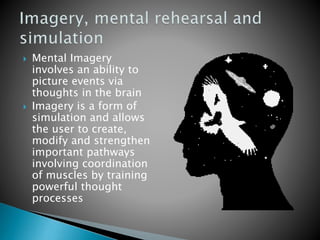
 Mental Imagery
involves an ability to
picture events via
thoughts in the brain
 Imagery is a form of
simulation and allows
the user to create,
modify and strengthen
important pathways
involving coordination
of muscles by training
powerful thought
processes
 Allow us to ‘feel’
our body as it
moves through
different actions
 Heavily involves
proprioception
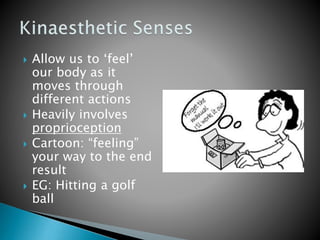
 Cartoon: “feeling”
your way to the end
result
 EG: Hitting a golf
ball
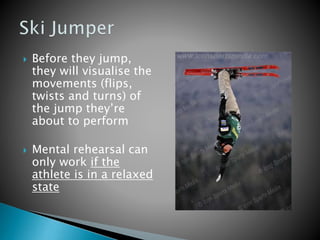
 Before they jump,
they will visualise the
movements (flips,
twists and turns) of
the jump they’re
about to perform
 Mental rehearsal can
only work if the
athlete is in a relaxed
state
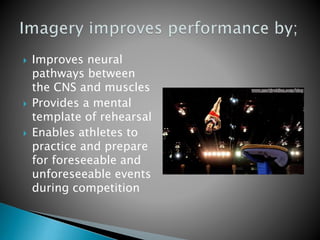
 Improves neural
pathways between
the CNS and muscles
 Provides a mental
template of rehearsal
 Enables athletes to
practice and prepare
for foreseeable and
unforeseeable events
during competition
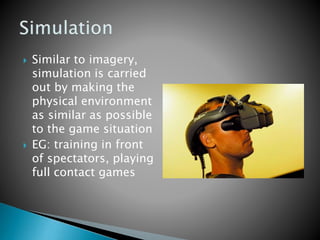
 Similar to imagery,
simulation is carried
out by making the
physical environment
as similar as possible
to the game situation
 EG: training in front
of spectators, playing
full contact games
 Very similar to the
principle of
specificity.
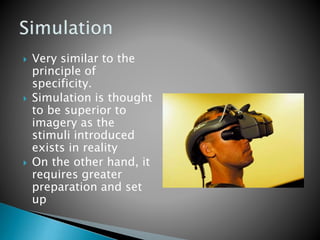
 Simulation is thought
to be superior to
imagery as the
stimuli introduced
exists in reality
 On the other hand, it
requires greater
preparation and set
up
 The definition contains 3 parts
1. Focusing on relevant environmental cues
2. Maintaining attention focus over time
3. Having awareness of the situation
Concentration and attention are used
interchangeably
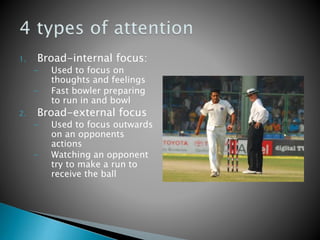
1. Broad-internal focus:
- Used to focus on
thoughts and feelings
- Fast bowler preparing
to run in and bowl
2. Broad-external focus
- Used to focus outwards
on an opponents
actions
- Watching an opponent
try to make a run to
receive the ball
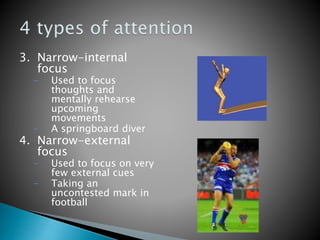
3. Narrow-internal
focus
- Used to focus
thoughts and
mentally rehearse
upcoming
movements
- A springboard diver
4. Narrow-external
focus
- Used to focus on very
few external cues
- Taking an
uncontested mark in
football
 Any most sports,
attention needs to shift
to adapt to the
environment around
them
 It an athletes attention
is inappropriate to the
task, performance can
be affected.
 Sometimes distractions
caused by future-
oriented thinking EG?
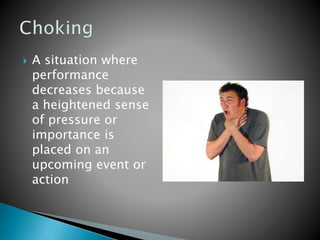
 A situation where
performance
decreases because
a heightened sense
of pressure or
importance is
placed on an
upcoming event or
action
 Roberto Baggio
◦ 1994 World Cup
 Simulation
 Shutting out irrelevant cues
 Use of cue-words (move your feet, follow
through etc)
 Routines (see example on P324)
 Overtraining skills (autonomous stage of
learning)

Imagery, simluation and concentration

  • 2.
     Mental Imagery involvesan ability to picture events via thoughts in the brain  Imagery is a form of simulation and allows the user to create, modify and strengthen important pathways involving coordination of muscles by training powerful thought processes
  • 3.
     Allow usto ‘feel’ our body as it moves through different actions  Heavily involves proprioception  Cartoon: “feeling” your way to the end result  EG: Hitting a golf ball
  • 4.
     Before theyjump, they will visualise the movements (flips, twists and turns) of the jump they’re about to perform  Mental rehearsal can only work if the athlete is in a relaxed state
  • 5.
     Improves neural pathwaysbetween the CNS and muscles  Provides a mental template of rehearsal  Enables athletes to practice and prepare for foreseeable and unforeseeable events during competition
  • 6.
     Similar toimagery, simulation is carried out by making the physical environment as similar as possible to the game situation  EG: training in front of spectators, playing full contact games
  • 7.
     Very similarto the principle of specificity.  Simulation is thought to be superior to imagery as the stimuli introduced exists in reality  On the other hand, it requires greater preparation and set up
  • 8.
     The definitioncontains 3 parts 1. Focusing on relevant environmental cues 2. Maintaining attention focus over time 3. Having awareness of the situation Concentration and attention are used interchangeably
  • 9.
    1. Broad-internal focus: -Used to focus on thoughts and feelings - Fast bowler preparing to run in and bowl 2. Broad-external focus - Used to focus outwards on an opponents actions - Watching an opponent try to make a run to receive the ball
  • 10.
    3. Narrow-internal focus - Usedto focus thoughts and mentally rehearse upcoming movements - A springboard diver 4. Narrow-external focus - Used to focus on very few external cues - Taking an uncontested mark in football
  • 11.
     Any mostsports, attention needs to shift to adapt to the environment around them  It an athletes attention is inappropriate to the task, performance can be affected.  Sometimes distractions caused by future- oriented thinking EG?
  • 12.
     A situationwhere performance decreases because a heightened sense of pressure or importance is placed on an upcoming event or action
  • 13.
     Roberto Baggio ◦1994 World Cup
  • 15.
     Simulation  Shuttingout irrelevant cues  Use of cue-words (move your feet, follow through etc)  Routines (see example on P324)  Overtraining skills (autonomous stage of learning)