Why I use a ‘Game Sense Approach’ 
for teaching my primary PE classes. 
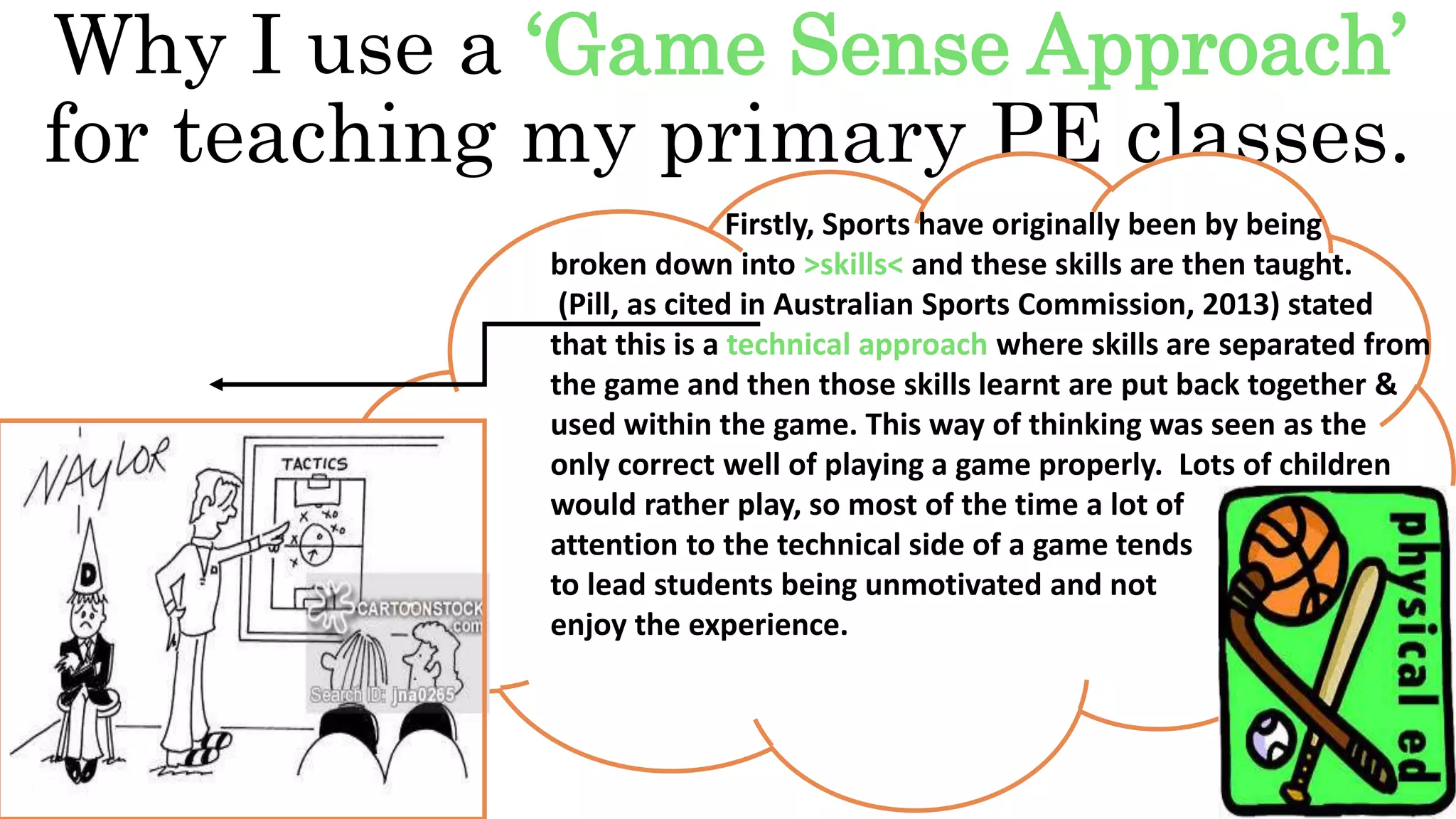
Firstly, Sports have originally been by being 
broken down into >skills< and these skills are then taught. 
(Pill, as cited in Australian Sports Commission, 2013) stated 
that this is a technical approach where skills are separated from 
the game and then those skills learnt are put back together & 
used within the game. This way of thinking was seen as the 
only correct well of playing a game properly. Lots of children 
would rather play, so most of the time a lot of 
attention to the technical side of a game tends 
to lead students being unmotivated and not 
enjoy the experience.
The ‘Game Sense Approach 
So what exactly is the 
requires a broad understanding of 
the sport and physical activity so 
that students can help each other 
by communicating with the 
teacher and their peers in ways 
which they can modify the game 
in a way that is challenging for 
them 
“The ‘Game Sense’ approach places an emphasis on 
the play aspect of sport. The approach asks students 
to perform in an environment where decision-making, 
tactics, problem-solving and skill development are 
developed consistently throughout a lesson. Through 
this approach, students also develop self-expression, 
socialisation skills, and conflict resolution skills, while 
incorporating the knowledge essential for a healthy 
lifestyle. A well-organised and structured Physical 
Education class with Game Sense can teach students 
the benefits of living a physically active life, as well as 
the skills and knowledge (social and physical) to 
incorporate safe, satisfying physical activity into 
their lives (Stevenson, as cited in How the Game 
Sense Approach in Physical Education can 
develop cognitive thinking, 2013) 
‘Game Sense 
Approach’?
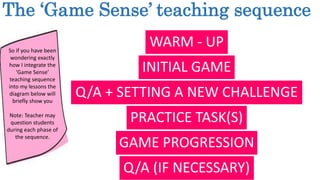
The ‘Game Sense’ teaching sequence 
WARM - UP 
INITIAL GAME 
Q/A + SETTING A NEW CHALLENGE 
PRACTICE TASK(S) 
GAME PROGRESSION 
Q/A (IF NECESSARY) 
So if you have been 
wondering exactly 
how I integrate the 
‘Game Sense’ 
teaching sequence 
into my lessons the 
diagram below will 
briefly show you 
Note: Teacher may 
question students 
during each phase of 
the sequence.
The strengths of this theory as a 
teaching approach 
In touch, the ball can be carried across a line, or it can be 
thrown or shot in a target (Netball or Basketball). The ‘Game 
Sense Approach’ is a strength as it focuses on the problem-solving 
aspect as well as the movement patterns of the 
games. As a teacher I will at times stop for focus on 
technique. However, the strategies needed to succeed in the 
game are the main focus. 
These games are easily modified by redesigning the space, 
changing equipment used or the number of players. 
Eg. Increasing the amount of space and changing the rules 
(allowing rolling of the ball from player to player) allows 
students to consider the amount of space they have, the rule 
and communication with teammates. This will lead to them 
questioning themselves how can be beat the attackers? What 
is the quickest way to get it in the goal? They incorporate 
swinging (non-locomotor skill) , running (locomotor skill), 
dribbling by pat bouncing, catching with two hands and many 
other manipulative skills. 
Fielding or Striking (manipulative skills) game involves 
competing in batting and fielding teams aiming to score more 
runs than the other team. Softball, Tee ball and Cricket 
involve a number of rounds to determine who wins the 
game. Questions leading to students include: What is the 
safest way to field the ball? What is the correct way of hitting 
the ball and why? Where should they position themselves if 
fielding? 
Research by Light (2003) highlights the effectiveness of the 
‘Game Sense’ strategy in enhancing cognitive thinking. I as a 
teacher, ensure that the initial games are simply and become 
progressively more challenging during each lesson.
REFERENCES 
Brookes, L. (2013). How the Game Sense Approach in Physical Education can 
develop cognitive thinking 
Commission, Australian Sports. (2014). Participation in organised sport’. Ausport, 
Canberra 
Light, R. (2003). ‘The Joy of learning: emotion and learning in games through Tgfu’. 
Journal of Physical Education New Zealand, pp.93-99 
Thompson, C. (1996). Video Analysis. Australian Touch Association Level 3 Coaching 
Assessment, Brisbane

Weebly

  • 1.
    Why I usea ‘Game Sense Approach’ for teaching my primary PE classes. Firstly, Sports have originally been by being broken down into >skills< and these skills are then taught. (Pill, as cited in Australian Sports Commission, 2013) stated that this is a technical approach where skills are separated from the game and then those skills learnt are put back together & used within the game. This way of thinking was seen as the only correct well of playing a game properly. Lots of children would rather play, so most of the time a lot of attention to the technical side of a game tends to lead students being unmotivated and not enjoy the experience.
  • 2.
    The ‘Game SenseApproach So what exactly is the requires a broad understanding of the sport and physical activity so that students can help each other by communicating with the teacher and their peers in ways which they can modify the game in a way that is challenging for them “The ‘Game Sense’ approach places an emphasis on the play aspect of sport. The approach asks students to perform in an environment where decision-making, tactics, problem-solving and skill development are developed consistently throughout a lesson. Through this approach, students also develop self-expression, socialisation skills, and conflict resolution skills, while incorporating the knowledge essential for a healthy lifestyle. A well-organised and structured Physical Education class with Game Sense can teach students the benefits of living a physically active life, as well as the skills and knowledge (social and physical) to incorporate safe, satisfying physical activity into their lives (Stevenson, as cited in How the Game Sense Approach in Physical Education can develop cognitive thinking, 2013) ‘Game Sense Approach’?
  • 3.
    The ‘Game Sense’teaching sequence WARM - UP INITIAL GAME Q/A + SETTING A NEW CHALLENGE PRACTICE TASK(S) GAME PROGRESSION Q/A (IF NECESSARY) So if you have been wondering exactly how I integrate the ‘Game Sense’ teaching sequence into my lessons the diagram below will briefly show you Note: Teacher may question students during each phase of the sequence.
  • 4.
    The strengths ofthis theory as a teaching approach In touch, the ball can be carried across a line, or it can be thrown or shot in a target (Netball or Basketball). The ‘Game Sense Approach’ is a strength as it focuses on the problem-solving aspect as well as the movement patterns of the games. As a teacher I will at times stop for focus on technique. However, the strategies needed to succeed in the game are the main focus. These games are easily modified by redesigning the space, changing equipment used or the number of players. Eg. Increasing the amount of space and changing the rules (allowing rolling of the ball from player to player) allows students to consider the amount of space they have, the rule and communication with teammates. This will lead to them questioning themselves how can be beat the attackers? What is the quickest way to get it in the goal? They incorporate swinging (non-locomotor skill) , running (locomotor skill), dribbling by pat bouncing, catching with two hands and many other manipulative skills. Fielding or Striking (manipulative skills) game involves competing in batting and fielding teams aiming to score more runs than the other team. Softball, Tee ball and Cricket involve a number of rounds to determine who wins the game. Questions leading to students include: What is the safest way to field the ball? What is the correct way of hitting the ball and why? Where should they position themselves if fielding? Research by Light (2003) highlights the effectiveness of the ‘Game Sense’ strategy in enhancing cognitive thinking. I as a teacher, ensure that the initial games are simply and become progressively more challenging during each lesson.
  • 5.
    REFERENCES Brookes, L.(2013). How the Game Sense Approach in Physical Education can develop cognitive thinking Commission, Australian Sports. (2014). Participation in organised sport’. Ausport, Canberra Light, R. (2003). ‘The Joy of learning: emotion and learning in games through Tgfu’. Journal of Physical Education New Zealand, pp.93-99 Thompson, C. (1996). Video Analysis. Australian Touch Association Level 3 Coaching Assessment, Brisbane