What the European Union’s tourism policy means
                 for Ireland


                       Ray Keaney
         IHI Hospitality Managers’ Conference
                        May 2012
Introduction


• Background to tourism policy in the EU

• New framework for tourism

• Lessons for Ireland
Background to tourism policy in the EU


• Policymakers slow to put political structures in place
  to support tourism development in EU

• Little direct intervention in tourism

• Influence stemmed from policies in other areas e.g.
  transport, environment and consumer protection
The Lisbon Treaty


• Article 195 provides a legal basis for the
  development of a coherent policy approach to
  tourism

• The EU has specific powers to direct tourism activity
  to complement actions of member states

• Article 195 excludes any harmonisation at European
  level relating to tourism
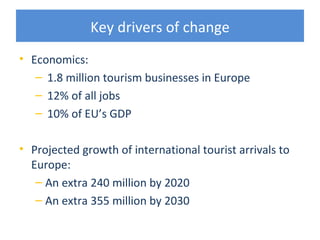
Key drivers of change
• Economics:
   – 1.8 million tourism businesses in Europe
   – 12% of all jobs
   – 10% of EU’s GDP

• Projected growth of international tourist arrivals to
  Europe:
   – An extra 240 million by 2020
   – An extra 355 million by 2030
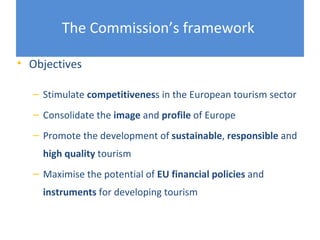
The Commission’s framework

• Objectives

  – Stimulate competitiveness in the European tourism sector
  – Consolidate the image and profile of Europe
  – Promote the development of sustainable, responsible and
    high quality tourism
  – Maximise the potential of EU financial policies and
    instruments for developing tourism
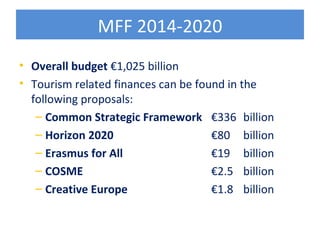
MFF 2014-2020
• Overall budget €1,025 billion
• Tourism related finances can be found in the
  following proposals:
   – Common Strategic Framework €336 billion
   – Horizon 2020                    €80 billion
   – Erasmus for All                 €19 billion
   – COSME                           €2.5 billion
   – Creative Europe                 €1.8 billion
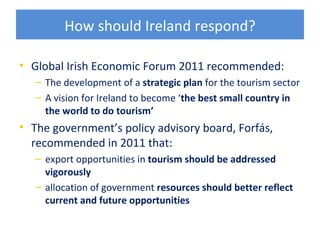
How should Ireland respond?

• Global Irish Economic Forum 2011 recommended:
   – The development of a strategic plan for the tourism sector
   – A vision for Ireland to become ‘the best small country in
     the world to do tourism’
• The government’s policy advisory board, Forfás,
  recommended in 2011 that:
   – export opportunities in tourism should be addressed
     vigorously
   – allocation of government resources should better reflect
     current and future opportunities
The challenges

• Tourism sector is fragmented
• Knowledge base is weak
• Tourism is less visible than other sectors of the Irish
  economy
• Successive governments have prioritised the science
  and technology and agri-food sectors
• Lack of joined-up thinking at the national, regional
  and local level
• Focus on ‘short-term wins’ at the expense of
  strategic development
Lessons for Ireland

• Develop tourism policy initiatives to stimulate long-
  term job creation and economic growth
• Invest in tourism innovation, research and
  development
• Give the tourism sector a focus equal to that of the
  agriculture and food, science and ICT sectors
• Change the structures to facilitate the strategic
  development of Irish tourism
Actions needed

1. Industry groups should identify issues of strategic
   importance and adopt a common agenda

3. Government should lead the development of a
   strategic plan for Irish tourism

5. Ireland should use its presidency of the European
   Council in 2013 to prioritise tourism in the MFF
   2014-2020
Conclusion
• The EU tourism framework offers Ireland a unique
  opportunity

• The choice is between a compelling future or
  gradual decline

• The challenge for industry and Government is to put
  in place the necessary structures to realise the
  sector’s potential
Thank You

Ihi conference may 2012

  • 1.
    What the EuropeanUnion’s tourism policy means for Ireland Ray Keaney IHI Hospitality Managers’ Conference May 2012
  • 2.
    Introduction • Background totourism policy in the EU • New framework for tourism • Lessons for Ireland
  • 3.
    Background to tourismpolicy in the EU • Policymakers slow to put political structures in place to support tourism development in EU • Little direct intervention in tourism • Influence stemmed from policies in other areas e.g. transport, environment and consumer protection
  • 4.
    The Lisbon Treaty •Article 195 provides a legal basis for the development of a coherent policy approach to tourism • The EU has specific powers to direct tourism activity to complement actions of member states • Article 195 excludes any harmonisation at European level relating to tourism
  • 5.
    Key drivers ofchange • Economics: – 1.8 million tourism businesses in Europe – 12% of all jobs – 10% of EU’s GDP • Projected growth of international tourist arrivals to Europe: – An extra 240 million by 2020 – An extra 355 million by 2030
  • 6.
    The Commission’s framework •Objectives – Stimulate competitiveness in the European tourism sector – Consolidate the image and profile of Europe – Promote the development of sustainable, responsible and high quality tourism – Maximise the potential of EU financial policies and instruments for developing tourism
  • 7.
    MFF 2014-2020 • Overallbudget €1,025 billion • Tourism related finances can be found in the following proposals: – Common Strategic Framework €336 billion – Horizon 2020 €80 billion – Erasmus for All €19 billion – COSME €2.5 billion – Creative Europe €1.8 billion
  • 8.
    How should Irelandrespond? • Global Irish Economic Forum 2011 recommended: – The development of a strategic plan for the tourism sector – A vision for Ireland to become ‘the best small country in the world to do tourism’ • The government’s policy advisory board, Forfás, recommended in 2011 that: – export opportunities in tourism should be addressed vigorously – allocation of government resources should better reflect current and future opportunities
  • 9.
    The challenges • Tourismsector is fragmented • Knowledge base is weak • Tourism is less visible than other sectors of the Irish economy • Successive governments have prioritised the science and technology and agri-food sectors • Lack of joined-up thinking at the national, regional and local level • Focus on ‘short-term wins’ at the expense of strategic development
  • 10.
    Lessons for Ireland •Develop tourism policy initiatives to stimulate long- term job creation and economic growth • Invest in tourism innovation, research and development • Give the tourism sector a focus equal to that of the agriculture and food, science and ICT sectors • Change the structures to facilitate the strategic development of Irish tourism
  • 11.
    Actions needed 1. Industrygroups should identify issues of strategic importance and adopt a common agenda 3. Government should lead the development of a strategic plan for Irish tourism 5. Ireland should use its presidency of the European Council in 2013 to prioritise tourism in the MFF 2014-2020
  • 12.
    Conclusion • The EUtourism framework offers Ireland a unique opportunity • The choice is between a compelling future or gradual decline • The challenge for industry and Government is to put in place the necessary structures to realise the sector’s potential
  • 13.