www.Tyco-Fire.com
Installation Instructions &
Technical Handbook
IH-1900MARCH 2015
Copyright © 2015 Tyco Fire Products, LP. All rights reserved.
2 TABLE OF CONTENTS
GENERAL DESCRIPTION.  .  .  .  .  .  .  .  .  .  .  .  .  .  .  .  .  .  .  .  .  .  .  .  .  .  .  .  .  .  .  .  .  .  .  .  . 4
INTRODUCTION .  .  .  .  .  .  .  .  .  .  .  .  .  .  .  .  .  .  .  .  .  .  .  .  .  .  .  .  .  .  .  .  .  .  .  .  .  .  .  .  .  .  . 4
Advantages .  .  .  .  .  .  .  .  .  .  .  .  .  .  .  .  .  .  .  .  .  .  .  .  .  .  .  .  .  .  .  .  .  .  .  .  .  .  .  .  .  .  .  .  .  .  . 5
Training and Demonstration .  .  .  .  .  .  .  .  .  .  .  .  .  .  .  .  .  .  .  .  .  .  .  .  .  .  .  .  .  .  .  .  . 5
LISTINGS/APPROVALS (WHERE TO USE).  .  .  .  .  .  .  .  .  .  .  .  .  .  .  .  .  .  .  .  .  .  . 7
Underwriters Laboratories Inc. (UL) and
Underwriters Laboratories Inc. (C-UL) For Use In Canada .  .  .  .  .  .  . 7
Concealed Installations (UL) .  .  .  .  .  .  .  .  .  .  .  .  .  .  .  .  .  .  .  .  .  .  .  .  .  .  .  .  .  . 7
Concealed Installations (C-UL).  .  .  .  .  .  .  .  .  .  .  .  .  .  .  .  .  .  .  .  .  .  .  .  .  .  .  . 8
Exposed Installation - General (UL  C-UL). .  .  .  .  .  .  .  .  .  .  .  .  .  .  .  .  . 8
Smooth, Flat, Horizontal, Fixed Ceilings -
Exposed Installations (UL  C-UL) .  .  .  .  .  .  .  .  .  .  .  .  .  .  .  .  .  .  .  .  .  .  .  .  . 8
Unfinished Basements - Exposed Installations. .  .  .  .  .  .  .  .  .  .  .  .  . 10
Residential Dry Pipe Systems (UL).  .  .  .  .  .  .  .  .  .  .  .  .  .  .  .  .  .  .  .  .  .  .  . 15
Air Plenums (UL). .  .  .  .  .  .  .  .  .  .  .  .  .  .  .  .  .  .  .  .  .  .  .  .  .  .  .  .  .  .  .  .  .  .  .  .  .  .  . 16
Garage Installations (UL) .  .  .  .  .  .  .  .  .  .  .  .  .  .  .  .  .  .  .  .  .  .  .  .  .  .  .  .  .  .  .  . 16
System Risers (UL). .  .  .  .  .  .  .  .  .  .  .  .  .  .  .  .  .  .  .  .  .  .  .  .  .  .  .  .  .  .  .  .  .  .  .  .  . 17
Underground Water Pressure Service (UL  C-UL) .  .  .  .  .  .  .  .  .  . 18
Outdoor Installations. .  .  .  .  .  .  .  .  .  .  .  .  .  .  .  .  .  .  .  .  .  .  .  .  .  .  .  .  .  .  .  .  .  .  . 22
Concealed Installations (FM).  .  .  .  .  .  .  .  .  .  .  .  .  .  .  .  .  .  .  .  .  .  .  .  .  .  .  .  . 23
Exposed Installations -
Smooth, Flat, Horizontal Ceilings (FM).  .  .  .  .  .  .  .  .  .  .  .  .  .  .  .  .  .  .  .  . 23
System Risers (FM).  .  .  .  .  .  .  .  .  .  .  .  .  .  .  .  .  .  .  .  .  .  .  .  .  .  .  .  .  .  .  .  .  .  .  .  . 24
Additional Approvals .  .  .  .  .  .  .  .  .  .  .  .  .  .  .  .  .  .  .  .  .  .  .  .  .  .  .  .  .  .  .  .  .  .  .  .  .  . 26
Ordinary Hazard Installations .  .  .  .  .  .  .  .  .  .  .  .  .  .  .  .  .  .  .  .  .  .  .  .  .  .  .  .  .  . 26
TECHNICAL DATA. .  .  .  .  .  .  .  .  .  .  .  .  .  .  .  .  .  .  .  .  .  .  .  .  .  .  .  .  .  .  .  .  .  .  .  .  .  .  .  .  .  . 27
TYCO CPVC Specifications .  .  .  .  .  .  .  .  .  .  .  .  .  .  .  .  .  .  .  .  .  .  .  .  .  .  .  .  .  .  .  .  . 27
Pipe. .  .  .  .  .  .  .  .  .  .  .  .  .  .  .  .  .  .  .  .  .  .  .  .  .  .  .  .  .  .  .  .  .  .  .  .  .  .  .  .  .  .  .  .  .  .  .  .  .  . 27
Fittings. .  .  .  .  .  .  .  .  .  .  .  .  .  .  .  .  .  .  .  .  .  .  .  .  .  .  .  .  .  .  .  .  .  .  .  .  .  .  .  .  .  .  .  .  .  .  . 27
Solvent Cement .  .  .  .  .  .  .  .  .  .  .  .  .  .  .  .  .  .  .  .  .  .  .  .  .  .  .  .  .  .  .  .  .  .  .  .  .  .  .  . 27
Product Ratings and Capabilities .  .  .  .  .  .  .  .  .  .  .  .  .  .  .  .  .  .  .  .  .  .  .  .  .  .  . 30
Ambient Temperature and Heat Sources.  .  .  .  .  .  .  .  .  .  .  .  .  .  .  .  .  .  . 30
Pressure Rating.  .  .  .  .  .  .  .  .  .  .  .  .  .  .  .  .  .  .  .  .  .  .  .  .  .  .  .  .  .  .  .  .  .  .  .  .  .  .  . 30
Friction Loss.  .  .  .  .  .  .  .  .  .  .  .  .  .  .  .  .  .  .  .  .  .  .  .  .  .  .  .  .  .  .  .  .  .  .  .  .  .  .  .  .  .  . 30
Thermal Expansion – U.S. Units.  .  .  .  .  .  .  .  .  .  .  .  .  .  .  .  .  .  .  .  .  .  .  .  .  .  . 32
Thermal Expansion – Metric Units. .  .  .  .  .  .  .  .  .  .  .  .  .  .  .  .  .  .  .  .  .  .  .  . 34
Physical and Thermal Properties .  .  .  .  .  .  .  .  .  .  .  .  .  .  .  .  .  .  .  .  .  .  .  .  .  .  .  . 45
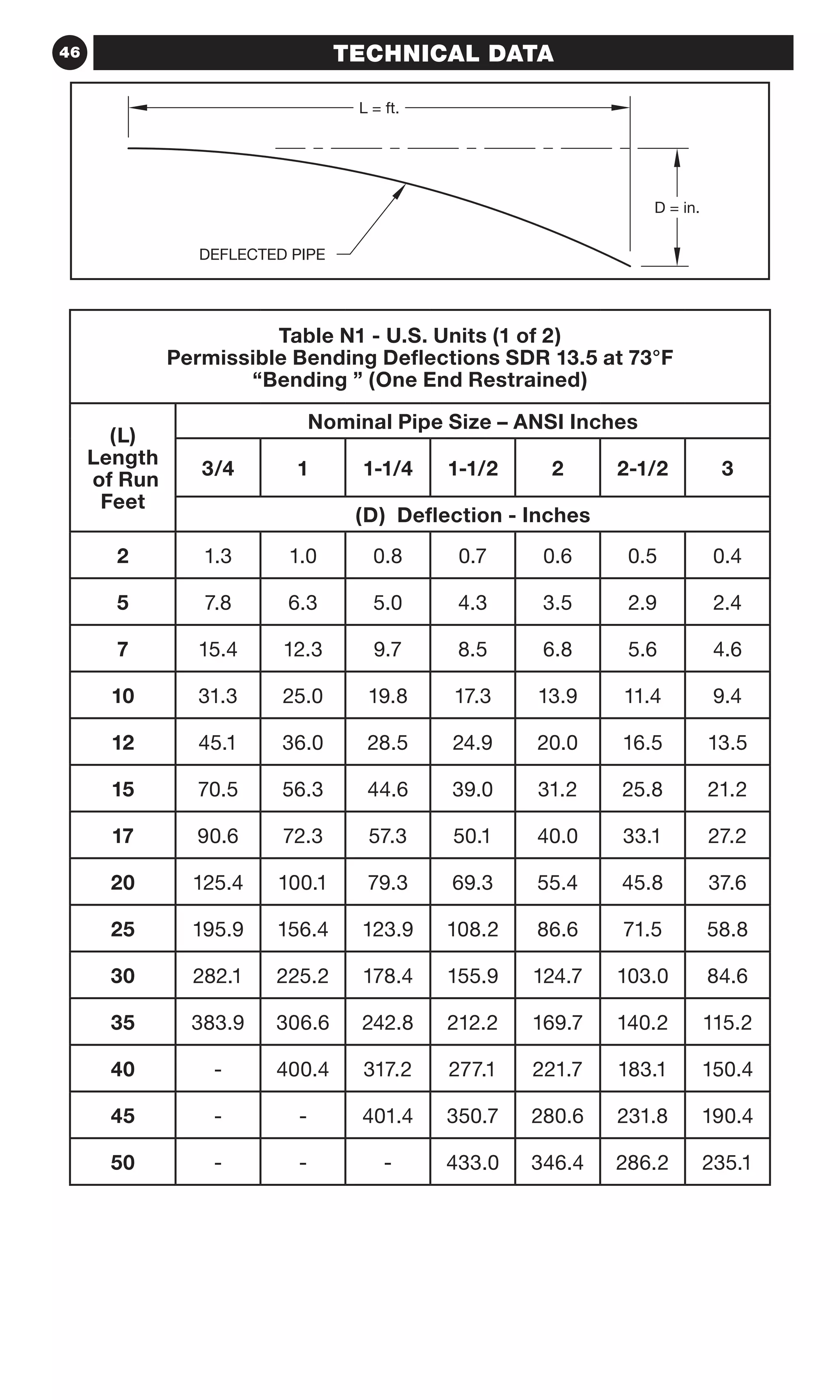
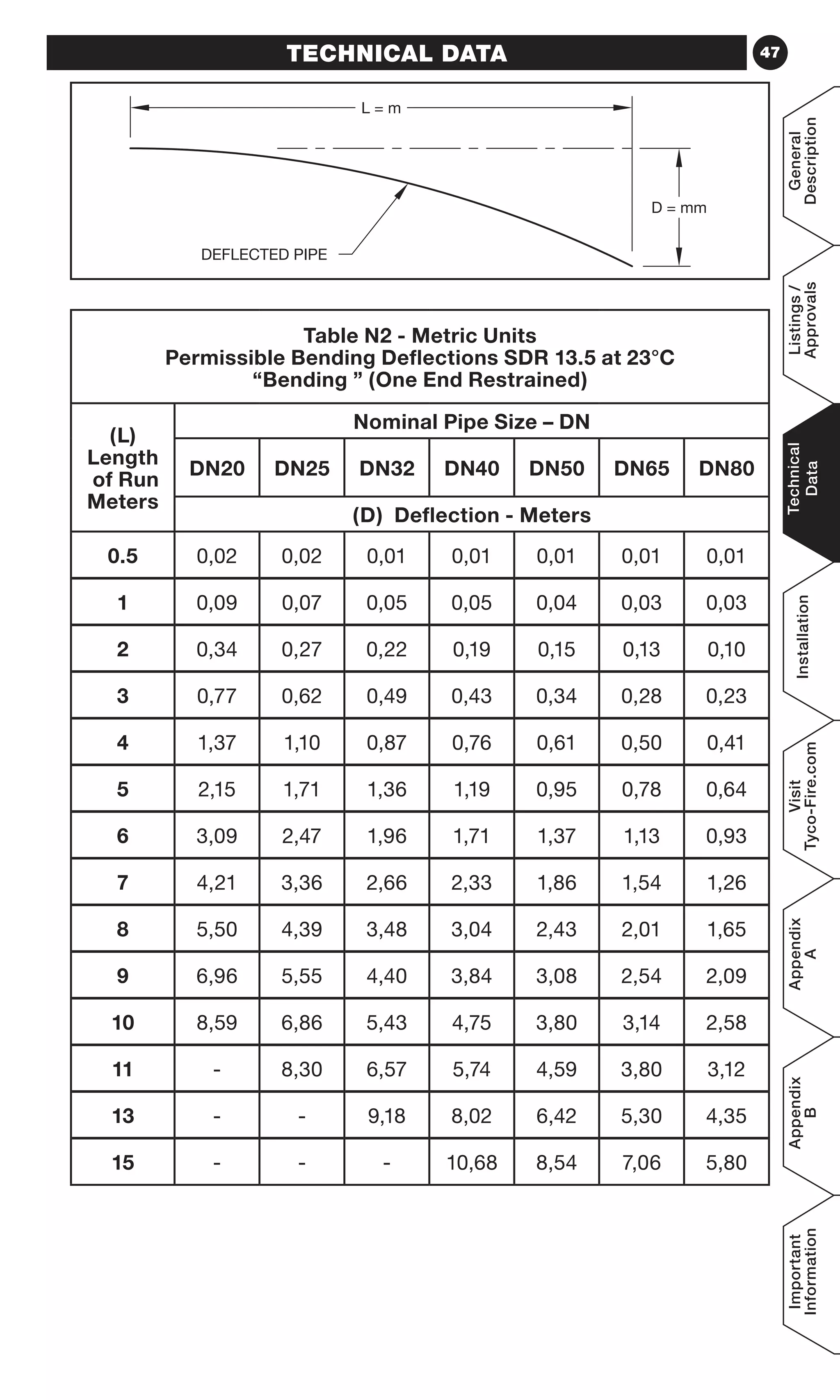
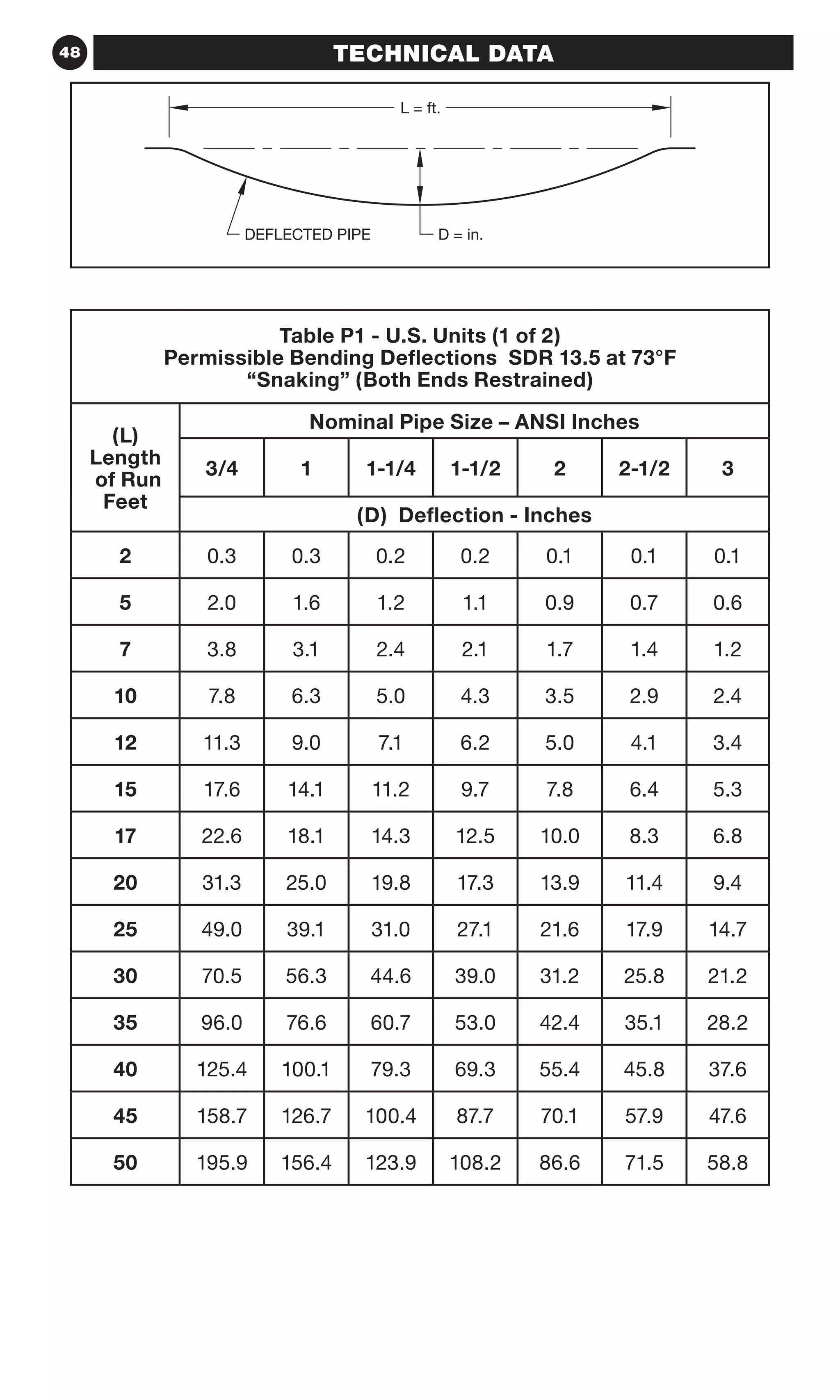
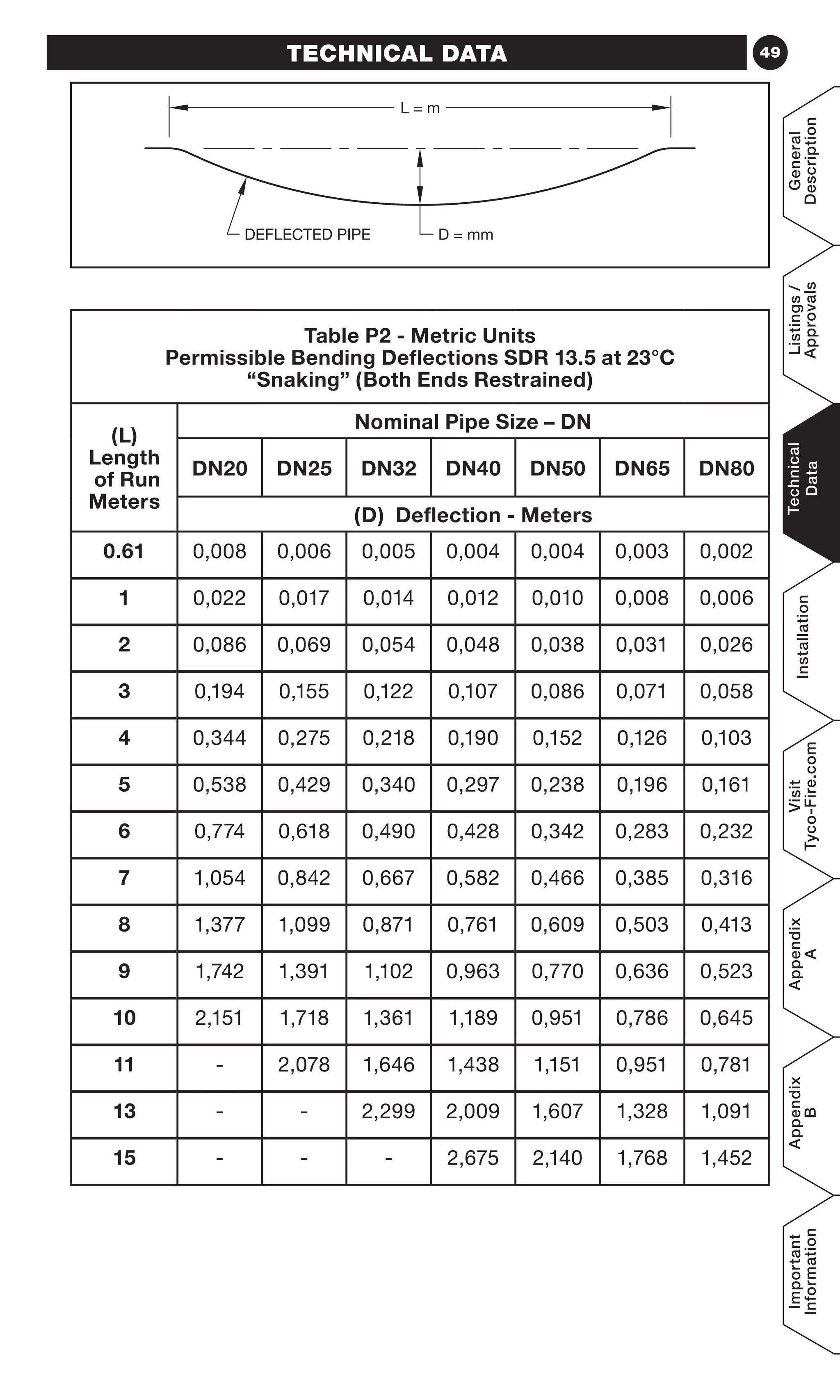
Permissible Bending Deflections. .  .  .  .  .  .  .  .  .  .  .  .  .  .  .  .  .  .  .  .  .  .  .  .  . 45
Support and Hanger Requirements .  .  .  .  .  .  .  .  .  .  .  .  .  .  .  .  .  .  .  .  .  .  .  .  .  . 50
Pipe Bracing with Standard Band Hanger.  .  .  .  .  .  .  .  .  .  .  .  .  .  .  .  .  . 51
Hanger/Support Spacing .  .  .  .  .  .  .  .  .  .  .  .  .  .  .  .  .  .  .  .  .  .  .  .  .  .  .  .  .  .  .  . 51
Vertical Restraint.  .  .  .  .  .  .  .  .  .  .  .  .  .  .  .  .  .  .  .  .  .  .  .  .  .  .  .  .  .  .  .  .  .  .  .  .  .  . 52
Chemical Compatibility .  .  .  .  .  .  .  .  .  .  .  .  .  .  .  .  .  .  .  .  .  .  .  .  .  .  .  .  .  .  .  .  .  .  .  . 54
Paint .  .  .  .  .  .  .  .  .  .  .  .  .  .  .  .  .  .  .  .  .  .  .  .  .  .  .  .  .  .  .  .  .  .  .  .  .  .  .  .  .  .  .  .  .  .  .  .  .  .  .  . 54
3TABLE OF CONTENTS
Handling  Storage of TYCO CPVC .  .  .  .  .  .  .  .  .  .  .  .  .  .  .  .  .  .  .  .  .  .  .  .  .  . 56
Handling - Pipe and Fittings.  .  .  .  .  .  .  .  .  .  .  .  .  .  .  .  .  .  .  .  .  .  .  .  .  .  .  .  .  . 56
Storage - Pipe  Fittings .  .  .  .  .  .  .  .  .  .  .  .  .  .  .  .  .  .  .  .  .  .  .  .  .  .  .  .  .  .  .  . 56
Handling - Solvent Cements. .  .  .  .  .  .  .  .  .  .  .  .  .  .  .  .  .  .  .  .  .  .  .  .  .  .  .  .  . 57
Storage - Solvent Cements. .  .  .  .  .  .  .  .  .  .  .  .  .  .  .  .  .  .  .  .  .  .  .  .  .  .  .  .  .  . 57
Solvent - Cement Spills.  .  .  .  .  .  .  .  .  .  .  .  .  .  .  .  .  .  .  .  .  .  .  .  .  .  .  .  .  .  .  .  .  . 57
Joining CPVC Pipe and Fittings with
One-Step Solvent Cement .  .  .  .  .  .  .  .  .  .  .  .  .  .  .  .  .  .  .  .  .  .  .  .  .  .  .  .  .  .  .  . 58
Estimating Cement Requirements. .  .  .  .  .  .  .  .  .  .  .  .  .  .  .  .  .  .  .  .  .  .  .  . 58
De-burring and Beveling.  .  .  .  .  .  .  .  .  .  .  .  .  .  .  .  .  .  .  .  .  .  .  .  .  .  .  .  .  .  .  .  . 59
Solvent Cement Application.  .  .  .  .  .  .  .  .  .  .  .  .  .  .  .  .  .  .  .  .  .  .  .  .  .  .  .  .  . 59
Assembly.  .  .  .  .  .  .  .  .  .  .  .  .  .  .  .  .  .  .  .  .  .  .  .  .  .  .  .  .  .  .  .  .  .  .  .  .  .  .  .  .  .  .  .  .  . 61
Set and Cure Times.  .  .  .  .  .  .  .  .  .  .  .  .  .  .  .  .  .  .  .  .  .  .  .  .  .  .  .  .  .  .  .  .  .  .  .  . 61
System Acceptance Testing (Hydrostatic Pressure Test).  .  .  .  . 63
Limited Pressurized Air or Nitrogen Testing Allowance. .  .  .  .  .  . 63
Joining Pipe and Fittings in Adverse Conditions .  .  .  .  .  .  .  .  .  .  .  .  .  .  . 64
In Cold Weather .  .  .  .  .  .  .  .  .  .  .  .  .  .  .  .  .  .  .  .  .  .  .  .  .  .  .  .  .  .  .  .  .  .  .  .  .  .  .  . 64
Transition to Other Materials .  .  .  .  .  .  .  .  .  .  .  .  .  .  .  .  .  .  .  .  .  .  .  .  .  .  .  .  .  .  . 65
Threaded Connections.  .  .  .  .  .  .  .  .  .  .  .  .  .  .  .  .  .  .  .  .  .  .  .  .  .  .  .  .  .  .  .  .  . 66
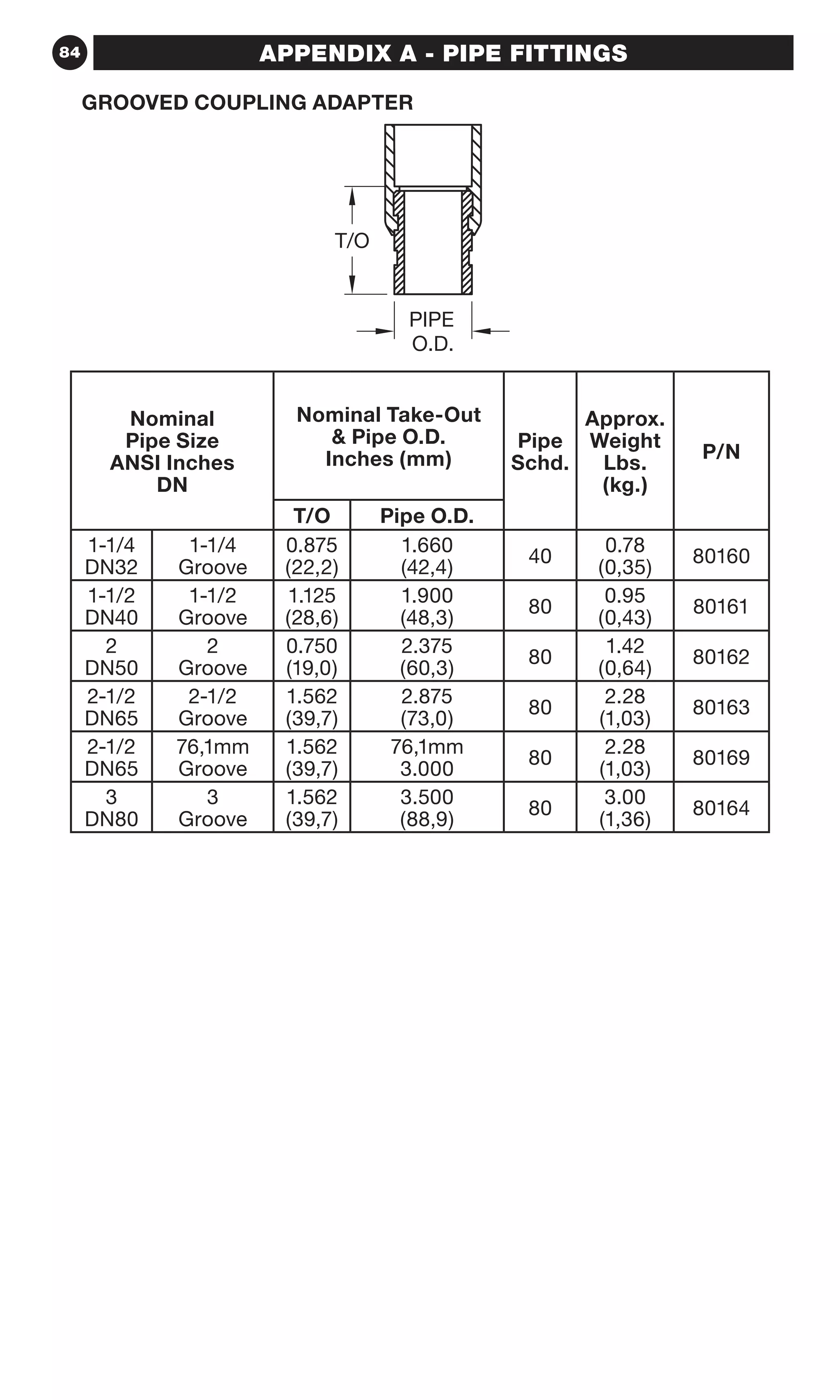
Grooved Coupling Adapter Connections.  .  .  .  .  .  .  .  .  .  .  .  .  .  .  .  .  .  . 66
Penetrating Fire Rated Walls  Partitions .  .  .  .  .  .  .  .  .  .  .  .  .  .  .  .  .  .  .  . 67
Freeze Protection .  .  .  .  .  .  .  .  .  .  .  .  .  .  .  .  .  .  .  .  .  .  .  .  .  .  .  .  .  .  .  .  .  .  .  .  .  .  .  .  . 68
Use of Dry Type Sprinklers.  .  .  .  .  .  .  .  .  .  .  .  .  .  .  .  .  .  .  .  .  .  .  .  .  .  .  .  .  .  . 68
Use and Cautions with Glycerin Antifreeze.  .  .  .  .  .  .  .  .  .  .  .  .  .  .  .  . 68
Batt Insulation Requirements and Suggestions.  .  .  .  .  .  .  .  .  .  .  .  . 70
Batt Insulation Installation Recommendations.  .  .  .  .  .  .  .  .  .  .  .  .  . 70
Cut-in Procedure for System Modification and Repair. . . . . . . . . 71
VISIT WWW.TYCO-FIRE.COM. .  .  .  .  .  .  .  .  .  .  .  .  .  .  .  .  .  .  .  .  .  .  .  .  .  .  .  .  .  .  .  . 73
Limited Warranty .  .  .  .  .  .  .  .  .  .  .  .  .  .  .  .  .  .  .  .  .  .  .  .  .  .  .  .  .  .  .  .  .  .  .  .  .  .  .  .  . 73
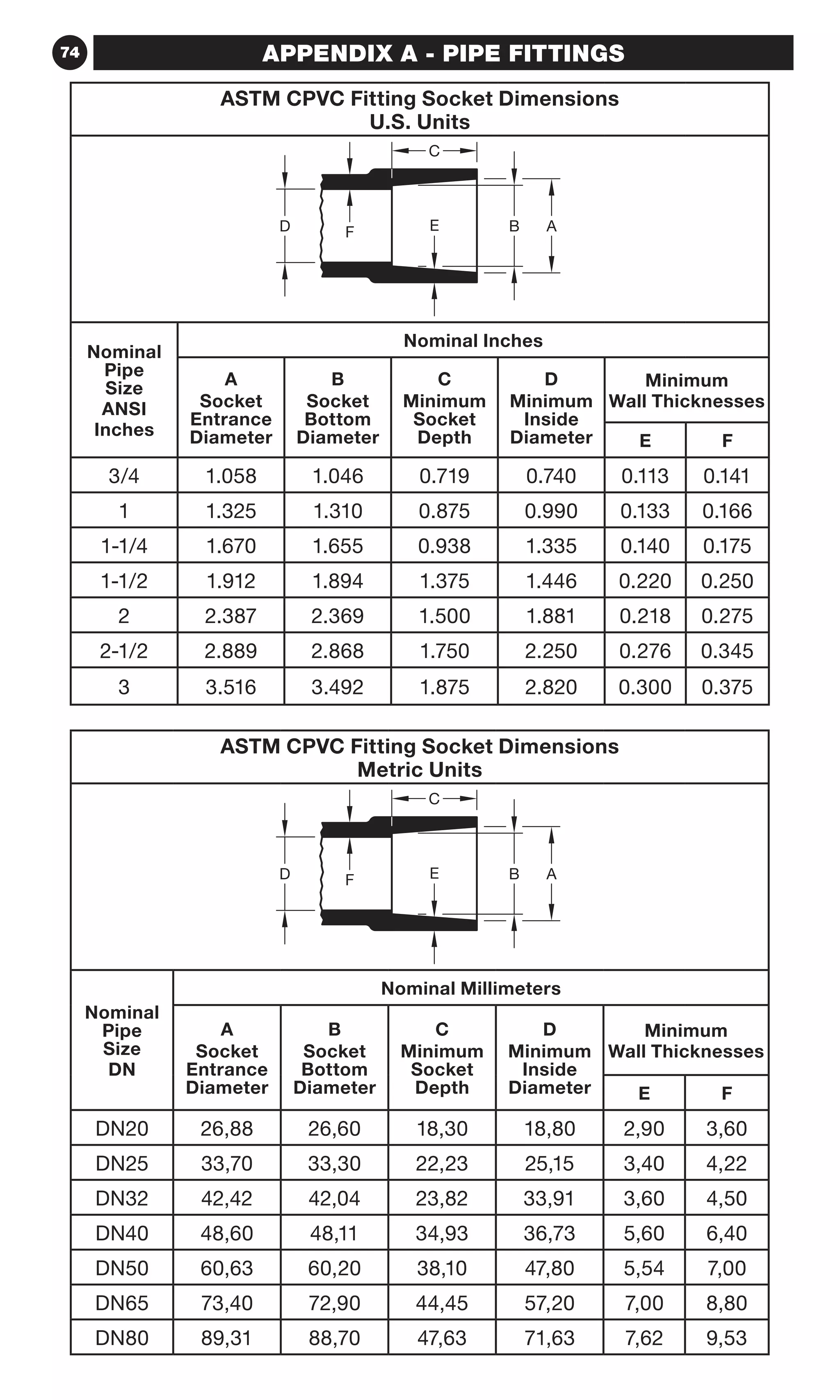
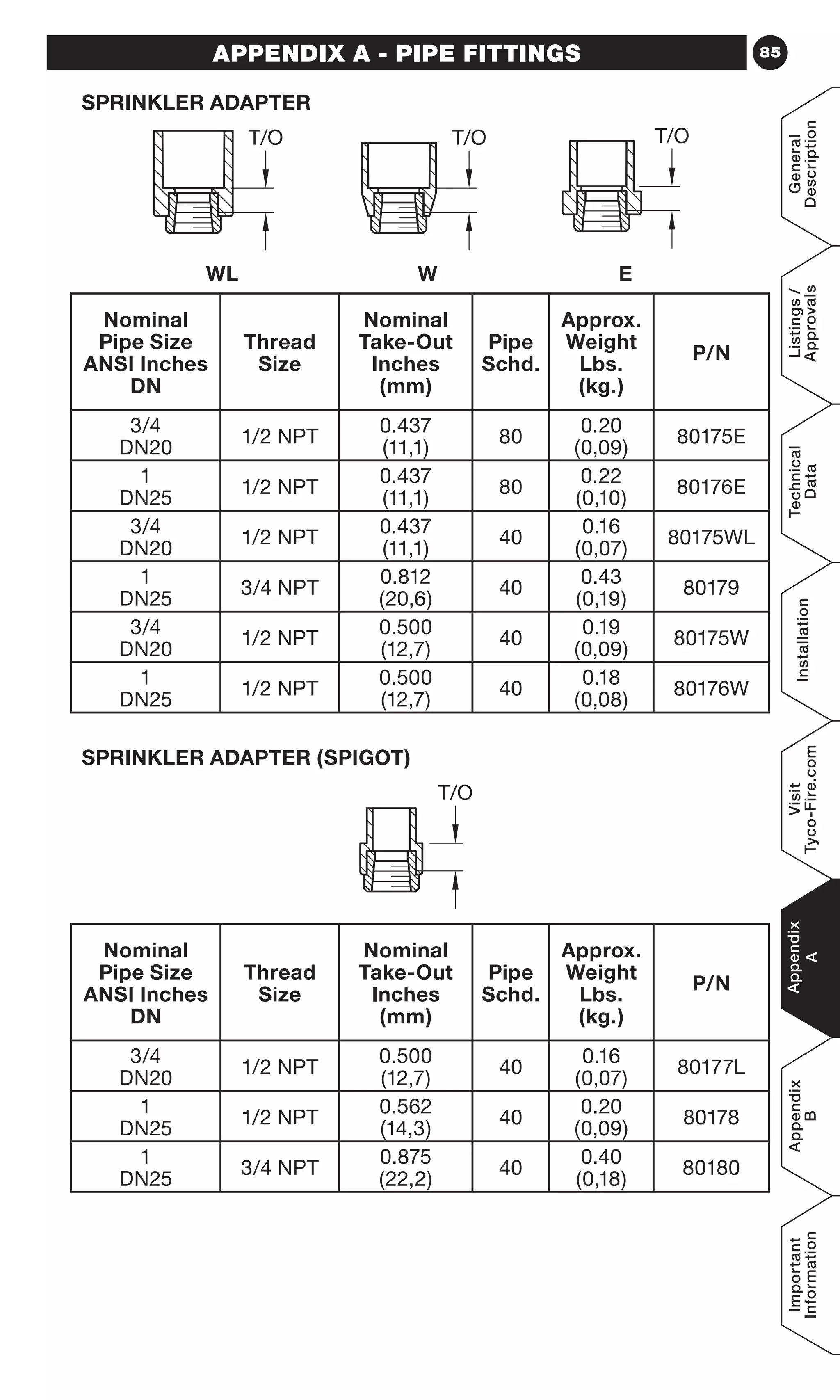
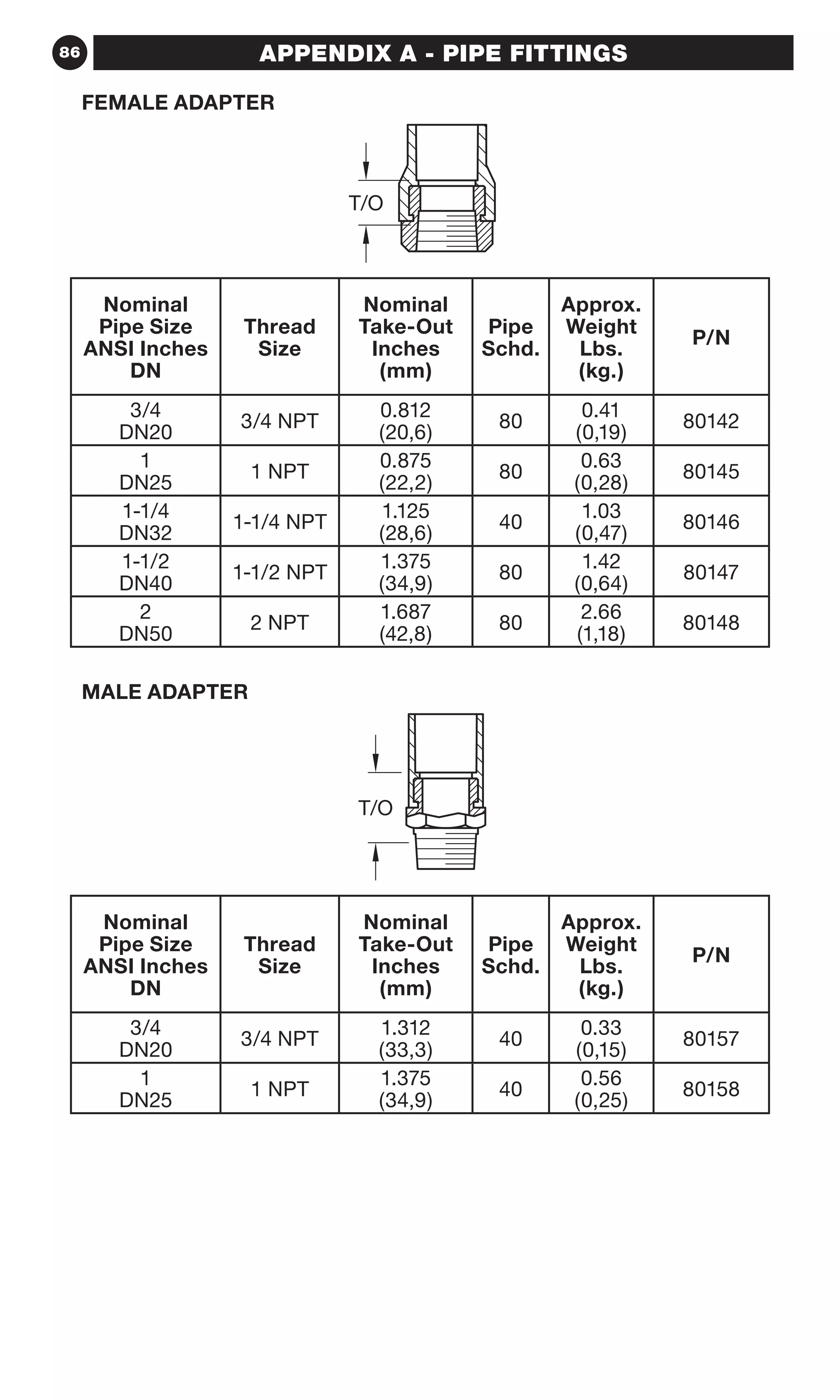
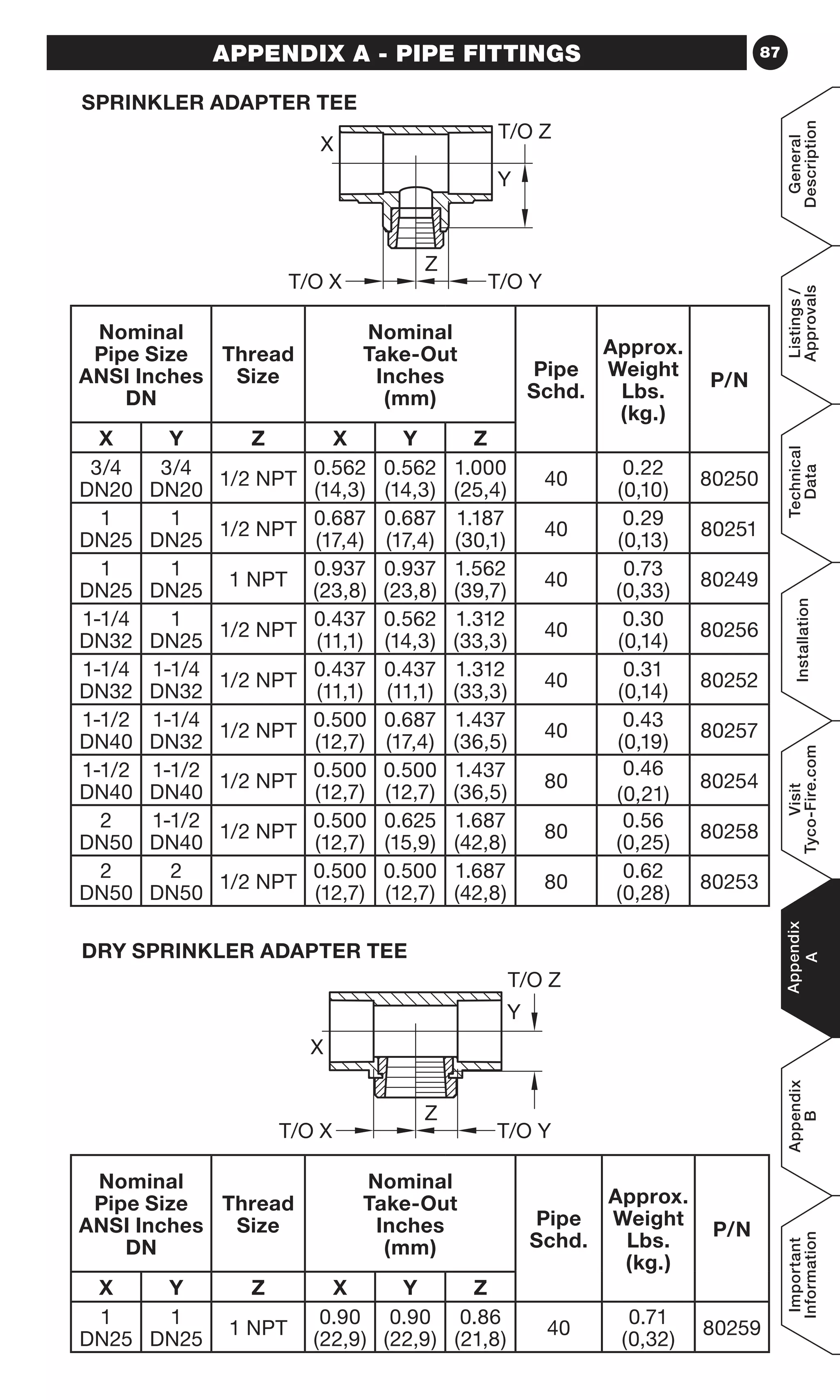
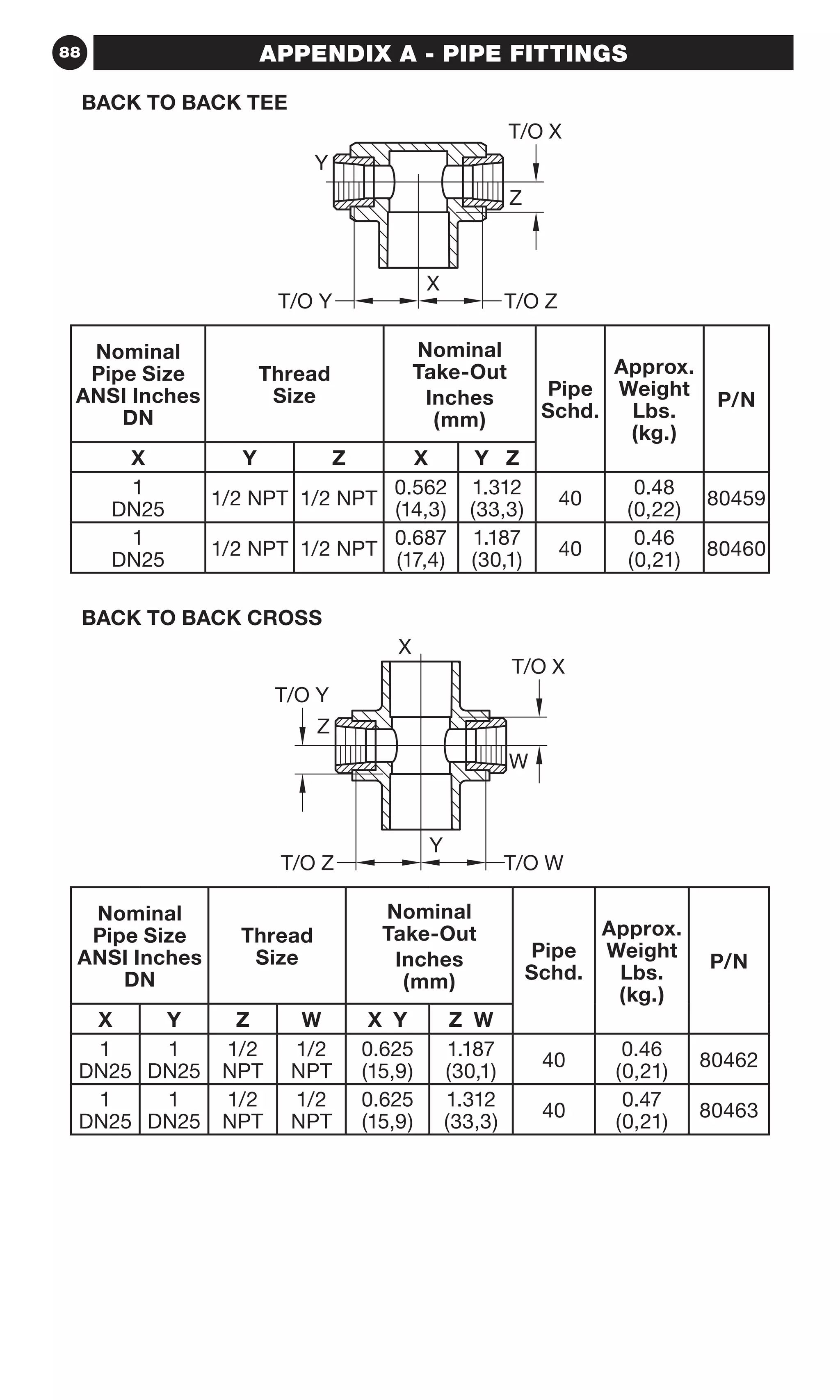
APPENDIX A - PIPE FITTINGS. .  .  .  .  .  .  .  .  .  .  .  .  .  .  .  .  .  .  .  .  .  .  .  .  .  .  .  .  .  .  .  . 74
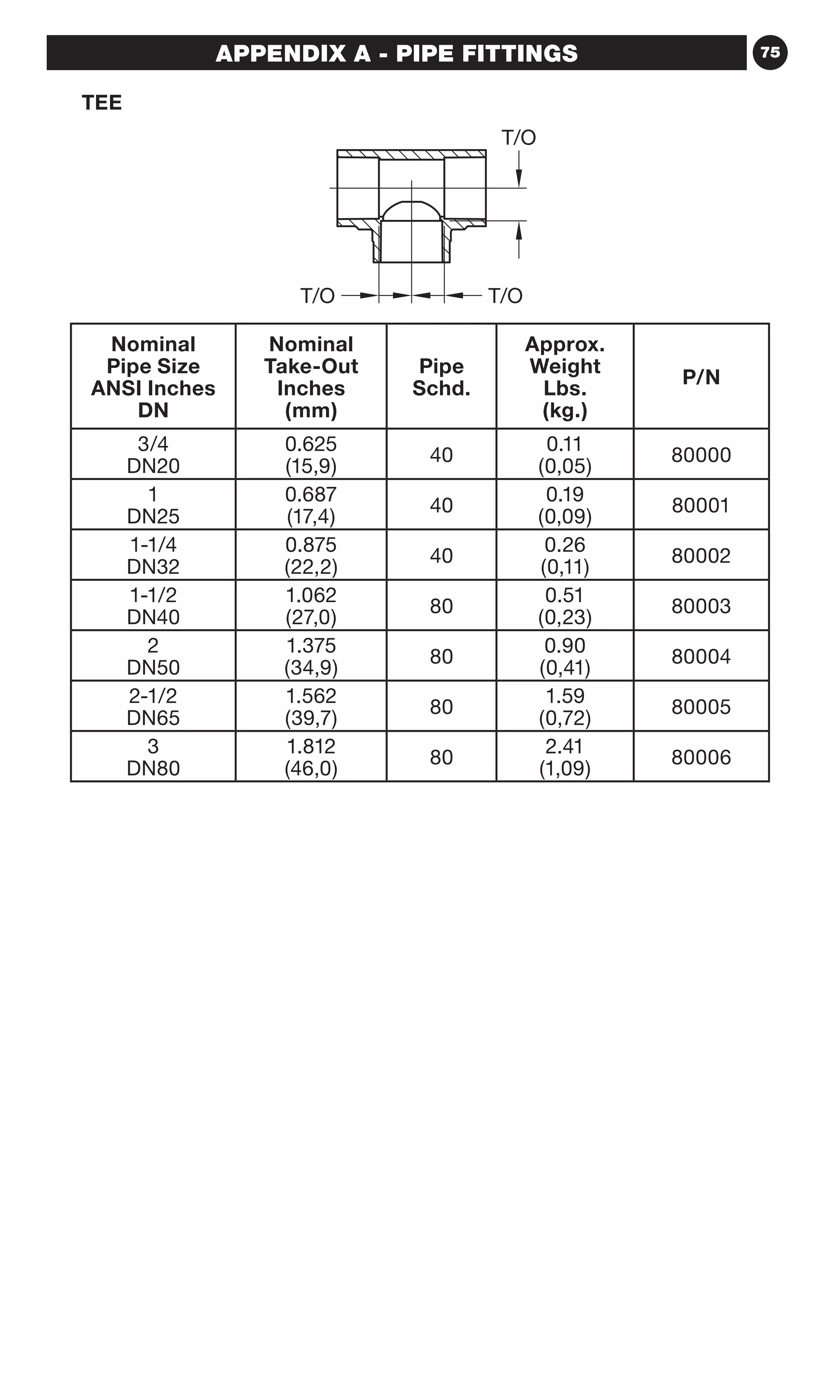
APPENDIX A - PIPE FITTINGS. .  .  .  .  .  .  .  .  .  .  .  .  .  .  .  .  .  .  .  .  .  .  .  .  .  .  .  .  .  .  .  . 75
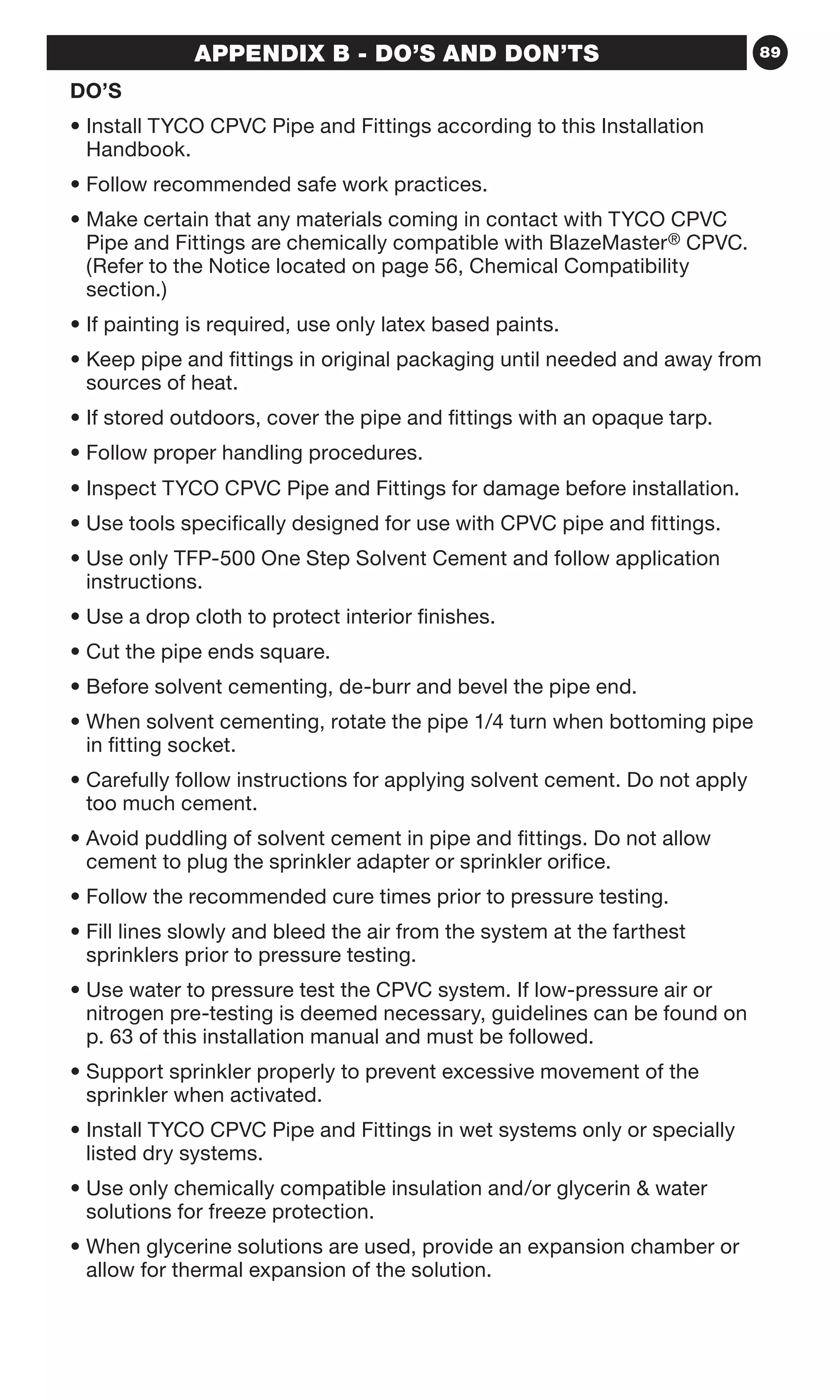
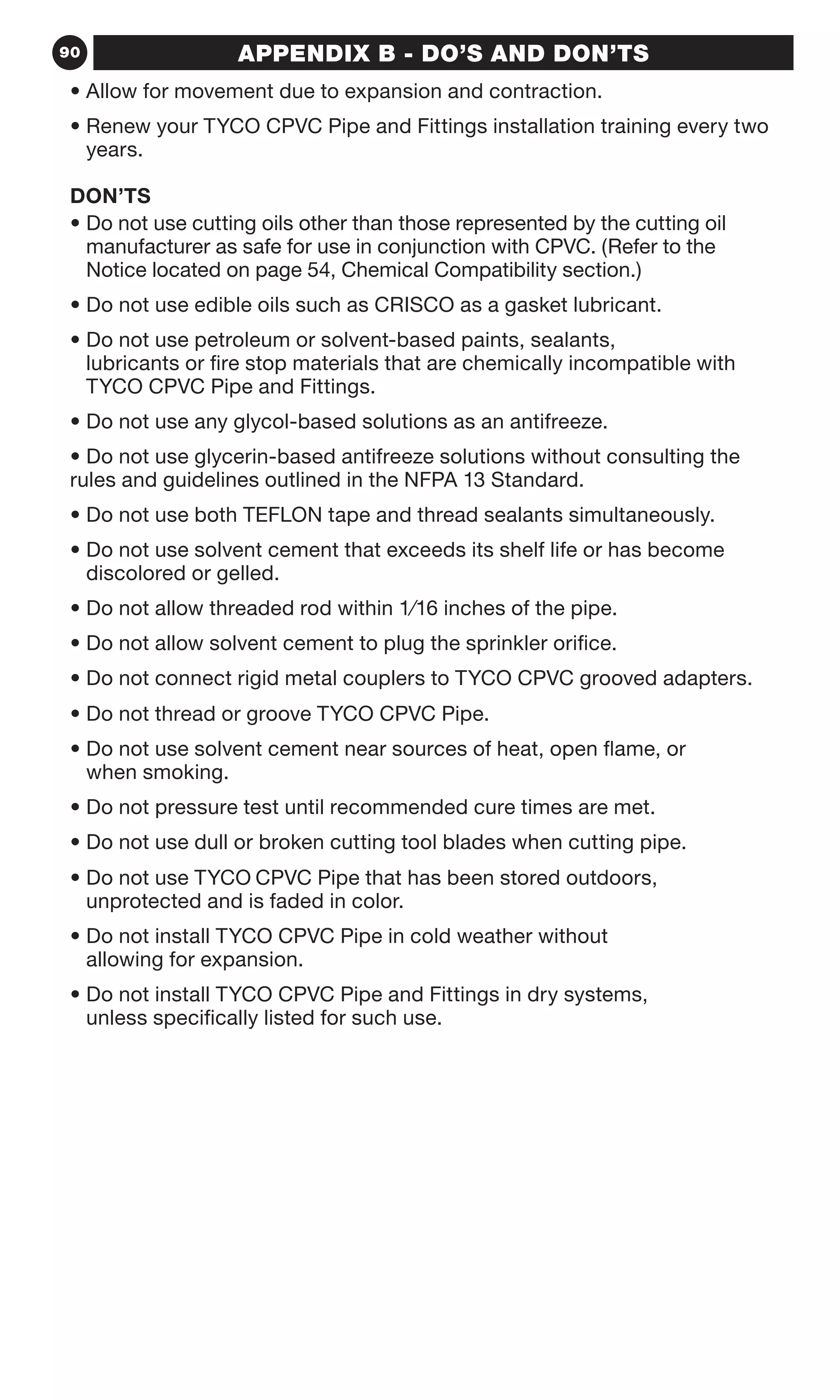
APPENDIX B - DO’S AND DON’TS.  .  .  .  .  .  .  .  .  .  .  .  .  .  .  .  .  .  .  .  .  .  .  .  .  .  .  .  . 89
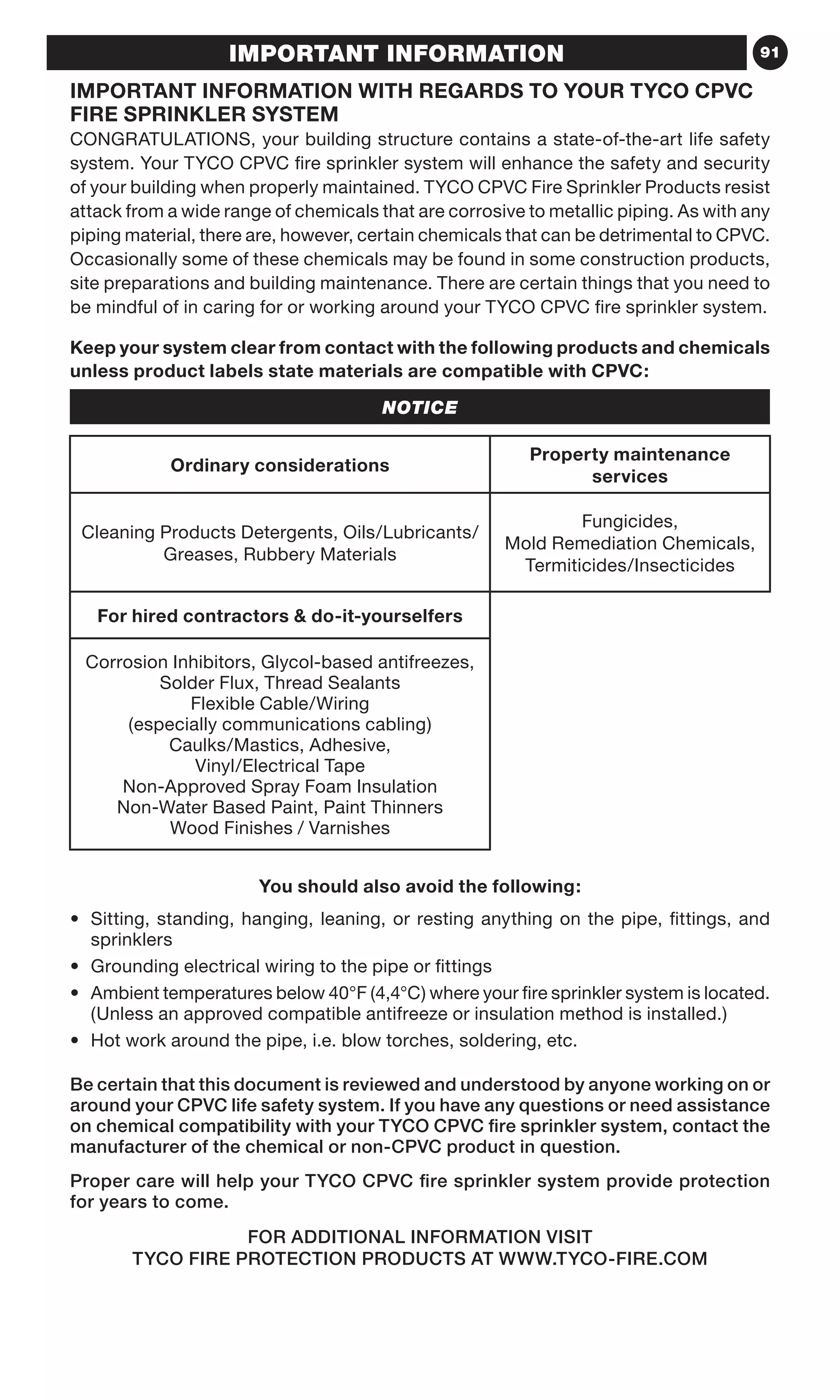
IMPORTANT INFORMATION.  .  .  .  .  .  .  .  .  .  .  .  .  .  .  .  .  .  .  .  .  .  .  .  .  .  .  .  .  .  .  .  .  . 91
Important Information with Regards to Your
TYCO CPVC Fire Sprinkler System .  .  .  .  .  .  .  .  .  .  .  .  .  .  .  .  .  .  .  .  .  .  .  .  .  . 91
Notification to Jobsite Building Trades .  .  .  .  .  .  .  .  .  .  .  .  .  .  .  .  .  .  .  .  .  .  . 92
4 GENERAL DESCRIPTION
INTRODUCTION
This Installation Handbook refers to TYCOCPVC Pipe and Fittings produced
by TYCO Fire Protection Products (TFPP). TYCO CPVC Pipe and Fittings are
produced using BlazeMaster CPVC compound. When reference to NFPA
Standards is made in this Installation Handbook, the current edition of the
relevant code is used. This Installation Handbook contains the criteria
for installation (including system design, handling, and storage) of
BlazeMaster CPVC piping systems in accordance with the applicable
Listing/Approval agencies. Additionally, this handbook contains general
piping practices and other installation suggestions that may not be required
to satisfy the applicable Listing/Approval agencies. To differentiate between
a requirement and a suggestion, use the following definitions:
SHALL or MUST – The use of the words “shall” or “must” indicates a
mandatory requirement of the Listings/Approvals.
SHOULD or MAY – The use of the words “should” or “may” indicates
a recommendation that is strongly advised, but not
required to meet the Listings/Approvals.
This handbook is intended as a supplement to basic, fundamental knowledge
relating to the installation and/or repair of CPVC fire sprinkler systems.
Before commencing installation, a user should understand this Installation
Handbook and confirm applicable National Fire Protection Association
(NFPA) standards, the National Building Code of Canada (as applicable), and
local approval and installation requirements for CPVC fire sprinkler systems.
NOTICE
The TYCO CPVC Pipe and Fittings described herein must be installed and
maintained in compliance with this Installation Handbook and with the
applicable standards of the National Fire Protection Association, in addition
to the standards of any authorities having jurisdiction. Failure to do so may
impair the performance of the TYCO CPVC Pipe and Fittings.
The owner is responsible for maintaining their fire protection system and
devices in proper operating condition. The installing contractor or product
manufacturer should be contacted with any questions.
It is the designer’s responsibility to select products suitable for the intended
service and to ensure that pressure ratings and performance data are not
exceeded. Material selection should be verified to be compatible for the
specific application. Designers and Installers must read and understand the
installation instructions in this handbook.
Never remove any piping component or modify any piping deficiencies
without first depressurizing and draining the system.
Never use compressed air or nitrogen in lieu of or to replace the required
hydrostatic system acceptance testing. Any pre-testing performed with
low pressure air or nitrogen should follow the recommendations on p. 63.
System failure when using high-pressure compressed air or nitrogen may
result in property damage, serious injury, or death.
5GENERAL DESCRIPTION
ADVANTAGES
TYCO CPVC Pipe and Fittings are designed specifically for fire sprinkler
systems and provide the following advantages over traditional sprinkler
piping systems:
• Increased hydraulic capabilities (C-Factor =150)
• No pre-cutting and expensive fabrication required
• Pipe/Fittings (slip style only) - NSF-pw listed for use in pressure rated
potable water piping systems
• Can easily be connected to other sprinkler piping systems
• Flexibility in the piping for greater ease of installation
• Resistant to rust, scale, and foreign contaminant build up
• Inexpensive tools required for installation
• Easily repaired or modified on site
• Easily transported and handled
• Resists sweating and condensation
TRAINING AND DEMONSTRATION
TYCO Fire Protection Products (TFPP) strongly recommends that installers
receive hands on demonstration in the proper procedure(s) for installation
of BlazeMaster fire sprinkler systems. On-site demonstration in proper pipe
preparation, solvent cementing, proper handling of CPVC and installation
instruction are available from TFPP at no charge. Upon completion of the
TYCO demonstration program, TFPP will issue a completion card to the
persons successfully finishing the required subject matter. This card is to
be carried when working on TYCO CPVC systems. For information about
on-site demonstration, please contact your local TFPP Distribution Center
or your TFPP sales representative.
General
Description
Listings/
Approvals
Technical
Data
Installation
Visit
Tyco-Fire.com
Appendix
A
Appendix
B
Important
Information
6 GENERAL DESCRIPTION
TYCO. . . . . . . . . . . . . . . registered trademark of Tyco Fire Protection Products
HEAD SET . . . . . . . . . . . . registered trademark of Tyco Fire ProtectionProducts
BlazeMaster®	�������������������������registered trademark of The Lubrizol Corporation
Caulk and Walk™	�������������������registered trademark of The Lubrizol Corporation
SOFFI-STEEL	������������������������������������ registered trademark of Grice Engineering
TEFLON	��������������������������������������������������������������registered trademark of Dupont
OATEY 	������������������������������������������������������������������ registered trademark of Oatey
GREAT WHITE	������������������������������������������������������ registered trademark of Oatey
CRISCO	�������������������������������������������� registered trademark of J.M. Smucker Co.
FBC™ System Compatible Program	�������������������������������registered trademark of
The Lubrizol Corporation
7LISTINGS AND APPROVALS
LISTINGS/APPROVALS (WHERE TO USE)
For verification of Listings and Approvals, please consult the current UL
Fire Protection Equipment Directory, C-UL Products Certified for Canada
Directory, Factory Mutual Research Approval Guide, or LPCB List of
Approved Fire Security Products and Services Guide.
TYCO Fire Protection Products manufactures CPVC pipe and fittings
using Lubrizol’s BlazeMaster® compound as a licensee of The Lubrizol
Corporation.
UNDERWRITERS LABORATORIES INC. (UL) AND
UNDERWRITERS LABORATORIES INC. (C-UL) FOR USE IN CANADA
TYCO CPVC Pipe and Fittings are UL and C-UL Listed for use in:
• Light Hazard and residential occupancies as defined in the Standard for
Installation of Sprinkler Systems, NFPA 13
• Residential occupancies as defined in the Standard for the Installation
of Sprinkler Systems in Low-Rise Residential Occupancies up to Four
Stories in Height, NFPA 13R
• Residential occupancies as defined in the Standard for Installation of
Sprinkler Systems in One and Two Family Dwellings and Manufactured
Homes, NFPA 13D
• Air plenums, as defined by the Installation of Air Conditioning and Ventilating
Systems, NFPA 90A
• Underground Water Pressure Service, NFPA 24
• System risers in accordance with NFPA 13, 13R, and 13D
• See UL Fire Protection Equipment Directory, categories VIWT and HFYH.
• See C-UL Products Certified for Canada Directory, categories VIWT7
and HFYH7.
TYCO Fire Sprinkler Systems shall be employed in wet-pipe systems only. (A
wet pipe system contains water or water and glycerin (anti-freeze solution)
and is connected to a water supply so that the water or water and glycerin
(anti-freeze solution) will discharge immediately when a sprinkler is opened.)
National Fire Protection Association Standards 13, 13R, 13D and NFPA
24, in addition to the standards of any other authorities having jurisdiction,
must be referenced and followed for design and installation requirements
in conjunction with this installation handbook.
Concealed Installations (UL)
• In accordance with the UL Listing, protection shall be provided for TYCO
CPVC Pipe and Fittings. The minimum protection shall consist of either
one layer of 3/8 inch (9,5 mm) thick gypsum wallboard, 1/2 inch (12,7 mm)
plywood soffits, or a suspended membrane ceiling with lay-in panels or
tiles having a weight of 0.35 pounds per sq. ft. (1,7 kg per sq. meter) when
installed with metallic grids. For residential occupancies defined in NFPA
13D and 13R, the minimum protection may consist of one layer of 1/2 inch
(12,7 mm) plywood.
General
Description
Listings/
Approvals
Technical
Data
Installation
Visit
Tyco-Fire.com
Appendix
A
Appendix
B
Important
Information
8 LISTINGS AND APPROVALS
Listed Quick Response, standard or extended coverage, 225°F (107°C)
maximum temperature rated sprinkler or Listed Residential 225°F (107°C)
maximum temperature rated sprinkler located in accordance with its
Listing may be used.
Solvent cement joints shall be made with TFP-500 One Step Solvent
Cement.
Concealed Installations (C-UL)
• In accordance with the C-UL Listing, protection shall be provided for
TYCO CPVC Pipe and Fittings. The minimum protection shall consist
of either one layer of 9,5 mm thick gypsum wallboard, one layer of 13
mm plywood, or a suspended membrane ceiling with lay-in panels or
tiles classified with respect to surface burning characteristics having a
mass of not less than 1,7 kg/m2 when installed with metallic grids. The
effectiveness of this protection can be impaired if penetrated by large
openings such as ventilation grills, exhaust fans connected to metal
ducts serving washrooms excepted. Where such penetration is present,
individual openings exceeding 0,03 m2 but not exceeding 0,71 m2 in area
must be located such that the distance from the edge of the opening to
the nearest sprinkler does not exceed 300 mm.
In these cases any Quick or Standard Response, 107°C maximum
temperature rated sprinkler or Listed Residential 107°C maximum
temperature rated sprinkler located in accordance with its Listing may be
used. TYCO CPVC Pipe and Fittings shall not be used where such openings
exceed 0.71 m2 in area.
Solvent cement joints shall be made with TFP-500 One Step Solvent
Cement.
Exposed Installation - General (UL  C-UL)
In accordance with the UL and C-UL Listings, TYCO CPVC Pipe and Fittings
may be installed without protection (exposed), subject to the following
additional limitations:
Note: NFPA standards permit the omission of automatic sprinklers in
areas such as small closets and bathrooms. Where sprinklers are not
required, and when approved by the authority having jurisdiction, it is
acceptable to install BlazeMaster® products exposed in these areas.
Note: Where piping is required to be mounted directly to the ceiling/
wall, the use of listed hangers for thermoplastic sprinkler piping mounted
directly to the ceiling/wall is permitted. The resulting clearance between
the pipe and the ceiling/wall as a function of using the listed hanger is
acceptable.
Smooth, Flat, Horizontal, Fixed Ceilings -
Exposed Installations (UL  C-UL)
• Standard Coverage Sprinklers
- Pendent Sprinklers shall be Listed, Quick Response, 170°F (77°C)
maximum temperature rated, sprinklers having deflectors installed within
8 inches (203,2 mm) of the ceiling. The maximum distance between
sprinklers shall not exceed 15 feet (4,6 m). Piping shall be mounted
directly to the ceiling.
9LISTINGS AND APPROVALS
- Upright Sprinklers shall be Listed, Quick Response, 155°F (68°C)
maximum temperature rated, installed within 4 inches (101,6 mm) of the
ceiling. The maximum distance between sprinklers shall not exceed 15
feet (4,6 m). The maximum distance from the ceiling to the centerline
of the main run of pipe shall not exceed 7-1/2 inches (190,5 mm). The
distance from the centerline of the sprinkler to the closest hanger shall
be 3 inches (76,2 mm).
- Horizontal Sidewall Sprinklers shall be Listed, Quick Response, 200°F
(93°C) maximum temperature rated, having deflectors within 12 inches
(305,0 mm) of the ceiling and within 6 inches (152,4 mm) of the side wall.
The maximum distance between sprinklers shall not exceed 14 feet (4,3
m). Piping shall be mounted directly to the side wall.
- Solvent cement joints shall be made with TFP-500 One Step Solvent
Cement.
• Extended Coverage Sprinklers
- Pendent Sprinklers shall be Listed, Quick Response, 155°F (68°C)
maximum temperature rated, having deflectors installed within 8 inches
(203,2 mm) of the ceiling. The maximum distance between sprinklers shall
not exceed 20 feet (6,1 m) with an application density of at least 0.1 gpm/
sq.ft (4,1 mm/min). Piping shall be mounted directly to the ceiling.
- Horizontal Sidewall Sprinklers shall be Listed, Quick Response, 165°F
(74°C) maximum temperature rated, having deflectors within 12 inches
(305,0 mm) of the ceiling and within 6 inches (152,4 mm) of the side wall.
The maximum lateral distance between sprinklers shall not exceed 18
feet (5,5 m) with an application density of at least 0.1 gpm/ft2 (4,1 mm/
min). Piping shall be mounted directly to the side wall.
- Horizontal Sidewall Sprinklers shall be Listed, Quick Response, 175°F
(79°C) maximum temperature rated, having deflectors within 12 inches
(305,0 mm) of the ceiling and within 6 inches (152,4 mm) of the side wall.
The maximum lateral distance between sprinklers shall not exceed 16
feet (4,9 m) with an application density of at least 0.1 gpm/ft2 (4,1 mm/
min). Piping shall be mounted directly to the side wall.
- When using fittings 1-1/2 inches (DN40) and larger only Schedule 80
fittings may be used.
- Solvent cement joints shall be made with TFP-500 One Step Solvent
Cement.
• Residential Sprinklers
- Pendent Sprinklers when the maximum lateral distance between
sprinklers is 15 feet (4,6 m) or less. Sprinklers shall be Listed 170°F (77°C)
maximum temperature rated, having deflectors located in accordance
with their Listing and not exceeding 8 inches (203,2 mm) from ceiling.
The demand for the sprinklers shall be the minimum flow rates indicated
in individual listing. Piping shall be mounted directly to the ceiling.
- Pendent Sprinklers when the maximum lateral distance between
sprinklers exceeds 15 feet (4,6 m) but does not exceed 20 feet (6,1
m). Sprinklers shall be Listed 155°F (68°C) maximum temperature
rated, having deflectors located in accordance with their Listing and
General
Description
Listings/
Approvals
Technical
Data
Installation
Visit
Tyco-Fire.com
Appendix
A
Appendix
B
Important
Information
10 LISTINGS AND APPROVALS
not exceeding 8 inches (203,2 mm) from ceiling. The demand for the
sprinklers shall be the greater of either the minimum flow rates indicated
in individual listing or calculated based on delivering a minimum of 0.1
gpm/sq.ft. (4,1 mm/min) over the design area in accordance with the
provisions of NFPA 13:(2007) Section 11.3.1.2. Piping shall be mounted
directly to the ceiling.
- Horizontal Sidewall Sprinklers when the maximum lateral distance
between sprinklers is 14 feet (4,3 m) or less. Sprinklers shall be Listed
200°F (93°C) maximum temperature rated having deflectors located in
accordance with their Listing. The demand for the sprinklers shall be the
minimum flow rates indicated in individual listing. Piping shall be mounted
directly to the side wall.
- Horizontal Sidewall Sprinklers when the maximum lateral distance
between sprinklers exceeds 14 feet (4,3 m) but does not exceed 18 feet
(5,5 m). Sprinklers shall be Listed 165°F (74°C) maximum temperature
rated having deflectors 12 inches (305,0 mm) from ceiling and within 6
inches (152,4 mm) of the wall. The demand for the sprinklers shall be
the greater of the minimum flow rates indicated in individual listing or
calculated based on delivering a minimum of 0.1 gpm/sq.ft (4,1 mm/
min) over the design area in accordance with the provisions of NFPA
13:(2007) Section 11.3.1.2. The maximum sprinkler area of coverage
shall not exceed 18 x 18 feet (5,5 m x 5,5 m). Piping shall be mounted
directly to the side wall.
- When applying criteria having a minimum 0.1 gpm/sq.ft (4,1 mm/min),
Schedule 80 fittings must be used when sizes are 1-1/2 inch (DN40)
and larger.
- Solvent cement joints shall be made with TFP-500 One Step Solvent
Cement.
Unfinished Basements - Exposed Installations
Solid and Composite Wood Joists (UL and C-UL)
TYCO CPVC Pipe and Fittings may be installed without protection (exposed)
in unfinished basements in accordance with NFPA 13D when subject to
the following additional limitations:
• The ceiling shall be horizontal and constructed utilizing solid wood joists
or composite wood joists with a nominal depth of 12 inches (305,0 mm)
or less on maximum 24 inch (609,6 mm) centers.
• The distance from the floor to the bottom of the joists shall be between 7
and 10 feet (2,1 m and 3,0 m).
• Listed residential pendent sprinklers with a maximum temperature rating
of 155°F (68°C) and a minimum K-factor of 4.9 are to be used for this type
of installation. The maximum sprinkler spacing shall not exceed 16 feet
(4,9 m). The maximum sprinkler coverage area is to be 16 feet (4,9 m) by
14 feet (4,3 m) spaced with the 16 foot (4,9 m) dimension along the joists
and the 14 foot (4,3 m) dimension across the joists. Lesser areas are also
permitted. The system is to be designed based upon the Listed flows for the
sprinkler selected except that the flow for a single sprinkler or for multiple
sprinklers flowing is to be not less than 13 gpm (49,2 lpm) per sprinkler. The
11LISTINGS AND APPROVALS
sprinklers are to be installed with their deflectors a maximum of 1-3/4 inch
below the bottom of the solid wood joists in anticipation of future installation
of a finished ceiling. (reference NFPA 13D, Section 8.2.4, 2010 Edition)
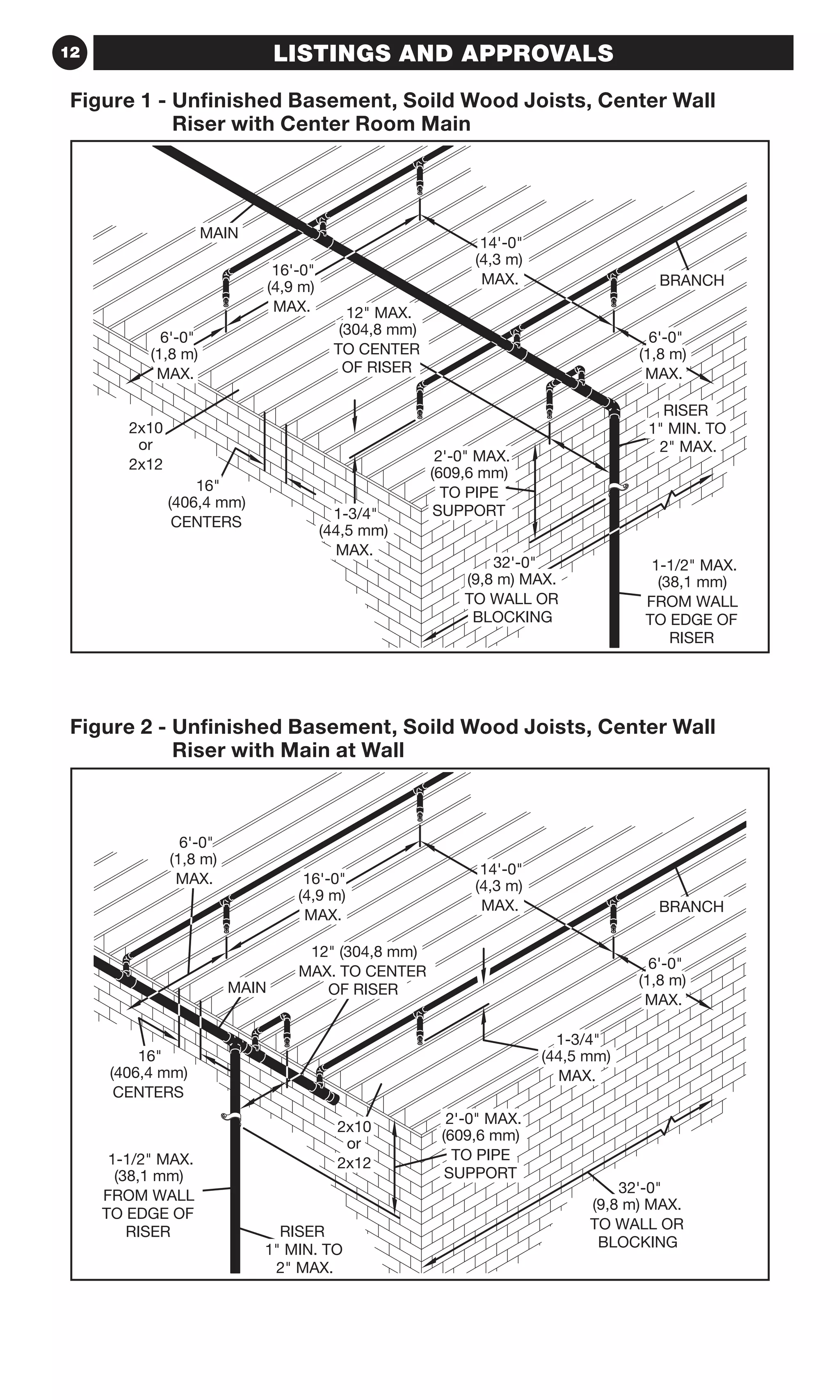
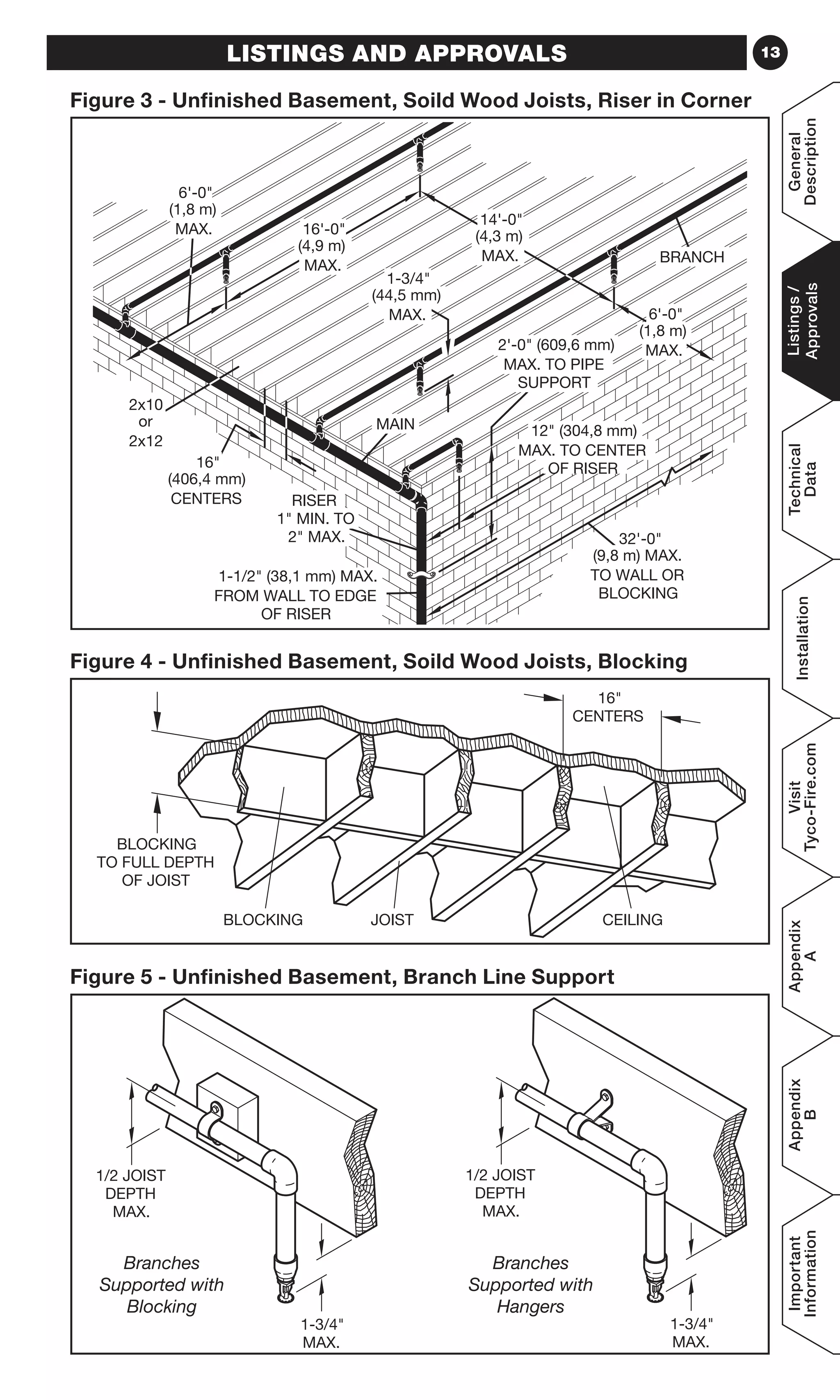
• All system mains shall be run perpendicular to the joists. All branch lines
shall be run parallel to the joists. Schedule 80 fittings in the 1-1/2 inch and
larger sizes shall be used.
• All solvent cement joints shall be made with One Step Solvent Cement
(TFP-500, BM-5, FP-1000, or TFP-401).
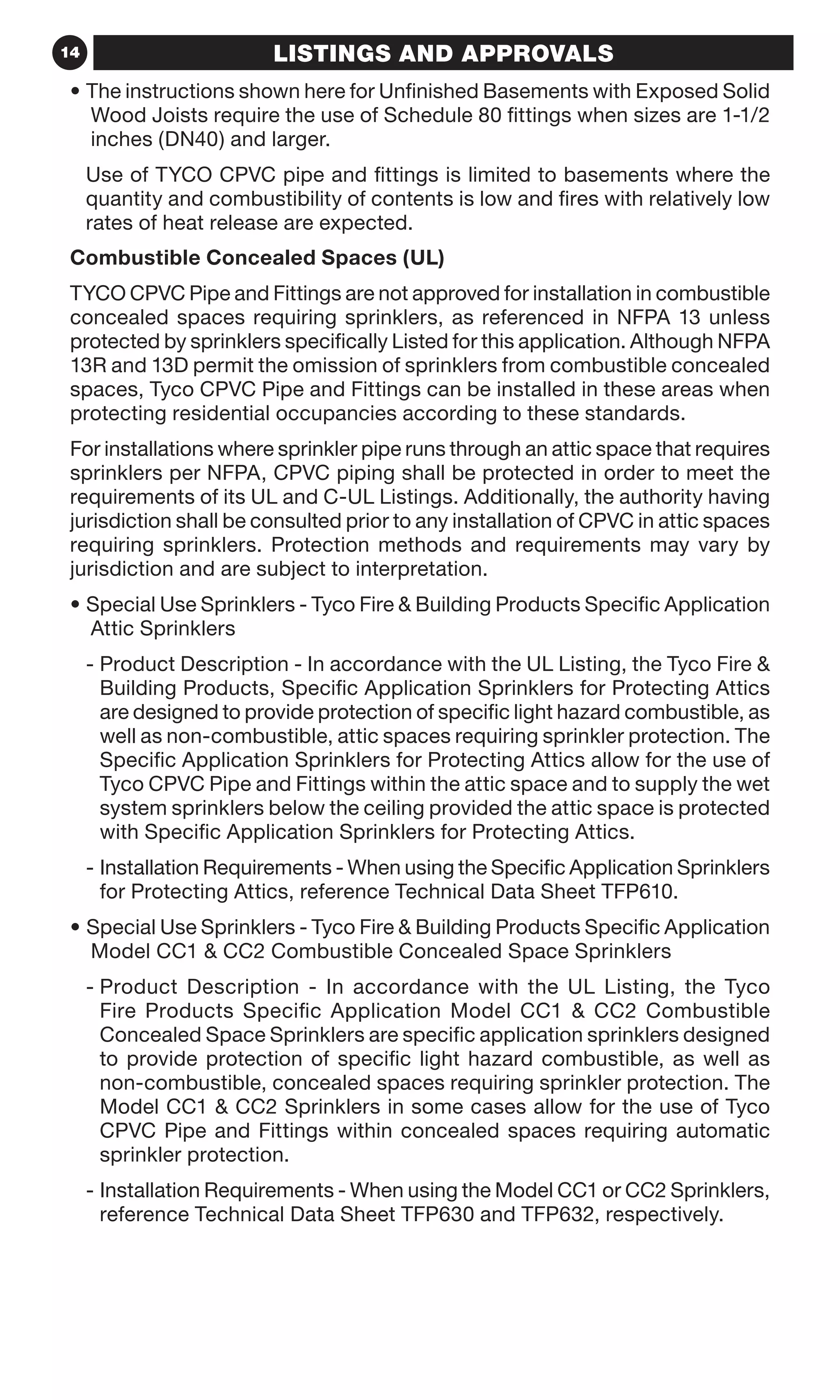
• The maximum length along the joist shall not exceed 32 feet (9,8 m). When
the length exceeds 32 feet (9,8 m), blocking shall be utilized. The blocking
shall be constructed of minimum 1/2 inch (12,7 mm) plywood, minimum
3/8 inch (9,5 mm) gypsum wallboard or batt insulation with a minimum
thickness of 3-1/2 inches (89 mm). These blocking materials shall be the
full depth of the joists. When batt insulation is used as blocking, it must be
a single piece of insulation. The insulation must be secured in place with
metal wire netting which must encase the insulation on both of the exposed
sides. The metal wire netting is required to hold the insulation in place and
prevent it from being dislodged or repositioned over time. It is acceptable
for items such as piping, wires, ducts, etc. to penetrate the blocking. The
gap between the item penetrating the blocking and the blocking should
be minimized. For installations where the gap exceeds 1/4 inch (6,4 mm),
the gap shall be filled with insulation, caulking, or other suitable material.
• When installing TYCO CPVC Pipe and Fittings perpendicular (system
mains) to the joists, listed support devices for thermoplastic sprinkler
piping or other listed support devices shall be used which mount the
piping directly to the bottom of the joists. As an alternative to mounting
the pipe and fittings below the joists, it may be acceptable to cut holes in
the joists at or below the center of the depth of the joist for support. The
holes should be oversized to allow for movement and located as to not
impair the structural integrity of the joists.
	 NOTICE
When drilling holes in the joists, the structural integrity must be main-
tained. Consult the authority having jurisdiction (AHJ) or building code
for requirements.
• When installing TYCO CPVC pipe and fittings parallel (branch lines) to the
joists, the pipe and fittings shall be installed in the cavity below the bottom
of the ceiling and above the bottom of the joist. The branch lines shall be
located at or below the center of the depth of the joist. The pipe shall be
installed utilizing listed support devices for thermoplastic sprinkler piping
or other listed support devices which mount the piping directly to nominal
2 inch (50,8 mm) wood blocking or listed support devices for thermoplastic
sprinkler piping that offset the pipe a nominal distance of 1-1/2 inches
(38,1 mm) from the joists. Use of TYCO CPVC pipe and fittings is limited
to basements where the quantity and combustibility of contents is low and
fires with relatively low rates of heat release are expected. For additional
information regarding the assembly and installation of TYCO CPVC pipe
and fittings please refer to the manufacturer’s installation instructions.
General
Description
Listings/
Approvals
Technical
Data
Installation
Visit
Tyco-Fire.com
Appendix
A
Appendix
B
Important
Information
12 LISTINGS AND APPROVALS
6'-0
(1,8 m)
TO WALL OR
BLOCKING
(9,8 m) MAX.
TO CENTER
OF RISER
(304,8 mm)
TO PIPE
(609,6 mm)
FROM WALL
TO EDGE OF
(38,1 mm)
1 MIN. TO
2 MAX.
RISER
BRANCH
MAIN
(44,5 mm)
MAX.
or
2x12
2x10
MAX.
16'-0
(4,9 m)
MAX.
14'-0
(4,3 m)
MAX.
6'-0
(1,8 m)
MAX.
1-3/4
12 MAX.
2'-0 MAX.
1-1/2 MAX.32'-0
RISER
SUPPORT
16
(406,4 mm)
CENTERS
Figure 1 - Unfinished Basement, Soild Wood Joists, Center Wall
Riser with Center Room Main
MAIN
6'-0
(1,8 m)
BRANCH
MAX. 16'-0
(4,9 m)
MAX.
14'-0
(4,3 m)
MAX.
6'-0
(1,8 m)
MAX.
(44,5 mm)
MAX.
1-3/4
FROM WALL
TO EDGE OF
(38,1 mm)
1-1/2 MAX.
RISER
16
(406,4 mm)
CENTERS
1 MIN. TO
2 MAX.
RISER TO WALL OR
BLOCKING
(9,8 m) MAX.
32'-0
MAX. TO CENTER
12 (304,8 mm)
OF RISER
or
2x12
2x10
TO PIPE
(609,6 mm)
2'-0 MAX.
SUPPORT
Figure 2 - Unfinished Basement, Soild Wood Joists, Center Wall
Riser with Main at Wall
13LISTINGS AND APPROVALS
Branches
Supported with
Blocking
Branches
Supported with
Hangers
DEPTH
MAX.
1/2 JOIST
1-3/4
MAX.
DEPTH
MAX.
1/2 JOIST
1-3/4
MAX.
Figure 5 - Unfinished Basement, Branch Line Support
MAIN
FROM WALL TO EDGE
OF RISER
1-1/2 (38,1 mm) MAX.
1 MIN. TO
2 MAX.
RISER
BRANCH
16'-0
(4,9 m)
MAX.
14'-0
(4,3 m)
MAX.
6'-0
(1,8 m)
MAX.
(44,5 mm)
MAX.
1-3/4
16
(406,4 mm)
CENTERS
or
2x12
2x10
6'-0
(1,8 m)
MAX.
MAX. TO CENTER
12 (304,8 mm)
OF RISER
TO WALL OR
BLOCKING
(9,8 m) MAX.
32'-0
MAX. TO PIPE
2'-0 (609,6 mm)
SUPPORT
Figure 3 - Unfinished Basement, Soild Wood Joists, Riser in Corner
16
CENTERS
JOIST CEILINGBLOCKING
TO FULL DEPTH
OF JOIST
BLOCKING
Figure 4 - Unfinished Basement, Soild Wood Joists, Blocking
General
Description
Listings/
Approvals
Technical
Data
Installation
Visit
Tyco-Fire.com
Appendix
A
Appendix
B
Important
Information
14 LISTINGS AND APPROVALS
• The instructions shown here for Unfinished Basements with Exposed Solid
Wood Joists require the use of Schedule 80 fittings when sizes are 1-1/2
inches (DN40) and larger.
Use of TYCO CPVC pipe and fittings is limited to basements where the
quantity and combustibility of contents is low and fires with relatively low
rates of heat release are expected.
Combustible Concealed Spaces (UL)
TYCO CPVC Pipe and Fittings are not approved for installation in combustible
concealed spaces requiring sprinklers, as referenced in NFPA 13 unless
protected by sprinklers specifically Listed for this application. Although NFPA
13R and 13D permit the omission of sprinklers from combustible concealed
spaces, Tyco CPVC Pipe and Fittings can be installed in these areas when
protecting residential occupancies according to these standards.
For installations where sprinkler pipe runs through an attic space that requires
sprinklers per NFPA, CPVC piping shall be protected in order to meet the
requirements of its UL and C-UL Listings. Additionally, the authority having
jurisdiction shall be consulted prior to any installation of CPVC in attic spaces
requiring sprinklers. Protection methods and requirements may vary by
jurisdiction and are subject to interpretation.
• Special Use Sprinklers - Tyco Fire  Building Products Specific Application
Attic Sprinklers
- Product Description - In accordance with the UL Listing, the Tyco Fire 
Building Products, Specific Application Sprinklers for Protecting Attics
are designed to provide protection of specific light hazard combustible, as
well as non-combustible, attic spaces requiring sprinkler protection. The
Specific Application Sprinklers for Protecting Attics allow for the use of
Tyco CPVC Pipe and Fittings within the attic space and to supply the wet
system sprinklers below the ceiling provided the attic space is protected
with Specific Application Sprinklers for Protecting Attics.
- Installation Requirements - When using the Specific Application Sprinklers
for Protecting Attics, reference Technical Data Sheet TFP610.
• Special Use Sprinklers - Tyco Fire  Building Products Specific Application
Model CC1  CC2 Combustible Concealed Space Sprinklers
- Product Description - In accordance with the UL Listing, the Tyco
Fire Products Specific Application Model CC1  CC2 Combustible
Concealed Space Sprinklers are specific application sprinklers designed
to provide protection of specific light hazard combustible, as well as
non-combustible, concealed spaces requiring sprinkler protection. The
Model CC1  CC2 Sprinklers in some cases allow for the use of Tyco
CPVC Pipe and Fittings within concealed spaces requiring automatic
sprinkler protection.
- Installation Requirements - When using the Model CC1 or CC2 Sprinklers,
reference Technical Data Sheet TFP630 and TFP632, respectively.
15LISTINGS AND APPROVALS
Residential Dry Pipe Systems (UL)
In accordance with the Underwriters Laboratories Inc. (UL) Listing, TYCO
CPVC Fire Sprinkler Pipe and Fittings made with BlazeMaster® compound
may be installed in Dry Pipe Systems for Residential Occupancies when
subject to the additional limitations listed in this section.
• Acceptable Residential Occupancies are defined as follows:
- Concealed (protected) installations in residential sprinkler systems for
one- and two- family dwellings and manufactured homes per NFPA 13D.
- Residential sprinkler systems for residential occupancies up to and
including four stories in height per NFPA 13R.
- Residential portions of any occupancy per NFPA 13 where calculations
for Dry Pipe System water delivery are based on the hazard shown in
Table 1 using a calculation program listed by a nationally recognized
laboratory or obtained where the system design specifies that water is
delivered to the system test connection in not more than 15 seconds for
Residential Occupancies, starting at normal air pressure on the system.
• Residential sprinklers used in conjunction with TYCO CPVC Fire Sprinkler
Pipe and Fittings in Dry Pipe Systems shall be specifically listed for such
use.
• The TYCO CPVC Sprinkler Head Adapter Tee (P/N 80259) is to be used with
dry-type residential pendent sprinklers in dry pipe system installations.
• Dry Pipe Systems in areas subject to freezing shall be pitched at least
1/4 or 1/2 inch per 10 feet (2 mm/m) in accordance with the appropriate
NFPA standard being utilized.
• Upon completion of the assembly and cure, the system shall by
hydrostatically tested in accordance with the procedures described in
the CPVC Installation Handbook (IH-1900).
• TYCO CPVC Fire Sprinkler pipe and fittings used in Dry Pipe Systems may
not be used in combination with other thermoplastic piping systems unless
specifically listed for use in Dry Pipe Systems. Combining with steel or
copper piping systems is permitted, where applicable.
• The pipe and fittings shall be protected (concealed) in accordance with
the specifications outlined in the CPVC Installation Handbook (IH-1900).
• Exposed pipe and fittings have not been evaluated.
• Minimum use temperature shall be -20°F (-29°C).
• 3/4 to 3 inch pipe and fittings are listed for these applications and are to
be assembled with TFP-500 One Step Solvent Cement.
• In-service system Air Pressure shall be maintained at a maximum of 15
psi (1 bar).
• Pipe friction loss shall be calculated in accordance with the Hazen-Williams
formula using a C value of 150.
• Air supply to the TYCO CPVC Pipe and Fittings shall be free of oil and oil
vapor. Automatic air compressors shall be of an oil-less type or the air
shall be treated to assure oil or oil vapor is not introduced into the piping.
General
Description
Listings/
Approvals
Technical
Data
Installation
Visit
Tyco-Fire.com
Appendix
A
Appendix
B
Important
Information
16 LISTINGS AND APPROVALS
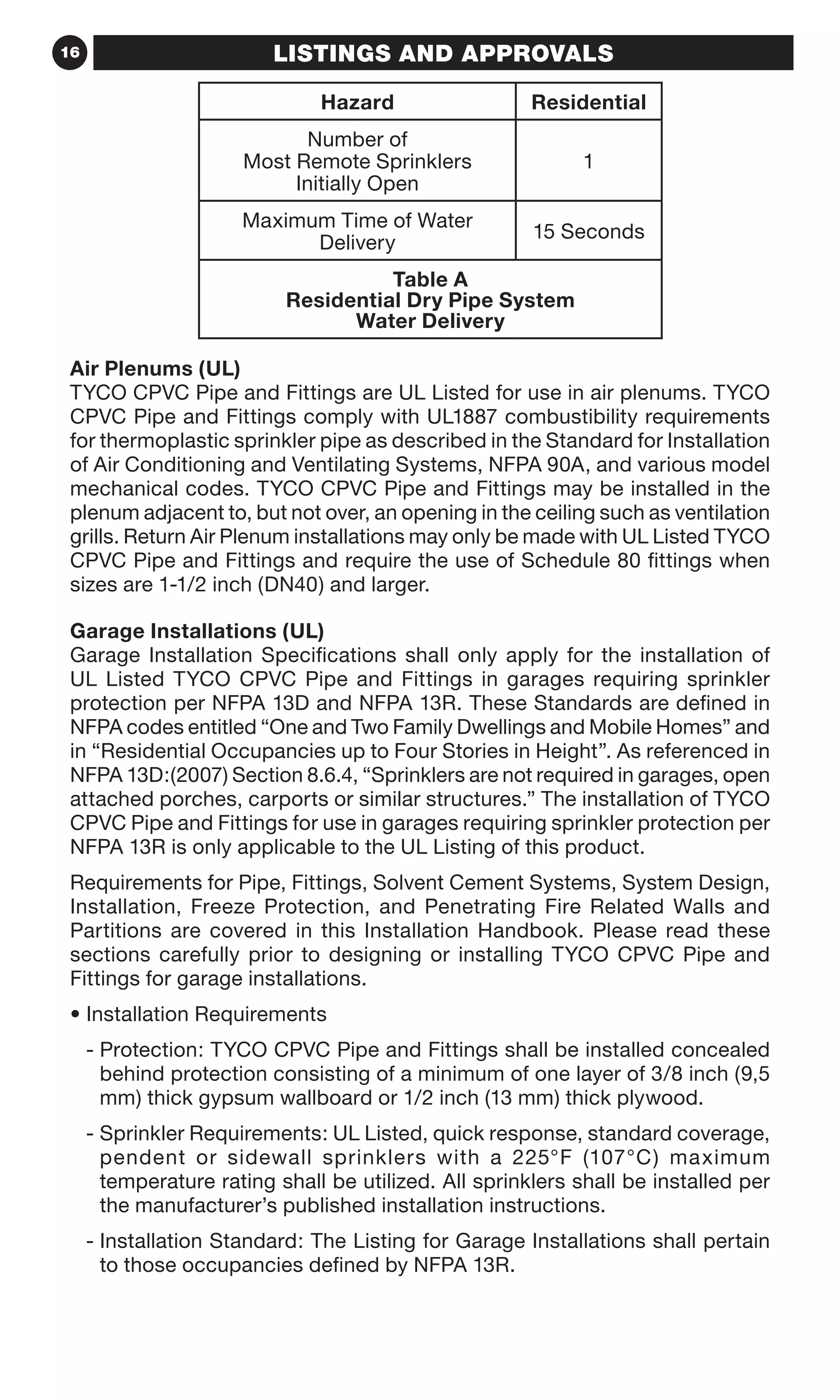
Hazard Residential
Number of
Most Remote Sprinklers
Initially Open
1
Maximum Time of Water
Delivery
15 Seconds
Table A
Residential Dry Pipe System
Water Delivery
Air Plenums (UL)
TYCO CPVC Pipe and Fittings are UL Listed for use in air plenums. TYCO
CPVC Pipe and Fittings comply with UL1887 combustibility requirements
for thermoplastic sprinkler pipe as described in the Standard for Installation
of Air Conditioning and Ventilating Systems, NFPA 90A, and various model
mechanical codes. TYCO CPVC Pipe and Fittings may be installed in the
plenum adjacent to, but not over, an opening in the ceiling such as ventilation
grills. Return Air Plenum installations may only be made with UL Listed TYCO
CPVC Pipe and Fittings and require the use of Schedule 80 fittings when
sizes are 1-1/2 inch (DN40) and larger.
Garage Installations (UL)
Garage Installation Specifications shall only apply for the installation of
UL Listed TYCO CPVC Pipe and Fittings in garages requiring sprinkler
protection per NFPA 13D and NFPA 13R. These Standards are defined in
NFPA codes entitled “One and Two Family Dwellings and Mobile Homes” and
in “Residential Occupancies up to Four Stories in Height”. As referenced in
NFPA 13D:(2007) Section 8.6.4, “Sprinklers are not required in garages, open
attached porches, carports or similar structures.” The installation of TYCO
CPVC Pipe and Fittings for use in garages requiring sprinkler protection per
NFPA 13R is only applicable to the UL Listing of this product.
Requirements for Pipe, Fittings, Solvent Cement Systems, System Design,
Installation, Freeze Protection, and Penetrating Fire Related Walls and
Partitions are covered in this Installation Handbook. Please read these
sections carefully prior to designing or installing TYCO CPVC Pipe and
Fittings for garage installations.
• Installation Requirements
- Protection: TYCO CPVC Pipe and Fittings shall be installed concealed
behind protection consisting of a minimum of one layer of 3/8 inch (9,5
mm) thick gypsum wallboard or 1/2 inch (13 mm) thick plywood.
- Sprinkler Requirements: UL Listed, quick response, standard coverage,
pendent or sidewall sprinklers with a 225°F (107°C) maximum
temperature rating shall be utilized. All sprinklers shall be installed per
the manufacturer’s published installation instructions.
- Installation Standard: The Listing for Garage Installations shall pertain
to those occupancies defined by NFPA 13R.
17LISTINGS AND APPROVALS
System Risers (UL)
In accordance with the UL Listing, TYCO CPVC Pipe and Fittings may be
used as system risers in accordance with NFPA 13, 13D, and 13R when
subject to the following additional limitations:
1. When installed protected (concealed) in accordance with NFPA 13, 13D,
and 13R, the minimum protection shall consist of either one layer of 3/8
inch (9,5 mm) thick gypsum wallboard or 1/2 inch (12,7 mm) thick plywood.
2. When installed without protection (exposed) in accordance with
NFPA 13D and 13R, the following limitations shall apply:
- The riser shall be installed below a smooth, flat, horizontal ceiling
construction. A Listed residential pendent sprinkler is to be installed with
its deflector at the distance from the ceiling specified in the sprinkler
Listing.
or
The riser shall be installed below a horizontal unfinished basement
ceiling (in accordance with NFPA 13D) constructed utilizing nominal 2”
x 10” (50 x 250) exposed wood joists on maximum 16 inch (406,4 mm)
centers; nominal 2” x 12” (50 x 300) exposed solid wood joists on 16
inch (406,4 mm) centers; or, composite wood I-joists with a nominal
depth of 12 inch (304,8 mm) on maximum 24 inch (609,6 mm) on center.
A Listed residential pendent sprinkler is to be installed with its deflector
a maximum of 1-3/4 inches (44,5 mm) below the bottom of the solid
wood joist in anticipation of the future installation of a finished ceiling.
When installing TYCO CPVC Pipe and Fittings in conjunction with 2” x
12” (50 x 300) solid wood joists, the maximum system working pressure
under flowing conditions shall not exceed 100 psi (6,9 bar) and the
maximum system working pressure under static (non flowing) conditions
shall not exceed 175 psi (12,1 bar).
- The Listed residential pendent sprinkler is to have 155°F (68°C) maximum
temperature rating and a minimum K-factor of 3.0, and is to be installed
at a maximum horizontal distance of 12 inches (305,0 mm) from the
center line of the riser. The system is to be designed based upon the
Listed flows for the sprinkler selected except that the flow for a single
sprinkler or multiple sprinklers shall not be less than 11 gpm (41,6 lpm)
per sprinkler.
- The riser shall be supported vertically within 2 feet (610 mm) of the
ceiling or bottom of the joist.
- The minimum riser diameter shall be 1 inch (DN25) and the maximum
riser diameter shall be 2 inches (DN50).
- The maximum distance between the wall(s) and the outside surface of
the riser pipe shall be 1-1/2 inches (38,1 mm).
- All solvent cement joints shall be made with TFP-500 One Step Solvent
Cement.
- The instructions shown here for Exposed System Risers require the
use of Schedule 80 fittings when riser sizes are 1-1/2 inches (38,1 mm)
and larger.
General
Description
Listings/
Approvals
Technical
Data
Installation
Visit
Tyco-Fire.com
Appendix
A
Appendix
B
Important
Information
18 LISTINGS AND APPROVALS
3. The system shall be installed per the requirements of NFPA 13:(2010)
Section 9.2.5, Support of Risers.
4. TYCO CPVC Pipe and Fittings shall be installed per the manufacturer’s
Installation Instruction and Technical Handbook.
5. Risers shall be supported by pipe clamps or by hangers located on the
horizontal connection closest to the riser. Only Listed hangers and clamps
shall be used.
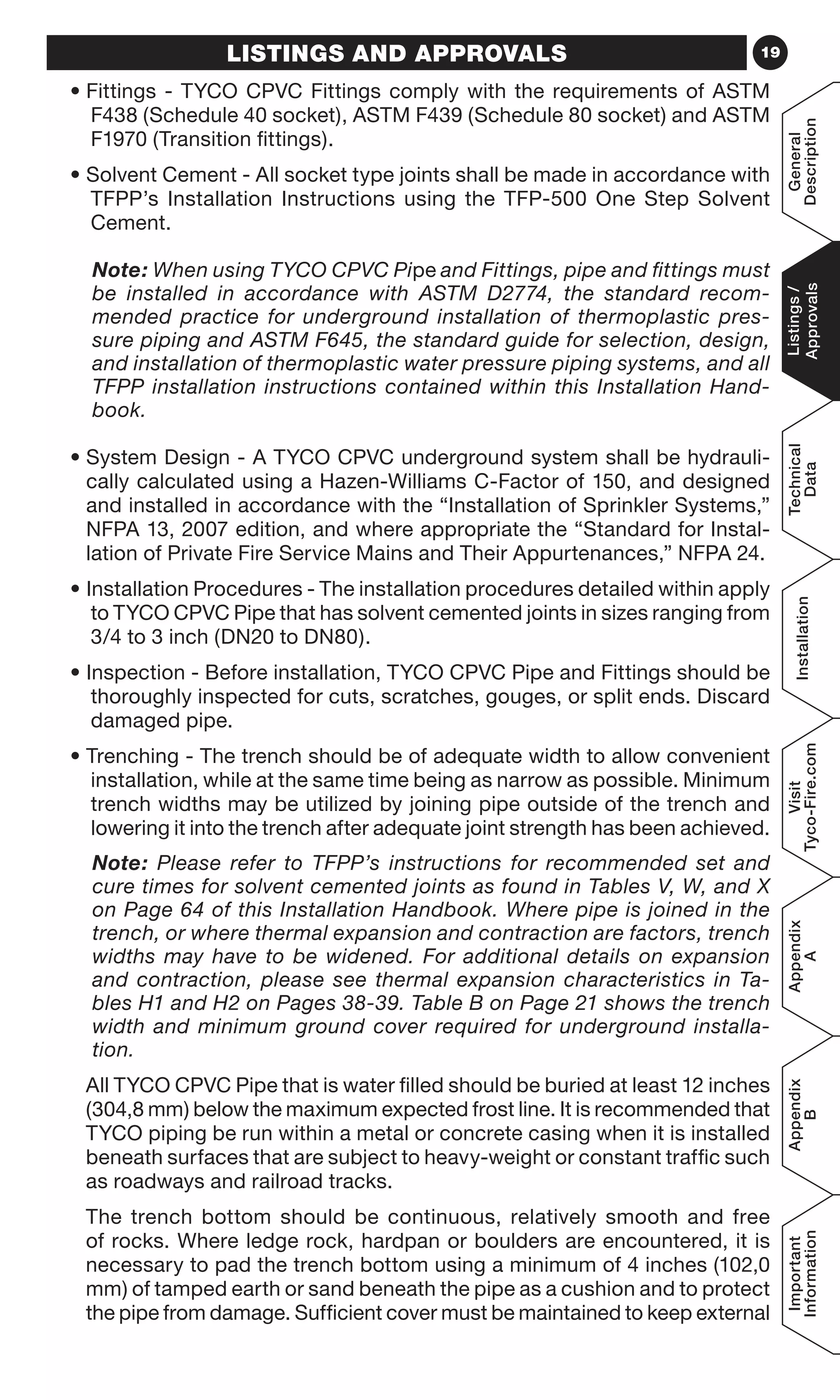
6. Vertical lines must be supported at intervals, described in Paragraphs 9
and 10 below to avoid placing excessive load on a fitting at the lower end.
Do this by using riser clamps or double bolt pipe clamps Listed for this
service. The clamps must not exert compressive stresses on the pipe.
If possible, the clamps should be located just below a fitting so that the
shoulder of the fitting rests against the clamp. If necessary, a coupling can
be modified and adhered to the pipe as a bearing support (modified riser
collar) such that the shoulder of the fitting rests on the clamp (Ref. Figure
6). Follow the cure times in Tables U, V, and W on Page 62.
	Note: A modified riser collar shall only be used to provide support to
the riser and shall not be used to join two pieces of pipe.
7. Do not use riser clamps that squeeze the pipe and depend on compression
of the pipe to support the weight.
8. Hangers and straps shall not compress, distort, cut or abrade the piping
and shall allow for free movement of the pipe to permit thermal expansion
and contraction. The pipe can be damaged, and compression increases
the likelihood of stress cracking.
9. Maintain vertical piping in straight alignment with supports at each floor
level, or at 10 feet (3,1 m) intervals, whichever is less.
. TYCO CPVC risers in vertical shafts or in buildings with ceilings over 25
feet (7,6 m), shall be aligned straightly and supported at each floor level,
or at 10 feet (3,1 m) intervals, whichever is less.
Figure 6 - Riser Collar
Parallel to Seat
Cut Above and
Seat
Portion
Discard This
Seat as Collar
Coupling Without
Rests on Support
Shoulder of Collar
Collar Adhered
to Pipe
Not Tight on Pipe
Support is Snug But
Support
Retain Portion of
Pipe
CollarModify Coupling
Underground Water Pressure Service (UL  C-UL)
• Pipe - TYCO CPVC Pipe complies with the requirements of ASTM F442 and
standard dimension ratio (SDR) 13.5. TYCO pipe is UL Listed and C-UL
Listed for a rated pressure of 175 psi (12,1 bar) for underground service.
10
19LISTINGS AND APPROVALS
• Fittings - TYCO CPVC Fittings comply with the requirements of ASTM
F438 (Schedule 40 socket), ASTM F439 (Schedule 80 socket) and ASTM
F1970 (Transition fittings).
• Solvent Cement - All socket type joints shall be made in accordance with
TFPP’s Installation Instructions using the TFP-500 One Step Solvent
Cement.
	Note: When using TYCO CPVC Pipe and Fittings, pipe and fittings must
be installed in accordance with ASTM D2774, the standard recom-
mended practice for underground installation of thermoplastic pres-
sure piping and ASTM F645, the standard guide for selection, design,
and installation of thermoplastic water pressure piping systems, and all
TFPP installation instructions contained within this Installation Hand-
book.
• System Design - A TYCO CPVC underground system shall be hydrauli-
cally calculated using a Hazen-Williams C-Factor of 150, and designed
and installed in accordance with the “Installation of Sprinkler Systems,”
NFPA 13, 2007 edition, and where appropriate the “Standard for Instal-
lation of Private Fire Service Mains and Their Appurtenances,” NFPA 24.
• Installation Procedures - The installation procedures detailed within apply
to TYCO CPVC Pipe that has solvent cemented joints in sizes ranging from
3/4 to 3 inch (DN20 to DN80).
• Inspection - Before installation, TYCO CPVC Pipe and Fittings should be
thoroughly inspected for cuts, scratches, gouges, or split ends. Discard
damaged pipe.
• Trenching - The trench should be of adequate width to allow convenient
installation, while at the same time being as narrow as possible. Minimum
trench widths may be utilized by joining pipe outside of the trench and
lowering it into the trench after adequate joint strength has been achieved.
	Note: Please refer to TFPP’s instructions for recommended set and
cure times for solvent cemented joints as found in Tables V, W, and X
on Page 64 of this Installation Handbook. Where pipe is joined in the
trench, or where thermal expansion and contraction are factors, trench
widths may have to be widened. For additional details on expansion
and contraction, please see thermal expansion characteristics in Ta-
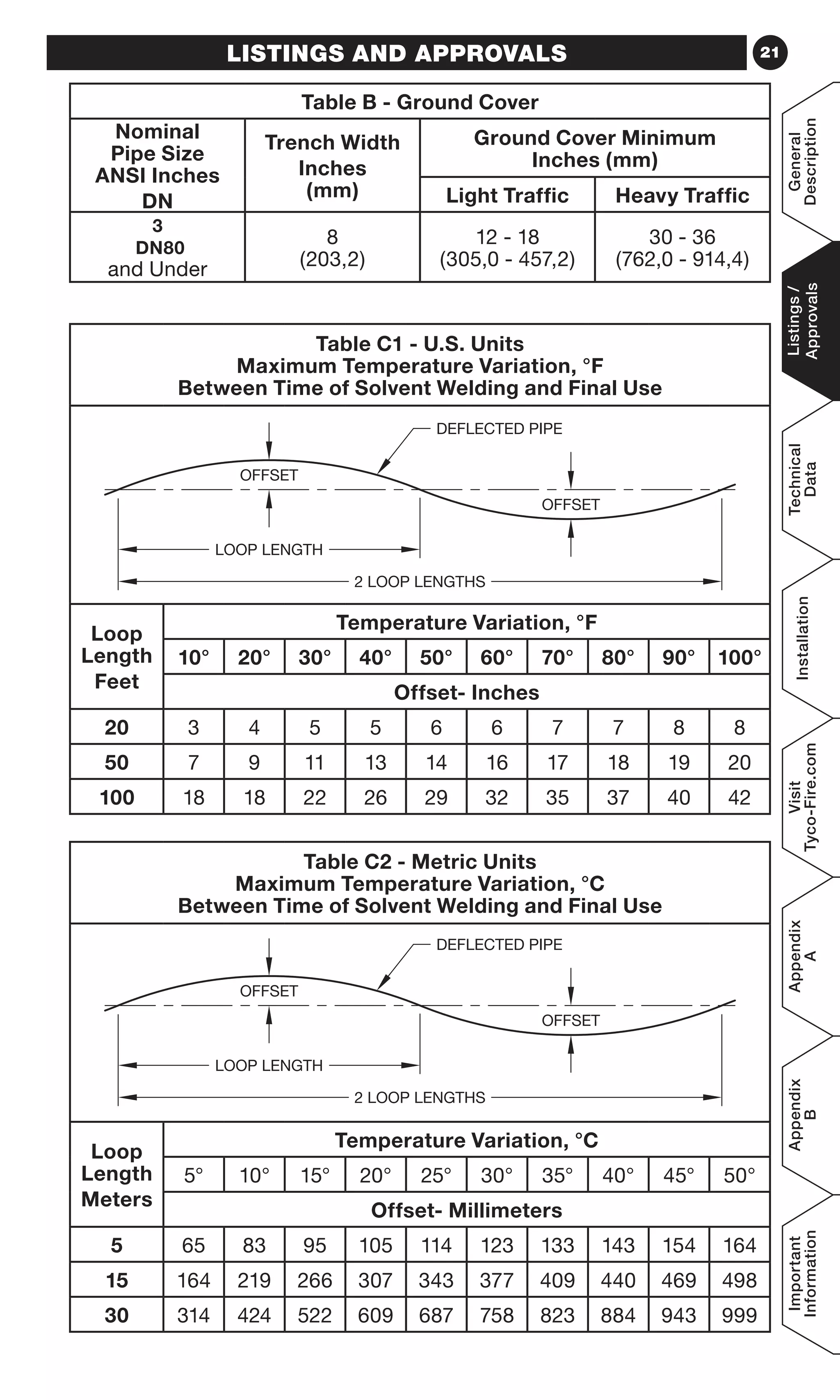
bles H1 and H2 on Pages 38-39. Table B on Page 21 shows the trench
width and minimum ground cover required for underground installa-
tion.
All TYCO CPVC Pipe that is water filled should be buried at least 12 inches
(304,8 mm) below the maximum expected frost line. It is recommended that
TYCO piping be run within a metal or concrete casing when it is installed
beneath surfaces that are subject to heavy-weight or constant traffic such
as roadways and railroad tracks.
The trench bottom should be continuous, relatively smooth and free
of rocks. Where ledge rock, hardpan or boulders are encountered, it is
necessary to pad the trench bottom using a minimum of 4 inches (102,0
mm) of tamped earth or sand beneath the pipe as a cushion and to protect
the pipe from damage. Sufficient cover must be maintained to keep external
General
Description
Listings/
Approvals
Technical
Data
Installation
Visit
Tyco-Fire.com
Appendix
A
Appendix
B
Important
Information
20 LISTINGS AND APPROVALS
stress levels below maximum design stress. Reliability and safety of service
is of major importance in determining minimum cover. Local, state and
national codes may also govern.
• Maintenance - Maintenance of TYCO CPVC Pipe and Fittings for
underground water service shall be in accordance with the Standard
for Inspection, Testing and Maintenance of Water Based Extinguishing
Systems as defined by NFPA 25.
• Snaking of Pipe - After TYCO CPVC pipe has been solvent cemented, it is
advisable to snake the pipe according to the following recommendations
beside the trench during its required drying time. BE ESPECIALLY
CAREFUL NOT TO APPLY ANY STRESS THAT WILL DISTURB THE
UNDRIED JOINT. Snaking is necessary to allow for any anticipated thermal
contraction that will take place in the newly joined pipe line. Snaking is
particularly necessary on the lengths of pipe that have been solvent
cemented during the afternoon hours of a hot summer day because
the drying time will extend through the cool of the night when thermal
contraction of the pipe could stress the joints to the point of pull out. This
snaking is also especially necessary with pipe that is laid in its trench
(necessitating wider trenches than recommended) and is back-filled with
cool earth before the joints are thoroughly dry. Tables C1 and C2 on Page
21 show the Pipe Snaking and the Loop Offset dimensions to compensate
for contraction.
• Back-Filling - Ideally, back-filling should only be done early in the morning
during hot weather when the line is fully contracted so that there is no
chance of insufficiently dried joints being subject to contraction stresses.
The pipe should be uniformly and continuously supported over its entire
length with firm, stable material. Blocking should not be used to change
pipe grade or to intermittently support pipe across excavated sections.
Pipe is installed in a wide range of sub soils. These soils should not only
be stable, but applied in such a manner so as to physically shield the pipe
from damage. Attention should be given to local pipe laying experience
that may indicate particular bedding problems.
Back-filled material free of rocks with a size of 1/2 inch (12,7 mm) or less
should be used to surround the pipe with 6-8 inches (152,4 mm - 203,2 mm)
of cover. The back-filled material should be placed in layers. Each soil layer
should be sufficiently compacted uniformly to develop laterally passive
soil forces during the back-fill operation. It may be advisable to have the
pipe under water pressure, 15-25 psi (1,0-1,7 bar) during the back-filling.
Vibratory methods are preferred when compacting sand or gravel. Best
results are obtained when the soils are in a nearly saturated condition.
Where water flooding is used, the initial back-fill should be sufficient to
ensure complete coverage of the pipe. Additional material should not be
added until the water flooded back-fill is firm enough to walk on. Care
should be taken to avoid floating the pipe.
Sand and gravel containing a significant portion of fine-grained material
such as silt and clay should be compacted by hand or preferably by a
mechanical tamper. The remainder of the back-fill should be placed and
spread in uniform layers in such a manner as to fill the trench completely
so that there will be no unfilled spaces under or about rocks or lumps of
21LISTINGS AND APPROVALS
Table C1 - U.S. Units
Maximum Temperature Variation, °F
Between Time of Solvent Welding and Final Use
2 LOOP LENGTHS
LOOP LENGTH
OFFSET
OFFSET
DEFLECTED PIPE
Loop
Length
Feet
Temperature Variation, °F
10° 20° 30° 40° 50° 60° 70° 80° 90° 100°
Offset- Inches
20 3 4 5 5 6 6 7 7 8 8
50 7 9 11 13 14 16 17 18 19 20
100 18 18 22 26 29 32 35 37 40 42
Table C2 - Metric Units
Maximum Temperature Variation, °C
Between Time of Solvent Welding and Final Use
2 LOOP LENGTHS
LOOP LENGTH
OFFSET
OFFSET
DEFLECTED PIPE
Loop
Length
Meters
Temperature Variation, °C
5° 10° 15° 20° 25° 30° 35° 40° 45° 50°
Offset- Millimeters
5 65 83 95 105 114 123 133 143 154 164
15 164 219 266 307 343 377 409 440 469 498
30 314 424 522 609 687 758 823 884 943 999
Table B - Ground Cover
Nominal
Pipe Size
ANSI Inches
DN
Trench Width
Inches
(mm)
Ground Cover Minimum
Inches (mm)
Light Traffic Heavy Traffic
3
DN80
and Under
8
(203,2)
12 - 18
(305,0 - 457,2)
30 - 36
(762,0 - 914,4)
General
Description
Listings/
Approvals
Technical
Data
Installation
Visit
Tyco-Fire.com
Appendix
A
Appendix
B
Important
Information
22 LISTINGS AND APPROVALS
earth in the back-fill. Large or sharp rocks, frozen clods and other debris
greater than 3 inches (76,2 mm) in diameter should be removed. Rolling
equipment or heavy tampers should only be used to consolidate the final
back-fill.
Outdoor Installations
TYCO CPVC Pipe and Fittings are not listed for outdoor applications other
than underground.
FACTORY MUTUAL (FM)
TYCO CPVC Pipe and Fittings are FM Approved for use in:
• Miscellaneous non-manufacturing occupancies as described in FM Loss
Prevention Data Sheet 3-26, “Fire Protection Water Demand for Non-
storage Sprinklered Properties”, Table 2, Section L.
• Residential occupancies as described in FM Loss Prevention Data Sheet
3-26, “Installation of Sprinkler Systems”.
TYCO Fire Sprinkler Systems shall be employed in wet pipe systems
only. (A wet pipe system contains water or water and glycerin [anti-freeze
solution] and is connected to a water supply so that the water or water and
glycerin [anti-freeze solution] will discharge immediately when the sprinkler
is opened.)
23LISTINGS AND APPROVALS
Concealed Installations (FM)
In accordance with the FM Approval, protection shall be provided for TYCO
CPVC Pipe and Fittings as follows:
• The minimum protection shall consist of either a permanently installed
non-combustible barrier from any area protected by the system.
	Note: A permanently installed barrier is one that cannot be removed
without substantial cosmetic damage. Drop in ceiling tiles, as used in
suspended ceilings are specifically considered not be permanently in-
stalled for the purposes of this definition. Non-combustible is defined as
having a minimum finish fire rating of 15 minutes when tested per ASTM
E119.
• As an alternative to the protection of a permanently installed non-
combustible barrier, FM has approved the use of TYCO CPVC with the
SOFFI-STEELTM covering system manufactured by Grice Engineering.
• FM Approved quick response, standard or extended coverage, or FM
Approved residential sprinklers installed in accordance with their approval
limitations may be used.
• Solvent cement joints shall be made with TFP-500 One Step Solvent
Cement.
Exposed Installations - Smooth, Flat, Horizontal Ceilings (FM)
In accordance with the FM Approval, TYCO CPVC Pipe and Fittings may be
installed without protection (exposed), subject to the following additional
limitations:
Note: Where piping is installed above drop-in ceiling tiles, the piping shall
be considered exposed.
Ceilings may be combustible, or non permanently installed.
• Standard Coverage Sprinklers
- Pendent sprinklers shall be FM Approved, quick response sprinklers
having deflectors installed within 8 inches (203,2 mm) of the ceiling. The
maximum distance between sprinklers shall not exceed 15 feet (4,6 m).
The maximum ceiling height shall not exceed 10 feet (3,0 m).
- Upright sprinklers shall be FM Approved, quick response sprinklers
having deflectors installed within 4 inches (101,6 mm) of the ceiling. The
maximum distance between sprinklers shall not exceed 15 feet (4,6 m).
The maximum distance from the ceiling to the centerline of the main
run of pipe shall not exceed 7-1/2 inch (191 mm). The distance from the
centerline of the sprinkler to the closest hanger shall be 3 inches (76,2
mm). The maximum ceiling height shall not exceed 10 feet (3,0 m).
- Horizontal Sidewall Sprinklers shall be FM Approved, quick response
sprinklers having deflectors installed within 12 inches (304,8 mm) of the
ceiling and within 6 inches (152,4 mm) of the side wall. The maximum
distance between sprinklers shall not exceed 14 feet (4,3 m). The
maximum ceiling height shall not exceed 10 feet (3,0 m).
- Solvent cement joints shall be made with TFP-500 One Step Solvent
Cement.
General
Description
Listings/
Approvals
Technical
Data
Installation
Visit
Tyco-Fire.com
Appendix
A
Appendix
B
Important
Information
24 LISTINGS AND APPROVALS
• Extended Coverage Sprinklers
- Pendent sprinklers shall be FM Approved, quick response sprinklers
having deflectors installed within 8 inches (203,2 mm) of the ceiling. The
maximum distance between sprinklers shall not exceed 20 feet (6,1 m).
When the sprinklers are not on square spacings, the flow for a sprinkler
should be based on the density applied over the square area calculated
for the largest dimension of the sprinkler spacing. The maximum ceiling
height shall not exceed 10 feet (3,0 m).
- Horizontal Sidewall Sprinklers shall be FM Approved, quick response
sprinklers having deflectors installed within 12 inches (304,8 mm) of the
ceiling and within 6 inches (152,4 mm) of the side wall. The maximum
lateral distance between sprinklers shall not exceed 16 feet (4,9 m). The
maximum ceiling height shall not exceed 10 feet (3,0 m).
- The minimum flow or pressure established for Extended Coverage
Systems shall be per FM Loss Prevention Data Sheet 2-0 and 3-26.
- Solvent cement joints shall be made with TFP-500 One Step Solvent
Cement.
• Residential Sprinklers
- Pendent sprinklers shall be FM Approved, residential sprinklers having
deflectors installed within 8 inches (203,2 mm) of the ceiling. The
maximum distance between sprinklers shall not exceed 20 feet (6,1 m).
The minimum required discharge from each sprinkler is to be the greater
of either the approved flow rate applied over the square area calculated
for the largest dimension of the sprinkler spacing or a minimum discharge
of 0.1 gpm/sq.ft. (4,1 mm/min) over the actual area (S x L) covered by the
sprinkler. The maximum ceiling height shall not exceed 10 feet (3,0 m).
- Horizontal Sidewall Sprinklers shall be FM Approved, quick response
sprinklers having deflectors installed within 12 inches (304,8 mm) of the
ceiling and within 6 inches (152,4 mm) of the side wall. The maximum
lateral distance between sprinklers shall not exceed 16 feet (4,9 m). The
minimum required discharge from each sprinkler is to be the greater of
either the approved flow rate applied over the area calculated for the
largest dimension of the sprinkler spacing or a minimum discharge of
0.1 gpm/sq.ft. (4,1 mm/min) over the actual area (S x L) covered by the
sprinkler. The maximum ceiling height shall not exceed 10 feet (3,0 m).
- The minimum flow or pressure established for Residential Sprinkler
Systems shall be per FM Loss Prevention Data Sheet 2-0 and 3-26.
- Solvent cement joints shall be made with TFP-500 One Step Solvent
Cement.
System Risers (FM)
In accordance with the FM Approval, TYCO CPVC Pipe and Fittings may be
installed without protection (exposed) as a vertical riser when subject to the
following additional limitations:
• An automatic sprinkler (of the same type as in the area being protected)
shall be located adjacent to and no further than 1 foot (0,3 m) from the riser.
• The automatic sprinkler protecting the riser shall not be considered when
determining protection criteria for the floor area. The design flow for the
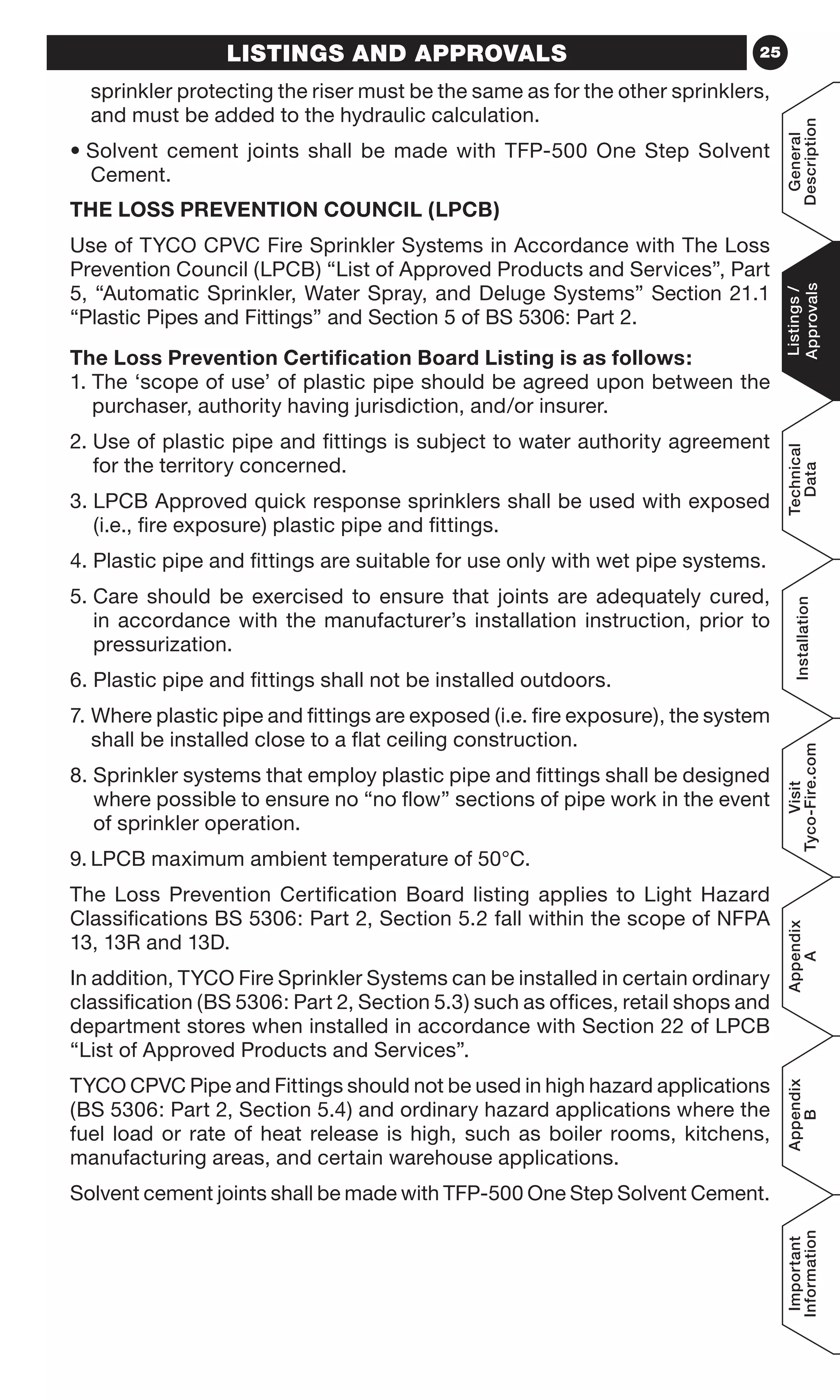
25LISTINGS AND APPROVALS
sprinkler protecting the riser must be the same as for the other sprinklers,
and must be added to the hydraulic calculation.
• Solvent cement joints shall be made with TFP-500 One Step Solvent
Cement.
THE LOSS PREVENTION COUNCIL (LPCB)
Use of TYCO CPVC Fire Sprinkler Systems in Accordance with The Loss
Prevention Council (LPCB) “List of Approved Products and Services”, Part
5, “Automatic Sprinkler, Water Spray, and Deluge Systems” Section 21.1
“Plastic Pipes and Fittings” and Section 5 of BS 5306: Part 2.
The Loss Prevention Certification Board Listing is as follows:
1. The ‘scope of use’ of plastic pipe should be agreed upon between the
purchaser, authority having jurisdiction, and/or insurer.
2. Use of plastic pipe and fittings is subject to water authority agreement
for the territory concerned.
3. LPCB Approved quick response sprinklers shall be used with exposed
(i.e., fire exposure) plastic pipe and fittings.
4. Plastic pipe and fittings are suitable for use only with wet pipe systems.
5. Care should be exercised to ensure that joints are adequately cured,
in accordance with the manufacturer’s installation instruction, prior to
pressurization.
6. Plastic pipe and fittings shall not be installed outdoors.
7. Where plastic pipe and fittings are exposed (i.e. fire exposure), the system
shall be installed close to a flat ceiling construction.
8. Sprinkler systems that employ plastic pipe and fittings shall be designed
where possible to ensure no “no flow” sections of pipe work in the event
of sprinkler operation.
9.	LPCB maximum ambient temperature of 50°C.
The Loss Prevention Certification Board listing applies to Light Hazard
Classifications BS 5306: Part 2, Section 5.2 fall within the scope of NFPA
13, 13R and 13D.
In addition, TYCO Fire Sprinkler Systems can be installed in certain ordinary
classification (BS 5306: Part 2, Section 5.3) such as offices, retail shops and
department stores when installed in accordance with Section 22 of LPCB
“List of Approved Products and Services”.
TYCO CPVC Pipe and Fittings should not be used in high hazard applications
(BS 5306: Part 2, Section 5.4) and ordinary hazard applications where the
fuel load or rate of heat release is high, such as boiler rooms, kitchens,
manufacturing areas, and certain warehouse applications.
Solvent cement joints shall be made with TFP-500 One Step Solvent Cement.
General
Description
Listings/
Approvals
Technical
Data
Installation
Visit
Tyco-Fire.com
Appendix
A
Appendix
B
Important
Information
26 LISTINGS AND APPROVALS
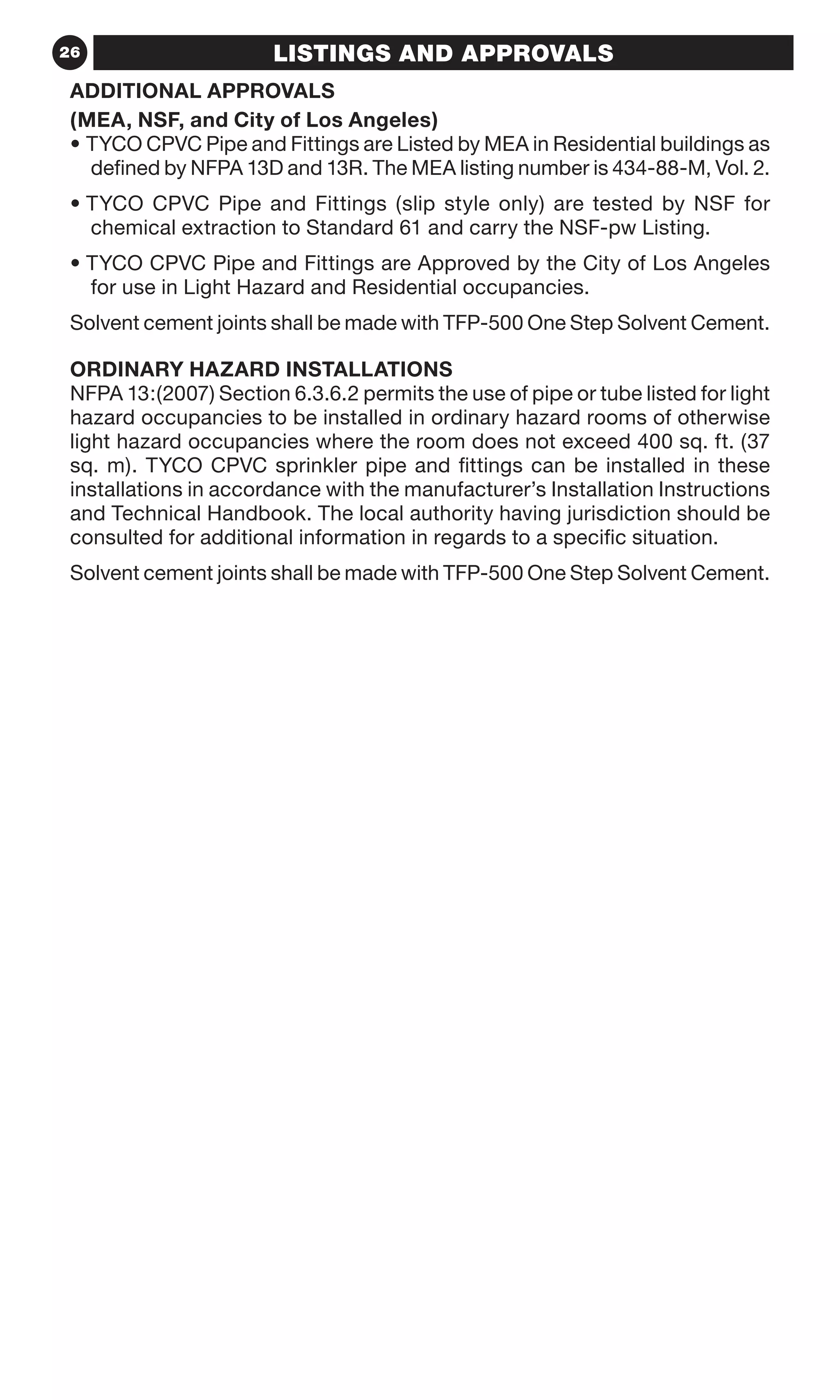
ADDITIONAL APPROVALS
(MEA, NSF, and City of Los Angeles)
• TYCO CPVC Pipe and Fittings are Listed by MEA in Residential buildings as
defined by NFPA 13D and 13R. The MEA listing number is 434-88-M, Vol. 2.
• TYCO CPVC Pipe and Fittings (slip style only) are tested by NSF for
chemical extraction to Standard 61 and carry the NSF-pw Listing.
• TYCO CPVC Pipe and Fittings are Approved by the City of Los Angeles
for use in Light Hazard and Residential occupancies.
Solvent cement joints shall be made with TFP-500 One Step Solvent Cement.
ORDINARY HAZARD INSTALLATIONS
NFPA 13:(2007) Section 6.3.6.2 permits the use of pipe or tube listed for light
hazard occupancies to be installed in ordinary hazard rooms of otherwise
light hazard occupancies where the room does not exceed 400 sq. ft. (37
sq. m). TYCO CPVC sprinkler pipe and fittings can be installed in these
installations in accordance with the manufacturer’s Installation Instructions
and Technical Handbook. The local authority having jurisdiction should be
consulted for additional information in regards to a specific situation.
Solvent cement joints shall be made with TFP-500 One Step Solvent Cement.
27TECHNICAL DATA
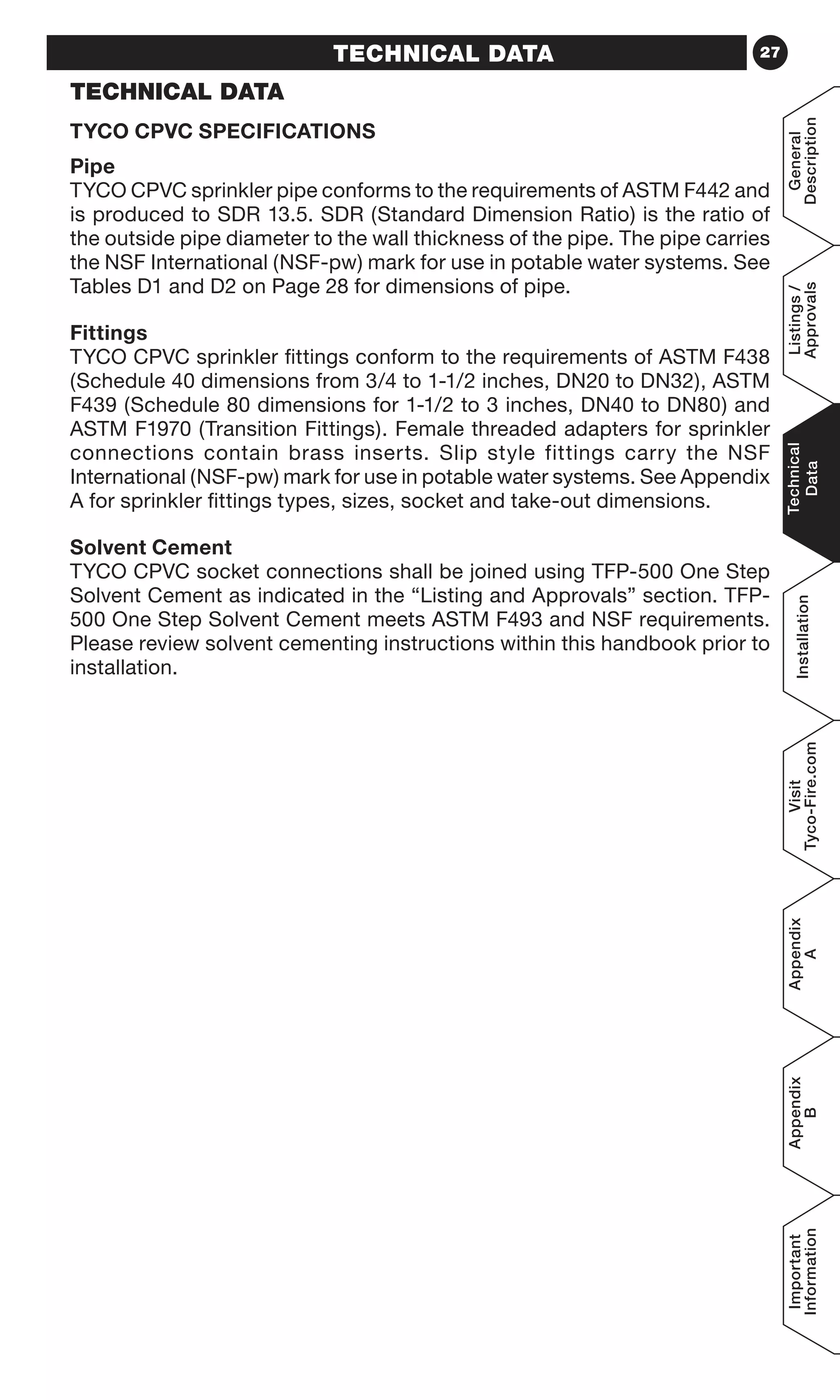
TECHNICAL DATA
TYCO CPVC SPECIFICATIONS
Pipe
TYCO CPVC sprinkler pipe conforms to the requirements of ASTM F442 and
is produced to SDR 13.5. SDR (Standard Dimension Ratio) is the ratio of
the outside pipe diameter to the wall thickness of the pipe. The pipe carries
the NSF International (NSF-pw) mark for use in potable water systems. See
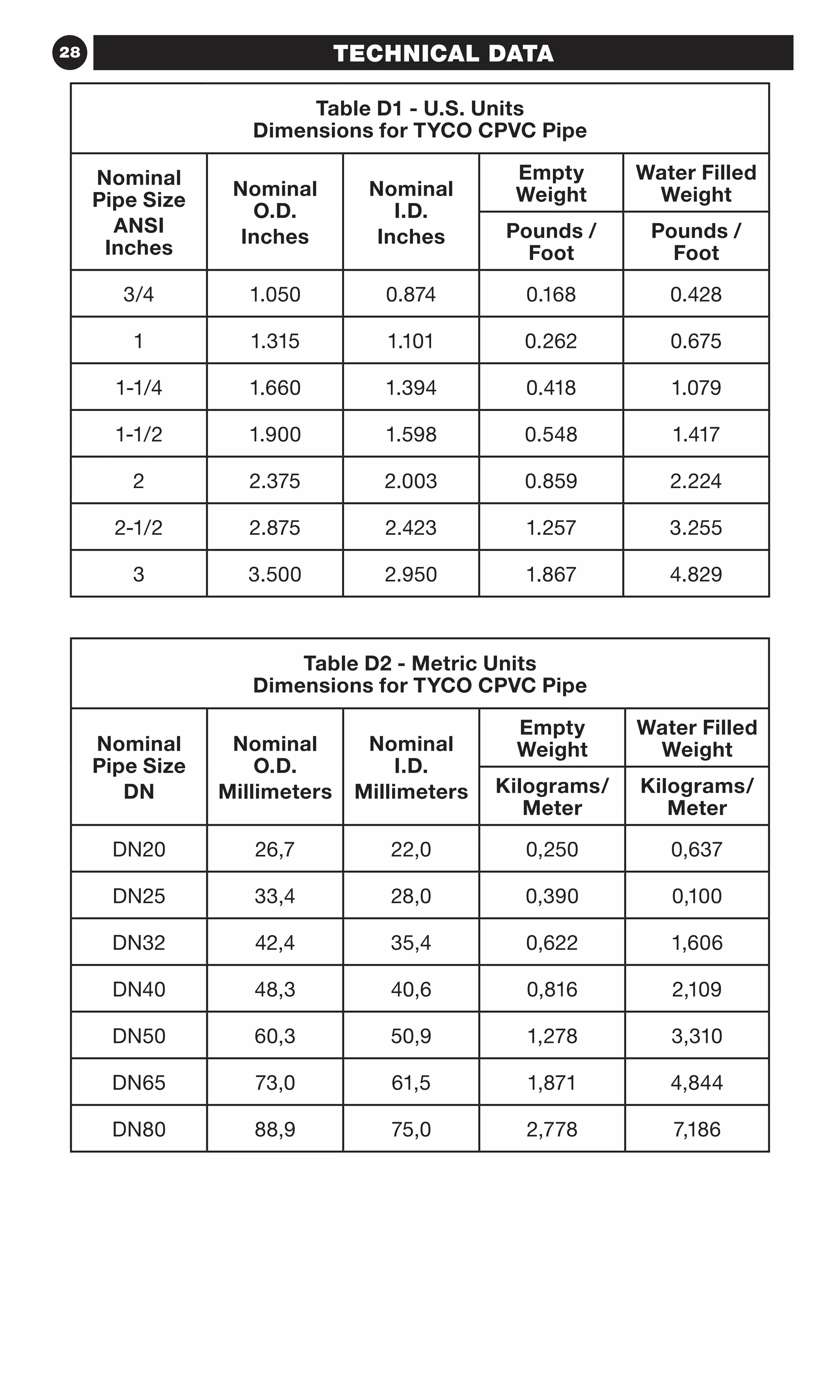
Tables D1 and D2 on Page 28 for dimensions of pipe.
Fittings
TYCO CPVC sprinkler fittings conform to the requirements of ASTM F438
(Schedule 40 dimensions from 3/4 to 1-1/2 inches, DN20 to DN32), ASTM
F439 (Schedule 80 dimensions for 1-1/2 to 3 inches, DN40 to DN80) and
ASTM F1970 (Transition Fittings). Female threaded adapters for sprinkler
connections contain brass inserts. Slip style fittings carry the NSF
International (NSF-pw) mark for use in potable water systems. See Appendix
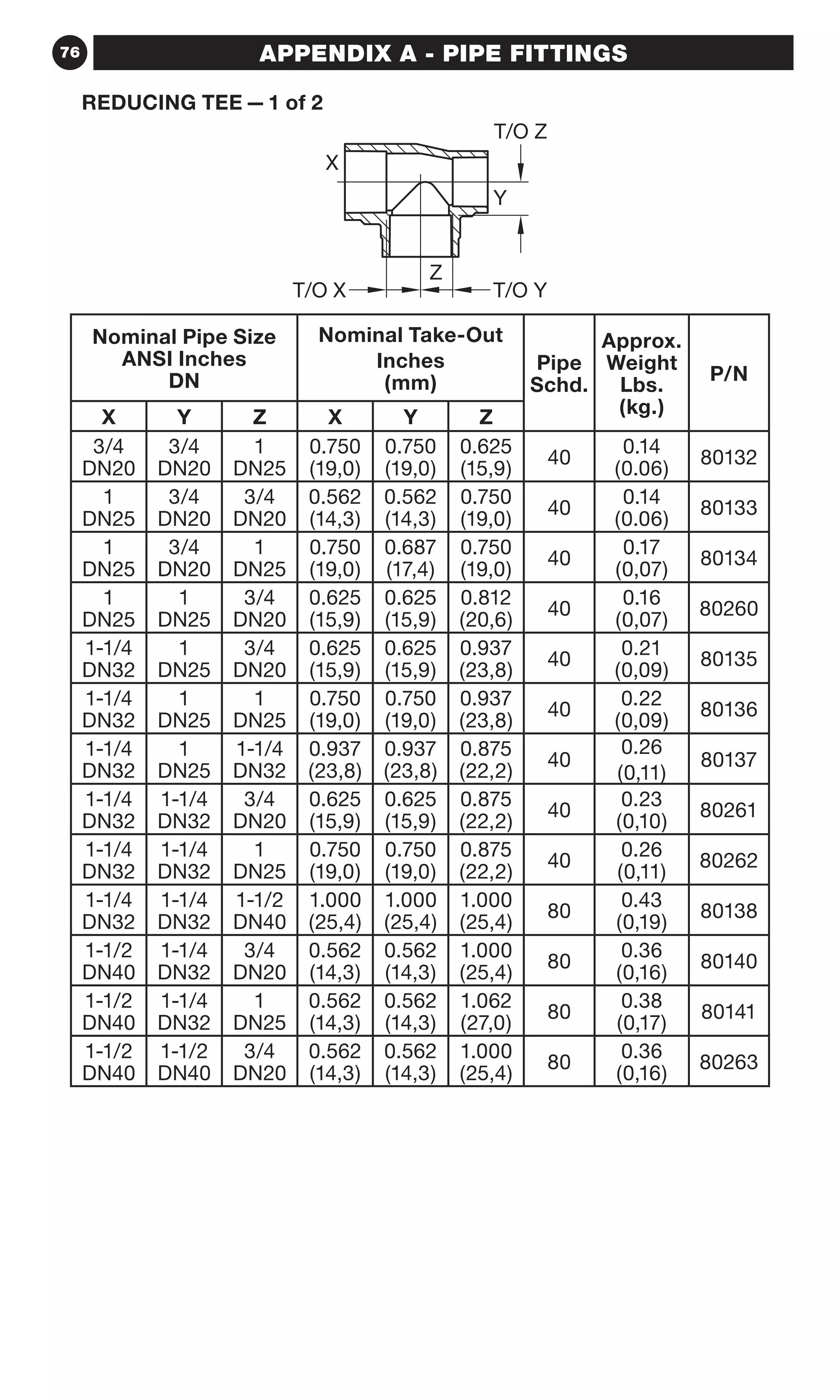
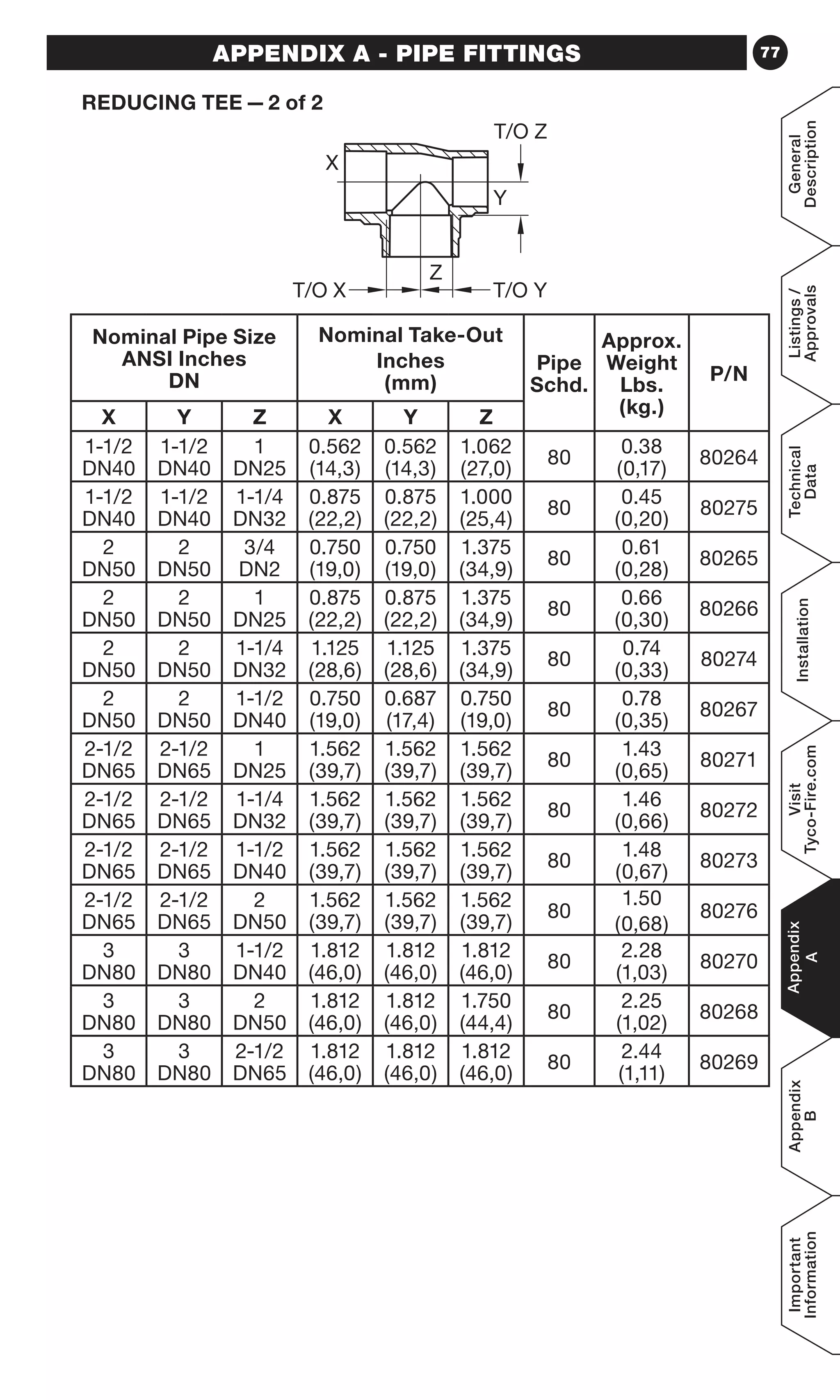
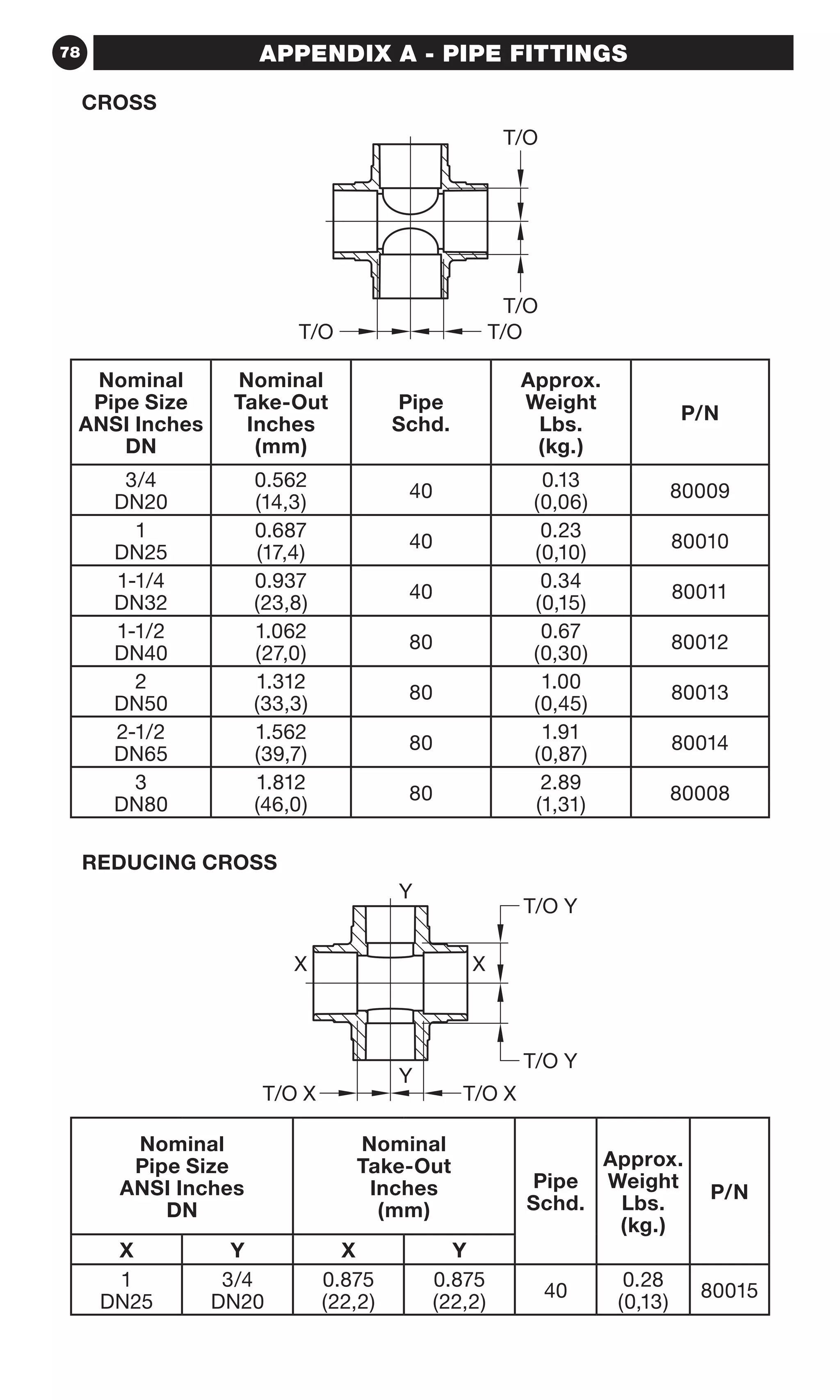
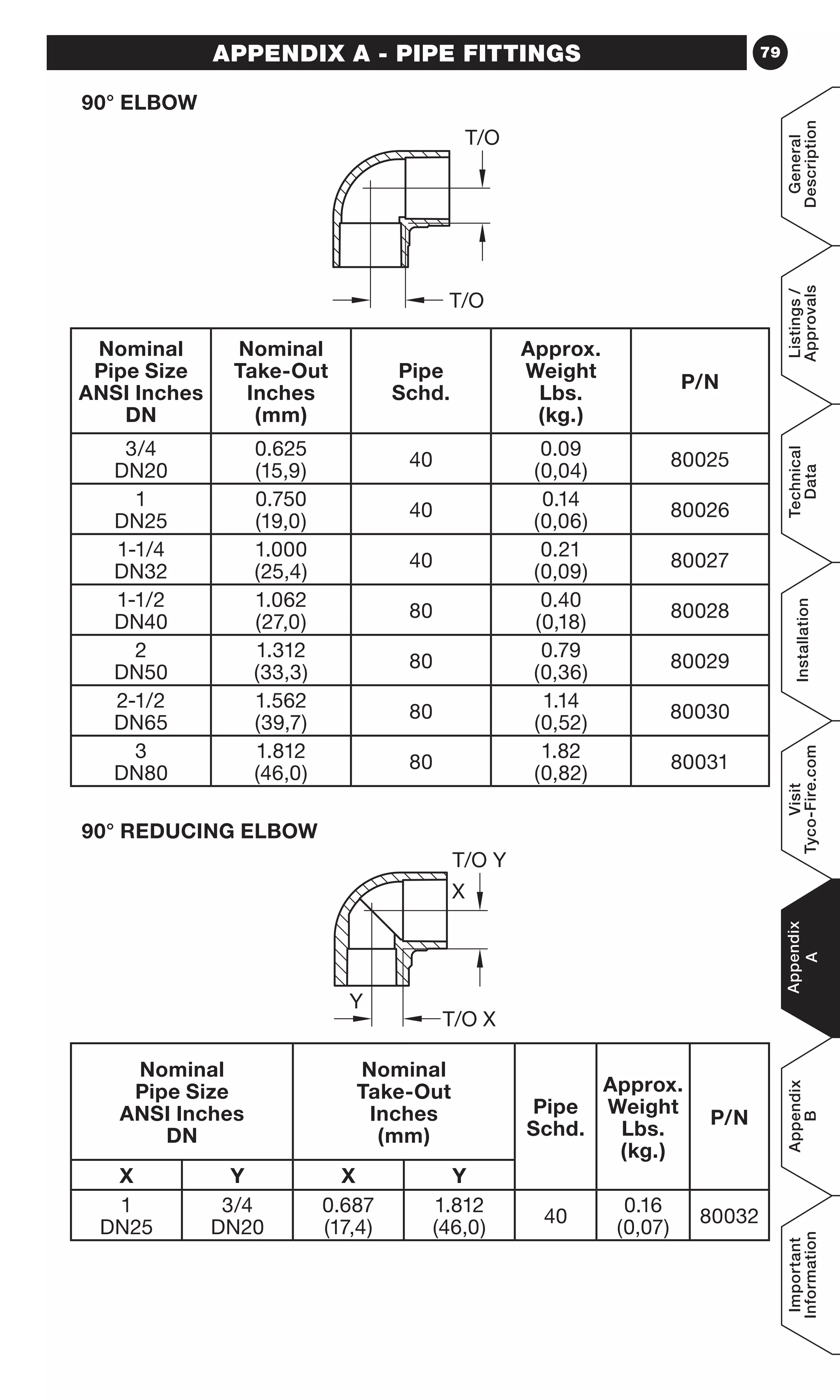
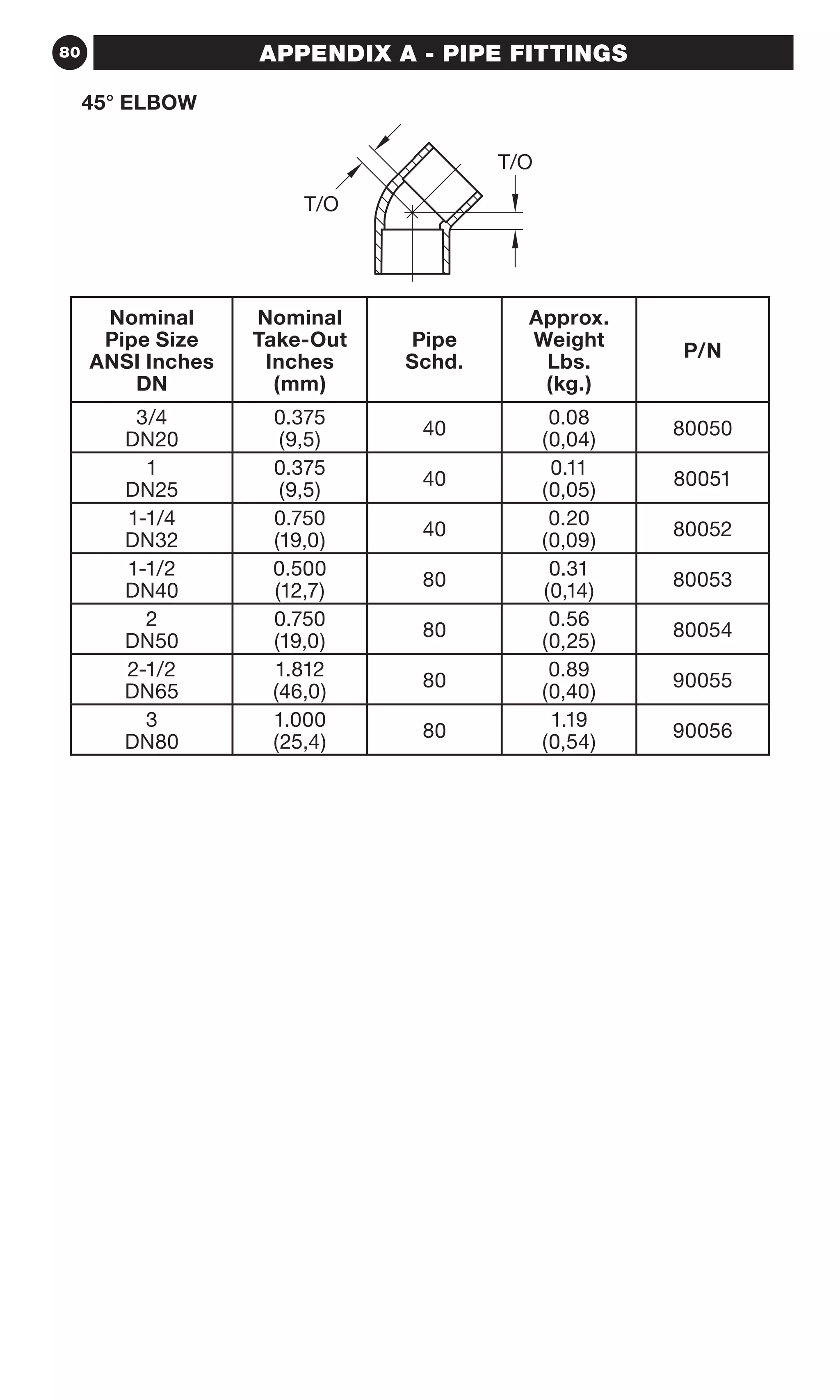
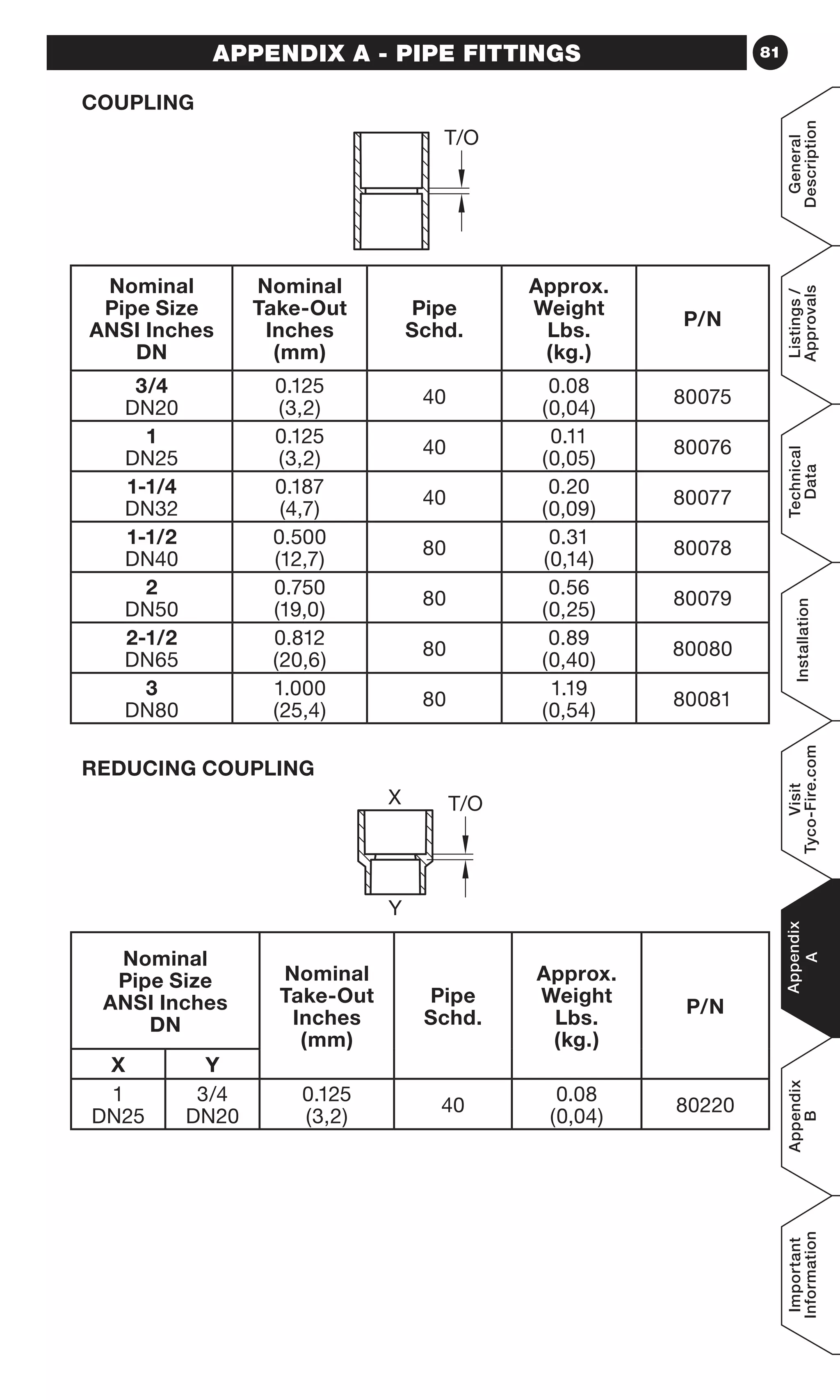
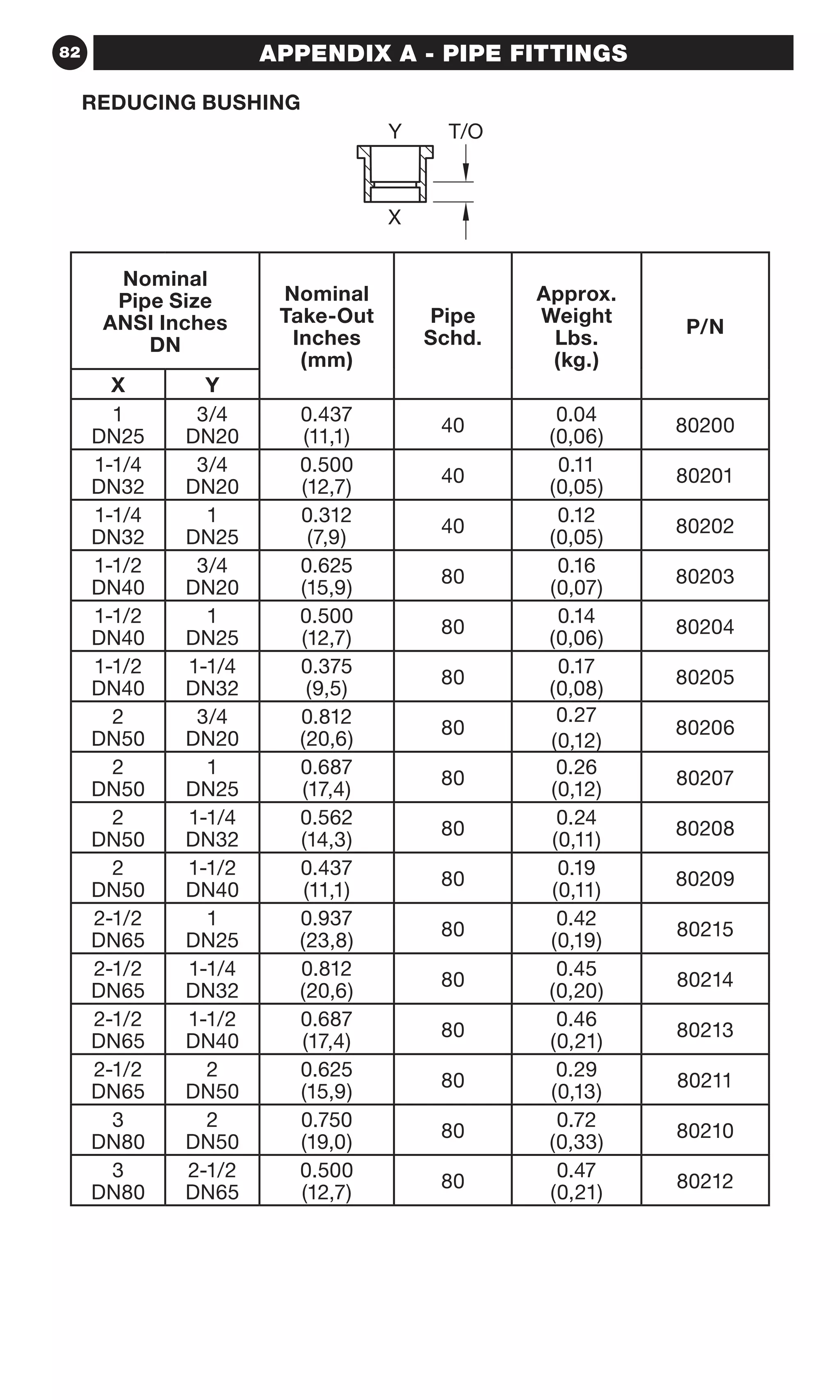
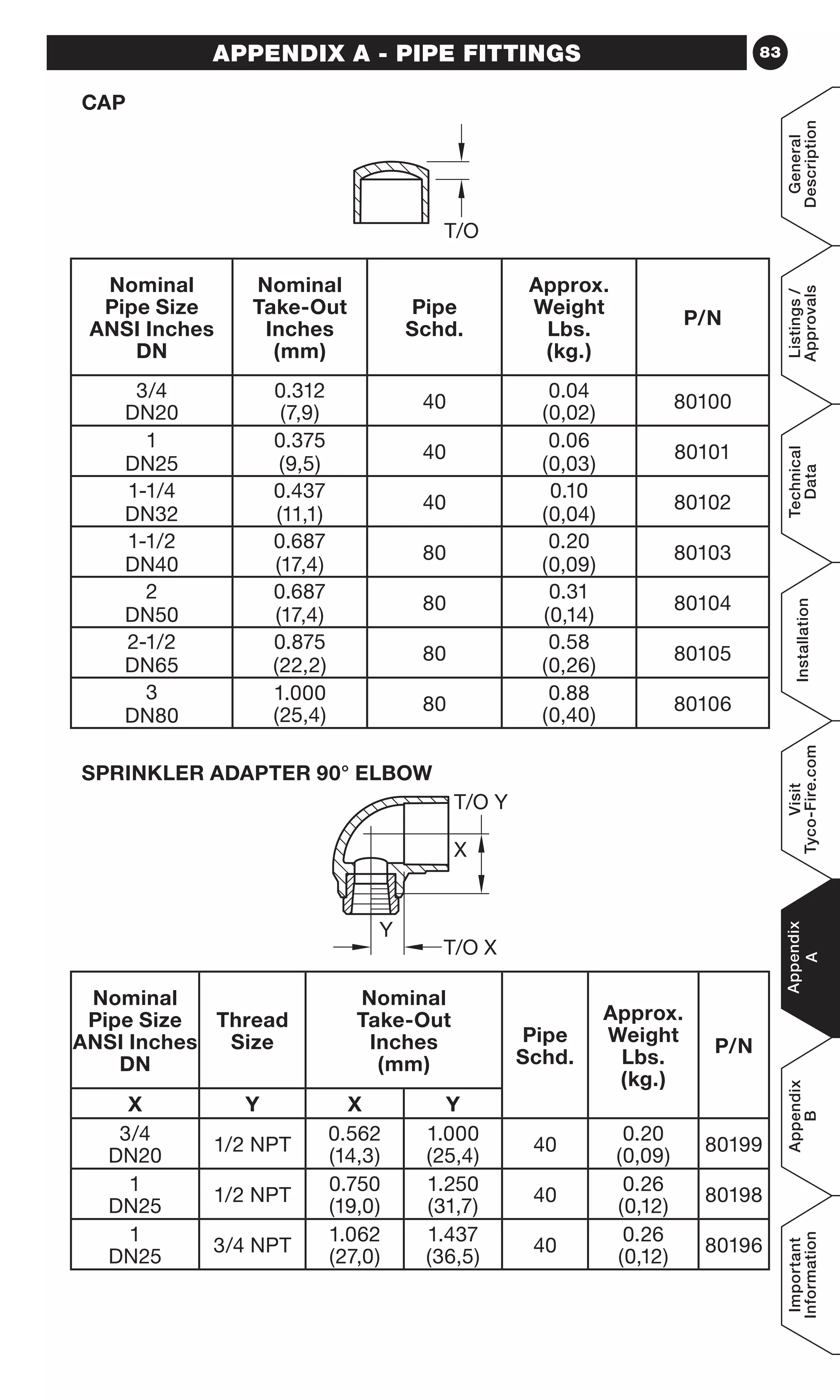
A for sprinkler fittings types, sizes, socket and take-out dimensions.
Solvent Cement
TYCO CPVC socket connections shall be joined using TFP-500 One Step
Solvent Cement as indicated in the “Listing and Approvals” section. TFP-
500 One Step Solvent Cement meets ASTM F493 and NSF requirements.
Please review solvent cementing instructions within this handbook prior to
installation.
General
Description
Listings/
Approvals
Technical
Data
Installation
Visit
Tyco-Fire.com
Appendix
A
Appendix
B
Important
Information
28 TECHNICAL DATA
Table D1 - U.S. Units
Dimensions for TYCO CPVC Pipe
Nominal
Pipe Size
ANSI
Inches
Nominal
O.D.
Inches
Nominal
I.D.
Inches
Empty
Weight
Water Filled
Weight
Pounds /
Foot
Pounds /
Foot
3/4 1.050 0.874 0.168 0.428
1 1.315 1.101 0.262 0.675
1-1/4 1.660 1.394 0.418 1.079
1-1/2 1.900 1.598 0.548 1.417
2 2.375 2.003 0.859 2.224
2-1/2 2.875 2.423 1.257 3.255
3 3.500 2.950 1.867 4.829
Table D2 - Metric Units
Dimensions for TYCO CPVC Pipe
Nominal
Pipe Size
DN
Nominal
O.D.
Millimeters
Nominal
I.D.
Millimeters
Empty
Weight
Water Filled
Weight
Kilograms/
Meter
Kilograms/
Meter
DN20 26,7 22,0 0,250 0,637
DN25 33,4 28,0 0,390 0,100
DN32 42,4 35,4 0,622 1,606
DN40 48,3 40,6 0,816 2,109
DN50 60,3 50,9 1,278 3,310
DN65 73,0 61,5 1,871 4,844
DN80 88,9 75,0 2,778 7,186
29TECHNICAL DATA
THIS PAGE INTENTIONALLY LEFT BLANK
General
Description
Listings/
Approvals
Technical
Data
Installation
Visit
Tyco-Fire.com
Appendix
A
Appendix
B
Important
Information
30 TECHNICAL DATA
PRODUCT RATINGS AND CAPABILITIES
Ambient Temperature and Heat Sources
TYCO CPVC Pipe and Fittings shall be installed in areas where the ambient
temperature does not exceed 150°F (65°C). (LPCB maximum ambient
temperature of 50°C)
Before penetrating fire rated walls and partitions, consult building codes and
authorities having jurisdiction in your area. TYCO CPVC systems should be
designed and installed so that the piping is not closely exposed to high heat
producing sources, such as incandescent light, ballasts, and steam lines.
Pressure Rating
TYCO CPVC Pipe and Fittings are Listed/Approved for a rated pressure
of 175 psi (12,1 bar) and a maximum ambient temperature of 150°F (65°C).
(LPCB maximum ambient temperature of 50°C)
Friction Loss
TYCO CPVC Pipe has a Hazen-Williams C-Value of 150. Pipe friction
loss calculations shall be made according to NFPA Standards.
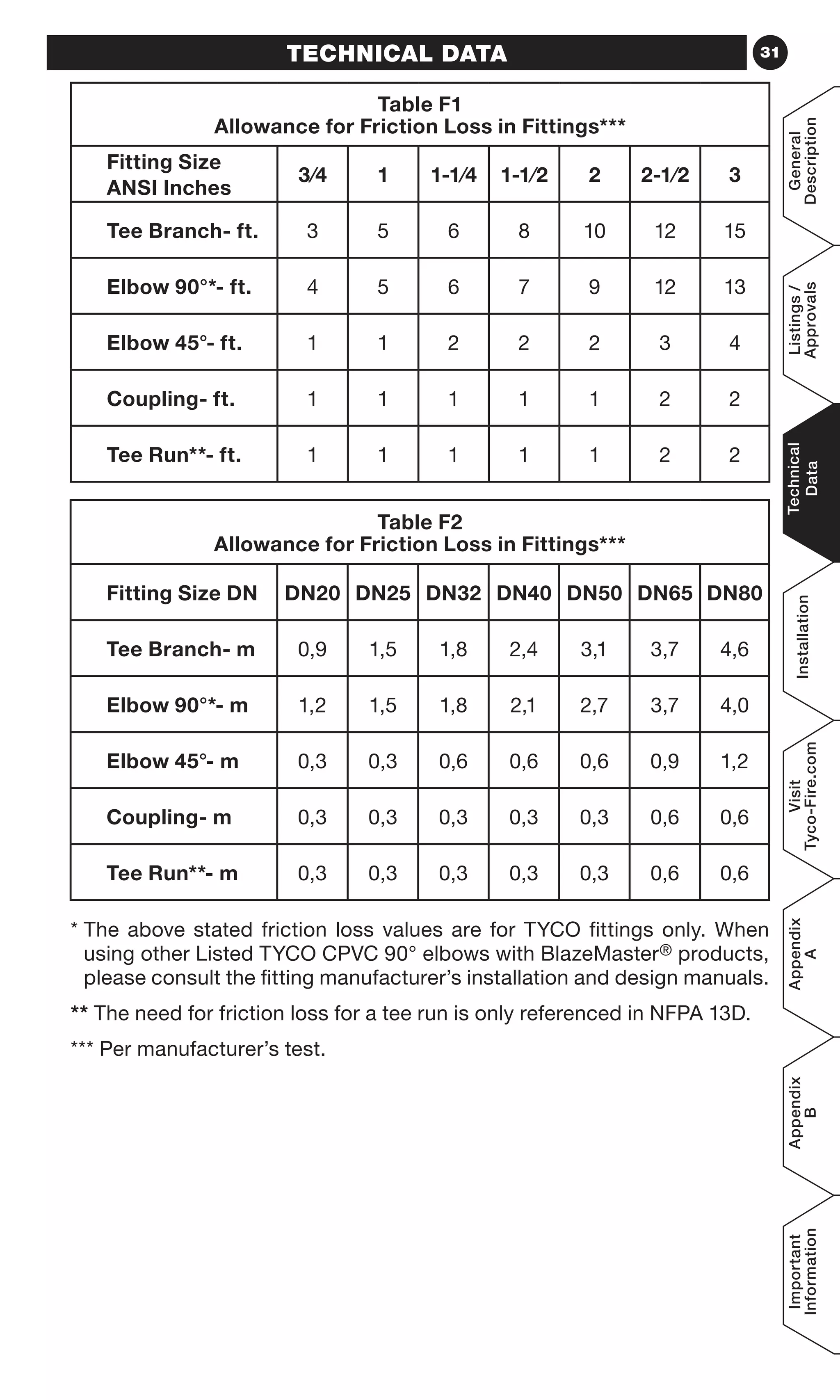
Tables F1 and F2 show the allowance of friction loss for fittings, expressed
in equivalent feet of pipe.
31TECHNICAL DATA
Table F1
Allowance for Friction Loss in Fittings***
Fitting Size
ANSI Inches
3⁄4 1 1-1⁄4 1-1⁄2 2 2-1⁄2 3
Tee Branch- ft. 3 5 6 8 10 12 15
Elbow 90°*- ft. 4 5 6 7 9 12 13
Elbow 45°- ft. 1 1 2 2 2 3 4
Coupling- ft. 1 1 1 1 1 2 2
Tee Run**- ft. 1 1 1 1 1 2 2
Table F2
Allowance for Friction Loss in Fittings***
Fitting Size DN DN20 DN25 DN32 DN40 DN50 DN65 DN80
Tee Branch- m 0,9 1,5 1,8 2,4 3,1 3,7 4,6
Elbow 90°*- m 1,2 1,5 1,8 2,1 2,7 3,7 4,0
Elbow 45°- m 0,3 0,3 0,6 0,6 0,6 0,9 1,2
Coupling- m 0,3 0,3 0,3 0,3 0,3 0,6 0,6
Tee Run**- m 0,3 0,3 0,3 0,3 0,3 0,6 0,6
* The above stated friction loss values are for TYCO fittings only. When
using other Listed TYCO CPVC 90° elbows with BlazeMaster® products,
please consult the fitting manufacturer’s installation and design manuals.
** The need for friction loss for a tee run is only referenced in NFPA 13D.
*** Per manufacturer’s test.
General
Description
Listings/
Approvals
Technical
Data
Installation
Visit
Tyco-Fire.com
Appendix
A
Appendix
B
Important
Information
32 TECHNICAL DATA
Thermal Expansion – U.S. Units
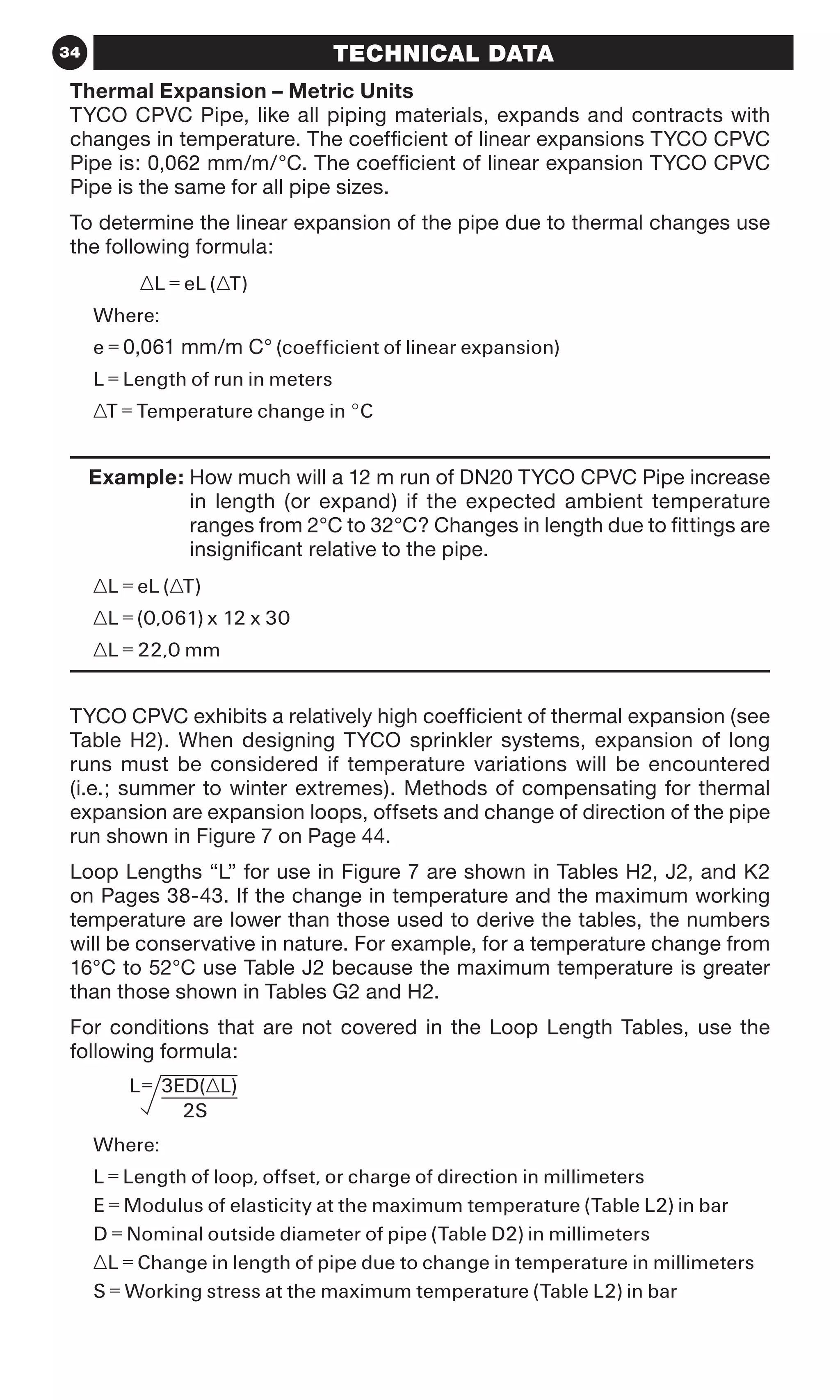
TYCO CPVC Pipe, like all piping materials, expands and contracts with
changes in temperature. The coefficient of linear expansion for TYCO CPVC
Pipe is: 0.000034 inch/inch /°F. The coefficient of linear expansion TYCO
CPVC Pipe is the same for all pipe sizes.
To determine the linear expansion of the pipe due to thermal changes use
the following formula:
	 ∆L = 12eL (∆T)
Where:
e = 0.000034 in/in/°F (coefficient of linear expansion)
L = Length of run in feet
∆T = Temperature change in °F
∆L = Inches
	 Example: How much will a 40 foot run of 3/4 inch TYCO CPVC Pipe
increase in length (or expand) if the expected ambient
temperature ranges from 35°F to 85°F? Changes in length due
to fittings are insignificant relative to the pipe.
∆L = 12eL (∆T)
∆L = 12 (0.000034) x 40 x 50
∆L = 0.82 inch or approximately 13/16 inch
TYCO CPVC exhibits a relatively high coefficient of thermal expansion.
When designing TYCO sprinkler systems, expansion of long runs must
be considered if temperature variations will be encountered (i.e.; summer
to winter extremes). Methods of compensating for thermal expansion are
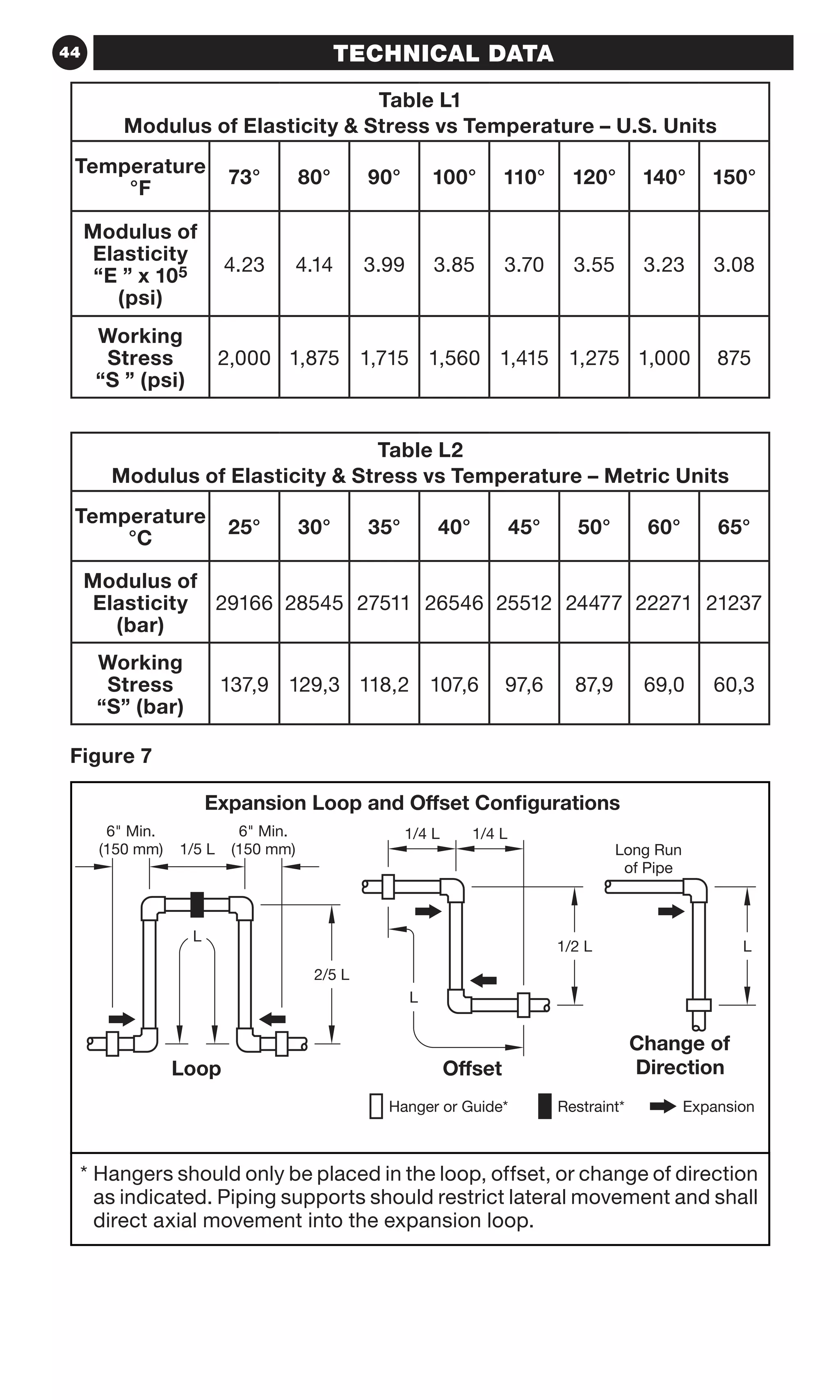
expansion loops, offsets and change of direction of the pipe run shown in
Figure 7 on Page 44.
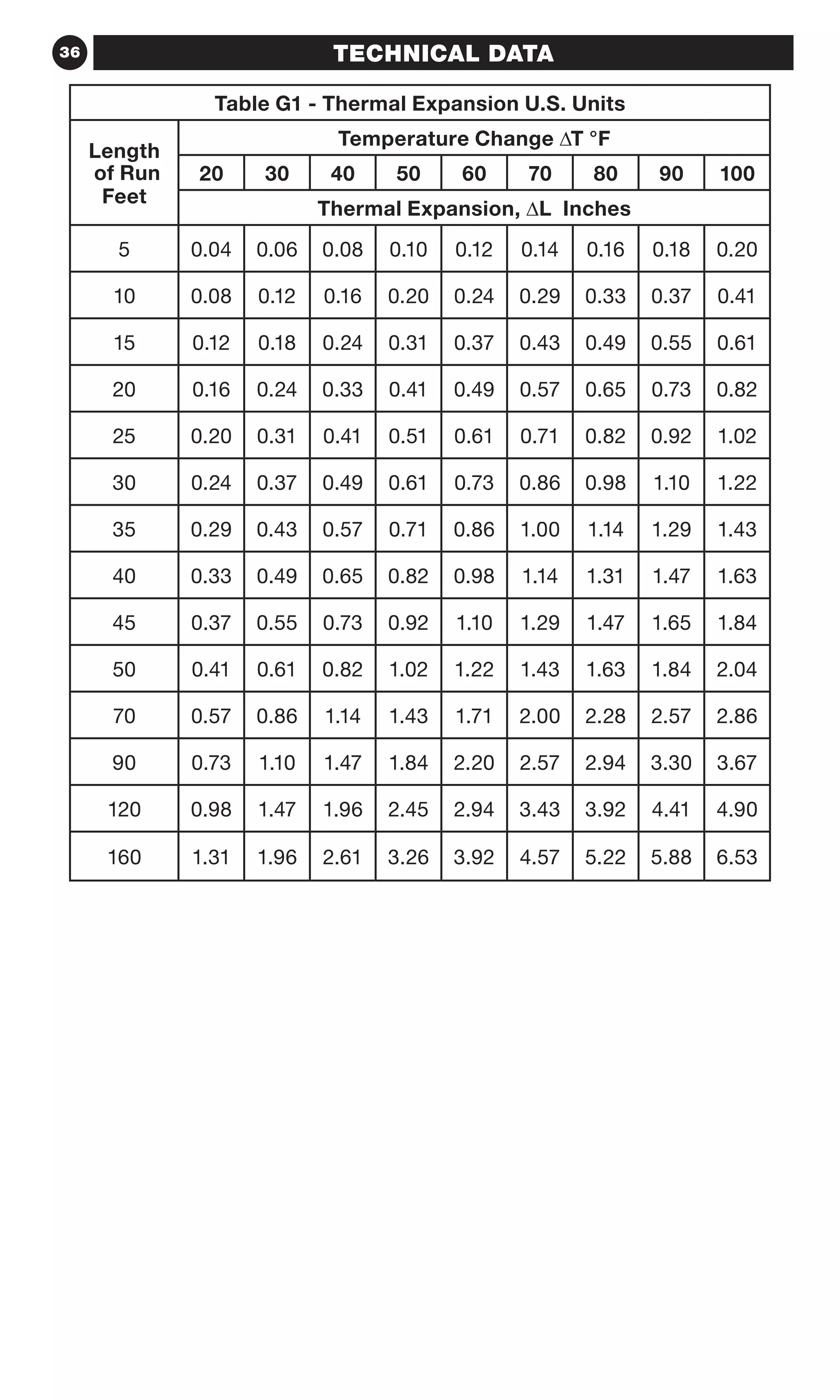
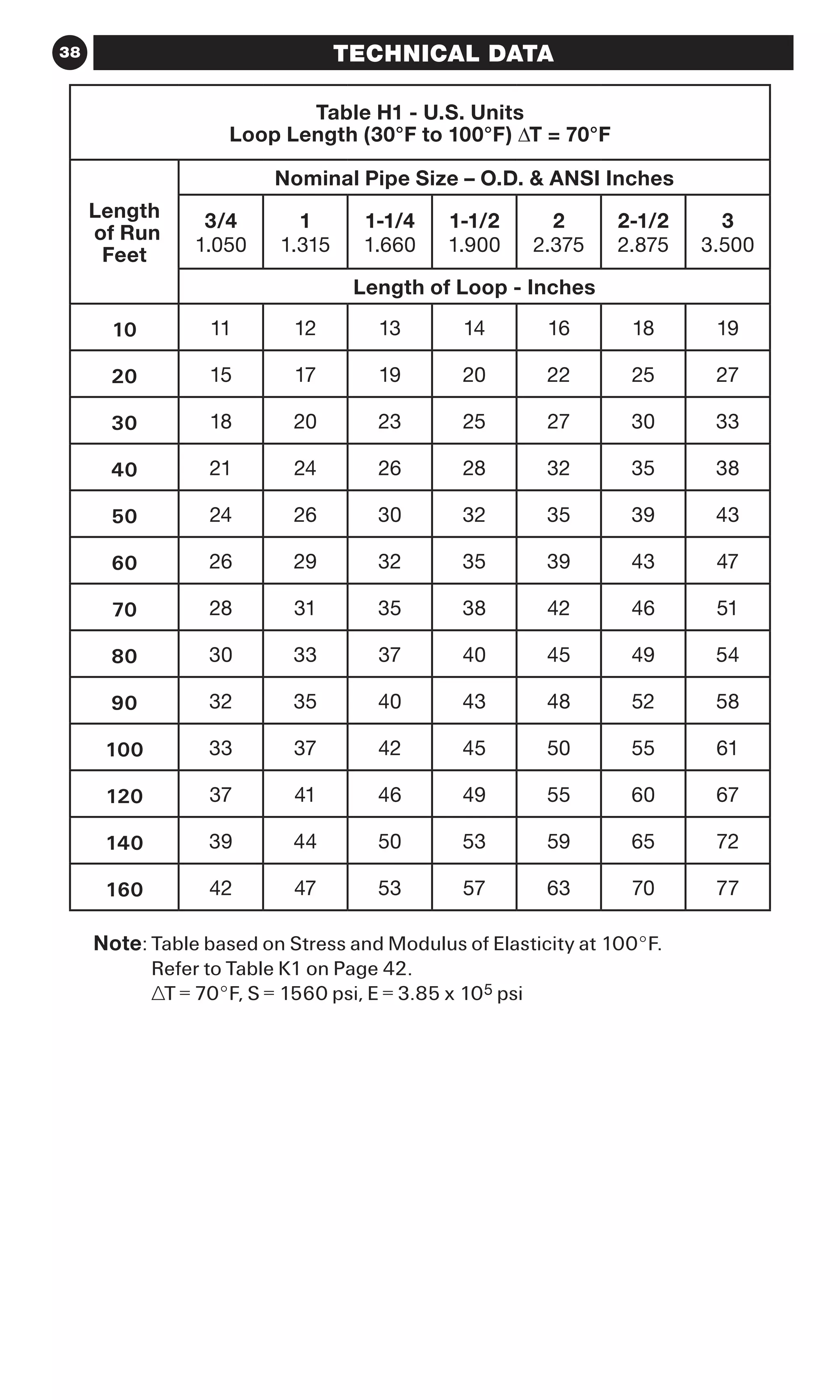
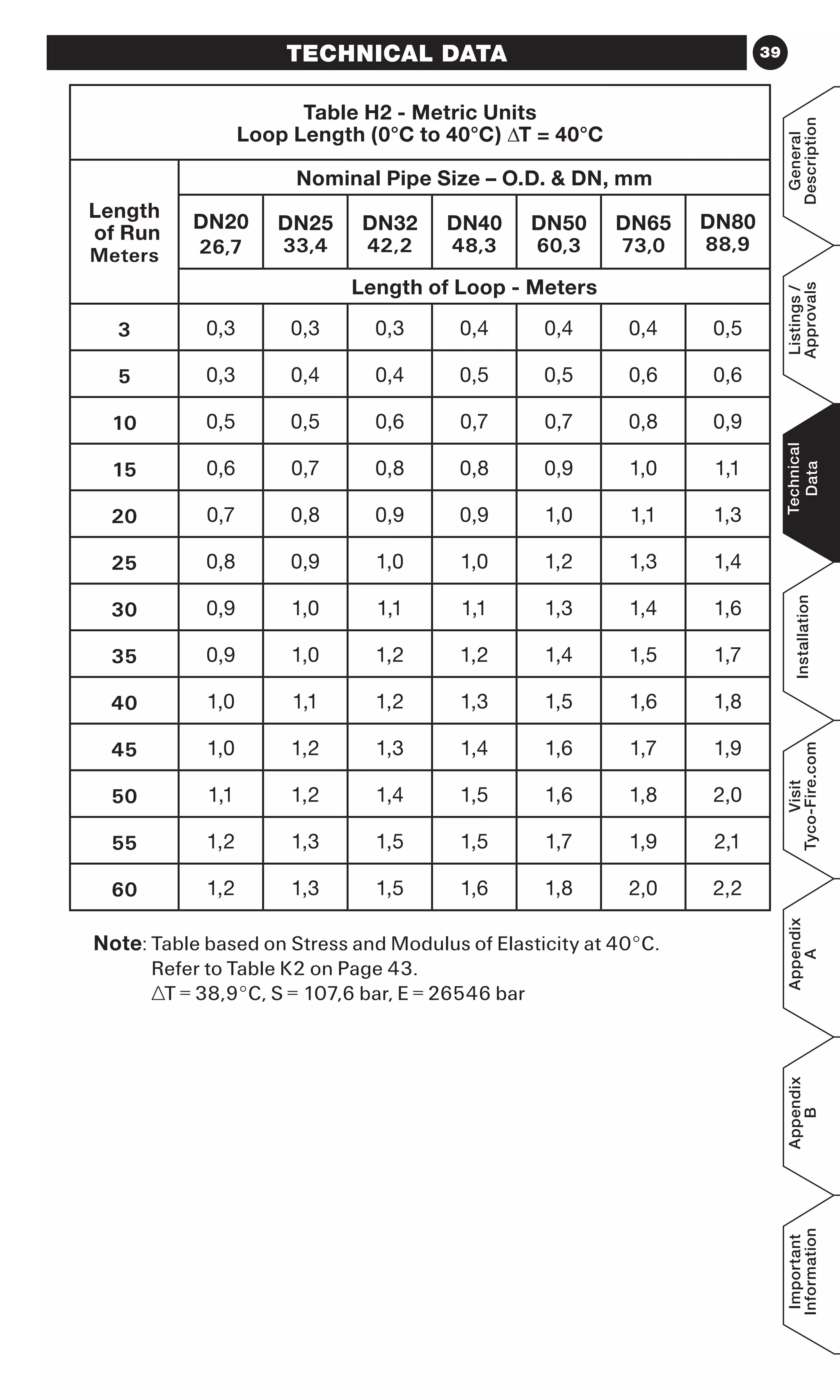
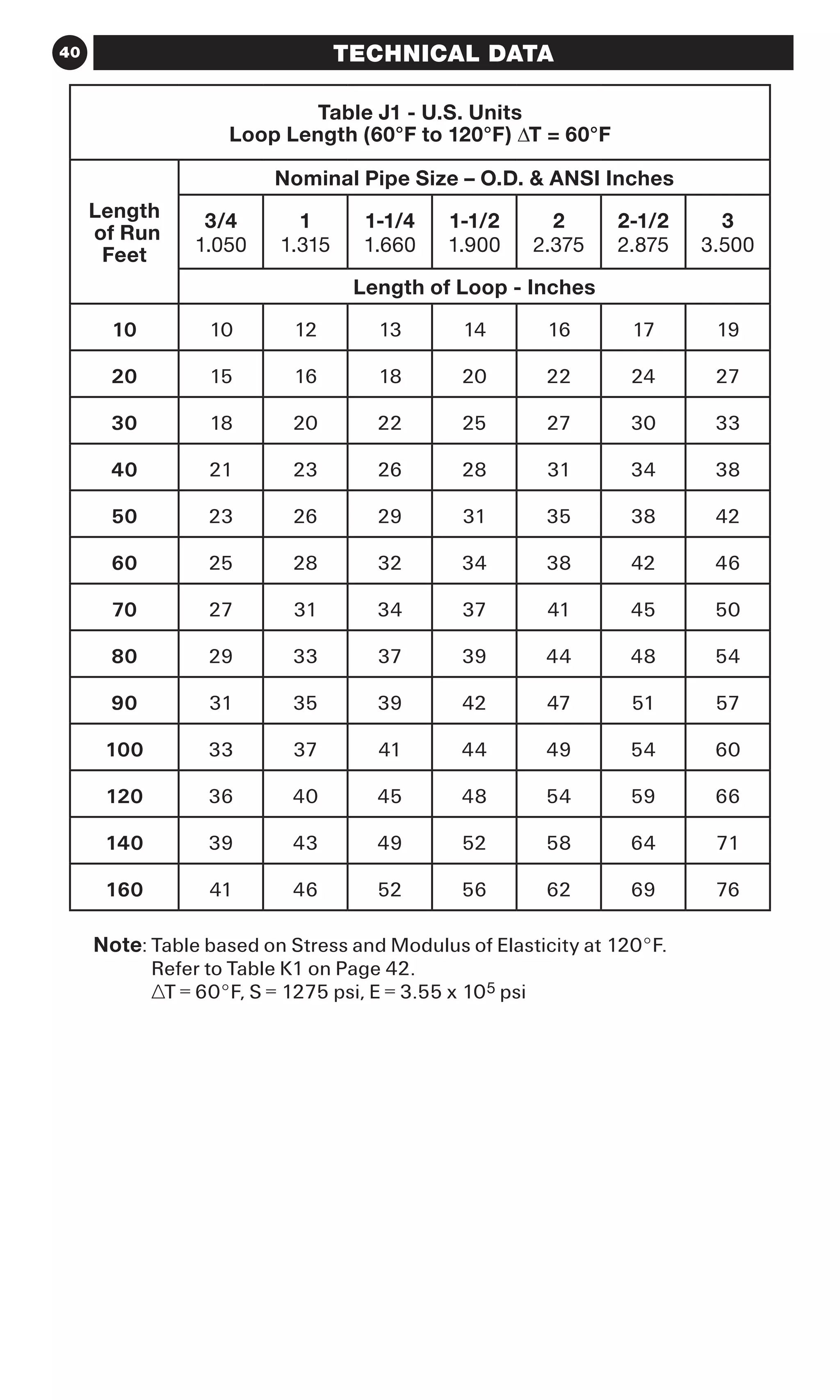
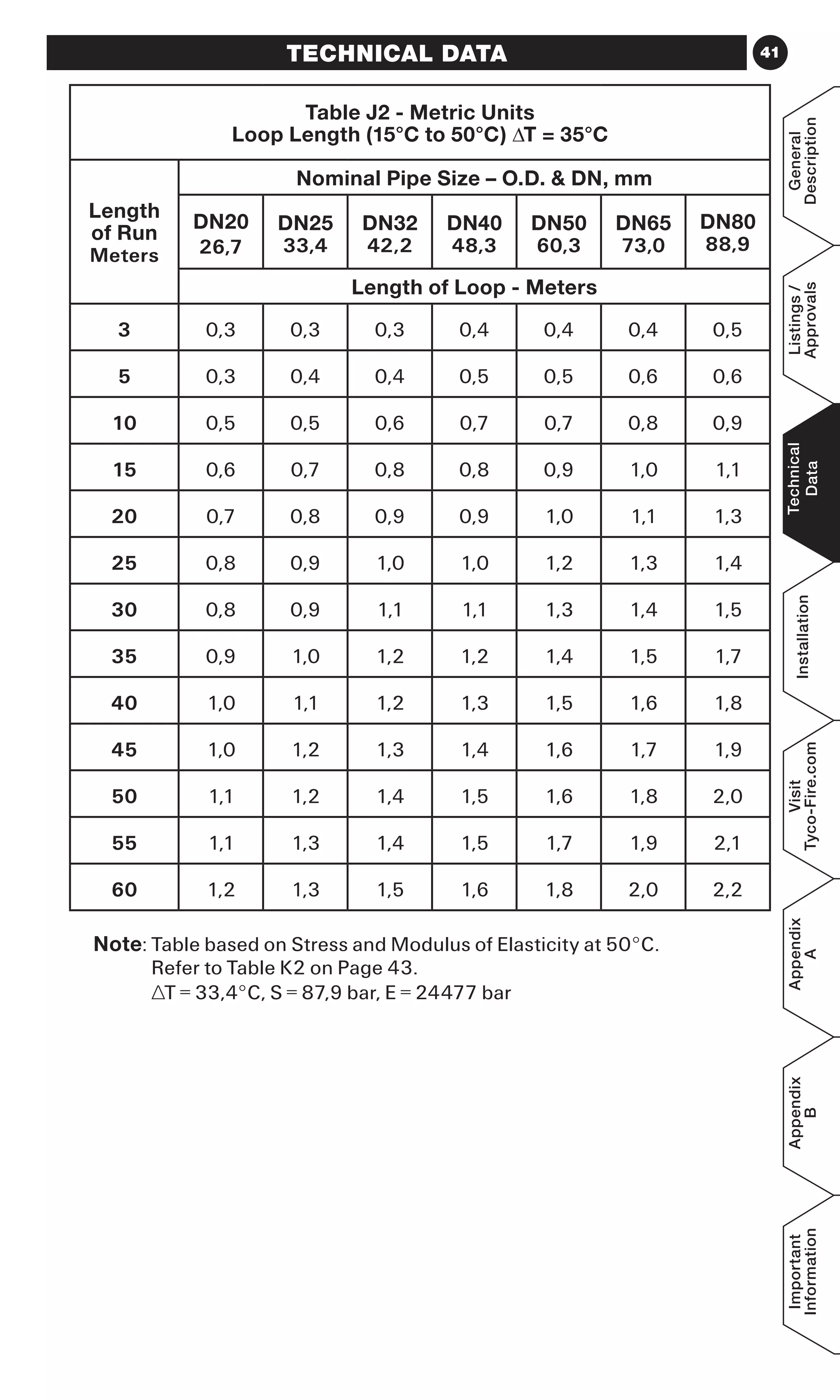
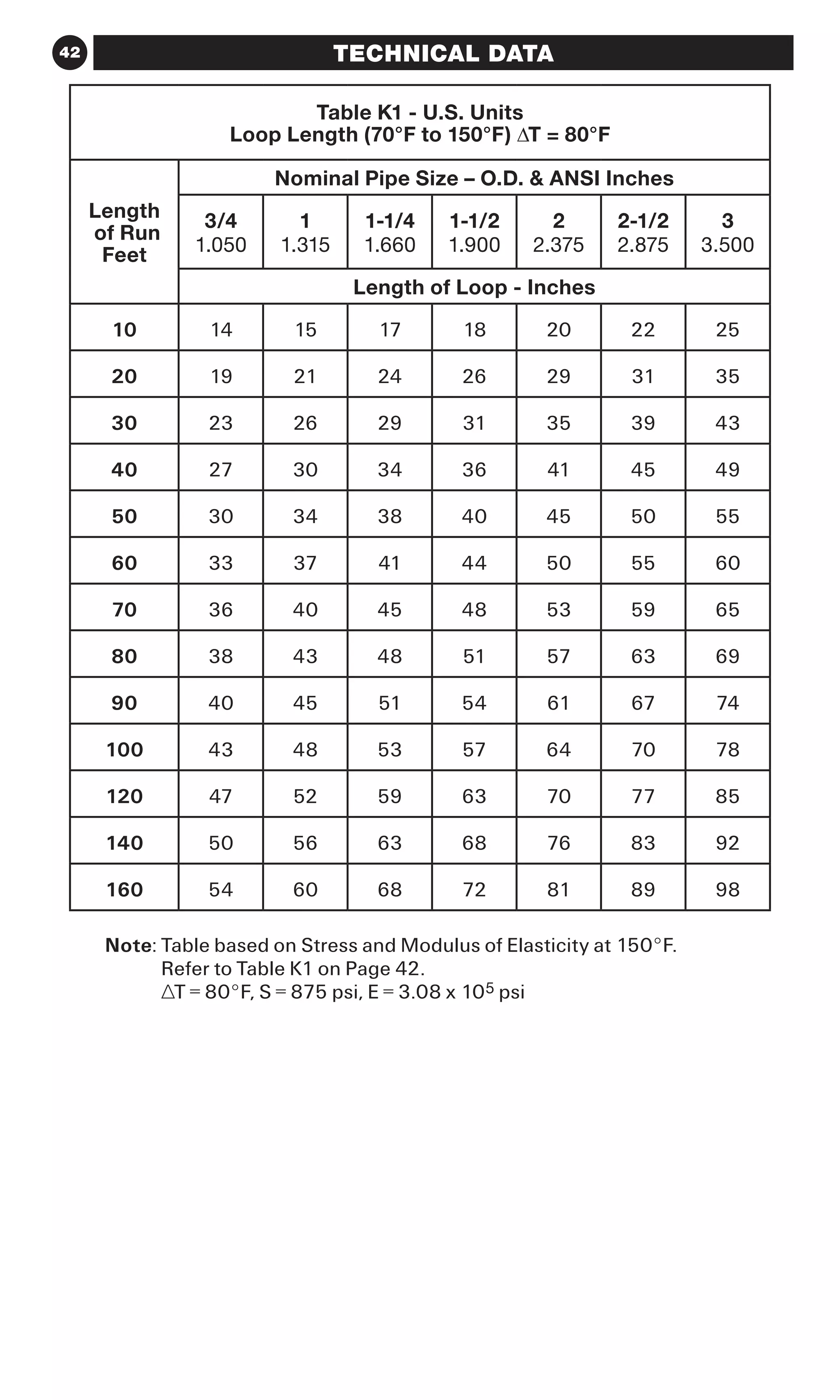
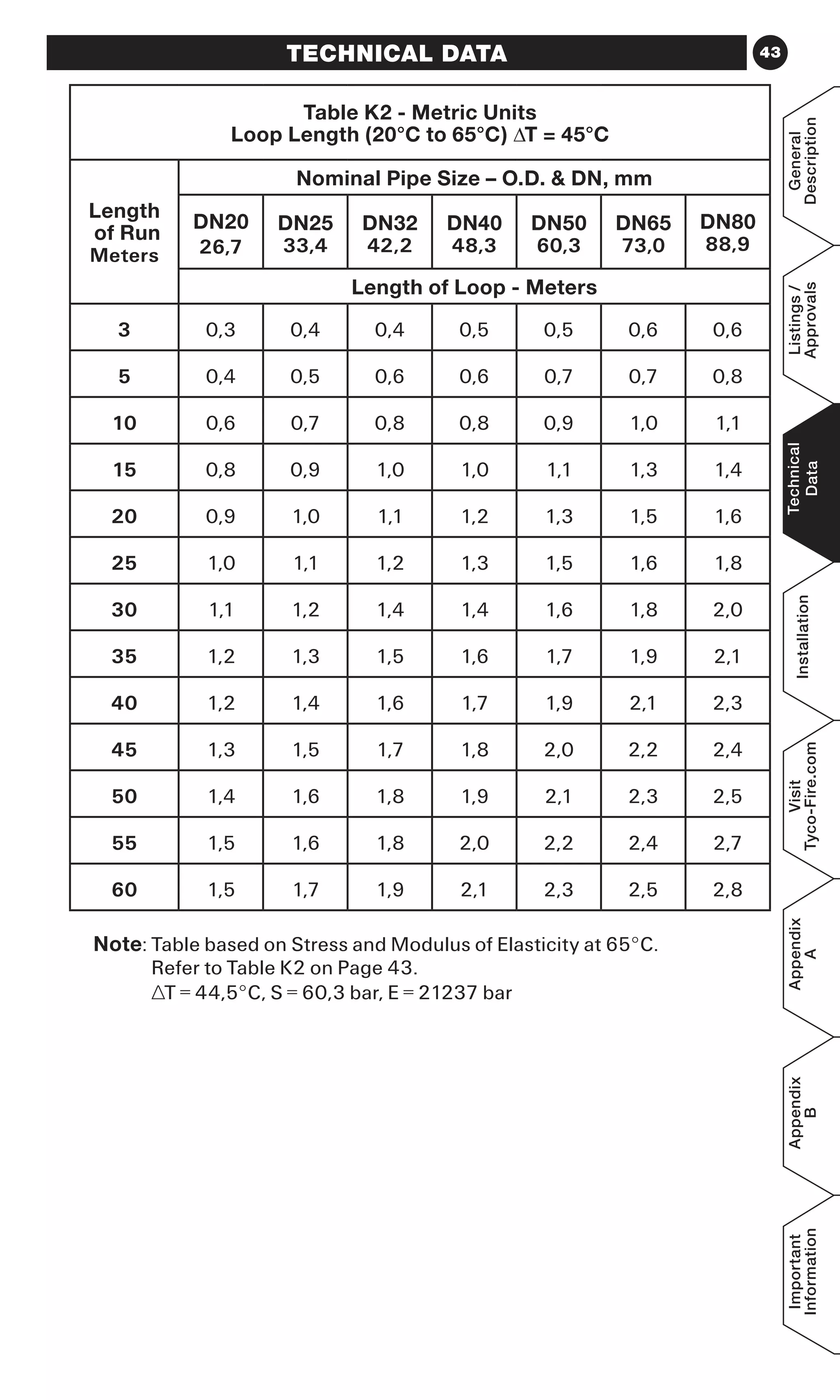
Loop Lengths “L” for use in Figure 7 are shown in Tables H1, J1, and K1
on Pages 38-43. If the change in temperature and the maximum working
temperature are lower than those used to derive the tables, the numbers
will be conservative in nature. For example, for a temperature change from
60°F to 125°F use Table J1 because the maximum temperature is greater
than those shown in Tables G1 and H1.
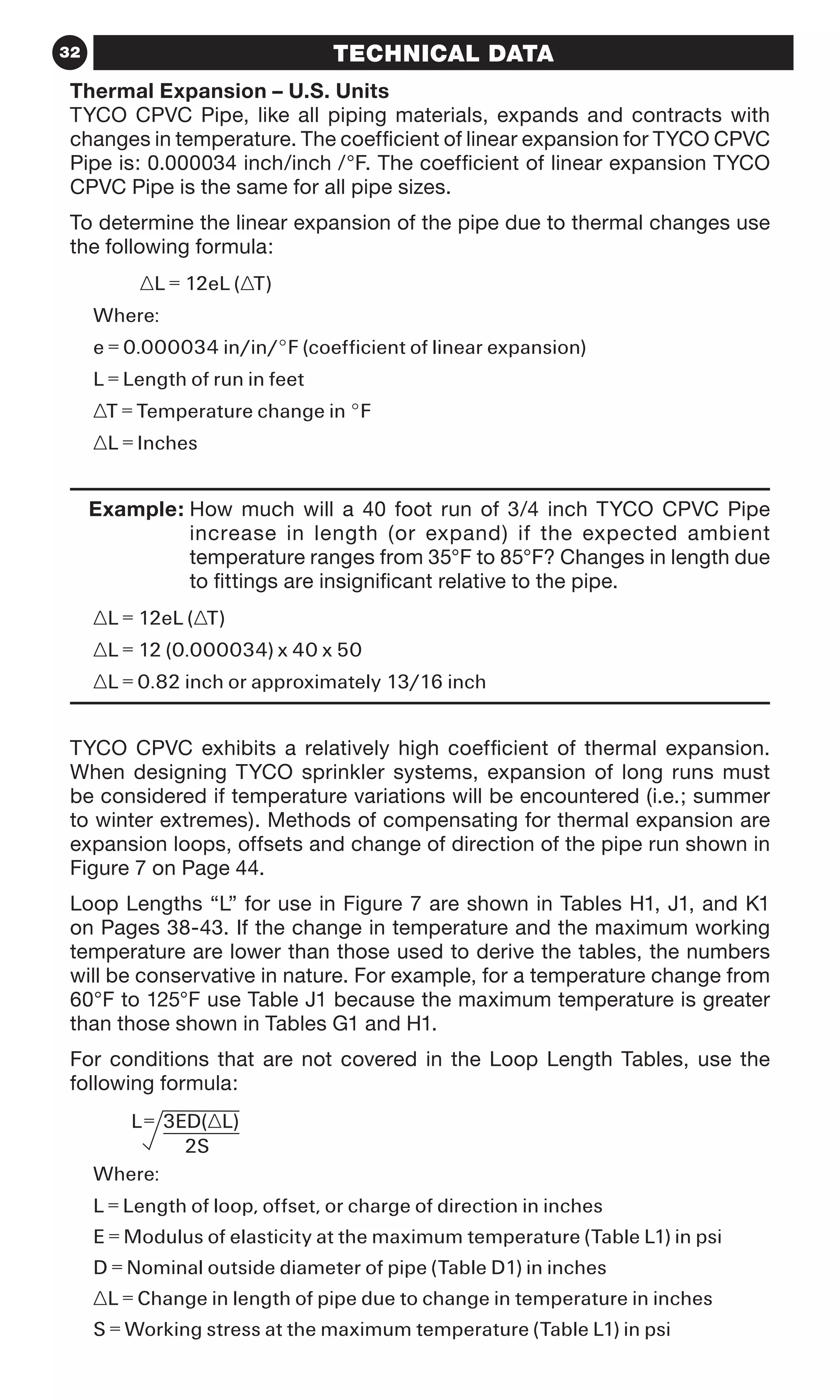
For conditions that are not covered in the Loop Length Tables, use the
following formula:
Where:
L = Length of loop, offset, or charge of direction in inches
E = Modulus of elasticity at the maximum temperature (Table L1) in psi
D = Nominal outside diameter of pipe (Table D1) in inches
∆L = Change in length of pipe due to change in temperature in inches
S = Working stress at the maximum temperature (Table L1) in psi
33TECHNICAL DATA
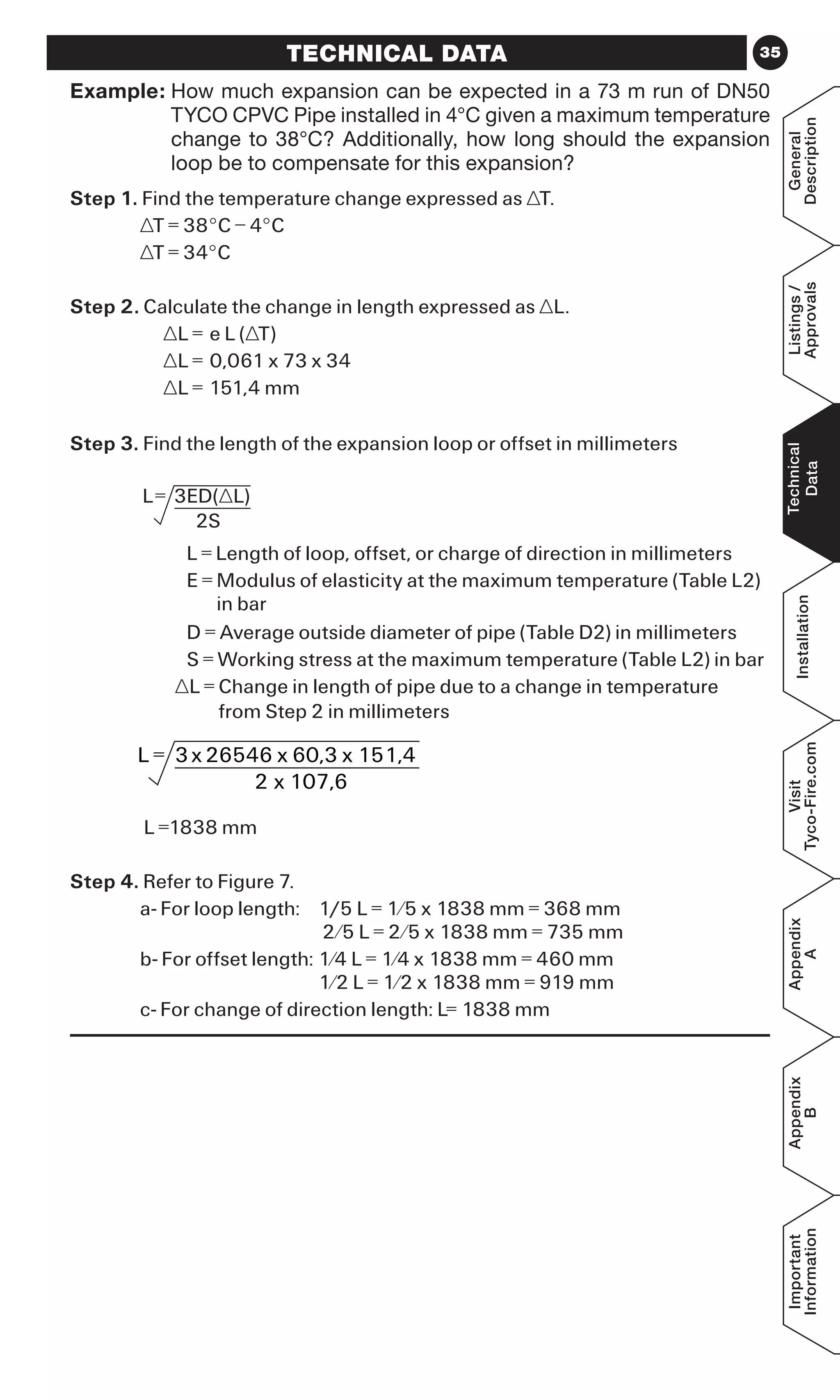
Example: How much expansion can be expected in a 240 foot run of 2 inch
TYCO CPVC Pipe installed in 40°F given a maximum temperature
change to 100°F? Additionally, how long should the expansion
loop be to compensate for this expansion?
Step 1. Find the temperature change expressed as ∆T.
	 	 	 ∆T = 100°F – 40°F
	 	 	 ∆T = 60°F
Step 2. Calculate the change in length expressed as ∆L.
	 	 	 	 ∆L = 12 e L (∆T)
	 	 	 	 ∆L = 12 (0.000034) x 240 x 60
	 	 	 	 ∆L = 5.88 inches
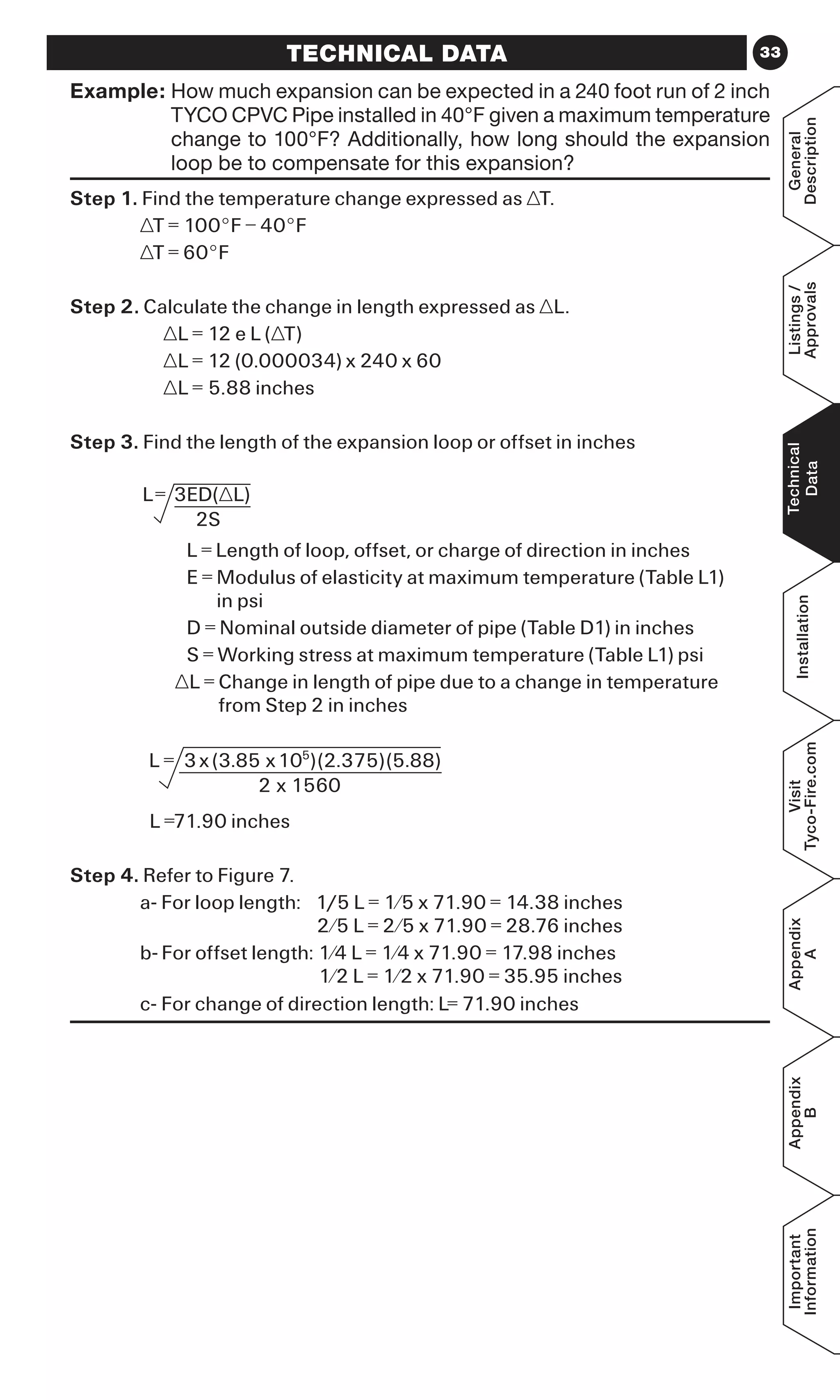
Step 3. Find the length of the expansion loop or offset in inches
	 	 	 	 	 L = Length of loop, offset, or charge of direction in inches
	 	 	 	 	 E = Modulus of elasticity at maximum temperature (Table L1)
in psi
	 	 	 	 	 D = Nominal outside diameter of pipe (Table D1) in inches
	 	 	 	 	 S = Working stress at maximum temperature (Table L1) psi
	 	 	 	   ∆L = Change in length of pipe due to a change in temperature
from Step 2 in inches
	 	 	   L =71.90 inches
Step 4. Refer to Figure 7.
	 	 	 a- For loop length:   1/5 L = 1⁄5 x 71.90 = 14.38 inches
2⁄5 L = 2⁄5 x 71.90 = 28.76 inches
	 	 	 b- For offset length: 1⁄4 L = 1⁄4 x 71.90 = 17.98 inches
1⁄2 L = 1⁄2 x 71.90 = 35.95 inches
	 	 	 c- For change of direction length: L= 71.90 inches
General
Description
Listings/
Approvals
Technical
Data
Installation
Visit
Tyco-Fire.com
Appendix
A
Appendix
B
Important
Information
34 TECHNICAL DATA
Thermal Expansion – Metric Units
TYCO CPVC Pipe, like all piping materials, expands and contracts with
changes in temperature. The coefficient of linear expansions TYCO CPVC
Pipe is: 0,062 mm/m/°C. The coefficient of linear expansion TYCO CPVC
Pipe is the same for all pipe sizes.
To determine the linear expansion of the pipe due to thermal changes use
the following formula:
	 ∆L = eL (∆T)
Where:
e = 0,061 mm/m C° (coefficient of linear expansion)
L = Length of run in meters
∆T = Temperature change in °C
	 Example: How much will a 12 m run of DN20 TYCO CPVC Pipe increase
in length (or expand) if the expected ambient temperature
ranges from 2°C to 32°C? Changes in length due to fittings are
insignificant relative to the pipe.
∆L = eL (∆T)
∆L = (0,061) x 12 x 30
∆L = 22,0 mm
TYCO CPVC exhibits a relatively high coefficient of thermal expansion (see
Table H2). When designing TYCO sprinkler systems, expansion of long
runs must be considered if temperature variations will be encountered
(i.e.; summer to winter extremes). Methods of compensating for thermal
expansion are expansion loops, offsets and change of direction of the pipe
run shown in Figure 7 on Page 44.
Loop Lengths “L” for use in Figure 7 are shown in Tables H2, J2, and K2
on Pages 38-43. If the change in temperature and the maximum working
temperature are lower than those used to derive the tables, the numbers
will be conservative in nature. For example, for a temperature change from
16°C to 52°C use Table J2 because the maximum temperature is greater
than those shown in Tables G2 and H2.
For conditions that are not covered in the Loop Length Tables, use the
following formula:
Where:
L = Length of loop, offset, or charge of direction in millimeters
E = Modulus of elasticity at the maximum temperature (Table L2) in bar
D = Nominal outside diameter of pipe (Table D2) in millimeters
∆L = Change in length of pipe due to change in temperature in millimeters
S = Working stress at the maximum temperature (Table L2) in bar
35TECHNICAL DATA
Example: How much expansion can be expected in a 73 m run of DN50
TYCO CPVC Pipe installed in 4°C given a maximum temperature
change to 38°C? Additionally, how long should the expansion
loop be to compensate for this expansion?
Step 1. Find the temperature change expressed as ∆T.
	 	 	 ∆T = 38°C – 4°C
	 	 	 ∆T = 34°C
Step 2. Calculate the change in length expressed as ∆L.
	 	 	 	 ∆L = e L (∆T)
	 	 	 	 ∆L = 0,061 x 73 x 34
	 	 	 	 ∆L = 151,4 mm
Step 3. Find the length of the expansion loop or offset in millimeters
	 	 	 	 	 L = Length of loop, offset, or charge of direction in millimeters
	 	 	 	 	 E = Modulus of elasticity at the maximum temperature (Table L2)
in bar
	 	 	 	 	 D = Average outside diameter of pipe (Table D2) in millimeters
	 	 	 	 	 S = Working stress at the maximum temperature (Table L2) in bar
	 	 	 	   ∆L = Change in length of pipe due to a change in temperature
from Step 2 in millimeters
	 	 	 L =1838 mm
Step 4. Refer to Figure 7.
	 	 	 a- For loop length:   1/5 L = 1⁄5 x 1838 mm = 368 mm
2⁄5 L = 2⁄5 x 1838 mm = 735 mm
	 	 	 b- For offset length: 1⁄4 L = 1⁄4 x 1838 mm = 460 mm
1⁄2 L = 1⁄2 x 1838 mm = 919 mm
	 	 	 c- For change of direction length: L= 1838 mm
General
Description
Listings/
Approvals
Technical
Data
Installation
Visit
Tyco-Fire.com
Appendix
A
Appendix
B
Important
Information
36 TECHNICAL DATA
Table G1 - Thermal Expansion U.S. Units
Length
of Run
Feet
Temperature Change ∆T °F
20 30 40 50 60 70 80 90 100
Thermal Expansion, ∆L Inches
5 0.04 0.06 0.08 0.10 0.12 0.14 0.16 0.18 0.20
10 0.08 0.12 0.16 0.20 0.24 0.29 0.33 0.37 0.41
15 0.12 0.18 0.24 0.31 0.37 0.43 0.49 0.55 0.61
20 0.16 0.24 0.33 0.41 0.49 0.57 0.65 0.73 0.82
25 0.20 0.31 0.41 0.51 0.61 0.71 0.82 0.92 1.02
30 0.24 0.37 0.49 0.61 0.73 0.86 0.98 1.10 1.22
35 0.29 0.43 0.57 0.71 0.86 1.00 1.14 1.29 1.43
40 0.33 0.49 0.65 0.82 0.98 1.14 1.31 1.47 1.63
45 0.37 0.55 0.73 0.92 1.10 1.29 1.47 1.65 1.84
50 0.41 0.61 0.82 1.02 1.22 1.43 1.63 1.84 2.04
70 0.57 0.86 1.14 1.43 1.71 2.00 2.28 2.57 2.86
90 0.73 1.10 1.47 1.84 2.20 2.57 2.94 3.30 3.67
120 0.98 1.47 1.96 2.45 2.94 3.43 3.92 4.41 4.90
160 1.31 1.96 2.61 3.26 3.92 4.57 5.22 5.88 6.53
37TECHNICAL DATA
Table G2 - Thermal Expansion Metric Units
Length
of Run
Meters
Temperature Change ∆T °C
10 15 20 25 30 35 40 50 55
Thermal Expansion, ∆L Millimeters
1 0,6 0,9 1,2 1,5 1,8 2,1 2,4 3,1 3,4
2 1,2 1,8 2,4 3,1 3,7 4,3 4,9 6,1 6,7
3 1,8 2,7 3,7 4,6 5,5 6,4 7,3 9,2 10,1
4 2,4 3,7 4,9 6,1 7,3 8,5 9,8 12,2 13,4
5 3,1 4,6 6,1 7,6 9,2 10,7 12,2 15,3 16,8
7 4,3 6,4 8,5 10,7 12,8 14,9 17,1 21,4 23,5
9 5,5 8,2 11,0 13,7 16,5 19,2 22,0 27,5 30,2
12 7,3 11,0 14,6 18,3 22,0 25,6 29,3 36,6 40,3
15 9,2 13,7 18,3 22,9 27,5 32,0 36,6 45,8 50,3
20 12,2 18,3 24,4 30,5 36,6 42,7 48,8 61,0 67,1
25 15,3 22,9 30,5 38,1 45,8 53,4 61,0 76,3 83,9
30 18,3 27,5 36,6 45,8 54,9 64,1 73,2 91,5 100,7
40 24,4 36,6 48,8 61,0 73,2 85,4 97,6 122,0 134,2
50 30,5 45,8 61,0 76,3 91,5 106,8 122,0 152,5 167,8
General
Description
Listings/
Approvals
Technical
Data
Installation
Visit
Tyco-Fire.com
Appendix
A
Appendix
B
Important
Information
38 TECHNICAL DATA
Table H1 - U.S. Units
Loop Length (30°F to 100°F) ∆T = 70°F
Length
of Run
Feet
Nominal Pipe Size – O.D.  ANSI Inches
3/4
1.050
1
1.315
1-1/4
1.660
1-1/2
1.900
2
2.375
2-1/2
2.875
3
3.500
Length of Loop - Inches
10 11 12 13 14 16 18 19
20 15 17 19 20 22 25 27
30 18 20 23 25 27 30 33
40 21 24 26 28 32 35 38
50 24 26 30 32 35 39 43
60 26 29 32 35 39 43 47
70 28 31 35 38 42 46 51
80 30 33 37 40 45 49 54
90 32 35 40 43 48 52 58
100 33 37 42 45 50 55 61
120 37 41 46 49 55 60 67
140 39 44 50 53 59 65 72
160 42 47 53 57 63 70 77
Note: Table based on Stress and Modulus of Elasticity at 100°F.
Refer to Table K1 on Page 42.
∆T = 70°F, S = 1560 psi, E = 3.85 x 10⁵ psi
39TECHNICAL DATA
Table H2 - Metric Units
Loop Length (0°C to 40°C) ∆T = 40°C
Length
of Run
Meters
Nominal Pipe Size – O.D.  DN, mm
DN20
26,7
DN25
33,4
DN32
42,2
DN40
48,3
DN50
60,3
DN65
73,0
DN80
88,9
Length of Loop - Meters
3 0,3 0,3 0,3 0,4 0,4 0,4 0,5
5 0,3 0,4 0,4 0,5 0,5 0,6 0,6
10 0,5 0,5 0,6 0,7 0,7 0,8 0,9
15 0,6 0,7 0,8 0,8 0,9 1,0 1,1
20 0,7 0,8 0,9 0,9 1,0 1,1 1,3
25 0,8 0,9 1,0 1,0 1,2 1,3 1,4
30 0,9 1,0 1,1 1,1 1,3 1,4 1,6
35 0,9 1,0 1,2 1,2 1,4 1,5 1,7
40 1,0 1,1 1,2 1,3 1,5 1,6 1,8
45 1,0 1,2 1,3 1,4 1,6 1,7 1,9
50 1,1 1,2 1,4 1,5 1,6 1,8 2,0
55 1,2 1,3 1,5 1,5 1,7 1,9 2,1
60 1,2 1,3 1,5 1,6 1,8 2,0 2,2
Note: Table based on Stress and Modulus of Elasticity at 40°C.
Refer to Table K2 on Page 43.
∆T = 38,9°C, S = 107,6 bar, E = 26546 bar
General
Description
Listings/
Approvals
Technical
Data
Installation
Visit
Tyco-Fire.com
Appendix
A
Appendix
B
Important
Information
40 TECHNICAL DATA
Table J1 - U.S. Units
Loop Length (60°F to 120°F) ∆T = 60°F
Length
of Run
Feet
Nominal Pipe Size – O.D.  ANSI Inches
3/4
1.050
1
1.315
1-1/4
1.660
1-1/2
1.900
2
2.375
2-1/2
2.875
3
3.500
Length of Loop - Inches
10 10 12 13 14 16 17 19
20 15 16 18 20 22 24 27
30 18 20 22 25 27 30 33
40 21 23 26 28 31 34 38
50 23 26 29 31 35 38 42
60 25 28 32 34 38 42 46
70 27 31 34 37 41 45 50
80 29 33 37 39 44 48 54
90 31 35 39 42 47 51 57
100 33 37 41 44 49 54 60
120 36 40 45 48 54 59 66
140 39 43 49 52 58 64 71
160 41 46 52 56 62 69 76
Note: Table based on Stress and Modulus of Elasticity at 120°F.
Refer to Table K1 on Page 42.
∆T = 60°F, S = 1275 psi, E = 3.55 x 10⁵ psi
41TECHNICAL DATA
Table J2 - Metric Units
Loop Length (15°C to 50°C) ∆T = 35°C
Length
of Run
Meters
Nominal Pipe Size – O.D.  DN, mm
DN20
26,7
DN25
33,4
DN32
42,2
DN40
48,3
DN50
60,3
DN65
73,0
DN80
88,9
Length of Loop - Meters
3 0,3 0,3 0,3 0,4 0,4 0,4 0,5
5 0,3 0,4 0,4 0,5 0,5 0,6 0,6
10 0,5 0,5 0,6 0,7 0,7 0,8 0,9
15 0,6 0,7 0,8 0,8 0,9 1,0 1,1
20 0,7 0,8 0,9 0,9 1,0 1,1 1,3
25 0,8 0,9 1,0 1,0 1,2 1,3 1,4
30 0,8 0,9 1,1 1,1 1,3 1,4 1,5
35 0,9 1,0 1,2 1,2 1,4 1,5 1,7
40 1,0 1,1 1,2 1,3 1,5 1,6 1,8
45 1,0 1,2 1,3 1,4 1,6 1,7 1,9
50 1,1 1,2 1,4 1,5 1,6 1,8 2,0
55 1,1 1,3 1,4 1,5 1,7 1,9 2,1
60 1,2 1,3 1,5 1,6 1,8 2,0 2,2
Note: Table based on Stress and Modulus of Elasticity at 50°C.
Refer to Table K2 on Page 43.
∆T = 33,4°C, S = 87,9 bar, E = 24477 bar
General
Description
Listings/
Approvals
Technical
Data
Installation
Visit
Tyco-Fire.com
Appendix
A
Appendix
B
Important
Information
42 TECHNICAL DATA
Table K1 - U.S. Units
Loop Length (70°F to 150°F) ∆T = 80°F
Length
of Run
Feet
Nominal Pipe Size – O.D.  ANSI Inches
3/4
1.050
1
1.315
1-1/4
1.660
1-1/2
1.900
2
2.375
2-1/2
2.875
3
3.500
Length of Loop - Inches
10 14 15 17 18 20 22 25
20 19 21 24 26 29 31 35
30 23 26 29 31 35 39 43
40 27 30 34 36 41 45 49
50 30 34 38 40 45 50 55
60 33 37 41 44 50 55 60
70 36 40 45 48 53 59 65
80 38 43 48 51 57 63 69
90 40 45 51 54 61 67 74
100 43 48 53 57 64 70 78
120 47 52 59 63 70 77 85
140 50 56 63 68 76 83 92
160 54 60 68 72 81 89 98
Note: Table based on Stress and Modulus of Elasticity at 150°F.
Refer to Table K1 on Page 42.
∆T = 80°F, S = 875 psi, E = 3.08 x 10⁵ psi
43TECHNICAL DATA
Table K2 - Metric Units
Loop Length (20°C to 65°C) ∆T = 45°C
Length
of Run
Meters
Nominal Pipe Size – O.D.  DN, mm
DN20
26,7
DN25
33,4
DN32
42,2
DN40
48,3
DN50
60,3
DN65
73,0
DN80
88,9
Length of Loop - Meters
3 0,3 0,4 0,4 0,5 0,5 0,6 0,6
5 0,4 0,5 0,6 0,6 0,7 0,7 0,8
10 0,6 0,7 0,8 0,8 0,9 1,0 1,1
15 0,8 0,9 1,0 1,0 1,1 1,3 1,4
20 0,9 1,0 1,1 1,2 1,3 1,5 1,6
25 1,0 1,1 1,2 1,3 1,5 1,6 1,8
30 1,1 1,2 1,4 1,4 1,6 1,8 2,0
35 1,2 1,3 1,5 1,6 1,7 1,9 2,1
40 1,2 1,4 1,6 1,7 1,9 2,1 2,3
45 1,3 1,5 1,7 1,8 2,0 2,2 2,4
50 1,4 1,6 1,8 1,9 2,1 2,3 2,5
55 1,5 1,6 1,8 2,0 2,2 2,4 2,7
60 1,5 1,7 1,9 2,1 2,3 2,5 2,8
Note: Table based on Stress and Modulus of Elasticity at 65°C.
Refer to Table K2 on Page 43.
∆T = 44,5°C, S = 60,3 bar, E = 21237 bar
General
Description
Listings/
Approvals
Technical
Data
Installation
Visit
Tyco-Fire.com
Appendix
A
Appendix
B
Important
Information
44 TECHNICAL DATA
Table L1
Modulus of Elasticity  Stress vs Temperature – U.S. Units
Temperature
°F
73° 80° 90° 100° 110° 120° 140° 150°
Modulus of
Elasticity
“E ” x 105
(psi)
4.23 4.14 3.99 3.85 3.70 3.55 3.23 3.08
Working
Stress
“S ” (psi)
2,000 1,875 1,715 1,560 1,415 1,275 1,000 875
Table L2
Modulus of Elasticity  Stress vs Temperature – Metric Units
Temperature
°C
25° 30° 35° 40° 45° 50° 60° 65°
Modulus of
Elasticity
(bar)
29166 28545 27511 26546 25512 24477 22271 21237
Working
Stress
“S” (bar)
137,9 129,3 118,2 107,6 97,6 87,9 69,0 60,3
Figure 7
Loop Offset
Change of
Direction
Expansion Loop and Offset Configurations
6 Min.
(150 mm)
2/5 L
L
1/2 L
L
Long Run
L
6 Min.
(150 mm)
1/4 L 1/4 L
of Pipe
Restraint*Hanger or Guide* Expansion
1/5 L
* Hangers should only be placed in the loop, offset, or change of direction
as indicated. Piping supports should restrict lateral movement and shall
direct axial movement into the expansion loop.
45TECHNICAL DATA
PHYSICAL AND THERMAL PROPERTIES
Permissible Bending Deflections
TYCO CPVC fire sprinkler piping while classified as a rigid piping material
is inherently flexible. This flexibility allows piping to be deflected within
permissible limits around or away from objects during installation.
The maximum allowable deflections for TYCO CPVC piping can be found
in Tables N1 and N2 on Pages 46-47 and Table P1 and P2 on Pages 48-49.
Table M - Physical and Thermal Properties
Property CPVC ASTM
Specific Gravity “Sp.Gr.” 1.53 D792
IZOD Impact Strength (ft.lbs./inch, notched) 3.0 D256A
Modulus of Elasticity, @73°F, psi “E” 4.23 x 10⁵ D638
Ultimate Tensile Strength, psi 8,000 D638
Compressive Strength, psi “o” 9,600 D695
Poisson’s Ratio “n” .35 -.38 –
Working Stress @ 73°F, psi “S” 2,000 D1598
Hazen Williams “C” Factor “C” 150 –
Coefficient of Linear Expansion in/(in °F) “e” 3.4 x 10⁻⁵ D696
Thermal Conductivity BTU/hr/ft2/°F/in “k” 0.95 C177
Flash Ignition Temperature °F 900 D1929
Limiting Oxygen Index “LOI” 60% D2863
Electrical Conductivity Non Conductor General
Description
Listings/
Approvals
Technical
Data
Installation
Visit
Tyco-Fire.com
Appendix
A
Appendix
B
Important
Information
L = ft.
D = in.
DEFLECTED PIPE
46 TECHNICAL DATA
Table N1 - U.S. Units (1 of 2)
Permissible Bending Deflections SDR 13.5 at 73°F
“Bending ” (One End Restrained)
(L)
Length
of Run
Feet
Nominal Pipe Size – ANSI Inches
3/4 1 1-1/4 1-1/2 2 2-1/2 3
(D) Deflection - Inches
2 1.3 1.0 0.8 0.7 0.6 0.5 0.4
5 7.8 6.3 5.0 4.3 3.5 2.9 2.4
7 15.4 12.3 9.7 8.5 6.8 5.6 4.6
10 31.3 25.0 19.8 17.3 13.9 11.4 9.4
12 45.1 36.0 28.5 24.9 20.0 16.5 13.5
15 70.5 56.3 44.6 39.0 31.2 25.8 21.2
17 90.6 72.3 57.3 50.1 40.0 33.1 27.2
20 125.4 100.1 79.3 69.3 55.4 45.8 37.6
25 195.9 156.4 123.9 108.2 86.6 71.5 58.8
30 282.1 225.2 178.4 155.9 124.7 103.0 84.6
35 383.9 306.6 242.8 212.2 169.7 140.2 115.2
40 - 400.4 317.2 277.1 221.7 183.1 150.4
45 - - 401.4 350.7 280.6 231.8 190.4
50 - - - 433.0 346.4 286.2 235.1
L = m
D = mm
DEFLECTED PIPE
47TECHNICAL DATA
Table N2 - Metric Units
Permissible Bending Deflections SDR 13.5 at 23°C
“Bending ” (One End Restrained)
(L)
Length
of Run
Meters
Nominal Pipe Size – DN
DN20 DN25 DN32 DN40 DN50 DN65 DN80
(D) Deflection - Meters
0.5 0,02 0,02 0,01 0,01 0,01 0,01 0,01
1 0,09 0,07 0,05 0,05 0,04 0,03 0,03
2 0,34 0,27 0,22 0,19 0,15 0,13 0,10
3 0,77 0,62 0,49 0,43 0,34 0,28 0,23
4 1,37 1,10 0,87 0,76 0,61 0,50 0,41
5 2,15 1,71 1,36 1,19 0,95 0,78 0,64
6 3,09 2,47 1,96 1,71 1,37 1,13 0,93
7 4,21 3,36 2,66 2,33 1,86 1,54 1,26
8 5,50 4,39 3,48 3,04 2,43 2,01 1,65
9 6,96 5,55 4,40 3,84 3,08 2,54 2,09
10 8,59 6,86 5,43 4,75 3,80 3,14 2,58
11 - 8,30 6,57 5,74 4,59 3,80 3,12
13 - - 9,18 8,02 6,42 5,30 4,35
15 - - - 10,68 8,54 7,06 5,80
General
Description
Listings/
Approvals
Technical
Data
Installation
Visit
Tyco-Fire.com
Appendix
A
Appendix
B
Important
Information
L = ft.
D = in.DEFLECTED PIPE
48 TECHNICAL DATA
Table P1 - U.S. Units (1 of 2)
Permissible Bending Deflections SDR 13.5 at 73°F
“Snaking” (Both Ends Restrained)
(L)
Length
of Run
Feet
Nominal Pipe Size – ANSI Inches
3/4 1 1-1/4 1-1/2 2 2-1/2 3
(D) Deflection - Inches
2 0.3 0.3 0.2 0.2 0.1 0.1 0.1
5 2.0 1.6 1.2 1.1 0.9 0.7 0.6
7 3.8 3.1 2.4 2.1 1.7 1.4 1.2
10 7.8 6.3 5.0 4.3 3.5 2.9 2.4
12 11.3 9.0 7.1 6.2 5.0 4.1 3.4
15 17.6 14.1 11.2 9.7 7.8 6.4 5.3
17 22.6 18.1 14.3 12.5 10.0 8.3 6.8
20 31.3 25.0 19.8 17.3 13.9 11.4 9.4
25 49.0 39.1 31.0 27.1 21.6 17.9 14.7
30 70.5 56.3 44.6 39.0 31.2 25.8 21.2
35 96.0 76.6 60.7 53.0 42.4 35.1 28.2
40 125.4 100.1 79.3 69.3 55.4 45.8 37.6
45 158.7 126.7 100.4 87.7 70.1 57.9 47.6
50 195.9 156.4 123.9 108.2 86.6 71.5 58.8
L = m
D = mmDEFLECTED PIPE
49TECHNICAL DATA
Table P2 - Metric Units
Permissible Bending Deflections SDR 13.5 at 23°C
“Snaking” (Both Ends Restrained)
(L)
Length
of Run
Meters
Nominal Pipe Size – DN
DN20 DN25 DN32 DN40 DN50 DN65 DN80
(D) Deflection - Meters
0.61 0,008 0,006 0,005 0,004 0,004 0,003 0,002
1 0,022 0,017 0,014 0,012 0,010 0,008 0,006
2 0,086 0,069 0,054 0,048 0,038 0,031 0,026
3 0,194 0,155 0,122 0,107 0,086 0,071 0,058
4 0,344 0,275 0,218 0,190 0,152 0,126 0,103
5 0,538 0,429 0,340 0,297 0,238 0,196 0,161
6 0,774 0,618 0,490 0,428 0,342 0,283 0,232
7 1,054 0,842 0,667 0,582 0,466 0,385 0,316
8 1,377 1,099 0,871 0,761 0,609 0,503 0,413
9 1,742 1,391 1,102 0,963 0,770 0,636 0,523
10 2,151 1,718 1,361 1,189 0,951 0,786 0,645
11 - 2,078 1,646 1,438 1,151 0,951 0,781
13 - - 2,299 2,009 1,607 1,328 1,091
15 - - - 2,675 2,140 1,768 1,452
General
Description
Listings/
Approvals
Technical
Data
Installation
Visit
Tyco-Fire.com
Appendix
A
Appendix
B
Important
Information
50 TECHNICAL DATA
SUPPORT AND HANGER REQUIREMENTS
Special care must be exercised when selecting the appropriate hanger or
support method for TYCO CPVC Fire Sprinkler Systems.
TYCO CPVC Fire Sprinkler Systems may be supported as follows:
• Using the same hangers as metal piping systems that meet the
requirements of this section
• Using hangers specifically listed for thermoplastic sprinkler piping
• Using any other support method acceptable to the local authority having
jurisdiction
When using hangers/restraining devices, ensure that the hangers are clean,
free of burrs, and free of all surface oils. Any foreign substance must be
removed from the hanger.
When plumbers tape or J hooks are permitted by the authority having
jurisdiction, for example NFPA 13D applications, rough edges are to be
shielded.
Avoid using hangers of the incorrect size for the pipe being fastened/hung
as the hanger can pinch, crush, and damage the piping system causing it
to leak or crack under pressure. Leaks may not appear until after the pipe
is in service.
The pipe size of the hanger shall be the same size as the supported pipe,
and the hanger shall be applied to the pipe (i.e., not the fittings). Horizontal
runs of piping must be braced so that stress loads (caused by bending or
snaking the pipe) will not be placed on a fitting or joint. In jurisdictions that
do not allow plastic to metal contact, rigid plastic sleeves should be used to
isolate the materials. Strapping pipe overly tight to a structural member may
cause damage to the pipe when pressurized. The pipe should be held snugly
by the hanger, but cannot be pinched or crushed in any way. Pipe hangers
must comply NFPA 13, NFPA 13D, NFPA 13R, or the standard recognized
by the applicable Approval Agency, as appropriate.
Exception: In installations where TYCO CPVC Pipe is attached tight to a
continuous ceiling with a “strap” style hanger, undue stress may be placed
on the pipe. The outside dimension of the fitting is greater than that of the
pipe and this size difference can create an unacceptable deflection of the
pipe when the strap is located directly adjacent to the fitting. In this case
only, and when the fitting is tight to the ceiling, it would be acceptable to use
a hanger that is one size larger than the pipe. The use of such an oversized
hanger would avoid the stress on the pipe.
Some hangers designed for metal pipe are
suitable for use with TYCO CPVC Fire Sprinklers
Systems. Hangers must not have rough or sharp
edges that can come in contact with the pipe. Pipe
hangers must have a load bearing surface at least
1/2 inch (12,7 mm) wide.
There are several types of hangers, that have
been specifically listed as “Support Devices For
Thermoplastic Piping,” such as Tolco (Model 22,
23, 24), Afcon (# 510, 511, 512) and Erico (No. 107, SHB1 Head Set
51TECHNICAL DATA
108, 109). Please consult the specific manufacturer for information on the
appropriateness of these devices as hangers and/or vertical restraining
devices for use with TYCO CPVC Pipe and Fittings.
For complete installation and positioning requirements for the TYCO HEAD
SET hangers refer to Technical Data Sheet TFP1920. They are designed for
direct attachment to the side of a structural wood joist or structural composite
wood joist Oriented Strand Board (OSB) web member or equivalent so as
to provide accurate placement of sprinklers.
Pipe Bracing with Standard Band Hanger
Tolco, Inc., Afcon and Erico make hanger/restraining devices that are
available for use with TYCO CPVC Pipe and Fittings.
A One Hole Strap, shown below, can function as a hanger and as a restraining
device. As a restraining device, invert the hanger so that the fastener is
downward. Installation in this manner will prevent upward movement of the
sprinkler during activation.
A Two Hole Strap, shown below, can function as a hanger and as a restraining
strap. UL Listed CPVC hangers incorporate features that protect the pipe
from sharp edges and ease installation. The hex head self-threading
screw (furnished with most UL Listed CPVC hangers) is easily installed
using a rechargeable electric drill and a 5/8 inch (8,0 mm) socket attachment.
No pre-drilling of a pilot hole is required.
Local codes have final authority on which types of hangers may be used.
Hanger/Support Spacing
Because TYCO pipe is more rigid than other
types of plastic pipe systems, the support
spacing shown in Table R shall be adhered
to when installing the system. For exposed
installations, Listed support devices shall
be used that mount piping directly to the
ceiling or side wall, except when using upright
sprinklers per the installation information
in the Listings  Approvals Section of this
handbook.
When the piping is supported by wood joists
or trusses by laying the pipe directly on top of
the structural members, the structure provides
One Hole Strap
Two Hole Strap
Table Q
Maximum Support Spacing “L ” (Feet) CPVC SDR 13.5
Nominal
Pipe Size
ANSI Inches
(DN)
3⁄4
DN20
1
DN25
1-1⁄4
DN32
1-1⁄2
DN40
2
DN50
2-1⁄2
DN65
3
DN80
Support
Spacing
in Feet (m)
5-1⁄2
(1,7)
6
(1,8)
6-1⁄2
(2,0)
7
(2,1)
8
(2,4)
9
(2,7)
10
(3,0)
General
Description
Listings/
Approvals
Technical
Data
Installation
Visit
Tyco-Fire.com
Appendix
A
Appendix
B
Important
Information
52 TECHNICAL DATATECHNICAL DATA
the support, assuming that the center spacing of the structural member does
not exceed the requirements of Table Q.
Vertical Restraint
When a sprinkler activates, a significant reactive force is exerted on the pipe,
especially at system static pressures greater than 100 psi (6,9 bar). The
reactive force will cause the pipe to lift vertically if it is not properly secured,
especially if the sprinkler drop is from a small diameter pipe.
When a sprinkler drop is 3/4
(DN19) to 1-1/4 inch (DN32) pipe,
the closest hanger should brace
the pipe against vertical lift. A
number of techniques can be
used to brace the pipe such as a
standard band hanger positioning
the threaded support rod to 1/16
inch (1,6 mm) above the pipe or
using a split ring or a wrap-around
hanger for restraint.
Note: Threaded rod shall not
come in contact with CPVC when installed. It is advisable to use lift re-
straint devices such as those produced by Tolco and Afcon that prevent
the threaded rod from coming in contact with the CPVC pipe (as shown
above).
Branch lines shall be braced at a distance from a tee or elbow to prevent
lift of sprinklers as shown in Tables R or S on Page 53.
The hangers used for vertical restraint can also serve as the hangers for
“Hanger/Support Spacing.”
53TECHNICAL DATA
Table R - One Point of Restraint
Nominal
Pipe Size
ANSI Inches
DN
“N”
Less than
100 psi
(6,9 bar)
“N”
Greater than
100 psi
(6,9 bar)
3⁄4
DN20
0’-9”
(0,23 m)
0’-6”
(0,15 m)
1
DN25
1’-0”
(0,30 m)
0’-9”
(0,23 m)
1-1⁄4
DN32
1’-4”
(0,41 m)
1’-0”
(0,30 m)
1-1⁄2 - 3
DN40 - DN80
2’-0”
(0,61 m)
1’-0”
(0,30 m)
One-Point
Vertical
Restraint
MAX.
N
RESTRAINT
ONE-POINT
Table S - Two Points of Restraint
Nominal
Pipe Size
ANSI Inches
DN
“M”
Less than
100 psi
(6,9 bar)
“M”
Greater than
100 psi
(6,9 bar)
3⁄4
DN20
4’-0”
(1,22 m)
3’-0”
(0,91 m)
1
DN25
5’-0”
(1,52 m)
4’-0”
(1,22 m)
1-1⁄4
DN32
6’-0”
(1,83 m)
5’-0”
(1,52 m)
1-1⁄2 - 3
DN40 - DN80
7’-0”
(2,13 m)
7’-0”
(2,13 m)
MAX.
TWO-POINT
RESTRAINT
ANY DISTANCE
M
Two-Point
Vertical
Restraint
ONE-POINT
RESTRAINT
MAX.
N
General
Description
Listings/
Approvals
Technical
Data
Installation
Visit
Tyco-Fire.com
Appendix
A
Appendix
B
Important
Information
54 TECHNICAL DATA
CHEMICAL COMPATIBILITY
NOTICE
Products coming in contact with CPVC systems must be chemically
compatible. Products commonly used in construction, including materials
ancillary to the assembly of fire sprinkler systems, may contain chemicals
that are incompatible with CPVC, including but not limited to: hydrocarbons
(for example, such as non-CPVC compatible cutting oils), termiticides and
insecticides, surfactants, cooking oils, plasticizers (for example, such as
in flexible wire or hose), building caulks, and certain paints. This list is not
meant to be exhaustive. Contact between CPVC and incompatible chemicals
should be avoided; failure to avoid contact with incompatible chemicals may
cause damage to/failure of the system. Consult The Lubrizol Corporation’s
FBC™ System Compatible Program at www.fbcsystemcompatible.com. If the
product in question is not identified in the FBC™ System Compatible Program,
Lubrizol recommends, as does TYCO, that the chemical compatibility be
confirmed with the manufacturer of the product in question. As set forth in
TYCO’s Limited Warranty, TYCO does not provide a warranty for products
or components which have been subject to deterioration from exposure to
incompatible chemicals/materials.
NOTICE
PAINT
The Listings and Approvals do not cover any (to be installed or existing)
painted CPVC fire sprinkler products.
Water-based acrylic latex paint is the preferred and recommended paint to
be used on TYCO CPVC Pipe and Fittings. OIL OR SOLVENT-BASED PAINTS
MAY BE CHEMICALLY INCOMPATIBLE WITH TYCO CPVC.
The installation contractor must take responsibility for obtaining approval
from the authority having jurisdiction to cover the markings on the product
(i.e. product identification, listing marks, etc.) and to change color of the pipe
and fittings from its identifiable orange. Application of oil or solvent-based
paints must be individually reviewed, as there are certain types of paints
and stains that contain drying oils and should not be used at all on CPVC.
Contact the manufacturer of the paint for verification of compatibility of
paints other than water-based acrylic latex.
55
General
Description
Listings/
Approvals
Technical
Data
Installation
Visit
Tyco-Fire.com
Appendix
A
Appendix
B
Important
Information
INSTALLATION
INSTALLATION
NOTICE
The “Notification to Jobsite Building Trades” placard (Page 92) is to be posted
from start to finish of a TYCO CPVC Fire Sprinkler System installation in a
location where building trades can take notice. Upon completion of a TYCO
CPVC fire sprinkler installation, the placard is to be posted in a conspicuous
space adjacent to the water supply to the sprinkler system.
Sprinklers shall be installed only after all the CPVC pipe and fittings, including
the sprinkler adapters, are solvent welded to the piping and allowed to cure
for a minimum of 30 minutes. Sprinkler fittings should be visually inspected
and probed with a wooden dowel to ensure that the water way and threads
are clear of any excess cement that may restrict the flow of water before
installing the sprinkler. Once installation is complete and cured per Tables
U, V and W on Page 62, the system shall be hydrostatically tested. It is an
unacceptable practice to install sprinklers into the sprinkler adapter fittings
and then solvent cement to the drop. Failure to allow sprinkler fitting joint to
cure before installing sprinklers may result in cement in sprinkler waterway.
Assembly or disassembly of a threaded connection requires extreme care
to avoid twisting of the CPVC pipe (for example, removal of a sprinkler from
a CPVC pipe drop). A hold back device, approved for use with CPVC pipe
and fittings, must be used on the threaded adapter to prevent damage to
the CPVC piping.
56 INSTALLATION
HANDLING  STORAGE OF TYCO CPVC
Handling - Pipe and Fittings
TYCO CPVC Pipe is protectively wrapped and fittings are packaged for
ease of handling and storage, minimizing the potential damage of pipe and
fittings due to transit handling and storage.
NOTICE
CPVC piping products have a lower impact strength as compared to metal
piping products. Pipe fittings, packaged or loose, should never be tossed
or thrown to the ground. Pipe should never be dropped or dragged on the
ground (e.g., when unloaded from a truck) and should remain boxed until
ready for use. Impact cracks, splits or scratches can weaken or damage the
pipe and fittings. Heavy or sharp objects should not be thrown into or against
CPVC pipe or fittings. When handling CPVC pipe, please ensure that the
pipe is well supported and sagging is minimized. Failure to comply could
result in damage of the CPVC pipe and in property damage due to leaks.
Very cold weather will make plastic pipe and fittings brittle. Extra care during
handling should be taken to prevent damage.
TYCO CPVC Pipe and Fittings should always be inspected for damage
before actual installation. Pipe or fittings with cuts, gouges, scratches, splits
or other signs of damage from improper handling or storage should not be
used. Damaged sections on lengths of pipe can easily be cut out using
proper techniques for cutting TYCO CPVC Pipe.
Storage - Pipe  Fittings
TYCO CPVC Pipe and Fittings can be stored in their original packaging to
keep them free from dirt and reduce the possibility of damage. TYCO pipe
(un-packaged) must be covered with a non-transparent material when stored
outdoors for extended periods of time. Brief exposure to direct sunlight on
the job site may result in color fade, but will not affect physical properties.
Long term exposure to direct sunlight will increase color fading and can make
the pipe and fittings more brittle. Avoid long term exposure to ultra-violet
light and/or direct sun exposure.
When storing inside, TYCO CPVC Pipe and Fittings should be kept in a well
ventilated area, away from steam-lines or other types of heat sources. TYCO
CPVC Pipe and Fittings should always be stored in the original packaging
until needed for use to keep them free from dirt and other contaminants,
eliminate color fading, and reduce the possibility of damage.
Pipe should be stored on a clean, flat surface that provides an even support
for the entire length of the pipe. When palletized pipe is stored, ensure that
the wooden pallet bracings are in full contact with each other. Loose pipe
should be stored in original packaging. When storing pipe on racks, the
racks should have continuous or close support arms to prevent the pipe
from sagging. Pipe racks should be free of oil/dirt and sharp edges that can
damage the pipe when stored.
Plastic pipe fittings should be stored on pallets in their original cartons.
The cartons should then be wrapped with thin plastic sheeting to prevent
moisture from causing the packaging to collapse. To avoid hydrocarbon
contamination and failure of the CPVC fittings under pressure, TYCO CPVC
Fittings should never be stored with metal fittings.
57
General
Description
Listings/
Approvals
Technical
Data
Installation
Visit
Tyco-Fire.com
Appendix
A
Appendix
B
Important
Information
INSTALLATION
Special care shall be taken to avoid contamination of TYCO CPVC Pipe and
Fittings. (Refer to the Notice located on page 54, Chemical Compatibility
section)
Handling - Solvent Cements
Prior to using CPVC solvent cements, review and follow all precautions
found on the container labels, material safety data sheet, and Standard
Practice for Safe Handling ASTM F 402. Failure to follow precautions may
result in injury.
Cements contain volatile solvents that evaporate rapidly. Avoid breathing
the vapors and provide ventilation. If necessary, use a fan to keep the work
area clear of fumes. Avoid skin contact. Keep the cement can closed when
not in use. If the cement thickens beyond its original consistency, discard
it. Do not attempt to dilute it with primer or thinner, as this may change the
character of the cement and make it ineffective. Primers and thinners may
also not be compatible with the TYCO CPVC and could cause failures. (Refer
to the Notice located on page 54, Chemical Compatibility section)
Before applying solvent cement, appropriate safety precautions should be
taken. Cement must be stored between 40°F (4,4°C) and 90°F (32,2°C) and
should be kept in the shade. Eliminate all ignition sources and do not smoke
when using. Explosion proof general mechanical ventilation or local exhaust
is recommended to maintain vapor concentrations below recommended
exposure limits. In confined of partially enclosed areas, a NIOSH approved
organic vapor cartridge respirator with full face piece is recommended.
Containers of solvent cement should be closed when not in use. Wearing
PVA coated protection gloves and an impervious apron are recommended.
Splash proof chemical goggles are recommended. For further information
refer to Technical Data Sheet TFP1990 that provides the MSDS (Material
Safety Data Sheet) for TFP-500 Solvent Cement.
Note: TYCO’s CPVC solvent cement has a shelf life of approximately one
to two years.
Storage - Solvent Cements
Cement must be stored between 40°F (4,4°C) and 90°F (32,2°C) and should
be kept in the shade. Eliminate all ignition sources.
Solvent - Cement Spills
The best protection from accidental spills of cement is to protect the work
area with drop cloths. If cement comes in contact with fiberglass tub/shower
enclosures, carpet or furniture, the excess cement must be wiped up
immediately. Once the cement is dry, it is almost impossible to remove.
The use of solvents such as alcohol, M.E.K. or acetone will usually work on
tile sinks or floors but can do more damage than good on some synthetic
materials. Care should be used when trying any solvent to remove cement
from any surface. Always protect the work area before starting, both under
and around where cement spills can cause irreparable damage.
Whatever method is used, it should first be tested on a small hidden area, if
it removes the shine or color or softens the surface, do not use.
58 INSTALLATIONINSTALLATION
JOINING CPVC PIPE AND FITTINGS WITH ONE-STEP SOLVENT
CEMENT
NOTICE
Read and understand all instructions prior to assembly. Follow all instruc-
tions. Failure to follow instructions during joining and testing may result in
pipe failure, clogged waterways, or leakage.
Solvent cementing is the only method of joining rigid CPVC pipe and fittings
that provides a chemically fused joint. Solvent cementing procedures must
be carefully followed. Field experience has shown that problems can occur
with improperly solvent cemented joints. Follow the instructions presented
below carefully. Do not omit any steps and ensure that all facets of installation
are fully understood prior to commencing work. Please note the specific
instructions and cure times for the TFP-500 One Step Solvent Cement
provided within this handbook. These instructions and cure times must be
carefully followed. TFPP offers a demonstration program for installers that
is described on Page 5 of this handbook.
NOTICE
Use of solvent cement products other than TFP-500 One Step Solvent Ce-
ment will void TYCO’s warranty on TYCO CPVC Pipe and Fittings.
Avoid applying too much cement. Do not allow the cement to drip be-
yond the bottom of fitting socket. Do not allow the cement to puddle in
the pipe and fitting assembly. Excessive cement on the pipe and/or fit-
ting can weaken the wall of the pipe and/or fitting and may cause cracks
when pressure is applied. Failure to comply could result in property dam-
age due to leaks. Leaks may not appear until after the pipe and/or fitting
is in service.
Estimating Cement Requirements
Guidelines to allow estimation of TYCO CPVC Cement quantities needed
are provided in Table T.
Table T - Estimated Cement Requirements
Fitting Size
ANSI Inch
DN
3/4
DN20
1
DN25
1-1/4
DN32
1-1/2
DN40
2
DN50
2-1/2
DN65
3
DN80
One Step
Solvent
Cemented
Joints
per Quart
260 170 125 95 65 40 30
59
General
Description
Listings/
Approvals
Technical
Data
Installation
Visit
Tyco-Fire.com
Appendix
A
Appendix
B
Important
Information
INSTALLATION
Cutting
CPVC can easily be cut with a ratchet cutter,
a wheel-type plastic tubing cutter, a power
saw or a fine toothed saw. Tools used to cut
CPVC must be designed for plastic use and
must be in good condition in accordance with
the tool manufacturer’s recommendations. It is
important to cut the pipe square. A square cut
provides the surface of the pipe with maximum
bonding area.
NOTICE
Avoid splitting the pipe when using ratchet
cutters. Failure to do so may result in pipe
failure or leakage.
•	 Only use ratchet cutters that contain a sharp
blade (blades dull quickly).
•	 Only use ratchet cutters at temperatures of
50°F (10°C) or warmer.
•	 Only use well-maintained, good quality
ratchet cutters capable of consistently
cutting the pipe squarely.
If any indication of damage or cracking is
evident at the pipe end, cut off at least 2 inches
(50 mm) beyond any visible crack.
De-burring and Beveling
Burrs and filings can prevent proper contact
between pipe and fitting during assembly,
and must be removed from the outside and
the inside of the pipe. A chamfering/reaming
tool or a file is suitable for this purpose. A
slight bevel (approximately 10° to 15°) shall be
placed at the end of the pipe to ease entry of
the pipe into the socket. This will also minimize
the chance that the edges of the pipe will wipe
solvent cement from the fitting socket during
the insertion of the pipe.
Solvent Cement Application
Prior to using TFP-500 One Step Solvent
Cement, review and follow all precautions
found on the container labels, material safe-
ty data sheet, and Standard Practice for Safe
Handling ASTM F 402. Failure to follow pre-
cautions may result in injury.
INSTALLATION
60 INSTALLATION
Using a clean, dry rag, wipe loose dirt and moisture from the fitting socket
and pipe end. Moisture can slow the cure time and at this stage of assembly,
and excessive water can reduce joint strength.
The pipe should easily enter the fitting socket one-third to two-thirds of the
way. Contact between the pipe and fitting is essential in making a good joint.
This contact allows the solvent cement (which is applied in the next step) to
effectively join the pipe and fitting.
Use a dauber that is properly sized for the pipe. For 3/4 inch (DN20) and 1
inch (DN25) pipe, use a dauber that is 3/4 inch (19,1 mm) in size. For 1-1/4
inch (DN32) through 3 inch (DN80) pipe, use a dauber that is 1-1/2 inch
(12,7 mm) in size.
Pint cans are furnished with 3/4 inch (DN20) daubers. Quart cans are
furnished with 1-1/2 inch daubers. Additional daubers can be obtained
through Customer Service.
All solvent cement joints shall be made with TFP-500 One Step Solvent
Cement, as applicable (refer to LISTINGS/APPROVALS).
Apply a heavy, even coat of cement to the outer wall of the pipe end. Apply a
medium coat to the inside of the fitting socket. Pipe sizes 1-1/4 inch (DN32)
and above shall always receive a second cement application. FIRST APPLY
CEMENT ON THE PIPE END, THEN IN THE FITTING SOCKET, AND, FINALLY,
ON THE PIPE END AGAIN.
NOTICE
Too much solvent cement can cause clogged waterways or weaken the
wall of the pipe or fitting and result in pipe failure or leakage, which may not
appear until after the pipe and/or fitting is in service.
•	 Do not allow excess cement to puddle in the pipe and fitting assembly.
To prevent this puddling, apply a lighter coating of solvent cement to the
inside of the fitting socket than the outside of the pipe.
•	 Wipe off excess cement on the outside of the joint. The solvents will
evaporate, but the solvent cement inside the fitting will stay there.
Special care shall be exercised when assembling CPVC fire sprinkler systems
in temperatures below 40°F (4°C). In colder temperatures extra time must be
allowed for the solvent cement to set and cure. Extra care should be taken
to prevent damaging the pipe during handling. (Refer to the Notice located
on page 56, Handling - Pipe and Fittings section.) When solvent cementing
pipe and fittings in colder temperatures, make certain that the cement has
not become lumpy or has not “gelled”. Gelled cement must be discarded.
At temperatures above 80°F (27°C) make sure both surfaces to be joined
are still wet with cement during assembly. Higher temperatures and/or wind
accelerate the evaporation of the volatile solvents in the cement. Pipe stored
in direct sunlight may have surface temperatures 20°F to 30°F above the air
temperature. If possible, store the pipe and fittings, or, at least the ends to be
solvent welded, out of the direct sunlight prior to cementing. The solvents will
penetrate hot surfaces more deeply. In such conditions, it is very important
to avoid puddling the solvent cement inside the fitting socket.
61
General
Description
Listings/
Approvals
Technical
Data
Installation
Visit
Tyco-Fire.com
Appendix
A
Appendix
B
Important
Information
INSTALLATION
Assembly
After applying cement, immediately insert the pipe into the fitting socket,
while rotating the pipe one-quarter turn until the pipe bottoms out at the
fitting stop. Rotate the pipe as it is inserted into the fitting, not after it has
bottomed out in the fitting. Properly align the fitting for the installation at this
time. Pipe must bottom to the stop. Hold the assembly for 30 seconds to
ensure initial bonding. A bead of solvent cement should be evident around
the pipe and fitting juncture. If this bead is not continuous around the
socket shoulder, it may indicate that insufficient cement was applied.
If insufficient cement is applied, the fitting must be cut out and discarded.
Cement in excess of the bead should be wiped off with a clean, dry rag.
NOTICE
Failure to allow sprinkler fitting joints to cure before installing sprinklers may
result in cement in the sprinkler waterway.
•	 Install sprinklers only after all the CPVC pipe and fittings, including
the sprinkler adapters, are solvent cemented and allowed to cure for a
minimum of 30 minutes.
•	 Do not install sprinklers in the fittings prior to the fittings being cemented
in place.
Exercise care when installing sprinklers. Allow sprinkler head fittings and
previously joined fittings to cure for a minimum of 30 minutes prior to installing
the sprinkler. When installing sprinklers, be sure to anchor or hold the pipe
drop securely to avoid rotating the pipe in previously cemented connections.
NOTICE
Too much solvent cement can cause clogged waterways.
•	 Visually inspect sprinkler fittings to ensure that the waterway and threads
are clear of any excess cement.
•	 Once the installation is complete and cured per Table U, V or W,
hydrostatically test the system.
Set and Cure Times
NOTICE
Inadequate curing of solvent cement joints may cause pipe failure or leakage.
Solvent cement set and cure times are a function of pipe size, temperature,
relative humidity, and tightness of fit.
Cure times should be increased when moisture is present, such as during
cut-ins to live sprinkler lines. (NOTE: A specific procedure for modifications
or repairs to existing CPVC fire sprinkler lines is included in this manual.)
The assembly must be allowed to set, without any stress on the joint, for 1
to 5 minutes, depending on pipe size and temperature. Following the initial
set period, the assembly can be handled carefully, avoiding significant
stresses to the joint.
Refer to Tables U, V, and W on Page 62 for MINIMUM cure times prior to
pressure testing.
62 INSTALLATION
Table U
Nominal
Pipe Size
ANSI
Inches
DN
Minimum Cure Time Table for
Pressure Test up to 100 psi (6,9 bar)
Ambient Temperature During Cure Period
60°F to 120°F
(16°C to 49°C)
40°F to 59°F
(4°C to 15°C)
0°F to 39°F
(-18°C to 3°C)
3/4 / DN20 15 minutes 15 minutes 30 minutes
1 / DN25 15 minutes 30 minutes 30 minutes
1-1/4 / DN32 15 minutes 30 minutes 2 hours
Table V
Nominal
Pipe Size
ANSI
Inches
DN
Minimum Cure Time Table for
Pressure Test up to 200 psi (13,8 bar)
Ambient Temperature During Cure Period
60°F to 120°F
(16°C to 49°C)
40°F to 59°F
(4°C to 15°C)
0°F to 39°F
(-18°C to 3°C)
3/4 / DN20 45 minutes 1-1/2 hours 24 hours
1 / DN25 45 minutes 1-1/2 hours 24 hours
1-1/4 / DN32 1-1/2 hours 16 hours 120 hours
1-1/2 / DN40 1-1/2 hours 16 hours 120 hours
2 / DN50 6 hours 36 hours *
2-1/2 / DN65 8 hours 72 hours *
3 / DN80 8 hours 72 hours *
Table W
Nominal
Pipe Size
ANSI
Inches
DN
Minimum Cure Time Table for
Pressure Test up to 225 psi (15,5 bar)
Ambient Temperature During Cure Period
60°F to 120°F
(16°C to 49°C)
40°F to 59°F
(4°C to 15°C)
0°F to 39°F
(-18°C to 3°C)
3/4 / DN20 1 hour 4 hours 48 hours
1 / DN25 1-1/2 hours 4 hours 48 hours
1-1/4 / DN32 3 hours 32 hours 10 days
1-1/2 / DN40 3 hours 32 hours 10 days
2 / DN50 8 hours 48 hours *
2-1/2 / DN65 24 hours 96 hours *
3 / DN80 24 hours 96 hours *
* For this size pipe and fitting, the solvent cement can be applied at tempera-
tures below 40°F (4,4°C), however, the sprinkler system temperature must be
raised to a temperature of 40°F (4,4°C) or above and allowed to cure per the
requirements listed above prior to pressure testing.
TFP-500 Solvent Cement Cure Times
63
General
Description
Listings/
Approvals
Technical
Data
Installation
Visit
Tyco-Fire.com
Appendix
A
Appendix
B
Important
Information
INSTALLATION
System Acceptance Testing (Hydrostatic Pressure Test)
Never use compressed air or notrogen in lieu of or to replace the required
hydrostatic system acceptance testing. Any pre-testing performed with
low pressure air or nitrogen should follow the recommendations on p. 65.
System failure when using high-pressure compressed air or nitrogen may
result in property damage, serious injury, or death.
Once an installation is completed and joints are properly cured per the above
instructions, the system shall be pressure tested with water at 200 psi (13,8
bar) for 2 hours. See Table V for curing conditions at 200 psi (13,8 bar).
The system shall be pressure tested with water at 50 psi (3,4 bar) in excess of
maximum pressure when the maximum system pressure is to be maintained
in excess of 150 psi (10,3 bar). See Table W for curing conditions at 225
psi (15,5 bar). This requirement is in accordance with the requirements
established by NFPA Standard 13, Section 24.2.1 (2013 Edition).
Sprinkler systems in one- and two-family dwellings and mobile homes may
be pressure tested with water at line pressure, after following Table U curing
conditions, in accordance with the requirements established by NFPA 13D,
Section 4.3 (2013 Edition).
When pressure testing, the sprinkler system shall be slowly filled with water
and the air bled from the highest and farthest sprinklers before pressure
testing begins. Air must be removed from piping systems (plastic or metal)
to prevent it from being locked in the system when pressure is applied.
Entrapped air can generate excessive surge pressures that can result in
bodily injury and/or property damage, regardless of the piping materials
used.
If a leak is found, the leaking pipe and/or fitting must be cut out and
discarded. A new section of piping can be installed using couplings or a
union. Unions should be used in accessible areas only.
Limited Pressurized Air or Nitrogen Testing Allowance
Extreme caution must be exercised when applying pressurized air or nitro-
gen to TYCO BlazeMaster CPVC systems. System failure caused by high-
pressure compressed air or nitrogen can casue property damage, severe
personal injury, or death.
If it is necessary to pre-test a TYCO BlazeMaster CPVC piping system
with air or nitrogen prior to the required hydrostatic test, the following
recommendations must be followed:
1.	Maximum pressure (air or nitrogen) must never exceed 15 psig and must
be regulated using the appropriate air maintenance device.
2.	Air or nitrogen introduced into the system must not contain oils, lubricants,
or other chemicals. Use an oil-less compressor. (Information regarding
chemical and substance compatibility with TYCO BlazeMaster CPVC can
be found at www.fbcsystemcompatible.com.)
3.	Proper use of Personal Protective Equipment (PPE), including but not
limited to safety glasses, hard hats, and protective gloves, must be worn
64 INSTALLATION
	 while performing any air test. Prior to pressurization and for the duration
of the test, all personnel must be evacuated from the test area.
Note: This recommendation applies only when the pre-testing of a sys-
tem has been deemed necessary. Pre-testing with low pressure air or
nitrogen is not a substitute for hydrostatic testing, which is required by
the installation standard (i.e., NFPA).
JOINING PIPE AND FITTINGS IN ADVERSE CONDITIONS
In Cold Weather
TFP-500 One Step Solvent Cement is suitable for cold weather usage down
to 0°F (-18°C). (Assembly temperatures below 0°F (-18°C) are not permitted.)
The bonding of TYCO CPVC Pipe and Fittings is a function of temperature
and time; therefore, very cold weather requires extra time be taken in
joining the pipe and fittings. Very cold weather will make TYCO CPVC Pipe
and Fittings brittle. Extra care should be taken to prevent damage during
handling, cutting, de-burring, beveling, and assembly.
NOTICE
Extra care must be exercised if using ratchet cutters as they may split the pipe
if not properly used and maintained. Refer to the Cutting section on Page 61.
When working in cold weather, take special note that solvents penetrate and
soften the surfaces more slowly than in warm weather. Colder temperatures
require greater cure times due to the slower evaporation of primer in solvent
cements.
Cure charts are found in Tables U, V and W on Page 62. The following
requirements should be followed when cementing during cold weather:
1. Carefully read and follow all instructions before installation.
2. Prefabricate as much of the system as possible in a heated working area.
3. Store cements in a warm area when not in use and make sure they remain
fluid. Do not allow the cement to freeze or become “jelly-like.” Gelled
cement shall be discarded.
4. Take special care to remove moisture, including ice and snow.
5. When using TFP-500 One Step Solvent Cement, primer shall never be
used.
6. Allow a longer cure period before the system is used.
In Hot Weather
CPVC solvent cements contain volatile solvents. Higher temperatures and/
or wind accelerate evaporation. Pipe stored in direct sunlight may have
surface temperatures of 20°F to 30°F (11°C to 17°C) above air temperatures.
Solvents attack these hot surfaces deeper; therefore, it is very important to
avoid puddling the cement inside the fitting socket. Always ensure that the
excess cement is wiped from the outside of the joint.
Follow the standard installation instructions and take special note of the
tips and cautions below:
1. Refer to Tables G1  G2 on Pages 36 -37 for the appropriate temperature
related expansion and contraction information.
65
General
Description
Listings/
Approvals
Technical
Data
Installation
Visit
Tyco-Fire.com
Appendix
A
Appendix
B
Important
Information
INSTALLATION
2. Store solvent/cements and primers in a cool or shaded area prior to use.
3. If possible, store pipe and fittings, or at least the ends to be solvent welded,
in a shady area before cementing.
4. Make sure both surfaces to be joined are still wet with cement when
putting them together. With larger size pipe more people may be required
to complete the application successfully.
5. Carefully read and follow all instructions before installation.
TRANSITION TO OTHER MATERIALS
Male and female brass insert thread adapters, grooved pipe adapters, or
flanges shall be used when connecting a TYCO system to other piping
materials. Special brass threaded adapters are used for connection to
sprinklers.
When TYCO CPVC Pipe and Fittings are used in combination systems with
steel pipe, compliance with 2013 NFPA 13 sections 6.3.7 and 6.4.3, and 2013
NFPA 13R sections 5.2.3 and 5.2.12.2 is required.
The instructions for transitioning to other materials are specifically for
TYCO CPVC Fittings. Should other Listed BlazeMaster CPVC Fittings be
used in conjunction with TYCO CPVC products, please consult the fitting
manufacturer’s installation and design manuals.
NOTICE
Care must be taken when transition is made to dissimilar materials. Brass
inserts used in male and female threaded and grooved CPVC adapters may
create galvanic reaction with steel and iron drop nipples, pipe, and cast
fittings in certain water conditions. If you are unsure of the potential for
galvanic reaction to occur, verify the water condition and conductivity of the
water being used in the sprinkler system piping prior to installation. Brass
threaded nipples are recommended when using brass inserted threaded
TYCO CPVC Fittings to reduce the potential of galvanic reaction caused by
dissimilar metals.
Care must be taken when transition is made from metallic pipe, fittings and
flanges. When transitioning from metallic pipe system to a TYCO CPVC
piping system via grooved adapter, male or female thread adapter or flanges,
caution must be taken to insure that all hydrocarbons and/or cutting oils are
thoroughly removed from both inside and outside of the metallic pipe, fittings
and flanges prior to assembly with TYCO CPVC Pipe and Fittings. (Refer to
Notice located on page 54, Chemical Compatibility section.)
66 INSTALLATION
Threaded Connections
A thread sealant shall be used in making threaded connections. TEFLON
thread tape is the recommended sealant. Some thread sealants other
than TEFLON thread tape contain solvents or other materials that may be
damaging to CPVC. For other types of thread sealants, which have been
specifically investigated and confirmed to be “System Compatible,” refer to
the FBC™ System Compatible Program at www.fbcsystemcompatible.com,
Underwriters Laboratory and FM Global Approvals.
Note: The use of any other thread sealant may result in damage to the
TYCO CPVC and/or the brass insert. DO NOT use a combination of tape
and thread sealant on the same joint.
When using TEFLON thread tape, TFPP recommends a thickness of 0.003
inch (3 mils) ±0.005 and the tape must meet or exceed military specification
MIL-T-27730A. The tape should be wrapped in the direction of the threads.
Generally 2 to 3 wraps are sufficient to obtain a leak free seal.
When using OATEY GREAT WHITE Thread Sealant, it should be applied to
the male threads only. Make sure all the threads are covered and DO NOT
clog the waterway with excess sealant.
Care must be taken to avoid over-torquing - usually 1 to 2 turns beyond finger
tight is all that is required to make up a threaded connection. For sprinkler
torque requirements refer to the appropriate sprinkler technical data sheets.
NOTICE
A hold back device, approved for use with CPVC pipe and fittings, must be
used when torquing the body of the sprinkler adapter. Failure to so may re-
sult in damage to the brass threaded connector and void the TFPP warran-
ty. Additionally, the CPVC system may also fail or leak, resulting in prop-
erty damage.
Grooved Coupling Adapter Connections
The following procedures are recommended for proper assembly of the
Grooved Coupling Adapter:
Inspect the fittings and pipe to ensure that they are sufficiently free of
indentations, projections or roll-marks on the gasket seating areas of the
fitting and pipe. The pipe should be squarely cut. Any loose scale, paint
and/or dirt must be removed from the groove and seating surfaces prior
to assembly.
Use a standard grade EPDM-A (See manufacturer for temperature ratings)
gasket that is suitable for wet fire sprinkler service. A flexible coupling shall
be used with grooved coupling adapters such as the Grinnell Figure 705 or
707 Grooved Flexible Coupling.
NOTICE
Products coming in contact with CPVC systems (e.g., coupling gaskets,
coupling lubricants, etc.) must be chemically compatible. (Refer to the Notice
located on Page 54, Chemical Compatibility section.)
67
General
Description
Listings/
Approvals
Technical
Data
Installation
Visit
Tyco-Fire.com
Appendix
A
Appendix
B
Important
Information
INSTALLATION
Use of rigid style couplings may damage the grooved coupling adapter.
Consult the grooved coupling manufacturer for proper selection and in-
stallation instructions.
Use of petroleum based lubricants will damage the gasket and may dam-
age the adapter, resulting in stress failure of the CPVC housing that could
cause property damage.
PENETRATING FIRE RATED WALLS  PARTITIONS
Consult the authority having jurisdiction and building codes prior to
penetrating fire rated walls and partitions. Several through-penetration
firestop systems are UL Classified for use with CPVC pipe. TFPP
recommends the use of BlazeMaster® Caulk and Walk™ for use with
TYCO CPVC Pipe and Fittings, as this caulking product contains a water
based intumescent that will not harm the CPVC compound as verified by
The Lubrizol Corporation. The use of fire-stopping materials incompatible
with TYCO CPVC Pipe and Fittings may cause damage to and/or failure
of the CPVC system. (Refer to the Notice located on Page 54, Chemical
Compatibility section.)
TYCO CPVC piping systems shall be designed and installed so that the
piping is not closely located to heat producing sources, such as light
fixtures, ballasts and steam lines. Pipe must not be positioned directly over
open ventilation grills. Finally, during periods of remodeling or ceiling repair,
appropriate steps must be taken to shield the piping from the protected
occupancy.
Because TYCO CPVC Pipe is much more flexible than metallic sprinkler pipe,
it has greater capacity to withstand earthquake damage. In areas subject to
earthquakes, TYCO CPVC piping systems should be designed and braced
in accordance with local codes and NFPA Standard 13. For information
regarding Bending Deflections and Snaking Deflections for given lengths of
CPVC SDR 13.5 pipe, refer to Tables N1, N2, P1, and P2 on Pages 46 - 49.
Use extreme care when passing TYCO CPVC Pipe and Fittings through
metal studs, as the sharp cut edges of these studs can scar or puncture
thermoplastic pipe. TFPP recommends the use of chemically compatible
rubber or plastic grommets such as those commonly used in the plumbing
industry for protection of the pipe when passing through such spaces. Please
consult your local authority having jurisdiction for additional information
regarding the protection of thermoplastic pipe when passed through metal
studs. (Refer to the Notice located on Page 54, Chemical Compatibility
section.)
68 INSTALLATION
FREEZE PROTECTION
Use of Dry Type Sprinklers
When dry type sprinklers are connected to a water filled TYCO CPVC piping
system protecting areas subject to freezing temperature, consideration
must be given to the appropriate length of the sprinkler that will prevent
freezing of the water in the connecting pipes due to conduction, as well as
the compatibility of the fitting to which the dry type sprinkler will be attached.
Refer to the sprinkler manufacturers’ installation instructions for specific
guidance on the minimum recommended lengths between the face of the
sprinkler fitting and the outside surface of the protected area, as well as the
appropriate fitting types for use with dry type sprinklers.
Use and Cautions with Glycerin Antifreeze
Whenever possible, TYCO CPVC systems are recommended to be protected
by using batt insulation and building construction techniques that ensure
adequate freeze protection and wind blocking. Batt insulation guidelines are
provided by most local authorities having jurisdiction with recommendations
for NFPA 13D installations provided in the Appendix of that Standard. Local
building code and authorities having jurisdiction requirements must be
followed carefully, as misplaced or inadequate insulation and wind blocking
can create localized freeze of the system piping that can result in damage
to the structure and piping system. When adequate insulation and wind
blocking are not available, TYCO CPVC Pipe and other Listed TYCO CPVC
Fittings can be protected with Glycerin antifreeze solutions only as outline
by NFPA 13 in areas that are subject to freezing. The guidelines provided
below must be followed when providing freeze protection for TYCO CPVC
Pipe and Fittings.
NOTICE
Products coming in contact with CPVC systems (e.g., anti-freeze, alcohol
based cleaners, etc.) must be chemically compatible. (Refer to the Notice
located on Page 54, Chemical Compatibility section.)
• The use of glycol based antifreeze solutions is specifically prohibited
for use with TYCO CPVC systems.
• Prior to using Glycerin Antifreeze, consult the local authority having
jurisdiction on the use of antifreeze solutions in fire sprinkler applications.
• Prior to using Glycerin antifreeze solutions, consult the NFPA 13 standard
for rules and guidelines.
• Do not hydro test Glycerin antifreeze designed sprinkler systems with water
only prior to introducing Glycerin antifreeze as the potential for freezing in
the drops is increased. The Glycerin solution will not fully mix with trapped
water in sprinkler drops and sprinkler system low points.
• A Glycerin antifreeze sprinkler system is more prone to leakage than a water
only sprinkler system. Glycerin characteristics increase the capacity for
leakage and can be successfully addressed by using care when making
threaded connections by ensuring sufficient torque is applied to the male
and female threads being mated. A thread sealant shall be used in making
threaded connections. TEFLON thread tape is the recommended sealant.
Some thread sealants other than TEFLON thread tape contain solvents or
other materials that maybe damaging to CPVC. For other types of thread
sealants, which have been specifically investigated and confirmed to be
“System Compatible,” refer to the FBC™ System Compatible Program at
www.fbcsystemcompatible.com.
69
General
Description
Listings/
Approvals
Technical
Data
Installation
Visit
Tyco-Fire.com
Appendix
A
Appendix
B
Important
Information
INSTALLATION
TYCO recommends between 14 and 21 ft.-lbs. (19,0 - 28,5 Nm) of torque
to achieve a leak free 1/2 inch (DN15) NPT seal. Do not use fittings or
sprinklers with damaged threads in glycerin systems, as the damaged
threads create increased leakage potential.
• Glycerin antifreeze can be cleaned with alcohol based cleaners. Prior to
using any cleaner on a surface, please ensure compatibility with the surface
material to be cleaned. If compatibility with the surface to be cleaned is
questionable, a small section of the surface should be spot cleaned prior
to wide spread application of the cleaner.
70 INSTALLATION
Batt Insulation Requirements and Suggestions
Many jurisdictions recommend the use of batt insulation for freeze protection
in place of antifreeze solutions. These jurisdictions typically publish
recommended batt insulation guidelines that provide the minimum thickness
of insulation to be utilized. These minimum insulation recommendations
should be followed. Insulation requirements may vary by geographic area
given climate conditions. Batt insulation is used to maintain a minimum
water temperature in the sprinkler piping of 40°F (4,4°C). The minimum
insulation recommendations pictured in the Appendix of NFPA 13D are
shown primarily for piping wood frame ceilings with an unheated attic or
an un-insulated roof above. Many jurisdictions do not allow the installation
of water filled sprinkler piping in unheated outside walls. Consult the local
authority having jurisdiction prior to installing batt insulation for freeze
protection with BlazeMaster CPVC products.
NOTICE
Products coming in contact with CPVC systems (e.g. insulation) must be
chemically compatible. (Refer to the Notice located on Page 54, Chemical
Compatibility section.)
Batt Insulation Installation Recommendations
The 2007 edition of NFPA 13D, The Standard for the Installation of Sprinkler
Systems in One and Two-Family Dwellings and Manufactured Homes,
Appendix A.8.3.1 recommends the following guidelines for use of batt
insulation:
In areas subject to freezing, care should be taken to cover sprinkler piping
completely in unheated attic spaces with insulation. Installation should follow
the guidelines of the insulation manufacturer. (Figures A.8.3.1 (a) through (e)
show several installation methods that can be considered.)
• A.8.3.1 (a) “It is important that the insulation be installed tight against the
joists. In unheated areas, any spaces or voids between the insulation and
the joists causes the water in the fire sprinkler piping to freeze”
• A.8.3.1 (b) “For areas having temperatures of 0°F (-18°C) or lower, an
additional batt of insulation covering the joist and the fire sprinkler piping
should be used. If this is not done, localized freeze-ups can occur in the
sprinkler piping.”
• A.8.3.1 (c) “Boring holes in the joist is one of the methods for locating the
fire sprinkler piping in the ceiling. As an alternative, when temperatures
are expected to be 0°F (-18°C) or lower, loose pieces on insulation should
be stuffed in the bored holes around the piping.”
• A.8.3.1 (d) (e) ”Care should be taken to avoid compressing the insulation.
This reduces its R value. To prevent potential freeze-ups of the sprinkler
piping, the insulation should be tight against the joists.”
Minimum insulation R value requirements are typically between R19 and
R30; however, the minimum requirements must be verified with the authority
having jurisdiction.
71
General
Description
Listings/
Approvals
Technical
Data
Installation
Visit
Tyco-Fire.com
Appendix
A
Appendix
B
Important
Information
INSTALLATION
CUT-IN PROCEDURE FOR SYSTEM MODIFICATION AND REPAIR
At times it may become necessary to make modifications to existing CPVC fire
sprinkler systems. Cut-ins can be done safely when the proper procedures
are followed. The following procedure has been developed to assure that the
modifications are done successfully.
Prior to making cut-ins to existing systems, care should be used to review
proper joining procedures and to follow cut-in cure schedules (Tables U, V and
W on Page 62) to ensure system integrity. Several methods can be utilized
to tie into an existing system using a socket style tee fitting in combination
with the use of socket unions, grooved coupling adapters, and flanges.
Regardless of the method used, the following points must be followed to
ensure system integrity:
• Using proper tools, the cut-in should be made on the smallest diameter
pipe section (that is capable of adequately supplying the system changes)
in close proximity to the modification being made. This approach will
expedite cure times prior to pressure testing.
• The cut-in connection to the existing system should be made first, prior
to proceeding with additional work.
• Existing lines must be drained adequately prior to solvent cementing. Use
a Drain Vac unit to be sure all water is removed from the system. Moisture
can slow the cure time and will reduce joint strength.
• Carefully review and follow the solvent cementing procedures for proper
joining techniques prior to commencing the cut-in (pipe must be cut square
to proper length, de-burred, beveled and dry to ensure proper insertion depth
and system integrity).
• Carefully measure and cut pipe to proper length to ensure complete
insertion during assembly (first check the interference fit of the
components being joined).
	Note: During assembly of the cut-in tee (and other components), it is
important to make a one-quarter turn when inserting the pipe into the
fitting per the installation instructions. This may require the use of sev-
eral components assembled in combination with the cut-in tee to cre-
ate a short spool piece assembly. This can be accomplished by using
socket unions, flanges, or grooved coupling adapters that will ensure
that a one-quarter turn can be obtained on all pipe connections being
joined.
• Prior to applying the solvent cement, use a clean dry rag to wipe moisture
and dirt from the fitting socket and the pipe end (the presence of moisture
on the joining surfaces will reduce joint integrity).
• Use a new can of solvent cement when making cut-in connections (verify
expiration dates stamped on can prior to use).
• After all work is completed, the cut-in joints must be allowed to cure properly
prior to pressure testing as shown in the Tables U, V, and W on Page 62.
• After work is completed and the cut-in cure times are met, inspect work
for proper alignment and hanger placement prior to pressure testing.
• After cut-in cure times are met, the system must be slowly filled with
water and the air bled from the farthest and highest sprinklers before
test pressure is applied. (Refer to instructions regarding pressure testing
the system.)
72 INSTALLATIONINSTALLATION
• After cut-in cure times are met and the air is bled from the system, pressure
testing of the portion of the sprinkler system containing the cut-in tee is
recommended. Prior to pressure testing, the system must be isolated
off to its smallest area using floor valves, etc., to isolate the cut-in area.
Additionally, the recommended test pressure to be applied is a maximum
of 50 psi (3,4 bar) over the system operating pressure. Should a leak occur,
this approach will minimize the potential for water damage.
• When tying into a TYCO CPVC piping system that has been painted with
water based latex paint, the paint on the end of the piping should be
removed with a fine grain sand paper approximately 1/4 to 1/2 inches
(6,4 to 12,7 mm) beyond the make-in of the fitting being added. Care
should be exercised to assure that material is evenly removed from the
entire circumference of the piping. The outside diameter of the piping
should be measured and compared to Tables D1 and D2 on Page 30. If
too much material is removed at one location along the circumference,
it could result in a leak point once the fitting is solvent welded to the
piping. Special care should be made when selecting the fitting that will
be attached to the recently cleaned piping. Check the dry fit of the pipe
and fitting. The pipe should enter the fitting socket easily 1/4 to 3/4 of
the way. If the pipe bottoms in the fittings with little interference, select a
different fitting. All other criteria outlined in “Installation- Cut-In Procedure
for System Modification and Repair” on Page 71 should be followed to
assure system integrity.
73
General
Description
Listings/
Approvals
Technical
Data
Installation
Visit
Tyco-Fire.com
Appendix
A
Appendix
B
Important
Information
VISIT WWW.TYCO-FIRE.COM
For more information about:
• BlazeMaster® CPVC and other TYCO products/services; and
• The terms and conditions of sale including the BlazeMaster® Limited Ten
Year Warranty,
LIMITED WARRANTY
For warranty terms and conditions, visit www.tyco-fire.com.
Please visit TYCO Fire Products website at http://www.tyco-fire.com.
74 APPENDIX A - PIPE FITTINGS
ASTM CPVC Fitting Socket Dimensions
U.S. Units
C
F E ABD
Nominal
Pipe
Size
ANSI
Inches
Nominal Inches
A
Socket
Entrance
Diameter
B
Socket
Bottom
Diameter
C
Minimum
Socket
Depth
D
Minimum
Inside
Diameter
Minimum
Wall Thicknesses
E F
3/4 1.058 1.046 0.719 0.740 0.113 0.141
1 1.325 1.310 0.875 0.990 0.133 0.166
1-1/4 1.670 1.655 0.938 1.335 0.140 0.175
1-1/2 1.912 1.894 1.375 1.446 0.220 0.250
2 2.387 2.369 1.500 1.881 0.218 0.275
2-1/2 2.889 2.868 1.750 2.250 0.276 0.345
3 3.516 3.492 1.875 2.820 0.300 0.375
ASTM CPVC Fitting Socket Dimensions
Metric Units
C
F E ABD
Nominal
Pipe
Size
DN
Nominal Millimeters
A
Socket
Entrance
Diameter
B
Socket
Bottom
Diameter
C
Minimum
Socket
Depth
D
Minimum
Inside
Diameter
Minimum
Wall Thicknesses
E F
DN20 26,88 26,60 18,30 18,80 2,90 3,60
DN25 33,70 33,30 22,23 25,15 3,40 4,22
DN32 42,42 42,04 23,82 33,91 3,60 4,50
DN40 48,60 48,11 34,93 36,73 5,60 6,40
DN50 60,63 60,20 38,10 47,80 5,54 7,00
DN65 73,40 72,90 44,45 57,20 7,00 8,80
DN80 89,31 88,70 47,63 71,63 7,62 9,53
75APPENDIX A - PIPE FITTINGS
Nominal
Pipe Size
ANSI Inches
DN
Nominal
Take-Out
Inches
(mm)
Pipe
Schd.
Approx.
Weight
Lbs.
(kg.)
P/N
3/4
DN20
0.625
(15,9)
40
0.11
(0,05)
80000
1
DN25
0.687
(17,4)
40
0.19
(0,09)
80001
1-1/4
DN32
0.875
(22,2)
40
0.26
(0,11)
80002
1-1/2
DN40
1.062
(27,0)
80
0.51
(0,23)
80003
2
DN50
1.375
(34,9)
80
0.90
(0,41)
80004
2-1/2
DN65
1.562
(39,7)
80
1.59
(0,72)
80005
3
DN80
1.812
(46,0)
80
2.41
(1,09)
80006
T/O T/O
T/O
TEE
76 APPENDIX A - PIPE FITTINGS
Nominal Pipe Size
ANSI Inches
DN
Nominal Take-Out
Inches
(mm)
Pipe
Schd.
Approx.
Weight
Lbs.
(kg.)
P/N
X Y Z X Y Z
3/4
DN20
3/4
DN20
1
DN25
0.750
(19,0)
0.750
(19,0)
0.625
(15,9)
40
0.14
(0.06)
80132
1
DN25
3/4
DN20
3/4
DN20
0.562
(14,3)
0.562
(14,3)
0.750
(19,0)
40
0.14
(0.06)
80133
1
DN25
3/4
DN20
1
DN25
0.750
(19,0)
0.687
(17,4)
0.750
(19,0)
40
0.17
(0,07)
80134
1
DN25
1
DN25
3/4
DN20
0.625
(15,9)
0.625
(15,9)
0.812
(20,6)
40
0.16
(0,07)
80260
1-1/4
DN32
1
DN25
3/4
DN20
0.625
(15,9)
0.625
(15,9)
0.937
(23,8)
40
0.21
(0,09)
80135
1-1/4
DN32
1
DN25
1
DN25
0.750
(19,0)
0.750
(19,0)
0.937
(23,8)
40
0.22
(0,09)
80136
1-1/4
DN32
1
DN25
1-1/4
DN32
0.937
(23,8)
0.937
(23,8)
0.875
(22,2)
40
0.26
(0,11)
80137
1-1/4
DN32
1-1/4
DN32
3/4
DN20
0.625
(15,9)
0.625
(15,9)
0.875
(22,2)
40
0.23
(0,10)
80261
1-1/4
DN32
1-1/4
DN32
1
DN25
0.750
(19,0)
0.750
(19,0)
0.875
(22,2)
40
0.26
(0,11)
80262
1-1/4
DN32
1-1/4
DN32
1-1/2
DN40
1.000
(25,4)
1.000
(25,4)
1.000
(25,4)
80
0.43
(0,19)
80138
1-1/2
DN40
1-1/4
DN32
3/4
DN20
0.562
(14,3)
0.562
(14,3)
1.000
(25,4)
80
0.36
(0,16)
80140
1-1/2
DN40
1-1/4
DN32
1
DN25
0.562
(14,3)
0.562
(14,3)
1.062
(27,0)
80
0.38
(0,17)
80141
1-1/2
DN40
1-1/2
DN40
3/4
DN20
0.562
(14,3)
0.562
(14,3)
1.000
(25,4)
80
0.36
(0,16)
80263
T/O X T/O Y
T/O Z
Z
X
Y
REDUCING TEE — 1 of 2
77
General
Description
Listings/
Approvals
Technical
Data
Installation
Visit
Tyco-Fire.com
Appendix
A
Appendix
B
Important
Information
APPENDIX A - PIPE FITTINGS
Nominal Pipe Size
ANSI Inches
DN
Nominal Take-Out
Inches
(mm)
Pipe
Schd.
Approx.
Weight
Lbs.
(kg.)
P/N
X Y Z X Y Z
1-1/2
DN40
1-1/2
DN40
1
DN25
0.562
(14,3)
0.562
(14,3)
1.062
(27,0)
80
0.38
(0,17)
80264
1-1/2
DN40
1-1/2
DN40
1-1/4
DN32
0.875
(22,2)
0.875
(22,2)
1.000
(25,4)
80
0.45
(0,20)
80275
2
DN50
2
DN50
3/4
DN2
0.750
(19,0)
0.750
(19,0)
1.375
(34,9)
80
0.61
(0,28)
80265
2
DN50
2
DN50
1
DN25
0.875
(22,2)
0.875
(22,2)
1.375
(34,9)
80
0.66
(0,30)
80266
2
DN50
2
DN50
1-1/4
DN32
1.125
(28,6)
1.125
(28,6)
1.375
(34,9)
80
0.74
(0,33)
80274
2
DN50
2
DN50
1-1/2
DN40
0.750
(19,0)
0.687
(17,4)
0.750
(19,0)
80
0.78
(0,35)
80267
2-1/2
DN65
2-1/2
DN65
1
DN25
1.562
(39,7)
1.562
(39,7)
1.562
(39,7)
80
1.43
(0,65)
80271
2-1/2
DN65
2-1/2
DN65
1-1/4
DN32
1.562
(39,7)
1.562
(39,7)
1.562
(39,7)
80
1.46
(0,66)
80272
2-1/2
DN65
2-1/2
DN65
1-1/2
DN40
1.562
(39,7)
1.562
(39,7)
1.562
(39,7)
80
1.48
(0,67)
80273
2-1/2
DN65
2-1/2
DN65
2
DN50
1.562
(39,7)
1.562
(39,7)
1.562
(39,7)
80
1.50
(0,68)
80276
3
DN80
3
DN80
1-1/2
DN40
1.812
(46,0)
1.812
(46,0)
1.812
(46,0)
80
2.28
(1,03)
80270
3
DN80
3
DN80
2
DN50
1.812
(46,0)
1.812
(46,0)
1.750
(44,4)
80
2.25
(1,02)
80268
3
DN80
3
DN80
2-1/2
DN65
1.812
(46,0)
1.812
(46,0)
1.812
(46,0)
80
2.44
(1,11)
80269
T/O X T/O Y
T/O Z
Z
X
Y
REDUCING TEE — 2 of 2
78 APPENDIX A - PIPE FITTINGS
Nominal
Pipe Size
ANSI Inches
DN
Nominal
Take-Out
Inches
(mm)
Pipe
Schd.
Approx.
Weight
Lbs.
(kg.)
P/N
X Y X Y
1
DN25
3/4
DN20
0.875
(22,2)
0.875
(22,2)
40
0.28
(0,13)
80015
Nominal
Pipe Size
ANSI Inches
DN
Nominal
Take-Out
Inches
(mm)
Pipe
Schd.
Approx.
Weight
Lbs.
(kg.)
P/N
3/4
DN20
0.562
(14,3)
40
0.13
(0,06)
80009
1
DN25
0.687
(17,4)
40
0.23
(0,10)
80010
1-1/4
DN32
0.937
(23,8)
40
0.34
(0,15)
80011
1-1/2
DN40
1.062
(27,0)
80
0.67
(0,30)
80012
2
DN50
1.312
(33,3)
80
1.00
(0,45)
80013
2-1/2
DN65
1.562
(39,7)
80
1.91
(0,87)
80014
3
DN80
1.812
(46,0)
80
2.89
(1,31)
80008
T/O T/O
T/O
T/O
Y
T/O X T/O X
T/O Y
T/O Y
X X
Y
CROSS
REDUCING CROSS
79
General
Description
Listings/
Approvals
Technical
Data
Installation
Visit
Tyco-Fire.com
Appendix
A
Appendix
B
Important
Information
APPENDIX A - PIPE FITTINGS
Nominal
Pipe Size
ANSI Inches
DN
Nominal
Take-Out
Inches
(mm)
Pipe
Schd.
Approx.
Weight
Lbs.
(kg.)
P/N
3/4
DN20
0.625
(15,9)
40
0.09
(0,04)
80025
1
DN25
0.750
(19,0)
40
0.14
(0,06)
80026
1-1/4
DN32
1.000
(25,4)
40
0.21
(0,09)
80027
1-1/2
DN40
1.062
(27,0)
80
0.40
(0,18)
80028
2
DN50
1.312
(33,3)
80
0.79
(0,36)
80029
2-1/2
DN65
1.562
(39,7)
80
1.14
(0,52)
80030
3
DN80
1.812
(46,0)
80
1.82
(0,82)
80031
Nominal
Pipe Size
ANSI Inches
DN
Nominal
Take-Out
Inches
(mm)
Pipe
Schd.
Approx.
Weight
Lbs.
(kg.)
P/N
X Y X Y
1
DN25
3/4
DN20
0.687
(17,4)
1.812
(46,0)
40
0.16
(0,07)
80032
T/O X
Y
X
T/O Y
T/O
T/O
90° ELBOW
90° REDUCING ELBOW
80 APPENDIX A - PIPE FITTINGS
Nominal
Pipe Size
ANSI Inches
DN
Nominal
Take-Out
Inches
(mm)
Pipe
Schd.
Approx.
Weight
Lbs.
(kg.)
P/N
3/4
DN20
0.375
(9,5)
40
0.08
(0,04)
80050
1
DN25
0.375
(9,5)
40
0.11
(0,05)
80051
1-1/4
DN32
0.750
(19,0)
40
0.20
(0,09)
80052
1-1/2
DN40
0.500
(12,7)
80
0.31
(0,14)
80053
2
DN50
0.750
(19,0)
80
0.56
(0,25)
80054
2-1/2
DN65
1.812
(46,0)
80
0.89
(0,40)
90055
3
DN80
1.000
(25,4)
80
1.19
(0,54)
90056
T/O
T/O
45° ELBOW
81
General
Description
Listings/
Approvals
Technical
Data
Installation
Visit
Tyco-Fire.com
Appendix
A
Appendix
B
Important
Information
APPENDIX A - PIPE FITTINGS
Nominal
Pipe Size
ANSI Inches
DN
Nominal
Take-Out
Inches
(mm)
Pipe
Schd.
Approx.
Weight
Lbs.
(kg.)
P/N
X Y
1
DN25
3/4
DN20
0.125
(3,2)
40
0.08
(0,04)
80220
Nominal
Pipe Size
ANSI Inches
DN
Nominal
Take-Out
Inches
(mm)
Pipe
Schd.
Approx.
Weight
Lbs.
(kg.)
P/N
3/4
DN20
0.125
(3,2)
40
0.08
(0,04)
80075
1
DN25
0.125
(3,2)
40
0.11
(0,05)
80076
1-1/4
DN32
0.187
(4,7)
40
0.20
(0,09)
80077
1-1/2
DN40
0.500
(12,7)
80
0.31
(0,14)
80078
2
DN50
0.750
(19,0)
80
0.56
(0,25)
80079
2-1/2
DN65
0.812
(20,6)
80
0.89
(0,40)
80080
3
DN80
1.000
(25,4)
80
1.19
(0,54)
80081
T/O
T/OX
Y
COUPLING
REDUCING COUPLING
82 APPENDIX A - PIPE FITTINGS
Nominal
Pipe Size
ANSI Inches
DN
Nominal
Take-Out
Inches
(mm)
Pipe
Schd.
Approx.
Weight
Lbs.
(kg.)
P/N
X Y
1
DN25
3/4
DN20
0.437
(11,1)
40
0.04
(0,06)
80200
1-1/4
DN32
3/4
DN20
0.500
(12,7)
40
0.11
(0,05)
80201
1-1/4
DN32
1
DN25
0.312
(7,9)
40
0.12
(0,05)
80202
1-1/2
DN40
3/4
DN20
0.625
(15,9)
80
0.16
(0,07)
80203
1-1/2
DN40
1
DN25
0.500
(12,7)
80
0.14
(0,06)
80204
1-1/2
DN40
1-1/4
DN32
0.375
(9,5)
80
0.17
(0,08)
80205
2
DN50
3/4
DN20
0.812
(20,6)
80
0.27
(0,12)
80206
2
DN50
1
DN25
0.687
(17,4)
80
0.26
(0,12)
80207
2
DN50
1-1/4
DN32
0.562
(14,3)
80
0.24
(0,11)
80208
2
DN50
1-1/2
DN40
0.437
(11,1)
80
0.19
(0,11)
80209
2-1/2
DN65
1
DN25
0.937
(23,8)
80
0.42
(0,19)
80215
2-1/2
DN65
1-1/4
DN32
0.812
(20,6)
80
0.45
(0,20)
80214
2-1/2
DN65
1-1/2
DN40
0.687
(17,4)
80
0.46
(0,21)
80213
2-1/2
DN65
2
DN50
0.625
(15,9)
80
0.29
(0,13)
80211
3
DN80
2
DN50
0.750
(19,0)
80
0.72
(0,33)
80210
3
DN80
2-1/2
DN65
0.500
(12,7)
80
0.47
(0,21)
80212
T/OY
X
REDUCING BUSHING
83
General
Description
Listings/
Approvals
Technical
Data
Installation
Visit
Tyco-Fire.com
Appendix
A
Appendix
B
Important
Information
APPENDIX A - PIPE FITTINGS
Nominal
Pipe Size
ANSI Inches
DN
Nominal
Take-Out
Inches
(mm)
Pipe
Schd.
Approx.
Weight
Lbs.
(kg.)
P/N
3/4
DN20
0.312
(7,9)
40
0.04
(0,02)
80100
1
DN25
0.375
(9,5)
40
0.06
(0,03)
80101
1-1/4
DN32
0.437
(11,1)
40
0.10
(0,04)
80102
1-1/2
DN40
0.687
(17,4)
80
0.20
(0,09)
80103
2
DN50
0.687
(17,4)
80
0.31
(0,14)
80104
2-1/2
DN65
0.875
(22,2)
80
0.58
(0,26)
80105
3
DN80
1.000
(25,4)
80
0.88
(0,40)
80106
Nominal
Pipe Size
ANSI Inches
DN
Thread
Size
Nominal
Take-Out
Inches
(mm)
Pipe
Schd.
Approx.
Weight
Lbs.
(kg.)
P/N
X Y X Y
3/4
DN20
1/2 NPT
0.562
(14,3)
1.000
(25,4)
40
0.20
(0,09)
80199
1
DN25
1/2 NPT
0.750
(19,0)
1.250
(31,7)
40
0.26
(0,12)
80198
1
DN25
3/4 NPT
1.062
(27,0)
1.437
(36,5)
40
0.26
(0,12)
80196
T/O
Y
T/O X
X
T/O Y
CAP
SPRINKLER ADAPTER 90° ELBOW
84 APPENDIX A - PIPE FITTINGS
Nominal
Pipe Size
ANSI Inches
DN
Nominal Take-Out
 Pipe O.D.
Inches (mm)
Pipe
Schd.
Approx.
Weight
Lbs.
(kg.)
P/N
T/O Pipe O.D.
1-1/4
DN32
1-1/4
Groove
0.875
(22,2)
1.660
(42,4)
40
0.78
(0,35)
80160
1-1/2
DN40
1-1/2
Groove
1.125
(28,6)
1.900
(48,3)
80
0.95
(0,43)
80161
2
DN50
2
Groove
0.750
(19,0)
2.375
(60,3)
80
1.42
(0,64)
80162
2-1/2
DN65
2-1/2
Groove
1.562
(39,7)
2.875
(73,0)
80
2.28
(1,03)
80163
2-1/2
DN65
76,1mm
Groove
1.562
(39,7)
76,1mm
3.000
80
2.28
(1,03)
80169
3
DN80
3
Groove
1.562
(39,7)
3.500
(88,9)
80
3.00
(1,36)
80164
O.D.
PIPE
T/O
GROOVED COUPLING ADAPTER
85
General
Description
Listings/
Approvals
Technical
Data
Installation
Visit
Tyco-Fire.com
Appendix
A
Appendix
B
Important
Information
APPENDIX A - PIPE FITTINGS
Nominal
Pipe Size
ANSI Inches
DN
Thread
Size
Nominal
Take-Out
Inches
(mm)
Pipe
Schd.
Approx.
Weight
Lbs.
(kg.)
P/N
3/4
DN20
1/2 NPT
0.437
(11,1)
80
0.20
(0,09)
80175E
1
DN25
1/2 NPT
0.437
(11,1)
80
0.22
(0,10)
80176E
3/4
DN20
1/2 NPT
0.437
(11,1)
40
0.16
(0,07)
80175WL
1
DN25
3/4 NPT
0.812
(20,6)
40
0.43
(0,19)
80179
3/4
DN20
1/2 NPT
0.500
(12,7)
40
0.19
(0,09)
80175W
1
DN25
1/2 NPT
0.500
(12,7)
40
0.18
(0,08)
80176W
Nominal
Pipe Size
ANSI Inches
DN
Thread
Size
Nominal
Take-Out
Inches
(mm)
Pipe
Schd.
Approx.
Weight
Lbs.
(kg.)
P/N
3/4
DN20
1/2 NPT
0.500
(12,7)
40
0.16
(0,07)
80177L
1
DN25
1/2 NPT
0.562
(14,3)
40
0.20
(0,09)
80178
1
DN25
3/4 NPT
0.875
(22,2)
40
0.40
(0,18)
80180
T/O
T/OT/O T/O
SPRINKLER ADAPTER
WL W E
SPRINKLER ADAPTER (SPIGOT)
86 APPENDIX A - PIPE FITTINGS
Nominal
Pipe Size
ANSI Inches
DN
Thread
Size
Nominal
Take-Out
Inches
(mm)
Pipe
Schd.
Approx.
Weight
Lbs.
(kg.)
P/N
3/4
DN20
3/4 NPT
0.812
(20,6)
80
0.41
(0,19)
80142
1
DN25
1 NPT
0.875
(22,2)
80
0.63
(0,28)
80145
1-1/4
DN32
1-1/4 NPT
1.125
(28,6)
40
1.03
(0,47)
80146
1-1/2
DN40
1-1/2 NPT
1.375
(34,9)
80
1.42
(0,64)
80147
2
DN50
2 NPT
1.687
(42,8)
80
2.66
(1,18)
80148
Nominal
Pipe Size
ANSI Inches
DN
Thread
Size
Nominal
Take-Out
Inches
(mm)
Pipe
Schd.
Approx.
Weight
Lbs.
(kg.)
P/N
3/4
DN20
3/4 NPT
1.312
(33,3)
40
0.33
(0,15)
80157
1
DN25
1 NPT
1.375
(34,9)
40
0.56
(0,25)
80158
T/O
T/O
FEMALE ADAPTER
MALE ADAPTER
87
General
Description
Listings/
Approvals
Technical
Data
Installation
Visit
Tyco-Fire.com
Appendix
A
Appendix
B
Important
Information
APPENDIX A - PIPE FITTINGS
Nominal
Pipe Size
ANSI Inches
DN
Thread
Size
Nominal
Take-Out
Inches
(mm)
Pipe
Schd.
Approx.
Weight
Lbs.
(kg.)
P/N
X Y Z X Y Z
3/4
DN20
3/4
DN20
1/2 NPT
0.562
(14,3)
0.562
(14,3)
1.000
(25,4)
40
0.22
(0,10)
80250
1
DN25
1
DN25
1/2 NPT
0.687
(17,4)
0.687
(17,4)
1.187
(30,1)
40
0.29
(0,13)
80251
1
DN25
1
DN25
1 NPT
0.937
(23,8)
0.937
(23,8)
1.562
(39,7)
40
0.73
(0,33)
80249
1-1/4
DN32
1
DN25
1/2 NPT
0.437
(11,1)
0.562
(14,3)
1.312
(33,3)
40
0.30
(0,14)
80256
1-1/4
DN32
1-1/4
DN32
1/2 NPT
0.437
(11,1)
0.437
(11,1)
1.312
(33,3)
40
0.31
(0,14)
80252
1-1/2
DN40
1-1/4
DN32
1/2 NPT
0.500
(12,7)
0.687
(17,4)
1.437
(36,5)
40
0.43
(0,19)
80257
1-1/2
DN40
1-1/2
DN40
1/2 NPT
0.500
(12,7)
0.500
(12,7)
1.437
(36,5)
80
0.46
(0,21)
80254
2
DN50
1-1/2
DN40
1/2 NPT
0.500
(12,7)
0.625
(15,9)
1.687
(42,8)
80
0.56
(0,25)
80258
2
DN50
2
DN50
1/2 NPT
0.500
(12,7)
0.500
(12,7)
1.687
(42,8)
80
0.62
(0,28)
80253
Nominal
Pipe Size
ANSI Inches
DN
Thread
Size
Nominal
Take-Out
Inches
(mm)
Pipe
Schd.
Approx.
Weight
Lbs.
(kg.)
P/N
X Y Z X Y Z
1
DN25
1
DN25
1 NPT
0.90
(22,9)
0.90
(22,9)
0.86
(21,8)
40
0.71
(0,32)
80259
Z
T/O X T/O Y
X
T/O Z
Y
Z
T/O X T/O Y
X
Y
T/O Z
SPRINKLER ADAPTER TEE
DRY SPRINKLER ADAPTER TEE
88 APPENDIX A - PIPE FITTINGS
Nominal
Pipe Size
ANSI Inches
DN
Thread
Size
Nominal
Take-Out
Inches
(mm)
Pipe
Schd.
Approx.
Weight
Lbs.
(kg.)
P/N
X Y Z X Y Z
1
DN25
1/2 NPT 1/2 NPT
0.562
(14,3)
1.312
(33,3)
40
0.48
(0,22)
80459
1
DN25
1/2 NPT 1/2 NPT
0.687
(17,4)
1.187
(30,1)
40
0.46
(0,21)
80460
Nominal
Pipe Size
ANSI Inches
DN
Thread
Size
Nominal
Take-Out
Inches
(mm)
Pipe
Schd.
Approx.
Weight
Lbs.
(kg.)
P/N
X Y Z W X Y Z W
1
DN25
1
DN25
1/2
NPT
1/2
NPT
0.625
(15,9)
1.187
(30,1)
40
0.46
(0,21)
80462
1
DN25
1
DN25
1/2
NPT
1/2
NPT
0.625
(15,9)
1.312
(33,3)
40
0.47
(0,21)
80463
Y
T/O Z T/O W
Z
T/O Y
T/O X
W
X
X
T/O Y T/O Z
Y
Z
T/O X
BACK TO BACK TEE
BACK TO BACK CROSS
89APPENDIX B - DO’S AND DON’TS
DO’S
• Install TYCO CPVC Pipe and Fittings according to this Installation
Handbook.
• Follow recommended safe work practices.
• Make certain that any materials coming in contact with TYCO CPVC
Pipe and Fittings are chemically compatible with BlazeMaster® CPVC.
(Refer to the Notice located on page 56, Chemical Compatibility
section.)
• If painting is required, use only latex based paints.
• Keep pipe and fittings in original packaging until needed and away from
sources of heat.
• If stored outdoors, cover the pipe and fittings with an opaque tarp.
• Follow proper handling procedures.
• Inspect TYCO CPVC Pipe and Fittings for damage before installation.
• Use tools specifically designed for use with CPVC pipe and fittings.
• Use only TFP-500 One Step Solvent Cement and follow application
instructions.
• Use a drop cloth to protect interior finishes.
• Cut the pipe ends square.
• Before solvent cementing, de-burr and bevel the pipe end.
• When solvent cementing, rotate the pipe 1/4 turn when bottoming pipe
in fitting socket.
• Carefully follow instructions for applying solvent cement. Do not apply
too much cement.
• Avoid puddling of solvent cement in pipe and fittings. Do not allow
cement to plug the sprinkler adapter or sprinkler orifice.
• Follow the recommended cure times prior to pressure testing.
• Fill lines slowly and bleed the air from the system at the farthest
sprinklers prior to pressure testing.
• Use water to pressure test the CPVC system. If low-pressure air or
nitrogen pre-testing is deemed necessary, guidelines can be found on
p. 63 of this installation manual and must be followed.
• Support sprinkler properly to prevent excessive movement of the
sprinkler when activated.
• Install TYCO CPVC Pipe and Fittings in wet systems only or specially
listed dry systems.
• Use only chemically compatible insulation and/or glycerin  water
solutions for freeze protection.
• When glycerine solutions are used, provide an expansion chamber or
allow for thermal expansion of the solution.
90 APPENDIX B - DO’S AND DON’TS
• Allow for movement due to expansion and contraction.
• Renew your TYCO CPVC Pipe and Fittings installation training every two
years.
DON’TS
• Do not use cutting oils other than those represented by the cutting oil
manufacturer as safe for use in conjunction with CPVC. (Refer to the
Notice located on page 54, Chemical Compatibility section.)
• Do not use edible oils such as CRISCO as a gasket lubricant.
• Do not use petroleum or solvent-based paints, sealants,
lubricants or fire stop materials that are chemically incompatible with
TYCO CPVC Pipe and Fittings.
• Do not use any glycol-based solutions as an antifreeze.
• Do not use glycerin-based antifreeze solutions without consulting the
rules and guidelines outlined in the NFPA 13 Standard.
• Do not use both TEFLON tape and thread sealants simultaneously.
• Do not use solvent cement that exceeds its shelf life or has become
discolored or gelled.
• Do not allow threaded rod within 1⁄16 inches of the pipe.
• Do not allow solvent cement to plug the sprinkler orifice.
• Do not connect rigid metal couplers to TYCO CPVC grooved adapters.
• Do not thread or groove TYCO CPVC Pipe.
• Do not use solvent cement near sources of heat, open flame, or
when smoking.
• Do not pressure test until recommended cure times are met.
• Do not use dull or broken cutting tool blades when cutting pipe.
• Do not use TYCO CPVC Pipe that has been stored outdoors,
unprotected and is faded in color.
• Do not install TYCO CPVC Pipe in cold weather without
allowing for expansion.
• Do not install TYCO CPVC Pipe and Fittings in dry systems,
unless specifically listed for such use.
91IMPORTANT INFORMATION
IMPORTANT INFORMATION WITH REGARDS TO YOUR TYCO CPVC
FIRE SPRINKLER SYSTEM
CONGRATULATIONS, your building structure contains a state-of-the-art life safety
system. Your TYCO CPVC fire sprinkler system will enhance the safety and security
of your building when properly maintained. TYCO CPVC Fire Sprinkler Products resist
attack from a wide range of chemicals that are corrosive to metallic piping. As with any
piping material, there are, however, certain chemicals that can be detrimental to CPVC.
Occasionally some of these chemicals may be found in some construction products,
site preparations and building maintenance. There are certain things that you need to
be mindful of in caring for or working around your TYCO CPVC fire sprinkler system.
Keep your system clear from contact with the following products and chemicals
unless product labels state materials are compatible with CPVC:
NOTICE
Ordinary considerations
Property maintenance
services
Cleaning Products Detergents, Oils/Lubricants/
Greases, Rubbery Materials
Fungicides,
Mold Remediation Chemicals,
Termiticides/Insecticides
For hired contractors  do-it-yourselfers
Corrosion Inhibitors, Glycol-based antifreezes,
Solder Flux, Thread Sealants
Flexible Cable/Wiring
(especially communications cabling)
Caulks/Mastics, Adhesive,
Vinyl/Electrical Tape
Non-Approved Spray Foam Insulation
Non-Water Based Paint, Paint Thinners
Wood Finishes / Varnishes
You should also avoid the following:
•	Sitting, standing, hanging, leaning, or resting anything on the pipe, fittings, and
sprinklers
•	 Grounding electrical wiring to the pipe or fittings
•	Ambient temperatures below 40°F (4,4°C) where your fire sprinkler system is located.
(Unless an approved compatible antifreeze or insulation method is installed.)
•	 Hot work around the pipe, i.e. blow torches, soldering, etc.
Be certain that this document is reviewed and understood by anyone working on or
around your CPVC life safety system. If you have any questions or need assistance
on chemical compatibility with your TYCO CPVC fire sprinkler system, contact the
manufacturer of the chemical or non-CPVC product in question.
Proper care will help your TYCO CPVC fire sprinkler system provide protection
for years to come.
FOR ADDITIONAL INFORMATION VISIT
TYCO FIRE PROTECTION PRODUCTS AT WWW.TYCO-FIRE.COM
92
NOTIFICATION TO JOBSITE BUILDING TRADES
IMPORTANT INFORMATION
THISBUILDINGCONTAINSACPVCFIRESPRINKLERSYSTEM.THISCPVCFIRESPRINKLERSYSTEMISALIFESAFETY
ASSEMBLYANDMUSTBETREATEDCAREFULLY.PLEASEREADTHEFOLLOWINGBEFOREANYACTIVITYWHICH
COULDCONTACTTHISSYSTEM:
CPVCpipingcomponentsmaybedamagedbycertainsubstancesandconstructionpractices.
•DONOTstack,support,hangequipment,orhangflexiblewire/cable,especiallycommunicationscable,orothermaterialonthe
firesprinklersystem.
•ONLYsystemcompatiblematerialsshouldbeusedincontactwiththissystem.Foralistofproductsthathavebeentestedand
verifiedascompatible,consulttheFBC™SystemCompatiblePrograminformationatwww.fbcsystemcompatible.com.Ifthe
productinquestionisnotidentifiedintheSystemCompatibilityProgram,Lubrizolrecommends,asdoesTYCO,thatthechemical
compatibilitybeverifiedwiththemanufactureroftheproductinquestion.
•DONOTexposeCPVCproductstoincompatiblesubstances,suchascuttingoils,non-waterbasedpaints,packingoils,tradi-
tionalpipethreadpasteanddope,fungicides,termiticides,insecticides,detergents,buildingcaulks,adhesivetape,solderflux,
flexiblewire/cable(withspecialconsiderationforcommunicationscabling),andnon-approvedsprayfoaminsulationmaterials.
•DONOTexposeCPVCproductstoedibleoils,solvents,orglycol-basedanti-freezefluids.
•DONOTexposeCPVCproductstoopenflame,solder,andsolderingflux.
•DONOTdrop,distort,orimpactCPVCproductsorallowobjectstobedroppedonthem.
•DONOThandleCPVCproductswithglovescontaminatedwithoils(hydrocarbons)orotherincompatiblematerials.
FailuretofollowthisnoticemaycausecracksorfracturestodevelopinCPVCproductsresultinginpropertydamage
duetoleaksorflooding.Thepresenceofanyvisiblecracksmayrequirepartialorfullsystemreplacement.Forad-
ditionalinformationcontactthegeneralcontractororthefiresprinklersysteminstaller.
FORADDITIONALINFORMATIONCONTACT“TYCOFIREPROTECTIONPRODUCTS”AT1-800-381-9312
Rev3.0Jan21,2008_distribu1
NOTICE
93
94
95
96

Ih 1900 - cpvc installation instructions & technical handbook

  • 2.
    www.Tyco-Fire.com Installation Instructions & TechnicalHandbook IH-1900MARCH 2015 Copyright © 2015 Tyco Fire Products, LP. All rights reserved.
  • 3.
    2 TABLE OFCONTENTS GENERAL DESCRIPTION. . . . . . . . . . . . . . . . . . . . . . . . . . . . . . . . . . . . . 4 INTRODUCTION . . . . . . . . . . . . . . . . . . . . . . . . . . . . . . . . . . . . . . . . . . . 4 Advantages . . . . . . . . . . . . . . . . . . . . . . . . . . . . . . . . . . . . . . . . . . . . . . . 5 Training and Demonstration . . . . . . . . . . . . . . . . . . . . . . . . . . . . . . . . . 5 LISTINGS/APPROVALS (WHERE TO USE). . . . . . . . . . . . . . . . . . . . . . . 7 Underwriters Laboratories Inc. (UL) and Underwriters Laboratories Inc. (C-UL) For Use In Canada . . . . . . . 7 Concealed Installations (UL) . . . . . . . . . . . . . . . . . . . . . . . . . . . . . . 7 Concealed Installations (C-UL). . . . . . . . . . . . . . . . . . . . . . . . . . . . 8 Exposed Installation - General (UL C-UL). . . . . . . . . . . . . . . . . . 8 Smooth, Flat, Horizontal, Fixed Ceilings - Exposed Installations (UL C-UL) . . . . . . . . . . . . . . . . . . . . . . . . . 8 Unfinished Basements - Exposed Installations. . . . . . . . . . . . . . 10 Residential Dry Pipe Systems (UL). . . . . . . . . . . . . . . . . . . . . . . . 15 Air Plenums (UL). . . . . . . . . . . . . . . . . . . . . . . . . . . . . . . . . . . . . . . . 16 Garage Installations (UL) . . . . . . . . . . . . . . . . . . . . . . . . . . . . . . . . 16 System Risers (UL). . . . . . . . . . . . . . . . . . . . . . . . . . . . . . . . . . . . . . 17 Underground Water Pressure Service (UL C-UL) . . . . . . . . . . 18 Outdoor Installations. . . . . . . . . . . . . . . . . . . . . . . . . . . . . . . . . . . . 22 Concealed Installations (FM). . . . . . . . . . . . . . . . . . . . . . . . . . . . . 23 Exposed Installations - Smooth, Flat, Horizontal Ceilings (FM). . . . . . . . . . . . . . . . . . . . . 23 System Risers (FM). . . . . . . . . . . . . . . . . . . . . . . . . . . . . . . . . . . . . 24 Additional Approvals . . . . . . . . . . . . . . . . . . . . . . . . . . . . . . . . . . . . . . 26 Ordinary Hazard Installations . . . . . . . . . . . . . . . . . . . . . . . . . . . . . . 26 TECHNICAL DATA. . . . . . . . . . . . . . . . . . . . . . . . . . . . . . . . . . . . . . . . . . . 27 TYCO CPVC Specifications . . . . . . . . . . . . . . . . . . . . . . . . . . . . . . . . . 27 Pipe. . . . . . . . . . . . . . . . . . . . . . . . . . . . . . . . . . . . . . . . . . . . . . . . . . . 27 Fittings. . . . . . . . . . . . . . . . . . . . . . . . . . . . . . . . . . . . . . . . . . . . . . . . 27 Solvent Cement . . . . . . . . . . . . . . . . . . . . . . . . . . . . . . . . . . . . . . . . 27 Product Ratings and Capabilities . . . . . . . . . . . . . . . . . . . . . . . . . . . 30 Ambient Temperature and Heat Sources. . . . . . . . . . . . . . . . . . . 30 Pressure Rating. . . . . . . . . . . . . . . . . . . . . . . . . . . . . . . . . . . . . . . . 30 Friction Loss. . . . . . . . . . . . . . . . . . . . . . . . . . . . . . . . . . . . . . . . . . . 30 Thermal Expansion – U.S. Units. . . . . . . . . . . . . . . . . . . . . . . . . . . 32 Thermal Expansion – Metric Units. . . . . . . . . . . . . . . . . . . . . . . . . 34 Physical and Thermal Properties . . . . . . . . . . . . . . . . . . . . . . . . . . . . 45 Permissible Bending Deflections. . . . . . . . . . . . . . . . . . . . . . . . . . 45 Support and Hanger Requirements . . . . . . . . . . . . . . . . . . . . . . . . . . 50 Pipe Bracing with Standard Band Hanger. . . . . . . . . . . . . . . . . . 51 Hanger/Support Spacing . . . . . . . . . . . . . . . . . . . . . . . . . . . . . . . . 51 Vertical Restraint. . . . . . . . . . . . . . . . . . . . . . . . . . . . . . . . . . . . . . . 52 Chemical Compatibility . . . . . . . . . . . . . . . . . . . . . . . . . . . . . . . . . . . . 54 Paint . . . . . . . . . . . . . . . . . . . . . . . . . . . . . . . . . . . . . . . . . . . . . . . . . . . . 54
  • 4.
    3TABLE OF CONTENTS Handling Storage of TYCO CPVC . . . . . . . . . . . . . . . . . . . . . . . . . . 56 Handling - Pipe and Fittings. . . . . . . . . . . . . . . . . . . . . . . . . . . . . . 56 Storage - Pipe Fittings . . . . . . . . . . . . . . . . . . . . . . . . . . . . . . . . 56 Handling - Solvent Cements. . . . . . . . . . . . . . . . . . . . . . . . . . . . . . 57 Storage - Solvent Cements. . . . . . . . . . . . . . . . . . . . . . . . . . . . . . . 57 Solvent - Cement Spills. . . . . . . . . . . . . . . . . . . . . . . . . . . . . . . . . . 57 Joining CPVC Pipe and Fittings with One-Step Solvent Cement . . . . . . . . . . . . . . . . . . . . . . . . . . . . . . . . 58 Estimating Cement Requirements. . . . . . . . . . . . . . . . . . . . . . . . . 58 De-burring and Beveling. . . . . . . . . . . . . . . . . . . . . . . . . . . . . . . . . 59 Solvent Cement Application. . . . . . . . . . . . . . . . . . . . . . . . . . . . . . 59 Assembly. . . . . . . . . . . . . . . . . . . . . . . . . . . . . . . . . . . . . . . . . . . . . . 61 Set and Cure Times. . . . . . . . . . . . . . . . . . . . . . . . . . . . . . . . . . . . . 61 System Acceptance Testing (Hydrostatic Pressure Test). . . . . 63 Limited Pressurized Air or Nitrogen Testing Allowance. . . . . . . 63 Joining Pipe and Fittings in Adverse Conditions . . . . . . . . . . . . . . . 64 In Cold Weather . . . . . . . . . . . . . . . . . . . . . . . . . . . . . . . . . . . . . . . . 64 Transition to Other Materials . . . . . . . . . . . . . . . . . . . . . . . . . . . . . . . 65 Threaded Connections. . . . . . . . . . . . . . . . . . . . . . . . . . . . . . . . . . 66 Grooved Coupling Adapter Connections. . . . . . . . . . . . . . . . . . . 66 Penetrating Fire Rated Walls Partitions . . . . . . . . . . . . . . . . . . . . 67 Freeze Protection . . . . . . . . . . . . . . . . . . . . . . . . . . . . . . . . . . . . . . . . . 68 Use of Dry Type Sprinklers. . . . . . . . . . . . . . . . . . . . . . . . . . . . . . . 68 Use and Cautions with Glycerin Antifreeze. . . . . . . . . . . . . . . . . 68 Batt Insulation Requirements and Suggestions. . . . . . . . . . . . . 70 Batt Insulation Installation Recommendations. . . . . . . . . . . . . . 70 Cut-in Procedure for System Modification and Repair. . . . . . . . . 71 VISIT WWW.TYCO-FIRE.COM. . . . . . . . . . . . . . . . . . . . . . . . . . . . . . . . . 73 Limited Warranty . . . . . . . . . . . . . . . . . . . . . . . . . . . . . . . . . . . . . . . . . 73 APPENDIX A - PIPE FITTINGS. . . . . . . . . . . . . . . . . . . . . . . . . . . . . . . . . 74 APPENDIX A - PIPE FITTINGS. . . . . . . . . . . . . . . . . . . . . . . . . . . . . . . . . 75 APPENDIX B - DO’S AND DON’TS. . . . . . . . . . . . . . . . . . . . . . . . . . . . . 89 IMPORTANT INFORMATION. . . . . . . . . . . . . . . . . . . . . . . . . . . . . . . . . . 91 Important Information with Regards to Your TYCO CPVC Fire Sprinkler System . . . . . . . . . . . . . . . . . . . . . . . . . . 91 Notification to Jobsite Building Trades . . . . . . . . . . . . . . . . . . . . . . . 92
  • 5.
    4 GENERAL DESCRIPTION INTRODUCTION ThisInstallation Handbook refers to TYCOCPVC Pipe and Fittings produced by TYCO Fire Protection Products (TFPP). TYCO CPVC Pipe and Fittings are produced using BlazeMaster CPVC compound. When reference to NFPA Standards is made in this Installation Handbook, the current edition of the relevant code is used. This Installation Handbook contains the criteria for installation (including system design, handling, and storage) of BlazeMaster CPVC piping systems in accordance with the applicable Listing/Approval agencies. Additionally, this handbook contains general piping practices and other installation suggestions that may not be required to satisfy the applicable Listing/Approval agencies. To differentiate between a requirement and a suggestion, use the following definitions: SHALL or MUST – The use of the words “shall” or “must” indicates a mandatory requirement of the Listings/Approvals. SHOULD or MAY – The use of the words “should” or “may” indicates a recommendation that is strongly advised, but not required to meet the Listings/Approvals. This handbook is intended as a supplement to basic, fundamental knowledge relating to the installation and/or repair of CPVC fire sprinkler systems. Before commencing installation, a user should understand this Installation Handbook and confirm applicable National Fire Protection Association (NFPA) standards, the National Building Code of Canada (as applicable), and local approval and installation requirements for CPVC fire sprinkler systems. NOTICE The TYCO CPVC Pipe and Fittings described herein must be installed and maintained in compliance with this Installation Handbook and with the applicable standards of the National Fire Protection Association, in addition to the standards of any authorities having jurisdiction. Failure to do so may impair the performance of the TYCO CPVC Pipe and Fittings. The owner is responsible for maintaining their fire protection system and devices in proper operating condition. The installing contractor or product manufacturer should be contacted with any questions. It is the designer’s responsibility to select products suitable for the intended service and to ensure that pressure ratings and performance data are not exceeded. Material selection should be verified to be compatible for the specific application. Designers and Installers must read and understand the installation instructions in this handbook. Never remove any piping component or modify any piping deficiencies without first depressurizing and draining the system. Never use compressed air or nitrogen in lieu of or to replace the required hydrostatic system acceptance testing. Any pre-testing performed with low pressure air or nitrogen should follow the recommendations on p. 63. System failure when using high-pressure compressed air or nitrogen may result in property damage, serious injury, or death.
  • 6.
    5GENERAL DESCRIPTION ADVANTAGES TYCO CPVCPipe and Fittings are designed specifically for fire sprinkler systems and provide the following advantages over traditional sprinkler piping systems: • Increased hydraulic capabilities (C-Factor =150) • No pre-cutting and expensive fabrication required • Pipe/Fittings (slip style only) - NSF-pw listed for use in pressure rated potable water piping systems • Can easily be connected to other sprinkler piping systems • Flexibility in the piping for greater ease of installation • Resistant to rust, scale, and foreign contaminant build up • Inexpensive tools required for installation • Easily repaired or modified on site • Easily transported and handled • Resists sweating and condensation TRAINING AND DEMONSTRATION TYCO Fire Protection Products (TFPP) strongly recommends that installers receive hands on demonstration in the proper procedure(s) for installation of BlazeMaster fire sprinkler systems. On-site demonstration in proper pipe preparation, solvent cementing, proper handling of CPVC and installation instruction are available from TFPP at no charge. Upon completion of the TYCO demonstration program, TFPP will issue a completion card to the persons successfully finishing the required subject matter. This card is to be carried when working on TYCO CPVC systems. For information about on-site demonstration, please contact your local TFPP Distribution Center or your TFPP sales representative. General Description Listings/ Approvals Technical Data Installation Visit Tyco-Fire.com Appendix A Appendix B Important Information
  • 7.
    6 GENERAL DESCRIPTION TYCO.. . . . . . . . . . . . . . registered trademark of Tyco Fire Protection Products HEAD SET . . . . . . . . . . . . registered trademark of Tyco Fire ProtectionProducts BlazeMaster® �������������������������registered trademark of The Lubrizol Corporation Caulk and Walk™ �������������������registered trademark of The Lubrizol Corporation SOFFI-STEEL ������������������������������������ registered trademark of Grice Engineering TEFLON ��������������������������������������������������������������registered trademark of Dupont OATEY ������������������������������������������������������������������ registered trademark of Oatey GREAT WHITE ������������������������������������������������������ registered trademark of Oatey CRISCO �������������������������������������������� registered trademark of J.M. Smucker Co. FBC™ System Compatible Program �������������������������������registered trademark of The Lubrizol Corporation
  • 8.
    7LISTINGS AND APPROVALS LISTINGS/APPROVALS(WHERE TO USE) For verification of Listings and Approvals, please consult the current UL Fire Protection Equipment Directory, C-UL Products Certified for Canada Directory, Factory Mutual Research Approval Guide, or LPCB List of Approved Fire Security Products and Services Guide. TYCO Fire Protection Products manufactures CPVC pipe and fittings using Lubrizol’s BlazeMaster® compound as a licensee of The Lubrizol Corporation. UNDERWRITERS LABORATORIES INC. (UL) AND UNDERWRITERS LABORATORIES INC. (C-UL) FOR USE IN CANADA TYCO CPVC Pipe and Fittings are UL and C-UL Listed for use in: • Light Hazard and residential occupancies as defined in the Standard for Installation of Sprinkler Systems, NFPA 13 • Residential occupancies as defined in the Standard for the Installation of Sprinkler Systems in Low-Rise Residential Occupancies up to Four Stories in Height, NFPA 13R • Residential occupancies as defined in the Standard for Installation of Sprinkler Systems in One and Two Family Dwellings and Manufactured Homes, NFPA 13D • Air plenums, as defined by the Installation of Air Conditioning and Ventilating Systems, NFPA 90A • Underground Water Pressure Service, NFPA 24 • System risers in accordance with NFPA 13, 13R, and 13D • See UL Fire Protection Equipment Directory, categories VIWT and HFYH. • See C-UL Products Certified for Canada Directory, categories VIWT7 and HFYH7. TYCO Fire Sprinkler Systems shall be employed in wet-pipe systems only. (A wet pipe system contains water or water and glycerin (anti-freeze solution) and is connected to a water supply so that the water or water and glycerin (anti-freeze solution) will discharge immediately when a sprinkler is opened.) National Fire Protection Association Standards 13, 13R, 13D and NFPA 24, in addition to the standards of any other authorities having jurisdiction, must be referenced and followed for design and installation requirements in conjunction with this installation handbook. Concealed Installations (UL) • In accordance with the UL Listing, protection shall be provided for TYCO CPVC Pipe and Fittings. The minimum protection shall consist of either one layer of 3/8 inch (9,5 mm) thick gypsum wallboard, 1/2 inch (12,7 mm) plywood soffits, or a suspended membrane ceiling with lay-in panels or tiles having a weight of 0.35 pounds per sq. ft. (1,7 kg per sq. meter) when installed with metallic grids. For residential occupancies defined in NFPA 13D and 13R, the minimum protection may consist of one layer of 1/2 inch (12,7 mm) plywood. General Description Listings/ Approvals Technical Data Installation Visit Tyco-Fire.com Appendix A Appendix B Important Information
  • 9.
    8 LISTINGS ANDAPPROVALS Listed Quick Response, standard or extended coverage, 225°F (107°C) maximum temperature rated sprinkler or Listed Residential 225°F (107°C) maximum temperature rated sprinkler located in accordance with its Listing may be used. Solvent cement joints shall be made with TFP-500 One Step Solvent Cement. Concealed Installations (C-UL) • In accordance with the C-UL Listing, protection shall be provided for TYCO CPVC Pipe and Fittings. The minimum protection shall consist of either one layer of 9,5 mm thick gypsum wallboard, one layer of 13 mm plywood, or a suspended membrane ceiling with lay-in panels or tiles classified with respect to surface burning characteristics having a mass of not less than 1,7 kg/m2 when installed with metallic grids. The effectiveness of this protection can be impaired if penetrated by large openings such as ventilation grills, exhaust fans connected to metal ducts serving washrooms excepted. Where such penetration is present, individual openings exceeding 0,03 m2 but not exceeding 0,71 m2 in area must be located such that the distance from the edge of the opening to the nearest sprinkler does not exceed 300 mm. In these cases any Quick or Standard Response, 107°C maximum temperature rated sprinkler or Listed Residential 107°C maximum temperature rated sprinkler located in accordance with its Listing may be used. TYCO CPVC Pipe and Fittings shall not be used where such openings exceed 0.71 m2 in area. Solvent cement joints shall be made with TFP-500 One Step Solvent Cement. Exposed Installation - General (UL C-UL) In accordance with the UL and C-UL Listings, TYCO CPVC Pipe and Fittings may be installed without protection (exposed), subject to the following additional limitations: Note: NFPA standards permit the omission of automatic sprinklers in areas such as small closets and bathrooms. Where sprinklers are not required, and when approved by the authority having jurisdiction, it is acceptable to install BlazeMaster® products exposed in these areas. Note: Where piping is required to be mounted directly to the ceiling/ wall, the use of listed hangers for thermoplastic sprinkler piping mounted directly to the ceiling/wall is permitted. The resulting clearance between the pipe and the ceiling/wall as a function of using the listed hanger is acceptable. Smooth, Flat, Horizontal, Fixed Ceilings - Exposed Installations (UL C-UL) • Standard Coverage Sprinklers - Pendent Sprinklers shall be Listed, Quick Response, 170°F (77°C) maximum temperature rated, sprinklers having deflectors installed within 8 inches (203,2 mm) of the ceiling. The maximum distance between sprinklers shall not exceed 15 feet (4,6 m). Piping shall be mounted directly to the ceiling.
  • 10.
    9LISTINGS AND APPROVALS -Upright Sprinklers shall be Listed, Quick Response, 155°F (68°C) maximum temperature rated, installed within 4 inches (101,6 mm) of the ceiling. The maximum distance between sprinklers shall not exceed 15 feet (4,6 m). The maximum distance from the ceiling to the centerline of the main run of pipe shall not exceed 7-1/2 inches (190,5 mm). The distance from the centerline of the sprinkler to the closest hanger shall be 3 inches (76,2 mm). - Horizontal Sidewall Sprinklers shall be Listed, Quick Response, 200°F (93°C) maximum temperature rated, having deflectors within 12 inches (305,0 mm) of the ceiling and within 6 inches (152,4 mm) of the side wall. The maximum distance between sprinklers shall not exceed 14 feet (4,3 m). Piping shall be mounted directly to the side wall. - Solvent cement joints shall be made with TFP-500 One Step Solvent Cement. • Extended Coverage Sprinklers - Pendent Sprinklers shall be Listed, Quick Response, 155°F (68°C) maximum temperature rated, having deflectors installed within 8 inches (203,2 mm) of the ceiling. The maximum distance between sprinklers shall not exceed 20 feet (6,1 m) with an application density of at least 0.1 gpm/ sq.ft (4,1 mm/min). Piping shall be mounted directly to the ceiling. - Horizontal Sidewall Sprinklers shall be Listed, Quick Response, 165°F (74°C) maximum temperature rated, having deflectors within 12 inches (305,0 mm) of the ceiling and within 6 inches (152,4 mm) of the side wall. The maximum lateral distance between sprinklers shall not exceed 18 feet (5,5 m) with an application density of at least 0.1 gpm/ft2 (4,1 mm/ min). Piping shall be mounted directly to the side wall. - Horizontal Sidewall Sprinklers shall be Listed, Quick Response, 175°F (79°C) maximum temperature rated, having deflectors within 12 inches (305,0 mm) of the ceiling and within 6 inches (152,4 mm) of the side wall. The maximum lateral distance between sprinklers shall not exceed 16 feet (4,9 m) with an application density of at least 0.1 gpm/ft2 (4,1 mm/ min). Piping shall be mounted directly to the side wall. - When using fittings 1-1/2 inches (DN40) and larger only Schedule 80 fittings may be used. - Solvent cement joints shall be made with TFP-500 One Step Solvent Cement. • Residential Sprinklers - Pendent Sprinklers when the maximum lateral distance between sprinklers is 15 feet (4,6 m) or less. Sprinklers shall be Listed 170°F (77°C) maximum temperature rated, having deflectors located in accordance with their Listing and not exceeding 8 inches (203,2 mm) from ceiling. The demand for the sprinklers shall be the minimum flow rates indicated in individual listing. Piping shall be mounted directly to the ceiling. - Pendent Sprinklers when the maximum lateral distance between sprinklers exceeds 15 feet (4,6 m) but does not exceed 20 feet (6,1 m). Sprinklers shall be Listed 155°F (68°C) maximum temperature rated, having deflectors located in accordance with their Listing and General Description Listings/ Approvals Technical Data Installation Visit Tyco-Fire.com Appendix A Appendix B Important Information
  • 11.
    10 LISTINGS ANDAPPROVALS not exceeding 8 inches (203,2 mm) from ceiling. The demand for the sprinklers shall be the greater of either the minimum flow rates indicated in individual listing or calculated based on delivering a minimum of 0.1 gpm/sq.ft. (4,1 mm/min) over the design area in accordance with the provisions of NFPA 13:(2007) Section 11.3.1.2. Piping shall be mounted directly to the ceiling. - Horizontal Sidewall Sprinklers when the maximum lateral distance between sprinklers is 14 feet (4,3 m) or less. Sprinklers shall be Listed 200°F (93°C) maximum temperature rated having deflectors located in accordance with their Listing. The demand for the sprinklers shall be the minimum flow rates indicated in individual listing. Piping shall be mounted directly to the side wall. - Horizontal Sidewall Sprinklers when the maximum lateral distance between sprinklers exceeds 14 feet (4,3 m) but does not exceed 18 feet (5,5 m). Sprinklers shall be Listed 165°F (74°C) maximum temperature rated having deflectors 12 inches (305,0 mm) from ceiling and within 6 inches (152,4 mm) of the wall. The demand for the sprinklers shall be the greater of the minimum flow rates indicated in individual listing or calculated based on delivering a minimum of 0.1 gpm/sq.ft (4,1 mm/ min) over the design area in accordance with the provisions of NFPA 13:(2007) Section 11.3.1.2. The maximum sprinkler area of coverage shall not exceed 18 x 18 feet (5,5 m x 5,5 m). Piping shall be mounted directly to the side wall. - When applying criteria having a minimum 0.1 gpm/sq.ft (4,1 mm/min), Schedule 80 fittings must be used when sizes are 1-1/2 inch (DN40) and larger. - Solvent cement joints shall be made with TFP-500 One Step Solvent Cement. Unfinished Basements - Exposed Installations Solid and Composite Wood Joists (UL and C-UL) TYCO CPVC Pipe and Fittings may be installed without protection (exposed) in unfinished basements in accordance with NFPA 13D when subject to the following additional limitations: • The ceiling shall be horizontal and constructed utilizing solid wood joists or composite wood joists with a nominal depth of 12 inches (305,0 mm) or less on maximum 24 inch (609,6 mm) centers. • The distance from the floor to the bottom of the joists shall be between 7 and 10 feet (2,1 m and 3,0 m). • Listed residential pendent sprinklers with a maximum temperature rating of 155°F (68°C) and a minimum K-factor of 4.9 are to be used for this type of installation. The maximum sprinkler spacing shall not exceed 16 feet (4,9 m). The maximum sprinkler coverage area is to be 16 feet (4,9 m) by 14 feet (4,3 m) spaced with the 16 foot (4,9 m) dimension along the joists and the 14 foot (4,3 m) dimension across the joists. Lesser areas are also permitted. The system is to be designed based upon the Listed flows for the sprinkler selected except that the flow for a single sprinkler or for multiple sprinklers flowing is to be not less than 13 gpm (49,2 lpm) per sprinkler. The
  • 12.
    11LISTINGS AND APPROVALS sprinklersare to be installed with their deflectors a maximum of 1-3/4 inch below the bottom of the solid wood joists in anticipation of future installation of a finished ceiling. (reference NFPA 13D, Section 8.2.4, 2010 Edition) • All system mains shall be run perpendicular to the joists. All branch lines shall be run parallel to the joists. Schedule 80 fittings in the 1-1/2 inch and larger sizes shall be used. • All solvent cement joints shall be made with One Step Solvent Cement (TFP-500, BM-5, FP-1000, or TFP-401). • The maximum length along the joist shall not exceed 32 feet (9,8 m). When the length exceeds 32 feet (9,8 m), blocking shall be utilized. The blocking shall be constructed of minimum 1/2 inch (12,7 mm) plywood, minimum 3/8 inch (9,5 mm) gypsum wallboard or batt insulation with a minimum thickness of 3-1/2 inches (89 mm). These blocking materials shall be the full depth of the joists. When batt insulation is used as blocking, it must be a single piece of insulation. The insulation must be secured in place with metal wire netting which must encase the insulation on both of the exposed sides. The metal wire netting is required to hold the insulation in place and prevent it from being dislodged or repositioned over time. It is acceptable for items such as piping, wires, ducts, etc. to penetrate the blocking. The gap between the item penetrating the blocking and the blocking should be minimized. For installations where the gap exceeds 1/4 inch (6,4 mm), the gap shall be filled with insulation, caulking, or other suitable material. • When installing TYCO CPVC Pipe and Fittings perpendicular (system mains) to the joists, listed support devices for thermoplastic sprinkler piping or other listed support devices shall be used which mount the piping directly to the bottom of the joists. As an alternative to mounting the pipe and fittings below the joists, it may be acceptable to cut holes in the joists at or below the center of the depth of the joist for support. The holes should be oversized to allow for movement and located as to not impair the structural integrity of the joists. NOTICE When drilling holes in the joists, the structural integrity must be main- tained. Consult the authority having jurisdiction (AHJ) or building code for requirements. • When installing TYCO CPVC pipe and fittings parallel (branch lines) to the joists, the pipe and fittings shall be installed in the cavity below the bottom of the ceiling and above the bottom of the joist. The branch lines shall be located at or below the center of the depth of the joist. The pipe shall be installed utilizing listed support devices for thermoplastic sprinkler piping or other listed support devices which mount the piping directly to nominal 2 inch (50,8 mm) wood blocking or listed support devices for thermoplastic sprinkler piping that offset the pipe a nominal distance of 1-1/2 inches (38,1 mm) from the joists. Use of TYCO CPVC pipe and fittings is limited to basements where the quantity and combustibility of contents is low and fires with relatively low rates of heat release are expected. For additional information regarding the assembly and installation of TYCO CPVC pipe and fittings please refer to the manufacturer’s installation instructions. General Description Listings/ Approvals Technical Data Installation Visit Tyco-Fire.com Appendix A Appendix B Important Information
  • 13.
    12 LISTINGS ANDAPPROVALS 6'-0 (1,8 m) TO WALL OR BLOCKING (9,8 m) MAX. TO CENTER OF RISER (304,8 mm) TO PIPE (609,6 mm) FROM WALL TO EDGE OF (38,1 mm) 1 MIN. TO 2 MAX. RISER BRANCH MAIN (44,5 mm) MAX. or 2x12 2x10 MAX. 16'-0 (4,9 m) MAX. 14'-0 (4,3 m) MAX. 6'-0 (1,8 m) MAX. 1-3/4 12 MAX. 2'-0 MAX. 1-1/2 MAX.32'-0 RISER SUPPORT 16 (406,4 mm) CENTERS Figure 1 - Unfinished Basement, Soild Wood Joists, Center Wall Riser with Center Room Main MAIN 6'-0 (1,8 m) BRANCH MAX. 16'-0 (4,9 m) MAX. 14'-0 (4,3 m) MAX. 6'-0 (1,8 m) MAX. (44,5 mm) MAX. 1-3/4 FROM WALL TO EDGE OF (38,1 mm) 1-1/2 MAX. RISER 16 (406,4 mm) CENTERS 1 MIN. TO 2 MAX. RISER TO WALL OR BLOCKING (9,8 m) MAX. 32'-0 MAX. TO CENTER 12 (304,8 mm) OF RISER or 2x12 2x10 TO PIPE (609,6 mm) 2'-0 MAX. SUPPORT Figure 2 - Unfinished Basement, Soild Wood Joists, Center Wall Riser with Main at Wall
  • 14.
    13LISTINGS AND APPROVALS Branches Supportedwith Blocking Branches Supported with Hangers DEPTH MAX. 1/2 JOIST 1-3/4 MAX. DEPTH MAX. 1/2 JOIST 1-3/4 MAX. Figure 5 - Unfinished Basement, Branch Line Support MAIN FROM WALL TO EDGE OF RISER 1-1/2 (38,1 mm) MAX. 1 MIN. TO 2 MAX. RISER BRANCH 16'-0 (4,9 m) MAX. 14'-0 (4,3 m) MAX. 6'-0 (1,8 m) MAX. (44,5 mm) MAX. 1-3/4 16 (406,4 mm) CENTERS or 2x12 2x10 6'-0 (1,8 m) MAX. MAX. TO CENTER 12 (304,8 mm) OF RISER TO WALL OR BLOCKING (9,8 m) MAX. 32'-0 MAX. TO PIPE 2'-0 (609,6 mm) SUPPORT Figure 3 - Unfinished Basement, Soild Wood Joists, Riser in Corner 16 CENTERS JOIST CEILINGBLOCKING TO FULL DEPTH OF JOIST BLOCKING Figure 4 - Unfinished Basement, Soild Wood Joists, Blocking General Description Listings/ Approvals Technical Data Installation Visit Tyco-Fire.com Appendix A Appendix B Important Information
  • 15.
    14 LISTINGS ANDAPPROVALS • The instructions shown here for Unfinished Basements with Exposed Solid Wood Joists require the use of Schedule 80 fittings when sizes are 1-1/2 inches (DN40) and larger. Use of TYCO CPVC pipe and fittings is limited to basements where the quantity and combustibility of contents is low and fires with relatively low rates of heat release are expected. Combustible Concealed Spaces (UL) TYCO CPVC Pipe and Fittings are not approved for installation in combustible concealed spaces requiring sprinklers, as referenced in NFPA 13 unless protected by sprinklers specifically Listed for this application. Although NFPA 13R and 13D permit the omission of sprinklers from combustible concealed spaces, Tyco CPVC Pipe and Fittings can be installed in these areas when protecting residential occupancies according to these standards. For installations where sprinkler pipe runs through an attic space that requires sprinklers per NFPA, CPVC piping shall be protected in order to meet the requirements of its UL and C-UL Listings. Additionally, the authority having jurisdiction shall be consulted prior to any installation of CPVC in attic spaces requiring sprinklers. Protection methods and requirements may vary by jurisdiction and are subject to interpretation. • Special Use Sprinklers - Tyco Fire Building Products Specific Application Attic Sprinklers - Product Description - In accordance with the UL Listing, the Tyco Fire Building Products, Specific Application Sprinklers for Protecting Attics are designed to provide protection of specific light hazard combustible, as well as non-combustible, attic spaces requiring sprinkler protection. The Specific Application Sprinklers for Protecting Attics allow for the use of Tyco CPVC Pipe and Fittings within the attic space and to supply the wet system sprinklers below the ceiling provided the attic space is protected with Specific Application Sprinklers for Protecting Attics. - Installation Requirements - When using the Specific Application Sprinklers for Protecting Attics, reference Technical Data Sheet TFP610. • Special Use Sprinklers - Tyco Fire Building Products Specific Application Model CC1 CC2 Combustible Concealed Space Sprinklers - Product Description - In accordance with the UL Listing, the Tyco Fire Products Specific Application Model CC1 CC2 Combustible Concealed Space Sprinklers are specific application sprinklers designed to provide protection of specific light hazard combustible, as well as non-combustible, concealed spaces requiring sprinkler protection. The Model CC1 CC2 Sprinklers in some cases allow for the use of Tyco CPVC Pipe and Fittings within concealed spaces requiring automatic sprinkler protection. - Installation Requirements - When using the Model CC1 or CC2 Sprinklers, reference Technical Data Sheet TFP630 and TFP632, respectively.
  • 16.
    15LISTINGS AND APPROVALS ResidentialDry Pipe Systems (UL) In accordance with the Underwriters Laboratories Inc. (UL) Listing, TYCO CPVC Fire Sprinkler Pipe and Fittings made with BlazeMaster® compound may be installed in Dry Pipe Systems for Residential Occupancies when subject to the additional limitations listed in this section. • Acceptable Residential Occupancies are defined as follows: - Concealed (protected) installations in residential sprinkler systems for one- and two- family dwellings and manufactured homes per NFPA 13D. - Residential sprinkler systems for residential occupancies up to and including four stories in height per NFPA 13R. - Residential portions of any occupancy per NFPA 13 where calculations for Dry Pipe System water delivery are based on the hazard shown in Table 1 using a calculation program listed by a nationally recognized laboratory or obtained where the system design specifies that water is delivered to the system test connection in not more than 15 seconds for Residential Occupancies, starting at normal air pressure on the system. • Residential sprinklers used in conjunction with TYCO CPVC Fire Sprinkler Pipe and Fittings in Dry Pipe Systems shall be specifically listed for such use. • The TYCO CPVC Sprinkler Head Adapter Tee (P/N 80259) is to be used with dry-type residential pendent sprinklers in dry pipe system installations. • Dry Pipe Systems in areas subject to freezing shall be pitched at least 1/4 or 1/2 inch per 10 feet (2 mm/m) in accordance with the appropriate NFPA standard being utilized. • Upon completion of the assembly and cure, the system shall by hydrostatically tested in accordance with the procedures described in the CPVC Installation Handbook (IH-1900). • TYCO CPVC Fire Sprinkler pipe and fittings used in Dry Pipe Systems may not be used in combination with other thermoplastic piping systems unless specifically listed for use in Dry Pipe Systems. Combining with steel or copper piping systems is permitted, where applicable. • The pipe and fittings shall be protected (concealed) in accordance with the specifications outlined in the CPVC Installation Handbook (IH-1900). • Exposed pipe and fittings have not been evaluated. • Minimum use temperature shall be -20°F (-29°C). • 3/4 to 3 inch pipe and fittings are listed for these applications and are to be assembled with TFP-500 One Step Solvent Cement. • In-service system Air Pressure shall be maintained at a maximum of 15 psi (1 bar). • Pipe friction loss shall be calculated in accordance with the Hazen-Williams formula using a C value of 150. • Air supply to the TYCO CPVC Pipe and Fittings shall be free of oil and oil vapor. Automatic air compressors shall be of an oil-less type or the air shall be treated to assure oil or oil vapor is not introduced into the piping. General Description Listings/ Approvals Technical Data Installation Visit Tyco-Fire.com Appendix A Appendix B Important Information
  • 17.
    16 LISTINGS ANDAPPROVALS Hazard Residential Number of Most Remote Sprinklers Initially Open 1 Maximum Time of Water Delivery 15 Seconds Table A Residential Dry Pipe System Water Delivery Air Plenums (UL) TYCO CPVC Pipe and Fittings are UL Listed for use in air plenums. TYCO CPVC Pipe and Fittings comply with UL1887 combustibility requirements for thermoplastic sprinkler pipe as described in the Standard for Installation of Air Conditioning and Ventilating Systems, NFPA 90A, and various model mechanical codes. TYCO CPVC Pipe and Fittings may be installed in the plenum adjacent to, but not over, an opening in the ceiling such as ventilation grills. Return Air Plenum installations may only be made with UL Listed TYCO CPVC Pipe and Fittings and require the use of Schedule 80 fittings when sizes are 1-1/2 inch (DN40) and larger. Garage Installations (UL) Garage Installation Specifications shall only apply for the installation of UL Listed TYCO CPVC Pipe and Fittings in garages requiring sprinkler protection per NFPA 13D and NFPA 13R. These Standards are defined in NFPA codes entitled “One and Two Family Dwellings and Mobile Homes” and in “Residential Occupancies up to Four Stories in Height”. As referenced in NFPA 13D:(2007) Section 8.6.4, “Sprinklers are not required in garages, open attached porches, carports or similar structures.” The installation of TYCO CPVC Pipe and Fittings for use in garages requiring sprinkler protection per NFPA 13R is only applicable to the UL Listing of this product. Requirements for Pipe, Fittings, Solvent Cement Systems, System Design, Installation, Freeze Protection, and Penetrating Fire Related Walls and Partitions are covered in this Installation Handbook. Please read these sections carefully prior to designing or installing TYCO CPVC Pipe and Fittings for garage installations. • Installation Requirements - Protection: TYCO CPVC Pipe and Fittings shall be installed concealed behind protection consisting of a minimum of one layer of 3/8 inch (9,5 mm) thick gypsum wallboard or 1/2 inch (13 mm) thick plywood. - Sprinkler Requirements: UL Listed, quick response, standard coverage, pendent or sidewall sprinklers with a 225°F (107°C) maximum temperature rating shall be utilized. All sprinklers shall be installed per the manufacturer’s published installation instructions. - Installation Standard: The Listing for Garage Installations shall pertain to those occupancies defined by NFPA 13R.
  • 18.
    17LISTINGS AND APPROVALS SystemRisers (UL) In accordance with the UL Listing, TYCO CPVC Pipe and Fittings may be used as system risers in accordance with NFPA 13, 13D, and 13R when subject to the following additional limitations: 1. When installed protected (concealed) in accordance with NFPA 13, 13D, and 13R, the minimum protection shall consist of either one layer of 3/8 inch (9,5 mm) thick gypsum wallboard or 1/2 inch (12,7 mm) thick plywood. 2. When installed without protection (exposed) in accordance with NFPA 13D and 13R, the following limitations shall apply: - The riser shall be installed below a smooth, flat, horizontal ceiling construction. A Listed residential pendent sprinkler is to be installed with its deflector at the distance from the ceiling specified in the sprinkler Listing. or The riser shall be installed below a horizontal unfinished basement ceiling (in accordance with NFPA 13D) constructed utilizing nominal 2” x 10” (50 x 250) exposed wood joists on maximum 16 inch (406,4 mm) centers; nominal 2” x 12” (50 x 300) exposed solid wood joists on 16 inch (406,4 mm) centers; or, composite wood I-joists with a nominal depth of 12 inch (304,8 mm) on maximum 24 inch (609,6 mm) on center. A Listed residential pendent sprinkler is to be installed with its deflector a maximum of 1-3/4 inches (44,5 mm) below the bottom of the solid wood joist in anticipation of the future installation of a finished ceiling. When installing TYCO CPVC Pipe and Fittings in conjunction with 2” x 12” (50 x 300) solid wood joists, the maximum system working pressure under flowing conditions shall not exceed 100 psi (6,9 bar) and the maximum system working pressure under static (non flowing) conditions shall not exceed 175 psi (12,1 bar). - The Listed residential pendent sprinkler is to have 155°F (68°C) maximum temperature rating and a minimum K-factor of 3.0, and is to be installed at a maximum horizontal distance of 12 inches (305,0 mm) from the center line of the riser. The system is to be designed based upon the Listed flows for the sprinkler selected except that the flow for a single sprinkler or multiple sprinklers shall not be less than 11 gpm (41,6 lpm) per sprinkler. - The riser shall be supported vertically within 2 feet (610 mm) of the ceiling or bottom of the joist. - The minimum riser diameter shall be 1 inch (DN25) and the maximum riser diameter shall be 2 inches (DN50). - The maximum distance between the wall(s) and the outside surface of the riser pipe shall be 1-1/2 inches (38,1 mm). - All solvent cement joints shall be made with TFP-500 One Step Solvent Cement. - The instructions shown here for Exposed System Risers require the use of Schedule 80 fittings when riser sizes are 1-1/2 inches (38,1 mm) and larger. General Description Listings/ Approvals Technical Data Installation Visit Tyco-Fire.com Appendix A Appendix B Important Information
  • 19.
    18 LISTINGS ANDAPPROVALS 3. The system shall be installed per the requirements of NFPA 13:(2010) Section 9.2.5, Support of Risers. 4. TYCO CPVC Pipe and Fittings shall be installed per the manufacturer’s Installation Instruction and Technical Handbook. 5. Risers shall be supported by pipe clamps or by hangers located on the horizontal connection closest to the riser. Only Listed hangers and clamps shall be used. 6. Vertical lines must be supported at intervals, described in Paragraphs 9 and 10 below to avoid placing excessive load on a fitting at the lower end. Do this by using riser clamps or double bolt pipe clamps Listed for this service. The clamps must not exert compressive stresses on the pipe. If possible, the clamps should be located just below a fitting so that the shoulder of the fitting rests against the clamp. If necessary, a coupling can be modified and adhered to the pipe as a bearing support (modified riser collar) such that the shoulder of the fitting rests on the clamp (Ref. Figure 6). Follow the cure times in Tables U, V, and W on Page 62. Note: A modified riser collar shall only be used to provide support to the riser and shall not be used to join two pieces of pipe. 7. Do not use riser clamps that squeeze the pipe and depend on compression of the pipe to support the weight. 8. Hangers and straps shall not compress, distort, cut or abrade the piping and shall allow for free movement of the pipe to permit thermal expansion and contraction. The pipe can be damaged, and compression increases the likelihood of stress cracking. 9. Maintain vertical piping in straight alignment with supports at each floor level, or at 10 feet (3,1 m) intervals, whichever is less. . TYCO CPVC risers in vertical shafts or in buildings with ceilings over 25 feet (7,6 m), shall be aligned straightly and supported at each floor level, or at 10 feet (3,1 m) intervals, whichever is less. Figure 6 - Riser Collar Parallel to Seat Cut Above and Seat Portion Discard This Seat as Collar Coupling Without Rests on Support Shoulder of Collar Collar Adhered to Pipe Not Tight on Pipe Support is Snug But Support Retain Portion of Pipe CollarModify Coupling Underground Water Pressure Service (UL C-UL) • Pipe - TYCO CPVC Pipe complies with the requirements of ASTM F442 and standard dimension ratio (SDR) 13.5. TYCO pipe is UL Listed and C-UL Listed for a rated pressure of 175 psi (12,1 bar) for underground service. 10
  • 20.
    19LISTINGS AND APPROVALS •Fittings - TYCO CPVC Fittings comply with the requirements of ASTM F438 (Schedule 40 socket), ASTM F439 (Schedule 80 socket) and ASTM F1970 (Transition fittings). • Solvent Cement - All socket type joints shall be made in accordance with TFPP’s Installation Instructions using the TFP-500 One Step Solvent Cement. Note: When using TYCO CPVC Pipe and Fittings, pipe and fittings must be installed in accordance with ASTM D2774, the standard recom- mended practice for underground installation of thermoplastic pres- sure piping and ASTM F645, the standard guide for selection, design, and installation of thermoplastic water pressure piping systems, and all TFPP installation instructions contained within this Installation Hand- book. • System Design - A TYCO CPVC underground system shall be hydrauli- cally calculated using a Hazen-Williams C-Factor of 150, and designed and installed in accordance with the “Installation of Sprinkler Systems,” NFPA 13, 2007 edition, and where appropriate the “Standard for Instal- lation of Private Fire Service Mains and Their Appurtenances,” NFPA 24. • Installation Procedures - The installation procedures detailed within apply to TYCO CPVC Pipe that has solvent cemented joints in sizes ranging from 3/4 to 3 inch (DN20 to DN80). • Inspection - Before installation, TYCO CPVC Pipe and Fittings should be thoroughly inspected for cuts, scratches, gouges, or split ends. Discard damaged pipe. • Trenching - The trench should be of adequate width to allow convenient installation, while at the same time being as narrow as possible. Minimum trench widths may be utilized by joining pipe outside of the trench and lowering it into the trench after adequate joint strength has been achieved. Note: Please refer to TFPP’s instructions for recommended set and cure times for solvent cemented joints as found in Tables V, W, and X on Page 64 of this Installation Handbook. Where pipe is joined in the trench, or where thermal expansion and contraction are factors, trench widths may have to be widened. For additional details on expansion and contraction, please see thermal expansion characteristics in Ta- bles H1 and H2 on Pages 38-39. Table B on Page 21 shows the trench width and minimum ground cover required for underground installa- tion. All TYCO CPVC Pipe that is water filled should be buried at least 12 inches (304,8 mm) below the maximum expected frost line. It is recommended that TYCO piping be run within a metal or concrete casing when it is installed beneath surfaces that are subject to heavy-weight or constant traffic such as roadways and railroad tracks. The trench bottom should be continuous, relatively smooth and free of rocks. Where ledge rock, hardpan or boulders are encountered, it is necessary to pad the trench bottom using a minimum of 4 inches (102,0 mm) of tamped earth or sand beneath the pipe as a cushion and to protect the pipe from damage. Sufficient cover must be maintained to keep external General Description Listings/ Approvals Technical Data Installation Visit Tyco-Fire.com Appendix A Appendix B Important Information
  • 21.
    20 LISTINGS ANDAPPROVALS stress levels below maximum design stress. Reliability and safety of service is of major importance in determining minimum cover. Local, state and national codes may also govern. • Maintenance - Maintenance of TYCO CPVC Pipe and Fittings for underground water service shall be in accordance with the Standard for Inspection, Testing and Maintenance of Water Based Extinguishing Systems as defined by NFPA 25. • Snaking of Pipe - After TYCO CPVC pipe has been solvent cemented, it is advisable to snake the pipe according to the following recommendations beside the trench during its required drying time. BE ESPECIALLY CAREFUL NOT TO APPLY ANY STRESS THAT WILL DISTURB THE UNDRIED JOINT. Snaking is necessary to allow for any anticipated thermal contraction that will take place in the newly joined pipe line. Snaking is particularly necessary on the lengths of pipe that have been solvent cemented during the afternoon hours of a hot summer day because the drying time will extend through the cool of the night when thermal contraction of the pipe could stress the joints to the point of pull out. This snaking is also especially necessary with pipe that is laid in its trench (necessitating wider trenches than recommended) and is back-filled with cool earth before the joints are thoroughly dry. Tables C1 and C2 on Page 21 show the Pipe Snaking and the Loop Offset dimensions to compensate for contraction. • Back-Filling - Ideally, back-filling should only be done early in the morning during hot weather when the line is fully contracted so that there is no chance of insufficiently dried joints being subject to contraction stresses. The pipe should be uniformly and continuously supported over its entire length with firm, stable material. Blocking should not be used to change pipe grade or to intermittently support pipe across excavated sections. Pipe is installed in a wide range of sub soils. These soils should not only be stable, but applied in such a manner so as to physically shield the pipe from damage. Attention should be given to local pipe laying experience that may indicate particular bedding problems. Back-filled material free of rocks with a size of 1/2 inch (12,7 mm) or less should be used to surround the pipe with 6-8 inches (152,4 mm - 203,2 mm) of cover. The back-filled material should be placed in layers. Each soil layer should be sufficiently compacted uniformly to develop laterally passive soil forces during the back-fill operation. It may be advisable to have the pipe under water pressure, 15-25 psi (1,0-1,7 bar) during the back-filling. Vibratory methods are preferred when compacting sand or gravel. Best results are obtained when the soils are in a nearly saturated condition. Where water flooding is used, the initial back-fill should be sufficient to ensure complete coverage of the pipe. Additional material should not be added until the water flooded back-fill is firm enough to walk on. Care should be taken to avoid floating the pipe. Sand and gravel containing a significant portion of fine-grained material such as silt and clay should be compacted by hand or preferably by a mechanical tamper. The remainder of the back-fill should be placed and spread in uniform layers in such a manner as to fill the trench completely so that there will be no unfilled spaces under or about rocks or lumps of
  • 22.
    21LISTINGS AND APPROVALS TableC1 - U.S. Units Maximum Temperature Variation, °F Between Time of Solvent Welding and Final Use 2 LOOP LENGTHS LOOP LENGTH OFFSET OFFSET DEFLECTED PIPE Loop Length Feet Temperature Variation, °F 10° 20° 30° 40° 50° 60° 70° 80° 90° 100° Offset- Inches 20 3 4 5 5 6 6 7 7 8 8 50 7 9 11 13 14 16 17 18 19 20 100 18 18 22 26 29 32 35 37 40 42 Table C2 - Metric Units Maximum Temperature Variation, °C Between Time of Solvent Welding and Final Use 2 LOOP LENGTHS LOOP LENGTH OFFSET OFFSET DEFLECTED PIPE Loop Length Meters Temperature Variation, °C 5° 10° 15° 20° 25° 30° 35° 40° 45° 50° Offset- Millimeters 5 65 83 95 105 114 123 133 143 154 164 15 164 219 266 307 343 377 409 440 469 498 30 314 424 522 609 687 758 823 884 943 999 Table B - Ground Cover Nominal Pipe Size ANSI Inches DN Trench Width Inches (mm) Ground Cover Minimum Inches (mm) Light Traffic Heavy Traffic 3 DN80 and Under 8 (203,2) 12 - 18 (305,0 - 457,2) 30 - 36 (762,0 - 914,4) General Description Listings/ Approvals Technical Data Installation Visit Tyco-Fire.com Appendix A Appendix B Important Information
  • 23.
    22 LISTINGS ANDAPPROVALS earth in the back-fill. Large or sharp rocks, frozen clods and other debris greater than 3 inches (76,2 mm) in diameter should be removed. Rolling equipment or heavy tampers should only be used to consolidate the final back-fill. Outdoor Installations TYCO CPVC Pipe and Fittings are not listed for outdoor applications other than underground. FACTORY MUTUAL (FM) TYCO CPVC Pipe and Fittings are FM Approved for use in: • Miscellaneous non-manufacturing occupancies as described in FM Loss Prevention Data Sheet 3-26, “Fire Protection Water Demand for Non- storage Sprinklered Properties”, Table 2, Section L. • Residential occupancies as described in FM Loss Prevention Data Sheet 3-26, “Installation of Sprinkler Systems”. TYCO Fire Sprinkler Systems shall be employed in wet pipe systems only. (A wet pipe system contains water or water and glycerin [anti-freeze solution] and is connected to a water supply so that the water or water and glycerin [anti-freeze solution] will discharge immediately when the sprinkler is opened.)
  • 24.
    23LISTINGS AND APPROVALS ConcealedInstallations (FM) In accordance with the FM Approval, protection shall be provided for TYCO CPVC Pipe and Fittings as follows: • The minimum protection shall consist of either a permanently installed non-combustible barrier from any area protected by the system. Note: A permanently installed barrier is one that cannot be removed without substantial cosmetic damage. Drop in ceiling tiles, as used in suspended ceilings are specifically considered not be permanently in- stalled for the purposes of this definition. Non-combustible is defined as having a minimum finish fire rating of 15 minutes when tested per ASTM E119. • As an alternative to the protection of a permanently installed non- combustible barrier, FM has approved the use of TYCO CPVC with the SOFFI-STEELTM covering system manufactured by Grice Engineering. • FM Approved quick response, standard or extended coverage, or FM Approved residential sprinklers installed in accordance with their approval limitations may be used. • Solvent cement joints shall be made with TFP-500 One Step Solvent Cement. Exposed Installations - Smooth, Flat, Horizontal Ceilings (FM) In accordance with the FM Approval, TYCO CPVC Pipe and Fittings may be installed without protection (exposed), subject to the following additional limitations: Note: Where piping is installed above drop-in ceiling tiles, the piping shall be considered exposed. Ceilings may be combustible, or non permanently installed. • Standard Coverage Sprinklers - Pendent sprinklers shall be FM Approved, quick response sprinklers having deflectors installed within 8 inches (203,2 mm) of the ceiling. The maximum distance between sprinklers shall not exceed 15 feet (4,6 m). The maximum ceiling height shall not exceed 10 feet (3,0 m). - Upright sprinklers shall be FM Approved, quick response sprinklers having deflectors installed within 4 inches (101,6 mm) of the ceiling. The maximum distance between sprinklers shall not exceed 15 feet (4,6 m). The maximum distance from the ceiling to the centerline of the main run of pipe shall not exceed 7-1/2 inch (191 mm). The distance from the centerline of the sprinkler to the closest hanger shall be 3 inches (76,2 mm). The maximum ceiling height shall not exceed 10 feet (3,0 m). - Horizontal Sidewall Sprinklers shall be FM Approved, quick response sprinklers having deflectors installed within 12 inches (304,8 mm) of the ceiling and within 6 inches (152,4 mm) of the side wall. The maximum distance between sprinklers shall not exceed 14 feet (4,3 m). The maximum ceiling height shall not exceed 10 feet (3,0 m). - Solvent cement joints shall be made with TFP-500 One Step Solvent Cement. General Description Listings/ Approvals Technical Data Installation Visit Tyco-Fire.com Appendix A Appendix B Important Information
  • 25.
    24 LISTINGS ANDAPPROVALS • Extended Coverage Sprinklers - Pendent sprinklers shall be FM Approved, quick response sprinklers having deflectors installed within 8 inches (203,2 mm) of the ceiling. The maximum distance between sprinklers shall not exceed 20 feet (6,1 m). When the sprinklers are not on square spacings, the flow for a sprinkler should be based on the density applied over the square area calculated for the largest dimension of the sprinkler spacing. The maximum ceiling height shall not exceed 10 feet (3,0 m). - Horizontal Sidewall Sprinklers shall be FM Approved, quick response sprinklers having deflectors installed within 12 inches (304,8 mm) of the ceiling and within 6 inches (152,4 mm) of the side wall. The maximum lateral distance between sprinklers shall not exceed 16 feet (4,9 m). The maximum ceiling height shall not exceed 10 feet (3,0 m). - The minimum flow or pressure established for Extended Coverage Systems shall be per FM Loss Prevention Data Sheet 2-0 and 3-26. - Solvent cement joints shall be made with TFP-500 One Step Solvent Cement. • Residential Sprinklers - Pendent sprinklers shall be FM Approved, residential sprinklers having deflectors installed within 8 inches (203,2 mm) of the ceiling. The maximum distance between sprinklers shall not exceed 20 feet (6,1 m). The minimum required discharge from each sprinkler is to be the greater of either the approved flow rate applied over the square area calculated for the largest dimension of the sprinkler spacing or a minimum discharge of 0.1 gpm/sq.ft. (4,1 mm/min) over the actual area (S x L) covered by the sprinkler. The maximum ceiling height shall not exceed 10 feet (3,0 m). - Horizontal Sidewall Sprinklers shall be FM Approved, quick response sprinklers having deflectors installed within 12 inches (304,8 mm) of the ceiling and within 6 inches (152,4 mm) of the side wall. The maximum lateral distance between sprinklers shall not exceed 16 feet (4,9 m). The minimum required discharge from each sprinkler is to be the greater of either the approved flow rate applied over the area calculated for the largest dimension of the sprinkler spacing or a minimum discharge of 0.1 gpm/sq.ft. (4,1 mm/min) over the actual area (S x L) covered by the sprinkler. The maximum ceiling height shall not exceed 10 feet (3,0 m). - The minimum flow or pressure established for Residential Sprinkler Systems shall be per FM Loss Prevention Data Sheet 2-0 and 3-26. - Solvent cement joints shall be made with TFP-500 One Step Solvent Cement. System Risers (FM) In accordance with the FM Approval, TYCO CPVC Pipe and Fittings may be installed without protection (exposed) as a vertical riser when subject to the following additional limitations: • An automatic sprinkler (of the same type as in the area being protected) shall be located adjacent to and no further than 1 foot (0,3 m) from the riser. • The automatic sprinkler protecting the riser shall not be considered when determining protection criteria for the floor area. The design flow for the
  • 26.
    25LISTINGS AND APPROVALS sprinklerprotecting the riser must be the same as for the other sprinklers, and must be added to the hydraulic calculation. • Solvent cement joints shall be made with TFP-500 One Step Solvent Cement. THE LOSS PREVENTION COUNCIL (LPCB) Use of TYCO CPVC Fire Sprinkler Systems in Accordance with The Loss Prevention Council (LPCB) “List of Approved Products and Services”, Part 5, “Automatic Sprinkler, Water Spray, and Deluge Systems” Section 21.1 “Plastic Pipes and Fittings” and Section 5 of BS 5306: Part 2. The Loss Prevention Certification Board Listing is as follows: 1. The ‘scope of use’ of plastic pipe should be agreed upon between the purchaser, authority having jurisdiction, and/or insurer. 2. Use of plastic pipe and fittings is subject to water authority agreement for the territory concerned. 3. LPCB Approved quick response sprinklers shall be used with exposed (i.e., fire exposure) plastic pipe and fittings. 4. Plastic pipe and fittings are suitable for use only with wet pipe systems. 5. Care should be exercised to ensure that joints are adequately cured, in accordance with the manufacturer’s installation instruction, prior to pressurization. 6. Plastic pipe and fittings shall not be installed outdoors. 7. Where plastic pipe and fittings are exposed (i.e. fire exposure), the system shall be installed close to a flat ceiling construction. 8. Sprinkler systems that employ plastic pipe and fittings shall be designed where possible to ensure no “no flow” sections of pipe work in the event of sprinkler operation. 9. LPCB maximum ambient temperature of 50°C. The Loss Prevention Certification Board listing applies to Light Hazard Classifications BS 5306: Part 2, Section 5.2 fall within the scope of NFPA 13, 13R and 13D. In addition, TYCO Fire Sprinkler Systems can be installed in certain ordinary classification (BS 5306: Part 2, Section 5.3) such as offices, retail shops and department stores when installed in accordance with Section 22 of LPCB “List of Approved Products and Services”. TYCO CPVC Pipe and Fittings should not be used in high hazard applications (BS 5306: Part 2, Section 5.4) and ordinary hazard applications where the fuel load or rate of heat release is high, such as boiler rooms, kitchens, manufacturing areas, and certain warehouse applications. Solvent cement joints shall be made with TFP-500 One Step Solvent Cement. General Description Listings/ Approvals Technical Data Installation Visit Tyco-Fire.com Appendix A Appendix B Important Information
  • 27.
    26 LISTINGS ANDAPPROVALS ADDITIONAL APPROVALS (MEA, NSF, and City of Los Angeles) • TYCO CPVC Pipe and Fittings are Listed by MEA in Residential buildings as defined by NFPA 13D and 13R. The MEA listing number is 434-88-M, Vol. 2. • TYCO CPVC Pipe and Fittings (slip style only) are tested by NSF for chemical extraction to Standard 61 and carry the NSF-pw Listing. • TYCO CPVC Pipe and Fittings are Approved by the City of Los Angeles for use in Light Hazard and Residential occupancies. Solvent cement joints shall be made with TFP-500 One Step Solvent Cement. ORDINARY HAZARD INSTALLATIONS NFPA 13:(2007) Section 6.3.6.2 permits the use of pipe or tube listed for light hazard occupancies to be installed in ordinary hazard rooms of otherwise light hazard occupancies where the room does not exceed 400 sq. ft. (37 sq. m). TYCO CPVC sprinkler pipe and fittings can be installed in these installations in accordance with the manufacturer’s Installation Instructions and Technical Handbook. The local authority having jurisdiction should be consulted for additional information in regards to a specific situation. Solvent cement joints shall be made with TFP-500 One Step Solvent Cement.
  • 28.
    27TECHNICAL DATA TECHNICAL DATA TYCOCPVC SPECIFICATIONS Pipe TYCO CPVC sprinkler pipe conforms to the requirements of ASTM F442 and is produced to SDR 13.5. SDR (Standard Dimension Ratio) is the ratio of the outside pipe diameter to the wall thickness of the pipe. The pipe carries the NSF International (NSF-pw) mark for use in potable water systems. See Tables D1 and D2 on Page 28 for dimensions of pipe. Fittings TYCO CPVC sprinkler fittings conform to the requirements of ASTM F438 (Schedule 40 dimensions from 3/4 to 1-1/2 inches, DN20 to DN32), ASTM F439 (Schedule 80 dimensions for 1-1/2 to 3 inches, DN40 to DN80) and ASTM F1970 (Transition Fittings). Female threaded adapters for sprinkler connections contain brass inserts. Slip style fittings carry the NSF International (NSF-pw) mark for use in potable water systems. See Appendix A for sprinkler fittings types, sizes, socket and take-out dimensions. Solvent Cement TYCO CPVC socket connections shall be joined using TFP-500 One Step Solvent Cement as indicated in the “Listing and Approvals” section. TFP- 500 One Step Solvent Cement meets ASTM F493 and NSF requirements. Please review solvent cementing instructions within this handbook prior to installation. General Description Listings/ Approvals Technical Data Installation Visit Tyco-Fire.com Appendix A Appendix B Important Information
  • 29.
    28 TECHNICAL DATA TableD1 - U.S. Units Dimensions for TYCO CPVC Pipe Nominal Pipe Size ANSI Inches Nominal O.D. Inches Nominal I.D. Inches Empty Weight Water Filled Weight Pounds / Foot Pounds / Foot 3/4 1.050 0.874 0.168 0.428 1 1.315 1.101 0.262 0.675 1-1/4 1.660 1.394 0.418 1.079 1-1/2 1.900 1.598 0.548 1.417 2 2.375 2.003 0.859 2.224 2-1/2 2.875 2.423 1.257 3.255 3 3.500 2.950 1.867 4.829 Table D2 - Metric Units Dimensions for TYCO CPVC Pipe Nominal Pipe Size DN Nominal O.D. Millimeters Nominal I.D. Millimeters Empty Weight Water Filled Weight Kilograms/ Meter Kilograms/ Meter DN20 26,7 22,0 0,250 0,637 DN25 33,4 28,0 0,390 0,100 DN32 42,4 35,4 0,622 1,606 DN40 48,3 40,6 0,816 2,109 DN50 60,3 50,9 1,278 3,310 DN65 73,0 61,5 1,871 4,844 DN80 88,9 75,0 2,778 7,186
  • 30.
    29TECHNICAL DATA THIS PAGEINTENTIONALLY LEFT BLANK General Description Listings/ Approvals Technical Data Installation Visit Tyco-Fire.com Appendix A Appendix B Important Information
  • 31.
    30 TECHNICAL DATA PRODUCTRATINGS AND CAPABILITIES Ambient Temperature and Heat Sources TYCO CPVC Pipe and Fittings shall be installed in areas where the ambient temperature does not exceed 150°F (65°C). (LPCB maximum ambient temperature of 50°C) Before penetrating fire rated walls and partitions, consult building codes and authorities having jurisdiction in your area. TYCO CPVC systems should be designed and installed so that the piping is not closely exposed to high heat producing sources, such as incandescent light, ballasts, and steam lines. Pressure Rating TYCO CPVC Pipe and Fittings are Listed/Approved for a rated pressure of 175 psi (12,1 bar) and a maximum ambient temperature of 150°F (65°C). (LPCB maximum ambient temperature of 50°C) Friction Loss TYCO CPVC Pipe has a Hazen-Williams C-Value of 150. Pipe friction loss calculations shall be made according to NFPA Standards. Tables F1 and F2 show the allowance of friction loss for fittings, expressed in equivalent feet of pipe.
  • 32.
    31TECHNICAL DATA Table F1 Allowancefor Friction Loss in Fittings*** Fitting Size ANSI Inches 3⁄4 1 1-1⁄4 1-1⁄2 2 2-1⁄2 3 Tee Branch- ft. 3 5 6 8 10 12 15 Elbow 90°*- ft. 4 5 6 7 9 12 13 Elbow 45°- ft. 1 1 2 2 2 3 4 Coupling- ft. 1 1 1 1 1 2 2 Tee Run**- ft. 1 1 1 1 1 2 2 Table F2 Allowance for Friction Loss in Fittings*** Fitting Size DN DN20 DN25 DN32 DN40 DN50 DN65 DN80 Tee Branch- m 0,9 1,5 1,8 2,4 3,1 3,7 4,6 Elbow 90°*- m 1,2 1,5 1,8 2,1 2,7 3,7 4,0 Elbow 45°- m 0,3 0,3 0,6 0,6 0,6 0,9 1,2 Coupling- m 0,3 0,3 0,3 0,3 0,3 0,6 0,6 Tee Run**- m 0,3 0,3 0,3 0,3 0,3 0,6 0,6 * The above stated friction loss values are for TYCO fittings only. When using other Listed TYCO CPVC 90° elbows with BlazeMaster® products, please consult the fitting manufacturer’s installation and design manuals. ** The need for friction loss for a tee run is only referenced in NFPA 13D. *** Per manufacturer’s test. General Description Listings/ Approvals Technical Data Installation Visit Tyco-Fire.com Appendix A Appendix B Important Information
  • 33.
    32 TECHNICAL DATA ThermalExpansion – U.S. Units TYCO CPVC Pipe, like all piping materials, expands and contracts with changes in temperature. The coefficient of linear expansion for TYCO CPVC Pipe is: 0.000034 inch/inch /°F. The coefficient of linear expansion TYCO CPVC Pipe is the same for all pipe sizes. To determine the linear expansion of the pipe due to thermal changes use the following formula: ∆L = 12eL (∆T) Where: e = 0.000034 in/in/°F (coefficient of linear expansion) L = Length of run in feet ∆T = Temperature change in °F ∆L = Inches Example: How much will a 40 foot run of 3/4 inch TYCO CPVC Pipe increase in length (or expand) if the expected ambient temperature ranges from 35°F to 85°F? Changes in length due to fittings are insignificant relative to the pipe. ∆L = 12eL (∆T) ∆L = 12 (0.000034) x 40 x 50 ∆L = 0.82 inch or approximately 13/16 inch TYCO CPVC exhibits a relatively high coefficient of thermal expansion. When designing TYCO sprinkler systems, expansion of long runs must be considered if temperature variations will be encountered (i.e.; summer to winter extremes). Methods of compensating for thermal expansion are expansion loops, offsets and change of direction of the pipe run shown in Figure 7 on Page 44. Loop Lengths “L” for use in Figure 7 are shown in Tables H1, J1, and K1 on Pages 38-43. If the change in temperature and the maximum working temperature are lower than those used to derive the tables, the numbers will be conservative in nature. For example, for a temperature change from 60°F to 125°F use Table J1 because the maximum temperature is greater than those shown in Tables G1 and H1. For conditions that are not covered in the Loop Length Tables, use the following formula: Where: L = Length of loop, offset, or charge of direction in inches E = Modulus of elasticity at the maximum temperature (Table L1) in psi D = Nominal outside diameter of pipe (Table D1) in inches ∆L = Change in length of pipe due to change in temperature in inches S = Working stress at the maximum temperature (Table L1) in psi
  • 34.
    33TECHNICAL DATA Example: Howmuch expansion can be expected in a 240 foot run of 2 inch TYCO CPVC Pipe installed in 40°F given a maximum temperature change to 100°F? Additionally, how long should the expansion loop be to compensate for this expansion? Step 1. Find the temperature change expressed as ∆T. ∆T = 100°F – 40°F ∆T = 60°F Step 2. Calculate the change in length expressed as ∆L. ∆L = 12 e L (∆T) ∆L = 12 (0.000034) x 240 x 60 ∆L = 5.88 inches Step 3. Find the length of the expansion loop or offset in inches L = Length of loop, offset, or charge of direction in inches E = Modulus of elasticity at maximum temperature (Table L1) in psi D = Nominal outside diameter of pipe (Table D1) in inches S = Working stress at maximum temperature (Table L1) psi ∆L = Change in length of pipe due to a change in temperature from Step 2 in inches L =71.90 inches Step 4. Refer to Figure 7. a- For loop length: 1/5 L = 1⁄5 x 71.90 = 14.38 inches 2⁄5 L = 2⁄5 x 71.90 = 28.76 inches b- For offset length: 1⁄4 L = 1⁄4 x 71.90 = 17.98 inches 1⁄2 L = 1⁄2 x 71.90 = 35.95 inches c- For change of direction length: L= 71.90 inches General Description Listings/ Approvals Technical Data Installation Visit Tyco-Fire.com Appendix A Appendix B Important Information
  • 35.
    34 TECHNICAL DATA ThermalExpansion – Metric Units TYCO CPVC Pipe, like all piping materials, expands and contracts with changes in temperature. The coefficient of linear expansions TYCO CPVC Pipe is: 0,062 mm/m/°C. The coefficient of linear expansion TYCO CPVC Pipe is the same for all pipe sizes. To determine the linear expansion of the pipe due to thermal changes use the following formula: ∆L = eL (∆T) Where: e = 0,061 mm/m C° (coefficient of linear expansion) L = Length of run in meters ∆T = Temperature change in °C Example: How much will a 12 m run of DN20 TYCO CPVC Pipe increase in length (or expand) if the expected ambient temperature ranges from 2°C to 32°C? Changes in length due to fittings are insignificant relative to the pipe. ∆L = eL (∆T) ∆L = (0,061) x 12 x 30 ∆L = 22,0 mm TYCO CPVC exhibits a relatively high coefficient of thermal expansion (see Table H2). When designing TYCO sprinkler systems, expansion of long runs must be considered if temperature variations will be encountered (i.e.; summer to winter extremes). Methods of compensating for thermal expansion are expansion loops, offsets and change of direction of the pipe run shown in Figure 7 on Page 44. Loop Lengths “L” for use in Figure 7 are shown in Tables H2, J2, and K2 on Pages 38-43. If the change in temperature and the maximum working temperature are lower than those used to derive the tables, the numbers will be conservative in nature. For example, for a temperature change from 16°C to 52°C use Table J2 because the maximum temperature is greater than those shown in Tables G2 and H2. For conditions that are not covered in the Loop Length Tables, use the following formula: Where: L = Length of loop, offset, or charge of direction in millimeters E = Modulus of elasticity at the maximum temperature (Table L2) in bar D = Nominal outside diameter of pipe (Table D2) in millimeters ∆L = Change in length of pipe due to change in temperature in millimeters S = Working stress at the maximum temperature (Table L2) in bar
  • 36.
    35TECHNICAL DATA Example: Howmuch expansion can be expected in a 73 m run of DN50 TYCO CPVC Pipe installed in 4°C given a maximum temperature change to 38°C? Additionally, how long should the expansion loop be to compensate for this expansion? Step 1. Find the temperature change expressed as ∆T. ∆T = 38°C – 4°C ∆T = 34°C Step 2. Calculate the change in length expressed as ∆L. ∆L = e L (∆T) ∆L = 0,061 x 73 x 34 ∆L = 151,4 mm Step 3. Find the length of the expansion loop or offset in millimeters L = Length of loop, offset, or charge of direction in millimeters E = Modulus of elasticity at the maximum temperature (Table L2) in bar D = Average outside diameter of pipe (Table D2) in millimeters S = Working stress at the maximum temperature (Table L2) in bar ∆L = Change in length of pipe due to a change in temperature from Step 2 in millimeters L =1838 mm Step 4. Refer to Figure 7. a- For loop length: 1/5 L = 1⁄5 x 1838 mm = 368 mm 2⁄5 L = 2⁄5 x 1838 mm = 735 mm b- For offset length: 1⁄4 L = 1⁄4 x 1838 mm = 460 mm 1⁄2 L = 1⁄2 x 1838 mm = 919 mm c- For change of direction length: L= 1838 mm General Description Listings/ Approvals Technical Data Installation Visit Tyco-Fire.com Appendix A Appendix B Important Information
  • 37.
    36 TECHNICAL DATA TableG1 - Thermal Expansion U.S. Units Length of Run Feet Temperature Change ∆T °F 20 30 40 50 60 70 80 90 100 Thermal Expansion, ∆L Inches 5 0.04 0.06 0.08 0.10 0.12 0.14 0.16 0.18 0.20 10 0.08 0.12 0.16 0.20 0.24 0.29 0.33 0.37 0.41 15 0.12 0.18 0.24 0.31 0.37 0.43 0.49 0.55 0.61 20 0.16 0.24 0.33 0.41 0.49 0.57 0.65 0.73 0.82 25 0.20 0.31 0.41 0.51 0.61 0.71 0.82 0.92 1.02 30 0.24 0.37 0.49 0.61 0.73 0.86 0.98 1.10 1.22 35 0.29 0.43 0.57 0.71 0.86 1.00 1.14 1.29 1.43 40 0.33 0.49 0.65 0.82 0.98 1.14 1.31 1.47 1.63 45 0.37 0.55 0.73 0.92 1.10 1.29 1.47 1.65 1.84 50 0.41 0.61 0.82 1.02 1.22 1.43 1.63 1.84 2.04 70 0.57 0.86 1.14 1.43 1.71 2.00 2.28 2.57 2.86 90 0.73 1.10 1.47 1.84 2.20 2.57 2.94 3.30 3.67 120 0.98 1.47 1.96 2.45 2.94 3.43 3.92 4.41 4.90 160 1.31 1.96 2.61 3.26 3.92 4.57 5.22 5.88 6.53
  • 38.
    37TECHNICAL DATA Table G2- Thermal Expansion Metric Units Length of Run Meters Temperature Change ∆T °C 10 15 20 25 30 35 40 50 55 Thermal Expansion, ∆L Millimeters 1 0,6 0,9 1,2 1,5 1,8 2,1 2,4 3,1 3,4 2 1,2 1,8 2,4 3,1 3,7 4,3 4,9 6,1 6,7 3 1,8 2,7 3,7 4,6 5,5 6,4 7,3 9,2 10,1 4 2,4 3,7 4,9 6,1 7,3 8,5 9,8 12,2 13,4 5 3,1 4,6 6,1 7,6 9,2 10,7 12,2 15,3 16,8 7 4,3 6,4 8,5 10,7 12,8 14,9 17,1 21,4 23,5 9 5,5 8,2 11,0 13,7 16,5 19,2 22,0 27,5 30,2 12 7,3 11,0 14,6 18,3 22,0 25,6 29,3 36,6 40,3 15 9,2 13,7 18,3 22,9 27,5 32,0 36,6 45,8 50,3 20 12,2 18,3 24,4 30,5 36,6 42,7 48,8 61,0 67,1 25 15,3 22,9 30,5 38,1 45,8 53,4 61,0 76,3 83,9 30 18,3 27,5 36,6 45,8 54,9 64,1 73,2 91,5 100,7 40 24,4 36,6 48,8 61,0 73,2 85,4 97,6 122,0 134,2 50 30,5 45,8 61,0 76,3 91,5 106,8 122,0 152,5 167,8 General Description Listings/ Approvals Technical Data Installation Visit Tyco-Fire.com Appendix A Appendix B Important Information
  • 39.
    38 TECHNICAL DATA TableH1 - U.S. Units Loop Length (30°F to 100°F) ∆T = 70°F Length of Run Feet Nominal Pipe Size – O.D. ANSI Inches 3/4 1.050 1 1.315 1-1/4 1.660 1-1/2 1.900 2 2.375 2-1/2 2.875 3 3.500 Length of Loop - Inches 10 11 12 13 14 16 18 19 20 15 17 19 20 22 25 27 30 18 20 23 25 27 30 33 40 21 24 26 28 32 35 38 50 24 26 30 32 35 39 43 60 26 29 32 35 39 43 47 70 28 31 35 38 42 46 51 80 30 33 37 40 45 49 54 90 32 35 40 43 48 52 58 100 33 37 42 45 50 55 61 120 37 41 46 49 55 60 67 140 39 44 50 53 59 65 72 160 42 47 53 57 63 70 77 Note: Table based on Stress and Modulus of Elasticity at 100°F. Refer to Table K1 on Page 42. ∆T = 70°F, S = 1560 psi, E = 3.85 x 10⁵ psi
  • 40.
    39TECHNICAL DATA Table H2- Metric Units Loop Length (0°C to 40°C) ∆T = 40°C Length of Run Meters Nominal Pipe Size – O.D. DN, mm DN20 26,7 DN25 33,4 DN32 42,2 DN40 48,3 DN50 60,3 DN65 73,0 DN80 88,9 Length of Loop - Meters 3 0,3 0,3 0,3 0,4 0,4 0,4 0,5 5 0,3 0,4 0,4 0,5 0,5 0,6 0,6 10 0,5 0,5 0,6 0,7 0,7 0,8 0,9 15 0,6 0,7 0,8 0,8 0,9 1,0 1,1 20 0,7 0,8 0,9 0,9 1,0 1,1 1,3 25 0,8 0,9 1,0 1,0 1,2 1,3 1,4 30 0,9 1,0 1,1 1,1 1,3 1,4 1,6 35 0,9 1,0 1,2 1,2 1,4 1,5 1,7 40 1,0 1,1 1,2 1,3 1,5 1,6 1,8 45 1,0 1,2 1,3 1,4 1,6 1,7 1,9 50 1,1 1,2 1,4 1,5 1,6 1,8 2,0 55 1,2 1,3 1,5 1,5 1,7 1,9 2,1 60 1,2 1,3 1,5 1,6 1,8 2,0 2,2 Note: Table based on Stress and Modulus of Elasticity at 40°C. Refer to Table K2 on Page 43. ∆T = 38,9°C, S = 107,6 bar, E = 26546 bar General Description Listings/ Approvals Technical Data Installation Visit Tyco-Fire.com Appendix A Appendix B Important Information
  • 41.
    40 TECHNICAL DATA TableJ1 - U.S. Units Loop Length (60°F to 120°F) ∆T = 60°F Length of Run Feet Nominal Pipe Size – O.D. ANSI Inches 3/4 1.050 1 1.315 1-1/4 1.660 1-1/2 1.900 2 2.375 2-1/2 2.875 3 3.500 Length of Loop - Inches 10 10 12 13 14 16 17 19 20 15 16 18 20 22 24 27 30 18 20 22 25 27 30 33 40 21 23 26 28 31 34 38 50 23 26 29 31 35 38 42 60 25 28 32 34 38 42 46 70 27 31 34 37 41 45 50 80 29 33 37 39 44 48 54 90 31 35 39 42 47 51 57 100 33 37 41 44 49 54 60 120 36 40 45 48 54 59 66 140 39 43 49 52 58 64 71 160 41 46 52 56 62 69 76 Note: Table based on Stress and Modulus of Elasticity at 120°F. Refer to Table K1 on Page 42. ∆T = 60°F, S = 1275 psi, E = 3.55 x 10⁵ psi
  • 42.
    41TECHNICAL DATA Table J2- Metric Units Loop Length (15°C to 50°C) ∆T = 35°C Length of Run Meters Nominal Pipe Size – O.D. DN, mm DN20 26,7 DN25 33,4 DN32 42,2 DN40 48,3 DN50 60,3 DN65 73,0 DN80 88,9 Length of Loop - Meters 3 0,3 0,3 0,3 0,4 0,4 0,4 0,5 5 0,3 0,4 0,4 0,5 0,5 0,6 0,6 10 0,5 0,5 0,6 0,7 0,7 0,8 0,9 15 0,6 0,7 0,8 0,8 0,9 1,0 1,1 20 0,7 0,8 0,9 0,9 1,0 1,1 1,3 25 0,8 0,9 1,0 1,0 1,2 1,3 1,4 30 0,8 0,9 1,1 1,1 1,3 1,4 1,5 35 0,9 1,0 1,2 1,2 1,4 1,5 1,7 40 1,0 1,1 1,2 1,3 1,5 1,6 1,8 45 1,0 1,2 1,3 1,4 1,6 1,7 1,9 50 1,1 1,2 1,4 1,5 1,6 1,8 2,0 55 1,1 1,3 1,4 1,5 1,7 1,9 2,1 60 1,2 1,3 1,5 1,6 1,8 2,0 2,2 Note: Table based on Stress and Modulus of Elasticity at 50°C. Refer to Table K2 on Page 43. ∆T = 33,4°C, S = 87,9 bar, E = 24477 bar General Description Listings/ Approvals Technical Data Installation Visit Tyco-Fire.com Appendix A Appendix B Important Information
  • 43.
    42 TECHNICAL DATA TableK1 - U.S. Units Loop Length (70°F to 150°F) ∆T = 80°F Length of Run Feet Nominal Pipe Size – O.D. ANSI Inches 3/4 1.050 1 1.315 1-1/4 1.660 1-1/2 1.900 2 2.375 2-1/2 2.875 3 3.500 Length of Loop - Inches 10 14 15 17 18 20 22 25 20 19 21 24 26 29 31 35 30 23 26 29 31 35 39 43 40 27 30 34 36 41 45 49 50 30 34 38 40 45 50 55 60 33 37 41 44 50 55 60 70 36 40 45 48 53 59 65 80 38 43 48 51 57 63 69 90 40 45 51 54 61 67 74 100 43 48 53 57 64 70 78 120 47 52 59 63 70 77 85 140 50 56 63 68 76 83 92 160 54 60 68 72 81 89 98 Note: Table based on Stress and Modulus of Elasticity at 150°F. Refer to Table K1 on Page 42. ∆T = 80°F, S = 875 psi, E = 3.08 x 10⁵ psi
  • 44.
    43TECHNICAL DATA Table K2- Metric Units Loop Length (20°C to 65°C) ∆T = 45°C Length of Run Meters Nominal Pipe Size – O.D. DN, mm DN20 26,7 DN25 33,4 DN32 42,2 DN40 48,3 DN50 60,3 DN65 73,0 DN80 88,9 Length of Loop - Meters 3 0,3 0,4 0,4 0,5 0,5 0,6 0,6 5 0,4 0,5 0,6 0,6 0,7 0,7 0,8 10 0,6 0,7 0,8 0,8 0,9 1,0 1,1 15 0,8 0,9 1,0 1,0 1,1 1,3 1,4 20 0,9 1,0 1,1 1,2 1,3 1,5 1,6 25 1,0 1,1 1,2 1,3 1,5 1,6 1,8 30 1,1 1,2 1,4 1,4 1,6 1,8 2,0 35 1,2 1,3 1,5 1,6 1,7 1,9 2,1 40 1,2 1,4 1,6 1,7 1,9 2,1 2,3 45 1,3 1,5 1,7 1,8 2,0 2,2 2,4 50 1,4 1,6 1,8 1,9 2,1 2,3 2,5 55 1,5 1,6 1,8 2,0 2,2 2,4 2,7 60 1,5 1,7 1,9 2,1 2,3 2,5 2,8 Note: Table based on Stress and Modulus of Elasticity at 65°C. Refer to Table K2 on Page 43. ∆T = 44,5°C, S = 60,3 bar, E = 21237 bar General Description Listings/ Approvals Technical Data Installation Visit Tyco-Fire.com Appendix A Appendix B Important Information
  • 45.
    44 TECHNICAL DATA TableL1 Modulus of Elasticity Stress vs Temperature – U.S. Units Temperature °F 73° 80° 90° 100° 110° 120° 140° 150° Modulus of Elasticity “E ” x 105 (psi) 4.23 4.14 3.99 3.85 3.70 3.55 3.23 3.08 Working Stress “S ” (psi) 2,000 1,875 1,715 1,560 1,415 1,275 1,000 875 Table L2 Modulus of Elasticity Stress vs Temperature – Metric Units Temperature °C 25° 30° 35° 40° 45° 50° 60° 65° Modulus of Elasticity (bar) 29166 28545 27511 26546 25512 24477 22271 21237 Working Stress “S” (bar) 137,9 129,3 118,2 107,6 97,6 87,9 69,0 60,3 Figure 7 Loop Offset Change of Direction Expansion Loop and Offset Configurations 6 Min. (150 mm) 2/5 L L 1/2 L L Long Run L 6 Min. (150 mm) 1/4 L 1/4 L of Pipe Restraint*Hanger or Guide* Expansion 1/5 L * Hangers should only be placed in the loop, offset, or change of direction as indicated. Piping supports should restrict lateral movement and shall direct axial movement into the expansion loop.
  • 46.
    45TECHNICAL DATA PHYSICAL ANDTHERMAL PROPERTIES Permissible Bending Deflections TYCO CPVC fire sprinkler piping while classified as a rigid piping material is inherently flexible. This flexibility allows piping to be deflected within permissible limits around or away from objects during installation. The maximum allowable deflections for TYCO CPVC piping can be found in Tables N1 and N2 on Pages 46-47 and Table P1 and P2 on Pages 48-49. Table M - Physical and Thermal Properties Property CPVC ASTM Specific Gravity “Sp.Gr.” 1.53 D792 IZOD Impact Strength (ft.lbs./inch, notched) 3.0 D256A Modulus of Elasticity, @73°F, psi “E” 4.23 x 10⁵ D638 Ultimate Tensile Strength, psi 8,000 D638 Compressive Strength, psi “o” 9,600 D695 Poisson’s Ratio “n” .35 -.38 – Working Stress @ 73°F, psi “S” 2,000 D1598 Hazen Williams “C” Factor “C” 150 – Coefficient of Linear Expansion in/(in °F) “e” 3.4 x 10⁻⁵ D696 Thermal Conductivity BTU/hr/ft2/°F/in “k” 0.95 C177 Flash Ignition Temperature °F 900 D1929 Limiting Oxygen Index “LOI” 60% D2863 Electrical Conductivity Non Conductor General Description Listings/ Approvals Technical Data Installation Visit Tyco-Fire.com Appendix A Appendix B Important Information
  • 47.
    L = ft. D= in. DEFLECTED PIPE 46 TECHNICAL DATA Table N1 - U.S. Units (1 of 2) Permissible Bending Deflections SDR 13.5 at 73°F “Bending ” (One End Restrained) (L) Length of Run Feet Nominal Pipe Size – ANSI Inches 3/4 1 1-1/4 1-1/2 2 2-1/2 3 (D) Deflection - Inches 2 1.3 1.0 0.8 0.7 0.6 0.5 0.4 5 7.8 6.3 5.0 4.3 3.5 2.9 2.4 7 15.4 12.3 9.7 8.5 6.8 5.6 4.6 10 31.3 25.0 19.8 17.3 13.9 11.4 9.4 12 45.1 36.0 28.5 24.9 20.0 16.5 13.5 15 70.5 56.3 44.6 39.0 31.2 25.8 21.2 17 90.6 72.3 57.3 50.1 40.0 33.1 27.2 20 125.4 100.1 79.3 69.3 55.4 45.8 37.6 25 195.9 156.4 123.9 108.2 86.6 71.5 58.8 30 282.1 225.2 178.4 155.9 124.7 103.0 84.6 35 383.9 306.6 242.8 212.2 169.7 140.2 115.2 40 - 400.4 317.2 277.1 221.7 183.1 150.4 45 - - 401.4 350.7 280.6 231.8 190.4 50 - - - 433.0 346.4 286.2 235.1
  • 48.
    L = m D= mm DEFLECTED PIPE 47TECHNICAL DATA Table N2 - Metric Units Permissible Bending Deflections SDR 13.5 at 23°C “Bending ” (One End Restrained) (L) Length of Run Meters Nominal Pipe Size – DN DN20 DN25 DN32 DN40 DN50 DN65 DN80 (D) Deflection - Meters 0.5 0,02 0,02 0,01 0,01 0,01 0,01 0,01 1 0,09 0,07 0,05 0,05 0,04 0,03 0,03 2 0,34 0,27 0,22 0,19 0,15 0,13 0,10 3 0,77 0,62 0,49 0,43 0,34 0,28 0,23 4 1,37 1,10 0,87 0,76 0,61 0,50 0,41 5 2,15 1,71 1,36 1,19 0,95 0,78 0,64 6 3,09 2,47 1,96 1,71 1,37 1,13 0,93 7 4,21 3,36 2,66 2,33 1,86 1,54 1,26 8 5,50 4,39 3,48 3,04 2,43 2,01 1,65 9 6,96 5,55 4,40 3,84 3,08 2,54 2,09 10 8,59 6,86 5,43 4,75 3,80 3,14 2,58 11 - 8,30 6,57 5,74 4,59 3,80 3,12 13 - - 9,18 8,02 6,42 5,30 4,35 15 - - - 10,68 8,54 7,06 5,80 General Description Listings/ Approvals Technical Data Installation Visit Tyco-Fire.com Appendix A Appendix B Important Information
  • 49.
    L = ft. D= in.DEFLECTED PIPE 48 TECHNICAL DATA Table P1 - U.S. Units (1 of 2) Permissible Bending Deflections SDR 13.5 at 73°F “Snaking” (Both Ends Restrained) (L) Length of Run Feet Nominal Pipe Size – ANSI Inches 3/4 1 1-1/4 1-1/2 2 2-1/2 3 (D) Deflection - Inches 2 0.3 0.3 0.2 0.2 0.1 0.1 0.1 5 2.0 1.6 1.2 1.1 0.9 0.7 0.6 7 3.8 3.1 2.4 2.1 1.7 1.4 1.2 10 7.8 6.3 5.0 4.3 3.5 2.9 2.4 12 11.3 9.0 7.1 6.2 5.0 4.1 3.4 15 17.6 14.1 11.2 9.7 7.8 6.4 5.3 17 22.6 18.1 14.3 12.5 10.0 8.3 6.8 20 31.3 25.0 19.8 17.3 13.9 11.4 9.4 25 49.0 39.1 31.0 27.1 21.6 17.9 14.7 30 70.5 56.3 44.6 39.0 31.2 25.8 21.2 35 96.0 76.6 60.7 53.0 42.4 35.1 28.2 40 125.4 100.1 79.3 69.3 55.4 45.8 37.6 45 158.7 126.7 100.4 87.7 70.1 57.9 47.6 50 195.9 156.4 123.9 108.2 86.6 71.5 58.8
  • 50.
    L = m D= mmDEFLECTED PIPE 49TECHNICAL DATA Table P2 - Metric Units Permissible Bending Deflections SDR 13.5 at 23°C “Snaking” (Both Ends Restrained) (L) Length of Run Meters Nominal Pipe Size – DN DN20 DN25 DN32 DN40 DN50 DN65 DN80 (D) Deflection - Meters 0.61 0,008 0,006 0,005 0,004 0,004 0,003 0,002 1 0,022 0,017 0,014 0,012 0,010 0,008 0,006 2 0,086 0,069 0,054 0,048 0,038 0,031 0,026 3 0,194 0,155 0,122 0,107 0,086 0,071 0,058 4 0,344 0,275 0,218 0,190 0,152 0,126 0,103 5 0,538 0,429 0,340 0,297 0,238 0,196 0,161 6 0,774 0,618 0,490 0,428 0,342 0,283 0,232 7 1,054 0,842 0,667 0,582 0,466 0,385 0,316 8 1,377 1,099 0,871 0,761 0,609 0,503 0,413 9 1,742 1,391 1,102 0,963 0,770 0,636 0,523 10 2,151 1,718 1,361 1,189 0,951 0,786 0,645 11 - 2,078 1,646 1,438 1,151 0,951 0,781 13 - - 2,299 2,009 1,607 1,328 1,091 15 - - - 2,675 2,140 1,768 1,452 General Description Listings/ Approvals Technical Data Installation Visit Tyco-Fire.com Appendix A Appendix B Important Information
  • 51.
    50 TECHNICAL DATA SUPPORTAND HANGER REQUIREMENTS Special care must be exercised when selecting the appropriate hanger or support method for TYCO CPVC Fire Sprinkler Systems. TYCO CPVC Fire Sprinkler Systems may be supported as follows: • Using the same hangers as metal piping systems that meet the requirements of this section • Using hangers specifically listed for thermoplastic sprinkler piping • Using any other support method acceptable to the local authority having jurisdiction When using hangers/restraining devices, ensure that the hangers are clean, free of burrs, and free of all surface oils. Any foreign substance must be removed from the hanger. When plumbers tape or J hooks are permitted by the authority having jurisdiction, for example NFPA 13D applications, rough edges are to be shielded. Avoid using hangers of the incorrect size for the pipe being fastened/hung as the hanger can pinch, crush, and damage the piping system causing it to leak or crack under pressure. Leaks may not appear until after the pipe is in service. The pipe size of the hanger shall be the same size as the supported pipe, and the hanger shall be applied to the pipe (i.e., not the fittings). Horizontal runs of piping must be braced so that stress loads (caused by bending or snaking the pipe) will not be placed on a fitting or joint. In jurisdictions that do not allow plastic to metal contact, rigid plastic sleeves should be used to isolate the materials. Strapping pipe overly tight to a structural member may cause damage to the pipe when pressurized. The pipe should be held snugly by the hanger, but cannot be pinched or crushed in any way. Pipe hangers must comply NFPA 13, NFPA 13D, NFPA 13R, or the standard recognized by the applicable Approval Agency, as appropriate. Exception: In installations where TYCO CPVC Pipe is attached tight to a continuous ceiling with a “strap” style hanger, undue stress may be placed on the pipe. The outside dimension of the fitting is greater than that of the pipe and this size difference can create an unacceptable deflection of the pipe when the strap is located directly adjacent to the fitting. In this case only, and when the fitting is tight to the ceiling, it would be acceptable to use a hanger that is one size larger than the pipe. The use of such an oversized hanger would avoid the stress on the pipe. Some hangers designed for metal pipe are suitable for use with TYCO CPVC Fire Sprinklers Systems. Hangers must not have rough or sharp edges that can come in contact with the pipe. Pipe hangers must have a load bearing surface at least 1/2 inch (12,7 mm) wide. There are several types of hangers, that have been specifically listed as “Support Devices For Thermoplastic Piping,” such as Tolco (Model 22, 23, 24), Afcon (# 510, 511, 512) and Erico (No. 107, SHB1 Head Set
  • 52.
    51TECHNICAL DATA 108, 109).Please consult the specific manufacturer for information on the appropriateness of these devices as hangers and/or vertical restraining devices for use with TYCO CPVC Pipe and Fittings. For complete installation and positioning requirements for the TYCO HEAD SET hangers refer to Technical Data Sheet TFP1920. They are designed for direct attachment to the side of a structural wood joist or structural composite wood joist Oriented Strand Board (OSB) web member or equivalent so as to provide accurate placement of sprinklers. Pipe Bracing with Standard Band Hanger Tolco, Inc., Afcon and Erico make hanger/restraining devices that are available for use with TYCO CPVC Pipe and Fittings. A One Hole Strap, shown below, can function as a hanger and as a restraining device. As a restraining device, invert the hanger so that the fastener is downward. Installation in this manner will prevent upward movement of the sprinkler during activation. A Two Hole Strap, shown below, can function as a hanger and as a restraining strap. UL Listed CPVC hangers incorporate features that protect the pipe from sharp edges and ease installation. The hex head self-threading screw (furnished with most UL Listed CPVC hangers) is easily installed using a rechargeable electric drill and a 5/8 inch (8,0 mm) socket attachment. No pre-drilling of a pilot hole is required. Local codes have final authority on which types of hangers may be used. Hanger/Support Spacing Because TYCO pipe is more rigid than other types of plastic pipe systems, the support spacing shown in Table R shall be adhered to when installing the system. For exposed installations, Listed support devices shall be used that mount piping directly to the ceiling or side wall, except when using upright sprinklers per the installation information in the Listings Approvals Section of this handbook. When the piping is supported by wood joists or trusses by laying the pipe directly on top of the structural members, the structure provides One Hole Strap Two Hole Strap Table Q Maximum Support Spacing “L ” (Feet) CPVC SDR 13.5 Nominal Pipe Size ANSI Inches (DN) 3⁄4 DN20 1 DN25 1-1⁄4 DN32 1-1⁄2 DN40 2 DN50 2-1⁄2 DN65 3 DN80 Support Spacing in Feet (m) 5-1⁄2 (1,7) 6 (1,8) 6-1⁄2 (2,0) 7 (2,1) 8 (2,4) 9 (2,7) 10 (3,0) General Description Listings/ Approvals Technical Data Installation Visit Tyco-Fire.com Appendix A Appendix B Important Information
  • 53.
    52 TECHNICAL DATATECHNICALDATA the support, assuming that the center spacing of the structural member does not exceed the requirements of Table Q. Vertical Restraint When a sprinkler activates, a significant reactive force is exerted on the pipe, especially at system static pressures greater than 100 psi (6,9 bar). The reactive force will cause the pipe to lift vertically if it is not properly secured, especially if the sprinkler drop is from a small diameter pipe. When a sprinkler drop is 3/4 (DN19) to 1-1/4 inch (DN32) pipe, the closest hanger should brace the pipe against vertical lift. A number of techniques can be used to brace the pipe such as a standard band hanger positioning the threaded support rod to 1/16 inch (1,6 mm) above the pipe or using a split ring or a wrap-around hanger for restraint. Note: Threaded rod shall not come in contact with CPVC when installed. It is advisable to use lift re- straint devices such as those produced by Tolco and Afcon that prevent the threaded rod from coming in contact with the CPVC pipe (as shown above). Branch lines shall be braced at a distance from a tee or elbow to prevent lift of sprinklers as shown in Tables R or S on Page 53. The hangers used for vertical restraint can also serve as the hangers for “Hanger/Support Spacing.”
  • 54.
    53TECHNICAL DATA Table R- One Point of Restraint Nominal Pipe Size ANSI Inches DN “N” Less than 100 psi (6,9 bar) “N” Greater than 100 psi (6,9 bar) 3⁄4 DN20 0’-9” (0,23 m) 0’-6” (0,15 m) 1 DN25 1’-0” (0,30 m) 0’-9” (0,23 m) 1-1⁄4 DN32 1’-4” (0,41 m) 1’-0” (0,30 m) 1-1⁄2 - 3 DN40 - DN80 2’-0” (0,61 m) 1’-0” (0,30 m) One-Point Vertical Restraint MAX. N RESTRAINT ONE-POINT Table S - Two Points of Restraint Nominal Pipe Size ANSI Inches DN “M” Less than 100 psi (6,9 bar) “M” Greater than 100 psi (6,9 bar) 3⁄4 DN20 4’-0” (1,22 m) 3’-0” (0,91 m) 1 DN25 5’-0” (1,52 m) 4’-0” (1,22 m) 1-1⁄4 DN32 6’-0” (1,83 m) 5’-0” (1,52 m) 1-1⁄2 - 3 DN40 - DN80 7’-0” (2,13 m) 7’-0” (2,13 m) MAX. TWO-POINT RESTRAINT ANY DISTANCE M Two-Point Vertical Restraint ONE-POINT RESTRAINT MAX. N General Description Listings/ Approvals Technical Data Installation Visit Tyco-Fire.com Appendix A Appendix B Important Information
  • 55.
    54 TECHNICAL DATA CHEMICALCOMPATIBILITY NOTICE Products coming in contact with CPVC systems must be chemically compatible. Products commonly used in construction, including materials ancillary to the assembly of fire sprinkler systems, may contain chemicals that are incompatible with CPVC, including but not limited to: hydrocarbons (for example, such as non-CPVC compatible cutting oils), termiticides and insecticides, surfactants, cooking oils, plasticizers (for example, such as in flexible wire or hose), building caulks, and certain paints. This list is not meant to be exhaustive. Contact between CPVC and incompatible chemicals should be avoided; failure to avoid contact with incompatible chemicals may cause damage to/failure of the system. Consult The Lubrizol Corporation’s FBC™ System Compatible Program at www.fbcsystemcompatible.com. If the product in question is not identified in the FBC™ System Compatible Program, Lubrizol recommends, as does TYCO, that the chemical compatibility be confirmed with the manufacturer of the product in question. As set forth in TYCO’s Limited Warranty, TYCO does not provide a warranty for products or components which have been subject to deterioration from exposure to incompatible chemicals/materials. NOTICE PAINT The Listings and Approvals do not cover any (to be installed or existing) painted CPVC fire sprinkler products. Water-based acrylic latex paint is the preferred and recommended paint to be used on TYCO CPVC Pipe and Fittings. OIL OR SOLVENT-BASED PAINTS MAY BE CHEMICALLY INCOMPATIBLE WITH TYCO CPVC. The installation contractor must take responsibility for obtaining approval from the authority having jurisdiction to cover the markings on the product (i.e. product identification, listing marks, etc.) and to change color of the pipe and fittings from its identifiable orange. Application of oil or solvent-based paints must be individually reviewed, as there are certain types of paints and stains that contain drying oils and should not be used at all on CPVC. Contact the manufacturer of the paint for verification of compatibility of paints other than water-based acrylic latex.
  • 56.
    55 General Description Listings/ Approvals Technical Data Installation Visit Tyco-Fire.com Appendix A Appendix B Important Information INSTALLATION INSTALLATION NOTICE The “Notification toJobsite Building Trades” placard (Page 92) is to be posted from start to finish of a TYCO CPVC Fire Sprinkler System installation in a location where building trades can take notice. Upon completion of a TYCO CPVC fire sprinkler installation, the placard is to be posted in a conspicuous space adjacent to the water supply to the sprinkler system. Sprinklers shall be installed only after all the CPVC pipe and fittings, including the sprinkler adapters, are solvent welded to the piping and allowed to cure for a minimum of 30 minutes. Sprinkler fittings should be visually inspected and probed with a wooden dowel to ensure that the water way and threads are clear of any excess cement that may restrict the flow of water before installing the sprinkler. Once installation is complete and cured per Tables U, V and W on Page 62, the system shall be hydrostatically tested. It is an unacceptable practice to install sprinklers into the sprinkler adapter fittings and then solvent cement to the drop. Failure to allow sprinkler fitting joint to cure before installing sprinklers may result in cement in sprinkler waterway. Assembly or disassembly of a threaded connection requires extreme care to avoid twisting of the CPVC pipe (for example, removal of a sprinkler from a CPVC pipe drop). A hold back device, approved for use with CPVC pipe and fittings, must be used on the threaded adapter to prevent damage to the CPVC piping.
  • 57.
    56 INSTALLATION HANDLING STORAGE OF TYCO CPVC Handling - Pipe and Fittings TYCO CPVC Pipe is protectively wrapped and fittings are packaged for ease of handling and storage, minimizing the potential damage of pipe and fittings due to transit handling and storage. NOTICE CPVC piping products have a lower impact strength as compared to metal piping products. Pipe fittings, packaged or loose, should never be tossed or thrown to the ground. Pipe should never be dropped or dragged on the ground (e.g., when unloaded from a truck) and should remain boxed until ready for use. Impact cracks, splits or scratches can weaken or damage the pipe and fittings. Heavy or sharp objects should not be thrown into or against CPVC pipe or fittings. When handling CPVC pipe, please ensure that the pipe is well supported and sagging is minimized. Failure to comply could result in damage of the CPVC pipe and in property damage due to leaks. Very cold weather will make plastic pipe and fittings brittle. Extra care during handling should be taken to prevent damage. TYCO CPVC Pipe and Fittings should always be inspected for damage before actual installation. Pipe or fittings with cuts, gouges, scratches, splits or other signs of damage from improper handling or storage should not be used. Damaged sections on lengths of pipe can easily be cut out using proper techniques for cutting TYCO CPVC Pipe. Storage - Pipe Fittings TYCO CPVC Pipe and Fittings can be stored in their original packaging to keep them free from dirt and reduce the possibility of damage. TYCO pipe (un-packaged) must be covered with a non-transparent material when stored outdoors for extended periods of time. Brief exposure to direct sunlight on the job site may result in color fade, but will not affect physical properties. Long term exposure to direct sunlight will increase color fading and can make the pipe and fittings more brittle. Avoid long term exposure to ultra-violet light and/or direct sun exposure. When storing inside, TYCO CPVC Pipe and Fittings should be kept in a well ventilated area, away from steam-lines or other types of heat sources. TYCO CPVC Pipe and Fittings should always be stored in the original packaging until needed for use to keep them free from dirt and other contaminants, eliminate color fading, and reduce the possibility of damage. Pipe should be stored on a clean, flat surface that provides an even support for the entire length of the pipe. When palletized pipe is stored, ensure that the wooden pallet bracings are in full contact with each other. Loose pipe should be stored in original packaging. When storing pipe on racks, the racks should have continuous or close support arms to prevent the pipe from sagging. Pipe racks should be free of oil/dirt and sharp edges that can damage the pipe when stored. Plastic pipe fittings should be stored on pallets in their original cartons. The cartons should then be wrapped with thin plastic sheeting to prevent moisture from causing the packaging to collapse. To avoid hydrocarbon contamination and failure of the CPVC fittings under pressure, TYCO CPVC Fittings should never be stored with metal fittings.
  • 58.
    57 General Description Listings/ Approvals Technical Data Installation Visit Tyco-Fire.com Appendix A Appendix B Important Information INSTALLATION Special care shallbe taken to avoid contamination of TYCO CPVC Pipe and Fittings. (Refer to the Notice located on page 54, Chemical Compatibility section) Handling - Solvent Cements Prior to using CPVC solvent cements, review and follow all precautions found on the container labels, material safety data sheet, and Standard Practice for Safe Handling ASTM F 402. Failure to follow precautions may result in injury. Cements contain volatile solvents that evaporate rapidly. Avoid breathing the vapors and provide ventilation. If necessary, use a fan to keep the work area clear of fumes. Avoid skin contact. Keep the cement can closed when not in use. If the cement thickens beyond its original consistency, discard it. Do not attempt to dilute it with primer or thinner, as this may change the character of the cement and make it ineffective. Primers and thinners may also not be compatible with the TYCO CPVC and could cause failures. (Refer to the Notice located on page 54, Chemical Compatibility section) Before applying solvent cement, appropriate safety precautions should be taken. Cement must be stored between 40°F (4,4°C) and 90°F (32,2°C) and should be kept in the shade. Eliminate all ignition sources and do not smoke when using. Explosion proof general mechanical ventilation or local exhaust is recommended to maintain vapor concentrations below recommended exposure limits. In confined of partially enclosed areas, a NIOSH approved organic vapor cartridge respirator with full face piece is recommended. Containers of solvent cement should be closed when not in use. Wearing PVA coated protection gloves and an impervious apron are recommended. Splash proof chemical goggles are recommended. For further information refer to Technical Data Sheet TFP1990 that provides the MSDS (Material Safety Data Sheet) for TFP-500 Solvent Cement. Note: TYCO’s CPVC solvent cement has a shelf life of approximately one to two years. Storage - Solvent Cements Cement must be stored between 40°F (4,4°C) and 90°F (32,2°C) and should be kept in the shade. Eliminate all ignition sources. Solvent - Cement Spills The best protection from accidental spills of cement is to protect the work area with drop cloths. If cement comes in contact with fiberglass tub/shower enclosures, carpet or furniture, the excess cement must be wiped up immediately. Once the cement is dry, it is almost impossible to remove. The use of solvents such as alcohol, M.E.K. or acetone will usually work on tile sinks or floors but can do more damage than good on some synthetic materials. Care should be used when trying any solvent to remove cement from any surface. Always protect the work area before starting, both under and around where cement spills can cause irreparable damage. Whatever method is used, it should first be tested on a small hidden area, if it removes the shine or color or softens the surface, do not use.
  • 59.
    58 INSTALLATIONINSTALLATION JOINING CPVCPIPE AND FITTINGS WITH ONE-STEP SOLVENT CEMENT NOTICE Read and understand all instructions prior to assembly. Follow all instruc- tions. Failure to follow instructions during joining and testing may result in pipe failure, clogged waterways, or leakage. Solvent cementing is the only method of joining rigid CPVC pipe and fittings that provides a chemically fused joint. Solvent cementing procedures must be carefully followed. Field experience has shown that problems can occur with improperly solvent cemented joints. Follow the instructions presented below carefully. Do not omit any steps and ensure that all facets of installation are fully understood prior to commencing work. Please note the specific instructions and cure times for the TFP-500 One Step Solvent Cement provided within this handbook. These instructions and cure times must be carefully followed. TFPP offers a demonstration program for installers that is described on Page 5 of this handbook. NOTICE Use of solvent cement products other than TFP-500 One Step Solvent Ce- ment will void TYCO’s warranty on TYCO CPVC Pipe and Fittings. Avoid applying too much cement. Do not allow the cement to drip be- yond the bottom of fitting socket. Do not allow the cement to puddle in the pipe and fitting assembly. Excessive cement on the pipe and/or fit- ting can weaken the wall of the pipe and/or fitting and may cause cracks when pressure is applied. Failure to comply could result in property dam- age due to leaks. Leaks may not appear until after the pipe and/or fitting is in service. Estimating Cement Requirements Guidelines to allow estimation of TYCO CPVC Cement quantities needed are provided in Table T. Table T - Estimated Cement Requirements Fitting Size ANSI Inch DN 3/4 DN20 1 DN25 1-1/4 DN32 1-1/2 DN40 2 DN50 2-1/2 DN65 3 DN80 One Step Solvent Cemented Joints per Quart 260 170 125 95 65 40 30
  • 60.
    59 General Description Listings/ Approvals Technical Data Installation Visit Tyco-Fire.com Appendix A Appendix B Important Information INSTALLATION Cutting CPVC can easilybe cut with a ratchet cutter, a wheel-type plastic tubing cutter, a power saw or a fine toothed saw. Tools used to cut CPVC must be designed for plastic use and must be in good condition in accordance with the tool manufacturer’s recommendations. It is important to cut the pipe square. A square cut provides the surface of the pipe with maximum bonding area. NOTICE Avoid splitting the pipe when using ratchet cutters. Failure to do so may result in pipe failure or leakage. • Only use ratchet cutters that contain a sharp blade (blades dull quickly). • Only use ratchet cutters at temperatures of 50°F (10°C) or warmer. • Only use well-maintained, good quality ratchet cutters capable of consistently cutting the pipe squarely. If any indication of damage or cracking is evident at the pipe end, cut off at least 2 inches (50 mm) beyond any visible crack. De-burring and Beveling Burrs and filings can prevent proper contact between pipe and fitting during assembly, and must be removed from the outside and the inside of the pipe. A chamfering/reaming tool or a file is suitable for this purpose. A slight bevel (approximately 10° to 15°) shall be placed at the end of the pipe to ease entry of the pipe into the socket. This will also minimize the chance that the edges of the pipe will wipe solvent cement from the fitting socket during the insertion of the pipe. Solvent Cement Application Prior to using TFP-500 One Step Solvent Cement, review and follow all precautions found on the container labels, material safe- ty data sheet, and Standard Practice for Safe Handling ASTM F 402. Failure to follow pre- cautions may result in injury. INSTALLATION
  • 61.
    60 INSTALLATION Using aclean, dry rag, wipe loose dirt and moisture from the fitting socket and pipe end. Moisture can slow the cure time and at this stage of assembly, and excessive water can reduce joint strength. The pipe should easily enter the fitting socket one-third to two-thirds of the way. Contact between the pipe and fitting is essential in making a good joint. This contact allows the solvent cement (which is applied in the next step) to effectively join the pipe and fitting. Use a dauber that is properly sized for the pipe. For 3/4 inch (DN20) and 1 inch (DN25) pipe, use a dauber that is 3/4 inch (19,1 mm) in size. For 1-1/4 inch (DN32) through 3 inch (DN80) pipe, use a dauber that is 1-1/2 inch (12,7 mm) in size. Pint cans are furnished with 3/4 inch (DN20) daubers. Quart cans are furnished with 1-1/2 inch daubers. Additional daubers can be obtained through Customer Service. All solvent cement joints shall be made with TFP-500 One Step Solvent Cement, as applicable (refer to LISTINGS/APPROVALS). Apply a heavy, even coat of cement to the outer wall of the pipe end. Apply a medium coat to the inside of the fitting socket. Pipe sizes 1-1/4 inch (DN32) and above shall always receive a second cement application. FIRST APPLY CEMENT ON THE PIPE END, THEN IN THE FITTING SOCKET, AND, FINALLY, ON THE PIPE END AGAIN. NOTICE Too much solvent cement can cause clogged waterways or weaken the wall of the pipe or fitting and result in pipe failure or leakage, which may not appear until after the pipe and/or fitting is in service. • Do not allow excess cement to puddle in the pipe and fitting assembly. To prevent this puddling, apply a lighter coating of solvent cement to the inside of the fitting socket than the outside of the pipe. • Wipe off excess cement on the outside of the joint. The solvents will evaporate, but the solvent cement inside the fitting will stay there. Special care shall be exercised when assembling CPVC fire sprinkler systems in temperatures below 40°F (4°C). In colder temperatures extra time must be allowed for the solvent cement to set and cure. Extra care should be taken to prevent damaging the pipe during handling. (Refer to the Notice located on page 56, Handling - Pipe and Fittings section.) When solvent cementing pipe and fittings in colder temperatures, make certain that the cement has not become lumpy or has not “gelled”. Gelled cement must be discarded. At temperatures above 80°F (27°C) make sure both surfaces to be joined are still wet with cement during assembly. Higher temperatures and/or wind accelerate the evaporation of the volatile solvents in the cement. Pipe stored in direct sunlight may have surface temperatures 20°F to 30°F above the air temperature. If possible, store the pipe and fittings, or, at least the ends to be solvent welded, out of the direct sunlight prior to cementing. The solvents will penetrate hot surfaces more deeply. In such conditions, it is very important to avoid puddling the solvent cement inside the fitting socket.
  • 62.
    61 General Description Listings/ Approvals Technical Data Installation Visit Tyco-Fire.com Appendix A Appendix B Important Information INSTALLATION Assembly After applying cement,immediately insert the pipe into the fitting socket, while rotating the pipe one-quarter turn until the pipe bottoms out at the fitting stop. Rotate the pipe as it is inserted into the fitting, not after it has bottomed out in the fitting. Properly align the fitting for the installation at this time. Pipe must bottom to the stop. Hold the assembly for 30 seconds to ensure initial bonding. A bead of solvent cement should be evident around the pipe and fitting juncture. If this bead is not continuous around the socket shoulder, it may indicate that insufficient cement was applied. If insufficient cement is applied, the fitting must be cut out and discarded. Cement in excess of the bead should be wiped off with a clean, dry rag. NOTICE Failure to allow sprinkler fitting joints to cure before installing sprinklers may result in cement in the sprinkler waterway. • Install sprinklers only after all the CPVC pipe and fittings, including the sprinkler adapters, are solvent cemented and allowed to cure for a minimum of 30 minutes. • Do not install sprinklers in the fittings prior to the fittings being cemented in place. Exercise care when installing sprinklers. Allow sprinkler head fittings and previously joined fittings to cure for a minimum of 30 minutes prior to installing the sprinkler. When installing sprinklers, be sure to anchor or hold the pipe drop securely to avoid rotating the pipe in previously cemented connections. NOTICE Too much solvent cement can cause clogged waterways. • Visually inspect sprinkler fittings to ensure that the waterway and threads are clear of any excess cement. • Once the installation is complete and cured per Table U, V or W, hydrostatically test the system. Set and Cure Times NOTICE Inadequate curing of solvent cement joints may cause pipe failure or leakage. Solvent cement set and cure times are a function of pipe size, temperature, relative humidity, and tightness of fit. Cure times should be increased when moisture is present, such as during cut-ins to live sprinkler lines. (NOTE: A specific procedure for modifications or repairs to existing CPVC fire sprinkler lines is included in this manual.) The assembly must be allowed to set, without any stress on the joint, for 1 to 5 minutes, depending on pipe size and temperature. Following the initial set period, the assembly can be handled carefully, avoiding significant stresses to the joint. Refer to Tables U, V, and W on Page 62 for MINIMUM cure times prior to pressure testing.
  • 63.
    62 INSTALLATION Table U Nominal PipeSize ANSI Inches DN Minimum Cure Time Table for Pressure Test up to 100 psi (6,9 bar) Ambient Temperature During Cure Period 60°F to 120°F (16°C to 49°C) 40°F to 59°F (4°C to 15°C) 0°F to 39°F (-18°C to 3°C) 3/4 / DN20 15 minutes 15 minutes 30 minutes 1 / DN25 15 minutes 30 minutes 30 minutes 1-1/4 / DN32 15 minutes 30 minutes 2 hours Table V Nominal Pipe Size ANSI Inches DN Minimum Cure Time Table for Pressure Test up to 200 psi (13,8 bar) Ambient Temperature During Cure Period 60°F to 120°F (16°C to 49°C) 40°F to 59°F (4°C to 15°C) 0°F to 39°F (-18°C to 3°C) 3/4 / DN20 45 minutes 1-1/2 hours 24 hours 1 / DN25 45 minutes 1-1/2 hours 24 hours 1-1/4 / DN32 1-1/2 hours 16 hours 120 hours 1-1/2 / DN40 1-1/2 hours 16 hours 120 hours 2 / DN50 6 hours 36 hours * 2-1/2 / DN65 8 hours 72 hours * 3 / DN80 8 hours 72 hours * Table W Nominal Pipe Size ANSI Inches DN Minimum Cure Time Table for Pressure Test up to 225 psi (15,5 bar) Ambient Temperature During Cure Period 60°F to 120°F (16°C to 49°C) 40°F to 59°F (4°C to 15°C) 0°F to 39°F (-18°C to 3°C) 3/4 / DN20 1 hour 4 hours 48 hours 1 / DN25 1-1/2 hours 4 hours 48 hours 1-1/4 / DN32 3 hours 32 hours 10 days 1-1/2 / DN40 3 hours 32 hours 10 days 2 / DN50 8 hours 48 hours * 2-1/2 / DN65 24 hours 96 hours * 3 / DN80 24 hours 96 hours * * For this size pipe and fitting, the solvent cement can be applied at tempera- tures below 40°F (4,4°C), however, the sprinkler system temperature must be raised to a temperature of 40°F (4,4°C) or above and allowed to cure per the requirements listed above prior to pressure testing. TFP-500 Solvent Cement Cure Times
  • 64.
    63 General Description Listings/ Approvals Technical Data Installation Visit Tyco-Fire.com Appendix A Appendix B Important Information INSTALLATION System Acceptance Testing(Hydrostatic Pressure Test) Never use compressed air or notrogen in lieu of or to replace the required hydrostatic system acceptance testing. Any pre-testing performed with low pressure air or nitrogen should follow the recommendations on p. 65. System failure when using high-pressure compressed air or nitrogen may result in property damage, serious injury, or death. Once an installation is completed and joints are properly cured per the above instructions, the system shall be pressure tested with water at 200 psi (13,8 bar) for 2 hours. See Table V for curing conditions at 200 psi (13,8 bar). The system shall be pressure tested with water at 50 psi (3,4 bar) in excess of maximum pressure when the maximum system pressure is to be maintained in excess of 150 psi (10,3 bar). See Table W for curing conditions at 225 psi (15,5 bar). This requirement is in accordance with the requirements established by NFPA Standard 13, Section 24.2.1 (2013 Edition). Sprinkler systems in one- and two-family dwellings and mobile homes may be pressure tested with water at line pressure, after following Table U curing conditions, in accordance with the requirements established by NFPA 13D, Section 4.3 (2013 Edition). When pressure testing, the sprinkler system shall be slowly filled with water and the air bled from the highest and farthest sprinklers before pressure testing begins. Air must be removed from piping systems (plastic or metal) to prevent it from being locked in the system when pressure is applied. Entrapped air can generate excessive surge pressures that can result in bodily injury and/or property damage, regardless of the piping materials used. If a leak is found, the leaking pipe and/or fitting must be cut out and discarded. A new section of piping can be installed using couplings or a union. Unions should be used in accessible areas only. Limited Pressurized Air or Nitrogen Testing Allowance Extreme caution must be exercised when applying pressurized air or nitro- gen to TYCO BlazeMaster CPVC systems. System failure caused by high- pressure compressed air or nitrogen can casue property damage, severe personal injury, or death. If it is necessary to pre-test a TYCO BlazeMaster CPVC piping system with air or nitrogen prior to the required hydrostatic test, the following recommendations must be followed: 1. Maximum pressure (air or nitrogen) must never exceed 15 psig and must be regulated using the appropriate air maintenance device. 2. Air or nitrogen introduced into the system must not contain oils, lubricants, or other chemicals. Use an oil-less compressor. (Information regarding chemical and substance compatibility with TYCO BlazeMaster CPVC can be found at www.fbcsystemcompatible.com.) 3. Proper use of Personal Protective Equipment (PPE), including but not limited to safety glasses, hard hats, and protective gloves, must be worn
  • 65.
    64 INSTALLATION whileperforming any air test. Prior to pressurization and for the duration of the test, all personnel must be evacuated from the test area. Note: This recommendation applies only when the pre-testing of a sys- tem has been deemed necessary. Pre-testing with low pressure air or nitrogen is not a substitute for hydrostatic testing, which is required by the installation standard (i.e., NFPA). JOINING PIPE AND FITTINGS IN ADVERSE CONDITIONS In Cold Weather TFP-500 One Step Solvent Cement is suitable for cold weather usage down to 0°F (-18°C). (Assembly temperatures below 0°F (-18°C) are not permitted.) The bonding of TYCO CPVC Pipe and Fittings is a function of temperature and time; therefore, very cold weather requires extra time be taken in joining the pipe and fittings. Very cold weather will make TYCO CPVC Pipe and Fittings brittle. Extra care should be taken to prevent damage during handling, cutting, de-burring, beveling, and assembly. NOTICE Extra care must be exercised if using ratchet cutters as they may split the pipe if not properly used and maintained. Refer to the Cutting section on Page 61. When working in cold weather, take special note that solvents penetrate and soften the surfaces more slowly than in warm weather. Colder temperatures require greater cure times due to the slower evaporation of primer in solvent cements. Cure charts are found in Tables U, V and W on Page 62. The following requirements should be followed when cementing during cold weather: 1. Carefully read and follow all instructions before installation. 2. Prefabricate as much of the system as possible in a heated working area. 3. Store cements in a warm area when not in use and make sure they remain fluid. Do not allow the cement to freeze or become “jelly-like.” Gelled cement shall be discarded. 4. Take special care to remove moisture, including ice and snow. 5. When using TFP-500 One Step Solvent Cement, primer shall never be used. 6. Allow a longer cure period before the system is used. In Hot Weather CPVC solvent cements contain volatile solvents. Higher temperatures and/ or wind accelerate evaporation. Pipe stored in direct sunlight may have surface temperatures of 20°F to 30°F (11°C to 17°C) above air temperatures. Solvents attack these hot surfaces deeper; therefore, it is very important to avoid puddling the cement inside the fitting socket. Always ensure that the excess cement is wiped from the outside of the joint. Follow the standard installation instructions and take special note of the tips and cautions below: 1. Refer to Tables G1 G2 on Pages 36 -37 for the appropriate temperature related expansion and contraction information.
  • 66.
    65 General Description Listings/ Approvals Technical Data Installation Visit Tyco-Fire.com Appendix A Appendix B Important Information INSTALLATION 2. Store solvent/cementsand primers in a cool or shaded area prior to use. 3. If possible, store pipe and fittings, or at least the ends to be solvent welded, in a shady area before cementing. 4. Make sure both surfaces to be joined are still wet with cement when putting them together. With larger size pipe more people may be required to complete the application successfully. 5. Carefully read and follow all instructions before installation. TRANSITION TO OTHER MATERIALS Male and female brass insert thread adapters, grooved pipe adapters, or flanges shall be used when connecting a TYCO system to other piping materials. Special brass threaded adapters are used for connection to sprinklers. When TYCO CPVC Pipe and Fittings are used in combination systems with steel pipe, compliance with 2013 NFPA 13 sections 6.3.7 and 6.4.3, and 2013 NFPA 13R sections 5.2.3 and 5.2.12.2 is required. The instructions for transitioning to other materials are specifically for TYCO CPVC Fittings. Should other Listed BlazeMaster CPVC Fittings be used in conjunction with TYCO CPVC products, please consult the fitting manufacturer’s installation and design manuals. NOTICE Care must be taken when transition is made to dissimilar materials. Brass inserts used in male and female threaded and grooved CPVC adapters may create galvanic reaction with steel and iron drop nipples, pipe, and cast fittings in certain water conditions. If you are unsure of the potential for galvanic reaction to occur, verify the water condition and conductivity of the water being used in the sprinkler system piping prior to installation. Brass threaded nipples are recommended when using brass inserted threaded TYCO CPVC Fittings to reduce the potential of galvanic reaction caused by dissimilar metals. Care must be taken when transition is made from metallic pipe, fittings and flanges. When transitioning from metallic pipe system to a TYCO CPVC piping system via grooved adapter, male or female thread adapter or flanges, caution must be taken to insure that all hydrocarbons and/or cutting oils are thoroughly removed from both inside and outside of the metallic pipe, fittings and flanges prior to assembly with TYCO CPVC Pipe and Fittings. (Refer to Notice located on page 54, Chemical Compatibility section.)
  • 67.
    66 INSTALLATION Threaded Connections Athread sealant shall be used in making threaded connections. TEFLON thread tape is the recommended sealant. Some thread sealants other than TEFLON thread tape contain solvents or other materials that may be damaging to CPVC. For other types of thread sealants, which have been specifically investigated and confirmed to be “System Compatible,” refer to the FBC™ System Compatible Program at www.fbcsystemcompatible.com, Underwriters Laboratory and FM Global Approvals. Note: The use of any other thread sealant may result in damage to the TYCO CPVC and/or the brass insert. DO NOT use a combination of tape and thread sealant on the same joint. When using TEFLON thread tape, TFPP recommends a thickness of 0.003 inch (3 mils) ±0.005 and the tape must meet or exceed military specification MIL-T-27730A. The tape should be wrapped in the direction of the threads. Generally 2 to 3 wraps are sufficient to obtain a leak free seal. When using OATEY GREAT WHITE Thread Sealant, it should be applied to the male threads only. Make sure all the threads are covered and DO NOT clog the waterway with excess sealant. Care must be taken to avoid over-torquing - usually 1 to 2 turns beyond finger tight is all that is required to make up a threaded connection. For sprinkler torque requirements refer to the appropriate sprinkler technical data sheets. NOTICE A hold back device, approved for use with CPVC pipe and fittings, must be used when torquing the body of the sprinkler adapter. Failure to so may re- sult in damage to the brass threaded connector and void the TFPP warran- ty. Additionally, the CPVC system may also fail or leak, resulting in prop- erty damage. Grooved Coupling Adapter Connections The following procedures are recommended for proper assembly of the Grooved Coupling Adapter: Inspect the fittings and pipe to ensure that they are sufficiently free of indentations, projections or roll-marks on the gasket seating areas of the fitting and pipe. The pipe should be squarely cut. Any loose scale, paint and/or dirt must be removed from the groove and seating surfaces prior to assembly. Use a standard grade EPDM-A (See manufacturer for temperature ratings) gasket that is suitable for wet fire sprinkler service. A flexible coupling shall be used with grooved coupling adapters such as the Grinnell Figure 705 or 707 Grooved Flexible Coupling. NOTICE Products coming in contact with CPVC systems (e.g., coupling gaskets, coupling lubricants, etc.) must be chemically compatible. (Refer to the Notice located on Page 54, Chemical Compatibility section.)
  • 68.
    67 General Description Listings/ Approvals Technical Data Installation Visit Tyco-Fire.com Appendix A Appendix B Important Information INSTALLATION Use of rigidstyle couplings may damage the grooved coupling adapter. Consult the grooved coupling manufacturer for proper selection and in- stallation instructions. Use of petroleum based lubricants will damage the gasket and may dam- age the adapter, resulting in stress failure of the CPVC housing that could cause property damage. PENETRATING FIRE RATED WALLS PARTITIONS Consult the authority having jurisdiction and building codes prior to penetrating fire rated walls and partitions. Several through-penetration firestop systems are UL Classified for use with CPVC pipe. TFPP recommends the use of BlazeMaster® Caulk and Walk™ for use with TYCO CPVC Pipe and Fittings, as this caulking product contains a water based intumescent that will not harm the CPVC compound as verified by The Lubrizol Corporation. The use of fire-stopping materials incompatible with TYCO CPVC Pipe and Fittings may cause damage to and/or failure of the CPVC system. (Refer to the Notice located on Page 54, Chemical Compatibility section.) TYCO CPVC piping systems shall be designed and installed so that the piping is not closely located to heat producing sources, such as light fixtures, ballasts and steam lines. Pipe must not be positioned directly over open ventilation grills. Finally, during periods of remodeling or ceiling repair, appropriate steps must be taken to shield the piping from the protected occupancy. Because TYCO CPVC Pipe is much more flexible than metallic sprinkler pipe, it has greater capacity to withstand earthquake damage. In areas subject to earthquakes, TYCO CPVC piping systems should be designed and braced in accordance with local codes and NFPA Standard 13. For information regarding Bending Deflections and Snaking Deflections for given lengths of CPVC SDR 13.5 pipe, refer to Tables N1, N2, P1, and P2 on Pages 46 - 49. Use extreme care when passing TYCO CPVC Pipe and Fittings through metal studs, as the sharp cut edges of these studs can scar or puncture thermoplastic pipe. TFPP recommends the use of chemically compatible rubber or plastic grommets such as those commonly used in the plumbing industry for protection of the pipe when passing through such spaces. Please consult your local authority having jurisdiction for additional information regarding the protection of thermoplastic pipe when passed through metal studs. (Refer to the Notice located on Page 54, Chemical Compatibility section.)
  • 69.
    68 INSTALLATION FREEZE PROTECTION Useof Dry Type Sprinklers When dry type sprinklers are connected to a water filled TYCO CPVC piping system protecting areas subject to freezing temperature, consideration must be given to the appropriate length of the sprinkler that will prevent freezing of the water in the connecting pipes due to conduction, as well as the compatibility of the fitting to which the dry type sprinkler will be attached. Refer to the sprinkler manufacturers’ installation instructions for specific guidance on the minimum recommended lengths between the face of the sprinkler fitting and the outside surface of the protected area, as well as the appropriate fitting types for use with dry type sprinklers. Use and Cautions with Glycerin Antifreeze Whenever possible, TYCO CPVC systems are recommended to be protected by using batt insulation and building construction techniques that ensure adequate freeze protection and wind blocking. Batt insulation guidelines are provided by most local authorities having jurisdiction with recommendations for NFPA 13D installations provided in the Appendix of that Standard. Local building code and authorities having jurisdiction requirements must be followed carefully, as misplaced or inadequate insulation and wind blocking can create localized freeze of the system piping that can result in damage to the structure and piping system. When adequate insulation and wind blocking are not available, TYCO CPVC Pipe and other Listed TYCO CPVC Fittings can be protected with Glycerin antifreeze solutions only as outline by NFPA 13 in areas that are subject to freezing. The guidelines provided below must be followed when providing freeze protection for TYCO CPVC Pipe and Fittings. NOTICE Products coming in contact with CPVC systems (e.g., anti-freeze, alcohol based cleaners, etc.) must be chemically compatible. (Refer to the Notice located on Page 54, Chemical Compatibility section.) • The use of glycol based antifreeze solutions is specifically prohibited for use with TYCO CPVC systems. • Prior to using Glycerin Antifreeze, consult the local authority having jurisdiction on the use of antifreeze solutions in fire sprinkler applications. • Prior to using Glycerin antifreeze solutions, consult the NFPA 13 standard for rules and guidelines. • Do not hydro test Glycerin antifreeze designed sprinkler systems with water only prior to introducing Glycerin antifreeze as the potential for freezing in the drops is increased. The Glycerin solution will not fully mix with trapped water in sprinkler drops and sprinkler system low points. • A Glycerin antifreeze sprinkler system is more prone to leakage than a water only sprinkler system. Glycerin characteristics increase the capacity for leakage and can be successfully addressed by using care when making threaded connections by ensuring sufficient torque is applied to the male and female threads being mated. A thread sealant shall be used in making threaded connections. TEFLON thread tape is the recommended sealant. Some thread sealants other than TEFLON thread tape contain solvents or other materials that maybe damaging to CPVC. For other types of thread sealants, which have been specifically investigated and confirmed to be “System Compatible,” refer to the FBC™ System Compatible Program at www.fbcsystemcompatible.com.
  • 70.
    69 General Description Listings/ Approvals Technical Data Installation Visit Tyco-Fire.com Appendix A Appendix B Important Information INSTALLATION TYCO recommends between14 and 21 ft.-lbs. (19,0 - 28,5 Nm) of torque to achieve a leak free 1/2 inch (DN15) NPT seal. Do not use fittings or sprinklers with damaged threads in glycerin systems, as the damaged threads create increased leakage potential. • Glycerin antifreeze can be cleaned with alcohol based cleaners. Prior to using any cleaner on a surface, please ensure compatibility with the surface material to be cleaned. If compatibility with the surface to be cleaned is questionable, a small section of the surface should be spot cleaned prior to wide spread application of the cleaner.
  • 71.
    70 INSTALLATION Batt InsulationRequirements and Suggestions Many jurisdictions recommend the use of batt insulation for freeze protection in place of antifreeze solutions. These jurisdictions typically publish recommended batt insulation guidelines that provide the minimum thickness of insulation to be utilized. These minimum insulation recommendations should be followed. Insulation requirements may vary by geographic area given climate conditions. Batt insulation is used to maintain a minimum water temperature in the sprinkler piping of 40°F (4,4°C). The minimum insulation recommendations pictured in the Appendix of NFPA 13D are shown primarily for piping wood frame ceilings with an unheated attic or an un-insulated roof above. Many jurisdictions do not allow the installation of water filled sprinkler piping in unheated outside walls. Consult the local authority having jurisdiction prior to installing batt insulation for freeze protection with BlazeMaster CPVC products. NOTICE Products coming in contact with CPVC systems (e.g. insulation) must be chemically compatible. (Refer to the Notice located on Page 54, Chemical Compatibility section.) Batt Insulation Installation Recommendations The 2007 edition of NFPA 13D, The Standard for the Installation of Sprinkler Systems in One and Two-Family Dwellings and Manufactured Homes, Appendix A.8.3.1 recommends the following guidelines for use of batt insulation: In areas subject to freezing, care should be taken to cover sprinkler piping completely in unheated attic spaces with insulation. Installation should follow the guidelines of the insulation manufacturer. (Figures A.8.3.1 (a) through (e) show several installation methods that can be considered.) • A.8.3.1 (a) “It is important that the insulation be installed tight against the joists. In unheated areas, any spaces or voids between the insulation and the joists causes the water in the fire sprinkler piping to freeze” • A.8.3.1 (b) “For areas having temperatures of 0°F (-18°C) or lower, an additional batt of insulation covering the joist and the fire sprinkler piping should be used. If this is not done, localized freeze-ups can occur in the sprinkler piping.” • A.8.3.1 (c) “Boring holes in the joist is one of the methods for locating the fire sprinkler piping in the ceiling. As an alternative, when temperatures are expected to be 0°F (-18°C) or lower, loose pieces on insulation should be stuffed in the bored holes around the piping.” • A.8.3.1 (d) (e) ”Care should be taken to avoid compressing the insulation. This reduces its R value. To prevent potential freeze-ups of the sprinkler piping, the insulation should be tight against the joists.” Minimum insulation R value requirements are typically between R19 and R30; however, the minimum requirements must be verified with the authority having jurisdiction.
  • 72.
    71 General Description Listings/ Approvals Technical Data Installation Visit Tyco-Fire.com Appendix A Appendix B Important Information INSTALLATION CUT-IN PROCEDURE FORSYSTEM MODIFICATION AND REPAIR At times it may become necessary to make modifications to existing CPVC fire sprinkler systems. Cut-ins can be done safely when the proper procedures are followed. The following procedure has been developed to assure that the modifications are done successfully. Prior to making cut-ins to existing systems, care should be used to review proper joining procedures and to follow cut-in cure schedules (Tables U, V and W on Page 62) to ensure system integrity. Several methods can be utilized to tie into an existing system using a socket style tee fitting in combination with the use of socket unions, grooved coupling adapters, and flanges. Regardless of the method used, the following points must be followed to ensure system integrity: • Using proper tools, the cut-in should be made on the smallest diameter pipe section (that is capable of adequately supplying the system changes) in close proximity to the modification being made. This approach will expedite cure times prior to pressure testing. • The cut-in connection to the existing system should be made first, prior to proceeding with additional work. • Existing lines must be drained adequately prior to solvent cementing. Use a Drain Vac unit to be sure all water is removed from the system. Moisture can slow the cure time and will reduce joint strength. • Carefully review and follow the solvent cementing procedures for proper joining techniques prior to commencing the cut-in (pipe must be cut square to proper length, de-burred, beveled and dry to ensure proper insertion depth and system integrity). • Carefully measure and cut pipe to proper length to ensure complete insertion during assembly (first check the interference fit of the components being joined). Note: During assembly of the cut-in tee (and other components), it is important to make a one-quarter turn when inserting the pipe into the fitting per the installation instructions. This may require the use of sev- eral components assembled in combination with the cut-in tee to cre- ate a short spool piece assembly. This can be accomplished by using socket unions, flanges, or grooved coupling adapters that will ensure that a one-quarter turn can be obtained on all pipe connections being joined. • Prior to applying the solvent cement, use a clean dry rag to wipe moisture and dirt from the fitting socket and the pipe end (the presence of moisture on the joining surfaces will reduce joint integrity). • Use a new can of solvent cement when making cut-in connections (verify expiration dates stamped on can prior to use). • After all work is completed, the cut-in joints must be allowed to cure properly prior to pressure testing as shown in the Tables U, V, and W on Page 62. • After work is completed and the cut-in cure times are met, inspect work for proper alignment and hanger placement prior to pressure testing. • After cut-in cure times are met, the system must be slowly filled with water and the air bled from the farthest and highest sprinklers before test pressure is applied. (Refer to instructions regarding pressure testing the system.)
  • 73.
    72 INSTALLATIONINSTALLATION • Aftercut-in cure times are met and the air is bled from the system, pressure testing of the portion of the sprinkler system containing the cut-in tee is recommended. Prior to pressure testing, the system must be isolated off to its smallest area using floor valves, etc., to isolate the cut-in area. Additionally, the recommended test pressure to be applied is a maximum of 50 psi (3,4 bar) over the system operating pressure. Should a leak occur, this approach will minimize the potential for water damage. • When tying into a TYCO CPVC piping system that has been painted with water based latex paint, the paint on the end of the piping should be removed with a fine grain sand paper approximately 1/4 to 1/2 inches (6,4 to 12,7 mm) beyond the make-in of the fitting being added. Care should be exercised to assure that material is evenly removed from the entire circumference of the piping. The outside diameter of the piping should be measured and compared to Tables D1 and D2 on Page 30. If too much material is removed at one location along the circumference, it could result in a leak point once the fitting is solvent welded to the piping. Special care should be made when selecting the fitting that will be attached to the recently cleaned piping. Check the dry fit of the pipe and fitting. The pipe should enter the fitting socket easily 1/4 to 3/4 of the way. If the pipe bottoms in the fittings with little interference, select a different fitting. All other criteria outlined in “Installation- Cut-In Procedure for System Modification and Repair” on Page 71 should be followed to assure system integrity.
  • 74.
    73 General Description Listings/ Approvals Technical Data Installation Visit Tyco-Fire.com Appendix A Appendix B Important Information VISIT WWW.TYCO-FIRE.COM For moreinformation about: • BlazeMaster® CPVC and other TYCO products/services; and • The terms and conditions of sale including the BlazeMaster® Limited Ten Year Warranty, LIMITED WARRANTY For warranty terms and conditions, visit www.tyco-fire.com. Please visit TYCO Fire Products website at http://www.tyco-fire.com.
  • 75.
    74 APPENDIX A- PIPE FITTINGS ASTM CPVC Fitting Socket Dimensions U.S. Units C F E ABD Nominal Pipe Size ANSI Inches Nominal Inches A Socket Entrance Diameter B Socket Bottom Diameter C Minimum Socket Depth D Minimum Inside Diameter Minimum Wall Thicknesses E F 3/4 1.058 1.046 0.719 0.740 0.113 0.141 1 1.325 1.310 0.875 0.990 0.133 0.166 1-1/4 1.670 1.655 0.938 1.335 0.140 0.175 1-1/2 1.912 1.894 1.375 1.446 0.220 0.250 2 2.387 2.369 1.500 1.881 0.218 0.275 2-1/2 2.889 2.868 1.750 2.250 0.276 0.345 3 3.516 3.492 1.875 2.820 0.300 0.375 ASTM CPVC Fitting Socket Dimensions Metric Units C F E ABD Nominal Pipe Size DN Nominal Millimeters A Socket Entrance Diameter B Socket Bottom Diameter C Minimum Socket Depth D Minimum Inside Diameter Minimum Wall Thicknesses E F DN20 26,88 26,60 18,30 18,80 2,90 3,60 DN25 33,70 33,30 22,23 25,15 3,40 4,22 DN32 42,42 42,04 23,82 33,91 3,60 4,50 DN40 48,60 48,11 34,93 36,73 5,60 6,40 DN50 60,63 60,20 38,10 47,80 5,54 7,00 DN65 73,40 72,90 44,45 57,20 7,00 8,80 DN80 89,31 88,70 47,63 71,63 7,62 9,53
  • 76.
    75APPENDIX A -PIPE FITTINGS Nominal Pipe Size ANSI Inches DN Nominal Take-Out Inches (mm) Pipe Schd. Approx. Weight Lbs. (kg.) P/N 3/4 DN20 0.625 (15,9) 40 0.11 (0,05) 80000 1 DN25 0.687 (17,4) 40 0.19 (0,09) 80001 1-1/4 DN32 0.875 (22,2) 40 0.26 (0,11) 80002 1-1/2 DN40 1.062 (27,0) 80 0.51 (0,23) 80003 2 DN50 1.375 (34,9) 80 0.90 (0,41) 80004 2-1/2 DN65 1.562 (39,7) 80 1.59 (0,72) 80005 3 DN80 1.812 (46,0) 80 2.41 (1,09) 80006 T/O T/O T/O TEE
  • 77.
    76 APPENDIX A- PIPE FITTINGS Nominal Pipe Size ANSI Inches DN Nominal Take-Out Inches (mm) Pipe Schd. Approx. Weight Lbs. (kg.) P/N X Y Z X Y Z 3/4 DN20 3/4 DN20 1 DN25 0.750 (19,0) 0.750 (19,0) 0.625 (15,9) 40 0.14 (0.06) 80132 1 DN25 3/4 DN20 3/4 DN20 0.562 (14,3) 0.562 (14,3) 0.750 (19,0) 40 0.14 (0.06) 80133 1 DN25 3/4 DN20 1 DN25 0.750 (19,0) 0.687 (17,4) 0.750 (19,0) 40 0.17 (0,07) 80134 1 DN25 1 DN25 3/4 DN20 0.625 (15,9) 0.625 (15,9) 0.812 (20,6) 40 0.16 (0,07) 80260 1-1/4 DN32 1 DN25 3/4 DN20 0.625 (15,9) 0.625 (15,9) 0.937 (23,8) 40 0.21 (0,09) 80135 1-1/4 DN32 1 DN25 1 DN25 0.750 (19,0) 0.750 (19,0) 0.937 (23,8) 40 0.22 (0,09) 80136 1-1/4 DN32 1 DN25 1-1/4 DN32 0.937 (23,8) 0.937 (23,8) 0.875 (22,2) 40 0.26 (0,11) 80137 1-1/4 DN32 1-1/4 DN32 3/4 DN20 0.625 (15,9) 0.625 (15,9) 0.875 (22,2) 40 0.23 (0,10) 80261 1-1/4 DN32 1-1/4 DN32 1 DN25 0.750 (19,0) 0.750 (19,0) 0.875 (22,2) 40 0.26 (0,11) 80262 1-1/4 DN32 1-1/4 DN32 1-1/2 DN40 1.000 (25,4) 1.000 (25,4) 1.000 (25,4) 80 0.43 (0,19) 80138 1-1/2 DN40 1-1/4 DN32 3/4 DN20 0.562 (14,3) 0.562 (14,3) 1.000 (25,4) 80 0.36 (0,16) 80140 1-1/2 DN40 1-1/4 DN32 1 DN25 0.562 (14,3) 0.562 (14,3) 1.062 (27,0) 80 0.38 (0,17) 80141 1-1/2 DN40 1-1/2 DN40 3/4 DN20 0.562 (14,3) 0.562 (14,3) 1.000 (25,4) 80 0.36 (0,16) 80263 T/O X T/O Y T/O Z Z X Y REDUCING TEE — 1 of 2
  • 78.
    77 General Description Listings/ Approvals Technical Data Installation Visit Tyco-Fire.com Appendix A Appendix B Important Information APPENDIX A -PIPE FITTINGS Nominal Pipe Size ANSI Inches DN Nominal Take-Out Inches (mm) Pipe Schd. Approx. Weight Lbs. (kg.) P/N X Y Z X Y Z 1-1/2 DN40 1-1/2 DN40 1 DN25 0.562 (14,3) 0.562 (14,3) 1.062 (27,0) 80 0.38 (0,17) 80264 1-1/2 DN40 1-1/2 DN40 1-1/4 DN32 0.875 (22,2) 0.875 (22,2) 1.000 (25,4) 80 0.45 (0,20) 80275 2 DN50 2 DN50 3/4 DN2 0.750 (19,0) 0.750 (19,0) 1.375 (34,9) 80 0.61 (0,28) 80265 2 DN50 2 DN50 1 DN25 0.875 (22,2) 0.875 (22,2) 1.375 (34,9) 80 0.66 (0,30) 80266 2 DN50 2 DN50 1-1/4 DN32 1.125 (28,6) 1.125 (28,6) 1.375 (34,9) 80 0.74 (0,33) 80274 2 DN50 2 DN50 1-1/2 DN40 0.750 (19,0) 0.687 (17,4) 0.750 (19,0) 80 0.78 (0,35) 80267 2-1/2 DN65 2-1/2 DN65 1 DN25 1.562 (39,7) 1.562 (39,7) 1.562 (39,7) 80 1.43 (0,65) 80271 2-1/2 DN65 2-1/2 DN65 1-1/4 DN32 1.562 (39,7) 1.562 (39,7) 1.562 (39,7) 80 1.46 (0,66) 80272 2-1/2 DN65 2-1/2 DN65 1-1/2 DN40 1.562 (39,7) 1.562 (39,7) 1.562 (39,7) 80 1.48 (0,67) 80273 2-1/2 DN65 2-1/2 DN65 2 DN50 1.562 (39,7) 1.562 (39,7) 1.562 (39,7) 80 1.50 (0,68) 80276 3 DN80 3 DN80 1-1/2 DN40 1.812 (46,0) 1.812 (46,0) 1.812 (46,0) 80 2.28 (1,03) 80270 3 DN80 3 DN80 2 DN50 1.812 (46,0) 1.812 (46,0) 1.750 (44,4) 80 2.25 (1,02) 80268 3 DN80 3 DN80 2-1/2 DN65 1.812 (46,0) 1.812 (46,0) 1.812 (46,0) 80 2.44 (1,11) 80269 T/O X T/O Y T/O Z Z X Y REDUCING TEE — 2 of 2
  • 79.
    78 APPENDIX A- PIPE FITTINGS Nominal Pipe Size ANSI Inches DN Nominal Take-Out Inches (mm) Pipe Schd. Approx. Weight Lbs. (kg.) P/N X Y X Y 1 DN25 3/4 DN20 0.875 (22,2) 0.875 (22,2) 40 0.28 (0,13) 80015 Nominal Pipe Size ANSI Inches DN Nominal Take-Out Inches (mm) Pipe Schd. Approx. Weight Lbs. (kg.) P/N 3/4 DN20 0.562 (14,3) 40 0.13 (0,06) 80009 1 DN25 0.687 (17,4) 40 0.23 (0,10) 80010 1-1/4 DN32 0.937 (23,8) 40 0.34 (0,15) 80011 1-1/2 DN40 1.062 (27,0) 80 0.67 (0,30) 80012 2 DN50 1.312 (33,3) 80 1.00 (0,45) 80013 2-1/2 DN65 1.562 (39,7) 80 1.91 (0,87) 80014 3 DN80 1.812 (46,0) 80 2.89 (1,31) 80008 T/O T/O T/O T/O Y T/O X T/O X T/O Y T/O Y X X Y CROSS REDUCING CROSS
  • 80.
    79 General Description Listings/ Approvals Technical Data Installation Visit Tyco-Fire.com Appendix A Appendix B Important Information APPENDIX A -PIPE FITTINGS Nominal Pipe Size ANSI Inches DN Nominal Take-Out Inches (mm) Pipe Schd. Approx. Weight Lbs. (kg.) P/N 3/4 DN20 0.625 (15,9) 40 0.09 (0,04) 80025 1 DN25 0.750 (19,0) 40 0.14 (0,06) 80026 1-1/4 DN32 1.000 (25,4) 40 0.21 (0,09) 80027 1-1/2 DN40 1.062 (27,0) 80 0.40 (0,18) 80028 2 DN50 1.312 (33,3) 80 0.79 (0,36) 80029 2-1/2 DN65 1.562 (39,7) 80 1.14 (0,52) 80030 3 DN80 1.812 (46,0) 80 1.82 (0,82) 80031 Nominal Pipe Size ANSI Inches DN Nominal Take-Out Inches (mm) Pipe Schd. Approx. Weight Lbs. (kg.) P/N X Y X Y 1 DN25 3/4 DN20 0.687 (17,4) 1.812 (46,0) 40 0.16 (0,07) 80032 T/O X Y X T/O Y T/O T/O 90° ELBOW 90° REDUCING ELBOW
  • 81.
    80 APPENDIX A- PIPE FITTINGS Nominal Pipe Size ANSI Inches DN Nominal Take-Out Inches (mm) Pipe Schd. Approx. Weight Lbs. (kg.) P/N 3/4 DN20 0.375 (9,5) 40 0.08 (0,04) 80050 1 DN25 0.375 (9,5) 40 0.11 (0,05) 80051 1-1/4 DN32 0.750 (19,0) 40 0.20 (0,09) 80052 1-1/2 DN40 0.500 (12,7) 80 0.31 (0,14) 80053 2 DN50 0.750 (19,0) 80 0.56 (0,25) 80054 2-1/2 DN65 1.812 (46,0) 80 0.89 (0,40) 90055 3 DN80 1.000 (25,4) 80 1.19 (0,54) 90056 T/O T/O 45° ELBOW
  • 82.
    81 General Description Listings/ Approvals Technical Data Installation Visit Tyco-Fire.com Appendix A Appendix B Important Information APPENDIX A -PIPE FITTINGS Nominal Pipe Size ANSI Inches DN Nominal Take-Out Inches (mm) Pipe Schd. Approx. Weight Lbs. (kg.) P/N X Y 1 DN25 3/4 DN20 0.125 (3,2) 40 0.08 (0,04) 80220 Nominal Pipe Size ANSI Inches DN Nominal Take-Out Inches (mm) Pipe Schd. Approx. Weight Lbs. (kg.) P/N 3/4 DN20 0.125 (3,2) 40 0.08 (0,04) 80075 1 DN25 0.125 (3,2) 40 0.11 (0,05) 80076 1-1/4 DN32 0.187 (4,7) 40 0.20 (0,09) 80077 1-1/2 DN40 0.500 (12,7) 80 0.31 (0,14) 80078 2 DN50 0.750 (19,0) 80 0.56 (0,25) 80079 2-1/2 DN65 0.812 (20,6) 80 0.89 (0,40) 80080 3 DN80 1.000 (25,4) 80 1.19 (0,54) 80081 T/O T/OX Y COUPLING REDUCING COUPLING
  • 83.
    82 APPENDIX A- PIPE FITTINGS Nominal Pipe Size ANSI Inches DN Nominal Take-Out Inches (mm) Pipe Schd. Approx. Weight Lbs. (kg.) P/N X Y 1 DN25 3/4 DN20 0.437 (11,1) 40 0.04 (0,06) 80200 1-1/4 DN32 3/4 DN20 0.500 (12,7) 40 0.11 (0,05) 80201 1-1/4 DN32 1 DN25 0.312 (7,9) 40 0.12 (0,05) 80202 1-1/2 DN40 3/4 DN20 0.625 (15,9) 80 0.16 (0,07) 80203 1-1/2 DN40 1 DN25 0.500 (12,7) 80 0.14 (0,06) 80204 1-1/2 DN40 1-1/4 DN32 0.375 (9,5) 80 0.17 (0,08) 80205 2 DN50 3/4 DN20 0.812 (20,6) 80 0.27 (0,12) 80206 2 DN50 1 DN25 0.687 (17,4) 80 0.26 (0,12) 80207 2 DN50 1-1/4 DN32 0.562 (14,3) 80 0.24 (0,11) 80208 2 DN50 1-1/2 DN40 0.437 (11,1) 80 0.19 (0,11) 80209 2-1/2 DN65 1 DN25 0.937 (23,8) 80 0.42 (0,19) 80215 2-1/2 DN65 1-1/4 DN32 0.812 (20,6) 80 0.45 (0,20) 80214 2-1/2 DN65 1-1/2 DN40 0.687 (17,4) 80 0.46 (0,21) 80213 2-1/2 DN65 2 DN50 0.625 (15,9) 80 0.29 (0,13) 80211 3 DN80 2 DN50 0.750 (19,0) 80 0.72 (0,33) 80210 3 DN80 2-1/2 DN65 0.500 (12,7) 80 0.47 (0,21) 80212 T/OY X REDUCING BUSHING
  • 84.
    83 General Description Listings/ Approvals Technical Data Installation Visit Tyco-Fire.com Appendix A Appendix B Important Information APPENDIX A -PIPE FITTINGS Nominal Pipe Size ANSI Inches DN Nominal Take-Out Inches (mm) Pipe Schd. Approx. Weight Lbs. (kg.) P/N 3/4 DN20 0.312 (7,9) 40 0.04 (0,02) 80100 1 DN25 0.375 (9,5) 40 0.06 (0,03) 80101 1-1/4 DN32 0.437 (11,1) 40 0.10 (0,04) 80102 1-1/2 DN40 0.687 (17,4) 80 0.20 (0,09) 80103 2 DN50 0.687 (17,4) 80 0.31 (0,14) 80104 2-1/2 DN65 0.875 (22,2) 80 0.58 (0,26) 80105 3 DN80 1.000 (25,4) 80 0.88 (0,40) 80106 Nominal Pipe Size ANSI Inches DN Thread Size Nominal Take-Out Inches (mm) Pipe Schd. Approx. Weight Lbs. (kg.) P/N X Y X Y 3/4 DN20 1/2 NPT 0.562 (14,3) 1.000 (25,4) 40 0.20 (0,09) 80199 1 DN25 1/2 NPT 0.750 (19,0) 1.250 (31,7) 40 0.26 (0,12) 80198 1 DN25 3/4 NPT 1.062 (27,0) 1.437 (36,5) 40 0.26 (0,12) 80196 T/O Y T/O X X T/O Y CAP SPRINKLER ADAPTER 90° ELBOW
  • 85.
    84 APPENDIX A- PIPE FITTINGS Nominal Pipe Size ANSI Inches DN Nominal Take-Out Pipe O.D. Inches (mm) Pipe Schd. Approx. Weight Lbs. (kg.) P/N T/O Pipe O.D. 1-1/4 DN32 1-1/4 Groove 0.875 (22,2) 1.660 (42,4) 40 0.78 (0,35) 80160 1-1/2 DN40 1-1/2 Groove 1.125 (28,6) 1.900 (48,3) 80 0.95 (0,43) 80161 2 DN50 2 Groove 0.750 (19,0) 2.375 (60,3) 80 1.42 (0,64) 80162 2-1/2 DN65 2-1/2 Groove 1.562 (39,7) 2.875 (73,0) 80 2.28 (1,03) 80163 2-1/2 DN65 76,1mm Groove 1.562 (39,7) 76,1mm 3.000 80 2.28 (1,03) 80169 3 DN80 3 Groove 1.562 (39,7) 3.500 (88,9) 80 3.00 (1,36) 80164 O.D. PIPE T/O GROOVED COUPLING ADAPTER
  • 86.
    85 General Description Listings/ Approvals Technical Data Installation Visit Tyco-Fire.com Appendix A Appendix B Important Information APPENDIX A -PIPE FITTINGS Nominal Pipe Size ANSI Inches DN Thread Size Nominal Take-Out Inches (mm) Pipe Schd. Approx. Weight Lbs. (kg.) P/N 3/4 DN20 1/2 NPT 0.437 (11,1) 80 0.20 (0,09) 80175E 1 DN25 1/2 NPT 0.437 (11,1) 80 0.22 (0,10) 80176E 3/4 DN20 1/2 NPT 0.437 (11,1) 40 0.16 (0,07) 80175WL 1 DN25 3/4 NPT 0.812 (20,6) 40 0.43 (0,19) 80179 3/4 DN20 1/2 NPT 0.500 (12,7) 40 0.19 (0,09) 80175W 1 DN25 1/2 NPT 0.500 (12,7) 40 0.18 (0,08) 80176W Nominal Pipe Size ANSI Inches DN Thread Size Nominal Take-Out Inches (mm) Pipe Schd. Approx. Weight Lbs. (kg.) P/N 3/4 DN20 1/2 NPT 0.500 (12,7) 40 0.16 (0,07) 80177L 1 DN25 1/2 NPT 0.562 (14,3) 40 0.20 (0,09) 80178 1 DN25 3/4 NPT 0.875 (22,2) 40 0.40 (0,18) 80180 T/O T/OT/O T/O SPRINKLER ADAPTER WL W E SPRINKLER ADAPTER (SPIGOT)
  • 87.
    86 APPENDIX A- PIPE FITTINGS Nominal Pipe Size ANSI Inches DN Thread Size Nominal Take-Out Inches (mm) Pipe Schd. Approx. Weight Lbs. (kg.) P/N 3/4 DN20 3/4 NPT 0.812 (20,6) 80 0.41 (0,19) 80142 1 DN25 1 NPT 0.875 (22,2) 80 0.63 (0,28) 80145 1-1/4 DN32 1-1/4 NPT 1.125 (28,6) 40 1.03 (0,47) 80146 1-1/2 DN40 1-1/2 NPT 1.375 (34,9) 80 1.42 (0,64) 80147 2 DN50 2 NPT 1.687 (42,8) 80 2.66 (1,18) 80148 Nominal Pipe Size ANSI Inches DN Thread Size Nominal Take-Out Inches (mm) Pipe Schd. Approx. Weight Lbs. (kg.) P/N 3/4 DN20 3/4 NPT 1.312 (33,3) 40 0.33 (0,15) 80157 1 DN25 1 NPT 1.375 (34,9) 40 0.56 (0,25) 80158 T/O T/O FEMALE ADAPTER MALE ADAPTER
  • 88.
    87 General Description Listings/ Approvals Technical Data Installation Visit Tyco-Fire.com Appendix A Appendix B Important Information APPENDIX A -PIPE FITTINGS Nominal Pipe Size ANSI Inches DN Thread Size Nominal Take-Out Inches (mm) Pipe Schd. Approx. Weight Lbs. (kg.) P/N X Y Z X Y Z 3/4 DN20 3/4 DN20 1/2 NPT 0.562 (14,3) 0.562 (14,3) 1.000 (25,4) 40 0.22 (0,10) 80250 1 DN25 1 DN25 1/2 NPT 0.687 (17,4) 0.687 (17,4) 1.187 (30,1) 40 0.29 (0,13) 80251 1 DN25 1 DN25 1 NPT 0.937 (23,8) 0.937 (23,8) 1.562 (39,7) 40 0.73 (0,33) 80249 1-1/4 DN32 1 DN25 1/2 NPT 0.437 (11,1) 0.562 (14,3) 1.312 (33,3) 40 0.30 (0,14) 80256 1-1/4 DN32 1-1/4 DN32 1/2 NPT 0.437 (11,1) 0.437 (11,1) 1.312 (33,3) 40 0.31 (0,14) 80252 1-1/2 DN40 1-1/4 DN32 1/2 NPT 0.500 (12,7) 0.687 (17,4) 1.437 (36,5) 40 0.43 (0,19) 80257 1-1/2 DN40 1-1/2 DN40 1/2 NPT 0.500 (12,7) 0.500 (12,7) 1.437 (36,5) 80 0.46 (0,21) 80254 2 DN50 1-1/2 DN40 1/2 NPT 0.500 (12,7) 0.625 (15,9) 1.687 (42,8) 80 0.56 (0,25) 80258 2 DN50 2 DN50 1/2 NPT 0.500 (12,7) 0.500 (12,7) 1.687 (42,8) 80 0.62 (0,28) 80253 Nominal Pipe Size ANSI Inches DN Thread Size Nominal Take-Out Inches (mm) Pipe Schd. Approx. Weight Lbs. (kg.) P/N X Y Z X Y Z 1 DN25 1 DN25 1 NPT 0.90 (22,9) 0.90 (22,9) 0.86 (21,8) 40 0.71 (0,32) 80259 Z T/O X T/O Y X T/O Z Y Z T/O X T/O Y X Y T/O Z SPRINKLER ADAPTER TEE DRY SPRINKLER ADAPTER TEE
  • 89.
    88 APPENDIX A- PIPE FITTINGS Nominal Pipe Size ANSI Inches DN Thread Size Nominal Take-Out Inches (mm) Pipe Schd. Approx. Weight Lbs. (kg.) P/N X Y Z X Y Z 1 DN25 1/2 NPT 1/2 NPT 0.562 (14,3) 1.312 (33,3) 40 0.48 (0,22) 80459 1 DN25 1/2 NPT 1/2 NPT 0.687 (17,4) 1.187 (30,1) 40 0.46 (0,21) 80460 Nominal Pipe Size ANSI Inches DN Thread Size Nominal Take-Out Inches (mm) Pipe Schd. Approx. Weight Lbs. (kg.) P/N X Y Z W X Y Z W 1 DN25 1 DN25 1/2 NPT 1/2 NPT 0.625 (15,9) 1.187 (30,1) 40 0.46 (0,21) 80462 1 DN25 1 DN25 1/2 NPT 1/2 NPT 0.625 (15,9) 1.312 (33,3) 40 0.47 (0,21) 80463 Y T/O Z T/O W Z T/O Y T/O X W X X T/O Y T/O Z Y Z T/O X BACK TO BACK TEE BACK TO BACK CROSS
  • 90.
    89APPENDIX B -DO’S AND DON’TS DO’S • Install TYCO CPVC Pipe and Fittings according to this Installation Handbook. • Follow recommended safe work practices. • Make certain that any materials coming in contact with TYCO CPVC Pipe and Fittings are chemically compatible with BlazeMaster® CPVC. (Refer to the Notice located on page 56, Chemical Compatibility section.) • If painting is required, use only latex based paints. • Keep pipe and fittings in original packaging until needed and away from sources of heat. • If stored outdoors, cover the pipe and fittings with an opaque tarp. • Follow proper handling procedures. • Inspect TYCO CPVC Pipe and Fittings for damage before installation. • Use tools specifically designed for use with CPVC pipe and fittings. • Use only TFP-500 One Step Solvent Cement and follow application instructions. • Use a drop cloth to protect interior finishes. • Cut the pipe ends square. • Before solvent cementing, de-burr and bevel the pipe end. • When solvent cementing, rotate the pipe 1/4 turn when bottoming pipe in fitting socket. • Carefully follow instructions for applying solvent cement. Do not apply too much cement. • Avoid puddling of solvent cement in pipe and fittings. Do not allow cement to plug the sprinkler adapter or sprinkler orifice. • Follow the recommended cure times prior to pressure testing. • Fill lines slowly and bleed the air from the system at the farthest sprinklers prior to pressure testing. • Use water to pressure test the CPVC system. If low-pressure air or nitrogen pre-testing is deemed necessary, guidelines can be found on p. 63 of this installation manual and must be followed. • Support sprinkler properly to prevent excessive movement of the sprinkler when activated. • Install TYCO CPVC Pipe and Fittings in wet systems only or specially listed dry systems. • Use only chemically compatible insulation and/or glycerin water solutions for freeze protection. • When glycerine solutions are used, provide an expansion chamber or allow for thermal expansion of the solution.
  • 91.
    90 APPENDIX B- DO’S AND DON’TS • Allow for movement due to expansion and contraction. • Renew your TYCO CPVC Pipe and Fittings installation training every two years. DON’TS • Do not use cutting oils other than those represented by the cutting oil manufacturer as safe for use in conjunction with CPVC. (Refer to the Notice located on page 54, Chemical Compatibility section.) • Do not use edible oils such as CRISCO as a gasket lubricant. • Do not use petroleum or solvent-based paints, sealants, lubricants or fire stop materials that are chemically incompatible with TYCO CPVC Pipe and Fittings. • Do not use any glycol-based solutions as an antifreeze. • Do not use glycerin-based antifreeze solutions without consulting the rules and guidelines outlined in the NFPA 13 Standard. • Do not use both TEFLON tape and thread sealants simultaneously. • Do not use solvent cement that exceeds its shelf life or has become discolored or gelled. • Do not allow threaded rod within 1⁄16 inches of the pipe. • Do not allow solvent cement to plug the sprinkler orifice. • Do not connect rigid metal couplers to TYCO CPVC grooved adapters. • Do not thread or groove TYCO CPVC Pipe. • Do not use solvent cement near sources of heat, open flame, or when smoking. • Do not pressure test until recommended cure times are met. • Do not use dull or broken cutting tool blades when cutting pipe. • Do not use TYCO CPVC Pipe that has been stored outdoors, unprotected and is faded in color. • Do not install TYCO CPVC Pipe in cold weather without allowing for expansion. • Do not install TYCO CPVC Pipe and Fittings in dry systems, unless specifically listed for such use.
  • 92.
    91IMPORTANT INFORMATION IMPORTANT INFORMATIONWITH REGARDS TO YOUR TYCO CPVC FIRE SPRINKLER SYSTEM CONGRATULATIONS, your building structure contains a state-of-the-art life safety system. Your TYCO CPVC fire sprinkler system will enhance the safety and security of your building when properly maintained. TYCO CPVC Fire Sprinkler Products resist attack from a wide range of chemicals that are corrosive to metallic piping. As with any piping material, there are, however, certain chemicals that can be detrimental to CPVC. Occasionally some of these chemicals may be found in some construction products, site preparations and building maintenance. There are certain things that you need to be mindful of in caring for or working around your TYCO CPVC fire sprinkler system. Keep your system clear from contact with the following products and chemicals unless product labels state materials are compatible with CPVC: NOTICE Ordinary considerations Property maintenance services Cleaning Products Detergents, Oils/Lubricants/ Greases, Rubbery Materials Fungicides, Mold Remediation Chemicals, Termiticides/Insecticides For hired contractors do-it-yourselfers Corrosion Inhibitors, Glycol-based antifreezes, Solder Flux, Thread Sealants Flexible Cable/Wiring (especially communications cabling) Caulks/Mastics, Adhesive, Vinyl/Electrical Tape Non-Approved Spray Foam Insulation Non-Water Based Paint, Paint Thinners Wood Finishes / Varnishes You should also avoid the following: • Sitting, standing, hanging, leaning, or resting anything on the pipe, fittings, and sprinklers • Grounding electrical wiring to the pipe or fittings • Ambient temperatures below 40°F (4,4°C) where your fire sprinkler system is located. (Unless an approved compatible antifreeze or insulation method is installed.) • Hot work around the pipe, i.e. blow torches, soldering, etc. Be certain that this document is reviewed and understood by anyone working on or around your CPVC life safety system. If you have any questions or need assistance on chemical compatibility with your TYCO CPVC fire sprinkler system, contact the manufacturer of the chemical or non-CPVC product in question. Proper care will help your TYCO CPVC fire sprinkler system provide protection for years to come. FOR ADDITIONAL INFORMATION VISIT TYCO FIRE PROTECTION PRODUCTS AT WWW.TYCO-FIRE.COM
  • 93.
    92 NOTIFICATION TO JOBSITEBUILDING TRADES IMPORTANT INFORMATION THISBUILDINGCONTAINSACPVCFIRESPRINKLERSYSTEM.THISCPVCFIRESPRINKLERSYSTEMISALIFESAFETY ASSEMBLYANDMUSTBETREATEDCAREFULLY.PLEASEREADTHEFOLLOWINGBEFOREANYACTIVITYWHICH COULDCONTACTTHISSYSTEM: CPVCpipingcomponentsmaybedamagedbycertainsubstancesandconstructionpractices. •DONOTstack,support,hangequipment,orhangflexiblewire/cable,especiallycommunicationscable,orothermaterialonthe firesprinklersystem. •ONLYsystemcompatiblematerialsshouldbeusedincontactwiththissystem.Foralistofproductsthathavebeentestedand verifiedascompatible,consulttheFBC™SystemCompatiblePrograminformationatwww.fbcsystemcompatible.com.Ifthe productinquestionisnotidentifiedintheSystemCompatibilityProgram,Lubrizolrecommends,asdoesTYCO,thatthechemical compatibilitybeverifiedwiththemanufactureroftheproductinquestion. •DONOTexposeCPVCproductstoincompatiblesubstances,suchascuttingoils,non-waterbasedpaints,packingoils,tradi- tionalpipethreadpasteanddope,fungicides,termiticides,insecticides,detergents,buildingcaulks,adhesivetape,solderflux, flexiblewire/cable(withspecialconsiderationforcommunicationscabling),andnon-approvedsprayfoaminsulationmaterials. •DONOTexposeCPVCproductstoedibleoils,solvents,orglycol-basedanti-freezefluids. •DONOTexposeCPVCproductstoopenflame,solder,andsolderingflux. •DONOTdrop,distort,orimpactCPVCproductsorallowobjectstobedroppedonthem. •DONOThandleCPVCproductswithglovescontaminatedwithoils(hydrocarbons)orotherincompatiblematerials. FailuretofollowthisnoticemaycausecracksorfracturestodevelopinCPVCproductsresultinginpropertydamage duetoleaksorflooding.Thepresenceofanyvisiblecracksmayrequirepartialorfullsystemreplacement.Forad- ditionalinformationcontactthegeneralcontractororthefiresprinklersysteminstaller. FORADDITIONALINFORMATIONCONTACT“TYCOFIREPROTECTIONPRODUCTS”AT1-800-381-9312 Rev3.0Jan21,2008_distribu1 NOTICE
  • 94.
  • 95.
  • 96.
  • 97.