AVC Learning Solutions
www.avcls.com
info@avcls.com
+91 880014 55 88
Financial Instruments


IAS 32 / 39 / IFRS 9
Classification of financial assets under IFRS
   9
(A) At amortised cost:
  An asset (other than equity instrument) that meets the below
   mentioned conditions:
  The asset is held within a business model whose objective is to hold
   assets in order to collect contractual cash flows;
  The contractual cash terms of the financial asset give rise to cash
   flows on specific dates that are solely payments of principal and
   interest on the principal amount outstanding;
  The entity has not invoked the fair value option for measurement of
   financial asset to reduce an accounting or measurement mismatch

(B) At fair value


                                            AVC Learning Solutions
Business Model
   An entity’s business model approach is determined on a
    higher level, rather than an asset-by-asset basis.
    Further, the entity may have different assets (portfolio of
    assets) for business purposes.
   Accordingly, it may not be right to identify the business
    model on an entity’s level either. The entity may
    comprise of a portfolio of assets which is collected on
    the basis of contractual cash flows, and of a portfolio of
    assets in which it trades.


                                     AVC Learning Solutions
Examples
   K Ltd, a banking company, issues loans to various customers in
    retail business. A customer, having taken a 20 years loan, decides to
    pay off the loan in 5 years’ time. K Ltd cannot refuse the pre-
    payment, and would receive the money due from the customer.

   K Ltd gives loan to various clients in the retail sector. If someone
    does not pay the instalment, K Ltd would follow different measures
    to recover money. It may further mean to recover money by selling
    off the collateral.


                                              AVC Learning Solutions
Amortised cost

   K Ltd invests $100,000 into debt instrument of T Ltd.
    The cost of advisory / valuation comes at $5,000. K
    Ltd’s business model is to collect contractual cash flows
    in form of recovery of interest and principal payments.


                                    AVC Learning Solutions
At fair value

IFRS 9 provides that changes in the value of a financial
asset measured at fair value, but not held for trading
purposes, may be done through Other Comprehensive
Income. However, this choice has to be made by the entity
at the time of initial recognition of the asset. This decision
is irrevocable, and cannot be changed later.


                                       AVC Learning Solutions
Examples
 K Ltd invests in 3 years’ redeemable preference shares of T Ltd. K Ltd
  holds these shares until maturity and recovers the cash flows through
  dividend and principal repayment.
 K Ltd invests in bonds of T Ltd. The intention is to hold these bonds for a
  longer term. However, K Ltd decided to value the investment at fair value
  routed through profit and loss.
 K Ltd has receivables of $5 million from T Ltd. The business model of K
  Ltd is to sell off the receivables portfolio to 3rd party and recover money the
  moment sales are made.
 K Ltd has invested in debentures of T Ltd. K Ltd has an intention to hold
  these debentures until maturity. However, if K Ltd identifies a substantial
  gain, it may sell off the debentures to realise the gain.

 A perpetual debt (with no maturity) is considered at amortised cost.
 A debt instrument convertible into equity shares of the entity is considered
  at fair value, rather than at amortised cost. The recovery is not necessarily
  coming through contractual cash flows in form of principal and interest.


                                               AVC Learning Solutions
At fair value

   K Ltd invests $100,000 into shares of T Ltd (not for
    trading purposes). The cost of advisory / valuation
    comes at $5,000.


                                    AVC Learning Solutions
Classification of Financial Liabilities
   Classification of Financial liabilities

   Under the principles of IAS 39, a financial asset may be classified under
    two categories:

 At amortised cost:
 An entity shall classify all financial liabilities as subsequently measured at
  amortised cost using the effective rate of interest method, unless the
  financial liability is measured at fair value through profit or loss.

 At fair value through profit or loss:
 The classification into fair value through profit or loss is applicable if:
 The classification reduces the accounting mismatch; or
 The liability is managed and its performance is evaluated on a fair value
  basis as per the documented investment strategy or risk management.


                                               AVC Learning Solutions
Measurement of liability at fair
value

K Ltd issues $100,000 debt instrument. The cost of
advisory / valuation comes at $5,000. K Ltd’s trades in this
liability.


                                   AVC Learning Solutions
Costs directly related to issuance of equity
and debt
   Transaction costs are the incremental costs directly attributable to
    the acquisition, issue or disposal of a financial asset or liability.
    These include:
     ◦ Legal fee (Stock exchange listing fee);
     ◦ Advisory fees;
     ◦ Printing and stamp charges;

   Transaction costs directly attributable to equity issuance, that
    otherwise would have been avoided, are deducted from equity.
   Similarly, transaction costs directly attributable to debt issuance,
    that otherwise would have been avoided, are deducted from debt to
    arrive at its initial value.


                                            AVC Learning Solutions
Directly attributable costs
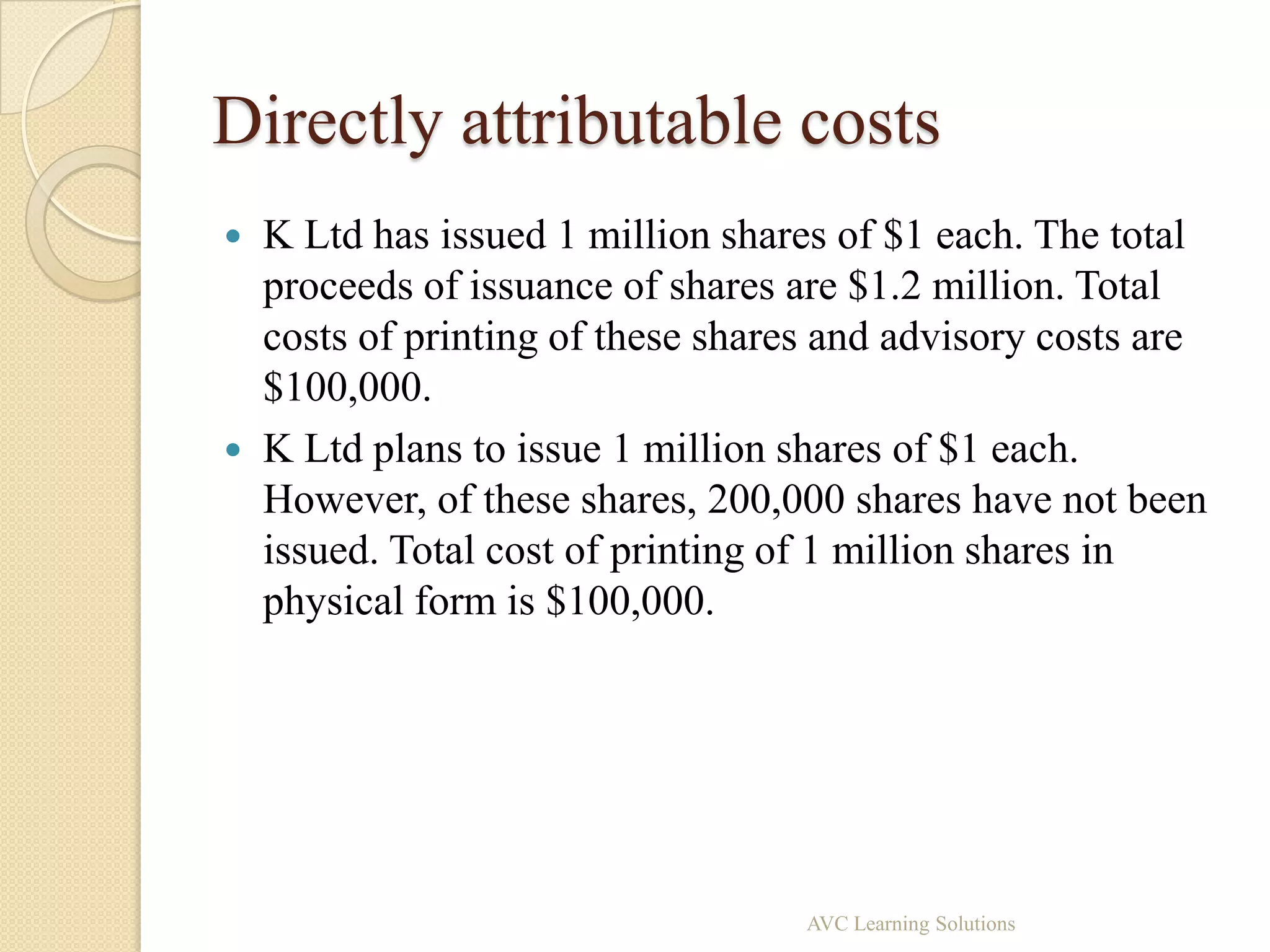
   K Ltd has issued 1 million shares of $1 each. The total
    proceeds of issuance of shares are $1.2 million. Total
    costs of printing of these shares and advisory costs are
    $100,000.
   K Ltd plans to issue 1 million shares of $1 each.
    However, of these shares, 200,000 shares have not been
    issued. Total cost of printing of 1 million shares in
    physical form is $100,000.


                                    AVC Learning Solutions
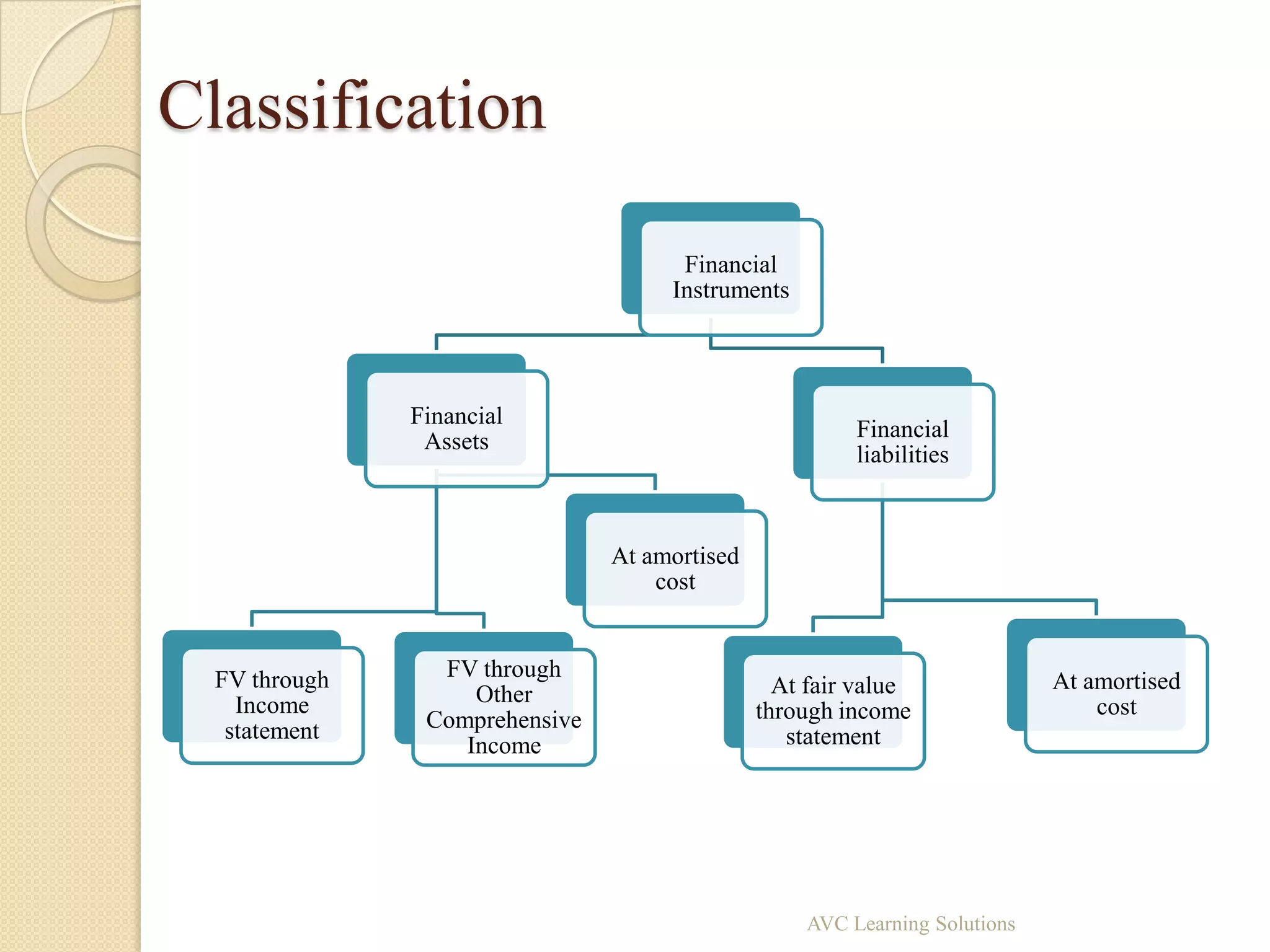
Classification

                                      Financial
                                     Instruments


               Financial
                Assets                                  Financial
                                                        liabilities


                                At amortised
                                    cost


  FV through     FV through                                                 At amortised
                    Other                        At fair value
    Income                                     through income                   cost
   statement    Comprehensive
                   Income                         statement


                                                   AVC Learning Solutions
Initial measurement of financial
assets and liabilities
For financial assets:

   A financial asset is measured at its fair value (for a
    financial asset recognised / classified at fair value);

   A financial asset is measured at its fair value plus
    attributable transaction costs (for a financial asset
    recognised / classified at amortised cost)


                                      AVC Learning Solutions
Amortised cost concept
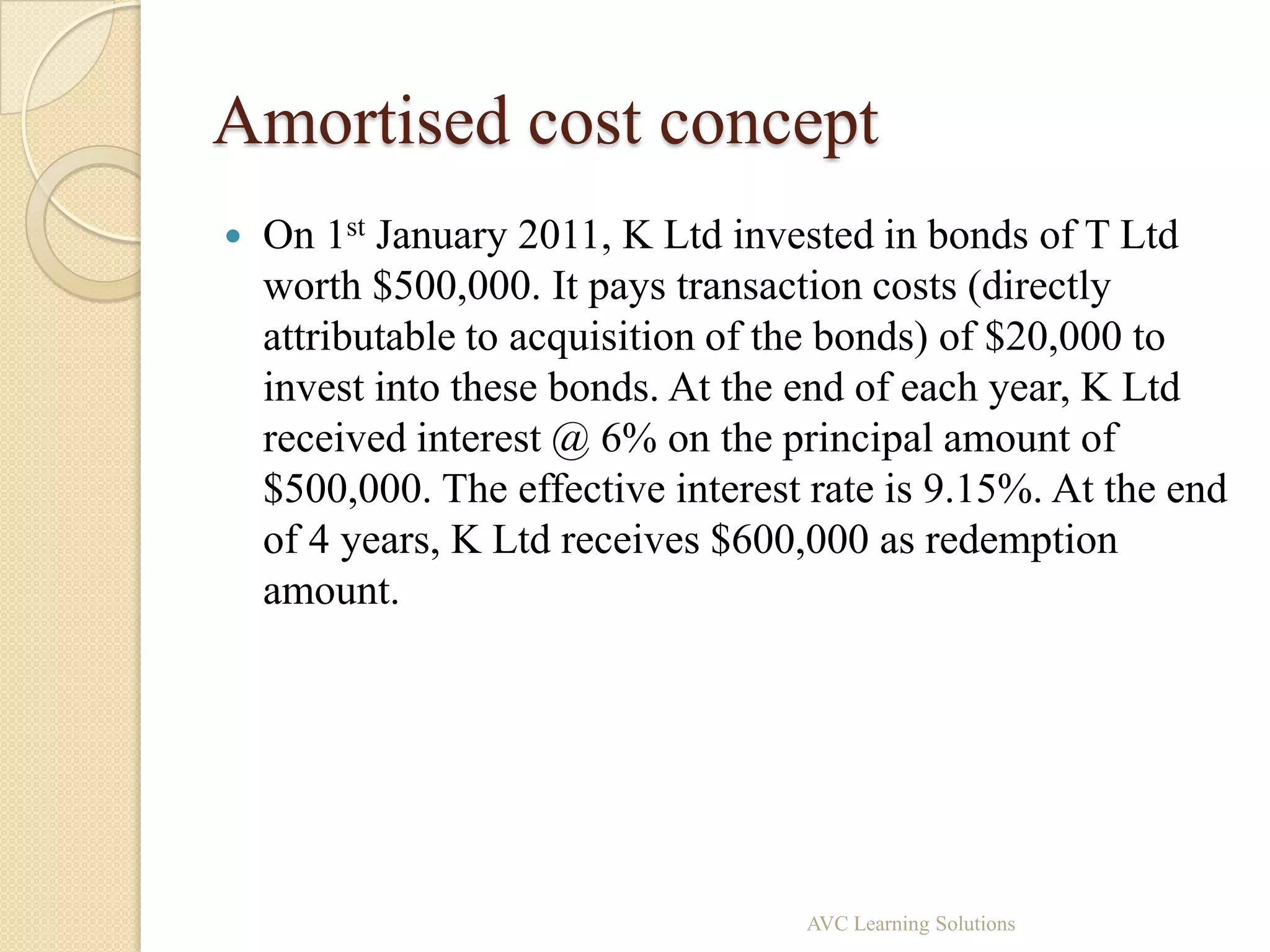
   On 1st January 2011, K Ltd invested in bonds of T Ltd
    worth $500,000. It pays transaction costs (directly
    attributable to acquisition of the bonds) of $20,000 to
    invest into these bonds. At the end of each year, K Ltd
    received interest @ 6% on the principal amount of
    $500,000. The effective interest rate is 9.15%. At the end
    of 4 years, K Ltd receives $600,000 as redemption
    amount.


                                    AVC Learning Solutions
Compound Instruments

   Comprise of both equity and liability
   Liability portion has to be separately calculated
   Equity is the residual balance (remaining amount)


                                   AVC Learning Solutions
Thanks

Ifrs 9

  • 1.
  • 2.
  • 3.
    Classification of financialassets under IFRS 9 (A) At amortised cost:  An asset (other than equity instrument) that meets the below mentioned conditions:  The asset is held within a business model whose objective is to hold assets in order to collect contractual cash flows;  The contractual cash terms of the financial asset give rise to cash flows on specific dates that are solely payments of principal and interest on the principal amount outstanding;  The entity has not invoked the fair value option for measurement of financial asset to reduce an accounting or measurement mismatch (B) At fair value AVC Learning Solutions
  • 4.
    Business Model  An entity’s business model approach is determined on a higher level, rather than an asset-by-asset basis. Further, the entity may have different assets (portfolio of assets) for business purposes.  Accordingly, it may not be right to identify the business model on an entity’s level either. The entity may comprise of a portfolio of assets which is collected on the basis of contractual cash flows, and of a portfolio of assets in which it trades. AVC Learning Solutions
  • 5.
    Examples  K Ltd, a banking company, issues loans to various customers in retail business. A customer, having taken a 20 years loan, decides to pay off the loan in 5 years’ time. K Ltd cannot refuse the pre- payment, and would receive the money due from the customer.  K Ltd gives loan to various clients in the retail sector. If someone does not pay the instalment, K Ltd would follow different measures to recover money. It may further mean to recover money by selling off the collateral. AVC Learning Solutions
  • 6.
    Amortised cost  K Ltd invests $100,000 into debt instrument of T Ltd. The cost of advisory / valuation comes at $5,000. K Ltd’s business model is to collect contractual cash flows in form of recovery of interest and principal payments. AVC Learning Solutions
  • 7.
    At fair value IFRS9 provides that changes in the value of a financial asset measured at fair value, but not held for trading purposes, may be done through Other Comprehensive Income. However, this choice has to be made by the entity at the time of initial recognition of the asset. This decision is irrevocable, and cannot be changed later. AVC Learning Solutions
  • 8.
    Examples  K Ltdinvests in 3 years’ redeemable preference shares of T Ltd. K Ltd holds these shares until maturity and recovers the cash flows through dividend and principal repayment.  K Ltd invests in bonds of T Ltd. The intention is to hold these bonds for a longer term. However, K Ltd decided to value the investment at fair value routed through profit and loss.  K Ltd has receivables of $5 million from T Ltd. The business model of K Ltd is to sell off the receivables portfolio to 3rd party and recover money the moment sales are made.  K Ltd has invested in debentures of T Ltd. K Ltd has an intention to hold these debentures until maturity. However, if K Ltd identifies a substantial gain, it may sell off the debentures to realise the gain.  A perpetual debt (with no maturity) is considered at amortised cost.  A debt instrument convertible into equity shares of the entity is considered at fair value, rather than at amortised cost. The recovery is not necessarily coming through contractual cash flows in form of principal and interest. AVC Learning Solutions
  • 9.
    At fair value  K Ltd invests $100,000 into shares of T Ltd (not for trading purposes). The cost of advisory / valuation comes at $5,000. AVC Learning Solutions
  • 10.
    Classification of FinancialLiabilities  Classification of Financial liabilities  Under the principles of IAS 39, a financial asset may be classified under two categories:  At amortised cost:  An entity shall classify all financial liabilities as subsequently measured at amortised cost using the effective rate of interest method, unless the financial liability is measured at fair value through profit or loss.  At fair value through profit or loss:  The classification into fair value through profit or loss is applicable if:  The classification reduces the accounting mismatch; or  The liability is managed and its performance is evaluated on a fair value basis as per the documented investment strategy or risk management. AVC Learning Solutions
  • 11.
    Measurement of liabilityat fair value K Ltd issues $100,000 debt instrument. The cost of advisory / valuation comes at $5,000. K Ltd’s trades in this liability. AVC Learning Solutions
  • 12.
    Costs directly relatedto issuance of equity and debt  Transaction costs are the incremental costs directly attributable to the acquisition, issue or disposal of a financial asset or liability. These include: ◦ Legal fee (Stock exchange listing fee); ◦ Advisory fees; ◦ Printing and stamp charges;  Transaction costs directly attributable to equity issuance, that otherwise would have been avoided, are deducted from equity.  Similarly, transaction costs directly attributable to debt issuance, that otherwise would have been avoided, are deducted from debt to arrive at its initial value. AVC Learning Solutions
  • 13.
    Directly attributable costs  K Ltd has issued 1 million shares of $1 each. The total proceeds of issuance of shares are $1.2 million. Total costs of printing of these shares and advisory costs are $100,000.  K Ltd plans to issue 1 million shares of $1 each. However, of these shares, 200,000 shares have not been issued. Total cost of printing of 1 million shares in physical form is $100,000. AVC Learning Solutions
  • 14.
    Classification Financial Instruments Financial Assets Financial liabilities At amortised cost FV through FV through At amortised Other At fair value Income through income cost statement Comprehensive Income statement AVC Learning Solutions
  • 15.
    Initial measurement offinancial assets and liabilities For financial assets:  A financial asset is measured at its fair value (for a financial asset recognised / classified at fair value);  A financial asset is measured at its fair value plus attributable transaction costs (for a financial asset recognised / classified at amortised cost) AVC Learning Solutions
  • 16.
    Amortised cost concept  On 1st January 2011, K Ltd invested in bonds of T Ltd worth $500,000. It pays transaction costs (directly attributable to acquisition of the bonds) of $20,000 to invest into these bonds. At the end of each year, K Ltd received interest @ 6% on the principal amount of $500,000. The effective interest rate is 9.15%. At the end of 4 years, K Ltd receives $600,000 as redemption amount. AVC Learning Solutions
  • 17.
    Compound Instruments  Comprise of both equity and liability  Liability portion has to be separately calculated  Equity is the residual balance (remaining amount) AVC Learning Solutions
  • 18.