IELTS Study Plan
Table Of Content
» IELTS
» IELTS Pattern / Format
» Why We Need A Good Study Plan
» IELTS study plan
» Study Plan IELTS Listening
» Study Plan IELTS Reading
» Study Plan IELTS Writing
» Study Plan IELTS Speaking
» Conclusion
2
HELLO!
We are from
CourseMentor™
We are here because we love to give
presentations.
You can find us at www.coursementor.com
3
IELTS
Let’s start with the first set of slides
4
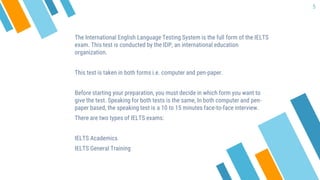
The International English Language Testing System is the full form of the IELTS
exam. This test is conducted by the IDP, an international education
organization.
This test is taken in both forms i.e. computer and pen-paper.
Before starting your preparation, you must decide in which form you want to
give the test. Speaking for both tests is the same, In both computer and pen-
paper based, the speaking test is a 10 to 15 minutes face-to-face interview.
There are two types of IELTS exams:
IELTS Academics
IELTS General Training
5
IELTS Pattern
/ Format
6
7
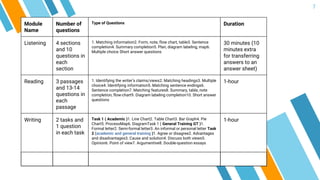
Module
Name
Number of
questions
Type of Questions Duration
Listening 4 sections
and 10
questions in
each
section
1. Matching information2. Form, note, flow chart, table3. Sentence
completion4. Summary completion5. Plan, diagram labeling, map6.
Multiple choice Short answer questions
30 minutes (10
minutes extra
for transferring
answers to an
answer sheet)
Reading 3 passages
and 13-14
questions in
each
passage
1. Identifying the writer’s claims/views2. Matching headings3. Multiple
choice4. Identifying information5. Matching sentence endings6.
Sentence completion7. Matching features8. Summary, table, note
completion, flow-chart9. Diagram labeling completion10. Short answer
questions
1-hour
Writing 2 tasks and
1 question
in each task
Task 1 ( Academic )1. Line Chart2. Table Chart3. Bar Graph4. Pie
Chart5. ProcessMap6. DiagramTask 1 ( General Training GT )1.
Formal letter2. Semi-formal letter3. An informal or personal letter Task
2 (academic and general training )1. Agree or disagree2. Advantages
and disadvantages3. Cause and solution4. Discuss both views5.
Opinion6. Point of view7. Argumentive8. Double-question essays
1-hour
IELTS study
plan
8
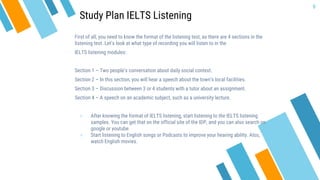
First of all, you need to know the format of the listening test, as there are 4 sections in the
listening test. Let’s look at what type of recording you will listen to in the
IELTS listening modules:
Section 1 – Two people’s conversation about daily social context.
Section 2 – In this section, you will hear a speech about the town’s local facilities.
Section 3 – Discussion between 3 or 4 students with a tutor about an assignment.
Section 4 – A speech on an academic subject, such as a university lecture.
» After knowing the format of IELTS listening, start listening to the IELTS listening
samples. You can get that on the official site of the IDP, and you can also search on
google or youtube.
» Start listening to English songs or Podcasts to improve your hearing ability. Also,
watch English movies.
9
Study Plan IELTS Listening
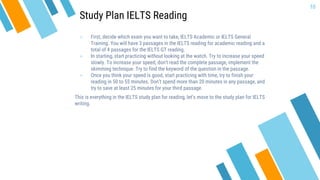
» First, decide which exam you want to take, IELTS Academic or IELTS General
Training. You will have 3 passages in the IELTS reading for academic reading and a
total of 4 passages for the IELTS GT reading.
» In starting, start practicing without looking at the watch. Try to increase your speed
slowly. To increase your speed, don’t read the complete passage, implement the
skimming technique. Try to find the keyword of the question in the passage.
» Once you think your speed is good, start practicing with time, try to finish your
reading in 50 to 55 minutes. Don’t spend more than 20 minutes in any passage, and
try to save at least 25 minutes for your third passage.
This is everything in the IELTS study plan for reading, let’s move to the study plan for IELTS
writing.
10
Study Plan IELTS Reading
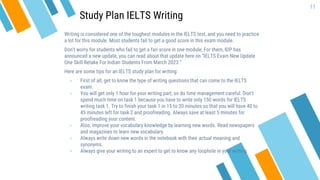
Writing is considered one of the toughest modules in the IELTS test, and you need to practice
a lot for this module. Most students fail to get a good score in this exam module.
Don’t worry for students who fail to get a fair score in one module, For them, IDP has
announced a new update, you can read about that update here on “IELTS Exam New Update
One Skill Retake For Indian Students From March 2023.”
Here are some tips for an IELTS study plan for writing:
» First of all, get to know the type of writing questions that can come to the IELTS
exam.
» You will get only 1 hour for your writing part, so do time management careful. Don’t
spend much time on task 1 because you have to write only 150 words for IELTS
writing task 1. Try to finish your task 1 in 15 to 20 minutes so that you will have 40 to
45 minutes left for task 2 and proofreading. Always save at least 5 minutes for
proofreading your content.
» Also, improve your vocabulary knowledge by learning new words. Read newspapers
and magazines to learn new vocabulary.
» Always write down new words in the notebook with their actual meaning and
synonyms.
» Always give your writing to an expert to get to know any loophole in your writing.
11
Study Plan IELTS Writing
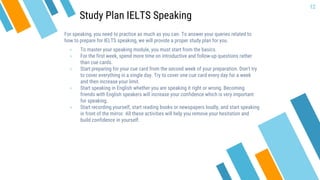
For speaking, you need to practice as much as you can. To answer your queries related to
how to prepare for IELTS speaking, we will provide a proper study plan for you.
» To master your speaking module, you must start from the basics.
» For the first week, spend more time on introductive and follow-up questions rather
than cue cards.
» Start preparing for your cue card from the second week of your preparation. Don’t try
to cover everything in a single day. Try to cover one cue card every day for a week
and then increase your limit.
» Start speaking in English whether you are speaking it right or wrong. Becoming
friends with English speakers will increase your confidence which is very important
for speaking.
» Start recording yourself, start reading books or newspapers loudly, and start speaking
in front of the mirror. All these activities will help you remove your hesitation and
build confidence in yourself.
12
Study Plan IELTS Speaking
Conclusion
13
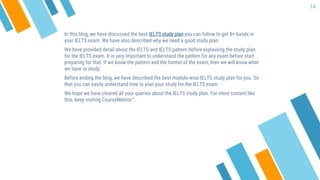
In this blog, we have discussed the best IELTS study plan you can follow to get 8+ bands in
your IELTS exam. We have also described why we need a good study plan.
We have provided detail about the IELTS and IELTS pattern before explaining the study plan
for the IELTS exam. It is very important to understand the pattern for any exam before start
preparing for that. If we know the pattern and the format of the exam, then we will know what
we have to study.
Before ending the blog, we have described the best module-wise IELTS study plan for you. So
that you can easily understand how to plan your study for the IELTS exam.
We hope we have cleared all your queries about the IELTS study plan. For more content like
this, keep visiting CourseMentor™.
14

IELTS Study Plan.pptx

  • 1.
  • 2.
    Table Of Content »IELTS » IELTS Pattern / Format » Why We Need A Good Study Plan » IELTS study plan » Study Plan IELTS Listening » Study Plan IELTS Reading » Study Plan IELTS Writing » Study Plan IELTS Speaking » Conclusion 2
  • 3.
    HELLO! We are from CourseMentor™ Weare here because we love to give presentations. You can find us at www.coursementor.com 3
  • 4.
    IELTS Let’s start withthe first set of slides 4
  • 5.
    The International EnglishLanguage Testing System is the full form of the IELTS exam. This test is conducted by the IDP, an international education organization. This test is taken in both forms i.e. computer and pen-paper. Before starting your preparation, you must decide in which form you want to give the test. Speaking for both tests is the same, In both computer and pen- paper based, the speaking test is a 10 to 15 minutes face-to-face interview. There are two types of IELTS exams: IELTS Academics IELTS General Training 5
  • 6.
  • 7.
    7 Module Name Number of questions Type ofQuestions Duration Listening 4 sections and 10 questions in each section 1. Matching information2. Form, note, flow chart, table3. Sentence completion4. Summary completion5. Plan, diagram labeling, map6. Multiple choice Short answer questions 30 minutes (10 minutes extra for transferring answers to an answer sheet) Reading 3 passages and 13-14 questions in each passage 1. Identifying the writer’s claims/views2. Matching headings3. Multiple choice4. Identifying information5. Matching sentence endings6. Sentence completion7. Matching features8. Summary, table, note completion, flow-chart9. Diagram labeling completion10. Short answer questions 1-hour Writing 2 tasks and 1 question in each task Task 1 ( Academic )1. Line Chart2. Table Chart3. Bar Graph4. Pie Chart5. ProcessMap6. DiagramTask 1 ( General Training GT )1. Formal letter2. Semi-formal letter3. An informal or personal letter Task 2 (academic and general training )1. Agree or disagree2. Advantages and disadvantages3. Cause and solution4. Discuss both views5. Opinion6. Point of view7. Argumentive8. Double-question essays 1-hour
  • 8.
  • 9.
    First of all,you need to know the format of the listening test, as there are 4 sections in the listening test. Let’s look at what type of recording you will listen to in the IELTS listening modules: Section 1 – Two people’s conversation about daily social context. Section 2 – In this section, you will hear a speech about the town’s local facilities. Section 3 – Discussion between 3 or 4 students with a tutor about an assignment. Section 4 – A speech on an academic subject, such as a university lecture. » After knowing the format of IELTS listening, start listening to the IELTS listening samples. You can get that on the official site of the IDP, and you can also search on google or youtube. » Start listening to English songs or Podcasts to improve your hearing ability. Also, watch English movies. 9 Study Plan IELTS Listening
  • 10.
    » First, decidewhich exam you want to take, IELTS Academic or IELTS General Training. You will have 3 passages in the IELTS reading for academic reading and a total of 4 passages for the IELTS GT reading. » In starting, start practicing without looking at the watch. Try to increase your speed slowly. To increase your speed, don’t read the complete passage, implement the skimming technique. Try to find the keyword of the question in the passage. » Once you think your speed is good, start practicing with time, try to finish your reading in 50 to 55 minutes. Don’t spend more than 20 minutes in any passage, and try to save at least 25 minutes for your third passage. This is everything in the IELTS study plan for reading, let’s move to the study plan for IELTS writing. 10 Study Plan IELTS Reading
  • 11.
    Writing is consideredone of the toughest modules in the IELTS test, and you need to practice a lot for this module. Most students fail to get a good score in this exam module. Don’t worry for students who fail to get a fair score in one module, For them, IDP has announced a new update, you can read about that update here on “IELTS Exam New Update One Skill Retake For Indian Students From March 2023.” Here are some tips for an IELTS study plan for writing: » First of all, get to know the type of writing questions that can come to the IELTS exam. » You will get only 1 hour for your writing part, so do time management careful. Don’t spend much time on task 1 because you have to write only 150 words for IELTS writing task 1. Try to finish your task 1 in 15 to 20 minutes so that you will have 40 to 45 minutes left for task 2 and proofreading. Always save at least 5 minutes for proofreading your content. » Also, improve your vocabulary knowledge by learning new words. Read newspapers and magazines to learn new vocabulary. » Always write down new words in the notebook with their actual meaning and synonyms. » Always give your writing to an expert to get to know any loophole in your writing. 11 Study Plan IELTS Writing
  • 12.
    For speaking, youneed to practice as much as you can. To answer your queries related to how to prepare for IELTS speaking, we will provide a proper study plan for you. » To master your speaking module, you must start from the basics. » For the first week, spend more time on introductive and follow-up questions rather than cue cards. » Start preparing for your cue card from the second week of your preparation. Don’t try to cover everything in a single day. Try to cover one cue card every day for a week and then increase your limit. » Start speaking in English whether you are speaking it right or wrong. Becoming friends with English speakers will increase your confidence which is very important for speaking. » Start recording yourself, start reading books or newspapers loudly, and start speaking in front of the mirror. All these activities will help you remove your hesitation and build confidence in yourself. 12 Study Plan IELTS Speaking
  • 13.
  • 14.
    In this blog,we have discussed the best IELTS study plan you can follow to get 8+ bands in your IELTS exam. We have also described why we need a good study plan. We have provided detail about the IELTS and IELTS pattern before explaining the study plan for the IELTS exam. It is very important to understand the pattern for any exam before start preparing for that. If we know the pattern and the format of the exam, then we will know what we have to study. Before ending the blog, we have described the best module-wise IELTS study plan for you. So that you can easily understand how to plan your study for the IELTS exam. We hope we have cleared all your queries about the IELTS study plan. For more content like this, keep visiting CourseMentor™. 14