Identification and Bridging of Semantic Gaps: The Case of Multi-Domain Engineering Andreas M. Hein Institute of Astronautics, Technical University of Munich Workshop Philosophy & Engineering 2010, Golden, Colorado
Content 1. Context: Frequent problems in Multi-Domain Engineering 2. Introduction to the Semantic Gap (SG) 3. Semantic Gaps in Multi-Domain Engineering 4. Limits to inter-domain understanding 5. Conclusion 25.05.10 Workshop Philosophy & Engineering 2010
1. Context: Frequent problems in Multi-Domain Engineering What is an engineering domain? - Mainly dependent on engineering curriculum (already interdisciplinary) - Constantly shifting and fuzzy borders (mechatronics, bionics) Frequent problems in Multi-Domain Engineering: - Engineer does not understand customer needs - Design engineer and production engineer miss opportunities - Engineers from different domains have difficulties to understand each other What is common to these problems?  (commonly refered to „communication“ problem) 25.05.10 Workshop Philosophy & Engineering 2010
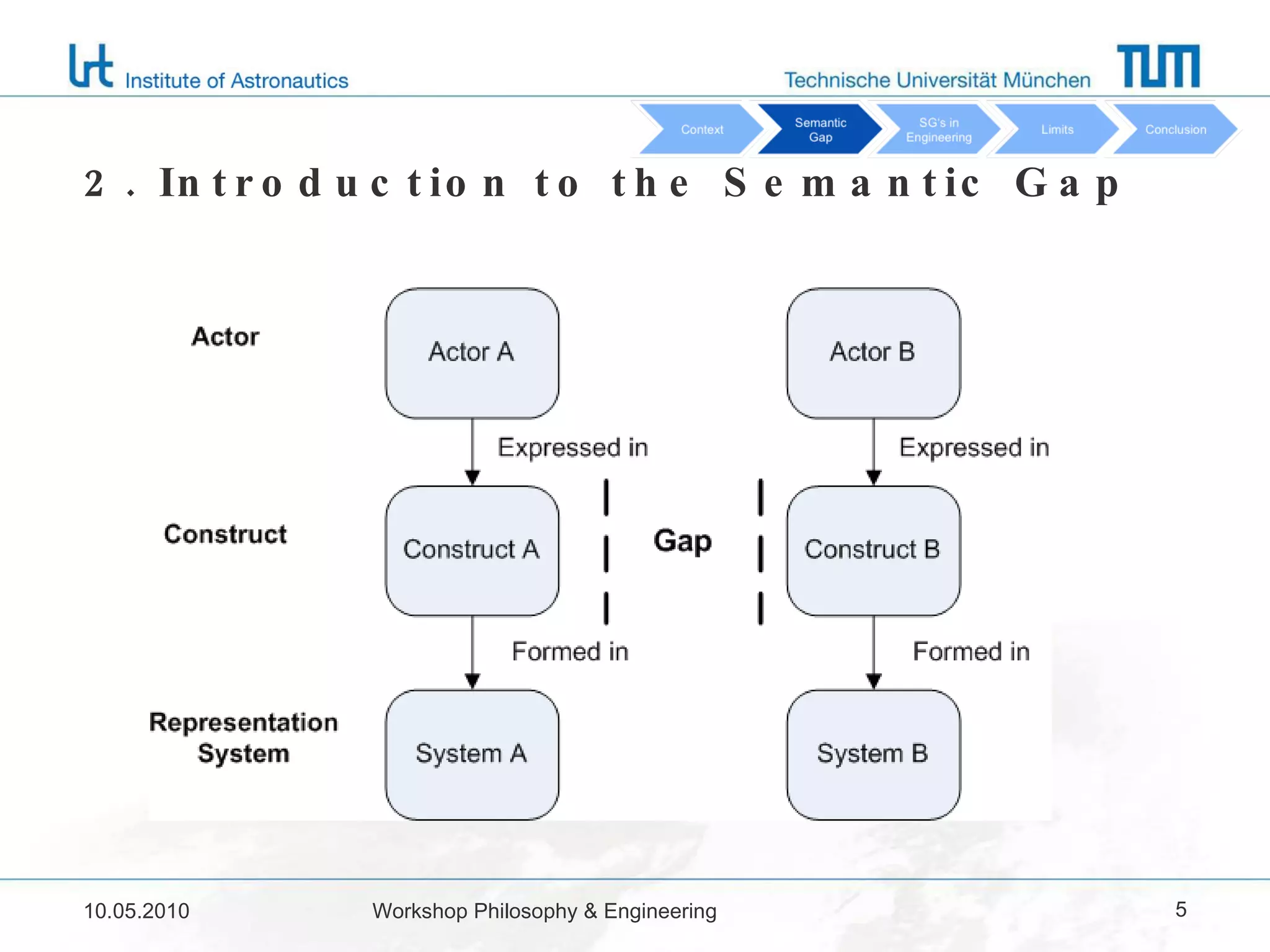
2. Introduction to the Semantic Gap “ A “semantic gap” is the  difference in meaning  between  constructs  formed within different  representation systems .”  Example: [1] 25.05.10 Workshop Philosophy & Engineering 2010 Human understanding Machine understanding
2. Introduction to the Semantic Gap 10.05.2010 Workshop Philosophy & Engineering
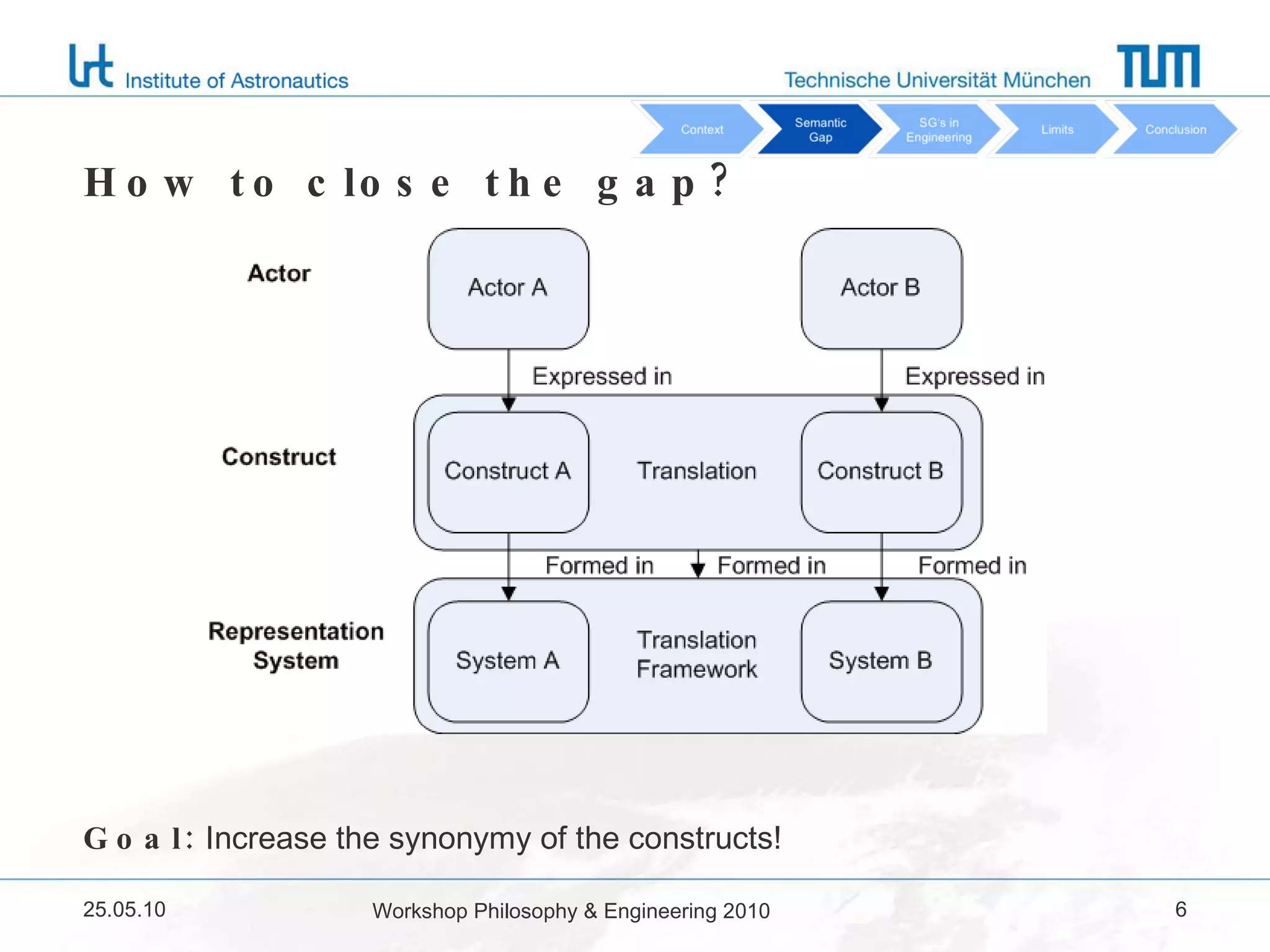
How to close the gap? Goal:  Increase the synonymy of the constructs! 25.05.10 Workshop Philosophy & Engineering 2010
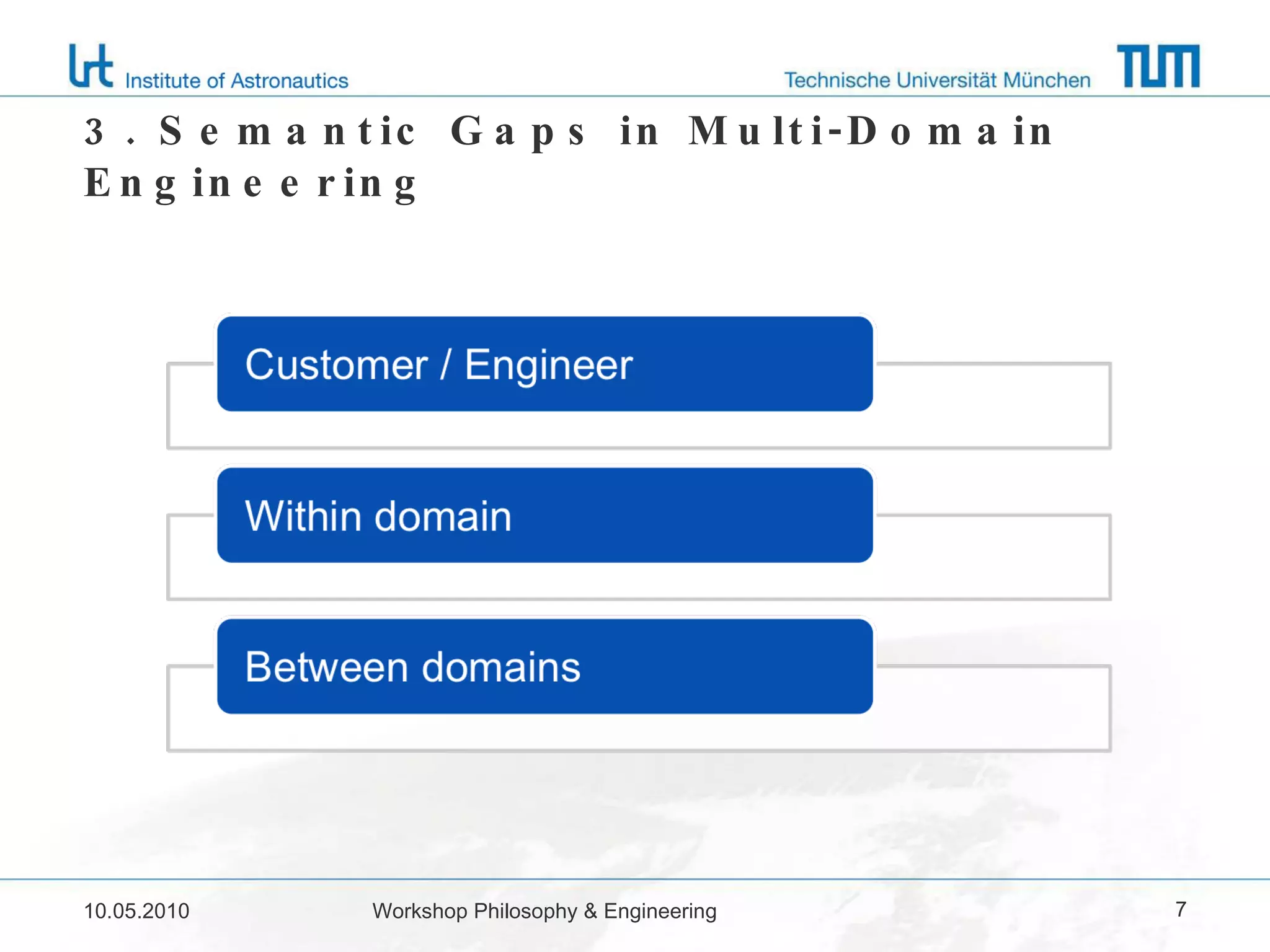
3. Semantic Gaps in Multi-Domain Engineering 10.05.2010 Workshop Philosophy & Engineering
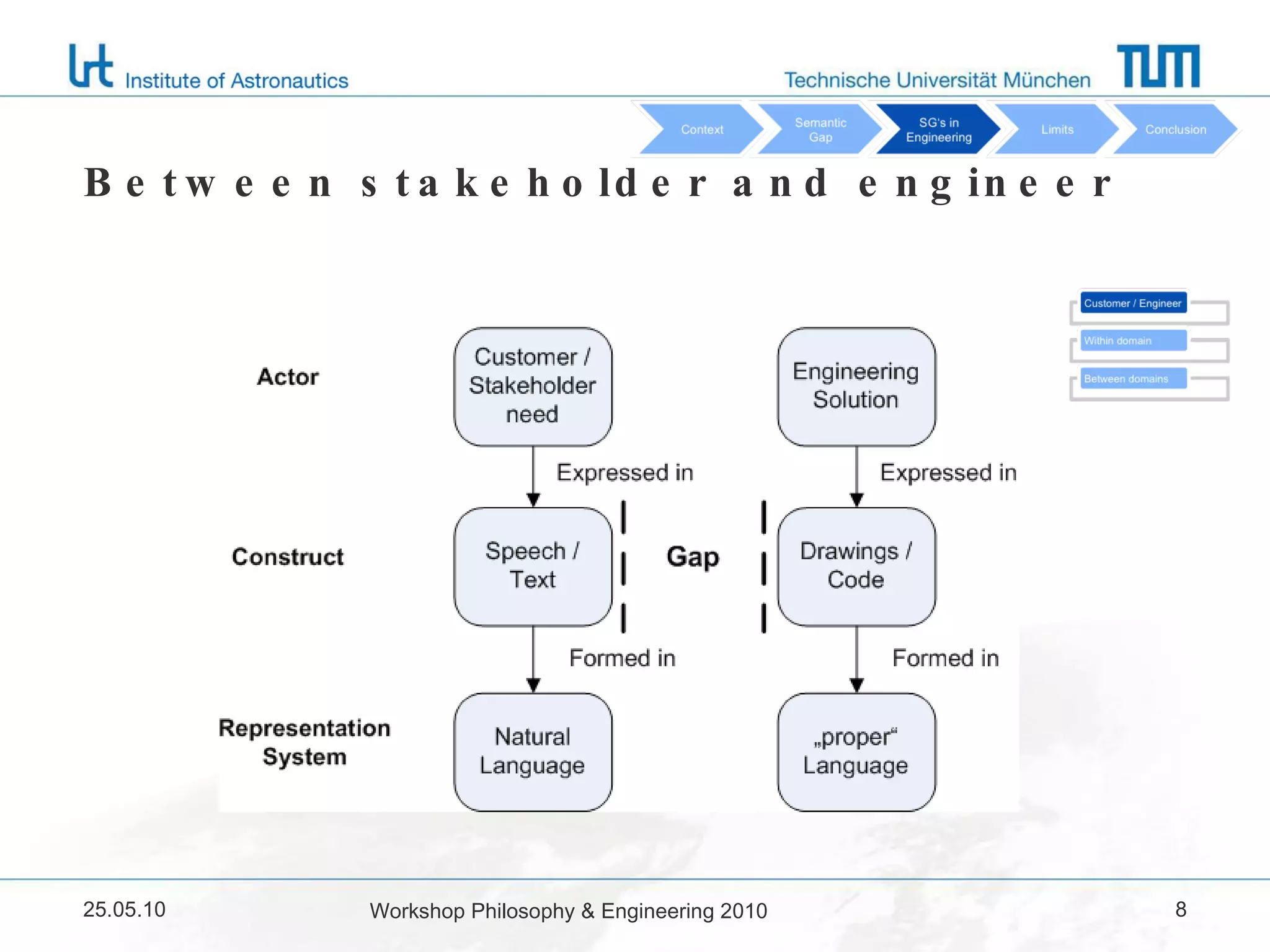
Between stakeholder and engineer 25.05.10 Workshop Philosophy & Engineering 2010
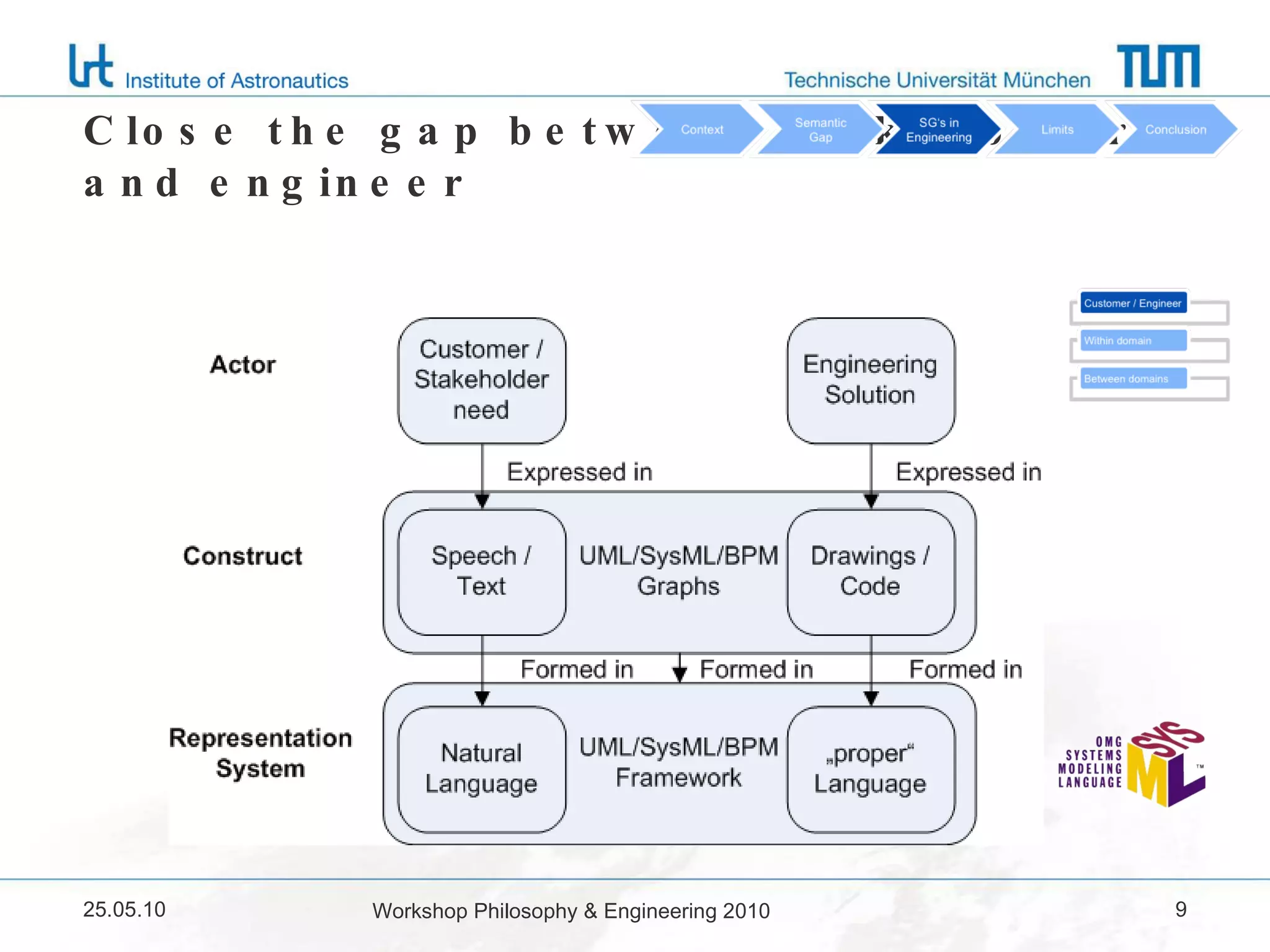
Close the gap between stakeholder and engineer 25.05.10 Workshop Philosophy & Engineering 2010
What is SysML ? [3] 25.05.10 Workshop Philosophy & Engineering 2010 1 Structure 2 Behaviour 3 Requirements 4 Parameter
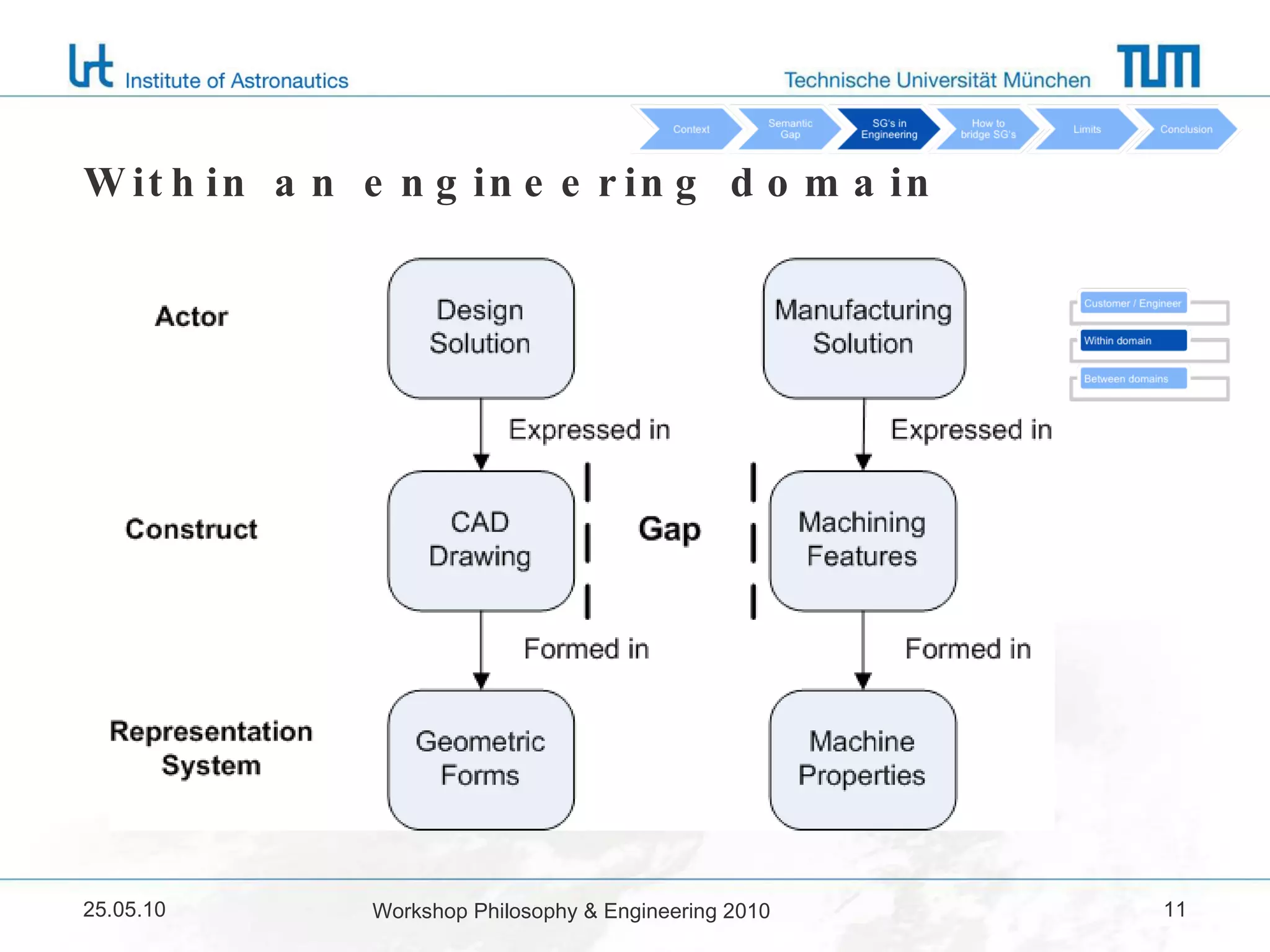
Within an engineering domain 25.05.10 Workshop Philosophy & Engineering 2010
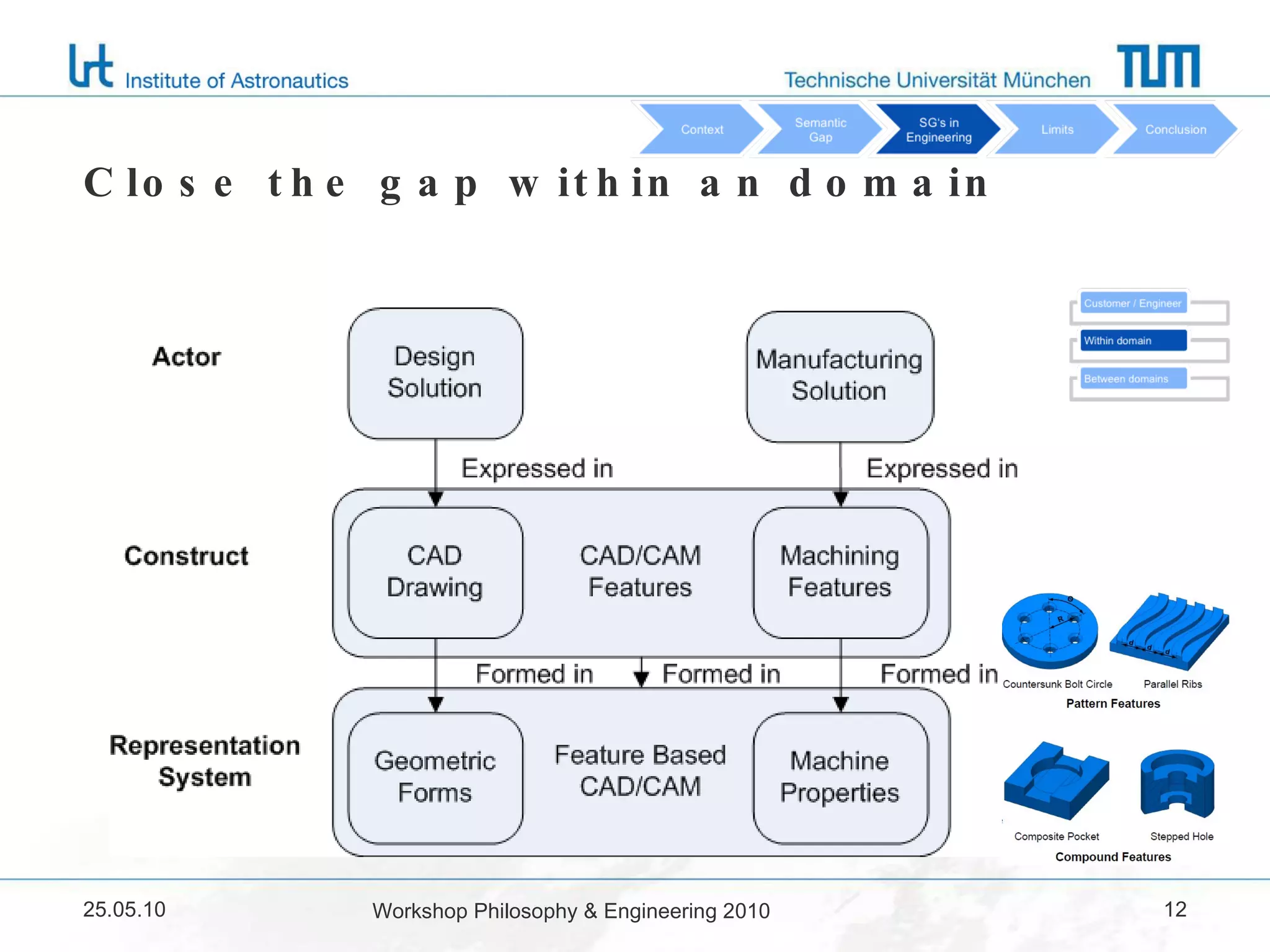
Close the gap within an domain 25.05.10 Workshop Philosophy & Engineering 2010
Feature Based CAD/CAM feature = geometry + semantics  [2] Example:  blind borehole Geometric form:  Cylinder with cone at the end (diameter, length, angle) Semantics:  hole that is made of a drill, does not go entirely through the  material 10.05.2010 Workshop Philosophy & Engineering
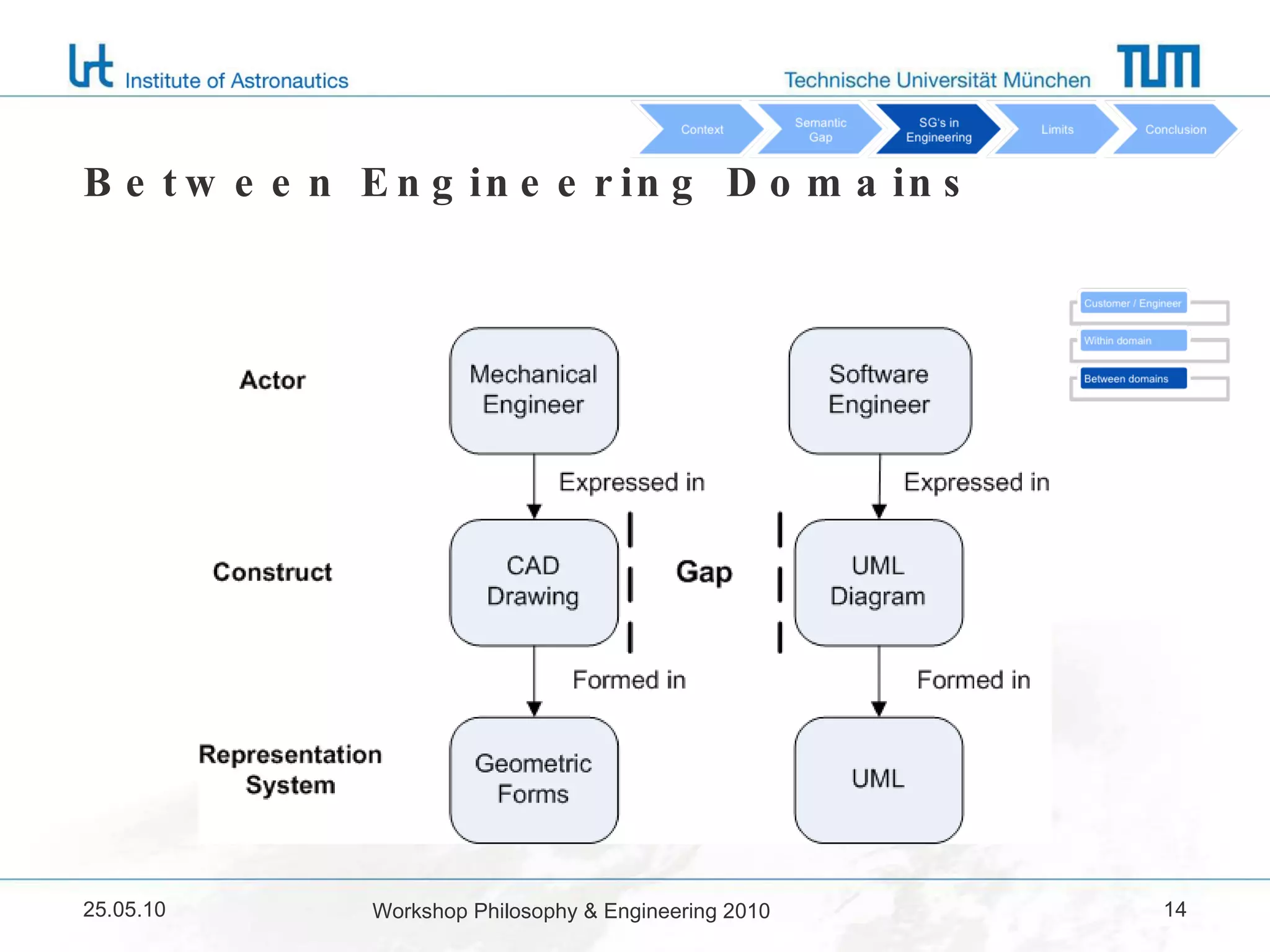
Between Engineering Domains 25.05.10 Workshop Philosophy & Engineering 2010
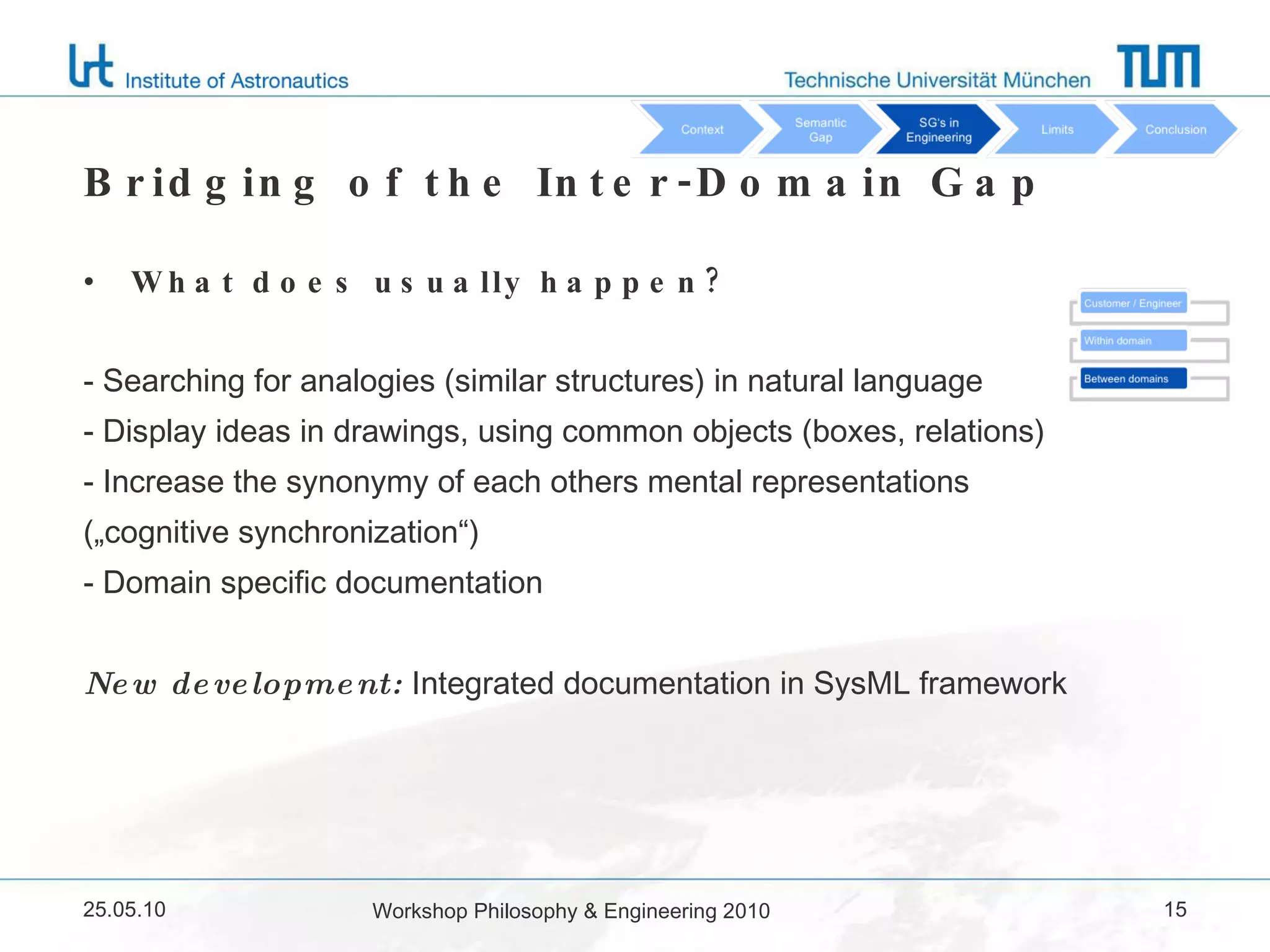
Bridging of the Inter-Domain Gap What does usually happen? - Searching for analogies (similar structures) in natural language - Display ideas in drawings, using common objects (boxes, relations) - Increase the synonymy of each others mental representations („cognitive synchronization“) - Domain specific documentation New development:  Integrated documentation in SysML framework 25.05.10 Workshop Philosophy & Engineering 2010
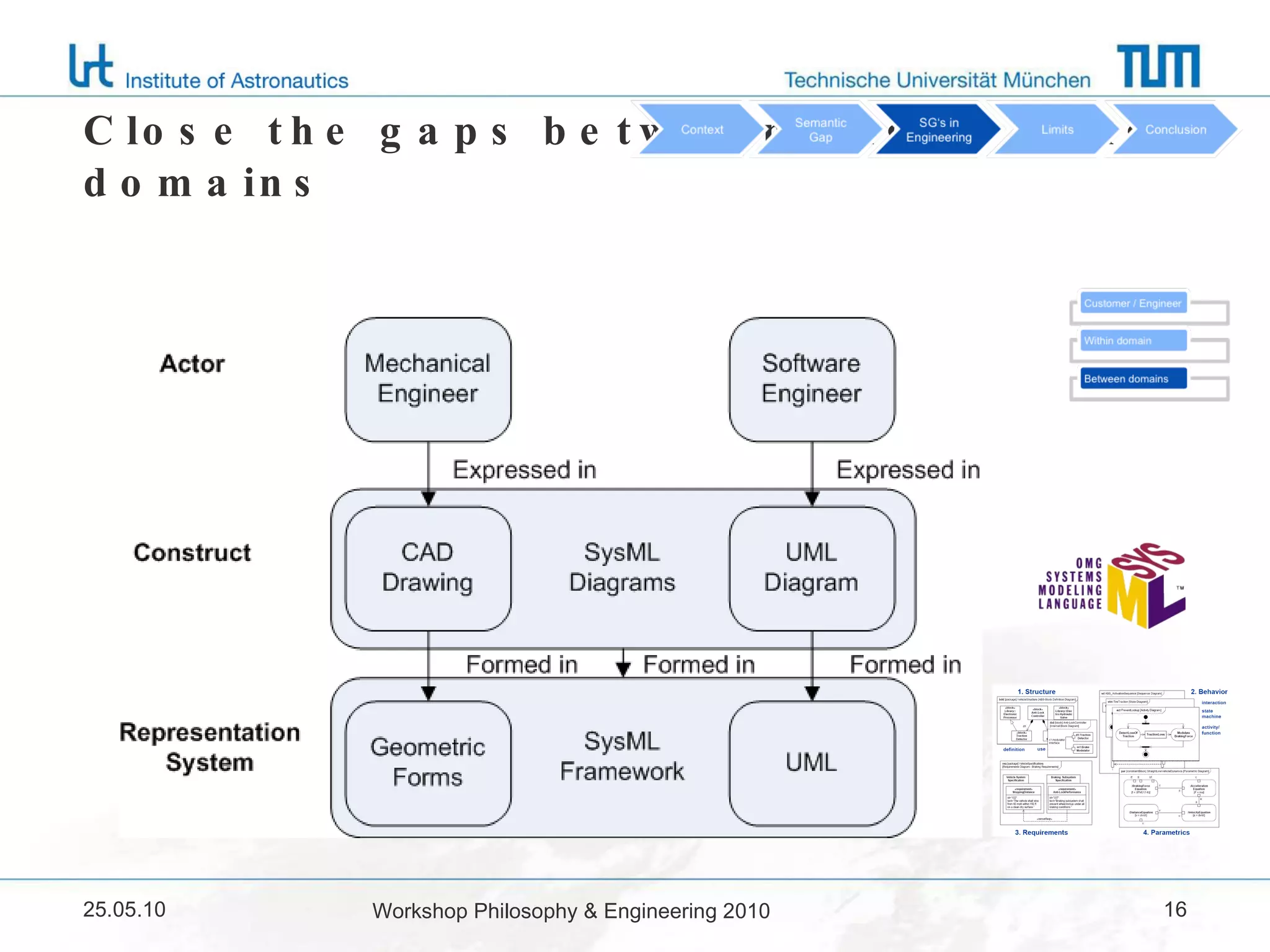
Close the gaps between engineering domains 25.05.10 Workshop Philosophy & Engineering 2010
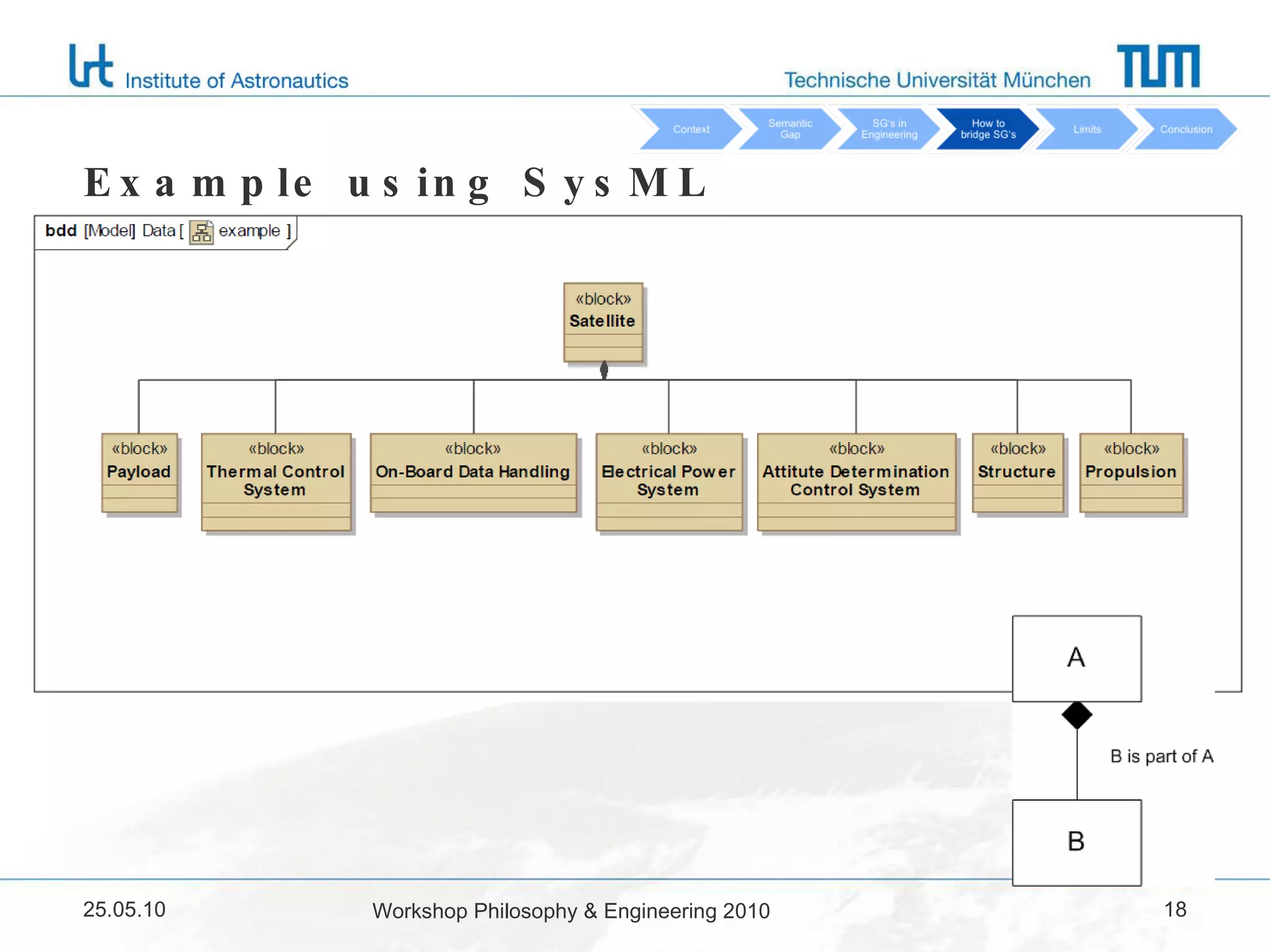
Example using SysML [4] 25.05.10 Workshop Philosophy & Engineering 2010
Example using SysML 25.05.10 Workshop Philosophy & Engineering 2010
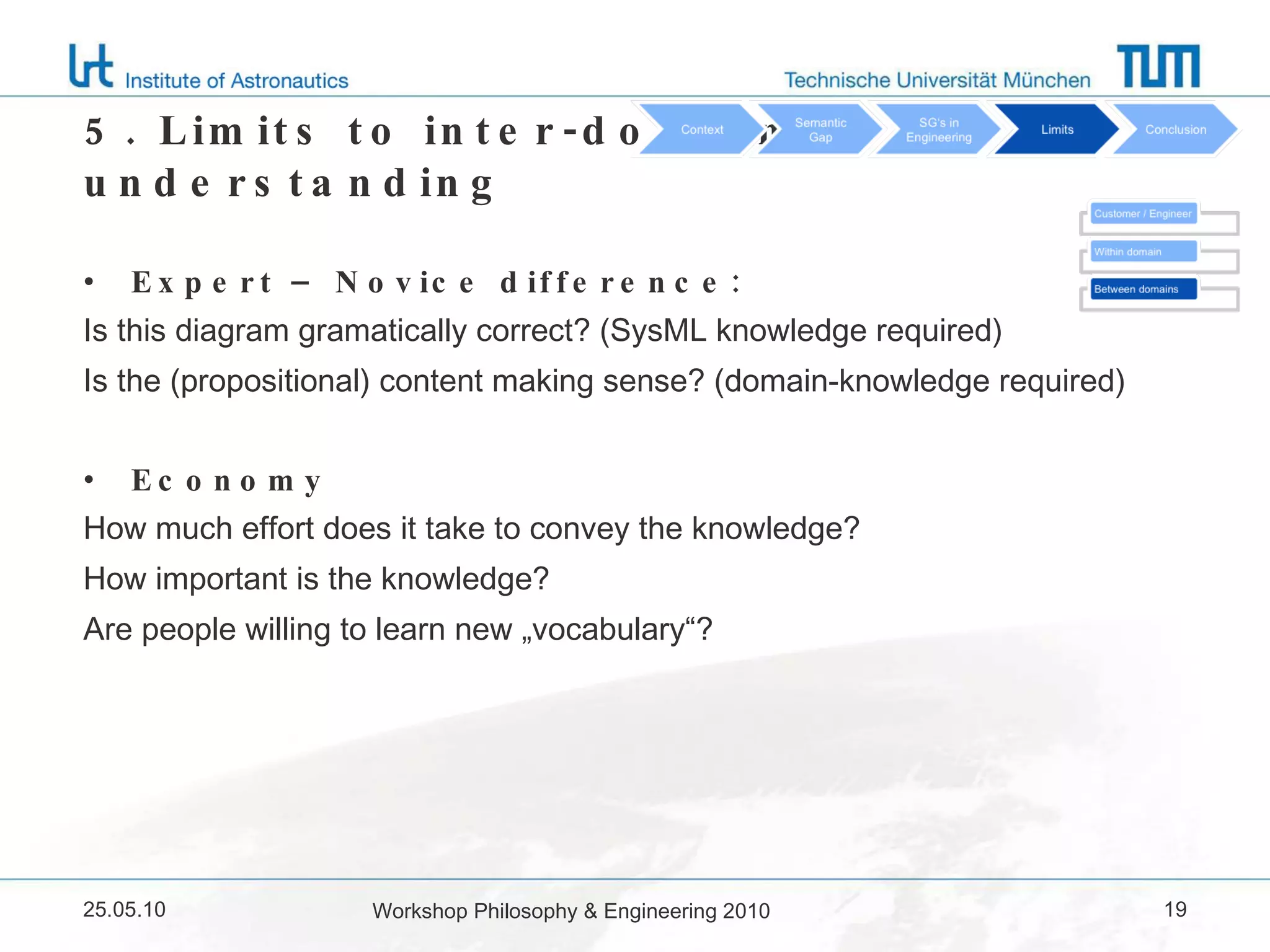
5. Limits to inter-domain understanding Expert – Novice difference: Is this diagram gramatically correct? (SysML knowledge required) Is the (propositional) content making sense? (domain-knowledge required) Economy How much effort does it take to convey the knowledge? How important is the knowledge? Are people willing to learn new „vocabulary“? 25.05.10 Workshop Philosophy & Engineering 2010
6. Conclusion Many problems in engineering can be associated with the notion „Semantic Gap “ Three characteristic Semantic Gaps in Multi-Domain Engineering  How to bridge these gaps How the understanding between domains works and can be improved The limits of inter-domain understanding 25.05.10 Workshop Philosophy & Engineering 2010
Thank you for your attention! Andreas Hein Institute of Astronautics Technical University of Munich [email_address] 25.05.10 Workshop Philosophy & Engineering 2010
References [1] Spinczyk, O. (2008) Betriebssysteme, Rechnernetze und verteilte Systeme 1  (BSRvS1) Zusammenfassung und Ausblick. Retrieved January 15, 2010, from  http://ess.cs.uni-dortmund.de/Teaching/SS2008/BSRvS1/Downloads/14-Zusammenfassung-Ausblick-1x2.pdf [2] Shah, J.J., Mäntylä, M. (1995). Parametric and Feature Based CAD/CAM. New York: John Wiley & Sons, Inc. [3] Object Management Group, Systems Modeling Language Specification v.1.1, http://www.omgsysml.org [4] All SysML diagrams are drawn with the MagicDraw SysML plugin software

Identification and Bridging of Semantic Gaps: The Case of Multidomain Engineering

  • 1.
    Identification and Bridgingof Semantic Gaps: The Case of Multi-Domain Engineering Andreas M. Hein Institute of Astronautics, Technical University of Munich Workshop Philosophy & Engineering 2010, Golden, Colorado
  • 2.
    Content 1. Context:Frequent problems in Multi-Domain Engineering 2. Introduction to the Semantic Gap (SG) 3. Semantic Gaps in Multi-Domain Engineering 4. Limits to inter-domain understanding 5. Conclusion 25.05.10 Workshop Philosophy & Engineering 2010
  • 3.
    1. Context: Frequentproblems in Multi-Domain Engineering What is an engineering domain? - Mainly dependent on engineering curriculum (already interdisciplinary) - Constantly shifting and fuzzy borders (mechatronics, bionics) Frequent problems in Multi-Domain Engineering: - Engineer does not understand customer needs - Design engineer and production engineer miss opportunities - Engineers from different domains have difficulties to understand each other What is common to these problems? (commonly refered to „communication“ problem) 25.05.10 Workshop Philosophy & Engineering 2010
  • 4.
    2. Introduction tothe Semantic Gap “ A “semantic gap” is the difference in meaning between constructs formed within different representation systems .” Example: [1] 25.05.10 Workshop Philosophy & Engineering 2010 Human understanding Machine understanding
  • 5.
    2. Introduction tothe Semantic Gap 10.05.2010 Workshop Philosophy & Engineering
  • 6.
    How to closethe gap? Goal: Increase the synonymy of the constructs! 25.05.10 Workshop Philosophy & Engineering 2010
  • 7.
    3. Semantic Gapsin Multi-Domain Engineering 10.05.2010 Workshop Philosophy & Engineering
  • 8.
    Between stakeholder andengineer 25.05.10 Workshop Philosophy & Engineering 2010
  • 9.
    Close the gapbetween stakeholder and engineer 25.05.10 Workshop Philosophy & Engineering 2010
  • 10.
    What is SysML? [3] 25.05.10 Workshop Philosophy & Engineering 2010 1 Structure 2 Behaviour 3 Requirements 4 Parameter
  • 11.
    Within an engineeringdomain 25.05.10 Workshop Philosophy & Engineering 2010
  • 12.
    Close the gapwithin an domain 25.05.10 Workshop Philosophy & Engineering 2010
  • 13.
    Feature Based CAD/CAMfeature = geometry + semantics [2] Example: blind borehole Geometric form: Cylinder with cone at the end (diameter, length, angle) Semantics: hole that is made of a drill, does not go entirely through the material 10.05.2010 Workshop Philosophy & Engineering
  • 14.
    Between Engineering Domains25.05.10 Workshop Philosophy & Engineering 2010
  • 15.
    Bridging of theInter-Domain Gap What does usually happen? - Searching for analogies (similar structures) in natural language - Display ideas in drawings, using common objects (boxes, relations) - Increase the synonymy of each others mental representations („cognitive synchronization“) - Domain specific documentation New development: Integrated documentation in SysML framework 25.05.10 Workshop Philosophy & Engineering 2010
  • 16.
    Close the gapsbetween engineering domains 25.05.10 Workshop Philosophy & Engineering 2010
  • 17.
    Example using SysML[4] 25.05.10 Workshop Philosophy & Engineering 2010
  • 18.
    Example using SysML25.05.10 Workshop Philosophy & Engineering 2010
  • 19.
    5. Limits tointer-domain understanding Expert – Novice difference: Is this diagram gramatically correct? (SysML knowledge required) Is the (propositional) content making sense? (domain-knowledge required) Economy How much effort does it take to convey the knowledge? How important is the knowledge? Are people willing to learn new „vocabulary“? 25.05.10 Workshop Philosophy & Engineering 2010
  • 20.
    6. Conclusion Manyproblems in engineering can be associated with the notion „Semantic Gap “ Three characteristic Semantic Gaps in Multi-Domain Engineering How to bridge these gaps How the understanding between domains works and can be improved The limits of inter-domain understanding 25.05.10 Workshop Philosophy & Engineering 2010
  • 21.
    Thank you foryour attention! Andreas Hein Institute of Astronautics Technical University of Munich [email_address] 25.05.10 Workshop Philosophy & Engineering 2010
  • 22.
    References [1] Spinczyk,O. (2008) Betriebssysteme, Rechnernetze und verteilte Systeme 1 (BSRvS1) Zusammenfassung und Ausblick. Retrieved January 15, 2010, from http://ess.cs.uni-dortmund.de/Teaching/SS2008/BSRvS1/Downloads/14-Zusammenfassung-Ausblick-1x2.pdf [2] Shah, J.J., Mäntylä, M. (1995). Parametric and Feature Based CAD/CAM. New York: John Wiley & Sons, Inc. [3] Object Management Group, Systems Modeling Language Specification v.1.1, http://www.omgsysml.org [4] All SysML diagrams are drawn with the MagicDraw SysML plugin software