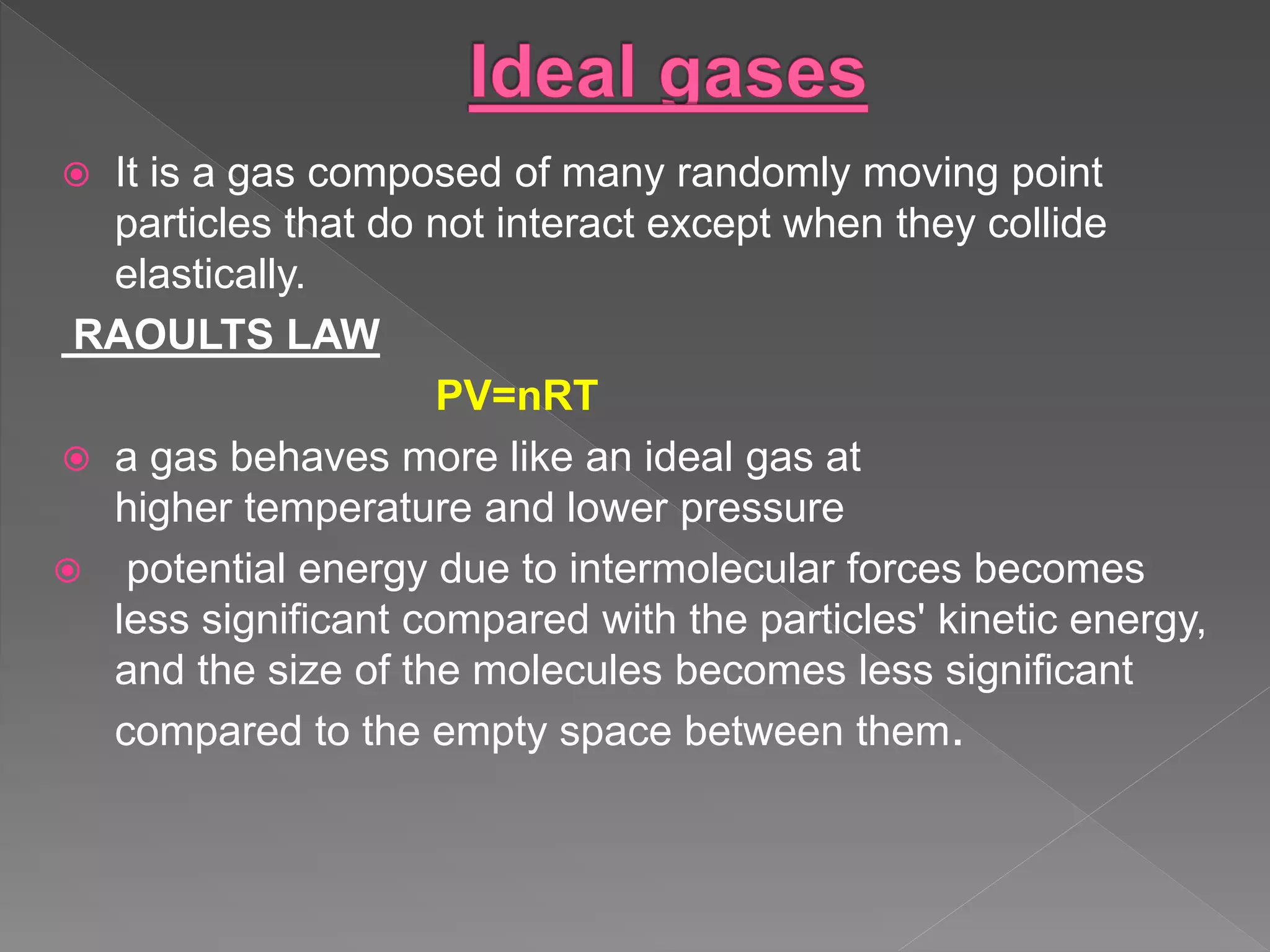
 It is a gas composed of many randomly moving point
particles that do not interact except when they collide
elastically.
RAOULTS LAW
PV=nRT
 a gas behaves more like an ideal gas at
higher temperature and lower pressure
 potential energy due to intermolecular forces becomes
less significant compared with the particles' kinetic energy,
and the size of the molecules becomes less significant
compared to the empty space between them.
 The ideal gas model tends to fail at lower temperatures or
higher pressures, when intermolecular forces and
molecular size become important.
 It also fails for most heavy gases, such as
many refrigerants and for gases with strong intermolecular
forces, notably water vapour.
 An ideal solution is that solution that follows raoults law
under all standard temp. and conc.
 It satisfy that ΔVmixing =0
 ΔHMIXING =0
 we can also say that it is the solution of two components A
and B in which the A---B interactions are of same
magnitude as A---A and B----B interaction
 Only solutions with low conc of solute behave ideally.
Ex. benzene+toluene
chlorobenzene+ bromobenzene
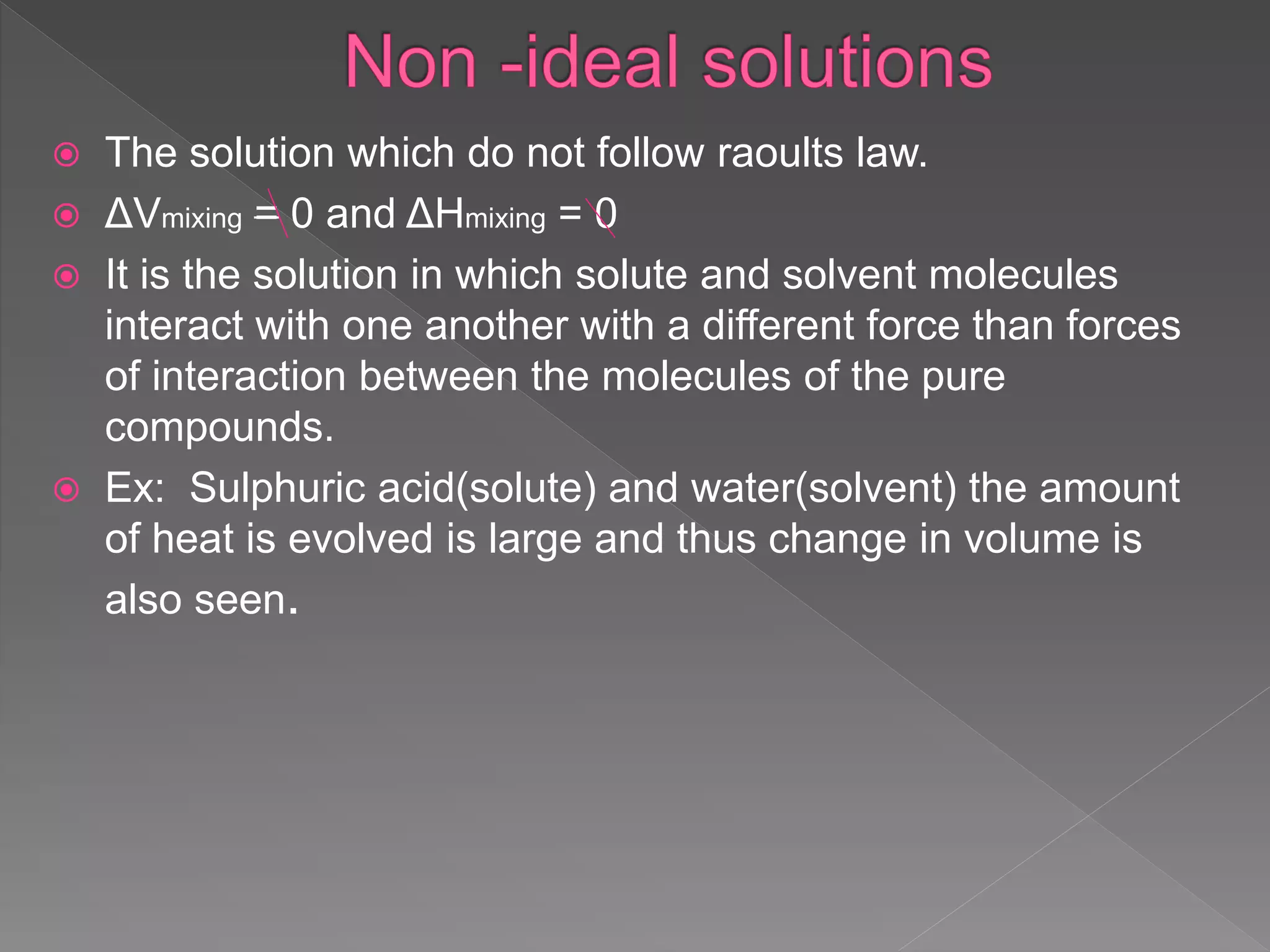
 The solution which do not follow raoults law.
 ΔVmixing = 0 and ΔHmixing = 0
 It is the solution in which solute and solvent molecules
interact with one another with a different force than forces
of interaction between the molecules of the pure
compounds.
 Ex: Sulphuric acid(solute) and water(solvent) the amount
of heat is evolved is large and thus change in volume is
also seen.
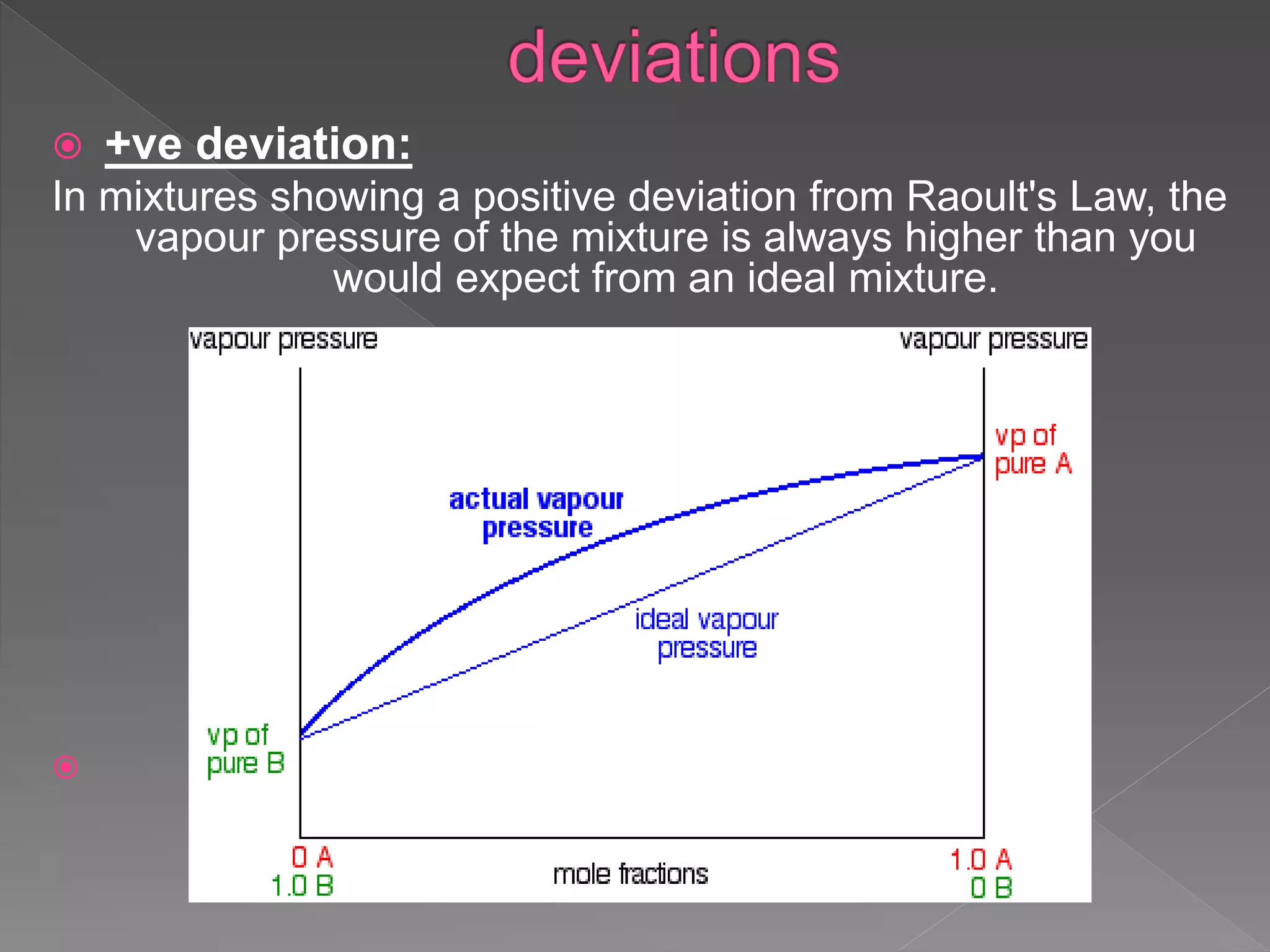
 +ve deviation:
In mixtures showing a positive deviation from Raoult's Law, the
vapour pressure of the mixture is always higher than you
would expect from an ideal mixture.

 The deviation can be small - in which case, the straight
line in the last graph turns into a slight curve.
 Notice that the highest vapour pressure anywhere is
still the vapour pressure of pure A.
 Cases like this, where the deviation is small, behave
just like ideal mixtures as
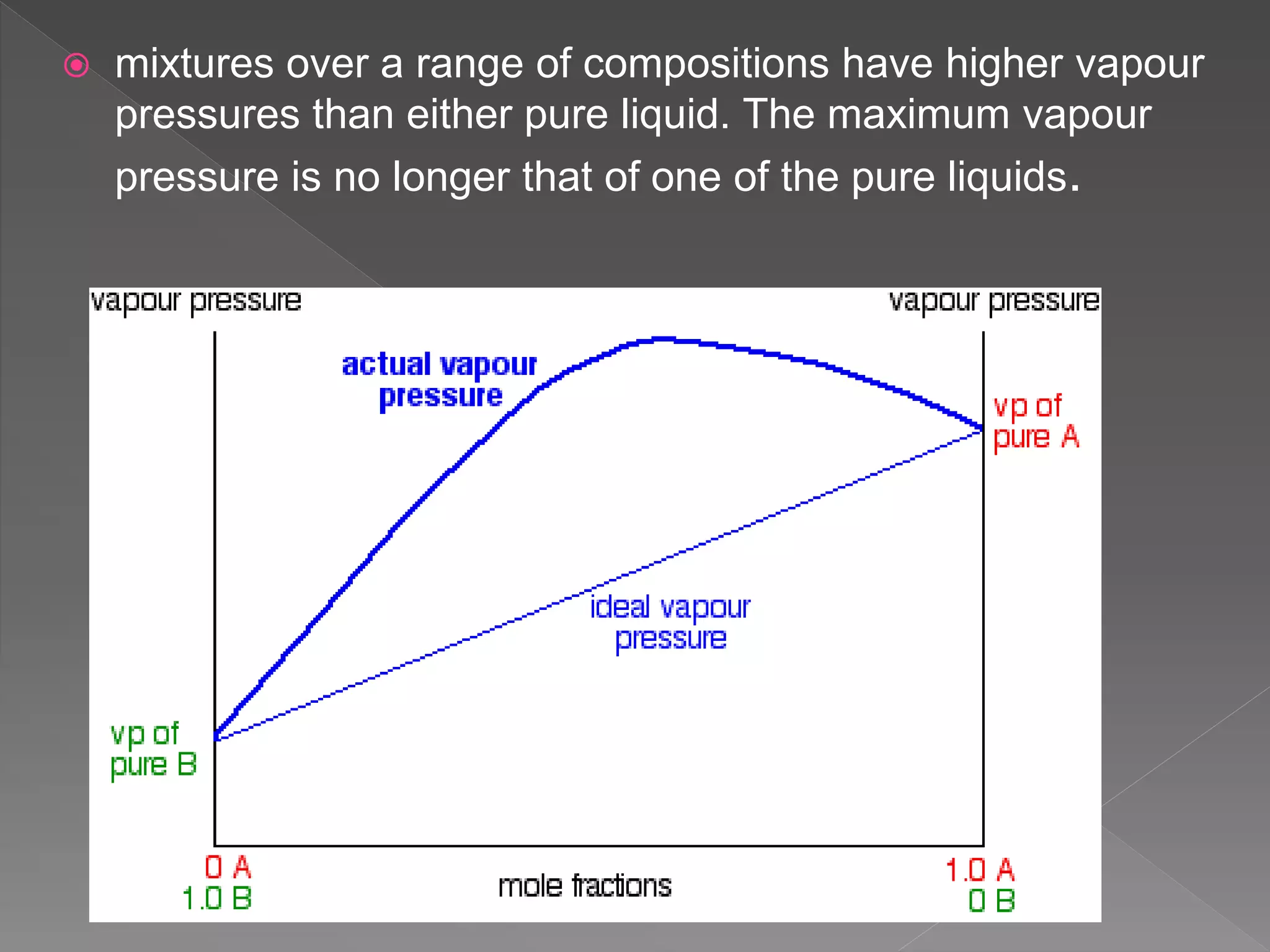
 But some liquid mixtures have very large positive
deviations from Raoult's Law, and in these cases, the
curve becomes very distorted.
 mixtures over a range of compositions have higher vapour
pressures than either pure liquid. The maximum vapour
pressure is no longer that of one of the pure liquids.
Explaining the deviations
 The fact that the vapour pressure is higher than ideal in
these mixtures means that molecules are breaking away
more easily than they do in the pure liquids.
 That is because the intermolecular forces between
molecules of A and B are less than they are in the pure
liquids.
 We can see that when we mix the liquids. Less heat is
evolved when the new attractions are set up than was
absorbed to break the original ones. Heat will therefore be
absorbed when the liquids mix. The enthalpy change of
mixing is endothermic.
 The classic example of a mixture of this kind is ethanol and
water. This produces a highly distorted curve with a
maximum vapour pressure for a mixture containing 95.6%
of ethanol by mass.
-ve deviations
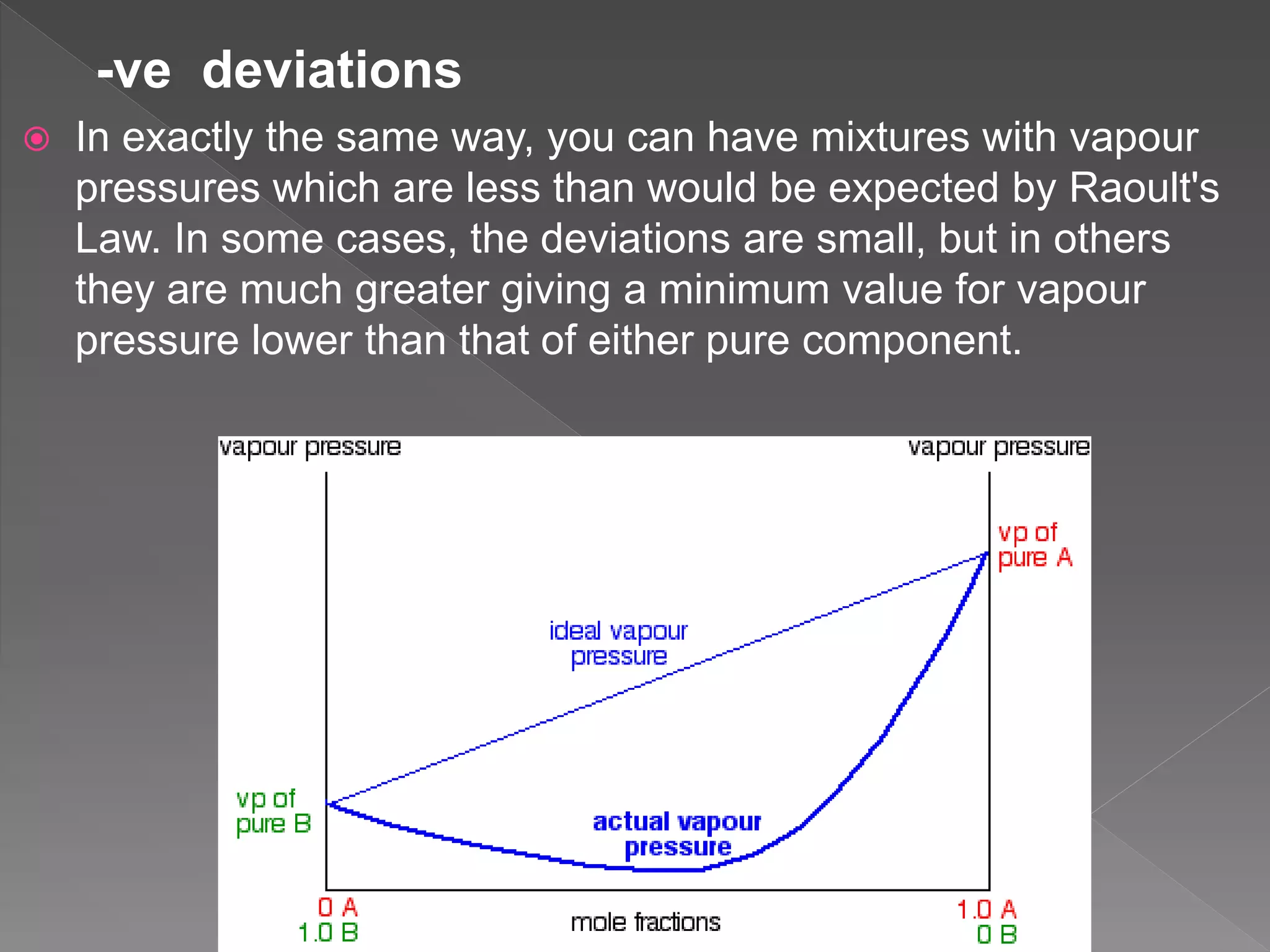
 In exactly the same way, you can have mixtures with vapour
pressures which are less than would be expected by Raoult's
Law. In some cases, the deviations are small, but in others
they are much greater giving a minimum value for vapour
pressure lower than that of either pure component.
 Explaining the deviations
 These are cases where the molecules break away from the
mixture less easily than they do from the pure liquids. New
stronger forces must exist in the mixture than in the original
liquids.
 we can recognise this happening because heat is evolved
when we mix the liquids - more heat is given out when the new
stronger bonds are made than was used in breaking the
original weaker ones.
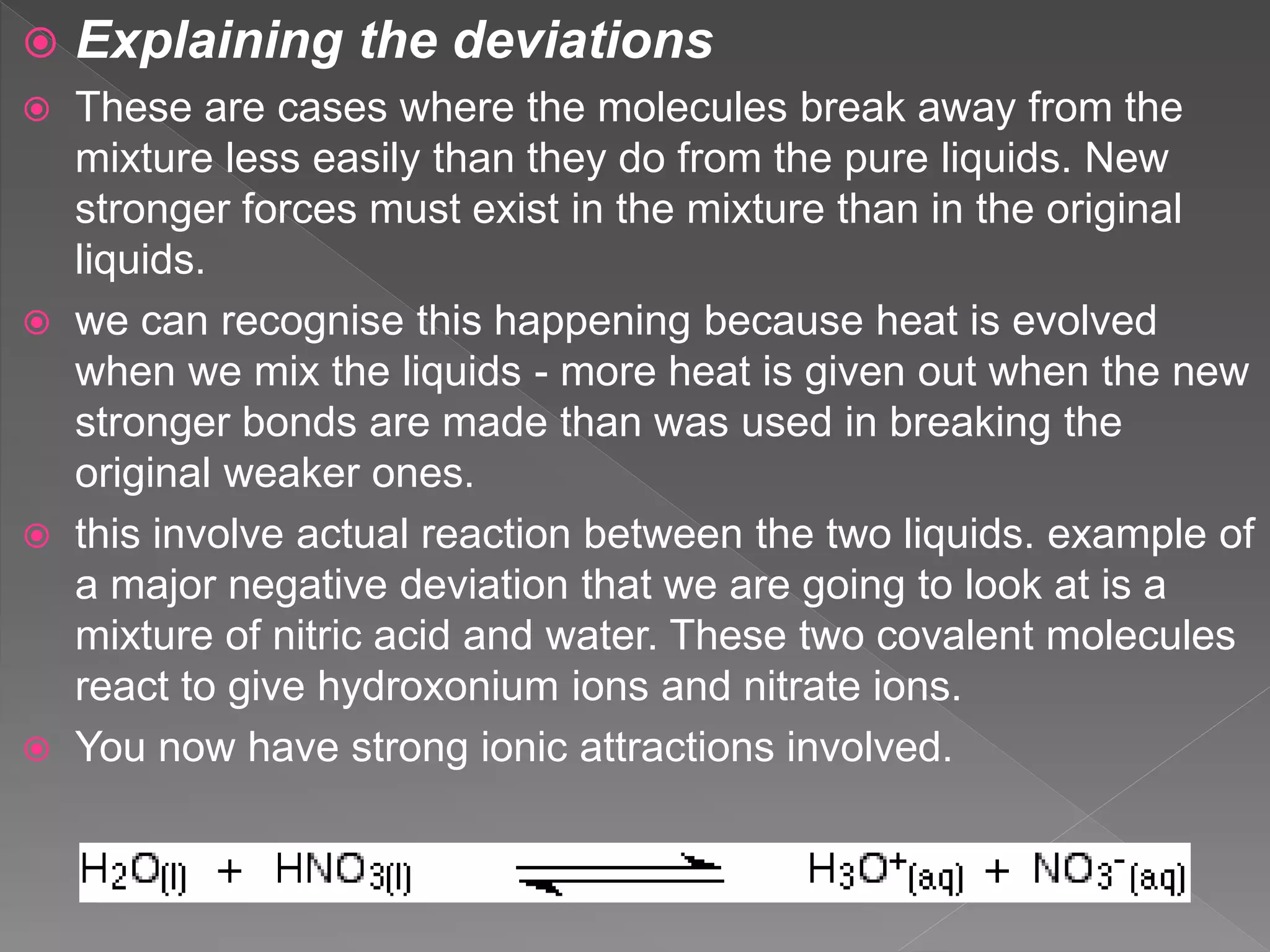
 this involve actual reaction between the two liquids. example of
a major negative deviation that we are going to look at is a
mixture of nitric acid and water. These two covalent molecules
react to give hydroxonium ions and nitrate ions.
 You now have strong ionic attractions involved.
Ideal solution and non ideal solution

Ideal solution and non ideal solution

  • 3.
     It isa gas composed of many randomly moving point particles that do not interact except when they collide elastically. RAOULTS LAW PV=nRT  a gas behaves more like an ideal gas at higher temperature and lower pressure  potential energy due to intermolecular forces becomes less significant compared with the particles' kinetic energy, and the size of the molecules becomes less significant compared to the empty space between them.
  • 4.
     The idealgas model tends to fail at lower temperatures or higher pressures, when intermolecular forces and molecular size become important.  It also fails for most heavy gases, such as many refrigerants and for gases with strong intermolecular forces, notably water vapour.
  • 5.
     An idealsolution is that solution that follows raoults law under all standard temp. and conc.  It satisfy that ΔVmixing =0  ΔHMIXING =0  we can also say that it is the solution of two components A and B in which the A---B interactions are of same magnitude as A---A and B----B interaction  Only solutions with low conc of solute behave ideally. Ex. benzene+toluene chlorobenzene+ bromobenzene
  • 6.
     The solutionwhich do not follow raoults law.  ΔVmixing = 0 and ΔHmixing = 0  It is the solution in which solute and solvent molecules interact with one another with a different force than forces of interaction between the molecules of the pure compounds.  Ex: Sulphuric acid(solute) and water(solvent) the amount of heat is evolved is large and thus change in volume is also seen.
  • 7.
     +ve deviation: Inmixtures showing a positive deviation from Raoult's Law, the vapour pressure of the mixture is always higher than you would expect from an ideal mixture. 
  • 8.
     The deviationcan be small - in which case, the straight line in the last graph turns into a slight curve.  Notice that the highest vapour pressure anywhere is still the vapour pressure of pure A.  Cases like this, where the deviation is small, behave just like ideal mixtures as  But some liquid mixtures have very large positive deviations from Raoult's Law, and in these cases, the curve becomes very distorted.
  • 9.
     mixtures overa range of compositions have higher vapour pressures than either pure liquid. The maximum vapour pressure is no longer that of one of the pure liquids.
  • 10.
    Explaining the deviations The fact that the vapour pressure is higher than ideal in these mixtures means that molecules are breaking away more easily than they do in the pure liquids.  That is because the intermolecular forces between molecules of A and B are less than they are in the pure liquids.  We can see that when we mix the liquids. Less heat is evolved when the new attractions are set up than was absorbed to break the original ones. Heat will therefore be absorbed when the liquids mix. The enthalpy change of mixing is endothermic.  The classic example of a mixture of this kind is ethanol and water. This produces a highly distorted curve with a maximum vapour pressure for a mixture containing 95.6% of ethanol by mass.
  • 11.
    -ve deviations  Inexactly the same way, you can have mixtures with vapour pressures which are less than would be expected by Raoult's Law. In some cases, the deviations are small, but in others they are much greater giving a minimum value for vapour pressure lower than that of either pure component.
  • 12.
     Explaining thedeviations  These are cases where the molecules break away from the mixture less easily than they do from the pure liquids. New stronger forces must exist in the mixture than in the original liquids.  we can recognise this happening because heat is evolved when we mix the liquids - more heat is given out when the new stronger bonds are made than was used in breaking the original weaker ones.  this involve actual reaction between the two liquids. example of a major negative deviation that we are going to look at is a mixture of nitric acid and water. These two covalent molecules react to give hydroxonium ions and nitrate ions.  You now have strong ionic attractions involved.