Role
of
International Development Association
(IDA)
Role
of
International Development Association
(IDA)
Department of Commerce
Group: Finance Special
UNIVERSITY OF NORTH BENGAL
2014
Prof. Ajit Kumar Ray
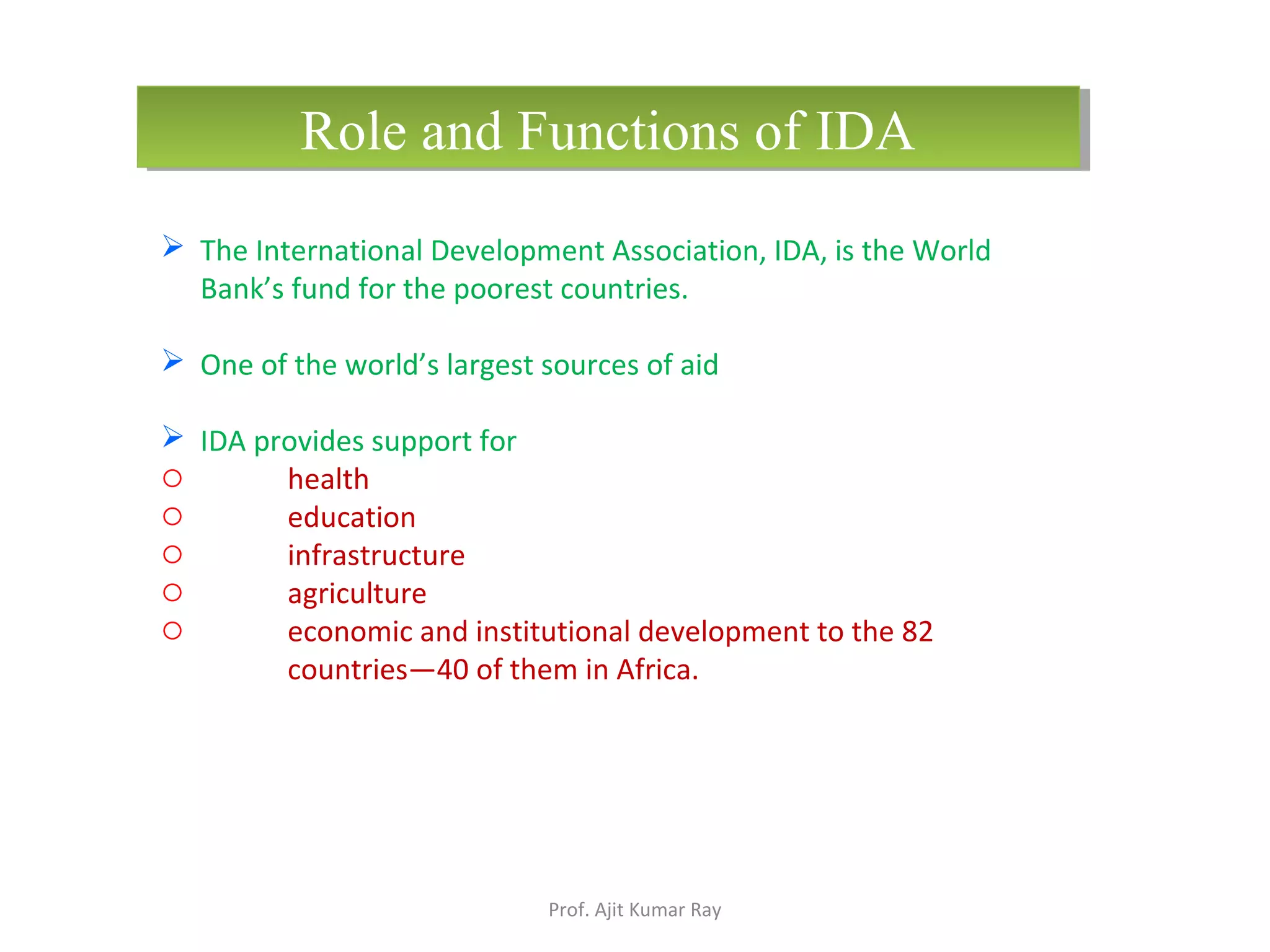
 The International Development Association, IDA, is the World
Bank’s fund for the poorest countries.
 One of the world’s largest sources of aid
 IDA provides support for
o health
o education
o infrastructure
o agriculture
o economic and institutional development to the 82
countries—40 of them in Africa.
Role and Functions of IDARole and Functions of IDA
Prof. Ajit Kumar Ray
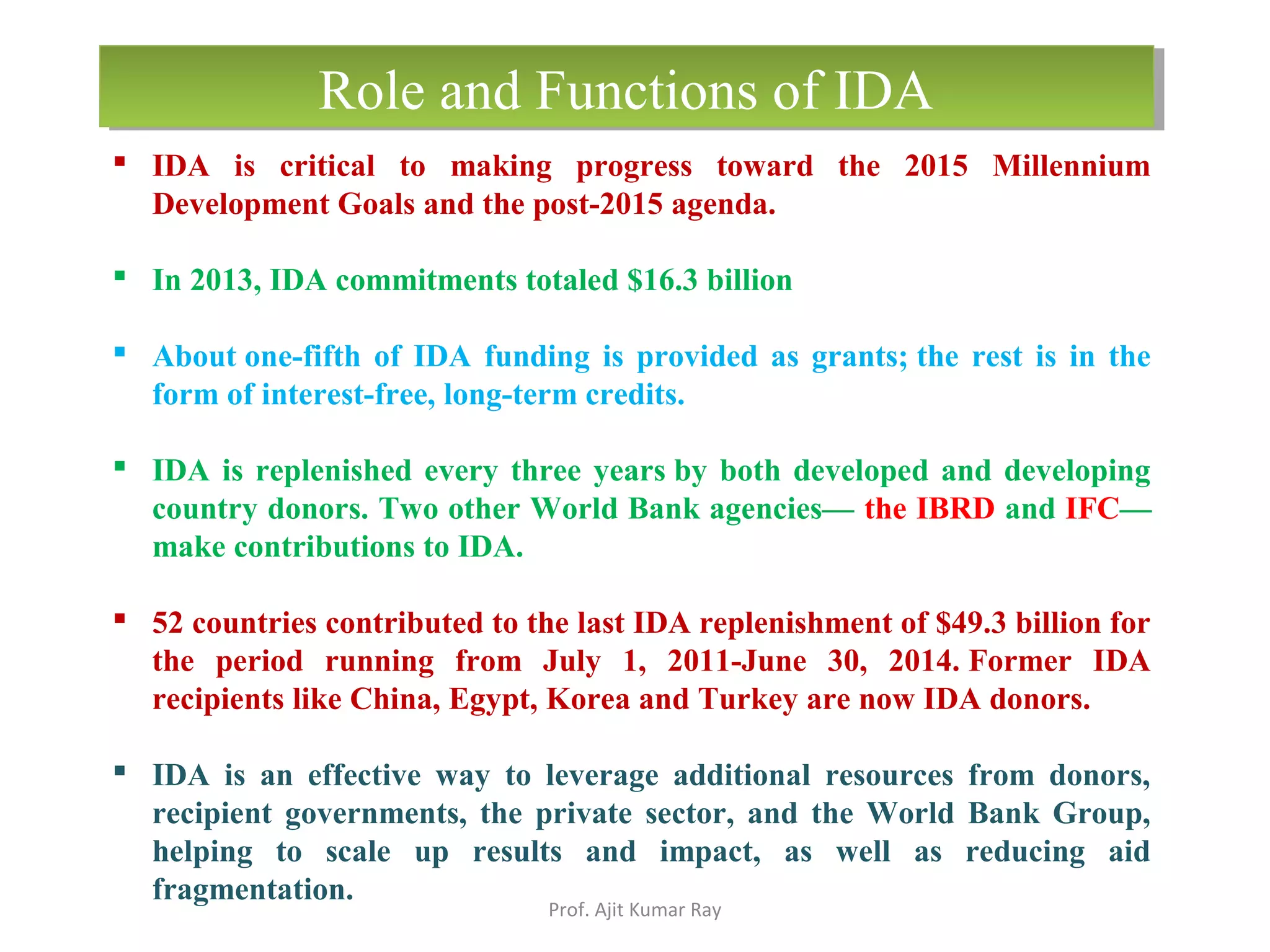
 IDA is critical to making progress toward the 2015 Millennium
Development Goals and the post-2015 agenda.
 In 2013, IDA commitments totaled $16.3 billion
 About one-fifth of IDA funding is provided as grants; the rest is in the
form of interest-free, long-term credits.
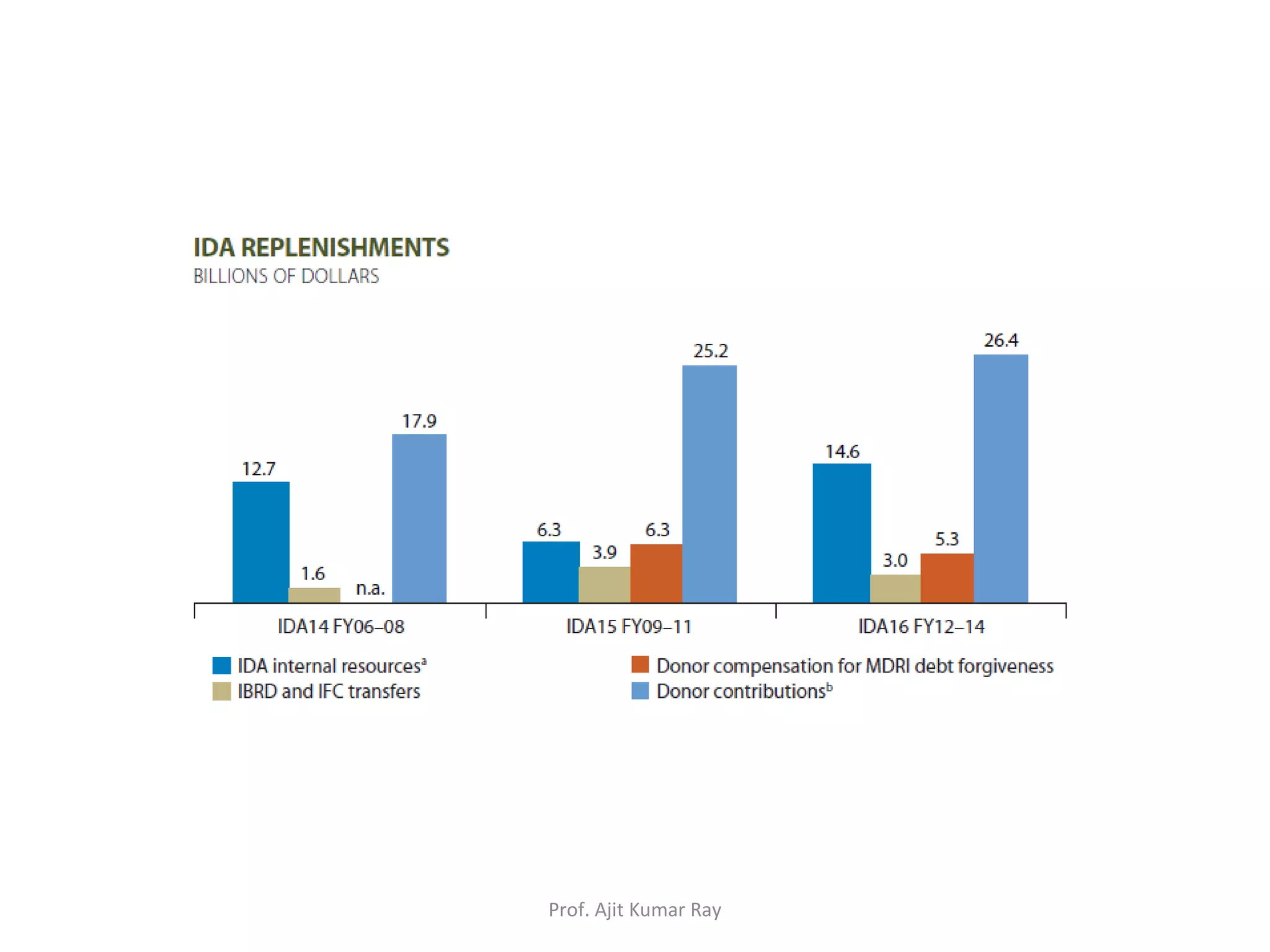
 IDA is replenished every three years by both developed and developing
country donors. Two other World Bank agencies— the IBRD and IFC—
make contributions to IDA.
 52 countries contributed to the last IDA replenishment of $49.3 billion for
the period running from July 1, 2011-June 30, 2014. Former IDA
recipients like China, Egypt, Korea and Turkey are now IDA donors.
 IDA is an effective way to leverage additional resources from donors,
recipient governments, the private sector, and the World Bank Group,
helping to scale up results and impact, as well as reducing aid
fragmentation.
Role and Functions of IDARole and Functions of IDA
Prof. Ajit Kumar Ray
The world’s poorest countries face enormous demands for development
finance that simply cannot be met through public resources. They need urgent
solutions that maximize the impact of private investment, driving powerful
results in job creation, infrastructure, health, education, and other key areas.
The world’s poorest countries face enormous demands for development
finance that simply cannot be met through public resources. They need urgent
solutions that maximize the impact of private investment, driving powerful
results in job creation, infrastructure, health, education, and other key areas.
How IFC works with IDAHow IFC works with IDA
Role and Functions of IDARole and Functions of IDA
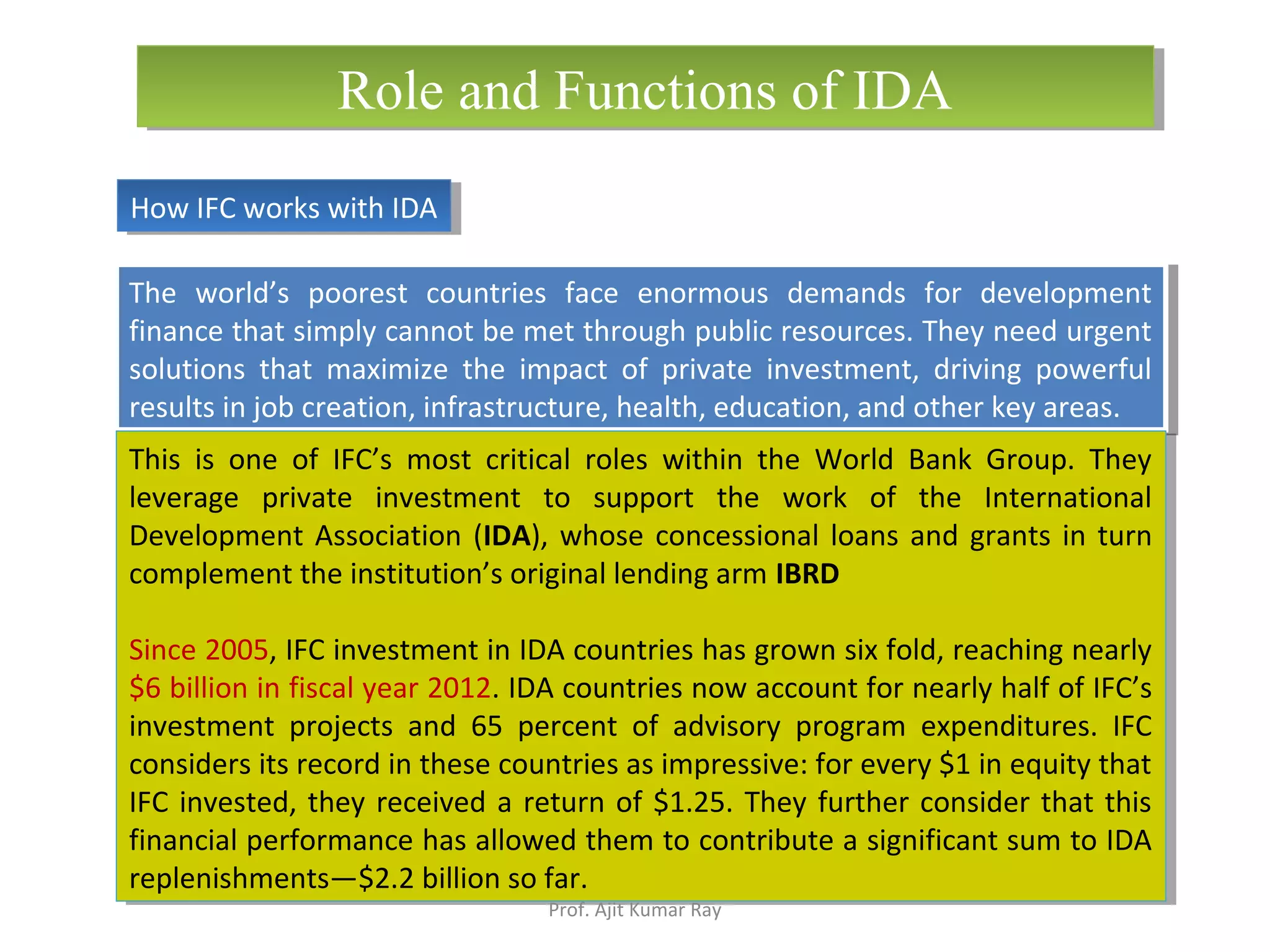
This is one of IFC’s most critical roles within the World Bank Group. They
leverage private investment to support the work of the International
Development Association (IDA), whose concessional loans and grants in turn
complement the institution’s original lending arm IBRD
Since 2005, IFC investment in IDA countries has grown six fold, reaching nearly
$6 billion in fiscal year 2012. IDA countries now account for nearly half of IFC’s
investment projects and 65 percent of advisory program expenditures. IFC
considers its record in these countries as impressive: for every $1 in equity that
IFC invested, they received a return of $1.25. They further consider that this
financial performance has allowed them to contribute a significant sum to IDA
replenishments—$2.2 billion so far.
This is one of IFC’s most critical roles within the World Bank Group. They
leverage private investment to support the work of the International
Development Association (IDA), whose concessional loans and grants in turn
complement the institution’s original lending arm IBRD
Since 2005, IFC investment in IDA countries has grown six fold, reaching nearly
$6 billion in fiscal year 2012. IDA countries now account for nearly half of IFC’s
investment projects and 65 percent of advisory program expenditures. IFC
considers its record in these countries as impressive: for every $1 in equity that
IFC invested, they received a return of $1.25. They further consider that this
financial performance has allowed them to contribute a significant sum to IDA
replenishments—$2.2 billion so far.
Prof. Ajit Kumar Ray
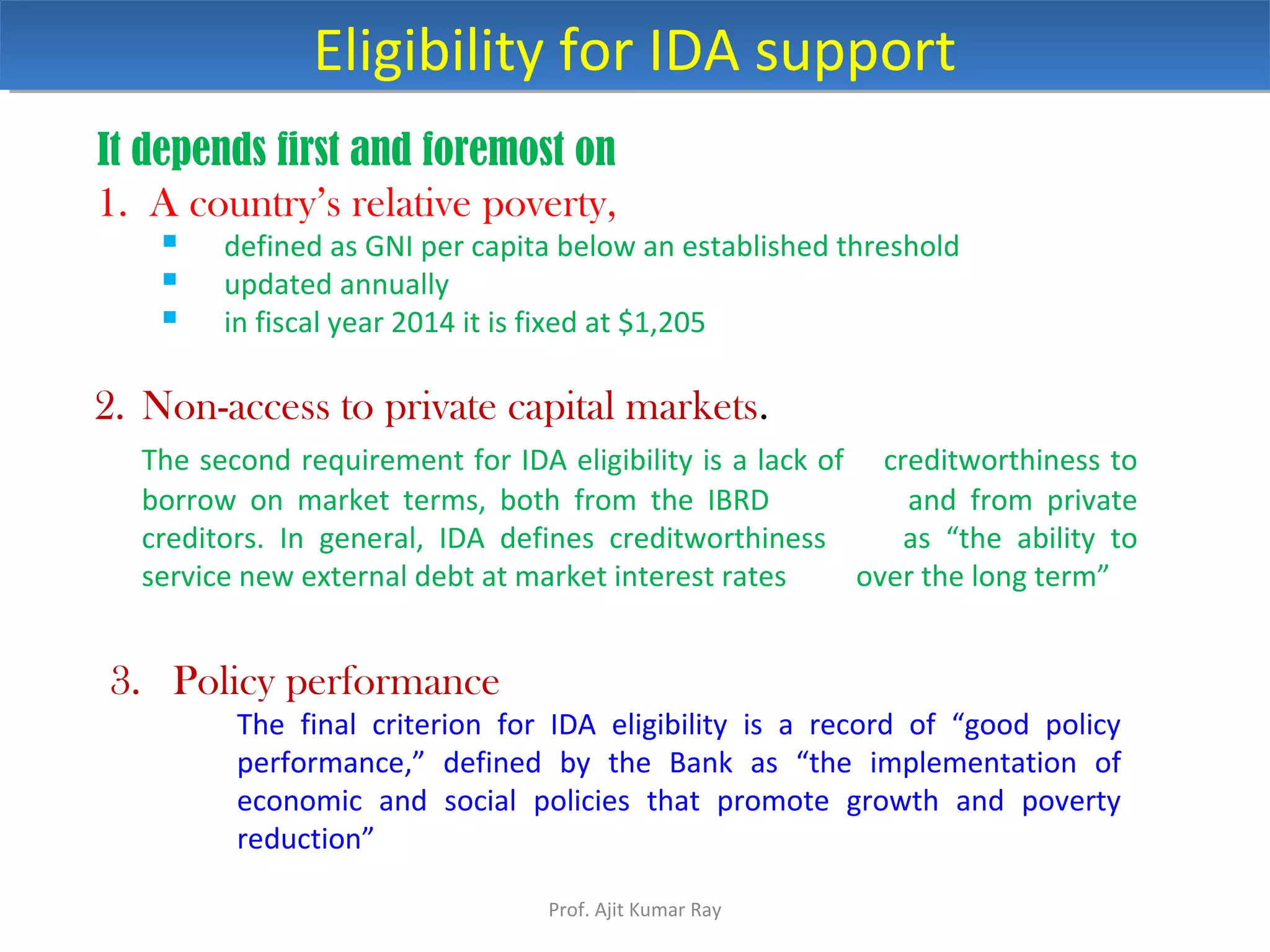
It depends first and foremost on
1. A country’s relative poverty,
 defined as GNI per capita below an established threshold
 updated annually
 in fiscal year 2014 it is fixed at $1,205
Eligibility for IDA supportEligibility for IDA support
3. Policy performance
The final criterion for IDA eligibility is a record of “good policy
performance,” defined by the Bank as “the implementation of
economic and social policies that promote growth and poverty
reduction”
2. Non-access to private capital markets.
The second requirement for IDA eligibility is a lack of creditworthiness to
borrow on market terms, both from the IBRD and from private
creditors. In general, IDA defines creditworthiness as “the ability to
service new external debt at market interest rates over the long term”
Prof. Ajit Kumar Ray
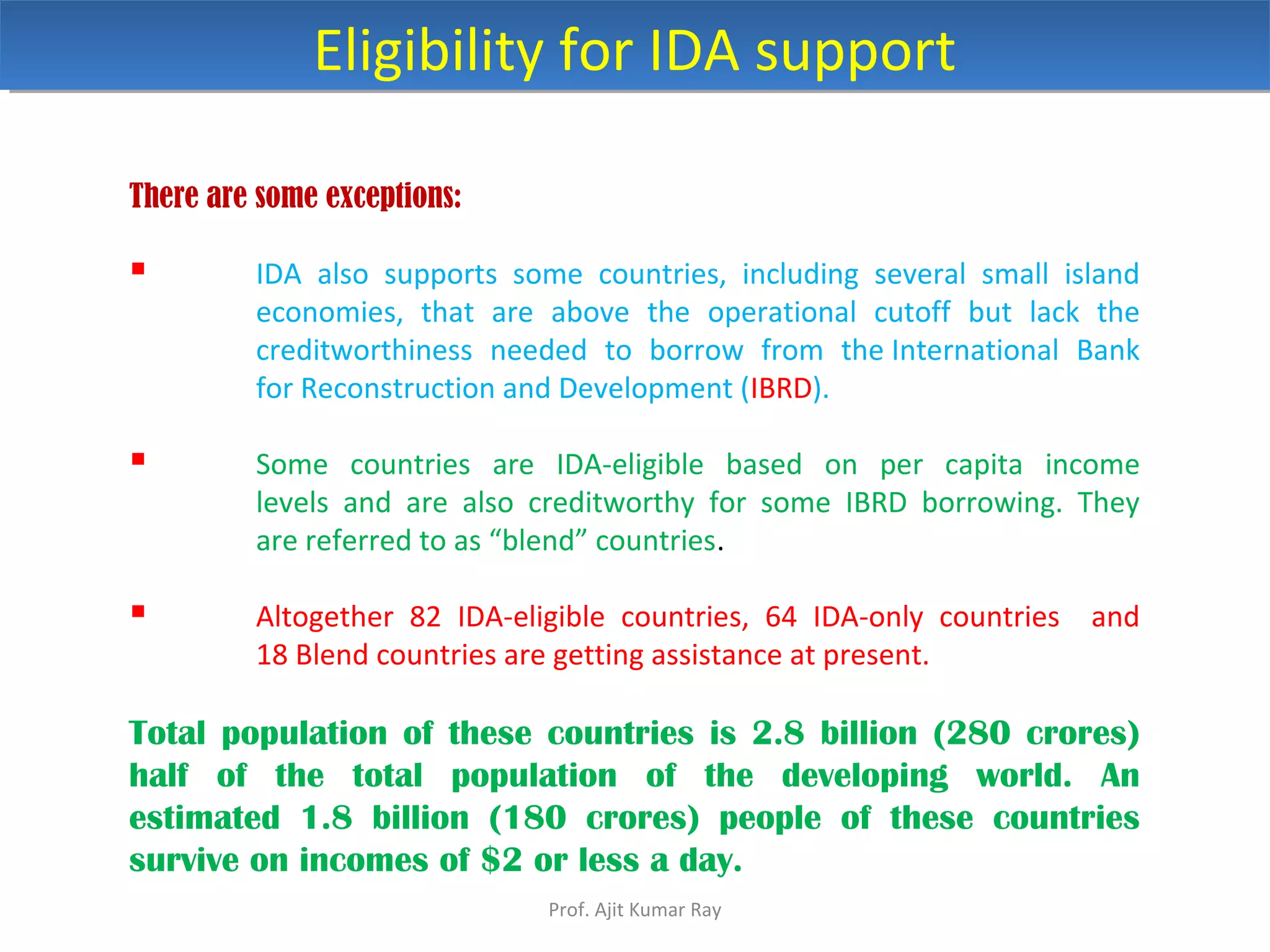
There are some exceptions:
 IDA also supports some countries, including several small island
economies, that are above the operational cutoff but lack the
creditworthiness needed to borrow from the International Bank
for Reconstruction and Development (IBRD).
 Some countries are IDA-eligible based on per capita income
levels and are also creditworthy for some IBRD borrowing. They
are referred to as “blend” countries.
 Altogether 82 IDA-eligible countries, 64 IDA-only countries and
18 Blend countries are getting assistance at present.
Total population of these countries is 2.8 billion (280 crores)
half of the total population of the developing world. An
estimated 1.8 billion (180 crores) people of these countries
survive on incomes of $2 or less a day.
Eligibility for IDA supportEligibility for IDA support
Prof. Ajit Kumar Ray
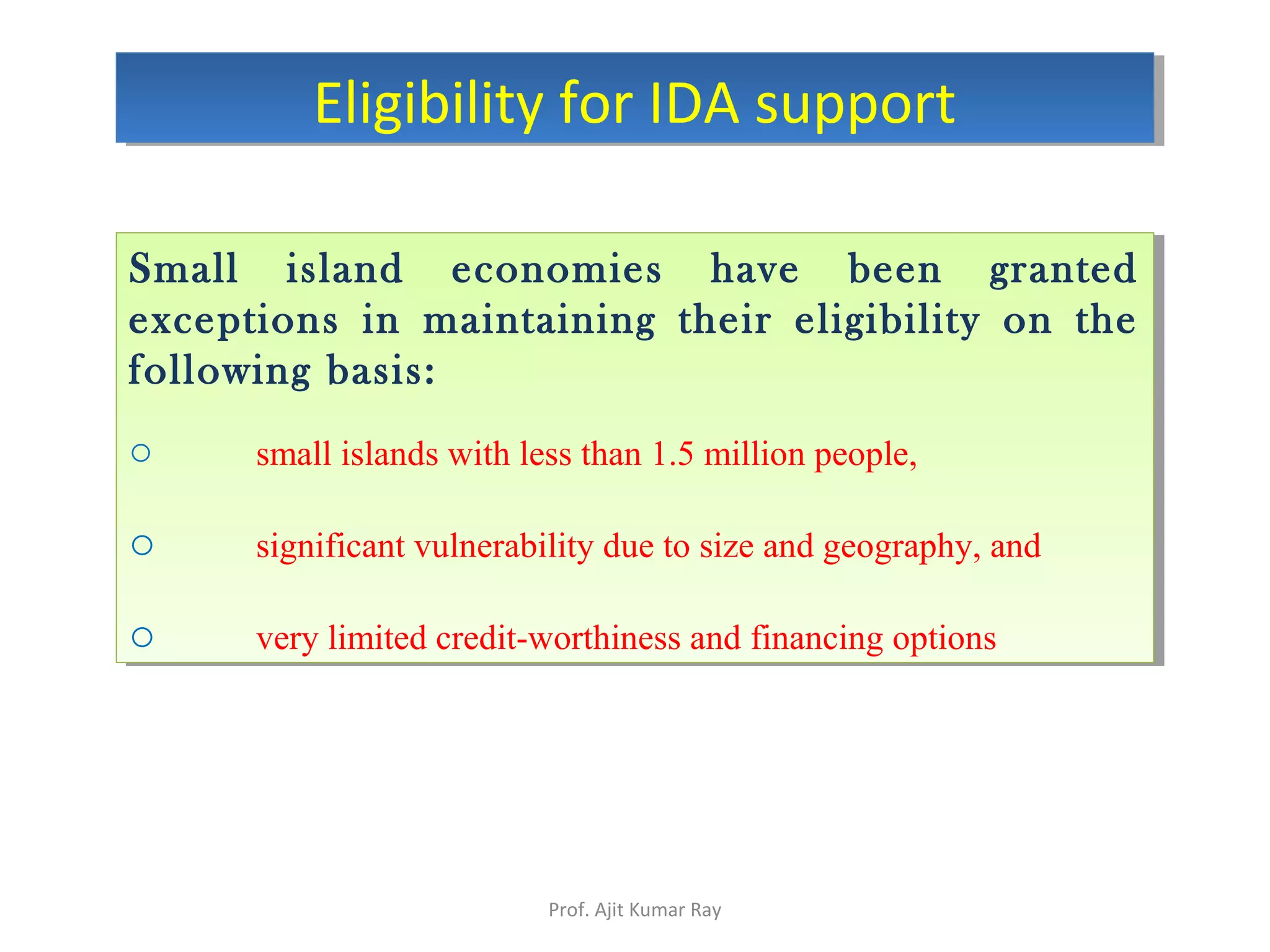
Small island economies have been granted
exceptions in maintaining their eligibility on the
following basis:
o small islands with less than 1.5 million people,
o significant vulnerability due to size and geography, and
o very limited credit-worthiness and financing options
Small island economies have been granted
exceptions in maintaining their eligibility on the
following basis:
o small islands with less than 1.5 million people,
o significant vulnerability due to size and geography, and
o very limited credit-worthiness and financing options
Eligibility for IDA supportEligibility for IDA support
Prof. Ajit Kumar Ray
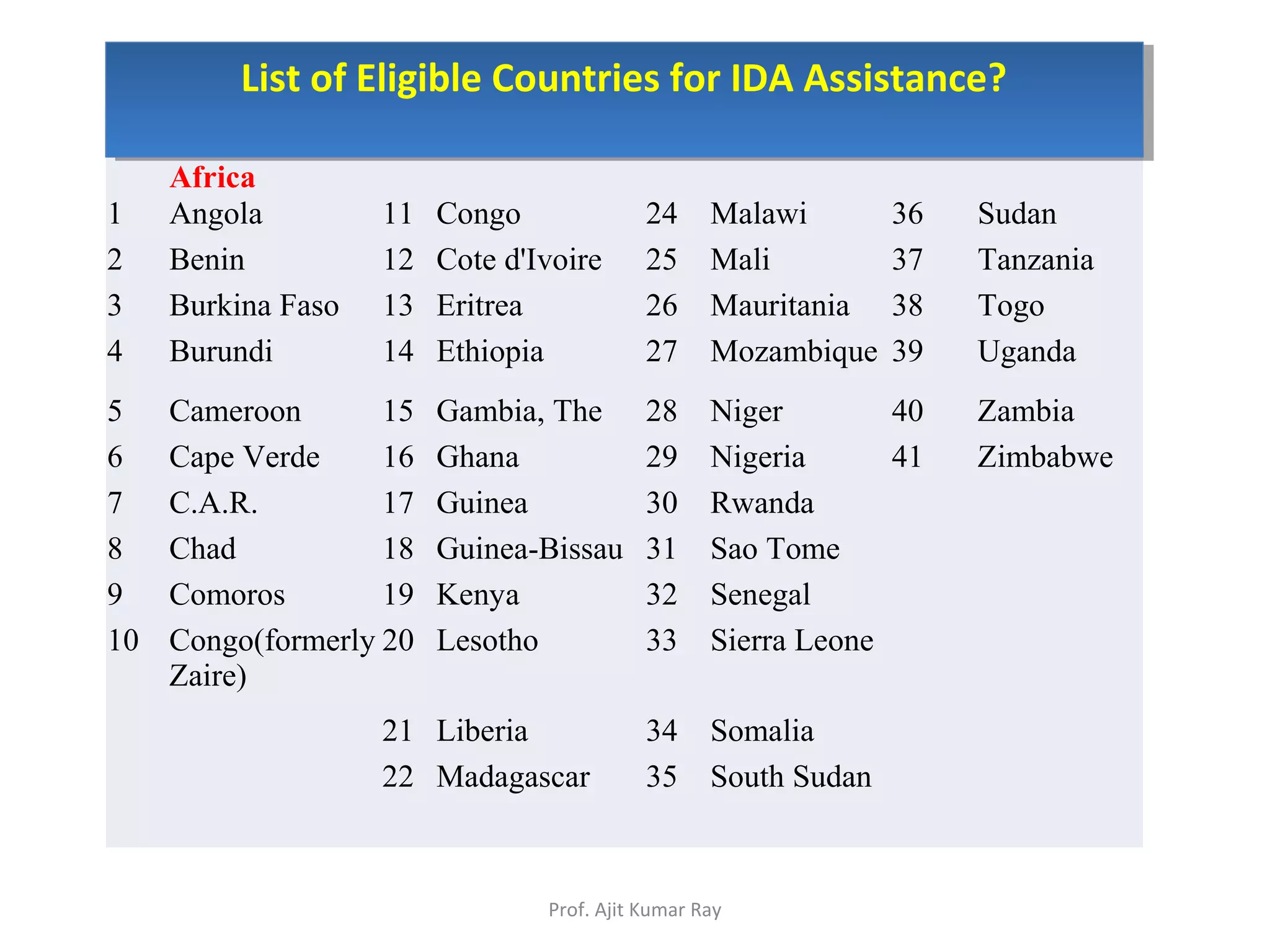
Africa
1 Angola 11 Congo 24 Malawi 36 Sudan
2 Benin 12 Cote d'Ivoire 25 Mali 37 Tanzania
3 Burkina Faso 13 Eritrea 26 Mauritania 38 Togo
4 Burundi 14 Ethiopia 27 Mozambique 39 Uganda
5 Cameroon 15 Gambia, The 28 Niger 40 Zambia
6 Cape Verde 16 Ghana 29 Nigeria 41 Zimbabwe
7 C.A.R. 17 Guinea 30 Rwanda
8 Chad 18 Guinea-Bissau 31 Sao Tome
9 Comoros 19 Kenya 32 Senegal
10 Congo(formerly
Zaire)
20 Lesotho 33 Sierra Leone
21 Liberia 34 Somalia
22 Madagascar 35 South Sudan
List of Eligible Countries for IDA Assistance?List of Eligible Countries for IDA Assistance?
Prof. Ajit Kumar Ray
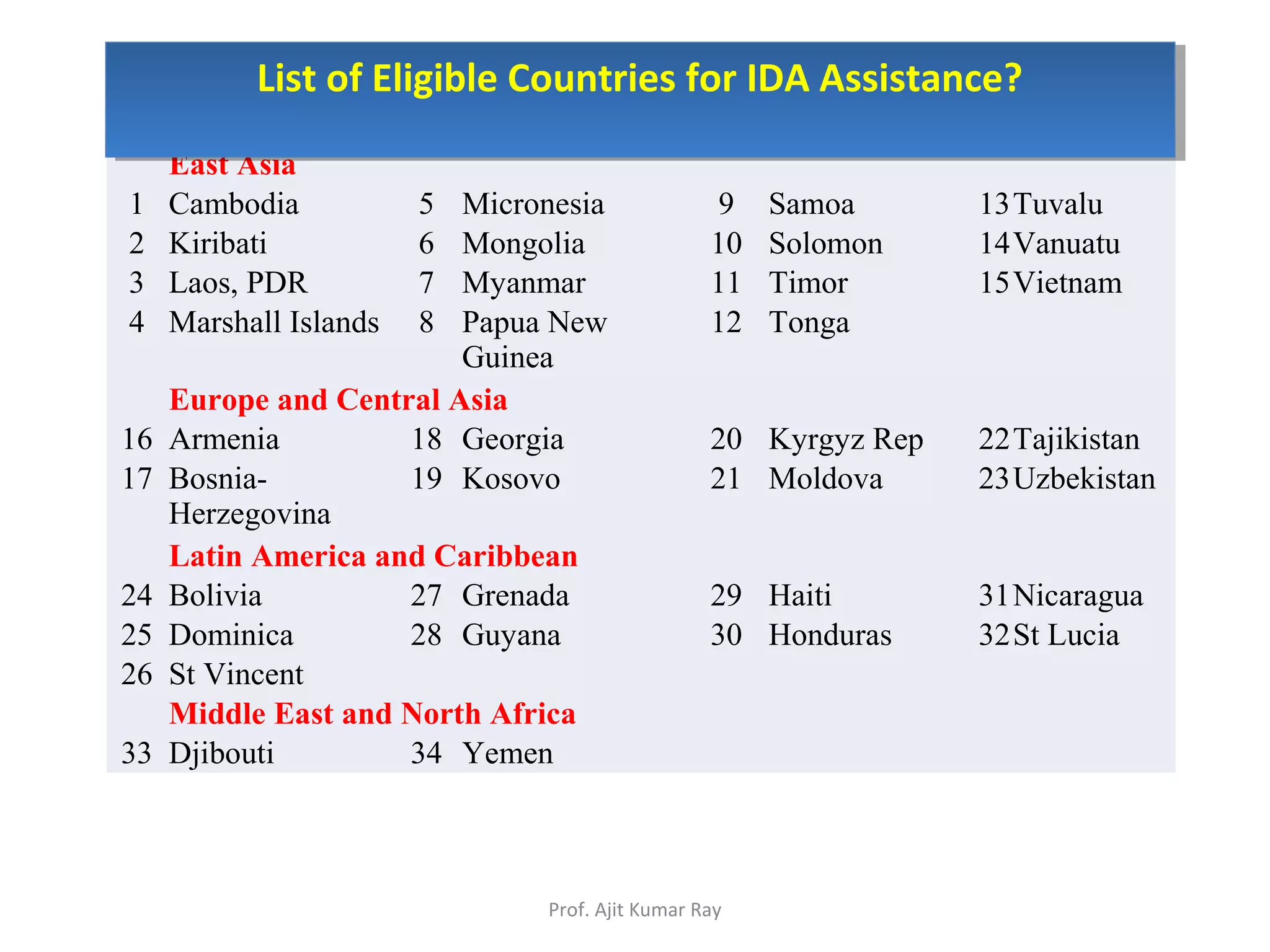
  East Asia            
1 Cambodia 5 Micronesia  9 Samoa  13Tuvalu
2 Kiribati  6 Mongolia 10 Solomon  14Vanuatu
3 Laos, PDR 7 Myanmar 11 Timor 15Vietnam 
4 Marshall Islands  8 Papua New 
Guinea
12 Tonga     
Europe and Central Asia        
16 Armenia  18 Georgia  20 Kyrgyz Rep 22Tajikistan
17 Bosnia-
Herzegovina 
19 Kosovo 21 Moldova 23Uzbekistan 
  Latin America and Caribbean        
24 Bolivia  27 Grenada 29 Haiti 31Nicaragua
25 Dominica 28 Guyana  30 Honduras 32St Lucia 
26 St Vincent             
  Middle East and North Africa        
33 Djibouti  34 Yemen        
List of Eligible Countries for IDA Assistance?List of Eligible Countries for IDA Assistance?
Prof. Ajit Kumar Ray
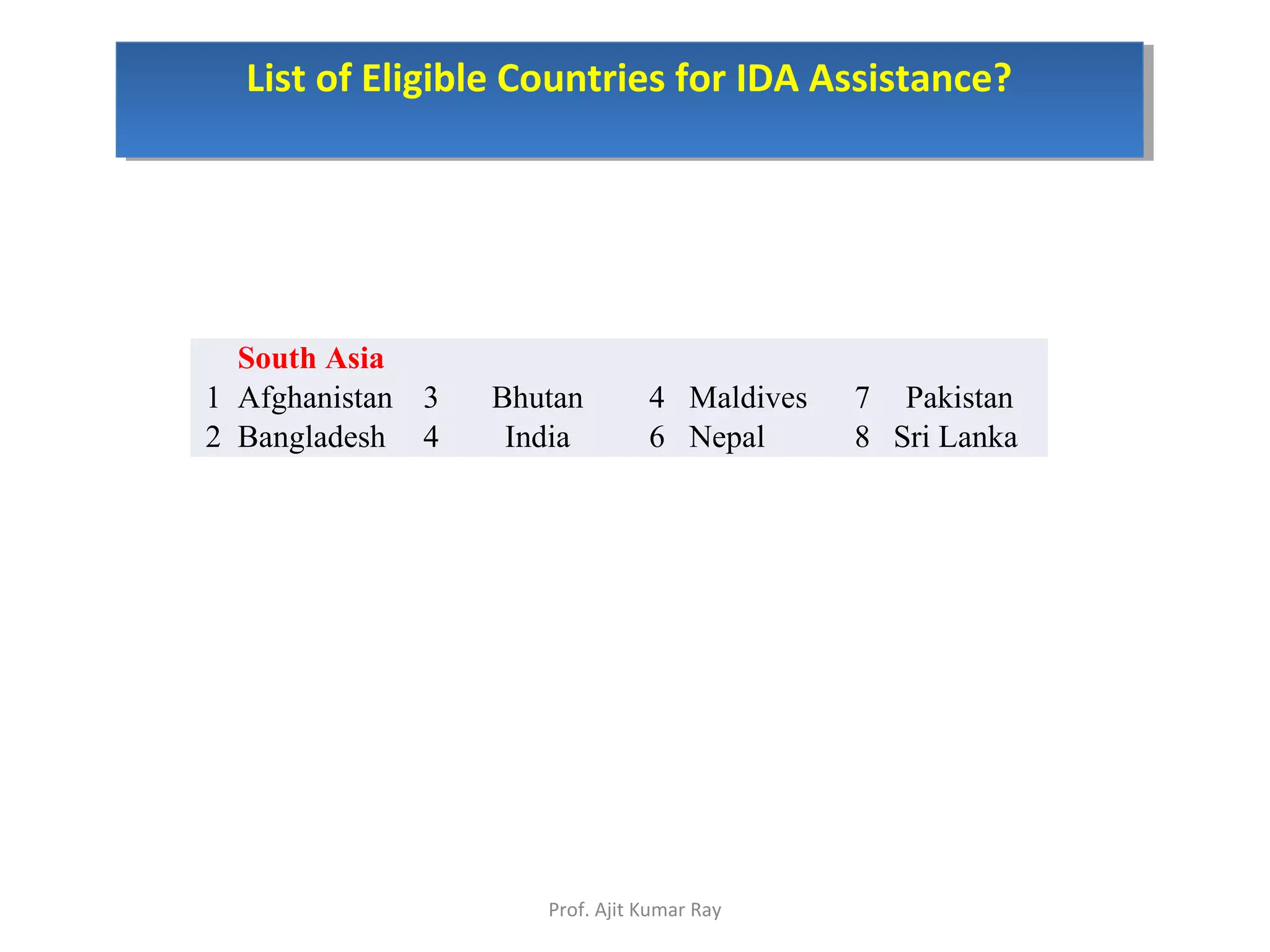
  South Asia            
1 Afghanistan 3 Bhutan  4 Maldives  7 Pakistan
2 Bangladesh 4 India  6 Nepal 8 Sri Lanka 
List of Eligible Countries for IDA Assistance?List of Eligible Countries for IDA Assistance?
Prof. Ajit Kumar Ray
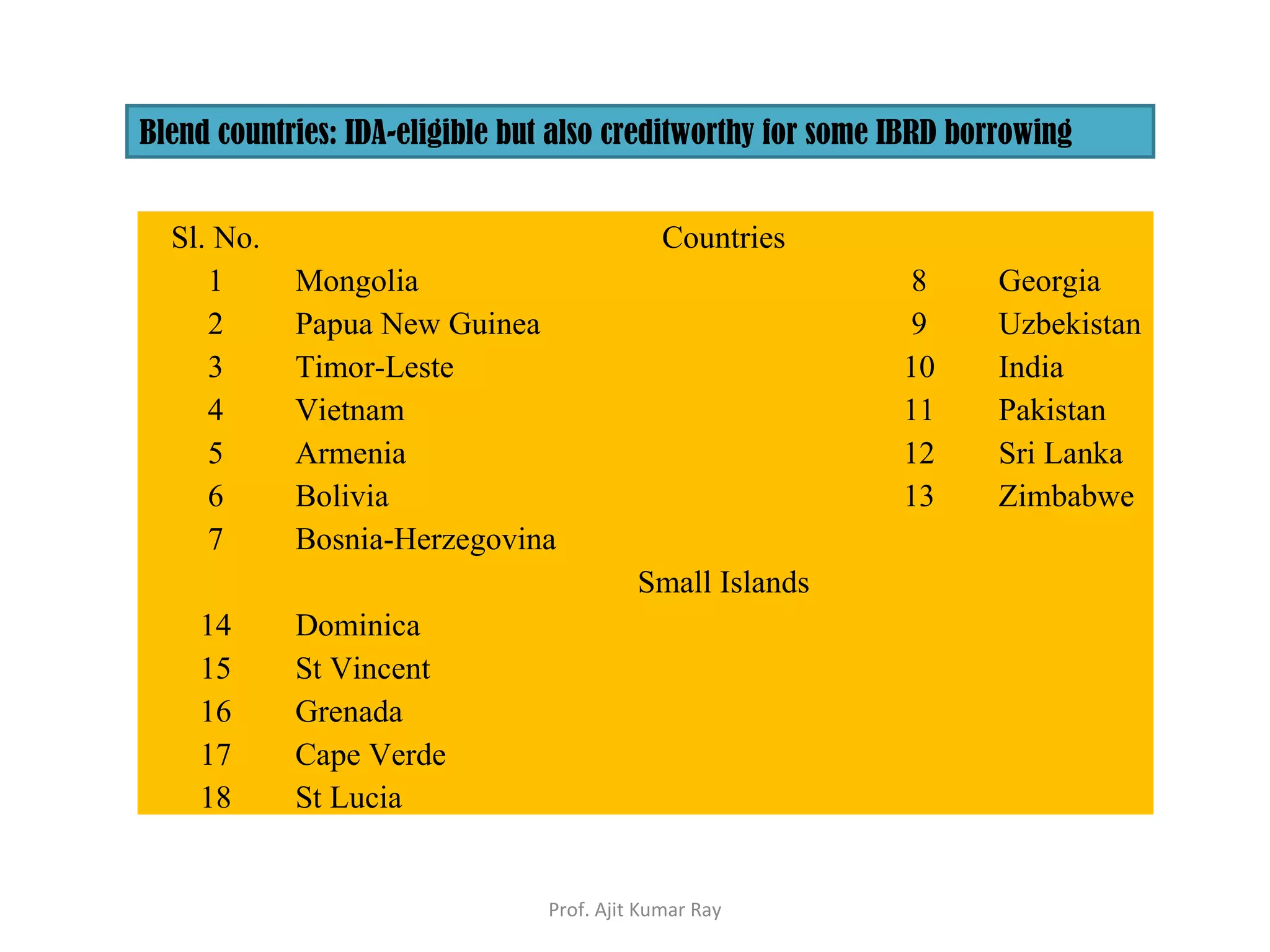
Sl. No. Countries
1 Mongolia  8 Georgia 
2 Papua New Guinea 9 Uzbekistan 
3 Timor-Leste  10 India 
4 Vietnam  11 Pakistan 
5 Armenia  12 Sri Lanka 
6 Bolivia 13 Zimbabwe
7 Bosnia-Herzegovina     
  Small Islands
14 Dominica    
15 St Vincent      
16 Grenada      
17 Cape Verde    
18 St Lucia    
Blend countries: IDA-eligible but also creditworthy for some IBRD borrowing
Prof. Ajit Kumar Ray
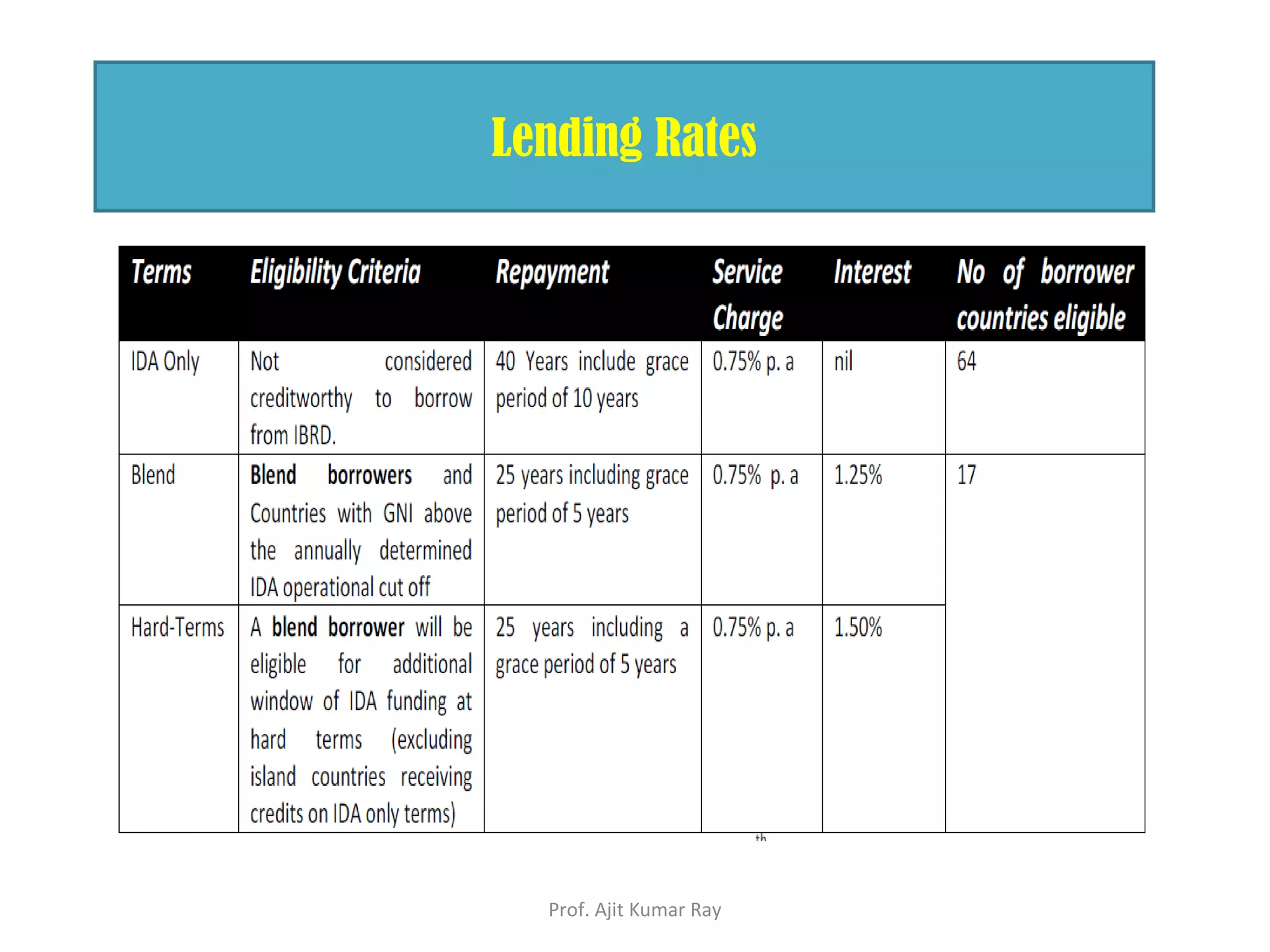
Lending Rates
Prof. Ajit Kumar Ray
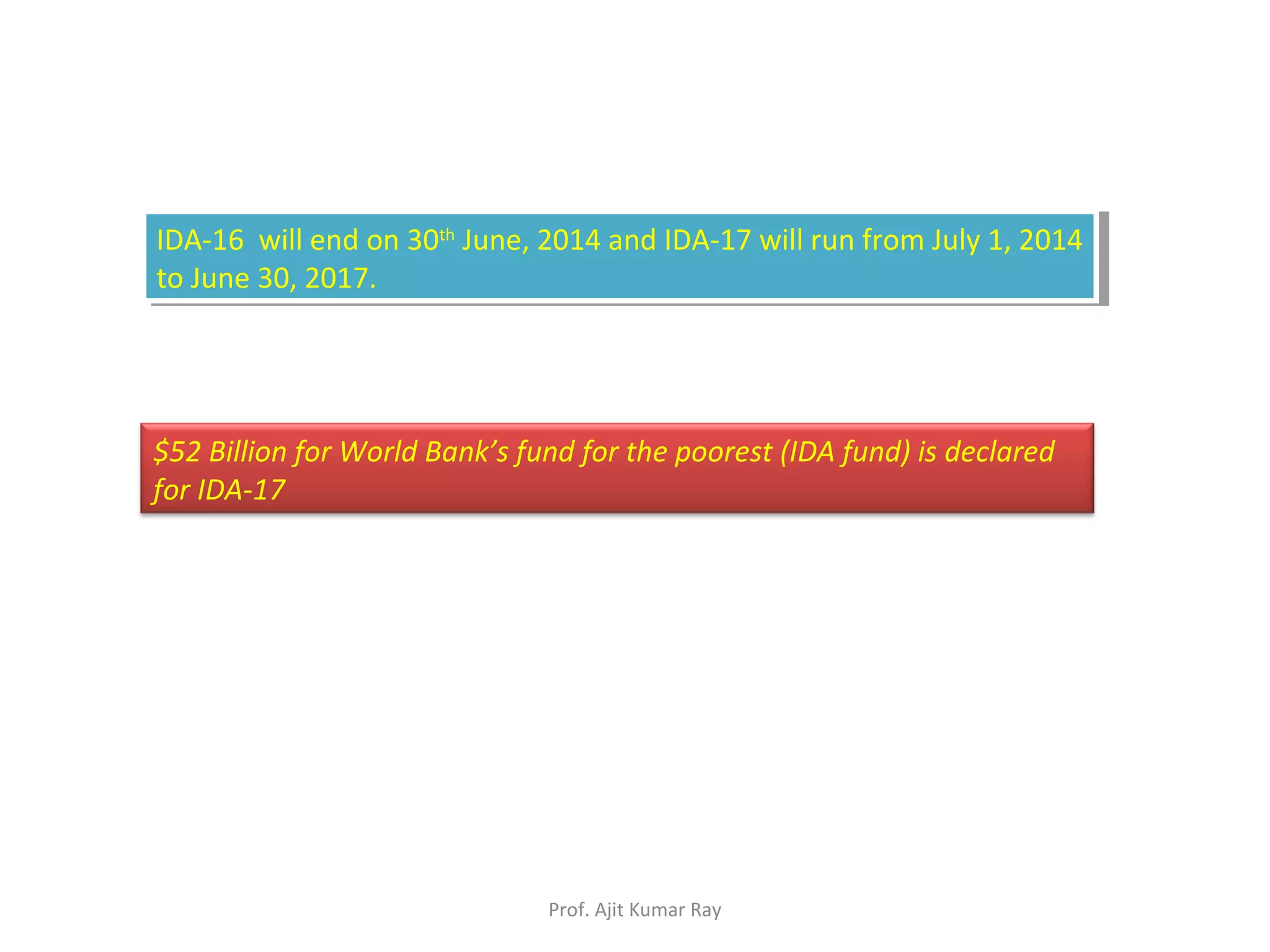
IDA-16 will end on 30th
June, 2014 and IDA-17 will run from July 1, 2014
to June 30, 2017.
IDA-16 will end on 30th
June, 2014 and IDA-17 will run from July 1, 2014
to June 30, 2017.
$52 Billion for World Bank’s fund for the poorest (IDA fund) is declared
for IDA-17
Prof. Ajit Kumar Ray
IDA’s
Performance-Based Allocation
System:
IDA’s
Performance-Based Allocation
System:
Prof. Ajit Kumar Ray
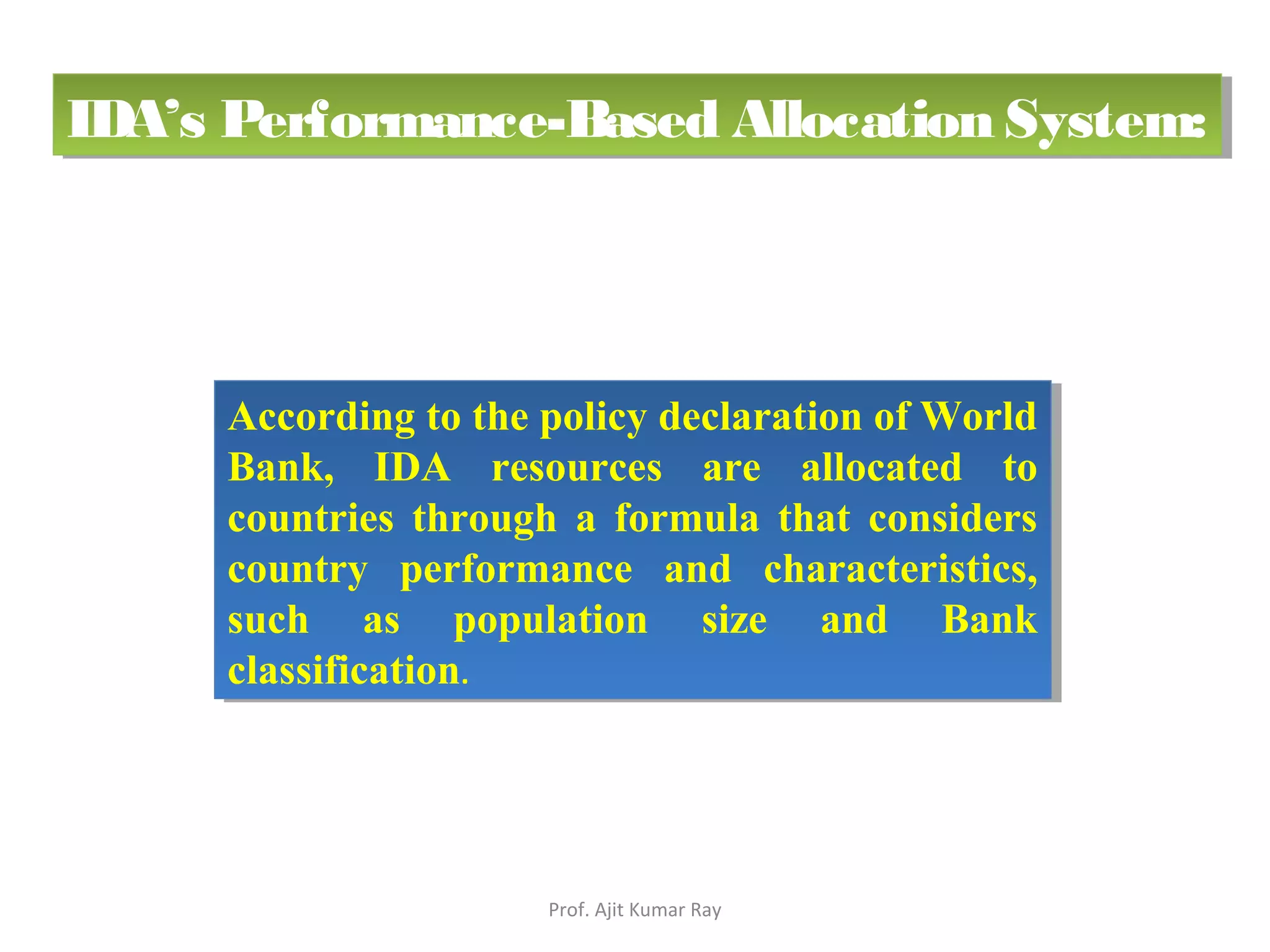
According to the policy declaration of World
Bank, IDA resources are allocated to
countries through a formula that considers
country performance and characteristics,
such as population size and Bank
classification.
According to the policy declaration of World
Bank, IDA resources are allocated to
countries through a formula that considers
country performance and characteristics,
such as population size and Bank
classification.
IDA’s Performance-Based Allocation System:IDA’s Performance-Based Allocation System:
Prof. Ajit Kumar Ray
The performance of IDA countries is assessed annually using
(a)the CPIA (Country Policy and Institutional Assessment)
(b)the ARPP (Annual Review of Portfolio Performance)
(c)The Governance factor.
Overview of
IDA’s Performance-Based
Allocation System
Prof. Ajit Kumar Ray
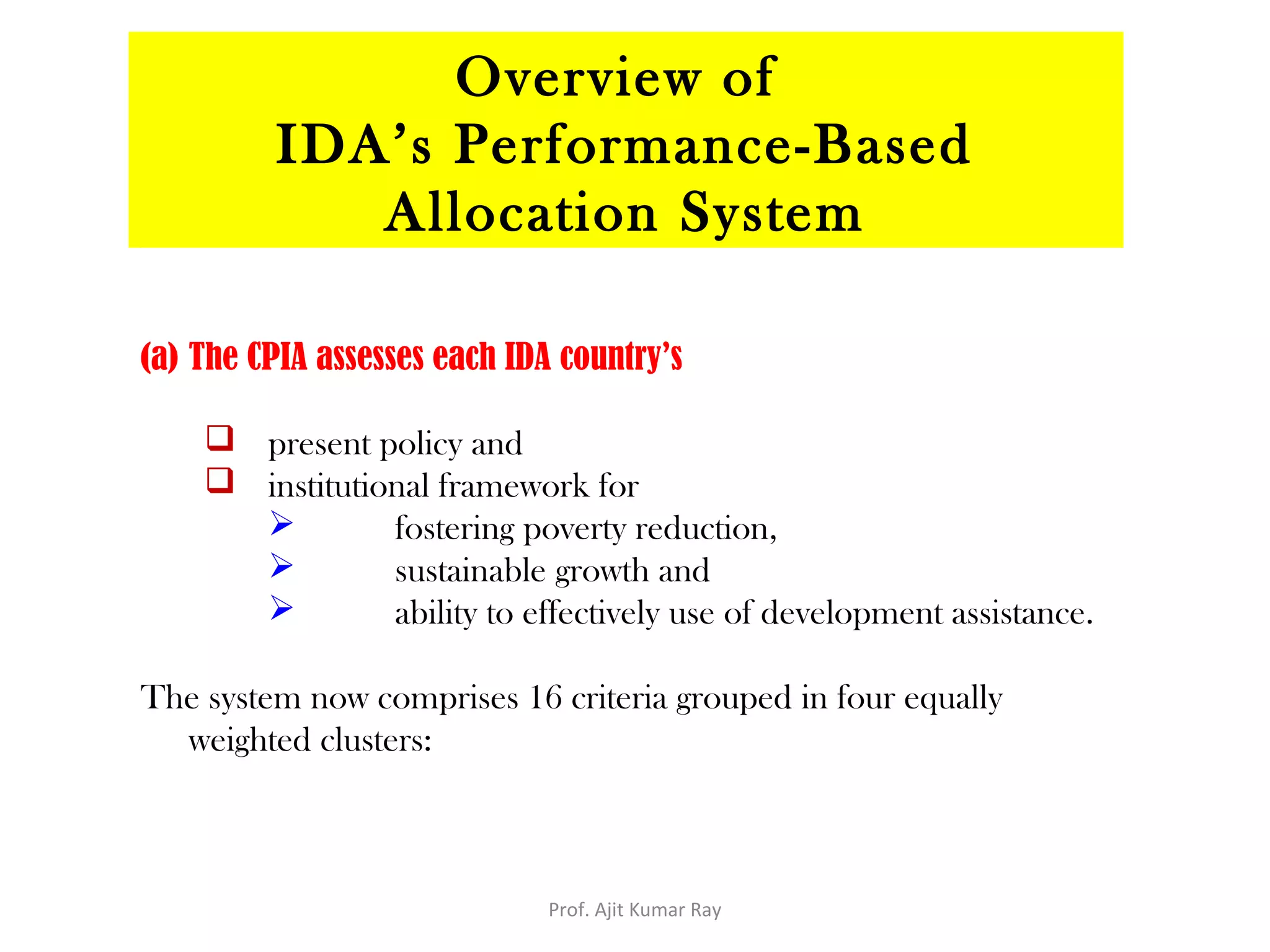
(a) The CPIA assesses each IDA country’s
 present policy and
 institutional framework for
 fostering poverty reduction,
 sustainable growth and
 ability to effectively use of development assistance.
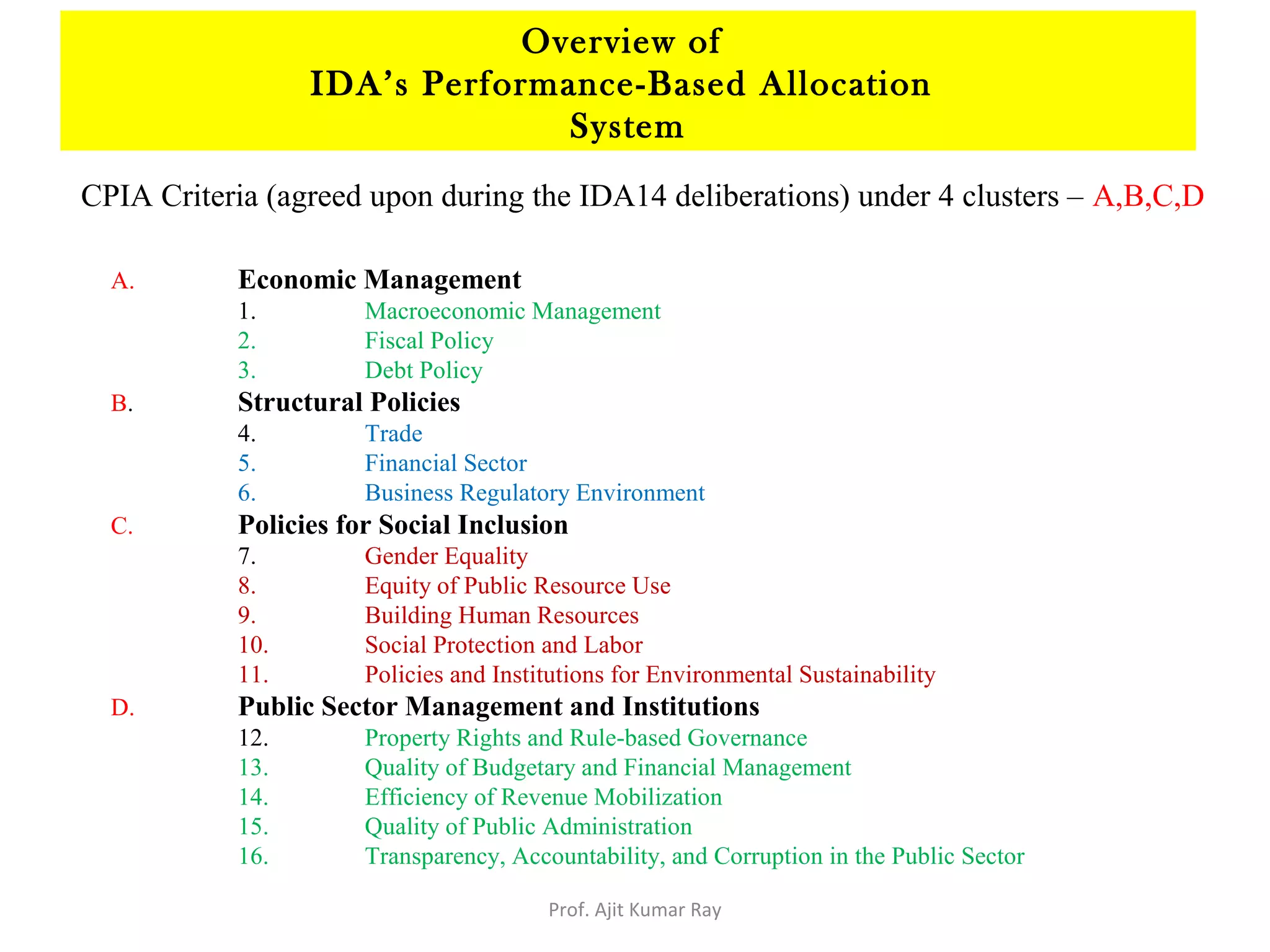
The system now comprises 16 criteria grouped in four equally
weighted clusters:
Overview of
IDA’s Performance-Based
Allocation System
Prof. Ajit Kumar Ray
A. Economic Management
1. Macroeconomic Management
2. Fiscal Policy
3. Debt Policy
B. Structural Policies
4. Trade
5. Financial Sector
6. Business Regulatory Environment
C. Policies for Social Inclusion
7. Gender Equality
8. Equity of Public Resource Use
9. Building Human Resources
10. Social Protection and Labor
11. Policies and Institutions for Environmental Sustainability
D. Public Sector Management and Institutions
12. Property Rights and Rule-based Governance
13. Quality of Budgetary and Financial Management
14. Efficiency of Revenue Mobilization
15. Quality of Public Administration
16. Transparency, Accountability, and Corruption in the Public Sector
CPIA Criteria (agreed upon during the IDA14 deliberations) under 4 clusters – A,B,C,D
Overview of
IDA’s Performance-Based Allocation
System
Prof. Ajit Kumar Ray
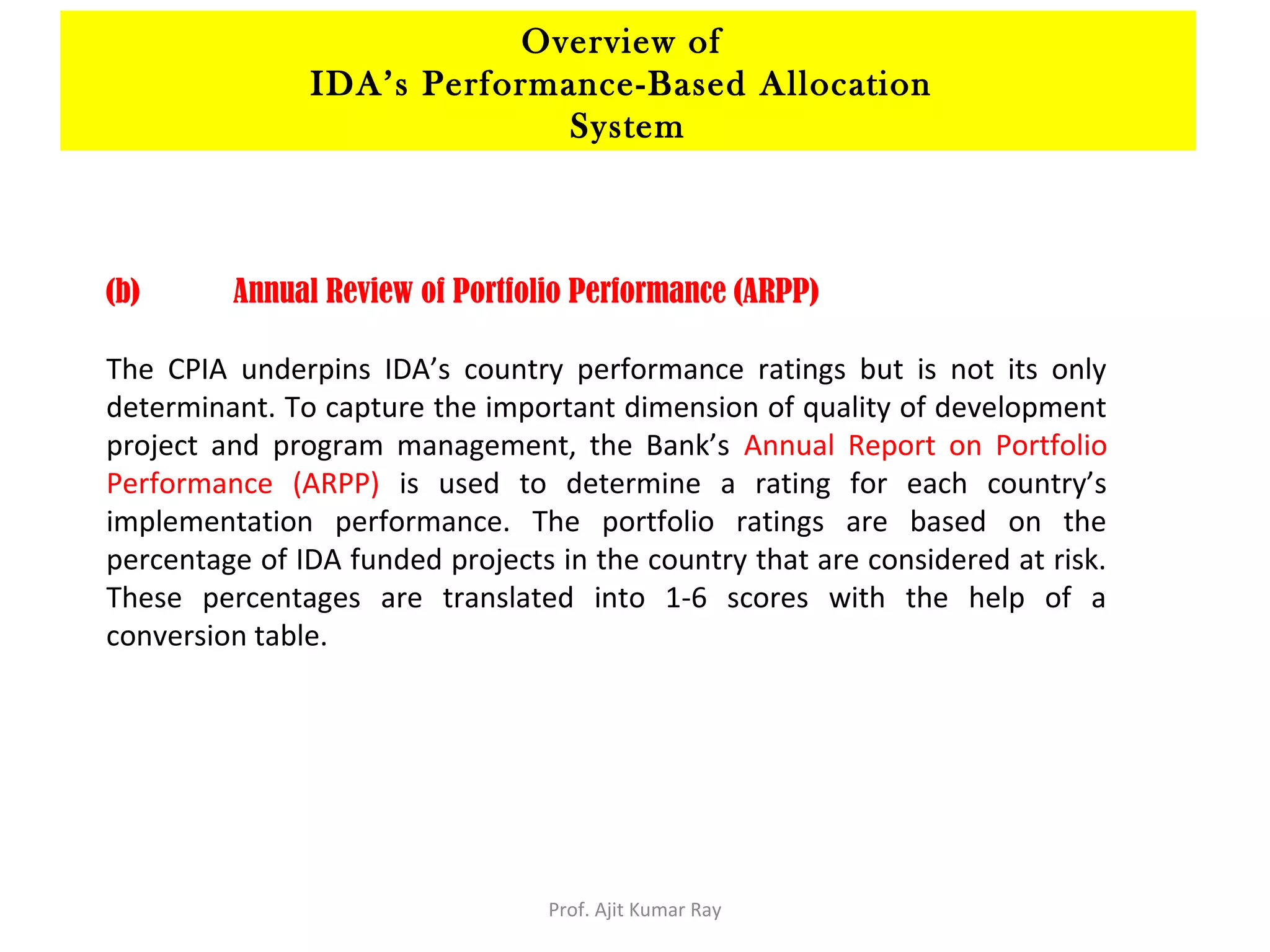
(b) Annual Review of Portfolio Performance (ARPP)
The CPIA underpins IDA’s country performance ratings but is not its only
determinant. To capture the important dimension of quality of development
project and program management, the Bank’s Annual Report on Portfolio
Performance (ARPP) is used to determine a rating for each country’s
implementation performance. The portfolio ratings are based on the
percentage of IDA funded projects in the country that are considered at risk.
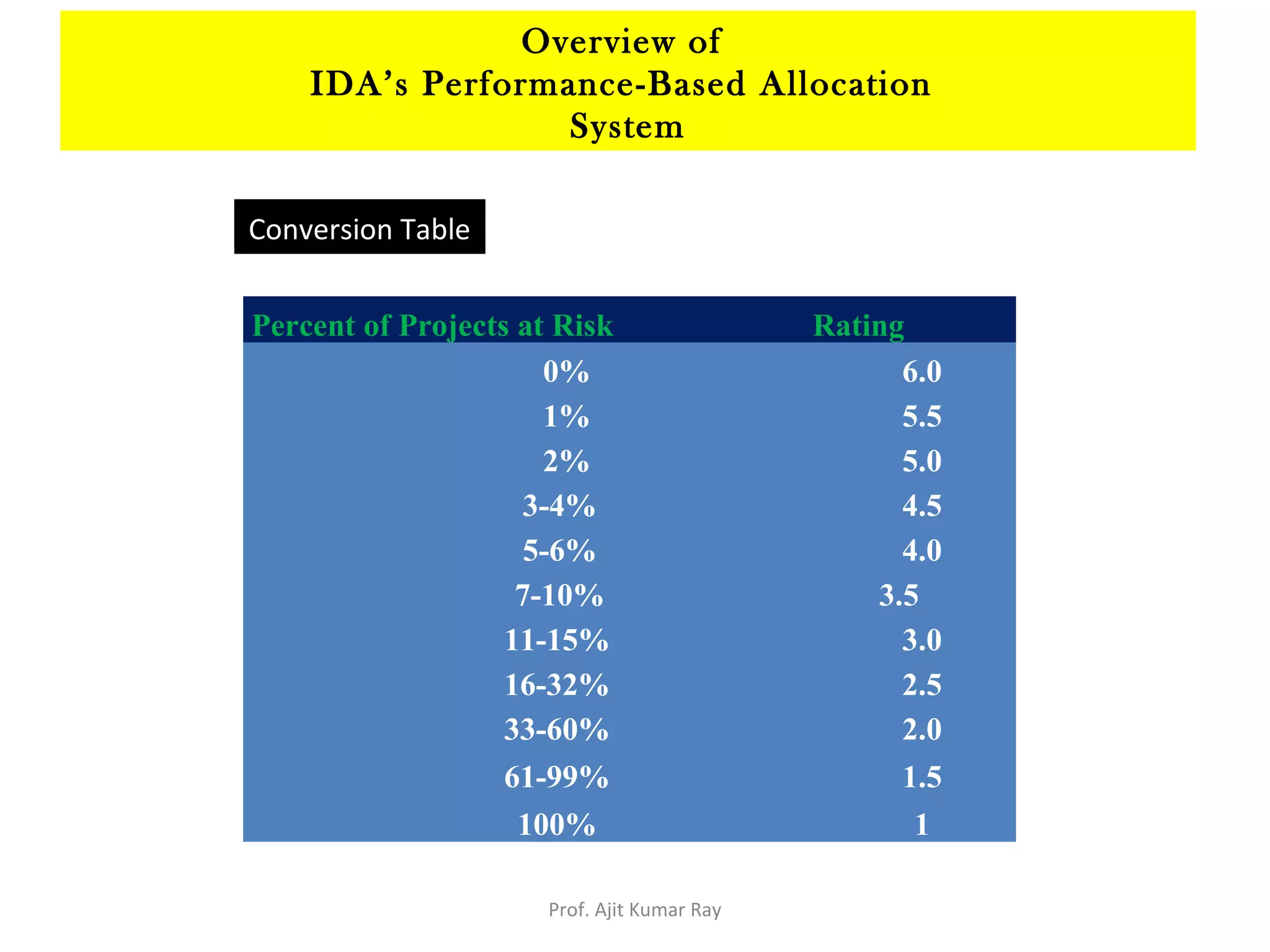
These percentages are translated into 1-6 scores with the help of a
conversion table.
Overview of
IDA’s Performance-Based Allocation
System
Prof. Ajit Kumar Ray
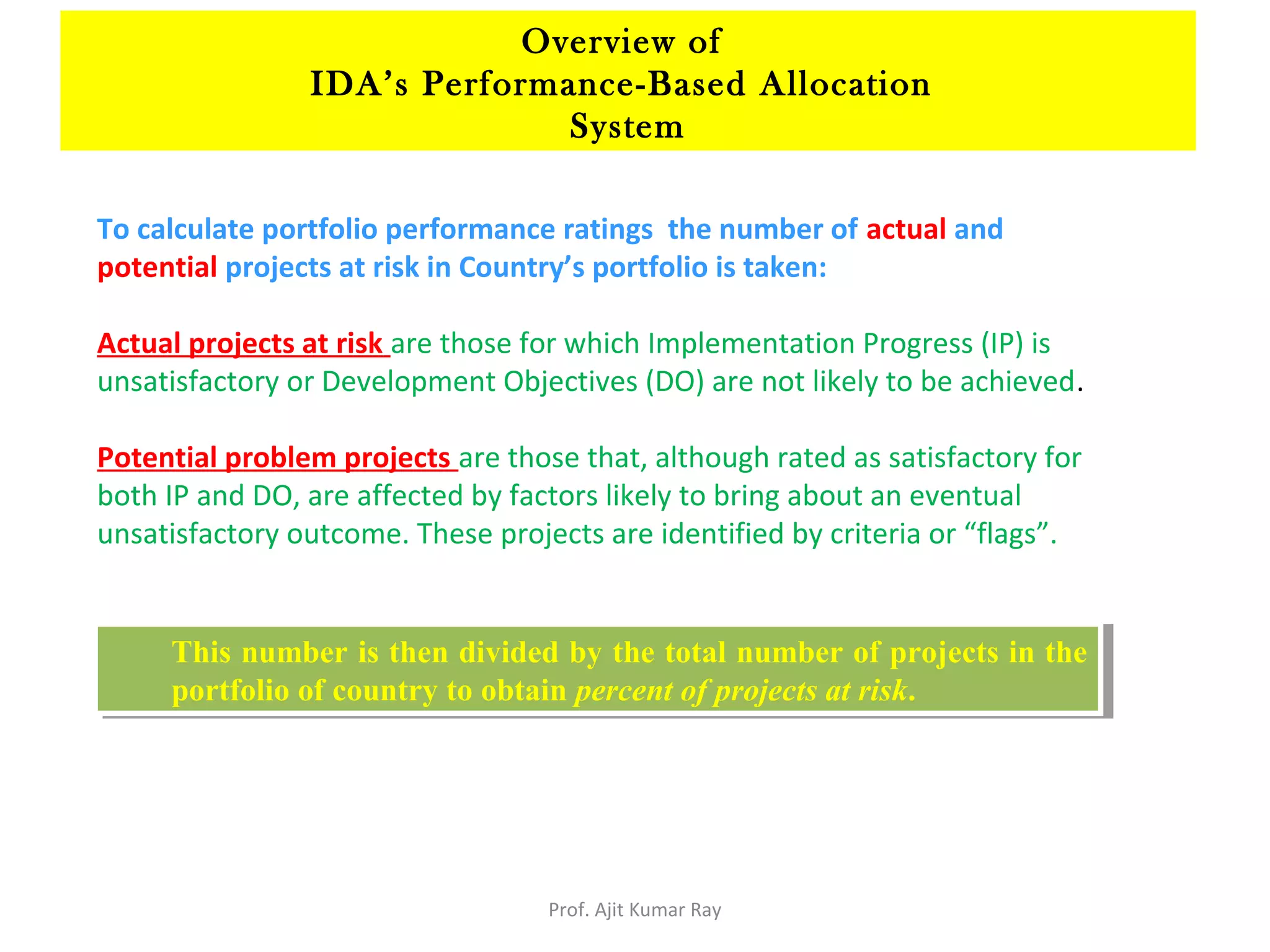
To calculate portfolio performance ratings the number of actual and
potential projects at risk in Country’s portfolio is taken:
Actual projects at risk are those for which Implementation Progress (IP) is
unsatisfactory or Development Objectives (DO) are not likely to be achieved.
Potential problem projects are those that, although rated as satisfactory for
both IP and DO, are affected by factors likely to bring about an eventual
unsatisfactory outcome. These projects are identified by criteria or “flags”.
This number is then divided by the total number of projects in the
portfolio of country to obtain percent of projects at risk.
This number is then divided by the total number of projects in the
portfolio of country to obtain percent of projects at risk.
Overview of
IDA’s Performance-Based Allocation
System
Prof. Ajit Kumar Ray
Percent of Projects at Risk Rating
0% 6.0
1% 5.5
2% 5.0
3-4% 4.5
5-6% 4.0
7-10% 3.5
11-15% 3.0
16-32% 2.5
33-60% 2.0
61-99% 1.5
100% 1
Conversion Table
Overview of
IDA’s Performance-Based Allocation
System
Prof. Ajit Kumar Ray
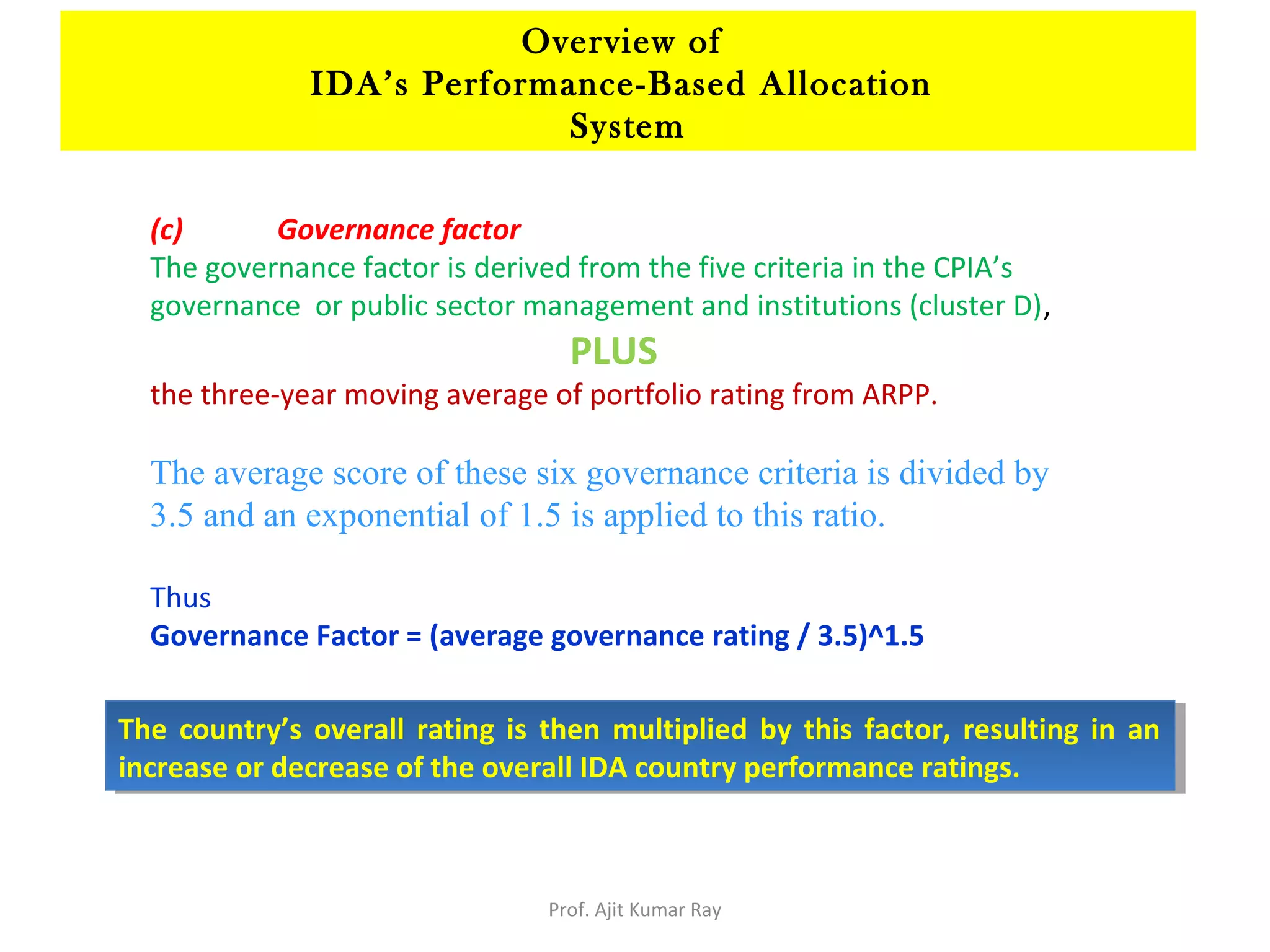
(c) Governance factor
The governance factor is derived from the five criteria in the CPIA’s
governance or public sector management and institutions (cluster D),
PLUS
the three-year moving average of portfolio rating from ARPP.
The average score of these six governance criteria is divided by
3.5 and an exponential of 1.5 is applied to this ratio.
Thus
Governance Factor = (average governance rating / 3.5)^1.5
The country’s overall rating is then multiplied by this factor, resulting in an
increase or decrease of the overall IDA country performance ratings.
The country’s overall rating is then multiplied by this factor, resulting in an
increase or decrease of the overall IDA country performance ratings.
Overview of
IDA’s Performance-Based Allocation
System
Prof. Ajit Kumar Ray
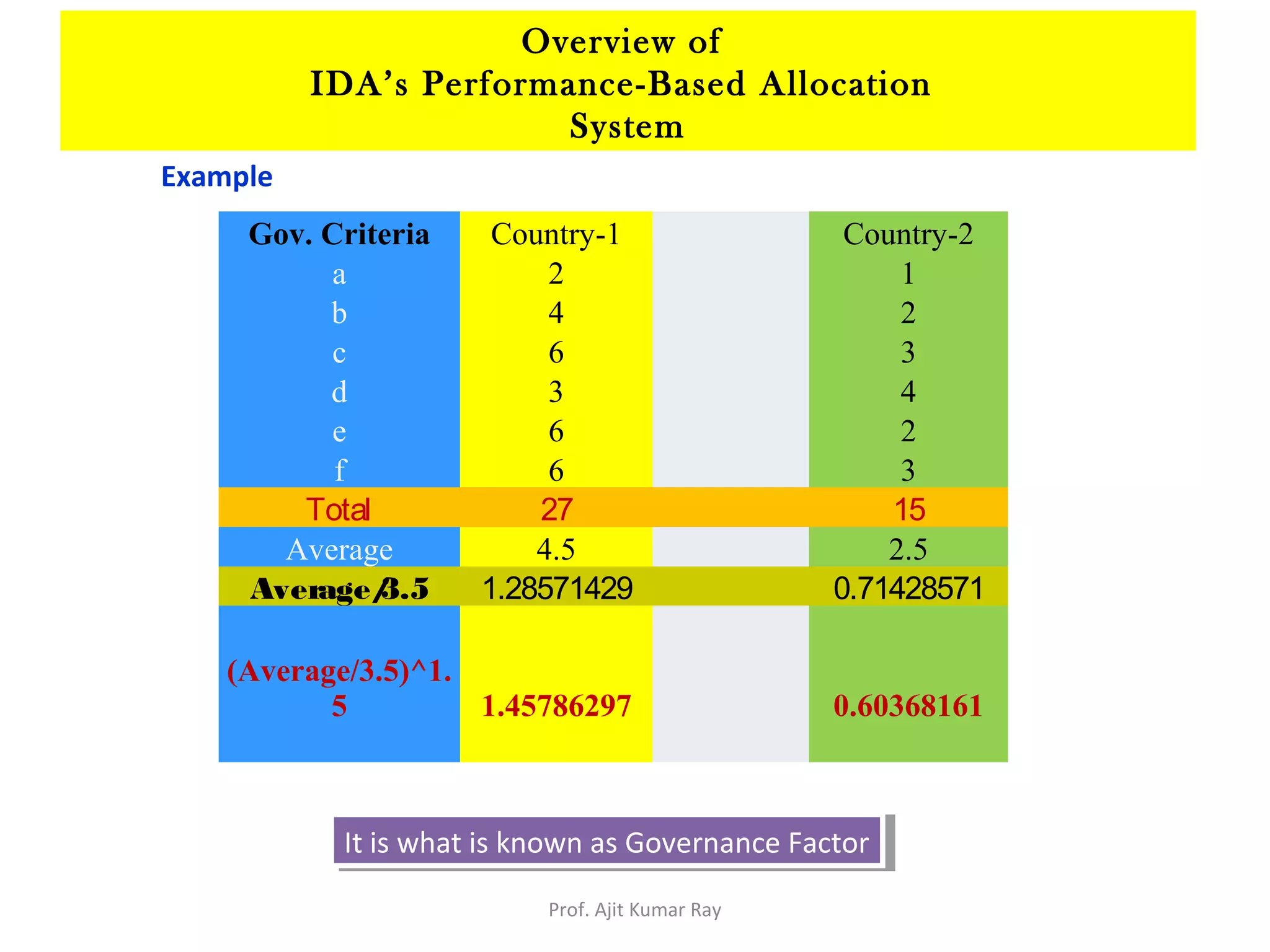
Example
Gov. Criteria Country-1 Country-2
a 2 1
b 4 2
c 6 3
d 3 4
e 6 2
f 6 3
Total 27   15
Average 4.5 2.5
Average/3.5 1.28571429   0.71428571
(Average/3.5)^1.
5 1.45786297 0.60368161
It is what is known as Governance FactorIt is what is known as Governance Factor
Overview of
IDA’s Performance-Based Allocation
System
Prof. Ajit Kumar Ray
Country performance ratings:
FIRST STEP:
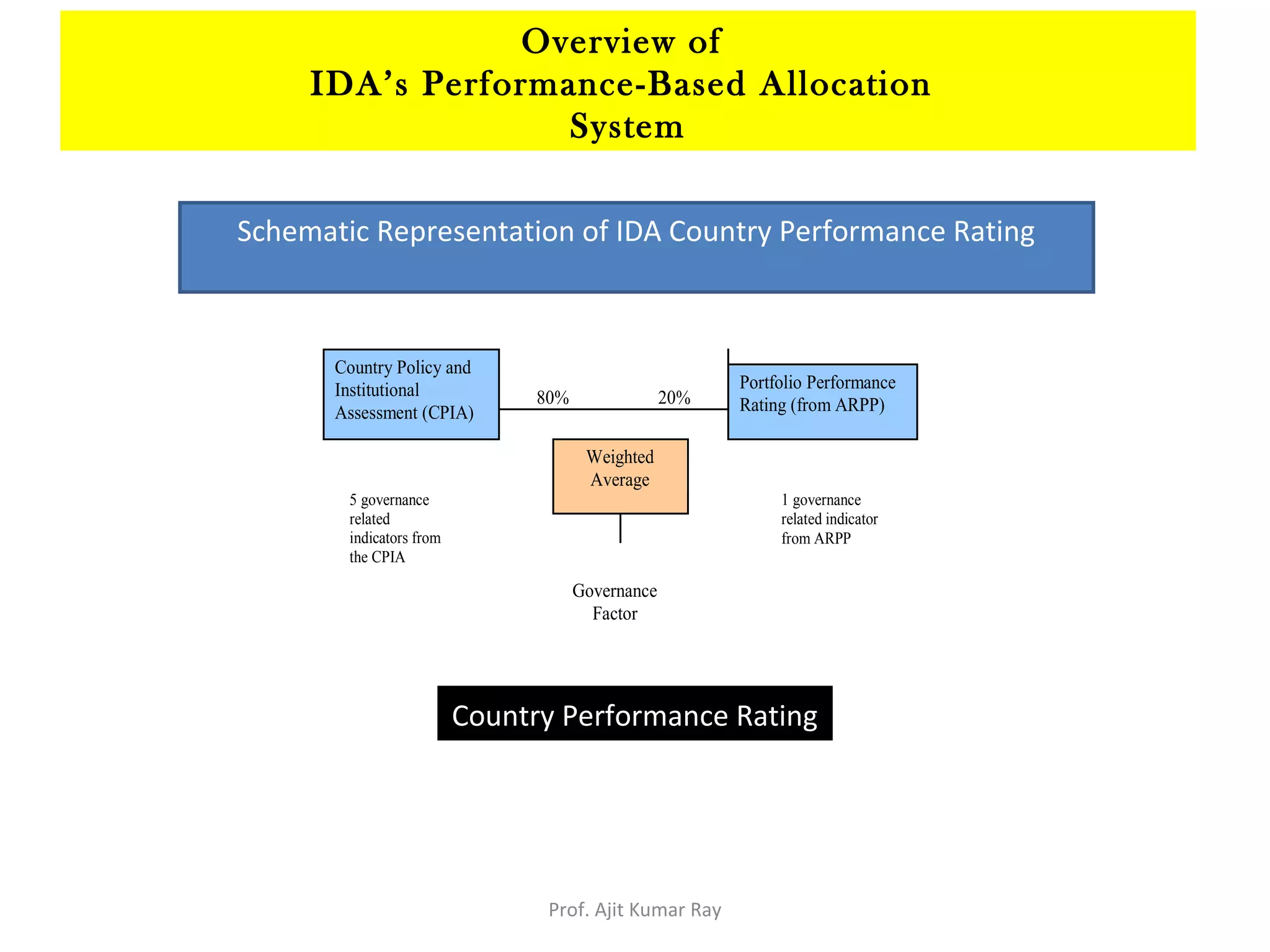
A weighted average rating is calculated of the CPIA (80 percent) and the
portfolio rating ARPP (20 percent).
SECOND STEP:
This composite rating is multiplied by the “governance factor” to
produce the country’s IDA country performance ratings.
Calculation of the country performance rating
Country performance rating = (0.8*CPIA + 0. 2*Portfolio rating)*(governance factor)
Suppose for a country X, CPIA score=3.42, ARPP score = 3.5 and Governance factor =
2.9. Then
Country performance rating = [(0.8*3.42) + (0.2*3.5)]* (2.9 / 3.5)^1.5 = 2.65
Overview of
IDA’s Performance-Based Allocation
System
Prof. Ajit Kumar Ray
-2
Weighted
Average
Chart 1: IDA Country Performance Rating
Country Policy and
Institutional
Assessment (CPIA)
80% 20%
Portfolio Performance
Rating (from ARPP)
5 governance
related
indicators from
the CPIA
Governance
Factor
1 governance
related indicator
from ARPP
Country Performance Rating
Schematic Representation of IDA Country Performance Rating
Overview of
IDA’s Performance-Based Allocation
System
Prof. Ajit Kumar Ray
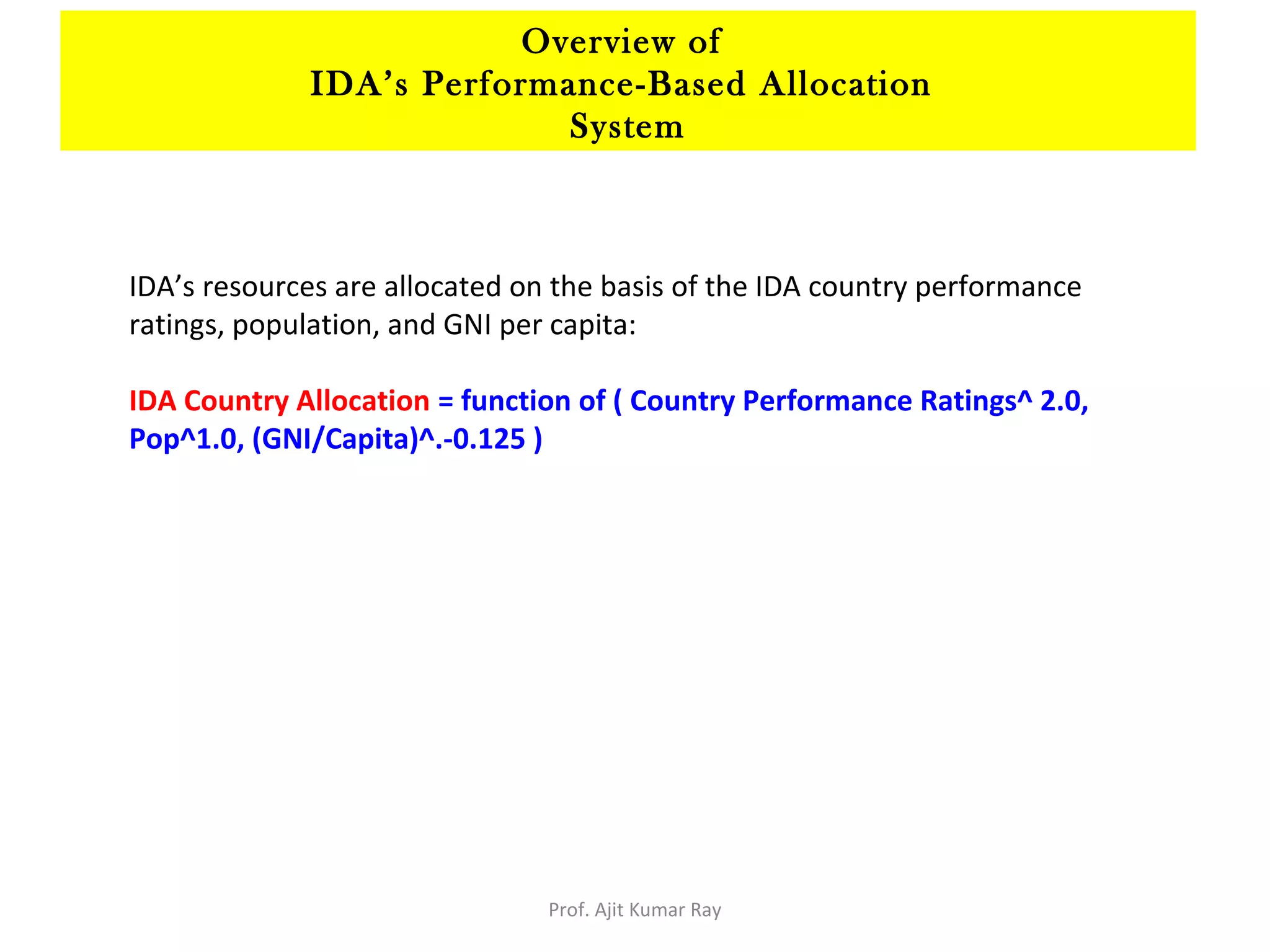
IDA’s resources are allocated on the basis of the IDA country performance
ratings, population, and GNI per capita:
IDA Country Allocation = function of ( Country Performance Ratings^ 2.0,
Pop^1.0, (GNI/Capita)^.-0.125 )
Overview of
IDA’s Performance-Based Allocation
System
Prof. Ajit Kumar Ray
Thanks for patienceThanks for patience
Prof. Ajit Kumar Ray

IDA part one & two

  • 1.
    Role of International Development Association (IDA) Role of InternationalDevelopment Association (IDA) Department of Commerce Group: Finance Special UNIVERSITY OF NORTH BENGAL 2014 Prof. Ajit Kumar Ray
  • 2.
     The InternationalDevelopment Association, IDA, is the World Bank’s fund for the poorest countries.  One of the world’s largest sources of aid  IDA provides support for o health o education o infrastructure o agriculture o economic and institutional development to the 82 countries—40 of them in Africa. Role and Functions of IDARole and Functions of IDA Prof. Ajit Kumar Ray
  • 3.
     IDA iscritical to making progress toward the 2015 Millennium Development Goals and the post-2015 agenda.  In 2013, IDA commitments totaled $16.3 billion  About one-fifth of IDA funding is provided as grants; the rest is in the form of interest-free, long-term credits.  IDA is replenished every three years by both developed and developing country donors. Two other World Bank agencies— the IBRD and IFC— make contributions to IDA.  52 countries contributed to the last IDA replenishment of $49.3 billion for the period running from July 1, 2011-June 30, 2014. Former IDA recipients like China, Egypt, Korea and Turkey are now IDA donors.  IDA is an effective way to leverage additional resources from donors, recipient governments, the private sector, and the World Bank Group, helping to scale up results and impact, as well as reducing aid fragmentation. Role and Functions of IDARole and Functions of IDA Prof. Ajit Kumar Ray
  • 4.
    The world’s poorestcountries face enormous demands for development finance that simply cannot be met through public resources. They need urgent solutions that maximize the impact of private investment, driving powerful results in job creation, infrastructure, health, education, and other key areas. The world’s poorest countries face enormous demands for development finance that simply cannot be met through public resources. They need urgent solutions that maximize the impact of private investment, driving powerful results in job creation, infrastructure, health, education, and other key areas. How IFC works with IDAHow IFC works with IDA Role and Functions of IDARole and Functions of IDA This is one of IFC’s most critical roles within the World Bank Group. They leverage private investment to support the work of the International Development Association (IDA), whose concessional loans and grants in turn complement the institution’s original lending arm IBRD Since 2005, IFC investment in IDA countries has grown six fold, reaching nearly $6 billion in fiscal year 2012. IDA countries now account for nearly half of IFC’s investment projects and 65 percent of advisory program expenditures. IFC considers its record in these countries as impressive: for every $1 in equity that IFC invested, they received a return of $1.25. They further consider that this financial performance has allowed them to contribute a significant sum to IDA replenishments—$2.2 billion so far. This is one of IFC’s most critical roles within the World Bank Group. They leverage private investment to support the work of the International Development Association (IDA), whose concessional loans and grants in turn complement the institution’s original lending arm IBRD Since 2005, IFC investment in IDA countries has grown six fold, reaching nearly $6 billion in fiscal year 2012. IDA countries now account for nearly half of IFC’s investment projects and 65 percent of advisory program expenditures. IFC considers its record in these countries as impressive: for every $1 in equity that IFC invested, they received a return of $1.25. They further consider that this financial performance has allowed them to contribute a significant sum to IDA replenishments—$2.2 billion so far. Prof. Ajit Kumar Ray
  • 5.
    It depends firstand foremost on 1. A country’s relative poverty,  defined as GNI per capita below an established threshold  updated annually  in fiscal year 2014 it is fixed at $1,205 Eligibility for IDA supportEligibility for IDA support 3. Policy performance The final criterion for IDA eligibility is a record of “good policy performance,” defined by the Bank as “the implementation of economic and social policies that promote growth and poverty reduction” 2. Non-access to private capital markets. The second requirement for IDA eligibility is a lack of creditworthiness to borrow on market terms, both from the IBRD and from private creditors. In general, IDA defines creditworthiness as “the ability to service new external debt at market interest rates over the long term” Prof. Ajit Kumar Ray
  • 6.
    There are someexceptions:  IDA also supports some countries, including several small island economies, that are above the operational cutoff but lack the creditworthiness needed to borrow from the International Bank for Reconstruction and Development (IBRD).  Some countries are IDA-eligible based on per capita income levels and are also creditworthy for some IBRD borrowing. They are referred to as “blend” countries.  Altogether 82 IDA-eligible countries, 64 IDA-only countries and 18 Blend countries are getting assistance at present. Total population of these countries is 2.8 billion (280 crores) half of the total population of the developing world. An estimated 1.8 billion (180 crores) people of these countries survive on incomes of $2 or less a day. Eligibility for IDA supportEligibility for IDA support Prof. Ajit Kumar Ray
  • 7.
    Small island economieshave been granted exceptions in maintaining their eligibility on the following basis: o small islands with less than 1.5 million people, o significant vulnerability due to size and geography, and o very limited credit-worthiness and financing options Small island economies have been granted exceptions in maintaining their eligibility on the following basis: o small islands with less than 1.5 million people, o significant vulnerability due to size and geography, and o very limited credit-worthiness and financing options Eligibility for IDA supportEligibility for IDA support Prof. Ajit Kumar Ray
  • 8.
    Africa 1 Angola 11Congo 24 Malawi 36 Sudan 2 Benin 12 Cote d'Ivoire 25 Mali 37 Tanzania 3 Burkina Faso 13 Eritrea 26 Mauritania 38 Togo 4 Burundi 14 Ethiopia 27 Mozambique 39 Uganda 5 Cameroon 15 Gambia, The 28 Niger 40 Zambia 6 Cape Verde 16 Ghana 29 Nigeria 41 Zimbabwe 7 C.A.R. 17 Guinea 30 Rwanda 8 Chad 18 Guinea-Bissau 31 Sao Tome 9 Comoros 19 Kenya 32 Senegal 10 Congo(formerly Zaire) 20 Lesotho 33 Sierra Leone 21 Liberia 34 Somalia 22 Madagascar 35 South Sudan List of Eligible Countries for IDA Assistance?List of Eligible Countries for IDA Assistance? Prof. Ajit Kumar Ray
  • 9.
      East Asia            1 Cambodia 5 Micronesia  9 Samoa  13Tuvalu 2 Kiribati  6 Mongolia 10 Solomon  14Vanuatu 3 Laos, PDR 7 Myanmar 11 Timor 15Vietnam  4 Marshall Islands  8 Papua New  Guinea 12 Tonga      Europe and Central Asia         16 Armenia  18 Georgia  20 Kyrgyz Rep 22Tajikistan 17 Bosnia- Herzegovina  19 Kosovo 21 Moldova 23Uzbekistan    Latin America and Caribbean         24 Bolivia  27 Grenada 29 Haiti 31Nicaragua 25 Dominica 28 Guyana  30 Honduras 32St Lucia  26 St Vincent                Middle East and North Africa         33 Djibouti  34 Yemen         List of Eligible Countries for IDA Assistance?List of Eligible Countries for IDA Assistance? Prof. Ajit Kumar Ray
  • 10.
      South Asia            1 Afghanistan 3 Bhutan  4 Maldives  7 Pakistan 2 Bangladesh 4 India  6 Nepal 8 Sri Lanka  List of Eligible Countries for IDA Assistance?List of Eligible Countries for IDA Assistance? Prof. Ajit Kumar Ray
  • 11.
    Sl. No. Countries 1 Mongolia 8 Georgia  2 Papua New Guinea 9 Uzbekistan  3 Timor-Leste  10 India  4 Vietnam  11 Pakistan  5 Armenia  12 Sri Lanka  6 Bolivia 13 Zimbabwe 7 Bosnia-Herzegovina        Small Islands 14 Dominica     15 St Vincent       16 Grenada       17 Cape Verde     18 St Lucia     Blend countries: IDA-eligible but also creditworthy for some IBRD borrowing Prof. Ajit Kumar Ray
  • 12.
  • 13.
  • 14.
  • 15.
  • 16.
  • 17.
  • 18.
    IDA-16 will endon 30th June, 2014 and IDA-17 will run from July 1, 2014 to June 30, 2017. IDA-16 will end on 30th June, 2014 and IDA-17 will run from July 1, 2014 to June 30, 2017. $52 Billion for World Bank’s fund for the poorest (IDA fund) is declared for IDA-17 Prof. Ajit Kumar Ray
  • 19.
  • 20.
    According to thepolicy declaration of World Bank, IDA resources are allocated to countries through a formula that considers country performance and characteristics, such as population size and Bank classification. According to the policy declaration of World Bank, IDA resources are allocated to countries through a formula that considers country performance and characteristics, such as population size and Bank classification. IDA’s Performance-Based Allocation System:IDA’s Performance-Based Allocation System: Prof. Ajit Kumar Ray
  • 21.
    The performance ofIDA countries is assessed annually using (a)the CPIA (Country Policy and Institutional Assessment) (b)the ARPP (Annual Review of Portfolio Performance) (c)The Governance factor. Overview of IDA’s Performance-Based Allocation System Prof. Ajit Kumar Ray
  • 22.
    (a) The CPIAassesses each IDA country’s  present policy and  institutional framework for  fostering poverty reduction,  sustainable growth and  ability to effectively use of development assistance. The system now comprises 16 criteria grouped in four equally weighted clusters: Overview of IDA’s Performance-Based Allocation System Prof. Ajit Kumar Ray
  • 23.
    A. Economic Management 1.Macroeconomic Management 2. Fiscal Policy 3. Debt Policy B. Structural Policies 4. Trade 5. Financial Sector 6. Business Regulatory Environment C. Policies for Social Inclusion 7. Gender Equality 8. Equity of Public Resource Use 9. Building Human Resources 10. Social Protection and Labor 11. Policies and Institutions for Environmental Sustainability D. Public Sector Management and Institutions 12. Property Rights and Rule-based Governance 13. Quality of Budgetary and Financial Management 14. Efficiency of Revenue Mobilization 15. Quality of Public Administration 16. Transparency, Accountability, and Corruption in the Public Sector CPIA Criteria (agreed upon during the IDA14 deliberations) under 4 clusters – A,B,C,D Overview of IDA’s Performance-Based Allocation System Prof. Ajit Kumar Ray
  • 24.
    (b) Annual Reviewof Portfolio Performance (ARPP) The CPIA underpins IDA’s country performance ratings but is not its only determinant. To capture the important dimension of quality of development project and program management, the Bank’s Annual Report on Portfolio Performance (ARPP) is used to determine a rating for each country’s implementation performance. The portfolio ratings are based on the percentage of IDA funded projects in the country that are considered at risk. These percentages are translated into 1-6 scores with the help of a conversion table. Overview of IDA’s Performance-Based Allocation System Prof. Ajit Kumar Ray
  • 25.
    To calculate portfolioperformance ratings the number of actual and potential projects at risk in Country’s portfolio is taken: Actual projects at risk are those for which Implementation Progress (IP) is unsatisfactory or Development Objectives (DO) are not likely to be achieved. Potential problem projects are those that, although rated as satisfactory for both IP and DO, are affected by factors likely to bring about an eventual unsatisfactory outcome. These projects are identified by criteria or “flags”. This number is then divided by the total number of projects in the portfolio of country to obtain percent of projects at risk. This number is then divided by the total number of projects in the portfolio of country to obtain percent of projects at risk. Overview of IDA’s Performance-Based Allocation System Prof. Ajit Kumar Ray
  • 26.
    Percent of Projectsat Risk Rating 0% 6.0 1% 5.5 2% 5.0 3-4% 4.5 5-6% 4.0 7-10% 3.5 11-15% 3.0 16-32% 2.5 33-60% 2.0 61-99% 1.5 100% 1 Conversion Table Overview of IDA’s Performance-Based Allocation System Prof. Ajit Kumar Ray
  • 27.
    (c) Governance factor Thegovernance factor is derived from the five criteria in the CPIA’s governance or public sector management and institutions (cluster D), PLUS the three-year moving average of portfolio rating from ARPP. The average score of these six governance criteria is divided by 3.5 and an exponential of 1.5 is applied to this ratio. Thus Governance Factor = (average governance rating / 3.5)^1.5 The country’s overall rating is then multiplied by this factor, resulting in an increase or decrease of the overall IDA country performance ratings. The country’s overall rating is then multiplied by this factor, resulting in an increase or decrease of the overall IDA country performance ratings. Overview of IDA’s Performance-Based Allocation System Prof. Ajit Kumar Ray
  • 28.
    Example Gov. Criteria Country-1Country-2 a 2 1 b 4 2 c 6 3 d 3 4 e 6 2 f 6 3 Total 27   15 Average 4.5 2.5 Average/3.5 1.28571429   0.71428571 (Average/3.5)^1. 5 1.45786297 0.60368161 It is what is known as Governance FactorIt is what is known as Governance Factor Overview of IDA’s Performance-Based Allocation System Prof. Ajit Kumar Ray
  • 29.
    Country performance ratings: FIRSTSTEP: A weighted average rating is calculated of the CPIA (80 percent) and the portfolio rating ARPP (20 percent). SECOND STEP: This composite rating is multiplied by the “governance factor” to produce the country’s IDA country performance ratings. Calculation of the country performance rating Country performance rating = (0.8*CPIA + 0. 2*Portfolio rating)*(governance factor) Suppose for a country X, CPIA score=3.42, ARPP score = 3.5 and Governance factor = 2.9. Then Country performance rating = [(0.8*3.42) + (0.2*3.5)]* (2.9 / 3.5)^1.5 = 2.65 Overview of IDA’s Performance-Based Allocation System Prof. Ajit Kumar Ray
  • 30.
    -2 Weighted Average Chart 1: IDACountry Performance Rating Country Policy and Institutional Assessment (CPIA) 80% 20% Portfolio Performance Rating (from ARPP) 5 governance related indicators from the CPIA Governance Factor 1 governance related indicator from ARPP Country Performance Rating Schematic Representation of IDA Country Performance Rating Overview of IDA’s Performance-Based Allocation System Prof. Ajit Kumar Ray
  • 31.
    IDA’s resources areallocated on the basis of the IDA country performance ratings, population, and GNI per capita: IDA Country Allocation = function of ( Country Performance Ratings^ 2.0, Pop^1.0, (GNI/Capita)^.-0.125 ) Overview of IDA’s Performance-Based Allocation System Prof. Ajit Kumar Ray
  • 32.
    Thanks for patienceThanksfor patience Prof. Ajit Kumar Ray